EP1227644A2 - Mobile phone with time zone dependent clock - Google Patents
Mobile phone with time zone dependent clock Download PDFInfo
- Publication number
- EP1227644A2 EP1227644A2 EP02250486A EP02250486A EP1227644A2 EP 1227644 A2 EP1227644 A2 EP 1227644A2 EP 02250486 A EP02250486 A EP 02250486A EP 02250486 A EP02250486 A EP 02250486A EP 1227644 A2 EP1227644 A2 EP 1227644A2
- Authority
- EP
- European Patent Office
- Prior art keywords
- time
- time zone
- base station
- mobile phone
- phone
- Prior art date
- Legal status (The legal status is an assumption and is not a legal conclusion. Google has not performed a legal analysis and makes no representation as to the accuracy of the status listed.)
- Withdrawn
Links
Images

Classifications
-
- G—PHYSICS
- G04—HOROLOGY
- G04G—ELECTRONIC TIME-PIECES
- G04G5/00—Setting, i.e. correcting or changing, the time-indication
-
- H—ELECTRICITY
- H04—ELECTRIC COMMUNICATION TECHNIQUE
- H04M—TELEPHONIC COMMUNICATION
- H04M1/00—Substation equipment, e.g. for use by subscribers
- H04M1/72—Mobile telephones; Cordless telephones, i.e. devices for establishing wireless links to base stations without route selection
- H04M1/724—User interfaces specially adapted for cordless or mobile telephones
- H04M1/72448—User interfaces specially adapted for cordless or mobile telephones with means for adapting the functionality of the device according to specific conditions
- H04M1/72451—User interfaces specially adapted for cordless or mobile telephones with means for adapting the functionality of the device according to specific conditions according to schedules, e.g. using calendar applications
-
- G—PHYSICS
- G04—HOROLOGY
- G04G—ELECTRONIC TIME-PIECES
- G04G9/00—Visual time or date indication means
- G04G9/0005—Transmission of control signals
- G04G9/0011—Transmission of control signals using coded signals
Definitions
- This invention relates to mobile communications, and specifically to the provision of a clock in a mobile phone which may be set to a specific time zone (single time zone) setting.
- the in-phone real-time clock is synchronization the precise local time given by the base station to which the phone is communicating with currently.
- This feature is known as automatic local time adjustment. Users of such a real-time clock equipped phone do not need to adjust the real-time clock, even when they move to a different time zone.
- Automatic local time adjustment may be both confusing and detrimental to users in some instances.
- a base station co-located in the user's time zone may drop service, and a base station in the next time zone may pick up service. This would, in conventional phones, change the local time shown on the phone. This may not be a serious problem, but may result in some confusion if the user relies on the phone clock for accurate time.
- PDA Personal Digital Assistant
- a base station in the other time zone picks up the phone, and changes the time.
- the PDA will not alert the user to the appointment, as the PDA will "believe" that the time for the appointment has passed.
- a mobile phone of this invention has a clock display, is in wireless communication with a base station located in a time zone having a current local time (CLT) and transportable to be in wireless communication with another base station in another time zone, and upon securing communications with a base station, synchronizes its internal clock to the CLT of the base station, and is characterized in that the mobile phone includes:
- Another mobile phone of this invention has therein a display and a PDA having events stored therein, is associated with a home service area network, is in wireless communication with a base station located in a time zone having a current local time (CLT) and transportable to be in wireless communication with another base station in another time zone, and upon securing communications with a base station synchronizes its internal clock to the CLT of the base station, and is characterized in that the mobile phone includes:
- Another mobile phone of this invention has a memory for recording events together with scheduled times for the events; and a display for displaying a real-time, events, and events' scheduled times, is transportable to time zones having respective local times, wherein upon receiving a local time from a base station located in a time zone over wireless communication, and synchronizes its internal clock to the local time, and is characterized in that the mobile phone includes a rewriting mechanism for rewriting the scheduled times according to the synchronization of the internal clock.
- Another object of the invention is to provide a means to allow a user to select either a local time zone or a home time zone to be used in a mobile phone.
- a further object of the invention is to provide, in a mobile phone, a mechanism for calculating a home time in a home time zone as a function of the local time given by a base station to which the mobile phone is connected.
- Still another object of the invention is to provide a display of events, such as a personal schedule, a call log, etc., with times set by the user-selected time zone.
- Another object of the invention is to provide, in a mobile phone, a mechanism for setting a home time zone automatically, as a function of the home system of the phone.
- Another object of the invention is to provide a mechanism for notifying a user when more than one time zone may be associated with a home system.
- a further object of the invention is to provide a mechanism allowing a user to select a single time zone as the "home time zone" from any possible time zones associated with the home system.
- a base station In digital cellular/PCS systems, such as the IS-95 CDMA system, a base station continuously broadcasts, on one of several control channels, the current local time, the local time zone and a flag for daylight savings time.
- a mobile phone attempts to retrieve the foregoing information from a received signal upon establishing physical layer synchronization with the base station, sets the base station local time in the in-phone clock, and then continues to update its local time using timing information generated by the synchronization mechanism. This ensures that the in-phone clock is precisely synchronization the time maintained by the base station and associated network.
- the base station serving the phone may be located in the next time zone, and the phone may erroneously set its clock to the time of the next time zone, which is different from that of the location of the user and phone.
- Each time zone is determined to border the adjacent ones roughly on its east and west edges based principally on the daily rotation of the earth and differ from adjacent time zones by one hour, for example.
- a system network includes base station 1, 12 and base station 2, 14.
- a mobile phone 16 includes a phone clock 18 therein, and a display 20, having a displayed clock 22 shown thereon.
- control channel signals 24, 26 are transmitted between phone 16 and base station 1 and base station 2 respectively.
- Control channel signals 24, 26 may include, among other things, a universal coordinated time (UCT) signal, a system ID (SID) signal, a network ID (NID) signal, a current local time (CLT) signal, where CLT is the local time of the time zone in which the base station is located, or a daylight savings time (DST) flag, which indicates whether daylight savings time is in effect for the location of the base station, or any of these signals and flag.
- UCT universal coordinated time
- SID system ID
- NID network ID
- CLT current local time
- DST daylight savings time
- Base station 1 is in a first time zone 28, which is six hours behind UCT, as determined at the prime meridian, while base station 2 is in a second time zone 30, which is UCT-7 hours.
- a time zone boundary 32 extends between time zone UCT-6 and UCT-7.
- base station 1 has a coverage area which extends over a relatively large portion of time zone UCT-6 and a relatively small portion of time zone UCT-7, while base station 2 has a coverage area, represented by dash-double-dot line 36, which extends over a relatively large portion of time zone UCT-7.
- Phone 16 is transportable between time zone UCT-6 and UCT-7, as well as other non-depicted time zones.
- phone 16 may be in contact with base station 1, the active base station, and may then switch to base station 2, which becomes the active base station, and may continue to switch between base stations, depending on signal strength, other traffic, geographical considerations, etc.
- phone clock 18 synchronizes with the CLT of the active base station.
- Phones not incorporating the invention hereof will change the time displayed in displayed clock 22 every time phone 16 changes active base stations.
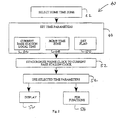
- the preferred embodiment of the instant invention resolves those problems by adding a number of features to the internal programming of mobile phone 16, the use of which is shown in Fig. 2, generally at 40.
- a user is allowed to select a home time zone (HTZ), 42, preferably from those time zones that are reachable from user's phone 16 by means of a selection mechanism incorporated into phone 16.
- the selection mechanism may take the form of software or hardware.
- the user sets time parameters 44, including selecting whether phone 16 will display the base station current local time (CLT), 46, or the home time zone, 48.
- CLT base station current local time
- DST daylight savings time
- the user may decide to use phone 16 on either local time zone, determined by a base station, or the home time zone.
- Phone 16 must still synchronize to the current local time of the active base station, 52, before the phone will indicate any of the selected time parameters, 54.
- Phone 16 of the invention includes a calculation mechanism which determines the time in the home time zone, based on the local time provided by the current base station, and to display 56 either the local time or the home time, as selected by the user.
- Display 20 will display events, such as a personal schedule, a call log, etc. 58, based on the user-selected time parameters.
- Phone 16 may further be provided with a mechanism to set a home time zone automatically based on the home base system of phone 16.
- Phone 16 of the invention includes a multiple time zone alerting mechanism to alert a user if the phone is located in a region where more than one time zone may be associated with the home service area network. If, for instance, phone 16's usual location is in an area as depicted in Fig. 1, the selection mechanism may allow the user to select one of the time zones as the home time zone from any possible time zones associated with the home system. This is accomplished by a multiple time zone discriminator, which is part of the selection mechanism.
- a user interface allows the user to (1) select a home time zone, e.g., the one where the user is usually located, and (2) select whether the home time zone or a local time zone, as acquired from the base station in current communication, is to be used.
- the user may also enable or disable daylight saving time for the home time zone, for areas that do not observe daylight saving time.
- the user selections of time parameters may be stored in the non-volatile memory. If the local time zone is selected, phone 16 displays the local time in clock 22. If the home time zone is selected, phone 16 displays the time in the home time zone, computed, after synchronization, using the difference between the local and home time zones. In this case, if the user has disabled daylight saving time, and if the base station sets the flag for daylight saving time, a pre-determined number of hours are subtracted from the computed time in the home time zone. The pre-determined number of hours is, for example, one hour, corresponding to the difference between adjacent time zones or the daylight savings time. In opposite cases where phone 16 is near the western edge of a time zone and receive signals from both base stations in the time zones, the pre-determined number of hours are added to the computed time in the home time zone.
- each event associated with time such as a call log or a scheduled event, referred to herein collectively as PDA events
- PDA events is time-stamped with the time in a pre-determined time zone, such as UCT, calculated from the local time and the local time zone.
- phone 16 converts the time in the pre-determined time zone to the one in the selected time zone, i. e., local or home.
- Phone 16 includes a PDA event controller for controlling the display of PDA events on display 20 at a time according to the user-selected time zone. This feature will prevent the skipping of events, generally scheduled within an hour of the CLT, should the phone go to an active base station in the adjacent, hour earlier time zone.
- the home time zone may be automatically set in phone 16.
- Each base station broadcasts its System ID (SID) and Network ID (NID) on one of the several control channels.
- SID System ID
- NID Network ID
- Each phone is configured with a home SID/NID pair.
- the current local time zone is the home time zone when the SID/NID pair received from a base station matches the home SID/NID programmed in the phone, and when the base station that provides the SID/NID pair is the same one as provided the current local time.
- an SID/NID pair is carried by a regional service area, which includes a number of base stations; there is, therefor, a chance that more than one time zone may be associated with an SID/NID pair. This happens if a service area extends across a time zone boundary.
- the user interface When a phone detects that multiple time zones are associated with its home SID/NID pair, the user interface notifies the user and requires selection of one of the associated time zones as the home time zone.
- this invention is applicable to any communications device equipped with a clock, including those which are too large to hand carry, but transportable in a vehicle or aircraft, for example.
- the mobile phone of this invention incorporates: a selection mechanism for use by a user to select a home time zone (HTZ), and to select a displayed time on a clock display from the group of displayed times consisting of a CLT and a time in the HTZ; and a displayed time calculating mechanism which determines the time displayed on the clock display as a function of the CLT and the HTZ.
- HTZ home time zone
- the arrangement is capable of maintaining a selected time zone setting and eliminating the inconvenience and confusion which could otherwise be caused near a time zone boundary due to an erroneous change of the in-phone clock.
Landscapes
- Engineering & Computer Science (AREA)
- Physics & Mathematics (AREA)
- General Physics & Mathematics (AREA)
- Human Computer Interaction (AREA)
- Computer Networks & Wireless Communication (AREA)
- Signal Processing (AREA)
- Mobile Radio Communication Systems (AREA)
- Telephone Function (AREA)
- Electric Clocks (AREA)
Abstract
Description
a rewriting mechanism for rewriting the scheduled times according to the synchronization of the internal clock.
Claims (10)
- A mobile phone having a clock display (22) therein, wherein the mobile phone is associated with a home service area network; is in wireless communication with a base station (14) located in a time zone (30) having a current local time (CLT), wherein the mobile phone is transportable to be in wireless communications with another base station (12) in another time zone (28), and wherein, upon securing communications with a base station (12, 14), the phone synchronizes its internal clock (18) to the CLT of the base station (12, 14); the mobile phone comprising:a selection mechanism for use by a user to select a home time zone (HTZ), and to select a displayed time on the clock display (22) from the group of displayed times consisting of the CLT and a time in the HTZ; anda displayed time calculating mechanism which determines the time displayed on the clock display (22) as a function of the CLT and the HTZ.
- The mobile phone of claim 1 wherein the phone includes a PDA, having PDA events stored therein, and which further comprises a PDA event controller for displaying PDA events in the times according to the user selected time zone.
- A mobile phone having therein a display (20) and a PDA having events stored therein, wherein the mobile phone is associated with a home service area network; is in wireless communication with a base station (14)located in a time zone (30) having a current local time (CLT), wherein the mobile phone is transportable to be in wireless communications with another base station (12) in another time zone (28), and wherein upon securing communications with a base station, the phone synchronizes its internal clock to the CLT of the base station; the mobile phone comprising:a selection mechanism for use by a user to select a time zone; anda PDA event controller for displaying PDA events in the times according to the user selected time zone.
- The mobile phone of claim 3 wherein: the selection mechanism is for use by a user to select a home time zone (HTZ), and to select a displayed time on a clock display from the group of times consisting of the CLT and a time in the HTZ; and the mobile phone further comprises a displayed time calculating mechanism which determines the time displayed on the clock display as a function of the CLT and the HTZ.
- A mobile phone having: a memory for recording events together with scheduled times for the events; and a display (20) for displaying a real-time, events, and events' scheduled times, the phone being transportable to time zones (28, 30) having respective local times, wherein upon receiving a local time from a base station located in a time zone over wireless communication, the phone synchronizes its internal clock (18) to the local time; the mobile phone comprising:a rewriting mechanism for rewriting the scheduled times according to the synchronization of the internal clock (18).
- The mobile phone of any one of claims 1 through 5 wherein the phone further comprises a home time zone setting mechanism to set automatically a home time zone to a home system of the phone.
- The mobile phone of any one of claims 1 through 6 wherein the phone further comprises a multiple time zone alerting mechanism to notify a user if the phone is located in a region where more than one time zone may be associated with a home service area network.
- The mobile phone of claim 7 wherein the phone further comprises a multiple time zone discriminator for allowing a user to select a specific time zone as the home time zone from the possible time zones associated with the home service area network.
- The mobile phone of any one of claims 1 through 8 wherein the base station transmits a control signal having carried therein at least one of a universal coordinated time (UCT) signal, a system Identification (SID) signal, a network identification (NID) signal, a CLT signal, and a daylight savings time (DST) flag.
- A transportable communications device having an internal clock and a clock display, the device being adapted for communication with a network having base stations located in different time zones and being operable upon establishing communication with a given base station to synchronize its said internal clock to the current local time (CLT) of said given base station,
the device including selection means permitting user-selection of a displayed current time based on but different from said current local time of the given base station.
Applications Claiming Priority (2)
| Application Number | Priority Date | Filing Date | Title |
|---|---|---|---|
| US770530 | 2001-01-25 | ||
| US09/770,530 US6728533B2 (en) | 2001-01-25 | 2001-01-25 | Clock for mobile phones |
Publications (2)
| Publication Number | Publication Date |
|---|---|
| EP1227644A2 true EP1227644A2 (en) | 2002-07-31 |
| EP1227644A3 EP1227644A3 (en) | 2004-02-04 |
Family
ID=25088865
Family Applications (1)
| Application Number | Title | Priority Date | Filing Date |
|---|---|---|---|
| EP02250486A Withdrawn EP1227644A3 (en) | 2001-01-25 | 2002-01-24 | Mobile phone with time zone dependent clock |
Country Status (4)
| Country | Link |
|---|---|
| US (1) | US6728533B2 (en) |
| EP (1) | EP1227644A3 (en) |
| JP (1) | JP2002271451A (en) |
| CN (1) | CN1194576C (en) |
Cited By (9)
| Publication number | Priority date | Publication date | Assignee | Title |
|---|---|---|---|---|
| KR20030084087A (en) * | 2002-04-24 | 2003-11-01 | 삼성전자주식회사 | Method for automatically updating and displaying a local time of visiting area |
| EP1816781A1 (en) * | 2006-02-02 | 2007-08-08 | Murata Kikai Kabushiki Kaisha | Network terminal device, and timestamp correcting method of the same |
| EP1883215A1 (en) * | 2006-07-27 | 2008-01-30 | Samsung Electronics Co., Ltd. | Screen displaying method of mobile terminal |
| EP1923826A1 (en) | 2006-11-16 | 2008-05-21 | Sap Ag | Methods and apparatuses for organizing events |
| WO2009030556A1 (en) * | 2007-09-07 | 2009-03-12 | Sony Ericsson Mobile Communications Ab | Dynamically assembling voice messages in a wireless communication device |
| EP1742121A3 (en) * | 2004-07-01 | 2009-03-18 | Nokia Corporation | Daylight saving time support for mobile devices |
| DE102007019219A9 (en) | 2006-04-27 | 2010-06-10 | Frank Warzecha | Mobile phone with additional function |
| WO2011056677A3 (en) * | 2009-10-28 | 2011-08-11 | Qualcomm Incorporated | Automatic selection of geographic area specific behavior |
| EP2617247A4 (en) * | 2010-09-15 | 2017-01-18 | BlackBerry Limited | Methods and apparatus to provide time zone information to a mobile station |
Families Citing this family (89)
| Publication number | Priority date | Publication date | Assignee | Title |
|---|---|---|---|---|
| DE10040035B4 (en) * | 2000-08-11 | 2005-10-06 | T-Mobile Deutschland Gmbh | Method for synchronizing the internal clock of a mobile station with the local time |
| US7260588B2 (en) * | 2001-06-22 | 2007-08-21 | Werner Raymond J | Location-based operations for information handling systems |
| US20030169642A1 (en) * | 2002-03-08 | 2003-09-11 | Quartex, Inc., A Division Of Primex, Inc. | Time keeping system with automatic daylight savings time adjustment |
| US20030169641A1 (en) * | 2002-03-08 | 2003-09-11 | Quartex A Division Of Primex, Inc. | Time keeping system with automatic daylight savings time adjustment |
| US7411869B2 (en) * | 2001-09-21 | 2008-08-12 | Quartex, Division Of Primex, Inc. | Wireless synchronous time system |
| JP3563721B2 (en) * | 2001-09-21 | 2004-09-08 | 株式会社東芝 | Information processing apparatus and clock display control method used in the information processing apparatus |
| US7369462B2 (en) * | 2001-09-21 | 2008-05-06 | Quartex, Division Of Primex, Inc. | Wireless synchronous time system with solar powered transceiver |
| CA2460995A1 (en) * | 2001-09-21 | 2003-03-27 | Quartex, Inc. | Time keeping system with automatic daylight savings time adjustment |
| US6873573B2 (en) | 2001-09-21 | 2005-03-29 | Quartex, Inc. | Wireless synchronous time system |
| TW500988B (en) * | 2001-10-04 | 2002-09-01 | Wedid Inc | System and method for updating time in different areas |
| US7127271B1 (en) | 2001-10-18 | 2006-10-24 | Iwao Fujisaki | Communication device |
| US7107081B1 (en) | 2001-10-18 | 2006-09-12 | Iwao Fujisaki | Communication device |
| US7466992B1 (en) | 2001-10-18 | 2008-12-16 | Iwao Fujisaki | Communication device |
| US7711855B2 (en) * | 2002-06-19 | 2010-05-04 | Siebel Systems, Inc. | Method and device for processing a time-related data entry |
| BR0316604A (en) * | 2002-12-13 | 2005-10-11 | Research In Motion Ltd | Method and apparatus for providing sms message consistency that formats mobile communication devices |
| US7443767B2 (en) * | 2003-01-09 | 2008-10-28 | Avaya Inc. | Apparatus and method for updating a schedule |
| US8229512B1 (en) | 2003-02-08 | 2012-07-24 | Iwao Fujisaki | Communication device |
| US8241128B1 (en) | 2003-04-03 | 2012-08-14 | Iwao Fujisaki | Communication device |
| JP4469339B2 (en) * | 2003-07-16 | 2010-05-26 | 京セラ株式会社 | Telephone, method and program for displaying local time of destination |
| US8090402B1 (en) | 2003-09-26 | 2012-01-03 | Iwao Fujisaki | Communication device |
| US7917167B1 (en) | 2003-11-22 | 2011-03-29 | Iwao Fujisaki | Communication device |
| US7518958B2 (en) * | 2003-12-17 | 2009-04-14 | Sharp Laboratories Of America, Inc. | GPS-assisted mobile phone clock for use in non-digital service coverage areas |
| US7720467B2 (en) * | 2003-12-17 | 2010-05-18 | Sharp Laboratories Of America, Inc. | User notification for digital mobile phones |
| JPWO2005062137A1 (en) * | 2003-12-24 | 2008-01-17 | シチズンホールディングス株式会社 | Radio correction clock, electronic device and time correction method |
| KR100557104B1 (en) * | 2004-01-14 | 2006-03-03 | 삼성전자주식회사 | Dual mode mobile communication terminal for displaying visual information and method thereof |
| US8041348B1 (en) | 2004-03-23 | 2011-10-18 | Iwao Fujisaki | Communication device |
| DE602004021298D1 (en) * | 2004-11-03 | 2009-07-09 | Ericsson Telefon Ab L M | METHOD AND UNIT FOR EQUIPPING A MOBILE STATION WITH NETWORK IDENTITY INFORMATION |
| KR100605168B1 (en) * | 2004-11-23 | 2006-07-31 | 삼성전자주식회사 | Automatic time setting method and digital broadcasting receiver |
| US8208954B1 (en) | 2005-04-08 | 2012-06-26 | Iwao Fujisaki | Communication device |
| KR100651522B1 (en) * | 2005-12-14 | 2006-11-30 | 삼성전자주식회사 | Method and apparatus for synchronizing time information in a mobile communication terminal |
| US20070206838A1 (en) * | 2006-02-22 | 2007-09-06 | Fouquet Julie E | Time synchronous biometric authentication |
| KR100724879B1 (en) * | 2006-03-06 | 2007-06-04 | 삼성전자주식회사 | How to update the summer time information of your mobile device |
| KR100678077B1 (en) * | 2006-03-24 | 2007-02-02 | 삼성전자주식회사 | Apparatus and method for synchronizing time of digital broadcast receiving terminal |
| KR101286811B1 (en) * | 2006-05-25 | 2013-07-17 | 삼성전자주식회사 | Method of providing layer structure for organizing screen and method of providing screen and the mobile communication terminal therefor |
| US7664527B2 (en) * | 2006-08-04 | 2010-02-16 | At&T Mobility Ii Llc | Network identity and timezone (NITZ) functionality for non-3GPP devices |
| WO2008020537A1 (en) * | 2006-08-16 | 2008-02-21 | Nec Corporation | Portable terminal, function list providing method used for the same, and its program |
| KR101384902B1 (en) * | 2006-12-15 | 2014-04-15 | 삼성전자주식회사 | Method and apparatus for preventing omission of schedule and overlapping execution due to change in time |
| US20080178150A1 (en) * | 2007-01-19 | 2008-07-24 | Microsoft Corporation | Complex time zone techniques |
| US8559983B1 (en) | 2007-05-03 | 2013-10-15 | Iwao Fujisaki | Communication device |
| US7890089B1 (en) | 2007-05-03 | 2011-02-15 | Iwao Fujisaki | Communication device |
| US8249616B2 (en) * | 2007-08-23 | 2012-08-21 | Texas Instruments Incorporated | Satellite (GPS) assisted clock apparatus, circuits, systems and processes for cellular terminals on asynchronous networks |
| US8676273B1 (en) | 2007-08-24 | 2014-03-18 | Iwao Fujisaki | Communication device |
| US8639214B1 (en) | 2007-10-26 | 2014-01-28 | Iwao Fujisaki | Communication device |
| US8472935B1 (en) | 2007-10-29 | 2013-06-25 | Iwao Fujisaki | Communication device |
| US8744720B1 (en) | 2007-12-27 | 2014-06-03 | Iwao Fujisaki | Inter-vehicle middle point maintaining implementer |
| US8009519B2 (en) * | 2008-02-28 | 2011-08-30 | Hewlett-Packard Development Company, L.P. | Apparatus and methods for maintaining a reliable time clock on a mobile computing device supporting satellite based position determination capability |
| US8543157B1 (en) | 2008-05-09 | 2013-09-24 | Iwao Fujisaki | Communication device which notifies its pin-point location or geographic area in accordance with user selection |
| US8340726B1 (en) | 2008-06-30 | 2012-12-25 | Iwao Fujisaki | Communication device |
| US8452307B1 (en) | 2008-07-02 | 2013-05-28 | Iwao Fujisaki | Communication device |
| KR20100043618A (en) * | 2008-10-20 | 2010-04-29 | 삼성전자주식회사 | Image processing apparatus and method of controlling thereof |
| US8996004B2 (en) * | 2008-10-29 | 2015-03-31 | Qualcomm Incorporated | Methods and systems for manual cell selection in boundary area for wireless devices |
| JP4678057B2 (en) * | 2009-01-09 | 2011-04-27 | カシオ計算機株式会社 | Time information receiver, radio clock, and program |
| CN101600249B (en) * | 2009-06-22 | 2011-12-28 | 中兴通讯股份有限公司 | Method and device for achieving summer time of CDMA system |
| JP5392177B2 (en) * | 2010-05-12 | 2014-01-22 | セイコーエプソン株式会社 | Electronics |
| WO2013188945A1 (en) | 2012-06-18 | 2013-12-27 | Research In Motion Limited | Methods and apparatuses for processing time zone identifiers |
| US9204249B2 (en) | 2012-09-06 | 2015-12-01 | Apple Inc. | Using a location to refine network-provided time zone information |
| EP4036685A1 (en) | 2014-06-27 | 2022-08-03 | Apple Inc. | Reduced size user interface |
| EP3195098B1 (en) | 2014-07-21 | 2024-10-23 | Apple Inc. | Remote user interface |
| JP6322765B2 (en) | 2014-08-02 | 2018-05-09 | アップル インコーポレイテッド | Context-specific user interface |
| US10452253B2 (en) | 2014-08-15 | 2019-10-22 | Apple Inc. | Weather user interface |
| JP2017527033A (en) | 2014-09-02 | 2017-09-14 | アップル インコーポレイテッド | User interface for receiving user input |
| WO2016036481A1 (en) | 2014-09-02 | 2016-03-10 | Apple Inc. | Reduced-size user interfaces for dynamically updated application overviews |
| EP4668726A3 (en) | 2014-09-02 | 2026-03-25 | Apple Inc. | Phone user interface |
| JP6202017B2 (en) * | 2015-02-24 | 2017-09-27 | カシオ計算機株式会社 | Electronic timepiece, communication system and program |
| US10055121B2 (en) | 2015-03-07 | 2018-08-21 | Apple Inc. | Activity based thresholds and feedbacks |
| WO2016144385A1 (en) | 2015-03-08 | 2016-09-15 | Apple Inc. | Sharing user-configurable graphical constructs |
| US10739971B2 (en) | 2015-06-05 | 2020-08-11 | Apple Inc. | Accessing and displaying information corresponding to past times and future times |
| US9916075B2 (en) | 2015-06-05 | 2018-03-13 | Apple Inc. | Formatting content for a reduced-size user interface |
| US10304347B2 (en) | 2015-08-20 | 2019-05-28 | Apple Inc. | Exercised-based watch face and complications |
| JP6451666B2 (en) * | 2016-03-01 | 2019-01-16 | カシオ計算機株式会社 | Communication device, electronic timepiece, communication method, and program |
| US12175065B2 (en) | 2016-06-10 | 2024-12-24 | Apple Inc. | Context-specific user interfaces for relocating one or more complications in a watch or clock interface |
| US10637986B2 (en) | 2016-06-10 | 2020-04-28 | Apple Inc. | Displaying and updating a set of application views |
| DK201770423A1 (en) | 2016-06-11 | 2018-01-15 | Apple Inc | Activity and workout updates |
| DK179412B1 (en) | 2017-05-12 | 2018-06-06 | Apple Inc | Context-Specific User Interfaces |
| US11327650B2 (en) | 2018-05-07 | 2022-05-10 | Apple Inc. | User interfaces having a collection of complications |
| US11960701B2 (en) | 2019-05-06 | 2024-04-16 | Apple Inc. | Using an illustration to show the passing of time |
| US11131967B2 (en) | 2019-05-06 | 2021-09-28 | Apple Inc. | Clock faces for an electronic device |
| KR102393717B1 (en) | 2019-05-06 | 2022-05-03 | 애플 인크. | Restricted operation of an electronic device |
| DK180392B1 (en) | 2019-09-09 | 2021-03-12 | Apple Inc | Techniques for managing display usage |
| EP4439263A3 (en) | 2020-05-11 | 2024-10-16 | Apple Inc. | User interfaces for managing user interface sharing |
| DK202070625A1 (en) | 2020-05-11 | 2022-01-04 | Apple Inc | User interfaces related to time |
| US11372659B2 (en) | 2020-05-11 | 2022-06-28 | Apple Inc. | User interfaces for managing user interface sharing |
| US11694590B2 (en) | 2020-12-21 | 2023-07-04 | Apple Inc. | Dynamic user interface with time indicator |
| US11720239B2 (en) | 2021-01-07 | 2023-08-08 | Apple Inc. | Techniques for user interfaces related to an event |
| US12182373B2 (en) | 2021-04-27 | 2024-12-31 | Apple Inc. | Techniques for managing display usage |
| US11921992B2 (en) | 2021-05-14 | 2024-03-05 | Apple Inc. | User interfaces related to time |
| US12493267B2 (en) | 2022-01-24 | 2025-12-09 | Apple Inc. | User interfaces for indicating time |
| US12578975B2 (en) | 2022-09-15 | 2026-03-17 | Apple Inc. | User interfaces for indicating time |
| US20250238129A1 (en) | 2024-01-18 | 2025-07-24 | Apple Inc. | User interfaces integrating hardware buttons |
Family Cites Families (15)
| Publication number | Priority date | Publication date | Assignee | Title |
|---|---|---|---|---|
| US5151932A (en) | 1987-11-17 | 1992-09-29 | Oki Electric Industry Co., Ltd. | Method and system for selectively communicating with a telephone or a non-telephone terminal through a public telephone network |
| US5212810A (en) | 1989-06-19 | 1993-05-18 | Nec Corporation | Terminal equipment of a vehicle radio telephone system |
| JP3005266B2 (en) | 1990-09-07 | 2000-01-31 | 日本電気株式会社 | Car phone equipment |
| EP0565927B1 (en) * | 1992-03-26 | 2000-11-08 | Nec Corporation | Automatic time zone adjustment in a mobile telephone |
| US5528558A (en) | 1994-01-07 | 1996-06-18 | Mardhekar; Dhananjay V. | International time indicating system |
| DE69616848T2 (en) * | 1995-03-08 | 2002-06-06 | Ibm | Method for calculating the current local time in a cellular mobile radio system |
| CA2188330C (en) * | 1995-12-12 | 2001-04-24 | Michael D. Bamburak | A method for selecting a wireless communications service provider in a multi-service provider environment |
| US5845257A (en) | 1996-02-29 | 1998-12-01 | Starfish Software, Inc. | System and methods for scheduling and tracking events across multiple time zones |
| US5818920A (en) | 1996-12-04 | 1998-10-06 | Telefonaktiebolaget Lm Ericsson | Apparatus for controlling communication connections based on local time |
| US6075992A (en) * | 1997-10-22 | 2000-06-13 | Ericsson Inc. | Apparatus and method for automatically handling initiation of a call by a portable intelligent communications device |
| DE19804188A1 (en) * | 1998-02-03 | 1999-08-05 | Siemens Ag | Radio |
| US6246886B1 (en) * | 1998-12-21 | 2001-06-12 | Bell Atlantic Mobile | System and methods for controlling access to digital wireless network in a dual mode wireless system |
| US6434403B1 (en) * | 1999-02-19 | 2002-08-13 | Bodycom, Inc. | Personal digital assistant with wireless telephone |
| GB2347313A (en) * | 1999-02-22 | 2000-08-30 | Nokia Mobile Phones Ltd | Mobile telephone having means for displaying local time |
| US6505052B1 (en) * | 2000-02-01 | 2003-01-07 | Qualcomm, Incorporated | System for transmitting and receiving short message service (SMS) messages |
-
2001
- 2001-01-25 US US09/770,530 patent/US6728533B2/en not_active Expired - Lifetime
-
2002
- 2002-01-23 JP JP2002014757A patent/JP2002271451A/en active Pending
- 2002-01-24 EP EP02250486A patent/EP1227644A3/en not_active Withdrawn
- 2002-01-25 CN CNB021070741A patent/CN1194576C/en not_active Expired - Fee Related
Cited By (11)
| Publication number | Priority date | Publication date | Assignee | Title |
|---|---|---|---|---|
| KR20030084087A (en) * | 2002-04-24 | 2003-11-01 | 삼성전자주식회사 | Method for automatically updating and displaying a local time of visiting area |
| EP1742121A3 (en) * | 2004-07-01 | 2009-03-18 | Nokia Corporation | Daylight saving time support for mobile devices |
| US7821875B2 (en) | 2004-07-01 | 2010-10-26 | Nokia Corporation | Daylight saving time support for mobile devices |
| EP1816781A1 (en) * | 2006-02-02 | 2007-08-08 | Murata Kikai Kabushiki Kaisha | Network terminal device, and timestamp correcting method of the same |
| DE102007019219A9 (en) | 2006-04-27 | 2010-06-10 | Frank Warzecha | Mobile phone with additional function |
| EP1883215A1 (en) * | 2006-07-27 | 2008-01-30 | Samsung Electronics Co., Ltd. | Screen displaying method of mobile terminal |
| EP1923826A1 (en) | 2006-11-16 | 2008-05-21 | Sap Ag | Methods and apparatuses for organizing events |
| US7774224B2 (en) | 2006-11-16 | 2010-08-10 | Sap Ag | Methods and apparatuses for organizing events |
| WO2009030556A1 (en) * | 2007-09-07 | 2009-03-12 | Sony Ericsson Mobile Communications Ab | Dynamically assembling voice messages in a wireless communication device |
| WO2011056677A3 (en) * | 2009-10-28 | 2011-08-11 | Qualcomm Incorporated | Automatic selection of geographic area specific behavior |
| EP2617247A4 (en) * | 2010-09-15 | 2017-01-18 | BlackBerry Limited | Methods and apparatus to provide time zone information to a mobile station |
Also Published As
| Publication number | Publication date |
|---|---|
| CN1370030A (en) | 2002-09-18 |
| JP2002271451A (en) | 2002-09-20 |
| US20020098857A1 (en) | 2002-07-25 |
| US6728533B2 (en) | 2004-04-27 |
| EP1227644A3 (en) | 2004-02-04 |
| CN1194576C (en) | 2005-03-23 |
Similar Documents
| Publication | Publication Date | Title |
|---|---|---|
| US6728533B2 (en) | Clock for mobile phones | |
| KR100679555B1 (en) | Daylight Saving Time Support for Mobile Devices | |
| US6282431B1 (en) | Time correcting method and portable remote telephone terminal in which time is corrected in accordance with such method | |
| EP1818739A2 (en) | Device and method for managing time information | |
| US6584316B1 (en) | Handoff of phone calls from wireless to wireline network | |
| US6044265A (en) | Methods and apparatus for cellular set programming | |
| EP0932973B1 (en) | Local time manager | |
| US5812950A (en) | Cellular telephone system having prioritized greetings for predefined services to a subscriber | |
| US5914668A (en) | Wireless terminal controlled mobility operational parameters | |
| US6684068B1 (en) | Method for transmitting a message to a mobile station | |
| EP0731621A2 (en) | Method for computing current local time in a cellular mobile radio system | |
| JPH08167936A (en) | Portable telephone set dealing with plural telephone numbers | |
| CA2102740C (en) | Paging receiver equipped with a display | |
| US7450970B2 (en) | Apparatus and method for managing user data in a mobile terminal | |
| EP1240769A2 (en) | Time synchronization in a cellular network device | |
| US7720467B2 (en) | User notification for digital mobile phones | |
| JP2002159071A (en) | Method for communicating with telephone between portable object having time measuring function and telephone set and special purpose server and portable object for executing the same | |
| JP3105824B2 (en) | Radio selective call receiver | |
| JP2000125341A (en) | Portable mobile terminal, base station and communication management system | |
| US6101370A (en) | Method and apparatus used in a simulcast radio communication system for providing improved local time | |
| KR20010083617A (en) | A mobile station with a notifying function of discount charge area and a mobile communication system using the same | |
| EP1042906A2 (en) | A system having tariff information features | |
| KR100770978B1 (en) | Method for automatically changing the incoming call mode in the mobile communication terminal | |
| JP3028971B2 (en) | Cordless telephone equipment | |
| KR20030084087A (en) | Method for automatically updating and displaying a local time of visiting area |
Legal Events
| Date | Code | Title | Description |
|---|---|---|---|
| PUAI | Public reference made under article 153(3) epc to a published international application that has entered the european phase |
Free format text: ORIGINAL CODE: 0009012 |
|
| AK | Designated contracting states |
Kind code of ref document: A2 Designated state(s): AT BE CH CY DE DK ES FI FR GB GR IE IT LI LU MC NL PT SE TR |
|
| AX | Request for extension of the european patent |
Free format text: AL;LT;LV;MK;RO;SI |
|
| PUAL | Search report despatched |
Free format text: ORIGINAL CODE: 0009013 |
|
| AK | Designated contracting states |
Kind code of ref document: A3 Designated state(s): AT BE CH CY DE DK ES FI FR GB GR IE IT LI LU MC NL PT SE TR |
|
| AX | Request for extension of the european patent |
Extension state: AL LT LV MK RO SI |
|
| RIC1 | Information provided on ipc code assigned before grant |
Ipc: 7G 04G 5/00 B Ipc: 7G 04G 9/00 B Ipc: 7H 04M 1/725 A |
|
| 17P | Request for examination filed |
Effective date: 20040305 |
|
| 17Q | First examination report despatched |
Effective date: 20040419 |
|
| AKX | Designation fees paid |
Designated state(s): DE FR GB IT |
|
| 17Q | First examination report despatched |
Effective date: 20040419 |
|
| STAA | Information on the status of an ep patent application or granted ep patent |
Free format text: STATUS: THE APPLICATION IS DEEMED TO BE WITHDRAWN |
|
| 18D | Application deemed to be withdrawn |
Effective date: 20160330 |