EP1227629A1 - Wireless system and method to improve efficiency of a slave-to-slave communication in a master-slave configuration - Google Patents
Wireless system and method to improve efficiency of a slave-to-slave communication in a master-slave configuration Download PDFInfo
- Publication number
- EP1227629A1 EP1227629A1 EP20020250170 EP02250170A EP1227629A1 EP 1227629 A1 EP1227629 A1 EP 1227629A1 EP 20020250170 EP20020250170 EP 20020250170 EP 02250170 A EP02250170 A EP 02250170A EP 1227629 A1 EP1227629 A1 EP 1227629A1
- Authority
- EP
- European Patent Office
- Prior art keywords
- master device
- wireless communication
- master
- slot usage
- temporary
- Prior art date
- Legal status (The legal status is an assumption and is not a legal conclusion. Google has not performed a legal analysis and makes no representation as to the accuracy of the status listed.)
- Granted
Links
Images



Classifications
-
- H—ELECTRICITY
- H04—ELECTRIC COMMUNICATION TECHNIQUE
- H04W—WIRELESS COMMUNICATION NETWORKS
- H04W84/00—Network topologies
- H04W84/18—Self-organising networks, e.g. ad-hoc networks or sensor networks
- H04W84/20—Leader-follower arrangements
-
- H—ELECTRICITY
- H04—ELECTRIC COMMUNICATION TECHNIQUE
- H04W—WIRELESS COMMUNICATION NETWORKS
- H04W24/00—Supervisory, monitoring or testing arrangements
-
- H—ELECTRICITY
- H04—ELECTRIC COMMUNICATION TECHNIQUE
- H04W—WIRELESS COMMUNICATION NETWORKS
- H04W4/00—Services specially adapted for wireless communication networks; Facilities therefor
- H04W4/24—Accounting or billing
-
- H—ELECTRICITY
- H04—ELECTRIC COMMUNICATION TECHNIQUE
- H04W—WIRELESS COMMUNICATION NETWORKS
- H04W74/00—Wireless channel access
- H04W74/04—Scheduled access
-
- H—ELECTRICITY
- H04—ELECTRIC COMMUNICATION TECHNIQUE
- H04W—WIRELESS COMMUNICATION NETWORKS
- H04W88/00—Devices specially adapted for wireless communication networks, e.g. terminals, base stations or access point devices
- H04W88/02—Terminal devices
Definitions
- the present invention relates to a wireless communication apparatus, a wireless communication system employing the same and a control method thereof that uses a slot efficiently and enables communication between slave devices by selecting a temporary master device according to an amount of slot usage in the wireless communication apparatuses that are connected to the wireless communication system.
- Figure 1 shows the structure of a Piconet in a typical Bluetooth communication system.
- the Bluetooth communication system has a plurality of slave devices S10, S20, S30 and S40 connected to one master device M10.
- a network i.e., a network in which at least one slave device such as S10, S20, S30 and S40, is connected to one master M10, is called a Piconet.
- a maximum of seven slave devices in an active state can be connected to the master device M10.
- FIG. 2(a) shows the structure of a conventional packet which is transmitted in the Piconet shown in Figure 1
- Figure 2(b) shows a header portion of the packet of Figure 1 in greater detail.
- the current Bluetooth communication method employs a master driven TDD (Time Division Duplex) type, system in which the master device transmits a packet designating a specific slave device, from a group of slave devices. The specific slave device subsequently transmits a data recorded packet to the master device as a response. Since the communication is carried out only between the specific slave device and the master device, the other slave devices cannot communicate with each other.
- TDD Time Division Duplex
- One conventional method is a master-slave switching method. This method is performed between the master device and the slave device such that one of the slave devices acts as the master device thereby enabling communication with the other slave devices.
- Another method is a destination address recording method, in which an address of a destination slave to which the packet should be finally sent, is recorded in an AM_ADDR (Active Member Address) part of the packet header area, and an address of a slave device which transmits the packet is recorded in a payload area of the packet.
- AM_ADDR Active Member Address
- Figure 3 shows an example of the packet according to the destination address recording method.
- the master device analyzes the destination address of the received packet and transmits the packet to the corresponding destination. Accordingly, peer-to-peer communication is performed among the slave devices, albeit via the master device.
- the master device analyzes and sends the received packets to the destination slaves every time the master device receives the packets.
- this method of slave to slave communication is time consuming and it wastes packets.
- the destination address recording method requires more packets than are required for the communication between the slave and master devices.
- the present invention is proposed to improve the foregoing problems associated with peer-to peer communication. It is, therefore, an aim of the present invention to provide a wireless communication apparatus capable of supporting efficient peer-to-peer communication.
- a wireless communication apparatus comprising: a transceiving unit for receiving and transmitting data; and a controller for analyzing a destination of a packet received for a certain period of time, detecting an amount of slot usage according to the destination, selecting a temporary master device according to the amount of slot usage, and transferring a role of master to the selected temporary master device.
- the apparatus comprises a memory for storing the amount of slot usage of the wireless communication apparatus.
- the wireless communication apparatus is operated as a master device.
- the controller selects the temporary master device that corresponds to the destination having the largest amount of slot usage.
- the controller continuously acts as a master device for a certain period of time if the controller has the largest amount of slot usage.
- the controller is connected to a host via a communication interface.
- a wireless communication system comprising: a master device for analyzing a destination of a packet , detecting an amount of slot usage according to the destination, selecting a temporary master device according to the amount of slot usage, and transferring a role of master to the selected temporary master device; and at least one slave device connected with the master device, if selected as the temporary master device, the slave device taking the role of master from the master device and acting as the temporary master device for a predetermined period of time.
- the master device selects the temporary master device that corresponds to a destination having the largest amount of slot usage.
- the temporary master device continuously maintains the role of master device for the predetermined period of time if the master device is the device that has the largest amount of slot usage.
- a control method of a wireless communication system having a master device and at least one slave device connected with the master device, the method comprising the steps of: (a) in the master device, analyzing a packet received for a period of time and detecting an amount of slot usage according to a destination; and (b) in the master device, selecting a temporary master device according to the amount of slot usage and transferring a role of master to the selected temporary master device.
- the step (b) comprises selecting the temporary master device that corresponds to a destination having the largest amount of slot usage.
- the master device continuously maintains the role of master device for a certain period of time if the master device is the device that has the largest amount of slot usage in the step (b).
- a control method of a wireless communication system having a master device and at least one slave device connected with the master device, the method including: (a) having the master device (M10) operable to analyze a packet received for a period of time and detecting an amount of slot usage according to a destination; and (b) in the master device, selecting a temporary master device according to the amount of slot usage and transferring a role of master to the selected temporary master device.
- M10 master device
- step (b) comprises selecting the temporary master device that corresponds to a destination having the largest amount of slot usage.
- the master device is operable to continuously maintain the role of master for said period of time if the master device is the device that has the largest amount of slot usage in (b).
- a wireless communication method for selecting a temporary master device comprising the steps of: (a) initializing a number of slot usage according to slave devices and a switching period; (b) receiving a packet from the slave devices connected to a Piconet, and increasing the number of slot usage according to a destination recorded in the packet; (c) determining whether or not a switching period has passed as wireless communication apparatuses mutually send/receive a plurality of packets;(d) selecting a certain device which has the largest number of slot usage and making the certain device a temporary master device; and (e) determining whether or not the certain device, selected to be the temporary master device, is a current master.
- steps (a) through (e) are repeated.
- the certain device selected to be the temporary master device is not a current master, transferring a role of master from a master device to the temporary master device through master-slave switching.
- the wireless communication apparatus designated by 30 has a transceiving unit 31, a memory 32 and a controller 33.
- the transceiving unit 31 processes a received signal such as an RF (Radio Frequency) signal and sends a transmission-intended packet to the outside.
- a received signal such as an RF (Radio Frequency) signal
- Memory 32 stores an amount of slot usage of the wireless communication apparatus connected to a Piconet.
- Figure 6 shows an example of the memory shown in Figure 4.
- Controller 33 is connected with host 50 through a communication interface.
- the host 50 can be various communication terminals such as a notebook computer, a mobile telephone, a printer, or the like.
- the controller 33 processes a signal requested from the host 50, and a signal received via the transceiving unit 31.
- the controller 33 stores an amount of slot usage of the slave devices corresponding to a destination, which is recorded in the packet received in the memory 32 via the transceiving unit 31 during one master-slave switching period.
- the controller selects the device having the largest amount of slot usage as a temporary master device.
- the controller 33 performs a mutual master-slave switching to transfer a role of a master to the selected temporary master device. Accordingly, the temporary master device acts as the master device during the next master-slave switching period.
- controller 33 continuously acts as the master device for a certain period of time if controller 33 is determined to be the one that has the largest amount of slot usage and is thus, selected as the temporary master device.
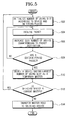
- Figure 5 illustrates a process of selecting the temporary master device in accordance with the present invention.
- the wireless communication apparatus 30, acting as the master, is applied to the Piconet to which a number of wireless communication apparatuses are connected.
- the wireless communication apparatus 30 initializes the number of slot usage according to the devices and the switching period.
- the master-slave switching period is a time for a mutual switching between the master device and the slave device, which is checked as the wireless communication apparatus 30 starts to send/receive packets to/from other wireless communication apparatuses connected therewith.
- the wireless communication apparatus 30 acting as the master receives packets from the slave devices connected to the Piconet (step 504), and increases the number of slot for the wireless communication apparatuses (including itself) connected to the Piconet according to the destination recorded in the packet (step 506).
- the packet has a different number of slots according to the type of the packet.
- DM1, DM3 and DM5 packets use 1, 3 and 5 slots, respectively.
- a master (M10) item of the memory 32 For example, if the DM3 packet is received and the address of the master is recorded in the destination address of the packet, three (3) slots are accumulated in a master (M10) item of the memory 32.
- slave 1 (S10) item of the memory if the DM1 packet is received and the address of slave 1 is recorded in the destination address of the packet, one (1) slot is accumulated in slave 1 (S10) item of the memory.
- the switching period ends as the wireless communication apparatuses mutually send/receive the packets (step 508), one device having the largest number of slot usage is detected from the memory and selected as the temporary master device (step 510).
- step 512 it is determined whether or not the device selected as the temporary master is the current master.
- the master device and the device selected as the temporary master perform the master-slave switching to transfer the role of master to the device selected as the temporary master (step 514).
- the slot number is calculated according to the device, and the role of master is transferred to the device having the largest slot number. Accordingly, the peer-to-peer communication can be carried out among the devices acting as the slave, and at the same time, the wireless source can be efficiently used.
Landscapes
- Engineering & Computer Science (AREA)
- Computer Networks & Wireless Communication (AREA)
- Signal Processing (AREA)
- Mobile Radio Communication Systems (AREA)
- Small-Scale Networks (AREA)
Abstract
Description
- The present invention relates to a wireless communication apparatus, a wireless communication system employing the same and a control method thereof that uses a slot efficiently and enables communication between slave devices by selecting a temporary master device according to an amount of slot usage in the wireless communication apparatuses that are connected to the wireless communication system.
- Figure 1 shows the structure of a Piconet in a typical Bluetooth communication system.
- Referring to Figure 1, the Bluetooth communication system has a plurality of slave devices S10, S20, S30 and S40 connected to one master device M10. Such a network, i.e., a network in which at least one slave device such as S10, S20, S30 and S40, is connected to one master M10, is called a Piconet. In the Piconet, a maximum of seven slave devices in an active state can be connected to the master device M10.
- In the Piconet, the master device M10 and the slave devices S10, S20, S30 and S40 communicate through packets. Figure 2(a) shows the structure of a conventional packet which is transmitted in the Piconet shown in Figure 1, and Figure 2(b) shows a header portion of the packet of Figure 1 in greater detail.
- The current Bluetooth communication method employs a master driven TDD (Time Division Duplex) type, system in which the master device transmits a packet designating a specific slave device, from a group of slave devices. The specific slave device subsequently transmits a data recorded packet to the master device as a response. Since the communication is carried out only between the specific slave device and the master device, the other slave devices cannot communicate with each other.
- Therefore, several methods have been proposed to enable inter-slave communication, namely, peer-to-peer communication between slave devices.
- One conventional method is a master-slave switching method. This method is performed between the master device and the slave device such that one of the slave devices acts as the master device thereby enabling communication with the other slave devices.
- Another method is a destination address recording method, in which an address of a destination slave to which the packet should be finally sent, is recorded in an AM_ADDR (Active Member Address) part of the packet header area, and an address of a slave device which transmits the packet is recorded in a payload area of the packet.
- Figure 3 shows an example of the packet according to the destination address recording method. When one slave device sends an address of another slave device, desired for communication as recorded in the destination address, the master device analyzes the destination address of the received packet and transmits the packet to the corresponding destination. Accordingly, peer-to-peer communication is performed among the slave devices, albeit via the master device.
- According to the destination address recording method, the master device analyzes and sends the received packets to the destination slaves every time the master device receives the packets. However, because communication among the slave devices is frequently carried out this method of slave to slave communication is time consuming and it wastes packets. This is because the destination address recording method requires more packets than are required for the communication between the slave and master devices.
- The present invention is proposed to improve the foregoing problems associated with peer-to peer communication. It is, therefore, an aim of the present invention to provide a wireless communication apparatus capable of supporting efficient peer-to-peer communication.
- According to a first aspect of the present invention there is provided a wireless communication apparatus comprising: a transceiving unit for receiving and transmitting data; and a controller for analyzing a destination of a packet received for a certain period of time, detecting an amount of slot usage according to the destination, selecting a temporary master device according to the amount of slot usage, and transferring a role of master to the selected temporary master device.
- Preferably the apparatus comprises a memory for storing the amount of slot usage of the wireless communication apparatus.
- Preferably, the wireless communication apparatus is operated as a master device.
- Preferably, the controller selects the temporary master device that corresponds to the destination having the largest amount of slot usage.
- Preferably, the controller continuously acts as a master device for a certain period of time if the controller has the largest amount of slot usage.
- Preferably, the controller is connected to a host via a communication interface.
- According to a second aspect of the present invention there is provided a wireless communication system comprising: a master device for analyzing a destination of a packet , detecting an amount of slot usage according to the destination, selecting a temporary master device according to the amount of slot usage, and transferring a role of master to the selected temporary master device; and at least one slave device connected with the master device, if selected as the temporary master device, the slave device taking the role of master from the master device and acting as the temporary master device for a predetermined period of time.
- Preferably, the master device selects the temporary master device that corresponds to a destination having the largest amount of slot usage.
- Preferably, the temporary master device continuously maintains the role of master device for the predetermined period of time if the master device is the device that has the largest amount of slot usage.
- According to a third aspect of the present invention there is provided a control method of a wireless communication system having a master device and at least one slave device connected with the master device, the method comprising the steps of: (a) in the master device, analyzing a packet received for a period of time and detecting an amount of slot usage according to a destination; and (b) in the master device, selecting a temporary master device according to the amount of slot usage and transferring a role of master to the selected temporary master device.
- Preferably, the step (b) comprises selecting the temporary master device that corresponds to a destination having the largest amount of slot usage.
- Preferably, the master device continuously maintains the role of master device for a certain period of time if the master device is the device that has the largest amount of slot usage in the step (b).
- According to a fourth aspect of the present invention there is provided a control method of a wireless communication system having a master device and at least one slave device connected with the master device, the method including: (a) having the master device (M10) operable to analyze a packet received for a period of time and detecting an amount of slot usage according to a destination; and (b) in the master device, selecting a temporary master device according to the amount of slot usage and transferring a role of master to the selected temporary master device.
- Preferably, step (b) comprises selecting the temporary master device that corresponds to a destination having the largest amount of slot usage.
- Preferably, the master device is operable to continuously maintain the role of master for said period of time if the master device is the device that has the largest amount of slot usage in (b).
- According to a fifth aspect of the present invention there is provided a wireless communication method for selecting a temporary master device, the wireless communication method comprising the steps of: (a) initializing a number of slot usage according to slave devices and a switching period; (b) receiving a packet from the slave devices connected to a Piconet, and increasing the number of slot usage according to a destination recorded in the packet; (c) determining whether or not a switching period has passed as wireless communication apparatuses mutually send/receive a plurality of packets;(d) selecting a certain device which has the largest number of slot usage and making the certain device a temporary master device; and (e) determining whether or not the certain device, selected to be the temporary master device, is a current master.
- Preferably, if it is determined that the certain device selected to be the temporary master device is a current master, steps (a) through (e) are repeated.
- Preferably, if it is determined that the certain device selected to be the temporary master device is not a current master, transferring a role of master from a master device to the temporary master device through master-slave switching.
- For a better understanding of the invention, and to show how embodiments of the same may be carried into effect, reference will now be made, by way of example, to the accompanying diagrammatic drawings in which:
- Figure 1 shows the structure of a Piconet in a conventional Bluetooth communication system;
- Figure 2(a) shows the structure of a conventional packet which is transmitted in the Piconet of Figure 1;
- Figure 2(b) shows a header area of Figure 1 in greater detail;
- Figure 3 shows the structure of a packet according to a destination address recording method;
- Figure 4 is a block diagram for showing a wireless communication apparatus according to the invention;
- Figure 5 is a flow chart for showing a process of selecting a temporary master when the wireless communication apparatus of Figure 4 acts as a master; and
- Figure 6 shows an example of a memory of Figure 4.
-
- Referring to Figure 4, the wireless communication apparatus designated by 30 has a transceiving
unit 31, amemory 32 and acontroller 33. - The transceiving
unit 31 processes a received signal such as an RF (Radio Frequency) signal and sends a transmission-intended packet to the outside. -
Memory 32 stores an amount of slot usage of the wireless communication apparatus connected to a Piconet. Figure 6 shows an example of the memory shown in Figure 4. -
Controller 33 is connected withhost 50 through a communication interface. Here, thehost 50 can be various communication terminals such as a notebook computer, a mobile telephone, a printer, or the like. - The
controller 33 processes a signal requested from thehost 50, and a signal received via the transceivingunit 31. - Also, the
controller 33 stores an amount of slot usage of the slave devices corresponding to a destination, which is recorded in the packet received in thememory 32 via the transceivingunit 31 during one master-slave switching period. The controller selects the device having the largest amount of slot usage as a temporary master device. - The
controller 33 performs a mutual master-slave switching to transfer a role of a master to the selected temporary master device. Accordingly, the temporary master device acts as the master device during the next master-slave switching period. - Here,
controller 33 continuously acts as the master device for a certain period of time ifcontroller 33 is determined to be the one that has the largest amount of slot usage and is thus, selected as the temporary master device. - Figure 5 illustrates a process of selecting the temporary master device in accordance with the present invention. The
wireless communication apparatus 30, acting as the master, is applied to the Piconet to which a number of wireless communication apparatuses are connected. - In
step 502, thewireless communication apparatus 30 initializes the number of slot usage according to the devices and the switching period. Here, the master-slave switching period is a time for a mutual switching between the master device and the slave device, which is checked as thewireless communication apparatus 30 starts to send/receive packets to/from other wireless communication apparatuses connected therewith. - The
wireless communication apparatus 30 acting as the master receives packets from the slave devices connected to the Piconet (step 504), and increases the number of slot for the wireless communication apparatuses (including itself) connected to the Piconet according to the destination recorded in the packet (step 506). - Here, the packet has a different number of slots according to the type of the packet. In other words, DM1, DM3 and DM5 packets use 1, 3 and 5 slots, respectively.
- For example, if the DM3 packet is received and the address of the master is recorded in the destination address of the packet, three (3) slots are accumulated in a master (M10) item of the
memory 32. - Also, if the DM1 packet is received and the address of
slave 1 is recorded in the destination address of the packet, one (1) slot is accumulated in slave 1 (S10) item of the memory. - Then, if the switching period ends as the wireless communication apparatuses mutually send/receive the packets (step 508), one device having the largest number of slot usage is detected from the memory and selected as the temporary master device (step 510).
- In
step 512, it is determined whether or not the device selected as the temporary master is the current master. - If the device selected as the temporary master is not the current master, the master device and the device selected as the temporary master perform the master-slave switching to transfer the role of master to the device selected as the temporary master (step 514).
- However, if the master selected as the temporary master is the current master, the foregoing steps are repeated.
- According to the wireless communication system employing such a wireless communication apparatus and the method thereof, the slot number is calculated according to the device, and the role of master is transferred to the device having the largest slot number. Accordingly, the peer-to-peer communication can be carried out among the devices acting as the slave, and at the same time, the wireless source can be efficiently used.
- It is apparent that the present invention is not restricted to the foregoing embodiment and can be modified by those skilled in the art. Therefore, the scope of the invention is not limited to the scope of the detailed description, but will be defined by the following claims.
- The reader's attention is directed to all papers and documents which are filed concurrently with or previous to this specification in connection with this application and which are open to public inspection with this specification, and the contents of all such papers and documents are incorporated herein by reference.
- All of the features disclosed in this specification (including any accompanying claims, abstract and drawings), and/or all of the steps of any method or process so disclosed, may be combined in any combination, except combinations where at least some of such features and/or steps are mutually exclusive.
- Each feature disclosed in this specification (including any accompanying claims, abstract and drawings), may be replaced by alternative features serving the same, equivalent or similar purpose, unless expressly stated otherwise. Thus, unless expressly stated otherwise, each feature disclosed is one example only of a generic series of equivalent or similar features.
- The invention is not restricted to the details of the foregoing embodiment(s). The invention extends to any novel one, or any novel combination, of the features disclosed in this specification (including any accompanying claims, abstract and drawings), or to any novel one, or any novel combination, of the steps of any method or process so disclosed.
Claims (18)
- A wireless communication apparatus comprising:a transceiving unit for receiving and transmitting data (31); anda controller (33) for analyzing a destination of a packet received for a certain period of time, detecting an amount of slot usage according to the destination, selecting a temporary master device according to the amount of slot usage, and transferring a role of master to the selected temporary master device.
- The wireless communication apparatus of claim 1, comprising a memory (32) for storing the amount of slot usage of the wireless communication apparatus.
- The wireless communication apparatus of claim 1 or 2, wherein the wireless communication apparatus is operated as a master device.
- The wireless communication apparatus of claim 1, 2 or 3 wherein the controller (33) selects the temporary master device that corresponds to the destination having the largest amount of slot usage.
- A wireless communication apparatus of claim 1, 2, 3 or 4 wherein the controller (33) continuously acts as a master device for a certain period of time if the controller has the largest amount of slot usage.
- The wireless communication apparatus of any of claims 1 to 5, wherein the controller (33) is connected to a host via a communication interface.
- A wireless communication system comprising:a master device (M10) for analyzing a destination of a packet , detecting an amount of slot usage according to the destination, selecting a temporary master device according to the amount of slot usage, and transferring a role of master to the selected temporary master device; andat least one slave device (S10,S20) connected with the master device, if selected as the temporary master device, the slave device taking the role of master from the master device and acting as the temporary master device for a predetermined period of time.
- The wireless communication system of claim 7, wherein the master device (M10) selects the temporary master device that corresponds to a destination having the largest amount of slot usage.
- The wireless communication system of claim 7 or 8, wherein the temporary master device (M10) continuously maintains the role of master device for the predetermined period of time if the master device is the device that has the largest amount of slot usage.
- A control method of a wireless communication system having a master device and at least one slave device connected with the master device, the method comprising the steps of:(a) in the master device (M10), analyzing a packet received for a period of time and detecting an amount of slot usage according to a destination; and(b) in the master device, selecting a temporary master device according to the amount of slot usage and transferring a role of master to the selected temporary master device (S10,S20).
- The control method of claim 10, wherein the step (b) comprises selecting the temporary master device that corresponds to a destination having the largest amount of slot usage.
- The control method of claim 10, wherein the master device continuously maintains the role of master device for a certain period of time if the master device is the device that has the largest amount of slot usage in the step (b).
- A control method of a wireless communication system having a master device and at least one slave device connected with the master device, the method including:(a) having the master device (M10) operable to analyze a packet received for a period of time and detecting an amount of slot usage according to a destination; and(b) in the master device, selecting a temporary master device according to the amount of slot usage and transferring a role of master to the selected temporary master device.
- The control method of claim 13, wherein step (b) comprises selecting the temporary master device that corresponds to a destination having the largest amount of slot usage.
- The control method of claim 13, wherein the master device is operable to continuously maintain the role of master for said period of time if the master device is the device that has the largest amount of slot usage in (b).
- A wireless communication method for selecting a temporary master device, the wireless communication method comprising the steps of:(a) initializing a number of slot usage according to slave devices (S10,S20) and a switching period;(b) receiving a packet from the slave devices (S10,S20) connected to a Piconet, and increasing the number of slot usage according to a destination recorded in the packet;(c) determining whether or not a switching period has passed as wireless communication apparatuses mutually send/receive a plurality of packets;(d) selecting a certain device (S10) which has the largest number of slot usage and making the certain device a temporary master device; and(e) determining whether or not the certain device, selected to be the temporary master device, is a current master.
- The wireless communication method of claim 16, wherein if it is determined that the certain device selected to be the temporary master device is a current master, steps (a) through (e) are repeated.
- The wireless communication method of claim 16, wherein if it is determined that the certain device selected to be the temporary master device is not a current master, transferring a role of master from a master device to the temporary master device through master-slave switching.
Applications Claiming Priority (2)
| Application Number | Priority Date | Filing Date | Title |
|---|---|---|---|
| KR2001004294 | 2001-01-30 | ||
| KR20010004294A KR100726425B1 (en) | 2001-01-30 | 2001-01-30 | Wireless communication device, wireless communication system using same and control method thereof |
Publications (2)
| Publication Number | Publication Date |
|---|---|
| EP1227629A1 true EP1227629A1 (en) | 2002-07-31 |
| EP1227629B1 EP1227629B1 (en) | 2005-12-14 |
Family
ID=36590863
Family Applications (1)
| Application Number | Title | Priority Date | Filing Date |
|---|---|---|---|
| EP20020250170 Expired - Lifetime EP1227629B1 (en) | 2001-01-30 | 2002-01-10 | Wireless system and method to improve efficiency of a slave-to-slave communication in a master-slave configuration |
Country Status (6)
| Country | Link |
|---|---|
| US (1) | US7321552B2 (en) |
| EP (1) | EP1227629B1 (en) |
| JP (1) | JP2002319950A (en) |
| KR (1) | KR100726425B1 (en) |
| AT (1) | ATE313190T1 (en) |
| DE (1) | DE60207903T2 (en) |
Cited By (4)
| Publication number | Priority date | Publication date | Assignee | Title |
|---|---|---|---|---|
| EP1610509A1 (en) * | 2004-06-24 | 2005-12-28 | Kabushiki Kaisha Toshiba | Ad-hoc wireless communication system with different frequency bandwidths |
| US7016316B2 (en) * | 1999-12-21 | 2006-03-21 | Koninklijke Philips Electronics N.V. | Synchronous TDD system |
| US7167454B2 (en) * | 2000-02-08 | 2007-01-23 | Koninklijke Philips Electronics N.V. | Radio communication system |
| WO2008076695A3 (en) * | 2006-12-13 | 2008-09-25 | Qualcomm Inc | Optimizing call setup latency for geographically dense groups |
Families Citing this family (11)
| Publication number | Priority date | Publication date | Assignee | Title |
|---|---|---|---|---|
| JP2004064341A (en) * | 2002-07-26 | 2004-02-26 | Uniden Corp | Wireless terminal device, communication system and communication control method |
| KR100480267B1 (en) * | 2002-12-11 | 2005-04-07 | 삼성전자주식회사 | Inquiry method in bluetooth system |
| US7822008B2 (en) * | 2003-08-15 | 2010-10-26 | Trilliant Networks, Inc. | Mini-slot communication protocol |
| EP1587275B1 (en) * | 2004-04-13 | 2012-05-23 | SMSC Europe GmbH | Network with flexible multimedia data routing |
| KR100657523B1 (en) * | 2005-02-04 | 2006-12-14 | 에스케이 텔레콤주식회사 | How to Allocate Relay Server Resources in a Peer-to-Peer Network |
| JP4548723B2 (en) * | 2005-02-16 | 2010-09-22 | 株式会社Kddi研究所 | Network control method |
| US7881028B2 (en) * | 2008-03-04 | 2011-02-01 | International Business Machines Corporation | E-fuse used to disable a triggering network |
| GB2470372B (en) * | 2009-05-19 | 2011-09-28 | Toshiba Res Europ Ltd | Wireless communications method and apparatus |
| JP5756908B2 (en) * | 2012-03-09 | 2015-07-29 | パナソニックIpマネジメント株式会社 | Multi-hop communication system, handset |
| JP2018142129A (en) * | 2017-02-27 | 2018-09-13 | 富士通株式会社 | Information processing system, information processing method, and information processing apparatus |
| WO2020096066A1 (en) * | 2018-11-09 | 2020-05-14 | 株式会社ソニー・インタラクティブエンタテインメント | Communication device and method for controlling state of communication unit |
Family Cites Families (8)
| Publication number | Priority date | Publication date | Assignee | Title |
|---|---|---|---|---|
| JPS62194757A (en) | 1986-02-20 | 1987-08-27 | Omron Tateisi Electronics Co | Radio data transmission system |
| JP2576762B2 (en) * | 1993-06-30 | 1997-01-29 | 日本電気株式会社 | Information collection method between nodes in ring network |
| US6590928B1 (en) * | 1997-09-17 | 2003-07-08 | Telefonaktiebolaget Lm Ericsson (Publ) | Frequency hopping piconets in an uncoordinated wireless multi-user system |
| US6026297A (en) * | 1997-09-17 | 2000-02-15 | Telefonaktiebolaget Lm Ericsson | Contemporaneous connectivity to multiple piconets |
| KR100333741B1 (en) * | 1999-06-30 | 2002-04-25 | 이계철 | Method for interlocking channel using multi-server in push system |
| EP1107520A1 (en) * | 1999-12-06 | 2001-06-13 | Telefonaktiebolaget Lm Ericsson | Method and arrangement in a communication network |
| US6657987B1 (en) * | 2000-03-24 | 2003-12-02 | International Business Machines Corporation | Scheduling methodology for connections with quality of service (QoS) constraints in a polling based media access control (MAC) |
| US6754250B2 (en) * | 2000-12-15 | 2004-06-22 | Telefonaktiebolaget Lm Ericsson (Publ) | Networking in uncoordinated frequency hopping piconets |
-
2001
- 2001-01-30 KR KR20010004294A patent/KR100726425B1/en not_active Expired - Fee Related
-
2002
- 2002-01-09 US US10/040,632 patent/US7321552B2/en not_active Expired - Fee Related
- 2002-01-10 DE DE2002607903 patent/DE60207903T2/en not_active Expired - Lifetime
- 2002-01-10 EP EP20020250170 patent/EP1227629B1/en not_active Expired - Lifetime
- 2002-01-10 AT AT02250170T patent/ATE313190T1/en not_active IP Right Cessation
- 2002-01-23 JP JP2002014845A patent/JP2002319950A/en active Pending
Non-Patent Citations (2)
| Title |
|---|
| "Specification of the Bluetooth System;Wireless connections made easy; Core; v1.0B", BLUETOOTH SPECIFICATION VERSION, XX, XX, 1 December 1999 (1999-12-01), pages 1,95 - 126, XP002173220 * |
| W. ZHANG, H.ZHU, G. CAO: "On Improving the Performance of Bluetooth Networks", TECHNICAL REPORT, CSE-01-018, May 2001 (2001-05-01), Pennsylvania State University, USA, pages 1 - 16, XP002198269, Retrieved from the Internet <URL:http://www.cse.psu.edu/~gcao/paper/bluetooth.ps> [retrieved on 20020507] * |
Cited By (7)
| Publication number | Priority date | Publication date | Assignee | Title |
|---|---|---|---|---|
| US7016316B2 (en) * | 1999-12-21 | 2006-03-21 | Koninklijke Philips Electronics N.V. | Synchronous TDD system |
| US7167454B2 (en) * | 2000-02-08 | 2007-01-23 | Koninklijke Philips Electronics N.V. | Radio communication system |
| EP1610509A1 (en) * | 2004-06-24 | 2005-12-28 | Kabushiki Kaisha Toshiba | Ad-hoc wireless communication system with different frequency bandwidths |
| US7430195B2 (en) | 2004-06-24 | 2008-09-30 | Kabushiki Kaisha Toshiba | Wireless communication system and wireless communication apparatus |
| CN100423607C (en) * | 2004-06-24 | 2008-10-01 | 株式会社东芝 | Wireless communication system and wireless communication device |
| WO2008076695A3 (en) * | 2006-12-13 | 2008-09-25 | Qualcomm Inc | Optimizing call setup latency for geographically dense groups |
| US8068823B2 (en) | 2006-12-13 | 2011-11-29 | Qualcomm Incorporated | Optimizing call setup latency for geographically dense groups |
Also Published As
| Publication number | Publication date |
|---|---|
| US20020101849A1 (en) | 2002-08-01 |
| US7321552B2 (en) | 2008-01-22 |
| JP2002319950A (en) | 2002-10-31 |
| KR20020063698A (en) | 2002-08-05 |
| ATE313190T1 (en) | 2005-12-15 |
| KR100726425B1 (en) | 2007-06-11 |
| DE60207903D1 (en) | 2006-01-19 |
| EP1227629B1 (en) | 2005-12-14 |
| DE60207903T2 (en) | 2006-07-06 |
Similar Documents
| Publication | Publication Date | Title |
|---|---|---|
| EP1227629A1 (en) | Wireless system and method to improve efficiency of a slave-to-slave communication in a master-slave configuration | |
| JP4570621B2 (en) | How to operate a wireless network | |
| US6907226B2 (en) | Wireless communication apparatus, wireless communication method thereof, and wireless communication system employing the same | |
| US7356347B1 (en) | Efficient discovery of devices in a bluetooth environment | |
| McDermott-Wells | What is bluetooth? | |
| US8005952B2 (en) | Method for intelligently selecting wireless access point | |
| US6795688B1 (en) | Method and system for personal area network (PAN) degrees of mobility-based configuration | |
| US7693485B2 (en) | Bluetooth polling with fewer poll packets | |
| EP1107521A1 (en) | Method, node and arrangement for routing in Bluetooth network | |
| JP2008518555A (en) | Apparatus and method for service search in ad hoc network using beacon signal | |
| KR20040097368A (en) | Methods and apparatus for providing ad-hoc networked sensors and protocols | |
| JP2001285315A (en) | Dynamic assignment of retransmission slot for high quality of radio communication link | |
| EP1221791B1 (en) | Wireless communication device, wireless communication system using the same, and communication method therefor | |
| US7596353B2 (en) | Enhanced bluetooth communication system | |
| JP2009537088A (en) | Low power medium access control protocol | |
| JP2004504770A (en) | Method of increasing data processing amount in communication system | |
| US20060104200A1 (en) | Terminal for automatically changing operating mode and wireless network system having the same, and method thereof | |
| CN1427549A (en) | Wireless communication apparatus capable of improving connecting rate | |
| US6975857B2 (en) | Automatically configuring a communication interface of a device for connection with a wireless communication network | |
| WO2009011291A1 (en) | Communication apparatus and communication method therefor | |
| JP2010258595A (en) | Electronic device and communication control method | |
| JP4889290B2 (en) | Wireless communication terminal and wireless communication method | |
| JP2007505588A (en) | UPNP terminal for ad hoc wireless network | |
| EP1589701A2 (en) | System and method for relaying data in coordinator-based wireless network | |
| KR20070106097A (en) | Low power communication method in beacon wireless communication system |
Legal Events
| Date | Code | Title | Description |
|---|---|---|---|
| PUAI | Public reference made under article 153(3) epc to a published international application that has entered the european phase |
Free format text: ORIGINAL CODE: 0009012 |
|
| 17P | Request for examination filed |
Effective date: 20020128 |
|
| AK | Designated contracting states |
Kind code of ref document: A1 Designated state(s): AT BE CH CY DE DK ES FI FR GB GR IE IT LI LU MC NL PT SE TR |
|
| AX | Request for extension of the european patent |
Free format text: AL;LT;LV;MK;RO;SI |
|
| AKX | Designation fees paid |
Designated state(s): AT BE CH CY DE DK ES FI FR GB GR IE IT LI LU MC NL PT SE TR |
|
| RIN1 | Information on inventor provided before grant (corrected) |
Inventor name: PARK, JONG-HUN,703-302 JUKONG APARTMENT Inventor name: LEE, TAE-JIN Inventor name: JANG, KYUNG-HUN Inventor name: KANG, HYUN-SOOK,105-905 HYUNDAI APARTMENT |
|
| 17Q | First examination report despatched |
Effective date: 20040407 |
|
| GRAP | Despatch of communication of intention to grant a patent |
Free format text: ORIGINAL CODE: EPIDOSNIGR1 |
|
| GRAS | Grant fee paid |
Free format text: ORIGINAL CODE: EPIDOSNIGR3 |
|
| GRAA | (expected) grant |
Free format text: ORIGINAL CODE: 0009210 |
|
| AK | Designated contracting states |
Kind code of ref document: B1 Designated state(s): AT BE CH CY DE DK ES FI FR GB GR IE IT LI LU MC NL PT SE TR |
|
| PG25 | Lapsed in a contracting state [announced via postgrant information from national office to epo] |
Ref country code: IT Free format text: LAPSE BECAUSE OF FAILURE TO SUBMIT A TRANSLATION OF THE DESCRIPTION OR TO PAY THE FEE WITHIN THE PRESCRIBED TIME-LIMIT;WARNING: LAPSES OF ITALIAN PATENTS WITH EFFECTIVE DATE BEFORE 2007 MAY HAVE OCCURRED AT ANY TIME BEFORE 2007. THE CORRECT EFFECTIVE DATE MAY BE DIFFERENT FROM THE ONE RECORDED. Effective date: 20051214 Ref country code: BE Free format text: LAPSE BECAUSE OF FAILURE TO SUBMIT A TRANSLATION OF THE DESCRIPTION OR TO PAY THE FEE WITHIN THE PRESCRIBED TIME-LIMIT Effective date: 20051214 Ref country code: CH Free format text: LAPSE BECAUSE OF FAILURE TO SUBMIT A TRANSLATION OF THE DESCRIPTION OR TO PAY THE FEE WITHIN THE PRESCRIBED TIME-LIMIT Effective date: 20051214 Ref country code: LI Free format text: LAPSE BECAUSE OF FAILURE TO SUBMIT A TRANSLATION OF THE DESCRIPTION OR TO PAY THE FEE WITHIN THE PRESCRIBED TIME-LIMIT Effective date: 20051214 Ref country code: FI Free format text: LAPSE BECAUSE OF FAILURE TO SUBMIT A TRANSLATION OF THE DESCRIPTION OR TO PAY THE FEE WITHIN THE PRESCRIBED TIME-LIMIT Effective date: 20051214 Ref country code: AT Free format text: LAPSE BECAUSE OF FAILURE TO SUBMIT A TRANSLATION OF THE DESCRIPTION OR TO PAY THE FEE WITHIN THE PRESCRIBED TIME-LIMIT Effective date: 20051214 |
|
| REG | Reference to a national code |
Ref country code: GB Ref legal event code: FG4D |
|
| REG | Reference to a national code |
Ref country code: CH Ref legal event code: EP |
|
| PG25 | Lapsed in a contracting state [announced via postgrant information from national office to epo] |
Ref country code: IE Free format text: LAPSE BECAUSE OF NON-PAYMENT OF DUE FEES Effective date: 20060110 |
|
| REG | Reference to a national code |
Ref country code: IE Ref legal event code: FG4D |
|
| REF | Corresponds to: |
Ref document number: 60207903 Country of ref document: DE Date of ref document: 20060119 Kind code of ref document: P |
|
| PG25 | Lapsed in a contracting state [announced via postgrant information from national office to epo] |
Ref country code: LU Free format text: LAPSE BECAUSE OF NON-PAYMENT OF DUE FEES Effective date: 20060131 Ref country code: MC Free format text: LAPSE BECAUSE OF NON-PAYMENT OF DUE FEES Effective date: 20060131 |
|
| PG25 | Lapsed in a contracting state [announced via postgrant information from national office to epo] |
Ref country code: GR Free format text: LAPSE BECAUSE OF FAILURE TO SUBMIT A TRANSLATION OF THE DESCRIPTION OR TO PAY THE FEE WITHIN THE PRESCRIBED TIME-LIMIT Effective date: 20060314 Ref country code: DK Free format text: LAPSE BECAUSE OF FAILURE TO SUBMIT A TRANSLATION OF THE DESCRIPTION OR TO PAY THE FEE WITHIN THE PRESCRIBED TIME-LIMIT Effective date: 20060314 Ref country code: SE Free format text: LAPSE BECAUSE OF FAILURE TO SUBMIT A TRANSLATION OF THE DESCRIPTION OR TO PAY THE FEE WITHIN THE PRESCRIBED TIME-LIMIT Effective date: 20060314 |
|
| PG25 | Lapsed in a contracting state [announced via postgrant information from national office to epo] |
Ref country code: ES Free format text: LAPSE BECAUSE OF FAILURE TO SUBMIT A TRANSLATION OF THE DESCRIPTION OR TO PAY THE FEE WITHIN THE PRESCRIBED TIME-LIMIT Effective date: 20060325 |
|
| PG25 | Lapsed in a contracting state [announced via postgrant information from national office to epo] |
Ref country code: PT Free format text: LAPSE BECAUSE OF FAILURE TO SUBMIT A TRANSLATION OF THE DESCRIPTION OR TO PAY THE FEE WITHIN THE PRESCRIBED TIME-LIMIT Effective date: 20060515 |
|
| ET | Fr: translation filed | ||
| REG | Reference to a national code |
Ref country code: CH Ref legal event code: PL |
|
| PLBE | No opposition filed within time limit |
Free format text: ORIGINAL CODE: 0009261 |
|
| STAA | Information on the status of an ep patent application or granted ep patent |
Free format text: STATUS: NO OPPOSITION FILED WITHIN TIME LIMIT |
|
| 26N | No opposition filed |
Effective date: 20060915 |
|
| PG25 | Lapsed in a contracting state [announced via postgrant information from national office to epo] |
Ref country code: TR Free format text: LAPSE BECAUSE OF FAILURE TO SUBMIT A TRANSLATION OF THE DESCRIPTION OR TO PAY THE FEE WITHIN THE PRESCRIBED TIME-LIMIT Effective date: 20051214 |
|
| PG25 | Lapsed in a contracting state [announced via postgrant information from national office to epo] |
Ref country code: CY Free format text: LAPSE BECAUSE OF FAILURE TO SUBMIT A TRANSLATION OF THE DESCRIPTION OR TO PAY THE FEE WITHIN THE PRESCRIBED TIME-LIMIT Effective date: 20051214 |
|
| REG | Reference to a national code |
Ref country code: FR Ref legal event code: PLFP Year of fee payment: 15 |
|
| PGFP | Annual fee paid to national office [announced via postgrant information from national office to epo] |
Ref country code: GB Payment date: 20151222 Year of fee payment: 15 |
|
| PGFP | Annual fee paid to national office [announced via postgrant information from national office to epo] |
Ref country code: NL Payment date: 20151223 Year of fee payment: 15 Ref country code: FR Payment date: 20151229 Year of fee payment: 15 |
|
| PGFP | Annual fee paid to national office [announced via postgrant information from national office to epo] |
Ref country code: DE Payment date: 20151223 Year of fee payment: 15 |
|
| REG | Reference to a national code |
Ref country code: DE Ref legal event code: R119 Ref document number: 60207903 Country of ref document: DE |
|
| REG | Reference to a national code |
Ref country code: NL Ref legal event code: MM Effective date: 20170201 |
|
| GBPC | Gb: european patent ceased through non-payment of renewal fee |
Effective date: 20170110 |
|
| REG | Reference to a national code |
Ref country code: FR Ref legal event code: ST Effective date: 20170929 |
|
| PG25 | Lapsed in a contracting state [announced via postgrant information from national office to epo] |
Ref country code: FR Free format text: LAPSE BECAUSE OF NON-PAYMENT OF DUE FEES Effective date: 20170131 |
|
| PG25 | Lapsed in a contracting state [announced via postgrant information from national office to epo] |
Ref country code: GB Free format text: LAPSE BECAUSE OF NON-PAYMENT OF DUE FEES Effective date: 20170110 Ref country code: DE Free format text: LAPSE BECAUSE OF NON-PAYMENT OF DUE FEES Effective date: 20170801 Ref country code: NL Free format text: LAPSE BECAUSE OF NON-PAYMENT OF DUE FEES Effective date: 20170201 |