EP1227320A2 - Nucleic acid detection method and apparatus and vessel for detecting nucleic acid - Google Patents
Nucleic acid detection method and apparatus and vessel for detecting nucleic acid Download PDFInfo
- Publication number
- EP1227320A2 EP1227320A2 EP01310036A EP01310036A EP1227320A2 EP 1227320 A2 EP1227320 A2 EP 1227320A2 EP 01310036 A EP01310036 A EP 01310036A EP 01310036 A EP01310036 A EP 01310036A EP 1227320 A2 EP1227320 A2 EP 1227320A2
- Authority
- EP
- European Patent Office
- Prior art keywords
- nucleic acid
- vessel
- electrode
- immobilized
- vessels
- Prior art date
- Legal status (The legal status is an assumption and is not a legal conclusion. Google has not performed a legal analysis and makes no representation as to the accuracy of the status listed.)
- Withdrawn
Links
- 108020004707 nucleic acids Proteins 0.000 title claims abstract description 188
- 150000007523 nucleic acids Chemical class 0.000 title claims abstract description 188
- 102000039446 nucleic acids Human genes 0.000 title claims abstract description 188
- 238000001514 detection method Methods 0.000 title claims abstract description 48
- 108020004711 Nucleic Acid Probes Proteins 0.000 claims abstract description 48
- 239000002853 nucleic acid probe Substances 0.000 claims abstract description 48
- 238000006243 chemical reaction Methods 0.000 claims abstract description 41
- 239000000126 substance Substances 0.000 claims abstract description 41
- 239000004020 conductor Substances 0.000 claims abstract description 40
- 238000000034 method Methods 0.000 claims description 61
- 239000000243 solution Substances 0.000 claims description 36
- 238000009396 hybridization Methods 0.000 claims description 31
- 239000003153 chemical reaction reagent Substances 0.000 claims description 23
- 230000027455 binding Effects 0.000 claims description 22
- 238000005406 washing Methods 0.000 claims description 16
- 230000008878 coupling Effects 0.000 claims description 8
- 238000010168 coupling process Methods 0.000 claims description 8
- 238000005859 coupling reaction Methods 0.000 claims description 8
- 239000007853 buffer solution Substances 0.000 claims description 5
- 238000004925 denaturation Methods 0.000 claims description 5
- 230000036425 denaturation Effects 0.000 claims description 5
- 230000003100 immobilizing effect Effects 0.000 abstract description 6
- 108090000623 proteins and genes Proteins 0.000 description 32
- 238000010586 diagram Methods 0.000 description 30
- 239000010408 film Substances 0.000 description 23
- PCHJSUWPFVWCPO-UHFFFAOYSA-N gold Chemical compound [Au] PCHJSUWPFVWCPO-UHFFFAOYSA-N 0.000 description 22
- 239000010931 gold Substances 0.000 description 22
- 229910052737 gold Inorganic materials 0.000 description 22
- 230000008569 process Effects 0.000 description 22
- 108020004414 DNA Proteins 0.000 description 18
- 238000004544 sputter deposition Methods 0.000 description 18
- 239000000758 substrate Substances 0.000 description 18
- OKTJSMMVPCPJKN-UHFFFAOYSA-N Carbon Chemical compound [C] OKTJSMMVPCPJKN-UHFFFAOYSA-N 0.000 description 16
- 229910052799 carbon Inorganic materials 0.000 description 14
- 229920002120 photoresistant polymer Polymers 0.000 description 13
- 238000005259 measurement Methods 0.000 description 12
- 239000007788 liquid Substances 0.000 description 11
- 230000008859 change Effects 0.000 description 10
- 239000000463 material Substances 0.000 description 10
- 229910052709 silver Inorganic materials 0.000 description 10
- 239000004332 silver Substances 0.000 description 10
- 229910021607 Silver chloride Inorganic materials 0.000 description 9
- 229910052751 metal Inorganic materials 0.000 description 9
- 239000002184 metal Substances 0.000 description 9
- HKZLPVFGJNLROG-UHFFFAOYSA-M silver monochloride Chemical compound [Cl-].[Ag+] HKZLPVFGJNLROG-UHFFFAOYSA-M 0.000 description 9
- 239000011521 glass Substances 0.000 description 8
- 238000010438 heat treatment Methods 0.000 description 8
- 150000002500 ions Chemical class 0.000 description 8
- 230000000052 comparative effect Effects 0.000 description 7
- 239000000523 sample Substances 0.000 description 7
- PXHVJJICTQNCMI-UHFFFAOYSA-N Nickel Chemical compound [Ni] PXHVJJICTQNCMI-UHFFFAOYSA-N 0.000 description 6
- RTAQQCXQSZGOHL-UHFFFAOYSA-N Titanium Chemical compound [Ti] RTAQQCXQSZGOHL-UHFFFAOYSA-N 0.000 description 6
- 238000003780 insertion Methods 0.000 description 6
- 230000037431 insertion Effects 0.000 description 6
- 239000000138 intercalating agent Substances 0.000 description 6
- 239000011159 matrix material Substances 0.000 description 6
- INAAIJLSXJJHOZ-UHFFFAOYSA-N pibenzimol Chemical compound C1CN(C)CCN1C1=CC=C(N=C(N2)C=3C=C4NC(=NC4=CC=3)C=3C=CC(O)=CC=3)C2=C1 INAAIJLSXJJHOZ-UHFFFAOYSA-N 0.000 description 6
- 239000010936 titanium Substances 0.000 description 6
- 229910052719 titanium Inorganic materials 0.000 description 6
- 238000007740 vapor deposition Methods 0.000 description 6
- 206010028980 Neoplasm Diseases 0.000 description 5
- BFMYDTVEBKDAKJ-UHFFFAOYSA-L disodium;(2',7'-dibromo-3',6'-dioxido-3-oxospiro[2-benzofuran-1,9'-xanthene]-4'-yl)mercury;hydrate Chemical compound O.[Na+].[Na+].O1C(=O)C2=CC=CC=C2C21C1=CC(Br)=C([O-])C([Hg])=C1OC1=C2C=C(Br)C([O-])=C1 BFMYDTVEBKDAKJ-UHFFFAOYSA-L 0.000 description 5
- 230000002209 hydrophobic effect Effects 0.000 description 5
- 230000007246 mechanism Effects 0.000 description 5
- 150000002739 metals Chemical class 0.000 description 5
- -1 polyethylene, ethylene Polymers 0.000 description 5
- KDLHZDBZIXYQEI-UHFFFAOYSA-N Palladium Chemical compound [Pd] KDLHZDBZIXYQEI-UHFFFAOYSA-N 0.000 description 4
- QAOWNCQODCNURD-UHFFFAOYSA-N Sulfuric acid Chemical compound OS(O)(=O)=O QAOWNCQODCNURD-UHFFFAOYSA-N 0.000 description 4
- 238000001917 fluorescence detection Methods 0.000 description 4
- BASFCYQUMIYNBI-UHFFFAOYSA-N platinum Chemical compound [Pt] BASFCYQUMIYNBI-UHFFFAOYSA-N 0.000 description 4
- 229910052710 silicon Inorganic materials 0.000 description 4
- 239000010703 silicon Substances 0.000 description 4
- 108090000790 Enzymes Proteins 0.000 description 3
- 102000004190 Enzymes Human genes 0.000 description 3
- XEKOWRVHYACXOJ-UHFFFAOYSA-N Ethyl acetate Chemical compound CCOC(C)=O XEKOWRVHYACXOJ-UHFFFAOYSA-N 0.000 description 3
- 241000700605 Viruses Species 0.000 description 3
- 229910045601 alloy Inorganic materials 0.000 description 3
- 239000000956 alloy Substances 0.000 description 3
- 210000004369 blood Anatomy 0.000 description 3
- 239000008280 blood Substances 0.000 description 3
- 238000002848 electrochemical method Methods 0.000 description 3
- 238000001914 filtration Methods 0.000 description 3
- 239000007789 gas Substances 0.000 description 3
- 238000002372 labelling Methods 0.000 description 3
- 239000010410 layer Substances 0.000 description 3
- 239000000203 mixture Substances 0.000 description 3
- 229910052759 nickel Inorganic materials 0.000 description 3
- 229920001220 nitrocellulos Polymers 0.000 description 3
- 238000000206 photolithography Methods 0.000 description 3
- 229920003229 poly(methyl methacrylate) Polymers 0.000 description 3
- 239000004926 polymethyl methacrylate Substances 0.000 description 3
- 238000001179 sorption measurement Methods 0.000 description 3
- XKRFYHLGVUSROY-UHFFFAOYSA-N Argon Chemical compound [Ar] XKRFYHLGVUSROY-UHFFFAOYSA-N 0.000 description 2
- IJGRMHOSHXDMSA-UHFFFAOYSA-N Atomic nitrogen Chemical compound N#N IJGRMHOSHXDMSA-UHFFFAOYSA-N 0.000 description 2
- 229910001020 Au alloy Inorganic materials 0.000 description 2
- 208000035473 Communicable disease Diseases 0.000 description 2
- ZHNUHDYFZUAESO-UHFFFAOYSA-N Formamide Chemical compound NC=O ZHNUHDYFZUAESO-UHFFFAOYSA-N 0.000 description 2
- GYHNNYVSQQEPJS-UHFFFAOYSA-N Gallium Chemical compound [Ga] GYHNNYVSQQEPJS-UHFFFAOYSA-N 0.000 description 2
- XEEYBQQBJWHFJM-UHFFFAOYSA-N Iron Chemical compound [Fe] XEEYBQQBJWHFJM-UHFFFAOYSA-N 0.000 description 2
- NBIIXXVUZAFLBC-UHFFFAOYSA-N Phosphoric acid Chemical compound OP(O)(O)=O NBIIXXVUZAFLBC-UHFFFAOYSA-N 0.000 description 2
- VYPSYNLAJGMNEJ-UHFFFAOYSA-N Silicium dioxide Chemical compound O=[Si]=O VYPSYNLAJGMNEJ-UHFFFAOYSA-N 0.000 description 2
- XUIMIQQOPSSXEZ-UHFFFAOYSA-N Silicon Chemical compound [Si] XUIMIQQOPSSXEZ-UHFFFAOYSA-N 0.000 description 2
- BQCADISMDOOEFD-UHFFFAOYSA-N Silver Chemical compound [Ag] BQCADISMDOOEFD-UHFFFAOYSA-N 0.000 description 2
- DHKHKXVYLBGOIT-UHFFFAOYSA-N acetaldehyde Diethyl Acetal Natural products CCOC(C)OCC DHKHKXVYLBGOIT-UHFFFAOYSA-N 0.000 description 2
- 239000002253 acid Substances 0.000 description 2
- DPKHZNPWBDQZCN-UHFFFAOYSA-N acridine orange free base Chemical compound C1=CC(N(C)C)=CC2=NC3=CC(N(C)C)=CC=C3C=C21 DPKHZNPWBDQZCN-UHFFFAOYSA-N 0.000 description 2
- 230000004913 activation Effects 0.000 description 2
- DZBUGLKDJFMEHC-UHFFFAOYSA-N benzoquinolinylidene Natural products C1=CC=CC2=CC3=CC=CC=C3N=C21 DZBUGLKDJFMEHC-UHFFFAOYSA-N 0.000 description 2
- 210000000988 bone and bone Anatomy 0.000 description 2
- 230000000295 complement effect Effects 0.000 description 2
- 150000001875 compounds Chemical class 0.000 description 2
- 239000008367 deionised water Substances 0.000 description 2
- 229910021641 deionized water Inorganic materials 0.000 description 2
- 229920001971 elastomer Polymers 0.000 description 2
- 238000010894 electron beam technology Methods 0.000 description 2
- 239000003822 epoxy resin Substances 0.000 description 2
- 238000000605 extraction Methods 0.000 description 2
- 235000013305 food Nutrition 0.000 description 2
- 229910052733 gallium Inorganic materials 0.000 description 2
- 229910052732 germanium Inorganic materials 0.000 description 2
- GNPVGFCGXDBREM-UHFFFAOYSA-N germanium atom Chemical compound [Ge] GNPVGFCGXDBREM-UHFFFAOYSA-N 0.000 description 2
- 229910021397 glassy carbon Inorganic materials 0.000 description 2
- 229910002804 graphite Inorganic materials 0.000 description 2
- 239000010439 graphite Substances 0.000 description 2
- 239000004973 liquid crystal related substance Substances 0.000 description 2
- 238000004519 manufacturing process Methods 0.000 description 2
- QSHDDOUJBYECFT-UHFFFAOYSA-N mercury Chemical compound [Hg] QSHDDOUJBYECFT-UHFFFAOYSA-N 0.000 description 2
- 229910052753 mercury Inorganic materials 0.000 description 2
- 230000009871 nonspecific binding Effects 0.000 description 2
- 229910052763 palladium Inorganic materials 0.000 description 2
- 239000005011 phenolic resin Substances 0.000 description 2
- 238000007747 plating Methods 0.000 description 2
- 229910052697 platinum Inorganic materials 0.000 description 2
- 229920000647 polyepoxide Polymers 0.000 description 2
- 229920000036 polyvinylpyrrolidone Polymers 0.000 description 2
- 235000013855 polyvinylpyrrolidone Nutrition 0.000 description 2
- 238000007639 printing Methods 0.000 description 2
- 230000005855 radiation Effects 0.000 description 2
- 230000035484 reaction time Effects 0.000 description 2
- 238000007894 restriction fragment length polymorphism technique Methods 0.000 description 2
- 125000003396 thiol group Chemical group [H]S* 0.000 description 2
- 150000003573 thiols Chemical class 0.000 description 2
- WFKWXMTUELFFGS-UHFFFAOYSA-N tungsten Chemical compound [W] WFKWXMTUELFFGS-UHFFFAOYSA-N 0.000 description 2
- 229910052721 tungsten Inorganic materials 0.000 description 2
- 239000010937 tungsten Substances 0.000 description 2
- XLYOFNOQVPJJNP-UHFFFAOYSA-N water Chemical compound O XLYOFNOQVPJJNP-UHFFFAOYSA-N 0.000 description 2
- FBOUIAKEJMZPQG-AWNIVKPZSA-N (1E)-1-(2,4-dichlorophenyl)-4,4-dimethyl-2-(1,2,4-triazol-1-yl)pent-1-en-3-ol Chemical compound C1=NC=NN1/C(C(O)C(C)(C)C)=C/C1=CC=C(Cl)C=C1Cl FBOUIAKEJMZPQG-AWNIVKPZSA-N 0.000 description 1
- 108091032973 (ribonucleotides)n+m Proteins 0.000 description 1
- WQMWHMMJVJNCAL-UHFFFAOYSA-N 2,4-dimethylpenta-1,4-dien-3-one Chemical compound CC(=C)C(=O)C(C)=C WQMWHMMJVJNCAL-UHFFFAOYSA-N 0.000 description 1
- NIXOWILDQLNWCW-UHFFFAOYSA-M Acrylate Chemical compound [O-]C(=O)C=C NIXOWILDQLNWCW-UHFFFAOYSA-M 0.000 description 1
- 229920000178 Acrylic resin Polymers 0.000 description 1
- 239000004925 Acrylic resin Substances 0.000 description 1
- 241000224489 Amoeba Species 0.000 description 1
- 101001007348 Arachis hypogaea Galactose-binding lectin Proteins 0.000 description 1
- 241000972773 Aulopiformes Species 0.000 description 1
- 241000193830 Bacillus <bacterium> Species 0.000 description 1
- 208000018084 Bone neoplasm Diseases 0.000 description 1
- 108091003079 Bovine Serum Albumin Proteins 0.000 description 1
- 208000003174 Brain Neoplasms Diseases 0.000 description 1
- 241000589876 Campylobacter Species 0.000 description 1
- 208000017897 Carcinoma of esophagus Diseases 0.000 description 1
- 241000606161 Chlamydia Species 0.000 description 1
- 206010008631 Cholera Diseases 0.000 description 1
- VYZAMTAEIAYCRO-UHFFFAOYSA-N Chromium Chemical compound [Cr] VYZAMTAEIAYCRO-UHFFFAOYSA-N 0.000 description 1
- 206010009944 Colon cancer Diseases 0.000 description 1
- RYGMFSIKBFXOCR-UHFFFAOYSA-N Copper Chemical compound [Cu] RYGMFSIKBFXOCR-UHFFFAOYSA-N 0.000 description 1
- 241000725619 Dengue virus Species 0.000 description 1
- KCXVZYZYPLLWCC-UHFFFAOYSA-N EDTA Chemical compound OC(=O)CN(CC(O)=O)CCN(CC(O)=O)CC(O)=O KCXVZYZYPLLWCC-UHFFFAOYSA-N 0.000 description 1
- 241000709661 Enterovirus Species 0.000 description 1
- 241000588724 Escherichia coli Species 0.000 description 1
- 201000006107 Familial adenomatous polyposis Diseases 0.000 description 1
- 241000233866 Fungi Species 0.000 description 1
- 241000590002 Helicobacter pylori Species 0.000 description 1
- 208000008051 Hereditary Nonpolyposis Colorectal Neoplasms Diseases 0.000 description 1
- 208000033640 Hereditary breast cancer Diseases 0.000 description 1
- 208000017095 Hereditary nonpolyposis colon cancer Diseases 0.000 description 1
- 241000282414 Homo sapiens Species 0.000 description 1
- 241000598436 Human T-cell lymphotropic virus Species 0.000 description 1
- 241000701806 Human papillomavirus Species 0.000 description 1
- 241000484121 Human parvovirus Species 0.000 description 1
- 241000617996 Human rotavirus Species 0.000 description 1
- XQFRJNBWHJMXHO-RRKCRQDMSA-N IDUR Chemical group C1[C@H](O)[C@@H](CO)O[C@H]1N1C(=O)NC(=O)C(I)=C1 XQFRJNBWHJMXHO-RRKCRQDMSA-N 0.000 description 1
- 208000026350 Inborn Genetic disease Diseases 0.000 description 1
- 206010062717 Increased upper airway secretion Diseases 0.000 description 1
- 241000710842 Japanese encephalitis virus Species 0.000 description 1
- 241000589242 Legionella pneumophila Species 0.000 description 1
- 241000589902 Leptospira Species 0.000 description 1
- 241000186781 Listeria Species 0.000 description 1
- 206010058467 Lung neoplasm malignant Diseases 0.000 description 1
- 239000004640 Melamine resin Substances 0.000 description 1
- 229920000877 Melamine resin Polymers 0.000 description 1
- 208000024556 Mendelian disease Diseases 0.000 description 1
- LSDPWZHWYPCBBB-UHFFFAOYSA-N Methanethiol Chemical compound SC LSDPWZHWYPCBBB-UHFFFAOYSA-N 0.000 description 1
- 108091092878 Microsatellite Proteins 0.000 description 1
- 241000711386 Mumps virus Species 0.000 description 1
- 241000202934 Mycoplasma pneumoniae Species 0.000 description 1
- 241000588653 Neisseria Species 0.000 description 1
- 206010029098 Neoplasm skin Diseases 0.000 description 1
- 208000009905 Neurofibromatoses Diseases 0.000 description 1
- 239000000020 Nitrocellulose Substances 0.000 description 1
- 101710163270 Nuclease Proteins 0.000 description 1
- REYJJPSVUYRZGE-UHFFFAOYSA-N Octadecylamine Chemical compound CCCCCCCCCCCCCCCCCCN REYJJPSVUYRZGE-UHFFFAOYSA-N 0.000 description 1
- 108091034117 Oligonucleotide Proteins 0.000 description 1
- 206010061902 Pancreatic neoplasm Diseases 0.000 description 1
- 239000004952 Polyamide Substances 0.000 description 1
- 239000004642 Polyimide Substances 0.000 description 1
- 229920002367 Polyisobutene Polymers 0.000 description 1
- 241001505332 Polyomavirus sp. Species 0.000 description 1
- 239000004721 Polyphenylene oxide Substances 0.000 description 1
- 239000004743 Polypropylene Substances 0.000 description 1
- 239000004793 Polystyrene Substances 0.000 description 1
- 239000004372 Polyvinyl alcohol Substances 0.000 description 1
- 229920001328 Polyvinylidene chloride Polymers 0.000 description 1
- 201000000582 Retinoblastoma Diseases 0.000 description 1
- 241000606701 Rickettsia Species 0.000 description 1
- 241000710799 Rubella virus Species 0.000 description 1
- KJTLSVCANCCWHF-UHFFFAOYSA-N Ruthenium Chemical compound [Ru] KJTLSVCANCCWHF-UHFFFAOYSA-N 0.000 description 1
- 241000607142 Salmonella Species 0.000 description 1
- 238000012300 Sequence Analysis Methods 0.000 description 1
- 229910052581 Si3N4 Inorganic materials 0.000 description 1
- 208000000453 Skin Neoplasms Diseases 0.000 description 1
- 206010068771 Soft tissue neoplasm Diseases 0.000 description 1
- 241000589970 Spirochaetales Species 0.000 description 1
- 241000191940 Staphylococcus Species 0.000 description 1
- 208000005718 Stomach Neoplasms Diseases 0.000 description 1
- QAOWNCQODCNURD-UHFFFAOYSA-L Sulfate Chemical compound [O-]S([O-])(=O)=O QAOWNCQODCNURD-UHFFFAOYSA-L 0.000 description 1
- 239000007984 Tris EDTA buffer Substances 0.000 description 1
- 229920001807 Urea-formaldehyde Polymers 0.000 description 1
- 241000607598 Vibrio Species 0.000 description 1
- 241000607272 Vibrio parahaemolyticus Species 0.000 description 1
- 208000008383 Wilms tumor Diseases 0.000 description 1
- 201000006083 Xeroderma Pigmentosum Diseases 0.000 description 1
- 241000607734 Yersinia <bacteria> Species 0.000 description 1
- FJWGYAHXMCUOOM-QHOUIDNNSA-N [(2s,3r,4s,5r,6r)-2-[(2r,3r,4s,5r,6s)-4,5-dinitrooxy-2-(nitrooxymethyl)-6-[(2r,3r,4s,5r,6s)-4,5,6-trinitrooxy-2-(nitrooxymethyl)oxan-3-yl]oxyoxan-3-yl]oxy-3,5-dinitrooxy-6-(nitrooxymethyl)oxan-4-yl] nitrate Chemical compound O([C@@H]1O[C@@H]([C@H]([C@H](O[N+]([O-])=O)[C@H]1O[N+]([O-])=O)O[C@H]1[C@@H]([C@@H](O[N+]([O-])=O)[C@H](O[N+]([O-])=O)[C@@H](CO[N+]([O-])=O)O1)O[N+]([O-])=O)CO[N+](=O)[O-])[C@@H]1[C@@H](CO[N+]([O-])=O)O[C@@H](O[N+]([O-])=O)[C@H](O[N+]([O-])=O)[C@H]1O[N+]([O-])=O FJWGYAHXMCUOOM-QHOUIDNNSA-N 0.000 description 1
- 239000011354 acetal resin Substances 0.000 description 1
- 150000001241 acetals Chemical class 0.000 description 1
- XECAHXYUAAWDEL-UHFFFAOYSA-N acrylonitrile butadiene styrene Chemical compound C=CC=C.C=CC#N.C=CC1=CC=CC=C1 XECAHXYUAAWDEL-UHFFFAOYSA-N 0.000 description 1
- 239000004676 acrylonitrile butadiene styrene Substances 0.000 description 1
- 229920000122 acrylonitrile butadiene styrene Polymers 0.000 description 1
- 239000012790 adhesive layer Substances 0.000 description 1
- 238000007605 air drying Methods 0.000 description 1
- PNEYBMLMFCGWSK-UHFFFAOYSA-N aluminium oxide Inorganic materials [O-2].[O-2].[O-2].[Al+3].[Al+3] PNEYBMLMFCGWSK-UHFFFAOYSA-N 0.000 description 1
- 229910000147 aluminium phosphate Inorganic materials 0.000 description 1
- 238000004458 analytical method Methods 0.000 description 1
- QZPSXPBJTPJTSZ-UHFFFAOYSA-N aqua regia Chemical compound Cl.O[N+]([O-])=O QZPSXPBJTPJTSZ-UHFFFAOYSA-N 0.000 description 1
- 229910052786 argon Inorganic materials 0.000 description 1
- 208000022362 bacterial infectious disease Diseases 0.000 description 1
- 230000005540 biological transmission Effects 0.000 description 1
- 229920001222 biopolymer Polymers 0.000 description 1
- 230000015572 biosynthetic process Effects 0.000 description 1
- 229940098773 bovine serum albumin Drugs 0.000 description 1
- 244000309466 calf Species 0.000 description 1
- 150000001718 carbodiimides Chemical class 0.000 description 1
- 210000004027 cell Anatomy 0.000 description 1
- 239000003638 chemical reducing agent Substances 0.000 description 1
- 239000003795 chemical substances by application Substances 0.000 description 1
- 229910052804 chromium Inorganic materials 0.000 description 1
- 239000011651 chromium Substances 0.000 description 1
- 208000029664 classic familial adenomatous polyposis Diseases 0.000 description 1
- 239000011248 coating agent Substances 0.000 description 1
- 238000000576 coating method Methods 0.000 description 1
- 229910017052 cobalt Inorganic materials 0.000 description 1
- 239000010941 cobalt Substances 0.000 description 1
- GUTLYIVDDKVIGB-UHFFFAOYSA-N cobalt atom Chemical compound [Co] GUTLYIVDDKVIGB-UHFFFAOYSA-N 0.000 description 1
- 210000001072 colon Anatomy 0.000 description 1
- 239000002299 complementary DNA Substances 0.000 description 1
- 238000009833 condensation Methods 0.000 description 1
- 230000005494 condensation Effects 0.000 description 1
- 229910052802 copper Inorganic materials 0.000 description 1
- 239000010949 copper Substances 0.000 description 1
- 239000013078 crystal Substances 0.000 description 1
- 238000000354 decomposition reaction Methods 0.000 description 1
- 229960000633 dextran sulfate Drugs 0.000 description 1
- 201000010099 disease Diseases 0.000 description 1
- 208000037265 diseases, disorders, signs and symptoms Diseases 0.000 description 1
- 239000003814 drug Substances 0.000 description 1
- 238000001312 dry etching Methods 0.000 description 1
- 208000001848 dysentery Diseases 0.000 description 1
- 230000000694 effects Effects 0.000 description 1
- 238000005868 electrolysis reaction Methods 0.000 description 1
- 230000000369 enteropathogenic effect Effects 0.000 description 1
- ZMMJGEGLRURXTF-UHFFFAOYSA-N ethidium bromide Chemical compound [Br-].C12=CC(N)=CC=C2C2=CC=C(N)C=C2[N+](CC)=C1C1=CC=CC=C1 ZMMJGEGLRURXTF-UHFFFAOYSA-N 0.000 description 1
- 229960005542 ethidium bromide Drugs 0.000 description 1
- DNJIEGIFACGWOD-UHFFFAOYSA-N ethyl mercaptane Natural products CCS DNJIEGIFACGWOD-UHFFFAOYSA-N 0.000 description 1
- 210000003608 fece Anatomy 0.000 description 1
- 210000001752 female genitalia Anatomy 0.000 description 1
- KTWOOEGAPBSYNW-UHFFFAOYSA-N ferrocene Chemical compound [Fe+2].C=1C=C[CH-]C=1.C=1C=C[CH-]C=1 KTWOOEGAPBSYNW-UHFFFAOYSA-N 0.000 description 1
- 229920002313 fluoropolymer Polymers 0.000 description 1
- 229910052839 forsterite Inorganic materials 0.000 description 1
- 238000004108 freeze drying Methods 0.000 description 1
- 235000011389 fruit/vegetable juice Nutrition 0.000 description 1
- 244000053095 fungal pathogen Species 0.000 description 1
- 206010017758 gastric cancer Diseases 0.000 description 1
- 238000002523 gelfiltration Methods 0.000 description 1
- 229940037467 helicobacter pylori Drugs 0.000 description 1
- 230000002949 hemolytic effect Effects 0.000 description 1
- 208000006454 hepatitis Diseases 0.000 description 1
- 231100000283 hepatitis Toxicity 0.000 description 1
- 208000025581 hereditary breast carcinoma Diseases 0.000 description 1
- 230000036039 immunity Effects 0.000 description 1
- 238000003018 immunoassay Methods 0.000 description 1
- 208000015181 infectious disease Diseases 0.000 description 1
- 239000011810 insulating material Substances 0.000 description 1
- 229910052742 iron Inorganic materials 0.000 description 1
- 238000010030 laminating Methods 0.000 description 1
- 229940115932 legionella pneumophila Drugs 0.000 description 1
- 208000032839 leukemia Diseases 0.000 description 1
- 210000000265 leukocyte Anatomy 0.000 description 1
- 150000002632 lipids Chemical class 0.000 description 1
- 238000000622 liquid--liquid extraction Methods 0.000 description 1
- 201000007270 liver cancer Diseases 0.000 description 1
- 208000014018 liver neoplasm Diseases 0.000 description 1
- 201000005202 lung cancer Diseases 0.000 description 1
- 208000020816 lung neoplasm Diseases 0.000 description 1
- HCWCAKKEBCNQJP-UHFFFAOYSA-N magnesium orthosilicate Chemical compound [Mg+2].[Mg+2].[O-][Si]([O-])([O-])[O-] HCWCAKKEBCNQJP-UHFFFAOYSA-N 0.000 description 1
- 201000004792 malaria Diseases 0.000 description 1
- 210000000260 male genitalia Anatomy 0.000 description 1
- 208000015486 malignant pancreatic neoplasm Diseases 0.000 description 1
- 210000005075 mammary gland Anatomy 0.000 description 1
- 108020004999 messenger RNA Proteins 0.000 description 1
- YACKEPLHDIMKIO-UHFFFAOYSA-N methylphosphonic acid Chemical compound CP(O)(O)=O YACKEPLHDIMKIO-UHFFFAOYSA-N 0.000 description 1
- 201000008026 nephroblastoma Diseases 0.000 description 1
- 201000004931 neurofibromatosis Diseases 0.000 description 1
- 229910052757 nitrogen Inorganic materials 0.000 description 1
- 229920003986 novolac Polymers 0.000 description 1
- 229920006284 nylon film Polymers 0.000 description 1
- 201000005443 oral cavity cancer Diseases 0.000 description 1
- 210000000056 organ Anatomy 0.000 description 1
- 150000002894 organic compounds Chemical class 0.000 description 1
- 239000011368 organic material Substances 0.000 description 1
- 208000008443 pancreatic carcinoma Diseases 0.000 description 1
- 244000045947 parasite Species 0.000 description 1
- 238000002205 phenol-chloroform extraction Methods 0.000 description 1
- 208000026435 phlegm Diseases 0.000 description 1
- 229920002285 poly(styrene-co-acrylonitrile) Polymers 0.000 description 1
- 229920002492 poly(sulfone) Polymers 0.000 description 1
- 229920002239 polyacrylonitrile Polymers 0.000 description 1
- 229920002647 polyamide Polymers 0.000 description 1
- 239000004417 polycarbonate Substances 0.000 description 1
- 229920000515 polycarbonate Polymers 0.000 description 1
- 229920000139 polyethylene terephthalate Polymers 0.000 description 1
- 239000005020 polyethylene terephthalate Substances 0.000 description 1
- 229920001721 polyimide Polymers 0.000 description 1
- 229920006324 polyoxymethylene Polymers 0.000 description 1
- 229920006380 polyphenylene oxide Polymers 0.000 description 1
- 229920001155 polypropylene Polymers 0.000 description 1
- 229920002223 polystyrene Polymers 0.000 description 1
- 229920002689 polyvinyl acetate Polymers 0.000 description 1
- 239000011118 polyvinyl acetate Substances 0.000 description 1
- 229920002451 polyvinyl alcohol Polymers 0.000 description 1
- 239000004800 polyvinyl chloride Substances 0.000 description 1
- 229920000915 polyvinyl chloride Polymers 0.000 description 1
- 239000005033 polyvinylidene chloride Substances 0.000 description 1
- 239000001267 polyvinylpyrrolidone Substances 0.000 description 1
- 230000002265 prevention Effects 0.000 description 1
- 238000012545 processing Methods 0.000 description 1
- 230000001681 protective effect Effects 0.000 description 1
- 238000010791 quenching Methods 0.000 description 1
- 230000000171 quenching effect Effects 0.000 description 1
- 230000002285 radioactive effect Effects 0.000 description 1
- 230000036632 reaction speed Effects 0.000 description 1
- 208000020615 rectal carcinoma Diseases 0.000 description 1
- 230000009467 reduction Effects 0.000 description 1
- 239000011347 resin Substances 0.000 description 1
- 229920005989 resin Polymers 0.000 description 1
- 229910052707 ruthenium Inorganic materials 0.000 description 1
- 235000019515 salmon Nutrition 0.000 description 1
- 229910052594 sapphire Inorganic materials 0.000 description 1
- 239000010980 sapphire Substances 0.000 description 1
- 210000000582 semen Anatomy 0.000 description 1
- 210000002966 serum Anatomy 0.000 description 1
- HBMJWWWQQXIZIP-UHFFFAOYSA-N silicon carbide Chemical compound [Si+]#[C-] HBMJWWWQQXIZIP-UHFFFAOYSA-N 0.000 description 1
- 229910010271 silicon carbide Inorganic materials 0.000 description 1
- HQVNEWCFYHHQES-UHFFFAOYSA-N silicon nitride Chemical compound N12[Si]34N5[Si]62N3[Si]51N64 HQVNEWCFYHHQES-UHFFFAOYSA-N 0.000 description 1
- 229910052814 silicon oxide Inorganic materials 0.000 description 1
- 229920002050 silicone resin Polymers 0.000 description 1
- 239000002689 soil Substances 0.000 description 1
- 238000000956 solid--liquid extraction Methods 0.000 description 1
- 238000000638 solvent extraction Methods 0.000 description 1
- 238000003756 stirring Methods 0.000 description 1
- 201000011549 stomach cancer Diseases 0.000 description 1
- 238000003860 storage Methods 0.000 description 1
- 229910021653 sulphate ion Inorganic materials 0.000 description 1
- 239000004094 surface-active agent Substances 0.000 description 1
- 238000010408 sweeping Methods 0.000 description 1
- 238000012360 testing method Methods 0.000 description 1
- 239000010409 thin film Substances 0.000 description 1
- 210000001541 thymus gland Anatomy 0.000 description 1
- 208000013076 thyroid tumor Diseases 0.000 description 1
- 210000001519 tissue Anatomy 0.000 description 1
- 241000701161 unidentified adenovirus Species 0.000 description 1
- 241000712461 unidentified influenza virus Species 0.000 description 1
- 229920006305 unsaturated polyester Polymers 0.000 description 1
- 230000002485 urinary effect Effects 0.000 description 1
- 210000002700 urine Anatomy 0.000 description 1
- 108700026220 vif Genes Proteins 0.000 description 1
- 229920002554 vinyl polymer Polymers 0.000 description 1
- 239000002351 wastewater Substances 0.000 description 1
- DGVVWUTYPXICAM-UHFFFAOYSA-N β‐Mercaptoethanol Chemical compound OCCS DGVVWUTYPXICAM-UHFFFAOYSA-N 0.000 description 1
Images






Classifications
-
- C—CHEMISTRY; METALLURGY
- C12—BIOCHEMISTRY; BEER; SPIRITS; WINE; VINEGAR; MICROBIOLOGY; ENZYMOLOGY; MUTATION OR GENETIC ENGINEERING
- C12Q—MEASURING OR TESTING PROCESSES INVOLVING ENZYMES, NUCLEIC ACIDS OR MICROORGANISMS; COMPOSITIONS OR TEST PAPERS THEREFOR; PROCESSES OF PREPARING SUCH COMPOSITIONS; CONDITION-RESPONSIVE CONTROL IN MICROBIOLOGICAL OR ENZYMOLOGICAL PROCESSES
- C12Q1/00—Measuring or testing processes involving enzymes, nucleic acids or microorganisms; Compositions therefor; Processes of preparing such compositions
- C12Q1/68—Measuring or testing processes involving enzymes, nucleic acids or microorganisms; Compositions therefor; Processes of preparing such compositions involving nucleic acids
- C12Q1/6813—Hybridisation assays
- C12Q1/6834—Enzymatic or biochemical coupling of nucleic acids to a solid phase
- C12Q1/6837—Enzymatic or biochemical coupling of nucleic acids to a solid phase using probe arrays or probe chips
-
- Y—GENERAL TAGGING OF NEW TECHNOLOGICAL DEVELOPMENTS; GENERAL TAGGING OF CROSS-SECTIONAL TECHNOLOGIES SPANNING OVER SEVERAL SECTIONS OF THE IPC; TECHNICAL SUBJECTS COVERED BY FORMER USPC CROSS-REFERENCE ART COLLECTIONS [XRACs] AND DIGESTS
- Y02—TECHNOLOGIES OR APPLICATIONS FOR MITIGATION OR ADAPTATION AGAINST CLIMATE CHANGE
- Y02A—TECHNOLOGIES FOR ADAPTATION TO CLIMATE CHANGE
- Y02A50/00—TECHNOLOGIES FOR ADAPTATION TO CLIMATE CHANGE in human health protection, e.g. against extreme weather
- Y02A50/30—Against vector-borne diseases, e.g. mosquito-borne, fly-borne, tick-borne or waterborne diseases whose impact is exacerbated by climate change
Definitions
- the present invention relates to a nucleic acid detection method and apparatus for detecting presence/absence of a nucleic acid having a particular sequence in a subject substance, and a vessel for detecting the nucleic acid.
- the DNA array is constituted of a DNA array 161 of glass or silicon of several centimeters square in which 10 1 to 10 5 types of nucleic acid probes different from one another in sequence are immobilized.
- a subject gene labeled beforehand with fluorochrome, radioactive isotope (RI), or the like is reacted on the DNA array, or a mixture of an unlabeled subject gene and labeled oligonucleotide is reacted with sandwich hybridization.
- RI radioactive isotope
- the DNA array is much expected not only as the gene detection technique but also as a sequence technique (Pease et al. 1994, Parinov et al. 1996).
- a gene detection method using the DNA array is a method of using the fluorescence strength or the RI strength as an indication to detect hybrid formation of the nucleic acid probe and the subject gene on the DNA array. Therefore, an intricate and expensive pretreatment for labeling the subject gene with fluorochrome, RI, or the like beforehand is necessary. Moreover, since fluorescence or RI from a micro region has to be detected, a high-sensitivity fluorescence detection system having a high resolution is necessary. Accordingly, there is a problem that the system becomes complicated, large-sized, and expensive.
- the known conventional DNA array is superior for the detection of varieties of genes with respect to one type of sample (subject substance). There is a problem that the array cannot necessarily be said to be suitable for treatment of varieties of samples.
- FIG. 21 is a schematic diagram.
- a micro titer plate 172 including a plurality of bottomed vessels 171 is used so that different samples can separately be injected, and a nucleic acid probe 173 is disposed beforehand in each vessel 171.
- the different samples including a subject gene 174 labeled beforehand with the fluorochrome, RI, or the like are individually injected into the respective vessels 171.
- the signal arising from the label fluorescence strength, RI strength
- the subject gene of each sample is a gene having the particular sequence.
- this method works excellently in the detection of many kinds of samples, but it entails such a problem that it is not very much suitable for detecting many kinds of genes. Further, in this method, the intricate and expensive pretreatment for labeling the subject gene with the fluorochrome, RI, or the like is necessary. Furthermore, since it is necessary to detect the fluorescence of the micro region, the high-sensitivity fluorescence detection system having a high resolution is necessary. Accordingly, there is a problem that the system becomes complicated, large, and expensive.
- An object of the present invention is to easily perform gene detection of many kinds of genes of many samples which has been difficult with a conventional gene detection technique with a simple equipment and at a high precision, and to precisely and efficiently perform gene examination expected in a tailor-made medical treatment, and the like.
- an electrochemical method is used as a nucleic acid detection method. That is, a nucleic acid immobilized electrode constituted by immobilizing a nucleic acid probe onto a conductor, and a counter electrode are brought into contact with a subject substance. An electrochemical change between the nucleic acid immobilized electrode and the counter electrode attributed to hybridization reaction with the nucleic acid probe is detected in a nucleic acid in the subject substance, so that presence/absence of a particular nucleic acid in the subject substance is detected. Therefore, an intricate and expensive pretreatment for labeling the subject gene with fluorochrome, RI, and the like, or a high-sensitivity fluorescence detection system having a high resolution is unnecessary.
- a plurality of vessels in which subject substances are contained are disposed, and a counter electrode is disposed on a bottom surface or an inside surface of the vessel.
- a method of electrochemically detecting presence of a nucleic acid having a particular sequence in a subject substance comprising: preparing first and second vessels, wherein in the second vessel, a solution of a nucleic acid binding reagent is dispensed, and at least the second vessel has a counter electrode on a bottom surface or a inside surface thereof; inserting the subject substance into the first vessel; inserting a nucleic acid immobilized electrode having a conductor member and a nucleic acid probe immobilized on the conductor member, to the first vessel; making a hybridization reaction to occur in the first vessel; extracting the nucleic acid immobilized electrode from the first vessel and inserting it into the second vessel; and applying a predetermined voltage between the nucleic acid immobilized electrode and the counter electrode so as to measure an electrochemical signal of the nucleic acid binding reagent solution.
- the nucleic acid detection apparatus includes a nucleic acid immobilized electrode 2, a plurality of bottomed vessels 1 separated from one another, a counter electrode 3 disposed on a bottom surface or a side surface of the bottomed vessel 1, and an electric circuit 4 for applying a voltage between the nucleic acid immobilized electrode 2 and the counter electrode 3.
- the electric circuit 4 includes a control circuit for controlling application of the voltage, and a power source circuit connected to an external power source.
- the nucleic acid immobilized electrode 2 may be constituted by forming a conductor in a substrate, or may be formed only of the conductor. Considering from strength, manufacturing cost, and the like, the conductor is preferably formed in the substrate. A nucleic acid probe 5 is immobilized in an exposed portion 2' of the conductor. A subject substance or a nucleic acid binding reagent is injected into each bottomed vessel 1.
- the nucleic acid immobilized electrode 2 can be inserted into the bottomed vessel 1, and the nucleic acid probe 5 can contact the subject substance dispensed in the bottomed vessel 1.
- the apparatus has a two-electrodes system in which the nucleic acid immobilized electrode 2 is used as a working electrode, and only the working electrode and counter electrode 3 are used.
- the apparatus has a three-electrodes system in which a reference electrode is used in addition to the working electrode and counter electrode.
- the reference electrode may be formed in the bottom surface or the side surface of the bottomed vessel 1 similarly as the counter electrode, or may be formed in the same substrate as that of the nucleic acid immobilized electrode 2.
- a shape of the nucleic acid immobilized electrode is not particularly limited.
- an outer shape of the electrode including a substrate portion is a columnar or cylindrical shape having a width not more than 6 mm and not less than 1 mm, so that the electrode can be inserted into a commercially available micro titer plate having 24, 48, 96, 384, or 1536 holes.
- a plurality of nucleic acid immobilized electrodes may be disposed so that a plurality of subject substances can simultaneously be measured.
- Control of the plurality of nucleic acid immobilized electrodes may be realized by a matrix system employed in a liquid crystal display.
- the system may be an active matrix system in which a MOSFET is used.
- a MOS image sensor type scanning circuit can also be used.
- the nucleic acid immobilized electrode 2 will be described hereinafter in more detail.
- gold as a conductor 2' for immobilizing the nucleic acid probe 5 in the nucleic acid immobilized electrode 2 in which the nucleic acid probe 5 is immobilized.
- the material include an alloy of gold, single metals such as silver, platinum, mercury, nickel, palladium, silicon, germanium, gallium, and tungsten, an alloy of these metals, carbons such as graphite and glassy carbon, and an oxide or a compound of these components.
- an electrode film can be formed by a resistance heating method, high-frequency heating method, and electron beam heating method.
- the electrode film can be formed by direct-current bipolar sputtering, bias sputtering, asymmetric alternating-current sputtering, getter sputtering, or high-frequency sputtering.
- an orientation index of (111) surface of a crystal structure of gold is important. The orientation index is obtained from the following equation by Willson's method.
- Orientation index (hkl) IF (hkl) /IFR (hkl) hkl: surface index IF (hkl) : relative strength of (hkl) surface IFR (hkl) : IF (hkl) as standard gold described in an ASTM card
- the orientation index is particularly preferably 1 or more. Furthermore, the orientation index is preferably 2 or more. In order to enhance orientation properties, it is also effective to heat the substrate during the vapor deposition or the sputtering.
- a heating temperature is not particularly limited, but is preferably in a range of 50°C to 500°C. Since the orientation properties are controlled, it is possible to uniformly control a nucleic acid probe 5 immobilized amount.
- titanium, chromium, copper, or nickel, or an alloy of these metals is disposed alone or in combination as an adhesive layer between the substrate and gold, so that a stable electrode layer can be formed.
- a material constituting the substrate in which the conductor 2' is formed in the nucleic acid immobilized electrode 2 is not particularly limited. It is possible to use, for example, inorganic insulating materials such as glass, quartz glass, silicon, alumina, sapphire, forsterite, silicon carbide, silicon oxide, and silicon nitride.
- organic materials such as polyethylene, ethylene, polypropylene, polyisobutylene, polyethylene terephthalate, unsaturated polyester, fluoroplastic, polyvinyl chloride, polyvinylidene chloride, polyvinyl acetate, polyvinyl alcohol, polyvinyl acetal, acrylic resin, polyacrylonitrile, polystyrene, acetal resin, polycarbonate, polyamide, phenol resin, urea resin, epoxy resin, melamine resin, styrene-acrylonitrile copolymer, acrylonitrile-butadiene-styrene copolymer, silicone resin, polyphenylene oxide, and polysulfone.
- organic materials such as polyethylene, ethylene, polypropylene, polyisobutylene, polyethylene terephthalate, unsaturated polyester, fluoroplastic, polyvinyl chloride, polyvinylidene chloride, polyvinyl acetate, polyvinyl alcohol, polyvinyl ace
- a photoresist material is preferably used to perform a photolithography process after forming the conductor on the substrate.
- the photoresist material include a photoresist for light exposure, photoresist for far ultraviolet radiation, photoresist for X rays, and photoresist for electron rays.
- examples of a main material include cyclized rubber, polycinnamic acid, and novolak resin.
- cyclized rubber for the photoresist for far ultraviolet radiation, cyclized rubber, phenol resin, polymethyl isopropenyl ketone (PMIPK), polymethyl methacrylate (PMMA), and the like are used.
- PMIPK polymethyl isopropenyl ketone
- PMMA polymethyl methacrylate
- various substances can be used in the resist for X rays.
- other substances such as PMMA can be used in the resist for electron rays.
- a photoresist layer for use in performing photolithography is preferably not less than 100 angstroms and not more than 1 mm.
- the conductor is coated with the photoresist, the photoresist is patterned into a concave/convex pattern having a desired shape, and subsequently the patterned photoresist is used as a mask to etch the conductor, so that a conductor 2' area can be set to be constant.
- the immobilized amount of the immobilized nucleic acid probe 5 becomes uniform among the respective electrodes, and measurement superior in reproducibility is enabled.
- the photoresist layer may be not only used as the mask for processing the conductor but also left as a protective film of the electrode.
- the conductor when the photolithography process is used, the conductor can be prepared at a high precision, but a little more manufacturing cost is sometimes required.
- a printed substrate can also be used in order to prepare the electrode at a low cost.
- polyimide, glass epoxy resin, and the like can be used as the substrate material.
- a conductor surface is preferably activated.
- the conductor surface can be activated by potential sweeping in a solution of sulfuric acid. Moreover, mixed acid, aqua regia, and the like may also be used. Furthermore, the conductor surface can also be activated by treating the surface with a dry etching gas.
- a single stranded nucleic acid whose base sequence is already known is used as the nucleic acid probe 5.
- a material constituting the nucleic acid probe 5 is not particularly limited, and it is possible to use DNA, RNA, PNA, nucleic acid of a methylphosphonate back bone, and other nucleic acid simulants.
- a method of immobilizing the nucleic acid probe 5 is not particularly limited. For example, when coupling of gold and a thiol group introduced in the nucleic acid probe 5 is utilized, immobilization can easily be performed. Additionally, the immobilization is enabled by physical adsorption, chemical adsorption, hydrophobic coupling, embedding, shared coupling, and the like. Moreover, biotin-avidin coupling, and condensation agents such as carbodiimide can also be used. In this case, the immobilization can be facilitated by modifying the conductor surface with a molecule having an organoleptic group beforehand.
- the conductor surface is preferably coated with mercaptan such as mercaptoethanol, or lipid such as stearyl amine.
- the probe When an immobilization apparatus called a DNA spotter or a DNA arrayer is used, the probe can relatively easily be immobilized.
- a spotter of an ink jet system or an electrostatic system is preferably used in order to prevent the surface of the conductor from being damaged.
- a holder 6 for holding the nucleic acid immobilized electrode 2 as shown in FIG. 2 may be used so that the electrode can be held.
- An insertion hole 6' for holding the nucleic acid immobilized electrode 2 is disposed in the holder 6.
- the insertion hole 6' is preferably formed at a pitch of 36 mm (3 ⁇ 2), 18 mm (6 ⁇ 4), 9 mm (12 ⁇ 8), 4.5 mm (24 ⁇ 16), or 2.25 (48 ⁇ 32) mm at which the held nucleic acid immobilized electrode 2 can be inserted into the commercially available micro titer plate having 24, 48, 96, 384, or 1536 holes.
- a diameter of the insertion hole 6' is shown in an exaggerated manner for convenience of description.
- a connector is used in order to extract an electric signal from a plurality of nucleic acid immobilized electrodes 2.
- a type of the connector is not particularly limited. However, for example, in the present embodiment, the connector is formed at a pitch of 36 mm (3 ⁇ 2), 18 mm (6 ⁇ 4), 9 mm (12 ⁇ 8), 4.5 mm (24 ⁇ 16), or 2.25 (48 ⁇ 32) mm at which the connector can be inserted into the commercially available micro titer plate having 24, 48, 96, 384, or 1536 holes.
- a vessel for general use in immunity examination, and the like in which the electrode is formed in the micro titer plate having 24, 48, 96, 384, or 1536 holes with a plurality of bottomed vessels integrated therein.
- Such an electrode is a counter electrode 3 opposite the nucleic acid immobilized electrode 3.
- a plurality of electrodes can separately be formed for the respective bottomed vessels 1, and one electrode common with the respective vessels 1 can also be disposed in the bottom surface.
- the matrix system used in the liquid crystal display it is also possible to use the matrix system used in the liquid crystal display.
- the active matrix system using the MOSFET may be used. Additionally, it is also possible to use the MOS image sensor type scanning circuit.
- the counter electrode 3 to be disposed in the bottom surface or the side surface of the bottomed vessel 1 preferably has a structure integrated with the bottomed vessel 1, but may have a structure which can be separated from the bottom surface or the side surface of the bottomed vessel. Also in this case, it is possible to form a plurality of counter electrodes 3.
- the three-electrodes system including the reference electrode in addition to the counter electrode 3 can also be constituted in a similar manner.
- An ion transmission film in which an electron can move may be disposed between the bottomed vessel 1 and the counter electrode 3.
- a material of the counter electrode 3 is not particularly limited, and it is possible to use gold, an alloy of gold, single metals such as silver, platinum, mercury, nickel, palladium, silicon, germanium, gallium, and tungsten, an alloy of these metals, carbons such as graphite and glassy carbon, and an oxide or a compound of these components.
- the electrode can be prepared with respect to the bottomed vessel 1 by plating, printing, sputtering, vapor deposition, and the like.
- the electrode film can be formed by the resistance heating method, high-frequency heating method, and electron beam heating method.
- the electrode film can be formed by the direct-current bipolar sputtering, bias sputtering, asymmetric alternating-current sputtering, getter sputtering, or high-frequency sputtering.
- silver/silver chloride may also be applied.
- These counter electrode 3 and reference electrode can also be formed on hydrophobic films such as a cellulose nitrate film and a nylon film, or through the films. In this case, filtering is possible similarly as a usually used micro plate with a filter attached thereto.
- a process of detecting a nucleic acid with use of the nucleic acid detection apparatus shown in FIG. 1 will be described hereinafter.
- the conductor formed of gold is cleaned with deionized water, and subsequently subjected to an activation treatment.
- a 0.1 to 10 mol/L sulfuric acid solution is used for activation.
- a potential is scanned in a range of -0.5 to 2V (vsAg/AgCl) and a range of 1 v/s to 100000 v/s in the solution. Thereby, the electrode surface is activated so that the probe can be immobilized.
- the thiol group is introduced beforehand in terminal 5' or 3' of the nucleic acid probe for use in immobilization.
- the thiolated nucleic acid probe is solved in a solution of a reducing agent such as DTT immediately before the immobilization, and DTT is removed by gel filtration, extraction operation by ethyl acetate, or the like immediately before use.
- the immobilization is extremely simple.
- a probe DNA is solved in a buffer solution within a range of pH 5 to 10 in a range of an ion strength of 0.01 to 5 in order to obtain a range of 1 ng/ml to 1 mg/mL, and the electrode is soaked in the solution immediately after activated.
- An immobilization reaction is carried out in a range of 4 to 100°C for ten minutes to about overnight.
- the electrode After the immobilization of the nucleic acid probe, the electrode is stored on a condition that a nucleic acid decomposition enzyme (nuclease) does not exist, and is shielded if possible. Additionally, for a short period, the electrode may be stored in a wet state.
- a composition of a stock liquid is preferably a composition of a liquid for performing the hybridization reaction, or a Tris-EDTA buffer solution or the deionized water.
- the storage temperature is not more than 4°C, and is preferably -20°C.
- the electrode with the nucleic acid probe immobilized thereto is stored for a long period, the electrode is preferably stored in a dry state.
- a method of setting the dry state is not particularly limited, and freeze drying, air drying, or the like may be carried out.
- a gas phase is not particularly limited, and an inactive gas such as argon, nitrogen, dry air, or vacuum state is preferable.
- the subject substance is not particularly limited. It is possible to use, for example, blood, serum, leukocyte, urine, feces, semen, salivary juice, tissue, cultivated cell, phlegm, food, soil, drainage, waste water, air, and the like. Particularly a nucleic acid component extracted from the substance is preferably used as the subject substance.
- a method of extracting the nucleic acid component it is possible to use a liquid-liquid extraction method such as a phenol-chloroform method, or a solid-liquid extraction method in which a carrier is used.
- QIAamp manufactured by QIAGEN Co.
- Sumi test manufactured by Sumitomo Metal Industries, Ltd.
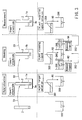
- FIG. 3 is a diagram showing the nucleic acid detection process of this embodiment and a comparative example thereof.
- the nucleic acid detection process according to this embodiment employs the nucleic acid immobilized electrode 2 having a stick-like shape as shown in FIG. 1.
- the nucleic acid probe 5 is fixed to the nucleic acid immobilized electrode 2.
- the counter electrode 3 is disposed on the bottom surface or side surface of the bottomed vessel 1 to which the nucleic acid immobilized electrode 2 is inserted.
- a voltage is applied between the electric circuit 4 between the nucleic acid immobilized electrode 2 and the counter electrode 3.
- a plurality of bottomed vessels are used, and different bottomed vessels are used at least between a hybridization reaction process and a nucleic acid measurement process.
- a counter electrode 3a is disposed on the bottom surface of the bottomed electrode 1a.
- the bottomed vessel 1b is designed to clean the nucleic acid immobilized electrode 2, and therefore no counter electrode is provided.
- a counter electrode 3c is provided on the bottom surface of the counter electrode 1c.
- a vessel 201 for dispensing a reaction solution to the vessel a vessel 202 for discarding an unnecessary portion of the solution, separated from the vessel 200, a vessel 203 for dispensing a washing solution to the vessel 200 and a vessel 204 for dispensing a nucleic acid binding reagent solution to the vessel 200 are used.
- Step S1 a reaction solution containing the subject substance containing double stranded nucleic acid is injected to the bottomed vessel 1a. Then, the double stranded nucleic acid into the single stranded nucleic acid. Then, the nucleic acid immobilized electrode 2 is moved to a position of the bottomed vessel 1a as shown in FIG. 3 (Step S1).
- FIG. 4 is a diagram showing an example of the structure of a movement control mechanism for the nucleic acid immobilized electrode.
- the movement control mechanism shown in this figure includes an arm portion 300 for holding the nucleic acid immobilized electrode 2, an arm drive portion 301 for driving the arm portion 300 in a direction indicated by an arrow in this figure, and a control portion 302 for controlling the driving of the arm drive portion 300 by the arm drive portion 301.
- the arm drive portion 301 drives the arm portion 300 so as to move the nucleic acid immobilized electrode 2 to a predetermined position on the bottomed vessel 1.
- the arm drive portion 301 drives the arm portion 300 so as to move the nucleic acid immobilized electrode 2 in a downward direction until the exposed portion 2' of the conductor of the nucleic acid immobilized electrode 2 is immersed into the solution in the bottomed vessel 1.
- the hybridization reaction process takes place in the following manner. That is, the reaction solution containing the subject substance is injected into the bottomed vessel 1a and the subject substance is added thereto. Then, the nucleic acid immobilized electrode 2 is inserted to the bottomed vessel 1a so that a hybridization reaction occurs between the nucleic acid component of the subject substance and the exposed portion 2' of the nucleic acid immobilized electrode 2.
- the buffer solution having a range of ion strength of 0.01 to 5 and a range of pH5 to 10 is preferable. It is possible to add dextran sulfate as a hybridization promoter, salmon sperm DNA, calf thymus DNA, EDTA, surfactant, Dextan sulphate, Form amide, BSA(Bovine Serum albumin), PVP(polyvinyl pyrrolidone), or the like into the solution.
- the subject substance is further injected into the reaction solution, and the double stranded nucleic acid is thermally denatured into single stranded type by heating it at 90°C or more.
- the nucleic acid immobilized electrode can be inserted immediately after the denaturation, or after quenching at 0°C.
- reaction speed can also be raised by operations such as stirring and shaking during the hybridization reaction.
- the reaction temperature is set to a range of 10°C to 90°C, and reaction time is at least one minute or more, and is preferably about overnight.
- the voltage is applied between the electrode 3a disposed on the side surface or the bottom surface of the bottomed vessel 1a, and the nucleic acid immobilized electrode 2 by the electric circuit 4 so that the surface of the electrode 2' has a plus voltage. Then, the minus charged nucleic acid is condensed on the electrode 2' surface and the reaction is promoted. Additionally, when a minus voltage is applied to the electrode surface 2', the nonspecific coupling can be removed.
- the electric circuit 4 includes a potentiostat, digital multimeter, and function generator, and the circuit applies the potential under current or voltage control.
- the electrode is extracted and cleaned on this embodiment.
- the movement control mechanism moves the nucleic acid immobilized electrode 2 to a position of the bottomed vessel 1b, so as to immerse it in the washing solution within the vessel 1b.
- the buffer solution having an ion strength in a range of 0.01 to 5 and a pH in a range of 5 to 10 is used for washing the electrode. It should be noted that this washing process is not essential to the invention.
- the movement control mechanism moves the nucleic acid immobilized electrode 2 to a position of the bottomed vessel 1b, so as to immerse it in the washing solution within the vessel 1b.
- the nucleic acid binding reagents is allowed to act and is selectively coupled to a double stranded portion formed in the surface of the electrode 2', and the electrochemical signal is measured.
- the electrochemical signal a redox current change generated between the nucleic acid immobilized electrode 2 and the counter electrode 3c, redox potential change, electric capacity change, resistance change, or electrochemical emission change can be used as an indication.
- An effect of the signal change is promoted also by using the nucleic acid binding reagents, that is, a substance particularly coupled to the double stranded nucleic acid.
- the double stranded nucleic acid binding reagents for use herein is not particularly limited. It is possible to use ruthenium called metallo-intercalator, metal complexes such as cobalt and iron, organic compounds such as Hoechst 33258, acridine orange, ethidium bromide, bis-intercalator, and tris-intercalator, and biopolymers such as antibody and enzyme. Moreover, it is also possible to detect nucleic acid in sandwich hybridization in which a second nucleic acid probe labeled with the metal complexes such as ferrocene is used.
- nucleic acid binding reagents such as Hoechst 33258, acridine orange, quinatarine, donomicine, metallo-intercalator, bis-intercalator such as bis-acridine, tris-intercalator, and polyintercalator are particularly desirable.
- a concentration of the nucleic acid binding reagent differs with a type, and the reagent is generally used in a range of 1 ng/ml to 1 mg/ml.
- the buffer solution having a range of pH 5 to 10 is used in a range of ion strength of 0.001 to 5.
- the electrochemical measurement is performed.
- a voltage having a potential at which the nucleic acid binding reagent is electrochemically reacted or more potential is applied to the electrode 2' by the electric circuit 4, and a reaction current value resulting from the nucleic acid binding reagent is measured.
- the voltage is swept at a constant speed, the pulse is applied, or the constant voltage is applied.
- the voltage is applied between the electrode 3c disposed on the side surface or the bottom surface of the bottomed vessel 1c, and the exposed portion 2' of the conductor of the nucleic acid immobilized electrode 2.
- the concentration of a target gene can be calculated from a working curve based on the current value obtained from the nucleic acid binding reagent.
- the reaction solution is dispensed to the bottomed vessel 200 in which the nucleic acid immobilized electrode is disposed on the bottom surface thereof, so that the above-described denaturation and hybridization reaction occur (step N1).
- the denaturation and hybridization reaction themselves are similar to the above-described processes of this embodiment.
- the reaction solution used in the hybridization reaction is removed from the bottomed vessel 200, and discarded to the vessel 202 (step N2).
- the washing solution is dispensed to the bottomed vessel 200 from which the reaction solution has been removed (step N3).
- the washing solution is removed from the bottomed vessel 200 and discarded to the vessel 202 (step N4).
- the nucleic acid binding reagent solution is dispensed from the vessel 204 to the bottomed vessel 200 from which the washing solution has been removed, and thus the measurement process is executed (step N5).
- a plurality of bottomed vessels each equipped with a counter electrode on its bottom surface are used, and the nucleic acid immobilized electrode 2 is moved to a respective one of the bottomed vessels.
- the vessel for the hybridization reaction and the vessel used for the measurement are separated from each other.
- the solution discarding operation of the comparative example is not necessary, and thus the nucleic acid detection process can be facilitated.
- Such a structure is effective in the case where a great number of subject substances are examined.
- the vessel for the hybridization reaction and the vessel used for the measurement are separated from each other, it is possible to avoid a non-specific binding resulted during the hybridization process, from remaining in the measurement process. Such a non-specific bonds may cause an undesired current, which creates noise in a measurement result. Therefore, the prevention of such a non-specific binding can contribute to noise reduction in the measurement result.
- FIG. 5 is a diagram showing one example of the nucleic acid immobilized electrode for the nucleic acid detection apparatus.
- a nucleic acid immobilized electrode 31 was prepared by laminating thin films of titanium (500 angstroms) and gold (2000 angstroms) on a glass substrate 32 having a thickness of 0.8 mm in order of the glass substrate, titanium, and gold by sputtering, and coating the gold surface with a resist 35 excluding a nucleic acid probe immobilized portion 33 (circular region with a diameter of 0.5 mm) and terminal portion 34.
- the nucleic acid probe immobilized portion 33 and terminal portion 34 are connected to each other on a back-surface side of the resist 35. Moreover, the thiolated nucleic acid probe is immobilized in the nucleic acid probe immobilized portion 33 with coupling of thiol/gold.
- An outer shape of the present electrode is set to have a width of 1.5 mm so that the electrode is inserted in the micro titer plate having 384 holes. Moreover, a length is 5 cm.
- FIG. 6 is a diagram showing a cross sectional view of the nucleic acid probe immobilized electrode 31 taken along the line A-A', and FIG. 6 is a diagram showing a cross sectional view of the nucleic acid probe immobilized electrode 31 taken along the line B-B'.
- FIG. 8 is a diagram showing one example of an electrode structure 41 in which the nucleic acid immobilized electrode and reference electrode for the nucleic acid detection apparatus are integrated.
- the electrode structure 41 was prepared as follows. First, titanium (500 angstroms) and gold (2000 angstroms) were laminated on a glass substrate 42 having a thickness of 0.8 mm in order of the glass substrate, titanium, and gold by sputtering, and were formed in two lines along a longitudinal direction of the substrate. Furthermore, with respect to the laminate of titanium and gold, the gold surface of one line was coated with a resist 45 excluding a nucleic acid probe immobilized portion 43 (circular region with a diameter of 0.5 mm) and terminal portion 44.
- a resist 45 excluding a nucleic acid probe immobilized portion 43 (circular region with a diameter of 0.5 mm) and terminal portion 44.
- the gold surface of another line was coated with the resist 45 excluding a reference electrode (circular region with a diameter of 0.5 mm) portion 46 in which silver/silver chloride was formed and terminal portion 47.
- the reference electrode portion 46 was subjected to electrolysis in a silver/silver chloride solution, and deposited and formed on a gold electrode surface.
- the thiolated nucleic acid probe was immobilized in the probe immobilized portion 43 with coupling of thiol/gold.
- a width is set to 3 mm so that the structure can be fit in the micro plate having 96 holes.
- a length is 10 cm.
- FIG. 9 is a sectional view showing one example of the holder of the nucleic acid immobilized electrode.
- a holder 60 for supporting nucleic acid immobilized electrodes 2 insertion holes 60' are arranged at a pitch of 6 mm in an array of 12 ⁇ 8 holes, and the nucleic acid immobilized electrodes 2 are disposed in the insertion holes 60', so that the plurality of nucleic acid immobilized electrodes 2 can be inserted once in the micro titer plate having 96 holes.
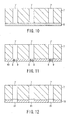
- FIG. 10 is a sectional view showing one example of an electrode integrated type micro titer plate as a vessel for nucleic acid detection.
- a plurality of bottomed vessels 7' are disposed in a micro titer plate 7.
- a carbon film electrode (counter electrode) 8 is attached to a bottom surface of each bottomed vessel 7'. When a liquid is injected into the bottomed vessel 7', the liquid directly contacts the carbon film electrode 8, or is held in the bottomed vessel 7'.
- FIG. 11 is a sectional view showing one example of the electrode integrated type micro titer plate as the vessel for nucleic acid detection.
- the plurality of bottomed vessels 7' are disposed in the micro titer plate 7.
- a nitrocellulose film 10 to which the carbon film electrode 8 and a carbon film electrode 9 with silver/silver chloride formed therein are attached is disposed in the bottom surface of each bottomed vessel 7', and the liquid is held in the vessel.
- Reference numeral 8 denotes the counter electrode, and 9 denotes the reference electrode.
- the liquid is held in the vessel. Filtering by suction is possible in accordance with a use method.
- FIG. 12 is a sectional view showing one example of the electrode integrated type micro titer plate as the vessel for nucleic acid detection.
- the plurality of bottomed vessels 7' are disposed in the micro titer plate 7.
- the nitrocellulose film 10 in which respective gold electrodes (counter electrodes) 81 are formed is attached to the bottom surface of each bottomed vessel 7'.
- the liquid When the liquid is injected into the bottomed vessel 7', the liquid contacts the gold electrode 81, or is held in the bottomed vessel 7'.
- the filtering by suction is possible in accordance with the use method.
- FIG. 13 is a sectional view showing one example of an electrode separated type micro titer plate as the vessel for nucleic acid detection.
- the plurality of bottomed vessels 7' are disposed in the micro titer plate 7.
- a hydrophobic filter 11 in which ion can move is attached to the bottom surface of the bottomed vessel 7', and the liquid can be held in the vessel.
- a vessel 12 to which a carbon film electrode (counter electrode) 91 is attached is disposed under the filter, and the voltage is applied to the constitution via the filter 11.
- FIG. 14 is a diagram showing one example of the electrode separated type micro titer plate as the vessel for nucleic acid detection.
- the plurality of bottomed vessels 7' are disposed in the micro titer plate 7.
- the hydrophobic filter 11 in which ion can move is attached to the bottom surface of the bottomed vessel 7', and the liquid can be held in the vessel.
- the vessel 12 to which a carbon film electrode (counter electrode) 101 for each bottomed vessel 7' is attached is disposed under the filter, and these electrodes are connected to an external power source via a wiring having a matrix structure.
- FIG. 15 is a diagram showing one example of the electrode separated type micro titer plate as the vessel for nucleic acid detection.
- the plurality of bottomed vessels 7' are disposed in the micro titer plate 7.
- the hydrophobic filter 11 in which ion can move is attached to the bottom surface of the micro titer plate 7, and the liquid can be held in the vessel.
- Carbon film electrodes (counter electrodes) 112, and carbon film electrodes (reference electrodes) 111 with silver/silver chloride formed therein are disposed opposite to the respective bottomed vessels 7' under the filter, and these electrodes are connected to the external power source via the wiring having an active matrix structure.
- FIG. 16 is a diagram schematically showing an electrode wiring for each electrode with use of the electrode separated type micro titer plate according to Example 8.
- a carbon film electrode 15 (represented as the carbon film electrode 101 in Example 8) is connected to a gate line 16 and source line 17, and the voltage from the power source is applied to the structure via the source line 17. Switching is performed by turning ON/OFF the gate line.
- FIG. 17 is a diagram schematically showing the electrode wiring for each electrode with use of the electrode separated type micro titer plate according to Example 9.
- the carbon film electrode 15 (represented as the carbon film electrode 112 in Example 9) acts as the counter electrode.
- the carbon film electrode 15 is connected to the gate line 16 and source line 17, and the voltage from the power source is applied to the structure via the source line 17.
- the switching is performed by turning ON/OFF a TFT 19 connected to the gate line 16.
- a silver chloride/silver electrode 18 (represented as the carbon film electrode 111 with silver/silver chloride formed therein in Example 9) acts as the reference electrode.
- the silver/silver chloride electrode 18 is connected to a gate line 20 and source line 17, and the voltage is applied to the structure via the source line.
- the switching is performed by turning ON/OFF the TFT 19 connected to the gate line 20.
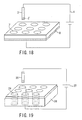
- FIG. 18 shows a nucleic acid detection apparatus in which the electrode integrated type micro titer plate of Example 4 and the nucleic acid immobilized electrode of Example 1 are used.
- the apparatus includes: the nucleic acid immobilized electrode 2; a 96-holes micro titer plate including the plurality of bottomed vessels 7' separated from one another and counter electrodes 8 disposed in the bottom surfaces of the bottomed vessels 7'; and means (power source) 4 for applying the voltage between the nucleic acid immobilized electrode 2 and the counter electrode 8.
- the subject substance containing the gene extracted from blood is inoculated into the bottomed vessel 7' of the micro titer plate, and the nucleic acid immobilized electrode 2 is inserted.
- the hybridization reaction can be promoted by applying the voltage of 0.5V between the nucleic acid immobilized electrode 2 and the counter electrode 8. The reaction ended in about five minutes. Subsequently, the nucleic acid binding reagent of Hoechst 33258 was added, and a current during application of the voltage was measured. The voltage of 0.6V was applied between the electrodes 2 and 8 for the current measurement of Hoechst 33258, and it was possible to simultaneously detect the genes with respect to 96 samples.
- FIG. 19 shows a nucleic acid detection apparatus in which the electrode separated type micro titer plate of Example 7 and the nucleic acid immobilized electrode of Example 1 are used.
- the apparatus includes: a nucleic acid immobilized electrode 25; the 96-holes micro titer plate including a plurality of bottomed vessels 24 separated from one another and vessels including counter electrodes 26 positioned in the bottom surfaces of the bottomed vessels 24; and means (power source) 27 for applying the voltage between the nucleic acid immobilized electrode 25 and the counter electrode 26.
- the subject substance containing the gene extracted from blood is inoculated into the bottomed vessel 24 of the 96-holes micro titer plate, and the nucleic acid immobilized electrode 25 is inserted.
- the hybridization reaction can be promoted by applying the voltage of 0.5V between the electrode 25 and the counter electrode 26.
- the reaction ended in about five minutes.
- the nucleic acid binding reagent of Hoechst 33258 was added, and the current during application of the voltage was measured.
- the voltage of 0.6V was applied between the electrode 25 and the counter electrode 26 for the current measurement of Hoechst 33258, and it was possible to simultaneously detect the genes with respect to 96 samples.
- the nucleic acid detected by the nucleic acid detection apparatus of the present invention is not particularly limited.
- the nucleic acid can be used to detect: virus infectious diseases of a hepatitis virus (A, B, C, D, E, F, G type), HIG, influenza virus, herpes group virus, adenovirus, human polyoma virus, human papilloma virus, human parvovirus, mumps virus, human rotavirus, enterovirus, Japanese encephalitis virus, dengue virus, rubella virus, HTLV, and the like; bacterial infectious diseases of yellow staphylococcus, hemolytic streptococci, enteropathogenic Escherichia coli, Vibrio parahaemolyticus, Helicobacter pylori, Campylobacter, cholera vibrio, dysentery bacillus, salmonella, Yersinia, gonococcus, Listeria, leptospira, Legionella pneumophila, spirochete, Myco
- hereditary diseases such as retinoblastoma, Wilms tumor, familial adenomatous polyposis, hereditary nonpolyposis colon cancer, neurofibromatosis, familial breast cancer, xeroderma pigmentosum, brain tumor, oral cavity cancer, esophagus carcinoma, gastric cancer, colon and rectum carcinoma, liver cancer, pancreas cancer, lung cancer, thyroid gland tumor, mammary gland tumor, urinary organs tumor, male genital organs tumor, female genital organs tumor, skin tumor, bone/soft tissue tumor, leukemia, lymphomatosa, and solid tumor.
- hereditary diseases such as retinoblastoma, Wilms tumor, familial adenomatous polyposis, hereditary nonpolyposis colon cancer, neurofibromatosis, familial breast cancer, xeroderma pigmentosum, brain tumor, oral cavity cancer, esophagus carcinoma, gastric cancer, colon and rectum carcinoma, liver cancer, pancreas cancer
- the present invention can be applied to all fields requiring gene examination, such as food examination, quarantine, medical supplies examination, forensic medicine, agriculture, stock raising, fishery, and forestry. Furthermore, it is also possible to detect restriction fragment length polymorphism (RFLP), single base polymorphism (SNPs), micro satellite sequence, and the like. Additionally, the present invention can also be used in unknown base sequence analysis. Further, the present invention can be applied to analysis of mRNA chain, cDNA chain and cRNA chain.
- RFLP restriction fragment length polymorphism
- SNPs single base polymorphism
- micro satellite sequence and the like.
- the present invention can also be used in unknown base sequence analysis. Further, the present invention can be applied to analysis of mRNA chain, cDNA chain and cRNA chain.
Landscapes
- Chemical & Material Sciences (AREA)
- Organic Chemistry (AREA)
- Life Sciences & Earth Sciences (AREA)
- Zoology (AREA)
- Wood Science & Technology (AREA)
- Proteomics, Peptides & Aminoacids (AREA)
- Health & Medical Sciences (AREA)
- Engineering & Computer Science (AREA)
- Microbiology (AREA)
- Immunology (AREA)
- Physics & Mathematics (AREA)
- Molecular Biology (AREA)
- Biotechnology (AREA)
- Biophysics (AREA)
- Analytical Chemistry (AREA)
- Biochemistry (AREA)
- Bioinformatics & Cheminformatics (AREA)
- General Engineering & Computer Science (AREA)
- General Health & Medical Sciences (AREA)
- Genetics & Genomics (AREA)
- Apparatus Associated With Microorganisms And Enzymes (AREA)
Abstract
Description
Orientation index (hkl) = IF(hkl)/IFR(hkl)
hkl: surface index
IF(hkl): relative strength of (hkl) surface
IFR(hkl) : IF(hkl) as standard gold described in an ASTM card
Claims (16)
- A method of electrochemically detecting presence of a nucleic acid having a particular sequence in a subject substance, characterized by comprising:preparing first and second vessels (1a, 1c), wherein in the second vessel (1c), a solution of a nucleic acid binding reagent is dispensed, and at least the second vessel (1c) has a counter electrode (3c) on a bottom surface or a inside surface thereof;inserting the subject substance into the first vessel (1a);inserting a nucleic acid immobilized electrode (2) having a conductor member and a nucleic acid probe immobilized on the conductor member, to the first vessel (1a) ;making a hybridization reaction to occur in the first vessel (1a);extracting the nucleic acid immobilized electrode (2) from the first vessel (1a) and inserting it into the second vessel (1c); andapplying a predetermined voltage between the nucleic acid immobilized electrode (2) and the counter electrode (3c) so as to measure an electrochemical signal of the nucleic acid binding reagent solution.
- The method according to claim 1, characterized in that the hybridization reaction occur in a buffer solution having an ion strength in a range of 0.01 to 5 and a pH in a range of 5 to 10.
- The method according to claim 1, characterized in that a hybridization promoter is added to the hybridization system.
- The method according to claim 1, characterized by further comprising:adding a denaturing which includes a thermal denaturation for denaturing a double stranded nucleic acid in the subject substance into single stranded type.
- The method according to claim 1, characterized in that the nucleic acid binding reagent solution acts on coupling between the nucleic acid probe and the subject substance to generate the electrochemical signal.
- The method according to claim 1, characterized by further comprising:applying a voltage to the nucleic acid immobilized electrode (2) to promote the hybridization reaction.
- The method according to claim 1, characterized in that the first vessel (1a) and the second vessel (1c) are formed in a micro titer plate (7).
- The method according to claim 7, characterized in that a plurality of the first vessels (7') and a plurality of the second vessels (7') are formed in the micro titer plate (7).
- The method according to claim 7, characterized in that there is only one of the counter electrode (8) common to said plurality of each of the first vessels and the second vessels (7').
- The method according to claim 7, characterized in that the counter electrode (8) is formed on the bottom surface or the inside surface of each of said plurality of the first vessels and the second vessels (7').
- The method according to claim 1, characterized in that at least one of the first vessel and the second vessel (7') each have a reference electrode (9).
- The method according to claim 11, characterized in that the reference electrode (9) is formed on an inside surface or a bottom surface of the vessel (7').
- A method of electrochemically detecting presence of a nucleic acid having a particular sequence in a subject substance, characterized by comprising:preparing first and second vessels (1a, 1c),
wherein in the second vessel (1c), a solution of a nucleic acid binding reagent is dispensed, and at least the second vessel (1c) having a counter electrode (3c) on a bottom surface or a inside surface thereof;inserting the subject substance into the first vessel (1a);inserting a nucleic acid immobilized electrode (2) having a conductor member and a nucleic acid probe on the conductor member, to the first vessel (1a);making a hybridization reaction to occur in the first vessel (1a) ;extracting the nucleic acid immobilized electrode (2) from the first vessel (1a) and inserting it into a washing vessel (1b);washing the nucleic acid immobilized electrode (2) in the washing vessel (1b);extracting the nucleic acid immobilized electrode (2) from the washing vessel (1b) and inserting it to the second vessel (1c); andapplying a predetermined voltage between the nucleic acid immobilized electrode (2) and the counter electrode (3c) so as to measure an electrochemical signal of the nucleic acid binding reagent solution. - A nucleic acid detection apparatus for electrochemically detecting presence of a nucleic acid having a particular sequence in a subject substance, characterized by comprising:a nucleic acid immobilized electrode (2) having a conductor member (2') and a nucleic acid probe (5) immobilized on the conductor member (2');a vessel (1) configured to bring the nucleic acid probe (5) and the subject substance into contact with each other;a counter electrode (3) formed on a bottom surface or inside surface of the vessel (1); andan electric circuit configured (4) to applying a voltage between the nucleic acid immobilized electrode (2) and the counter electrode (3).
- A nucleic acid detection vessel used in the nucleic acid detection apparatus according to claim 14, characterized by comprising:a vessel (3),and a first electrode formed on the bottom surface or inside surface of the vessel (3), wherein the first electrode is used as the counter electrode (3,8).
- A nucleic acid detection vessel according to claim 15, characterized by further comprising:a second electrode formed on the bottom surface or inside surface of the vessel (3), wherein the second electrode is used as a reference electrode (9).
Applications Claiming Priority (2)
| Application Number | Priority Date | Filing Date | Title |
|---|---|---|---|
| JP2000364614 | 2000-11-30 | ||
| JP2000364614 | 2000-11-30 |
Publications (2)
| Publication Number | Publication Date |
|---|---|
| EP1227320A2 true EP1227320A2 (en) | 2002-07-31 |
| EP1227320A3 EP1227320A3 (en) | 2003-07-23 |
Family
ID=18835521
Family Applications (1)
| Application Number | Title | Priority Date | Filing Date |
|---|---|---|---|
| EP01310036A Withdrawn EP1227320A3 (en) | 2000-11-30 | 2001-11-30 | Nucleic acid detection method and apparatus and vessel for detecting nucleic acid |
Country Status (2)
| Country | Link |
|---|---|
| US (1) | US6670131B2 (en) |
| EP (1) | EP1227320A3 (en) |
Families Citing this family (29)
| Publication number | Priority date | Publication date | Assignee | Title |
|---|---|---|---|---|
| EP2040068A3 (en) * | 2000-09-29 | 2010-09-22 | Kabushiki Kaisha Toshiba | Nucleic acid detection sensor |
| JP3670972B2 (en) * | 2001-02-01 | 2005-07-13 | 日立ソフトウエアエンジニアリング株式会社 | Biopolymer detector |
| US20050003396A1 (en) * | 2003-04-11 | 2005-01-06 | Mihrimah Ozkan | Biosensors having single reactant components immobilized over single electrodes and methods of making and using thereof |
| US20070105100A1 (en) * | 2003-04-28 | 2007-05-10 | Canon Kabushiki Kaisha | Process for assay of nucleic acids by competitive hybridization using a dna microarray |
| JP4285119B2 (en) * | 2003-07-07 | 2009-06-24 | ソニー株式会社 | Biochemical reaction apparatus, biochemical reaction substrate, method for producing hybridization substrate, and hybridization method |
| US20050136413A1 (en) * | 2003-12-22 | 2005-06-23 | Briggs Michael W. | Reagent systems for biological assays |
| US20080125333A1 (en) * | 2006-05-31 | 2008-05-29 | Antara Biosciences Inc. | Devices and kits for detecting one or more target agents |
| CN1948507B (en) * | 2006-06-06 | 2010-12-08 | 浙江省疾病预防控制中心 | A kind of mumps virus fluorescence amplification detection kit and detection method |
| US20080026394A1 (en) * | 2006-07-11 | 2008-01-31 | Antara Biosciences Inc. | Methods of detecting one or more cancer markers |
| US9551026B2 (en) * | 2007-12-03 | 2017-01-24 | Complete Genomincs, Inc. | Method for nucleic acid detection using voltage enhancement |
| CN103900894A (en) * | 2008-06-06 | 2014-07-02 | 华盛顿大学 | Method and system for concentrating particles from a solution |
| US8940092B1 (en) | 2008-10-27 | 2015-01-27 | University Of Washington Through Its Center For Commercialization | Hybrid fibers, devices using hybrid fibers, and methods for making hybrid fibers |
| US10837879B2 (en) | 2011-11-02 | 2020-11-17 | Complete Genomics, Inc. | Treatment for stabilizing nucleic acid arrays |
| CA3021580A1 (en) | 2015-06-25 | 2016-12-29 | Barry L. Merriman | Biomolecular sensors and methods |
| CN113985017A (en) | 2016-01-14 | 2022-01-28 | 罗斯韦尔生物技术股份有限公司 | Molecular sensors and related methods |
| JP7280590B2 (en) | 2016-01-28 | 2023-05-24 | ロズウェル バイオテクノロジーズ,インコーポレイテッド | Methods and apparatus for measuring analytes using large-scale molecular electronics sensor arrays |
| EP3408219B1 (en) | 2016-01-28 | 2022-08-17 | Roswell Biotechnologies, Inc | Massively parallel dna sequencing apparatus |
| KR20240170584A (en) | 2016-02-09 | 2024-12-03 | 로스웰 엠이 아이엔씨. | Electronic label-free dna and genome sequencing |
| US10597767B2 (en) | 2016-02-22 | 2020-03-24 | Roswell Biotechnologies, Inc. | Nanoparticle fabrication |
| US9829456B1 (en) * | 2016-07-26 | 2017-11-28 | Roswell Biotechnologies, Inc. | Method of making a multi-electrode structure usable in molecular sensing devices |
| KR102622275B1 (en) | 2017-01-10 | 2024-01-05 | 로스웰 바이오테크놀로지스 인코포레이티드 | Methods and systems for DNA data storage |
| CA3052140A1 (en) | 2017-01-19 | 2018-07-26 | Roswell Biotechnologies, Inc. | Solid state sequencing devices comprising two dimensional layer materials |
| EP3615685B1 (en) | 2017-04-25 | 2025-02-19 | Roswell Biotechnologies, Inc | Enzymatic circuits for molecular sensors |
| US10508296B2 (en) | 2017-04-25 | 2019-12-17 | Roswell Biotechnologies, Inc. | Enzymatic circuits for molecular sensors |
| EP4023764A3 (en) | 2017-05-09 | 2022-09-21 | Roswell Biotechnologies, Inc. | Binding probe circuits for molecular sensors |
| CN111373049A (en) | 2017-08-30 | 2020-07-03 | 罗斯威尔生命技术公司 | Progressive enzyme molecular electronic sensor for DNA data storage |
| CN111373051A (en) | 2017-10-10 | 2020-07-03 | 罗斯威尔生命技术公司 | Methods, devices and systems for amplification-free DNA data storage |
| CN113994013A (en) | 2019-04-12 | 2022-01-28 | 罗斯威尔生命技术公司 | Polycyclic aromatic bridges for molecular electronic sensors |
| US12146852B2 (en) | 2019-09-06 | 2024-11-19 | Roswell Biotechnologies, Inc. | Methods of fabricating nanoscale structures usable in molecular sensors and other devices |
Family Cites Families (7)
| Publication number | Priority date | Publication date | Assignee | Title |
|---|---|---|---|---|
| US6197508B1 (en) * | 1990-09-12 | 2001-03-06 | Affymetrix, Inc. | Electrochemical denaturation and annealing of nucleic acid |
| EP0478319B1 (en) | 1990-09-28 | 1997-04-02 | Kabushiki Kaisha Toshiba | Gene detection method |
| US5776672A (en) | 1990-09-28 | 1998-07-07 | Kabushiki Kaisha Toshiba | Gene detection method |
| ATE175723T1 (en) | 1994-03-15 | 1999-01-15 | Scient Generics Ltd | ELECTROCHEMICAL DENATUSATION OF DOUBLE STRANDED NUCLEIC ACID |
| JPH10239240A (en) | 1997-02-25 | 1998-09-11 | Hitachi Ltd | Automatic DNA probe device |
| RU2161653C2 (en) | 1998-08-24 | 2001-01-10 | ФАРМАКОВСКИЙ Дмитрий Александрович | Method of quantitative electrochemical analysis of biological molecules |
| DE19917052A1 (en) | 1999-04-15 | 2000-10-19 | Wolfgang Schuhmann | Chemical or biochemical assay, involving electrochemically assessing a change in diffusion coefficient of redox-active species due to a specific binding reaction, useful e.g. for determining antigens or DNA fragments |
-
2001
- 2001-11-29 US US09/995,614 patent/US6670131B2/en not_active Expired - Fee Related
- 2001-11-30 EP EP01310036A patent/EP1227320A3/en not_active Withdrawn
Also Published As
| Publication number | Publication date |
|---|---|
| US20020064795A1 (en) | 2002-05-30 |
| US6670131B2 (en) | 2003-12-30 |
| EP1227320A3 (en) | 2003-07-23 |
Similar Documents
| Publication | Publication Date | Title |
|---|---|---|
| US6670131B2 (en) | Nucleic acid detection method and apparatus, and vessel for detecting nucleic acid | |
| US6489160B2 (en) | Method for producing nucleic acid strand immobilized carrier | |
| US7510636B2 (en) | Nucleic acid detection sensor | |
| EP1075656B1 (en) | Detection of a target in a sample | |
| US20070190665A1 (en) | Biological material detection element, biological material detection method and apparatus, charged material moving apparatus | |
| US7645574B2 (en) | Methods of metallizing nucleic acid molecules and methods of attaching nucleic acid molecules to conductive surfaces | |
| JP2002195997A (en) | Nucleic acid detection sensor | |
| JP4122854B2 (en) | Hybridization method and hybridization apparatus for selective binding substance and substrate for fixing selective binding substance | |
| JP4143046B2 (en) | Nucleic acid detection substrate and nucleic acid detection method using the apparatus | |
| JP4398953B2 (en) | Nucleic acid detection sensor | |
| JP3482140B2 (en) | Nucleic acid chain synthesis method, nucleic acid immobilized chip and nucleic acid chain detection method | |
| JP4261077B2 (en) | Method for producing nucleic acid chain-immobilized carrier | |
| JP4309942B2 (en) | Electrode and detection device | |
| JP2003202343A (en) | Hybridization method and hybridization device for selective binding substance and selective binding substance array substrate | |
| JP3677237B2 (en) | Nucleic acid detection method and apparatus, and nucleic acid detection container | |
| US20020179439A1 (en) | Microelectronic system and method of use and fabrication | |
| JP4427525B2 (en) | Nucleic acid detection sensor | |
| JP4498132B2 (en) | Manufacturing method of probe array | |
| JP3848226B2 (en) | Biological substance detection device and biological substance detection element | |
| CN101633960A (en) | Method of detecting a plurality of nucleic acids | |
| JP3842600B2 (en) | Charged mass transfer device |
Legal Events
| Date | Code | Title | Description |
|---|---|---|---|
| PUAI | Public reference made under article 153(3) epc to a published international application that has entered the european phase |
Free format text: ORIGINAL CODE: 0009012 |
|
| 17P | Request for examination filed |
Effective date: 20011207 |
|
| AK | Designated contracting states |
Kind code of ref document: A2 Designated state(s): AT BE CH CY DE DK ES FI FR GB GR IE IT LI LU MC NL PT SE TR |
|
| AX | Request for extension of the european patent |
Free format text: AL;LT;LV;MK;RO;SI |
|
| PUAL | Search report despatched |
Free format text: ORIGINAL CODE: 0009013 |
|
| RIC1 | Information provided on ipc code assigned before grant |
Ipc: 7G 01N 33/543 B Ipc: 7C 12Q 1/68 B Ipc: 7G 01N 27/26 A |
|
| AK | Designated contracting states |
Designated state(s): AT BE CH CY DE DK ES FI FR GB GR IE IT LI LU MC NL PT SE TR |
|
| AX | Request for extension of the european patent |
Extension state: AL LT LV MK RO SI |
|
| AKX | Designation fees paid |
Designated state(s): DE FR GB |
|
| 17Q | First examination report despatched |
Effective date: 20070228 |
|
| STAA | Information on the status of an ep patent application or granted ep patent |
Free format text: STATUS: THE APPLICATION IS DEEMED TO BE WITHDRAWN |
|
| 18D | Application deemed to be withdrawn |
Effective date: 20110601 |