EP1227162A2 - Sequences and methods for detection of Hepatitis B virus - Google Patents
Sequences and methods for detection of Hepatitis B virus Download PDFInfo
- Publication number
- EP1227162A2 EP1227162A2 EP02001764A EP02001764A EP1227162A2 EP 1227162 A2 EP1227162 A2 EP 1227162A2 EP 02001764 A EP02001764 A EP 02001764A EP 02001764 A EP02001764 A EP 02001764A EP 1227162 A2 EP1227162 A2 EP 1227162A2
- Authority
- EP
- European Patent Office
- Prior art keywords
- sequence
- target
- seq
- amplification
- target binding
- Prior art date
- Legal status (The legal status is an assumption and is not a legal conclusion. Google has not performed a legal analysis and makes no representation as to the accuracy of the status listed.)
- Withdrawn
Links
Classifications
-
- C—CHEMISTRY; METALLURGY
- C12—BIOCHEMISTRY; BEER; SPIRITS; WINE; VINEGAR; MICROBIOLOGY; ENZYMOLOGY; MUTATION OR GENETIC ENGINEERING
- C12Q—MEASURING OR TESTING PROCESSES INVOLVING ENZYMES, NUCLEIC ACIDS OR MICROORGANISMS; COMPOSITIONS OR TEST PAPERS THEREFOR; PROCESSES OF PREPARING SUCH COMPOSITIONS; CONDITION-RESPONSIVE CONTROL IN MICROBIOLOGICAL OR ENZYMOLOGICAL PROCESSES
- C12Q1/00—Measuring or testing processes involving enzymes, nucleic acids or microorganisms; Compositions therefor; Processes of preparing such compositions
- C12Q1/70—Measuring or testing processes involving enzymes, nucleic acids or microorganisms; Compositions therefor; Processes of preparing such compositions involving virus or bacteriophage
- C12Q1/701—Specific hybridization probes
- C12Q1/706—Specific hybridization probes for hepatitis
Definitions
- the present invention relates to materials and methods for detection of Hepatitis B viral nucleic acids, in particular to probes and primers for detection of Hepatitis B in hybridization and amplification assays.
- Hepatitis B virus is a partially double-stranded DNA virus which uses a unique replication mechanism incorporating an intermediate reverse transcription step. It is a major causative agent of chronic hepatitis and has been implicated in liver cirrhosis and hepatocellular carcinoma. Accurate identification and quantitation of HBV DNA is important not only for detecting HBV infection but also for monitoring the efficacy of antiviral treatments.
- a simple assay for HBV DNA using branched-DNA (bDNA) probes has been used for quantitation but was found to be insufficiently sensitive to monitor serum virus levels in patients undergoing antiviral treatment. More recently, HBV DNA has been detected and quantitated in more sensitive PCR assays, using both the AmplicorTM HBV Monitor test and the TaqManTM technology for real-time detection.
- the present invention provides probes and primers for detection of HBV nucleic acids which may provide a more rapid and sensitive means for detecting HBV than immunological and culture-based methods. Further the probes and primers of the invention may allow more reliable detection of naturally occurring variants of HBV, as they are based on an analysis of conserved regions of the HBV DNA polymerase gene.
- the present invention provides primers and probes derived from the HBV DNA polymerase gene which are predicted to facilitate detection and/or quantification of all presently known genotypes of HBV (A-F). That is, a single amplification primer pair according to the invention should efficiently amplify all known genotypes of HBV, which may then be detected in a single detection step using the detector probes and primers of the invention.
- the primers, hybridization probes and detector primers of the present invention are complementary to regions of the HBV DNA polymerase gene. Design of the disclosed primers and probes was based on relatively conserved regions in an alignment of multiple HBV DNA polymerase gene sequences. One goal was to develop probes and primers which, in spite of heterogeneity in the gene sequence, would be expected to for provide amplification, detection and/or quantitation of all presently known HBV genotypes with approximately equal efficiency. In some cases this was accomplished by overlapping the hybridization site of the 5' ends of certain of the detector probes with the hybridization site of the 3' end an amplification primer.
- an amplification primer is an oligonucleotide for amplification of a target sequence by extension of the oligonucleotide after hybridization to the target sequence or by ligation of multiple oligonucleotides which are adjacent when hybridized to the target sequence. At least a portion of the amplification primer hybridizes to the target. This portion is referred to as the target binding sequence and it determines the target-specificity of the primer.
- certain amplification methods require specialized non-target binding sequences in the amplification primer. These specialized sequences are necessary for the amplification reaction to proceed and typically serve to append the specialized sequence to the target.
- the amplification primers used in SDA include a restriction endonuclease recognition site 5' to the target binding sequence (US Patent No. 5,455,166 and US Patent No. 5,270,184).
- NASBA, 3SR and transcription based amplification primers require an RNA polymerase promoter linked to the target binding sequence of the primer. Linking such specialized sequences to a target binding sequence for use in a selected amplification reaction is routine in the art.
- amplification methods such as PCR which do not require specialized sequences at the ends of the target, generally employ amplification primers consisting of only target binding sequence.
- primer and “probe” refer to the function of the oligonucleotide.
- a primer is typically extended by polymerase or ligation following hybridization to the target but a probe typically is not.
- a hybridized oligonucleotide may function as a probe if it is used to capture or detect a target sequence, and the same oligonucleotide may function as a primer when it is employed as a target binding sequence in an amplification primer.
- any of the target binding sequences disclosed herein for amplification, detection or quantitation of HBV may be used either as hybridization probes or as target binding sequences in primers for detection or amplification, optionally linked to a specialized sequence required by the selected amplification reaction or to facilitate detection.
- RERS restriction endonuclease recognition site
- the following detector primers were also designed for detection of amplification products produced using the amplification primers. They hybridize to the target sequence downstream of or overlapping an amplification primers so that they are displaced during the amplification reaction.
- the detector primer hybridization site may or may not overlap the hybridization site of the amplification primer.
- An advantage of this detection method is that the target sequence can be detected and/or quantified as the amplification reaction is occurring, i.e., in "real-time" rather than at an endpoint.
- the target binding sequences of the primers are underlined. The remaining portion of the sequence forms a hairpin structure which is typically labeled to facilitate detection of amplification products, for example as described in US Patent No. 5,928,869.
- target sequence may be used alone for detection (typically linked to a detectable label) and that other detectable sequences and labels may be substituted for the hairpin as is known in the art (e.g., G-quartets, linear sequences for specific probe hybridization, or restriction sites).
- detectable sequences and labels may be substituted for the hairpin as is known in the art (e.g., G-quartets, linear sequences for specific probe hybridization, or restriction sites).
- G-quartets linear sequences for specific probe hybridization, or restriction sites.
- SEQ ID NOs:7-9 are conventional non-overlapping detector primers which contain a hairpin as described in US Patent No. 5,928,869.
- SEQ ID NOs:10-15 also contain the hairpin but the 5' end of the target binding sequences overlap with the 3' end of the target binding sequences of the upstream amplification primers.
- Bumper primers used in SDA (BR and BL) and detector probes (PD) for use in post-amplification primer extension detection assays were also designed.
- the entire sequence of each of these oligonucleotides consists of target binding sequence:
- the primers and probes set forth above were selected to minimize the effects of heterogeneity in the targeted region of the DNA polymerase gene. Mismatches were confined to the middle or the 5' end of the primers and probes to permit efficient 3' extension upon hybridization to the target sequence.
- target binding sequence confers target specificity on the primer or probe
- the target binding sequences exemplified above for use as particular components of a specific amplification reaction may also be used in a variety of other ways for detection of the known genotypes of HBV.
- the target binding sequences of SEQ ID NOs:1-20 may alternatively be used as hybridization probes for direct detection of HBV, either without prior amplification or as a post-amplification assay.
- Such hybridization methods are well known in the art and typically employ a detectable label associated with or linked to the target binding sequence to facilitate detection of hybridization.
- amplification primers comprising the target binding sequences disclosed herein may be labeled as is known in the art, or labeled detector primers comprising the disclosed target binding sequences may be used in conjunction with the amplification primers as described in US Patent No. 5,547,861; US Patent No. 5,928,869; US Patent No. 5,593,867; US Patent No. 5,550,025; US Patent No.
- Such detector primers may comprise a directly or indirectly detectable sequence which does not initially hybridize to the target but which facilitates detection of the detector primer once it has hybridized to the target and been extended.
- detectable sequences may be sequences which form a secondary structure, sequences which contain a restriction site, or linear sequences which are detected by hybridization of their complements to a labeled oligonucleotide (sometimes referred to as a reporter probe) as is known in the art.
- the amplification products may be detected post-amplification by hybridization of a probe selected from any of the target binding sequences disclosed herein which fall between a selected set of amplification primers.
- an oligonucleotide according to the invention which consists of a target binding sequence and, optionally, either a sequence required for a selected amplification reaction or a sequence required for a selected detection reaction may also include certain other sequences which serve as spacers, linkers, sequences for labeling or binding of an enzyme, etc. Such additional sequences are typically known to be necessary to obtain optimum function of the oligonucleotide in the selected reaction and are intended to be included by the term "consisting of.”
- SDA SDA reaction to detect HBV.
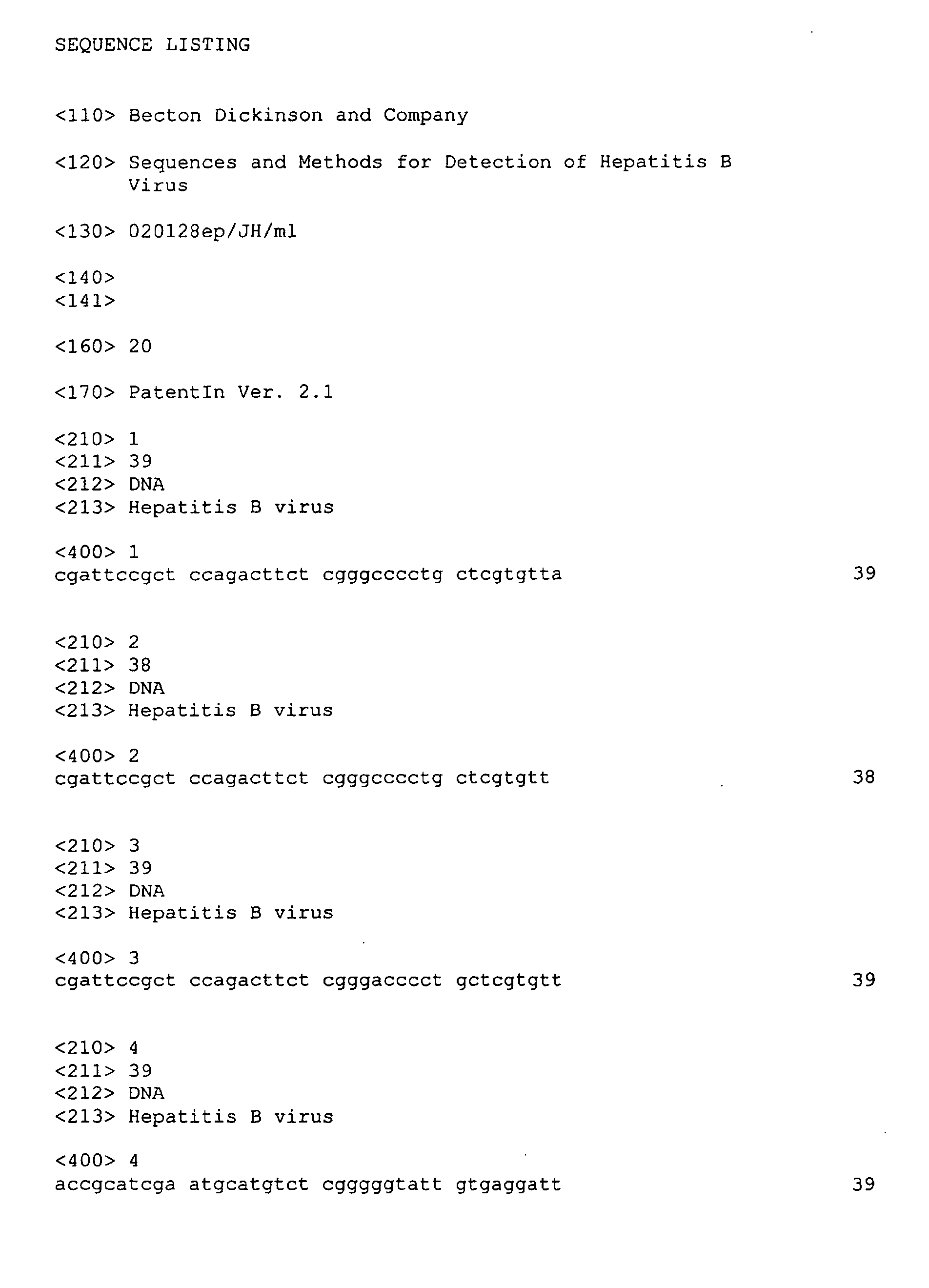
- one "left" amplification primer is selected from SEQ ID NOs:1-3 and one "right” amplification primer (“AR") is selected from SEQ ID NOs:4-6.
- a detector primer is also selected from SEQ ID NOs:7-15, and the hairpin is labeled with a donor/quencher dye pair as is known in the art for detection of target amplification. Fluorescein and dabcyl are preferred dyes for this purpose.
- SEQ ID NO:16 serves as the "left” bumper primer and either SEQ ID NO:17 or SEQ ID NO:18 may be selected as the "right” bumper primer.
- SDA is preferably performed at about 52°C as described in US Patent 5,648,211 using the selected detector primer to provide detection of the target during amplification as described in US Patent Nos. 5,919,630; 5,928,869 and 5,958,700.
- Donor fluorescence is monitored during the amplification reaction. In the presence of HBV target nucleic acids, donor fluorescence will increase as the hairpin holding the donor and quencher in close proximity is unfolded. In the absence of target, fluorescence will remain consistently low throughout the reaction. An increase in fluorescence or a failure of fluorescence to change substantially indicate the presence or absence of HBV target, respectively. Typically, the generation of a relatively higher amount of fluorescence indicates a higher initial level of target.
Landscapes
- Chemical & Material Sciences (AREA)
- Health & Medical Sciences (AREA)
- Life Sciences & Earth Sciences (AREA)
- Organic Chemistry (AREA)
- Wood Science & Technology (AREA)
- Proteomics, Peptides & Aminoacids (AREA)
- Zoology (AREA)
- Immunology (AREA)
- Engineering & Computer Science (AREA)
- Molecular Biology (AREA)
- Virology (AREA)
- Biotechnology (AREA)
- Microbiology (AREA)
- Physics & Mathematics (AREA)
- Analytical Chemistry (AREA)
- Communicable Diseases (AREA)
- Biophysics (AREA)
- Biochemistry (AREA)
- Bioinformatics & Cheminformatics (AREA)
- General Engineering & Computer Science (AREA)
- General Health & Medical Sciences (AREA)
- Genetics & Genomics (AREA)
- Measuring Or Testing Involving Enzymes Or Micro-Organisms (AREA)
Abstract
Description




Claims (14)
- A method for detecting an HBV target sequence comprising:a) amplifying the target sequence using a first amplification primer having a sequence consisting of the target binding sequence of any one of SEQ ID NO:1 through SEQ ID NO:20 and, optionally, a sequence required for a selected amplification reaction, and;b) detecting the amplified target sequence.
- The method of Claim 1 further comprising a second amplification primer having a sequence consisting of the target binding sequence of any one of SEQ ID NO:1 through SEQ ID NO:20 and, optionally a sequence required for the selected amplification reaction.
- The method of Claim 1 wherein the target binding sequence of the first amplification primer is the target binding sequence of any one of SEQ ID NO:1 through SEQ ID NO:3.
- The method of Claim 2 wherein the target binding sequence of the second amplification primer is the target binding sequence of any one of SEQ ID NO:4 through SEQ ID NO:6.
- The method of Claim 1 wherein the amplified target sequence is detected using an oligonucleotide having a sequence consisting of the target binding sequence of any one of SEQ ID NO:7 through SEQ ID NO:15 and, optionally, a sequence required for a selected detection reaction.
- The method of Claim 5 wherein the oligonucleotide is selected such that a 5' end of the target binding sequence of the oligonucleotide for detection overlaps a 3' end of the target binding sequence of the first amplification primer.
- The method of Claim 5 wherein the sequence required for the selected detection reaction is a hairpin, G-quartet, restriction site or a sequence which hybridizes to a reporter probe.
- The method of Claim 1 further comprising quantifying the target sequence.
- The method of Claim 8 wherein the target sequence is quantified by coamplification of a control sequence and the target sequence.
- The method of Claim 1 wherein one or more HBV genotypes are detected.
- An oligonucleotide having a sequence consisting of the target binding sequence of any one of SEQ ID NO:1 through SEQ ID NO:20 and, optionally, either a sequence required for a selected amplification reaction or a sequence required for a selected detection reaction.
- The oligonucleotide of Claim 11 which consists of the target binding sequence of any one of SEQ ID NO:1 through SEQ ID NO:6 and, optionally, a sequence required for a selected amplification reaction.
- The oligonucleotide of Claim 11 which consists of the target binding sequence of any one of SEQ ID NO:7 through SEQ ID NO:15 and, optionally, a sequence required for a selected detection reaction.
- The oligonucleotide of Claim 13 wherein the sequence required for the detection reaction is a hairpin, a G-quartet, a restriction site or a sequence which hybridizes to a reporter probe.
Applications Claiming Priority (2)
| Application Number | Priority Date | Filing Date | Title |
|---|---|---|---|
| US770532 | 2001-01-26 | ||
| US09/770,532 US6583279B1 (en) | 2001-01-26 | 2001-01-26 | Sequences and methods for detection of hepatitis B virus |
Publications (2)
| Publication Number | Publication Date |
|---|---|
| EP1227162A2 true EP1227162A2 (en) | 2002-07-31 |
| EP1227162A3 EP1227162A3 (en) | 2003-09-17 |
Family
ID=25088873
Family Applications (1)
| Application Number | Title | Priority Date | Filing Date |
|---|---|---|---|
| EP02001764A Withdrawn EP1227162A3 (en) | 2001-01-26 | 2002-01-25 | Sequences and methods for detection of Hepatitis B virus |
Country Status (6)
| Country | Link |
|---|---|
| US (1) | US6583279B1 (en) |
| EP (1) | EP1227162A3 (en) |
| JP (1) | JP2002330760A (en) |
| AU (1) | AU785393B2 (en) |
| CA (1) | CA2366238A1 (en) |
| NO (1) | NO20020399L (en) |
Cited By (1)
| Publication number | Priority date | Publication date | Assignee | Title |
|---|---|---|---|---|
| CN106995838A (en) * | 2011-05-11 | 2017-08-01 | 欧凌科公司 | Unfolding is adjacent to probe and its application method |
Families Citing this family (4)
| Publication number | Priority date | Publication date | Assignee | Title |
|---|---|---|---|---|
| CA2486420C (en) * | 2002-06-14 | 2014-04-15 | Gen-Probe Incorporated | Compositions and methods for detecting hepatitis b virus |
| US20040191776A1 (en) * | 2003-03-21 | 2004-09-30 | Pei-Jer Chen | Method for genotyping and quantifying Hepatitis B Virus |
| CN100422344C (en) * | 2004-08-27 | 2008-10-01 | 广州华银基因科技有限公司 | Fluorescent PCR detection method and kit for hepatitis B virus genotyping |
| US20100255482A1 (en) * | 2007-11-06 | 2010-10-07 | Siemens Healthcare Diagnostics Inc. | Hepatitis B Virus (HBV) Specific Oligonucleotide Sequences |
Family Cites Families (14)
| Publication number | Priority date | Publication date | Assignee | Title |
|---|---|---|---|---|
| YU44186B (en) | 1978-12-22 | 1990-04-30 | Biogen Nv | Process for obtaining recombinant dnk molecules |
| US4562159A (en) | 1981-03-31 | 1985-12-31 | Albert Einstein College Of Medicine, A Division Of Yeshiva Univ. | Diagnostic test for hepatitis B virus |
| FI861417A0 (en) | 1985-04-15 | 1986-04-01 | Endotronics Inc | HEPATITIS B YTANTIGEN FRAMSTAELLD MED REKOMBINANT-DNA-TEKNIK, VACCIN, DIAGNOSTISKT MEDEL OCH CELLINJER SAMT FOERFARANDEN FOER FRAMSTAELLNING DAERAV. |
| US5359100A (en) | 1987-10-15 | 1994-10-25 | Chiron Corporation | Bifunctional blocked phosphoramidites useful in making nucleic acid mutimers |
| US5780219A (en) | 1989-07-11 | 1998-07-14 | Gen-Probe Incorporated | Nucleic acid amplification oligonucleotides and probes to human hepatitis B virus |
| WO1993013120A1 (en) | 1991-12-23 | 1993-07-08 | Chiron Corporation | Hbv amplifier probes for use in solution phase sandwich hybridization assays |
| US5736334A (en) | 1993-04-12 | 1998-04-07 | Abbott Laboratories | Nucleotide sequences and process for amplifying and detection of hepatitis B viral DNA |
| US5595739A (en) | 1993-05-07 | 1997-01-21 | Abbott Laboratories | Hepatitis B virus mutants, reagents and methods for detection |
| EP0785996A1 (en) * | 1993-07-13 | 1997-07-30 | Abbott Laboratories | Nucleotide sequences and process for amplifying and detection of hepatitis b virus |
| US5728518A (en) | 1994-01-12 | 1998-03-17 | The Immune Response Corporation | Antiviral poly-and oligonucleotides |
| US5856459A (en) | 1995-06-06 | 1999-01-05 | Hybridon, Inc. | Oligonucleotides specific for hepatitis B virus |
| US5709997A (en) | 1995-08-14 | 1998-01-20 | Abbott Laboratories | Nucleic acid detection of hepatitis GB virus |
| US5667994A (en) * | 1996-02-28 | 1997-09-16 | Becton, Dickinson And Company | Amplification and detection of mycobacterium avium complex species |
| AR028149A1 (en) * | 1999-07-08 | 2003-04-30 | Innogenetics Nv | DETECTION OF RESISTANCE TO DRUGS AGAINST HEPATITIS B |
-
2001
- 2001-01-26 US US09/770,532 patent/US6583279B1/en not_active Expired - Lifetime
-
2002
- 2002-01-18 CA CA002366238A patent/CA2366238A1/en not_active Abandoned
- 2002-01-24 AU AU13568/02A patent/AU785393B2/en not_active Ceased
- 2002-01-25 NO NO20020399A patent/NO20020399L/en not_active Application Discontinuation
- 2002-01-25 EP EP02001764A patent/EP1227162A3/en not_active Withdrawn
- 2002-01-28 JP JP2002019245A patent/JP2002330760A/en active Pending
Cited By (2)
| Publication number | Priority date | Publication date | Assignee | Title |
|---|---|---|---|---|
| CN106995838A (en) * | 2011-05-11 | 2017-08-01 | 欧凌科公司 | Unfolding is adjacent to probe and its application method |
| CN106995838B (en) * | 2011-05-11 | 2021-10-15 | 欧凌科公司 | Unfolding proximity probes and methods of use |
Also Published As
| Publication number | Publication date |
|---|---|
| NO20020399D0 (en) | 2002-01-25 |
| CA2366238A1 (en) | 2002-07-26 |
| AU785393B2 (en) | 2007-03-29 |
| JP2002330760A (en) | 2002-11-19 |
| US6583279B1 (en) | 2003-06-24 |
| AU1356802A (en) | 2002-08-01 |
| EP1227162A3 (en) | 2003-09-17 |
| NO20020399L (en) | 2002-07-29 |
Similar Documents
| Publication | Publication Date | Title |
|---|---|---|
| US6586584B2 (en) | Sequences and methods for detection of Hepatitis C virus | |
| EP2292801B1 (en) | Compositions and methods for detecting hepatitis b virus | |
| US20140004502A1 (en) | Sequences and methods for detecting influenza a and influenza b virus | |
| WO2012034130A2 (en) | Methods and compositions for nucleic acid detection | |
| US9702017B2 (en) | HEV assay | |
| EP3957754B1 (en) | Method for detecting chikungunya virus | |
| JP2020092721A (en) | Dual probe assay for detection of target nucleic acid | |
| US6583279B1 (en) | Sequences and methods for detection of hepatitis B virus | |
| EP2722397B1 (en) | Dual probe assay for the detection of heterogeneous amplicon populations | |
| EP1794328B1 (en) | Assay for detecting and quantifying hiv-1 | |
| AU2014201154B2 (en) | Assay for detecting and quantifying HIV-1 | |
| HK1220496B (en) | Assay for detecting and quantifying hiv-1 |
Legal Events
| Date | Code | Title | Description |
|---|---|---|---|
| PUAI | Public reference made under article 153(3) epc to a published international application that has entered the european phase |
Free format text: ORIGINAL CODE: 0009012 |
|
| AK | Designated contracting states |
Kind code of ref document: A2 Designated state(s): AT BE CH CY DE DK ES FI FR GB GR IE IT LI LU MC NL PT SE TR |
|
| AX | Request for extension of the european patent |
Free format text: AL;LT;LV;MK;RO;SI |
|
| PUAL | Search report despatched |
Free format text: ORIGINAL CODE: 0009013 |
|
| AK | Designated contracting states |
Kind code of ref document: A3 Designated state(s): AT BE CH CY DE DK ES FI FR GB GR IE IT LI LU MC NL PT SE TR |
|
| AX | Request for extension of the european patent |
Extension state: AL LT LV MK RO SI |
|
| 17P | Request for examination filed |
Effective date: 20040309 |
|
| AKX | Designation fees paid |
Designated state(s): AT BE CH CY DE DK ES FI FR GB GR IE IT LI LU MC NL PT SE TR |
|
| 17Q | First examination report despatched |
Effective date: 20040615 |
|
| STAA | Information on the status of an ep patent application or granted ep patent |
Free format text: STATUS: THE APPLICATION HAS BEEN WITHDRAWN |
|
| 18W | Application withdrawn |
Effective date: 20041221 |