EP1227134A1 - Polymer composition crosslinkable with ultraviolet - Google Patents
Polymer composition crosslinkable with ultraviolet Download PDFInfo
- Publication number
- EP1227134A1 EP1227134A1 EP00955053A EP00955053A EP1227134A1 EP 1227134 A1 EP1227134 A1 EP 1227134A1 EP 00955053 A EP00955053 A EP 00955053A EP 00955053 A EP00955053 A EP 00955053A EP 1227134 A1 EP1227134 A1 EP 1227134A1
- Authority
- EP
- European Patent Office
- Prior art keywords
- polymer
- crosslinking
- fluorine
- iodine
- ultraviolet
- Prior art date
- Legal status (The legal status is an assumption and is not a legal conclusion. Google has not performed a legal analysis and makes no representation as to the accuracy of the status listed.)
- Granted
Links
Classifications
-
- C—CHEMISTRY; METALLURGY
- C08—ORGANIC MACROMOLECULAR COMPOUNDS; THEIR PREPARATION OR CHEMICAL WORKING-UP; COMPOSITIONS BASED THEREON
- C08J—WORKING-UP; GENERAL PROCESSES OF COMPOUNDING; AFTER-TREATMENT NOT COVERED BY SUBCLASSES C08B, C08C, C08F, C08G or C08H
- C08J3/00—Processes of treating or compounding macromolecular substances
- C08J3/28—Treatment by wave energy or particle radiation
-
- C—CHEMISTRY; METALLURGY
- C08—ORGANIC MACROMOLECULAR COMPOUNDS; THEIR PREPARATION OR CHEMICAL WORKING-UP; COMPOSITIONS BASED THEREON
- C08F—MACROMOLECULAR COMPOUNDS OBTAINED BY REACTIONS ONLY INVOLVING CARBON-TO-CARBON UNSATURATED BONDS
- C08F259/00—Macromolecular compounds obtained by polymerising monomers on to polymers of halogen containing monomers as defined in group C08F14/00
- C08F259/08—Macromolecular compounds obtained by polymerising monomers on to polymers of halogen containing monomers as defined in group C08F14/00 on to polymers containing fluorine
-
- C—CHEMISTRY; METALLURGY
- C08—ORGANIC MACROMOLECULAR COMPOUNDS; THEIR PREPARATION OR CHEMICAL WORKING-UP; COMPOSITIONS BASED THEREON
- C08J—WORKING-UP; GENERAL PROCESSES OF COMPOUNDING; AFTER-TREATMENT NOT COVERED BY SUBCLASSES C08B, C08C, C08F, C08G or C08H
- C08J2327/00—Characterised by the use of homopolymers or copolymers of compounds having one or more unsaturated aliphatic radicals, each having only one carbon-to-carbon double bond, and at least one being terminated by a halogen; Derivatives of such polymers
- C08J2327/02—Characterised by the use of homopolymers or copolymers of compounds having one or more unsaturated aliphatic radicals, each having only one carbon-to-carbon double bond, and at least one being terminated by a halogen; Derivatives of such polymers not modified by chemical after-treatment
Definitions
- the present invention relates to a polymer composition having iodine and/or bromine which is crosslinkable by irradiation with ultraviolet rays.
- crosslinking a fluorine-containing polymer, particularly a fluorine-containing elastomer
- usual crosslinking methods are polyamine vulcanization, polyol vulcanization and organic peroxide vulcanization. In any of those methods, a high temperature is necessary in order to obtain a crosslinked article and therefore an application thereof is limited.
- JP-B-5-63482, etc. describe crosslinking methods other than the method of crosslinking by using heat energy, namely methods of crosslinking by using radiation, etc. Such methods require expensive facilities and are not carried out easily and therefore application thereof is limited to only particular fields.
- urethane rubber and silicone rubber are on the market and are widely used because crosslinking need not be carried out at high temperature and can be carried out at room temperature.
- the urethane rubber has a problem with heat resistance and water resistance
- the silicone rubber has a problem with chemical resistance and oil resistance.
- An object of the present invention is to provide a crosslinkable composition comprising a polymer containing iodine and/or bromine in a specific amount, particularly an ultraviolet-crosslinkable fluorine-containing polymer, and also to provide a crosslinked article obtained from the composition.
- the present invention relates to an ultraviolet-crosslinkable polymer composition which comprises a polymer containing 0.001 to 10 % by weight of iodine and/or bromine, a photoinitiator as a crosslinking agent and a polyfunctional unsaturated compound as a crosslinking aid.
- the polymer is a fluorine-containing polymer, particularly a fluorine-containing elastomer, an excellent effect is exhibited.
- crosslinking with ultraviolet rays usually an acryl group is activated by irradiation of ultraviolet rays to become a crosslinking point.
- iodine or bromine contained in the polymer is a crosslinking point.
- Such a crosslinking system has not been known and is a novel one.
- the polymer having iodine and/or bromine may be a resin or an elastomer.
- iodine or bromine For introducing iodine or bromine into the polymer, various known methods can be used. For example, there are (1) a method of copolymerizing a monomer having iodine and/or bromine (hereinafter referred to as "Introducing Method 1". JP-A-8-53595, JP-B-5-63482, JP-A-4-288305, JP-B-53-4115, etc.); (2) a method of using an iodine or bromine compound as a polymerization initiator or a chain transfer agent (hereinafter referred to as "Introducing Method 2".
- the introducing method is not limited to them.
- a resin as a basic component is explained below. Either of a non-fluorine-containing resin and a fluorine-containing resin may be used as a resin.
- non-fluorine-containing resin examples include, for instance, homopolymers or copolymers of poly(meth)acrylic acid esters such as polymethyl methacrylate and polyethyl acrylate.
- the monomer to be used examples include methyl acrylate, ethyl acrylate, methyl methacrylate, ethyl methacrylate, and the like.
- the comonomer examples include, for instance, ethylene, propylene, vinyl chloride, vinylidene chloride, acrylonitrile, vinyl esters such as vinyl acetate, vinyl ethers such as ethyl vinyl ether, vinyl monomers such as styrene, and the like.
- comonomer examples include the above-mentioned (meth)acrylic acid esters and/or vinyl monomers.
- polytetrafluoroethylene polyvinylidene fluoride, ethylene-tetrafluoroethylene copolymer, ethylene-chlorotrifluoroethylene copolymer, tetrafluoroethylene-hexafluoropropylene copolymer, tetrafluoroethylene-perfluoro(alkyl vinyl ether) copolymer, and the like.
- the elastomer to be used in the present invention may be a non-fluorine-containing elastomer, particularly a fluorine-containing elastomer which has been unable to be crosslinked with ultraviolet rays can be used preferably.
- fluorine-containing elastomer examples include vinylidene fluoride copolymers such as vinylidene fluoride-hexafluoropropylene copolymer, vinylidene fluoride-tetrafluoroethylene-hexafluoropropylene copolymer and vinylidene fluoride-chlorotrifluoroethylene copolymer; tetrafluoroethylene-propylene copolymer and ethylene-hexafluoropropylene copolymer; fluoro(alkyl vinyl ether) (encompassing those having plural ether bonds)-olefin copolymers such as vinylidene fluoride-tetrafluoroethylene-perfluoro(alkyl vinyl ether) copolymer and tetrafluoroethylene-perfluoro(alkyl vinyl ether) copolymer; alkyl vinyl ether-chlorotrifluoroethylene copolymer, and the like.
- Also other monomer component copolymerizable thereto may be copolymerized.
- examples thereof are vinyl chloride, vinylidene chloride, acrylonitrile, vinyl esters such as vinyl acetate, vinyl ethers such as ethyl vinyl ether, styrene, and the like.
- the fluorine-containing elastomer may be the above-mentioned fluorine-containing elastomers and in addition, those having, as an elastomer chain, a perfluoro elastomer chain represented by the following formula (2) or (3) or a non-perfluoro elastomer chain represented by the formula (4), (5), (6) or (7).
- fluorine-containing multi-segment polymer prepared by block-copolymerizing the above-mentioned elastomer as an elastomer segment with a fluorine-containing resin as a hard segment.
- Polymerization methods which can be used for this introducing method are known methods such as emulsion polymerization, suspension polymerization, solution polymerization, and the like.
- the monomer is copolymerized in such an amount that iodine and/or bromine are contained in the obtained polymer in an amount of from 0.001 to 10 % by weight, preferably from 0.05 to 7 % by weight.
- Introducing Method 2 is a method of introducing iodine and/or bromine into an end of the polymer by using iodine and/or bromine or a compound having iodine and/or bromine as a polymerization initiator or a chain transfer agent.
- Examples of such a polymerization initiator are, for instance, those described in the above-mentioned JP-A-63-23907. Concretely there are, for example, (ICF 2 COO) 2 , and the like.
- Examples of such a chain transfer agent are, for instance, those described in the above-mentioned JP-B-6-11773, JP-B-1-16844, JP-B-63-41928, JP-B-5-406, JP-A-62-36407, etc. Concretely there are, for example, I(CF 2 ) 4 I, CH 2 I 2 , (ICF 2 CF 2 ) 2 C 6 F 4 , CF 2 Br 2 , BrCH 2 CH 2 I, and the like. It is preferable that those iodine- and/or bromine-containing monomers are used for the fluorine-containing polymers from the viewpoint of chain transfer reaction.
- iodine-containing monomers are preferable.
- Examples of a polymerization method which can be used for those introducing methods are known methods such as emulsion polymerization, suspension polymerization and solution polymerization.
- the polymers must contain iodine or bromine (a total amount thereof when the both are contained) in an amount of from 0.001 to 10 % by weight. When the amount is less than 0.001 % by weight, crosslinking cannot be carried out sufficiently, and when the amount is more than 10 % by weight, properties of the polymer such as heat resistance are lowered.
- the preferred content thereof is from 0.05 to 7 % by weight.
- the polymers mainly contain iodine rather than bromine.
- the iodine- and/or bromine-containing polymers may be used alone or in a mixture of two or more thereof.
- the polymers may be blended to other polymer which does not contain iodine (bromine).
- examples of the other non-iodine (non-bromine)-containing polymer which may be blended are, for instance, ultraviolet-crosslinkable polymers, such as epoxy acrylate, urethane acrylate, polyester acrylate and polyether acrylate.
- the ultraviolet-crosslinkable polymer composition of the present invention comprises the above-mentioned iodine- and/or bromine-containing polymer, a photoinitiator and a polyfunctional unsaturated compound.
- the photoinitiator to be used in the present invention acts as a crosslinking agent, and photoinitiators which have been known in ultraviolet crosslinking can be used.
- photoinitiators which have been known in ultraviolet crosslinking
- examples thereof are acetophenone initiators such as chloroacetophenone, diethoxyacetophenone, ⁇ -aminoacetophenone, and hydroxyacetophenones, i.e.
- An amount of the photoinitiator is usually from about 0.05 to about 10 parts by weight (hereinafter referred to as "part"), preferably from 1 to 5 parts based on 100 parts of the above-mentioned iodine-and/or bromine-containing polymer.
- a hydrogen donor may be added as a photoinitiating aid.
- the hydrogen donor are, for instance, aliphatic amines such as triethanolamine, methyldiethanolamine and triisopropanolamine; aromatic amines such as 4,4'-diethylaminophenone, 4-dimethylaminoethyl benzoate and 4-dimethylamino(n-buthoxy)ethyl benzoate, and the like.
- An amount of the hydrogen donor is usually from about 0.05 to about 10 parts, preferably from 0.5 to 5 parts based on 100 parts of the above-mentioned polymer.
- the polyfunctional unsaturated compound to be used in the present invention acts as a crosslinking aid.
- the polyfunctional unsaturated compound is not limited and is effective as far as it has a reactivity against both of a polymer radical derived from iodine and/or bromine and generated by irradiation of ultraviolet rays and a radical derived from the photoinitiator.
- Examples of the preferable polyfunctional unsaturated compound are, for instance, various diacrylates, trimethylolpropane triacrylate (TMPTA), trimethylolpropane trimethacrylate, triallyl isocyanurate (TAIC), triallyl cyanurate, triallyl trimellitate, pentaerythritol triacrylate, pentaerythritol tetraacrylate, dipentaerythritol hexaacrylate, N,N'-m-phenylenebismaleimide, dipropargyl terephthalate, diallyl phthalate, tetraallyl terephthalamide, triallyl phosphate, and the like.
- those having three or more functional groups are particularly preferable from the viewpoint of easiness of crosslinking of the polymer.
- An amount of the polyfunctional unsaturated compound is from about 0.05 to about 10 parts, preferably from 0.5 to 5 parts based on 100 parts of the above-mentioned polymer.
- a filler, processing aid, antioxidant, age resister, antiozonant, ultraviolet ray absorber, and the like may be blended.
- the filler examples include metal oxides such as magnesium oxide, calcium oxide, titanium oxide, silicon oxide and aluminum oxide, metal hydroxides such as magnesium hydroxide, aluminum hydroxide and calcium hydroxide, carbonates such as magnesium carbonate, aluminum carbonate, calcium carbonate and barium carbonate, silicates such as magnesium silicate, calcium silicate, sodium silicate and aluminum silicate, sulfates such as aluminum sulfate, calcium sulfate and barium sulfate, synthetic hydrotalcite, metal sulfides such as molybdenum disulfide, iron sulfide and copper sulfide, diatom earth, asbestos, lithopone (zinc sulfide/barium sulfate), graphite, carbon black, carbon fluoride, calcium fluoride, coke, fluorine-containing resin, and the like.
- metal oxides such as magnesium oxide, calcium oxide, titanium oxide, silicon oxide and aluminum oxide
- metal hydroxides such as magnesium hydroxide, aluminum hydroxide and calcium hydroxide
- processing aid examples include higher fatty acids such as stearic acid, oleic acid, palmitic acid and lauric acid; higher fatty acid salts such as sodium stearate and zinc stearate; higher fatty acid amides such as stearic acid amide and oleic amide; higher fatty acid esters such as ethyl oleate; higher fatty acid amines such as stearylamine and oleilamine; petroleum wax such as carnauba wax and ceresine wax; polyglycols such as ethylene glycol, glycerine and diethylene glycol; aliphatic hydrocarbons such as vaseline and paraffin; silicone oil; silicone polymer; low molecular weight polyethylene; phthalic acid esters; phosphoric acid esters; rosin; (halogenated) dialkylamine; (halogenated) dialkylsulfone, surfactant; and the like.
- higher fatty acids such as stearic acid, oleic acid, palmi
- antioxidant examples include phenol compounds such as 2,5-di-t-amylhydroquinone, amine-ketone compounds such as 2,2,4-trimethyl-1,2-dihydroquinone, aromatic binary amine compounds such as 4,4'-bis( ⁇ , ⁇ -dimethylbenzyl)diphenylamine, and the like.
- Examples of the ultraviolet ray absorber are benzophenone compounds such as 2,4-dihydroxybenzophenone, amine compounds such as bis(2,2,6,6-tetramethyl-4-piperizyl)sebacate, benzotriazole compounds such as 2-(2'-hydroxy-5'-methylphenyl)benzotriazole, and the like.
- An adding amount thereof differs depending on kind of additives and should be an amount not impairing a crosslinking reaction with ultraviolet rays.
- the composition of the present invention can be prepared by known mixing methods.
- the mixing may be carried out at a temperature of not less than a melting point thereof by using an internal mixer, segment extruder, two-screw extruder, or the like.
- the polymer is an elastomer and a molecular weight thereof is high, kneading may be carried out with an internal mixer such as an open roll or kneader mixer, and when the molecular weight thereof is low, mixing may be carried out with a planetary mixer, portable mixer, or the like.
- the mixing is carried out under the condition that no photo energy activating the photoinitiator is irradiated. Also the mixing may be carried out in a solution by using a good solvent.
- suitable ultraviolet rays are those having a wavelength of from 420 to 150 nm. Also those having a wavelength range covering a maximum absorption wavelength of the above-mentioned photoinitiator can be used.
- the composition of the present invention can be subjected to crosslinking with radiation and electron beams.
- the composition may be crosslinked with radiation or electron beams and as the case demands, in combination with ultraviolet rays.
- An irradiation time varies depending on an intensity of ultraviolet rays, kind of photoinitiator, etc. When the intensity of the irradiation is about 165 mW/cm 2 , the irradiation time of from about ten seconds to about five minutes is enough.
- the irradiation can be carried out at room temperature.
- the composition of the present invention is formed into a crosslinked article by crosslinking with ultraviolet rays.
- the crosslinked article can be used for various known applications. Particularly when a fluorine-containing polymer is used as a component polymer, the crosslinked article can be used for various parts in automotive industry, airplane industry and semiconductor industry by making the use of its excellent heat resistance, oil resistance, amine resistance, chemical resistance, etc. Further when a fluorine-containing elastomer is used, by utilizing its heat resistance, oil resistance and amine resistance, the crosslinked article can be used suitably for parts for oil sealing, for example, a hose, oil seal, etc. for engine oil of automotive, and also by utilizing its property of releasing less outgas, the crosslinked article can be used suitably for a gasket for a magnetic disc production apparatus, sealing materials for semiconductor production apparatuses and lines, etc.
- composition of the present invention can be used as a coating material. Concretely by dissolving or dispersing the composition of the present invention in a solvent such as water or organic solvent, a coating material which can be crosslinked with ultraviolet rays (further as the case demands, electron beams) is obtained.
- crosslinked article of the present invention can be applied on the following molded articles, but the application is not limited to them.
- Packing, O-ring, hose, other sealing material, diaphragm and valve having amine resistance, oil resistance, chemical resistance, steam resistance and weather resistance in transportation means such as automotive, ship and airplane; similar packing, O-ring, sealing material, diaphragm, valve, hose, roll and tube in chemical plant; similar packing, O-ring, hose, sealing material, belt, diaphragm, valve, roll and tube in foods plant and foods processing machine (including domestic appliances); similar packing, O-ring, hose, sealing material, diaphragm, valve and tube in nuclear plant; similar packing, O-ring, hose, sealing material, diaphragm, valve, roll, tube, mandrel, cable, flexible joint, belt, rubber plate and weatherstrip in general industrial parts; roll, roll blade and belt for PPC copying machine, etc.
- the molded article of the present invention can be used for O-ring, sealing material, hose, tube, diaphragm, roll, lining and coating in equipment for producing semiconductor, liquid crystal panel, plasma display panel, plasma address liquid crystal panel, field emission display panel, substrate for solar battery, etc., for example, CVD equipment, etching equipment, oxidation/diffusion equipment, sputtering equipment, ashing equipment, ion implantation equipment, exhausting equipment, and the like which require plasma resistance; O-ring, sealing material, hose, tube, diaphragm and roll in wet etcher, cleaning equipment, pipes for chemicals, gas pipes, and the like which require chemical resistance; and further O-ring, sealing material, hose, tube, diaphragm and roll to be used on parts of the mentioned equipment which are required to be free from dust and metal.
- CVD equipment for example, CVD equipment, etching equipment, oxidation/diffusion equipment, sputtering equipment, ashing equipment, ion implantation equipment, exhausting equipment,
- Examples of other applications where chemical resistance is required are O-ring, sealing material, hose, tube, diaphragm of pump and wafer transferring rolls for resist developing solution, releasing solution and wafer cleaning solution in production equipment for semiconductor, liquid crystal panel, plasma display panel, etc.
- the polymer is a low molecular weight polymer
- molding or processing can be carried out easily at working site by using an extrusion gun such as a hot melt gun or a dispenser.
- an extrusion gun such as a hot melt gun or a dispenser.
- a number average molecular weight thereof is within a range of from 1,000 to 50,000. When the number average molecular weight is less than 1,000, the crosslinking becomes difficult, and when the number average molecular weight is more than 50,000, the extrusion becomes difficult.
- Examples of the application for work which can be carried out at site are coating of metal gasket for automotive engine, gasket for oil pan of engine, roll of copying machine or printer, sealing for building, sealing of gasket for magnetic recorder, sealing of filter unit of clean room, coating of printed circuit board, fixing of electric and electronic parts, insulation and water-proof treatment of lead wire terminal of electrical equipment, sealing of an oven such as an electric oven, terminal treatment of sheath type heater, sealing of window frame of microwave oven, adhesion of CRT wedge and neck, adhesion of instrumentation parts of automotive, sealing of joints of kitchen, bath room and lavatory, etc.
- a 3-liter autoclave equipped with a thermometer, stirrer, nitrogen gas feeding tube and pressure reducing device was charged with 1,500 ml of pure water and 2 g of ammonium perfluorooctanoate.
- VdF/HFP/TFE vinylidene fluoride/hexafluoropropylene/tetrafluoroethylene gas mixture
- a pressure and temperature of the inside of the autoclave were increased to 16 kg/cm 2 G and 80°C, respectively.
- 10 ml of a 0.3 % aqueous solution of ammonium persulfate was introduced under pressure with stirring.
- a number average molecular weight thereof was 140,000 (based on polystyrene).
- the iodine content thereof was 0.55 % by weight according to an elementary analysis.
- a 3-liter autoclave equipped with a thermometer, stirrer, nitrogen gas feeding tube and pressure reducing device was charged with 1,500 ml of pure water and 1.5 g of ammonium perfluorooctanoate.
- VdF/HFP vinylidene fluoride/hexafluoropropylene gas mixture
- Polymer B a polymer (hereinafter referred to as "Polymer B").
- a number average molecular weight thereof was 41,000 (based on polystyrene).
- the iodine content thereof was 0.6 % by weight according to an elementary analysis.
- the iodine content of the obtained polymer was 0.43 % by weight as a result of elementary analysis.
- 0.01 g of sodium hydrosulfite, 0.002 g of sodium formaldehyde sulfoxylate and 0.005 g of t-butyl hydroperoxide were added to initiate a polymerization reaction at 35°C.
- Polymer D After six-hour reaction had been carried out so that a conversion of the polymerization became not less than 99 %, the reaction product was subjected to salting-out, washing with water and drying to obtain a polymer (hereinafter referred to as "Polymer D").
- TMPTA trimethylolpropane triacrylate
- the sheet was passed through a conveyor type ultraviolet ray irradiation equipment to be subjected to irradiation with ultraviolet rays. Thereby a crosslinked article was obtained.
- an intensity of ultraviolet rays was about 165 mW/cm 2
- an irradiation time was about 30 seconds
- an ambient temperature was room temperature (about 25°C).
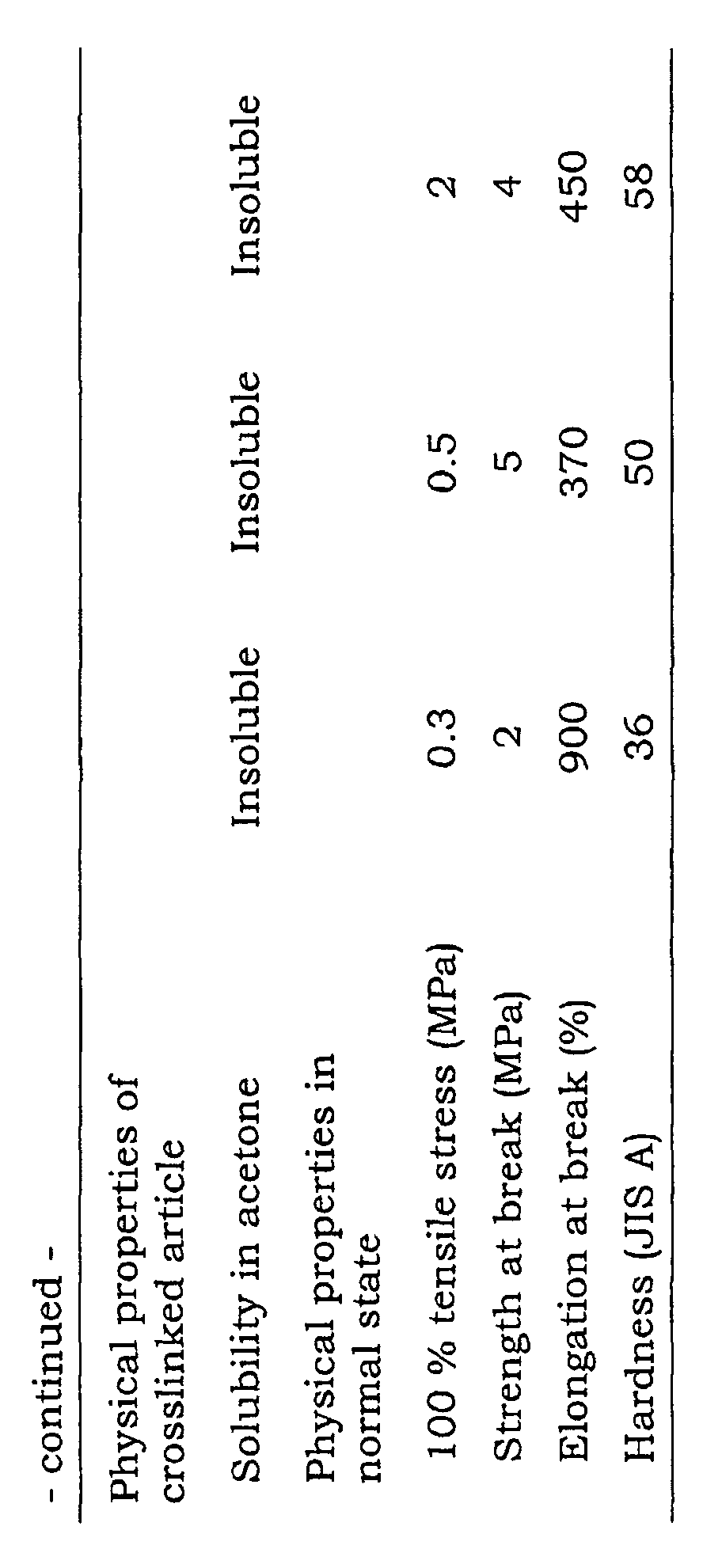
- Example 1 Components shown in Table 1 were mixed and pre-molded in the same manner as in Example 1 to obtain an about 0.5 mm thick sheet. The sheet was subjected to ultraviolet ray irradiation under the same irradiation conditions as in Example 1 to obtain a crosslinked article and its solubility in acetone and physical properties in normal state were determined. The results are shown in Table 1.
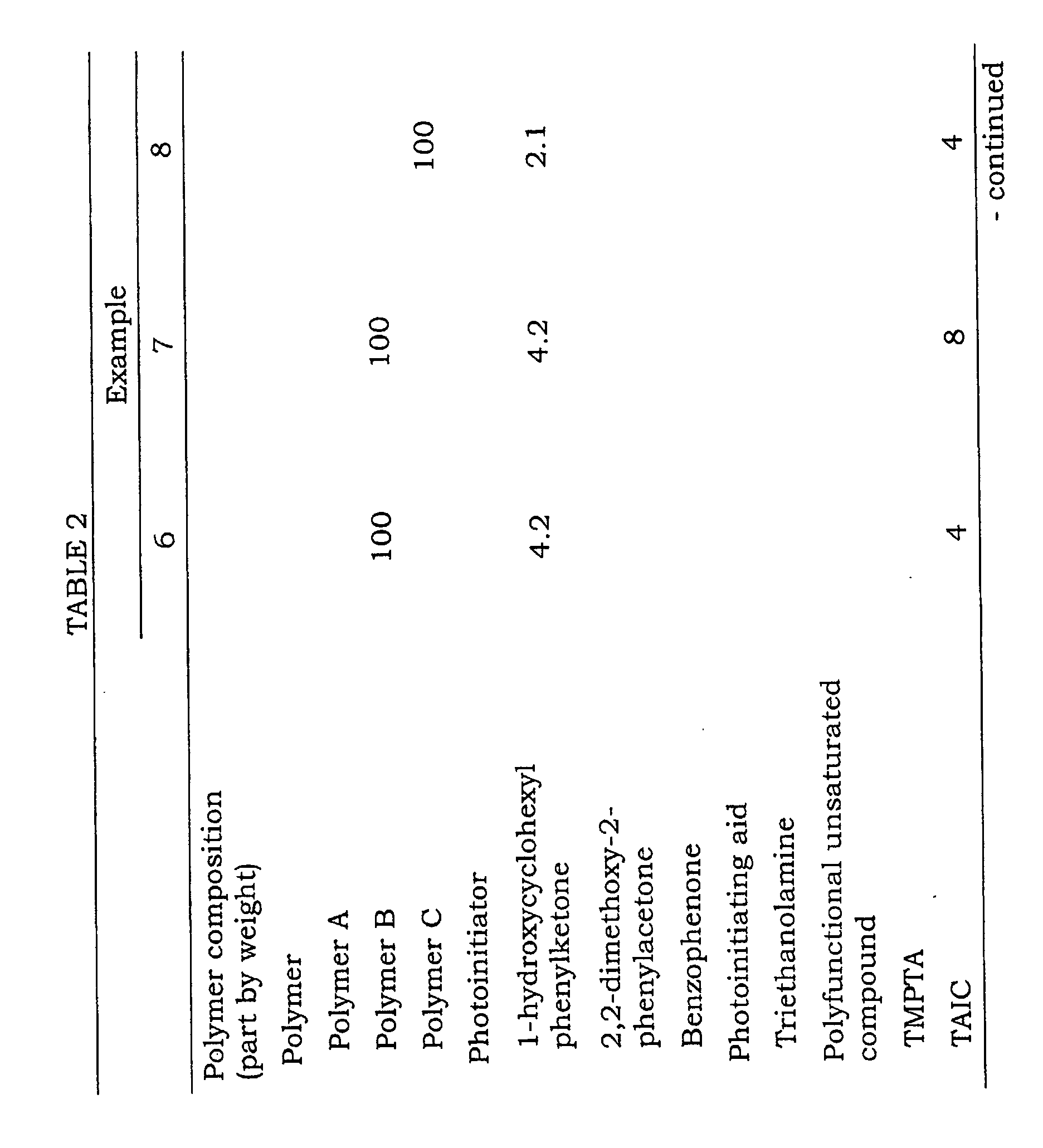
- Example 2 Components shown in Table 2 were mixed and pre-molded in the same manner as in Example 1 to obtain an about 0.5 mm thick sheet.
- Polymer B prepared in Preparation Example 2 was used as an iodine-containing polymer
- Polymer C prepared in Preparation Example 3 was used as an iodine-containing polymer.
- the sheet was subjected to ultraviolet ray irradiation under the same irradiation conditions as in Example 1 to give a crosslinked article and its solubility in acetone and physical properties in normal state were determined. The results are shown in Table 2.
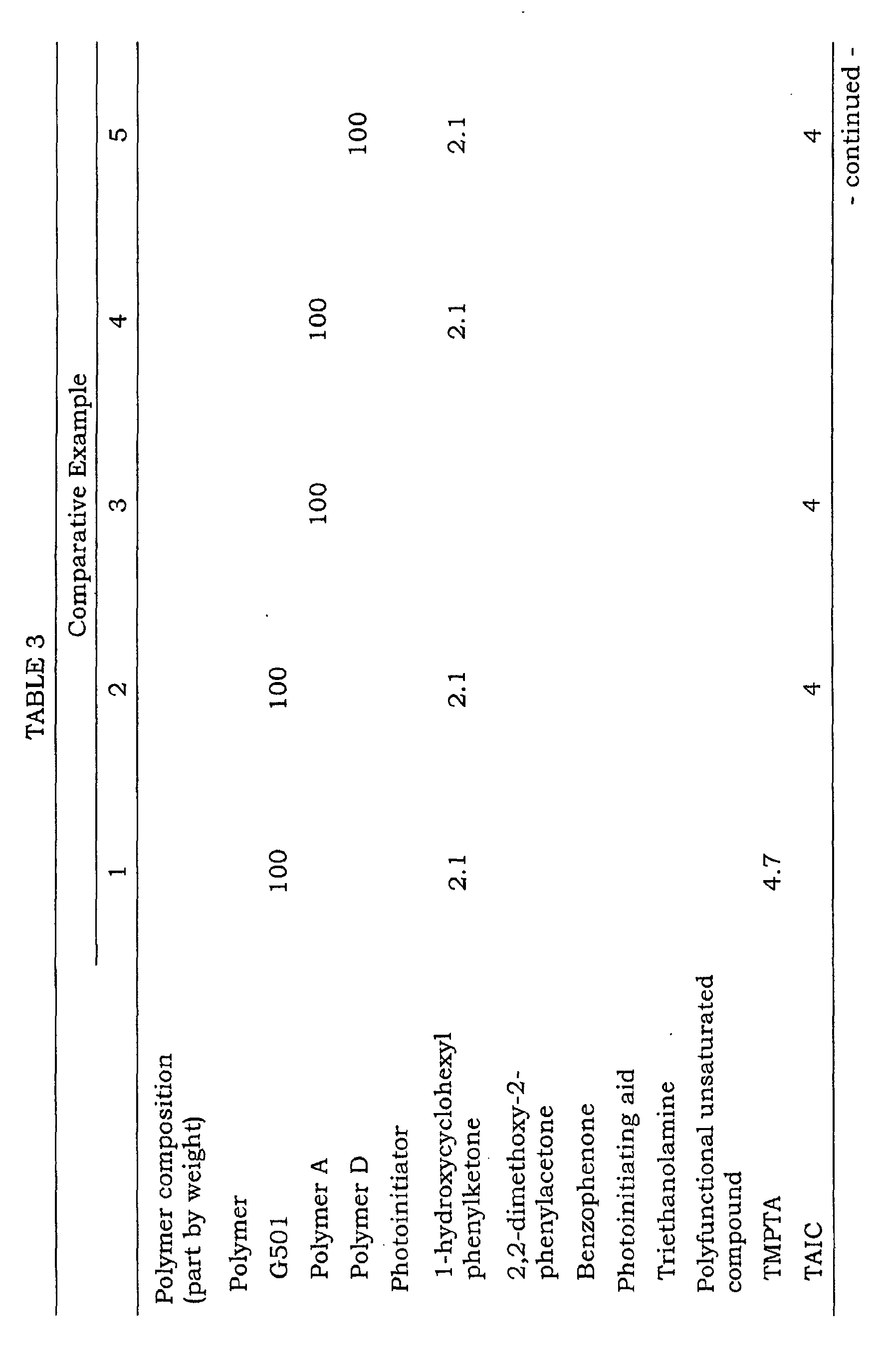
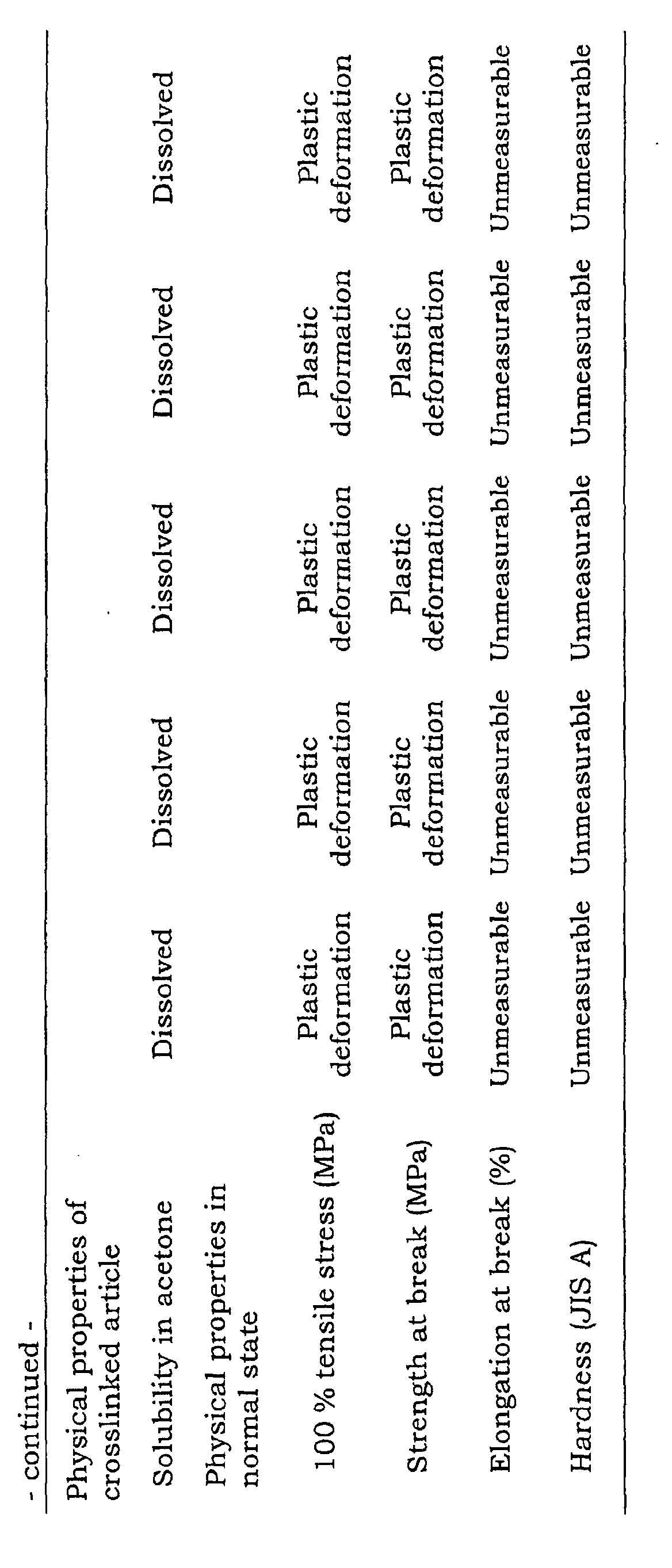
- the sheet was subjected to ultraviolet ray irradiation under the same irradiation conditions as in Example 1 to obtain a crosslinked article and its solubility in acetone and physical properties in normal state were determined. The results are shown in Table 3.
- iodine and/or bromine as a crosslinking point, it is possible to carry out crosslinking of various polymers including fluorine-containing polymers which have been very difficult to crosslink with ultraviolet rays, and molding or processing can be made easily at working site at low temperature.
Landscapes
- Chemical & Material Sciences (AREA)
- Health & Medical Sciences (AREA)
- Chemical Kinetics & Catalysis (AREA)
- Medicinal Chemistry (AREA)
- Polymers & Plastics (AREA)
- Organic Chemistry (AREA)
- Compositions Of Macromolecular Compounds (AREA)
- Addition Polymer Or Copolymer, Post-Treatments, Or Chemical Modifications (AREA)
- Polymerisation Methods In General (AREA)
- Graft Or Block Polymers (AREA)
Abstract
Description
A copolymer elastomer chain represented by the formula (2):

A terpolymer elastomer chain represented by the formula (3):

A copolymer elastomer chain represented by the formula (4):
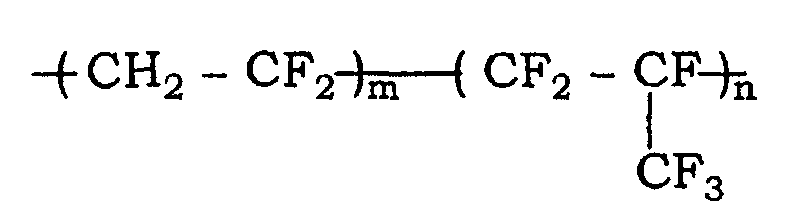
A terpolymer elastomer chain represented by the formula (5):
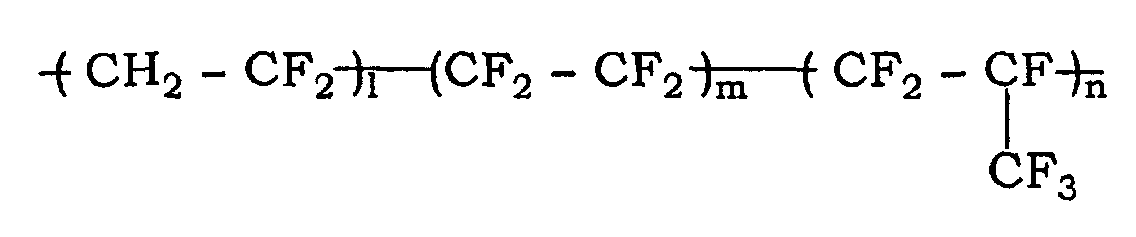
A terpolymer elastomer chain represented by the formula (6):

A non-perfluoro elastomer chain represented by the formula (7):

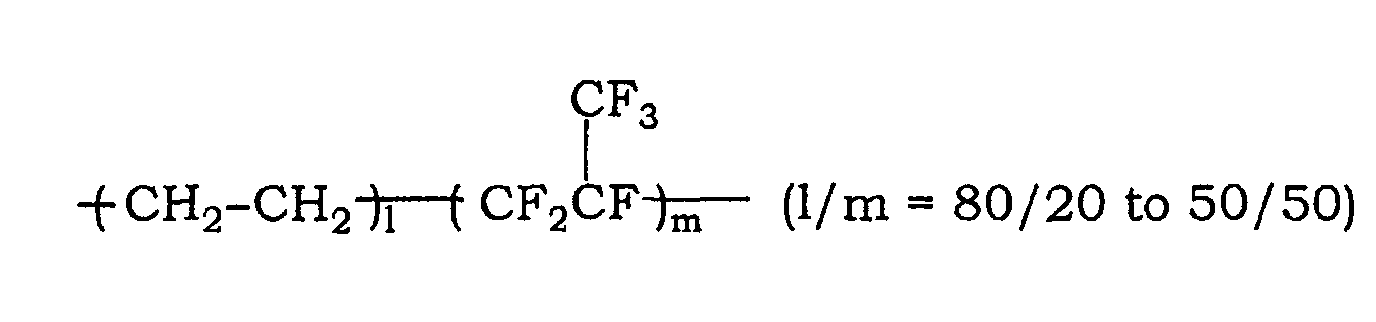


Claims (6)
- A polymer composition which is crosslinkable with ultraviolet rays and comprises a polymer containing 0.001 to 10 % by weight of iodine and/or bromine, a photoinitiator as a crosslinking agent and a polyfunctional unsaturated compound as a crosslinking aid.
- The polymer composition of Claim 1, wherein the polymer is a fluorine-containing polymer.
- The polymer composition of Claim 2, wherein the fluorine-containing polymer is a fluorine-containing elastomer.
- A crosslinked article obtained by subjecting the ultraviolet-crosslinkable polymer composition of any of Claims 1 to 3 to ultraviolet irradiation.
- A gasket for magnetic disc production apparatus which is obtained by subjecting the ultraviolet-crosslinkable polymer composition of any of Claims 1 to 3 to ultraviolet irradiation.
- A fluorine-containing polymer coating material comprising the ultraviolet-crosslinkable polymer composition of Claim 2 or 3.
Applications Claiming Priority (3)
| Application Number | Priority Date | Filing Date | Title |
|---|---|---|---|
| JP24465399 | 1999-08-31 | ||
| JP24465399 | 1999-08-31 | ||
| PCT/JP2000/005780 WO2001016234A1 (en) | 1999-08-31 | 2000-08-28 | Polymer composition crosslinkable with ultraviolet |
Publications (3)
| Publication Number | Publication Date |
|---|---|
| EP1227134A1 true EP1227134A1 (en) | 2002-07-31 |
| EP1227134A4 EP1227134A4 (en) | 2002-11-05 |
| EP1227134B1 EP1227134B1 (en) | 2006-10-04 |
Family
ID=17121958
Family Applications (1)
| Application Number | Title | Priority Date | Filing Date |
|---|---|---|---|
| EP00955053A Revoked EP1227134B1 (en) | 1999-08-31 | 2000-08-28 | Polymer composition crosslinkable with ultraviolet |
Country Status (4)
| Country | Link |
|---|---|
| US (1) | US6974845B1 (en) |
| EP (1) | EP1227134B1 (en) |
| DE (1) | DE60031148T2 (en) |
| WO (1) | WO2001016234A1 (en) |
Cited By (2)
| Publication number | Priority date | Publication date | Assignee | Title |
|---|---|---|---|---|
| WO2005068522A1 (en) * | 2003-12-29 | 2005-07-28 | Arkema France | Method for grafting a fluorinated polymer, and multilayer structures comprising said grafted polymer |
| WO2019154765A1 (en) * | 2018-02-09 | 2019-08-15 | Solvay Specialty Polymers Italy S.P.A. | Fluoroelastomer curable composition |
Families Citing this family (18)
| Publication number | Priority date | Publication date | Assignee | Title |
|---|---|---|---|---|
| US20060041069A1 (en) * | 2002-10-11 | 2006-02-23 | Asahi Glass Co., Ltd. | Sealing material for semiconductor device and method for production thereof |
| WO2004063281A1 (en) * | 2003-01-10 | 2004-07-29 | Daikin Industries, Ltd. | Cross-linked elastomer composition and formed product composed of such cross-linked elastomer composition |
| US7678858B2 (en) * | 2003-04-22 | 2010-03-16 | Daikin Industries, Ltd. | Fluorine-containing elastomer composition excellent in plasma-aging prevention effect and shaped article made thereof |
| JP4876580B2 (en) * | 2003-11-21 | 2012-02-15 | ダイキン工業株式会社 | Fluorine-containing elastomer coating composition |
| DK1814590T4 (en) | 2004-11-01 | 2014-02-24 | Amylin Pharmaceuticals Llc | Treatment of obesity and related diseases. |
| US8394765B2 (en) | 2004-11-01 | 2013-03-12 | Amylin Pharmaceuticals Llc | Methods of treating obesity with two different anti-obesity agents |
| EP1922336B1 (en) | 2005-08-11 | 2012-11-21 | Amylin Pharmaceuticals, LLC | Hybrid polypeptides with selectable properties |
| EP2330125A3 (en) | 2005-08-11 | 2012-12-12 | Amylin Pharmaceuticals, Inc. | Hybrid polypeptides with selectable properties |
| JP2007231072A (en) * | 2006-02-28 | 2007-09-13 | Three M Innovative Properties Co | Coating composition and article using the same |
| US20080032052A1 (en) * | 2006-08-04 | 2008-02-07 | Kostantinos Kourtakis | Low refractive index composition |
| US20080032053A1 (en) * | 2006-08-04 | 2008-02-07 | Kostantinos Kourtakis | Low refractive index composition |
| WO2008151257A2 (en) | 2007-06-04 | 2008-12-11 | Synergy Pharmaceuticals Inc. | Agonists of guanylate cyclase useful for the treatment of gastrointestinal disorders, inflammation, cancer and other disorders |
| JP5353880B2 (en) * | 2008-03-28 | 2013-11-27 | ダイキン工業株式会社 | Fuel low permeability block copolymer |
| US9550842B2 (en) * | 2012-11-21 | 2017-01-24 | Denka Company Limited | Acrylic elastomer, acrylic elastomer composition, laminate, crosslinked product, and molded article |
| EP3219771B1 (en) | 2016-03-14 | 2019-02-06 | 3M Innovative Properties Company | Fluoropolymer compositions with high content of inorganic material |
| CN111601858B (en) * | 2017-12-18 | 2022-06-21 | 3M创新有限公司 | Fluorinated elastomers cured by actinic radiation and methods thereof |
| WO2021038424A1 (en) | 2019-08-27 | 2021-03-04 | 3M Innovative Properties Company | Curable fluoropolymer compositions comprising metal fluoride particles and articles therefrom |
| CN114630874B (en) * | 2019-11-04 | 2023-12-05 | 3M创新有限公司 | Fluoropolymer compositions comprising curing agents having ethylenically unsaturated groups and electron donor groups and substrates coated therewith |
Family Cites Families (16)
| Publication number | Priority date | Publication date | Assignee | Title |
|---|---|---|---|---|
| US4209582A (en) | 1977-02-22 | 1980-06-24 | Arthur D. Little, Inc. | Method of preparing screen printing stencils using novel compounds and compositions |
| JPS53125491A (en) * | 1977-04-08 | 1978-11-01 | Daikin Ind Ltd | Fluorine-containing polymer easily curable and its curable composition |
| US4286048A (en) * | 1979-12-03 | 1981-08-25 | Arthur D. Little, Inc. | Photocrosslinkable compositions for screen printing stencils |
| US4254194A (en) | 1979-12-03 | 1981-03-03 | Arthur D. Little, Inc. | Screen printing stencils using novel compounds and compositions |
| JPS5920310A (en) * | 1982-07-27 | 1984-02-02 | Daikin Ind Ltd | Easily curable fluorocarbon polymer and composition for its curing |
| JPS6131411A (en) | 1984-07-23 | 1986-02-13 | Suriibondo:Kk | Curable composition |
| EP0390207A1 (en) * | 1989-03-31 | 1990-10-03 | Daikin Industries, Limited | Vibration-proof damping polymer material |
| DE69010082T2 (en) * | 1989-06-02 | 1994-12-22 | Enichem Spa | Crosslinkable compositions of polyphenylene ether and radically polymerizable monomers. |
| JPH07196878A (en) | 1993-12-07 | 1995-08-01 | E I Du Pont De Nemours & Co | Low-hardness fluororubber vulcanizing composition crosslinkable by peroxide |
| JPH08157538A (en) | 1994-12-06 | 1996-06-18 | Daikin Ind Ltd | Fluororubber copolymer excellent in low temperature property and its curing composition |
| IT1277445B1 (en) | 1995-08-04 | 1997-11-10 | Ausimont Spa | VULCANIZABLE COMPOSITIONS OF FLUOROELASTOMERS CONTAINING BROMO |
| DE19530636A1 (en) * | 1995-08-21 | 1997-02-27 | Bayer Ag | Reactive and processable fluororubbers, a process for their preparation, a process for the production of crosslinked, grafted or modified fluoroelastomers using the reactive and processable fluororubbers and their use |
| JP3496739B2 (en) | 1996-03-22 | 2004-02-16 | ユニマテック株式会社 | Fluorine-containing elastomer, its production method and composition |
| IT1292391B1 (en) | 1997-06-20 | 1999-02-08 | Ausimont Spa | THERMOPLASTIC ELASTOMERS |
| US6346300B1 (en) * | 1998-01-21 | 2002-02-12 | Dupont Dow Elastomers L.L.C. | UV curable elastomer composition |
| JP4847660B2 (en) | 1999-07-15 | 2011-12-28 | デュポン パフォーマンス エラストマーズ エルエルシー | UV curable elastomer composition |
-
2000
- 2000-08-28 US US10/069,791 patent/US6974845B1/en not_active Expired - Fee Related
- 2000-08-28 WO PCT/JP2000/005780 patent/WO2001016234A1/en not_active Ceased
- 2000-08-28 EP EP00955053A patent/EP1227134B1/en not_active Revoked
- 2000-08-28 DE DE60031148T patent/DE60031148T2/en not_active Revoked
Cited By (6)
| Publication number | Priority date | Publication date | Assignee | Title |
|---|---|---|---|---|
| WO2005068522A1 (en) * | 2003-12-29 | 2005-07-28 | Arkema France | Method for grafting a fluorinated polymer, and multilayer structures comprising said grafted polymer |
| US8124667B2 (en) | 2003-12-29 | 2012-02-28 | Arkema France | Method for grafting a fluorinated polymer and multilayer structures comprising said grafted fluoropolymer |
| WO2019154765A1 (en) * | 2018-02-09 | 2019-08-15 | Solvay Specialty Polymers Italy S.P.A. | Fluoroelastomer curable composition |
| CN111742005A (en) * | 2018-02-09 | 2020-10-02 | 索尔维特殊聚合物意大利有限公司 | Fluoroelastomer curable composition |
| CN111742005B (en) * | 2018-02-09 | 2023-01-20 | 索尔维特殊聚合物意大利有限公司 | Fluoroelastomer curable compositions |
| US11873357B2 (en) | 2018-02-09 | 2024-01-16 | Solvay Specialty Polymers Italy S.P.A. | Fluoroelastomer curable composition |
Also Published As
| Publication number | Publication date |
|---|---|
| DE60031148T2 (en) | 2007-10-25 |
| US6974845B1 (en) | 2005-12-13 |
| DE60031148D1 (en) | 2006-11-16 |
| WO2001016234A1 (en) | 2001-03-08 |
| EP1227134B1 (en) | 2006-10-04 |
| EP1227134A4 (en) | 2002-11-05 |
Similar Documents
| Publication | Publication Date | Title |
|---|---|---|
| US6974845B1 (en) | Polymer composition crosslinkable with ultraviolet | |
| EP2085408B1 (en) | Fluorocopolymer curable composition, and cured object | |
| JP6822598B1 (en) | Fluorine-containing elastomer production method and composition | |
| EP1709113A1 (en) | Fluoroelastomers with improved low temperature property and method for making the same | |
| JP3133142B2 (en) | Crosslinking composition | |
| US11873357B2 (en) | Fluoroelastomer curable composition | |
| EP1832608B1 (en) | Vulcanizable fluorine-containing elastomer composition | |
| JPWO2005028547A1 (en) | Perfluoroelastomer seal material | |
| EP3612578B1 (en) | Fluorinated thermoplastic elastomers | |
| JP3682868B2 (en) | Method for producing fluorine-containing copolymer | |
| WO2008080897A1 (en) | Fluoroelastomer composition | |
| JP2002256204A (en) | UV-crosslinkable fluoropolymer coating composition and coated article | |
| JP4617790B2 (en) | Curable composition | |
| JPWO2001016234A1 (en) | UV-crosslinkable polymer composition | |
| JPWO2002102892A1 (en) | Ethylene-hexafluoropropylene-based elastomer composition | |
| JP3220509B2 (en) | Crosslinking composition | |
| US6858763B2 (en) | Process for preparing elastomeric ethylene-hexafluoropropylene copolymer | |
| EP3592788B1 (en) | Fluorinated thermoplastic elastomers | |
| JPS5930167B2 (en) | Manufacturing method of fluorine-containing elastomer | |
| JP3709483B2 (en) | Fluorine-containing graft or block polymer | |
| JPH05186654A (en) | Readily curable fluorine-containing elastomer vulcanizable composition |
Legal Events
| Date | Code | Title | Description |
|---|---|---|---|
| PUAI | Public reference made under article 153(3) epc to a published international application that has entered the european phase |
Free format text: ORIGINAL CODE: 0009012 |
|
| 17P | Request for examination filed |
Effective date: 20020321 |
|
| AK | Designated contracting states |
Kind code of ref document: A1 Designated state(s): AT BE CH DE FR IT LI |
|
| A4 | Supplementary search report drawn up and despatched | ||
| AK | Designated contracting states |
Kind code of ref document: A4 Designated state(s): AT BE CH CY DE DK ES FI FR GB GR IE IT LI LU MC NL PT SE |
|
| TPAD | Observations filed by third parties |
Free format text: ORIGINAL CODE: EPIDOS TIPA |
|
| A4 | Supplementary search report drawn up and despatched |
Effective date: 20021105 |
|
| RIC1 | Information provided on ipc code assigned before grant |
Free format text: 7C 08L 101/04 A, 7C 08J 3/28 B, 7C 09D 201/04 B, 7F 16J 15/10 B, 7C 08F 259/08 B |
|
| RBV | Designated contracting states (corrected) |
Designated state(s): AT BE CH DE FR IT LI |
|
| 17Q | First examination report despatched |
Effective date: 20050510 |
|
| GRAP | Despatch of communication of intention to grant a patent |
Free format text: ORIGINAL CODE: EPIDOSNIGR1 |
|
| GRAS | Grant fee paid |
Free format text: ORIGINAL CODE: EPIDOSNIGR3 |
|
| RBV | Designated contracting states (corrected) |
Designated state(s): DE FR IT |
|
| GRAA | (expected) grant |
Free format text: ORIGINAL CODE: 0009210 |
|
| AK | Designated contracting states |
Kind code of ref document: B1 Designated state(s): DE FR IT |
|
| PG25 | Lapsed in a contracting state [announced via postgrant information from national office to epo] |
Ref country code: IT Free format text: LAPSE BECAUSE OF FAILURE TO SUBMIT A TRANSLATION OF THE DESCRIPTION OR TO PAY THE FEE WITHIN THE PRESCRIBED TIME-LIMIT;WARNING: LAPSES OF ITALIAN PATENTS WITH EFFECTIVE DATE BEFORE 2007 MAY HAVE OCCURRED AT ANY TIME BEFORE 2007. THE CORRECT EFFECTIVE DATE MAY BE DIFFERENT FROM THE ONE RECORDED. Effective date: 20061004 |
|
| REF | Corresponds to: |
Ref document number: 60031148 Country of ref document: DE Date of ref document: 20061116 Kind code of ref document: P |
|
| ET | Fr: translation filed | ||
| PLBI | Opposition filed |
Free format text: ORIGINAL CODE: 0009260 |
|
| PLAX | Notice of opposition and request to file observation + time limit sent |
Free format text: ORIGINAL CODE: EPIDOSNOBS2 |
|
| 26 | Opposition filed |
Opponent name: DUPONT PERFORMANCE ELASTOMERS L.L.C. Effective date: 20070702 |
|
| PLAF | Information modified related to communication of a notice of opposition and request to file observations + time limit |
Free format text: ORIGINAL CODE: EPIDOSCOBS2 |
|
| PLBB | Reply of patent proprietor to notice(s) of opposition received |
Free format text: ORIGINAL CODE: EPIDOSNOBS3 |
|
| PGFP | Annual fee paid to national office [announced via postgrant information from national office to epo] |
Ref country code: DE Payment date: 20080912 Year of fee payment: 9 |
|
| PGFP | Annual fee paid to national office [announced via postgrant information from national office to epo] |
Ref country code: FR Payment date: 20080818 Year of fee payment: 9 Ref country code: IT Payment date: 20080828 Year of fee payment: 9 |
|
| RDAF | Communication despatched that patent is revoked |
Free format text: ORIGINAL CODE: EPIDOSNREV1 |
|
| RDAG | Patent revoked |
Free format text: ORIGINAL CODE: 0009271 |
|
| STAA | Information on the status of an ep patent application or granted ep patent |
Free format text: STATUS: PATENT REVOKED |
|
| 27W | Patent revoked |
Effective date: 20090403 |