EP1227096A1 - 4-oxoquinolizine antimicrobials having 2-pyridone skeletons as the partial structure - Google Patents
4-oxoquinolizine antimicrobials having 2-pyridone skeletons as the partial structure Download PDFInfo
- Publication number
- EP1227096A1 EP1227096A1 EP00969876A EP00969876A EP1227096A1 EP 1227096 A1 EP1227096 A1 EP 1227096A1 EP 00969876 A EP00969876 A EP 00969876A EP 00969876 A EP00969876 A EP 00969876A EP 1227096 A1 EP1227096 A1 EP 1227096A1
- Authority
- EP
- European Patent Office
- Prior art keywords
- group
- thereafter
- compound
- hydrogen atom
- resulting mixture
- Prior art date
- Legal status (The legal status is an assumption and is not a legal conclusion. Google has not performed a legal analysis and makes no representation as to the accuracy of the status listed.)
- Granted
Links
- 0 *c1cc(C(C=CN23)=C(*)C2=C(C2CC2)C=C(C(O*)=O)C3=O)ccc1CN Chemical compound *c1cc(C(C=CN23)=C(*)C2=C(C2CC2)C=C(C(O*)=O)C3=O)ccc1CN 0.000 description 1
Images


Classifications
-
- C—CHEMISTRY; METALLURGY
- C07—ORGANIC CHEMISTRY
- C07D—HETEROCYCLIC COMPOUNDS
- C07D455/00—Heterocyclic compounds containing quinolizine ring systems, e.g. emetine alkaloids, protoberberine; Alkylenedioxy derivatives of dibenzo [a, g] quinolizines, e.g. berberine
- C07D455/02—Heterocyclic compounds containing quinolizine ring systems, e.g. emetine alkaloids, protoberberine; Alkylenedioxy derivatives of dibenzo [a, g] quinolizines, e.g. berberine containing not further condensed quinolizine ring systems
-
- A—HUMAN NECESSITIES
- A61—MEDICAL OR VETERINARY SCIENCE; HYGIENE
- A61K—PREPARATIONS FOR MEDICAL, DENTAL OR TOILETRY PURPOSES
- A61K31/00—Medicinal preparations containing organic active ingredients
- A61K31/33—Heterocyclic compounds
- A61K31/395—Heterocyclic compounds having nitrogen as a ring hetero atom, e.g. guanethidine or rifamycins
- A61K31/435—Heterocyclic compounds having nitrogen as a ring hetero atom, e.g. guanethidine or rifamycins having six-membered rings with one nitrogen as the only ring hetero atom
- A61K31/4353—Heterocyclic compounds having nitrogen as a ring hetero atom, e.g. guanethidine or rifamycins having six-membered rings with one nitrogen as the only ring hetero atom ortho- or peri-condensed with heterocyclic ring systems
- A61K31/4375—Heterocyclic compounds having nitrogen as a ring hetero atom, e.g. guanethidine or rifamycins having six-membered rings with one nitrogen as the only ring hetero atom ortho- or peri-condensed with heterocyclic ring systems the heterocyclic ring system containing a six-membered ring having nitrogen as a ring heteroatom, e.g. quinolizines, naphthyridines, berberine, vincamine
-
- A—HUMAN NECESSITIES
- A61—MEDICAL OR VETERINARY SCIENCE; HYGIENE
- A61P—SPECIFIC THERAPEUTIC ACTIVITY OF CHEMICAL COMPOUNDS OR MEDICINAL PREPARATIONS
- A61P31/00—Antiinfectives, i.e. antibiotics, antiseptics, chemotherapeutics
- A61P31/04—Antibacterial agents
-
- Y—GENERAL TAGGING OF NEW TECHNOLOGICAL DEVELOPMENTS; GENERAL TAGGING OF CROSS-SECTIONAL TECHNOLOGIES SPANNING OVER SEVERAL SECTIONS OF THE IPC; TECHNICAL SUBJECTS COVERED BY FORMER USPC CROSS-REFERENCE ART COLLECTIONS [XRACs] AND DIGESTS
- Y02—TECHNOLOGIES OR APPLICATIONS FOR MITIGATION OR ADAPTATION AGAINST CLIMATE CHANGE
- Y02A—TECHNOLOGIES FOR ADAPTATION TO CLIMATE CHANGE
- Y02A50/00—TECHNOLOGIES FOR ADAPTATION TO CLIMATE CHANGE in human health protection, e.g. against extreme weather
- Y02A50/30—Against vector-borne diseases, e.g. mosquito-borne, fly-borne, tick-borne or waterborne diseases whose impact is exacerbated by climate change
-
- Y—GENERAL TAGGING OF NEW TECHNOLOGICAL DEVELOPMENTS; GENERAL TAGGING OF CROSS-SECTIONAL TECHNOLOGIES SPANNING OVER SEVERAL SECTIONS OF THE IPC; TECHNICAL SUBJECTS COVERED BY FORMER USPC CROSS-REFERENCE ART COLLECTIONS [XRACs] AND DIGESTS
- Y02—TECHNOLOGIES OR APPLICATIONS FOR MITIGATION OR ADAPTATION AGAINST CLIMATE CHANGE
- Y02P—CLIMATE CHANGE MITIGATION TECHNOLOGIES IN THE PRODUCTION OR PROCESSING OF GOODS
- Y02P20/00—Technologies relating to chemical industry
- Y02P20/50—Improvements relating to the production of bulk chemicals
- Y02P20/55—Design of synthesis routes, e.g. reducing the use of auxiliary or protecting groups
Definitions
- the present invention relates to a novel synthetic antimicrobial which exhibits strong antibacterial activities against Gram-positive, Gram-negative bacteria and anaerobic bacteria.
- Quinolone type synthetic antimicrobials have been widely used in the clinical field as an agent having an excellent antibacterial activity.
- Quinolone type synthetic antimicrobials have problems, for example, that they cause a lot of side effects concerning the central nervous system, that they cause critical side effects such as a spasm inducement, and that bacteria resistant due to such antimicrobials rapidly spread. Therefore, it has been desired that synthetic antibacterial agents be developed which are effective against the bacteria resistant to such an antimicrobial and have fewer side effects and a broad antibacterial spectrum.
- the present invention provides a 4-oxoquinolizine antimicrobial having new structure and strong antibacterial activities against Gram-positive, Gram-negative bacteria, and anaerobic bacteria.
- the present inventors have conducted extensive research to provide an excellent antimicrobial, and found out that the compounds represented by the following Formula (I) has fewer side effects such as spasm inducement than the conventional antimicrobials and exhibits a strong antibacterial activity.
- the present invention has been completed on the basis of this finding.
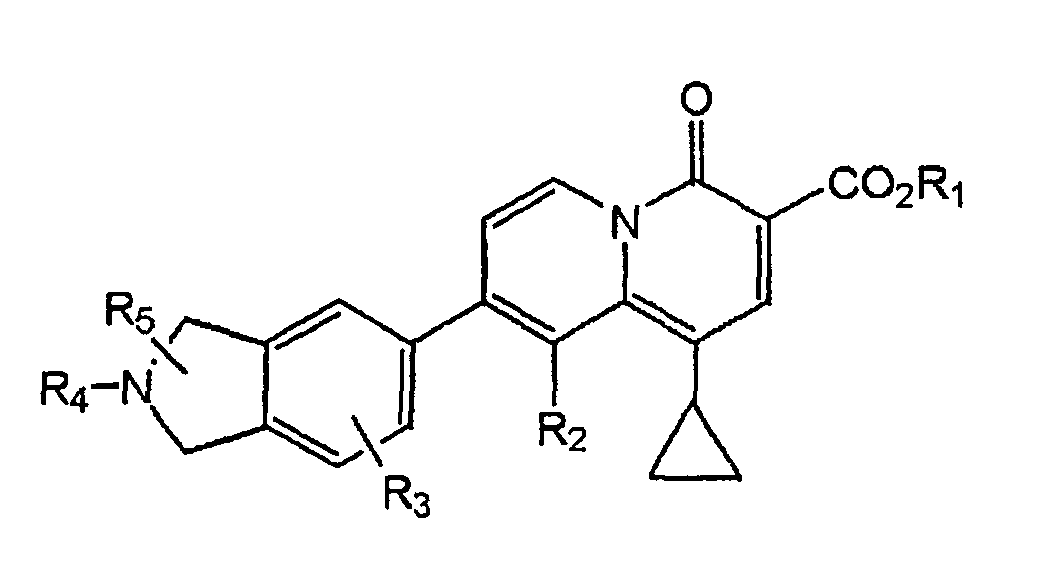
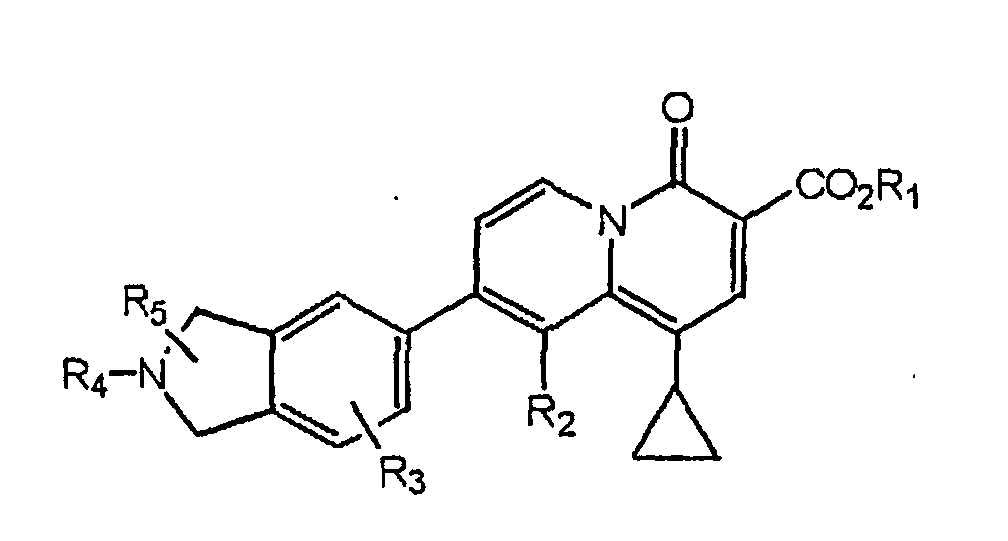
- the present invention is related to a compound represented by the following Formula (I) or a pharmaceutically acceptable salt thereof: wherein
- alkyl group means a saturated alkyl group having usually C 1-20 , preferably C 1-15 , and more preferably C 1-10 and may have a straight chain or branched chain. Particularly, the alkyl group includes lower and higher alkyl groups.
- the lower alkyl group includes an alkyl group whose carbon number is, for example, C 1-8 , preferably about C 1-5 .
- the alkyl group includes a lower alkyl group, e.g., methyl, ethyl, n-propyl, isopropyl, n-butyl, isobutyl, sec-butyl, tert-butyl and pentyl, as well as an alkyl group such as a decyl, dodecyl, tridecyl and undecyl.
- a lower alkyl group e.g., methyl, ethyl, n-propyl, isopropyl, n-butyl, isobutyl, sec-butyl, tert-butyl and pentyl
- an alkyl group such as a decyl, dodecyl, tridecyl and undecyl.
- alkenyl group means a group having a double bond in the corresponding alkyl group.
- the alkenyl group includes a straight chain or branched chain alkenyl group.
- the alkenyl group includes a straight chain or branched chain alkenyl group such as vinyl, allyl, propenyl, isopropenyl, butenyl, pentenyl, isopentenyl, hexenyl, octenyl, nonenyl and decenyl groups.
- a cycloalkyl group is a cyclic alkyl group and includes cyclopropyl, cyclobutyl, cyclopentyl, cyclohexyl, cycloheptyl, cyclononyl, cyclodecyl and cyclododecyl groups.
- An aryl group includes a phenyl and an anthracene group.
- the alkyl, alkenyl, cycloalkyl and aryl groups may have a substituent.
- a substituent includes halogen atom, hydroxyl, amino, cyano, isocyanate, epoxy, carboxyl and sulfonyl groups.
- a halogen atom includes fluorine, chlorine, bromine and iodine atoms.
- the hydrogen atoms bound to the nitrogen atom of the amino or imino group may be substituted therefore.
- a substituent is preferably an alkyl group.
- Such an alkyl group includes a straight or branched alkyl group.
- Such an alkyl group may be selected from the groups as stated above.
- a substituted amino group includes a monoalkylamino and a dialkylamino group.
- Such an alkyl group includes the alkyl group as stated above.
- Such a monoalkylamino group includes a methylamino, ethylamino, n-propylamino, isopropylamino, n-butylamino, isobutylamino, sec-butylamino and tert-butylamino.
- an alkyl group contained in the alkylamino group may have the substituent as stated above.
- the dialkylamino group may have two different alkyl groups.
- Such a dialkylamino group includes dimethylamino, methylethylamino and diethylamino groups.
- the alkyl group contained in the dialkylamino group may have the substituent as stated above.
- the alkylimino group includes methylimino, ethylimino, n-propylimino, isopropylimino, n-butylimino, isobutylimino, sec-butylimino and tert-butylimino groups.
- An alkoxy group is a group containing the oxygen atom bound to an alkyl group.
- the alkyl group contained in the alkoxy group includes the alkyl groups as stated above.
- a lower alkoxy group includes a straight or branched chain lower alkoxy group, such as methoxy, ethoxy, n-propoxy, isopropoxy, n-butoxy, isobutoxy, sec-butoxy, tert-butoxy and penthyloxy groups.
- the alkyl group contained in the alkoxy group may have the substituent as stated above.
- An alkylthio group is the group corresponding to an alkoxy group.
- the alkyl group contained in the alkylthio group includes the alkyl group as stated above.
- a lower alkylthio group includes a straight or branched lower alkylthio group, such as methylthio, ethylthio, n-propylthio, isopropylthio, n-butylthio, isobutylthio, sec-butylthio, tert-butyothio and pentylthio groups.
- the alkyl group contained in the alkylthio group may have the substituent as stated above.
- the protecting group includes a (substituted) alkoxycarbonyl group such as t-butoxycarbonyl group (Boc) and 2,2,2-trichloroetoxycarbonyl groups; a (substituted) aralkyloxycarbonyl group such as benzyloxycarbonyl, paramethoxybenzyloxycarbonyl, and paranitrobenzyloxycarbonyl groups; a (substituted) acyl group such as acethyl, methoxyacethyl, trifluoroacethyl, chloroacethyl, pivaloyl, formyl and benzoyl groups; a (substituted) alkyl or aralkyl group such as t-butyl, benzyl, paranitrobenzyl, paramethoxybenzyl and triphenylmethyl groups; a (substituted) ether group
- a protecting group of a carboxyl group includes methyl, ethyl, n-propyl, isopropyl n-buthyl, isobutyl, sec-buthyl and tert-buthyl groups.
- R 2 is preferably a lower alkyl group such as a methyl or an ethyl group, or a halogen-substituted methyl or ethyl group thereof, a lower alkoxy group such as a methoxy or an ethoxy group, or a halogen-substituted methoxy group or ethoxy group thereof.
- R 3 is also preferably a hydrogen atom, a halogen atom such as fluorine atom, or a lower alkoxy group such as a methoxy or an ethoxy group or a halogen-substituted methoxy or ethoxy group thereof.
- R 5 is preferably a hydrogen atom, a lower alkyl group such as a methyl or an ethyl group or a halogen-substituted methyl or ethyl group thereof.
- a salt of the compound represented above by Formula (I) includes a salt of a mineral acid, e.g., hydrochloric, sulfuric and phosphoric acids, a salt of an organic carboxylic acid, e.g., tartaric, formic, acetic, citric, fumaric and lactic acids, a salt of a sulfonic acid, e.g., methansulfonic, benzensulfonic, p-toluensulfonic and mesithylensulfonic acids, a salt of an alkali metal, e.g., sodium and potassium, a salt of an alkaline earth metal, e.g., calcium and magnesium, and a salt of a nitrogen-containing organic base, e.g., ammonium salt.
- a mineral acid e.g., hydrochloric, sulfuric and phosphoric acids
- an organic carboxylic acid e.g., tartaric, formic, acetic,
- the compound represented by Formula (I) or its salt includes also solvates, hydrates and various crystal forms.
- the compound represented by Formula (I) includes the isomers.
- the isomers include optical isomers, steric isomers and geometric isomers.
- the present compound can be synthesized according to a known method.
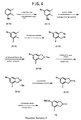
- the present compound can be synthesized according to Reaction Scheme 1 shown in Figure 1.
- the compound of Formula (VI) can be synthesized from Compound (II) (2,3-dimethylpyridine) and Compound (V) (4-chloro-3-methoxy-2-methylpyridine) as starting materials which are commercially available.
- Compound (III) can be obtained by dissolving Compound (II) in acetic acid solution and hydrogen peroxide being added thereto as an oxidizing agent, and then heating, for example, at 70 to 100°C for 5 to 24 hours.
- Compound (IV) can be obtained by nitrating Compound (III).
- the nitrating agent used herein includes a concentrated nitric acid, a mixed liquid of nitric acid and sulfuric acid, sulfuric acid and a nitrate such as potassium nitrate and sodium nitrate and anhydrous nitric acid.
- Compound (VI) wherein R 2 is difluoromethyl group for example, is prepared from Compound (XVI) and via Compound (XVII) and Compound (XVIII) as stated in Reaction Scheme 1.
- Each of the reactions is known and it is thus easy to understand for those skilled in the art.
- Compound (XVI) can be easily produced by difloromethylating 2-methylpyridine-3-carbaldehyde which is commercially available with a fluorination agent such as diethylaminosulfur trifluoride by those skilled in the art (see Reference Examples 50 to 52).
- Compound (VI) wherein R 2 is difluoromethoxy group can also be produced by treating Compound (XIX) with 3-chloroperbenzoic acid as stated in Reaction Scheme 1 (see Reference Examples 30 to 37). This method is known to those skilled in the art.
- Compound (XIX) itself can be easily produced by, for example, difluoromethoxylating the 3-position hydroxyl group of maltol with chlorodifluoromethane, and then transforming it to the 4-oxopyridine skeleton by ammonia treatment and conducting chlorination using phosphoryl chloride by those skilled in the art.
- Compound (VII) can be obtained by dissolving Compound (VI) in acetic anhydride, heating the resultant mixture, for example, at 70 to 110°C for 0.5 to 5 hours, adding a base to the resulting residue and reacting it, for example, at 50 to 90°C for 1 to 5 hours.
- the base used herein includes sodium hydroxide, potassium hydroxide and lithium hydroxide.
- Compound (VIII) can be obtained by oxidizing Compound (VII).
- the oxidizing agent used herein includes dichromic acid-sulfuric acid, chromic oxide (VI)-pyridine complex, dimethylsulfoxide-oxalylchloride and dimethylsulfoxide-trifluoroacetic acid.
- Compound (IX) can be obtained by reacting Compound (VIII) with a Grignard reagent prepared from cyclopropyl bromide and magnesium.
- the reaction may be carried out, for example, at 0 to 50°C for 1 to 15 hours.
- Compound (XI) can be obtained by reacting Compound (X) with a Wittig reagent which is prepared from (methoxymethyl)triphenylphosphonium chloride and a base.
- the base used herein includes phenyllithium, n-butyllithium and lithiumbis(trimethylsilyl)amide.
- the reaction may be carried out, for example, at 0 to 50°C for 1 to 5 hours.
- Compound (XII) When Compound (XI) is hydrolyzed under the presence of an acid, Compound (XII) can be obtained.
- the acid used herein includes hydrochloric acid, hydrobromic acid, sulfuric acid and acetic acid.
- the reaction temperature may be, for example, at 40 to 80°C and the reaction time may be, for example, for 2 to 5 hours.
- Knoevenagel condensation reaction of Compound (XII) with a diethyl malonate is carried out under the presence of an amine as a catalyst, an unsaturated carboxylic diester can be obtained as an intermediate product.
- the amine used herein includes piperidine, pyridine and diethylamine.
- the reaction temperature may be, for example, at 50 to 100°C and the reaction time may be, for example, for 2 to 5 hours.
- the present compound (XIV) can be then obtained by reacting Compound (XIII) with Compound (3) in a solvent such as toluene under the presence of a catalyst such as bis(triphenylphosphine)palladium (II) chloride (see Example 1).
- the present compound (XV) can be obtained by hydrolyzing Compound (XIV) according to a conventional method (see Example 2).
- the compound represented by Formula (II) used as a starting material can be synthesized by the method stated in J. Med. Chem., 38, 4906(1995), J. Pharm. Sci., 69, 1074(1980), J. Org. Chem., 29, 776(1964) or by a similar method.
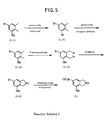
- the compound represented by Formula (I) can be also synthesized by the method according to Reaction Scheme 2 as shown in Figure 2.
- L 1 represents a tin(an alkyl group) 3 or a boron(a lower alkoxy group) 2 and X represents a halogen atom.
- Compound (I) can be obtained by coupling Compound (1) with Organic tin compound (3) or coupling Organic tin compound (2) with Compound (4) under the presence of a palladium complex as a catalyst.
- the solvents includes aromatic hydrocarbons such as benzene, toluene and xylene; ethers such as dioxane, tetrahydrofuran, anisole, diethyleneglycol diethylether and dimethylcellosolve; nitriles such as acetonitrile; amides such as N,N-dimethylformamide and N,N-dimethylacetoamide; and sulfoxides such as dimethylsulfoxide.
- the solvent may be used singly or as a mixture of two or more solvents.
- the palladium complex catalyst used in the reaction includes PdCl 2 (PPh 3 ) 2 , Pd(PPh 3 ) 4 , PdCl 2 (P(O-toryl) 3 ) 2 , PdCl 2 +2P(OEt) 3 , and PdCl 2 (PhCN) 2 wherein Ph represents a phenyl group and Et represents a ethyl group.
- the amount of Organic tin compound (3) is the same molar or more as Compound (1), preferably 1.0 to 2.0 times molar to Compound (1).
- the coupling reaction may usually be carried out, for example, at 50 to 170°C,for example, for 1 minute to 24 hours under an inert gas atmosphere such as argon or nitrogen.
- Compound (I) can be obtained by coupling Compound (1) with Organic boron compound (3) by using the palladium complex catalyst in the same manner as stated above.
- Any solvent can be used in the reaction, so long as it does not adversely effect the reaction, and includes water; alcohols such as methanol, ethanol and propanol; aromatic hydrocarbons such as benzene, toluene and xylene; hydrocarbon halogenides such as methylene chloride, chloroform and dichloroethane; ethers such as dioxane, tetrahydrofuran, anisole, diethyleneglycol diethylether and dimethylcellosolve; esters such as ethyl acetate and butyl acetate; ketones such as acetone and methylethylketone; nitriles such as acetonitrile; amides such as N,N-dimethylformamide and N,N-dimethylacetoamide; and sulfoxides such as dimethylsulfoxide.
- the solvent may be used singly or as a mixture of two or more solvents.
- the base used in the reaction includes sodium hydrogencarbonate, sodium carbonate, potassium carbonate and triethylamine.
- the amount of Organic boron compound (3) is the same molar or more as Compound (1), preferably 1.0 to 1.5 times molar to Compound (1).
- the coupling reaction may usually be carried out at 50 to 170°C for 1 minute to 24 hours under an inert gas atmosphere such as argon or nitrogen.
- Compound (3-1) when Compound (3-1) is dissolved in a base and a reducing agent is added thereto, then stirred, for example, at 0 to 60°C for 1 to 60 hours, and thereafter, the resultant mixture is oxidized with, for example, hydrochloric acid, to yield Compound (3-2).
- the base used herein includes sodium hydroxide, potassium hydroxide and lithium hydroxide.
- the reducing agent includes sodium boron hydride and potassium boron hydride.
- Compound (3-3) can be obtained by nitrifying Compound (3-2).
- the nitrating agent includes a concentrated nitric acid, a mixture of nitric acid and sulfuric acid, sulfuric acid and nitrate such as potassium nitrate and sodium nitrate, and anhydrous nitric acid.
- Compound (3-4) can be obtained by dissolving Compound (3-3), for example, in ethanol and adding a catalyst thereto and reducing the resultant mixture under a hydrogen atmosphere.
- the catalyst used herein includes palladium carbon and Raney nickel.
- the hydrogen pressure may be usual pressure or pressurized.
- the reaction temperature may be, for example, at -5 to 50°C and the reaction time may be, for example, for 1 to 30 hours.
- the reaction may be carried out by reducing with a metal such as tin and iron under the presence of a hydrochloric acid.
- Compound (3-5) can be obtained by halogenating Compound (3-4).
- the method of the halogenation may be carried out by Sandmeyer reaction by which the corresponding diazonium salt to Compound (3-4) is brominated by copper bromide.
- Compound (3-6) can be obtained by adding a reducing agent to Compound (3-5) in anhydrous THF and reducing the resultant mixture, for example, at -78 to 0°C for 1 to 12 hours.
- the reducing agent used herein includes lithium alminium hydride, diisobuthylalminium hydride and borane.
- Compound (3-7) can be obtained by halogenating Compound (3-6).
- the halogenating agent used herein includes phosphorous tribromide, hydrobromic acid, phosphorus oxychloride, and thionyl chloride.
- the reaction temperature is, for example, at -5 to 50°C and the reaction time is, for example, for 1 to 30 hours.
- Compound (3-8) can be obtained by dissolving Compound (3-7) in, for example, anhydrous DMF and reacting the resultant mixture, for example, with p-toluensulfonamide under the presence of a base.
- the base used herein includes sodium hydride, sodium ethoxide and n-buthyl lithium.
- the reaction temperature is, for example, at 30 to 180°C and the reaction time is, for example, for 0.5 to 12 hours.
- Compound (3-9) can be obtained by heating Compound (3-8), for example, at 30 to 180°C, for example, for 1 to 12 hours under the presence of a mineral acid and an organic acid and then reacting it with a N-Z-L-phenylalanine, for example, at 0 to 80°C for 1 to 30 hours.
- the mineral acid used herein includes a hydrochloric acid, a hydrobromic acid and a sulfuric acid.
- the organic acid includes acetic acid, propionic acid, p-toluensulfonic acid and phenol.
- the appropriate active esterification agent and condensation agent can be used.
- the active esterification agent includes N-hydroxysuccinimide and 1-hydroxybenzotriazol.
- the condensation agent includes N,N'-dicyclohexylcarbodiimide and N,N'-diisopropylcarbodiimide.
- Compound (4) can be obtained by heating Compound (3-9), for example, at 50 to 180°C, for example, for 1 to 80 hours under the presence of an inorganic acid or an organic acid and reacting it with tritylchloride, for example, at 0 to 50°C, for example, for 1 to 30 hours under the presence of a base.
- the inorganic acid used herein includes hydrochloric acid, hydrobromic acid and sulfuric acid.
- the organic acid includes acetic acid and phenol.
- the base includes potassium carbonate, sodium hydroxide, ammonia and triethylamine.
- Compound (3) can be obtained by dissolving Compound (4), for example, in anhydrous THF, and reacting the resultant mixture, for example, with a trialkyl borate under inactive atomosphere such as argone and the presence of a base.
- the base used herein includes n-butyl lithium, phenyl lithium, lithium diisopropylamide and lithium bis(trimethylsilyl)amide.
- the trialkyl borate includes trimethyl borate, triethyl borate and triisopropyl borate.
- the reaction temperature is, for example, at -100 to -15°C and the reaction time is, for example, for 2 to 30 hours.
- each kind of substitutent may be introduced into the present compound as R 2 of Compound (1) or (2), or as R3 of Compound (3) or (4) in Reaction Scheme 2. It is also possible for those skilled in the art to think of various modifications of the present embodiment based on the disclosure of the present invention.
- the present compound is a useful antimicrobial agent for curing local infections or general infections of a human and an animal caused by, e.g., Gram-positive, Gram-negative bacteria and anaerobic bacteria.
- the present compound can be used singly or with an adjuvant, a diluent, a binder and the like which is pharmaceutically acceptable, in a form of a general pharmaceutical composition such as a tablet, frosted tablet, capsule, injection, cream, ointment, liquid and powder.
- a general pharmaceutical composition such as a tablet, frosted tablet, capsule, injection, cream, ointment, liquid and powder.
- the present compound can be used singly or as a mixture of multiple different compounds.
- a pharmaceutical component for example, an excipient such as lactose, D-mannitol, cornstarch and crystal cellulose, a disintegrator such as carboxymethylcellulose and carboxymethylcellulose calcium, a binder such as hydroxypropylcellulose, hydroxypropylmethylcellulose and polyvinylpyrrolidone, a lubricant such as magnesium stearate and talc, a coating agent such as hydroxypropylmethylcellulose, white sugar and titanium oxide, a plasticizer such as polyethylene glycol, a base such as polyethylene glycol and hard fat may be used.
- an excipient such as lactose, D-mannitol, cornstarch and crystal cellulose
- a disintegrator such as carboxymethylcellulose and carboxymethylcellulose calcium
- a binder such as hydroxypropylcellulose, hydroxypropylmethylcellulose and polyvinylpyrrolidone
- a lubricant such as magnesium stearate and talc
- a coating agent such as hydroxy
- a pharmaceutical component including, for example, a solubilizer or a solubilizer adjuvant which can be constituted in an aqueous or necessary dissolution formulation such as distilled water for injection, saline and propylene glycol, a pH adjuster such as inorganic acid, organic acid or base, an isotonic agent such as saline, glucose and glycerin, and a stabilizer may be used.
- a solubilizer or a solubilizer adjuvant which can be constituted in an aqueous or necessary dissolution formulation such as distilled water for injection, saline and propylene glycol, a pH adjuster such as inorganic acid, organic acid or base, an isotonic agent such as saline, glucose and glycerin, and a stabilizer
- an appropriate pharmaceutical component as an ointment, a cream and a patch, for example, white vaseline, macrogol, glycerin, liquid paraffin and cotton cloth may be used.
- a dosage of the present compound is varied depending on the symptoms, age and weight of a patient and the like. Usually, in the case of a general administration, it is possible to administer the compound to an adult in a proportion of 0.05 to 100 mg/kg/day, preferably 0.1 to 50 mg/kg/day. For example, a concentration of the effective component in a local cure is 0.01 to 5 %, preferably 0.1 to 3 %.
- the resulting mixture was stirred at -78 °C for 30 minutes, and thereafter, the reaction temperature was elevated to -45 °C, and was stirred at the same temperature for 1 hour, and thereafter, 105.8 ml of triethylamine was dropped thereto and the temperature of the resulting mixture was elevated to a room temperature.
- Water was added to the resulting mixture, and the resulting mixture was extracted with chloroform, and the resulting organic layer was washed with water and saturated salt water, and thereafter, dried over anhydrous sodium sulfate and the solvent was distilled off under reduced pressure.
- the resulting mixture was stirred at -78 °C for 30 minutes, and thereafter, the reaction temperature was elevated to -45°C and the resulting mixture was stirred at the same temperature for 1 hour, and thereafter, 68.93 ml of triethylamine was dropped thereto and the temperature of the resulting mixture was elevated to a room temperature. Water was added thereto and the resulting mixture was extracted with chloroform, and the resulting organic layer was washed with water and saturated salt water, and thereafter, dried over anhydrous sodium sulfate and the solvent was distilled off under reduced pressure.
- the resulting residue was separated by filtering and washed with ether, and thereafter, the ether filtrate and ether used for washing were collected together and the collected solution was washed with water, and thereafter, dried over anhydrous sodium sulfate and the solvent was distilled off under reduced pressure.
- the resulting mixture was stirred at -78 °C for 30 minutes, and thereafter, the reaction temperature was elevated to -45 °C, and the resulting mixture was stirred at the same temperature for 1 hour, and thereafter, 95.0 ml of triethylamine was dropped thereto and the temperature of the resulting mixture was elevated to a room temperature.
- Water was added to the resulting mixture, and the resulting mixture was extracted with chloroform, and the resulting organic layer was washed with water and saturated salt water, and thereafter, dried over anhydrous sodium sulfate and the solvent was distilled off under reduced pressure.
- the resulting mixture was stirred at -78 °C for 30 minutes, and thereafter, the reaction temperature was elevated to -45°C and the resulting mixture was stirred at the same temperature for 1 hour, and thereafter, 62.79 ml of triethylamine was dropped and the temperature of the resulting mixture was elevated to a room temperature. Water was added thereto and the resulting mixture was extracted with chloroform, and the resulting organic layer was washed with water and saturated salt water, and thereafter, dried over anhydrous sodium sulfate and the solvent was distilled off under reduced pressure.
- the resulting residue was separated by filtering and washed with ether, and thereafter, the ether filtrate and ether used for washing were collected together and the collected solution was washed with water, and thereafter, dried over anhydrous sodium sulfate and the solvent was distilled off under reduced pressure.
- (+)-5-bromo-1-methyl-2-tritylisoindoline (4) was dissolved in 3.0 ml of THF, and under an argon atmosphere, 0.53 ml of n-buthyl lithium (n-hexane solution; 1.53 mol/l) was dropped thereto and the resulting mixture was stirred at the same temperature for 1 hour. 0.21 ml of triisopropyl borate was dropped to the mixture, which was stirred at the same temperature for 2 hours.
- reaction solution was concentrated under reduced pressure, and thereafter, dissolved in 10 ml of water and neutralized with IN hydrochloric acid.
- the precipitated crystal was separated by filtering to obtain 515 mg of 1-cyclopropyl-9-methoxy-8-(isoindoline-5-yl)-4-oxo-4H-quinolizine-3-carboxylic acid (I).
- the resulting mixture was stirred at -78 °C for 30 minutes, and thereafter, the reaction temperature was elevated to -45 °C, and the resulting mixture was stirred at the same temperature for 1 hour, and thereafter, 76.9 ml of triethylamine was dropped thereto and the temperature of the resulting mixture was elevated to a room temperature.
- Water was added to the resulting mixture, which was extracted with chloroform, and the resulting organic layer was washed with water and saturated salt water, and thereafter, dried over anhydrous sodium sulfate, and the solvent was distilled off under reduced pressure.
- the resulting mixture was stirred at -78 °C for 30 minutes, and thereafter, the reaction temperature was elevated to -45°C, and the resulting mixture was stirred at the same temperature for 1 hour, and thereafter, 39.56 ml of triethylamine was dropped and the temperature of the resulting mixture was elevated to a room temperature. Water was added thereto and the resulting mixture was extracted with chloroform, and the resulting organic layer was washed with water and saturated salt water, and thereafter, dried over anhydrous sodium sulfate and the solvent was distilled off under reduced pressure.
- the resulting residue was separated by filtering and washed with ether, and thereafter, the ether filtrate and ether used for washing were collected together and the collected solution was washed with water, and thereafter, dried over anhydrous sodium sulfate and the solvent was distilled off under reduced pressure.
- the solvent was distilled off under reduced pressure and 400 ml of methanol and 400 ml of concentrated hydrochloric acid were added to the resulting residue, to which 100 g of iron powder was added in a divided form, and thereafter, the resulting mixture was stirred at 70 °C for 30 minutes.
- the reaction solution was poured into ice water, and the resulting mixture was alkaline with sodium bicarbonate, and thereafter, extracted with ethyl acetate and the resulting organic layer was dried over anhydrous magnesium sulfate.
- the resulting mixture was stirred at -78 °C for 30 minutes, and thereafter, the reaction temperature was elevated to -45 °C, and the resulting mixture was stirred at the same temperature for 1 hour, and thereafter, 5.60 ml of triethylamine was dropped thereto and the temperature of the resulting mixture was elevated to a room temperature.
- Water was added to the resulting mixture, and the resulting mixture was extracted with chloroform, and the resulting organic layer was washed with water and saturated salt water, and thereafter, dried over anhydrous sodium sulfate and the solvent was distilled off under reduced pressure.
- the resulting mixture was stirred at -78 °C for 30 minutes, and thereafter, the reaction temperature was elevated to -45°C and the resulting mixture was stirred at the same temperature for 1 hour, and thereafter, 1.86 ml of triethylamine was dropped and the temperature of the resulting mixture was elevated to a room temperature. Water was added thereto and the resulting mixture was extracted with chloroform, and the resulting organic layer was washed with water and saturated salt water, and thereafter, dried over anhydrous sodium sulfate and the solvent was distilled off under reduced pressure.
- the resulting residue was separated by filtering and washed with ether, and thereafter, the ether filtrate and ether used for washing were collected together and the collected solution was washed with water, and thereafter, dried over anhydrous sodium sulfate and the solvent was distilled off under reduced pressure.
- Prescription Example will be represented as follows. However, the scope of the present invention should not be construed to be limited by Prescription Example.
- a tablet was prepared from the following components by a conventional procedure.
- Component amount Present compound 1 0 0 mg Cornstarch 5 0 mg Carboxymethyl cellulose calcium 2 5 mg Crystalline cellulose 2 0 mg Magnesium stearate 5 mg Total 2 0 0 mg
- Example 2 The in vitro antibacterial activity of the present compound (Example 2, 4, 6, 8, 10, 12, 14, 16 and 18) was tested by the standard method of Japan Chemical Therapy Institute using agar plate dilution method which is described in CHEMOTHERAPY Vol.29, 76-70, 1981. For an anaerobic bacteria, it was tested by the method described in CHEMOTHERAPY Vol. 27, 559-590, 1979. The minimum concentration at which the growth of a bacteria could be inhibited by the present compound was decided as MIC ( ⁇ g/ml). The results are shown in Tables 1 and 2 below.
- Example 2 Example 4
- Example 6 LVFX Streptococcus aureus JCM2874 0.008 0.063 0.008 0.25 Streptococcus aureus Clin-211 0.25 1 0.125 4 Streptococcus pneumoniae IID553 0.063 0.25 0.031 1 Escherichia coli IFO 12734 0.031 0.125 0.016 0.063 Pseudomonas aeruginosa CSJ1853 0.25 1 0.25 0.5 Bacillus fragilis GAI0675 0.031 0.25 0.031 0.5 Antibacterial spectrum MIC( ⁇ g/ml)
- Example 8 Example 10
- Example 12 Example 14
- Example 16 Example 18
- Streptococcus aureus JCM2874 0.063 0.063 0.031 0.008 0.125 0.031 Streptococcus aureus Clin-211 0.5 1 1 0.125 2 0.5 Streptococcus pneumoniae IID553 0.25 0.25 0.25 0.031 0.5 0.125 Es
- the present invention provides a novel synthetic 4-oxoquinolizine antimicrobial agent which exhibits a strong antibacterial activity against Gram-positive, Gram-negative bacteria or anaerobic bacteria.
Landscapes
- Health & Medical Sciences (AREA)
- Chemical & Material Sciences (AREA)
- Organic Chemistry (AREA)
- Life Sciences & Earth Sciences (AREA)
- Veterinary Medicine (AREA)
- Public Health (AREA)
- General Health & Medical Sciences (AREA)
- Medicinal Chemistry (AREA)
- Animal Behavior & Ethology (AREA)
- Pharmacology & Pharmacy (AREA)
- Epidemiology (AREA)
- Nuclear Medicine, Radiotherapy & Molecular Imaging (AREA)
- General Chemical & Material Sciences (AREA)
- Chemical Kinetics & Catalysis (AREA)
- Oncology (AREA)
- Communicable Diseases (AREA)
- Pharmaceuticals Containing Other Organic And Inorganic Compounds (AREA)
- Pyridine Compounds (AREA)
- Nitrogen Condensed Heterocyclic Rings (AREA)
- Nitrogen And Oxygen Or Sulfur-Condensed Heterocyclic Ring Systems (AREA)
Abstract
Description
1H-NMR(CDCl3) δ : 2.35(3H, s), 2.51(3H, s), 6.95-7.10(2H, m), 8.10-8.17(1H, m)
1H-NMR(CDCl3) δ : 2.57(3H, s), 2.59(3H, s), 7.72(1H, d, J=7.1Hz), 8.21(1H, d, J=7.1Hz)
1H-NMR(CDCl3) δ : 2.40(3H, s), 2.57(3H, s), 7.14(1H, d, J=6.8Hz), 8.09(1H, d, J=6.8Hz)
EI-MS m/z : 157(M+)
1H-NMR(DMSO-d6) δ : 2.36(3H, s), 4.62(2H, d, J=5.6Hz), 5.20(1H, t, J=5.6Hz), 7.44(1H, d, J=5.1Hz), 8.30(1H, d, J=5.1Hz)
EI-MS m/z : 157(M+)
1H-NMR(CDCl3) δ :2.73(3H, s), 7.50(1H, d, J=5.1Hz), 8.55(1H, d, J=5.1Hz), 10.17(1H, s)
1H-NMR(CDCl3) δ : 0.30-0.61(4H, m), 1.10-1.20(1H, m), 2.40(3H, s), 4.50(1H, d, J=7.8Hz), 4.78-4.80(1H, m), 7.25(1H, d, J=5.4Hz), 8.27(1H, d, J=5.4Hz)
1H-NMR(CDCl3) δ : 1.10-1.20(2H, m), 1.25-1.30(2H, m), 2.53(3H, s), 2.95-3.10(1H, m), 7.43(1H, d, J=5.1Hz), 8.41(1H, d, J=5.1Hz)
1H-NMR(CDCl3)
δ1 : 0.25-0.30(2H, m), 0.70-0.74(2H, m), 1.90-2.00(1H, m), 2.39(3H, s), 3.71(3H, s), 6.15(1H, d, J=1.0Hz), 7.16(1H, d, J=5.6Hz), 8.24(1H, d, J=5.6Hz)
δ2 : 0.30-0.40(2H, m), 0.60-0.65(2H, m), 1.60-1.70(1H, m) , 2.29(3H, s), 3.56(3H, s), 6.11(1H, d, J=1.2Hz), 7.16(1H, d, J=5.6Hz) , 8.33(1H, d, J=5.6Hz)
1H-NMR(CDCl3) δ : 0.23-0.78(4H, m), 1.50-1.60(1H, m), 2.36(3H, s), 3.20-3.30(1H, m), 7.24(1H, d, J=5.1Hz), 8.35(1H, d, J=5.1Hz), 9.87(1H, d, J=2.7Hz)
1H-NMR(CDCl3) δ : 0.70-0.75(2H, m), 1.00-1.10(2H, m), 1.42(3H, t, J=7.1Hz), 2.25-2.30 (1H, m), 3.00(3H, s), 4.42(2H, q, J=7.1Hz), 7.11(1H, d, J=7.8Hz), 8.39(1H, s), 9.31(1H, d, J=7.8Hz)
1H-NMR(CDCl3) δ : 0.70-0.76(2H, m), 0.95-1.05(2H, m), 1.43(3H, t, J=7.1Hz), 1.49(3H, d, J=6.6Hz), 2.30-2.40(1H, m), 2.62(3H, s), 4.10-4.61(5H, m), 6.60-7.58 (19H, m), 8.31(1H, s), 9.39(1H, d, J=7.6Hz)
1H-NMR(DMSO-d6) δ : 0.75-0.80(2H, m), 1.00-1.10(2H, m), 1.38(3H, d, J=6.4Hz), 2.40-2.55(1H, m), 2.86(3H, s), 4.09-4.44(3H, m), 7.30-7.50(3H, m), 7.54(1H, d, J=7.6Hz), 8.26 (1H, s), 9.31(1H, d, J=7.6Hz)
FAB-MS m/z : 375(M+H)+
1H-NMR(CDCl3) δ : 2.52(3H, s), 3.88(3H, s), 7.13(1H, d, J=7.1Hz), 8.05(1H, d, J=7.1Hz)
1H-NMR(CDCl3) δ : 3.91(3H, s), 4.18(1H, brs), 4.81(2H, s), 7.28(1H, d, J=5.1Hz), 8.22(1H, d, J=5.1Hz)
1H-NMR(CDCl3) δ :4.03(3H, s), 7.57(1H, d, J=4.9Hz), 8.47(1H, d, J=4.9Hz), 10.24(1H, s)
1H-NMR(CDCl3) δ : 0.40-0.61(4H, m), 1.10-1.27(1H, m), 3.93(3H, s), 4.20(1H, brs), 4.62 (1H, brs), 7.28(1H, d, J=5.1Hz), 8.23(1H, d, J=5.1Hz)
1H-NMR(CDCl3) δ : 1.09-1.30(4H,m), 2.90-2.97(1H, m), 3.95(3H, s), 7.48(1H, d, J=5.1Hz), 8.33(1H, d, J=5.1Hz)
1H-NMR(CDCl3)
δ1 : 0.47-0.51(2H, m), 0.71-0.75(2H, m), 1.83-1.91(1H, m), 3.76(3H, s), 3.82(3H, s), 6.57(1H, d, J=1.2Hz), 7.16(1H, d, J=5.1Hz), 8.15(1H, d, J=5.1Hz)
δ2 : 0.41-0.45(2H, m), 0.57-0.62(2H, m), 1.63-1.70(1H, m) , 3.58(3H, s), 3.85(3H, s), 6.20(1H, d, J=1.2Hz), 7.22(1H, d, J=5.1Hz), 8.26(1H, d, J=5.1Hz)
1H-NMR(CDCl3) δ : 0.23-0.82(4H, m), 1.50-1.59(1H, m), 3.23-3.26(1H, m), 3.86(3H, s), 7.27(1H, d, J=5.1Hz) 8.27(1H, d, J=5.1Hz), 9.92(1H, d, J=2.7Hz)
1H-NMR(CDCl3) δ : 0.74-0.75(2H, m), 0.95-1.02(2H, m), 1.42(3H, t, J=7.3Hz), 2.45-2.55 (1H, m), 3.97(3H, s), 4.42(2H, q, J=7.3Hz), 7.10(1H, d, J=7.8Hz), 8.26(1H, s), 9.26(1H, d, J=7.8Hz)
1H-NMR(CDCl3) δ : 0.73-0.78(2H, m), 0.90-0.98(2H, m), 1.42(3H, t, J=7.1Hz), 1.48(3H, d, J=6.6Hz), 2.49-2.58(1H, m), 3.28(3H, s), 4.15-4.63(5H, m), 6.88- 7.59(19H, m), 8.23(1H, s), 9.31(1H, d, J=7.6Hz)
1H-NMR(DMSO-d6) δ : 0.75-0.76(2H, m), 0.95-1.05(2H, m), 1.37(3H, d, J=6.4Hz), 2.60- 2.70(1H, m), 3.48(3H, s), 4.10-4.42(3H, m), 7.43-7.73(4H, m), 8.14(1H, s), 9.25(1H, d, J=7.6Hz)
FAB-MS m/z : 391(M+H)+
1H-NMR(CDCl3) δ :0.75(2H, m), 1.00(2H, m), 1.43(3H, t, J=7.1Hz), 2.3(1H, m), 2.78 (3H, s), 4.02(4H, s), 4.42(2H, q, J=7.1Hz), 7.02-7.63(19H, m), 8.40(1H, s), 9.43(1H, d, J=7.6Hz)
1H-NMR(DMSO-d6) δ : 0.75-0.80(2H, m), 1.05-1.15(2H, m), 2.40-2.55(1H, m), 2.86(3H, s), 4.17(4H, s), 7.36-7.55(4H, m), 8.26(1H, s), 9.31(1H, d, J=7.6Hz)
FAB-MS m/z : 361(M+H)+
1H-NMR(CDCl3) δ : 1.64(3H, dd, J=1.2Hz, 6.6Hz), 5.58(1H, q, J=6.6Hz), 7.45-7.90(4H, m)
1H-NMR(CDCl3) δ : 1.72(3H, d, J=6.8Hz), 5.70(1H, q, J=6.8Hz), 7.67(1H, d, J=8.5Hz), 8.57(1H, dd, J=2.0Hz, 8.5Hz), 8.73(1H, d, J=2.0Hz)
1H-NMR(CDCl3) δ : 1.58(3H, d, J=6.6Hz), 3.95(2H, brs), 5.47(1H, q, J=6.6Hz), 6.97(1H, dd, J=2.2Hz, 8.1Hz), 7.10(1H, d, J=2.2Hz), 7.18(1H, d, J=8.1Hz)
1H-NMR(CDCl3) δ :1.64(3H, d, J=6.6Hz), 5.54(1H, q, J=6.6Hz), 7.33(1H, d, J=8.1Hz), 7.80 (1H, dd, J=1.7Hz, 8.1Hz), 8.02(1H, d, J=1.7Hz)
1H-NMR(CDCl3) δ : 1.48(3H, d, J=6.3Hz), 3.52-3.61(2H, m), 4.48-5.02(3H, m), 7.27-7.44 (3H, m)
1H-NMR(CDCl3) δ : 2.07(3H, d, J=6.8Hz), 4.39(1H, d, J=10.7Hz), 4.70(1H, d, J=10.7Hz), 5.51(1H, q, J=6.8Hz), 7.45-7.49(3H, m)
1H-NMR(CDCl3) δ : 1.64(3H, d, J=6.3Hz), 2.39(3H, s), 4.51-4.89(3H, m), 6.96-7.75(7H, m)
1H-NMR(CDCl3) δ : 1.42(3H, d, J=6.6Hz), 3.07(1H, brs), 4.13(1H, d, J=14.4Hz), 4.22(1H, d, J=14.4 Hz), 4.39(1H, q, J=6.6Hz), 7.03-7.36(3H, m)
1H-NMR(CDCl3) δ : 1.33(3H, d, J=6.4Hz), 2.96-3.13(2H, m), 3.84-3.88(1H, m), 4.54-5.68 (6H, m), 7.01-7.38(13H, m)
1H-NMR(CDCl3) δ : 1.37(3H, d, J=6.6Hz), 3.98-4.48(3H, m), 6.56-7.53(18H, m) [α]D 20=78° (c=1.0 CHCl3)
1H-NMR(CDCl3) δ :1.40(3H, d, J=6.6Hz), 3.99-4.58(3H, m), 6.74-7.66(18H, m)
1H-NMR(CDCl3) δ : 0.72-0.76(2H, m), 0.95-0.97(2H, m), 1.43(3H, t, J=7.1Hz), 2.51-2.56(1H, m), 3.45(3H, s), 4.02(4H, s), 4.40(2H, q, J=7.1Hz), 7.12-7.62 (19H, m), 8.24(1H, s), 9.35(1H, d, J=7.6Hz)
1H-NMR(CF3COOD) δ : 1.15-1.16(2H, m), 1.46-1.48(2H, m), 3.10-3.11(1H, m), 3.84(3H, s), 5.16-5.17(4H, m), 7.84(1H, d, J=8.0Hz), 8.06-8.10(2H, m), 8.16(1H, d, J=7.3Hz), 8.47(1H, brs), 8.71(1H, s), 9.50(1H, d, J=7.3Hz)
FAB-MS m/z : 377(M+H)+
1H-NMR(CDCl3) δ : 2.55(3H, s), 6.59(1H, t, J=73.0 Hz), 7.23(1H, d, J=7.1Hz), 8.17(1H, d, J=7.1Hz)
1H-NMR(CDCl3) δ : 3.94(1H, t, J=5.1Hz) 4.84(2H, d, J=5.1Hz), 6.60(1H, t, J=73.5Hz), 7.38(1H, d, J=5.4Hz), 8.40(1H, d, J=5.4Hz)
1H-NMR(CDCl3) δ :6.77(1H, t, J=74.2Hz), 7.67(1H, d, J=5.1Hz), 8.62(1H, d, J=5.1Hz), 10.18(1H, s)
1H-NMR(CDCl3) δ : 0.44-0.62(4H, m), 1.18-1.26(1H, m), 3.79(1H, d, J=8.1Hz), 4.70(1H, m), 6.61(1H, dd, J=75.7, 71.5Hz), 7.37(1H, d, J=5.1Hz), 8.39(1H, d, J=5.1Hz)
1H-NMR(CDCl3) δ : 1.12-1.32(4H,m), 2.98-3.04(1H, m), 6.76(1H, t, J=75.0Hz), 7.59(1H, d, J=5.1Hz) 8.49(1H, d, J=5.1Hz)
1H-NMR(CDCl3)
δ 1 : 0.43-0.47(2H, m), 0.73-0.78(2H, m), 1.77-1.84(1H, m), 3.78(3H, s), 6.49(1H, t, J=77.5Hz), 6.61(1H, d, J=1.2Hz),7.23(1H, d, J=5.1Hz) 8.29(1H, d, J=5.1Hz)
δ 2 : 0.43-0.46(2H, m), 0.60-0.64(2H, m), 1.61-1.68(1H, m) , 3.60(3H, s), 6.22(1H, d, J=1.0Hz), 6.43(1H, t, J=74.2Hz), 7.30(1H, d, J=4.9Hz) , 8.40(1H, d, J=4.9Hz)
1H-NMR(CDCl3) δ : 0.27-0.86(4H, m), 1.50-1.59(1H, m), 3.37-3.40(1H, m), 6.53(1H, t, J=73.0Hz), 7.36(1H, d, J=5.1Hz), 8.45(1H, d, J=5.1Hz), 9.98(1H, d, J=1.7Hz)
1H-NMR(CDCl3) δ : 0.67-0.71(2H, m), 1.01-1.06(2H, m), 1.42(3H, t, J=7.3Hz), 2.35-2.42 (1H, m), 4.42(2H, q, J=7.3Hz), 6.69(1H, t, J=74.2Hz), 7.09(1H, d, J=7.8Hz), 8.35(1H, s), 9.30(1H, d, J=7.8Hz)
1H-NMR(CDCl3) δ : 0.68-0.73(2H, m), 0.99-1.05(2H, m), 1.42(3H, t, J=7.1Hz), 1.48(3H, d, J=6.6Hz), 2.41(1H, m), 4.10-4.66(5H, m), 5.65(1H, dd, J=74.0, 78.1Hz), 6.92-7.58(19H, m),8.35(1H, s), 9.36(1H, d, J=7.6Hz)
1H-NMR(CF3COOD) δ : 1.10-1.14(2H, m), 1.47-1.52(2H, m), 2.04(3H, d, J=6.8Hz), 2.90-2.97(1H, m), 5.05-5.52(3H, m), 6.46(1H, t, J=71.8Hz), 7.77-8.19(4H, m), 8.83(1H, s), 9.61-9.63(1H, m)
FAB-MS m/z : 427(M+H)+
1H-NMR(CDCl3) δ : 0.70-0.74(2H, m), 0.95-1.05(2H, m), 1.43(3H, t, J=7.1Hz), 2.41-2.48(1H, m), 4.04(4H, s), 4.42(2H, q, J=7.1Hz), 6.00(1H, t, J=75Hz), 7.10-7.62(19H, m), 8.36(1H, s), 9.40(1H, d, J=7.6Hz)
1H-NMR(CF3COOD) δ : 1.25-1.27(2H, m), 1.62-1.66(2H, m), 3.07-3.10(1H, m), 5.29-5.31(4H, m), 6.60(1H, t, J=72Hz), 7.97 (1H, d, J=8.0Hz), 8.15-8.19(2H, m), 8.33(1H, dd, J=7.6Hz), 8.98(1H, s), 9.76(1H, d, J=7.6Hz)
FAB-MS m/z : 413(M+H)+
1H-NMR(CDCl3) δ : 2.00(3H, s), 2.22(3H, s), 3.61(2H, bs), 6.69(1H, d, J=2.0Hz), 6.75(1H, d, J=2.0Hz)
1H-NMR(CDCl3) δ : 2.11(3H, d, J=2.2Hz), 2.50(3H, s), 7.02-7.08(2H, m)
1H-NMR(CDCl3) δ : 4.54(2H, s), 4.61(2H, s), 7.22-7.34(2H, m)
1H-NMR(CD3OD) δ : 4.66-4.69(4H, m), 7.39-7.49(2H, m)
1H-NMR(CDCl3) δ : 3.89-4.01(4H, m), 6.95-7.57(17H, m)
1H-NMR(CDCl3) δ : 3.69-4.15(4H, m), 7.10-7.61(17H, m)
1H-NMR(CDCl3) δ :0.74-0.78(2H, m), 1.00-1.04(2H, m), 1.40-1.44(3H, m), 2.30-2.39(1H, m), 2.77-2.89(3H, m), 4.08-4.45(4H, m), 6.56-7.62(20H, m), 8.40-8.41(1H, m), 9.41-9.45(1H, m)
1H-NMR(CF3COOD) δ : 1.16-1.17(2H, m), 1.51-1.53(2H, m), 2.74-2.83(1H, m), 3.26(3H, s), 5.14-5.22(4H, m), 7.41-7.43(1H, m), 7.49(1H, s), 7.99(1H, d, J=7.3Hz), 8.87(1H, s), 9.57(1H, d, J=7.3Hz)
FAB-MS m/z : 379(M+H)+
1H-NMR(CDCl3) δ : 2.09(3H, s), 2.23(3H, s), 4.77(1H, s), 6.79(1H, d, J=1.7Hz), 6.90(1H, d, J=1.7Hz)
1H-NMR(CDCl3) δ : 2.07(3H, s), 2.23(3H, s), 3.79(3H, s), 6.83(1H, s), 6.93(1H, s)
1H-NMR(CDCl3) δ : 3.89(3H, s), 4.53(2H, s), 4.69(2H, s), 7.00(1H, d, J=1.7Hz), 7.13(1H, d, J=1.7Hz)
1H-NMR(CDCl3) δ : 3.73(3H, s), 3.88-3.93(4H, m), 6.75(1H, s), 6.83(1H, s), 7.13-7.57 (15H, m)
1H-NMR(CDCl3) δ : 0.74-0.75(2H, m), 0.95-0.98(2H, m), 1.43(3H, t, J=7.1Hz), 2.57(1H, m), 3.47(3H, s), 3.81(3H, s), 4.04(4H, m), 4.42(2H, q, J=7.1Hz), 6.98-7.63(18H, m), 8.24(1H, s), 9.34(1H, d, J=7.3Hz)
1H-NMR(CF3COOD) δ : 1.13-1.17(2H, m), 1.43-1.48(2H, m), 3.10(1H, m), 3.88(3H, s), 4.16(3H, s), 5.10-5.15(4H, m), 7.56(1H, s), 7.59(1H, s), 8.16(1H, d, J=7.3Hz), 8.39(1H, brs), 8.71(1H, s), 9.48(1H, d, J=7.3Hz)
FAB-MS m/z : 407(M+H)+
1H-NMR(CDCl3) δ : 0.75-0.79(2H, m), 0.99-1.04(2H, m), 1.43(3H, t, J=7.1Hz), 2.34(1H, m), 3.79(3H, s), 4.04(3H, s), 4.42(4H, q ,J=7.1Hz), 6.57(1H, s), 6.69 (1H, s), 7.02(1H, d, J=7.6Hz), 7.15-7.62(15H, m), 8.39(1H, s), 9.43(1H, d, J=7.6Hz)
1H-NMR(CF3COOD) δ : 1.16-1.17(2H, m), 1.50-1.52(2H, m), 2.78(1H, m), 3.26(3H, s), 4.10(3H, s), 5.07(4H, m), 7.14(1H, s), 7.21(1H, s), 8.02(1H, d, J=6.3Hz), 8.37(1H, brs), 8.83(1H, s), 9.55(1H, d, J=7.6Hz)
FAB-MS m/z : 391(M+H)+
1H-NMR(CDCl3) δ :2.60(3H, s), 6.77(1H, t, J=54.7 Hz), 7.25(1H, t, J=7.1Hz), 7.42(1H, d, J=8.1Hz), 8.37(1H, d, J=6.6Hz)
1H-NMR(CDCl3) δ :2.73(3H, s), 7.35(1H, t, J=52.5Hz), 7.82(1H, d, J=7.3Hz), 8.38(1H, d, J=7.3Hz)
EI-MS m/z : 204(M+)
1H-NMR(CDCl3) δ :2.70(3H, s), 7.16(1H, t, J=53.7Hz), 7.22(1H, d, J=7.1Hz), 8.26(1H, d, J=7.1Hz)
1H-NMR(CDCl3) δ : 4.48(1H, brs), 4.98(2H, s), 7.19(1H, t, J=53.2Hz), 7.33(1H, d, J=5.4Hz), 8.54(1H, d, J=5.4Hz)
1H-NMR(CDCl3) δ : 7.63(1H, d, J=5.4Hz), 7.76(1H, t, J=53.0Hz), 8.77(1H, d, J=5.4Hz), 10.19(1H, s)
1H-NMR(CDCl3) δ : 0.43-0.60(4H, m), 1.20-1.28(1H, m), 3.75(1H, m), 4.91(1H, brs) 7.24(1H, t, J=53.2Hz), 7.34(1H, d, J=5.1Hz), 8.55(1H, d, J=5.1Hz)
1H-NMR(CDCl3) δ : 1.16-1.35(4H, m), 2.91-2.98(1H, m), 7.25(1H, t, J=53.2Hz), 7.54(1H, d, J=5.1Hz), 8.63(1H, d, J=5.1Hz)
1H-NMR(CDCl3)
δ 1 : 0.36-0.41(2H, m), 0.70-0.77(2H, m), 1.95-2.02(1H, m), 3.74(3H, s), 6.13(1H, d, J=0.7Hz), 6.97(1H, t, J=53.2Hz), 7.30(1H, d, J=5.4Hz), 8.50(1H, d, J=5.4Hz)
δ 2 : 0.37-0.41(2H, m), 0.61-0.66(2H, m), 1.64-1.71(1H, m), 3.57(3H, s), 6.23(1H, d, J=1.2Hz), 6.74(1H, t, J=53.2Hz), 7.30(1H, d, J=5.4Hz) , 8.57(1H, d, J=5.4Hz)
1H-NMR(CDCl3) δ : 0.31-0.38(1H, m), 0.47-0.56(2H, m), 0.76-0.83(1H, m), 1.59-1.68(1H, m), 3.45(1H, d, J=9.8Hz), 7.26(1H, t, J=53.2Hz), 7.31(1H, d, J=5.1Hz), 8.62(1H, d, J=5.1Hz), 9.89(1H, d, J=1.7Hz)
1H-NMR(CDCl3) δ : 0.68-0.72(2H, m), 1.13-1.18(2H, m), 1.42(3H, t, J=7.1Hz), 2.10-2.20 (1H, m), 4.42(2H, q, J=7.1Hz), 7.10(1H, d, J=7.8Hz), 7.92(1H, t, J=52.2Hz) 8.43(1H, s), 9.38(1H, d, J=7.8Hz)
EI-MS m/z : 341(M+)
FAB-MS m/z : 425(M+H)+
| Component | amount |
| | 1 0 0 |
| Cornstarch | |
| 5 0 mg | |
| | 2 5 mg |
| | 2 0 |
| Magnesium stearate | |
| 5 mg | |
| Total | 2 0 0 mg |
| Antibacterial spectrum MIC(µ g/ml) | ||||
| Example 2 | Example 4 | Example 6 | LVFX | |
| Streptococcus aureus JCM2874 | 0.008 | 0.063 | 0.008 | 0.25 |
| Streptococcus aureus Clin-211 | 0.25 | 1 | 0.125 | 4 |
| Streptococcus pneumoniae IID553 | 0.063 | 0.25 | 0.031 | 1 |
| Escherichia coli IFO 12734 | 0.031 | 0.125 | 0.016 | 0.063 |
| Pseudomonas aeruginosa CSJ1853 | 0.25 | 1 | 0.25 | 0.5 |
| Bacillus fragilis GAI0675 | 0.031 | 0.25 | 0.031 | 0.5 |
| Antibacterial spectrum MIC(µ g/ml) | ||||||
| Example 8 | Example 10 | Example 12 | Example 14 | Example 16 | Example 18 | |
| Streptococcus aureus JCM2874 | 0.063 | 0.063 | 0.031 | 0.008 | 0.125 | 0.031 |
| Streptococcus aureus Clin-211 | 0.5 | 1 | 1 | 0.125 | 2 | 0.5 |
| Streptococcus pneumoniae IID553 | 0.25 | 0.25 | 0.25 | 0.031 | 0.5 | 0.125 |
| Escherichia coli IFO 12734 | 0.063 | 0.125 | 0.125 | 0.031 | 0.5 | 0.125 |
| | 1 | 4 | 4 | 0.5 | 8 | 2 |
| Bacillus fragilis GAI0675 | 0.25 | 0.5 | 0.25 | 0.016 | 0.25 | 0.063 |
Claims (14)
- A compound represented by the following Formula (I) or a pharmaceutically acceptable salt thereof:wherein
 R1 represents a hydrogen atom or a carboxyl-protecting group,R2 represents a hydrogen atom, a halogen atom, a lower alkyl group, a lower alkoxy group or a hydroxyl group,R3 represents a hydrogen atom, a halogen atom, a lower alkyl group, a lower alkoxy group, a lower alkylthio group, a nitro group, a cyano group, a hydroxyl group or an amino group;R4 represents a hydrogen atom, an amino-protecting group, an alkyl group or a cycloalkyl group, andR5 represents a hydrogen atom, a halogen atom, an alkyl group, an alkenyl group, a cycloalkyl group, an aryl group, an alkoxy group, an alkylthio group, a hydroxyl group, an imino group or an amino group.
 - The compound or the pharmaceutically acceptable salt thereof of claim 1, wherein in Formula (I), R2 is a lower alkyl group or a lower alkoxy group.
- The compound or the pharmaceutically acceptable salt thereof of claim 1, wherein in Formula (I), R3 is a hydrogen atom or a lower alkoxy group.
- The compound or the pharmaceutically acceptable salt thereof of claim 1, wherein in Formula (I), R5 is a hydrogen atom or a lower alkyl group.
- The compound or the pharmaceutically acceptable salt thereof of claim 1, wherein in Formula (I), R1 is a hydrogen atom.
- An antimicrobial agent comprising the compound of claim 1 or a pharmaceutically acceptable salt thereof as an effective component.
- The antimicrobial agent of claim 6 against a Gram-positive bacterium.
- The antimicrobial agent of claim 7, wherein said Gram-positive bacterium is Streptococcus aureus or Streptococcus pneumoniae.
- The antimicrobial agent of claim 6 against a Gram-negative bacterium.
- The antimicrobial agent of claim 9, wherein said Gram-negative bacterium is Escherichia coli or Pseudomonas aeruginosa.
- The antimicrobial agent of claim 6 against an anaerobic bacterium.
- The antimicrobial agent of claim 11, wherein said anaerobic bacterium is Bacillus fragilis.
- A method of preparing the compound of claim 1, comprising reacting a compound represented by the following Formula (1):wherein
 with a compound represented by the following Formula (3),R1 represents a hydrogen atom or a carboxyl-protecting group,R2 represents a hydrogen atom, a halogen atom, a lower alkyl group, a lower alkoxy group or a hydroxyl group; andX represents a halogen atom,wherein
 R3 represents a hydrogen atom, a halogen atom, a lower alkyl group, a lower alkoxy group, a lower alkylthio group, a nitro group, a cyano group, a hydroxyl group, or an amino group,R4 represents a hydrogen atom, an amino-protecting group, an alkyl group or a cycloalkyl group,R5 represents a hydrogen atom, a halogen atom, an alkyl group, an alkenyl group, a cycloalkyl group, an aryl group, an alkoxy group, an alkylthio group, a hydroxyl group, an imino group, or an amino group, andL1 represents tin(an alkyl group)3 or boron(a lower alkoxy group)2.
 - A method of preparing the compound of claim 1, comprising reacting a compound represented by the following Formula (2):wherein
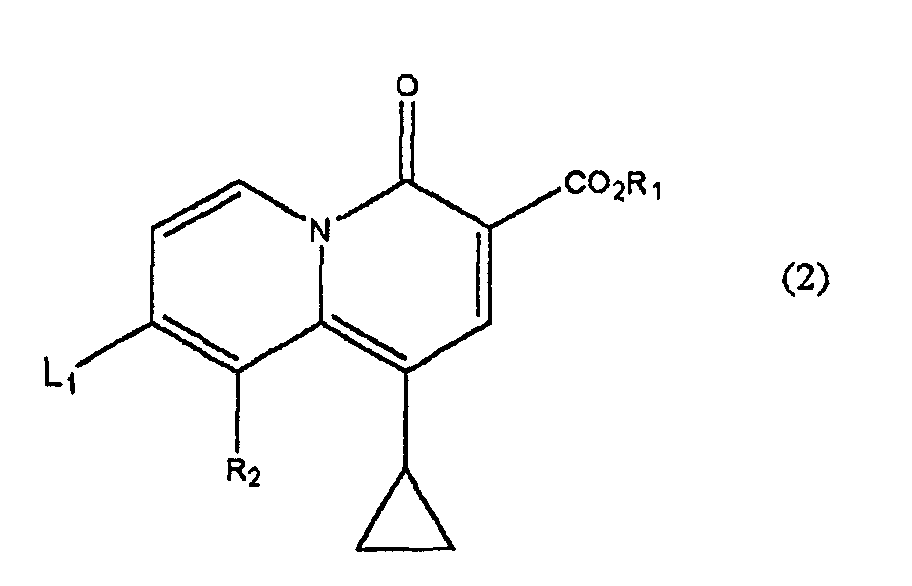 R1 represents a hydrogen atom or a carboxyl-protecting group,R2 represents a hydrogen atom, a halogen atom, a lower alkyl group, a lower alkoxy group or a hydroxyl group, andL1 represents tin(an alkyl group)3 or boron(an lower alkoxy group)2, with a compound represented by the following Formula (4)wherein
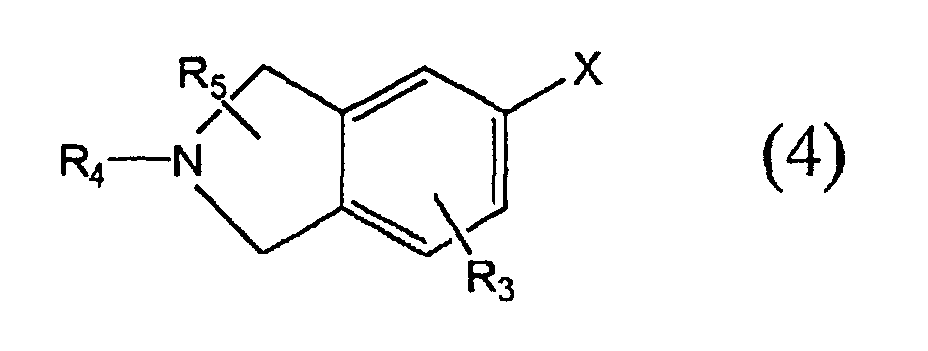 R3 represents a hydrogen atom, a halogen atom, a lower alkyl group, a lower alkoxy group, a lower alkylthio group, a nitro group, a cyano group, a hydroxyl group, or an amino group,R4 represents a hydrogen atom, an amino-protecting group, an alkyl group or a cycloalkyl group,R5 represents a hydrogen atom, a halogen atom, an alkyl group, an alkenyl group, a cycloalkyl group, an aryl group, an alkoxy group, an alkylthio group, a hydroxyl group, an imino group, or an amino group, andX represents a halogen atom.
Applications Claiming Priority (3)
| Application Number | Priority Date | Filing Date | Title |
|---|---|---|---|
| JP29638399 | 1999-10-19 | ||
| JP29638399 | 1999-10-19 | ||
| PCT/JP2000/007256 WO2001029035A1 (en) | 1999-10-19 | 2000-10-19 | 4-oxoquinolizine antimicrobials having 2-pyridone skeletons as the partial structure |
Publications (3)
| Publication Number | Publication Date |
|---|---|
| EP1227096A1 true EP1227096A1 (en) | 2002-07-31 |
| EP1227096A4 EP1227096A4 (en) | 2003-04-02 |
| EP1227096B1 EP1227096B1 (en) | 2004-09-22 |
Family
ID=17832846
Family Applications (1)
| Application Number | Title | Priority Date | Filing Date |
|---|---|---|---|
| EP00969876A Expired - Lifetime EP1227096B1 (en) | 1999-10-19 | 2000-10-19 | 4-oxoquinolizine antimicrobials having 2-pyridone skeletons as the partial structure |
Country Status (8)
| Country | Link |
|---|---|
| US (1) | US6525066B2 (en) |
| EP (1) | EP1227096B1 (en) |
| JP (1) | JP4328049B2 (en) |
| AT (1) | ATE277042T1 (en) |
| AU (1) | AU7948900A (en) |
| DE (1) | DE60014143T2 (en) |
| ES (1) | ES2225237T3 (en) |
| WO (1) | WO2001029035A1 (en) |
Cited By (3)
| Publication number | Priority date | Publication date | Assignee | Title |
|---|---|---|---|---|
| WO2005019224A3 (en) * | 2003-06-06 | 2005-07-28 | Cadila Healthcare Ltd | Novel antiinfective compounds |
| WO2012047487A1 (en) * | 2010-09-27 | 2012-04-12 | Evolva Sa | 2-pyridone antimicrobial compositions |
| WO2012104305A1 (en) * | 2011-02-01 | 2012-08-09 | Evolva Sa | Antimicrobial 4-oxoquinolizines |
Families Citing this family (17)
| Publication number | Priority date | Publication date | Assignee | Title |
|---|---|---|---|---|
| AR025976A1 (en) | 1999-10-08 | 2002-12-26 | Affinium Pharm Inc | FAB INHIBITORS I. |
| AU2001286191A1 (en) * | 2000-09-12 | 2002-03-26 | Sankyo Company, Limited | Quinolizine derivatives |
| CA2444597A1 (en) * | 2001-04-06 | 2002-10-06 | Affinium Pharmaceuticals, Inc. | Fab i inhibitors |
| ATE404558T1 (en) * | 2001-09-28 | 2008-08-15 | Sato Pharma | ANTIMICROBIAL 4-OXOCINOLICINE COMPOUNDS THAT HAVE A 2-PYRIDONE SKELETON AS A PARTIAL STRUCTURE |
| CA2508792C (en) | 2002-12-06 | 2013-02-05 | Affinium Pharmaceuticals, Inc. | Heterocyclic compounds, methods of making them and their use in therapy |
| WO2004082586A2 (en) | 2003-03-17 | 2004-09-30 | Affinium Pharmaceuticals, Inc. | Phamaceutical compositions comprising inhibitors of fab i and further antibiotics |
| CA2568914C (en) * | 2004-06-04 | 2013-09-24 | Affinium Pharmaceuticals, Inc. | Therapeutic agents, and methods of making and using the same |
| EP1973902A2 (en) * | 2005-12-05 | 2008-10-01 | Affinium Pharmaceuticals, Inc. | 3-heterocyclylacrylamide compounds as fabi inhibitors and antibacterial agents |
| EP2687533B1 (en) | 2006-07-20 | 2017-07-19 | Debiopharm International SA | Acrylamide derivatives as FAB I inhibitors |
| US20080139574A1 (en) | 2006-11-30 | 2008-06-12 | Cadila Healthcare Limited | Novel quinoline derivatives |
| US8263613B2 (en) * | 2007-02-16 | 2012-09-11 | Affinium Pharmaceuticals, Inc. | Salts, prodrugs and polymorphs of fab I inhibitors |
| WO2011031745A1 (en) | 2009-09-09 | 2011-03-17 | Achaogen, Inc. | Antibacterial fluoroquinolone analogs |
| SMT201900411T1 (en) | 2012-06-19 | 2019-09-09 | Debiopharm Int Sa | Prodrug derivatives of (e)-n-methyl-n-((3-methylbenzofuran-2-yl)methyl)-3-(7-oxo-5,6,7,8-tetrahydro-1,8-naphthyridin-3-yl)acrylamide |
| BR122023021456A2 (en) | 2016-02-26 | 2024-02-20 | Debiopharm International S.A. | USE OF {6- [(E)-3-{METHYL[(3-METHYL-1-BENFOFURAN-2- IOL)METHYL]AMINO)-3- OXOPRO-1-EN-1-IL] DIHYDROGEN PHOSPHATE -2-OXO-3,4-DI-HYDRO-1,8-NAFTYRIDIN-1(2H)- IL}METHYL FOR TREATMENT OF OSTEOMYELITIS OF THE DIABETIC FOOT AND PHARMACEUTICAL COMPOSITION |
| FI3923914T3 (en) | 2019-02-14 | 2023-04-27 | Debiopharm Int Sa | Afabicin formulation, method for its preparation |
| MA56184A (en) | 2019-06-14 | 2022-04-20 | Debiopharm Int Sa | AFABICIN FOR USE IN THE TREATMENT OF BACTERIAL INFECTIONS INVOLVING BIOFILM |
| CN110938028B (en) * | 2019-12-09 | 2022-03-04 | 南京杰运医药科技有限公司 | Preparation method of (1R) -5-bromo-2, 3-dihydro-1-methyl-1H-isoindole |
Family Cites Families (4)
| Publication number | Priority date | Publication date | Assignee | Title |
|---|---|---|---|---|
| JPH09503783A (en) * | 1993-10-14 | 1997-04-15 | アボツト・ラボラトリーズ | Quinolidinone type compound |
| ATE245638T1 (en) | 1994-08-12 | 2003-08-15 | Toyama Chemical Co Ltd | NEW QUINOLONE OR NAPHTHYRIDONE CARBOXYLIC ACID DERIVATIVES OR SALTS THEREOF |
| JP3833738B2 (en) | 1995-11-15 | 2006-10-18 | 第一製薬株式会社 | Substituted aminomethylpyrrolidine derivatives |
| AU2001286191A1 (en) * | 2000-09-12 | 2002-03-26 | Sankyo Company, Limited | Quinolizine derivatives |
-
2000
- 2000-10-19 AT AT00969876T patent/ATE277042T1/en not_active IP Right Cessation
- 2000-10-19 EP EP00969876A patent/EP1227096B1/en not_active Expired - Lifetime
- 2000-10-19 AU AU79489/00A patent/AU7948900A/en not_active Abandoned
- 2000-10-19 DE DE60014143T patent/DE60014143T2/en not_active Expired - Fee Related
- 2000-10-19 JP JP2001531834A patent/JP4328049B2/en not_active Expired - Fee Related
- 2000-10-19 ES ES00969876T patent/ES2225237T3/en not_active Expired - Lifetime
- 2000-10-19 WO PCT/JP2000/007256 patent/WO2001029035A1/en not_active Ceased
-
2002
- 2002-04-18 US US10/124,485 patent/US6525066B2/en not_active Expired - Fee Related
Cited By (5)
| Publication number | Priority date | Publication date | Assignee | Title |
|---|---|---|---|---|
| WO2005019224A3 (en) * | 2003-06-06 | 2005-07-28 | Cadila Healthcare Ltd | Novel antiinfective compounds |
| WO2012047487A1 (en) * | 2010-09-27 | 2012-04-12 | Evolva Sa | 2-pyridone antimicrobial compositions |
| WO2012104305A1 (en) * | 2011-02-01 | 2012-08-09 | Evolva Sa | Antimicrobial 4-oxoquinolizines |
| EP3312176A1 (en) * | 2011-02-01 | 2018-04-25 | Emergent Product Development Gaithersburg Inc. | Antimicrobial 4-oxoquinolizines |
| EP3476844A1 (en) * | 2011-02-01 | 2019-05-01 | Emergent Product Development Gaithersburg Inc. | Antimicrobial 4-oxoquinolizines |
Also Published As
| Publication number | Publication date |
|---|---|
| ES2225237T3 (en) | 2005-03-16 |
| AU7948900A (en) | 2001-04-30 |
| US20020173517A1 (en) | 2002-11-21 |
| ATE277042T1 (en) | 2004-10-15 |
| DE60014143D1 (en) | 2004-10-28 |
| JP4328049B2 (en) | 2009-09-09 |
| EP1227096B1 (en) | 2004-09-22 |
| EP1227096A4 (en) | 2003-04-02 |
| WO2001029035A1 (en) | 2001-04-26 |
| US6525066B2 (en) | 2003-02-25 |
| DE60014143T2 (en) | 2006-03-02 |
Similar Documents
| Publication | Publication Date | Title |
|---|---|---|
| EP1227096B1 (en) | 4-oxoquinolizine antimicrobials having 2-pyridone skeletons as the partial structure | |
| JPWO2001029035A1 (en) | 4-oxoquinolizine antibacterial agent having a 2-pyridone skeleton as a partial structure | |
| US5935952A (en) | Quinolone- or naphthylidone-carboxylic acid derivates or their salts | |
| TW202204364A (en) | Rip1k inhibitors | |
| TW201249798A (en) | Fluoro-pyridinone derivatives useful as antibacterial agents | |
| JP2020509017A (en) | Novel isoindoline derivatives, pharmaceutical compositions and uses thereof | |
| IL267239B (en) | Novel phenyl propionic acid derivatives and uses thereof | |
| JPS6320828B2 (en) | ||
| KR20170082632A (en) | Morpholine and 1,4-oxazepane amides as somatostatin receptor subtype 4 (sstr4) agonists | |
| US8586602B2 (en) | Derivatives of 7 alkynyl-1,8 naphthyridones, preparation method thereof and use of same in therapeutics | |
| JP2007015928A (en) | New olefin derivatives | |
| MXPA05002886A (en) | Cox-2 inhibiting pyridine derivatives. | |
| KR100550078B1 (en) | Quinolone Carbonate Derivatives or Salts thereof | |
| KR20010085852A (en) | 2,3-disubstituted pyridine derivatives, process for the preparation thereof, drug compositions containing the same and intermediates for the preparation | |
| CA2391012A1 (en) | Pyrazinone thrombin inhibitors | |
| HRP20010903A2 (en) | Pyrazinone thrombin inhibitors | |
| CZ20004587A3 (en) | Tetrahydroquinoline derivatives | |
| CN117645616A (en) | Selective HER2 inhibitors | |
| AU2005219689A1 (en) | Novel cyclic compound having 4-pyridylalkylthio group having (un)substituted amino introduced therein | |
| JP2787713B2 (en) | Novel isothiazolone naphthyridine and isothiazolo quinoline derivatives and their salts | |
| CN113891879B (en) | 3,6-Disubstituted-2-pyridinealdehyde oxime skeleton | |
| CN116874468B (en) | Synthesis and application of small molecule compounds with 2-pyridine-substituted carboxamide structures | |
| TW202532411A (en) | Glp-1 receptor agonist, and uses thereof | |
| JP2630566B2 (en) | 1,4-dihydro-4-oxonaphthyridine derivative or salt thereof | |
| CN117384162A (en) | Selective HER2 inhibitors |
Legal Events
| Date | Code | Title | Description |
|---|---|---|---|
| PUAI | Public reference made under article 153(3) epc to a published international application that has entered the european phase |
Free format text: ORIGINAL CODE: 0009012 |
|
| 17P | Request for examination filed |
Effective date: 20020418 |
|
| AK | Designated contracting states |
Kind code of ref document: A1 Designated state(s): AT BE CH CY DE DK ES FI FR GB GR IE IT LI LU MC NL PT SE |
|
| AX | Request for extension of the european patent |
Free format text: AL;LT;LV;MK;RO;SI |
|
| RIN1 | Information on inventor provided before grant (corrected) |
Inventor name: KIMURA, HIROAKI Inventor name: ISHIDUKA, SEIJI Inventor name: KATO, MASATOSHI Inventor name: FUKUMOTO, RYOICHI Inventor name: HIROSAWA, CHISATO Inventor name: YANAGIHARA, SATOSHI Inventor name: KUSAKABE, HIROYUKI Inventor name: CHU, CHONG |
|
| A4 | Supplementary search report drawn up and despatched |
Effective date: 20030214 |
|
| 17Q | First examination report despatched |
Effective date: 20030502 |
|
| GRAP | Despatch of communication of intention to grant a patent |
Free format text: ORIGINAL CODE: EPIDOSNIGR1 |
|
| GRAS | Grant fee paid |
Free format text: ORIGINAL CODE: EPIDOSNIGR3 |
|
| GRAA | (expected) grant |
Free format text: ORIGINAL CODE: 0009210 |
|
| AK | Designated contracting states |
Kind code of ref document: B1 Designated state(s): AT BE CH CY DE DK ES FI FR GB GR IE IT LI LU MC NL PT SE |
|
| PG25 | Lapsed in a contracting state [announced via postgrant information from national office to epo] |
Ref country code: NL Free format text: LAPSE BECAUSE OF FAILURE TO SUBMIT A TRANSLATION OF THE DESCRIPTION OR TO PAY THE FEE WITHIN THE PRESCRIBED TIME-LIMIT Effective date: 20040922 Ref country code: CY Free format text: LAPSE BECAUSE OF FAILURE TO SUBMIT A TRANSLATION OF THE DESCRIPTION OR TO PAY THE FEE WITHIN THE PRESCRIBED TIME-LIMIT Effective date: 20040922 Ref country code: FI Free format text: LAPSE BECAUSE OF FAILURE TO SUBMIT A TRANSLATION OF THE DESCRIPTION OR TO PAY THE FEE WITHIN THE PRESCRIBED TIME-LIMIT Effective date: 20040922 |
|
| REG | Reference to a national code |
Ref country code: GB Ref legal event code: FG4D |
|
| REG | Reference to a national code |
Ref country code: CH Ref legal event code: EP |
|
| REG | Reference to a national code |
Ref country code: IE Ref legal event code: FG4D |
|
| REF | Corresponds to: |
Ref document number: 60014143 Country of ref document: DE Date of ref document: 20041028 Kind code of ref document: P |
|
| REG | Reference to a national code |
Ref country code: CH Ref legal event code: NV Representative=s name: MICHELI & CIE INGENIEURS-CONSEILS |
|
| PG25 | Lapsed in a contracting state [announced via postgrant information from national office to epo] |
Ref country code: SE Free format text: LAPSE BECAUSE OF FAILURE TO SUBMIT A TRANSLATION OF THE DESCRIPTION OR TO PAY THE FEE WITHIN THE PRESCRIBED TIME-LIMIT Effective date: 20041222 Ref country code: GR Free format text: LAPSE BECAUSE OF FAILURE TO SUBMIT A TRANSLATION OF THE DESCRIPTION OR TO PAY THE FEE WITHIN THE PRESCRIBED TIME-LIMIT Effective date: 20041222 Ref country code: DK Free format text: LAPSE BECAUSE OF FAILURE TO SUBMIT A TRANSLATION OF THE DESCRIPTION OR TO PAY THE FEE WITHIN THE PRESCRIBED TIME-LIMIT Effective date: 20041222 |
|
| LTIE | Lt: invalidation of european patent or patent extension |
Effective date: 20040922 |
|
| REG | Reference to a national code |
Ref country code: ES Ref legal event code: FG2A Ref document number: 2225237 Country of ref document: ES Kind code of ref document: T3 |
|
| NLV1 | Nl: lapsed or annulled due to failure to fulfill the requirements of art. 29p and 29m of the patents act | ||
| ET | Fr: translation filed | ||
| PLBE | No opposition filed within time limit |
Free format text: ORIGINAL CODE: 0009261 |
|
| STAA | Information on the status of an ep patent application or granted ep patent |
Free format text: STATUS: NO OPPOSITION FILED WITHIN TIME LIMIT |
|
| PGFP | Annual fee paid to national office [announced via postgrant information from national office to epo] |
Ref country code: IE Payment date: 20050823 Year of fee payment: 6 |
|
| PGFP | Annual fee paid to national office [announced via postgrant information from national office to epo] |
Ref country code: AT Payment date: 20050831 Year of fee payment: 6 |
|
| 26N | No opposition filed |
Effective date: 20050623 |
|
| PGFP | Annual fee paid to national office [announced via postgrant information from national office to epo] |
Ref country code: BE Payment date: 20050914 Year of fee payment: 6 |
|
| PGFP | Annual fee paid to national office [announced via postgrant information from national office to epo] |
Ref country code: MC Payment date: 20050919 Year of fee payment: 6 |
|
| PGFP | Annual fee paid to national office [announced via postgrant information from national office to epo] |
Ref country code: LU Payment date: 20051027 Year of fee payment: 6 |
|
| PG25 | Lapsed in a contracting state [announced via postgrant information from national office to epo] |
Ref country code: IE Free format text: LAPSE BECAUSE OF NON-PAYMENT OF DUE FEES Effective date: 20061019 Ref country code: AT Free format text: LAPSE BECAUSE OF NON-PAYMENT OF DUE FEES Effective date: 20061019 |
|
| PG25 | Lapsed in a contracting state [announced via postgrant information from national office to epo] |
Ref country code: MC Free format text: LAPSE BECAUSE OF NON-PAYMENT OF DUE FEES Effective date: 20061031 |
|
| REG | Reference to a national code |
Ref country code: IE Ref legal event code: MM4A |
|
| BERE | Be: lapsed |
Owner name: *SATO PHARMACEUTICAL CO. LTD Effective date: 20061031 |
|
| PG25 | Lapsed in a contracting state [announced via postgrant information from national office to epo] |
Ref country code: PT Free format text: LAPSE BECAUSE OF NON-PAYMENT OF DUE FEES Effective date: 20050222 |
|
| PG25 | Lapsed in a contracting state [announced via postgrant information from national office to epo] |
Ref country code: LU Free format text: LAPSE BECAUSE OF NON-PAYMENT OF DUE FEES Effective date: 20061019 |
|
| PGFP | Annual fee paid to national office [announced via postgrant information from national office to epo] |
Ref country code: CH Payment date: 20080923 Year of fee payment: 9 |
|
| PGFP | Annual fee paid to national office [announced via postgrant information from national office to epo] |
Ref country code: FR Payment date: 20080813 Year of fee payment: 9 Ref country code: IT Payment date: 20080909 Year of fee payment: 9 |
|
| PGFP | Annual fee paid to national office [announced via postgrant information from national office to epo] |
Ref country code: ES Payment date: 20081002 Year of fee payment: 9 |
|
| PGFP | Annual fee paid to national office [announced via postgrant information from national office to epo] |
Ref country code: DE Payment date: 20081222 Year of fee payment: 9 |
|
| PGFP | Annual fee paid to national office [announced via postgrant information from national office to epo] |
Ref country code: GB Payment date: 20081015 Year of fee payment: 9 |
|
| PG25 | Lapsed in a contracting state [announced via postgrant information from national office to epo] |
Ref country code: BE Free format text: LAPSE BECAUSE OF FAILURE TO SUBMIT A TRANSLATION OF THE DESCRIPTION OR TO PAY THE FEE WITHIN THE PRESCRIBED TIME-LIMIT Effective date: 20061031 |
|
| REG | Reference to a national code |
Ref country code: CH Ref legal event code: PL |
|
| REG | Reference to a national code |
Ref country code: FR Ref legal event code: ST Effective date: 20100630 |
|
| PG25 | Lapsed in a contracting state [announced via postgrant information from national office to epo] |
Ref country code: DE Free format text: LAPSE BECAUSE OF NON-PAYMENT OF DUE FEES Effective date: 20100501 Ref country code: FR Free format text: LAPSE BECAUSE OF NON-PAYMENT OF DUE FEES Effective date: 20091102 |
|
| PG25 | Lapsed in a contracting state [announced via postgrant information from national office to epo] |
Ref country code: CH Free format text: LAPSE BECAUSE OF NON-PAYMENT OF DUE FEES Effective date: 20091031 Ref country code: LI Free format text: LAPSE BECAUSE OF NON-PAYMENT OF DUE FEES Effective date: 20091031 |
|
| PG25 | Lapsed in a contracting state [announced via postgrant information from national office to epo] |
Ref country code: GB Free format text: LAPSE BECAUSE OF NON-PAYMENT OF DUE FEES Effective date: 20091019 |
|
| REG | Reference to a national code |
Ref country code: ES Ref legal event code: FD2A Effective date: 20110310 |
|
| PG25 | Lapsed in a contracting state [announced via postgrant information from national office to epo] |
Ref country code: IT Free format text: LAPSE BECAUSE OF NON-PAYMENT OF DUE FEES Effective date: 20091019 |
|
| PG25 | Lapsed in a contracting state [announced via postgrant information from national office to epo] |
Ref country code: ES Free format text: LAPSE BECAUSE OF NON-PAYMENT OF DUE FEES Effective date: 20110309 |
|
| PG25 | Lapsed in a contracting state [announced via postgrant information from national office to epo] |
Ref country code: ES Free format text: LAPSE BECAUSE OF NON-PAYMENT OF DUE FEES Effective date: 20091020 |