EP1227088A1 - Crystalline base of citalopram and hydrochoride or hydrobromide salt thereof - Google Patents
Crystalline base of citalopram and hydrochoride or hydrobromide salt thereof Download PDFInfo
- Publication number
- EP1227088A1 EP1227088A1 EP02009350A EP02009350A EP1227088A1 EP 1227088 A1 EP1227088 A1 EP 1227088A1 EP 02009350 A EP02009350 A EP 02009350A EP 02009350 A EP02009350 A EP 02009350A EP 1227088 A1 EP1227088 A1 EP 1227088A1
- Authority
- EP
- European Patent Office
- Prior art keywords
- citalopram
- base
- salt
- hydrochloride
- hydrobromide
- Prior art date
- Legal status (The legal status is an assumption and is not a legal conclusion. Google has not performed a legal analysis and makes no representation as to the accuracy of the status listed.)
- Granted
Links
- WSEQXVZVJXJVFP-HXUWFJFHSA-N (R)-citalopram Chemical compound C1([C@@]2(C3=CC=C(C=C3CO2)C#N)CCCN(C)C)=CC=C(F)C=C1 WSEQXVZVJXJVFP-HXUWFJFHSA-N 0.000 title claims abstract description 126
- 229960001653 citalopram Drugs 0.000 title claims abstract description 126
- CPELXLSAUQHCOX-UHFFFAOYSA-N Hydrogen bromide Chemical class Br CPELXLSAUQHCOX-UHFFFAOYSA-N 0.000 title claims abstract description 33
- VEXZGXHMUGYJMC-UHFFFAOYSA-N Hydrochloric acid Chemical compound Cl VEXZGXHMUGYJMC-UHFFFAOYSA-N 0.000 title claims description 26
- 150000003839 salts Chemical class 0.000 claims abstract description 46
- 239000000203 mixture Substances 0.000 claims abstract description 38
- 238000000034 method Methods 0.000 claims abstract description 26
- 238000006243 chemical reaction Methods 0.000 claims description 33
- 239000002671 adjuvant Substances 0.000 claims description 10
- 125000000217 alkyl group Chemical group 0.000 claims description 10
- 239000008187 granular material Substances 0.000 claims description 10
- 238000000746 purification Methods 0.000 claims description 10
- 229910052736 halogen Inorganic materials 0.000 claims description 8
- 229910052739 hydrogen Inorganic materials 0.000 claims description 8
- 239000001257 hydrogen Substances 0.000 claims description 8
- 239000008194 pharmaceutical composition Substances 0.000 claims description 8
- 150000002367 halogens Chemical class 0.000 claims description 7
- QCQCHGYLTSGIGX-GHXANHINSA-N 4-[[(3ar,5ar,5br,7ar,9s,11ar,11br,13as)-5a,5b,8,8,11a-pentamethyl-3a-[(5-methylpyridine-3-carbonyl)amino]-2-oxo-1-propan-2-yl-4,5,6,7,7a,9,10,11,11b,12,13,13a-dodecahydro-3h-cyclopenta[a]chrysen-9-yl]oxy]-2,2-dimethyl-4-oxobutanoic acid Chemical compound N([C@@]12CC[C@@]3(C)[C@]4(C)CC[C@H]5C(C)(C)[C@@H](OC(=O)CC(C)(C)C(O)=O)CC[C@]5(C)[C@H]4CC[C@@H]3C1=C(C(C2)=O)C(C)C)C(=O)C1=CN=CC(C)=C1 QCQCHGYLTSGIGX-GHXANHINSA-N 0.000 claims description 6
- 239000012535 impurity Substances 0.000 claims description 6
- XFXPMWWXUTWYJX-UHFFFAOYSA-N Cyanide Chemical compound N#[C-] XFXPMWWXUTWYJX-UHFFFAOYSA-N 0.000 claims description 5
- 125000003710 aryl alkyl group Chemical group 0.000 claims description 5
- 150000002825 nitriles Chemical group 0.000 claims description 5
- CPELXLSAUQHCOX-UHFFFAOYSA-M Bromide Chemical compound [Br-] CPELXLSAUQHCOX-UHFFFAOYSA-M 0.000 claims description 4
- MUBZPKHOEPUJKR-UHFFFAOYSA-N Oxalic acid Chemical compound OC(=O)C(O)=O MUBZPKHOEPUJKR-UHFFFAOYSA-N 0.000 claims description 4
- 238000007906 compression Methods 0.000 claims description 4
- 230000006835 compression Effects 0.000 claims description 4
- 150000002431 hydrogen Chemical class 0.000 claims description 4
- LMBFAGIMSUYTBN-MPZNNTNKSA-N teixobactin Chemical compound C([C@H](C(=O)N[C@@H]([C@@H](C)CC)C(=O)N[C@@H](CO)C(=O)N[C@H](CCC(N)=O)C(=O)N[C@H]([C@@H](C)CC)C(=O)N[C@@H]([C@@H](C)CC)C(=O)N[C@@H](CO)C(=O)N[C@H]1C(N[C@@H](C)C(=O)N[C@@H](C[C@@H]2NC(=N)NC2)C(=O)N[C@H](C(=O)O[C@H]1C)[C@@H](C)CC)=O)NC)C1=CC=CC=C1 LMBFAGIMSUYTBN-MPZNNTNKSA-N 0.000 claims description 4
- VEXZGXHMUGYJMC-UHFFFAOYSA-M Chloride anion Chemical compound [Cl-] VEXZGXHMUGYJMC-UHFFFAOYSA-M 0.000 claims description 3
- QAOWNCQODCNURD-UHFFFAOYSA-L Sulfate Chemical compound [O-]S([O-])(=O)=O QAOWNCQODCNURD-UHFFFAOYSA-L 0.000 claims description 3
- 125000004448 alkyl carbonyl group Chemical group 0.000 claims description 3
- 238000007907 direct compression Methods 0.000 claims description 3
- 239000000155 melt Substances 0.000 claims description 3
- 229910021653 sulphate ion Inorganic materials 0.000 claims description 3
- WIHMBLDNRMIGDW-UHFFFAOYSA-N 1-[3-(dimethylamino)propyl]-1-(4-fluorophenyl)-3h-2-benzofuran-5-carbonitrile;hydron;bromide Chemical compound [Br-].O1CC2=CC(C#N)=CC=C2C1(CCC[NH+](C)C)C1=CC=C(F)C=C1 WIHMBLDNRMIGDW-UHFFFAOYSA-N 0.000 claims description 2
- 229910019142 PO4 Inorganic materials 0.000 claims description 2
- XAJMJYPAJNLKIS-UHFFFAOYSA-N [5-(4-bromophenyl)furan-2-yl]methanamine Chemical compound O1C(CN)=CC=C1C1=CC=C(Br)C=C1 XAJMJYPAJNLKIS-UHFFFAOYSA-N 0.000 claims description 2
- 229960000584 citalopram hydrobromide Drugs 0.000 claims description 2
- 125000004435 hydrogen atom Chemical group [H]* 0.000 claims description 2
- NBIIXXVUZAFLBC-UHFFFAOYSA-K phosphate Chemical compound [O-]P([O-])([O-])=O NBIIXXVUZAFLBC-UHFFFAOYSA-K 0.000 claims description 2
- 239000010452 phosphate Substances 0.000 claims description 2
- 230000001376 precipitating effect Effects 0.000 claims description 2
- 125000003107 substituted aryl group Chemical group 0.000 claims description 2
- 150000002823 nitrates Chemical class 0.000 claims 1
- UXQPRXPNOJXOQO-UHFFFAOYSA-N sulfuric acid;hydrobromide Chemical compound Br.OS(O)(=O)=O UXQPRXPNOJXOQO-UHFFFAOYSA-N 0.000 claims 1
- 238000009472 formulation Methods 0.000 abstract description 8
- 238000002360 preparation method Methods 0.000 abstract description 7
- 239000000935 antidepressant agent Substances 0.000 abstract description 5
- WSEQXVZVJXJVFP-UHFFFAOYSA-N 1-[3-(dimethylamino)propyl]-1-(4-fluorophenyl)-1,3-dihydro-2-benzofuran-5-carbonitrile Chemical compound O1CC2=CC(C#N)=CC=C2C1(CCCN(C)C)C1=CC=C(F)C=C1 WSEQXVZVJXJVFP-UHFFFAOYSA-N 0.000 abstract description 2
- YXFVVABEGXRONW-UHFFFAOYSA-N Toluene Chemical compound CC1=CC=CC=C1 YXFVVABEGXRONW-UHFFFAOYSA-N 0.000 description 48
- 239000002585 base Substances 0.000 description 47
- 239000003826 tablet Substances 0.000 description 26
- IMNFDUFMRHMDMM-UHFFFAOYSA-N N-Heptane Chemical compound CCCCCCC IMNFDUFMRHMDMM-UHFFFAOYSA-N 0.000 description 18
- HEMHJVSKTPXQMS-UHFFFAOYSA-M Sodium hydroxide Chemical compound [OH-].[Na+] HEMHJVSKTPXQMS-UHFFFAOYSA-M 0.000 description 18
- 239000003054 catalyst Substances 0.000 description 14
- KDLHZDBZIXYQEI-UHFFFAOYSA-N Palladium Chemical compound [Pd] KDLHZDBZIXYQEI-UHFFFAOYSA-N 0.000 description 13
- 239000002904 solvent Substances 0.000 description 13
- PXHVJJICTQNCMI-UHFFFAOYSA-N Nickel Chemical compound [Ni] PXHVJJICTQNCMI-UHFFFAOYSA-N 0.000 description 12
- FYSNRJHAOHDILO-UHFFFAOYSA-N thionyl chloride Chemical compound ClS(Cl)=O FYSNRJHAOHDILO-UHFFFAOYSA-N 0.000 description 12
- 150000001875 compounds Chemical class 0.000 description 11
- 125000004093 cyano group Chemical group *C#N 0.000 description 9
- 239000012458 free base Substances 0.000 description 9
- OKTJSMMVPCPJKN-UHFFFAOYSA-N Carbon Chemical compound [C] OKTJSMMVPCPJKN-UHFFFAOYSA-N 0.000 description 8
- ZMXDDKWLCZADIW-UHFFFAOYSA-N N,N-Dimethylformamide Chemical compound CN(C)C=O ZMXDDKWLCZADIW-UHFFFAOYSA-N 0.000 description 8
- XHXFXVLFKHQFAL-UHFFFAOYSA-N phosphoryl trichloride Chemical compound ClP(Cl)(Cl)=O XHXFXVLFKHQFAL-UHFFFAOYSA-N 0.000 description 8
- XLYOFNOQVPJJNP-UHFFFAOYSA-N water Substances O XLYOFNOQVPJJNP-UHFFFAOYSA-N 0.000 description 8
- 239000011701 zinc Substances 0.000 description 8
- QGZKDVFQNNGYKY-UHFFFAOYSA-N Ammonia Chemical compound N QGZKDVFQNNGYKY-UHFFFAOYSA-N 0.000 description 7
- LFQSCWFLJHTTHZ-UHFFFAOYSA-N Ethanol Chemical compound CCO LFQSCWFLJHTTHZ-UHFFFAOYSA-N 0.000 description 7
- XEKOWRVHYACXOJ-UHFFFAOYSA-N Ethyl acetate Chemical compound CCOC(C)=O XEKOWRVHYACXOJ-UHFFFAOYSA-N 0.000 description 7
- 239000002253 acid Substances 0.000 description 7
- 150000002148 esters Chemical group 0.000 description 7
- 239000012071 phase Substances 0.000 description 7
- RIOQSEWOXXDEQQ-UHFFFAOYSA-N triphenylphosphine Chemical compound C1=CC=CC=C1P(C=1C=CC=CC=1)C1=CC=CC=C1 RIOQSEWOXXDEQQ-UHFFFAOYSA-N 0.000 description 7
- VMJNTFXCTXAXTC-UHFFFAOYSA-N 2,2-difluoro-1,3-benzodioxole-5-carbonitrile Chemical group C1=C(C#N)C=C2OC(F)(F)OC2=C1 VMJNTFXCTXAXTC-UHFFFAOYSA-N 0.000 description 6
- OKKJLVBELUTLKV-UHFFFAOYSA-N Methanol Chemical compound OC OKKJLVBELUTLKV-UHFFFAOYSA-N 0.000 description 6
- 230000003197 catalytic effect Effects 0.000 description 6
- 238000001816 cooling Methods 0.000 description 6
- 239000003085 diluting agent Substances 0.000 description 6
- HQKMJHAJHXVSDF-UHFFFAOYSA-L magnesium stearate Chemical compound [Mg+2].CCCCCCCCCCCCCCCCCC([O-])=O.CCCCCCCCCCCCCCCCCC([O-])=O HQKMJHAJHXVSDF-UHFFFAOYSA-L 0.000 description 6
- 238000004519 manufacturing process Methods 0.000 description 6
- 229910006124 SOCl2 Inorganic materials 0.000 description 5
- QAOWNCQODCNURD-UHFFFAOYSA-N Sulfuric acid Chemical compound OS(O)(=O)=O QAOWNCQODCNURD-UHFFFAOYSA-N 0.000 description 5
- 150000001408 amides Chemical group 0.000 description 5
- 125000003118 aryl group Chemical group 0.000 description 5
- 239000002775 capsule Substances 0.000 description 5
- 239000000543 intermediate Substances 0.000 description 5
- NGNBDVOYPDDBFK-UHFFFAOYSA-N 2-[2,4-di(pentan-2-yl)phenoxy]acetyl chloride Chemical compound CCCC(C)C1=CC=C(OCC(Cl)=O)C(C(C)CCC)=C1 NGNBDVOYPDDBFK-UHFFFAOYSA-N 0.000 description 4
- IAZDPXIOMUYVGZ-WFGJKAKNSA-N Dimethyl sulfoxide Chemical compound [2H]C([2H])([2H])S(=O)C([2H])([2H])[2H] IAZDPXIOMUYVGZ-WFGJKAKNSA-N 0.000 description 4
- 229910019213 POCl3 Inorganic materials 0.000 description 4
- JUJWROOIHBZHMG-UHFFFAOYSA-N Pyridine Chemical compound C1=CC=NC=C1 JUJWROOIHBZHMG-UHFFFAOYSA-N 0.000 description 4
- VYPSYNLAJGMNEJ-UHFFFAOYSA-N Silicium dioxide Chemical compound O=[Si]=O VYPSYNLAJGMNEJ-UHFFFAOYSA-N 0.000 description 4
- 239000012024 dehydrating agents Substances 0.000 description 4
- 238000005469 granulation Methods 0.000 description 4
- 230000003179 granulation Effects 0.000 description 4
- UHZYTMXLRWXGPK-UHFFFAOYSA-N phosphorus pentachloride Chemical compound ClP(Cl)(Cl)(Cl)Cl UHZYTMXLRWXGPK-UHFFFAOYSA-N 0.000 description 4
- 239000000741 silica gel Substances 0.000 description 4
- 229910002027 silica gel Inorganic materials 0.000 description 4
- 229960001866 silicon dioxide Drugs 0.000 description 4
- MNWBNISUBARLIT-UHFFFAOYSA-N sodium cyanide Chemical compound [Na+].N#[C-] MNWBNISUBARLIT-UHFFFAOYSA-N 0.000 description 4
- 239000001117 sulphuric acid Substances 0.000 description 4
- 235000011149 sulphuric acid Nutrition 0.000 description 4
- WFDIJRYMOXRFFG-UHFFFAOYSA-N Acetic anhydride Chemical compound CC(=O)OC(C)=O WFDIJRYMOXRFFG-UHFFFAOYSA-N 0.000 description 3
- UHOVQNZJYSORNB-UHFFFAOYSA-N Benzene Chemical compound C1=CC=CC=C1 UHOVQNZJYSORNB-UHFFFAOYSA-N 0.000 description 3
- YMWUJEATGCHHMB-UHFFFAOYSA-N Dichloromethane Chemical compound ClCCl YMWUJEATGCHHMB-UHFFFAOYSA-N 0.000 description 3
- GUBGYTABKSRVRQ-QKKXKWKRSA-N Lactose Natural products OC[C@H]1O[C@@H](O[C@H]2[C@H](O)[C@@H](O)C(O)O[C@@H]2CO)[C@H](O)[C@@H](O)[C@H]1O GUBGYTABKSRVRQ-QKKXKWKRSA-N 0.000 description 3
- 239000004480 active ingredient Substances 0.000 description 3
- 239000000654 additive Substances 0.000 description 3
- 229910021529 ammonia Inorganic materials 0.000 description 3
- 239000003795 chemical substances by application Substances 0.000 description 3
- DOBRDRYODQBAMW-UHFFFAOYSA-N copper(i) cyanide Chemical compound [Cu+].N#[C-] DOBRDRYODQBAMW-UHFFFAOYSA-N 0.000 description 3
- 239000013078 crystal Substances 0.000 description 3
- 238000002425 crystallisation Methods 0.000 description 3
- 230000000694 effects Effects 0.000 description 3
- 238000002347 injection Methods 0.000 description 3
- 239000007924 injection Substances 0.000 description 3
- 239000008101 lactose Substances 0.000 description 3
- 235000019359 magnesium stearate Nutrition 0.000 description 3
- VLKZOEOYAKHREP-UHFFFAOYSA-N n-Hexane Chemical compound CCCCCC VLKZOEOYAKHREP-UHFFFAOYSA-N 0.000 description 3
- 229910052763 palladium Inorganic materials 0.000 description 3
- NNFCIKHAZHQZJG-UHFFFAOYSA-N potassium cyanide Chemical compound [K+].N#[C-] NNFCIKHAZHQZJG-UHFFFAOYSA-N 0.000 description 3
- 239000011541 reaction mixture Substances 0.000 description 3
- QZAYGJVTTNCVMB-UHFFFAOYSA-N serotonin Chemical compound C1=C(O)C=C2C(CCN)=CNC2=C1 QZAYGJVTTNCVMB-UHFFFAOYSA-N 0.000 description 3
- 239000000243 solution Substances 0.000 description 3
- LQIAZOCLNBBZQK-UHFFFAOYSA-N 1-(1,2-Diphosphanylethyl)pyrrolidin-2-one Chemical compound PCC(P)N1CCCC1=O LQIAZOCLNBBZQK-UHFFFAOYSA-N 0.000 description 2
- -1 5-thiazolinyl group Chemical group 0.000 description 2
- CSCPPACGZOOCGX-UHFFFAOYSA-N Acetone Chemical compound CC(C)=O CSCPPACGZOOCGX-UHFFFAOYSA-N 0.000 description 2
- 229920002261 Corn starch Polymers 0.000 description 2
- RTZKZFJDLAIYFH-UHFFFAOYSA-N Diethyl ether Chemical compound CCOCC RTZKZFJDLAIYFH-UHFFFAOYSA-N 0.000 description 2
- UFHFLCQGNIYNRP-UHFFFAOYSA-N Hydrogen Chemical compound [H][H] UFHFLCQGNIYNRP-UHFFFAOYSA-N 0.000 description 2
- 229920000168 Microcrystalline cellulose Polymers 0.000 description 2
- SECXISVLQFMRJM-UHFFFAOYSA-N N-Methylpyrrolidone Chemical compound CN1CCCC1=O SECXISVLQFMRJM-UHFFFAOYSA-N 0.000 description 2
- VEQPNABPJHWNSG-UHFFFAOYSA-N Nickel(2+) Chemical compound [Ni+2] VEQPNABPJHWNSG-UHFFFAOYSA-N 0.000 description 2
- NFHFRUOZVGFOOS-UHFFFAOYSA-N Pd(PPh3)4 Substances [Pd].C1=CC=CC=C1P(C=1C=CC=CC=1)C1=CC=CC=C1.C1=CC=CC=C1P(C=1C=CC=CC=1)C1=CC=CC=C1.C1=CC=CC=C1P(C=1C=CC=CC=1)C1=CC=CC=C1.C1=CC=CC=C1P(C=1C=CC=CC=1)C1=CC=CC=C1 NFHFRUOZVGFOOS-UHFFFAOYSA-N 0.000 description 2
- WYURNTSHIVDZCO-UHFFFAOYSA-N Tetrahydrofuran Chemical compound C1CCOC1 WYURNTSHIVDZCO-UHFFFAOYSA-N 0.000 description 2
- HCHKCACWOHOZIP-UHFFFAOYSA-N Zinc Chemical compound [Zn] HCHKCACWOHOZIP-UHFFFAOYSA-N 0.000 description 2
- 230000000996 additive effect Effects 0.000 description 2
- 150000003973 alkyl amines Chemical class 0.000 description 2
- 230000029936 alkylation Effects 0.000 description 2
- 238000005804 alkylation reaction Methods 0.000 description 2
- 230000001430 anti-depressive effect Effects 0.000 description 2
- 229940005513 antidepressants Drugs 0.000 description 2
- 230000015572 biosynthetic process Effects 0.000 description 2
- 229910052794 bromium Inorganic materials 0.000 description 2
- 244000309464 bull Species 0.000 description 2
- 125000003178 carboxy group Chemical group [H]OC(*)=O 0.000 description 2
- 239000007795 chemical reaction product Substances 0.000 description 2
- 239000003153 chemical reaction reagent Substances 0.000 description 2
- 239000008120 corn starch Substances 0.000 description 2
- 230000018044 dehydration Effects 0.000 description 2
- 238000006297 dehydration reaction Methods 0.000 description 2
- 229940093499 ethyl acetate Drugs 0.000 description 2
- 235000019439 ethyl acetate Nutrition 0.000 description 2
- 239000007888 film coating Substances 0.000 description 2
- 238000009501 film coating Methods 0.000 description 2
- 125000002485 formyl group Chemical group [H]C(*)=O 0.000 description 2
- 230000007062 hydrolysis Effects 0.000 description 2
- 238000006460 hydrolysis reaction Methods 0.000 description 2
- 238000011065 in-situ storage Methods 0.000 description 2
- 239000004615 ingredient Substances 0.000 description 2
- 125000001977 isobenzofuranyl group Chemical group C=1(OC=C2C=CC=CC12)* 0.000 description 2
- 239000000314 lubricant Substances 0.000 description 2
- 239000000463 material Substances 0.000 description 2
- 229940016286 microcrystalline cellulose Drugs 0.000 description 2
- 235000019813 microcrystalline cellulose Nutrition 0.000 description 2
- 239000008108 microcrystalline cellulose Substances 0.000 description 2
- 239000012074 organic phase Substances 0.000 description 2
- 239000003960 organic solvent Substances 0.000 description 2
- WXHIJDCHNDBCNY-UHFFFAOYSA-N palladium dihydride Chemical compound [PdH2] WXHIJDCHNDBCNY-UHFFFAOYSA-N 0.000 description 2
- 239000003755 preservative agent Substances 0.000 description 2
- 239000000047 product Substances 0.000 description 2
- 239000008213 purified water Substances 0.000 description 2
- UMJSCPRVCHMLSP-UHFFFAOYSA-N pyridine Natural products COC1=CC=CN=C1 UMJSCPRVCHMLSP-UHFFFAOYSA-N 0.000 description 2
- 238000001953 recrystallisation Methods 0.000 description 2
- LPXPTNMVRIOKMN-UHFFFAOYSA-M sodium nitrite Chemical compound [Na+].[O-]N=O LPXPTNMVRIOKMN-UHFFFAOYSA-M 0.000 description 2
- 238000003786 synthesis reaction Methods 0.000 description 2
- 239000008096 xylene Substances 0.000 description 2
- 229910052725 zinc Inorganic materials 0.000 description 2
- 238000001644 13C nuclear magnetic resonance spectroscopy Methods 0.000 description 1
- 238000005160 1H NMR spectroscopy Methods 0.000 description 1
- CGVBIXZVEMXIQU-UHFFFAOYSA-N 3-[1-(4-fluorophenyl)-3h-2-benzofuran-1-yl]-n,n-dimethylpropan-1-amine Chemical class O1CC2=CC=CC=C2C1(CCCN(C)C)C1=CC=C(F)C=C1 CGVBIXZVEMXIQU-UHFFFAOYSA-N 0.000 description 1
- WEVYAHXRMPXWCK-UHFFFAOYSA-N Acetonitrile Chemical compound CC#N WEVYAHXRMPXWCK-UHFFFAOYSA-N 0.000 description 1
- 206010012289 Dementia Diseases 0.000 description 1
- 239000001828 Gelatine Substances 0.000 description 1
- AVXURJPOCDRRFD-UHFFFAOYSA-N Hydroxylamine Chemical compound ON AVXURJPOCDRRFD-UHFFFAOYSA-N 0.000 description 1
- DGAQECJNVWCQMB-PUAWFVPOSA-M Ilexoside XXIX Chemical compound C[C@@H]1CC[C@@]2(CC[C@@]3(C(=CC[C@H]4[C@]3(CC[C@@H]5[C@@]4(CC[C@@H](C5(C)C)OS(=O)(=O)[O-])C)C)[C@@H]2[C@]1(C)O)C)C(=O)O[C@H]6[C@@H]([C@H]([C@@H]([C@H](O6)CO)O)O)O.[Na+] DGAQECJNVWCQMB-PUAWFVPOSA-M 0.000 description 1
- NHTMVDHEPJAVLT-UHFFFAOYSA-N Isooctane Chemical compound CC(C)CC(C)(C)C NHTMVDHEPJAVLT-UHFFFAOYSA-N 0.000 description 1
- 229920003085 Kollidon® CL Polymers 0.000 description 1
- 229920003083 Kollidon® VA64 Polymers 0.000 description 1
- 239000002841 Lewis acid Substances 0.000 description 1
- FYYHWMGAXLPEAU-UHFFFAOYSA-N Magnesium Chemical compound [Mg] FYYHWMGAXLPEAU-UHFFFAOYSA-N 0.000 description 1
- PWHULOQIROXLJO-UHFFFAOYSA-N Manganese Chemical compound [Mn] PWHULOQIROXLJO-UHFFFAOYSA-N 0.000 description 1
- 229910002651 NO3 Inorganic materials 0.000 description 1
- 229910021585 Nickel(II) bromide Inorganic materials 0.000 description 1
- 229910021586 Nickel(II) chloride Inorganic materials 0.000 description 1
- NHNBFGGVMKEFGY-UHFFFAOYSA-N Nitrate Chemical compound [O-][N+]([O-])=O NHNBFGGVMKEFGY-UHFFFAOYSA-N 0.000 description 1
- CTQNGGLPUBDAKN-UHFFFAOYSA-N O-Xylene Chemical compound CC1=CC=CC=C1C CTQNGGLPUBDAKN-UHFFFAOYSA-N 0.000 description 1
- 230000002378 acidificating effect Effects 0.000 description 1
- 150000001335 aliphatic alkanes Chemical class 0.000 description 1
- 230000009435 amidation Effects 0.000 description 1
- 238000007112 amidation reaction Methods 0.000 description 1
- 125000003368 amide group Chemical group 0.000 description 1
- 239000003963 antioxidant agent Substances 0.000 description 1
- 239000000010 aprotic solvent Substances 0.000 description 1
- 238000009835 boiling Methods 0.000 description 1
- 125000001246 bromo group Chemical group Br* 0.000 description 1
- 150000001732 carboxylic acid derivatives Chemical class 0.000 description 1
- 208000026106 cerebrovascular disease Diseases 0.000 description 1
- 238000006757 chemical reactions by type Methods 0.000 description 1
- 229910052801 chlorine Inorganic materials 0.000 description 1
- 125000001309 chloro group Chemical group Cl* 0.000 description 1
- WRJWRGBVPUUDLA-UHFFFAOYSA-N chlorosulfonyl isocyanate Chemical compound ClS(=O)(=O)N=C=O WRJWRGBVPUUDLA-UHFFFAOYSA-N 0.000 description 1
- 238000004040 coloring Methods 0.000 description 1
- 238000007796 conventional method Methods 0.000 description 1
- 238000007333 cyanation reaction Methods 0.000 description 1
- 230000001419 dependent effect Effects 0.000 description 1
- JVSWJIKNEAIKJW-UHFFFAOYSA-N dimethyl-hexane Natural products CCCCCC(C)C JVSWJIKNEAIKJW-UHFFFAOYSA-N 0.000 description 1
- 150000002170 ethers Chemical class 0.000 description 1
- 229940035423 ethyl ether Drugs 0.000 description 1
- 125000001495 ethyl group Chemical group [H]C([H])([H])C([H])([H])* 0.000 description 1
- 238000001704 evaporation Methods 0.000 description 1
- 230000008020 evaporation Effects 0.000 description 1
- 238000000605 extraction Methods 0.000 description 1
- 238000011049 filling Methods 0.000 description 1
- 229920000159 gelatin Polymers 0.000 description 1
- 235000019322 gelatine Nutrition 0.000 description 1
- 238000010438 heat treatment Methods 0.000 description 1
- 125000001072 heteroaryl group Chemical group 0.000 description 1
- 239000003112 inhibitor Substances 0.000 description 1
- 229910052500 inorganic mineral Inorganic materials 0.000 description 1
- 229910052740 iodine Inorganic materials 0.000 description 1
- 125000002346 iodo group Chemical group I* 0.000 description 1
- 239000002608 ionic liquid Substances 0.000 description 1
- 125000000959 isobutyl group Chemical group [H]C([H])([H])C([H])(C([H])([H])[H])C([H])([H])* 0.000 description 1
- 238000002955 isolation Methods 0.000 description 1
- 125000001449 isopropyl group Chemical group [H]C([H])([H])C([H])(*)C([H])([H])[H] 0.000 description 1
- 150000007517 lewis acids Chemical class 0.000 description 1
- 239000003446 ligand Substances 0.000 description 1
- 239000011777 magnesium Substances 0.000 description 1
- 229910052749 magnesium Inorganic materials 0.000 description 1
- 238000007909 melt granulation Methods 0.000 description 1
- 238000002844 melting Methods 0.000 description 1
- 230000008018 melting Effects 0.000 description 1
- AUHZEENZYGFFBQ-UHFFFAOYSA-N mesitylene Substances CC1=CC(C)=CC(C)=C1 AUHZEENZYGFFBQ-UHFFFAOYSA-N 0.000 description 1
- 125000001827 mesitylenyl group Chemical group [H]C1=C(C(*)=C(C([H])=C1C([H])([H])[H])C([H])([H])[H])C([H])([H])[H] 0.000 description 1
- 229910052751 metal Inorganic materials 0.000 description 1
- 239000002184 metal Substances 0.000 description 1
- 125000002496 methyl group Chemical group [H]C([H])([H])* 0.000 description 1
- 239000011707 mineral Substances 0.000 description 1
- 238000002156 mixing Methods 0.000 description 1
- 125000004108 n-butyl group Chemical group [H]C([H])([H])C([H])([H])C([H])([H])C([H])([H])* 0.000 description 1
- 125000004123 n-propyl group Chemical group [H]C([H])([H])C([H])([H])C([H])([H])* 0.000 description 1
- 229910052759 nickel Inorganic materials 0.000 description 1
- QMMRZOWCJAIUJA-UHFFFAOYSA-L nickel dichloride Chemical compound Cl[Ni]Cl QMMRZOWCJAIUJA-UHFFFAOYSA-L 0.000 description 1
- IPLJNQFXJUCRNH-UHFFFAOYSA-L nickel(2+);dibromide Chemical compound [Ni+2].[Br-].[Br-] IPLJNQFXJUCRNH-UHFFFAOYSA-L 0.000 description 1
- 229910052757 nitrogen Inorganic materials 0.000 description 1
- 229910000069 nitrogen hydride Inorganic materials 0.000 description 1
- 239000012454 non-polar solvent Substances 0.000 description 1
- 150000007524 organic acids Chemical class 0.000 description 1
- 235000005985 organic acids Nutrition 0.000 description 1
- 150000002923 oximes Chemical class 0.000 description 1
- 229910052760 oxygen Inorganic materials 0.000 description 1
- 239000003208 petroleum Substances 0.000 description 1
- 125000001997 phenyl group Chemical group [H]C1=C([H])C([H])=C(*)C([H])=C1[H] 0.000 description 1
- 229940093429 polyethylene glycol 6000 Drugs 0.000 description 1
- 229920000036 polyvinylpyrrolidone Polymers 0.000 description 1
- 235000013855 polyvinylpyrrolidone Nutrition 0.000 description 1
- 229920001592 potato starch Polymers 0.000 description 1
- 229940069328 povidone Drugs 0.000 description 1
- 239000000843 powder Substances 0.000 description 1
- 238000001556 precipitation Methods 0.000 description 1
- 239000002243 precursor Substances 0.000 description 1
- 125000002914 sec-butyl group Chemical group [H]C([H])([H])C([H])([H])C([H])(*)C([H])([H])[H] 0.000 description 1
- 238000000926 separation method Methods 0.000 description 1
- 229940076279 serotonin Drugs 0.000 description 1
- 239000011734 sodium Substances 0.000 description 1
- 229910052708 sodium Inorganic materials 0.000 description 1
- 239000007787 solid Substances 0.000 description 1
- 239000007858 starting material Substances 0.000 description 1
- 239000008174 sterile solution Substances 0.000 description 1
- 239000008223 sterile water Substances 0.000 description 1
- 238000004659 sterilization and disinfection Methods 0.000 description 1
- 239000000126 substance Substances 0.000 description 1
- 125000001424 substituent group Chemical group 0.000 description 1
- 125000000547 substituted alkyl group Chemical group 0.000 description 1
- 229940124530 sulfonamide Drugs 0.000 description 1
- 150000003456 sulfonamides Chemical class 0.000 description 1
- 229910052717 sulfur Inorganic materials 0.000 description 1
- 235000020357 syrup Nutrition 0.000 description 1
- 239000006188 syrup Substances 0.000 description 1
- 239000000454 talc Substances 0.000 description 1
- 229910052623 talc Inorganic materials 0.000 description 1
- 235000012222 talc Nutrition 0.000 description 1
- 125000000999 tert-butyl group Chemical group [H]C([H])([H])C(*)(C([H])([H])[H])C([H])([H])[H] 0.000 description 1
- YBRBMKDOPFTVDT-UHFFFAOYSA-N tert-butylamine Chemical compound CC(C)(C)N YBRBMKDOPFTVDT-UHFFFAOYSA-N 0.000 description 1
- 125000003944 tolyl group Chemical group 0.000 description 1
- 239000003039 volatile agent Substances 0.000 description 1
- 238000005550 wet granulation Methods 0.000 description 1
- 150000003738 xylenes Chemical class 0.000 description 1
Classifications
-
- C—CHEMISTRY; METALLURGY
- C07—ORGANIC CHEMISTRY
- C07D—HETEROCYCLIC COMPOUNDS
- C07D307/00—Heterocyclic compounds containing five-membered rings having one oxygen atom as the only ring hetero atom
- C07D307/77—Heterocyclic compounds containing five-membered rings having one oxygen atom as the only ring hetero atom ortho- or peri-condensed with carbocyclic rings or ring systems
- C07D307/87—Benzo [c] furans; Hydrogenated benzo [c] furans
-
- A—HUMAN NECESSITIES
- A61—MEDICAL OR VETERINARY SCIENCE; HYGIENE
- A61K—PREPARATIONS FOR MEDICAL, DENTAL OR TOILETRY PURPOSES
- A61K31/00—Medicinal preparations containing organic active ingredients
- A61K31/33—Heterocyclic compounds
- A61K31/335—Heterocyclic compounds having oxygen as the only ring hetero atom, e.g. fungichromin
- A61K31/34—Heterocyclic compounds having oxygen as the only ring hetero atom, e.g. fungichromin having five-membered rings with one oxygen as the only ring hetero atom, e.g. isosorbide
- A61K31/343—Heterocyclic compounds having oxygen as the only ring hetero atom, e.g. fungichromin having five-membered rings with one oxygen as the only ring hetero atom, e.g. isosorbide condensed with a carbocyclic ring, e.g. coumaran, bufuralol, befunolol, clobenfurol, amiodarone
-
- A—HUMAN NECESSITIES
- A61—MEDICAL OR VETERINARY SCIENCE; HYGIENE
- A61P—SPECIFIC THERAPEUTIC ACTIVITY OF CHEMICAL COMPOUNDS OR MEDICINAL PREPARATIONS
- A61P25/00—Drugs for disorders of the nervous system
-
- A—HUMAN NECESSITIES
- A61—MEDICAL OR VETERINARY SCIENCE; HYGIENE
- A61P—SPECIFIC THERAPEUTIC ACTIVITY OF CHEMICAL COMPOUNDS OR MEDICINAL PREPARATIONS
- A61P25/00—Drugs for disorders of the nervous system
- A61P25/24—Antidepressants
Definitions
- the present invention relates to the crystalline base of the well known antidepressant drug citalopram, 1-[3 -(dimethylamino)propyl]-1-(4-fluorophenyl)-1,3-dihydro-5-isobenzofurancarbonitrile, formulations of said base, a process for the preparation of purified salts of citalopram, such as the hydrobromide, using the base, the salts obtained by said process and formulations containing such salts.
- Citalopram is a well-known antidepressant drug that has now been on the market for some years and has the following structure:
- Citalopram was first disclosed in DE 2,657,013, corresponding to US 4,136,193. This patent publication describes the preparation of citalopram by one method and outlines a further method, which may be used for preparing citalopram.
- the citalopram prepared was isolated as the oxalate, the hydrobromide and the hydrochloride salt, respectively.
- the citalopram base was obtained as an oil (B.P. 175 C/0.03 mmHg).
- Citalopram is marketed as the hydrobromide and the hydrochloride, respectively.
- citalopram has been prepared by:
- citalopram processes for the preparation of citalopram comprise exchange of the 5-bromo group of 1-(4-fluorophenyl)-1,3-dihydro-5-isobenzofuranbromide with 5-cyano followed by alkylation with a 3-(N,N-dimethylamino)propyl-halogenide (DE 2,657,013 and WO 9819511).
- the base of citalopram may be obtained as a very nice and pure crystalline product, which may easily be handled and conveniently be formulated into tablets and other pharmaceutical forms. Furthermore, it has surprisingly been found that a very good and efficient purification of citalopram may be obtained during manufacture of citalopram (e.g. of the hydrobromide or the hydrochloride salt) by crystallising the base, and thereafter optionally forming a salt from the base.
- manufacture of citalopram e.g. of the hydrobromide or the hydrochloride salt
- This purification process is particularly useful for removing intermediates which are structurally closely related to citalopram, in particular compounds which only differ from citalopram by the substituent situated in position 5 on the isobenzofurane ring, and intermediates which have physical/chemical properties which are close to those of citalopram, e.g.
- the present invention provides the crystalline base of the compound
- the invention provides a process for the manufacture of a salt of citalopram, preferably the hydrobromide or hydrochloride in which the free base of citalopram is precipitated in crystalline form, optionally re-crystallised one or more times and then transferred to a pharmaceutically acceptable salt of citalopram.
- the invention relates to the pure crystalline salt, preferably the hydrobromide or hydrochloride prepared by the process of the invention.
- the invention relates to a process for the manufacture of a salt of citalopram characterised in that the base of citalopram is set free and precipitated in crystalline form, optionally re-crystallised one or more times, and then transferred into a salt thereof.
- the invention relates to a process for the manufacture of a salt of citalopram characterised in that the base of citalopram is set free from a crude salt or crude mixture of citalopram.
- the present invention relates to a process for the manufacture of citalopram base or a salt of citalopram characterised in that one or more impurities of the formula wherein Z is halogen, -O-SO 2 -(CF 2 ) n -CF 3 , where n is 0-8, -CHO, -NHR 1 , -COOR 2 , -CONR 2 R 3 wherein R 2 and R 3 are selected from hydrogen, alkyl, optionally substituted aryl or aralkyl and R 1 is hydrogen or alkylcarbonyl, are removed from a crude mixture of citalopram or from a crude salt of citalopram, by precipitating citalopram base in crystalline form, optionally re-crystallising said base one or more times and/or transferring said base into a salt thereof.
- the crude mixture of citalopram containing the compound of formula II as an impurity may be prepared by subjecting a compound of formula II to a cyanide exchange reaction with a cyanide source, or by subjecting 1-(4-fluorophenyl)-1,3-dihydro-5-isobenzofuranhalogenide, in particular the bromide, to a cyanide exchange reaction followed by alkylation with a 3-(N,N-dimethylamino)propyl-halogenide.
- Z is halogen, in particular bromide or chloride.
- the salt prepared is the hydrobromide or hydrochloride salt of citalopram.
- the crude salt may be any convenient salt, such as the hydrobromide, hydrochloride, sulphate, oxalate, phosphate, nitrate or any other convenient salt.
- Other salts are salts of organic acids.
- the crude salt is the sulphate, the hydrobromide or the hydrochloride salt.
- the invention also relates to a hydrochloride or hydrobromide salt of citalopram prepared by the processes of the invention.
- the invention relates to a hydrochloride or hydrobromide salt of citalopram having a purity of more than 99.8 %w/w, preferably more than 99.9 %w/w.
- a pharmaceutical formulation of the free base of citalopram, or a hydrobromide or hydrochloride prepared from said base is provided.
- the formulation is for oral administration.
- the formulations according to the invention may be prepared by direct compression of citalopram in admixture with conventional adjuvants or diluents.
- a wet granulate or a melt granulate of citalopram optionally in admixture with conventional adjuvants or diluents may be used for compression of tablets.
- the pharmaceutical composition of the invention contains the racemic mixture of citalopram base, citalopram hydrochloride or citalopram hydrobromide.
- the crystalline base of citalopram is preferably more than 99.8% w/w pure, most preferably more than 99.9% w/w pure (peak area).
- the melting point is preferably a range within 90 - 93 °C, most preferably 91 - 92 °C (DSC; onset, open capsule) or it is between 92 and 94°C, preferably 92.5 and 93.5 °C (DSC; onset, closed capsule).
- the crystalline base of citalopram is preferably in racemic form.
- crude salt and “crude mixture” refer to the fact that the salt and the mixture, respectively, comprise impurities, in particular impurities of formula II, which must be removed or which it is desired to remove.
- the crude salt may be a salt separated directly from the reaction mixture, or the crude reaction mixture may have been subjected to some initial purification, e.g. one re-crystallisation, and /or treatment with activated carbon or silica gel, and the salt formed subsequently by treatment with an acid using methods known in the art.
- the salt may be isolated by precipitation or it may exist in a solvent, e.g. in the mixture resulting directly from the synthesis of the salt.
- the crude mixture comprising citalopram may be obtained directly from the synthesis of the compound according to any of the above mentioned processes or it may have been subjected to some initial or simultaneous purification, e.g. one re-crystallisation, treatment with activated carbon or silica gel.
- the base of citalopram may be set free from the crude salt by dissolving the crude salt in a mixture of water and an organic solvent and then adding a base.
- the organic solvent may be toluene, ethyl acetate or any other suitable solvent and the base may be any convenient base, preferably NaOH or NH 3 .
- the base of citalopram may, if necessary, be set free from a crude mixture containing citalopram by treatment with a base.
- Crude mixtures containing citalopram base may be subjected to further purification and extraction, before the base is precipitated in crystalline form.
- the base of citalopram may be isolated by separation of the organic phase, evaporation of the solvent in order to obtain the base most probably as an oil and then crystallisation of the base from an aprotic solvent, such as an alkane, including n-heptane, hexane and isooctane, and high and low boiling petroleum ethers and substituted aromates, inc1 toluene and xylenes.
- Crystalline citalopram base may be re-crystallised from the same solvents.
- the pharmaceutically acceptable salt of citalopram such as the hydrobromide or hydrochloride
- the base may be reacted with either the calculated amount of acid in a water miscible solvent, such as acetone or ethanol, with subsequent isolation of the salt by concentration and cooling, or with an excess of the acid in a water immiscible solvent, such as ethylether, ethylacetate or dichloromethane, with the salt separating spontaneously.
- a water miscible solvent such as acetone or ethanol
- a water immiscible solvent such as ethylether, ethylacetate or dichloromethane
- the hydrobromide or hydrochloride of citalopram obtained by the method of the invention has a very high purity, preferably more than 99,8% pure, most preferably more than 99,9 % purity.
- Other salts of citalopram e.g. the oxalate, may also be obtained in a very pure form by this process.
- the conversion to a cyano group may be carried out by reaction with a cyanide source, for example KCN, NaCN, CuCN, Zn(CN) 2 or (R 4 ) 4 NCN where R 4 indicates four groups which may be the same or different and are selected from hydrogen and straight chain or branched alkyl, in the presence of a palladium catalyst and a catalytic amount of Cu + or Zn 2+ , or with Zn(CN) 2 in the presence of a palladium catalyst.
- a cyanide source for example KCN, NaCN, CuCN, Zn(CN) 2 or (R 4 ) 4 NCN where R 4 indicates four groups which may be the same or different and are selected from hydrogen and straight chain or branched alkyl, in the presence of a palladium catalyst and a catalytic amount of Cu + or Zn 2+ , or with Zn(CN) 2 in the presence of a palladium catalyst.
- the cyanide source is used in a stoichiometric amount or in excess, preferably 1-2 equivalents are used pr. equivalent starting material.
- R 4 N + may conveniently be (Bu) 4 N + .
- the cyanide compound is preferably NaCN or KCN or Zn(CN) 2 .
- the palladium catalyst may be any suitable Pd(0) or Pd(II) containing catalyst, such as Pd(PPh 3 ) 4 , Pd 2 (dba) 3 , Pd(PPh) 2 Cl 2 , etc.
- Pd catalyst is conveniently used in an amount of 1-10, preferably 2-6, most preferably about 4-5 mol%.
- Catalytic amounts of Cu + and Zn 2+ means substoichiometric amounts such as 0.1- 5, preferably 1 - 3 %. Conveniently, about 1 ⁇ 2 eq. is used per eq. Pd. Any convenient source of Cu + and Zn ++ may be used.
- Cu + is preferably used in the form of CuI and Zn 2+ is conveniently used as the Zn(CN) 2 salt.
- the conversion to a cyano group may also be carried out by reaction with Cu(CN) without catalyst.
- the reaction is performed at elevated temperature.
- reaction is performed in an ionic liquid of the general formula (R 5 ) 4 N + , X - , wherein R 5 are alkyl-groups or two of the R 5 groups together form a ring and X - is the counterion.
- (R 5 ) 4 N + X - represents
- the reaction is conducted with apolar solvents such as benzene, xylene or mesitylene and under the influence of microwaves by using i.e. Synthewave 1000TM by Prolabo.
- apolar solvents such as benzene, xylene or mesitylene
- the reaction is performed without added solvent.
- the temperature ranges are dependent upon the reaction type. If no catalyst is present, preferred temperatures are in the range of 100-200°C. However, when the reaction is conducted under the influence of microwaves, the temperature in the reaction mixture may raise to above 300 °C. More preferred temperature ranges are between 120-170°C. The most preferred range is 130-150°C. If catalyst is present, the preferred temperature range is between 0 and 100°C. More preferred are temperature ranges of 40-90°C. Most preferred temperature ranges are between 60-90°C.
- reaction conditions are conventional conditions for such reactions and may easily be determined by a person skilled in the art.
- the conversion to a cyano group may also be carried out by reaction with a cyanide source, for example KCN, NaCN, CuCN, Zn(CN) 2 or (R 4 ) 4 NCNwhere (R 4 ) 4 indicates four groups which may be the same or different and are selected from hydrogen and straight chain or branched alkyl, in the presence of a nickel catalyst.
- a cyanide source for example KCN, NaCN, CuCN, Zn(CN) 2 or (R 4 ) 4 NCN
- the nickel catalyst may be any suitable Ni(0) or Ni(II) containing complex which acts as a catalyst, such as Ni(PPh 3 ) 3 , ( ⁇ -aryl)-Ni(PPh 3 ) 2 Cl, etc.
- the nickel catalysts and their preparation are described in WO 96/11906, EP-A-613720 or EP-A-384392.
- the reaction is carried out in the presence of a catalytic amount of Cu + or Zn 2+ .
- a Nickel(0) complex is prepared in situ before the cyanation reaction by reduction of a Nickel(II) precursor such as NiCl 2 or NiBr 2 by a metal, such as zinc, magnesium or mangan in the presence of excess of complex ligands, preferably triphenylphosphin.
- Ni-catalyst is conveniently used in an amount of 0.5-10, preferably 2-6, most preferably about 4-5 mol%.
- Catalytic amounts of Cu + and Zn 2+ mean substoichiometric amounts such as 0.1- 5, preferably 1 - 3 %. Any convenient source of Cu + and Zn 2+ may be used.
- Cu + is preferably used in the form of CuI and Zn 2+ is conveniently used as the Zn(CN) 2 salt or formed in situ by reduction of a Nickel (II) compounds using zinc.
- Ni catalysts are i . e . Ni (0), Pd(0) or Pd(II) catalysts as described by Sakakibara et. al. in Bull. Chem. Soc. Jpn., 61 , 1985-1990, (1988).
- Preferred catalysts are Ni(PPh 3 ) 3 or Pd(PPh 3 ) 4 , or Pd(PPh) 2 Cl 2 .
- the reactions may be performed in any convenient solventas described in Sakakibara et. al. in Bull. Chem. Soc. Jpn., 61 , 1985-1990, (1988).
- Preferred solvents are acetonitril, ethylacetat, THF, DMF or NMP.
- the conversion to a cyano group may be carried out by conversion of the formyl group to an oxime or similar group by reaction with a reagent R 6 -V-NH 2 wherein R 6 is hydrogen, optionally substituted alkyl, aryl or heteroaryl and V is O, N or S, followed by dehydration with a common dehydrating agent, for example thionylchloride, acetic anhydride/pyridine, pyridine/HCl or phosphor pentachloride.
- Preferred reagents R 6 -V-NH 2 are hydroxylamin and compounds wherein R 6 is alkyl or aryl and V is N or O.
- the conversion to a cyano group may be carried out via the corresponding acid chloride, ester or amide.
- the acid chloride is conveniently obtained by treatment of the acid with POCl 3 , PCl 5 or SOCl 2 neat or in a suitable solvent, such as toluene or toluene comprising a catalytic amount of N,N-dimethylformamide.
- the ester is obtained by treatment of the acid with an alcohol, in the presence of an acid, preferably a mineral acid or a Lewis acid, such as HCl, H 2 SO 4, POCl 3 , PCl 5 or SOCl 2 .
- the ester may be obtained from the acid chloride by reaction with an alcohol.
- the ester or the acid chloride is then converted to an amide or by amidation with ammonia or an alkylamine, preferably t-butyl amine.
- the conversion to amide may also be obtained by reaction of the ester with ammonia or an alkylamine under pressure and heating.
- the amide group is then converted to a cyano group by dehydration.
- the dehydrating agent may be any suitable dehydrating agent, and the optimal agent may easily be determined by a person skilled in the art. Examples of suitable dehydrating agents are SOCl 2 , POCl 3 and PCl 5 , preferably SOCl 2 .
- the carboxylic acid is reacted with an alcohol, preferably ethanol, in the presence of POCl 3 , in order to obtain the corresponding ester, which is then reacted with ammonia thereby giving the corresponding amide, which in turn is reacted with SOCl 2 in toluene comprising a catalytic amount of N,N-dimethylformamide.
- a compound where Z is ⁇ COOH may be reacted with chlorosulfonyl isocyanate in order to form the nitrile, or treated with a dehydrating agent and a sulfonamide.
- the compounds of formula (II) may be prepared as described in DE 2,657,013, WO 0011926 and WO 0013648, WO 9819513, WO 9819512 and WO 9900548.
- halogen means chloro, bromo or iodo.
- alkyl refers to a branched or unbranched alkyl group, such as methyl, ethyl, 1-propyl, 2-propyl, 1-butyl, 2-butyl, 2-methyl-2-propyl, and 2-methyl-1-propyl.
- aryl refers to a carbocyclic aromatic group, in particular phenyl.
- Aralkyl refers to an arylalkyl group wherein aryl and alkyl is as defined above.
- the aryl and aralkyl groups may optionally be substituted, e.g. with alkyl groups, forming for example tolyl.
- compositions of the invention may be administered in any suitable way and in any suitable form, for example orally in the form of tablets, capsules, powders or syrups, or parenterally in the form of usual sterile solutions for injection.
- pharmaceutical compositions of the invention are administered orally.
- the pharmaceutical formulations of the invention may be prepared by conventional methods in the art.
- tablets may be prepared by mixing the active ingredient with ordinary adjuvants and/or diluents and subsequently compressing the mixture in a conventional tabletting machine.
- adjuvants or diluents comprise: Corn starch, potato starch, talcum, magnesium stearate, gelatine, lactose, gums, and the like. Any other adjuvant or additive colourings, aroma, preservatives etc. may be used provided that they are compatible with the active ingredients.
- the formulations according to the invention may be prepared by direct compression of citalopram in admixture with conventional adjuvants or diluents.
- a wet granulate or a melt granulate of citalopram optionally in admixture with conventional adjuvants or diluents may be used for compression of tablets.
- Solutions for injections may be prepared by solving the active ingredient and possible additives in a part of the solvent for injection, preferably sterile water, adjusting the solution to the desired volume, sterilisation of the solution and filling in suitable ampoules or vials. Any suitable additive conventionally used in the art may be added, such as tonicity agents, preservatives, antioxidants, etc.
- the base of citalopram has been found to be crystalline with stable and nice white crystals and it has been found that the base may easily be crystallised in a very pure form. So for example more than 99.8% w/w pure citalopram base was obtained by crystallisation from up to 95% pure hydrobromide without further purification. Accordingly, the process of the invention for preparing salts of citalopram has been found to give the salts as very pure products of pharmaceutically acceptable quality. Accordingly, the yield may be improved substantially during the manufacture of citalopram.
- the crystalline citalopram base may be formulated into very good and stable solid formulations with good release properties.
- the batch size was 200 g and the granulation was performed in a small-scale laboratory high shear mixer (Micromixer).
- Citalopram base was sieved through a sieve aperture of 0.3 mm.
- the ingredients of the intragranular phase (1 - 4 in Table 1) were mixed at 600 rpm.
- 25 ml of purified water (5) was added in 30 sec and the granulation terminated after a total processing time of 3 min.
- the granulate was wet sieved through a 0.7 mm sieve aperture and dried at 40 °C in 30 minutes to equilibrium relative humidity of 32 %.
- the dried granulate was finally sieved through a 0.7 mm sieve aperture.
- Tablets were produced on a single punch tabletting machine Korsch EK0. The characteristics of the tables are shown in Table 2. Tablet characteristics. Parameter Values Tablet strength, mg 20 Nominal tablet weight, mg 125 Tablet diameter, mm 7 Tablet shape Film coating (special doomed) Mean disintegration time, min 1.77 Mean chrushing strength, N 69.1 Mean tablet weight, mg 125.4 RSD tablet weight, % 0.42 Friability, % 0.3
- the tablets produced had satisfactory technical properties.
- the batch size was 200 g.
- Citalopram base was sieved through a sieve aperture of 0.3 mm.
- the granulation was performed in a small-scale laboratory high shear mixer (Micromixer)
- the ingredients of the intra-granular phase (1 - 3 in Table 3) were mixed at 1200 rpm.
- the jacket temperature was 80 °C.
- the granulation process was terminated after 3.5 min.
- the granulate was sieved through a sieve aperture of 1.0 mm and mixed with the extra-granular phase (4, 5) for 3 min. and with the lubricant (6) for 30 sec. Composition of the tablet.
- Tablets were produced on a single punch tabletting machine Korsch EK0. The characteristics of the tables are shown in Table 4. Tablet characteristics. Parameter Values Tablet strength, 20 mg 20 Nominel tablet weight, mg 125 Tablet diameter, mm 7 Tablet shape Film coating , Special doomed Mean disintegration time, min 1.0 Mean chrushing strength, N 55.5 Mean tablet weight, mg 125.6 RSD tablet weight, % 0.5 Friability, % 0.4
- the tablets produced had satisfactory technical properties.
Landscapes
- Chemical & Material Sciences (AREA)
- Organic Chemistry (AREA)
- Health & Medical Sciences (AREA)
- Medicinal Chemistry (AREA)
- Veterinary Medicine (AREA)
- Public Health (AREA)
- General Health & Medical Sciences (AREA)
- Animal Behavior & Ethology (AREA)
- Life Sciences & Earth Sciences (AREA)
- Pharmacology & Pharmacy (AREA)
- Neurosurgery (AREA)
- Nuclear Medicine, Radiotherapy & Molecular Imaging (AREA)
- General Chemical & Material Sciences (AREA)
- Chemical Kinetics & Catalysis (AREA)
- Neurology (AREA)
- Biomedical Technology (AREA)
- Bioinformatics & Cheminformatics (AREA)
- Engineering & Computer Science (AREA)
- Psychiatry (AREA)
- Pain & Pain Management (AREA)
- Epidemiology (AREA)
- Pharmaceuticals Containing Other Organic And Inorganic Compounds (AREA)
- Compositions Of Macromolecular Compounds (AREA)
- Laminated Bodies (AREA)
- Organic Low-Molecular-Weight Compounds And Preparation Thereof (AREA)
- Medicinal Preparation (AREA)
- Silicates, Zeolites, And Molecular Sieves (AREA)
- Nitrogen Condensed Heterocyclic Rings (AREA)
- Manufacture Of Macromolecular Shaped Articles (AREA)
- Plural Heterocyclic Compounds (AREA)
Abstract
Description
- The present invention relates to the crystalline base of the well known antidepressant drug citalopram, 1-[3 -(dimethylamino)propyl]-1-(4-fluorophenyl)-1,3-dihydro-5-isobenzofurancarbonitrile, formulations of said base, a process for the preparation of purified salts of citalopram, such as the hydrobromide, using the base, the salts obtained by said process and formulations containing such salts.
- Citalopram is a well-known antidepressant drug that has now been on the market for some years and has the following structure:

- It is a selective, centrally acting serotonin (5-hydroxytryptamine; 5-HT) reuptake inhibitor, accordingly having antidepressant activities. The antidepressant activity of the compound has been reported in several publications, eg. J. Hyttel, Prog. Neuro-Psychopharmacol. & Biol. Psychiat., 1982, 6, 277-295 and A. Gravem, Acta Psychiatr. Scand., 1987, 75, 478-486. The compound has further been disclosed to show effects in the treatment of dementia and cerebrovascular disorders, EP-A-474580.
- Citalopram was first disclosed in DE 2,657,013, corresponding to US 4,136,193. This patent publication describes the preparation of citalopram by one method and outlines a further method, which may be used for preparing citalopram. The citalopram prepared was isolated as the oxalate, the hydrobromide and the hydrochloride salt, respectively. Furthermore, the citalopram base was obtained as an oil (B.P. 175 C/0.03 mmHg). Citalopram is marketed as the hydrobromide and the hydrochloride, respectively.
- A number of processes for the preparation of citalopram have been disclosed. In many of these, the last step of the process is a conversion of a group different from cyano in the 5 position of the direct analogue of citalopram to a 5-cyano group. So citalopram has been prepared by:
- Exchange of 5-halogen, or 5-CF3-(CF2)n-SO2-O- with cyano (DE 2,657,013 and co-pending WO 0011926 and WO 0013648)
- Conversion of a 5-amido or 5-ester group to a 5-cyano group (WO 9819513)
- Conversion of a 5-amino group to a 5-cyano group (WO 9819512)
- Conversion of a 5-formyl group to a 5-cyano group (WO 9900548)
- Conversion of a 5-oxazolinyl or 5-thiazolinyl group to a 5-cyano group (WO 0023431)
-
- Other processes for the preparation of citalopram comprise exchange of the 5-bromo group of 1-(4-fluorophenyl)-1,3-dihydro-5-isobenzofuranbromide with 5-cyano followed by alkylation with a 3-(N,N-dimethylamino)propyl-halogenide (DE 2,657,013 and WO 9819511).
- Many of the processes mentioned above have the disadvantage that it is difficult to separate the intermediates formed during the process (the intermediates mentioned above or earlier intermediates) from the end product and, accordingly, extensive purification procedures involving loss of citalopram are required in order to obtain the necessary quality of the end product.
- It has now been found that the base of citalopram may be obtained as a very nice and pure crystalline product, which may easily be handled and conveniently be formulated into tablets and other pharmaceutical forms. Furthermore, it has surprisingly been found that a very good and efficient purification of citalopram may be obtained during manufacture of citalopram (e.g. of the hydrobromide or the hydrochloride salt) by crystallising the base, and thereafter optionally forming a salt from the base.
- This purification process is particularly useful for removing intermediates which are structurally closely related to citalopram, in particular compounds which only differ from citalopram by the substituent situated in position 5 on the isobenzofurane ring, and intermediates which have physical/chemical properties which are close to those of citalopram, e.g. the 1-[3-(dimethylamino)propyl]-1-(4-fluorophenyl)-1,3-dihydro-isobenzofuranes having halogen (in particular bromide and chloride), an amide or an ester in position 5 of the isobenzofurane ring, or 1-(4-fluorophenyl)-1,3-dihydro-5-isobenzofuranbromide, or -cloride.
- The present invention provides the crystalline base of the compound

- In a second aspect, the invention provides a process for the manufacture of a salt of citalopram, preferably the hydrobromide or hydrochloride in which the free base of citalopram is precipitated in crystalline form, optionally re-crystallised one or more times and then transferred to a pharmaceutically acceptable salt of citalopram.
- In a further aspect, the invention relates to the pure crystalline salt, preferably the hydrobromide or hydrochloride prepared by the process of the invention.
- In particular, the invention relates to a process for the manufacture of a salt of citalopram characterised in that the base of citalopram is set free and precipitated in crystalline form, optionally re-crystallised one or more times, and then transferred into a salt thereof.
- In particular, the invention relates to a process for the manufacture of a salt of citalopram characterised in that the base of citalopram is set free from a crude salt or crude mixture of citalopram.
- More particularly, the present invention relates to a process for the manufacture of citalopram base or a salt of citalopram characterised in that one or more impurities of the formulawherein Z is halogen, -O-SO2-(CF2)n-CF3, where n is 0-8, -CHO, -NHR1, -COOR2, -CONR2R3 wherein R2 and R3 are selected from hydrogen, alkyl, optionally substituted aryl or aralkyl and R1 is hydrogen or alkylcarbonyl, are removed from a crude mixture of citalopram or from a crude salt of citalopram, by precipitating citalopram base in crystalline form, optionally re-crystallising said base one or more times and/or transferring said base into a salt thereof.
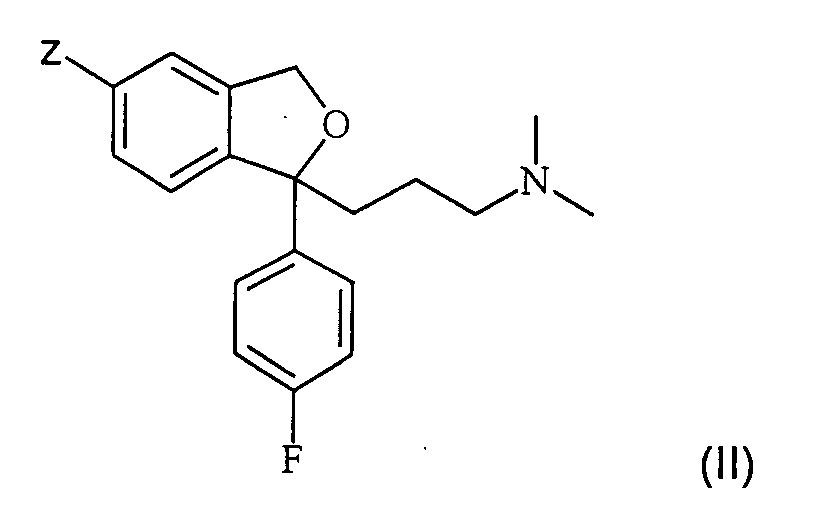
- The crude mixture of citalopram containing the compound of formula II as an impurity may be prepared by subjecting a compound of formula II to a cyanide exchange reaction with a cyanide source, or by subjecting 1-(4-fluorophenyl)-1,3-dihydro-5-isobenzofuranhalogenide, in particular the bromide, to a cyanide exchange reaction followed by alkylation with a 3-(N,N-dimethylamino)propyl-halogenide.
- In a particular embodiment of the invention, Z is halogen, in particular bromide or chloride.
- In a particularly preferred embodiment of the invention, the salt prepared is the hydrobromide or hydrochloride salt of citalopram.
- The crude salt may be any convenient salt, such as the hydrobromide, hydrochloride, sulphate, oxalate, phosphate, nitrate or any other convenient salt. Other salts are salts of organic acids.
- In a preferred embodiment of the invention, the crude salt is the sulphate, the hydrobromide or the hydrochloride salt.
- The invention also relates to a hydrochloride or hydrobromide salt of citalopram prepared by the processes of the invention. In particular, the invention relates to a hydrochloride or hydrobromide salt of citalopram having a purity of more than 99.8 %w/w, preferably more than 99.9 %w/w.
- In yet another aspect, a pharmaceutical formulation of the free base of citalopram, or a hydrobromide or hydrochloride prepared from said base, is provided. Preferably the formulation is for oral administration.
- The formulations according to the invention may be prepared by direct compression of citalopram in admixture with conventional adjuvants or diluents. Alternatively, a wet granulate or a melt granulate of citalopram, optionally in admixture with conventional adjuvants or diluents may be used for compression of tablets.
- In particular, the pharmaceutical composition of the invention contains the racemic mixture of citalopram base, citalopram hydrochloride or citalopram hydrobromide.
- The crystalline base of citalopram is preferably more than 99.8% w/w pure, most preferably more than 99.9% w/w pure (peak area). The melting point is preferably a range within 90 - 93 °C, most preferably 91 - 92 °C (DSC; onset, open capsule) or it is between 92 and 94°C, preferably 92.5 and 93.5 °C (DSC; onset, closed capsule). The crystalline base of citalopram is preferably in racemic form.
- The terms "crude salt" and "crude mixture" refer to the fact that the salt and the mixture, respectively, comprise impurities, in particular impurities of formula II, which must be removed or which it is desired to remove.
- The crude salt may be a salt separated directly from the reaction mixture, or the crude reaction mixture may have been subjected to some initial purification, e.g. one re-crystallisation, and /or treatment with activated carbon or silica gel, and the salt formed subsequently by treatment with an acid using methods known in the art. The salt may be isolated by precipitation or it may exist in a solvent, e.g. in the mixture resulting directly from the synthesis of the salt.
- Similarly, the crude mixture comprising citalopram may be obtained directly from the synthesis of the compound according to any of the above mentioned processes or it may have been subjected to some initial or simultaneous purification, e.g. one re-crystallisation, treatment with activated carbon or silica gel.
- The base of citalopram may be set free from the crude salt by dissolving the crude salt in a mixture of water and an organic solvent and then adding a base. The organic solvent may be toluene, ethyl acetate or any other suitable solvent and the base may be any convenient base, preferably NaOH or NH3. Likewise, the base of citalopram may, if necessary, be set free from a crude mixture containing citalopram by treatment with a base.
- Crude mixtures containing citalopram base may be subjected to further purification and extraction, before the base is precipitated in crystalline form. The base of citalopram may be isolated by separation of the organic phase, evaporation of the solvent in order to obtain the base most probably as an oil and then crystallisation of the base from an aprotic solvent, such as an alkane, including n-heptane, hexane and isooctane, and high and low boiling petroleum ethers and substituted aromates, inc1 toluene and xylenes. Crystalline citalopram base may be re-crystallised from the same solvents.
- The pharmaceutically acceptable salt of citalopram, such as the hydrobromide or hydrochloride, may be prepared by methods known in the art. So, the base may be reacted with either the calculated amount of acid in a water miscible solvent, such as acetone or ethanol, with subsequent isolation of the salt by concentration and cooling, or with an excess of the acid in a water immiscible solvent, such as ethylether, ethylacetate or dichloromethane, with the salt separating spontaneously. The hydrobromide or hydrochloride of citalopram obtained by the method of the invention has a very high purity, preferably more than 99,8% pure, most preferably more than 99,9 % purity. Other salts of citalopram, e.g. the oxalate, may also be obtained in a very pure form by this process.
- The cyanide exchange reactions mentioned above may be carried out as described in the patent applications mentioned above.
- In particular, when Z is halogen, or CF3-(CF2)n-SO2-O- wherein n is an integer in the range 0-8, incl., the conversion to a cyano group may be carried out by reaction with a cyanide source, for example KCN, NaCN, CuCN, Zn(CN)2 or (R4)4NCN where R4 indicates four groups which may be the same or different and are selected from hydrogen and straight chain or branched alkyl, in the presence of a palladium catalyst and a catalytic amount of Cu+ or Zn2+, or with Zn(CN)2 in the presence of a palladium catalyst.
- The cyanide source is used in a stoichiometric amount or in excess, preferably 1-2 equivalents are used pr. equivalent starting material. R4N+ may conveniently be (Bu)4N+. The cyanide compound is preferably NaCN or KCN or Zn(CN)2.
- The palladium catalyst may be any suitable Pd(0) or Pd(II) containing catalyst, such as Pd(PPh3)4, Pd2(dba)3, Pd(PPh)2Cl2, etc. The Pd catalyst is conveniently used in an amount of 1-10, preferably 2-6, most preferably about 4-5 mol%.
- Catalytic amounts of Cu+ and Zn2+, respectively, means substoichiometric amounts such as 0.1- 5, preferably 1 - 3 %. Conveniently, about ½ eq. is used per eq. Pd. Any convenient source of Cu+ and Zn++ may be used. Cu+ is preferably used in the form of CuI and Zn2+ is conveniently used as the Zn(CN)2 salt.
- When Z is Br or I, the conversion to a cyano group may also be carried out by reaction with Cu(CN) without catalyst. In a preferred embodiment, the reaction is performed at elevated temperature.
- In another aspect of the invention, the reaction is performed in an ionic liquid of the general formula (R5)4N+, X-, wherein R5 are alkyl-groups or two of the R5 groups together form a ring and X- is the counterion. In one embodiment of the invention, (R5)4N+X- represents

- In another particuar aspect, the reaction is conducted with apolar solvents such as benzene, xylene or mesitylene and under the influence of microwaves by using i.e. Synthewave 1000™ by Prolabo. In a particular aspect, the reaction is performed without added solvent.
- The temperature ranges are dependent upon the reaction type. If no catalyst is present, preferred temperatures are in the range of 100-200°C. However, when the reaction is conducted under the influence of microwaves, the temperature in the reaction mixture may raise to above 300 °C. More preferred temperature ranges are between 120-170°C. The most preferred range is 130-150°C. If catalyst is present, the preferred temperature range is between 0 and 100°C. More preferred are temperature ranges of 40-90°C. Most preferred temperature ranges are between 60-90°C.
- Other reaction conditions, solvents, etc. are conventional conditions for such reactions and may easily be determined by a person skilled in the art.
- When Z is Cl or Br, the conversion to a cyano group may also be carried out by reaction with a cyanide source, for example KCN, NaCN, CuCN, Zn(CN)2 or (R4)4NCNwhere (R4)4 indicates four groups which may be the same or different and are selected from hydrogen and straight chain or branched alkyl, in the presence of a nickel catalyst.
- The nickel catalyst may be any suitable Ni(0) or Ni(II) containing complex which acts as a catalyst, such as Ni(PPh3)3, (σ-aryl)-Ni(PPh3)2Cl, etc. The nickel catalysts and their preparation are described in WO 96/11906, EP-A-613720 or EP-A-384392.
- In one embodiment of the invention, the reaction is carried out in the presence of a catalytic amount of Cu+ or Zn2+.
- In a particularly preferred embodiment, a Nickel(0) complex is prepared in situ before the cyanation reaction by reduction of a Nickel(II) precursor such as NiCl2 or NiBr2 by a metal, such as zinc, magnesium or mangan in the presence of excess of complex ligands, preferably triphenylphosphin.
- The Ni-catalyst is conveniently used in an amount of 0.5-10, preferably 2-6, most preferably about 4-5 mol%.
- Catalytic amounts of Cu+ and Zn2+, respectively, mean substoichiometric amounts such as 0.1- 5, preferably 1 - 3 %. Any convenient source of Cu+ and Zn2+ may be used. Cu+ is preferably used in the form of CuI and Zn2+ is conveniently used as the Zn(CN)2 salt or formed in situ by reduction of a Nickel (II) compounds using zinc.
- The Ni catalysts are i.e. Ni (0), Pd(0) or Pd(II) catalysts as described by Sakakibara et. al. in Bull. Chem. Soc. Jpn., 61, 1985-1990, (1988). Preferred catalysts are Ni(PPh3)3 or Pd(PPh3)4, or Pd(PPh)2Cl2.
- The reactions may be performed in any convenient solventas described in Sakakibara et. al. in Bull. Chem. Soc. Jpn., 61, 1985-1990, (1988). Preferred solvents are acetonitril, ethylacetat, THF, DMF or NMP.
- When Z is CHO, the conversion to a cyano group may be carried out by conversion of the formyl group to an oxime or similar group by reaction with a reagent R6-V-NH2 wherein R6 is hydrogen, optionally substituted alkyl, aryl or heteroaryl and V is O, N or S, followed by dehydration with a common dehydrating agent, for example thionylchloride, acetic anhydride/pyridine, pyridine/HCl or phosphor pentachloride. Preferred reagents R6-V-NH2 are hydroxylamin and compounds wherein R6 is alkyl or aryl and V is N or O.
- When Z is -COOH, the conversion to a cyano group may be carried out via the corresponding acid chloride, ester or amide.
- The acid chloride is conveniently obtained by treatment of the acid with POCl3, PCl5 or SOCl2 neat or in a suitable solvent, such as toluene or toluene comprising a catalytic amount of N,N-dimethylformamide. The ester is obtained by treatment of the acid with an alcohol, in the presence of an acid, preferably a mineral acid or a Lewis acid, such as HCl, H2SO4,POCl3, PCl5 or SOCl2. Alternatively, the ester may be obtained from the acid chloride by reaction with an alcohol. The ester or the acid chloride is then converted to an amide or by amidation with ammonia or an alkylamine, preferably t-butyl amine.
- The conversion to amide may also be obtained by reaction of the ester with ammonia or an alkylamine under pressure and heating.
- The amide group is then converted to a cyano group by dehydration. The dehydrating agent may be any suitable dehydrating agent, and the optimal agent may easily be determined by a person skilled in the art. Examples of suitable dehydrating agents are SOCl2, POCl3 and PCl5, preferably SOCl2.
- In a particularly preferred embodiment, the carboxylic acid is reacted with an alcohol, preferably ethanol, in the presence of POCl3, in order to obtain the corresponding ester, which is then reacted with ammonia thereby giving the corresponding amide, which in turn is reacted with SOCl2 in toluene comprising a catalytic amount of N,N-dimethylformamide.
- Alternatively, a compound where Z is ―COOH may be reacted with chlorosulfonyl isocyanate in order to form the nitrile, or treated with a dehydrating agent and a sulfonamide.
- When Z is -NHR1, where R1 is hydrogen, the conversion into cyano is preferably performed by diazotation and followed by reaction with CN-. Most preferably NaNO2 and CuCN and/or NaCN are used. When R1 is alkylcarbonyl, it is initially subjected to hydrolysis thereby obtaining the corresponding compound wherein R1 is H which is the converted as described above. The hydrolysis may be performed either in acidic or basic environment.
- The compounds of formula (II) may be prepared as described in DE 2,657,013, WO 0011926 and WO 0013648, WO 9819513, WO 9819512 and WO 9900548.
- Throughout this specification with claims halogen means chloro, bromo or iodo.
- The term alkyl refers to a branched or unbranched alkyl group, such as methyl, ethyl, 1-propyl, 2-propyl, 1-butyl, 2-butyl, 2-methyl-2-propyl, and 2-methyl-1-propyl.
- The term aryl refers to a carbocyclic aromatic group, in particular phenyl. Aralkyl refers to an arylalkyl group wherein aryl and alkyl is as defined above. The aryl and aralkyl groups may optionally be substituted, e.g. with alkyl groups, forming for example tolyl.
- The pharmaceutical compositions of the invention may be administered in any suitable way and in any suitable form, for example orally in the form of tablets, capsules, powders or syrups, or parenterally in the form of usual sterile solutions for injection. Preferably the pharmaceutical compositions of the invention are administered orally.
- The pharmaceutical formulations of the invention may be prepared by conventional methods in the art. For example, tablets may be prepared by mixing the active ingredient with ordinary adjuvants and/or diluents and subsequently compressing the mixture in a conventional tabletting machine. Examples of adjuvants or diluents comprise: Corn starch, potato starch, talcum, magnesium stearate, gelatine, lactose, gums, and the like. Any other adjuvant or additive colourings, aroma, preservatives etc. may be used provided that they are compatible with the active ingredients.
- In particular, the formulations according to the invention may be prepared by direct compression of citalopram in admixture with conventional adjuvants or diluents. Alternatively, a wet granulate or a melt granulate of citalopram, optionally in admixture with conventional adjuvants or diluents may be used for compression of tablets.
- Solutions for injections may be prepared by solving the active ingredient and possible additives in a part of the solvent for injection, preferably sterile water, adjusting the solution to the desired volume, sterilisation of the solution and filling in suitable ampoules or vials. Any suitable additive conventionally used in the art may be added, such as tonicity agents, preservatives, antioxidants, etc.
- According to the present invention, the base of citalopram has been found to be crystalline with stable and nice white crystals and it has been found that the base may easily be crystallised in a very pure form. So for example more than 99.8% w/w pure citalopram base was obtained by crystallisation from up to 95% pure hydrobromide without further purification. Accordingly, the process of the invention for preparing salts of citalopram has been found to give the salts as very pure products of pharmaceutically acceptable quality. Accordingly, the yield may be improved substantially during the manufacture of citalopram.
- Finally, it has been found that the crystalline citalopram base may be formulated into very good and stable solid formulations with good release properties.
- The invention is further illustrated by the following examples.
- 1-(3-Dimethylaminopropyl)-1-(4'-fluorophenyl)-1,3-dihydrobenzofuran-5-carbonitrile.
- 1-(3-Dimethylaminopropyl)-1-(4'-fluorophenyl)-1,3-dihydrobenzofuran-5-carbonitrile hydrobromide (101 grams, 0.25 mole) prepared from 1-(3-Dimethylaminopropyl)- 1-(4-fluorophenyl)-1,3-dihydro-5-isobenzofuranbromide, is suspended in water (500 ml) and toluene (500 ml). NaOH (60 ml, 5 N (aq)) is added and the mixture (pH>10) is stirred for 15 min. before the phases are separated. The organic phase is washed with water (2x100 ml) and filtered through a pad of filter help. The volatiles are removed in vacuo and the title compound is obtained as an oil. n-Heptane (400 ml) is added and the mixture is heated to 70 °C. On cooling, crystals form. The white crystals of the title compound are filtered off and dried at ambient temperature over night in vacuo. Yield: 75.4 grams (93%). DSC(onset, open capsule): 91.3-91.8 °C DSC (onset, closed capsule): 92.8 °C. Purity: (> 99.8 % (peak area)).
Anal. calcd. for C20H21N2F1O1; C, 74.04; H, 6.54; N, 8.64. Found C, 74.01; H, 6.49; N, 8.59. 1H-NMR (DMSO-d6 , 500 MHz): 1.21 (1H, m), 1.29 (1H, m), 2.02 (6H, s), 2.09-2.23 (4 H, m), 5.15 (1H, d J=12.5 Hz), 5.22 (1H, d J=12.5 Hz), 7.16 (2H, t J=8.5 Hz), 7.60 (2H, dt J=8.5 Hz J=1.2 Hz), 7.76 (1H, d J= 8.5 Hz), 7.79 (1H, d J=8.5 Hz), 7.80 (1H, s). 13C-NMR (DMSO-d6, 125 MHz): 21.8, 38.3, 45.0, 58.8, 71.0, 90.7, 110.5, 115.1 (d J=22 Hz), 118.8, 123.1, 125.1, 127.0 (d J=8 Hz), 132.0, 140.0 (d J=3 Hz), 140.5, 149.5, 161.3 (d J=245Hz). -
- a) A crude mixture of Citalopram and sulphuric acid is made basic by adding NaOH and the citalopram base is extracted with toluene. The toluene is evaporated and the citalopram base obtained is dissolved in n-heptane at elevated temperature. The very pure free base of citalopram is precipitated by cooling.
- b) A crude mixture of Citalopram and sulphuric acid is made basic by adding NaOH and the citalopram base is extracted with toluene. The toluene is evaporated and the citalopram base obtained is dissolved in methanol. The mixture is treated with activated carbon and filtrated and the solvent is evaporated. The purified free base is dissolved in n-heptane at elevated temperature. Then the very pure free base of citalopram is precipitated by cooling.
- c) A crude mixture of Citalopram and sulphuric acid is made basic by adding NaOH and the citalopram base is extracted with toluene. The toluene phase is treated with silicagel, the toluene is evaporated and the citalopram base obtained is dissolved in n-heptane at elevated temperature. The very pure free base of citalopram is precipitated by cooling.
- d) A crude mixture of Citalopram and sulphuric acid is made basic by adding NaOH and the citalopram base is extracted with toluene. The toluene phase is treated with silicagel, the toluene is evaporated and the citalopram base obtained is dissolved in methanol. The mixture is treated with activated carbon and filtrated and the solvent is evaporated. The purified free base is dissolved in n-heptane at elevated temperature. Then the extremely pure free base of citalopram is precipitated by cooling.
-
- The batch size was 200 g and the granulation was performed in a small-scale laboratory high shear mixer (Micromixer).
- Citalopram base was sieved through a sieve aperture of 0.3 mm. The ingredients of the intragranular phase (1 - 4 in Table 1) were mixed at 600 rpm. 25 ml of purified water (5) was added in 30 sec and the granulation terminated after a total processing time of 3 min. The granulate was wet sieved through a 0.7 mm sieve aperture and dried at 40 °C in 30 minutes to equilibrium relative humidity of 32 %. The dried granulate was finally sieved through a 0.7 mm sieve aperture.
- The dried granulate was mixed for 3 minutes with the extragranular phase (6- 7) in a Turbula mixer and finally mixed with the lubricant (8) for 30 sec.
Composition of the tablets. Materials % 1 Citalopram (base) 16.00 2 Kollidon VA64 2.32 3 Lactose 350 mesh 38.98 4 Corn starch 20.00 5 Purified water 25 6 Avicel PH 200 (Microcrystalline cellulose) 20.00 7 Ac-Di-Sol (Croscarmelose sodium) 2.00 8 Magnesium stearate 0.7 - Tablets were produced on a single punch tabletting machine Korsch EK0. The characteristics of the tables are shown in Table 2.
Tablet characteristics. Parameter Values Tablet strength, mg 20 Nominal tablet weight, mg 125 Tablet diameter, mm 7 Tablet shape Film coating (special doomed) Mean disintegration time, min 1.77 Mean chrushing strength, N 69.1 Mean tablet weight, mg 125.4 RSD tablet weight, % 0.42 Friability, % 0.3 - The tablets produced had satisfactory technical properties.
- The batch size was 200 g. Citalopram base was sieved through a sieve aperture of 0.3 mm.
The granulation was performed in a small-scale laboratory high shear mixer (Micromixer) - The ingredients of the intra-granular phase (1 - 3 in Table 3) were mixed at 1200 rpm.
The jacket temperature was 80 °C. The granulation process was terminated after 3.5 min. The granulate was sieved through a sieve aperture of 1.0 mm and mixed with the extra-granular phase (4, 5) for 3 min. and with the lubricant (6) for 30 sec.Composition of the tablet. Materials % 1 Citalopram (base) 16.00 2 Polyethyleneglycol 6000 9.14 3 Lactose 350 mesh 38.98 4 Avicel PH 200 (Microcrystalline cellulose) 30.00 5 Kollidon CL (Cross-linked povidone) 4.00 6 Magnesium stearate 0.7 - Tablets were produced on a single punch tabletting machine Korsch EK0. The characteristics of the tables are shown in Table 4.
Tablet characteristics. Parameter Values Tablet strength, 20 mg 20 Nominel tablet weight, mg 125 Tablet diameter, mm 7 Tablet shape Film coating , Special doomed Mean disintegration time, min 1.0 Mean chrushing strength, N 55.5 Mean tablet weight, mg 125.6 RSD tablet weight, % 0.5 Friability, % 0.4 - The tablets produced had satisfactory technical properties.
Claims (15)
- A crystalline base of citalopram, or a hydrochloride or hydrobromide salt of citalopram, characterised in that it has a purity of more than 99.8 %w/w, preferably more than 99.9 % w/w.
- The crystalline base of citalopram, or a hydrochloride or hydrobromide salt of citalopram prepared by a process characterised in that the base of citalopram is set free and precipitated in crystalline form, optionally re-crystallised one or more times, and then transferred into a salt thereof.
- The crystalline base of citalopram, or a hydrochloride or hydrobromide salt of citalopram of claim 2 characterised in that the base of citalopram is set free from a crude salt or a crude mixture of citalopram.
- The crystalline base of citalopram, or a hydrochloride or hydrobromide salt of citalopram prepared by a process characterised in that one or more impurities of the formulawherein Z is halogen, -O-SO2-(CF2)n-CF3, where n is 0-8, -CHO, -NHR1, -COOR2, -CONR2R3 wherein R2 and R3 are selected from hydrogen, alkyl, optionally substituted aryl or aralkyl and R1 is hydrogen or alkylcarbonyl, are removed from a crude mixture of citalopram or from a crude salt of citalopram, by precipitating citalopram base in crystalline form, optionally re-crystallising said base one or more times and/or transferring said base into a salt thereof.
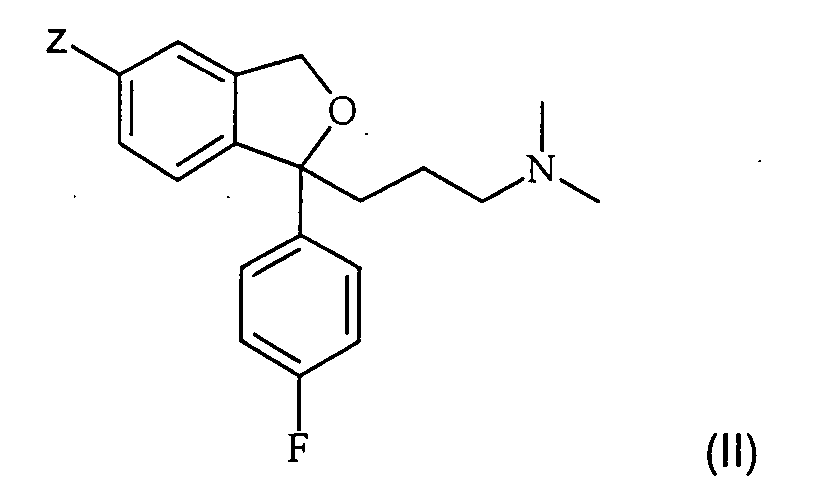
- The crystalline base of citalopram, or a hydrochloride or hydrobromide salt of citalopram according to claim 4 wherein the crude mixture of citalopram containing the compound of formula II as an impurity, is prepared by subjecting a compound of formula II to a cyanide exchange reaction with a cyanide source.
- The crystalline base of citalopram, or a hydrochloride or hydrobromide salt of citalopram of claim 4 wherein Z is halogen, in particular bromide or chloride.
- The crystalline base of citalopram, or a hydrochloride or hydrobromide salt of citalopram of claims 4-6 wherein the crude mixture of citalopram is subjected to initial purification before the base of citalopram is precipitated in crystalline form.
- The crystalline base of citalopram, or a hydrochloride or hydrobromide salt of citalopram of claims 4-6 wherein the crude mixture of citalopram is subjected to initial purification before a crude salt is formed from said crude mixture.
- The crystalline base of citalopram, or a hydrochloride or hydrobromide salt of citalopram according to claims 4-7 wherein the base of citalopram is set free from a crude salt or a crude mixture of citalopram by treatment with a base and optionally subjected to further purification before the base of citalopram is precipitated in crystalline form.
- The crystalline base of citalopram, or a hydrochloride or hydrobromide salt of citalopram according to claims 2-9 wherein the citalopram base is transferred into the hydrobromide or the hydrochloride salt of citalopram.
- The crystalline base of citalopram, or a hydrochloride or hydrobromide salt of citalopram according to claims 2-4, characterised in that the crude salt is a hydrobromide, hydrochloride, sulphate, oxalate, phosphate or nitrate salt, preferably the sulphate hydrobromide, or hydrochloride salt.
- The base, the hydrochloride or the hydrobromide salt of claims 2-11 characterised in that it has a purity of more than 99.8 %w/w, preferably more than 99.9 %w/w.
- A pharmaceutical composition containing the hydrochloride or the hydrobromide salt of citalopram according to Claims 1 to 12, or the crystalline base of citalopram.
- A pharmaceutical composition according to Claim 13 which is a tablet prepared bya) direct compression of citalopram, optionally in admixture with pharmaceutically acceptable adjuvants;b) by compression of a wet granulate of the citalopram, optionally in admixture with pharmaceutically acceptable adjuvants; orc) by compression of a melt granulate of the citalopram, optionally in admixture with pharmaceutically acceptable adjuvants.
- The pharmaceutical composition according to Claims 13 to 14 characterized in that it contains the racemic mixture of citalopram base, citalopram hydrochloride or citalopram hydrobromide.
Priority Applications (1)
| Application Number | Priority Date | Filing Date | Title |
|---|---|---|---|
| SI200130031T SI1227088T1 (en) | 2000-03-13 | 2001-02-28 | Crystalline base of citalopram and hydrochoride or hydrobromide salt thereof |
Applications Claiming Priority (4)
| Application Number | Priority Date | Filing Date | Title |
|---|---|---|---|
| DKPA200000402 | 2000-03-13 | ||
| DK200000402 | 2000-03-13 | ||
| WOPCT/DK00/00183 | 2000-04-13 | ||
| DKPCT/DK00/00183 | 2000-04-13 |
Related Parent Applications (1)
| Application Number | Title | Priority Date | Filing Date |
|---|---|---|---|
| EP01909568A Division EP1169314B2 (en) | 2000-03-13 | 2001-02-28 | Process for the manufacture of salts of citalopram |
Publications (2)
| Publication Number | Publication Date |
|---|---|
| EP1227088A1 true EP1227088A1 (en) | 2002-07-31 |
| EP1227088B1 EP1227088B1 (en) | 2003-09-17 |
Family
ID=8159320
Family Applications (2)
| Application Number | Title | Priority Date | Filing Date |
|---|---|---|---|
| EP01909568A Expired - Lifetime EP1169314B2 (en) | 2000-03-13 | 2001-02-28 | Process for the manufacture of salts of citalopram |
| EP02009350A Revoked EP1227088B1 (en) | 2000-03-13 | 2001-02-28 | Crystalline base of citalopram and hydrochoride or hydrobromide salt thereof |
Family Applications Before (1)
| Application Number | Title | Priority Date | Filing Date |
|---|---|---|---|
| EP01909568A Expired - Lifetime EP1169314B2 (en) | 2000-03-13 | 2001-02-28 | Process for the manufacture of salts of citalopram |
Country Status (41)
| Country | Link |
|---|---|
| US (7) | US20010031784A1 (en) |
| EP (2) | EP1169314B2 (en) |
| JP (1) | JP2003527383A (en) |
| KR (1) | KR20020080486A (en) |
| CN (2) | CN1258530C (en) |
| AR (1) | AR029811A1 (en) |
| AT (3) | ATE223396T1 (en) |
| AU (2) | AU746664B2 (en) |
| BE (1) | BE1013210A3 (en) |
| BG (1) | BG107065A (en) |
| BR (1) | BR0109373A (en) |
| CA (2) | CA2411732A1 (en) |
| CH (2) | CH691477A5 (en) |
| CZ (1) | CZ292077B6 (en) |
| DE (7) | DE20007303U1 (en) |
| DK (3) | DK173903B1 (en) |
| EA (1) | EA200200972A1 (en) |
| ES (3) | ES2180471T3 (en) |
| FI (2) | FI20010156A0 (en) |
| FR (1) | FR2806086B1 (en) |
| GB (2) | GB2357762B (en) |
| GR (1) | GR1003796B (en) |
| HR (1) | HRP20020756A2 (en) |
| HU (3) | HU0001581D0 (en) |
| IE (1) | IES20010109A2 (en) |
| IL (2) | IL147339A (en) |
| IS (1) | IS5841A (en) |
| IT (2) | IT1319645B1 (en) |
| MX (1) | MXPA02008793A (en) |
| NL (2) | NL1016435C1 (en) |
| NO (2) | NO312031B1 (en) |
| PL (1) | PL360158A1 (en) |
| PT (2) | PT1169314E (en) |
| SE (2) | SE517136C2 (en) |
| SI (2) | SI1227088T1 (en) |
| SK (1) | SK285528B6 (en) |
| TR (1) | TR200202185T2 (en) |
| UA (1) | UA74360C2 (en) |
| WO (1) | WO2001068627A1 (en) |
| YU (1) | YU68802A (en) |
| ZA (1) | ZA200207148B (en) |
Cited By (2)
| Publication number | Priority date | Publication date | Assignee | Title |
|---|---|---|---|---|
| WO2003080590A1 (en) * | 2002-03-21 | 2003-10-02 | Jubilant Organosys Ltd. | Process for the isolation of high purity crystalline citalopram base |
| US7985323B2 (en) | 2003-08-29 | 2011-07-26 | Novartis Ag | Purification process |
Families Citing this family (59)
| Publication number | Priority date | Publication date | Assignee | Title |
|---|---|---|---|---|
| NZ514671A (en) | 1999-04-14 | 2003-10-31 | H | Method for the preparation of citalopram |
| AR021155A1 (en) * | 1999-07-08 | 2002-06-12 | Lundbeck & Co As H | TREATMENT OF NEUROTIC DISORDERS |
| US7713279B2 (en) | 2000-12-20 | 2010-05-11 | Fox Hollow Technologies, Inc. | Method and devices for cutting tissue |
| US7708749B2 (en) | 2000-12-20 | 2010-05-04 | Fox Hollow Technologies, Inc. | Debulking catheters and methods |
| US8328829B2 (en) | 1999-08-19 | 2012-12-11 | Covidien Lp | High capacity debulking catheter with razor edge cutting window |
| US7887556B2 (en) | 2000-12-20 | 2011-02-15 | Fox Hollow Technologies, Inc. | Debulking catheters and methods |
| US6299622B1 (en) | 1999-08-19 | 2001-10-09 | Fox Hollow Technologies, Inc. | Atherectomy catheter with aligned imager |
| NL1017417C1 (en) | 2000-03-03 | 2001-03-16 | Lundbeck & Co As H | Process for the preparation of Citalopram. |
| NL1017500C1 (en) | 2000-03-13 | 2001-04-26 | Lundbeck & Co As H | Process for the preparation of Citalopram. |
| GB2357762B (en) * | 2000-03-13 | 2002-01-30 | Lundbeck & Co As H | Crystalline base of citalopram |
| US6977306B2 (en) * | 2000-05-02 | 2005-12-20 | Sumitomo Chemical Company, Limited | Citalopram hydrobromide crystal and method for crystallization thereof |
| AR032455A1 (en) | 2000-05-12 | 2003-11-12 | Lundbeck & Co As H | METHOD FOR THE PREPARATION OF CITALOPRAM, AN INTERMEDIARY EMPLOYED IN THE METHOD, A METHOD FOR THE PREPARATION OF THE INTERMEDIARY EMPLOYED IN THE METHOD AND PHARMACEUTICAL COMPOSITION ANTIDEPRESSIVE |
| CA2353693C (en) * | 2000-08-10 | 2003-07-22 | H. Lundbeck A/S | Pharmaceutical composition containing citalopram |
| GB2376233B (en) * | 2000-08-10 | 2003-09-10 | Lundbeck & Co As H | Crystals of a pharmaceutically acceptable salt of citalopram wherein the median size of the crystals is at least 40 microns |
| DE60144107D1 (en) | 2000-12-20 | 2011-04-07 | Fox Hollow Technologies Inc | REDUCTION CATHETER |
| JP3798982B2 (en) * | 2000-12-22 | 2006-07-19 | ハー・ルンドベック・アクチエゼルスカベット | Method for producing pure citalopram |
| AU2001100195B4 (en) * | 2001-01-05 | 2001-12-20 | H Lundbeck As | Pharmaceutical composition containing citalopram. |
| GB0105627D0 (en) * | 2001-03-07 | 2001-04-25 | Cipla Ltd | Preparation of phthalanes |
| EA200301195A1 (en) * | 2001-05-01 | 2004-04-29 | Х. Лундбекк А/С | APPLICATION OF ENANTIOMERALLY CLEAN ESCYTAL PREMA |
| HRP20031073A2 (en) | 2001-07-31 | 2004-04-30 | Lundbeck & Co As H | Crystalline composition containing escitalopram |
| WO2003057132A2 (en) * | 2002-01-07 | 2003-07-17 | Sun Pharmaceutical Industries Limited | Process for the preparation of 1-[3-(dimethylamino)propyl]-1-(4-fluorophenyl)- 1,3-dihydro-5-isobenzofuran carbonitrile |
| GB2387844B (en) * | 2002-02-27 | 2005-05-11 | Matrix Lab Ltd | Separation of impurities from a crude mixture of citalopram |
| GB2386118A (en) * | 2002-02-27 | 2003-09-10 | Cipla Ltd | Citalopram |
| GB2386119A (en) * | 2002-02-27 | 2003-09-10 | Cipla Ltd | Purification of citalopram |
| GB0204607D0 (en) | 2002-02-27 | 2002-04-10 | Matrix Lab Ltd | Process |
| GB2385848A (en) * | 2002-02-27 | 2003-09-03 | Cipla Ltd | Citalopram salts |
| GB0206708D0 (en) * | 2002-03-21 | 2002-05-01 | Cipla Ltd | Pharmaceutical salts |
| US6812355B2 (en) | 2002-10-22 | 2004-11-02 | Sekhsaria Chemicals Limited | Process for the manufacture of citalopram hydrobromide from 5-bromophthalide |
| TR200504022T1 (en) * | 2003-03-24 | 2006-08-21 | Hetero Drugs Limited | New liquid crystal forms of (S) -sitalopram oxalate. |
| WO2004094399A1 (en) * | 2003-04-21 | 2004-11-04 | Natco Pharma Ltd | An improved process for the preparation of citalopram hydrobromide |
| US8246640B2 (en) | 2003-04-22 | 2012-08-21 | Tyco Healthcare Group Lp | Methods and devices for cutting tissue at a vascular location |
| US7019153B2 (en) | 2003-06-10 | 2006-03-28 | Sun Pharmaceutical Industries Limited | Process for hydrogenolysis of [1-(3-dimethylamino)propyl)]-1-(4-fluorophenyl)-1,3-dihydro-5-halo-isobenzofuran acetamido-3-substituted-3-cephem-4-carboxylic acid |
| GB0317475D0 (en) * | 2003-07-25 | 2003-08-27 | Meditab Specialities Pvt Ltd | Product |
| JP4025735B2 (en) * | 2003-08-21 | 2007-12-26 | ローム アンド ハース カンパニー | Method for treating aqueous systems |
| CN100569765C (en) * | 2003-12-19 | 2009-12-16 | 杭州民生药业集团有限公司 | Citalopram intermediate crystalline base |
| ITTO20050301A1 (en) * | 2005-05-05 | 2006-11-06 | Errekappa Euroterapici Spa | ORAL LIQUID FORMULATIONS CONTAINING CITALOPRAM |
| US20110196032A1 (en) * | 2005-05-20 | 2011-08-11 | Ashish Gogia | Pharmaceutical Dosage Form of an Antidepressant |
| TWI347942B (en) * | 2005-06-22 | 2011-09-01 | Lundbeck & Co As H | Crystalline base of escitalopram and orodispersible tablets comprising escitalopram base |
| US7834201B2 (en) | 2005-06-22 | 2010-11-16 | H. Lundbeck A/S | Crystalline base of escitalopram and orodispersible tablets comprising escitalopram base |
| RU2408368C2 (en) | 2005-06-27 | 2011-01-10 | Биовэйл Лэборэториз Интернэшнл С.Р.Л. | Modified release bupropion salt preparations |
| US20070276419A1 (en) | 2006-05-26 | 2007-11-29 | Fox Hollow Technologies, Inc. | Methods and devices for rotating an active element and an energy emitter on a catheter |
| US8784440B2 (en) | 2008-02-25 | 2014-07-22 | Covidien Lp | Methods and devices for cutting tissue |
| CN102223847B (en) | 2008-10-13 | 2013-10-30 | 泰科保健集团有限合伙公司 | Devices and methods for manipulating catheter shaft |
| KR101323553B1 (en) | 2009-04-29 | 2013-10-29 | 코비디엔 엘피 | Methods and devices for cutting and abrading tissue |
| KR101581091B1 (en) | 2009-05-14 | 2015-12-30 | 코비디엔 엘피 | Easily cleaned atherectomy catheters and methods of use |
| EP2913013B1 (en) | 2009-12-02 | 2016-11-09 | Covidien LP | Methods and devices for cutting tissue |
| IN2012DN04977A (en) | 2009-12-11 | 2015-09-25 | Tyco Healthcare | |
| WO2011159697A1 (en) | 2010-06-14 | 2011-12-22 | Tyco Healthcare Group Lp | Material removal device |
| WO2012058438A1 (en) | 2010-10-28 | 2012-05-03 | Tyco Healthcare Group Lp | Material removal device and method of use |
| RU2553930C2 (en) | 2010-11-11 | 2015-06-20 | Ковидиен Лп | Flexible fragmenting catheters with visualisation and methods of their application and manufacturing |
| JP5806407B2 (en) | 2011-09-01 | 2015-11-10 | コヴィディエン リミテッド パートナーシップ | Catheter with helical drive shaft and manufacturing method |
| US9579157B2 (en) | 2012-09-13 | 2017-02-28 | Covidien Lp | Cleaning device for medical instrument and method of use |
| US9943329B2 (en) | 2012-11-08 | 2018-04-17 | Covidien Lp | Tissue-removing catheter with rotatable cutter |
| WO2015200702A1 (en) | 2014-06-27 | 2015-12-30 | Covidien Lp | Cleaning device for catheter and catheter including the same |
| US10314667B2 (en) | 2015-03-25 | 2019-06-11 | Covidien Lp | Cleaning device for cleaning medical instrument |
| US10292721B2 (en) | 2015-07-20 | 2019-05-21 | Covidien Lp | Tissue-removing catheter including movable distal tip |
| US10314664B2 (en) | 2015-10-07 | 2019-06-11 | Covidien Lp | Tissue-removing catheter and tissue-removing element with depth stop |
| US20240024288A1 (en) | 2019-07-19 | 2024-01-25 | Bioxcel Therapeutics, Inc. | Non-sedating dexmedetomidine treatment regimens |
| US11806334B1 (en) | 2023-01-12 | 2023-11-07 | Bioxcel Therapeutics, Inc. | Non-sedating dexmedetomidine treatment regimens |
Citations (8)
| Publication number | Priority date | Publication date | Assignee | Title |
|---|---|---|---|---|
| DE2657013A1 (en) * | 1976-01-14 | 1977-07-28 | Kefalas As | PHTHALANE DERIVATIVES AND PROCESS FOR THEIR PRODUCTION AND PHARMACEUTICAL PRODUCTS CONTAINING THESE |
| EP0171943A1 (en) * | 1984-08-06 | 1986-02-19 | H. Lundbeck A/S | Novel intermediate and method for its preparation |
| EP0347066A1 (en) * | 1988-06-14 | 1989-12-20 | H. Lundbeck A/S | New enantiomers and their isolation |
| WO1998019512A2 (en) * | 1997-11-11 | 1998-05-14 | H. Lundbeck A/S | Method for the preparation of citalopram |
| WO1998019511A2 (en) * | 1997-11-10 | 1998-05-14 | H. Lundbeck A/S | Method for the preparation of citalopram |
| WO1998019513A2 (en) * | 1997-07-08 | 1998-05-14 | H. Lundbeck A/S | Method for the preparation of citalopram |
| WO2000011926A2 (en) | 1999-06-25 | 2000-03-09 | H. Lundbeck A/S | Method for the preparation of citalopram |
| DE20007303U1 (en) * | 2000-03-13 | 2000-07-27 | H. Lundbeck A/S, Kopenhagen/Koebenhavn | Crystalline base from citalopram |
Family Cites Families (14)
| Publication number | Priority date | Publication date | Assignee | Title |
|---|---|---|---|---|
| US2233970A (en) * | 1941-03-04 | Quinoline compound and process of | ||
| US2584429A (en) * | 1950-12-29 | 1952-02-05 | Rohm & Haas | 1,1-diphenyl-4-tert.-amino-2-butyne-1-ols |
| GB1143703A (en) * | 1965-03-18 | |||
| US4314081A (en) * | 1974-01-10 | 1982-02-02 | Eli Lilly And Company | Arloxyphenylpropylamines |
| IL63968A (en) * | 1980-10-01 | 1985-10-31 | Glaxo Group Ltd | Form 2 ranitidine hydrochloride,its preparation and pharmaceutical compositions containing it |
| US4535186A (en) * | 1983-04-19 | 1985-08-13 | American Home Products Corporation | 2-Phenyl-2-(1-hydroxycycloalkyl or 1-hydroxycycloalk-2-enyl)ethylamine derivatives |
| US5296507A (en) * | 1990-09-06 | 1994-03-22 | H.Lundbeck A/S | Treatment of cerbrovascular disorders |
| DK213290D0 (en) | 1990-09-06 | 1990-09-06 | Lundbeck & Co As H | TREATMENT OF CEREBROVASCULAR DISORDERS |
| CA2120874E (en) * | 1994-04-08 | 2002-01-08 | Keshava Murthy | Form of form 1 ranitidine |
| PL199423B1 (en) * | 1998-10-20 | 2008-09-30 | Lundbeck & Co As H | Method for the preparation of citalopram |
| NZ514671A (en) | 1999-04-14 | 2003-10-31 | H | Method for the preparation of citalopram |
| ITMI991581A1 (en) | 1999-06-25 | 2001-01-15 | Lundbeck & Co As H | METHOD FOR THE PREPARATION OF CITALOPRAM |
| US6433196B1 (en) * | 2000-02-17 | 2002-08-13 | Sumika Fine Chemicals Co., Ltd. | Production method of citalopram, intermediate therefor and production method of the intermediate |
| US6977306B2 (en) * | 2000-05-02 | 2005-12-20 | Sumitomo Chemical Company, Limited | Citalopram hydrobromide crystal and method for crystallization thereof |
-
2000
- 2000-04-13 GB GB0105982A patent/GB2357762B/en not_active Expired - Fee Related
- 2000-04-18 HU HU0001581A patent/HU0001581D0/en unknown
- 2000-04-20 DE DE20007303U patent/DE20007303U1/en not_active Ceased
- 2000-10-18 NL NL1016435A patent/NL1016435C1/en not_active IP Right Cessation
- 2000-11-09 IT IT2000MI002425A patent/IT1319645B1/en active
- 2000-12-05 US US09/730,490 patent/US20010031784A1/en not_active Abandoned
-
2001
- 2001-01-25 FI FI20010156A patent/FI20010156A0/en unknown
- 2001-01-26 HU HU0100450A patent/HU0100450D0/en unknown
- 2001-02-05 GB GBGB0102797.8A patent/GB0102797D0/en not_active Ceased
- 2001-02-05 IS IS5841A patent/IS5841A/en unknown
- 2001-02-05 DK DK200100183A patent/DK173903B1/en not_active IP Right Cessation
- 2001-02-05 HU HU0100531A patent/HUP0100531A3/en unknown
- 2001-02-06 NO NO20010619A patent/NO312031B1/en active IP Right Review Request
- 2001-02-07 IE IE20010109A patent/IES20010109A2/en not_active IP Right Cessation
- 2001-02-07 FI FI20010225A patent/FI109022B/en active
- 2001-02-12 GR GR20010100074A patent/GR1003796B/en unknown
- 2001-02-20 DE DE10108042A patent/DE10108042A1/en not_active Withdrawn
- 2001-02-20 DE DE10164687A patent/DE10164687B4/en not_active Revoked
- 2001-02-20 DE DE20121240U patent/DE20121240U1/en not_active Ceased
- 2001-02-21 FR FR0102340A patent/FR2806086B1/en not_active Expired - Fee Related
- 2001-02-21 NL NL1017413A patent/NL1017413C1/en not_active IP Right Cessation
- 2001-02-22 CH CH00321/01A patent/CH691477A5/en not_active IP Right Cessation
- 2001-02-22 CH CH00580/01A patent/CH691537A5/en not_active IP Right Cessation
- 2001-02-28 DK DK02009350T patent/DK1227088T3/en active
- 2001-02-28 EP EP01909568A patent/EP1169314B2/en not_active Expired - Lifetime
- 2001-02-28 AR ARP010100934A patent/AR029811A1/en unknown
- 2001-02-28 CA CA002411732A patent/CA2411732A1/en not_active Abandoned
- 2001-02-28 CN CNB018093418A patent/CN1258530C/en not_active Expired - Fee Related
- 2001-02-28 IL IL14733901A patent/IL147339A/en not_active IP Right Cessation
- 2001-02-28 EA EA200200972A patent/EA200200972A1/en unknown
- 2001-02-28 YU YU68802A patent/YU68802A/en unknown
- 2001-02-28 DE DE60100022T patent/DE60100022T3/en not_active Expired - Fee Related
- 2001-02-28 AT AT01909568T patent/ATE223396T1/en not_active IP Right Cessation
- 2001-02-28 PT PT01909568T patent/PT1169314E/en unknown
- 2001-02-28 EP EP02009350A patent/EP1227088B1/en not_active Revoked
- 2001-02-28 WO PCT/DK2001/000137 patent/WO2001068627A1/en not_active Ceased
- 2001-02-28 SI SI200130031T patent/SI1227088T1/en unknown
- 2001-02-28 MX MXPA02008793A patent/MXPA02008793A/en active IP Right Grant
- 2001-02-28 KR KR1020027012048A patent/KR20020080486A/en not_active Ceased
- 2001-02-28 CA CA002360287A patent/CA2360287C/en not_active Expired - Lifetime
- 2001-02-28 IT IT2001MI000406A patent/ITMI20010406A1/en unknown
- 2001-02-28 SI SI200130001T patent/SI1169314T2/en unknown
- 2001-02-28 BR BR0109373-8A patent/BR0109373A/en not_active IP Right Cessation
- 2001-02-28 HR HRP20020756 patent/HRP20020756A2/en not_active Application Discontinuation
- 2001-02-28 ES ES02009350T patent/ES2180471T3/en not_active Expired - Lifetime
- 2001-02-28 DK DK01909568T patent/DK1169314T3/en active
- 2001-02-28 UA UA2002097314A patent/UA74360C2/en unknown
- 2001-02-28 PL PL36015801A patent/PL360158A1/en not_active Application Discontinuation
- 2001-02-28 TR TR2002/02185T patent/TR200202185T2/en unknown
- 2001-02-28 CN CNA2005100091603A patent/CN1680350A/en active Pending
- 2001-02-28 ES ES01909568T patent/ES2173054T3/en not_active Expired - Lifetime
- 2001-02-28 DE DE60100786T patent/DE60100786T2/en not_active Revoked
- 2001-02-28 DE DE1227088T patent/DE1227088T1/en active Pending
- 2001-02-28 AU AU37252/01A patent/AU746664B2/en not_active Ceased
- 2001-02-28 JP JP2001567719A patent/JP2003527383A/en active Pending
- 2001-02-28 PT PT02009350T patent/PT1227088E/en unknown
- 2001-02-28 BE BE2001/0136A patent/BE1013210A3/en not_active IP Right Cessation
- 2001-02-28 AT AT02009350T patent/ATE250050T1/en not_active IP Right Cessation
- 2001-02-28 SK SK1313-2002A patent/SK285528B6/en unknown
- 2001-02-28 IL IL15807201A patent/IL158072A0/en unknown
- 2001-03-05 CZ CZ2001808A patent/CZ292077B6/en not_active IP Right Cessation
- 2001-03-07 AT AT0016601U patent/AT4364U1/en unknown
- 2001-03-09 ES ES200100548A patent/ES2159491B1/en not_active Expired - Fee Related
- 2001-07-26 AU AU2001100197A patent/AU2001100197B4/en not_active Expired
- 2001-09-14 SE SE0103046A patent/SE517136C2/en not_active IP Right Cessation
-
2002
- 2002-01-23 NO NO20020356A patent/NO315851B1/en unknown
- 2002-03-12 SE SE0200730A patent/SE526022C2/en not_active IP Right Cessation
- 2002-09-05 BG BG107065A patent/BG107065A/en unknown
- 2002-09-05 ZA ZA200207148A patent/ZA200207148B/en unknown
- 2002-09-12 US US10/245,824 patent/US20030078442A1/en not_active Abandoned
-
2003
- 2003-12-19 US US10/741,553 patent/US20040132808A1/en not_active Abandoned
- 2003-12-30 US US10/750,049 patent/US20040167210A1/en not_active Abandoned
-
2005
- 2005-03-24 US US11/090,336 patent/US20050165092A1/en not_active Abandoned
- 2005-03-24 US US11/090,337 patent/US20050165244A1/en not_active Abandoned
-
2006
- 2006-06-20 US US11/425,321 patent/US20060247451A1/en not_active Abandoned
Patent Citations (8)
| Publication number | Priority date | Publication date | Assignee | Title |
|---|---|---|---|---|
| DE2657013A1 (en) * | 1976-01-14 | 1977-07-28 | Kefalas As | PHTHALANE DERIVATIVES AND PROCESS FOR THEIR PRODUCTION AND PHARMACEUTICAL PRODUCTS CONTAINING THESE |
| EP0171943A1 (en) * | 1984-08-06 | 1986-02-19 | H. Lundbeck A/S | Novel intermediate and method for its preparation |
| EP0347066A1 (en) * | 1988-06-14 | 1989-12-20 | H. Lundbeck A/S | New enantiomers and their isolation |
| WO1998019513A2 (en) * | 1997-07-08 | 1998-05-14 | H. Lundbeck A/S | Method for the preparation of citalopram |
| WO1998019511A2 (en) * | 1997-11-10 | 1998-05-14 | H. Lundbeck A/S | Method for the preparation of citalopram |
| WO1998019512A2 (en) * | 1997-11-11 | 1998-05-14 | H. Lundbeck A/S | Method for the preparation of citalopram |
| WO2000011926A2 (en) | 1999-06-25 | 2000-03-09 | H. Lundbeck A/S | Method for the preparation of citalopram |
| DE20007303U1 (en) * | 2000-03-13 | 2000-07-27 | H. Lundbeck A/S, Kopenhagen/Koebenhavn | Crystalline base from citalopram |
Cited By (2)
| Publication number | Priority date | Publication date | Assignee | Title |
|---|---|---|---|---|
| WO2003080590A1 (en) * | 2002-03-21 | 2003-10-02 | Jubilant Organosys Ltd. | Process for the isolation of high purity crystalline citalopram base |
| US7985323B2 (en) | 2003-08-29 | 2011-07-26 | Novartis Ag | Purification process |
Also Published As
Similar Documents
| Publication | Publication Date | Title |
|---|---|---|
| EP1169314B1 (en) | Crystalline base of citalopram | |
| US20060229459A1 (en) | Crystalline base of citalopram | |
| AU738526B2 (en) | Method for the preparation of citalopram | |
| WO2001062754A1 (en) | Method for the preparation of citalopram | |
| HK1084104A (en) | Crystalline base of citalopram | |
| HK1054750B (en) | Crystalline base of citalopram |
Legal Events
| Date | Code | Title | Description |
|---|---|---|---|
| PUAI | Public reference made under article 153(3) epc to a published international application that has entered the european phase |
Free format text: ORIGINAL CODE: 0009012 |
|
| 17P | Request for examination filed |
Effective date: 20020503 |
|
| AC | Divisional application: reference to earlier application |
Ref document number: 1169314 Country of ref document: EP |
|
| AK | Designated contracting states |
Kind code of ref document: A1 Designated state(s): AT BE CH CY DE DK ES FI FR GB GR IE IT LI LU MC NL PT SE TR |
|
| AX | Request for extension of the european patent |
Free format text: AL;LT;LV;MK;RO;SI |
|
| TPAD | Observations filed by third parties |
Free format text: ORIGINAL CODE: EPIDOS TIPA |
|
| 17Q | First examination report despatched |
Effective date: 20020913 |
|
| REG | Reference to a national code |
Ref country code: GR Ref legal event code: PP Ref document number: 20020300051 Country of ref document: GR |
|
| TCAT | At: translation of patent claims filed | ||
| EL | Fr: translation of claims filed | ||
| TCNL | Nl: translation of patent claims filed | ||
| DET | De: translation of patent claims | ||
| GRAH | Despatch of communication of intention to grant a patent |
Free format text: ORIGINAL CODE: EPIDOS IGRA |
|
| AKX | Designation fees paid |
Designated state(s): AT BE CH CY DE DK ES FI FR GB GR IE IT LI LU MC NL PT SE TR |
|
| AXX | Extension fees paid |
Extension state: SI Payment date: 20020828 Extension state: MK Payment date: 20020828 Extension state: AL Payment date: 20020828 Extension state: LT Payment date: 20020828 Extension state: LV Payment date: 20020828 Extension state: RO Payment date: 20020828 |
|
| GRAS | Grant fee paid |
Free format text: ORIGINAL CODE: EPIDOSNIGR3 |
|
| GRAA | (expected) grant |
Free format text: ORIGINAL CODE: 0009210 |
|
| AC | Divisional application: reference to earlier application |
Ref document number: 1169314 Country of ref document: EP Kind code of ref document: P |
|
| AK | Designated contracting states |
Kind code of ref document: B1 Designated state(s): AT BE CH CY DE DK ES FI FR GB GR IE IT LI LU MC NL PT SE TR |
|
| AX | Request for extension of the european patent |
Extension state: AL LT LV MK RO SI |
|
| REG | Reference to a national code |
Ref country code: GB Ref legal event code: FG4D |
|
| PLBQ | Unpublished change to opponent data |
Free format text: ORIGINAL CODE: EPIDOS OPPO |
|
| PLBI | Opposition filed |
Free format text: ORIGINAL CODE: 0009260 |
|
| REG | Reference to a national code |
Ref country code: CH Ref legal event code: EP |
|
| REF | Corresponds to: |
Ref document number: 60100786 Country of ref document: DE Date of ref document: 20031023 Kind code of ref document: P |
|
| REG | Reference to a national code |
Ref country code: IE Ref legal event code: FG4D |
|
| 26 | Opposition filed |
Opponent name: SANDOZ GMBH Effective date: 20030917 |
|
| NLR1 | Nl: opposition has been filed with the epo |
Opponent name: SANDOZ GMBH |
|
| REG | Reference to a national code |
Ref country code: SE Ref legal event code: TRGR |
|
| PLBP | Opposition withdrawn |
Free format text: ORIGINAL CODE: 0009264 |
|
| REG | Reference to a national code |
Ref country code: GR Ref legal event code: EP Ref document number: 20030404577 Country of ref document: GR Ref country code: DK Ref legal event code: T3 |
|
| REG | Reference to a national code |
Ref country code: CH Ref legal event code: NV Representative=s name: E. BLUM & CO. PATENTANWAELTE |
|
| REG | Reference to a national code |
Ref country code: ES Ref legal event code: FG2A Ref document number: 2180471 Country of ref document: ES Kind code of ref document: T3 |
|
| PLBQ | Unpublished change to opponent data |
Free format text: ORIGINAL CODE: EPIDOS OPPO |
|
| PLBI | Opposition filed |
Free format text: ORIGINAL CODE: 0009260 |
|
| ET | Fr: translation filed | ||
| PLBQ | Unpublished change to opponent data |
Free format text: ORIGINAL CODE: EPIDOS OPPO |
|
| PLBI | Opposition filed |
Free format text: ORIGINAL CODE: 0009260 |
|
| PLBQ | Unpublished change to opponent data |
Free format text: ORIGINAL CODE: EPIDOS OPPO |
|
| PLBI | Opposition filed |
Free format text: ORIGINAL CODE: 0009260 |
|
| 26 | Opposition filed |
Opponent name: MEPHA AG Effective date: 20040525 |
|
| PLAX | Notice of opposition and request to file observation + time limit sent |
Free format text: ORIGINAL CODE: EPIDOSNOBS2 |
|
| 26 | Opposition filed |
Opponent name: MEPHA AG Effective date: 20040525 Opponent name: SARAH MARGARET TSCHAMPAL Effective date: 20040602 |
|
| 26 | Opposition filed |
Opponent name: EGIS GYOGYSZERGYAR RT. Effective date: 20040616 Opponent name: MEPHA AG Effective date: 20040525 Opponent name: SARAH MARGARET TSCHAMPAL Effective date: 20040602 |
|
| NLR1 | Nl: opposition has been filed with the epo |
Opponent name: MEPHA AG |
|
| NLR1 | Nl: opposition has been filed with the epo |
Opponent name: EGIS GYOGYSZERGYAR RT. Opponent name: SARAH MARGARET TSCHAMPAL Opponent name: MEPHA AG |
|
| PLAX | Notice of opposition and request to file observation + time limit sent |
Free format text: ORIGINAL CODE: EPIDOSNOBS2 |
|
| REG | Reference to a national code |
Ref country code: SI Ref legal event code: IF |
|
| PLAX | Notice of opposition and request to file observation + time limit sent |
Free format text: ORIGINAL CODE: EPIDOSNOBS2 |
|
| PLBB | Reply of patent proprietor to notice(s) of opposition received |
Free format text: ORIGINAL CODE: EPIDOSNOBS3 |
|
| PGFP | Annual fee paid to national office [announced via postgrant information from national office to epo] |
Ref country code: GR Payment date: 20060111 Year of fee payment: 6 |
|
| PGFP | Annual fee paid to national office [announced via postgrant information from national office to epo] |
Ref country code: AT Payment date: 20060213 Year of fee payment: 6 |
|
| PGFP | Annual fee paid to national office [announced via postgrant information from national office to epo] |
Ref country code: FR Payment date: 20060220 Year of fee payment: 6 |
|
| PGFP | Annual fee paid to national office [announced via postgrant information from national office to epo] |
Ref country code: DE Payment date: 20060223 Year of fee payment: 6 |
|
| PGFP | Annual fee paid to national office [announced via postgrant information from national office to epo] |
Ref country code: IT Payment date: 20060228 Year of fee payment: 6 |
|
| PGFP | Annual fee paid to national office [announced via postgrant information from national office to epo] |
Ref country code: BE Payment date: 20060418 Year of fee payment: 6 |
|
| RDAF | Communication despatched that patent is revoked |
Free format text: ORIGINAL CODE: EPIDOSNREV1 |
|
| PGFP | Annual fee paid to national office [announced via postgrant information from national office to epo] |
Ref country code: CY Payment date: 20070122 Year of fee payment: 7 |
|
| PGFP | Annual fee paid to national office [announced via postgrant information from national office to epo] |
Ref country code: MC Payment date: 20070126 Year of fee payment: 7 |
|
| PGFP | Annual fee paid to national office [announced via postgrant information from national office to epo] |
Ref country code: NL Payment date: 20070204 Year of fee payment: 7 |
|
| PGFP | Annual fee paid to national office [announced via postgrant information from national office to epo] |
Ref country code: SE Payment date: 20070206 Year of fee payment: 7 |
|
| PGFP | Annual fee paid to national office [announced via postgrant information from national office to epo] |
Ref country code: IE Payment date: 20070213 Year of fee payment: 7 |
|
| PGFP | Annual fee paid to national office [announced via postgrant information from national office to epo] |
Ref country code: FI Payment date: 20070214 Year of fee payment: 7 |
|
| PGFP | Annual fee paid to national office [announced via postgrant information from national office to epo] |
Ref country code: DK Payment date: 20070215 Year of fee payment: 7 |
|
| PGFP | Annual fee paid to national office [announced via postgrant information from national office to epo] |
Ref country code: PT Payment date: 20070227 Year of fee payment: 7 |
|
| PGFP | Annual fee paid to national office [announced via postgrant information from national office to epo] |
Ref country code: GB Payment date: 20070228 Year of fee payment: 7 Ref country code: LU Payment date: 20070228 Year of fee payment: 7 |
|
| PGFP | Annual fee paid to national office [announced via postgrant information from national office to epo] |
Ref country code: CH Payment date: 20070301 Year of fee payment: 7 |
|
| RDAG | Patent revoked |
Free format text: ORIGINAL CODE: 0009271 |
|
| STAA | Information on the status of an ep patent application or granted ep patent |
Free format text: STATUS: PATENT REVOKED |
|
| PGFP | Annual fee paid to national office [announced via postgrant information from national office to epo] |
Ref country code: ES Payment date: 20070327 Year of fee payment: 7 |
|
| REG | Reference to a national code |
Ref country code: PT Ref legal event code: MP4A Effective date: 20070314 |
|
| 27W | Patent revoked |
Effective date: 20061025 |
|
| GBPR | Gb: patent revoked under art. 102 of the ep convention designating the uk as contracting state |
Free format text: 20061025 |
|
| REG | Reference to a national code |
Ref country code: CH Ref legal event code: PL |
|
| NLR2 | Nl: decision of opposition |
Effective date: 20061025 |
|
| PGFP | Annual fee paid to national office [announced via postgrant information from national office to epo] |
Ref country code: TR Payment date: 20070227 Year of fee payment: 7 |
|
| REG | Reference to a national code |
Ref country code: SI Ref legal event code: KO00 Effective date: 20081112 |