Technical Field
The present invention relates to a make-up
color image classification system for classifying
color images obtained from applying make-up to the
face, that is, applying color to the skin, and a
make-up color image map that expresses in map form a
make-up color image.
Background Art
In making up the face, people usually rely
on experience and perception. However, when it
comes to making up one's own face, it is not always
easy to express the image one wants. Also, when
making up another's face to achieve a certain image,
the infinite variety of attainable faces requires
that the make-up artist have considerable experience
and skill in order to apply make-up the way each and
every individual wants.
There have been attempts to describe
logically the process of applying make-up.
Thus, for example, a process of applying
make-up while considering the image projected by the
type of face has long been carried out. This
involves the application of the aesthetic rules
governing the plastic arts. However, when applied
to make-up, even if the desired image can be
obtained partially there is no guarantee that with
such an approach the face, when looked at as a whole,
can obtain a well-balanced image.
Concerning this method for applying make-up
while considering the image projected by the type of
face, the present applicant has previously proposed
a facial classification method and facial map (see
Japanese Laid-Open Patent Application No. 10-75823).
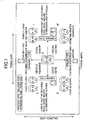
This facial classification method and
facial map, as shown in FIG. 1, classifies faces by
locating the face to be classified along coordinate
axes comprising a balance axis, which shows the
length of the face as well as the positioning of
such facial features as the eyes, eyebrows and so
forth, and a form axis, which shows the roundness of
the face as well as the aforementioned facial
features. Additionally, this facial classification
method and facial map creates a map from the set of
coordinates.
This facial classification method and
facial map makes it possible to get an overall
picture of the face and clarify scientifically the
factors that bring out the image of the face, and
based on that, to apply make-up effectively.
Similarly, for example, applying make-up
while taking into consideration a color image has
long been carried out. This involves the
application of the aesthetic rules governing color,
and thus, for example, is based on an average
perception of the relation between individual colors
and emotions as shown in FIG. 2. In this case, too,
as with the type of face, even if the desired image
can be obtained partially, there is no guarantee
that with such an approach the face, when looked at
as a whole, can obtain a well-balanced image. It
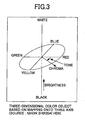
should be noted that, although chromatics knows of a
three-dimensional color object based on mapping
three color sense perception attributes onto three
axes as shown in FIG. 3, there is no example of
multi-dimensionally obtaining a color image from
this three-dimensional color object and making use
of it in the application of make-up.
In short, as described above, a method of
applying make-up while taking into consideration the
color image is not necessarily an effective
technique.
Disclosure of the Invention
The present invention, which was conceived
in view of these points, has as its object to
provide a make-up color image classification method
and make-up color image map based not on chromatics,
which deals purely with color, but on a view of the
total make-up color image projected by a face on
which color is applied to skin, enabling the
application of make-up to be performed effectively.
In order to achieve this objective, the
make-up color image classification method according
to the present invention classifies at least one or
the other of either a lip color or an eye color
using a color image index chosen from among, and
indicating at least one of, warm/cool, character,
mind as well as a color image index chosen from
among, and indicating at least one of,
light/dignified, mature/immature, mature, obtained
from applying color to skin, while at this time
taking as coordinate axes and classifying two-dimensionally
the color image index chosen from
among and indicating at least one of warm/cool,
character, mind and the color image index chosen
from among and indicating at least one of
light/dignified, mature/immature, mature. It should
be noted that, in classifying the latter by mapping
onto a two-dimensional set of coordinates, the
warm/cool axis and light/dignified axis, the
character axis and mature/immature axis, the mind
axis and mature axis, correspond respectively
thereto.
Additionally, the make-up color image
classification method according to the present
invention comprises an image index setting step for
setting either an image index chosen from among and
indicating at least one of warm/cool, character and
mind or an image index chosen from among and
indicating at least one of light/dignified,
mature/immature and mature; a made-up face data
acquisition step for acquiring made-up face data for
a plurality of types of make-up material for at
least one of lip color and eye color applied to a
face; a make-up color image evaluation step, in
which a plurality of test subjects evaluate a color
image of the make-up material based on the made-up
face data using the image index as an evaluation
criteria; and a make-up color image classification
step for classifying the make-up material based on
the obtained make-up material color image using the
image index.
Additionally, the make-up color image
classification method according to the present
invention is a make-up color image classification
method comprising an image index setting step for
setting an image index chosen from among and
indicating at least one of warm/cool, character and
mind or chosen from among and indicating at least
one of light/dignified, mature/immature and mature
as two coordinate axes; a made-up face data
acquisition step for acquiring made-up face data for
a plurality of types of make-up material for at
least one of lip color and eye color applied to a
face; a make-up color image evaluation step, in
which a plurality of test subjects evaluate a color
image of the make-up material based on the made-up
face data using the two image indexes as an
evaluation criteria; and a make-up color image
classification step for two-dimensionally
classifying the make-up material based on the
obtained make-up material color image using the two
image indexes as coordinate axes.
Additionally, the make-up color image
classification method according to the present
invention is a make-up color image classification
method for classifying make-up material based on
color image data collected and analyzed using a
computer, comprising an image index display step for
setting, inputting and displaying either an image
index chosen from among and indicating at least one
of warm/cool, character and mind or an image index
chosen from among and indicating at least one of
light/dignified, mature/immature and mature; a made-up
face data display step for inputting and
displaying made-up face data for a plurality of
types of make-up material for at least one of lip
color and eye color applied to a face; a make-up
color image evaluation input step for evaluating a
color image of the make-up material based on the
made-up face data using the image index as an
evaluation criteria and inputting grading data; a
make-up color image evaluation data totaling step
for adding up grading data input by a plurality of
people; and a make-up color image classification
data output step for statistically processing the
totaled grading data and outputting results of a
positioning of a plurality of types of make-up
materials in relation to an image index.
Additionally, the make-up color image
classification method according to the present
invention is a make-up color image classification
method for classifying make-up material based on
color image data collected and analyzed using a
computer, comprising an image index display step for
setting, inputting and displaying an image index
chosen from among and indicating at least one of
warm/cool, character and mind as well as an image
index chosen from among and indicating at least one
of light/dignified, mature/immature and mature; a
made-up face data display step for inputting and
displaying made-up face data for a plurality of
types of make-up material for at least one of lip
color and eye color applied to a face; a make-up
color image coordinate plane data input step for
evaluating a color image of the make-up material
based on the made-up face data using the image index
as an evaluation criteria and inputting coordinates;
a make-up color image coordinate plane data totaling
step for adding up grading data input by a plurality
of people; and a make-up color image classification
data output step for statistically processing the
totaled coordinate point data and outputting a
coordinate plane map indicating a position of a
plurality of types of make-up materials.
According to the above-described
composition of the present invention, color image
data can be systematically and multifacetedly
analyzed and classified, enabling the application of
make-up to be performed effectively.
Additionally, the make-up color image map
according to the present invention two-dimensionally
classifies, positions and displays at least one of
either a lip color or an eye color using a color
image index chosen from among, and indicating at
least one of, warm/cool, character, mind as well as
a color image index chosen from among, and
indicating at least one of, light/dignified,
mature/immature, mature, obtained from applying
color to skin as coordinate axes. Additionally, at
this time, each quadrant created by the coordinate
axes is provided therein with a written description
of the color image that is representative of the
respective quadrant.
According to the above-described
composition of the present invention, the color
image can be grasped easily and accurately, enabling
the application of make-up to be performed
effectively.
BRIEF DESCRIPTION OF THE DRAWINGS
FIG. 1 is a facial map previously proposed
by the applicant.
FIG. 2 is a chart showing an example of the
conventional understanding of the relation between
color and image.
FIG. 3 is a diagram showing a three-dimensional
color object obtained by mapping the
three color sense perception attributes along three
axes.
FIG. 4 is a schematic diagram illustrating
a state of input/output processing using a computer.
FIG. 5 is a process block diagram for
purposes of illustrating steps in a make-up color
image classification method according to one
embodiment of the present invention.
FIG. 6 is a lip color chart used in
experiments in the make-up color image
classification method, according to an embodiment of
the present invention.
FIG. 7 is an eye color chart used in
experiments in the make-up color image
classification method, according to an embodiment of
the present invention.
FIG. 8 is a survey chart showing the
evaluation criteria used in the make-up color image
classification method according to one embodiment of
the present invention.
FIG. 9 is a pink/rose group lip color make-up
color image map according to one embodiment of
the present invention.
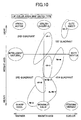
FIG. 10 is an orange/red group lip color
make-up color image map according to one embodiment
of the present invention.
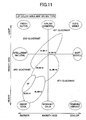
FIG. 11 is a brown/clear group lip color
make-up color image map according to one embodiment
of the present invention.
FIG. 12 is a make-up color image map of eye
color according to an embodiment of the present
invention.
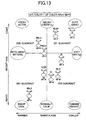
FIG. 13 is a make-up color image map of a
combination of lip color and eye color according to
an embodiment of the present invention.
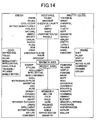
FIG. 14 is a map showing representative
image terms located in each quadrant of a make-up
color image map of lip color and eye color as well
as a facial map according to an embodiment of the
present invention.
BEST EMBODIMENT FOR PRACTICING THE INVENTION
A description will be given below of
preferred embodiments of the make-up color image
classification method and make-up color image map
according to the present invention (hereinafter
embodiments of the present invention), with
reference to the drawings.
First, a description will be given below of
the make-up color image classification method.
Lip color and eye color were used as
cosmetic make-up for making up an image of a face.
In order to make distinct each color image, the
following experiments were performed.
At this time, as shown in FIG. 4, using a
computer, and in the order shown in FIG. 5, a
model's face made up with cosmetic materials (made-up
face), planar coordinate data, survey input
format and so forth were displayed on a monitor
display screen 1, data was input from a keyboard 2
and statistically processed and the obtained results
were output either on the display screen or in
printed form.
Initially, the aforementioned facial map
used three models of different types and
photographed them using the 28 lip colors and 19 eye
colors shown in FIG. 6 and FIG. 7. Then, data on
these made-up faces was input into a computer (step
S2 in FIG. 5, Made-Up Face Data Acquisition Process,
Made-Up Face Data Display Process), and in the
following processes displayed as appropriate on the
display screen and used. It should be noted that,
in each drawing, where the meaning does not
accompany the reference symbol, it should be
understood that VI stands for violet, RS stands for
purplish red (hereinafter called rose), PK stands
for pink, RD stands for red, BR stands for brown, OR
stands for orange, YE stands for yellow, GY stands
for gray, GR stands for green, BL stands for blue,
and MN stands for achromatic color.
In other words, for example, for lip color,
the tone includes all tones ranging from violet to
gray, and the intensity means a wide range from pale
to deep.
Then, in the case of the lip color
experiment, everything except the mouth was made the
same natural color so as to be able to capture just
the change in image created by the differences in
lip color. Similarly, in the case of the eye color
experiment, everything except the eyes was made the
same natural color.
Determinations as to color image were made
by 30 ordinary women monitors and 31 beauticians.
It should be noted that the age distribution of the
test subjects was made the same for the ordinary
women monitors and the beauticians.
It should be noted that, separate from the
above-described process, an image index expressing a
color image is prepared, and in this case made into
a survey chart evaluation criterion, displayed on
the computer display screen, and additionally, an
image index coordinate plane map is displayed (step
S1 in FIG. 5, Image Index Setting Process (Image
Index Display Process).
The criteria used to determine the color
image are as shown in the survey chart depicted in
FIG. 8. In this case, the messages (text) that
describe the color images resembled that used for
the facial classification method and facial map
investigated previously by the applicant as noted
above. They were conceived with the idea of
combining, and using for determining, the make-up
color image classification method and the make-up
color image map of the present invention, and the
facial classification method and facial map, so that
both classification methods and both maps can be
used together to perform effective make-up
application. As a result, the two coordinate axes
of the color image map described below, that is, the
axis of the color image index that is chosen from
among and indicates at least one of warm/cool,
character and mind (hereinafter as a representative
example called the warm/cool axis), and the axis of
the color image index that is chosen from among and
indicates at least one of light/dignified, mature,
immature and mature (hereinafter as a representative
example called the light/dignified axis), are
identical to the two axes used instead of words to
describe the image of the face located within each
of four quadrants formed by the balance axis and the
form axis of the face map. It should be noted that,
in this case, the two axes of the color image map
and the facial map need not coincide, that is, the
coordinate axes may be rotated, and further, may be
set without regard to the many words that express
the color image used for the color map, the acquired
data analyzed with statistical methods such as the
factor analysis used for the facial map, and a new
image axis created.
The survey results involve tabulating the
number of points acquired for each expression
describing a given color image, using 2 points for
"Think so" and 1 point for "Sort of think so", and
on that basis positioning along the above-described
two coordinate axes according to the directionality
and the points of the words expressing individual
color images of individual colors (step S3 in FIG. 5,
the make-up color image evaluation process, the
make-up color image data input process, and the
make-up color image coordinate plane data input
process).
FIGS. 9-11 show a make-up color image map
for lip color. In this case, the survey results
from ordinary women monitors and beauticians were
each totaled (step S4 in FIG. 5, make-up color image
evaluation data totaling process, make-up color
image coordinate plane data totaling process),
analyzed, and further, individual analysis results
comprehensively analyzed to create a single map
(step S5 in FIG. 5, make-up color image
classification process, make-up color image
classification data output process). It should be
noted that, with respect to the former, it is
possible to analyze results of surveys of the
ordinary women monitors and the beauticians
separately, and, looking at the resulting two maps,
in the case of the beautician's map, for example,
compared to the former, that is, to the map prepared
according to the results of the survey of the
ordinary women monitors, a difference can be seen
also insofar as individual colors are distributed
widely in the direction of the horizontal axis (the
warmth axis), and meaningful results can be obtained
by producing and using the two maps. However, when
the make-up color image map of the present invention
is actually used to apply make-up, it is thought
that evaluating all the data comprehensively, and
displaying and giving a certain amount of width to a
zone for each individual color on the map, and
providing a degree of freedom in the choice of color
is practical.
The purpose of dividing among the three
shown in FIGS. 9-11 is, as described above, to give
each individual color a wide zone of expression, an
attempt which would lead to the inconvenience of
having multiple color zones overlapping if all
colors were displayed on a single map.
Looking at the pink/rose type map of FIG. 9
that contains red and blue, from the first quadrant
(for example, a zone locating the cute image) to the
fourth quadrant (for example, the zone locating the
feminine image), it can be seen that pale colors and
light colors belong to the first quadrant, and that
dark colors and clear colors belong to the fourth
quadrant.
Looking at the orange/red type map of FIG.
10, it can be seen that the color distribution is to
the left as compared to the pink/rose type, that is,
has shifted toward the center of the map and
elongated vertically.
Looking at the brown/gray type map of FIG.
11, which has little red, it can be seen that the
color distribution has shifted further to the left
as compared to the orange/red type, and elongated
further vertically, with a strong silver image in
the third quadrant (for example, the zone locating
the sharp image).
FIG. 12 is a make-up color image for eye
color. In this case also, data is analyzed and
collected according to the same steps as those for
the lip color described above, with a zone displayed
for each individual color.
Looking at FIG. 12, it can be seen that
vivacious, bright colors such as yellow are located
in the first quadrant (the zone that locates the
cute image); off-white colors such as light
achromatic colors and brown are located in the
second quadrant (for example, the zone that locates
the fresh image); colors with little or no red such
as brown and dark achromatic colors and black are
located in the third quadrant (the zone that locates
sharp images); and colors with an appropriate amount
of red such as dark pink and violet, and in
particular, colors containing blue, are located in
the fourth quadrant (the zone that locates the
feminine image). By contrast, blue and blue-green
are located largely in the center.
At any rate, the make-up color image map
for the eye color and the make-up color image map
for the lip color can be said to be show virtually
identical tendencies.
It should be noted that these results, when
viewed from the standpoint of chromatics, indicate
that blue is a cool type of color, that is, a calm
color that gives a feeling of coolness, and for this
reason it may be thought appropriate to locate it at
the left side of the map, in the second and third
quadrants. However, as a make-up color image on the
map, the color blue is located virtually in the
center of the drawing. This is because the color of
the skin always exists in the background of the
making up of the eye and the making up of the lip.
That is, the color of orange skin darkened with blue
is a complementary color scheme in chromatics and
blue is a color that stands out against the color of
the skin, so it would appear that the make-up color
image it projects, together with the usual fresh,
cool image that is the basic image of blue, the cute,
vibrant reverse image as well. That is, bluish
colors have the ability to provide a variety of
images with just minor changes in tone and feeling,
and on this point, the color image at make-up and
the color image in chromatics can sometimes differ
dramatically.
Next, an experiment was conducted on color
images produced by combining the lip color and the
eye color as mapped above, with only the results
shown in FIG. 13.
Looking at FIG. 13, a combination of pink
eye color and pale pink lip color is located in the
first quadrant (the zone that locates the cute
image); a combination of pale white eye color and
pale orange lip color is located in the second
quadrant (the zone that locates the fresh image); a
combination of dark achromatic eye color and dark
brown lip color is located in the third quadrant
(the zone that locates the sharp image); and a
combination of dark pinkish eye color and moderate
rose lip color is located in the fourth quadrant
(the zone that locates the feminine image).
This, practically, means that, when used
with combinations of lip color and eye color
positioned in the same quadrants of the respective
maps, the image of that quadrant can be expressed
for the face as a whole.
It should be noted that, the representative
color image located in the individual quadrants
formed by each of the above-described axes are
displayed in further detail in FIG. 14. By
comparing and contrasting this FIG. 14 with FIGS. 9-13
and referring thereto, the color image can be
grasped easily and accurately, making it possible to
apply make-up effectively.
As described above, the make-up color image
classification method and the make-up color image
map of the present invention are of course useful
when applying either lip color or eye color singly
or in combination, and further, can make the
application of make-up even more effective when used
in combination with the facial classification method
and facial map.
For example, by providing a computer at
cosmetics stores, each individual customer can
visually subjectively imagine a make-up image color
using a made-up face photograph combining cosmetic
make-up, and further, cosmeticians are able to
provide customers with reliable advice on the best
way to apply make-up based on a wide range of
objective information obtained by displaying the
make-up color image on a display screen and by using
this make-up color image map.