EP1226118B1 - Method for producing peroxydicarbonates and their use in the radical polymerization of monomers - Google Patents
Method for producing peroxydicarbonates and their use in the radical polymerization of monomers Download PDFInfo
- Publication number
- EP1226118B1 EP1226118B1 EP00973042A EP00973042A EP1226118B1 EP 1226118 B1 EP1226118 B1 EP 1226118B1 EP 00973042 A EP00973042 A EP 00973042A EP 00973042 A EP00973042 A EP 00973042A EP 1226118 B1 EP1226118 B1 EP 1226118B1
- Authority
- EP
- European Patent Office
- Prior art keywords
- peroxydicarbonate
- vessel
- alkali metal
- peroxide
- polymerization
- Prior art date
- Legal status (The legal status is an assumption and is not a legal conclusion. Google has not performed a legal analysis and makes no representation as to the accuracy of the status listed.)
- Expired - Lifetime
Links
- 239000000178 monomer Substances 0.000 title claims abstract description 60
- 125000005634 peroxydicarbonate group Chemical group 0.000 title claims abstract description 47
- 238000004519 manufacturing process Methods 0.000 title description 4
- 238000010526 radical polymerization reaction Methods 0.000 title 1
- BEQKKZICTDFVMG-UHFFFAOYSA-N 1,2,3,4,6-pentaoxepane-5,7-dione Chemical compound O=C1OOOOC(=O)O1 BEQKKZICTDFVMG-UHFFFAOYSA-N 0.000 claims abstract description 111
- 238000000034 method Methods 0.000 claims abstract description 79
- 238000006116 polymerization reaction Methods 0.000 claims abstract description 73
- 238000006243 chemical reaction Methods 0.000 claims abstract description 67
- XLYOFNOQVPJJNP-UHFFFAOYSA-N water Substances O XLYOFNOQVPJJNP-UHFFFAOYSA-N 0.000 claims abstract description 62
- 150000004973 alkali metal peroxides Chemical class 0.000 claims abstract description 50
- 229920000642 polymer Polymers 0.000 claims abstract description 41
- 239000002270 dispersing agent Substances 0.000 claims abstract description 39
- 239000000203 mixture Substances 0.000 claims abstract description 22
- 150000002978 peroxides Chemical class 0.000 claims abstract description 15
- 150000008044 alkali metal hydroxides Chemical class 0.000 claims abstract description 13
- 239000004014 plasticizer Substances 0.000 claims abstract description 7
- 239000003960 organic solvent Substances 0.000 claims abstract description 5
- HEMHJVSKTPXQMS-UHFFFAOYSA-M Sodium hydroxide Chemical group [OH-].[Na+] HEMHJVSKTPXQMS-UHFFFAOYSA-M 0.000 claims description 48
- BZHJMEDXRYGGRV-UHFFFAOYSA-N Vinyl chloride Chemical group ClC=C BZHJMEDXRYGGRV-UHFFFAOYSA-N 0.000 claims description 27
- MHAJPDPJQMAIIY-UHFFFAOYSA-N Hydrogen peroxide Chemical group OO MHAJPDPJQMAIIY-UHFFFAOYSA-N 0.000 claims description 26
- CWINGZLCRSDKCL-UHFFFAOYSA-N ethoxycarbonyloxy ethyl carbonate Chemical group CCOC(=O)OOC(=O)OCC CWINGZLCRSDKCL-UHFFFAOYSA-N 0.000 claims description 23
- 238000001816 cooling Methods 0.000 claims description 16
- FZFAMSAMCHXGEF-UHFFFAOYSA-N chloro formate Chemical compound ClOC=O FZFAMSAMCHXGEF-UHFFFAOYSA-N 0.000 claims description 14
- 238000013019 agitation Methods 0.000 claims description 13
- 229920002689 polyvinyl acetate Polymers 0.000 claims description 10
- PFUVRDFDKPNGAV-UHFFFAOYSA-N sodium peroxide Chemical group [Na+].[Na+].[O-][O-] PFUVRDFDKPNGAV-UHFFFAOYSA-N 0.000 claims description 10
- 239000011118 polyvinyl acetate Substances 0.000 claims description 9
- 125000004432 carbon atom Chemical group C* 0.000 claims description 8
- 239000003795 chemical substances by application Substances 0.000 claims description 7
- 125000001495 ethyl group Chemical group [H]C([H])([H])C([H])([H])* 0.000 claims description 7
- 238000002156 mixing Methods 0.000 claims description 7
- 238000007599 discharging Methods 0.000 claims description 6
- 229920000609 methyl cellulose Polymers 0.000 claims description 6
- 239000001923 methylcellulose Substances 0.000 claims description 6
- 235000010981 methylcellulose Nutrition 0.000 claims description 6
- 230000007062 hydrolysis Effects 0.000 claims description 5
- 238000006460 hydrolysis reaction Methods 0.000 claims description 5
- ZACVGCNKGYYQHA-UHFFFAOYSA-N 2-ethylhexoxycarbonyloxy 2-ethylhexyl carbonate Chemical compound CCCCC(CC)COC(=O)OOC(=O)OCC(CC)CCCC ZACVGCNKGYYQHA-UHFFFAOYSA-N 0.000 claims description 4
- 238000001035 drying Methods 0.000 claims description 4
- BWJUFXUULUEGMA-UHFFFAOYSA-N propan-2-yl propan-2-yloxycarbonyloxy carbonate Chemical compound CC(C)OC(=O)OOC(=O)OC(C)C BWJUFXUULUEGMA-UHFFFAOYSA-N 0.000 claims description 4
- 108010010803 Gelatin Proteins 0.000 claims description 3
- 229920002125 Sokalan® Polymers 0.000 claims description 3
- ZGPBOPXFOJBLIV-UHFFFAOYSA-N butoxycarbonyloxy butyl carbonate Chemical compound CCCCOC(=O)OOC(=O)OCCCC ZGPBOPXFOJBLIV-UHFFFAOYSA-N 0.000 claims description 3
- 125000000484 butyl group Chemical group [H]C([*])([H])C([H])([H])C([H])([H])C([H])([H])[H] 0.000 claims description 3
- 239000008273 gelatin Substances 0.000 claims description 3
- 229920000159 gelatin Polymers 0.000 claims description 3
- 235000019322 gelatine Nutrition 0.000 claims description 3
- 235000011852 gelatine desserts Nutrition 0.000 claims description 3
- 239000001866 hydroxypropyl methyl cellulose Substances 0.000 claims description 3
- 229920003088 hydroxypropyl methyl cellulose Polymers 0.000 claims description 3
- 235000010979 hydroxypropyl methyl cellulose Nutrition 0.000 claims description 3
- UFVKGYZPFZQRLF-UHFFFAOYSA-N hydroxypropyl methyl cellulose Chemical compound OC1C(O)C(OC)OC(CO)C1OC1C(O)C(O)C(OC2C(C(O)C(OC3C(C(O)C(O)C(CO)O3)O)C(CO)O2)O)C(CO)O1 UFVKGYZPFZQRLF-UHFFFAOYSA-N 0.000 claims description 3
- 125000004123 n-propyl group Chemical group [H]C([H])([H])C([H])([H])C([H])([H])* 0.000 claims description 3
- 239000004584 polyacrylic acid Substances 0.000 claims description 3
- 229920000036 polyvinylpyrrolidone Polymers 0.000 claims description 3
- 235000013855 polyvinylpyrrolidone Nutrition 0.000 claims description 3
- 239000001267 polyvinylpyrrolidone Substances 0.000 claims description 3
- 239000000843 powder Substances 0.000 claims description 3
- YPVDWEHVCUBACK-UHFFFAOYSA-N propoxycarbonyloxy propyl carbonate Chemical compound CCCOC(=O)OOC(=O)OCCC YPVDWEHVCUBACK-UHFFFAOYSA-N 0.000 claims description 3
- LNAZSHAWQACDHT-XIYTZBAFSA-N (2r,3r,4s,5r,6s)-4,5-dimethoxy-2-(methoxymethyl)-3-[(2s,3r,4s,5r,6r)-3,4,5-trimethoxy-6-(methoxymethyl)oxan-2-yl]oxy-6-[(2r,3r,4s,5r,6r)-4,5,6-trimethoxy-2-(methoxymethyl)oxan-3-yl]oxyoxane Chemical compound CO[C@@H]1[C@@H](OC)[C@H](OC)[C@@H](COC)O[C@H]1O[C@H]1[C@H](OC)[C@@H](OC)[C@H](O[C@H]2[C@@H]([C@@H](OC)[C@H](OC)O[C@@H]2COC)OC)O[C@@H]1COC LNAZSHAWQACDHT-XIYTZBAFSA-N 0.000 claims description 2
- 229920001213 Polysorbate 20 Polymers 0.000 claims description 2
- 239000000256 polyoxyethylene sorbitan monolaurate Substances 0.000 claims description 2
- 235000010486 polyoxyethylene sorbitan monolaurate Nutrition 0.000 claims description 2
- 150000004972 metal peroxides Chemical class 0.000 claims 1
- 239000003999 initiator Substances 0.000 abstract description 21
- 150000003254 radicals Chemical class 0.000 abstract description 13
- 239000004800 polyvinyl chloride Substances 0.000 description 28
- 229920000915 polyvinyl chloride Polymers 0.000 description 27
- 239000004615 ingredient Substances 0.000 description 15
- 239000000376 reactant Substances 0.000 description 14
- -1 alkyl radicals Chemical class 0.000 description 12
- 238000000265 homogenisation Methods 0.000 description 10
- 239000011347 resin Substances 0.000 description 10
- 229920005989 resin Polymers 0.000 description 10
- 239000000243 solution Substances 0.000 description 10
- 239000002904 solvent Substances 0.000 description 8
- 238000000354 decomposition reaction Methods 0.000 description 7
- 229940075065 polyvinyl acetate Drugs 0.000 description 7
- 230000015572 biosynthetic process Effects 0.000 description 6
- 239000000839 emulsion Substances 0.000 description 6
- 238000010557 suspension polymerization reaction Methods 0.000 description 6
- RIFGWPKJUGCATF-UHFFFAOYSA-N ethyl chloroformate Chemical compound CCOC(Cl)=O RIFGWPKJUGCATF-UHFFFAOYSA-N 0.000 description 5
- 239000011521 glass Substances 0.000 description 5
- 239000000463 material Substances 0.000 description 5
- 239000002002 slurry Substances 0.000 description 5
- 238000003786 synthesis reaction Methods 0.000 description 5
- 239000007900 aqueous suspension Substances 0.000 description 4
- 239000006227 byproduct Substances 0.000 description 4
- 239000011541 reaction mixture Substances 0.000 description 4
- LYCAIKOWRPUZTN-UHFFFAOYSA-N Ethylene glycol Chemical compound OCCO LYCAIKOWRPUZTN-UHFFFAOYSA-N 0.000 description 3
- WMFOQBRAJBCJND-UHFFFAOYSA-M Lithium hydroxide Chemical compound [Li+].[OH-] WMFOQBRAJBCJND-UHFFFAOYSA-M 0.000 description 3
- KWYUFKZDYYNOTN-UHFFFAOYSA-M Potassium hydroxide Chemical compound [OH-].[K+] KWYUFKZDYYNOTN-UHFFFAOYSA-M 0.000 description 3
- 239000002245 particle Substances 0.000 description 3
- 230000000379 polymerizing effect Effects 0.000 description 3
- 238000002360 preparation method Methods 0.000 description 3
- SMZOUWXMTYCWNB-UHFFFAOYSA-N 2-(2-methoxy-5-methylphenyl)ethanamine Chemical compound COC1=CC=C(C)C=C1CCN SMZOUWXMTYCWNB-UHFFFAOYSA-N 0.000 description 2
- NIXOWILDQLNWCW-UHFFFAOYSA-N 2-Propenoic acid Natural products OC(=O)C=C NIXOWILDQLNWCW-UHFFFAOYSA-N 0.000 description 2
- SOGAXMICEFXMKE-UHFFFAOYSA-N Butylmethacrylate Chemical compound CCCCOC(=O)C(C)=C SOGAXMICEFXMKE-UHFFFAOYSA-N 0.000 description 2
- CURLTUGMZLYLDI-UHFFFAOYSA-N Carbon dioxide Chemical compound O=C=O CURLTUGMZLYLDI-UHFFFAOYSA-N 0.000 description 2
- CERQOIWHTDAKMF-UHFFFAOYSA-N Methacrylic acid Chemical compound CC(=C)C(O)=O CERQOIWHTDAKMF-UHFFFAOYSA-N 0.000 description 2
- BAPJBEWLBFYGME-UHFFFAOYSA-N Methyl acrylate Chemical compound COC(=O)C=C BAPJBEWLBFYGME-UHFFFAOYSA-N 0.000 description 2
- 229910000831 Steel Inorganic materials 0.000 description 2
- NSGQRLUGQNBHLD-UHFFFAOYSA-N butan-2-yl butan-2-yloxycarbonyloxy carbonate Chemical compound CCC(C)OC(=O)OOC(=O)OC(C)CC NSGQRLUGQNBHLD-UHFFFAOYSA-N 0.000 description 2
- LQKBKHFGCGFBAF-UHFFFAOYSA-N butyl carboxyoxy carbonate Chemical group CCCCOC(=O)OOC(O)=O LQKBKHFGCGFBAF-UHFFFAOYSA-N 0.000 description 2
- 239000000460 chlorine Substances 0.000 description 2
- 229910052801 chlorine Inorganic materials 0.000 description 2
- 239000011248 coating agent Substances 0.000 description 2
- 238000000576 coating method Methods 0.000 description 2
- 239000000356 contaminant Substances 0.000 description 2
- 239000003085 diluting agent Substances 0.000 description 2
- 150000002148 esters Chemical class 0.000 description 2
- 238000011010 flushing procedure Methods 0.000 description 2
- 229910052751 metal Inorganic materials 0.000 description 2
- 239000002184 metal Substances 0.000 description 2
- 230000035484 reaction time Effects 0.000 description 2
- 238000011084 recovery Methods 0.000 description 2
- 239000011734 sodium Substances 0.000 description 2
- 229910001220 stainless steel Inorganic materials 0.000 description 2
- 239000010935 stainless steel Substances 0.000 description 2
- 239000010959 steel Substances 0.000 description 2
- 239000000725 suspension Substances 0.000 description 2
- IGGDKDTUCAWDAN-UHFFFAOYSA-N 1-vinylnaphthalene Chemical compound C1=CC=C2C(C=C)=CC=CC2=C1 IGGDKDTUCAWDAN-UHFFFAOYSA-N 0.000 description 1
- OEPOKWHJYJXUGD-UHFFFAOYSA-N 2-(3-phenylmethoxyphenyl)-1,3-thiazole-4-carbaldehyde Chemical compound O=CC1=CSC(C=2C=C(OCC=3C=CC=CC=3)C=CC=2)=N1 OEPOKWHJYJXUGD-UHFFFAOYSA-N 0.000 description 1
- SBYMUDUGTIKLCR-UHFFFAOYSA-N 2-chloroethenylbenzene Chemical compound ClC=CC1=CC=CC=C1 SBYMUDUGTIKLCR-UHFFFAOYSA-N 0.000 description 1
- AEPWOCLBLLCOGZ-UHFFFAOYSA-N 2-cyanoethyl prop-2-enoate Chemical compound C=CC(=O)OCCC#N AEPWOCLBLLCOGZ-UHFFFAOYSA-N 0.000 description 1
- RTGLJCSUKOLTEM-UHFFFAOYSA-N 2-ethylhexyl carbonochloridate Chemical compound CCCCC(CC)COC(Cl)=O RTGLJCSUKOLTEM-UHFFFAOYSA-N 0.000 description 1
- XZIIFPSPUDAGJM-UHFFFAOYSA-N 6-chloro-2-n,2-n-diethylpyrimidine-2,4-diamine Chemical compound CCN(CC)C1=NC(N)=CC(Cl)=N1 XZIIFPSPUDAGJM-UHFFFAOYSA-N 0.000 description 1
- ZCYVEMRRCGMTRW-UHFFFAOYSA-N 7553-56-2 Chemical compound [I] ZCYVEMRRCGMTRW-UHFFFAOYSA-N 0.000 description 1
- QTBSBXVTEAMEQO-UHFFFAOYSA-M Acetate Chemical compound CC([O-])=O QTBSBXVTEAMEQO-UHFFFAOYSA-M 0.000 description 1
- NLHHRLWOUZZQLW-UHFFFAOYSA-N Acrylonitrile Chemical compound C=CC#N NLHHRLWOUZZQLW-UHFFFAOYSA-N 0.000 description 1
- VHUUQVKOLVNVRT-UHFFFAOYSA-N Ammonium hydroxide Chemical compound [NH4+].[OH-] VHUUQVKOLVNVRT-UHFFFAOYSA-N 0.000 description 1
- WKBOTKDWSSQWDR-UHFFFAOYSA-N Bromine atom Chemical compound [Br] WKBOTKDWSSQWDR-UHFFFAOYSA-N 0.000 description 1
- ZAMOUSCENKQFHK-UHFFFAOYSA-N Chlorine atom Chemical compound [Cl] ZAMOUSCENKQFHK-UHFFFAOYSA-N 0.000 description 1
- JIGUQPWFLRLWPJ-UHFFFAOYSA-N Ethyl acrylate Chemical compound CCOC(=O)C=C JIGUQPWFLRLWPJ-UHFFFAOYSA-N 0.000 description 1
- PXGOKWXKJXAPGV-UHFFFAOYSA-N Fluorine Chemical compound FF PXGOKWXKJXAPGV-UHFFFAOYSA-N 0.000 description 1
- XTXRWKRVRITETP-UHFFFAOYSA-N Vinyl acetate Chemical compound CC(=O)OC=C XTXRWKRVRITETP-UHFFFAOYSA-N 0.000 description 1
- 150000001335 aliphatic alkanes Chemical class 0.000 description 1
- 239000003513 alkali Substances 0.000 description 1
- 229910000318 alkali metal phosphate Inorganic materials 0.000 description 1
- 125000003342 alkenyl group Chemical group 0.000 description 1
- 125000002877 alkyl aryl group Chemical group 0.000 description 1
- 229920013820 alkyl cellulose Polymers 0.000 description 1
- 125000000217 alkyl group Chemical group 0.000 description 1
- XYLMUPLGERFSHI-UHFFFAOYSA-N alpha-Methylstyrene Chemical compound CC(=C)C1=CC=CC=C1 XYLMUPLGERFSHI-UHFFFAOYSA-N 0.000 description 1
- 239000007864 aqueous solution Substances 0.000 description 1
- 125000003710 aryl alkyl group Chemical group 0.000 description 1
- 125000003118 aryl group Chemical group 0.000 description 1
- QVGXLLKOCUKJST-UHFFFAOYSA-N atomic oxygen Chemical compound [O] QVGXLLKOCUKJST-UHFFFAOYSA-N 0.000 description 1
- 238000010923 batch production Methods 0.000 description 1
- 230000009286 beneficial effect Effects 0.000 description 1
- 125000001797 benzyl group Chemical group [H]C1=C([H])C([H])=C(C([H])=C1[H])C([H])([H])* 0.000 description 1
- GDTBXPJZTBHREO-UHFFFAOYSA-N bromine Substances BrBr GDTBXPJZTBHREO-UHFFFAOYSA-N 0.000 description 1
- 229910052794 bromium Inorganic materials 0.000 description 1
- INLLPKCGLOXCIV-UHFFFAOYSA-N bromoethene Chemical compound BrC=C INLLPKCGLOXCIV-UHFFFAOYSA-N 0.000 description 1
- 239000000872 buffer Substances 0.000 description 1
- CQEYYJKEWSMYFG-UHFFFAOYSA-N butyl acrylate Chemical compound CCCCOC(=O)C=C CQEYYJKEWSMYFG-UHFFFAOYSA-N 0.000 description 1
- AXCZMVOFGPJBDE-UHFFFAOYSA-L calcium dihydroxide Chemical compound [OH-].[OH-].[Ca+2] AXCZMVOFGPJBDE-UHFFFAOYSA-L 0.000 description 1
- 239000000920 calcium hydroxide Substances 0.000 description 1
- 229910001861 calcium hydroxide Inorganic materials 0.000 description 1
- 239000001569 carbon dioxide Substances 0.000 description 1
- 229910002092 carbon dioxide Inorganic materials 0.000 description 1
- RBHJBMIOOPYDBQ-UHFFFAOYSA-N carbon dioxide;propan-2-one Chemical compound O=C=O.CC(C)=O RBHJBMIOOPYDBQ-UHFFFAOYSA-N 0.000 description 1
- 125000001309 chloro group Chemical group Cl* 0.000 description 1
- AOGYCOYQMAVAFD-UHFFFAOYSA-N chlorocarbonic acid Chemical class OC(Cl)=O AOGYCOYQMAVAFD-UHFFFAOYSA-N 0.000 description 1
- 125000000490 cinnamyl group Chemical group C(C=CC1=CC=CC=C1)* 0.000 description 1
- 230000000052 comparative effect Effects 0.000 description 1
- 150000001875 compounds Chemical class 0.000 description 1
- 238000010276 construction Methods 0.000 description 1
- 238000010924 continuous production Methods 0.000 description 1
- 239000002826 coolant Substances 0.000 description 1
- 125000000113 cyclohexyl group Chemical group [H]C1([H])C([H])([H])C([H])([H])C([H])(*)C([H])([H])C1([H])[H] 0.000 description 1
- 230000003111 delayed effect Effects 0.000 description 1
- 230000001419 dependent effect Effects 0.000 description 1
- 230000001627 detrimental effect Effects 0.000 description 1
- 238000010790 dilution Methods 0.000 description 1
- 239000012895 dilution Substances 0.000 description 1
- 239000006185 dispersion Substances 0.000 description 1
- 238000009826 distribution Methods 0.000 description 1
- 230000000694 effects Effects 0.000 description 1
- 150000002170 ethers Chemical class 0.000 description 1
- 229910052731 fluorine Inorganic materials 0.000 description 1
- 239000011737 fluorine Substances 0.000 description 1
- 238000005187 foaming Methods 0.000 description 1
- 238000007710 freezing Methods 0.000 description 1
- 230000008014 freezing Effects 0.000 description 1
- 239000003517 fume Substances 0.000 description 1
- 239000000499 gel Substances 0.000 description 1
- 229910052736 halogen Inorganic materials 0.000 description 1
- 125000005843 halogen group Chemical group 0.000 description 1
- 150000002367 halogens Chemical group 0.000 description 1
- 150000002391 heterocyclic compounds Chemical class 0.000 description 1
- 125000004051 hexyl group Chemical group [H]C([H])([H])C([H])([H])C([H])([H])C([H])([H])C([H])([H])C([H])([H])* 0.000 description 1
- 229920013821 hydroxy alkyl cellulose Polymers 0.000 description 1
- 239000011261 inert gas Substances 0.000 description 1
- 239000011630 iodine Substances 0.000 description 1
- 229910052740 iodine Inorganic materials 0.000 description 1
- 125000000959 isobutyl group Chemical group [H]C([H])([H])C([H])(C([H])([H])[H])C([H])([H])* 0.000 description 1
- 125000001449 isopropyl group Chemical group [H]C([H])([H])C([H])(*)C([H])([H])[H] 0.000 description 1
- 239000007788 liquid Substances 0.000 description 1
- 238000011068 loading method Methods 0.000 description 1
- VTHJTEIRLNZDEV-UHFFFAOYSA-L magnesium dihydroxide Chemical compound [OH-].[OH-].[Mg+2] VTHJTEIRLNZDEV-UHFFFAOYSA-L 0.000 description 1
- 239000000347 magnesium hydroxide Substances 0.000 description 1
- 229910001862 magnesium hydroxide Inorganic materials 0.000 description 1
- 229910000000 metal hydroxide Inorganic materials 0.000 description 1
- 150000004692 metal hydroxides Chemical class 0.000 description 1
- 125000002496 methyl group Chemical group [H]C([H])([H])* 0.000 description 1
- SNVLJLYUUXKWOJ-UHFFFAOYSA-N methylidenecarbene Chemical group C=[C] SNVLJLYUUXKWOJ-UHFFFAOYSA-N 0.000 description 1
- CQDGTJPVBWZJAZ-UHFFFAOYSA-N monoethyl carbonate Chemical compound CCOC(O)=O CQDGTJPVBWZJAZ-UHFFFAOYSA-N 0.000 description 1
- 125000004108 n-butyl group Chemical group [H]C([H])([H])C([H])([H])C([H])([H])C([H])([H])* 0.000 description 1
- 125000000740 n-pentyl group Chemical group [H]C([H])([H])C([H])([H])C([H])([H])C([H])([H])C([H])([H])* 0.000 description 1
- 229940065472 octyl acrylate Drugs 0.000 description 1
- ANISOHQJBAQUQP-UHFFFAOYSA-N octyl prop-2-enoate Chemical compound CCCCCCCCOC(=O)C=C ANISOHQJBAQUQP-UHFFFAOYSA-N 0.000 description 1
- 239000001301 oxygen Substances 0.000 description 1
- 229910052760 oxygen Inorganic materials 0.000 description 1
- PNJWIWWMYCMZRO-UHFFFAOYSA-N pent‐4‐en‐2‐one Natural products CC(=O)CC=C PNJWIWWMYCMZRO-UHFFFAOYSA-N 0.000 description 1
- 239000000047 product Substances 0.000 description 1
- HJWLCRVIBGQPNF-UHFFFAOYSA-N prop-2-enylbenzene Chemical compound C=CCC1=CC=CC=C1 HJWLCRVIBGQPNF-UHFFFAOYSA-N 0.000 description 1
- IVRIRQXJSNCSPQ-UHFFFAOYSA-N propan-2-yl carbonochloridate Chemical compound CC(C)OC(Cl)=O IVRIRQXJSNCSPQ-UHFFFAOYSA-N 0.000 description 1
- 230000003134 recirculating effect Effects 0.000 description 1
- 238000010992 reflux Methods 0.000 description 1
- 239000011369 resultant mixture Substances 0.000 description 1
- 230000002441 reversible effect Effects 0.000 description 1
- 239000011833 salt mixture Substances 0.000 description 1
- 150000003839 salts Chemical class 0.000 description 1
- 230000035939 shock Effects 0.000 description 1
- 229940035044 sorbitan monolaurate Drugs 0.000 description 1
- 230000000087 stabilizing effect Effects 0.000 description 1
- 238000003860 storage Methods 0.000 description 1
- 150000003440 styrenes Chemical class 0.000 description 1
- 125000003718 tetrahydrofuranyl group Chemical group 0.000 description 1
- 229920002554 vinyl polymer Polymers 0.000 description 1
Classifications
-
- C—CHEMISTRY; METALLURGY
- C08—ORGANIC MACROMOLECULAR COMPOUNDS; THEIR PREPARATION OR CHEMICAL WORKING-UP; COMPOSITIONS BASED THEREON
- C08F—MACROMOLECULAR COMPOUNDS OBTAINED BY REACTIONS ONLY INVOLVING CARBON-TO-CARBON UNSATURATED BONDS
- C08F4/00—Polymerisation catalysts
- C08F4/28—Oxygen or compounds releasing free oxygen
- C08F4/32—Organic compounds
- C08F4/34—Per-compounds with one peroxy-radical
-
- C—CHEMISTRY; METALLURGY
- C07—ORGANIC CHEMISTRY
- C07C—ACYCLIC OR CARBOCYCLIC COMPOUNDS
- C07C407/00—Preparation of peroxy compounds
-
- C—CHEMISTRY; METALLURGY
- C08—ORGANIC MACROMOLECULAR COMPOUNDS; THEIR PREPARATION OR CHEMICAL WORKING-UP; COMPOSITIONS BASED THEREON
- C08F—MACROMOLECULAR COMPOUNDS OBTAINED BY REACTIONS ONLY INVOLVING CARBON-TO-CARBON UNSATURATED BONDS
- C08F12/00—Homopolymers and copolymers of compounds having one or more unsaturated aliphatic radicals, each having only one carbon-to-carbon double bond, and at least one being terminated by an aromatic carbocyclic ring
- C08F12/02—Monomers containing only one unsaturated aliphatic radical
- C08F12/04—Monomers containing only one unsaturated aliphatic radical containing one ring
-
- Y—GENERAL TAGGING OF NEW TECHNOLOGICAL DEVELOPMENTS; GENERAL TAGGING OF CROSS-SECTIONAL TECHNOLOGIES SPANNING OVER SEVERAL SECTIONS OF THE IPC; TECHNICAL SUBJECTS COVERED BY FORMER USPC CROSS-REFERENCE ART COLLECTIONS [XRACs] AND DIGESTS
- Y10—TECHNICAL SUBJECTS COVERED BY FORMER USPC
- Y10S—TECHNICAL SUBJECTS COVERED BY FORMER USPC CROSS-REFERENCE ART COLLECTIONS [XRACs] AND DIGESTS
- Y10S526/00—Synthetic resins or natural rubbers -- part of the class 520 series
- Y10S526/91—Suspending agents
-
- Y—GENERAL TAGGING OF NEW TECHNOLOGICAL DEVELOPMENTS; GENERAL TAGGING OF CROSS-SECTIONAL TECHNOLOGIES SPANNING OVER SEVERAL SECTIONS OF THE IPC; TECHNICAL SUBJECTS COVERED BY FORMER USPC CROSS-REFERENCE ART COLLECTIONS [XRACs] AND DIGESTS
- Y10—TECHNICAL SUBJECTS COVERED BY FORMER USPC
- Y10S—TECHNICAL SUBJECTS COVERED BY FORMER USPC CROSS-REFERENCE ART COLLECTIONS [XRACs] AND DIGESTS
- Y10S526/00—Synthetic resins or natural rubbers -- part of the class 520 series
- Y10S526/911—Emulsifying agents
-
- Y—GENERAL TAGGING OF NEW TECHNOLOGICAL DEVELOPMENTS; GENERAL TAGGING OF CROSS-SECTIONAL TECHNOLOGIES SPANNING OVER SEVERAL SECTIONS OF THE IPC; TECHNICAL SUBJECTS COVERED BY FORMER USPC CROSS-REFERENCE ART COLLECTIONS [XRACs] AND DIGESTS
- Y10—TECHNICAL SUBJECTS COVERED BY FORMER USPC
- Y10S—TECHNICAL SUBJECTS COVERED BY FORMER USPC CROSS-REFERENCE ART COLLECTIONS [XRACs] AND DIGESTS
- Y10S526/00—Synthetic resins or natural rubbers -- part of the class 520 series
- Y10S526/932—Thickener or dispersant for aqueous system
Definitions
- Peroxydicarbonates are important for use as free radical producing initiators in the polymerization field, and particularly in the polymerization of ethylenically unsaturated monomers, such as vinyl chloride. Peroxydicarbonates are typically made in large batches and sold in pure form either as neat or diluted products. Polymer producers presently store large quantities of the peroxydicarbonates for use in their polymerization processes. Precautions must be taken with the storage and handling of these materials as they are unstable and are sensitive to both thermal and impact shock and can detonate under certain conditions. Complying with all of the safety requirements of handling these materials results in the peroxydicarbonates being very expensive to employ in the manufacture of polymers.
- U.S. Patent 4,359,427 proposes a process to continuously produce and purify the peroxydicarbonates on the polymerization site and to store them in a diluted phase until used.
- Another approach that has been suggested is to produce the peroxydicarbonates in the large polymerization vessel before adding the polymerizable monomer. Making the peroxydicarbonates in a large vessel has resulted in quality problems for the polymer being produced for several reasons. One such reason is that there is not adequate mixing of the small amount of reactants in a large reactor vessel.
- GB Patent 1,484,675-A proposes to solve these problems by producing the peroxydicarbonates outside of the polymerization vessel in the presence of a solvent to obtain adequate mixing of the reactants. This method is undesirable because the solvent must be removed or else it becomes a contaminant in the polymerization process and contaminates the polymerization process monomer recovery system.
- WO 97/27229 proposes to solve the problem by making the peroxydicarbonates outside of the polymerization reactor in a two-step process and adding a water insoluble liquid dialkyl alkanedicarboxylate.
- the dialkyl alkane dicarboxylate is a plasticizer for the resulting polymer and is undesirable in rigid applications of the polymer. Also, the two-step process is cumbersome and requires excess equipment.
- said peroxydicarbonate has the formula: wherein R and R 1 are different or identical organic radicals containing from 2 to 16 carbon atoms.
- R and R 1 of said peroxydicarbonate are an identical organic radical containing from 2 to 8 carbon atoms.
- R and R 1 of said peroxydicarbonate are selected from the group consisting of ethyl, n-propyl, and secondary butyl.
- R and R 1 of said peroxydicarbonate are ethyl groups.
- peroxydicarbonate is di-ethyl peroxydicarbonate.
- haloformate is a chloroformate
- said alkali metal hydroxide is sodium hydroxide.
- said inorganic peroxide is hydrogen peroxide.
- said dispersant is selected from the group consisting of hydrolyzed plyvinyl acetate, methyl cellulose, hydroxypropyl methyl cellulose, gelatin, polyvinylpyrrolidone, polyoxyethylene sorbitan monolaurate and polyacrylic acid.
- said dispersant is hydrolyzed polyvinyl acetate having a hydrolysis of from about 70% to about 90%.
- the contents of said second vessel are maintained at a temperature below 40°C.
- said contents of said second vessel are maintained at a temperature below 22°C.
- said contents of said second vessel are maintained at a temperature of from about 0°C to about 10°C.
- said alkali metal peroxide is metered into said second vessel over a time period of from about 2 minutes to about 20 minutes.
- one mole of said alkali metal peroxide is metered into said second vessel for every two moles of haloformate present in said second vessel.
- said second vessel is equipped with an agitation means and the peroxydicarbonate is agitated.
- said alkali metal peroxide is cooled to a temperature of from about 0°C to about 10°C prior to being metered into said second vessel.
- said peroxydicarbonate is substantially free of organic solvents and plasticizer agents for polymers.
- the contents of the second vessel may be partially homogenized before any of the alkali metal peroxide is metered into the second vessel.
- the entire contents of said second vessel are charged to said polymerization reactor.
- said ethylenically unsaturated monomer is vinyl chloride monomer.
- said peroxydicarbonate is substantially free of organic solvents and plasticizing agents for said polymer.
- the alkaline metal hydroxide is sodium hydroxide and the inorganic peroxide is hydrogen peroxide, and the dispersant is hydrolyzed polyvinyl acetate having a hydrolysis of from about 70% to about 90%. It is preferred for the contents of the second vessel to be maintained at a temperature of from about 0°C to about 10°C and for the alkali metal peroxide to be cooled to a temperature of from about 0°C to about 10°C prior to being metered into the second vessel.
- a process to produce two or more different peroxydicarbonates within the same vessel comprising producing a first peroxydicarbonate by a method according to any one of Claims 1 to 20 wherein the haloformate is a chloroformate and wherein, after said first peroxydicarbonate has been formed, the method comprises the further step of
- a process for the polymerization of at least one ethylenically unsaturated monomer comprising producing a peroxydicarbonate by a method as described above comprising:
- said ethylenically unsaturated monomer is vinyl chloride monomer.
- di(2-ethyl hexyl) peroxydicarbonate is selected from the group consisting of di-ethyl peroxydicarbonate, di-n-propyl peroxydicarbonate, di-iso-propyl peroxydicarbonate, di(2-ethyl hexyl) peroxydicarbonate, di-n-butyl peroxydicarbonate and secondary butyl peroxydicarbonate.
- said polymerization is conducted at a temperature of from about 40°C to about 70°C.
- said peroxydicarbonate is di-ethyl peroxydicarbonate
- said alkali metal peroxide is sodium peroxide
- said peroxydicarbonate is homogenized sufficient to form droplets of from 1 to 10 microns.
- a peroxydicarbonate initiator can be produced at a polymerization site outside of the polymerization vessel which when used in polymerizing ethylenically unsaturated monomers gives high quality polymers.
- the process for making the peroxydicarbonate of this invention involves first mixing an alkali metal hydroxide with a peroxide to form an alkali metal peroxide.
- the alkali metal peroxide is added to a mixture of haloformate, dispersant and water to form the desired peroxydicarbonate.
- the reaction mixture is homogenized during the reaction to give small droplets of peroxydicarbonates.
- the resulting peroxydicarbonates do not need to be diluted with solvents or plasticizer nor do they need to be purified.
- the resulting peroxydicarbonates are produced immediately prior to a polymerization reaction and charged to the polymerization vessel and the polymerization reaction is conducted to give a high quality polymer from the ethylenically unsaturated monomer.
- Peroxydicarbonates produced by this invention have the general formula: where R and R 1 are different or identical organic radicals having from 2 to 16 carbon atoms, preferably 2 to 10 carbon atoms, and more preferably from 2 to 6 carbon atoms.
- the most preferred peroxydicarbonates have R and R 1 as identical radicals.
- R and R 1 are alkyl radicals such as ethyl, n-propyl, isopropyl, n-butyl, isobutyl, secondary butyl, amyl, hexyl or 2-ethylhexyl; alkenyl, aryl, alkylaryl, arylalkyl or cycloakyl radicals, or radicals derived from heterocyclic compounds and, particularly radicals such as benzyl, cyclohexyl, cinnamyl, tetrahydrofuryl, and also their substituted derivatives.
- alkyl radicals such as ethyl, n-propyl, isopropyl, n-butyl, isobutyl, secondary butyl, amyl, hexyl or 2-ethylhexyl
- alkenyl, aryl, alkylaryl, arylalkyl or cycloakyl radicals or radicals derived
- peroxydicarbonates are diethyl peroxydicarbonate, di-n-propyl peroxydicarbonate, di-isopropyl peroxydicarbonate, di-n-butyl peroxydicarbonate, di(secondary butyl) peroxydicarbonate and di(2-ethyl hexyl) peroxydicarbonate.
- the haloformates used to produce the peroxydicarbonates have the general formula: wherein R 2 is an organic radical containing from 2 to 16 carbon atoms and R 3 is a halogen atom. R 2 is the same organic radical as described above for R and R 1 . R 3 is a halogen, such as chlorine, fluorine, iodine or bromine. Preferably R 3 is chlorine.
- R 2 is an organic radical containing from 2 to 16 carbon atoms and R 3 is a halogen atom.
- R 2 is the same organic radical as described above for R and R 1 .
- R 3 is a halogen, such as chlorine, fluorine, iodine or bromine.
- R 3 is chlorine.
- One or more than one haloformate may be used to produce the peroxydicarbonate.
- At least one dispersant is used in the synthesis of the peroxydicarbonate such as hydrolyzed polyvinyl acetates, alkyl and hydroxyalkyl cellulose ethers such as methyl cellulose, hydroxypropyl methyl cellulose, gelatin, polyvinylpyrrolidone, polyoxyethlyene sorbitan monolaurate, polyacrylic acid and like compounds.
- the dispersant is preferably selected to be similar to the dispersant used in the polymerization of the ethylenically unsaturated monomer.
- the preferred dispersant is hydrolyzed polyvinyl acetate having a hydrolysis in the range of about 70% to about 90%.
- the dispersant is preferably added as a water solution.
- the level of dispersant used should be sufficient to form a water emulsion of the haloformate. This level is normally from about 0.05 to 0.2 gram of dispersant per gram of haloformate, and is preferably from about 0.075 to about 0.1 gram of dispersant per gram of haloformate.
- the dispersant is added as a water solution.
- the solution has from about 1% to about 10% by weight of dispersant in water, preferably from about 3% to about 8% by weight of dispersant in water.
- Water is also used in the synthesis of peroxydicarbonates of this invention.
- the water is required to disperse the dispersant and other reaction ingredients. Water also assists in removal of the heat resulting from the exothermic reaction.
- the water used is demineralized water.
- the amount of water used is not critical except that the amount necessary to disperse the dispersant and dissolve the alkali metal hydroxide and peroxide must be used.
- the alkali metal hydroxide and peroxide are used as aqueous solutions and thus provide a portion of the required water.
- a minimum amount of water is used to get the required cooling. An excess of water, over that required to disperse the reactants and provide cooling, should be avoided during the reaction so as to give more intimate contact of the reactants.
- additional water may be added.
- amount of water used for the reaction is from about 5 grams to about 20 grams of water per gram of haloformate, preferably from about 7 grams to about 12 grams of water per gram of haloformate. A majority of the water is added as a result of adding the ingredients as a water solution.
- At least one alkali metal peroxide is used in the synthesis of the peroxydicarbonates of this invention.
- the preferred alkali metal peroxide is sodium peroxide.
- the alkali peroxide is formed from reacting an inorganic peroxide such as hydrogen peroxide with an alkali metal hydroxide, such as sodium hydroxide, potassium hydroxide, ammonia hydroxide, lithium hydroxide, calcium hydroxide, magnesium hydroxide and alkali metal phosphates.
- the preferred sodium peroxide is formed by reacting sodium hydroxide with hydrogen peroxide. Two moles of alkali metal hydroxide are used for every one mole of inorganic peroxide. An excess of either reactant can be used, but would not be preferred.
- One method to produce the peroxydicarbonates of this invention is to use two reaction vessels.
- the reaction vessels may be of any shape and material, but the shape and material of construction should be conducive to being cooled.
- Metal vessels such as stainless steel pots or pipes are satisfactory.
- the alkali metal peroxide is produced by mixing the alkali metal hydroxide with inorganic peroxide.
- the mixture of the alkali metal hydroxide and inorganic peroxide are thoroughly mixed by conventional mechanical agitation to form the alkali metal peroxide.
- sodium hydroxide is mixed with hydrogen peroxide to produce sodium peroxide.
- the preferred sodium hydroxide used is a water solution of sodium hydroxide.
- the concentration of sodium hydroxide is not critical but the preferred concentration is a 5% to 35 weight % percent solution of sodium hydroxide in water, with the preferred concentration being at 5% to 15 weight % solution of sodium hydroxide.
- the hydrogen peroxide used is in a range of 5% to 35 weight % solution of hydrogen peroxide in water and is preferably in a range of 25% to 35% solution of hydrogen peroxide in water.
- the mixture used to make the alkali metal peroxide is two moles of alkali metal hydroxide with one mole of inorganic peroxide.
- the reversible reaction can be shown for the preferred ingredients as: 2 NaOH + H 2 O 2 ⁇ Na 2 O 2 + 2 H 2 O
- the temperature of the reaction needs to be below the decomposition temperature of the alkali metal peroxide. Also, the mixture should be cooled so as not to add heat when later used to make the peroxydicarbonate.
- the alkali metal peroxide is cooled to less than 28°C and more preferably to a temperature of from 0°C to 10°C.
- the haloformate, dispersant and water are mixed.
- the resultant mixture of haloformate, dispersant and water is cooled and homogenized while adding the alkali metal peroxide from the first vessel. It is preferred to start the homogenization before the alkali metal peroxide is added and continue until all of the alkali metal peroxide has been added.
- the temperature of the mixture of the second vessel should be maintained below the decomposition temperature of the peroxydicarbonate to be formed. For the preferred reactants, the temperature should be maintained below 40°C, preferably below 22°C and more preferably from 0°C to 10°C.
- the mixture should not be cooled low enough to freeze the water, although the freezing temperature of the water in the mixture is lower than 0°C because of the presence of by-products (salts). If the temperature is above the decomposition temperature of the peroxydicarbonate formed, efficiency is lowered as the peroxydicarbonate will decompose. Decomposition can be observed by foaming caused by the liberation of carbon dioxide when the peroxydicarbonate decomposes.
- the alkali metal peroxide can be added to the second vessel at a rate which is determined by the ability to cool the second vessel, such as not to exceed the decomposition temperature of the peroxydicarbonate formed.
- the reaction of the alkali metal peroxide and haloformate is almost instantaneous, but is extremely exothermic. Because of the highly exothermic reaction, it is preferred to meter the alkali metal peroxide from the first vessel to the second vessel containing the haloformate over a period of from about 2 to about 20 minutes. The rate of addition of the alkali metal peroxide is dependent only on the ability to cool the reaction, such as to maintain the reaction temperature below the decomposition temperature of the peroxydicarbonate being formed.
- the haloformate, dispersant and water mixture of the second vessel could be added to the first vessel containing the alkali metal peroxide but this method is less efficient in that yields of peroxydicarbonate are lower.
- the levels of reactants used in the second vessel are one mole of alkali metal peroxide for every two moles of haloformate.
- the reaction can be shown for the preferred reactants as: wherein R 2 is an ethyl group in the most preferred embodiment of this invention.
- homogenization of the ingredients in the second vessel is very important and a critical feature of this invention as it provides intimate contact between the reactants thus resulting in the need to use less reactants.
- the homogenization also gives peroxydicarbonate droplets having a diameter less than 10 microns, preferably less than 5 microns and more preferably from 1 to 4 microns. The small droplet size of peroxydicarbonate is advantageous in producing polymers having low levels of gels.
- the type of homogenizer apparatus found to be suitable for larger scale reactions in this invention is an Arde Barinko homogenizer.
- This type of homogenizer apparatus has a shaft extending into the reactants of the second vessel.
- the shaft end has narrow slits (teeth) in the fixed stator with a rotating disc having teeth offset from the teeth in the stator, such that the reactants are drawn into and repeatedly cycled through the narrow slits in the stator.
- a homogenizer of the tissue tearer type such as Fisher Schientic #15-338-51 can be employed.
- An alternate method to make the peroxydicarbonates of this invention for use in a polymerization process to produce polymers from ethylenically unsaturated monomers is to use an in line homogenizer.
- an in-line homogenizer When using an in-line homogenizer, the haloformate, dispersant and water are injected into a line, such as a pipe.
- the pipe is connected to a homogenizer.
- the alkali metal peroxide may be metered into the line just prior to the homogenizer, or preferably in a recirculating line between homogenization passes. This method provides for the homogenization of the haloformate before adding the alkali metal peroxide and homogenization after combining all ingredients.
- suitable in-line homogenizers are the those sold under the name Manton Gaulin homogenizer.
- the ingredients to be homogenized can be passed through the homogenizer multiple times until the desired homogenization is obtained.
- sufficient homogenization should be performed to give a droplet size of the peroxydicarbonate of from about 1 to 10 microns, preferably from about 1 to about 4 microns.
- the line where the peroxydicarbonates are formed is connected to the polymerization reactor and pumped into the reactor at the desired time. The line is flushed clean with water after the peroxydicarbonate is charged to the polymerization reactor.
- the reaction to form the first peroxydicarbonate should be completed before adding the second haloformate and the corresponding alkali metal peroxide. If two different haloformates are mixed and alkali metal peroxide is added, then three different types of peroxydicarbonates will be formed. Two types will be symmetrical with the same end groups on each end, while the third type will have a different end group on each side. Although this type of peroxydicarbonate mixture would function as an initiator for polymerization, it is not the most desirable mixture. The specific amounts of each of the three different types of peroxydicarbonates formed is not believed to be well controlled and can vary from batch to batch.
- the reaction in the second vessel to produce the peroxydicarbonate preferably should be completed just prior to when it is needed in the polymerization cycle. Should there be an unplanned delay in using the peroxydicarbonate, the aqueous mixture in the second vessel containing the peroxydicarbonate should be agitated. It is preferred that the second vessel contain an agitation system, as well as the homogenization system. The agitation is necessary because the preferred peroxydicarbonate is heavier than the aqueous salt mixture it is suspended in and will settle to the bottom over time if not agitated.
- the stability of the other peroxydicarbonates, other than di-ethyl peroxydicarbonate, are greater in that they are less dense, but agitation is still preferred should the use of the peroxydicarbonate be delayed.
- a simple agitation is preferred rather than continuing to run the homogenizer, since the homogenizer will add heat to the aqueous dispersion of the peroxydicarbonate, which is undesirable.
- Any type of system for the agitation is acceptable, such as a shaft with blades or a system to bubble inert gas into the vessel, as long as the peroxydicarbonate is not allowed to settle on the bottom of the vessel.
- peroxydicarbonates can be made by the process of this invention.
- the nature, or structure of the initiator produced will depend upon the particular haloformate employed in the reaction.
- the peroxydicarbonates can be used in the suspension polymerization of ethylenically unsaturated monomers.
- the vinyl halides such as vinyl chloride, vinyl bromide, etc.
- vinylidene halides such as vinylidene chloride, and the like
- acrylic acid esters of acrylic acid, such as methyl acrylate, ethyl acrylate, butyl acrylate, octyl acrylate, cyanoethyl acrylate, and the like
- methacrylic acid esters of methacrylic acid such as methyl methacylate, butyl methacrylate, and the like
- vinyl acetate acrylonitrile
- the peroxydicarbonates of the present invention are particularly useful in the suspension polymerization of vinyl chloride to make polyvinyl chloride (PVC).
- PVC polyvinyl chloride
- the invention is further described in the aqueous suspension polymerization of vinyl chloride.
- the polymerization process is usually conducted at a temperature in the range of about 0°C to 100°C. However, it is preferred to employ temperatures in the range of about 40°C to about 70°C, since at these temperatures polymers having the most beneficial properties are produced.
- the time of the polymerization reaction will vary from about 2 to about 15 hours, and is preferably from 3 to 6 hours.
- the aqueous suspension process to produce PVC contains, in addition to the vinyl chloride monomer, water, dispersants, free radical initiator and may optionally contain other ingredients such as buffers, short stop agents, and the like.
- the aqueous suspension process to produce PVC is a batch process for the reaction and then becomes a continuous process after leaving the reactor.
- the continuous part of the process involves stripping the residual vinyl chloride monomer from the PVC polymer and recovering the monomer for further use in subsequent polymerizations. Also, the polymer particles are dewatered and dried to a free flowing powder, all as is well understood in the art.
- the reaction is stopped and the reactor contents are pumped out to empty the reactor.
- the empty reactor is then prepared for the next polymerization cycle by flushing with water and coating the walls to prevent build-up of polymer.
- the flushing and coating cycle consumes about 10 to 20 minutes, which is ample time to conduct the reaction to make the peroxydicarbonate which will be used in the next polymerization cycle.
- the peroxydicarbonate made by this invention, together with the by-products of the peroxydicarbonate reaction are charged to the PVC reactor at the desired time to begin the polymerization of the vinyl chloride monomer.
- the order of charging the ingredients to the PVC reactor is not critical, but it is preferred to charge the peroxydicarbonate after the reactor contents have reached the desired polymerization temperature. If the peroxydicarbonate is added before the desired polymerization temperature is reached, some of it will be used up at the lower temperature and this will result in less initiator being present for the polymerization. This can be compensated for by adding an excess of peroxydicarbonate, but is less desirable because of increased costs.
- the yields of the peroxydicarbonate preparation method of this invention are from about 90 to about 97% yield.
- a convenient method to determine the yield is to measure the PVC reaction cycle time with a given loading of peroxydicarbonate and compare the reaction time to the theoretical time, as is well understood in the art.
- the PVC reaction cycle times indicate that the yields of the peroxydicarbonate made by the method of this invention are very reproducible and are at least 90%.
- a convenient method is to charge to the PVC reactor with about 10% excess over the theoretical amount required of the peroxydicarbonate produced by this invention. This is to compensate for the less than 100% yield.
- the level and selection of a particular type of peroxydicarbonate used in a PVC polymerization reaction will vary depending on the reaction temperature desired and the total reaction cycle time desired.
- the total cycle time desired is usually determined by the speed at which heat can be removed from the PVC reaction.
- the speed of heat removal depends on several factors such as the surface area of the reactor available for cooling, the cooling medium temperature, and the coefficient of heat transfer.
- PVC reactors can be equipped with reflux condensers to enhance the speed of cooling and refrigerated water can be used on the reactor jacket as well as internal cooling surfaces such as baffles.
- the normal level of peroxydicarbonate used when the peroxydicarbonate is di-ethyl peroxydicarbonate, is from 0.20 to 1 part by weight per 100 parts by weight of vinyl chloride monomer, and preferably from 0.030 to 0.060 part by weight per 100 parts by weight of vinyl chloride monomer.
- Different peroxydicarbonates require different levels depending on their decomposition rate to form free radicals at a given reaction temperature, and their molecular weight, all is well understood by those skilled in the art.
- peroxydicarbonates or other initiators can be used in conjunction with the peroxydicarbonates of this invention to achieve a particular reaction kinetics, although it is not necessary, since multiple peroxydicarbonates can be made in the same vessel by the method of this invention.
- One important advantage of this invention is that the entire contents of the vessel where the peroxydicarbonate is produced can be charged to the PVC polymerization reactor. There is no need to purify the peroxydicarbonate nor to dilute it with solvents or plasticizers as is taught by the prior art methods.
- the peroxydicarbonates are preferably made on demand, one batch at a time, as needed. This eliminates the need to store the peroxydicarbonate. Of course, the peroxydicarbonates could be made by the method of this invention and stored for later use, but this is less desirable.
- di-ethyl peroxydicarbonate is produced by the method of this invention.
- the preparation of the peroxydicarbonate is carried out in a fume hood.
- An Arde Barinko homogenizer unit is used.
- a 15 liter beaker is placed within an acetone-dry ice cooling bath held at approximately -10°C.
- an ethylene glycol cooling coil is placed within the beaker. Temperatures of both the reaction mixture and the external cooling bath are monitored continuously via glass thermometers clamped in place. The cooling coil operates at from 4°C to 10°C.
- This mixture containing the sodium peroxide was then placed within a glass dropping funnel which was securely clamped above the 15 liter stainless steel beaker containing the ethyl chloroformate.
- the temperature within the steel beaker was 0°C.
- the homogenizer was running throughout the synthesis reaction to form the peroxydicarbonate.
- the sodium peroxide was added dropwise from the glass dropping funnel, with the addition rate manually adjusted such that the temperature of the reaction mixture did not rise above 10°C.
- the reaction of the sodium peroxide with the ethyl chlorofonnate can be represented by the formula:
- reaction mixture was homogenized for a further 5 minutes while an additional 3500 milliliters of a 5 weight percent in water of 72.5% hydrolyzed poly vinyl acetate was added to stabilize the di-ethyl peroxydicarbonate emulsion.
- the mixture now contains all of the di-ethyl peroxydicarbonate and 72.5% hydrolyzed poly vinyl acetate necessary to provide a dispersed initiator charge for a 4.2 cubic meter size reactor to polymerize vinyl chloride.
- This example is presented to show a vinyl chloride suspension polymerization using the di-ethyl peroxydicarbonate produced in Example 1.
- Example 1 This example demonstrates that the di-ethyl peroxydicarbonate produced in Example 1 was very effective in polymerizing vinyl chloride monomer.
- This example is presented to show a standard control vinyl chloride suspension polymerization using a commercially available see-butyl peroxydicarbonate.
- the same polymerization vessel (4.2 cubic meters), and reaction ingredients and procedures were followed as in Example 2, except that 669 grams of sec-butyl peroxydicarbonate was used as the initiator. At 291 minutes after the addition of the initiator, pressure drop occurred and the short-stop agent was added. The PVC slurry was stripped of residual monomer and dried. An examination of the internal surfaces indicated that there was some polymer build-up, which is normal for this type of reaction. The polymer build up was greater for this reaction than for the reaction of Example 2, which uses the peroxydicarbonate produced by this invention.
- a vinyl chloride suspension reaction was conducted in a 55 liter polymerization vessel equipped with agitation and cooling. To a clean 55 liter reactor vessel, the following polymerization ingredients were added: demineralized water - 25.440 Kg Vinyl chloride monomer - 18.544 Kg PVA (72.5%) - 439.898 gr Methyl cellulose - 68.681 gr PVA (88%) - 35.210 gr See-butyl peroxy- dicarbonate - 8.396 gr
- the water was first added and the agitator started.
- the Vinyl Chloride Monomer (VCM) was added and the reactor contents were heated to 56°C.
- the dispersants were then added and agitation continued while maintaining the temperature at 56°C for 10 minutes.
- the commercially available initiator, secondary-butyl peroxydicarbonate was added and the reaction started.
- the reaction temperature was maintained at 56°C for 49 minutes.
- the reaction temperature was gradually reduced as in Example 2 for 197 minutes until it reached 50°C.
- the temperature was maintained at 50°C until a pressure drop occurred. A pressure drop occurred at 272 minutes after adding the initiator, at which time the reaction was terminated by adding 3.709 gr of a short-stop agent.
- the PVC resin slurry was stripped of residual monomer and dried.
- Example 4 The same 55 liter reactor vessel was used in this example as in Example 4 and the same procedures followed as well as the same reaction ingredients, except that the 8.396 grams of commercially available secondary butyl peroxydicarbonate was replaced with a di-ethyl peroxydicarbonate produced as in Example 1 using 8.56 grams of ethyl chloroformate. Pressure drop occurred at 274 minutes after addition of the initiator and the reaction was terminated at this time by adding a short stop agent as in Example 4. The PVC resin slurry was stripped of residual monomer and dried.
- This example is presented to show the suspension polymerization of vinyl chloride monomer using the prior art method of making di-ethyl peroxydicarbonate in the polymerization vessel, prior to the polymerization.
- the yellowness index and the stability (DTS) problems of the prior art method are believed to be caused by the low yield of peroxydicarbonates made in the reactor thus resulting in significant amounts of chloroformate not being converted to peroxydicarbonate due to hydrolysis to ethyl carbonic acid and the resulting detrimental effects on the PVC resin by having these contaminants present in the polymerization.
Landscapes
- Chemical & Material Sciences (AREA)
- Organic Chemistry (AREA)
- Polymers & Plastics (AREA)
- Health & Medical Sciences (AREA)
- Chemical Kinetics & Catalysis (AREA)
- Medicinal Chemistry (AREA)
- Materials Engineering (AREA)
- Engineering & Computer Science (AREA)
- Polymerization Catalysts (AREA)
- Polymerisation Methods In General (AREA)
- Organic Low-Molecular-Weight Compounds And Preparation Thereof (AREA)
- Addition Polymer Or Copolymer, Post-Treatments, Or Chemical Modifications (AREA)
- Compositions Of Macromolecular Compounds (AREA)
Abstract
Description
- Peroxydicarbonates are important for use as free radical producing initiators in the polymerization field, and particularly in the polymerization of ethylenically unsaturated monomers, such as vinyl chloride. Peroxydicarbonates are typically made in large batches and sold in pure form either as neat or diluted products. Polymer producers presently store large quantities of the peroxydicarbonates for use in their polymerization processes. Precautions must be taken with the storage and handling of these materials as they are unstable and are sensitive to both thermal and impact shock and can detonate under certain conditions. Complying with all of the safety requirements of handling these materials results in the peroxydicarbonates being very expensive to employ in the manufacture of polymers.
- Various solutions to this problem have been proposed in the past. U.S. Patent 4,359,427 proposes a process to continuously produce and purify the peroxydicarbonates on the polymerization site and to store them in a diluted phase until used. Another approach that has been suggested is to produce the peroxydicarbonates in the large polymerization vessel before adding the polymerizable monomer. Making the peroxydicarbonates in a large vessel has resulted in quality problems for the polymer being produced for several reasons. One such reason is that there is not adequate mixing of the small amount of reactants in a large reactor vessel. Without adequate mixing the reaction to form the peroxydicarbonates is inefficient and the yield of peroxydicarbonate produced varies, thus making the polymerization reaction using the peroxydicarbonates initiator(s) vary in reaction time. To make greater volumes, diluents are often used, such as solvents and water. With these diluents there is poor conversion of the reactants resulting in large amounts of undesirable by-products which are formed and which remain in the large reactor to contaminate the polymer that is ultimately produced in the reactor. Solvent dilution results in solvent being present which must be recovered and which contaminates the recovery system for recovering unreacted monomer. Also, by making the peroxydicarbonate in the large polymerization vessel, productivity is lowered because the polymerization vessel is occupied with the peroxydicarbonate synthesis process before each batch of polymer can be produced.
- GB Patent 1,484,675-A proposes to solve these problems by producing the peroxydicarbonates outside of the polymerization vessel in the presence of a solvent to obtain adequate mixing of the reactants. This method is undesirable because the solvent must be removed or else it becomes a contaminant in the polymerization process and contaminates the polymerization process monomer recovery system.
- WO 97/27229 proposes to solve the problem by making the peroxydicarbonates outside of the polymerization reactor in a two-step process and adding a water insoluble liquid dialkyl alkanedicarboxylate. The dialkyl alkane dicarboxylate is a plasticizer for the resulting polymer and is undesirable in rigid applications of the polymer. Also, the two-step process is cumbersome and requires excess equipment.
- US 4,359,427-A, GB 1,484,675-A and WO 97/27229 all teach that the peroxydicarbonates can be produced by reacting a chloroformate with an alkali metal peroxide.
- US-A-4,359,427 and J. Am. Chem. Soc., 1950, 72, 1254-1263 disclose methods of preparation of peroxydicarbonates by reacting an alkali metal peroxide with a chloroformate.
- According to one aspect of this invention there is provided a process for producing peroxydicarbonates comprising the steps of:
- (a) reacting at least one inorganic peroxide with at least one alkali metal hydroxide, in a first vessel to form at least one alkali metal peroxide,
- (b) charging at least one haloformate, at least one dispersant and water, into a second vessel equipped with homogenizing means and cooling means,
- (c) being mixing the contents of said second vessel, and
- (d) metering said at least one alkali metal peroxide produced in said first vessel into said second vessel while homogenising the contents of said second vessel until substantially all of the alkali metal peroxide has reacted with the haloformate to form peroxydicarbonate.
-
- Preferably said peroxydicarbonate has the formula:wherein R and R1 are different or identical organic radicals containing from 2 to 16 carbon atoms.

- Conveniently R and R1 of said peroxydicarbonate are an identical organic radical containing from 2 to 8 carbon atoms.
- Advantageously R and R1 of said peroxydicarbonate are selected from the group consisting of ethyl, n-propyl, and secondary butyl.
- Preferably R and R1 of said peroxydicarbonate are ethyl groups.
- Conveniently said peroxydicarbonate is di-ethyl peroxydicarbonate.
- Advantageously said haloformate is a chloroformate.
- Preferably said alkali metal hydroxide is sodium hydroxide.
- Conveniently said inorganic peroxide is hydrogen peroxide.
- Advantageously said dispersant is selected from the group consisting of hydrolyzed plyvinyl acetate, methyl cellulose, hydroxypropyl methyl cellulose, gelatin, polyvinylpyrrolidone, polyoxyethylene sorbitan monolaurate and polyacrylic acid.
- Preferably said dispersant is hydrolyzed polyvinyl acetate having a hydrolysis of from about 70% to about 90%.
- Conveniently the contents of said second vessel are maintained at a temperature below 40°C.
- Advantageously said contents of said second vessel are maintained at a temperature below 22°C.
- Preferably said contents of said second vessel are maintained at a temperature of from about 0°C to about 10°C.
- Conveniently said alkali metal peroxide is metered into said second vessel over a time period of from about 2 minutes to about 20 minutes.
- Preferably one mole of said alkali metal peroxide is metered into said second vessel for every two moles of haloformate present in said second vessel.
- Preferably said second vessel is equipped with an agitation means and the peroxydicarbonate is agitated.
- Conveniently said alkali metal peroxide is cooled to a temperature of from about 0°C to about 10°C prior to being metered into said second vessel.
- Advantageously said peroxydicarbonate is substantially free of organic solvents and plasticizer agents for polymers.
the contents of the second vessel may be partially homogenized before any of the alkali metal peroxide is metered into the second vessel. - According to another aspect of this invention there is provided a process of the polymerization of at least one ethylenically unsaturated monomer comprising:
- (a) producing at least one peroxydicarbonate by a method as described above,
- (b) adding to a polymerization reactor at least one ethylenically unsaturated monomer, water, dispersant and peroxydicarbonate produced in (a);
- (c) conducting the polymerization reaction to the desired level of conversion of said ethylenically unsaturated monomer to form polymer;
- (d) discharging said polymer from the polymerization reactor;
- (e) stripping said ethylenically unsaturated monomer from said polymer, and
- (f) dewatering and drying said polymer to a free flowing power form; wherein said first vessel and said second vessel are located exterior of said polymerization reactor.
-
- Preferably the entire contents of said second vessel are charged to said polymerization reactor.
- Conveniently said ethylenically unsaturated monomer is vinyl chloride monomer.
- Preferably said peroxydicarbonate is substantially free of organic solvents and plasticizing agents for said polymer.
- In preferred processes in accordance with the invention the alkaline metal hydroxide is sodium hydroxide and the inorganic peroxide is hydrogen peroxide, and the dispersant is hydrolyzed polyvinyl acetate having a hydrolysis of from about 70% to about 90%. It is preferred for the contents of the second vessel to be maintained at a temperature of from about 0°C to about 10°C and for the alkali metal peroxide to be cooled to a temperature of from about 0°C to about 10°C prior to being metered into the second vessel.
- According to another aspect of this invention there is provided a process to produce two or more different peroxydicarbonates within the same vessel, comprising producing a first peroxydicarbonate by a method according to any one of Claims 1 to 20 wherein the haloformate is a chloroformate and wherein, after said first peroxydicarbonate has been formed, the method comprises the further step of
- (e) discharging into said second vessel a second chloroformate and metering into said second vessel additional amounts of said alkali metal peroxide to form a second peroxydicarbonate, while continuing to homogenize the contents of said second vessel until substantially all of the second chloroformate has reacted with said alkali metal peroxide to form a second peroxydicarbonate, and
- (f) repeating step (e) for each additional peroxydicarbonate desired.
-
- According to a further aspect of this invention there is provided a process for the polymerization of at least one ethylenically unsaturated monomer comprising producing a peroxydicarbonate by a method as described above comprising:
- (a) injecting at least one haloformate, at least one dispersant, and water into a line equipped with cooling means and an in-line homogenizer, wherein said line is connected to a polymerization reactor,
- (b) metering at least one alkali metal peroxide into said line,
- (c) homogenizing said mixture in said line to form a peroxydicarbonate,
- (d) injecting said peroxydicarbonate in said line into a polymerization reactor containing said ethylenically unsaturated monomer, dispersant, and water,
- (e) conducting the polymerization to the desired conversion level of monomer to polymer in said polymerization reactor,
- (f) discharging said polymer from said polymerization reactor,
- (g) stripping the residual monomer from said polymer and dewatering and drying said polymer to a free flowing powder form.
-
- Preferably said ethylenically unsaturated monomer is vinyl chloride monomer.
- Conveniently said di(2-ethyl hexyl) peroxydicarbonate is selected from the group consisting of di-ethyl peroxydicarbonate, di-n-propyl peroxydicarbonate, di-iso-propyl peroxydicarbonate, di(2-ethyl hexyl) peroxydicarbonate, di-n-butyl peroxydicarbonate and secondary butyl peroxydicarbonate.
- Advantageously said polymerization is conducted at a temperature of from about 40°C to about 70°C.
- Conveniently said peroxydicarbonate is di-ethyl peroxydicarbonate, said alkali metal peroxide is sodium peroxide, and said peroxydicarbonate is homogenized sufficient to form droplets of from 1 to 10 microns.
- It is to be appreciated that it has been unexpectedly found that a peroxydicarbonate initiator can be produced at a polymerization site outside of the polymerization vessel which when used in polymerizing ethylenically unsaturated monomers gives high quality polymers. The process for making the peroxydicarbonate of this invention involves first mixing an alkali metal hydroxide with a peroxide to form an alkali metal peroxide. The alkali metal peroxide is added to a mixture of haloformate, dispersant and water to form the desired peroxydicarbonate. The reaction mixture is homogenized during the reaction to give small droplets of peroxydicarbonates. The resulting peroxydicarbonates do not need to be diluted with solvents or plasticizer nor do they need to be purified. The resulting peroxydicarbonates are produced immediately prior to a polymerization reaction and charged to the polymerization vessel and the polymerization reaction is conducted to give a high quality polymer from the ethylenically unsaturated monomer.
- The invention will now be described by way of example.
- Peroxydicarbonates produced by this invention have the general formula:where R and R1 are different or identical organic radicals having from 2 to 16 carbon atoms, preferably 2 to 10 carbon atoms, and more preferably from 2 to 6 carbon atoms. The most preferred peroxydicarbonates have R and R1 as identical radicals. Specific examples of R and R1 are alkyl radicals such as ethyl, n-propyl, isopropyl, n-butyl, isobutyl, secondary butyl, amyl, hexyl or 2-ethylhexyl; alkenyl, aryl, alkylaryl, arylalkyl or cycloakyl radicals, or radicals derived from heterocyclic compounds and, particularly radicals such as benzyl, cyclohexyl, cinnamyl, tetrahydrofuryl, and also their substituted derivatives. The most preferred peroxydicarbonates are diethyl peroxydicarbonate, di-n-propyl peroxydicarbonate, di-isopropyl peroxydicarbonate, di-n-butyl peroxydicarbonate, di(secondary butyl) peroxydicarbonate and di(2-ethyl hexyl) peroxydicarbonate.

- The haloformates used to produce the peroxydicarbonates have the general formula:wherein R2 is an organic radical containing from 2 to 16 carbon atoms and R3 is a halogen atom. R2 is the same organic radical as described above for R and R1. R3 is a halogen, such as chlorine, fluorine, iodine or bromine. Preferably R3 is chlorine. One or more than one haloformate may be used to produce the peroxydicarbonate.

- At least one dispersant is used in the synthesis of the peroxydicarbonate such as hydrolyzed polyvinyl acetates, alkyl and hydroxyalkyl cellulose ethers such as methyl cellulose, hydroxypropyl methyl cellulose, gelatin, polyvinylpyrrolidone, polyoxyethlyene sorbitan monolaurate, polyacrylic acid and like compounds. The dispersant is preferably selected to be similar to the dispersant used in the polymerization of the ethylenically unsaturated monomer. For polymerizing vinyl chloride monomer, the preferred dispersant is hydrolyzed polyvinyl acetate having a hydrolysis in the range of about 70% to about 90%. The dispersant is preferably added as a water solution. The level of dispersant used should be sufficient to form a water emulsion of the haloformate. This level is normally from about 0.05 to 0.2 gram of dispersant per gram of haloformate, and is preferably from about 0.075 to about 0.1 gram of dispersant per gram of haloformate. The dispersant is added as a water solution. The solution has from about 1% to about 10% by weight of dispersant in water, preferably from about 3% to about 8% by weight of dispersant in water. Once the reaction to form the peroxydicarbonate is complete, additional dispersant may be added to stabilize the emulsion. Stabilizing the emulsion is particularly important if the peroxydicarbonate is not used shortly after being made.
- Water is also used in the synthesis of peroxydicarbonates of this invention. The water is required to disperse the dispersant and other reaction ingredients. Water also assists in removal of the heat resulting from the exothermic reaction. Preferably the water used is demineralized water. The amount of water used is not critical except that the amount necessary to disperse the dispersant and dissolve the alkali metal hydroxide and peroxide must be used. The alkali metal hydroxide and peroxide are used as aqueous solutions and thus provide a portion of the required water. Preferably a minimum amount of water is used to get the required cooling. An excess of water, over that required to disperse the reactants and provide cooling, should be avoided during the reaction so as to give more intimate contact of the reactants. Once the reaction is complete, additional water may be added. Normally the amount of water used for the reaction is from about 5 grams to about 20 grams of water per gram of haloformate, preferably from about 7 grams to about 12 grams of water per gram of haloformate. A majority of the water is added as a result of adding the ingredients as a water solution.
- At least one alkali metal peroxide is used in the synthesis of the peroxydicarbonates of this invention. The preferred alkali metal peroxide is sodium peroxide. The alkali peroxide is formed from reacting an inorganic peroxide such as hydrogen peroxide with an alkali metal hydroxide, such as sodium hydroxide, potassium hydroxide, ammonia hydroxide, lithium hydroxide, calcium hydroxide, magnesium hydroxide and alkali metal phosphates. The preferred sodium peroxide is formed by reacting sodium hydroxide with hydrogen peroxide. Two moles of alkali metal hydroxide are used for every one mole of inorganic peroxide. An excess of either reactant can be used, but would not be preferred.
- One method to produce the peroxydicarbonates of this invention, is to use two reaction vessels. The reaction vessels may be of any shape and material, but the shape and material of construction should be conducive to being cooled. Metal vessels such as stainless steel pots or pipes are satisfactory. In one vessel, the alkali metal peroxide is produced by mixing the alkali metal hydroxide with inorganic peroxide. The mixture of the alkali metal hydroxide and inorganic peroxide are thoroughly mixed by conventional mechanical agitation to form the alkali metal peroxide. In making the preferred alkali metal peroxide, sodium hydroxide is mixed with hydrogen peroxide to produce sodium peroxide. The preferred sodium hydroxide used is a water solution of sodium hydroxide. The concentration of sodium hydroxide is not critical but the preferred concentration is a 5% to 35 weight % percent solution of sodium hydroxide in water, with the preferred concentration being at 5% to 15 weight % solution of sodium hydroxide. The hydrogen peroxide used is in a range of 5% to 35 weight % solution of hydrogen peroxide in water and is preferably in a range of 25% to 35% solution of hydrogen peroxide in water.
- The mixture used to make the alkali metal peroxide is two moles of alkali metal hydroxide with one mole of inorganic peroxide. The reversible reaction can be shown for the preferred ingredients as:
- The temperature of the reaction needs to be below the decomposition temperature of the alkali metal peroxide. Also, the mixture should be cooled so as not to add heat when later used to make the peroxydicarbonate. For the preferred alkali metal peroxide, the alkali metal peroxide is cooled to less than 28°C and more preferably to a temperature of from 0°C to 10°C.
- In the second vessel which is with a homogenizer apparatus or a homogenization system and cooling means initially the haloformate, dispersant and water are mixed. The resultant mixture of haloformate, dispersant and water is cooled and homogenized while adding the alkali metal peroxide from the first vessel. It is preferred to start the homogenization before the alkali metal peroxide is added and continue until all of the alkali metal peroxide has been added. The temperature of the mixture of the second vessel should be maintained below the decomposition temperature of the peroxydicarbonate to be formed. For the preferred reactants, the temperature should be maintained below 40°C, preferably below 22°C and more preferably from 0°C to 10°C. Because water is present, the mixture should not be cooled low enough to freeze the water, although the freezing temperature of the water in the mixture is lower than 0°C because of the presence of by-products (salts). If the temperature is above the decomposition temperature of the peroxydicarbonate formed, efficiency is lowered as the peroxydicarbonate will decompose. Decomposition can be observed by foaming caused by the liberation of carbon dioxide when the peroxydicarbonate decomposes. The alkali metal peroxide can be added to the second vessel at a rate which is determined by the ability to cool the second vessel, such as not to exceed the decomposition temperature of the peroxydicarbonate formed. The reaction of the alkali metal peroxide and haloformate is almost instantaneous, but is extremely exothermic. Because of the highly exothermic reaction, it is preferred to meter the alkali metal peroxide from the first vessel to the second vessel containing the haloformate over a period of from about 2 to about 20 minutes. The rate of addition of the alkali metal peroxide is dependent only on the ability to cool the reaction, such as to maintain the reaction temperature below the decomposition temperature of the peroxydicarbonate being formed.
- The haloformate, dispersant and water mixture of the second vessel could be added to the first vessel containing the alkali metal peroxide but this method is less efficient in that yields of peroxydicarbonate are lower.
- The levels of reactants used in the second vessel are one mole of alkali metal peroxide for every two moles of haloformate. The reaction can be shown for the preferred reactants as:wherein R2 is an ethyl group in the most preferred embodiment of this invention.

- Homogenization of the ingredients in the second vessel is very important and a critical feature of this invention as it provides intimate contact between the reactants thus resulting in the need to use less reactants. By using less reactants, the need to dilute the reaction with a solvent or a plasticizer is unnecessary thus resulting in less by-products which are harmful in the polymerization process of the ethylenically unsaturated monomer. The homogenization also gives peroxydicarbonate droplets having a diameter less than 10 microns, preferably less than 5 microns and more preferably from 1 to 4 microns. The small droplet size of peroxydicarbonate is advantageous in producing polymers having low levels of gels.
- The type of homogenizer apparatus found to be suitable for larger scale reactions in this invention is an Arde Barinko homogenizer. This type of homogenizer apparatus has a shaft extending into the reactants of the second vessel. The shaft end has narrow slits (teeth) in the fixed stator with a rotating disc having teeth offset from the teeth in the stator, such that the reactants are drawn into and repeatedly cycled through the narrow slits in the stator. For small scale laboratory reactions, a homogenizer of the tissue tearer type such as Fisher Schientic #15-338-51 can be employed.
- An alternate method to make the peroxydicarbonates of this invention for use in a polymerization process to produce polymers from ethylenically unsaturated monomers, is to use an in line homogenizer. When using an in-line homogenizer, the haloformate, dispersant and water are injected into a line, such as a pipe. The pipe is connected to a homogenizer. The alkali metal peroxide may be metered into the line just prior to the homogenizer, or preferably in a recirculating line between homogenization passes. This method provides for the homogenization of the haloformate before adding the alkali metal peroxide and homogenization after combining all ingredients. Examples of suitable in-line homogenizers are the those sold under the name Manton Gaulin homogenizer. The ingredients to be homogenized can be passed through the homogenizer multiple times until the desired homogenization is obtained. For making the peroxydicarbonates of this invention, sufficient homogenization should be performed to give a droplet size of the peroxydicarbonate of from about 1 to 10 microns, preferably from about 1 to about 4 microns. The line where the peroxydicarbonates are formed is connected to the polymerization reactor and pumped into the reactor at the desired time. The line is flushed clean with water after the peroxydicarbonate is charged to the polymerization reactor.
- If it is desired to produce more than one peroxydicarbonate for use in a polymerization, then the reaction to form the first peroxydicarbonate should be completed before adding the second haloformate and the corresponding alkali metal peroxide. If two different haloformates are mixed and alkali metal peroxide is added, then three different types of peroxydicarbonates will be formed. Two types will be symmetrical with the same end groups on each end, while the third type will have a different end group on each side. Although this type of peroxydicarbonate mixture would function as an initiator for polymerization, it is not the most desirable mixture. The specific amounts of each of the three different types of peroxydicarbonates formed is not believed to be well controlled and can vary from batch to batch. For this reason, it is preferred to complete the reaction of the first peroxydicarbonate before beginning the reaction to form the second peroxydicarbonate. Should a third or subsequent peroxydicarbonate be desired, then the reaction to complete the second peroxydicarbonate should be completed before adding the haloformate to produce the third peroxydicarbonate and so forth for each additional desired peroxydicarbonate.
- The reaction in the second vessel to produce the peroxydicarbonate preferably should be completed just prior to when it is needed in the polymerization cycle. Should there be an unplanned delay in using the peroxydicarbonate, the aqueous mixture in the second vessel containing the peroxydicarbonate should be agitated. It is preferred that the second vessel contain an agitation system, as well as the homogenization system. The agitation is necessary because the preferred peroxydicarbonate is heavier than the aqueous salt mixture it is suspended in and will settle to the bottom over time if not agitated. The stability of the other peroxydicarbonates, other than di-ethyl peroxydicarbonate, are greater in that they are less dense, but agitation is still preferred should the use of the peroxydicarbonate be delayed. A simple agitation is preferred rather than continuing to run the homogenizer, since the homogenizer will add heat to the aqueous dispersion of the peroxydicarbonate, which is undesirable. Any type of system for the agitation is acceptable, such as a shaft with blades or a system to bubble inert gas into the vessel, as long as the peroxydicarbonate is not allowed to settle on the bottom of the vessel.
- Various peroxydicarbonates can be made by the process of this invention. The nature, or structure of the initiator produced will depend upon the particular haloformate employed in the reaction. The peroxydicarbonates can be used in the suspension polymerization of ethylenically unsaturated monomers. As examples of the ethylenically unsaturated monomers, there may be named the vinyl halides, such as vinyl chloride, vinyl bromide, etc., vinylidene halides, such as vinylidene chloride, and the like, acrylic acid; esters of acrylic acid, such as methyl acrylate, ethyl acrylate, butyl acrylate, octyl acrylate, cyanoethyl acrylate, and the like; methacrylic acid; esters of methacrylic acid such as methyl methacylate, butyl methacrylate, and the like; vinyl acetate; acrylonitrile; syrene and styrene derivatives including alphamethyl styrene, vinyl toluene, chlorostyrene, vinyl naphthalene; and other monomers having at least one terminal CH2=C< grouping; mixtures of any one of these types of monomers and other types of ethylenically unsaturated monomers known to those skilled in the art.
- The peroxydicarbonates of the present invention are particularly useful in the suspension polymerization of vinyl chloride to make polyvinyl chloride (PVC). The invention is further described in the aqueous suspension polymerization of vinyl chloride.
- In the aqueous suspension process to produce PVC from vinyl chloride monomer, the polymerization process is usually conducted at a temperature in the range of about 0°C to 100°C. However, it is preferred to employ temperatures in the range of about 40°C to about 70°C, since at these temperatures polymers having the most beneficial properties are produced. The time of the polymerization reaction will vary from about 2 to about 15 hours, and is preferably from 3 to 6 hours. The aqueous suspension process to produce PVC contains, in addition to the vinyl chloride monomer, water, dispersants, free radical initiator and may optionally contain other ingredients such as buffers, short stop agents, and the like. The aqueous suspension process to produce PVC is a batch process for the reaction and then becomes a continuous process after leaving the reactor. The continuous part of the process involves stripping the residual vinyl chloride monomer from the PVC polymer and recovering the monomer for further use in subsequent polymerizations. Also, the polymer particles are dewatered and dried to a free flowing powder, all as is well understood in the art.
- Once the PVC polymerization reaction reaches the desired conversion, which is usually from about 80 to 94 percent conversion of the monomer to polymer, the reaction is stopped and the reactor contents are pumped out to empty the reactor. The empty reactor is then prepared for the next polymerization cycle by flushing with water and coating the walls to prevent build-up of polymer. The flushing and coating cycle consumes about 10 to 20 minutes, which is ample time to conduct the reaction to make the peroxydicarbonate which will be used in the next polymerization cycle.
- The peroxydicarbonate made by this invention, together with the by-products of the peroxydicarbonate reaction are charged to the PVC reactor at the desired time to begin the polymerization of the vinyl chloride monomer. The order of charging the ingredients to the PVC reactor is not critical, but it is preferred to charge the peroxydicarbonate after the reactor contents have reached the desired polymerization temperature. If the peroxydicarbonate is added before the desired polymerization temperature is reached, some of it will be used up at the lower temperature and this will result in less initiator being present for the polymerization. This can be compensated for by adding an excess of peroxydicarbonate, but is less desirable because of increased costs.
- The yields of the peroxydicarbonate preparation method of this invention are from about 90 to about 97% yield. A convenient method to determine the yield is to measure the PVC reaction cycle time with a given loading of peroxydicarbonate and compare the reaction time to the theoretical time, as is well understood in the art. The PVC reaction cycle times indicate that the yields of the peroxydicarbonate made by the method of this invention are very reproducible and are at least 90%. A convenient method is to charge to the PVC reactor with about 10% excess over the theoretical amount required of the peroxydicarbonate produced by this invention. This is to compensate for the less than 100% yield.
- The level and selection of a particular type of peroxydicarbonate used in a PVC polymerization reaction will vary depending on the reaction temperature desired and the total reaction cycle time desired. The total cycle time desired is usually determined by the speed at which heat can be removed from the PVC reaction. The speed of heat removal depends on several factors such as the surface area of the reactor available for cooling, the cooling medium temperature, and the coefficient of heat transfer. PVC reactors can be equipped with reflux condensers to enhance the speed of cooling and refrigerated water can be used on the reactor jacket as well as internal cooling surfaces such as baffles.
- The normal level of peroxydicarbonate used, when the peroxydicarbonate is di-ethyl peroxydicarbonate, is from 0.20 to 1 part by weight per 100 parts by weight of vinyl chloride monomer, and preferably from 0.030 to 0.060 part by weight per 100 parts by weight of vinyl chloride monomer. Different peroxydicarbonates require different levels depending on their decomposition rate to form free radicals at a given reaction temperature, and their molecular weight, all is well understood by those skilled in the art. Conventional peroxydicarbonates or other initiators can be used in conjunction with the peroxydicarbonates of this invention to achieve a particular reaction kinetics, although it is not necessary, since multiple peroxydicarbonates can be made in the same vessel by the method of this invention.
- One important advantage of this invention is that the entire contents of the vessel where the peroxydicarbonate is produced can be charged to the PVC polymerization reactor. There is no need to purify the peroxydicarbonate nor to dilute it with solvents or plasticizers as is taught by the prior art methods.
- The peroxydicarbonates are preferably made on demand, one batch at a time, as needed. This eliminates the need to store the peroxydicarbonate. Of course, the peroxydicarbonates could be made by the method of this invention and stored for later use, but this is less desirable.
- The following examples are presented to show the method of making peroxydicarbonate and their subsequent use to produce high quality PVC polymers.
- In this example di-ethyl peroxydicarbonate is produced by the method of this invention. The preparation of the peroxydicarbonate is carried out in a fume hood. An Arde Barinko homogenizer unit is used. A 15 liter beaker is placed within an acetone-dry ice cooling bath held at approximately -10°C. In addition, an ethylene glycol cooling coil is placed within the beaker. Temperatures of both the reaction mixture and the external cooling bath are monitored continuously via glass thermometers clamped in place. The cooling coil operates at from 4°C to 10°C. 1200 milliliters of water was placed within the 15 liter steel beaker, followed by 1,000 milliliters of 5 weight percent in water of 72.5% hydrolyzed poly vinyl acetate dispersant and 541 milliliters (596 grams) of ethyl chloroformate. This mixture was homogenized with an Arde Barinko homogenizer for approximately one minute, to facilitate the formation of an emulsion of ethyl chloroformate.
- In a separate glass beaker, placed within an ice bath, 4154 milliliters (4391 grams) of a 5 weight percent in water of sodium hydroxide was mixed with 280 milliliters (311 grams) of a 30 weight percent in water of hydrogen peroxide: Mechanical agitation was used in the glass beaker. The mixture was stirred mechanically for approximately 5 minutes, to facilitate the formation of sodium peroxide (which is formed in equilibrium with sodium hydroxide and hydrogen peroxide) as represented by the formula:
- This mixture containing the sodium peroxide was then placed within a glass dropping funnel which was securely clamped above the 15 liter stainless steel beaker containing the ethyl chloroformate. The temperature within the steel beaker was 0°C. The homogenizer was running throughout the synthesis reaction to form the peroxydicarbonate.
- The sodium peroxide was added dropwise from the glass dropping funnel, with the addition rate manually adjusted such that the temperature of the reaction mixture did not rise above 10°C. The reaction of the sodium peroxide with the ethyl chlorofonnate can be represented by the formula:

- At the end of the addition of the sodium peroxide, which was from 10-15 minutes, the reaction mixture was homogenized for a further 5 minutes while an additional 3500 milliliters of a 5 weight percent in water of 72.5% hydrolyzed poly vinyl acetate was added to stabilize the di-ethyl peroxydicarbonate emulsion.
- On a 100% yield basis there would be 489 grams of di-ethyl peroxydicarbonate produced.
- The mixture now contains all of the di-ethyl peroxydicarbonate and 72.5% hydrolyzed poly vinyl acetate necessary to provide a dispersed initiator charge for a 4.2 cubic meter size reactor to polymerize vinyl chloride.
- If one wishes to produce different peroxydicarbonates, other than diethyl peroxydicarbonate, to achieve the same activity on an active oxygen basis, different chloroformates would be required in the procedure described above according to the following table:
Amount chloroformate used Peroxydicarbonate made Chloroformate used Grams Milliliters Di-ethyl peroxydicarbonate Ethyl chloroformate 596 541 n-propyl peroxydicarbonate n-propyl chloroformate 673 617 Iso-propyl peroxydicarbonate Iso-propyl chloroformate 673 624 n-butyl peroxydicarbonate n-butyl chloroformate 750 698 s-butyl peroxydicarbonate s-butyl chloroformate 750 714 2-ethyl hexyl peroxydicarbonate 2-ethyl hexyl chloroformate 1058 1080 - This example is presented to show a vinyl chloride suspension polymerization using the di-ethyl peroxydicarbonate produced in Example 1.
- To a clean 4.2 cubic meter polymerization reactor equipped with agitation and cooling was added 1,479.86 kg of vinyl chloride monomer, 2,013.278 kg of hot demineralized water, 3.9173 kg of methyl cellulose dispersant, 2.5243 kg of 88% hydrolyzed poly vinyl acetate dispersant and the aqueous di-ethyl peroxydicarbonate emulsion produced in Example 1. The reaction was started at 56.5°C and held at this temperature for 45 minutes. At 45 minutes the reaction temperature was reduced by 0.038°C per minute for 185 minutes to a reaction temperature of 49.5°C. The reaction temperature was held at 49.5°C until pressure drop occurred. At 312 minutes after the addition of the initiator pressure drop occurred and 591.9 grams of a short-stop agent was added to terminate the reaction. The PVC slurry was stripped of residual monomer and dried. Examination of the internal metal surfaces of the polymerization vessel showed that the vessel was unexpectedly lacking in polymer build-up, which is very advantageous.
- This example demonstrates that the di-ethyl peroxydicarbonate produced in Example 1 was very effective in polymerizing vinyl chloride monomer.
- This example is presented to show a standard control vinyl chloride suspension polymerization using a commercially available see-butyl peroxydicarbonate. The same polymerization vessel (4.2 cubic meters), and reaction ingredients and procedures were followed as in Example 2, except that 669 grams of sec-butyl peroxydicarbonate was used as the initiator. At 291 minutes after the addition of the initiator, pressure drop occurred and the short-stop agent was added. The PVC slurry was stripped of residual monomer and dried. An examination of the internal surfaces indicated that there was some polymer build-up, which is normal for this type of reaction. The polymer build up was greater for this reaction than for the reaction of Example 2, which uses the peroxydicarbonate produced by this invention.
- This example when compared with Examples 5 and 6 is presented to show the superiority of using the di-ethyl peroxydicarbonate produced by this invention over that used in the prior art method of producing the peroxydicarbonate in the PVC reactor vessel. This example is a control for Examples 5 and 6.
- A vinyl chloride suspension reaction was conducted in a 55 liter polymerization vessel equipped with agitation and cooling. To a clean 55 liter reactor vessel, the following polymerization ingredients were added:
demineralized water - 25.440 Kg Vinyl chloride monomer - 18.544 Kg PVA (72.5%) - 439.898 gr Methyl cellulose - 68.681 gr PVA (88%) - 35.210 gr See-butyl peroxy- dicarbonate - 8.396 gr - The water was first added and the agitator started. The Vinyl Chloride Monomer (VCM) was added and the reactor contents were heated to 56°C. The dispersants were then added and agitation continued while maintaining the temperature at 56°C for 10 minutes. At this time the commercially available initiator, secondary-butyl peroxydicarbonate, was added and the reaction started. The reaction temperature was maintained at 56°C for 49 minutes. The reaction temperature was gradually reduced as in Example 2 for 197 minutes until it reached 50°C. The temperature was maintained at 50°C until a pressure drop occurred. A pressure drop occurred at 272 minutes after adding the initiator, at which time the reaction was terminated by adding 3.709 gr of a short-stop agent. The PVC resin slurry was stripped of residual monomer and dried.
- This example is presented to show that a vinyl chloride suspension reaction using the di-ethyl peroxydicarbonate produced by the method of this invention is superior to the method used in the prior art of producing the diethyl peroxydicarbonate in the polymerization vessel (as is shown in Example 6).
- The same 55 liter reactor vessel was used in this example as in Example 4 and the same procedures followed as well as the same reaction ingredients, except that the 8.396 grams of commercially available secondary butyl peroxydicarbonate was replaced with a di-ethyl peroxydicarbonate produced as in Example 1 using 8.56 grams of ethyl chloroformate. Pressure drop occurred at 274 minutes after addition of the initiator and the reaction was terminated at this time by adding a short stop agent as in Example 4. The PVC resin slurry was stripped of residual monomer and dried.
- This example is presented to show the suspension polymerization of vinyl chloride monomer using the prior art method of making di-ethyl peroxydicarbonate in the polymerization vessel, prior to the polymerization.
- The same 55 liter reactor was used in this example as in Examples 4 and 5 and the same procedures followed as well as the same reaction ingredients, except that in this example the di-ethyl peroxydicarbonate was produced in the reaction vessel and about a 35% excess of initiator ingredients were used to obtain an equivalent time to pressure drop, because of the inefficiency in making the peroxydicarbonate in the reactor vessel.
- To make the initiator in the reactor, 8.1 Kg of water was first charged to the reactor (which is about 32% of the total water used) and the agitator started. It was necessary to have the water level higher than the agitator level in the reactor in order to get agitation for making the initiator. The dispersants (72.5 % PVA, 88% PVC and methyl cellulose) were then charged to the reactor and followed by 10.50 grams of ethyl chloroformate, 15.4276 grams of sodium hydroxide, and 5.5628 grams of hydrogen peroxide. The ingredients were mixed for 5 minutes before charging the remaining water. The vinyl chloride monomer was then charged and temperature brought to 56°C. The temperature profile was then the same as in Examples 4 and 5. Pressure drop occurred at 277 minutes and the reaction was stopped as in Examples 4 and 5. The resulting PVC resin slurry was dewatered and dried.
- The PVC resins produced in Examples 4, 5 and 6 were tested for properties important to PVC resins and the results are shown in Table III below:
Resin Property Example 4 (control) Example 5 (this invention) Example 6 (comparative) Avg particle size (microns) 126 131 146 Particle size distribution 23 23 27 % coarse 0.10 0 0.10 % fines 21.48 19.40 12.61 DOP porosity (ml/gr.) 0.414 0.394 0.361 Apparent bulk density (gr/ml.) 0.419 0.424 0.452 Funnel flow (seconds) 28.4 27.0 22 Yellowness Index 8.07 11.63 14.54 DTS - yellow (min) 14 18 10 DTS-black (min) 24 29 22 - From the above data it can be seen that the thermal stability and initial colour (yellowness index) of the PVC resin made with the initiator produced in the reaction vessel (Example 6) is inferior to the PVC resin produced according to this invention (Example 5). The resin produced by this invention compares much more favourably to the control (Example 4) which uses a conventional commercially available see-butyl peroxydicarbonate initiator. The yellowness index and the stability (DTS) problems of the prior art method are believed to be caused by the low yield of peroxydicarbonates made in the reactor thus resulting in significant amounts of chloroformate not being converted to peroxydicarbonate due to hydrolysis to ethyl carbonic acid and the resulting detrimental effects on the PVC resin by having these contaminants present in the polymerization.
- The above examples and description of the invention is not limited by the specific materials mentioned or examples performed. The invention is intended to be limited only by the claims which follow.
- In the present specification "comprise" means "includes or consists of" and "comprising" means "including or consisting of".
- The features disclosed in the foregoing description, or the following Claims, or the accompanying drawings, expressed in their specific forms or in terms of a means for performing the disclosed function, or a method or process for attaining the disclosed result, as appropriate, may, separately, or in any combination of such features, be utilised for realising the invention in diverse forms thereof.
Claims (30)
- A process for producing peroxydicarbonates comprising the steps of:(a) reacting at least one inorganic peroxide with at least one alkali metal hydroxide, in a first vessel to form at least one alkali metal peroxide,(b) charging at least one haloformate, at least one dispersant and water, into a second vessel equipped with homogenizing means and cooling means,(c) begin mixing the contents of said second vessel, and(d) metering said at least one alkali metal peroxide produced in said first vessel into said second vessel while homogenising the contents of said second vessel until substantially all of the alkali metal peroxide has reacted with the haloformate to form peroxydicarbonate.
- A process of Claim 1 wherein said peroxydicarbonate has the formula:wherein R and R1 are different or identical organic radicals containing from 2 to 16 carbon atoms.
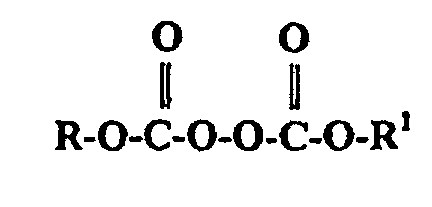
- A process of Claim 2 wherein R and R1 of said peroxydicarbonate are an identical organic radical containing from 2 to 8 carbon atoms.
- A process of Claim 3 wherein R and R1 of said peroxydicarbonate are selected from the group consisting of ethyl, n-propyl, and secondary butyl.
- A process of Claim 3 wherein R and R1 of said peroxydicarbonate are ethyl groups.
- A process of claims wherein said peroxydicarbonate is di-ethyl peroxydicarbonate.
- A process of any one of the preceding claims wherein said haloformate is a chloroformate.
- A process of any one of the preceding claims wherein said alkali metal hydroxide is sodium hydroxide.
- A process of any one of the preceding claims wherein said inorganic peroxide is hydrogen peroxide.
- A process of any one of the preceding claims wherein said dispersant is selected from the group consisting of hydrolyzed polyvinyl acetate, methyl cellulose, hydroxypropyl methyl cellulose, gelatin, polyvinylpyrrolidone, polyoxyethylene sorbitan monolaurate and polyacrylic acid.
- A process of Claim 10 wherein said dispersant is hydrolyzed polyvinyl acetate having a hydrolysis of from about 70% to about 90%.
- A process of any one of the preceding claims wherein the contents of said second vessel are maintained at a temperature below 40°C.
- A process of Claim 12 wherein said contents of said second vessel are maintained at a temperature below 22°C.
- A process of Claim 13 wherein said contents of said second vessel are maintained at a temperature of from about 0°C to about 10°C.
- A process of any one of the preceding claims wherein said alkali metal peroxide is metered into said second vessel over a time period of from about 2 minutes to about 20 minutes.
- A process of any one of the preceding claims wherein one mole of said alkali metal peroxide is metered into said second vessel for every two moles of haloformate present in said second vessel.
- A process of any one of the preceding claims wherein said second vessel is equipped with an agitation means and the peroxydicarbonate is agitated.
- A process of any one of the preceding claims wherein metal peroxide is cooled to a temperature of form about 0°C to about 10°C prior to being metered into said second vessel.
- A process of any one of the preceding claims wherein said peroxydicarbonate is substantially free of organic solvents and plasticizer agents for polymers.
- A process of any one of the preceding claims wherein the contents of the second vessel are partially homogenized before any of the alkali metal peroxide is metered into the second vessel.
- A process for the polymerization of at least one ethylenically unsaturated monomer comprising:wherein said first vessel and said second vessel are located exterior of said polymerization reactor.(a) producing at least one peroxydicarbonate by a method according to any one of Claims 1 to 20;(b) adding to a polymerization reactor at least one ethylenically unsaturated monomer, water, dispersant and peroxydicarbonate produced in (a);(c) conducting the polymerization reaction to the desired level of conversion of said ethylenically unsaturated monomer to form polymer;(d) discharging said polymer from the polymerization reactor;(e) stripping said ethylenically unsaturated monomer from said polymer, and(f) dewatering and drying said polymer to a free flowing power form;
- A process of Claim 20 wherein the entire contents of said second vessel are charged to said polymerization reactor.
- A process of Claim 21 or 22 wherein said ethylenically unsaturated monomer is vinyl chloride monomer.
- A process of any one of Claims 21 to 23 wherein said peroxydicarbonate is substantially free of organic solvents and plasticizing agents for said polymer.
- A process to produce two or more different peroxydicarbonates within the same vessel comprising producing a first peroxydicarbonate by a method according to any one of Claims 1 to 20 wherein the haloformate is a chloroformate and wherein, after said first peroxydicarbonate has been formed, the method comprises the further step of(e) discharging into said second vessel a second chloroformate and metering into said second vessel additional amounts of said alkali metal peroxide to form a second peroxydicarbonate, while continuing to homogenize the contents of said second vessel until substantially all of the second chloroformate has reacted with said alkali metal peroxide to form a second peroxydicarbonate, and(f) repeating step (e) for each additional peroxydicarbonate desired.
- A process for the polymerization of at least one ethylenically unsaturated monomer comprising:Producing a peroxydicarbonate by a method according to Claim 1 comprising:(a) injecting said at least one haloformate, said at least one dispersant, and water into a line equipped with cooling means and an in-line homogenizer, said line constituting said second vessel, wherein said line is connected to a polymerization reactor,(b) metering said at least one alkali metal peroxide into said line,(c) homogenizing said mixture in said line to form said peroxydicarbonate,the polymerisation process further comprising the steps of:(d) injecting said peroxydicarbonate in said line into a polymerization reactor containing said ethylenically unsaturated monomer, dispersant, and water,(e) conducting the polymerization to the desired conversion level of monomer to polymer in said polymerization reactor,(f) discharging said polymer from said polymerization reactor,(g) stripping the residual monomer from said polymer and dewatering and drying said polymer to a free flowing powder form.
- A process of Claim 26 wherein said ethylenically unsaturated monomer is vinyl chloride monomer.
- A process of Claim 26 or 27 wherein said peroxydicarbonate is selected from the group consisting of di-ethyl peroxydicarbonate, di-n-propyl peroxydicarbonate, di-iso-propyl peroxydicarbonate, di(2-ethyl hexyl) peroxydicarbonate, di-n-butyl peroxydicarbonate and secondary buryl peroxydicarbonate.
- A process of any one of Claims 26 to 28 wherein said polymerization is conducted at a temperature of from about 40°C to about 70°C.
- A process of any one of Claims 26 to 29 wherein said peroxydicarbonate is di-ethyl peroxydicarbonate, said alkali metal peroxide is sodium peroxide, and said peroxydicarbonate is homogenized sufficient to form droplets of from 1 to 10 microns.
Applications Claiming Priority (3)
| Application Number | Priority Date | Filing Date | Title |
|---|---|---|---|
| US09/433,907 US6433208B1 (en) | 1999-11-04 | 1999-11-04 | Method for producing stable, dilute, aqueous, emulsified peroxydicarbonates by homogenization |
| US433907 | 1999-11-04 | ||
| PCT/GB2000/004230 WO2001032613A1 (en) | 1999-11-04 | 2000-11-03 | Method for producing peroxydicarbonates and their use in the radical polymerization of monomers |
Publications (2)
| Publication Number | Publication Date |
|---|---|
| EP1226118A1 EP1226118A1 (en) | 2002-07-31 |
| EP1226118B1 true EP1226118B1 (en) | 2004-01-28 |
Family
ID=23722021
Family Applications (1)
| Application Number | Title | Priority Date | Filing Date |
|---|---|---|---|
| EP00973042A Expired - Lifetime EP1226118B1 (en) | 1999-11-04 | 2000-11-03 | Method for producing peroxydicarbonates and their use in the radical polymerization of monomers |
Country Status (19)
| Country | Link |
|---|---|
| US (3) | US6433208B1 (en) |
| EP (1) | EP1226118B1 (en) |
| JP (2) | JP5031962B2 (en) |
| KR (1) | KR100732660B1 (en) |
| CN (1) | CN1387511A (en) |
| AT (1) | ATE258546T1 (en) |
| CA (1) | CA2389728C (en) |
| CZ (1) | CZ302981B6 (en) |
| DE (1) | DE60008012T2 (en) |
| DK (1) | DK1226118T3 (en) |
| ES (1) | ES2215078T3 (en) |
| HU (1) | HU228803B1 (en) |
| IL (2) | IL149332A0 (en) |
| MX (1) | MXPA02003996A (en) |
| NO (1) | NO327596B1 (en) |
| PL (1) | PL202098B1 (en) |
| PT (1) | PT1226118E (en) |
| WO (1) | WO2001032613A1 (en) |
| YU (1) | YU32602A (en) |
Families Citing this family (16)
| Publication number | Priority date | Publication date | Assignee | Title |
|---|---|---|---|---|
| US6995221B2 (en) * | 1999-11-04 | 2006-02-07 | Oxy Vinyls, L.P. | Method for producing organic peroxides and their use in the radical polymerization of monomers |
| US6433208B1 (en) * | 1999-11-04 | 2002-08-13 | Oxy Vinyls Lp | Method for producing stable, dilute, aqueous, emulsified peroxydicarbonates by homogenization |
| MXPA04008432A (en) | 2002-03-01 | 2004-11-26 | Akzo Nobel Nv | Polymerization process involving diacyl peroxides. |
| ATE399799T1 (en) * | 2004-05-05 | 2008-07-15 | Vestolit Gmbh & Co Kg | METHOD FOR PRODUCING POLYMERS AND COPOLYMERS |
| EP1852418A1 (en) * | 2006-04-27 | 2007-11-07 | Arkema France | Process for synthesizing selected organic peroxides |
| EP1849804A1 (en) * | 2006-04-27 | 2007-10-31 | Arkema France | Process of free-radical polymerization or crosslinking in the presence of an organic peroxide by an ex situ process |
| CN101619035B (en) * | 2009-05-06 | 2012-06-06 | 淄博正华助剂股份有限公司 | Process for preparing 2, 4-dichlorobenzoyl peroxide |
| CN102442932A (en) * | 2010-10-08 | 2012-05-09 | 淄博正华助剂股份有限公司 | Preparation method of solvent type bis (2-ethoxy) ethyl peroxydicarbonate |
| FR2968660B1 (en) * | 2010-12-14 | 2014-03-07 | Solvay | PROCESS FOR THE PREPARATION OF AN ORGANIC SOLUTION OF A DIALKYL PEROXYDICARBONATE |
| CN102584663A (en) * | 2011-12-26 | 2012-07-18 | 淄博正华助剂股份有限公司 | The preparation method of solvent-based mass fraction 75% di(2-ethylhexyl) peroxydicarbonate |
| CN102659960B (en) * | 2011-12-26 | 2014-08-20 | 淄博正华助剂股份有限公司 | Preparation method of solvent-type di-(2-ethylhexyl)peroxydicarbonate with mass fraction of 60% |
| JP2017206439A (en) * | 2014-08-27 | 2017-11-24 | エーザイ・アール・アンド・ディー・マネジメント株式会社 | Method for producing antitumor agent using homogenizer |
| FR3027236B1 (en) | 2014-10-17 | 2020-01-03 | Arkema France | AQUEOUS DIALKYL PEROXIDE EMULSION |
| CN109134334A (en) * | 2018-09-11 | 2019-01-04 | 蓝凤祥 | A kind of Safe production technology of cumyl peroxyneodecanoate initiator |
| CN114149355A (en) * | 2021-12-27 | 2022-03-08 | 兰州助剂厂有限责任公司 | Preparation method of dicetyl peroxydicarbonate |
| EP4541788A1 (en) * | 2023-10-20 | 2025-04-23 | Nouryon Chemicals International B.V. | Continuous production of aqueous organic peroxide emulsions |
Family Cites Families (31)
| Publication number | Priority date | Publication date | Assignee | Title |
|---|---|---|---|---|
| US2370588A (en) * | 1942-10-22 | 1945-02-27 | Pittsburgh Plate Glass Co | Organic percarbonates |
| US2661363A (en) | 1952-01-18 | 1953-12-01 | Shell Dev | Peresters of peroxycarboxylic acids |
| AT243234B (en) | 1962-10-06 | 1965-10-25 | Hoechst Ag | Process for the preparation of solutions of peroxydicarbonic acid esters |
| DE1259325B (en) * | 1964-05-22 | 1968-01-25 | Hoechst Ag | Process for the continuous production of solutions of peroxydicarbonic acid esters |
| DE1265154B (en) * | 1965-11-15 | 1968-04-04 | Hoechst Ag | Process for the continuous production of solutions of peroxydicarbonic acid esters |
| IL29131A (en) | 1967-12-14 | 1971-01-28 | Kreisel M | Process for the polymerization of vinyl compounds |
| US3736344A (en) * | 1967-12-26 | 1973-05-29 | Argus Chem | Low molecular weight acyl peroxycarbonic esters |
| US3799966A (en) * | 1971-12-17 | 1974-03-26 | Pennwalt Corp | Di-(2-phenoxyethyl)peroxydicarbonate |
| US3825509A (en) * | 1972-11-13 | 1974-07-23 | Goodrich Co B F | Initiator emulsion for olefinic polymerization reactions |
| NL7303315A (en) * | 1973-03-09 | 1974-09-11 | ||
| US3935243A (en) * | 1973-09-17 | 1976-01-27 | The Dow Chemical Company | Method for preparing polyperoxydicarbonate esters |
| FR2253760B1 (en) | 1973-12-05 | 1976-10-08 | Solvay | |
| US3950375A (en) * | 1973-12-10 | 1976-04-13 | Pennwalt Corporation | Continuous manufacture of peroxydicarbonates |
| US3988261A (en) * | 1975-07-28 | 1976-10-26 | Ppg Industries, Inc. | Frozen organic peroxide emulsion |
| JPS5272790A (en) * | 1975-12-15 | 1977-06-17 | Sumitomo Chem Co Ltd | Suspension polymerization of vinyl chloride |
| JPS5287119A (en) * | 1976-01-12 | 1977-07-20 | Pennwalt Corp | Process for continuously manufacturing peroxydicarbonate |
| JPS559067A (en) * | 1978-06-30 | 1980-01-22 | Ppg Industries Inc | Manufacture of peroxydicarbonates |
| DE3038164A1 (en) * | 1980-10-09 | 1982-05-06 | Peroxid-Chemie GmbH, 8023 Höllriegelskreuth | METHOD FOR THE CONTINUOUS PRODUCTION OF DIALKYL PEROXYDICARBONATES |
| US4359427A (en) * | 1981-07-27 | 1982-11-16 | The B. F. Goodrich Company | Process for producing peroxydicarbonates |
| JPS5869864A (en) * | 1981-10-20 | 1983-04-26 | Kayaku Nuurii Kk | Production of peroxydicarbonates |
| JPH0776207B2 (en) * | 1988-01-29 | 1995-08-16 | 三建化工株式会社 | Novel fluorine-containing peroxydicarbonate |
| JP3165454B2 (en) * | 1991-02-23 | 2001-05-14 | 化薬アクゾ株式会社 | Method for producing organic peroxide |
| SE9101674L (en) | 1991-05-31 | 1992-12-01 | Berol Nobel Ab | DISPERSION |
| JPH06157629A (en) * | 1992-07-31 | 1994-06-07 | Geon Co | Method of polymerizing vinyl monomer |
| AU713659B2 (en) * | 1995-04-17 | 1999-12-09 | Procter & Gamble Company, The | Preparation and use of composite particles containing diacyl peroxide |
| BE1009969A3 (en) * | 1996-01-25 | 1997-11-04 | Solvay | METHOD FOR AQUEOUS SUSPENSION POLYMERIZATION OF VINYL CHLORIDE TO dialkylperoxydicarbonates OPERATION. |
| JPH10338701A (en) * | 1997-04-08 | 1998-12-22 | Shin Etsu Chem Co Ltd | Production of vinyl chloride-based polymer |
| DE69721770T2 (en) * | 1997-09-24 | 2004-03-11 | Nof Corp. | Polyfunctional peroxides, initiators containing them for the polymerization of vinyl monomers and processes for the polymerization of vinyl monomers using them |
| US6242562B1 (en) * | 1998-12-28 | 2001-06-05 | Shin-Etsu Chemical Co., Ltd. | Process for producing vinyl chloride polymer |
| US6995221B2 (en) * | 1999-11-04 | 2006-02-07 | Oxy Vinyls, L.P. | Method for producing organic peroxides and their use in the radical polymerization of monomers |
| US6433208B1 (en) * | 1999-11-04 | 2002-08-13 | Oxy Vinyls Lp | Method for producing stable, dilute, aqueous, emulsified peroxydicarbonates by homogenization |
-
1999
- 1999-11-04 US US09/433,907 patent/US6433208B1/en not_active Expired - Lifetime
-
2000
- 2000-11-03 HU HU0203775A patent/HU228803B1/en not_active IP Right Cessation
- 2000-11-03 KR KR1020027005722A patent/KR100732660B1/en not_active Expired - Fee Related
- 2000-11-03 MX MXPA02003996A patent/MXPA02003996A/en active IP Right Grant
- 2000-11-03 EP EP00973042A patent/EP1226118B1/en not_active Expired - Lifetime
- 2000-11-03 ES ES00973042T patent/ES2215078T3/en not_active Expired - Lifetime
- 2000-11-03 DE DE60008012T patent/DE60008012T2/en not_active Expired - Lifetime
- 2000-11-03 AT AT00973042T patent/ATE258546T1/en active
- 2000-11-03 JP JP2001534766A patent/JP5031962B2/en not_active Expired - Lifetime
- 2000-11-03 CN CN00815360A patent/CN1387511A/en active Pending
- 2000-11-03 PL PL354581A patent/PL202098B1/en unknown
- 2000-11-03 YU YU32602A patent/YU32602A/en unknown
- 2000-11-03 PT PT00973042T patent/PT1226118E/en unknown
- 2000-11-03 IL IL14933200A patent/IL149332A0/en active IP Right Grant
- 2000-11-03 CA CA002389728A patent/CA2389728C/en not_active Expired - Lifetime
- 2000-11-03 WO PCT/GB2000/004230 patent/WO2001032613A1/en not_active Ceased
- 2000-11-03 CZ CZ20021527A patent/CZ302981B6/en not_active IP Right Cessation
- 2000-11-03 DK DK00973042T patent/DK1226118T3/en active
-
2002
- 2002-04-24 IL IL149332A patent/IL149332A/en not_active IP Right Cessation
- 2002-04-24 NO NO20021934A patent/NO327596B1/en not_active IP Right Cessation
- 2002-04-25 US US10/132,582 patent/US6770719B2/en not_active Expired - Lifetime
-
2004
- 2004-05-18 US US10/847,954 patent/US7763690B2/en not_active Expired - Fee Related
-
2011
- 2011-09-16 JP JP2011203038A patent/JP5581288B2/en not_active Expired - Lifetime
Also Published As
Similar Documents
| Publication | Publication Date | Title |
|---|---|---|
| JP5581288B2 (en) | Process for the production of peroxydicarbonate and its use in radical polymerization of monomers | |
| JPS6411642B2 (en) | ||
| US7053161B2 (en) | Method for producing organic peroxides and their use in the radical polymerization of monomers | |
| AU779704B2 (en) | Method for producing peroxydicarbonates and their use in the radical polymerization of monomers | |
| JPH0120161B2 (en) | ||
| JPH06166704A (en) | Production of vinyl chloride-based polymer | |
| EP0049966A1 (en) | Use of diperesters in the polymerisation of vinyl chloride monomer | |
| JPS62235303A (en) | Method for feeding suspension stabilizer in vinyl chloride suspension polymerization method | |
| JPH10110005A (en) | Polymerizing method for vinyl chloride resin | |
| NO162726B (en) | PROCEDURE FOR SUSPENSION POLYMERIZATION OF VINYL CHLORIDE MONOMES AND EVENTS. | |
| JPS6239601B2 (en) | ||
| JPH0114241B2 (en) | ||
| JPH01256504A (en) | Suspension polymerization of vinyl chloride | |
| JPH1036409A (en) | Method for producing vinyl chloride polymer | |
| JP2001261709A (en) | Method for producing vinyl chloride polymer | |
| JPH10306105A (en) | Method for producing vinyl chloride polymer | |
| JP2000119312A (en) | Manufacture of vinylchloride resin | |
| JPH0649106A (en) | Production of vinyl chloride polymer | |
| JPH049365A (en) | 1-phenylcyclohexyl peroxy-2-ethylhexanoate and use thereof | |
| JPH02255703A (en) | Method for producing vinyl chloride polymer | |
| JPH0718005A (en) | Method for producing vinyl chloride polymer | |
| JPH1149807A (en) | Continuous suspension polymerization of vinyl chloride polymer |
Legal Events
| Date | Code | Title | Description |
|---|---|---|---|
| PUAI | Public reference made under article 153(3) epc to a published international application that has entered the european phase |
Free format text: ORIGINAL CODE: 0009012 |
|
| 17P | Request for examination filed |
Effective date: 20020502 |
|
| AK | Designated contracting states |
Kind code of ref document: A1 Designated state(s): AT BE CH CY DE DK ES FI FR GB GR IE IT LI LU MC NL PT SE TR |
|
| AX | Request for extension of the european patent |
Free format text: AL;LT;LV;MK;RO;SI |
|
| GRAP | Despatch of communication of intention to grant a patent |
Free format text: ORIGINAL CODE: EPIDOSNIGR1 |
|
| GRAS | Grant fee paid |
Free format text: ORIGINAL CODE: EPIDOSNIGR3 |
|
| GRAA | (expected) grant |
Free format text: ORIGINAL CODE: 0009210 |
|
| AK | Designated contracting states |
Kind code of ref document: B1 Designated state(s): AT BE CH CY DE DK ES FI FR GB GR IE IT LI LU MC NL PT SE TR |
|
| PG25 | Lapsed in a contracting state [announced via postgrant information from national office to epo] |
Ref country code: CY Free format text: LAPSE BECAUSE OF FAILURE TO SUBMIT A TRANSLATION OF THE DESCRIPTION OR TO PAY THE FEE WITHIN THE PRESCRIBED TIME-LIMIT Effective date: 20040128 Ref country code: TR Free format text: LAPSE BECAUSE OF FAILURE TO SUBMIT A TRANSLATION OF THE DESCRIPTION OR TO PAY THE FEE WITHIN THE PRESCRIBED TIME-LIMIT Effective date: 20040128 |
|
| REG | Reference to a national code |
Ref country code: GB Ref legal event code: FG4D |
|
| REG | Reference to a national code |
Ref country code: CH Ref legal event code: EP |
|
| REG | Reference to a national code |
Ref country code: IE Ref legal event code: FG4D Ref country code: GR Ref legal event code: EP Ref document number: 20040400101 Country of ref document: GR |
|
| REF | Corresponds to: |
Ref document number: 60008012 Country of ref document: DE Date of ref document: 20040304 Kind code of ref document: P |
|
| REG | Reference to a national code |
Ref country code: CH Ref legal event code: NV Representative=s name: ISLER & PEDRAZZINI AG |
|
| REG | Reference to a national code |
Ref country code: PT Ref legal event code: SC4A Free format text: AVAILABILITY OF NATIONAL TRANSLATION Effective date: 20040305 |
|
| REG | Reference to a national code |
Ref country code: DK Ref legal event code: T3 |
|
| REG | Reference to a national code |
Ref country code: SE Ref legal event code: TRGR |
|
| ET | Fr: translation filed | ||
| LTIE | Lt: invalidation of european patent or patent extension |
Effective date: 20040128 |
|
| REG | Reference to a national code |
Ref country code: ES Ref legal event code: FG2A Ref document number: 2215078 Country of ref document: ES Kind code of ref document: T3 |
|
| PG25 | Lapsed in a contracting state [announced via postgrant information from national office to epo] |
Ref country code: LU Free format text: LAPSE BECAUSE OF NON-PAYMENT OF DUE FEES Effective date: 20041103 |
|
| PG25 | Lapsed in a contracting state [announced via postgrant information from national office to epo] |
Ref country code: MC Free format text: LAPSE BECAUSE OF NON-PAYMENT OF DUE FEES Effective date: 20041130 |
|
| PLBE | No opposition filed within time limit |
Free format text: ORIGINAL CODE: 0009261 |
|
| STAA | Information on the status of an ep patent application or granted ep patent |
Free format text: STATUS: NO OPPOSITION FILED WITHIN TIME LIMIT |
|
| 26N | No opposition filed |
Effective date: 20041029 |
|
| REG | Reference to a national code |
Ref country code: CH Ref legal event code: PCAR Free format text: ISLER & PEDRAZZINI AG;POSTFACH 1772;8027 ZUERICH (CH) |
|
| REG | Reference to a national code |
Ref country code: FR Ref legal event code: PLFP Year of fee payment: 16 |
|
| REG | Reference to a national code |
Ref country code: FR Ref legal event code: PLFP Year of fee payment: 17 |
|
| REG | Reference to a national code |
Ref country code: FR Ref legal event code: PLFP Year of fee payment: 18 |
|
| PGFP | Annual fee paid to national office [announced via postgrant information from national office to epo] |
Ref country code: DK Payment date: 20171026 Year of fee payment: 18 Ref country code: FI Payment date: 20171026 Year of fee payment: 18 |
|
| PGFP | Annual fee paid to national office [announced via postgrant information from national office to epo] |
Ref country code: AT Payment date: 20171027 Year of fee payment: 18 Ref country code: IE Payment date: 20171026 Year of fee payment: 18 Ref country code: ES Payment date: 20171207 Year of fee payment: 18 Ref country code: SE Payment date: 20171108 Year of fee payment: 18 Ref country code: BE Payment date: 20171121 Year of fee payment: 18 Ref country code: PT Payment date: 20171026 Year of fee payment: 18 Ref country code: GR Payment date: 20171026 Year of fee payment: 18 Ref country code: CH Payment date: 20171025 Year of fee payment: 18 |
|
| REG | Reference to a national code |
Ref country code: FR Ref legal event code: PLFP Year of fee payment: 19 |
|
| REG | Reference to a national code |
Ref country code: DK Ref legal event code: EBP Effective date: 20181130 |
|
| REG | Reference to a national code |
Ref country code: CH Ref legal event code: PL |
|
| REG | Reference to a national code |
Ref country code: SE Ref legal event code: EUG |
|
| REG | Reference to a national code |
Ref country code: AT Ref legal event code: MM01 Ref document number: 258546 Country of ref document: AT Kind code of ref document: T Effective date: 20181103 |
|
| PG25 | Lapsed in a contracting state [announced via postgrant information from national office to epo] |
Ref country code: PT Free format text: LAPSE BECAUSE OF NON-PAYMENT OF DUE FEES Effective date: 20190503 Ref country code: SE Free format text: LAPSE BECAUSE OF NON-PAYMENT OF DUE FEES Effective date: 20181104 Ref country code: FI Free format text: LAPSE BECAUSE OF NON-PAYMENT OF DUE FEES Effective date: 20181103 |
|
| REG | Reference to a national code |
Ref country code: BE Ref legal event code: MM Effective date: 20181130 |
|
| REG | Reference to a national code |
Ref country code: IE Ref legal event code: MM4A |
|
| PG25 | Lapsed in a contracting state [announced via postgrant information from national office to epo] |
Ref country code: CH Free format text: LAPSE BECAUSE OF NON-PAYMENT OF DUE FEES Effective date: 20181130 Ref country code: LI Free format text: LAPSE BECAUSE OF NON-PAYMENT OF DUE FEES Effective date: 20181130 Ref country code: GR Free format text: LAPSE BECAUSE OF NON-PAYMENT OF DUE FEES Effective date: 20190605 |
|
| PG25 | Lapsed in a contracting state [announced via postgrant information from national office to epo] |
Ref country code: IE Free format text: LAPSE BECAUSE OF NON-PAYMENT OF DUE FEES Effective date: 20181103 Ref country code: DK Free format text: LAPSE BECAUSE OF NON-PAYMENT OF DUE FEES Effective date: 20181130 Ref country code: AT Free format text: LAPSE BECAUSE OF NON-PAYMENT OF DUE FEES Effective date: 20181103 |
|
| PG25 | Lapsed in a contracting state [announced via postgrant information from national office to epo] |
Ref country code: BE Free format text: LAPSE BECAUSE OF NON-PAYMENT OF DUE FEES Effective date: 20181130 |
|
| REG | Reference to a national code |
Ref country code: ES Ref legal event code: FD2A Effective date: 20200102 |
|
| PGFP | Annual fee paid to national office [announced via postgrant information from national office to epo] |
Ref country code: NL Payment date: 20191030 Year of fee payment: 20 Ref country code: DE Payment date: 20191017 Year of fee payment: 20 |
|
| PG25 | Lapsed in a contracting state [announced via postgrant information from national office to epo] |
Ref country code: ES Free format text: LAPSE BECAUSE OF NON-PAYMENT OF DUE FEES Effective date: 20181104 |
|
| PGFP | Annual fee paid to national office [announced via postgrant information from national office to epo] |
Ref country code: FR Payment date: 20191029 Year of fee payment: 20 Ref country code: IT Payment date: 20191113 Year of fee payment: 20 |
|
| PGFP | Annual fee paid to national office [announced via postgrant information from national office to epo] |
Ref country code: GB Payment date: 20191029 Year of fee payment: 20 |
|
| REG | Reference to a national code |
Ref country code: DE Ref legal event code: R071 Ref document number: 60008012 Country of ref document: DE |
|
| REG | Reference to a national code |
Ref country code: NL Ref legal event code: MK Effective date: 20201102 |
|
| REG | Reference to a national code |
Ref country code: GB Ref legal event code: PE20 Expiry date: 20201102 |
|
| PG25 | Lapsed in a contracting state [announced via postgrant information from national office to epo] |
Ref country code: GB Free format text: LAPSE BECAUSE OF EXPIRATION OF PROTECTION Effective date: 20201102 |