EP1226094B1 - Device for electrolysis - Google Patents
Device for electrolysis Download PDFInfo
- Publication number
- EP1226094B1 EP1226094B1 EP00953572A EP00953572A EP1226094B1 EP 1226094 B1 EP1226094 B1 EP 1226094B1 EP 00953572 A EP00953572 A EP 00953572A EP 00953572 A EP00953572 A EP 00953572A EP 1226094 B1 EP1226094 B1 EP 1226094B1
- Authority
- EP
- European Patent Office
- Prior art keywords
- water
- supply system
- generator
- water supply
- electrodes
- Prior art date
- Legal status (The legal status is an assumption and is not a legal conclusion. Google has not performed a legal analysis and makes no representation as to the accuracy of the status listed.)
- Expired - Lifetime
Links
- 238000005868 electrolysis reaction Methods 0.000 title abstract description 5
- XLYOFNOQVPJJNP-UHFFFAOYSA-N water Substances O XLYOFNOQVPJJNP-UHFFFAOYSA-N 0.000 claims abstract description 90
- 230000000249 desinfective effect Effects 0.000 claims abstract description 11
- 238000000034 method Methods 0.000 claims abstract description 8
- ZAMOUSCENKQFHK-UHFFFAOYSA-N Chlorine atom Chemical compound [Cl] ZAMOUSCENKQFHK-UHFFFAOYSA-N 0.000 description 18
- 239000000460 chlorine Substances 0.000 description 18
- 229910052801 chlorine Inorganic materials 0.000 description 18
- FAPWRFPIFSIZLT-UHFFFAOYSA-M Sodium chloride Chemical compound [Na+].[Cl-] FAPWRFPIFSIZLT-UHFFFAOYSA-M 0.000 description 8
- CBENFWSGALASAD-UHFFFAOYSA-N Ozone Chemical compound [O-][O+]=O CBENFWSGALASAD-UHFFFAOYSA-N 0.000 description 5
- 230000005611 electricity Effects 0.000 description 4
- WQYVRQLZKVEZGA-UHFFFAOYSA-N hypochlorite Chemical compound Cl[O-] WQYVRQLZKVEZGA-UHFFFAOYSA-N 0.000 description 4
- 150000003839 salts Chemical class 0.000 description 4
- 239000011780 sodium chloride Substances 0.000 description 4
- QWPPOHNGKGFGJK-UHFFFAOYSA-N hypochlorous acid Chemical compound ClO QWPPOHNGKGFGJK-UHFFFAOYSA-N 0.000 description 3
- 230000009182 swimming Effects 0.000 description 3
- RTAQQCXQSZGOHL-UHFFFAOYSA-N Titanium Chemical compound [Ti] RTAQQCXQSZGOHL-UHFFFAOYSA-N 0.000 description 2
- 239000007772 electrode material Substances 0.000 description 2
- 239000001257 hydrogen Substances 0.000 description 2
- 229910052739 hydrogen Inorganic materials 0.000 description 2
- -1 hydrogen ions Chemical class 0.000 description 2
- 229910052751 metal Inorganic materials 0.000 description 2
- 239000002184 metal Substances 0.000 description 2
- BASFCYQUMIYNBI-UHFFFAOYSA-N platinum Chemical compound [Pt] BASFCYQUMIYNBI-UHFFFAOYSA-N 0.000 description 2
- 239000010936 titanium Substances 0.000 description 2
- 229910052719 titanium Inorganic materials 0.000 description 2
- 229910000967 As alloy Inorganic materials 0.000 description 1
- 241000894006 Bacteria Species 0.000 description 1
- OYPRJOBELJOOCE-UHFFFAOYSA-N Calcium Chemical compound [Ca] OYPRJOBELJOOCE-UHFFFAOYSA-N 0.000 description 1
- KZBUYRJDOAKODT-UHFFFAOYSA-N Chlorine Chemical compound ClCl KZBUYRJDOAKODT-UHFFFAOYSA-N 0.000 description 1
- UFHFLCQGNIYNRP-UHFFFAOYSA-N Hydrogen Chemical compound [H][H] UFHFLCQGNIYNRP-UHFFFAOYSA-N 0.000 description 1
- FYYHWMGAXLPEAU-UHFFFAOYSA-N Magnesium Chemical compound [Mg] FYYHWMGAXLPEAU-UHFFFAOYSA-N 0.000 description 1
- 239000002033 PVDF binder Substances 0.000 description 1
- KJTLSVCANCCWHF-UHFFFAOYSA-N Ruthenium Chemical compound [Ru] KJTLSVCANCCWHF-UHFFFAOYSA-N 0.000 description 1
- 239000005708 Sodium hypochlorite Substances 0.000 description 1
- QVGXLLKOCUKJST-UHFFFAOYSA-N atomic oxygen Chemical compound [O] QVGXLLKOCUKJST-UHFFFAOYSA-N 0.000 description 1
- 239000006227 byproduct Substances 0.000 description 1
- 239000011575 calcium Substances 0.000 description 1
- 229910052791 calcium Inorganic materials 0.000 description 1
- 239000003518 caustics Substances 0.000 description 1
- 239000011248 coating agent Substances 0.000 description 1
- 238000000576 coating method Methods 0.000 description 1
- 150000001875 compounds Chemical class 0.000 description 1
- 230000008878 coupling Effects 0.000 description 1
- 238000010168 coupling process Methods 0.000 description 1
- 238000005859 coupling reaction Methods 0.000 description 1
- 235000020188 drinking water Nutrition 0.000 description 1
- 239000003651 drinking water Substances 0.000 description 1
- 239000012530 fluid Substances 0.000 description 1
- 239000011777 magnesium Substances 0.000 description 1
- 229910052749 magnesium Inorganic materials 0.000 description 1
- 239000000203 mixture Substances 0.000 description 1
- 230000003647 oxidation Effects 0.000 description 1
- 238000007254 oxidation reaction Methods 0.000 description 1
- 239000001301 oxygen Substances 0.000 description 1
- 229910052760 oxygen Inorganic materials 0.000 description 1
- 229910052697 platinum Inorganic materials 0.000 description 1
- 229920002981 polyvinylidene fluoride Polymers 0.000 description 1
- 229910052707 ruthenium Inorganic materials 0.000 description 1
- 239000011734 sodium Substances 0.000 description 1
- SUKJFIGYRHOWBL-UHFFFAOYSA-N sodium hypochlorite Chemical compound [Na+].Cl[O-] SUKJFIGYRHOWBL-UHFFFAOYSA-N 0.000 description 1
- 125000006850 spacer group Chemical group 0.000 description 1
- 238000004659 sterilization and disinfection Methods 0.000 description 1
- 229920002994 synthetic fiber Polymers 0.000 description 1
- 239000008399 tap water Substances 0.000 description 1
- 235000020679 tap water Nutrition 0.000 description 1
Images
Classifications
-
- C—CHEMISTRY; METALLURGY
- C25—ELECTROLYTIC OR ELECTROPHORETIC PROCESSES; APPARATUS THEREFOR
- C25B—ELECTROLYTIC OR ELECTROPHORETIC PROCESSES FOR THE PRODUCTION OF COMPOUNDS OR NON-METALS; APPARATUS THEREFOR
- C25B15/00—Operating or servicing cells
-
- C—CHEMISTRY; METALLURGY
- C02—TREATMENT OF WATER, WASTE WATER, SEWAGE, OR SLUDGE
- C02F—TREATMENT OF WATER, WASTE WATER, SEWAGE, OR SLUDGE
- C02F1/00—Treatment of water, waste water, or sewage
- C02F1/46—Treatment of water, waste water, or sewage by electrochemical methods
- C02F1/461—Treatment of water, waste water, or sewage by electrochemical methods by electrolysis
- C02F1/46104—Devices therefor; Their operating or servicing
-
- C—CHEMISTRY; METALLURGY
- C02—TREATMENT OF WATER, WASTE WATER, SEWAGE, OR SLUDGE
- C02F—TREATMENT OF WATER, WASTE WATER, SEWAGE, OR SLUDGE
- C02F1/00—Treatment of water, waste water, or sewage
- C02F1/46—Treatment of water, waste water, or sewage by electrochemical methods
- C02F1/461—Treatment of water, waste water, or sewage by electrochemical methods by electrolysis
- C02F1/467—Treatment of water, waste water, or sewage by electrochemical methods by electrolysis by electrochemical disinfection; by electrooxydation or by electroreduction
- C02F1/4672—Treatment of water, waste water, or sewage by electrochemical methods by electrolysis by electrochemical disinfection; by electrooxydation or by electroreduction by electrooxydation
- C02F1/4674—Treatment of water, waste water, or sewage by electrochemical methods by electrolysis by electrochemical disinfection; by electrooxydation or by electroreduction by electrooxydation with halogen or compound of halogens, e.g. chlorine, bromine
-
- C—CHEMISTRY; METALLURGY
- C02—TREATMENT OF WATER, WASTE WATER, SEWAGE, OR SLUDGE
- C02F—TREATMENT OF WATER, WASTE WATER, SEWAGE, OR SLUDGE
- C02F2201/00—Apparatus for treatment of water, waste water or sewage
- C02F2201/46—Apparatus for electrochemical processes
- C02F2201/461—Electrolysis apparatus
- C02F2201/46105—Details relating to the electrolytic devices
- C02F2201/4616—Power supply
- C02F2201/46165—Special power supply, e.g. solar energy or batteries
-
- C—CHEMISTRY; METALLURGY
- C02—TREATMENT OF WATER, WASTE WATER, SEWAGE, OR SLUDGE
- C02F—TREATMENT OF WATER, WASTE WATER, SEWAGE, OR SLUDGE
- C02F2303/00—Specific treatment goals
- C02F2303/04—Disinfection
Definitions
- the present invention relates to an electrolytic device for a water supply system, comprising an electrolytic cell which is provided with electrodes over which a voltage difference is applied.
- the invention further relates to a method for disinfecting a water supply system by electrolysis.
- the chlorine formed at the anode may, depending on the pH, also be present as hypochlorous acid (HClO) or as a hypochlorite (ClO - ). Dissolved chlorine, hypochlorous acid and hypochlorite are called “free chlorine” or "free active chlorine".
- HClO hypochlorous acid
- ClO - hypochlorite
- Dissolved chlorine, hypochlorous acid and hypochlorite are called "free chlorine” or "free active chlorine”.
- tap water having a pH of about 7 to 8 and containing a small concentration of NaCl, sodium hypochlorite will be formed.
- the quantity of free chlorine to be formed will depend on the wanted concentration and the quantity of water to be treated.
- Common equipment for disinfecting water consists of an electrolytic cell, a rectifier to convert mains voltage into direct current and a control to adapt the electric current to be supplied to the electrodes to the water flow rate.
- US 5,228,964 discloses a chlorinating apparatus for use with a saltwater swimming pool having a pump for circulating the water between the swimmingpool and a filter, which apparatus comprises electricity generating means, driven by the flow of water produced by the pump, for providing an electrical output and electrode means connected with the electrical output of the electricity generating means for generating chlorine from the salt water.
- the housing of the apparatus is connected with the outlet of the pipe returning the water from the pump/filter to the pool.
- the apparatus is placed in a chamber containing the leafbasket of a conventional swimming pool, the bottom of the chamber being connected through a pipe with the pump/filter.
- the electricity generating means comprises a generator, such as a sealed dynamo, within the housing of the apparatus having a rotatable shaft on which is mounted an impeller.
- the electricity generating means may generate either AC or DC voltage.
- the electrode means comprises a plurality of spaced mesh electrodes, such as alloy-coated titanium electrodes.
- US patent 4,272,686 discloses an electrical power plant for generating electrical energy from the energy of a fluid flowing within a pipeline, comprising a turbine having a plurality of vanes, a flywheel for driving an electrical generator, a shaft connecting said turbine and said flywheel, a housing having a first chamber housing the turbine, a second chamber housing the flywheel and inlet and outlet openings.
- the plant may be provided with a second, smaller generator connected with an ozone generator placed in the second chamber for producing ozone to eliminate bacteria and to reduce odours within the second chamber.
- JP-08103777A relates to a steriliser comprising a device connected to the water tap of service water and equipped with a turbine which is driven by the water flow from the nozzle of the service water tap, a direct current generator driven by the turbine, an ozone generator driven by the electric current produced by the generator and an ozone injector which injects ozone into the service water.
- an electrolytic device for disinfecting water in a water supply system comprising in one housing an electrolytic cell which is provided with electrodes over which a voltage difference is applied, which electrodes contact the water in the water supply system, a generator for supplying the voltage difference for the electrolytic cell, which generator is driven by the water in the water supply system, a water inlet opening to be connected to the water supply system, characterised in that the device further comprises a water outlet opening to be connected to the water supply system, and a variable resistance for adapting the voltage to be supplied to the electrodes to the properties of the water in the water supply system, wherein the electric current supplied by the generator is substantially proportional to the quantity of water flowing past the generator.
- the invention further relates to a method for disinfecting water in a water supply system using the above described electrolytic device.
- water supply system means each pipe through which water is guided or in which water is present.
- Said pipe may for instance be a hot water pipe in a residence, but also a supply pipe for fresh or recycled water in a swimming pool.
- the generator In case the generator is of the type which supplies an electric current which is proportional to the quantity of water flowing past it, the generator, when the speed of flow increases and more water has to be disinfected, will supply more power so that more free chlorine is formed.
- a suitable type of generator is a turbine, particularly a DC turbine.
- the device can be adjusted to the conductance of the water.
- variations of the water composition in water supply systems are usually of a minor nature, it will in general not be necessary to adapt the adjustment for a long time.
- the device of the invention therefore provides in its own need for power and is self adjusting.
- a very simple apparatus that can be built in against low costs, is obtained when the electrolytic cell and the generator, or at least its driving part, are accommodated in one housing.
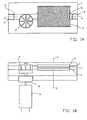
- FIG. 1A a cross-section of a device according to the invention, in which the electrolytic cell and the driving part of the turbine are accommodated in one housing, is shown schematically.
- Figure 1 B schematically shows a cross-section of the device along line A-A in figure 1A.
- 1 refers to a housing
- 2 refers to an electrolytic cell
- 3 refers to a blade wheel of a turbine.
- a channel 6, in which the blade wheel 3 is placed connects the electrolytic cell 2 with a water inlet opening 7 to be connected to the water supply system and a channel 8 connects the electrolytic cell 2 to a water outlet opening 9 to be connected to the water supply system.
- the blade wheel 3 is connected to a turbine 11 via a magnet coupling 10.
- Such a system can be placed in all kinds of water supply systems, taking the possible water flow rates into account in order to determine the maximum capacity of the apparatus.
- the device of the invention disinfects the water not only directly through anodic oxidation, but free chlorine is also produced so that a disinfecting action remains present.
- the apparatus need not be installed directly near the location of use, but it may also be placed in the main supply system.
- a suitable electrode material is a stretch metal of titanium provided with a ruthenium or platinum coating.
- the stretch metal lets water through well, so that the electrodes can be placed transverse to the flow direction, optionally in the shape of a harmonica, so that the water contacts the electrodes several times. Any other commonly used suitable electrode material and any other commonly used suitable electrode shape, however, can also be used.
- a spacer for instance made of a porous synthetic material such as PVDF gauze, can be arranged between the electrodes.
- the concentration of free chlorine used for disinfecting water is usually between 0.1 and 1 ppm. At a low concentration of salt the quantity of free chlorine produced is approximately 1 g/Ah. At a water flow rate of 1000 l/h approximately 0.1 g chlorine/h will be necessary for obtaining a concentration of free chlorine of approximately 0.1 ppm, which corresponds to a current of approximately 0.1 A (at a voltage of about 3 V over the electrodes).
- a voltage of approximately 3 volt DC is needed for a current density of 0.5 A/dm 2 .
- the water to be treated contains sodium chloride and during electrolysis free chlorine will be created. However it has appeared that when the conductance is sufficient, also in the absence of chlorine active compounds are formed which can ensure disinfection.
Landscapes
- Chemical & Material Sciences (AREA)
- Organic Chemistry (AREA)
- Chemical Kinetics & Catalysis (AREA)
- Electrochemistry (AREA)
- Engineering & Computer Science (AREA)
- Materials Engineering (AREA)
- Metallurgy (AREA)
- General Chemical & Material Sciences (AREA)
- Life Sciences & Earth Sciences (AREA)
- Hydrology & Water Resources (AREA)
- Environmental & Geological Engineering (AREA)
- Water Supply & Treatment (AREA)
- Water Treatment By Electricity Or Magnetism (AREA)
- Electrical Discharge Machining, Electrochemical Machining, And Combined Machining (AREA)
Abstract
Description
- The present invention relates to an electrolytic device for a water supply system, comprising an electrolytic cell which is provided with electrodes over which a voltage difference is applied. The invention further relates to a method for disinfecting a water supply system by electrolysis.
- The use of electrolysis for disinfecting water is known. Usually sodium chloride (NaCl) is electrochemically converted into chlorine and caustic (as a by-product). The salt dissolves in water under forming of Na+- and Cl--ions. When said solution is guided through an electrolytic cell, while a voltage is applied over the electrodes of said cell, chlorine (Cl2), oxygen and hydrogen ions are formed at the anode and hydrogen and hydroxyl ions are formed at the cathode.
- The chlorine formed at the anode may, depending on the pH, also be present as hypochlorous acid (HClO) or as a hypochlorite (ClO-). Dissolved chlorine, hypochlorous acid and hypochlorite are called "free chlorine" or "free active chlorine". When using (common) tap water having a pH of about 7 to 8 and containing a small concentration of NaCl, sodium hypochlorite, will be formed. The quantity of free chlorine to be formed will depend on the wanted concentration and the quantity of water to be treated.
- Common equipment for disinfecting water consists of an electrolytic cell, a rectifier to convert mains voltage into direct current and a control to adapt the electric current to be supplied to the electrodes to the water flow rate.
- US 5,228,964 discloses a chlorinating apparatus for use with a saltwater swimming pool having a pump for circulating the water between the swimmingpool and a filter, which apparatus comprises electricity generating means, driven by the flow of water produced by the pump, for providing an electrical output and electrode means connected with the electrical output of the electricity generating means for generating chlorine from the salt water. In one embodiment the housing of the apparatus is connected with the outlet of the pipe returning the water from the pump/filter to the pool. In another embodiment the apparatus is placed in a chamber containing the leafbasket of a conventional swimming pool, the bottom of the chamber being connected through a pipe with the pump/filter. The electricity generating means comprises a generator, such as a sealed dynamo, within the housing of the apparatus having a rotatable shaft on which is mounted an impeller. The electricity generating means may generate either AC or DC voltage. Typically the electrode means comprises a plurality of spaced mesh electrodes, such as alloy-coated titanium electrodes.
- US patent 4,272,686 discloses an electrical power plant for generating electrical energy from the energy of a fluid flowing within a pipeline, comprising a turbine having a plurality of vanes, a flywheel for driving an electrical generator, a shaft connecting said turbine and said flywheel, a housing having a first chamber housing the turbine, a second chamber housing the flywheel and inlet and outlet openings. The plant may be provided with a second, smaller generator connected with an ozone generator placed in the second chamber for producing ozone to eliminate bacteria and to reduce odours within the second chamber.
- JP-08103777A relates to a steriliser comprising a device connected to the water tap of service water and equipped with a turbine which is driven by the water flow from the nozzle of the service water tap, a direct current generator driven by the turbine, an ozone generator driven by the electric current produced by the generator and an ozone injector which injects ozone into the service water.
- For several applications, for instance smaller water supply systems as used in residences, it is desirable to have a simple system at one's disposal which can be active on its own without being connected to the lighting mains. Disinfecting spring water in remote areas where no source of energy is present can also be named for example.
- According to the invention the above mentioned need is met by an electrolytic device for disinfecting water in a water supply system comprising in one housing an electrolytic cell which is provided with electrodes over which a voltage difference is applied, which electrodes contact the water in the water supply system, a generator for supplying the voltage difference for the electrolytic cell, which generator is driven by the water in the water supply system, a water inlet opening to be connected to the water supply system,
characterised in that the device further comprises
a water outlet opening to be connected to the water supply system, and a variable resistance for adapting the voltage to be supplied to the electrodes to the properties of the water in the water supply system, wherein the electric current supplied by the generator is substantially proportional to the quantity of water flowing past the generator. - The invention further relates to a method for disinfecting water in a water supply system using the above described electrolytic device.
- In this description water supply system means each pipe through which water is guided or in which water is present. Said pipe may for instance be a hot water pipe in a residence, but also a supply pipe for fresh or recycled water in a swimming pool.
- In case the generator is of the type which supplies an electric current which is proportional to the quantity of water flowing past it, the generator, when the speed of flow increases and more water has to be disinfected, will supply more power so that more free chlorine is formed.
- A suitable type of generator is a turbine, particularly a DC turbine.
- By once adjusting the wanted voltage power with a variable resistance in the electric supply lead to the electrodes, the device can be adjusted to the conductance of the water. As the variations of the water composition in water supply systems are usually of a minor nature, it will in general not be necessary to adapt the adjustment for a long time.
- The device of the invention therefore provides in its own need for power and is self adjusting.
- When the water contains calcium and/or magnesium said elements may deposit on the electrodes in the form of their salts. A known method to prevent such a fouling of the electrodes, is to regularly reverse the polarity of the electrodes.
- A very simple apparatus that can be built in against low costs, is obtained when the electrolytic cell and the generator, or at least its driving part, are accommodated in one housing.
- In the accompanying figure 1A a cross-section of a device according to the invention, in which the electrolytic cell and the driving part of the turbine are accommodated in one housing, is shown schematically. Figure 1 B schematically shows a cross-section of the device along line A-A in figure 1A.
- In the figures, 1 refers to a housing, 2 refers to an electrolytic cell and 3 refers to a blade wheel of a turbine. In the electrolytic cell 2 a pair of
electrodes 4 provided withlead wires 5 is arranged. Achannel 6, in which theblade wheel 3 is placed, connects theelectrolytic cell 2 with a water inlet opening 7 to be connected to the water supply system and achannel 8 connects theelectrolytic cell 2 to a water outlet opening 9 to be connected to the water supply system. Theblade wheel 3 is connected to aturbine 11 via amagnet coupling 10. - Such a system can be placed in all kinds of water supply systems, taking the possible water flow rates into account in order to determine the maximum capacity of the apparatus.
- The device of the invention disinfects the water not only directly through anodic oxidation, but free chlorine is also produced so that a disinfecting action remains present. As a result the apparatus need not be installed directly near the location of use, but it may also be placed in the main supply system.
- An example of a suitable electrode material is a stretch metal of titanium provided with a ruthenium or platinum coating. The stretch metal lets water through well, so that the electrodes can be placed transverse to the flow direction, optionally in the shape of a harmonica, so that the water contacts the electrodes several times. Any other commonly used suitable electrode material and any other commonly used suitable electrode shape, however, can also be used.
- Because the conductance of the water to be treated is generally low, it will be necessary to place the electrodes as closely together as possible in order to obtain an acceptable current density between the electrodes. In order to prevent that as a result of deformation of the electrodes short-circuiting occurs a spacer, for instance made of a porous synthetic material such as PVDF gauze, can be arranged between the electrodes.
- The concentration of free chlorine used for disinfecting water is usually between 0.1 and 1 ppm. At a low concentration of salt the quantity of free chlorine produced is approximately 1 g/Ah. At a water flow rate of 1000 l/h approximately 0.1 g chlorine/h will be necessary for obtaining a concentration of free chlorine of approximately 0.1 ppm, which corresponds to a current of approximately 0.1 A (at a voltage of about 3 V over the electrodes).
- For water having a conductance of approximately 400 µS/cm (regular drinking water) a voltage of approximately 3 volt DC is needed for a current density of 0.5 A/dm2. A cell for the treatment of 1000 l/h of water for which about 0.1 mg/l of free chlorine is wanted, only needs an electrode surface of about 20 cm2 and requires a power of approximately 0.3 W.
- It was found that a simple DC pump (for instance of the type Reich Tauchpumpe 12 VDC 12 l/m 0.5 bar) having an adapted pump housing and impeller at a flow rate of 10 l/min in a 12 mm pipe supplies a power of approximately 0.8 W, sufficient for a free chlorine content of 0.8 ppm.
- In general the water to be treated contains sodium chloride and during electrolysis free chlorine will be created. However it has appeared that when the conductance is sufficient, also in the absence of chlorine active compounds are formed which can ensure disinfection.
Claims (8)
- Electrolytic device for disinfecting water in a water supply system comprising in one housing
an electrolytic cell which is provided with electrodes over which a voltage difference is applied, which electrodes contact the water in the water supply system,
a generator for supplying the voltage difference for the electrolytic cell, which generator is driven by the water in the water supply system,
a water inlet opening to be connected to the water supply system,
characterised in that the device further comprises
a water outlet opening to be connected to the water supply system, and a
variable resistance for adapting the voltage to be supplied to the electrodes to the properties of the water in the water supply
system, wherein the electric current supplied by the generator is substantially proportional to the quantity of water flowing past the generator. - Electrolytic device according to claim 1, in which the generator is a turbine.
- Electrolytic device according to claim 2, in which the turbine is a DC turbine.
- Electrolytic system according to any one of the preceding claims, which is provided with means for periodically reversing the polarity of the electrodes.
- Method for disinfecting water in a water supply system comprising passing the water through an electrolytic device comprising in one housing
an electrolytic cell which is provided with electrodes over which a voltage difference is applied, which electrodes contact the water in the water supply system,
a generator for supplying the voltage difference for the electrolytic cell, which generator is driven by the water in the water supply system,
a water inlet opening to be connected to the water supply system,
characterised in that the device further comprises
a water outlet opening to be connected to the water supply system, and a
variable resistance for adapting the voltage to be supplied to the electrodes to the properties of the water in the water supply system, wherein the electric current supplied by the generator is substantially proportional to the quantity of water flowing past the generator. - A method according to claim 5, in which the generator is a turbine.
- A method according to claim 6, in which the turbine is a DC turbine.
- A method according to any one of claims 5-7, in which the electrolytic device is provided with means for periodically reversing the polarity of the electrodes.
Applications Claiming Priority (3)
| Application Number | Priority Date | Filing Date | Title |
|---|---|---|---|
| NL1012794A NL1012794C2 (en) | 1999-08-09 | 1999-08-09 | Electrolysis device and method for disinfecting water. |
| NL1012794 | 1999-08-09 | ||
| PCT/NL2000/000527 WO2001017908A1 (en) | 1999-08-09 | 2000-07-25 | Device for electrolysis |
Publications (2)
| Publication Number | Publication Date |
|---|---|
| EP1226094A1 EP1226094A1 (en) | 2002-07-31 |
| EP1226094B1 true EP1226094B1 (en) | 2003-11-26 |
Family
ID=19769712
Family Applications (1)
| Application Number | Title | Priority Date | Filing Date |
|---|---|---|---|
| EP00953572A Expired - Lifetime EP1226094B1 (en) | 1999-08-09 | 2000-07-25 | Device for electrolysis |
Country Status (8)
| Country | Link |
|---|---|
| EP (1) | EP1226094B1 (en) |
| AT (1) | ATE255068T1 (en) |
| AU (1) | AU6599700A (en) |
| DE (1) | DE60006847T2 (en) |
| ES (1) | ES2211582T3 (en) |
| NL (1) | NL1012794C2 (en) |
| PT (1) | PT1226094E (en) |
| WO (1) | WO2001017908A1 (en) |
Cited By (1)
| Publication number | Priority date | Publication date | Assignee | Title |
|---|---|---|---|---|
| CN101423271B (en) * | 2007-10-29 | 2013-06-05 | 江口日出雄 | Water sterilization device and water sterilization method |
Families Citing this family (4)
| Publication number | Priority date | Publication date | Assignee | Title |
|---|---|---|---|---|
| NL1019698C2 (en) * | 2002-01-04 | 2003-07-09 | Johannes Petrus Paulus Tholen | Electrolysis device and method for disinfecting water in a water supply system by means of the generation of active chlorine. |
| DE102012112560B3 (en) * | 2012-12-18 | 2014-05-15 | Kumatec Sondermaschinenbau & Kunststoffverarbeitung Gmbh | Impeller pump arrangement for electrolyzer, has impeller made of non-corrosive material comprising odd or even number of blades mounted on outer ends and connected to blades surrounding ring, and magnets arranged in ring |
| CA2974938A1 (en) * | 2014-08-11 | 2016-02-18 | Formarum Inc. | Water treatment system and method |
| DE102016216397A1 (en) * | 2016-08-31 | 2018-03-01 | Robert Bosch Gmbh | Liquid treatment device, liquid outlet device, and method for preparing a liquid |
Family Cites Families (6)
| Publication number | Priority date | Publication date | Assignee | Title |
|---|---|---|---|---|
| FR2196201A1 (en) * | 1972-08-21 | 1974-03-15 | Saint Gobain Techn Nouvelles | Decarbonising electrolysis electrodes - by periodic inversion of polarities in the electrolytic appts |
| DE2626569C2 (en) * | 1976-06-14 | 1986-01-16 | Sachs Systemtechnik Gmbh, 8720 Schweinfurt | Device for regulating and monitoring the power supply of a supply system for sterilized liquids |
| US4272686A (en) * | 1980-03-25 | 1981-06-09 | Kunio Suzuki | Apparatus for converting hydraulic energy to electrical energy |
| US5228964A (en) * | 1991-02-07 | 1993-07-20 | Middleby Samuel R | Chlorinating apparatus |
| JPH08103777A (en) * | 1994-09-30 | 1996-04-23 | Amtex:Kk | Tap water purifier |
| JPH1137036A (en) * | 1997-07-11 | 1999-02-09 | Yoshiaki Ogawa | Power generator |
-
1999
- 1999-08-09 NL NL1012794A patent/NL1012794C2/en not_active IP Right Cessation
-
2000
- 2000-07-25 WO PCT/NL2000/000527 patent/WO2001017908A1/en not_active Ceased
- 2000-07-25 ES ES00953572T patent/ES2211582T3/en not_active Expired - Lifetime
- 2000-07-25 AU AU65997/00A patent/AU6599700A/en not_active Abandoned
- 2000-07-25 PT PT00953572T patent/PT1226094E/en unknown
- 2000-07-25 AT AT00953572T patent/ATE255068T1/en not_active IP Right Cessation
- 2000-07-25 EP EP00953572A patent/EP1226094B1/en not_active Expired - Lifetime
- 2000-07-25 DE DE60006847T patent/DE60006847T2/en not_active Expired - Lifetime
Cited By (1)
| Publication number | Priority date | Publication date | Assignee | Title |
|---|---|---|---|---|
| CN101423271B (en) * | 2007-10-29 | 2013-06-05 | 江口日出雄 | Water sterilization device and water sterilization method |
Also Published As
| Publication number | Publication date |
|---|---|
| DE60006847T2 (en) | 2004-11-04 |
| WO2001017908A1 (en) | 2001-03-15 |
| EP1226094A1 (en) | 2002-07-31 |
| PT1226094E (en) | 2004-04-30 |
| ATE255068T1 (en) | 2003-12-15 |
| AU6599700A (en) | 2001-04-10 |
| DE60006847D1 (en) | 2004-01-08 |
| ES2211582T3 (en) | 2004-07-16 |
| NL1012794C2 (en) | 2001-02-12 |
Similar Documents
| Publication | Publication Date | Title |
|---|---|---|
| CA2112677C (en) | Electrolytic cell assembly and process for production of bromine | |
| JP3716042B2 (en) | Acid water production method and electrolytic cell | |
| US7695606B2 (en) | Electrolytic device and method for disinfecting water in a water supply system by means of the generation of active chlorine | |
| KR20090083796A (en) | Low Volume Sodium Hypochlorite Generator with Modular Electrolytic Cell | |
| KR100634760B1 (en) | Sterile Oxidized Water Production Equipment Using Overpotential Electrode | |
| JPH0673675B2 (en) | Method for producing sterilized water containing hypochlorous acid by electrolysis | |
| WO2019166248A1 (en) | Electrolysis method and device for spas and pools | |
| EP1226094A1 (en) | Device for electrolysis | |
| EP4568930B1 (en) | A method and device for disinfecting water and water supply system comprising said device | |
| RU2139956C1 (en) | Plant for production of hypochlorites solutions by electrolysis | |
| KR20030093171A (en) | Electrolysis having a mesh type electrode | |
| KR200342557Y1 (en) | Electrolysis having a mesh type electrode | |
| JPH09206755A (en) | Method and apparatus for producing alkaline ionized water and sterilized hypochlorous acid water by electrolysis | |
| MX2012007677A (en) | PROCESS AND APPLIANCE TO DISINFECT WATER TO PRODUCE HYDROXYL IONS THROUGH THE HYDROLYSIS OF WATER MOLECULES. | |
| JP2003126858A (en) | Electrolytic water generation method | |
| JP2892121B2 (en) | Method for producing sterile water containing hypochlorous acid by electrolysis | |
| JP3401294B2 (en) | Electrolytic water treatment method | |
| KR200262827Y1 (en) | Apparatus for water sterilization in reservoir of water purification system by electrochemical process | |
| JPH11319831A (en) | Method and apparatus for producing electrolyzed functional water | |
| JP2023089000A (en) | Method and apparatus for control of oxidant concentration | |
| KR20230040433A (en) | A faucet capable of Sterilization and supplies Hydrogen | |
| JPH10118654A (en) | Method for producing weakly acidic sterilized water and weakly alkaline water | |
| JPH07163983A (en) | Running water type electrolyzer | |
| JPH1133553A (en) | In-line chlorine generation electrolysis apparatus and method for electrolyzing water to be treated using the apparatus | |
| JP2004216380A (en) | Method for producing electrolytic water |
Legal Events
| Date | Code | Title | Description |
|---|---|---|---|
| PUAI | Public reference made under article 153(3) epc to a published international application that has entered the european phase |
Free format text: ORIGINAL CODE: 0009012 |
|
| 17P | Request for examination filed |
Effective date: 20020208 |
|
| AK | Designated contracting states |
Kind code of ref document: A1 Designated state(s): AT BE CH CY DE DK ES FI FR GB GR IE IT LI LU MC NL PT SE |
|
| AX | Request for extension of the european patent |
Free format text: AL;LT;LV;MK;RO;SI |
|
| GRAH | Despatch of communication of intention to grant a patent |
Free format text: ORIGINAL CODE: EPIDOS IGRA |
|
| GRAS | Grant fee paid |
Free format text: ORIGINAL CODE: EPIDOSNIGR3 |
|
| GRAA | (expected) grant |
Free format text: ORIGINAL CODE: 0009210 |
|
| AK | Designated contracting states |
Kind code of ref document: B1 Designated state(s): AT BE CH CY DE DK ES FI FR GB GR IE IT LI LU MC NL PT SE |
|
| PG25 | Lapsed in a contracting state [announced via postgrant information from national office to epo] |
Ref country code: FI Free format text: LAPSE BECAUSE OF FAILURE TO SUBMIT A TRANSLATION OF THE DESCRIPTION OR TO PAY THE FEE WITHIN THE PRESCRIBED TIME-LIMIT Effective date: 20031126 Ref country code: CY Free format text: LAPSE BECAUSE OF FAILURE TO SUBMIT A TRANSLATION OF THE DESCRIPTION OR TO PAY THE FEE WITHIN THE PRESCRIBED TIME-LIMIT Effective date: 20031126 Ref country code: AT Free format text: LAPSE BECAUSE OF FAILURE TO SUBMIT A TRANSLATION OF THE DESCRIPTION OR TO PAY THE FEE WITHIN THE PRESCRIBED TIME-LIMIT Effective date: 20031126 |
|
| REG | Reference to a national code |
Ref country code: GB Ref legal event code: FG4D |
|
| REG | Reference to a national code |
Ref country code: CH Ref legal event code: EP |
|
| REF | Corresponds to: |
Ref document number: 60006847 Country of ref document: DE Date of ref document: 20040108 Kind code of ref document: P |
|
| REG | Reference to a national code |
Ref country code: IE Ref legal event code: FG4D |
|
| PG25 | Lapsed in a contracting state [announced via postgrant information from national office to epo] |
Ref country code: DK Free format text: LAPSE BECAUSE OF FAILURE TO SUBMIT A TRANSLATION OF THE DESCRIPTION OR TO PAY THE FEE WITHIN THE PRESCRIBED TIME-LIMIT Effective date: 20040226 Ref country code: SE Free format text: LAPSE BECAUSE OF FAILURE TO SUBMIT A TRANSLATION OF THE DESCRIPTION OR TO PAY THE FEE WITHIN THE PRESCRIBED TIME-LIMIT Effective date: 20040226 |
|
| REG | Reference to a national code |
Ref country code: CH Ref legal event code: NV Representative=s name: E. BLUM & CO. PATENTANWAELTE |
|
| REG | Reference to a national code |
Ref country code: GR Ref legal event code: EP Ref document number: 20040400637 Country of ref document: GR |
|
| REG | Reference to a national code |
Ref country code: PT Ref legal event code: SC4A Free format text: AVAILABILITY OF NATIONAL TRANSLATION Effective date: 20040218 |
|
| LTIE | Lt: invalidation of european patent or patent extension |
Effective date: 20031126 |
|
| REG | Reference to a national code |
Ref country code: ES Ref legal event code: FG2A Ref document number: 2211582 Country of ref document: ES Kind code of ref document: T3 |
|
| PG25 | Lapsed in a contracting state [announced via postgrant information from national office to epo] |
Ref country code: LU Free format text: LAPSE BECAUSE OF NON-PAYMENT OF DUE FEES Effective date: 20040725 |
|
| PG25 | Lapsed in a contracting state [announced via postgrant information from national office to epo] |
Ref country code: IE Free format text: LAPSE BECAUSE OF NON-PAYMENT OF DUE FEES Effective date: 20040726 |
|
| PG25 | Lapsed in a contracting state [announced via postgrant information from national office to epo] |
Ref country code: MC Free format text: LAPSE BECAUSE OF NON-PAYMENT OF DUE FEES Effective date: 20040731 |
|
| ET | Fr: translation filed | ||
| PLBE | No opposition filed within time limit |
Free format text: ORIGINAL CODE: 0009261 |
|
| STAA | Information on the status of an ep patent application or granted ep patent |
Free format text: STATUS: NO OPPOSITION FILED WITHIN TIME LIMIT |
|
| 26N | No opposition filed |
Effective date: 20040827 |
|
| REG | Reference to a national code |
Ref country code: IE Ref legal event code: MM4A |
|
| REG | Reference to a national code |
Ref country code: CH Ref legal event code: PFA Owner name: THOLEN, JOHANNES, PETRUS, PAULUS Free format text: THOLEN, JOHANNES, PETRUS, PAULUS#GRAAF WICHMANLAAN 19#1405 GX BUSSUM (NL) -TRANSFER TO- THOLEN, JOHANNES, PETRUS, PAULUS#GRAAF WICHMANLAAN 19#1405 GX BUSSUM (NL) |
|
| PGFP | Annual fee paid to national office [announced via postgrant information from national office to epo] |
Ref country code: ES Payment date: 20100716 Year of fee payment: 11 Ref country code: CH Payment date: 20100709 Year of fee payment: 11 |
|
| PGFP | Annual fee paid to national office [announced via postgrant information from national office to epo] |
Ref country code: FR Payment date: 20100805 Year of fee payment: 11 Ref country code: IT Payment date: 20100717 Year of fee payment: 11 Ref country code: DE Payment date: 20100722 Year of fee payment: 11 |
|
| PGFP | Annual fee paid to national office [announced via postgrant information from national office to epo] |
Ref country code: GR Payment date: 20100630 Year of fee payment: 11 Ref country code: GB Payment date: 20100721 Year of fee payment: 11 |
|
| PGFP | Annual fee paid to national office [announced via postgrant information from national office to epo] |
Ref country code: PT Payment date: 20100701 Year of fee payment: 11 |
|
| PGFP | Annual fee paid to national office [announced via postgrant information from national office to epo] |
Ref country code: BE Payment date: 20100722 Year of fee payment: 11 |
|
| BERE | Be: lapsed |
Owner name: *THOLEN JOHANNES PETRUS PAULUS Effective date: 20110731 |
|
| REG | Reference to a national code |
Ref country code: PT Ref legal event code: MM4A Free format text: LAPSE DUE TO NON-PAYMENT OF FEES Effective date: 20120125 |
|
| REG | Reference to a national code |
Ref country code: CH Ref legal event code: PL |
|
| GBPC | Gb: european patent ceased through non-payment of renewal fee |
Effective date: 20110725 |
|
| REG | Reference to a national code |
Ref country code: GR Ref legal event code: ML Ref document number: 20040400637 Country of ref document: GR Effective date: 20120202 |
|
| REG | Reference to a national code |
Ref country code: FR Ref legal event code: ST Effective date: 20120330 |
|
| PG25 | Lapsed in a contracting state [announced via postgrant information from national office to epo] |
Ref country code: CH Free format text: LAPSE BECAUSE OF NON-PAYMENT OF DUE FEES Effective date: 20110731 Ref country code: BE Free format text: LAPSE BECAUSE OF NON-PAYMENT OF DUE FEES Effective date: 20110731 Ref country code: LI Free format text: LAPSE BECAUSE OF NON-PAYMENT OF DUE FEES Effective date: 20110731 Ref country code: DE Free format text: LAPSE BECAUSE OF NON-PAYMENT OF DUE FEES Effective date: 20120201 Ref country code: FR Free format text: LAPSE BECAUSE OF NON-PAYMENT OF DUE FEES Effective date: 20110801 |
|
| REG | Reference to a national code |
Ref country code: DE Ref legal event code: R119 Ref document number: 60006847 Country of ref document: DE Effective date: 20120201 |
|
| PG25 | Lapsed in a contracting state [announced via postgrant information from national office to epo] |
Ref country code: PT Free format text: LAPSE BECAUSE OF NON-PAYMENT OF DUE FEES Effective date: 20120125 Ref country code: GR Free format text: LAPSE BECAUSE OF NON-PAYMENT OF DUE FEES Effective date: 20120202 Ref country code: IT Free format text: LAPSE BECAUSE OF NON-PAYMENT OF DUE FEES Effective date: 20110725 |
|
| PG25 | Lapsed in a contracting state [announced via postgrant information from national office to epo] |
Ref country code: GB Free format text: LAPSE BECAUSE OF NON-PAYMENT OF DUE FEES Effective date: 20110725 |
|
| REG | Reference to a national code |
Ref country code: ES Ref legal event code: FD2A Effective date: 20130821 |
|
| PG25 | Lapsed in a contracting state [announced via postgrant information from national office to epo] |
Ref country code: ES Free format text: LAPSE BECAUSE OF NON-PAYMENT OF DUE FEES Effective date: 20110726 |
|
| PGFP | Annual fee paid to national office [announced via postgrant information from national office to epo] |
Ref country code: NL Payment date: 20160705 Year of fee payment: 17 |
|
| REG | Reference to a national code |
Ref country code: NL Ref legal event code: MM Effective date: 20170801 |
|
| PG25 | Lapsed in a contracting state [announced via postgrant information from national office to epo] |
Ref country code: NL Free format text: LAPSE BECAUSE OF NON-PAYMENT OF DUE FEES Effective date: 20170801 |