EP1225517A2 - System and methods for computer based searching for relevant texts - Google Patents
System and methods for computer based searching for relevant texts Download PDFInfo
- Publication number
- EP1225517A2 EP1225517A2 EP01103933A EP01103933A EP1225517A2 EP 1225517 A2 EP1225517 A2 EP 1225517A2 EP 01103933 A EP01103933 A EP 01103933A EP 01103933 A EP01103933 A EP 01103933A EP 1225517 A2 EP1225517 A2 EP 1225517A2
- Authority
- EP
- European Patent Office
- Prior art keywords
- graph
- word
- text
- query
- characterizing
- Prior art date
- Legal status (The legal status is an assumption and is not a legal conclusion. Google has not performed a legal analysis and makes no representation as to the accuracy of the status listed.)
- Granted
Links
Images








Classifications
-
- G—PHYSICS
- G06—COMPUTING OR CALCULATING; COUNTING
- G06F—ELECTRIC DIGITAL DATA PROCESSING
- G06F16/00—Information retrieval; Database structures therefor; File system structures therefor
- G06F16/30—Information retrieval; Database structures therefor; File system structures therefor of unstructured textual data
- G06F16/33—Querying
- G06F16/3331—Query processing
- G06F16/334—Query execution
- G06F16/3344—Query execution using natural language analysis
Definitions
- the present invention relates to systems and methods for computer based text retrieval, and more particularly, to systems and method enabling the retrieval of those texts from databases that are deemed to be related to a search query.
- search engines typically deliver more results than a user can cope with, since it is impossible to read through all the documents found to be relevant by the search engine. It is of great help to present the search result in a condensed way, or to present only those documents that are likely to contain interesting information.
- Schemes are known where a keyword collector is employed. These schemes take into account things like boldness of a word, and location in a document (i.e., words at the top are given more weight).
- Scores statistical weights
- TFIDF term frequency times inverse document frequency
- the precision is defined as the number of relevant documents retrieved by the search, divided by the total number of documents retrieved.
- recall another parameter
- a method for automatically determining a characterizing strength which indicates how well a text stored in a database describes a query comprising the steps of: defining a query comprising a query word; creating a graph with nodes and links, whereby words of the text are represented by the nodes and a relationship between the words is represented by the links; evolving the graph according to a pre-defined set of rules; determining a neighborhood of the query word, the neighborhood comprising those nodes connected through one or more links to the query word; and, calculating the characterizing strength based on the neighborhood.
- a system for automatically determining a characterizing strength which indicates how well a text in a database describes a search query comprising: a database storing a plurality of m texts; a search engine for processing a search query in order to identify thoses k texts from the plurality of m texts that match the search query; and, a calculation engine for calculating the characterizing strengths of each of the k texts that match the search query, by performing the following steps for each such text: Creating a graph with nodes and links, whereby words of the text are represented by the nodes and the relationship between words is represented by the links, evolving the graph according to a pre-defined set of rules, determining the neighborhood of the word, whereby the neighborhood comprises those nodes that are connected through one or more links to the word, and calculating the characterizing strength based on the topological structure of the neighborhood.
- a software module for automatically determining a characterizing strength which indicates how well a text in a database describes a query, whereby said software module, when executed by a programmable data processing system, performs the steps: enabling a user to define a query comprising a word, creating a graph with nodes and links, whereby words of the text are represented by nodes and the relationship between words is represented by means of the links, evolving the graph according to a pre-defined set of rules, determining the neighborhood of the word, whereby the neighborhood comprises those nodes that are connected through one or a few links to the word, and calculating the characterizing strength based on the topological structure of the neighborhood.
- the inventive scheme helps to realize systems where a user is able to find those documents actually containing information of interest and is thus less likely to follow "wrong" links and reach useless documents.
- the systems presented herein attempt to provide suggestions of relevant documents, only.
- an information retrieval system, method, and various software modules provide an improved information retrieval from a document database by providing a special ranking of documents taking into consideration the characterizing strength of each document.
- the present invention can be used for information retrieval in general and for searching and recalling information, in particular.
- the characterizing strength C of a document is an abstract measure of how well this document satisfies the user's information needs. Ideally, a system should retrieve only the relevant documents for a user. Unfortunately, this is a subjective notion and difficult to quantify. In the present context, the characterizing strength C is a reliable measure for a document's relevance, that can be automatically and reproducibly determined.
- a text is a piece of information the user may want to retrieve. This could be a text file, a www-page, a newsgroup posting, a document, or a sentence from a book and the like.
- the texts can be stored within the user's computer system, or in a server system. The texts can also be stored in a distributed environment, e.g., somewhere in the Internet.
- a query is a word or a string of words that characterizes the information that the user seeks. Note that a query does not have to be a human readable query.
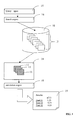
- FIG. 1 A first implementation of the present invention is now described in connection with an example. Details are illustrated in Figure 1.
- a database 10 comprising a collection of m texts 17.
- the user is looking for information concerning the word "agent”.
- he creates a query 15 that simply contains the word "agent”. He can create this query using a search interface (e.g., within a browser) provided on a computer screen.
- a search interface e.g., within a browser
- a search engine 16 is employed that is able to find all texts 17 in the database 10 that contain the word "agent".
- a conventional search engine can be used for that purpose.
- the search engine 16 can be located inside the user's computer or at a server.
- There are three texts 11, 12, and 13 ( k 3) that contain the word "agent", as illustrated in box 14.
- the characterizing strength C of each text is determined in order to find the text or texts that are most relevant.
- a calculating engine 18 is employed.
- the calculating engine 18 may output the results in a format displayed in box 19. In this output box 19 a characterizing strength C1 is given for each of the three texts 11 - 13.
- a virtual network (herein referred to as graph) is created that indicates the relationship between the words of the text, e.g., the relationship between the word "agent" and the other words of the text.
- the words of the text are represented by network elements (nodes) and the relationship between words is represented by links (edges). If two words are connected through one link, then there is assumed to be a close relationship between these two words. If two words are more than one link apart, then there is no close relationship.
- a parser can be employed in order to generate such a network.
- An English slot grammar (ESG) parser is well suited.
- ESG English slot grammar
- the graph is evolved.
- the graph can be evolved by reducing its complexity, for example. This can be done by removing certain words and links and/or by replacing certain words.
- the whole graph may also be re-arranged. This is done according to a pre-defined set of rules.
- the characterizing strength (C) will now be calculated based on a topological structure of the neighborhood.
- the number of immediate neighbors of the word "agent” is determined (step 23).
- An immediate neighbor is a neighbor that is connected through one link to the word "agent”.
- the number of immediate neighbors is determined by counting the number of neighbors (first neighbors) that are connected through one link to the word "agent”. In that one counts the number of immediate neighbors, one is able the determine the topological structure of the graph. There are other ways to determine the topological structure of graphs, as will be described later.
- the result is output (step 25) such that it can be used for further processing.
- the characterizing strength C1 may for example be picked up by another application, or it may be processed such that it can be displayed on a display screen.
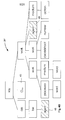
- This text 11 comprises four sentences. Pursuant to step 21, a tree-like graph 30 is generated for each sentence using an English Slot Grammar parser.
- the first sentence graph 30, is illustrated in Figure 3A.
- the graph 30 comprises nodes (represented by boxes) and links (represented by lines connecting the boxes).
- the parser creates a tree-like graph 30 with twelve nodes since the first sentence comprises twelve words.
- the word "agent” appears just once in this first sentence.
- the main verb "offer” forms the root of the tree-like graph 30.
- the second sentence graph 31 is illustrated in Figure 3B.
- the word “agent” is used two times in this sentence.
- the main verb “say” forms the root of the tree-like graph 31.
- the third sentence graph 32 is shown in Figure 3C.
- the word “agent” is used just once.
- the main verb “may” forms the root of the tree-like graph 32.
- the fourth sentence graph 33 is depicted in Figure 3D.
- the word “agent” appears once.
- the main verb “be” forms the root of the tree-like graph 33.
- the graph is evolved by reducing the complexity of the graphs 30 - 33. This is done - according to a pre-defined set of rules - by removing certain words and links and/or by replacing certain words. In the present example, at least the following three rules are used:
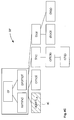
- a graph 30' is generated that comprises five nodes 40 - 44.
- This graph 30' is illustrated in Figure 4A.
- the following words have been removed from the network 30: "I”, “a”, “of”, “can”, “we”, “all”, “probably”, “on”.
- As a preparation for evolving the graph 30' further, one identifies the subject of the first sentence. Since there is no subject in the first sentence of text 11, an empty subject box 44 is generated.
- the simplified graph 33' is illustrated in Figure 4D.
- the word "agent” is the subject 47 of this sentence, too.
- the complexity of the graphs 30' - 33' is further reduced according to an additional pre-defined set of rules.
- additional rules are used:
- the number of immediate neighbors of the word "agent” is now determined for each graph 30",31", 32", and 33" (step 23).
- the number of immediate neighbors is depicted in Figures 5A - 5D.
- the word “agent” 42 has only one immediate neighbor 41 in the graph 30" of the first sentence (cf. Figure 5A).
- the two words “agent” 48 and 49 have no immediate neighbors in the graph 31" of the second sentence (cf. Figure 5B). Note that the empty subject node 45 does not count as a neighbor.
- the word “agent” 46 has two immediate neighbors 50 and 51 in the graph 32" of the third sentence (cf. Figure 5C).
- the word “agent” 47 has two immediate neighbors 52 and 53 in the graph 33" of the fourth sentence (cf. Figure 5D).
- the number of second neighbors is also displayed in the Figures 5A - 5D.
- the calculation of the characterizing strength C is schematically illustrated in Figure 6.
- the first column 64 of the table 60 shows the number of immediate neighbors for each of the four sentences of the text 11. The sum of all numbers in a column is given in row 62.
- the characterizing strength C1 where only the immediate neighbors of the word "agent" are taken into consideration, is given in row 63.
- the characterizing strength C1 is the average of all results in column 64.
- n the number of sentences in a given text
- a first step 70 one text (e.g., text 11) is fetched. Then (step 71), a graph is created.
- a parser e.g., an ESG parser
- ESG parser can be employed in order to generate such a graph.
- a subsequent step 72 the graphs 30 - 33 are evolved. This is done according to a pre-defined set of rules. In the present example, the rules 1. - 5. are used, too.
- a step 73 is carried out. During this step, the centers of the graphs are defined by putting the subject in the center (instead of the main verb). In the tree-like graphs, the root is defined to be the center.
- the number of immediate neighbors is determined (step 74) by counting the number of neighbors (first neighbors) that are connected through one link to the word "agent".
- the second neighbors of the word "agent” are determined, as well.
- a second neighbor is a word that is connected through two links to the word "agent”. Note that there is always an immediate neighbor between the word and any second neighbor.
- the characterizing strength C2 of the respective text in now calculated (step 76) based on the number of immediate neighbors and second neighbors.
- step 77 After having determined the characterizing strength C2, the result is output (step 77) such that it can be used for further processing. Some or all these steps 70 - 77 can now be repeated for all texts 11 - 13 that were identified as containing the word "agent". The repetition of these steps is schematically illustrated by means of the loop 78.
- the calculation of the characterizing strength C2 is schematically illustrated in Figure 6.
- the second column 61 of the table 60 shows the number of immediate neighbors plus the number of second neighbors for each of the four sentences of the text 11. The sum of all numbers in a column is given in row 62.
- the characterizing strength C2 is the average of all results in column 61.
- the text 12 is displayed in table 2.
- the text 13 is displayed in table 3.
- the calculation engine 18 (cf. Figure 1) thus is able to provide an output box 19 where all three texts 11, 12, and 13 are ordered according to their characterizing strength C1. The same ranking can be done using the C2 results.
- the user can now retrieve the respective texts by clicking on one of the http-links in the output box 19. These links are indicated by means of underlining.
- a semantic network generator (also called semantic processor) is employed.
- This semantic network generator creates a graph for each text that is returned by a search engine when processing a search query. Details about a semantic network generator are given in the co-pending patent application EP 962873-A1, currently assigned to the assignee of the present patent application. This co-pending patent application was published on 8 December 1999.
- the semantic network generator creates a graph that has a fractal hierarcial structure and comprises semantical units and pointers.
- the pointers may carry weights, whereby the weights represent the semantical distance between neighboring semantical units.
- such a graph generated by the semantic network generator can be evolved by applying a set of rules.
- One can, for example, remove all pointers and semantical units that have a semantical distances with respect to the word(s) given by a query that is above or below a certain threshold. In other words, only the neighborhood of the word(s) the user has listed in the query is kept in the graph. All other semantical units and pointers are not considered in determining the characterizing strength of the respective text.
- Some or all of the rules described in connection with the first two embodiments can be employed as well.
- One can also employ self-organizing graphs to reduce the complexity before determining the characterizing strength (C1 and/or C2). Such self-organizing graphs are described in the co-pending patent application PCT/IB99/00231, as filed on 11 February 1999 and in the co-pending German patent application with application number DE 19908204.9, as filed on 25 February 1999.
- a semantic network generator similar to those disclosed in the above-mentioned patent application EP 962873-A1 can be employed to generate graphs. Referring to the text 11 again, such a network generator would be designed to either generate four separate graphs (first approach), one for each sentence in the text 11, or to generate one common graph for the whole text 11 (second approach). If separate graphs are generated, then these graphs are to be combined in a subsequent step into one common graph. This can be done by identifying identical words in each of the sentences, such that the graphs can be linked together (mapped) via these identical words.
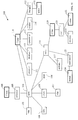
- the common graph 100 comprises semantical units 102 - 124.
- This graph 100 can then be automatically evolved by employing certain rules.
- the two subjects ⁇ SUB1 109 and ⁇ SUB2 110 are assumed to be the same, since all the sentences of the text 11 are written by the same person (the author or speaker).
- the two boxes 109 and 110 can thus be combined into a common box ⁇ ⁇ SUB 125, as illustrated in Figure 11.
- the structure of the graph 100 can be further evolved using linguistic and/or grammar rules.
- graphs can be evolved by removing nodes and/or links, by adding nodes and/or links, by replacing nodes and/or links, and by fusion of nodes and/or links. This is done - according to a pre-defined set of rules. Note that these are just some example of how graphs can be combined and evolved according to pre-defined rules. The rules are defined such that the graphs can be matched together making use of their closeness. Additional details about operations for evolving a graph are addressed in our co-pending patent application reference CH9-2000-0036, entitled "Meaning Understanding by Means of Local Pervasive Intelligence".
- graphs are combined by fusion of identical instances (nodes). In other words, two identical nodes are combined into one single node.
- a query expansion is preformed.
- Such a query expansion builds an improved query from the query keyed in by the user. It could be created by adding terms from other documents, or by adding synonyms of terms in the query (as found in a thesaurus).
- a parser is employed that generates a mesh-like graph rather than a tree-like graph.
- the semantic graph generator is an example of such a parser generating mesh-like graphs.
- the present characterzation scheme can also be used in connection with other schemes for classifying texts according to their relevance.
- the invention can be implemented by or on a general or special purpose computer.
- a computer program in the present context means an expression, in any language, code or notation, of a set of instructions intended to cause a device having an information processing capability to perform a particular function.
- the client system 80 comprises all elements 10 - 18 that were described in connection with Figure 1. There is a keyboard 81 that can be used by the user to key in a query. The result is processed by the client system 80 such that it can be displayed on a display screen 82.
- FIG. 9 A client-server implementation of the present invention is illustrated in Figure 9.
- a client computer comprising a computing system 93, a keyboard 91, and a display 92.
- This client computer connects via a network 94 (e.g., the Internet) to a server 90.
- This server 90 comprises the elements 10 - 18.
- the query is processed by the server and the characterizing strength is computed by the server.
- the result is output in a fashion that it can be sent via the network 94 to the client computer.
- the result can be fetched by the client computer from the server 90.
- the result is processed by the client computer such that it can be displayed on the display 92.
- the corresponding full-text is retrieved from the database 10 located at the server side.
- the database 10 may even reside on a third computer, or the documents 17 may even be distributed over a multitude of computers.
- the search engine may also be on another computer, just to mention some variations that are still within the scope of the present invention.
- the characterizing strength of texts there are many different ways to calculate the characterizing strength of texts.
- the basic idea is to calculate, after evolution of the graph(s), topological invariances.
- the characterizing strength (C) is calculated based on the topological structure of the neighborhood.
- There are different ways to determine the topological invariances of a graph One may determine distances, or graph dimensions, or connection components, for example. It is also conceivable to define a metric on the graph to define distances between nodes.
- the nodes of a graph may also have an associated topology table which defines the structure of the neighborhood. Both of these can also be used to determine topological invariances, such as nearest neighbor counting, etc.
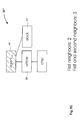
- the characterizing strength (C) may be determined by counting the number of nodes of the largest subgraphs. In the present example, the largest subgraph is the graph 130. It has 14 nodes. In the present example, the characterizing strength (C) would be 14.
- C may vary in a certain range between 0 and infinity.
- C may be standardized such that it varies between a lower boundary (e.g., 0) and an upper boundary (e.g., 100), for example.
Landscapes
- Engineering & Computer Science (AREA)
- Theoretical Computer Science (AREA)
- Artificial Intelligence (AREA)
- Computational Linguistics (AREA)
- Data Mining & Analysis (AREA)
- Databases & Information Systems (AREA)
- Physics & Mathematics (AREA)
- General Engineering & Computer Science (AREA)
- General Physics & Mathematics (AREA)
- Information Retrieval, Db Structures And Fs Structures Therefor (AREA)
Abstract
Description
- FIG. 1
- shows a schematic block diagram of one embodiment, according to the present invention.
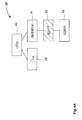
- FIG. 2
- shows a schematic flow chart in accordance with one embodiment of the present invention.
- FIG. 3A
- shows a first graph created in accordance with one embodiment of the present invention.
- FIG. 3B
- shows a second graph created in accordance with one embodiment of the present invention.
- FIG. 3C
- shows a third graph created in accordance with one embodiment of the present invention.
- FIG. 3D
- shows a fourth graph created in accordance with one embodiment of the present invention.
- FIG. 4A
- shows the first graph, in accordance with one embodiment of the present invention, after the graph has been evolved.
- FIG. 4B
- shows the second graph, in accordance with one embodiment of the present invention, after the graph has been evolved.
- FIG. 4C
- shows the third graph, in accordance with one embodiment of the present invention, after the graph has been evolved.
- FIG. 4D
- shows the fourth graph, in accordance with one embodiment of the present invention, after the graph has been evolved.
- FIG. 5A
- shows the first graph, in accordance with one embodiment of the present invention, after the graph has been further evolved.
- FIG. 5B
- shows the second graph, in accordance with one embodiment of the present invention, after the graph has been further evolved.
- FIG. 5C
- shows the third graph, in accordance with one embodiment of the present invention, after the graph has been further evolved.
- FIG. 5D
- shows the fourth graph, in accordance with one embodiment of the present invention, after the graph has been further evolved.
- FIG. 6
- is a schematic table, in accordance with one embodiment of the present invention, that is used in order to illustrate how the characterizing strength is calculated.
- FIG. 7
- shows a schematic flow chart in accordance with another embodiment of the present invention.
- FIG. 8
- shows a schematic block diagram of yet another embodiment, according to the present invention.
- FIG. 9
- shows a schematic block diagram of yet another embodiment, according to the present invention.
- FIG. 10
- shows another graph, in accordance with one embodiment of the present invention.
- FIG. 11
- shows the graph of Fig. 10 after the graph has been evolved.
- FIG. 12
- shows the graph of Fig. 11 after the word "agent" has been removed from the graph.



| | C1 | C2 | |
| 11 | 1.25 | 3.5 | |
| 12 | 0.25 | 0.5 | |
| 13 | 0.5 | 1.25 |
Claims (26)
- Method for automatically determining a characterizing strength (C) which indicates how well a text (11) stored in a database (10) describes a query (15), comprising the steps of:a) defining a query (15) comprising a query word;b) creating (71) a graph (30) with nodes and links, whereby words of the text (11) are represented by the nodes and a relationship between the words is represented by the links;c) evolving (72) the graph (30) according to a pre-defined set of rules,d) determining a neighborhood of the query word, the neighborhood comprising those nodes connected through one or more links to the query word; and,e) calculating the characterizing strength (C) based on the neighborhood.
- The method of claim 1, wherein the characterizing strength (C) is calculated in step e) by counting the number of immediate neighbors of the query word, whereby an immediate neighbor is a word that is connected through one link to the query word.
- The method of claim 1, wherein the database (10) stores a plurality of texts (17).
- The method of claim 1, comprising performing a search to find texts (11, 12, 13) in the database (10) that contain the query word.
- The method of claim 4, wherein the steps b) through e) are repeated for each text (11, 12, 13) that contains the query word.
- The method of claim 5, comprising displaying a list (82) showing the characterizing strength (C) of each text (11, 12, 13) that contains the word.
- The method according to any one of the preceding claims, wherein a parser is employed, to create the graph in step b).
- The method of any one of claims 1 to 6, wherein a semantic network generator is employed to create the graph (30) in step b).
- The method of any one of claims 1 to 3, wherein one graph is generated for each sentence in the text and wherein the characterizing strength (C) is calculated for each sentence by performing the steps b) through e).
- The method of claim 9, wherein the characterizing strength (C) of the text is calculated in dependence on the characterizing strengths (C) of all sentences of the respective text.
- The method of any one of claims 1 to 3, wherein the graph is evolved in step c) by removing all words from the text that are not nouns and/or verbs.
- The method of any one of claims 1 to 3, wherein the graph is evolved in step c) by replacing auxiliary verbs with main verbs.
- The method of any one of claims 1 to 3, wherein the graph is evolved in step c) by leaving out verbs.
- The method of any one of claims 1 to 3, wherein the subject of the sentence is identified and placed centrally in the graph to produce a tree-like graph structure in which the subject is at the root, prior to carrying out step d).
- The method of claim 2, comprising the step of determining the number of second neighbors of the query word, whereby a second neighbor is a word that is connected through two links to the query word.
- The method of claim 2 or 15, wherein the characterizing strength (C) of the text is an average calculated byadding the characterizing strengths (C) of all sentences of the respective text, andthen dividing the result of the previous step by the number of sentences.
- A system for automatically determining a characterizing strength (C) which indicates how well a text (17) in a database (10) describes a search query (15), the system comprising:o a database (10) storing a plurality of m texts (17);o a search engine (16) for processing a search query (15) in order to identify thoses k texts (11, 12, 13) from the plurality of m texts (17) that match the search query (15); and,o a calculation engine (18) for calcuating the characterizing strengths (C) of each of the k texts (11, 12, 13) that match the search query (15), by performing the following steps for each such text:creating a graph with nodes and links, whereby words of the text are represented by the nodes and the relationship between words is represented by the links,evolving the graph according to a pre-defined set of rules,determining the neighborhood of the word, whereby the neighborhood comprises those nodes that are connected through one or more links to the word, andcalculating the characterizing strength (C) based on the topological structure of the neighborhood.
- The system of claim 17, wherein the database (11) is stored in a server (90) connected via a network (94) to a client system (91, 92, 93).
- The system of claim 17 comprising a parser for creating the graph.
- The system of claim 17 comprising a semantic network generator for creating the graph.
- The system of claim 17, wherein the calculation engine calculates the characterizing strength (C) by counting the number of immediate neighbors of the word, whereby an immediate neighbor is a word that is connected through one link to the word.
- An information retrieval system comprising a system as claimed in any of claims 17 to 21.
- A server computer system comprising a system as claimed in any of claims 17 to 21.
- A client computer system comprising a system as claimed in any of claims 17 to 21.
- Software module for automatically determining a characterizing strength (C) which indicates how well a text in a database describes a query, whereby said software module, when executed by a programmable data processing system, performs the steps:a) enabling a user to define a query (15) comprising a word,b) creating a graph (71) with nodes and links, whereby words of the text (17) are represented by nodes and the relationship between words is represented by means of the links,c) evolving the graph (72) according to a pre-defined set of rules,d) determining the neighborhood of the word, whereby the neighborhood comprises those nodes that are connected through one or a few links to the word, ande) calculating the characterizing strength (C) based on the topological structure of the neighborhood;f) displaying the characterizing strenth (C).
- The software module of claim 30 comprising a search engine (16) for identifying those texts (11, 12, 13) in a plurality of texts (17) that match the query.
Priority Applications (3)
| Application Number | Priority Date | Filing Date | Title |
|---|---|---|---|
| EP01103933A EP1225517B1 (en) | 2001-01-17 | 2001-02-19 | System and methods for computer based searching for relevant texts |
| JP2002007154A JP3755134B2 (en) | 2001-01-17 | 2002-01-16 | Computer-based matched text search system and method |
| US10/050,049 US20020133483A1 (en) | 2001-01-17 | 2002-01-17 | Systems and methods for computer based searching for relevant texts |
Applications Claiming Priority (3)
| Application Number | Priority Date | Filing Date | Title |
|---|---|---|---|
| EP01810040 | 2001-01-17 | ||
| EP01810040 | 2001-01-17 | ||
| EP01103933A EP1225517B1 (en) | 2001-01-17 | 2001-02-19 | System and methods for computer based searching for relevant texts |
Publications (3)
| Publication Number | Publication Date |
|---|---|
| EP1225517A2 true EP1225517A2 (en) | 2002-07-24 |
| EP1225517A3 EP1225517A3 (en) | 2003-06-18 |
| EP1225517B1 EP1225517B1 (en) | 2006-05-17 |
Family
ID=26076482
Family Applications (1)
| Application Number | Title | Priority Date | Filing Date |
|---|---|---|---|
| EP01103933A Expired - Lifetime EP1225517B1 (en) | 2001-01-17 | 2001-02-19 | System and methods for computer based searching for relevant texts |
Country Status (3)
| Country | Link |
|---|---|
| US (1) | US20020133483A1 (en) |
| EP (1) | EP1225517B1 (en) |
| JP (1) | JP3755134B2 (en) |
Cited By (9)
| Publication number | Priority date | Publication date | Assignee | Title |
|---|---|---|---|---|
| GB2403636A (en) * | 2003-07-02 | 2005-01-05 | Sony Uk Ltd | Information retrieval using an array of nodes |
| US8024653B2 (en) | 2005-11-14 | 2011-09-20 | Make Sence, Inc. | Techniques for creating computer generated notes |
| US8108389B2 (en) | 2004-11-12 | 2012-01-31 | Make Sence, Inc. | Techniques for knowledge discovery by constructing knowledge correlations using concepts or terms |
| US8126890B2 (en) | 2004-12-21 | 2012-02-28 | Make Sence, Inc. | Techniques for knowledge discovery by constructing knowledge correlations using concepts or terms |
| US8140559B2 (en) | 2005-06-27 | 2012-03-20 | Make Sence, Inc. | Knowledge correlation search engine |
| US8209214B2 (en) * | 2007-06-26 | 2012-06-26 | Richrelevance, Inc. | System and method for providing targeted content |
| WO2014127500A1 (en) * | 2013-02-19 | 2014-08-28 | Google Inc. | Natural language processing based search |
| US8898134B2 (en) | 2005-06-27 | 2014-11-25 | Make Sence, Inc. | Method for ranking resources using node pool |
| US9330175B2 (en) | 2004-11-12 | 2016-05-03 | Make Sence, Inc. | Techniques for knowledge discovery by constructing knowledge correlations using concepts or terms |
Families Citing this family (38)
| Publication number | Priority date | Publication date | Assignee | Title |
|---|---|---|---|---|
| US8126712B2 (en) * | 2005-02-08 | 2012-02-28 | Nippon Telegraph And Telephone Corporation | Information communication terminal, information communication system, information communication method, and storage medium for storing an information communication program thereof for recognizing speech information |
| US7849090B2 (en) | 2005-03-30 | 2010-12-07 | Primal Fusion Inc. | System, method and computer program for faceted classification synthesis |
| US9177248B2 (en) | 2005-03-30 | 2015-11-03 | Primal Fusion Inc. | Knowledge representation systems and methods incorporating customization |
| US8849860B2 (en) | 2005-03-30 | 2014-09-30 | Primal Fusion Inc. | Systems and methods for applying statistical inference techniques to knowledge representations |
| US10002325B2 (en) | 2005-03-30 | 2018-06-19 | Primal Fusion Inc. | Knowledge representation systems and methods incorporating inference rules |
| US9104779B2 (en) | 2005-03-30 | 2015-08-11 | Primal Fusion Inc. | Systems and methods for analyzing and synthesizing complex knowledge representations |
| US9378203B2 (en) | 2008-05-01 | 2016-06-28 | Primal Fusion Inc. | Methods and apparatus for providing information of interest to one or more users |
| US8903810B2 (en) | 2005-12-05 | 2014-12-02 | Collarity, Inc. | Techniques for ranking search results |
| US7756855B2 (en) * | 2006-10-11 | 2010-07-13 | Collarity, Inc. | Search phrase refinement by search term replacement |
| US8429184B2 (en) | 2005-12-05 | 2013-04-23 | Collarity Inc. | Generation of refinement terms for search queries |
| US8442972B2 (en) * | 2006-10-11 | 2013-05-14 | Collarity, Inc. | Negative associations for search results ranking and refinement |
| US20080158585A1 (en) * | 2006-12-27 | 2008-07-03 | Seiko Epson Corporation | Apparatus, method, program for supporting printing, system, method, and program for printing, and recording medium |
| US7970721B2 (en) * | 2007-06-15 | 2011-06-28 | Microsoft Corporation | Learning and reasoning from web projections |
| US20090028164A1 (en) * | 2007-07-23 | 2009-01-29 | Semgine, Gmbh | Method and apparatus for semantic serializing |
| US9361365B2 (en) | 2008-05-01 | 2016-06-07 | Primal Fusion Inc. | Methods and apparatus for searching of content using semantic synthesis |
| US8676732B2 (en) | 2008-05-01 | 2014-03-18 | Primal Fusion Inc. | Methods and apparatus for providing information of interest to one or more users |
| CA2723179C (en) | 2008-05-01 | 2017-11-28 | Primal Fusion Inc. | Method, system, and computer program for user-driven dynamic generation of semantic networks and media synthesis |
| US8438178B2 (en) | 2008-06-26 | 2013-05-07 | Collarity Inc. | Interactions among online digital identities |
| JP4587236B2 (en) * | 2008-08-26 | 2010-11-24 | Necビッグローブ株式会社 | Information search apparatus, information search method, and program |
| CA2988181C (en) | 2008-08-29 | 2020-03-10 | Primal Fusion Inc. | Systems and methods for semantic concept definition and semantic concept relationship synthesis utilizing existing domain definitions |
| US10108616B2 (en) | 2009-07-17 | 2018-10-23 | International Business Machines Corporation | Probabilistic link strength reduction |
| US9292855B2 (en) | 2009-09-08 | 2016-03-22 | Primal Fusion Inc. | Synthesizing messaging using context provided by consumers |
| US9262520B2 (en) | 2009-11-10 | 2016-02-16 | Primal Fusion Inc. | System, method and computer program for creating and manipulating data structures using an interactive graphical interface |
| US8875038B2 (en) | 2010-01-19 | 2014-10-28 | Collarity, Inc. | Anchoring for content synchronization |
| US9235806B2 (en) | 2010-06-22 | 2016-01-12 | Primal Fusion Inc. | Methods and devices for customizing knowledge representation systems |
| US10474647B2 (en) | 2010-06-22 | 2019-11-12 | Primal Fusion Inc. | Methods and devices for customizing knowledge representation systems |
| US11294977B2 (en) | 2011-06-20 | 2022-04-05 | Primal Fusion Inc. | Techniques for presenting content to a user based on the user's preferences |
| US9092516B2 (en) | 2011-06-20 | 2015-07-28 | Primal Fusion Inc. | Identifying information of interest based on user preferences |
| US8965882B1 (en) * | 2011-07-13 | 2015-02-24 | Google Inc. | Click or skip evaluation of synonym rules |
| US8909627B1 (en) | 2011-11-30 | 2014-12-09 | Google Inc. | Fake skip evaluation of synonym rules |
| US9152698B1 (en) | 2012-01-03 | 2015-10-06 | Google Inc. | Substitute term identification based on over-represented terms identification |
| US8965875B1 (en) | 2012-01-03 | 2015-02-24 | Google Inc. | Removing substitution rules based on user interactions |
| US9141672B1 (en) | 2012-01-25 | 2015-09-22 | Google Inc. | Click or skip evaluation of query term optionalization rule |
| US8959103B1 (en) | 2012-05-25 | 2015-02-17 | Google Inc. | Click or skip evaluation of reordering rules |
| US9146966B1 (en) | 2012-10-04 | 2015-09-29 | Google Inc. | Click or skip evaluation of proximity rules |
| US20180341871A1 (en) * | 2017-05-25 | 2018-11-29 | Accenture Global Solutions Limited | Utilizing deep learning with an information retrieval mechanism to provide question answering in restricted domains |
| CN112000788B (en) * | 2020-08-19 | 2024-02-09 | 腾讯云计算(长沙)有限责任公司 | Data processing method, device and computer readable storage medium |
| CN116127075A (en) * | 2023-02-15 | 2023-05-16 | 百度在线网络技术(北京)有限公司 | Text classification method, device, equipment and storage medium |
Family Cites Families (17)
| Publication number | Priority date | Publication date | Assignee | Title |
|---|---|---|---|---|
| US5056021A (en) * | 1989-06-08 | 1991-10-08 | Carolyn Ausborn | Method and apparatus for abstracting concepts from natural language |
| JP3334807B2 (en) * | 1991-07-25 | 2002-10-15 | 株式会社日立製作所 | Pattern classification method and apparatus using neural network |
| US5487132A (en) * | 1992-03-04 | 1996-01-23 | Cheng; Viktor C. H. | End user query facility |
| US5471382A (en) * | 1994-01-10 | 1995-11-28 | Informed Access Systems, Inc. | Medical network management system and process |
| US5644686A (en) * | 1994-04-29 | 1997-07-01 | International Business Machines Corporation | Expert system and method employing hierarchical knowledge base, and interactive multimedia/hypermedia applications |
| AU6849196A (en) * | 1995-08-16 | 1997-03-19 | Syracuse University | Multilingual document retrieval system and method using semantic vector matching |
| US5893088A (en) * | 1996-04-10 | 1999-04-06 | Altera Corporation | System and method for performing database query using a marker table |
| US5819271A (en) * | 1996-06-04 | 1998-10-06 | Multex Systems, Inc. | Corporate information communication and delivery system and method including entitlable hypertext links |
| JP3643470B2 (en) * | 1997-09-05 | 2005-04-27 | 株式会社日立製作所 | Document search system and document search support method |
| JP3614618B2 (en) * | 1996-07-05 | 2005-01-26 | 株式会社日立製作所 | Document search support method and apparatus, and document search service using the same |
| US5784539A (en) * | 1996-11-26 | 1998-07-21 | Client-Server-Networking Solutions, Inc. | Quality driven expert system |
| US5933822A (en) * | 1997-07-22 | 1999-08-03 | Microsoft Corporation | Apparatus and methods for an information retrieval system that employs natural language processing of search results to improve overall precision |
| US6243670B1 (en) * | 1998-09-02 | 2001-06-05 | Nippon Telegraph And Telephone Corporation | Method, apparatus, and computer readable medium for performing semantic analysis and generating a semantic structure having linked frames |
| US6167370A (en) * | 1998-09-09 | 2000-12-26 | Invention Machine Corporation | Document semantic analysis/selection with knowledge creativity capability utilizing subject-action-object (SAO) structures |
| US6564263B1 (en) * | 1998-12-04 | 2003-05-13 | International Business Machines Corporation | Multimedia content description framework |
| US6556983B1 (en) * | 2000-01-12 | 2003-04-29 | Microsoft Corporation | Methods and apparatus for finding semantic information, such as usage logs, similar to a query using a pattern lattice data space |
| US20030061202A1 (en) * | 2000-06-02 | 2003-03-27 | Coleman Kevin B. | Interactive product selector with fuzzy logic engine |
-
2001
- 2001-02-19 EP EP01103933A patent/EP1225517B1/en not_active Expired - Lifetime
-
2002
- 2002-01-16 JP JP2002007154A patent/JP3755134B2/en not_active Expired - Fee Related
- 2002-01-17 US US10/050,049 patent/US20020133483A1/en not_active Abandoned
Cited By (15)
| Publication number | Priority date | Publication date | Assignee | Title |
|---|---|---|---|---|
| US8230364B2 (en) | 2003-07-02 | 2012-07-24 | Sony United Kingdom Limited | Information retrieval |
| GB2403636A (en) * | 2003-07-02 | 2005-01-05 | Sony Uk Ltd | Information retrieval using an array of nodes |
| US10467297B2 (en) | 2004-11-12 | 2019-11-05 | Make Sence, Inc. | Techniques for knowledge discovery by constructing knowledge correlations using concepts or terms |
| US8108389B2 (en) | 2004-11-12 | 2012-01-31 | Make Sence, Inc. | Techniques for knowledge discovery by constructing knowledge correlations using concepts or terms |
| US9330175B2 (en) | 2004-11-12 | 2016-05-03 | Make Sence, Inc. | Techniques for knowledge discovery by constructing knowledge correlations using concepts or terms |
| US9311601B2 (en) | 2004-11-12 | 2016-04-12 | Make Sence, Inc. | Techniques for knowledge discovery by constructing knowledge correlations using concepts or terms |
| US8126890B2 (en) | 2004-12-21 | 2012-02-28 | Make Sence, Inc. | Techniques for knowledge discovery by constructing knowledge correlations using concepts or terms |
| US8898134B2 (en) | 2005-06-27 | 2014-11-25 | Make Sence, Inc. | Method for ranking resources using node pool |
| US8140559B2 (en) | 2005-06-27 | 2012-03-20 | Make Sence, Inc. | Knowledge correlation search engine |
| US9477766B2 (en) | 2005-06-27 | 2016-10-25 | Make Sence, Inc. | Method for ranking resources using node pool |
| US9213689B2 (en) | 2005-11-14 | 2015-12-15 | Make Sence, Inc. | Techniques for creating computer generated notes |
| US8024653B2 (en) | 2005-11-14 | 2011-09-20 | Make Sence, Inc. | Techniques for creating computer generated notes |
| US8209214B2 (en) * | 2007-06-26 | 2012-06-26 | Richrelevance, Inc. | System and method for providing targeted content |
| US9639846B2 (en) | 2007-06-26 | 2017-05-02 | Richrelevance, Inc. | System and method for providing targeted content |
| WO2014127500A1 (en) * | 2013-02-19 | 2014-08-28 | Google Inc. | Natural language processing based search |
Also Published As
| Publication number | Publication date |
|---|---|
| EP1225517B1 (en) | 2006-05-17 |
| EP1225517A3 (en) | 2003-06-18 |
| JP3755134B2 (en) | 2006-03-15 |
| JP2002259429A (en) | 2002-09-13 |
| US20020133483A1 (en) | 2002-09-19 |
Similar Documents
| Publication | Publication Date | Title |
|---|---|---|
| EP1225517A2 (en) | System and methods for computer based searching for relevant texts | |
| US7333966B2 (en) | Systems, methods, and software for hyperlinking names | |
| US8650483B2 (en) | Method and apparatus for improving the readability of an automatically machine-generated summary | |
| US8332434B2 (en) | Method and system for finding appropriate semantic web ontology terms from words | |
| US8983965B2 (en) | Document rating calculation system, document rating calculation method and program | |
| JP2009110513A (en) | Automatic ontology generation using word similarity | |
| JP5146108B2 (en) | Document importance calculation system, document importance calculation method, and program | |
| JP2011103075A (en) | Method for extracting excerpt sentence | |
| JP4333229B2 (en) | Named character string evaluation device and evaluation method | |
| JP2004054882A (en) | Synonym search device, method, program, and storage medium | |
| JPH11259524A (en) | Information retrieval system, information processing method in information retrieval system, and recording medium | |
| JP2000105769A (en) | Document display method | |
| Sharma et al. | Improved stemming approach used for text processing in information retrieval system | |
| JP2005031949A (en) | Information search method, information search apparatus and program | |
| AU2011253680B2 (en) | Systems, methods, and software for hyperlinking names | |
| AU2011253689B2 (en) | Systems, methods, and software for hyperlinking names | |
| JPH08292960A (en) | Retrieval result evaluation device | |
| JP2003085203A (en) | Information search device, information search method, and storage medium |
Legal Events
| Date | Code | Title | Description |
|---|---|---|---|
| PUAI | Public reference made under article 153(3) epc to a published international application that has entered the european phase |
Free format text: ORIGINAL CODE: 0009012 |
|
| AK | Designated contracting states |
Kind code of ref document: A2 Designated state(s): AT BE CH CY DE DK ES FI FR GB GR IE IT LI LU MC NL PT SE TR |
|
| AX | Request for extension of the european patent |
Free format text: AL;LT;LV;MK;RO;SI |
|
| PUAL | Search report despatched |
Free format text: ORIGINAL CODE: 0009013 |
|
| AK | Designated contracting states |
Designated state(s): AT BE CH CY DE DK ES FI FR GB GR IE IT LI LU MC NL PT SE TR |
|
| AX | Request for extension of the european patent |
Extension state: AL LT LV MK RO SI |
|
| 17P | Request for examination filed |
Effective date: 20031122 |
|
| AKX | Designation fees paid |
Designated state(s): AT BE CH CY DE DK ES FI FR GB GR IE IT LI LU MC NL PT SE TR |
|
| 17Q | First examination report despatched |
Effective date: 20040415 |
|
| GRAP | Despatch of communication of intention to grant a patent |
Free format text: ORIGINAL CODE: EPIDOSNIGR1 |
|
| GRAS | Grant fee paid |
Free format text: ORIGINAL CODE: EPIDOSNIGR3 |
|
| GRAA | (expected) grant |
Free format text: ORIGINAL CODE: 0009210 |
|
| AK | Designated contracting states |
Kind code of ref document: B1 Designated state(s): AT BE CH CY DE DK ES FI FR GB GR IE IT LI LU MC NL PT SE TR |
|
| PG25 | Lapsed in a contracting state [announced via postgrant information from national office to epo] |
Ref country code: FI Free format text: LAPSE BECAUSE OF FAILURE TO SUBMIT A TRANSLATION OF THE DESCRIPTION OR TO PAY THE FEE WITHIN THE PRESCRIBED TIME-LIMIT Effective date: 20060517 Ref country code: IT Free format text: LAPSE BECAUSE OF FAILURE TO SUBMIT A TRANSLATION OF THE DESCRIPTION OR TO PAY THE FEE WITHIN THE PRESCRIBED TIME-LIMIT;WARNING: LAPSES OF ITALIAN PATENTS WITH EFFECTIVE DATE BEFORE 2007 MAY HAVE OCCURRED AT ANY TIME BEFORE 2007. THE CORRECT EFFECTIVE DATE MAY BE DIFFERENT FROM THE ONE RECORDED. Effective date: 20060517 Ref country code: AT Free format text: LAPSE BECAUSE OF FAILURE TO SUBMIT A TRANSLATION OF THE DESCRIPTION OR TO PAY THE FEE WITHIN THE PRESCRIBED TIME-LIMIT Effective date: 20060517 Ref country code: NL Free format text: LAPSE BECAUSE OF FAILURE TO SUBMIT A TRANSLATION OF THE DESCRIPTION OR TO PAY THE FEE WITHIN THE PRESCRIBED TIME-LIMIT Effective date: 20060517 Ref country code: BE Free format text: LAPSE BECAUSE OF FAILURE TO SUBMIT A TRANSLATION OF THE DESCRIPTION OR TO PAY THE FEE WITHIN THE PRESCRIBED TIME-LIMIT Effective date: 20060517 |
|
| REG | Reference to a national code |
Ref country code: GB Ref legal event code: FG4D |
|
| REG | Reference to a national code |
Ref country code: CH Ref legal event code: NV Representative=s name: INTERNATIONAL BUSINESS MACHINES CORPORATION Ref country code: CH Ref legal event code: EP |
|
| REG | Reference to a national code |
Ref country code: IE Ref legal event code: FG4D |
|
| REF | Corresponds to: |
Ref document number: 60119686 Country of ref document: DE Date of ref document: 20060622 Kind code of ref document: P |
|
| PG25 | Lapsed in a contracting state [announced via postgrant information from national office to epo] |
Ref country code: DK Free format text: LAPSE BECAUSE OF FAILURE TO SUBMIT A TRANSLATION OF THE DESCRIPTION OR TO PAY THE FEE WITHIN THE PRESCRIBED TIME-LIMIT Effective date: 20060817 Ref country code: SE Free format text: LAPSE BECAUSE OF FAILURE TO SUBMIT A TRANSLATION OF THE DESCRIPTION OR TO PAY THE FEE WITHIN THE PRESCRIBED TIME-LIMIT Effective date: 20060817 |
|
| PG25 | Lapsed in a contracting state [announced via postgrant information from national office to epo] |
Ref country code: ES Free format text: LAPSE BECAUSE OF FAILURE TO SUBMIT A TRANSLATION OF THE DESCRIPTION OR TO PAY THE FEE WITHIN THE PRESCRIBED TIME-LIMIT Effective date: 20060828 |
|
| PG25 | Lapsed in a contracting state [announced via postgrant information from national office to epo] |
Ref country code: PT Free format text: LAPSE BECAUSE OF FAILURE TO SUBMIT A TRANSLATION OF THE DESCRIPTION OR TO PAY THE FEE WITHIN THE PRESCRIBED TIME-LIMIT Effective date: 20061017 |
|
| NLV1 | Nl: lapsed or annulled due to failure to fulfill the requirements of art. 29p and 29m of the patents act | ||
| ET | Fr: translation filed | ||
| PGFP | Annual fee paid to national office [announced via postgrant information from national office to epo] |
Ref country code: IE Payment date: 20070221 Year of fee payment: 7 |
|
| PG25 | Lapsed in a contracting state [announced via postgrant information from national office to epo] |
Ref country code: MC Free format text: LAPSE BECAUSE OF NON-PAYMENT OF DUE FEES Effective date: 20070228 |
|
| PLBE | No opposition filed within time limit |
Free format text: ORIGINAL CODE: 0009261 |
|
| STAA | Information on the status of an ep patent application or granted ep patent |
Free format text: STATUS: NO OPPOSITION FILED WITHIN TIME LIMIT |
|
| 26N | No opposition filed |
Effective date: 20070220 |
|
| REG | Reference to a national code |
Ref country code: GB Ref legal event code: 746 Effective date: 20080117 |
|
| PG25 | Lapsed in a contracting state [announced via postgrant information from national office to epo] |
Ref country code: GR Free format text: LAPSE BECAUSE OF FAILURE TO SUBMIT A TRANSLATION OF THE DESCRIPTION OR TO PAY THE FEE WITHIN THE PRESCRIBED TIME-LIMIT Effective date: 20060818 |
|
| PGFP | Annual fee paid to national office [announced via postgrant information from national office to epo] |
Ref country code: DE Payment date: 20080215 Year of fee payment: 8 Ref country code: GB Payment date: 20080221 Year of fee payment: 8 |
|
| PGFP | Annual fee paid to national office [announced via postgrant information from national office to epo] |
Ref country code: CH Payment date: 20080522 Year of fee payment: 8 Ref country code: FR Payment date: 20080208 Year of fee payment: 8 |
|
| PG25 | Lapsed in a contracting state [announced via postgrant information from national office to epo] |
Ref country code: IE Free format text: LAPSE BECAUSE OF NON-PAYMENT OF DUE FEES Effective date: 20080219 |
|
| PG25 | Lapsed in a contracting state [announced via postgrant information from national office to epo] |
Ref country code: LU Free format text: LAPSE BECAUSE OF NON-PAYMENT OF DUE FEES Effective date: 20070219 Ref country code: CY Free format text: LAPSE BECAUSE OF FAILURE TO SUBMIT A TRANSLATION OF THE DESCRIPTION OR TO PAY THE FEE WITHIN THE PRESCRIBED TIME-LIMIT Effective date: 20060517 |
|
| PG25 | Lapsed in a contracting state [announced via postgrant information from national office to epo] |
Ref country code: TR Free format text: LAPSE BECAUSE OF FAILURE TO SUBMIT A TRANSLATION OF THE DESCRIPTION OR TO PAY THE FEE WITHIN THE PRESCRIBED TIME-LIMIT Effective date: 20060517 |
|
| REG | Reference to a national code |
Ref country code: CH Ref legal event code: PL |
|
| GBPC | Gb: european patent ceased through non-payment of renewal fee |
Effective date: 20090219 |
|
| PG25 | Lapsed in a contracting state [announced via postgrant information from national office to epo] |
Ref country code: LI Free format text: LAPSE BECAUSE OF NON-PAYMENT OF DUE FEES Effective date: 20090228 Ref country code: CH Free format text: LAPSE BECAUSE OF NON-PAYMENT OF DUE FEES Effective date: 20090228 |
|
| REG | Reference to a national code |
Ref country code: FR Ref legal event code: ST Effective date: 20091030 |
|
| PG25 | Lapsed in a contracting state [announced via postgrant information from national office to epo] |
Ref country code: DE Free format text: LAPSE BECAUSE OF NON-PAYMENT OF DUE FEES Effective date: 20090901 |
|
| PG25 | Lapsed in a contracting state [announced via postgrant information from national office to epo] |
Ref country code: FR Free format text: LAPSE BECAUSE OF NON-PAYMENT OF DUE FEES Effective date: 20090302 Ref country code: GB Free format text: LAPSE BECAUSE OF NON-PAYMENT OF DUE FEES Effective date: 20090219 |