EP1225231A1 - Environmental stress resistance gene - Google Patents
Environmental stress resistance gene Download PDFInfo
- Publication number
- EP1225231A1 EP1225231A1 EP00946421A EP00946421A EP1225231A1 EP 1225231 A1 EP1225231 A1 EP 1225231A1 EP 00946421 A EP00946421 A EP 00946421A EP 00946421 A EP00946421 A EP 00946421A EP 1225231 A1 EP1225231 A1 EP 1225231A1
- Authority
- EP
- European Patent Office
- Prior art keywords
- amino acids
- sequence
- seq
- stress
- protein
- Prior art date
- Legal status (The legal status is an assumption and is not a legal conclusion. Google has not performed a legal analysis and makes no representation as to the accuracy of the status listed.)
- Withdrawn
Links
Images




Classifications
-
- C—CHEMISTRY; METALLURGY
- C12—BIOCHEMISTRY; BEER; SPIRITS; WINE; VINEGAR; MICROBIOLOGY; ENZYMOLOGY; MUTATION OR GENETIC ENGINEERING
- C12N—MICROORGANISMS OR ENZYMES; COMPOSITIONS THEREOF; PROPAGATING, PRESERVING, OR MAINTAINING MICROORGANISMS; MUTATION OR GENETIC ENGINEERING; CULTURE MEDIA
- C12N1/00—Microorganisms; Compositions thereof; Processes of propagating, maintaining or preserving microorganisms or compositions thereof; Processes of preparing or isolating a composition containing a microorganism; Culture media therefor
- C12N1/04—Preserving or maintaining viable microorganisms
-
- C—CHEMISTRY; METALLURGY
- C07—ORGANIC CHEMISTRY
- C07K—PEPTIDES
- C07K14/00—Peptides having more than 20 amino acids; Gastrins; Somatostatins; Melanotropins; Derivatives thereof
- C07K14/415—Peptides having more than 20 amino acids; Gastrins; Somatostatins; Melanotropins; Derivatives thereof from plants
-
- C—CHEMISTRY; METALLURGY
- C12—BIOCHEMISTRY; BEER; SPIRITS; WINE; VINEGAR; MICROBIOLOGY; ENZYMOLOGY; MUTATION OR GENETIC ENGINEERING
- C12N—MICROORGANISMS OR ENZYMES; COMPOSITIONS THEREOF; PROPAGATING, PRESERVING, OR MAINTAINING MICROORGANISMS; MUTATION OR GENETIC ENGINEERING; CULTURE MEDIA
- C12N15/00—Mutation or genetic engineering; DNA or RNA concerning genetic engineering, vectors, e.g. plasmids, or their isolation, preparation or purification; Use of hosts therefor
- C12N15/09—Recombinant DNA-technology
- C12N15/10—Processes for the isolation, preparation or purification of DNA or RNA
- C12N15/1034—Isolating an individual clone by screening libraries
-
- C—CHEMISTRY; METALLURGY
- C12—BIOCHEMISTRY; BEER; SPIRITS; WINE; VINEGAR; MICROBIOLOGY; ENZYMOLOGY; MUTATION OR GENETIC ENGINEERING
- C12N—MICROORGANISMS OR ENZYMES; COMPOSITIONS THEREOF; PROPAGATING, PRESERVING, OR MAINTAINING MICROORGANISMS; MUTATION OR GENETIC ENGINEERING; CULTURE MEDIA
- C12N15/00—Mutation or genetic engineering; DNA or RNA concerning genetic engineering, vectors, e.g. plasmids, or their isolation, preparation or purification; Use of hosts therefor
- C12N15/09—Recombinant DNA-technology
- C12N15/63—Introduction of foreign genetic material using vectors; Vectors; Use of hosts therefor; Regulation of expression
- C12N15/79—Vectors or expression systems specially adapted for eukaryotic hosts
- C12N15/82—Vectors or expression systems specially adapted for eukaryotic hosts for plant cells, e.g. plant artificial chromosomes (PACs)
- C12N15/8241—Phenotypically and genetically modified plants via recombinant DNA technology
- C12N15/8261—Phenotypically and genetically modified plants via recombinant DNA technology with agronomic (input) traits, e.g. crop yield
- C12N15/8271—Phenotypically and genetically modified plants via recombinant DNA technology with agronomic (input) traits, e.g. crop yield for stress resistance, e.g. heavy metal resistance
- C12N15/8273—Phenotypically and genetically modified plants via recombinant DNA technology with agronomic (input) traits, e.g. crop yield for stress resistance, e.g. heavy metal resistance for drought, cold, salt resistance
-
- C—CHEMISTRY; METALLURGY
- C12—BIOCHEMISTRY; BEER; SPIRITS; WINE; VINEGAR; MICROBIOLOGY; ENZYMOLOGY; MUTATION OR GENETIC ENGINEERING
- C12Q—MEASURING OR TESTING PROCESSES INVOLVING ENZYMES, NUCLEIC ACIDS OR MICROORGANISMS; COMPOSITIONS OR TEST PAPERS THEREFOR; PROCESSES OF PREPARING SUCH COMPOSITIONS; CONDITION-RESPONSIVE CONTROL IN MICROBIOLOGICAL OR ENZYMOLOGICAL PROCESSES
- C12Q1/00—Measuring or testing processes involving enzymes, nucleic acids or microorganisms; Compositions therefor; Processes of preparing such compositions
- C12Q1/68—Measuring or testing processes involving enzymes, nucleic acids or microorganisms; Compositions therefor; Processes of preparing such compositions involving nucleic acids
- C12Q1/6876—Nucleic acid products used in the analysis of nucleic acids, e.g. primers or probes
- C12Q1/6888—Nucleic acid products used in the analysis of nucleic acids, e.g. primers or probes for detection or identification of organisms
- C12Q1/6895—Nucleic acid products used in the analysis of nucleic acids, e.g. primers or probes for detection or identification of organisms for plants, fungi or algae
-
- A—HUMAN NECESSITIES
- A01—AGRICULTURE; FORESTRY; ANIMAL HUSBANDRY; HUNTING; TRAPPING; FISHING
- A01K—ANIMAL HUSBANDRY; AVICULTURE; APICULTURE; PISCICULTURE; FISHING; REARING OR BREEDING ANIMALS, NOT OTHERWISE PROVIDED FOR; NEW BREEDS OF ANIMALS
- A01K2217/00—Genetically modified animals
- A01K2217/05—Animals comprising random inserted nucleic acids (transgenic)
-
- C—CHEMISTRY; METALLURGY
- C12—BIOCHEMISTRY; BEER; SPIRITS; WINE; VINEGAR; MICROBIOLOGY; ENZYMOLOGY; MUTATION OR GENETIC ENGINEERING
- C12Q—MEASURING OR TESTING PROCESSES INVOLVING ENZYMES, NUCLEIC ACIDS OR MICROORGANISMS; COMPOSITIONS OR TEST PAPERS THEREFOR; PROCESSES OF PREPARING SUCH COMPOSITIONS; CONDITION-RESPONSIVE CONTROL IN MICROBIOLOGICAL OR ENZYMOLOGICAL PROCESSES
- C12Q2600/00—Oligonucleotides characterized by their use
- C12Q2600/13—Plant traits
-
- C—CHEMISTRY; METALLURGY
- C12—BIOCHEMISTRY; BEER; SPIRITS; WINE; VINEGAR; MICROBIOLOGY; ENZYMOLOGY; MUTATION OR GENETIC ENGINEERING
- C12Q—MEASURING OR TESTING PROCESSES INVOLVING ENZYMES, NUCLEIC ACIDS OR MICROORGANISMS; COMPOSITIONS OR TEST PAPERS THEREFOR; PROCESSES OF PREPARING SUCH COMPOSITIONS; CONDITION-RESPONSIVE CONTROL IN MICROBIOLOGICAL OR ENZYMOLOGICAL PROCESSES
- C12Q2600/00—Oligonucleotides characterized by their use
- C12Q2600/158—Expression markers
Definitions
- the present invention relates to DNA encoding proteins having the activity of improving tolerance against environmental stresses such as salt stress and its screening methods, proteins having the activity of improving tolerance against environmental stresses such as salt stress, and the use of the DNA or the proteins such as transgenic plants.
- Organisms living in the nature are exposed to various environmental stresses such as salt stress, high temperature stress, low temperature stress, freezing stress, or drought stress.
- salt stress is one of the main factors inhibiting the growth of many species of higher plants. Since the improvement of tolerance against salt in higher plants leads to the increase of the farm products, attempts have recently been made vigorously to improve salt tolerance of higher plants by gene introduction.
- H. J. Bohnert et al. show that salt tolerance of tobacco plants was improved by introducing the mannitol synthetase derived from coliforms into tobacco plants (Science 259, 22, 508-510, 1993). It has been shown that similar effects of improvement of salt tolerance in higher plants can be obtained by introducing proline synthetase (Plant Physiol. 108, 1387-1394, 1995) or glycine betaine synthetase (Plant J. 12, 133-142, 1997, Plant Mol. Biol. 38, 1011-1019, 1998). However, the recombinant plants obtained by the introduction of the genes encoding the enzymes will not acquire salt tolerance enough to cope with the level of the seawater.
- mangroves are woody plants growing in soil containing a high concentration of salt along the coast and near the entry of rivers. Mangrove plants are thought to have acquired special mechanisms for salt tolerance in the process of evolution. Therefore, if we can isolate gene population of mangrove plants responsible for salt tolerance, it is expected that the isolates can be used to apply to improve salt tolerance of higher plants.
- One representative example is to improve salt tolerance of tobacco plants by introducing inositole methyltransferase genes derived from Masembryanthenum crystallinum, which is a halophyte, into tobacco, and increasing the content of ononitol, a kind of compatible solute, into transformed cells (Plant Physiol. 115, 1221-1219, 1998), and another example is to slightly improve salt tolerance of rice plants by introducing the genes encoding stress inducing proteins (LEA proteins) derived from barley with a relatively high level of salt tolerance, into rice plants (Plant Physiol. 110, 249-257, 1996).
- LSA proteins stress inducing proteins
- the functions of improving salt stress tolerance of proteins can be improved by artificially modifying genes encoding the proteins having the activity of improving salt stress tolerance, it becomes possible to produce plants with a higher level of tolerance to salt stress.
- the object of the present invention is to provide efficient methods for screening genes having the effects of improving tolerance to environmental stress in various organisms, genes of proteins (proteins having the activity of improving environmental stress tolerance) having the activity of improving environmental stress tolerance obtained from the screening method, proteins having the activity of improving environmental stress tolerance, and transgenic plants or the like whose salt tolerance is improved.
- mangroves which are halophytes
- mangroves which are halophytes
- Bruguiera sexangula which was established as a cultured cell lines, cultured this cell line in the presence of 100mM of NaCl, produced cDNA library based on the mRNA extracted from the cultured cells, and attempted to detect genes involved in salt tolerance in mangroves.
- differential screening is widely used to screen genes involved in salt tolerance (see Publication for Japanese Laid-Open Patent Application No. 10-295380 on novel thionine genes induced by salt stress).
- the genes which this screening method isolates are the ones specifically derived under stressful conditions, and it is not always the case that the expression of the genes in other cells leads to the improvement of stress tolerance of the cells.
- the present inventors developed methods of using gene expression systems of coliform to detect genes involved in stress tolerance.
- the group of genes (cDNA), derived from halophytes such as mangroves isolated by the present inventors following the above-mentioned method, has functions of improving the salt tolerance in coliform. Since it was possible to improve the level of salt tolerance in the coliforms by expressing the plant genes in coliforms, which are different organisms, a group of such genes are considered to have functions of improving salt tolerance in a wide range of organisms from prokaryotes to eukaryotes. In fact, the present inventors have succeeded in improving the salt tolerance in yeast, plant cells (cultured tobacco cells), and plant organisms (tobacco plants) by introducing a single gene, which is isolated and named mang1 gene, from among the group of genes involved in stress tolerance.
- mang1 has functions of improving the levels of tolerance to environmental stresses such as thermal, osmotic pressure, freezing other than salt tolerance. Further, we found that it was possible to obtain proteins having stronger activity of improving salt tolerance by introducing random mutants into mang1 cDNA, introducing the mutant cDNA into coliforms, and carrying out the process of selecting once, or twice or more under more stringent conditions than the selecting condition before the mutation. The present invention has been accomplished based on the sequence of researches.
- the present invention relates to a method for screening DNA encoding proteins having the activity of improving environmental stress tolerance wherein candidate cDNA derived from cDNA library is introduced into host cells, the obtained transformed cells are cultured under the conditions where the host cells cannot substantially grow, the clones grown after culturing are selected, and the candidate cDNA introduced from the selected clones is isolated (claim 1), a method for screening DNA encoding proteins having the activity of improving environmental stress tolerance wherein candidate cDNA derived from cDNA library is introduced into host cells, the obtained transformed cells are cultured under conditions where the host cells cannot substantially grow, the clones grown after the culturing are selected, candidate cDNA is isolated from the selected clones, the isolated candidate cDNA is introduced into the isolated cDNA, the mutant cDNA is introduced into host cells, and the process of selecting is repeated one or more under stringent conditions of selecting mutant cDNA than the selecting condition (claim 2), the method for screening according to any one of claims 1 or 2, wherein the environmental stress is one or more of chemical substance stress
- the present invention also relates to DNA encoding proteins having the activity of improving environmental stress tolerance wherein the DNA is obtained according to any one of claims 1 to 7 (claim 8), DNA encoding proteins having the activity of improving environmental stress tolerance according to claim 8, wherein the environmental stress is one or more of stresses selected from chemical substance stress, high temperature stress, low temperature stress, freezing stress, drought stress, ozone stress, ultraviolet stress, radiation stress, or osmotic pressure stress (claim 9), DNA encoding proteins having the activity of improving the environmental stress tolerance according to claim 9, wherein the chemical substance stress is salt stress (claim 10), DNA encoding proteins having the activity of improving the environmental stress tolerance according to any one of claims 8 to 10, wherein the proteins having the activity of improving the environmental stress tolerance are derived from plants (claim 11), DNA encoding proteins having the activity of improving the environmental stress tolerance according to claim 11, wherein the plant is Bruguiera sexangla, Avicennia marina, Sueada japonica, Salsola komarovii, or Mesembryanthemum crystall
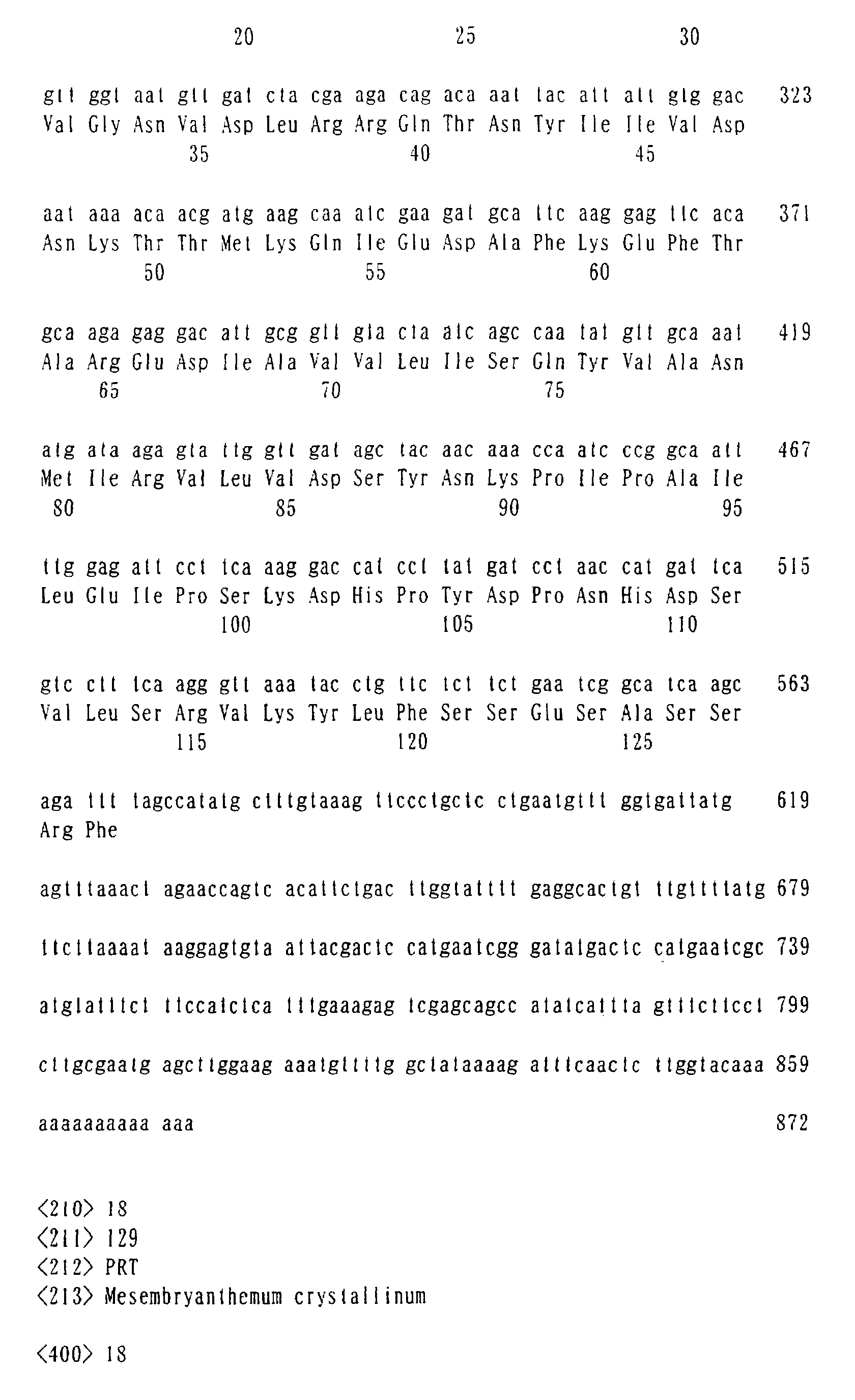
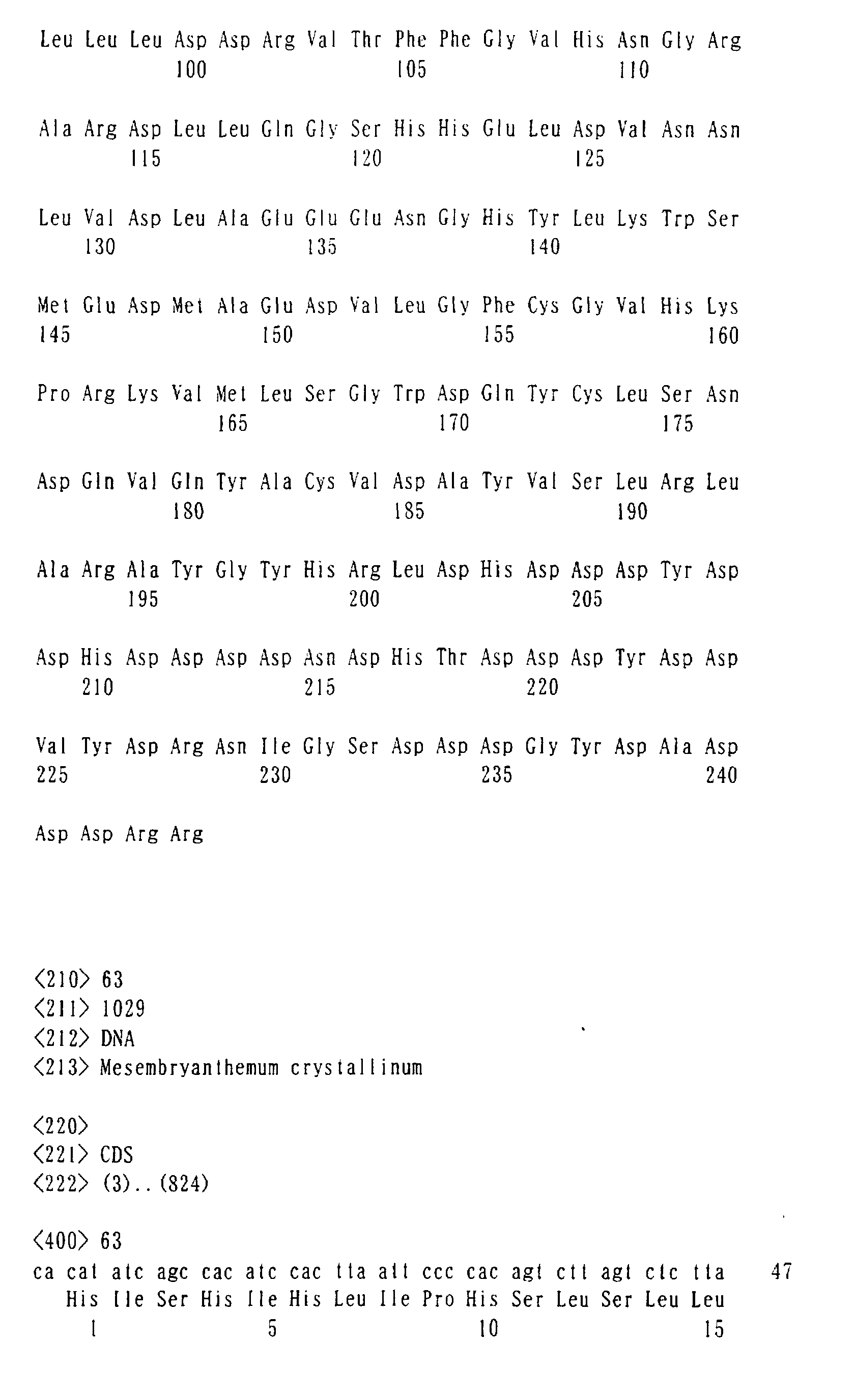
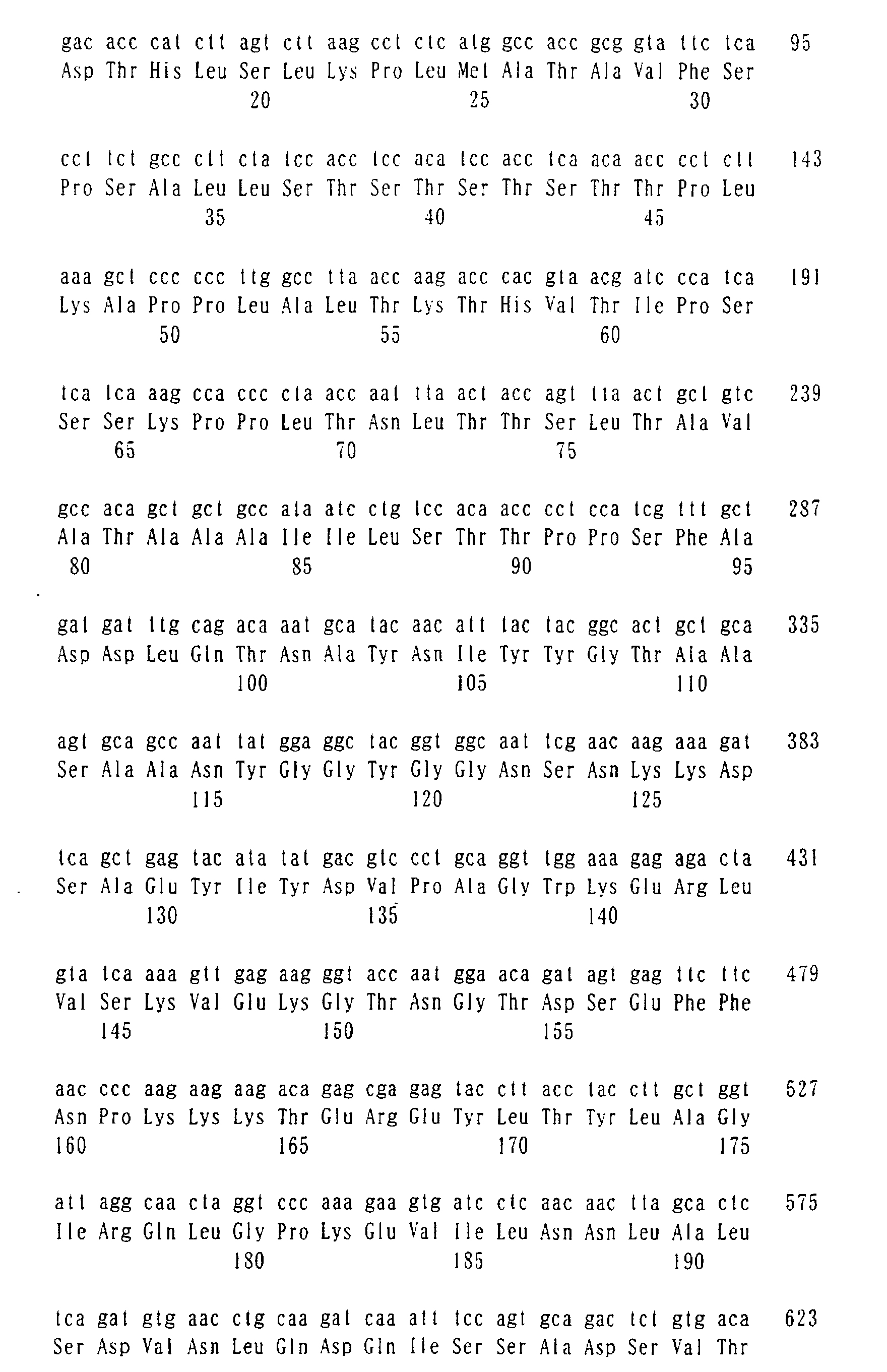
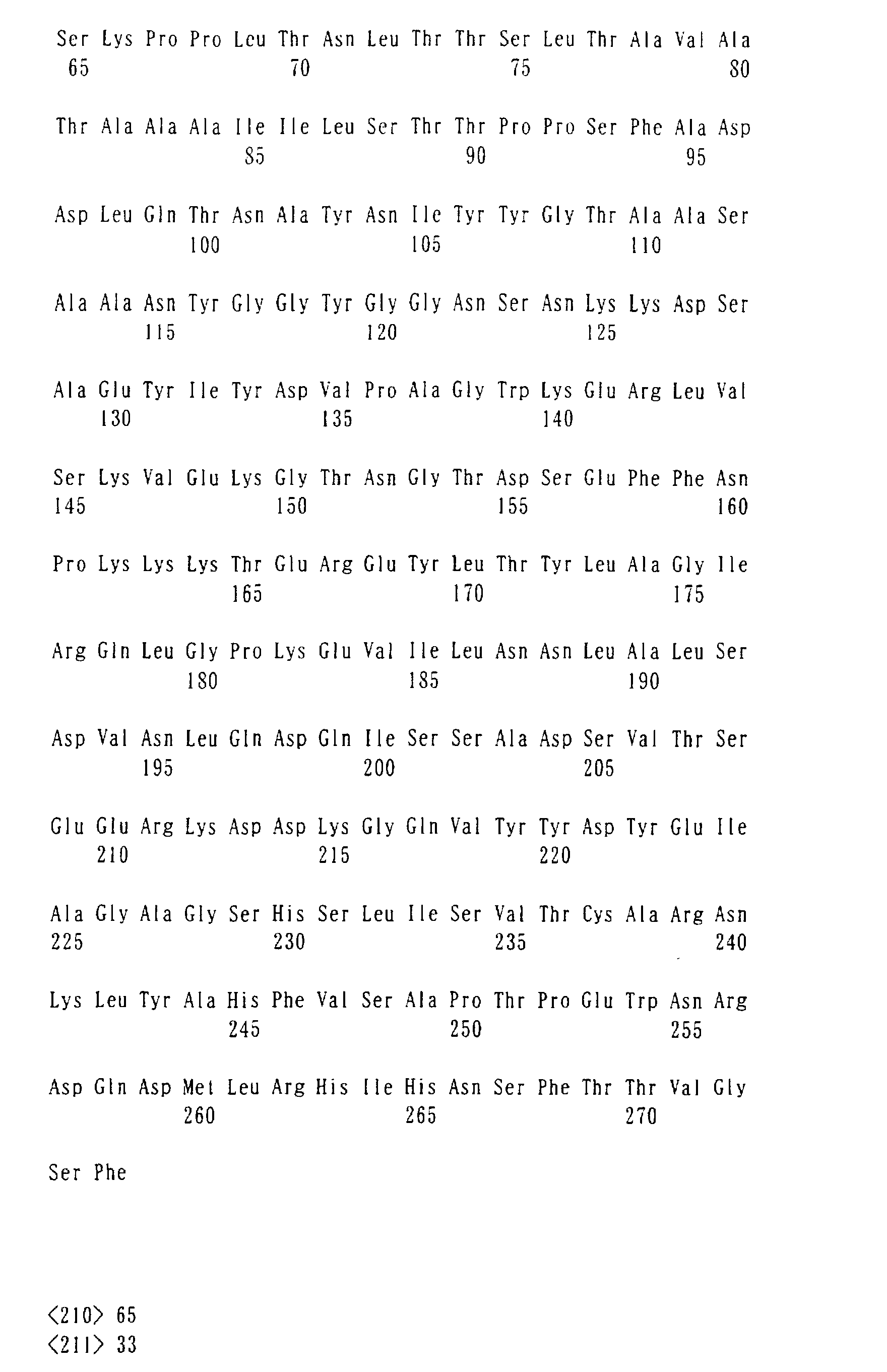
- DNA encoding proteins according to any one of the following (a) or (b): (a) a protein comprising the sequence of amino acids shown in Seq. ID No. 36, 38, 40, 42, 44, 46, 48, 50, 52, 54, 56, 58, 60, 62, or 64, (b) a protein comprising a sequence of amino acids wherein one or more of amino acids are deleted, substituted, or added in the sequence of amino acids shown in Seq. ID No.
- the invention also relates to a method for improving environmental stress tolerance, wherein the DNA according to any one of claims 8 to 66 is used (claim 67), the method for improving the environmental stress tolerance according to claim 67, wherein the environmental stress is one or more of chemical substance stress, high temperature stress, low temperature stress, freezing stress, drought stress, ozone stress, ultraviolet stress, radiation stress, and/or osmotic pressure stress (claim 68), and the method for improving environmental stress tolerance according to claim 68, wherein the chemical substance stress is salt stress (claim 69).
- the invention also relates to a protein comprising of the sequence of amino acids shown in Seq. ID No. 2 (claim 70), a protein having 70% or more of homology with the sequence of amino acids shown in Seq. ID No. 2, and having the activity of improving tolerance at least against salt stress (claim 71), a protein comprising a sequence of amino acids wherein one or more amino acids are deleted, substituted, or added in the sequence of amino acids shown in Seq. ID No. 2, and having the activity of improving tolerance at least against salt stress (claim 72), a protein comprising the sequence of amino acids shown in Seq. ID No. 4 (claim 73), a protein comprising a sequence of amino acids wherein one or more amino acids are deleted, substituted, or added in the sequence of amino acids shown in Seq.
- a protein comprising the sequence of amino acids shown in Seq. ID No. 14 (claim 83), a protein comprising a sequence of amino acids wherein one or more amino acids are deleted, substituted, or added in the sequence of amino acids shown in Seq. ID No. 14, and having the activity of improving tolerance at least against salt stress (claim 84), a protein comprising the sequence of amino acids shown in Seq. ID No. 16 (claim 85), a protein comprising a sequence of amino acids wherein one or more amino acids are deleted, substituted, or added in the sequence of amino acids shown in Seq. ID No.
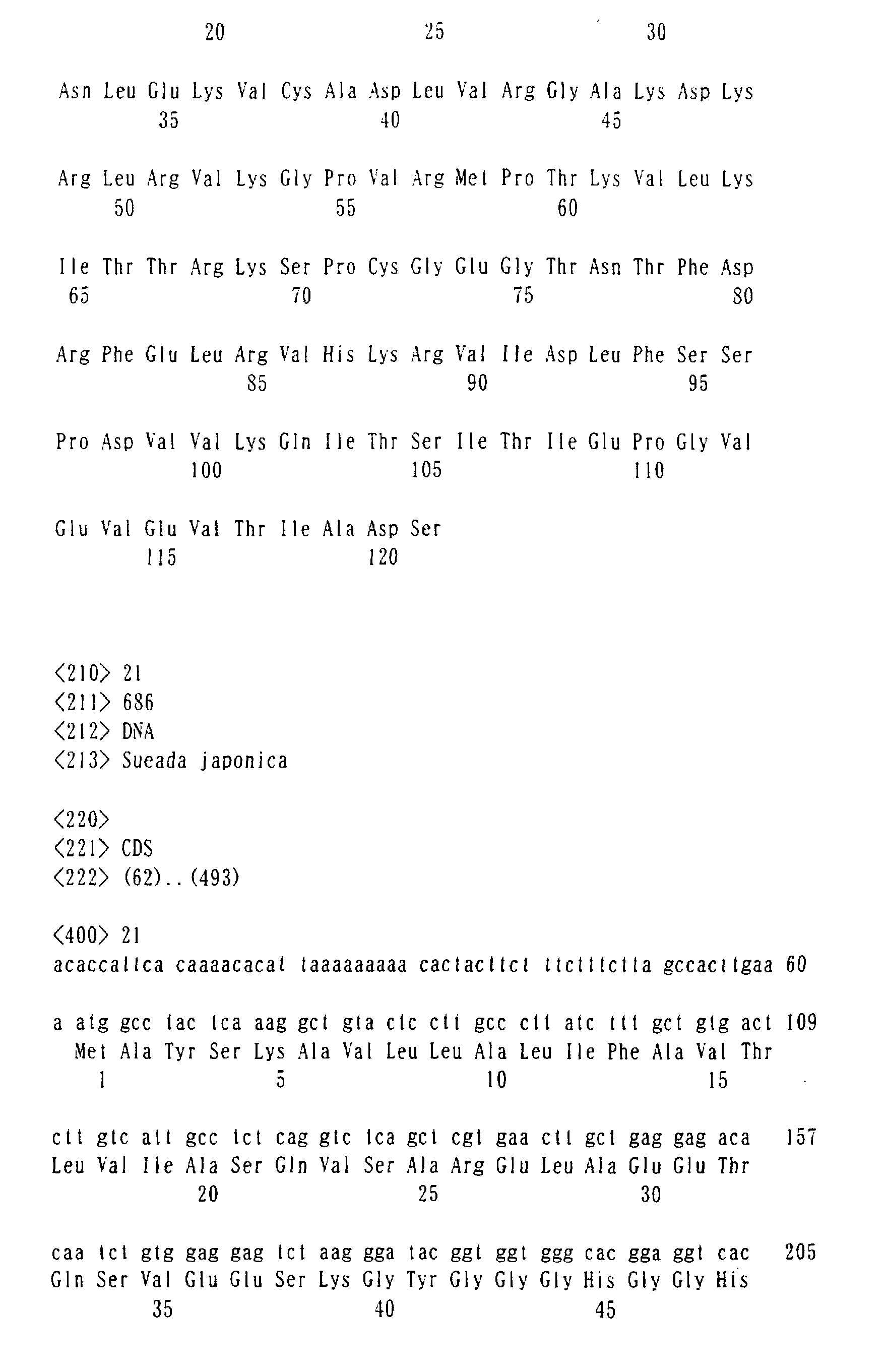
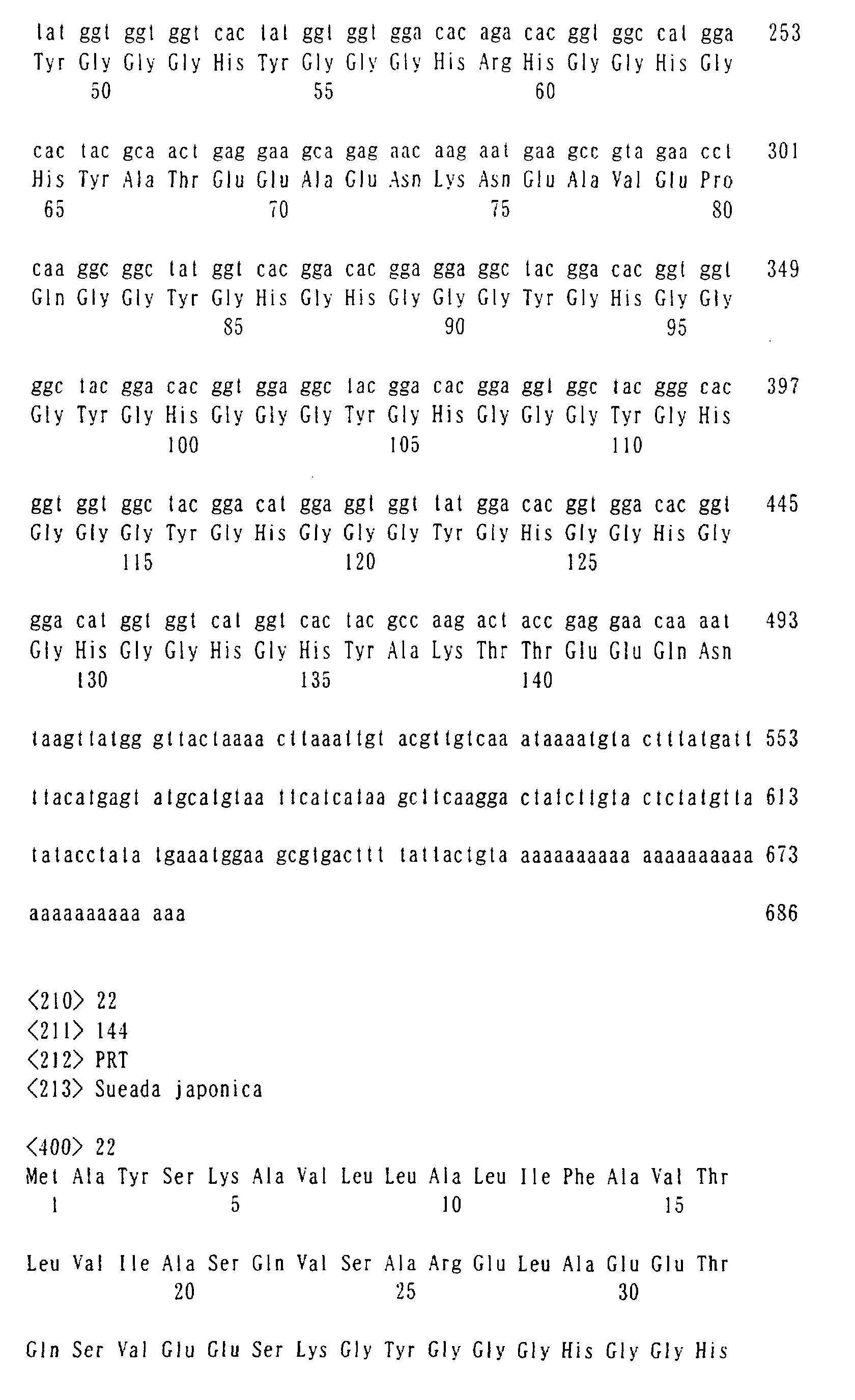
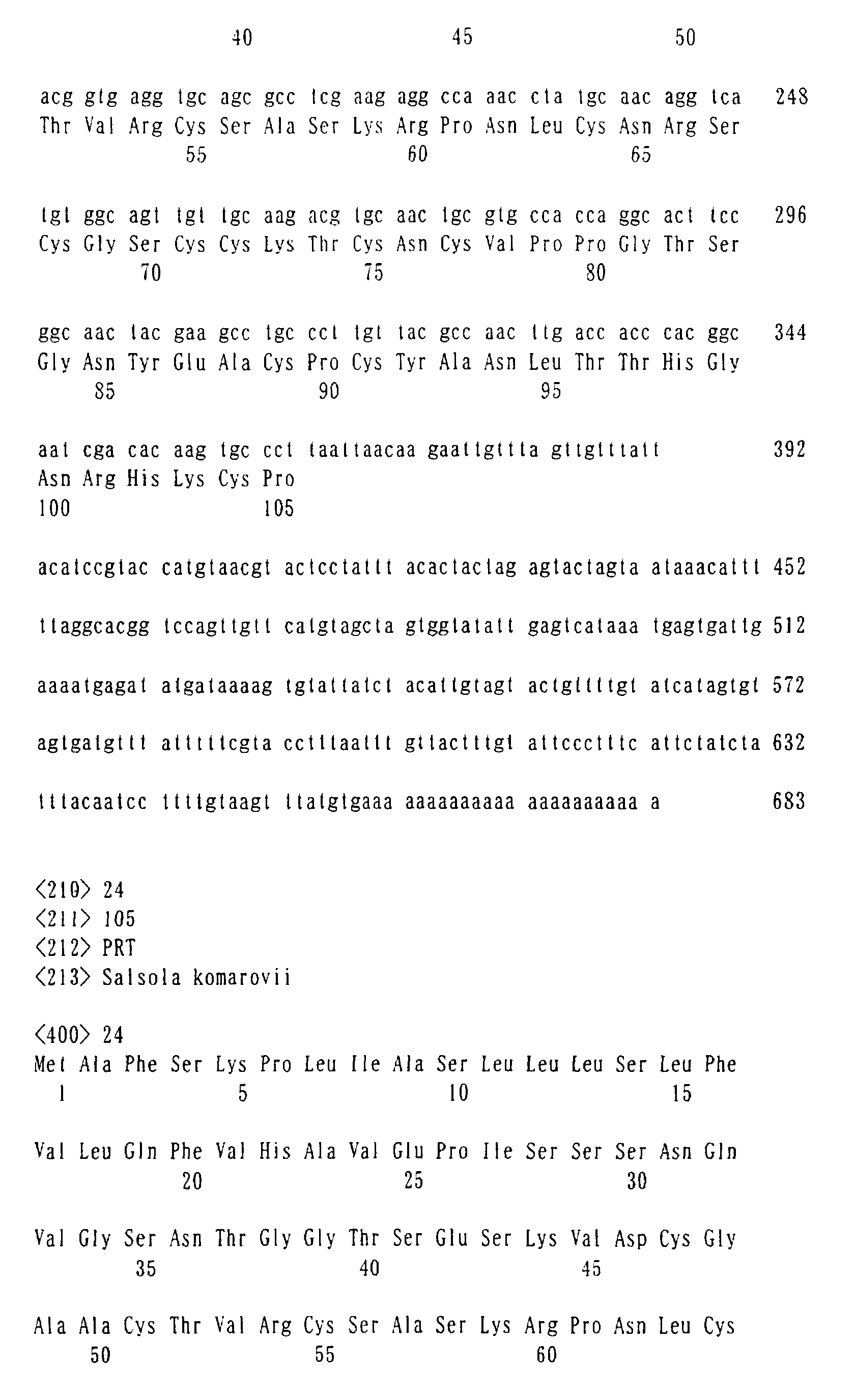
- a protein comprising the sequence of amino acids shown in Seq. ID No. 22 (claim 91), a protein comprising a sequence of amino acids wherein one or more amino acids are deleted, substituted, or added in the sequence of amino acids shown in Seq. ID No. 22, and having the activity of improving tolerance at least against salt stress (claim 92), a protein comprising the sequence of amino acids shown in Seq. ID No. 24 (claim 93), a protein comprising a sequence of amino acids wherein one or more amino acids are deleted, substituted, or added in the sequence of amino acids shown in Seq. ID No.
- a protein comprising the sequence of amino acids shown in Seq. ID No. 26 (claim 95), a protein comprising a sequence of amino acids wherein one or more amino acids are deleted, substituted, or added in the sequence of amino acids shown in Seq. ID No. 26, and having the activity of improving tolerance at least against salt stress (claim 96), a protein comprising the sequence of amino acids shown in Seq. ID No. 28 (claim 97), a protein comprising a sequence of amino acids wherein one or more amino acids are deleted, substituted, or added in the sequence of amino acids shown in Seq. ID No.
- a protein comprising the sequence of amino acids shown in Seq. ID No. 30 (claim 99), a protein comprising a sequence of amino acids wherein one or more amino acids are deleted, substituted, or added in the sequence of amino acids shown in Seq. ID No. 30, and having the activity of improving tolerance at least against salt stress (claim 100), a protein comprising the sequence of amino acids shown in Seq. ID No. 32 (claim 101), a protein comprising a sequence of amino acids wherein one or more amino acids are deleted, substituted, or added in the sequence of amino acids shown in Seq. ID No.
- the present invention also relates to an antibody specifically bound to the protein according to any one of claims 70 to 72 (claim 107), an antibody specifically bound to the protein according to any one of claims 73 to 104 (claim 108), an antibody specifically bound to the protein according to any one of claims 105 or 106 (claim 109), and the antibody according to any one of claims 107 to 109, wherein the antibody is a monoclonal antibody (claim 110).
- the present invention also relates to a vector comprising the DNA encoding proteins having the activity of improving tolerance against environmental stresses according to any one of claims 8 to 12 (claim 111), a vector comprising the DNA according to any one of claims 13 to 15 (claim 112), a vector comprising the DNA according to any one of claims 16 to 63 (claim 113), and a vector comprising the DNA according to any one of claims 64 to 66 (claim 114).
- the present invention also relates to a transformed cell obtained by introducing the vector according to any one of claims 111 to 114 (claim 115), a transformed cell according to claim 115, wherein the host cell is a plant cell (claim 116), and a method for producing proteins having the activity of improving environmental stress tolerance, wherein the transformed cells according to either of claims 115 or 116 is cultured, and recombinant proteins are collected from the transformed cells or the supernatant of the cultured liquid (claim 117).
- the present invention also relates to a transgenic plant obtained by introducing the DNA according to any one of claims 8 to 12 encoding proteins having the activity of improving environmental stress tolerance, and by dividing, proliferating and redifferentiating the plant cell (claim 118), a transgenic plant obtained by introducing the DNA according to any one of claims 13 to 15 encoding proteins having the activity of improving environmental stress tolerance, and by dividing, proliferating and redifferentiating the plant cell (claim 119), a transgenic plant obtained by introducing the DNA according to any one of claims 16 to 63 encoding proteins having the activity of improving environmental stress tolerance, and by dividing, proliferating and redifferentiating the plant cell (claim 120), a transgenic plant obtained by introducing the DNA according to any one of claims 64 to 66 encoding proteins having the activity of improving environmental stress tolerance, and by dividing, proliferating and redifferentiating the plant cell (claim 121), a transgenic plant obtained by introducing the vector according to any one of claims 111 to 114
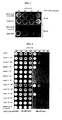
- Fig. 1 shows the result of detecting salt tolerance of coliforms (SOLR) wherein mang1 is introduced. Colony forming was used as an index for detection. As a control, a vector (pBluescript SK) was used alone. Measurement was carried out with two levels of salt (NaCl) concentration.
- Fig. 2 shows the result of detecting salt tolerance of the coliforms wherein various parts of a sequence of mang1 were introduced. Colony forming was used as an index for detection. As a control, a vector (pBluescript SK) was used alone. Measurement was carried out with two levels of salt (NaCl) concentration. The numbers in the parentheses indicate the numbers of amino acids, and "*" indicates cDNA of mang1 containing coding and non-coding regions.
- Fig. 3 shows the result of measuring the time-course growth of the yeast introduced with mang1 under the condition of high concentration of salt.
- Cell concentration was used as an index for detection.
- a vector pYES2
- Measurement was carried out with two levels of salt (NaCl) concentrations.
- Fig. 4 shows the result of measuring the growth of the tobacco-cultured cells wherein mang1 was introduced under the condition of high concentration of salt. Wet weight was used as an index for detection. As a control, a vector (GUS) was used alone. Measurement was carried out with three concentrations of salt (NaCl).
- Fig. 5 shows the result of measuring the growth of the tobacco plant organisms wherein mang1 was introduced under the condition of high concentration of salt (150mM of NaCI).
- a and C indicate the tobaccos wherein a vector (GUS) alone was introduced, and B and D indicate the tobaccos wherein manglis introduced.
- Fig. 6 shows the result of examining thermal stress tolerance of coliforms (SOLR) wherein mang1 was introduced.
- the thermal stress tolerance was evaluated with the growing curve in the culture at 40 °C as an index.
- the SOLR introduced with a vector (pBluesript SK) alone was used.
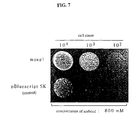
- Fig. 7 shows the result of examining the osmotic pressure tolerance of the coliforms (SOLR) wherein mang1 was introduced.
- the osmotic pressure tolerance was evaluated with the growth on 2YT agar medium containing 800mM of sorbitol as an index.
- the SOLR introduced with a vector (pBluescript SK) alone was used.
- Fig. 8 shows the result of examining the freezing stress tolerance of coliforms (SOLR) wherein mangl was introduced.
- the freezing stress tolerance was evaluated with the growth of cell bodies treated with freezing and melting method on 2YT agar medium.
- a SOLR wherein only vectors (pBluescript SK) were introduced was used.
- Fig. 9 shows a region considered as minimal functional region of mangl (mangl core), and the sequences of bases and amino acids of clones wherein mutants were introduced.
- the white letters in the sequences of bases and amino acids shows the mutated positions.
- Fig. 10 shows the regions considered as minimal functional region of mangl, and the result of the growth of the clones, the regions of which are introduced with mutation, on the agar mediums containing 85mM, 350mM, and 500mM of NaCl.
- SOLR introduced with a vector pBluescript
- Any method for screening DNA encoding proteins having activity of improving environmental stress tolerance in the present invention can be employed as long as it introduces candidate cDNA derived from cDNA library into host cells, cultures obtained transformed cells under the conditions where host cells are substantially unable to grow, selects clones growing after cultivation, and isolates candidate cDNA introduced from the selected clones.
- This screening method can be used to improve functions of proteins having activity of improving environmental stress tolerance obtained by this method.
- a method for screening DNA encoding proteins having activity of improving other types of environmental stress tolerance in the present invention can be exemplified by a screening method wherein candidate cDNA derived from cDNA library was introduced into host cells, the obtained transformed cells are cultured under the environment where host cells cannot substantially grow, the matured clones were selected after the cultivation, the selected clones candidate cDNA was isolated from the selected clones wherein the cDNA was introduced, random mutants were introduced into isolated candidate cDNA, the mutant cDNA was introduced into host cells, and the process of selection under more stringent conditions than the condition for selecting cDNA before mutation was repeated once or more.
- PCR is a method generally used, and the method to lower the fidelity by adding manganese to PCR reactive solution (A Journal of Methods in Cell and Molecular Biology 1, 11-15, 1989, Yeast 8, 79-82, 1992) is the easiest one.
- DNA shuffling Proc Natl Acad Sci USA 91, 10747-10751, 1994
- Environmental stress mentioned above can be any kind of stress based on environmental factors, including chemical substance stress, high-temperature stress, low-temperature stress, freezing stress, drought stress, ozone stress, ultraviolet stress, radiation stress, osmotic pressure stress, and such environmental stresses can be based on either one single factor or a plurality of stresses.
- a chemical substance stress can be any stress caused by chemical substance, and is exemplified by salt stress or toxic substance stress.
- cDNA library prepared from organic species such as halophilous plants, including mangroves (Sonneatia, Bruguiera, Kandelia, Rhizophora, Lumnitzera, Salsola komarovii, Nypa), Mesembryanthemum, Sueada japonica, Aster tripolium, Salicornia, Suaeda, and Atriplex subcordata Kitag can be used.
- a method of preparing cDNA library can be any one well known to a person having ordinary skill in the art. For example, as disclosed in the examples, extraction of total mRNA from cells can be prepared following the method in Ostrem et al. (Plant Physiol. 84, 1270-1275, 1987), and poly(A) +RNA can be purified from mRNA prepared with Oligotex-dT30 ⁇ super> (Daiichi Kagakusha).
- the cDNA library can be constructed by using ZAP-cDNA/Gigapack Cloning Kit (Stratagen) based on the purified poly(A) +RNA.
- a host cell wherein candidate cDNA was introduced as a target of screening derived from the cDNA library can be a cell in microorganism such as bacteria or yeast, or a cell in animals or plants, it is preferable to use animal cells whose knowledge on the host-vector system has been established, such as coliforms bacillus, Bacillus subtilis, Saccharomyces cerevisiae, BHK cells and the like. Among them, it is desirable to use coliforms bacillus because knowledge about it is abundant, it grows fast, and it is easy to handle.
- a host cell it is preferred to use a cell which cannot substantially grow under the condition where a transformed cell wherein candidate cDNA derived from cDNA library can grow, such as a salt sensitive cell or a thermal salt sensitive cell.
- a salt sensitive cell such as a salt sensitive cell or a thermal salt sensitive cell.
- Such cells can be prepared by screening or mutating wild type strains.
- transformation of cells can be performed by introducing candidate cDNA derived from cDNA library into the host cell, and such a method of introduction can be any well-known method of gene introduction such as transformation method or electroporation.
- the transformed cells wherein candidate cDNA is introduced are cultured under environment where the host cells cannot substantially grow, including under the condition of high concentration of salt, the condition of high temperature, the condition of drought.
- the matured clones can be selected by well known methods after cultivation, and candidate cDNA introduced from the selected clones can be isolated by the method.
- the environmental stress is salt stress and the host cell is coliform.
- a coliform used as a host cell it is preferable to use a coliform whose function of salt tolerance is degraded, and more preferably a coliform with a minimal concentration of salt inhibiting their growth.
- a coliform sensitive to NaCl can be exemplified by SOLR strain (commercialized by TOYOBO, Stratagene, Riken gene bank, and others), a kind of coliform which the present inventors found, that it cannot grow on the agar medium containing a low level of salt (more than 350mM of NaCl).
- SOLR strain commercialized by TOYOBO, Stratagene, Riken gene bank, and others
- the SOLR strain contained in said ZAP-cDNA/Gigapack Cloning Kit (Stratagene) and in vivo excision system by ExAssist helper phage can be used for the introduction of candidate cDNA. All of these operations can easily be performed following the user's manual for the kit.
- the SOLR strain obtained in this ways wherein the candidate cDNA is introduced is cultured in a medium containing about 400mM of NaCl and the matured cells are selected to select clones transformed by the DNA encoding proteins having salt tolerance.
- selection of clones may be carried out by culturing on agar medium for 8 to 20 hours at 37°C and select colonies formed on the agar.
- a method for isolating cDNA from the selected clones a method disclosed in a reference (Current Protocols in Molecular Biology (Greene Publishing Associates and Wiley-Interscience, 1987) can be performed by extracting plasmid DNA.
- the screening to obtain the targeted transformed coliforms can be carried out repeatedly for several times.
- the coliforms wherein cDNA library was introduced are cultured in a medium containing the minimal concentration of salt inhibiting their growth, and select the clones which can grow under this condition (first screening).
- the cDNA are isolated from the selected clones , and are reintroduced into coliforms.
- the coliforms are cultured in a medium containing a higher concentration of salt than the minimal concentration of salt inhibiting their growth, and the clones which can grow under this condition are selected (second screening). By repeating such process of screening, the efficiency of isolating the genes relevant to salt tolerance can be improved.
- the second screening can be carried out by using mutant cDNA wherein random mutants are introduced into isolated cDNA.
- DNA encoding proteins having activities of improving the environmental stress tolerance in the present invention there are no particular restrictions on the DNA encoding proteins having activities of improving the environmental stress tolerance in the present invention as long as the DNA can be obtained by the method for screening, and it can be exemplified by the DNA encoding proteins having activities of improving tolerance against one or more of chemical stress such as salt stress, thermal stress, drought stress, ozone stress, ultraviolet stress, radiation stress, osmotic pressure stress.
- DNA encoding proteins having activities of improving salt stress tolerance can be exemplified as DNA derived from plants, preferably DNA derived from halophytes such as Brugfuiera sexangula.
- An example of mangrove derived DNA encoding proteins having activities of improving salt stress tolerance can be exemplified as DNA having a sequence of bases shown in Seq.
- An example of Mesembryanthemum crystallinum derived DNA encoding proteins having activity of improving salt stress tolerance can be exemplified as DNA having a sequence of bases shown in Seq. ID No. 15, 17, 19, 35, 63 in the list of sequences.
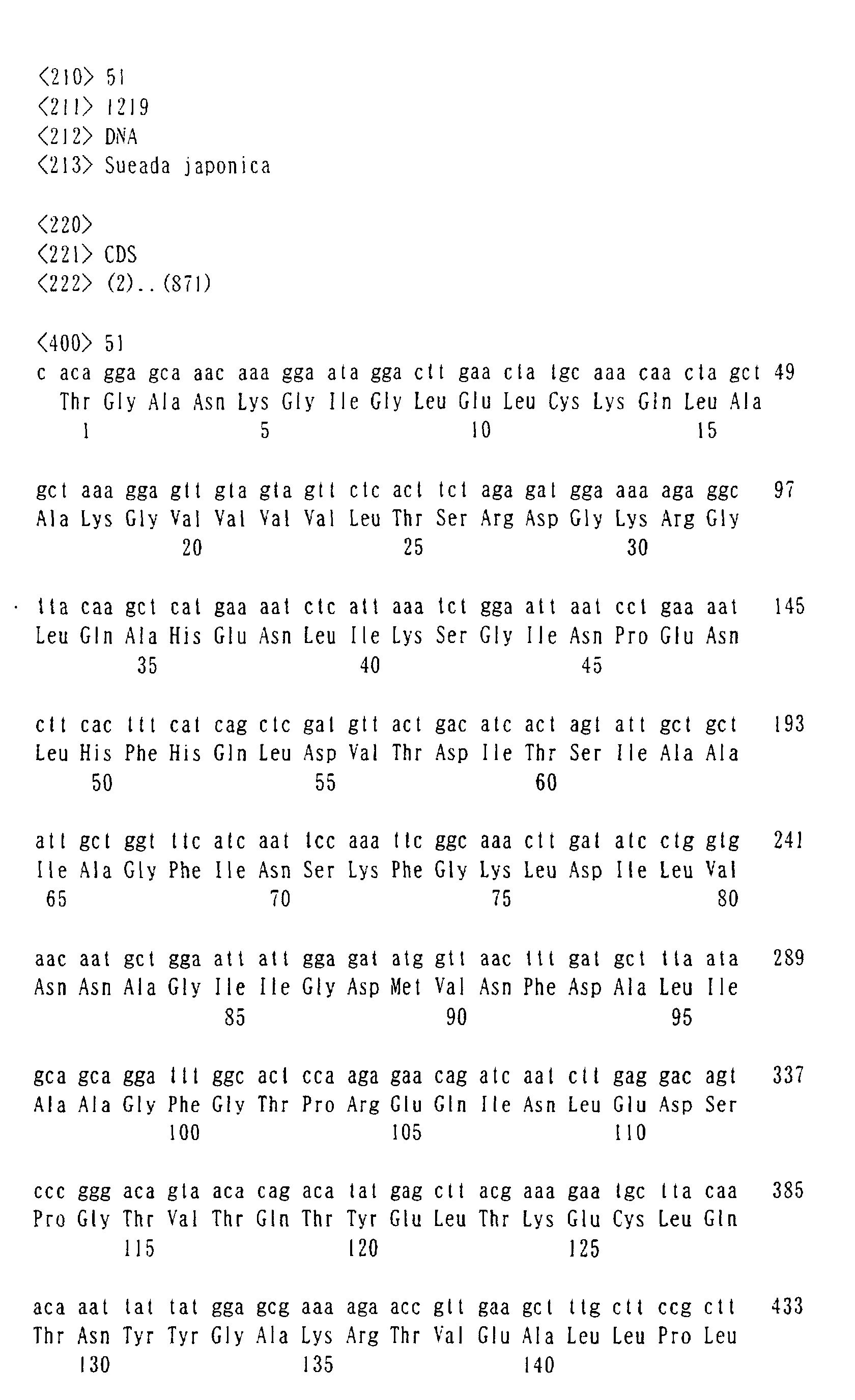
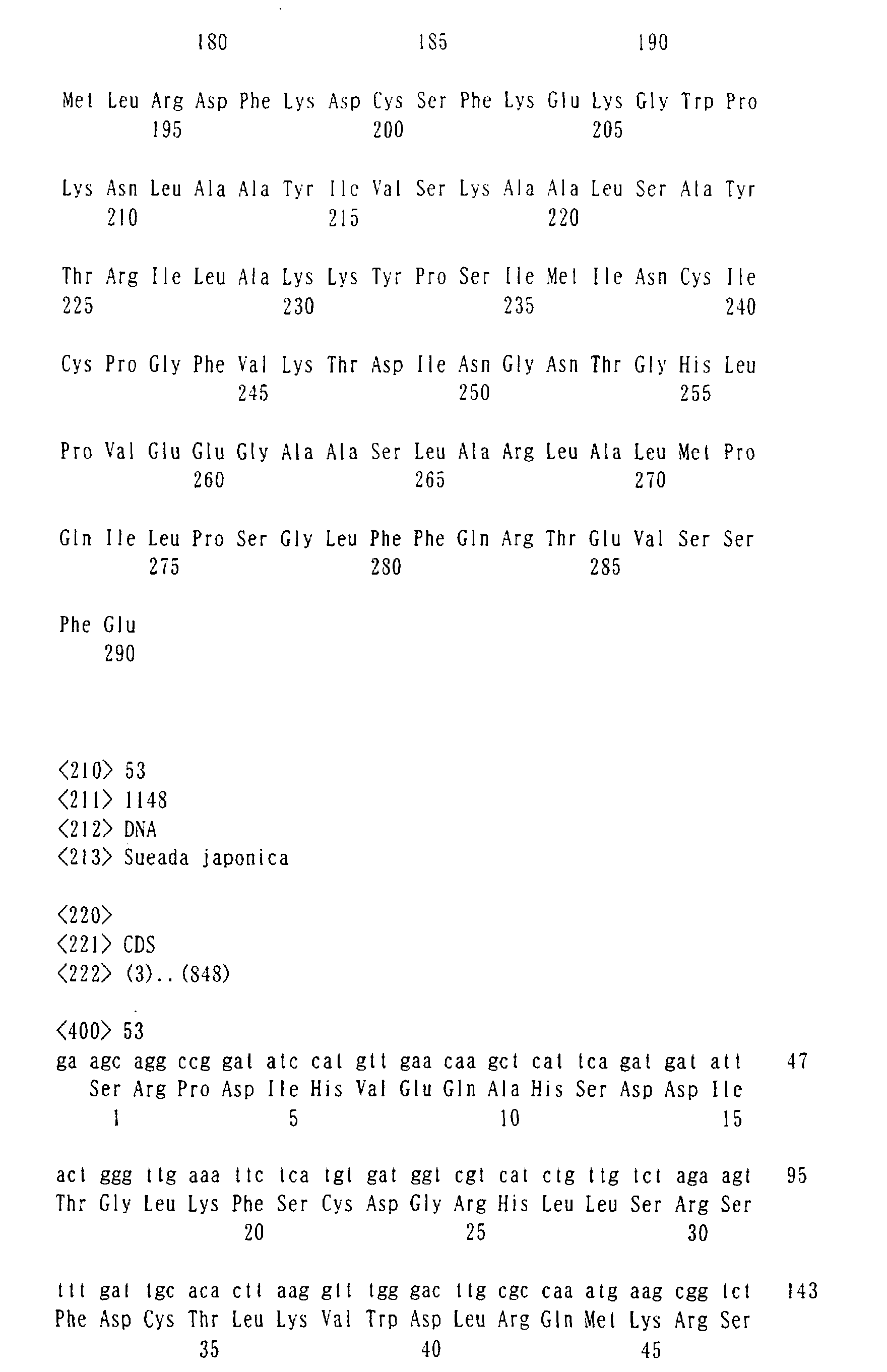
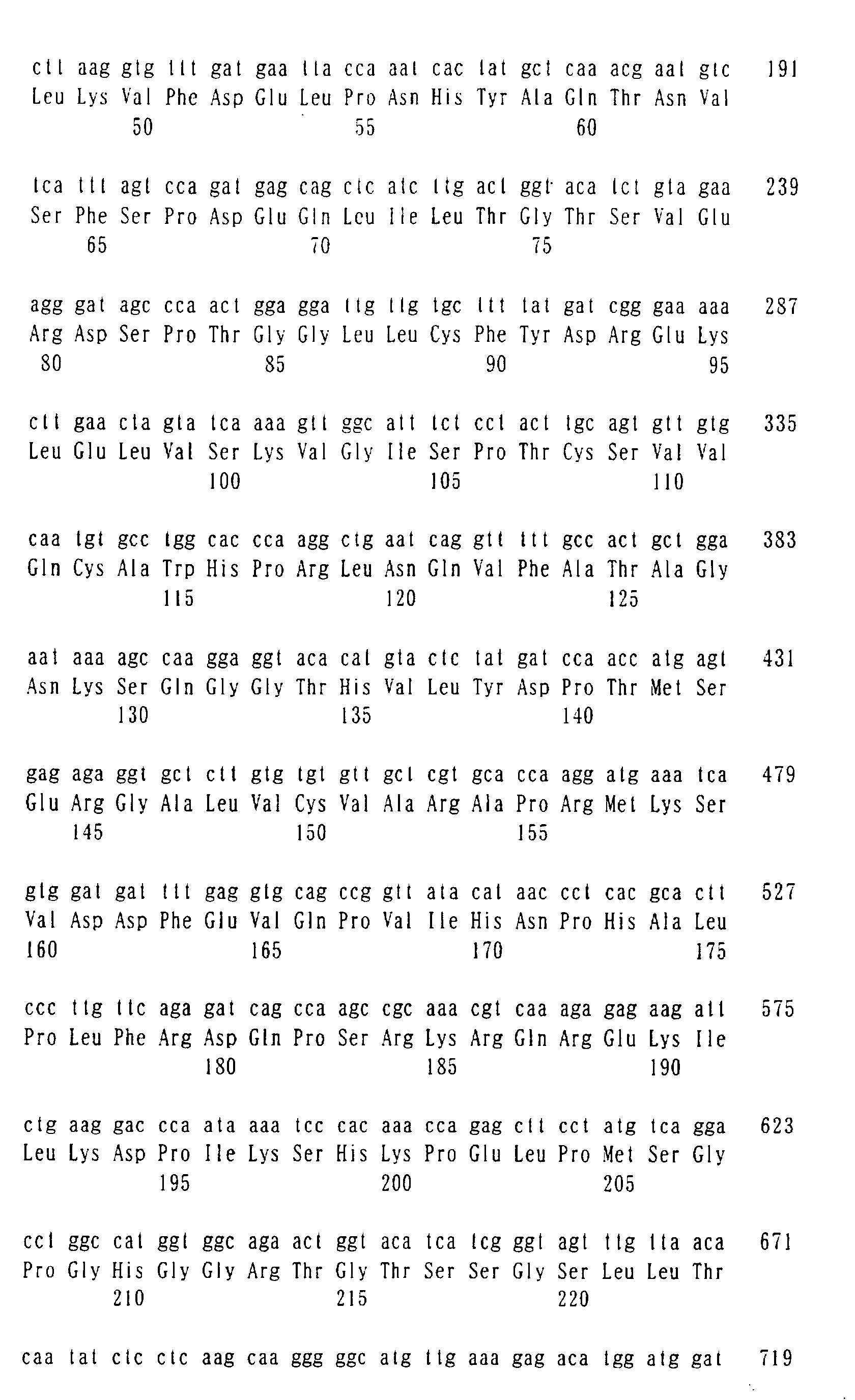
- An example of Sueada japonica derived DNA encoding proteins having activity of improving salt stress tolerance can be exemplified as DNA having a sequence of bases shown in Seq. ID No. 21, 37, 39, 51, 53, 57 in the list of sequences.
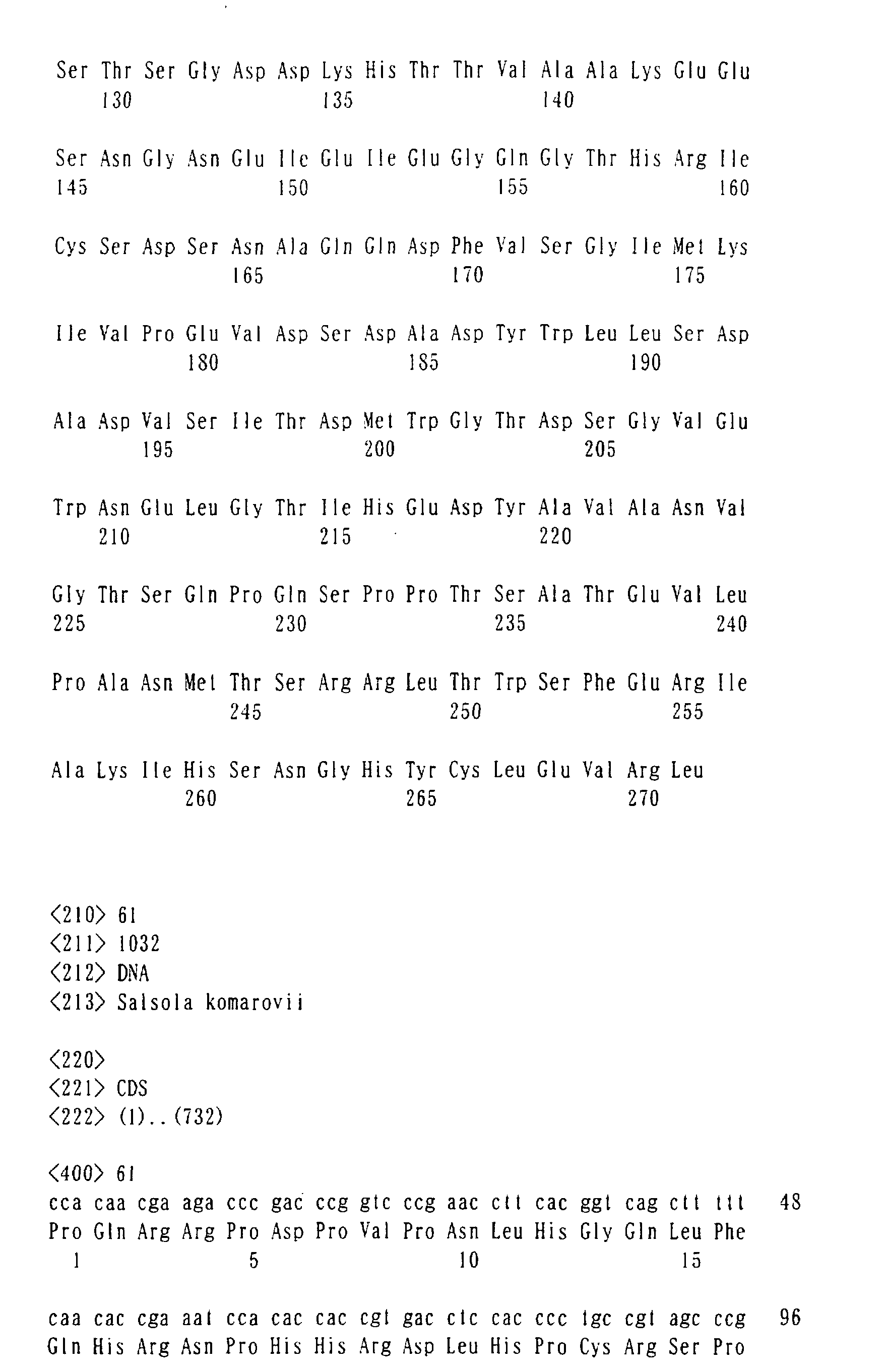
- Salsola komarovii derived DNA encoding proteins having activity of improving salt stress tolerance can be exemplified as DNA having a sequence of bases shown in Seq. ID No. 23, 25, 41, 47, 49, 59, 61 in the list of sequences.
- An example of Avicennia marina (a kind of mangrove) derived DNA encoding proteins having activities of improving salt stress tolerance can be exemplified as DNA having a sequence of bases shown in Seq. ID No. 27, 29, 31, 33, 43, 43, 55 in the list of sequences.
- DNA in the present invention can be exemplified as DNA having part or whole of a sequence of bases shown in the Seq. ID No. in the list of sequences or their complementary sequences, DNA which can hybridize with the DNA under stringent conditions and encodes proteins having activities of improving tolerance at least against salt stress, DNA which encodes proteins having a sequence of amino acids shown in Seq. ID No. 2, 4, 6, 8, 10, 12, 14, 16, 18, 20, 22, 24, 26, 28, 30, 32, 34, 36, 38, 40, 42, 44, 46, 48, 50, 52, 54, 56, 58, 60, 62, or 64 in the list of sequence, DNA which comprises a sequence of amino acids having 70% or more of homology with the sequence of amino acids shown in Seq. ID No.
- DNA which comprises a sequence of amino acids wherein one or more of the amino acids are deleted, substituted, or added in the sequence of amino acids shown in Seq. ID No. 2, 4, 6, 8, 10, 12, 14, 16, 18, 20, 22, 24, 26, 28, 30, 32, 34, 36, 38, 40, 42, 44, 46, 48, 50, 52, 54, 56, 58, 60, 62, or 64 in the list of sequence, and encodes proteins having activities of improving tolerance at least against salt stress. It has not been reported that tolerance to salt or the like is improved by introducing the DNA into various organisms, and it is found by the present inventors for the first time.
- Proteins in the present invention can be exemplified as proteins having a sequence of amino acids shown in Seq. ID No. 2, 4, 6, 8, 10, 12, 14, 16, 18, 20, 22, 24, 26, 28, 30, 32, 34, 36, 38, 40, 42, 44, 46, 48, 50, 52, 54, 56, 58, 60, 62, or, 64 in the list of sequence, proteins which have a sequence of amino acids having 70% or more of homology with the sequence of amino acids shown in Seq. ID No. 2 in the list of sequence and have activity of improving tolerance at least against salt stress, or proteins which have a sequence of amino acids wherein one or more of amino acids are deleted, substituted, or added in the sequence of amino acids shown in Seq. ID No.
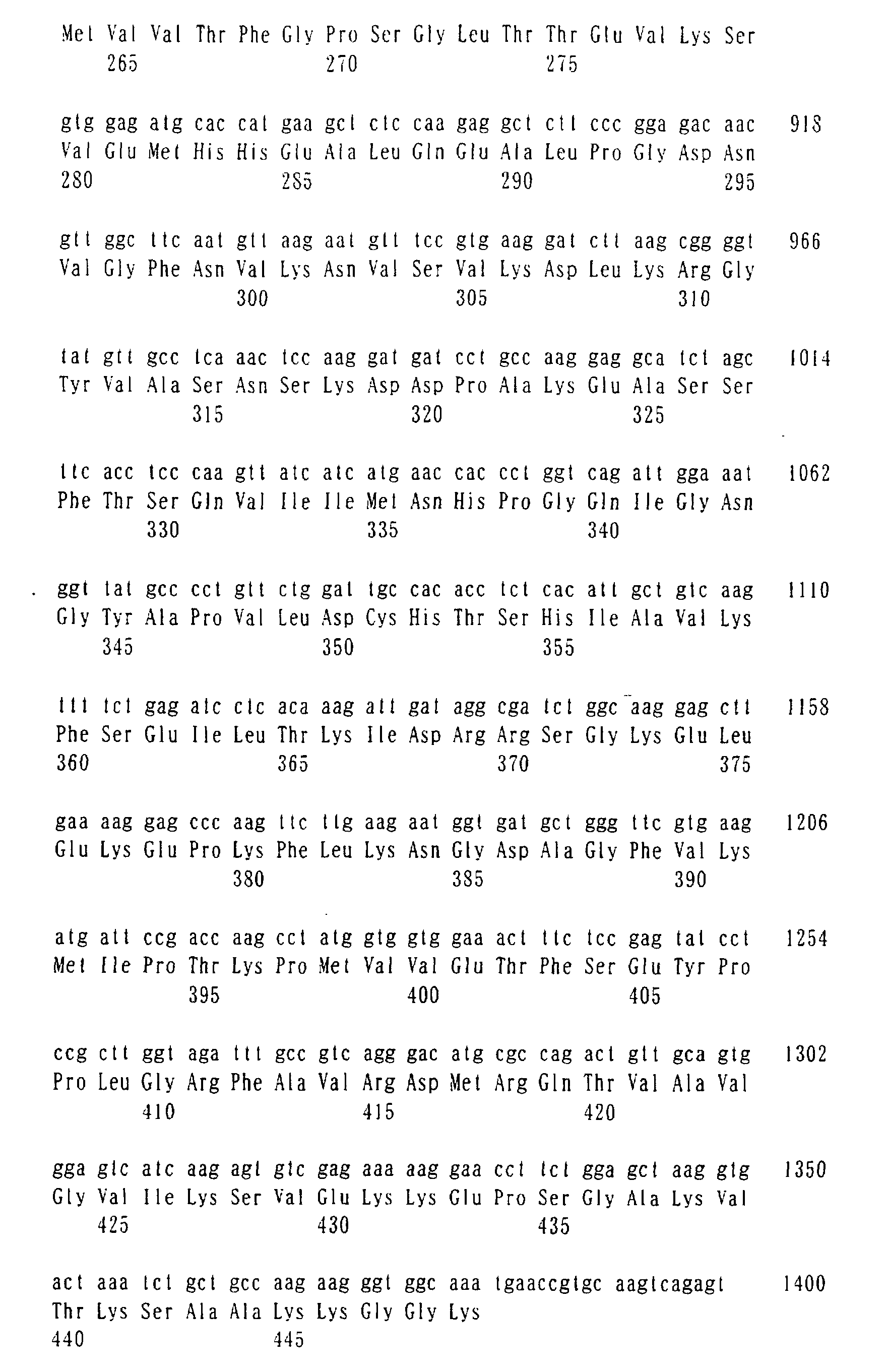
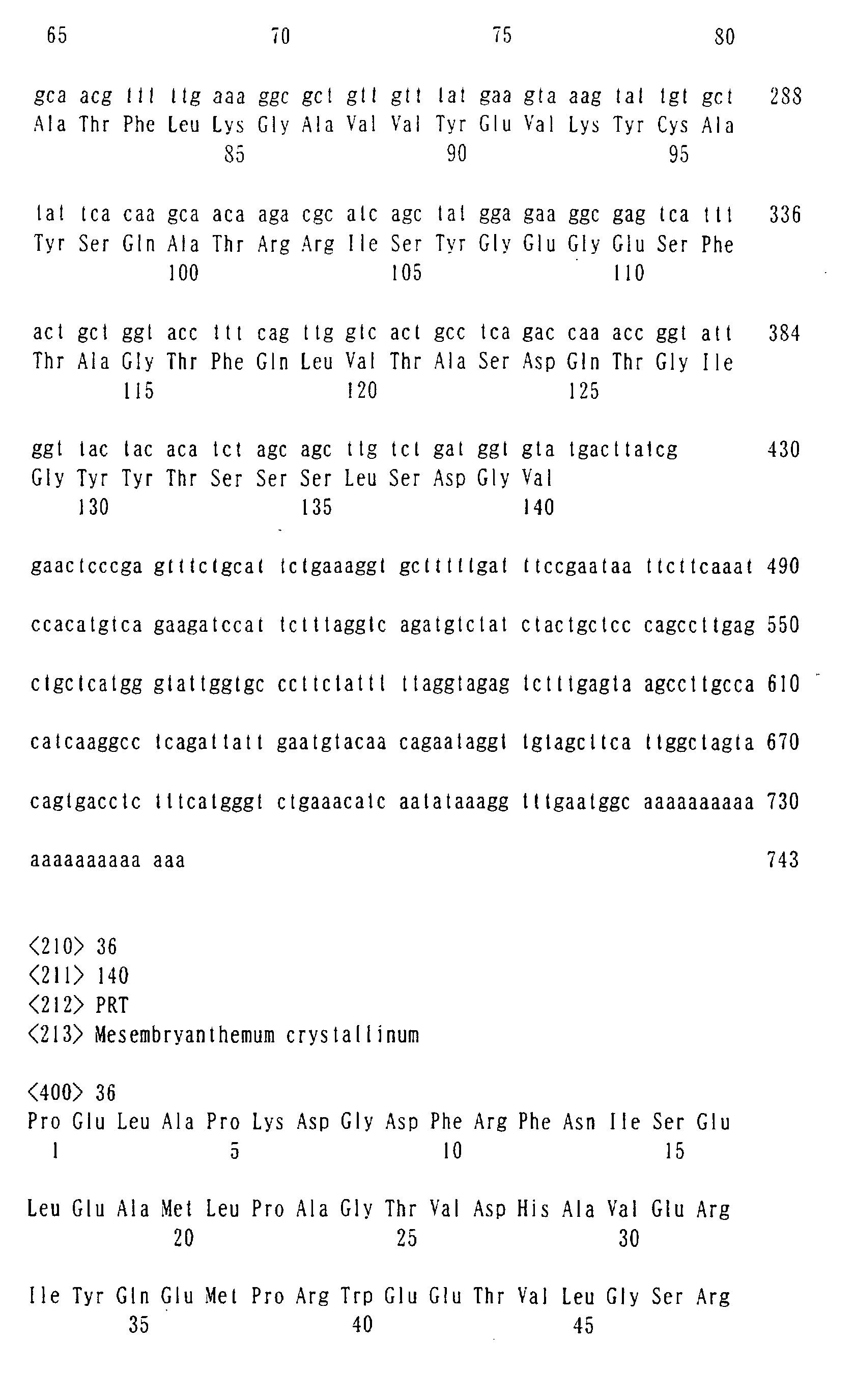
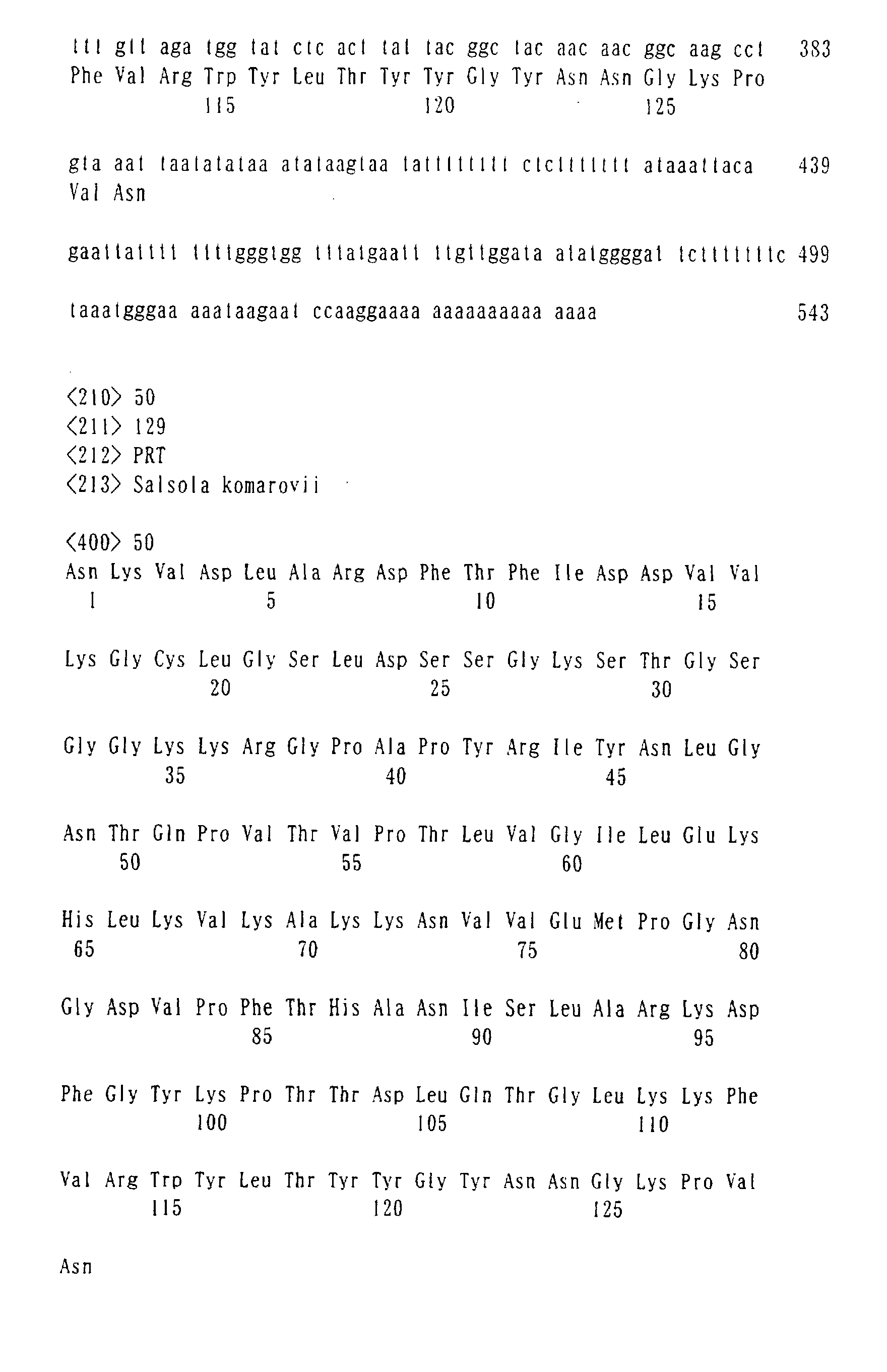
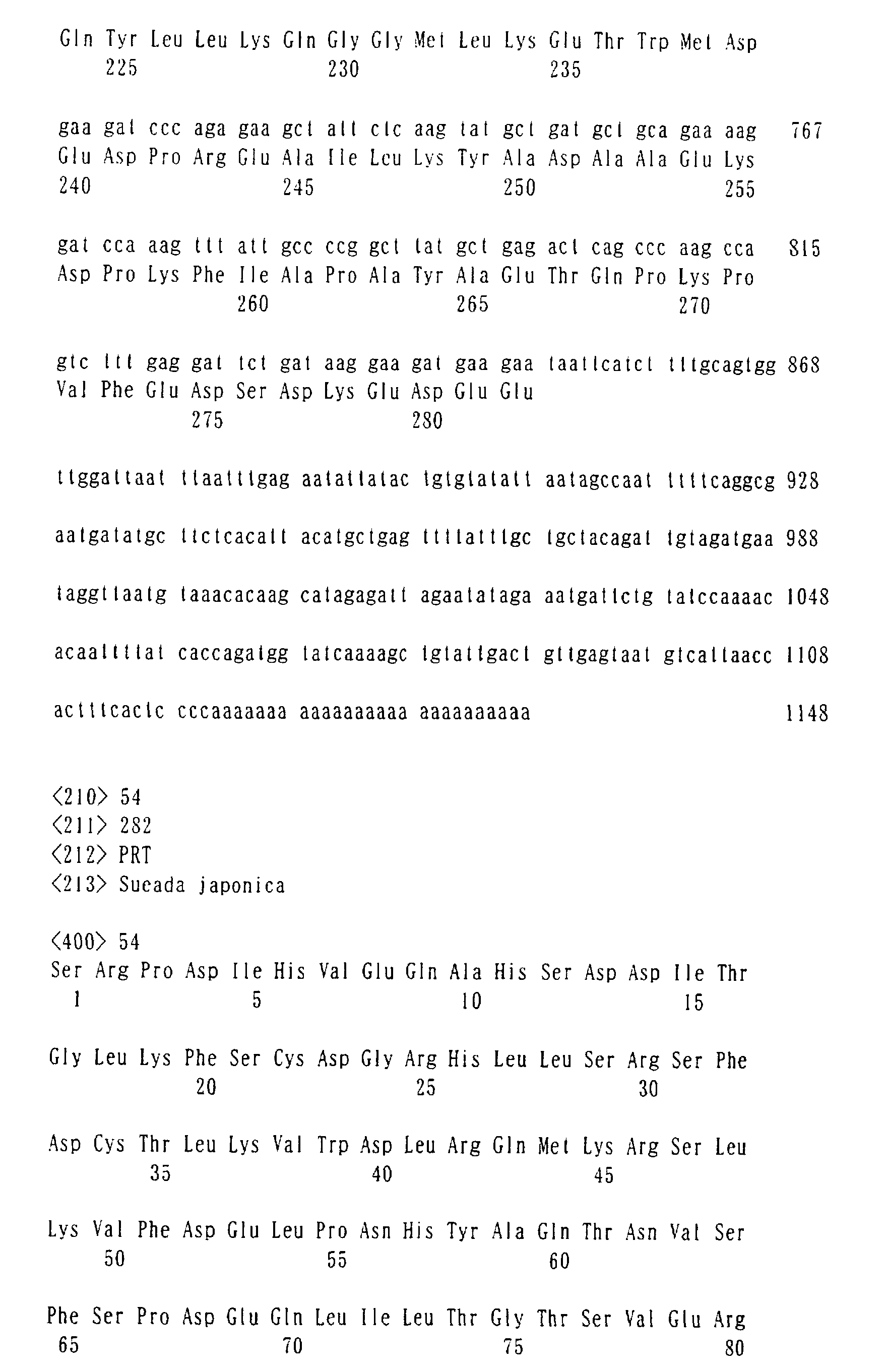
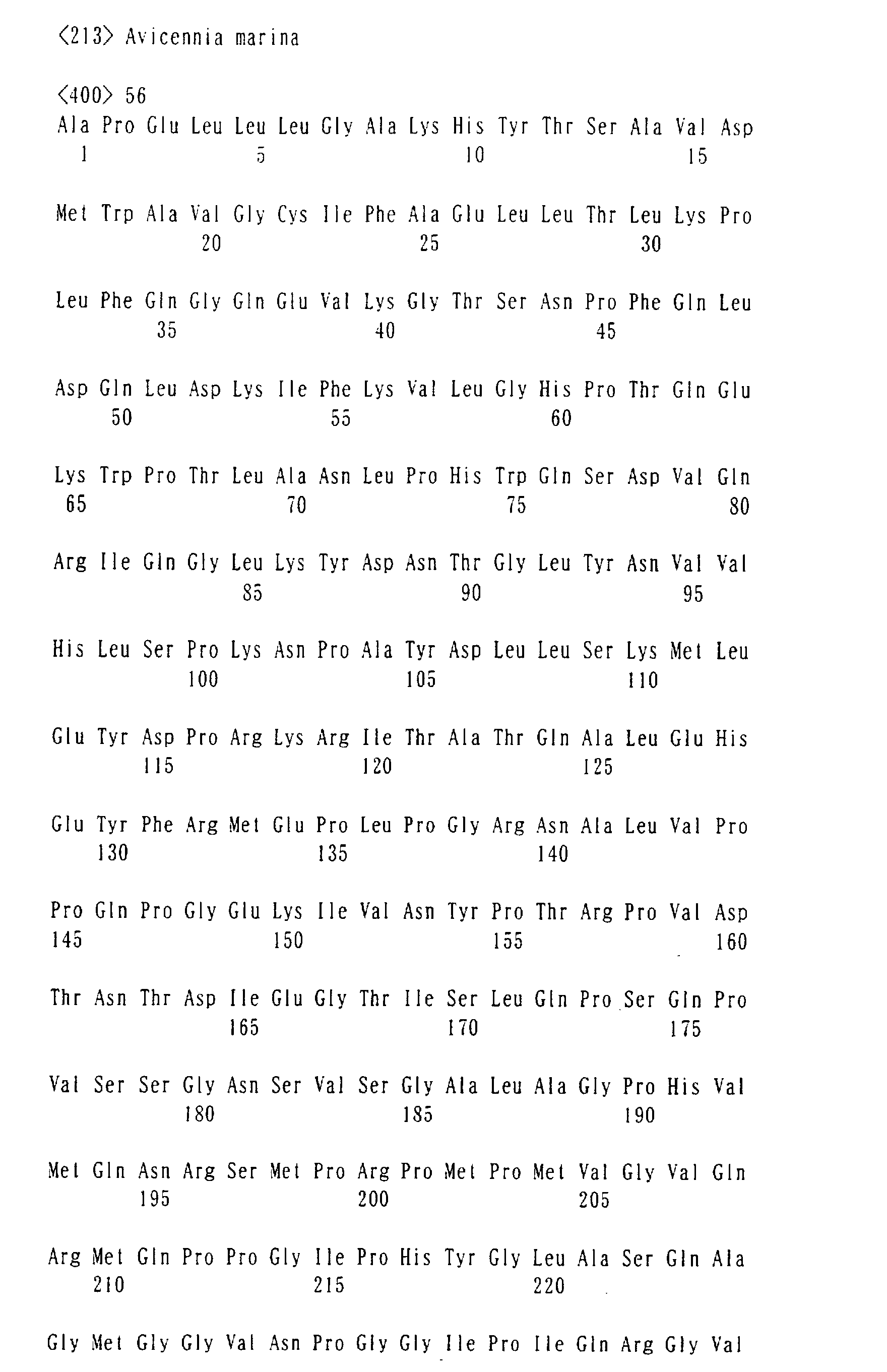
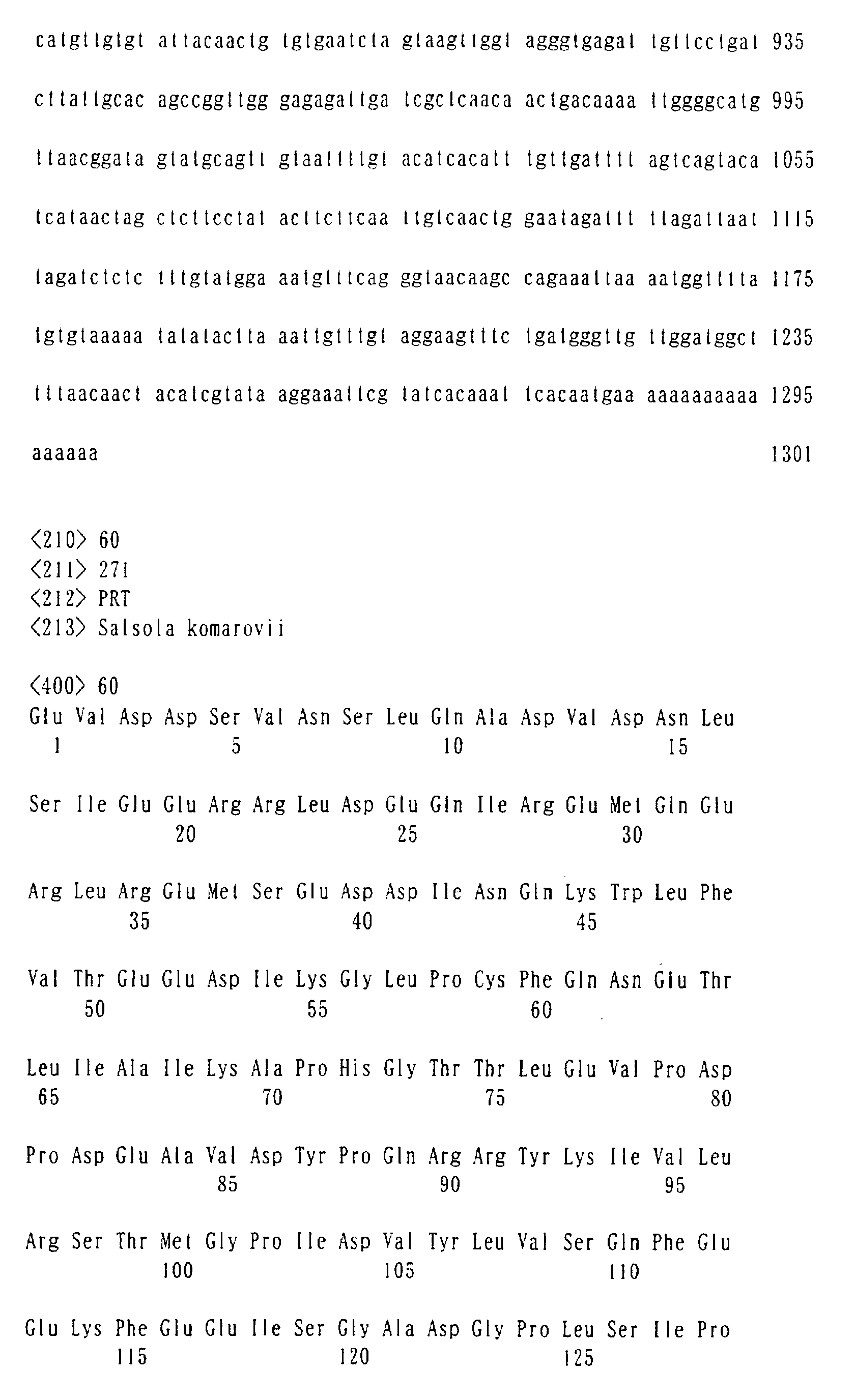
- sequences of amino acids shown in 8, 14, 36, 38, 40, 42, 44, 46, 48, 50, 52, 54, 56, 58, 60, 62, or 64 in the Seq. ID No. are thought not to be the ones encoding the full length of proteins. However, since there is activity of improving salt stress tolerance in itself, they are considered to be a functional region in each of the proteins of full length. As mentioned above, the present invention involves the full length of proteins involving these functional regions and DNA encoding the full length of proteins.
- kits such as Marathon cDNA Amplification Kit (Clontech), 3'-Full RACE Core Set (TAKARA), 5'-Full RACE Core Set (TAKARA) and follow their user's manuals.
- the present invention involves DNA encoding proteins functionally equivalent to the proteins having a sequence of amino acids shown in Seq. ID No. 2, 4, 6, 8, 10, 12, 14, 16, 18, 20, 22, 24, 26, 28, 30, 32, 34, 36, 38, 40, 42, 44, 46, 48, 50, 52, 54, 56, 58, 60, 62, or 64.
- proteins having biogenic activity can maintain the biogenic activity.
- Various methods for mutating amino acids in proteins are well known, and some kits are already commercialized as well. For example, it is easy to mutate amino acids in proteins by synthesizing primers wherein mutants are introduced and with the use of QuikChange Site-Directed Mutagenesis Kit (Stratagene).
- Proteins having amino acids wherein one or more of amino acids are substituted, deleted, added and/or inserted in the list of a sequence of amino acids shown in Seq. ID No. 2, 4, 6, 8, 10, 12, 14, 16, 18, 20, 22, 24, 26, 28, 30, 32, 34, 36, 38, 40, 42, 44, 46, 48, 50, 52, 54, 56, 58, 60, 62, or 64 are all involved in the scope of the present invention as long as they have activity of improving environmental stress tolerance at least against salt stress tolerance in various organic cells (for example, plant cells, coliforms, yeast).
- 2, 4, 6, 8, 10, 12, 14, 16, 18, 20, 22, 24, 26, 28, 30, 32, 34, 36, 38, 40, 42, 44, 46, 48, 50, 52, 54, 56, 58, 60, 62, or 64 can be prepared by hybridization technology or molecular amplification technology (Molecular Cloning, a Laboratory Manual, Second Edition, Cold Spring Harbor Laboratory Press, 1989). For example, it is possible to obtain DNA or the like encoding proteins having activity of improving environmental stress tolerance including at least salt stress tolerance as an object by the hybridization of cDNA library derived from various organisms under stringent conditions where the probes are part or whole of a sequence of bases shown in Seq. ID No.
- hybridization can be carried out at 42°C and treatment of washing at 42° C with the use of washing buffer containing 1 ⁇ SSC and 0.1 % of SDS. More preferably, it can be hybridized at 65° C and treatment of washing at 65° C with the use of washing buffer containing 0.1 ⁇ SSC and 0.1 % of SDS.
- factors effecting the stringency of hybridization there are various other factors other than the thermal ones mentioned above, and a person having ordinary skill in the art is capable of carrying out the same level of stringency as illustrated in the stringency of hybridization by combining various factors in an appropriate way.
- DNA or the like encoding proteins having activity of improving environmental stress tolerance including tolerance at least against salt tolerance by polymerase chain reaction of various organism-derived DNA (or RNA) as templates by using oligonucleotides prepared based on a sequence of bases shown in Seq. ID No. 1, 3, 5, 7, 9, 11, 13, 15, 17, 19, 21, 23, 25, 27, 29, 31, 33, 35, 37, 39, 41, 43, 45, 47, 49, 51, 53, 55, 57, 59, 61, or 63 as primers.
- the present invention involves DNA which can be isolated by using hybridization technology or gene amplification technology, as long as they have activities of improving environmental stress tolerance including at least salt stress tolerance in various organic cells (such as plant cells, coliforms, or yeast).
- proteins functionally equivalent to proteins having a sequence of amino acids shown in Seq. ID No. 2, 4, 6, 8, 10, 12, 14, 16, 18, 20, 22, 24, 26, 28, 30, 32, 34, 36, 38, 40, 42, 44, 46, 48, 50, 52, 54, 56, 58, 60, 62, or 64 have high homology with the sequence of amino acids shown in the sequence numbers.
- the high level of homology stands for 70 % or more, preferably 80% or more, or more preferable 90% or more (for example, 95% or more) of homology in sequences.
- the present invention involves DNA whose sequence of amino acids has a high level of homology with the sequence of amino acids shown in the above sequence numbers, and which encodes proteins having activity of improving tolerance at least to salt stress in various organic cells (such as plant cells, coliforms, or yeast).
- the sequence of amino acids in Seq. ID No. 2 have activity of improving salt stress tolerance in the region comprising amino acids from 1 to 86, and therefore all of the gene DNA encoding a sequence of amino acids comprising this region, for example, are all included in the scope of the present invention.
- the homology in sequences can be determined, for example, by using the multi-alignment function of GENETYX-MAC (Software Development Corporation), a genetic information processing software.
- a method for improving environmental stress tolerance in the present invention uses DNA encoding proteins having activity of improving tolerance against one or more environmental stresses selected from chemical substance stress such as salt stress, high temperature stress, low temperature stress, freezing stress, drought stress, ozone stress, ultraviolet stress, radiation stress, osmotic pressure stress.
- environmental stress tolerance can be improved in tissues, organs, and cells of plants and animals, and microorganisms such as bacteria, yeast, and fungi.
- any antibody can be used as long as the antibody can specifically bind to proteins in the present invention.
- Such antibodies can be exemplified as immune specific antibodies such as monoclonal antibiotics, polyclonal antibiotics, chimera antibiotics, single chain antibody, or human cell line antibody or the like.
- these antibodies can be produced by using the following proteins having a sequence of amino acids shown in Seq. ID No.
- proteins having a sequence of 70% or more of homology with a sequence of amino acids shown in Seq. ID No. 2 and having activity of improving tolerance at least against salt stress proteins having a sequence of amino acids wherein one or more the amino acids are deleted, substituted, or added in a sequence of amino acids shown in Seq. ID No.
- Such antibodies are useful in elucidating the molecular structure of proteins having activity of improving environmental stress tolerance and others.
- antibodies for proteins having activity of improving the environmental stress tolerance are produced by administering proteins having activity of improving the environmental stress tolerance in animals (preferably, except for human), or fragments, their analogues or cells involving epitope.
- animals preferably, except for human
- any technology can be used such as hybridoma technology (Nature 256, 495-497, 1975), trioma technology, human B cell hybridoma technology (Immunology Today 4, 72, 1983) or EBV-hybridoma technology (MONOCLONAL ANTIBODIES AND CANCER THERAPY, 77-96, Alan R. Liss. Inc., 1985), which produce antibodies from the culture of successive cell strains.
- the method for preparing single chain antibodies can apply to produce single chain antibodies for proteins having activity of improving the environmental stress tolerance in the present invention.
- transgenic plants or transgenic animals and the like can be used to express human cell line antibodies, clones expressing proteins having activity of improving the environmental stress tolerance by using the antibodies can be isolated or identified, or the polypeptides can be purified by using affinity chromatography.
- vectors used in the present invention there are no special restrictions on vectors used in the present invention, as long as the vectors comprising DNA encoding proteins having activity of improving tolerance against the environmental stresses such as chemical substance stress such as salt stress, thermal stress, low temperature stress, freezing stress, drought stress, ozone stress, ultraviolet stress, radiation stress, and osmotic pressure stress.
- transformed cells used in the present invention as long as the transformed cells are obtained by introducing the vectors into host cells such as plant cells or the like.
- a method for producing proteins having activity of improving environmental stress tolerance in the present invention it can be any method as long as the transformed cells are cultured, and recombinant proteins are collected from the transformed cells or the supernatant of the cultured liquid.
- any transgenic plant can be used in the present invention as long as it introduces DNA encoding proteins having activity of improving the environmental stress tolerance or the vectors into plant cells, and are obtained by division, proliferation, and redifferentiation of the plant cells.
- the following explains vectors, transformed cells, methods for producing proteins having activity of improving environmental stress tolerance, and transgenic plant in the present invention.
- DNA in the present invention can be used in preparing recombinant proteins.
- the DNA in the present invention are inserted into appropriate expression vectors, the vectors are introduced into appropriate host cells, the DNA are expressed, and then the expressed proteins are collected from the transformed cells or the supernate of the cultured liquid.
- the host-vector system used in expressing recombinant proteins can be exemplified as IMPACT-CN System (host cell: E. coli strain ER2566, vector:pTYB1, pYB2, pYB11, pYB12 (BioLabs), or pET Expression System (host cell: Epicurian Coli BL 21, vector: pET3 series (Novagen)).
- a method for introducing vectors into host cells well known methods can be used such as electroporation method or heat shock method (IDENSHI LIBRARY NO SAKUSEIHOO (Methods of producing gene library), Yoodo-sha, 1994, SHOKUBUTU SAIBOO KOOGAKU NYUMON (Introduction to plant cell engineering), Japan Scientific Societies Press, 1998).
- the culture for expressing recombinant proteins can be carried out by conventional methods and under conventional conditions. Expressed proteins can be purified by Chitin Beads (BioLabs) when IMPACT-CN System is used, and His Bind Resin (Novagen) when pET Expression System is used.
- DNA in the present invention can be used to produce transgenic organisms whose tolerance at least against salt stress is improved. There are no restrictions on the species of organisms in producing transgenic organisms by using DNA in the present invention. However, in the case where the genes used are derived from mangrove, it is preferable to use higher plants. In producing such transgenic plants, it is more advantageous to insert DNA into vectors to express them in plant cells, to introduce them into plant cells, and to recover the transformation plant cells in order to obtain transgenic plants.
- pBI101 commercialized by Toyobo, or pIG121Hm (Plant J. 6, 271-282, 1994).
- pIG121Hm Plant J. 6, 271-282, 1994.
- Morphology of plant cells can be protoplast, callus, part of plant organism (leafdisk, hypocotyl) and the like.
- the Agrobacterium method is most preferable, and polyethylene glycole method, electroporation method, particle gun method, and others can also be used (MODEL SHOKUBUTU NO JIKKEN PROTOCOL (Experimental Protocols for plant models), Shujin-sha, 1996).
- the ways how plant cells wherein vectors are introduced vary depending on the species of plants.
- the following processes are carried out when rice plant is taken as an example.
- the callus is derived from matured seeds, and the obtained callus is infected with Agrobacterium wherein cDNA are introduced. After the period of co-culturing, they are transferred to selective medium to culture. About three weeks later, callus is transferred to redifferentiation medium, and is cultured until redifferntiation. Transformants are recovered by transferring them to pots after 4 or 5 days of acclimatation.
- MODEL SHOKUBUTU NO JIKKEN PROTOCOL Extracellular Protocols for plant models
- Shujin-sha 1996
- the methods proposed by Dr. Kato and Dr. Shono are appropriate for each (SHOKUBUTU SOSHIKI BAIYOO NO GIJUTU (Technologies for culturing plant tissues), Asakura-shoten, 1983).
- Breeding materials derived from transgenic plants in the present invention can be any one as long as they are derived from the transgenic plants, and more specifically seeds, tuberous roots, ears, mericlone, and the like can be used as materials for culturing and proliferating, depending on the species of plants. Further, it is possible to produce massively transgenic plants in the present invention based on the breeding materials.
- Suspension culture cell lines of Bruguiera sexangula established by Miura was used as mangrove suspension culture cells (J. Plant Res. 110, 25-29, 1997).
- the cells are cultured in AA medium containing 100mM of NaCl, separated 120 ml for each flask of 500ml, and performed shaken culture (70 rpm) in a dark room at 26° C.
- the cDNA library of mangrove was carried out by using suspension culture cells.
- Ostrem et al. Plant Physiol.
- RNA total RNA were extracted, and then poly(A)+RNA was purified by using Oligotex-dT30 ⁇ super> (Daiichi Kagaku sha).
- the purified poly(A)+RNA was used to synthesize cDNA, and cDNA library was constructed by introducing the lambda phage vector ⁇ ZaplI (Stratagene). Methods for constructing cDNA library by introducing ⁇ ZapII are well known, and the actual procedure was followed by the manufacturer's manual by Stratagene. As a result, a mangrove cDNA library containing independent clones of 10 6 was successfully constructed.
- cDNA libraries of other halophytes such as Avicennia marina (a kind of mangrove), Sueada japonica, Salsola komarovii, Mesembryanthemum crystallinum, leaves of each plant organism are used. The same method was used to construct cDNA library as in the case of mangroves.
- the obtained cDNA library contained 10 5 to 10 6 of independent clones for each.
- the present inventors used the gene expression system of coliforms as a method for screening cDNA relevant to salt tolerance from cDNA library, of mangrove or other halophytes.
- the present inventors developed a novel method for acquiring cDNA relevant to salt tolerance by introducing cDNA of mangrove or other halophytes into coliforms and selecting transformed coliforms with their salt tolerance improved.
- 2YT agar medium containing appropriate concentration of NaCl were used to select transformed coliforms with their salt tolerance improved.
- the present inventors determined the minimal concentration of NaCl inhibiting growth of various coliforms (DH5 ⁇ , JM109, HB101, SOLR) in order to select the host coliforms appropriate for the screening.
- Such coliforms are well-known strains, and they are commercialized by TOYOBO and Stratagene, and others. Although the growth of DH5 ⁇ , JM109, and HB101 is remarkably inhibited on the 2YT agar medium containing 1200mM of NaCI; they are able to form colonies. Their growth is completely restricted under 1500mM of NaCl. On the contrary, the growth of SOLR was remarkably inhibited in NaCl of less than 300mM, and completely inhibited under 400mM of NaCl.
- cDNA library of mangrove and other halophytes was introduced into SOLR by inserting pBluescript SK carrying the library with in vivo excision system (Stratagene). The introduction of genes was performed by manufacturer's manual for ZAP-cDNA/Gigapack Cloning Kit (Stratagene). In order to select SOLR introduced with cDNA relevant to salt tolerance from SOLR introduced with cDNA of mangrove and other halophytes, two steps of screening were performed.
- Plasmids were extracted from each clone obtained by the first screening, and were all reintroduced into SOLRs. Transformants obtained were cultured until log phase on the 2YT liquid medium containing 50 ⁇ g/ml of kanamycin, 50 ⁇ g/ml of ampicillin, 0.05mMof IPTG, diluted series were produced on 2YT liquid medium, and were spotted 25 ⁇ l for each on the agar selection medium. After the liquid was blow-dried, they were cultured at 37°C overnight. The result confirmed that 30 clones improved salt tolerance in Bruguiera cDNA library. As a representative, Fig. 1 shows the result of spot experiment of coliforms wherein cDNA shown in Seq. ID No. 1 is introduced.
- cDNA shown in Seq. ID No. in 15, 17, 19, 35, 63 are obtained from Mesembryanthemum crystallinum
- cDNA shown in Seq. ID No.s in 21, 37, 39, 51, 53, 57 are obtained from Suaeda japonic
- cDNA shown in Seq. ID No.s as 23, 25, 41, 47, 49, 59, 61 are obtained from Salsola komarovil
- cDNA shown in Seq. ID No.s 27, 29, 31, 33, 43, 45, 55 are obtained from Avicennia marina.
- the BLAST Homology Search program was used to search homology of the sequences of amino acids encoding these pieces of DNA.
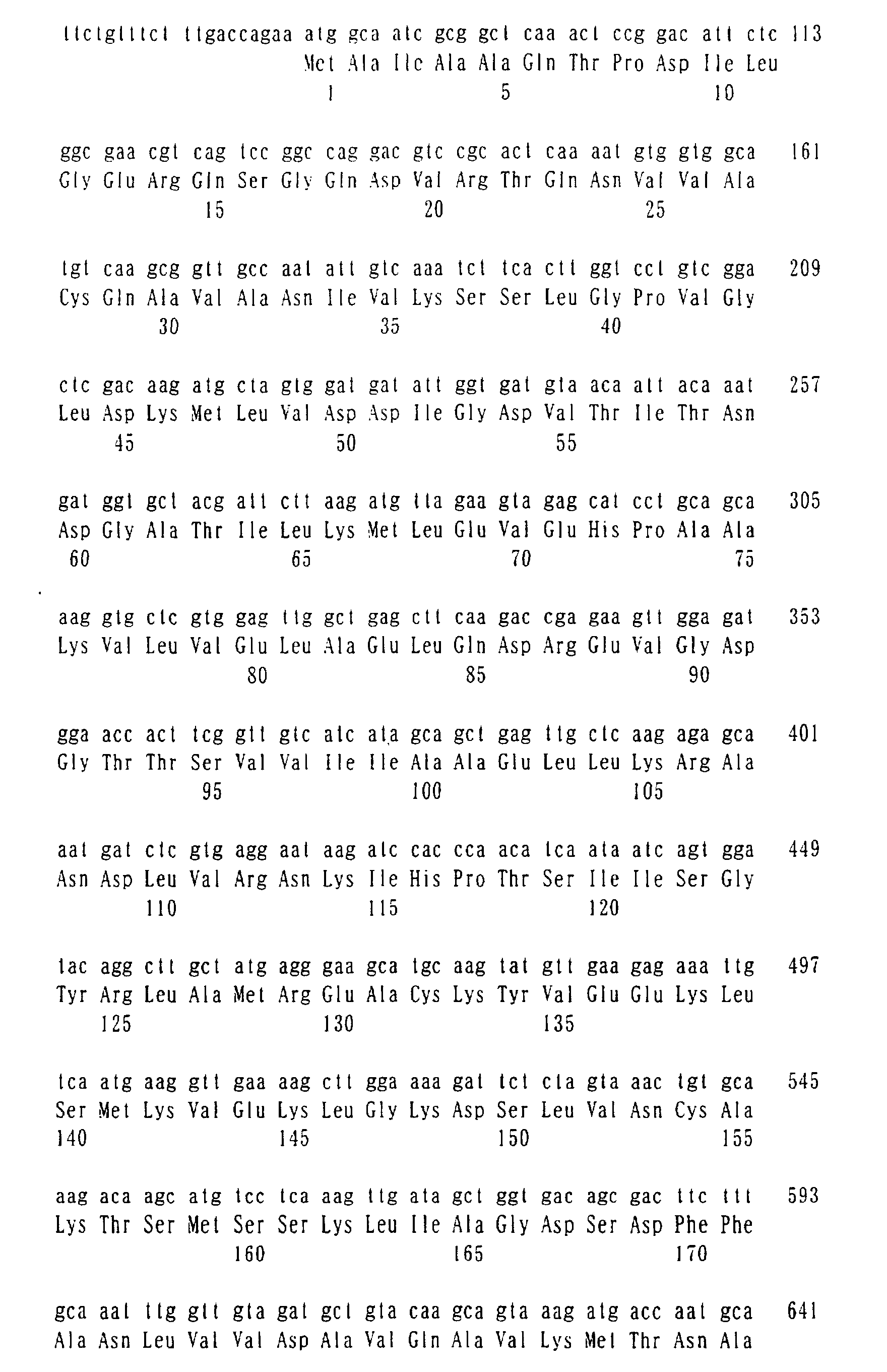
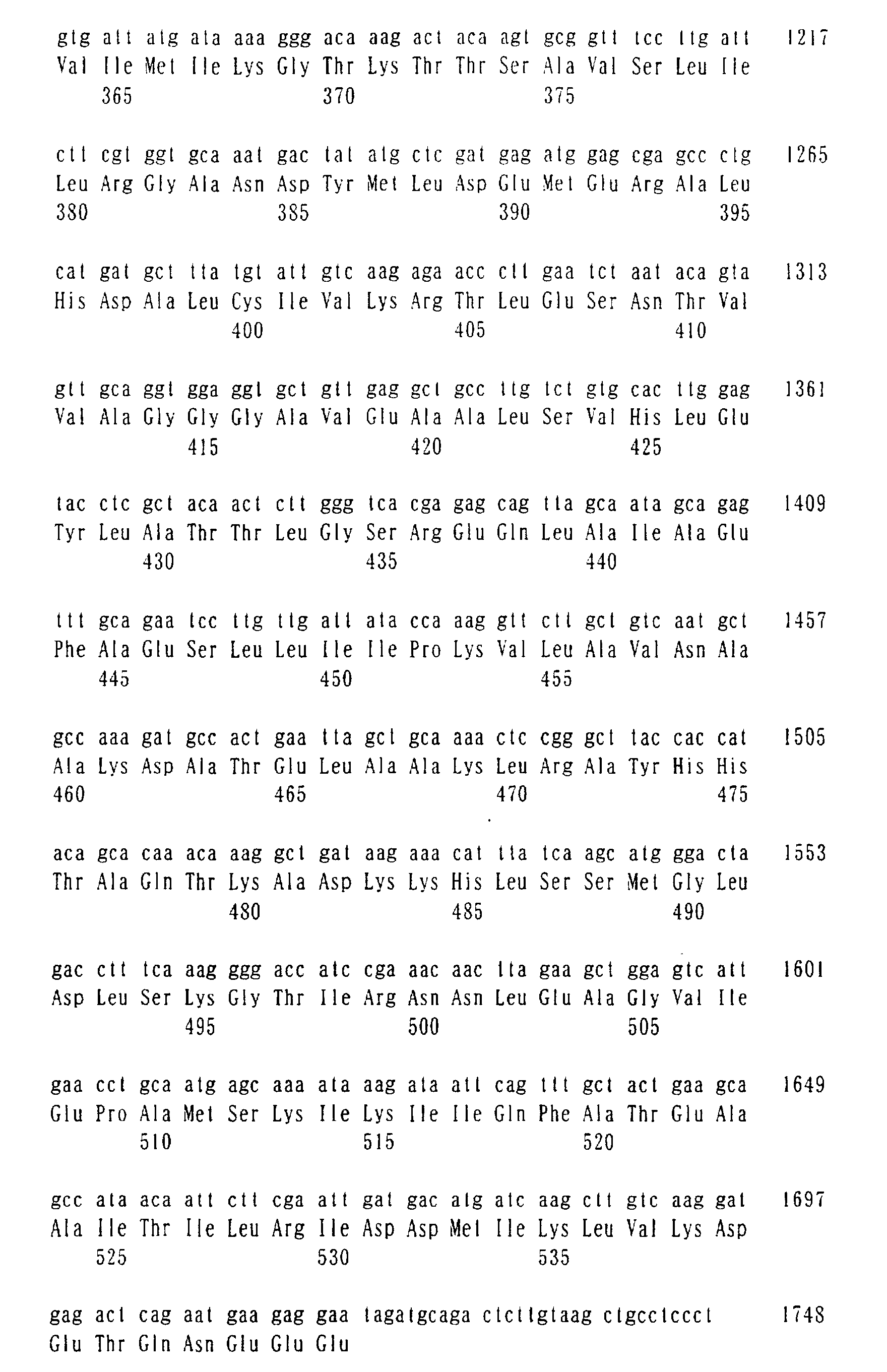
- the result is that there are no proteins registered which have homology with the sequence of amino acids shown in Seq. ID No. 2 in the databases such as Swiss protein, PIR, and revealing that the proteins are novel. Therefore, the present inventors named the novel protein encoding the cDNA (total number of amino acids: 141) as mangrin, and the genes as mang1. Next, functional regions of mangrin were determined.
- the subclones were produced by introducing terminal codons into the amino acids of No.
- the sequence of amino acids shown in Seq. ID No. 4 has about 90% of homology with t-complex polypeptide 1 (pir JN0448) from Arabidopsis thaliana.
- the sequence of amino acids shown in Seq. ID No. 6 has about 80% of homology with Metallothionein-like protein TYPE 2 (EMBL L02306) from Ricinus communis.
- the sequence of amino acids shown in Seq. ID No. 8 has about 63% of homology with RubB-like DNA helicase (AB024301) from Homo sapiens.
- the sequence of amino acids shown in Seq. ID No. 10 has about 45% of homology with Ribosomal protein S29 (pir S30298) from Rattus norvegicus.
- the sequence of amino acids shown in Seq. ID No. 12 has about 90% of homology with Elongation factor eEF-1 alpha chain (pir S66339) from Zea mays.
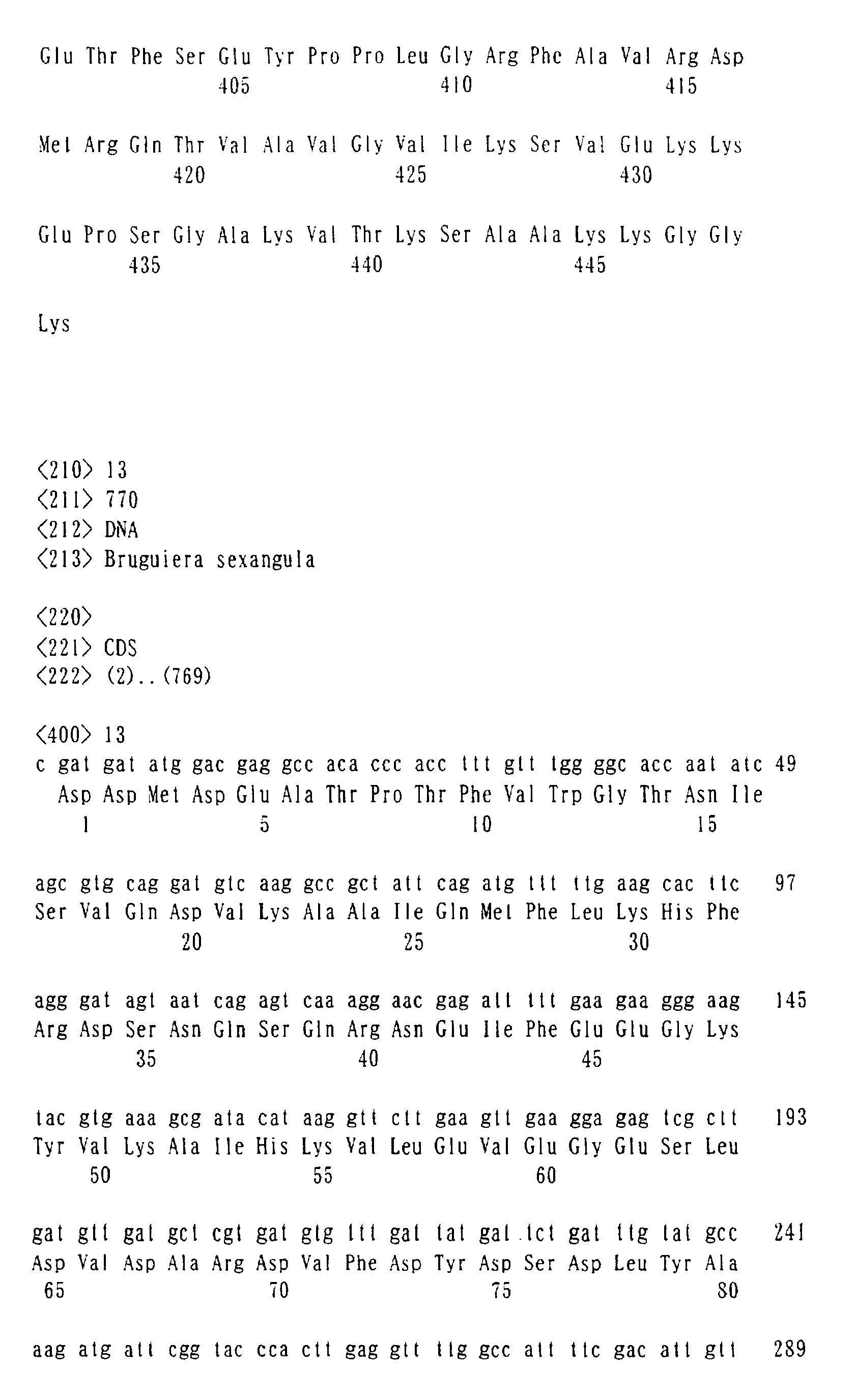
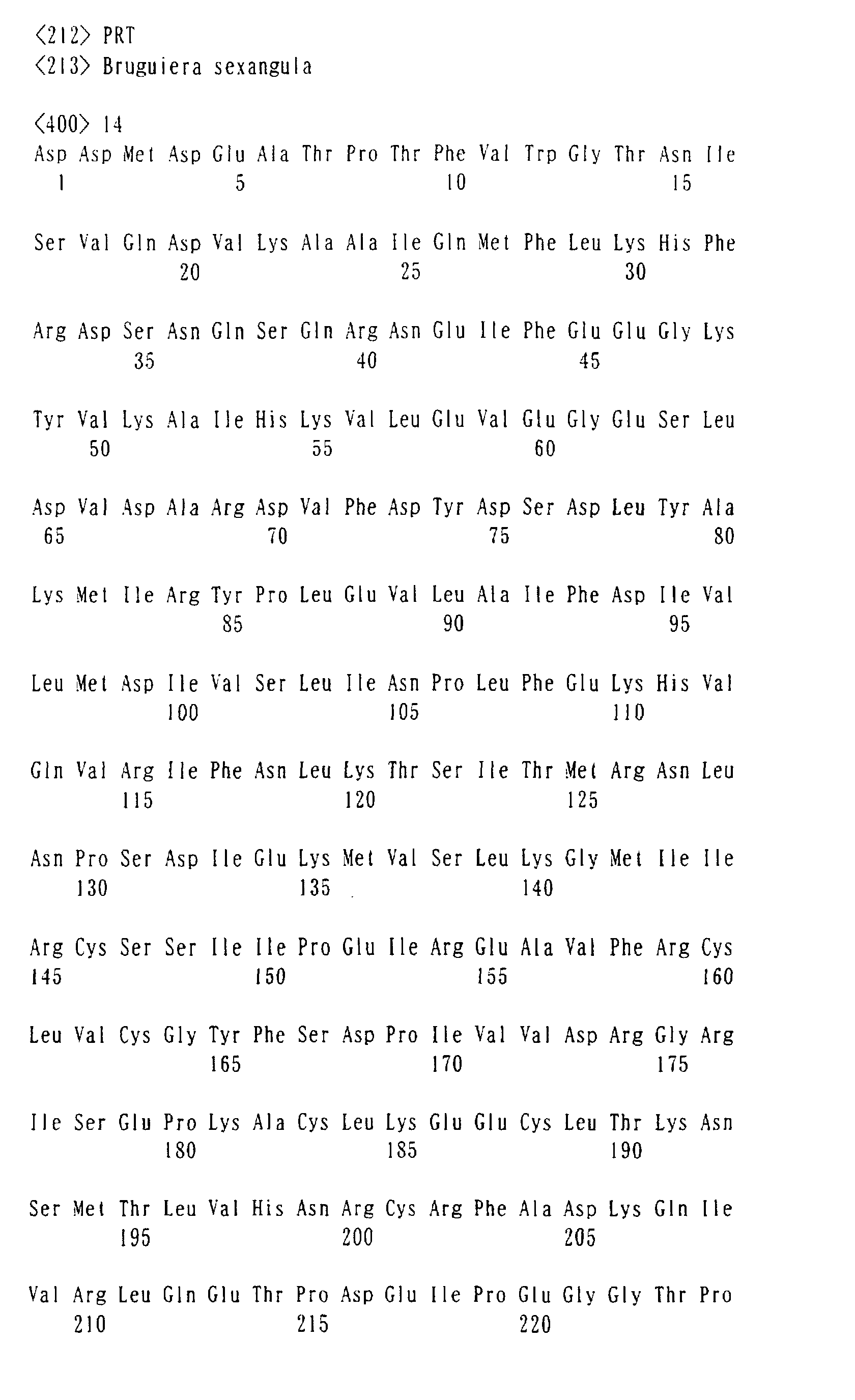
- the sequence of amino acids shown in Seq. ID No. 14 has about 70% of homology with cdc21 (pir S26640) from Schizosaccharomyces pombe.
- Th cDNA shown in Seq. ID No.s 1, 3, 5, 7, 9, 11, or 13 encoding proteins shown in Seq. ID No.s 2, 4, 6, 8, 10, 12, or 14 respectively are considered to have functions of improving salt tolerance in a wide-range group of organisms from procarytes such as coliforms to higher animals because they actually have functions of improving salt tolerance of coliforms.
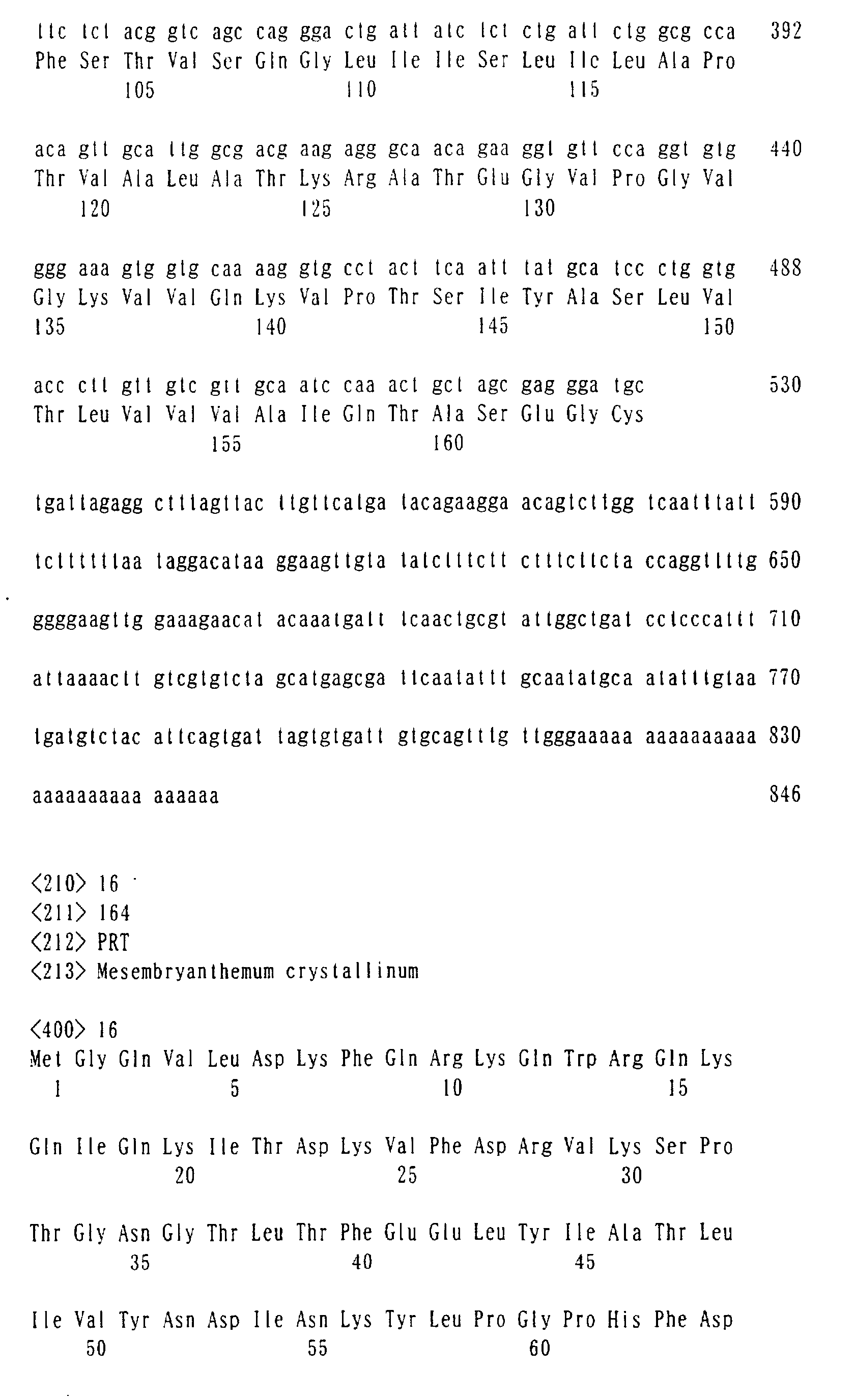
- sequence of amino acids derived from Mesembryanthemum crystallinum shown in Seq. ID No. 16 has 68% of homology with F13O1.15 gene product (gpAC006193_15) from Arabidopsis thaliana.
- the sequence of amino acids derived from Mesembryanthemum crystallinum shown in Seq. ID No. 18 has 78% homology with H+-transporting ATPase (EC 3.6.1.35) 14K chain (pir T01087) from Arabidopsis thaliana.
- 26 has 99% of homology with ADP-ribosylation factor (gp AF 022389_1) of Vigna unguiculata.
- the sequence of amino acids derived from Avicennia marina shown in Seq. ID No. 28 has 56% of homology with tuberization-induced protein (prf 2310431A) of Solanum demissum.
- the sequence of amino acids derived from Avicennia marina shown in Seq. ID No. 30 has 69% of homology with Enod93 protein (gp MSA248334_1) of Medicago sative.
- sequence of amino acids derived from Mesembryanthemum crystallinum shown in Seq. ID No. 36 has 58% of homology with pRIB5 protein (gp RN17578_1) of Ribes nigrum.
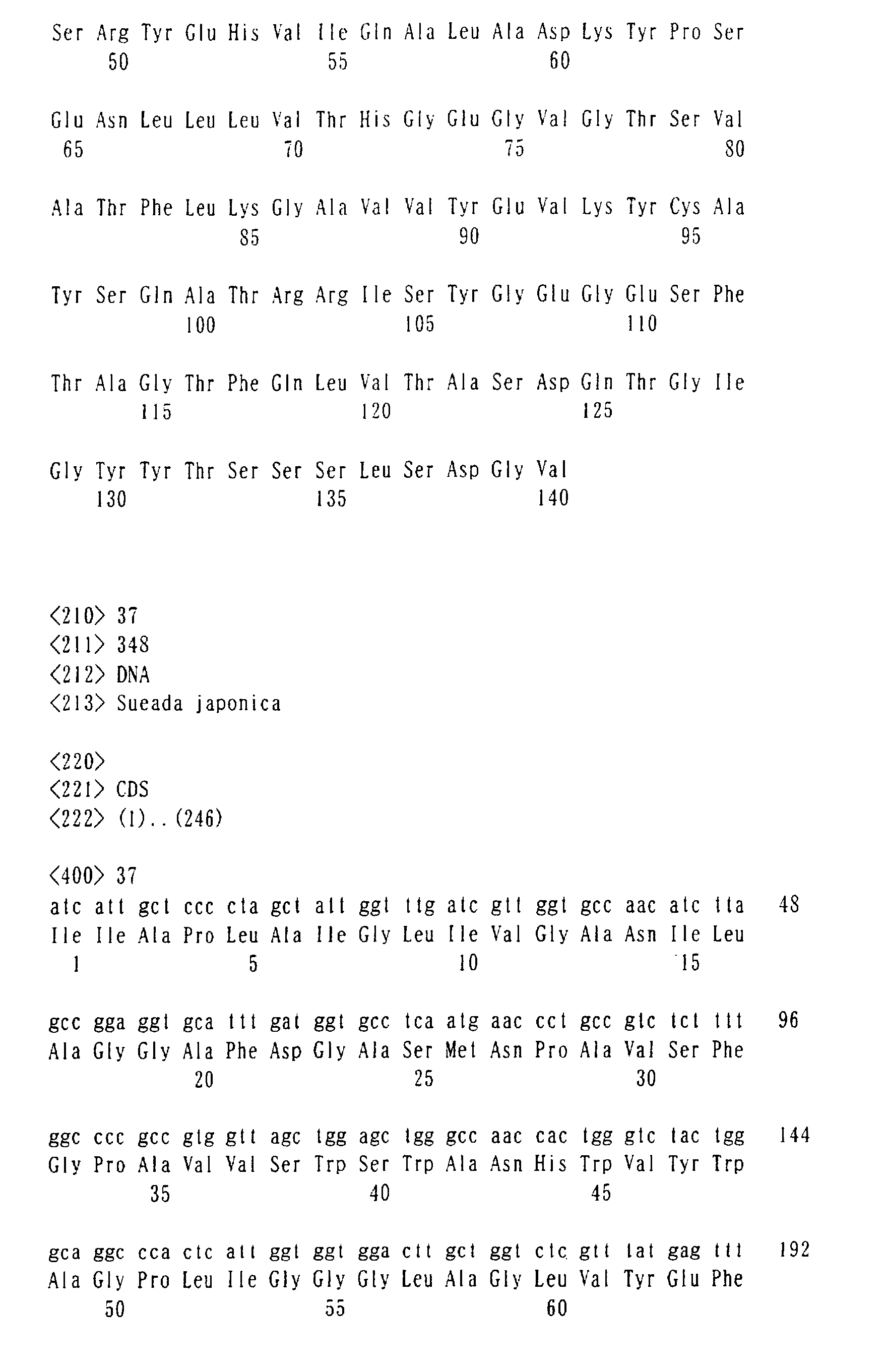
- the sequence of amino acids derived from Sueada japonica shown in Seq. ID No. 38 has 84% of homology with tonoplast intrinsic protein (pir T12439) of Mesembryanthemum crystallinum.
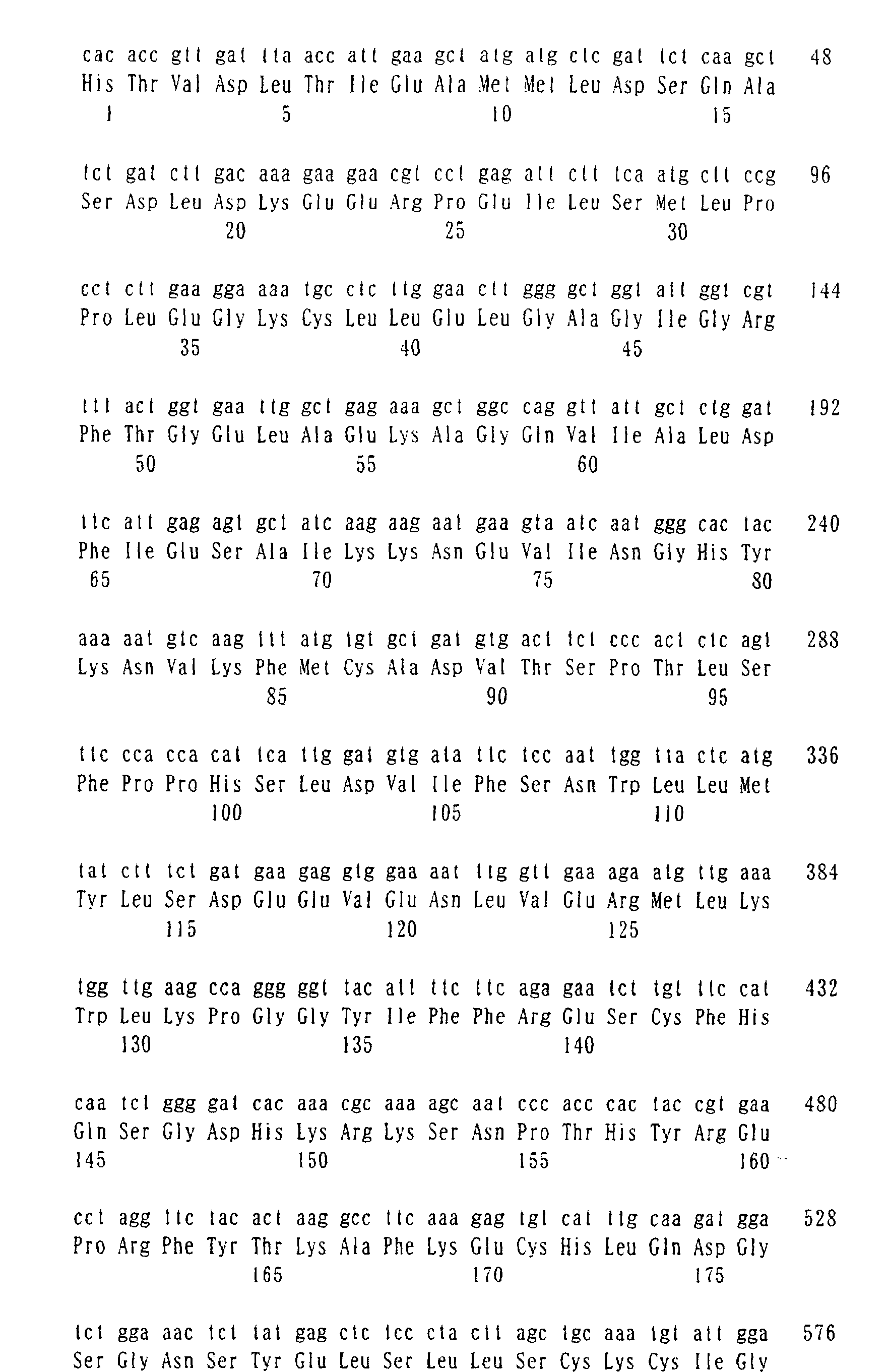
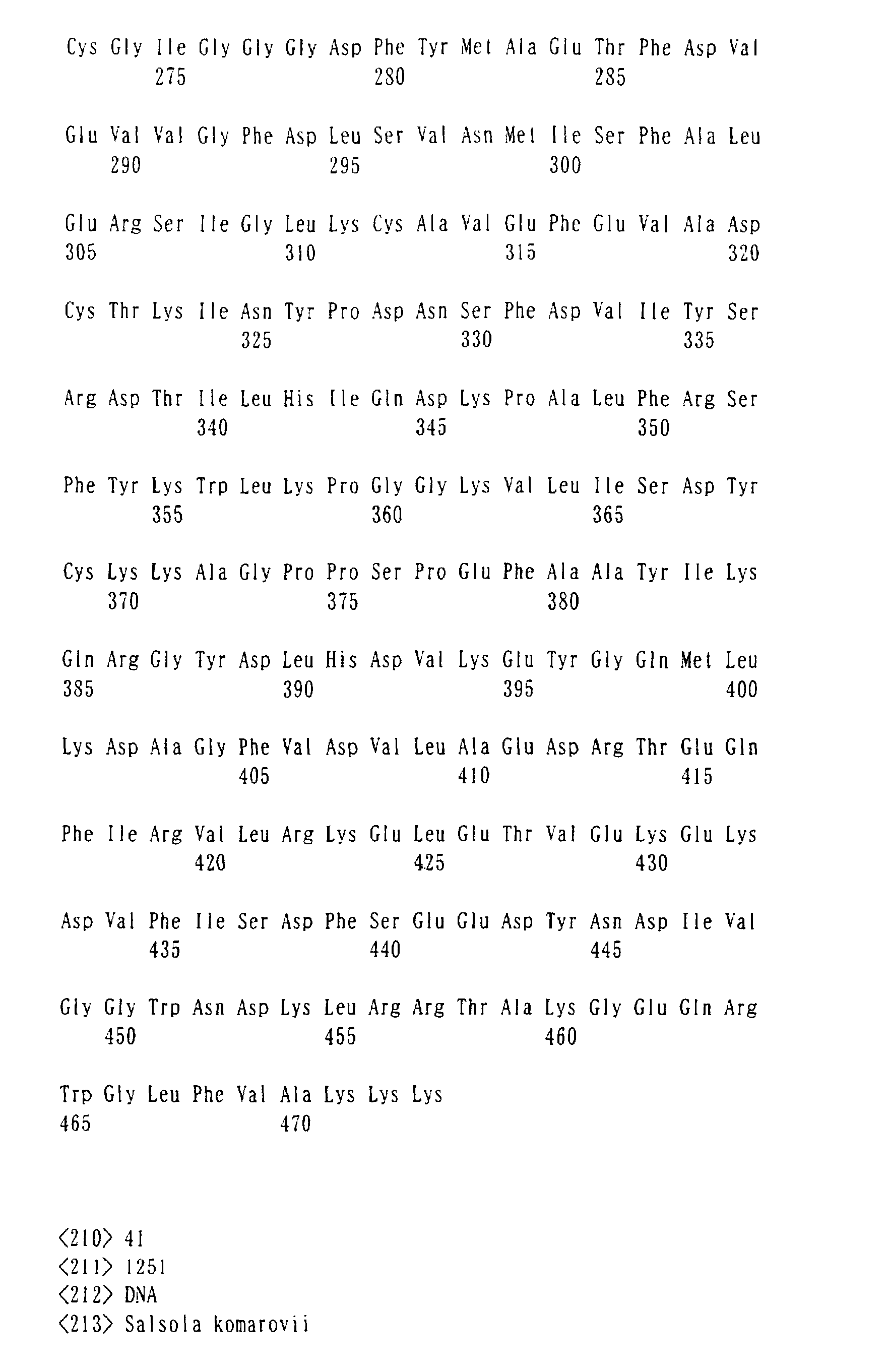
- sequence of amino acids derived from Sueada japonica shown in Seq. ID No. 40 has 86% of homology with phosphoethanolamine N-methyltransferase (gp AF237633_1) of Spinacia oleracea.
- the sequence of amino acids derived from Salsola komarvii shown in Seq. ID No. 42 has 83 % of homology with phosphoenolpyruvate carboxylase (gpu SWI17843_1) of Selenicereus wittii.
- the sequence of amino acids derived from Avicennia marina shown in Seq. ID No. 44 has 84% of homology with putative chaperonin (gp ATAC021640_16) of Arabidopsis thaliana.
- the sequence of amino acids derived from Avicennia marina shown in Seq. ID No. 46 has 88% of homology with hypothetical protein T5F17.40 (pir T10653) of Arabidpsis theliana.
- sequence of amino acids derived from Salsola komarvii shown in Seq. ID No. 48 has 63% of homology with cysteine proteinase inhibitor (pir T07139) of Glycine max.
- the sequence of amino acids derived from Salsola komarvii shown in Seq. ID No. 50 has 87% of homology with nucleotide sugar epimerase-like protein (gp ATCHRIV73_17) of Arabidopsis thaliana.
- sequence of amino acids derived from Sueada japonica shown in Seq. ID No. 52 has 57% of homology with putative protein (gp ATT20K12_12) of Arabidopsis theliana.
- ID No. 54 has 78 % of homology with putative WD-40 repeat protein (gp AC006569_14) of Arabidopsis thaliana.
- the sequence of amino acids derived from Avicennia marina shown in Seq. ID No. 56 has 75 % of homology with cdc2MsE gene product (gp MSCDC2MSE_1) of Medicago sativa.
- the sequence of amino acids derived from Sueada japonica shown in Seq. ID No. 58 has 39% of homology with putative protein (gp ATF17C15_9) of Arabidopsis thaliana.
- 60 has 66% of homology with transcription factor E2F (prf 2601241A) of Nicotiana tabacum.
- the sequence of amino acids derived from Salsola komarovii shown in Seq. ID No. 62 has 34% of homology with hypothetical protein T26B15.5 (pir T02548) of Arabidopsis thaliana.
- the sequence of amino acids derived from Mesembryanthemum crystallinum shown in Seq. ID No. 64 has 30% of homology with Homo sapiens cDNA FLJ10298 fis, clone NT2RM1001115, weakly similar to ENDOCHITINASE 2 PRECURSOR (EC 3.2.1.14) (pir T02548).
- the pBluescript SK cloned with cDNA shown in Seq. ID No. 1 was digested by restriction enzymes EcoRI or NotI, and was subjected to agarose gel electrophoresis. About 1kb fragment obtained here was excised, and was purified with GENECLEAN kit (BIO101). By using Ligation Kit ver2 (TAKARA), the fragments were introduced into yeast expression vectors pYES2 (Invitrogen) which were digested with restriction enzymes EcoRI and NotI. Next, the vectors are introduced into yeast by means of electoroporation. Saccharomyces cereviciae YM4271 (Clontech) was used as yeast.
- -UraSD agar medium which does not contain uracil (hereafter, -UraSD agar medium) was used to select transformed yeast.
- Fig. 3 shows the result of the measurements.
- the cDNA in yeast obtained by the screening showed similar function of salt tolerance as the ones in coliform.
- the pBluescript SK cloned with cDNA shown in Seq. ID No. 1 was digested by the restriction enzymes Xba1 and Xho1, and was subjected to agarose gel electrophoresis. About 1kb fragment obtained here was excised, and purified by GENECLEAN kit (BIO101). By using Ligation Kit ver2 (TAKARA), the fragments were introduced into the restriction enzymes EcoRI and NotI sites of plant expressing vector pBI101 (EMBOJ 6, 3901-3907, 1987). The obtained plasmids were introduced into Agrobacterium tumefaciens, by the electoroporation method, and were infected to tobacco cultured cells (Nicotiana tabacumL. Cv.
- Agrobacterium tumefaciens in introducing genes into plant cells.
- Agrobacterium tumefaciens EHA 101 was used as Agrobacterium, and the method of An was used (Plant Physiol. 79, 568-570, 1985).
- the salt tolerance of transformed tobacco cultured cells were evaluated in the following way. Callus of transformed tobacco cultured cells were collected, and was cultured on Lins-Mayer medium until the late period of the logarithmic growth phase. The obtained Callus were separated 1ml for each on 45 ml of Lins- Mayer media which were prepared to be 0, 100, or 150mM of NaCl concentrations, and were subjected to shaking culture at 26°C.
- Fig. 4 shows the result of the measurements.
- the cDNA in tobacco culture cells obtained by the screening showed similar function of salt tolerance as the ones in coliform.
- Plasmids obtained by Example 5 were introduced into Agrobacterium tumefaciens by electoroporation, and the plasmids were infected to tobacco leafdisks. It is well known to use Agrobacterium tumefaciens in introducing genes into tobacco leafdisks.
- Agrobacterium tumefaciens EHA 101 was used as Agrobacterium, and it was carried out following the method described in Shokubutu Saiboo Koogaku Nyuumon (Introduction to plant cell engineering) (Japan Scientific Societies Press, 1998). The salt tolerance of transformed tobacco (plant organism) was evaluated in the following way.
- Transformed tobacco was planted on MS agar medium where the concentration of NaCl was prepared to be 150 mM, and was cultured at 26°C under lighting of the lighting cycle (light: 16 hours/ dark: 8 hours). The growth of the plant organisms after 30 days of culture was observed, and its salt tolerance was evaluated. Tobacco culture cells into which GUS genes were introduced by pBI101 rather than mangrove cDNA were examined in the same fashion. Fig. 5 shows the result (see also the photos). As obvious from Fig. 5, the roots, leaves, and stems of the tobacco plant organisms obtained from the result of screening show a high rate of growth. This confirms that cDNA obtained from the result of screening have functions of improving salt tolerance at the level of plant organism.
- SOLR into which cDNA was cloned shown in Seq. ID No. 1 and pBluescript SK was introduced was cultured in 2YT liquid medium containing 50 ⁇ g/ml of kanamycin, 50 ⁇ g/ml of ampicillin, 0.05mM of IPTG at 37°C, and 40°C.
- SOLR wherein pBluescript SK, a vector, was introduced as a vector was examined in the same manner.
- Fig. 6 shows the result.
- cDNA obtained from the result of screening have functions of improving thermal tolerance.
- SOLR wherein cDNA was cloned shown in Seq. ID No. 1 and pBluescript SK was introduced was cultured in 2YT liquid medium containing 50 ⁇ g/ml of kanamycin, 50 ⁇ g/ml of ampicillin, 0.05mM of IPTG until the logarithmic growth phase. Dilution series were produced on 2YT liquid medium, and were spotted each for 25 ⁇ l on 800mM of 2YT agar medium. After the liquid was air-dried, culture was carried out at 37°C overnight. Fig.7 shows the result. As seen from Fig. 7, it was confirmed that cDNA obtained from the screening have functions of improving osmotic pressure tolerance.
- SOLR wherein cDNA was cloned shown in Seq. ID No. 1 and pBluescript SK was introduced was cultured in 2YT liquid medium containing 50 ⁇ g/ml of kanamycin, 50 ⁇ g/ml of ampicillin, 0.05mM of IPTG until the logarithmic growth phase, and was diluted to be 5000 cells/25 ⁇ l on 2YT liquid medium.
- the cells were transferred to plastic tubes, and they were frozen by liquid nitrogen for 3 minutes and melt at 37° C for 10 minutes repeatedly. Part of the cell body (25 ⁇ l) was taken when melted, and SOLR was spotted on 2YT agar medium containing 50 ⁇ g/ml of kanamycin, 50 ⁇ g/ml of ampicillin, 0.05mM of IPTG.
- SOLR wherein pBluescript SK, a vector, was introduced as a vector was examined in the same manner.
- Fig. 8 shows the result. As obvious from Fig. 8, cDNA obtained from the screening have functions of improving tolerance against
- reaction temperature was set as 92°C for 30 seconds, 50°C for 30 seconds, and 72°C for 90 seconds. This cycle was repeated 30 times, and DNA fragments wherein random mutants were introduced into margin core were obtained.
- the DNA fragments obtained were digested with Xbal and Xhol, and these are cloned to the vectors (pBluescript SK) already digested with Xbal and Xhol. These were introduced into SOLR, and were selected with the growth on agar medium containing 450mM of NaCl as an index.
- sequence of bases are mutated, mutant mangrin core maintaining or improving activity of improving salt tolerance was selected. The sequence of bases is determined on part of obtained clones, and the activity of improving salt tolerance was evaluated by spot test.
- c-52, c-80 2 clones (c-52, c-80) of a sequence of bases are mutated.
- c-80 is mutated in the sequence of amino acids, and this is considered to be a factor of improving functions of salt tolerance in mangrin core.
- Fig. 10 for comparing functions of improving stress tolerance, it can be used to improve functions of environmental stress tolerance genes.
- the present invention will be an effective means to improve tolerance against environmental stress for various animals.
- the plants whose tolerance against environmental stress tolerance is improved can grow in salt damaged lands, cold regions, deserts, and oceans, where they are difficult to grow. From this fact, it is expected that the amount of agricultural products will increase due to the expansion of farmland. Further, the plants whose environmental stress tolerance is improved contribute to the suppression of global warming due to the global increase of CO 2 level globally, as well as to the increase of greenery areas and greening of deserts.
Landscapes
- Life Sciences & Earth Sciences (AREA)
- Chemical & Material Sciences (AREA)
- Health & Medical Sciences (AREA)
- Genetics & Genomics (AREA)
- Engineering & Computer Science (AREA)
- Organic Chemistry (AREA)
- Zoology (AREA)
- Wood Science & Technology (AREA)
- Biotechnology (AREA)
- Bioinformatics & Cheminformatics (AREA)
- General Engineering & Computer Science (AREA)
- Molecular Biology (AREA)
- General Health & Medical Sciences (AREA)
- Biomedical Technology (AREA)
- Biochemistry (AREA)
- Microbiology (AREA)
- Biophysics (AREA)
- Proteomics, Peptides & Aminoacids (AREA)
- Physics & Mathematics (AREA)
- Analytical Chemistry (AREA)
- Medicinal Chemistry (AREA)
- Plant Pathology (AREA)
- Botany (AREA)
- Gastroenterology & Hepatology (AREA)
- Tropical Medicine & Parasitology (AREA)
- Virology (AREA)
- Immunology (AREA)
- Crystallography & Structural Chemistry (AREA)
- Mycology (AREA)
- Cell Biology (AREA)
- Peptides Or Proteins (AREA)
- Micro-Organisms Or Cultivation Processes Thereof (AREA)
Abstract
Description



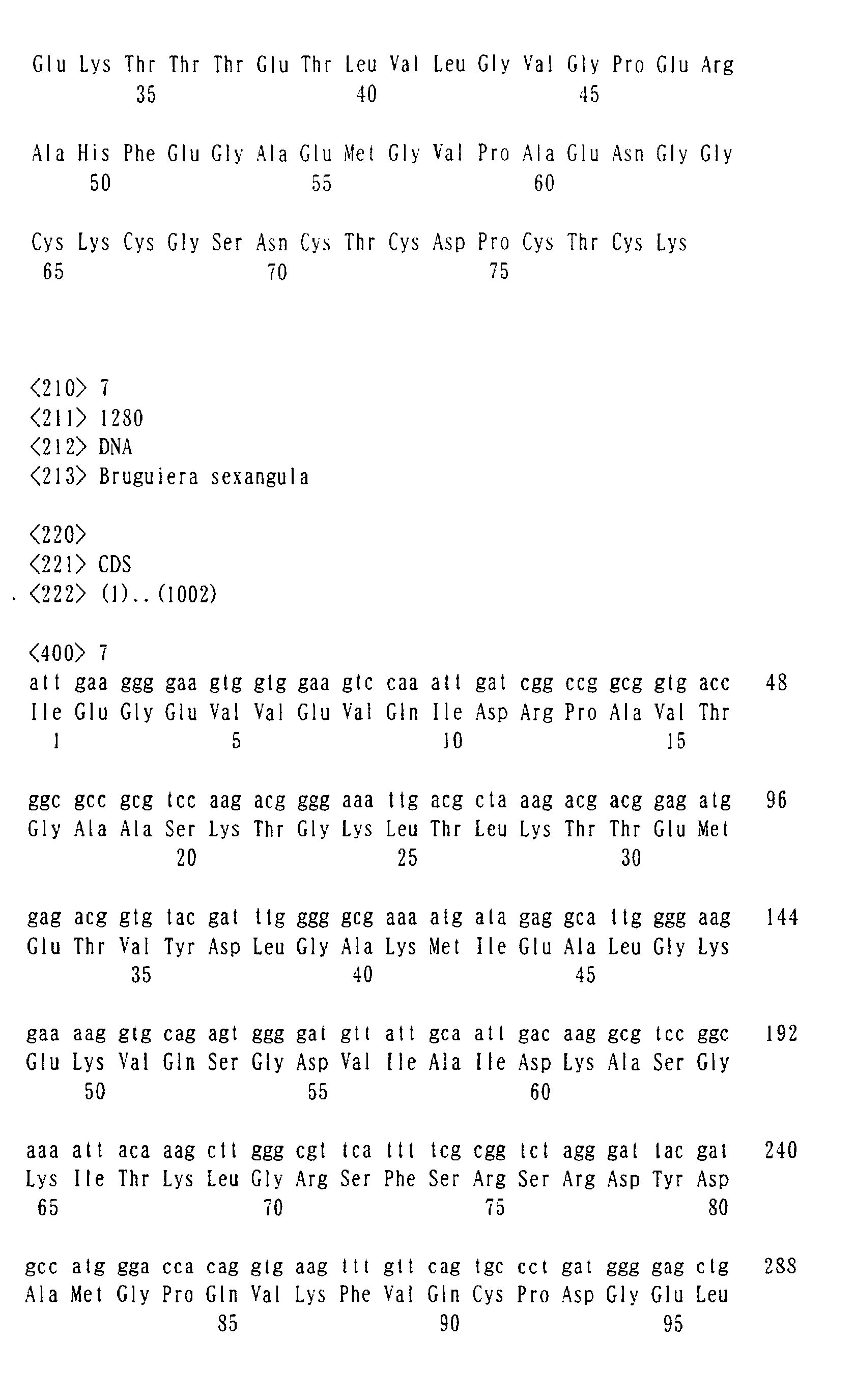

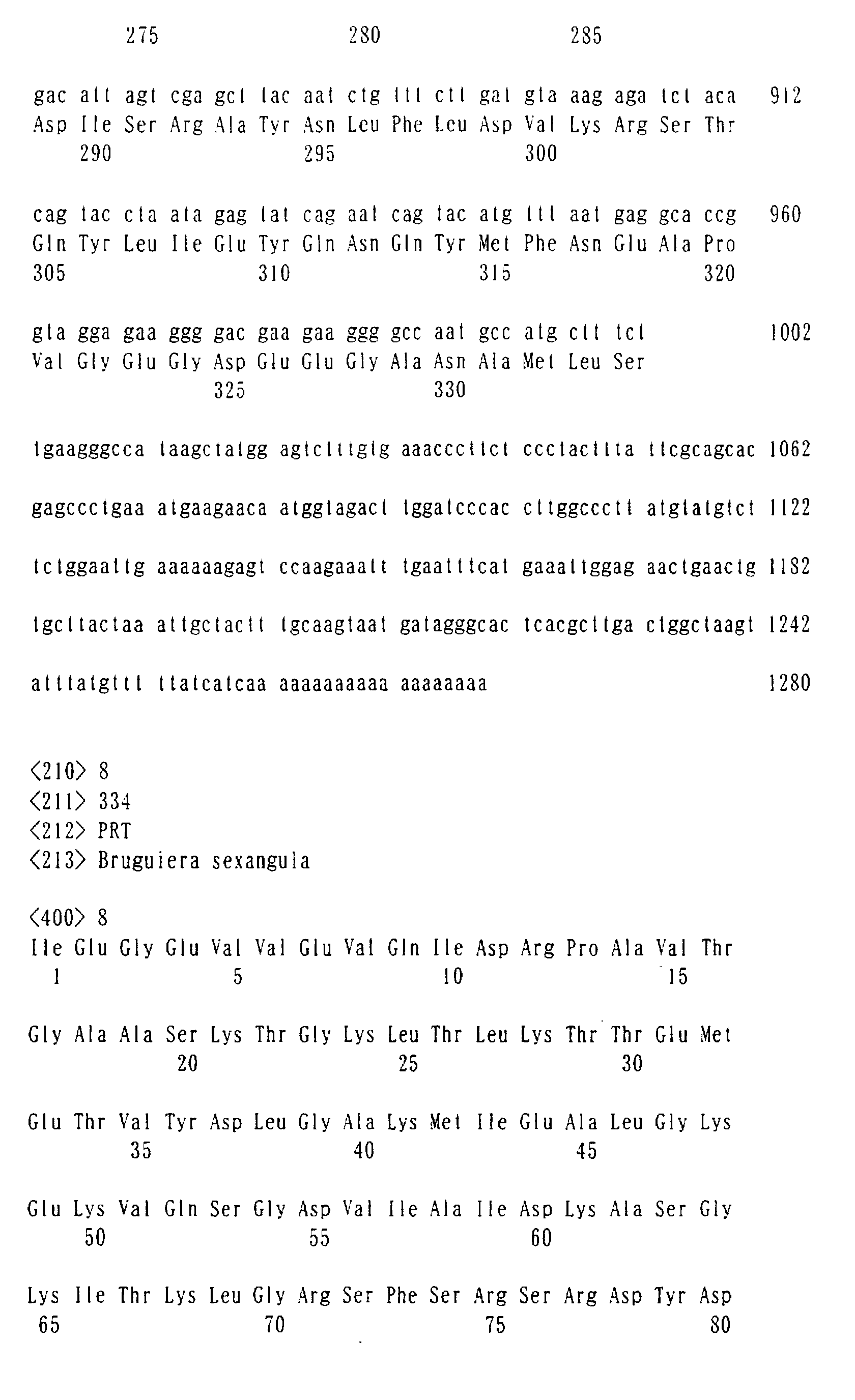

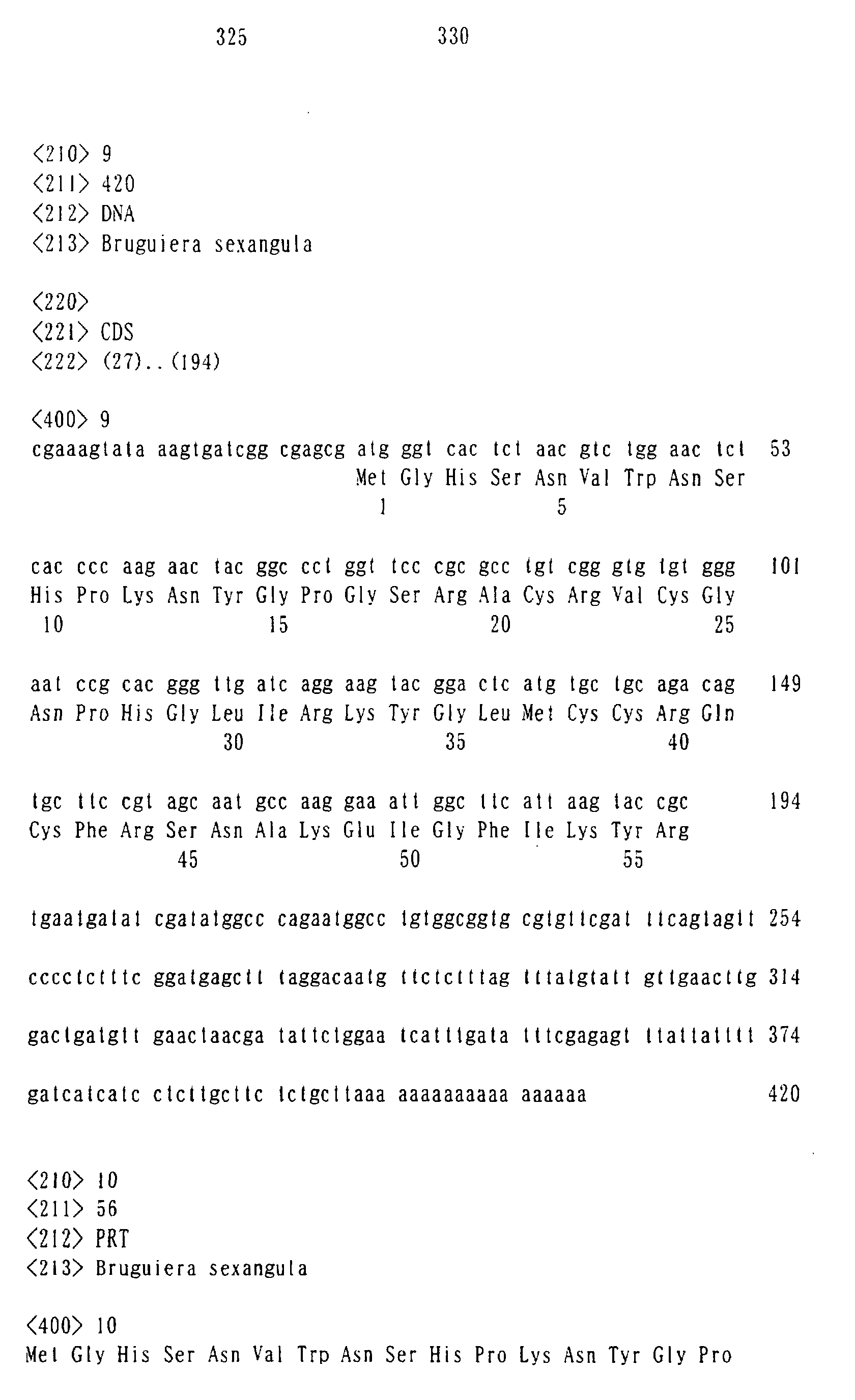

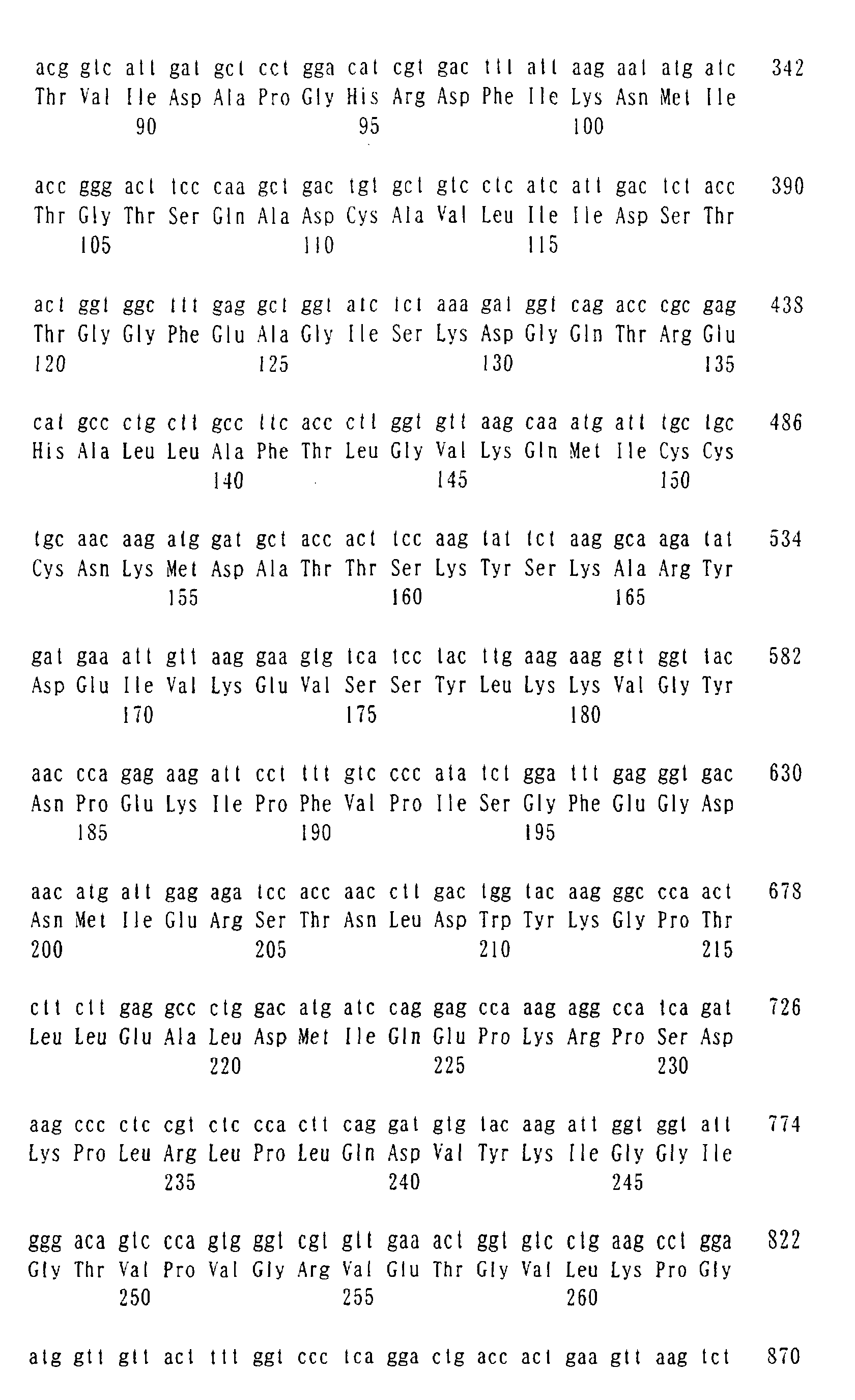

















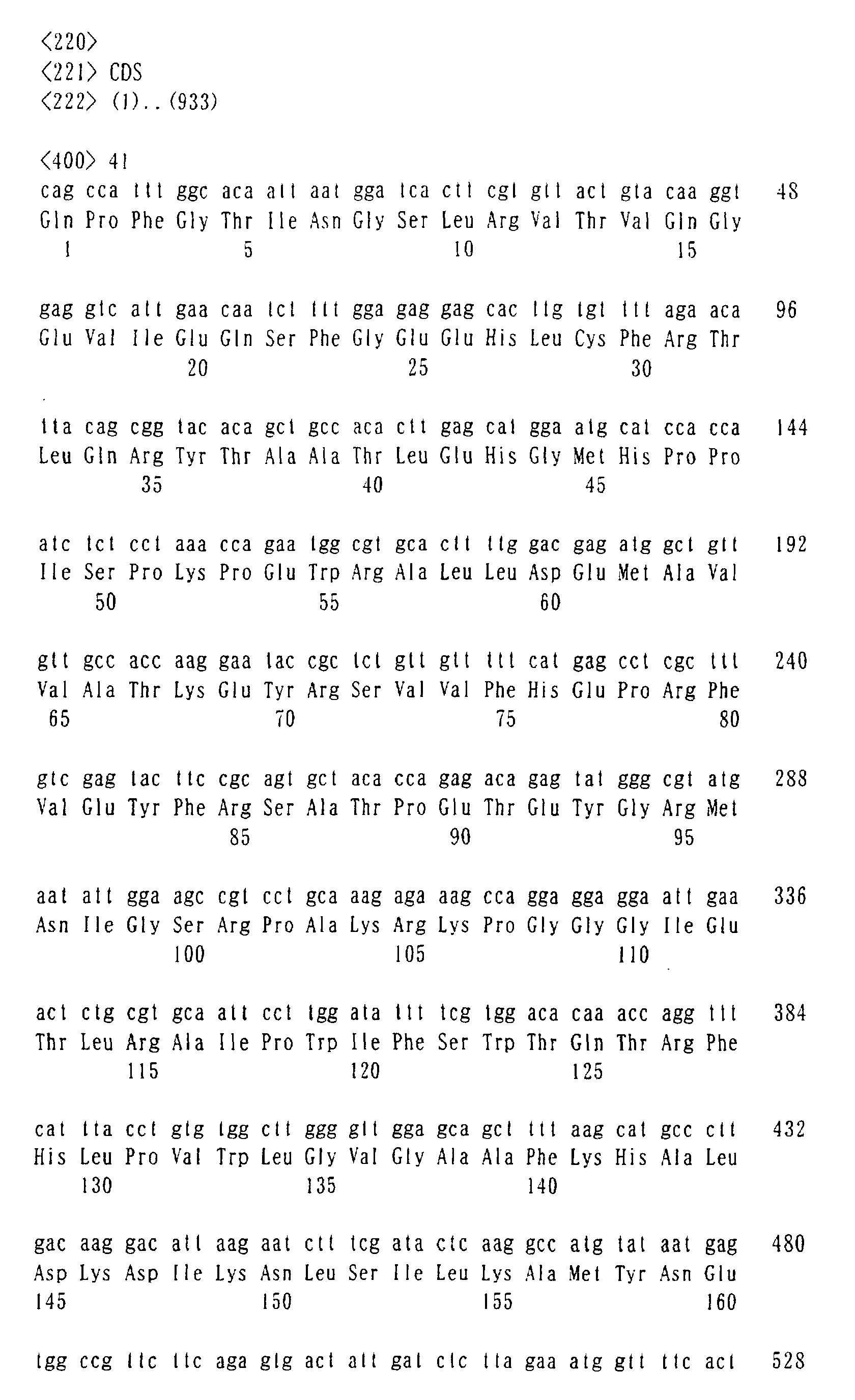

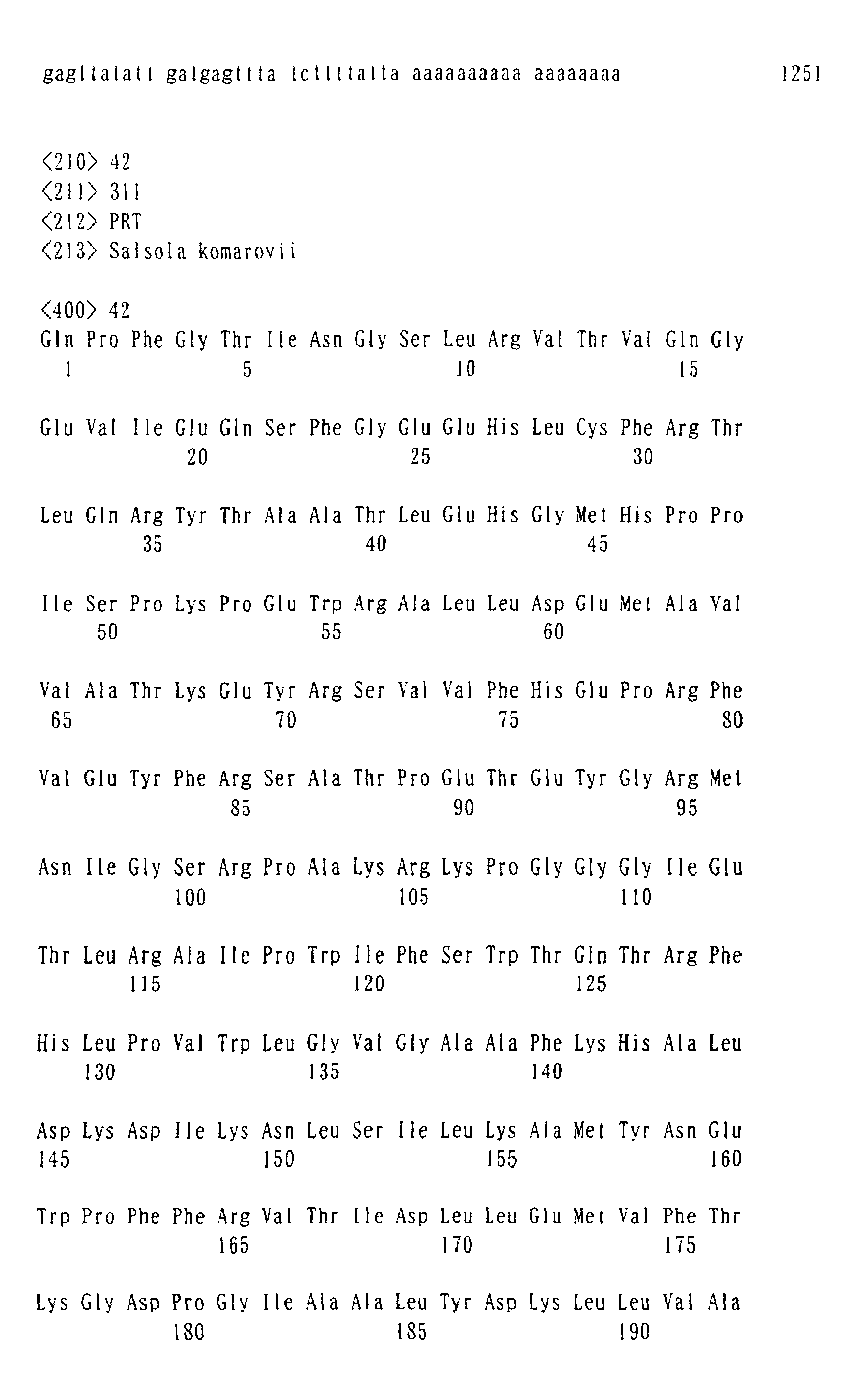


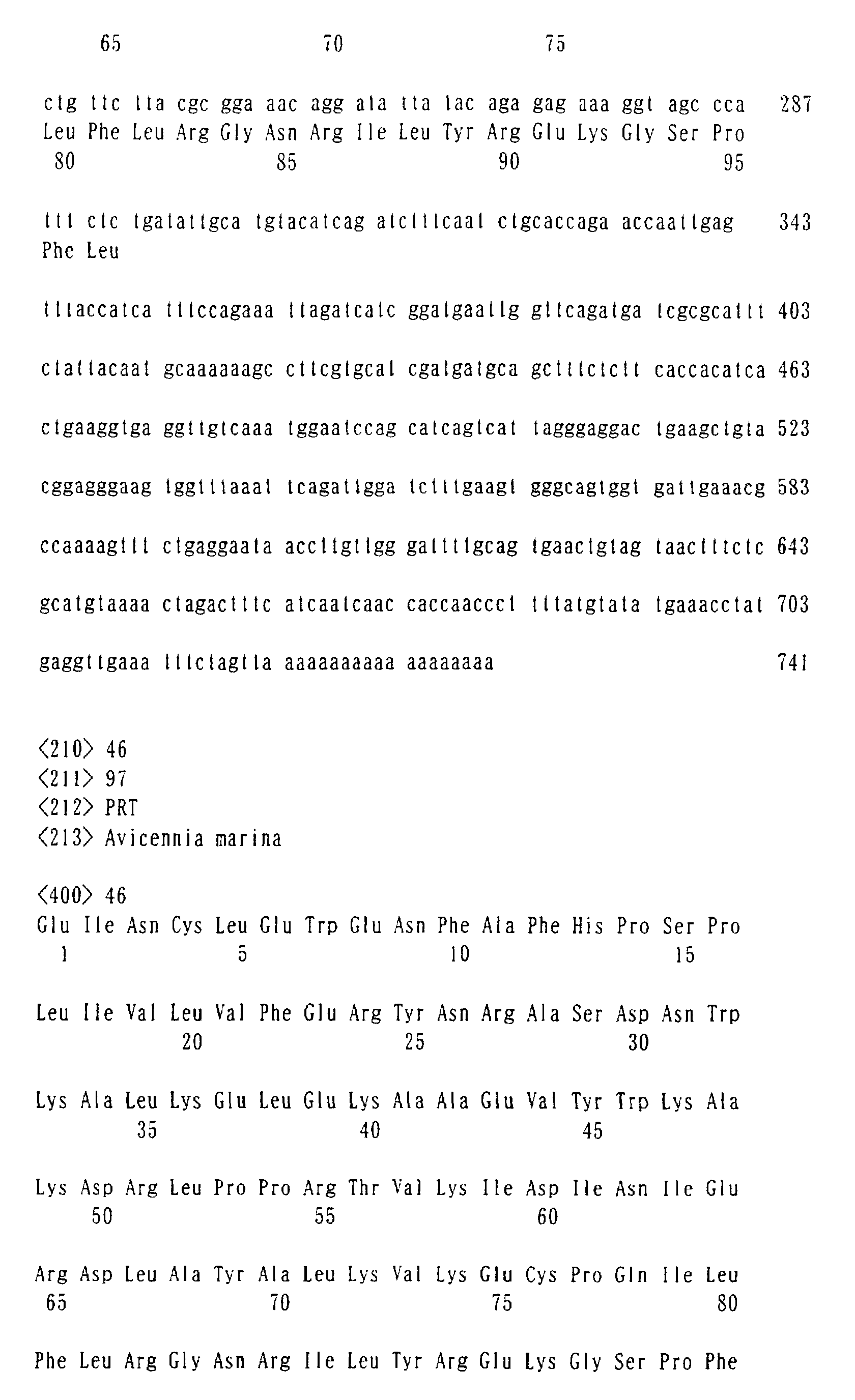

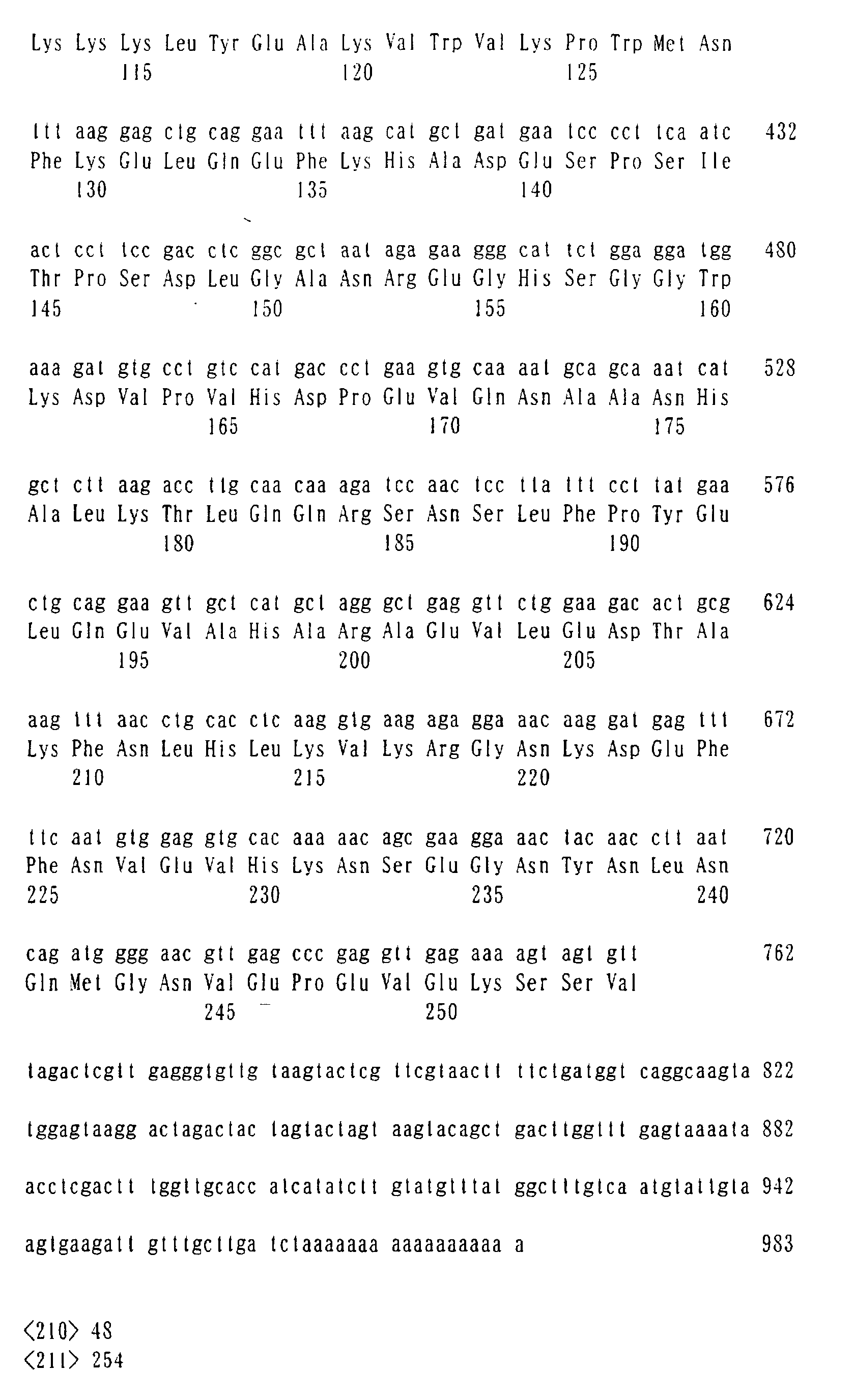












Claims (125)
- A method for screening DNA encoding proteins having the activity of improving environmental stress tolerance wherein candidate cDNA derived from cDNA library is introduced into host cells, the obtained transformed cells are cultured under the conditions where the host cells cannot substantially grow, the clones grown after culturing are selected, and the candidate cDNA introduced from the selected clones is isolated.
- A method for screening DNA encoding proteins having the activity of improving environmental stress tolerance wherein candidate cDNA derived from cDNA library is introduced into host cells, the obtained transformed cells are cultured under conditions where the host cells cannot substantially grow, the clones grown after the culturing are selected, the candidate cDNA introduced from the selected clones is isolated, the isolated candidate cDNA is introduced into the isolated cDNA, the mutant cDNA is introduced into host cells, and the process of selecting is repeated one or more under stringent conditions of selecting mutant cDNA than the selecting condition.
- The method for screening according to any one of claims 1 or 2, wherein the environmental stress is one or more of chemical substance stress, high temperature stress, low temperature stress, freezing stress, drought stress, ozone stress, ultraviolet stress, radiation stress, or osmotic pressure stress.
- The method for screening according to claim 3, wherein the chemical substance stress is salt stress.
- The method for screening according to any one of claims 1 to 4, wherein the host cell is a coliform.
- The method for screening according to claim 5, wherein the coliform is SOLR strain.
- The method for screening according to any one of claims 1 to 6, wherein an environmental condition where host cells cannot substantially grow is 350mM or more of salt concentration.
- DNA encoding proteins having the activity of improving environmental stress tolerance wherein the DNA is obtained according to any one of claims 1 to 7.
- DNA encoding proteins having the activity of improving environmental stress tolerance according to claim 8, wherein the environmental stress is one or more of stresses selected from chemical substance stress, high-temperature stress, low-temperature stress, freezing stress, drought stress, ozone stress, ultraviolet stress, radiation stress, or osmotic pressure stress.
- DNA encoding proteins having the activity of improving the environmental stress tolerance according to claim 9, wherein the chemical substance stress is salt stress.
- DNA encoding proteins having the activity of improving the environmental stress tolerance according to any one of claims 8 to 10, wherein the proteins having the activity of improving the environmental stress tolerance are derived from plants.
- DNA encoding proteins having the activity of improving the environmental stress tolerance according to claim 11, wherein the plant is Bruguiera sexangla, Avicennia marina, Sueada japonica, Salsola komarovii, or Mesembryanthemum crystallinum.
- DNA encoding proteins according to any one of the following (a) to (c):(a) a protein comprising the sequence of amino acids shown in Seq. ID No. 2,(b) a protein comprising a sequence of amino acids having 70% or more of homology with the sequence of amino acids shown in Seq. ID No. 2, and having the activity of tolerance at least against salt stress,(c) a protein having a sequence of amino acids wherein one or more of amino acids are deleted, substituted, or added in the sequence of amino acids shown in Seq. ID No. 2, and having the activity of improving tolerance at least against salt stress.
- DNA comprising part or whole of the sequence of bases shown in Seq. ID No. 1, or its complementary sequence.
- DNA hybridized with the DNA according to claim 14 under stringent conditions, and encoding proteins having the activity of improving tolerance at least against salt stress.
- DNA encoding proteins according to any one of the following (a) or (b):(a) a protein comprising the sequence of amino acids shown in Seq. ID No. 4,(b) a protein comprising a sequence of amino acids wherein one or more of amino acids are deleted, substituted, or added in the sequence of amino acids shown in Seq. ID No. 4, and having the activity of improving tolerance at least against salt stress.
- DNA comprising part or whole of the sequence of bases shown in Seq. ID No. 3 or its complementary sequence.
- DNA hybridized with the DNA according to claim 17 under stringent conditions, and encoding proteins having the activity of improving tolerance at least against salt stress.
- DNA encoding proteins according to any one of the following (a) or (b):(a) a protein comprising the sequence of amino acids shown in Seq. ID No. 6,(b) a protein comprising the sequence of amino acids wherein one or more of amino acids are deleted, substituted, or added in the sequence of amino acids shown in Seq. ID No. 6, and having the activity of improving tolerance at least against salt stress.
- DNA comprising part or whole of the sequence of bases shown in Seq. ID No. 5 or its complementary sequence.
- DNA hybridized with the DNA according to claim 20 under stringent conditions, and encoding proteins comprising the activity of improving tolerance at least against salt stress.
- DNA encoding proteins according to any one of the following (a) or (b):(a) a protein comprising the sequence of amino acids shown in Seq. ID No. 8,(b) a protein comprising a sequence of amino acids wherein one or more of amino acids are deleted, substituted, or added in the sequence of amino acids shown in Seq. ID No. 8, and having the activity of improving tolerance at least against salt stress.
- DNA comprising part or whole of the sequence of bases shown in Seq. ID No. 7 or its complementary sequence.
- DNA hybridized with the DNA according to Claim 23 under stringent conditions, and encoding proteins having the activity of improving tolerance at least against salt stress.
- DNA encoding proteins according to any one of the following (a) or (b):(a) a protein comprising a sequence of amino acids shown in Seq. ID No. 10,(b) a protein comprising a sequence of amino acids wherein one or more of amino acids are deleted, substituted, or added in the sequence of amino acids shown in Seq. ID No. 10, and having the activity of improving tolerance at least against salt stress.
- DNA comprising part or whole of the sequence of bases shown in Seq. ID No. 9 or its complementary sequence.
- DNA hybridized with the DNA according to claim 26 under stringent conditions, and encoding proteins having the activity of improving tolerance at least against salt stress.
- DNA encoding proteins according to any one of the following (a) or (b):(a) a protein having the sequence of amino acids shown in Seq. ID No. 12,(b) a protein having a sequence of amino acids wherein one or more of amino acids are deleted, substituted, or added in the sequence of amino acids shown in Seq. ID No. 12, and having the activity of improving tolerance at least against salt stress.
- DNA comprising part or whole of the sequence of bases shown in Seq. ID No. 11 or its complementary sequence.
- DNA hybridized with the DNA according to claim 29 under stringent conditions, and encoding proteins having the activity of improving tolerance at least against salt stress.
- DNA encoding proteins according to any one of the following (a) or (b):(a) a protein having the sequence of amino acids shown in Seq. ID No. 14,(b) a protein having a sequence of amino acids wherein one or more of amino acids are deleted, substituted, or added in the sequence of amino acids shown in Seq. ID No. 14, and having the activity of improving tolerance at least against salt stress.
- DNA comprising part or whole of the sequence of bases shown in Seq. ID No. 13 or its complementary sequence.
- DNA hybridized with the DNA according to claim 32 under stringent conditions, and encoding proteins having the activity of improving tolerance at least against salt stress.
- DNA encoding proteins according to any one of the following (a) or (b):(a) a protein comprising the sequence of amino acids shown in Seq. ID No. 16,(b) a protein comprising a sequence of amino acids wherein one or more of amino acids are deleted, substituted, or added in the sequence of amino acids shown in Seq. ID No. 16, and having the activity of improving tolerance at least against salt stress.
- DNA comprising part or whole of the sequence of bases shown in Seq. ID No. 15 or its complementary sequence.
- DNA hybridized with the DNA according to claim 35 under stringent conditions, and encoding proteins having the activity of improving tolerance at least against salt stress.
- DNA encoding proteins according to any one of the following (a) or (b):(a) a protein comprising the sequence of amino acids shown in Seq. ID No. 18,(b) a protein comprising a sequence of amino acids wherein one or more of amino acids are deleted, substituted, or added in the sequence of amino acids shown in Seq. ID No. 18, and having the activity of improving tolerance at least against salt stress.
- DNA having part or whole of the sequence of bases shown in Seq. ID No. 17 or its complementary sequence.
- DNA hybridized with the DNA according to Claim 38 under stringent conditions, and encoding proteins having the activity of improving tolerance at least against salt stress.
- DNA encoding proteins according to any one of the following (a) or (b):(a) a protein comprising the sequence of amino acids shown in Seq. ID No. 20,(b) a protein comprising a sequence of amino acids wherein one or more of amino acids are deleted, substituted, or added in the sequence of amino acids shown in Seq. ID No. 20, and having the activity of improving tolerance at least against salt stress.
- DNA comprising part or whole of the sequence of bases shown in Seq. ID No. 19 or its complementary sequence.
- DNA hybridized with the DNA according to claim 41 under stringent conditions, and encoding proteins having the activity of improving tolerance at least against salt stress.
- DNA encoding proteins according to any one of the following (a) or (b):(a) a protein comprising the sequence of amino acids shown in Seq. ID No. 22,(b) a proteins comprising a sequence of amino acids wherein one or more of amino acids are deleted, substituted, or added in the sequence of amino acids shown in Seq. ID No. 22, and having the activity of improving tolerance at least against salt stress.
- DNA comprising part or whole of the sequence of bases shown in Seq. ID No. 21 or its complementary sequence.
- DNA hybridized with the DNA under stringent conditions according to claim 44, and encoding proteins having the activity of improving tolerance at least against salt stress.
- DNA encoding proteins according to any one of the following (a) or (b):(a) a protein comprising the sequence of amino acids shown in Seq. ID No. 24,(b) a protein comprising a sequence of amino acids wherein one or more of amino acids are deleted, substituted, or added in the sequence of amino acids shown in Seq. ID No. 24, and having activity of improving tolerance at least against salt stress.
- DNA comprising part or whole of the sequence of bases shown in Seq. ID No. 23 or its complementary sequence.
- DNA hybridized with the DNA according to Claim 47 under stringent conditions, and encoding proteins having the activity of improving tolerance at least against salt stress.
- DNA encoding proteins according to any one of the following (a) or (b):(a) a protein comprising the sequence of amino acids shown in Seq. ID No. 26,(b) a protein comprising a sequence of amino acids wherein one or more of amino acids are deleted, substituted, or added in the sequence of amino acids shown in Seq. ID No. 26, and having the activity of improving tolerance at least against salt stress.
- DNA comprising part or whole of the sequence of bases shown in Seq. ID No. 25 or its complementary sequence.
- DNA hybridized with the DNA according to Claim 50 under stringent conditions, and encoding proteins having the activity of improving tolerance at least against salt stress.
- DNA encoding proteins according to any one of the following (a) or (b):(a) a protein comprising the sequence of amino acids shown in Seq. ID No. 28,(b) a protein comprising a sequence of amino acids wherein one or more of amino acids are deleted, substituted, or added in the sequence of amino acids shown in Seq. ID No. 28, and having the activity of improving tolerance at least against salt stress.
- DNA comprising part or whole of the sequence of bases shown in Seq. ID No. 27 or its complementary sequence.
- DNA hybridized with the DNA according to claim 53 under stringent conditions, and encoding proteins having the activity of improving tolerance at least against salt stress.
- DNA encoding proteins according to any one of the following (a) or (b):(a) a protein comprising the sequence of amino acids shown in Seq. ID No. 30,(b) a protein comprising a sequence of amino acids wherein one or more of amino acids are deleted, substituted, or added in the sequence of amino acids shown in. ID No. 30, and having the activity of improving tolerance at least against salt stress.
- DNA comprising part or whole of the sequence of bases shown in Seq. ID No. 29 or its complementary sequence.
- DNA hybridized with the DNA according to Claim 56 under stringent conditions, and encoding proteins having the activity of improving tolerance at least against salt stress.
- DNA encoding proteins according to any one of the following (a) or (b):(a) a protein comprising the sequence of amino acids shown in Seq. ID No. 32,(b) a protein comprising a sequence of amino acids wherein one or more of amino acids are deleted, substituted, or added in the sequence of amino acids shown in Seq. ID No. 32, and having the activity of improving tolerance at least against salt stress.
- DNA comprising part or whole of the sequence of bases shown in Seq. ID No. 31 or its complementary sequence.
- DNA hybridized with the DNA according to claim 59 under stringent conditions, and encoding proteins having the activity of improving tolerance at least against salt stress.
- DNA encoding proteins according to any one of the following (a) or (b):(a) a protein comprising the sequence of amino acids shown in Seq. ID No. 34,(b) a protein comprising a sequence of amino acids wherein one or more of amino acids are deleted, substituted, or added in the sequence of amino acids shown in Seq. ID No. 34, and having the activity of improving tolerance at least against salt stress.
- DNA comprising part or whole of the sequence of bases shown in Seq. ID No. 33 or its complementary sequence.
- DNA hybridized with the DNA according to Claim 62 under stringent conditions, and encoding proteins having the activity of improving tolerance at least against salt stress.
- DNA encoding proteins according to any one of the following (a) or (b):(a) a protein comprising the sequence of amino acids shown in Seq. ID No. 36, 38, 40, 42, 44, 46, 48, 50, 52, 54, 56, 58, 60, 62, or 64,(b) a protein comprising a sequence of amino acids wherein one or more of amino acids are deleted, substituted, or added in the sequence of amino acids shown in Seq. ID No. 36, 38, 40, 42, 44, 46, 48, 50, 52, 54, 56, 58, 60, 62, or 64, and having the activity of improving tolerance at least against salt stress.
- DNA comprising part or whole of the sequence of bases shown in Seq. ID No. 35, 37, 39, 41, 43, 45, 47, 49, 51, 53, 55, 57, 59, 61, or 63, or its complementary sequence.
- DNA hybridized with the DNA according to claim 65 under stringent conditions, and encoding proteins having the activity of improving tolerance at least against salt stress.
- A method for improving environmental stress tolerance, wherein the DNA according to any one of claims 8 to 66 is used.
- The method for improving the environmental stress tolerance according to claim 67, wherein the environmental stress is one or more of chemical substance stress, high temperature stress, low temperature stress, freezing stress, drought stress, ozone stress, ultraviolet stress, radiation stress, and/or osmotic pressure stress.
- The method for improving environmental stress tolerance according to claim 68, wherein the chemical substance stress is salt stress.
- A protein comprising of the sequence of amino acids shown in Seq. ID No. 2.
- A protein having 70% or more of homology with the sequence of amino acids shown in Seq. ID No. 2, and having the activity of improving tolerance at least against salt stress.
- A protein comprising a sequence of amino acids wherein one or more amino acids are deleted, substituted, or added in the sequence of amino acids shown in Seq. ID No. 2, and having the activity of improving tolerance at least against salt stress.
- A protein comprising the sequence of amino acids shown in Seq. ID No. 4.
- A protein comprising a sequence of amino acids wherein one or more amino acids are deleted, substituted, or added in the sequence of amino acids shown in Seq. ID No. 4, and having the activity of improving tolerance at least against salt stress.
- A protein comprising the sequence of amino acids shown in Seq. ID No. 6.
- A protein comprising a sequence of amino acids wherein one or more amino acids are deleted, substituted, or added in the sequence of amino acids shown in Seq. ID No. 6, and having the activity of improving tolerance at least against salt stress.
- A protein comprising the sequence of amino acids shown in Seq. ID No. 8.
- A protein comprising a sequence of amino acids wherein one or more amino acids are deleted, substituted, or added in the sequence of amino acids shown in Seq. ID No. 8, and having the activity of improving tolerance at least against salt stress.
- A protein comprising the sequence of amino acids shown in Seq. ID No. 10.
- A protein comprising a sequence of amino acids wherein one or more amino acids are deleted, substituted, or added in the sequence of amino acids shown in Seq. ID No. 10, and having the activity of improving tolerance at least against salt stress.
- A protein comprising the sequence of amino acids shown in Seq. ID No. 12.
- A protein comprising a sequence of amino acids wherein one or more amino acids are deleted, substituted, or added in the sequence of amino acids shown in Seq. ID No. 12, and having the activity of improving tolerance at least against salt stress.
- A protein comprising the sequence of amino acids shown in Seq. ID No. 14.
- A protein comprising a sequence of amino acids wherein one or more amino acids are deleted, substituted, or added in the sequence of amino acids shown in Seq. ID No. 14, and having the activity of improving tolerance at least against salt stress.
- A protein comprising the sequence of amino acids shown in Seq. ID No. 16.
- A protein comprising a sequence of amino acids wherein one or more amino acids are deleted, substituted, or added in the sequence of amino acids shown in Seq. ID No. 16, and having the activity of improving tolerance at least against salt stress.
- A protein comprising the sequence of amino acids shown in Seq. ID No. 18.
- A protein comprising a sequence of amino acids wherein one or more amino acids are deleted, substituted, or added in the sequence of amino acids shown in Seq. ID No. 18, and having the activity of improving tolerance at least against salt stress.
- A protein comprising the sequence of amino acids shown in Seq. ID No. 20.
- A protein comprising a sequence of amino acids wherein one or more amino acids are deleted, substituted, or added in the sequence of amino acids shown in Seq. ID No. 20, and having the activity of improving tolerance at least against salt stress.
- A protein comprising the sequence of amino acids shown in Seq. ID No. 22.
- A protein comprising a sequence of amino acids wherein one or more amino acids are deleted, substituted, or added in the sequence of amino acids shown in Seq. ID No. 22, and having the activity of improving tolerance at least against salt stress.
- A protein comprising the sequence of amino acids shown in Seq. ID No. 24.
- A protein comprising a sequence of amino acids wherein one or more amino acids are deleted, substituted, or added in the sequence of amino acids shown in Seq. ID No. 24, and having the activity of improving tolerance at least against salt stress.
- A protein comprising the sequence of amino acids shown in Seq. ID No. 26.
- A protein comprising a sequence of amino acids wherein one or more amino acids are deleted, substituted, or added in the sequence of amino acids shown in Seq. ID No. 26, and having the activity of improving tolerance at least against salt stress.
- A protein comprising the sequence of amino acids shown in Seq. ID No. 28.
- A protein comprising a sequence of amino acids wherein one or more amino acids are deleted, substituted, or added in the sequence of amino acids shown in Seq. ID No. 28, and having the activity of improving tolerance at least against salt stress.
- A protein comprising the sequence of amino acids shown in Seq. ID No. 30.
- A protein comprising a sequence of amino acids wherein one or more amino acids are deleted, substituted, or added in the sequence of amino acids shown in Seq. ID No. 30, and having the activity of improving tolerance at least against salt stress.
- A protein comprising the sequence of amino acids shown in Seq. ID No. 32.
- A protein comprising a sequence of amino acids wherein one or more amino acids are deleted, substituted, or added in the sequence of amino acids shown in Seq. ID No. 32, and having the activity of improving tolerance at least against salt stress.
- A protein comprising the sequence of amino acids shown in Seq. ID No. 34.
- A protein comprising a sequence of amino acids wherein one or more amino acids are deleted, substituted, or added in the sequence of amino acids shown in Seq. ID No. 34, and having the activity of improving tolerance at least against salt stress.
- A protein comprising the sequence of amino acids shown in Seq. ID No. 36, 38, 40, 42, 44, 46, 48, 50, 52, 54, 56, 58, 60, 62, or 64.
- A protein comprising a sequence of amino acids wherein one or more amino acids are deleted, substituted, or added in the sequence of amino acids shown in Seq. ID No. 36, 38, 40, 42, 44, 46, 48, 50, 52, 54, 56, 58, 60, 62, or 64, and having the activity of improving tolerance at least against salt stress.
- An antibody specifically bound to the protein according to any one of claims 70 to 72.
- An antibody specifically bound to the protein according to any one of claims 73 to 104.
- An antibody specifically bound to the protein according to any one of claims 105 or 106.
- The antibody according to any one of claims 107 to 109, wherein the antibody is a monoclonal antibody.
- A vector comprising the DNA encoding proteins having the activity of improving tolerance against environmental stresses according to any one of claims 8 to 12.
- A vector comprising the DNA according to any one of claims 13 to 15.
- A vector comprising the DNA according to any one of claims 16 to 63.
- A vector comprising the DNA according to any one of claims 64 to 66.
- A transformed cell obtained by introducing the vector according to any one of claims 111 to 114.
- A transformed cell according to claim 115, wherein the host cell is a plant cell.
- A method for producing proteins having the activity of improving environmental stress tolerance, wherein the transformed cells according to either of claims 115 or 116 is cultured, and recombinant proteins are collected from the transformed cells or the supematant of the cultured liquid.
- A transgenic plant obtained by introducing the DNA according to any one of claims 8 to 12 encoding proteins having the activity of improving environmental stress tolerance, and by dividing, proliferating and redifferentiating the plant cell.
- A transgenic plant obtained by introducing the DNA according to any one of claims 13 to 15 encoding proteins having the activity of improving environmental stress tolerance, and by dividing, proliferating and redifferentiating the plant cell.
- A transgenic plant obtained by introducing the DNA according to any one of claims 16 to 63 encoding proteins having the activity of improving environmental stress tolerance, and by dividing, proliferating and redifferentiating the plant cell.
- A transgenic plant obtained by introducing the DNA according to any one of claims 64 to 66 encoding proteins having the activity of improving environmental stress tolerance, and by dividing, proliferating and redifferentiating the plant cell.
- A transgenic plant obtained by introducing the vector according to any one of claims 111 to 114, and by dividing, proliferating and redifferentiating the plant cell.
- The transgenic plant according to any one of claims 118 to 122, wherein the environmental stress is one or more of chemical substance stress, high temperature stress, low temperature stress, frenzying stress, drought stress, ozone stress, ultraviolet stress, radiation stress, and/or osmotic pressure stress.
- The transgenic plant according to claim 123, wherein the chemical substance stress is salt stress.
- A material for breeding derived from the transgenic plant according to any one of claims 118 to 122.
Applications Claiming Priority (5)
| Application Number | Priority Date | Filing Date | Title |
|---|---|---|---|
| JP23591099 | 1999-07-19 | ||
| JP23591099 | 1999-07-19 | ||
| JP2000085377 | 2000-03-24 | ||
| JP2000085377 | 2000-03-24 | ||
| PCT/JP2000/004862 WO2001006006A1 (en) | 1999-07-19 | 2000-07-19 | Environmental stress resistance gene |
Publications (2)
| Publication Number | Publication Date |
|---|---|
| EP1225231A1 true EP1225231A1 (en) | 2002-07-24 |
| EP1225231A4 EP1225231A4 (en) | 2003-01-29 |
Family
ID=26532388
Family Applications (1)
| Application Number | Title | Priority Date | Filing Date |
|---|---|---|---|
| EP00946421A Withdrawn EP1225231A4 (en) | 1999-07-19 | 2000-07-19 | GENE OF RESISTANCE TO AMBIENT STRESS |
Country Status (4)
| Country | Link |
|---|---|
| US (1) | US7151202B1 (en) |
| EP (1) | EP1225231A4 (en) |
| CA (1) | CA2379850A1 (en) |
| WO (1) | WO2001006006A1 (en) |
Cited By (11)
| Publication number | Priority date | Publication date | Assignee | Title |
|---|---|---|---|---|
| WO2005065339A3 (en) * | 2003-12-30 | 2006-09-21 | Arborgen Llc | Cell cycle genes and related methods of using |
| EP1625199A4 (en) * | 2003-05-22 | 2007-11-28 | Evogene Ltd | Methods of increasing abiotic stress tolerance and/or biomass in plants and plants generated thereby |
| WO2008010928A3 (en) * | 2006-07-19 | 2008-06-19 | Childrens Memorial Hospital | Method for discovery of anti-senescence genes |
| EP2064330A2 (en) * | 2007-05-22 | 2009-06-03 | BASF Plant Science GmbH | Plants with increased tolerance and/or resistance to environmental stress and increased biomass production |
| US7554007B2 (en) | 2003-05-22 | 2009-06-30 | Evogene Ltd. | Methods of increasing abiotic stress tolerance and/or biomass in plants |
| EP1945021A4 (en) * | 2005-08-15 | 2010-03-03 | Evogene Ltd | Methods of increasing abiotic stress tolerance and/or biomass in plants and plants generated thereby |
| CN104622923A (en) * | 2015-03-03 | 2015-05-20 | 周佩龙 | Pharmaceutical composition for treating learning and memory impairment disease as well as preparation process and application of pharmaceutical composition |
| US9631000B2 (en) | 2006-12-20 | 2017-04-25 | Evogene Ltd. | Polynucleotides and polypeptides involved in plant fiber development and methods of using same |
| US9670501B2 (en) | 2007-12-27 | 2017-06-06 | Evogene Ltd. | Isolated polypeptides, polynucleotides useful for modifying water user efficiency, fertilizer use efficiency, biotic/abiotic stress tolerance, yield and biomass in plants |
| US10457954B2 (en) | 2010-08-30 | 2019-10-29 | Evogene Ltd. | Isolated polynucleotides and polypeptides, and methods of using same for increasing nitrogen use efficiency, yield, growth rate, vigor, biomass, oil content, and/or abiotic stress tolerance |
| US10760088B2 (en) | 2011-05-03 | 2020-09-01 | Evogene Ltd. | Isolated polynucleotides and polypeptides and methods of using same for increasing plant yield, biomass, growth rate, vigor, oil content, abiotic stress tolerance of plants and nitrogen use efficiency |
Families Citing this family (16)
| Publication number | Priority date | Publication date | Assignee | Title |
|---|---|---|---|---|
| EP2169069A3 (en) * | 2000-04-07 | 2010-07-14 | BASF Plant Science GmbH | Phosphatase stress-related proteins and methods of use in plants |
| US8481814B2 (en) * | 2004-09-30 | 2013-07-09 | Ceres, Inc. | Nucleotide sequences and polypeptides encoded thereby useful for modifying plant characteristics |
| WO2005121364A2 (en) | 2004-06-14 | 2005-12-22 | Evogene Ltd. | Polynucleotides and polypeptides involved in plant fiber development and methods of using same |
| CA2626592C (en) | 2005-10-24 | 2018-07-17 | Evogene Ltd. | Methods of increasing abiotic stress tolerance and fertilizer use efficiency of a plant |
| BRPI0809796B1 (en) | 2007-04-09 | 2021-09-08 | Evogene Ltd | METHODS TO INCREASE THE OIL CONTENT, GROWTH RATE, BIOMASS, STRENGTH AND/OR YIELD OF A PLANT, AND TO PRODUCE OIL |
| ES2685631T3 (en) | 2007-07-24 | 2018-10-10 | Evogene Ltd. | Polynucleotides, polypeptides encoded by them, and methods of using them to increase tolerance to abiotic stress and / or biomass and / or yield in plants that express them |
| US8847008B2 (en) | 2008-05-22 | 2014-09-30 | Evogene Ltd. | Isolated polynucleotides and polypeptides and methods of using same for increasing plant utility |
| BR122021014175B1 (en) | 2008-08-18 | 2022-09-20 | Evogene Ltd. | METHOD TO INCREASE NITROGEN USE EFFICIENCY, FERTILIZER USE EFFICIENCY, PRODUCTION, GROWTH RATE, VIGOR, BIOMASS, OIL CONTENT AND/OR NITROGEN DEFICIENCY STRESS TOLERANCE OF A PLANT |
| MX389590B (en) | 2008-10-30 | 2025-03-20 | Evogene Ltd | ISOLATED POLYNUCLEOTIDES AND POLYPEPTIDES AND METHODS OF USING THEM TO INCREASE PLANT YIELD, BIOMASS, GROWTH RATE, VIGOR, OIL CONTENT, ABIOTIC STRESS TOLERANCE OF PLANTS AND NITROGEN USE EFFICIENCY. |
| HUE041819T2 (en) | 2009-03-02 | 2019-05-28 | Evogene Ltd | Isolated polynucleotides and polypeptides, and methods of using same for increasing plant yield and/or agricultural characteristics |
| ES2773985T3 (en) | 2009-06-10 | 2020-07-16 | Evogene Ltd | Isolated polynucleotides and polypeptides, and methods of using them to increase nitrogen use efficiency, yield, growth rate, vigor, biomass, oil content, and / or tolerance to abiotic stress |
| CA2784342C (en) | 2009-12-28 | 2022-11-22 | Evogene Ltd. | Isolated polynucleotides and polypeptides and methods of using same for increasing plant yield, biomass, growth rate, vigor, oil content, abiotic stress tolerance of plants and nitrogen use efficiency |
| US9328353B2 (en) | 2010-04-28 | 2016-05-03 | Evogene Ltd. | Isolated polynucleotides and polypeptides for increasing plant yield and/or agricultural characteristics |
| MX354193B (en) | 2010-12-22 | 2018-02-16 | Evogene Ltd | Isolated polynucleotides and polypeptides, and methods of using same for improving plant properties. |
| US9803223B2 (en) | 2013-04-17 | 2017-10-31 | Research Institute Of Innovative Technology For The Earth | Coryneform bacterium transformant with improved aniline productivity and process for producing aniline using the same |
| CN106749546B (en) * | 2017-02-07 | 2020-11-13 | 天津农学院 | A kind of artificial salt-tolerant protein, synthesis method and coding gene and application of gene |
Family Cites Families (4)
| Publication number | Priority date | Publication date | Assignee | Title |
|---|---|---|---|---|
| US4946778A (en) | 1987-09-21 | 1990-08-07 | Genex Corporation | Single polypeptide chain binding molecules |
| JPH10295380A (en) | 1997-04-23 | 1998-11-10 | Japan Tobacco Inc | New thionine gene induced by salt stress |
| CA2332130A1 (en) * | 1998-06-29 | 2000-01-06 | Ray J. Wu | Production of low-temperature, salt-and drought-tolerant transgenic cereal plants |
| WO2000008187A2 (en) * | 1998-08-04 | 2000-02-17 | Cropdesign N.V. | Genes involved in tolerance to environmental stress |
-
2000
- 2000-07-19 US US10/031,331 patent/US7151202B1/en not_active Expired - Fee Related
- 2000-07-19 CA CA002379850A patent/CA2379850A1/en not_active Abandoned
- 2000-07-19 WO PCT/JP2000/004862 patent/WO2001006006A1/en not_active Ceased
- 2000-07-19 EP EP00946421A patent/EP1225231A4/en not_active Withdrawn
Cited By (16)
| Publication number | Priority date | Publication date | Assignee | Title |
|---|---|---|---|---|
| EP2365087A3 (en) * | 2003-05-22 | 2011-11-30 | Evogene Ltd. | Methods of increasing abiotic stress tolerance and/or biomass in plants and plants generated thereby |
| US7554007B2 (en) | 2003-05-22 | 2009-06-30 | Evogene Ltd. | Methods of increasing abiotic stress tolerance and/or biomass in plants |
| EP1625199A4 (en) * | 2003-05-22 | 2007-11-28 | Evogene Ltd | Methods of increasing abiotic stress tolerance and/or biomass in plants and plants generated thereby |
| US10184132B2 (en) | 2003-05-22 | 2019-01-22 | Evogene Ltd. | Methods of increasing abiotic stress tolerance, yield and/or biomass in plants |
| US7598084B2 (en) | 2003-12-30 | 2009-10-06 | Arborgen Llc | Modifications of plant traits using cyclin A |
| WO2005065339A3 (en) * | 2003-12-30 | 2006-09-21 | Arborgen Llc | Cell cycle genes and related methods of using |
| EP1945021A4 (en) * | 2005-08-15 | 2010-03-03 | Evogene Ltd | Methods of increasing abiotic stress tolerance and/or biomass in plants and plants generated thereby |
| US10829777B2 (en) | 2005-08-15 | 2020-11-10 | Evogene Ltd. | Methods of increasing abiotic stress tolerance and/or biomass in plants and plants generated thereby |
| US7910800B2 (en) | 2005-08-15 | 2011-03-22 | Evogene Ltd. | Methods of increasing abiotic stress tolerance and/or biomass in plants and plants generated thereby |
| WO2008010928A3 (en) * | 2006-07-19 | 2008-06-19 | Childrens Memorial Hospital | Method for discovery of anti-senescence genes |
| US9631000B2 (en) | 2006-12-20 | 2017-04-25 | Evogene Ltd. | Polynucleotides and polypeptides involved in plant fiber development and methods of using same |
| EP2064330A2 (en) * | 2007-05-22 | 2009-06-03 | BASF Plant Science GmbH | Plants with increased tolerance and/or resistance to environmental stress and increased biomass production |
| US9670501B2 (en) | 2007-12-27 | 2017-06-06 | Evogene Ltd. | Isolated polypeptides, polynucleotides useful for modifying water user efficiency, fertilizer use efficiency, biotic/abiotic stress tolerance, yield and biomass in plants |
| US10457954B2 (en) | 2010-08-30 | 2019-10-29 | Evogene Ltd. | Isolated polynucleotides and polypeptides, and methods of using same for increasing nitrogen use efficiency, yield, growth rate, vigor, biomass, oil content, and/or abiotic stress tolerance |
| US10760088B2 (en) | 2011-05-03 | 2020-09-01 | Evogene Ltd. | Isolated polynucleotides and polypeptides and methods of using same for increasing plant yield, biomass, growth rate, vigor, oil content, abiotic stress tolerance of plants and nitrogen use efficiency |
| CN104622923A (en) * | 2015-03-03 | 2015-05-20 | 周佩龙 | Pharmaceutical composition for treating learning and memory impairment disease as well as preparation process and application of pharmaceutical composition |
Also Published As
| Publication number | Publication date |
|---|---|
| WO2001006006A1 (en) | 2001-01-25 |
| EP1225231A4 (en) | 2003-01-29 |
| CA2379850A1 (en) | 2001-01-25 |
| US7151202B1 (en) | 2006-12-19 |
Similar Documents
| Publication | Publication Date | Title |
|---|---|---|
| US7151202B1 (en) | Environmental stress resistance gene | |
| AU2019276382B2 (en) | Use of Yr4DS gene of Aegilops tauschii in stripe rust resistance breeding of Triticeae plants | |
| JP5758376B2 (en) | Rice zinc finger protein transcription factor DST and its use to regulate drought and salt tolerance | |
| AU762390B2 (en) | Genes involved in tolerance to environmental stress | |
| CN102112613B (en) | Genes, proteins and vectors for increaseing tolerance of plants and microbes to abiotic stresses and use thereof | |
| AU2018242633B2 (en) | Methods for improving traits in plants | |
| CN104450744A (en) | Rice SBP-box transcription factor genes and application thereof | |
| CN102776203B (en) | Cold resistant transcription factor PtrICE1 gene of trifoliate orange and application thereof in cold resistant improvement of plant | |
| KR20050000415A (en) | Ice1, a regulator of cold induced transcriptome and freezing tolerance in plants | |
| CN114292856A (en) | Gene PeCLH2 for regulating and controlling salt tolerance of populus euphratica and application thereof | |
| CN110218247B (en) | Interaction of two proteins PwRBP1 and PwNAC1 for synergistically improving plant stress tolerance and application thereof | |
| CN108276481B (en) | GhLEA3 Gene of Upland Cotton and Its Application in Resistance to Low Temperature Stress | |
| CN119371507B (en) | Wheat stem rust resistance protein, resistance gene and its application | |
| US7943821B2 (en) | Stress-induced transcription factor derived from maize | |
| WO2002044389A1 (en) | Novel transcriptional factor enhancing the resistance of plants to osmotic stress | |
| JP4754676B2 (en) | Environmental stress tolerance gene | |
| CN104120136B (en) | Chloroplast iron transporter gene NtPIC1 and application thereof | |
| JP2003334084A (en) | Root-specific genes that respond to stress | |
| CN101575366B (en) | Rice plant type gene and application thereof | |
| CN114853860A (en) | Protein related to shortening larch breeding cycle and application thereof | |
| CN109337885B (en) | Application of Beauveria bassiana calcineurin B subunit BbCBB and A subunit BbCNA in cotton and tobacco breeding | |
| CN108410888B (en) | A kind of apple MdCEPR1 gene and its preparation method and application | |
| CN109750008B (en) | Upland cotton optical signal path regulating factor GhCOP1 and application thereof | |
| CN113173981A (en) | Phyllostachys pubescens PeDREB3 gene and application thereof in plant cold resistance regulation | |
| CN113912685A (en) | Protein for regulating dark respiration of plant leaves and application thereof |
Legal Events
| Date | Code | Title | Description |
|---|---|---|---|
| PUAI | Public reference made under article 153(3) epc to a published international application that has entered the european phase |
Free format text: ORIGINAL CODE: 0009012 |
|
| 17P | Request for examination filed |
Effective date: 20020214 |
|
| AK | Designated contracting states |
Kind code of ref document: A1 Designated state(s): CH DE FR GB LI |
|
| RIC1 | Information provided on ipc code assigned before grant |
Free format text: 7C 12Q 1/68 A, 7C 12N 15/29 B, 7C 07K 14/415 B, 7C 07K 16/16 B, 7C 12P 21/02 B, 7A 01H 5/00 B, 7C 12N 15/82 B, 7C 12N 15/10 B |
|
| A4 | Supplementary search report drawn up and despatched |
Effective date: 20021217 |
|
| RA4 | Supplementary search report drawn up and despatched (corrected) |
Effective date: 20021223 |
|
| RBV | Designated contracting states (corrected) |
Designated state(s): CH DE FR GB LI |
|
| RAP1 | Party data changed (applicant data changed or rights of an application transferred) |
Owner name: JAPAN SCIENCE AND TECHNOLOGY AGENCY |
|
| 17Q | First examination report despatched |
Effective date: 20080212 |
|
| STAA | Information on the status of an ep patent application or granted ep patent |
Free format text: STATUS: THE APPLICATION IS DEEMED TO BE WITHDRAWN |
|
| 18D | Application deemed to be withdrawn |
Effective date: 20080623 |