EP1225173A1 - Naphthyridine derivatives - Google Patents
Naphthyridine derivatives Download PDFInfo
- Publication number
- EP1225173A1 EP1225173A1 EP00970038A EP00970038A EP1225173A1 EP 1225173 A1 EP1225173 A1 EP 1225173A1 EP 00970038 A EP00970038 A EP 00970038A EP 00970038 A EP00970038 A EP 00970038A EP 1225173 A1 EP1225173 A1 EP 1225173A1
- Authority
- EP
- European Patent Office
- Prior art keywords
- ethyl
- naphthyridin
- methyl
- chlorophenyl
- added
- Prior art date
- Legal status (The legal status is an assumption and is not a legal conclusion. Google has not performed a legal analysis and makes no representation as to the accuracy of the status listed.)
- Granted
Links
- 0 Cc1c(*)c(C(*)=C(*CC(*)=O)C(N2*)=O)c2nc1* Chemical compound Cc1c(*)c(C(*)=C(*CC(*)=O)C(N2*)=O)c2nc1* 0.000 description 2
Classifications
-
- C—CHEMISTRY; METALLURGY
- C07—ORGANIC CHEMISTRY
- C07D—HETEROCYCLIC COMPOUNDS
- C07D471/00—Heterocyclic compounds containing nitrogen atoms as the only ring hetero atoms in the condensed system, at least one ring being a six-membered ring with one nitrogen atom, not provided for by groups C07D451/00 - C07D463/00
- C07D471/02—Heterocyclic compounds containing nitrogen atoms as the only ring hetero atoms in the condensed system, at least one ring being a six-membered ring with one nitrogen atom, not provided for by groups C07D451/00 - C07D463/00 in which the condensed system contains two hetero rings
- C07D471/04—Ortho-condensed systems
-
- A—HUMAN NECESSITIES
- A61—MEDICAL OR VETERINARY SCIENCE; HYGIENE
- A61K—PREPARATIONS FOR MEDICAL, DENTAL OR TOILETRY PURPOSES
- A61K31/00—Medicinal preparations containing organic active ingredients
- A61K31/33—Heterocyclic compounds
- A61K31/395—Heterocyclic compounds having nitrogen as a ring hetero atom, e.g. guanethidine or rifamycins
- A61K31/41—Heterocyclic compounds having nitrogen as a ring hetero atom, e.g. guanethidine or rifamycins having five-membered rings with two or more ring hetero atoms, at least one of which being nitrogen, e.g. tetrazole
- A61K31/425—Thiazoles
- A61K31/427—Thiazoles not condensed and containing further heterocyclic rings
-
- A—HUMAN NECESSITIES
- A61—MEDICAL OR VETERINARY SCIENCE; HYGIENE
- A61K—PREPARATIONS FOR MEDICAL, DENTAL OR TOILETRY PURPOSES
- A61K31/00—Medicinal preparations containing organic active ingredients
- A61K31/33—Heterocyclic compounds
- A61K31/395—Heterocyclic compounds having nitrogen as a ring hetero atom, e.g. guanethidine or rifamycins
- A61K31/435—Heterocyclic compounds having nitrogen as a ring hetero atom, e.g. guanethidine or rifamycins having six-membered rings with one nitrogen as the only ring hetero atom
- A61K31/4353—Heterocyclic compounds having nitrogen as a ring hetero atom, e.g. guanethidine or rifamycins having six-membered rings with one nitrogen as the only ring hetero atom ortho- or peri-condensed with heterocyclic ring systems
- A61K31/4375—Heterocyclic compounds having nitrogen as a ring hetero atom, e.g. guanethidine or rifamycins having six-membered rings with one nitrogen as the only ring hetero atom ortho- or peri-condensed with heterocyclic ring systems the heterocyclic ring system containing a six-membered ring having nitrogen as a ring heteroatom, e.g. quinolizines, naphthyridines, berberine, vincamine
-
- A—HUMAN NECESSITIES
- A61—MEDICAL OR VETERINARY SCIENCE; HYGIENE
- A61K—PREPARATIONS FOR MEDICAL, DENTAL OR TOILETRY PURPOSES
- A61K31/00—Medicinal preparations containing organic active ingredients
- A61K31/33—Heterocyclic compounds
- A61K31/395—Heterocyclic compounds having nitrogen as a ring hetero atom, e.g. guanethidine or rifamycins
- A61K31/435—Heterocyclic compounds having nitrogen as a ring hetero atom, e.g. guanethidine or rifamycins having six-membered rings with one nitrogen as the only ring hetero atom
- A61K31/439—Heterocyclic compounds having nitrogen as a ring hetero atom, e.g. guanethidine or rifamycins having six-membered rings with one nitrogen as the only ring hetero atom the ring forming part of a bridged ring system, e.g. quinuclidine
-
- A—HUMAN NECESSITIES
- A61—MEDICAL OR VETERINARY SCIENCE; HYGIENE
- A61K—PREPARATIONS FOR MEDICAL, DENTAL OR TOILETRY PURPOSES
- A61K31/00—Medicinal preparations containing organic active ingredients
- A61K31/33—Heterocyclic compounds
- A61K31/395—Heterocyclic compounds having nitrogen as a ring hetero atom, e.g. guanethidine or rifamycins
- A61K31/435—Heterocyclic compounds having nitrogen as a ring hetero atom, e.g. guanethidine or rifamycins having six-membered rings with one nitrogen as the only ring hetero atom
- A61K31/44—Non condensed pyridines; Hydrogenated derivatives thereof
- A61K31/4427—Non condensed pyridines; Hydrogenated derivatives thereof containing further heterocyclic ring systems
- A61K31/444—Non condensed pyridines; Hydrogenated derivatives thereof containing further heterocyclic ring systems containing a six-membered ring with nitrogen as a ring heteroatom, e.g. amrinone
-
- A—HUMAN NECESSITIES
- A61—MEDICAL OR VETERINARY SCIENCE; HYGIENE
- A61K—PREPARATIONS FOR MEDICAL, DENTAL OR TOILETRY PURPOSES
- A61K31/00—Medicinal preparations containing organic active ingredients
- A61K31/33—Heterocyclic compounds
- A61K31/395—Heterocyclic compounds having nitrogen as a ring hetero atom, e.g. guanethidine or rifamycins
- A61K31/435—Heterocyclic compounds having nitrogen as a ring hetero atom, e.g. guanethidine or rifamycins having six-membered rings with one nitrogen as the only ring hetero atom
- A61K31/44—Non condensed pyridines; Hydrogenated derivatives thereof
- A61K31/445—Non condensed piperidines, e.g. piperocaine
- A61K31/4523—Non condensed piperidines, e.g. piperocaine containing further heterocyclic ring systems
- A61K31/4545—Non condensed piperidines, e.g. piperocaine containing further heterocyclic ring systems containing a six-membered ring with nitrogen as a ring hetero atom, e.g. pipamperone, anabasine
-
- A—HUMAN NECESSITIES
- A61—MEDICAL OR VETERINARY SCIENCE; HYGIENE
- A61K—PREPARATIONS FOR MEDICAL, DENTAL OR TOILETRY PURPOSES
- A61K31/00—Medicinal preparations containing organic active ingredients
- A61K31/33—Heterocyclic compounds
- A61K31/395—Heterocyclic compounds having nitrogen as a ring hetero atom, e.g. guanethidine or rifamycins
- A61K31/495—Heterocyclic compounds having nitrogen as a ring hetero atom, e.g. guanethidine or rifamycins having six-membered rings with two or more nitrogen atoms as the only ring heteroatoms, e.g. piperazine or tetrazines
- A61K31/496—Non-condensed piperazines containing further heterocyclic rings, e.g. rifampin, thiothixene or sparfloxacin
-
- A—HUMAN NECESSITIES
- A61—MEDICAL OR VETERINARY SCIENCE; HYGIENE
- A61K—PREPARATIONS FOR MEDICAL, DENTAL OR TOILETRY PURPOSES
- A61K31/00—Medicinal preparations containing organic active ingredients
- A61K31/33—Heterocyclic compounds
- A61K31/395—Heterocyclic compounds having nitrogen as a ring hetero atom, e.g. guanethidine or rifamycins
- A61K31/495—Heterocyclic compounds having nitrogen as a ring hetero atom, e.g. guanethidine or rifamycins having six-membered rings with two or more nitrogen atoms as the only ring heteroatoms, e.g. piperazine or tetrazines
- A61K31/4965—Non-condensed pyrazines
- A61K31/497—Non-condensed pyrazines containing further heterocyclic rings
-
- A—HUMAN NECESSITIES
- A61—MEDICAL OR VETERINARY SCIENCE; HYGIENE
- A61K—PREPARATIONS FOR MEDICAL, DENTAL OR TOILETRY PURPOSES
- A61K31/00—Medicinal preparations containing organic active ingredients
- A61K31/33—Heterocyclic compounds
- A61K31/395—Heterocyclic compounds having nitrogen as a ring hetero atom, e.g. guanethidine or rifamycins
- A61K31/535—Heterocyclic compounds having nitrogen as a ring hetero atom, e.g. guanethidine or rifamycins having six-membered rings with at least one nitrogen and one oxygen as the ring hetero atoms, e.g. 1,2-oxazines
- A61K31/5375—1,4-Oxazines, e.g. morpholine
- A61K31/5377—1,4-Oxazines, e.g. morpholine not condensed and containing further heterocyclic rings, e.g. timolol
-
- A—HUMAN NECESSITIES
- A61—MEDICAL OR VETERINARY SCIENCE; HYGIENE
- A61P—SPECIFIC THERAPEUTIC ACTIVITY OF CHEMICAL COMPOUNDS OR MEDICINAL PREPARATIONS
- A61P11/00—Drugs for disorders of the respiratory system
-
- A—HUMAN NECESSITIES
- A61—MEDICAL OR VETERINARY SCIENCE; HYGIENE
- A61P—SPECIFIC THERAPEUTIC ACTIVITY OF CHEMICAL COMPOUNDS OR MEDICINAL PREPARATIONS
- A61P11/00—Drugs for disorders of the respiratory system
- A61P11/06—Antiasthmatics
-
- A—HUMAN NECESSITIES
- A61—MEDICAL OR VETERINARY SCIENCE; HYGIENE
- A61P—SPECIFIC THERAPEUTIC ACTIVITY OF CHEMICAL COMPOUNDS OR MEDICINAL PREPARATIONS
- A61P11/00—Drugs for disorders of the respiratory system
- A61P11/08—Bronchodilators
-
- A—HUMAN NECESSITIES
- A61—MEDICAL OR VETERINARY SCIENCE; HYGIENE
- A61P—SPECIFIC THERAPEUTIC ACTIVITY OF CHEMICAL COMPOUNDS OR MEDICINAL PREPARATIONS
- A61P43/00—Drugs for specific purposes, not provided for in groups A61P1/00-A61P41/00
Definitions
- the present invention relates to a naphthyridine derivative useful as a medicament, particularly as a type IV phosphodiesterase inhibitor.
- Asthma is a respiratory disease which repeats wheeze and attack by the contraction of airway.
- the number of the patients has been increasing steadily and is predicted to further increase hereafter.
- Xanthine derivatives such as aminophylline and theophylline and ⁇ -stimulators such as procaterol are now mainly used as bronchodilator for the treatment of asthma.
- the functional mechanism of these compounds is to alleviate contraction of airway smooth muscle by increasing intracellular cyclic adenosine 3',5'-monophosphate (cAMP) concentration through the activation of an intracellular cAMP producing enzyme, adenylate cyclase, or the inhibition of a cAMP hydrolyzing enzyme, phosphodiesterase (PDE) in airway smooth muscle ( Internal Medicine , 69, 207 - 214 (1992)).
- cAMP cyclic adenosine 3',5'-monophosphate
- the xanthine derivatives express systemic side effects such as hypotension and cardiotonic action ( J. Cyclic Nucleotide and Protein Phosphorylation Res., 10, 551 - 564 (1985), J. Pharmacol. Exp. Ther. , 257, 741 - 747 (1991)), and the ⁇ -stimulators are apt to cause desensitization and, when the dosage is increased, generate side effects such as finger tremor and palpitation.
- PDE is divided into at least five different types of from I to V, and each of them has different distribution or function ( Pharmacol. Ther. , 51, 13 - 33 (1991)).
- type IV PDE does not act upon cyclic guanosine 3',5'-monophosphate (cGMP) but specifically hydrolyze cAMP among nucleotides, and its presence is recognized in both of airway smooth muscle and infiltrating cells.
- cGMP cyclic guanosine 3',5'-monophosphate
- type IV PDE inhibitors show inhibitory action upon eosinophiles infiltration by antigens and platelet-activating factors in guinea pig ( Eur. J. Pharmacol. , 255, 253 - 256 (1994)) and inhibit liberation of detrimental proteins (MBP, ECP) from eosinophiles ( Br. J. Pharmacol. , 115, 39 - 47 (1995)). It has been also reported that they show inhibitory action upon the contraction of airway smooth muscle by contractile substances (histamine, methacholine, LTD 4 ) ( Br. J. Pharmacol.
- naphthyridine derivatives As compounds having type IV PDE inhibitory activity, a large number of compounds are known including naphthyridine derivatives.
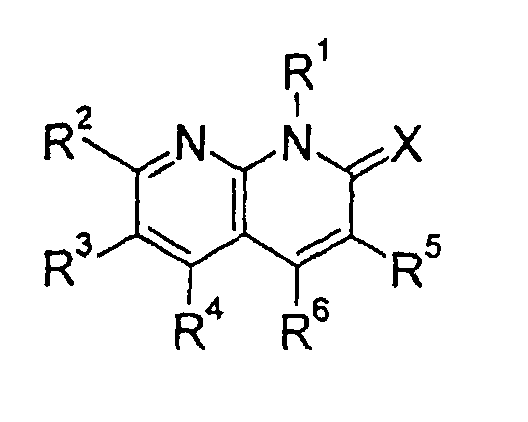
- the present applicant has previously reported a naphthyridine derivative represented by the following formula in which the 4-position (R 6 ) is a cyclic substituent such as an aryl, a heteroaryl or a cycloalkyl and the 3-position (R 5 ) is unsubstituted or a substituted lower alkyl group (WO 96/06843).
- R 5 represents a hydrogen atom or a lower alkyl group
- R 6 represents an aryl group having a substituent, a heteroaryl group having a substituent, a cycloalkyl group or an adamantyl group. See the reference for other details.
- the present inventors have conducted studies with the aim of providing a novel compound which efficiently and selectively inhibits type IV PDE and is useful for preventing and treating respiratory diseases such as bronchial asthma with less side effects and also of providing a medicament containing the same.
- the inventors have further conducted extensive studies on compounds having inhibitory activity upon type IV PDE and, as a result, found that a compound in which a specific substituent (-X-R 6 ) is introduced into the 3-position of the compound previously reported (WO96/06843) is a novel compound and has a strong type IV PDE inhibitory action, as well as excellent oral absorbability and metabolic stability. Therefore, they have found that the compound is markedly useful as a type IV PDE inhibitor, thus resulting in the accomplishment of the invention.
- the invention relates to a novel naphthyridine derivative represented by the following general formula (I) or a pharmaceutically acceptable salt thereof and a medicament containing the same as the active ingredient. (wherein each symbol has the following meaning;
- a medicament particularly a type IV PDE inhibitor, which comprises the naphthyridine derivative or a salt thereof.
- lower as used herein means a straight or branched hydrocarbon chain having from 1 to 6 carbon atoms and examples of the “lower alkyl” include methyl, ethyl, propyl, isopropyl, butyl, isobutyl, tert-butyl, pentyl, isopentyl, neopentyl, hexyl, and the like.
- Preferred is an alkyl having from 1 to 4 carbon atoms, and particularly preferred is methyl or ethyl.
- the "lower alkylene” means a divalent group formed by removing any one hydrogen atom from the above “lower alkyl” and is preferably an alkylene having from 1 to 4 carbon atoms, particularly preferably methylene, ethylene or propylene.
- the "lower alkenylene” means a group having one or more double bonds at any position in the "lower alkylene” having two or more carbon atoms, and is preferably an alkenylene having 2 to 4 carbon atoms.
- cycloalkyl is preferably a cycloalkyl having from 3 to 8 carbon atoms, particularly preferably cyclopropyl or cyclohexyl.
- cycloalkenyl is preferably a cycloalkenyl having from 5 to 8 carbon atoms, particularly preferably cyclohexenyl.
- aryl means an aromatic hydrocarbon group having from 6 to 14 carbon atoms, preferably phenyl.
- heterocyclic group is a monocyclic to tricyclic heterocyclic group having from 1 to 4 heteroatoms selected from the group consisting of nitrogen atom, oxygen atom, and sulfur atom, which may form a bridged ring or a condensed ring with benzene ring.
- This heterocycle is preferably a five- to seven-membered saturated or unsaturated monocyclic heterocyclic group, and is particularly preferably pyridine, piperidine, morpholine, thiophene, thiazole, imidazole, tetrazole, pyrazine or piperazine.
- halogen means F, Cl, Br or I.
- cycloalkyl which may be substituted is not particularly limited as long as it can used as the substituent of these rings for medicaments, particularly a type IV PDE inhibitor, but is preferably -OH, -phenyl, -a halogen, -OR 0 , -CO 2 H, -CO 2 R 0 , -NH 2 , -NHR 0 , -NR 0 2 , -NO 2 , -CN or -COR 0 , or a lower alkyl which may be substituted with a group selected from these groups.
- the group (X-R 6 ) at the 3-position of the naphthyridine is preferably a group more hydrophilic than the alkyl group having the same carbon atoms.
- X is preferably a bond or a lower alkylene and R 6 is preferably -OH, -COOH, -COOR 7 , -O-COR 7 , -NH 2 , -NHR 7 , -N(R 7 ) 2 , -C(NH)NH 2 , -NHC(NH)NH 2 or -N(R 7 )C(NH)NH 2 , or a group represented by the formula -Y-R 8 .
- R 8 is preferably an aryl or heterocyclic group.
- These groups may be substituted with a group selected from the group consisting of -OH, -phenyl, -a halogen, -OR 0 , -CO 2 H, -CO 2 R 0 , -NH 2 , -NHR 0 , -NR 0 2 , -NO 2 , -CN, and -COR 0 .
- the group (R 5 ) at the 4-position of the naphthyridine is preferably a cycloalkyl, phenyl which may have a substituent at the 3-position, or the like.
- the substituent is preferably a halogen, a lower alkyl, or the like.
- the groups (R 3 and R 4 ) at the 5- and 6-position of the naphthyridine are each preferably a lower alkyl or hydrogen atom, more preferably hydrogen atom.
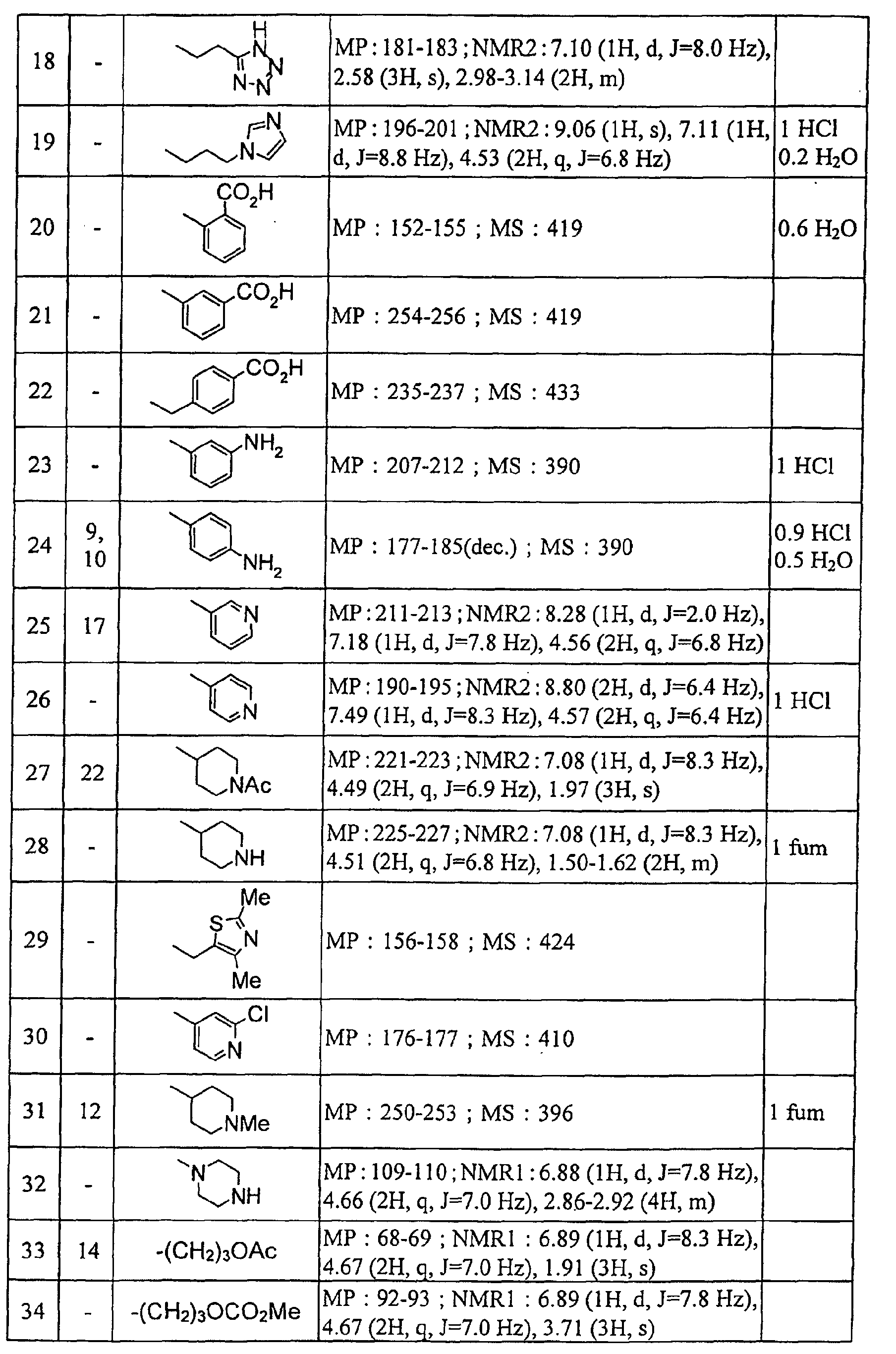
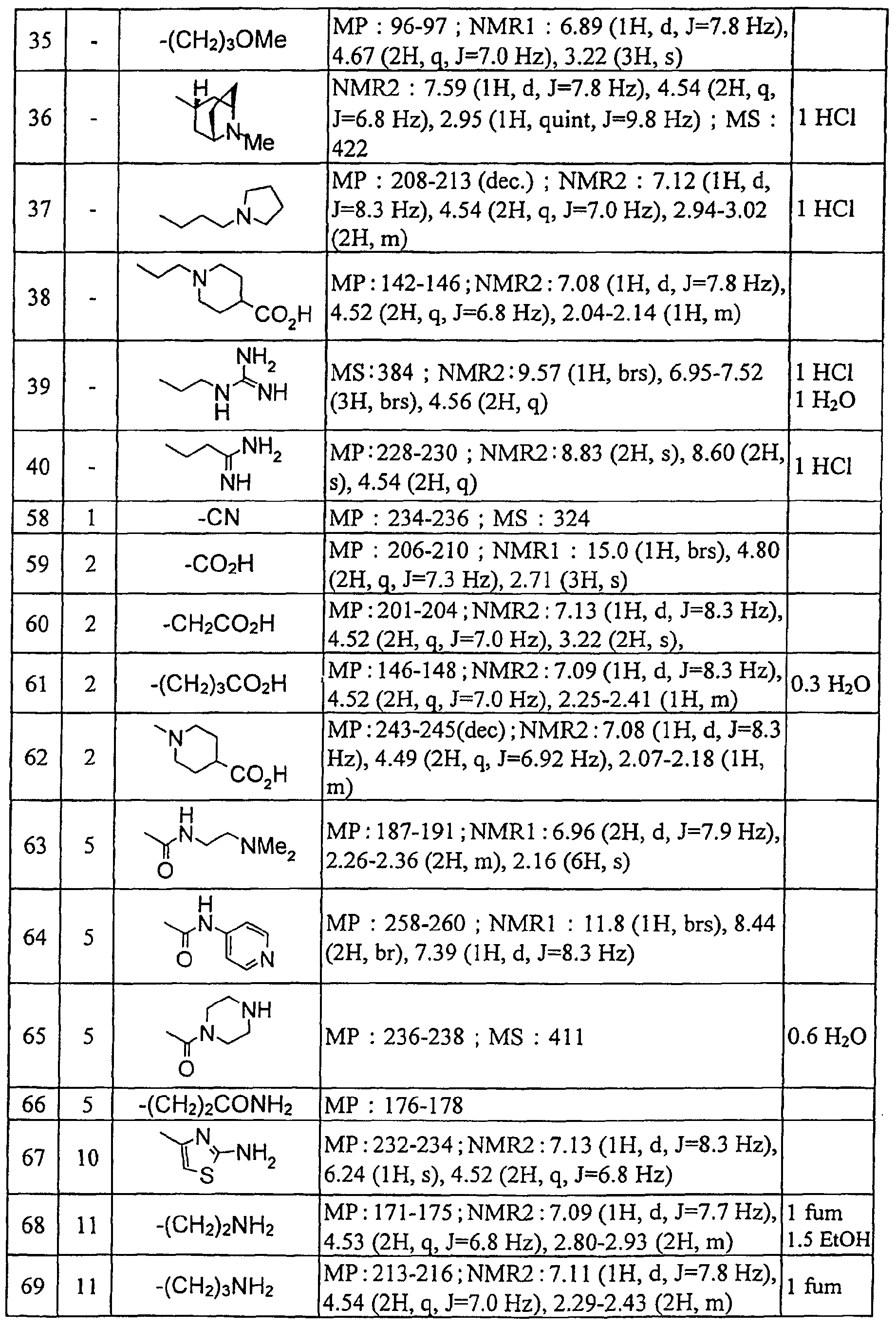
- particularly preferable compounds are the following compounds: 3-(2-amidinoethyl)-4-(3-chlorophenyl)-1-ethyl-7-methyl-1,8-naphthyridin-2(1H)-one, 4-(3-chlorophenyl)-1-ethyl-3-(2-guanidinoethyl)-7-methyl-1,8-naphthyridin-2(1H)-one, 4-cyclohexyl-1-ethyl-7-methyl-3-[2-(1H-tetrazol-5-yl)ethyl]-1,8-naphthyridin-2(1H)-one, 4-(3-chlorophenyl)-1-ethyl-7-methyl-3-[3-(1H-tetrazol-5-yl)propyl]-1,8-naphthyridin-2(1H)-one, 4-(3-bromophenyl)-1-
- the compounds of the invention may exist in the form of geometrical isomers and tautomers, and isolated forms or mixtures of these isomers are included in the invention.
- the compounds of the invention may have asymmetric carbon atoms in some cases, and (R) and (S) forms of optical isomers can exist based on these atoms.
- the invention includes all of these optical isomers in mixed and isolated forms.
- Pharmacologically acceptable prodrugs are also included in the compounds of the invention.
- the pharmacologically acceptable prodrugs are compounds having groups which can be converted into certain groups of the invention such as NH 2 , OH and CO 2 H by solvolysis or under a physiological condition.
- groups which form prodrugs include those which are described in Prog. Med. , 5, 2157 - 2161 (1985) and "Pharmaceutical Research and Development” (Hirokawa Publishing Co., 1990) Vol. 7 Drug Design 163 - 198.
- the compounds of the invention may form acid addition salts or, depending on the kinds of the substituents, salts with bases.
- Such salts are pharmaceutically acceptable salts, and their illustrative examples include acid addition salts with inorganic acids such as hydrochloric acid, hydrobromic acid, hydroiodic acid, sulfuric acid, nitric acid and phosphoric acid and organic acids such as formic acid, acetic acid, propionic acid, oxalic acid, malonic acid, succinic acid, fumaric acid, maleic acid, lactic acid, malic acid, tartaric acid, citric acid, methanesulfonic acid, ethanesulfonic acid, aspartic acid and glutamic acid, salts with inorganic bases such as sodium, potassium, magnesium, calcium and aluminum and organic bases such as methylamine, ethylamine, ethanolamine, lysine and ornithine, and ammonium salts.
- inorganic acids such as hydrochloric acid, hydrobromic
- the invention also includes various hydrates, solvates and polymorphic substances of the compound (I) of the invention and salts thereof.
- the compound of the invention and pharmaceutically acceptable salts thereof can be produced by applying various known synthetic methods making use of the characteristics based on its fundamental structure or the kind of substituent.
- an appropriate protecting group namely a group which can be easily converted into the functional group.
- the compound of interest can be obtained by removing the protecting group as occasion demands.
- Hydroxyl group and carboxyl group can be exemplified as such functional groups, and the protecting groups described for example in "Protective Groups in Organic Synthesis (2nd Ed.)" edited by Greene and Wuts can be cited as such protecting groups, which may be optionally used in response to the reaction conditions.
- the compound (Ia) of the invention is produced by reacting an aminopyridine derivative (II) with an acylating agent represented by the general formula (III) to obtain an amide derivative (IV), and then directly subjecting it to a ring-closing reaction.
- Preferred examples of the leaving group represented by L 1 include halogen atoms, acyloxy, carbonates such as alkyloxycarbonyloxy and organic sulfonic acid residues such as methanesulfonyloxy and p-toluenesulfonyloxy.
- the general formula (III) may form an intramolecular or intermolecular acid anhydride (e.g., glutaric anhydride).
- the reaction is carried out in an organic solvent inert to the reaction, selected from halogenated hydrocarbons such as dichloromethane, dichloroethane and chloroform; aromatic hydrocarbons such as benzene, toluene and xylene; ethers such as diethyl ether, tetrahydrofuran (THF) and dioxane; and N,N-dimethylformamide (DMF) ; or without solvent, under from cooling to heating.
- halogenated hydrocarbons such as dichloromethane, dichloroethane and chloroform
- aromatic hydrocarbons such as benzene, toluene and xylene
- ethers such as diethyl ether, tetrahydrofuran (THF) and dioxane
- DMF N,N-dimethylformamide
- the aminopyridine derivative (II) and the acylating agent (III) can be used in equivalent amounts or one of them in excess amount, and it is sometimes advantageous for smooth progress of the reaction to carry out the reaction in the presence of an organic base (preferably, triethylamine, pyridine or 4-(N,N-dimethylamino)pyridine), an inorganic base (preferably sodium hydroxide or potassium carbonate) or a metal base (preferably, sodium hydride, sodium methoxide or potassium tert-butoxide).
- an organic base preferably, triethylamine, pyridine or 4-(N,N-dimethylamino)pyridine
- an inorganic base preferably sodium hydroxide or potassium carbonate
- a metal base preferably, sodium hydride, sodium methoxide or potassium tert-butoxide
- isolation of the amide derivative (IV) and its ring-closing reaction may be carried out stepwise.
- the same conditions as those mentioned above can be employed in each reaction.
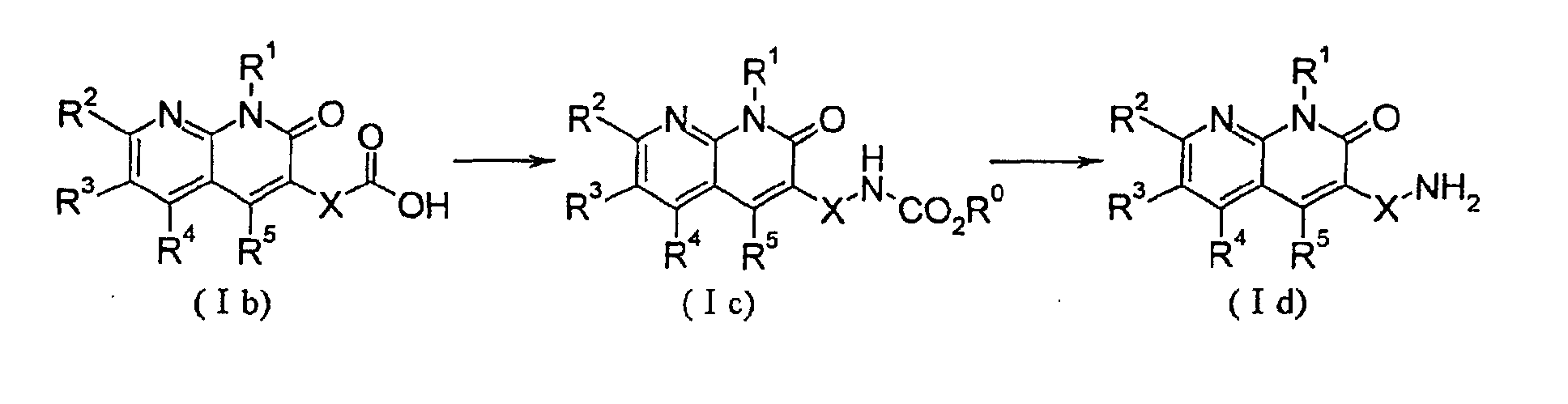
- a compound (Id) of the invention having amino group is produced from the compound (Ib) of the invention having a carboxyl group.
- the carbamate compound (Ic) obtainable as the intermediate is also a compound of the invention.
- the compound (Ic) of the invention can be produced by reacting an isocyanate compound which is obtained by the Curtius rearrangement of an acid azide obtained by the reaction of a reactive derivative of a carboxyl group obtained from the compound (Ib), such as an acid anhydride, with an azide salt such as sodium azide, or by the diphenylphosphoryl azide (DPPA) method, or which is by Hofmann rearrangement of an primary amide produced from the compound (Ib) according to an conventional amidation reaction, with an alcohol compound.
- an isocyanate compound which is obtained by the Curtius rearrangement of an acid azide obtained by the reaction of a reactive derivative of a carboxyl group obtained from the compound (Ib), such as an acid anhydride
- an azide salt such as sodium azide
- DPPA diphenylphosphoryl azide
- the reaction is carried out in an organic solvent inert to the reaction, selected from halogenated hydrocarbons, aromatic hydrocarbons, ethers and DMF, or without solvent, under from cooling to heating.
- the alcohol compound can be used in an equivalent or excess amount based on the compound (Ib).
- the compound (Id) of the invention is produced by subjecting the compound (Ic) of the invention to a removing reaction of a carbamate type amino group-protecting group described in the "Protective Groups in Organic Synthesis (2nd Ed.)" mentioned previously. This reaction may be carried out successively without isolating the compound (Ic), following the above reaction.
- a compound having a carboxyl group on R 8 of the compound (I) can be produced by hydrolyzing the trifluoromethyl group on R 8 .
- the reaction is carried out in an organic solvent inert to the reaction, selected from halogenated hydrocarbons, aromatic hydrocarbons, ethers and DMF, or without solvent, in the presence of an acid (hydrochloric acid, sulfuric acid, or the like) or a base (sodium hydroxide, sodium methoxide, or the like) under from cooling to heating.
- an organic solvent inert selected from halogenated hydrocarbons, aromatic hydrocarbons, ethers and DMF, or without solvent, in the presence of an acid (hydrochloric acid, sulfuric acid, or the like) or a base (sodium hydroxide, sodium methoxide, or the like) under from cooling to heating.
- compounds (If), (Ig) and (Ih) of the invention are produced from a compound (Ie) of the invention through the above pathway.
- the compound (If) of the invention can be produced by dehydrating the compound (Ie) of the invention.
- a usual method of dehydration reaction can be used in the reaction, such as a method described for example in "JIKKEN KAGAKU KOZA (4th Ed.)” edited by The Chemical Society of Japan, vol. 20 (1992) (Maruzen).
- the compound (Ig) of the invention can be produced by the reaction of the compound (If) of the invention with an azide salt such as sodium azide.
- the reaction is carried out in a solvent inert to the reaction, selected from halogenated hydrocarbons, aromatic hydrocarbons, ethers, alcohols such as methanol and ethanol, DMF and water, or without solvent, under from cooling to heating.
- the azide salt can be used in an equivalent or excess amount based on the compound (If), and it is sometimes advantageous for smoothly progressing the reaction to carry out the reaction in the presence of an acid (acetic acid, trifluoroacetic acid, triethylamine hydrochloride, hydrochloric acid, aluminum chloride or the like) or a base (pyridine, triethylamine, sodium hydroxide, potassium hydroxide, sodium methoxide, potassium tert-butoxide or the like).
- an acid acetic acid, trifluoroacetic acid, triethylamine hydrochloride, hydrochloric acid, aluminum chloride or the like
- pyridine triethylamine, sodium hydroxide, potassium hydroxide, sodium methoxide, potassium tert-butoxide or the like.
- the compound (Ih) of the invention can be produced by the reaction of the compound (If) of the invention with ammonia, an ammonium salt such as ammonium chloride or a metal amide such as sodium amide. It can also be produced by allowing an imidoyl chloride obtained by the reaction of the compound (If) with hydrogen chloride to react with an ammonium salt such as ammonium chloride.
- the reaction is carried out in a solvent inert to the reaction, selected from halogenated hydrocarbons, aromatic hydrocarbons, ethers, alcohols, DMF and water, or without solvent, under from cooling to heating and under from ordinary pressure to a forced pressure.
- the amination agent can be used in an equivalent or excess amount based on the compound (If).
- a compound (Ii) is produced by a guanidino-forming reaction of the compound (Id) of the invention.
- guanidino-forming agent examples include cyanamide, amidino sulfate, 1-amidinopyrazole and S-methylisothiourea.
- the reaction is carried out in a solvent inert to the reaction, selected from halogenated hydrocarbons, aromatic hydrocarbons, ethers, alcohols, DMF and water, or without solvent, under from cooling to heating.
- the guanidino-forming agent can be used in an equivalent or excess amount based on the compound (Id), and it is sometimes advantageous for smoothly progressing the reaction to carry out the reaction in the presence of an acid (acetic acid, trifluoroacetic acid, hydrochloric acid, sulfuric acid or the like) or a base (pyridine, dimethylaminopyridine, triethylamine, sodium hydroxide, potassium hydroxide, sodium methoxide, potassium tert-butoxide or the like).
- an acid acetic acid, trifluoroacetic acid, hydrochloric acid, sulfuric acid or the like
- a base pyridine, dimethylaminopyridine, triethylamine, sodium hydroxide, potassium hydroxide, sodium methoxide, potassium tert-butoxide or the like.
- R a and R b may be the same or different and each represents H or a group represented by R 7 or R 8 . The same shall apply hereinafter.
- a thiazole derivative (Ik) is produced from the compound (Ij) of the invention.
- the aimed compound can be produced by reacting, with a thioamide (V), a bromo compound which is obtained by reacting the compound (Ij) with a brominating agent such as bromine, N-bromosuccinimide, or benzyltrimethylammonium tribromide, after isolation or without isolation.
- a brominating agent such as bromine, N-bromosuccinimide, or benzyltrimethylammonium tribromide
- the reaction is carried out in a solvent inert to the reaction, selected from halogenated hydrocarbons, aromatic hydrocarbons, ethers, alcohols, acetic acid, DMF and water, or without solvent, under from cooling to heating.
- the compound (Ij) and the brominating agent or the bromo compound and the thioamide (V) can be used in equivalent amounts or one of them in excess amount, and it is sometimes advantageous for smoothly progressing the reaction to carry out the reaction in the presence of an acid or a base.
- the aimed compound can be produced by reacting a pyridine oxide compound obtainable by reacting the compound (Il) with an oxidating agent such as m-chloroperbenzoic acid, peracetic acid or hydrogen peroxide, with a chlorinating agent such as phosphorus oxychloride, phosphorus pentachloride or thionyl chloride after isolation or without isolation.
- an oxidating agent such as m-chloroperbenzoic acid, peracetic acid or hydrogen peroxide
- a chlorinating agent such as phosphorus oxychloride, phosphorus pentachloride or thionyl chloride after isolation or without isolation.
- the reaction is carried out in a solvent inert to the reaction, selected from halogenated hydrocarbons, aromatic hydrocarbons, ethers, alcohols, acetic acid, DMF and water, or without solvent, under from cooling to heating.
- the compound (Il) and the oxidating agent or the pyridine oxide compound and the chlorinating agent can be used in equivalent amounts or one of them in excess amount, and it is sometimes advantageous for smoothly progressing the reaction to carry out the reaction in the presence of an acid or a base.
- the chloro group can be converted into various substituents by subjecting the compound (Im) of the invention obtained according to the present production method to usual ipso substitution reaction described in the publication of WO97/19078 and so on.
- L 2 represents a leaving group the same as L 1 and M represents H or a metal salt. The same shall apply hereinafter.
- a starting compound (II) in which the substituent R 2 and the pyridine ring are combined with a carbon-carbon bond and a starting compound (VI) having leaving groups on the 2-position and 6-position of the pyridine ring can be synthesized according to the method described on pages 19 to 21 of the publication of WO97/19078.
- a starting compound (II) in which the substituent R 2 and the pyridine ring are not combined with a carbon-carbon bond can be synthesized by subjecting the starting compound (VI) to ipso substitution reaction with an amine compound (VII) having R 1 group and a nucleophilic reagent R 2 M (VIII), successively.
- the order of the ipso substitution reaction is suitably decided in consideration of the substituents (R 1 NH and R 2 ) and the leaving groups (L 1 and L 2 ).
- the reaction is carried out in a solvent inert to the reaction, selected from water, aromatic hydrocarbons, ethers and DMF, or without solvent, under from cooling to heating. It is sometimes advantageous for smooth progress of the reaction to carry out the reaction in the presence of an organic base, an inorganic base (preferably sodium hydroxide or potassium carbonate) or a metal base.
- the compound of the invention obtained by each of the above production methods can be further converted into various compounds of the invention by subjecting the compound to each reaction of amidation, sulfonamidation, esterification, hydrolysis, alkylation, reduction of an ester, or nucleophilic substitution.
- Amidation, sulfonamidation, and esterification can be carried out according to methods described for example in "JIKKEN KAGAKU KOZA (4th Ed.)" edited by The Chemical Society of Japan, vol.
- the nucleophilic substitution can be achieved by reacting a compound having an alkyl group substituted with OH with thionyl chloride or the like to form an alkyl chloride derivative or with methanesulfonyl chloride or p-toluenesulfonyl chloride to form an organic sulfonate ester, followed by reaction with a nucleophile.
- a nucleophile Alternatively, it can be also achieved by carrying out Mitsunobu reaction.
- the reaction is carried out in an organic solvent inert to the reaction, selected from halogenated hydrocarbons, aromatic hydrocarbons, ethers, and DMF, or without solvent, under from cooling to heating. It is sometimes advantageous for smoothly progressing the reaction to carry out the reaction in the presence of a base.
- the reaction product obtained by each of the above production methods is isolated and purified as its free compound, salt or various solvates such as hydrate.
- the salt can be produced by carrying out a usual salt formation treatment.
- the isolation and purification are carried out by employing usually used chemical techniques such as extraction, concentration, evaporation, crystallization, filtration, recrystallization and various types of chromatography.
- optical isomers can be isolated in the usual way making use of the difference in physicochemical properties between corresponding isomers.
- optical isomers can be separated by a general optical resolution method such as a fractional crystallization or chromatography.
- an optical isomer can be produced starting from an appropriate optically active material compound.
- the compound of the invention has particularly excellent activity to inhibit type IV PDE and is therefore useful as an agent for preventing and/or treating respiratory diseases (e.g., bronchial asthma (including atopic asthma), chronic bronchitis, pneumonic diseases and adult respiratory distress syndrome (ARDS)) in which the type IV PDE participates.
- respiratory diseases e.g., bronchial asthma (including atopic asthma), chronic bronchitis, pneumonic diseases and adult respiratory distress syndrome (ARDS)
- ARDS adult respiratory distress syndrome
- it can be expected to be an agent for preventing and/or treating bronchial asthma.
- the compound of the invention is also useful as an agent for preventing and/or treating other diseases in which involvement of the type IV PDE is known, such as those in which cytokine (IL-1, IL-4, IL-6 and TNF (tumor necrosis factor)) or the like are concerned (e.g., rheumatoid arthritis, ulcerative colitis, Crohn disease, sepsis, septic shock, endotoxin shock, Gram negative bacterial sepsis, toxic shock syndrome, nephritis, hepatitis, infection (bacterial and viral) and circulatory failure (heart failure, arteriosclerosis, myocardial infarction, stroke, or the like)).
- cytokine IL-1, IL-4, IL-6 and TNF (tumor necrosis factor)
- TNF tumor necrosis factor
- Test Example 1 Type IV PDE inhibitory activity.
- a concentration of test compound which inhibits 50% of the metabolic activity of type IV PDE was defined as IC 50 and calculated for each compound.
- the compounds of Examples 2, 16, 21, 28, 38, 39, 40, 41, 43, 47, 61, 70, 77, 78, 79 and 80 have an IC 50 value of 11 nM or less for the type IV PDE, including a compound having a potent activity of 0.002 nM.
- Test Example 3 Oral absorbability and pharmacokinetic profile evaluation test using type IV PDE inhibitory activity as the index
- the following assay was carried out in order to evaluate oral absorbability and pharmacokinetic profiles of the type IV PDE-inhibiting compounds of the invention.
- composition containing one or two or more of the compounds of the invention or salts thereof as the active ingredient is prepared using carriers, excipients and other additives which are generally used in the preparation of medicaments.
- the administration may be either oral administration in the form of, e.g., tablets, pills, capsules, granules, powders or liquids or parenteral administration in the form of, e.g., intravenous or intramuscular injections, suppositories, transdermal preparations, transnasal preparations or inhalations.
- the dose is optionally decided in response to each case, e.g., by taking symptoms, age and sex of each patient to be treated into consideration, but is usually approximately from 0.001 mg/kg to 100 mg/kg per day per adult in the case of oral administration, which is administered once a day or by dividing into 2 to 4 doses per day.
- intravenous administration when intravenous administration is conducted due to the symptoms, it is administered once or several times a day generally within the range of from 0.001 mg/kg to 10 mg/kg per day per adult. Also, in the case of inhalation, it is administered once or several times a day generally within the range of from 0.0001 mg/kg to 1 mg/kg per day per adult, and in the case of spreading, it is administered once or several times a day within the range of from 0.0001 mg/kg to 1 mg/kg per day per adult.
- the solid composition in the oral administration according to the invention is used in the form of, e.g., tablets, powders or granules.
- one or more active substances are mixed with at least one inert filler such as lactose, mannitol, glucose, hydroxypropylcellulose, microcrystalline cellulose, starch, polyvinylpyrrolidone or aluminum magnesium silicate.
- the composition may contain inert additives including a lubricant such as magnesium stearate and a disintegrating agent such as carboxymethylstarch sodium or a solubilization assisting agent. If necessary, tablets or pills may be coated with a film of sugar or a gastric or enteric coating substance.
- the liquid composition for oral administration contains, e.g., pharmaceutically acceptable emulsions, liquids, suspensions, syrups and elixirs and contains a generally used inert solvent such as purified water or ethanol.
- this composition may also contain auxiliary agents such as a solubilizing agent, a moistening agent and a suspending agent, as well as sweeteners, flavors, aromatics and antiseptics.
- the injections for parenteral administration use include aseptic aqueous or non-aqueous liquids, suspensions and emulsions.
- the aqueous solvent include distilled water for injection and physiological saline.
- the non-aqueous solvent include propylene glycol, polyethylene glycol, a plant oil such as olive oil, an alcohol such as ethanol, and polysorbate 80 (trade name).
- Such a composition may further contain a tonicity agent, an antiseptic, a moistening agent, an emulsifying agent, a dispersing agent, a stabilizing agent and a solubilization assisting agent.
- compositions are sterilized, e.g., by filtration through a bacteria retaining filter, blending of a germicide or irradiation.
- these may be used by firstly making into sterile solid compositions and dissolving them in sterile water or a sterile solvent for injection use prior to their use.
- Ethyl isonipecotate was reacted with benzyl bromoacetate in acetonitrile in the presence of cesium carbonate, and then the reaction mixture was worked up and purified in a usual manner to obtain ethyl 1-(benzyloxycarbonylmethyl)isonipecotate as a colorless oily substance. MS: 306.
- Ethyl 1-(benzyloxycarbonylmethyl)isonipecotate was subjected to catalytic reduction under a hydrogen atmosphere of 1 atm in ethanol in the presence of 10% palladium-carbon.
- the resulting compound was treated with sodium methoxide in ethanol and then reacted with pivaloyl chloride in THF.
- the resulting compound was reacted with 3-(3-chlorobenzoyl)-2-ethylamino-6-methylpyridine under heating, and further treated with sodium methoxide in ethanol.
- reaction mixture was worked up and purified in a usual manner to obtain 2-[4-tert-butoxycarbonylpiperazin-1-yl]-N-[3-(3-chlorobenzoyl)-6-methylpyridin-2-yl]-N-ethylacetamide.
- the resulting compound was reacted with sodium methoxide in methanol under heating.
- reaction mixture was worked up and purified in a usual manner to obtain 3-(1-tert-butoxycarbonylpiperazin-4-yl)-4-(3-chlorophenyl)-1-ethyl-7-methyl-1,8-naphthyridin-2(1H)-one.
- a DMF solution of 3-(3-chlorobenzoyl)-6-dimethoxymethyl-2-ethylaminopyridine was treated with sodium hydride at 0°C and then monoethyl chloroglutarate was added thereto, followed by heating at 80°C under stirring. Thereafter, the reaction mixture was worked up in a usual manner.
- the resulting compound was dissolved in ethanol and sodium methoxide was added thereto at 0°C, followed by heating under reflux for 1 hour.
- the reaction mixture was cooled to 0°C and then concentrated sulfuric acid was added thereto, followed by heating under reflux for 1 hour. Thereafter, the reaction mixture was worked up in a usual manner.
- a 15 ml portion of a 1M sodium hydroxide aqueous solution was added to 15 ml of a THF-methanol (1:1) solution containing 2.70 g of ethyl 3-[4-(3-chlorophenyl)-1-ethyl-7-methyl-2-oxo-1,2-dihydro-1,8-naphthyridin-3-yl]propanoate, followed by stirring under heating at an oil bath temperature of 80°C for 2 hours. After cooling to room temperature, the whole was adjusted to pH 3 with 1M hydrochloric acid and extracted with ethyl acetate. The organic layer was washed with saturated brine and then the solvent was evaporated.
- the resulting compound was dissolved in 20 ml of THF and 500 mg of sodium borohydride was added thereto. While heating under reflux, 3 ml of methanol was added dropwise thereto, and the mixture was further heated under reflux for 3 hours. After cooling to room temperature, 1M hydrochloric acid was added and the whole was extracted with ethyl acetate. The organic layer was washed with water and saturated brine and then the solvent was evaporated.
- reaction mixture was diluted with ethyl acetate and washed with a 1M sodium hydroxide aqueous solution and saturated brine.
- the solvent was evaporated from the organic layer and 50 ml of methanol and 900 mg of sodium methoxide were added to the residue, followed by heating under reflux for 3 hours. Thereafter, 40 ml of a 1M sodium hydroxide aqueous solution was added and the mixture was stirred at 60°C for 16 hours. Then, 50 ml of 1M hydrochloric acid was added to the reaction mixture.
- a mixed solution containing 400 mg of 3-(1-acetylpiperidin-4-yl)-4-(3-chlorophenyl)-1-ethyl-7-methyl-1,8-naphthyridin-2(1H)-one, 5 ml of ethanol and 5 ml of 6M hydrochloric acid was heated under reflux for 15 hours.
- the reaction mixture was concentrated and, after addition of a saturated sodium bicarbonate aqueous solution, extracted with chloroform. The organic layer was washed with water and saturated brine, and then the solvent was evaporated.
- the resulting compound was dissolved in 10 ml of ethanol, 104 mg of thioacetamide was added thereto, and the whole was stirred at 70°C for 2 hours.
- the solvent of the reaction mixture was evaporated and chloroform was added to the resulting residue.
- the solution was washed with water and saturated brine and dried over anhydrous magnesium sulfate.
- Hydrogen chloride gas was bubbled into 20 ml of an ethanol-chloroform (1:1) solution containing 461 mg of 4-(3-chlorophenyl)-3-(2-cyanoethyl)-1-ethyl-7-methyl-1,8-naphthyridin-2(1H)-one at -78°C for 30 minutes, the solution was stirred at 5°C for 18 hours and then the reaction solution was evaporated. To the resulting solid were added 15 ml of ethanol and 505 mg of ammonium acetate, followed by stirring for 90 hours. The reaction solution was evaporated and the residue was purified by a silica gel column chromatography (chloroform-methanol-aqueous ammonia).
- Example 2 Using a 200 mg portion of 210 mg of the resulting compound, the compound was treated in a similar manner to Example 2 to obtain 130 mg of 3-[4-(3-chlorophenyl)-1-ethyl-7-hydroxymethyl-2-oxo-1,2-dihydro-1,8-naphthyridin-3-yl]propanoic acid as pale yellow crystals.
- the solvent was evaporated and 1.00 g of sodium methoxide was added to a 20 ml ethanol solution of the resulting residue, followed by heating under reflux for 1 hour. Then, 20 ml of a 1M sodium hydroxide aqueous solution was added to the reaction solution, followed by heating under reflex for another 1 hour. After the mixture was cooled to room temperature, water was added thereto, and the mixture was neutralized with 1M hydrochloric acid and then extracted with ethyl acetate. The organic layer was washed with saturated brine and dried over anhydrous magnesium sulfate.
Landscapes
- Health & Medical Sciences (AREA)
- Chemical & Material Sciences (AREA)
- Life Sciences & Earth Sciences (AREA)
- Veterinary Medicine (AREA)
- Public Health (AREA)
- Medicinal Chemistry (AREA)
- General Health & Medical Sciences (AREA)
- Animal Behavior & Ethology (AREA)
- Pharmacology & Pharmacy (AREA)
- Epidemiology (AREA)
- Organic Chemistry (AREA)
- Engineering & Computer Science (AREA)
- Nuclear Medicine, Radiotherapy & Molecular Imaging (AREA)
- General Chemical & Material Sciences (AREA)
- Chemical Kinetics & Catalysis (AREA)
- Pulmonology (AREA)
- Bioinformatics & Cheminformatics (AREA)
- Nitrogen Condensed Heterocyclic Rings (AREA)
- Pharmaceuticals Containing Other Organic And Inorganic Compounds (AREA)
Abstract
Description




MS: 286.
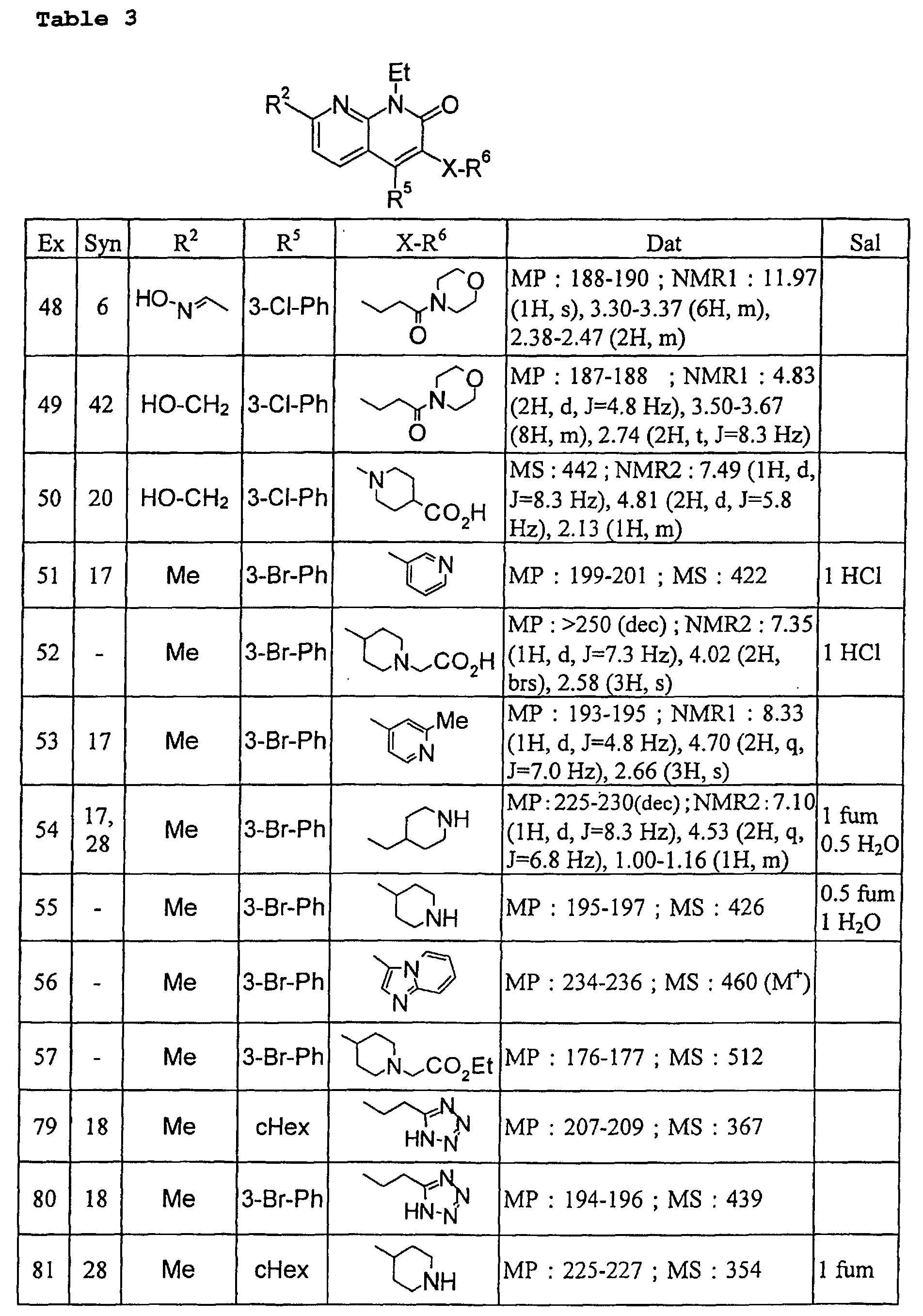
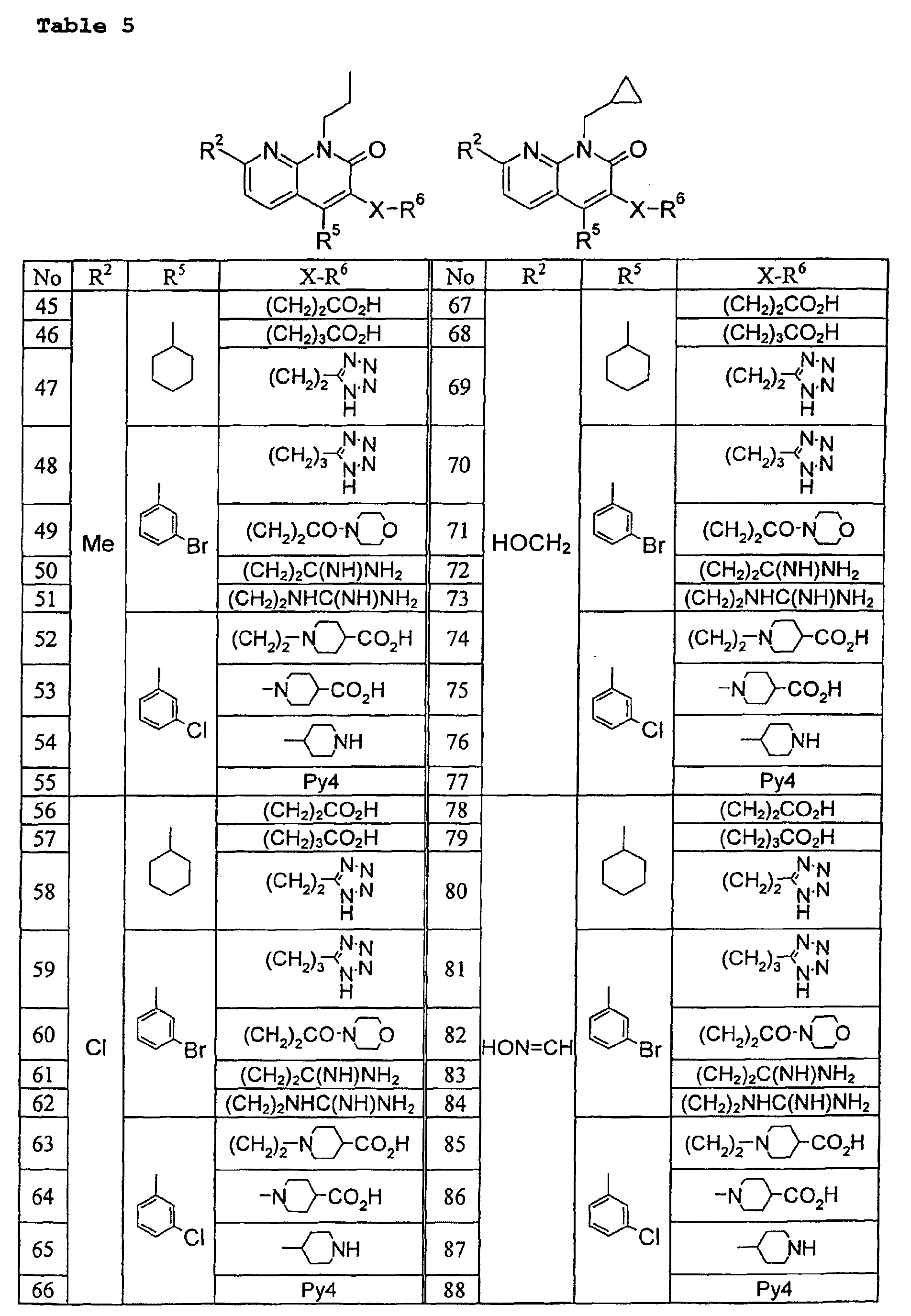
Thereafter, the reaction mixture was worked up and purified in a usual manner. The resulting compound was reacted in ethanol in the presence of sodium methoxide under heating, and the reaction mixture was worked up and purified in a usual manner. Then, the resulting compound was reacted in a solution of 6M hydrochloric acid-dioxane (1:1) under heating, and then the reaction mixture was worked up and purified in a usual manner. The resulting compound was further reacted with methyl iodide in DMF in the presence of potassium carbonate, and then the reaction mixture was worked up and purified in a usual manner to obtain methyl 3-[4-(3-chlorophenyl)-1-ethyl-7-formyl-2-oxo-1,2-dihydro-1,8-naphthyridin-3-yl]propanoate. NMR1: 10.11 (1H, d, J=0.6 Hz), 2.45-2.95 (4H, m), 1.43 (3H, t, J=7.1 Hz).
NMR1: 6.36 (1H, dd, J=8.2, 0.7 Hz), 2.58 (3H, s), 1.32 (3H, t, J=7.1 Hz).




Claims (8)
- A naphthyridine derivative represented by the following general formula (I) or a pharmaceutically acceptable salt thereof(wherein each symbol has the following meaning;
 R1: -R0, -a lower alkylene-cycloalkyl or -a cycloalkylR0: -a lower alkyl,R2, R3, and R4: -H, -R0, -a halogen, -a lower alkylene-OH, -a lower alkylene-SH, -a lower alkylene-O-R0, -a lower alkylene-S-R0, -a lower alkylene-O-CO-R0, -a lower alkylene-S-CO-R0, -OH, -O-R0, -S-R0, -SO-R0, -SO2-R0, -NH2, -NHR0, -NR0 2, -a cycloalkyl, -CO-R0, or -CH=N-OR9, which may be the same or different from one another,R9: -H, -R0 or -a lower alkylene-aryl,R5: a cycloalkyl which may be substituted with a group selected from R10, a cycloalkenyl which may be substituted with a group selected from R10, a heterocyclic group which may be substituted with a group selected from R10, or phenyl which may be substituted with a group selected from R10,R6: -OH, -OR7, -COOH, -COOR7, -CONH2, -CONHR7, -CON(R7)2, -O-COR7, -O-COOR7, -CHO, -COR7, -NH2, -NHR7, -N(R7)2, -NHCOR7, -N(R7)COR7, -NHSO2R7, -N(R7)SO2R7, -CN, -NHCOOR7, -N(R7)COOR7, -C(NH)NH2, -NHC(NH)NH2 or -N(R7)C(NH)NH2, or a group represented by the formula -Y-R8,R7: a lower alkyl which may be substituted with a group selected from the group consisting of -OH, -phenyl, -a halogen, -OR0, -CO2H, -CO2R0, -NH2, -NHR0, -NR0 2, -NO2, -CN, and -COR0,R8: a cycloalkyl which may be substituted with a group selected from R10, an aryl which may be substituted with a group selected from R10, or a heterocyclic group which may be substituted with a group selected from R10,R10: -OH, -phenyl, -a halogen, -OR0, -CO2H, -CO2R0, -NH2, -NHR0, -NR0 2, -NO2, -CN or -COR0, or a group described in R7.Y: a bond, -O-, -COO-, -CONH-, -CON(R7)-, -O-CO-, -O-COO-, -CO-, -NH-, -N(R7)-, -NHCO-, -N(R7)CO-, -NHCOO-, -N(R7)COO-, -NHSO2-, or -N(R7)SO2-, andX: a bond, a lower alkylene, or a lower alkenylene).
 - The naphthyridine derivative or a pharmaceutically acceptable salt thereof according to claim 1, wherein X is a bond or a lower alkylene and R6 is -OH, -COOH, -COOR7, -O-COR7, -NH2, -NHR7, -N(R7)2, -C (NH)NH2, -NHC(NH)NH2 or -N(R7)C(NH)NH2, or a group represented by the formula -Y-R8.
- The naphthyridine derivative or a pharmaceutically acceptable salt thereof according to claim 1, wherein R5 is cyclohexyl or phenyl substituted with a halogen.
- The naphthyridine derivative or a pharmaceutically acceptable salt thereof according to claim 1, which is selected from the group consisting of 3-(2-amidinoethyl)-4-(3-chlorophenyl)-1-ethyl-7-methyl-1,8-naphthyridin-2(1H)-one, 4-(3-chlorophenyl)-1-ethyl-3-(2-guanidinoethyl)-7-methyl-1,8-naphthyridin-2(1H)-one, 4-cyclohexyl-1-ethyl-7-methyl-3-[2-(1H-tetrazol-5-yl)ethyl]-1,8-naphthyridin-2(1H)-one, 4-(3-chlorophenyl)-1-ethyl-7-methyl-3-[3-(1H-tetrazol-5-yl)propyl]-1,8-naphthyridin-2(1H)-one, 4-(3-bromophenyl)-1-ethyl-7-methyl-3-[2-(1H-tetrazol-5-yl)ethyl]-1,8-naphthyridin-2(1H)-one, 3-[4-(3-chlorophenyl)-1-ethyl-7-methyl-2-oxo-1,2-dihydro-1,8-naphthyridin-3-yl]propanoic acid, 3-(4-cyclohexyl-1-ethyl-7-methyl-2-oxo-1,2-dihydro-1,8-naphthyridin-3-yl)propanoic acid, 3-[4-(3-chlorophenyl)-1-ethyl-7-methyl-2-oxo-1,2-dihydro-1,8-naphthyridin-3-yl]benzoic acid, 3-[4-(3-chlorophenyl)-1-ethyl-7-(hydroxyiminomethyl)-2-oxo-1,2-dihydro-1,8-naphthyridin-3-yl]propanoic acid, 3-[7-chloro-4-(3-chlorophenyl)-1-ethyl-2-oxo-1,2-dihydro-1,8-naphthyridin-3-yl]propanoic acid, 3-[1-ethyl-7-methyl-4-(3-methylphenyl)-2-oxo-1,2-dihydro-1,8-naphthyridin-3-yl]propanoic acid, 4-(3-chlorophenyl)-1-ethyl-7-methyl-3-(piperidin-4-yl)-1,8-naphthyridin-2(1H)-one and 1-{2-[4-(3-chlorophenyl)-1-ethyl-7-methyl-2-oxo-1,2-dihydro-1,8-naphthyridin-3-yl]ethyl}piperidine-4-carboxylic acid.
- A pharmaceutical composition which comprises the naphthyridine derivative of claim 1 or a pharmaceutically acceptable salt thereof and a pharmaceutically acceptable carrier.
- The pharmaceutical composition according to claim 5, which is a type IV phosphodiesterase inhibitor.
- The pharmaceutical composition according to claim 6, which is an agent for preventing or treating respiratory diseases.
- The pharmaceutical composition according to claim 7, which is an agent for preventing or treating bronchial asthma.
Applications Claiming Priority (3)
| Application Number | Priority Date | Filing Date | Title |
|---|---|---|---|
| JP30254499 | 1999-10-25 | ||
| JP30254499 | 1999-10-25 | ||
| PCT/JP2000/007433 WO2001030779A1 (en) | 1999-10-25 | 2000-10-24 | Naphthyridine derivatives |
Publications (3)
| Publication Number | Publication Date |
|---|---|
| EP1225173A1 true EP1225173A1 (en) | 2002-07-24 |
| EP1225173A4 EP1225173A4 (en) | 2003-08-20 |
| EP1225173B1 EP1225173B1 (en) | 2005-09-28 |
Family
ID=17910254
Family Applications (1)
| Application Number | Title | Priority Date | Filing Date |
|---|---|---|---|
| EP00970038A Expired - Lifetime EP1225173B1 (en) | 1999-10-25 | 2000-10-24 | Naphthyridine derivatives |
Country Status (16)
| Country | Link |
|---|---|
| US (1) | US6740662B1 (en) |
| EP (1) | EP1225173B1 (en) |
| KR (1) | KR100699395B1 (en) |
| CN (1) | CN1148369C (en) |
| AR (1) | AR029185A1 (en) |
| AT (1) | ATE305470T1 (en) |
| AU (1) | AU779081B2 (en) |
| BR (1) | BR0014981A (en) |
| CA (1) | CA2385178A1 (en) |
| DE (1) | DE60022893T2 (en) |
| ES (1) | ES2250200T3 (en) |
| MX (1) | MXPA02004122A (en) |
| PL (1) | PL354600A1 (en) |
| RU (1) | RU2240322C2 (en) |
| TW (1) | TWI262919B (en) |
| WO (1) | WO2001030779A1 (en) |
Cited By (10)
| Publication number | Priority date | Publication date | Assignee | Title |
|---|---|---|---|---|
| WO2003076405A1 (en) * | 2002-03-14 | 2003-09-18 | Bayer Healthcare Ag | Monocyclic aroylpyridinones as antiinflammatory agents |
| WO2005009967A3 (en) * | 2003-07-22 | 2005-03-24 | Janssen Pharmaceutica Nv | Quinolinone derivatives as inhibitors of c-fms kinase |
| WO2007004958A1 (en) * | 2005-07-04 | 2007-01-11 | Astrazeneca Ab | Pyridopyrimidine derivatives as pde4 inhibitors for the treatment of inflammatory and' immune diseases |
| WO2007135026A3 (en) * | 2006-05-24 | 2008-03-27 | Boehringer Ingelheim Int | Substituted pteridines as therapeutic agents |
| WO2008071964A1 (en) * | 2006-12-15 | 2008-06-19 | Astrazeneca Ab | Naphthyridine bactericides |
| WO2010056038A3 (en) * | 2008-11-11 | 2010-09-16 | 제일약품주식회사 | Novel tricyclic derivative or pharmaceutically acceptable salts thereof, preparation method thereof, and pharmaceutical composition containing the same |
| EP3689876A4 (en) * | 2017-09-28 | 2021-05-05 | Nanjing Transthera Biosciences Co. Ltd. | PDE9 INHIBITOR AND ITS USE |
| EP3915992A4 (en) * | 2019-01-23 | 2022-11-16 | Transthera Sciences (Nanjing), Inc. | Pde9 inhibitor and use thereof |
| US12234233B2 (en) | 2019-03-15 | 2025-02-25 | Transthera Sciences (Nanjing), Inc. | Crystal form of phosphodiesterase inhibitor, preparation method therefor and use thereof |
| US12465601B2 (en) | 2019-03-08 | 2025-11-11 | Transthera Sciences (Nanjing), Inc. | Uses of phosphodiesterase inhibitors |
Families Citing this family (19)
| Publication number | Priority date | Publication date | Assignee | Title |
|---|---|---|---|---|
| IS7839A (en) * | 2002-11-22 | 2004-05-23 | Merck Frosst Canada Ltd. | 4-Oxo-1- (3-substituted phenyl-1,4-dihydro-1,8-naphthyridine-3-carboxamide phosphodiesterase-4 inhibitor |
| PL1685849T3 (en) | 2003-11-20 | 2012-07-31 | Astellas Pharma Inc | Pde 4 inhibitors for the treatment of interstitial cystitis |
| EP2275096A3 (en) | 2005-08-26 | 2011-07-13 | Braincells, Inc. | Neurogenesis via modulation of the muscarinic receptors |
| EP2258357A3 (en) | 2005-08-26 | 2011-04-06 | Braincells, Inc. | Neurogenesis with acetylcholinesterase inhibitor |
| WO2007047978A2 (en) | 2005-10-21 | 2007-04-26 | Braincells, Inc. | Modulation of neurogenesis by pde inhibition |
| EP2314289A1 (en) | 2005-10-31 | 2011-04-27 | Braincells, Inc. | Gaba receptor mediated modulation of neurogenesis |
| WO2007097317A1 (en) * | 2006-02-21 | 2007-08-30 | Eisai R & D Management Co., Ltd. | 4-(3-benzoylaminophenyl)-6,7-dimethoxy-2- methylaminoquinazoline derivative |
| US20100216734A1 (en) | 2006-03-08 | 2010-08-26 | Braincells, Inc. | Modulation of neurogenesis by nootropic agents |
| US7678808B2 (en) | 2006-05-09 | 2010-03-16 | Braincells, Inc. | 5 HT receptor mediated neurogenesis |
| EP2021000A2 (en) | 2006-05-09 | 2009-02-11 | Braincells, Inc. | Neurogenesis by modulating angiotensin |
| WO2008030651A1 (en) | 2006-09-08 | 2008-03-13 | Braincells, Inc. | Combinations containing a 4-acylaminopyridine derivative |
| US20100184806A1 (en) | 2006-09-19 | 2010-07-22 | Braincells, Inc. | Modulation of neurogenesis by ppar agents |
| US8530654B2 (en) * | 2007-02-16 | 2013-09-10 | Eisai R&D Management Co., Ltd. | Crystals, amorphous substances or salts of methyl N-[3-(6,7-dimethoxy-2-methylaminoquinazolin-4-yl) phenyl] terephthalamic acid |
| CN101687819B (en) | 2007-08-17 | 2013-03-20 | 卫材R&D管理有限公司 | topical agent |
| ATE538102T1 (en) * | 2007-08-17 | 2012-01-15 | Eisai R&D Man Co Ltd | METHOD FOR PRODUCING A QUINAZOLINE DERIVATIVE |
| US8426673B2 (en) | 2008-01-11 | 2013-04-23 | Astellas Pharma, Inc. | Pathological animal model for pelvic pain syndrome |
| US20100216805A1 (en) | 2009-02-25 | 2010-08-26 | Braincells, Inc. | Modulation of neurogenesis using d-cycloserine combinations |
| WO2013078216A1 (en) * | 2011-11-21 | 2013-05-30 | Advanced Liquid Logic Inc | Glucose-6-phosphate dehydrogenase assays |
| WO2013106547A1 (en) | 2012-01-10 | 2013-07-18 | President And Fellows Of Harvard College | Beta-cell replication promoting compounds and methods of their use |
Family Cites Families (11)
| Publication number | Priority date | Publication date | Assignee | Title |
|---|---|---|---|---|
| US4324893A (en) | 1979-04-18 | 1982-04-13 | American Home Products Corporation | 4-Amino-3-carboxy or cyano-1,2-dihydro-2-oxo-1,8-naphthyridine derivatives |
| JPS55164682A (en) * | 1979-06-11 | 1980-12-22 | Yamanouchi Pharmaceut Co Ltd | 1-alkyl-2-oxo-2h-1,8-naphthyridine derivative and its preparation |
| EP0267691A3 (en) * | 1986-10-15 | 1989-08-23 | Schering Corporation | Use of 1-substituted naphthyridine and pyridopyrazine derivatives for the preparation of medicaments with immunosuppressor activity. |
| AU664912B2 (en) * | 1992-09-02 | 1995-12-07 | Dainippon Pharmaceutical Co. Ltd. | Novel 3-oxadiazolyl-1,6-naphthyridine derivatives |
| KR950704314A (en) * | 1992-12-01 | 1995-11-17 | 가와노 다케히코 | 1,8-naphthyridin-2-one derivatives and methods of use thereof (1,8-NAPHTHYRIDIN-2-ONE DERIVATIVE AND USE THEREOF) |
| JPH0710875A (en) * | 1993-06-21 | 1995-01-13 | Green Cross Corp:The | Selective phosphodiesterase IV inhibitors |
| JPH07126268A (en) * | 1993-10-29 | 1995-05-16 | Otsuka Pharmaceut Factory Inc | 1,8-naphthyridine derivative |
| WO1996006843A1 (en) * | 1994-08-29 | 1996-03-07 | Yamanouchi Pharmaceutical Co., Ltd. | Novel naphthyridine derivative and medicinal composition thereof |
| CA2222687A1 (en) * | 1995-05-31 | 1996-12-05 | Masami Muraoka | Novel naphthyridine derivatives |
| AU725276B2 (en) * | 1996-11-26 | 2000-10-12 | Sumitomo Pharmaceuticals Company, Limited | Novel naphthyridine derivatives |
| WO1999043659A1 (en) * | 1998-02-25 | 1999-09-02 | Sumitomo Pharmaceuticals Co., Ltd. | Pyridone derivatives and process for producing the same |
-
2000
- 2000-10-23 AR ARP000105559A patent/AR029185A1/en active IP Right Grant
- 2000-10-23 TW TW089122260A patent/TWI262919B/en not_active IP Right Cessation
- 2000-10-24 AT AT00970038T patent/ATE305470T1/en not_active IP Right Cessation
- 2000-10-24 ES ES00970038T patent/ES2250200T3/en not_active Expired - Lifetime
- 2000-10-24 US US10/111,077 patent/US6740662B1/en not_active Expired - Fee Related
- 2000-10-24 CA CA002385178A patent/CA2385178A1/en not_active Abandoned
- 2000-10-24 EP EP00970038A patent/EP1225173B1/en not_active Expired - Lifetime
- 2000-10-24 WO PCT/JP2000/007433 patent/WO2001030779A1/en not_active Ceased
- 2000-10-24 BR BR0014981-0A patent/BR0014981A/en not_active Application Discontinuation
- 2000-10-24 KR KR1020027005261A patent/KR100699395B1/en not_active Expired - Fee Related
- 2000-10-24 DE DE60022893T patent/DE60022893T2/en not_active Expired - Lifetime
- 2000-10-24 PL PL00354600A patent/PL354600A1/en not_active IP Right Cessation
- 2000-10-24 AU AU79560/00A patent/AU779081B2/en not_active Ceased
- 2000-10-24 RU RU2002111005/04A patent/RU2240322C2/en not_active IP Right Cessation
- 2000-10-24 CN CNB008147663A patent/CN1148369C/en not_active Expired - Fee Related
- 2000-10-24 MX MXPA02004122A patent/MXPA02004122A/en active IP Right Grant
Cited By (16)
| Publication number | Priority date | Publication date | Assignee | Title |
|---|---|---|---|---|
| WO2003076405A1 (en) * | 2002-03-14 | 2003-09-18 | Bayer Healthcare Ag | Monocyclic aroylpyridinones as antiinflammatory agents |
| WO2005009967A3 (en) * | 2003-07-22 | 2005-03-24 | Janssen Pharmaceutica Nv | Quinolinone derivatives as inhibitors of c-fms kinase |
| US7326788B2 (en) | 2003-07-22 | 2008-02-05 | Janssen Pharmaceutica N.V. | Quinolinone derivatives as inhibitors of c-fms kinase |
| WO2007004958A1 (en) * | 2005-07-04 | 2007-01-11 | Astrazeneca Ab | Pyridopyrimidine derivatives as pde4 inhibitors for the treatment of inflammatory and' immune diseases |
| WO2007135026A3 (en) * | 2006-05-24 | 2008-03-27 | Boehringer Ingelheim Int | Substituted pteridines as therapeutic agents |
| US7674788B2 (en) | 2006-05-24 | 2010-03-09 | Boehringer Ingelheim International Gmbh | Substituted pteridines |
| US8877756B2 (en) | 2006-05-24 | 2014-11-04 | Boehringer Ingelheim International Gmbh | Substituted pteridines |
| WO2008071964A1 (en) * | 2006-12-15 | 2008-06-19 | Astrazeneca Ab | Naphthyridine bactericides |
| RU2470934C1 (en) * | 2008-11-11 | 2012-12-27 | Дзе Ил Фармасьютикал Ко., Лтд. | Novel tricyclic derivative and pharmaceutically acceptable salts thereof, method for production thereof and pharmaceutical composition containing said derivative |
| US8815891B2 (en) | 2008-11-11 | 2014-08-26 | Je Il Pharmaceutical Co., Ltd. | Tricyclic derivative or pharmaceutically acceptable salts thereof, preparation method thereof, and pharmaceutical composition containing the same |
| WO2010056038A3 (en) * | 2008-11-11 | 2010-09-16 | 제일약품주식회사 | Novel tricyclic derivative or pharmaceutically acceptable salts thereof, preparation method thereof, and pharmaceutical composition containing the same |
| EP3689876A4 (en) * | 2017-09-28 | 2021-05-05 | Nanjing Transthera Biosciences Co. Ltd. | PDE9 INHIBITOR AND ITS USE |
| US11434248B2 (en) | 2017-09-28 | 2022-09-06 | Nanjing Transthera Biosciences Co. Ltd. | PDE9 inhibitor and use thereof |
| EP3915992A4 (en) * | 2019-01-23 | 2022-11-16 | Transthera Sciences (Nanjing), Inc. | Pde9 inhibitor and use thereof |
| US12465601B2 (en) | 2019-03-08 | 2025-11-11 | Transthera Sciences (Nanjing), Inc. | Uses of phosphodiesterase inhibitors |
| US12234233B2 (en) | 2019-03-15 | 2025-02-25 | Transthera Sciences (Nanjing), Inc. | Crystal form of phosphodiesterase inhibitor, preparation method therefor and use thereof |
Also Published As
| Publication number | Publication date |
|---|---|
| PL354600A1 (en) | 2004-01-26 |
| EP1225173A4 (en) | 2003-08-20 |
| KR20020041477A (en) | 2002-06-01 |
| WO2001030779A1 (en) | 2001-05-03 |
| CN1148369C (en) | 2004-05-05 |
| KR100699395B1 (en) | 2007-03-27 |
| CA2385178A1 (en) | 2001-05-03 |
| DE60022893D1 (en) | 2006-02-09 |
| RU2240322C2 (en) | 2004-11-20 |
| CN1382141A (en) | 2002-11-27 |
| ES2250200T3 (en) | 2006-04-16 |
| AR029185A1 (en) | 2003-06-18 |
| MXPA02004122A (en) | 2003-02-12 |
| ATE305470T1 (en) | 2005-10-15 |
| EP1225173B1 (en) | 2005-09-28 |
| DE60022893T2 (en) | 2006-07-13 |
| AU7956000A (en) | 2001-05-08 |
| AU779081B2 (en) | 2005-01-06 |
| TWI262919B (en) | 2006-10-01 |
| US6740662B1 (en) | 2004-05-25 |
| BR0014981A (en) | 2002-07-16 |
Similar Documents
| Publication | Publication Date | Title |
|---|---|---|
| EP1225173B1 (en) | Naphthyridine derivatives | |
| JP3649395B2 (en) | Fused heteroaryl derivatives | |
| JP6047189B2 (en) | Pharmaceutical composition containing pyrazolopyridine derivatives as NADPH oxidase inhibitors | |
| JP6026441B2 (en) | Aminoquinolines as kinase inhibitors | |
| TW202133844A (en) | Combination of an azetidine lpa1 receptor antagonist with anti-fibrotic agents | |
| JP2013544256A (en) | Heterocyclic amines and uses thereof | |
| EP1806347A1 (en) | Aromatic-ring-fused pyrimidine derivative | |
| WO2010068452A1 (en) | Heteroaryl-substituted urea modulators of fatty acid amide hydrolase | |
| AU2010293429B2 (en) | 8-oxodihydropurine derivative | |
| JP3373838B2 (en) | Naphthyridine derivative | |
| WO2006077851A1 (en) | Quinolone derivative and salt thereof | |
| JP3810017B2 (en) | Fused heteroaryl derivatives | |
| AU2002325493B2 (en) | Condensed Polycyclic Compounds | |
| WO2012046792A1 (en) | Gpr119 agonist | |
| WO2023003862A1 (en) | Cxcr4 modulators and uses related thereto | |
| AU2009315615A1 (en) | Novel pyrazolone-derivatives and their use as PD4 inhibitors | |
| KR20130069646A (en) | Imidazo[1,2-a]pyridine derivative | |
| JP4725047B2 (en) | Quinolone derivatives or salts thereof | |
| WO2005123745A1 (en) | Tricyclic compounds | |
| TW202214574A (en) | Substituted (phthalazin-1-ylmethyl)ureas, substituted n-(phthalazin-1-ylmethyl)amides, and analogues thereof | |
| JP4853824B2 (en) | Pharmaceutical composition comprising a quinolone derivative as an active ingredient | |
| WO2015009611A1 (en) | Inhibitors of leukotriene production | |
| CN1331857C (en) | Fused-polycyclic compounds | |
| WO2002074771A1 (en) | Tricyclic heterocyclic compound, process for producing the same, and use | |
| JP2000239277A (en) | Imidazoquinazoline derivatives |
Legal Events
| Date | Code | Title | Description |
|---|---|---|---|
| PUAI | Public reference made under article 153(3) epc to a published international application that has entered the european phase |
Free format text: ORIGINAL CODE: 0009012 |
|
| 17P | Request for examination filed |
Effective date: 20020416 |
|
| AK | Designated contracting states |
Kind code of ref document: A1 Designated state(s): AT BE CH CY DE DK ES FI FR GB GR IE IT LI LU MC NL PT SE |
|
| AX | Request for extension of the european patent |
Free format text: AL;LT;LV;MK;RO;SI |
|
| RIC1 | Information provided on ipc code assigned before grant |
Ipc: 7A 61P 11/00 B Ipc: 7A 61K 31/4375 B Ipc: 7A 61K 31/4545 B Ipc: 7A 61P 43/00 B Ipc: 7A 61K 31/435 B Ipc: 7C 07D 471/04 A Ipc: 7A 61K 31/444 B Ipc: 7A 61K 31/497 B Ipc: 7C 07D 519/00 B Ipc: 7A 61K 31/439 B Ipc: 7A 61K 31/5377 B |
|
| A4 | Supplementary search report drawn up and despatched |
Effective date: 20030704 |
|
| 17Q | First examination report despatched |
Effective date: 20031031 |
|
| GRAP | Despatch of communication of intention to grant a patent |
Free format text: ORIGINAL CODE: EPIDOSNIGR1 |
|
| RAP1 | Party data changed (applicant data changed or rights of an application transferred) |
Owner name: YAMANOUCHI PHARMACEUTICAL CO., LTD. |
|
| GRAS | Grant fee paid |
Free format text: ORIGINAL CODE: EPIDOSNIGR3 |
|
| GRAA | (expected) grant |
Free format text: ORIGINAL CODE: 0009210 |
|
| AK | Designated contracting states |
Kind code of ref document: B1 Designated state(s): AT BE CH CY DE DK ES FI FR GB GR IE IT LI LU MC NL PT SE |
|
| PG25 | Lapsed in a contracting state [announced via postgrant information from national office to epo] |
Ref country code: FI Free format text: LAPSE BECAUSE OF FAILURE TO SUBMIT A TRANSLATION OF THE DESCRIPTION OR TO PAY THE FEE WITHIN THE PRESCRIBED TIME-LIMIT Effective date: 20050928 Ref country code: AT Free format text: LAPSE BECAUSE OF FAILURE TO SUBMIT A TRANSLATION OF THE DESCRIPTION OR TO PAY THE FEE WITHIN THE PRESCRIBED TIME-LIMIT Effective date: 20050928 |
|
| RAP1 | Party data changed (applicant data changed or rights of an application transferred) |
Owner name: ASTELLAS PHARMA INC. |
|
| REG | Reference to a national code |
Ref country code: GB Ref legal event code: FG4D |
|
| REG | Reference to a national code |
Ref country code: CH Ref legal event code: EP |
|
| REG | Reference to a national code |
Ref country code: IE Ref legal event code: FG4D |
|
| PG25 | Lapsed in a contracting state [announced via postgrant information from national office to epo] |
Ref country code: CY Free format text: LAPSE BECAUSE OF FAILURE TO SUBMIT A TRANSLATION OF THE DESCRIPTION OR TO PAY THE FEE WITHIN THE PRESCRIBED TIME-LIMIT Effective date: 20051024 Ref country code: IE Free format text: LAPSE BECAUSE OF NON-PAYMENT OF DUE FEES Effective date: 20051024 |
|
| PG25 | Lapsed in a contracting state [announced via postgrant information from national office to epo] |
Ref country code: MC Free format text: LAPSE BECAUSE OF NON-PAYMENT OF DUE FEES Effective date: 20051031 |
|
| PG25 | Lapsed in a contracting state [announced via postgrant information from national office to epo] |
Ref country code: LU Free format text: LAPSE BECAUSE OF NON-PAYMENT OF DUE FEES Effective date: 20051128 |
|
| REG | Reference to a national code |
Ref country code: CH Ref legal event code: NV Representative=s name: BOVARD AG PATENTANWAELTE |
|
| REG | Reference to a national code |
Ref country code: SE Ref legal event code: TRGR |
|
| PG25 | Lapsed in a contracting state [announced via postgrant information from national office to epo] |
Ref country code: DK Free format text: LAPSE BECAUSE OF FAILURE TO SUBMIT A TRANSLATION OF THE DESCRIPTION OR TO PAY THE FEE WITHIN THE PRESCRIBED TIME-LIMIT Effective date: 20051228 Ref country code: GR Free format text: LAPSE BECAUSE OF FAILURE TO SUBMIT A TRANSLATION OF THE DESCRIPTION OR TO PAY THE FEE WITHIN THE PRESCRIBED TIME-LIMIT Effective date: 20051228 |
|
| REF | Corresponds to: |
Ref document number: 60022893 Country of ref document: DE Date of ref document: 20060209 Kind code of ref document: P |
|
| PG25 | Lapsed in a contracting state [announced via postgrant information from national office to epo] |
Ref country code: PT Free format text: LAPSE BECAUSE OF FAILURE TO SUBMIT A TRANSLATION OF THE DESCRIPTION OR TO PAY THE FEE WITHIN THE PRESCRIBED TIME-LIMIT Effective date: 20060228 |
|
| REG | Reference to a national code |
Ref country code: ES Ref legal event code: FG2A Ref document number: 2250200 Country of ref document: ES Kind code of ref document: T3 |
|
| ET | Fr: translation filed | ||
| RAP2 | Party data changed (patent owner data changed or rights of a patent transferred) |
Owner name: ASTELLAS PHARMA INC. |
|
| NLT2 | Nl: modifications (of names), taken from the european patent patent bulletin |
Owner name: ASTELLAS PHARMA INC. Effective date: 20060524 |
|
| PLBE | No opposition filed within time limit |
Free format text: ORIGINAL CODE: 0009261 |
|
| STAA | Information on the status of an ep patent application or granted ep patent |
Free format text: STATUS: NO OPPOSITION FILED WITHIN TIME LIMIT |
|
| REG | Reference to a national code |
Ref country code: IE Ref legal event code: MM4A |
|
| 26N | No opposition filed |
Effective date: 20060629 |
|
| PGFP | Annual fee paid to national office [announced via postgrant information from national office to epo] |
Ref country code: CH Payment date: 20081031 Year of fee payment: 9 |
|
| PGFP | Annual fee paid to national office [announced via postgrant information from national office to epo] |
Ref country code: SE Payment date: 20081022 Year of fee payment: 9 Ref country code: BE Payment date: 20081010 Year of fee payment: 9 |
|
| PGFP | Annual fee paid to national office [announced via postgrant information from national office to epo] |
Ref country code: ES Payment date: 20091023 Year of fee payment: 10 Ref country code: DE Payment date: 20091022 Year of fee payment: 10 |
|
| PGFP | Annual fee paid to national office [announced via postgrant information from national office to epo] |
Ref country code: NL Payment date: 20091015 Year of fee payment: 10 |
|
| BERE | Be: lapsed |
Owner name: *ASTELLAS PHARMA INC. Effective date: 20091031 |
|
| PGFP | Annual fee paid to national office [announced via postgrant information from national office to epo] |
Ref country code: IT Payment date: 20091019 Year of fee payment: 10 Ref country code: GB Payment date: 20091021 Year of fee payment: 10 Ref country code: FR Payment date: 20091029 Year of fee payment: 10 |
|
| REG | Reference to a national code |
Ref country code: CH Ref legal event code: PL |
|
| EUG | Se: european patent has lapsed | ||
| PG25 | Lapsed in a contracting state [announced via postgrant information from national office to epo] |
Ref country code: BE Free format text: LAPSE BECAUSE OF NON-PAYMENT OF DUE FEES Effective date: 20091031 Ref country code: LI Free format text: LAPSE BECAUSE OF NON-PAYMENT OF DUE FEES Effective date: 20091031 Ref country code: CH Free format text: LAPSE BECAUSE OF NON-PAYMENT OF DUE FEES Effective date: 20091031 |
|
| REG | Reference to a national code |
Ref country code: NL Ref legal event code: V1 Effective date: 20110501 |
|
| PG25 | Lapsed in a contracting state [announced via postgrant information from national office to epo] |
Ref country code: SE Free format text: LAPSE BECAUSE OF NON-PAYMENT OF DUE FEES Effective date: 20091025 |
|
| GBPC | Gb: european patent ceased through non-payment of renewal fee |
Effective date: 20101024 |
|
| PG25 | Lapsed in a contracting state [announced via postgrant information from national office to epo] |
Ref country code: FR Free format text: LAPSE BECAUSE OF NON-PAYMENT OF DUE FEES Effective date: 20101102 |
|
| REG | Reference to a national code |
Ref country code: FR Ref legal event code: ST Effective date: 20110630 |
|
| PG25 | Lapsed in a contracting state [announced via postgrant information from national office to epo] |
Ref country code: NL Free format text: LAPSE BECAUSE OF NON-PAYMENT OF DUE FEES Effective date: 20110501 Ref country code: GB Free format text: LAPSE BECAUSE OF NON-PAYMENT OF DUE FEES Effective date: 20101024 |
|
| REG | Reference to a national code |
Ref country code: DE Ref legal event code: R119 Ref document number: 60022893 Country of ref document: DE Effective date: 20110502 |
|
| REG | Reference to a national code |
Ref country code: ES Ref legal event code: FD2A Effective date: 20111121 |
|
| PG25 | Lapsed in a contracting state [announced via postgrant information from national office to epo] |
Ref country code: IT Free format text: LAPSE BECAUSE OF NON-PAYMENT OF DUE FEES Effective date: 20101024 |
|
| PG25 | Lapsed in a contracting state [announced via postgrant information from national office to epo] |
Ref country code: ES Free format text: LAPSE BECAUSE OF NON-PAYMENT OF DUE FEES Effective date: 20101025 |
|
| PG25 | Lapsed in a contracting state [announced via postgrant information from national office to epo] |
Ref country code: DE Free format text: LAPSE BECAUSE OF NON-PAYMENT OF DUE FEES Effective date: 20110502 |