EP1224861A1 - Animal with the mass expression of human gene and test method by using the animal - Google Patents
Animal with the mass expression of human gene and test method by using the animal Download PDFInfo
- Publication number
- EP1224861A1 EP1224861A1 EP00964699A EP00964699A EP1224861A1 EP 1224861 A1 EP1224861 A1 EP 1224861A1 EP 00964699 A EP00964699 A EP 00964699A EP 00964699 A EP00964699 A EP 00964699A EP 1224861 A1 EP1224861 A1 EP 1224861A1
- Authority
- EP
- European Patent Office
- Prior art keywords
- animal
- human
- candidate
- expressing
- cell
- Prior art date
- Legal status (The legal status is an assumption and is not a legal conclusion. Google has not performed a legal analysis and makes no representation as to the accuracy of the status listed.)
- Granted
Links
Images




Classifications
-
- C—CHEMISTRY; METALLURGY
- C12—BIOCHEMISTRY; BEER; SPIRITS; WINE; VINEGAR; MICROBIOLOGY; ENZYMOLOGY; MUTATION OR GENETIC ENGINEERING
- C12N—MICROORGANISMS OR ENZYMES; COMPOSITIONS THEREOF; PROPAGATING, PRESERVING, OR MAINTAINING MICROORGANISMS; MUTATION OR GENETIC ENGINEERING; CULTURE MEDIA
- C12N15/00—Mutation or genetic engineering; DNA or RNA concerning genetic engineering, vectors, e.g. plasmids, or their isolation, preparation or purification; Use of hosts therefor
- C12N15/09—Recombinant DNA-technology
- C12N15/63—Introduction of foreign genetic material using vectors; Vectors; Use of hosts therefor; Regulation of expression
- C12N15/79—Vectors or expression systems specially adapted for eukaryotic hosts
- C12N15/85—Vectors or expression systems specially adapted for eukaryotic hosts for animal cells
- C12N15/8509—Vectors or expression systems specially adapted for eukaryotic hosts for animal cells for producing genetically modified animals, e.g. transgenic
-
- A—HUMAN NECESSITIES
- A01—AGRICULTURE; FORESTRY; ANIMAL HUSBANDRY; HUNTING; TRAPPING; FISHING
- A01K—ANIMAL HUSBANDRY; AVICULTURE; APICULTURE; PISCICULTURE; FISHING; REARING OR BREEDING ANIMALS, NOT OTHERWISE PROVIDED FOR; NEW BREEDS OF ANIMALS
- A01K67/00—Rearing or breeding animals, not otherwise provided for; New or modified breeds of animals
- A01K67/027—New or modified breeds of vertebrates
- A01K67/0275—Genetically modified vertebrates, e.g. transgenic
-
- A—HUMAN NECESSITIES
- A01—AGRICULTURE; FORESTRY; ANIMAL HUSBANDRY; HUNTING; TRAPPING; FISHING
- A01K—ANIMAL HUSBANDRY; AVICULTURE; APICULTURE; PISCICULTURE; FISHING; REARING OR BREEDING ANIMALS, NOT OTHERWISE PROVIDED FOR; NEW BREEDS OF ANIMALS
- A01K67/00—Rearing or breeding animals, not otherwise provided for; New or modified breeds of animals
- A01K67/027—New or modified breeds of vertebrates
- A01K67/0275—Genetically modified vertebrates, e.g. transgenic
- A01K67/0278—Knock-in vertebrates, e.g. humanised vertebrates
-
- A—HUMAN NECESSITIES
- A61—MEDICAL OR VETERINARY SCIENCE; HYGIENE
- A61P—SPECIFIC THERAPEUTIC ACTIVITY OF CHEMICAL COMPOUNDS OR MEDICINAL PREPARATIONS
- A61P25/00—Drugs for disorders of the nervous system
- A61P25/20—Hypnotics; Sedatives
-
- A—HUMAN NECESSITIES
- A61—MEDICAL OR VETERINARY SCIENCE; HYGIENE
- A61P—SPECIFIC THERAPEUTIC ACTIVITY OF CHEMICAL COMPOUNDS OR MEDICINAL PREPARATIONS
- A61P3/00—Drugs for disorders of the metabolism
- A61P3/04—Anorexiants; Antiobesity agents
-
- A—HUMAN NECESSITIES
- A61—MEDICAL OR VETERINARY SCIENCE; HYGIENE
- A61P—SPECIFIC THERAPEUTIC ACTIVITY OF CHEMICAL COMPOUNDS OR MEDICINAL PREPARATIONS
- A61P37/00—Drugs for immunological or allergic disorders
- A61P37/08—Antiallergic agents
-
- A—HUMAN NECESSITIES
- A61—MEDICAL OR VETERINARY SCIENCE; HYGIENE
- A61P—SPECIFIC THERAPEUTIC ACTIVITY OF CHEMICAL COMPOUNDS OR MEDICINAL PREPARATIONS
- A61P43/00—Drugs for specific purposes, not provided for in groups A61P1/00-A61P41/00
-
- C—CHEMISTRY; METALLURGY
- C12—BIOCHEMISTRY; BEER; SPIRITS; WINE; VINEGAR; MICROBIOLOGY; ENZYMOLOGY; MUTATION OR GENETIC ENGINEERING
- C12N—MICROORGANISMS OR ENZYMES; COMPOSITIONS THEREOF; PROPAGATING, PRESERVING, OR MAINTAINING MICROORGANISMS; MUTATION OR GENETIC ENGINEERING; CULTURE MEDIA
- C12N9/00—Enzymes; Proenzymes; Compositions thereof; Processes for preparing, activating, inhibiting, separating or purifying enzymes
- C12N9/90—Isomerases (5.)
-
- A—HUMAN NECESSITIES
- A01—AGRICULTURE; FORESTRY; ANIMAL HUSBANDRY; HUNTING; TRAPPING; FISHING
- A01K—ANIMAL HUSBANDRY; AVICULTURE; APICULTURE; PISCICULTURE; FISHING; REARING OR BREEDING ANIMALS, NOT OTHERWISE PROVIDED FOR; NEW BREEDS OF ANIMALS
- A01K2207/00—Modified animals
- A01K2207/15—Humanized animals
-
- A—HUMAN NECESSITIES
- A01—AGRICULTURE; FORESTRY; ANIMAL HUSBANDRY; HUNTING; TRAPPING; FISHING
- A01K—ANIMAL HUSBANDRY; AVICULTURE; APICULTURE; PISCICULTURE; FISHING; REARING OR BREEDING ANIMALS, NOT OTHERWISE PROVIDED FOR; NEW BREEDS OF ANIMALS
- A01K2217/00—Genetically modified animals
-
- A—HUMAN NECESSITIES
- A01—AGRICULTURE; FORESTRY; ANIMAL HUSBANDRY; HUNTING; TRAPPING; FISHING
- A01K—ANIMAL HUSBANDRY; AVICULTURE; APICULTURE; PISCICULTURE; FISHING; REARING OR BREEDING ANIMALS, NOT OTHERWISE PROVIDED FOR; NEW BREEDS OF ANIMALS
- A01K2217/00—Genetically modified animals
- A01K2217/05—Animals comprising random inserted nucleic acids (transgenic)
-
- A—HUMAN NECESSITIES
- A01—AGRICULTURE; FORESTRY; ANIMAL HUSBANDRY; HUNTING; TRAPPING; FISHING
- A01K—ANIMAL HUSBANDRY; AVICULTURE; APICULTURE; PISCICULTURE; FISHING; REARING OR BREEDING ANIMALS, NOT OTHERWISE PROVIDED FOR; NEW BREEDS OF ANIMALS
- A01K2227/00—Animals characterised by species
- A01K2227/10—Mammal
- A01K2227/105—Murine
-
- A—HUMAN NECESSITIES
- A01—AGRICULTURE; FORESTRY; ANIMAL HUSBANDRY; HUNTING; TRAPPING; FISHING
- A01K—ANIMAL HUSBANDRY; AVICULTURE; APICULTURE; PISCICULTURE; FISHING; REARING OR BREEDING ANIMALS, NOT OTHERWISE PROVIDED FOR; NEW BREEDS OF ANIMALS
- A01K2267/00—Animals characterised by purpose
- A01K2267/03—Animal model, e.g. for test or diseases
-
- A—HUMAN NECESSITIES
- A01—AGRICULTURE; FORESTRY; ANIMAL HUSBANDRY; HUNTING; TRAPPING; FISHING
- A01K—ANIMAL HUSBANDRY; AVICULTURE; APICULTURE; PISCICULTURE; FISHING; REARING OR BREEDING ANIMALS, NOT OTHERWISE PROVIDED FOR; NEW BREEDS OF ANIMALS
- A01K2267/00—Animals characterised by purpose
- A01K2267/03—Animal model, e.g. for test or diseases
- A01K2267/035—Animal model for multifactorial diseases
- A01K2267/0362—Animal model for lipid/glucose metabolism, e.g. obesity, type-2 diabetes
-
- A—HUMAN NECESSITIES
- A01—AGRICULTURE; FORESTRY; ANIMAL HUSBANDRY; HUNTING; TRAPPING; FISHING
- A01K—ANIMAL HUSBANDRY; AVICULTURE; APICULTURE; PISCICULTURE; FISHING; REARING OR BREEDING ANIMALS, NOT OTHERWISE PROVIDED FOR; NEW BREEDS OF ANIMALS
- A01K2267/00—Animals characterised by purpose
- A01K2267/03—Animal model, e.g. for test or diseases
- A01K2267/035—Animal model for multifactorial diseases
- A01K2267/0368—Animal model for inflammation
Definitions
- the invention of this application relates to a human gene over-expressing animal, and to various test methods using the animal. More precisely, the invention of this application relates to a non-human transgenic animal which carries, in its somatic cell chromosome, a gene encoding human PGD synthase (H-PGDS), an enzyme for synthesizing prostaglandin D 2 (PGD 2 ) that is one causal substance for allergy and sleep induction, and which can produce a large amount of PGD 2 through over expression of the enzyme.
- H-PGDS human PGD synthase
- PGD 2 prostaglandin D 2
- the invention also relates to methods of using the animal for testing active ingredients of medicines for preventing and curing allergic diseases, sleep disorders, life habit-caused disorders such as obesity.
- H-PGDS (Biochem. Biophys. Acta 575:43-51, 1979; J. Biol. Chem. 262:3820-3825, 1987; Cell 90:1085-1095, 1997) is an enzyme having the function of producing an endogenous substance, prostaglandin D 2 (PGD 2 : Prostaglandins Leukot. Essent. Fatty Acids, 37:219-234, 1989; FASEB J. 5:2575-2581, 1991; J. Lipid Mediat. Cell Signaling, 14:71-82, 1996) that has various physiological activities, and it is expressed in immunocytes and genital organs (J. Immunol. 143:2982-2989, 1989; J. biol. Chem.
- H-PGDS is expressed in mast cell and antigen-presenting cell (J. Immunol. 143:2982-2989, 1989; J. Biol. Chem. 270:3239-3246, 1995), and participates in production of PGD 2 in allergic inflammation. It is known that thus produced PGD 2 causes bronchoconstriction and vasodilation and involves in ingravescence of allergies.
- PGD 2 has the most potent sleep-inducing activity. It is reported that in human patients suffering from trypanosome-infected African sleeping sickness, the PGD 2 level in the cerebrospinal fluid increases 100 to 1,000-fold with ingravescence of the disease condition (Trans Royal Soc. Trop. Med. Hyg. 84:795-799, 1990). In addition, it is known that in pathologic deep sleep observed in systemic mastocytosis patients, the blood PGD 2 level also increases 150-fold (New Engl. J. Med. 303:1400-1404, 1980), and the important role of PGD 2 in pathologic sleep is suggested.
- PGD 2 and H-PGDS producing PGD 2 closely correlate to various physiological functions of individuals, and may be a potential cause of human diseases.
- no animal model system has as yet been established that enables the study under the controlled condition how the over expression of H-PGDS will act on animal.
- the invention of this application has been made in consideration of the above-mentioned situation, and its object is to provide a non-human animal that genetically expresses a large amount of H-PGDS. Another object of this application is to provide methods of using the animal for testing the effectiveness of preventing or curing substances for various diseases caused by the over expression of H-PGDS in the animal.
- human H-PGDS gene its cDNA can be used.
- the H-PGDS cDNA may be prepared according to a method that comprises synthesizing an oligonucleotide based on the base sequence of a desired part of a known rat cDNA sequence (Cell 90:1085-1095, 1997; GenBank Accession No. D82071) or human cDNA sequence (Eur. J. Biochem. 267:3315-3322, 2000; GenBank Accession No.
- NM014485 a probe to screen a human cDNA library, or an RT-PCR method that comprises synthesizing oligonucleotides capable of hybridizing sequences at both ends of the intended cDNA fragment, and using it as primers to prepare the H-PGDS cDNA from an mRNA isolated from human cells.
- the transgene has a promoter sequence or an enhancer sequence linked thereto, which is for controlling the over expression of the gene.
- the promoter sequence or the enhancer sequence are not specifically defined, for which, for example, suitably used is a promoter region or an enhancer region of a gene capable of being highly expressed in various organs of the transgenic animal.
- the human gene over-expressing animal of the invention (1) can be produced in accordance with a known method of producing transgenic animals (for example, Proc. Natl. Acad. Sci. USA 77:7380-7384, 1980). Specifically, the transgene is introduced into totipotency cell of a non-human animal, the cell is ontogenized into individuals, and those carrying the transgene in the genome of the somatic cells thereof are selected. The thus-selected individuals are of the intended transgenic animal. From the technical viewpoint, animals of any and every species may be employed for the non-human animal for use herein, but mice are the best for it, since a large number of inbred lines have been available and, in addition, the technique of fertilized egg incubation and external fertilization thereof has been established in the art.
- the totipotency cell to be introduced with the gene may be those of fertilized eggs or early embryos.
- DNA microinjection method is the best in view of the yield of the transgenic animals and of the transgene transfer efficiency to the next generations.
- the fertilized eggs into which the gene has been injected are implanted into the oviduct of a surrogate mother, in which the eggs are ontogenized into an individuals, and the individual animals are born from it and then are bred by a foster mother.
- DNA is extracted out of the animal at a part of its body (the tip of the tail), and subjected to Southern blotting analysis or PCR to confirm the presence of the transgene.
- the individual animal in which the presence of the transgene has been confirmed is the founder, and the transgene is transferred to 50 % of the offspring of the founder. In that manner, wild-type or variant animals can be produced efficiently.
- the thus-produced transgenic animal produces excess H-PGDS, and therefore can be the best model for investigating the physiological activities of PGD 2 .
- the invention (3) of this application is a method for testing in vivo activity of a candidate for anti-allergy medicines, which comprises administering the candidate to the human gene over-expressing animal of the invention (1), and measuring the allergic reaction in the animal to thereby evaluate the activity of the candidate.
- the transgenic animal of the invention (1) carries a large amount of H-PGDS and produces a large amount of PGD 2 , and therefore sensitively reacts with various types of allergens. Accordingly, for example, when a certain allergen is previously administered to the animal, a candidate for anti-allergy medicine is then thereto, and the systemic allergic reaction of the animal is measured, then the pharmacological activity of the candidate can be evaluated.
- the invention (4) of this application is a method for testing in vivo activity of a sleep-controlling substance, which comprises administering a candidate for the substance to the human gene over-expressing animal of the invention (1), and measuring the sleep condition of the animal to thereby evaluate the activity of the candidate.
- the transgenic animal of the invention (1) carries a large amount of H-PGDS and produces a large amount of PGD 2 , and therefore its sleep control is disordered due to the strong sleep-inducing action of PGD 2 .
- a candidate for sleep control for example, a substance having the ability to sustain vigilance
- the awake/sleep condition of the animal can be determined by measuring the locomotor activity thereof or measuring the food intake or water intake thereof, or by measuring the physiological parameters such as electroencepharogram or electromyogram thereof.
- the invention (5) of this application is a method for testing in vivo activity of a candidate for anti-obesity medicine, which comprises administering a candidate for anti-obesity medicine to the human gene over-expressing animal of above (1), and measuring the degree of obesity of the animal (e.g., body weight, fatty tissue weight) to thereby evaluate the activity of the candidate.
- the transgenic animal of the invention (1) carries a large amount of H-PGDS and produces a large amount of PGD 2 , and therefore produces a large amount of 15d-PGJ 2 that involves in increase of the body weight or fatty tissue weight in the animal, and, as a result, the animal gets fat. Accordingly, for example, when a candidate for anti-obesity is administered to the animal and the degree of the obesity of the animal is measured, and then the pharmacological activity of the candidate can be evaluated.
- human H-PGDS cDNA was cloned by using rat H-PGDS cDNA as a probe.
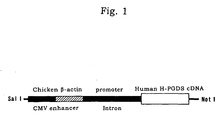
- Fig. 1 shows the construction of the transgene in the transfer vector.
- the transgene has a CMV enhancer and a chicken ⁇ -actin promoter upstream the H-PGDS cDNA, and when introduced into a mouse chromosome, it expresses a large amount of H-PGDS mRNA owing to the action of the enhancer and the promoter.
- the transfer vector was introduced into fertilized eggs of an FVB mouse through microinjection.
- the gene-introduced fertilized eggs were then implanted into the oviduct of a surrogate mother in an ordinary manner, in which those are ontogenized into individuals, and the individuals were then born.
- DNA was extracted from the tail of each of the thus-obtained mouse individuals, and it was analyzed through Southern blotting analysis using a probe that had been synthesized on the basis of the sequence of the transgene. Based on the data of the thus-analyzed DNA, transgenic mice were selected. Three independent lines of transgenic mice were thus established, which differ from each other in the degree of H-PGDS expression therein. The data are as in Fig. 2.
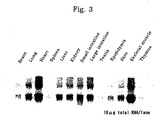
- the PGD enzyme activity in various organs of the transgenic mice was determined.
- the enzyme activity significantly increased in various organs.
- the three lines of transgenic mice were compared with each other in point of the enzyme activity thereof.
- the enzyme activity increase in these was in an order of S55 > S41 > S66.
- the data are as in Fig. 4,
- Example 1 As a human asthma model, the transgenic mice obtained in Example 1 were analyzed in antigen-induced lung inflammation model.
- transgenic mice of this invention are useful as a model animal for clarifying the mechanism of allergosis and are effective for the system of screening novel anti-allergy substances.
- a lipopolysaccharide was intraperitoneally administered to the transgenic mice obtained in Example 1, and the inflamed mice in narcolepsy were analyzed.
- transgenic mice of this invention are useful as a model animal for clarifying the mechanism of sleep induction and are effective for the system of screening novel substances of controlling sleep-awake rhythm.
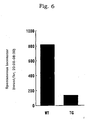
- the transgenic mice obtained in Example 1 and wild-type mice were loaded with a high-fat food, and analyzed for the obesity progress.
- mice were loaded with a high-fat food for 6 weeks, and their body weight increase was observed. As compared with that of the wild-type mice, the body weight of the transgenic mice significantly increased. In addition, the white adipose tissue weight of the transgenic mice also significantly increased.
- the data are as in Fig. 7.
- the invention provides a transgenic animal that expresses a large amount of H-PGDS and therefore produces a large amount of PGD 2 .
- the animal promotes the development of medicines for various human diseases.
Landscapes
- Health & Medical Sciences (AREA)
- Life Sciences & Earth Sciences (AREA)
- Engineering & Computer Science (AREA)
- Chemical & Material Sciences (AREA)
- Zoology (AREA)
- General Health & Medical Sciences (AREA)
- Bioinformatics & Cheminformatics (AREA)
- Genetics & Genomics (AREA)
- Organic Chemistry (AREA)
- Veterinary Medicine (AREA)
- Biotechnology (AREA)
- Wood Science & Technology (AREA)
- Environmental Sciences (AREA)
- Animal Behavior & Ethology (AREA)
- Biomedical Technology (AREA)
- Medicinal Chemistry (AREA)
- General Engineering & Computer Science (AREA)
- Molecular Biology (AREA)
- Microbiology (AREA)
- Pharmacology & Pharmacy (AREA)
- Nuclear Medicine, Radiotherapy & Molecular Imaging (AREA)
- Animal Husbandry (AREA)
- Biodiversity & Conservation Biology (AREA)
- General Chemical & Material Sciences (AREA)
- Chemical Kinetics & Catalysis (AREA)
- Public Health (AREA)
- Biochemistry (AREA)
- Plant Pathology (AREA)
- Biophysics (AREA)
- Physics & Mathematics (AREA)
- Neurology (AREA)
- Hematology (AREA)
- Obesity (AREA)
- Diabetes (AREA)
- Neurosurgery (AREA)
- Child & Adolescent Psychology (AREA)
- Anesthesiology (AREA)
- Immunology (AREA)
- Pulmonology (AREA)
- Measuring Or Testing Involving Enzymes Or Micro-Organisms (AREA)
Abstract
Description
Claims (5)
- A human gene over-expressing animal, which is a non-human animal carrying a human hematopoietic prostaglandin D2 synthase gene in its somatic cell chromosome and expressing a large amount of human prostaglandin D2 synthase, wherein the animal is one obtained through ontogenesis of a totipotency cell of a non-human animal or offspring of the obtained animal, and the totipotency cell is introduced with said synthase gene.
- The human gene over-expressing animal of claim 1, wherein the non-human animal is a mouse.
- A method for testing in vivo activity of a candidate for the anti-allergy medicines, which comprises administering the candidate to the human gene over-expressing animal of claim 1 or 2, and measuring allergic reactions of the animal to thereby evaluate the activity of the candidate.
- A method for testing in vivo activity of sleep-controlling substances, which comprises administering a candidate for the substances to the human gene over-expressing animal of claim 1 or 2, and measuring sleep condition of the animal to thereby evaluate the activity of the candidate.
- A method for testing in vivo activity of a differentiation-controlling substance for mast cell and adipose cell, which comprises administering a candidate for the substance to the human gene over-expressing animal of claim 1 or 2, and measuring the obesity condition of the animal to thereby evaluate the activity of the candidate.
Applications Claiming Priority (5)
| Application Number | Priority Date | Filing Date | Title |
|---|---|---|---|
| JP28461099 | 1999-10-05 | ||
| JP28461099 | 1999-10-05 | ||
| JP2000166726 | 2000-06-02 | ||
| JP2000166726 | 2000-06-02 | ||
| PCT/JP2000/006963 WO2001024627A1 (en) | 1999-10-05 | 2000-10-05 | Animal with the mass expression of human gene and test method by using the animal |
Publications (3)
| Publication Number | Publication Date |
|---|---|
| EP1224861A1 true EP1224861A1 (en) | 2002-07-24 |
| EP1224861A4 EP1224861A4 (en) | 2004-12-08 |
| EP1224861B1 EP1224861B1 (en) | 2009-06-24 |
Family
ID=26555540
Family Applications (1)
| Application Number | Title | Priority Date | Filing Date |
|---|---|---|---|
| EP00964699A Expired - Lifetime EP1224861B1 (en) | 1999-10-05 | 2000-10-05 | Test method relating to adipose cells and to obesity by using a human h-pgds overexpressing non-human animal |
Country Status (5)
| Country | Link |
|---|---|
| US (1) | US7202394B1 (en) |
| EP (1) | EP1224861B1 (en) |
| CA (1) | CA2388227A1 (en) |
| DE (1) | DE60042456D1 (en) |
| WO (1) | WO2001024627A1 (en) |
Cited By (3)
| Publication number | Priority date | Publication date | Assignee | Title |
|---|---|---|---|---|
| EP1882937A4 (en) * | 2005-05-17 | 2009-03-25 | Taiho Pharmaceutical Co Ltd | METHOD OF DIAGNOSING GRAVITY AND PREDICTING RECURRENCE IN EOSINOPHILIC DISEASE |
| WO2009142724A2 (en) | 2008-05-19 | 2009-11-26 | Beth Israel Deaconess Medical Center, Inc. | Novel gpr101 transgenic mice and methods of use thereof |
| WO2016005424A1 (en) * | 2014-07-09 | 2016-01-14 | INSERM (Institut National de la Santé et de la Recherche Médicale) | Methods for assessing mineralocorticoid receptor activation in adipose tissue of a subject and treating metabolic syndrome |
Families Citing this family (4)
| Publication number | Priority date | Publication date | Assignee | Title |
|---|---|---|---|---|
| US20050059618A1 (en) * | 2001-11-08 | 2005-03-17 | Karsten Eulenberg | Men protein, gst2, rab-rp1, csp, f-box protein lilina/fbl7, abc50, coronin, sec61 alpha, or vhappa1-1, or homologous proteins involved in the regulation of energy homeostasis |
| JPWO2004006956A1 (en) | 2002-07-12 | 2005-11-10 | 独立行政法人科学技術振興機構 | A prognostic agent for brain injury and its screening method |
| JP2010246547A (en) * | 2010-05-24 | 2010-11-04 | Osaka Bioscience Institute | Hematopoietic prostaglandin D synthase gene-deficient mouse and test method using the mouse |
| CN111549000B (en) * | 2020-06-18 | 2022-07-29 | 中国医学科学院整形外科医院 | Recombinant adipose-derived stem cell for over-expression of Hpgds, preparation method and application thereof |
Family Cites Families (3)
| Publication number | Priority date | Publication date | Assignee | Title |
|---|---|---|---|---|
| NZ256776A (en) * | 1992-09-22 | 1997-10-24 | Univ Rochester | Transgenic mammalian cells containing a dna sequence expressing pghs-2 |
| JP3600847B2 (en) | 1996-06-05 | 2004-12-15 | 財団法人大阪バイオサイエンス研究所 | DNA encoding human hematopoietic prostaglandin D synthase |
| JP4076667B2 (en) | 1998-03-25 | 2008-04-16 | 独立行政法人科学技術振興機構 | Gene-deficient mice and test methods using these mice |
-
2000
- 2000-10-05 WO PCT/JP2000/006963 patent/WO2001024627A1/en not_active Ceased
- 2000-10-05 US US10/089,883 patent/US7202394B1/en not_active Expired - Fee Related
- 2000-10-05 CA CA002388227A patent/CA2388227A1/en not_active Abandoned
- 2000-10-05 EP EP00964699A patent/EP1224861B1/en not_active Expired - Lifetime
- 2000-10-05 DE DE60042456T patent/DE60042456D1/en not_active Expired - Lifetime
Cited By (5)
| Publication number | Priority date | Publication date | Assignee | Title |
|---|---|---|---|---|
| EP1882937A4 (en) * | 2005-05-17 | 2009-03-25 | Taiho Pharmaceutical Co Ltd | METHOD OF DIAGNOSING GRAVITY AND PREDICTING RECURRENCE IN EOSINOPHILIC DISEASE |
| US8568967B2 (en) | 2005-05-17 | 2013-10-29 | Taiho Pharmaceutical Co., Ltd. | Method for diagnosis of severity and prediction of recurrence in eosinophilic inflammatory disease |
| WO2009142724A2 (en) | 2008-05-19 | 2009-11-26 | Beth Israel Deaconess Medical Center, Inc. | Novel gpr101 transgenic mice and methods of use thereof |
| WO2009142724A3 (en) * | 2008-05-19 | 2010-01-21 | Beth Israel Deaconess Medical Center, Inc. | Novel gpr101 transgenic mice and methods of use thereof |
| WO2016005424A1 (en) * | 2014-07-09 | 2016-01-14 | INSERM (Institut National de la Santé et de la Recherche Médicale) | Methods for assessing mineralocorticoid receptor activation in adipose tissue of a subject and treating metabolic syndrome |
Also Published As
| Publication number | Publication date |
|---|---|
| DE60042456D1 (en) | 2009-08-06 |
| EP1224861B1 (en) | 2009-06-24 |
| EP1224861A4 (en) | 2004-12-08 |
| US7202394B1 (en) | 2007-04-10 |
| WO2001024627A1 (en) | 2001-04-12 |
| CA2388227A1 (en) | 2001-04-12 |
Similar Documents
| Publication | Publication Date | Title |
|---|---|---|
| Woo et al. | Hyperexcitability and epilepsy associated with disruption of the mouse neuronal‐specific K–Cl cotransporter gene | |
| Gimeno et al. | Targeted deletion of fatty acid transport protein-4 results in early embryonic lethality | |
| Yang et al. | In vivo roles of lysophospholipid receptors revealed by gene targeting studies in mice | |
| Yoon et al. | DifferentMRF4Knockout Alleles Differentially Disrupt Myf-5 Expression: cis-Regulatory Interactions at theMRF4/Myf-5Locus | |
| US5625125A (en) | Phospholipase A2 expressing transgenic animals | |
| US20080075663A1 (en) | Mouse Model of Chronic Heart Failure and Coronary Atherosclerosis Regression | |
| EP1224861B1 (en) | Test method relating to adipose cells and to obesity by using a human h-pgds overexpressing non-human animal | |
| JP4027803B2 (en) | Transgenic animal having drug metabolizing enzyme gene and use thereof | |
| US20020108131A1 (en) | SR-BI and apo E knockout animals and use thereof as models for atherosclerosis and heart attack | |
| US6333447B1 (en) | Transgenic model of heart failure | |
| KR102923578B1 (en) | Use of Tas2r108 gene for extending lifespan and increasing weight | |
| JP2000510001A (en) | Transgenic animal having a disrupted NPY Y1 receptor gene | |
| US7094947B2 (en) | Animals with high histamine productivity | |
| JP6650649B2 (en) | Genetically modified non-human model animals | |
| JP3817638B2 (en) | Transgenic non-human mammal | |
| EP1743523A1 (en) | Nonhuman transgenic animal as type 2 diabetes model | |
| JP2001524819A (en) | Non-human transgenic animal in which expression of the gene encoding insulin is suppressed | |
| JP2000510000A (en) | Novel method for testing the differentiation status of mammalian pancreatic cells | |
| JP4484708B2 (en) | Methods for treating autoimmune diseases and methods for screening for therapeutic compounds for autoimmune diseases | |
| JPH06292485A (en) | Gene-introduced diabetic model animal | |
| JPWO2001024627A1 (en) | Human gene overexpression animals and test methods using these animals | |
| THEJASRI | CHARACTERIZATION OF ELONGATION OF VERY LONG CHAIN FATTY ACIDS PROTEIN 2 (ELOVL2) GENE AND IDENTIFICATION OF ITS MINIMAL PROMOTER WITH ITS POLYMORPHISM IN CHICKEN | |
| CN119120579A (en) | A method for constructing an ECHS1D disease animal model and its application | |
| EP1699289B1 (en) | Non-human mammal comprising a modified serca2 gene and methods, cells, genes, and vectors thereof | |
| JPH11332417A (en) | Gene-deficient mice and test methods using these mice |
Legal Events
| Date | Code | Title | Description |
|---|---|---|---|
| PUAI | Public reference made under article 153(3) epc to a published international application that has entered the european phase |
Free format text: ORIGINAL CODE: 0009012 |
|
| 17P | Request for examination filed |
Effective date: 20020502 |
|
| AK | Designated contracting states |
Kind code of ref document: A1 Designated state(s): AT BE CH CY DE DK ES FI FR GB GR IE IT LI LU MC NL PT SE |
|
| RIN1 | Information on inventor provided before grant (corrected) |
Inventor name: HAYASHI, NAOKI Inventor name: URADE, YOSHIHIRO 706,TOWACITYCOOP, 440,KONISHI-CHO Inventor name: KITAYAMA, HIROAKI Inventor name: FUJITANI, YASUSHI |
|
| RAP1 | Party data changed (applicant data changed or rights of an application transferred) |
Owner name: JAPAN SCIENCE AND TECHNOLOGY CORPORATION Owner name: ORIENTAL YEAST CO., LTD. Owner name: OSAKA BIOSCIENCE INSTITUTE |
|
| RBV | Designated contracting states (corrected) |
Designated state(s): AT BE CH CY DE FR GB LI |
|
| RAP1 | Party data changed (applicant data changed or rights of an application transferred) |
Owner name: ORIENTAL YEAST CO., LTD. Owner name: OSAKA BIOSCIENCE INSTITUTE Owner name: JAPAN SCIENCE AND TECHNOLOGY AGENCY |
|
| A4 | Supplementary search report drawn up and despatched |
Effective date: 20041021 |
|
| 17Q | First examination report despatched |
Effective date: 20050421 |
|
| 17Q | First examination report despatched |
Effective date: 20050421 |
|
| RIC1 | Information provided on ipc code assigned before grant |
Ipc: G01N 33/50 20060101ALI20080814BHEP Ipc: C12N 9/90 20060101ALI20080814BHEP Ipc: A01K 67/027 20060101AFI20080814BHEP Ipc: A61K 49/00 20060101ALI20080814BHEP Ipc: C12N 15/52 20060101ALI20080814BHEP |
|
| RTI1 | Title (correction) |
Free format text: TEST METHOD RELATING TO ADIPOSE CELLS AND TO OBESITY BY USING A HUMAN H-PGDS OVEREXPRESSING NON-HUMAN ANIMAL |
|
| GRAP | Despatch of communication of intention to grant a patent |
Free format text: ORIGINAL CODE: EPIDOSNIGR1 |
|
| GRAS | Grant fee paid |
Free format text: ORIGINAL CODE: EPIDOSNIGR3 |
|
| GRAA | (expected) grant |
Free format text: ORIGINAL CODE: 0009210 |
|
| AK | Designated contracting states |
Kind code of ref document: B1 Designated state(s): CH DE FR GB LI |
|
| REG | Reference to a national code |
Ref country code: GB Ref legal event code: FG4D |
|
| REG | Reference to a national code |
Ref country code: CH Ref legal event code: EP |
|
| REF | Corresponds to: |
Ref document number: 60042456 Country of ref document: DE Date of ref document: 20090806 Kind code of ref document: P |
|
| REG | Reference to a national code |
Ref country code: CH Ref legal event code: NV Representative=s name: BOHEST AG |
|
| PGFP | Annual fee paid to national office [announced via postgrant information from national office to epo] |
Ref country code: GB Payment date: 20090928 Year of fee payment: 10 |
|
| PGFP | Annual fee paid to national office [announced via postgrant information from national office to epo] |
Ref country code: CH Payment date: 20091028 Year of fee payment: 10 Ref country code: DE Payment date: 20091027 Year of fee payment: 10 |
|
| PGFP | Annual fee paid to national office [announced via postgrant information from national office to epo] |
Ref country code: FR Payment date: 20091027 Year of fee payment: 10 |
|
| PLBE | No opposition filed within time limit |
Free format text: ORIGINAL CODE: 0009261 |
|
| STAA | Information on the status of an ep patent application or granted ep patent |
Free format text: STATUS: NO OPPOSITION FILED WITHIN TIME LIMIT |
|
| 26N | No opposition filed |
Effective date: 20100325 |
|
| REG | Reference to a national code |
Ref country code: CH Ref legal event code: PL |
|
| GBPC | Gb: european patent ceased through non-payment of renewal fee |
Effective date: 20101005 |
|
| PG25 | Lapsed in a contracting state [announced via postgrant information from national office to epo] |
Ref country code: FR Free format text: LAPSE BECAUSE OF NON-PAYMENT OF DUE FEES Effective date: 20101102 Ref country code: CH Free format text: LAPSE BECAUSE OF NON-PAYMENT OF DUE FEES Effective date: 20101031 Ref country code: LI Free format text: LAPSE BECAUSE OF NON-PAYMENT OF DUE FEES Effective date: 20101031 |
|
| REG | Reference to a national code |
Ref country code: FR Ref legal event code: ST Effective date: 20110630 |
|
| PG25 | Lapsed in a contracting state [announced via postgrant information from national office to epo] |
Ref country code: GB Free format text: LAPSE BECAUSE OF NON-PAYMENT OF DUE FEES Effective date: 20101005 |
|
| REG | Reference to a national code |
Ref country code: DE Ref legal event code: R119 Ref document number: 60042456 Country of ref document: DE Effective date: 20110502 |
|
| PG25 | Lapsed in a contracting state [announced via postgrant information from national office to epo] |
Ref country code: DE Free format text: LAPSE BECAUSE OF NON-PAYMENT OF DUE FEES Effective date: 20110502 |