EP1224573B1 - Procedure and device for control of data file transmission - Google Patents
Procedure and device for control of data file transmission Download PDFInfo
- Publication number
- EP1224573B1 EP1224573B1 EP00930029A EP00930029A EP1224573B1 EP 1224573 B1 EP1224573 B1 EP 1224573B1 EP 00930029 A EP00930029 A EP 00930029A EP 00930029 A EP00930029 A EP 00930029A EP 1224573 B1 EP1224573 B1 EP 1224573B1
- Authority
- EP
- European Patent Office
- Prior art keywords
- transmission
- segment
- data file
- transmitting
- segments
- Prior art date
- Legal status (The legal status is an assumption and is not a legal conclusion. Google has not performed a legal analysis and makes no representation as to the accuracy of the status listed.)
- Expired - Lifetime
Links
Images


Classifications
-
- H—ELECTRICITY
- H04—ELECTRIC COMMUNICATION TECHNIQUE
- H04L—TRANSMISSION OF DIGITAL INFORMATION, e.g. TELEGRAPHIC COMMUNICATION
- H04L67/00—Network arrangements or protocols for supporting network services or applications
- H04L67/01—Protocols
- H04L67/06—Protocols specially adapted for file transfer, e.g. file transfer protocol [FTP]
-
- H—ELECTRICITY
- H04—ELECTRIC COMMUNICATION TECHNIQUE
- H04L—TRANSMISSION OF DIGITAL INFORMATION, e.g. TELEGRAPHIC COMMUNICATION
- H04L69/00—Network arrangements, protocols or services independent of the application payload and not provided for in the other groups of this subclass
- H04L69/14—Multichannel or multilink protocols
-
- H—ELECTRICITY
- H04—ELECTRIC COMMUNICATION TECHNIQUE
- H04L—TRANSMISSION OF DIGITAL INFORMATION, e.g. TELEGRAPHIC COMMUNICATION
- H04L69/00—Network arrangements, protocols or services independent of the application payload and not provided for in the other groups of this subclass
- H04L69/40—Network arrangements, protocols or services independent of the application payload and not provided for in the other groups of this subclass for recovering from a failure of a protocol instance or entity, e.g. service redundancy protocols, protocol state redundancy or protocol service redirection
Definitions
- the invention relates to transmission of data files. More specifically the invention relates to a procedure for control of data file transmission between transmitting and receiving units, wherein examples of the data file that shall be transmitted are stored at a plurality of units. The invention also relates to a device to perform this procedure.
- a problem in the situation is that the user or the receiving unit does not know which server, or which part of the network, that for the time being has a low load. Therefore, there also will be the risk that also this server is, or will be, overloaded and that the transmission is slowed down or has to be broken. There also is a risk of imbalance of networks and servers.
- EP 0 512 174 shows a parallel rule-based data transmission method and apparatus comprising multiple computer ports, modems, and multiple data transmission channels. Data files to be transmitted are segmented in order to facilitate simultaneous transmission and achieve optimum throughput.
- One aim of the invention is to create a procedure, and a corresponding device, for control of data file transmission that reduces the risk of overload of transmitting units and transmission networks.
- a device is provided according to claim 6.
- the invention consequently is based on the understanding of the advantage of the transmission of the wanted data file from a plurality of transmitting units by different segments of the data file being transmitted from the different transmitting units.
- This solution requires that at least one example of the data file that shall be transmitted exists at, at least, two transmitting units.
- the transferred segments are put together to a complete data file. This is preferably made in the receiving unit.
- segment is related to a certain amount of information of a data file.
- the data file that shall be transmitted consists of at least two segments of the same size, or of varying sizes.
- the size and number of the segments, and which part of the file the segment constitutes, are determined by the unit that requests the transmission.
- Examples of the data file existing at different transmitting units need not necessarily be identical copies of the data file. At transmission of most file types, however, the transmission and the subsequent putting together of the segments are facilitated if the examples are essentially similar both regarding size and content.
- a request for transmission of a segment of a data file is preferably transmitted to a plurality of transmitting units in such a way that only one request for transmission is initially transmitted for respective segment, and that the segments together constitute the entire file. Initially, preferably only one request for transmission of a segment of the data file is transmitted to the respective transmitting unit.
- the transmission capacity of the transmitting units that first finish the requested transmission of a segment to the receiving unit is also utilized for transmission of the segments for which the transmission has started but not been finished. This is done by a request, when the transmission of a segment has been finished, for a transmission of a segment that has not been completely transferred, i.e. where the transmission is still in progress, to the transmitting unit that has finished its transmission.
- the advantage achieved by this is that a plurality of segments can be transmitted from the transmitting units with highest capacity without the need of any check or estimation of the transmission speeds before transmission of the data file is requested. This step is repeated until all segments of the data file have been transferred. Preferably, but not necessarily, all transmissions of segments of the data file in question that have not been finished, are broken.
- the advantage of this is that the risk of a blocking caused by the transmission from a transmitting unit being stopped, or being performed very slowly, for instance due to overload of network or server, is eliminated.
- transmission of only a portion of a segment is requested from the unit that has completed transmission of a segment.
- This portion constitutes the portion, or part of the portion, of the segment, where transmission has not yet been completed.
- the portion of the segment for which transmission is requested can constitute the whole portion of the segment that remains to be transmitted, or a portion that constitutes a part of the remaining portion. How large part of the portion that shall be transferred is determined in relation to the transmission speeds for the transmitting unit that is transmitting the segment in question, and for the transmitting unit from which transmission of the part of the portion shall be requested.
- the size of said part of the portion is selected in such a way that the transmission of this part and the transmission of the remaining part of the portion, from the transmitting unit that has originally started the transmission of the segment, essentially takes the same time, which results in the advantage that the transfer time of this segment will be further shortened.
- the estimation of the transfer times is based on so far transmitted amount of the data file in question.
- the transmission speeds of the transmitting units that can be of current interest for the transmission of a data file are estimated before transmission is requested.
- These estimated transmission speeds can with advantage be utilized to disregard the transmitting units with lowest transmission speeds. They also can be utilized to request transmission of segments of different sizes, where the size of respective segment is selected proportionally to respective transmission speed.
- the present invention consequently results in the overall advantage that a sharing of the load that is caused by file transmission is effected in such a way that the route that on each occasion is least loaded will be most utilized for the transmission of the file in question. In this way the situation is also improved for the users who do not make use of the procedure or the device according to the present invention.
- Figure 1 shows diagrammatically a system to effect the procedure according to embodiments of the invention.
- the system includes a receiving unit or computer 20 and a number of transmitting units or servers 30, 31, 32, 33, which all are interconnected by connection to a network 10, which in preferred embodiments is constituted by Internet.
- a network 10 which in preferred embodiments is constituted by Internet.
- server 30, 31, 32, 33 is stored at least one example of a data file that one wants to have transmitted to the computer 20.
- the number of illustrated servers has been limited to four, which should not be regarded as a limitation of, or recommendation for, suitable number of servers.
- IP-protocols Communication between computer and server is best performed according to standardized and well-known IP-protocols.
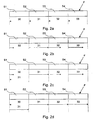
- FIG. 2a-2b is diagrammatically shown an example of a course of events according to a preferred embodiment of a procedure according to the present invention.
- the reference indication 40 refers to a schematically illustrated data file, which one wants to have transferred to the computer 20, and the reference indications S1-S4 indicate segments of the file F.
- home-loading of the file F is requested from the servers 30-31.
- FIG. 2a the figure under respective segment refers to the server 30-33 from which a transmission of respective segments S1-S4 has been requested, and where the arrow under respective segment illustrates how large part of the segment that has been transferred.
- this figure illustrates that the home-loading of the segments S1-S4 from the different servers 30-33 just has started.
- Figure 2b illustrates the transmission of the segments S1-S4 when the transmission has been going on for a certain period of time.
- the transmission of segment S1 from the server 30 is slow; the transmission of segment S2 from server 31 has been very fast and is already completed, whereas the transmission of the segments S3 and S4 from server 32 respective 33 is comparatively fast.
- the transmission is finished and transmission of one more segment of the data file F from server 31 is requested.
- segment S1 is the segment where the largest portion of the segment remains to be loaded home, transmission of just this segment is requested, which is illustrated in Figure 2c, just after that transmission of segment S1 from server 31 has been requested.
- the segment S1 is loaded home parallelly from both server 30 and 31 and the whole segment S1 is requested to be transferred from server 31.
- the transmission/transfer of the data file is completed when the transfer of all segments S1-S4 of the data file is completed.
- the server 31 has completed the transmission of segment S1
- the servers 32 and 33 have completed the transmission of segment S3 respective S4. Since the transmission of the segment S2 has previously been completed, all segments S1-S4 of the data file F have been transferred, and the transmission procedure can be stopped, i.e. the transmission in progress of segment S1 from server 30 is stopped. After that, the transmitted segments S1-S4 are put together, by the receiving computer, to the wanted file.
- the transmission from the servers 31, 32 and 33 are completed essentially at the same point of time, which is not necessarily the case. If the transmission of any segment has been completed while the transmission of any other segment has not been completed, this segment is requested to be transferred from the server that has just completed its transmission. This is after that repeated until all segments are completely transferred.
- FIG. 3a-3d is shown diagrammatically a preferred embodiment of the invention.
- the Figures 3a and 3b show the course of events that was described above with reference to the Figures 2a and 2b, which, for that reason, will not be described in detail.
- server 31 has completed the transmission of segment S2 and a transmission of segment S1, for which largest portion of the segment remains to be transmitted, is requested.
- This request is taken into consideration how large part of the segment S1 that has already been transferred, i.e. it is only for that portion of the segment S1 that remains to be transmitted that transmission is requested.
- the transmission of the remaining portion of the segment S1 is then made parallelly, or, as is shown in Figure 3c, the transmission of the remaining portion of the segment S1 is shared between the server 30 and server 31.
- the remaining portion of the segment S1 is shared proportionally to these transmission speeds.
- the current transmission speeds are based on the portion of the segments that have already been transmitted from respective server. This means that, if server 31 relieves server 30 of the remaining portion, which is illustrated by the reference indication S11 in Figure 3c, of the segment S1, and if the transmission from respective server is performed with the same speed as so far, the transmission of respective portion from the two servers 30, 31 will take essentially the same time.
- the receiving computer 20 Before transmission of the file is requested, the receiving computer 20 preferably first makes an estimation of the expected transmission speed from respective server, where examples of the wanted file are. This estimation is then used to select from which servers, which need not be all servers where examples of the files are, transmission of the file, or segment of the file, shall be requested.
- this estimation is also used, as is shown as an example in Figure 4a, to request transmission of segments S5-S8 of different sizes from the servers in question.
- the transmission speed for server 30 has been estimated to be very high, so transmission of a larger segment S5 of the data file is requested from this server 31.
- the size of respective segment S5-S8 is determined preferably proportionally to the transmission speed for respective server 30-31. This means that the transmission from respective server 30-33 should take essentially the same time. If that is not the case, transmission of not completely transmitted segments is requested in the same way as has been described above.
- Shown embodiments of the present invention can preferably be realized by implementation that utilizes File Transfer Protocol (FTP), which is a part of the IP-standard.
- FTP File Transfer Protocol
Landscapes
- Engineering & Computer Science (AREA)
- Computer Networks & Wireless Communication (AREA)
- Signal Processing (AREA)
- Computer Security & Cryptography (AREA)
- Computer And Data Communications (AREA)
- Communication Control (AREA)
- Information Retrieval, Db Structures And Fs Structures Therefor (AREA)
- Information Transfer Between Computers (AREA)
- Selective Calling Equipment (AREA)
Abstract
Description
- The invention relates to transmission of data files. More specifically the invention relates to a procedure for control of data file transmission between transmitting and receiving units, wherein examples of the data file that shall be transmitted are stored at a plurality of units. The invention also relates to a device to perform this procedure.
- At transmission of data files from a transmitting unit, or a server, to a receiving unit, for instance over Internet, it frequently occurs that the transmitting unit, or the network that is utilized for the transmission, is overloaded. This may result in that the transmission speed from a server to the receiving unit will be very low, which in its turn results in very long transfer times and also can result in that the transmission will be unsuccessful.
- However, it is usual, i.a. on the Internet, that files are copied and distributed to a plurality of servers in order to share the load on these servers that files that are frequently requested to be transmitted can result in. This will reduce the risk of overloading and, of course, also opens for the possibility to break off a too slow transmission of a file, and request a transmission of the file from another server.
- A problem in the situation is that the user or the receiving unit does not know which server, or which part of the network, that for the time being has a low load. Therefore, there also will be the risk that also this server is, or will be, overloaded and that the transmission is slowed down or has to be broken. There also is a risk of imbalance of networks and servers.
- EP 0 512 174 shows a parallel rule-based data transmission method and apparatus comprising multiple computer ports, modems, and multiple data transmission channels. Data files to be transmitted are segmented in order to facilitate simultaneous transmission and achieve optimum throughput.
- One aim of the invention is to create a procedure, and a corresponding device, for control of data file transmission that reduces the risk of overload of transmitting units and transmission networks.
- It is also an aim of the present invention to create a procedure, and a corresponding device, that makes a more efficient control of data file transmission between transmitting and receiving units.
- Said and other aims are effected, according to the present invention, by a procedure and a device with the characteristics that are defined in the
independent claims 1 and 6 respectively. Preferred embodiments are defined by the dependent claims. - According to a first aspect of the invention, this is expressed in a procedure of the kind defined in the introduction, and including the steps set forth in
claim 1. - According to a second aspect of the present invention, a device is provided according to claim 6.
- The invention consequently is based on the understanding of the advantage of the transmission of the wanted data file from a plurality of transmitting units by different segments of the data file being transmitted from the different transmitting units. This results in the advantage that if a transmitting unit is overloaded, and the transmission speed from this unit is greatly reduced, only one segment of the file is influenced. In this way the total transfer time of the file can be considerably reduced compared to a situation where the whole file should be transmitted from a unit with low transmission speed. This solution requires that at least one example of the data file that shall be transmitted exists at, at least, two transmitting units.
- After finished transmission of the segments, the transferred segments are put together to a complete data file. This is preferably made in the receiving unit.
- By segment is related to a certain amount of information of a data file. According to the invention, the data file that shall be transmitted consists of at least two segments of the same size, or of varying sizes. The size and number of the segments, and which part of the file the segment constitutes, are determined by the unit that requests the transmission.
- Examples of the data file existing at different transmitting units need not necessarily be identical copies of the data file. At transmission of most file types, however, the transmission and the subsequent putting together of the segments are facilitated if the examples are essentially similar both regarding size and content.
- A request for transmission of a segment of a data file is preferably transmitted to a plurality of transmitting units in such a way that only one request for transmission is initially transmitted for respective segment, and that the segments together constitute the entire file. Initially, preferably only one request for transmission of a segment of the data file is transmitted to the respective transmitting unit.
- According to the invention, the transmission capacity of the transmitting units that first finish the requested transmission of a segment to the receiving unit, is also utilized for transmission of the segments for which the transmission has started but not been finished. This is done by a request, when the transmission of a segment has been finished, for a transmission of a segment that has not been completely transferred, i.e. where the transmission is still in progress, to the transmitting unit that has finished its transmission. The advantage achieved by this is that a plurality of segments can be transmitted from the transmitting units with highest capacity without the need of any check or estimation of the transmission speeds before transmission of the data file is requested. This step is repeated until all segments of the data file have been transferred. Preferably, but not necessarily, all transmissions of segments of the data file in question that have not been finished, are broken.
- To achieve as high a total transmission speed as possible, a check is first made, according to an embodiment of the invention, for which segment, or from which transmitting unit, the transmission speed has been lowest, i.e. where the largest portion of the segment still remains to be transferred. After that, transmission of just this segment of the data file is requested. The advantage of this is that the risk of a blocking caused by the transmission from a transmitting unit being stopped, or being performed very slowly, for instance due to overload of network or server, is eliminated.
- According to the invention, transmission of only a portion of a segment is requested from the unit that has completed transmission of a segment. This portion constitutes the portion, or part of the portion, of the segment, where transmission has not yet been completed. In this way no request for transmission of any portion of the data file that has already been transferred to the receiving unit is made, which results in the advantage that the total transmission speed can be further improved.
- The portion of the segment for which transmission is requested can constitute the whole portion of the segment that remains to be transmitted, or a portion that constitutes a part of the remaining portion. How large part of the portion that shall be transferred is determined in relation to the transmission speeds for the transmitting unit that is transmitting the segment in question, and for the transmitting unit from which transmission of the part of the portion shall be requested. The size of said part of the portion is selected in such a way that the transmission of this part and the transmission of the remaining part of the portion, from the transmitting unit that has originally started the transmission of the segment, essentially takes the same time, which results in the advantage that the transfer time of this segment will be further shortened. The estimation of the transfer times is based on so far transmitted amount of the data file in question.
- According to an alternative embodiment of the invention, the transmission speeds of the transmitting units that can be of current interest for the transmission of a data file, i.e., which have examples of the file in question, are estimated before transmission is requested. These estimated transmission speeds can with advantage be utilized to disregard the transmitting units with lowest transmission speeds. They also can be utilized to request transmission of segments of different sizes, where the size of respective segment is selected proportionally to respective transmission speed.
- The present invention consequently results in the overall advantage that a sharing of the load that is caused by file transmission is effected in such a way that the route that on each occasion is least loaded will be most utilized for the transmission of the file in question. In this way the situation is also improved for the users who do not make use of the procedure or the device according to the present invention.
- It should be realized that the above discussed embodiments and characteristics can be combined in advantageous ways, depending on present application.
- Further characteristics of the invention will be obvious by the following description of exemplifying embodiments of these and by the enclosed claims.
- The invention now will be described by means of exemplified embodiments with reference to the enclosed figures, in which:
- Figure 1 diagrammatically shows a system to effect a procedure according to the present invention.
- Figure 2a-2d diagrammatically shows a course of events according to a preferred embodiment of the present invention,
- Figure 3a-3d diagrammatically shows a course of events according to a preferred embodiment of the present invention, and
- Figure 4a diagrammatically shows a step corresponding to the step that is shown in Figure 2a, respective 3a, of a course of events of an alternative embodiment of the present invention.
- Figure 1 shows diagrammatically a system to effect the procedure according to embodiments of the invention. The system includes a receiving unit or
computer 20 and a number of transmitting units orservers network 10, which in preferred embodiments is constituted by Internet. Withrespective server computer 20. In order to facilitate the description, the number of illustrated servers has been limited to four, which should not be regarded as a limitation of, or recommendation for, suitable number of servers. - Communication between computer and server is best performed according to standardized and well-known IP-protocols.
- With reference to the Figures 2a-2b is diagrammatically shown an example of a course of events according to a preferred embodiment of a procedure according to the present invention. According to this example is supposed that the file one wants to have transferred can be loaded home from four different servers. The reference indication 40 refers to a schematically illustrated data file, which one wants to have transferred to the
computer 20, and the reference indications S1-S4 indicate segments of the file F. According to this example, home-loading of the file F is requested from the servers 30-31. More specific, home-loading is requested of a first segment S1 of the file F from afirst server 30, of a second segment S2 from asecond server 31, of a third segment S3 from athird server 32, and of a fourth segment S4 from afourth server 33. This is illustrated in Figure 2a, where the figure under respective segment refers to the server 30-33 from which a transmission of respective segments S1-S4 has been requested, and where the arrow under respective segment illustrates how large part of the segment that has been transferred. As can be realized by the short arrows in Figure 2a, this figure illustrates that the home-loading of the segments S1-S4 from the different servers 30-33 just has started. - Figure 2b illustrates the transmission of the segments S1-S4 when the transmission has been going on for a certain period of time. As can be seen in the Figure, the transmission of segment S1 from the
server 30 is slow; the transmission of segment S2 fromserver 31 has been very fast and is already completed, whereas the transmission of the segments S3 and S4 fromserver 32 respective 33 is comparatively fast. When the home-loading of the segment S2 fromserver 31 is completed, the transmission is finished and transmission of one more segment of the data file F fromserver 31 is requested. Because segment S1 is the segment where the largest portion of the segment remains to be loaded home, transmission of just this segment is requested, which is illustrated in Figure 2c, just after that transmission of segment S1 fromserver 31 has been requested. As can be seen in Figure 2c the segment S1 is loaded home parallelly from bothserver server 31. - The transmission/transfer of the data file is completed when the transfer of all segments S1-S4 of the data file is completed. As can be seen in Figure 2d, the
server 31 has completed the transmission of segment S1, and theservers server 30 is stopped. After that, the transmitted segments S1-S4 are put together, by the receiving computer, to the wanted file. In the described course of events, the transmission from theservers - With reference to the Figures 3a-3d is shown diagrammatically a preferred embodiment of the invention. The Figures 3a and 3b show the course of events that was described above with reference to the Figures 2a and 2b, which, for that reason, will not be described in detail. In the same way as in the above described example,
server 31 has completed the transmission of segment S2 and a transmission of segment S1, for which largest portion of the segment remains to be transmitted, is requested. At this request is taken into consideration how large part of the segment S1 that has already been transferred, i.e. it is only for that portion of the segment S1 that remains to be transmitted that transmission is requested. The transmission of the remaining portion of the segment S1 is then made parallelly, or, as is shown in Figure 3c, the transmission of the remaining portion of the segment S1 is shared between theserver 30 andserver 31. - At this sharing the transmission speeds for
server server 31 relievesserver 30 of the remaining portion, which is illustrated by the reference indication S11 in Figure 3c, of the segment S1, and if the transmission from respective server is performed with the same speed as so far, the transmission of respective portion from the twoservers - Before transmission of the file is requested, the receiving
computer 20 preferably first makes an estimation of the expected transmission speed from respective server, where examples of the wanted file are. This estimation is then used to select from which servers, which need not be all servers where examples of the files are, transmission of the file, or segment of the file, shall be requested. - According to an alternative embodiment, this estimation is also used, as is shown as an example in Figure 4a, to request transmission of segments S5-S8 of different sizes from the servers in question. According to this example, the transmission speed for
server 30 has been estimated to be very high, so transmission of a larger segment S5 of the data file is requested from thisserver 31. The size of respective segment S5-S8 is determined preferably proportionally to the transmission speed for respective server 30-31. This means that the transmission from respective server 30-33 should take essentially the same time. If that is not the case, transmission of not completely transmitted segments is requested in the same way as has been described above. - Shown embodiments of the present invention can preferably be realized by implementation that utilizes File Transfer Protocol (FTP), which is a part of the IP-standard.
Claims (10)
- Procedure for control of data file transmission between transmitting (30-33) and receiving units (20), examples of the data file (F) that shall be transmitted being stored at a plurality of transmitting units (30-33), including the steps
to request transmission of segments (S1-S4) of the data file (F) from a plurality of transmitting units (30-33), and
to receive said segments (S1-S4) from said plurality of transmitting units (30-33), at start of the transmission different segments of the data file (F) being transmitted from different transmitting units, and to request, when the transmission of a segment (S1-S4) from a transmitting unit is completed, transmission from said transmitting unit of one more segment (S1) of the data file (F), for which the transmission of this one more segment (S1) from another transmitting unit has started, the step to request transmission of one more segment (S1) including the step
to request transmission of only a portion (S11) of said one more segment (S1), which portion (S11) of said one more segment is included in the portion of the segment (S1) that has not yet been transmitted. - Procedure as claimed in claim 1, wherein the step to request transmission of one more segment (S1-S4) includes the steps
to determine for which segment (S1-S4) the largest portion of the segment (S1-S4) remains to be transmitted, and
to request transmission of this segment (S1). - Procedure as claimed in claim 1, wherein the step to request transmission of a portion (S11) of said one more segment (S1) includes the steps
to determine how large portion of said one more segment (S1) remains to be transmitted,
to estimate the transmission speed for the transmitting unit (30) that is transmitting said segment (S1) and for the transmitting unit (31) from which transmission of said portion (S11) shall be requested,
to determine, depending on the estimated transmission speeds, how large said portion (S11) shall be, and
to request transmission of said portion (S11). - Procedure as claimed in any of the previous claims, including the steps
to estimate the transmission speeds from respective transmitting unit (30-33), and
to request transmission of segments (S5-S8) of different sizes, the size of the respective segment being determined on the basis of the estimated transmission speeds. - Procedure as claimed in any of the previous claims, including the step
to estimate the transmission speeds from the respective transmitting unit, and
to select transmitting units (30-33) for the transmission with regard to the estimated transmission speed from the respective transmitting unit. - Device for control of data file transmission between transmitting (30-33) and receiving units (20), examples of the data file (F) that shall be transmitted being stored at a plurality of transmitting units (30-33), including
a device to request transmission of segments (S1-S4) of the data file (F) from a plurality of transmitting units (30-33), and
a device to receive said segments (S1-S4) from said plurality of transmitting units (30-33), at start of the transmission different segments of the data file (F) being transmitted from different transmitting units, and to request, when the transmission of a segment (S1-S4) from a transmitting unit is completed, transmission from said transmitting unit of one more segment (S1) of the data file (F), for which the transmission of this one more segment (S1) from another transmitting unit has started, the device to request transmission of one more segment (S1) including
a device to request transmission of only a portion (S11) of said one more segment (S1), which portion (S11) of said one more segment is included in the portion of the segment (S1) that has not yet been transmitted. - Device as claimed in claim 6, wherein the device to request transmission of one more segment (S1-S4) includes
a device to determine for which segment (S1-S4) the largest portion of the segment (S1-S4) remains to be transmitted, and a device to request transmission of this segment (S1). - Device as claimed in claim 7, wherein the device to request transmission of a portion (S11) of said one more segment (S1) includes
a device to determine how large portion of said one more segment (S1) remains to be transmitted
a device to estimate the transmission speed for the transmitting unit (30) which is transmitting said segment (S1) and for the transmitting unit (31) from which transmission of said portion (S11) shall be requested,
a device to determine, depending on the estimated transmission speeds, the size of said portion (S11), and a device to request transmission of said portion (S11). - Device as claimed in any of the claims 6-8, including
a device to estimate the transmission speeds from respective transmitting unit (30-33), and
a device to request transmission of segments (S5-S8) of different sizes, which device is arranged to determine the size of the respective segment (S5-S8) on the basis of the estimated transmission speeds. - Device as claimed in any of the claims 6-9 including
a device to estimate the transmission speeds from the respective transmitting unit, and
a device to select transmitting units (30-33) for the transmission with regard to the estimated transmission speed from the respective transmitting unit.
Applications Claiming Priority (3)
| Application Number | Priority Date | Filing Date | Title |
|---|---|---|---|
| SE9901638A SE515834C2 (en) | 1999-05-06 | 1999-05-06 | Method and apparatus for controlling data file transfer |
| SE9901638 | 1999-05-06 | ||
| PCT/SE2000/000881 WO2000068835A1 (en) | 1999-05-06 | 2000-05-03 | Procedure and device for control of data file transmission |
Publications (2)
| Publication Number | Publication Date |
|---|---|
| EP1224573A1 EP1224573A1 (en) | 2002-07-24 |
| EP1224573B1 true EP1224573B1 (en) | 2007-02-28 |
Family
ID=20415489
Family Applications (1)
| Application Number | Title | Priority Date | Filing Date |
|---|---|---|---|
| EP00930029A Expired - Lifetime EP1224573B1 (en) | 1999-05-06 | 2000-05-03 | Procedure and device for control of data file transmission |
Country Status (9)
| Country | Link |
|---|---|
| US (1) | US7003579B1 (en) |
| EP (1) | EP1224573B1 (en) |
| AT (1) | ATE355562T1 (en) |
| DE (1) | DE60033680D1 (en) |
| DK (1) | DK1224573T3 (en) |
| EE (1) | EE05208B1 (en) |
| NO (1) | NO319728B1 (en) |
| SE (1) | SE515834C2 (en) |
| WO (1) | WO2000068835A1 (en) |
Families Citing this family (5)
| Publication number | Priority date | Publication date | Assignee | Title |
|---|---|---|---|---|
| JP2003022232A (en) * | 2001-07-06 | 2003-01-24 | Fujitsu Ltd | Content data transfer system |
| JP2006523980A (en) | 2003-04-17 | 2006-10-19 | トムソン ライセンシング | Data requesting device, data transmitting device, process thereof and corresponding product |
| EP2095255B1 (en) * | 2006-11-30 | 2014-07-23 | Speedbit Ltd. | Accelerated multimedia file download and playback |
| EP3253005A4 (en) * | 2015-01-29 | 2018-01-17 | Nec Corporation | Data file registration management system, method, management device, and program |
| US10217091B2 (en) | 2015-02-13 | 2019-02-26 | Bank Of America Corporation | Pre-provisioning electronic banking files |
Family Cites Families (6)
| Publication number | Priority date | Publication date | Assignee | Title |
|---|---|---|---|---|
| EP0512174B1 (en) * | 1991-05-08 | 1997-02-26 | Semaphore, Inc. | Parallel rule-based data transmission method and apparatus |
| US6963923B1 (en) | 1997-02-10 | 2005-11-08 | International Business Machines Corporation | Method for file transfer restarts using standard internet protocol |
| US6003045A (en) * | 1997-09-17 | 1999-12-14 | International Business Machines Corporation | Accessing stored files from multiple storage devices |
| US6460087B1 (en) * | 1998-02-25 | 2002-10-01 | Kdd Corporation | Method of transferring file |
| US6085251A (en) * | 1998-04-02 | 2000-07-04 | The United States Of America As Represented By The Secretary Of The Air Force | Implementing a parallel file transfer protocol |
| US6765868B1 (en) * | 1998-09-22 | 2004-07-20 | International Business Machines Corp. | System and method for large file transfers in packet networks |
-
1999
- 1999-05-06 SE SE9901638A patent/SE515834C2/en not_active IP Right Cessation
-
2000
- 2000-05-03 EE EEP200100587A patent/EE05208B1/en not_active IP Right Cessation
- 2000-05-03 US US09/926,451 patent/US7003579B1/en not_active Expired - Lifetime
- 2000-05-03 EP EP00930029A patent/EP1224573B1/en not_active Expired - Lifetime
- 2000-05-03 DE DE60033680T patent/DE60033680D1/en not_active Expired - Lifetime
- 2000-05-03 WO PCT/SE2000/000881 patent/WO2000068835A1/en not_active Ceased
- 2000-05-03 AT AT00930029T patent/ATE355562T1/en not_active IP Right Cessation
- 2000-05-03 DK DK00930029T patent/DK1224573T3/en active
-
2001
- 2001-10-24 NO NO20015186A patent/NO319728B1/en not_active IP Right Cessation
Also Published As
| Publication number | Publication date |
|---|---|
| NO319728B1 (en) | 2005-09-12 |
| WO2000068835A1 (en) | 2000-11-16 |
| DE60033680D1 (en) | 2007-04-12 |
| EE05208B1 (en) | 2009-08-17 |
| EP1224573A1 (en) | 2002-07-24 |
| NO20015186L (en) | 2002-01-07 |
| NO20015186D0 (en) | 2001-10-24 |
| DK1224573T3 (en) | 2007-06-18 |
| EE200100587A (en) | 2003-02-17 |
| SE515834C2 (en) | 2001-10-15 |
| SE9901638D0 (en) | 1999-05-06 |
| SE9901638L (en) | 2000-11-07 |
| ATE355562T1 (en) | 2006-03-15 |
| US7003579B1 (en) | 2006-02-21 |
Similar Documents
| Publication | Publication Date | Title |
|---|---|---|
| US7801978B1 (en) | Apparatus, method and computer program product for efficiently pooling connections between clients and servers | |
| RU2595752C2 (en) | Multichannel connections in file system sessions | |
| US6954780B2 (en) | Internet client-server multiplexer | |
| JP3382953B2 (en) | Client management flow control method and apparatus on finite memory computer system | |
| EP1257910B1 (en) | Method and apparatus for distributing load in a computer environment | |
| US20120259920A1 (en) | Peer-to-peer communication according to transmission capacity | |
| US7003579B1 (en) | Procedure and device for control of data file transmission | |
| CN115086350B (en) | Block chain node data synchronization method, equipment and storage medium | |
| WO2002088951A1 (en) | Stateless server | |
| JP2009181481A (en) | Computer system, service providing device, service using device, control method and program | |
| EP3975497A1 (en) | Message load balancing method | |
| JP3531419B2 (en) | Image input method | |
| RU2522995C2 (en) | Method and apparatus for creating peer-to-peer group in peer-to-peer application and method of using peer-to-peer group | |
| EP1290564B1 (en) | Procedure at transmission/transfer of data files | |
| JPH0962624A (en) | Online transaction processing method and processing system | |
| CN100581157C (en) | Method for transferring workload of seventh layer load balancer to server side for processing | |
| JP2003167775A (en) | Load balancing system and load balancing device | |
| EP1290565A1 (en) | Procedure at transmission/transfer of data files | |
| JPH11316717A (en) | Data transfer system | |
| JP3422516B2 (en) | Network system | |
| CN115186029B (en) | Data storage method and device, data storage equipment and server | |
| JPH1065728A (en) | Distribution processor-type data exchange | |
| KR100508157B1 (en) | Block data transmission method between client and server systems of multi-agent structure | |
| JPH09212439A (en) | Decentralized processing system and its data transfer method | |
| CN118381762A (en) | Data transmission method, system and electronic equipment based on TCP link |
Legal Events
| Date | Code | Title | Description |
|---|---|---|---|
| PUAI | Public reference made under article 153(3) epc to a published international application that has entered the european phase |
Free format text: ORIGINAL CODE: 0009012 |
|
| 17P | Request for examination filed |
Effective date: 20011206 |
|
| AK | Designated contracting states |
Kind code of ref document: A1 Designated state(s): AT BE CH CY DE DK ES FI FR GB GR IE IT LI LU MC NL PT SE |
|
| AX | Request for extension of the european patent |
Free format text: LT PAYMENT 20011206;LV PAYMENT 20011206 |
|
| GRAP | Despatch of communication of intention to grant a patent |
Free format text: ORIGINAL CODE: EPIDOSNIGR1 |
|
| RIC1 | Information provided on ipc code assigned before grant |
Ipc: G06F 17/30 20060101AFI20060215BHEP Ipc: H04L 29/06 20060101ALI20060215BHEP |
|
| RTI1 | Title (correction) |
Free format text: PROCEDURE AND DEVICE FOR CONTROL OF DATA FILE TRANSMISSION |
|
| GRAS | Grant fee paid |
Free format text: ORIGINAL CODE: EPIDOSNIGR3 |
|
| GRAC | Information related to communication of intention to grant a patent modified |
Free format text: ORIGINAL CODE: EPIDOSCIGR1 |
|
| GRAA | (expected) grant |
Free format text: ORIGINAL CODE: 0009210 |
|
| AK | Designated contracting states |
Kind code of ref document: B1 Designated state(s): AT BE CH CY DE DK ES FI FR GB GR IE IT LI LU MC NL PT SE |
|
| AX | Request for extension of the european patent |
Extension state: LT LV |
|
| PG25 | Lapsed in a contracting state [announced via postgrant information from national office to epo] |
Ref country code: CH Free format text: LAPSE BECAUSE OF FAILURE TO SUBMIT A TRANSLATION OF THE DESCRIPTION OR TO PAY THE FEE WITHIN THE PRESCRIBED TIME-LIMIT Effective date: 20070228 Ref country code: NL Free format text: LAPSE BECAUSE OF FAILURE TO SUBMIT A TRANSLATION OF THE DESCRIPTION OR TO PAY THE FEE WITHIN THE PRESCRIBED TIME-LIMIT Effective date: 20070228 Ref country code: LI Free format text: LAPSE BECAUSE OF FAILURE TO SUBMIT A TRANSLATION OF THE DESCRIPTION OR TO PAY THE FEE WITHIN THE PRESCRIBED TIME-LIMIT Effective date: 20070228 Ref country code: BE Free format text: LAPSE BECAUSE OF FAILURE TO SUBMIT A TRANSLATION OF THE DESCRIPTION OR TO PAY THE FEE WITHIN THE PRESCRIBED TIME-LIMIT Effective date: 20070228 Ref country code: AT Free format text: LAPSE BECAUSE OF FAILURE TO SUBMIT A TRANSLATION OF THE DESCRIPTION OR TO PAY THE FEE WITHIN THE PRESCRIBED TIME-LIMIT Effective date: 20070228 |
|
| REG | Reference to a national code |
Ref country code: GB Ref legal event code: FG4D |
|
| REG | Reference to a national code |
Ref country code: CH Ref legal event code: EP |
|
| REF | Corresponds to: |
Ref document number: 60033680 Country of ref document: DE Date of ref document: 20070412 Kind code of ref document: P |
|
| REG | Reference to a national code |
Ref country code: IE Ref legal event code: FG4D |
|
| PG25 | Lapsed in a contracting state [announced via postgrant information from national office to epo] |
Ref country code: SE Free format text: LAPSE BECAUSE OF FAILURE TO SUBMIT A TRANSLATION OF THE DESCRIPTION OR TO PAY THE FEE WITHIN THE PRESCRIBED TIME-LIMIT Effective date: 20070531 |
|
| PG25 | Lapsed in a contracting state [announced via postgrant information from national office to epo] |
Ref country code: ES Free format text: LAPSE BECAUSE OF FAILURE TO SUBMIT A TRANSLATION OF THE DESCRIPTION OR TO PAY THE FEE WITHIN THE PRESCRIBED TIME-LIMIT Effective date: 20070608 |
|
| REG | Reference to a national code |
Ref country code: DK Ref legal event code: T3 |
|
| PG25 | Lapsed in a contracting state [announced via postgrant information from national office to epo] |
Ref country code: PT Free format text: LAPSE BECAUSE OF FAILURE TO SUBMIT A TRANSLATION OF THE DESCRIPTION OR TO PAY THE FEE WITHIN THE PRESCRIBED TIME-LIMIT Effective date: 20070730 |
|
| NLV1 | Nl: lapsed or annulled due to failure to fulfill the requirements of art. 29p and 29m of the patents act | ||
| LTIE | Lt: invalidation of european patent or patent extension |
Effective date: 20070228 |
|
| REG | Reference to a national code |
Ref country code: CH Ref legal event code: PL |
|
| EN | Fr: translation not filed | ||
| RAP2 | Party data changed (patent owner data changed or rights of a patent transferred) |
Owner name: TELIASONERA AB |
|
| PLBE | No opposition filed within time limit |
Free format text: ORIGINAL CODE: 0009261 |
|
| STAA | Information on the status of an ep patent application or granted ep patent |
Free format text: STATUS: NO OPPOSITION FILED WITHIN TIME LIMIT |
|
| GBPC | Gb: european patent ceased through non-payment of renewal fee |
Effective date: 20070528 |
|
| PG25 | Lapsed in a contracting state [announced via postgrant information from national office to epo] |
Ref country code: DE Free format text: LAPSE BECAUSE OF FAILURE TO SUBMIT A TRANSLATION OF THE DESCRIPTION OR TO PAY THE FEE WITHIN THE PRESCRIBED TIME-LIMIT Effective date: 20070530 Ref country code: MC Free format text: LAPSE BECAUSE OF NON-PAYMENT OF DUE FEES Effective date: 20070531 |
|
| 26N | No opposition filed |
Effective date: 20071129 |
|
| PG25 | Lapsed in a contracting state [announced via postgrant information from national office to epo] |
Ref country code: FR Free format text: LAPSE BECAUSE OF FAILURE TO SUBMIT A TRANSLATION OF THE DESCRIPTION OR TO PAY THE FEE WITHIN THE PRESCRIBED TIME-LIMIT Effective date: 20071019 Ref country code: GR Free format text: LAPSE BECAUSE OF FAILURE TO SUBMIT A TRANSLATION OF THE DESCRIPTION OR TO PAY THE FEE WITHIN THE PRESCRIBED TIME-LIMIT Effective date: 20070529 Ref country code: IT Free format text: LAPSE BECAUSE OF FAILURE TO SUBMIT A TRANSLATION OF THE DESCRIPTION OR TO PAY THE FEE WITHIN THE PRESCRIBED TIME-LIMIT Effective date: 20070228 |
|
| PG25 | Lapsed in a contracting state [announced via postgrant information from national office to epo] |
Ref country code: GB Free format text: LAPSE BECAUSE OF NON-PAYMENT OF DUE FEES Effective date: 20070528 Ref country code: IE Free format text: LAPSE BECAUSE OF NON-PAYMENT OF DUE FEES Effective date: 20070503 |
|
| PG25 | Lapsed in a contracting state [announced via postgrant information from national office to epo] |
Ref country code: FR Free format text: LAPSE BECAUSE OF FAILURE TO SUBMIT A TRANSLATION OF THE DESCRIPTION OR TO PAY THE FEE WITHIN THE PRESCRIBED TIME-LIMIT Effective date: 20070228 |
|
| PG25 | Lapsed in a contracting state [announced via postgrant information from national office to epo] |
Ref country code: CY Free format text: LAPSE BECAUSE OF FAILURE TO SUBMIT A TRANSLATION OF THE DESCRIPTION OR TO PAY THE FEE WITHIN THE PRESCRIBED TIME-LIMIT Effective date: 20070228 |
|
| PG25 | Lapsed in a contracting state [announced via postgrant information from national office to epo] |
Ref country code: LU Free format text: LAPSE BECAUSE OF NON-PAYMENT OF DUE FEES Effective date: 20070503 |
|
| PGFP | Annual fee paid to national office [announced via postgrant information from national office to epo] |
Ref country code: DK Payment date: 20190523 Year of fee payment: 20 Ref country code: FI Payment date: 20190522 Year of fee payment: 20 |
|
| REG | Reference to a national code |
Ref country code: DK Ref legal event code: EUP Expiry date: 20200503 |
|
| REG | Reference to a national code |
Ref country code: FI Ref legal event code: MAE |