EP1223687A1 - Méthode simplifiée de détection par sphères en présence de faible rapport signal à bruit - Google Patents
Méthode simplifiée de détection par sphères en présence de faible rapport signal à bruit Download PDFInfo
- Publication number
- EP1223687A1 EP1223687A1 EP02290089A EP02290089A EP1223687A1 EP 1223687 A1 EP1223687 A1 EP 1223687A1 EP 02290089 A EP02290089 A EP 02290089A EP 02290089 A EP02290089 A EP 02290089A EP 1223687 A1 EP1223687 A1 EP 1223687A1
- Authority
- EP
- European Patent Office
- Prior art keywords
- constellation
- point
- points
- network
- received
- Prior art date
- Legal status (The legal status is an assumption and is not a legal conclusion. Google has not performed a legal analysis and makes no representation as to the accuracy of the status listed.)
- Granted
Links
- 238000001514 detection method Methods 0.000 title claims abstract description 55
- 239000013598 vector Substances 0.000 claims abstract description 86
- PXFBZOLANLWPMH-UHFFFAOYSA-N 16-Epiaffinine Natural products C1C(C2=CC=CC=C2N2)=C2C(=O)CC2C(=CC)CN(C)C1C2CO PXFBZOLANLWPMH-UHFFFAOYSA-N 0.000 claims abstract description 32
- 238000000034 method Methods 0.000 claims abstract description 17
- 238000001914 filtration Methods 0.000 claims description 11
- 230000005540 biological transmission Effects 0.000 claims description 10
- 239000011159 matrix material Substances 0.000 description 56
- 238000007476 Maximum Likelihood Methods 0.000 description 8
- 230000000875 corresponding effect Effects 0.000 description 7
- 230000009466 transformation Effects 0.000 description 7
- 230000002087 whitening effect Effects 0.000 description 5
- 238000004061 bleaching Methods 0.000 description 4
- 238000000354 decomposition reaction Methods 0.000 description 4
- 239000000654 additive Substances 0.000 description 3
- 230000000996 additive effect Effects 0.000 description 3
- 238000004364 calculation method Methods 0.000 description 3
- 238000011160 research Methods 0.000 description 2
- 238000000926 separation method Methods 0.000 description 2
- 238000001228 spectrum Methods 0.000 description 2
- 230000001360 synchronised effect Effects 0.000 description 2
- 241000566613 Cardinalis Species 0.000 description 1
- 241001644893 Entandrophragma utile Species 0.000 description 1
- 108010003272 Hyaluronate lyase Proteins 0.000 description 1
- 101100014660 Rattus norvegicus Gimap8 gene Proteins 0.000 description 1
- 230000015556 catabolic process Effects 0.000 description 1
- 230000002596 correlated effect Effects 0.000 description 1
- 238000011161 development Methods 0.000 description 1
- 230000018109 developmental process Effects 0.000 description 1
- 230000000694 effects Effects 0.000 description 1
- 230000008030 elimination Effects 0.000 description 1
- 238000003379 elimination reaction Methods 0.000 description 1
- 238000011156 evaluation Methods 0.000 description 1
- 230000000135 prohibitive effect Effects 0.000 description 1
- 230000000644 propagated effect Effects 0.000 description 1
- 230000003595 spectral effect Effects 0.000 description 1
- 238000012360 testing method Methods 0.000 description 1
- 230000001131 transforming effect Effects 0.000 description 1
- 238000013519 translation Methods 0.000 description 1
Images



Classifications
-
- H—ELECTRICITY
- H04—ELECTRIC COMMUNICATION TECHNIQUE
- H04B—TRANSMISSION
- H04B1/00—Details of transmission systems, not covered by a single one of groups H04B3/00 - H04B13/00; Details of transmission systems not characterised by the medium used for transmission
- H04B1/69—Spread spectrum techniques
- H04B1/707—Spread spectrum techniques using direct sequence modulation
- H04B1/7097—Interference-related aspects
- H04B1/7103—Interference-related aspects the interference being multiple access interference
- H04B1/7105—Joint detection techniques, e.g. linear detectors
-
- H—ELECTRICITY
- H04—ELECTRIC COMMUNICATION TECHNIQUE
- H04L—TRANSMISSION OF DIGITAL INFORMATION, e.g. TELEGRAPHIC COMMUNICATION
- H04L25/00—Baseband systems
- H04L25/02—Details ; arrangements for supplying electrical power along data transmission lines
- H04L25/03—Shaping networks in transmitter or receiver, e.g. adaptive shaping networks
- H04L25/03993—Noise whitening
-
- H—ELECTRICITY
- H04—ELECTRIC COMMUNICATION TECHNIQUE
- H04L—TRANSMISSION OF DIGITAL INFORMATION, e.g. TELEGRAPHIC COMMUNICATION
- H04L25/00—Baseband systems
- H04L25/02—Details ; arrangements for supplying electrical power along data transmission lines
- H04L25/06—DC level restoring means; Bias distortion correction ; Decision circuits providing symbol by symbol detection
- H04L25/061—DC level restoring means; Bias distortion correction ; Decision circuits providing symbol by symbol detection providing hard decisions only; arrangements for tracking or suppressing unwanted low frequency components, e.g. removal of DC offset
-
- H—ELECTRICITY
- H04—ELECTRIC COMMUNICATION TECHNIQUE
- H04L—TRANSMISSION OF DIGITAL INFORMATION, e.g. TELEGRAPHIC COMMUNICATION
- H04L27/00—Modulated-carrier systems
- H04L27/32—Carrier systems characterised by combinations of two or more of the types covered by groups H04L27/02, H04L27/10, H04L27/18 or H04L27/26
- H04L27/34—Amplitude- and phase-modulated carrier systems, e.g. quadrature-amplitude modulated carrier systems
- H04L27/38—Demodulator circuits; Receiver circuits
-
- H—ELECTRICITY
- H04—ELECTRIC COMMUNICATION TECHNIQUE
- H04B—TRANSMISSION
- H04B1/00—Details of transmission systems, not covered by a single one of groups H04B3/00 - H04B13/00; Details of transmission systems not characterised by the medium used for transmission
- H04B1/69—Spread spectrum techniques
- H04B1/707—Spread spectrum techniques using direct sequence modulation
- H04B1/709—Correlator structure
- H04B1/7093—Matched filter type
-
- H—ELECTRICITY
- H04—ELECTRIC COMMUNICATION TECHNIQUE
- H04B—TRANSMISSION
- H04B1/00—Details of transmission systems, not covered by a single one of groups H04B3/00 - H04B13/00; Details of transmission systems not characterised by the medium used for transmission
- H04B1/69—Spread spectrum techniques
- H04B1/707—Spread spectrum techniques using direct sequence modulation
- H04B1/7097—Interference-related aspects
- H04B1/7103—Interference-related aspects the interference being multiple access interference
- H04B1/7105—Joint detection techniques, e.g. linear detectors
- H04B1/71057—Joint detection techniques, e.g. linear detectors using maximum-likelihood sequence estimation [MLSE]
Definitions
- the present invention relates to a multi-user detection method and device. More particularly, the present invention relates to a method and a multi-user detection device for a DS-CDMA telecommunications system or MC-CDMA.
- a DS-CDMA Direct Sequence Code Division Multiple Access
- the separation of communications from or to different users is carried out by multiplying each complex symbol of a user by a spread sequence which is specific to the latter, also called for this reason the user's signature.
- the spreading frequency (chip rate) being higher than the symbol frequency
- the signal transmitted by each user is distributed (or spread) in the frequency space.
- the ratio between the band occupied by the spread signal and the band occupied by the information signal is called the spreading factor.
- the separation of a given user is obtained by filtering adapted to the corresponding signature.
- the output of the adapted filtering comprises as many correlation peaks.
- Each path of the channel can be modeled by a complex multiplicative coefficient and a delay.
- the signals propagated along the different paths can be aligned and combined by means of complex coefficients conjugate with the path coefficients, thus achieving filtering adapted to the transmission channel.
- filtering adapted to user k both the filtering operation adapted to the signature of user k and that of filtering adapted to the transmission channel.
- multi-user detection methods have been proposed and in particular iterative detection methods such as those known under the name of PIC ( Parallel Interference Cancellation ) and SIC ( Serial Interference Cancellation ). They are based on the iteration of an interference elimination cycle comprising the estimation of the symbols transmitted, the evaluation of the interference and their subtraction from the signals received. Although effective, these methods are not optimal insofar as they do not provide an estimate in the sense of the maximum likelihood of the symbols transmitted by the different users.
- DS-CDMA direct sequences
- d k ( i ) be the complex symbol emitted by user k at time i .
- This symbol belongs to the modulation constellation A k used by user k , which will also be called user symbol alphabet k .
- Each user k transmits a block of N symbols with an amplitude of the signal a k .
- the K complex symbols d k ( i ) d R / k ( i ) + j .
- d 2 ( i ) ( d R 1 ( i ) d l 1 ( i ), ..., d R K ( i ) d l K ( i ))
- n S t + ⁇ t be the signal received at time t and ⁇ t be a complex Gaussian noise with zero mean and whose components have a variance N 0 .
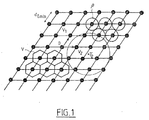
- FIG. 1 An example of a 2-dimensional point network has been shown in FIG. 1.
- the points of the network form an additive abelian subgroup of R ⁇ , it is moreover the smallest subgroup of R ⁇ containing the vectors ⁇ v 1 , v 2 , ..., v ⁇ ⁇ and a Z -module of R ⁇ .
- the region delimited by the basic vectors is called the fundamental parallelotope and its volume, denoted vol ( ⁇ ) or det ( ⁇ ), is called the fundamental volume.
- This fundamental volume is none other than the modulus of the vector product of the ⁇ basic vectors and is therefore equal to
- the Voronoi region V or Dirichlet cell of a point x belonging to the network is the set of points of R ⁇ closer to x than to any other point of the network.
- the volume of this region is equal to the fundamental volume.
- the stacking radius ⁇ of the network is the radius of the largest sphere inscribed in the Voronoi region and the overlapping radius that of the smallest sphere circumscribed in this same region.
- the stacking radius is therefore the radius of the spheres whose stacking constitutes the network of points and the covering radius is that of the smallest spheres which, centered on the points of the network, make it possible to cover all the space R ⁇ .
- the density of the network is the ratio between the volume of the sphere of radius ⁇ and the fundamental volume.
- d R / k ( i ) and d l / k ( i ) are PAM modulation symbols of order M: d R k ( i ) ⁇ ⁇ - M + 1, - M 3, ..., M -3, M -1 ⁇ and d l k ( i ) ⁇ ⁇ -M + 1 -M 3, ..., M -3, M -1 ⁇
- d ' R / k ( i ) 1/2 ( d R / k ( i ) + M -1)
- v M ( M -1, M -1, ..., M -1) the components of R / k (i) and
- the vector y 2 ( i ) can therefore be considered as a point in the network ⁇ 2 corrupted by noise n 2 ( i ).
- n 2 ( i ) the components of the noise vector n 2 ( i ) are correlated and the covariance matrix of n 2 ( i ) is N 0 R 2 .
- x 2 ( i ) is a vector of components ( x R / l ( i ), x l / 1 ( i ), ..., x R / K ( i ), x l / K ( i )) belonging to ⁇ 2 .
- the network ⁇ 2 has the generator matrix A 2 W 2 , the lower triangular real matrix.
- the detection therefore comprises a first step of bleaching the observation vector followed by a step of searching for the nearest neighbor within the network of points ⁇ 2 .
- Fig. 2 schematically represents a multi-user detection device using a detection method by spheres.
- the received signal n is filtered by a battery of filters adapted to each of the users, 210 1 , ..., 210 K.
- the real and imaginary components of the observation vector y 2 ( i ) at the output of the adapted filters are transmitted to a matrix calculation unit performing the spectral whitening operation according to the relation (14).
- the real and imaginary components of the bleached vector ( i ) are then transmitted to a detection unit by spheres searching for the closest neighbor to the point received within the network ⁇ 2 of dimension 2.
- K The nearest neighbor coordinates directly give the real and imaginary components of the estimated symbols d and k ( i ) for the different users.
- the nearest neighbor search step takes a lot of computing time which can be very disadvantageous when the number of users is high.
- the signal to noise ratio is low, it is necessary to choose a large radius for the research sphere and the risk is high of having to consider a big number of network points in the search stage.
- the aim of the present invention is to propose a simplification of the method detection by spheres especially in the presence of a low signal to noise ratio.
- the invention is defined by a method for detecting a plurality K of symbols (d k ( i )) transmitted by or for a plurality K of users from a received signal, each symbol of a user belonging to a modulation constellation, the detection method implementing a network of points ( ⁇ ) generated by said modulation constellations, said plurality of symbols of the different users being represented by a point among a subset of points of said network, said constellation and the received signal being represented by a point characteristic of this signal, called the received point, translated from a point of said constellation by a noise vector ( n ), the method comprising a step of orthogonal projection of the point received on a sub- affine space, called projection space, parallel or merged with an affine subspace delimiting said constellation and a step of finding the closest neighbor to the point thus projected by mid points of said constellation.
- said affine subspace delimiting the constellation is determined as a function of the position of the point received with respect to said constellation.
- the search for the nearest neighbor is limited at the points of the constellation belonging to a sphere centered on said projected point.
- the search for the nearest neighbor can be performed among the points of the constellation belonging to said affine subspace.
- the search for the nearest neighbor is advantageously limited to the points of the affine subspace belonging to a sphere of said subspace centered on said point projected.
- the projection step is not carried out only if the received point is more than one distance from said constellation predetermined.
- the present invention finds particular application to transmission in DS-CDMA or MC-CDMA mode.
- the symbols for each user multiplied by a signature of this user before being transmitted on a transmission channel the coordinates of the received point are obtained by a step of adapted filtering of the received signal, the filtering being adapted to the channels of transmission and signatures of different users.
- the present invention also relates to a reception device for DS-CDMA telecommunications system including a detection device suitable for implementing the detection method described above.
- the present invention also relates to a reception device for a system.
- MC-CDMA telecommunications system including a detection device adapted to implement the detection method described above.
- the observation vectors y R ( i ) and y l ( i ) belong to R K. After possible transformation according to a relation of the type of that of (12), the vectors y R ( i ) and y l ( i ) can be considered as points of a network ⁇ of generator matrix M corrupted by noise.
- noise vectors n R ( i ) and n l ( i ) both have the covariance matrix N 0 .
- the real observation vectors y R ( i ) and y l ( i ) are first subjected to a bleaching operation:
- the noise vector ⁇ has independent real components following a Gaussian distribution with zero mean and variance N 0 .
- G is the generator matrix of the network .
- the set of symbols issued is limited to an alphabet of finite size A ⁇ ⁇ Z ⁇ called a constellation.
- This constellation is determined by the modulation constellations used by (or for) the ⁇ users and the cardinal of the alphabet A ⁇ is the product of the cardinals of the different modulation alphabets. It will be assumed that the complex points of each of these constellations have real values and regularly distributed imaginary values.
- the decoder advantageously restricts its calculation to the points which are located inside a zone of the constellation situated around the received point, preferably inside a sphere of given radius. VS centered on the point received as shown in Fig. 1. Only the points of the network located at a quadratic distance less than C from the received point are therefore considered for the minimization of the metric (19).
- the decoder performs the following minimization:
- the decoder searches for the smallest vector w in the translated set z - ⁇ .
- ⁇ and ⁇ are real vectors.
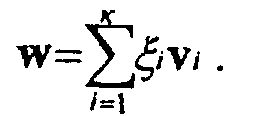
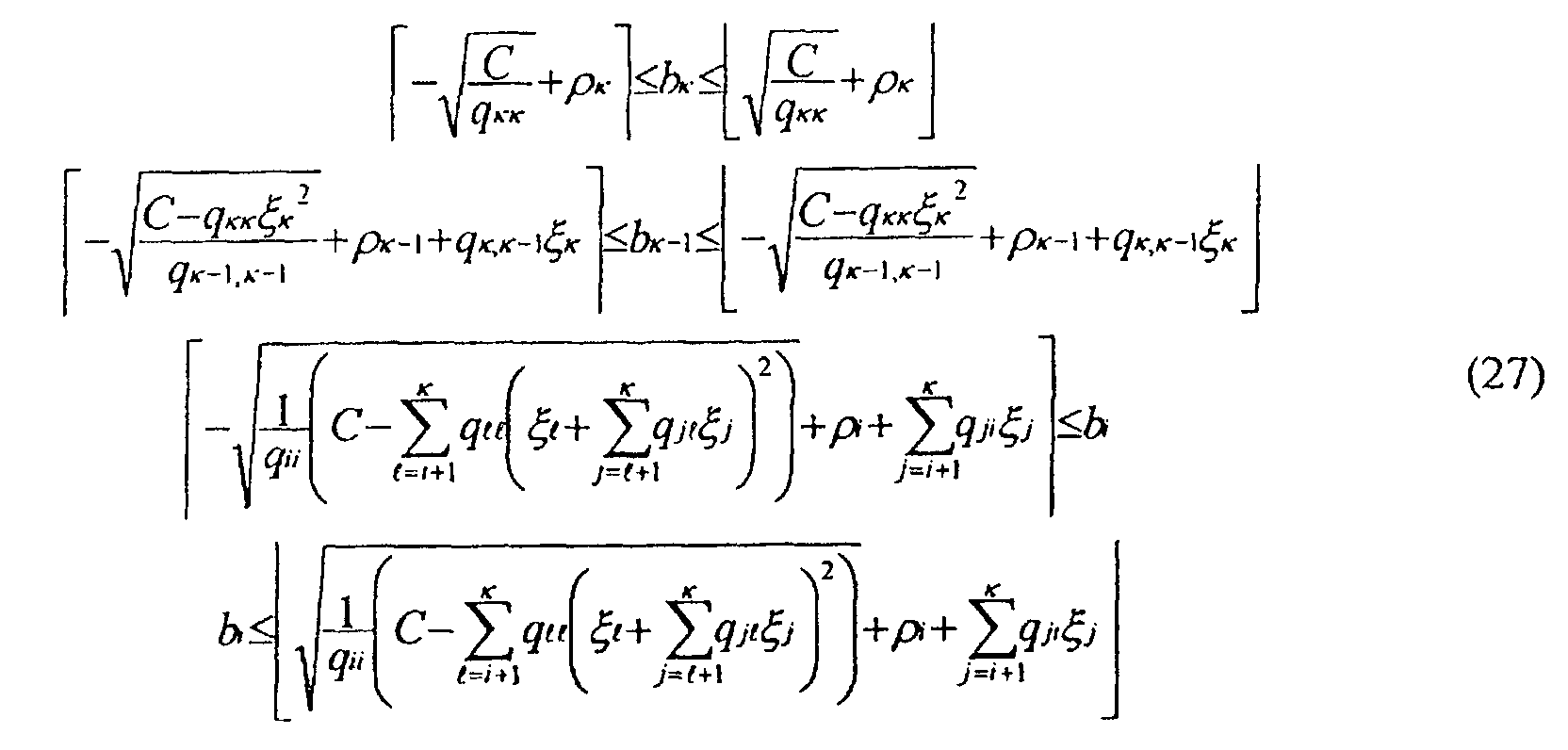
- the vector w is a point of the network whose coordinates ⁇ i are expressed in the translated coordinate system centered on the received point.
- the decoder has ⁇ internal counters, namely a counter by dimension, each counter counting between a lower and upper terminal as indicated in (27), it being understood that each counter is associated with a particular pair of terminals. In practice, these terminals can be updated recursively.
- each user k uses a constellation of symbols A k , each symbol of the constellation being a complex number whose real and imaginary parts (possibly after affine transformation) are elements of Z.
- the network is of dimension 2 K , where K is the number of users.
- the constellation, or equivalently the modulation constellation of the user k is first projected on the dimension 2k .
- the situation is slightly different when using real spreading sequences and therefore when the network is of dimension K (where K is the number of users).
- the real and imaginary values of the symbols are the subject of parallel research in a network ( ⁇ , ⁇ ) of dimension K.
- the calculation of the search limits (and the choice of the values of the values of the components) relates in turn to the real part and the imaginary part, in an interlaced manner.
- the integer coordinate b i of the point sought must be between 0 and M - 1.
- the search sphere may not contain any point in the constellation.
- the search interval [ B - / i , B + / i ] may be empty for certain dimensions i because L + / i ⁇ M - / i or L - / i > M + / i . In both cases, you must increase the radius of the sphere until you find a point in the constellation, which can lead to many unnecessary search steps and therefore considerably slow down the algorithm.
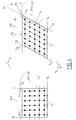
- a sphere centered on the received point z in the representation in 401 is transformed into an ellipsoid centered on the received point ⁇ in 402.
- a received point not belonging to the constellation is first projected orthogonally on the latter or more generally on an envelope E of this constellation. The choice of the affine subspace on which the projection is made depends on the position of the point received.
- the point M 1 belonging to the zone I delimited by the lines D 1 , D 2 , D 4 is projected on the line D 1
- the point M 2 belonging to the sector II delimited by the lines D 1 and D 2 is "Projected" on the vertex P 12 (that is to say that the image of any point belonging to this sector will be point P 12 )
- the point M3 belonging to the zone III delimited by the lines D 2 , D 1 , D 3 is projected on the right D 2 , etc.
- this choice of projection is sub-optimal. It is however preferred for its ease of implementation.
- the different types of affine subspaces on which we can perform a projection depend on the dimension of the network.
- the affine subspaces to be considered will be the faces, edges and vertices of the parallelepiped.
- ⁇ min, l and ⁇ max, l l equal to the same value ⁇ . This value can also be chosen null if one wishes to carry out the projection directly on the constellation.
- the affine subspaces to be considered are defined by L relations of type (34).
- T 0 be such a subspace: any point belonging to this subspace has L coordinates fixed by relations of the type (34).
- ⁇ 0 ( ⁇ max, 1 , ..., ⁇ max, L ) is a line vector of dimension L , z 0 a line vector of dimension ⁇ , k a line vector of dimension N representing the free coordinates of the sub- vector space T associated with the affine subspace T 0 , B 0 a matrix of size ( L ⁇ ⁇ ) containing the first L lines of G and B a matrix of size ( N ⁇ ⁇ ), which contains the last N lines of G forming a base of the vector subspace T.
- the point corresponding to the vector z P is close to the constellation and its detection will therefore be much faster than that of the initial point.
- the gain in detection speed is especially appreciable for low signal-to-noise ratios.
- the choice of projection is sub-optimal.
- the optimal choice would in fact correspond to that illustrated in FIG. 5.
- the zones of choice are delimited by lines orthogonal to the lines delimiting the constellation.
- the points of the zone I delimited by the lines D ' 1 and D " 1 are projected on the line D 1
- the points of sector II delimited by the lines D" 1 and D' 2 are "projected" on the point P 12
- the points of zone III delimited by the lines D ' 2 and D " 2 are projected on the line D 2
- An envelope E of the constellation has also been represented in Fig. 5 which would correspond to this criterion
- the latter is generalized to a lattice of any dimension.
- the optimal choice would correspond to an orthogonal projection on a polyhedral envelope, the polyhedron being in fact a parallelepiped of faces parallel to those of constellation and all the angles of which are bevelled.
- the orthogonal projection of the point received is carried out directly on an affine subspace delimiting the constellation (for example on one of the lines D 1 , D 2 , D 3 , D 4 or one of the points P 12 , P 23 , P 34 , P 41 in the case of Fig. 4) and then a detection by spheres inside this affine subspace is carried out, the advantage being to work in a space of dimension N smaller than the dimension ⁇ of the network.
- the point received To decode in the network contained in the affine subspace, the point received must be projected directly onto the affine subspace. One can nevertheless decide to carry out the projection only if the point received is sufficiently far from the constellation. The projection choice conditions are therefore the same as above.
- B 0 is a size matrix ( L ⁇ ⁇ ) and B a size matrix ( N ⁇ ⁇ ) defined as above and n is a noise vector .
- the matrix B contains N basic vectors of size ⁇ . is therefore a noisy point of a network ⁇ 'of dimension N of R ⁇ .
- the vector observed must be a noisy point of a network of dimension N in space R N. It is therefore necessary to find a matrix B P 'containing N basic vectors of size N and generating a network equivalent to that generated by B in R ⁇ .
- the two matrices B P 'and B have the same Gram matrix and therefore the norm defined by equation (22) is the same in both cases.
- the matrix B P ' is triangular lower. This feature makes it possible to save on the Cholesky decomposition normally performed at the start of detection by spheres.
- the whole coordinates not fixed (the fixed coordinates are given by b 0 ) are grouped in and obtained by detection by spheres of the vector U.
- the MC-CDMA technique combines OFDM ( Orthogonal Frequency Division Multiplex ) modulation and the CDMA multiple access technique.
- OFDM Orthogonal Frequency Division Multiplex
- CDMA multiple access technique the signature here multiplies the signal in the frequency domain, each element of the signature multiplying the signal by a sub- different carrier.
- the samples of the received signal are subjected to an FFT and the signals relating to the different subcarriers are then filtered by filtering adapted to the user's signature and the transmission channel.
- Equation (49) has a form identical to that of equation (6) and by therefore a sphere detection algorithm can be applied to the vector of observation, including the simplification proposed by the invention when the point receipt is located outside the constellation.
Landscapes
- Engineering & Computer Science (AREA)
- Computer Networks & Wireless Communication (AREA)
- Signal Processing (AREA)
- Power Engineering (AREA)
- Digital Transmission Methods That Use Modulated Carrier Waves (AREA)
- Mobile Radio Communication Systems (AREA)
- Treatment Of Fiber Materials (AREA)
- Noise Elimination (AREA)
- Transmission And Conversion Of Sensor Element Output (AREA)
- Glass Compositions (AREA)
- Investigating Or Analyzing Materials By The Use Of Ultrasonic Waves (AREA)
- Reduction Or Emphasis Of Bandwidth Of Signals (AREA)
Abstract
Description

Soit le vecteur ligne y 2(i)=(y R / 1(i), y l / 1(i),...,y R / K(i),y l / K(i)) tel que yk (i)=y R / k(i)+j.y l / k(i) soit la sortie complexe à l'instant i du filtre adapté à l'utilisateur k :
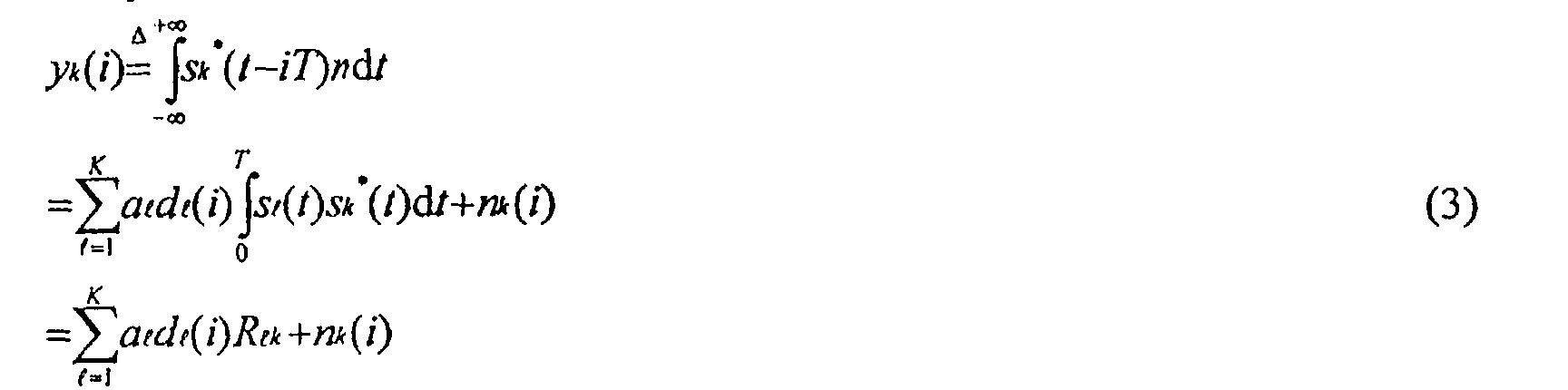



les composantes d' R / k(i) et d' l / k(i) sont des éléments de Z et par suite d'2(i) est un vecteur de Z 2K.




























Claims (9)
- Méthode de détection d'une pluralité K de symboles (dk(i)) transmis par ou pour une pluralité K d'utilisateurs à partir d'un signal reçu, chaque symbole d'un utilisateur appartenant à une constellation de modulation, la méthode de détection mettant en oeuvre un réseau de points (Ξ) généré par lesdites constellations de modulation, ladite pluralité de symboles des différents utilisateurs étant représentée par un point parmi un sous-ensemble de points dudit réseau, dit constellation et le signal reçu étant représenté par un point caractéristique de ce signal, dit point reçu, translaté d'un point de ladite constellation par un vecteur de bruit (n), caractérisée en ce qu'elle comprend une étape de projection orthogonale du point reçu sur un sous-espace affine, dit de projection, parallèle ou confondu avec un sous-espace affine délimitant ladite constellation et une étape de recherche du plus proche voisin du point ainsi projeté parmi les points de ladite constellation.
- Méthode de détection selon la revendication 1, caractérisée en ce que ledit sous-espace affine délimitant la constellation est déterminé en fonction de la position du point reçu par rapport à ladite constellation.
- Méthode de détection selon la revendication 2, caractérisée en ce que la recherche du plus proche voisin est limitée aux points de la constellation appartenant à une sphère centrée sur ledit point projeté.
- Méthode de détection selon la revendication 1 ou 2, caractérisée en ce que le sous-espace affine de projection étant confondu avec un sous-espace affine délimitant la constellation, la recherche du plus proche voisin est effectuée parmi les points de la constellation appartenant audit sous-espace affine.
- Méthode de détection selon la revendication 4, caractérisée en ce que la recherche du plus proche voisin est limitée aux points du sous-espace affine appartenant à une sphère dudit sous-espace centrée sur ledit point projeté.
- Méthode de détection selon l'une des revendications précédentes, caractérisée en ce que l'étape de projection n'est effectuée que si le point reçu est éloigné de ladite constellation de plus d'une distance prédéterminée.
- Méthode de détection selon l'une des revendications précédentes, caractérisée en ce que, les symboles de chaque utilisateur faisant l'objet d'une multiplication par une signature de cet utilisateur avant d'être transmis sur un canal de transmission, les coordonnées du point reçu sont obtenues par une étape de filtrage adapté du signal reçu, le filtrage étant adapté aux canaux de transmission et aux signatures des différents utilisateurs.
- Dispositif de réception pour système de télécommunication DS-CDMA comprenant un dispositif de détection adapté à mettre en oeuvre la méthode de détection selon l'une des revendications précédentes.
- Dispositif de réception pour système de télécommunication MC-CDMA comprenant un dispositif de détection adapté à mettre en oeuvre la méthode de détection selon l'une des revendications 1 à 7.
Applications Claiming Priority (2)
| Application Number | Priority Date | Filing Date | Title |
|---|---|---|---|
| FR0100627A FR2819659B1 (fr) | 2001-01-15 | 2001-01-15 | Methode simplifiee de detection par spheres en presence de faible rapport signal a bruit |
| FR0100627 | 2001-01-15 |
Publications (2)
| Publication Number | Publication Date |
|---|---|
| EP1223687A1 true EP1223687A1 (fr) | 2002-07-17 |
| EP1223687B1 EP1223687B1 (fr) | 2007-08-29 |
Family
ID=8858942
Family Applications (1)
| Application Number | Title | Priority Date | Filing Date |
|---|---|---|---|
| EP02290089A Expired - Lifetime EP1223687B1 (fr) | 2001-01-15 | 2002-01-14 | Méthode simplifiée de détection par sphères en présence de faible rapport signal à bruit |
Country Status (6)
| Country | Link |
|---|---|
| US (1) | US6987818B2 (fr) |
| EP (1) | EP1223687B1 (fr) |
| JP (1) | JP4014081B2 (fr) |
| AT (1) | ATE371992T1 (fr) |
| DE (1) | DE60222033T2 (fr) |
| FR (1) | FR2819659B1 (fr) |
Families Citing this family (16)
| Publication number | Priority date | Publication date | Assignee | Title |
|---|---|---|---|---|
| RU2179365C1 (ru) * | 2001-05-22 | 2002-02-10 | Плотников Андрей Алексеевич | Способ передачи дискретного сообщения и система для его осуществления |
| US7782984B2 (en) * | 2002-08-30 | 2010-08-24 | Alcatel-Lucent Usa Inc. | Method of sphere decoding with low complexity and good statistical output |
| EP1550117B1 (fr) * | 2002-10-08 | 2006-08-16 | University of Limerick | Systeme de detection de donnees |
| EP1492241B1 (fr) * | 2003-06-26 | 2007-02-14 | Mitsubishi Electric Information Technology Centre Europe B.V. | Décodage par sphères amélioré de symboles transmis dans un système de télécommunications |
| US7437135B2 (en) | 2003-10-30 | 2008-10-14 | Interdigital Technology Corporation | Joint channel equalizer interference canceller advanced receiver |
| US7400692B2 (en) | 2004-01-14 | 2008-07-15 | Interdigital Technology Corporation | Telescoping window based equalization |
| US7769100B2 (en) * | 2005-12-10 | 2010-08-03 | Electronics And Telecommunications Research Institute | Method and apparatus for cancellation of cross-talk signals using multi-dimensional coordination and vectored transmission |
| EP2190159B1 (fr) * | 2006-07-03 | 2012-10-31 | ST-Ericsson SA | Réduction du facteur de crête dans les systèmes multiporteuse |
| WO2008045293A1 (fr) * | 2006-10-04 | 2008-04-17 | Interdigital Technology Corporation | Procédé et appareil pour une interpolation de canaux bidimensionnelle adaptative avancée dans des systèmes de communication sans fil à multiplexage par répartition orthogonale de fréquence (ofdm) |
| US8718170B2 (en) * | 2011-09-12 | 2014-05-06 | Daniel Nathan Nissani (Nissensohn) | Lattice coded mimo transmission method and apparatus |
| US10148285B1 (en) | 2012-07-25 | 2018-12-04 | Erich Schmitt | Abstraction and de-abstraction of a digital data stream |
| US9509379B2 (en) * | 2013-06-17 | 2016-11-29 | Huawei Technologies Co., Ltd. | System and method for designing and using multidimensional constellations |
| US10795858B1 (en) | 2014-02-18 | 2020-10-06 | Erich Schmitt | Universal abstraction and de-abstraction of a digital data stream |
| US10523383B2 (en) | 2014-08-15 | 2019-12-31 | Huawei Technologies Co., Ltd. | System and method for generating waveforms and utilization thereof |
| WO2017071586A1 (fr) | 2015-10-30 | 2017-05-04 | Huawei Technologies Co., Ltd. | Système et procédé pour accès multiple à codes peu denses haut débit en liaison descendante |
| CN115472171B (zh) * | 2021-06-11 | 2024-11-22 | 华为技术有限公司 | 编解码方法、装置、设备、存储介质及计算机程序 |
Citations (3)
| Publication number | Priority date | Publication date | Assignee | Title |
|---|---|---|---|---|
| EP0641102A2 (fr) * | 1993-08-24 | 1995-03-01 | Philips Electronics Uk Limited | Récepteur pour accès multiple par multiplexage de code à séquence direct avec annuleur d'interférence pour utilisation multiples |
| EP0827311A2 (fr) * | 1996-08-26 | 1998-03-04 | NOKIA TECHNOLOGY GmbH | Récupération de la porteuse dans des récepteurs MAQ |
| WO2000041374A1 (fr) * | 1998-12-31 | 2000-07-13 | Dsp Software Engineering, Inc. | Methode sur ordinateur et appareillage de decoupage par point pour modem |
Family Cites Families (2)
| Publication number | Priority date | Publication date | Assignee | Title |
|---|---|---|---|---|
| US6137881A (en) * | 1997-02-28 | 2000-10-24 | Texas Instruments Incorporated | Adaptive filtering method and apparatus employing modified fast affine projection algorithm |
| US6754340B1 (en) * | 1998-12-22 | 2004-06-22 | Nortel Networks Limited | Stable adaptive filter and method |
-
2001
- 2001-01-15 FR FR0100627A patent/FR2819659B1/fr not_active Expired - Fee Related
- 2001-12-31 US US10/029,953 patent/US6987818B2/en not_active Expired - Fee Related
-
2002
- 2002-01-11 JP JP2002004688A patent/JP4014081B2/ja not_active Expired - Fee Related
- 2002-01-14 DE DE60222033T patent/DE60222033T2/de not_active Expired - Lifetime
- 2002-01-14 EP EP02290089A patent/EP1223687B1/fr not_active Expired - Lifetime
- 2002-01-14 AT AT02290089T patent/ATE371992T1/de not_active IP Right Cessation
Patent Citations (3)
| Publication number | Priority date | Publication date | Assignee | Title |
|---|---|---|---|---|
| EP0641102A2 (fr) * | 1993-08-24 | 1995-03-01 | Philips Electronics Uk Limited | Récepteur pour accès multiple par multiplexage de code à séquence direct avec annuleur d'interférence pour utilisation multiples |
| EP0827311A2 (fr) * | 1996-08-26 | 1998-03-04 | NOKIA TECHNOLOGY GmbH | Récupération de la porteuse dans des récepteurs MAQ |
| WO2000041374A1 (fr) * | 1998-12-31 | 2000-07-13 | Dsp Software Engineering, Inc. | Methode sur ordinateur et appareillage de decoupage par point pour modem |
Non-Patent Citations (1)
| Title |
|---|
| PARKER G J: "Techniques for the blind estimation of signal to noise ratio for quadrature modulated signals", FOURTH INTERNATIONAL SYMPOSIUM ON SIGNAL PROCESSING AND ITS APPLICATIONS. ISSPA 96. PROCEEDINGS MAIN SYMPOSIUM, PROCEEDINGS OF FOURTH INTERNATIONAL SYMPOSIUM ON SIGNAL PROCESSING AND ITS APPLICATIONS, GOLD COAST, QLD., AUSTRALIA, 25-30 AUG. 1996, 1996, Brisbane, Qld., Australia, Queensland Univ. Technol, Australia, pages 238 - 241 vol.1, XP002178997, ISBN: 1-86435-209-4 * |
Also Published As
| Publication number | Publication date |
|---|---|
| DE60222033D1 (de) | 2007-10-11 |
| EP1223687B1 (fr) | 2007-08-29 |
| ATE371992T1 (de) | 2007-09-15 |
| DE60222033T2 (de) | 2008-06-05 |
| FR2819659B1 (fr) | 2006-08-11 |
| US20020126773A1 (en) | 2002-09-12 |
| FR2819659A1 (fr) | 2002-07-19 |
| JP4014081B2 (ja) | 2007-11-28 |
| US6987818B2 (en) | 2006-01-17 |
| JP2002271299A (ja) | 2002-09-20 |
Similar Documents
| Publication | Publication Date | Title |
|---|---|---|
| EP1223687B1 (fr) | Méthode simplifiée de détection par sphères en présence de faible rapport signal à bruit | |
| EP2274852B1 (fr) | Procédé de décodage d'un signal mettant en oeuvre une construction progressive d'un arbre de décodage, produit programme d'ordinateur et dispositif de décodage correspondants | |
| EP1215839A1 (fr) | Méthode et dispositif de détection multi-utilisateur | |
| FR2798542A1 (fr) | Recepteur a multiplexage par repartition en frequences orthogonales avec estimation iterative de canal et procede correspondant | |
| WO2011055024A1 (fr) | Procédé pour émettre des données numériques pre-egalisées, et base émettrice mettant en oeuvre un tel procédé | |
| EP0017716B1 (fr) | Procédé pour initialiser un égaliseur adaptatif à partir d'un signal de données inconnu dans un système de transmission utilisant une modulation à double bande latérale-porteuse en quadrature | |
| FR2742619A1 (fr) | Procede d'egalisation multicapteur permettant une reception multicapteur en presence d'interferences et de multitrajets de propagation, et recepteur pour sa mise en oeuvre | |
| EP1185004A1 (fr) | Méthode d'estimation conjointe de canal et de direction d'arrivée | |
| EP1221219A1 (fr) | Procede d'egalisation dans des recepteurs utilisant une combinaison des techniques de modulations a porteuses multiples et a acces multiple par repartition de codes | |
| EP2327190B1 (fr) | Methode d'estimation aveugle de parametres de modulation OFDM selon un critere de maximum de vraisemblance | |
| EP1221773B1 (fr) | Méthode et dispositif de détection multi-utilisateur en mode DS-CDMA | |
| WO2017114920A1 (fr) | Procede d'extraction univalente et univoque de cles a partir du canal de propagation | |
| FR2818842A1 (fr) | Methode acceleree de detection par spheres | |
| EP0073869A1 (fr) | Dispositif de réception de données avec suppresseur d'écho d'écoute | |
| EP1244244A1 (fr) | Egalisation à minimisation de l'erreur quadratique moyenne globale | |
| EP1244243B1 (fr) | Egalisation à minimisation de l'erreur quadratique moyenne globale | |
| EP1220464B1 (fr) | Méthode accélérée de détection par sphères | |
| EP1235399B1 (fr) | Procédé et dispositif d'estimation de la matrice de covariance du canal de transmission d'un système UMTS | |
| EP1094631A1 (fr) | Recherche de l'instant d'échantillonnage optimal dans un système de transmissions par paquets TDMA | |
| EP1229696B1 (fr) | Estimation des paramètres de canal au moyen d'estimation de maximum de vraisemblance | |
| EP2327191B1 (fr) | Méthode d'estimation aveugle de paramètres de signal OFDM par filtrage adapté | |
| Smith | Optimization strategies for blind multiuser detection in strong interference scenarios | |
| EP1240759A1 (fr) | Dispositifs d'estimation de canal radio et de demodulation | |
| WO2025132969A1 (fr) | Procédés, dispositifs et programmes de démodulation d'une trame de données | |
| WO2005109708A1 (fr) | Procede de determination de codes d’etalement utilises dans un signal cdma et dispositif de communication correspondant. |
Legal Events
| Date | Code | Title | Description |
|---|---|---|---|
| PUAI | Public reference made under article 153(3) epc to a published international application that has entered the european phase |
Free format text: ORIGINAL CODE: 0009012 |
|
| AK | Designated contracting states |
Kind code of ref document: A1 Designated state(s): AT BE CH CY DE DK ES FI FR GB GR IE IT LI LU MC NL PT SE TR |
|
| AX | Request for extension of the european patent |
Free format text: AL;LT;LV;MK;RO;SI |
|
| RAP1 | Party data changed (applicant data changed or rights of an application transferred) |
Owner name: MITSUBISHI ELECTRIC INFORMATION TECHNOLOGY CENTRE |
|
| AKX | Designation fees paid | ||
| 17P | Request for examination filed |
Effective date: 20030318 |
|
| RBV | Designated contracting states (corrected) |
Designated state(s): AT BE CH CY DE DK ES FI FR GB GR IE IT LI LU MC NL PT SE TR |
|
| REG | Reference to a national code |
Ref country code: DE Ref legal event code: 8566 |
|
| GRAP | Despatch of communication of intention to grant a patent |
Free format text: ORIGINAL CODE: EPIDOSNIGR1 |
|
| GRAS | Grant fee paid |
Free format text: ORIGINAL CODE: EPIDOSNIGR3 |
|
| GRAA | (expected) grant |
Free format text: ORIGINAL CODE: 0009210 |
|
| AK | Designated contracting states |
Kind code of ref document: B1 Designated state(s): AT BE CH CY DE DK ES FI FR GB GR IE IT LI LU MC NL PT SE TR |
|
| REG | Reference to a national code |
Ref country code: GB Ref legal event code: FG4D Free format text: NOT ENGLISH |
|
| GBT | Gb: translation of ep patent filed (gb section 77(6)(a)/1977) |
Effective date: 20070905 |
|
| REG | Reference to a national code |
Ref country code: CH Ref legal event code: EP |
|
| REG | Reference to a national code |
Ref country code: IE Ref legal event code: FG4D Free format text: LANGUAGE OF EP DOCUMENT: FRENCH |
|
| REF | Corresponds to: |
Ref document number: 60222033 Country of ref document: DE Date of ref document: 20071011 Kind code of ref document: P |
|
| PG25 | Lapsed in a contracting state [announced via postgrant information from national office to epo] |
Ref country code: FI Free format text: LAPSE BECAUSE OF FAILURE TO SUBMIT A TRANSLATION OF THE DESCRIPTION OR TO PAY THE FEE WITHIN THE PRESCRIBED TIME-LIMIT Effective date: 20070829 Ref country code: ES Free format text: LAPSE BECAUSE OF FAILURE TO SUBMIT A TRANSLATION OF THE DESCRIPTION OR TO PAY THE FEE WITHIN THE PRESCRIBED TIME-LIMIT Effective date: 20071210 Ref country code: NL Free format text: LAPSE BECAUSE OF FAILURE TO SUBMIT A TRANSLATION OF THE DESCRIPTION OR TO PAY THE FEE WITHIN THE PRESCRIBED TIME-LIMIT Effective date: 20070829 |
|
| NLV1 | Nl: lapsed or annulled due to failure to fulfill the requirements of art. 29p and 29m of the patents act | ||
| PG25 | Lapsed in a contracting state [announced via postgrant information from national office to epo] |
Ref country code: AT Free format text: LAPSE BECAUSE OF FAILURE TO SUBMIT A TRANSLATION OF THE DESCRIPTION OR TO PAY THE FEE WITHIN THE PRESCRIBED TIME-LIMIT Effective date: 20070829 |
|
| REG | Reference to a national code |
Ref country code: IE Ref legal event code: FD4D |
|
| PG25 | Lapsed in a contracting state [announced via postgrant information from national office to epo] |
Ref country code: GR Free format text: LAPSE BECAUSE OF FAILURE TO SUBMIT A TRANSLATION OF THE DESCRIPTION OR TO PAY THE FEE WITHIN THE PRESCRIBED TIME-LIMIT Effective date: 20071130 |
|
| PG25 | Lapsed in a contracting state [announced via postgrant information from national office to epo] |
Ref country code: PT Free format text: LAPSE BECAUSE OF FAILURE TO SUBMIT A TRANSLATION OF THE DESCRIPTION OR TO PAY THE FEE WITHIN THE PRESCRIBED TIME-LIMIT Effective date: 20080129 Ref country code: IE Free format text: LAPSE BECAUSE OF FAILURE TO SUBMIT A TRANSLATION OF THE DESCRIPTION OR TO PAY THE FEE WITHIN THE PRESCRIBED TIME-LIMIT Effective date: 20070829 |
|
| PG25 | Lapsed in a contracting state [announced via postgrant information from national office to epo] |
Ref country code: SE Free format text: LAPSE BECAUSE OF FAILURE TO SUBMIT A TRANSLATION OF THE DESCRIPTION OR TO PAY THE FEE WITHIN THE PRESCRIBED TIME-LIMIT Effective date: 20071129 |
|
| PLBE | No opposition filed within time limit |
Free format text: ORIGINAL CODE: 0009261 |
|
| STAA | Information on the status of an ep patent application or granted ep patent |
Free format text: STATUS: NO OPPOSITION FILED WITHIN TIME LIMIT |
|
| BERE | Be: lapsed |
Owner name: MITSUBISHI ELECTRIC INFORMATION TECHNOLOGY CENTRE Effective date: 20080131 |
|
| 26N | No opposition filed |
Effective date: 20080530 |
|
| PG25 | Lapsed in a contracting state [announced via postgrant information from national office to epo] |
Ref country code: MC Free format text: LAPSE BECAUSE OF NON-PAYMENT OF DUE FEES Effective date: 20080131 |
|
| REG | Reference to a national code |
Ref country code: CH Ref legal event code: PL |
|
| PG25 | Lapsed in a contracting state [announced via postgrant information from national office to epo] |
Ref country code: CH Free format text: LAPSE BECAUSE OF NON-PAYMENT OF DUE FEES Effective date: 20080131 Ref country code: LI Free format text: LAPSE BECAUSE OF NON-PAYMENT OF DUE FEES Effective date: 20080131 |
|
| PG25 | Lapsed in a contracting state [announced via postgrant information from national office to epo] |
Ref country code: BE Free format text: LAPSE BECAUSE OF NON-PAYMENT OF DUE FEES Effective date: 20080131 |
|
| PG25 | Lapsed in a contracting state [announced via postgrant information from national office to epo] |
Ref country code: CY Free format text: LAPSE BECAUSE OF FAILURE TO SUBMIT A TRANSLATION OF THE DESCRIPTION OR TO PAY THE FEE WITHIN THE PRESCRIBED TIME-LIMIT Effective date: 20070829 |
|
| PG25 | Lapsed in a contracting state [announced via postgrant information from national office to epo] |
Ref country code: DK Free format text: LAPSE BECAUSE OF FAILURE TO SUBMIT A TRANSLATION OF THE DESCRIPTION OR TO PAY THE FEE WITHIN THE PRESCRIBED TIME-LIMIT Effective date: 20070829 |
|
| PG25 | Lapsed in a contracting state [announced via postgrant information from national office to epo] |
Ref country code: LU Free format text: LAPSE BECAUSE OF NON-PAYMENT OF DUE FEES Effective date: 20080114 |
|
| PG25 | Lapsed in a contracting state [announced via postgrant information from national office to epo] |
Ref country code: TR Free format text: LAPSE BECAUSE OF FAILURE TO SUBMIT A TRANSLATION OF THE DESCRIPTION OR TO PAY THE FEE WITHIN THE PRESCRIBED TIME-LIMIT Effective date: 20070829 |
|
| PG25 | Lapsed in a contracting state [announced via postgrant information from national office to epo] |
Ref country code: IT Free format text: LAPSE BECAUSE OF NON-PAYMENT OF DUE FEES Effective date: 20080131 |
|
| PGFP | Annual fee paid to national office [announced via postgrant information from national office to epo] |
Ref country code: DE Payment date: 20140122 Year of fee payment: 13 |
|
| PGFP | Annual fee paid to national office [announced via postgrant information from national office to epo] |
Ref country code: FR Payment date: 20140128 Year of fee payment: 13 |
|
| PGFP | Annual fee paid to national office [announced via postgrant information from national office to epo] |
Ref country code: GB Payment date: 20140121 Year of fee payment: 13 |
|
| REG | Reference to a national code |
Ref country code: DE Ref legal event code: R119 Ref document number: 60222033 Country of ref document: DE |
|
| GBPC | Gb: european patent ceased through non-payment of renewal fee |
Effective date: 20150114 |
|
| PG25 | Lapsed in a contracting state [announced via postgrant information from national office to epo] |
Ref country code: DE Free format text: LAPSE BECAUSE OF NON-PAYMENT OF DUE FEES Effective date: 20150801 Ref country code: GB Free format text: LAPSE BECAUSE OF NON-PAYMENT OF DUE FEES Effective date: 20150114 |
|
| REG | Reference to a national code |
Ref country code: FR Ref legal event code: ST Effective date: 20150930 |
|
| PG25 | Lapsed in a contracting state [announced via postgrant information from national office to epo] |
Ref country code: FR Free format text: LAPSE BECAUSE OF NON-PAYMENT OF DUE FEES Effective date: 20150202 |