EP1223527A2 - E-mail service provider and method for filtering unsolicited e-mail - Google Patents
E-mail service provider and method for filtering unsolicited e-mail Download PDFInfo
- Publication number
- EP1223527A2 EP1223527A2 EP01850227A EP01850227A EP1223527A2 EP 1223527 A2 EP1223527 A2 EP 1223527A2 EP 01850227 A EP01850227 A EP 01850227A EP 01850227 A EP01850227 A EP 01850227A EP 1223527 A2 EP1223527 A2 EP 1223527A2
- Authority
- EP
- European Patent Office
- Prior art keywords
- address
- user
- dynamic
- Prior art date
- Legal status (The legal status is an assumption and is not a legal conclusion. Google has not performed a legal analysis and makes no representation as to the accuracy of the status listed.)
- Withdrawn
Links
Images

Classifications
-
- H—ELECTRICITY
- H04—ELECTRIC COMMUNICATION TECHNIQUE
- H04L—TRANSMISSION OF DIGITAL INFORMATION, e.g. TELEGRAPHIC COMMUNICATION
- H04L51/00—User-to-user messaging in packet-switching networks, transmitted according to store-and-forward or real-time protocols, e.g. e-mail
- H04L51/48—Message addressing, e.g. address format or anonymous messages, aliases
-
- G—PHYSICS
- G06—COMPUTING OR CALCULATING; COUNTING
- G06Q—INFORMATION AND COMMUNICATION TECHNOLOGY [ICT] SPECIALLY ADAPTED FOR ADMINISTRATIVE, COMMERCIAL, FINANCIAL, MANAGERIAL OR SUPERVISORY PURPOSES; SYSTEMS OR METHODS SPECIALLY ADAPTED FOR ADMINISTRATIVE, COMMERCIAL, FINANCIAL, MANAGERIAL OR SUPERVISORY PURPOSES, NOT OTHERWISE PROVIDED FOR
- G06Q10/00—Administration; Management
- G06Q10/10—Office automation; Time management
- G06Q10/107—Computer-aided management of electronic mailing [e-mailing]
-
- H—ELECTRICITY
- H04—ELECTRIC COMMUNICATION TECHNIQUE
- H04L—TRANSMISSION OF DIGITAL INFORMATION, e.g. TELEGRAPHIC COMMUNICATION
- H04L51/00—User-to-user messaging in packet-switching networks, transmitted according to store-and-forward or real-time protocols, e.g. e-mail
- H04L51/21—Monitoring or handling of messages
- H04L51/212—Monitoring or handling of messages using filtering or selective blocking
Definitions
- the present invention is directed toward electronic mail or email, and more particularly toward reducing the problems resulting from unwanted email.
- Unsolicited email such as spam requires email users to spend significant time weeding through their email to find the email which is legitimate communication (and risks not noticing legitimate communications and/or accidentally deleting legitimate communications when deleting the unwanted mail).
- email users have chosen to change their email address in an attempt to stop the junk mail, but changing addresses makes it equally difficult for acceptable correspondents to get email through, burdens the email user to attempt to get the new address to all desired correspondents, and eventually such unwanted mail will probably resume at the new address anyway.
- the handling of spam in the communication system e.g., the communication of the spam between email service providers and between the service providers and the email users) is significantly burdened.
- the downloading of email from a user's service provider to the user's computer can take significant time, particularly where the email is large (e.g., includes graphics files as is common with advertisement), tying up the computer and delaying the user from productive work, as well as costing the user money where Internet access is priced based on access time (even when not, access via modem connection typically will involve phone connection costs).
- the email is large (e.g., includes graphics files as is common with advertisement)
- tying up the computer and delaying the user from productive work as well as costing the user money where Internet access is priced based on access time (even when not, access via modem connection typically will involve phone connection costs).
- Spammers are, in effect, taking resources away from users and service suppliers without compensation and without authorization. Spamming is such a serious problem for service providers and innocent users that litigation and other legal avenues have been variously pursued to address the problem.
- a user who is the victim/recipient of unwanted email can notify his email service provider (typically his Internet Service Provider or ISP) of a problem with email being received from a particular email address.
- the ISP can set its server (configure its email engine) to filter mail from the offending email address.
- the victim/recipient can contact the ISP of the offending email sender, and that ISP can filter email from the sender or even terminate service to the offender. While this can work effectively for specific problem spammers, it requires that the victim/recipient take burdensome action every time an offending spammer is identified.
- the problem will exist, and part of the victim/recipient's bandwidth which he pays for will continue to be used for such spam until the victim/recipient recognizes a particular spammer and takes action (including figuring out whom to contact). Still further, the ISP in such situations is forced to manually configure its mail system to filter the unwanted messages for every spammer for which it receives a complaint. Of course, the ISP (particularly the spammer's ISP) may also in each case be forced to undergo a burdensome investigation of the validity of any received complaint to ensure that service is not wrongly terminated.
- Some tools have been created to take the burden from the user and to automatically eliminate spam. Typically, these tools will examine incoming email messages and search for indications that it is spam (e.g., an indication that a large number of messages have been sent from a single source). Of course, such examination of all email can be burdensome on the processing resources of the ISP, and there is a real chance that legitimate mass mailers may be falsely identified as spam sources (many users do wish to receive mass mailings from particular sources, and those users may be denied such mailings as a result of filtering other, unwanted spam). Further, until a spammer is adequately identified from examination of mail, bandwidth will continue to be used for email of that spammer.
- decoy email accounts with a decoy address to attract spam.
- decoy accounts are specially created, and are never used to solicit email, and therefore if any email is sent to that account it can be assumed that the email is spam.
- This tool can examine the presumed spam for the email address of the sender/originator and can also examine the assumed spam for content, so that email from that address can thereafter be filtered as can email from other sender/originator addresses which are found to have similar content.
- Even this solution has significant drawbacks, however. Since the decoy accounts are not used to solicit email, there may be a lengthy wait before any spam originator learns of it and adds it to its database.
- the present invention is directed toward overcoming one or more of the problems set forth above.
- an email service provider includes a port receiving and transmitting email, and a server.
- the server selectively creates a dynamic address as the sending address associated with email transmitted to a target address from the first user address, with the dynamic address being anonymously associated with the first user address.
- the server further selectively forwards email addressed to the dynamic address to the first user address.
- the server associates the dynamic address with the target address, and rejects mail to the dynamic address from a sender address which is not the target address. In another form, the server forwards email addressed to the dynamic address for only a selected period of time. In still another form, the server forwards only a selected amount of email addressed to the dynamic address.
- an email service provider includes a port and a server, where the server selectively creates a dynamic address as the sending address associated with email transmitted to a target address, where the dynamic address includes a tag associated with the target address, and the server adds the tag to text of received email addressed to the dynamic address.
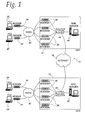
- FIG. 1 A system 10 of handling email is illustrated in Figure 1. As detailed herein, the present invention may be used with this system 10. However, it should also be understood that the system 10 is merely illustrative, and the present invention could also be advantageously used with other systems of handling email.
- the system 10 may include a plurality of email service providers, two of which (12, 14) are illustrated.
- the email service providers 12, 14 are also Internet service providers (ISPs), although they need not be.
- ISPs Internet service providers
- the various email service providers 12, 14 are connected as part of the system 10 (for example, via the Internet 16 as illustrated).
- the email system may and typically does include a large number of email service providers, with only two shown in Fig. 1 for simplicity.
- One email service provider 12 provides email service to the computers 20, 22 of its customers, and the other email service provider 14 provides email service to the computers 24, 26 of its customers. Again, each email service provider 12, 14 will typically provide service to many more than two customers 20-26, with only two shown for each provider 12, 14 in Fig. 1 for simplicity.
- the customer computers 20-26 communicate with the email service providers 12, 14 via a public service telephone network 30 using modems 34 associated with the customer computers 20-26 and modems 38 at ports to the email service providers 12,14.
- modems 34 associated with the customer computers 20-26 and modems 38 at ports to the email service providers 12,14.
- modems 34 associated with the customer computers 20-26 and modems 38 at ports to the email service providers 12,14.
- DSLs digital subscriber lines
- the modems 38 are used to receive and transmit electronic signals (such as email), which signals are communicated with a router 44 which operates with a mail server 48 to control and direct the transmission of the electronic signals.
- electronic signals such as email
- the server 48 when an email signal is received from a customer's computer 20, 22, the server 48 will selectively replace the customer's email address with a dynamic email address so that the email signal sent out over the Internet 16 may include the dynamic email address rather than the customer's email address as the sender's email address.
- the replacement of the customer's email address with a dynamic email address may or may not be done according to the customer's instructions in the email signal.
- a dynamic email address is used, however, the customer's email address will therefore be anonymous to the recipient of the email ( i.e. , will not be known to or determinable by the recipient from the dynamic email address indicated in the email).
- Any reply to the dynamic email address may, however, be associated by the email service provider 12, 14 with the email address of its customer and such email to that customer may be distinguished and selectively handled differently than email to the customer's email address.
- Fig. 2 is a flow chart of an exemplary method for creating a dynamic address according to the present invention.
- the provider 12, 14 receives an email from a customer's computer 20-24 for transmission to another (target) address
- the provider 12, 14 would first check to see whether the customer selected a "secure send” option by checking for an indication of that selection in the email. If no such option is selected, then email would be handled in a normal manner by forwarding it to the target address (via another email service provider if necessary).
- the customer is sending the email to trusted recipients such as business associates or family members
- the "secure send” option would not be chosen, and the trusted associates would receive email from the customer with his actual email address indicated.
- the "secure send” option causing use of the dynamic address according to the present invention would be chosen to protect the customer from receiving unwanted replies to that email.
- Each email service provider 12, 14 typically will have a specific domain, such as "aol.com” for America OnLine, with addresses typically in the form of "username@domain", with the username being specific to the customer and the domain being specific to the email service provider.
- the service provider 12, 14 may establish one or more separate domains to be used only for the dynamic addresses. The separate domains may be established so that there would be no obvious linkage between the regular and dynamic addresses to further provide protection against a spam source reverse engineering the dynamic address in order to determine the customer's actual email address.
- the server 48 begins creation of a dynamic address as the address attached to the email as the source or sender address by beginning to encode the customer's email address at 100 in Fig. 2.
- the server 48 may also check the email for further option choices at 102 by polling the user for option preferences, which options may be used in generating the dynamic address and/or in determining what email to filter to the dynamic address.
- creation of the username of the dynamic address begins at 104 with the choice of a random seed as part of the dynamic address.
- the process at 106 then checks to see whether or not the "include username" option has been selected. If it has, then at 108, the username is added to the username being constructed for the dynamic address. If it has not, then step 108 is skipped. In either case, a control word using the customer's preferences (e.g. , selected options) is built at 110, and a verification code is then suitably calculated and appended at 112 to the username being constructed for the dynamic email.
- the verification code may be used to determine whether or not a dynamic address for which email is received at the email service provider 12, 14 is valid (and not just an erroneous address).
- a randomization seed is then generated and appended at 114 to the dynamic address username being constructed and, using the randomization seed and a secret algorithm (i.e. , an algorithm essentially known only to the customer's email service provider 12, 14), the control word and verification code are scrambled at 116.
- the location of the control word and the verification code are then reordered at 118, after which the email will be forwarded to the target address at 120 with the generated username attached thereto as the sending address. Encoding thus ends at 122.
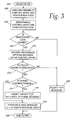
- the email service provider 12,14 of the customer by whom the original email was sent will receive the email at the secure domain and be handled as illustrated in Fig. 3.
- email to the dynamic address is first identified by the email service provider of the customer to whom the email is directed via the dynamic address (e.g. , by the fact that the email is addressed to the secure domain used for dynamic addresses.
- the server 48 of the email service provider 12, 14 then begins filtering the email at 200.
- the reordering of the control word and verification code (which took place at 118 when the dynamic address was generated) is undone at 202, and the control word and verification code (which were scrambled at 116 when the dynamic address was generated) is unscrambled at 204.
- the unscrambled verification code is then checked at 206 to determine whether it is valid. If it is not, the email message is rejected at 208. If it is valid, then the dynamic address is presumed to be valid and processing continues to 210 where the email processing options encoded in the control word are decoded.
- Processing of the received email then continues at 212, where it is determined whether the rules set according to the selected options permit forwarding of the email to the customer. For example, if the "source filtering" option was selected, the email would be checked to determine whether it was sent from the address of the original recipient of the email to which the dynamic address was appended. If it was sent from the address of the original recipient, then processing would continue to 214; if it was not, processing would continue to 208 (where the message would be rejected). As another example, if the "time limited filtering" option was selected, the server 48 would determine whether the time limit had been exceeded when the email was received. If the time limit was not exceeded, then processing would continue to 214; if it was exceeded, processing would continue to 208 (where the message would be rejected).
- the server 48 would determine whether more than the fixed number of acceptable responses to the dynamic address had been received. If the number of messages had not exceeded the limit, then processing would continue to 214; if it was exceeded, processing would continue to 208 (where the message would be rejected). Of course, as previously mentioned, any combination of such options for filtering email would also be selected and then all used to filter email received to the dynamic address.
- the target text is inserted into the body of the email at 216.
- the text will then enable the customer to identify the recipient of the original mail from which the return email was generated, and therefore identify an unreliable source (i.e., if the customer receives spam, he will know the original recipient of the customer's email who was the source of the dynamic address for the spammer), and then can take appropriate action such as ceasing email with that original recipient or speaking to the recipient to stress that the customer does not want that recipient to share his email address with others.
- processing finally proceeds to 218 where the filtered email is forwarded to the customer's message box in the server 48 of the customer's email service provider 12, 14, from which it is transmitted to the customer's computer 20-26 when requested. Filtering of that email to the dynamic address ends at that point at 220.
- Unwanted email can be rejected immediately by the email service provider 12, 14 based simply on the target address.
- the unwanted email is not transmitted to the customer's computer, which not only allows the customer to not be burdened with weeding through unnecessary mail, but also does not use up band width and connect time (and associated costs) to unnecessarily transmit that unwanted email from the email service provider 12, 14 to the customers' computers 20-26.
- the email software used by the customers does not have to be modified if it is web based or may be only minimally modified if based on the user's computer to simply provide the customer with the ability to selected the"secure send" and related options and to transmit those options to the email service provider 12, 14 when sending an email message. Still further, this is a feature which each email service provider 12, 14 can implement independently of the other email service providers, providing this option as a selling point for potential customers versus email service providers which do not provide the option. Additionally, there is no guess work involved in identifying messages to be rejected, and no problem with false identification of spammers. No user intervention is necessary to identify and filter spam, and there is no need to use decoy accounts or newsgroup postings to identify spammers. Further, the "target tagging" option allows the customer to identify his email correspondents who transmit his email address to undesirable sources.
Landscapes
- Engineering & Computer Science (AREA)
- Business, Economics & Management (AREA)
- Human Resources & Organizations (AREA)
- Entrepreneurship & Innovation (AREA)
- Computer Networks & Wireless Communication (AREA)
- Signal Processing (AREA)
- Strategic Management (AREA)
- Marketing (AREA)
- Data Mining & Analysis (AREA)
- Economics (AREA)
- Computer Hardware Design (AREA)
- Operations Research (AREA)
- Quality & Reliability (AREA)
- Tourism & Hospitality (AREA)
- Physics & Mathematics (AREA)
- General Business, Economics & Management (AREA)
- General Physics & Mathematics (AREA)
- Theoretical Computer Science (AREA)
- Information Transfer Between Computers (AREA)
- Data Exchanges In Wide-Area Networks (AREA)
Abstract
Description
| Step | Action | email address |
| 1 | Use spatate secure domain name | @secure_isp.com |
| 2 | Add original usename (at 108) (if "include usename" option selected) | john@secure_isp.com |
| 3 | Add control data such as verification code at 112 | john1439@secure_isp.com |
| 4 | Add randomization seed at 114 | john14394E@secure_isp.com |
| 5 | Add checksum | john14394ED1@secure_isp.co m |
| 6 | Encrypt control data, randomization seed and checksum at 116 | john4756B13C@secure_isp.co m |
| 7 | Reorder control data, randomization seed and checksum at 118 | john6735C1B4@secure_isp.co m |
Claims (16)
- An email service provider providing service to a user having a first user address, comprising:a port receiving and transmitting email; anda server whichselectively creates a dynamic address as a sending address associated with email transmitted to a target address from said first user address, said dynamic address being anonymously associated with said first user address, andselectively forwards email addressed to said dynamic address to said first user address.
- The email service provider of claim 1, further comprising a router cooperating with said server to selectively transmit email.
- The email service provider of claim 1, wherein said server adds to said dynamic address a tag associated with said target address, and adds said tag to text of email received from a sender address to said dynamic address.
- The email service provider of claim 1, wherein said server associates said dynamic address with said target address, and rejects mail to said dynamic address from a sender address which is not said target address.
- The email service provider of claim 1, wherein said server forwards email addressed to said dynamic address for only a selected period of time.
- The email service provider of claim 1, wherein said server forwards only a selected amount of email addressed to said dynamic address.
- The email service provider of claim 1, wherein said server includes a user name associated with said first user address in said selectively created dynamic address.
- An email service provider providing service to a user having a first user address, comprising:a port receiving and transmitting email; anda server whichselectively creates a dynamic address as a sending address associated with email transmitted to a target address from said first user address, said dynamic address including a tag associated with said target address; andadds said tag to text of received email addressed to said dynamic address.
- The email service provider of claim 8, further comprising a router cooperating with said server to selectively transmit email.
- A method of controlling electronic mail to a user email address, comprising:selectively generating a dynamic address as a sending address in place of said user email address when sending mail to a target address from said user email address, said dynamic address being anonymously associated with said user email address;selectively accepting mail addressed to said dynamic address at said user email address.
- The method of claim 10, wherein said selectively generating a dynamic address as a sending address in place of said user email address when sending mail to a target address from said user email address comprises adding a tag associated with said target address; and further comprising adding said tag to text of mail addressed to said dynamic address.
- The method of claim 10, wherein:said selectively generating a dynamic address as a sending address in place of said user email address when sending mail to a target address from said user email address comprises associating said dynamic address with said target address; andsaid selectively accepting mail addressed to said dynamic address at said user email address comprises accepting mail to said dynamic address only from said target address.
- The method of claim 10, wherein said selectively accepting mail addressed to said dynamic address at said user email address comprises accepting mail to said dynamic address only for a selected period of time.
- The method of claim 10, wherein said selectively accepting mail addressed to said dynamic address at said user email address comprises accepting only a selected amount of mail to said dynamic address.
- The method of claim 10, wherein said user email address includes a user name, and said selectively generating a dynamic address as a sending address in place of said user email address when sending mail to a target address from said user email address comprises generating a dynamic address which includes said user name.
- A method of identifying unwanted electronic mail to a user email address, comprising:selectively generating a dynamic address as a sending address in place of said user email address when sending mail to a target address from said user email address, said dynamic address including a tag associated with said target address; andadding said tag to text of mail addressed to said dynamic address.
Applications Claiming Priority (2)
| Application Number | Priority Date | Filing Date | Title |
|---|---|---|---|
| US09/760,935 US20020129111A1 (en) | 2001-01-15 | 2001-01-15 | Filtering unsolicited email |
| US760935 | 2001-01-15 |
Publications (2)
| Publication Number | Publication Date |
|---|---|
| EP1223527A2 true EP1223527A2 (en) | 2002-07-17 |
| EP1223527A3 EP1223527A3 (en) | 2002-09-18 |
Family
ID=25060619
Family Applications (1)
| Application Number | Title | Priority Date | Filing Date |
|---|---|---|---|
| EP01850227A Withdrawn EP1223527A3 (en) | 2001-01-15 | 2001-12-27 | E-mail service provider and method for filtering unsolicited e-mail |
Country Status (2)
| Country | Link |
|---|---|
| US (1) | US20020129111A1 (en) |
| EP (1) | EP1223527A3 (en) |
Cited By (20)
| Publication number | Priority date | Publication date | Assignee | Title |
|---|---|---|---|---|
| EP1388986A1 (en) * | 2002-08-06 | 2004-02-11 | Hewlett Packard Company, a Delaware Corporation | Process for protecting personal identification data in a network by associating substitute identifiers |
| FR2844371A1 (en) * | 2002-09-09 | 2004-03-12 | Anh Tuan Tran | Email database creation method in which email addresses are automatically generated according to a thematic classification scheme and the resulting emails are stored in a segmented database |
| WO2005048544A1 (en) * | 2003-11-17 | 2005-05-26 | Hardt Dick C | Method and system for pseudonymous email address |
| US7224778B2 (en) | 2003-12-30 | 2007-05-29 | Aol Llc. | Method and apparatus for managing subscription-type messages |
| EP1843518A2 (en) | 2006-04-07 | 2007-10-10 | France Télécom | E-mail address protection method, associated system and devices |
| EP1796028A3 (en) * | 2005-12-06 | 2008-05-21 | Siemens Aktiengesellschaft Österreich | Method for establishing connections in communication networks |
| EP1577784A4 (en) * | 2002-12-20 | 2009-02-18 | Nippon Telegraph & Telephone | COMMUNICATION METHOD, COMMUNICATION SYSTEM, RELAY SYSTEM, COMMUNICATION PROGRAM, COMMUNICATION SYSTEM PROGRAM, MAIL DISTRIBUTION SYSTEM, MAIL DISTRIBUTION METHOD, AND COURIER DISTRIBUTION PROGRAM |
| US7580980B2 (en) | 2002-12-20 | 2009-08-25 | Nippon Telegraph And Telephone Corporation | Email system restoring recipient identifier based on identifier-for-disclosure for establishing communication between sender and recipient |
| US8117649B2 (en) | 2002-06-06 | 2012-02-14 | Dormarke Assets Limited Liability Company | Distributed hierarchical identity management |
| US8260806B2 (en) | 2000-08-04 | 2012-09-04 | Grdn. Net Solutions, Llc | Storage, management and distribution of consumer information |
| WO2013038190A1 (en) * | 2011-09-13 | 2013-03-21 | Morgenroth Lee Hayes | Handling emails |
| US8504704B2 (en) | 2004-06-16 | 2013-08-06 | Dormarke Assets Limited Liability Company | Distributed contact information management |
| US8527752B2 (en) | 2004-06-16 | 2013-09-03 | Dormarke Assets Limited Liability | Graduated authentication in an identity management system |
| US8566248B1 (en) | 2000-08-04 | 2013-10-22 | Grdn. Net Solutions, Llc | Initiation of an information transaction over a network via a wireless device |
| EP1769336A4 (en) * | 2004-05-25 | 2014-08-20 | Reflexion Network Solutions Inc | SYSTEM AND METHOD FOR CONTROLLING ACCESS TO A RECEIVER OF ELECTRONIC MESSAGES |
| US9245266B2 (en) | 2004-06-16 | 2016-01-26 | Callahan Cellular L.L.C. | Auditable privacy policies in a distributed hierarchical identity management system |
| US9361602B1 (en) * | 2003-10-14 | 2016-06-07 | Novell, Inc. | Temporary electronic mail addresses |
| EP3198834A4 (en) * | 2014-09-26 | 2018-03-21 | Sanjay Parekh | Method and system for email privacy, security and information theft detection |
| US9928508B2 (en) | 2000-08-04 | 2018-03-27 | Intellectual Ventures I Llc | Single sign-on for access to a central data repository |
| WO2021146707A1 (en) * | 2020-01-16 | 2021-07-22 | Green Line Business Group, LLC | Communication networking system |
Families Citing this family (57)
| Publication number | Priority date | Publication date | Assignee | Title |
|---|---|---|---|---|
| WO1993022738A1 (en) | 1992-04-30 | 1993-11-11 | Apple Computer, Inc. | Method and apparatus for organizing information in a computer system |
| US7493366B1 (en) * | 2001-03-01 | 2009-02-17 | Verizon Laboratories, Inc. | System and method for processing customer requests relating to unsolicited commercial email and other service disruptions |
| US20020147780A1 (en) * | 2001-04-09 | 2002-10-10 | Liu James Y. | Method and system for scanning electronic mail to detect and eliminate computer viruses using a group of email-scanning servers and a recipient's email gateway |
| US7076527B2 (en) * | 2001-06-14 | 2006-07-11 | Apple Computer, Inc. | Method and apparatus for filtering email |
| JP2003076804A (en) * | 2001-09-04 | 2003-03-14 | Sharp Corp | Identification method, transmitting device, receiving device, communication relay device, identification program, and computer-readable recording medium recording the same |
| US20030074434A1 (en) * | 2001-10-11 | 2003-04-17 | Jason James L. | Determination of message source in network communications |
| US7093292B1 (en) * | 2002-02-08 | 2006-08-15 | Mcafee, Inc. | System, method and computer program product for monitoring hacker activities |
| US7558826B1 (en) * | 2002-03-15 | 2009-07-07 | Novell, Inc. | Methods, systems, and data structures for electronic addressing |
| JP2003273934A (en) * | 2002-03-18 | 2003-09-26 | Fujitsu Ltd | Email management method |
| US7181496B1 (en) * | 2002-03-29 | 2007-02-20 | Infowave Software Inc. | Automatic email forwarding rule creation |
| US20030233415A1 (en) * | 2002-06-17 | 2003-12-18 | Siemens Information And Communication Networks, Inc. | Apparatus and method for private online message center |
| US7113977B1 (en) * | 2002-06-26 | 2006-09-26 | Bellsouth Intellectual Property Corporation | Blocking electronic mail content |
| US8046832B2 (en) | 2002-06-26 | 2011-10-25 | Microsoft Corporation | Spam detector with challenges |
| US7222157B1 (en) * | 2002-07-15 | 2007-05-22 | Aol Llc | Identification and filtration of digital communications |
| US7010565B2 (en) * | 2002-09-30 | 2006-03-07 | Sampson Scott E | Communication management using a token action log |
| US8051172B2 (en) | 2002-09-30 | 2011-11-01 | Sampson Scott E | Methods for managing the exchange of communication tokens |
| US6804687B2 (en) * | 2002-09-30 | 2004-10-12 | Scott E. Sampson | File system management with user-definable functional attributes stored in a token action log |
| US7219148B2 (en) * | 2003-03-03 | 2007-05-15 | Microsoft Corporation | Feedback loop for spam prevention |
| US7676546B2 (en) * | 2003-03-25 | 2010-03-09 | Verisign, Inc. | Control and management of electronic messaging |
| US7272853B2 (en) * | 2003-06-04 | 2007-09-18 | Microsoft Corporation | Origination/destination features and lists for spam prevention |
| US7711779B2 (en) * | 2003-06-20 | 2010-05-04 | Microsoft Corporation | Prevention of outgoing spam |
| US7620690B1 (en) | 2003-11-20 | 2009-11-17 | Lashback, LLC | Privacy control system for electronic communication |
| US8214438B2 (en) * | 2004-03-01 | 2012-07-03 | Microsoft Corporation | (More) advanced spam detection features |
| US20050204005A1 (en) * | 2004-03-12 | 2005-09-15 | Purcell Sean E. | Selective treatment of messages based on junk rating |
| US20050204006A1 (en) * | 2004-03-12 | 2005-09-15 | Purcell Sean E. | Message junk rating interface |
| US7237010B2 (en) * | 2004-03-18 | 2007-06-26 | International Business Machines Corporation | Method, system and computer program product for generating and processing a disposable email address |
| US7664819B2 (en) * | 2004-06-29 | 2010-02-16 | Microsoft Corporation | Incremental anti-spam lookup and update service |
| US7444380B1 (en) * | 2004-07-13 | 2008-10-28 | Marc Diamond | Method and system for dispensing and verification of permissions for delivery of electronic messages |
| US20060026248A1 (en) * | 2004-07-29 | 2006-02-02 | International Business Machines Corporation | System and method for preparing electronic mails |
| US7904517B2 (en) * | 2004-08-09 | 2011-03-08 | Microsoft Corporation | Challenge response systems |
| US7660865B2 (en) * | 2004-08-12 | 2010-02-09 | Microsoft Corporation | Spam filtering with probabilistic secure hashes |
| WO2006029211A2 (en) | 2004-09-07 | 2006-03-16 | Coueignoux Philippe J M | Controlling electronic messages |
| JP4559295B2 (en) * | 2005-05-17 | 2010-10-06 | 株式会社エヌ・ティ・ティ・ドコモ | Data communication system and data communication method |
| US10021062B2 (en) * | 2005-07-01 | 2018-07-10 | Cirius Messaging Inc. | Secure electronic mail system |
| US8682979B2 (en) * | 2005-07-01 | 2014-03-25 | Email2 Scp Solutions Inc. | Secure electronic mail system |
| US7930353B2 (en) | 2005-07-29 | 2011-04-19 | Microsoft Corporation | Trees of classifiers for detecting email spam |
| US8065370B2 (en) | 2005-11-03 | 2011-11-22 | Microsoft Corporation | Proofs to filter spam |
| US8103724B2 (en) * | 2006-07-06 | 2012-01-24 | International Business Machines Corporation | Method and program product for securing privacy of an e-mail address in an e-mail |
| US8224905B2 (en) | 2006-12-06 | 2012-07-17 | Microsoft Corporation | Spam filtration utilizing sender activity data |
| US8423615B1 (en) * | 2006-12-06 | 2013-04-16 | Google Inc. | System and method for restricting distribution of electronic messages |
| US20080263626A1 (en) * | 2007-04-17 | 2008-10-23 | Caterpillar Inc. | Method and system for logging a network communication event |
| US8667069B1 (en) | 2007-05-16 | 2014-03-04 | Aol Inc. | Filtering incoming mails |
| US20090144374A1 (en) * | 2007-11-30 | 2009-06-04 | Gant Laborde | System and Method for Unsolicited Electronic Mail Identification and Evasion |
| US8806590B2 (en) * | 2008-06-22 | 2014-08-12 | Microsoft Corporation | Signed ephemeral email addresses |
| US7607174B1 (en) | 2008-12-31 | 2009-10-20 | Kaspersky Lab Zao | Adaptive security for portable information devices |
| US7584508B1 (en) | 2008-12-31 | 2009-09-01 | Kaspersky Lab Zao | Adaptive security for information devices |
| US20100287244A1 (en) * | 2009-05-11 | 2010-11-11 | Navosha Corporation | Data communication using disposable contact information |
| US9552478B2 (en) | 2010-05-18 | 2017-01-24 | AO Kaspersky Lab | Team security for portable information devices |
| US9197591B2 (en) | 2012-06-08 | 2015-11-24 | Justemailus, Llc | Method and system for validating email from an internet application or website |
| US9137032B2 (en) | 2012-10-01 | 2015-09-15 | Oracle International Corporation | Specifying desired list of recipients in electronic mails |
| US10453035B2 (en) * | 2012-10-19 | 2019-10-22 | International Business Machines Corporation | Gathering and mining data across a varying and similar group and invoking actions |
| SG11201600444PA (en) | 2013-07-25 | 2016-02-26 | Schlumberger Technology Bv | Sand control system and methodology |
| GB2520085B (en) * | 2013-11-11 | 2016-04-13 | Rosberg System As | Telecommunications system |
| WO2018144669A1 (en) | 2017-02-02 | 2018-08-09 | Schlumberger Technology Corporation | Downhole tool for gravel packing a wellbore |
| US10715475B2 (en) * | 2018-08-28 | 2020-07-14 | Enveloperty LLC | Dynamic electronic mail addressing |
| US11438284B2 (en) * | 2018-12-11 | 2022-09-06 | Yahoo Assets Llc | Communication with service providers using disposable email accounts |
| WO2023096964A1 (en) * | 2021-11-23 | 2023-06-01 | Insurance Services Office, Inc. | Systems and methods for automatic url identification from data |
Family Cites Families (19)
| Publication number | Priority date | Publication date | Assignee | Title |
|---|---|---|---|---|
| US5444782A (en) * | 1993-03-09 | 1995-08-22 | Uunet Technologies, Inc. | Computer network encryption/decryption device |
| US5930479A (en) * | 1996-10-21 | 1999-07-27 | At&T Corp | Communications addressing system |
| US6038601A (en) * | 1997-07-21 | 2000-03-14 | Tibco, Inc. | Method and apparatus for storing and delivering documents on the internet |
| JP3932319B2 (en) * | 1997-07-24 | 2007-06-20 | タンブルウィード コミュニケーションズ コーポレイション | Email firewall using encryption / decryption with stored key |
| US5968121A (en) * | 1997-08-13 | 1999-10-19 | Microsoft Corporation | Method and apparatus for representing and applying network topological data |
| US6591291B1 (en) * | 1997-08-28 | 2003-07-08 | Lucent Technologies Inc. | System and method for providing anonymous remailing and filtering of electronic mail |
| US6052709A (en) * | 1997-12-23 | 2000-04-18 | Bright Light Technologies, Inc. | Apparatus and method for controlling delivery of unsolicited electronic mail |
| US7188358B1 (en) * | 1998-03-26 | 2007-03-06 | Nippon Telegraph And Telephone Corporation | Email access control scheme for communication network using identification concealment mechanism |
| US6161130A (en) * | 1998-06-23 | 2000-12-12 | Microsoft Corporation | Technique which utilizes a probabilistic classifier to detect "junk" e-mail by automatically updating a training and re-training the classifier based on the updated training set |
| EP1145485B1 (en) * | 1998-08-14 | 2010-02-17 | Omnipoint Corporation | Apparatus and method for an authenticated electronic userid |
| US6324571B1 (en) * | 1998-09-21 | 2001-11-27 | Microsoft Corporation | Floating single master operation |
| US6457053B1 (en) * | 1998-09-21 | 2002-09-24 | Microsoft Corporation | Multi-master unique identifier allocation |
| GB2343529B (en) * | 1998-11-07 | 2003-06-11 | Ibm | Filtering incoming e-mail |
| US6654787B1 (en) * | 1998-12-31 | 2003-11-25 | Brightmail, Incorporated | Method and apparatus for filtering e-mail |
| US6574658B1 (en) * | 1999-01-29 | 2003-06-03 | Lucent Technologies Inc. | System and method for secure classification of electronic mail |
| US6182148B1 (en) * | 1999-03-18 | 2001-01-30 | Walid, Inc. | Method and system for internationalizing domain names |
| US6400810B1 (en) * | 1999-07-20 | 2002-06-04 | Ameritech Corporation | Method and system for selective notification of E-mail messages |
| US6691156B1 (en) * | 2000-03-10 | 2004-02-10 | International Business Machines Corporation | Method for restricting delivery of unsolicited E-mail |
| US7380126B2 (en) * | 2001-06-01 | 2008-05-27 | Logan James D | Methods and apparatus for controlling the transmission and receipt of email messages |
-
2001
- 2001-01-15 US US09/760,935 patent/US20020129111A1/en not_active Abandoned
- 2001-12-27 EP EP01850227A patent/EP1223527A3/en not_active Withdrawn
Cited By (31)
| Publication number | Priority date | Publication date | Assignee | Title |
|---|---|---|---|---|
| US8566248B1 (en) | 2000-08-04 | 2013-10-22 | Grdn. Net Solutions, Llc | Initiation of an information transaction over a network via a wireless device |
| US9928508B2 (en) | 2000-08-04 | 2018-03-27 | Intellectual Ventures I Llc | Single sign-on for access to a central data repository |
| US8260806B2 (en) | 2000-08-04 | 2012-09-04 | Grdn. Net Solutions, Llc | Storage, management and distribution of consumer information |
| US8117649B2 (en) | 2002-06-06 | 2012-02-14 | Dormarke Assets Limited Liability Company | Distributed hierarchical identity management |
| EP1388986A1 (en) * | 2002-08-06 | 2004-02-11 | Hewlett Packard Company, a Delaware Corporation | Process for protecting personal identification data in a network by associating substitute identifiers |
| FR2844371A1 (en) * | 2002-09-09 | 2004-03-12 | Anh Tuan Tran | Email database creation method in which email addresses are automatically generated according to a thematic classification scheme and the resulting emails are stored in a segmented database |
| EP1577784A4 (en) * | 2002-12-20 | 2009-02-18 | Nippon Telegraph & Telephone | COMMUNICATION METHOD, COMMUNICATION SYSTEM, RELAY SYSTEM, COMMUNICATION PROGRAM, COMMUNICATION SYSTEM PROGRAM, MAIL DISTRIBUTION SYSTEM, MAIL DISTRIBUTION METHOD, AND COURIER DISTRIBUTION PROGRAM |
| US7580980B2 (en) | 2002-12-20 | 2009-08-25 | Nippon Telegraph And Telephone Corporation | Email system restoring recipient identifier based on identifier-for-disclosure for establishing communication between sender and recipient |
| EP2357595A1 (en) * | 2002-12-20 | 2011-08-17 | Nippon Telegraph And Telephone Corporation | Communication method, communication system, relay system, communication program, program for relay system, mail delivery system, mail delivery method, and mail delivery program |
| US9361602B1 (en) * | 2003-10-14 | 2016-06-07 | Novell, Inc. | Temporary electronic mail addresses |
| WO2005048544A1 (en) * | 2003-11-17 | 2005-05-26 | Hardt Dick C | Method and system for pseudonymous email address |
| US7783741B2 (en) | 2003-11-17 | 2010-08-24 | Hardt Dick C | Pseudonymous email address manager |
| US7224778B2 (en) | 2003-12-30 | 2007-05-29 | Aol Llc. | Method and apparatus for managing subscription-type messages |
| EP1769336A4 (en) * | 2004-05-25 | 2014-08-20 | Reflexion Network Solutions Inc | SYSTEM AND METHOD FOR CONTROLLING ACCESS TO A RECEIVER OF ELECTRONIC MESSAGES |
| US10904262B2 (en) | 2004-06-16 | 2021-01-26 | Callahan Cellular L.L.C. | Graduated authentication in an identity management system |
| US8504704B2 (en) | 2004-06-16 | 2013-08-06 | Dormarke Assets Limited Liability Company | Distributed contact information management |
| US8527752B2 (en) | 2004-06-16 | 2013-09-03 | Dormarke Assets Limited Liability | Graduated authentication in an identity management system |
| US10298594B2 (en) | 2004-06-16 | 2019-05-21 | Callahan Cellular L.L.C. | Graduated authentication in an identity management system |
| US10567391B2 (en) | 2004-06-16 | 2020-02-18 | Callahan Cellular L.L.C. | Graduated authentication in an identity management system |
| US9245266B2 (en) | 2004-06-16 | 2016-01-26 | Callahan Cellular L.L.C. | Auditable privacy policies in a distributed hierarchical identity management system |
| US11824869B2 (en) | 2004-06-16 | 2023-11-21 | Callahan Cellular L.L.C. | Graduated authentication in an identity management system |
| US9398020B2 (en) | 2004-06-16 | 2016-07-19 | Callahan Cellular L.L.C. | Graduated authentication in an identity management system |
| EP1796028A3 (en) * | 2005-12-06 | 2008-05-21 | Siemens Aktiengesellschaft Österreich | Method for establishing connections in communication networks |
| EP1843518A3 (en) * | 2006-04-07 | 2008-02-20 | France Télécom | E-mail address protection method, associated system and devices |
| FR2899747A1 (en) * | 2006-04-07 | 2007-10-12 | France Telecom | METHOD FOR MESSAGING ADDRESS PROTECTION, SYSTEM AND ASSOCIATED DEVICES |
| EP1843518A2 (en) | 2006-04-07 | 2007-10-10 | France Télécom | E-mail address protection method, associated system and devices |
| WO2013038190A1 (en) * | 2011-09-13 | 2013-03-21 | Morgenroth Lee Hayes | Handling emails |
| EP3198834A4 (en) * | 2014-09-26 | 2018-03-21 | Sanjay Parekh | Method and system for email privacy, security and information theft detection |
| US10931709B2 (en) | 2014-09-26 | 2021-02-23 | MailMosh, Inc. | Method and system for email privacy, security, and information theft detection |
| WO2021146707A1 (en) * | 2020-01-16 | 2021-07-22 | Green Line Business Group, LLC | Communication networking system |
| US12199939B2 (en) | 2020-01-16 | 2025-01-14 | Green Line Business Group, LLC | Communication networking system |
Also Published As
| Publication number | Publication date |
|---|---|
| EP1223527A3 (en) | 2002-09-18 |
| US20020129111A1 (en) | 2002-09-12 |
Similar Documents
| Publication | Publication Date | Title |
|---|---|---|
| US20020129111A1 (en) | Filtering unsolicited email | |
| US7483951B2 (en) | Method and system for selectively blocking delivery of electronic mail | |
| US7580982B2 (en) | Email filtering system and method | |
| US7054906B2 (en) | System and method for controlling and organizing Email | |
| US6266692B1 (en) | Method for blocking all unwanted e-mail (SPAM) using a header-based password | |
| US7870214B2 (en) | Proxy email method and system | |
| US8185638B2 (en) | Degrees of separation for handling communications | |
| US7801960B2 (en) | Monitoring electronic mail message digests | |
| US20070204043A1 (en) | Method, system and apparatus for rejecting unauthorized or SPAM e-mail messages. | |
| AU782333B2 (en) | Electronic message filter having a whitelist database and a quarantining mechanism | |
| US20080052364A1 (en) | System and method for protecting e-mail sender identity via use of customized recipient e-mail addresses | |
| US20070180039A1 (en) | Anonymous disposable email addressing system and method of use thereo | |
| US20030220978A1 (en) | System and method for message sender validation | |
| US20040236838A1 (en) | Method and code for authenticating electronic messages | |
| US20060149823A1 (en) | Electronic mail system and method | |
| US20040093414A1 (en) | System for prevention of undesirable Internet content | |
| US20080177843A1 (en) | Inferring email action based on user input | |
| US7627633B2 (en) | Proxy email method and system | |
| US20050044160A1 (en) | Method and software product for identifying unsolicited emails | |
| Gabber et al. | Curbing junk e-mail via secure classification | |
| WO2001044953A1 (en) | Method and system for confirming receipt of electronic mail transmitted via a communications network | |
| US20100174788A1 (en) | Honoring user preferences in email systems | |
| US7447744B2 (en) | Challenge response messaging solution | |
| CA2420391C (en) | Email message filtering system and method | |
| US20050027879A1 (en) | System and method for selectively increasing message transaction costs |
Legal Events
| Date | Code | Title | Description |
|---|---|---|---|
| PUAI | Public reference made under article 153(3) epc to a published international application that has entered the european phase |
Free format text: ORIGINAL CODE: 0009012 |
|
| AK | Designated contracting states |
Kind code of ref document: A2 Designated state(s): AT BE CH CY DE DK ES FI FR GB GR IE IT LI LU MC NL PT SE TR |
|
| AX | Request for extension of the european patent |
Free format text: AL;LT;LV;MK;RO;SI |
|
| PUAL | Search report despatched |
Free format text: ORIGINAL CODE: 0009013 |
|
| AK | Designated contracting states |
Kind code of ref document: A3 Designated state(s): AT BE CH CY DE DK ES FI FR GB GR IE IT LI LU MC NL PT SE TR |
|
| AX | Request for extension of the european patent |
Free format text: AL;LT;LV;MK;RO;SI |
|
| 17P | Request for examination filed |
Effective date: 20030318 |
|
| AKX | Designation fees paid |
Designated state(s): AT BE CH CY DE DK ES FI FR GB GR IE IT LI LU MC NL PT SE TR |
|
| 17Q | First examination report despatched |
Effective date: 20030708 |
|
| RAP1 | Party data changed (applicant data changed or rights of an application transferred) |
Owner name: TELEFONAKTIEBOLAGET LM ERICSSON (PUBL) |
|
| STAA | Information on the status of an ep patent application or granted ep patent |
Free format text: STATUS: THE APPLICATION IS DEEMED TO BE WITHDRAWN |
|
| 18D | Application deemed to be withdrawn |
Effective date: 20060530 |