EP1223233B1 - Zinc-based metal plated steel sheet treated with phosphate being excellent in formability and method for production thereof - Google Patents
Zinc-based metal plated steel sheet treated with phosphate being excellent in formability and method for production thereof Download PDFInfo
- Publication number
- EP1223233B1 EP1223233B1 EP00950039A EP00950039A EP1223233B1 EP 1223233 B1 EP1223233 B1 EP 1223233B1 EP 00950039 A EP00950039 A EP 00950039A EP 00950039 A EP00950039 A EP 00950039A EP 1223233 B1 EP1223233 B1 EP 1223233B1
- Authority
- EP
- European Patent Office
- Prior art keywords
- phosphate
- steel sheet
- coating
- ions
- coated steel
- Prior art date
- Legal status (The legal status is an assumption and is not a legal conclusion. Google has not performed a legal analysis and makes no representation as to the accuracy of the status listed.)
- Expired - Lifetime
Links
Images


Classifications
-
- C—CHEMISTRY; METALLURGY
- C23—COATING METALLIC MATERIAL; COATING MATERIAL WITH METALLIC MATERIAL; CHEMICAL SURFACE TREATMENT; DIFFUSION TREATMENT OF METALLIC MATERIAL; COATING BY VACUUM EVAPORATION, BY SPUTTERING, BY ION IMPLANTATION OR BY CHEMICAL VAPOUR DEPOSITION, IN GENERAL; INHIBITING CORROSION OF METALLIC MATERIAL OR INCRUSTATION IN GENERAL
- C23C—COATING METALLIC MATERIAL; COATING MATERIAL WITH METALLIC MATERIAL; SURFACE TREATMENT OF METALLIC MATERIAL BY DIFFUSION INTO THE SURFACE, BY CHEMICAL CONVERSION OR SUBSTITUTION; COATING BY VACUUM EVAPORATION, BY SPUTTERING, BY ION IMPLANTATION OR BY CHEMICAL VAPOUR DEPOSITION, IN GENERAL
- C23C22/00—Chemical surface treatment of metallic material by reaction of the surface with a reactive liquid, leaving reaction products of surface material in the coating, e.g. conversion coatings, passivation of metals
- C23C22/82—After-treatment
- C23C22/83—Chemical after-treatment
-
- C—CHEMISTRY; METALLURGY
- C23—COATING METALLIC MATERIAL; COATING MATERIAL WITH METALLIC MATERIAL; CHEMICAL SURFACE TREATMENT; DIFFUSION TREATMENT OF METALLIC MATERIAL; COATING BY VACUUM EVAPORATION, BY SPUTTERING, BY ION IMPLANTATION OR BY CHEMICAL VAPOUR DEPOSITION, IN GENERAL; INHIBITING CORROSION OF METALLIC MATERIAL OR INCRUSTATION IN GENERAL
- C23C—COATING METALLIC MATERIAL; COATING MATERIAL WITH METALLIC MATERIAL; SURFACE TREATMENT OF METALLIC MATERIAL BY DIFFUSION INTO THE SURFACE, BY CHEMICAL CONVERSION OR SUBSTITUTION; COATING BY VACUUM EVAPORATION, BY SPUTTERING, BY ION IMPLANTATION OR BY CHEMICAL VAPOUR DEPOSITION, IN GENERAL
- C23C22/00—Chemical surface treatment of metallic material by reaction of the surface with a reactive liquid, leaving reaction products of surface material in the coating, e.g. conversion coatings, passivation of metals
- C23C22/05—Chemical surface treatment of metallic material by reaction of the surface with a reactive liquid, leaving reaction products of surface material in the coating, e.g. conversion coatings, passivation of metals using aqueous solutions
- C23C22/06—Chemical surface treatment of metallic material by reaction of the surface with a reactive liquid, leaving reaction products of surface material in the coating, e.g. conversion coatings, passivation of metals using aqueous solutions using aqueous acidic solutions with pH less than 6
- C23C22/07—Chemical surface treatment of metallic material by reaction of the surface with a reactive liquid, leaving reaction products of surface material in the coating, e.g. conversion coatings, passivation of metals using aqueous solutions using aqueous acidic solutions with pH less than 6 containing phosphates
- C23C22/08—Orthophosphates
- C23C22/10—Orthophosphates containing oxidants
-
- C—CHEMISTRY; METALLURGY
- C23—COATING METALLIC MATERIAL; COATING MATERIAL WITH METALLIC MATERIAL; CHEMICAL SURFACE TREATMENT; DIFFUSION TREATMENT OF METALLIC MATERIAL; COATING BY VACUUM EVAPORATION, BY SPUTTERING, BY ION IMPLANTATION OR BY CHEMICAL VAPOUR DEPOSITION, IN GENERAL; INHIBITING CORROSION OF METALLIC MATERIAL OR INCRUSTATION IN GENERAL
- C23C—COATING METALLIC MATERIAL; COATING MATERIAL WITH METALLIC MATERIAL; SURFACE TREATMENT OF METALLIC MATERIAL BY DIFFUSION INTO THE SURFACE, BY CHEMICAL CONVERSION OR SUBSTITUTION; COATING BY VACUUM EVAPORATION, BY SPUTTERING, BY ION IMPLANTATION OR BY CHEMICAL VAPOUR DEPOSITION, IN GENERAL
- C23C22/00—Chemical surface treatment of metallic material by reaction of the surface with a reactive liquid, leaving reaction products of surface material in the coating, e.g. conversion coatings, passivation of metals
- C23C22/05—Chemical surface treatment of metallic material by reaction of the surface with a reactive liquid, leaving reaction products of surface material in the coating, e.g. conversion coatings, passivation of metals using aqueous solutions
- C23C22/06—Chemical surface treatment of metallic material by reaction of the surface with a reactive liquid, leaving reaction products of surface material in the coating, e.g. conversion coatings, passivation of metals using aqueous solutions using aqueous acidic solutions with pH less than 6
- C23C22/07—Chemical surface treatment of metallic material by reaction of the surface with a reactive liquid, leaving reaction products of surface material in the coating, e.g. conversion coatings, passivation of metals using aqueous solutions using aqueous acidic solutions with pH less than 6 containing phosphates
- C23C22/08—Orthophosphates
- C23C22/12—Orthophosphates containing zinc cations
- C23C22/13—Orthophosphates containing zinc cations containing also nitrate or nitrite anions
-
- C—CHEMISTRY; METALLURGY
- C23—COATING METALLIC MATERIAL; COATING MATERIAL WITH METALLIC MATERIAL; CHEMICAL SURFACE TREATMENT; DIFFUSION TREATMENT OF METALLIC MATERIAL; COATING BY VACUUM EVAPORATION, BY SPUTTERING, BY ION IMPLANTATION OR BY CHEMICAL VAPOUR DEPOSITION, IN GENERAL; INHIBITING CORROSION OF METALLIC MATERIAL OR INCRUSTATION IN GENERAL
- C23C—COATING METALLIC MATERIAL; COATING MATERIAL WITH METALLIC MATERIAL; SURFACE TREATMENT OF METALLIC MATERIAL BY DIFFUSION INTO THE SURFACE, BY CHEMICAL CONVERSION OR SUBSTITUTION; COATING BY VACUUM EVAPORATION, BY SPUTTERING, BY ION IMPLANTATION OR BY CHEMICAL VAPOUR DEPOSITION, IN GENERAL
- C23C22/00—Chemical surface treatment of metallic material by reaction of the surface with a reactive liquid, leaving reaction products of surface material in the coating, e.g. conversion coatings, passivation of metals
- C23C22/05—Chemical surface treatment of metallic material by reaction of the surface with a reactive liquid, leaving reaction products of surface material in the coating, e.g. conversion coatings, passivation of metals using aqueous solutions
- C23C22/06—Chemical surface treatment of metallic material by reaction of the surface with a reactive liquid, leaving reaction products of surface material in the coating, e.g. conversion coatings, passivation of metals using aqueous solutions using aqueous acidic solutions with pH less than 6
- C23C22/34—Chemical surface treatment of metallic material by reaction of the surface with a reactive liquid, leaving reaction products of surface material in the coating, e.g. conversion coatings, passivation of metals using aqueous solutions using aqueous acidic solutions with pH less than 6 containing fluorides or complex fluorides
- C23C22/36—Chemical surface treatment of metallic material by reaction of the surface with a reactive liquid, leaving reaction products of surface material in the coating, e.g. conversion coatings, passivation of metals using aqueous solutions using aqueous acidic solutions with pH less than 6 containing fluorides or complex fluorides containing also phosphates
- C23C22/368—Chemical surface treatment of metallic material by reaction of the surface with a reactive liquid, leaving reaction products of surface material in the coating, e.g. conversion coatings, passivation of metals using aqueous solutions using aqueous acidic solutions with pH less than 6 containing fluorides or complex fluorides containing also phosphates containing magnesium cations
-
- Y—GENERAL TAGGING OF NEW TECHNOLOGICAL DEVELOPMENTS; GENERAL TAGGING OF CROSS-SECTIONAL TECHNOLOGIES SPANNING OVER SEVERAL SECTIONS OF THE IPC; TECHNICAL SUBJECTS COVERED BY FORMER USPC CROSS-REFERENCE ART COLLECTIONS [XRACs] AND DIGESTS
- Y10—TECHNICAL SUBJECTS COVERED BY FORMER USPC
- Y10T—TECHNICAL SUBJECTS COVERED BY FORMER US CLASSIFICATION
- Y10T428/00—Stock material or miscellaneous articles
- Y10T428/12—All metal or with adjacent metals
- Y10T428/12493—Composite; i.e., plural, adjacent, spatially distinct metal components [e.g., layers, joint, etc.]
- Y10T428/12535—Composite; i.e., plural, adjacent, spatially distinct metal components [e.g., layers, joint, etc.] with additional, spatially distinct nonmetal component
- Y10T428/12556—Organic component
-
- Y—GENERAL TAGGING OF NEW TECHNOLOGICAL DEVELOPMENTS; GENERAL TAGGING OF CROSS-SECTIONAL TECHNOLOGIES SPANNING OVER SEVERAL SECTIONS OF THE IPC; TECHNICAL SUBJECTS COVERED BY FORMER USPC CROSS-REFERENCE ART COLLECTIONS [XRACs] AND DIGESTS
- Y10—TECHNICAL SUBJECTS COVERED BY FORMER USPC
- Y10T—TECHNICAL SUBJECTS COVERED BY FORMER US CLASSIFICATION
- Y10T428/00—Stock material or miscellaneous articles
- Y10T428/12—All metal or with adjacent metals
- Y10T428/12493—Composite; i.e., plural, adjacent, spatially distinct metal components [e.g., layers, joint, etc.]
- Y10T428/12535—Composite; i.e., plural, adjacent, spatially distinct metal components [e.g., layers, joint, etc.] with additional, spatially distinct nonmetal component
- Y10T428/12583—Component contains compound of adjacent metal
-
- Y—GENERAL TAGGING OF NEW TECHNOLOGICAL DEVELOPMENTS; GENERAL TAGGING OF CROSS-SECTIONAL TECHNOLOGIES SPANNING OVER SEVERAL SECTIONS OF THE IPC; TECHNICAL SUBJECTS COVERED BY FORMER USPC CROSS-REFERENCE ART COLLECTIONS [XRACs] AND DIGESTS
- Y10—TECHNICAL SUBJECTS COVERED BY FORMER USPC
- Y10T—TECHNICAL SUBJECTS COVERED BY FORMER US CLASSIFICATION
- Y10T428/00—Stock material or miscellaneous articles
- Y10T428/12—All metal or with adjacent metals
- Y10T428/12493—Composite; i.e., plural, adjacent, spatially distinct metal components [e.g., layers, joint, etc.]
- Y10T428/12535—Composite; i.e., plural, adjacent, spatially distinct metal components [e.g., layers, joint, etc.] with additional, spatially distinct nonmetal component
- Y10T428/12611—Oxide-containing component
-
- Y—GENERAL TAGGING OF NEW TECHNOLOGICAL DEVELOPMENTS; GENERAL TAGGING OF CROSS-SECTIONAL TECHNOLOGIES SPANNING OVER SEVERAL SECTIONS OF THE IPC; TECHNICAL SUBJECTS COVERED BY FORMER USPC CROSS-REFERENCE ART COLLECTIONS [XRACs] AND DIGESTS
- Y10—TECHNICAL SUBJECTS COVERED BY FORMER USPC
- Y10T—TECHNICAL SUBJECTS COVERED BY FORMER US CLASSIFICATION
- Y10T428/00—Stock material or miscellaneous articles
- Y10T428/12—All metal or with adjacent metals
- Y10T428/12493—Composite; i.e., plural, adjacent, spatially distinct metal components [e.g., layers, joint, etc.]
- Y10T428/12771—Transition metal-base component
- Y10T428/12785—Group IIB metal-base component
- Y10T428/12792—Zn-base component
- Y10T428/12799—Next to Fe-base component [e.g., galvanized]
-
- Y—GENERAL TAGGING OF NEW TECHNOLOGICAL DEVELOPMENTS; GENERAL TAGGING OF CROSS-SECTIONAL TECHNOLOGIES SPANNING OVER SEVERAL SECTIONS OF THE IPC; TECHNICAL SUBJECTS COVERED BY FORMER USPC CROSS-REFERENCE ART COLLECTIONS [XRACs] AND DIGESTS
- Y10—TECHNICAL SUBJECTS COVERED BY FORMER USPC
- Y10T—TECHNICAL SUBJECTS COVERED BY FORMER US CLASSIFICATION
- Y10T428/00—Stock material or miscellaneous articles
- Y10T428/12—All metal or with adjacent metals
- Y10T428/12993—Surface feature [e.g., rough, mirror]
Definitions
- the present invention relates to a phosphate treated zinc coated steel sheet having excellent workability for use in vehicles, household appliances, building materials, and the like.
- Japanese Patent Laid-Open Publication No. Hei 7-138764 discloses a zinc phosphate treated zinc coated steel sheet that contains at least one of Fe, Co, Ni, Ca, Mg, Mn, and the like and has excellent press performance. However, in this technology as well, sufficient performance is not obtained in the above bead press drawing process.
- DE 2 049 350 discloses a process for phosphating iron metal and zinc coated steel by treatment in a solution containing phosphate, zinc, cobalt or copper or nickel, magnesium, nitride and/or chloride, and fluoride.
- EP1 213 368 which is a prior art document according to Art 54(3) EPC discloses a phosphate-treated electrogalvanized steel sheet having a phosphate film containing at least 2% of Mg, at least 0.5% in total of Ni and/or Mn, and at least 4% in total of Mg and Ni and/or Mn, formed on a zinc or zinc alloy plated steel sheet.
- EP 1 067 212 which is a prior art document according to Art 54(3) EPC discloses a galvanized steel sheet having a galvanized coating layer provided with a zinc phosphate coating layer thereon containing Mg with an amount of about 0.5 to about 10.0%, Ni with an amount of about 0.1 to about 2% and Mn with an amount of about 0.5 to about 8%.
- An object of the present invention is to solve the above problems and provide a phosphate treated zinc coated steel sheet having excellent workability.
- a further object is to provide a phosphate treated zinc coated steel sheet having excellent corrosion resistance and weldability.
- the present invention provides a great improvement in the workability of the drawing in the bead press process by having a shape in which granulated crystals are mainly used.
- the present invention also provides improved corrosion resistance by simultaneously supplying magnesium which has excellent corrosion resistance to the phosphate treatment coat. Moreover, by controlling the amount of the coating, it is also possible to improve the weldability.
- the zinc coated steel sheet used in the present invention there is no particular limitation on the zinc coated steel sheet used in the present invention, and an excellent workability improvement effect can be obtained when both pure zinc coating and alloy coating are used.
- electrical zinc coating, hot-dip zinc coating, alloyed hot-dip zinc coating, and the like are preferable.
- the shape of the crystals of the phosphate coating formed on top of the zinc coating there is no particular limitation, and generally examples thereof may include a zinc phosphate coating forming what are known as hopeite crystals, a zinc phosphate coating modified by an element such as Fe, Ni, Co, Mn, Mg, Ca, Cu, and the like, and complex phosphate treated coatings in which a post treatment is performed on the above zinc phosphate coatings.
- the conventional phosphate treated coating on the surface of zinc coated steel sheets is formed from needle crystals with a length of several ⁇ m, however, in the present invention, it is extremely important that the crystals are formed in a granulated crystal shape.
- the shape of the crystals can be easily observed by surface SEM. Specifically, if the surface of a steel sheet (after solvent degreasing if it is an oil coated material) is observed by SEM (at an accelerating voltage of 15Kv, with no inclination, and at a magnification of 5000x), it is possible to easily distinguish between granulated crystals and needle crystals. In the-present invention, it is important that these granulated crystals form the main portion of the crystals. A phosphate treated coating formed principally with granulated crystals is shown in Fig. 2.
- the ratio of the major axis of the crystals to the minor axis thereof is close to 1.0, this means that the crystals have an approximately granulated shape. Specifically, among the crystals seen when photographed by SEM (at a magnification of 5000x) in an arbitrary visual field, the average ratio is taken over all the crystals by measuring the average value of those crystals whose length ratio of the major axis to the minor axis is closest to 1.00 and those crystals whose length ratio of the major axis to the minor axis is the largest.
- Figs 3 and 4 show the results when the crystals shown in Figs 1 and 2 are traced in a planar view.
- the ratios of the major axis to the minor axis of all the crystals in the visual field are measured, and those whose length ratio of major axis to minor axis is closest to 1.00 (the 3a portion of Fig. 3) and those whose length ratio of major axis to minor axis is the largest (the 3b portion of Fig. 3) are selected, and average ratio thereof may be determined.
- the present inventors examined several methods for changing the shape of the crystals from a needle shape to a granulated shape as described above, and also invented a production method for industrially and stably ensuring granulated crystals.
- Zinc phosphate treatment solutions that are normally used contain 0.5 to 5 g/liter of Zn ions, 5 to 50 g/liter of phosphoric acid ions, 0.5 to 30 g/liter of nitric acid ions, 0.1 to 2.0 g/liter of fluoride ions or complex fluoride ions in fluorine conversion, and where necessary 0.1 to 5 g/liter of Ni ions or the like.
- the zinc coated steel sheet is treated by a spray method or by an immersion method with a bath temperature of 40 to 70 °C and a reaction time of 1 to 10 seconds so as to deposit the zinc phosphate based treatment coating.
- the shape of produced crystals of the coating is a needle shape.
- the present inventors added Mg ions to a zinc phosphate treatment solution that uses the above normal treatment solution as a base, and discovered that, if the Mg ions are at least 10.25 g/l and the Zn ions are at least 0.5 g/l, then stable granulated crystals that are the essential feature of the present invention can be produced. 10.25 g/l
- Mg ions 6 g/l or more of the Mg ions are present. If the amount of Mg ions is less than 10.25 g/l, granulated crystals are not formed. If the amount of Zn ions is less than 0.5 g/l, the reaction speed is slow and it is difficult for a coating to be formed.
- the concentration of the phosphoric acid ions, the nitric acid ions, and the fluoride ions there is no particular limitation as to the concentration of the phosphoric acid ions, the nitric acid ions, and the fluoride ions, however, it is sufficient if the phosphate treatment solution contains 5 to 50 g/L of phosphoric acid ions, at least 0.5 g/l of nitric acid ions, and 0.1 to 2.0 g/L of fluoride ions or complex fluoride ions in fluorine conversion.
- the Mg ions are at least 10.25 g/l and the Zn ions are at least 0.5 g/l.
- the source of supply of the phosphoric acid ions, the nitric acid ions, the zinc ions, and the magnesium ions there is no particular limitation as to the source of supply of the phosphoric acid ions, the nitric acid ions, the zinc ions, and the magnesium ions, however, orthophosphoric acid, nitric acid, zinc phosphate or zinc nitrate, and magnesium nitrate are used, respectively.
- hydrofluoric acid hydrofluosilicic acid, hydrofluoboric acid, and the like may be used.
- metallic ions other than the coexistent Zn and Mg ions, however, one or more types of metallic ion selected from Fe, Ni, Co, Mn, Ca, Cu, and the like may be included. Essentially, it is desirable that the amount is not greater than 5 g/liter because of the competing reaction when the Mg is incorporated into the Zn.
- the phosphate treatment method according to the present invention it is desirable that a zinc coated steel sheet undergoes a preliminary activation treatment in a treatment solution including titanium colloid. Thereafter, it is desirable that the phosphate treatment solution according to the present invention is coated using either a spray treatment method or an immersion treatment method at a bath temperature of 40 to 70 °C for a treatment time of 1 to 10 seconds.
- the bath temperature is less than 40 °C, there is insufficient reactivity and a predetermined coating weight cannot be guaranteed. If the bath temperature is greater than 70 °C, the treatment bath easily deteriorates. If the processing time is less than 1 second, it is difficult to form the predetermined coating weight, while longer than 10 seconds is unfavorable in view of the production costs.
- the coating of the present invention can be formed even if the amount of Zn ions contained in the phosphate treatment solution is less than 0.5 g/l or is 0 g/l, and if the amount of Mg ions is at least 10 g/l and the amount of nitric acid ions is at least 40 g/l, the coating of the present invention can be formed.
- a main characteristic of the present invention is that the structure of the crystals is changed by implementing a phosphate treatment on zinc coated steel sheet using a phosphate treatment solution in which Mg ions are at least 10.25 g/l and Zn ions are at least 0.5 g/l, or Mg ions are at least 10 g/l and Zn ions are 0 or more and less than 0.5 g/l, and nitric acid ions are at least 40 g/l.
- Mg ions are at least 10.25 g/l and Zn ions are at least 0.5 g/l
- Mg ions are at least 10 g/l and Zn ions are 0 or more and less than 0.5 g/l
- nitric acid ions are at least 40 g/l.
- a further characteristic is that the amount of Mg incorporated into the zinc phosphate coating is increased. As a result of still further earnest research, it was determined that excellent corrosion resistance was achieved by the amount of Mg incorporated into
- the corrosion resistance is excellent.
- the concentration of Zn ions is 1 g/l and the concentration of Mg ions is 30 g/l, then the amount of Mg in the coating in a zinc phosphate coating amount of 1.6 g/m 2 is 60 mg/m 2 .
- the coating amount should be controlled to 0.5 to 3.0 g/m 2 . If the coating amount is less than 0.5 g/m 2 , the area of direct contact between the zinc coating and the electrodes (Cu-Cr) increases and the continuous dotting performance deteriorates because the Zn and Cu form an alloy. If, however, the amount is greater than 3.0 g/m 2 , the electrical resistance of the phosphate coating of the present invention itself is too great and the continuous dotting performance deteriorates because surface flash is generated during welding.
- the steel sheet according to the present invention has excellent corrosion resistance in this state, however, it is desirable that rust prevention oil be applied for intermediate rust prevention.
- the coated heavy magnesium phosphate is related to the crystal structure of the zinc phosphate treated coating, and it is thought that it grows along the stable surface of the crystal structure of the lower layer thereof. If the amount of coating exceeds 0.5 g/m 2 , the workability deteriorates because the granulated crystals are not formed, but needle crystals being formed.
- the total coating amount of the zinc phosphate treated coating and the applied heavy magnesium phosphate is 0.5 to 3.0 g/m 2 , then good spot weldability can be obtained.
- the complex steel sheet according to the present invention is coated with a rust prevention oil for intermediate rust prevention.
- the present inventors further predicted from the change in the shape of the crystals that there was some change in the structure of the crystals, and examined a method of quantifying this simply using X-ray diffraction.
- a method of quantifying this simply using X-ray diffraction resulting from their investigation into the relationship between the measurement of the X-ray diffraction pattern and the workability of the drawing in the bead press process, they discovered that, in the X-ray diffraction pattern measurement using CuK a ray characteristic X-rays, there is a strong correlation in the phosphate treated coating between the workability of the drawing in the bead press process and the strength ratio (Ia/Ib) of the maximum strength value (Ia) of the maximum peak when 2 ⁇ is not less than 9.540° and not more than 9.800° to the maximum strength value (Ib) of the maximum peak when 2 ⁇ is not less than 19.200° and not more than 19.660°, and thus achieved the present invention.
- a commercial titanium colloid based treatment agent (PL-ZN manufactured by Nihon Parkerizing Co., LTD.) was used to perform a preliminary treatment.
- Various zinc phosphate treatments were then carried out and the material was then washed and dried.
- Phosphate treatment bath A (5 g/l of phosphoric acid ions, 1 g/l of Zn ions, 2 g/l of Ni ions, 0.5 g/l of Mg ions, 0.15 g/l of fluorine, and 1 g/l of nitric acid ions) was used as the base treatment solution.
- the temperature of the treatment bath was set at 60 °C and phosphate treatment was performed by a spray treatment. The material was then washed and dried (Comparative example 1).
- Magnesium nitrate in metallic ion amounts of 5.0, 10, and 30 g/l was added to the treatment bath A and the same treatment was performed. Thereafter, the treatment time was changed to form the zinc phosphate coatings with the coating amounts shown in Table 1.
- the concentration of the Mg ions in the bath is 5.5 g/l (comparative example 2)
- the concentration of the Mg ions in the bath is the sum of the 5.0 g/l of Mg ions added to the 0.5 g/l of the Mg ions in the base bath, this is 5.5 g/l.
- 10 and 30 g/l of Mg ions were added, excellent workability was achieved in all cases (Examples 1 to 6).
- the Examples 2 and 4 in which the amount of Mg in the coating was large also had good corrosion resistance.
- the amount of the coating is small, as in Example 1, the weldability is deteriorated.
- Phosphate treatment bath B (2.5 g/l of phosphoric acid ions, 0.5 g/l of Zn ions, 1 g/l of Ni ions, 0.25 g/l of Mg ions, 0.1 g/l of fluorine, and 1 g/l of nitric acid ions) was used as the base treatment solution.
- the temperature of the treatment bath was set at 60 °C and phosphate treatment was performed by a spray treatment. The material was then washed and dried (Comparative example 3).
- Magnesium nitrate in metallic ion amounts of 10 and 30 g/l was added to the treatment bath B and the same treatment was performed. Thereafter, the treatment time was changed to form the zinc phosphate coatings shown in Table 1 (Examples 7 and 8).
- the workability was inferior in Comparative example, but good workability was achieved within the range according to the present invention.
- Phosphate treatment bath C containing no Mg ions (10 g/l of phosphoric acid ions, 2.0 g/l of Zn ions, 5 g/l of Ni ions, 0.2 g/l of fluorine, and 1 g/l of nitric acid ions) was used as the treatment solution.
- Magnesium nitrate in a metallic ion amount of 30 g/l was added and the temperature of the treatment bath was set at 60 °C.
- Phosphate treatment was then performed by a spray treatment. The material was then washed and dried (Example 9). Good workability was achieved within the range according to the present invention.
- Phosphate treatment bath D containing no Mg ions (20 g/l of phosphoric acid ions, 4.0 g/l of Zn ions, 1 g/l of Ni ions, 0.2 g/l of fluorine, and 1 g/l of nitric acid ions) was used as the treatment solution.
- Magnesium nitrate in a metallic ion amount of 60 g/l was added and the temperature of the treatment bath was set at 60 °C.
- Phosphate treatment was then performed by a spray treatment. The material was then washed and dried (Example 10). Good workability was achieved within the range according to the present invention.
- Phosphate treatment bath E containing no Mg or Ni ions (10 g/l of phosphoric acid ions, 2.0 g/l of Zn ions, 0.2 g/l of fluorine, and 1 g/l of nitric acid ions) was used as the base treatment solution.
- the temperature of the treatment bath was set at 60 °C and phosphate treatment was performed by a spray treatment. The material was then washed and dried (Comparative examples 4 and 5).
- Magnesium nitrate in a metallic ion amount of 30 g/l was added to the treatment bath E and the same treatment was then performed. Thereafter, a zinc phosphate coating was formed (Example 11).
- the workability was inferior in Comparative example, but good workability was achieved within the range according to the present invention.
- Co was added to the above base treatment solution A to prepare the phosphate treatment bath F (5 g/l of phosphoric acid ions, 1.0 g/l of Zn ions, 2 g/l of Ni ions, 0.5 g/l of Mg ions, 2 g/l of Co ions, 0.15 g/l of fluorine, and 1 g/l of nitric acid ions).
- the temperature of the treatment bath was set at 60 °C and phosphate treatment was performed by a spray treatment. The material was then washed and dried (Comparative example 6).
- Magnesium nitrate in a metallic ion amount of 30 g/l was added to the treatment bath F and the same treatment was then performed. Thereafter, a zinc phosphate coating of 1.6 g/m 2 was formed.
- the workability was inferior in Comparative example, but good workability was achieved within the range according to the present invention.
- Treatment solution base G (Examples 13 and 14 and Comparative examples 7 and 8)
- Phosphate treatment bath G containing no Mg or Zn ions (10 g/l of phosphoric acid ions, 0.2 g/l of fluorine, and 1 g/l of nitric acid ions) was prepared as a base treatment solution.
- Zinc nitrate, magnesium nitrate, and nitric acid are added to the treatment bath G in order to adjust the concentrations of Zn ions, Mg ions, and nitric acid ions shown in Table 2.
- the temperature of the treatment bath was set at 60 °C and phosphate treatment was performed by a spray treatment. The material was then washed and dried. Note that the treatment time in the examples was set at 2 seconds, while the treatment time in the comparative examples was set at 10 seconds.
- Examples 13 and 14 it is possible to form a coating when the solution contains 10 g/l or more of Mg ions and 40 g/l or more of nitric acid ions and each falls within the range of the present invention.
- a commercial titanium colloid based treatment agent (PL - ZN manufactured by Nihon Parkerizing Co., LTD.) was used to perform a preliminary treatment. Thereafter, using the same method as in Examples 4 and 6, a base material a (coating amount 0.6 g/m 2 ) and a base material b (coating amount 1.6 g/m 2 ) on which zinc phosphate coatings were formed in advance were prepared.
- a base material c was also prepared using the same method as in Comparative example 1.
- a heavy magnesium phosphate aqueous solution (a 50 % aqueous solution of heavy Mg phosphate manufactured by Yoneyama Chemical Industries Co., Ltd. diluted by a factor of 5) was further coated using a roll coater and was dried so that the sheet temperature reached 110 °C. The number of rotations was controlled such that the weights of the applied coatings were the coating weights shown in Table 3.
- One cycle comprising:
- a sample piece was sheared to a size of 100 mm X 300 mm, it was coated with rust prevention oil (Noxrust 530F60, manufactured by Parker Industries Co., LTD.), and was then measured under the following conditions (*described later) using an ND 70-24, manufactured by Dengen Ltd.
- a preliminary measurement was made of the value of the scattering generation current, and, from the scattering generation current value, at a current value of not more than 0.3 KA, the composite continuous dotting performance was examined. Success was judged by a nugget diameter of not less than 3.6 mm after 500 dottings.
- the steel sheet of the present invention is simple to produce and cost effective and can be preferably applied for various uses, such as in vehicles, household appliances, building materials, and the like.
Landscapes
- Chemical & Material Sciences (AREA)
- General Chemical & Material Sciences (AREA)
- Chemical Kinetics & Catalysis (AREA)
- Engineering & Computer Science (AREA)
- Materials Engineering (AREA)
- Mechanical Engineering (AREA)
- Metallurgy (AREA)
- Organic Chemistry (AREA)
- Chemical Treatment Of Metals (AREA)
- Coating With Molten Metal (AREA)
Description
- The present invention relates to a phosphate treated zinc coated steel sheet having excellent workability for use in vehicles, household appliances, building materials, and the like.
- Conventionally, it is common for zinc coated steel sheet for use in vehicles, household appliances, building materials, and the like to undergo a phosphate treatment, a chromate treatment, and a further organic coating treatment so that the added value such as corrosion resistance, workability, and the like is improved. Recent years have seen a trend in which, because of environmental concerns, chromate treated steel sheet, in particular, is out of favor due to the possibility of hexavalent chromium being contained therein, and the demands on phosphate treatment have increased. Moreover, from the viewpoint of workability, because Zn-Ni based alloy plated steel sheet exhibits excellent properties, it is widely used, however, the drawback arises that, because the alloy plating includes Ni, the production costs are high. Therefore, attempts have been made to improve the added value by carrying out a phosphate treatment on electrically zinc coated steel sheet, hot-dip zinc coated steel sheet, and alloyed hot-dip zinc coated steel sheet, which each have low production costs.
- However, in the conventional phosphate treatment for electrically zinc coated steel sheet, hot-dip zinc coated steel sheet, and alloyed hot-dip zinc coated steel sheet, a sufficient workability is not necessarily obtained as compared with Zn-Ni based alloy plated steel sheet. In particular, the workability is not sufficient when it is used in the performing of a drawing process in which the amount of inflow of steel sheet is regulated using a bead press whose use has increased in recent years.
- In contrast to this, Japanese Patent Laid-Open Publication No. Hei 7-138764 discloses a zinc phosphate treated zinc coated steel sheet that contains at least one of Fe, Co, Ni, Ca, Mg, Mn, and the like and has excellent press performance. However, in this technology as well, sufficient performance is not obtained in the above bead press drawing process.
- DE 2 049 350 discloses a process for phosphating iron metal and zinc coated steel by treatment in a solution containing phosphate, zinc, cobalt or copper or nickel, magnesium, nitride and/or chloride, and fluoride.
- EP1 213 368 which is a prior art document according to Art 54(3) EPC discloses a phosphate-treated electrogalvanized steel sheet having a phosphate film containing at least 2% of Mg, at least 0.5% in total of Ni and/or Mn, and at least 4% in total of Mg and Ni and/or Mn, formed on a zinc or zinc alloy plated steel sheet.
-
EP 1 067 212 which is a prior art document according to Art 54(3) EPC discloses a galvanized steel sheet having a galvanized coating layer provided with a zinc phosphate coating layer thereon containing Mg with an amount of about 0.5 to about 10.0%, Ni with an amount of about 0.1 to about 2% and Mn with an amount of about 0.5 to about 8%. - An object of the present invention is to solve the above problems and provide a phosphate treated zinc coated steel sheet having excellent workability. A further object is to provide a phosphate treated zinc coated steel sheet having excellent corrosion resistance and weldability.
- As a result of their investigations into improving the workability of phosphate treated zinc coated steel sheet, the present inventors noticed that the shape of the surface phosphate crystals plays an extremely important role and thus achieved the present invention. Namely, the present invention provides a great improvement in the workability of the drawing in the bead press process by having a shape in which granulated crystals are mainly used.
- The present invention also provides improved corrosion resistance by simultaneously supplying magnesium which has excellent corrosion resistance to the phosphate treatment coat. Moreover, by controlling the amount of the coating, it is also possible to improve the weldability.
- The object above can be achieved by the features defined in the claims.
- There is no particular limitation on the zinc coated steel sheet used in the present invention, and an excellent workability improvement effect can be obtained when both pure zinc coating and alloy coating are used. However, in view of production costs, electrical zinc coating, hot-dip zinc coating, alloyed hot-dip zinc coating, and the like are preferable.
- Other than as to the shape of the crystals of the phosphate coating formed on top of the zinc coating, there is no particular limitation, and generally examples thereof may include a zinc phosphate coating forming what are known as hopeite crystals, a zinc phosphate coating modified by an element such as Fe, Ni, Co, Mn, Mg, Ca, Cu, and the like, and complex phosphate treated coatings in which a post treatment is performed on the above zinc phosphate coatings.
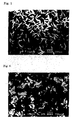
- As is shown in Fig. 1, the conventional phosphate treated coating on the surface of zinc coated steel sheets is formed from needle crystals with a length of several µm, however, in the present invention, it is extremely important that the crystals are formed in a granulated crystal shape.
- The shape of the crystals can be easily observed by surface SEM. Specifically, if the surface of a steel sheet (after solvent degreasing if it is an oil coated material) is observed by SEM (at an accelerating voltage of 15Kv, with no inclination, and at a magnification of 5000x), it is possible to easily distinguish between granulated crystals and needle crystals. In the-present invention, it is important that these granulated crystals form the main portion of the crystals. A phosphate treated coating formed principally with granulated crystals is shown in Fig. 2.
- In order to make a still more clear-cut distinction, it is possible to make a distinction using the ratio of the major axis of the crystals to the minor axis thereof. If the ratio of the major axis to the minor axis is close to 1.0, this means that the crystals have an approximately granulated shape. Specifically, among the crystals seen when photographed by SEM (at a magnification of 5000x) in an arbitrary visual field, the average ratio is taken over all the crystals by measuring the average value of those crystals whose length ratio of the major axis to the minor axis is closest to 1.00 and those crystals whose length ratio of the major axis to the minor axis is the largest.
- For example, Figs 3 and 4 show the results when the crystals shown in Figs 1 and 2 are traced in a planar view.
- In the case of the needle crystals shown in Fig. 1, the ratios of the major axis to the minor axis of all the crystals in the visual field are measured, and those whose length ratio of major axis to minor axis is closest to 1.00 (the 3a portion of Fig. 3) and those whose length ratio of major axis to minor axis is the largest (the 3b portion of Fig. 3) are selected, and average ratio thereof may be determined.
- In the same way, in the case of the granulated crystals shown in Fig. 2, those whose length ratio of major axis to minor axis is closest to 1.00 are set as the 4a portion of Fig. 4, and those whose length ratio of major axis to minor axis is the largest are set as the 4b portion of Fig. 4.
- If this average ratio is 1.00 or greater and 2.90 or less, then, as is shown in Fig. 5, it is clear that formability with beads is excellent. Note that formability with beads is evaluated by the number of times continuous molding is possible during continuous processing and only those that are capable of 10 or more continuous processings are acceptable.
- The present inventors examined several methods for changing the shape of the crystals from a needle shape to a granulated shape as described above, and also invented a production method for industrially and stably ensuring granulated crystals.
- Zinc phosphate treatment solutions that are normally used contain 0.5 to 5 g/liter of Zn ions, 5 to 50 g/liter of phosphoric acid ions, 0.5 to 30 g/liter of nitric acid ions, 0.1 to 2.0 g/liter of fluoride ions or complex fluoride ions in fluorine conversion, and where necessary 0.1 to 5 g/liter of Ni ions or the like. Normally, the zinc coated steel sheet is treated by a spray method or by an immersion method with a bath temperature of 40 to 70 °C and a reaction time of 1 to 10 seconds so as to deposit the zinc phosphate based treatment coating. Needless to say, the shape of produced crystals of the coating is a needle shape.
- The present inventors added Mg ions to a zinc phosphate treatment solution that uses the above normal treatment solution as a base, and discovered that, if the Mg ions are at least 10.25 g/l and the Zn ions are at least 0.5 g/l, then stable granulated crystals that are the essential feature of the present invention can be produced. 10.25 g/l
- In this case, it is particularly important that 6 g/l or more of the Mg ions are present. If the amount of Mg ions is less than 10.25 g/l, granulated crystals are not formed. If the amount of Zn ions is less than 0.5 g/l, the reaction speed is slow and it is difficult for a coating to be formed.
- The phosphate treatment solution of the present invention will now be described.
- In the phosphate treatment solution used in the present invention, there is no particular limitation as to the concentration of the phosphoric acid ions, the nitric acid ions, and the fluoride ions, however, it is sufficient if the phosphate treatment solution contains 5 to 50 g/L of phosphoric acid ions, at least 0.5 g/l of nitric acid ions, and 0.1 to 2.0 g/L of fluoride ions or complex fluoride ions in fluorine conversion.
- In the present invention, as described above, the most important factor is that the Mg ions are at least 10.25 g/l and the Zn ions are at least 0.5 g/l.
- Moreover, there is no particular limitation as to the source of supply of the phosphoric acid ions, the nitric acid ions, the zinc ions, and the magnesium ions, however, orthophosphoric acid, nitric acid, zinc phosphate or zinc nitrate, and magnesium nitrate are used, respectively.
- There is neither any particular limitation as to the source of supply of the fluoride ions or complex fluoride ions, however, hydrofluoric acid, hydrofluosilicic acid, hydrofluoboric acid, and the like may be used.
- There is neither any particular limitation as to metallic ions other than the coexistent Zn and Mg ions, however, one or more types of metallic ion selected from Fe, Ni, Co, Mn, Ca, Cu, and the like may be included. Essentially, it is desirable that the amount is not greater than 5 g/liter because of the competing reaction when the Mg is incorporated into the Zn.
- There is no particular limitation as to the phosphate treatment method according to the present invention, however, it is desirable that a zinc coated steel sheet undergoes a preliminary activation treatment in a treatment solution including titanium colloid. Thereafter, it is desirable that the phosphate treatment solution according to the present invention is coated using either a spray treatment method or an immersion treatment method at a bath temperature of 40 to 70 °C for a treatment time of 1 to 10 seconds.
- If the bath temperature is less than 40 °C, there is insufficient reactivity and a predetermined coating weight cannot be guaranteed. If the bath temperature is greater than 70 °C, the treatment bath easily deteriorates. If the processing time is less than 1 second, it is difficult to form the predetermined coating weight, while longer than 10 seconds is unfavorable in view of the production costs.
- Moreover, as a result of yet further investigations, it was determined that even if the amount of Zn ions contained in the phosphate treatment solution is less than 0.5 g/l or is 0 g/l, and if the amount of Mg ions is at least 10 g/l and the amount of nitric acid ions is at least 40 g/l, the coating of the present invention can be formed.
- Namely, regardless of whether the concentration of Zn ions in the treatment solution is low, or whether there are no Zn ions in the treatment solution, by making the nitric acid ions coexist in a large amount, the Zn dissolution in the plating was accelerated, and it was determined that the phosphate coating could be formed.
- As described above, a main characteristic of the present invention is that the structure of the crystals is changed by implementing a phosphate treatment on zinc coated steel sheet using a phosphate treatment solution in which Mg ions are at least 10.25 g/l and Zn ions are at least 0.5 g/l, or Mg ions are at least 10 g/l and Zn ions are 0 or more and less than 0.5 g/l, and nitric acid ions are at least 40 g/l. However, a further characteristic is that the amount of Mg incorporated into the zinc phosphate coating is increased. As a result of still further earnest research, it was determined that excellent corrosion resistance was achieved by the amount of Mg incorporated into the zinc phosphate coating. Namely, it was determined that if the content of the Mg included in the phosphate coating is 10 mg/m2 or more, then the corrosion resistance is excellent. As an example, when the concentration of Zn ions is 1 g/l and the concentration of Mg ions is 30 g/l, then the amount of Mg in the coating in a zinc phosphate coating amount of 1.6 g/m2 is 60 mg/m2.
- Moreover, in order to obtain good spot weldability, it was determined that the coating amount should be controlled to 0.5 to 3.0 g/m2. If the coating amount is less than 0.5 g/m2, the area of direct contact between the zinc coating and the electrodes (Cu-Cr) increases and the continuous dotting performance deteriorates because the Zn and Cu form an alloy. If, however, the amount is greater than 3.0 g/m2, the electrical resistance of the phosphate coating of the present invention itself is too great and the continuous dotting performance deteriorates because surface flash is generated during welding.
- The steel sheet according to the present invention has excellent corrosion resistance in this state, however, it is desirable that rust prevention oil be applied for intermediate rust prevention.
- Moreover, in order to further improve corrosion resistance, a method was examined in which a heavy magnesium phosphate aqueous solution was coated and dried on the top layer of the zinc phosphate treated coating prepared by the above method. As a result, it was also discovered that, if the amount of coating provided is 0.5 g/m2 or less, the crystals retain a granulated shape and the workability with beads is excellent.
- Although the mechanism is unclear, the coated heavy magnesium phosphate is related to the crystal structure of the zinc phosphate treated coating, and it is thought that it grows along the stable surface of the crystal structure of the lower layer thereof. If the amount of coating exceeds 0.5 g/m2, the workability deteriorates because the granulated crystals are not formed, but needle crystals being formed.
- In the complex phosphate treated coating according to the present invention, if the total coating amount of the zinc phosphate treated coating and the applied heavy magnesium phosphate is 0.5 to 3.0 g/m2, then good spot weldability can be obtained.
- Moreover, it is desirable that the complex steel sheet according to the present invention is coated with a rust prevention oil for intermediate rust prevention.
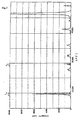
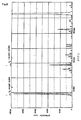
- The present inventors further predicted from the change in the shape of the crystals that there was some change in the structure of the crystals, and examined a method of quantifying this simply using X-ray diffraction. As a result, resulting from their investigation into the relationship between the measurement of the X-ray diffraction pattern and the workability of the drawing in the bead press process, they discovered that, in the X-ray diffraction pattern measurement using CuK a ray characteristic X-rays, there is a strong correlation in the phosphate treated coating between the workability of the drawing in the bead press process and the strength ratio (Ia/Ib) of the maximum strength value (Ia) of the maximum peak when 2θ is not less than 9.540° and not more than 9.800° to the maximum strength value (Ib) of the maximum peak when 2θ is not less than 19.200° and not more than 19.660°, and thus achieved the present invention. Namely, as is indicated by the diagram of the relationship between the drawing performance in the bead press process and the strength ratio (Ia/Ib) shown in Fig. 6, if the phosphate treated coating has a crystal structure in which the strength ratio (Ia/Ib) is not less than 3.0, then there is highly excellent workability in the bead press drawing performance. For reference, the results of an X-ray diffraction pattern measurement for a product according to the present invention using CuK α ray characteristic X-rays are shown in Fig. 7. The strength ratio (Ia/Ib) shown in Fig. 7 is 9.9. Note that in the pattern measurement in Fig. 8, the strength ratio (Ia/Ib) was 2.6.
- The mechanism behind why the bead press drawing workability changes when the strength ratio changes is not clear, however, it is thought that the symmetry in the original monoclinic crystals worsens when the crystal structure changes so as to form various peaks. It is extremely difficult, industrially, to create single crystals and then specify the crystal structure of each, however, the present invention has a further advantage in that, within the limits of this range, workability is excellent and it is possible to easily determine product performance even if there are a plurality of crystal structures.
-
- Fig. 1 is an SEM photograph (5000x) of needle crystals of the comparative example.
- Fig. 2 is an SEM photograph (5000x) of granular crystals of the example.
- Fig. 3 is a typical view of phosphate crystals projected from the surface of Fig. 1, wherein the portion a, indicated by the diagonal lines, is a crystal whose ratio of major axis to minor axis is closest to 1.00, while the portion b, indicated by the diagonal lines, is a crystal whose ratio of major axis to minor axis is the largest.
- Fig. 4 is a typical view of phosphate crystals projected from the surface of Fig. 2, wherein the portion a, indicated by the diagonal lines, is a crystal whose ratio of major axis to minor axis is closest to 1.00, while the portion b, indicated by the diagonal lines, is a crystal whose ratio of major axis to minor axis is the largest.
- Fig. 5 is a relational diagram showing the relationship between formability with beads and the major axis / minor axis average ratio.
- Fig. 6 is a relational diagram showing the relationship between the strength ratio (Ia/Ib) and formability with beads.
- Fig. 7 is an XRD diffraction pattern chart of Example 9.
- Fig. 8 is an XRD diffraction pattern chart of Comparative example 10.
- Examples of the present invention are given below, however, the present invention is not limited by these examples.
- Materials; electrically zinc coated steel sheet (30g per m2 per one side) having a thickness of 0.7 mm and r (Lankford value) of 1.9 was used.
- After the material (i.e. the zinc coated steel sheet) was degreased, a commercial titanium colloid based treatment agent (PL-ZN manufactured by Nihon Parkerizing Co., LTD.) was used to perform a preliminary treatment. Various zinc phosphate treatments were then carried out and the material was then washed and dried.
- Phosphate treatment bath A (5 g/l of phosphoric acid ions, 1 g/l of Zn ions, 2 g/l of Ni ions, 0.5 g/l of Mg ions, 0.15 g/l of fluorine, and 1 g/l of nitric acid ions) was used as the base treatment solution. The temperature of the treatment bath was set at 60 °C and phosphate treatment was performed by a spray treatment. The material was then washed and dried (Comparative example 1).
- Magnesium nitrate in metallic ion amounts of 5.0, 10, and 30 g/l was added to the treatment bath A and the same treatment was performed. Thereafter, the treatment time was changed to form the zinc phosphate coatings with the coating amounts shown in Table 1.
- As shown in the table, when the concentration of the Mg ions in the bath is 5.5 g/l (comparative example 2), the crystals are, not granulated and the workability is not satisfactory. Here, because the concentration of the Mg ions in the bath, in this case, is the sum of the 5.0 g/l of Mg ions added to the 0.5 g/l of the Mg ions in the base bath, this is 5.5 g/l. When 10 and 30 g/l of Mg ions were added, excellent workability was achieved in all cases (Examples 1 to 6). Moreover, the Examples 2 and 4, in which the amount of Mg in the coating was large, also had good corrosion resistance. When the amount of the coating is small, as in Example 1, the weldability is deteriorated.
- Phosphate treatment bath B (2.5 g/l of phosphoric acid ions, 0.5 g/l of Zn ions, 1 g/l of Ni ions, 0.25 g/l of Mg ions, 0.1 g/l of fluorine, and 1 g/l of nitric acid ions) was used as the base treatment solution. The temperature of the treatment bath was set at 60 °C and phosphate treatment was performed by a spray treatment. The material was then washed and dried (Comparative example 3).
- Magnesium nitrate in metallic ion amounts of 10 and 30 g/l was added to the treatment bath B and the same treatment was performed. Thereafter, the treatment time was changed to form the zinc phosphate coatings shown in Table 1 (Examples 7 and 8).
- The workability was inferior in Comparative example, but good workability was achieved within the range according to the present invention.
- Phosphate treatment bath C containing no Mg ions (10 g/l of phosphoric acid ions, 2.0 g/l of Zn ions, 5 g/l of Ni ions, 0.2 g/l of fluorine, and 1 g/l of nitric acid ions) was used as the treatment solution. Magnesium nitrate in a metallic ion amount of 30 g/l was added and the temperature of the treatment bath was set at 60 °C. Phosphate treatment was then performed by a spray treatment. The material was then washed and dried (Example 9). Good workability was achieved within the range according to the present invention.
- Phosphate treatment bath D containing no Mg ions (20 g/l of phosphoric acid ions, 4.0 g/l of Zn ions, 1 g/l of Ni ions, 0.2 g/l of fluorine, and 1 g/l of nitric acid ions) was used as the treatment solution. Magnesium nitrate in a metallic ion amount of 60 g/l was added and the temperature of the treatment bath was set at 60 °C. Phosphate treatment was then performed by a spray treatment. The material was then washed and dried (Example 10). Good workability was achieved within the range according to the present invention.
- Phosphate treatment bath E containing no Mg or Ni ions (10 g/l of phosphoric acid ions, 2.0 g/l of Zn ions, 0.2 g/l of fluorine, and 1 g/l of nitric acid ions) was used as the base treatment solution. The temperature of the treatment bath was set at 60 °C and phosphate treatment was performed by a spray treatment. The material was then washed and dried (Comparative examples 4 and 5).
- Magnesium nitrate in a metallic ion amount of 30 g/l was added to the treatment bath E and the same treatment was then performed. Thereafter, a zinc phosphate coating was formed (Example 11). The workability was inferior in Comparative example, but good workability was achieved within the range according to the present invention.
- Co was added to the above base treatment solution A to prepare the phosphate treatment bath F (5 g/l of phosphoric acid ions, 1.0 g/l of Zn ions, 2 g/l of Ni ions, 0.5 g/l of Mg ions, 2 g/l of Co ions, 0.15 g/l of fluorine, and 1 g/l of nitric acid ions). The temperature of the treatment bath was set at 60 °C and phosphate treatment was performed by a spray treatment. The material was then washed and dried (Comparative example 6).
- Magnesium nitrate in a metallic ion amount of 30 g/l was added to the treatment bath F and the same treatment was then performed. Thereafter, a zinc phosphate coating of 1.6 g/m2 was formed. The workability was inferior in Comparative example, but good workability was achieved within the range according to the present invention.
- As shown in Table 1, in contrast to the excellent workability obtained with good formability with beads in the examples of the present invention, the comparative examples, which were outside the range of the present invention, showed a remarkable deterioration in workability.
Table 1 (Examples) No. Treatment Bath Conditions Coating Inspection Evaluation Results Base Bath Composition Total Ion Cone. (g/l) Coating Amount g/m2 Mg Amount mg/m2 Crystal Shape Workability Corrosion resistance Weldability Zn Mg Average ratio Ia/Ib Examples 1 A 1 10.5 0.4 9 2.1 6.5 Pass Fail Fail 2 A 1 10.5 1.0 22 1.5 8.0 Pass Pass Pass 3 A 1 30.5 0.2 2 1.3 9.0 Pass Fail Fail 4 A 1 30.5 0.6 19 1.9 7.8 Pass Pass Pass 5 A 1 30.5 1.0 38 1.9 7.4 Pass Pass Pass 6 A 1 30.5 1.6 60 1.5 6.8 Pass Pass Pass 7 B 0.5 10.25 0.5 9 2.0 6.5 Pass Fail Pass 8 B 0.5 30.25 0.3 14 1.5 7.0 Pass Pass Fail 9 C 2 30.0 1.8 60 1.3 9.9 Pass Pass Pass 10 D 4 60.0 1.8 54 1.2 10 Pass Pass Pass 11 E 2 30.0 1.8 41 2.0 6.8 Pass Pass Pass 12 F 1 30.5 1.6 60 1.5 6.8 Pass Pass Pass Comparative Examples 1 A 1 0.5 0.8 2 3.2 1.6 Fail Fail Pass 2 A 1 5.5 1.5 12 3.2 1.8 Fail Pass Pass 3 B 0.5 0.25 1.5 4 3.2 1.7 Fail Fail Pass 4 E 2 0 2.5 0 6.1 1.4 Fail Fail Pass 5 E 2 0 3.5 0 5.9 1.6 Fail Fail Fail 6 F 1 0.5 1.8 2 6.1 1.7 Fail Fail Pass - Phosphate treatment bath G containing no Mg or Zn ions (10 g/l of phosphoric acid ions, 0.2 g/l of fluorine, and 1 g/l of nitric acid ions) was prepared as a base treatment solution.
- Zinc nitrate, magnesium nitrate, and nitric acid are added to the treatment bath G in order to adjust the concentrations of Zn ions, Mg ions, and nitric acid ions shown in Table 2. The temperature of the treatment bath was set at 60 °C and phosphate treatment was performed by a spray treatment. The material was then washed and dried. Note that the treatment time in the examples was set at 2 seconds, while the treatment time in the comparative examples was set at 10 seconds.
- In Examples 13 and 14, it is possible to form a coating when the solution contains 10 g/l or more of Mg ions and 40 g/l or more of nitric acid ions and each falls within the range of the present invention.
- However, in Comparative examples 7 and 8, because there are insufficient Mg ions and nitric acid ions, no coating was formed even with a treatment time of 10 seconds.
Table 2 No. Treatment Bath Conditions Coating Inspection Evaluation Results Base Bath Composition ton Conc. (g/I) Coating Amount g/m2 Mg Amount mg/m2 Crystal Shape Workability Corrosion resistance Weldability Zn Mg NO2 Average ratio Ia/Ib Examples 13 G 0 10 40 0.3 8 2.8 7.6 Pass Fail Fail 14 G 0.3 30 153 1.6 60 1.5 7.9 Pass Pass Pass Comparative Examples 7 G 0 4 25 0 0 Not measurable Not measurable Fail Fail Fail 8 G 0.3 4 25 0 0 Not measurable Not measurable Fail Fail Fail - After the material (i.e. the zinc coated steel sheet) was degreased, a commercial titanium colloid based treatment agent (PL - ZN manufactured by Nihon Parkerizing Co., LTD.) was used to perform a preliminary treatment. Thereafter, using the same method as in Examples 4 and 6, a base material a (coating amount 0.6 g/m2) and a base material b (coating amount 1.6 g/m2) on which zinc phosphate coatings were formed in advance were prepared.
- A base material c was also prepared using the same method as in Comparative example 1.
- Using the base materials a, b, and c treated with a zinc phosphate coating, a heavy magnesium phosphate aqueous solution (a 50 % aqueous solution of heavy Mg phosphate manufactured by Yoneyama Chemical Industries Co., Ltd. diluted by a factor of 5) was further coated using a roll coater and was dried so that the sheet temperature reached 110 °C. The number of rotations was controlled such that the weights of the applied coatings were the coating weights shown in Table 3.
- As is shown in Table 3, in contrast to the excellent workability obtained with good formability with beads in the examples of the present invention, the comparative examples, which were outside the range of the present invention, showed a remarkable deterioration in workability.
Table 3 No. Zinc phosphate treated base material Heavy Mg phosphate coating amount g/m2 Coating Inspection Evaluation Results Symbol Average ratio Coating amount Total coating amount mg/m3 Mg amount mg/m2 Crystal Shape Workability Corrosion resistance Weldability Average ratio Ia/Ib Examples 15 a 1.9 0.6 0.2 0.8 39 2.1 7.4 Pass Pass Pass 16 a 1.9 0.6 0.4 1.0 59 2.5 6.9 Pass Pass Pass 17 a 1.9 0.6 0.5 1.1 69 2.9 6.8 Pass Pass Pass 18 b 1.5 1.8 0.2 1.8 60 1.9 6.9 Pass Pass Pass Comparative Examples 9 a 1.9 0.6 0.7 1.3 79 3.2 2.9 Fail Pass Pass 10 b 1.5 1.6 1.5 3.1 200 4.5 2.6 Fail Pass Fail 11 c 3.2 0.8 0.4 1.2 47 3.4 2.0 Fail Pass Pass -
- • After each of the materials was degreased with solvent (n - hexane), the average ratio was measured by photographing arbitrary locations on the surface of the steel sheets (at an accelerated voltage of 15 KV and a magnification of 5000x) by SEM (JSM - 6400, manufactured by JEOL Ltd.).
- •Using the photographs thus obtained, those crystals having a ratio of major axis to minor axis closest to 1.00 and those crystals whose ratio of major axis to minor axis was the largest were measured from all those crystals within the field of vision for which a determination as to the crystal grain interface was possible.
- • Lastly, the average ratio was taken from the average of the crystals whose ratio of major axis to minor axis was closest to 1.00 and the crystals whose ratio of major axis to minor axis was the largest.
-
- • After each of the materials was degreased with solvent (n-hexane), a 40 mm round piece was measured using an XRD (X-ray diffractor) (RINT - 1500 manufactured by Rigaku Denki K.K.) under the following conditions.
(XRD measurement conditions)- target: Cu (Kα) tube voltage: 40 KV tube current: 200 mA
- measured surface: 5 mm x 12 mm
- range of measurement scan angle: 5 to 40°
- divergence slit: 1° light receiving slit: 0.6 mm
- scan step: 0.02° scan speed: 4° /min
- counter: scintillation counter
- surface normal line: perpendicular to surface of the material plate
- • The largest strength value of the maximum peak (Ia) (cps units) at which 2θ = not less than 9.540° and not more than 9.800° and the largest strength value of the maximum peak (Ib) (cps units) at which 26 = not less than 19.200° and not more than 19.660° were obtained from the measured peaks.
- Lastly, the strength ratio (Ia/Ib) was determined.
- After a sample piece was sheared to a size of 30 mm x 300 mm, it was immersed in detergent oil (RL55, manufactured by Idemitsu Industries Co., Ltd.) and was roll drawn. A continuous U bead bending process was then performed. A 60 ton crank press was used for the processing. The processing conditions were BHF = 1 ton, processing height = 40 mm, bead portion punch R = 5 mm, bead portion die R = 1mm, punch R = 5 mm, and processing speed = 25 spm. Evaluation was made by evaluating the number of times continuous molding was possible, and success was judged by whether or not 10 times was possible without crack formation.
- After a sample piece was sheared to a size of 150 mm x 70 mm, the edge of the cut surface was sealed, and a bare corrosion resistance examination was performed using a corrosion cycle tester (*the conditions therefor will be described later). Evaluation was performed by measuring the ratio of the surface area where rust occurred after 5 cycles using an image analyzer. Success was judged by whether or not the ratio of the surface area where rust occurred was less than 1% after 5 cycles.
- One cycle comprising:
- salt water spray (6 hours) → drying (3 hours) → wetting (14 hours) → drying (1 hour),
- was repeated, at respective test condition;
- 5% NaCl, 35°C → 50°C, 45% RH → 50°C, 95% RH → 50°C, 45% RH.
- After a sample piece was sheared to a size of 100 mm X 300 mm, it was coated with rust prevention oil (Noxrust 530F60, manufactured by Parker Industries Co., LTD.), and was then measured under the following conditions (*described later) using an ND 70-24, manufactured by Dengen Ltd. A preliminary measurement was made of the value of the scattering generation current, and, from the scattering generation current value, at a current value of not more than 0.3 KA, the composite continuous dotting performance was examined. Success was judged by a nugget diameter of not less than 3.6 mm after 500 dottings.
-
- electrode: CF type (Cu-Cr) electrode with a tip diameter of 5 mm
- water volume: 3 L/min Applied pressure: 200 kgf
- sequence: Sq. Time 60 cyc,
Up Slope 1 cyc, Weld Time 13 cyc, Ho.Time 2 cyc - composite continuous dotting method: tester (25 dots) → 10 seconds interval → cold drawn steel sheet (25 dots) → 10 seconds interval repeated for 500 dottings.
-
- 1) The amount of zinc phosphate treated coating was measured using the following method.
- • Firstly, using a precision balance, the weight of a test piece was measured and the test piece was then dissolved in 5% chromic acid at a room temperature for 5 minutes. It was then washed with water, dried, and the weight of the test piece was measured. The amount of the coating (g/m2) was taken as the difference in weight before and after the dissolution divided by the dissolved surface area.
- • Next, using the chromic acid solution used in the coating weight measurement, the amount of adhered Mg per unit area in the phosphoric acid coating was measured by ICP (inductive coupling plasma light emission method).
- 2) The total amount of complex phosphate treated coating was measured using the following method.
- Firstly, the weight of a test piece, having a zinc phosphate treated coating formed thereon in advance, was measured. Heavy magnesium phosphate was then coated thereon and dried and the weight of the test piece was measured. The amount of the increase was taken as the heavy magnesium phosphate coating amount.
- Next, in order to measure the total complex phosphate coating amount, the weight of the test piece is measured and the test piece was then dissolved for 5 minutes at a room temperature in 5% chromic acid. The test piece was then washed, dried, and the weight of the test piece was measured. The amount of the coating (g/m2) was taken as the difference in weight before and after the dissolution divided by the dissolved surface area.
- Next, using the chromic acid solution used in the coating weight measurement, the amount of adhered Mg per unit area in the complex phosphate coating was measured by ICP (inductive coupling plasma light emission method).
- According to the present invention, it is possible to obtain a phosphate treated zinc coated steel sheet having excellent workability not achieved in the prior art. The steel sheet of the present invention is simple to produce and cost effective and can be preferably applied for various uses, such as in vehicles, household appliances, building materials, and the like.
Claims (7)
- A phosphate treated zinc coated steel sheet with excellent workability, having a phosphate coating comprising Mg and mainly granulated crystals on a surface of a zinc coated steel sheet and a rust prevention oil layer provided on the phosphate coating wherein an average ratio of a major axis to a minor axis of the crystals in the phosphate coating is not less than 1.00 and not more than 2.90, wherein, the average ratio is an average value of that crystal whose length ratio of the major axis to the minor axis is closest to 1.00 and that crystal whose length ratio of the major axis to the minor axis is the largest from among crystals seen when an SEM photograph (at a magnification of 5000X) is taken.
- The phosphate treated zinc coated steel sheet according to claim 1 also with excellent corrosion resistance, wherein the amount of the Mg contained in the phosphate coating is not less than 10 mg/m2.
- The phosphate treated zinc coated steel sheet according to claim 1 or 2 also with excellent weldability, wherein an adhered amount of the phosphate coating is from 0.5 g/m2 to 3.0 g/m2.
- A method for producing a phosphate treated zinc coated steel sheet with excellent workability and corrosion resistance according to claim 1, wherein a phosphate treatment is performed on a zinc coated steel sheet using a phosphate treatment solution in which, among metallic ions included in the phosphate treatment solution, the amount of Mg ions is at least 10.25 g/l and the amount of Zn ions is at least 0.5 g/l, and the phosphate coated steel sheet is coated with a rust prevention oil.
- A method for producing a phosphate treated zinc coated steel sheet with excellent workability and corrosion resistance according to claim 1, wherein a phosphate treatment is performed on a zinc coated steel sheet using a phosphate treatment solution in which, among metallic ions included in the phosphate treatment solution, the amount of Mg ions is at least 10 g/l the amount of Zn ions is 0 or more and less than 0.5 g/l, and the amount of nitric acid ions included in the phosphate treatment solution is at least 40 g/l, and the phosphate coated steel sheet is coated with a rust prevention oil.
- A method for producing a phosphate treated zinc coated steel sheet with excellent workability and corrosion resistance, wherein, after the phosphate treatment according to claim 4 or 5, a heavy magnesium phosphate coating is formed on a surface thereof by coating and drying in a coating amount of not more than 0.5 g/m2.
- A phosphate treated zinc coated steel sheet with excellent workability, having a phosphate coating on a surface of the zinc coated steel sheet according to claim 1, the phosphate coating being characterized in that when measuring an X-ray diffraction pattern using CuK α ray characteristic X-rays, the strength ratio (Ia/Ib) of the largest strength value of the maximum peak (Ia) at which 2θ is not less than 9.540 and not more than 9.800 and the largest strength value of the maximum peak (Ib) at which 2θ is not less than 19.200 and not more than 19.660 is not less than 3.0.
Applications Claiming Priority (5)
| Application Number | Priority Date | Filing Date | Title |
|---|---|---|---|
| JP22545499 | 1999-08-09 | ||
| JP22545499 | 1999-08-09 | ||
| JP23019899 | 1999-08-17 | ||
| JP23019899 | 1999-08-17 | ||
| PCT/JP2000/005301 WO2001011110A1 (en) | 1999-08-09 | 2000-08-08 | Zinc-based metal plated steel sheet treated with phosphate being excellent in formability and method for production thereof |
Publications (3)
| Publication Number | Publication Date |
|---|---|
| EP1223233A1 EP1223233A1 (en) | 2002-07-17 |
| EP1223233A4 EP1223233A4 (en) | 2004-05-12 |
| EP1223233B1 true EP1223233B1 (en) | 2007-03-14 |
Family
ID=26526650
Family Applications (1)
| Application Number | Title | Priority Date | Filing Date |
|---|---|---|---|
| EP00950039A Expired - Lifetime EP1223233B1 (en) | 1999-08-09 | 2000-08-08 | Zinc-based metal plated steel sheet treated with phosphate being excellent in formability and method for production thereof |
Country Status (12)
| Country | Link |
|---|---|
| US (1) | US6753095B1 (en) |
| EP (1) | EP1223233B1 (en) |
| JP (1) | JP4088069B2 (en) |
| KR (1) | KR100665467B1 (en) |
| CN (1) | CN1244715C (en) |
| AU (1) | AU768532B2 (en) |
| BR (1) | BRPI0013046B1 (en) |
| CA (1) | CA2381561C (en) |
| DE (1) | DE60033950T2 (en) |
| ES (1) | ES2279763T3 (en) |
| TW (1) | TW508373B (en) |
| WO (1) | WO2001011110A1 (en) |
Families Citing this family (5)
| Publication number | Priority date | Publication date | Assignee | Title |
|---|---|---|---|---|
| JP4720830B2 (en) * | 1999-07-08 | 2011-07-13 | Jfeスチール株式会社 | Method for producing galvanized steel sheet with excellent perforation resistance and press workability |
| WO2009017535A2 (en) * | 2007-06-07 | 2009-02-05 | Henkel Ag & Co. Kgaa | High manganese cobalt-modified zinc phosphate conversion coating |
| KR101830508B1 (en) * | 2016-06-24 | 2018-02-21 | 주식회사 포스코 | Phosphate-treated zinc-based plated steel sheet having excellent discoloration resistance and film adhesiveness |
| KR101968836B1 (en) * | 2017-09-26 | 2019-04-12 | 현대제철 주식회사 | Electro galvanized steel sheet and manufacturing method thereof |
| CN114892154B (en) * | 2022-05-17 | 2023-08-11 | 洛阳轴承研究所有限公司 | High-corrosion-resistance phosphating solution for wind power main shaft bearing and phosphating method |
Family Cites Families (15)
| Publication number | Priority date | Publication date | Assignee | Title |
|---|---|---|---|---|
| US3597283A (en) * | 1969-10-08 | 1971-08-03 | Lubrizol Corp | Phosphating solutions for use on ferrous metal and zinc surfaces |
| JPS50154129A (en) * | 1974-05-30 | 1975-12-11 | ||
| JPS5815554B2 (en) | 1980-03-24 | 1983-03-26 | 新日本製鐵株式会社 | Plated steel materials for cationic electrodeposition coating |
| DE3735538A1 (en) * | 1987-10-21 | 1989-05-03 | Metallgesellschaft Ag | PROCESS FOR THE PRODUCTION OF PHOSPHATUEBERZUEGEN |
| JPH02173274A (en) * | 1988-12-24 | 1990-07-04 | Kobe Steel Ltd | Method for phosphating galvanized steel sheet |
| JPH03107469A (en) * | 1989-09-21 | 1991-05-07 | Nippon Parkerizing Co Ltd | Zinc plated material having phosphate chemical conversion coating film excellent in bare corrosion resistance |
| EP0653502A3 (en) * | 1993-11-11 | 1995-08-09 | Nihon Parkerizing | Composite article of steel plated with a metal containing zinc and production process. |
| JP3190188B2 (en) * | 1993-11-11 | 2001-07-23 | 日本パーカライジング株式会社 | Zinc-containing metal-coated steel sheet composite with excellent high-speed press formability |
| DE19740953A1 (en) * | 1997-09-17 | 1999-03-18 | Henkel Kgaa | High speed spray or dip phosphating of steel strip |
| JPH11181577A (en) * | 1997-12-22 | 1999-07-06 | Nippon Steel Corp | Non-oriented electrical steel sheet excellent in punchability and method for producing the same |
| JP3828675B2 (en) * | 1998-04-23 | 2006-10-04 | 新日本製鐵株式会社 | Surface-treated steel sheet with excellent corrosion resistance and workability and method for producing the same |
| AU778143B2 (en) * | 1999-05-27 | 2004-11-18 | Nippon Steel Corporation | Phosphate-treated galvanized steel sheet excellent in corrosion resistance and paintability |
| EP1067212A1 (en) * | 1999-07-08 | 2001-01-10 | Kawasaki Steel Corporation | Perforative corrosion resistant galvanized steel sheet |
| DE60037645T2 (en) * | 1999-09-17 | 2008-12-18 | Jfe Steel Corp. | SURFACE-TREATED STEEL PLATE AND METHOD FOR THE PRODUCTION THEREOF |
| JP3531736B2 (en) * | 2001-01-19 | 2004-05-31 | オリエンタルエンヂニアリング株式会社 | Carburizing method and carburizing device |
-
2000
- 2000-08-08 AU AU63209/00A patent/AU768532B2/en not_active Expired
- 2000-08-08 CN CNB00811465XA patent/CN1244715C/en not_active Expired - Lifetime
- 2000-08-08 KR KR1020027001791A patent/KR100665467B1/en not_active Expired - Lifetime
- 2000-08-08 ES ES00950039T patent/ES2279763T3/en not_active Expired - Lifetime
- 2000-08-08 EP EP00950039A patent/EP1223233B1/en not_active Expired - Lifetime
- 2000-08-08 DE DE60033950T patent/DE60033950T2/en not_active Expired - Lifetime
- 2000-08-08 JP JP2001515354A patent/JP4088069B2/en not_active Expired - Fee Related
- 2000-08-08 WO PCT/JP2000/005301 patent/WO2001011110A1/en not_active Ceased
- 2000-08-08 TW TW089115944A patent/TW508373B/en not_active IP Right Cessation
- 2000-08-08 BR BRPI0013046A patent/BRPI0013046B1/en not_active IP Right Cessation
- 2000-08-08 US US10/049,231 patent/US6753095B1/en not_active Expired - Lifetime
- 2000-08-08 CA CA002381561A patent/CA2381561C/en not_active Expired - Lifetime
Also Published As
| Publication number | Publication date |
|---|---|
| CA2381561C (en) | 2007-02-20 |
| AU768532B2 (en) | 2003-12-18 |
| KR100665467B1 (en) | 2007-01-04 |
| CN1369022A (en) | 2002-09-11 |
| BR0013046A (en) | 2002-04-30 |
| US6753095B1 (en) | 2004-06-22 |
| ES2279763T3 (en) | 2007-09-01 |
| AU6320900A (en) | 2001-03-05 |
| DE60033950T2 (en) | 2007-12-06 |
| WO2001011110A1 (en) | 2001-02-15 |
| TW508373B (en) | 2002-11-01 |
| CN1244715C (en) | 2006-03-08 |
| EP1223233A4 (en) | 2004-05-12 |
| DE60033950D1 (en) | 2007-04-26 |
| JP4088069B2 (en) | 2008-05-21 |
| EP1223233A1 (en) | 2002-07-17 |
| CA2381561A1 (en) | 2001-02-15 |
| KR20020040769A (en) | 2002-05-30 |
| BRPI0013046B1 (en) | 2016-11-16 |
Similar Documents
| Publication | Publication Date | Title |
|---|---|---|
| US8956468B2 (en) | Zr-/Ti-containing phosphating solution for passivation of metal composite surfaces | |
| WO2004055237A1 (en) | Treating fluid for surface treatment of metal and method for surface treatment | |
| KR102888545B1 (en) | Surface-treated steel sheet and method of producing the same | |
| EP0866149B1 (en) | Zinciferous coated steel sheet and method for producing the same | |
| EP3252189B1 (en) | Surface-treated steel plate and metal container | |
| JP3137535B2 (en) | Zinc-containing metal-coated steel sheet composite excellent in coatability and method for producing the same | |
| EP2336391B1 (en) | Metal material having excellent corrosion resistance | |
| EP3786319B1 (en) | Method for producing surface-treated steel plate | |
| US6753095B1 (en) | Zinc-based metal plated steel sheet treated with phosphate being excellent in formability and method for production thereof | |
| EP1859930A1 (en) | Surface-treated metallic material | |
| JP4393349B2 (en) | Cold-rolled steel sheet with excellent phosphatability and post-coating salt hot water resistance | |
| JPWO2001011110A1 (en) | Phosphate-treated zinc-based coated steel sheet with excellent workability and its manufacturing method | |
| JP7295486B2 (en) | Sn-based plated steel sheet | |
| JP4630326B2 (en) | Method for producing phosphate-treated zinc-plated steel sheet with excellent workability | |
| EP4173984A1 (en) | Surface-treated steel sheet, metal container, and method for manufacturing surface-treated steel sheet | |
| JP2000313965A (en) | High corrosion resistant surface treated steel sheet and method for producing the same | |
| JP2004197203A (en) | Corrosion resistant galvanized steel sheet, and production method therefor | |
| JP2004323890A (en) | Galvanized steel sheet and manufacturing method thereof | |
| JP2000328258A (en) | High corrosion resistant surface treated steel sheet and method for producing the same | |
| MXPA02001366A (en) | Zinc-based metal plated steel sheet treated with phosphate being excellent in formability and method for production thereof | |
| JP3191646B2 (en) | Manufacturing method of galvanized steel sheet | |
| JP2785672B2 (en) | Zn-based alloy-plated steel sheet with excellent perforation resistance and plating adhesion | |
| JP2005320558A (en) | Pre-phosphate steel plate and method for manufacturing the same | |
| JPH08325794A (en) | Method for producing galvanized steel sheet treated with electrolytic chromate, which is excellent in corrosion resistance, fingerprint resistance, chromium elution resistance and stable productivity, and electrolytic chromate bath used therefor | |
| JPH101798A (en) | Electrolytic chromate treatment method |
Legal Events
| Date | Code | Title | Description |
|---|---|---|---|
| PUAI | Public reference made under article 153(3) epc to a published international application that has entered the european phase |
Free format text: ORIGINAL CODE: 0009012 |
|
| 17P | Request for examination filed |
Effective date: 20020305 |
|
| AK | Designated contracting states |
Kind code of ref document: A1 Designated state(s): AT BE CH CY DE DK ES FI FR GB GR IE IT LI LU MC NL PT SE |
|
| A4 | Supplementary search report drawn up and despatched |
Effective date: 20040331 |
|
| RBV | Designated contracting states (corrected) |
Designated state(s): AT BE CH CY DE ES FR GB LI |
|
| RIC1 | Information provided on ipc code assigned before grant |
Ipc: 7C 23C 22/83 B Ipc: 7C 23C 22/13 B Ipc: 7C 23C 22/36 A |
|
| 17Q | First examination report despatched |
Effective date: 20041111 |
|
| GRAP | Despatch of communication of intention to grant a patent |
Free format text: ORIGINAL CODE: EPIDOSNIGR1 |
|
| RBV | Designated contracting states (corrected) |
Designated state(s): DE ES FR GB |
|
| GRAS | Grant fee paid |
Free format text: ORIGINAL CODE: EPIDOSNIGR3 |
|
| GRAA | (expected) grant |
Free format text: ORIGINAL CODE: 0009210 |
|
| AK | Designated contracting states |
Kind code of ref document: B1 Designated state(s): DE ES FR GB |
|
| REG | Reference to a national code |
Ref country code: GB Ref legal event code: FG4D |
|
| REF | Corresponds to: |
Ref document number: 60033950 Country of ref document: DE Date of ref document: 20070426 Kind code of ref document: P |
|
| ET | Fr: translation filed | ||
| REG | Reference to a national code |
Ref country code: ES Ref legal event code: FG2A Ref document number: 2279763 Country of ref document: ES Kind code of ref document: T3 |
|
| PLBE | No opposition filed within time limit |
Free format text: ORIGINAL CODE: 0009261 |
|
| STAA | Information on the status of an ep patent application or granted ep patent |
Free format text: STATUS: NO OPPOSITION FILED WITHIN TIME LIMIT |
|
| 26N | No opposition filed |
Effective date: 20071217 |
|
| REG | Reference to a national code |
Ref country code: DE Ref legal event code: R082 Ref document number: 60033950 Country of ref document: DE Representative=s name: VOSSIUS & PARTNER, DE Effective date: 20130227 Ref country code: DE Ref legal event code: R081 Ref document number: 60033950 Country of ref document: DE Owner name: NIPPON STEEL & SUMITOMO METAL CORPORATION, JP Free format text: FORMER OWNER: NIPPON STEEL CORP., TOKIO/TOKYO, JP Effective date: 20130227 Ref country code: DE Ref legal event code: R082 Ref document number: 60033950 Country of ref document: DE Representative=s name: VOSSIUS & PARTNER PATENTANWAELTE RECHTSANWAELT, DE Effective date: 20130227 |
|
| REG | Reference to a national code |
Ref country code: FR Ref legal event code: CD Owner name: NIPPON STEEL & SUMITOMO METAL CORPORATION, JP Effective date: 20130913 Ref country code: FR Ref legal event code: CA Effective date: 20130913 |
|
| REG | Reference to a national code |
Ref country code: FR Ref legal event code: PLFP Year of fee payment: 17 |
|
| REG | Reference to a national code |
Ref country code: FR Ref legal event code: PLFP Year of fee payment: 18 |
|
| REG | Reference to a national code |
Ref country code: FR Ref legal event code: PLFP Year of fee payment: 19 |
|
| REG | Reference to a national code |
Ref country code: DE Ref legal event code: R082 Ref document number: 60033950 Country of ref document: DE Representative=s name: VOSSIUS & PARTNER PATENTANWAELTE RECHTSANWAELT, DE Ref country code: DE Ref legal event code: R081 Ref document number: 60033950 Country of ref document: DE Owner name: NIPPON STEEL CORPORATION, JP Free format text: FORMER OWNER: NIPPON STEEL & SUMITOMO METAL CORPORATION, TOKYO, JP |
|
| PGFP | Annual fee paid to national office [announced via postgrant information from national office to epo] |
Ref country code: ES Payment date: 20190903 Year of fee payment: 20 Ref country code: DE Payment date: 20190723 Year of fee payment: 20 Ref country code: FR Payment date: 20190711 Year of fee payment: 20 |
|
| PGFP | Annual fee paid to national office [announced via postgrant information from national office to epo] |
Ref country code: GB Payment date: 20190814 Year of fee payment: 20 |
|
| REG | Reference to a national code |
Ref country code: DE Ref legal event code: R071 Ref document number: 60033950 Country of ref document: DE |
|
| REG | Reference to a national code |
Ref country code: GB Ref legal event code: PE20 Expiry date: 20200807 |
|
| PG25 | Lapsed in a contracting state [announced via postgrant information from national office to epo] |
Ref country code: GB Free format text: LAPSE BECAUSE OF EXPIRATION OF PROTECTION Effective date: 20200807 |
|
| REG | Reference to a national code |
Ref country code: ES Ref legal event code: FD2A Effective date: 20201126 |
|
| PG25 | Lapsed in a contracting state [announced via postgrant information from national office to epo] |
Ref country code: ES Free format text: LAPSE BECAUSE OF EXPIRATION OF PROTECTION Effective date: 20200809 |