EP1223201A2 - A phase change ink composition - Google Patents
A phase change ink composition Download PDFInfo
- Publication number
- EP1223201A2 EP1223201A2 EP02394005A EP02394005A EP1223201A2 EP 1223201 A2 EP1223201 A2 EP 1223201A2 EP 02394005 A EP02394005 A EP 02394005A EP 02394005 A EP02394005 A EP 02394005A EP 1223201 A2 EP1223201 A2 EP 1223201A2
- Authority
- EP
- European Patent Office
- Prior art keywords
- ink
- particles
- dispersant
- pigment
- carrier
- Prior art date
- Legal status (The legal status is an assumption and is not a legal conclusion. Google has not performed a legal analysis and makes no representation as to the accuracy of the status listed.)
- Withdrawn
Links
Images
Classifications
-
- C—CHEMISTRY; METALLURGY
- C09—DYES; PAINTS; POLISHES; NATURAL RESINS; ADHESIVES; COMPOSITIONS NOT OTHERWISE PROVIDED FOR; APPLICATIONS OF MATERIALS NOT OTHERWISE PROVIDED FOR
- C09D—COATING COMPOSITIONS, e.g. PAINTS, VARNISHES OR LACQUERS; FILLING PASTES; CHEMICAL PAINT OR INK REMOVERS; INKS; CORRECTING FLUIDS; WOODSTAINS; PASTES OR SOLIDS FOR COLOURING OR PRINTING; USE OF MATERIALS THEREFOR
- C09D11/00—Inks
-
- C—CHEMISTRY; METALLURGY
- C09—DYES; PAINTS; POLISHES; NATURAL RESINS; ADHESIVES; COMPOSITIONS NOT OTHERWISE PROVIDED FOR; APPLICATIONS OF MATERIALS NOT OTHERWISE PROVIDED FOR
- C09D—COATING COMPOSITIONS, e.g. PAINTS, VARNISHES OR LACQUERS; FILLING PASTES; CHEMICAL PAINT OR INK REMOVERS; INKS; CORRECTING FLUIDS; WOODSTAINS; PASTES OR SOLIDS FOR COLOURING OR PRINTING; USE OF MATERIALS THEREFOR
- C09D11/00—Inks
- C09D11/30—Inkjet printing inks
- C09D11/34—Hot-melt inks
Definitions
- US4390565 and US5212212 describe inks based on a UV curable ink system and are designed to be applied by a screen printing process.
- the ceramic ink formulations described are in liquid form and the solid constituents of the inks tend to sediment as a function of time in storage. Therefore the ink must be constantly mixed while not in use. This also applies to other types of liquid ink such as solvent or oil based ink.
- an ink suitable for application to a heat resistant substrate and firing to fuse the ink to the substrate the ink being in a form for ink jet printing and comprising:-
- the pigment is in particulate form.
- the pigment comprises ceramic pigment particles of less than 10 microns in size.
- concentration of ceramic pigment in the ink is in the range of 10% to 60% by weight, preferably 20% to 50% by weight.
- the pigment and fusible vitreous agent are combined in the form of ceramic pigment particles.
- the ceramic pigment particles are less than 5 microns in size.
- the dispersant is chemisorbed onto the particles.
- the dispersant may be chemisorbed onto the particles by drying in an oven for up to 24 hours wherein the temperature of the oven is at least 120 o C.
- the dispersant is selected from a modified polyacrylate and fatty acid, most preferably the dispersant is selected from 12-hydroxystearic acid, stearic acid, tartaric acid, hydroxybenzoic acid and docosanoic acid. Ideally the dispersant comprises stearic acid.
- the carrier material comprises a wax material.
- the carrier material has a melting point of from 20 to 150 o C, preferably 50 to 100 o C.
- the pigment comprises a chemical dye.
- the invention also provides an ink suitable for application to a heat resistant substrate and firing to fuse the ink to the substrate, the ink being in a form for ink jet printing and comprising;-
- the ink of the invention in a form for ink jet printing comprises the following:-
- the carrier material is a wax material such as paraffin wax, an example of which is, Paraflint C77®, produced by Schuman Sasol GmbH, Hamburg, Germany.
- a wax material such as paraffin wax, an example of which is, Paraflint C77®, produced by Schuman Sasol GmbH, Hamburg, Germany.
- Animal Vegetable Mineral Synthetic Beeswax mp 62-65°C
- Candelillia mp 68.5-72.5°C
- Montan mp 83-93°C
- Fischer-Tropsch waxes eg.
- the ceramic pigment may comprise one or more metal oxides, which have characteristic crystalline structures, which impart colour to materials.
- the ceramic pigment of the invention is in the form of a very fine powder with a particle size less than 10 ⁇ m, most preferably less than 5 ⁇ m in size.
- the viscosity of the ink is in the range of from 10 to 40cP, and preferably from 10 to 25cP.
- the powdered materials with the desired particle size distribution may be produced by milling, sol-gel, or any other suitable powder production method.
- the desired particle size distribution is obtained by bead milling commercially available pigments in the presence of a liquid.
- a quantity of the commercially available ceramic pigment powder is placed into a ceramic vessel with a quantity of ceramic beads.
- To this water is added and the contents are stirred at high speed with a ceramic stirrer.
- samples of the powder/water mixture (slurry) are extracted and the particle size distribution is determined by a laser diffraction technique.
- the liquid is removed by filtration, evaporation or any other suitable method and the milled powder is dried thoroughly in an oven.
- the pre-milled pigment(s), with the desired particle size distribution, are prepared for dispersion in a carrier material by coating the particles with the dispersant.
- the powder (milled pigment) is mixed with a suitable solvent and the dispersant is added to the mixture.
- the dispersant is soluble in the solvent.
- the solvent may be selected from any one or more of toluene or butyl acetate.
- the dispersant helps to stabilise the dispersion of the pigment particles in the ink by creating repulsive forces between the particles, thereby inhibiting agglomeration or flocculation in the ink.
- the proportions of powder and solvent are approximately 5g powder per 100ml toluene.
- the proportion of dispersant added is in the range of from 0.5-20% of the weight of the ceramic powder. However, the amount of dispersant added is preferably from 2 to 5% of the weight of the ceramic powder.
- adsorption test was conducted for each type of dispersant used.
- the adsorption test involves varying the amount of dispersant added to the powder and combining, as described above the dispersant and powder in the proportions as outlined in Table 2 below.
- the ceramic powder and dispersant contents are expressed in terms of weight percent of the total solids content.
- the solvent is removed by filtration and the powder is washed by more solvent to remove the excess dispersant.
- the dispersant-coated powder is then dried in an oven at a temperature of at least 120°C.
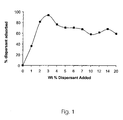
- the weight loss results as a percentage of the weight of the dispersant added, as shown in Fig. 1, it can be seen that the amount of adsorbed dispersant increases rapidly up to approximately 2.8% weight loss which corresponds to a powder to dispersant ratio of 97:3 by weight.
- the results indicate that the minimum amount of the dispersant required to coat the powder is 2%, by weight, of the total amount of ceramic pigment.
- 4% dispersant is used in the production of inks in order to ensure complete coverage of the pigment particles with dispersant molecules.
- the ceramic pigment material may alternatively be milled in the presence of a solvent. In this case the dispersant is added during the milling step of the process. After milling the solvent is removed and the dispersant chemisorbed to the powder as described previously.
- the properties of the ink composition of the invention are suitable for printing using a piezoelectric drop-on-demand inkjet printer.
- the viscosity is in the range of from 10 to 40cP, and preferably from 10 to 25cP.
- the printing process or printer may comprise any of the following features: an ink reservoir with suitable heating capability which can be employed to melt the ink as required.
- An ink umbilical which may be heated in order to transport the ink from the reservoir to the printhead without allowing the ink to solidify; a piezoelectric drop-on-demand inkjet printhead with inbuilt heating capability which can maintain the ink in liquid form during printing.
- the heating capability of the printhead may control the temperature of the ink so as to optimise the viscosity of the ink.
- additives to the ink composition may include binders, plasticisers, dyes, biocides, antioxidants, viscosity modifiers, defoamers or any other additives as appropriate. These ingredients may be added at the milling stage or at the dispersion stage of the production process, as appropriate.
- the ink may be printed onto a variety of substrates including glass, ceramic and metal substrates.
- An advantage of phase change inks is that the ink droplets solidify the instant they strike the substrate. This makes substrate handling more convenient.
- After printing the printed ink and substrate may by fired typically at temperatures of from 700°C to 1300°C, preferably glass articles will be fired at a temperature of from 700°C to 800°C and ceramic articles will be fired at temperatures of from 900°C to 1200°C, in order to remove the carrier material and other organic ingredients and to fuse the vitreous ceramic material, from the ink, to the substrate.
- the ink composition of the invention has many industrial applications.
- the ink may be used for decorating ceramic tiles, decorating glass articles, decorating ceramic and glass tableware, decorating ceramic and glass ornamental ware, temperature resistant marking and labelling, and decorating metal articles.
- the dispersant coated powder and a solid wax, in the form of beads, were placed in a dispersion vessel. 20ml of toluene was added to wet the powder and the mixture was stirred. The mixture was heated to 80°C to melt the wax. The resultant liquid mixture was then dispersed using a rotary dissolver and the temperature was raised to 110°C to evaporate the toluene. The dispersion was continued for 1 hour. The ink was then cooled until it solidified.
- Example 1 and 2 the vitreous agent and the pigment are combined or incorporated in the ceramic pigment particles.
- the pigment may alternatively be provided as a chemical dye.
- the vitreous agent particles are milled as described above for the ceramic pigment particles, and the dye is dissolved in a solvent and mixed with liquid wax before addition to the milled vitreous agent particles.
- Table 5 shows the sedimentation results, at 120°C, obtained for inks containing ceramic pigment (20% by weight), hydroxystearic acid (0.8% by weight) as the dispersant and hydroxystearic acid (79.2% by weight) as the wax carrier.
- Example 3 An ink was produced as described in Example 3 comprising 70% by weight stearic acid as a carrier, 28.8% by weight WHITE 45T41 ceramic pigment and 1.2% by weight EFKA 4401® dispersant.
- the ink was heated to 120°C in a piezoelectric drop-on-demand inkjet printhead and printed in straight lines 1cm wide, via the printhead, onto a flat glass substrate.
- the substrate with print applied were then passed through a kiln and fired at a temperature of 745°C, which burned off the organic materials and fused the inorganic (ceramic) materials to the glass substrate. This yielded a white enamel print of white lines on a glass substrate. It was found that the print was fused completely and was highly scratch resistant.
- the viscosity of the ink was determined by cone and plate rotational viscometry employing a Haake RV-1 rotational viscometer with temperature control attachments.
- the test involves placing the sample between a cone and a plate of standard geometry.
- the cone is rotated at a preset speed.
- the torque required to maintain the rotational speed is related to the viscosity.
- the viscosity is calculated from the torque required.
- the set speed and the geometry factors, shear force and shear rate are also calculated.
- the viscosity and shear force were determined for each sample at varying shear rate.
Landscapes
- Chemical & Material Sciences (AREA)
- Life Sciences & Earth Sciences (AREA)
- Engineering & Computer Science (AREA)
- Materials Engineering (AREA)
- Wood Science & Technology (AREA)
- Organic Chemistry (AREA)
- Inks, Pencil-Leads, Or Crayons (AREA)
Abstract
Description
- need for storage of screens or transfer members,
- high cost for low volume printing and lack of versatility generally,
- limitations in substrate surface printing coverage, in which edge-to-edge printing is often not possible, and
- requirement for an even substrate surface.
| Animal | Vegetable | Mineral | Synthetic |
| Beeswax (mp 62-65°C) | Candelillia (mp 68.5-72.5°C) | Montan (mp 83-93°C) | Fischer-Tropsch waxes eg. paraffin (mp 44-75°C) |
| Bayberry (mp 38-49 °C) | Carnauba (mp 83-86°C) | Polyethylene (mp 90-120°C) | |
| Japan wax (mp 50°C) | Fatty acids e.g. stearic acid (mp 69°C), hydroxystearic acid (mp 75°C) |
| Sample | Toluene (ml) | Powder Wt % | Dispersant Wt % |
| A001 | 65 | 100 | 0 |
| A002 | 65 | 99 | 1 |
| A003 | 65 | 98 | 2 |
| A004 | 65 | 97 | 3 |
| A005 | 65 | 96 | 4 |
| A006 | 65 | 95 | 5 |
| A007 | 65 | 94 | 6 |
| A008 | 65 | 93 | 7 |
| A009 | 65 | 90 | 10 |
| A010 | 65 | 88 | 12 |
| A012 | 65 | 86 | 14 |
| A013 | 65 | 80 | 20 |
| Sample | Weight Loss (%) | % |
| A001 | ||
| 0 | 0 | |
| A002 | 0.38 | 36 |
| A003 | 1.62 | 81 |
| A004 | 2.79 | 93 |
| A005 | 3.04 | 76 |
| A006 | 3.51 | 70.2 |
| A007 | 4.19 | 69.83 |
| A008 | 4.7 | 67.14 |
| A009 | 5.77 | 57.7 |
| A010 | 7.32 | 61 |
| A012 | 9.46 | 67.57 |
| A013 | 11.83 | 59.15 |
| Milling time | Max. particle size (µm) | Min. particle size (µm) |
| Before milling | 50 | 0.2 |
| 1 Hour | 45 | 0.2 |
| 3.5 | 20 | 0.15 |
| 5 Hours | 2.5 | 0.15 |
| 7 Hours | 1.5 | 0.1 |
| Time (hrs) | Sedimentation Volume (ml) |
| 1 | 0 |
| 2 | 0 |
| 4 | 0 |
| 8 | 0 |
| 12 | 0 |
| 24 | 0.1 |
| 48 | 0.3 |
| 72 | 0.5 |
| Sample | Wax Wt % | Ceramic Pigment Wt % |
| P1001 | 90 | 10 |
| | 80 | 20 |
| P1003 | 70 | 30 |
| | 60 | 40 |
| P1005 | 50 | 50 |
| | 40 | 60 |
| Ink Formulation | Ceramic Powder | | Solvent | Wax | |
| 1 | WHITE 45T41 | 12-Hydroxystearic acid | Toluene | 12- | |
| 2 | WHITE 45T41 | Stearic | Toluene | Paraffin | |
| 3 | WHITE 45T41 | EFKA 4401 | Butyl | Stearic acid | |
| 4 | WHITE 45T41 | Tartaric | Toluene | Paraffin | |
| 5 | WHITE 45T41 | Hydroxybenzoic | Toluene | Paraffin | |
| 6 | WHITE 45T41 | Docosanoic acid | Toluene | Paraffin |
| % Dispersant Ceramic Powder | | Viscosity | |
| 10 | 90 | 4 | |
| 20 | 80 | 5 | |
| 30 | 70 | 12 | |
| 40 | 60 | 15 | |
| 50 | 50 | 23 |
Claims (23)
- An ink suitable for application to a heat resistant substrate and firing to fuse the ink to the substrate, the ink being in a form for ink jet printing and comprising:-a carrier material;a pigment;a fusible vitreous agent comprising particles of less than 10 microns in size, andthe carrier having a melting point for phase change of the ink.
- An ink as claimed in claim 1 wherein the pigment is in particulate form.
- An ink as claimed in claim 1 or 2 wherein the pigment comprises ceramic pigment particles of less than 10 microns in size.
- An ink as claimed in claim 3 wherein the concentration of ceramic pigment in the ink is in the range of 10% to 60% by weight, preferably in the range of 20% to 50% by weight.
- An ink as claimed in claims 1 to 4 wherein the pigment and fusible vitreous agent are combined in the form of ceramic pigment particles.
- An ink as claimed in any of claims 1 to 5 wherein the particles are less than 5 microns in size.
- An ink as claimed in any of claims 1 to 6 wherein the ink comprises a dispersant.
- An ink as claimed in claim 8 wherein the particles are coated with the dispersant, preferably the dispersant is chemisorbed onto the particles.
- An ink as claimed in claim 8 wherein the dispersant is chemisorbed onto the particles by drying in an oven for up to 24 hours at a temperature of at least 120°C.
- An ink as claimed in claim 8 or 9 wherein the dispersant is selected from a modified polyacrylate and fatty acid preferably the dispersant is selected from 12-hydroxystearic acid, stearic acid, tartaric acid, hydroxybenzoic acid and docosanoic acid, preferably the dispersant comprises stearic acid.
- An ink as claimed in any of claims 8 to 10 wherein the dispersant is present in a concentration by weight of the ceramic pigment from 2 to 5% preferably approximately 4%.
- An ink as claimed in any of claims 8 to 11 wherein the particles are coated with a dispersant in the presence of a solvent preferably wherein the solvent is toluene or butyl acetate, preferably the dispersant is soluble in the solvent.
- An ink as claimed in any of claims 8 to 12 wherein the particles are coated with a dispersant by ball milling or using a rotary dissolver.
- An ink as claimed in any preceding claim wherein the carrier comprises a wax material, preferably the carrier has a melting point of from 20 to 150°C, preferably 50 to 100°C.
- An ink as claimed in claim 1 wherein the pigment comprises a chemical dye.
- An ink as claimed in claim 1 wherein the pigment comprises organometallic particles and metallic components.
- An ink suitable for application to a heat resistant substrate and firing to fuse the ink to the substrate, the ink being in a form for ink jet printing and comprising:-ceramic pigment particles of less than 10 microns in size;fusible vitreous particles of less than 10 microns in size; anda carrier having a melting point for phase change of the ink.
- An ink claimed as in claim 17 wherein the particles are coated with a dispersant.
- An ink suitable for application to a heat resistant substrate and firing to fuse the ink to the substrate, the ink being in a form for ink jet printing and comprising:-a carrier having a melting point for phase change of the ink;ceramic pigment particles of less than 10 microns in size;fusible vitreous particles of less than 10 microns in size; anda dispersant which is chemisorbed onto the particles.
- A method of producing an ink in a form for ink jet printing comprising the steps of:-milling a fusible vitreous agent to provide a powder having a particle size less than 10µm;providing a pigment for the ink;heating a phase change carrier, and mixing the powder with the molten carrier; andallowing the carrier to cool to provide solid ink.
- A method as claimed in claim 20, in which the pigment is combined with the fusible vitreous agent as ceramic pigment particles.
- A method of producing an ink comprising the steps of:-milling a fusible vitreous agent to provide a powder having a particle size less than 10µm;providing a pigment for the ink;mixing the milled particles with a dispersant, and a solvent,removing the solvent;heating the mixture to a temperature in excess of 120°C whereby the dispersant is chemisorbed onto the milled particles,heating a phase change carrier, and mixing the powder mixture with the molten carrier; andallowing the carrier to cool to provide solid ink.
- A method as claimed in claim 22, wherein the pigment is combined with the fusible vitreous agent as ceramic pigment particles.
Priority Applications (1)
| Application Number | Priority Date | Filing Date | Title |
|---|---|---|---|
| EP02394005A EP1223201A3 (en) | 2001-01-16 | 2002-01-15 | A phase change ink composition |
Applications Claiming Priority (3)
| Application Number | Priority Date | Filing Date | Title |
|---|---|---|---|
| EP01650006 | 2001-01-16 | ||
| EP01650006 | 2001-01-16 | ||
| EP02394005A EP1223201A3 (en) | 2001-01-16 | 2002-01-15 | A phase change ink composition |
Publications (2)
| Publication Number | Publication Date |
|---|---|
| EP1223201A2 true EP1223201A2 (en) | 2002-07-17 |
| EP1223201A3 EP1223201A3 (en) | 2004-01-21 |
Family
ID=8183584
Family Applications (1)
| Application Number | Title | Priority Date | Filing Date |
|---|---|---|---|
| EP02394005A Withdrawn EP1223201A3 (en) | 2001-01-16 | 2002-01-15 | A phase change ink composition |
Country Status (2)
| Country | Link |
|---|---|
| US (1) | US6773496B2 (en) |
| EP (1) | EP1223201A3 (en) |
Cited By (6)
| Publication number | Priority date | Publication date | Assignee | Title |
|---|---|---|---|---|
| WO2004107472A1 (en) * | 2003-06-03 | 2004-12-09 | International Business Machines Corporation | High-resolution patterning |
| WO2005019360A1 (en) * | 2003-08-25 | 2005-03-03 | Dip Tech. Ltd. | Ink for ceramic surfaces |
| WO2007036942A3 (en) * | 2005-09-28 | 2007-06-21 | Dip Tech Ltd | Ink providing etch-like effect for printing on ceramic surfaces |
| US7683107B2 (en) * | 2004-02-09 | 2010-03-23 | E.I. Du Pont De Nemours And Company | Ink jet printable thick film compositions and processes |
| EP2168774A1 (en) * | 2008-09-30 | 2010-03-31 | Glassdecor Revestimientos S.L. | Method and apparatus for preparing decorated glass, glass body and glass mosaic |
| US9636922B2 (en) | 1999-12-23 | 2017-05-02 | Pergo (Europe) Ab | Process for the manufacturing of surface elements |
Families Citing this family (8)
| Publication number | Priority date | Publication date | Assignee | Title |
|---|---|---|---|---|
| US20080103504A1 (en) * | 2006-10-30 | 2008-05-01 | Schmitz Gregory P | Percutaneous spinal stenosis treatment |
| US7700158B2 (en) * | 2004-10-20 | 2010-04-20 | Royal Canadian Mint | Method of printing an image on a metallic surface, particularly on a coin surface |
| GB0805493D0 (en) * | 2008-03-26 | 2008-04-30 | Sun Chemical Bv | A jet ink and ink jet printing process |
| US8974045B2 (en) * | 2011-04-13 | 2015-03-10 | Fujifilm Dimatix, Inc. | Phase-change ink jetting |
| US20130129994A1 (en) * | 2011-11-18 | 2013-05-23 | Fujifilm Dimatix, Inc. | Forming A Pigment Pattern On A Substrate |
| US20140071213A1 (en) * | 2012-09-13 | 2014-03-13 | Xerox Corporation | Phase Change Ink Compositions For Image Robustness |
| ES2554178B1 (en) * | 2014-05-16 | 2016-09-20 | Torrecid, S.A | COMPOSITION OF MAGENTA INK FOR DECORATION OF NON-POROUS SUBSTRATES |
| US9771649B2 (en) * | 2015-05-05 | 2017-09-26 | Linco Technology Co., Ltd. | Substrate carrier unit for a film deposition apparatus |
Family Cites Families (24)
| Publication number | Priority date | Publication date | Assignee | Title |
|---|---|---|---|---|
| US4070517A (en) * | 1976-07-08 | 1978-01-24 | Beckman Instruments, Inc. | Low fired conductive compositions |
| US4264679A (en) * | 1978-01-18 | 1981-04-28 | Corning Glass Works | Durable ceramic decorating enamels based on thermally stable cadmium red colors |
| US4401767A (en) * | 1981-08-03 | 1983-08-30 | Johnson Matthey Inc. | Silver-filled glass |
| US4446241A (en) * | 1982-06-28 | 1984-05-01 | Owens-Illinois, Inc. | Lead-free and cadmium-free glass frit compositions for glazing, enameling and decorating |
| US4390565A (en) | 1982-08-26 | 1983-06-28 | Lord Corporation | Photocurable compositions for use as ceramic ink vehicles |
| EP0105994B1 (en) | 1982-09-17 | 1987-03-25 | Corning Glass Works | Thermoplastic inks for decorating purposes |
| US4472537A (en) * | 1982-09-17 | 1984-09-18 | Corning Glass Works | Thermoplastic inks for decorating purposes |
| DE3585871D1 (en) | 1984-11-05 | 1992-05-21 | Dataproducts Corp | HOT-MELTING INK FOR INK-JET PRINTING. |
| US4717690A (en) * | 1986-02-12 | 1988-01-05 | Heraeus, Inc. Cermalloy Division | Overglaze inks |
| US4732794A (en) * | 1986-10-02 | 1988-03-22 | Mobay Corporation | Porcelain enamel composition and substrates coated therewith |
| US5185035A (en) * | 1990-05-23 | 1993-02-09 | Coates Electrographics Limited | Transparent hot melt jet ink |
| US5221335A (en) | 1990-05-23 | 1993-06-22 | Coates Electrographics Limited | Stabilized pigmented hot melt ink containing nitrogen-modified acrylate polymer as dispersion-stabilizer agent |
| EP0479501B1 (en) * | 1990-09-29 | 1996-07-03 | Canon Kabushiki Kaisha | Jet recording method, normally solid recording material and recording apparatus for the method |
| DE4106520A1 (en) * | 1991-03-01 | 1992-09-03 | Degussa | PURPLE PIGMENTS, METHOD FOR THE PRODUCTION AND USE THEREOF |
| US5212212A (en) | 1992-11-14 | 1993-05-18 | Lord Corporation | Zinc-containing ceramic ink compositions stabilized with calcium organic complex |
| GB9301435D0 (en) * | 1993-01-19 | 1993-03-17 | Atomic Energy Authority Uk | Ceramic pigments |
| US5397388A (en) * | 1993-02-05 | 1995-03-14 | Brother Kogyo Kabushiki Kaisha | Hot melt ink for ink jet printers |
| US5286288A (en) * | 1993-03-11 | 1994-02-15 | Videojet Systems International, Inc. | Hot melt inks for continuous jet printing |
| JPH06306319A (en) | 1993-04-26 | 1994-11-01 | Brother Ind Ltd | Hot-melt ink for ink-jet printer |
| GB9319971D0 (en) * | 1993-09-28 | 1993-11-17 | Cookson Group Plc | Cobalt glass compositions for coatings |
| ATE182695T1 (en) * | 1993-10-07 | 1999-08-15 | Michael Zimmer | DECORATED CERAMIC AND GLASS PRODUCTS, PROCESS FOR THE PRODUCTION THEREOF AND CERAMIC COLOR COMPOSITIONS FOR CARRYING OUT THE PROCESS |
| DE4413168C2 (en) | 1993-10-07 | 1998-01-15 | Michael Zimmer | Process for producing decorated ceramic and glass products and ceramic color compositions for carrying out the process |
| US6221147B1 (en) * | 1998-12-18 | 2001-04-24 | Cerdec Aktiengesellschaft Keramischre Farben | Bismuth manganese oxide pigments |
| US6248680B1 (en) * | 1999-06-01 | 2001-06-19 | Alliedsignal, Inc. | Low temperature burnout screen printing frit vehicles and pastes |
-
2002
- 2002-01-15 EP EP02394005A patent/EP1223201A3/en not_active Withdrawn
- 2002-01-15 US US10/045,679 patent/US6773496B2/en not_active Expired - Fee Related
Cited By (16)
| Publication number | Priority date | Publication date | Assignee | Title |
|---|---|---|---|---|
| US9636922B2 (en) | 1999-12-23 | 2017-05-02 | Pergo (Europe) Ab | Process for the manufacturing of surface elements |
| US10464339B2 (en) | 1999-12-23 | 2019-11-05 | Pergo (Europe) Ab | Process for the manufacturing of surface elements |
| US9656476B2 (en) | 1999-12-23 | 2017-05-23 | Pergo (Europe) Ab | Process for the manufacturing of surface elements |
| US9636923B2 (en) | 1999-12-23 | 2017-05-02 | Pergo (Europe) Ab | Process for the manufacturing of surface elements |
| CN100559624C (en) * | 2003-06-03 | 2009-11-11 | 国际商业机器公司 | High-resolution patterning |
| WO2004107472A1 (en) * | 2003-06-03 | 2004-12-09 | International Business Machines Corporation | High-resolution patterning |
| KR100773014B1 (en) * | 2003-06-03 | 2007-11-05 | 인터내셔널 비지네스 머신즈 코포레이션 | High-resolution patterning |
| US7803221B2 (en) | 2003-08-25 | 2010-09-28 | DIP Tech LTd.. | Ink for ceramic surfaces |
| EP2233539A1 (en) | 2003-08-25 | 2010-09-29 | Dip Tech. Ltd. | Ink for ceramic surfaces |
| US7976906B2 (en) | 2003-08-25 | 2011-07-12 | DIPTech Ltd. | Digital ink-jet glass printer |
| US8603589B2 (en) | 2003-08-25 | 2013-12-10 | Dip Tech Ltd. | Digital ink-jet glass printer |
| WO2005019360A1 (en) * | 2003-08-25 | 2005-03-03 | Dip Tech. Ltd. | Ink for ceramic surfaces |
| US7683107B2 (en) * | 2004-02-09 | 2010-03-23 | E.I. Du Pont De Nemours And Company | Ink jet printable thick film compositions and processes |
| US8163077B2 (en) | 2005-09-28 | 2012-04-24 | Yissum Research Development Company Of The Hebrew University Of Jerusalem | Ink providing etch-like effect for printing on ceramic surfaces |
| WO2007036942A3 (en) * | 2005-09-28 | 2007-06-21 | Dip Tech Ltd | Ink providing etch-like effect for printing on ceramic surfaces |
| EP2168774A1 (en) * | 2008-09-30 | 2010-03-31 | Glassdecor Revestimientos S.L. | Method and apparatus for preparing decorated glass, glass body and glass mosaic |
Also Published As
| Publication number | Publication date |
|---|---|
| US20020144627A1 (en) | 2002-10-10 |
| EP1223201A3 (en) | 2004-01-21 |
| US6773496B2 (en) | 2004-08-10 |
| IE20020020A1 (en) | 2003-05-28 |
Similar Documents
| Publication | Publication Date | Title |
|---|---|---|
| US6773496B2 (en) | Phase change ink composition | |
| EP2233539B1 (en) | Ink for ceramic surfaces | |
| KR100414313B1 (en) | Aqueous inks and coatings containing modified carbon products | |
| EP1052114B1 (en) | Process for decorating solid material | |
| Gardini et al. | Nano-sized ceramic inks for drop-on-demand ink-jet printing in quadrichromy | |
| HUT77797A (en) | Aqueous inks and coatings containing modified carbon products | |
| US10675889B2 (en) | Dispersants for colouration of ceramic tiles using ink jet inks | |
| US20080194733A1 (en) | Pigmented Inks Suitable For Use With Ceramics and Method of Producing Same | |
| JP2021530417A (en) | Particle mixtures, kits, inks, methods and articles | |
| US10584256B2 (en) | Polyester dispersants for colouration of ceramic tiles using ink jet inks and ink jet ink printers | |
| IE83751B1 (en) | A phase change ink composition | |
| EP1347839B1 (en) | Method of decorating a ceramic article | |
| JP2003012972A (en) | Method for forming image | |
| TW202336177A (en) | Inkjet printable inks for fabricating enamel coatings | |
| WO2016208493A1 (en) | Ink jet ink and method for producing ink jet printed matter using same | |
| Dondi et al. | Industrial ink-jet application of nano-sized ceramic inks | |
| WO2018107033A1 (en) | Aliphatic ceramic dispersant obtained by reaction of pibsa with non-polymeric amino ether/alcohol | |
| EP3144357A1 (en) | Magenta ink composition for decorating non-porous substrates | |
| JP2011099041A (en) | Artificial mineral pigment and method of producing the same | |
| JP2000085251A (en) | Thermal transfer ink sheet | |
| HK1003649B (en) | Aqueous inks and coatings containing modified carbon products | |
| HK1069593A (en) | Aqueous inks and coatings containing modified carbon products |
Legal Events
| Date | Code | Title | Description |
|---|---|---|---|
| PUAI | Public reference made under article 153(3) epc to a published international application that has entered the european phase |
Free format text: ORIGINAL CODE: 0009012 |
|
| AK | Designated contracting states |
Kind code of ref document: A2 Designated state(s): AT BE CH CY DE DK ES FI FR GB GR IE IT LI LU MC NL PT SE TR |
|
| AX | Request for extension of the european patent |
Free format text: AL;LT;LV;MK;RO;SI |
|
| PUAL | Search report despatched |
Free format text: ORIGINAL CODE: 0009013 |
|
| AK | Designated contracting states |
Kind code of ref document: A3 Designated state(s): AT BE CH CY DE DK ES FI FR GB GR IE IT LI LU MC NL PT SE TR |
|
| AX | Request for extension of the european patent |
Extension state: AL LT LV MK RO SI |
|
| 17P | Request for examination filed |
Effective date: 20040625 |
|
| AKX | Designation fees paid |
Designated state(s): AT BE CH CY DE DK ES FI FR GB GR IE IT LI LU MC NL PT SE TR |
|
| 17Q | First examination report despatched |
Effective date: 20050324 |
|
| RAP1 | Party data changed (applicant data changed or rights of an application transferred) |
Owner name: GLAZEJET LIMITED |
|
| RAP1 | Party data changed (applicant data changed or rights of an application transferred) |
Owner name: UNIVERSITY OF LIMERICK |
|
| STAA | Information on the status of an ep patent application or granted ep patent |
Free format text: STATUS: THE APPLICATION IS DEEMED TO BE WITHDRAWN |
|
| 18D | Application deemed to be withdrawn |
Effective date: 20141017 |