EP1221733A2 - Perfluoropolyether additives for electrochemical applications - Google Patents
Perfluoropolyether additives for electrochemical applications Download PDFInfo
- Publication number
- EP1221733A2 EP1221733A2 EP01130566A EP01130566A EP1221733A2 EP 1221733 A2 EP1221733 A2 EP 1221733A2 EP 01130566 A EP01130566 A EP 01130566A EP 01130566 A EP01130566 A EP 01130566A EP 1221733 A2 EP1221733 A2 EP 1221733A2
- Authority
- EP
- European Patent Office
- Prior art keywords
- compositions according
- electrolytic compositions
- electrolytic
- solution
- litre
- Prior art date
- Legal status (The legal status is an assumption and is not a legal conclusion. Google has not performed a legal analysis and makes no representation as to the accuracy of the status listed.)
- Granted
Links
Classifications
-
- H—ELECTRICITY
- H01—ELECTRIC ELEMENTS
- H01M—PROCESSES OR MEANS, e.g. BATTERIES, FOR THE DIRECT CONVERSION OF CHEMICAL ENERGY INTO ELECTRICAL ENERGY
- H01M10/00—Secondary cells; Manufacture thereof
- H01M10/05—Accumulators with non-aqueous electrolyte
- H01M10/056—Accumulators with non-aqueous electrolyte characterised by the materials used as electrolytes, e.g. mixed inorganic/organic electrolytes
- H01M10/0564—Accumulators with non-aqueous electrolyte characterised by the materials used as electrolytes, e.g. mixed inorganic/organic electrolytes the electrolyte being constituted of organic materials only
- H01M10/0565—Polymeric materials, e.g. gel-type or solid-type
-
- C—CHEMISTRY; METALLURGY
- C07—ORGANIC CHEMISTRY
- C07C—ACYCLIC OR CARBOCYCLIC COMPOUNDS
- C07C309/00—Sulfonic acids; Halides, esters, or anhydrides thereof
- C07C309/01—Sulfonic acids
- C07C309/02—Sulfonic acids having sulfo groups bound to acyclic carbon atoms
- C07C309/03—Sulfonic acids having sulfo groups bound to acyclic carbon atoms of an acyclic saturated carbon skeleton
- C07C309/07—Sulfonic acids having sulfo groups bound to acyclic carbon atoms of an acyclic saturated carbon skeleton containing oxygen atoms bound to the carbon skeleton
- C07C309/09—Sulfonic acids having sulfo groups bound to acyclic carbon atoms of an acyclic saturated carbon skeleton containing oxygen atoms bound to the carbon skeleton containing etherified hydroxy groups bound to the carbon skeleton
- C07C309/10—Sulfonic acids having sulfo groups bound to acyclic carbon atoms of an acyclic saturated carbon skeleton containing oxygen atoms bound to the carbon skeleton containing etherified hydroxy groups bound to the carbon skeleton with the oxygen atom of at least one of the etherified hydroxy groups further bound to an acyclic carbon atom
-
- C—CHEMISTRY; METALLURGY
- C08—ORGANIC MACROMOLECULAR COMPOUNDS; THEIR PREPARATION OR CHEMICAL WORKING-UP; COMPOSITIONS BASED THEREON
- C08G—MACROMOLECULAR COMPOUNDS OBTAINED OTHERWISE THAN BY REACTIONS ONLY INVOLVING UNSATURATED CARBON-TO-CARBON BONDS
- C08G65/00—Macromolecular compounds obtained by reactions forming an ether link in the main chain of the macromolecule
- C08G65/002—Macromolecular compounds obtained by reactions forming an ether link in the main chain of the macromolecule from unsaturated compounds
- C08G65/005—Macromolecular compounds obtained by reactions forming an ether link in the main chain of the macromolecule from unsaturated compounds containing halogens
- C08G65/007—Macromolecular compounds obtained by reactions forming an ether link in the main chain of the macromolecule from unsaturated compounds containing halogens containing fluorine
-
- C—CHEMISTRY; METALLURGY
- C08—ORGANIC MACROMOLECULAR COMPOUNDS; THEIR PREPARATION OR CHEMICAL WORKING-UP; COMPOSITIONS BASED THEREON
- C08L—COMPOSITIONS OF MACROMOLECULAR COMPOUNDS
- C08L67/00—Compositions of polyesters obtained by reactions forming a carboxylic ester link in the main chain; Compositions of derivatives of such polymers
-
- H—ELECTRICITY
- H01—ELECTRIC ELEMENTS
- H01M—PROCESSES OR MEANS, e.g. BATTERIES, FOR THE DIRECT CONVERSION OF CHEMICAL ENERGY INTO ELECTRICAL ENERGY
- H01M10/00—Secondary cells; Manufacture thereof
- H01M10/05—Accumulators with non-aqueous electrolyte
- H01M10/056—Accumulators with non-aqueous electrolyte characterised by the materials used as electrolytes, e.g. mixed inorganic/organic electrolytes
- H01M10/0564—Accumulators with non-aqueous electrolyte characterised by the materials used as electrolytes, e.g. mixed inorganic/organic electrolytes the electrolyte being constituted of organic materials only
- H01M10/0566—Liquid materials
- H01M10/0567—Liquid materials characterised by the additives
-
- H—ELECTRICITY
- H01—ELECTRIC ELEMENTS
- H01M—PROCESSES OR MEANS, e.g. BATTERIES, FOR THE DIRECT CONVERSION OF CHEMICAL ENERGY INTO ELECTRICAL ENERGY
- H01M50/00—Constructional details or processes of manufacture of the non-active parts of electrochemical cells other than fuel cells, e.g. hybrid cells
- H01M50/40—Separators; Membranes; Diaphragms; Spacing elements inside cells
- H01M50/409—Separators, membranes or diaphragms characterised by the material
- H01M50/411—Organic material
- H01M50/414—Synthetic resins, e.g. thermoplastics or thermosetting resins
-
- C—CHEMISTRY; METALLURGY
- C08—ORGANIC MACROMOLECULAR COMPOUNDS; THEIR PREPARATION OR CHEMICAL WORKING-UP; COMPOSITIONS BASED THEREON
- C08L—COMPOSITIONS OF MACROMOLECULAR COMPOUNDS
- C08L71/00—Compositions of polyethers obtained by reactions forming an ether link in the main chain; Compositions of derivatives of such polymers
-
- H—ELECTRICITY
- H01—ELECTRIC ELEMENTS
- H01M—PROCESSES OR MEANS, e.g. BATTERIES, FOR THE DIRECT CONVERSION OF CHEMICAL ENERGY INTO ELECTRICAL ENERGY
- H01M10/00—Secondary cells; Manufacture thereof
- H01M10/05—Accumulators with non-aqueous electrolyte
- H01M10/052—Li-accumulators
-
- H—ELECTRICITY
- H01—ELECTRIC ELEMENTS
- H01M—PROCESSES OR MEANS, e.g. BATTERIES, FOR THE DIRECT CONVERSION OF CHEMICAL ENERGY INTO ELECTRICAL ENERGY
- H01M10/00—Secondary cells; Manufacture thereof
- H01M10/05—Accumulators with non-aqueous electrolyte
- H01M10/056—Accumulators with non-aqueous electrolyte characterised by the materials used as electrolytes, e.g. mixed inorganic/organic electrolytes
- H01M10/0564—Accumulators with non-aqueous electrolyte characterised by the materials used as electrolytes, e.g. mixed inorganic/organic electrolytes the electrolyte being constituted of organic materials only
- H01M10/0566—Liquid materials
- H01M10/0568—Liquid materials characterised by the solutes
-
- H—ELECTRICITY
- H01—ELECTRIC ELEMENTS
- H01M—PROCESSES OR MEANS, e.g. BATTERIES, FOR THE DIRECT CONVERSION OF CHEMICAL ENERGY INTO ELECTRICAL ENERGY
- H01M2300/00—Electrolytes
- H01M2300/0085—Immobilising or gelification of electrolyte
-
- H—ELECTRICITY
- H01—ELECTRIC ELEMENTS
- H01M—PROCESSES OR MEANS, e.g. BATTERIES, FOR THE DIRECT CONVERSION OF CHEMICAL ENERGY INTO ELECTRICAL ENERGY
- H01M50/00—Constructional details or processes of manufacture of the non-active parts of electrochemical cells other than fuel cells, e.g. hybrid cells
- H01M50/40—Separators; Membranes; Diaphragms; Spacing elements inside cells
- H01M50/489—Separators, membranes, diaphragms or spacing elements inside the cells, characterised by their physical properties, e.g. swelling degree, hydrophilicity or shut down properties
-
- H—ELECTRICITY
- H01—ELECTRIC ELEMENTS
- H01M—PROCESSES OR MEANS, e.g. BATTERIES, FOR THE DIRECT CONVERSION OF CHEMICAL ENERGY INTO ELECTRICAL ENERGY
- H01M50/00—Constructional details or processes of manufacture of the non-active parts of electrochemical cells other than fuel cells, e.g. hybrid cells
- H01M50/40—Separators; Membranes; Diaphragms; Spacing elements inside cells
- H01M50/489—Separators, membranes, diaphragms or spacing elements inside the cells, characterised by their physical properties, e.g. swelling degree, hydrophilicity or shut down properties
- H01M50/497—Ionic conductivity
-
- Y—GENERAL TAGGING OF NEW TECHNOLOGICAL DEVELOPMENTS; GENERAL TAGGING OF CROSS-SECTIONAL TECHNOLOGIES SPANNING OVER SEVERAL SECTIONS OF THE IPC; TECHNICAL SUBJECTS COVERED BY FORMER USPC CROSS-REFERENCE ART COLLECTIONS [XRACs] AND DIGESTS
- Y02—TECHNOLOGIES OR APPLICATIONS FOR MITIGATION OR ADAPTATION AGAINST CLIMATE CHANGE
- Y02E—REDUCTION OF GREENHOUSE GAS [GHG] EMISSIONS, RELATED TO ENERGY GENERATION, TRANSMISSION OR DISTRIBUTION
- Y02E60/00—Enabling technologies; Technologies with a potential or indirect contribution to GHG emissions mitigation
- Y02E60/10—Energy storage using batteries
Definitions
- the present invention relates to additives which allow to improve the wettability of the components of an electrochemical system.
- the invention relates to perfluoropolyether additives having perfluoroalkansulphonated groups, which used in electrolytic compositions, allow an improved wettability of electrodes and separatory membranes of electrochemical systems, for example lithium batteries, maintaining a high conductivity.
- the electrolytes for electrochemical systems working at high voltage are prepared by dissolving one or more conductive salts in one or more aprotic dipolar solvents to obtain an electrolytic solution.
- the obtained solution swell the polymer membranes which separate the electrodes of the electrolytic cell assuring the system conductivity. The more effective the electrolyte the more the wettability of components of the electrochemical cell, for example electrodes and separatory membrane.
- the electrolyte solution must have a surface tension at least equal to that of the membrane and preferably lower to increase the wettability efficacy and wetting homogeneity.
- the electrolytic solutions used in the prior art show a high surface tension and a high viscosity, which prevent an effective wettability of the separatory membrane and of the electrodes.
- the small sizes and the compact form of the batteries make more difficult the membrane wettability.
- Patent application WO 99/30381 relates to perfluorihated imide salts which, when used in an electrolytic solution, allow to improve the wetting properties thereof towards the electrodes and the separatory membrane.
- the reduction of the surface tension is just sufficient to guarantee the wettability of the separatory membrane, since the surface tension of the resulting solution is very similar to the critical surface tension of the substratum.
- the synthesis process of bis(perfluoroalkylsulphonyl)imides described in said application is complex since it requires various synthesis steps. The obtained products are therefore very expensive.
- the Applicant has surprisingly and unexpectedly found an additive capable to improve the wetting properties of the electrolytic solutions towards the components of an electrochemical cell, without negatively affecting the chemical and thermal stability of the cell and its performances in conductivity terms.
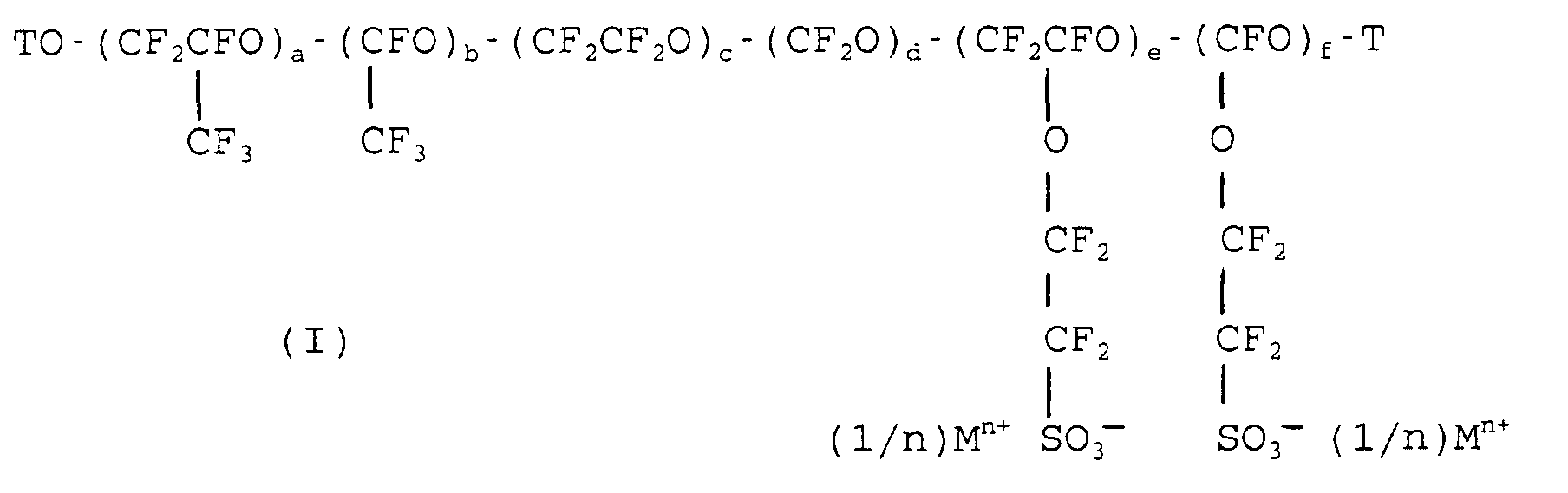
- An object of the invention are electrolytic compositions comprising a perfluoropolyether additive of formula (I): wherein:
- the selection of the cation and of the molecular weight of the perfluoro-polyether additive must be such to assure the stability of the electrolytic solution.
- the electrolytic compositions of the invention besides the additive of formula (I), comprise:
- salts commonly employed in electrochemical systems can be used.
- Salts can be mentioned wherein the cation is selected from the group comprising H + , alkaline, alkaline-earth metals, trivalent metals, tetraalkylammonium and the anion is selected from: PF 6 - , ClO 4 - , AsF 6 - , BF 4 - , (R f1 SO 2 )(R f2 SO 2 )N - , R fv SO 3 - wherein R f1 , R f2 , R fv are independently selected from C 1 -C 4 perfluoroalkyl groups optionally containing heteroatoms.
- PF 6 - , ClO 4 - are preferably used.
- the solvents used to dissolve the conductive salt and the perfluoropolyether additive of the invention are aprotic polar solvents having a limited content of water, preferably lower than 50 ppm, such as for example 1,2-dimethoxyethane, 1,2-diethoxyethane, 1,3-dioxolane, 2-methyl-1,3-dioxolane, 4-methyl-1,3-dioxolane, tetrahydrofuran, 2-methyltetrahydrofuran, 1,4-dioxane, diethylcarbonate, propylencarbonate, ethylencarbonate, dimethylcarbonate, N,N-dimethyformamide, dimethysulphoxide.
- ester carbonates are used as aprotic polar solvents. It has been found by the Applicant that the additives of the invention, specifically those with M monovalent, are particularly soluble in the above solvents.
- the concentration of conductive salt in the electrolytic solution is higher than 0.5 moles/litre, preferably in the range 0.5-2 moles/litre, the concentration of the perfluoropolyether additive is higher than 10 meq/litre (calculated as cation M n+ ), preferably in the range 10 meq/litre-500 meq/litre.
- the matrix material can be in the form of solid, liquid polymer, gel or porous membrane.
- the solid polymer materials, optionally crosslinked, suitable to be used as matrix in electrochemical cells are selected from polyethylenoxide, polyesters, polyacrylates, polyvinilydenfluoride, polyacrylonitrile, having a water content preferably lower than 50 ppm.
- microporous polymers are used, such for example polyethylene, polypropylene having a surface tension generally in the range 28-35 mN/m (dyne/cm).
- the additives of the invention allow to decrease the surface tension of the electrolytic solution and to increase its wetting properties towards electrodes and separatory membranes of the electrochemical cell.
- the additives of the invention show a high thermal stability, even at temperatures of the order of 300°C and show a high chemical stability in the use conditions of the electrochemical cells.
- the perfluoropolyether compounds of the invention besides increasing the wetting properties of the electrolytic solution, contribute to the system charge transport, and therefore to its conductivity, by their dissociable cations (see the Examples).
- Another advantage of the invention resides in that the surface tension lowering conferred by the additives of the invention allows the use of solvents having a high viscosity and surface tension, such as for example propylencarbonate.
- solvents having a high viscosity and surface tension such as for example propylencarbonate.
- said solvents must be used in admixture with other solvents (for example dimethoxyethane, dimethylcarbonate, etc.) which have the further effect to lower the dielectric constant of the medium, worsening the electrochemical system efficiency. Therefore, the additives of the invention allow to increase the system conductivity, and the consequent battery functionality.
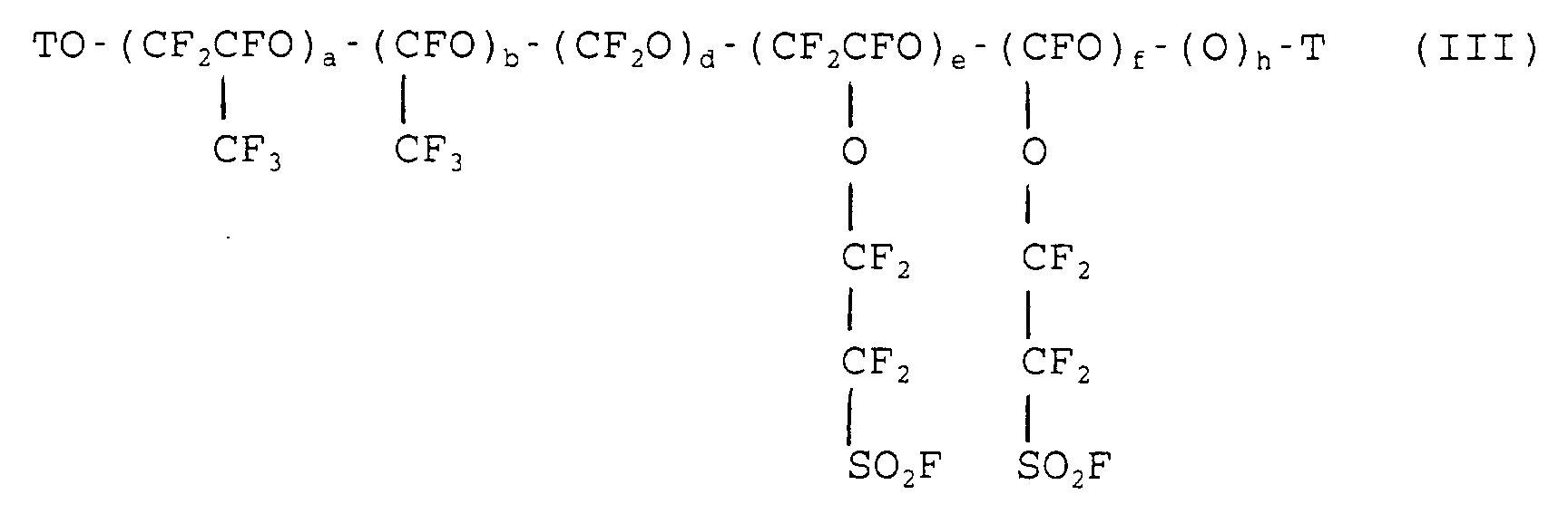
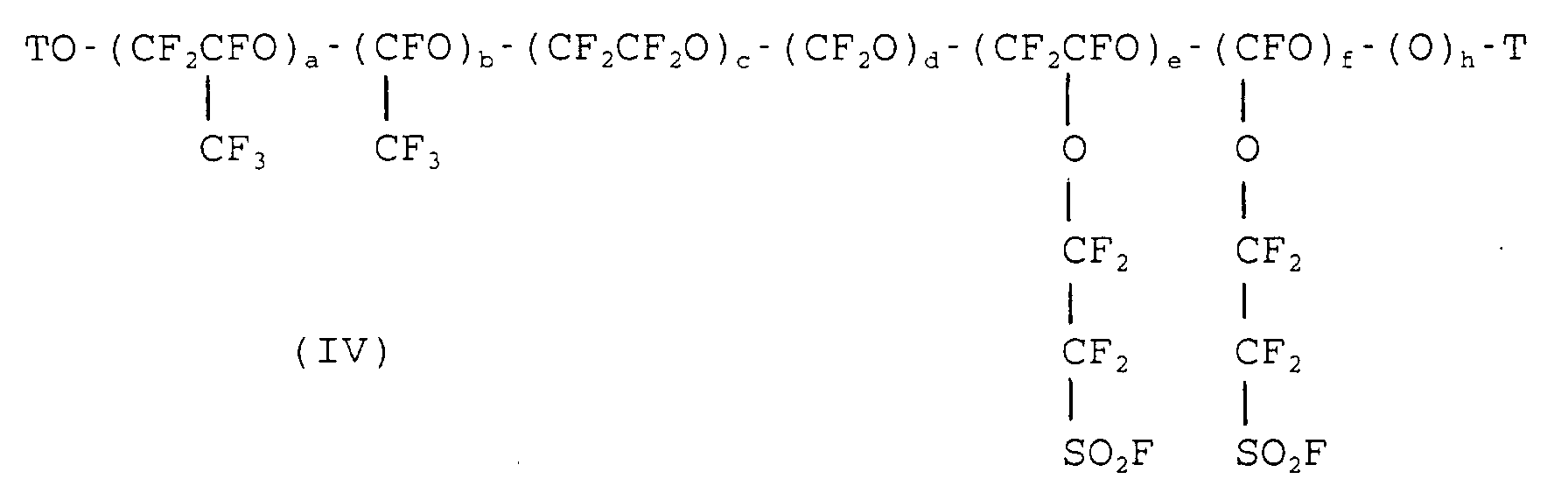
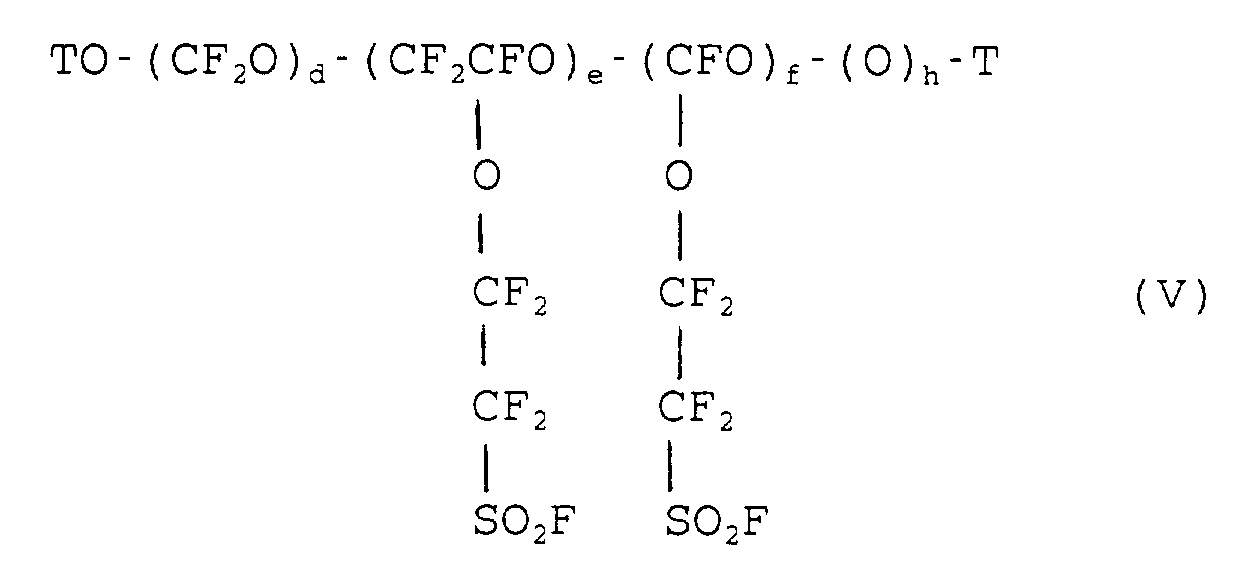
- the perfluoropolyether additives of the present invention contain one or more perfluorinated units of the type - (CF 2 CF(CF 3 )O)-, -(CF(CF 3 )O)-, -(CF 2 CF 2 O)-, -(CF 2 O)-, -(CF 2 CF(OCF 2 CF 2 SO 3 - (1/n)M n+ )O)-, -(CF(OCF 2 CF 2 SO 3 - (1/n)M n+ )O)- statistically distributed along the chain and in an amount variable depending on the operating process conditions mentioned below.
- perfluoropolyether copolymers of formula (IV) are obtained:
- the additives of formula (I) of the invention are obtainable starting from the above homopolymers or copolymers having the -SO 2 F function. These homopolymers or copolymers are obtainable by a photooxidation process of the monomers, i.e. a (co)polymerization process in the presence of oxygen which utilizes the action of ultraviolet radiations.
- a photooxidation process of the monomers i.e. a (co)polymerization process in the presence of oxygen which utilizes the action of ultraviolet radiations.
- An alternative process is the polymerization of monomers without the use of ultraviolet radiations and uses compounds having the function of polymerization initiators.
- a mixed process which uses UV radiations and polymerization initiators as defined below can be used.
- CFC chlorofluorocarbons
- HCFC hydrochlorofluorocarbons
- HFC hydrofluorocarbons
- FE fluoroethers
- HFE hydrofluoroethers
- FC fluorocarbons
- FC fluorocarbons
- the liquid reaction medium is maintained at a temperature in the range from -100° to +50°C, preferably from -90° to -30°C, and irradiated with ultraviolet radiation having wave length in the range 2,000-6,000 A°.
- a liquid reaction medium formed by a solvent selected from the above compounds.
- a gaseous or liquid flow of one or more compounds having one or more bonds F-Q wherein Q is selected between fluorine and oxygen is fed; when Q is oxygen, the initiator is an organic compound containing one or more fluoroxy groups.
- the initiator is a FOR f compound wherein R f is a perfluoroalkyl radical having from 1 to 3 carbon atoms; or it is a compound of the type FOCF 2 OF, FO-(RO) s -F, R f -(RO) s -F with R perfluoroalkylene radical of the type -CF 2 -, -CF 2 CF 2 -, -CF 2 CF(CF 3 )-, wherein s is in the range 1-100.
- Said initiators are described in USP 5,142,842, USP 5,258,110, USP 5,488,181.
- the initiator flow-rate is adjusted so that the molar ratio between the initiator and the monomers in the reaction medium is in the range 0.0001-0.1.
- the partial oxygen pressure is generally in the range 0.01-15 atmospheres;
- molar concentration at the pure state it is meant that the polymerization can be carried out in the presence of the sulphonyl monomer at the liquid state, or the maximum concentration of said monomer in the above indicated used solvent. The skilled is easily able to determine said maximum concentration.
- the reaction can be carried out in batch or in a continuous way, continuously drawing from the reactor an aliquot of the liquid phase, subjecting it to distillation, recycling the solvent, if any, and the unreacted monomers and recovering the reaction product.
- the frequency of the sulphonylfluoride group -CF(OCF 2 CF 2 SO 2 F)- in the chain is proportional to the ratio perfluoroalkylsulphonylvinylether/olefins in the reaction mixture and it can range from 1 to 99% of the total units of the perfluoropolyether.
- the peroxidic perfluoropolyethers are subjected to a thermal treatment at temperatures generally comprised between 150°C and 250°C, or to a photochemical treatment at temperatures generally comprised between -40°C and +150°C in the presence of UV radiations having wave length between 2,000 and 6,000 A° and in the presence of an optional solvent.
- a thermal treatment at temperatures generally comprised between 150°C and 250°C
- a photochemical treatment at temperatures generally comprised between -40°C and +150°C in the presence of UV radiations having wave length between 2,000 and 6,000 A° and in the presence of an optional solvent.
- the additives of the invention of formula (I) are obtained by conversion of the fluorosulphonyl groups -OCF 2 CF 2 SO 2 F of the perfluoropolyethers not containing peroxidic oxygen.
- the conversion of the fluorosulphonyl groups is carried out by hydrolysis using an excess of M metals hydroxides and then carbonating the excess of unreacted hydroxides by bubbling CO 2 in the aqueous solution.
- the insoluble inorganic salts obtained from the reaction are removed by evaporation of the water at reduced pressure and repeated hot washings with absolute alcohol and subsequent filtration of the insoluble residue.
- the additives of the invention are isolated by evaporation at reduced pressure of the ethanol.
- the surface tensions of the electrolytic solutions have been measured by the De Noüy method according to ASTM D1331-89.
- the method determines, by microbalance, the maximum exertable force F in the extraction of a Pt ring from the liquid, without complete detachment and breaking of the surface film.
- the surface tension is equivalent to the force which opposes the ring detachment and it can be expressed in mN/m both as force for length unit and as work for surface unit.
- the surface tension value is deduced from F by tabulated corrective factors which include the ring geometric parameters and the liquid density. All the measurements have been performed at 25°C with the KSV Sigma 70 equipment, using the corrective factor of Huh-Mason (as described in Colloid Polym. Sci., 253 (1975) 566), repeating the measurements in the time up to a constant value for at least 5 consecutive measurements.
- the wetting properties of a liquid towards a solid substratum depend on the contact angle ⁇ , defined by the intersection of the planes tangent to the liquid the liquid and solid surfaces.
- ⁇ defined by the intersection of the planes tangent to the liquid the liquid and solid surfaces.
- the condition of complete wettability corresponds to ⁇ equal to zero, while ⁇ equal to 180° corresponds to zero wettability (ideally spherical drop of liquid on the substratum in equilibrium conditions).
- KSV Sigma 70 used also as tensiometer
- ⁇ adv The difference of ⁇ adv among subsequent cycles is known as kinetic hysteresis and it is associated to the evolution of the surface characteristics in the time and used for the study of the progressive adsorption on the substratum of surfactant species in solution (see for example J. Colloid Interface Sci., 191 (1997) 303). All the measurements have been performed at 25°C, at a dipping rate of the substratum of 6 mm/min. As substratum moulded plates of low density polyethylene (LDPE) have been used, having a value of critical surface tension ⁇ cr of 30 ⁇ 1 mN/m, using contact angle measurements of the substratum towards pure liquids having a known surface tension.
- LDPE low density polyethylene
- Viscosities have been measured at 25°C by Cannon-Fenske viscometer according to the ASTM D 445 method.
- the Specific Conductivity ⁇ measurements have been carried out by an AMEL mod. 360 conductimeter (measurement frequency 1 KHz at ⁇ >100 ⁇ S/cm and 40 Hz at lower ⁇ ), with Pt cell having a constant of 0.995 cm.
- the model system used to evaluate the measurement conditions in the mixture ethylencarbonate/propylencarbonate (EC/PC) 1:1 is the salt CF 3 (CF 2 ) 6 CF 2 SO 3 - Li + . Within the solubility limits of this salt in the solvent, linearity between conductivity and concentration has been obtained.
- each specimen has been put in a thermostated glass cell at 25 ⁇ 0.5°C under magnetic stirring, bubbling N 2 , anhydrified with CaCl 2 and saturated in the same anhydrified solvent mixture for 20 minutes. Subsequently, each solution has been maintained under inert atmosphere, following the conductivity variation thereof in the time up to a constant value. The difference between the initial value and that of the equilibrium was always around 1% of the equilibrium value.
- the specific conductivity values reported in the Examples refer at least 3-4 measurements with a deviation within ⁇ 0,5%.
- a UV ray lamp of the HANAU TQ 150 type (which emits 47 watt of UV radiation having wave length in the range 2,000 and 3,000 ⁇ ) it is turned on and the irradiation and the oxygen feeding are continued for 15 hours.
- the UV lamp heat is controlled by a closed cycle cooling system.
- the lamp is turned off and the CF 2 Cl 2 is recovered by evaporation at room temperature. 1,076 g of a colourless oily residue are obtained.
- Said product has (iodometric titration) an active (peroxidic) oxygen content equal to 0.35% by weight.
- the lithium content analysis carried out by the Inductively Coupled Plasma (ICP) technique, shows a total conversion of the -SO 2 F groups of the perfluoropolyether to -SO 3 (-) Li (+) and of the end groups -COF to -COO - Li + .
- ICP Inductively Coupled Plasma
- a PFPE-lithium sulphonate is obtained which has been characterized by thermogravimetric analysis to determine the thermal stability thereof.
- the thermogravimetry has been carried out in nitrogen with a temperature gradient of 10°C/min from 30°C to 700°C.
- a weight loss of 1.5% at 150°C, of 6% at 250°C, of 20% at 300°C is determined.
- the PFPE-lithium sulphonate is dissolved in concentration 1 N in a mixture of ethylencarbonate/propylencarbonate EC/PC (50/50 by weight).
- the polyethylene plate is dipped into the prepared solution.
- Table 1 The data relating to subsequent immersion and emersion cycles of the plate are shown in Table 1, wherein the measures of the advancing dynamic contact angle ( ⁇ adv ) and of the recession angle ( ⁇ rec ) are reported.
- the surface tension value of the PFPE-lithium sulphonate solution in EC/PC is reported in Table 2.
- Said imide salt is dissolved in concentration 1 N in an EC/PC mixture 50/50 by weight. Then the polyethylene plate is dipped into the prepared solution. The data relating to subsequent immersion and emersion cycles of the plate are shown in Table 1, wherein the measures of the advancing dynamic contact angle ( ⁇ adv ) and of the recession angle ( ⁇ rec ) are reported. The surface tension value of the imide salt solution in EC/PC is reported in Table 2.
- Table 1 points out how in the case of the solution containing the additive PFPE-lithium sulphonate of the invention, already at the first cycle, clearly lower dynamic contact angles are obtained compared with those of the solution containing the imide salt.
- the solution of Example 2 wets more quickly and more effectively the surface of the polyethylene plate with respect to the solution of Example 3.
- the difference between the first ⁇ adv and all the other measured angles, together with the absence of hysteresis verified in the subsequent cycles show the capability of the additive PFPE- lithium sulphonate to permanently modify the substratum surface, making it solvophilic. From the results of Example 3, wherein hysteresis phenomena are evident also in the cycles following the first one, one concludes that the imide salt additive is unable to permanently modify the substratum surface.
- the wetting properties conferred by the perfluoropolyether additive of the invention are tested in an electrolytic solution containing as conductive salt Li (+) PF 6 (-) (high purity, battery grade) purchased by Aldrich Chimica, Division of the Sigma-Aldrich S.r.1.
- a solution 1 N of LiPF 6 in propylencarbonate is prepared ( solution 1 ).
- a second solution is prepared by adding to the solution 1 the imide salt of formula (C 4 F 9 SO 2 ) 2 N (-) Li (+) in concentration 0.1 N ( solution 2 ).
- Solution 1 solution 1N of LiPF 6 in PC
- Solution 2 solution 1N of LiPF 6 and 0.1N of (C 4 F 9 SO 2 ) 2 N (-) Li (+) in PC
- the values of the surface tension ⁇ , viscosity ⁇ and density ⁇ of the obtained solutions have been measured.
- Table 3 shows that the PFPE-lithium sulphonate of the invention meaningfully decreases the surface tension of the solution 1N of LiPF 6 , in an extent greater than the imide salt (C 4 F 9 SO 2 ) 2 N (-) Li (+) , the concentration being equal.
- the data show furthermore that the solution 3 of the invention has lower viscosity and density with respect to the electrolytic solution containing the imide salt.
- the specific conductivity ⁇ has ben measured at 25°C of the following electrolytic solutions containing the PFPE additive of the invention:
- the values show how the addition of PFPE-Li sulphonate to a conductive salt LiPF 6 solution, determines a small decrease of the specific conductivity, of the same order as that determined by the imide salt (C 4 F 9 SO 2 ) 2 N (-) Li (+) .
- This Example shows that solution 2 and solution 3, respectively containing the imide salt and the PFPE-lithium sulphonate, give the same specific conductivity values.
Landscapes
- Chemical & Material Sciences (AREA)
- Organic Chemistry (AREA)
- Chemical Kinetics & Catalysis (AREA)
- Electrochemistry (AREA)
- General Chemical & Material Sciences (AREA)
- General Physics & Mathematics (AREA)
- Engineering & Computer Science (AREA)
- Medicinal Chemistry (AREA)
- Physics & Mathematics (AREA)
- Condensed Matter Physics & Semiconductors (AREA)
- Health & Medical Sciences (AREA)
- Inorganic Chemistry (AREA)
- Polymers & Plastics (AREA)
- Manufacturing & Machinery (AREA)
- Dispersion Chemistry (AREA)
- Secondary Cells (AREA)
- Polyethers (AREA)
- Paints Or Removers (AREA)
- Compositions Of Macromolecular Compounds (AREA)
- Organic Low-Molecular-Weight Compounds And Preparation Thereof (AREA)
Abstract

Description
- one or more aprotic polar solvents;
- a conductive salt having the function to assure the ionic conductivity inside the cell.
- (CF2CF(CF3)O)-, -(CF(CF3)O)-, -(CF2CF2O)-, -(CF2O)-, -(CF2CF(OCF2CF2SO3 -(1/n)Mn+)O)-, -(CF(OCF2CF2SO3 -(1/n)Mn+)O)-
statistically distributed along the chain and in an amount variable depending on the operating process conditions mentioned below.

An alternative process is the polymerization of monomers without the use of ultraviolet radiations and uses compounds having the function of polymerization initiators. Also a mixed process which uses UV radiations and polymerization initiators as defined below can be used.
All the measurements have been performed at 25°C, at a dipping rate of the substratum of 6 mm/min. As substratum moulded plates of low density polyethylene (LDPE) have been used, having a value of critical surface tension γcr of 30± 1 mN/m, using contact angle measurements of the substratum towards pure liquids having a known surface tension.
d=1.4; e=3.5; f=4.1.
Therefore an average molecular weight of 2,330 is calculated with an equivalent weight of 288.
Therefore an average molecular weight of 7,130 is calculated with an equivalent weight of 320.
The water is evaporated at reduced pressure, a hot washing is carried out with absolute alcohol and the mixture is filtered on porous septum, thus removing the inorganic salts (lithium carbonate and lithium fluoride) insoluble in ethanol. This operation is repeated twice, then the ethanol is evaporated under reduced pressure and 50 grams of PFPE-lithium sulphonate are obtained, with a yield equal to 83%.
The Differential Scanning Calorimetry identifies the Tg (Onset) of the PFPE-lithium sulphonate at -37°C.
The data relating to subsequent immersion and emersion cycles of the plate are shown in Table 1, wherein the measures of the advancing dynamic contact angle (adv) and of the recession angle (rec) are reported.
The surface tension value of the PFPE-lithium sulphonate solution in EC/PC is reported in Table 2.
The data relating to subsequent immersion and emersion cycles of the plate are shown in Table 1, wherein the measures of the advancing dynamic contact angle (adv) and of the recession angle (rec) are reported.
The surface tension value of the imide salt solution in EC/PC is reported in Table 2.
| Cycle Number | EXAMPLE 2 | EXAMPLE 3 (Comp.) | ||
| (adv) | (rec) | (adv) | (rec) | |
| 1 | 46 | < 5 | 65 | < 10 |
| 2 | < 5 | < 5 | 64 | 22 |
| 3 | < 5 | < 5 | 65 | 25 |
| 4 | < 5 | < 5 | 67 | 25 |
| Surface Tension (mNm-1) | |
| Example 2 | 21 |
| Example 3 (Comp.) | 31 |
Besides, as regards the solution of Example 2, the difference between the first adv and all the other measured angles, together with the absence of hysteresis verified in the subsequent cycles, show the capability of the additive PFPE- lithium sulphonate to permanently modify the substratum surface, making it solvophilic.
From the results of Example 3, wherein hysteresis phenomena are evident also in the cycles following the first one, one concludes that the imide salt additive is unable to permanently modify the substratum surface.
A solution 1 N of LiPF6 in propylencarbonate is prepared (solution 1).
A second solution is prepared by adding to the solution 1 the imide salt of formula (C4F9SO2)2N(-) Li(+) in concentration 0.1 N (solution 2).
A third solution is prepared by adding to the solution 1 the PFPE-lithium sulphonate (EW=288) prepared according to Example 1 and in concentrtion 0.1 N (solution 3).
Solution 1: solution 1N of LiPF6 in PC;
Solution 2: solution 1N of LiPF6 and 0.1N of (C4F9SO2)2N(-) Li(+) in PC;
Solution 3: solution 1N of LiPF6 and 0.1N PFPE-lithium sulphonate (EW=288) in PC.
The values of the surface tension γ, viscosity η and density ρ of the obtained solutions have been measured.
| Solution | γ (mNm-1) | η (cst) | ρ (g/ml) |
| 1 | 41.1 | 5.69 | 1.2798 |
| 2 (Comp.) | 33.0 | 7.51 | 1.3001 |
| 3 | 28.4 | 7.05 | 1.2890 |
The specific conductivity κ of the prepared solutions is measured at 25°C. The values are reported in Table 4.
| Solution | Concentration (N) | κ (mS/cm) |
| 1 | 1 | 0.871 |
| 2 | 1 | 0.817 |
| 3 | 0.5 | 0.929 |
| 4 EC/PC (1:1) | - | 0.060 |
| Solution | κ (mS/cm) |
| 1 | 5.731 |
| 2 (Comp) | 5.132 |
| 3 | 5.133 |
Claims (17)
- Electrolytic compositions comprising a perfluoropolyether additive of formula (I):wherein:
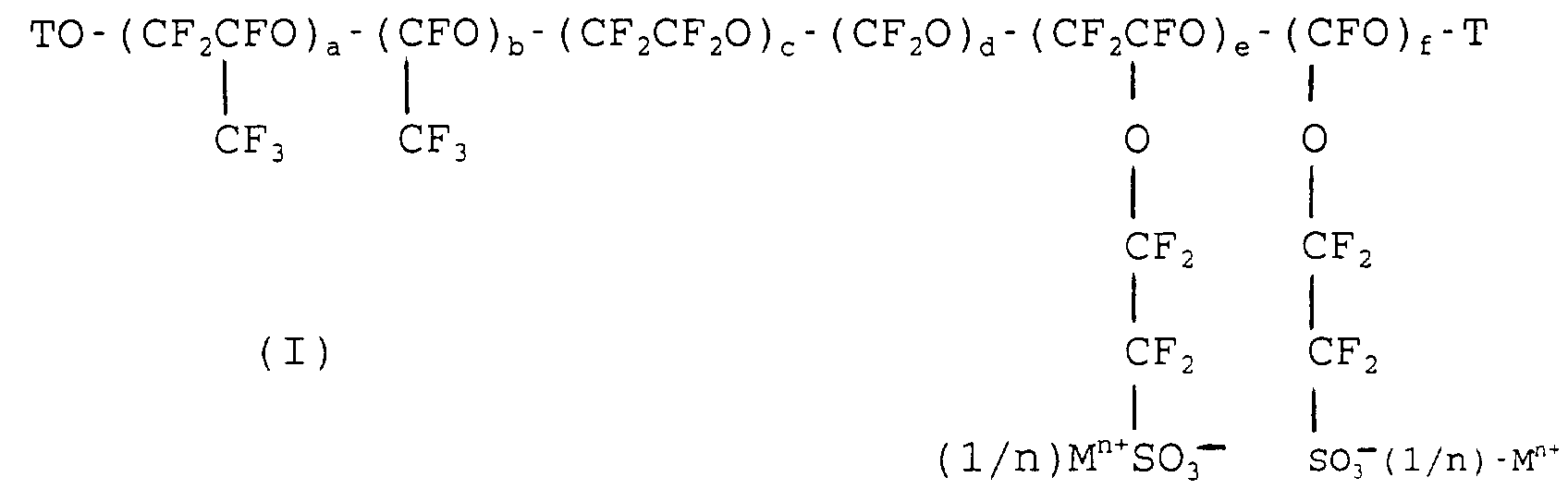 d,e,f are integers; a,b,c can be zero or integers; said units being statistically distributed along the chain, a+b+c+d+e+f such that the number average molecular weight ranges from 500 to 5x10⁵, preferably from 1,000 to 50,000;T are end groups selected from -CF2X (X=F,CF3,Cl), -C3F7, -CF(CF3)COO- (1/n)Mn+, -CF2COO (1/n)Mn+, -CF2C(O(1/n)Mn+)2CF3;Mn+ is a cation having valence n=1-4 selected from Li+, Na+, K+, Cs+, Mg2+, Ca2+, Sr2+, Ba2+, metal cations of the group IIIA such as Al3+; transition metal cations, such as Fe2+, Fe3+, Zn2+, Ti4+, Cu2+;tetraalkylammonium NR4 + cations, trialkylammonium NR3 + cations, wherein R is selected from H, a linear or branched when possible C1-C4 lower alkyl.
 - Electrolytic compositions according to claim 1, wherein Mn+ is a monovalent cation (n=1), preferably M=Li+.
- Electrolytic compositions according to claims 1-2, furthermore comprising:one or more aprotic polar solvents;a conductive salt.
- Electrolytic compositions according to claim 3, wherein the conductive salt cation is selected from the group comprising alkaline, alkaline-earth metals, trivalent metals, tetra-alkyulammonium; the anion is selected from: PF6 -, ClO4 -, AsF6 -, BF4 -, (Bf1SO2)(Bf2SO2)N-, BfvSO3 - wherein Rf1, Rf2, Rfv are independently selected from C1-C4 perfluoroalkyl groups optionally containing heteroatoms.
- Electrolytic compositions according to claims 3-4, wherein the aprotic polar solvents are selected from 1,2-dimethoxyethane, 1,2-diethoxyethane, 1,3-dioxolane, 2-methyl-1,3-dioxolane, 4-methyl-1,3-dioxolane, tetrahydrofuran, 2-methyltetrahydrofuran, 1,4-dioxane, N,N-dimethylformamide, dimethylsulphoxide, ester carbonates such as dimethylcarbonate, diethylcarbonate, propylencarbonate, ethylencarbonate.
- Electrolytic compositions according to claim 5, wherein the solvents are ester carbonates.
- Electrolytic compositions according to claims 1-6, wherein the concentration of conductive salt in the electrolytic solution is higher than 0.5 moles/litre, preferably in the range 0.5-2 moles/litre.
- Electrolytic compositions according to claims 1-7, wherein the concentration of the perfluoropolyether additive is higher than 10 meq/litre (calculated as cation Mn+), preferably in the range 10 meq/litre-500 meq/litre.
- Electrolytic compositions according to claims 1-8, whereien the ionic species are at least partially dissolved or dispersed in a matrix material.
- Electrolytic compositions according to claim 9, wherein the matrix material is in the form of solid, liquid polymer, gel or porous membrane.
- Electrolytic compositions according to claims 9-10, wherein the matrix material in the form of solid polymer is selected from polyethylenoxide, polyesters, polyacrylates, polyvinilydenfluoride, polyacrylonitrile.
- Electrolytic compositions according to claims 9-11, wherein the matrix material in the form of porous solid membranes is selected from polyethylene, polypropylene having a surface tension in the range 28-35 mN/m (dyne/cm).
- Electrolytic compositions according to claims 1-12, wherein the perfluoropolyether additive of formula (I) is obtainable by conversion of the fluorosulphonyl groups -SO2F into -SO3M groups carried out on the homopolymers of the monomer CF2=CFOCF2CF2SO2F or on the copolymers of said monomer with perfluoroolefins.
- Electrolytic compositions according to claim 13, wherein the perfluoroolefins are tetrafluoroethylene and/or perfluoropropene.
- Use of the electrolytic compositions according to claims 1-14, in electrochemical systems, such as lithium batteries.
- Electrochemical system comprising the electrolytic compositions according to claims 1-14.
- Perfluoropolyether additives according to claims 1-2.
Applications Claiming Priority (2)
| Application Number | Priority Date | Filing Date | Title |
|---|---|---|---|
| ITMI010008 | 2001-01-03 | ||
| IT2001MI000008A ITMI20010008A1 (en) | 2001-01-03 | 2001-01-03 | ADDITIVES FOR FLUOROPOLIETEREI FOR ELECTROMAGNETIC APPLICATIONS |
Publications (3)
| Publication Number | Publication Date |
|---|---|
| EP1221733A2 true EP1221733A2 (en) | 2002-07-10 |
| EP1221733A3 EP1221733A3 (en) | 2005-08-17 |
| EP1221733B1 EP1221733B1 (en) | 2006-12-06 |
Family
ID=11446382
Family Applications (1)
| Application Number | Title | Priority Date | Filing Date |
|---|---|---|---|
| EP01130566A Expired - Lifetime EP1221733B1 (en) | 2001-01-03 | 2001-12-21 | Perfluoropolyether additives for electrochemical applications |
Country Status (5)
| Country | Link |
|---|---|
| US (1) | US6896996B2 (en) |
| EP (1) | EP1221733B1 (en) |
| JP (1) | JP2002305023A (en) |
| DE (1) | DE60125012T2 (en) |
| IT (1) | ITMI20010008A1 (en) |
Cited By (10)
| Publication number | Priority date | Publication date | Assignee | Title |
|---|---|---|---|---|
| WO2006119224A1 (en) * | 2005-05-03 | 2006-11-09 | 3M Innovative Properties Company | Fluorinated ionomers with reduced amounts of carbonyl end groups |
| WO2010063745A1 (en) * | 2008-12-05 | 2010-06-10 | Solvay Solexis S.P.A. | Polyfunctional (per)fluoropolyethers |
| EP2421081A1 (en) * | 2010-08-20 | 2012-02-22 | Leclanché S.A. | Electrolyte comprising a wetting agent for a battery |
| US9178250B2 (en) | 2010-08-20 | 2015-11-03 | Leclanche' Sa | Electrolyte for a battery |
| WO2016083279A1 (en) | 2014-11-27 | 2016-06-02 | Solvay Specialty Polymers Italy S.P.A. | Bifunctional fluorinated polymers comprising a plurality of (per)fluoropolyether segments |
| US9748604B2 (en) | 2012-10-19 | 2017-08-29 | The University Of North Carolina At Chapel Hill | Ion conducting polymers and polymer blends for alkali metal ion batteries |
| US9755273B2 (en) | 2013-04-01 | 2017-09-05 | The University Of North Carolina At Chapel Hill | Ion conducting fluoropolymer carbonates for alkali metal ion batteries |
| CN107508001A (en) * | 2016-06-14 | 2017-12-22 | 松下知识产权经营株式会社 | Battery electrolytic solution and battery |
| CN107546412A (en) * | 2016-06-24 | 2018-01-05 | 三星电子株式会社 | Polymer dielectric, the method for preparing the polymer dielectric and include its lithium metal battery |
| US10227288B2 (en) | 2015-02-03 | 2019-03-12 | Blue Current, Inc. | Functionalized fluoropolymers and electrolyte compositions |
Families Citing this family (24)
| Publication number | Priority date | Publication date | Assignee | Title |
|---|---|---|---|---|
| KR100446659B1 (en) * | 2001-05-09 | 2004-09-04 | 주식회사 엘지화학 | Electrolyte containing non-ionic surface active agent and its application to lithium ion battery |
| CN1829564B (en) * | 2003-06-02 | 2010-12-15 | Ge奥斯莫尼克斯公司 | Materials for treating non-aqueous mixtures and methods for their preparation |
| KR100892048B1 (en) | 2006-09-18 | 2009-04-06 | 주식회사 엘지화학 | Secondary battery with improved high rate discharge characteristics |
| US9893337B2 (en) | 2008-02-13 | 2018-02-13 | Seeo, Inc. | Multi-phase electrolyte lithium batteries |
| US20110003211A1 (en) * | 2008-02-13 | 2011-01-06 | Seeo, Inc. | Electrodes with solid polymer electrolytes |
| JP5217645B2 (en) * | 2008-06-04 | 2013-06-19 | Tdk株式会社 | Electrolytes and electrochemical devices |
| US20100266907A1 (en) * | 2008-11-04 | 2010-10-21 | Rachid Yazami | Metal air battery system |
| KR20140039254A (en) * | 2011-06-07 | 2014-04-01 | 쓰리엠 이노베이티브 프로퍼티즈 컴파니 | Lithium-ion electrochemical cells including fluorocarbon electrolyte additives |
| WO2013090249A1 (en) * | 2011-12-14 | 2013-06-20 | 3M Innovative Properties Company | Electrochemical cells including partially fluorinated soluble polymers as electrolyte additives |
| US9923245B2 (en) | 2015-04-03 | 2018-03-20 | Seeo, Inc. | Fluorinated alkali ion electrolytes with urethane groups |
| WO2016164505A1 (en) | 2015-04-07 | 2016-10-13 | Seeo, Inc. | Fluorinated alkali ion electrolytes with cyclic carbonate groups |
| KR20180005173A (en) | 2015-05-12 | 2018-01-15 | 시오 인코퍼레이티드 | Copolymers of PEO and fluorinated polymers as electrolytes for lithium batteries |
| WO2016200559A1 (en) | 2015-06-09 | 2016-12-15 | Seeo, Inc. | Peo-based graft copolymers with pendant fluorinated groups for use as electrolytes |
| CN105140563A (en) * | 2015-07-28 | 2015-12-09 | 珠海市赛纬电子材料有限公司 | Electrolyte functional additive, non-aqueous lithium-ion battery electrolyte containing additive and lithium-ion battery |
| KR102547797B1 (en) * | 2015-11-04 | 2023-06-26 | 삼성전자주식회사 | Polymer electrolyte and battery including the same |
| JP6872562B2 (en) * | 2016-05-10 | 2021-05-19 | シーオ インコーポレーテッドSeeo, Inc. | Fluorinated electrolyte with nitrile group |
| HUE061777T2 (en) * | 2016-07-25 | 2023-08-28 | Solvay Specialty Polymers It | Liquid electrolytes for lithium batteries |
| CN109417196B (en) * | 2017-01-12 | 2021-08-20 | 株式会社Lg化学 | Nonaqueous electrolyte and lithium secondary battery including the same |
| US11196087B2 (en) | 2017-05-19 | 2021-12-07 | Panasonic Intellectual Property Management Co., Ltd. | Nonaqueous electrolyte containing perfluoropolyether and nitrile compound, and secondary battery including the same |
| JP7467449B2 (en) * | 2018-11-12 | 2024-04-15 | ソルベイ スペシャルティ ポリマーズ イタリー エス.ピー.エー. | Solid electrolyte composition |
| US11424484B2 (en) | 2019-01-24 | 2022-08-23 | Octet Scientific, Inc. | Zinc battery electrolyte additive |
| CN111864253B (en) * | 2019-04-24 | 2023-05-09 | 惠州比亚迪实业有限公司 | Lithium ion battery electrolyte and lithium ion battery |
| EP4649105A1 (en) * | 2023-01-12 | 2025-11-19 | Syensqo Specialty Polymers Italy S.p.A. | Perfluoropolyether polymers |
| EP4649104A1 (en) * | 2023-01-12 | 2025-11-19 | Syensqo Specialty Polymers Italy S.p.A. | Composition comprising (per)fluoropolyether polymers |
Family Cites Families (12)
| Publication number | Priority date | Publication date | Assignee | Title |
|---|---|---|---|---|
| IT1213071B (en) | 1986-05-07 | 1989-12-07 | Ausimont Spa | PERFLUOROPOLYETERS FREE OF PEROXIDE OXYGEN AND CONTAINING PERFLUOROEPOXID GROUPS ARRANGED ALONG THE PERFLUOROPOLYETHER CHAIN. |
| US4981727A (en) * | 1986-08-29 | 1991-01-01 | Minnesota Mining And Manufacturing Company | Polyfluoropolyethers having pendant perfluoroalkoxy groups |
| IT1229845B (en) * | 1989-04-20 | 1991-09-13 | Ausimont Srl | PROCEDURE FOR THE PREPARATION OF PEROXIDE PERFLUOROPOLYETERS. |
| US5142842A (en) * | 1989-12-13 | 1992-09-01 | W. R. Grace & Co.-Conn. | Method for making a film/foil panel |
| US5608022A (en) * | 1993-10-12 | 1997-03-04 | Asahi Kasei Kogyo Kabushiki Kaisha | Perfluorocarbon copolymer containing functional groups and a method for producing it |
| IT1264977B1 (en) * | 1993-11-17 | 1996-10-17 | Ausimont Spa | PROCESS FOR PREPARING PERFLUOROPOLYSTERS |
| US5872157A (en) * | 1996-01-30 | 1999-02-16 | The University Of North Carolina At Chapel Hill | Method for olefin oxidation |
| US5882810A (en) * | 1996-03-08 | 1999-03-16 | The Dow Chemicalcompany | Active layer for membrane electrode assembly |
| DE19644942A1 (en) | 1996-10-29 | 1998-04-30 | Kba Planeta Ag | Batch logistics |
| KR100559110B1 (en) | 1997-12-10 | 2006-03-13 | 미네소타 마이닝 앤드 매뉴팩춰링 캄파니 | Bis (perfluoroalkylsulfonyl) imide surfactant salts in electrochemical systems |
| CH693625A5 (en) * | 1999-02-18 | 2003-11-28 | Inpharma Sa | Pharmaceutical compositions containing compounds of promoter activity of absorption of active ingredients. |
| IT1313597B1 (en) * | 1999-08-04 | 2002-09-09 | Ausimont Spa | FLUOROPOLYEREOUS LUBRICANTS CONTAINING SULPHONYLFLUORIDE GROUPS |
-
2001
- 2001-01-03 IT IT2001MI000008A patent/ITMI20010008A1/en unknown
- 2001-12-21 DE DE60125012T patent/DE60125012T2/en not_active Expired - Fee Related
- 2001-12-21 EP EP01130566A patent/EP1221733B1/en not_active Expired - Lifetime
- 2001-12-27 JP JP2001397756A patent/JP2002305023A/en active Pending
- 2001-12-28 US US10/028,310 patent/US6896996B2/en not_active Expired - Fee Related
Cited By (15)
| Publication number | Priority date | Publication date | Assignee | Title |
|---|---|---|---|---|
| US7214740B2 (en) | 2005-05-03 | 2007-05-08 | 3M Innovative Properties Company | Fluorinated ionomers with reduced amounts of carbonyl end groups |
| WO2006119224A1 (en) * | 2005-05-03 | 2006-11-09 | 3M Innovative Properties Company | Fluorinated ionomers with reduced amounts of carbonyl end groups |
| WO2010063745A1 (en) * | 2008-12-05 | 2010-06-10 | Solvay Solexis S.P.A. | Polyfunctional (per)fluoropolyethers |
| US8557952B2 (en) | 2008-12-05 | 2013-10-15 | Solvay Solexis S.P.A. | Polyfunctional (per)fluoropolyethers |
| EP2421081A1 (en) * | 2010-08-20 | 2012-02-22 | Leclanché S.A. | Electrolyte comprising a wetting agent for a battery |
| US9178250B2 (en) | 2010-08-20 | 2015-11-03 | Leclanche' Sa | Electrolyte for a battery |
| US9748604B2 (en) | 2012-10-19 | 2017-08-29 | The University Of North Carolina At Chapel Hill | Ion conducting polymers and polymer blends for alkali metal ion batteries |
| US9755273B2 (en) | 2013-04-01 | 2017-09-05 | The University Of North Carolina At Chapel Hill | Ion conducting fluoropolymer carbonates for alkali metal ion batteries |
| WO2016083279A1 (en) | 2014-11-27 | 2016-06-02 | Solvay Specialty Polymers Italy S.P.A. | Bifunctional fluorinated polymers comprising a plurality of (per)fluoropolyether segments |
| US10179836B2 (en) | 2014-11-27 | 2019-01-15 | Solvay Specialty Polymers Italy S.P.A. | Bifunctional fluorinated polymers comprising a plurality of (per)fluoropolyether segments |
| US10227288B2 (en) | 2015-02-03 | 2019-03-12 | Blue Current, Inc. | Functionalized fluoropolymers and electrolyte compositions |
| CN107508001A (en) * | 2016-06-14 | 2017-12-22 | 松下知识产权经营株式会社 | Battery electrolytic solution and battery |
| CN107508001B (en) * | 2016-06-14 | 2022-02-01 | 松下知识产权经营株式会社 | Electrolyte for battery and battery |
| CN107546412A (en) * | 2016-06-24 | 2018-01-05 | 三星电子株式会社 | Polymer dielectric, the method for preparing the polymer dielectric and include its lithium metal battery |
| CN107546412B (en) * | 2016-06-24 | 2022-01-04 | 三星电子株式会社 | Polymer electrolyte, method of preparing the same, and lithium metal battery including the same |
Also Published As
| Publication number | Publication date |
|---|---|
| ITMI20010008A0 (en) | 2001-01-03 |
| EP1221733A3 (en) | 2005-08-17 |
| JP2002305023A (en) | 2002-10-18 |
| DE60125012T2 (en) | 2007-06-28 |
| US6896996B2 (en) | 2005-05-24 |
| US20020127475A1 (en) | 2002-09-12 |
| EP1221733B1 (en) | 2006-12-06 |
| ITMI20010008A1 (en) | 2002-07-03 |
| DE60125012D1 (en) | 2007-01-18 |
Similar Documents
| Publication | Publication Date | Title |
|---|---|---|
| EP1221733B1 (en) | Perfluoropolyether additives for electrochemical applications | |
| JP7367817B2 (en) | Fluorosulfonyl group-containing compounds, fluorosulfonyl group-containing monomers, and methods for producing them | |
| EP1124796B1 (en) | Ionomers and polymers for electrochemical uses | |
| US10122001B2 (en) | Polymerized ionic liquid block copolymers as battery membranes | |
| US6100324A (en) | Ionomers and ionically conductive compositions | |
| US6025092A (en) | Fluorinated ionomers and their uses | |
| JP2002505356A (en) | Significantly fluorinated ionomer | |
| Boujioui et al. | Solid polymer electrolytes from a fluorinated copolymer bearing cyclic carbonate pendant groups | |
| EP1179548A1 (en) | Sulphonic fluorinated ionomers | |
| EP3892650A1 (en) | Production method of fluorine-containing polymer containing fluorosulfonyl group, production method of fluorine-containing polymer containing salt-type sulfonic acid group, and production method of fluorine-containing polymer containing acid-type sulfonic acid group | |
| JP2022515059A (en) | Vinylidene Fluoride Polymer Dispersion | |
| US12071494B2 (en) | Vinylidene fluoride polymer dispersion | |
| JP7355037B2 (en) | Acid-type sulfonic acid group-containing polymers, liquid compositions, solid polymer electrolyte membranes, membrane electrode assemblies, polymer electrolyte fuel cells, and ion exchange membranes for water electrolysis | |
| JP7543910B2 (en) | Liquid composition, solid polymer electrolyte membrane, membrane electrode assembly, and solid polymer fuel cell | |
| EP0970984B1 (en) | Perfluoropolyether acylperoxides and process for their preparation | |
| CN117980390A (en) | Reinforced shaped articles comprising fluoropolymers | |
| WO2019101698A1 (en) | A multilayer assembly for electrochemical cells | |
| MXPA01004122A (en) | Monomers, ionomers and polymers for electrochemical uses | |
| MXPA00007297A (en) | Fluorinated ionomers and their uses |
Legal Events
| Date | Code | Title | Description |
|---|---|---|---|
| PUAI | Public reference made under article 153(3) epc to a published international application that has entered the european phase |
Free format text: ORIGINAL CODE: 0009012 |
|
| AK | Designated contracting states |
Kind code of ref document: A2 Designated state(s): AT BE CH CY DE DK ES FI FR GB GR IE IT LI LU MC NL PT SE TR |
|
| AX | Request for extension of the european patent |
Free format text: AL;LT;LV;MK;RO;SI |
|
| RAP1 | Party data changed (applicant data changed or rights of an application transferred) |
Owner name: AGORA' S.P.A. |
|
| RAP1 | Party data changed (applicant data changed or rights of an application transferred) |
Owner name: SOLVAY SOLEXIS S.P.A. |
|
| PUAL | Search report despatched |
Free format text: ORIGINAL CODE: 0009013 |
|
| AK | Designated contracting states |
Kind code of ref document: A3 Designated state(s): AT BE CH CY DE DK ES FI FR GB GR IE IT LI LU MC NL PT SE TR |
|
| AX | Request for extension of the european patent |
Extension state: AL LT LV MK RO SI |
|
| 17P | Request for examination filed |
Effective date: 20051230 |
|
| AKX | Designation fees paid |
Designated state(s): DE FR GB IT |
|
| GRAP | Despatch of communication of intention to grant a patent |
Free format text: ORIGINAL CODE: EPIDOSNIGR1 |
|
| GRAS | Grant fee paid |
Free format text: ORIGINAL CODE: EPIDOSNIGR3 |
|
| GRAA | (expected) grant |
Free format text: ORIGINAL CODE: 0009210 |
|
| AK | Designated contracting states |
Kind code of ref document: B1 Designated state(s): DE FR GB IT |
|
| REG | Reference to a national code |
Ref country code: GB Ref legal event code: FG4D |
|
| REF | Corresponds to: |
Ref document number: 60125012 Country of ref document: DE Date of ref document: 20070118 Kind code of ref document: P |
|
| ET | Fr: translation filed | ||
| PLBE | No opposition filed within time limit |
Free format text: ORIGINAL CODE: 0009261 |
|
| STAA | Information on the status of an ep patent application or granted ep patent |
Free format text: STATUS: NO OPPOSITION FILED WITHIN TIME LIMIT |
|
| 26N | No opposition filed |
Effective date: 20070907 |
|
| PGFP | Annual fee paid to national office [announced via postgrant information from national office to epo] |
Ref country code: IT Payment date: 20071221 Year of fee payment: 7 |
|
| PGFP | Annual fee paid to national office [announced via postgrant information from national office to epo] |
Ref country code: FR Payment date: 20071210 Year of fee payment: 7 Ref country code: GB Payment date: 20071219 Year of fee payment: 7 |
|
| PGFP | Annual fee paid to national office [announced via postgrant information from national office to epo] |
Ref country code: DE Payment date: 20071213 Year of fee payment: 7 |
|
| GBPC | Gb: european patent ceased through non-payment of renewal fee |
Effective date: 20081221 |
|
| REG | Reference to a national code |
Ref country code: FR Ref legal event code: ST Effective date: 20090831 |
|
| PG25 | Lapsed in a contracting state [announced via postgrant information from national office to epo] |
Ref country code: DE Free format text: LAPSE BECAUSE OF NON-PAYMENT OF DUE FEES Effective date: 20090701 |
|
| PG25 | Lapsed in a contracting state [announced via postgrant information from national office to epo] |
Ref country code: GB Free format text: LAPSE BECAUSE OF NON-PAYMENT OF DUE FEES Effective date: 20081221 |
|
| PG25 | Lapsed in a contracting state [announced via postgrant information from national office to epo] |
Ref country code: FR Free format text: LAPSE BECAUSE OF NON-PAYMENT OF DUE FEES Effective date: 20081231 |
|
| PG25 | Lapsed in a contracting state [announced via postgrant information from national office to epo] |
Ref country code: IT Free format text: LAPSE BECAUSE OF NON-PAYMENT OF DUE FEES Effective date: 20081221 |