EP1221693A2 - Prosody template matching for text-to-speech systems - Google Patents
Prosody template matching for text-to-speech systems Download PDFInfo
- Publication number
- EP1221693A2 EP1221693A2 EP01310926A EP01310926A EP1221693A2 EP 1221693 A2 EP1221693 A2 EP 1221693A2 EP 01310926 A EP01310926 A EP 01310926A EP 01310926 A EP01310926 A EP 01310926A EP 1221693 A2 EP1221693 A2 EP 1221693A2
- Authority
- EP
- European Patent Office
- Prior art keywords
- prosody
- stress
- pattern
- text string
- syllabic
- Prior art date
- Legal status (The legal status is an assumption and is not a legal conclusion. Google has not performed a legal analysis and makes no representation as to the accuracy of the status listed.)
- Granted
Links
Images



Classifications
-
- G—PHYSICS
- G10—MUSICAL INSTRUMENTS; ACOUSTICS
- G10L—SPEECH ANALYSIS TECHNIQUES OR SPEECH SYNTHESIS; SPEECH RECOGNITION; SPEECH OR VOICE PROCESSING TECHNIQUES; SPEECH OR AUDIO CODING OR DECODING
- G10L13/00—Speech synthesis; Text to speech systems
- G10L13/08—Text analysis or generation of parameters for speech synthesis out of text, e.g. grapheme to phoneme translation, prosody generation or stress or intonation determination
- G10L13/10—Prosody rules derived from text; Stress or intonation
Definitions
- the present invention relates generally to text-to-speech synthesis. More particularly, the invention relates to a technique for applying prosody information to the synthesized speech using prosody templates, based on a tree-structured look-up technique.
- Text-to-speech systems convert character-based text (e.g., typewritten text) into synthesized spoken audio content.
- Text-to-speech systems are used in a variety of commercial applications and consumer products, including telephone and voicemail prompting systems, vehicular navigation systems, automated radio broadcast systems, and the like.
- Some systems use a model-based approach in which the resonant properties of the human vocal tract and the pulse-like waveform of the human glottis are modeled, parameterized, and then used to simulate the sounds of natural human speech.
- Other systems use short digitally recorded samples of actual human speech that are then carefully selected and concatenated to produce spoken words and phrases when the concatenated strings are played back.
- Prosody refers to the rhythmic and intonational aspects of a spoken language.
- a text-to-speech apparatus can have great difficulty simulating the natural flow and inflection of the human-spoken phrase or sentence because the proper inflection cannot always be inferred from the text alone.
- the human speaker in providing instructions to a motorist to turn at the next intersection, the human speaker might say "turn HERE,” emphasizing the word “here” to convey a sense of urgency.
- the text-to-speech apparatus simply producing synthesized speech in response to the typewritten input text, would not know whether a sense of urgency was warranted, or not. Thus the apparatus would not place special emphasis on one word over the other. In comparison to the human speech, the synthesized speech would tend to sound more monotone and monotonous.
- prosody information affects the pitch contours and/or duration values of the sounds being generated in response to text input.
- stressed or accented syllables are produced by raising the pitch of one's voice and/or by increasing the duration of the vowel portion of the accented syllable.
- the text-to-speech synthesizer can mimic the prosody of human speech.
- a template-based system to organize and associate prosody information with a sequence of text, where the text is described in terms of some sort of linguistic unit, such as a word or phrase.
- a library of templates is constructed for a collection of words or phrases that have different phonological characteristics. Then, given particular text input, the template with the best matching characteristics is selected and used to supply prosodic information for synthesis.
- the present invention provides a solution to this problem by a technique that finds the closest matching template for a given target synthesis and by then finding an optimal mapping between a not-exactly- matching template and target.
- the system is capable of generating new templates using portions of existing templates when an exactly matching template is not found.
- the prosody template matching system of the invention represents stress patterns in words in a tree structure, such as tree 10 .
- the presently preferred tree structure is a binary tree structure having a root node 12 under which our grouped pairs of child nodes, grandchildren nodes, etc.
- the nodes represent different stress patterns corresponding to how syllables are stressed or accented when the word or phrase is spoken.
- FIG. 2 an exemplary list of words is shown, together with the corresponding stress pattern for each word and its prosodic transcription.
- the word "Catalina” has its strongest accent on the third syllable, with an additional secondary accent on the first syllable.
- numbers have been used to designate different levels of stress applied to syllables, where "0" corresponds to an unstressed syllable, "1" corresponds to a strongly accented syllable and "2" corresponds to a less strongly stressed syllable. While numeric representations are used to denote different stress levels here, it will be understood that other representations can also be used to practice the invention. Also, while the description here focuses primarily on the accent or stress applied to a syllable, other prosodic features may also be represented using the same techniques as described here.
- the tree 10 serves as a component within the prosody pattern lookup mechanism by which stress patterns are applied to the output of the text-to-speech synthesizer 14.
- Text is input to the text analysis module 14 which determines strings of data that are ultimately fed to the sound generation module 16 .
- Part of this data found during text analysis is the grouping of sounds by syllable, and the assignment of stress level to each syllable. It is this pattern of stress assignments by syllable which will be used to access prosodic information by the prosody module 18 .
- prosodic modifications such as changing the pitch contour and/or duration of phonemes, are needed to simulate the manner in which a human speaker would pronounce the word or phrase in context.
- the text-to-speech synthesizer and its associated playback module and prosody module can be based on any of a variety of different synthesis techniques, including concatenative synthesis and model-based synthesis (e.g., glottal source model synthesis).
- the prosody module modifies the data string output from the text-to-speech synthesizer 14 based on prosody information stored in a lookup table 20 .
- table 20 contains both pitch modification information (in column 22), and duration modifying information, in column 24 .
- other types of prosody information can be used instead, depending on the type of text-to-speech synthesizer being used.
- the table 20 contains prosody information (pitch and duration) for each of a variety of different stress patterns, shown in column 26 .
- the pitch modification information might comprise a list of integer or floating point numbers used to adjust the height and evolution in time of the pitch being used by the synthesizer. Different adjustment values may be used to reflect whether the speaker is male or female.
- duration information may comprise integer or floating point numeric values indicating how much to extend the playback duration of selected sounds (typically the vowel sounds).
- the prosody pattern lookup module 28 associated with prosody module 18 accesses tree 10 to obtain pointers into table 20 and then retrieves the pitch and duration information for the corresponding pattern so that it may be used by prosody module 18 .
- the tree 10 illustrated in Figure 1 has been greatly abbreviated to allow it to fit on the page. In an actual embodiment, the tree 10 and its associated table 20 would typically contain more nodes and more entries in the table.
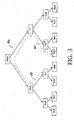
- Figure 3 shows the first three levels of an exemplary tree 10a that might be typical of a template system allowing for two levels of stress (stressed and unstressed) while Figure 4 shows the first two levels of an exemplary tree 10b illustrative of how a template lookup system might be implemented where three levels of stress are allowed (unstressed, primary stress, secondary stress).
- the number of levels in the tree correspond to the maximum number of syllables in the associated prosody template, in practice trees of eight or more levels may be required.
- nodes have been identified as "null".
- Other nodes contain stress pattern integers corresponding to particular combinations of stress patterns. In the general case, it would be possible to populate each of the nodes with a stress pattern; thus none of the nodes would be null. However, in an actual working system, there may be many instances where there are no training examples available for certain stress pattern combinations. Where there are no data available, the corresponding nodes in the tree are simply loaded with a null value, so that the tree can be traversed from parent to child, or vice versa, even though there may be no template data available for that node in table 20 . In other words, the null nodes serve as placeholders to retain the topological structure of the tree even though there are no stress patterns available for those nodes.
- the text input 30 has an associated syllable stress pattern 32 which is determined by the text analysis module 14 .
- these associated syllable stress patterns would be represented as numeric stress patterns corresponding to the numeric values found in tree 10.
- the prosody pattern lookup module 28 will traverse tree 10 until it finds node 40 containing pattern "10". Node 40 stores the stress pattern "10" that corresponds to a two syllable word having its first syllable stressed and its second syllable unstressed. From there, the pattern lookup module 28 accesses table 20, as at row 42, to obtain the corresponding pitch and duration information for the "10" pattern. This pitch and duration information, shown at 44 , is then supplied to prosody module 18 where it is used to modify the data string from synthesizer 14 so that the initial syllable will be stressed and the second syllable will be unstressed.
- the system does this, as will be more fully explained below, by matching the input text stress pattern to one or more patterns that do exist in the tree and then adding or cloning additional stress pattern values, as needed, to allow existing partial patterns to be concatenated to form the desired new pattern.
- the prosody pattern lookup module 28 handles situations where the complete prosody template for a given word does not exist in its entirety within the tree 10 and its associated table 20. The module does this by traversing or walking the tree 10, beginning at root node 12 and then following each of the branches down through each of the extremities. As the module proceeds from node to node, it tests at each step whether the stress pattern stored in the present node matches the stress pattern of the corresponding syllable within the word.
- the lookup module adds a predetermined penalty to a running total being maintained for each of the paths being traversed.
- the path with the lowest penalty score is the one that best matches the stress pattern of the target word.
- penalty scores are selected from a stored matrix of penalty values associated with different combinations of template syllable stress and target syllable stress.
- these pre-stored penalties may be further modified based on the context of the target word within the sentence or phrase being spoken. Contexts that are perceptually salient have penalty modifiers associated with them. For example, in spoken English, a prosody mismatch in word-final syllables is quite noticeable. Thus, the system increases the penalty selected from the penalty matrix for mismatches that occur in word-final syllables.
- a search is performed to match syllables in the target word to syllables in the reference template that minimizes the mismatch penalty.
- the search enumerates all possible assignments of target word syllables to reference template syllables. In fact, it is not necessary to enumerate all possible assignments because, in the process of searching it is possible to know that some sequence of syllable matches cannot possibly compete with another and can therefore be abandoned. In particular, if the mismatch penalty for a partial match exceeds the lowest mismatch penalty for a full match which has already been found, then the partial match can safely be abandoned.
- Figure 3 The tree structure of Figure 3 can be traversed from the root node through various paths to each of the eight leaf nodes appearing at the bottom of the tree.
- One such path is illustrated in dotted lines at 50.
- Other paths may be traced from the root node to intermediate nodes, such as path 52.
- Path 50 ends at the node containing pattern "100" while path 52 ends at the node containing pattern "01".
- Path 52 could also be extended to define an additional path ending at the node containing "010" as well.
- the prosody pattern lookup module 28 explores each of the possible paths, it accumulates a penalty score for each path.
- path 52 When attempting to match the stress pattern "01" of a target word supplied as input text, path 52 would have a zero penalty score, whereas all other paths would have higher penalty scores, because they do not exactly match the stress pattern of the target word. Thus, the lookup module would identify path 52 as the least-cost path and would then identify the node containing "01" as the proper node for use as an index into the prosody look-up table 20 (Fig. 1). All other paths, having higher penalty scores, would be rejected.
- the prosody pattern lookup module 28 addresses this situation by a node construction technique.
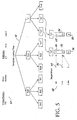
- Figure 5 gives a simple example of how the technique is applied.
- the target word "avenue” has a stress pattern of "102" as indicated by the dictionary information at 60 .
- the-prosody pattern lookup module would ideally like to find the node containing stress pattern "102" in the tree 10 . In this case, however, the stress pattern "102" is not found in tree 10 .
- the prosody pattern lookup module 28 seeks a three-syllable stress pattern within a tree structure that contains only two syllable stress patterns. There are, however, nodes containing "10" and "12” that may serve as an approximation of the desired pattern "102".
- the module generates an additional stress pattern by duplicating or cloning one of the nodes on a tree so that one syllable of a template can be used for two or more adjacent syllables of the target word.
- the target word "avenue” is shown broken up into syllables at 62 .
- Two nodes namely the node containing "10" and the node containing "12" match the stress pattern of the first syllable of the target word.
- the stress pattern of the first syllable of the target word shown at 64
- the beginning stress pattern of nodes "10" and "12”, as shown at 66 and 68 respectively.
- the stress pattern of the middle syllable of the target word, shown at 70 matches the second syllable of the "10" node, as shown at 72 . It does not match the second syllable of node "12” as shown at 74 .
- the lookup tree 10 contains only one and two syllable nodes, a third syllable must be generated.
- the preferred embodiment does this by cloning or duplicating the stress pattern of an adjacent syllable.
- an additional "0" stress pattern is added at 76 and an additional "2" stress pattern is added at 78.
- Both of the resulting paths are evaluated using the matrix of penalties. The cumulative scores of both are assessed and the solution with the lowest penalty score is selected.
- the preferred embodiment calculates the penalty by finding an initial penalty value in a lookup table.
- An exemplary lookup table is provided as follows: Input Syllable Template Syllable Stress Stress 0 1 2 0 0 16 2 1 16 0 4 2 2 4 0 This initial value is then modified to account for context effects by applying the following modification rules:
- the first generated solution "100" matches the target word "102" exactly, except for the final syllable. Because a substitution has occurred whereby a desired "2" is replaced with "0" an initial penalty of two is accrued (see matrix of penalties in Table I).
- the second solution "122" matches the target word "102" exactly, except for the substitution of a "2" for the "0" in the second syllable.
- a substitution of "2" for "0” also accrues a penalty of two.
- the second generated solution "122" has the lower cumulative penalty score and is selected as the stress pattern most closely correlated to the target word.
- the prosody pattern lookup module can contain a set of rules designed to break ties. For instance, successive unstressed syllables are favored over successive intermediate stressed syllables when selecting a solution. Pseudo-code implementing this preferred embodiment has been attached hereto as an Appendix.
- the prosody pattern lookup module would use the pattern "10" to access the table and retrieve the pitch and duration information for that pattern. It would then repeat the pitch and duration information from the second syllable in the "10" pattern for use in the third syllable of the constructed "102" pattern. The retrieved prosody data would then be joined or concatenated and fed to the prosody module 18 (Fig. 1) for use in modifying the string data sent from synthesizer 14 .
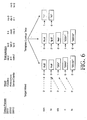
- FIG. 6 A somewhat more complex example, shown in Figure 6, will further illustrate the technique by which the lookup module handles inexact matches.
- the example of Figure 6 uses the target words "Santa Clarita".
- the desired stress pattern of the target word is "20010".
- the template lookup tree has the three-part branching structure of tree 10b in Figure 4, but extends to more levels to include patterns of up to five syllables. A few of the relevant branches of the tree are shown schematically in Figure 6.
- the preferred lookup algorithm descends the template lookup tree, attempting to match syllable stress levels of the target word.
- the match need not be exact. Rather, a measure of closeness is maintained by summing the values found from the penalty matrix, as modified by the context-sensitive penalty modification rules.
- paths do not need to be pursued completely, if the cumulative penalty score for that partially traversed branch surpasses that of the best branch found thus far.
- the system will insert nodes by cloning or duplicating an existing node to allow one syllable of a template to be used for two or more adjacent syllables of the target word.
- adding a cloned syllable corresponds to a template/target mismatch, the action of adding a syllable incurs a penalty which is summed with the other accumulated penalties attributed to that branch.
- the examples illustrated so far have focused on the use of a single tree.
- the invention can be extended to use multiple trees, each being utilized in a different context.
- the input text supplied to the synthesizer can be analyzed or parsed to identify whether a particular word is at the beginning, middle or end of the sentence or phrase.
- Different prosodic rules may wish to be applied depending on where the word appears in the phrase or sentence.
- the system may employ multiple trees each having an associated lookup table containing the pitch and duration information for that context.
- the system is processing a word at the beginning of the sentence, the tree designated for use by beginning words would be used. If the word falls in the middle or at the end of the sentence, the corresponding other trees would be used.
- Such a multiple tree system could be implemented as a single large tree in which the beginning, middle and end starting points would be the first three child nodes from a single root node.
- the algorithm has been described herein as progressing from the first syllable of the target word to the final syllable of the target word in "left-to-right” order. However, if the data in the template lookup trees are suitably re-ordered, the algorithm could be applied as well progressing from the final syllable of the target word to the first syllable of the target word in "right-to-left” order.
Landscapes
- Engineering & Computer Science (AREA)
- Computational Linguistics (AREA)
- Health & Medical Sciences (AREA)
- Audiology, Speech & Language Pathology (AREA)
- Human Computer Interaction (AREA)
- Physics & Mathematics (AREA)
- Acoustics & Sound (AREA)
- Multimedia (AREA)
- Machine Translation (AREA)
- Information Retrieval, Db Structures And Fs Structures Therefor (AREA)
Abstract
Description
| Input Syllable | Template | ||
| Stress | |||
| 0 | 1 | 2 | |
| 0 | 0 | 16 | 2 |
| 1 | 16 | 0 | 4 |
| 2 | 2 | 4 | 0 |
-
Rule 1 - if the template syllable is constructed by repeating the previous syllable, add 4 to the penalty value.
-
Rule 2 - if the previous input syllable has stress level of 1 or 2, add 4 to the penalty value.
- Rule 3
- if the succeeding input syllable has stress level of 1 or 2, add 4 to the penalty value.
- Rule 4
- if the mismatch syllable is the final one in the word, multiply the cumulative penalty by 16.


Claims (22)
- A text-to-speech synthesizer system, comprising:a text input module receptive of target synthesis text;
a prosody module connected to the text input module for associating prosody information with the target synthesis text, the prosody module employing an n-way tree structure to identify the prosody information for the target synthesis text; and
a sound generation module connected to the prosody module for converting the target synthesis text to audible speech using the prosody information. - The text-to-speech synthesizer system of Claim 1 wherein the prosody module employs a tree structure that is based on stress patterns, such that each node of the tree structure corresponds to a stress level that may be associated with a syllabic portion of a text string.
- The text-to-speech synthesizer system of Claim 2 wherein the text input module is operative to segment the target synthesis text into syllabic portions and to determine a stress level for each syllabic portion, thereby forming a stress pattern for the target synthesis text.
- The text-to-speech synthesizer system of Claim 3 wherein the prosody module is operative to traverse the tree structure in order to identify a matching stress pattern that corresponds to the stress pattern for the target synthesis text and to retrieve the prosody information for the target synthesis text using the matching stress pattern.
- The text-to-speech synthesizer system of Claim 1 wherein the prosody information is further defined as pitch modification information and duration modification information.
- A method for generating synthesized speech, comprising the steps of:receiving an input text string;employing an n-way tree structure to identify prosody information for the input text string, where the tree structure is based on stress patterns such that each node of the tree structure provides a stress level that may be associated with a syllabic portion of a text spring; andconverting the input text string into audible speech using the prosody information.
- The method of Claim 6 further comprising the steps of:segmenting the input text string into syllabic portions;determining a stress level for each syllabic portion of the input text string, thereby forming a stress pattern for the input text string;traversing the tree structure in order to identify a matching stress pattern that matches the stress pattern for the input text string; andusing the matching stress pattern to retrieve the prosody information for the input text string.
- The method of Claim 7 wherein the step of traversing the tree structure further comprises the steps of:comparing a stress level for a syllabic portion of the input text string with a stress level for the corresponding syllabic portion in the tree structure;determining a matching score indicative of the correlation between the stress level for the syllabic portion of the input text string and the stress level for the corresponding syllabic portion in the tree structure; andusing the matching score to identify a matching stress pattern that correlates to the stress pattern for the input text string.
- The method of Claim 8 wherein the step of determining a matching score further comprises modifying the matching score based on at least one of the context of the syllabic portion within a transcription derived from the input text string and the context of a word within the input text string, where the word incorporates the syllabic portion used to determine the matching score.
- The method of Claim 8 further comprises the steps of:accumulating a matching score for each path that is traversed in the tree structure;storing a stress pattern having the lowest matching score;updating the stress pattern having the lowest matching score when the matching score for a given path is less than or equal to the lowest matching score; andceasing to traverse a path in the tree structure when the matching score for the given path exceeds the lowest matching score.
- The method of Claim 7 wherein the step of traversing the tree structure further comprises the step of constructing a stress pattern that correlates to the stress pattern of the input text string, when a matching stress pattern is not identified in the tree structure.
- The method of Claim 11 wherein the step of constructing a stress pattern further comprises the steps of:identifying one or more target nodes having stress patterns that correlate to the stress pattern of the input text string;cloning a stress level from an adjacent syllabic portion in the target node, when the number of syllabic portions in the target node is less than the number of syllabic portions in the input text string; andconcatenating the stress level onto the stress pattern of the target node, thereby constructing a stress pattern that correlates to the stress pattern of the input text string.
- The method of Claim 12 wherein the step of constructing a stress pattern further comprises the steps of:determining a matching score indicative of the correlation between the stress patterns for each of the target nodes and the stress pattern of the input text string; andusing the matching score to identify a target node that most closely correlates to the stress pattern of the input text string.
- The method of Claim 13 further comprising the steps of:retrieving the prosody information for the identified target node;cloning a portion of the prosody information that corresponds to the cloned adjacent syllabic portion of the target node; andconcatenating the portion of the prosody information onto the remainder of the prosody information, thereby constructing the prosody information that corresponds to the identified target node.
- The method of Claim 14 further comprising the step of converting the input text string to audible speech using the prosody information that corresponds to the identified target node.
- The method of Claim 6 wherein the prosody information is further defined as pitch modification information and duration modification information.
- A method for generating prosody information for use in a text-to-speech synthesizer system, comprising the steps of:receiving an input text string;determining a pattern of prosodic features associated with the input text string;identifying a first prosody template from a plurality of prosody templates, where each prosody template represents a pattern of prosodic features that may be associated with a text string and the first prosody template having a pattern of prosodic features that correlate to the input text string;replicating a portion of the first prosody template, when the pattern for the first prosody template is shorter than the pattern for the input text string; andconcatenating the replicated portion of the first prosody template onto the pattern of the first prosody template, thereby constructing a generated prosody template that more closely correlates to the input text string.
- The method of Claim 17 further comprising the steps of using the generated prosody template to retrieve prosody information for the input text string, and converting the input text string into audible speech using the prosody information.
- The method of Claim 17 wherein each prosody template is further defined as a pattern of stress levels for each syllabic portion of a text string.
- The method of Claim 19 wherein the step of determining a pattern of prosodic features further comprising the steps of:segmenting the input text string into syllabic portions; anddetermining a stress level for each syllabic portion of the input text string, thereby forming a stress pattern for the input text string;
- The method of Claim 20 wherein the step of identifying a first prosody template further comprises the step of traversing an n-way tree structure in order to identify a matching pattern of prosodic features, where the tree structures are based on stress patterns such that each node of the tree structure provides a stress level that may be associated with a syllabic portion of a text string.
- The method of Claim 21 wherein the step of replicating a portion of the first prosody template further comprises the steps of cloning a stress level from an adjacent syllabic portion of the matching pattern, when the number of syllabic portions in the first prosody template is less than the number of syllabic portions of the stress pattern for the input text string, and concatenating the stress level onto the matching pattern of the first prosody template.
Applications Claiming Priority (2)
| Application Number | Priority Date | Filing Date | Title |
|---|---|---|---|
| US755699 | 2001-01-05 | ||
| US09/755,699 US6845358B2 (en) | 2001-01-05 | 2001-01-05 | Prosody template matching for text-to-speech systems |
Publications (3)
| Publication Number | Publication Date |
|---|---|
| EP1221693A2 true EP1221693A2 (en) | 2002-07-10 |
| EP1221693A3 EP1221693A3 (en) | 2004-02-04 |
| EP1221693B1 EP1221693B1 (en) | 2006-04-19 |
Family
ID=25040261
Family Applications (1)
| Application Number | Title | Priority Date | Filing Date |
|---|---|---|---|
| EP01310926A Expired - Lifetime EP1221693B1 (en) | 2001-01-05 | 2001-12-28 | Prosody template matching for text-to-speech systems |
Country Status (6)
| Country | Link |
|---|---|
| US (1) | US6845358B2 (en) |
| EP (1) | EP1221693B1 (en) |
| JP (1) | JP2002318595A (en) |
| CN (1) | CN1182512C (en) |
| DE (1) | DE60118874T2 (en) |
| ES (1) | ES2261355T3 (en) |
Cited By (1)
| Publication number | Priority date | Publication date | Assignee | Title |
|---|---|---|---|---|
| CN119724204A (en) * | 2024-12-23 | 2025-03-28 | 中电信人工智能科技(北京)有限公司 | Time series repetition perception penalty sampling method, device, electronic device and storage medium |
Families Citing this family (35)
| Publication number | Priority date | Publication date | Assignee | Title |
|---|---|---|---|---|
| US6950798B1 (en) * | 2001-04-13 | 2005-09-27 | At&T Corp. | Employing speech models in concatenative speech synthesis |
| US7401020B2 (en) * | 2002-11-29 | 2008-07-15 | International Business Machines Corporation | Application of emotion-based intonation and prosody to speech in text-to-speech systems |
| CN1604077B (en) * | 2003-09-29 | 2012-08-08 | 纽昂斯通讯公司 | Improvement for pronunciation waveform corpus |
| US7558389B2 (en) * | 2004-10-01 | 2009-07-07 | At&T Intellectual Property Ii, L.P. | Method and system of generating a speech signal with overlayed random frequency signal |
| CN1811912B (en) * | 2005-01-28 | 2011-06-15 | 北京捷通华声语音技术有限公司 | Minor sound base phonetic synthesis method |
| JP2006309162A (en) * | 2005-03-29 | 2006-11-09 | Toshiba Corp | Pitch pattern generation method, pitch pattern generation device, and program |
| CN1956057B (en) * | 2005-10-28 | 2011-01-26 | 富士通株式会社 | Voice time premeauring device and method based on decision tree |
| WO2007087682A1 (en) * | 2006-02-01 | 2007-08-09 | Hr3D Pty Ltd | Human-like response emulator |
| JP4716116B2 (en) * | 2006-03-10 | 2011-07-06 | 株式会社国際電気通信基礎技術研究所 | Voice information processing apparatus and program |
| CN1835076B (en) * | 2006-04-07 | 2010-05-12 | 安徽中科大讯飞信息科技有限公司 | A speech evaluation method that comprehensively uses speech recognition, phonetic knowledge and Chinese dialect analysis |
| US20080027725A1 (en) * | 2006-07-26 | 2008-01-31 | Microsoft Corporation | Automatic Accent Detection With Limited Manually Labeled Data |
| JP2009047957A (en) * | 2007-08-21 | 2009-03-05 | Toshiba Corp | Pitch pattern generation method and apparatus |
| US8583438B2 (en) * | 2007-09-20 | 2013-11-12 | Microsoft Corporation | Unnatural prosody detection in speech synthesis |
| US8321225B1 (en) | 2008-11-14 | 2012-11-27 | Google Inc. | Generating prosodic contours for synthesized speech |
| CN101814288B (en) * | 2009-02-20 | 2012-10-03 | 富士通株式会社 | Method and equipment for self-adaption of speech synthesis duration model |
| US9626339B2 (en) * | 2009-07-20 | 2017-04-18 | Mcap Research Llc | User interface with navigation controls for the display or concealment of adjacent content |
| RU2421827C2 (en) * | 2009-08-07 | 2011-06-20 | Общество с ограниченной ответственностью "Центр речевых технологий" | Speech synthesis method |
| US8965768B2 (en) * | 2010-08-06 | 2015-02-24 | At&T Intellectual Property I, L.P. | System and method for automatic detection of abnormal stress patterns in unit selection synthesis |
| US9286886B2 (en) * | 2011-01-24 | 2016-03-15 | Nuance Communications, Inc. | Methods and apparatus for predicting prosody in speech synthesis |
| US9171401B2 (en) | 2013-03-14 | 2015-10-27 | Dreamworks Animation Llc | Conservative partitioning for rendering a computer-generated animation |
| US9626787B2 (en) | 2013-03-15 | 2017-04-18 | Dreamworks Animation Llc | For node in render setup graph |
| US9230294B2 (en) | 2013-03-15 | 2016-01-05 | Dreamworks Animation Llc | Preserving and reusing intermediate data |
| US9659398B2 (en) | 2013-03-15 | 2017-05-23 | Dreamworks Animation Llc | Multiple visual representations of lighting effects in a computer animation scene |
| US9514562B2 (en) | 2013-03-15 | 2016-12-06 | Dreamworks Animation Llc | Procedural partitioning of a scene |
| US9218785B2 (en) | 2013-03-15 | 2015-12-22 | Dreamworks Animation Llc | Lighting correction filters |
| US9811936B2 (en) | 2013-03-15 | 2017-11-07 | Dreamworks Animation L.L.C. | Level-based data sharing for digital content production |
| US9589382B2 (en) | 2013-03-15 | 2017-03-07 | Dreamworks Animation Llc | Render setup graph |
| US9208597B2 (en) * | 2013-03-15 | 2015-12-08 | Dreamworks Animation Llc | Generalized instancing for three-dimensional scene data |
| JP5807921B2 (en) * | 2013-08-23 | 2015-11-10 | 国立研究開発法人情報通信研究機構 | Quantitative F0 pattern generation device and method, model learning device for F0 pattern generation, and computer program |
| CN103578465B (en) * | 2013-10-18 | 2016-08-17 | 威盛电子股份有限公司 | Speech recognition method and electronic device |
| CN103793641B (en) * | 2014-02-27 | 2021-07-16 | 联想(北京)有限公司 | An information processing method, device and electronic device |
| RU2015156411A (en) * | 2015-12-28 | 2017-07-06 | Общество С Ограниченной Ответственностью "Яндекс" | Method and system for automatically determining the position of stress in word forms |
| JP2018159759A (en) * | 2017-03-22 | 2018-10-11 | 株式会社東芝 | Voice processor, voice processing method and program |
| JP6646001B2 (en) * | 2017-03-22 | 2020-02-14 | 株式会社東芝 | Audio processing device, audio processing method and program |
| CN109599079B (en) * | 2017-09-30 | 2022-09-23 | 腾讯科技(深圳)有限公司 | Music generation method and device |
Family Cites Families (23)
| Publication number | Priority date | Publication date | Assignee | Title |
|---|---|---|---|---|
| US5384893A (en) * | 1992-09-23 | 1995-01-24 | Emerson & Stern Associates, Inc. | Method and apparatus for speech synthesis based on prosodic analysis |
| CA2119397C (en) * | 1993-03-19 | 2007-10-02 | Kim E.A. Silverman | Improved automated voice synthesis employing enhanced prosodic treatment of text, spelling of text and rate of annunciation |
| JP2679623B2 (en) * | 1994-05-18 | 1997-11-19 | 日本電気株式会社 | Text-to-speech synthesizer |
| JP3314116B2 (en) * | 1994-08-03 | 2002-08-12 | シャープ株式会社 | Voice rule synthesizer |
| US5625749A (en) * | 1994-08-22 | 1997-04-29 | Massachusetts Institute Of Technology | Segment-based apparatus and method for speech recognition by analyzing multiple speech unit frames and modeling both temporal and spatial correlation |
| US5592585A (en) | 1995-01-26 | 1997-01-07 | Lernout & Hauspie Speech Products N.C. | Method for electronically generating a spoken message |
| JP3340581B2 (en) * | 1995-03-20 | 2002-11-05 | 株式会社日立製作所 | Text-to-speech device and window system |
| US5905972A (en) | 1996-09-30 | 1999-05-18 | Microsoft Corporation | Prosodic databases holding fundamental frequency templates for use in speech synthesis |
| WO1998014934A1 (en) * | 1996-10-02 | 1998-04-09 | Sri International | Method and system for automatic text-independent grading of pronunciation for language instruction |
| JPH10171485A (en) * | 1996-12-12 | 1998-06-26 | Matsushita Electric Ind Co Ltd | Speech synthesizer |
| US5915237A (en) * | 1996-12-13 | 1999-06-22 | Intel Corporation | Representing speech using MIDI |
| US6163769A (en) * | 1997-10-02 | 2000-12-19 | Microsoft Corporation | Text-to-speech using clustered context-dependent phoneme-based units |
| US6029132A (en) * | 1998-04-30 | 2000-02-22 | Matsushita Electric Industrial Co. | Method for letter-to-sound in text-to-speech synthesis |
| TW422967B (en) | 1998-04-29 | 2001-02-21 | Matsushita Electric Industrial Co Ltd | Method and apparatus using decision trees to generate and score multiple pronunciations for a spelled word |
| US6101470A (en) * | 1998-05-26 | 2000-08-08 | International Business Machines Corporation | Methods for generating pitch and duration contours in a text to speech system |
| US6490563B2 (en) * | 1998-08-17 | 2002-12-03 | Microsoft Corporation | Proofreading with text to speech feedback |
| US6266637B1 (en) * | 1998-09-11 | 2001-07-24 | International Business Machines Corporation | Phrase splicing and variable substitution using a trainable speech synthesizer |
| US6571210B2 (en) * | 1998-11-13 | 2003-05-27 | Microsoft Corporation | Confidence measure system using a near-miss pattern |
| US6260016B1 (en) * | 1998-11-25 | 2001-07-10 | Matsushita Electric Industrial Co., Ltd. | Speech synthesis employing prosody templates |
| JP3361066B2 (en) * | 1998-11-30 | 2003-01-07 | 松下電器産業株式会社 | Voice synthesis method and apparatus |
| US6185533B1 (en) * | 1999-03-15 | 2001-02-06 | Matsushita Electric Industrial Co., Ltd. | Generation and synthesis of prosody templates |
| EP1100072A4 (en) * | 1999-03-25 | 2005-08-03 | Matsushita Electric Industrial Co Ltd | SYSTEM AND METHOD FOR SYNTHESIZING SPEECH |
| JP3685648B2 (en) * | 1999-04-27 | 2005-08-24 | 三洋電機株式会社 | Speech synthesis method, speech synthesizer, and telephone equipped with speech synthesizer |
-
2001
- 2001-01-05 US US09/755,699 patent/US6845358B2/en not_active Expired - Lifetime
- 2001-12-28 ES ES01310926T patent/ES2261355T3/en not_active Expired - Lifetime
- 2001-12-28 DE DE60118874T patent/DE60118874T2/en not_active Expired - Fee Related
- 2001-12-28 EP EP01310926A patent/EP1221693B1/en not_active Expired - Lifetime
-
2002
- 2002-01-04 CN CNB021084807A patent/CN1182512C/en not_active Expired - Lifetime
- 2002-01-07 JP JP2002000652A patent/JP2002318595A/en active Pending
Cited By (1)
| Publication number | Priority date | Publication date | Assignee | Title |
|---|---|---|---|---|
| CN119724204A (en) * | 2024-12-23 | 2025-03-28 | 中电信人工智能科技(北京)有限公司 | Time series repetition perception penalty sampling method, device, electronic device and storage medium |
Also Published As
| Publication number | Publication date |
|---|---|
| DE60118874D1 (en) | 2006-05-24 |
| CN1372246A (en) | 2002-10-02 |
| US20020128841A1 (en) | 2002-09-12 |
| EP1221693B1 (en) | 2006-04-19 |
| US6845358B2 (en) | 2005-01-18 |
| JP2002318595A (en) | 2002-10-31 |
| EP1221693A3 (en) | 2004-02-04 |
| DE60118874T2 (en) | 2006-09-14 |
| CN1182512C (en) | 2004-12-29 |
| ES2261355T3 (en) | 2006-11-16 |
Similar Documents
| Publication | Publication Date | Title |
|---|---|---|
| US6845358B2 (en) | Prosody template matching for text-to-speech systems | |
| US7124083B2 (en) | Method and system for preselection of suitable units for concatenative speech | |
| EP1213705B1 (en) | Method and apparatus for speech synthesis | |
| US6505158B1 (en) | Synthesis-based pre-selection of suitable units for concatenative speech | |
| US6101470A (en) | Methods for generating pitch and duration contours in a text to speech system | |
| US6792407B2 (en) | Text selection and recording by feedback and adaptation for development of personalized text-to-speech systems | |
| US6411932B1 (en) | Rule-based learning of word pronunciations from training corpora | |
| US6363342B2 (en) | System for developing word-pronunciation pairs | |
| EP1037195A2 (en) | Generation and synthesis of prosody templates | |
| US8942983B2 (en) | Method of speech synthesis | |
| EP1668628A1 (en) | Method for synthesizing speech | |
| US7069216B2 (en) | Corpus-based prosody translation system | |
| Sečujski et al. | An overview of the AlfaNum text-to-speech synthesis system | |
| JP3571925B2 (en) | Voice information processing device | |
| EP1777697B1 (en) | Method for speech synthesis without prosody modification | |
| JP5012444B2 (en) | Prosody generation device, prosody generation method, and prosody generation program | |
| JP2009237564A (en) | Data selection method for speech synthesis | |
| JPH1097290A (en) | Speech synthesizer | |
| JPH07160290A (en) | Speech synthesis method |
Legal Events
| Date | Code | Title | Description |
|---|---|---|---|
| PUAI | Public reference made under article 153(3) epc to a published international application that has entered the european phase |
Free format text: ORIGINAL CODE: 0009012 |
|
| AK | Designated contracting states |
Kind code of ref document: A2 Designated state(s): AT BE CH CY DE DK ES FI FR GB GR IE IT LI LU MC NL PT SE TR |
|
| AX | Request for extension of the european patent |
Free format text: AL;LT;LV;MK;RO;SI |
|
| PUAL | Search report despatched |
Free format text: ORIGINAL CODE: 0009013 |
|
| AK | Designated contracting states |
Kind code of ref document: A3 Designated state(s): AT BE CH CY DE DK ES FI FR GB GR IE IT LI LU MC NL PT SE TR |
|
| AX | Request for extension of the european patent |
Extension state: AL LT LV MK RO SI |
|
| 17P | Request for examination filed |
Effective date: 20040517 |
|
| AKX | Designation fees paid |
Designated state(s): DE ES FR GB IT NL |
|
| 17Q | First examination report despatched |
Effective date: 20050331 |
|
| GRAP | Despatch of communication of intention to grant a patent |
Free format text: ORIGINAL CODE: EPIDOSNIGR1 |
|
| GRAS | Grant fee paid |
Free format text: ORIGINAL CODE: EPIDOSNIGR3 |
|
| GRAA | (expected) grant |
Free format text: ORIGINAL CODE: 0009210 |
|
| AK | Designated contracting states |
Kind code of ref document: B1 Designated state(s): DE ES FR GB IT NL |
|
| REG | Reference to a national code |
Ref country code: GB Ref legal event code: FG4D |
|
| REF | Corresponds to: |
Ref document number: 60118874 Country of ref document: DE Date of ref document: 20060524 Kind code of ref document: P |
|
| ET | Fr: translation filed | ||
| REG | Reference to a national code |
Ref country code: ES Ref legal event code: FG2A Ref document number: 2261355 Country of ref document: ES Kind code of ref document: T3 |
|
| PGFP | Annual fee paid to national office [announced via postgrant information from national office to epo] |
Ref country code: NL Payment date: 20061203 Year of fee payment: 6 |
|
| PGFP | Annual fee paid to national office [announced via postgrant information from national office to epo] |
Ref country code: FR Payment date: 20061208 Year of fee payment: 6 |
|
| PGFP | Annual fee paid to national office [announced via postgrant information from national office to epo] |
Ref country code: DE Payment date: 20061221 Year of fee payment: 6 |
|
| PGFP | Annual fee paid to national office [announced via postgrant information from national office to epo] |
Ref country code: GB Payment date: 20061227 Year of fee payment: 6 |
|
| PGFP | Annual fee paid to national office [announced via postgrant information from national office to epo] |
Ref country code: IT Payment date: 20061231 Year of fee payment: 6 |
|
| PGFP | Annual fee paid to national office [announced via postgrant information from national office to epo] |
Ref country code: ES Payment date: 20070122 Year of fee payment: 6 |
|
| PLBE | No opposition filed within time limit |
Free format text: ORIGINAL CODE: 0009261 |
|
| STAA | Information on the status of an ep patent application or granted ep patent |
Free format text: STATUS: NO OPPOSITION FILED WITHIN TIME LIMIT |
|
| 26N | No opposition filed |
Effective date: 20070122 |
|
| GBPC | Gb: european patent ceased through non-payment of renewal fee |
Effective date: 20071228 |
|
| NLV4 | Nl: lapsed or anulled due to non-payment of the annual fee |
Effective date: 20080701 |
|
| PG25 | Lapsed in a contracting state [announced via postgrant information from national office to epo] |
Ref country code: DE Free format text: LAPSE BECAUSE OF NON-PAYMENT OF DUE FEES Effective date: 20080701 |
|
| REG | Reference to a national code |
Ref country code: FR Ref legal event code: ST Effective date: 20081020 |
|
| PG25 | Lapsed in a contracting state [announced via postgrant information from national office to epo] |
Ref country code: NL Free format text: LAPSE BECAUSE OF NON-PAYMENT OF DUE FEES Effective date: 20080701 |
|
| PG25 | Lapsed in a contracting state [announced via postgrant information from national office to epo] |
Ref country code: GB Free format text: LAPSE BECAUSE OF NON-PAYMENT OF DUE FEES Effective date: 20071228 |
|
| REG | Reference to a national code |
Ref country code: ES Ref legal event code: FD2A Effective date: 20071229 |
|
| PG25 | Lapsed in a contracting state [announced via postgrant information from national office to epo] |
Ref country code: FR Free format text: LAPSE BECAUSE OF NON-PAYMENT OF DUE FEES Effective date: 20071231 Ref country code: ES Free format text: LAPSE BECAUSE OF NON-PAYMENT OF DUE FEES Effective date: 20071229 |
|
| PG25 | Lapsed in a contracting state [announced via postgrant information from national office to epo] |
Ref country code: IT Free format text: LAPSE BECAUSE OF NON-PAYMENT OF DUE FEES Effective date: 20071228 |