EP1221447A2 - Alkyl Cobalt (III) Dioximates and process for forming the same - Google Patents
Alkyl Cobalt (III) Dioximates and process for forming the same Download PDFInfo
- Publication number
- EP1221447A2 EP1221447A2 EP01126197A EP01126197A EP1221447A2 EP 1221447 A2 EP1221447 A2 EP 1221447A2 EP 01126197 A EP01126197 A EP 01126197A EP 01126197 A EP01126197 A EP 01126197A EP 1221447 A2 EP1221447 A2 EP 1221447A2
- Authority
- EP
- European Patent Office
- Prior art keywords
- alkyl
- aryl
- cobalt
- group
- iii
- Prior art date
- Legal status (The legal status is an assumption and is not a legal conclusion. Google has not performed a legal analysis and makes no representation as to the accuracy of the status listed.)
- Granted
Links
Classifications
-
- C—CHEMISTRY; METALLURGY
- C07—ORGANIC CHEMISTRY
- C07F—ACYCLIC, CARBOCYCLIC OR HETEROCYCLIC COMPOUNDS CONTAINING ELEMENTS OTHER THAN CARBON, HYDROGEN, HALOGEN, OXYGEN, NITROGEN, SULFUR, SELENIUM OR TELLURIUM
- C07F15/00—Compounds containing elements of Groups 8, 9, 10 or 18 of the Periodic Table
- C07F15/06—Cobalt compounds
Definitions
- This invention is directed to certain cobalt chelates and to an improved process for forming cobalt chelates and in particular, to alkyl cobalt (III) dioximates and a process that provides an improved yield and purity of such dioximates.
- Cobalt chelates have been widely used in the polymerization of high and low molecular weight polymers, and in the formation of oligomers, macromoners, and latices. Also, cobalt (II) chelates have been used as chain transfer agents in free radical polymerizations to form polymers. Acrylic graft copolymers having an acrylic copolymer core and macromonomers grafted thereto have been prepared utilizing cobalt chelates. The synthesis of terminally unsaturated oligomers and functionalized diene oligomers using cobalt chelate catalysts also are known.
- the process should allow for the formation of alkyl cobalt (III) dioximates by using glyoximes other than dimethylgloxime since such other glyoximes can impart important properties to the chelate, such as shelf stability and solubility in a variety of solvents. Such properties make the chelate more versatile and useful and cost effective in polymerization processes used for a variety of monomers.
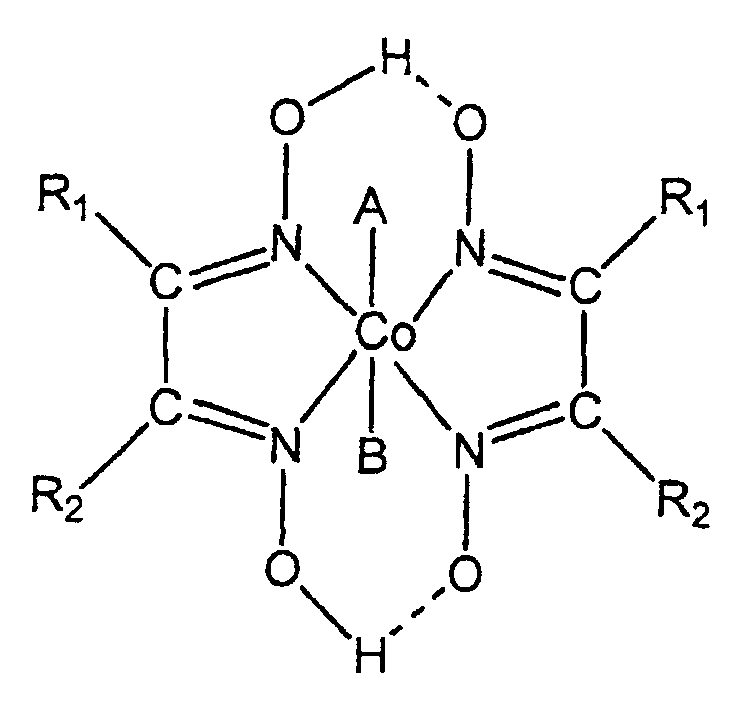
- the alkyl cobalt (III) dioximate has the following structural formula: wherein R 1 , and R 2 , are individually selected from the following group: H, alkyl having at least 2 carbon atoms, substituted alkyl, aryl, substituted aryl, COOR 5 , CONR 6 R 7 , SR 7 , SO 2 R 7 , SO 2 NR 5 R 6 , SOR 5 , SO 3 R 5 , halogen, CCl 3 , CF 3 , COR 5 , CHO, CR 6 R 7 OR 5 , CH(OR 5 )(OR 6 ), CR 5 (OR 6 )(OR 7 ); where R 5 , R 6 , and R 7 are independently selected from the following group: H, alkyl, substituted alkyl, aryl or substituted aryl and A is a substituted alkyl derived from an olefinic component and
- the alkyl cobalt (III) dioximate of this invention is formed by a novel process in which a mixture of a cobalt (II) salt, a dioxime, an olefinic component and a Lewis base is treated with molecular hydrogen under pressure of 0.7 to 70 kg/cm 2 .
- the cobalt (II) salt, dioxime, olefinic component, and the Lewis base are reacted in a molar ratio of 1:2:1:1.
- the hydrogen is under a high pressure of 14 to 70 kg/cm 2 , preferably, 18 to 30 kg/cm 2 unless a Lewis base of an imidazole, phosphine or phosphite is used.
- the hydrogen pressure can be reduced to 0.7 to 14 kg/cm 2 preferably, 1 to 2 kg/cm 2 .
- Typical treatment time with hydrogen under pressure is 0.5 to 5.0 hours, preferably 4 to 6 hours.
- Typical reaction temperatures are -20 to 50°C and preferably 17 to 30°C.
- the yields are high, i.e., 70% and over and that the purity is high, 80% and over, of the alkyl cobalt (III) dioximate formed.
- Typical cobalt (II) salts that can be used are acetates, nitrates, chlorides, bromides, iodides, fluorides, sulfates, fluoroborate, hexafluorophosphate or hexafluoroantimonate either as hydrated or anhydrous, or as an alkanoate. Mixtures of any of the aformentioned cobalt (II) salts also can be used. Lower (C 2 to C 3 ) alkanoates are soluble in methanol or propanol and the higher (C 4 to C 8 ) alkanoates are soluble in hydrocarbon solvents.
- cobalt salts are cobalt chloride, cobalt chloride hexahydrate, cobalt acetate, cobalt acetate tetrahydrate, cobalt nitrate, cobalt bromide, cobalt iodide, cobalt difluoride, cobalt ammonium sulfate and cobalt 2-ethylhexanoate.
- Typical dioximes are as follows: diphenylglyoxime, carboxyethylmethylglyoxime, methyl phenylglyoxime, dimethylamidolcarbonylmethylglyoxime, 4-amidophenylamidylcarbonylmethylglyoxime, trifluoroacetyl-trifluoromethylglyoxime, camphordiquinonedioxime, 1,2-cyclohexanedioxime, furildioxime, thiophenylglyoxime, and di(butylthio)glyoxime.
- Preferred are diphenylglyoxime and carboxyethylmethylglyoxime.
- a Lewis base is used in the process to form the cobalt (III) dioximate of this invention and forms the A component of the dioximate. It is believed that the Lewis base activates the cobalt in the reaction with hydrogen and forms a coordination bond with the cobalt.
- useful Lewis bases are alcohols, such as methanol, ethanol, propanol, isopropanol, n-butanol, isobutanol, water (under some conditions); alkyl mercaptanes, such as ethyl mercaptane, thiophenole, dodecyl mercaptan; amines, such as pyridine, 4-methylpyridine, nicotineamide, 2-methyl pyridine, and 4-dimthylaminopyridine. Pyridine is preferred.
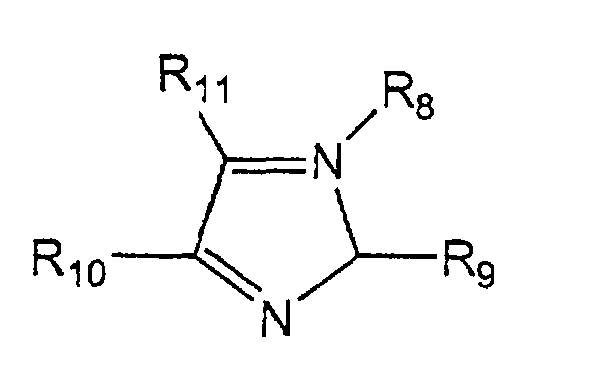
- R 8 , R 9 , R 10 , and R 11 are each selected from the following: H, alkyl, aryl, NR 5 ,N 6 , SR 7 , SO 2 R 7 , SO 2 NR 5 R 6 , SOR 5 , COR 5 , CHO, CR 6 R 7 OR 5 , CH(OR 5 )(OR 6 ), and CR 5 (OR 6 )(OR 7 ); and where R 5 , R 6 , and R 7 are each selected from the following group: H, alkyl and aryl.
- imidazoles examples include as follows: unsubstituted imidazole, 2-methyl imidazole, 2-phenyl imidazole, 1,2 dimethyl imidazole, 1,2 diethyl imidazole, 1-methyl-2-ethyl imidazole, 1-butyl imidazole, and 2,5-dimethyl-4-hydroxymethyl imidazole. 1,2 Dimethyl imidazole and 1-butyl imidazole are preferred.
- Phosphines that can be used have the formula P(R 14 )(R 15 )(R 16 ), wherein R 14 , R 15 , R 16 are each selected from the following group: H, alkyl and aryl.
- R 14 , R 15 , R 16 are each selected from the following group: H, alkyl and aryl.
- useful phosphines used are triphenyl phosphine and triethyl phosphine.
- Phosphites that can be used have the formula P(OR 17 )(OR 18 )(OR 19 ), where R 17 , R 18 , and R 19 are each selected from the following group: H, alkyl and aryl.
- Typically useful phosphites are triethylphosphite, triphenylphosphite, and tricresylphosphite.
- olefinic component included in the B component of the alkyl cobalt (III) dioximate forms a coordination bond with the cobalt constituent of the dioximate.
- olefinic compounds that are used in the process of this invention are alkyl acrylates, i.e., alkyl esters of acrylic acid, such as methyl acrylate, ethyl acrylate, propyl acrylate, methoxy ethyl acrylate, phenoxy ethyl acrylate, isopropyl acrylate, butyl acrylate, pentyl acrylate, and ethylhexyl acrylate. Methyl acrylate is preferred.
- olefinic components such as styrene, methyl styrene, acrylonitrile, acrylamide, dimethylolacrylamide, vinyl pyrrolidone, vinyl chloride, vinyl acetate, maleic anhydride, N-methylmaleimide, and other vinylic monomers of the following structure: where X is an amide, imide, ester, aryl, halogen, pseudo halogen (thiocyanates), isocyanate, nitrile, ether, carbamyl, substituted amine and thio ether.
- Suitable solvents that can be used in the process are alcohols, such as methanol, ethanol, propanol, isopropanol, butanol, isobutanol, and any mixtures thereof.
- Other common organic solvents that can be used are diethyl ether, ethylene glycol, polyethylene glycol monoalkyl and dialkyl ethers, propylene carbonate, N-methyl pyrrolidone, amides, dimethylsulfoxide, and Cellosolves® and Carbitols® both supplied by supplied by Union Carbide Corp. Danbury, CT. Water and mixtures of water and the aforementioned solvents can be used.
- the novel process of this invention provides for high purity alkyl cobalt (III) dioximate and in a high yield. Yields are 70% and over and preferably 75% and up to 100% and purity is over 80% and preferably over 85% up to 100%.
- R 1 and R 2 are phenyl, A is (methoxycarbonyl) ethyl and B is pyridine; in another preferred alkyl cobalt (III) dioximate, R 1 and R 2 are phenyl, A is (methoxycarbonyl) ethyl and B is dimethyl imidazole; in still another preferred alkyl cobalt (III) dioximate, R 1 and R 2 are phenyl, A is (methoxycarbonyl) ethyl and B is triphenylphosphine.
- the alkyl cobalt (III) dioximate is an excellent chain transfer agents used in free radical polymerization of polymers, macromonomers, oligomers, low molecular weight polymers (Mw 200 to 1,000), medium molecular weight polymers (Mw 1,000 to 50,000) and high molecular weight polymer (Mw 500,000 and over), latex polymers, graft copolymers, star polymers, hyperbranched polymers, core shell structured polymers and other polymer compositions.
- This example was directed to the synthesis of an alkyl cobalt (III) dioximate under a high pressure of molecular hydrogen (21 kg/cm 2 ).
- the resulting cobalt (III) complex was identified by NMR (nuclear magnetic resonance) as an alkyl cobalt (III) dioximate that had the formula as shown in the above specification wherein R 1 and R 2 were phenyl, A was 1-(methoxycarbonyl)ethyl and B was pyridine.
- the yield was 54 g (70%) and the purity measured by (NMR) was 90-95%.
- a polymethylmethacrylate polymer was prepared using the above alkyl cobalt (III) dioximate.
- the following constituents were charged into a reaction vessel equipped with a stirrer, nitrogen inlet and a heating mantle: 30 ml methyl methacrylate monomer (MMA), 60 mg azobisisobutyronitrile, and 6 mg of the above prepared alkyl cobalt (III) dioximate.
- the resulting reaction mixture was under a blanket of nitrogen and held at 75°C for 3 hours.
- a comparative polymethylmethacrylate polymer was prepared using the same constituents and similar proceedure set forth above except the alkyl cobalt (III) dioximate was omitted.
- This example was directed to the synthesis of an alkyl cobalt (III) dioximate using very high pressure hydrogen (70 kg/cm 2 ).
- the synthesis followed the procedure of Example 1 using the same constituents except the pressure of hydrogen was increased to 70 kg/cm 2 .
- the resulting product was identical to the alkyl cobalt (III) dioximate of Example 1 (determined by NMR).
- the yield was 83% and the purity >95%.
- This example was directed to a synthesis using low pressure hydrogen (10.5 kg/cm 2 ) in an attempt to form an alkyl cobalt (III) dioximate.
- the synthesis followed the procedure of Example 1 using the same constituents except the pressure of hydrogen was decreased to 10.5 kg/cm 2 .
- the product formed was predominately a Co(II) complex as determined by NMR.
- Comparative Examples 5 and 6 show that when glyoximes other than dimethylglyoxime were used, an alkyl cobalt (III) dioximate was not formed using the process of Schrauzer et al (Example 4).
- This example was directed to a synthesis that used water instead of pyridine and used hydrogen under very high pressure (140 kg/cm 2 ) in an attempt to form an alkyl cobalt (III) dioximate.
- the synthesis followed the procedure of Example 1 using the same constituents except water was used instead of pyridine and the pressure of hydrogen was increased to 140 kg/cm 2 . No crystalline product was formed.
- This example showed that a Lewis base, such a pyridine, was needed to form the alkyl cobalt (III) dioximate of this invention.
- This example was directed to a synthesis that used an imidazole in place of pyridine and hydrogen was used under low pressure.
- the synthesis followed the procedure of Example I using the same constituents except 1,2 dimethyl imidazole was used instead of pyridine and the pressure of hydrogen was decreased to 10.5 kg/cm 2 .
- the resulting reaction mixture was filtered and organic crystals of an alkyl cobalt (III) dioximate identified by NMR were obtained.
- the resulting alkyl cobalt (III) dioximate had the formula as shown in the above specification wherein R 1 and R 2 were phenyl, A was 1-(methoxycarbonyl)ethyl and B was 1,2 dimethyl imidazole.
- the yield was (70%) and the purity as measured by NMR was 90%.
- This example was directed to a synthesis that used a phosphine in place of pyridine and hydrogen under low pressure.
- the synthesis followed the procedure of Example 1 using the same constituents except triphenylphosphine was used instead of pyridine and the pressure of hydrogen was decreased to 2.1 kg/cm 2 .
- the resulting reaction mixture was filtered and organic crystals of a cobalt (III) complex were obtained.
- the cobalt (III) complex was identified by NMR as an alkyl cobalt (III) dioximate.
- the resulting alkyl cobalt (III) dioximate had the formula as shown in the above specification wherein R 1 and R 2 were phenyl, A was 1-(methoxycarbonyl)ethyl and B was triphenylphosphine. The yield was (72%) and the purity as measured by NMR was 80%.
- This example was directed to a synthesis that used hydrogen under ultra low pressure.
- a mixture of 9.3 g of dimethylglyoxime (0.08), 10 g of cobalt acetate tetrahydrate (0.04 mol), 3.6g methyl acrylate (0.04 mol), 5.3 ml of n-butyl imidazole (0.1 mol) and 150 ml methanol were stirred under a pressure of 0.007 kg/cm 2 of hydrogen in CO 2 for 6 hours.
- the resulting reaction mixture was diluted with 40 ml water and orange crystals were filtered off and identified by NMR as the alkyl cobalt (III) dioximate of this invention where A was 1-(methoxycarbonyl) ethyl and B was n-butyl imidazole.
- the yield was 6g (30%) and purity as measured by NMR was 80%.
- Example 10 showed that under low hydrogen pressure using an imidazole, the alkyl cobalt (III) dioximate of this invention was formed. The yield was unacceptable for a viable commercial process.
- This example was directed to a synthesis that used hydrogen under ultra low pressure and used pyridine instead of an imidazole of Example 10.
- the synthesis followed the procedure of Example 10 except pyridine was substituted for n-butyl imidazole.
- the product formed was identified by NMR to contain mainly a cobalt (II) complex and not the alkyl cobalt (III) dioximate of this invention.
- Comparative Example 11 showed that an imidazole was required to form the alkyl cobalt (III) dioximate of this invention when low pressure hydrogen was used.
Landscapes
- Chemical & Material Sciences (AREA)
- Organic Chemistry (AREA)
- Organic Low-Molecular-Weight Compounds And Preparation Thereof (AREA)
- Inorganic Compounds Of Heavy Metals (AREA)
Abstract
Description


Examples of such imidazoles are as follows: unsubstituted imidazole, 2-methyl imidazole, 2-phenyl imidazole, 1,2 dimethyl imidazole, 1,2 diethyl imidazole, 1-methyl-2-ethyl imidazole, 1-butyl imidazole, and 2,5-dimethyl-4-hydroxymethyl imidazole. 1,2 Dimethyl imidazole and 1-butyl imidazole are preferred.
Phosphites that can be used have the formula P(OR17)(OR18)(OR19), where R17, R18, and R19 are each selected from the following group: H, alkyl and aryl. Typically useful phosphites are triethylphosphite, triphenylphosphite, and tricresylphosphite.

Claims (11)
- An alkyl cobalt (III) dioximate having the following structural formula:wherein R1, and R2 are individually selected from the group consisting of H, alkyl having at least 2 carbon atoms, substituted alkyl, aryl, substituted aryl, COOR5, CONR6R7, SR7, SO2R7, SO2NR5R6, SOR5, SO3R5, halogen, CCl3, CF3, COR5, CHO, CR6R7OR5, CH(OR5)(OR6), CR5(OR6)(OR7), where R5, R6, and R7 are independently selected from the group consisting of H, alkyl, substituted alkyl, aryl and substituted aryl and A is substituted alkyl derived from an olefinic component and B is a component of a Lewis base and where the substituents of the substituted alkyl are individually selected from the group consisting of ester, ether, amide, halogen, ketone, hydroxy, aryl, SO2-alkyl, sulfamido, and amino groups and the substituents for the substituted aryl are individually selected from the group consisting of ester, ether, amide, halogen, ketone, hydroxy, alkyl, SO2-alkyl, sulfamido, and amino groups.

- The alkyl cobalt (III) dioximate of claim 1 wherein component B is an imidazole of the structural formula:wherein R8, R9, R10, and R11 are independently selected from the group consisting of H, alkyl, aryl, NR5R6, SR7, SO2R7, SO2NR5R6, SOR5, COR5, CHO, CR6R7OR5, CH(OR5)(OR6), and CR5(OR6)(OR7); where R5, R6, and R7 are independently selected from the group consisting of H, alkyl, and aryl.
- The alkyl cobalt (III) dioximate of claim 1 wherein component B consists of a phosphine of the formula P(R14)(R15)(R16), wherein R14, R15, R16 are independently selected from the group consisting of H, alkyl, and aryl.
- The alkyl cobalt (III) dioximate of claim 1 wherein component B consists of a phosphite having the formula P(OR17)(OR18)(OR19), where R17, R18, and R19 are independently selected from the group consisting of H, alkyl, and aryl.
- The alkyl cobalt (III) dioximate of claim 1 wherein A is an alkyl acrylate ester.
- A process for forming an alkyl cobalt (III) dioximate which compriseswherein the alkyl cobalt (III) dioximate has the following structural formula:(1) forming a mixture of a cobalt (II) salt, a dioxime of the formula R1-C(=NOH)-C(=NOH)-R2, an olefinic component, and a Lewis base and(2) treating said mixture with molecular hydrogen under a pressure of 0.7-70 kg/cm2;wherein R1, and R2 are individually selected from the group consisting of H, alkyl having at least 2 carbon atoms, substituted alkyl, aryl, substituted aryl, COOR5, CONR6R7, SR7, SO2R7, SO2NR5R6, SOR5, SO3R5, halogen, CCl3, CF3, COR5, CHO, CR6R7OR5, CH(OR5)(OR6), CR5(OR6)(OR7), where R5, R6, and R7 are independently selected from the group consisting of H, alkyl, substituted alkyl, aryl and substituted aryl and A is a substituted alkyl derived from an olefinic component and B is a component of a Lewis base and where the substituents of the substituted alkyl are individually selected from the group consisting of ester, ether, amide, halogen, ketone, hydroxy, aryl, SO2-alkyl, sulfamido, and amino groups and the substituents for the substituted aryl are individually selected from the group consisting of ester, ether, amide, halogen, ketone, hydroxy, alkyl, SO2-alkyl, sulfamido, and amino groups.

- The process of claim 6 in which the mixture is treated with hydrogen for 0.5 to 5.0 hours at a temperature of-20 to 50 °C and the mixture comprises a cobalt (II) salt, dioxime, olefinic component and Lewis base present in a molar ratio of 1:2:1:1.
- The process of claim 6 in which the hydrogen used to treat the mixture is under a pressure of 0.7 to 14 kg/cm2 and the Lewis base is selected from the group consiting of imidazole, phosphine and phosphite.
- The process of claim 8 in which the Lewis base is an imidazole having the structural formula:wherein R8, R9, R10, and R11 are independently selected from the group consisting of H, alkyl, aryl, NR5R6, SR7, SO2R7, SO2NR5R6, SOR5, COR5, CHO, CR6R7OR5, CH(OR5)(OR6), and CR5(OR6)(OR7) and treated with molecular hydrogen under a pressure of 0.7 to 14 kg/cm2; where R5, R6, and R7 are independently selected from the group consisting of H, alkyl, and aryl.

- The process of claim 8 in which the Lewis base consists of phosphine of the formula P(R14)(R15)(R16), wherein R14, R15, R16 are independently selected from the group consisting of H, alkyl, and aryl.
- The process of claim 8 in which the Lewis base consists of a phosphite having the formula P(OR17)(OR18)(OR19), where R17, R18, and R19 are independently selected from the group consisting of H, alkyl, and aryl.
Applications Claiming Priority (2)
| Application Number | Priority Date | Filing Date | Title |
|---|---|---|---|
| US25957601P | 2001-01-03 | 2001-01-03 | |
| US259576P | 2001-01-03 |
Publications (3)
| Publication Number | Publication Date |
|---|---|
| EP1221447A2 true EP1221447A2 (en) | 2002-07-10 |
| EP1221447A3 EP1221447A3 (en) | 2003-12-03 |
| EP1221447B1 EP1221447B1 (en) | 2007-10-03 |
Family
ID=22985488
Family Applications (1)
| Application Number | Title | Priority Date | Filing Date |
|---|---|---|---|
| EP01126197A Expired - Lifetime EP1221447B1 (en) | 2001-01-03 | 2001-11-05 | Alkyl Cobalt (III) Dioximates and process for forming the same |
Country Status (13)
| Country | Link |
|---|---|
| US (4) | US6559327B2 (en) |
| EP (1) | EP1221447B1 (en) |
| JP (1) | JP2002226448A (en) |
| KR (1) | KR20020059245A (en) |
| AT (1) | ATE374780T1 (en) |
| AU (1) | AU783808B2 (en) |
| BR (1) | BR0106438A (en) |
| CA (1) | CA2360493A1 (en) |
| DE (1) | DE60130727T2 (en) |
| ES (1) | ES2293957T3 (en) |
| MX (1) | MXPA01013473A (en) |
| NZ (1) | NZ515099A (en) |
| TW (1) | TW593323B (en) |
Cited By (1)
| Publication number | Priority date | Publication date | Assignee | Title |
|---|---|---|---|---|
| CN102276658A (en) * | 2011-06-13 | 2011-12-14 | 天津师范大学 | Mixed ligand cobalt (II) coordination compound as well as preparation method and application thereof |
Families Citing this family (5)
| Publication number | Priority date | Publication date | Assignee | Title |
|---|---|---|---|---|
| US6559327B2 (en) * | 2001-01-03 | 2003-05-06 | E. I. Du Pont De Nemours And Company | Alkyl cobalt (III) dioximates and process for forming the same |
| US7026415B2 (en) * | 2004-02-17 | 2006-04-11 | Equistar Chemicals, Lp | Clathrochelates as olefin polymerization catalyst components |
| US8754166B2 (en) * | 2005-09-12 | 2014-06-17 | Axalta Coating Systems Ip Co., Llc | Coatings system with common activator and common volumetric mix ratio |
| US7652099B2 (en) * | 2005-09-12 | 2010-01-26 | E.I. Du Pont De Nemours And Company | Process for producing coating compositions with customizable properties |
| US7714084B2 (en) * | 2005-11-10 | 2010-05-11 | E.I. Du Pont De Nemours And Company | Catalysts for catalytic chain transfer |
Family Cites Families (13)
| Publication number | Priority date | Publication date | Assignee | Title |
|---|---|---|---|---|
| US4526945A (en) | 1984-03-21 | 1985-07-02 | Scm Corporation | Low molecular weight polymers and copolymers |
| US4680352A (en) | 1985-03-01 | 1987-07-14 | E. I. Du Pont De Nemours And Company | Cobalt (II) chelates as chain transfer agents in free radical polymerizations |
| US4694054A (en) | 1985-03-01 | 1987-09-15 | E. I. Du Pont De Nemours And Company | Cobalt(II) chelates as chain transfer agents in free radical polymerizations |
| US5324879A (en) | 1985-12-03 | 1994-06-28 | Commonwealth Scientific And Industrial Research Organisation | Oligomerization process |
| JPH0819172B2 (en) * | 1985-12-03 | 1996-02-28 | コモンウエルス サイエンテイフイツク アンド インダストリアル リサ−チ オ−ガナイゼイシヨン | Oligomerization method |
| US5028677A (en) | 1986-09-23 | 1991-07-02 | E. I. Du Pont De Nemours And Company | Novel macromonomer compositions |
| US5773534A (en) | 1992-05-22 | 1998-06-30 | E. I. Du Pont De Nemours And Company | Preparing crosslinkable polymers employing macromonomer chain transfer agents |
| US5310807A (en) | 1992-12-30 | 1994-05-10 | E. I. Du Pont De Nemours And Company | Star polymers made from macromonomers made by cobalt chain transfer process |
| US5412039A (en) | 1994-07-08 | 1995-05-02 | E. I. Dupont De Nemours And Company | Acrylic copolymer core with catalyst grafted with macromonomers |
| US5587431A (en) | 1995-04-21 | 1996-12-24 | E. I. Du Pont De Nemours And Company | Synthesis of terminally unsaturated oligomers |
| US5847060A (en) | 1997-08-18 | 1998-12-08 | E. I. Du Pont De Nemours And Company | Functionalized diene oligomers |
| US5928829A (en) | 1998-02-26 | 1999-07-27 | Xerox Corporation | Latex processes |
| US6559327B2 (en) * | 2001-01-03 | 2003-05-06 | E. I. Du Pont De Nemours And Company | Alkyl cobalt (III) dioximates and process for forming the same |
-
2001
- 2001-04-30 US US09/845,865 patent/US6559327B2/en not_active Expired - Fee Related
- 2001-10-26 AU AU83652/01A patent/AU783808B2/en not_active Ceased
- 2001-10-29 NZ NZ515099A patent/NZ515099A/en unknown
- 2001-10-30 CA CA002360493A patent/CA2360493A1/en not_active Abandoned
- 2001-11-05 ES ES01126197T patent/ES2293957T3/en not_active Expired - Lifetime
- 2001-11-05 AT AT01126197T patent/ATE374780T1/en not_active IP Right Cessation
- 2001-11-05 EP EP01126197A patent/EP1221447B1/en not_active Expired - Lifetime
- 2001-11-05 DE DE60130727T patent/DE60130727T2/en not_active Expired - Lifetime
- 2001-11-15 TW TW090128349A patent/TW593323B/en not_active IP Right Cessation
- 2001-12-19 MX MXPA01013473A patent/MXPA01013473A/en active IP Right Grant
- 2001-12-20 BR BR0106438-0A patent/BR0106438A/en not_active IP Right Cessation
- 2001-12-26 JP JP2001394767A patent/JP2002226448A/en not_active Ceased
- 2001-12-31 KR KR1020010088955A patent/KR20020059245A/en not_active Withdrawn
-
2003
- 2003-02-21 US US10/371,765 patent/US6858745B2/en not_active Expired - Fee Related
- 2003-02-21 US US10/371,891 patent/US6740618B2/en not_active Expired - Fee Related
- 2003-02-21 US US10/371,890 patent/US6713427B2/en not_active Expired - Fee Related
Cited By (2)
| Publication number | Priority date | Publication date | Assignee | Title |
|---|---|---|---|---|
| CN102276658A (en) * | 2011-06-13 | 2011-12-14 | 天津师范大学 | Mixed ligand cobalt (II) coordination compound as well as preparation method and application thereof |
| CN102276658B (en) * | 2011-06-13 | 2013-08-28 | 天津师范大学 | Mixed ligand cobalt (II) coordination compound as well as preparation method and application thereof |
Also Published As
| Publication number | Publication date |
|---|---|
| ES2293957T3 (en) | 2008-04-01 |
| US6858745B2 (en) | 2005-02-22 |
| US6559327B2 (en) | 2003-05-06 |
| JP2002226448A (en) | 2002-08-14 |
| DE60130727D1 (en) | 2007-11-15 |
| TW593323B (en) | 2004-06-21 |
| MXPA01013473A (en) | 2002-07-22 |
| US20020087006A1 (en) | 2002-07-04 |
| AU783808B2 (en) | 2005-12-08 |
| ATE374780T1 (en) | 2007-10-15 |
| KR20020059245A (en) | 2002-07-12 |
| NZ515099A (en) | 2003-04-29 |
| DE60130727T2 (en) | 2008-07-03 |
| US20030135054A1 (en) | 2003-07-17 |
| US20030125564A1 (en) | 2003-07-03 |
| EP1221447A3 (en) | 2003-12-03 |
| US20030149275A1 (en) | 2003-08-07 |
| EP1221447B1 (en) | 2007-10-03 |
| US6713427B2 (en) | 2004-03-30 |
| AU8365201A (en) | 2002-07-04 |
| US6740618B2 (en) | 2004-05-25 |
| CA2360493A1 (en) | 2002-07-03 |
| BR0106438A (en) | 2002-09-24 |
Similar Documents
| Publication | Publication Date | Title |
|---|---|---|
| JP3872516B2 (en) | Catalytic polymerization method | |
| JP5147599B2 (en) | Alkoxyamines derived from .BETA.-phosphorylated nitroxides of radical polymerization and their use | |
| US4886861A (en) | Molecular weight control in free radical polymerizations | |
| JP2002537304A (en) | Alkoxyamines obtained from β-phosphorous nitroxide | |
| US6740618B2 (en) | Alkyl cobalt(III) dioximates and process for forming the same | |
| CN116874389B (en) | α-Diimine ligand compound and metal complex thereof, α-diimine metal-supported catalyst and application thereof | |
| CA2359946A1 (en) | .alpha.-halogenated acid esters with polyvalent alcohols as atom transfer radical polymerization initiators | |
| JPS6395215A (en) | Novel macromonomer composition | |
| JP4727938B2 (en) | Production method and use of polyphosphoric acid having living radical polymerization initiating group | |
| CN106008213A (en) | The prevention method of premature polymerization | |
| JPH0670137B2 (en) | Poly (thiuram disulfide), its production method, and its use for vinyl monomer polymerization | |
| WO2001068726A1 (en) | Atom transfer radical polymerisation catalyst | |
| US7132491B2 (en) | Chain transfer reagent, free radical polymerization employing the same and resulting polymers | |
| CN105504232B (en) | The new method of copolymer is prepared based on two kinds of different carbon radicals co-coupling reactions | |
| KR100842114B1 (en) | Polymers having nitrilotriacetic acid ends, preparation methods thereof, and methods for analyzing, separating or purifying proteins using such polymers | |
| US20040260051A1 (en) | Alpha-halogenated acid esters with polyvalent alcohols as atom transfer radical polymerization initiators | |
| US6469190B2 (en) | Aluminum compounds for producing vinylic polymers | |
| JP2010265386A (en) | Process for producing ethylene copolymer | |
| JP2012072124A (en) | Phosphine-palladium complex having ferrocene skeleton, substituted acetylene polymerization initiator, substituted polyacetylene having functional group introduced into terminal, polymer polymerization initiator using the same and method for producing block copolymer | |
| JPH08505606A (en) | Diacyl peroxide ester | |
| CN112480319A (en) | Acrylamide copolymer and preparation method and application thereof | |
| JPH03255116A (en) | Production of ethylenic copolymer | |
| JP2000017071A (en) | New acylated macroazo compounds |
Legal Events
| Date | Code | Title | Description |
|---|---|---|---|
| PUAI | Public reference made under article 153(3) epc to a published international application that has entered the european phase |
Free format text: ORIGINAL CODE: 0009012 |
|
| AK | Designated contracting states |
Kind code of ref document: A2 Designated state(s): AT BE CH CY DE DK ES FI FR GB GR IE IT LI LU MC NL PT SE TR |
|
| AX | Request for extension of the european patent |
Free format text: AL;LT;LV;MK;RO;SI |
|
| PUAL | Search report despatched |
Free format text: ORIGINAL CODE: 0009013 |
|
| AK | Designated contracting states |
Kind code of ref document: A3 Designated state(s): AT BE CH CY DE DK ES FI FR GB GR IE IT LI LU MC NL PT SE TR |
|
| AX | Request for extension of the european patent |
Extension state: AL LT LV MK RO SI |
|
| 17P | Request for examination filed |
Effective date: 20031127 |
|
| 17Q | First examination report despatched |
Effective date: 20040609 |
|
| AKX | Designation fees paid |
Designated state(s): AT BE CH CY DE DK ES FI FR GB GR IE IT LI LU MC NL PT SE TR |
|
| 17Q | First examination report despatched |
Effective date: 20040609 |
|
| GRAP | Despatch of communication of intention to grant a patent |
Free format text: ORIGINAL CODE: EPIDOSNIGR1 |
|
| GRAS | Grant fee paid |
Free format text: ORIGINAL CODE: EPIDOSNIGR3 |
|
| GRAA | (expected) grant |
Free format text: ORIGINAL CODE: 0009210 |
|
| AK | Designated contracting states |
Kind code of ref document: B1 Designated state(s): AT BE CH CY DE DK ES FI FR GB GR IE IT LI LU MC NL PT SE TR |
|
| REG | Reference to a national code |
Ref country code: GB Ref legal event code: FG4D |
|
| REG | Reference to a national code |
Ref country code: CH Ref legal event code: EP |
|
| REG | Reference to a national code |
Ref country code: IE Ref legal event code: FG4D |
|
| REF | Corresponds to: |
Ref document number: 60130727 Country of ref document: DE Date of ref document: 20071115 Kind code of ref document: P |
|
| REG | Reference to a national code |
Ref country code: SE Ref legal event code: TRGR |
|
| ET | Fr: translation filed | ||
| PGFP | Annual fee paid to national office [announced via postgrant information from national office to epo] |
Ref country code: ES Payment date: 20071219 Year of fee payment: 7 Ref country code: NL Payment date: 20071104 Year of fee payment: 7 |
|
| PGFP | Annual fee paid to national office [announced via postgrant information from national office to epo] |
Ref country code: AT Payment date: 20071113 Year of fee payment: 7 |
|
| PGFP | Annual fee paid to national office [announced via postgrant information from national office to epo] |
Ref country code: SE Payment date: 20071106 Year of fee payment: 7 |
|
| REG | Reference to a national code |
Ref country code: ES Ref legal event code: FG2A Ref document number: 2293957 Country of ref document: ES Kind code of ref document: T3 |
|
| REG | Reference to a national code |
Ref country code: CH Ref legal event code: PL |
|
| PG25 | Lapsed in a contracting state [announced via postgrant information from national office to epo] |
Ref country code: CH Free format text: LAPSE BECAUSE OF FAILURE TO SUBMIT A TRANSLATION OF THE DESCRIPTION OR TO PAY THE FEE WITHIN THE PRESCRIBED TIME-LIMIT Effective date: 20071003 Ref country code: LI Free format text: LAPSE BECAUSE OF FAILURE TO SUBMIT A TRANSLATION OF THE DESCRIPTION OR TO PAY THE FEE WITHIN THE PRESCRIBED TIME-LIMIT Effective date: 20071003 |
|
| PG25 | Lapsed in a contracting state [announced via postgrant information from national office to epo] |
Ref country code: PT Free format text: LAPSE BECAUSE OF FAILURE TO SUBMIT A TRANSLATION OF THE DESCRIPTION OR TO PAY THE FEE WITHIN THE PRESCRIBED TIME-LIMIT Effective date: 20080303 |
|
| PG25 | Lapsed in a contracting state [announced via postgrant information from national office to epo] |
Ref country code: MC Free format text: LAPSE BECAUSE OF NON-PAYMENT OF DUE FEES Effective date: 20071130 |
|
| PG25 | Lapsed in a contracting state [announced via postgrant information from national office to epo] |
Ref country code: DK Free format text: LAPSE BECAUSE OF FAILURE TO SUBMIT A TRANSLATION OF THE DESCRIPTION OR TO PAY THE FEE WITHIN THE PRESCRIBED TIME-LIMIT Effective date: 20071003 |
|
| PLBE | No opposition filed within time limit |
Free format text: ORIGINAL CODE: 0009261 |
|
| STAA | Information on the status of an ep patent application or granted ep patent |
Free format text: STATUS: NO OPPOSITION FILED WITHIN TIME LIMIT |
|
| PGFP | Annual fee paid to national office [announced via postgrant information from national office to epo] |
Ref country code: BE Payment date: 20071130 Year of fee payment: 7 |
|
| 26N | No opposition filed |
Effective date: 20080704 |
|
| PG25 | Lapsed in a contracting state [announced via postgrant information from national office to epo] |
Ref country code: IE Free format text: LAPSE BECAUSE OF NON-PAYMENT OF DUE FEES Effective date: 20071105 |
|
| PG25 | Lapsed in a contracting state [announced via postgrant information from national office to epo] |
Ref country code: GR Free format text: LAPSE BECAUSE OF FAILURE TO SUBMIT A TRANSLATION OF THE DESCRIPTION OR TO PAY THE FEE WITHIN THE PRESCRIBED TIME-LIMIT Effective date: 20080104 |
|
| PG25 | Lapsed in a contracting state [announced via postgrant information from national office to epo] |
Ref country code: FI Free format text: LAPSE BECAUSE OF FAILURE TO SUBMIT A TRANSLATION OF THE DESCRIPTION OR TO PAY THE FEE WITHIN THE PRESCRIBED TIME-LIMIT Effective date: 20071003 |
|
| PGFP | Annual fee paid to national office [announced via postgrant information from national office to epo] |
Ref country code: IT Payment date: 20081126 Year of fee payment: 8 |
|
| BERE | Be: lapsed |
Owner name: E. I. DU PONT DE NEMOURS AND CY Effective date: 20081130 |
|
| PGFP | Annual fee paid to national office [announced via postgrant information from national office to epo] |
Ref country code: GB Payment date: 20081105 Year of fee payment: 8 |
|
| EUG | Se: european patent has lapsed | ||
| PG25 | Lapsed in a contracting state [announced via postgrant information from national office to epo] |
Ref country code: NL Free format text: LAPSE BECAUSE OF NON-PAYMENT OF DUE FEES Effective date: 20090601 Ref country code: CY Free format text: LAPSE BECAUSE OF FAILURE TO SUBMIT A TRANSLATION OF THE DESCRIPTION OR TO PAY THE FEE WITHIN THE PRESCRIBED TIME-LIMIT Effective date: 20071003 |
|
| NLV4 | Nl: lapsed or anulled due to non-payment of the annual fee |
Effective date: 20090601 |
|
| PG25 | Lapsed in a contracting state [announced via postgrant information from national office to epo] |
Ref country code: AT Free format text: LAPSE BECAUSE OF NON-PAYMENT OF DUE FEES Effective date: 20081105 Ref country code: LU Free format text: LAPSE BECAUSE OF NON-PAYMENT OF DUE FEES Effective date: 20071105 |
|
| PG25 | Lapsed in a contracting state [announced via postgrant information from national office to epo] |
Ref country code: TR Free format text: LAPSE BECAUSE OF FAILURE TO SUBMIT A TRANSLATION OF THE DESCRIPTION OR TO PAY THE FEE WITHIN THE PRESCRIBED TIME-LIMIT Effective date: 20071003 Ref country code: BE Free format text: LAPSE BECAUSE OF NON-PAYMENT OF DUE FEES Effective date: 20081130 |
|
| REG | Reference to a national code |
Ref country code: ES Ref legal event code: FD2A Effective date: 20081106 |
|
| PG25 | Lapsed in a contracting state [announced via postgrant information from national office to epo] |
Ref country code: ES Free format text: LAPSE BECAUSE OF NON-PAYMENT OF DUE FEES Effective date: 20081106 |
|
| GBPC | Gb: european patent ceased through non-payment of renewal fee |
Effective date: 20091105 |
|
| PG25 | Lapsed in a contracting state [announced via postgrant information from national office to epo] |
Ref country code: SE Free format text: LAPSE BECAUSE OF NON-PAYMENT OF DUE FEES Effective date: 20081106 |
|
| PG25 | Lapsed in a contracting state [announced via postgrant information from national office to epo] |
Ref country code: GB Free format text: LAPSE BECAUSE OF NON-PAYMENT OF DUE FEES Effective date: 20091105 |
|
| PG25 | Lapsed in a contracting state [announced via postgrant information from national office to epo] |
Ref country code: IT Free format text: LAPSE BECAUSE OF NON-PAYMENT OF DUE FEES Effective date: 20091105 |
|
| PGFP | Annual fee paid to national office [announced via postgrant information from national office to epo] |
Ref country code: FR Payment date: 20121130 Year of fee payment: 12 Ref country code: DE Payment date: 20121031 Year of fee payment: 12 |
|
| REG | Reference to a national code |
Ref country code: FR Ref legal event code: ST Effective date: 20140731 |
|
| REG | Reference to a national code |
Ref country code: DE Ref legal event code: R119 Ref document number: 60130727 Country of ref document: DE Effective date: 20140603 |
|
| PG25 | Lapsed in a contracting state [announced via postgrant information from national office to epo] |
Ref country code: DE Free format text: LAPSE BECAUSE OF NON-PAYMENT OF DUE FEES Effective date: 20140603 |
|
| PG25 | Lapsed in a contracting state [announced via postgrant information from national office to epo] |
Ref country code: FR Free format text: LAPSE BECAUSE OF NON-PAYMENT OF DUE FEES Effective date: 20131202 |