EP1220823B1 - Process for the synthesis of 2-hydroxyphenyl alkyl ketones - Google Patents
Process for the synthesis of 2-hydroxyphenyl alkyl ketones Download PDFInfo
- Publication number
- EP1220823B1 EP1220823B1 EP00967799A EP00967799A EP1220823B1 EP 1220823 B1 EP1220823 B1 EP 1220823B1 EP 00967799 A EP00967799 A EP 00967799A EP 00967799 A EP00967799 A EP 00967799A EP 1220823 B1 EP1220823 B1 EP 1220823B1
- Authority
- EP
- European Patent Office
- Prior art keywords
- process according
- catalyst
- reaction
- formula
- gaseous phase
- Prior art date
- Legal status (The legal status is an assumption and is not a legal conclusion. Google has not performed a legal analysis and makes no representation as to the accuracy of the status listed.)
- Expired - Lifetime
Links
- 0 **c1ccccc1O Chemical compound **c1ccccc1O 0.000 description 1
Classifications
-
- B—PERFORMING OPERATIONS; TRANSPORTING
- B01—PHYSICAL OR CHEMICAL PROCESSES OR APPARATUS IN GENERAL
- B01J—CHEMICAL OR PHYSICAL PROCESSES, e.g. CATALYSIS OR COLLOID CHEMISTRY; THEIR RELEVANT APPARATUS
- B01J29/00—Catalysts comprising molecular sieves
- B01J29/04—Catalysts comprising molecular sieves having base-exchange properties, e.g. crystalline zeolites
- B01J29/06—Crystalline aluminosilicate zeolites; Isomorphous compounds thereof
- B01J29/70—Crystalline aluminosilicate zeolites; Isomorphous compounds thereof of types characterised by their specific structure not provided for in groups B01J29/08 - B01J29/65
-
- C—CHEMISTRY; METALLURGY
- C07—ORGANIC CHEMISTRY
- C07C—ACYCLIC OR CARBOCYCLIC COMPOUNDS
- C07C45/00—Preparation of compounds having >C = O groups bound only to carbon or hydrogen atoms; Preparation of chelates of such compounds
- C07C45/51—Preparation of compounds having >C = O groups bound only to carbon or hydrogen atoms; Preparation of chelates of such compounds by pyrolysis, rearrangement or decomposition
- C07C45/54—Preparation of compounds having >C = O groups bound only to carbon or hydrogen atoms; Preparation of chelates of such compounds by pyrolysis, rearrangement or decomposition of compounds containing doubly bound oxygen atoms, e.g. esters
Definitions
- the present invention belongs to the field of synthesis of phenyl ketones.
- a process is described for the synthesis of 2- hydroxyphenylalkyl ketones by catalyzed rearrangement starting from phenolic esters, characterized by the use of aluminosilicate-based catalysts having pre-determined chemical-physical characteristics.
- Hydroxyphenylalkyl ketones in particular ortho -hydroxyacetophenone and para -hydroxyacetophenone (hereinafter referred to, respectively, as “2-HAP” and "4-HAP”) are intermediate products useful in the synthesis of various products of industrial interest, such as catechol (US Ser. No. 661,552), guaiacol, acetylsalicylic acid (US. Ser. No. 633,832) and various other products in the field of essences, insecticides and pharmaceutical products Adv. Catal., 1968, 18, 259.
- catechol US Ser. No. 661,552
- guaiacol guaiacol
- acetylsalicylic acid US. Ser. No. 633,832
- Hydroxyalkyl ketones are commonly obtained by means of Fries rearrangement on phenylacetates (Appl. Catal., A: General 133, (1995), L1-L6).
- This reaction requires the use of Lewis acids or Brönsted acids, such as AlCl 3 , as catalysts.
- Lewis acids or Brönsted acids such as AlCl 3
- these catalysts present the disadvantage of having to be used in high quantities and requiring a long process for recovery of the product; in addition, they cannot be recovered after use.
- Other catalysts used are FeCl 3 , TiCl 4 , or mineral acids, such as HF or H 2 SO 4 . All these catalysts produce a large quantity of organic by-products.
- Zeolites are aluminosilicates the structure of which consists of tetrahedrons of SiO 4 and AlO 4 interconnected by atoms of oxygen to form a three-dimensional lattice.
- Various structures are obtained owing to the possibility of interconnecting the SiO 4 tetrahedrons and substituting the silicon atom with other elements, such as Al, B, Fe, and Ga.
- phenyl acetate catalyzed by Zeolites
- PA phenyl acetate
- 2-HAP ortho -hydroxyacetophenone
- 4-HAP para -hydroxyacetophenone
- PhOH phenol
- 4-AcPA 4-acetylphenylacetate
- 2-AcPA 2-acetylphenylacetate.
- zeolites of the type H-ZSM-5 are used in the direct acylation of phenol with acetic acid.
- the reaction is orthoselective, leading preferably to 2-HAP, but the percentage of conversion of the phenyl acetate does not exceed 40%.
- the same reaction is carried out in US-A-4,652,683 using silicalites containing pre-determined amounts of alumina; the yield in 2-HAP does not improve, and high amounts of phenolic by-product are obtained.
- Tetr. Lett., 1989, 30(17), 2281-84 a reduction in the formation of phenol is achieved, using an anhydrous catalyst, at the cost, however, of a concomitant reduction in the general efficiency of reaction.
- aluminosilicates have a silica/alumina ratio higher than 10, are made up of primary crystallites with a mean diameter of between 0.1 ⁇ m and 0.9 ⁇ m, and at least 20% of the primary crystallites are joined in agglomerates of dimensions between 5 ⁇ m and 500 ⁇ m; the primary crystallites and the agglomerates are bound together by means of finely ground alumina, obtained from hydrolysis of alumino-organic compounds.
- the surface area (determined by the BET method) of the catalyst is between 300 m 2 /g and 600 m 2 /g, and the volume of the pores (determined via porosity to mercury) is between 0.3 cm 2 /g and 0.8 cm 2 /g.
- the aforementioned crystalline aluminosilicates are present in the H form, and the finely ground alumina is contained in a weight percentage with respect to the weight of the catalyst of between 10wt% and 40 wt%.
- the rearrangement catalyzed by these aluminosilicates involves a high conversion of the phenolic ester, a high orthoselectivity and a low formation of phenolic by-products, thus enabling the formation, in high yields, of 2-hydroxyphenylalkyl ketones, with particular application for the synthesis of 2-hydroxyacetophenone.
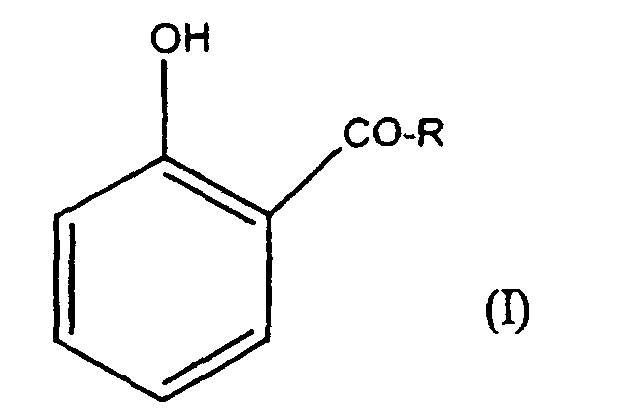
- the subject of the present invention is a process for the synthesis of 2-hydroxyphenylalkyl ketones of formula (I) where R is a linear alkyl containing from 1 to 9 carbon atoms, preferably methyl, characterized by the interaction of a compound of formula (II), where R has the aforementioned meanings, with a catalyst made up of crystalline aluminosilicates of the pentasyl type, where:
- the BET method of determination of the surface area is a widely known standard method (see, for example, J. Am. Soc., 60, 1938, p.309).
- aluminosilicates already described in the patent application EP-A-369364, are characterized by a particular porosity that is established when the primary crystallites aggregate to form agglomerates with the addition of the aluminous binder.
- the patent EP-A-369364 describes the use of these compounds in the conversion of olefins into diesel, in the oil industry sector.
- aluminosilicates that may be used in the present invention may be obtained with the following methodology:
- a further subject of the present invention is therefore a process for the synthesis of 2-hydroxyphenylalkyl ketones of formula (I) where R is a linear alkyl containing from 1 to 9 carbon atoms, preferably methyl, characterized by the interaction of a compound of formula (II), where R has the aforementioned meanings, with a catalyst chosen from among T-4480 powder, T-4480 Extr. 1/16", and Ex-1720 Pt-1.
- the rearrangement reaction that leads to obtaining the compounds of formula (I) is preferably conducted in conditions of gas flow in appropriate reactors, for instance, of a tubular structure. These plants are characterized by a feed zone, a reaction zone and a zone for collection of the products of reaction.
- the compound of formula II (for instance, PA) is vehicled by a vector gas, and the resultant flow is set in contact, for a predetermined period of time, with the aluminosilicates having the chemical-physical characteristics defined above.
- the vector gas utilized is an inert gas, for instance nitrogen, helium, or argon.
- an inert gas for instance nitrogen, helium, or argon.
- the gas in the present process, in order to obtain high yields of 2-HAP, it is preferable for the gas to contain not more than 1% of water.
- the catalyst is set inside the reactor in such a form that it enables convenient and efficient contact with the gas flow, for instance by forming a bed of catalyst through which the gas flows. Before carrying out the reaction, it is preferable to activate the catalyst by means of pre-heating under flow of inert gas.
- the phenolic ester of formula (II) is added to the flow of vector gas.
- the phenolic ester is incorporated in the vector gas in volume proportions generally of between 1% and 20%, preferably between 5% and 15%, or more preferably 10% with respect to the total gas (gas + phenolic ester). These percentages are to be understood as being measured at ambient pressure and at the reaction temperature.
- the phenolic ester is added to the vector gas by means of a infusion pump in a line heated at a temperature higher than the boiling temperature of the ester. In the case of PA the normal operating temperature is 200°C.
- the spatial velocity (WHSV) is normally between 0.1 h -1 and 1.0 h -1 , preferably between 0.25 h -1 and 0.75 h -1 , and more preferably is 0.5 h -1 .
- the reaction temperature is between 220°C and 280°C, preferably between 240°C and 265°C, or more preferably is 256°C.
- temperature of reaction is meant the temperature that characterizes the reaction zone of the reactor.
- the catalytic tests were conducted in conditions of gas flow using a laboratory microplant.
- the plant may be divided into three main zones: (a) feed zone, (b) reaction zone, (c) zone of collection of products.
- the flow of He is regulated by a mass flowmeter calibrated with a bubble flowmeter.
- the phenylacetate (PA) is supplied by an infusion pump and is introduced into the line heated at 200°C and controlled by an iron/Constantan thermocouple.
- the tubular reactor consists of a stainless steel tube with a section of 1 inch and a length of approximately 50 cm. Inside the tube, a perforated diaphragm blocks the catalyst inside the reactor, enabling the passage of the flow of gas. In contact with the tube are two electrically heated copper jaws controlled by means of a thermocouple. The ensemble is insulated by perlite and enclosed in a brass cylinder.
- Inserted in the catalytic bed is a 1/8-inch stainless steel tube inside which a mobile thermocouple can slide, thus enabling measurement of the reaction temperature at different heights of the catalytic bed.
- the gases coming out are maintained at 100°C by means of a resistor controlled by a thermoregulator to prevent crystallization of the heavier products.
- a glass crystallizer At output from the hot zone is set a glass crystallizer at room temperature that enables collection of the condensates. Subsequently, there are two bubble adsorbers containing acetone and set in ice (for the collection of the products that do not condense in the crystallizer) and a bubble adsorber containing absolute ethanol to transform the ketene that may possibly be formed in acetyl acetate.
- the experimental conditions are the ones that yielded the best results following upon a prior screening. These conditions were:
- the catalysts according to the present invention revealed a high 2-HAP/4-HAP selectivity, together with a value of 2-HAP/PhOH ratio considerably higher than that obtained for any of the reference specimens.
- the persistence of high yield values over time for the process forming the subject of the invention enables retardation of the cycles of reactivation of the catalyst, thus increasing the productivity of the plants.
Landscapes
- Chemical & Material Sciences (AREA)
- Organic Chemistry (AREA)
- Crystallography & Structural Chemistry (AREA)
- Engineering & Computer Science (AREA)
- Materials Engineering (AREA)
- Chemical Kinetics & Catalysis (AREA)
- Organic Low-Molecular-Weight Compounds And Preparation Thereof (AREA)
- Catalysts (AREA)
Abstract
Description
- The present invention belongs to the field of synthesis of phenyl ketones. A process is described for the synthesis of 2- hydroxyphenylalkyl ketones by catalyzed rearrangement starting from phenolic esters, characterized by the use of aluminosilicate-based catalysts having pre-determined chemical-physical characteristics.
- Hydroxyphenylalkyl ketones, in particular ortho-hydroxyacetophenone and para-hydroxyacetophenone (hereinafter referred to, respectively, as "2-HAP" and "4-HAP") are intermediate products useful in the synthesis of various products of industrial interest, such as catechol (US Ser. No. 661,552), guaiacol, acetylsalicylic acid (US. Ser. No. 633,832) and various other products in the field of essences, insecticides and pharmaceutical products Adv. Catal., 1968, 18, 259.
- Considering the industrial interest of these products, a great deal of work has been done in the field of their synthesis.
- Hydroxyalkyl ketones are commonly obtained by means of Fries rearrangement on phenylacetates (Appl. Catal., A: General 133, (1995), L1-L6). This reaction requires the use of Lewis acids or Brönsted acids, such as AlCl3, as catalysts. However, these catalysts present the disadvantage of having to be used in high quantities and requiring a long process for recovery of the product; in addition, they cannot be recovered after use. Other catalysts used are FeCl3, TiCl4, or mineral acids, such as HF or H2SO4. All these catalysts produce a large quantity of organic by-products.
- These drawbacks have been overcome by using zeolites as catalysts: these are used in smaller quantities and may be regenerated after use.
- Zeolites are aluminosilicates the structure of which consists of tetrahedrons of SiO4 and AlO4 interconnected by atoms of oxygen to form a three-dimensional lattice. Various structures are obtained owing to the possibility of interconnecting the SiO4 tetrahedrons and substituting the silicon atom with other elements, such as Al, B, Fe, and Ga.
- The rearrangement of phenyl acetate, catalyzed by Zeolites, can be represented as follows:where: PA = phenyl acetate; 2-HAP = ortho-hydroxyacetophenone; 4-HAP = para-hydroxyacetophenone; PhOH = phenol; 4-AcPA = 4-acetylphenylacetate; and 2-AcPA = 2-acetylphenylacetate.

- As is evident from the diagram, the rearrangement reaction leads to a mixture of 2-HAP, 4-HAP and a series of by-products, in particular phenol (Adv. Catal., 1968, op. cit.). This reaction leads to a low yield of the desired isomer; in addition, the rearrangement of the phenyl acetate (PA) is never quantitative, and part of this product does not react.
- A great deal of research work has thus been directed at improving the efficiency of conversion of the phenyl acetate and its selective transformation into the desired isomer, whether 2-HAP or 4-HAP.
- For instance, in US-A-4,668,826 zeolites of the type H-ZSM-5 are used in the direct acylation of phenol with acetic acid. The reaction is orthoselective, leading preferably to 2-HAP, but the percentage of conversion of the phenyl acetate does not exceed 40%. The same reaction is carried out in US-A-4,652,683 using silicalites containing pre-determined amounts of alumina; the yield in 2-HAP does not improve, and high amounts of phenolic by-product are obtained. In Tetr. Lett., 1989, 30(17), 2281-84, a reduction in the formation of phenol is achieved, using an anhydrous catalyst, at the cost, however, of a concomitant reduction in the general efficiency of reaction.
- In Tetr. Lett., 1993, 34(48), 7799-7800, an excellent orthoselectivity is obtained, using zeolites doped with metals, such as Ga, Ni, Pt, Pd; however, the efficiency of conversion remains on average around 65%, and the 2-HAP/phenol ratio is generally low (0.25-1.55).
- In Appl. Catal. A: General, 123, 1995, 37-49, a comparison is made between the results of the Fries rearrangement reaction catalyzed by zeolites, conducted in discontinuous liquid phase or in continuous gaseous phase. The reaction proves more efficient in the liquid phase, and proceeds with a prevalent paraselectivity, leading to larger amounts of 4-HAP. In the gaseous phase, high amounts of phenol and other undesired by-products are obtained; the catalyst is moreover quickly inactivated, especially at low temperatures.
- In a recent work (Progr. Zeol. Microp. Mat., 1997, 105, 1197-1202), an evaluation was made of the effect of particular zeolites with large pores and high silica content (NCL-1) on the Fries rearrangement of the phenyl acetate: a modest orthoselectivity is obtained, as well as low efficiency of rearrangement and significant amounts of phenol.
- Summarizing the teachings of the known art referred to above, it may be concluded that, although the use of zeolites has led to an improved industrial applicability of the Fries rearrangements, the syntheses in terms of hydroxyphenylalkyl ketones fail to meet completely the requirements of efficiency of rearrangement, selectivity of reaction, and reduction of formation of phenolic by-products. There thus remains the need for a process that leads efficiently and selectively to obtaining hydroxyphenylalkyl ketones, in particular 2-HAP and its derivatives.
- It has now been surprisingly found that it is possible synthesize 2-hydroxyphenylalkyl ketones with high yields and high selectivity in a process of rearrangement catalyzed by specific crystalline aluminosilicates. These aluminosilicates have a silica/alumina ratio higher than 10, are made up of primary crystallites with a mean diameter of between 0.1 µm and 0.9 µm, and at least 20% of the primary crystallites are joined in agglomerates of dimensions between 5 µm and 500 µm; the primary crystallites and the agglomerates are bound together by means of finely ground alumina, obtained from hydrolysis of alumino-organic compounds. The surface area (determined by the BET method) of the catalyst is between 300 m2/g and 600 m2/g, and the volume of the pores (determined via porosity to mercury) is between 0.3 cm2/g and 0.8 cm2/g. The aforementioned crystalline aluminosilicates are present in the H form, and the finely ground alumina is contained in a weight percentage with respect to the weight of the catalyst of between 10wt% and 40 wt%.
- The rearrangement catalyzed by these aluminosilicates involves a high conversion of the phenolic ester, a high orthoselectivity and a low formation of phenolic by-products, thus enabling the formation, in high yields, of 2-hydroxyphenylalkyl ketones, with particular application for the synthesis of 2-hydroxyacetophenone.
- The subject of the present invention is a process for the synthesis of 2-hydroxyphenylalkyl ketones of formula (I)where R is a linear alkyl containing from 1 to 9 carbon atoms, preferably methyl, characterized by the interaction of a compound of formula (II), where R has the aforementioned meanings,
 with a catalyst made up of crystalline aluminosilicates of the pentasyl type, where:
- said catalyst is made up of primary crystallites with a mean diameter of between 0.1 µm and 0.9 µm;
- at least 20% of the crystallites are joined in agglomerates of dimensions between 5 µm and 500 µm;
- the primary crystallites or the agglomerates are bound together by means of finely ground alumina obtained from the hydrolysis of alumino-organic compounds, the said alumina being contained in a weight percentage with respect to the weight of the catalyst of between 10 wt% and 40 wt%;
- the surface area (determined with the BET method) of the catalyst is between 300 m2/g and 600 m2/g and the volume of the pores (determined via porosity to mercury) is between 0.3 cm2/g and 0.8 cm2/g;
- the alluminosilicate is present in the H form;
- the silica/alumina ratio is higher than 10.
- The BET method of determination of the surface area is a widely known standard method (see, for example, J. Am. Soc., 60, 1938, p.309).
- These aluminosilicates, already described in the patent application EP-A-369364, are characterized by a particular porosity that is established when the primary crystallites aggregate to form agglomerates with the addition of the aluminous binder. The patent EP-A-369364 describes the use of these compounds in the conversion of olefins into diesel, in the oil industry sector.
- It has now been unexpectedly found, and this forms the subject of the present invention, that these compounds may to be used as catalysts in the Fries rearrangement of phenyl acetate, leading to obtaining 2-hydroxyphenylalkyl ketones, in particular ortho-hydroxyacetophenone (2-HAP), in conditions of efficiency and selectivity not as yet attained by the prior art.
- The aluminosilicates that may be used in the present invention may be obtained with the following methodology:
- a) production of a gel in an aqueous environment containing a source of silicon, a source of aluminium, a source of alkali and a templating agent, such as tetrapropylammonium hydroxide. From the mixture, treated at high pressures and temperatures, there are formed, in a controlled manner, primary crystallites of alluminosilicate with diameters of between 0.1 µm and 0.9 µm;
- b) pre-aggregation of the primary crystallites by addition of flocculants, such as copolymers of acrylamide and derivatives of acrylic acid, and separation of the pre-aggregates obtained;
- c) ion exchange in an aqueous environment of the pre-aggregates with a substance capable of donating protons when heated, separation and immediate calcining of the product obtained, and isolation of the fraction of agglomerates of dimensions between 5 µm and 500 µm;
- d) mixing of the agglomerates with finely ground hydrated alumina, said alumina being preferably in a peptizable form; and
- e) final calcining of the product obtained.
-
- For greater details of description and preparation of these aluminosilicates, the reader is referred to the patent application EP-A-369364, which is here incorporated by reference in its entirety.
- Preferred examples of such products are distributed commercially, by Süd-Chemie under the names T-4480 powder, T-4480 Extr. 1/16", and Ex-1720 Pt-1. A further subject of the present invention is therefore a process for the synthesis of 2-hydroxyphenylalkyl ketones of formula (I)where R is a linear alkyl containing from 1 to 9 carbon atoms, preferably methyl, characterized by the interaction of a compound of formula (II), where R has the aforementioned meanings,
 with a catalyst chosen from among T-4480 powder, T-4480 Extr. 1/16", and Ex-1720 Pt-1.
- The rearrangement reaction that leads to obtaining the compounds of formula (I) is preferably conducted in conditions of gas flow in appropriate reactors, for instance, of a tubular structure. These plants are characterized by a feed zone, a reaction zone and a zone for collection of the products of reaction. The compound of formula II (for instance, PA) is vehicled by a vector gas, and the resultant flow is set in contact, for a predetermined period of time, with the aluminosilicates having the chemical-physical characteristics defined above.
- The vector gas utilized is an inert gas, for instance nitrogen, helium, or argon. In reactions on zeolites in the gaseous phase it is common practice to add a small amount of water to increase the lifetime of the catalyst; in the present process, in order to obtain high yields of 2-HAP, it is preferable for the gas to contain not more than 1% of water.
- The catalyst is set inside the reactor in such a form that it enables convenient and efficient contact with the gas flow, for instance by forming a bed of catalyst through which the gas flows. Before carrying out the reaction, it is preferable to activate the catalyst by means of pre-heating under flow of inert gas.
- When the conditions of activation are attained, the phenolic ester of formula (II) is added to the flow of vector gas. The phenolic ester is incorporated in the vector gas in volume proportions generally of between 1% and 20%, preferably between 5% and 15%, or more preferably 10% with respect to the total gas (gas + phenolic ester). These percentages are to be understood as being measured at ambient pressure and at the reaction temperature. Preferably, the phenolic ester is added to the vector gas by means of a infusion pump in a line heated at a temperature higher than the boiling temperature of the ester. In the case of PA the normal operating temperature is 200°C.
- The spatial velocity (WHSV) is normally between 0.1 h-1 and 1.0 h-1, preferably between 0.25 h-1 and 0.75 h-1, and more preferably is 0.5 h-1.
- By spatial velocity is meant the ratio between the rate of feed [grams of (gas+reagent) per hour] and the quantity [in grams] of catalyst, according to the formula:
- The reaction temperature is between 220°C and 280°C, preferably between 240°C and 265°C, or more preferably is 256°C. By the term temperature of reaction" is meant the temperature that characterizes the reaction zone of the reactor.
- For a general description of the technology of reactions in gas flow, the reader is referred to the text "Chemical Reaction Engineering" published by John Wiley & Sons, New York, 2nd ed., 1972.
- The present invention is now described by means of the following non-limiting experimental examples.
- The performance of various acidic catalysts in the rearrangement of PA to form 2-HAP were analyzed. Particular aspects studied were the orthoselectivity of the reaction, the production of by-products, and the total yields of 2-HAP.
- As reference catalysts, various types of zeolites were used, ones commonly used in the catalysis of reactions in gaseous phase, in acidic form or partially exchanged with Ga or La. The SiO2/Al2O3 ratio of the tested zeolites ranged between 25 and 120. More specific characteristics of these products are illustrated in the table below.
Specimen SiO2/Al2O3 Impregnat. Element Channel dimension (Å) H-ZSM-5 28 - 5.3*5.6,5.5*5.1 H-ZSM-5 120 - 5.3*5.6,5.5*5.1 H-Y 30 - 24.28 H-β 25 - n.d. H-ZSM-5 28 Ga - H-ZSM-5 28 La - H-Y 30 Ga - H-β 25 Ga - - The performance of these catalysts was compared to that of the catalysts T-4480 powder, T-4480 Extr. 1/16" and Ex-1720 Pt-1 belonging to the family of compounds described in the patent EP-A-369364.
- The catalytic tests were conducted in conditions of gas flow using a laboratory microplant. The plant may be divided into three main zones: (a) feed zone, (b) reaction zone, (c) zone of collection of products.
- The flow of He is regulated by a mass flowmeter calibrated with a bubble flowmeter. The phenylacetate (PA) is supplied by an infusion pump and is introduced into the line heated at 200°C and controlled by an iron/Constantan thermocouple.
- The tubular reactor consists of a stainless steel tube with a section of 1 inch and a length of approximately 50 cm. Inside the tube, a perforated diaphragm blocks the catalyst inside the reactor, enabling the passage of the flow of gas. In contact with the tube are two electrically heated copper jaws controlled by means of a thermocouple. The ensemble is insulated by perlite and enclosed in a brass cylinder.
- Inserted in the catalytic bed is a 1/8-inch stainless steel tube inside which a mobile thermocouple can slide, thus enabling measurement of the reaction temperature at different heights of the catalytic bed. The gases coming out are maintained at 100°C by means of a resistor controlled by a thermoregulator to prevent crystallization of the heavier products.
- At output from the hot zone is set a glass crystallizer at room temperature that enables collection of the condensates. Subsequently, there are two bubble adsorbers containing acetone and set in ice (for the collection of the products that do not condense in the crystallizer) and a bubble adsorber containing absolute ethanol to transform the ketene that may possibly be formed in acetyl acetate.
- The experimental conditions are the ones that yielded the best results following upon a prior screening. These conditions were:
- Temperature of the incoming band = 200°C.
- Temperature at output from the reactor = 100°C.
- Reaction temperature (i.e., the temperature inside the reactor in the reaction zone) = 256°C.
- Temperature of the catalytic bed = 265°C.
- Activation of the catalyst: 5 hours at 300°C in He (60 ml/min).
- Feed:
- quantity of PA contained in the inert gas =10%.
- spatial velocity (WHSV) inside the reactor = 0.5 h-1.
- Pressure: atmospheric
- After 4 hours from the start of reaction, the reaction products were determined quantitatively via gas-chromatography analysis. The analyses yielded the following results:
Catalyst PA Conv. 2-HAP yield 2-HAP/4-HAP 2-HAP/PhOH 1 H-ZSM-5(28) 72.8 22.0 42.1 0.30 2 H-ZSM-5(120) 52.1 7.3 2.9 0.27 3 Ga-ZSM-5(28) 33.3 17.4 3.3 0.42 4 La-ZSM-5(28) 78.6 4.8 163.3 0.2 5 HY-30 66.8 16.6 0.3 6 Ga-Y 85.9 3.5 17.5 0.33 7 H-β (25) 75.4 21.2 * 0.42 8 T-480Extr.1/16" 74.5 32.9 17.3 1.5 9 T-4480 powder 62.0 73.6 26.6 2.5 10 Ex-1720 Pt-1 68.1 59.4 19.8 2.1 - From the data given in Table 2 it may be noted that the traditional zeolites (specimens 1, 2 and 5-7) have a high 2-HAP / 4-HAP selectivity, but the yield in 2-HAP is quite modest in that a substantial proportion of PA is converted into phenol, as is evident from the low values of the 2-HAP/PhOH ratio.
- The doping of the zeolites with metals (see specimens 3, 4 and 6) does not improve the yield in 2-HAP, nor does it reduce the formation of the PhOH by-product.
- Instead, the catalysts according to the present invention (see specimens 8-10) revealed a high 2-HAP/4-HAP selectivity, together with a value of 2-HAP/PhOH ratio considerably higher than that obtained for any of the reference specimens.
- As emerges from the Table, the synergy between these two factors leads to 2-HAP yields that are surprisingly higher than those obtained from all the reference specimens.
- The yields in further by-products of reaction (2-AcPA, 4-AcPA) are lower than 0.2%.
- Further tests were carried out on a longer production cycle (4 hours/day for three days) to verify the persistence of activity and the constancy of the yields over time.
- During the entire duration of the test, none of the above-mentioned reference catalysts managed to exceed or even approach the yield values found in the process forming the subject of the invention.
- The persistence of high yield values over time for the process forming the subject of the invention enables retardation of the cycles of reactivation of the catalyst, thus increasing the productivity of the plants.
Claims (10)
- A process for the synthesis of 2-hydroxyphenylalkyl ketones of formula (I)where R is a linear alkyl containing from 1 to 9 carbon atoms, characterized by the interaction of a compound of formula (II), where R has the meanings indicated above
 with a catalyst made up of crystalline aluminosilicates of the pentasyl type, where
 said catalyst is made up of primary crystallites with a mean diameter of between 0.1 µm and 0.9 µm;at least 20% of the crystallites are joined in agglomerates of dimensions of between 5 µm and 500 µm;the primary crystallites or the agglomerates are bound together by means of finely ground alumina obtained from the hydrolysis of alumino-organic compounds, the said alumina being contained in a weight percentage with respect to the weight of the catalyst of between 10 wt% and 40 wt%;the surface area (determined using the BET method) of the catalyst is between 300 m2/g and 600 m2/g and the volume of the pores (determined via porosity to mercury) is between 0.3 cm2/g and 0.8 cm2/g;the alluminosilicate is present in the H form; andthe silica/alumina ratio is higher than 10.
 - A process according to Claim 1, where R is chosen between methyl and ethyl.
- A process according to Claims 1 and 2, where said catalyst is chosen between the products T-4480 powder, T-4480 Extr. 1/16", and Ex-1720 Pt-1, (Süd-Chemie).
- A process according to Claims 1-3, conducted in the gaseous phase.
- A process according to Claim 4, conducted in the following conditions:temperature of reaction of between 220°C and 280°C;spatial velocity of between 0.1 h-1 and 1.0 h-1; andconcentration of compound of formula (II) in the gaseous phase of between 1 vol% and 20 vol% with respect to the total gas (i.e., gas + compound of formula II).
- A process according to Claim 4, conducted in the following conditions:temperature of reaction of between 240°C and 265°C;spatial velocity of between 0.25 h-1 and 0.75 h-1; andconcentration of compound of formula (II) in the gaseous phase of between 5% and 15%, by volume
- A process according to Claim 4, conducted in the following conditions:temperature of reaction: 256°C;spatial velocity: 0.5 h -1; andconcentration of compound of formula (II) in the gaseous phase: 10 vol%.
- A process according to Claims 4-7, where the gas utilized to produce the gaseous phase is chosen from among nitrogen, helium, argon or their mixtures.
- A process according to Claims 4-8, where the gas utilized to produce the gaseous phase contains at most 1% of water.
- A process according to Claims 4-9, where the catalyst is activated by means of pre-heating under flow of inert gas before the reaction is carried out.
Applications Claiming Priority (3)
| Application Number | Priority Date | Filing Date | Title |
|---|---|---|---|
| IT1999MI002038A IT1313654B1 (en) | 1999-09-30 | 1999-09-30 | PROCESS FOR THE SYNTHESIS OF 2-HYDROXYPHENYL ALCHYL KETONES. |
| ITMI992038 | 1999-09-30 | ||
| PCT/EP2000/009425 WO2001023339A1 (en) | 1999-09-30 | 2000-09-27 | Process for the synthesis of 2-hydroxyphenyl alkyl ketones |
Publications (2)
| Publication Number | Publication Date |
|---|---|
| EP1220823A1 EP1220823A1 (en) | 2002-07-10 |
| EP1220823B1 true EP1220823B1 (en) | 2004-02-25 |
Family
ID=11383694
Family Applications (1)
| Application Number | Title | Priority Date | Filing Date |
|---|---|---|---|
| EP00967799A Expired - Lifetime EP1220823B1 (en) | 1999-09-30 | 2000-09-27 | Process for the synthesis of 2-hydroxyphenyl alkyl ketones |
Country Status (6)
| Country | Link |
|---|---|
| EP (1) | EP1220823B1 (en) |
| AT (1) | ATE260231T1 (en) |
| AU (1) | AU7783400A (en) |
| DE (1) | DE60008564T2 (en) |
| IT (1) | IT1313654B1 (en) |
| WO (1) | WO2001023339A1 (en) |
Families Citing this family (1)
| Publication number | Priority date | Publication date | Assignee | Title |
|---|---|---|---|---|
| CN109369359A (en) * | 2018-12-24 | 2019-02-22 | 浙江工业大学 | A method of preparing parahydroxyacet-ophenone |
Family Cites Families (4)
| Publication number | Priority date | Publication date | Assignee | Title |
|---|---|---|---|---|
| US3354221A (en) * | 1963-08-12 | 1967-11-21 | Mobil Oil Corp | Production of phenols |
| US4652683A (en) * | 1985-12-02 | 1987-03-24 | Celanese Corporation | Process for producing 2-hydroxyphenyl lower alkyl ketones |
| DE3838710A1 (en) * | 1988-11-15 | 1990-05-17 | Sued Chemie Ag | CATALYST BASED ON CRYSTALLINE ALUMOSILICATES |
| DE4323774A1 (en) * | 1993-07-15 | 1995-02-09 | Basf Ag | Hollow ball-like agglomerated pentasil zeolites |
-
1999
- 1999-09-30 IT IT1999MI002038A patent/IT1313654B1/en active
-
2000
- 2000-09-27 WO PCT/EP2000/009425 patent/WO2001023339A1/en not_active Ceased
- 2000-09-27 DE DE60008564T patent/DE60008564T2/en not_active Expired - Lifetime
- 2000-09-27 AT AT00967799T patent/ATE260231T1/en not_active IP Right Cessation
- 2000-09-27 AU AU77834/00A patent/AU7783400A/en not_active Abandoned
- 2000-09-27 EP EP00967799A patent/EP1220823B1/en not_active Expired - Lifetime
Also Published As
| Publication number | Publication date |
|---|---|
| EP1220823A1 (en) | 2002-07-10 |
| AU7783400A (en) | 2001-04-30 |
| IT1313654B1 (en) | 2002-09-09 |
| WO2001023339A8 (en) | 2001-08-09 |
| ATE260231T1 (en) | 2004-03-15 |
| ITMI992038A1 (en) | 2001-03-30 |
| WO2001023339A1 (en) | 2001-04-05 |
| ITMI992038A0 (en) | 1999-09-30 |
| DE60008564D1 (en) | 2004-04-01 |
| DE60008564T2 (en) | 2004-12-16 |
Similar Documents
| Publication | Publication Date | Title |
|---|---|---|
| Doelle et al. | Sorption and catalytic reaction in pentasil zeolites. Influence of preparation and crystal size on equilibria and kinetics | |
| US5573990A (en) | Process for the conversion of methanol to light olefins and catalyst for such process | |
| CN102858718B (en) | Manufacture the method comprising the catalyzer of phosphorus-modified zeolite being used for dehydration of alcohols technique | |
| Wang et al. | Transformylating amine with DMF to formamide over CeO 2 catalyst | |
| US5137854A (en) | Process for the production of modified H-mordenite, catalyst comprising said H-mordenite and process for the synthesis of methylamine with the use of the same | |
| Izumi et al. | Organic syntheses using aluminosilicates | |
| TW201113250A (en) | Process for the production of acetic acid and dimethyl ether | |
| KR20170108174A (en) | Production of para-xylene | |
| JPH0656730A (en) | Method of aldol condensation of solid basic catalyst comprising magnesium oxide and aluminum oxide having large surface area | |
| CN105358521B (en) | carbonylation method | |
| EA007767B1 (en) | Production of olefins | |
| JPH0597747A (en) | Synthesis of alkyl tertiary alkyl ether using zeolite catalyst | |
| CN112138724B (en) | Hydroalkylation catalyst and method thereof | |
| NZ207794A (en) | Catalytic production of unsaturated carboxylic acids | |
| US4918249A (en) | Silicometallate molecular sieves and their use as catalysts in oxidation of alkanes | |
| IT9021157A1 (en) | DEHYDROISOMERIZATION CATALYST AND ITS USE IN THE PREPARATION OF ISOBUTENE FROM N-BUTANE | |
| EP0591504A1 (en) | Process for the production of olefins | |
| Sigismondi et al. | Palladium (0)-catalyzed substitution of allylic substrates in an aqueous-organic medium. Influence of various parameters on the selectivity of the reaction | |
| JPH05246919A (en) | Method for synthesis of alkyl tert-alkyl ether using zeolite catalyst | |
| EP1220823A1 (en) | Process for the synthesis of 2-hydroxyphenyl alkyl ketones | |
| KR960016524B1 (en) | Synthesis for pyridine and alkylpyridine | |
| Kamalakar et al. | Vapor phase ethylation of naphthalene with ethanol over molecular sieve catalysts | |
| Climent et al. | Acid zeolites as catalysts in organic reactions: condensation of acetophenone with benzene derivatives | |
| Salehirad et al. | NMR studies of methanol-to-hydrocarbon chemistry Part 1Primary products and mechanistic considerations using a wide-pore catalyst | |
| Yarlagadda et al. | Conversion of methanol to hydrocarbons over silica-alumina: Selective Formation of Lower Olefins |
Legal Events
| Date | Code | Title | Description |
|---|---|---|---|
| PUAI | Public reference made under article 153(3) epc to a published international application that has entered the european phase |
Free format text: ORIGINAL CODE: 0009012 |
|
| 17P | Request for examination filed |
Effective date: 20020424 |
|
| AK | Designated contracting states |
Kind code of ref document: A1 Designated state(s): AT BE CH CY DE DK ES FI FR GB GR IE IT LI LU MC NL PT SE |
|
| AX | Request for extension of the european patent |
Free format text: AL;LT;LV;MK;RO;SI |
|
| RIN1 | Information on inventor provided before grant (corrected) |
Inventor name: POLUZZI, ELISA Inventor name: BORZATTA, VALERIO Inventor name: VACCARI, ANGELO |
|
| GRAP | Despatch of communication of intention to grant a patent |
Free format text: ORIGINAL CODE: EPIDOSNIGR1 |
|
| GRAS | Grant fee paid |
Free format text: ORIGINAL CODE: EPIDOSNIGR3 |
|
| GRAA | (expected) grant |
Free format text: ORIGINAL CODE: 0009210 |
|
| GRAL | Information related to payment of fee for publishing/printing deleted |
Free format text: ORIGINAL CODE: EPIDOSDIGR3 |
|
| GRAS | Grant fee paid |
Free format text: ORIGINAL CODE: EPIDOSNIGR3 |
|
| RIN1 | Information on inventor provided before grant (corrected) |
Inventor name: VACCARI, ANGELO Inventor name: POLUZZI, ELISA Inventor name: BORZATTA, VALERIO |
|
| AK | Designated contracting states |
Kind code of ref document: B1 Designated state(s): AT BE CH CY DE DK ES FI FR GB GR IE IT LI LU MC NL PT SE |
|
| PG25 | Lapsed in a contracting state [announced via postgrant information from national office to epo] |
Ref country code: IT Free format text: LAPSE BECAUSE OF FAILURE TO SUBMIT A TRANSLATION OF THE DESCRIPTION OR TO PAY THE FEE WITHIN THE PRESCRIBED TIME-LIMIT;WARNING: LAPSES OF ITALIAN PATENTS WITH EFFECTIVE DATE BEFORE 2007 MAY HAVE OCCURRED AT ANY TIME BEFORE 2007. THE CORRECT EFFECTIVE DATE MAY BE DIFFERENT FROM THE ONE RECORDED. Effective date: 20040225 Ref country code: LI Free format text: LAPSE BECAUSE OF FAILURE TO SUBMIT A TRANSLATION OF THE DESCRIPTION OR TO PAY THE FEE WITHIN THE PRESCRIBED TIME-LIMIT Effective date: 20040225 Ref country code: FI Free format text: LAPSE BECAUSE OF FAILURE TO SUBMIT A TRANSLATION OF THE DESCRIPTION OR TO PAY THE FEE WITHIN THE PRESCRIBED TIME-LIMIT Effective date: 20040225 Ref country code: CY Free format text: LAPSE BECAUSE OF FAILURE TO SUBMIT A TRANSLATION OF THE DESCRIPTION OR TO PAY THE FEE WITHIN THE PRESCRIBED TIME-LIMIT Effective date: 20040225 Ref country code: CH Free format text: LAPSE BECAUSE OF FAILURE TO SUBMIT A TRANSLATION OF THE DESCRIPTION OR TO PAY THE FEE WITHIN THE PRESCRIBED TIME-LIMIT Effective date: 20040225 Ref country code: NL Free format text: LAPSE BECAUSE OF FAILURE TO SUBMIT A TRANSLATION OF THE DESCRIPTION OR TO PAY THE FEE WITHIN THE PRESCRIBED TIME-LIMIT Effective date: 20040225 Ref country code: BE Free format text: LAPSE BECAUSE OF FAILURE TO SUBMIT A TRANSLATION OF THE DESCRIPTION OR TO PAY THE FEE WITHIN THE PRESCRIBED TIME-LIMIT Effective date: 20040225 Ref country code: AT Free format text: LAPSE BECAUSE OF FAILURE TO SUBMIT A TRANSLATION OF THE DESCRIPTION OR TO PAY THE FEE WITHIN THE PRESCRIBED TIME-LIMIT Effective date: 20040225 |
|
| REG | Reference to a national code |
Ref country code: GB Ref legal event code: FG4D |
|
| REG | Reference to a national code |
Ref country code: CH Ref legal event code: EP |
|
| REG | Reference to a national code |
Ref country code: IE Ref legal event code: FG4D |
|
| REF | Corresponds to: |
Ref document number: 60008564 Country of ref document: DE Date of ref document: 20040401 Kind code of ref document: P |
|
| PG25 | Lapsed in a contracting state [announced via postgrant information from national office to epo] |
Ref country code: SE Free format text: LAPSE BECAUSE OF FAILURE TO SUBMIT A TRANSLATION OF THE DESCRIPTION OR TO PAY THE FEE WITHIN THE PRESCRIBED TIME-LIMIT Effective date: 20040525 Ref country code: DK Free format text: LAPSE BECAUSE OF FAILURE TO SUBMIT A TRANSLATION OF THE DESCRIPTION OR TO PAY THE FEE WITHIN THE PRESCRIBED TIME-LIMIT Effective date: 20040525 Ref country code: GR Free format text: LAPSE BECAUSE OF FAILURE TO SUBMIT A TRANSLATION OF THE DESCRIPTION OR TO PAY THE FEE WITHIN THE PRESCRIBED TIME-LIMIT Effective date: 20040525 |
|
| PG25 | Lapsed in a contracting state [announced via postgrant information from national office to epo] |
Ref country code: ES Free format text: LAPSE BECAUSE OF FAILURE TO SUBMIT A TRANSLATION OF THE DESCRIPTION OR TO PAY THE FEE WITHIN THE PRESCRIBED TIME-LIMIT Effective date: 20040605 |
|
| NLV1 | Nl: lapsed or annulled due to failure to fulfill the requirements of art. 29p and 29m of the patents act | ||
| LTIE | Lt: invalidation of european patent or patent extension |
Effective date: 20040225 |
|
| REG | Reference to a national code |
Ref country code: CH Ref legal event code: PL |
|
| PG25 | Lapsed in a contracting state [announced via postgrant information from national office to epo] |
Ref country code: LU Free format text: LAPSE BECAUSE OF NON-PAYMENT OF DUE FEES Effective date: 20040927 Ref country code: IE Free format text: LAPSE BECAUSE OF NON-PAYMENT OF DUE FEES Effective date: 20040927 |
|
| PG25 | Lapsed in a contracting state [announced via postgrant information from national office to epo] |
Ref country code: MC Free format text: LAPSE BECAUSE OF NON-PAYMENT OF DUE FEES Effective date: 20040930 |
|
| ET | Fr: translation filed | ||
| PLBE | No opposition filed within time limit |
Free format text: ORIGINAL CODE: 0009261 |
|
| STAA | Information on the status of an ep patent application or granted ep patent |
Free format text: STATUS: NO OPPOSITION FILED WITHIN TIME LIMIT |
|
| 26N | No opposition filed |
Effective date: 20041126 |
|
| REG | Reference to a national code |
Ref country code: IE Ref legal event code: MM4A |
|
| PG25 | Lapsed in a contracting state [announced via postgrant information from national office to epo] |
Ref country code: PT Free format text: LAPSE BECAUSE OF NON-PAYMENT OF DUE FEES Effective date: 20040725 |
|
| PGFP | Annual fee paid to national office [announced via postgrant information from national office to epo] |
Ref country code: GB Payment date: 20090928 Year of fee payment: 10 |
|
| PGFP | Annual fee paid to national office [announced via postgrant information from national office to epo] |
Ref country code: DE Payment date: 20090928 Year of fee payment: 10 |
|
| PGFP | Annual fee paid to national office [announced via postgrant information from national office to epo] |
Ref country code: FR Payment date: 20091013 Year of fee payment: 10 |
|
| GBPC | Gb: european patent ceased through non-payment of renewal fee |
Effective date: 20100927 |
|
| REG | Reference to a national code |
Ref country code: FR Ref legal event code: ST Effective date: 20110531 |
|
| REG | Reference to a national code |
Ref country code: DE Ref legal event code: R119 Ref document number: 60008564 Country of ref document: DE Effective date: 20110401 |
|
| PG25 | Lapsed in a contracting state [announced via postgrant information from national office to epo] |
Ref country code: FR Free format text: LAPSE BECAUSE OF NON-PAYMENT OF DUE FEES Effective date: 20100930 Ref country code: DE Free format text: LAPSE BECAUSE OF NON-PAYMENT OF DUE FEES Effective date: 20110401 |
|
| PG25 | Lapsed in a contracting state [announced via postgrant information from national office to epo] |
Ref country code: GB Free format text: LAPSE BECAUSE OF NON-PAYMENT OF DUE FEES Effective date: 20100927 |