EP1220283A2 - Ionization polarity prediction of compounds for efficient mass spectrometry - Google Patents
Ionization polarity prediction of compounds for efficient mass spectrometry Download PDFInfo
- Publication number
- EP1220283A2 EP1220283A2 EP01306065A EP01306065A EP1220283A2 EP 1220283 A2 EP1220283 A2 EP 1220283A2 EP 01306065 A EP01306065 A EP 01306065A EP 01306065 A EP01306065 A EP 01306065A EP 1220283 A2 EP1220283 A2 EP 1220283A2
- Authority
- EP
- European Patent Office
- Prior art keywords
- compounds
- polarity
- polarization
- positive
- negative
- Prior art date
- Legal status (The legal status is an assumption and is not a legal conclusion. Google has not performed a legal analysis and makes no representation as to the accuracy of the status listed.)
- Withdrawn
Links
Images

Classifications
-
- H—ELECTRICITY
- H01—ELECTRIC ELEMENTS
- H01J—ELECTRIC DISCHARGE TUBES OR DISCHARGE LAMPS
- H01J49/00—Particle spectrometers or separator tubes
- H01J49/0027—Methods for using particle spectrometers
Definitions
- This invention relates to methods for increasing the efficiency of mass spectrometric analysis and particularly for use in drug compound screening procedures.
- This invention particularly relates to methods for pre-screening of candidate drug compounds, which are to be analyzed by mass spectroscopy for drug-drug interactions. It also particularly relates to a means for increasing the efficiency, speed, flexibility of use and throughput in which analytical results can be obtained on large numbers of compounds from said mass spectroscopy.
- a compound sample flows through a fused silica capillary to a charged stainless steel needle held at high (3000-5000) voltage.
- This potential causes the formation of a liquid spray known as electrospray, wherein ions (both negative and positive) of the analyte are formed where they are then entrained into the mass analyzer sections of the instrument for the analysis.
- electrospray ions (both negative and positive) of the analyte are formed where they are then entrained into the mass analyzer sections of the instrument for the analysis.
- numerous sample feeds are effected.
- the numerous samples are loaded and injected in a cycle with the time of the cycle being the time between starting a series of samples (or an injection into the HPLC system) and the subsequent set of samples. At present, this cycle time is on the order of about one minute.
- the present invention comprises a method for presorting compounds by polarity in order to segregate compounds, such as by plating them into separate racks, to avoid problems of polarity matching in mass spectrometric quantitation.
- the method of the present invention comprises the steps of:
- a series of identifiers are applied to compounds which identifiers are generally predictive of polarity along a decisional tree of parameters.
- a first identifier predictor is the presence of an hydroxyl (OH) group, with a majority of compounds having an OH group being ionized at positive polarity, whereas a clear minority are less likely to be polarized at a positive polarity.
- a second determined identifier predictor is the number of oxygen atoms. Thus, compounds having more than two oxygen atoms are less likely to be ionized at a positive polarity whereas compounds with less than two oxygens are more likely to be ionized at a positive polarity.
- the number of oxygen atoms is a good discriminator for compounds which also have an OH group present but for compounds without an OH group present, a different discriminator feature is better, i.e., a CH 2 QCH 2 moiety where Q represents an atom other than C or H.
- compounds slated for testing are pre-sorted by polarity with the compounds being slated into separate racks to avoid the problem of polarity matching in mass spectrometric quantitation. This is particularly useful in multispray applications where a given set of 2 or 4 analytes must all ionize at the same polarity.
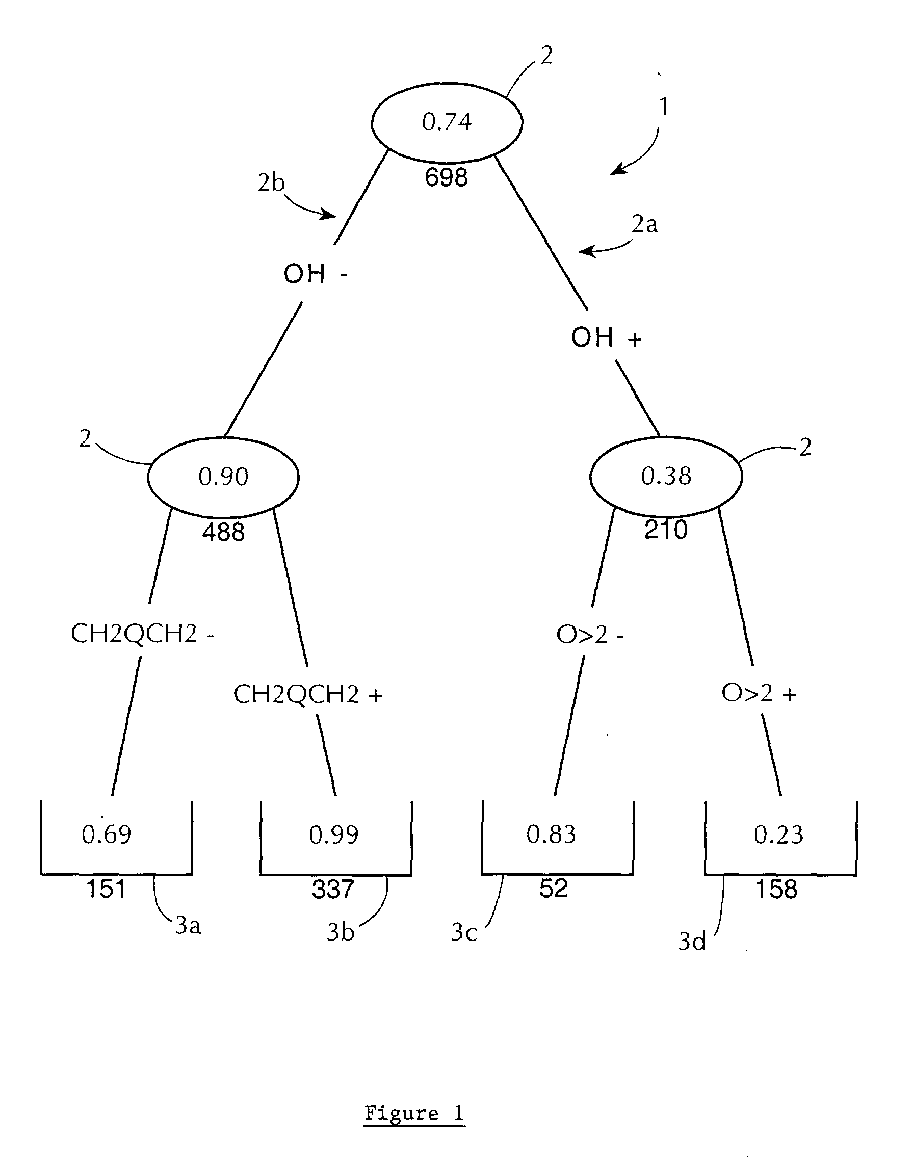
- the sole figure is an example of a polarity classification tree with discrimination parameter branches and percentage of positive and negative polarities.
- each node 2 of the tree indicates the fraction of the compounds with the indicated discrimination structure ionized at positive polarity, with "+" indicating present and "-" indicating absence.
- the 210 compounds with an OH group present are less likely to be ionized at positive polarity (38%), while the 488 compounds without an OH group drop down the tree to the left and are much more likely to be ionized at positive polarity (90%).
- the two groups are then further segregated based on the best discriminating factor for the particular group.
- the 210 compounds with an OH group present are divided based on whether there are more than two oxygen atoms present.
- the tree suggests that the number of oxygen atoms is a good discriminator for compounds but only if an OH group is present, otherwise as seen in the figure and the branches going down to the left, the presence or absence of CH 2 QCH 2 groups, where Q is neither C or H, is a better discriminator of polarity (presence translates into 99% positive polarity).
- classification trees were built on 348 of the 698 compounds described above, and their predictive ability was evaluated with the remaining 350 compounds. Results based on this small sample indicates that the tree based method can accurately classify 87-89% of the compounds with respect to polarity for ionization. These data are however underestimates since the data used to generate the tree models were based on optimal ionization polarity and often a given compound will ionize at both polarities, especially where the prediction values lie near a selection threshold.
Landscapes
- Chemical & Material Sciences (AREA)
- Analytical Chemistry (AREA)
- Other Investigation Or Analysis Of Materials By Electrical Means (AREA)
Abstract
Description
Claims (6)
- A method for segregating compounds by ionization polarity for use in polarity sensitive analysis thereof, said method comprising the steps of:a) selecting a data base of a statistically significant group of compounds and determining the polarization, positive or negative, at which each of said compounds is ionized;b) structurally analyzing the individual compounds to determine structural characteristics common to a majority of compounds which ionize at positive polarity and to determine structural characteristics common to a majority of compounds which ionize at negative polarity, as polarization determinants;c) sequentially arranging the polarization determinants in classification trees according to percentage determination of one of said negative or positive polarization;d) applying the polarization determinants in one of said classification trees in classifying a new compound for a predicted polarization of positive or negative at which said compound is ionized;e) segregating compounds classified as ionizing at positive polarity and compounds classified as ionizing at negative polarity; andf) separately analyzing the segregated compounds with the respective predicted polarities with an analysis instrument operable in different modes depending on ionization polarity.
- The method of claim 1, wherein said analysis instrument is a mass spectrometer.
- The method of claim 2, wherein a polarization determinant is the presence of an OH group.
- The method of claim 2, wherein a polarization determinant is one of the presence of more than two oxygen atoms and the presence of less than two oxygen atoms.
- The method of claim 4, wherein the presence of more than two oxygen atoms or the presence of less than two oxygen atoms is a determinant, if an OH group is present.
- The method of claim 5, wherein, in the absence of an OH group, the presence or absence of CH2QCH2 groups, where Q is neither C or H, is a discriminator of polarity.
Applications Claiming Priority (2)
| Application Number | Priority Date | Filing Date | Title |
|---|---|---|---|
| US21976900P | 2000-07-20 | 2000-07-20 | |
| US219769 | 2000-07-20 |
Publications (2)
| Publication Number | Publication Date |
|---|---|
| EP1220283A2 true EP1220283A2 (en) | 2002-07-03 |
| EP1220283A3 EP1220283A3 (en) | 2004-07-14 |
Family
ID=22820704
Family Applications (1)
| Application Number | Title | Priority Date | Filing Date |
|---|---|---|---|
| EP01306065A Withdrawn EP1220283A3 (en) | 2000-07-20 | 2001-07-13 | Ionization polarity prediction of compounds for efficient mass spectrometry |
Country Status (6)
| Country | Link |
|---|---|
| US (1) | US20020010555A1 (en) |
| EP (1) | EP1220283A3 (en) |
| JP (1) | JP2002107343A (en) |
| CA (1) | CA2353200A1 (en) |
| IL (1) | IL144313A0 (en) |
| MX (1) | MXPA01007347A (en) |
Family Cites Families (2)
| Publication number | Priority date | Publication date | Assignee | Title |
|---|---|---|---|---|
| AU722989B2 (en) * | 1996-11-04 | 2000-08-17 | 3-Dimensional Pharmaceuticals, Inc. | System, method, and computer program product for the visualization and interactive processing and analysis of chemical data |
| WO1999005309A1 (en) * | 1997-07-23 | 1999-02-04 | Millennium Pharmaceuticals, Inc. | Multiple target screening of molecular libraries by mass spectrometry |
-
2001
- 2001-07-03 US US09/898,290 patent/US20020010555A1/en not_active Abandoned
- 2001-07-12 IL IL14431301A patent/IL144313A0/en unknown
- 2001-07-13 EP EP01306065A patent/EP1220283A3/en not_active Withdrawn
- 2001-07-18 CA CA002353200A patent/CA2353200A1/en not_active Abandoned
- 2001-07-19 JP JP2001219719A patent/JP2002107343A/en active Pending
- 2001-07-19 MX MXPA01007347A patent/MXPA01007347A/en unknown
Also Published As
| Publication number | Publication date |
|---|---|
| JP2002107343A (en) | 2002-04-10 |
| IL144313A0 (en) | 2002-05-23 |
| EP1220283A3 (en) | 2004-07-14 |
| MXPA01007347A (en) | 2002-03-08 |
| CA2353200A1 (en) | 2002-01-20 |
| US20020010555A1 (en) | 2002-01-24 |
Similar Documents
| Publication | Publication Date | Title |
|---|---|---|
| Sinha et al. | A beginner’s guide to mass spectrometry–based proteomics | |
| JP4768189B2 (en) | Methods for non-targeted complex sample analysis | |
| Dunn et al. | Mass appeal: metabolite identification in mass spectrometry-focused untargeted metabolomics | |
| Zimmer et al. | Advances in proteomics data analysis and display using an accurate mass and time tag approach | |
| US8987660B2 (en) | Mass spectrometry with selective ion filtration by digital thresholding | |
| EP1766394B1 (en) | System and method for grouping precursor and fragment ions using selected ion chromatograms | |
| JP4818116B2 (en) | Method and device for processing LC-MS or LC-MS / MS data in metabonomics | |
| JP4704034B2 (en) | Method of using data binning in analysis of chromatographic / spectrometric data | |
| Oberacher et al. | Evaluation of the sensitivity of the ‘Wiley registry of tandem mass spectral data, MSforID’with MS/MS data of the ‘NIST/NIH/EPA mass spectral library’ | |
| BRPI0711967A2 (en) | mass spectrometry biomarker assay | |
| CN117461087A (en) | Methods and apparatus for identifying molecular species in mass spectrometry | |
| CN112689885B (en) | Dynamic ion filter for reducing highly abundant ions | |
| Zhou et al. | The spectra count label-free quantitation in cancer proteomics | |
| CN111198226B (en) | Method for multiplexing MS-3 analysis of peptides | |
| CN108287200A (en) | Materials analysis methods of the mass spectrum with reference to the method for building up of database and based on it | |
| US20240369516A1 (en) | Method of bioanalytical analysis utilizing ion spectrometry, including mass analysis | |
| US20020010555A1 (en) | Ionization polarity prediction of compounds for efficient mass spectrometry | |
| KR20070029126A (en) | Protein interpretation method | |
| US20050159902A1 (en) | Apparatus for library searches in mass spectrometry | |
| JP5039330B2 (en) | Mass spectrometry system | |
| CN117110466B (en) | High-sensitivity and high-flux chemical substance annotation method and system | |
| CN101169417A (en) | Reagent kit and method for judging normal person and liver cancer using magnetic bead supported matrix | |
| CN110763784A (en) | Data mining-based method for analyzing peptide fragment impurities in high-purity polypeptide | |
| Zhang et al. | ICPD-a new peak detection algorithm for LC/MS | |
| Nelson et al. | Eric E. Niederkofler 15.1 Background Historically, proteomics is the discipline of studying the complete complement of |
Legal Events
| Date | Code | Title | Description |
|---|---|---|---|
| PUAI | Public reference made under article 153(3) epc to a published international application that has entered the european phase |
Free format text: ORIGINAL CODE: 0009012 |
|
| 17P | Request for examination filed |
Effective date: 20010727 |
|
| AK | Designated contracting states |
Kind code of ref document: A2 Designated state(s): AT BE CH CY DE DK ES FI FR GB GR IE IT LI LU MC NL PT SE TR |
|
| AX | Request for extension of the european patent |
Free format text: AL;LT;LV;MK;RO;SI |
|
| PUAL | Search report despatched |
Free format text: ORIGINAL CODE: 0009013 |
|
| AK | Designated contracting states |
Kind code of ref document: A3 Designated state(s): AT BE CH CY DE DK ES FI FR GB GR IE IT LI LU MC NL PT SE TR |
|
| AX | Request for extension of the european patent |
Extension state: AL LT LV MK RO SI |
|
| RIC1 | Information provided on ipc code assigned before grant |
Ipc: 7G 01N 33/94 B Ipc: 7H 01J 49/04 A |
|
| AKX | Designation fees paid |
Designated state(s): AT BE CH CY DE DK ES FI FR GB GR IE IT LI LU MC NL PT SE TR |
|
| STAA | Information on the status of an ep patent application or granted ep patent |
Free format text: STATUS: THE APPLICATION IS DEEMED TO BE WITHDRAWN |
|
| 18D | Application deemed to be withdrawn |
Effective date: 20050115 |