EP1220198A1 - Decoding multiple HMM sets using a single sentence grammar - Google Patents
Decoding multiple HMM sets using a single sentence grammar Download PDFInfo
- Publication number
- EP1220198A1 EP1220198A1 EP01000331A EP01000331A EP1220198A1 EP 1220198 A1 EP1220198 A1 EP 1220198A1 EP 01000331 A EP01000331 A EP 01000331A EP 01000331 A EP01000331 A EP 01000331A EP 1220198 A1 EP1220198 A1 EP 1220198A1
- Authority
- EP
- European Patent Office
- Prior art keywords
- symbols
- network
- symbol
- hmm
- base
- Prior art date
- Legal status (The legal status is an assumption and is not a legal conclusion. Google has not performed a legal analysis and makes no representation as to the accuracy of the status listed.)
- Withdrawn
Links
- 238000000034 method Methods 0.000 claims abstract description 20
- 238000010276 construction Methods 0.000 claims description 7
- 238000006243 chemical reaction Methods 0.000 claims description 6
- 230000007704 transition Effects 0.000 claims description 6
- 230000006870 function Effects 0.000 description 8
- 238000007476 Maximum Likelihood Methods 0.000 description 1
- 230000001419 dependent effect Effects 0.000 description 1
- 238000010586 diagram Methods 0.000 description 1
- 238000010845 search algorithm Methods 0.000 description 1
- 238000012360 testing method Methods 0.000 description 1
Images

Classifications
-
- G—PHYSICS
- G10—MUSICAL INSTRUMENTS; ACOUSTICS
- G10L—SPEECH ANALYSIS TECHNIQUES OR SPEECH SYNTHESIS; SPEECH RECOGNITION; SPEECH OR VOICE PROCESSING TECHNIQUES; SPEECH OR AUDIO CODING OR DECODING
- G10L15/00—Speech recognition
- G10L15/08—Speech classification or search
- G10L15/14—Speech classification or search using statistical models, e.g. Hidden Markov Models [HMMs]
- G10L15/142—Hidden Markov Models [HMMs]
Definitions
- This invention relates generally to speech recognition and more particularly to a speech recognition search method.
- Speech recognition devices are typically deployed in different acoustic environments.
- An acoustic environment refers to a stationary condition in which the speech is produced.
- speech signal can be produced by male speakers, female speakers, in an office environment, in a noisy environment.
- HMM Hidden Markov Models
- the speech recognizer is required to decode M (the number of environments) sets of HMMs each of which models a specific acoustic environment.
- recognition search methods typically (which include state-of-the-art recognizers as HTK 2.0) require a network of M sub-networks, as illustrated in Figure 1. Requiring M-sets of sentence network makes the recognition device more costly and requires much more memory.
- a new speech recognition search method is described herein, which needs only 1 out of the M subnetwork (sentence network) and yet gives substantially the same recognition performance, thus reducing memory requirement for network storage by M-1/M.
- the speech recognition method includes a basic speaker independent grammar or network (sentence structure) and virtual symbols representing the network of expanded sets HMM sets where the pronunciation of each symbol is specified by a set of HMM states.
- the new recognizer builds recognition paths defined on the expanded symbols, and accesses the network using base-symbols, through proper conversion function that gives the base-symbol of any expanded symbols, and vice versa.
- a network is constructed to represent a merged version of the M networks that is speaker independent. For the male and female case this would be a merged version of the male and female networks and be gender-independent. The models for children may also be merged. Other environments may also be merged. We need to further decode specific HMMs such as those for male, female and child and combine with the generic (speaker independent) network where for both the male, female and child have the same nodes and transitions.
- FIG. 2 there is illustrated the system according to one embodiment of the present invention.
- the generic network represented by the base symbol ⁇ is stored in memory 21. This provides the network structure itself.
- memory 23 Also stored in memory 23 is a set of HMMs for male and a set for female for example. A set of HMMs may also be for child.
- the base symbol contains the sentence structure. The process is to identify the HMM to be used.
- a main loop program For every incoming speech frame a main loop program performs a recognition path construction and update-observation-probability.
- the main loop program ( see Figure 3) includes a path-propagation program 25 and an update-observation-probability program 27.
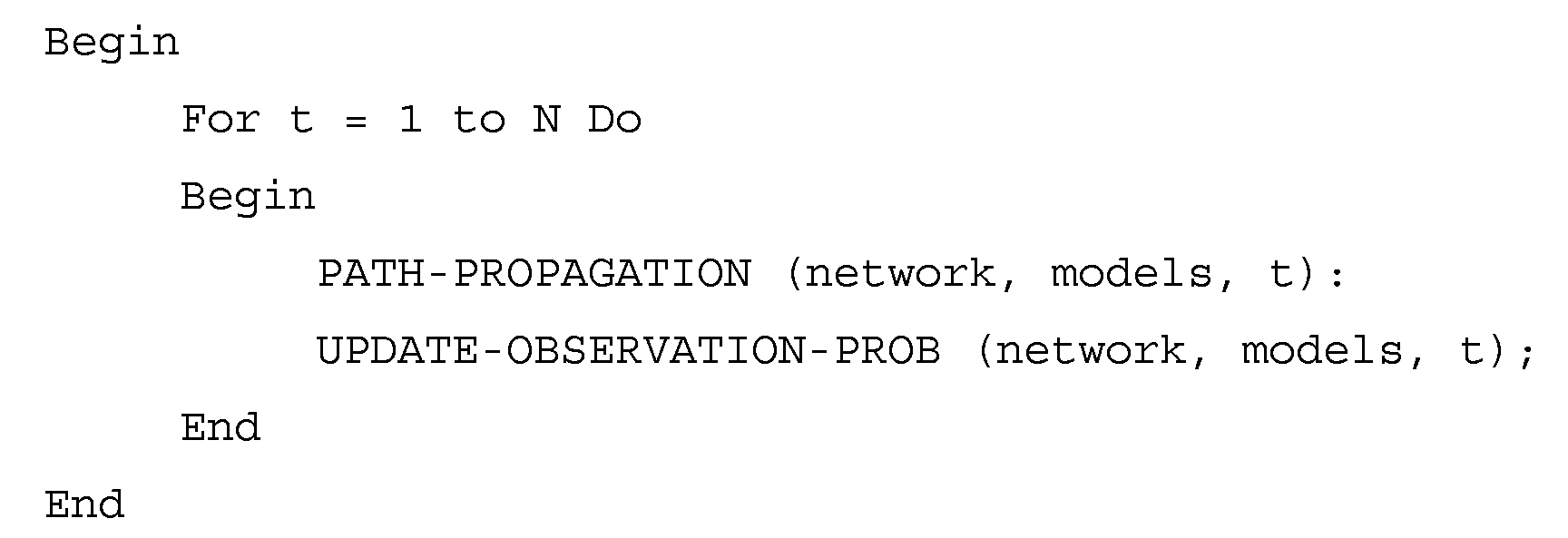
- the function MAIN-LOOP program illustrated in Figure 3 performs recognition path construction for every incoming speech frame:
- a path consists of a sequence of symbols, and the pronunciation of each symbol is specified by a set of hidden Markov model states. Consequently, a path can be either within-model-path or cross-model-path, which the decoding procedure constructs for each symbol:
- the nodes are constructed based on the model .
- next symbol s of ⁇ we need to consider all possible next symbols s. This is the true symbol s (knowledge of grammar that tells which symbol follows which symbol).
- UPDATE-OBSERVATION-PROB (network, models, t);
- the next step is to look at the speech to validate by comparison with the actual speech. This is done in the update-observation-probability program 27. See Figure 2.
- We need to find the HMM and for every HMM state we need to evaluate the score against the storage area at the time for the symbol ⁇ . The highest score is used. The best score models are provided.
- the purpose is to calibrate resource requirement and verify that the recognition scores are bit-exact with multiple grammar decoder. Tests are based on ten files, 5 male 5 female.
Landscapes
- Engineering & Computer Science (AREA)
- Physics & Mathematics (AREA)
- Probability & Statistics with Applications (AREA)
- Computational Linguistics (AREA)
- Health & Medical Sciences (AREA)
- Audiology, Speech & Language Pathology (AREA)
- Human Computer Interaction (AREA)
- Acoustics & Sound (AREA)
- Multimedia (AREA)
- Machine Translation (AREA)
Abstract
For a given sentence grammar, speech recognizers are often
required to decode M set of HMMs each of which models a specific
acoustic environment. In order to match input acoustic
observations to each of the environments, typically recognition
search methods require a network of M sub-networks. A new
speech recognition search method is described here, which needs
only 1 out of the M subnetwork and yet gives the same
recognition performance, thus reducing memory requirement for
network storage by M-1/M.
Description
- This invention relates generally to speech recognition and more particularly to a speech recognition search method.
- Speech recognition devices are typically deployed in different acoustic environments. An acoustic environment refers to a stationary condition in which the speech is produced. For instance, speech signal can be produced by male speakers, female speakers, in an office environment, in a noisy environment.
- A common way of dealing with multiple environment speech recognition is to train a set of Hidden Markov Models (HMM) for each environment. For example there would be a pronunciation set or network of HMMs (grammars)for male speakers and a set of HMMs for female speakers because the sounds or models for a male speaker are different from a female speaker. At the recognition phase, HMMs of all environments are decoded and the recognition result of the environment giving the maximum likelihood is considered as final results. Such a practice is very efficient in recognition performance. For example, if male/female separate models are not used, with the same amount of HMM parameters, the Word Error Rate (WER) will typically increase by 70%.
- More specifically, for a given sentence grammar, the speech recognizer is required to decode M (the number of environments) sets of HMMs each of which models a specific acoustic environment. In order to perform acoustic matching with each of the environments, recognition search methods typically (which include state-of-the-art recognizers as HTK 2.0) require a network of M sub-networks, as illustrated in Figure 1. Requiring M-sets of sentence network makes the recognition device more costly and requires much more memory.
- A new speech recognition search method is described herein, which needs only 1 out of the M subnetwork (sentence network) and yet gives substantially the same recognition performance, thus reducing memory requirement for network storage by M-1/M. The speech recognition method includes a basic speaker independent grammar or network (sentence structure) and virtual symbols representing the network of expanded sets HMM sets where the pronunciation of each symbol is specified by a set of HMM states. The new recognizer builds recognition paths defined on the expanded symbols, and accesses the network using base-symbols, through proper conversion function that gives the base-symbol of any expanded symbols, and vice versa.
- The present invention will now be further described by way of example, with reference to the preferred and exemplary embodiments illustrated in the figures of the accompanying drawings in which:
- Figure 1 illustrates conventional recognizers require large network to recognize multiple HMM set;
- Figure 2 illustrates a block diagram of the system according to one embodiment of the present invention; and
- Figure 3 illustrates the main program loop.
-
- In the present application we refer a node in the network describing the sentence grammar as a symbol. For typical recognizers, a symbol has to be duplicated M-times in the network when M-sets of HMM are used. This is illustrated in Figure1, where three sets of sentence networks are depicted.
- In accordance with the present invention a network is constructed to represent a merged version of the M networks that is speaker independent. For the male and female case this would be a merged version of the male and female networks and be gender-independent. The models for children may also be merged. Other environments may also be merged. We need to further decode specific HMMs such as those for male, female and child and combine with the generic (speaker independent) network where for both the male, female and child have the same nodes and transitions.
- In applicant's method of decoding M HMM sets, two types of symbols are distinguished:
- Base-symbols (α): Symbol representing the basic grammar or network (i.e., the network before duplication for M-sets HMM). They have physical memory space for storage. This is generic (speaker independent) representing the nodes and transitions.
- Expanded-symbols (ã): Symbols representing the network of M-1 expanded HMM sets. Their existence in the grammar network is conceptual. This symbol may represents for example the two sets of HMMs for male and female.
- For each base-symbol in the network, there are M-1 corresponding expanded-symbols associated. The new recognizer builds recognition paths defined on the expanded-symbols, and accesses the network using base-symbols, through proper conversion function that gives the base-symbol of any expanded symbols.
- Referring to Figure 2 there is illustrated the system according to one embodiment of the present invention. For the male and female combined case the generic network represented by the base symbol α is stored in
memory 21. This provides the network structure itself. Also stored inmemory 23 is a set of HMMs for male and a set for female for example. A set of HMMs may also be for child. The base symbol contains the sentence structure. The process is to identify the HMM to be used. For every incoming speech frame a main loop program performs a recognition path construction and update-observation-probability. The main loop program ( see Figure 3) includes a path-propagation program 25 and an update-observation-probability program 27. - The function MAIN-LOOP program illustrated in Figure 3 performs recognition path construction for every incoming speech frame:
-
- A path consists of a sequence of symbols, and the pronunciation of each symbol is specified by a set of hidden Markov model states. Consequently, a path can be either within-model-path or cross-model-path, which the decoding procedure constructs for each symbol:
-
 where: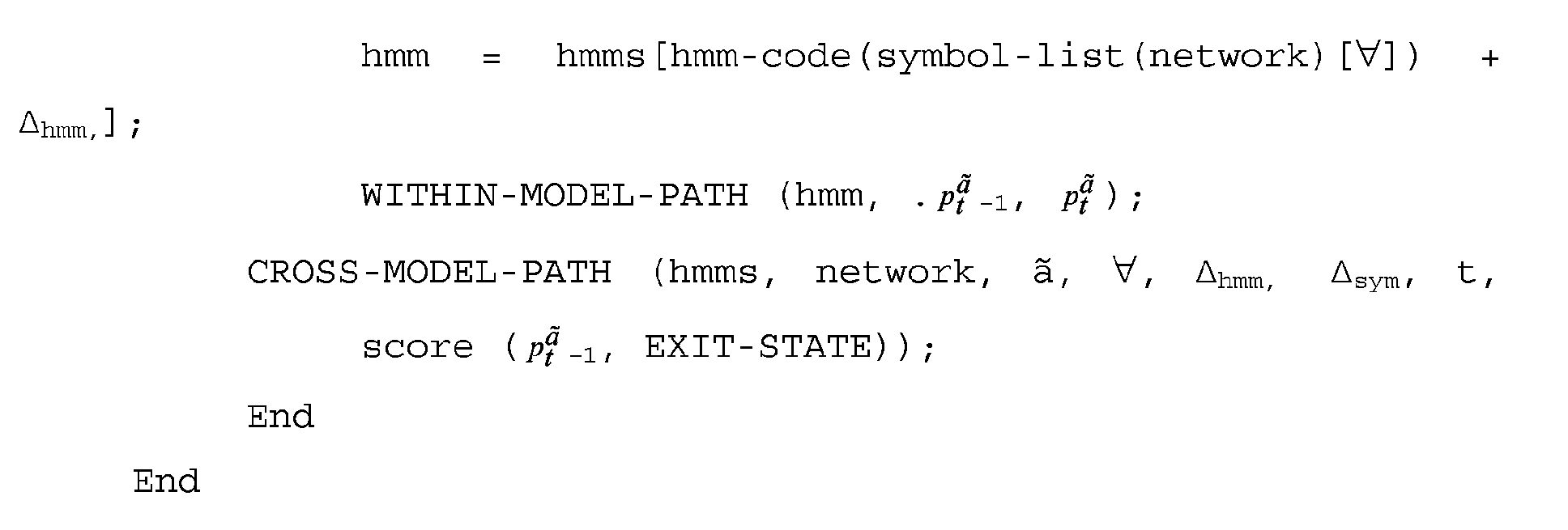
- p s / t denotes the storage of path information for the expanded-symbol s at frame t.
- "get-offsets" gives the offset of HMM (Δhmm), offset of symbol (Δsym) and the base-symbol (∀), given ã and a network.
- "symbol-list" returns the list of symbols of a network.
- "hmm-code" gives index of an hmm, associated to a symbol.
- Score (p, i) gives the score at state i of the symbol storage p. We keep what is the symbol and frame from which we are from t to t-1 and trace the sequence of the word .
- The nodes are constructed based on the model .
- In the search algorithm for each
frame time interval 1 to N for frame time t looks back at time t-1 and calculates to find out the base symbol. See Figure 2. From this to access thegeneric network 21 given the expanded symbol ã to get the offset of HMM (ΔHMM). Once the ΔHMM is determined, the HMMmemory 23 can be accessed such that the HMM that corresponds to the male base or female is provided. Once the HMM is obtained the sequence of states within model path is determined and then the cross model path. The sequence of HMM states is constructed in therecognition path construction 25 in both the within HMM path and the between models. There are therefore two key functions for decoding, within-model-path construction and cross-model-path construction: - where:

- ∀i,j is the transition probability from state i to state j. When we do the within HMM path ,we need to do the storage of t and t-1. That sentence with the highest score is determined based on the highest transition log probability. This is done for every state in the HMM . ( For each state j in the equation below. Once we arrive at the end we go back and find out what is the sequence of the symbols that has been recognized. This is stored.
-
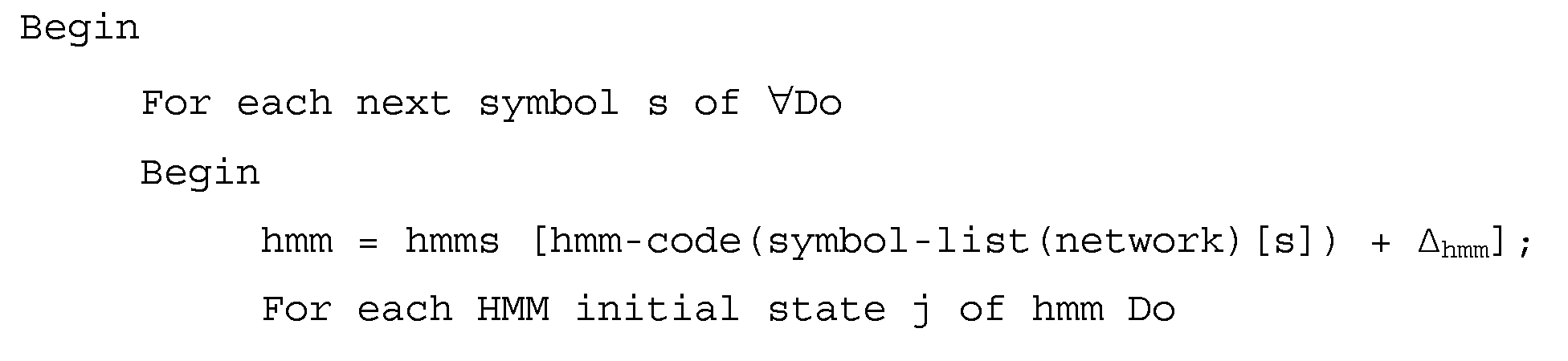

- For the cross model path we need for the next symbol s of α we need to consider all possible next symbols s. This is the true symbol s (knowledge of grammar that tells which symbol follows which symbol). We determine it's initial state or first HMM and we perform the sequence of HMM states for between states and add the transition probability (log probability)from one state to another. We use the π symbol for outside the states. We go back to the beginning and determine what is the symbol and frame from which we are from so that at the end we can go back and check the sequence of words. By doing this within and between we have constructed all the nodes.
- Finally, once a path is expanded according to the grammar network, its acoustic score is evaluated:
-
 where:
- "get-true-symbol" returns the base-symbol of a expanded symbol.
- These are all based on the model. The next step is to look at the speech to validate by comparison with the actual speech. This is done in the update-observation-
probability program 27. See Figure 2. We need to find the HMM and for every HMM state we need to evaluate the score against the storage area at the time for the symbol α. The highest score is used. The best score models are provided. - This new method has been very effective at reducing the memory size. Below represents the generic grammar for 1-7 digit strings:
- $digit = (zero | oh | one | two | three | four | five | six | seven | eight | nine) [sil] ;
- $DIG = $digit [ $digit [ $digit [ $digit [ $digit [ $digit [ $digit] ] ] ] ] ] ;
- $SENT = [sil] $DIG [sil] ;
-
- It says for we recognize zero or oh or one, or two etc..It also says a digit is composed of a single digit,two digits etc.. It also says a sentence is on two etc. digits.
- The grammar for the 1-7 digit strings for the old gender dependent way follows:
- $digit_m = (zero_m | oh_m | one_m | two_m | three_m | four_m | five_m | six_m | seven_m | eight_m | nine_m) [sil_m];
- $DIG = $digit_m [ $digit_m [ $digit_m [ $digit_m [ $digit_m [ $digit_m [ $digit_m] ] ] ] ] ] ;
- $SENT_m = [sil_m] $DIG_m [sil_m] ;
- $digit_f = (zero_f | oh_f | one_f | two_f | three_f | four_f | five_f | six_f | seven_f | eight_f | nine_f)[sil_f] ;
- $DIG_f = $digit_f [ $digit_f [ $digit_f [ $digit_f [ $digit_f [ $digit_f [ $digit_f] ] ] ] ] ];
- $SENT_f = [sil_f] $DIG_f [sil_f] ;
- $S = $SENT_m | $SENT_f;
-
- This is twice the size of the generic grammar.
- The purpose is to calibrate resource requirement and verify that the recognition scores are bit-exact with multiple grammar decoder. Tests are based on ten files, 5 male 5 female.
- For the grammars above, respectively, a single network grammar of sentence and a multiple (two, one for male, one for female) network grammar of sentence.
- Due to the conversion between base and expanded symbols, the search method is certainly more complex than the one requiring M-set of networks. To determine how much more computation is needed for the sentence network memory saving, the CPU cycles of top 20 functions are counted, and In are shown in Table 1(excluding three file I/O functions). It can be seen that the cycle:


- Consumption for most functions stays the same. Only four functions showed slight changes. Table 2 summarizes cycle consumption and memory usage. The 1.58% is spent on calculating the set-index, and can be further reduced by storing the indices. However, the percent increase is so law that at this time it might not be worth-doing to investigate the other alternative - CPU efficient implementation.
Comparison of multiple-grammar vs. single-grammar (memory-efficient implementation). Item multiple-grammar single-grammar increase TOP CYCLES 78115500 79352090 1.58 NETWORK SIZE 11728 5853 -50.0
Claims (10)
- A method of speech recognition comprising:decoding multiple HMM sets using a set of sentence network; andrecognizing speech using said decoded multiple HMM sets.
- The method of Claim 1, wherein the means for decoding comprises means for building recognition paths defined on expanded symbols and accessing said network using base symbols through a conversion function.
- The method of Claim 2, wherein said step of decoding comprises within model construction and between model construction.
- The method of Claim 3, wherein said step of decoding comprises update-observation-probability.
- A speech recognizer comprising:means for decoding HMM sets using a set of sentence network; anda recognizer for recognizing speech using said decoded multiple HMM sets.
- A speech recognition search method comprising:providing a set of generic grammars;providing symbols representing a network of expanded sets; andbuilding recognition paths defined by the symbols; andaccessing the network using using base symbols through proper conversion function that gives the true symbol of any expanded symbol.
- A method of speech recognition comprising:providing a generic network containing base symbols; a single set of HMMs for male and female;building recognition paths defined on virtual symbols corresponding to base symbols;accessing said generic network using said bbase symbols through conversion function that gives base symbols for virtual symbols to therefore decode multiple HMM sets using a single sentence grammar and using said HMM sets to recognize incoming speech.
- The method of Claim 7, wherein said building step comprises for each frame path propagation expansion based on the grammar network and update-observation-probability.
- The method of Claim 8, wherein said path propagation comprises getting offset HMMs, offset symbols and the base symbol for a given expanded symbol and obtaining the HMM of the previous frame and expanding and storing a sequence set of HMM states both for within model path and cross model path and determining the path with the best transition probability.
- The method of Claim 9, wherein said update-observation-probability includes getting the base symbol of a expanded symbol and validating state by state the base symbol bbby comparing to speech in the present frame for the base symbol associated with the virtual symbol.
Applications Claiming Priority (2)
| Application Number | Priority Date | Filing Date | Title |
|---|---|---|---|
| US221920 | 1988-07-20 | ||
| US22192000P | 2000-07-31 | 2000-07-31 |
Publications (1)
| Publication Number | Publication Date |
|---|---|
| EP1220198A1 true EP1220198A1 (en) | 2002-07-03 |
Family
ID=22829977
Family Applications (1)
| Application Number | Title | Priority Date | Filing Date |
|---|---|---|---|
| EP01000331A Withdrawn EP1220198A1 (en) | 2000-07-31 | 2001-07-31 | Decoding multiple HMM sets using a single sentence grammar |
Country Status (3)
| Country | Link |
|---|---|
| US (1) | US7269558B2 (en) |
| EP (1) | EP1220198A1 (en) |
| JP (1) | JP2002073077A (en) |
Families Citing this family (3)
| Publication number | Priority date | Publication date | Assignee | Title |
|---|---|---|---|---|
| US7529671B2 (en) * | 2003-03-04 | 2009-05-05 | Microsoft Corporation | Block synchronous decoding |
| US8056070B2 (en) * | 2007-01-10 | 2011-11-08 | Goller Michael D | System and method for modifying and updating a speech recognition program |
| US20140365225A1 (en) * | 2013-06-05 | 2014-12-11 | DSP Group | Ultra-low-power adaptive, user independent, voice triggering schemes |
Family Cites Families (6)
| Publication number | Priority date | Publication date | Assignee | Title |
|---|---|---|---|---|
| US5333275A (en) * | 1992-06-23 | 1994-07-26 | Wheatley Barbara J | System and method for time aligning speech |
| US5819221A (en) * | 1994-08-31 | 1998-10-06 | Texas Instruments Incorporated | Speech recognition using clustered between word and/or phrase coarticulation |
| US5806034A (en) * | 1995-08-02 | 1998-09-08 | Itt Corporation | Speaker independent speech recognition method utilizing multiple training iterations |
| WO1998014934A1 (en) * | 1996-10-02 | 1998-04-09 | Sri International | Method and system for automatic text-independent grading of pronunciation for language instruction |
| US6076057A (en) * | 1997-05-21 | 2000-06-13 | At&T Corp | Unsupervised HMM adaptation based on speech-silence discrimination |
| US6285981B1 (en) * | 1998-06-30 | 2001-09-04 | Texas Instruments Incorporated | Speed up speech recognition search using macro evaluator |
-
2001
- 2001-07-26 US US09/915,911 patent/US7269558B2/en not_active Expired - Lifetime
- 2001-07-31 EP EP01000331A patent/EP1220198A1/en not_active Withdrawn
- 2001-07-31 JP JP2001266505A patent/JP2002073077A/en not_active Abandoned
Non-Patent Citations (3)
| Title |
|---|
| IMPERL B: "Multilingual connected digits and natural numbers recognition in the telephone speech dialog systems", ISIE '99. PROCEEDINGS OF THE IEEE INTERNATIONAL SYMPOSIUM ON INDUSTRIAL ELECTRONICS (CAT. NO.99TH8465), PROCEEDINGS OF ISIE '99. IEEE INTERNATIONAL SYMPOSIUM ON INDUSTRIAL ELECTRONICS, BLED, SLOVENIA, 12-16 JULY 1999, 1999, Piscataway, NJ, USA, IEEE, USA, pages 188 - 192 vol.1, XP002181040, ISBN: 0-7803-5662-4 * |
| KORKMAZSKIY F ET AL: "GENERALIZED MIXTURE OF HMMS FOR CONTINUOUS SPEECH RECOGNITION", 1997 IEEE INTERNATIONAL CONFERENCE ON ACOUSTICS, SPEECH, AND SIGNAL PROCESSING. SPEECH PROCESSING. MUNICH, APR. 21 - 24, 1997, IEEE INTERNATIONAL CONFERENCE ON ACOUSTICS, SPEECH, AND SIGNAL PROCESSING (ICASSP), LOS ALAMITOS, IEEE COMP. SOC. PRESS, US, vol. 2, 21 April 1997 (1997-04-21), pages 1443 - 1446, XP000822729, ISBN: 0-8186-7920-4 * |
| YIFAN GONG ET AL: "PARALLEL CONSTRUCTION OF SYNTACTIC STRUCTURE FOR CONTINUOUS SPEECH RECOGNITION", PROCEEDINGS OF THE EUROPEAN CONFERENCE ON SPEECH COMMUNICATION AND TECHNOLOGY (EUROSPEECH). PARIS, SEPT. 26 - 28, 1989, EDINBURGH, CEP CONSULTANTS, GB, vol. 2 CONF. 1, 1 September 1989 (1989-09-01), pages 47 - 50, XP000209953 * |
Also Published As
| Publication number | Publication date |
|---|---|
| US20020042710A1 (en) | 2002-04-11 |
| JP2002073077A (en) | 2002-03-12 |
| US7269558B2 (en) | 2007-09-11 |
Similar Documents
| Publication | Publication Date | Title |
|---|---|---|
| Soong et al. | A Tree. Trellis based fast search for finding the n best sentence hypotheses in continuous speech recognition | |
| Huang et al. | The SPHINX-II speech recognition system: an overview | |
| CN108305634B (en) | Decoding method, decoder and storage medium | |
| JP3948747B2 (en) | Pattern recognition method and system based on tree configuration probability density | |
| US5268990A (en) | Method for recognizing speech using linguistically-motivated hidden Markov models | |
| EP0398574B1 (en) | Speech recognition employing key word modeling and non-key word modeling | |
| US6668243B1 (en) | Network and language models for use in a speech recognition system | |
| Sainath et al. | No need for a lexicon? evaluating the value of the pronunciation lexica in end-to-end models | |
| US6178401B1 (en) | Method for reducing search complexity in a speech recognition system | |
| Lee et al. | Improved acoustic modeling for large vocabulary continuous speech recognition | |
| US20030200085A1 (en) | Pattern matching for large vocabulary speech recognition systems | |
| EP1922653B1 (en) | Word clustering for input data | |
| Myer et al. | Efficient keyword spotting using time delay neural networks | |
| EP1447792A2 (en) | Method and apparatus for modeling a speech recognition system and for predicting word error rates from text | |
| US5765133A (en) | System for building a language model network for speech recognition | |
| WO2017076222A1 (en) | Speech recognition method and apparatus | |
| US7035802B1 (en) | Recognition system using lexical trees | |
| US7076422B2 (en) | Modelling and processing filled pauses and noises in speech recognition | |
| US8234115B2 (en) | Systems and methods for determining the N-best strings | |
| JP2002358097A (en) | Voice recognition device | |
| US20010002465A1 (en) | Speech recognition device implementing a syntactic permutation rule | |
| US20020042710A1 (en) | Decoding multiple HMM sets using a single sentence grammar | |
| CN111640423B (en) | A word boundary estimation method, device and electronic equipment | |
| US7464033B2 (en) | Decoding multiple HMM sets using a single sentence grammar | |
| JP3628245B2 (en) | Language model generation method, speech recognition method, and program recording medium thereof |
Legal Events
| Date | Code | Title | Description |
|---|---|---|---|
| PUAI | Public reference made under article 153(3) epc to a published international application that has entered the european phase |
Free format text: ORIGINAL CODE: 0009012 |
|
| AK | Designated contracting states |
Kind code of ref document: A1 Designated state(s): AT BE CH CY DE DK ES FI FR GB GR IE IT LI LU MC NL PT SE TR |
|
| AX | Request for extension of the european patent |
Free format text: AL;LT;LV;MK;RO;SI |
|
| 17P | Request for examination filed |
Effective date: 20030103 |
|
| AKX | Designation fees paid |
Designated state(s): DE FR GB |
|
| 17Q | First examination report despatched |
Effective date: 20040728 |
|
| STAA | Information on the status of an ep patent application or granted ep patent |
Free format text: STATUS: THE APPLICATION IS DEEMED TO BE WITHDRAWN |
|
| 18D | Application deemed to be withdrawn |
Effective date: 20060428 |