EP1220042A2 - Toner compositions with surface additives - Google Patents
Toner compositions with surface additives Download PDFInfo
- Publication number
- EP1220042A2 EP1220042A2 EP01130491A EP01130491A EP1220042A2 EP 1220042 A2 EP1220042 A2 EP 1220042A2 EP 01130491 A EP01130491 A EP 01130491A EP 01130491 A EP01130491 A EP 01130491A EP 1220042 A2 EP1220042 A2 EP 1220042A2
- Authority
- EP
- European Patent Office
- Prior art keywords
- toner
- toner composition
- alumina
- weight
- treated
- Prior art date
- Legal status (The legal status is an assumption and is not a legal conclusion. Google has not performed a legal analysis and makes no representation as to the accuracy of the status listed.)
- Granted
Links
- 239000000203 mixture Substances 0.000 title claims abstract description 117
- 239000000654 additive Substances 0.000 title description 58
- PNEYBMLMFCGWSK-UHFFFAOYSA-N aluminium oxide Inorganic materials [O-2].[O-2].[O-2].[Al+3].[Al+3] PNEYBMLMFCGWSK-UHFFFAOYSA-N 0.000 claims abstract description 68
- 239000002245 particle Substances 0.000 claims abstract description 48
- 239000003795 chemical substances by application Substances 0.000 claims abstract description 23
- 239000003086 colorant Substances 0.000 claims abstract description 17
- KQAHMVLQCSALSX-UHFFFAOYSA-N decyl(trimethoxy)silane Chemical compound CCCCCCCCCC[Si](OC)(OC)OC KQAHMVLQCSALSX-UHFFFAOYSA-N 0.000 claims abstract description 13
- 239000011230 binding agent Substances 0.000 claims abstract description 6
- 229920005989 resin Polymers 0.000 claims description 25
- 239000011347 resin Substances 0.000 claims description 25
- 239000011164 primary particle Substances 0.000 claims description 14
- 238000002156 mixing Methods 0.000 claims description 12
- 125000004432 carbon atom Chemical group C* 0.000 claims description 8
- 125000000217 alkyl group Chemical group 0.000 claims description 7
- 238000000034 method Methods 0.000 claims description 6
- 229910052593 corundum Inorganic materials 0.000 claims description 3
- 230000008569 process Effects 0.000 claims description 3
- 229910001845 yogo sapphire Inorganic materials 0.000 claims description 3
- GWEVSGVZZGPLCZ-UHFFFAOYSA-N Titan oxide Chemical compound O=[Ti]=O GWEVSGVZZGPLCZ-UHFFFAOYSA-N 0.000 description 40
- 230000000052 comparative effect Effects 0.000 description 36
- 239000000049 pigment Substances 0.000 description 30
- 230000000996 additive effect Effects 0.000 description 24
- -1 hydrocarbon radical Chemical group 0.000 description 16
- 238000012360 testing method Methods 0.000 description 12
- VYPSYNLAJGMNEJ-UHFFFAOYSA-N Silicium dioxide Chemical compound O=[Si]=O VYPSYNLAJGMNEJ-UHFFFAOYSA-N 0.000 description 11
- PPBRXRYQALVLMV-UHFFFAOYSA-N Styrene Chemical compound C=CC1=CC=CC=C1 PPBRXRYQALVLMV-UHFFFAOYSA-N 0.000 description 10
- 238000009826 distribution Methods 0.000 description 9
- 230000002708 enhancing effect Effects 0.000 description 9
- 239000000463 material Substances 0.000 description 9
- VZCYOOQTPOCHFL-OWOJBTEDSA-N Fumaric acid Chemical compound OC(=O)\C=C\C(O)=O VZCYOOQTPOCHFL-OWOJBTEDSA-N 0.000 description 8
- IISBACLAFKSPIT-UHFFFAOYSA-N bisphenol A Chemical compound C=1C=C(O)C=CC=1C(C)(C)C1=CC=C(O)C=C1 IISBACLAFKSPIT-UHFFFAOYSA-N 0.000 description 8
- 239000000975 dye Substances 0.000 description 8
- 229920000642 polymer Polymers 0.000 description 8
- 239000001993 wax Substances 0.000 description 8
- 229910000831 Steel Inorganic materials 0.000 description 7
- 239000010959 steel Substances 0.000 description 7
- 239000011324 bead Substances 0.000 description 6
- 238000000576 coating method Methods 0.000 description 6
- FFUAGWLWBBFQJT-UHFFFAOYSA-N hexamethyldisilazane Chemical compound C[Si](C)(C)N[Si](C)(C)C FFUAGWLWBBFQJT-UHFFFAOYSA-N 0.000 description 6
- 229920000728 polyester Polymers 0.000 description 6
- 239000004698 Polyethylene Substances 0.000 description 5
- 239000004743 Polypropylene Substances 0.000 description 5
- 229910021485 fumed silica Inorganic materials 0.000 description 5
- 239000002184 metal Chemical class 0.000 description 5
- 229910052751 metal Inorganic materials 0.000 description 5
- 229920001225 polyester resin Polymers 0.000 description 5
- 239000004645 polyester resin Substances 0.000 description 5
- 229920001155 polypropylene Polymers 0.000 description 5
- 125000000391 vinyl group Chemical group [H]C([*])=C([H])[H] 0.000 description 5
- VYZAMTAEIAYCRO-UHFFFAOYSA-N Chromium Chemical compound [Cr] VYZAMTAEIAYCRO-UHFFFAOYSA-N 0.000 description 4
- 230000008901 benefit Effects 0.000 description 4
- 230000002902 bimodal effect Effects 0.000 description 4
- 229910052804 chromium Inorganic materials 0.000 description 4
- 239000011651 chromium Substances 0.000 description 4
- JZLCKKKUCNYLDU-UHFFFAOYSA-N decylsilane Chemical compound CCCCCCCCCC[SiH3] JZLCKKKUCNYLDU-UHFFFAOYSA-N 0.000 description 4
- 239000001530 fumaric acid Substances 0.000 description 4
- 238000011068 loading method Methods 0.000 description 4
- 229920000573 polyethylene Polymers 0.000 description 4
- 239000004408 titanium dioxide Substances 0.000 description 4
- VZCYOOQTPOCHFL-UHFFFAOYSA-N trans-butenedioic acid Natural products OC(=O)C=CC(O)=O VZCYOOQTPOCHFL-UHFFFAOYSA-N 0.000 description 4
- 229920002554 vinyl polymer Polymers 0.000 description 4
- XOOUIPVCVHRTMJ-UHFFFAOYSA-L zinc stearate Chemical compound [Zn+2].CCCCCCCCCCCCCCCCCC([O-])=O.CCCCCCCCCCCCCCCCCC([O-])=O XOOUIPVCVHRTMJ-UHFFFAOYSA-L 0.000 description 4
- 125000003545 alkoxy group Chemical group 0.000 description 3
- 238000000149 argon plasma sintering Methods 0.000 description 3
- 238000006243 chemical reaction Methods 0.000 description 3
- 229910017052 cobalt Inorganic materials 0.000 description 3
- 239000010941 cobalt Substances 0.000 description 3
- GUTLYIVDDKVIGB-UHFFFAOYSA-N cobalt atom Chemical compound [Co] GUTLYIVDDKVIGB-UHFFFAOYSA-N 0.000 description 3
- 229920001577 copolymer Polymers 0.000 description 3
- XCJYREBRNVKWGJ-UHFFFAOYSA-N copper(II) phthalocyanine Chemical compound [Cu+2].C12=CC=CC=C2C(N=C2[N-]C(C3=CC=CC=C32)=N2)=NC1=NC([C]1C=CC=CC1=1)=NC=1N=C1[C]3C=CC=CC3=C2[N-]1 XCJYREBRNVKWGJ-UHFFFAOYSA-N 0.000 description 3
- 238000003384 imaging method Methods 0.000 description 3
- UQSXHKLRYXJYBZ-UHFFFAOYSA-N iron oxide Inorganic materials [Fe]=O UQSXHKLRYXJYBZ-UHFFFAOYSA-N 0.000 description 3
- SZVJSHCCFOBDDC-UHFFFAOYSA-N iron(II,III) oxide Inorganic materials O=[Fe]O[Fe]O[Fe]=O SZVJSHCCFOBDDC-UHFFFAOYSA-N 0.000 description 3
- VKWNTWQXVLKCSG-UHFFFAOYSA-N n-ethyl-1-[(4-phenyldiazenylphenyl)diazenyl]naphthalen-2-amine Chemical compound CCNC1=CC=C2C=CC=CC2=C1N=NC(C=C1)=CC=C1N=NC1=CC=CC=C1 VKWNTWQXVLKCSG-UHFFFAOYSA-N 0.000 description 3
- 229920003229 poly(methyl methacrylate) Polymers 0.000 description 3
- 239000004926 polymethyl methacrylate Substances 0.000 description 3
- 239000002243 precursor Substances 0.000 description 3
- 238000002360 preparation method Methods 0.000 description 3
- 239000007787 solid Substances 0.000 description 3
- 229910001220 stainless steel Inorganic materials 0.000 description 3
- 239000010935 stainless steel Substances 0.000 description 3
- 229920003048 styrene butadiene rubber Polymers 0.000 description 3
- PUPZLCDOIYMWBV-UHFFFAOYSA-N (+/-)-1,3-Butanediol Chemical compound CC(O)CCO PUPZLCDOIYMWBV-UHFFFAOYSA-N 0.000 description 2
- WYTZZXDRDKSJID-UHFFFAOYSA-N (3-aminopropyl)triethoxysilane Chemical compound CCO[Si](OCC)(OCC)CCCN WYTZZXDRDKSJID-UHFFFAOYSA-N 0.000 description 2
- XKZQKPRCPNGNFR-UHFFFAOYSA-N 2-(3-hydroxyphenyl)phenol Chemical compound OC1=CC=CC(C=2C(=CC=CC=2)O)=C1 XKZQKPRCPNGNFR-UHFFFAOYSA-N 0.000 description 2
- 229910002012 Aerosil® Inorganic materials 0.000 description 2
- SOGAXMICEFXMKE-UHFFFAOYSA-N Butylmethacrylate Chemical compound CCCCOC(=O)C(C)=C SOGAXMICEFXMKE-UHFFFAOYSA-N 0.000 description 2
- XTEGARKTQYYJKE-UHFFFAOYSA-M Chlorate Chemical compound [O-]Cl(=O)=O XTEGARKTQYYJKE-UHFFFAOYSA-M 0.000 description 2
- SNRUBQQJIBEYMU-UHFFFAOYSA-N Dodecane Natural products CCCCCCCCCCCC SNRUBQQJIBEYMU-UHFFFAOYSA-N 0.000 description 2
- XEEYBQQBJWHFJM-UHFFFAOYSA-N Iron Chemical compound [Fe] XEEYBQQBJWHFJM-UHFFFAOYSA-N 0.000 description 2
- OFOBLEOULBTSOW-UHFFFAOYSA-N Malonic acid Chemical compound OC(=O)CC(O)=O OFOBLEOULBTSOW-UHFFFAOYSA-N 0.000 description 2
- BAPJBEWLBFYGME-UHFFFAOYSA-N Methyl acrylate Chemical compound COC(=O)C=C BAPJBEWLBFYGME-UHFFFAOYSA-N 0.000 description 2
- BLRPTPMANUNPDV-UHFFFAOYSA-N Silane Chemical compound [SiH4] BLRPTPMANUNPDV-UHFFFAOYSA-N 0.000 description 2
- 229920004482 WACKER® Polymers 0.000 description 2
- 150000001343 alkyl silanes Chemical class 0.000 description 2
- MTAZNLWOLGHBHU-UHFFFAOYSA-N butadiene-styrene rubber Chemical class C=CC=C.C=CC1=CC=CC=C1 MTAZNLWOLGHBHU-UHFFFAOYSA-N 0.000 description 2
- 125000000484 butyl group Chemical group [H]C([*])([H])C([H])([H])C([H])([H])C([H])([H])[H] 0.000 description 2
- 239000000969 carrier Substances 0.000 description 2
- 239000011248 coating agent Substances 0.000 description 2
- 239000008119 colloidal silica Substances 0.000 description 2
- 125000002704 decyl group Chemical group [H]C([H])([H])C([H])([H])C([H])([H])C([H])([H])C([H])([H])C([H])([H])C([H])([H])C([H])([H])C([H])([H])C([H])([H])* 0.000 description 2
- WOZVHXUHUFLZGK-UHFFFAOYSA-N dimethyl terephthalate Chemical compound COC(=O)C1=CC=C(C(=O)OC)C=C1 WOZVHXUHUFLZGK-UHFFFAOYSA-N 0.000 description 2
- 150000002009 diols Chemical class 0.000 description 2
- 125000003438 dodecyl group Chemical group [H]C([H])([H])C([H])([H])C([H])([H])C([H])([H])C([H])([H])C([H])([H])C([H])([H])C([H])([H])C([H])([H])C([H])([H])C([H])([H])C([H])([H])* 0.000 description 2
- 230000000694 effects Effects 0.000 description 2
- 230000032050 esterification Effects 0.000 description 2
- 238000005886 esterification reaction Methods 0.000 description 2
- 125000004051 hexyl group Chemical group [H]C([H])([H])C([H])([H])C([H])([H])C([H])([H])C([H])([H])C([H])([H])* 0.000 description 2
- 229920001519 homopolymer Polymers 0.000 description 2
- 229930195733 hydrocarbon Natural products 0.000 description 2
- 150000005673 monoalkenes Chemical class 0.000 description 2
- 239000000178 monomer Substances 0.000 description 2
- 125000002347 octyl group Chemical group [H]C([*])([H])C([H])([H])C([H])([H])C([H])([H])C([H])([H])C([H])([H])C([H])([H])C([H])([H])[H] 0.000 description 2
- TWNQGVIAIRXVLR-UHFFFAOYSA-N oxo(oxoalumanyloxy)alumane Chemical compound O=[Al]O[Al]=O TWNQGVIAIRXVLR-UHFFFAOYSA-N 0.000 description 2
- ULQKBAFUVJFPPF-UHFFFAOYSA-L oxygen(2-);titanium(4+);dihydroxide Chemical compound [OH-].[OH-].[O-2].[Ti+4] ULQKBAFUVJFPPF-UHFFFAOYSA-L 0.000 description 2
- 108091008695 photoreceptors Proteins 0.000 description 2
- IEQIEDJGQAUEQZ-UHFFFAOYSA-N phthalocyanine Chemical compound N1C(N=C2C3=CC=CC=C3C(N=C3C4=CC=CC=C4C(=N4)N3)=N2)=C(C=CC=C2)C2=C1N=C1C2=CC=CC=C2C4=N1 IEQIEDJGQAUEQZ-UHFFFAOYSA-N 0.000 description 2
- 239000002952 polymeric resin Substances 0.000 description 2
- HXHCOXPZCUFAJI-UHFFFAOYSA-N prop-2-enoic acid;styrene Chemical class OC(=O)C=C.C=CC1=CC=CC=C1 HXHCOXPZCUFAJI-UHFFFAOYSA-N 0.000 description 2
- YGSDEFSMJLZEOE-UHFFFAOYSA-N salicylic acid Chemical compound OC(=O)C1=CC=CC=C1O YGSDEFSMJLZEOE-UHFFFAOYSA-N 0.000 description 2
- 150000003839 salts Chemical class 0.000 description 2
- 230000035945 sensitivity Effects 0.000 description 2
- 229910000077 silane Inorganic materials 0.000 description 2
- 125000004079 stearyl group Chemical group [H]C([*])([H])C([H])([H])C([H])([H])C([H])([H])C([H])([H])C([H])([H])C([H])([H])C([H])([H])C([H])([H])C([H])([H])C([H])([H])C([H])([H])C([H])([H])C([H])([H])C([H])([H])C([H])([H])C([H])([H])C([H])([H])[H] 0.000 description 2
- 239000000126 substance Substances 0.000 description 2
- 229920003002 synthetic resin Polymers 0.000 description 2
- 229920005992 thermoplastic resin Polymers 0.000 description 2
- 239000001052 yellow pigment Substances 0.000 description 2
- DNIAPMSPPWPWGF-GSVOUGTGSA-N (R)-(-)-Propylene glycol Chemical compound C[C@@H](O)CO DNIAPMSPPWPWGF-GSVOUGTGSA-N 0.000 description 1
- KTZVZZJJVJQZHV-UHFFFAOYSA-N 1-chloro-4-ethenylbenzene Chemical compound ClC1=CC=C(C=C)C=C1 KTZVZZJJVJQZHV-UHFFFAOYSA-N 0.000 description 1
- IAFBRPFISOTXSO-UHFFFAOYSA-N 2-[[2-chloro-4-[3-chloro-4-[[1-(2,4-dimethylanilino)-1,3-dioxobutan-2-yl]diazenyl]phenyl]phenyl]diazenyl]-n-(2,4-dimethylphenyl)-3-oxobutanamide Chemical compound C=1C=C(C)C=C(C)C=1NC(=O)C(C(=O)C)N=NC(C(=C1)Cl)=CC=C1C(C=C1Cl)=CC=C1N=NC(C(C)=O)C(=O)NC1=CC=C(C)C=C1C IAFBRPFISOTXSO-UHFFFAOYSA-N 0.000 description 1
- CVEPFOUZABPRMK-UHFFFAOYSA-N 2-methylprop-2-enoic acid;styrene Chemical compound CC(=C)C(O)=O.C=CC1=CC=CC=C1 CVEPFOUZABPRMK-UHFFFAOYSA-N 0.000 description 1
- CFVWNXQPGQOHRJ-UHFFFAOYSA-N 2-methylpropyl prop-2-enoate Chemical compound CC(C)COC(=O)C=C CFVWNXQPGQOHRJ-UHFFFAOYSA-N 0.000 description 1
- XCKGFJPFEHHHQA-UHFFFAOYSA-N 5-methyl-2-phenyl-4-phenyldiazenyl-4h-pyrazol-3-one Chemical compound CC1=NN(C=2C=CC=CC=2)C(=O)C1N=NC1=CC=CC=C1 XCKGFJPFEHHHQA-UHFFFAOYSA-N 0.000 description 1
- HRPVXLWXLXDGHG-UHFFFAOYSA-N Acrylamide Chemical compound NC(=O)C=C HRPVXLWXLXDGHG-UHFFFAOYSA-N 0.000 description 1
- NLHHRLWOUZZQLW-UHFFFAOYSA-N Acrylonitrile Chemical compound C=CC#N NLHHRLWOUZZQLW-UHFFFAOYSA-N 0.000 description 1
- BTBUEUYNUDRHOZ-UHFFFAOYSA-N Borate Chemical compound [O-]B([O-])[O-] BTBUEUYNUDRHOZ-UHFFFAOYSA-N 0.000 description 1
- CPELXLSAUQHCOX-UHFFFAOYSA-M Bromide Chemical compound [Br-] CPELXLSAUQHCOX-UHFFFAOYSA-M 0.000 description 1
- OKTJSMMVPCPJKN-UHFFFAOYSA-N Carbon Chemical class [C] OKTJSMMVPCPJKN-UHFFFAOYSA-N 0.000 description 1
- 239000004215 Carbon black (E152) Substances 0.000 description 1
- VEXZGXHMUGYJMC-UHFFFAOYSA-M Chloride anion Chemical compound [Cl-] VEXZGXHMUGYJMC-UHFFFAOYSA-M 0.000 description 1
- RYGMFSIKBFXOCR-UHFFFAOYSA-N Copper Chemical compound [Cu] RYGMFSIKBFXOCR-UHFFFAOYSA-N 0.000 description 1
- 239000004593 Epoxy Substances 0.000 description 1
- JIGUQPWFLRLWPJ-UHFFFAOYSA-N Ethyl acrylate Chemical compound CCOC(=O)C=C JIGUQPWFLRLWPJ-UHFFFAOYSA-N 0.000 description 1
- CERQOIWHTDAKMF-UHFFFAOYSA-M Methacrylate Chemical compound CC(=C)C([O-])=O CERQOIWHTDAKMF-UHFFFAOYSA-M 0.000 description 1
- VVQNEPGJFQJSBK-UHFFFAOYSA-N Methyl methacrylate Chemical compound COC(=O)C(C)=C VVQNEPGJFQJSBK-UHFFFAOYSA-N 0.000 description 1
- GYCMBHHDWRMZGG-UHFFFAOYSA-N Methylacrylonitrile Chemical compound CC(=C)C#N GYCMBHHDWRMZGG-UHFFFAOYSA-N 0.000 description 1
- 229910002651 NO3 Inorganic materials 0.000 description 1
- NHNBFGGVMKEFGY-UHFFFAOYSA-N Nitrate Chemical compound [O-][N+]([O-])=O NHNBFGGVMKEFGY-UHFFFAOYSA-N 0.000 description 1
- 239000002033 PVDF binder Substances 0.000 description 1
- 229920013620 Pliolite Polymers 0.000 description 1
- GOOHAUXETOMSMM-UHFFFAOYSA-N Propylene oxide Chemical compound CC1CO1 GOOHAUXETOMSMM-UHFFFAOYSA-N 0.000 description 1
- NRCMAYZCPIVABH-UHFFFAOYSA-N Quinacridone Chemical class N1C2=CC=CC=C2C(=O)C2=C1C=C1C(=O)C3=CC=CC=C3NC1=C2 NRCMAYZCPIVABH-UHFFFAOYSA-N 0.000 description 1
- QAOWNCQODCNURD-UHFFFAOYSA-L Sulfate Chemical compound [O-]S([O-])(=O)=O QAOWNCQODCNURD-UHFFFAOYSA-L 0.000 description 1
- XTXRWKRVRITETP-UHFFFAOYSA-N Vinyl acetate Chemical compound CC(=O)OC=C XTXRWKRVRITETP-UHFFFAOYSA-N 0.000 description 1
- DYRDKSSFIWVSNM-UHFFFAOYSA-N acetoacetanilide Chemical class CC(=O)CC(=O)NC1=CC=CC=C1 DYRDKSSFIWVSNM-UHFFFAOYSA-N 0.000 description 1
- 230000003213 activating effect Effects 0.000 description 1
- 230000002411 adverse Effects 0.000 description 1
- 150000001298 alcohols Chemical class 0.000 description 1
- 238000004458 analytical method Methods 0.000 description 1
- 150000001450 anions Chemical class 0.000 description 1
- 239000001000 anthraquinone dye Chemical class 0.000 description 1
- YYGRIGYJXSQDQB-UHFFFAOYSA-N anthrathrene Natural products C1=CC=CC2=CC=C3C4=CC5=CC=CC=C5C=C4C=CC3=C21 YYGRIGYJXSQDQB-UHFFFAOYSA-N 0.000 description 1
- 239000000987 azo dye Substances 0.000 description 1
- QFFVPLLCYGOFPU-UHFFFAOYSA-N barium chromate Chemical compound [Ba+2].[O-][Cr]([O-])(=O)=O QFFVPLLCYGOFPU-UHFFFAOYSA-N 0.000 description 1
- 230000005540 biological transmission Effects 0.000 description 1
- 239000000038 blue colorant Substances 0.000 description 1
- CQEYYJKEWSMYFG-UHFFFAOYSA-N butyl acrylate Chemical compound CCCCOC(=O)C=C CQEYYJKEWSMYFG-UHFFFAOYSA-N 0.000 description 1
- 239000006229 carbon black Substances 0.000 description 1
- 229910000420 cerium oxide Inorganic materials 0.000 description 1
- DRVWBEJJZZTIGJ-UHFFFAOYSA-N cerium(3+);oxygen(2-) Chemical class [O-2].[O-2].[O-2].[Ce+3].[Ce+3] DRVWBEJJZZTIGJ-UHFFFAOYSA-N 0.000 description 1
- 230000008859 change Effects 0.000 description 1
- 239000003153 chemical reaction reagent Substances 0.000 description 1
- 229920001688 coating polymer Polymers 0.000 description 1
- 150000001868 cobalt Chemical class 0.000 description 1
- 239000000470 constituent Substances 0.000 description 1
- 238000001816 cooling Methods 0.000 description 1
- 150000004696 coordination complex Chemical class 0.000 description 1
- 229910052802 copper Inorganic materials 0.000 description 1
- 239000010949 copper Substances 0.000 description 1
- 238000004132 cross linking Methods 0.000 description 1
- 238000000151 deposition Methods 0.000 description 1
- 230000001627 detrimental effect Effects 0.000 description 1
- 238000011161 development Methods 0.000 description 1
- 125000000664 diazo group Chemical group [N-]=[N+]=[*] 0.000 description 1
- 235000014113 dietary fatty acids Nutrition 0.000 description 1
- FPDLLPXYRWELCU-UHFFFAOYSA-M dimethyl(dioctadecyl)azanium;methyl sulfate Chemical compound COS([O-])(=O)=O.CCCCCCCCCCCCCCCCCC[N+](C)(C)CCCCCCCCCCCCCCCCCC FPDLLPXYRWELCU-UHFFFAOYSA-M 0.000 description 1
- 230000005670 electromagnetic radiation Effects 0.000 description 1
- 125000003700 epoxy group Chemical group 0.000 description 1
- 150000002148 esters Chemical class 0.000 description 1
- MEGHWIAOTJPCHQ-UHFFFAOYSA-N ethenyl butanoate Chemical compound CCCC(=O)OC=C MEGHWIAOTJPCHQ-UHFFFAOYSA-N 0.000 description 1
- UIWXSTHGICQLQT-UHFFFAOYSA-N ethenyl propanoate Chemical compound CCC(=O)OC=C UIWXSTHGICQLQT-UHFFFAOYSA-N 0.000 description 1
- SUPCQIBBMFXVTL-UHFFFAOYSA-N ethyl 2-methylprop-2-enoate Chemical compound CCOC(=O)C(C)=C SUPCQIBBMFXVTL-UHFFFAOYSA-N 0.000 description 1
- 238000001125 extrusion Methods 0.000 description 1
- 239000000194 fatty acid Substances 0.000 description 1
- 229930195729 fatty acid Natural products 0.000 description 1
- 150000004665 fatty acids Chemical class 0.000 description 1
- 229920002313 fluoropolymer Polymers 0.000 description 1
- 238000009472 formulation Methods 0.000 description 1
- 238000000227 grinding Methods 0.000 description 1
- 229910052736 halogen Inorganic materials 0.000 description 1
- 150000002367 halogens Chemical class 0.000 description 1
- 238000010438 heat treatment Methods 0.000 description 1
- RBTKNAXYKSUFRK-UHFFFAOYSA-N heliogen blue Chemical compound [Cu].[N-]1C2=C(C=CC=C3)C3=C1N=C([N-]1)C3=CC=CC=C3C1=NC([N-]1)=C(C=CC=C3)C3=C1N=C([N-]1)C3=CC=CC=C3C1=N2 RBTKNAXYKSUFRK-UHFFFAOYSA-N 0.000 description 1
- 150000002430 hydrocarbons Chemical class 0.000 description 1
- 229910052739 hydrogen Inorganic materials 0.000 description 1
- 239000001257 hydrogen Substances 0.000 description 1
- 125000004435 hydrogen atom Chemical group [H]* 0.000 description 1
- XMBWDFGMSWQBCA-UHFFFAOYSA-N hydrogen iodide Chemical compound I XMBWDFGMSWQBCA-UHFFFAOYSA-N 0.000 description 1
- 230000006872 improvement Effects 0.000 description 1
- 229910052742 iron Inorganic materials 0.000 description 1
- 235000013980 iron oxide Nutrition 0.000 description 1
- VBMVTYDPPZVILR-UHFFFAOYSA-N iron(2+);oxygen(2-) Chemical class [O-2].[Fe+2] VBMVTYDPPZVILR-UHFFFAOYSA-N 0.000 description 1
- JEIPFZHSYJVQDO-UHFFFAOYSA-N iron(III) oxide Inorganic materials O=[Fe]O[Fe]=O JEIPFZHSYJVQDO-UHFFFAOYSA-N 0.000 description 1
- PBOSTUDLECTMNL-UHFFFAOYSA-N lauryl acrylate Chemical compound CCCCCCCCCCCCOC(=O)C=C PBOSTUDLECTMNL-UHFFFAOYSA-N 0.000 description 1
- 238000000691 measurement method Methods 0.000 description 1
- 229910044991 metal oxide Inorganic materials 0.000 description 1
- 150000004706 metal oxides Chemical class 0.000 description 1
- NYGZLYXAPMMJTE-UHFFFAOYSA-M metanil yellow Chemical group [Na+].[O-]S(=O)(=O)C1=CC=CC(N=NC=2C=CC(NC=3C=CC=CC=3)=CC=2)=C1 NYGZLYXAPMMJTE-UHFFFAOYSA-M 0.000 description 1
- YLGXILFCIXHCMC-JHGZEJCSSA-N methyl cellulose Chemical compound COC1C(OC)C(OC)C(COC)O[C@H]1O[C@H]1C(OC)C(OC)C(OC)OC1COC YLGXILFCIXHCMC-JHGZEJCSSA-N 0.000 description 1
- 150000002763 monocarboxylic acids Chemical class 0.000 description 1
- DNIAPMSPPWPWGF-UHFFFAOYSA-N monopropylene glycol Natural products CC(O)CO DNIAPMSPPWPWGF-UHFFFAOYSA-N 0.000 description 1
- WNWZKKBGFYKSGA-UHFFFAOYSA-N n-(4-chloro-2,5-dimethoxyphenyl)-2-[[2,5-dimethoxy-4-(phenylsulfamoyl)phenyl]diazenyl]-3-oxobutanamide Chemical compound C1=C(Cl)C(OC)=CC(NC(=O)C(N=NC=2C(=CC(=C(OC)C=2)S(=O)(=O)NC=2C=CC=CC=2)OC)C(C)=O)=C1OC WNWZKKBGFYKSGA-UHFFFAOYSA-N 0.000 description 1
- 150000002815 nickel Chemical class 0.000 description 1
- ANISOHQJBAQUQP-UHFFFAOYSA-N octyl prop-2-enoate Chemical compound CCCCCCCCOC(=O)C=C ANISOHQJBAQUQP-UHFFFAOYSA-N 0.000 description 1
- MSRJTTSHWYDFIU-UHFFFAOYSA-N octyltriethoxysilane Chemical compound CCCCCCCC[Si](OCC)(OCC)OCC MSRJTTSHWYDFIU-UHFFFAOYSA-N 0.000 description 1
- 229960003493 octyltriethoxysilane Drugs 0.000 description 1
- 150000004028 organic sulfates Chemical class 0.000 description 1
- FJKROLUGYXJWQN-UHFFFAOYSA-N papa-hydroxy-benzoic acid Natural products OC(=O)C1=CC=C(O)C=C1 FJKROLUGYXJWQN-UHFFFAOYSA-N 0.000 description 1
- 239000012188 paraffin wax Substances 0.000 description 1
- 235000019809 paraffin wax Nutrition 0.000 description 1
- WXZMFSXDPGVJKK-UHFFFAOYSA-N pentaerythritol Chemical compound OCC(CO)(CO)CO WXZMFSXDPGVJKK-UHFFFAOYSA-N 0.000 description 1
- PNJWIWWMYCMZRO-UHFFFAOYSA-N pent‐4‐en‐2‐one Natural products CC(=O)CC=C PNJWIWWMYCMZRO-UHFFFAOYSA-N 0.000 description 1
- 235000019271 petrolatum Nutrition 0.000 description 1
- WRAQQYDMVSCOTE-UHFFFAOYSA-N phenyl prop-2-enoate Chemical compound C=CC(=O)OC1=CC=CC=C1 WRAQQYDMVSCOTE-UHFFFAOYSA-N 0.000 description 1
- MTZWHHIREPJPTG-UHFFFAOYSA-N phorone Chemical compound CC(C)=CC(=O)C=C(C)C MTZWHHIREPJPTG-UHFFFAOYSA-N 0.000 description 1
- 229940110337 pigment blue 1 Drugs 0.000 description 1
- 229920000058 polyacrylate Polymers 0.000 description 1
- 150000001364 polyalkylsilanes Polymers 0.000 description 1
- 229920000647 polyepoxide Polymers 0.000 description 1
- 229920000098 polyolefin Polymers 0.000 description 1
- 229920002635 polyurethane Polymers 0.000 description 1
- 239000004814 polyurethane Substances 0.000 description 1
- 229920002981 polyvinylidene fluoride Polymers 0.000 description 1
- 238000012545 processing Methods 0.000 description 1
- 235000013772 propylene glycol Nutrition 0.000 description 1
- 150000003856 quaternary ammonium compounds Chemical class 0.000 description 1
- 150000003242 quaternary ammonium salts Chemical class 0.000 description 1
- 230000005855 radiation Effects 0.000 description 1
- 150000003254 radicals Chemical class 0.000 description 1
- 230000009467 reduction Effects 0.000 description 1
- 229960004889 salicylic acid Drugs 0.000 description 1
- 229920006395 saturated elastomer Polymers 0.000 description 1
- 239000000377 silicon dioxide Substances 0.000 description 1
- 229920005573 silicon-containing polymer Polymers 0.000 description 1
- 229940124530 sulfonamide Drugs 0.000 description 1
- BDHFUVZGWQCTTF-UHFFFAOYSA-M sulfonate Chemical compound [O-]S(=O)=O BDHFUVZGWQCTTF-UHFFFAOYSA-M 0.000 description 1
- 150000003871 sulfonates Chemical class 0.000 description 1
- 239000012756 surface treatment agent Substances 0.000 description 1
- 239000000725 suspension Substances 0.000 description 1
- 239000010936 titanium Substances 0.000 description 1
- 150000004992 toluidines Chemical class 0.000 description 1
- 229920001567 vinyl ester resin Polymers 0.000 description 1
- 229910000859 α-Fe Inorganic materials 0.000 description 1
Images


Classifications
-
- G—PHYSICS
- G03—PHOTOGRAPHY; CINEMATOGRAPHY; ANALOGOUS TECHNIQUES USING WAVES OTHER THAN OPTICAL WAVES; ELECTROGRAPHY; HOLOGRAPHY
- G03G—ELECTROGRAPHY; ELECTROPHOTOGRAPHY; MAGNETOGRAPHY
- G03G9/00—Developers
- G03G9/08—Developers with toner particles
- G03G9/097—Plasticisers; Charge controlling agents
- G03G9/09708—Inorganic compounds
-
- G—PHYSICS
- G03—PHOTOGRAPHY; CINEMATOGRAPHY; ANALOGOUS TECHNIQUES USING WAVES OTHER THAN OPTICAL WAVES; ELECTROGRAPHY; HOLOGRAPHY
- G03G—ELECTROGRAPHY; ELECTROPHOTOGRAPHY; MAGNETOGRAPHY
- G03G9/00—Developers
- G03G9/08—Developers with toner particles
- G03G9/097—Plasticisers; Charge controlling agents
- G03G9/09708—Inorganic compounds
- G03G9/09716—Inorganic compounds treated with organic compounds
Definitions
- the present invention relates to toner compositions having improved properties that are provided by improved surface additives. More particularly, the present invention relates to toner and developer compositions where the toner particles have an improved treated alumina surface additive.
- a photoreceptor containing a photoconductive insulating layer on a conductive layer is imaged by first uniformly electrostatically charging its surface.
- the photoreceptor is then exposed to a pattern of activating electromagnetic radiation, such as light.
- the radiation selectively dissipates the charge in the illuminated areas of the photoconductive insulating layer while leaving behind an electrostatic latent image in the non-illuminated areas.
- This electrostatic latent image may then be developed to form a visible image by depositing finely divided toner particles on the surface of the photoconductive insulating layer.
- the resulting visible image may then be transferred from the photoconductor to a support, such as transparency or paper. This imaging process may be repeated many times.
- the toner particles include a binding material such as a resin, a colorant such as a dye and/or a pigment, and any of various additives to provide particular properties to the toner particles.
- the surface additive can be incorporated for any of various reasons, including for providing improved charging characteristics, improved flow properties, and the like.
- toner compositions with certain surface additives including certain silicas
- these additives include colloidal silicas, such as certain AEROSILS like R972TM available from Degussa, metal salts and metal salts of fatty acids inclusive of zinc stearate, aluminum oxides, cerium oxides, and mixtures thereof.
- colloidal silicas such as certain AEROSILS like R972TM available from Degussa
- AEROSILS like R972TM available from Degussa
- metal salts and metal salts of fatty acids inclusive of zinc stearate aluminum oxides, cerium oxides, and mixtures thereof.
- metal salts and metal salts of fatty acids inclusive of zinc stearate aluminum oxides, cerium oxides, and mixtures thereof.
- metal salts and metal salts of fatty acids inclusive of zinc stearate aluminum oxides, cerium
- HMDZ hexamethyldisilazane
- APTES aminopropyltriethoxysilane
- Disadvantages associated with these toners may include, in certain instances, a low, relatively unstable triboelectric charge, and high relative humidity sensitivity.
- disadvantages of toners containing as surface additives HMDZ include, for example, unstable triboelectric charge, relative humidity sensitivity, and low charge/wrong sign toner as measured by a charge spectrograph.
- Developer compositions with charge enhancing additives, which impart a positive charge to the toner resin are also known.
- U.S. Patent No. 3,893,935 describes the use of quaternary ammonium salts as charge control agents for electrostatic toner compositions.
- 4,221,856 discloses electrophotographic toners containing resin compatible quaternary ammonium compounds in which at least two R radicals are hydrocarbons having from 8 to about 22 carbon atoms, and each other R is a hydrogen or hydrocarbon radical with from 1 to about 8 carbon atoms, and A is an anion, for example sulfate, sulfonate, nitrate, borate, chlorate, and the halogens, such as iodide, chloride and bromide.
- R radicals are hydrocarbons having from 8 to about 22 carbon atoms, and each other R is a hydrogen or hydrocarbon radical with from 1 to about 8 carbon atoms, and A is an anion, for example sulfate, sulfonate, nitrate, borate, chlorate, and the halogens, such as iodide, chloride and bromide.
- Similar teachings are presented in U.S. Patents No. 4,312,933 and 4,291,111.
- toner compositions with negative charge enhancing additives are known, as described, for example, in U.S. Patents Nos. 4,411,974 and 4,206,064, the entire disclosures of which are incorporated herein by reference.
- the '974 patent discloses negatively charged toner compositions comprised of resin particles, pigment particles, and as a charge enhancing additive ortho-halo phenyl carboxylic acids.
- toner compositions with chromium, cobalt, and nickel complexes of salicylic acid as negative charge enhancing additives.
- U.S. Patent No. 4,404,271 describes a toner that contains a metal complex where the metal can be chromium, cobalt or iron. Additionally, other patents disclosing various metal containing azo dyestuff structures wherein the metal is chromium or cobalt include U.S. Patents Nos. 2,891,939, 2,871,233, 2,891,938, 2,933,489, 4,053,462 and 4,314,937. Also, in U.S. Patent No. 4,433,040, the entire disclosure of which is incorporated herein by reference, there are illustrated toner compositions with chromium and cobalt complexes of azo dyes as negative charge enhancing additives. Other charge enhancing additives include those illustrated in U.S. Patent Nos. 5,304,449, 4,904,762, and 5,223,368, the entire disclosures of which are incorporated herein by reference.
- U.S. Patent No. 6,124,071 discloses toner compositions including a polymer and titanium oxide dihydroxide of the formula -O-Ti(OH) 2 .
- the titanium oxide dihydroxide is a charge additive.
- U.S. Patent No. 6,087,059 describes a toner comprised of resin, colorant and a surface additive mixture comprised of two coated silicas, and a coated metal oxide.
- U.S. Patent No. 6,017,668 discloses a toner composition comprising resin, colorant, and a surface additive mixture of a magnetite and a polyvinylidene fluoride.
- 6,004,714 discloses a toner comprised of binder, colorant, and a silica containing a coating of an alkylsilane, including polyalkylsilanes such as decylsilane.
- Each of the toner compositions are disclosed as providing a number of advantages, such as excellent triboelectric charging characteristics, substantial insensitivity to humidity, superior toner flow through, stable triboelectric charging values, and wherein the toners enable the generation of developed images with superior resolution, and excellent color intensity.
- titania titanium dioxide
- both treated and untreated forms of titania tend to reduce the triboelectric charge of the toner composition.
- the titania additives have a higher refractive index (about 2.4 to 2.5) as compared to the polymer resins used to form the toner particles (about 1.5 to 1.7).
- the titania causes a higher light scattering, which hurts color toners in both the reflection and transmission modes. Based on both of these drawbacks, the loading amount of the titania must be reduced as much as possible, as higher loadings only exacerbate the problems.
- the present invention addresses these problems by using, as a toner particle surface additive, a treated Al 2 O 3 (aluminum oxide or alumina).
- a treated Al 2 O 3 aluminum oxide or alumina.
- Use of the treated alumina provides significant benefits to the toner compositions. Unlike titania, the treated alumina does not cause a reduction in the triboelectric charge of the toner composition.
- alumina has a lower refractive index (about 1.7), which more closely matches the refractive index of the polymer resins used to form the toner particles, the use of treated alumina allows for a higher loading of the material, without increased light scattering.
- the present invention provides a toner composition
- a toner composition comprising:
- the present invention also provides developers including such a toner composition, and methods for making such a toner composition.
- said treatment agent is an alkylalkoxysilane polymer.
- said treatment agent is decyltrimethoxysilane.
- a toner includes at least a binder, a colorant, and a surface additive.
- the surface additive is Al 2 O 3 (aluminum oxide or alumina) that is surface treated, preferably by an alkylalkoxysilane.
- any suitable alumina material can be used, such as those available from Cabot Corporation.
- the alumina has a primary particle size of from about 20 or about 25 nanometers to about 55 or about 60 nanometers. More preferably, the primary particle size is from about 30 nanometers to about 40 nanometers.
- the alumina particles according to the present invention preferably have an average aggregate size of from about 200 or about 225 nanometers to about 400 or about 450 nanometers. More preferably, the average aggregate size is from about 300 nanometers to about 375 nanometers.
- alumina materials having sizes outside of these ranges can be used, in embodiments.
- the treatment agent used to treat the alumina particles according to the invention is preferably an alkylsilane, alkoxysilane, or alkylalkoxysilane. More preferably the treatment agent is an alkylalkoxysilane such as a alkylpolyalkoxysilane.
- the alkyl group of the silane preferably contains from 1 to about 25 carbon atoms, preferably from about 4 to about 18 carbon atoms.
- suitable alkyl groups include, but are not limited to, butyl, hexyl, octyl, decyl, dodecyl, or stearyl (octadecanyl).
- the alkoxy group of the silane preferably contains from 1 to about 10 carbon atoms.
- the alkylalkoxysilane can be represented by the following formula (I): wherein R represents an alkyl group and A, B, and C independently represent alkoxy groups.
- Examples of preferred treatment agents thus include, but are not limited to, decyltrialkoxysilane such as decyltrimethoxysilane, and octyltrialkoxysilane such as octyltriethoxysilane.
- decyltrialkoxysilane such as decyltrimethoxysilane
- octyltrialkoxysilane such as octyltriethoxysilane.
- Other suitable treatment agents can also be used.
- the treatment agent can be present on the alumina particles in any suitable amount to provide desired results.
- the treatment agent is present in an amount of from about 2 to about 25 percent by weight, based on the weight of the alumina particles.
- the treatment agent is present in an amount of from about 5 to about 20 percent by weight, and more preferably from about 10 to about 20 percent by weight, based on the weight of the alumina particles.
- values outside these ranges can be used, in embodiments.
- the amount of the treatment agent on the alumina surface can be determined from and/or controlled by the feed rate or feed amount of a precursor material, such as an alkylalkoxysilane.
- a precursor material such as an alkylalkoxysilane.
- the feed amount of the precursor material is from about 1 or about 2.5 to about 25 or about 30 weight percent of the alumina.
- the feed amount of the precursor material is from about 5 to about 20 weight percent, more preferably from about 5 to about 15 weight percent.
- the treated alumina particles preferably have a primary particle size as determined from BET, of, for example, from about 10 or about 20 nanometers to about 400 or about 500 nanometers. Preferably, the particle size is from about 25 nanometers to about 100 nanometers, or from about 25 nanometers to about 55 nanometers.
- BET measurement method is named for Brunauer, Emmett, and Teller, and is a standard known technical method that measures surface area, and with model assumptions can calculate the primary particle size.
- the thus formed treated alumina particles can be added to the toner composition in any suitable amount to obtain the desired results.
- the treated alumina is present on the surface of the toner particles in an amount of from about 0.5 to about 10 percent by weight, based on the weight of the toner particles.
- the treated alumina is present in an amount of from about 1 to about 5 percent by weight, based on the weight of the toner particles.
- values outside these ranges can be used, in embodiments.
- the toner compositions of the present invention in addition to including the above-described surface additive, generally also include at least a toner resin and a colorant.
- the toner compositions can include one or more conventional additives, including but not limited to, optional charge enhancing additives and optional waxes, especially low molecular weight waxes with an Mw of, for example, from about 1,000 to about 20,000.
- Suitable toner compositions which can be modified to include the treated alumina surface additive of the present invention, include those toner compositions disclosed in, for example, U.S. Patents Nos.
- the toner compositions can generally be prepared by any known technique, such as by admixing and heating resin particles, colorant, and optional additives other than the above-described surface additive in a suitable toner extrusion device, such as the ZSK53 available from Werner Pfleiderer, following by removing the formed toner composition from the device.
- a suitable toner extrusion device such as the ZSK53 available from Werner Pfleiderer, following by removing the formed toner composition from the device.
- the toner composition is subjected to grinding utilizing, for example, a Sturtevant micronizer for the purpose of achieving toner particles with a desired volume median diameter of, for example, less than about 25 microns, and preferably of from about 6 to about 12 microns, which diameters are determined by a Coulter Counter.
- the toner compositions can be classified utilizing, for example, a Donaldson Model B classifier for the purpose of removing fines, that is toner particles having a volume median diameter of less than about 4 microns.
- the coated alumina particles and other optional surface additives can be added to the toner composition by blending the additives with the obtained toner particles.
- any of the convention toner resins can be used.
- suitable toner resins include, for example, thermoplastic resins such as vinyl resins in general or styrene resins in particular, and polyesters.
- thermoplastic resins include, but are not limited to, styrene methacrylate; polyolefins; styrene acrylates, such as PSB-2700 obtained from Hercules-Sanyo Inc.; polyesters, styrene butadienes; crosslinked styrene polymers; epoxies; polyurethanes; vinyl resins, including homopolymers or copolymers of two or more vinyl monomers; and polymeric esterification products of a dicarboxylic acid and a diol comprising a diphenol.
- Vinyl monomers include, but are not limited to, styrene; p-chlorostyrene; unsaturated mono-olefins such as ethylene, propylene, butylene, isobutylene and the like; saturated mono-olefins such as vinyl acetate, vinyl propionate, and vinyl butyrate; vinyl esters such as esters of monocarboxylic acids including methyl acrylate, ethyl acrylate, n-butylacrylate, isobutyl acrylate, dodecyl acrylate, n-octyl acrylate, phenyl acrylate, methyl methacrylate, ethyl methacrylate, and butyl methacrylate; acrylonitrile, methacrylonitrile, and acrylamide; mixtures thereof; and the like.
- crosslinked resins including polymers, copolymers, and homopolymers of styrene polymers, may be selected.
- toner resin there can be selected the esterification products of a dicarboxylic acid and a diol comprising a diphenol.
- these resins are illustrated, for example, in U.S. Patent No. 3,590,000, the entire disclosure of which is incorporated herein by reference.
- Other specific toner resins include, but are not limited to, styrene/methacrylate copolymers, and styrene/butadiene copolymers; Pliolites; suspension polymerized styrene butadienes, reference U.S. Patent No.
- polyester resins obtained from the reaction of bisphenol A and propylene oxide; followed by the reaction of the resulting product with fumaric acid, and branched polyester resins resulting from the reaction of dimethylterephthalate, 1,3-butanediol, 1,2-propanediol, and pentaerythritol; reactive extruded resins, especially reactive extruded polyesters with crosslinking as illustrated in U.S. Patent No. 5,352,556, the entire disclosure of which is incorporated herein by reference, styrene acrylates, and mixtures thereof.
- waxes with a molecular weight Mw of from about 1,000 to about 20,000 such as polyethylene, polypropylene, and paraffin waxes, can be included in, or on the toner compositions as fuser roll release agents.
- the toner resin is generally present in any sufficient, but effective amount.
- the toner resin is generally present in an amount of from about 50 to about 95 percent by weight of the toner composition. More preferably, the toner resin is generally present in an amount of from about 70 to about 90 percent by weight of the toner composition.
- the toner composition also generally includes a colorant.
- the colorant can be a dye, a pigment, a mixture of a dye and a pigment, or two or more of them.
- colored pigments there can be selected, for example, various known cyan, magenta, yellow, red, green, brown, or blue colorants, or mixtures thereof.
- pigments include, but are not limited to, phthalocyanine HELIOGEN BLUE L6900TM, D6840TM, D7080TM, D7020TM, PYLAM OIL BLUETM, PYLAM OIL YELLOWTM, PIGMENT BLUE 1 TM, available from Paul Uhlich & Company, Inc., PIGMENT VIOLET 1TM, PIGMENT RED 48TM, LEMON CHROME YELLOW DCC 1026 TM, E.D.
- colored dyes and pigments that can be selected are cyan, magenta, or yellow pigments, and mixtures thereof.
- magentas examples include, for example, 2,9-dimethyl-substituted quinacridone and anthraquinone dye identified in the Color Index as CI 60710, CI Dispersed Red 15, diazo dye identified in the Color Index as CI 26050, CI Solvent Red 19, and the like.
- cyans that may be selected include copper tetra(octadecyl sulfonamido) phthalocyanine, x-copper phthalocyanine pigment listed in the Color Index as CI 74160, CI Pigment Blue, and Anthrathrene Blue, identified in the Color Index as CI 69810, Special Blue X-2137, and the like.
- yellows that may be selected are diarylide yellow 3,3-dichlorobenzidene acetoacetanilides, a monoazo pigment identified in the Color Index as CI 12700, CI Solvent Yellow 16, a nitrophenyl amine sulfonamide identified in the Color Index as Foron Yellow SE/GLN, CI Dispersed Yellow 33 2,5-dimethoxy-4-sulfonanilide phenylazo-4'-chloro-2,5-dimethoxy acetoacetanilide, and Permanent Yellow FGL.
- Other soluble dyes such as red, blue, green, and the like, can also be used, as desired.
- the colorant is included in the toner composition in known amounts, for the desired color strength.
- the above-described dyes and pigments, and others can be included in the toner composition in any suitable amount, such as from about 1 to about 20 percent by weight of the toner composition.
- the colorant is included in an amount of from about 2 to about 10 percent by weight of the toner composition.
- magnetites can also be included in the toner composition, either for their magnetic properties, or for the colorant properties, or both.
- Suitable magnetites that can be used in the toner compositions of the present invention include, but are not limited to, a mixture of iron oxides (FeO.Fe 2 O 3 ), including those commercially available as MAPICO BLACKTM.
- the magnetite can be present in the toner composition in any of various effective amounts, such as an amount of from about 10 percent by weight to about 75 percent by weight of the toner composition. Preferably, the magnetite is present in an amount of from about 30 percent to about 55 percent by weight of the toner composition.
- charge additives as indicated herein in various effective amounts, such as from about 1 to about 15, and preferably from about 1 to about 3, percent by weight of the toner composition.
- suitable charge additives can include the above-described coated alumina particles, or other charge additives well known in the art.
- the toner compositions of the present invention can also include suitable waxes for their known effect.
- suitable waxes include, but are not limited to, polypropylenes and polyethylenes commercially available from Allied Chemical and Petrolite Corporation; Epolene N-15 commercially available from Eastman Chemical Products, Inc.; Viscol 550-P, a low weight average molecular weight polypropylene available from Sanyo Kasei K.K.; mixtures thereof, and the like.
- the commercially available polyethylenes selected possess, for example, a weight average molecular weight of from about 1,000 to about 1,500, while the commercially available polypropylenes utilized are believed to have a weight average molecular weight of from about 4,000 to about 7,000.
- Many of the polyethylene and polypropylene compositions useful in the present invention are illustrated in British Patent No. 1,442,835, the entire disclosure of which is incorporated herein by reference.
- the wax can be present in the toner composition of the present invention in various amounts. However, generally these waxes are present in the toner composition in an amount of from about 1 percent by weight to about 15 percent by weight, and preferably in an amount of from about 2 percent by weight to about 10 percent by weight, based on the weight of the toner composition.
- the toners of the present invention may also, in embodiments, contain polymeric alcohols, such as UNILINSTM, reference U.S. Patent No. 4,883,736, the entire disclosure of which is incorporated herein by reference.
- the UNILINSTM products are available from Petrolite Corporation.
- Developer compositions can be prepared by mixing the toners with known carrier particles, including but not limited to coated carriers, such as steel, ferrites, and the like, reference U.S. Patent Nos. 4,937,166 and 4,935,326, the entire disclosures of which are incorporated herein by reference.
- the toner composition and carrier particles are generally mixed to include from about 2 percent toner concentration to about 8 percent toner concentration.
- the carriers can include coatings thereon, such as those illustrated in the above-referenced U.S. Patents Nos. 4,937,166 and 4,935,326 patents, and other known coatings. There can be selected a single coating polymer, or a mixture of polymers.
- the polymer coating or coatings may contain conductive components therein, such as carbon black in an amount for example, of from about 10 to about 70 weight percent, and preferably from about 20 to about 50 weight percent.
- conductive components such as carbon black in an amount for example, of from about 10 to about 70 weight percent, and preferably from about 20 to about 50 weight percent.
- Specific examples of coatings are fluorocarbon polymers, acrylate polymers, methacrylate polymers, silicone polymers, and the like.
- Imaging methods are also envisioned with the toners of the present invention. Suitable imaging methods that utilize toner particles are known in the art and include, for example, but are not limited to, the various patents mentioned herein as well as U.S. Patents Nos. 4,585,884, 4,584,253, 4,563,408, and 4,265,990, the entire disclosures of which are incorporated herein by reference.
- the toner compositions prepared according to the present invention provide excellent results in electrostatographic printing operations.
- the toner compositions, including the treated aerosil particles possess good triboelectric charge properties, good admix times, and substantially unimodal charge distributions.
- the toner compositions have a triboelectric charge of from about 15 to about 70 microcoulombs per gram.
- the toner compositions have a triboelectric charge of from about 25 to about 65 microcoulombs per gram, more preferably from about 30 to about 60 microcoulombs per gram.
- the toner compositions have an admix time of less than about 60 seconds.
- the toner compositions have an admix time of less than about 45 seconds, more preferably from about 1 second to about 30 seconds.
- toner compositions according to the present invention in embodiments, is that the toner compositions have a substantially unimodal charge distribution, as measured by a charge spectrograph.
- toner compositions containing additives other than the treated alumina particles, or containing no additives often exhibit charge distributions that have a distinct second peak, or a large shoulder on the primary peak in the charge distribution.
- the toner compositions can be provided having a unimodal charge distribution and very little, or preferably none, low charge or wrong sign toner as measured by a charge spectrograph.
- the charge spectrograph analyses of toners of the present invention exhibit improved charge distribution over conventional toners. That is, it has been found that in general, toner compositions including the treated alumina additive provides a more unimodal charge distribution as compared to toner compositions including conventional additives such as titania. Moreover, it has been found that the charge distribution can be more easily adjusted than in the case of conventional toners, simply by adjusting the concentration of the alumina based on the surface treatment agent concentration. The present invention thereby provides further improvement in the adjustment of charge distribution for a toner composition.
- a toner is made by blending 73.33 weight percent of a polyester resin composed of bisphenol A and fumaric acid and 26.67 weight percent of a predispersion of the above mentioned polyester and Pigment Yellow 17 yellow pigment to give a final pigment concentration of 8 percent, and extruded in a ZSK-40 extruder.
- the extruded blend is then jetted and classified to form a yellow toner with a toner particle size of about 6.5 microns as measured in a Layson Cell.
- a thirty gram sample of this toner is added to a 9 ounce jar with 150 grams of stainless steel beads.
- a yellow toner is prepared as in Comparative Example 1, except that the surface treated titania is replaced by a surface treated alumina, which is alumina treated with 15% decyltrimethoxysilane.
- the surface treated alumina is used in the same weight amount as the surface treated titania of Comparative Example 1.
- Developers are made using the toners of Example 1 and Comparative Example 1 by mixing 4 parts by weight of the foregoing blended toners with 100 parts by weight of a carrier of a Hoeganaes steel core, which core is previously coated with 1.0 weight percent of polymethylmethacrylate.
- a 90-minute triboelectric charge track is made for each of the developers.
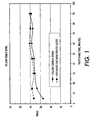
- the tracks are shown in Figure 1.
- the triboelectric charge tracks show that the toner composition of the present invention, including a surface treated alumina, is at least as good as the toner of Comparative Example 1, not including the surface treated alumina.
- Admix testing of each of the developers is also performed. In admix testing, fresh toner is added to the developer used to measure the tribo time tracks. Samples of the developer are analyzed at time intervals of 15 seconds, 60 seconds, and 120 seconds after a 0 time sample. The toner of Example 1 has very little wrong sign and low charge particles. This tests indicates the fresh toner's ability to charge the same as the old toner on the developer.
- Both the developers of Example 1 and Comparative Example 1 show high values of q/d (fc/ ⁇ m) for their initial points of about 0.75 fc/ ⁇ m. However, after the testing, the developer of Example 1 consistently shows better q/d values. By 120 seconds, the developer of Comparative Example 1 shows bimodal peaks with charge through, while the developer of Example 1 remains unimodal. The q/d value for Comparative Example 1 is 0.4, while the q/d value for Example 1 is about 0.51.
- Toners are made as in Example 1 and Comparative Example 1 except that the percent of additive is varied at values of 0%, 0.5%, 1%, 2%, 2.5% and 3%, by weight of the toner composition.
- Solid area images are made with these toners and fused using an envelope fuser. The images are then analyzed for their projection efficiency and color fidelity in the CIE LAB space. Projection efficiency is described as the amount of light that hits a detector within a 3.5 degree of arc perpendicular to the image versus all the light that passes through the image. The results are shown in Fig. 2.
- a toner is made by blending 88.25 weight percent of a polyester resin composed of bisphenol A and fumaric acid and 11.75 weight percent of a predispersion of the above mentioned polyester and 81:2 magenta pigment to give a final pigment concentration of 4.7 weight percent, and extruded in a ZSK-40 extruder.
- the extruded blend is then jetted and classified to form a magenta toner with a toner particle size of about 6.5 microns as measured in a Layson Cell.
- a thirty gram sample of this toner is added to a 9 ounce jar with 150 grams of stainless steel beads.
- NA50HS which is a 30 nanometer primary particle size fumed silica from Nippon Aerosil Corp.
- SMT5103 which is a 30 nanometer primary particle size titanium dioxide coated with decylsilane generated from decyltrimethoxysilane available from Tayca Corp., and 0.3 weight percent zinc stearate L from Synthetic Products Company.
- a magenta toner is prepared as in Comparative Example 9, except that the surface treated titania is replaced by a surface treated alumina, which is alumina treated with 15% decyltrimethoxysilane.
- the surface treated alumina is used in the same weight amount as the surface treated titania of Comparative Example 9.
- Developers are made using the toners of Example 9 and Comparative Example 9 by mixing 4 parts by weight of the foregoing blended toners with 100 parts by weight of a carrier of a Hoeganaes steel core, which core is previously coated with 1.0 weight percent of polymethylmethacrylate.
- a 90-minute triboelectric charge track is made for each of the developers.
- the tracks are shown in Figure 3.
- the triboelectric charge tracks show that the toner composition of the present invention, including a surface treated alumina, is at least as good as the toner of Comparative Example 9, not including the surface treated alumina.
- Admix testing of each of the developers is also performed. In admix testing, fresh blended toner is added to the developer used to measure the tribo time tracks. Samples of the developer are analyzed at time intervals of 15 seconds, 60 seconds, and 120 seconds after a 0 time sample. This test indicates the fresh toner's ability to charge the same as the old toner on the developer.
- the toner of Example 9 has very little wrong sign and low charge particles. Both the developers of Example 9 and Comparative Example 9 show high values of q/d (fc/ ⁇ m) for their initial points of about 1.3 fc/ ⁇ m. However, after the testing, the developer of Example 9 consistently shows better q/d values. By 120 seconds, the developer of Comparative Example 9 shows bimodal peaks with charge through, while the developer of Example 9 shows only a slight shoulder. The q/d value for Comparative Example 9 is 0.4, while the q/d value for Example 9 is 0.51.
- Toners are made as in Example 9 and Comparative Example 9 except that the percent of additive is varied at values of 0%, 0.5%, 1%, 2%, 2.5% and 3%, by weight of the toner composition. Solid area images are made with these toners and fused using an envelope fuser. The Projection Efficiency is measured for each with results comparable to Examples 3-8 and Comparative Examples 3-8.
- a toner is made by blending 89.0 weight percent of a polyester resin composed of bisphenol A and fumaric acid and 11.0 weight percent of a predispersion of the above mentioned polyester and 15:3 cyan pigment to give a final pigment concentration of 3.3 weight percent, and extruded in a ZSK-40 extruder. The extruded blend is then jetted and classified to form a cyan toner with a toner particle size of about 6.5 microns as measured in a Layson Cell. A thirty gram sample of this toner was added to a 9 ounce jar with 150 grams of stainless steel beads.
- Example 17a Two cyan toners are prepared as in Comparative Example 17, except that the surface treated titania is replaced by a surface treated alumina.
- the surface treated alumina is alumina treated with 10% decyltrimethoxysilane.
- Example 17b the surface treated alumina is alumina treated with 15% decyltrimethoxysilane.
- the surface treated alumina is used in the same weight amount as the surface treated titania of Comparative Example 17.
- Developers are made using the toners of Example 17a and 17b and Comparative Example 17 by mixing 4 parts by weight of the foregoing blended toners with 100 parts by weight of a carrier of a Hoeganaes steel core, which core is previously coated with 1.0 weight percent of polymethylmethacrylate.
- a 90-minute triboelectric charge track is made for each of the developers.
- the tracks are shown in Figure 4.
- the triboelectric charge tracks show that the toner compositions of the present invention, including a surface treated alumina, are at least as good as the toner of Comparative Example 17, not including the surface treated alumina.
- Admix testing of each of the developers is also performed. In admix testing fresh toner is added to the developer used to measure the tribo time tracks. Samples of the developer are analyzed at time intervals of 15 seconds, 60 seconds, and 120 seconds after a 0 time sample. This tests indicates the fresh toners ability to charge the same as the old toner on the developer.
- the toner of Example 17 has very little wrong sign and low charge particles. Both the developers of Example 17a and Comparative Example 17 show high values of q/d (fc/ ⁇ m) for their initial points of about 1.1 fc/ ⁇ m, while the developer of Example 17b shows a higher value of q/d (fc/ ⁇ m) for its initial point of about 1.25 fc/ ⁇ m.
- Example 17a and 17b consistently show better q/d values.
- the developer of Comparative Example 17 shows strong bimodal peaks with charge through, while the developer of Example 17a remains unimodal, and the developer of Example 17b shows a bimodal peak, but smaller than that of Comparative Example 17.
- the q/d value for Comparative Example 17 is about 0.4, while the q/d value for Examples 17a and 17b are about 0.8 and about 0.25, respectively.
- Toners are made as in Example 17 and Comparative Example 17 except that the percent of additive is varied at values of 0%, 0.5%, 1%, 2%, 2.5% and 3%, by weight of the toner composition. Solid area images are made with these toners and fused using an envelope fuser. The Projection Efficiency is measured for each, with results comparable to Examples 3-8 and Comparative Examples 3-8.
Landscapes
- Chemical & Material Sciences (AREA)
- Inorganic Chemistry (AREA)
- Physics & Mathematics (AREA)
- General Physics & Mathematics (AREA)
- Developing Agents For Electrophotography (AREA)
Abstract
Description
- The present invention relates to toner compositions having improved properties that are provided by improved surface additives. More particularly, the present invention relates to toner and developer compositions where the toner particles have an improved treated alumina surface additive.
- In electrophotography, a photoreceptor containing a photoconductive insulating layer on a conductive layer is imaged by first uniformly electrostatically charging its surface. The photoreceptor is then exposed to a pattern of activating electromagnetic radiation, such as light. The radiation selectively dissipates the charge in the illuminated areas of the photoconductive insulating layer while leaving behind an electrostatic latent image in the non-illuminated areas. This electrostatic latent image may then be developed to form a visible image by depositing finely divided toner particles on the surface of the photoconductive insulating layer. The resulting visible image may then be transferred from the photoconductor to a support, such as transparency or paper. This imaging process may be repeated many times.
- Various toner compositions for such a printing system are well known in the art, and have been produced having a wide range of additives and constituent materials. Generally, however, the toner particles include a binding material such as a resin, a colorant such as a dye and/or a pigment, and any of various additives to provide particular properties to the toner particles.
- One type of additive that is commonly used in toner compositions is a surface additive. The surface additive can be incorporated for any of various reasons, including for providing improved charging characteristics, improved flow properties, and the like.
- For example, toner compositions with certain surface additives, including certain silicas, are known. Examples of these additives include colloidal silicas, such as certain AEROSILS like R972™ available from Degussa, metal salts and metal salts of fatty acids inclusive of zinc stearate, aluminum oxides, cerium oxides, and mixtures thereof. Generally, such additives are each present in an amount of from about 1 percent by weight to about 5 percent by weight, and preferably in an amount of from about 1 percent by weight to about 3 percent by weight, of the toner composition. Several of the aforementioned additives are illustrated, for example, in U.S. Patents Nos. 3,590,000 and 3,900,588, the entire disclosures of which are incorporated herein by reference.
- Also known are toners containing a mixture of hexamethyldisilazane (HMDZ) and aminopropyltriethoxysilane (APTES). Disadvantages associated with these toners may include, in certain instances, a low, relatively unstable triboelectric charge, and high relative humidity sensitivity. Further, disadvantages of toners containing as surface additives HMDZ include, for example, unstable triboelectric charge, relative humidity sensitivity, and low charge/wrong sign toner as measured by a charge spectrograph.
- Developer compositions with charge enhancing additives, which impart a positive charge to the toner resin, are also known. For example, U.S. Patent No. 3,893,935 describes the use of quaternary ammonium salts as charge control agents for electrostatic toner compositions. U.S. Patent No. 4,221,856 discloses electrophotographic toners containing resin compatible quaternary ammonium compounds in which at least two R radicals are hydrocarbons having from 8 to about 22 carbon atoms, and each other R is a hydrogen or hydrocarbon radical with from 1 to about 8 carbon atoms, and A is an anion, for example sulfate, sulfonate, nitrate, borate, chlorate, and the halogens, such as iodide, chloride and bromide. Similar teachings are presented in U.S. Patents No. 4,312,933 and 4,291,111. There is also described in U.S. Patent No. 2,986,521 developer compositions comprised of toner resin particles coated with certain finely divided colloidal silica. According to the disclosure of this patent, the development of electrostatic latent images on negatively charged surfaces is accomplished by applying a developer composition having a positively charged triboelectric relationship with respect to the colloidal silica.
- Also, there is disclosed in U.S. Patent No. 4,338,390, the entire disclosure of which is incorporated herein by reference, developer compositions containing as charge enhancing additives organic sulfate and sulfonates, which additives can impart a positive charge to the toner composition. Further, there is disclosed in U.S. Patent No. 4,298,672, the entire disclosure of which is incorporated herein by reference, positively charged toner compositions with resin particles and pigment particles, and as charge enhancing additives alkyl pyridinium compounds. Additionally, other patents disclosing positively charged toner compositions with charge control additives include, for example, U.S. Patents Nos. 3,944,493; 4,007,293; 4,079,014; 4,394,430 and 4,560,635, which illustrate a toner with a distearyl dimethyl ammonium methyl sulfate charge additive. Surface additives, such as silicas like AEROSILS, may be incorporated into the toners of these patents.
- Moreover, toner compositions with negative charge enhancing additives are known, as described, for example, in U.S. Patents Nos. 4,411,974 and 4,206,064, the entire disclosures of which are incorporated herein by reference. The '974 patent discloses negatively charged toner compositions comprised of resin particles, pigment particles, and as a charge enhancing additive ortho-halo phenyl carboxylic acids. Similarly, there are disclosed in the '064 patent toner compositions with chromium, cobalt, and nickel complexes of salicylic acid as negative charge enhancing additives.
- U.S. Patent No. 4,404,271 describes a toner that contains a metal complex where the metal can be chromium, cobalt or iron. Additionally, other patents disclosing various metal containing azo dyestuff structures wherein the metal is chromium or cobalt include U.S. Patents Nos. 2,891,939, 2,871,233, 2,891,938, 2,933,489, 4,053,462 and 4,314,937. Also, in U.S. Patent No. 4,433,040, the entire disclosure of which is incorporated herein by reference, there are illustrated toner compositions with chromium and cobalt complexes of azo dyes as negative charge enhancing additives. Other charge enhancing additives include those illustrated in U.S. Patent Nos. 5,304,449, 4,904,762, and 5,223,368, the entire disclosures of which are incorporated herein by reference.
- Despite the broad range of additives that have been used in formulating toner compositions, there is a continued need in the art for improved toner compositions that provide improved results and improved image quality.
- For example, U.S. Patent No. 6,124,071 discloses toner compositions including a polymer and titanium oxide dihydroxide of the formula -O-Ti(OH)2. The titanium oxide dihydroxide is a charge additive. U.S. Patent No. 6,087,059 describes a toner comprised of resin, colorant and a surface additive mixture comprised of two coated silicas, and a coated metal oxide. U.S. Patent No. 6,017,668 discloses a toner composition comprising resin, colorant, and a surface additive mixture of a magnetite and a polyvinylidene fluoride. U.S. Patent No. 6,004,714 discloses a toner comprised of binder, colorant, and a silica containing a coating of an alkylsilane, including polyalkylsilanes such as decylsilane. Each of the toner compositions are disclosed as providing a number of advantages, such as excellent triboelectric charging characteristics, substantial insensitivity to humidity, superior toner flow through, stable triboelectric charging values, and wherein the toners enable the generation of developed images with superior resolution, and excellent color intensity.
- Despite these and other various toner composition formulations, there remains a need in the art for improved toner compositions. For example, although various of the above-described surface additives have provided improved printing and processing characteristics, some of the additives possess certain drawbacks that preferably should be overcome to provide still further improved performance results.
- For example, although titanium dioxide (titania), either by itself or in surface treated forms, has been widely used in the art, such a surface additive introduces several problems. In particular, both treated and untreated forms of titania tend to reduce the triboelectric charge of the toner composition. In addition, the titania additives have a higher refractive index (about 2.4 to 2.5) as compared to the polymer resins used to form the toner particles (about 1.5 to 1.7). As a result, the titania causes a higher light scattering, which hurts color toners in both the reflection and transmission modes. Based on both of these drawbacks, the loading amount of the titania must be reduced as much as possible, as higher loadings only exacerbate the problems.
- The present invention addresses these problems by using, as a toner particle surface additive, a treated Al2O3 (aluminum oxide or alumina). Use of the treated alumina provides significant benefits to the toner compositions. Unlike titania, the treated alumina does not cause a reduction in the triboelectric charge of the toner composition. Furthermore, because alumina has a lower refractive index (about 1.7), which more closely matches the refractive index of the polymer resins used to form the toner particles, the use of treated alumina allows for a higher loading of the material, without increased light scattering.
- In particular, the present invention provides a toner composition comprising:
- a binder,
- a colorant, and
- a treated alumina as a surface additive, wherein said treated alumina comprises alumina particles treated with a treatment agent.
-
- The present invention also provides developers including such a toner composition, and methods for making such a toner composition. In a further embodiment of the process defined in
claim 10 said treatment agent is an alkylalkoxysilane polymer.
In a further embodiment said treatment agent is decyltrimethoxysilane. - These and other advantages and features of this invention will be apparent from the following, especially when considered with the accompanying drawings, in which:
- Fig. 1 shows triboelectric charge tracks for a yellow developer of the present invention compared to a conventional yellow developer.
- Fig. 2 shows projection efficiency as a function of additive percent for yellow developers of the present invention compared to conventional yellow developers.
- Fig. 3 shows triboelectric charge tracks for a magenta developer of the present invention compared to a conventional magenta developer.
- Fig. 4 shows triboelectric charge tracks for cyan developers of the present invention compared to a conventional cyan developer.
-
- According to the present invention, a toner is provided that includes at least a binder, a colorant, and a surface additive. The surface additive is Al2O3 (aluminum oxide or alumina) that is surface treated, preferably by an alkylalkoxysilane.
- As the base material for the surface additive, any suitable alumina material can be used, such as those available from Cabot Corporation. Preferably, the alumina has a primary particle size of from about 20 or about 25 nanometers to about 55 or about 60 nanometers. More preferably, the primary particle size is from about 30 nanometers to about 40 nanometers. Because the alumina is typically used as larger particles that are aggregates of the smaller primary particles, the alumina particles according to the present invention preferably have an average aggregate size of from about 200 or about 225 nanometers to about 400 or about 450 nanometers. More preferably, the average aggregate size is from about 300 nanometers to about 375 nanometers. However, alumina materials having sizes outside of these ranges can be used, in embodiments.
- The treatment agent used to treat the alumina particles according to the invention is preferably an alkylsilane, alkoxysilane, or alkylalkoxysilane. More preferably the treatment agent is an alkylalkoxysilane such as a alkylpolyalkoxysilane.
- When alkylalkoxysilanes are used as the treatment agent, the alkyl group of the silane preferably contains from 1 to about 25 carbon atoms, preferably from about 4 to about 18 carbon atoms. For example, suitable alkyl groups include, but are not limited to, butyl, hexyl, octyl, decyl, dodecyl, or stearyl (octadecanyl). When alkoxysilanes are used as the treatment agent, the alkoxy group of the silane preferably contains from 1 to about 10 carbon atoms.
- In embodiments, the alkylalkoxysilane can be represented by the following formula (I):wherein R represents an alkyl group and A, B, and C independently represent alkoxy groups.

- Examples of preferred treatment agents thus include, but are not limited to, decyltrialkoxysilane such as decyltrimethoxysilane, and octyltrialkoxysilane such as octyltriethoxysilane. Other suitable treatment agents can also be used.
- The treatment agent can be present on the alumina particles in any suitable amount to provide desired results. In embodiments, the treatment agent is present in an amount of from about 2 to about 25 percent by weight, based on the weight of the alumina particles. Preferably, the treatment agent is present in an amount of from about 5 to about 20 percent by weight, and more preferably from about 10 to about 20 percent by weight, based on the weight of the alumina particles. However, values outside these ranges can be used, in embodiments.
- Generally, the amount of the treatment agent on the alumina surface can be determined from and/or controlled by the feed rate or feed amount of a precursor material, such as an alkylalkoxysilane. In embodiments, to achieve the desired treatment level, the feed amount of the precursor material is from about 1 or about 2.5 to about 25 or about 30 weight percent of the alumina. Preferably, the feed amount of the precursor material is from about 5 to about 20 weight percent, more preferably from about 5 to about 15 weight percent.
- The treated alumina particles preferably have a primary particle size as determined from BET, of, for example, from about 10 or about 20 nanometers to about 400 or about 500 nanometers. Preferably, the particle size is from about 25 nanometers to about 100 nanometers, or from about 25 nanometers to about 55 nanometers. The BET measurement method is named for Brunauer, Emmett, and Teller, and is a standard known technical method that measures surface area, and with model assumptions can calculate the primary particle size.
- The thus formed treated alumina particles can be added to the toner composition in any suitable amount to obtain the desired results. In embodiments, the treated alumina is present on the surface of the toner particles in an amount of from about 0.5 to about 10 percent by weight, based on the weight of the toner particles. Preferably, the treated alumina is present in an amount of from about 1 to about 5 percent by weight, based on the weight of the toner particles. However, values outside these ranges can be used, in embodiments.
- The toner compositions of the present invention, in addition to including the above-described surface additive, generally also include at least a toner resin and a colorant. In addition, the toner compositions can include one or more conventional additives, including but not limited to, optional charge enhancing additives and optional waxes, especially low molecular weight waxes with an Mw of, for example, from about 1,000 to about 20,000. Suitable toner compositions, which can be modified to include the treated alumina surface additive of the present invention, include those toner compositions disclosed in, for example, U.S. Patents Nos. 6,004,714, 6,017,668, 6,071,665, 6,087,059, 6,103,440, and 6,124,071, the entire disclosures of which are incorporated herein by reference. The toner compositions can generally be prepared by any known technique, such as by admixing and heating resin particles, colorant, and optional additives other than the above-described surface additive in a suitable toner extrusion device, such as the ZSK53 available from Werner Pfleiderer, following by removing the formed toner composition from the device. Subsequent to cooling, the toner composition is subjected to grinding utilizing, for example, a Sturtevant micronizer for the purpose of achieving toner particles with a desired volume median diameter of, for example, less than about 25 microns, and preferably of from about 6 to about 12 microns, which diameters are determined by a Coulter Counter. Subsequently, the toner compositions can be classified utilizing, for example, a Donaldson Model B classifier for the purpose of removing fines, that is toner particles having a volume median diameter of less than about 4 microns. Thereafter, the coated alumina particles and other optional surface additives can be added to the toner composition by blending the additives with the obtained toner particles.
- As the toner (or binder) resin, any of the convention toner resins can be used. Illustrative examples of such suitable toner resins include, for example, thermoplastic resins such as vinyl resins in general or styrene resins in particular, and polyesters. Examples of suitable thermoplastic resins include, but are not limited to, styrene methacrylate; polyolefins; styrene acrylates, such as PSB-2700 obtained from Hercules-Sanyo Inc.; polyesters, styrene butadienes; crosslinked styrene polymers; epoxies; polyurethanes; vinyl resins, including homopolymers or copolymers of two or more vinyl monomers; and polymeric esterification products of a dicarboxylic acid and a diol comprising a diphenol. Other suitable Vinyl monomers include, but are not limited to, styrene; p-chlorostyrene; unsaturated mono-olefins such as ethylene, propylene, butylene, isobutylene and the like; saturated mono-olefins such as vinyl acetate, vinyl propionate, and vinyl butyrate; vinyl esters such as esters of monocarboxylic acids including methyl acrylate, ethyl acrylate, n-butylacrylate, isobutyl acrylate, dodecyl acrylate, n-octyl acrylate, phenyl acrylate, methyl methacrylate, ethyl methacrylate, and butyl methacrylate; acrylonitrile, methacrylonitrile, and acrylamide; mixtures thereof; and the like. In addition, crosslinked resins, including polymers, copolymers, and homopolymers of styrene polymers, may be selected.
- For example, as one toner resin, there can be selected the esterification products of a dicarboxylic acid and a diol comprising a diphenol. These resins are illustrated, for example, in U.S. Patent No. 3,590,000, the entire disclosure of which is incorporated herein by reference. Other specific toner resins include, but are not limited to, styrene/methacrylate copolymers, and styrene/butadiene copolymers; Pliolites; suspension polymerized styrene butadienes, reference U.S. Patent No. 4,558,108, the entire disclosure of which is incorporated herein by reference; polyester resins obtained from the reaction of bisphenol A and propylene oxide; followed by the reaction of the resulting product with fumaric acid, and branched polyester resins resulting from the reaction of dimethylterephthalate, 1,3-butanediol, 1,2-propanediol, and pentaerythritol; reactive extruded resins, especially reactive extruded polyesters with crosslinking as illustrated in U.S. Patent No. 5,352,556, the entire disclosure of which is incorporated herein by reference, styrene acrylates, and mixtures thereof. Also, waxes with a molecular weight Mw of from about 1,000 to about 20,000, such as polyethylene, polypropylene, and paraffin waxes, can be included in, or on the toner compositions as fuser roll release agents.
- The toner resin is generally present in any sufficient, but effective amount. For example, the toner resin is generally present in an amount of from about 50 to about 95 percent by weight of the toner composition. More preferably, the toner resin is generally present in an amount of from about 70 to about 90 percent by weight of the toner composition.
- The toner composition also generally includes a colorant. As desired, the colorant can be a dye, a pigment, a mixture of a dye and a pigment, or two or more of them. As colored pigments, there can be selected, for example, various known cyan, magenta, yellow, red, green, brown, or blue colorants, or mixtures thereof. Specific examples of pigments include, but are not limited to, phthalocyanine HELIOGEN BLUE L6900™, D6840™, D7080™, D7020™, PYLAM OIL BLUE™, PYLAM OIL YELLOW™, PIGMENT BLUE 1 ™, available from Paul Uhlich & Company, Inc., PIGMENT VIOLET 1™, PIGMENT RED 48™, LEMON CHROME YELLOW DCC 1026 ™, E.D. TOLUIDINE RED™ and BON RED C™ available from Dominion Color Corporation, Ltd., Toronto, Ontario, NOVAPERM YELLOW FGL™, HOSTAPERM PINK E™ from Hoechst, CINQUASIA MAGENTATA™ available from E.I. DuPont de Nemours & Company, Pigment Yellow 180, Pigment Yellow 12, Pigment Yellow 13, Pigment Yellow 14, Pigment Yellow 17, Pigment Blue 15, Pigment Blue 15:3, Pigment Red 122, Pigment Red 57:1, Pigment Red 81:1, Pigment Red 81:2, Pigment Red 81:3, and the like.
- Generally, colored dyes and pigments that can be selected are cyan, magenta, or yellow pigments, and mixtures thereof. Examples of magentas that may be selected include, for example, 2,9-dimethyl-substituted quinacridone and anthraquinone dye identified in the Color Index as CI 60710, CI Dispersed Red 15, diazo dye identified in the Color Index as CI 26050, CI Solvent Red 19, and the like. Illustrative examples of cyans that may be selected include copper tetra(octadecyl sulfonamido) phthalocyanine, x-copper phthalocyanine pigment listed in the Color Index as CI 74160, CI Pigment Blue, and Anthrathrene Blue, identified in the Color Index as CI 69810, Special Blue X-2137, and the like. Illustrative examples of yellows that may be selected are diarylide yellow 3,3-dichlorobenzidene acetoacetanilides, a monoazo pigment identified in the Color Index as CI 12700, CI Solvent Yellow 16, a nitrophenyl amine sulfonamide identified in the Color Index as Foron Yellow SE/GLN, CI Dispersed Yellow 33 2,5-dimethoxy-4-sulfonanilide phenylazo-4'-chloro-2,5-dimethoxy acetoacetanilide, and Permanent Yellow FGL. Other soluble dyes, such as red, blue, green, and the like, can also be used, as desired.
- Generally, the colorant is included in the toner composition in known amounts, for the desired color strength. For example, the above-described dyes and pigments, and others, can be included in the toner composition in any suitable amount, such as from about 1 to about 20 percent by weight of the toner composition. Preferably, the colorant is included in an amount of from about 2 to about 10 percent by weight of the toner composition.
- If desired, such as to give the toner composition magnetic properties, magnetites can also be included in the toner composition, either for their magnetic properties, or for the colorant properties, or both. Suitable magnetites that can be used in the toner compositions of the present invention include, but are not limited to, a mixture of iron oxides (FeO.Fe2O3), including those commercially available as MAPICO BLACK™. The magnetite can be present in the toner composition in any of various effective amounts, such as an amount of from about 10 percent by weight to about 75 percent by weight of the toner composition. Preferably, the magnetite is present in an amount of from about 30 percent to about 55 percent by weight of the toner composition.
- There can be included in the toner compositions of the present invention charge additives as indicated herein in various effective amounts, such as from about 1 to about 15, and preferably from about 1 to about 3, percent by weight of the toner composition. Such suitable charge additives can include the above-described coated alumina particles, or other charge additives well known in the art.
- Furthermore, the toner compositions of the present invention can also include suitable waxes for their known effect. Suitable waxes include, but are not limited to, polypropylenes and polyethylenes commercially available from Allied Chemical and Petrolite Corporation; Epolene N-15 commercially available from Eastman Chemical Products, Inc.; Viscol 550-P, a low weight average molecular weight polypropylene available from Sanyo Kasei K.K.; mixtures thereof, and the like. The commercially available polyethylenes selected possess, for example, a weight average molecular weight of from about 1,000 to about 1,500, while the commercially available polypropylenes utilized are believed to have a weight average molecular weight of from about 4,000 to about 7,000. Many of the polyethylene and polypropylene compositions useful in the present invention are illustrated in British Patent No. 1,442,835, the entire disclosure of which is incorporated herein by reference.
- The wax can be present in the toner composition of the present invention in various amounts. However, generally these waxes are present in the toner composition in an amount of from about 1 percent by weight to about 15 percent by weight, and preferably in an amount of from about 2 percent by weight to about 10 percent by weight, based on the weight of the toner composition.
- The toners of the present invention may also, in embodiments, contain polymeric alcohols, such as UNILINS™, reference U.S. Patent No. 4,883,736, the entire disclosure of which is incorporated herein by reference. The UNILINS™ products are available from Petrolite Corporation.
- Developer compositions can be prepared by mixing the toners with known carrier particles, including but not limited to coated carriers, such as steel, ferrites, and the like, reference U.S. Patent Nos. 4,937,166 and 4,935,326, the entire disclosures of which are incorporated herein by reference. The toner composition and carrier particles are generally mixed to include from about 2 percent toner concentration to about 8 percent toner concentration. The carriers can include coatings thereon, such as those illustrated in the above-referenced U.S. Patents Nos. 4,937,166 and 4,935,326 patents, and other known coatings. There can be selected a single coating polymer, or a mixture of polymers. Additionally, the polymer coating or coatings may contain conductive components therein, such as carbon black in an amount for example, of from about 10 to about 70 weight percent, and preferably from about 20 to about 50 weight percent. Specific examples of coatings are fluorocarbon polymers, acrylate polymers, methacrylate polymers, silicone polymers, and the like.
- Imaging methods are also envisioned with the toners of the present invention. Suitable imaging methods that utilize toner particles are known in the art and include, for example, but are not limited to, the various patents mentioned herein as well as U.S. Patents Nos. 4,585,884, 4,584,253, 4,563,408, and 4,265,990, the entire disclosures of which are incorporated herein by reference.
- The toner compositions prepared according to the present invention provide excellent results in electrostatographic printing operations. In particular, the toner compositions, including the treated aerosil particles, possess good triboelectric charge properties, good admix times, and substantially unimodal charge distributions.
- In embodiments of the present invention, the toner compositions have a triboelectric charge of from about 15 to about 70 microcoulombs per gram. Preferably, the toner compositions have a triboelectric charge of from about 25 to about 65 microcoulombs per gram, more preferably from about 30 to about 60 microcoulombs per gram.
- Likewise, In embodiments of the present invention, the toner compositions have an admix time of less than about 60 seconds. Preferably, the toner compositions have an admix time of less than about 45 seconds, more preferably from about 1 second to about 30 seconds.
- An advantage of toner compositions according to the present invention, in embodiments, is that the toner compositions have a substantially unimodal charge distribution, as measured by a charge spectrograph. For example, toner compositions containing additives other than the treated alumina particles, or containing no additives, often exhibit charge distributions that have a distinct second peak, or a large shoulder on the primary peak in the charge distribution. In contrast, according to embodiments of the present invention, the toner compositions can be provided having a unimodal charge distribution and very little, or preferably none, low charge or wrong sign toner as measured by a charge spectrograph.
- According to embodiments of the present invention, the charge spectrograph analyses of toners of the present invention exhibit improved charge distribution over conventional toners. That is, it has been found that in general, toner compositions including the treated alumina additive provides a more unimodal charge distribution as compared to toner compositions including conventional additives such as titania. Moreover, it has been found that the charge distribution can be more easily adjusted than in the case of conventional toners, simply by adjusting the concentration of the alumina based on the surface treatment agent concentration. The present invention thereby provides further improvement in the adjustment of charge distribution for a toner composition.
- The following examples illustrate specific embodiments of the present invention. One skilled in the art will recognize that the appropriate reagents, and component ratios/concentrations may be adjusted as necessary to achieve specific product characteristics. All parts and percentages are by weight unless otherwise indicated.
- A toner is made by blending 73.33 weight percent of a polyester resin composed of bisphenol A and fumaric acid and 26.67 weight percent of a predispersion of the above mentioned polyester and Pigment Yellow 17 yellow pigment to give a final pigment concentration of 8 percent, and extruded in a ZSK-40 extruder. The extruded blend is then jetted and classified to form a yellow toner with a toner particle size of about 6.5 microns as measured in a Layson Cell. A thirty gram sample of this toner is added to a 9 ounce jar with 150 grams of stainless steel beads. To this is added 4.5 weight percent a 30 nanometer primary particle size fumed silica coated with decyltrimethoxysilane, available from Cabot Corp., 2.7 weight percent SMT5103, which is a 30 nanometer primary particle size titanium dioxide coated with decylsilane generated from decyltrimethoxysilane available from Tayca Corp., 0.3 weight percent H2050, which is a 12 nanometer primary particle size fumed silica commercially available from Wacker Chemie, and 0.5 weight percent zinc stearate L from Synthetic Products Company. After blending on a roll mill for 30 minutes the steel beads are removed from the jar.
- A yellow toner is prepared as in Comparative Example 1, except that the surface treated titania is replaced by a surface treated alumina, which is alumina treated with 15% decyltrimethoxysilane. The surface treated alumina is used in the same weight amount as the surface treated titania of Comparative Example 1.
- Developers are made using the toners of Example 1 and Comparative Example 1 by mixing 4 parts by weight of the foregoing blended toners with 100 parts by weight of a carrier of a Hoeganaes steel core, which core is previously coated with 1.0 weight percent of polymethylmethacrylate.
- A 90-minute triboelectric charge track is made for each of the developers. The tracks are shown in Figure 1. The triboelectric charge tracks show that the toner composition of the present invention, including a surface treated alumina, is at least as good as the toner of Comparative Example 1, not including the surface treated alumina.
- Admix testing of each of the developers is also performed. In admix testing, fresh toner is added to the developer used to measure the tribo time tracks. Samples of the developer are analyzed at time intervals of 15 seconds, 60 seconds, and 120 seconds after a 0 time sample. The toner of Example 1 has very little wrong sign and low charge particles. This tests indicates the fresh toner's ability to charge the same as the old toner on the developer. Both the developers of Example 1 and Comparative Example 1 show high values of q/d (fc/µm) for their initial points of about 0.75 fc/µm. However, after the testing, the developer of Example 1 consistently shows better q/d values. By 120 seconds, the developer of Comparative Example 1 shows bimodal peaks with charge through, while the developer of Example 1 remains unimodal. The q/d value for Comparative Example 1 is 0.4, while the q/d value for Example 1 is about 0.51.
- Toners are made as in Example 1 and Comparative Example 1 except that the percent of additive is varied at values of 0%, 0.5%, 1%, 2%, 2.5% and 3%, by weight of the toner composition. Solid area images are made with these toners and fused using an envelope fuser. The images are then analyzed for their projection efficiency and color fidelity in the CIE LAB space. Projection efficiency is described as the amount of light that hits a detector within a 3.5 degree of arc perpendicular to the image versus all the light that passes through the image. The results are shown in Fig. 2. The results show that the surface treated alumina according to the present invention has little or no effect on projection efficiency to at least a loading of 3%, whereas surface treated titania used in conventional toners has a large detrimental effect on projection efficiency. The results in the table below indicate that treated alumina does not impair the color fidelity of an image, especially for high concentrations of additive as compared to TiO2, (treated and untreated).
PE L* a* b* C* h* Control 88.9 89.37 3.05 98.52 98.57 88.24 3.0% AlO2 88.5 89.23 2.78 97.62 97.65 88.37 3.0% TiO2 79.4 83.66 5.44 93.97 94.13 86.69 - A toner is made by blending 88.25 weight percent of a polyester resin composed of bisphenol A and fumaric acid and 11.75 weight percent of a predispersion of the above mentioned polyester and 81:2 magenta pigment to give a final pigment concentration of 4.7 weight percent, and extruded in a ZSK-40 extruder. The extruded blend is then jetted and classified to form a magenta toner with a toner particle size of about 6.5 microns as measured in a Layson Cell. A thirty gram sample of this toner is added to a 9 ounce jar with 150 grams of stainless steel beads. To this is added 4.0 weight percent NA50HS, which is a 30 nanometer primary particle size fumed silica from Nippon Aerosil Corp., 2.5 weight percent SMT5103, which is a 30 nanometer primary particle size titanium dioxide coated with decylsilane generated from decyltrimethoxysilane available from Tayca Corp., and 0.3 weight percent zinc stearate L from Synthetic Products Company. After blending on a roll mill for 30 minutes the steel beads are removed from the jar.
- A magenta toner is prepared as in Comparative Example 9, except that the surface treated titania is replaced by a surface treated alumina, which is alumina treated with 15% decyltrimethoxysilane. The surface treated alumina is used in the same weight amount as the surface treated titania of Comparative Example 9.
- Developers are made using the toners of Example 9 and Comparative Example 9 by mixing 4 parts by weight of the foregoing blended toners with 100 parts by weight of a carrier of a Hoeganaes steel core, which core is previously coated with 1.0 weight percent of polymethylmethacrylate.
- A 90-minute triboelectric charge track is made for each of the developers. The tracks are shown in Figure 3. The triboelectric charge tracks show that the toner composition of the present invention, including a surface treated alumina, is at least as good as the toner of Comparative Example 9, not including the surface treated alumina.
- Admix testing of each of the developers is also performed. In admix testing, fresh blended toner is added to the developer used to measure the tribo time tracks. Samples of the developer are analyzed at time intervals of 15 seconds, 60 seconds, and 120 seconds after a 0 time sample. This test indicates the fresh toner's ability to charge the same as the old toner on the developer. The toner of Example 9 has very little wrong sign and low charge particles. Both the developers of Example 9 and Comparative Example 9 show high values of q/d (fc/µm) for their initial points of about 1.3 fc/µm. However, after the testing, the developer of Example 9 consistently shows better q/d values. By 120 seconds, the developer of Comparative Example 9 shows bimodal peaks with charge through, while the developer of Example 9 shows only a slight shoulder. The q/d value for Comparative Example 9 is 0.4, while the q/d value for Example 9 is 0.51.
- Toners are made as in Example 9 and Comparative Example 9 except that the percent of additive is varied at values of 0%, 0.5%, 1%, 2%, 2.5% and 3%, by weight of the toner composition. Solid area images are made with these toners and fused using an envelope fuser. The Projection Efficiency is measured for each with results comparable to Examples 3-8 and Comparative Examples 3-8.
- A toner is made by blending 89.0 weight percent of a polyester resin composed of bisphenol A and fumaric acid and 11.0 weight percent of a predispersion of the above mentioned polyester and 15:3 cyan pigment to give a final pigment concentration of 3.3 weight percent, and extruded in a ZSK-40 extruder. The extruded blend is then jetted and classified to form a cyan toner with a toner particle size of about 6.5 microns as measured in a Layson Cell. A thirty gram sample of this toner was added to a 9 ounce jar with 150 grams of stainless steel beads. To this is added 4.0 weight percent a 30 nanometer primary particle size fumed silica coated with decyltrimethoxysilane, available from Cabot Corp., 2.3 weight percent SMT5103, which is a 30 nanometer primary particle size titanium dioxide coated with decylsilane generated from decyltrimethoxysilane available from Tayca Corp., 0.2 weight percent H2050, which is a 12 nanometer primary particle size fumed silica commercially available from Wacker Chemie, and 0.3 weight percent zinc stearate L from Synthetic Products Company. After blending on a roll mill for 30 minutes the steel beads are removed from the jar.
- Two cyan toners are prepared as in Comparative Example 17, except that the surface treated titania is replaced by a surface treated alumina. In Example 17a, the surface treated alumina is alumina treated with 10% decyltrimethoxysilane. In Example 17b, the surface treated alumina is alumina treated with 15% decyltrimethoxysilane. The surface treated alumina is used in the same weight amount as the surface treated titania of Comparative Example 17.
- Developers are made using the toners of Example 17a and 17b and Comparative Example 17 by mixing 4 parts by weight of the foregoing blended toners with 100 parts by weight of a carrier of a Hoeganaes steel core, which core is previously coated with 1.0 weight percent of polymethylmethacrylate.
- A 90-minute triboelectric charge track is made for each of the developers. The tracks are shown in Figure 4. The triboelectric charge tracks show that the toner compositions of the present invention, including a surface treated alumina, are at least as good as the toner of Comparative Example 17, not including the surface treated alumina.
- Admix testing of each of the developers is also performed. In admix testing fresh toner is added to the developer used to measure the tribo time tracks. Samples of the developer are analyzed at time intervals of 15 seconds, 60 seconds, and 120 seconds after a 0 time sample. This tests indicates the fresh toners ability to charge the same as the old toner on the developer. The toner of Example 17 has very little wrong sign and low charge particles. Both the developers of Example 17a and Comparative Example 17 show high values of q/d (fc/µm) for their initial points of about 1.1 fc/µm, while the developer of Example 17b shows a higher value of q/d (fc/µm) for its initial point of about 1.25 fc/µm. However, after the testing, the developers of Example 17a and 17b consistently show better q/d values. By 120 seconds, the developer of Comparative Example 17 shows strong bimodal peaks with charge through, while the developer of Example 17a remains unimodal, and the developer of Example 17b shows a bimodal peak, but smaller than that of Comparative Example 17. The q/d value for Comparative Example 17 is about 0.4, while the q/d value for Examples 17a and 17b are about 0.8 and about 0.25, respectively.
- Toners are made as in Example 17 and Comparative Example 17 except that the percent of additive is varied at values of 0%, 0.5%, 1%, 2%, 2.5% and 3%, by weight of the toner composition. Solid area images are made with these toners and fused using an envelope fuser. The Projection Efficiency is measured for each, with results comparable to Examples 3-8 and Comparative Examples 3-8.
In a further embodiment the presence of the treated alumina does not cause adverse light scattering of a color image formed on a transparency using the toner composition. In a further embodiment the presence of the treated alumina does not cause a change in color fidelity of an image formed on a transparency using the toner composition, as measured in the CIE LAB color space.
In a further embodiment the toner composition further comprises a wax.
In a further embodiment the colorant is selected from the group consisting of cyan, magenta, yellow, red, orange, green, and violet.
In a further embodiment the alumina is treated with an alkylpolyalkoxysilane, wherein said alkyl contains from about 4 to about 18 carbon atoms.
In a further embodiment said alkyl is butyl, hexyl, octyl, decyl, dodecyl, or stearyl.
In a further embodiment the alkylalkoxysilane is of the formula (I):

In a further embodiment said treated alumina is present in an amount of from about 0.5 weight percent to about 6 weight percent by weight of the toner composition.
In a further embodiment the toner composition has a triboelectric charge of from about 15 to about 65 microcoulombs per gram.
In a further embodiment the toner composition has an admix time of from about 1 second to about 60 seconds.
Claims (10)
- A toner composition comprising:wherein said treated alumina comprises alumina particles treated with a treatment agent.a binder,a colorant, anda treated alumina,
- A toner composition in accordance with claim 1 wherein said treatment agent is an alkylalkoxysilane.
- A toner composition in accordance with claim 1 wherein said treatment agent is present in an amount from about 2 to about 25 weight percent, based on a weight of the alumina particles.
- A toner composition in accordance with claim 1 wherein said treated alumina has a primary particle size of from about 25 to about 55 nanometers, and an average aggregate size of from about 190 to about 400 nanometers.
- A toner composition in accordance with claim 2 wherein an alkyl group of said alkylalkoxysilane contains from about 1 to about 25 carbon atoms.
- A toner composition in accordance with claim 2 wherein said treatment agent is decylalkoxysilane.
- A toner composition in accordance with claim 2 wherein said treatment agent is decyltrimethoxysilane.
- A toner composition in accordance with claim 2 wherein an amount of said alkylalkoxysilane is determined from a feed rate or feed amount of an alkylalkoxysilane, and which amount is from about 5 to about 25 weight percent.
- A developer comprising:the toner composition of claim 1, anda carrier.
- A process for the preparing a toner composition, comprising:mixing a resin, and a colorant to form toner particles, andapplying to an external surface of said toner particles, a treated Al2O3 comprising alumina particles treated with a treatment agent.
Applications Claiming Priority (2)
| Application Number | Priority Date | Filing Date | Title |
|---|---|---|---|
| US09/749,687 US6420078B1 (en) | 2000-12-28 | 2000-12-28 | Toner compositions with surface additives |
| US749687 | 2000-12-28 |
Publications (3)
| Publication Number | Publication Date |
|---|---|
| EP1220042A2 true EP1220042A2 (en) | 2002-07-03 |
| EP1220042A3 EP1220042A3 (en) | 2003-07-16 |
| EP1220042B1 EP1220042B1 (en) | 2015-06-10 |
Family
ID=25014750
Family Applications (1)
| Application Number | Title | Priority Date | Filing Date |
|---|---|---|---|
| EP01130491.2A Expired - Lifetime EP1220042B1 (en) | 2000-12-28 | 2001-12-20 | Toner compositions with surface additives |
Country Status (3)
| Country | Link |
|---|---|
| US (1) | US6420078B1 (en) |
| EP (1) | EP1220042B1 (en) |
| JP (1) | JP2002214824A (en) |
Cited By (1)
| Publication number | Priority date | Publication date | Assignee | Title |
|---|---|---|---|---|
| WO2003033405A1 (en) * | 2001-10-18 | 2003-04-24 | Aluminium Pechiney | Ground calcined alumina for input in a precursor composition for refractory material, and method for obtaining same |
Families Citing this family (3)
| Publication number | Priority date | Publication date | Assignee | Title |
|---|---|---|---|---|
| US7566518B2 (en) * | 2004-04-15 | 2009-07-28 | Kao Corporation | Toner for electrostatic image development |
| US7229735B2 (en) * | 2004-07-26 | 2007-06-12 | Xerox Corporation | Toner compositions |
| JP2019023697A (en) * | 2017-07-24 | 2019-02-14 | 株式会社沖データ | Developer, developer cartridge, developing device, and image forming apparatus |
Family Cites Families (50)
| Publication number | Priority date | Publication date | Assignee | Title |
|---|---|---|---|---|
| US2933489A (en) | 1960-04-19 | Heavy metal-containing dyestuffs | ||
| US1442835A (en) | 1922-04-11 | 1923-01-23 | Charles W Surplus | Box-covering machine |
| US2871233A (en) | 1954-06-16 | 1959-01-27 | Basf Ag | Cobalt containing azo dyestuffs |
| US2891938A (en) | 1957-03-29 | 1959-06-23 | Geigy Ag J R | Chromium-containing monoazo dyestuffs |
| US2891939A (en) | 1957-03-29 | 1959-06-23 | Geigy Ag J R | Chromium-containing monoazo dyestuffs |
| US2986521A (en) | 1958-03-28 | 1961-05-30 | Rca Corp | Reversal type electroscopic developer powder |
| US3590000A (en) | 1967-06-05 | 1971-06-29 | Xerox Corp | Solid developer for latent electrostatic images |
| US3893935A (en) | 1972-05-30 | 1975-07-08 | Eastman Kodak Co | Electrographic toner and developer composition |
| US4053462A (en) | 1973-06-22 | 1977-10-11 | Ciba-Geigy Corporation | Unsymmetrical phenyl azo naphthyl chromium complex dyes |
| US3900588A (en) | 1974-02-25 | 1975-08-19 | Xerox Corp | Non-filming dual additive developer |
| US3944493A (en) | 1974-05-16 | 1976-03-16 | Eastman Kodak Company | Electrographic toner and developer composition |
| CH619977A5 (en) | 1976-02-04 | 1980-10-31 | Ciba Geigy Ag | |
| US4007293A (en) | 1976-03-01 | 1977-02-08 | Xerox Corporation | Mechanically viable developer materials |
| US4079014A (en) | 1976-07-21 | 1978-03-14 | Eastman Kodak Company | Electrographic toner and developer composition containing a 4-aza-1-azoniabicyclo(2.2.2) octane salt as a charge control agent |
| JPS53127726A (en) | 1977-04-13 | 1978-11-08 | Canon Inc | Electrostatic image developing toner |
| US4265990A (en) | 1977-05-04 | 1981-05-05 | Xerox Corporation | Imaging system with a diamine charge transport material in a polycarbonate resin |
| US4291111A (en) | 1977-11-25 | 1981-09-22 | Xerox Corporation | Nitrogen-containing additives for magnetic toners having hydrophobic and hydrophilic moiety |
| US4221856A (en) | 1978-04-03 | 1980-09-09 | Xerox Corporation | Electrographic toner containing resin-compatible quaternary ammonium compound |
| US4298672A (en) | 1978-06-01 | 1981-11-03 | Xerox Corporation | Toners containing alkyl pyridinium compounds and their hydrates |
| US4312933A (en) | 1979-02-09 | 1982-01-26 | Xerox Corporation | Method of imaging using nitrogen-containing additives for magnetic toners |
| US4338390A (en) | 1980-12-04 | 1982-07-06 | Xerox Corporation | Quarternary ammonium sulfate or sulfonate charge control agents for electrophotographic developers compatible with viton fuser |
| JPS5841508B2 (en) | 1980-12-22 | 1983-09-12 | オリヱント化学工業株式会社 | Toner for developing electrostatic images |
| DE3174159D1 (en) | 1981-02-27 | 1986-04-24 | Hodogaya Chemical Co Ltd | Electrophotographic toner |
| US4394430A (en) | 1981-04-14 | 1983-07-19 | Eastman Kodak Company | Electrophotographic dry toner and developer compositions |
| US4411974A (en) | 1982-04-12 | 1983-10-25 | Xerox Corporation | Ortho-halo phenyl carboxylic acid charge enhancing additives |
| US4558108A (en) | 1982-12-27 | 1985-12-10 | Xerox Corporation | Aqueous suspension polymerization process |
| US4585884A (en) | 1984-05-23 | 1986-04-29 | Xerox Corporation | Silylated compositions, and deuterated hydroxyl squaraine compositions and processes |
| US4560635A (en) | 1984-08-30 | 1985-12-24 | Xerox Corporation | Toner compositions with ammonium sulfate charge enhancing additives |
| US4584253A (en) | 1984-12-24 | 1986-04-22 | Xerox Corporation | Electrophotographic imaging system |
| US4563408A (en) | 1984-12-24 | 1986-01-07 | Xerox Corporation | Photoconductive imaging member with hydroxyaromatic antioxidant |
| US4935326A (en) | 1985-10-30 | 1990-06-19 | Xerox Corporation | Electrophotographic carrier particles coated with polymer mixture |
| US4937166A (en) | 1985-10-30 | 1990-06-26 | Xerox Corporation | Polymer coated carrier particles for electrophotographic developers |
| US4883736A (en) | 1987-01-20 | 1989-11-28 | Xerox Corporation | Electrophotographic toner and developer compositions with polymeric alcohol waxes |
| US4904762A (en) | 1989-08-21 | 1990-02-27 | Xerox Corporation | Toner compositions with charge enhancing additives |
| US5334472A (en) * | 1991-04-15 | 1994-08-02 | Tomoegawa Paper Co., Ltd. | Toner for developing static charge images |
| US5223368A (en) | 1991-09-06 | 1993-06-29 | Xerox Corporation | Toner and developer compositions comprising aluminum charge control agent |
| US5227460A (en) | 1991-12-30 | 1993-07-13 | Xerox Corporation | Cross-linked toner resins |
| US5304449A (en) | 1992-11-30 | 1994-04-19 | Xerox Corporation | Toner and developer compositions with pyridinium compounds and tetrasubstituted ammonium salts as charge enhancing additives |
| DE69520328T2 (en) * | 1994-11-08 | 2001-08-23 | Canon K.K., Tokio/Tokyo | Toner for developing electrostatic images, two-component developer, developing method, image forming method, heat fixing method and method for producing toners |
| US5827632A (en) * | 1994-12-05 | 1998-10-27 | Canon Kabushiki Kaisha | Toner for developing electrostatic image containing hydrophobized inorganic fine powder |
| DE69512882T2 (en) * | 1994-12-28 | 2000-04-20 | Canon K.K. | Toner for developing electrostatic images |
| US6071665A (en) | 1995-05-26 | 2000-06-06 | Xerox Corporation | Toner processes with surface additives |
| DE69608660T2 (en) * | 1995-10-02 | 2001-02-01 | Mitsubishi Materials Corp., Tokio/Tokyo | HYDROPHOBIC METAL OXIDE POWDER AND THEIR USE |
| JP3652161B2 (en) * | 1998-04-30 | 2005-05-25 | キヤノン株式会社 | toner |
| US6103440A (en) | 1998-05-04 | 2000-08-15 | Xerox Corporation | Toner composition and processes thereof |
| US6004714A (en) | 1998-08-11 | 1999-12-21 | Xerox Corporation | Toner compositions |
| US6124071A (en) | 1999-03-01 | 2000-09-26 | Xerox Corporation | Toner compositions |
| US6017668A (en) | 1999-05-26 | 2000-01-25 | Xerox Corporation | Toner compositions |
| US6087059A (en) | 1999-06-28 | 2000-07-11 | Xerox Corporation | Toner and developer compositions |
| US6203960B1 (en) * | 2000-08-22 | 2001-03-20 | Xerox Corporation | Toner compositions |
-
2000
- 2000-12-28 US US09/749,687 patent/US6420078B1/en not_active Expired - Lifetime
-
2001
- 2001-12-20 EP EP01130491.2A patent/EP1220042B1/en not_active Expired - Lifetime
- 2001-12-27 JP JP2001395687A patent/JP2002214824A/en active Pending
Non-Patent Citations (1)
| Title |
|---|
| None |
Cited By (2)
| Publication number | Priority date | Publication date | Assignee | Title |
|---|---|---|---|---|
| WO2003033405A1 (en) * | 2001-10-18 | 2003-04-24 | Aluminium Pechiney | Ground calcined alumina for input in a precursor composition for refractory material, and method for obtaining same |
| US7125539B2 (en) | 2001-10-18 | 2006-10-24 | Aluminium Pechiney | Ground calcined alumina for input in a precursor composition for refractory material and method for obtaining same |
Also Published As
| Publication number | Publication date |
|---|---|
| EP1220042B1 (en) | 2015-06-10 |
| EP1220042A3 (en) | 2003-07-16 |
| US6420078B1 (en) | 2002-07-16 |
| JP2002214824A (en) | 2002-07-31 |
Similar Documents
| Publication | Publication Date | Title |
|---|---|---|
| US6087059A (en) | Toner and developer compositions | |
| US6214507B1 (en) | Toner compositions | |
| US6190815B1 (en) | Toner compositions | |
| US6004714A (en) | Toner compositions | |
| US6503677B1 (en) | Emulsion aggregation toner particles coated with negatively chargeable and positively chargeable additives and method of making same | |
| CA2353038C (en) | Toner compositions | |
| US6190814B1 (en) | Modified silica particles | |
| US6566025B1 (en) | Polymeric particles as external toner additives | |
| CA2528412C (en) | Toner compositions | |
| US6103440A (en) | Toner composition and processes thereof | |
| CA2585598A1 (en) | External additive composition and process | |
| US5763132A (en) | Toner compositions | |
| US5288581A (en) | Toner compositions with anionic clay or clay-like charge enhancing additives | |
| EP1655639B1 (en) | Toner compositions with surface additives | |
| US7288352B2 (en) | Toner compositions with surface additives | |
| US6420078B1 (en) | Toner compositions with surface additives | |
| US5948583A (en) | Toner composition and processes thereof | |
| USH1889H (en) | Toner compositions | |
| US5663025A (en) | Magenta toner and developer compositions | |
| US5691097A (en) | Toner compositions | |
| US7229735B2 (en) | Toner compositions | |
| US5318872A (en) | Toner and developer compositions with fluorophosphate charge enhancing additives | |
| JP4432802B2 (en) | Photofixing color toner, electrophotographic developer, and image forming method |
Legal Events
| Date | Code | Title | Description |
|---|---|---|---|
| PUAI | Public reference made under article 153(3) epc to a published international application that has entered the european phase |
Free format text: ORIGINAL CODE: 0009012 |
|
| AK | Designated contracting states |
Kind code of ref document: A2 Designated state(s): AT BE CH CY DE DK ES FI FR GB GR IE IT LI LU MC NL PT SE TR |
|
| AX | Request for extension of the european patent |
Free format text: AL;LT;LV;MK;RO;SI |
|
| PUAL | Search report despatched |
Free format text: ORIGINAL CODE: 0009013 |
|
| AK | Designated contracting states |
Designated state(s): AT BE CH CY DE DK ES FI FR GB GR IE IT LI LU MC NL PT SE TR |
|
| AX | Request for extension of the european patent |
Extension state: AL LT LV MK RO SI |
|
| 17P | Request for examination filed |
Effective date: 20040116 |
|
| AKX | Designation fees paid |
Designated state(s): DE FR GB |
|
| 17Q | First examination report despatched |
Effective date: 20090922 |
|
| GRAP | Despatch of communication of intention to grant a patent |
Free format text: ORIGINAL CODE: EPIDOSNIGR1 |
|
| INTG | Intention to grant announced |
Effective date: 20150127 |
|
| GRAS | Grant fee paid |
Free format text: ORIGINAL CODE: EPIDOSNIGR3 |
|
| GRAA | (expected) grant |
Free format text: ORIGINAL CODE: 0009210 |
|
| AK | Designated contracting states |
Kind code of ref document: B1 Designated state(s): DE FR GB |
|
| REG | Reference to a national code |
Ref country code: GB Ref legal event code: FG4D |
|
| REG | Reference to a national code |
Ref country code: DE Ref legal event code: R096 Ref document number: 60149398 Country of ref document: DE |
|
| REG | Reference to a national code |
Ref country code: FR Ref legal event code: PLFP Year of fee payment: 15 |
|
| REG | Reference to a national code |
Ref country code: DE Ref legal event code: R097 Ref document number: 60149398 Country of ref document: DE |
|
| PLBE | No opposition filed within time limit |
Free format text: ORIGINAL CODE: 0009261 |
|
| STAA | Information on the status of an ep patent application or granted ep patent |
Free format text: STATUS: NO OPPOSITION FILED WITHIN TIME LIMIT |
|
| 26N | No opposition filed |
Effective date: 20160311 |
|
| REG | Reference to a national code |
Ref country code: FR Ref legal event code: PLFP Year of fee payment: 16 |
|
| PGFP | Annual fee paid to national office [announced via postgrant information from national office to epo] |
Ref country code: FR Payment date: 20161121 Year of fee payment: 16 Ref country code: GB Payment date: 20161128 Year of fee payment: 16 Ref country code: DE Payment date: 20161121 Year of fee payment: 16 |
|
| REG | Reference to a national code |
Ref country code: DE Ref legal event code: R119 Ref document number: 60149398 Country of ref document: DE |
|
| GBPC | Gb: european patent ceased through non-payment of renewal fee |
Effective date: 20171220 |
|
| REG | Reference to a national code |
Ref country code: FR Ref legal event code: ST Effective date: 20180831 |
|
| PG25 | Lapsed in a contracting state [announced via postgrant information from national office to epo] |
Ref country code: FR Free format text: LAPSE BECAUSE OF NON-PAYMENT OF DUE FEES Effective date: 20180102 Ref country code: DE Free format text: LAPSE BECAUSE OF NON-PAYMENT OF DUE FEES Effective date: 20180703 |
|
| PG25 | Lapsed in a contracting state [announced via postgrant information from national office to epo] |
Ref country code: GB Free format text: LAPSE BECAUSE OF NON-PAYMENT OF DUE FEES Effective date: 20171220 |