EP1219681A1 - Phenolic molding composition - Google Patents
Phenolic molding composition Download PDFInfo
- Publication number
- EP1219681A1 EP1219681A1 EP01131001A EP01131001A EP1219681A1 EP 1219681 A1 EP1219681 A1 EP 1219681A1 EP 01131001 A EP01131001 A EP 01131001A EP 01131001 A EP01131001 A EP 01131001A EP 1219681 A1 EP1219681 A1 EP 1219681A1
- Authority
- EP
- European Patent Office
- Prior art keywords
- weight
- parts
- pulley
- molding composition
- phenolic
- Prior art date
- Legal status (The legal status is an assumption and is not a legal conclusion. Google has not performed a legal analysis and makes no representation as to the accuracy of the status listed.)
- Granted
Links
- 239000000203 mixture Substances 0.000 title claims abstract description 34
- 238000000465 moulding Methods 0.000 title claims abstract description 31
- ISWSIDIOOBJBQZ-UHFFFAOYSA-N phenol group Chemical group C1(=CC=CC=C1)O ISWSIDIOOBJBQZ-UHFFFAOYSA-N 0.000 title claims abstract description 19
- VYPSYNLAJGMNEJ-UHFFFAOYSA-N Silicium dioxide Chemical compound O=[Si]=O VYPSYNLAJGMNEJ-UHFFFAOYSA-N 0.000 claims abstract description 56
- 239000000377 silicon dioxide Substances 0.000 claims abstract description 28
- 239000000843 powder Substances 0.000 claims abstract description 26
- KXGFMDJXCMQABM-UHFFFAOYSA-N 2-methoxy-6-methylphenol Chemical compound [CH]OC1=CC=CC([CH])=C1O KXGFMDJXCMQABM-UHFFFAOYSA-N 0.000 claims abstract description 21
- 229920001568 phenolic resin Polymers 0.000 claims abstract description 21
- 239000005011 phenolic resin Substances 0.000 claims abstract description 21
- 229920001971 elastomer Polymers 0.000 claims abstract description 19
- 239000012784 inorganic fiber Substances 0.000 claims abstract description 15
- 239000002245 particle Substances 0.000 claims abstract description 14
- 229920003987 resole Polymers 0.000 claims abstract description 11
- 239000003365 glass fiber Substances 0.000 claims abstract description 7
- 229920005989 resin Polymers 0.000 claims description 11
- 239000011347 resin Substances 0.000 claims description 11
- 230000035939 shock Effects 0.000 description 11
- 238000012360 testing method Methods 0.000 description 10
- 230000000052 comparative effect Effects 0.000 description 8
- 239000000428 dust Substances 0.000 description 8
- 238000005299 abrasion Methods 0.000 description 7
- 239000000835 fiber Substances 0.000 description 7
- 229920000459 Nitrile rubber Polymers 0.000 description 4
- 238000005452 bending Methods 0.000 description 4
- 238000005336 cracking Methods 0.000 description 4
- 239000000463 material Substances 0.000 description 4
- 229910052751 metal Inorganic materials 0.000 description 4
- 239000002184 metal Substances 0.000 description 4
- 238000000034 method Methods 0.000 description 4
- 230000000694 effects Effects 0.000 description 3
- 229920000742 Cotton Polymers 0.000 description 2
- IAYPIBMASNFSPL-UHFFFAOYSA-N Ethylene oxide Chemical compound C1CO1 IAYPIBMASNFSPL-UHFFFAOYSA-N 0.000 description 2
- OKKJLVBELUTLKV-UHFFFAOYSA-N Methanol Chemical class OC OKKJLVBELUTLKV-UHFFFAOYSA-N 0.000 description 2
- 239000000654 additive Substances 0.000 description 2
- 239000004744 fabric Substances 0.000 description 2
- 238000001746 injection moulding Methods 0.000 description 2
- 239000000395 magnesium oxide Substances 0.000 description 2
- CPLXHLVBOLITMK-UHFFFAOYSA-N magnesium oxide Inorganic materials [Mg]=O CPLXHLVBOLITMK-UHFFFAOYSA-N 0.000 description 2
- AXZKOIWUVFPNLO-UHFFFAOYSA-N magnesium;oxygen(2-) Chemical compound [O-2].[Mg+2] AXZKOIWUVFPNLO-UHFFFAOYSA-N 0.000 description 2
- 238000005259 measurement Methods 0.000 description 2
- 239000007787 solid Substances 0.000 description 2
- 238000001721 transfer moulding Methods 0.000 description 2
- 229920000049 Carbon (fiber) Polymers 0.000 description 1
- 239000006087 Silane Coupling Agent Substances 0.000 description 1
- 239000006096 absorbing agent Substances 0.000 description 1
- 229920000800 acrylic rubber Polymers 0.000 description 1
- 150000001412 amines Chemical class 0.000 description 1
- 239000003963 antioxidant agent Substances 0.000 description 1
- 235000006708 antioxidants Nutrition 0.000 description 1
- 229920006231 aramid fiber Polymers 0.000 description 1
- QRUDEWIWKLJBPS-UHFFFAOYSA-N benzotriazole Chemical compound C1=CC=C2N[N][N]C2=C1 QRUDEWIWKLJBPS-UHFFFAOYSA-N 0.000 description 1
- 239000012964 benzotriazole Substances 0.000 description 1
- AXCZMVOFGPJBDE-UHFFFAOYSA-L calcium dihydroxide Chemical compound [OH-].[OH-].[Ca+2] AXCZMVOFGPJBDE-UHFFFAOYSA-L 0.000 description 1
- 239000000920 calcium hydroxide Substances 0.000 description 1
- 229910001861 calcium hydroxide Inorganic materials 0.000 description 1
- 235000011116 calcium hydroxide Nutrition 0.000 description 1
- CJZGTCYPCWQAJB-UHFFFAOYSA-L calcium stearate Chemical compound [Ca+2].CCCCCCCCCCCCCCCCCC([O-])=O.CCCCCCCCCCCCCCCCCC([O-])=O CJZGTCYPCWQAJB-UHFFFAOYSA-L 0.000 description 1
- 235000013539 calcium stearate Nutrition 0.000 description 1
- 239000008116 calcium stearate Substances 0.000 description 1
- 239000004917 carbon fiber Substances 0.000 description 1
- 239000003086 colorant Substances 0.000 description 1
- 239000000306 component Substances 0.000 description 1
- 238000013329 compounding Methods 0.000 description 1
- 238000000748 compression moulding Methods 0.000 description 1
- 239000013078 crystal Substances 0.000 description 1
- NJLLQSBAHIKGKF-UHFFFAOYSA-N dipotassium dioxido(oxo)titanium Chemical compound [K+].[K+].[O-][Ti]([O-])=O NJLLQSBAHIKGKF-UHFFFAOYSA-N 0.000 description 1
- 239000000806 elastomer Substances 0.000 description 1
- 238000011156 evaluation Methods 0.000 description 1
- 238000010438 heat treatment Methods 0.000 description 1
- -1 hindered amine Chemical compound 0.000 description 1
- 238000004898 kneading Methods 0.000 description 1
- 239000004611 light stabiliser Substances 0.000 description 1
- 239000007788 liquid Substances 0.000 description 1
- VNWKTOKETHGBQD-UHFFFAOYSA-N methane Chemical compound C VNWKTOKETHGBQD-UHFFFAOYSA-N 0.000 description 1
- GCBNHVRADXQGPB-UHFFFAOYSA-N n-(2,3-dimethylphenyl)phenazine-1-carboxamide Chemical compound CC1=CC=CC(NC(=O)C=2C3=NC4=CC=CC=C4N=C3C=CC=2)=C1C GCBNHVRADXQGPB-UHFFFAOYSA-N 0.000 description 1
- 229920003986 novolac Polymers 0.000 description 1
- 229920001084 poly(chloroprene) Polymers 0.000 description 1
- 229920000058 polyacrylate Polymers 0.000 description 1
- 238000010298 pulverizing process Methods 0.000 description 1
- 230000003014 reinforcing effect Effects 0.000 description 1
- 238000011160 research Methods 0.000 description 1
- HBMJWWWQQXIZIP-UHFFFAOYSA-N silicon carbide Chemical compound [Si+]#[C-] HBMJWWWQQXIZIP-UHFFFAOYSA-N 0.000 description 1
- 229910010271 silicon carbide Inorganic materials 0.000 description 1
- 229920002379 silicone rubber Polymers 0.000 description 1
- 239000004945 silicone rubber Substances 0.000 description 1
- 239000000126 substance Substances 0.000 description 1
- 238000004381 surface treatment Methods 0.000 description 1
- 229940124543 ultraviolet light absorber Drugs 0.000 description 1
- XOOUIPVCVHRTMJ-UHFFFAOYSA-L zinc stearate Chemical compound [Zn+2].CCCCCCCCCCCCCCCCCC([O-])=O.CCCCCCCCCCCCCCCCCC([O-])=O XOOUIPVCVHRTMJ-UHFFFAOYSA-L 0.000 description 1
Classifications
-
- C—CHEMISTRY; METALLURGY
- C08—ORGANIC MACROMOLECULAR COMPOUNDS; THEIR PREPARATION OR CHEMICAL WORKING-UP; COMPOSITIONS BASED THEREON
- C08K—Use of inorganic or non-macromolecular organic substances as compounding ingredients
- C08K7/00—Use of ingredients characterised by shape
- C08K7/02—Fibres or whiskers
- C08K7/04—Fibres or whiskers inorganic
-
- C—CHEMISTRY; METALLURGY
- C08—ORGANIC MACROMOLECULAR COMPOUNDS; THEIR PREPARATION OR CHEMICAL WORKING-UP; COMPOSITIONS BASED THEREON
- C08K—Use of inorganic or non-macromolecular organic substances as compounding ingredients
- C08K3/00—Use of inorganic substances as compounding ingredients
- C08K3/34—Silicon-containing compounds
- C08K3/36—Silica
-
- C—CHEMISTRY; METALLURGY
- C08—ORGANIC MACROMOLECULAR COMPOUNDS; THEIR PREPARATION OR CHEMICAL WORKING-UP; COMPOSITIONS BASED THEREON
- C08L—COMPOSITIONS OF MACROMOLECULAR COMPOUNDS
- C08L61/00—Compositions of condensation polymers of aldehydes or ketones; Compositions of derivatives of such polymers
- C08L61/04—Condensation polymers of aldehydes or ketones with phenols only
- C08L61/06—Condensation polymers of aldehydes or ketones with phenols only of aldehydes with phenols
-
- C—CHEMISTRY; METALLURGY
- C08—ORGANIC MACROMOLECULAR COMPOUNDS; THEIR PREPARATION OR CHEMICAL WORKING-UP; COMPOSITIONS BASED THEREON
- C08L—COMPOSITIONS OF MACROMOLECULAR COMPOUNDS
- C08L61/00—Compositions of condensation polymers of aldehydes or ketones; Compositions of derivatives of such polymers
- C08L61/04—Condensation polymers of aldehydes or ketones with phenols only
- C08L61/06—Condensation polymers of aldehydes or ketones with phenols only of aldehydes with phenols
- C08L61/12—Condensation polymers of aldehydes or ketones with phenols only of aldehydes with phenols with polyhydric phenols
-
- Y—GENERAL TAGGING OF NEW TECHNOLOGICAL DEVELOPMENTS; GENERAL TAGGING OF CROSS-SECTIONAL TECHNOLOGIES SPANNING OVER SEVERAL SECTIONS OF THE IPC; TECHNICAL SUBJECTS COVERED BY FORMER USPC CROSS-REFERENCE ART COLLECTIONS [XRACs] AND DIGESTS
- Y10—TECHNICAL SUBJECTS COVERED BY FORMER USPC
- Y10S—TECHNICAL SUBJECTS COVERED BY FORMER USPC CROSS-REFERENCE ART COLLECTIONS [XRACs] AND DIGESTS
- Y10S254/00—Implements or apparatus for applying pushing or pulling force
- Y10S254/902—Either drum, pulley wheel element, or cable constructed from specific material
-
- Y—GENERAL TAGGING OF NEW TECHNOLOGICAL DEVELOPMENTS; GENERAL TAGGING OF CROSS-SECTIONAL TECHNOLOGIES SPANNING OVER SEVERAL SECTIONS OF THE IPC; TECHNICAL SUBJECTS COVERED BY FORMER USPC CROSS-REFERENCE ART COLLECTIONS [XRACs] AND DIGESTS
- Y10—TECHNICAL SUBJECTS COVERED BY FORMER USPC
- Y10T—TECHNICAL SUBJECTS COVERED BY FORMER US CLASSIFICATION
- Y10T74/00—Machine element or mechanism
- Y10T74/19—Gearing
- Y10T74/1987—Rotary bodies
Definitions
- the present invention relates to a phenolic molding composition used in engine parts or the like mounted on a vehicle, and more particularly relates to a phenolicmolding composition improved in wear resistance, especially in abrasive wear resistance, and a pulley molded of the composition.
- phenolic molding compositions are superior in heat resistance and dimensional stability, they have been used as alternative materials to metal parts in various fields.
- making various parts out of resin has been promoted with the increase in demand for reduction in size, weight and cost.
- pulleys which have been heretofore chiefly made of metal are being replaced by those made of resin.
- Such resin pulleys have been molded with various shapes.
- the pulley made of phenolic resin is easily cracked because of a difference in thermal expansion coefficient from a metal insert in the environment in which variations in temperature are violent. Therefore, there is a problem that the pulley is inferior in heat shock resistance.
- a molded product particularly a pulley
- a molded product is improved in wear resistance and heat shock resistance by compounding, in a phenolic resin molding composition, resol-based phenolic resin, inorganic fiber, silica powder with an average particle diameter of from 20 to 150 ⁇ m, and a rubber component in specific proportions.
- the invention has been accomplished.
- the invention is characterized by having the following arrangement.
- a phenolic molding composition for forming a pulley according to the invention will be described below in detail.
- a resol-based phenolic resin used in this invention may be dimethylene-ether-based or methylol-based and either of a solid type or of a liquid type.
- a solid type phenolic resin with an average molecular weight of from 600 to 800 may be used preferably in order to improve heat shock resistance.
- the resol-based phenolic resin has a function of uniformly dispersing a rubber component mixed as a stress absorber in this invention, further has a function of reducing molding pressure at the time of injection molding to reduce stress remaining in the pulley. Accordingly, the resol-based phenolic resin improves heat shock resistance.
- a rubber component, inorganic fiber and silica powder are compounded in the molding composition according to this invention.
- the rubber component used in this invention is not particularly limited but nitrile rubber, acrylic rubber, polychloroprene rubber, styrene-butadience rubber, silicone rubber or the like may be used preferably.
- One selected from these rubber components maybe used singly or two or more rubber components may be used in combination.
- 1 to 15 parts by weight of the rubber component are contained in 100 parts by weight of phenolic resin. If the amount of the rubber component is smaller than 1 part by weight, the effect for reduction in elastic modulus cannot be exhibited. If the amount of the rubber component is larger than 15 parts by weight, the effect for reduction in elastic modulus can be obtained but improvement in abrasive wear resistance cannot be obtained because of extreme reduction in surface hardness and strength.
- inorganic fiber used in this invention it is possible to use glass fiber, carbon fiber, silicon carbide fiber, potassium titanate fiber or the like. One selected from these materials maybe used singly or two or more materials may be used in combination. Especially, inorganic fiber containing not smaller than 50 % by weight of glass fiber may be used preferably from the point of view of strength, heat resistance, cost, and so on, The glass fiber may be preferably subjected to a surface treatment with a silane coupling agent in order to improve adhesion to the phenolic resin.
- the inorganic fiber 40 to 100 parts by weight of the inorganic fiber is contained in 100 parts by weight of the phenolic resin. If the amount of the inorganic fiber is smaller than 40 parts by weight, the reinforcing effect is poor in practical use of the pulley. If the amount of the inorganic fiber is larger than 100 parts by weight, the characteristic of attacking the rubber belt becomes high as well as the abrasive wear resistance becomes low because of increase in elastic modulus. Therefore, it is undesirable to determine the amount of the inorganic fiber which is smaller than 40 parts by weight or is larger than 100 parts by weight.
- natural silica powder with an average particle diameter of from 20 to 150 ⁇ m is used.
- natural silica is classified into crystal silica and amorphous molten silica. Either of them may be used.
- the shape of natural silica powder is classified into a pulverized type and a round grain type.
- the pulverized type natural silica powder may be preferably used because the frictional resistance due to mobility of the pulley prevents the silica powder from dropping out. If the average particle diameter of the natural silica powder is smaller than 20 ⁇ m, the contact surface area of the particles with the phenolic resin becomes small so that the particles are apt to drop out undesirably. If the average particle diameter is larger than 150 ⁇ m, the surface of the finished product is roughened so easily that the abrasive wear resistance becomes low undesirably.
- the natural silica powder are contained in 100 parts by weight of the phenolic resin. If the amount of the natural silica powder is smaller than 30 parts by weight, a sufficient effect cannot be given to wear resistance because of shortage of the proportion of the silica powder on the surface of the pulley. If the amount of the silica powder is larger than 90 parts by weight, the adhesion between the phenolic resin and the silica powder is lowered because of relative reduction in the amount of resin so that the silica powder is apt to drop out of the surface of the pulley.
- additives commonly used in the general phenolic molding composition for example, releasants such as calcium stearate, accelerators such as magnesium oxide, anti-oxidants such as hindered phenol, light stabilizers such as hindered amine, ultraviolet light absorbers such as benzotriazole, and colorants, may be added to the molding composition according to the invention as occasion demands.
- releasants such as calcium stearate
- accelerators such as magnesium oxide
- anti-oxidants such as hindered phenol
- light stabilizers such as hindered amine
- ultraviolet light absorbers such as benzotriazole, and colorants
- organic fiber such as cotton cloth fiber, aramid fiber or the like can be added to the molding composition according to the invention if the organic fiber does not disturb the object of the invention.
- the molding composition according to the invention can be produced by heating and kneading in a press kneader, abiaxial extruder, a Henschel mixer, a mixing heat roll or the like and by pulverizing in a power mill or the like.
- a pulley having a desired shape can be molded by a known molding method such as an injection molding method, a transfer molding method or a compression molding method.
- a molded product shaped like a spiral is obtained by transfer molding in the following condition.
- the length of the spiral thereof was made a spiral flow value.
- Mold 100 mm pot diameter, 18 mm pitch, 1000 mm length
- Molding Condition 165°C mold temperature, 53 MPa molding pressure, 50g sample
- the bending strength and the elastic modulus in flexure was measured according to JIS-K6911.
- the Charpy impact strength was measured according to JIS-K6911.
- the Rockwell hardness was measured according to JIS-K6911.
- the volume reduced up to 2000 rotations was measured in an abrasion test according to JIS-K7204.
- a pulley dust test was performed under the condition of 1 kg/m 3 dust, rotational speed of 0 to 7000 rpm and load of 980 N. After the pulley was made to run for 400 hours, the abrasion state of the pulley was checked. The case where no abrasion was not observed in the outer circumferential groove portion of the pulley which was a frictional surface against the rubber belt was estimated as O. The case where abrasion was observed was estimated as X. With respect to the characteristic of attacking the rubber belt, the case where the attacking characteristic was not observed was estimated as O. The case where the attacking characteristic was observed was estimated as X.
- One cycle of -40°C for 30 minutes and 120°C for 30 minutes was repeated 1000 times. After the 1000 cycles, cracking was checked. The case where there was no cracking was estimated as O. The case where there was some cracking was estimated as X.
- dimethylene-ether-based resol resin [number-average molecular weight of 800, made by ASASHI ORGANIC CHEMICALS INDUSTRY CO., LTD.], 75 parts by weight of glass fiber [made by NIPPON ELCTRIC GALSS CO., LTD.], 65 parts by weight of natural silica powder [average particle diameter of 25 ⁇ m, pulverized shape, made by TATSUMORI LTD.], 12 parts by weight of nitrile rubber [PCN-38, made by JSR Corp.], 6 parts by weight of hydrated lime, 5 parts by weight of magnesium oxide and 5 parts by weight of zinc stearate were compounded and mixed homogeneously, the mixture was heated and kneaded evenly by a roll to thereby form a sheet-like mixture. After cooled, the mixture was pulverized by a power mill. Thus, a granular molding composition was produced.
- the molding composition thus obtained was injection-molded under the following condition. Cylinder Temperature: front 85°C, rear 50°C Mold Temperature: 180°C Curing Time: 60 seconds Thus, a test piece for evaluation of performance and a pulley were produced.
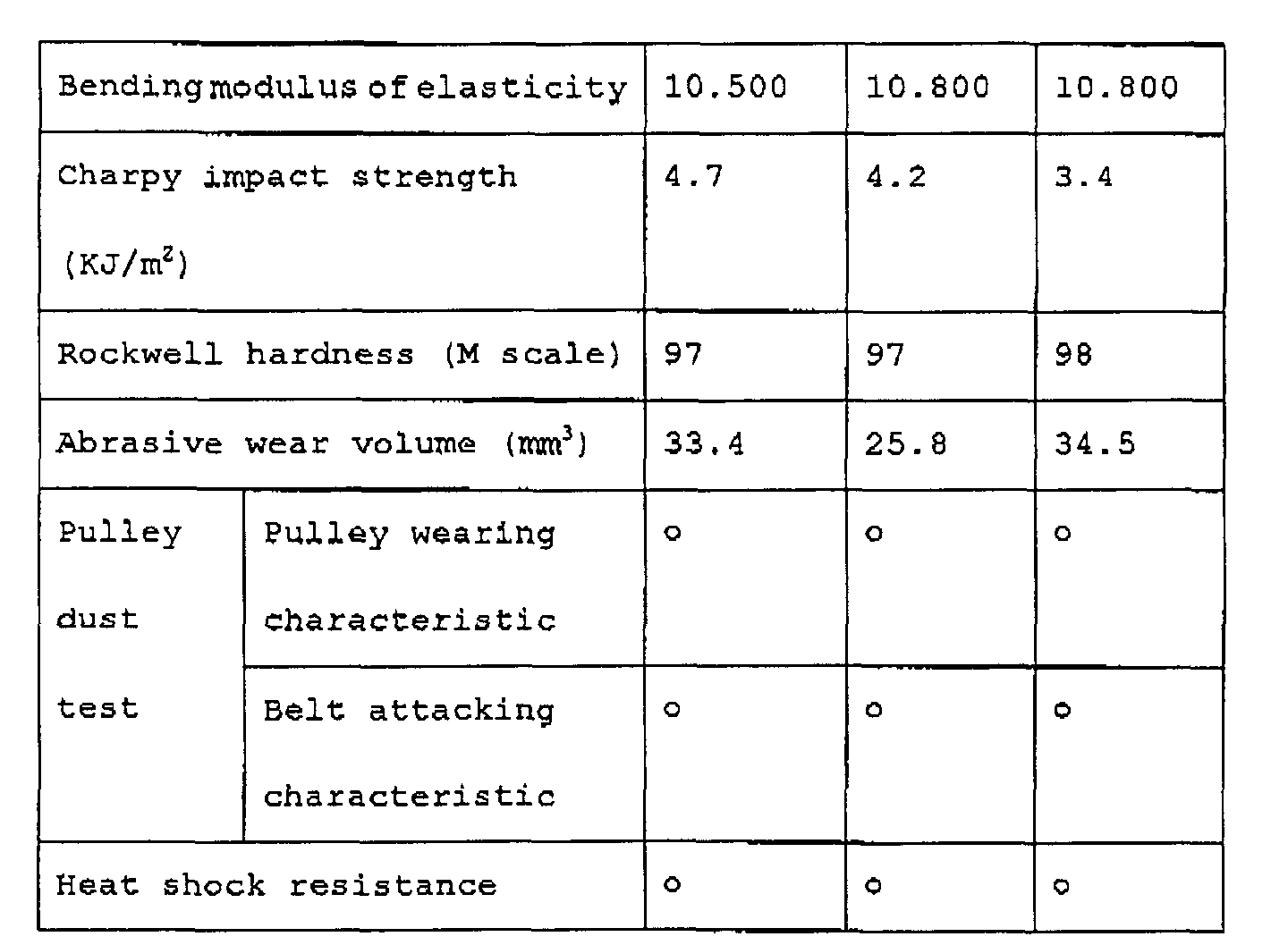
- the bending strength, the bending modulus of elasticity, the Charpy impact strength, the Rockwell hardness and the abrasive wear volume were measured. Further, with respect to the pulley thus obtained, the pulley wearing characteristic and the belt attacking characteristic were evaluated by a pulley dust test. In addition, the heat shock resistance was evaluated. Results of the measurement were shown in Table 1.
- a test piece and a pulley were produced after a molding composition was produced in the same manner as in Example 1 except that the mixture proportions were changed as shown in Table 1. The performance was evaluated. Results of the measurement were shown in Table 1. ⁇
- Comparative Example 5 In Comparative Example 5 in which the resol resin was replaced by novolac-based phenolic resin, the abrasive wear resistance was excellent but the heat shock resistance was poor.
- Comparative Example 6 In Comparative Example 6 in which natural silica with an average particle diameter of 10 ⁇ m and cotton cloth fiber were used, the strength was excellent but both the spiral flow characteristic and the abrasive wearability were inferior and particularly the pulley wearing characteristic was poor.
- the phenolic molding composition according to the invention is excellent in abrasive wear resistance and heat shock resistance.
- a molded product further excellent in mechanical strength can be obtained.
- the phenolic molding composition is extremely suitable particularly as a pulley material.
Landscapes
- Chemical & Material Sciences (AREA)
- Health & Medical Sciences (AREA)
- Chemical Kinetics & Catalysis (AREA)
- Medicinal Chemistry (AREA)
- Polymers & Plastics (AREA)
- Organic Chemistry (AREA)
- Pulleys (AREA)
- Compositions Of Macromolecular Compounds (AREA)
- Auxiliary Drives, Propulsion Controls, And Safety Devices (AREA)
- Manufacture Of Macromolecular Shaped Articles (AREA)
- Reinforced Plastic Materials (AREA)
Abstract
Description
- The present invention relates to a phenolic molding composition used in engine parts or the like mounted on a vehicle, and more particularly relates to a phenolicmolding composition improved in wear resistance, especially in abrasive wear resistance, and a pulley molded of the composition.
- Since phenolic molding compositions are superior in heat resistance and dimensional stability, they have been used as alternative materials to metal parts in various fields. In the field of vehicles, making various parts out of resin has been promoted with the increase in demand for reduction in size, weight and cost. Particularly, pulleys which have been heretofore chiefly made of metal are being replaced by those made of resin. Such resin pulleys have been molded with various shapes.
- However, particularly in the case of a pulley made of phenolic resin, the contact surface of the pulley with a rubber belt is apt to wear out if the pulley is used in the state where dust is nipped between the pulley and the belt. Thus, there is a disadvantage that the resin pulley is inferior in durability compared to the general metal pulley. In order to prevent such dust from entering, An attempt on covering of the whole of an auxiliary driving portion of an engine with a cover is therefore considered. Such an attempt is, however, impractical because it is against the demand for reduction in weight and cost. Therefore, it is essential to improve the wear resistance, particularly the abrasive wear resistance of the pulley itself.
- The pulley made of phenolic resin is easily cracked because of a difference in thermal expansion coefficient from a metal insert in the environment in which variations in temperature are violent. Therefore, there is a problem that the pulley is inferior in heat shock resistance.
- Therefore, a resin pulley made of phenolic resin mixed with inorganic fiber, inorganic powder, organic fiber and elastomer has been proposed, for example, as described in Japanese Patent Laid-OpenNo. 217818/1997. Fine silica powder with an average particle diameter of 10 µm is used as the inorganic powder in such a resin pulley. In this case, there is a problem that the abrasive wear resistance is insufficient so that the abrasion loss of the pulley increases. Thus, further improvement has been demanded.
- Taking the problems in the related art into consideration, the present inventors have made various researches. As a result, the present inventors have found that a molded product, particularly a pulley, is improved in wear resistance and heat shock resistance by compounding, in a phenolic resin molding composition, resol-based phenolic resin, inorganic fiber, silica powder with an average particle diameter of from 20 to 150 µm, and a rubber component in specific proportions. Thus, the invention has been accomplished.
- In order to solve the aforesaid object, the invention is characterized by having the following arrangement.
- (1) A phenolic molding composition comprising:
- a resol-based phenolic resin; and
- 40 to 100 parts by weight of inorganic fiber;
- 30 to 90 parts by weight of natural silica powder with an average particle diameter of from 20 to 150 µm; and
- 1 to 15 parts by weight of a rubber component, each per 100 parts by weight of the resol-based phenolic resin.
- (2) The phenolic molding composition according to (1), wherein the inorganic fiber includes 50% or more by weight of glass fiber.
- (3) The phenolic molding composition according to (1) or (2), wherein the natural silica powder is shaped like pulverized powder.
- (4) The resin pulley molded of a phenolic molding composition defined in any one of (1) to (3).
-
- A phenolic molding composition for forming a pulley according to the invention will be described below in detail.
- A resol-based phenolic resin used in this invention may be dimethylene-ether-based or methylol-based and either of a solid type or of a liquid type. Especially, a solid type phenolic resin with an average molecular weight of from 600 to 800 may be used preferably in order to improve heat shock resistance. The resol-based phenolic resin has a function of uniformly dispersing a rubber component mixed as a stress absorber in this invention, further has a function of reducing molding pressure at the time of injection molding to reduce stress remaining in the pulley. Accordingly, the resol-based phenolic resin improves heat shock resistance.
- In order to improve abrasive wear resistance which is an object of this invention, it is essential to increase hardness of additives and surface hardness of the composition and to reduce elastic modulus. From this point of view, a rubber component, inorganic fiber and silica powder are compounded in the molding composition according to this invention.
- The rubber component used in this invention is not particularly limited but nitrile rubber, acrylic rubber, polychloroprene rubber, styrene-butadience rubber, silicone rubber or the like may be used preferably. One selected from these rubber components maybe used singly or two or more rubber components may be used in combination. Preferably, 1 to 15 parts by weight of the rubber component are contained in 100 parts by weight of phenolic resin. If the amount of the rubber component is smaller than 1 part by weight, the effect for reduction in elastic modulus cannot be exhibited. If the amount of the rubber component is larger than 15 parts by weight, the effect for reduction in elastic modulus can be obtained but improvement in abrasive wear resistance cannot be obtained because of extreme reduction in surface hardness and strength.
- As the inorganic fiber used in this invention, it is possible to use glass fiber, carbon fiber, silicon carbide fiber, potassium titanate fiber or the like. One selected from these materials maybe used singly or two or more materials may be used in combination. Especially, inorganic fiber containing not smaller than 50 % by weight of glass fiber may be used preferably from the point of view of strength, heat resistance, cost, and so on, The glass fiber may be preferably subjected to a surface treatment with a silane coupling agent in order to improve adhesion to the phenolic resin.
- In this invention, 40 to 100 parts by weight of the inorganic fiber is contained in 100 parts by weight of the phenolic resin. If the amount of the inorganic fiber is smaller than 40 parts by weight, the reinforcing effect is poor in practical use of the pulley. If the amount of the inorganic fiber is larger than 100 parts by weight, the characteristic of attacking the rubber belt becomes high as well as the abrasive wear resistance becomes low because of increase in elastic modulus. Therefore, it is undesirable to determine the amount of the inorganic fiber which is smaller than 40 parts by weight or is larger than 100 parts by weight.
- In this invention, natural silica powder with an average particle diameter of from 20 to 150 µm is used. In accordance with crystalline state, natural silica is classified into crystal silica and amorphous molten silica. Either of them may be used. The shape of natural silica powder is classified into a pulverized type and a round grain type. Especially, the pulverized type natural silica powder may be preferably used because the frictional resistance due to mobility of the pulley prevents the silica powder from dropping out. If the average particle diameter of the natural silica powder is smaller than 20 µm, the contact surface area of the particles with the phenolic resin becomes small so that the particles are apt to drop out undesirably. If the average particle diameter is larger than 150 µm, the surface of the finished product is roughened so easily that the abrasive wear resistance becomes low undesirably.
- Preferably, 30 to 90 parts by weight of the natural silica powder are contained in 100 parts by weight of the phenolic resin. If the amount of the natural silica powder is smaller than 30 parts by weight, a sufficient effect cannot be given to wear resistance because of shortage of the proportion of the silica powder on the surface of the pulley. If the amount of the silica powder is larger than 90 parts by weight, the adhesion between the phenolic resin and the silica powder is lowered because of relative reduction in the amount of resin so that the silica powder is apt to drop out of the surface of the pulley.
- Various kinds of additives commonly used in the general phenolic molding composition, for example, releasants such as calcium stearate, accelerators such as magnesium oxide, anti-oxidants such as hindered phenol, light stabilizers such as hindered amine, ultraviolet light absorbers such as benzotriazole, and colorants, may be added to the molding composition according to the invention as occasion demands.
- Further, organic fiber such as cotton cloth fiber, aramid fiber or the like can be added to the molding composition according to the invention if the organic fiber does not disturb the object of the invention.
- The molding composition according to the invention can be produced by heating and kneading in a press kneader, abiaxial extruder, a Henschel mixer, a mixing heat roll or the like and by pulverizing in a power mill or the like. In addition, a pulley having a desired shape can be molded by a known molding method such as an injection molding method, a transfer molding method or a compression molding method.
- Examples according to the invention will be described below but the invention is not limited these examples.
- Incidentally, the respective characteristics measured were evaluated according to the following method.
- A molded product shaped like a spiral is obtained by transfer molding in the following condition. The length of the spiral thereof was made a spiral flow value.
Mold: 100 mm pot diameter, 18 mm pitch, 1000 mm length
Molding Condition: 165°C mold temperature, 53 MPa molding pressure, 50g sample - The bending strength and the elastic modulus in flexure was measured according to JIS-K6911.
- The Charpy impact strength was measured according to JIS-K6911.
- The Rockwell hardness was measured according to JIS-K6911.
- The volume reduced up to 2000 rotations was measured in an abrasion test according to JIS-K7204.
- A pulley dust test was performed under the condition of 1 kg/m3 dust, rotational speed of 0 to 7000 rpm and load of 980 N. After the pulley was made to run for 400 hours, the abrasion state of the pulley was checked. The case where no abrasion was not observed in the outer circumferential groove portion of the pulley which was a frictional surface against the rubber belt was estimated as O. The case where abrasion was observed was estimated as X. With respect to the characteristic of attacking the rubber belt, the case where the attacking characteristic was not observed was estimated as O. The case where the attacking characteristic was observed was estimated as X.
- One cycle of -40°C for 30 minutes and 120°C for 30 minutes was repeated 1000 times. After the 1000 cycles, cracking was checked. The case where there was no cracking was estimated as O. The case where there was some cracking was estimated as X.
- After 100 parts by weight of dimethylene-ether-based resol resin [number-average molecular weight of 800, made by ASASHI ORGANIC CHEMICALS INDUSTRY CO., LTD.], 75 parts by weight of glass fiber [made by NIPPON ELCTRIC GALSS CO., LTD.], 65 parts by weight of natural silica powder [average particle diameter of 25 µm, pulverized shape, made by TATSUMORI LTD.], 12 parts by weight of nitrile rubber [PCN-38, made by JSR Corp.], 6 parts by weight of hydrated lime, 5 parts by weight of magnesium oxide and 5 parts by weight of zinc stearate were compounded and mixed homogeneously, the mixture was heated and kneaded evenly by a roll to thereby form a sheet-like mixture. After cooled, the mixture was pulverized by a power mill. Thus, a granular molding composition was produced.
- The molding composition thus obtained was injection-molded under the following condition.
Cylinder Temperature: front 85°C, rear 50°C
Mold Temperature: 180°C
Curing Time: 60 seconds Thus, a test piece for evaluation of performance and a pulley were produced. - With respect to the test piece thus obtained, the bending strength, the bending modulus of elasticity, the Charpy impact strength, the Rockwell hardness and the abrasive wear volume were measured. Further, with respect to the pulley thus obtained, the pulley wearing characteristic and the belt attacking characteristic were evaluated by a pulley dust test. In addition, the heat shock resistance was evaluated. Results of the measurement were shown in Table 1.
- A test piece and a pulley were produced after a molding composition was produced in the same manner as in Example 1 except that the mixture proportions were changed as shown in Table 1. The performance was evaluated. Results of the measurement were shown in Table 1.

 <
<

- From results of Table 1, it was confirmed that the molded product using the phenolic molding composition according to the invention was excellent in abrasive wear resistance because the abrasive wear volume in each of Examples 1 to 3 was reduced greatly to a value of from about 40 % to about 60 % as large as that in each of Comparative Examples 1 to 6 and because abrasion was not observed in Examples 1 to 3 in the pulley dust test. In addition, it was confirmed that the molded product using the phenolic molding composition according to the invention was excellent in heat shock resistance because there was no cracking in the molded product in the heat shock resistance test.
- On the other hand, each of Comparative Example 1 in which natural silica with a small mean particle size of 10 µm was used and Comparative Example 2 in which natural silica with a large mean particle size of 250 µm was used, the abrasive wear resistance was poor because the abrasive wear volume was large so that abrasion was observed in the pulley dust test. In Comparative Example 3 in which the loading of natural silica was reduced, the abrasive wear resistance was worsened. In Comparative Example 4 in which the loading of nitrile rubber was reduced, the heat shock performance was worsened. In Comparative Example 5 in which the resol resin was replaced by novolac-based phenolic resin, the abrasive wear resistance was excellent but the heat shock resistance was poor. In Comparative Example 6 in which natural silica with an average particle diameter of 10 µm and cotton cloth fiber were used, the strength was excellent but both the spiral flow characteristic and the abrasive wearability were inferior and particularly the pulley wearing characteristic was poor.
- As described above, the phenolic molding composition according to the invention is excellent in abrasive wear resistance and heat shock resistance. In addition, a molded product further excellent in mechanical strength can be obtained. Hence, the phenolic molding composition is extremely suitable particularly as a pulley material.
Claims (4)
- A phenolic molding composition comprising:a resol-based phenolic resin; and40 to 100 parts by weight of inorganic fiber;30 to 90 parts by weight of natural silica powder with an average particle diameter of from 20 to 150 µm; and1 to 15 parts by weight of a rubber component, each per 100 parts by weight of the resol-based phenolic resin.
- The phenolic molding composition according to claim 1, wherein the inorganic fiber includes 50% or more by weight of glass fiber.
- The phenolic molding composition according to claim 1 or 2, wherein the natural silica powder is shaped like pulverized powder.
- The resin pulley molded of a phenolic molding composition defined in any one of claims 1 to 3.
Applications Claiming Priority (2)
| Application Number | Priority Date | Filing Date | Title |
|---|---|---|---|
| JP2000402847 | 2000-12-28 | ||
| JP2000402847A JP3763740B2 (en) | 2000-12-28 | 2000-12-28 | Resin pulley |
Publications (2)
| Publication Number | Publication Date |
|---|---|
| EP1219681A1 true EP1219681A1 (en) | 2002-07-03 |
| EP1219681B1 EP1219681B1 (en) | 2009-08-12 |
Family
ID=18867067
Family Applications (1)
| Application Number | Title | Priority Date | Filing Date |
|---|---|---|---|
| EP01131001A Expired - Lifetime EP1219681B1 (en) | 2000-12-28 | 2001-12-28 | Phenolic molding composition |
Country Status (4)
| Country | Link |
|---|---|
| US (1) | US6716907B2 (en) |
| EP (1) | EP1219681B1 (en) |
| JP (1) | JP3763740B2 (en) |
| DE (1) | DE60139538D1 (en) |
Cited By (3)
| Publication number | Priority date | Publication date | Assignee | Title |
|---|---|---|---|---|
| EP1394442A3 (en) * | 2002-08-29 | 2004-03-31 | Koyo Seiko Co., Ltd. | Resin pulley |
| EP1602860A4 (en) * | 2003-03-11 | 2006-05-17 | Sumitomo Bakelite Co | Molding phenolic resin material for pulley, resinous pulley, and method of using molding resin material |
| EP1721934A4 (en) * | 2004-03-01 | 2012-08-15 | Jtekt Corp | Phenol resin molding material and pulley molded with the molding material |
Families Citing this family (8)
| Publication number | Priority date | Publication date | Assignee | Title |
|---|---|---|---|---|
| US7297081B2 (en) * | 2003-08-29 | 2007-11-20 | Dayco Products, Llc | Idler pulley with integral bearing carrier insert and method |
| JP4799175B2 (en) * | 2005-12-28 | 2011-10-26 | 株式会社ジェイテクト | Resin pulley |
| JP4508165B2 (en) * | 2006-06-27 | 2010-07-21 | パナソニック電工株式会社 | Phenolic resin molding materials and molded products |
| JP2010235671A (en) * | 2009-03-30 | 2010-10-21 | Sumitomo Bakelite Co Ltd | Phenol resin composition |
| JP2011112151A (en) * | 2009-11-26 | 2011-06-09 | Jtekt Corp | Resin pulley |
| JP6831175B2 (en) * | 2015-10-29 | 2021-02-17 | 住友ベークライト株式会社 | Phenolic resin molding material |
| CN105733174B (en) * | 2016-02-02 | 2017-12-12 | 东南大学 | A kind of preparation method of fiber surface-processing method and fibre reinforced composites and composite |
| US11333235B2 (en) * | 2019-06-14 | 2022-05-17 | NHI Mechanical Motion, LLC | Hybrid drive component |
Citations (4)
| Publication number | Priority date | Publication date | Assignee | Title |
|---|---|---|---|---|
| JPH0532863A (en) * | 1991-08-01 | 1993-02-09 | Sumitomo Bakelite Co Ltd | Phenol resin composition excellent in impact strength |
| EP0590233A2 (en) * | 1992-09-30 | 1994-04-06 | Sumitomo Bakelite Company Limited | Impact modified, reinforced phenolic resin molding materials |
| EP0794361A1 (en) * | 1996-02-14 | 1997-09-10 | Koyo Seiko Co., Ltd. | Resin pulley |
| US5834551A (en) * | 1994-06-10 | 1998-11-10 | Dainippon Ink And Chemicals, Inc. | Composite of thermosetting resin with metallic oxide and process for the preparation thereof |
-
2000
- 2000-12-28 JP JP2000402847A patent/JP3763740B2/en not_active Expired - Fee Related
-
2001
- 2001-12-27 US US10/026,472 patent/US6716907B2/en not_active Expired - Lifetime
- 2001-12-28 DE DE60139538T patent/DE60139538D1/en not_active Expired - Lifetime
- 2001-12-28 EP EP01131001A patent/EP1219681B1/en not_active Expired - Lifetime
Patent Citations (4)
| Publication number | Priority date | Publication date | Assignee | Title |
|---|---|---|---|---|
| JPH0532863A (en) * | 1991-08-01 | 1993-02-09 | Sumitomo Bakelite Co Ltd | Phenol resin composition excellent in impact strength |
| EP0590233A2 (en) * | 1992-09-30 | 1994-04-06 | Sumitomo Bakelite Company Limited | Impact modified, reinforced phenolic resin molding materials |
| US5834551A (en) * | 1994-06-10 | 1998-11-10 | Dainippon Ink And Chemicals, Inc. | Composite of thermosetting resin with metallic oxide and process for the preparation thereof |
| EP0794361A1 (en) * | 1996-02-14 | 1997-09-10 | Koyo Seiko Co., Ltd. | Resin pulley |
Non-Patent Citations (1)
| Title |
|---|
| DATABASE WPI Section Ch Week 199311, Derwent World Patents Index; Class A12, AN 1993-088803, XP002193781 * |
Cited By (6)
| Publication number | Priority date | Publication date | Assignee | Title |
|---|---|---|---|---|
| EP1394442A3 (en) * | 2002-08-29 | 2004-03-31 | Koyo Seiko Co., Ltd. | Resin pulley |
| US7452926B2 (en) | 2002-08-29 | 2008-11-18 | Jtekt Corporation | Resin pulley formed of a resin composition having a phenol resin, an inorganic powder , a reinforcing fiber, and a lubricant |
| EP1602860A4 (en) * | 2003-03-11 | 2006-05-17 | Sumitomo Bakelite Co | Molding phenolic resin material for pulley, resinous pulley, and method of using molding resin material |
| US7569633B2 (en) | 2003-03-11 | 2009-08-04 | Sumitomo Bakelite Co. Ltd. | Molding phenolic resin material for pulley, and method of using molding resin material |
| EP1721934A4 (en) * | 2004-03-01 | 2012-08-15 | Jtekt Corp | Phenol resin molding material and pulley molded with the molding material |
| US8962734B2 (en) | 2004-03-01 | 2015-02-24 | Jtekt Corporation | Phenol resin molding material and pulley molded from said molding material |
Also Published As
| Publication number | Publication date |
|---|---|
| JP2002201335A (en) | 2002-07-19 |
| US6716907B2 (en) | 2004-04-06 |
| EP1219681B1 (en) | 2009-08-12 |
| JP3763740B2 (en) | 2006-04-05 |
| DE60139538D1 (en) | 2009-09-24 |
| US20020123557A1 (en) | 2002-09-05 |
Similar Documents
| Publication | Publication Date | Title |
|---|---|---|
| EP0794361B1 (en) | Resin pulley | |
| US7297728B2 (en) | Friction material | |
| EP2526318B1 (en) | Copper-free friction material for brake pads | |
| EP1219681B1 (en) | Phenolic molding composition | |
| CN108884378B (en) | Friction material composition | |
| US20100084233A1 (en) | Friction Material For Brakes | |
| EP1031754B1 (en) | Non-asbestos friction materials | |
| EP3381996B1 (en) | Friction material | |
| EP2491267A1 (en) | Friction material for brakes | |
| EP1394442B1 (en) | Resin pulley | |
| EP1602860A1 (en) | Molding phenolic resin material for pulley, resinous pulley, and method of using molding resin material | |
| CN101351662B (en) | Resinous pulley and resin composition | |
| JP3370596B2 (en) | High-density anti-vibration rubber and its manufacturing method | |
| JP4679062B2 (en) | Pulley molded with phenolic resin molding material | |
| JP3626093B2 (en) | Resin pulley | |
| JPH08159244A (en) | Resin pulley | |
| JP2003268197A (en) | Phenolic resin molding materials and resin pulleys | |
| JP2001280449A (en) | Resin pulley | |
| JP2002266992A (en) | Resin pulley | |
| JPH08145148A (en) | Resin made pulley | |
| JP2003172433A (en) | Resin pulley | |
| JP2001151983A (en) | Phenolic resin molding material and molded pulley prepared therefrom |
Legal Events
| Date | Code | Title | Description |
|---|---|---|---|
| PUAI | Public reference made under article 153(3) epc to a published international application that has entered the european phase |
Free format text: ORIGINAL CODE: 0009012 |
|
| AK | Designated contracting states |
Kind code of ref document: A1 Designated state(s): AT BE CH CY DE DK ES FI FR GB GR IE IT LI LU MC NL PT SE TR |
|
| AX | Request for extension of the european patent |
Free format text: AL;LT;LV;MK;RO;SI |
|
| 17P | Request for examination filed |
Effective date: 20020514 |
|
| AKX | Designation fees paid |
Designated state(s): DE FR GB |
|
| RAP1 | Party data changed (applicant data changed or rights of an application transferred) |
Owner name: JTEKT CORPORATION |
|
| 17Q | First examination report despatched |
Effective date: 20081024 |
|
| GRAP | Despatch of communication of intention to grant a patent |
Free format text: ORIGINAL CODE: EPIDOSNIGR1 |
|
| RIC1 | Information provided on ipc code assigned before grant |
Ipc: C08K 13/04 20060101ALI20090325BHEP Ipc: C08L 61/06 20060101AFI20090325BHEP |
|
| GRAS | Grant fee paid |
Free format text: ORIGINAL CODE: EPIDOSNIGR3 |
|
| GRAA | (expected) grant |
Free format text: ORIGINAL CODE: 0009210 |
|
| AK | Designated contracting states |
Kind code of ref document: B1 Designated state(s): DE FR GB |
|
| REG | Reference to a national code |
Ref country code: GB Ref legal event code: FG4D |
|
| REF | Corresponds to: |
Ref document number: 60139538 Country of ref document: DE Date of ref document: 20090924 Kind code of ref document: P |
|
| PLBE | No opposition filed within time limit |
Free format text: ORIGINAL CODE: 0009261 |
|
| STAA | Information on the status of an ep patent application or granted ep patent |
Free format text: STATUS: NO OPPOSITION FILED WITHIN TIME LIMIT |
|
| 26N | No opposition filed |
Effective date: 20100517 |
|
| PGFP | Annual fee paid to national office [announced via postgrant information from national office to epo] |
Ref country code: FR Payment date: 20131209 Year of fee payment: 13 |
|
| REG | Reference to a national code |
Ref country code: FR Ref legal event code: ST Effective date: 20150831 |
|
| PG25 | Lapsed in a contracting state [announced via postgrant information from national office to epo] |
Ref country code: FR Free format text: LAPSE BECAUSE OF NON-PAYMENT OF DUE FEES Effective date: 20141231 |
|
| PGFP | Annual fee paid to national office [announced via postgrant information from national office to epo] |
Ref country code: GB Payment date: 20201216 Year of fee payment: 20 Ref country code: DE Payment date: 20201216 Year of fee payment: 20 |
|
| REG | Reference to a national code |
Ref country code: DE Ref legal event code: R071 Ref document number: 60139538 Country of ref document: DE |
|
| REG | Reference to a national code |
Ref country code: GB Ref legal event code: PE20 Expiry date: 20211227 |
|
| PG25 | Lapsed in a contracting state [announced via postgrant information from national office to epo] |
Ref country code: GB Free format text: LAPSE BECAUSE OF EXPIRATION OF PROTECTION Effective date: 20211227 |