EP1219633A1 - Process for producing aspartame derivative, crystals thereof, novel production intermediates therefor and process for producing the intermediate - Google Patents
Process for producing aspartame derivative, crystals thereof, novel production intermediates therefor and process for producing the intermediate Download PDFInfo
- Publication number
- EP1219633A1 EP1219633A1 EP00964672A EP00964672A EP1219633A1 EP 1219633 A1 EP1219633 A1 EP 1219633A1 EP 00964672 A EP00964672 A EP 00964672A EP 00964672 A EP00964672 A EP 00964672A EP 1219633 A1 EP1219633 A1 EP 1219633A1
- Authority
- EP
- European Patent Office
- Prior art keywords
- group
- methoxyphenyl
- hydroxy
- reaction
- solvent
- Prior art date
- Legal status (The legal status is an assumption and is not a legal conclusion. Google has not performed a legal analysis and makes no representation as to the accuracy of the status listed.)
- Withdrawn
Links
- 0 CC(c1cc(C)c(*)cc1)=O Chemical compound CC(c1cc(C)c(*)cc1)=O 0.000 description 6
- CWRZYFPMWTVPMJ-UHFFFAOYSA-N CC(c(cc1)cc(C)c1O)OC Chemical compound CC(c(cc1)cc(C)c1O)OC CWRZYFPMWTVPMJ-UHFFFAOYSA-N 0.000 description 1
Images

Classifications
-
- C—CHEMISTRY; METALLURGY
- C07—ORGANIC CHEMISTRY
- C07K—PEPTIDES
- C07K5/00—Peptides containing up to four amino acids in a fully defined sequence; Derivatives thereof
- C07K5/04—Peptides containing up to four amino acids in a fully defined sequence; Derivatives thereof containing only normal peptide links
- C07K5/06—Dipeptides
- C07K5/06104—Dipeptides with the first amino acid being acidic
- C07K5/06113—Asp- or Asn-amino acid
- C07K5/06121—Asp- or Asn-amino acid the second amino acid being aromatic or cycloaliphatic
- C07K5/0613—Aspartame
-
- C—CHEMISTRY; METALLURGY
- C07—ORGANIC CHEMISTRY
- C07K—PEPTIDES
- C07K5/00—Peptides containing up to four amino acids in a fully defined sequence; Derivatives thereof
- C07K5/04—Peptides containing up to four amino acids in a fully defined sequence; Derivatives thereof containing only normal peptide links
- C07K5/06—Dipeptides
- C07K5/06104—Dipeptides with the first amino acid being acidic
- C07K5/06113—Asp- or Asn-amino acid
-
- A—HUMAN NECESSITIES
- A23—FOODS OR FOODSTUFFS; TREATMENT THEREOF, NOT COVERED BY OTHER CLASSES
- A23L—FOODS, FOODSTUFFS OR NON-ALCOHOLIC BEVERAGES, NOT OTHERWISE PROVIDED FOR; PREPARATION OR TREATMENT THEREOF
- A23L27/00—Spices; Flavouring agents or condiments; Artificial sweetening agents; Table salts; Dietetic salt substitutes; Preparation or treatment thereof
- A23L27/30—Artificial sweetening agents
- A23L27/31—Artificial sweetening agents containing amino acids, nucleotides, peptides or derivatives
- A23L27/32—Artificial sweetening agents containing amino acids, nucleotides, peptides or derivatives containing dipeptides or derivatives
-
- C—CHEMISTRY; METALLURGY
- C07—ORGANIC CHEMISTRY
- C07C—ACYCLIC OR CARBOCYCLIC COMPOUNDS
- C07C45/00—Preparation of compounds having >C = O groups bound only to carbon or hydrogen atoms; Preparation of chelates of such compounds
- C07C45/41—Preparation of compounds having >C = O groups bound only to carbon or hydrogen atoms; Preparation of chelates of such compounds by hydrogenolysis or reduction of carboxylic groups or functional derivatives thereof
-
- C—CHEMISTRY; METALLURGY
- C07—ORGANIC CHEMISTRY
- C07C—ACYCLIC OR CARBOCYCLIC COMPOUNDS
- C07C45/00—Preparation of compounds having >C = O groups bound only to carbon or hydrogen atoms; Preparation of chelates of such compounds
- C07C45/78—Separation; Purification; Stabilisation; Use of additives
- C07C45/79—Separation; Purification; Stabilisation; Use of additives by solid-liquid treatment; by chemisorption
-
- C—CHEMISTRY; METALLURGY
- C07—ORGANIC CHEMISTRY
- C07C—ACYCLIC OR CARBOCYCLIC COMPOUNDS
- C07C47/00—Compounds having —CHO groups
- C07C47/20—Unsaturated compounds having —CHO groups bound to acyclic carbon atoms
- C07C47/277—Unsaturated compounds having —CHO groups bound to acyclic carbon atoms containing ether groups, groups, groups, or groups
-
- C—CHEMISTRY; METALLURGY
- C07—ORGANIC CHEMISTRY
- C07C—ACYCLIC OR CARBOCYCLIC COMPOUNDS
- C07C51/00—Preparation of carboxylic acids or their salts, halides or anhydrides
- C07C51/347—Preparation of carboxylic acids or their salts, halides or anhydrides by reactions not involving formation of carboxyl groups
- C07C51/367—Preparation of carboxylic acids or their salts, halides or anhydrides by reactions not involving formation of carboxyl groups by introduction of functional groups containing oxygen only in singly bound form
-
- C—CHEMISTRY; METALLURGY
- C07—ORGANIC CHEMISTRY
- C07C—ACYCLIC OR CARBOCYCLIC COMPOUNDS
- C07C59/00—Compounds having carboxyl groups bound to acyclic carbon atoms and containing any of the groups OH, O—metal, —CHO, keto, ether, groups, groups, or groups
- C07C59/40—Unsaturated compounds
- C07C59/58—Unsaturated compounds containing ether groups, groups, groups, or groups
- C07C59/64—Unsaturated compounds containing ether groups, groups, groups, or groups containing six-membered aromatic rings
-
- A—HUMAN NECESSITIES
- A23—FOODS OR FOODSTUFFS; TREATMENT THEREOF, NOT COVERED BY OTHER CLASSES
- A23V—INDEXING SCHEME RELATING TO FOODS, FOODSTUFFS OR NON-ALCOHOLIC BEVERAGES AND LACTIC OR PROPIONIC ACID BACTERIA USED IN FOODSTUFFS OR FOOD PREPARATION
- A23V2002/00—Food compositions, function of food ingredients or processes for food or foodstuffs
Definitions
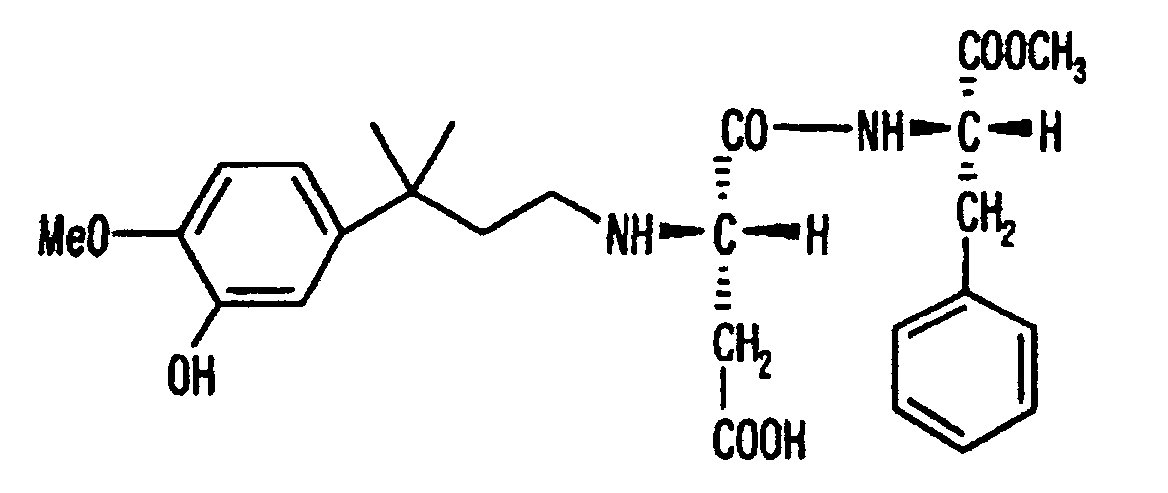
- the present invention relates to a novel process for production of an aspartyl dipeptide ester derivative, such as N-[N-[3-(3-hydroxy-4-methoxyphenyl)-3-methylbutyl]-L- ⁇ -aspartyl]-L-phenylalanine 1-methyl ester important as a sweetener having a high degree of sweetness.
- an aspartyl dipeptide ester derivative such as N-[N-[3-(3-hydroxy-4-methoxyphenyl)-3-methylbutyl]-L- ⁇ -aspartyl]-L-phenylalanine 1-methyl ester important as a sweetener having a high degree of sweetness.
- the present invention relates to a process for production of high purity N-[N-[3-(3-hydroxy-4-methoxyphenyl)-3-methylbutyl]-L- ⁇ -aspartyl]-L-phenylalanine 1-methyl ester important as a sweetener having a high degree of sweetness. Specifically, it relates to a process for purification of said compound containing various impurity, to a process for production of said compound with high purity comprising a particularly excellent and conventional method for crystallization, and to the crystal thereof.
- the present invention relates to a process for production of the above N-[N-[3-(3-hydroxy-4-methoxyphenyl)-3-methylbutyl]-L- ⁇ -aspartyl]-L-phenylalanine 1-methyl ester, and to a novel aldehyde derivative useful as an intermediate for the production thereof, to a process for production thereof, to an use thereof as the intermediate for the production, and to a novel intermediate for the production thereof.
- N-[N-[3-(3-hydroxy-4-methoxyphenyl)-3-methylbutyl]-L- ⁇ -aspartyl]-L-phenylalanine 1-methyl ester represented by the following has been found as a sweetener which is excellent in stability and moreover is better by far in degree of sweetness, i.e., has the advantage in cost per sweet taste, by a part of the present inventors and the like.
- sweeteners are mainly consumed as their objective by a person in the form of foods or pharmaceutical preparations using the same, they should be purified in the process whereby a high purity substance not containing practically any impurity and decomposed material can be obtained. Further, in case of a peptide based sweetener which is easy to be decomposed comparatively, such as the object compound in the present invention, it is desirable that an ultimate form therefor much more excellent in stability is prepared, to prevent from decomposition after shipment of finished product.
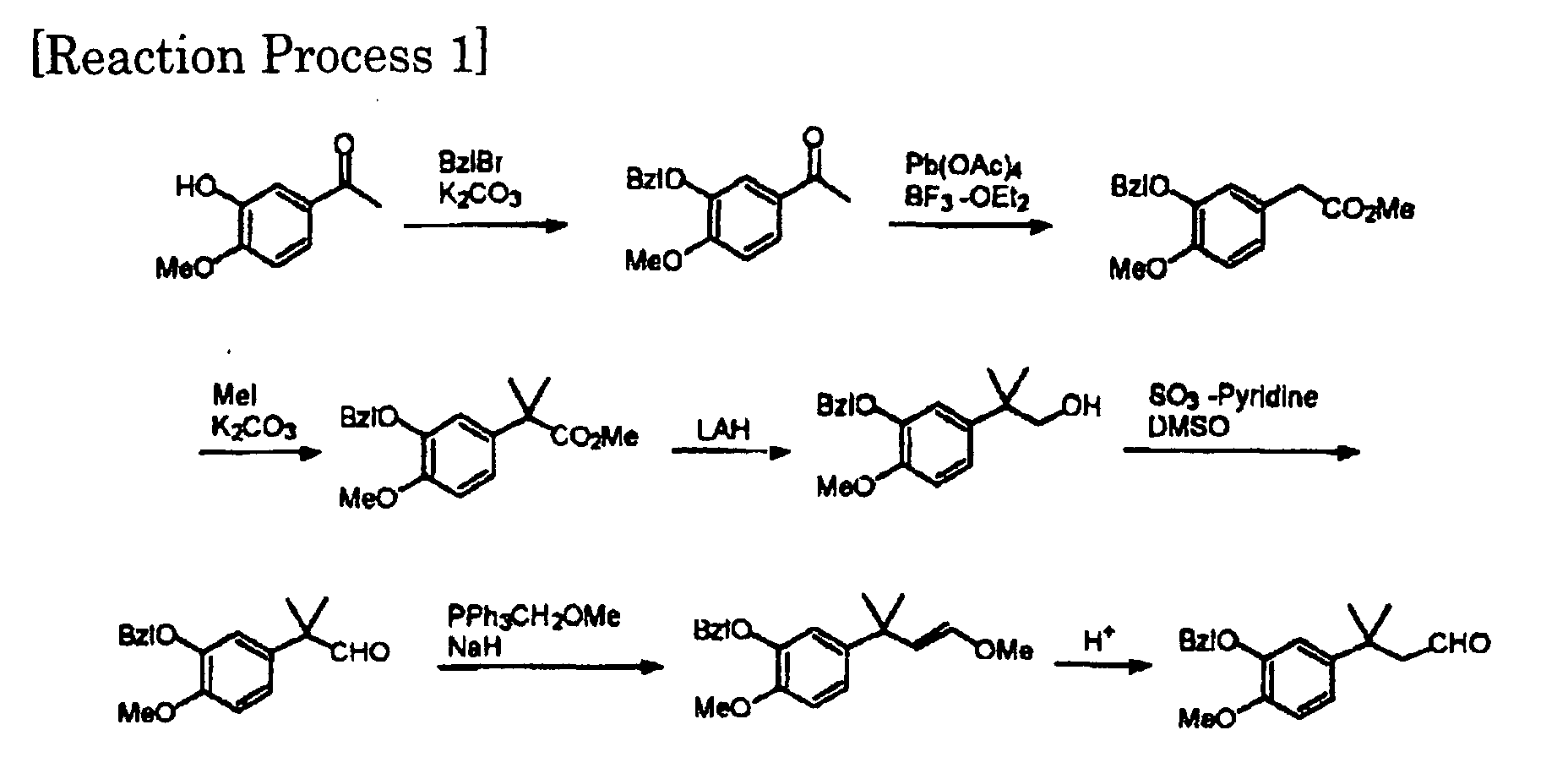
- 3-(3-benzyloxy-4-methoxyphenyl)-3-methylbutylaldehyde is synthesized through 7 stages of reactions starting from the 3-hydroxy-4-methoxyacetophenone, as shown in the following reaction process 1, and therefore the compound is not an industrially profitable ground substance for reaction.
- the problem to be solved by the present invention is to provide a process for producing industrially and efficiently N-[N-[3-(3-hydroxy-4-methoxyphenyl)-3-methylbutyl]-L- ⁇ -aspartyl]-L-phenylalanine 1-methyl ester excellent as a sweetener having a high degree of sweetness, and particularly an intermediate for the production therefor or a conventional process for the production thereof. It is also to provide a practical and industrial process for purifying the object compound described above, particularly a process for obtaining the object compound in the crystalline form at a high purity separated from moity impurity therein, and crystals which are in the ultimate form much more excellent in stability as a finished product.
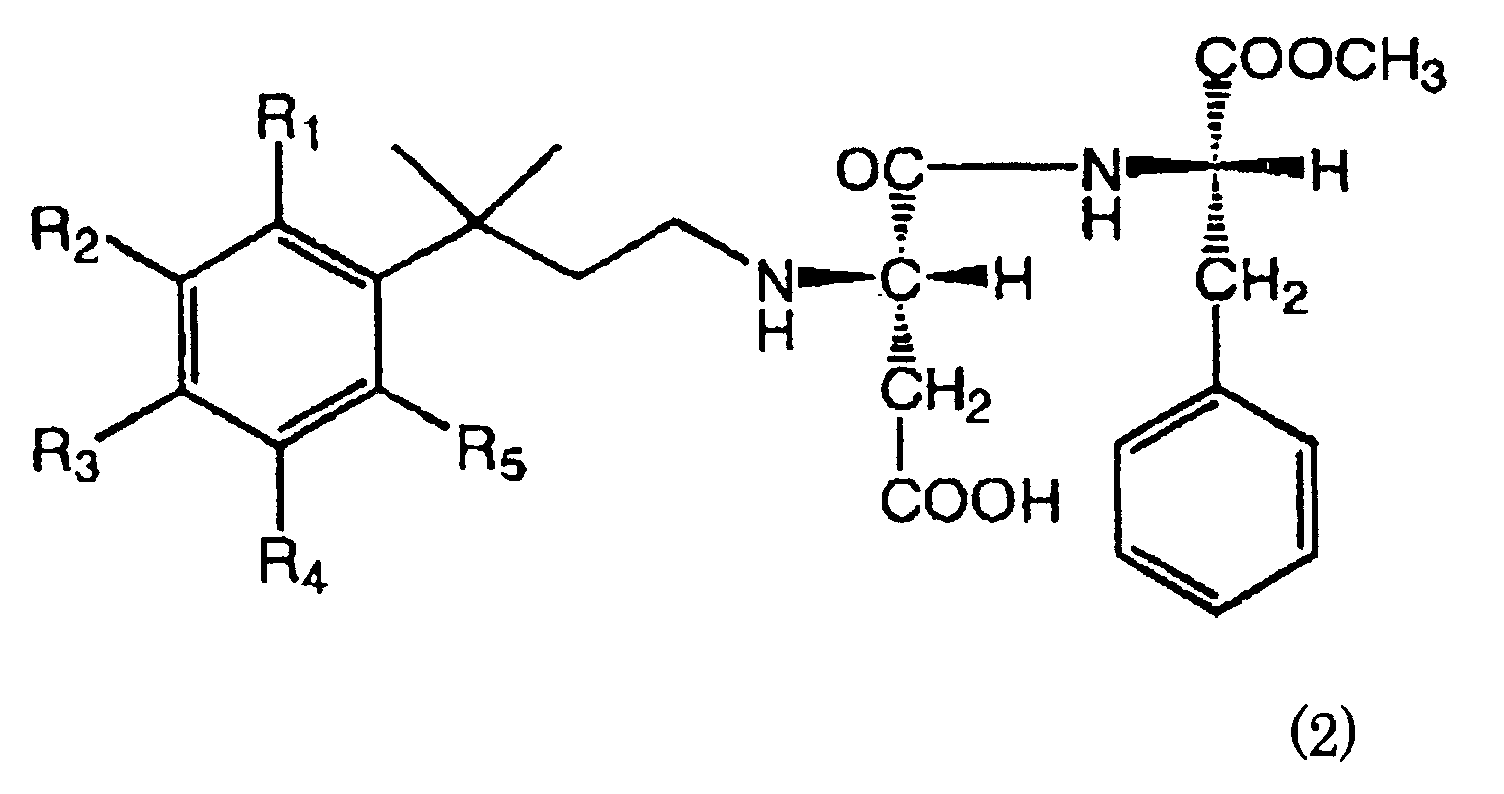
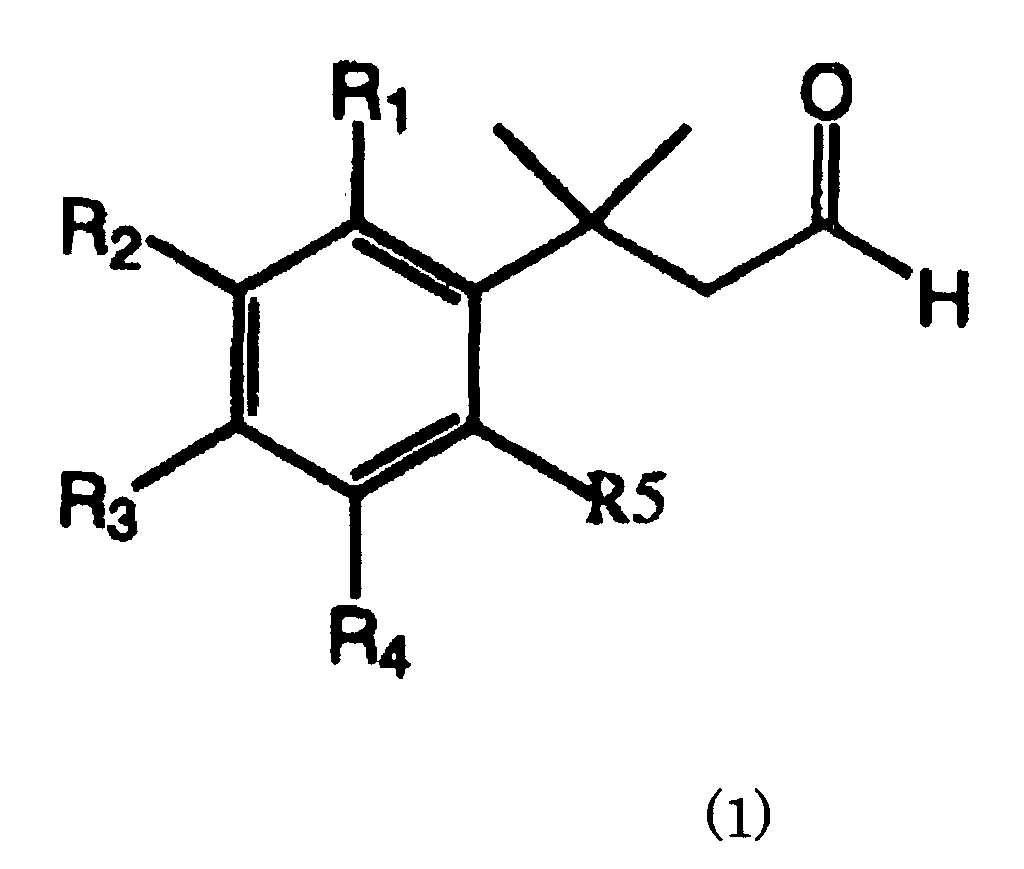
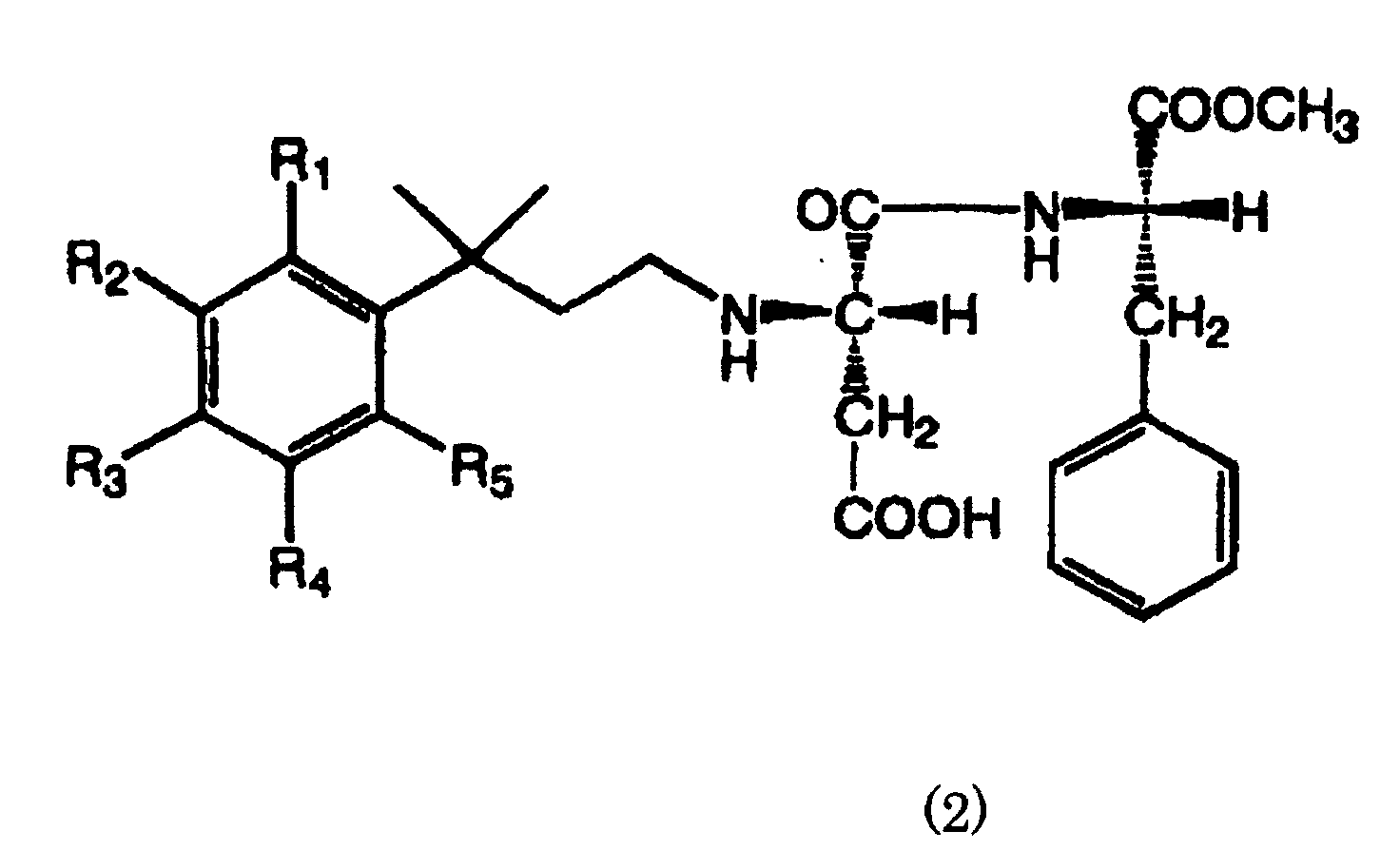
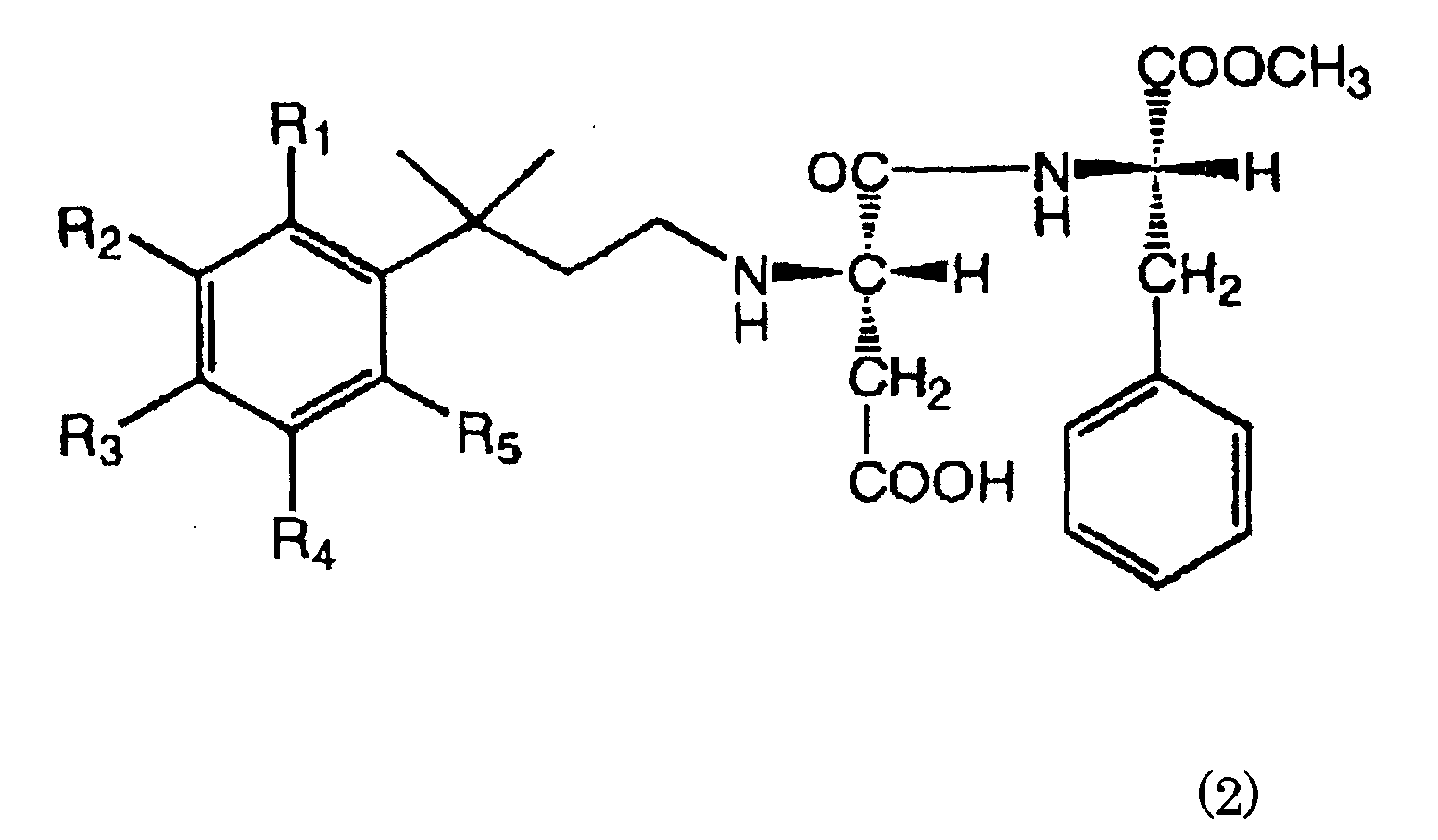
- an aspartyl dipeptide ester derivative as the object compound represented by the following general formula (2) can be easily obtained in the process for alkylating reductively aspartame with an aldehyde represented by the following general formula (1), preferably in the presence of catalyst, more preferably for reacting the above in the presence of hydrogen.
- R 1 , R 2 , R 3 , R 4 and R 5 are reciprocally independent and each denotes a substituent group selected from the group consisting of a hydrogen atom, a hydroxyl group, an alkoxy group having 1 to 3 carbon atoms, an alkyl group having 1 to 3 carbon atoms, a benzyloxy group and a hydroxyalkyloxy group having 2 or 3 carbon atoms, wherein two symbols of R 1 and R 2 , or two symbols of R 2 and R 3 may be combined together to denote a methylene dioxy group, and provided that in the formula (2), any one of R 1 , R 2 , R 3 , R 4 and R 5 does not denote a benzyloxy group.
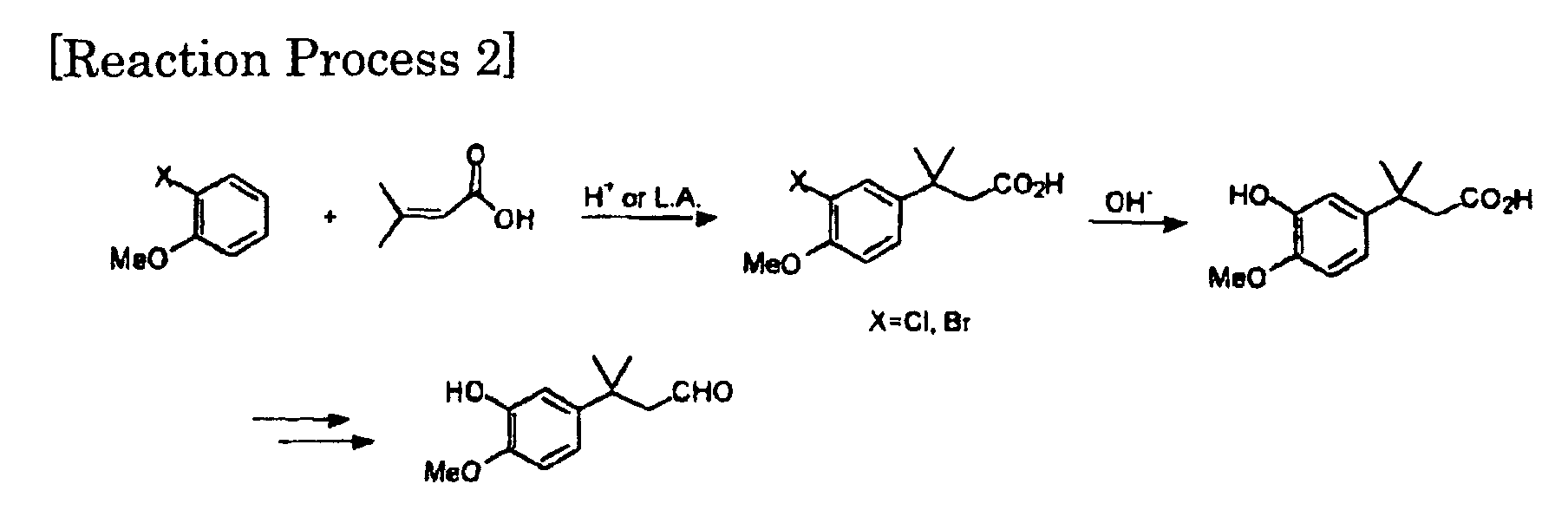
- 3-(3-hydroxy-4-methoxyphenyl)-3-methylbutylaldehyde can be synthesized, for example, in the process for reacting 2-halogenoanisole with 3-methylcrotonic acid, preferably in the presence of an acid; converting the halogen atom in the 3-(3-halogeno-4-methoxyphenyl)-3-methylbutyric acid thus obtained into a hydroxyl group through an alkaline hydrolysis in the presence of a copper catalyst; and converting thus obtained carboxylic acid into an aldehyde.
- the aspartyl dipeptide ester derivative represented by the following general formula (2) is produced in the process, which comprises:
- reaction for alkylation it is desirably conducted in a solvent for reaction, and also it is desirably conducted in the presence of reduction catalyst. Particularly, it is reduced desirably with hydrogen by using catalyst usable as reductive alkylation catalyst, for example, catalyst for hydrogenation (hydrogen addition).
- catalyst usable as reductive alkylation catalyst for example, catalyst for hydrogenation (hydrogen addition).
- R 1 , R 2 , R 3 , R 4 and R 5 are reciprocally independent and each denotes a substituent group selected from the group consisting of a hydrogen atom, a hydroxyl group, an alkoxy group having 1 to 3 carbon atoms, an alkyl group having 1 to 3 carbon atoms, a benzyloxy group and a hydroxyalkyloxy group having 2 or 3 carbon atoms, wherein two symbols of R 1 and R 2 , or two symbols of R 2 and R 3 may be combined together to denote a methylene dioxy group, and provided that in the formula (2), any one of R 1 , R 2 , R 3 , R 4 and R 5 does not denote a benzyloxy group.
- any one of R 1 , R 2 , R 3 , R 4 and R 5 does not denote a benzyloxy group.
- any one of R 1 , R 2 , R 3 , R 4 and R 5 denotes a benzyloxy group, when the object compound is produced in the reductive alkylation reaction in the present invention, from a benzyloxy moiety, the benzyl group is removed to convert it into a hydroxyl group.
- the aldehyde described above is further dissolved, and then preferably the catalyst is added thereto, and thereafter the reaction may be conducted under hydrogen gas atmosphere. At that time, the reaction proceeds under stirring only.
- the catalyst is removed by filtration, thus obtained filtrate is concentrated to obtain the object compound of aspartyl dipeptide ester derivative as a crude product. Accordingly, from the crude product, the object compound of aspartyl dipeptide ester derivative can be obtained easily through general and ordinary process for purification, such as re-crystallization.
- the reaction process 3 described in the following a compound having substituent group(s) as objective in the benzene ring is selected as a starting material, and the reaction is conducted, whereby the desired aldehyde can be easily produced.
- the reaction in case that a hydroxyl group is located in the benzene ring, it is protected as shown in the reaction process 3, as occasion demands, the reaction can be conducted in the same manner as above.
- reaction solvent there is no particular limitations thereto, as far as a material inactive to a ground substance (substrate) for reaction, a catalyst and a product may be employed therefor.
- a homogeneous organic solvent which can dissolve aspartame and the aldehyde used in the present invention described above, and which is a single solvent consisted of one kind of organic solvent only or a mixed solvent consisted of plural kinds of organic solvents, or a mixture of such organic solvent with water may be employed therefor.
- organic solvent for example, alcohols such as methanol and ethanol, tetrahydrofuran, acetonitrile, dimethylformamide and the like are cited.
- an alcohol such as methanol, or water-containing alcohol such as water-containing methanol is particularly suitable in view of a reaction property.
- a catalyst for hydrogenation such as palladium, platinum, nickel and rhodium based catalyst, is preferably cited therefor.
- palladium carbon, platinum carbon, rhodium carbon, Raney Nickel and the like are cited therefor.
- palladium carbon and platinum carbon are preferable.
- the reductive alkylation reaction used in the present invention can be conducted through hydrogenation (hydrogen addition), and in such case, for the hydrogen pressure, preferably 0.1 to 1.0 MPa or so may be selected.
- the condition suitable for the reductive alkylation reaction can be selected.
- a temperature range of 15 to 50 °C or so, and a range for reaction time of 2 to 72 hours or so can be preferably selected.
- a molar ratio of aspartame to the aldehyde as the starting materials used in the present invention a range of preferably 0.5 to 1.5 moles or so of aspartame per 1 mole of the aldehyde can be used for reaction.
- 2-halogenoanisole such as 2-chloroanisole, 2-bromoanisole and the like
- 3-methylcrotonic acid it is conducted without a solvent or in an organic solvent, preferably in the presence of an acid.
- organic solvent if employed, there is no special limitations thereto, as far as a material inactive to a ground substance (substrate) for reaction, an acid and a reaction product may be employed therefor.
- a preferable solvent for example, methylene chloride, chloroform, nitrobenzene and the like are cited.
- a proton acid such as sulfuric acid, para (p-)toluenesulfonic acid and hydrogen chloride
- a Lewis acid such as aluminum chloride and titanium tetrachloride, and the like
- Plural acids can be employed, respectively in the proton acid or Lewis acid, if necessary.
- sulfuric acid, aluminum chloride and titanium tetrachloride are employed.
- a proton acid may be possibly employed in combination with a Lewis acid, such as combination of hydrogen chloride with aluminum chloride, if necessary.
- an acid fixed onto the surface of the solid phase is desirably employed, because a process for treatment may be simplified.
- an amount of acid to be employed is not limited particularly. In case that much excess of acid is employed to the 3-methylcrotonic acid, the reaction can be conducted in a shorter time to completion. From the economical point of view, preferably 5 molar equivalents or less, more preferably 3 molar equivalents or less, and further more preferably 0.1 to 3 molar equivalents or so, of the acid to the 3-methylcrotonic acid may be employed.
- a quantity consumed (employed) of 2-halogenoanisole to the 3-methylcrotonic acid it is not limited particularly.
- 0.5 molar equivalents or more, more preferably 1 molar equivalent or more, and further more preferably 1 to 10 molar equivalents or so, of 2-halogenoanisole to the 3-methylcrotonic acid may be employed.
- reaction temperature there is no particular limitations thereto.
- a reaction for converting the halogen atom substituted at the 3-position of the phenyl group into a hydroxyl group may be employed.
- a reaction for converting the halogen atom substituted at the 3-position of the phenyl group into a hydroxyl group may be employed.
- the halogen atom can be easily converted into a hydroxyl group.
- a metal hydroxide such as sodium hydroxide, potassium hydroxide and the like can be put into operation industrially at a low cost, and therefore it is preferable.
- an amount used of the alkaline material there is no particular limitations thereto. For example, it is sufficient that 1 to 10 moles or so thereof to 1 mole of 3-(3-halogeno-4-methoxyphenyl)-3-methylbutyric acid is employed.
- reaction temperature when converting it to the hydroxyl group, there is no particular limitations.
- the copper catalyst when it is employed in the above reaction, it is not particularly limited, as long as the catalyst as employed therein may release univalent or divalent copper ion in the aqueous solution.
- copper oxide(I), copper oxide(II), sulphate of copper(II), and the like are cited therefor.
- sulphate of copper(II) is employed.
- the carboxylic acid may be made to a half reduction thereof.
- the compound can be reduced directly by half for a half reduction thereof, based on the process described in Chemistry Letters, pp. 1143-1144, published in 1998, November, to be converted into 3-(3-hydroxy-4-methoxyphenyl)-3-methylbutylaldehyde as objective.
- This process is a process for reducing 3-(3-hydroxy-4-methoxyphenyl)-3-methylbutyric acid with hydrogen in the organic solvent, under addition of pivalic acid anhydride, palladium acetate and triphenylphosphine derivative.
- the organic solvent there is no particular limitations thereto, as far as a material inactive to a ground substance (substrate) for reaction, a catalyst and a product may be employed therefor.
- a catalyst and a product may be employed therefor.
- acetone, tetrahydrofuran, toluene and the like are preferably employed.
- an amount employed of the pivalic acid anhydride equimolecular or more of the compound to 3-(3-hydroxy-4-methoxyphenyl)-3-methylbutyric acid, may be employed.
- 1 to 5 moles or so of the compound to 1 mole of 3-(3-hydroxy-4-methoxyphenyl)-3-methylbutyric acid may be preferably employed.
- triphenylphosphine derivative triphenylphosphine and tritolylphosphine may be preferably employed.
- the palladium acetate and triphenylphosphine derivative are used as a catalyst.
- the quantities consumed thereof in case of palladium acetate, preferably 0.1 to 5 moles % and above all preferably 0.5 to 3 mole % thereof to the ground substance (substrate) can be employed.
- triphenylphosphine derivative preferably 5 times mole % or more and more preferably 5 to 7 times mole % thereof to the palladium acetate can be employed.
- the reaction temperature employed in the reaction it is not limited particularly.
- the reaction is conducted preferably at 40 to 100 °C, and above all preferably at 60 to 80 °C. At a higher temperature, the reaction is promoted, and thus can be completed and finished in a short time. Accordingly, at a comparatively high temperature, it can be conducted at an advantage.
- a reductive alkylation reaction is conducted with hydrogen, more preferably, under suitable or effective reaction temperature and pressure to be able to produce the above object compound.
- reaction solvent there is no particular limitations thereto, as far as a material inactive to a ground substance (substrate) for reaction, a catalyst and a product may be employed therefor.
- a homogeneous organic solvent which can dissolve aspartame and the aldehyde described above, and which is a single solvent consisted of one kind of organic solvent only or a mixed solvent consisted of plural kinds of organic solvents, or a mixture of such organic solvent with water may be employed therefor.
- organic solvent for example, alcohols such as methanol and ethanol, tetrahydrofuran, acetonitrile, dimethylformamide and the like are cited.
- an alcohol such as methanol, or water-containing alcohol such as water-containing methanol is particularly suitable in view of a reaction property.
- a catalyst for hydrogenation such as palladium, platinum, nickel and rhodium based catalyst, is preferably cited therefor.
- the reductive alkylation reaction used in the present invention can be conducted through hydrogenation (hydrogen addition), and in such case, for the hydrogen pressure, preferably 0.1 to 1.0 MPa or so may be selected.
- the condition suitable for the reductive alkylation reaction can be selected.
- a temperature range of 15 to 50 °C or so, and a range for reaction time of 2 to 72 hours or so can be preferably selected.
- a molar ratio of aspartame to the aldehyde as the starting materials used in the present invention a range of preferably 0.5 to 1.5 moles or so of aspartame per 1 mole of the aldehyde can be used for reaction.
- N-[N-[3-(3-hydroxy-4-methoxyphenyl)-3-methylbutyl]-L- ⁇ -aspartyl]-L-phenylalanine 1-methyl ester containing impurity a solution, a solid or an intermediate (intermediary body) therebetween such as a slurry, containing the object compound, and the like can be cited.
- the object compound described above mostly at least one compound of aspartame, aspartame derivative, peptide derivative, amino acid, amino acid derivative, aldehyde and its derivative may be contained as impurity of moit.
- the present invention is suitable for purifying the object compound described above containing such impurity (a material to be purified).
- the state of the material to be purified includes a solution form, a solid form, or a form of an intermediate stage therebetween as the case may be, and the like, as described above.
- the object compound contains the impurity, there is no particular limitations to how to contain the impurity therein.
- the object compound is made to crystallization with the use of a suitable solvent for crystallization, whereby the object compound with high purity is produced, and the crystals thereof are separated to purify the same.
- the reaction solution thereof is purified with a silica gel column chromatography and the thus obtained fractions of the object compound extracted is concentrated to solidification, for one process to obtain the same.
- this process is high in cost, and problematic in treatment of waste (used) silica gel or the like, and therefore is undesirable for industrial operation.
- the solid obtained in this process is in the amorphous state, and is also undesirable in stability.
- the object compound described above is useful as a sweetener used for a food, a pharmaceutical product and the like, and it is requested that the compound is a final form at a high purity and excellent in stability.
- the reaction solution containing the object compound obtained on conducting the reductive alkylation reaction to produce the object compound with the use of aspartame and 3-(3-hydroxy-4-methoxyphenyl)-3-methylbutylaldehyde or its derivative (said derivative wherein the hydroxyl group is protected, and the like) can be cited.
- the insoluble material is removed previously (in advance) by separation with filtration. The thus obtained solution is subjected to the crystallization under a condition suitable for the crystallization of the object compound to crystallize the object compound, and as a result, the compound can be separated for purification.
- the solution described above contains the solvent for the crystallization solvent of the object compound
- the solution is concentrated with concentration operation under reduced pressure or the like until to a condition desirable for the crystallization of the object compound, or after such concentration
- a suitable crystallization solvent is specifically selected and is added secondarily to thus concentrated solution until to a condition desirable for the crystallization of the object compound, and the thus obtained solution is cooled or concentrated where necessary, and thereafter, cooled until to a condition suitable for the crystallization, or the like to be able to crystallize the object compound.
- the solution described above uses a solvent undesirable for the crystallization of the object compound
- the solution is concentrated with a concentration operation under reduced pressure or the like to remove the solvent completely by distillation to solidification, and thereafter, among the crystallization solvents for the object compound a suitable crystallization solvent is specifically selected, and the crystallization step is conducted in the same manner as above, to be able to crystallize the object compound.
- the process can be applied to the case where the material to be purified does not contain a solvent.
- a process for substitution of solvent is also as effective means therefor.
- the material to be purified contains an nonpolar solvent such as aldehyde and its derivative, as the impurity of moit, as described above
- a step for extraction with solvent therewith before the crystallization step, during the crystallization step or after the crystallization step, for conducting the crystallization process
- the crystals of the object compound with higher purity can also be produced.
- a process for removing impurity is conducted preferably in the state where the crystals are dissolved therein. However, it may be conducted in the state where the crystals are not dissolved therein completely, that is in the slurry state.
- the purification can be conducted in the following conventional means.
- a suitable solvent for extraction and water where necessary are added to dissolve the impurity in the solvent in the state of solution and thereby to remove it from the aqueous layer.
- An aqueous layer at the time of such extraction with water may contain, for example, at least one solvent selected from the group consisting of methanol, ethanol, isopropyl alcohol, tetrahydrofuran, acetonitrile, acetic acid and ethyl acetate, which is a solvent usable for the reductive alkylation reaction, as far as it does not work against the separating nature of the solvent at the time of extraction.
- the solvent used for the extraction with solvent in the present invention is a solvent which can not be mixed with water homogeneously.
- a solvent which can not be mixed with water homogeneously.
- a lower alcohol such as methanol, ethanol, isopropyl alcohol and the like
- ketones such as acetone, methyl ethyl ketone,
- the material to be purified is a synthetic reaction solution containing said N-[N-[3-(3-hydroxy-4-methoxyphenyl)-3-methylbutyl]-L- ⁇ -aspartyl]-L-phenylalanine 1-methyl ester obtained in the process for alkylating reductively aspartame and 3-(3-hydroxy-4-methoxyphenyl)-3-methylbutylaldehyde in a mixed solvent of methanol and water (mixing ratio of 3 : 2 v/v), the object compound in the crystalline form at a high purity can be obtained in the following extremely conventional process.
- the catalyst is separated by filtration, toluene is added thereto for extraction with solvent, and thereby the impurity is removed, and thus obtained aqueous layer is concentrated under reduced pressure to remove methanol partially, and cooled to crystallize the object compound for separation of the crystals.
- a process for separation of the crystals there is no particular limitations.
- a usual method such as separation by filtration, centrifugal separation and the like can be employed.
- the crystals can be dried where necessary, and to this process for drying, there is also no particular limitations.
- a usual method such as drying under reduced pressure, throughflow drying, and the like can be employed.
- a crystallizing condition suitable for crystallization of the object compound in the present invention because it is varied according to, for example, kind of crystallization solvent, composition of solvent, quantity employed of solvent, method of crystallization, and the like, or a combination thereof, uniformly explanations can not be given.
- the present invention in case that the present invention is conducted with crystallization under cooling, mostly, it may be conducted in the following range shown. That is, for a concentration of the object compound in the solution to be subjected to a crystallization process is 0.5 to 20 g/dl or so, preferably 1 to 15 g/dl or so, and more preferably 2 to 10 g/dl or so may be preferably employed.
- a temperature for starting crystallization there is no particular limitations. For example, 40 to 80 °C or so, and preferably 50 to 70 °C or so may be preferably selected. When the temperature is higher too much, a problem such as decomposition of the object compound, distillation (vaporization) of the crystallization solvent, or the like is raised, and therefore it may be undesirable.
- a temperature for finishing crystallization there is no particular limitations. It may be conducted at a temperature where the solution is not solidified. It may be cooled until to preferably 20 to 5 °C or so, and more preferably 15 to 5 °C or so. To a cooling speed, there is no particular limitations.
- the crystals of the object compound obtained in the process for purification described above are contained.
- the crystals of the object compound exhibit the following physical properties:
- a sweetener or a food and drink or other product with a sweet taste imparted, comprising the crystal at a high purity, as described above as an effective ingredient, are contained.
- it may further comprise a carrier or a bulking agent for a sweetener.
- a process for imparting a sweet taste which comprises:
- a sweetener In case that a sweetener is produced, the product such as a food and drink, or the like (including a pharmaceutical product, and the like) having a sweet taste imparted, is produced, or a sweet taste is imparted into a product in need of a sweet taste or the intermediate product therefor, for example, the same during manufacture, it can come to operation by making use of known methods or the like so far, as a process for producing a sweetener with the use of a sweetening component, or as a process for imparting a sweet taste.
- the crystals obtained in the present invention are used for sweeteners or for foods and drinks (beverages), in order to give stability much more thereto as described above, a carrier, a thickening agent (viscosity improver), a bulking agent, and/or an excipient (diluting agent) for sweeteners, where necessary, can be employed.
- a thickening agent (viscosity improver), a bulking agent, an excipient (diluting agent), and the like for sweeteners known or used, so far can be employed.
- a saccharide which can be also used as a stabilizing agent (material), or the like can be also employed. Except for such material, the material which has been used so far or could be used in the past, as a carrier for a sweetener can also be employed.
- the object compound can also be produced in the form of a sweetener, and further, except for the form of a sweetener, by using a component necessary for a food and drink and an excipient, it can be taken effect in the form of a food and drink, such as a frozen dessert or the like.
- a sweetener for a product such as a food and drink or the like in need of a sweet taste imparted
- a product such as a food and drink or the like in need of a sweet taste imparted
- confectionary frozen dessert, jelly, cake, candy (sweet or the like)
- bread for example, bread, chewing gums, hygiene product, cosmetics (including an oral composition such as dentifrice and others), a pharmaceutical product, and various veterinary product for animal other than for humans or the like
- the object compound can be also employed.
- the crystals obtained in the present invention can be used also in the form of the product (article of manufacture) with a sweet taste imparted thus above, and also in the process for imparting a sweet taste to said product in need of a sweet taste to be imparted.
- Figure 1 is a powder X-ray diffraction pattern of N-[N-[3-(3-hydroxy-4-methoxyphenyl)-3-methylbutyl]-L- ⁇ -aspartyl]-L-phenylalanine 1-methyl ester in the crystalline form obtained in the present invention.
- reaction solution was filtrated to remove the catalyst, and further, the catalyst was washed with methanol (10 ml).
- the filtrate and the wash solution were combined together to obtain a reaction solution (38 ml) containing N-[N-[3-(3-hydroxy-4-methoxyphenyl)-3-methylbutyl]-L- ⁇ -aspartyl]-L-phenylalanine 1-methyl ester (0.795 g, 1.63 mmol).
- This reaction solution was concentrated under reduced pressure at 40 °C up to approximately one fourth (1/4) of the volume thereof, and then to the concentrated solution while stirring at 50 °C, methanol (1 ml) was added to precipitate crystals.
- This crystallization solution was cooled to 5 °C and allowed to stand overnight at the same temperature.
- the crystals were separated by filtration, and further washed with water (20 ml), and dried overnight under reduced pressure at room temperature to obtain crude crystals thereof (0.841 g, Content of the object compound: 0.513 g, Recovery rate: 65 %).
- crude crystals were added to a mixed solvent (26 ml) of methanol and water (Mixing ratio of 3:2 v/v) and dissolved therein at 60 °C. After that, the solution was cooled to 5 °C to precipitate crystals.
- HPLC high performance liquid chromatography
- reaction solution was filtrated to remove the catalyst, and further, the catalyst was washed with a mixed solvent (150 ml) of methanol and water (Mixing ratio of 3: 2 v/v).
- the filtrate and the wash solution were combined together to obtain a reaction solution (439 g) containing N-[N-[3-(3-hydroxy-4-methoxyphenyl)-3-methylbutyl]-L- ⁇ -aspartyl]-L-phenylalanine 1-methyl ester (9.32 g, 19.2 mmol).
- toluene (288 ml) was added, and thus obtained solution was stirred at room temperature for 30 minutes to make layers separated therein. The toluene layer was removed therefrom, and thereby the aqueous layer (458 g) was obtained.
- This aqueous layer was concentrated under reduced pressure at 40 °C up to an amount of residual solution of 224 g, and heated up to 75 °C, and then cooled to 5 °C while stirring (Cooling speed: 10 °C/hour) to precipitate crystals.
- stirring speed: 10 °C/hour stirring speed
- the crystals were separated by filtration, and further washed with water (20 ml) to obtain the wet crude crystals (14.0 g, Content of the object compound: 8.61 g, Recovery rate: 92 %).
- reaction solution was filtrated to remove the catalyst, and further, the catalyst was washed with methanol (10 ml). The filtrate and the wash solution were combined together to obtain a reaction solution (32.6 g) containing N-[N-[3-(3-hydroxy-4-methoxyphenyl)-3-methylbutyl]-L- ⁇ -aspartyl]-L-phenylalanine 1-methyl ester (0.988 g, 2.03 mmol).
- This reaction solution was concentrated under reduced pressure at 40 °C up to an amount of residual solution of 10.1 g, and heated up to 75 °C, and then cooled to 5 °C while stirring (Cooling speed: 10 °C/hour) to precipitate crystals.
- mixture was stirred overnight at the same temperature.
- the crystals were separated by filtration, and further washed with water (2.6 ml) to obtain the wet crude crystals (1.31 g, Content of the object compound: 0.909 g, Recovery rate: 92 %).
- a mixed solvent 52 ml
- methanol and water Mating ratio of 1 : 1 v/v
- toluene 26 ml
- aspartame is alkylated reductively with 3-(phenyl with substituent group(s))-3-methylbutylaldehyde to be able to produce N-[N-[3-(phenyl with substituent group(s))-3-methylbutyl]-L- ⁇ -aspartyl]-L-phenylalanine 1-methyl ester derivative efficiently on an industrial scale, which is excellent as a sweetener having a high degree of sweetness and therefore is an objective compound described above.
- N-[N-[3-(3-hydroxy-4-methoxyphenyl)-3-methylbutyl]-L- ⁇ -aspartyl]-L-phenylalanine 1-methyl ester which is important as a sweetener having a high degree of sweetness, can be easily produced efficiently on an industrial scale.
- the above 3-(3-hydroxy-4-methoxyphenyl)-3-methylbutyl aldehyde can be produced easily and efficiently in a process for subjecting 3-(3-halogeno-4-methoxyphenyl)-3-methylbutyric acid, which can be obtained in the reaction of 2-halogenoanisole with 3-methylcrotonic acid, to a reaction for converting the halogen atom of a substituent group to a hydroxyl group to produce 3-(3-hydroxy-4-methoxyphenyl)-3-methylbutyric acid, followed by converting the carboxyl group of the carboxylic acid thus obtained into a formyl group.
- N-[N-[3-(3-hydroxy-4-methoxyphenyl)-3-methylbutyl]-L- ⁇ -aspartyl]-L-phenylalanine 1-methyl ester which is important as a sweetener having a high degree of sweetness, can be crystallized, and thus the compound can be obtained easily and conventionally in the crystalline form. Further, the present invention can be also used for a process to separate the object compound only with high purity through purification from the object compound containing impurity, and therefore, the present invention is useful industrially to an extreme.
- the compound as such can be used directly as a sweetener component, and the compound can be easily used for a food and drink, or the like in need of a sweet taste.
Landscapes
- Chemical & Material Sciences (AREA)
- Organic Chemistry (AREA)
- Life Sciences & Earth Sciences (AREA)
- Proteomics, Peptides & Aminoacids (AREA)
- Health & Medical Sciences (AREA)
- Engineering & Computer Science (AREA)
- Medicinal Chemistry (AREA)
- Molecular Biology (AREA)
- Genetics & Genomics (AREA)
- General Health & Medical Sciences (AREA)
- Biophysics (AREA)
- Biochemistry (AREA)
- Oil, Petroleum & Natural Gas (AREA)
- Chemical Kinetics & Catalysis (AREA)
- Food Science & Technology (AREA)
- Nutrition Science (AREA)
- Polymers & Plastics (AREA)
- Peptides Or Proteins (AREA)
- Organic Low-Molecular-Weight Compounds And Preparation Thereof (AREA)
- Seasonings (AREA)
Abstract
Description

provided that in the formula (2), any one of R1, R2, R3, R4 and R5 does not denote a benzyloxy group.
converting the halogen atom in the 3-(3-halogeno-4-methoxyphenyl)-3-methylbutyric acid thus obtained into a hydroxyl group through an alkaline hydrolysis in the presence of a copper catalyst; and
converting thus obtained carboxylic acid into an aldehyde.

provided that in the formula (2), any one of R1, R2, R3, R4 and R5 does not denote a benzyloxy group.

provided that the compounds where R1 is a chlorine atom or a bromine atom, and R3 is a formyl group, are excluded.

provided that in the formula (2), any one of R1, R2, R3, R4 and R5 does not denote a benzyloxy group.

A homogeneous organic solvent which can dissolve aspartame and the aldehyde used in the present invention described above, and which is a single solvent consisted of one kind of organic solvent only or a mixed solvent consisted of plural kinds of organic solvents, or a mixture of such organic solvent with water may be employed therefor.
As for the quantities consumed thereof, in case of palladium acetate, preferably 0.1 to 5 moles % and above all preferably 0.5 to 3 mole % thereof to the ground substance (substrate) can be employed. And, in case of triphenylphosphine derivative, preferably 5 times mole % or more and more preferably 5 to 7 times mole % thereof to the palladium acetate can be employed. As for the reaction temperature employed in the reaction, it is not limited particularly. For, example, the reaction is conducted preferably at 40 to 100 °C, and above all preferably at 60 to 80 °C. At a higher temperature, the reaction is promoted, and thus can be completed and finished in a short time. Accordingly, at a comparatively high temperature, it can be conducted at an advantage.
may be preferably employed. When the concentration is lower too much, yield for crystallization is lowered, and when it is higher too much, purity is lowered, and therefore they are not desirable. To a temperature for starting crystallization there is no particular limitations. For example, 40 to 80 °C or so, and preferably 50 to 70 °C or so may be preferably selected. When the temperature is higher too much, a problem such as decomposition of the object compound, distillation (vaporization) of the crystallization solvent, or the like is raised, and therefore it may be undesirable. To a temperature for finishing crystallization, there is no particular limitations. It may be conducted at a temperature where the solution is not solidified. It may be cooled until to preferably 20 to 5 °C or so, and more preferably 15 to 5 °C or so. To a cooling speed, there is no particular limitations.
1H NMR (CDCl3) δ : 1. 4 3 (s, 6H), 2.61 (s, 2H), 3.87 (s, 3H), 6.86 (d, J=8.6 Hz, 1H), 7.10 - 7.23 (m, 1H), 7.35 (d, J=2.4 Hz, 1H). ESI-MS;
Calculation: C12H15 35ClO3=242.3, Analysis: 241.3(MH-).
1HNMR (CDCl3) δ : 1. 4 3 (s, 6H), 2.61 (s, 2H), 3.87 (s, 3H), 6.84 (d, J=8.7 Hz, 1H), 7.20 - 7.29 (m, 1H), 7.52 (d, J=2.4 Hz, 1H). ESI-MS;
Calculation: C12H15 79BrO3=286.2, Analysis: 285.2(MH-).
To thus obtained reaction solution, hydrochloric acid (HCl) was added to make it acidification, and the mixture was extracted with ethyl acetate and the organic layer was washed with sodium chloride saturated aqueous solution. The solvent therein was distilled off under reduced pressure to obtain crude crystals. Thus obtained crude crystals were re-crystallized with ethyl acetate and hexane to obtain 3-(3-hydroxy-4-methoxyphenyl)-3-methylbutyric acid (10.5 g, yield of 72 %).
1HNMR (CDCl3 δ : 1 . 4 2 (s, 6H), 2.60 (s, 2H), 3.86 (s, 3H), 6.78 (d, J=8.5 Hz, 1H), 6.84 (dd, J=2.2, 8.5 Hz, 1H), 6.95 (d, J=2.2 Hz, 1H).
ESI-MS;
Calculation: C12H16O4=224.3, Analysis: 223.2(MH-).
1HNMR (CDCl3) δ : 1.41 (s, 6H), 2.61 (d, J=3.0 Hz, 2H), 3.87 (s, 3H), 6.72 - 6.84 (m, 2H), 6.98 (d, J=1.9 Hz, 1H), 9.49 (t, J=3.0 Hz, 1H).
ESI-MS;
Calculation: C12H16O3=208.3, Analysis: 207.2(MH-).
1H NMR (DMSO-d6) δ : 1.14 (brs, 6H), 1.54 - 1.68 (m, 2H), 2.04 - 2.22 (m, 3H), 2.24 - 2.34 (dd, 1H), 2.84 - 2.94 (dd, 1H), 3.00 - 3.08 (dd, 1H), 3.31 - 3.36 (m, 1H), 3.59 (s, 3H), 3.71 (s, 3H), 4.46 - 4.55 (m, 1H), 6.60 - 6.65 (dd, 1H), 6.73 (s, 1H), 6.80 (d, 1H), 7.10 - 7.28 (m, 5H), 8.45 (d, 1H), 8.75 (brs, 1H).
ESI-MS; 487.3 (MH+).
Differential thermal analysis:
Temperature range for the determination: 50-300 °C; Heating-up speed: 10 °C/minute; Melting point: 189 °C.
Powder X-ray diffraction:
Claims (34)
- A process for producing aspartyl dipeptide ester derivative represented by the following general formula (2), which comprises:alkylating reductively aspartame with the aldehyde represented by the following general formula (1):

 In the above formulae (1) and (2), R1, R2, R3, R4 and R5 are reciprocally independent and each denotes a substituent group selected from the group consisting of a hydrogen atom, a hydroxyl group, an alkoxy group having 1 to 3 carbon atoms, an alkyl group having 1 to 3 carbon atoms, a benzyloxy group and a hydroxyalkyloxy group having 2 or 3 carbon atoms, wherein two symbols of R1 and R2, or two symbols of R2 and R3 may be combined together to denote a methylene dioxy group, andprovided that in the formula (2), any one of R1, R2, R3, R4 and R5 does not denote a benzyloxy group.
 - The process as defined in claim 1, wherein in the formulae, R3 is a methoxy group, and R1, R2, R4 and R5 are a hydrogen atom.
- The process as defined in claim 1, wherein in the formulae, R3 is a hydroxyl group, and R1, R2, R4 and R5 are a hydrogen atom, and in the formula (1), R3 may be a benzyloxy group.
- The process as defined in claim 1, wherein in the formulae, R2 is a methoxy group, R3 is a hydroxyl group, and R1, R4 and R5 are a hydrogen atom, and in the formula (1), R3 may be a benzyloxy group.
- The process as defined in claim 1, wherein in the formulae, R2 is a hydroxyl group, R3 is a methoxy group, and R1, R4 and R5 are a hydrogen atom, and in the formula (1), R2 may be a benzyloxy group.
- The process as defined in claim 1, wherein in the formulae, R1 is a hydroxyl group, and R2, R3, R4 and R5 are a hydrogen atom, and in the formula (1), R1 may be a benzyloxy group.
- The process as defined in claim 1, wherein in the formulae, R1 is a hydroxyl group, R3 is a methoxy group, and R2, R4 and R5 are a hydrogen atom, and in the formula (1), R1 may be a benzyloxy group.
- The process as defined in claim 1, wherein in the formulae, R1 is a hydroxyl group, R3 is a methyl group, and R2, R4 and R5 are a hydrogen atom, and in the formula (1), R1 may be a benzyloxy group.
- The process as defined in claim 1, wherein in the formulae, R2 and R3 are combined together to denote a methylene dioxy group, and R1, R4 and R5 are a hydrogen atom.
- The process as defined in claim 1, wherein in the formulae, R2 is a methyl group, R3 is a methoxy group, and R1, R4 and R5 are a hydrogen atom.
- The process as defined in claim 1, wherein in the formulae, R2 is a methyl group, R3 is a hydroxyl group, and R1, R4 and R5 are a hydrogen atom, and in the formula (1), R3 may be a benzyloxy group.
- The process as defined in claim 1, wherein in the formulae, R2 is a hydroxyl group, R3 is a methyl group, and R1, R4 and R5 are a hydrogen atom, and in-the formula (1), R2 may be a benzyloxy group.
- The process as defined in claim 1, wherein the reaction for alkylating reductively said aspartame is conducted in the presence of catalyst for hydrogenation.
- The process as defined in claim 13, wherein said catalyst is palladium carbon or platinum carbon.
- The process as defined in claim 1, wherein the reaction for alkylating reductively said aspartame is conducted in a solvent, and said solvent is an alcohol or a water-containing alcohol.
- A process for producing 3-(3-hydroxy-4-methoxyphenyl)-3-methylbutylaldehyde, which comprises:subjecting 3-(3-hydroxy-4-methoxyphenyl)-3-methylbutyric acid to a reaction for converting a carboxyl group into a formyl group.
- The process as defined in claim 16, wherein said 3-(3-hydroxy-4-methoxyphenyl)-3-methylbutyric acid is obtained by any one step of the following steps:to a reaction for converting a halogen atom of the substituent group into a hydroxyl group.a. subjecting 3-(3-halogeno-4-methoxyphenyl)-3-methylbutyric acid to a reaction for converting a halogen atom of the substituent group into a hydroxyl group; andb. subjecting 3-(3-halogeno-4-methoxyphenyl)-3-methylbutyric acid obtained through the step of reaction of 2-halogenoanisole with 3-methylcrotonic acid,
- The process as defined in claim 17, wherein in said 3-(3-halogeno-4-methoxyphenyl)-3-methylbutyric acid, the halogen atom located at the 3-positon of the phenyl group is a chlorine atom or a bromine atom.
- The process as defined in claim 17, wherein said reaction with 3-methylcrotonic acid is conducted in the presence of an acid.
- The process as defined in claim 16, wherein said reaction for converting a carboxyl group into a formyl group is any one of the following reactions:a. a reaction for converting a carboxylic acid to an aldehyde through a half reduction thereof; andb. a reaction for converting a carboxyl group into a hydroxymethyl group, and thereafter converting it into a formyl group.
- A process for producing N-[N-[3-(3-hydroxy-4-methoxyphenyl)-3-methylbutyl]-L-α-aspartyl]-L-phenylalanine 1-methyl ester, which comprises:subjecting 3-(3-hydroxy-4-methoxyphenyl)-3-methylbutyl aldehyde obtained in the process as defined in any one of claims 16 to 20 and aspartame to a reductive alkylation reaction.
- A process for producing N-[N-[3-(3-hydroxy-4-methoxyphenyl)-3-methylbutyl]-L-α-aspartyl]-L-phenylalanine 1-methyl ester, which comprises:subjecting 3-(3-hydroxy-4-methoxyphenyl)-3-methylbutyl aldehyde and aspartame to a reductive alkylation reaction.
- A benzene derivative represented by the following general formula (3):
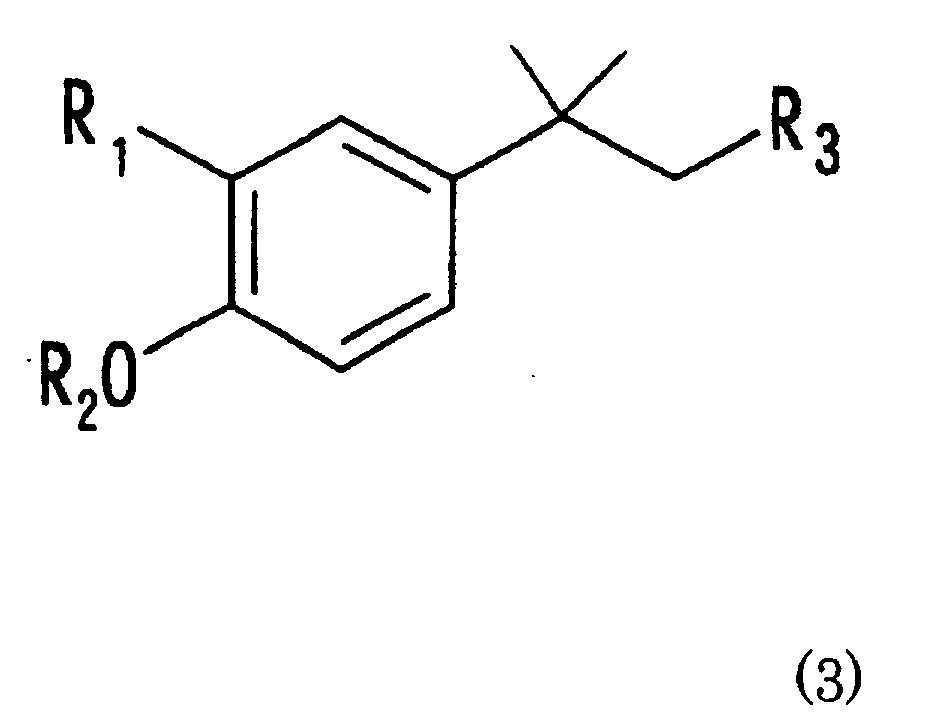 In the above formula, R1 denotes any one substituent group of a hydroxyl group, a halogen atom and a lower alkyloxy group having 1 to 4 carbon atoms, R2 denotes a lower alkyl group having 1 to 4 carbon atoms, and R3 denotes any one substituent group of a carboxyl group, a formyl group and a hydroxymethyl group,provided that the compounds where R1 is a chlorine atom or a bromine atom, and R3 is a formyl group are excluded.
 - A benzene derivative selected from the following compounds a. to e.:a. 3-(3-hydroxy-4-methoxyphenyl)-3-methylbutylaldehyde;b. 3-(3-chloro-4-methoxyphenyl)-3-methylbutyric acid;c. 3-(3-bromo-4-methoxyphenyl)-3-methylbutyric acid;d. 3-(3-hydroxy-4-methoxyphenyl)-3-methylbutyric acid; ande. 3-(3-hydroxy-4-methoxyphenyl)-3-methyl-1-butanol.
- A process for producing N-[N-[3-(3-hydroxy-4-methoxyphenyl)-3-methylbutyl]-L-α-aspartyl]-L-phenylalanine 1-methyl ester, which comprises:subjecting N-[N-[3-(3-hydroxy-4-methoxyphenyl)-3-methylbutyl]-L-α-aspartyl]-L-phenylalanine 1-methyl ester containing impurity to a crystallization step to crystallize said compound.
- The process as defined in claim 25, wherein said N-[N-[3-(3-hydroxy-4-methoxyphenyl)-3-methylbutyl]-L-α-aspartyl]-L-phenylalanine 1-methyl ester containing impurity is a material obtained by subjecting aspartame and 3-(3-hydroxy-4-methoxyphenyl)-3-methylbutylaldehyde or its derivative to a reductive alkylation reaction.
- The process as defined in any one of claims 25 and 26, wherein said impurity includes at least one compound selected from the group consisting of aspartame, aspartame derivative, peptide derivative, amino acid, amino acid derivative, aldehyde and its derivative.
- The process as defined in any one of claims 25 to 27, wherein the solvent used for said crystallization step is at least one solvent selected from the group consisting of methanol, ethanol, isopropyl alcohol, acetone, methyl ethyl ketone, methyl isobutyl ketone, methyl acetate, ethyl acetate, propyl acetate, isopropyl acetate, butyl acetate, tetrahydrofuran, acetonitrile and toluene, or a mixed solvent of at least one solvent of these organic solvents, with water.
- The process as defined in any one of claims 25 to 28, which further comprises a step for removing said impurity through an extraction process with a solvent.
- The process as defined in claim 29, wherein the solvent used for said extraction process with a solvent is at least one solvent selected from the group consisting of toluene, diethyl ether, chloroform, dichloromethane, hexane, ethyl acetate, propyl acetate, isopropyl acetate and butyl acetate.
- A crystal of N-[N-[3-(3-hydroxy-4-methoxyphenyl)-3-methylbutyl]-L-α-aspartyl]-L-phenylalanine 1-methyl ester, which exhibits peaks of diffractive X-ray in at least diffraction angles of 8.3°, 19.5° and 21.2° (2, CuKα ray) when determined in the powder X-ray diffractometry.
- The crystal as defined in claim 31, which is obtained in the process containing the process as defined in any one of claims 25 to 30.
- A sweetener, or a food and drink or other product with a sweet taste imparted, comprising the crystal as defined in claim 31 as an effective ingredient, which may further comprise a carrier or a bulking agent for sweeteners.
- A process for imparting a sweet taste, which comprises:adding the crystal as defined in claim 31 to or including said crystal in a product such as a food and drink or the like in need of a sweet taste imparted or the intermediate product therefor during manufacture.
Applications Claiming Priority (9)
| Application Number | Priority Date | Filing Date | Title |
|---|---|---|---|
| JP28820799 | 1999-10-08 | ||
| JP28820799 | 1999-10-08 | ||
| JP28820899 | 1999-10-08 | ||
| JP28820899 | 1999-10-08 | ||
| JP29440999 | 1999-10-15 | ||
| JP29440999 | 1999-10-15 | ||
| JP32809999 | 1999-11-18 | ||
| JP32809999 | 1999-11-18 | ||
| PCT/JP2000/006933 WO2001027142A1 (en) | 1999-10-08 | 2000-10-04 | Process for producing aspartame derivative, crystals thereof, novel production intermediates therefor and process for producing the intermediate |
Publications (2)
| Publication Number | Publication Date |
|---|---|
| EP1219633A1 true EP1219633A1 (en) | 2002-07-03 |
| EP1219633A4 EP1219633A4 (en) | 2004-10-20 |
Family
ID=27479481
Family Applications (1)
| Application Number | Title | Priority Date | Filing Date |
|---|---|---|---|
| EP00964672A Withdrawn EP1219633A4 (en) | 1999-10-08 | 2000-10-04 | Process for producing aspartame derivative, crystals thereof, novel production intermediates therefor and process for producing the intermediate |
Country Status (8)
| Country | Link |
|---|---|
| US (2) | US20020132032A1 (en) |
| EP (1) | EP1219633A4 (en) |
| KR (1) | KR20020038797A (en) |
| CN (2) | CN1566141A (en) |
| AU (1) | AU7556700A (en) |
| BR (1) | BR0014565A (en) |
| CA (1) | CA2386859A1 (en) |
| WO (1) | WO2001027142A1 (en) |
Families Citing this family (5)
| Publication number | Priority date | Publication date | Assignee | Title |
|---|---|---|---|---|
| KR20020038797A (en) * | 1999-10-08 | 2002-05-23 | 에가시라 구니오 | Process for producing aspartame derivative, crystals thereof, novel production intermediates therefor and process for producing the intermediate |
| JP2001199930A (en) * | 2000-01-20 | 2001-07-24 | Ajinomoto Co Inc | New arylpropylaldehyde derivative, method for production of the derivative and its use, etc. |
| EP2433922A1 (en) | 2010-08-25 | 2012-03-28 | Syngenta Participations AG | Process for the preparation of dichlorofulvene |
| JP6573992B2 (en) * | 2016-01-29 | 2019-09-11 | シチズン時計株式会社 | Inspection liquid for inspecting whether leather is treated with hexavalent chromium reducing compound |
| CN116284174A (en) * | 2023-03-07 | 2023-06-23 | 昆山亚香香料股份有限公司 | Electronic cigarette sweetener, production process and application |
Family Cites Families (12)
| Publication number | Priority date | Publication date | Assignee | Title |
|---|---|---|---|---|
| JPS60193940A (en) * | 1984-03-16 | 1985-10-02 | Mitsui Toatsu Chem Inc | Novel aromatic alkene compound |
| FR2697844B1 (en) * | 1992-11-12 | 1995-01-27 | Claude Nofre | New compounds derived from dipeptides or dipeptide analogues useful as sweetening agents, process for their preparation. |
| FR2719590B1 (en) * | 1994-05-09 | 1996-07-26 | Claude Nofre | Improved process for the preparation of a compound derived from aspartame useful as a sweetening agent. |
| US5728862A (en) * | 1997-01-29 | 1998-03-17 | The Nutrasweet Company | Method for preparing and purifying an N-alkylated aspartame derivative |
| NZ507938A (en) * | 1998-04-09 | 2002-11-26 | Ajinomoto Kk | Aspartyl dipeptide ester derivatives and sweeteners |
| HUP0103426A3 (en) * | 1998-06-26 | 2004-09-28 | Ajinomoto Kk | Novel aspartyl dipeptide ester derivatives and sweeteners |
| CZ2001974A3 (en) * | 1998-09-18 | 2001-08-15 | Ajinomoto Co., Inc. | An N-alkylaspartyldipeptide ester derivative and a sweetener |
| WO2001018034A1 (en) * | 1999-09-07 | 2001-03-15 | Ajinomoto Co., Inc. | Process for producing aspartame derivative, method of purifying the same, crystals thereof and use of the same |
| US20040176472A1 (en) * | 1999-10-07 | 2004-09-09 | Ajinomoto Co., Inc. | Process for production of aspartyl dipeptide ester derivative, novel production intermediate therefor, and process for production thereof |
| KR20020038797A (en) * | 1999-10-08 | 2002-05-23 | 에가시라 구니오 | Process for producing aspartame derivative, crystals thereof, novel production intermediates therefor and process for producing the intermediate |
| WO2001038297A1 (en) * | 1999-11-18 | 2001-05-31 | Ajinomoto Co., Inc. | Novel intermediate for sweetener with high sweetness and process for producing the same |
| EP1283213A1 (en) * | 2000-05-10 | 2003-02-12 | Ajinomoto Co., Inc. | Process for producing aspartyl dipeptide ester derivatives |
-
2000
- 2000-10-04 KR KR1020027004396A patent/KR20020038797A/en not_active Withdrawn
- 2000-10-04 CN CNA200410061915XA patent/CN1566141A/en active Pending
- 2000-10-04 AU AU75567/00A patent/AU7556700A/en not_active Abandoned
- 2000-10-04 CA CA002386859A patent/CA2386859A1/en not_active Abandoned
- 2000-10-04 WO PCT/JP2000/006933 patent/WO2001027142A1/en not_active Ceased
- 2000-10-04 EP EP00964672A patent/EP1219633A4/en not_active Withdrawn
- 2000-10-04 BR BR0014565-3A patent/BR0014565A/en not_active IP Right Cessation
- 2000-10-04 CN CN00813890A patent/CN1378556A/en active Pending
-
2002
- 2002-04-08 US US10/117,205 patent/US20020132032A1/en not_active Abandoned
-
2004
- 2004-06-08 US US10/862,426 patent/US20040230073A1/en not_active Abandoned
Also Published As
| Publication number | Publication date |
|---|---|
| KR20020038797A (en) | 2002-05-23 |
| WO2001027142A1 (en) | 2001-04-19 |
| AU7556700A (en) | 2001-04-23 |
| CN1378556A (en) | 2002-11-06 |
| BR0014565A (en) | 2002-11-19 |
| EP1219633A4 (en) | 2004-10-20 |
| US20020132032A1 (en) | 2002-09-19 |
| CN1566141A (en) | 2005-01-19 |
| CA2386859A1 (en) | 2001-04-19 |
| US20040230073A1 (en) | 2004-11-18 |
Similar Documents
| Publication | Publication Date | Title |
|---|---|---|
| EP1350791B1 (en) | Process for converting dihydroisoxazole derivatives to gamma-hydroxyamino acid derivatives, e.g. monatins | |
| US6818243B2 (en) | Crystals of aspartame derivative | |
| BG64562B1 (en) | METHOD FOR OBTAINING AND PURIFYING N-ALKILATED ASPHARAGINE DERIVATIVES | |
| EP1283197B1 (en) | Process for producing cinnamylaldehyde derivatives, use thereof and the like | |
| US6794531B2 (en) | Process for production of aspartyl dipeptide ester derivative, novel production intermediate therefor, and process for production thereof | |
| JPWO2001087813A1 (en) | Method for producing cinnamyl aldehyde derivatives and their uses | |
| US20040230073A1 (en) | Process for production of aspartame derivative, crystal thereof, novel production intermediate therefor, and process for production of intermediate thereof | |
| US6689902B2 (en) | Arylpropyl aldehyde derivatives, processes for producing the same, and methods of using the same | |
| US6841183B2 (en) | Process for producing aspartame derivatives, process for purifying aspartame derivatives, production intermediates, and process for producing production intermediates | |
| JPWO2001027142A1 (en) | Method for producing aspartame derivatives, their crystals, and novel intermediates therefor and method for producing the intermediates | |
| US6899912B2 (en) | Method for producing aspartame derivative, method for purifying the same, crystals thereof and uses of the same | |
| US5225591A (en) | Process for making 1-cyclopentylalyl amines useful for the synthesis of sweeteners | |
| US20040176472A1 (en) | Process for production of aspartyl dipeptide ester derivative, novel production intermediate therefor, and process for production thereof | |
| JPWO2001047949A1 (en) | Crystals of aspartame derivatives | |
| JPWO2001025260A1 (en) | Method for producing aspartyl dipeptide ester derivatives, novel intermediates therefor and method for producing the same | |
| JPWO2001018034A1 (en) | Method for producing aspartame derivatives, method for purifying them, and crystals thereof, and uses thereof | |
| JPH07640B2 (en) | Process for producing α-L-aspartyl-L-phenylalanine methyl ester hydrochloride | |
| JP2001106697A (en) | Method for producing high-purity aspartame derivative and crystal thereof | |
| JP2001106696A (en) | Production process for aspartame derivative | |
| JPWO2001038297A1 (en) | Novel intermediate for high-intensity sweeteners and method for producing the same |
Legal Events
| Date | Code | Title | Description |
|---|---|---|---|
| PUAI | Public reference made under article 153(3) epc to a published international application that has entered the european phase |
Free format text: ORIGINAL CODE: 0009012 |
|
| 17P | Request for examination filed |
Effective date: 20020221 |
|
| AK | Designated contracting states |
Kind code of ref document: A1 Designated state(s): AT BE CH CY DE DK ES FI FR GB GR IE IT LI LU MC NL PT SE |
|
| AX | Request for extension of the european patent |
Free format text: AL;LT;LV;MK;RO;SI |
|
| RIC1 | Information provided on ipc code assigned before grant |
Ipc: 7C 07C 59/64 B Ipc: 7C 07K 5/06 B Ipc: 7C 07C 47/277 B Ipc: 7C 07C 51/367 B Ipc: 7C 07C 45/41 B Ipc: 7A 23L 1/236 B Ipc: 7C 07C 45/79 A |
|
| RIC1 | Information provided on ipc code assigned before grant |
Ipc: 7C 07C 59/64 B Ipc: 7C 07C 47/277 B Ipc: 7A 23L 1/236 B Ipc: 7C 07K 5/06 A Ipc: 7C 07C 51/367 B Ipc: 7C 07C 45/41 B Ipc: 7C 07C 45/79 B |
|
| A4 | Supplementary search report drawn up and despatched |
Effective date: 20040908 |
|
| STAA | Information on the status of an ep patent application or granted ep patent |
Free format text: STATUS: THE APPLICATION HAS BEEN WITHDRAWN |
|
| 18W | Application withdrawn |
Effective date: 20041119 |