EP1219607A1 - Integrase inhibitors containing aromatic heterocycle derivatives - Google Patents
Integrase inhibitors containing aromatic heterocycle derivatives Download PDFInfo
- Publication number
- EP1219607A1 EP1219607A1 EP00955030A EP00955030A EP1219607A1 EP 1219607 A1 EP1219607 A1 EP 1219607A1 EP 00955030 A EP00955030 A EP 00955030A EP 00955030 A EP00955030 A EP 00955030A EP 1219607 A1 EP1219607 A1 EP 1219607A1
- Authority
- EP
- European Patent Office
- Prior art keywords
- optionally substituted
- compound
- formula
- alkyl
- hydrogen
- Prior art date
- Legal status (The legal status is an assumption and is not a legal conclusion. Google has not performed a legal analysis and makes no representation as to the accuracy of the status listed.)
- Granted
Links
- 0 CC1(CNCC(CCc2ccccc2)=C=*)OC1 Chemical compound CC1(CNCC(CCc2ccccc2)=C=*)OC1 0.000 description 3
Classifications
-
- C—CHEMISTRY; METALLURGY
- C07—ORGANIC CHEMISTRY
- C07D—HETEROCYCLIC COMPOUNDS
- C07D213/00—Heterocyclic compounds containing six-membered rings, not condensed with other rings, with one nitrogen atom as the only ring hetero atom and three or more double bonds between ring members or between ring members and non-ring members
- C07D213/02—Heterocyclic compounds containing six-membered rings, not condensed with other rings, with one nitrogen atom as the only ring hetero atom and three or more double bonds between ring members or between ring members and non-ring members having three double bonds between ring members or between ring members and non-ring members
- C07D213/04—Heterocyclic compounds containing six-membered rings, not condensed with other rings, with one nitrogen atom as the only ring hetero atom and three or more double bonds between ring members or between ring members and non-ring members having three double bonds between ring members or between ring members and non-ring members having no bond between the ring nitrogen atom and a non-ring member or having only hydrogen or carbon atoms directly attached to the ring nitrogen atom
- C07D213/60—Heterocyclic compounds containing six-membered rings, not condensed with other rings, with one nitrogen atom as the only ring hetero atom and three or more double bonds between ring members or between ring members and non-ring members having three double bonds between ring members or between ring members and non-ring members having no bond between the ring nitrogen atom and a non-ring member or having only hydrogen or carbon atoms directly attached to the ring nitrogen atom with hetero atoms or with carbon atoms having three bonds to hetero atoms with at the most one bond to halogen, e.g. ester or nitrile radicals, directly attached to ring carbon atoms
- C07D213/62—Oxygen or sulfur atoms
- C07D213/63—One oxygen atom
- C07D213/64—One oxygen atom attached in position 2 or 6
-
- A—HUMAN NECESSITIES
- A61—MEDICAL OR VETERINARY SCIENCE; HYGIENE
- A61P—SPECIFIC THERAPEUTIC ACTIVITY OF CHEMICAL COMPOUNDS OR MEDICINAL PREPARATIONS
- A61P31/00—Antiinfectives, i.e. antibiotics, antiseptics, chemotherapeutics
- A61P31/12—Antivirals
-
- A—HUMAN NECESSITIES
- A61—MEDICAL OR VETERINARY SCIENCE; HYGIENE
- A61P—SPECIFIC THERAPEUTIC ACTIVITY OF CHEMICAL COMPOUNDS OR MEDICINAL PREPARATIONS
- A61P31/00—Antiinfectives, i.e. antibiotics, antiseptics, chemotherapeutics
- A61P31/12—Antivirals
- A61P31/14—Antivirals for RNA viruses
- A61P31/18—Antivirals for RNA viruses for HIV
-
- A—HUMAN NECESSITIES
- A61—MEDICAL OR VETERINARY SCIENCE; HYGIENE
- A61P—SPECIFIC THERAPEUTIC ACTIVITY OF CHEMICAL COMPOUNDS OR MEDICINAL PREPARATIONS
- A61P43/00—Drugs for specific purposes, not provided for in groups A61P1/00-A61P41/00
-
- C—CHEMISTRY; METALLURGY
- C07—ORGANIC CHEMISTRY
- C07D—HETEROCYCLIC COMPOUNDS
- C07D213/00—Heterocyclic compounds containing six-membered rings, not condensed with other rings, with one nitrogen atom as the only ring hetero atom and three or more double bonds between ring members or between ring members and non-ring members
- C07D213/02—Heterocyclic compounds containing six-membered rings, not condensed with other rings, with one nitrogen atom as the only ring hetero atom and three or more double bonds between ring members or between ring members and non-ring members having three double bonds between ring members or between ring members and non-ring members
- C07D213/04—Heterocyclic compounds containing six-membered rings, not condensed with other rings, with one nitrogen atom as the only ring hetero atom and three or more double bonds between ring members or between ring members and non-ring members having three double bonds between ring members or between ring members and non-ring members having no bond between the ring nitrogen atom and a non-ring member or having only hydrogen or carbon atoms directly attached to the ring nitrogen atom
- C07D213/24—Heterocyclic compounds containing six-membered rings, not condensed with other rings, with one nitrogen atom as the only ring hetero atom and three or more double bonds between ring members or between ring members and non-ring members having three double bonds between ring members or between ring members and non-ring members having no bond between the ring nitrogen atom and a non-ring member or having only hydrogen or carbon atoms directly attached to the ring nitrogen atom with substituted hydrocarbon radicals attached to ring carbon atoms
- C07D213/54—Radicals substituted by carbon atoms having three bonds to hetero atoms with at the most one bond to halogen, e.g. ester or nitrile radicals
- C07D213/55—Acids; Esters
-
- C—CHEMISTRY; METALLURGY
- C07—ORGANIC CHEMISTRY
- C07D—HETEROCYCLIC COMPOUNDS
- C07D213/00—Heterocyclic compounds containing six-membered rings, not condensed with other rings, with one nitrogen atom as the only ring hetero atom and three or more double bonds between ring members or between ring members and non-ring members
- C07D213/02—Heterocyclic compounds containing six-membered rings, not condensed with other rings, with one nitrogen atom as the only ring hetero atom and three or more double bonds between ring members or between ring members and non-ring members having three double bonds between ring members or between ring members and non-ring members
- C07D213/04—Heterocyclic compounds containing six-membered rings, not condensed with other rings, with one nitrogen atom as the only ring hetero atom and three or more double bonds between ring members or between ring members and non-ring members having three double bonds between ring members or between ring members and non-ring members having no bond between the ring nitrogen atom and a non-ring member or having only hydrogen or carbon atoms directly attached to the ring nitrogen atom
- C07D213/24—Heterocyclic compounds containing six-membered rings, not condensed with other rings, with one nitrogen atom as the only ring hetero atom and three or more double bonds between ring members or between ring members and non-ring members having three double bonds between ring members or between ring members and non-ring members having no bond between the ring nitrogen atom and a non-ring member or having only hydrogen or carbon atoms directly attached to the ring nitrogen atom with substituted hydrocarbon radicals attached to ring carbon atoms
- C07D213/54—Radicals substituted by carbon atoms having three bonds to hetero atoms with at the most one bond to halogen, e.g. ester or nitrile radicals
- C07D213/56—Amides
-
- C—CHEMISTRY; METALLURGY
- C07—ORGANIC CHEMISTRY
- C07D—HETEROCYCLIC COMPOUNDS
- C07D213/00—Heterocyclic compounds containing six-membered rings, not condensed with other rings, with one nitrogen atom as the only ring hetero atom and three or more double bonds between ring members or between ring members and non-ring members
- C07D213/02—Heterocyclic compounds containing six-membered rings, not condensed with other rings, with one nitrogen atom as the only ring hetero atom and three or more double bonds between ring members or between ring members and non-ring members having three double bonds between ring members or between ring members and non-ring members
- C07D213/04—Heterocyclic compounds containing six-membered rings, not condensed with other rings, with one nitrogen atom as the only ring hetero atom and three or more double bonds between ring members or between ring members and non-ring members having three double bonds between ring members or between ring members and non-ring members having no bond between the ring nitrogen atom and a non-ring member or having only hydrogen or carbon atoms directly attached to the ring nitrogen atom
- C07D213/24—Heterocyclic compounds containing six-membered rings, not condensed with other rings, with one nitrogen atom as the only ring hetero atom and three or more double bonds between ring members or between ring members and non-ring members having three double bonds between ring members or between ring members and non-ring members having no bond between the ring nitrogen atom and a non-ring member or having only hydrogen or carbon atoms directly attached to the ring nitrogen atom with substituted hydrocarbon radicals attached to ring carbon atoms
- C07D213/54—Radicals substituted by carbon atoms having three bonds to hetero atoms with at the most one bond to halogen, e.g. ester or nitrile radicals
- C07D213/57—Nitriles
-
- C—CHEMISTRY; METALLURGY
- C07—ORGANIC CHEMISTRY
- C07D—HETEROCYCLIC COMPOUNDS
- C07D213/00—Heterocyclic compounds containing six-membered rings, not condensed with other rings, with one nitrogen atom as the only ring hetero atom and three or more double bonds between ring members or between ring members and non-ring members
- C07D213/02—Heterocyclic compounds containing six-membered rings, not condensed with other rings, with one nitrogen atom as the only ring hetero atom and three or more double bonds between ring members or between ring members and non-ring members having three double bonds between ring members or between ring members and non-ring members
- C07D213/04—Heterocyclic compounds containing six-membered rings, not condensed with other rings, with one nitrogen atom as the only ring hetero atom and three or more double bonds between ring members or between ring members and non-ring members having three double bonds between ring members or between ring members and non-ring members having no bond between the ring nitrogen atom and a non-ring member or having only hydrogen or carbon atoms directly attached to the ring nitrogen atom
- C07D213/60—Heterocyclic compounds containing six-membered rings, not condensed with other rings, with one nitrogen atom as the only ring hetero atom and three or more double bonds between ring members or between ring members and non-ring members having three double bonds between ring members or between ring members and non-ring members having no bond between the ring nitrogen atom and a non-ring member or having only hydrogen or carbon atoms directly attached to the ring nitrogen atom with hetero atoms or with carbon atoms having three bonds to hetero atoms with at the most one bond to halogen, e.g. ester or nitrile radicals, directly attached to ring carbon atoms
- C07D213/62—Oxygen or sulfur atoms
- C07D213/63—One oxygen atom
- C07D213/65—One oxygen atom attached in position 3 or 5
-
- C—CHEMISTRY; METALLURGY
- C07—ORGANIC CHEMISTRY
- C07D—HETEROCYCLIC COMPOUNDS
- C07D213/00—Heterocyclic compounds containing six-membered rings, not condensed with other rings, with one nitrogen atom as the only ring hetero atom and three or more double bonds between ring members or between ring members and non-ring members
- C07D213/02—Heterocyclic compounds containing six-membered rings, not condensed with other rings, with one nitrogen atom as the only ring hetero atom and three or more double bonds between ring members or between ring members and non-ring members having three double bonds between ring members or between ring members and non-ring members
- C07D213/04—Heterocyclic compounds containing six-membered rings, not condensed with other rings, with one nitrogen atom as the only ring hetero atom and three or more double bonds between ring members or between ring members and non-ring members having three double bonds between ring members or between ring members and non-ring members having no bond between the ring nitrogen atom and a non-ring member or having only hydrogen or carbon atoms directly attached to the ring nitrogen atom
- C07D213/60—Heterocyclic compounds containing six-membered rings, not condensed with other rings, with one nitrogen atom as the only ring hetero atom and three or more double bonds between ring members or between ring members and non-ring members having three double bonds between ring members or between ring members and non-ring members having no bond between the ring nitrogen atom and a non-ring member or having only hydrogen or carbon atoms directly attached to the ring nitrogen atom with hetero atoms or with carbon atoms having three bonds to hetero atoms with at the most one bond to halogen, e.g. ester or nitrile radicals, directly attached to ring carbon atoms
- C07D213/62—Oxygen or sulfur atoms
- C07D213/63—One oxygen atom
- C07D213/68—One oxygen atom attached in position 4
-
- C—CHEMISTRY; METALLURGY
- C07—ORGANIC CHEMISTRY
- C07D—HETEROCYCLIC COMPOUNDS
- C07D215/00—Heterocyclic compounds containing quinoline or hydrogenated quinoline ring systems
- C07D215/02—Heterocyclic compounds containing quinoline or hydrogenated quinoline ring systems having no bond between the ring nitrogen atom and a non-ring member or having only hydrogen atoms or carbon atoms directly attached to the ring nitrogen atom
- C07D215/16—Heterocyclic compounds containing quinoline or hydrogenated quinoline ring systems having no bond between the ring nitrogen atom and a non-ring member or having only hydrogen atoms or carbon atoms directly attached to the ring nitrogen atom with hetero atoms or with carbon atoms having three bonds to hetero atoms with at the most one bond to halogen, e.g. ester or nitrile radicals, directly attached to ring carbon atoms
- C07D215/20—Oxygen atoms
- C07D215/22—Oxygen atoms attached in position 2 or 4
- C07D215/233—Oxygen atoms attached in position 2 or 4 only one oxygen atom which is attached in position 4
-
- C—CHEMISTRY; METALLURGY
- C07—ORGANIC CHEMISTRY
- C07D—HETEROCYCLIC COMPOUNDS
- C07D235/00—Heterocyclic compounds containing 1,3-diazole or hydrogenated 1,3-diazole rings, condensed with other rings
- C07D235/02—Heterocyclic compounds containing 1,3-diazole or hydrogenated 1,3-diazole rings, condensed with other rings condensed with carbocyclic rings or ring systems
- C07D235/04—Benzimidazoles; Hydrogenated benzimidazoles
- C07D235/06—Benzimidazoles; Hydrogenated benzimidazoles with only hydrogen atoms, hydrocarbon or substituted hydrocarbon radicals, directly attached in position 2
- C07D235/16—Radicals substituted by carbon atoms having three bonds to hetero atoms with at the most one bond to halogen, e.g. ester or nitrile radicals
-
- C—CHEMISTRY; METALLURGY
- C07—ORGANIC CHEMISTRY
- C07D—HETEROCYCLIC COMPOUNDS
- C07D239/00—Heterocyclic compounds containing 1,3-diazine or hydrogenated 1,3-diazine rings
- C07D239/02—Heterocyclic compounds containing 1,3-diazine or hydrogenated 1,3-diazine rings not condensed with other rings
- C07D239/24—Heterocyclic compounds containing 1,3-diazine or hydrogenated 1,3-diazine rings not condensed with other rings having three or more double bonds between ring members or between ring members and non-ring members
- C07D239/26—Heterocyclic compounds containing 1,3-diazine or hydrogenated 1,3-diazine rings not condensed with other rings having three or more double bonds between ring members or between ring members and non-ring members with only hydrogen atoms, hydrocarbon or substituted hydrocarbon radicals, directly attached to ring carbon atoms
-
- C—CHEMISTRY; METALLURGY
- C07—ORGANIC CHEMISTRY
- C07D—HETEROCYCLIC COMPOUNDS
- C07D239/00—Heterocyclic compounds containing 1,3-diazine or hydrogenated 1,3-diazine rings
- C07D239/02—Heterocyclic compounds containing 1,3-diazine or hydrogenated 1,3-diazine rings not condensed with other rings
- C07D239/24—Heterocyclic compounds containing 1,3-diazine or hydrogenated 1,3-diazine rings not condensed with other rings having three or more double bonds between ring members or between ring members and non-ring members
- C07D239/28—Heterocyclic compounds containing 1,3-diazine or hydrogenated 1,3-diazine rings not condensed with other rings having three or more double bonds between ring members or between ring members and non-ring members with hetero atoms or with carbon atoms having three bonds to hetero atoms with at the most one bond to halogen, directly attached to ring carbon atoms
- C07D239/46—Two or more oxygen, sulphur or nitrogen atoms
- C07D239/52—Two oxygen atoms
-
- C—CHEMISTRY; METALLURGY
- C07—ORGANIC CHEMISTRY
- C07D—HETEROCYCLIC COMPOUNDS
- C07D241/00—Heterocyclic compounds containing 1,4-diazine or hydrogenated 1,4-diazine rings
- C07D241/02—Heterocyclic compounds containing 1,4-diazine or hydrogenated 1,4-diazine rings not condensed with other rings
- C07D241/10—Heterocyclic compounds containing 1,4-diazine or hydrogenated 1,4-diazine rings not condensed with other rings having three double bonds between ring members or between ring members and non-ring members
- C07D241/12—Heterocyclic compounds containing 1,4-diazine or hydrogenated 1,4-diazine rings not condensed with other rings having three double bonds between ring members or between ring members and non-ring members with only hydrogen atoms, hydrocarbon or substituted hydrocarbon radicals, directly attached to ring carbon atoms
-
- C—CHEMISTRY; METALLURGY
- C07—ORGANIC CHEMISTRY
- C07D—HETEROCYCLIC COMPOUNDS
- C07D241/00—Heterocyclic compounds containing 1,4-diazine or hydrogenated 1,4-diazine rings
- C07D241/02—Heterocyclic compounds containing 1,4-diazine or hydrogenated 1,4-diazine rings not condensed with other rings
- C07D241/10—Heterocyclic compounds containing 1,4-diazine or hydrogenated 1,4-diazine rings not condensed with other rings having three double bonds between ring members or between ring members and non-ring members
- C07D241/14—Heterocyclic compounds containing 1,4-diazine or hydrogenated 1,4-diazine rings not condensed with other rings having three double bonds between ring members or between ring members and non-ring members with hetero atoms or with carbon atoms having three bonds to hetero atoms with at the most one bond to halogen, e.g. ester or nitrile radicals, directly attached to ring carbon atoms
- C07D241/18—Oxygen or sulfur atoms
-
- C—CHEMISTRY; METALLURGY
- C07—ORGANIC CHEMISTRY
- C07D—HETEROCYCLIC COMPOUNDS
- C07D241/00—Heterocyclic compounds containing 1,4-diazine or hydrogenated 1,4-diazine rings
- C07D241/02—Heterocyclic compounds containing 1,4-diazine or hydrogenated 1,4-diazine rings not condensed with other rings
- C07D241/10—Heterocyclic compounds containing 1,4-diazine or hydrogenated 1,4-diazine rings not condensed with other rings having three double bonds between ring members or between ring members and non-ring members
- C07D241/14—Heterocyclic compounds containing 1,4-diazine or hydrogenated 1,4-diazine rings not condensed with other rings having three double bonds between ring members or between ring members and non-ring members with hetero atoms or with carbon atoms having three bonds to hetero atoms with at the most one bond to halogen, e.g. ester or nitrile radicals, directly attached to ring carbon atoms
- C07D241/20—Nitrogen atoms
-
- C—CHEMISTRY; METALLURGY
- C07—ORGANIC CHEMISTRY
- C07D—HETEROCYCLIC COMPOUNDS
- C07D263/00—Heterocyclic compounds containing 1,3-oxazole or hydrogenated 1,3-oxazole rings
- C07D263/02—Heterocyclic compounds containing 1,3-oxazole or hydrogenated 1,3-oxazole rings not condensed with other rings
- C07D263/30—Heterocyclic compounds containing 1,3-oxazole or hydrogenated 1,3-oxazole rings not condensed with other rings having two or three double bonds between ring members or between ring members and non-ring members
- C07D263/32—Heterocyclic compounds containing 1,3-oxazole or hydrogenated 1,3-oxazole rings not condensed with other rings having two or three double bonds between ring members or between ring members and non-ring members with only hydrogen atoms, hydrocarbon or substituted hydrocarbon radicals, directly attached to ring carbon atoms
-
- C—CHEMISTRY; METALLURGY
- C07—ORGANIC CHEMISTRY
- C07D—HETEROCYCLIC COMPOUNDS
- C07D277/00—Heterocyclic compounds containing 1,3-thiazole or hydrogenated 1,3-thiazole rings
- C07D277/02—Heterocyclic compounds containing 1,3-thiazole or hydrogenated 1,3-thiazole rings not condensed with other rings
- C07D277/20—Heterocyclic compounds containing 1,3-thiazole or hydrogenated 1,3-thiazole rings not condensed with other rings having two or three double bonds between ring members or between ring members and non-ring members
- C07D277/22—Heterocyclic compounds containing 1,3-thiazole or hydrogenated 1,3-thiazole rings not condensed with other rings having two or three double bonds between ring members or between ring members and non-ring members with only hydrogen atoms, hydrocarbon or substituted hydrocarbon radicals, directly attached to ring carbon atoms
- C07D277/30—Radicals substituted by carbon atoms having three bonds to hetero atoms with at the most one bond to halogen, e.g. ester or nitrile radicals
-
- C—CHEMISTRY; METALLURGY
- C07—ORGANIC CHEMISTRY
- C07D—HETEROCYCLIC COMPOUNDS
- C07D285/00—Heterocyclic compounds containing rings having nitrogen and sulfur atoms as the only ring hetero atoms, not provided for by groups C07D275/00 - C07D283/00
- C07D285/01—Five-membered rings
- C07D285/02—Thiadiazoles; Hydrogenated thiadiazoles
- C07D285/04—Thiadiazoles; Hydrogenated thiadiazoles not condensed with other rings
- C07D285/12—1,3,4-Thiadiazoles; Hydrogenated 1,3,4-thiadiazoles
-
- C—CHEMISTRY; METALLURGY
- C07—ORGANIC CHEMISTRY
- C07D—HETEROCYCLIC COMPOUNDS
- C07D401/00—Heterocyclic compounds containing two or more hetero rings, having nitrogen atoms as the only ring hetero atoms, at least one ring being a six-membered ring with only one nitrogen atom
- C07D401/02—Heterocyclic compounds containing two or more hetero rings, having nitrogen atoms as the only ring hetero atoms, at least one ring being a six-membered ring with only one nitrogen atom containing two hetero rings
- C07D401/06—Heterocyclic compounds containing two or more hetero rings, having nitrogen atoms as the only ring hetero atoms, at least one ring being a six-membered ring with only one nitrogen atom containing two hetero rings linked by a carbon chain containing only aliphatic carbon atoms
-
- C—CHEMISTRY; METALLURGY
- C07—ORGANIC CHEMISTRY
- C07D—HETEROCYCLIC COMPOUNDS
- C07D401/00—Heterocyclic compounds containing two or more hetero rings, having nitrogen atoms as the only ring hetero atoms, at least one ring being a six-membered ring with only one nitrogen atom
- C07D401/02—Heterocyclic compounds containing two or more hetero rings, having nitrogen atoms as the only ring hetero atoms, at least one ring being a six-membered ring with only one nitrogen atom containing two hetero rings
- C07D401/12—Heterocyclic compounds containing two or more hetero rings, having nitrogen atoms as the only ring hetero atoms, at least one ring being a six-membered ring with only one nitrogen atom containing two hetero rings linked by a chain containing hetero atoms as chain links
-
- C—CHEMISTRY; METALLURGY
- C07—ORGANIC CHEMISTRY
- C07D—HETEROCYCLIC COMPOUNDS
- C07D403/00—Heterocyclic compounds containing two or more hetero rings, having nitrogen atoms as the only ring hetero atoms, not provided for by group C07D401/00
- C07D403/02—Heterocyclic compounds containing two or more hetero rings, having nitrogen atoms as the only ring hetero atoms, not provided for by group C07D401/00 containing two hetero rings
- C07D403/06—Heterocyclic compounds containing two or more hetero rings, having nitrogen atoms as the only ring hetero atoms, not provided for by group C07D401/00 containing two hetero rings linked by a carbon chain containing only aliphatic carbon atoms
-
- C—CHEMISTRY; METALLURGY
- C07—ORGANIC CHEMISTRY
- C07D—HETEROCYCLIC COMPOUNDS
- C07D403/00—Heterocyclic compounds containing two or more hetero rings, having nitrogen atoms as the only ring hetero atoms, not provided for by group C07D401/00
- C07D403/02—Heterocyclic compounds containing two or more hetero rings, having nitrogen atoms as the only ring hetero atoms, not provided for by group C07D401/00 containing two hetero rings
- C07D403/12—Heterocyclic compounds containing two or more hetero rings, having nitrogen atoms as the only ring hetero atoms, not provided for by group C07D401/00 containing two hetero rings linked by a chain containing hetero atoms as chain links
-
- C—CHEMISTRY; METALLURGY
- C07—ORGANIC CHEMISTRY
- C07D—HETEROCYCLIC COMPOUNDS
- C07D405/00—Heterocyclic compounds containing both one or more hetero rings having oxygen atoms as the only ring hetero atoms, and one or more rings having nitrogen as the only ring hetero atom
- C07D405/02—Heterocyclic compounds containing both one or more hetero rings having oxygen atoms as the only ring hetero atoms, and one or more rings having nitrogen as the only ring hetero atom containing two hetero rings
- C07D405/12—Heterocyclic compounds containing both one or more hetero rings having oxygen atoms as the only ring hetero atoms, and one or more rings having nitrogen as the only ring hetero atom containing two hetero rings linked by a chain containing hetero atoms as chain links
-
- C—CHEMISTRY; METALLURGY
- C07—ORGANIC CHEMISTRY
- C07D—HETEROCYCLIC COMPOUNDS
- C07D413/00—Heterocyclic compounds containing two or more hetero rings, at least one ring having nitrogen and oxygen atoms as the only ring hetero atoms
- C07D413/02—Heterocyclic compounds containing two or more hetero rings, at least one ring having nitrogen and oxygen atoms as the only ring hetero atoms containing two hetero rings
- C07D413/06—Heterocyclic compounds containing two or more hetero rings, at least one ring having nitrogen and oxygen atoms as the only ring hetero atoms containing two hetero rings linked by a carbon chain containing only aliphatic carbon atoms
-
- C—CHEMISTRY; METALLURGY
- C07—ORGANIC CHEMISTRY
- C07D—HETEROCYCLIC COMPOUNDS
- C07D417/00—Heterocyclic compounds containing two or more hetero rings, at least one ring having nitrogen and sulfur atoms as the only ring hetero atoms, not provided for by group C07D415/00
- C07D417/02—Heterocyclic compounds containing two or more hetero rings, at least one ring having nitrogen and sulfur atoms as the only ring hetero atoms, not provided for by group C07D415/00 containing two hetero rings
- C07D417/06—Heterocyclic compounds containing two or more hetero rings, at least one ring having nitrogen and sulfur atoms as the only ring hetero atoms, not provided for by group C07D415/00 containing two hetero rings linked by a carbon chain containing only aliphatic carbon atoms
-
- C—CHEMISTRY; METALLURGY
- C07—ORGANIC CHEMISTRY
- C07D—HETEROCYCLIC COMPOUNDS
- C07D473/00—Heterocyclic compounds containing purine ring systems
-
- C—CHEMISTRY; METALLURGY
- C07—ORGANIC CHEMISTRY
- C07F—ACYCLIC, CARBOCYCLIC OR HETEROCYCLIC COMPOUNDS CONTAINING ELEMENTS OTHER THAN CARBON, HYDROGEN, HALOGEN, OXYGEN, NITROGEN, SULFUR, SELENIUM OR TELLURIUM
- C07F9/00—Compounds containing elements of Groups 5 or 15 of the Periodic Table
- C07F9/02—Phosphorus compounds
- C07F9/547—Heterocyclic compounds, e.g. containing phosphorus as a ring hetero atom
- C07F9/645—Heterocyclic compounds, e.g. containing phosphorus as a ring hetero atom having two nitrogen atoms as the only ring hetero atoms
- C07F9/6509—Six-membered rings
- C07F9/6512—Six-membered rings having the nitrogen atoms in positions 1 and 3
Definitions
- the present invention relates to integrase inhibitors comprising aromatic heterocycle derivatives, in detail HIV integrase inhibitors comprising aromatic heterocycle derivatives.
- HIV human immunodeficiency virus
- AIDS acquired immunodeficiency syndrome
- the therapeutic agent for AIDS is mainly selected from the group of reverse transcriptase inhibitors (e.g., AZT, 3TC, and the like) and protease inhibitors (e.g., Indinavir and the like), but they are proved to be accompanied by side effects such as nephropathy and the emergence of resistant viruses.
- reverse transcriptase inhibitors e.g., AZT, 3TC, and the like
- protease inhibitors e.g., Indinavir and the like
- integrase which is an enzyme relating to the site-specific recombination or insertion of viral DNA into chromosomes in animal cells, and the research for anti-HIV agents based on the enzyme inhibitory activity has been performed; (1) KOURILSKY P et al., Proc. Natl. Acad. Sci. USA 61 (3), 1013-1020 (1968); (2) F Barin et al., J. VIROL. METHODS (NETHERLANDS), 17/1-2(55-61) (1987); (3) Fesen. MR, Proc. Natl. Acad. Sci.
- a combination therapy is reported to be efficient in treatment for acquired immunodeficiency syndrome against the frequent emergence of the resistant mutant in Balzarini, J. et al, Proc. Natl. Acad. Sci. USA 1996, 93, p13152-13157.
- Reverse transcriptase inhibitors and protease inhibitors are clinically used as an anti-HIV agent but agents having the same mechanism of action often exhibit cross resistance or only an additional activity. Therefore, anti-HIV agents having the other mechanism of action are desired.
- a novel integrase inhibitor has been desired.
- the present inventors have intensively studied to find that a novel aromatic heterocycle derivative, namely, a compound of the general formula (I), a tautomer of itself, a prodrug thereof, a pharmaceutically acceptable salt thereof or a solvate thereof has an integrase -inhibiting activity and is useful as an antiviral agent, especially an anti-HIV agent, to accomplish the present invention.
- the present invention relates to
- Preferred is a compound wherein the group of the formula: -C(Z) C(X)Y wherein X, Y and Z are as defined above substitutes at an atom adjacent to a hetero atom in ring (A).
- An example is the following compound of the formula: wherein Het is a hetero atom in ring (A); A 1 is an atom adjacent to the above hetero atom in ring (A); a dotted line is the presence or absence of a bond; the other terms are as defined above; and ring (A) may have hetero atoms other than Het.
- Y is optionally substituted heteroaryl
- preferred is a compound wherein the heteroaryl has a bond at an atom adjacent to a hetero atom in Y.
- An example is the following compound of the formula: wherein Het is a hetero atom in heteroaryl; Y 1 is an atom adjacent to the hetero atom.
- the group of the formula: corresponds to Y.
- a dotted line is the presence or absence of a bond, the other terms are as defined above, and Y may have hetero atoms other than Het.
- Het hetero atom
- the aromatic heterocycle (ring (A)) may be substituted with a group of the formula: -Z 1 -Z 2 -Z 3 -R 1 wherein Z 1 and Z 3 each is independently a bond, alkylene or alkenylene;
- R 10 is hydrogen, optionally substituted alkyl, optionally substituted alkenyl, optionally substituted alkynyl or optionally substituted aralkyl;
- R 1 is optionally substituted alkyl, optionally substituted alkenyl, optionally substituted
- the present invention provides the compound of the formula (I), the tautomer of itself, the prodrug thereof, the pharmaceutically acceptable salt, the solvate thereof, the pharmaceutical composition comprising them, the anti-viral agent, the anti-HIV agent, the integrase inhibitor or the HIV-medical mixture.
- AIDS-treating agent for AIDS and AIDS-related clinical conditions such as AIDS-related complication (ARC), progressive generalized lymphadenia (PGL), Kaposi sarcoma, pneumocystis carini pneumonia and sudden thrombocytopenic purpura, as well as AIDS-related neurological conditions such as AIDS dementia complication, AIDS brain fever, multiple sclerosis and tropical paraparesis, and positive conditions of anti-HIV antibody and HIV, which includes those of asymptomatic patients.
- ARC AIDS-related complication
- PDL progressive generalized lymphadenia
- Kaposi sarcoma pneumocystis carini pneumonia and sudden thrombocytopenic purpura
- AIDS-related neurological conditions such as AIDS dementia complication, AIDS brain fever, multiple sclerosis and tropical paraparesis, and positive conditions of anti-HIV antibody and HIV, which includes those of asymptomatic patients.
- aromatic heterocycle of ring (A) includes a 5- to 8-membered aromatic group containing 1 to 4 oxygen atom, sulfur atom and/or nitrogen atom in the ring, or the said aromatic ring fused with one to four 5-to 8-membered aromatic carbon ring or other 5- to 8-membered heteroaromatic ring, which has a radical group at any substitutable position.
- aromatic heterocycle includes monocyclic aromatic heterocycle or polycyclic aromatic heterocycle.
- monocyclic aromatic heterocycle includes a 5- to 8-membered aromatic group containing 1 to 4 oxygen atom, sulfur atom and/or nitrogen atom in the ring, which has a radical group at any substitutable position.
- polycyclic aromatic heterocycle includes a 5- to 8-membered aromatic group containing 1 to 4 oxygen atom, sulfur atom and/or nitrogen atom in the ring, fused with one to four 5- to 8-membered aromatic carbon ring or other 5- to 8-membered heteroaromatic ring, which has a radical group at any substitutable position.
- aromatic heterocycle includes monocyclic aromatic heterocycle such as furan, thiophen, pyrrole, imidazole, pyrazole, triazole, tetrazole, oxazole, isoxazole, thiazole, thiadiazole, isothiazole, pyridine, pyridazine, pyrimidine, furazan, pyradine or the like, and polycyclic aromatic heterocycle such as benzofuran, benzothiophen, benzimidazole, dibenzofuran, benzoxazole, quinoxaline, cinnoline, quinazoline, quinoline, phthalazine, isoquinoline, purine, pteridine, carbazole, phenanthridine, acridine, indole, isoindole, phenazine or the like.
- aromatic heterocycle is aromatic heterocycle containing nitrogen atom.
- Aromaatic heterocycle containing nitrogen atom includes an aromatic heterocycle containing one or more nitrogen atom in the ring, for example, pyrrole, imidazole, pyrazole, triazole, tetrazole, oxazole, isoxazole, thiazole, thiadiazole, isothiazole, pyridine, pyridazine, pyrimidine, furazan, benzimidazole, benzoxazole, quinoxaline, cinnoline, quinazoline, quinoline, phthalazine, isoquinoline, purine, pteridine, carbazole, phenanthridine, acridine, indole, isoindole, phenazine or the like.
- Preferred is an aromatic heterocycle wherein the group of the formula: -C(Z) C(X)Y in the formula (I) substitutes at an atom adjacent to a hetero atom in "aromatic heterocycle" of ring (A).
- aromatic heterocycle wherein the hetero atom has a lone pair not relating to the conjugation of aromatic ring.
- aromatic heterocycle examples include furan, thiophen, imidazole, pyrazole, triazole, tetrazole, oxazole, isoxazole, thiazole, thiadiazole, isothiazole, pyridine, pyridazine, pyrimidine, furazan, pyrazine, benzofuran, benzothiophen, benzimidazole, benzoxazole, quinoxaline, cinnoline, quinazoline, quinoline, phthalazine, isoquinoline, purine, pteridine, phenanthridine or the like.
- aromatic heterocycle examples include pyridine, pyrazine, pyrimidine, oxazole, thiadiazole, quinoline, isoquinoline, purine, benzoxazole or benzimidazole.
- heteroaryl includes a group derived from the above “aromatic heterocycle” by removing one hydrogen atom on carbon atom or nitrogen atom in the ring, for example, furyl (e.g., furan-2-yl, furan-3-yl), thienyl (e.g., thiophen-2-yl, thiophen-3-yl), pyrrolyl (e.g., pyrrol-1-yl, pyrrol-2-yl, pyrrol-3-yl), imidazolyl (e.g., imidazol-1-yl, imidazol-2-yl, imidazol-4-yl), pyrazolyl (e.g., pyrazol-1-yl, pyrazol-3-yl, pyrazol-4-yl), triazolyl (e.g., 1,2,4-triazol-1-yl, 1,2,4-triazol-3-yl, 1,2,4-triazol-4-yl),
- heteroaryl of Y includes 5- or 6-membered ring containing at least one nitrogen atom in the ring. More preferred examples include tetrazolyl, triazolyl, thiazolyl, isoxazolyl, pyrazinyl, imidazolyl, pyrimidinyl, pyridyl, oxazolyl or isothiazolyl. Most preferred embodiment includes a heteroaryl having a bond at an atom adjacent to a hetero atom in the ring.
- heteroaryl examples include 2H-tetrazol-5-yl, 1H-[1,2,4]triazol-3-yl, thiazol-2-yl, thiazol-4-yl, isoxazol-3-yl, isoxazol-5-yl, pyrazin-2-yl, imidazol-2-yl, pyrimidin-2-yl, pyridin-2-yl or the like.
- heteroaryl of R 1 includes a 5- or 6-membered heteroaryl, for example, furyl, thienyl, pyrrolyl, imidazolyl, pyrazolyl, triazolyl, tetrazolyl, oxazolyl, isoxazolyl, thiazolyl, thiadiazolyl, isothiazolyl, pyridyl, pyridazinyl, pyrimidinyl, furazanyl, pyrazinyl or the like. Most preferred is pyridyl (pyridin-2-yl, pyridin-3-yl, pyridin-4-yl).
- aryl includes monocyclic aromatic hydrocarbon group (e.g., phenyl) or polycyclic aromatic hydrocarbon group (e.g., 1-naphthyl, 2-naphthyl, 1-anthryl, 2-anthryl, 9-anthryl, 1-phenanthryl, 2-phenanthryl, 3-phenanthryl, 4-phenanthryl, 9-phenanthryl).
- phenyl or naphthyl (1-naphthyl, 2-naphthyl).
- alkylene includes C1 to C6 straight or branched alkylene group, for example, methylene, ethylene, trimethylene, propylene, tetramethylene, ethylethylene, pentamethylene, hexamethylene or the like.
- C1 to C6 straight alkylene group such as methylene, ethylene, trimethylene or tetramethylene.
- alkenylene includes the above C2-C6 straight or branched alkenylene group having one or more double bonds, for example, vinylene, propenylene or butenylene. Preferred is a C2-C3 straight alkenylene group, for example, vinylene or propenylene.
- alkyl includes a C1-C8 straight or branched alkyl group, for example, methyl, ethyl, n-propyl, isopropyl, n-butyl, isobutyl, sec-butyl, tert-butyl, n-pentyl, isopentyl, neopentyl, tert-pentyl, n-hexyl, isohexyl, n-heptyl, n-octyl or the like.
- alkyl of R 1 includes branched alkyl, especially, C3-C8 branched alkyl (e.g., isopropyl, isobutyl, sec-butyl, tert-butyl, isopentyl, neopentyl, tert-pentyl, isohexyl).
- C3-C8 branched alkyl e.g., isopropyl, isobutyl, sec-butyl, tert-butyl, isopentyl, neopentyl, tert-pentyl, isohexyl.
- a preferred embodiment of alkyl of R 4 , R 5 , R 7 , R 8 , R 9 and R 10 includes C1-C8 straight alkyl (methyl, ethyl, n-propyl, n-butyl, n-pentyl, n-hexyl).
- alkenyl includes the above C2-C8 straight or branched alkenyl having one or more double bond, for example, vinyl, 1-propenyl, 2-propenyl, 1-butenyl, 2-butenyl, 3-butenyl, 1,3-butadienyl, 3-methyl-2-butenyl or the like.
- alkynyl includes the above C2-C8 alkynyl having one or more triple bond, for example, ethynyl, 1-propynyl, 2-propynyl, 1-butynyl, 2-butynyl, 3-butynyl or the like.
- cycloalkyl includes a C3-C10 saturated cyclic hydrocarbon group, for example, cyclopropyl, cyclobutyl, cyclopentyl, cyclohexyl, cycloheptyl, cyclooctyl or the like. Preferred is cyclopentyl or cyclohexyl.
- cycloalkenyl includes a C3-C10 cyclic non-aromatic hydrocarbon group, for example, cyclopropenyl (e.g., 1-cyclopropenyl), cyclobutenyl (e.g., 1-cyclobutenyl), cyclopentenyl (e.g., 1-cyclopenten-1-yl, 2-cyclopenten-1-yl, 3-cyclopenten-1-yl), cyclohexenyl (e.g., 1-cyclohexen-1-yl, 2-cyclohexen-1-yl, 3-cyclohexen-1-yl), cycloheptenyl (e.g., 1-cycloheptenyl), cyclooctenyl (e.g., 1-cyclooctenyl) or the like.
- Preferred is 1-cyclohexen-1-yl, 2-cyclohexen-1-yl, 3-cyclohexen-1-yl.
- aralkyl includes the above alkyl substituted with one to three the above “aryl”, for example, benzyl, diphenylmethyl, triphenylmethyl, phenethyl, 1-naphthylmethyl, 2-naphthylmethyl or the like.
- alkyl part of "alkoxy” includes the above “alkyl”, for example, methoxy, ethoxy, n-propoxy, isopropoxy, n-butoxy, isobutoxy, tert-butoxy or the like. Preferred is methoxy or ethoxy.
- halogenated alkyl includes the above alkyl substituted with one or more halogen, especially, a C1-C3 halogenated alkyl, for example,trifluoromethyl, chloromethyl, dichloromethyl, 1,1-dichloroethyl. 2,2,2-trichloroethyl or the like.
- non-aromatic heterocyclic group includes a non-aromatic heterocyclic group containing at least one or more nitrogen atom, oxygen atom or sulfur atom in the ring, which has a radical group at any substitutable position.
- non-aromatic heterocyclic group include 1-pyrrolinyl, 2-pyrrolinyl, 3-pyrrolinyl, 1-pyrrolidinyl, 2-pyrrolidinyl, 3-pyrrolidinyl, 1-imidazolinyl, 2-imidazolinyl, 4-imidazolinyl, 1-imidazolidinyl, 2-imidazolidinyl, 4-imidazolidinyl, 1-pyrazolinyl, 3-pyrazolinyl, 4-pyrazolinyl, 1-pyrazolidinyl, 3-pyrazolidinyl, 4-pyrazolidinyl, piperidino, 2-piperidyl, 3-piperidyl, 4-piperidyl, 1-piperazinyl, 2-piperidine, 2-piperidy
- alkyl part of “aralkyl”, as well as “alkyl”, “alkenyl”, “alkynyl”, “cycloalkyl”, “cycloalkenyl” or “non-aromatic heterocyclic group” may be substituted at any position with 1 to 4 of the same or different substituents.
- aryl part of "aralkyl”, as well as “aryl”, “heteroaryl” or “aromatic heterocycle” may be substituted at any position (e.g., ortho, meta and/or para) with 1 to 4 of the same or different substituents.
- substituents on aryl and alkyl parts of “aralkyl”, and substituents of "optionally substituted alkyl”, “optionally substituted alkenyl”, “optionally substituted alkynyl”, “optionally substituted cycloalkyl”, “optionally substituted cycloalkenyl”, “optionally substituted non-aromatic heterocyclic group", “optionally substituted aryl”, “optionally substituted heteroaryl” or “optionally substituted aromatic heterocycle” include hydroxy, carboxy, halogen (F, Cl, Br, I), halogenated alkyl (e.g., CF 3 , CH 2 CF 3 , CH 2 CCl 3 or the like), alkyl (e.g., methyl, ethyl, isopropyl, tert-butyl or the like), alkenyl (e.g., vinyl), alkynyl (e.g., ethynyl), cycloalkyl (e.g.
- substituents of "optionally substituted aromatic heterocycle" of the ring (A) of the compound of the formula (I) include the above shown substituents besides the group of the formula: -Z 1 -Z 2 -Z 3 -R 1 wherein Z 1 , Z 2 , Z 3 and R 1 are as defined above.
- substituents of "optionally substituted amino" and “optionally substituted carbamoyl” include alkyl (e.g., methyl, ethyl, dimethyl or the like), alkoxyalkyl (e.g., ethoxymethyl, ethoxyethyl or the like), acyl (e.g., formyl, acetyl, benzoyl, toluoyl or the like), aralkyl (e.g., benzyl, trityl or the like), hydroxy or the like.
- alkyl e.g., methyl, ethyl, dimethyl or the like
- alkoxyalkyl e.g., ethoxymethyl, ethoxyethyl or the like
- acyl e.g., formyl, acetyl, benzoyl, toluoyl or the like
- aralkyl e.g., benzyl, t
- X is hydroxy or optionally substituted amino. Preferred is hydroxy. p is 0 to 2. Preferred is 1.
- Preferred examples of the group of the formula: -Z 1 -Z 2 -Z 3 -R 1 wherein Z 1 , Z 2 , Z 3 and R 1 are as defined above include 1) the group wherein Z 1 is a bond or alkylene, 2) the group wherein Z 1 is a bond, 3) the group wherein Z 2 is a bond, alkylene, -SO 2 - or -O-, 4) the group wherein Z 2 is a bond, alkylene or -O-, 5) the group wherein Z 2 is alkylene or -O-, 6) the group wherein Z 3 is a bond or alkylene, 7) the group wherein R 1 is optionally substituted alkyl, optionally substituted cycloalkyl, optionally substituted aryl or optionally substituted heteroaryl, 8) the group wherein R 1 is optionally substituted branched alkyl, optionally substituted alkenyl, optionally substituted alkynyl, optionally substituted cycloalkyl,
- Preferred examples of the group of the formula: -Z 1 -Z 2 -Z 3 -R 1 wherein Z 1 , Z 2 , Z 3 and R 1 are as defined above include phenyl, 2-fluorophenyl, 3-fluorophenyl, 4-fluorophenyl, 2-chlorophenyl, 3-chlorophenyl, 4-chlorophenyl, 2,4-difluorophenyl, 2,6-difluorophenyl, 2,5-difluorophenyl, 3,4-difluorophenyl, 4-methylphenyl, 3-trifluoromethylphenyl, 4-trifluoromethylphenyl, 4-hydroxyphenyl, 4-methoxyphenyl, 4-bromophenyl, 4-biphenyl, benzyl, 2-fluorobenzyl, 3-fluorobenzyl, 4-fluorobenzyl, 2-chlorobenzyl, 3-chlorobenzyl, 4-chlorobenzyl
- a more preferred example is phenyl, benzyl, 2-fluorobenzyl, 3-fluorobenzyl, 4-fluorobenzyl, 2-chlorobenzyl, 3-chlorobenzyl, 4-chlorobenzyl, 2,4-difluorobenzyl, 2,6-difluorobenzyl, 2,5-difluorobenzyl, 3,4-difluorobenzyl, 4-methylbenzyl, 3-trifluoromethylbenzyl, 4-trifluoromethylbenzyl, 4-hydroxybenzyl, 4-methoxybenzyl, 4-bromobenzyl, 4-phenylbenzyl, 2-phenylethyl, 2-(2-fluorophenyl)ethyl, 2-(3-fluorophenyl)ethyl, 2-(4-fluorophenyl)ethyl, 2-(2-chlorophenyl)ethyl, 2-(3-chlorophenyl)ethyl, 2-
- a most preferred example is phenyl, benzyl, 2-phenylethyl, 2-fluorobenzyl, 3-fluorobenzyl, 4-fluorobenzyl, 2-chlorobenzyl, 3-chlorobenzyl, 4-chlorobenzyl, 2-(2-fluorophenyl)ethyl, 2-(3-fluorophenyl)ethyl, 2-(4-fluorophenyl)ethyl, benzenesulfonyl, 2-fluorobenzenesulfonyl, 3-fluorobenzenesulfonyl, 4-fluorobenzenesulfonyl, 2-chlorobenzenesulfonyl, 3-chlorobenzenesulfonyl, 4-chlorobenzenesulfonyl, benzenesulfenyl, 4-fluorobenzenesulfenyl, phenoxy, benzyloxy, 2-phenylethoxy
- the compound of the formula (I) wherein Z is hydrogen may usually be at the following chemical equilibrium in a solution or the like.
- A is optionally substituted aromatic heterocycle;
- X is hydroxy or optionally substituted amino;
- R 3 is oxygen atom, sulfur atom or N-R 5 ;
- R 4 is hydrogen, optionally substituted alkyl, optionally substituted alkenyl, optionally substituted alkynyl or optionally substituted aralkyl;
- aromatic heterocycle or “heteroaryl” includes various tautomers.
- Example of triazolyl, tetrazolyl or the like are illustrated below. Therefore, triazolyl, tetrazolyl or the like is not limited to the specific structure. All tautomers are in the scope of the present invention.
- a prodrug is a derivative of the compound of the present invention (the compound of the formula (I)) having a group which can be decomposed chemically or metabolically, and such prodrug is converted to a pharmaceutically active compound of the present invention by means of solvolysis or by placing the compound in vivo under a physiological condition.
- Method for the selection and process of an appropriate prodrug derivative are described in the literature such as Design of Prodrugs, Elsevier, Amsterdam 1985.
- HIV is known to increase in lymph node even at asymptomatic stage. Therefore, as a prodrug of the compound of the present invention, preferred is a lymph-targeted prodrug.
- AIDS brain fever is known as one of the diseases caused by HIV. Therefore, as a prodrug of the compound of the present invention, preferred is a brain-targeted prodrug.
- a prodrug having a high lipophilicity As a lymph-targeted prodrug and a brain-targeted prodrug, preferred is a prodrug having a high lipophilicity as shown below.
- an ester derivative prepared by reacting a basal acid compound with a suitable alcohol or an amide derivative prepared by reacting a basal acid compound with a suitable amine is exemplified as a prodrug.
- a particularly preferred ester derivative as an prodrug is methyl ester, ethyl ester, n-propyl ester, isopropyl ester, n-butyl ester, isobutyl ester, tert-butyl ester, morpholinoethyl ester, N,N-diethylglycolamido ester or the like.
- an acyloxy derivative prepared by reacting with a suitable acyl halide or a suitable acid anhydride is exemplified as a prodrug.
- an amide derivative prepared by reacting with a suitable acid halide or a suitable acid anhydride is exemplified as a prodrug.
- a particularly preferred amide derivative as a prodrug is -NHCO(CH 2 ) 20 CH 3 , -NHCOCH(NH 2 )CH 3 or the like.
- any of pharmaceutically acceptable salts can be used, including base addition salts, for example, alkali metal salts such as sodium or potassium salts; alkaline-earth metal salts such as calcium or magnesium salts; ammonium salts; aliphatic amine salts such as trimethylamine, triethylamine, dicyclohexylamine, ethanolamine, diethanolamine, triethanolamine or procaine salts; aryl lower alkyl amine salts such as N,N-dibenzylethylenediamine salts; heterocyclic aromatic amine salts such as pyridine salts, picoline salts, quinoline salts or isoquinoline salts; quaternary ammonium salts such as tetramethylammonium salts, tetraethylammonium salts, benzyltrimethylammonium salts, benzyltriethylammonium salts, benzyltributylammoni
- Acid addition salts include, for example, mineral acid salts such as hydrochlorides salts, sulfates salts, nitrate salts, phosphates salts, carbonates salts, hydrogen carbonates salts or perchlorates salts; organic acid salts such as acetates, propionates, lactates, maleates, fumarates, tartrates, malates, succinates, or ascorbates; sulfonates such as methanesulfonates, isethionates, benzenesulfonates, or p-toluenesulfonates; and acidic amino acid salts such as aspartates or glutamates.
- mineral acid salts such as hydrochlorides salts, sulfates salts, nitrate salts, phosphates salts, carbonates salts, hydrogen carbonates salts or perchlorates salts
- organic acid salts such as acetates, propionates, lactates, maleates, fuma
- inhibitor means that the compound of the formula (I) suppresses the action of integrase.
- pharmaceutically acceptable means harmless with respect to the prevention and the treatment.
- a compound of the formula (I) is a novel aromatic heterocycle derivative.
- said aromatic heterocycle (ring (A)) include monocyclic aromatic heterocycle such as furan, thiophen, pyrrole, imidazole, pyrazole, triazole, tetrazole, oxazole, isoxazole, thiazole, thiadiazole, isothiazole, pyridine, pyridazine, pyrimidine, furazan, pyradine or the like, and polycyclic aromatic heterocycle such as benzofuran, benzothiophen, benzimidazole, dibenzofuran, benzoxazole, quinoxaline, cinnoline, quinazoline, quinoline, phthalazine, isoquinoline, purine, pteridine, carbazole, phenanthridine, acridine, indole, isoindole, phenazine or the like.
- Heteroaromatic compounds having a desired substituent(s) can be prepared.
- the following documents can be referred to as the general organic synthesis of various kinds of heteroaromatic compounds: (1) Alan R.Katriszly et al., Comprehensive Heterocyclic Chemistry (2) Alan R.Katriszly et al., Comprehensive Heterocyclic Chemistry II (3) RODD'S CHEMISTRY OF CARBON COMPOUNDS VOLUME IV HETEROCYCLIC COMPOUNDS and the like.
- the compounds of the formula (I) can be easily prepared from the commercially available heteroaromatic compounds or derivatives thereof through well-known reactions as shown below.
- ring (A) is optionally substituted aromatic heterocycle
- Z 1 and Z 3 each is independently a bond, alkylene or alkenylene
- R 1 is optionally substituted alkyl, optionally substituted alkenyl, optionally substituted alkynyl, optionally substituted cycloalkyl, optionally substituted cycloalkenyl, optional
- Aromatic heterocycle derivatives having a methyl group can be obtained as follows; 1) use of a commercially available compound, 2) introduction of a methyl group to aromatic heterocycle compound through Friedel-Crafts reaction.
- the compound of the formula (I) can be prepared by reacting the compound of the formula (II) with the compound of the formula (III), preferably in the presence of a base.
- a solvent to be used is tetrahydrofuran (THF), dioxane, diethylether or the like.
- a base to be used is sodium ethoxide, potasium tert-butoxide, lithiumbistrimethylsilylamide (LHMDS), butyllithium or the like.
- a reaction temperature is approximately -100 °C to 100 °C, preferably -70°C to 60 °C.
- the compound of the formula (IIIb) includes, for example, oxalic acid dimethyl ester (oxalic acid diethyl ester), methyl oxalylchloride, ethyl oxalylchloride, 2-trityl-2 H -tetrazole-5-carboxylic acid ethyl ester, 1-trityl-1 H -1,2,4-triazole-3-carboxylic acid ethyl ester, 1-tritylimidazole-2-carboxylic acid ethyl ester, 2-trityl-2 H -tetrazole-5-carboxylic acid methyl ester, 1-trityl-1 H -1,2,4-triazole-3-carboxylic acid methyl ester, 1-tritylimidazole-2-carboxylic acid methyl ester, 2-tetrahydropyranyl-2 H -tetrazole-5-carboxylic acid ethyl este
- Example of a compound of the formula (II) includes 2-methylpyridine, 6-benzyloxy-2-methylpyridine, 5-benzyloxy-2-methylpyridine, 4-benzyloxy-2-methylpyridine, 3-benzyloxy-2-methylpyridine, 6-benzyl-2-methylpyridine, 5-benzyl-2-methylpyridine, 4-benzyl-2-methylpyridine, 3-benzyl-2-methylpyridine, 6-(2-phenyl)ethyl-2-methylpyridine, 5-(2-phenyl)ethyl-2-methylpyridine, 4-(2-phenyl)ethyl-2-methylpyridine, 3-(2-phenyl)ethyl-2-methylpyridine, 6-cyclohexylmethoxy-2-methylpyridine, 5-cyclohexylmethoxy-2-methylpyridine, 4-cyclohexylmethoxy-2-methylpyridine, 3-cyclohexylmethoxy-2-methylpyridine, 6-isopentoxy-2-methylpyridine, 5-isopentoxy-2-methylpyr
- TMSBr trimethylsilylbromide
- R 11 is alkyl, alkoxyalkyl, acyl or aralkyl.
- the compound of the formula (I-2) can be prepared by reacting the compound of the formula (I-1) with a compound of the formula: R 11 NH 2 wherein R 11 is alkyl (e.g., methyl, ethyl or the like), alkoxyalkyl (e.g., ethoxymethyl, ethoxyethyl or the like), acyl (e.g., formyl, acetyl or the like) or aralkyl (e.g., benzyl or the like), or its acid addition salt.
- R 11 is alkyl (e.g., methyl, ethyl or the like), alkoxyalkyl (e.g., ethoxymethyl, ethoxyethyl or the like), acyl (e.g., formyl, acetyl or the like) or aralkyl (e.g., benzyl or the like), or its acid addition salt.
- R 11 is alkyl (
- a solvent to be used is, for example, methanol, ethanol or the like.
- a reaction temperature is approximately -10 to 100 °C, preferably room temperature to 100 °C.
- C, N and H of the ring of the formula: is a carbon atom of the aromatic heterocycle, a nitrogen atom of the ring and a hydrogen atom connected to these atoms, respectively.
- A is optionally substituted aromatic heterocycle
- a group of the formula: -R X is a group of the formula: -Z 1 -Z 2 -Z 3 -R 1 wherein Z 1 and Z 3 each is independently a bond, alkylene or alkenylene
- R 10 is hydrogen, optionally substituted alkyl, optionally substitute
- a compound of the formula (IVc) can be prepared by reacting a compound of the formula (IVa) with a compound of the formula (IVb), or isocyanate derivative or the like which can be used for introducing a group of the formula: -R X .
- a base to be used is, for example, NaH, K 2 CO 3 or the like.
- a solvent to be used is, for example, tetrahydrofuran (THF), dioxane or the like.
- a compound of the formula (IVb) is, for example, various sulfonylhalides (e.g., (substituted) benzenesulfonylchloride, 2-thiophensulfonylchloride, (substituted) amino sulfonylchloride, alkylsulfonylchloride or the like), alkylhalide (e.g., methyl iodide, butyl bromide, cyclopropyl bromide or the like), aryl(lower)alkylhalide (e.g., (substituted) benzylchloride, picolylchloride, naphthylmethylchloride, biphenylmethylchloride or the like), carbamoyl chloride (e.g., dimethylcarbamoyl chloride or the like), halogenated acyl (e.g., 4-fluorobenzoylchloride or the
- Isocyanate derivative is, for example, (substituted) arylisocyanate (e.g, phenylisocyanate or the like) or the like.
- a reaction temperature is approximately -100 to 100 °C, preferably -20 to 60 °C.
- A is as defined above; a group of the formula: -CH(OH)-R X , a group of the formula: -CH 2 -R X , a group of the formula: -Z 1 -CH(OH)-R X and a group of the formula: -Z 1 -CH 2 -R X each is a group of the formula: -Z 1 -Z 2 -Z 3 -R 1 wherein Z 1 , Z 2 , Z 3 and R 1 are as defined above.
- a compound of the formula (Vc) or (Vc') can be prepared by lithiation of a compound of the formula (Va) or (Va') with a base (e.g., n-BuLi, LDA or the like), followed by reacting the above obtained compound with an aldehyde of the formula (Vb), as shown in Tetrahedron Letters, 1979, 5, p469.
- LDA may be commercially available or prepared from n-BuLi and (i-Pr) 2 NH upon the reaction.
- a solvent to be used is, for example, tetrahydrofuran (THF), dioxane, diethylether or the like.
- a compound of the formula (Vb) is, for example, (substituted) benzaldehyde (e.g., benzaldehyde, 4-fluorobenzaldehyde, 4-chlorobenzaldehyde, 2,4-difluorobenzaldehyde, 4-trifluoromethylbenzaldehyde or the like), alkanal (e.g., formaldehyde, acetaldehyde, isovaleraldehyde or the like), furfural, 3-furaldehyde, 2-thiophenecarbaldehyde, 3-thiophenecarbaldehyde or the like.
- a reaction temperature is approximately -100 to 100 °C, preferably -70 to 50 °C.
- a compound of the formula (Vd) or (Vd') can be prepared from a compound of the formula (Vc) or (Vc') by reduction reaction.
- reduction reaction is, for example, 1) reacting the above compound with trimethylchlorosilane and sodium iodide at -20 to 50 °C as shown in Tetrahedron, 1995, 51, p11043, 2) reacting the above compound with phenylchlorothionoformate to produce thio ester derivative, and radically reducing the above obtained compound by tributyltin hydride and AIBN (azodiisobutyronitrile) in a solution such as toluene or the like under heating as shown in J.Org.Chem., 1993, 58, p2552, or the like.
- AIBN azodiisobutyronitrile
- a group of the formula: -C(OH)Me-R X or -CHMe-R X can be introduced into the above shown compound of the formula (Vc), (Vc'), (Vd) or (Vd') in place of a group of the formula: -C(OH)H-R X or -CH 2 -R x .
- a compound of the formula (VIc) can be prepared by Friedel-Crafts reaction of a compound of the formula (VIa) with a compound of the formula (VIb).
- Friedel-Crafts reaction can be carried out in the presence of Lewis acid.
- an acyl group can be introduced at the 3-position of pyrrole by using aluminum chloride and at the 2-position by using BF 3 /ether as Lewis Acid.
- a compound of the formula (VIb) is, for example, acetylchloride, acetic anhydride, cyclohexylcarbonylchloride, (substituted) benzoylchloride (e.g., 4-fluorobenzoylchloride, 4-fluorobenzoylbromide, 4-chlorobenzoylchloride, 2,4-difluorobenzoylchloride, 4-trifluoromethylbenzoylchloride or the like) or the like.
- a solvent to be used is, for example, carbon disulfide, methylene chloride, dichloroethane or the like.
- a reaction temperature is approximately -100 to 100 °C, preferably -50 to 50 °C, more preferably -20 to 30 °C.
- a compound of the formula (VId) can be prepared from a compound of the formula (VIc) by reduction reaction.
- reduction reaction is, for example, 1) reacting the above compound with triethylsilane (Et 3 SiH) as shown in J.Org.Chem., 1978, 43, p374, 2) reducing a compound of the formula (VIc) with borane/tert-butylamine complex in the presence of aluminum chloride, or the like.
- a solvent to be used is, for example, methylene chloride, ethers or the like.
- a reaction temperature is approximately -100 to 100 °C, preferably -30 to 30 °C. wherein A is as defined above; a group of the formula: -S-R X , a group of the formula: -SO-R X and a group of the formula: -SO 2 -R X are a group of the formula: -Z 1 -Z 2 -Z 3 -R 1 wherein Z 1 , Z 2 , Z 3 and R 1 are as defined above; L is halogen or the like.
- a aromatic heterocycle compound is lithiated and reacted with a compound of the formula (VIIb) to give a sulfenyl derivative of the formula (VIIc).
- a solvent to be used is, for example, tetrahydrofuran (THF), dioxane or the like.
- a reaction temperature is approximately -100 to 100 °C, preferably -70 to 50 °C.
- a compound of the formula (VIIb) is disulfide.
- Oxidation of the obtained sulfenyl derivative of the formula (VIIc) produces two types of oxide: a sulfinyl derivative of the formula (VIId) and sulfonyl derivative of the formula (VIIe).
- An oxidizing agent to be used is oxone, m-chloroperbenzoic acid or the like.
- a solvent to be used is methylene chloride, chloroform or the like.
- a reaction temperature is approximately -100 to 100 °C, preferably -50 to 50 °C, and more preferably -20 to 30 °C.
- a aromatic heterocycle derivative having a formyl group shown of the formula (VIIIa), can be obtained as follows: 1) use of a commercially available compound or 2) introduction of a formyl group to aromatic heterocycle compound through Vilsmeier reaction, Reimer-Tiemann reaction or the like.
- An olefin derivative of the formula (VIIIc) can be prepared by Wittig reaction or Horner-Emmons reaction of a compound of the formula (VIIIa) with a compound of the formula (VIIIb), if desired, in the presence of a base.
- a compound of the formula (VIIIb) is, for example, an ylide derivative (e.g., (carbethoxy)triphenylphospholan or the like), phosphoryl derivative (e.g., methyl diethylphosphono acetate, diethylbenzyl phosphonate or the like) or the like.
- a solvent to be used is, for example, dimethylformamide (DMF), tetrahydrofuran (THF), dioxane or the like.
- a reaction temperature is approximately -100 to 150 °C, preferably -20 to 100 °C.
- a compound of the formula (VIIId) can be prepared by reducing an olefin derivative of the formula (VIIIc). Hydrogenation or the like can be used as reduction reaction.
- a catalyst to be used is, for example, palladium-carbon or the like.
- a solvent to be used is, for example, tetrahydrofuran(THF), ethanol or the like, preferably mixed solvent with ethanol and tetrahydrofuran.
- a reaction temperature is approximately -100 to 100 °C, preferably -20 to 30 °C.
- a compound of the formula (I) wherein Z 2 is -NR 10 CO- or -NR 10 - wherein R 10 is as defined above can be prepared as illustrated above.
- a aromatic heterocycle derivative having an amino group of the formula (IXa), is easily prepared by 1) obtaining a commercially available compound, 2) reacting the corresponding halogen derivative with R 10 NH 2 , or 3) reducing a nitro derivative prepared by nitration.
- a compound of the formula (IXc) can be prepared by reacting a compound of the formula (IXa) with a compound of the formula (IXb), preferably in the presence of a base, as shown in shin-jikkenn kagakukouza, Vol. 14, 1978, page 1787; Synthesis, 1986, p852-854; shin-jikkenn kagakukouza, Vol. 22, 1992, page 155.
- a compound of the formula (IXb) is a carboxylic acid
- a compound of the formula (IXc) can be prepared by condensation reaction using a condensing agent.
- a solvent to be used is, for example, tetrahydrofuran (THF), dioxane or the like.
- a base to be used is, for example, pyridine, dimethylamino pyridine or the like.
- a condensing agent to be used is, for example, DCC (dicyclohexylcarbodiimide), EDC or the like.
- a reaction temperature is approximately -100 to 100 °C, preferably -70 to 60 °C.
- a compound of the formula (IXd) can be prepared by reducing a compound of the formula (XIIc). Reduction reaction is carried out by using lithium aluminum hydride, borane methylsulfide complex or the like.
- an amide derivative of the formula (I) wherein Z 2 is -CONR 10 - can be prepared by condensation reaction using a compound of the formula: R X NH 2 in place of a compound of the (IXb) as well as the above shown synthetic route [G].
- an aromatic heterocycle compound having a group of the formula: -(SO 2 )L wherein L is halogen or the like can be obtained or prepared as a starting material
- an sulfonamide derivative of the formula (I) wherein Z 2 is -SO 2 NR 10 - can be prepared by using a compound of the formula: R X NH 2 .
- a and Z 1 are as defined above; L is halogen;
- a group of the formula: -R X is a group of the formula: -Z 3 -R 1 wherein Z 3 and R 1 are as defined above.
- a compound of the formula (I) wherein Z 2 is -O- can be prepared as illustrated above.
- Examples of a compound of the formula (Xa) include 6-hydroxy-2-methylpyridine, 5-hydroxy-2-methylpyridine, 4-hydroxy-2-methylpyridine, 3-hydroxy-2-methylpyridine, 8-hydroxy-2-methylquinoline, 7-hydroxy-2-methylquinoline, 6-hydroxy-2-methylquinoline, 5-hydroxy-2-methylquinoline, 4-hydroxy-2-methylquinoline, 3-hydroxy-2-methylquinoline, 8-hydroxy-1-methylisoquinoline, 7-hydroxy-1-methylisoquinoline, 6-hydroxy-1-methylisoquinoline, 5-hydroxy-1-methylisoquinoline, 4-hydroxy-1-methylisoquinoline, 3-hydroxy-1-methylisoquinoline, 8-hydroxy-3-methylisoquinoline, 7-hydroxy-3-methylisoquinoline, 6-hydroxy-3-methylisoquinoline, 5-hydroxy-3-methylisoquinoline, 4-hydroxy-3-methylisoquinoline, 1-hydroxy-3-methylisoquinoline, 3-hydroxy-2-methylpyrazine, 5-hydroxy-2-methylpyrazine, 6-hydroxy-2-methyl or the like.
- a base to be used is, for example, NaH, NaOH, LiH, CaCO 3 , K 2 CO 3 or the like.
- a reaction temperature is room temperature to 100 °C.
- a solvent to be used is, for example, DMF or the like.
- Examples of a compound of the formula (Xb) include, for example, benzylbromide, benzylchloride, cyclohexylmethylbromide, cyclohexylmethylchloride, isopentylchloride, isopentylbromide, 2-phenylethylchloride, 4-fluorobenzylchloride, 4-fluorobenzylbromide, 2-(4-fluorophenyl)ethylchloride, 2,4-difluorobenzylchloride, 2,4-difluorobenzylbromide, isopropylchloride, isopropylbromide, methyl iodide, 4-trifluoromethylbenzylchloride, 4-trifluoromethylbenzylbromide, 2-naphthylmethylchloride, 2-naphthylmethylbromide, 3,5-difluorobenzylchloride, 3,5-diflu
- an aromatic heterocycle ring (A 1 ) has a group of the formula: - Z 1 -SH wherein R X is as defined above
- a compound of the formula (I) wherein Z 2 is -S- can be prepared by using a compound of the formula (Xb).
- a compound of the formula (Xc) can be prepared by using a compound of the formula: R X -OH wherein R X is as defined above in place of a compound of the formula (Xb).
- Z 21 , Z 22 , Z 41 and Z 42 each is independently -CHO, -CH 2 Li, -SH, -SO 2 L, -MgL, -Li, -NHR 10 , -OH, -L, -COOH, -COL, -B(OH) 2 , -Otf or the like;
- L is halogen or the like.
- this synthetic route [I] can provide a compound of the formula (XIc) by further reacting a functional group attached to the aromatic heterocycle (e.g, a group of the formula: -Z 1 -Z 21 ).
- a combination of Z 21 and Z 22 forms Z 2 as shown below (- Z 21 + -Z 22 ⁇ -Z 2 -).
- Hal is halogen
- ring (A) is optionally substituted aromatic heterocycle
- R 1 is heteroaryl or aryl
- P is hydroxy, carboxy, halogen, halogenated alkyl, alkyl, alkenyl, alkynyl, cycloalkyl, cycloalkenyl, alkoxy, alkoxycarbonyl, nitro, nitroso, optionally substituted amino, azido, aryl, aralkyl, cyano, isocyano, isocyanato, thiocyanato, isothiocyanato, mercapto, alkylthio, alkylsulfonyl, optionally substituted carbamoyl, sulfamoyl, acyl, formyloxy, haloformyl, oxalo, mercapto, thioformyl, thiocarboxy, di
- a compound of the formula (XIIa) is attached to a resin (e.g., Wang Resin), which can be carried out in DMF in the presence of HOBt, N-methylmorpholine and PyBop.
- the obtained resin is washed with DMF, water, methanol and/or methylene chloride and dried under reduced pressure, to give Resin A.
- Resin A a mixture of Resin A and THF is stirred at room temperture in the presence of 9-BBN.
- an aqueous solution of potassium carbonate To the mixture are added a compound of the formula (XIIb) and PdCl 2 (dppf).
- the mixture is stirred at approximately 50 °C for several hours to several ten hours.
- the obtained resin is washed with DMF, water, methanol and/or methylene chloride to give Resin B.
- the compounds of the formula (XIIb) are prepared from commercially available compounds or prepared by synthesis. This process is useful because this process is one of solid phase syntheses, in which purification procedure is a washing resins, most procedures can be carried out as a routine step, and many compounds can be prepared for short term. Therefore, compounds of the formula (XIIb) having many kinds of substituents can be used for this process.
- Resin B is treated with an acidic solution (e.g., TFA-methylene chloride) to give a compound of the formula (XIIc).
- an acidic solution e.g., TFA-methylene chloride
- the compounds obtained by this process can be used as well as that prepared by usual liquid phase synthesis, because the number of steps in this process is small and the purity of them is high.
- This solid phase synthesis can be carried out, not depending on any kind of ring (A), R 1 , the substituent P, the number (t) of the substituents.
- a preferred ring (A) is pyridine or pyrimidine.
- a preferred R 1 is aryl (especially phenyl).
- This solid phase synthesis gives, for example, compounds of the formula (XIIc) having various substituents on R 1 by using pyridine or pyrimidine as ring (A) and reacting various kinds of a compound of the formula (XIIb).
- a library of the compound of the formula (XIIc) can be prepared by this process. Split synthesis or parallel synthesis may be used.
- the term "a library of compounds” means a group of compounds, having the common partial structure, prepared from a solid phase synthesis.
- Compounds having such common partial structures have an anti-integrase inhibitory activity.
- a pharmaceutical composition thereof can be used as an antiviral agent, an anti-HIV agent, an integrase inhibitor or a HIV medical mixture.
- the library of compounds of the present invention can be used not only for screening integrase inhibitors having a high integrase inhibitory activity, but also for screening compounds having the other medical use.
- the compound of the formula (I) is useful as a pharmaceutical composition such as an antiviral agent or the like.
- the compound of the present invention has an outstanding inhibitory activity against integrase of viruses. Therefore, the compound of the formula (I) is expected to prevent or treat various diseases caused by viruses producing integrase to grow in animal cells upon infection, and is useful as, for example, an integrase inhibitor against retroviruses (e.g., HIV-1, HIV-2, HTLV-1, SIV, FIV or the like), especially, an anti-HIV agent or the like.
- retroviruses e.g., HIV-1, HIV-2, HTLV-1, SIV, FIV or the like
- the compound of the formula (I) can be used in combination therapy, by the combination with an anti-HIV agent possessing other inhibitory mechanism such as a reverse transcriptase inhibitor and/or a protease inhibitor. Since any integrase inhibitor has not been on sale yet, it is useful to use the compound of the formula (I) in combination therapy, associated with a reverse transcriptase inhibitor and/or a protease inhibitor.
- the compound of the present invention can be used in cocktail therapy or the like as a concomitant agent showing synergy effect, such as enhancing the activity of the other anti-HIV agent.
- the compound of the formula (I) can be used to suppress the spread of the retrovirus infection over non-target tissues in the gene therapy using a retrovirus vector derived from HIV or MLV. Specially, in the case that cells and the like are infected by such a vector in vitro and then are put back in a body, a previous administration of the compound of the formula (I) prevents an unnecessary infection.
- the compounds of the formula (I) can be administered orally or parenterally.
- the compounds of the present invention can be used in any form of usual formulations, for example, solid formulations such as tablets, powders, granules, capsules; aqueous formulations; oleaginous suspensions; solutions such as syrup or elixir.
- the compounds of the formula (I) can be used as an aqueous or oleaginous suspension injection, or nose drops.
- conventional excipients, binding agents, lubricants, aqueous solvents, oleaginous solvents, emulsifying agents, suspending agents, preservatives, stabilizers, and the like can be optionally used.
- Preferred as an anti-HIV agent is oral administration.
- a formulation according to the present invention may be manufactured by combining (for example, admixing) a curatively effective amount of a compound of the formula (I) with a pharmaceutically acceptable carrier or diluent.
- the formulation comprising a compound of the formula (I) may be manufactured with the use of well-known and easily available ingredients in accordance with a known method.
- an active ingredient is admixed or diluted with a carrier, or they are contained in a carrier in the form of capsule, sacheier, paper, or another container.
- the carrier is a solid, semi-solid, or liquid material which functions as a medium.
- a formulation according to the present invention may be produced in the form of tablet, pill, powder medicine, intraoral medicine, elixir agent, suspending agent, emulsifier, dissolving agent, syrup agent, aerosol agent (solid in liquid medium), and ointment.
- Such a formulation may contain up to 10% of an active compound. It is preferred to formulate a compound of the present invention prior to administration.
- a carrier is in the form of solid, liquid, or a mixture of solid and liquid.
- a compound of the present invention is dissolved into 4% dextrose / 0.5% sodium citrate aqueous solution so as to be 2 mg/ml concentration for intravenous injection.
- Solid formulation includes powder, tablet, and capsule.
- Solid carrier consists of one or more of material(s) for serving also as fragrant, lubricant, dissolving agent, suspension, binder, tablet disintegrator, capsule.
- a tablet for oral administration contains a suitable excipient such as calcium carbonate, sodium carbonate, lactose, calcium phosphate and the like together with a disintegrator such as corn starch, alginic acid and the like and/or a binder such as gelatin, acacia and the like, and a lubricant such as magnesium stearate, stearic acid, talc and the like.
- a suitable excipient such as calcium carbonate, sodium carbonate, lactose, calcium phosphate and the like together with a disintegrator such as corn starch, alginic acid and the like and/or a binder such as gelatin, acacia and the like, and a lubricant such as magnesium stearate, stearic acid, talc and the like.
- a carrier is a finely pulverized solid which is blended with finely pulverized active ingredients.
- active ingredients are admixed with a carrier having required binding power in a suitable ratio, and it is solidified in a desired shape and size.
- Powder medicine and tablet contain about 1 to about 99% by weight of the active ingredients being novel compounds according to the present invention.
- suitable solid carriers include magnesium carbonate, magnesium stearate, talc, sugar, lactose, pectin, dextrin, starch, gelatin, tragacanth gum, methyl cellulose, sodium carboxymethylcellulose, low-melting wax, and cocoa butter.
- An axenic liquid formulation contains suspending agent, emulsifier, syrup agent, and elixir agent.
- Active ingredients may be dissolved or suspended into a pharmaceutically acceptable carrier such as sterile water, a sterile organic solvent, a mixture thereof and the like. Active ingredients may be dissolved frequently into a suitable organic solvent such as propylene glycol aqueous solution. When finely pulverized active ingredients are dispersed into aqueous starch, sodium carboxylmethylcellulose solution, or suitable oil, the other compositions can be prepared.
- the daily dosage can be between approximately 0.05-3000 mg, preferably approximately 0.1-1000 mg, for an adult.
- the daily dosage can be administered in divisions.
- the daily dosage for an adult can be between approximately 0.01-1000 mg, preferably approximately 0.05-500 mg.
- the compound of the formula (I) is useful as an intermediate or a starting material for preparing medicines or the like.
- the compound of the present invention wherein R defined in Y is an ester residue can be easily derived to the compound wherein R is hydrogen by deprotection.
- reactions are usually carried out under nitrogen atmosphere, and reaction solvents are used as dried over molecular sieve and the like. Extracts are dried over sodium sulfate or magnesium sulfate and the like.
- n-butyllithium 1.5 mol/l hexane solution
- 2-Trityl-2 H -tetrazol-5-carboxylic acid ethyl ester, 1-trityl-1 H -1,2,4-triazol-3-carboxylic acid ethyl ester and 2-trityl-2 H -1,2,4-triazol-3-carboxylic acid ethyl ester to be used in the present invention were prepared in accordance with methods (A) to (C) described below.
- 1-trityl-1 H -1,2,4-triazol-3- carboxylic acid ethyl ester and 2-trityl-2 H -1,2,4-triazol-3-carboxylic acid ethyl ester have a protective group (trityl) at different position, but both of them can be used in the preparation of the compound of the formula (I) and (II).
- Example 4 - 12 each is carried out in accordance with Example 1 - 3. Each structure and physical date of the compound is shown below.
- Compound (I-24) and (I-25) were prepared from the above-obtained 4-methyl-6-phenethylpyrimidine in accordance with Example 2 and 3.
- Compound (1-25) 1 H-NMR(d 6 -DMSO) ⁇ : 3.00(4H,s), 6.29(1H,s), 7.15-7.40(6H,m), 8.92(1H,s).
- a mixture of Compound (I-58) and (I-59) (1:1) was prepared from the mixture of Compound 3 and 4 (1:1) in accordance with Example 2 and 3.
- regio isomer mixture The mixture of Compound (I-58) and (I-59) 1 H-NMR(d 6 -DMSO) ⁇ : 3.24, 3.26 (3H,s), 4.04, 4.05 (2H,s), 5.56 (2H,s), 6.24, 6.27 (1H,s), 7.13-7.60 (8H,m). regio isomer mixture
- Compound (I-118) and (I-119) were prepared from Compound 22 in accordance with Example 2 and 3.
- Compound (I-123) was prepared from Compound (I-122) in accordance with Example 3.
- Compound (I-124) was prepared from Compound (I-123) in accordance with Example 60.
- Resin A (30 mg) was added THF (0.4 ml). To the mixture was added 9-BBN (0.5M in THF, 0.4 ml). The mixture was stirred at room temperature for 4 hours. To the mixture was added an aqueous solution of potassium carbonate (2M, 0.1 ml), 2-acetyliodobenzene (41 mg, 0.2 mmol) and PdCl 2 (dppf) (3 mg). The mixture was stirred at 50 °C for 20 hours. The obtained resin was washed with DMF, water, methanol and methylene chloride to give Resin B.
- inhibitory effects of the compounds of the present invention for HIV-1 integrase have been determined by the assay described below.
- Substrate DNA and target DNA which sequences were indicated below, were synthesized by Amersham Pharmacia Biotech and dissolved in KTE buffer (composition: 100 mM KCl, 1 mM EDTA, 10 mM Tris-HCl (pH 7.6)) at concentration of 2 pmol/ ⁇ l and 5 pmol/ ⁇ l, respectively.
- KTE buffer composition: 100 mM KCl, 1 mM EDTA, 10 mM Tris-HCl (pH 7.6)
- the DNA solutions were annealed with each complement by slowly cooling after heating.
- Streptavidin obtained from Vector Laboratories, was dissolved in 0.1 M carbonate buffer (composition: 90 mM Na 2 CO 3 , 10 mM NaHCO 3 ) at concentration of 40 ⁇ g/ml. After coating each well of microtiter plates (obtained from NUNC) with 50 ⁇ l of the above solution at 4 °C over night, each well was washed twice with PBS (composition: 13.7 mM NaCl, 0.27 mM KCl, 0.43 mM Na 2 HPO 4 , 0.14 mM KH 2 PO 4 ) and blocked with 300 ⁇ l of 1% skim milk in PBS for 30 min.
- PBS composition: 13.7 mM NaCl, 0.27 mM KCl, 0.43 mM Na 2 HPO 4 , 0.14 mM KH 2 PO 4
- each well was washed twice with PBS and added 50 ⁇ l of substrate DNA solution (2 pmol/ ⁇ l).
- the microtiter plates were kept at room temperature for 30 min. Then, each well was washed twice with PBS and once with H 2 O.
- reaction buffer prepared from 12 ⁇ l of the buffer (composition: 150 mM MOPS (pH 7.2), 75 mM MnCl 2 , 50 mM 2-mercaptoethanol, 25% glycerol, 500 ⁇ g/ml bovine serum albumin-fraction V), 1 ⁇ l of target DNA (5 pmol/ ⁇ l), and 32 ⁇ l of the distilled water.
- 6 ⁇ l of either a test compound in DMSO or DMSO for positive control(PC) was mixed with the above reaction buffer, then 9 ⁇ l of an integrase solution (30 pmol) was added and mixed well.
- NC negative control
- microtiter plates were incubated at 30 °C for 1 hour. The reaction solution was removed and each well was washed twice with PBS. Subsequently, each well of the microtiter plates was filled with 100 ⁇ l of anti-digoxigenin antibody labeled with alkaline phosphatase (Sheep Fab fragment: obtained from Boehringer) and incubated at 30 °C for 1 hour. Then, each well was washed twice with 0.05% Tween20 in PBS and once with PBS.
- alkaline phosphatase Sheep Fab fragment: obtained from Boehringer
- the Alkaline phosphatase reaction buffer composition: 10mM p -Nitrophenylphosphate (obtained from Vector Laboratories), 5 mM MgCl 2 , 100 mM NaCl, 100 mM Tris-HCl (pH 9.5)
- the microtiter plates were incubated at 30 °C for 2 hours and the reaction was terminated by the addition of 50 ⁇ l of 1 N NaOH solution.
- the optical density (OD) at 405 nm of each well was measured and the percent inhibition was determined by the following expression.
- the percent inhibition (%) 100[1- ⁇ (C abs. - NC abs.) / (PC abs.- NC abs.) ⁇ ]
- the IC 50 values, the concentration of the compounds at percent inhibition 50%, are shown in the following Table 1.
- the following Compounds (X-1 to 3) were used in order to compare an activity of the present compound with that of the compounds (X-1 to 3).
- Compound No. in the Table 1 is the same as compound No. of the above example.
- examples of the compound having high activity are the compound I-91, 95, 97, 103, 109, 110, 111, 114, 115, 117, 119, or the like. These compounds are especially preferred among the compounds of the present invention.
- active ingredient means the compounds of the formula (I), the prodrugs ' thereof, their pharmaceutical acceptable salts, or their solvates.
- Hard gelatin capsules are prepared using of the following ingredients: Dose (mg/capsule) Active ingredient 250 140 Starch, dried 200 Magnesium stearate 10 Total 460 mg
- a tablet is prepared using of the following ingredients: Dose (mg/tablet) Active ingredient 250 Cellulose, microcrystals 400 Silicon dioxide, fumed 10 Stearic acid 5 Total 665 mg
- the components are blended and compressed to form tablets each weighing 665 mg.
- An aerosol solution is prepared containing the following components: Weight Active ingredient 0.25 Ethanol 25.75 Propellant 22 (chlorodifluoromethane) 74.00 Total 100.00
- the active ingredient is mixed with ethanol and the admixture added to a portion of the propellant 22, cooled to -30 °C and transferred to a filling device.
- the required amount is then fed to a stainless steel container and diluted with the reminder of the propellant.
- the valve units are then fitted to the container.
- Tablets each containing 60 mg of active ingredient, are made as follows. Active ingredient 60 mg Starch 45 mg Microcrystals cellulose 35 mg Polyvinylpyrrolidone (as 10% solution in water) 4 mg Sodium carboxymethyl starch 4.5 mg Magnesium stearate 0.5 mg Talc 1 mg Total 150 mg
- the active ingredient, starch, and cellulose are passed through a No. 45 mesh U.S. sieve, and the mixed thoroughly.
- the aqueous solution containing polyvinylpyrrolidone is mixed with the resultant powder, and the admixture then is passed through a No. 14 mesh U.S. sieve.
- the granules so produced are dried at 50°C and passed through a No. 18 mesh U.S. sieve.
- the sodium carboxymethyl starch, magnesium stearate, and talc previously passed through No. 60 mesh U.S. sieve, are then added to the granules which, after mixing, are compressed on a tablet machine to yield tablets each weighing 150 mg.
- Capsules each containing 80 mg of active ingredient, are made as follows: Active ingredient 80 mg Starch 59 mg Microcrystals cellulose 59 mg Magnesium stearate 2 mg Total 200 mg
- the active ingredient, cellulose, starch, and magnesium stearate are blended, passed through a No. 45 mesh U.S. sieve, and filled into hard gelatin capsules in 200 mg quantities.
- Suppositories each containing 225 mg of active ingredient, are made as follows: Active ingredient 225 mg Saturated fatty acid glycerides 2000 mg Total 2225 mg
- the active ingredient is passed through a No. 60 mesh U.S. sieve and suspended in the saturated fatty acid glycerides previously melted using the minimum heat necessary. The mixture is then poured into a suppository mold of nominal 2g capacity and allowed to cool.
- Suspensions each containing 50 mg of active ingredient per 5 ml dose, are made as follows: Active ingredient 50 mg Sodium carboxymethyl cellulose 50 mg Syrup 1.25 ml Benzoic acid solution 0.10 ml Flavor q.v. Color q.v. Purified water to total 5 ml
- the active ingredient is passed through a No. 45 U.S. sieve, and mixed with the sodium carboxymethyl cellulose and syrup to form a smooth paste.
- the benzoic acid solution, flavor and color are diluted with a portion of the water and added, with stirring. Sufficient water is then added to produce the required volume.
- An intravenous formulation may be prepared as follows: Active ingredient 100 mg Isotonic saline 1000 ml The solution of the above ingredients is generally administered intravenously to a subject at a rate of 1 ml per minute.
- the present compound, the tautomer, the prodrug, the pharmaceutically acceptable salt, or the hydrate thereof has an inhibitory activity against integrase and efficient for treatment of AIDS and the like as an antiviral agent, an anti-HIV agent, and the like.
Landscapes
- Chemical & Material Sciences (AREA)
- Organic Chemistry (AREA)
- Health & Medical Sciences (AREA)
- Life Sciences & Earth Sciences (AREA)
- General Health & Medical Sciences (AREA)
- Pharmacology & Pharmacy (AREA)
- Veterinary Medicine (AREA)
- Virology (AREA)
- Molecular Biology (AREA)
- Public Health (AREA)
- Chemical Kinetics & Catalysis (AREA)
- General Chemical & Material Sciences (AREA)
- Medicinal Chemistry (AREA)
- Nuclear Medicine, Radiotherapy & Molecular Imaging (AREA)
- Animal Behavior & Ethology (AREA)
- Communicable Diseases (AREA)
- Biochemistry (AREA)
- Oncology (AREA)
- Bioinformatics & Cheminformatics (AREA)
- AIDS & HIV (AREA)
- Engineering & Computer Science (AREA)
- Tropical Medicine & Parasitology (AREA)
- Pharmaceuticals Containing Other Organic And Inorganic Compounds (AREA)
- Nitrogen Condensed Heterocyclic Rings (AREA)
- Plural Heterocyclic Compounds (AREA)
- Quinoline Compounds (AREA)
- Other In-Based Heterocyclic Compounds (AREA)
- Nitrogen- Or Sulfur-Containing Heterocyclic Ring Compounds With Rings Of Six Or More Members (AREA)
- Pyridine Compounds (AREA)
- Heterocyclic Carbon Compounds Containing A Hetero Ring Having Nitrogen And Oxygen As The Only Ring Hetero Atoms (AREA)
Abstract

- Z is hydrogen or the like;
- Z1 and Z3 each is independently a bond, alkylene or the like;
- Z2 is a bond, alkylene, -O- or the like;
- R1 is optionally substituted aryl, optionally substituted heteroaryl or the like;
- p is 0 to 2 and
- ring (A) is optionally substituted aromatic heterocycle, a tautomer of itself, a prodrug thereof, a pharmaceutically acceptable salt thereof or a solvate thereof has an integrase-inhibiting activity.
Description
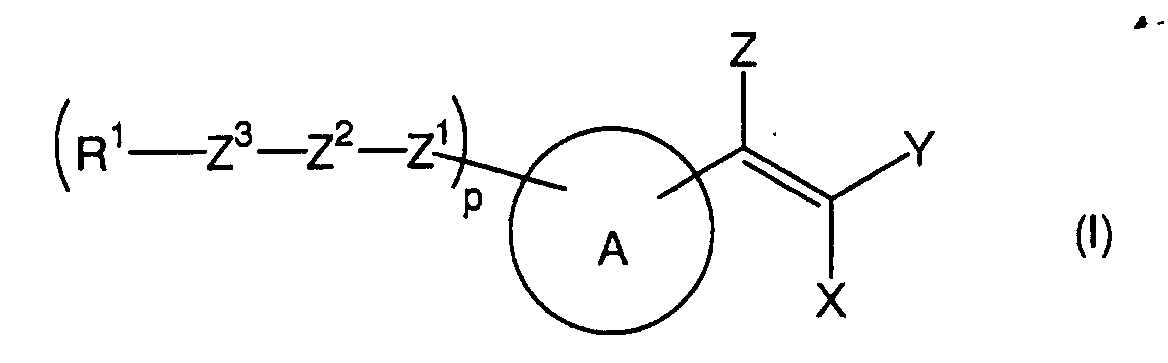
-S(=O)q-R6-R7 wherein R6 is oxygen atom or N-R7, R7 each is independently hydrogen, optionally substituted alkyl, optionally substituted alkenyl, optionally substituted alkynyl or optionally substituted aralkyl and q is 1 or 2,
-S(=O)q-R8 wherein R8 is optionally substituted alkyl, optionally substituted alkenyl, optionally substituted alkynyl or optionally substituted aralkyl and q is as defined above,
-P(=O)(OR9)2 wherein R9 each is independently hydrogen or optionally substituted alkyl,
halogenated alkyl or optionally substituted heteroaryl;
Y is -C(=R2)-R3-R4 wherein R2 is oxygen atom, R3 is oxygen atom or N-R5, R4 is hydrogen, optionally substituted alkyl, optionally substituted alkenyl, optionally substituted alkynyl or optionally substituted aralkyl and R5 is hydrogen, optionally substituted alkyl, optionally substituted alkenyl, optionally substituted alkynyl, optionally substituted alkoxy, optionally substituted cycloalkyl or optionally substituted aralkyl, or R4 and R5 may be taken together with the adjacent nitrogen atom to form optionally substituted non-aromatic heterocyclic group;
optionally substituted tetrazolyl; optionally substituted triazolyl; optionally substituted thiazolyl; optionally substituted isoxazolyl; optionally substituted pyrazinyl; optionally substituted imidazolyl; optionally substituted pyrimidinyl or optionally substituted pyridyl,

-S(=O)q-R6-R7 wherein R6 is oxygen atom or N-R7, R7 each is independently hydrogen, optionally substituted alkyl, optionally substituted alkenyl, optionally substituted alkynyl or optionally substituted aralkyl and q is 1 or 2;
-S(=O)q-R8 wherein R8 is optionally substituted alkyl, optionally substituted alkenyl, optionally substituted alkynyl or optionally substituted aralkyl and q is as defined above;
-P(=O)(OR9)2 wherein R9 each is independently hydrogen or optionally substituted alkyl;
halogenated alkyl or optionally substituted heteroaryl;
Y is -C(=R2)-R3-R4 wherein R2 is oxygen atom, R3 is oxygen atom or N-R5, R4 is hydrogen, optionally substituted alkyl, optionally substituted alkenyl, optionally substituted alkynyl or optionally substituted aralkyl and R5 is hydrogen, optionally substituted alkyl, optionally substituted alkenyl, optionally substituted alkynyl, optionally substituted alkoxy, optionally substituted cycloalkyl or optionally substituted aralkyl, or R4 and R5 may be taken together with the adjacent nitrogen atom to form optionally substituted non-aromatic heterocyclic group;
optionally substituted tetrazolyl; optionally substituted triazolyl; optionally substituted thiazolyl; optionally substituted isoxazolyl; optionally substituted pyrazinyl; optionally substituted imidazolyl; optionally substituted pyrimidinyl or optionally substituted pyridyl, a tautomer of itself, a prodrug thereof, a pharmaceutically acceptable salt thereof or a solvate thereof,

Y is -C(=R2)-R3-R4 wherein R2 is oxygen atom or sulfur atom, R3 is oxygen atom, sulfur atom or N-R5, R4 is hydrogen, optionally substituted alkyl, optionally substituted alkenyl, optionally substituted alkynyl or optionally substituted aralkyl and R5 is hydrogen, optionally substituted alkyl, optionally substituted alkenyl, optionally substituted alkynyl, optionally substituted alkoxy, optionally substituted cycloalkyl or optionally substituted aralkyl, or R4 and R5 may be taken together with the adjacent nitrogen atom to form optionally substituted non-aromatic heterocyclic group;
-S(=O)q-R6-R7 wherein R6 is oxygen atom or N-R7, R7 each is independently hydrogen, optionally substituted alkyl, optionally substituted alkenyl, optionally substituted alkynyl or optionally substituted aralkyl and q is 1 or 2;
-S(=O)q-R8 wherein R8 is optionally substituted alkyl, optionally substituted alkenyl, optionally substituted alkynyl or optionally substituted aralkyl and q is as defined above;
-P(=O)(OR9)2 wherein R9 each is independently hydrogen or optionally substituted alkyl;
halogenated alkyl or optionally substituted heteroaryl and
Z is hydrogen, optionally substituted alkyl or optionally substituted aralkyl.


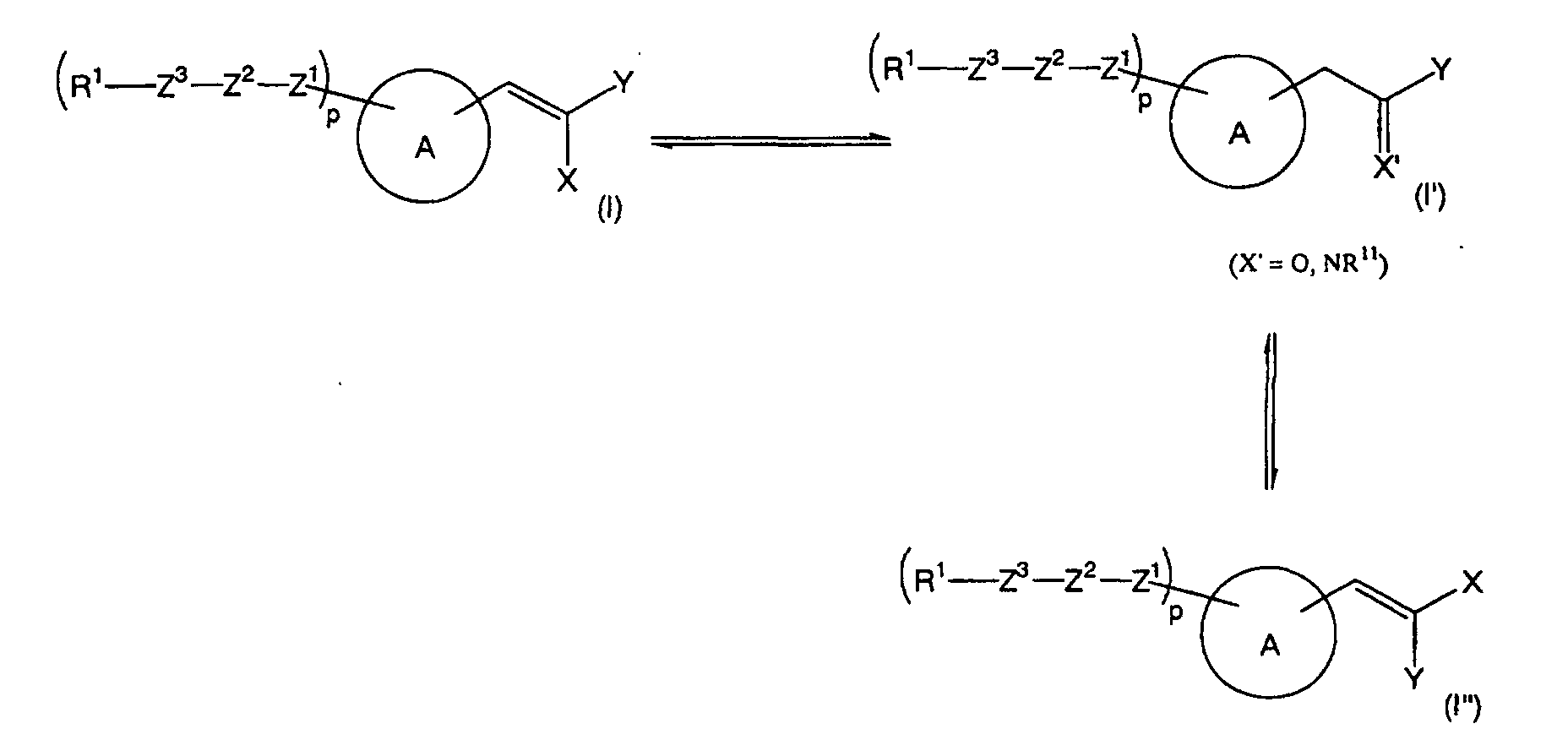
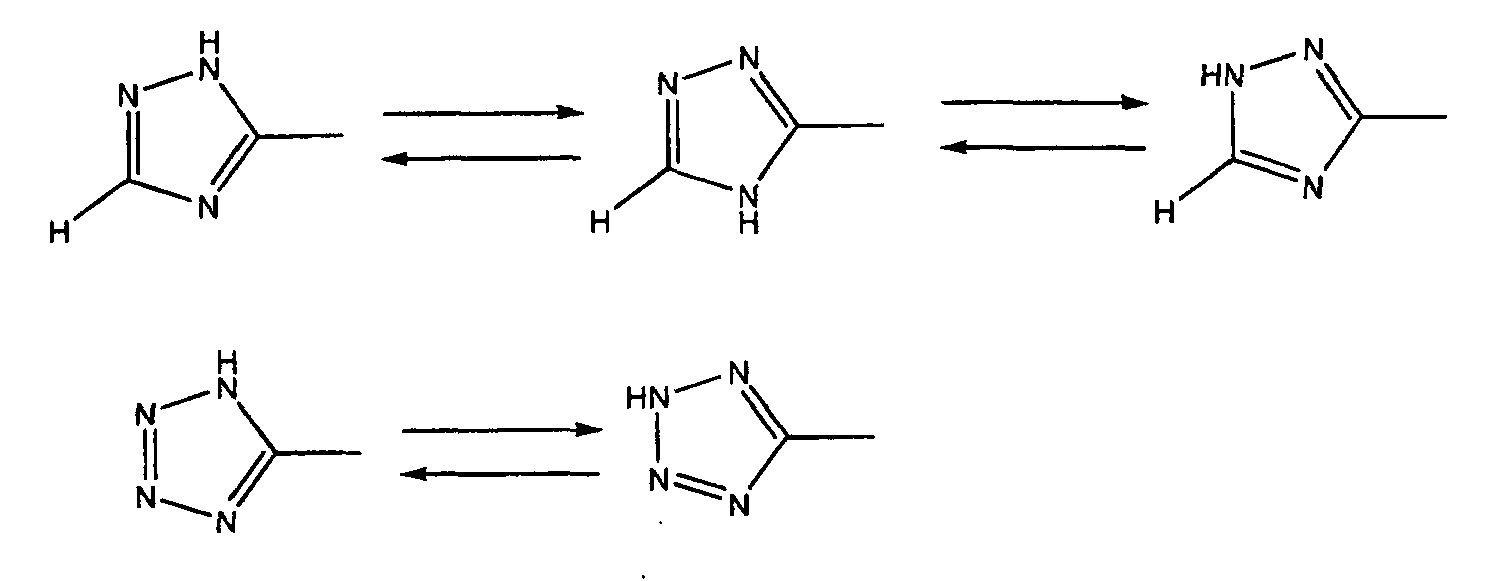
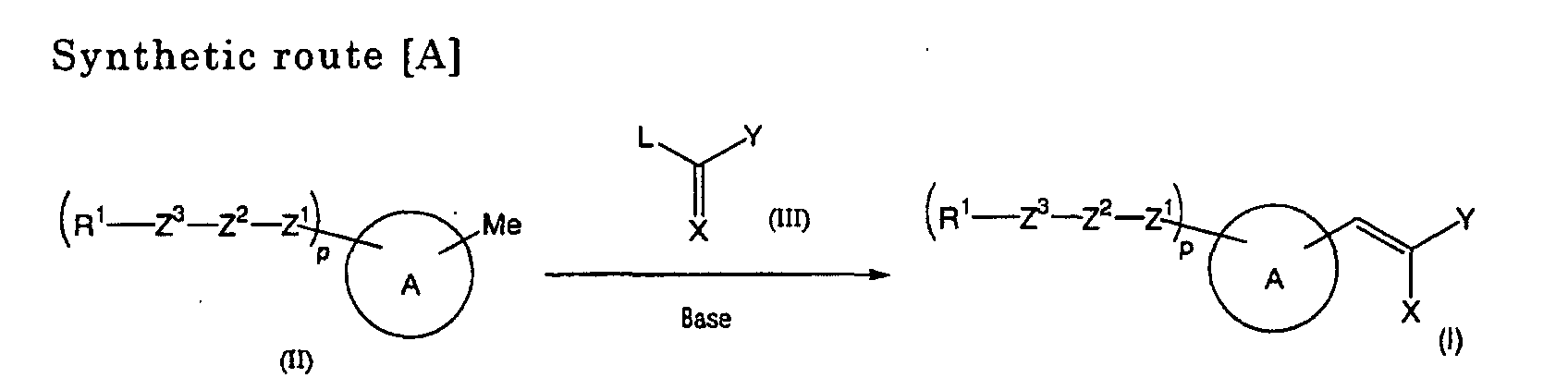


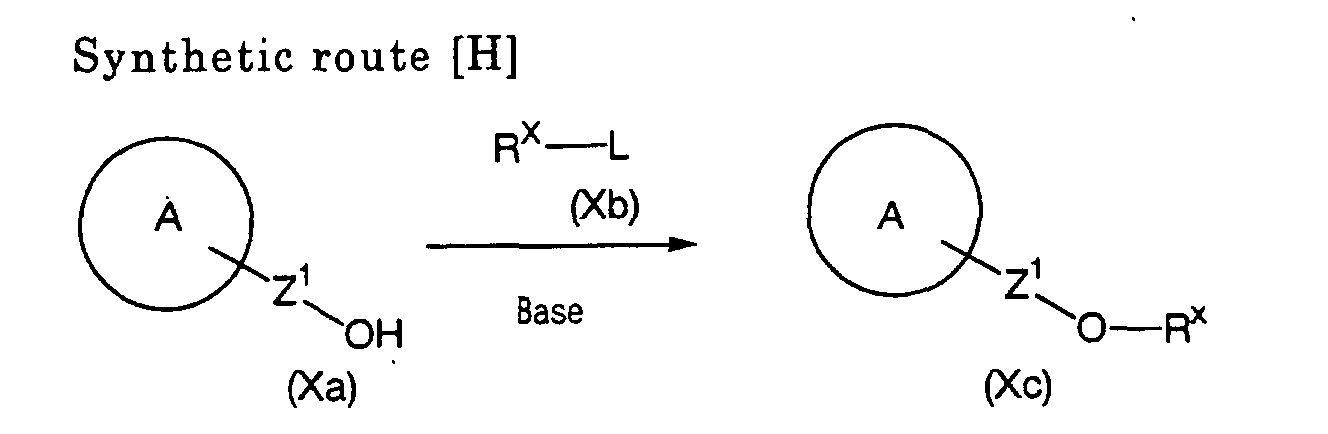

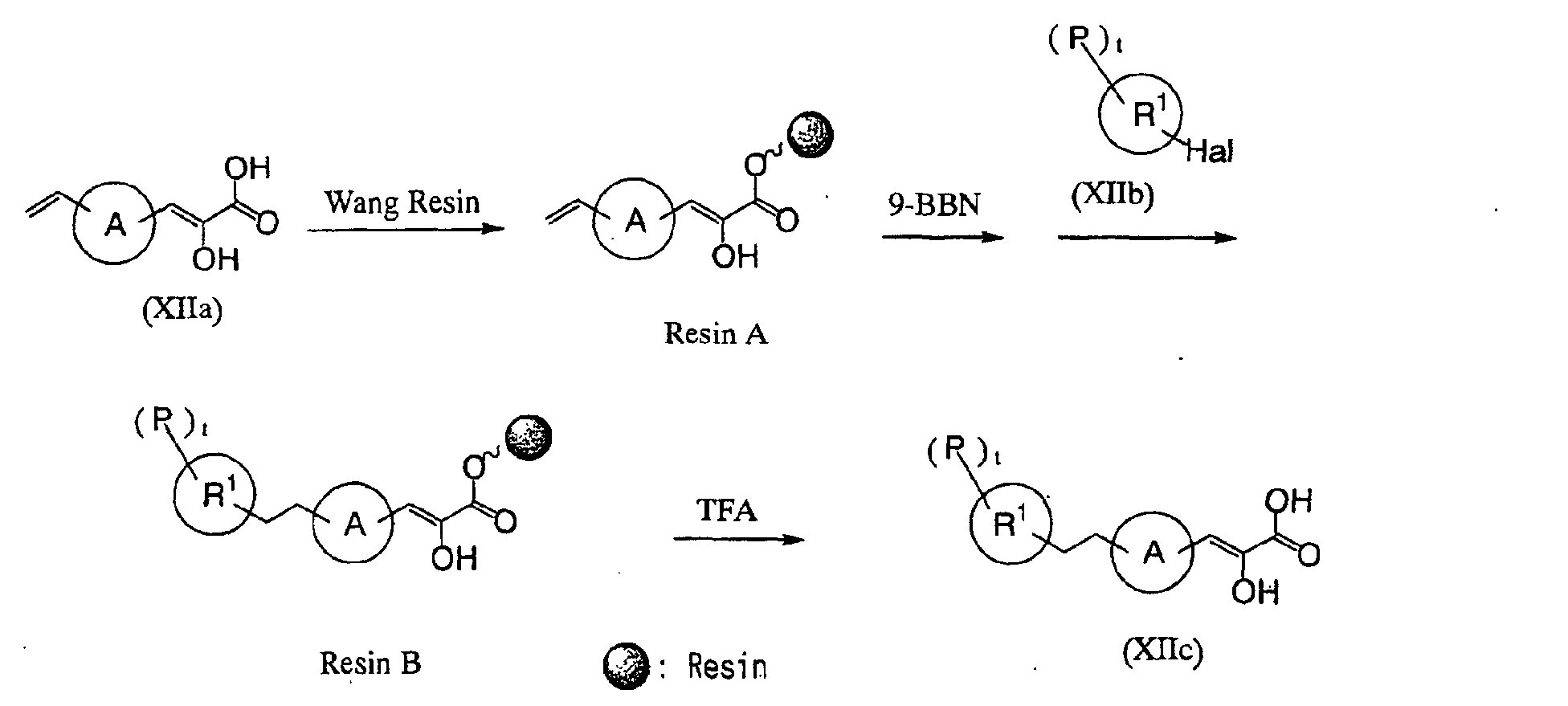
M.p.: 162 °C (decomposition)
NMR(CDCl3) δ: 1.43(3H, t,J=7.2Hz), 4.50(2H, q, J=7.2Hz), 7.08-7.12(6H, m), 7.29-7.41(9H, m).
NMR(CDCl3) δ: 1.41(3H, t,J=7.2Hz), 4.45(2H, q, J=7.2Hz), 7.11-7.13(6H, m), 7.32-7.36(9H, m), 8.01(1H, s).
NMR(CDCl3) δ: 1.02(3H, t,J=7.2Hz), 3.76(2H, q, J=7.2Hz), 7.12-7.14(6H, m), 7.28-7.33(9H, m), 7.99(1H, s).

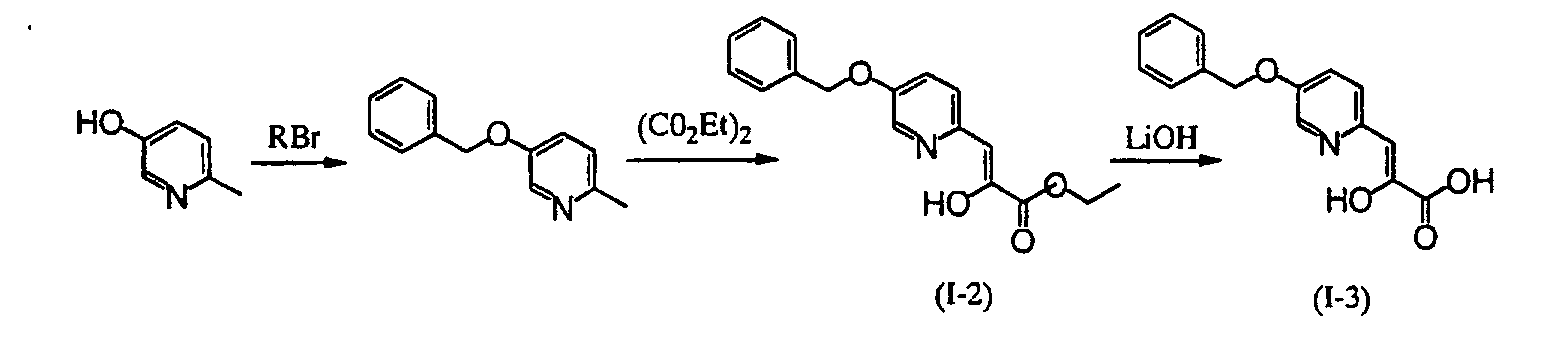
1H-NMR(CDCl3) δ: 1.39(3H,t,J=7.0Hz), 4.35(2H,q,J=7.0Hz), 5.14(2H,s), 6.58(1H,s), 7.18-7.43(7H,m), 8.24(1H,d,J=2.4Hz).
1H-NMR(d6-DMSO) δ: 5.23(2H, s), 6.66(1H, s), 7.30-7.65(7H, m), 8.38(1H, d, J=3.3Hz).


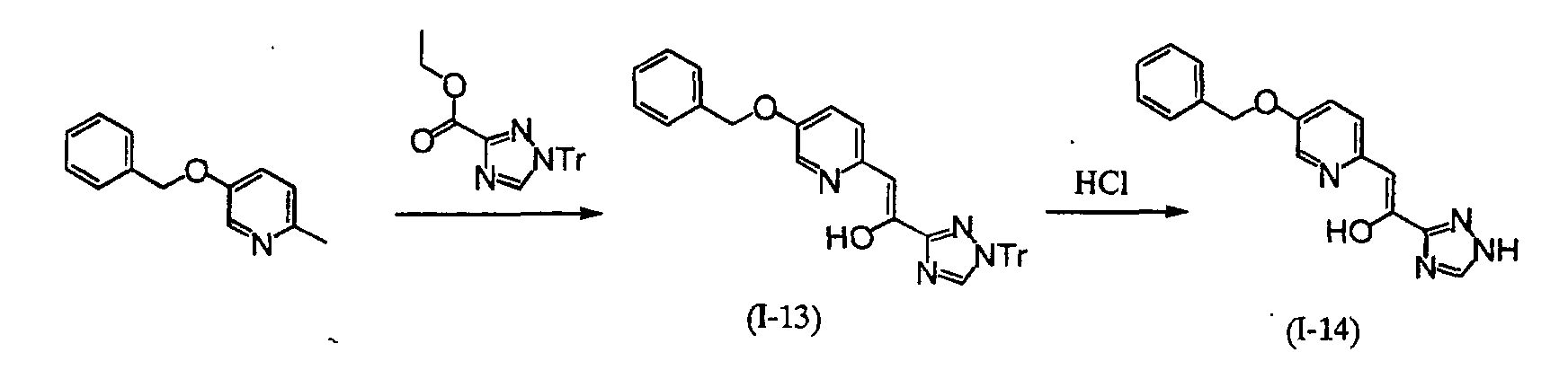
1H-NMR(CDCl3) δ: 4.50(2/3H,s), 5.07(2/3H,s), 5.12(4/3H,s), 6.50(2/3H,s), 7.05-7.46(22H,m), 8.96(2/3H,s), 8.04(1/3H,s), 8.17(2/3H,d,J=3.2Hz), 8.29(1/3H,bs).
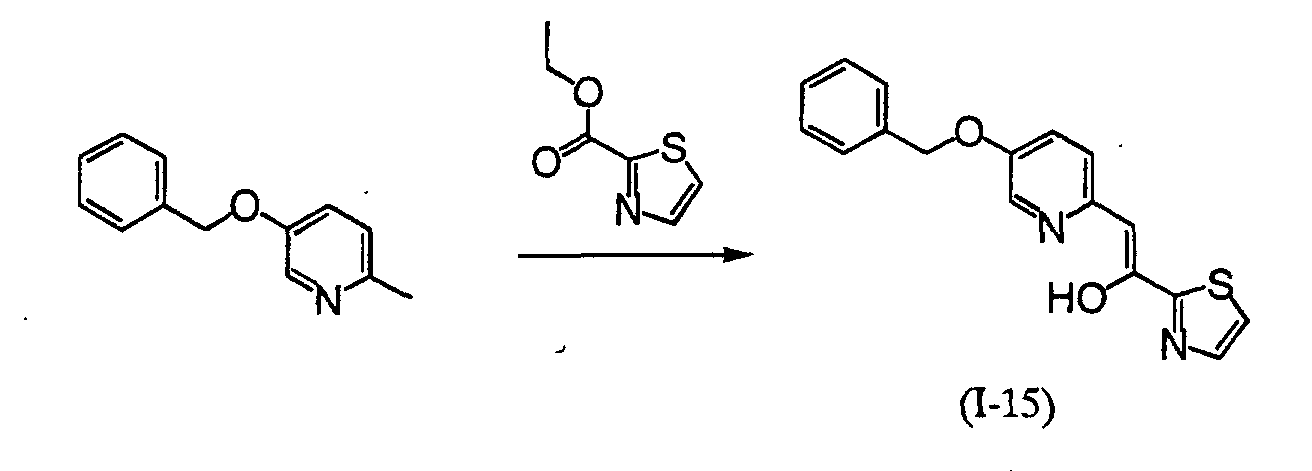
1H-NMR(CDCl3) δ: 4.62(2/3H,s), 5.09(2/3H,s), 5.14(4/3H,s), 6.60(2/3H,s), 7.16(2/3H,d,J=8.7Hz), 7.33-7.48(7H,m), 7.69(1/3H,d,J=3.5Hz), 7.87(2/3H,d,J=3.5Hz), 8.04(1/3H,d,J=3.5Hz), 8.16(2/3H,d,J=3.5Hz), 8.34(1/3H,d,J=3.5Hz).

1H-NMR(CDCl3) δ: 1.35-1.45(6H,m), 4.36(2H,q,J=7.2Hz), 4.43(2H,q,J=7.2Hz), 5.17(2H,s), 6.57(1H,s), 7.07(1H,dt,J=1.4,9.7Hz), 7.21(1H,d,J=9.1Hz), 7.35(1H,dd,J=9.1,2.9Hz), 7.72(1H,dq,J=1.4,9.7Hz), 8.26(1H,d,J=2.9Hz).
1H-NMR(d6-DMSO) δ: 6.30(2H,s), 6.60(1H,s), 7.37(1H,dt,J=1.5,9.8Hz), 7.55(1H,d,J=9.0Hz), 7.68(1H,dd,J=9.0,3.0Hz), 7.95(1H,dq,J=1.5,9.8Hz), 8.42(1H,d,J=3.0Hz).
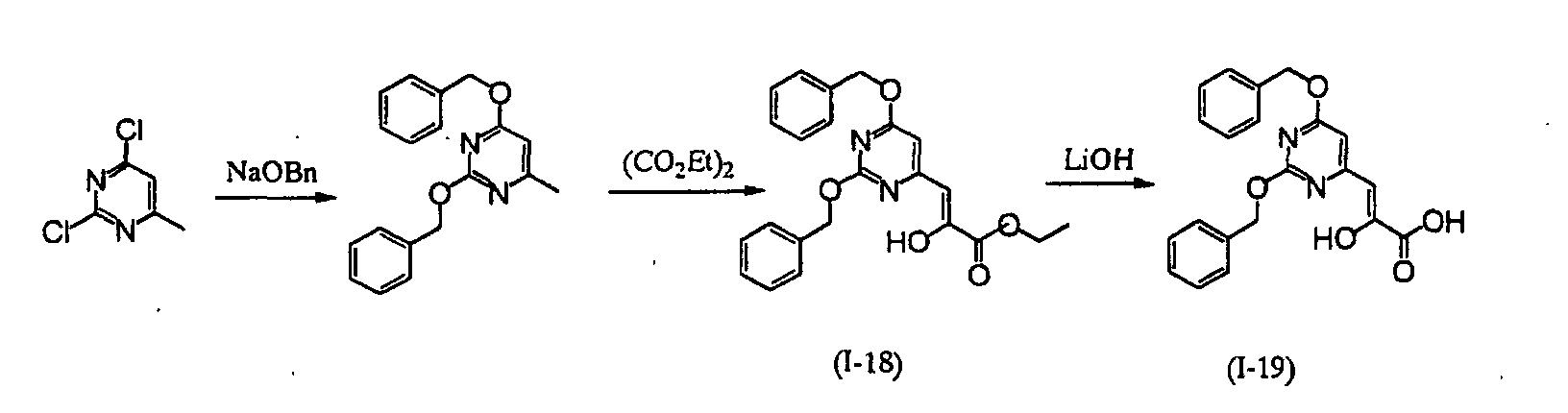
Compound (I-18)
1H-NMR(CDCl3) δ: 1.39(3H,t,J=7.1Hz), 4.35(2H,q,J=7.1Hz), 5.39(2H,s), 5.41(2H,s), 6.24(1H,s), 6.38(1H,s), 7.30-7.50(10H,m).
Compound (I-19)
1H-NMR(d6-DMSO) δ: 5.41(2H,s), 5.42(2H,s), 6.42(1H,s), 6.77(1H,s), 7.30-7.55(10H,m).
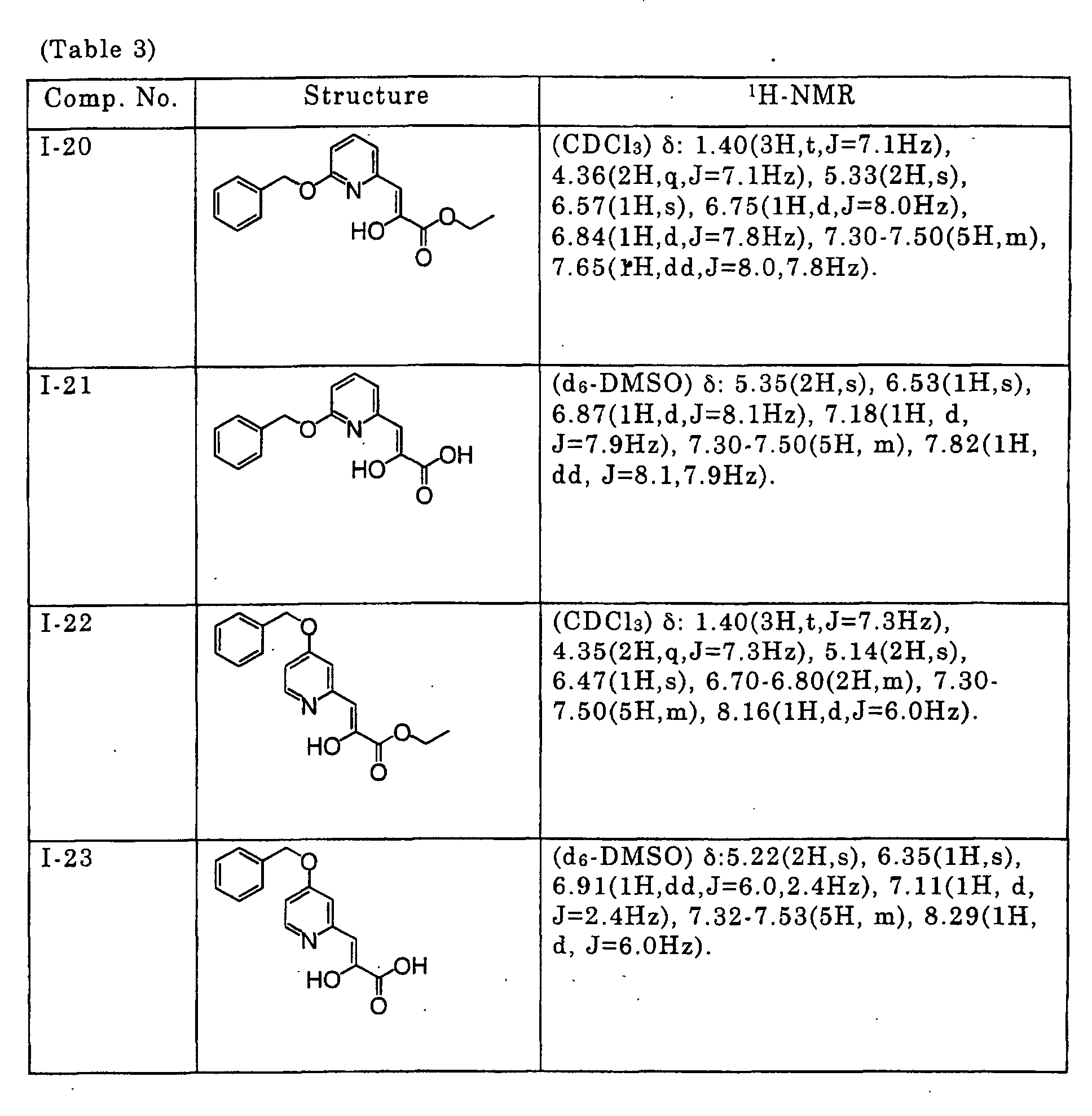

Compound (I-24)
1H-NMR(CDCl3) δ: 1.40(3H,t,J=7.1Hz), 3.06(4H,s), 4.35(2H,q,J=7.1Hz), 6.39(1H,s), 6.86(1H,s), 7.12-7.35(6H,m), 8.95(1H,s).
Compound (1-25)
1H-NMR(d6-DMSO) δ: 3.00(4H,s), 6.29(1H,s), 7.15-7.40(6H,m), 8.92(1H,s).


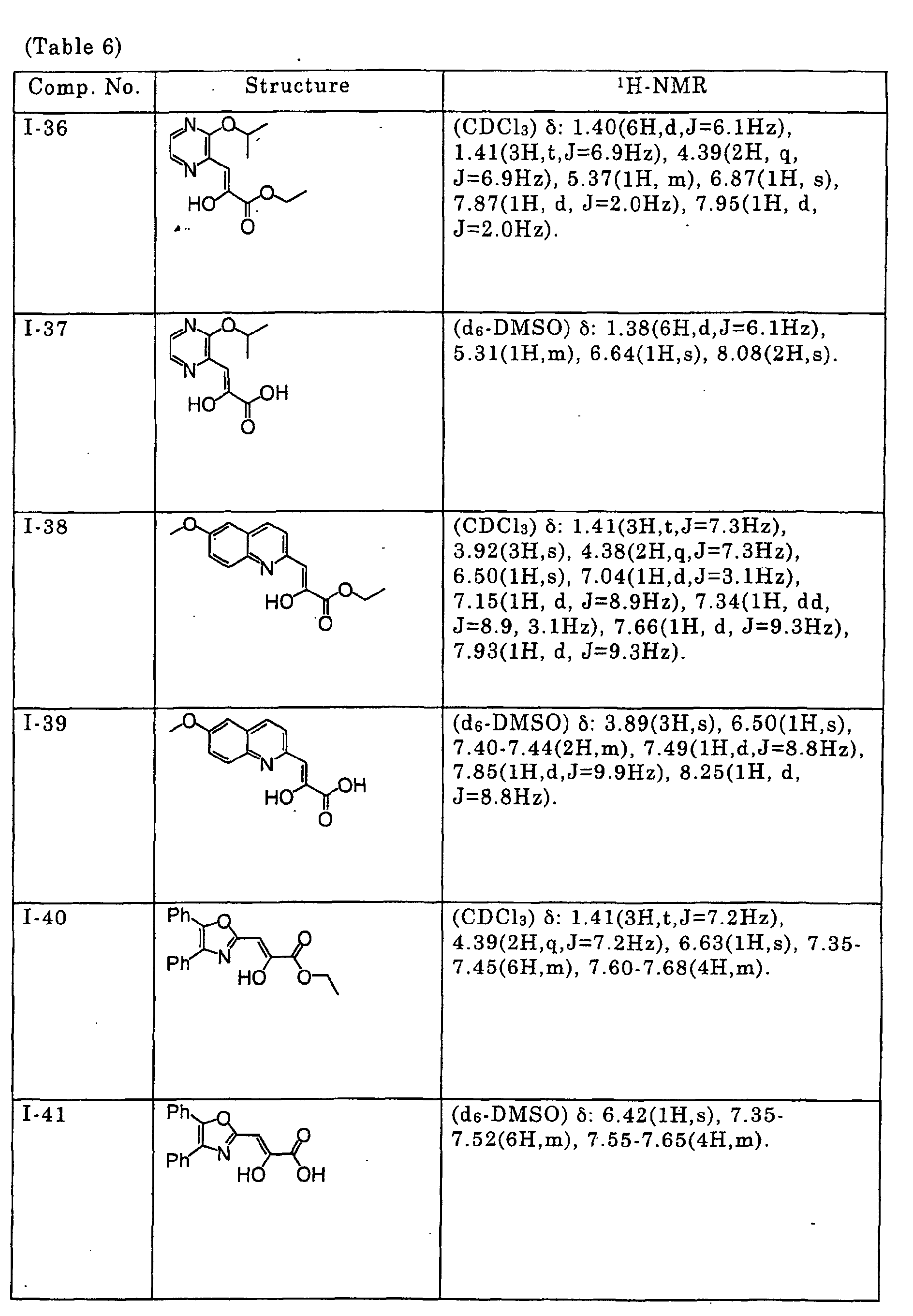
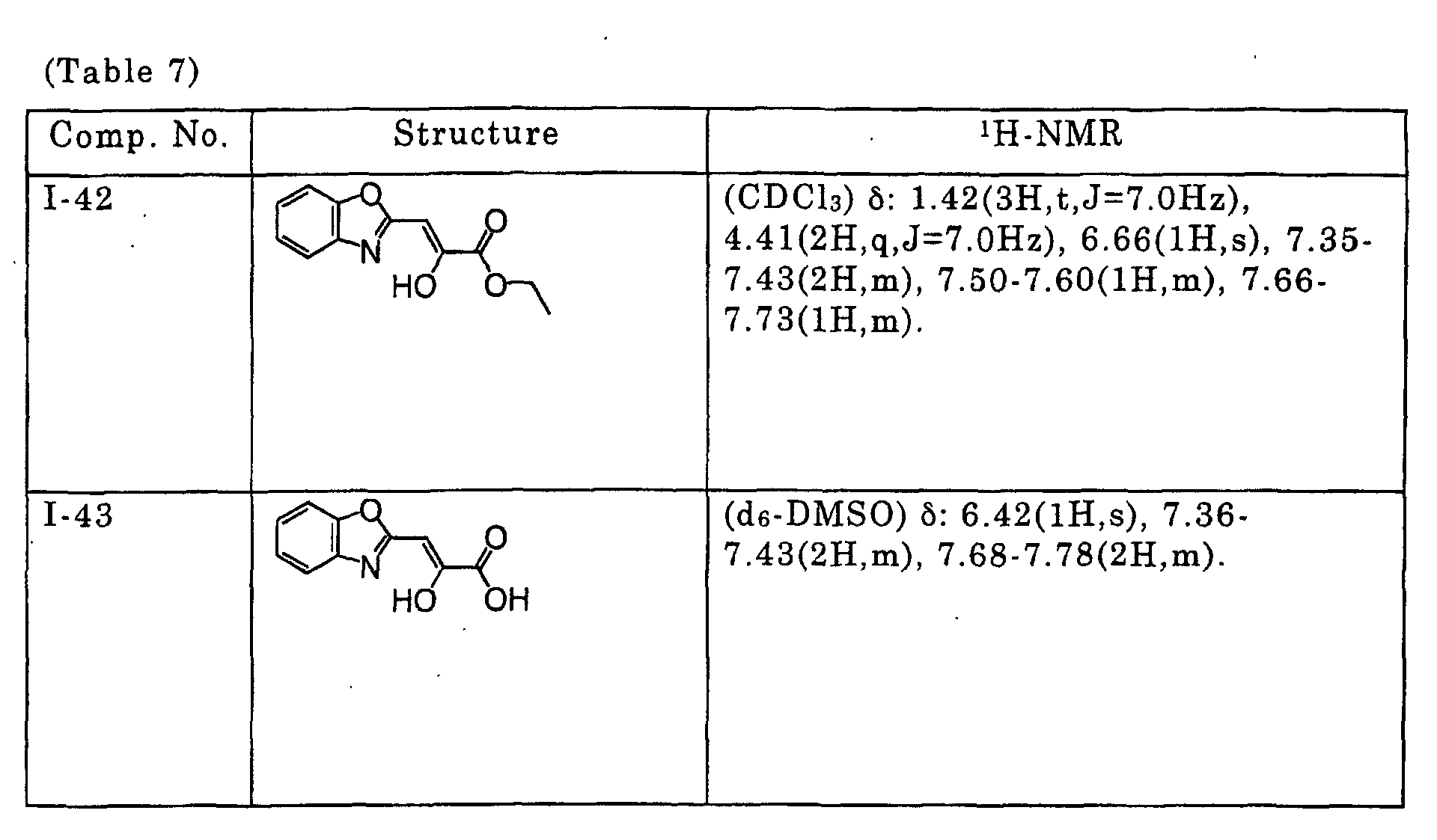
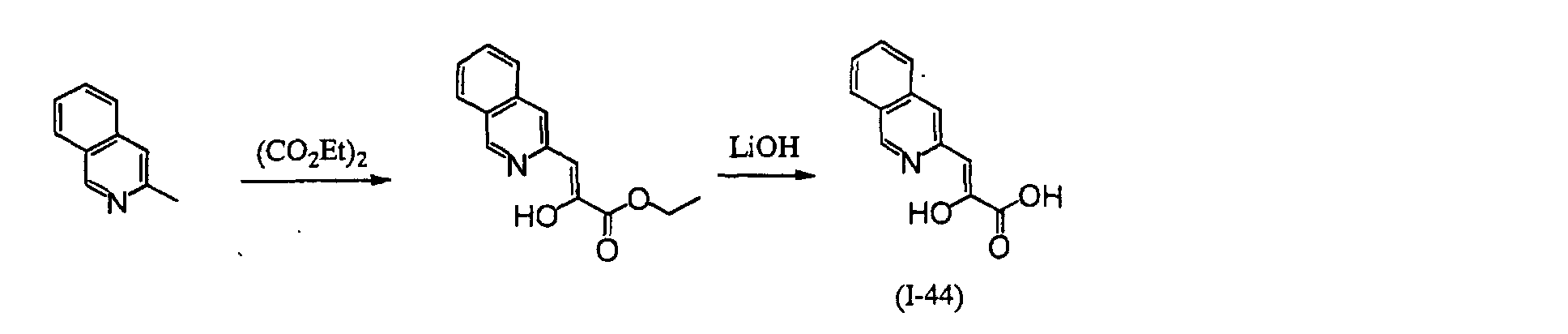
1H-NMR(d6-DMSO) δ: 6.72(1H,s), 7.67-7.73(1H,m), 7.82-7.87(1H,m), 7.95-8.00(2H,m), 8.18(1H,d,J=9Hz), 9.38(1H,s).
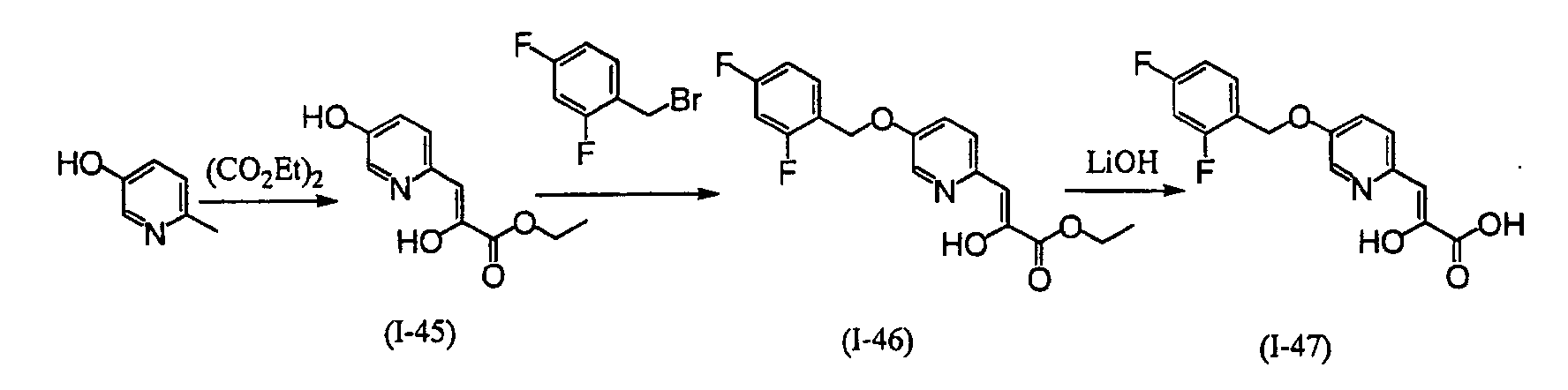
1H-NMR(CDCl3) δ: 1.35-1.42(3H,m), 4.32-4.39(2H,m), 6.55(1H,s), 7.17(1H,d,J=8.7Hz), 7.30(1H,dd,J=8.4,2.4Hz), 8.179(1H,d,J=2.4Hz).
1H-NMR(CDCl3) δ: 1.39(3H,t,J=7.1Hz), 4.35(2H,q,J=7.1Hz), 5.14(2H,s), 6.56(1H,s), 6.84-6.96(2H,m), 7.19(1H,d,J=8.7Hz), 7.34(1H,dd,J=2.7,8.7Hz), 7.42-7.50(1H,m), 8.24(1H,d,J=2.7Hz).
1H-NMR(d6-DMSO) δ: 5.24(2H,s), 6.58(1H,s), 7.10-7.19(1H,m), 7.29-7.37(1H,m), 7.54(1H,d,J=8.7Hz), 7.62-7.70(1H,m), 8.40(1H,d,J=3.0Hz).
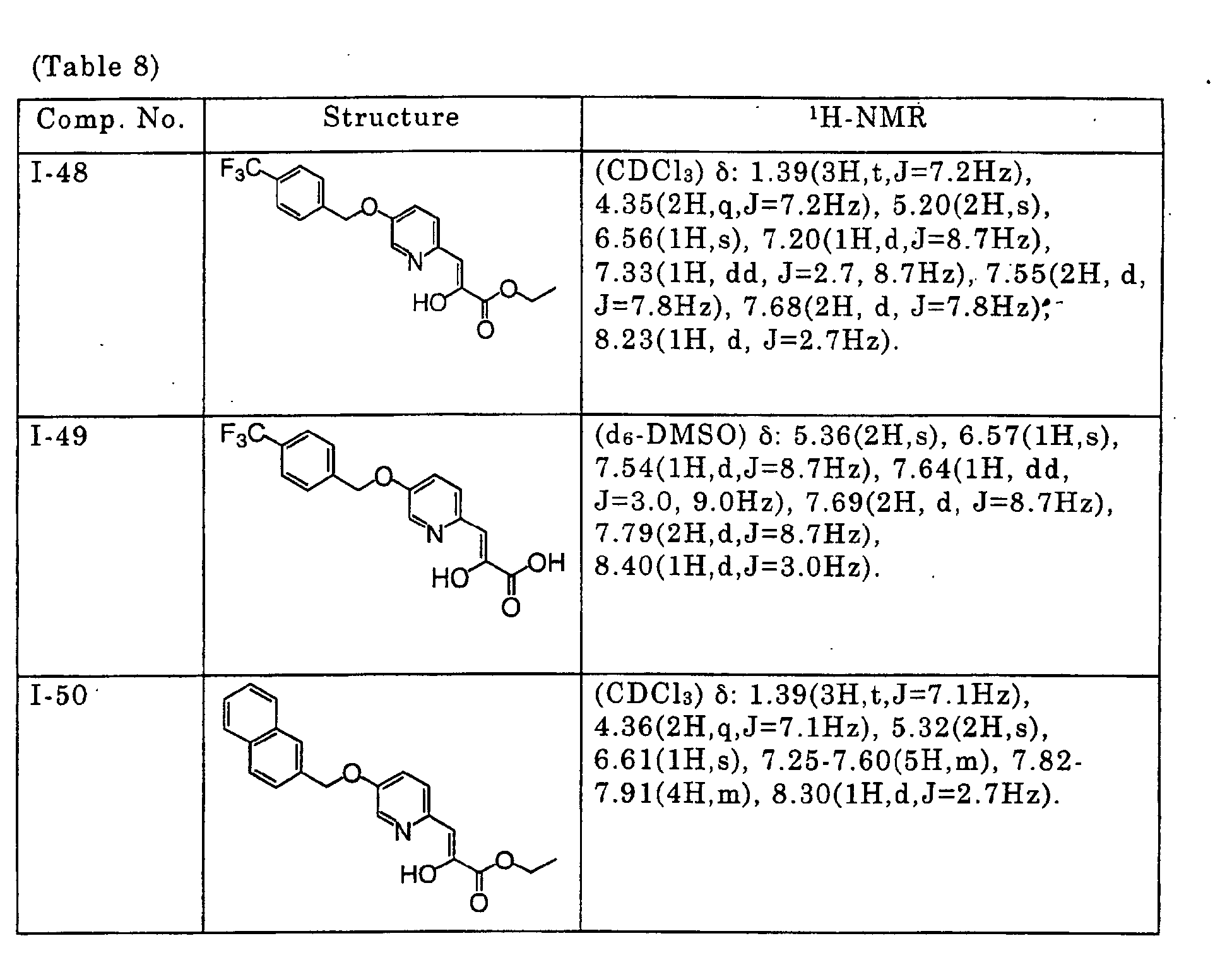

1H-NMR(d6-DMSO) δ: 1.30(3H,t,J=7.2Hz), 4.25(2H,q,J=7.2Hz), 6.48(1H,s), 8.45(1H,s), 8.56(1H,s).
1H-NMR(d6-DMSO) δ: 1.29(3H,t,J=7.1Hz), 4.24(2H,q,J=7.1Hz), 5.46(2H,s,), 6.49(1H,s), 7.32-7.36(5H,m), 8.57(1H,s), 8.60(1H,s).
1H-NMR(d6-DMSO) δ: 5.45(2H,s), 6.54(1H,s), 7.25-7.40(5H,m), 8.57(1H,s), 8.61(1H,s).
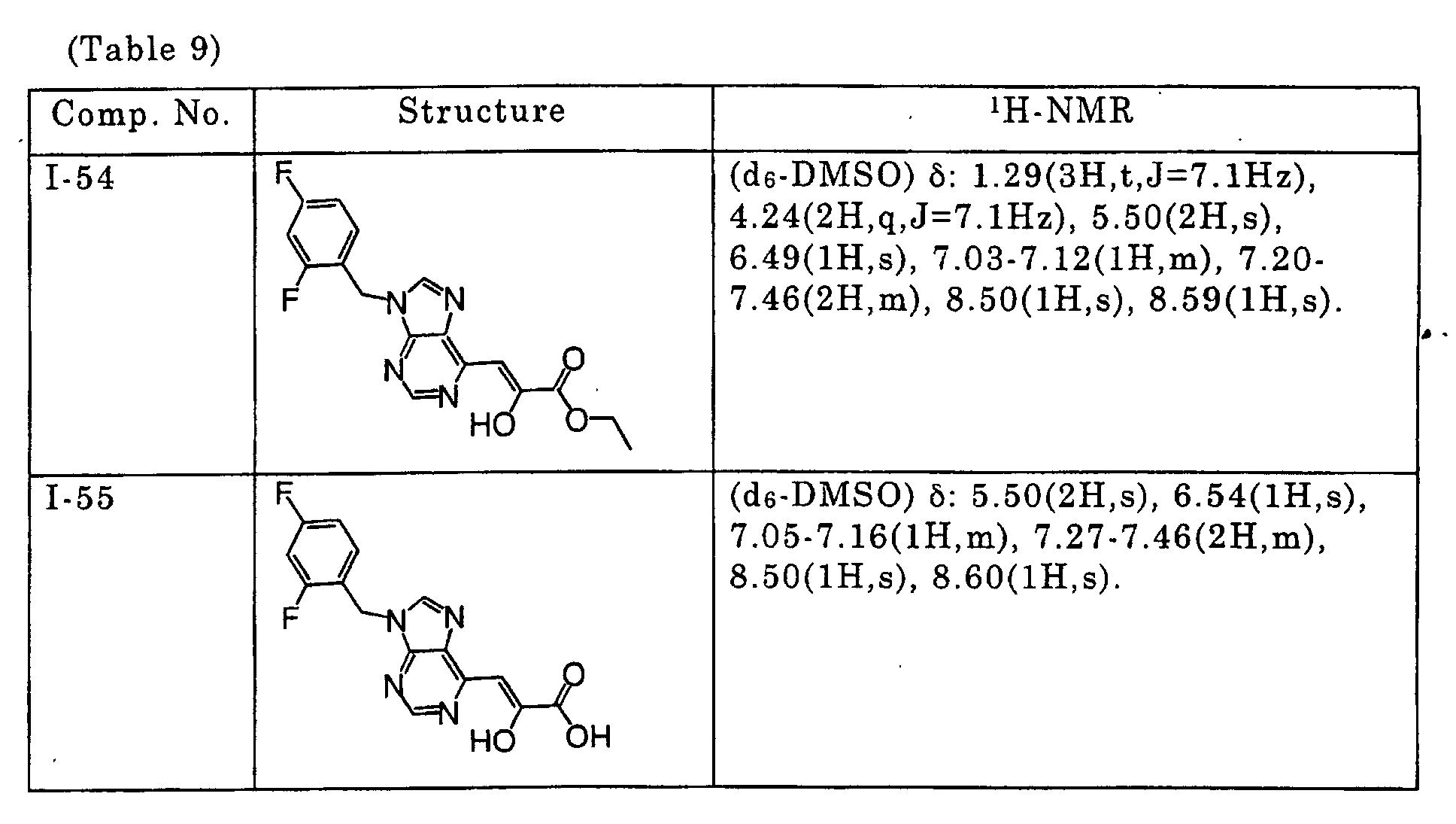
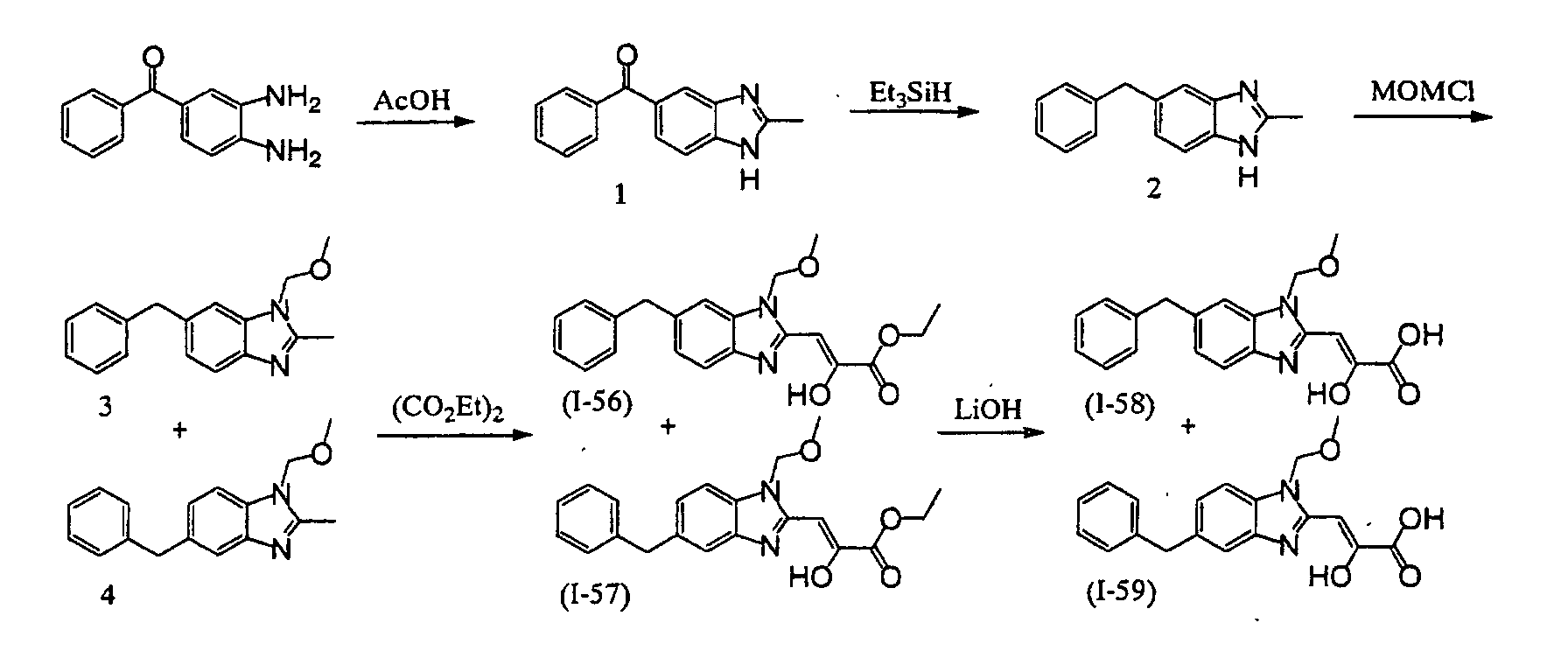
The mixture of Compound (I-56) and (I-57)
1H-NMR(CDCl3)δ: 1.40 (3H,t,J=7.2Hz), 3.33, 3.34 (3H,s), 4.09, 4.11 (2H,s), 4.36 (2H,q,J=7.2Hz), 5.42, 5.43 (2H,s), 6.37, 6.39 (1H,s), 7.12-7.45 (8H,m). regio isomer mixture
The mixture of Compound (I-58) and (I-59)
1H-NMR(d6-DMSO) δ: 3.24, 3.26 (3H,s), 4.04, 4.05 (2H,s), 5.56 (2H,s), 6.24, 6.27 (1H,s), 7.13-7.60 (8H,m). regio isomer mixture
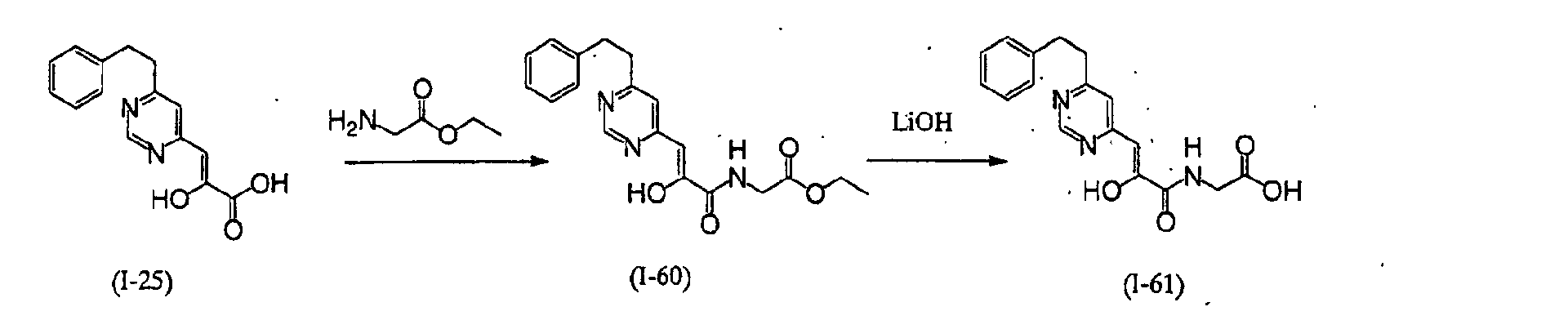
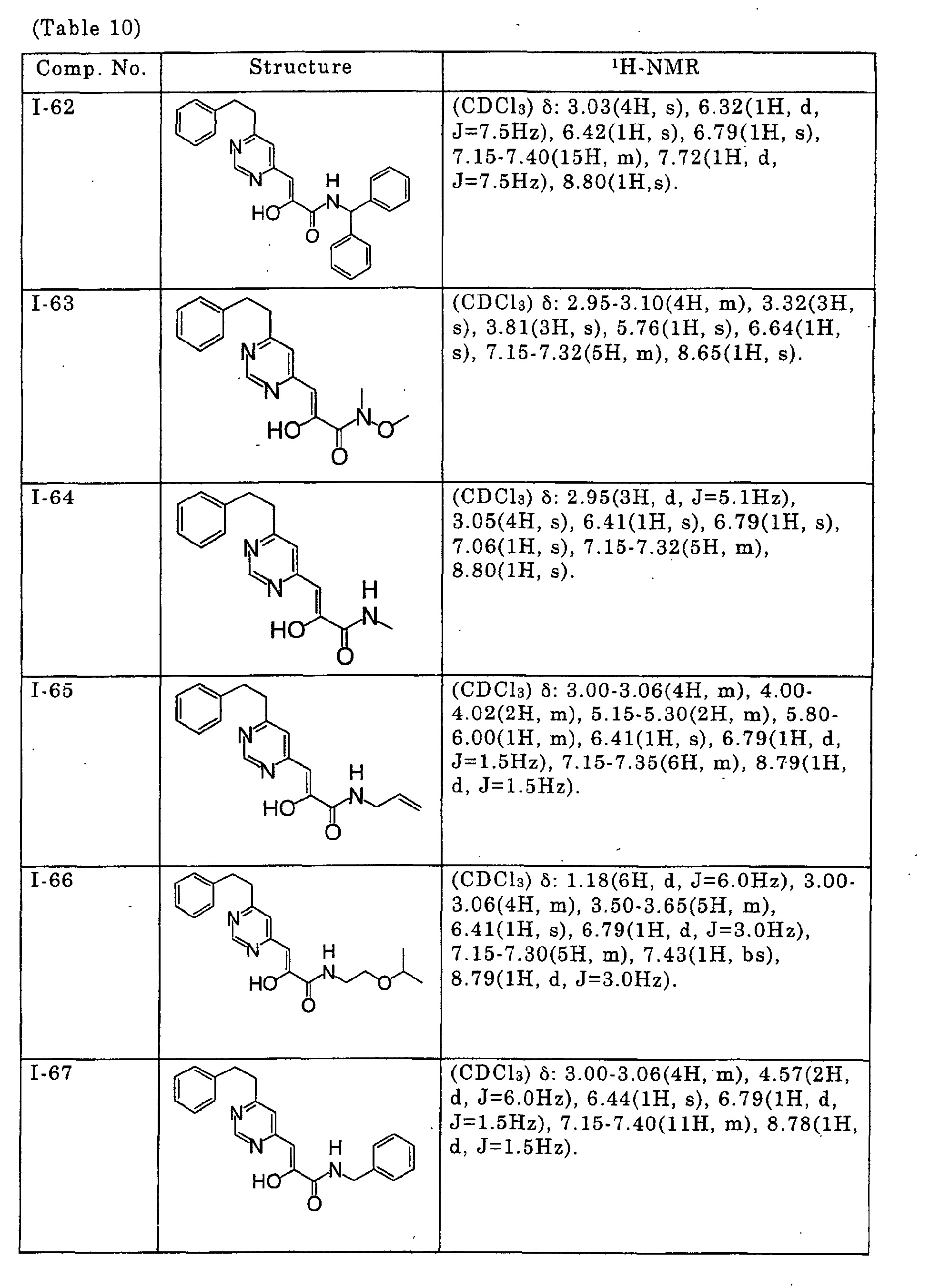


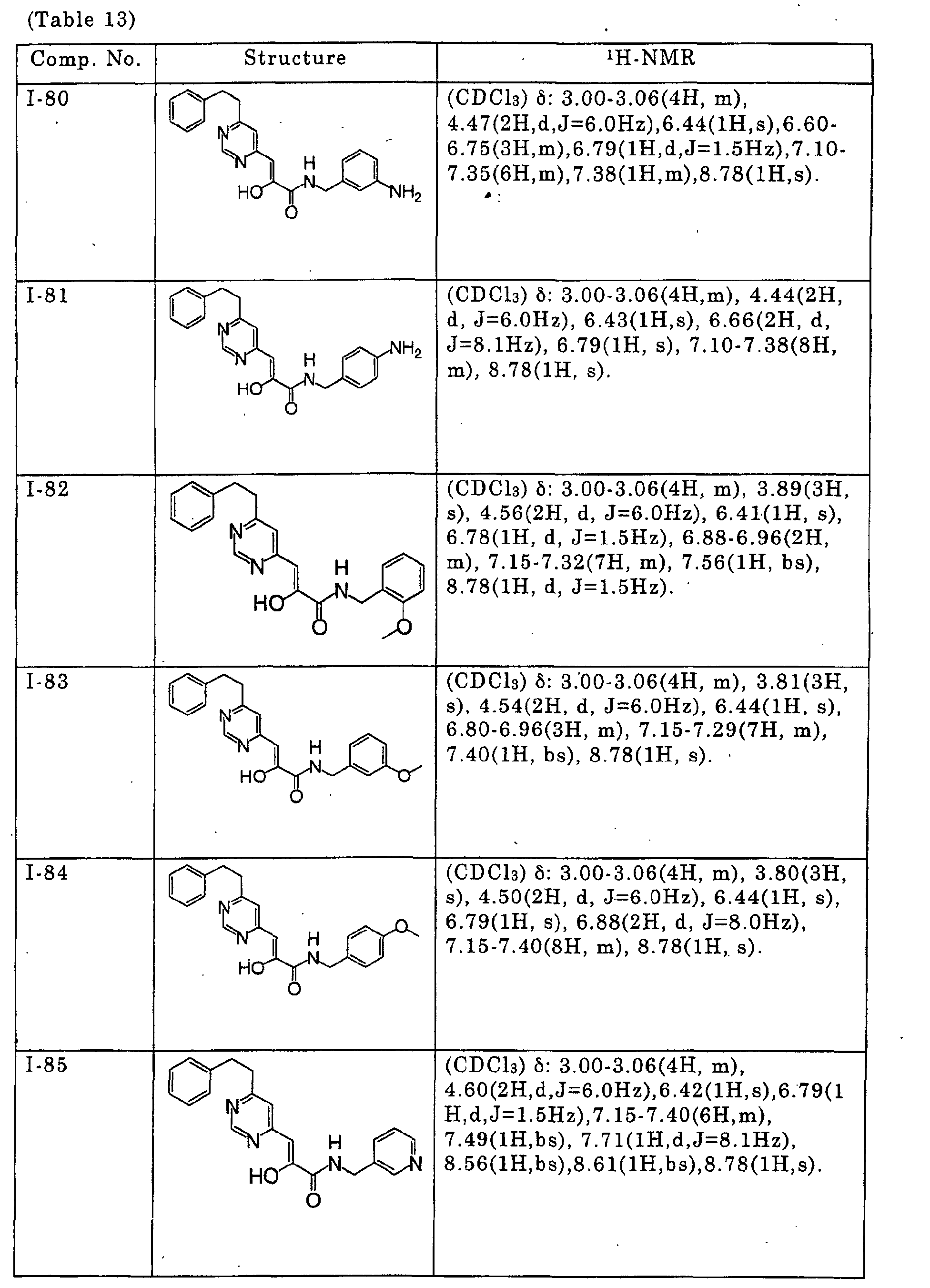
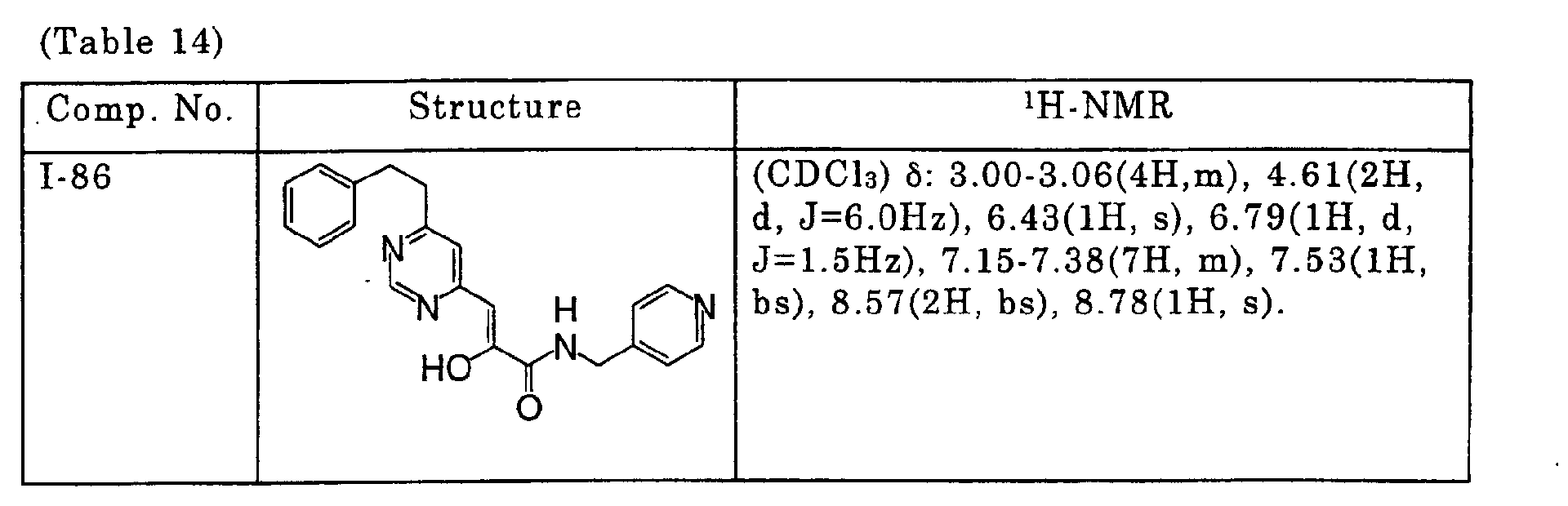
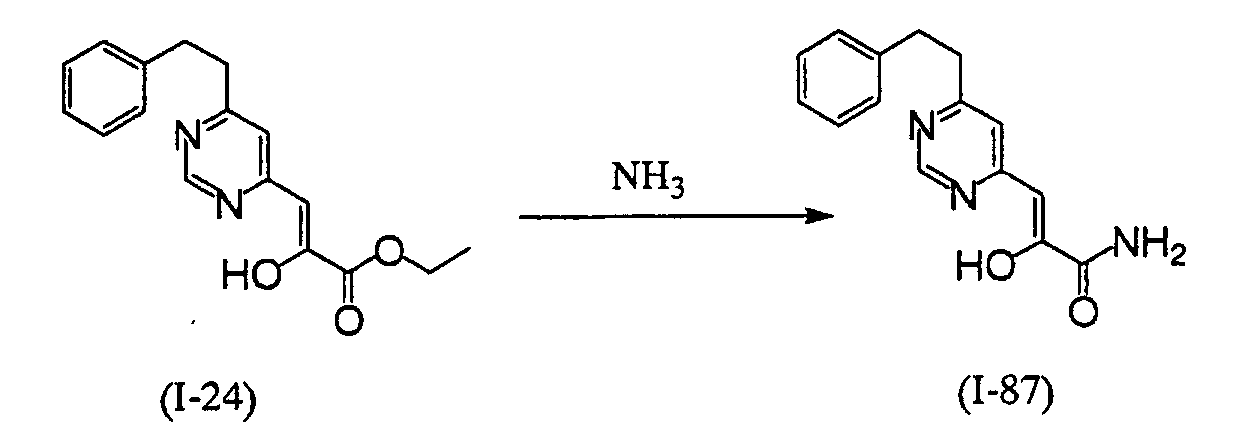
1H-NMR(CDCl3) δ: 3.00-3.05 (4H,m), 5.70 (1H,bs), 6.41 (1H,s), 6.80 (1H,d,J=1.2Hz), 6.94 (1H,bs), 7.15-7.35 (5H,m), 8.83 (1H,d,J=1.2Hz).

Compound (I-88)
1H-NMR(CDCl3) δ: 1.41 (3H,t,J=7.1Hz), 4.39 (2H,q,J=7.1Hz), 6.69 (1H,s), 7.04 (1H,d,J=16.5Hz), 7.30-7.50 (6H,m), 7.55 (1H,s), 7.58 (1H,s), 8.34 (1H,d,J=7.2Hz).
Compound (I-89)
1H-NMR(CDCl3) δ: 1.40 (3H,t,J=7.0Hz), 2.98 (4H,s), 4.38 (2H,q,J=7.0Hz), 6.65 (1H,s), 7.01 (1H,d,J=5.7Hz), 7.13 (1H,d,J=7.2Hz), 7.20-7.34 (5H,m), 8.29 (1H,d,J=5.4Hz).
Compound (I-90)
1H-NMR(d6-DMSO) δ: 2.94 (4H,s), 6.40 (1H,s), 7.15-7.33 (7H,m), 8.35 (1H,d,J=5.4Hz).

1H-NMR(d6-DMSO) δ: 2.90-3.10 (5H,m), 6.12 (1H,s), 6.98 (1H,s), 7.02-7.24 (10H,m), 8.90(1H,s).
1H-NMR(CDCl3) δ: 1.31 (3H,t,J=7.1Hz), 2.80-3.00 (4H,m), 3.89 (2H,s), 4.30 (2H,q,J=7.1Hz), 6.78 (1H,s), 7.00-7.30 (10H,m), 8.84(1H,s).
1H-NMR(CDCl3) δ: 1.47 (9H,s), 2.91 (4H,s), 3.79 (2H,s), 6.69 (1H,s), 7.04-7.30 (10H,m), 8.77 (1H,s).
1H-NMR(d6-DMSO) δ: 2.88 (4H,s), 3.78 (2H,s), 6.95 (1H,s), 7.05-7.30 (10H,m), 8.81 (1H,s).

1H-NMR (d6-DMSO) δ: 2.90-3.05 (4H,m), 6.29 (1H,s), 7.08 (1H,s), 7.18-7.35 (5H,m), 8.35 (1H,bs), 8.75 (1H,s).

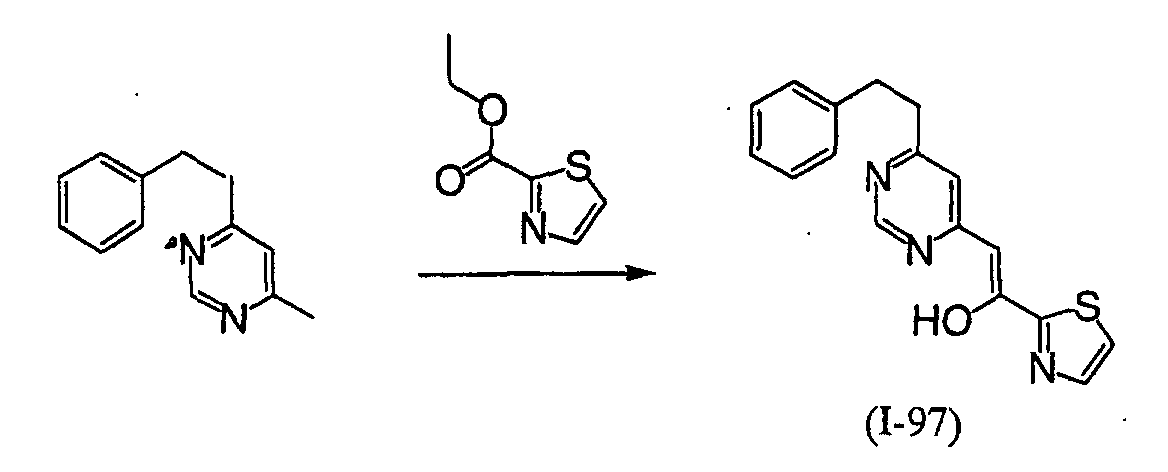
1H-NMR(CDCl3) δ: 3.00-3.07 (4H,m), 6.44 (1H,s), 6.70 (1H.s), 7.18-7.29 (5H,m), 7.53 (1H,d,J=3.0Hz), 7.92 (1H,d,J=3.0Hz), 8.67(1H,s).

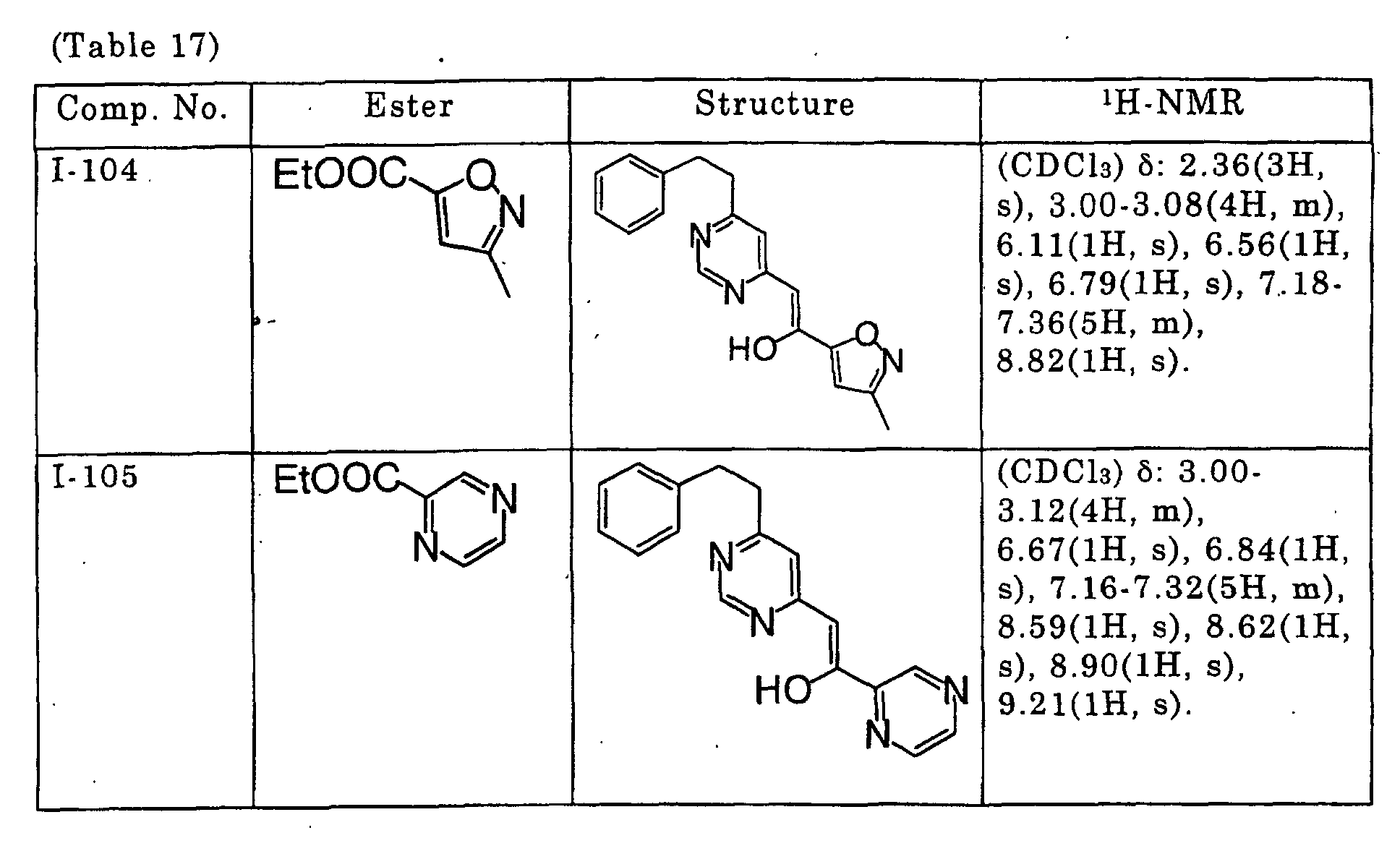
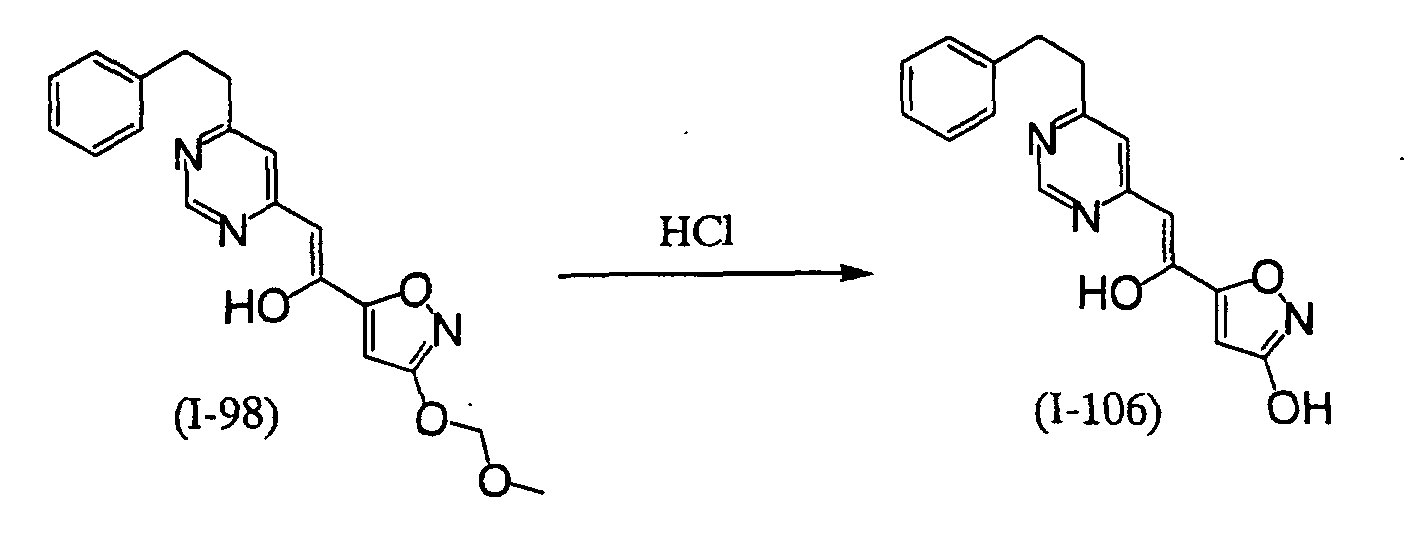
1H-NMR(d6-DMSO) δ: 2.91-3.01 (4H,m), 6.01 (1H,s), 6.41 (1H,s), 7.05 (1H,s), 7.18-7.28 (5H,m), 8.72 (1H,s).
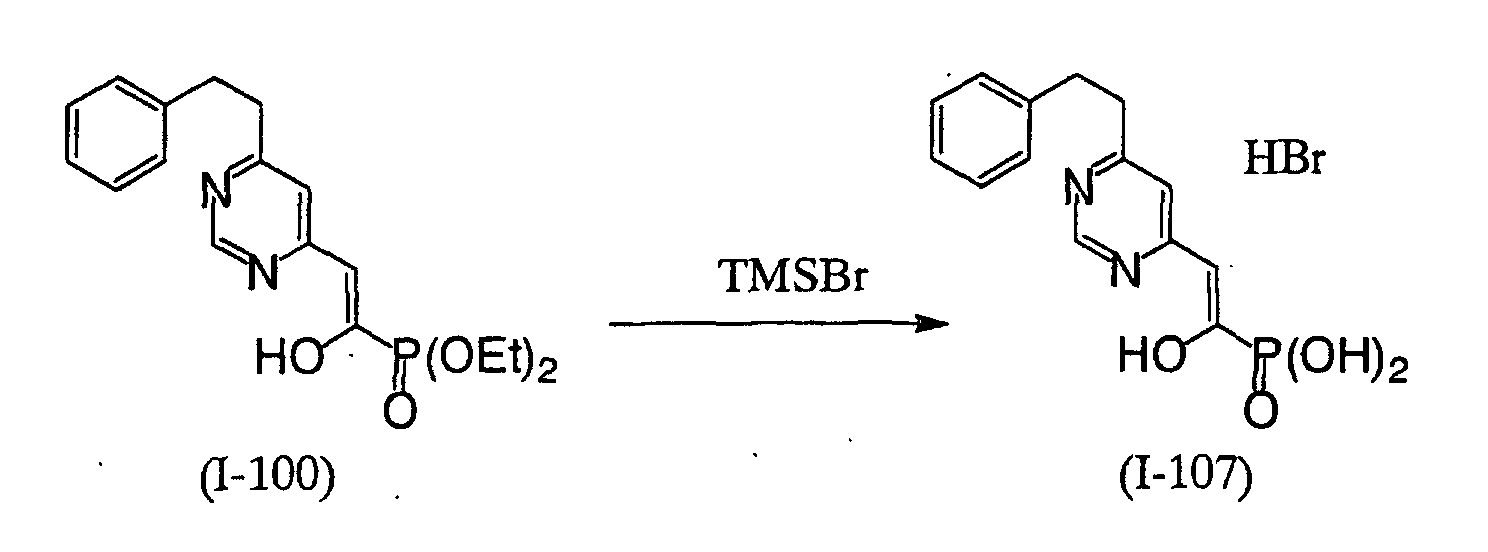

1H-NMR(CDCl3) δ: 2.90-3.10 (4H,m), 6.56 (1H,s), 6.69 (1H,s), 7.10-7.30 (5H,m), 8.56 (1H,s), 9.09(1H,s).

1H-NMR(CDCl3) δ: 3.00-3.06 (4H,m), 6.86-7.02 (4H,m), 7.10-7.18 (2H,m), 7.29-7.34 (1H,m), 8.87 (2H,d,J=1.5Hz), 8.99 (1H,s).
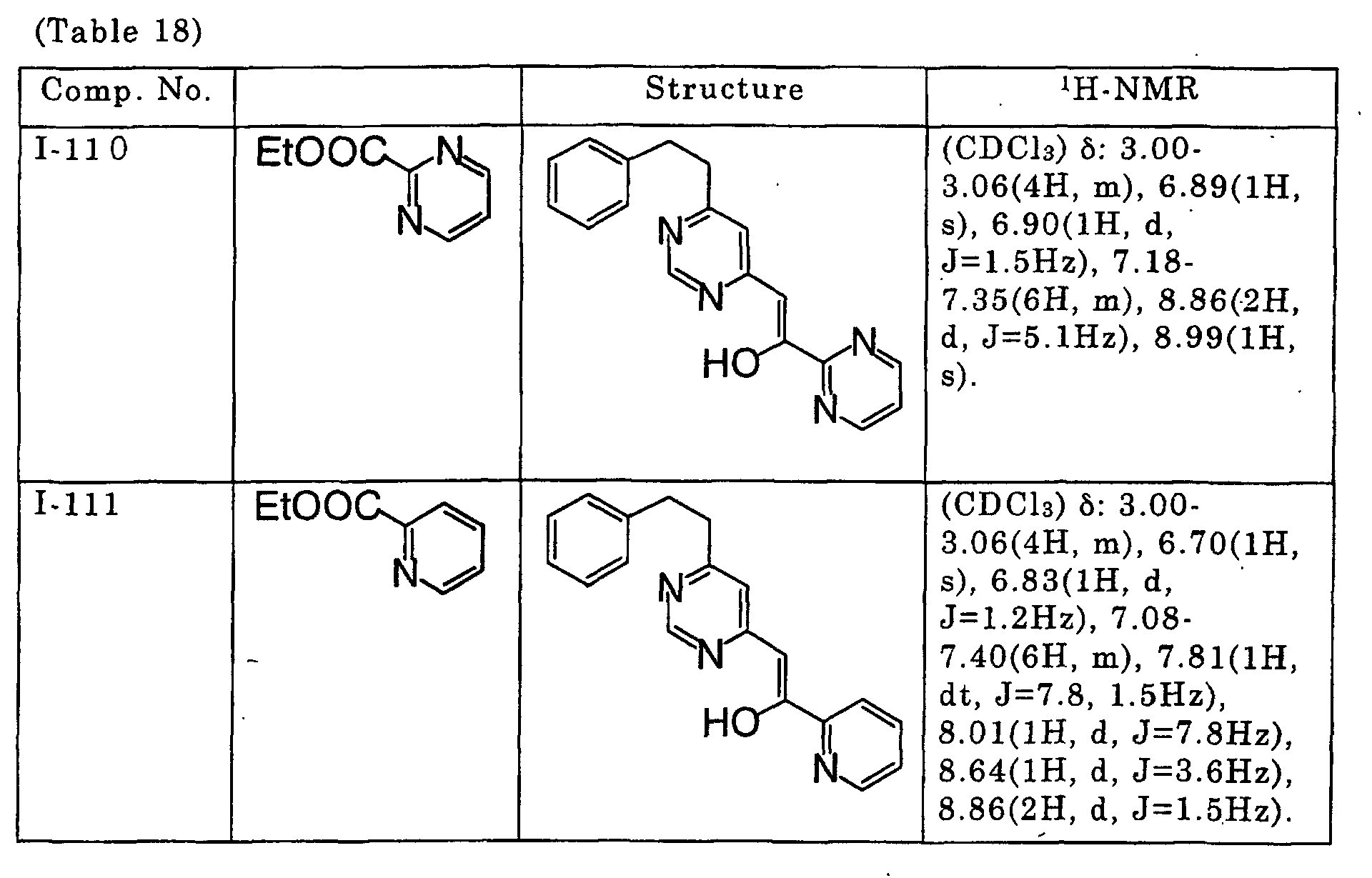
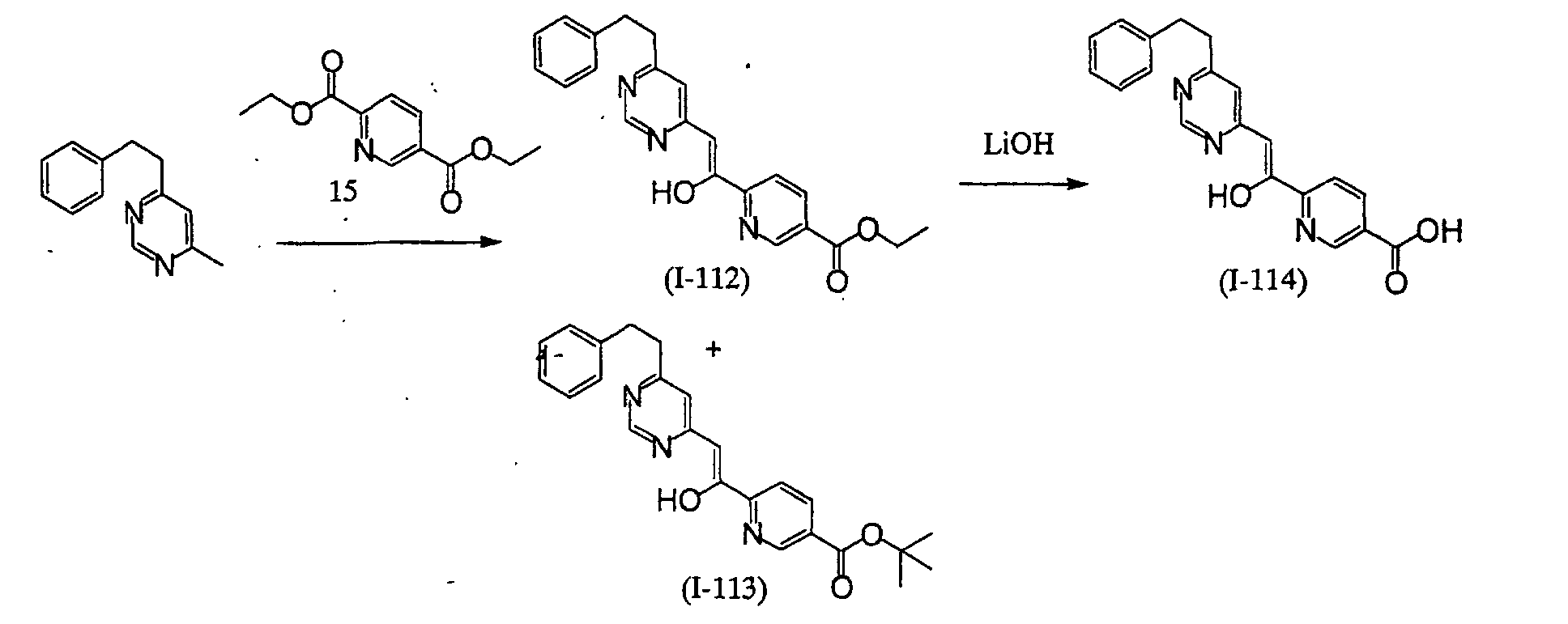
Compound (I-112)
1H-NMR(CDCl3) δ: 1.43 (3H,t,J=7.2Hz), 3.00-3.06 (4H,m), 4.44 (2H,q,J=7.2Hz), 6.81 (1H,s), 6.88 (1H,d,J=1.2Hz), 7.16-7.30 (6H,m), 8.05 (1H,dd,J=8.4,0.9Hz), 8.40 (1H,dd,J=8.4,2.4Hz), 8.90 (1H,d,J=0.9Hz), 9.21 (1H,dd,J=2.1,0.9Hz).
Compound (I-113)
1H-NMR(CDCl3) δ: 1.62 (9H,s), 6.79 (1H,s), 6.87 (1H,d,J=1.2Hz), 7.16-7.30 (6H,m), 8.03 (1H,dd,J=8.4,0.6Hz), 8.33 (1H,dd,J=8.4,2.1Hz), 8.90 (1H,d,J=0.6Hz), 9.15 (1H,dd,J=2.1,0.9Hz).
1H-NMR(d6-DMSO) δ: 6.81 (1H,s), 6.81 (1H,s), 7.16-7.35 (6H,m), 8.05 (1H,d,J=8.4Hz), 8.41 (1H,m), 8.88 (1H,s), 9.10 (1H,m).
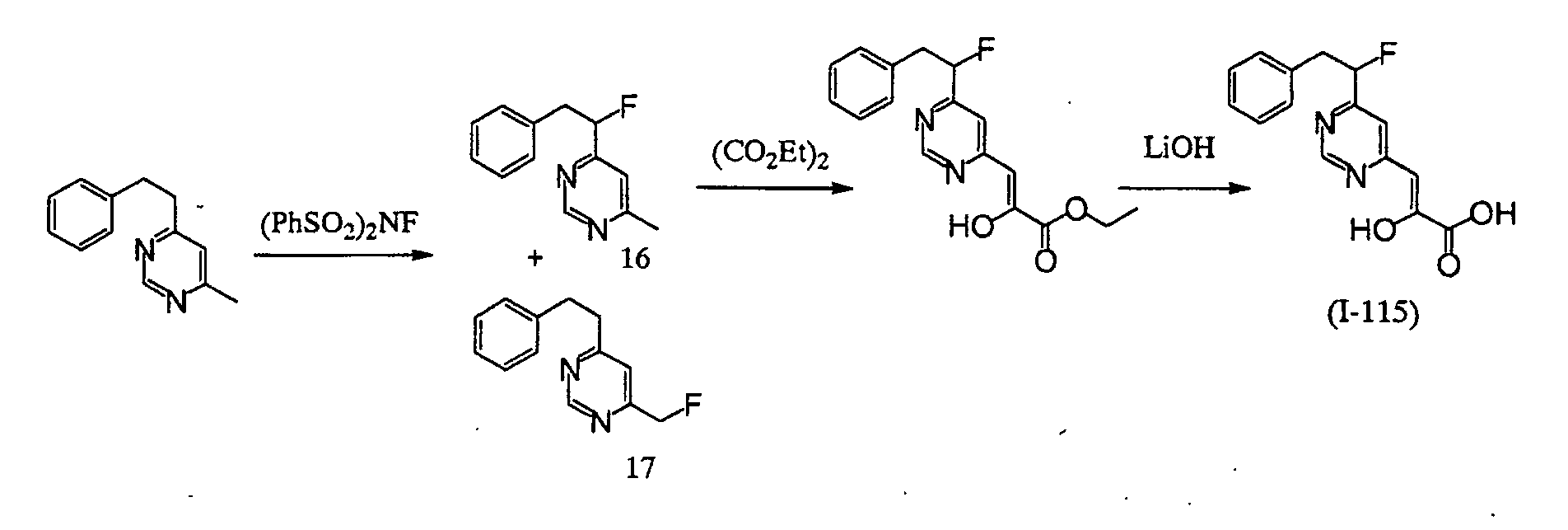
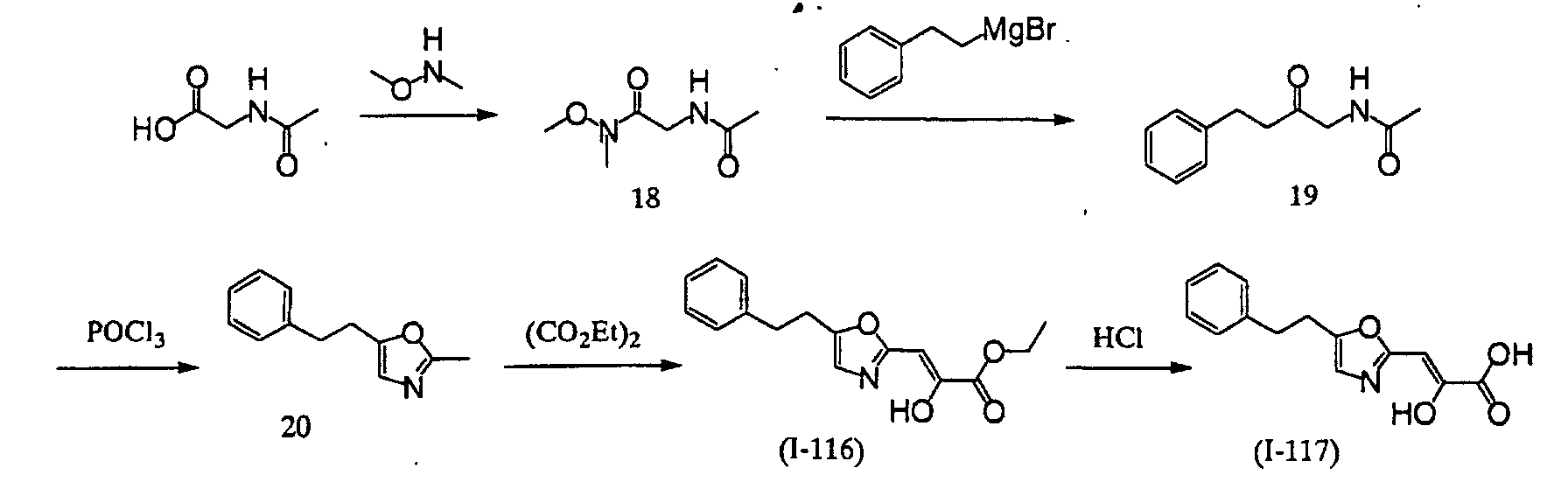
1H-NMR(CDCl3) δ: 1.39 (3H,t,J=7.2Hz), 2.99 (4H,s), 4.36 (2H,q,J=7.2Hz), 6.53 (1H,s), 6.79 (1H,s), 7.13-7.35 (5H,m).
1H-NMR(d6-DMSO) δ: 2.85-3.05 (4H,m), 6.37 (1H,s), 7.05 (1H,s), 7.10-7.32 (5H,m).

Compound (I-118)
1H-NMR(CDCl3) δ: 1.38 (3H,t,J=7.2Hz), 2.97 (2H,t,J=7.7Hz), 3.16 (2H,t,J=7.7Hz), 4.35 (2H,q,J=7.2Hz), 6.69 (1H,s), 7.15-7.38 (5H,m), 7.42 (1H,s).
Compound (I-119)
1H-NMR(d6-DMSO) δ: 2.93 (2H,t,J=8.0Hz), 3.12 (2H,t,J=8.0Hz), 6.63 (1H,s), 7.18-7.38 (5H,m), 7.48 (1H,s).
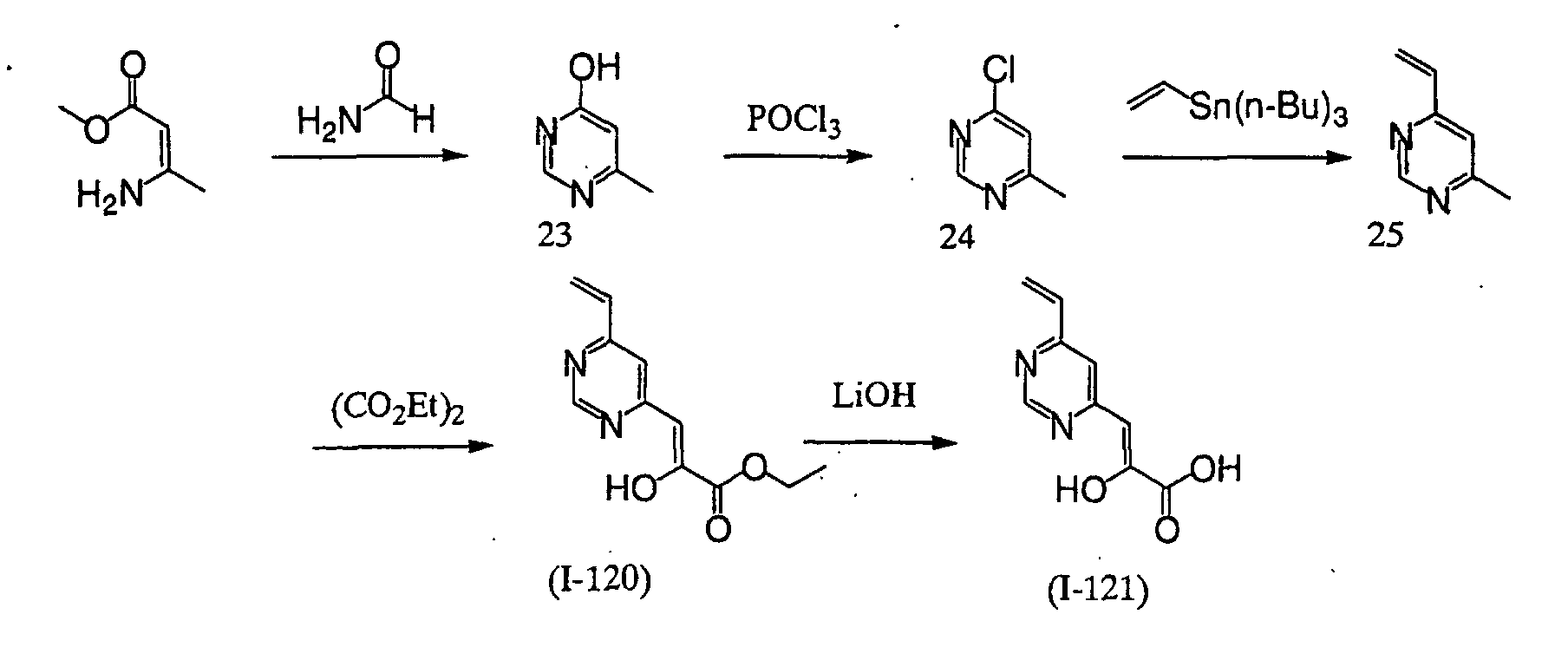
Compound (I-120)
1H-NMR(CDCl3) δ: 1.40 (3H,t,J=7.4Hz), 4.37 (2H,q,J=7.4Hz), 5.74 (1H,dd,J=10.8,1.5Hz), 6.45 (1H,s), 6.50 (1H,dd,J=17.1,1.5Hz), 6.71 (1H,dd,J=17.1,10.8Hz), 8.89 (1H,s).
Compound (I-121)
1H-NMR(d6-DMSO) δ: 5.74 (1H,d,J=11.0Hz), 6.28 (1H,s), 6.47 (1H,d,J=17.0Hz), 6.74 (1H,dd,J=11.0,17.0Hz), 7.40 (1H,s), 8.82 (1H,s).
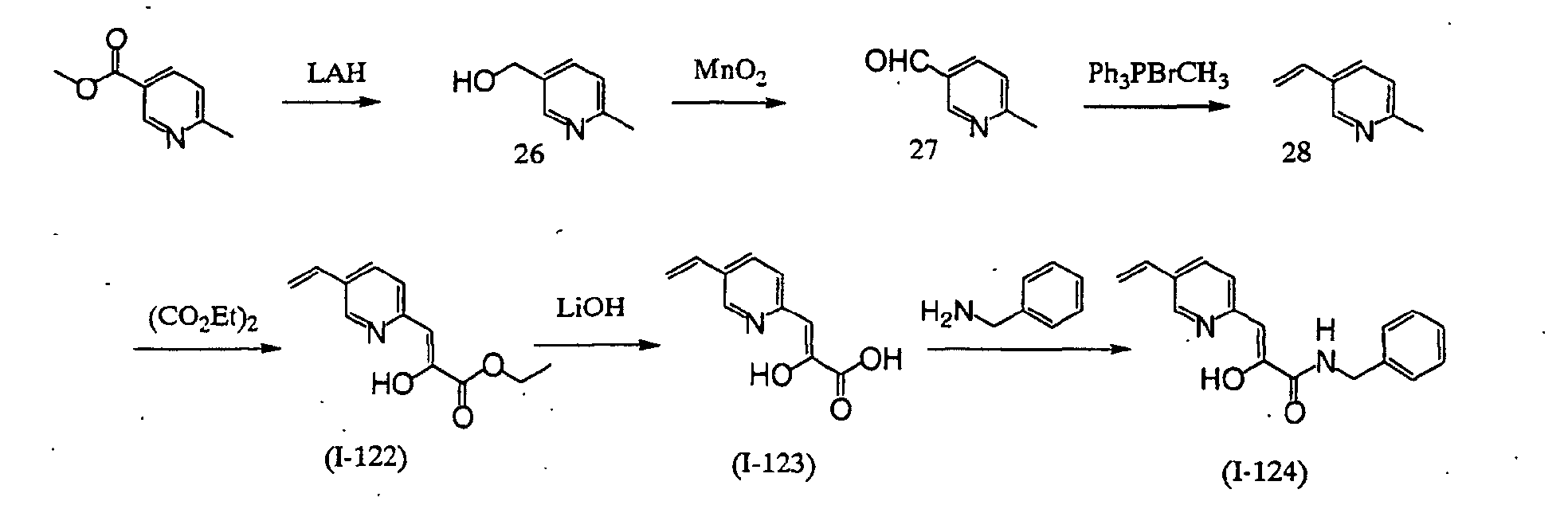
1H-NMR(CDCl3) δ: 1.40 (3H,t,J=7.1Hz), 4.36 (2H,q,J=7.1Hz), 5.40 (1H,d,J=11.0Hz), 5.83 (1H,d,J=17.6Hz), 6.56 (1H,s), 6.69 (1H,dd,J=11.0,17.6Hz), 7.18 (1H,d,J=8.2Hz), 7.79 (1H,dd,J=2.2,8.0Hz), 8.43 (1H,d,J=2.2Hz).
1H-NMR(d6-DMSO) δ: 5.42 (1H,d,J=11.3Hz), 6.01 (1H,d,J=17.7Hz), 6.56 (1H,s), 6.77 (1H,dd,J=11.3,17.7Hz), 7.50 (1H,d,J=8.5Hz), 8.07 (1H,d,J=2.1,8.5Hz), 8.60 (1H,d,J=1.8Hz).
1H-NMR(CDCl3) δ: 4.60 (2H,d,J=6.0Hz), 5.38 (1H,d,J=11.1Hz), 5.80 (1H,d,J=17.7Hz), 6.60 (1H,s), 6.66 (1H,dd,J=11.1,17.7Hz), 7.18 (1H,d,J=8.4Hz), 7.20-7.42 (5H,m), 7.78 (1H,dd,J=2.4,8.7Hz), 8.26 (1H,d,J=2.4Hz).

Compound (I-125)
1H-NMR(CDCl3) δ: 1.39 (3H,t,J=7.1Hz), 4.35 (2H,q,J=7.1Hz), 6.54 (1H,s), 7.08-7.32 (6H,m), 7.47 (1H,dd,J=2.1,7.8Hz), 8.20 (1H,d,J=2.4Hz).
Compound (I-126)
1H-NMR(d6-DMSO) δ: 2.92 (4H,s), 6.52 (1H,s), 7.15-7.31 (5H,m), 7.42 (1H,d,J=8.4Hz), 7.77 (1H,dd,J=2.1,8.1Hz), 8.36 (1H,d,J=2.1Hz).


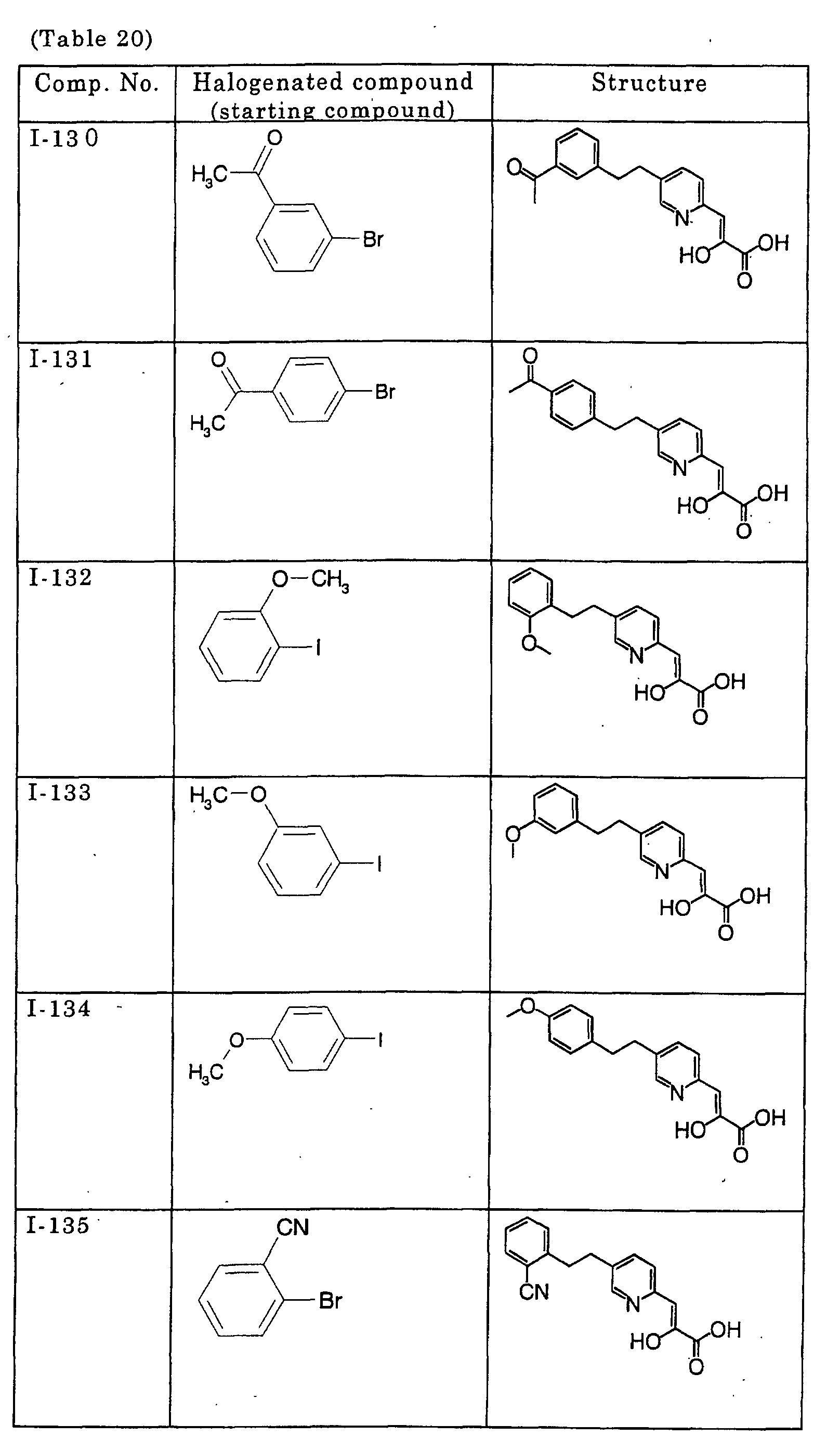


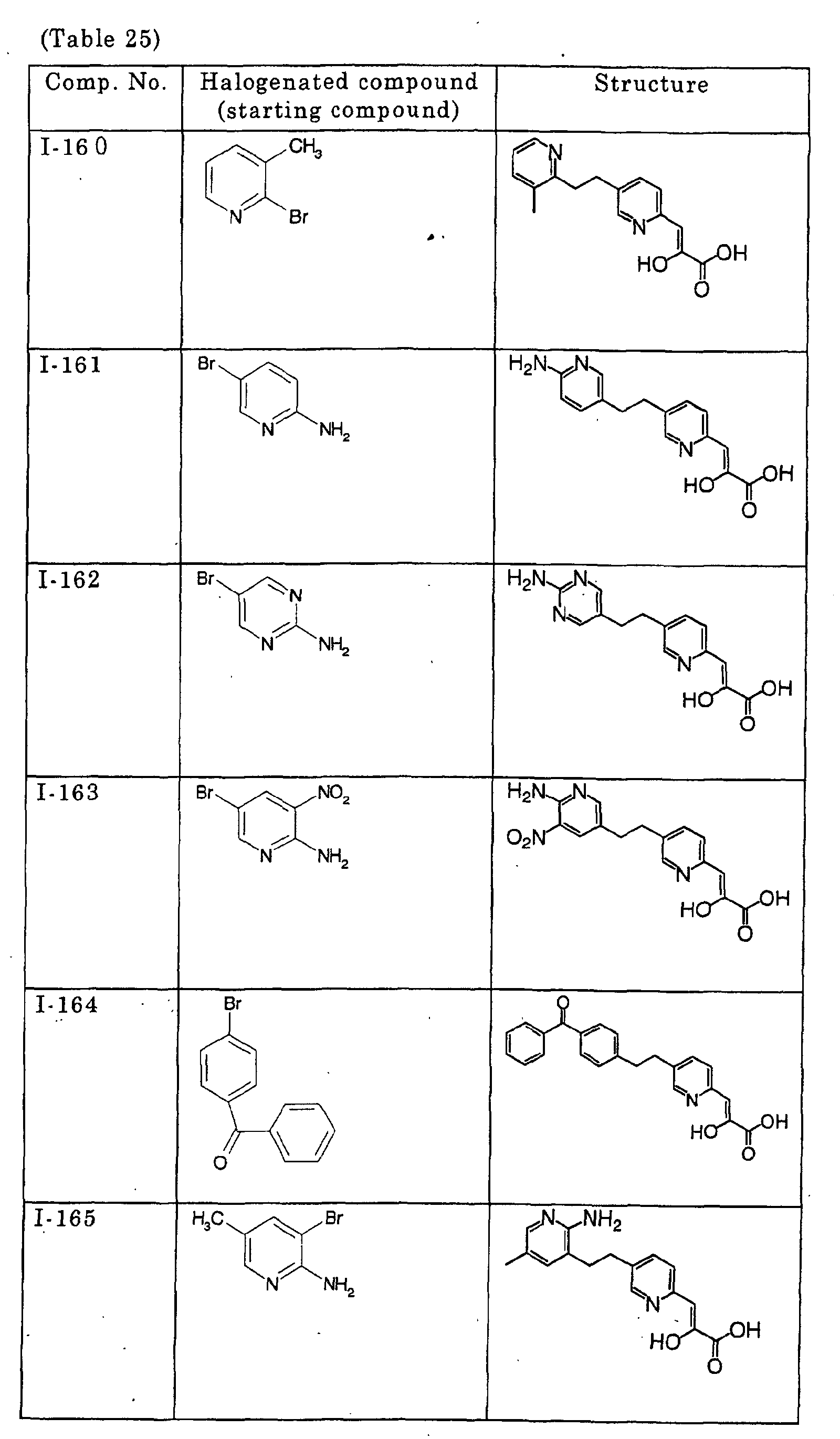
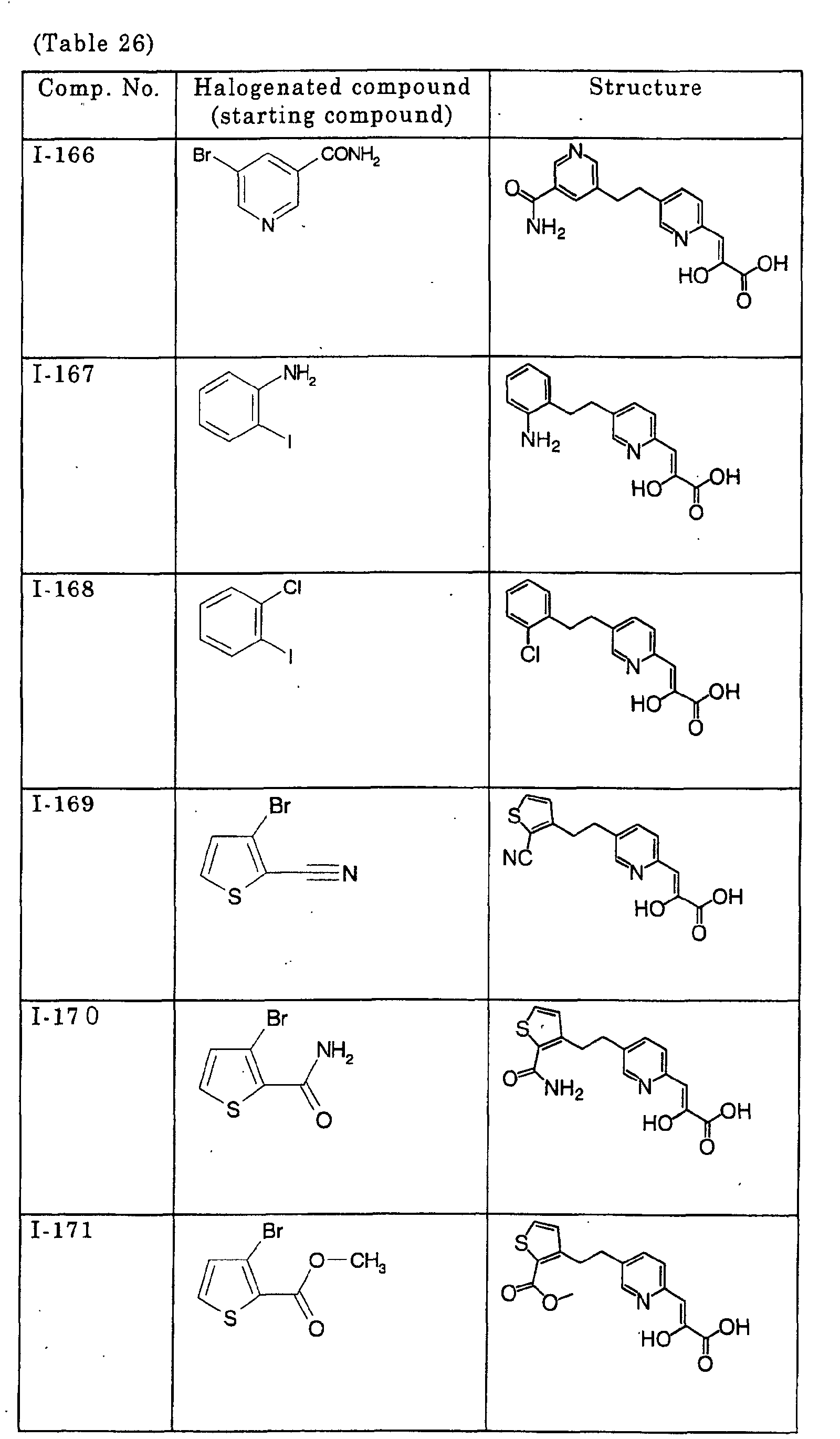
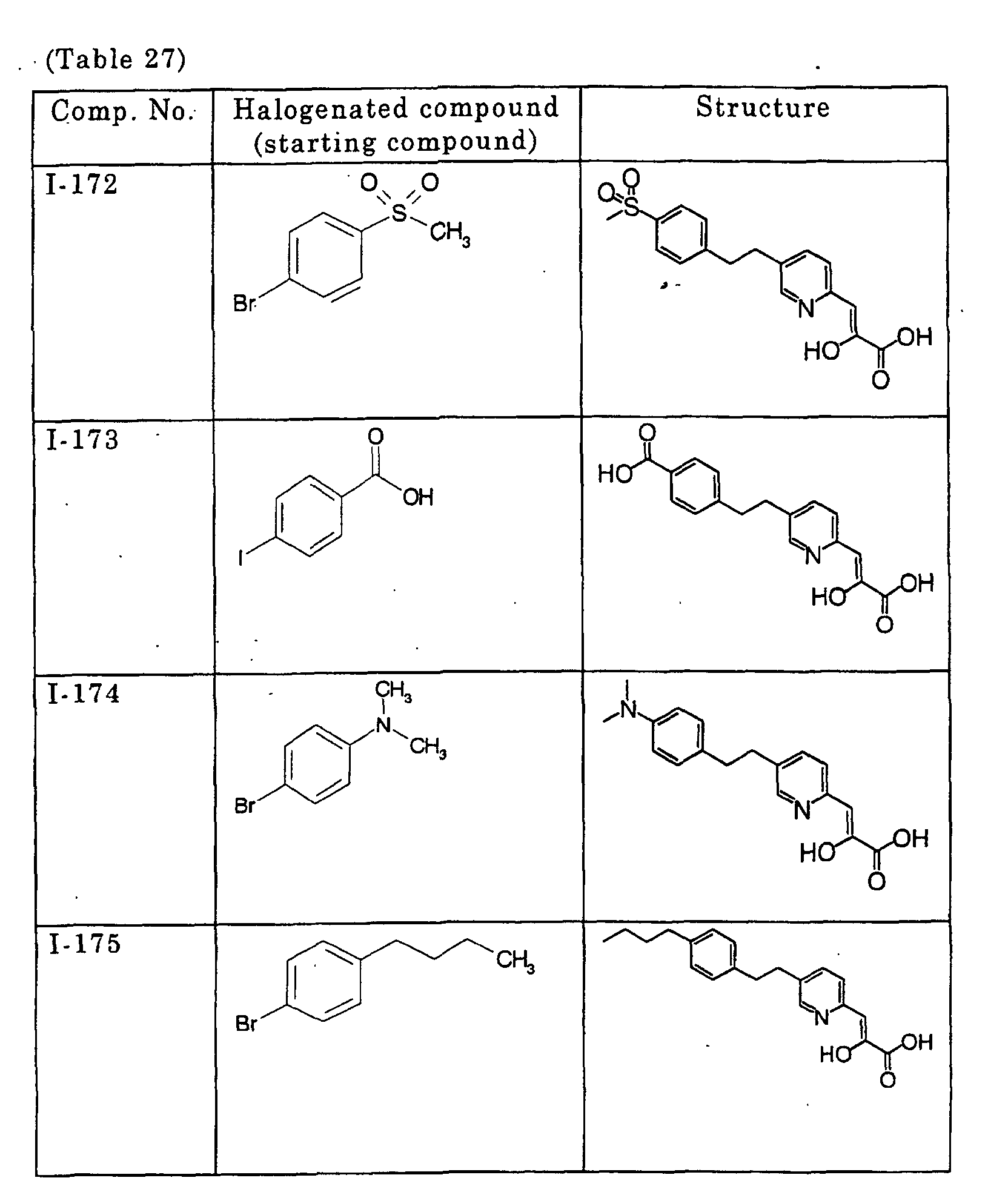

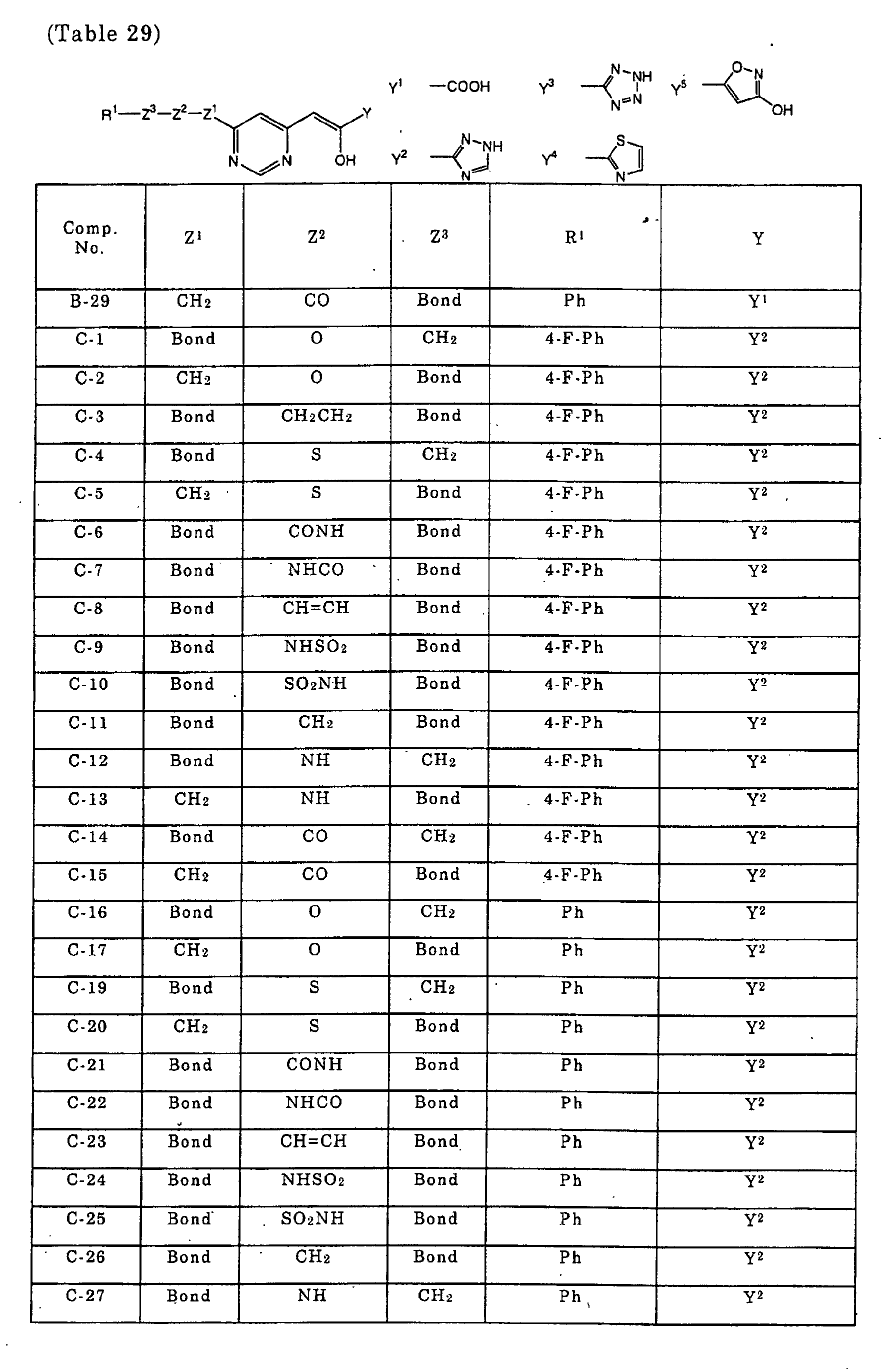
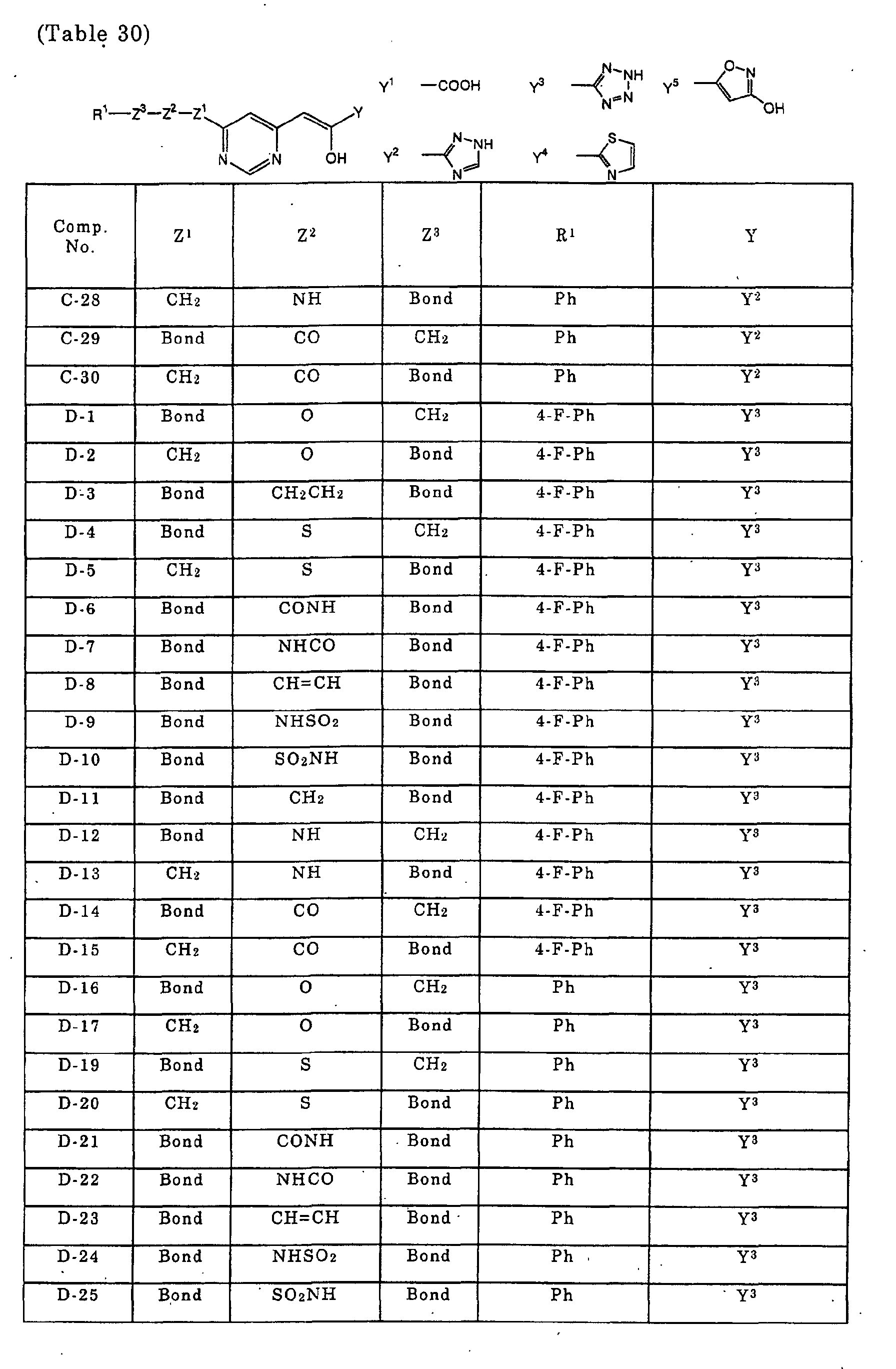
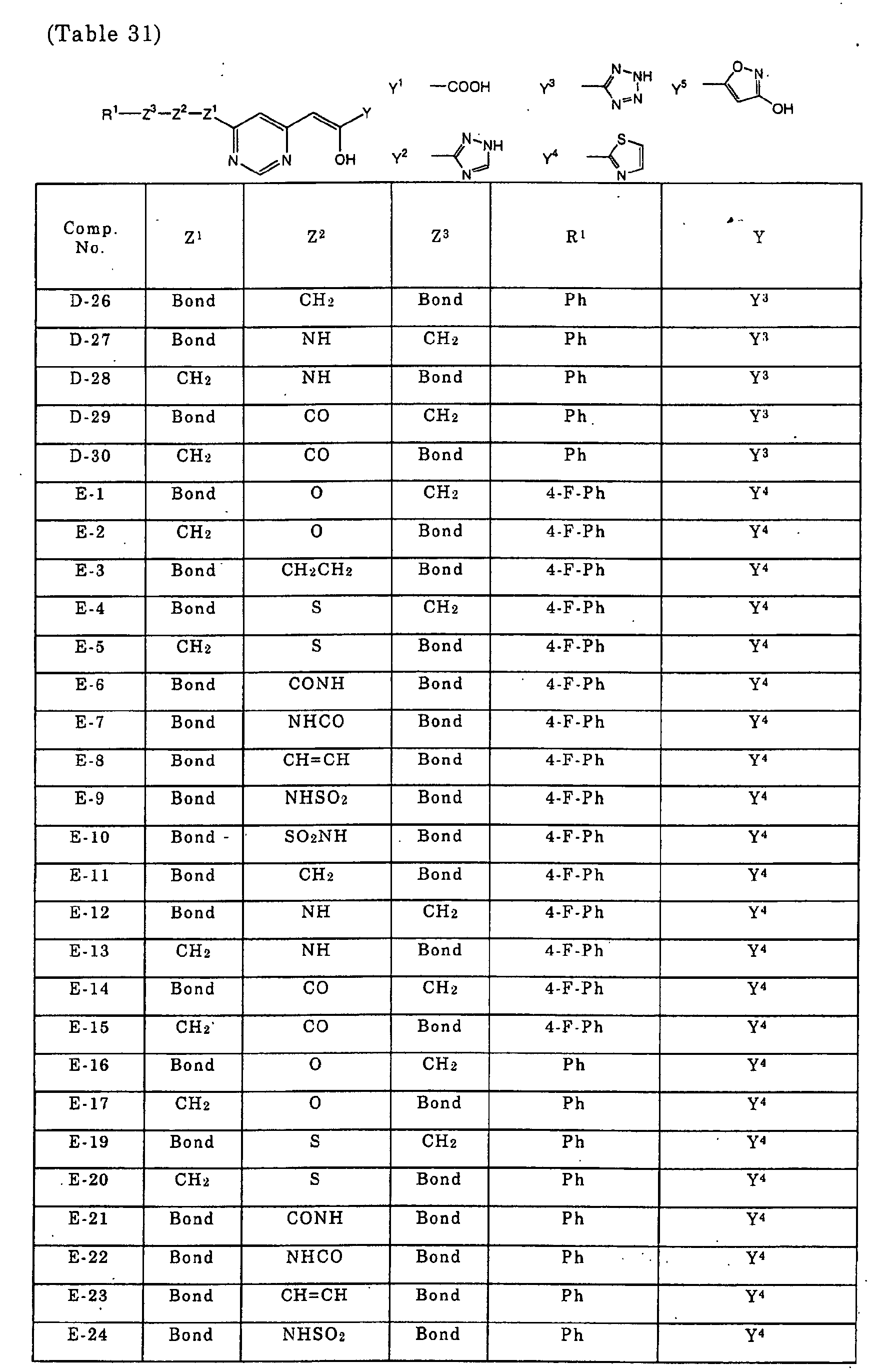

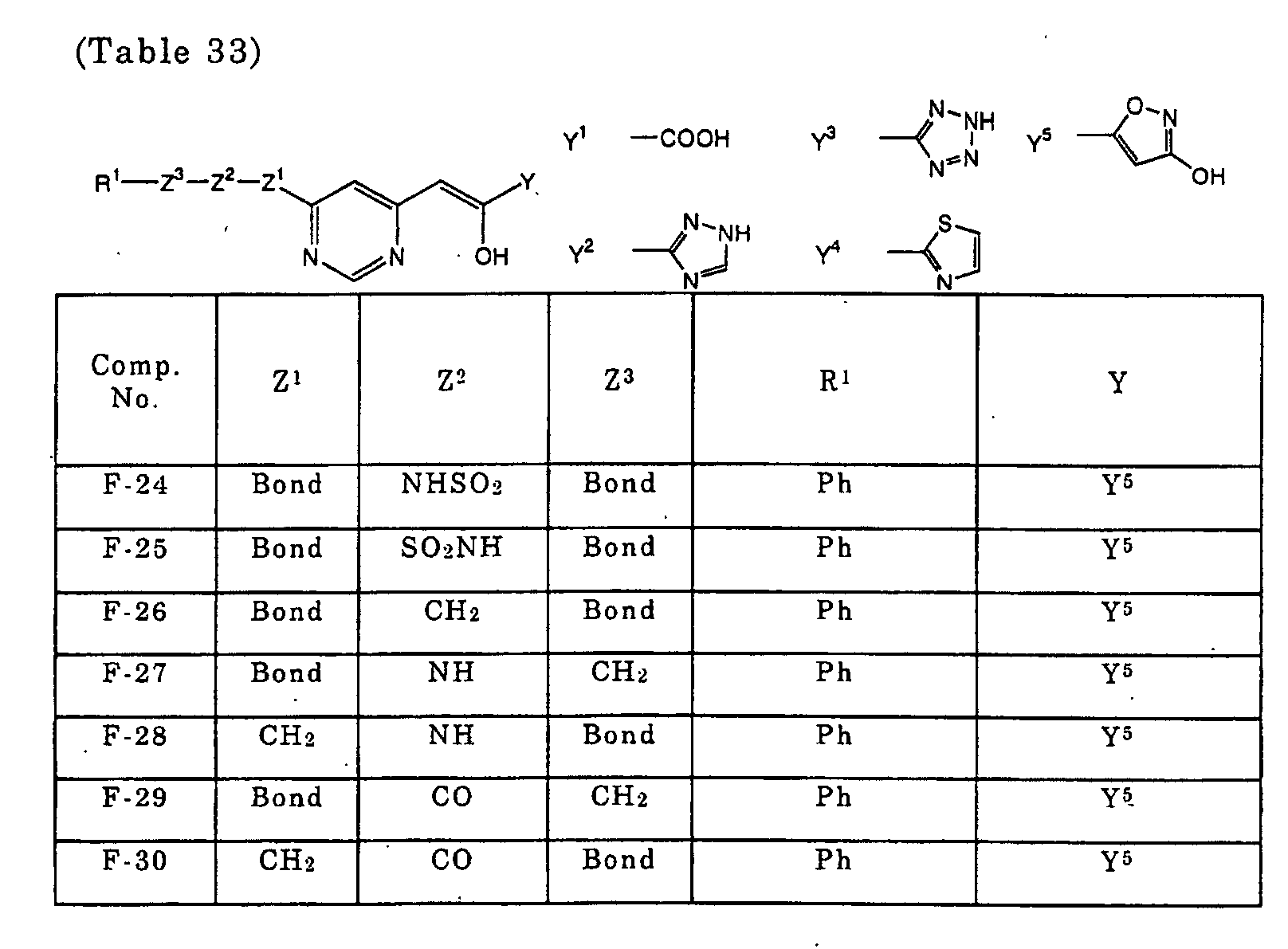
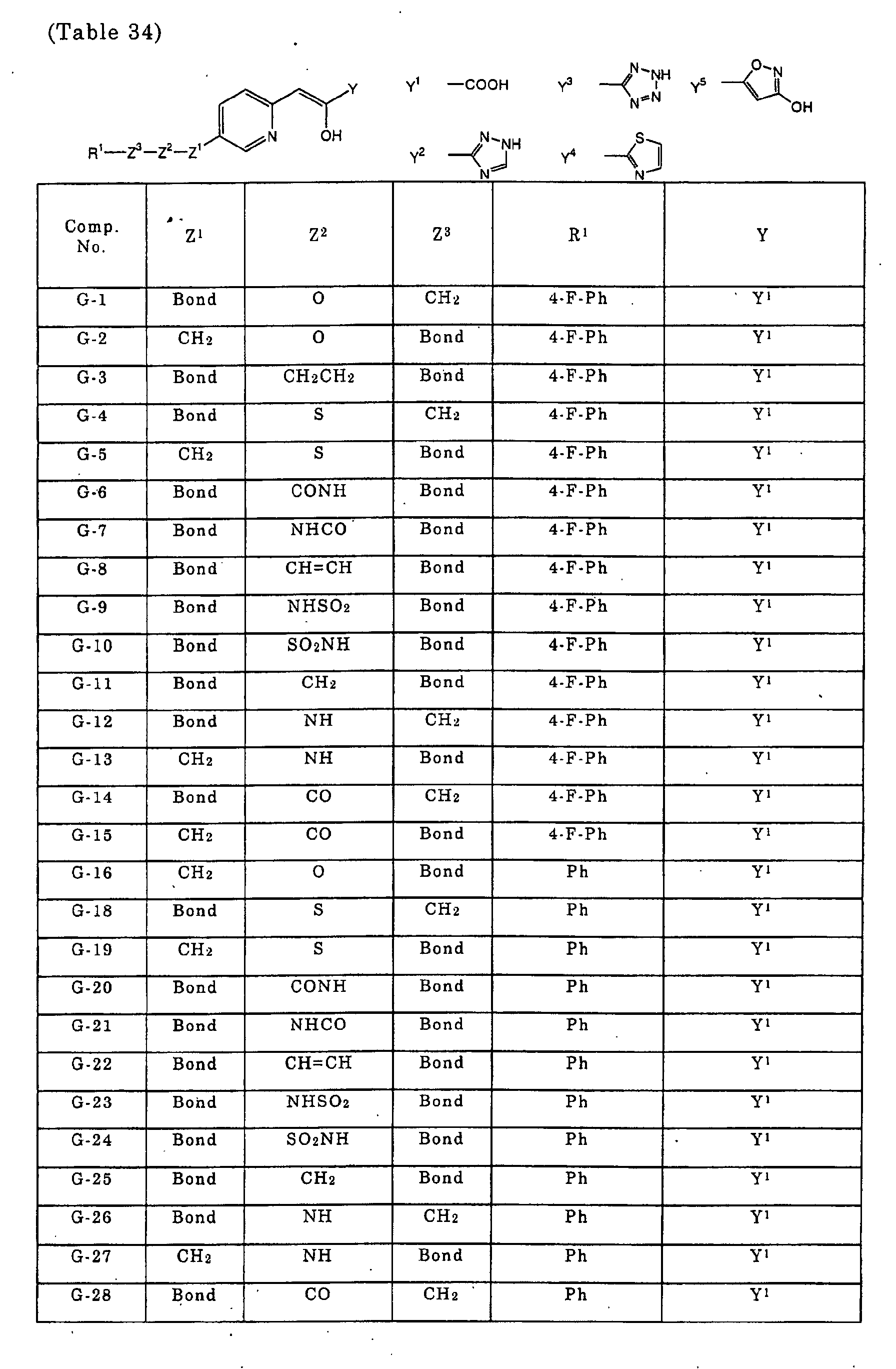


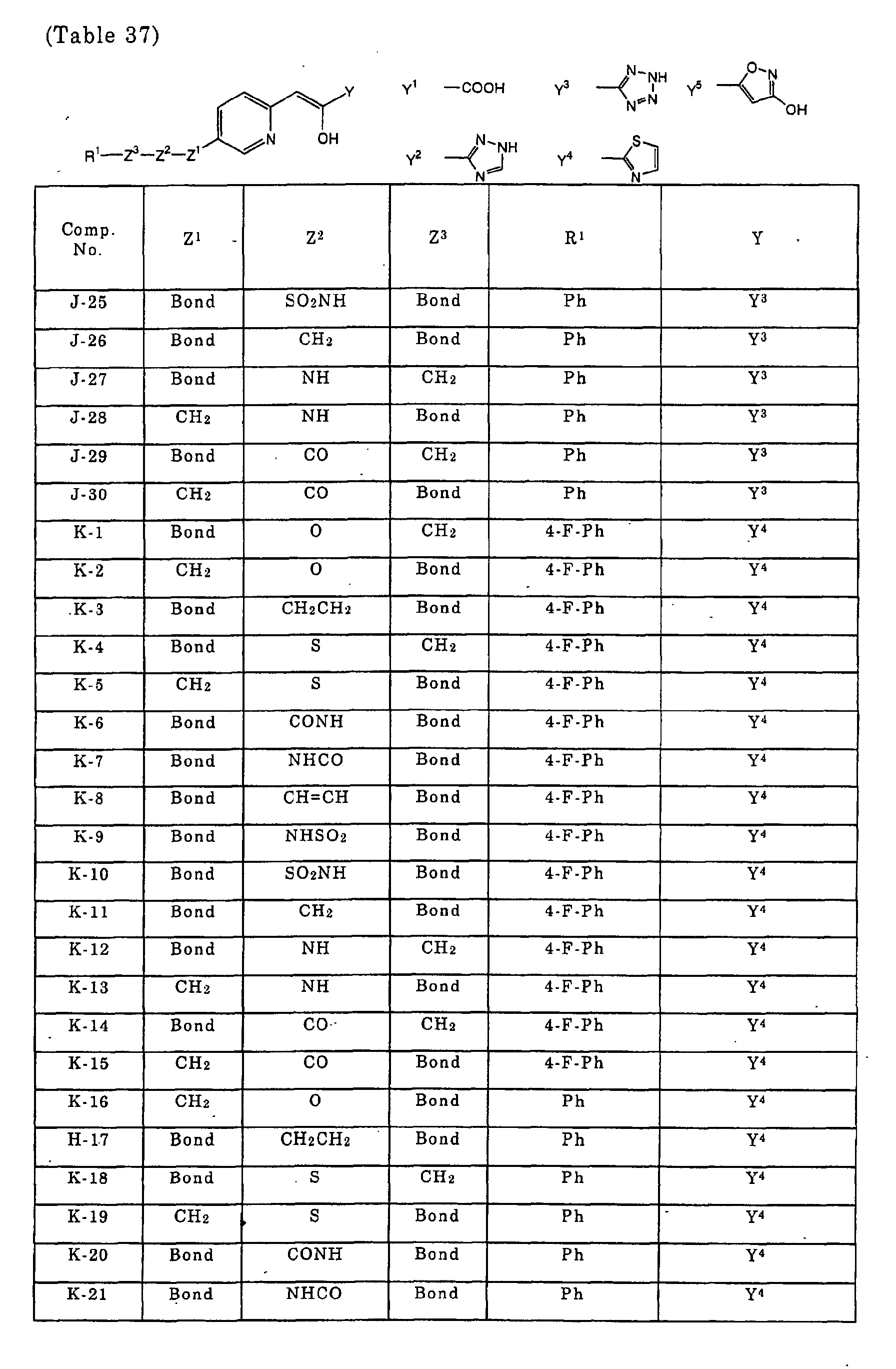


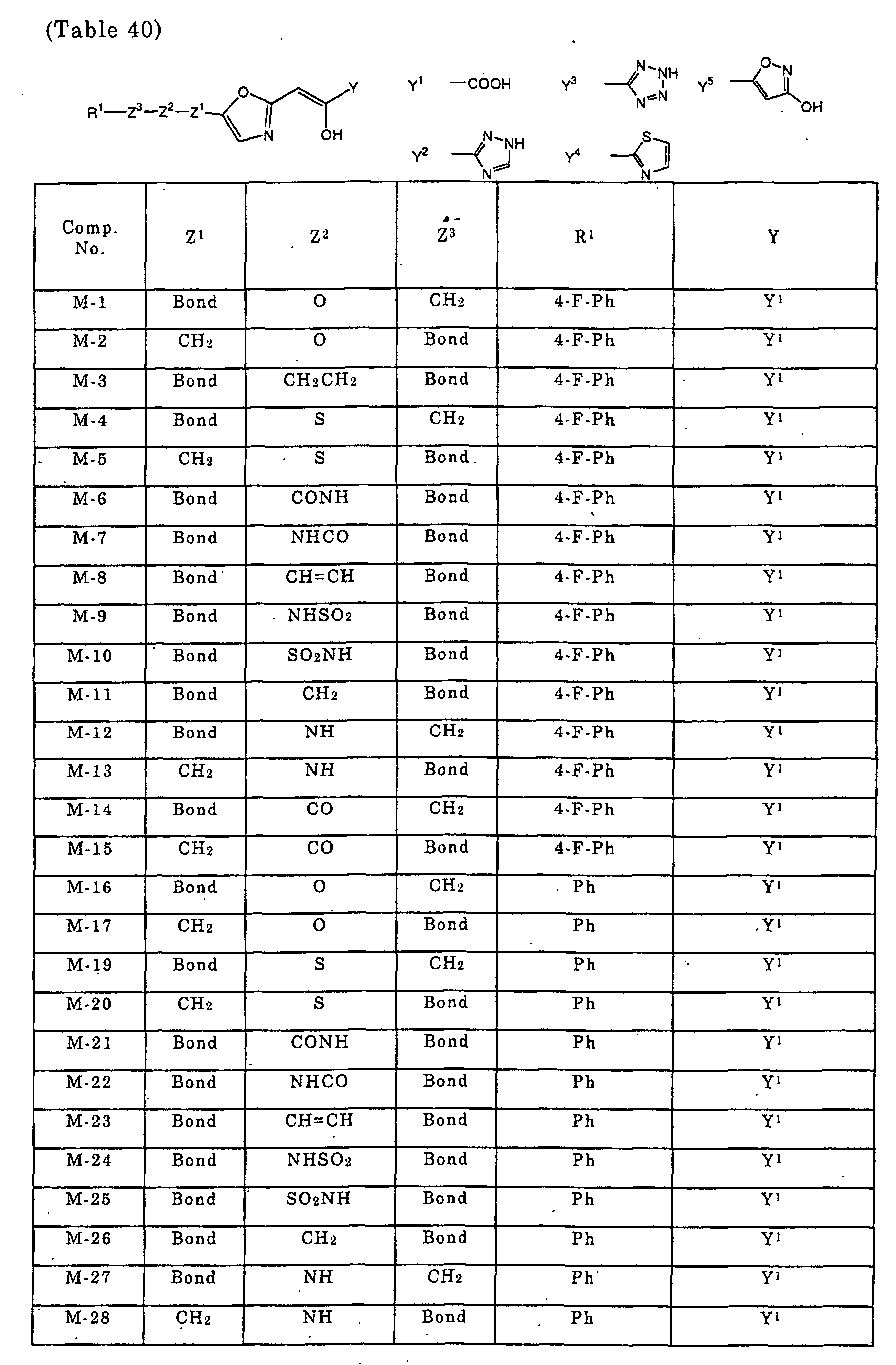


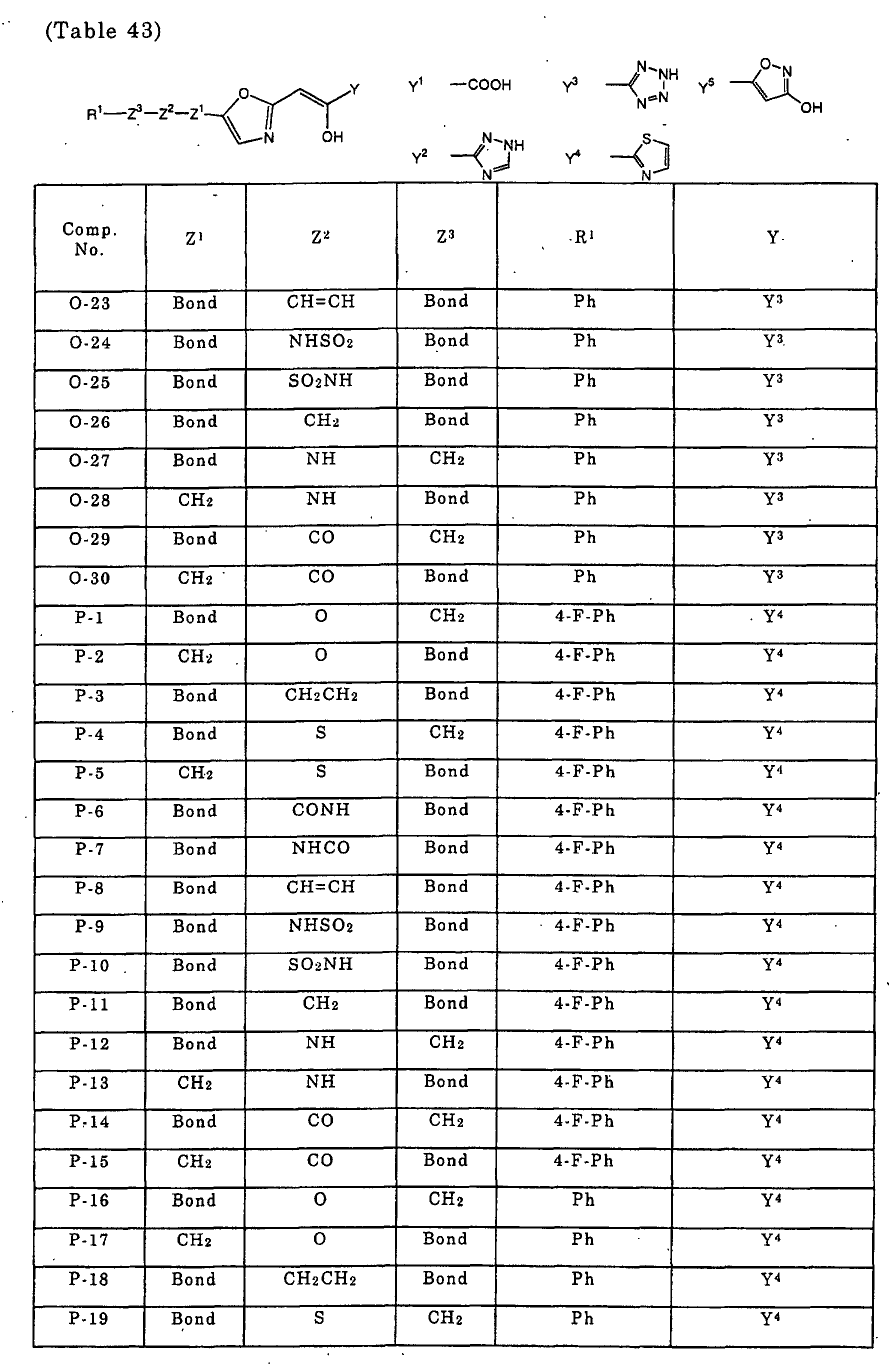



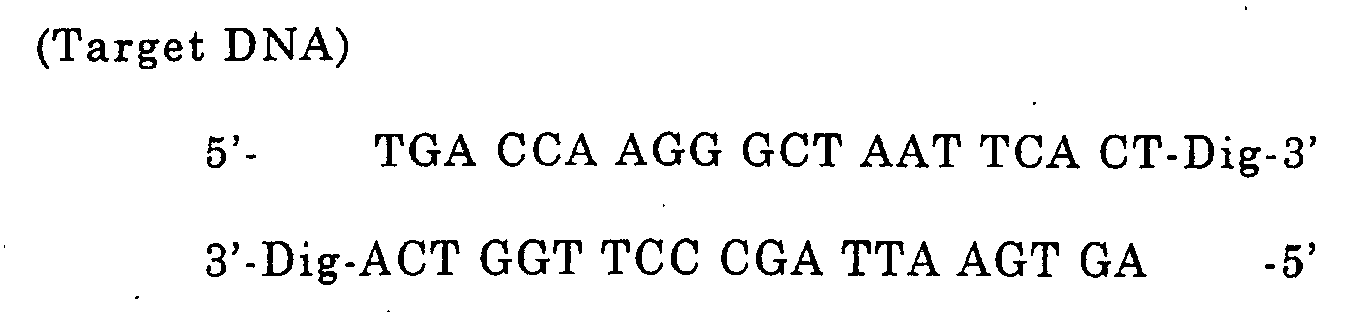

| Compound No. | IC50(µg/ml) |
| I-2 | 0.53 |
| I-3 | 0.31 |
| I-7 | 1.3 |
| I-9 | 2.9 |
| I-14 | 0.95 |
| I-15 | 3.17 |
| I-17 | 3.4 |
| I-24 | 0.3 |
| I-25 | 0.13 |
| I-27 | 0.68 |
| I-35 | 0.44 |
| I-46 | 0.55 |
| I-47 | 0.5 |
| I-49 | 5.6 |
| X-1 | >100 |
| X-2 | >100 |
| X-3 | >100 |
| Dose (mg/capsule) | |
| Active ingredient | 250 |
| 140 | |
| Starch, dried | 200 |
| Magnesium stearate | 10 |
| Total | 460 mg |
| Dose (mg/tablet) | |
| Active ingredient | 250 |
| Cellulose, microcrystals | 400 |
| Silicon dioxide, fumed | 10 |
| Stearic acid | 5 |
| Total | 665 mg |
| Weight | |
| Active ingredient | 0.25 |
| Ethanol | 25.75 |
| Propellant 22 (chlorodifluoromethane) | 74.00 |
| Total | 100.00 |
| Active ingredient | 60 mg |
| Starch | 45 mg |
| Microcrystals cellulose | 35 mg |
| Polyvinylpyrrolidone (as 10% solution in water) | 4 mg |
| Sodium carboxymethyl starch | 4.5 mg |
| Magnesium stearate | 0.5 mg |
| Talc | 1 mg |
| Total | 150 mg |
| Active ingredient | 80 mg |
| Starch | 59 mg |
| Microcrystals cellulose | 59 mg |
| Magnesium stearate | 2 mg |
| Total | 200 mg |
| Active ingredient | 225 mg |
| Saturated fatty acid glycerides | 2000 mg |
| Total | 2225 mg |
| Active ingredient | 50 mg |
| Sodium carboxymethyl cellulose | 50 mg |
| Syrup | 1.25 ml |
| Benzoic acid solution | 0.10 ml |
| Flavor | q.v. |
| Color | q.v. |
| Purified water to total | 5 ml |
| Active ingredient | 100 mg |
| Isotonic saline | 1000 ml |
Claims (24)
- A pharmaceutical composition having an integrase-inhibiting activity which comprises as an active ingredient a compound of the formula (I):wherein
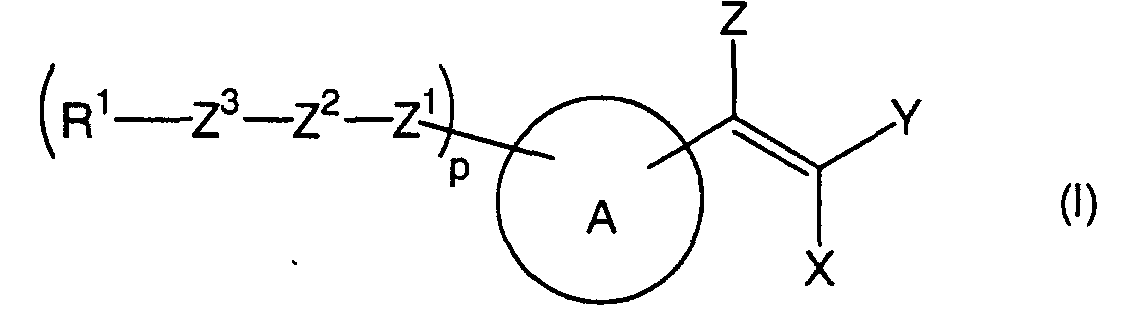 X is hydroxy or optionally substituted amino;Y is -C(=R2)-R3-R4 wherein R2 is oxygen atom or sulfur atom, R3 is oxygen atom, sulfur atom or N-R5, R4 is hydrogen, optionally substituted alkyl, optionally substituted alkenyl, optionally substituted alkynyl or optionally substituted aralkyl and R5 is hydrogen, optionally substituted alkyl, optionally substituted alkenyl, optionally substituted alkynyl, optionally substituted alkoxy, optionally substituted cycloalkyl or optionally substituted aralkyl, or R4 and R5 may be taken together with the adjacent nitrogen atom to form optionally substituted non-aromatic heterocyclic group;
-S(=O)q-R6-R7 wherein R6 is oxygen atom or N-R7, R7 each is independently hydrogen, optionally substituted alkyl, optionally substituted alkenyl, optionally substituted alkynyl or optionally substituted aralkyl and q is 1 or 2;
-S(=O)q-R8 wherein R8 is optionally substituted alkyl, optionally substituted alkenyl, optionally substituted alkynyl or optionally substituted aralkyl and q is as defined above;
-P(=O)(OR9)2 wherein. R9 each is independently hydrogen or optionally substituted alkyl;
halogenated alkyl or optionally substituted heteroaryl;Z is hydrogen, optionally substituted alkyl or optionally substituted aralkyl;Z1 and Z3 each is independently a bond, alkylene or alkenylene;Z2 is a bond, alkylene, alkenylene, -CH(OH)-, -S-, -SO-, -SO2-, -SO2NR10-, -NR10SO2-, -O-, -NR10-, -NR10CO-, -CONR10-, -C(=O)-O-, -O-C(=O)- or -CO-;R10 is hydrogen, optionally substituted alkyl, optionally substituted alkenyl, optionally substituted alkynyl or optionally substituted aralkyl;R1 is optionally substituted alkyl, optionally substituted alkenyl, optionally substituted alkynyl, optionally substituted cycloalkyl, optionally substituted cycloalkenyl, optionally substituted non-aromatic heterocyclic group, optionally substituted aryl or optionally substituted heteroaryl;p is 0 to 2, provided that when p is 2, the groups of the formula: -Z1-Z2-Z3-R1 may be different from each other; andring (A) is optionally substituted aromatic heterocycle, a tautomer of itself, a prodrug thereof, a pharmaceutically acceptable salt thereof or a solvate thereof. - The pharmaceutical composition having an integrase-inhibiting activity according to claim 1 wherein the group of the formula: -C(Z)=C(X)Y in the formula (I) substitutes at an atom adjacent to a hetero atom in ring (A).
- The pharmaceutical composition having an integrase-inhibiting activity according to claim 1 or 2 wherein Y is optionally substituted heteroaryl; and the heteroaryl has a bond at an atom adjacent to a hetero atom in Y.
- The pharmaceutical composition having an integrase-inhibiting activity according to claim 1 or 2 wherein X is hydroxy and
Y is -C(=R2)-R3-R4 wherein R2 is oxygen atom, R3 is oxygen atom or N-R5, R4 is hydrogen, optionally substituted alkyl, optionally substituted alkenyl, optionally substituted alkynyl or optionally substituted aralkyl, R5 is hydrogen, optionally substituted alkyl, optionally substituted alkenyl, optionally substituted alkynyl, optionally substituted alkoxy, optionally substituted cycloalkyl or optionally substituted aralkyl, or R4 and R5 may be taken together with the adjacent nitrogen atom to form optionally substituted non-aromatic heterocyclic group;
optionally substituted tetrazolyl; optionally substituted triazolyl; optionally substituted thiazolyl; optionally substituted isoxazolyl; optionally substituted pyrazinyl; optionally substituted imidazolyl; optionally substituted pyrimidinyl or optionally substituted pyridyl. - The pharmaceutical composition having an integrase-inhibiting activity according to any one of claims 1 to 4 wherein ring (A) is optionally substituted pyridine, optionally substituted pyrazine, optionally substituted pyrimidine, optionally substituted oxazole, optionally substituted thiadiazole, optionally substituted quinoline, optionally substituted isoquinoline, optionally substituted purine, optionally substituted benzoxazole or optionally substituted benzimidazole.
- The pharmaceutical composition having an integrase-inhibiting activity according to any one of claims 1 to 5 wherein p is 1; Z1 and Z3 each is independently a bond or alkylene; Z2 is a bond, alkylene or -O- and R1 is optionally substituted alkyl, optionally substituted cycloalkyl, optionally substituted aryl or optionally substituted heteroaryl.
- A compound of the formula (I):wherein
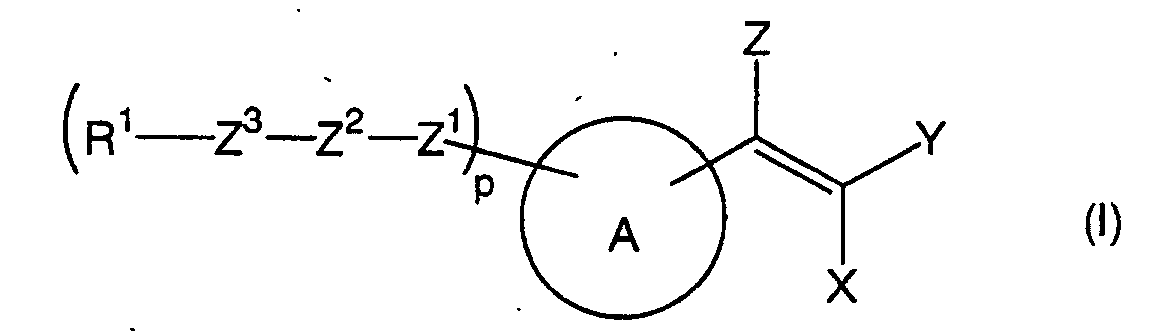 the group of the formula: -C(Z)=C(X)Y in the formula (I) substitutes at an atom adjacent to a hetero atom in ring (A);X is hydroxy or optionally substituted amino;Y is -C(=R2)-R3-R4 wherein R2 is oxygen atom or sulfur atom, R3 is oxygen atom, sulfur atom or N-R5, R4 is hydrogen, optionally substituted alkyl, optionally substituted alkenyl, optionally substituted alkynyl or optionally substituted aralkyl and R5 is hydrogen, optionally substituted alkyl, optionally substituted alkenyl, optionally substituted alkynyl, optionally substituted alkoxy, optionally substituted cycloalkyl or optionally substituted aralkyl, or R4 and R5 may be taken together with the adjacent nitrogen atom to form optionally substituted non-aromatic heterocyclic group;
-S(=O)q-R6-R7 wherein R6 is oxygen atom or N-R7, R7 each is independently hydrogen, optionally substituted alkyl, optionally substituted alkenyl, optionally substituted alkynyl or optionally substituted aralkyl and q is 1 or 2;
-S(=O)q-R8 wherein R8 is optionally substituted alkyl, optionally substituted alkenyl, optionally substituted alkynyl or optionally substituted aralkyl and q is as defined above;
-P(=O)(OR9)2 wherein R9 each is independently hydrogen or optionally substituted alkyl;
halogenated alkyl or optionally substituted heteroaryl;Z is hydrogen, optionally substituted alkyl or optionally substituted aralkyl;Z1 and Z3 each is independently a bond, alkylene or alkenylene;Z2 is a bond, alkylene, alkenylene, -CH(OH)-, -S-, -SO-, -SO2-, -SO2NR10-, -NR10SO2-, -O-, -NR10-, -NR10CO-, -CONR10-, -C(=O)-O-, -O-C(=O)- or -CO-;R10 is hydrogen, optionally substituted alkyl,-optionally substituted alkenyl, optionally substituted alkynyl or optionally substituted aralkyl;R1 is optionally substituted branched alkyl, optionally substituted alkenyl, optionally substituted alkynyl, optionally substituted cycloalkyl, optionally substituted cycloalkenyl, optionally substituted non-aromatic heterocyclic group, optionally substituted aryl or optionally substituted heteroaryl;p is 1 to 2, provided that when p is 2, the groups of the formula:-Z1-Z2-Z3-R1 are different from each other;ring (A) is optionally substituted aromatic heterocycle; and
provided compounds wherein X is hydroxy; Y is -C(=R2)-R3-R4 wherein R2 is oxygen atom, R3 is oxygen atom, R4 is hydrogen, methyl or ethyl, Z is hydrogen, Z1, Z2 and Z3 is a bond, R1 is unsubstituted phenyl, p is 1 and ring (A) is optionally substituted pyridine or optionally substituted pyrazole are excluded, a tautomer of itself, a prodrug thereof, a pharmaceutically acceptable salt thereof or a solvate thereof. - The compound according to claim 7 wherein Y is optionally substituted heteroaryl; and the heteroaryl has a bond at an atom adjacent to a hetero atom in Y, a tautomer of itself, a prodrug thereof, a pharmaceutically acceptable salt thereof or a solvate thereof.
- The compound according to claim 7 or 8 whereinoptionally substituted tetrazolyl; optionally substituted triazolyl; optionally substituted thiazolyl; optionally substituted isoxazolyl; optionally substituted pyrazinyl; optionally substituted imidazolyl; optionally substituted pyrimidinyl or optionally; substituted pyridyl, a tautomer of itself, a prodrug thereof, a pharmaceutically acceptable salt thereof or a solvate thereof.X is hydroxy;Y is -C(=R2)-R3-R4 wherein R2 is oxygen atom, R3 is oxygen atom or N-R5, R4 is hydrogen, optionally substituted alkyl, optionally substituted alkenyl, optionally substituted alkynyl or optionally substituted aralkyl and R5 is hydrogen, optionally substituted alkyl, optionally substituted alkenyl, optionally substituted alkynyl, optionally substituted alkoxy, optionally substituted cycloalkyl or optionally substituted aralkyl, or R4 and R5 may be taken together with the adjacent nitrogen atom to form optionally substituted non-aromatic heterocyclic group;
- The compound according to any one of claims 7 to 9 wherein ring (A) is optionally substituted aromatic heterocycle containing nitrogen atom, a tautomer of itself, a prodrug thereof, a pharmaceutically acceptable salt thereof or a solvate thereof.
- The compound according to any one of claims 7 to 10 wherein ring (A) is optionally substituted pyridine, optionally substituted pyrazine, optionally substituted pyrimidine, optionally substituted oxazole, optionally substituted thiadiazole, optionally substituted quinoline, optionally substituted isoquinoline, optionally substituted purine, optionally substituted benzoxazole or optionally substituted benzimidazole, a tautomer of itself, a prodrug thereof, a pharmaceutically acceptable salt thereof or a solvate thereof.
- The compound according to any one of claims 7 to 11 wherein Z2 is a bond, alkylene or -O-, a tautomer of itself, a prodrug thereof, a pharmaceutically acceptable salt thereof or a solvate thereof.
- The compound according to any one of claims 7 to 12 wherein Z1 and Z3 each is independently a bond or alkylene and R1 is optionally substituted branched alkyl, optionally substituted cycloalkyl, optionally substituted non-aromatic heterocyclic group, optionally substituted aryl or optionally substituted heteroaryl, a tautomer of itself, a prodrug thereof, a pharmaceutically acceptable salt thereof or a solvate thereof.
- The compound according to any one of claims 7 to 13 wherein Z1 is a bond; Z2 is alkylene or -O-; Z3 is a bond or alkylene; and ring (A) is optionally substituted pyridine, a tautomer of itself, a prodrug thereof, a pharmaceutically acceptable salt thereof or a solvate thereof.
- A compound of the formula (XIIc):wherein ring (A) is optionally substituted aromatic heterocycle; R1 is heteroaryl or aryl; P is hydroxy, carboxy, halogen, halogenated alkyl, alkyl, alkenyl, alkynyl, cycloalkyl, cycloalkenyl, alkoxy, alkoxycarbonyl, nitro, nitroso, optionally substituted amino, azido, aryl, aralkyl, cyano, isocyano, isocyanato, thiocyanato, isothiocyanato, mercapto, alkylthio, alkylsulfonyl, optionally substituted carbamoyl, sulfamoyl, acyl, formyloxy, haloformyl, oxalo, mercapto, thioformyl, thiocarboxy, dithiocarboxy, thiocarbamoyl, sulfino, sulfo, sulfoamino, hydrazino, azido, ureido, amidino or guanidino; and t is 0 to 5.

- A library of the compounds according to claim 15.
- A pharmaceutical composition which comprises as an active ingredient the compound according to any one of claims 7 to 15, a tautomer of itself, a prodrug thereof, a pharmaceutically acceptable salt thereof or a solvate thereof.
- A pharmaceutical composition useful for an anti-viral agent which comprises as an active ingredient the compound according to any one of claims 7 to 15, a tautomer of itself, a prodrug thereof, a pharmaceutically acceptable salt thereof or a solvate thereof.
- A pharmaceutical composition useful for an anti-HIV agent which comprises as an active ingredient the compound according to any one of claims 7 to 15, a tautomer of itself, a prodrug thereof, a pharmaceutically acceptable salt thereof or a solvate thereof.
- A pharmaceutical composition having an integrase-inhibiting activity comprises as an active ingredient the compound according to any one of claims 7 to 15, a tautomer of itself, a prodrug thereof, a pharmaceutically acceptable salt thereof or a solvate thereof.
- An anti-HIV medical mixture which comprises a reverse transcriptase inhibitor and/or a protease inhibitor in addition to the integrase inhibitor according to any one of claims 1 to 6 and 20.
- The pharmaceutical composition according to any one of claims 1 to 6 and 20 which enhances an anti-HIV activity of a reverse transcriptase inhibitor and/or a protease inhibitor.
- A method for treating AIDS or AIDS-related complication which comprises administering the integrase inhibitor according to any one of claims 1 to 6 and 20.
- Use of the compound according to any one of claims 1 to 6 and 20 for the manufacture of a pharmaceutical composition having an integrase-inhibiting activity.
Applications Claiming Priority (3)
| Application Number | Priority Date | Filing Date | Title |
|---|---|---|---|
| JP24820699 | 1999-09-02 | ||
| JP24820699 | 1999-09-02 | ||
| PCT/JP2000/005754 WO2001017968A1 (en) | 1999-09-02 | 2000-08-25 | Integrase inhibitors containing aromatic heterocycle derivatives |
Publications (3)
| Publication Number | Publication Date |
|---|---|
| EP1219607A1 true EP1219607A1 (en) | 2002-07-03 |
| EP1219607A4 EP1219607A4 (en) | 2004-10-06 |
| EP1219607B1 EP1219607B1 (en) | 2011-04-06 |
Family
ID=17174780
Family Applications (1)
| Application Number | Title | Priority Date | Filing Date |
|---|---|---|---|
| EP00955030A Expired - Lifetime EP1219607B1 (en) | 1999-09-02 | 2000-08-25 | Integrase inhibitors containing aromatic heterocycle derivatives |
Country Status (7)
| Country | Link |
|---|---|
| US (1) | US7576198B1 (en) |
| EP (1) | EP1219607B1 (en) |
| JP (1) | JP4577751B2 (en) |
| AT (1) | ATE504572T1 (en) |
| AU (1) | AU6731100A (en) |
| DE (1) | DE60045821D1 (en) |
| WO (1) | WO2001017968A1 (en) |
Families Citing this family (10)
| Publication number | Priority date | Publication date | Assignee | Title |
|---|---|---|---|---|
| EP1138328A1 (en) * | 2000-03-29 | 2001-10-04 | Eli Lilly And Company Limited | Naphthalene derivatives as CNS drugs |
| AU2001262732A1 (en) * | 2000-06-14 | 2001-12-24 | Shionogi And Co., Ltd. | Inhibitor for enzyme having two divalent metal ions as active centers |
| DK3042894T1 (en) | 2001-08-10 | 2016-11-07 | Shionogi & Co | ANTIVIRAL AGENT |
| JP4836368B2 (en) * | 2001-08-30 | 2011-12-14 | 広栄化学工業株式会社 | Method for producing methylhydroxyalkylpyridines |
| JP4497347B2 (en) * | 2001-12-05 | 2010-07-07 | 塩野義製薬株式会社 | Derivatives having HIV integrase inhibitory activity |
| CA2737031A1 (en) | 2008-09-29 | 2010-04-01 | Abbott Laboratories | Indole and indoline derivatives and methods of use thereof |
| US9625475B2 (en) | 2008-09-29 | 2017-04-18 | Abbvie Inc. | Indole and indoline derivatives and methods of use thereof |
| WO2011008312A2 (en) | 2009-07-14 | 2011-01-20 | Abbott Laboratories | Indole and indoline derivatives and methods of use thereof |
| KR101290025B1 (en) * | 2009-11-30 | 2013-07-30 | 한국전자통신연구원 | WIRELESS COMMUNICATION SYSTEM AND METHOD FOR SHARING sensing antenna, sensing receiver and data antenna, data transmitter-receiver |
| CN112898218B (en) * | 2020-01-14 | 2022-08-26 | 河南师范大学 | Method for synthesizing trifluoromethyl oxazolone compound by one-pot method |
Family Cites Families (14)
| Publication number | Priority date | Publication date | Assignee | Title |
|---|---|---|---|---|
| US4252951A (en) * | 1979-10-09 | 1981-02-24 | Eli Lilly And Company | Isolation of syn-7-(2-amino-4-thiazolyl)-(methoxyimino)acetamido-3-acetoxymethyl-3-cephem-4-carboxylic acid |
| DE3203309A1 (en) | 1982-01-27 | 1983-07-28 | Schering Ag, 1000 Berlin Und 4619 Bergkamen | DIPHOSPHONIC ACID DERIVATIVES AND PHARMACEUTICAL PREPARATIONS CONTAINING THEM |
| JPS6296479A (en) * | 1985-10-23 | 1987-05-02 | Shionogi & Co Ltd | Polyfluoroalkylisoxazolylamine |
| DK0581250T3 (en) | 1992-07-31 | 1999-09-27 | Hoechst Ag | Process for biotechnological preparation of L-thienylalanines in enantiomerically pure form from 2-hydroxy-3-thienyl acrylic acids |
| US5834460A (en) * | 1993-04-27 | 1998-11-10 | Yamanouchi Pharmaceutical Co., Ltd. | Serine derivative |
| US5480887A (en) * | 1994-02-02 | 1996-01-02 | Eli Lilly And Company | Protease inhibitors |
| US5591773A (en) | 1994-03-14 | 1997-01-07 | The Trustees Of Columbia University In The City Of New York | Inhibition of cataract formation, diseases resulting from oxidative stress, and HIV replication by caffeic acid esters |
| AU736854B2 (en) * | 1996-04-25 | 2001-08-02 | Nissan Chemical Industries Ltd. | Ethylene derivatives and pesticides containing said derivatives |
| US5939414A (en) * | 1996-10-31 | 1999-08-17 | Merck & Co., Inc. | Benzodiazepine hydrazide derivatives as inhibitors of HIV integrase |
| US5935982A (en) * | 1997-02-28 | 1999-08-10 | The University Of North Carolina At Chapel Hill | Methods of treating retroviral infection and compounds useful therefor |
| WO1999006410A1 (en) * | 1997-08-04 | 1999-02-11 | Amgen Inc. | Hydroxamic acid substituted fused heterocyclic metalloproteinase inhibitors |
| TWI236476B (en) * | 1997-11-25 | 2005-07-21 | Schering Corp | Thrombin receptor antagonists |
| EP1069111A4 (en) * | 1998-03-26 | 2001-06-06 | Shionogi & Co | Indole derivatives with antiviral activity |
| TWI294882B (en) * | 2002-12-09 | 2008-03-21 | Hoffmann La Roche | Anhydrous crystalline azido cytosine hemisulfate derivative |
-
2000
- 2000-08-25 EP EP00955030A patent/EP1219607B1/en not_active Expired - Lifetime
- 2000-08-25 WO PCT/JP2000/005754 patent/WO2001017968A1/en not_active Ceased
- 2000-08-25 DE DE60045821T patent/DE60045821D1/en not_active Expired - Lifetime
- 2000-08-25 JP JP2001521715A patent/JP4577751B2/en not_active Expired - Fee Related
- 2000-08-25 AU AU67311/00A patent/AU6731100A/en not_active Abandoned
- 2000-08-25 AT AT00955030T patent/ATE504572T1/en not_active IP Right Cessation
- 2000-08-25 US US10/069,999 patent/US7576198B1/en not_active Expired - Fee Related
Also Published As
| Publication number | Publication date |
|---|---|
| WO2001017968A1 (en) | 2001-03-15 |
| DE60045821D1 (en) | 2011-05-19 |
| AU6731100A (en) | 2001-04-10 |
| EP1219607B1 (en) | 2011-04-06 |
| US7576198B1 (en) | 2009-08-18 |
| EP1219607A4 (en) | 2004-10-06 |
| JP4577751B2 (en) | 2010-11-10 |
| ATE504572T1 (en) | 2011-04-15 |
Similar Documents
| Publication | Publication Date | Title |
|---|---|---|
| CN101014572B (en) | Carbamoyl pyridone derivatives having HIV integrase inhibitory activity | |
| EP2033952B1 (en) | Nitrogen-containing Heteroaryl compounds having HIV Integrase Inhibitory Activity | |
| TWI426902B (en) | Nitrogen-containing heterocyclic derivatives having type i 11β hydroxysteroid dehydrogenase inhibitory activity | |
| CN102271682B (en) | Be used for the treatment of the P2X of pain 3receptor antagonist | |
| AU2017217238B2 (en) | Haloallylamine indole and azaindole derivative inhibitors of lysyl oxidases and uses thereof | |
| CN106232585B (en) | Triazine compounds and their medicinal uses | |
| JP6050241B2 (en) | Novel compounds for the treatment of neurodegenerative diseases | |
| EP2295413A1 (en) | Indazole compounds useful as protein kinase inhibitors | |
| CA2353961A1 (en) | Heteroaromatic derivatives having an inhibitory activity against hiv integrase | |
| TW201332988A (en) | Heteroaryls and uses thereof | |
| JPWO2004024693A1 (en) | Heterocyclic compounds having HIV integrase inhibitory activity | |
| JP4497347B2 (en) | Derivatives having HIV integrase inhibitory activity | |
| US10519138B2 (en) | Modulators of SOCE, compositions, and uses thereof | |
| JP4176477B2 (en) | Nitrogen-containing aromatic heterocyclic derivatives having HIV integrase inhibitory activity | |
| ZA200209673B (en) | Medicinal compositions containing propenone derivatives. | |
| EP1219607B1 (en) | Integrase inhibitors containing aromatic heterocycle derivatives | |
| CZ242993A3 (en) | Benzofuran derivatives, process of their preparation and pharmaceutical preparations in which they are comprised | |
| JPWO2001017968A1 (en) | Integrase inhibitors containing aromatic heterocyclic derivatives | |
| JP2004519503A (en) | Farnesyltransferase inhibitors | |
| CA2784153A1 (en) | Novel (heterocycle/tetrahydropyridine)-(piperazinyl)-1-alcanone and (heterocycle/dihydropyrrolidine)-(piperazinyl)-1-alcanone derivatives, and use thereof as p75 inhibitors | |
| JP2024502056A (en) | RORγt modulator, its manufacturing method and application | |
| HK40116343A (en) | Ectonucleotide pyrophosphatase-phosphodiesterase 1 (enpp1) inhibitors and uses thereof | |
| JP2000143637A (en) | Pyrimidine derivative and method for producing the same | |
| JPH0912571A (en) | (pyridylalkyl)(phenylsulfonamide)pyrrole derivative and medicinal preparation containing the same | |
| HK1060564A (en) | Nitrogen-containing heteroaryl compounds having hiv integrase inhibitory activity |
Legal Events
| Date | Code | Title | Description |
|---|---|---|---|
| PUAI | Public reference made under article 153(3) epc to a published international application that has entered the european phase |
Free format text: ORIGINAL CODE: 0009012 |
|
| 17P | Request for examination filed |
Effective date: 20020402 |
|
| AK | Designated contracting states |
Kind code of ref document: A1 Designated state(s): AT BE CH CY DE DK ES FI FR GB GR IE IT LI LU MC NL PT SE |
|
| AX | Request for extension of the european patent |
Free format text: AL;LT;LV;MK;RO;SI |
|
| A4 | Supplementary search report drawn up and despatched |
Effective date: 20040823 |
|
| 17Q | First examination report despatched |
Effective date: 20050419 |
|
| GRAP | Despatch of communication of intention to grant a patent |
Free format text: ORIGINAL CODE: EPIDOSNIGR1 |
|
| GRAS | Grant fee paid |
Free format text: ORIGINAL CODE: EPIDOSNIGR3 |
|
| GRAA | (expected) grant |
Free format text: ORIGINAL CODE: 0009210 |
|
| AK | Designated contracting states |
Kind code of ref document: B1 Designated state(s): AT BE CH CY DE DK ES FI FR GB GR IE IT LI LU MC NL PT SE |
|
| REG | Reference to a national code |
Ref country code: GB Ref legal event code: FG4D |
|
| REG | Reference to a national code |
Ref country code: CH Ref legal event code: EP |
|
| REG | Reference to a national code |
Ref country code: IE Ref legal event code: FG4D |
|
| REF | Corresponds to: |
Ref document number: 60045821 Country of ref document: DE Date of ref document: 20110519 Kind code of ref document: P |
|
| REG | Reference to a national code |
Ref country code: DE Ref legal event code: R096 Ref document number: 60045821 Country of ref document: DE Effective date: 20110519 |
|
| REG | Reference to a national code |
Ref country code: NL Ref legal event code: VDEP Effective date: 20110406 |
|
| PG25 | Lapsed in a contracting state [announced via postgrant information from national office to epo] |
Ref country code: SE Free format text: LAPSE BECAUSE OF FAILURE TO SUBMIT A TRANSLATION OF THE DESCRIPTION OR TO PAY THE FEE WITHIN THE PRESCRIBED TIME-LIMIT Effective date: 20110406 Ref country code: PT Free format text: LAPSE BECAUSE OF FAILURE TO SUBMIT A TRANSLATION OF THE DESCRIPTION OR TO PAY THE FEE WITHIN THE PRESCRIBED TIME-LIMIT Effective date: 20110808 |
|
| PG25 | Lapsed in a contracting state [announced via postgrant information from national office to epo] |
Ref country code: BE Free format text: LAPSE BECAUSE OF FAILURE TO SUBMIT A TRANSLATION OF THE DESCRIPTION OR TO PAY THE FEE WITHIN THE PRESCRIBED TIME-LIMIT Effective date: 20110406 Ref country code: CY Free format text: LAPSE BECAUSE OF FAILURE TO SUBMIT A TRANSLATION OF THE DESCRIPTION OR TO PAY THE FEE WITHIN THE PRESCRIBED TIME-LIMIT Effective date: 20110406 Ref country code: FI Free format text: LAPSE BECAUSE OF FAILURE TO SUBMIT A TRANSLATION OF THE DESCRIPTION OR TO PAY THE FEE WITHIN THE PRESCRIBED TIME-LIMIT Effective date: 20110406 Ref country code: AT Free format text: LAPSE BECAUSE OF FAILURE TO SUBMIT A TRANSLATION OF THE DESCRIPTION OR TO PAY THE FEE WITHIN THE PRESCRIBED TIME-LIMIT Effective date: 20110406 Ref country code: ES Free format text: LAPSE BECAUSE OF FAILURE TO SUBMIT A TRANSLATION OF THE DESCRIPTION OR TO PAY THE FEE WITHIN THE PRESCRIBED TIME-LIMIT Effective date: 20110717 Ref country code: GR Free format text: LAPSE BECAUSE OF FAILURE TO SUBMIT A TRANSLATION OF THE DESCRIPTION OR TO PAY THE FEE WITHIN THE PRESCRIBED TIME-LIMIT Effective date: 20110707 |
|
| PG25 | Lapsed in a contracting state [announced via postgrant information from national office to epo] |
Ref country code: NL Free format text: LAPSE BECAUSE OF FAILURE TO SUBMIT A TRANSLATION OF THE DESCRIPTION OR TO PAY THE FEE WITHIN THE PRESCRIBED TIME-LIMIT Effective date: 20110406 |
|
| PLBE | No opposition filed within time limit |
Free format text: ORIGINAL CODE: 0009261 |
|
| STAA | Information on the status of an ep patent application or granted ep patent |
Free format text: STATUS: NO OPPOSITION FILED WITHIN TIME LIMIT |
|
| PG25 | Lapsed in a contracting state [announced via postgrant information from national office to epo] |
Ref country code: DK Free format text: LAPSE BECAUSE OF FAILURE TO SUBMIT A TRANSLATION OF THE DESCRIPTION OR TO PAY THE FEE WITHIN THE PRESCRIBED TIME-LIMIT Effective date: 20110406 |
|
| 26N | No opposition filed |
Effective date: 20120110 |
|
| PG25 | Lapsed in a contracting state [announced via postgrant information from national office to epo] |
Ref country code: MC Free format text: LAPSE BECAUSE OF NON-PAYMENT OF DUE FEES Effective date: 20110831 |
|
| REG | Reference to a national code |
Ref country code: CH Ref legal event code: PL |
|
| PG25 | Lapsed in a contracting state [announced via postgrant information from national office to epo] |
Ref country code: CH Free format text: LAPSE BECAUSE OF NON-PAYMENT OF DUE FEES Effective date: 20110831 Ref country code: LI Free format text: LAPSE BECAUSE OF NON-PAYMENT OF DUE FEES Effective date: 20110831 |
|
| REG | Reference to a national code |
Ref country code: DE Ref legal event code: R097 Ref document number: 60045821 Country of ref document: DE Effective date: 20120110 |
|
| REG | Reference to a national code |
Ref country code: IE Ref legal event code: MM4A |
|
| PG25 | Lapsed in a contracting state [announced via postgrant information from national office to epo] |
Ref country code: IE Free format text: LAPSE BECAUSE OF NON-PAYMENT OF DUE FEES Effective date: 20110825 |
|
| PGFP | Annual fee paid to national office [announced via postgrant information from national office to epo] |
Ref country code: GB Payment date: 20120822 Year of fee payment: 13 |
|
| PGFP | Annual fee paid to national office [announced via postgrant information from national office to epo] |
Ref country code: DE Payment date: 20120822 Year of fee payment: 13 Ref country code: FR Payment date: 20120823 Year of fee payment: 13 |
|
| PG25 | Lapsed in a contracting state [announced via postgrant information from national office to epo] |
Ref country code: LU Free format text: LAPSE BECAUSE OF NON-PAYMENT OF DUE FEES Effective date: 20110825 |
|
| GBPC | Gb: european patent ceased through non-payment of renewal fee |
Effective date: 20130825 |
|
| PG25 | Lapsed in a contracting state [announced via postgrant information from national office to epo] |
Ref country code: DE Free format text: LAPSE BECAUSE OF NON-PAYMENT OF DUE FEES Effective date: 20140301 |
|
| REG | Reference to a national code |
Ref country code: DE Ref legal event code: R119 Ref document number: 60045821 Country of ref document: DE Effective date: 20140301 |
|
| REG | Reference to a national code |
Ref country code: FR Ref legal event code: ST Effective date: 20140430 |
|
| PG25 | Lapsed in a contracting state [announced via postgrant information from national office to epo] |
Ref country code: GB Free format text: LAPSE BECAUSE OF NON-PAYMENT OF DUE FEES Effective date: 20130825 Ref country code: IT Free format text: LAPSE BECAUSE OF FAILURE TO SUBMIT A TRANSLATION OF THE DESCRIPTION OR TO PAY THE FEE WITHIN THE PRESCRIBED TIME-LIMIT Effective date: 20110406 |
|
| PG25 | Lapsed in a contracting state [announced via postgrant information from national office to epo] |
Ref country code: FR Free format text: LAPSE BECAUSE OF NON-PAYMENT OF DUE FEES Effective date: 20130902 |