EP1219602A1 - Methyl isopropyl ketone peroxide formulations and their use for curing unsaturated polyesters - Google Patents
Methyl isopropyl ketone peroxide formulations and their use for curing unsaturated polyesters Download PDFInfo
- Publication number
- EP1219602A1 EP1219602A1 EP01201233A EP01201233A EP1219602A1 EP 1219602 A1 EP1219602 A1 EP 1219602A1 EP 01201233 A EP01201233 A EP 01201233A EP 01201233 A EP01201233 A EP 01201233A EP 1219602 A1 EP1219602 A1 EP 1219602A1
- Authority
- EP
- European Patent Office
- Prior art keywords
- ketone peroxide
- methyl propyl
- propyl ketone
- weight
- type
- Prior art date
- Legal status (The legal status is an assumption and is not a legal conclusion. Google has not performed a legal analysis and makes no representation as to the accuracy of the status listed.)
- Withdrawn
Links
Classifications
-
- C—CHEMISTRY; METALLURGY
- C07—ORGANIC CHEMISTRY
- C07C—ACYCLIC OR CARBOCYCLIC COMPOUNDS
- C07C409/00—Peroxy compounds
- C07C409/20—Peroxy compounds the —O—O— group being bound to a carbon atom further substituted by singly—bound oxygen atoms
- C07C409/22—Peroxy compounds the —O—O— group being bound to a carbon atom further substituted by singly—bound oxygen atoms having two —O—O— groups bound to the carbon atom
-
- C—CHEMISTRY; METALLURGY
- C08—ORGANIC MACROMOLECULAR COMPOUNDS; THEIR PREPARATION OR CHEMICAL WORKING-UP; COMPOSITIONS BASED THEREON
- C08F—MACROMOLECULAR COMPOUNDS OBTAINED BY REACTIONS ONLY INVOLVING CARBON-TO-CARBON UNSATURATED BONDS
- C08F299/00—Macromolecular compounds obtained by interreacting polymers involving only carbon-to-carbon unsaturated bond reactions, in the absence of non-macromolecular monomers
- C08F299/02—Macromolecular compounds obtained by interreacting polymers involving only carbon-to-carbon unsaturated bond reactions, in the absence of non-macromolecular monomers from unsaturated polycondensates
- C08F299/04—Macromolecular compounds obtained by interreacting polymers involving only carbon-to-carbon unsaturated bond reactions, in the absence of non-macromolecular monomers from unsaturated polycondensates from polyesters
- C08F299/0442—Catalysts
- C08F299/045—Peroxy-compounds
-
- C—CHEMISTRY; METALLURGY
- C08—ORGANIC MACROMOLECULAR COMPOUNDS; THEIR PREPARATION OR CHEMICAL WORKING-UP; COMPOSITIONS BASED THEREON
- C08K—Use of inorganic or non-macromolecular organic substances as compounding ingredients
- C08K5/00—Use of organic ingredients
- C08K5/04—Oxygen-containing compounds
- C08K5/14—Peroxides
Definitions
- the invention relates to formulations comprising methyl propyl ketone peroxide and the use of methyl propyl ketone peroxide-containing formulations in the process to cure unsaturated polyester resins.
- Ketone peroxides and their use as curing agents for unsaturated polyester resins also have long been known.
- a ketone peroxide is a reaction product of a ketone and hydrogen peroxide and usually is a mixture of products with different structure types. The so-called type-3 and type-4 structures (see below) are most stable and are therefore predominantly present. Most of the ketone peroxides in pure form are hazardous and they need to be phlegmatized to a degree where they are safe to handle and transport, typically at ambient temperature, as mentioned in, for instance, US 3,649,546.
- the degree of phlegmatization or, in other words, the amount of a phlegmatizer needed, is dependent on the type of ketone peroxide, type of phlegmatizer and the relative weight of the various ketone peroxide types. It has been tried to influence the ratio of the compounds in equilibrium in such a manner that a relatively safe mixture of compounds is formed, one that needs little phlegmatization.
- US 3,560,395 discloses how to make aqueous methyl ethyl ketone peroxide compositions containing just hydrogen peroxide, a ketone peroxide of formula (a so-called type-4 ketone peroxide), and water, which is safe at concentrations of more than 10% active oxygen and gives fast curing of water extended polyester resins.
- the production and use of predominantly type-4 ethyl amyl ketone peroxide was disclosed in US 3,151,170.
- US 4,052,465 discloses the use of ketone peroxides consisting essentially of compounds of the formula (so-called type-3 ketone peroxides) for the curing of vinyl or vinylidene group-containing polyester resins.
- JP-A-10087652 discloses the use of a ketone peroxide composition comprising 13-43% by weight of the type-3 product and 3-22% by weight of the type-4 product. When used to cure unsaturated polyester resins, the compounds are said to give a long gel time and slow cure. Safety properties of peroxides are not discussed. However, such formulations were found not to be safe and the cure of the UP was found to be too slow.
- the ketone peroxides exemplified are derived from methyl ethyl ketone and use is made of conventional accelerators, such as Co-octoate.
- the methyl ethyl ketone peroxides disclosed in the examples of these references show insufficient performance in the curing of gel coats, being thin layers (up to 2 mm in thickness) of unsaturated polyester resin. More specifically, an undesired and very long gel time is observed, resulting in, inter alia, too high styrene emission. Gelation and cure speed can be increased by using higher amounts of peroxide and/or by introduction of cobalt salts, such as cobalt octoate. However, in the conventional systems this leads to unacceptable discoloration of the gel coats. Also, conventional fast curing systems tend to lead to foaming in vinylester resins, which is undesired.
- ketone peroxide formulations that are derived from methyl propyl ketone and comprise a high amount of type-4 ketone peroxide can be produced safely, especially when use is made of an effective amount of particular (co)solvents, and that the use of these products gives desirable fast curing rates of unsaturated polyester resins, especially in gel coat applications, and that a low level of residual monomer is obtained.
- the products according to the invention can be stored and handled safely at ambient temperatures.
- methyl propyl ketone peroxide formulations comprising: more than 60%, preferably more than 65, more preferably more than 67%, most preferably more than 70% by weight of type-4 methyl propyl ketone peroxide up to 100%, preferably 99, more preferably 98%, most preferably 95% by weight of type-4 methyl propyl ketone peroxide, and preferably comprising, less than 40%, preferably less than 35%, most preferably less than 30%, and preferably more than 1%, more preferably more than 2%, most preferably more than 5% by weight of type-3 methyl propyl ketone peroxide (calculated as the amount of active oxygen of the specified type ketone peroxide based on the total active oxygen of all methyl propyl ketone peroxides in the formulation) and a nonaqueous phlegmatizer in an amount such that the Self Accelerating Decomposition Test (SADT), Dutch Pressure Vessel Test (DPVT) and the Koenen test show safe handling and
- SADT
- the amount of phlegmatizer is chosen such that the self accelerating decomposition temperature as determined by the SADT is 50°C or higher, the limiting diameter as determined by the DPVT is ⁇ 3.5 mm, and the limiting diameter as determined by the Koenen test is 1.0 mm.
- the tests are of the conventional type as mentioned in the UN Recommendations on the Transport of Dangerous Goods, 11 th edition (ST/SG/AC.10/1/Rev.11)
- the final methyl propyl ketone peroxide formulation contains more than 10%, preferably more than 15%, more preferably more than 20, and most preferably more than 25% by weight of type-4 peroxide, based on the weight of the total formulation.
- the amount of type-3 ketone peroxide in the formulations according to the invention is less than 13% by weight, based on the weight of the total formulation. It is noted that the amount of active oxygen associated with each of the peroxidic components is determined in the conventional way known in the art and that hydrogen peroxide is not a ketone peroxide.
- methyl propyl ketone peroxide includes peroxides derived from methyl isopropyl ketone and/or methyl n-propyl ketone. Preferred are the methyl isopropyl ketone-derived peroxide formulations.
- the final methyl propyl ketone peroxide formulations may contain (residual) hydrogen peroxide. It was observed that in certain curing processes of unsaturated peroxides the speed of gelation was increased due to the presence of the H 2 O 2 . However, in some instances, such as when vinylester resins are cured, the presence of H 2 O 2 is undesirable as it gives foaming. Therefore, depending on the use of the formulations, it can be preferred to have from 0.001 to 5% by weight (%w/w) of hydrogen peroxide (based on the weight of the active oxygen of the hydrogen peroxide over the weight of the total active oxygen of the formulation) in the formulation.
- Phlegmatizers that can be used in these formulations are of the conventional type and are preferably selected from alkanols, cycloalkanols, alkylene glycols, alkylene glycol monoalkyl ethers, cyclic ether substituted alcohols, cyclic amides, esters, ketones, aromatic solvents, halogenated hydrocarbon solvents, and mixtures thereof.
- hydrophilic esters include, but are not limited to, monocarboxylic esters of mono- and dihydric alcohols, esters of dicarboxylic acids and monohydric alcohols, carbonates of monohydric alcohols, alkoxyalkyl esters, ⁇ -keto esters, phthalates, phosphates, benzoates, adipates, and citrates.
- esters useful in most of the compositions of the present invention are dimethyl phthalate, diethyl phthalate, dibenzyl phthalate, butyl benzyl phthalate, diallyl phthalate, isopentyl acetate, benzyl acetate, methyl benzoate, ethyl benzoate, isopropyl benzoate, diethylene glycol dibenzoate, dipropylene glycol dibenzoate, propylene glycol dibenzoate, n-butyl pivalate, isoamyl pivalate, sec-amyl pivalate, diethyl adipate, dioctyl adipate, methyl neodecanoate, n-butyl neodecanoate, propylene glycol diacetate, ethylene glycol diacetate, neopentyl acetate, methyl-2-ethylhexanoate, isoamyl propionate, sec
- Preferred useful hydrocarbon solvents include, but are not limited to, benzene, toluene, ethylbenzene, xylene (o, m, p, or mixtures thereof), mesithylene, o-diisopropyl benzene, m-diisopropyl benzene, p-diisopropyl benzene, and mixtures thereof.
- More preferred hydrocarbon solvents include Solvesso® 100, Solvesso 150, Solvesso 200, halogenated versions of these compounds, such as p-dibromobenzene, 5-bromo-m-xylene, and 1,2,3-trichlorobenzene, and mixtures of two or more of any of the compounds. Most preferred are aromatic solvents, since these show the best solubility for MPKP formulations with a high type-4 content.
- Useful halogenated hydrocarbons include 3-bromo-o-xylene, 4-bromo-o-xylene, 2-bromo-m-xylene, 4-bromo-m-xylene, 5-bromo-m-xylene, o-dibromobenzene, p-dibromobenzene, tetrabromoethylene, 1,2,3-trichlorobenzene, 1,2,4-trichlorobenzene, and mixtures thereof.
- ketone examples include 4,4-dimethyl 4-hydroxy-2-pentanone, disobutylketone and diisopropyl ketones.
- cyclic amides examples include 2-pyrrolidone, N-methyl pyrrolidone, 1,5-dimethyl-2-pyrrolidone, and 3,3-dimethyl-2-pyrrolidone.
- Examples of useful alcohols are n-butyl alcohol, capryl alcohol, tetrahydrofurfuryl alcohol, 1,4-dihydroxymethyl cyclohexane, ethylene glycol, diethylene glycol, polyethylene glycols, propylene glycol, dipropylene glycol, neopentyl glycol, hexylene glycol, 1,4-butylene glycol, 2,3-butylene glycol, butene diol, 1,5-pentane diol, 2,2,4,4-tetramethyl-1,3-cyclobutane diol, ethylene glycol monoethyl ether, ethylene glycol monobutyl ether, diethylene glycol monoethyl ether, diethylene glycol monobutyl ether, tetrahydrofuran and diacetone alcohol.
- Soluble solid or waxy materials that can be employed in the compositions of the present invention include polyethylene glycol, polypropylene glycol, polytetrahydrofuran, and polycaprolactone.
- Preferred methyl propyl ketone peroxide (MPKP) formulations according to the invention comprise a phlegmatizer selected from the group consisting of dimethyl phthalate, and 2,2,4-trimethyl-1,3-pentanediol-diisobutyrate.
- a phlegmatizer selected from the group consisting of dimethyl phthalate, and 2,2,4-trimethyl-1,3-pentanediol-diisobutyrate.
- other phlegmatizers selected from one or more of the compounds given above may be used as a co-phlegmatizer in the preferred methyl propyl ketone peroxide formulations.
- a co-phlegmatizer preferably at least 1% by weight, more preferably at least 10% by weight of all phlegmatizer is of the preferred type.
- the curing process of the present invention comprises the addition of an MPKP formulation according to the invention to a resin(s) and/or prepolymer(s), and preferably at least one accelerator, followed by mixing and dispensing.
- the curing process is preferably carried out at ambient temperatures commonly used in applications such as hand lay-up, spray, and coating. However, it can also be used in SMC, BMC, pulltrusion techniques, and the like. Due to the high reactivity of the MPKP formulations according to the invention they are particularly suitable for curing (at ambient temperature) of a thin articles of up to 2mm in thickness and coating, especially gel coats.
- the amount of the MPKP formulation that is to be used in the curing process ranges from 0.1 to 8% by weight based on resin, but preferably from 0.5 to 5%, most preferably from 1 to 2%.
- the resin or prepolymer is preferably chosen from the group consisting of conventional unsaturated polyesters, including so-called ortho resins, iso-resins, iso-npg resins, and dichloro pentadiene resins. Examples of such resins are maleic, allylic, vinylic, and epoxy-type materials, combined with at least one ethylenically unsaturated reactive monomer.
- Preferred ethylenically unsaturated reactive monomers include styrene and styrene derivatives such as ⁇ -methylstyrene, indene, divinyl benzene, stilbene, dibenzalacetone, propenyl benzene, and isopropenyl benzene; triallyl cyanurate, triallyl isocyanurate, and mixtures thereof.
- the amount of ethylenically unsaturated reactive monomer is from 0 to 50% by weight (%w/w), based on the weight of the resin.
- Preferred optional accelerators are selected from the group consisting of conventional salts, preferably cobalt salts, of one or more carboxylic acids with one or more of the metals and complexes of two metals selected from lithium, copper, manganese, magnesium, vanadium, iron, and cobalt, with an oxygenated compound, such as an aldehyde, ketone, ether, ester, or alcohol.
- the oxygenated compound of the complexes is preferably selected from keto- and aldo-esters and ethers or alcohols, in particular methyl acetoacetate, ethyl acetoacetate, mono- and diesters of ketoglutaric acid, pyruvates, sugars such as glucose and fructose; and esters of ascorbic acid such as ascorbic palmitate; 1,3-diketones and aldehydes, in particular acetyl acetone, benzoyl acetone, and dibenzoyl methane; mono- and diesters, more in particular diethyl malonate and succinates; 1,2-diketones, in particular diacetyl and glyoxal; and certain polyalcohols and other alcohols such as diethylene glycol, benzyl alcohol, and alcohols of the fatty series, as disclosed in US 5,235,010.
- the accelerator is generally employed in a conventional amount. Amounts of 0.1
- additives may be employed in the curing process according to the invention, such as fillers, glass fibres, pigments, inhibitors, promoters, and stabilizers.
- the resin is first mixed with the ethylenically unsaturated reactive monomer.
- the optional accelerator composition may be added in several different manners and may have been pre-mixed with the monomer or resin.
- the MPKP formulation may be added directly to the mixture. However, it can also be first mixed with the monomer or resin. Care is to be taken that the MPKP formulation and the accelerator are not pre-mixed, since this can be hazardous.
- the curing process of the present invention is preferably carried out at ambient temperature, but depending on the technique being used, temperatures up to 150°C, more preferably up to 50°C, can be used.
- Methyl isopropyl ketone and hydrogen peroxide were reacted using a mineral acid as a catalyst in the presence of sufficient phlegmatizer, dimethyl phthalate (DMP), to have a total active oxygen level in the composition of 7% by weight.
- DMP dimethyl phthalate
- the type-4 to type-3 ratio was 67 to 33.
- Methyl isopropyl ketone peroxide formulation (MIPKP) with this type-4 to type-3 ratio and an active oxygen concentration greater than 7% by weight were found not to fulfill the UN requirements for products to be handled and transported at ambient temperatures.
- Example 1 was repeated except that diisobutyl phthalate was used instead of DMP and that the amount of acid was increased.
- the product contained 40%w/w of type-4 product and 60%w/w of type-3 product, based on the weight of total methyl isopropyl ketone peroxides in the formulation, and did not contain any other ketone peroxides.
- Gel time is the time from the mixing of peroxide with gel coat till the mixture gels and not flow anymore.
- Time to lamination is the time from the start of the mixing till the gel coat layer is still tacky but upon touching no gel coat transfers to a glove. This is the time when the laminate can be applied onto the gel coat layer. Therefore, it is desirable to have a short time to lamination in order to increase the productivity.
- Persoz hardness was measured according to method ISO-DR-1522.
- methyl n-propyl ketone was reacted with hydrogen peroxide in DMP in the same way as mentioned in example 1.
- the product, MnPKP had an active oxygen content of 7% and the type-4 to type-3 ratio was 65 to 35.
- Example 1 was repeated except that TXIB (trimethyl 1,3-pentanediol diisobutyrate) was used instead of DMP and in a lower amount.
- the product was found to be safe up to an active oxygen concentration of 8.5 % by weight.
- the formed MIPKP of 8.5% AO had a type-4 to type-3 ratio of 70 to 30 (and was phthalate free).
- preferred MPKP formulations of the invention preferably have a type-4 : other ketone peroxides ratio of from 1.5 to 4. Preferably, it is 1.70 to 3.5, more preferably 2 to 3. The ratio is expressed as the weight of the active oxygen of the type-4 product over the weight of active oxygen of all other ketone peroxides in the formulation. Also, the phlegmatizers evaluated are preferred, since they are economical and useful in obtaining desirable MPKP formulations.
- methyl ethyl ketone peroxide (MEKP) and MIPKP were compared.
- the curing systems contained 100 parts by weight (pbw) of iso-65 resin (Crystic ISO 65GC ex Scott Bader), 0.25 pbw of a Co-octoate solution (containing 6% Co-octoate), and 2 pbw of a ketone peroxide formulation.
- the formulations and results are given in the following table: Example A B 5 6 7 Bx. M50 Cad.
- MIPKP MIPKP MnPKP AO % 9 9 7 8,5 7 Phlegmatizer DMP TXIB DMP TXIB DMP MEKP (Butanox M50) 2 - - - MEKP (Cadox M50) - 2 - - MIPKP (example 1) - - 2 MIPKP (example 4) - - - 2 MnPKP (example 3) 2 400 micron dry film Gel time, min 15 23 15 11 16 Time to Lamination , min 50 53 40 30 45 Persoz Hardness 2 hrs 21 18 26 34 22 4 hrs 41 35 53 60 45 6 hrs 58 46 68 75 62 24 hrs 120 106 129 132 120
- the MPKP formulations according to the invention give a shorter time to lamination and fast cure (as measured by hardness build up), which is desirable to achieve fast production, despite the fact that a higher oxygen concentration was used in the comparative examples.
- the product of examples 1 and 4 were compared with conventional methyl ethyl ketone peroxide using a technique wherein a gelcoat is sprayed (allowing fast production).
- the curing systems contained 100 parts by weight (pbw) of iso-resin (Palatal A400 ex. DSM-BASF), 0.25 pbw of an accelerator composition containing cobalt and copper in accordance with US 5,235,010, supplied as Accelerator R553 by Akzo Nobel, and 2 pbw of a ketone peroxide formulation.
- MIPKP gives better reactivity, especially with respect to gel time and time to lamination, when accelerated with a product like R553.
- Example 5 was repeated, except that 0.3 pbw of the Co-octoate-containing solution was used.
- the ketone peroxide formulations that were used, and the results obtained are given in the following table. It is noted that the product of Example D consisted essentially of type-3 MIPKP and corresponds to Composition G in US 5,907,022.
- the MPKP peroxide formulations of the invention outperform the conventional ketone peroxide formulations.
- Barcol meter was placed onto the horizontal surface of laminate and pressed manually so that the indenter of the meter penetrates the surface and the hardness is directly read on the meter.
- Barcol meter number 934 is used for hard surfaces and number 935 is used for soft surfaces.
- an MPKP formulation of Examples 1 and 4 was used, respectively.
- Examples G and H a conventional MEKP formulation, supplied as Butanox® M50 ex Akzo Nobel (DMP being the phlegmatizer) and Cadox® M50 ex Akzo Nobel (TXIB being the phlegmatizer), respectively, each with an active oxygen content of 9% by weight, was used. The results are given in the table below.
- the products according to the invention give a superior performance, viz. a short time to peak and fast cure in terms of hardness development, while the exotherm is not too high.
- Example 14 15 I J Ketone peroxide MIPKP (example 1) MIPKP (example 1) Butanox M50 (MEKP) Butanox M50 (MEKP) Accelerator NL51P R-553 NL51P R-553 Gel time, min 18 14 30 24 Foaming yes no yes no
- MIPKP gives better reactivity than the conventional ketone peroxide. Also it is shown that in vinylester resin the use of a combination of MIPKP and accelerators such as R-553 is particularly advantageous since not only is a fast curing observed, it also does not lead to undesired foam formation.
Landscapes
- Chemical & Material Sciences (AREA)
- Organic Chemistry (AREA)
- Health & Medical Sciences (AREA)
- Chemical Kinetics & Catalysis (AREA)
- Medicinal Chemistry (AREA)
- Polymers & Plastics (AREA)
- Polymerization Catalysts (AREA)
- Compositions Of Macromolecular Compounds (AREA)
- Adhesives Or Adhesive Processes (AREA)
- Macromonomer-Based Addition Polymer (AREA)
Abstract
Methyl propyl ketone peroxide formulations are claimed that can be safely handled at ambient temperature, are storage stable, and give fast curing rates of unsaturated polyester resins particularly when accelerated with a complex of two different metals. The claimed products are particularly suited for thin articles and coating such as suited for use in gel coat systems. The pure ketone peroxides consist of more than 60% by weight of type-4 methyl propyl ketone peroxide and used as formulations containing sufficient amount of a non-aqueous phlegmatizer.
Description
The invention relates to formulations comprising methyl propyl ketone peroxide
and the use of methyl propyl ketone peroxide-containing formulations in the
process to cure unsaturated polyester resins.
Ketone peroxides and their use as curing agents for unsaturated polyester
resins also have long been known. A ketone peroxide is a reaction product of a
ketone and hydrogen peroxide and usually is a mixture of products with different
structure types. The so-called type-3 and type-4 structures (see below) are
most stable and are therefore predominantly present. Most of the ketone
peroxides in pure form are hazardous and they need to be phlegmatized to a
degree where they are safe to handle and transport, typically at ambient
temperature, as mentioned in, for instance, US 3,649,546. The degree of
phlegmatization or, in other words, the amount of a phlegmatizer needed, is
dependent on the type of ketone peroxide, type of phlegmatizer and the relative
weight of the various ketone peroxide types. It has been tried to influence the
ratio of the compounds in equilibrium in such a manner that a relatively safe
mixture of compounds is formed, one that needs little phlegmatization. US
3,560,395, for example, discloses how to make aqueous methyl ethyl ketone
peroxide compositions containing just hydrogen peroxide, a ketone peroxide of
formula
 (a so-called type-4 ketone peroxide), and water, which
is safe at concentrations of more than 10% active oxygen and gives fast curing
of water extended polyester resins. The production and use of predominantly
type-4 ethyl amyl ketone peroxide was disclosed in US 3,151,170.
US 4,052,465 discloses the use of ketone peroxides consisting essentially of
compounds of the formula
(a so-called type-4 ketone peroxide), and water, which
is safe at concentrations of more than 10% active oxygen and gives fast curing
of water extended polyester resins. The production and use of predominantly
type-4 ethyl amyl ketone peroxide was disclosed in US 3,151,170.
US 4,052,465 discloses the use of ketone peroxides consisting essentially of
compounds of the formula
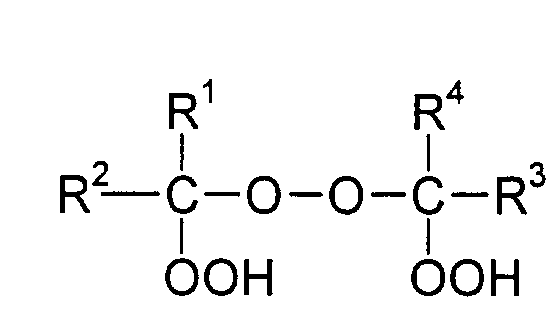 (so-called type-3 ketone
peroxides) for the curing of vinyl or vinylidene group-containing polyester resins.
JP-A-10087652 discloses the use of a ketone peroxide composition comprising
13-43% by weight of the type-3 product and 3-22% by weight of the type-4
product. When used to cure unsaturated polyester resins, the compounds are
said to give a long gel time and slow cure. Safety properties of peroxides are
not discussed. However, such formulations were found not to be safe and the
cure of the UP was found to be too slow. Typically, the ketone peroxides
exemplified are derived from methyl ethyl ketone and use is made of
conventional accelerators, such as Co-octoate.
(so-called type-3 ketone
peroxides) for the curing of vinyl or vinylidene group-containing polyester resins.
JP-A-10087652 discloses the use of a ketone peroxide composition comprising
13-43% by weight of the type-3 product and 3-22% by weight of the type-4
product. When used to cure unsaturated polyester resins, the compounds are
said to give a long gel time and slow cure. Safety properties of peroxides are
not discussed. However, such formulations were found not to be safe and the
cure of the UP was found to be too slow. Typically, the ketone peroxides
exemplified are derived from methyl ethyl ketone and use is made of
conventional accelerators, such as Co-octoate.
However, the methyl ethyl ketone peroxides disclosed in the examples of these
references show insufficient performance in the curing of gel coats, being thin
layers (up to 2 mm in thickness) of unsaturated polyester resin. More
specifically, an undesired and very long gel time is observed, resulting in, inter
alia, too high styrene emission. Gelation and cure speed can be increased by
using higher amounts of peroxide and/or by introduction of cobalt salts, such as
cobalt octoate. However, in the conventional systems this leads to unacceptable
discoloration of the gel coats. Also, conventional fast curing systems tend to
lead to foaming in vinylester resins, which is undesired. Slow cure is a
disadvantage in most of the other applications of unsaturated polyester resins
too. Moreover, some of the ketone peroxide formulations of the prior art that
contain a large amount of type-3 ketone peroxide are not safe. Furthermore, the
use of aqueous compositions, as proposed by the prior art, is unacceptable in
many applications since i) conventional Co-based accelerators hydrolyze in
such systems, leading to unsatisfactory cure characteristics, and ii) aqueous
formulations tend to result in undesired foam formation. Hence, there is a clear
need for improved ketone peroxide compositions which should give fast cure,
low discoloration, no foaming of vinylester resins, and at the same time is safe
during transport, storage, and handling, preferably at ambient temperatures.
Surprisingly, we have found that specific ketone peroxide formulations that are
derived from methyl propyl ketone and comprise a high amount of type-4 ketone
peroxide can be produced safely, especially when use is made of an effective
amount of particular (co)solvents, and that the use of these products gives
desirable fast curing rates of unsaturated polyester resins, especially in gel coat
applications, and that a low level of residual monomer is obtained. Moreover,
the products according to the invention can be stored and handled safely at
ambient temperatures.
Accordingly, we claim methyl propyl ketone peroxide formulations comprising:
more than 60%, preferably more than 65, more preferably more than 67%, most preferably more than 70% by weight of type-4 methyl propyl ketone peroxide up to 100%, preferably 99, more preferably 98%, most preferably 95% by weight of type-4 methyl propyl ketone peroxide, and preferably comprising, less than 40%, preferably less than 35%, most preferably less than 30%, and preferably more than 1%, more preferably more than 2%, most preferably more than 5% by weight of type-3 methyl propyl ketone peroxide (calculated as the amount of active oxygen of the specified type ketone peroxide based on the total active oxygen of all methyl propyl ketone peroxides in the formulation) and a nonaqueous phlegmatizer in an amount such that the Self Accelerating Decomposition Test (SADT), Dutch Pressure Vessel Test (DPVT) and the Koenen test show safe handling and transport at temperatures of 0-50°C, preferably at temperatures of 10-45°C, most preferably at ambient temperatures of 20-40°C. More preferably, the amount of phlegmatizer is chosen such that the self accelerating decomposition temperature as determined by the SADT is 50°C or higher, the limiting diameter as determined by the DPVT is <3.5 mm, and the limiting diameter as determined by the Koenen test is 1.0 mm. The tests are of the conventional type as mentioned in the UN Recommendations on the Transport of Dangerous Goods, 11th edition (ST/SG/AC.10/1/Rev.11)
more than 60%, preferably more than 65, more preferably more than 67%, most preferably more than 70% by weight of type-4 methyl propyl ketone peroxide up to 100%, preferably 99, more preferably 98%, most preferably 95% by weight of type-4 methyl propyl ketone peroxide, and preferably comprising, less than 40%, preferably less than 35%, most preferably less than 30%, and preferably more than 1%, more preferably more than 2%, most preferably more than 5% by weight of type-3 methyl propyl ketone peroxide (calculated as the amount of active oxygen of the specified type ketone peroxide based on the total active oxygen of all methyl propyl ketone peroxides in the formulation) and a nonaqueous phlegmatizer in an amount such that the Self Accelerating Decomposition Test (SADT), Dutch Pressure Vessel Test (DPVT) and the Koenen test show safe handling and transport at temperatures of 0-50°C, preferably at temperatures of 10-45°C, most preferably at ambient temperatures of 20-40°C. More preferably, the amount of phlegmatizer is chosen such that the self accelerating decomposition temperature as determined by the SADT is 50°C or higher, the limiting diameter as determined by the DPVT is <3.5 mm, and the limiting diameter as determined by the Koenen test is 1.0 mm. The tests are of the conventional type as mentioned in the UN Recommendations on the Transport of Dangerous Goods, 11th edition (ST/SG/AC.10/1/Rev.11)
Preferably, the final methyl propyl ketone peroxide formulation contains more
than 10%, preferably more than 15%, more preferably more than 20, and most
preferably more than 25% by weight of type-4 peroxide, based on the weight of
the total formulation. Preferably, the amount of type-3 ketone peroxide in the
formulations according to the invention is less than 13% by weight, based on
the weight of the total formulation. It is noted that the amount of active oxygen
associated with each of the peroxidic components is determined in the
conventional way known in the art and that hydrogen peroxide is not a ketone
peroxide. Furthermore it is noted that the term methyl propyl ketone peroxide
includes peroxides derived from methyl isopropyl ketone and/or methyl n-propyl
ketone. Preferred are the methyl isopropyl ketone-derived peroxide
formulations.
The final methyl propyl ketone peroxide formulations may contain (residual)
hydrogen peroxide. It was observed that in certain curing processes of
unsaturated peroxides the speed of gelation was increased due to the presence
of the H2O2. However, in some instances, such as when vinylester resins are
cured, the presence of H2O2 is undesirable as it gives foaming. Therefore,
depending on the use of the formulations, it can be preferred to have from 0.001
to 5% by weight (%w/w) of hydrogen peroxide (based on the weight of the
active oxygen of the hydrogen peroxide over the weight of the total active
oxygen of the formulation) in the formulation.
Phlegmatizers that can be used in these formulations are of the conventional
type and are preferably selected from alkanols, cycloalkanols, alkylene glycols,
alkylene glycol monoalkyl ethers, cyclic ether substituted alcohols, cyclic
amides, esters, ketones, aromatic solvents, halogenated hydrocarbon solvents,
and mixtures thereof.
Examples of hydrophilic esters include, but are not limited to, monocarboxylic
esters of mono- and dihydric alcohols, esters of dicarboxylic acids and
monohydric alcohols, carbonates of monohydric alcohols, alkoxyalkyl esters, β-keto
esters, phthalates, phosphates, benzoates, adipates, and citrates. More
specific examples of esters useful in most of the compositions of the present
invention are dimethyl phthalate, diethyl phthalate, dibenzyl phthalate, butyl
benzyl phthalate, diallyl phthalate, isopentyl acetate, benzyl acetate, methyl
benzoate, ethyl benzoate, isopropyl benzoate, diethylene glycol dibenzoate,
dipropylene glycol dibenzoate, propylene glycol dibenzoate, n-butyl pivalate,
isoamyl pivalate, sec-amyl pivalate, diethyl adipate, dioctyl adipate, methyl
neodecanoate, n-butyl neodecanoate, propylene glycol diacetate, ethylene
glycol diacetate, neopentyl acetate, methyl-2-ethylhexanoate, isoamyl
propionate, sec-amyl propionate, benzyl propionate, butyl caproate, ethylene
glycol dipropionate, heptyl propionate, methyl phenyl acetate, propyl caprylate,
triethyl phosphate, tricresyl phosphate, trixylyl phosphate, dimethyl methyl
phosphonate, chlorinated phosphate esters, tributyl phosphate, tributoxyethyl
phosphate, methyl decanoate, dimethyl succinate, diethyl succinate, dimethyl
malonate, diethyl malonate, methyl ethyl succinate, diisobutyl nylonate, 2,2,4-trimethyl-1,3-pentanediol-diisobutyrate
(also known as TXIB), diethyl oxalate,
dimethyl fumarate, diethyl fumarate, dipropyl fumarate, dibutyl fumarate, acetyl
tributyl citrate, and diesters of maleic anhydride, such as dibutyl maleate.
Preferred useful hydrocarbon solvents include, but are not limited to, benzene,
toluene, ethylbenzene, xylene (o, m, p, or mixtures thereof), mesithylene, o-diisopropyl
benzene, m-diisopropyl benzene, p-diisopropyl benzene, and
mixtures thereof. More preferred hydrocarbon solvents include Solvesso® 100,
Solvesso 150, Solvesso 200, halogenated versions of these compounds, such
as p-dibromobenzene, 5-bromo-m-xylene, and 1,2,3-trichlorobenzene, and
mixtures of two or more of any of the compounds. Most preferred are aromatic
solvents, since these show the best solubility for MPKP formulations with a high
type-4 content.
Useful halogenated hydrocarbons include 3-bromo-o-xylene, 4-bromo-o-xylene,
2-bromo-m-xylene, 4-bromo-m-xylene, 5-bromo-m-xylene, o-dibromobenzene,
p-dibromobenzene, tetrabromoethylene, 1,2,3-trichlorobenzene, 1,2,4-trichlorobenzene,
and mixtures thereof.
Examples of ketone as solvents are 4,4-dimethyl 4-hydroxy-2-pentanone,
disobutylketone and diisopropyl ketones.
Examples of cyclic amides include 2-pyrrolidone, N-methyl pyrrolidone, 1,5-dimethyl-2-pyrrolidone,
and 3,3-dimethyl-2-pyrrolidone.
Examples of useful alcohols are n-butyl alcohol, capryl alcohol,
tetrahydrofurfuryl alcohol, 1,4-dihydroxymethyl cyclohexane, ethylene glycol,
diethylene glycol, polyethylene glycols, propylene glycol, dipropylene glycol,
neopentyl glycol, hexylene glycol, 1,4-butylene glycol, 2,3-butylene glycol,
butene diol, 1,5-pentane diol, 2,2,4,4-tetramethyl-1,3-cyclobutane diol, ethylene
glycol monoethyl ether, ethylene glycol monobutyl ether, diethylene glycol
monoethyl ether, diethylene glycol monobutyl ether, tetrahydrofuran and
diacetone alcohol.
Soluble solid or waxy materials that can be employed in the compositions of the
present invention include polyethylene glycol, polypropylene glycol,
polytetrahydrofuran, and polycaprolactone.
Preferred methyl propyl ketone peroxide (MPKP) formulations according to the
invention comprise a phlegmatizer selected from the group consisting of
dimethyl phthalate, and 2,2,4-trimethyl-1,3-pentanediol-diisobutyrate. However,
other phlegmatizers selected from one or more of the compounds given above
may be used as a co-phlegmatizer in the preferred methyl propyl ketone
peroxide formulations. When a co-phlegmatizer is used, preferably at least 1%
by weight, more preferably at least 10% by weight of all phlegmatizer is of the
preferred type. The use of one or more of these two phlegmatizers allows the
production of safe MPKP formulations with high active oxygen levels which are
stable during storage (no change in the ratio type-3 : type-4 product is
observed) and which give very good curing of unsaturated polyester resins.
It is noted that US 5,907,022 discloses, in a comparative example, how to make
a pure type-3 ketone peroxide based on methyl isopropyl ketone. However,
neither safe, stable, and technical mixtures comprising type-3 and type-4 ketone
peroxide nor the use of such products in unsaturated curing processes is
disclosed or suggested.
The curing process of the present invention comprises the addition of an MPKP
formulation according to the invention to a resin(s) and/or prepolymer(s), and
preferably at least one accelerator, followed by mixing and dispensing. The
curing process is preferably carried out at ambient temperatures commonly used
in applications such as hand lay-up, spray, and coating. However, it can also be
used in SMC, BMC, pulltrusion techniques, and the like. Due to the high reactivity
of the MPKP formulations according to the invention they are particularly suitable
for curing (at ambient temperature) of a thin articles of up to 2mm in thickness and
coating, especially gel coats. The amount of the MPKP formulation that is to be
used in the curing process ranges from 0.1 to 8% by weight based on resin, but
preferably from 0.5 to 5%, most preferably from 1 to 2%.
The resin or prepolymer is preferably chosen from the group consisting of conventional unsaturated polyesters, including so-called ortho resins, iso-resins, iso-npg resins, and dichloro pentadiene resins. Examples of such resins are maleic, allylic, vinylic, and epoxy-type materials, combined with at least one ethylenically unsaturated reactive monomer. Preferred ethylenically unsaturated reactive monomers include styrene and styrene derivatives such as α-methylstyrene, indene, divinyl benzene, stilbene, dibenzalacetone, propenyl benzene, and isopropenyl benzene; triallyl cyanurate, triallyl isocyanurate, and mixtures thereof. The amount of ethylenically unsaturated reactive monomer is from 0 to 50% by weight (%w/w), based on the weight of the resin.
The resin or prepolymer is preferably chosen from the group consisting of conventional unsaturated polyesters, including so-called ortho resins, iso-resins, iso-npg resins, and dichloro pentadiene resins. Examples of such resins are maleic, allylic, vinylic, and epoxy-type materials, combined with at least one ethylenically unsaturated reactive monomer. Preferred ethylenically unsaturated reactive monomers include styrene and styrene derivatives such as α-methylstyrene, indene, divinyl benzene, stilbene, dibenzalacetone, propenyl benzene, and isopropenyl benzene; triallyl cyanurate, triallyl isocyanurate, and mixtures thereof. The amount of ethylenically unsaturated reactive monomer is from 0 to 50% by weight (%w/w), based on the weight of the resin.
Preferred optional accelerators are selected from the group consisting of
conventional salts, preferably cobalt salts, of one or more carboxylic acids with
one or more of the metals and complexes of two metals selected from lithium,
copper, manganese, magnesium, vanadium, iron, and cobalt, with an
oxygenated compound, such as an aldehyde, ketone, ether, ester, or alcohol.
More particularly, the oxygenated compound of the complexes is preferably
selected from keto- and aldo-esters and ethers or alcohols, in particular methyl
acetoacetate, ethyl acetoacetate, mono- and diesters of ketoglutaric acid,
pyruvates, sugars such as glucose and fructose; and esters of ascorbic acid
such as ascorbic palmitate; 1,3-diketones and aldehydes, in particular acetyl
acetone, benzoyl acetone, and dibenzoyl methane; mono- and diesters, more in
particular diethyl malonate and succinates; 1,2-diketones, in particular diacetyl
and glyoxal; and certain polyalcohols and other alcohols such as diethylene
glycol, benzyl alcohol, and alcohols of the fatty series, as disclosed in
US 5,235,010. In the process of the present invention, the accelerator is
generally employed in a conventional amount. Amounts of 0.1 to 5% by weight,
preferably 0.25 to 2.0% by weight, based on the weight of the resin, are typically
used.
Other optional additives may be employed in the curing process according to
the invention, such as fillers, glass fibres, pigments, inhibitors, promoters, and
stabilizers.
In the curing process of the present invention, typically the resin is first mixed
with the ethylenically unsaturated reactive monomer. The optional accelerator
composition may be added in several different manners and may have been
pre-mixed with the monomer or resin. The MPKP formulation may be added
directly to the mixture. However, it can also be first mixed with the monomer or
resin. Care is to be taken that the MPKP formulation and the accelerator are not
pre-mixed, since this can be hazardous.
The curing process of the present invention is preferably carried out at ambient
temperature, but depending on the technique being used, temperatures up to
150°C, more preferably up to 50°C, can be used.
The invention is elucidated by means of the following examples:
Methyl isopropyl ketone and hydrogen peroxide were reacted using a mineral
acid as a catalyst in the presence of sufficient phlegmatizer, dimethyl phthalate
(DMP), to have a total active oxygen level in the composition of 7% by weight.
The type-4 to type-3 ratio (on an active oxygen basis) was 67 to 33.
Methyl isopropyl ketone peroxide formulation (MIPKP) with this type-4 to type-3 ratio and an active oxygen concentration greater than 7% by weight were found not to fulfill the UN requirements for products to be handled and transported at ambient temperatures.
Methyl isopropyl ketone peroxide formulation (MIPKP) with this type-4 to type-3 ratio and an active oxygen concentration greater than 7% by weight were found not to fulfill the UN requirements for products to be handled and transported at ambient temperatures.
Example 1 was repeated except that diisobutyl phthalate was used instead of
DMP and that the amount of acid was increased. The product contained
40%w/w of type-4 product and 60%w/w of type-3 product, based on the weight
of total methyl isopropyl ketone peroxides in the formulation, and did not contain
any other ketone peroxides.
The peroxides of examples 1 and Z and were compared for their efficiency in an
iso gel coat, Crystic 65PA ex Scott Bader. The iso gel coat resin was
accelerated with 0.25 % cobalt octate solution (Accelerator NL51P containing
6% cobalt ex Akzo Nobel). Properties measured were gel time, time to
lamination and hardness on 400 micron dry film. The table below shows that
MIPKP with lower type 4 / type 3 shows longer gel time and slow hardness built-up.
This shows that higher type 4 to type 3 ratio is desired to achieve desirable
fast cure peroxides.
| Product | MIPKP of Example 1 | MIPKP of Example Z |
| Type 4 / type 3 MIPKP | 67 / 33 | 40 / 60 |
| Gel time, min | 13 | 30 |
| Time to lamination | 35 | 50 |
| Persoz hardness | ||
| After 2 hours | 44 | 29 |
| After 4 hours | 72 | 47 |
| After 6 hours | 93 | 67 |
Gel time is the time from the mixing of peroxide with gel coat till the mixture gels
and not flow anymore.
Time to lamination is the time from the start of the mixing till the gel coat layer is still tacky but upon touching no gel coat transfers to a glove. This is the time when the laminate can be applied onto the gel coat layer. Therefore, it is desirable to have a short time to lamination in order to increase the productivity. Persoz hardness was measured according to method ISO-DR-1522.
Time to lamination is the time from the start of the mixing till the gel coat layer is still tacky but upon touching no gel coat transfers to a glove. This is the time when the laminate can be applied onto the gel coat layer. Therefore, it is desirable to have a short time to lamination in order to increase the productivity. Persoz hardness was measured according to method ISO-DR-1522.
In this example methyl n-propyl ketone was reacted with hydrogen peroxide in
DMP in the same way as mentioned in example 1. The product, MnPKP had an
active oxygen content of 7% and the type-4 to type-3 ratio was 65 to 35.
Example 1 was repeated except that TXIB (trimethyl 1,3-pentanediol
diisobutyrate) was used instead of DMP and in a lower amount. The product
was found to be safe up to an active oxygen concentration of 8.5 % by weight.
The formed MIPKP of 8.5% AO had a type-4 to type-3 ratio of 70 to 30 (and
was phthalate free).
On the basis of the results, it is considered that preferred MPKP formulations of
the invention preferably have a type-4 : other ketone peroxides ratio of from 1.5
to 4. Preferably, it is 1.70 to 3.5, more preferably 2 to 3. The ratio is expressed
as the weight of the active oxygen of the type-4 product over the weight of
active oxygen of all other ketone peroxides in the formulation. Also, the
phlegmatizers evaluated are preferred, since they are economical and useful in
obtaining desirable MPKP formulations. Furthermore, all the methyl propyl
ketone peroxide formulations were storage stable at room temperature for a
period of up to 3 months and could, surprisingly, also be safely handled and
transported at room temperature, as shown by the SADT, the DPVT and the
Koenen test (documented as UN test E.1 for the Koenen test and UN test E.2
for the DPVT in the "United Nations Recommendations on the Transport of
Dangerous Goods, Manual of Tests and Criteria, ST/SG/AC.10/11/Rev.2,"
United Nations, New York and Geneva, 1995).
In a conventional gel coat recipe methyl ethyl ketone peroxide (MEKP) and
MIPKP were compared. The curing systems contained 100 parts by weight
(pbw) of iso-65 resin (Crystic ISO 65GC ex Scott Bader), 0.25 pbw of a Co-octoate
solution (containing 6% Co-octoate), and 2 pbw of a ketone peroxide
formulation. The formulations and results are given in the following table:
| Example | A | B | 5 | 6 | 7 |
| Bx. M50 | Cad. M50 | MIPKP | MIPKP | MnPKP | |
| AO, % | 9 9 7 | 8,5 | 7 | ||
| Phlegmatizer | DMP | TXIB | DMP | TXIB | DMP |
| MEKP (Butanox M50) | 2 | - | - | - | |
| MEKP (Cadox M50) | - | 2 | - | - | |
| MIPKP (example 1) | - | - | 2 | ||
| MIPKP (example 4) | - | - | - | 2 | |
| MnPKP (example 3) | 2 | ||||
| 400 micron dry film Gel time, min | 15 | 23 | 15 | 11 | 16 |
| Time to Lamination , min | 50 | 53 | 40 | 30 | 45 |
| Persoz Hardness | |||||
| 2 hrs | 21 | 18 | 26 | 34 | 22 |
| 4 hrs | 41 | 35 | 53 | 60 | 45 |
| 6 hrs | 58 | 46 | 68 | 75 | 62 |
| 24 hrs | 120 | 106 | 129 | 132 | 120 |
So, clearly, the MPKP formulations according to the invention give a shorter
time to lamination and fast cure (as measured by hardness build up), which is
desirable to achieve fast production, despite the fact that a higher oxygen
concentration was used in the comparative examples.
The product of examples 1 and 4 were compared with conventional methyl ethyl
ketone peroxide using a technique wherein a gelcoat is sprayed (allowing fast
production). The curing systems contained 100 parts by weight (pbw) of iso-resin
(Palatal A400 ex. DSM-BASF), 0.25 pbw of an accelerator composition
containing cobalt and copper in accordance with US 5,235,010, supplied as
Accelerator R553 by Akzo Nobel, and 2 pbw of a ketone peroxide formulation.
The formulations and results are given in the following table:
| Example | C | 8 | 9 |
| Butanox M50 (MEKP) | MIPKP (example 1) | MIPKP (example 4) | |
| 400 micron dry film | |||
| Gel time, min | 13 | 8 | 6 |
| Time to lamination, min | 35 | 24 | 19 |
| Persoz hardness after 2 hours | 22 | 36 | 40 |
| after 4 hours | 40 | 56 | 61 |
Clearly, the MIPKP gives better reactivity, especially with respect to gel time
and time to lamination, when accelerated with a product like R553.
Example 5 was repeated, except that 0.3 pbw of the Co-octoate-containing
solution was used. The ketone peroxide formulations that were used, and the
results obtained are given in the following table. It is noted that the product of
Example D consisted essentially of type-3 MIPKP and corresponds to
Composition G in US 5,907,022.
Gel time measurement of various peroxides
| Example | D | E | 10 | 11 | F |
| Ketone peroxide | MIBKP | MIPKP | MIPKP | MIPKP | Bx.LPT |
| AO, % | 8,9 | 9 | 7 | 8,5 | 8,9 |
| solvent | DBP | Solvesso | DMP | TXIB | DIBP |
| MEKP (Butanox M50) | 2 | - | - | - | - |
| MEKP (Cadox M50) - | 2 | - | - | - | |
| MIPKP (example 1) | - | - | 2 | - | |
| MIPKP (example 4) | - | - | - | 2 | - |
| MEKP (Bx. LPT) | 2 | ||||
| Gel time, min | 32 | 103 | 10 | 8 | 28 |
| MIBKP=methyl isobutyl ketone peroxide, Trigonox HM ex. Akzo Nobel | |||||
| Bx. LPT= MEKP in accordance with NOF JP-A-10087652 | |||||
| DBP=dibutyl phthalate |
Clearly, the MPKP peroxide formulations of the invention outperform the
conventional ketone peroxide formulations.
In these examples a laminate with a thickness of 4 mm was made. A
conventional Ortho UP resin ( Ludapal P6 ex. BASF/DSM) in an amount of 100
pbw was combined with 0.5 pbw of a Co-octoate solution (containing 1% cobalt
by weight), 2 pbw of a ketone peroxide formulation, and glass fibre in such an
amount that the total mixture contained 35% by weight of said glass fibre. The
gelation time at 20°C, the time at which the curing heat peak was observed
(time to peak), the maximum temperature recorded (Tp), and the Barcol
Hardness (measured in the conventional way) were determined after 2, 4, 6,
and 24 hours. Accordingly, Barcol meter was placed onto the horizontal surface
of laminate and pressed manually so that the indenter of the meter penetrates
the surface and the hardness is directly read on the meter. Barcol meter
number 934 is used for hard surfaces and number 935 is used for soft surfaces.
In Examples 12 and 13 an MPKP formulation of Examples 1 and 4 was used,
respectively. In Examples G and H a conventional MEKP formulation, supplied
as Butanox® M50 ex Akzo Nobel (DMP being the phlegmatizer) and Cadox®
M50 ex Akzo Nobel (TXIB being the phlegmatizer), respectively, each with an
active oxygen content of 9% by weight, was used. The results are given in the
table below.
| Ex. | Gel time (min) | Time to peak (min) | Tp (°C) | Barcol hardness after (hours) (meter 934) | |||
| 2 | 4 | 6 | 24 | ||||
| 12 | 14 | 30 | 57 | 29 | 37 | 38 | 40 |
| 13 | 13.5 | 28 | 72 | 43 | 43 | 43 | 44 |
| G | 16.5 | 35 | 40 | soft | 12 | 15 | 37 |
| H | 18.7 | 37 | 40 | soft | soft | 10 | 30 |
Clearly, the products according to the invention give a superior performance,
viz. a short time to peak and fast cure in terms of hardness development, while
the exotherm is not too high.
The product of examples 1 was compared with conventional methyl ethyl
ketone peroxide using a technique wherein a vinylester resin was cured. The
curing systems contained 100 parts by weight (pbw) of vinylester resin
(Derakane 411 ex. Dow Chemicals), 0.25 pbw of an accelerator composition,
and 2 pbw of a ketone peroxide formulation. The formulations and results are
given in the following table:
| Example | 14 | 15 | I | J |
| Ketone peroxide | MIPKP (example 1) | MIPKP (example 1) | Butanox M50 (MEKP) | Butanox M50 (MEKP) |
| Accelerator | NL51P | R-553 | NL51P | R-553 |
| Gel time, min | 18 | 14 | 30 | 24 |
| Foaming | yes | no | yes | no |
Clearly, the MIPKP gives better reactivity than the conventional ketone
peroxide. Also it is shown that in vinylester resin the use of a combination of
MIPKP and accelerators such as R-553 is particularly advantageous since not
only is a fast curing observed, it also does not lead to undesired foam formation.
Claims (10)
- Methyl propyl ketone peroxide formulations comprising more than 60% by weight of type-4 methyl propyl ketone peroxide (calculated as the weight of active oxygen of the type-4 methyl propyl ketone peroxide over the weight of the total active oxygen of all methyl propyl ketone peroxides) and a nonaqueous phlegmatizer in an amount such that the Pressure Vessel Test and the Koenen test show safe handling and transport at temperatures of 0-50°C.
- Methyl propyl ketone peroxide formulations according to claim 1 that contain a phlegmatizer in such an amount that they can be safely handled and transported at temperatures of 10-45°C, preferably at ambient temperatures of 20-40°C.
- Methyl propyl ketone peroxide formulations of claim 1 or 2 wherein the phlegmatizer comprises dimethyl phthalate or trimethyl-1,3-pentanediol diisobutyrate.
- Methyl propyl ketone peroxide formulations of claim 1 or 2 comprising 10-75% by weight of type-4 peroxide, based on the weight of the total formulation.
- Methyl propyl ketone peroxide formulations according to any one of the preceding claims wherein the methyl propyl ketone peroxide is derived from methyl isopropyl ketone.
- Methyl propyl ketone peroxide formulations according to any one of the preceding claims comprising up to 5% by weight of hydrogen peroxide.
- Process to cure an unsaturated polyester resin wherein a methyl propyl ketone peroxide formulation according to any one of the preceding claims is used.
- Process according to claim 7 wherein a metal accelerator is used.
- Process according to claim 8 wherein at least two metal accelerators are used.
- Process according to claim 7 wherein a thin article, preferably a gel coat, is cured.
Priority Applications (18)
| Application Number | Priority Date | Filing Date | Title |
|---|---|---|---|
| ES01986406T ES2264452T3 (en) | 2000-12-29 | 2001-12-07 | FORMULATIONS OF PEROXIDE OF METHYL-PROPIL-KETONE AND ITS USE TO CURE INSURED POLYESTERS |
| AU2002237230A AU2002237230B2 (en) | 2000-12-29 | 2001-12-07 | Methyl propyl ketone peroxide formulations and their use for curing unsaturated polyesters |
| JP2002554650A JP4105547B2 (en) | 2000-12-29 | 2001-12-07 | Methylpropylketone peroxide composition and method of using it in a method of curing an unsaturated polyester resin |
| MXPA03005910A MXPA03005910A (en) | 2000-12-29 | 2001-12-07 | Methyl propyl ketone peroxide formulations and their use in processes to cure unsaturated polyester resins. |
| PCT/EP2001/014498 WO2002053531A2 (en) | 2000-12-29 | 2001-12-07 | Methyl propyl ketone peroxide formulations and their use for curing unsaturated polyesters |
| PT01986406T PT1347954E (en) | 2000-12-29 | 2001-12-07 | METHYLPROPYLETHETHYL PEROXIDE FORMULATIONS AND THEIR USE FOR THE CURE OF UNSATURATED POLYESTERS |
| PL362455A PL204408B1 (en) | 2000-12-29 | 2001-12-07 | Methyl propyl ketone peroxide formulations and their use for curing unsaturated polyesters |
| CNB018214894A CN1296353C (en) | 2000-12-29 | 2001-12-07 | Methyl propyl ketone peroxide preparations and their use in a method for curing unsaturated polyester resins |
| DK01986406T DK1347954T3 (en) | 2000-12-29 | 2001-12-07 | Methylpropylketone peroxide formulations and their use in a process for curing unsaturated polyesters |
| BRPI0116560-7A BR0116560B1 (en) | 2000-12-29 | 2001-12-07 | methylpropyl ketone peroxide formulations and their use in curing processes of unsaturated polyester resins. |
| RU2003123499/04A RU2275357C2 (en) | 2000-12-29 | 2001-12-07 | Methylpropyl ketone peroxide compositions and their using in methods for hardening resins based on unsaturated polyesters |
| AT01986406T ATE326445T1 (en) | 2000-12-29 | 2001-12-07 | METHYLPROPYL KETONE PEROXIDE FORMULATIONS AND THEIR USE FOR CURING UNSATURATED POLYESTERS |
| KR1020037007302A KR100819675B1 (en) | 2000-12-29 | 2001-12-07 | Methyl propyl ketone peroxide formulations and their use in curing methods of unsaturated polyester resins |
| EP01986406A EP1347954B1 (en) | 2000-12-29 | 2001-12-07 | Methyl propyl ketone peroxide formulations and their use for curing unsaturated polyesters |
| DE60119782T DE60119782T2 (en) | 2000-12-29 | 2001-12-07 | METHYLPROPYLKETONE PEROXIDE FORMULATIONS AND THEIR USE FOR HARDENING UNSATURATED POLYESTER |
| US10/026,260 US6642287B2 (en) | 2000-12-29 | 2001-12-21 | Methyl propyl ketone peroxide formulations and their use in processes to cure unsaturated polyester resins |
| MYPI20015899A MY126886A (en) | 2000-12-29 | 2001-12-27 | Methyl propyl ketone peroxide formulations and their use in processes to cure unsaturated polyester resins |
| TW090132771A TWI291482B (en) | 2000-12-29 | 2001-12-28 | Methyl propyl ketone peroxide formulations and their use in processes to cure unsaturated polyester resins |
Applications Claiming Priority (2)
| Application Number | Priority Date | Filing Date | Title |
|---|---|---|---|
| US25865000P | 2000-12-29 | 2000-12-29 | |
| US258650P | 2000-12-29 |
Publications (1)
| Publication Number | Publication Date |
|---|---|
| EP1219602A1 true EP1219602A1 (en) | 2002-07-03 |
Family
ID=22981516
Family Applications (1)
| Application Number | Title | Priority Date | Filing Date |
|---|---|---|---|
| EP01201233A Withdrawn EP1219602A1 (en) | 2000-12-29 | 2001-03-30 | Methyl isopropyl ketone peroxide formulations and their use for curing unsaturated polyesters |
Country Status (4)
| Country | Link |
|---|---|
| US (1) | US6642287B2 (en) |
| EP (1) | EP1219602A1 (en) |
| KR (1) | KR100819675B1 (en) |
| MY (1) | MY126886A (en) |
Cited By (2)
| Publication number | Priority date | Publication date | Assignee | Title |
|---|---|---|---|---|
| WO2006034981A1 (en) * | 2004-09-28 | 2006-04-06 | Akzo Nobel N.V. | Curing of water-containing unsaturated polyester resins involving a cobalt accelerator and a complexing compound |
| CN107163205A (en) * | 2017-05-12 | 2017-09-15 | 常州大学 | A kind of unsaturated polyester (UP) performed polymer of ketone group containing and its production and use |
Families Citing this family (6)
| Publication number | Priority date | Publication date | Assignee | Title |
|---|---|---|---|---|
| US6682679B1 (en) * | 2000-06-14 | 2004-01-27 | Intouch Services | Process for providing a decorative transfer in a molded product |
| PT1637168E (en) * | 2003-04-16 | 2009-04-20 | Neochemical Desarrollos Avanza | Use of a dialkylketone peroxide as biocidal, sterilizing, antiseptic, disinfecting and anti-parasitic agent |
| ATE527308T1 (en) * | 2005-06-10 | 2011-10-15 | Dsm Ip Assets Bv | COMPOSITION CONTAINING UNSATURATED POLYESTER RESIN OR VINYLESTER RESIN |
| AR088945A1 (en) * | 2011-12-02 | 2014-07-16 | Akzo Nobel Chemicals Int Bv | MULTI-COMPONENT CURABLE COMPOSITION AND CORRESPONDING CURING PROCESS |
| MX2015002009A (en) * | 2012-08-17 | 2015-06-02 | Akzo Nobel Chemicals Int Bv | Process for curing thermoset resins. |
| CA2881480A1 (en) | 2012-08-17 | 2014-02-20 | Akzo Nobel Chemicals International B.V. | Process for curing thermoset resins |
Citations (7)
| Publication number | Priority date | Publication date | Assignee | Title |
|---|---|---|---|---|
| US3288861A (en) * | 1962-08-31 | 1966-11-29 | Short Milling Co J | Alkyl peroxide addition compounds |
| GB2000497A (en) * | 1977-07-04 | 1979-01-10 | Akzo Nv | Composition containing a cyclohexanone peroxide and a solvent |
| EP0209181A2 (en) * | 1985-07-16 | 1987-01-21 | Akzo N.V. | Novel desensitized ketone peroxide compositions and their use in the manufacture of foundry cores or moulds |
| EP0570213A2 (en) * | 1992-05-15 | 1993-11-18 | Scott Bader Company Limited | Terminally modified unsaturated polyester resins |
| WO1996003397A1 (en) * | 1994-07-21 | 1996-02-08 | Akzo Nobel N.V. | Cyclic ketone peroxide formulations |
| WO1998033770A1 (en) * | 1997-02-03 | 1998-08-06 | Akzo Nobel N.V. | Peroxide compositions with improved safety characteristics |
| WO1999032442A1 (en) * | 1997-12-18 | 1999-07-01 | Akzo Nobel N.V. | Ketone peroxide derivatives, their preparation and use |
Family Cites Families (8)
| Publication number | Priority date | Publication date | Assignee | Title |
|---|---|---|---|---|
| US3003000A (en) * | 1959-07-01 | 1961-10-03 | Research Corp | Organic peroxides |
| US3151170A (en) | 1961-07-20 | 1964-09-29 | Shell Oil Co | Ethyl amyl ketone peroxide |
| US3649546A (en) | 1967-05-15 | 1972-03-14 | Norac Co | Non-hazardous ketone peroxide polymerization initiators |
| US3560395A (en) | 1968-09-12 | 1971-02-02 | Pennwalt Corp | Aqueous ketone peroxide-hydrogen peroxide composition |
| GB1462853A (en) | 1972-12-22 | 1977-01-26 | Akzo Nv | Polymerisation or copolymerisation of unsaturated esters |
| IT1232850B (en) | 1989-04-26 | 1992-03-05 | Saint Peter Srl | ACCELERANTS FOR HARDENING OF UNSATURE, MALEIC, ALLYLIC AND EPOXY POLYESTER RESINS AND HARDENING PROCEDURES USING THEM |
| AR001122A1 (en) | 1995-03-06 | 1997-09-24 | Akzo Nobel Nv | Polymerization process that uses a functionalized (co) polymer peroxide composition obtained by the process and use of a peroxide composition |
| JPH1087652A (en) | 1996-09-13 | 1998-04-07 | Nof Corp | Ketone peroxide composition and curing of unsaturated polyester resin using the same |
-
2001
- 2001-03-30 EP EP01201233A patent/EP1219602A1/en not_active Withdrawn
- 2001-12-07 KR KR1020037007302A patent/KR100819675B1/en not_active Expired - Fee Related
- 2001-12-21 US US10/026,260 patent/US6642287B2/en not_active Expired - Lifetime
- 2001-12-27 MY MYPI20015899A patent/MY126886A/en unknown
Patent Citations (7)
| Publication number | Priority date | Publication date | Assignee | Title |
|---|---|---|---|---|
| US3288861A (en) * | 1962-08-31 | 1966-11-29 | Short Milling Co J | Alkyl peroxide addition compounds |
| GB2000497A (en) * | 1977-07-04 | 1979-01-10 | Akzo Nv | Composition containing a cyclohexanone peroxide and a solvent |
| EP0209181A2 (en) * | 1985-07-16 | 1987-01-21 | Akzo N.V. | Novel desensitized ketone peroxide compositions and their use in the manufacture of foundry cores or moulds |
| EP0570213A2 (en) * | 1992-05-15 | 1993-11-18 | Scott Bader Company Limited | Terminally modified unsaturated polyester resins |
| WO1996003397A1 (en) * | 1994-07-21 | 1996-02-08 | Akzo Nobel N.V. | Cyclic ketone peroxide formulations |
| WO1998033770A1 (en) * | 1997-02-03 | 1998-08-06 | Akzo Nobel N.V. | Peroxide compositions with improved safety characteristics |
| WO1999032442A1 (en) * | 1997-12-18 | 1999-07-01 | Akzo Nobel N.V. | Ketone peroxide derivatives, their preparation and use |
Cited By (3)
| Publication number | Priority date | Publication date | Assignee | Title |
|---|---|---|---|---|
| WO2006034981A1 (en) * | 2004-09-28 | 2006-04-06 | Akzo Nobel N.V. | Curing of water-containing unsaturated polyester resins involving a cobalt accelerator and a complexing compound |
| CN107163205A (en) * | 2017-05-12 | 2017-09-15 | 常州大学 | A kind of unsaturated polyester (UP) performed polymer of ketone group containing and its production and use |
| CN107163205B (en) * | 2017-05-12 | 2019-03-22 | 常州大学 | A kind of unsaturated polyester (UP) performed polymer of ketone group containing and its preparation method and application |
Also Published As
| Publication number | Publication date |
|---|---|
| KR100819675B1 (en) | 2008-04-04 |
| US20020137972A1 (en) | 2002-09-26 |
| MY126886A (en) | 2006-10-31 |
| KR20030069177A (en) | 2003-08-25 |
| US6642287B2 (en) | 2003-11-04 |
Similar Documents
| Publication | Publication Date | Title |
|---|---|---|
| AU686466B2 (en) | Cyclic ketone peroxide formulations | |
| US5907022A (en) | Cyclic ketone peroxides as polymer initiators | |
| CA2682548C (en) | Accelerator solution | |
| AU2002237230B2 (en) | Methyl propyl ketone peroxide formulations and their use for curing unsaturated polyesters | |
| US6642287B2 (en) | Methyl propyl ketone peroxide formulations and their use in processes to cure unsaturated polyester resins | |
| AU2002237230A1 (en) | Methyl propyl ketone peroxide formulations and their use for curing unsaturated polyesters | |
| WO1998033770A1 (en) | Peroxide compositions with improved safety characteristics | |
| US4219674A (en) | Peroxide initiators | |
| US3238274A (en) | Process for curing unsaturated polyesters using a vanadium compound and an acid phosphate ester as catalysts | |
| RU2351611C2 (en) | Storage-stable cyclic ketone peroxide compositions | |
| JP2005528496A (en) | Food-approved accelerator solution for curing unsaturated polyester resins | |
| EP0507602B1 (en) | Thioester polymerization modifiers | |
| JPS5896617A (en) | Medium temperature-curing of unsaturated polyester resin |
Legal Events
| Date | Code | Title | Description |
|---|---|---|---|
| PUAI | Public reference made under article 153(3) epc to a published international application that has entered the european phase |
Free format text: ORIGINAL CODE: 0009012 |
|
| AK | Designated contracting states |
Kind code of ref document: A1 Designated state(s): AT BE CH CY DE DK ES FI FR GB GR IE IT LI LU MC NL PT SE TR |
|
| AX | Request for extension of the european patent |
Free format text: AL;LT;LV;MK;RO;SI |
|
| STAA | Information on the status of an ep patent application or granted ep patent |
Free format text: STATUS: THE APPLICATION HAS BEEN WITHDRAWN |
|
| 18W | Application withdrawn |
Withdrawal date: 20020719 |