EP1219521A1 - Switch machine for railroad switches or the like, having a trailing resistant device for opposing trailing of the switch points - Google Patents
Switch machine for railroad switches or the like, having a trailing resistant device for opposing trailing of the switch points Download PDFInfo
- Publication number
- EP1219521A1 EP1219521A1 EP01129408A EP01129408A EP1219521A1 EP 1219521 A1 EP1219521 A1 EP 1219521A1 EP 01129408 A EP01129408 A EP 01129408A EP 01129408 A EP01129408 A EP 01129408A EP 1219521 A1 EP1219521 A1 EP 1219521A1
- Authority
- EP
- European Patent Office
- Prior art keywords
- switch
- trailing
- signaling
- resistant
- stops
- Prior art date
- Legal status (The legal status is an assumption and is not a legal conclusion. Google has not performed a legal analysis and makes no representation as to the accuracy of the status listed.)
- Granted
Links
- 238000006073 displacement reaction Methods 0.000 claims abstract description 66
- 230000033001 locomotion Effects 0.000 claims abstract description 21
- 230000009471 action Effects 0.000 claims abstract description 18
- 230000011664 signaling Effects 0.000 claims description 88
- 230000002093 peripheral effect Effects 0.000 claims description 15
- 230000007246 mechanism Effects 0.000 claims description 5
- 238000005096 rolling process Methods 0.000 claims description 5
- 230000010355 oscillation Effects 0.000 claims description 4
- 230000002452 interceptive effect Effects 0.000 claims 1
- 230000002441 reversible effect Effects 0.000 claims 1
- 238000010276 construction Methods 0.000 description 13
- 230000002427 irreversible effect Effects 0.000 description 4
- 230000008859 change Effects 0.000 description 2
- 230000008878 coupling Effects 0.000 description 2
- 238000010168 coupling process Methods 0.000 description 2
- 238000005859 coupling reaction Methods 0.000 description 2
- 238000001514 detection method Methods 0.000 description 2
- 230000006872 improvement Effects 0.000 description 2
- 238000012423 maintenance Methods 0.000 description 2
- 230000002159 abnormal effect Effects 0.000 description 1
- 230000003213 activating effect Effects 0.000 description 1
- 230000010354 integration Effects 0.000 description 1
- 230000004048 modification Effects 0.000 description 1
- 238000012986 modification Methods 0.000 description 1
- 230000003534 oscillatory effect Effects 0.000 description 1
- 230000035515 penetration Effects 0.000 description 1
- 230000008439 repair process Effects 0.000 description 1
- 239000004575 stone Substances 0.000 description 1
- 230000003313 weakening effect Effects 0.000 description 1
Images






Classifications
-
- B—PERFORMING OPERATIONS; TRANSPORTING
- B61—RAILWAYS
- B61L—GUIDING RAILWAY TRAFFIC; ENSURING THE SAFETY OF RAILWAY TRAFFIC
- B61L11/00—Operation of points from the vehicle or by the passage of the vehicle
- B61L11/02—Operation of points from the vehicle or by the passage of the vehicle using mechanical interaction between vehicle and track
- B61L11/04—Trailable point locks
-
- B—PERFORMING OPERATIONS; TRANSPORTING
- B61—RAILWAYS
- B61L—GUIDING RAILWAY TRAFFIC; ENSURING THE SAFETY OF RAILWAY TRAFFIC
- B61L5/00—Local operating mechanisms for points or track-mounted scotch-blocks; Visible or audible signals; Local operating mechanisms for visible or audible signals
- B61L5/10—Locking mechanisms for points; Means for indicating the setting of points
Definitions
- the invention relates to a switch machine for railroad switches or the like, having a trailing resistant device for opposing trailing of the switch points, which switch machine comprises:
- Prior art railroad switches are basically provided in two designs, known as trailable and non-trailable switches.
- the so-called trailable switches allow the switch points to be displaced from the predefined operating position, when a train coming in the direction opposite the deviation caused by the switch finds the turnout with the switch points in the improper position.
- the wheels of the train act on the switch points and force them from the predefined - improper - position to the proper position they should have.
- the carrier means which are dynamically connected to the drive motor are dynamically coupled to the switch point displacing drive means - typically rods or ties - by means of elastic coupling elements which, when a displacement force is exerted on the switch points that exceeds a predetermined value, releases the drive means from the carrier means, typically a carriage which is slid by a motor thanks to the action of irreversible drives, such as feed screw drives or the like.
- the switch points are released from the irreversible displacing mechanism acting thereon and may be displaced by the train wheels to a position differing from their former improper position.
- the switch point displacing drive means are locked in the different operating positions by substantially rigid means, which are operated when the switch points reach their respective operating positions.
- the locking means consist of removable stops, such as pins, studs or bosses which are associated to stationary parts of the switch machine, e.g. to its enclosure, and cooperate with appropriately positioned stops, associated to mechanical parts of the switch point displacement drive, particularly to the switch point displacing drive means.
- the means for locking the switch point driving means are made in such a manner as to allow the switch points a certain displacement caused by forces acting thereon, within predetermined tolerances. This may be achieved, for instance, by providing that the removable locking means, associated to stationary members of the switch machine and the cooperating stops, associated to the switch point displacement drive means in such positions that, in the operating condition of said locking means and with the switch points in the thrown position, said locking means and the stops cooperating therewith are at a certain distance from each other with reference to the direction of mutual caused by the displacement of the switch points due to trailing.
- the switch points may be slightly displaced to a predetermined extent before the locking means come to cooperate with the stops associated to the drive means. This displacement is not problematic when the train runs through the switch in the right direction. Conversely, when the partial displacement of the switch points is caused by partial or attempted trailing, prior art switch machines do not allow detection of this condition, nothing visible remaining of this abnormal use of the switch. However, for safety purposes, such a switch which has been used in improper conditions should be checked by the operating personnel.
- the invention has the object to provide a switch machine as described hereinbefore which, by relatively simple and inexpensive arrangements, provides a switch machine for a railroad switch or the like with non-trailability characteristics up to a certain load, thereby obviating all drawbacks caused by damages to unforeseeable parts of the switch machine if the latter is set to be non trailable and provides at the same time improved features for controlling the conditions of the switch when it is trailed.
- Another object of the invention consists in providing a switch machine as described above, which has the same or substantially the same outer size as those of a tie and may take the place of a tie.
- the invention achieves the above purposes by providing a switch machine as described hereinbefore, in which the trailing resistant means for opposing the displacement of the switch points, which are integral with a stationary portion of the switch machine are made in such a manner as to have a predetermined rupture behavior when the force exerted thereon exceeds a predetermined value, i.e. as to break and release the drive means under the action of a predetermined force of switch point displacement directly exerted on the switch points, particularly by the wheels of a rail car.
- This condition or rupture behavior may be obtained thanks to coupling keys cooperating with engagement grooves or stops associated to the drive means and to a stationary part of the switch machine respectively, which are weakened or conformed in such a manner as to oppose a certain maximum resistance before breaking when the ends of the grooves or abutments act against the trailing resistant keys or studs.
- the trailing resistant means and the stops cooperating therewith are associated to means for signaling the broken condition of the locking means and/or the stops.
- These signaling means may be of any type, e.g. signals for indicating the position of the stops or the trailing resistant means, which are operated when the drive means - typically rods - take or exceed a predetermined position relative to the carrier member.
- the invention provides that the trailing resistant means are mounted so as to be movable between a position of interference and a position of non-interference thereof with the stops associated to the switch point displacing drive means, whereas said displacement is controlled by actuating cams, which are integral with the carrier means and cooperate with control rollers borne by the trailing resistant means.
- the trailing resistant means may be provided in combination with elastic means which stress said trailing resistant means to a stable interference position, whereas the displacement of said trailing resistant means to a position of non-interference with the stops associated to the switch point displacing drive means occurs against the action of said elastic means.
- the trailing resistant means are automatically carried to the position of non interference with the stops associated to the drive means which are rigidly connected to the switch points.
- the switch points reach their end-of-stroke position, in either direction, the trailing resistant means are taken again to a position of non interference with the stops associated to the switch point displacing drive means.
- the turnout is trailed, i.e. the displacement force is exerted directly on the switch points, the drive means are displaced separately from the carrier means, there being provided a compliant connection therebetween once a predetermined force is exceeded. Therefore, in this case, the carrier means keep still and the cams for controlling the position of the trailing resistant means do not interact with the latter, which remain in the operating position of interference with the drive means.
- switch point displacement may sometimes be relatively limited - for instance due to side slip or oscillatory motions of rolling stock running through the turnout in the right direction, with respect to the operating position of the switch points - the invention provides a certain freedom of mutual movement between the stops associated to the switch point drive means and the trailing resistant means cooperating with said stops and associated to a stationary part of the switch machine, in such a manner as to prevent any rupture, as well as the consequent trailing signal, when no actual trailing condition occurred.
- the switch machine of the invention has means for signaling the occurrence of a limited or partial trailing impact.
- the switch machine of the invention includes, in combination with signaling means or even separately therefrom, means for mechanically signaling the partial trailing condition.
- Said mechanical means may advantageously be such as to also cause a functional loss of the switch machine.
- Said functional loss may be set in such a manner that the normal operation of the switch machine may be restored by a specific action, which may be a remote controlled actuation of automatic restoring actuators or a direct manual intervention, such as when the trailing resistant means, having a predetermined rupture behavior, are broken.
- the means for stably signaling a partial trailing impact consist of sliders situated nearer the stops associated to the drive means which cooperate with the trailing resistant means, as compared to the position of the trailing resistant means relative to said stops, and which signaling means are moved by said stops associated to the means for driving the switch points to the position in which the signaling switches are actuated.
- the signaling means i.e. the sliders and the signaling switches are also mounted in such a manner as to allow displacement thereof alternately to positions of interference and non interference with the stops associated to the means for driving the switch points under the action of the carrier means, in the same manner as described for trailing resistant means.
- Both the trailing resistant means and the means for signaling partial trailing may be advantageously mounted on a single saddle which is controlled by cams associated to the carrier means by control tailpieces.
- said sliders are associated to signaling position locks, which are in turn caused to cooperate with the signaling means in the event of a partial trailing impact.
- the invention advantageously provides that the signaling means, particularly the sliders are associated to a cam which may be moved along with the signaling sliders and cooperates with a lock, which is elastically loaded against said cam, the latter having a cam track with at least one boss, bulge, projection or recess behind which the lock is positioned when displacement occurs due to a partial trailing impact on the slider, so that said slider can no longer snap backwards when the direct thrust force on the switch points stops.
- the signaling means are associated to additional means for holding them in the starting position, which only release the signaling means, i.e. the sliders, when a predetermined force on the switch points, hence on the drive means, is exceeded.
- These holding means advantageously consist of a roller elastically stressed against a cam, which may be moved along with the slider and has a recess with inclined end walls, in which the roller is held until a predetermined force is exceeded.
- the holding cam is made of one piece with the cam for locking the slider in the signaling switch actuating position.
- All cam tracks may be integrated on a single cam associated to a single slider for both displacement directions of the drive means.
- the holding recess may be provided in the central position and the two locking tracks of the slider may be provided in the partial trailing position on both sides of the recess for holding the slider in its starting position.
- the slider may be displaced in both directions, hence it has opposite surfaces abutting against the stops associated to the drive means.
- the holding cam and the roller cooperating therewith may be also moved, like the trailing resistant means, the sliders and the cam for locking them in the partial trailing position, alternately to positions of interference and non-interference with the stops of the switch point displacing drive means.
- a preferred embodiment of the invention provides that the sliders have a substantially circular shape, with a flattened abutment face on the side facing toward the corresponding stop associated to the drive means, the latter being able to rotate about their axis.
- advantages may be obtained from providing both start position holding cam track and partial trailing position locking cam track along the peripheral edge of the circular slider.
- the holding roller, and the partial trailing position locking roller may be integrated in a single roller borne on a transverse tailpiece of a member which is slidable in a radial direction with respect to the circular slider and loaded against the peripheral surface of said slider by elastic means, as well as provided with stops for operating and/or controlling the signaling switches.
- a circular slider for each sliding direction of the drive means hence a pair of symmetrical opposite circular sliders, which are rotatably mounted on the same axle, the retaining recesses along the peripheral edge being coincident, whereas the cam tracks for locking the sliders in the partial trailing condition are provided on respectively opposite sides of the retaining recesses, and the stops associated to the switch point drive means are asymmetric, i.e. extend in such a manner as to cooperate each with one of the sliders.
- the trailing resistant means consist of a weakened pin which is formed by an end coaxial extension of a saddle, which slides radially with respect to the circular sliders and carries the axles about whose axes the circular sliders rotate, whereas the roller for displacing the circular sliders for signaling the partial trailing impact and the weakened trailing resistant pin is mounted coaxially to the circular sliders on a terminal extension outside said circular sliders.
- the rollers cooperating with the peripheral cam tracks of the circular sliders are also mounted on a saddle sliding radially with respect to the circular sliders, which is independent from the saddle which carries the sliders and the weakened trailing resistant pin, the two saddles being loaded by a single elastic member which stresses them into the position in which the trailing resistant pin and the sliders are engaged with the stops and the roller for locking and/or retaining said sliders are held pressed against the peripheral track thereof, the two saddles being further mounted in such a manner as to allow separate control and movement thereof.
- the saddle which carries the rollers for retaining and locking the circular sliders in the partial trailing position is interposed between the elastic member and the saddle which carries the roller for displacing the trailing resistant means and the partial trailing signaling means into the positions of interference and non-interference with the stops of the switch point drive means, the two saddles being mounted in such a manner as to allow displacement of the saddle which carries the partial trailing position holding and locking rollers, cooperating with the sliders for signaling the partial trailing condition and for controlling the signaling switches without causing the trailing resistant means and the trailing condition signaling means to be displaced between the positions of interference and non-interference with the stops on the drive means.
- the trailing resistant means are arranged to cooperate directly with the partial trailing signaling means.
- said sliders have surfaces designed to contact with stationary abutment elements, e.g. pins, teeth, etc.
- stationary abutment elements are mounted in such a manner as to be displaceable with the sliders into the positions of interference and non-interference with the stops associated to the switch point displacing drive rods.
- these contact elements are axial teeth or pins engaging in slots of the sliders.
- the slots are obviously in the form of coaxial circular sectors, and have such a width as to prevent any interference of the ends of said slots with the axial pins or teeth until the predetermined partial trailing stroke is overcome.
- the switch point stroke overcomes said predetermined axial stroke, the pin or tooth will come to cooperate with the end of the slot formed in the sliders, thereby being broken.
- This construction advantageously allows to dispose a single circular sector with the axis of rotation perpendicular to the upper surface of the switch machine.
- the surface of the circular sector for abutment with the stops associated to the switch point drive rods consists in this case of an axial tooth on the face of said slider facing toward the drive rods.
- the latter embodiment allows to considerably limit construction costs and dimensions of the trailing signaling device. Said device is also more easily mounted and replaced.
- the invention does not include means for actually locking the switch points against trailing, but has means which provide locking functions against trailing up to a certain trailing force exerted on the switch points, and signal in any case the occurred partial trailing condition. While a trailing condition with the switch points being forced above the threshold requires the switch machine to be restored by only replacing the trailing resistant means, when a partial trailing impact occurs, a stable switch point slight or partial forcing signaling condition, require a local intervention by the personnel to reset the signaling means and to inspect in any case the switch machine. All this is achieved by relatively simple mechanical means which do not require substantial changes to the construction of existing switch machines, and which are easy to mount and to replace.
- the invention prevents any unforeseeable parts from being broken before trailing, thereby avoiding all associated heavy maintenance and replacement interventions on the parts of a switch machine. This is a critical feature when considering that the replacement of a whole switch machine is not a fast and easy operation. These conditions are obviously even more difficult in the case of switch machines wholly integrated in housings having the same size and arrangement as a rail tie.
- the switch machine of the invention is shown without limitation in combination with a so-called English-type switch. This combination is to be intended without limitation, but shows one of the most complex implementations of the invention.
- the provision of a switch machine in the form of a tie is also to be intended without limitation and here again said provision is a preferred embodiment as compared with traditional switch machines which may have the inventive characteristics as claimed, obviously mechanically adapted to the different construction conditions.
- the so-called English-type turnout is provided at crossings and has four switch points.
- two tracks are provided with the rails B1, B1' and B2, B2' cooperating with the switch points A1, A1' and A2, A2' respectively.
- a switch machine 1 having a shape and a size substantially corresponding to those of a rail tie houses the means for displacing the switch points A1, A1' and A2, A2'.
- the tie-shaped switch machine 1 extends for a certain length even outside the trucks to an extent substantially corresponding to the ties and a drive motor, typically an electric motor, denoted as M, is housed in one of these outer end extensions.
- the motor M rotatably drives, by means of a bevel gear drive 5, 5', a threaded rod 3 which is coupled to the output shaft 5" of the drive by means of a joint of any type, which may be even disengageable in a stress condition above a predetermined torque or friction.
- a non-rotatable nut screw, sliding integrally with a first carriage 12 is fitted onto the threaded rod 3.
- the carriage 12 may roll on wheels 13 in both directions longitudinally to the threaded rod 3 on the bottom of the switch machine 1.
- the carriage 12 may be moved between two stop end-of-stroke walls which delimit the actuating stroke.
- the end-of-stroke positions of the carriage 12 are defined by a stationary stop 80, which is integral with the bottom of the switch machine and through which an axial extension 412 of the carriage 12 passes, which carries an abutment widened part 512 at its free end.
- the actuating carriage 12 is integral with a superposed guide 19 for a rod carrier 18 which is integral in its translation with the actuating carriage 12, thanks to a vertical stud or any other interlocking arrangement 618 and rolls on rollers 218 along the lateral longitudinal walls of the guide 19 in the switch machine 1 .
- the rod carrier 18 is tubular, and its side walls, which have the shape of isosceles trapezoids, and form symmetrically opposite inclined planes 518 at the opposite ends of each side wall 318 of the rod carrier 18, which planes converge toward the center of the carriage 18.
- the rod carrier 18 has, at the bottom and top sides, a sliding guide which may be double, i.e.
- each leaf spring 220 is connected to the rod carrier 18 by means of two leaf springs 220.
- Each of the two leaf springs is fastened by its extrados side and in a symmetric position with respect to the other leaf spring of the central rod 120, whereby a substantial "X" shape, vertically cut into halves by the rod 120 results in a plan view.
- Each of the free ends of the leaf springs 220 carries a roller 320.
- the leaf springs 220 are dimensioned in such a manner that each roller 320 cooperates with an inclined plane 518 of the rod carrier.
- the rollers 320 at the ends of each leaf spring 220 cooperate with the inclined planes 518 respectively at the end sides of the same side of the rod carrier 18 toward which the leaf spring 220 faces.
- the central rod 120 is fastened to the leaf springs 220 substantially at one point, particularly at the point or more precisely the tangent strip between the leaf springs 220 and said rod 120, by means of a clamp 420.
- the central rod 120 is connected at both ends by means of joints to drive rods 21 extending up to the portion under the corresponding rail B1, B1', B2, B2'.
- the end 121 of the drive rods is made in the form of a plate, which is horizontal in the example, and is slidably engaged between two guiding side walls 23.
- a first elongated groove 221 having a certain predetermined length and a second angled groove 321 in the end portion, closer to the joint 22 for connecting the rod carrier 18 of the rod carrier 18 and at a predetermined distance from said first groove 221.
- the first groove 221 is rectilinear and the longitudinal axis thereof is parallel and coincident with the central longitudinal axis of the corresponding drive rod 21.
- the second groove 321 forms an obtuse angle and has a branch parallel to the central axis, longitudinal to the corresponding drive rod 21, but laterally staggered with respect to the latter, substantially to an extent corresponding to the length of the tooth 124 of an oscillating lever 24 and a transverse inclined branch which ends substantially at the center of the drive rod 21.
- the length of the projection of the second groove 321 on the longitudinal axis of the corresponding drive rod 21 is substantially identical to the total length of the first groove 221.
- An oscillating lever 24 is provided at the end 121 of each drive rod 21, which lever is angled at the end corresponding to the free end of the drive rod 21 to form a hook-like tooth 124.
- Two transverse pins 224 and 324 extend from the lower side supporting the oscillating lever 24, and are engaged in the corresponding grooves 221 and 321 at the ends 121 of the drive rods 21.
- One of the pins 224 is provided at the end of each oscillating lever 24 facing toward the rod carrier 18, whereas the other pin 324 is provided in line with the former 224, with reference to the longitudinal axis of the longer branch of the oscillating lever 24 and in the corner area thereof.
- the distance between the two pins 224 and 324 substantially corresponds to the distance between the projections of the ends, on the same side, of the grooves 221 and 321 on the longitudinal axis of the drive rods 21, in such a manner that, when the pin 224 abuts against one of the ends of the groove 221, the pin 324 abuts against the end on the same side of the angled groove 321, in this case having the function of a guide track for the pin 324, and causes an angular displacement in the horizontal plane of the oscillating lever 24, whose stroke is sufficient to bring the lever alternately into the position in which the tooth 124 is engaged behind the end edge of the opposite guiding side wall 23 and into the position in which it is disengaged therefrom due to a relative displacement between the drive rod and the oscillating lever 24.
- a transverse extension connected to the switch point extends coaxial to the pin 224 engaged in the rectilinear groove 221 of the drive rod 21, on the upper side of each rocking lever, which extension consists of a pin 424 having a head 524 in the form of a spherical interlock seat for a spherical tailpiece which is integral with the switch point A1, A1', A2, A2' in such a manner that the rocking lever 24 is connected to the corresponding switch point A1, A1', A2, A2', to rotate at least about the axis shared with the pin 224 of the lever 24.
- the spherical tailpiece extends from an arm 125 fastened to the switch point A1, A1', A2, A2', particularly to a longitudinal side wall thereof.
- the drive rod 21 associated to the thrown switch point in the start position performs a movement relative to the switch point and to the connecting oscillating lever 24.
- the relative movement is such as to bring the lever 24 associated to the thrown switch point/s in the starting condition, into a position of disengagement from the end edge of the guiding side wall 23 whereas, on the opposite side, the guide rod has performed such a relative motion that the connecting oscillating lever 24 associated to the switch point/s which are to be brought into the thrown position, takes a slightly inclined position, substantially abutting against the inner surface of the guiding side wall 23 associated thereto.
- the switch point reaches the thrown position and at the same time the tooth 124 of the connecting oscillating lever 24 passes beyond the rear edge of the facing guide side wall 23, with reference to the translation direction of the drive rods 21, whereby any further translation of the drive rods 21 causes a further oscillation, especially of the connecting lever 24 associated to the switch point which has been brought into the thrown position into the position in which it is engaged behind the end edge of the facing guide side wall.
- the oscillating lever for connecting the switch point which has moved away from the associated rail is further brought into the central position with respect to the side guides 23.
- the English-type turnout differs from the normal one in that no specific position locking means may be provided at the center of turnout for the switch points A2 and A1'. Therefore, in this condition, since the switch point A1 must take the thrown condition with the switch point A2 of the other pair, both are rigidly linked together by means of a rod 26, whereby the lock device, i.e. the connecting oscillating lever 24 is only provided outside the track and at the switch point A1.
- the lock device i.e. the connecting oscillating lever 24 is only provided outside the track and at the switch point A1.
- An identical construction is also provided for the switch points A1' and A2' which take together the thrown position against their respective rail.
- the particular construction of the rod carrier 18 allows the turnout to be trailable. This means that the turnout may be actuated by a train which runs in the direction opposite the arrow T of Fig. 1 and in the wrong track, thereby acting with its wheel on the non-thrown switch point.
- the train wheel exerts a displacement force against the associated rail to throw the non-thrown switch point and if the switch point did not fail, it would break or anyway cause derailment.
- the inclined planes 518 have such a length that the rolling distance run by the rollers from an end to the other thereof substantially corresponds to the length of the angled grooves 321 of each drive rod, which are rectilinear and parallel to the longitudinal axis of the drive rods whereby, as long as the rollers remain on the inclined planes 518 without reaching the intermediate portion of the side walls of the rod carrier 18, the oscillating levers 24 to be connected to the thrown switch points do not take the disengagement position. This allows the drive mechanism to absorb slight mechanical stresses exerted on the switch points, without causing the turnout to change its position.
- the rod carrier 18, which is integral with the actuating carriage 12 allows to prevent any stress on the drive motor when mechanical obstacles interpose between the switch point and its respective rail when the former is thrown against the latter. In fact, if, for instance a stone or else prevents the switch point from taking its final thrown position, the actuating carriage may be nevertheless be brought to its end-of-stroke position, by a disengagement of the central rod 120 from the rod carrier 18 like the one described for the trailing condition.
- means may be provided for limiting the displacement of the central rod 120 or of the drive rods 21 or anyway for opposing, at least to a predetermined extent with reference to a predetermined opposition resistance, the displacement of said rods thereby disabling the trailability feature of the turnout.
- this may be obtained by means of a transverse, vertical stud 50 engaged in coincident slots 52 of the central rod 120 or of the rods 21 rigidly connected thereto.
- the stud 50 may be either arranged to be only inserted manually, thereby preventing the turnout to be trailable unless a manual change is made, or may be controlled in its two positions in an automatic manner, e.g.
- the stud 50 cooperates with slots 52 formed in the central rod 120, whose length is such that a certain relative movement is allowed, within preset limits, between the central rod 120 and the vertical trailing resistant stud 50.
- This is particularly aimed at allowing the rod carrier 18 and the activating carriage 12 to always reach the end-of-stroke position in which the motor M is stopped, even when obstacles are interposed between the switch point and the rail against which it is thrown, and prevent the switch point from being thrown against said rail in the end-of-stroke position, or when the switch points are only partially displaced either in the case of incomplete trailing or due to the action of transverse oscillations of rail cars running in the right direction through the switch but nonetheless exerting such translation forces on the switch points, as to simulate the trailing condition.
- the slots 52 have such a length that, the relative stroke between the central rod and the carriage which, in the above case is run against the action of the leaf springs 220, always keeps the rollers of the leaf springs within the inclined plane 518 of the rod carrier 18.
- the central rod may perform small movements relative to the rod carrier 18 and to the actuating carriage 12, but may be never completely released therefrom like in the case of complete trailing when the turnout is trailable.
- lifting means are provided for the purpose, which are associated to the rod carrier 18 and consist of inclined planes 154 of a cam track 54 cooperating with a roller 53 which is supported in such a manner as to rotate about an axis transverse to the sliding direction of the central rod 120 and to overhang laterally in line with said inclined planes 154 at the free end of the stud 50.
- the invention includes particular means to make the switch non trailable and to signal partial trailing conditions.
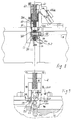
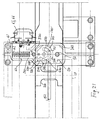
- the stud 50 is mounted at the end of a saddle 60 which is accommodated in an enclosure 61, in such a manner as to be able to slide in the axial direction of the stud itself and perpendicular to the rod.
- the saddle 60 is stressed by a spring 62 into a stable condition in which it engages the slots 52 of the central rod.
- a transverse tailpiece of the stud 50 which is provided in the form of a spindle or axle 63 bears a control roller 53, cooperating with the cam 54, 154 of the rod carrier 18, in a slightly staggered position, coinciding with the cam 54, 154.
- the latter displaces the roller alternately upwards to a position in which the stud 50 does not interfere with the corresponding end of the two slots 52 of the central rod 120, when the switch points are displaced properly, thanks to the carriage and to the associated rod carrier 18, and to a position in which the stud 50 interferes or engages in the corresponding slot 52 of the central rod when the switch points are in one of the two end-of-stroke positions.
- the switch points are displaced by a force exerted directly thereon, e.g. by rolling stock, thanks to the elastic connection between the leaf springs 220 and the rod carrier 18, the rods 21 and the central rod 120 may be displaced relative to the enclosure and to the stud 50 as well as relative to the rod carrier 18.
- the displacement of the switch points under a direct force acting thereon does not allow the stud 50 to be displaced to a position of non-interference with the end sides 152 of the respective groove 52, since the carriage for driving the rods 120, 21, i.e. the rod carrier 18 which controls displacement while the stud 50 is in the idle position stands still.
- the stud 50 is at a certain distance from the end wall 152 of the slot 52 against which it abuts when the switch points are displaced due to a direct action thereon.
- the initial displacement through a certain distance corresponding to an incomplete disengagement of the leaf springs 220 from the rod carrier 18, i.e. from the inclined planes of the end sides thereof and to a condition in which the switch points are slightly displaced may be caused for instance by a partial trailing impact or by a side slip of the wheels of a train even though it runs in the proper direction of traffic. Thanks to this arrangement, in these conditions no stress is exerted upon the stud 50, and the switch machine must not necessarily be disabled.
- the stud 50 further has a weakening peripheral groove 250 which has such a depth as to allow the stud to be broken when a predetermined transverse force is applied thereon.
- a weakening peripheral groove 250 which has such a depth as to allow the stud to be broken when a predetermined transverse force is applied thereon.
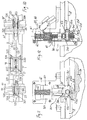
- the saddle 60 is composed of a first saddle 160 carrying the stud 50 at its end and whereto the roller 53 for controlling the positions of interference and non-interference of the stud 50 is associated, and of a second saddle 260 interposed between the end saddle and the spring 62, which bears the means for controlling the signaling switches 65, 66, two of which are provided for safety purposes.
- the two saddles 160 and 260 may be displaced in the same direction and are free from each other, hence displaceable either together or separately. Hence, the signaling means may be operated regardless of the displacement of the stud 50 and such feature will be more apparent from the following description.
- the first saddle 160 for carrying the stud 50 cooperates with end-of-stroke stops of stud engagement in the grooves 52 of the central rod 120, which stops face away from the elastic member 62 and delimit the deepest penetration position of the stud 50 in said grooves 52 of the central rod 120.
- the stud 50 is associated to means designed to control signaling of the trailing condition, both in case of complete trailing with the stud 50 being broken, and in the case of partial trailing, within a range of displacement of the switch points from a position of simple contact between the end side 152 of the corresponding groove 52 and the stud 50 to the position in which the stud 50 is broken and passed over, i.e. from an initial trailing position when a minimum stroke is run by the switch points within a range in which such displacement is considered irrelevant for the purposes of detection, to the opposite end-of-stroke position of the switch points after the stud 50 has broken.
- these means consist of a rotating slider 70, consisting of two circular coaxial plates 170 which are particularly fitted onto the same axle 63 which bears the roller 53 for controlling the movement of the stud 50 into the positions of interference and non-interference with the grooves 51, said roller also moving the plates 170 into positions of interference and non interference with actuating stops again consisting of the end sides 152 of the grooves 52 of the central rod 120.
- the two circular plates 170 have a flattened portion 270 on the side facing toward the end side 152 of the corresponding groove 52, which is relevant for the corresponding displacement direction of the switch points upon trailing. Said flattened portion is ahead toward the relevant end side 152 of the corresponding groove 52 with respect to the stud 50.
- the circular plates 170 which obviously have their flattened portions in diametrically opposite positions, have a first peripheral cam track with a particularly V-shaped recess 370, for engagement of a roller 71 fitted onto the second saddle 260 for controlling the signaling switches 65, 66.
- the roller 71 and the groove 370 have the joined function to hold the circular plates in the defined starting position and the faces of the groove 270 are inclined to such an extent as to set a predetermined force for holding the two circular plates 170 in position, below which said two circular plates 170 are not rotated.
- each end side 152 always coincides with the central stud 50, whereas the two opposite and facing end sides 152 extend sidewise to such an extent as to be coincident or interfere with one of the two rotating circular sliders 170 respectively, i.e. with the circular slider whose flattened portion 370 faces toward the corresponding end side 152 respectively.
- a peripheral profile 470 which forms another depression-like cam track having a predetermined angular width is provided at the periphery of the circular plates 170 immediately past the groove 370 with reference to the corresponding direction of rotation of the corresponding circular plate 170.
- the depression 470 has end faces 570 whose shape is such as to form stops for stably holding the circular plate in its angular position and for preventing it from taking its former angular position. Therefore, in the partial trailing position, the signaling switches 65, 66 are stably operated and functionality may be only restored by a manual intervention whereby the circular plates 170 are brought back to their starting position after checking the functionality of the switch machine. Such functionality is independent from the behavior of the stud 50, which is not under stress here.
- the peripheral cam track 470, 570 has such an angular width as to allow that the conditions in which trailing is signaled may be maintained even when complete trailing occurs, and the stud 50 breaks, as shown in Figs. 13 to 15.
- Trailing conditions are detected when the signaling switches 65, 66 are operated, as well as when signals are received from the position sensors associated to the carriage and/or to the rod carrier 18.
- the switches for signaling the trailing condition are operated anytime the stud 50 and/or the means 70 for detecting and/or signaling partial trailing are moved outwards either due to trailing or to the displacement caused by the cams 54, 154 of the rod carrier when the switch machine is in normal operating conditions.
- the rod carrier 18 and/or the carriage cause their own position signals to be switched, in case of trailing said position signals of the rod carrier 18 and/or the carriage are not switched, the switches for signaling the displacement of the stud 50 and/or of the sliders 170 for detecting and signaling partial trailing conditions are only switched.
- FIG. 16 to 25 a variant embodiment of the switch machine of the previous Figures 1 to 15 is shown.
- the features are substantially the same, except that there is not provided a real trailing resistant stud 50, but a mechanical member which breaks upon trailing but is of no essential hindrance to the translation of the switch points.
- the stud 50 is replaced by a mechanical member of an irreversible fuse, which is denoted as 50'.
- the variant embodiment as shown in Figures 16 to 25 is further improved as regards construction rationalization and in terms of position of the axis along which the saddles slide parallel to the upper wall of the switch machine. This allows to limit dimensions in the vertical direction, which is particularly advantageous for a switch machine which is integrated in a box replacing a rail tie or positioned like a rail tie.
- the saddle 60 consists of a plate 160 which may be moved transverse to the direction in which the rods 21, 120 slide and parallel to the upper wall of the switch machine.
- the saddle 160 is subjected to the action of a spring 62 which pushes it to a stable end-of-stroke position in which a first displacing roller 53 interferes with a cam 54, 154 of the rod carrier 18.
- the roller 53 projects downwards from the plate 160 toward the inside of the switch machine and in a position coinciding with the cam 54, 154, which is obviously staggered through 90° with respect to the cam 54, 154 of the previous embodiment.
- a second saddle 260 is interposed between the plate 160 and the spring 62 and bears, like in the previous embodiment, a roller 71 which cooperates with the recess 370 of the slider for detecting and signaling the partial trailing condition.
- the second saddle 260 controls, like in the previous embodiment, two signaling switches 65, 66.
- the slider for detecting and signaling the partial trailing condition 70 consists of a single circular plate 170' which is fitted in such a manner as to rotate about its axis onto the first saddle or plate 160, parallel thereto.
- said plate 170' On the lower side of the circular plate 170', in a diametrically opposite position with respect to the peripheral retaining recess 370 cooperating with the roller 71, said plate 170' has an axial tooth 670 which projects inside the switch machine through an arched aperture having the shape of a sector of a circle 360 and being formed in the sliding plate 160, said tooth being coincident, in a position of interference with the rods 21, 120, with stops 152', associated to said rods 21, 120, designed to rotatably actuate said plate.
- the first plate-like saddle 160 bears a stationary pin 50' which is engaged in an aperture 770 shaped like a coaxial sector of a circle and formed in the circular plate 170. This pin 50' has, as described above, the same function as the stud 50 with the predetermined rupture strength of the previous embodiment.
- the circular plate 170 On both sides of the V-shaped recess 370 the circular plate 170 has a recess 470 which is identical to the one described with reference to the previous embodiment. However, this functionality is achieved here by a single circular plate 170 which has the function to detect and signal the partial or total trailing condition for both switch point displacement directions.
- the rods, or the central rod 120 does not have several grooves 52, but one or more projections whose end sides 152' form abutments cooperating with the tooth 670 of the circular plate 170' in the two end-of-stroke positions.
- the cam 54, 154 associated to the carriage and/or to the rod carrier 18 causes, like in the previous embodiment, the lateral displacement of the plate 160 which forms the first sliding saddle, and hence of the slider 70 for detecting and signaling the even partial trailing condition, i.e. of the rotatable plate 170 together with the driving tooth 670 and of the pin 50' engaged in the aperture having the shape of a sector of a circle 770, as well as of the second saddle 260 with the holding roller 71, when the switch points are displaced due to the actuation of the switch machine.
- the tooth 670 for actuating the slider 70 i.e. the rotatable circular plate 170, is displaced sideways to a position of non-interference with the stops 152' associated to the rods 21, 120.
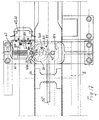
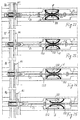
- Fig. 20 and the corresponding Figure 24 show the situation of a partial trailing attempt.
- the switch points are displaced to such an extent as to disengage the circular plate 170' from the holding roller 71 and to cause it to rotate by letting the roller 71 pass in the recess 470 beyond the non-return projection 570.
- the displacement stroke of the switch points is not sufficient to cause the pin 50' to break, and the latter only reaches the end-of-stroke position in the aperture 770 having the shape of a sector of a circle.
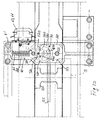
- Figs. 21 to 25 show a trailing condition which caused the switch points to be displaced to a greater extent than allowed by the aperture shaped like a sector of a circle 770 and in which the force exerted by the switch points exceeded the rupture strength of the pin 50' which was broken by the end side of the aperture 770 shaped like a sector of a circle , thereby allowing the switch points to be displaced freely in the direction imposed by the trailing action.
- Construction advantages are self-evident from the previous description of this second embodiment, i.e. smaller dimensions, a smaller number of parts and a simplification of the conformation of the parts to obtain a pin having a predetermined rupture strength and the means for signaling the partial trailing condition.
- the invention may be greatly varied, especially as regards construction, without departure from the inventive principle disclosed above and claimed below, which consists in providing means for opposing the displacement of the switch points in the trailing condition by a predetermined rupture strength and in combination with a stable signaling condition which is irreversible without a manual intervention by the personnel.
Landscapes
- Engineering & Computer Science (AREA)
- Mechanical Engineering (AREA)
- Railway Tracks (AREA)
- Train Traffic Observation, Control, And Security (AREA)
- Valve Device For Special Equipments (AREA)
- Control Of Turbines (AREA)
- Control Of Vehicles With Linear Motors And Vehicles That Are Magnetically Levitated (AREA)
- Transmission Devices (AREA)
- Rotary Switch, Piano Key Switch, And Lever Switch (AREA)
- Switch Cases, Indication, And Locking (AREA)
Abstract
Description
Claims (35)
the trailing resistant means (50, 50') for opposing displacement of the switch points, which are integral with a stationary portion of the switch machine, are made in such a manner as to have a predetermined rupture behavior when the force exerted thereon exceeds a predetermined value, so that they break and release the drive means under the action of a predetermined switch point displacement force directly exerted on the switch points, particularly by the wheels of a rail car.
means (70, 170, 71, 370, 470, 570) for signaling the occurrence of a limited or partial trailing impact, designed to account for incomplete trailing conditions, due to a direct displacement of the switch points exceeding a predetermined minimum displacement stroke of the drive means relative to the rolling stock oscillation tolerances of the switch points.
Applications Claiming Priority (2)
| Application Number | Priority Date | Filing Date | Title |
|---|---|---|---|
| ITSV000062 | 2000-12-28 | ||
| IT2000SV000062A ITSV20000062A1 (en) | 2000-12-28 | 2000-12-28 | CASE OF MANEUVERING FOR RAILWAY OR SIMILAR DEVIATORS WITH ANTI-TALLONING DEVICE OF CONTRAST TO THE HEELING OF THE SWITCH NEEDLES |
Publications (2)
| Publication Number | Publication Date |
|---|---|
| EP1219521A1 true EP1219521A1 (en) | 2002-07-03 |
| EP1219521B1 EP1219521B1 (en) | 2006-09-20 |
Family
ID=11457071
Family Applications (1)
| Application Number | Title | Priority Date | Filing Date |
|---|---|---|---|
| EP01129408A Expired - Lifetime EP1219521B1 (en) | 2000-12-28 | 2001-12-10 | Switch machine for railroad switches or the like, having a trailing resistant device for opposing trailing of the switch points |
Country Status (5)
| Country | Link |
|---|---|
| EP (1) | EP1219521B1 (en) |
| AT (1) | ATE340115T1 (en) |
| DE (2) | DE60123203T4 (en) |
| ES (1) | ES2269285T3 (en) |
| IT (1) | ITSV20000062A1 (en) |
Cited By (6)
| Publication number | Priority date | Publication date | Assignee | Title |
|---|---|---|---|---|
| WO2004074066A1 (en) * | 2003-02-18 | 2004-09-02 | Alstom Ferroviaria S.P.A | Switch machine for railway and tramway switches or the like |
| EP2535238A1 (en) | 2011-06-17 | 2012-12-19 | ALSTOM Transport SA | Railway, tramway or the like turnout of so-called English type |
| EP2565099A1 (en) | 2011-08-30 | 2013-03-06 | ALSTOM Transport SA | Railway switch |
| EP2620347A1 (en) | 2012-01-24 | 2013-07-31 | Alstom Ferroviaria S.P.A. | Non trailable switch machine for railroad switches or the like |
| CN110641518A (en) * | 2019-11-05 | 2020-01-03 | 通号万全信号设备有限公司 | A switch machine representation mechanism |
| CN113110404A (en) * | 2021-05-26 | 2021-07-13 | 四川都睿感控科技有限公司 | Device for independently simulating alternating current point switch and using method thereof |
Families Citing this family (1)
| Publication number | Priority date | Publication date | Assignee | Title |
|---|---|---|---|---|
| EP4714780A1 (en) | 2024-09-23 | 2026-03-25 | voestalpine Signaling Austria GmbH | Switch actuating device |
Citations (4)
| Publication number | Priority date | Publication date | Assignee | Title |
|---|---|---|---|---|
| JPS5551968A (en) * | 1978-10-06 | 1980-04-16 | Hitachi Ltd | Anomalousness detector for weak point pin coupling mechanism |
| EP0320636A2 (en) * | 1987-12-16 | 1989-06-21 | SASIB S.p.A. | Universal outer point lock device for railway points |
| US5590857A (en) * | 1994-08-19 | 1997-01-07 | General Railway Signal Corporation | Trailing device for a railroad switch layout |
| WO1999020512A1 (en) * | 1997-10-22 | 1999-04-29 | Alstom Transport S.P.A. | Switch box for railway, tramway points, or similar, particularly of the so called english type |
-
2000
- 2000-12-28 IT IT2000SV000062A patent/ITSV20000062A1/en unknown
-
2001
- 2001-12-10 DE DE60123203T patent/DE60123203T4/en not_active Expired - Lifetime
- 2001-12-10 EP EP01129408A patent/EP1219521B1/en not_active Expired - Lifetime
- 2001-12-10 AT AT01129408T patent/ATE340115T1/en not_active IP Right Cessation
- 2001-12-10 ES ES01129408T patent/ES2269285T3/en not_active Expired - Lifetime
- 2001-12-10 DE DE60123203A patent/DE60123203D1/en not_active Expired - Lifetime
Patent Citations (4)
| Publication number | Priority date | Publication date | Assignee | Title |
|---|---|---|---|---|
| JPS5551968A (en) * | 1978-10-06 | 1980-04-16 | Hitachi Ltd | Anomalousness detector for weak point pin coupling mechanism |
| EP0320636A2 (en) * | 1987-12-16 | 1989-06-21 | SASIB S.p.A. | Universal outer point lock device for railway points |
| US5590857A (en) * | 1994-08-19 | 1997-01-07 | General Railway Signal Corporation | Trailing device for a railroad switch layout |
| WO1999020512A1 (en) * | 1997-10-22 | 1999-04-29 | Alstom Transport S.P.A. | Switch box for railway, tramway points, or similar, particularly of the so called english type |
Non-Patent Citations (1)
| Title |
|---|
| PATENT ABSTRACTS OF JAPAN vol. 004, no. 094 (M - 019) 8 July 1980 (1980-07-08) * |
Cited By (11)
| Publication number | Priority date | Publication date | Assignee | Title |
|---|---|---|---|---|
| WO2004074066A1 (en) * | 2003-02-18 | 2004-09-02 | Alstom Ferroviaria S.P.A | Switch machine for railway and tramway switches or the like |
| AU2004213172B2 (en) * | 2003-02-18 | 2010-07-08 | Alstom Ferroviaria S.P.A. | Switch machine for railway and tramway switches or the like |
| AU2004213172B8 (en) * | 2003-02-18 | 2010-11-25 | Alstom Ferroviaria S.P.A. | Switch machine for railway and tramway switches or the like |
| KR101033099B1 (en) * | 2003-02-18 | 2011-05-09 | 알스톰 페로비아리아 에스.피.에이. | Trains for railway and tram tracks |
| EP2535238A1 (en) | 2011-06-17 | 2012-12-19 | ALSTOM Transport SA | Railway, tramway or the like turnout of so-called English type |
| AU2012203437B2 (en) * | 2011-06-17 | 2017-03-02 | Alstom Holdings | Railway, tramway or the like turnout of so-called English type |
| EP2565099A1 (en) | 2011-08-30 | 2013-03-06 | ALSTOM Transport SA | Railway switch |
| EP2620347A1 (en) | 2012-01-24 | 2013-07-31 | Alstom Ferroviaria S.P.A. | Non trailable switch machine for railroad switches or the like |
| CN110641518A (en) * | 2019-11-05 | 2020-01-03 | 通号万全信号设备有限公司 | A switch machine representation mechanism |
| CN113110404A (en) * | 2021-05-26 | 2021-07-13 | 四川都睿感控科技有限公司 | Device for independently simulating alternating current point switch and using method thereof |
| CN113110404B (en) * | 2021-05-26 | 2023-08-11 | 四川都睿感控科技有限公司 | Device for independently simulating alternating current switch machine and application method thereof |
Also Published As
| Publication number | Publication date |
|---|---|
| DE60123203T4 (en) | 2007-11-29 |
| ES2269285T3 (en) | 2007-04-01 |
| DE60123203D1 (en) | 2006-11-02 |
| EP1219521B1 (en) | 2006-09-20 |
| DE60123203T2 (en) | 2007-05-10 |
| ITSV20000062A1 (en) | 2002-06-28 |
| ATE340115T1 (en) | 2006-10-15 |
Similar Documents
| Publication | Publication Date | Title |
|---|---|---|
| CN1750959B (en) | Switch machine for railway and tramway switches or the like | |
| AU756674B2 (en) | Switch box for railway, tramway points, or similar | |
| EP2620347B1 (en) | Non trailable switch machine for railroad switches or the like | |
| EP1219521B1 (en) | Switch machine for railroad switches or the like, having a trailing resistant device for opposing trailing of the switch points | |
| EP2535238B1 (en) | Railway, tramway or the like turnout of so-called English type | |
| EP3412535B1 (en) | Switching machine for a railroad | |
| JP2025521696A (en) | Switch | |
| EP2402505B1 (en) | Actuating and locking device for a railroad switch device | |
| JP6069046B2 (en) | Control method of index electric switch and index electric switch | |
| JP5620388B2 (en) | Safety switch | |
| KR100443463B1 (en) | Apparatus for converting railroad | |
| EP3147174B1 (en) | Apparatus for operating a switch of a railway track and associated switch | |
| EP1470983A1 (en) | Point regulator | |
| HK40118743A (en) | Switch machine | |
| HK1229775A (en) | Apparatus for operating a switch of a railway track and associated method and switch | |
| HK1229775A1 (en) | Apparatus for operating a switch of a railway track and associated method and switch |
Legal Events
| Date | Code | Title | Description |
|---|---|---|---|
| PUAI | Public reference made under article 153(3) epc to a published international application that has entered the european phase |
Free format text: ORIGINAL CODE: 0009012 |
|
| AK | Designated contracting states |
Kind code of ref document: A1 Designated state(s): AT BE CH CY DE DK ES FI FR GB GR IE IT LI LU MC NL PT SE TR |
|
| AX | Request for extension of the european patent |
Free format text: AL;LT;LV;MK;RO;SI |
|
| 17P | Request for examination filed |
Effective date: 20021007 |
|
| AKX | Designation fees paid |
Designated state(s): AT BE CH CY DE DK ES FI FR GB GR IE IT LI LU MC NL PT SE TR |
|
| RAP1 | Party data changed (applicant data changed or rights of an application transferred) |
Owner name: ALSTOM FERROVIARIA S.P.A. |
|
| GRAP | Despatch of communication of intention to grant a patent |
Free format text: ORIGINAL CODE: EPIDOSNIGR1 |
|
| GRAS | Grant fee paid |
Free format text: ORIGINAL CODE: EPIDOSNIGR3 |
|
| GRAA | (expected) grant |
Free format text: ORIGINAL CODE: 0009210 |
|
| AK | Designated contracting states |
Kind code of ref document: B1 Designated state(s): AT BE CH CY DE DK ES FI FR GB GR IE IT LI LU MC NL PT SE TR |
|
| PG25 | Lapsed in a contracting state [announced via postgrant information from national office to epo] |
Ref country code: AT Free format text: LAPSE BECAUSE OF FAILURE TO SUBMIT A TRANSLATION OF THE DESCRIPTION OR TO PAY THE FEE WITHIN THE PRESCRIBED TIME-LIMIT Effective date: 20060920 Ref country code: NL Free format text: LAPSE BECAUSE OF FAILURE TO SUBMIT A TRANSLATION OF THE DESCRIPTION OR TO PAY THE FEE WITHIN THE PRESCRIBED TIME-LIMIT Effective date: 20060920 Ref country code: BE Free format text: LAPSE BECAUSE OF FAILURE TO SUBMIT A TRANSLATION OF THE DESCRIPTION OR TO PAY THE FEE WITHIN THE PRESCRIBED TIME-LIMIT Effective date: 20060920 Ref country code: CH Free format text: LAPSE BECAUSE OF FAILURE TO SUBMIT A TRANSLATION OF THE DESCRIPTION OR TO PAY THE FEE WITHIN THE PRESCRIBED TIME-LIMIT Effective date: 20060920 Ref country code: LI Free format text: LAPSE BECAUSE OF FAILURE TO SUBMIT A TRANSLATION OF THE DESCRIPTION OR TO PAY THE FEE WITHIN THE PRESCRIBED TIME-LIMIT Effective date: 20060920 Ref country code: FI Free format text: LAPSE BECAUSE OF FAILURE TO SUBMIT A TRANSLATION OF THE DESCRIPTION OR TO PAY THE FEE WITHIN THE PRESCRIBED TIME-LIMIT Effective date: 20060920 |
|
| REG | Reference to a national code |
Ref country code: GB Ref legal event code: FG4D |
|
| REG | Reference to a national code |
Ref country code: CH Ref legal event code: EP |
|
| REG | Reference to a national code |
Ref country code: IE Ref legal event code: FG4D |
|
| REF | Corresponds to: |
Ref document number: 60123203 Country of ref document: DE Date of ref document: 20061102 Kind code of ref document: P |
|
| PG25 | Lapsed in a contracting state [announced via postgrant information from national office to epo] |
Ref country code: IE Free format text: LAPSE BECAUSE OF NON-PAYMENT OF DUE FEES Effective date: 20061211 |
|
| PG25 | Lapsed in a contracting state [announced via postgrant information from national office to epo] |
Ref country code: SE Free format text: LAPSE BECAUSE OF FAILURE TO SUBMIT A TRANSLATION OF THE DESCRIPTION OR TO PAY THE FEE WITHIN THE PRESCRIBED TIME-LIMIT Effective date: 20061220 Ref country code: DK Free format text: LAPSE BECAUSE OF FAILURE TO SUBMIT A TRANSLATION OF THE DESCRIPTION OR TO PAY THE FEE WITHIN THE PRESCRIBED TIME-LIMIT Effective date: 20061220 |
|
| PG25 | Lapsed in a contracting state [announced via postgrant information from national office to epo] |
Ref country code: MC Free format text: LAPSE BECAUSE OF NON-PAYMENT OF DUE FEES Effective date: 20061231 |
|
| NLV1 | Nl: lapsed or annulled due to failure to fulfill the requirements of art. 29p and 29m of the patents act | ||
| PG25 | Lapsed in a contracting state [announced via postgrant information from national office to epo] |
Ref country code: PT Free format text: LAPSE BECAUSE OF FAILURE TO SUBMIT A TRANSLATION OF THE DESCRIPTION OR TO PAY THE FEE WITHIN THE PRESCRIBED TIME-LIMIT Effective date: 20070312 |
|
| REG | Reference to a national code |
Ref country code: CH Ref legal event code: PL |
|
| REG | Reference to a national code |
Ref country code: ES Ref legal event code: FG2A Ref document number: 2269285 Country of ref document: ES Kind code of ref document: T3 |
|
| EN | Fr: translation not filed | ||
| PLBE | No opposition filed within time limit |
Free format text: ORIGINAL CODE: 0009261 |
|
| STAA | Information on the status of an ep patent application or granted ep patent |
Free format text: STATUS: NO OPPOSITION FILED WITHIN TIME LIMIT |
|
| 26N | No opposition filed |
Effective date: 20070621 |
|
| PG25 | Lapsed in a contracting state [announced via postgrant information from national office to epo] |
Ref country code: GR Free format text: LAPSE BECAUSE OF FAILURE TO SUBMIT A TRANSLATION OF THE DESCRIPTION OR TO PAY THE FEE WITHIN THE PRESCRIBED TIME-LIMIT Effective date: 20061221 Ref country code: FR Free format text: LAPSE BECAUSE OF FAILURE TO SUBMIT A TRANSLATION OF THE DESCRIPTION OR TO PAY THE FEE WITHIN THE PRESCRIBED TIME-LIMIT Effective date: 20070518 |
|
| PG25 | Lapsed in a contracting state [announced via postgrant information from national office to epo] |
Ref country code: TR Free format text: LAPSE BECAUSE OF FAILURE TO SUBMIT A TRANSLATION OF THE DESCRIPTION OR TO PAY THE FEE WITHIN THE PRESCRIBED TIME-LIMIT Effective date: 20060920 Ref country code: LU Free format text: LAPSE BECAUSE OF NON-PAYMENT OF DUE FEES Effective date: 20061210 |
|
| PG25 | Lapsed in a contracting state [announced via postgrant information from national office to epo] |
Ref country code: FR Free format text: LAPSE BECAUSE OF FAILURE TO SUBMIT A TRANSLATION OF THE DESCRIPTION OR TO PAY THE FEE WITHIN THE PRESCRIBED TIME-LIMIT Effective date: 20060920 Ref country code: CY Free format text: LAPSE BECAUSE OF FAILURE TO SUBMIT A TRANSLATION OF THE DESCRIPTION OR TO PAY THE FEE WITHIN THE PRESCRIBED TIME-LIMIT Effective date: 20060920 |
|
| PGFP | Annual fee paid to national office [announced via postgrant information from national office to epo] |
Ref country code: DE Payment date: 20191210 Year of fee payment: 19 |
|
| PGFP | Annual fee paid to national office [announced via postgrant information from national office to epo] |
Ref country code: ES Payment date: 20200121 Year of fee payment: 19 |
|
| PGFP | Annual fee paid to national office [announced via postgrant information from national office to epo] |
Ref country code: GB Payment date: 20201223 Year of fee payment: 20 |
|
| REG | Reference to a national code |
Ref country code: DE Ref legal event code: R119 Ref document number: 60123203 Country of ref document: DE |
|
| PGFP | Annual fee paid to national office [announced via postgrant information from national office to epo] |
Ref country code: IT Payment date: 20201224 Year of fee payment: 20 |
|
| PG25 | Lapsed in a contracting state [announced via postgrant information from national office to epo] |
Ref country code: DE Free format text: LAPSE BECAUSE OF NON-PAYMENT OF DUE FEES Effective date: 20210701 |
|
| REG | Reference to a national code |
Ref country code: GB Ref legal event code: PE20 Expiry date: 20211209 |
|
| PG25 | Lapsed in a contracting state [announced via postgrant information from national office to epo] |
Ref country code: GB Free format text: LAPSE BECAUSE OF EXPIRATION OF PROTECTION Effective date: 20211209 |
|
| REG | Reference to a national code |
Ref country code: ES Ref legal event code: FD2A Effective date: 20220208 |
|
| PG25 | Lapsed in a contracting state [announced via postgrant information from national office to epo] |
Ref country code: ES Free format text: LAPSE BECAUSE OF NON-PAYMENT OF DUE FEES Effective date: 20201211 |