EP1219480A2 - Bracket interconnection structure for auxiliary component - Google Patents
Bracket interconnection structure for auxiliary component Download PDFInfo
- Publication number
- EP1219480A2 EP1219480A2 EP01130299A EP01130299A EP1219480A2 EP 1219480 A2 EP1219480 A2 EP 1219480A2 EP 01130299 A EP01130299 A EP 01130299A EP 01130299 A EP01130299 A EP 01130299A EP 1219480 A2 EP1219480 A2 EP 1219480A2
- Authority
- EP
- European Patent Office
- Prior art keywords
- bracket
- connector
- engagement
- auxiliary component
- protrusions
- Prior art date
- Legal status (The legal status is an assumption and is not a legal conclusion. Google has not performed a legal analysis and makes no representation as to the accuracy of the status listed.)
- Granted
Links
- 238000003780 insertion Methods 0.000 description 6
- 230000037431 insertion Effects 0.000 description 6
- 230000013011 mating Effects 0.000 description 2
- 230000000717 retained effect Effects 0.000 description 2
- 238000005034 decoration Methods 0.000 description 1
- 230000000694 effects Effects 0.000 description 1
- 238000005286 illumination Methods 0.000 description 1
- 238000012986 modification Methods 0.000 description 1
- 230000004048 modification Effects 0.000 description 1
Images




Classifications
-
- B—PERFORMING OPERATIONS; TRANSPORTING
- B60—VEHICLES IN GENERAL
- B60J—WINDOWS, WINDSCREENS, NON-FIXED ROOFS, DOORS, OR SIMILAR DEVICES FOR VEHICLES; REMOVABLE EXTERNAL PROTECTIVE COVERINGS SPECIALLY ADAPTED FOR VEHICLES
- B60J3/00—Antiglare equipment associated with windows or windscreens; Sun visors for vehicles
- B60J3/02—Antiglare equipment associated with windows or windscreens; Sun visors for vehicles adjustable in position
- B60J3/0204—Sun visors
- B60J3/0213—Sun visors characterised by the mounting means
- B60J3/0217—Brackets for mounting the sun visor support arm to the vehicle
- B60J3/0221—Brackets for mounting the sun visor support arm to the vehicle self mounting, i.e. no tools or screws required
Definitions
- This invention relates to an interconnection structure in which two brackets are interconnected to fix an auxiliary component held by one bracket to the other bracket. More particularly, this invention relates to a structure for interconnection between a bracket having a connector for a sunvisor and a bracket having a connector for a wiring harness from a vehicle body.
- sunvisors for a driver and a passenger seat occupant are provided above a front window.
- Some sorts of sunvisors are provided with vanity mirrors and/or illumination lamps for nighttime.
- FIG. 1 shows such a sunvisor with a lamp provided with a bracket at the distal end of a fixing shaft for fixing the sunvisor to the interior of a vehicle.
- the bracket is screwed to an inner panel in the vehicle interior.
- An inner panel has a hole provided above a front window, through which a wiring harness is drawn out into the interior of a vehicle.
- a connector attached to the front end of the harness is mated with a connector attached to the front end of a wire drawn out from the bracket. The mating of those two connectors requires manual work by a skilled person.
- the mated connectors and the wiring harness are inserted through the hole formed in the inner panel into a space between the inner panel and an outer panel so as to mount the sunvisor.
- a grommet screw formed in the bracket is inserted into a bracket mounting hole formed in the inner panel as shown in FIG. 3, thereby to push the bracket into the inner panel.
- a screw is inserted into a central hole of the grommet screw in a cylindrical shape for fastening.
- the grommet screw has slits at the front end so that it is pushed and expanded by the screw inserted.
- a plurality of expanded portions of the grommet screw is pressed against an opening periphery of the bracket mounting hole, whereby the bracket is fixed to the inner panel.
- the conventional fixing structure further requires a guiding structure for each connector to facilitate mating of the connectors.
- the connectors cannot be disadvantageously made smaller.
- the conventional fixing structure prevents reduction in size and weight of connectors, and thus preventing reduction in cost.
- a bracket interconnection structure for an auxiliary component which comprises a first bracket comprising a first connector and a plurality of engagement members, and a second bracket comprising a second connector and a plurality of engagement protrusions fitted into the engagement members and having a height greater than that of the second connector.
- the engagement members guide the engagement protrusions inside to engage with them, whereby the first connector and the second connector are fitted to one another, and thus the first bracket and the second bracket are connected to one another.
- the auxiliary component supported by the second bracket is fixed to an object to which the first bracket is fixed.
- the engagement protrusions on the second bracket are guided and inserted into the engagement parts before the second connector is fitted into the first connector because of their greater height than that of the second connector.
- the wires led out from the auxiliary component and the second connector are thus prevented from being damaged.
- the engagement members guide the engagement protrusions, thereby to appropriately position the both brackets for connection, the connectors can be fitted to one another without receiving undue force. This eliminates the need for producing the connectors with great strength, allowing the connectors to be reduced in size, and thus allowing the brackets to be reduced in weight.
- the engagement protrusions have upper portions formed in a circular cone shape or a quadrangular prism shape with diameters gradually reduced to the top ends, and the engagement members are in a tubular shape.
- the front portions with reduced diameters of the protrusions guide the protrusions to their normal positions. This eliminates the need for providing guiding mechanism to the first and second connectors , resulting in a simplified connecting structure.
- the engagement members have respective locking arms, and the engagement protrusions have respective grooves, the locking arms being engaged with the respective grooves.
- brackets in a preliminarily fixed state.
- the brackets can thus be retained in the interconnected state before being further fixed with grommet screws or the like, for example.
- the invention is applied to a bracket interconnection structure for fixing a sunvisor as an auxiliary component to an inner panel fixed above a front window in front of a driver seat or a passenger seat.
- a bracket 1 to be mounted to a vehicle body is a device for fixing a sunvisor 3 to an inner panel 2 of a vehicle, attached to the front end of a fixing shaft 4 supporting the sunvisor 3.
- the bracket 1 includes a first bracket 5 and a second bracket 6.
- the first bracket 5 to be mounted to the inner panel of the vehicle is provided with a first connector 7 as shown in FIG. 5.
- the first connector 7 is formed in an upwardly protruding manner on the first bracket 5 and is provided at its bottom with a connection opening (not shown) for receiving a second connector 19 to be described later.
- a first connection terminal 9 fitted onto an end of a wiring harness 8 from a vehicle body as shown in FIG. 5 is housed and fixed in the first connector 7.
- a cover 7B is attached to the first connector 7 via a hinge 7A. With the cover 7B put over the first connector 7 for engagement, the first terminal 9 is retained inside.
- the first bracket 5 is further provided with a pair of tubular engagement members 11 for engagement with a pair of engagement protrusions 10 provided to a second bracket 6 described later.
- Each engagement member 11 has at its bottom an opening for receiving the engagement protrusion 10.
- An insertion hole 5A for insertion of a shaft holding member 14 of the second bracket 6 to be described later is provided between the engagement members 11.
- Each engagement member 11 has a flexible locking arm 11A.
- the first bracket 5 is further provided with a pair of mounting holes 12 for insertion of grommet screws not shown.
- the first bracket 5 is fixed to the inner panel 2.
- the inner panel 2 has an opening 2A provided for insertion of the protruded first connector 7 and the pair of engagement members 11.
- the inner panel 2 further has a pair of mounting holes 2B positioned correspondingly to the mounting holes 12 of the first bracket 5.
- the second bracket 6 is, as shown in FIG. 5, fixed to the first bracket 5 with a trim 13 to be fixed to the inner panel 2 for interior decoration interposed therebetween.
- the second bracket 6 has the shaft holding member 14 for holding the front end of the fixing shaft 4.
- the shaft holding member 14 has in the center a substantially cylindrical shaft holding hole 15 for receiving the fixing shaft 4.
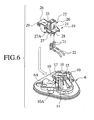
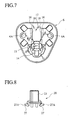
- the second bracket 6 has, as shown in FIGS. 6 and 7, a connector fixing section 17 with two opposite slots 16 extending in a parallel relationship in the plane direction of the bracket. Each slot 16 has a locking recess 18 formed in the middle. The second connector 19 is slid laterally into the fixing section 17 as shown in FIG. 5.
- the two engagement protrusions 10 are formed in an upwardly protruding manner on opposite sides of the shaft holding member 14.
- the protrusions 10 extend to a higher level than the second connector 19.
- Each engagement protrusion 10 is formed with a groove 10A in an upper side surface for engagement with a free end of the locking arm 11A.
- the upper portion of the engagement protrusion 10 is in a quadrangular prism or circular cone shape. The upper portion in such a shape guides the protrusion 10 into the engagement member 11 during insertion. This allows reliable connecting operation of the first and second brackets 5 and 6.
- the second bracket 6 also has a mounting hole 6A provided on each side of the inserted position of the second connector 19.
- the mounting hole 6A corresponds in position to the mounting hole 12 of the first bracket 5 and the mounting hole 2B of the inner panel 2.
- the second connector 19 has, as shown in FIG. 6, a connector housing 20 and a pair of second connection terminals 21 housed in the housing 20.
- the second terminals 21 are connected to ends of a pair of wires 22 from the sunvisor, led out from the end of the fixing shaft 4 inserted into the shaft holding member 14 of the second bracket 6.
- the connector housing 20 consists, as shown in FIG. 6 and FIGS. 8 to 10, of an upper member 24 as a body having a second connector hood 23 for insertion of the second terminals 21 from the bottom, and a lower member 26 attached to the upper member 24 via a hinge 25.
- the lower member 26 is turned on the hinge 25 to cover the bottom of the upper member 24.
- the upper member 24 has, at its opposed sidewalls, a pair of rails 27 to be inserted into the slots 16 of the second bracket 6.
- Each rail 27 is a flexible arm and is fixed at the opposite ends to the sidewall of the upper member 24.
- a locking protrusion 27A extending laterally outward of the upper member 24 is formed substantially in the middle of each rail 27.
- the upper member 24 also has, at its opposite sidewalls, engagement protrusions 28.
- the lower member 26 has engagement parts 29 positioned correspondingly to the engagement protrusions 28. The engagement parts 29 engage with the respective engagement protrusions 28 when the lower member 26 is turned on the hinge 25 to be laid on the bottom of the upper member 24.
- the second connection terminals 21 are inserted from below and held in the connector hood 23, and the lower member 26 is turned on the hinge 25 onto the upper member 24 so as to engage the engagement parts 29 with the engagement protrusions 28, whereby the second terminals 21 are guided to and fixed in the appropriate positions inside the connector hood 23.
- the rails 27 are inserted into the slots 16 of the second bracket 6. That is, the connector housing 20 cannot be fixed to the second bracket 6 until the second terminals 21 are housed appropriately in the connector hood 23. Once the second connector 19 is fixed to the second bracket 6, the lower member 26 never opens, which eliminates the possibility of erroneous pulling out of the second terminals 21 or disengagement of the lower member 26.
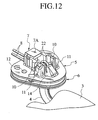
- the first bracket 5 is interposed between the inner panel 2 and the trim 13 with the first connector 7 and the engagement parts 11 protruded outside of the opening 2A of the inner panel 2, and the second connector 19, the engagement protrusions 10 and the shaft holding member 14 on the second bracket 6 are opposed through an opening 13A of the trim 13 to the first bracket 5 for assemblage. Since the upper portion of the engagement protrusion 10 is in a quadrangular prism shape, the protrusion 10 is appropriately guided into the opening provided at the bottom of the engagement member 11 of the first bracket 5, and is fitted into the member 11.
- the engagement protrusions 10 are inserted into the respective engagement members 11 of the first bracket 5 before the second connector 19 is fitted into the first connector 7 in the course of connecting the second bracket 6 to the first bracket 5.
- the top ends of the locking arms 11A of the engagement members 11 are engaged with the grooves 10A formed in the side surfaces of the engagement protrusions 10, thereby bringing the brackets 5 and 6 into preliminary engagement.
- bracket case not shown is attached from below the second bracket 6, completing the fixing of the sunvisor 3 as an auxiliary component to the inner panel 2.
- the bracket case has screw grommets to be inserted into the mounting holes 6A, 12 and 2B.
Landscapes
- Engineering & Computer Science (AREA)
- Mechanical Engineering (AREA)
- Details Of Connecting Devices For Male And Female Coupling (AREA)
- Connector Housings Or Holding Contact Members (AREA)
- Installation Of Indoor Wiring (AREA)
Abstract
Description
Claims (3)
- A bracket interconnection structure for an auxiliary component, comprising:a first bracket comprising:a first connector; anda plurality of engagement members; anda second bracket supporting an auxiliary component, comprising:a second connector; anda plurality of engagement protrusions fitted into the engagement members, the protrusions are greater in height than the second connector; wherein,the engagement protrusions are guided into the engagement members to be engaged so as to fit the second connector into the first connector, connecting the second bracket to the first bracket; whereby,the auxiliary component is fixed to the first bracket.
- A bracket interconnection structure for an auxiliary component according to claim 1, wherein:the engagement protrusions have upper portions formed in a circular cone shape or a quadrangular prism shape with diameters gradually reduced to the top ends, and the engagement members are in a tubular shape.
- A bracket interconnection structure for an auxiliary component according to claim 1 or 2, wherein:the engagement members have respective locking arms, and the engagement protrusions have respective grooves, the locking arms being engaged with the respective grooves.
Applications Claiming Priority (2)
| Application Number | Priority Date | Filing Date | Title |
|---|---|---|---|
| JP2000392762 | 2000-12-25 | ||
| JP2000392762A JP3593498B2 (en) | 2000-12-25 | 2000-12-25 | Auxiliary bracket connection structure |
Publications (3)
| Publication Number | Publication Date |
|---|---|
| EP1219480A2 true EP1219480A2 (en) | 2002-07-03 |
| EP1219480A3 EP1219480A3 (en) | 2002-09-18 |
| EP1219480B1 EP1219480B1 (en) | 2004-03-03 |
Family
ID=18858703
Family Applications (1)
| Application Number | Title | Priority Date | Filing Date |
|---|---|---|---|
| EP01130299A Expired - Lifetime EP1219480B1 (en) | 2000-12-25 | 2001-12-21 | Bracket interconnection structure for auxiliary component |
Country Status (4)
| Country | Link |
|---|---|
| US (1) | US6568951B2 (en) |
| EP (1) | EP1219480B1 (en) |
| JP (1) | JP3593498B2 (en) |
| DE (1) | DE60102208T2 (en) |
Families Citing this family (3)
| Publication number | Priority date | Publication date | Assignee | Title |
|---|---|---|---|---|
| EP1653555A3 (en) * | 2004-10-30 | 2006-05-10 | Hirschmann Car Communication GmbH | apparatus for coupling a wiring harness to an antenna |
| JP5704748B2 (en) * | 2010-11-17 | 2015-04-22 | 矢崎総業株式会社 | Auxiliary bracket fixing structure with connector |
| CN102780136B (en) * | 2012-08-09 | 2014-06-25 | 安徽江淮汽车股份有限公司 | Fixing device for plugins |
Family Cites Families (7)
| Publication number | Priority date | Publication date | Assignee | Title |
|---|---|---|---|---|
| US5046956A (en) | 1989-05-30 | 1991-09-10 | Kabushiki Kaisha T An T | Electrical connector device |
| US5462448A (en) * | 1994-09-08 | 1995-10-31 | Morton International, Inc. | Electrical connector locking system |
| JP3200546B2 (en) | 1995-09-04 | 2001-08-20 | 矢崎総業株式会社 | Movable connector |
| US6000959A (en) | 1996-02-07 | 1999-12-14 | Lear Corporation | Door panel wiring system |
| US5893768A (en) * | 1996-12-18 | 1999-04-13 | Ut Automotive Dearborn, Inc. | Self-aligning connection system |
| JP3341813B2 (en) * | 1997-06-02 | 2002-11-05 | 矢崎総業株式会社 | Connection structure of car door circuit |
| TW404537U (en) * | 1998-06-29 | 2000-09-01 | Darfon Electronics Corp | High voltage connection device for a retrieval transformer |
-
2000
- 2000-12-25 JP JP2000392762A patent/JP3593498B2/en not_active Expired - Lifetime
-
2001
- 2001-12-21 DE DE2001602208 patent/DE60102208T2/en not_active Expired - Lifetime
- 2001-12-21 EP EP01130299A patent/EP1219480B1/en not_active Expired - Lifetime
- 2001-12-21 US US10/024,259 patent/US6568951B2/en not_active Expired - Lifetime
Also Published As
| Publication number | Publication date |
|---|---|
| EP1219480B1 (en) | 2004-03-03 |
| EP1219480A3 (en) | 2002-09-18 |
| JP3593498B2 (en) | 2004-11-24 |
| JP2002192949A (en) | 2002-07-10 |
| US20020081898A1 (en) | 2002-06-27 |
| DE60102208T2 (en) | 2005-01-13 |
| DE60102208D1 (en) | 2004-04-08 |
| US6568951B2 (en) | 2003-05-27 |
Similar Documents
| Publication | Publication Date | Title |
|---|---|---|
| US6558193B2 (en) | Connector fitting structure for auxiliary component | |
| US5454737A (en) | Relay connector | |
| US6749324B2 (en) | Lamp unit mounting structure | |
| US20010025909A1 (en) | Bracket for mounting auxiliary machinery to vehicle body | |
| US6513961B2 (en) | Lamp unit | |
| US6354843B1 (en) | Electrical connector for a vehicle body side having engaging and recess portions for connection | |
| US5848902A (en) | Connector device | |
| JPH09180828A (en) | Fixture combined type connector and its mounting structure | |
| US6568951B2 (en) | Bracket interconnection structure for auxiliary component | |
| US6726165B2 (en) | Bracket connecting structure | |
| JP3595230B2 (en) | Bracket for mounting the body of the sun visor with electrical components | |
| US6398173B1 (en) | Bracket for mounting auxiliary equipment to vehicle body | |
| US6095831A (en) | Electrical connector mating structure | |
| JP3393501B2 (en) | Connector connection structure | |
| EP1223642B1 (en) | Connection structure of flat cable to connector | |
| AU2003252196B2 (en) | Bracket | |
| JP3901956B2 (en) | Auxiliary bracket connection structure | |
| US6428077B1 (en) | Securing structure of auxiliary equipment for vehicle | |
| JP2001186623A (en) | Module connector mounting structure | |
| JP3889576B2 (en) | Bracket connection structure | |
| JP5286109B2 (en) | Auxiliary device mounting bracket and its mounting method | |
| JP3446994B2 (en) | Door module wiring connection structure | |
| JP2560594Y2 (en) | Vehicle license lamp mounting structure |
Legal Events
| Date | Code | Title | Description |
|---|---|---|---|
| PUAI | Public reference made under article 153(3) epc to a published international application that has entered the european phase |
Free format text: ORIGINAL CODE: 0009012 |
|
| 17P | Request for examination filed |
Effective date: 20011221 |
|
| AK | Designated contracting states |
Kind code of ref document: A2 Designated state(s): AT BE CH CY DE DK ES FI FR GB GR IE IT LI LU MC NL PT SE TR |
|
| AX | Request for extension of the european patent |
Free format text: AL;LT;LV;MK;RO;SI |
|
| PUAL | Search report despatched |
Free format text: ORIGINAL CODE: 0009013 |
|
| AK | Designated contracting states |
Kind code of ref document: A3 Designated state(s): AT BE CH CY DE DK ES FI FR GB GR IE IT LI LU MC NL PT SE TR |
|
| AX | Request for extension of the european patent |
Free format text: AL;LT;LV;MK;RO;SI |
|
| 17Q | First examination report despatched |
Effective date: 20030310 |
|
| AKX | Designation fees paid |
Designated state(s): DE FR GB |
|
| GRAP | Despatch of communication of intention to grant a patent |
Free format text: ORIGINAL CODE: EPIDOSNIGR1 |
|
| GRAS | Grant fee paid |
Free format text: ORIGINAL CODE: EPIDOSNIGR3 |
|
| GRAA | (expected) grant |
Free format text: ORIGINAL CODE: 0009210 |
|
| AK | Designated contracting states |
Kind code of ref document: B1 Designated state(s): DE FR GB |
|
| REG | Reference to a national code |
Ref country code: GB Ref legal event code: FG4D |
|
| REG | Reference to a national code |
Ref country code: IE Ref legal event code: FG4D |
|
| REF | Corresponds to: |
Ref document number: 60102208 Country of ref document: DE Date of ref document: 20040408 Kind code of ref document: P |
|
| ET | Fr: translation filed | ||
| PLBE | No opposition filed within time limit |
Free format text: ORIGINAL CODE: 0009261 |
|
| STAA | Information on the status of an ep patent application or granted ep patent |
Free format text: STATUS: NO OPPOSITION FILED WITHIN TIME LIMIT |
|
| 26N | No opposition filed |
Effective date: 20041206 |
|
| REG | Reference to a national code |
Ref country code: FR Ref legal event code: PLFP Year of fee payment: 15 |
|
| REG | Reference to a national code |
Ref country code: FR Ref legal event code: PLFP Year of fee payment: 16 |
|
| REG | Reference to a national code |
Ref country code: FR Ref legal event code: PLFP Year of fee payment: 17 |
|
| PGFP | Annual fee paid to national office [announced via postgrant information from national office to epo] |
Ref country code: DE Payment date: 20181211 Year of fee payment: 18 |
|
| PGFP | Annual fee paid to national office [announced via postgrant information from national office to epo] |
Ref country code: GB Payment date: 20181219 Year of fee payment: 18 Ref country code: FR Payment date: 20181120 Year of fee payment: 18 |
|
| REG | Reference to a national code |
Ref country code: DE Ref legal event code: R119 Ref document number: 60102208 Country of ref document: DE |
|
| GBPC | Gb: european patent ceased through non-payment of renewal fee |
Effective date: 20191221 |
|
| PG25 | Lapsed in a contracting state [announced via postgrant information from national office to epo] |
Ref country code: GB Free format text: LAPSE BECAUSE OF NON-PAYMENT OF DUE FEES Effective date: 20191221 Ref country code: DE Free format text: LAPSE BECAUSE OF NON-PAYMENT OF DUE FEES Effective date: 20200701 Ref country code: FR Free format text: LAPSE BECAUSE OF NON-PAYMENT OF DUE FEES Effective date: 20191231 |