This invention relates to colored, aqueous heat-bleachable
compositions that can undergo a change in electromagnetic absorption
characteristics upon application of heat. These compositions are useful as
antihalation or filter components of photothermographic elements.
Photographic materials usually contain various layers and
components, including antihalation or filter layers, overcoats and radiation
sensitive layers. The antihalation layer of an imaging element helps to prevent
light that has passed through the radiation sensitive layer(s) from reflecting back
into those layers. If reflection is not prevented, the resulting image is less sharp.
In wet processes, the antihalation layer is generally removed or rendered colorless
during wet-chemical processing. A filter layer is used to absorb light of a color
not completely absorbed by a color layer or color layer unit above the filter layer,
while transmitting light of a color intended to be absorbed by a color layer or a
color layer below the filter layer. In other words, a filter layer is used to
selectively absorb light not used for image capture. An antihalation layer can be
viewed as a type of filter layer positioned below all the color layers, wherein no
light needs to be transmitted to any color layer below the antihalation layer, but
reflection of light back through the antihalation unit is prevented or minimized.
Both an antihalation layer and a filter layer will typically employ a filter dye
which absorbs, or filters out, light not intended to be absorbed by a color layer.
Imaging elements that can be processed, after imagewise exposure,
simply by heating the element are referred to as photothermographic elements. It
is often desired that such elements include an antihalation or filter layer. In most
cases, the antihalation layer must be rendered substantially transparent upon heat
processing in order to avoid unwanted absorption of light during scanning, which
would undesirably result in a higher level of minimum density (an increased
"Dmin"). Particularly in the case of a color film, bleaching to transparency and
avoiding or minimizing any tint is desirable.
A variety of antihalation compositions have been reported in the
literature for use in photothermographic systems which avoid the use of
processing solutions. Such compositions generally include heat bleachable
antihalation dyes or incorporated addenda that act as bleaching agents. In
particular, the use of radicals from biimidazoles as bleaching agents in
antihalation compositions are known, being described, for example, in U.S. Pat.
No. 4,196,002 (Levinson et al) and U.S. Pat. No. 4,201,590 (Levinson et al). The
compositions contain filter dyes in reactive association with certain
hexaarylbiimidazole (HABI) compounds. These antihalation compositions
become colorless upon exposure to heat for a given time. Other patents that
disclose similar antihalation compositions and photothermographic elements are:
U.S. Patents Nos. 5,652,091 (Perry et al.)5,693,589 (Goswami et al.) and
5,705,323 (Perry et al.) and British patent GB 2,004,380 (Levinson et al.).
Most of the bleachable antihalation compositions in the prior art
were designed for solvent systems in which the dyes and the bleaching agents
were soluble as individual molecules. Since HABIs disclosed in the prior art have
not been designed for use in aqueous systems, it is not predictable whether such
systems would function when aqueous coated or in a hydrophilic layer
comprising water. Furthermore, most of the bleachable antihalation compositions
in the prior art have been directed to health imaging or graphic arts, as compared
to photothermographic color film for consumer use. In the latter context, the dark
keeping of a thermally bleachable dye composition would be a challenge. For
such compositions to be useful, it would be crucial that they have the least amount
of dark keeping loss, and at the same time undergo almost complete bleaching at
higher temperatures.
There is a need for antihalation compositions that can be
permanently and quickly bleached at lower temperatures in aqueous systems.
Particularly in the field of color photothermographic film for consumer use, the
requirements in terms of bleaching and keeping are high. Bleaching of an
antihalation layer or filter layer is desired to improve scanning of the film.
The present invention relates to a photothermographic element
comprising a support, at least one photothermographic layer, and at least one
antihalation layer or a filter layer, wherein the antihalation or filer layer comprises
a heat-bleachable composition comprising at least one light-absorbing filter dye
(not derived from a latent image) and at least one hexaarylbiimidazole compound
dispersed within the layer in the form of solid or liquid particles. The filter dye
encompasses dyes used in filter layers or antihalation layers and excludes dyes
resulting from developing agents or coupling agents. In one embodiment of the
invention, the particles are dispersed in a matrix comprising a hydrophilic
polymer or water-dispersible hydrophobic polymer. In one embodiment, the
hydrophilic polymer is oxidized gelatin, as a binder for the antihalation or filter
layer.
The present invention is also directed to a composition in the form
of an aqueous dispersion comprising at least one antihalation or filter dye and at
least one hexaarylbiimidazole compound, which aqueous dispersion comprises an
aqueous phase and a dispersed organic phase, the aqueous phase comprising a
soluble hydrophilic polymer or dispersed hydrophobic polymer and the dispersed
organic phase comprising solid or liquid particles comprising said
hexaarylbiimidazole compound, and wherein the hexaarylbiimidazole compound
in said particles is capable of bleaching said dye when the dispersion is coated,
dried and heated to a temperature of at least 90°C for at least 0.5 seconds. The
dye may be in the aqueous phase or in a separate dispersed organic phase. In one
embodiment, solid particles comprising said hexaarylbiimidazole compound are
employed. In another embodiment, an oil-in-water emulsion is employed.
The invention is also directed to a method of making a
photothermographic element and the use of the photothermographic element,
wherein the antihalation or filter layer becomes at least 40%, preferably at least
50%, more preferably at least 90%, colorless within about 20 minutes, preferably
within about 5 minutes, more preferably within about 0.5 minutes, upon heating
to a temperature of at least about 90°C (according to controlled tests of such a
layer essentially alone on the same support used in the product). The described
antihalation or filter layer is especially advantageous because of the speed with
which the layer becomes at least 40% colorless upon heating and its good shelf
life storage stability. The invention is also directed to a method of forming an
image in the multicolor photothermographic element, including scanning the
developed image.
As indicated above, a feature of the invention is the use, in a
photothermographic element of a filter or antihalation layer comprising particles
comprising a hexaarylbiimidazole compound dispersed in an aqueous matrix or an
aqueous coated matrix. This hexaarylbiimidazole is used, in reactive association
with a dye, to bleach the dye after image capture and upon suitable heating of the
photothermographic element, advantageously during development of the image.
A variety of hexaarylbiimidazole compounds are useful in an antihalation or filter
layer according to the invention. These hexaarylbiimidazole compounds, also
referred to as oxidative dimers of triarylimidazoles, are known compounds and
can be prepared by methods known in the art. For instance, hexaarylbiimidazoles
can be prepared by means of an interfacial oxidation of the parent triarylimidazole
using potassium ferricyanide as an oxidant. For example, typical
hexaarylbiimidazole compounds that are useful according to the invention are
described in, and can be selected from, the following patents: U.S. Pat. Nos.
3,734,733 of Poot et al, issued May 22, 1973; 3,390,997 of Read, issued July 2,
1968; 3,383,212 of MacLachlan, issued May 14, 1968; 3,445,234 of Cescon et al,
issued May 20, 1969; 3,395,018 of Read, issued July 30, 1968; 3,390,994 of
Cescon et al, issued July 2, 1968; 3,615,481 of Looney, issued Oct. 26, 1971;
3,666,466 of Strilko, issued May 30, 1972; 3,630,736 of Cescon, issued Dec. 28,
1971; and 3,533,797 of James et al, issued Oct. 13, 1970. These patents are
incorporated herein by reference.
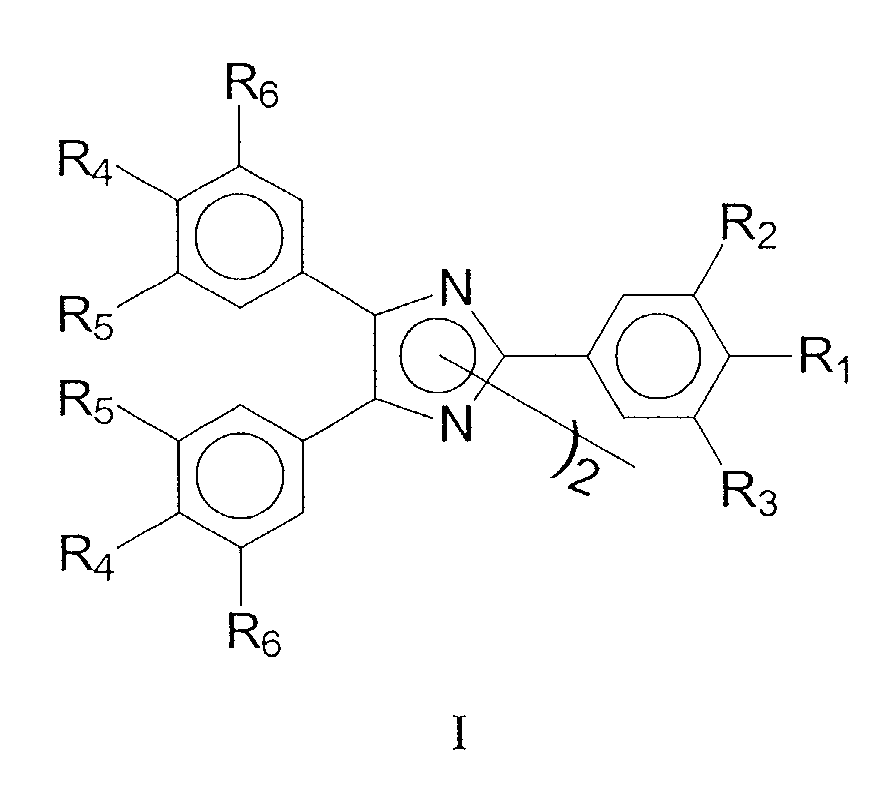
Typical examples of useful hexaarylbiimidazole compounds
include oxidative dimers of 2,4,5-triarylimidazoles in which the aryl groups are
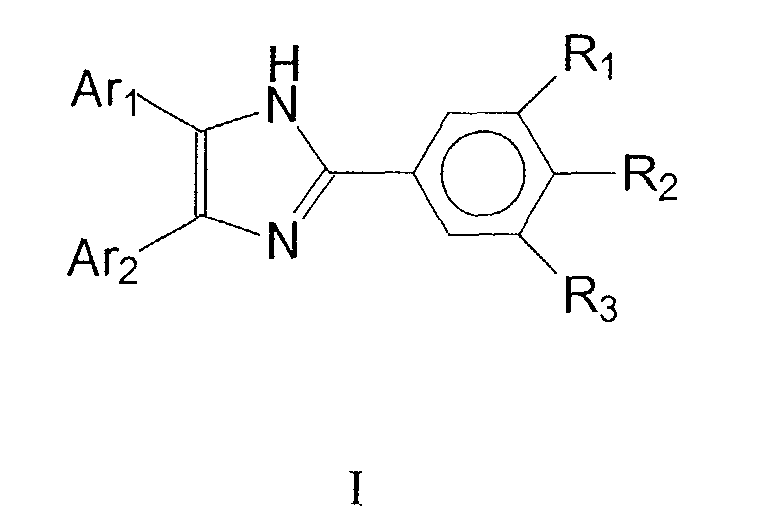
substituted or unsubstituted. The hexaarylbiimidazole is preferably a dimer of
two triarylimidazoles independently represented by the following Structure I
below:
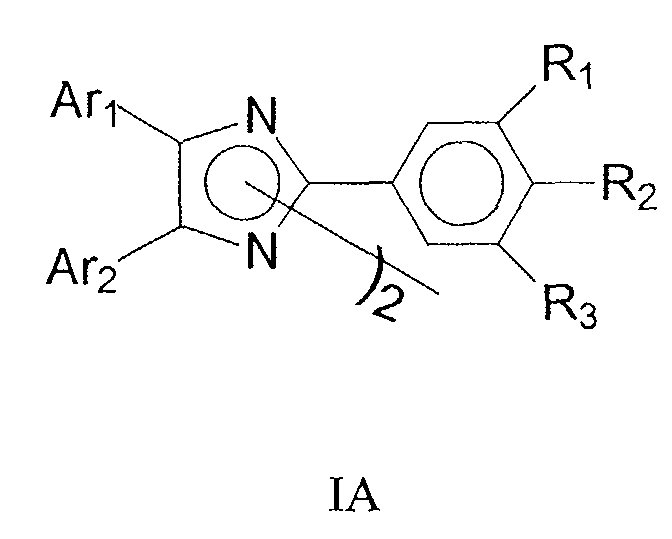
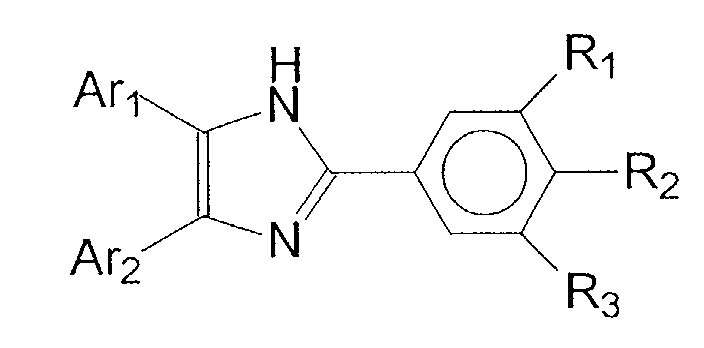
In the case, where the dimer is composed of identical monomers, the
hexaarylbiimidazole can be represented as follows:
wherein R
1, R
2 and R
3 are independently substituents, for example, hydrogen,
halogen, alkyl or substituted alkyl of 1 to about 10 carbons, alkoxy of 1 to 10
carbon atoms, aryl or substituted aryl of from 5 to about 10 carbons, cyano,
carboalkoxy, nitro, a substituted or unsubstituted benzyl of from 6 to 11 carbon
atoms; wherein Ar
1 and Ar
2 are independently substituted or unsubstituted
carbocyclic or heterocyclic aromatic groups. Preferably, the alkyl or alkoxy
substituents contain 1 to 4 carbon atoms, such as methyl, ethyl, propyl and butyl.
Preferably, R
1, R
2 and R
3 in Structure I are independently hydrogen, halogen,
alkyl or substituted alkyl of 1 to about 10 carbons, aryl or substituted aryl of from
5 to about 10 carbons, a substituted or unsubstituted benzyl of from 6 to 11
carbon atoms.
More preferably, the hexaarylbiimidazole is represented by
Structure IC:
wherein R
1 is hydrogen or halogen; R
2 and R
3 are independently hydrogen,
halogen, alkyl or substituted alkyl of 1 to about 10 carbons, aryl or substituted
aryl of from 5 to about 10 carbons, a substituted or unsubstituted benzyl, cyano;
R
4, R
5, and R
6 are independently hydrogen, alkyl or substituted alkyl of 1 to about
6 carbons. The R
4, R
5, and R
6 groups may be independently selected for each
ring, although preferably they are the same for both rings. The two monomers in
Structure IC may be independently selected or may be identical. More preferably,
the hexaarylbiimidazole is according to Structure IC wherein R
1, R
2, and R
3 are
hydrogen; R
4 is alkyl or substituted alkyl of 1 to about 6 carbons; and R
5 and R
6
are hydrogen. Finally, the most preferred compound is according to Structure IC
wherein R
1, R
2, and R
3 are hydrogen, R
4 is isopropyl; and R
5, and R
6 are
hydrogen.
Important teachings relating to hexaarylbiimidazoles have been
published by Aldag, Photochromism, Molecules and Systems, Durr and Bouras-Laurent
(Eds.), Chapter 18, pages 714-717, Elsevier, 1990. A single
triarylimidazole can conceivably give rise to different structural dimers if the
dimer linkage is made via C-N, C-C or N-N bonds. These individual structural
dimers or mixtures thereof can be generated chemically, thermally or
photolytically from a common triarylimidazoyl radical. While the dimers
specifically described herein are linked via a C-N bond (2-carbon atom of one
imidazole and nitrogen atom of the other imidazole), the present invention is not
so limited.
If desired, a combination of hexaarylbiimidazole compounds can
be used. An example of such a combination is the combination of compounds,
within Structure (I), one compound (a) wherein all the R groups are hydrogen
with a second compound (b) wherein R4 and R1 are isopropyl, with all other R
groups being hydrogen.
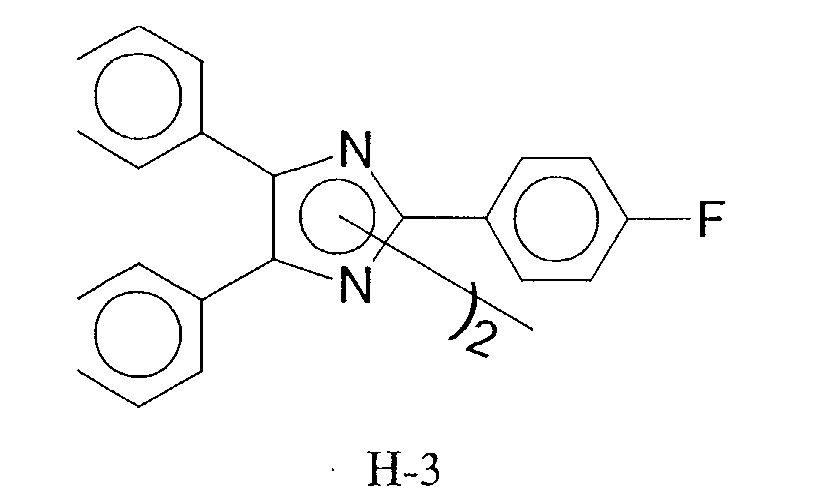
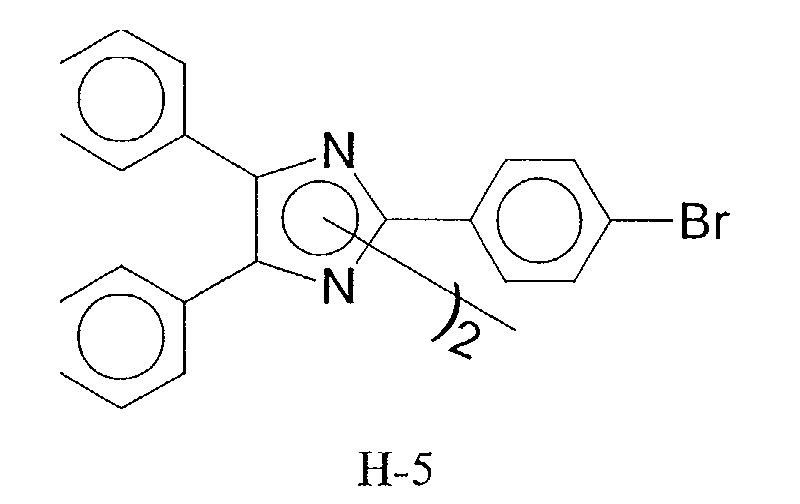
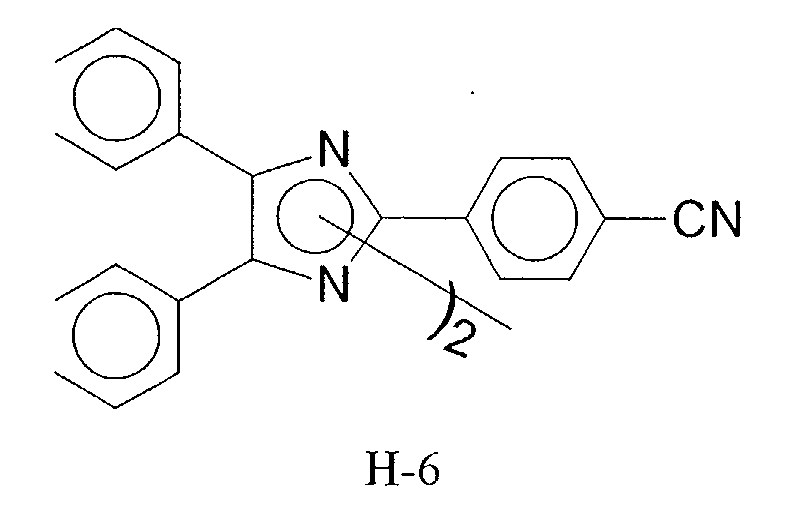
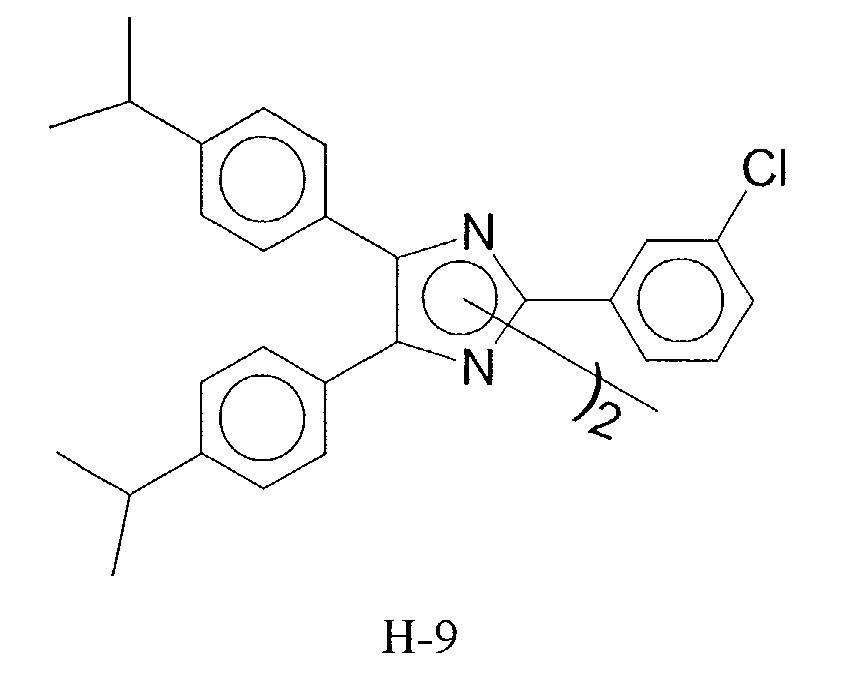
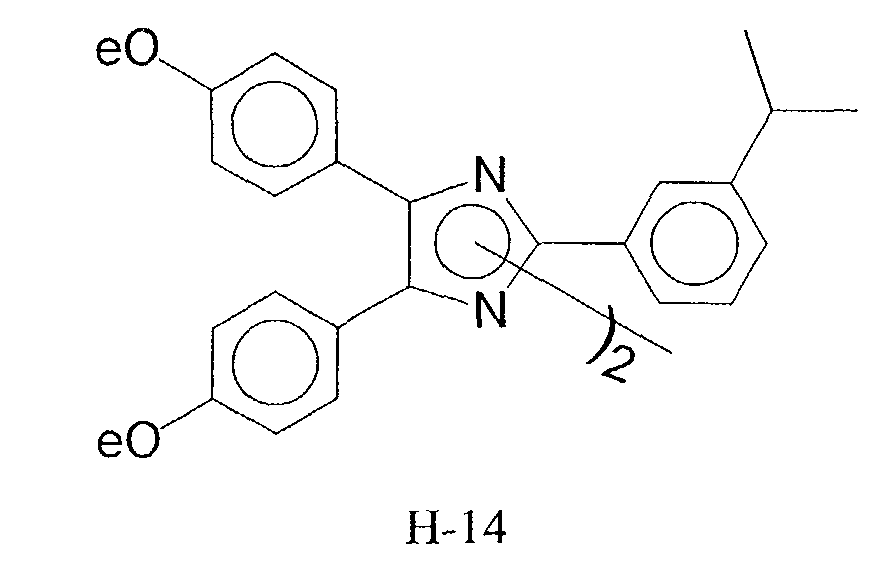
Particular examples of hexaarylbiimidazole compounds are:
Selection of the hexaarylbiimidazole compound or combination of
such compounds will depend upon such factors as the particular antihalation or
filter dye or dyes to be used, processing conditions, desired degree of bleaching in
the layer containing the dye or dyes, solubility characteristics of the components
and the like.
A variety of dyes and dye precursors can be useful according to the
invention with the described hexaarylbiimidazole compounds, but in general any
dye or dye precursor can be used according to the invention which changes its
color, i.e. changes its electromagnetic radiation absorption characteristics, upon
reaction with what are believed to be triarylimidazoyl radicals provided upon
heating the described hexaarylbiimidazole compounds. For antihalation layer
purposes for example, it is desirable that the heat bleachable layer have
substantially uniform absorption in the spectral region in which the imaging
composition is sensitive. The antihalation dye or dye precursor should also be
changed to the extent that at least about 40%, and preferably at least 50%, more
preferably at least 60%, still more preferably at least 80%, and most preferably at
least 90% of the layer absorption is changed from colored to colorless according
to a standard test using Status M density. Thus, the antihalation or filter layer,
after bleaching, has minimal or substantially no optical density that will adversely
affect the Dmin of the product during scanning, or during overall picture
production using the photothermographic element.
A variety of dyes are known which can be bleached or converted to
a colorless form using hexaarylbiimidazole, many of which are specifically
disclosed in the prior art, including, for example, but not limited to squarylliums
(sometimes referred to as "squarilliums"), oxonols, formazans, and other filter
dyes, either water or solvent soluble, that are likewise bleachable.
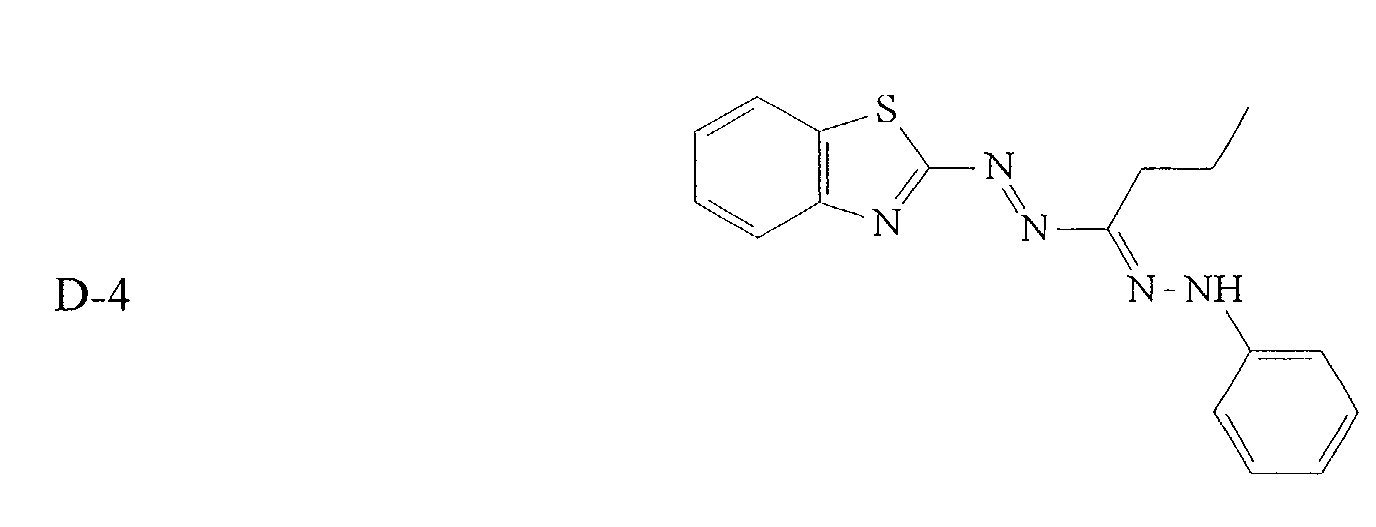
Examples of formazan dyes are represented by the following
Structure II:
wherein R
3 is a substituted or unsubstituted aromatic group of 5 to 20 atoms in
the ring system, such as carbocyclic or heterocyclic aromatic rings. Preferably,
R
3 is a substituted or unsubstituted coordinating aromatic group having 5 to 15
atoms in the ring system. Such aromatic groups can be carbocyclic or
heterocyclic containing one or more nitrogen, oxygen or sulfur atoms.
R4 can also be an aryl group (substituted or unsubstituted)
having from 6 to 14 carbon atoms in the ring nucleus (such as phenyl, tolyl,
xylyl, naphthyl, anthryl, p-nitrophenyl, benzthiophenyl, benzimidazoyl or
pyridyl).
R5 is an alkyl group (substituted or unsubstituted) of 1 to 20
carbon atoms (such as substituted or unsubstituted methyl, ethyl, n-propyl,
isopropyl, t-butyl, hexyl, decyl, benzyl and other branched or linear hydrocarbons
readily apparent to one skilled in the art), an aryl group (substituted or
unsubstituted) of 6 to 14 carbon atoms in the ring (such as phenyl, xylyl, tolyl,
naphthyl, 4-hydroxyphenyl, p-nitrophenyl, dimethoxyphenyl, anthroquinonyl and
other substituted carbocyclic aromatic ring systems readily apparent to one skilled
in the art), or a substituted or unsubstituted 5- to 7-membered heterocyclic group
having 5 to 7 atoms in the ring nucleus, such as pyridyl, pyrimidyl, oxazyl,
benzothiazolyl, benzimidazolyl, and others readily apparent to one skilled in the
art. Particular formazan dyes (some in metallized form) that can be mentioned
include those disclosed in US Patent No. 5,652,091 to Perry et al. and US Patent
4,201,590 to Levinson et al., hereby incorporated by reference in its entirety, for
instance: (1) 1,3,5-triphenylformazan; (2) 1-(4-chlorophenyl)-3,5-diphenylformazan;
(3) 1-p-nitrophenyl-3,5-(diphenyl)formazan; (4) 1,5-diphenyl-3-methylformazan;
(5) 1,5-diphenyl-3-(3-iodophenylf)formazan; (6)
1,5-diphenyl-3-(2-naphthyl)formazan; (7) 1-(2-carboxyphenyl)-3,5-diphenylformazan
and; (8) 1,5-diphenyl-3-(p-nitrophenyl)formazan. The
formazan antihalation or filter dyes that are useful can be a metallized formazan
dye, examples of which are zinc-formazan dye complexes, cobalt-formazan dye
complexes, copper-formazan dye complexes, cadmium-formazan dye complexes
and nickel-formazan dye complexes. Combinations of formazan dyes can also be
useful, and metallized formazan dyes can also be useful in combination with
metallized formazan dyes or formazan dyes that are not metallized. Combinations
of formazan dyes can be useful to provide the desired degree of absorption. An
example of a combination of formazan dyes is triphenylformazan with 1-(p-nitrophenyl)-3-methyl-5-phenylformazan.
Other useful formazan dyes are described, for example, in
Research Disclosure, October 1974, Item 12617, pages 12-30, published by
Industrial Opportunities Ltd., Homewell, Havant, Hampshire, PO9 1EF, UK.
U.S. Pat. No. 3,227,556 of Oliver and Gates, issued Jan. 4, 1966; U. S. Pat. No.
3,050,393 of Macdonald, issued Aug. 21, 1962; and Chemical Reviews, 1955,
beginning at page 356. These are also incorporated herein by reference. The
formazan dyes and their preparation are known in the art. The formazan dyes can
be prepared by procedures known in the art, such as described in Chemical
Reviews, 1955, beginning at page 356.
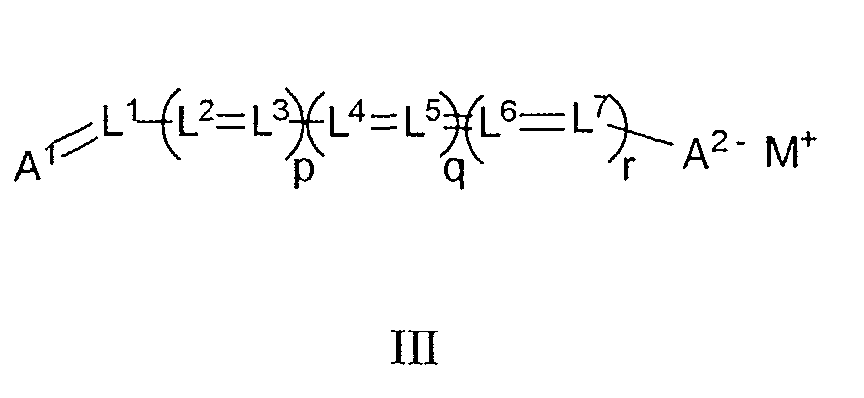
Still another example of a preferred class of filter dyes that can
be used in the present invention are oxonol dyes, including symmetrical and
unsymmetrical tri, penta and heptamethine oxonol dyes derived from cyclic or
acyclic (or both) ketomethylenes. Typical oxonol dyes can be represented by
the following structure III:
wherein A
1 and A
2 are activated methylene moieties (including ketomethylene),
L
1-L
7 each independently represent a substituted or unsubstituted methine group,
M
+ is a cation, and p is one, q and r are independently 0 or 1.
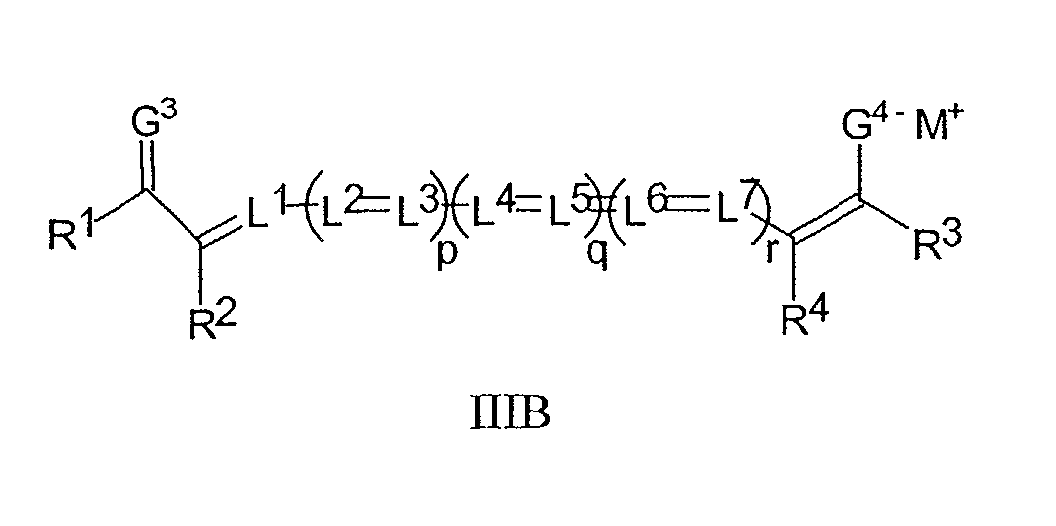
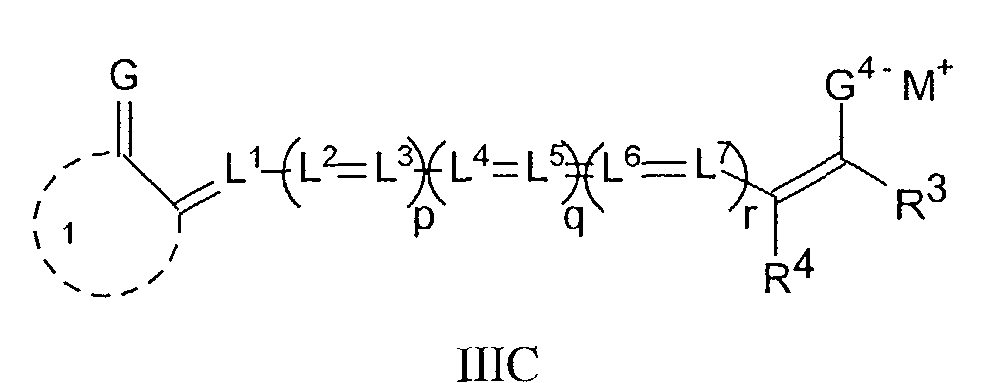
Preferably, the oxonol is represented by the following Structure
IIIA, IIIB or IIIC:
wherein W
1 and Y
1 are the atoms required to form a cyclic activated methylene or
ketomethylene moiety; R
1 and R
3 are aromatic or heteroaromatic groups; R
2 and
R
4 are electron-withdrawing groups; G-G
4 are independently O or dicyanovinyl (-C(CN)
2))
and p is one, q and r are independently 0 or 1, and L
1-L
7 each represent
a substituted or unsubstituted methine groups. This divides the dyes of Structure
III into oxonols derived from two cyclic activated methylene units (IIIA) such as
pyrazolones or barbituric acids, two acyclic activated methylene units (IIIB) such
as tricyanopropenes or benzoylacetonitriles, or one of each (IIIC). In all three
substructures, however, the end groups need not be identical, but can be
independently selected.
In Structure III above (with respect to A1 and A2) or in structures
according to Structure IIIA, IIIB and IIIC, activated methylene (including
ketomethylene) moieties are well known in the art and are described, for example,
in Hamer, The Cyanine Dyes and Related Compounds, pages 469-494 and 595-604.
In accordance with the present invention, preferred activated methylene
groups include, but are not restricted to those derived from benzoylacetonitrile, 2-pyrazolin-5-one,
pyrazolidindione, tricyanopropene, barbituric acid, indanedione,
dicyanovinylindanedione, bis(dicyanovinyl)indanedione, pyrrolinone, furanone
(such as cyanophenylfuranone and derivatives) benzothiophene dioxide,
dicyanovinylbenzothiophene dioxide, rhodanine, benzofuranone, chromandione,
cyclohexanedione, isoxazolinone, pyrazolopyridine, pyridone and pyrandione, and
any of these moieties may be optionally substituted with ionic or non-ionic
solubilizing group(s) or an ionizable group with a pKa value less than 4 in water.
W1 and Y1 are the atoms required to form a carbocyclic or heterocyclic
ketomethylene moiety.
In Structure III, IIIA, IIIB and IIIC, M+ is a cation such as H+,
Et3NH+, C5H5NH+, Na+, and K+. "Group" wherever used in the present application
includes the possibility of being substituted or unsubstituted. R2, R4, E1 and E2 are
electron-withdrawing substituents which are discussed in March, Advanced
Organic Chemistry, pages 20-21, 228-229, 386-387 and 494-497. Groups for R2,
R4, E1 and E2 may include cyano, acyl, benzoyl, phenacyl, aminocarbonyl,
alkoxycarbonyl, aryl, nitro or arylsulfonyl or alkylsulfonyl.
Any L group may be substituted or unsubstituted. This includes the
possibility that any of them may be members of a 5 or 6-membered ring.
Methine groups may be substituted with, for example, an alkyl,
alkenyl, aryl, aralkyl, cycloalkyl, or heterocyclic group or, as mentioned above, if
more than one of p, q, or r is 1, two or more methine groups together with their
substituents may form a 5- or 6-membered carbocyclic or heterocyclic ring.
In general, when reference in this application is made to a
particular moiety or group it is to be understood that such reference encompasses
that moiety whether unsubstituted or substituted with one or more substituents (up
to the maximum possible number). For example, "alkyl" or "alkyl group" refers
to a substituted or unsubstituted alkyl, while "benzene group" refers to a
substituted or unsubstituted benzene (with up to six substituents). Generally,
unless otherwise specifically stated, substituent groups usable on molecules herein
include any groups, whether substituted or unsubstituted, which do not destroy
properties necessary for the photographic utility. Examples of substituents on any
of the mentioned groups can include known substituents, such as: halogen, for
example, chloro, fluoro, bromo, iodo; hydroxy; alkoxy, particularly those "lower
alkyl" (that is, with 1 to 6 carbon atoms, for example, methoxy, ethoxy;
substituted or unsubstituted alkyl, particularly lower alkyl (for example, methyl,
trifluoromethyl); thioalkyl (for example, methylthio or ethylthio), particularly
either of those with 1 to 6 carbon atoms; substituted or unsubstituted alkenyl,
preferably of 2 to 10 carbon atoms (for example, ethenyl, propenyl, or butenyl);
substituted and unsubstituted aryl, particularly those having from 6 to 20 carbon
atoms (for example, phenyl); and substituted or unsubstituted heteroaryl,
particularly those having a 5 or 6-membered ring containing 1 to 3 heteroatoms
selected from N, O, or S (for example, pyridyl, thienyl, furyl, pyrrolyl); acid or
acid salt groups such as any of those described below; hydroxylate, amino,
alkylamino, cyano, nitro, carboxy, carboxylate, acyl, alkoxycarbonyl,
aminocarbonyl, sulfonamido, sulfamoyl, sulfo, sulfonate, alkylammonium, and an
ionizable group with a pKa value below 4 in water; and others known in the art.
Alkyl substituents may specifically include "lower alkyl" (that is, having 1-6
carbon atoms), for example, methyl, ethyl, and the like. Further, with regard to
any alkyl group or alkylene group, it will be understood that these can be
branched or unbranched and include ring structures. Preferred compounds are
derived from pyrazolones, indanediones and thienonedioxide oxonols. Oxonols
include chain alkyl and chain acyl dyes, in which alkyl or acyl groups are attached
to the central moiety between the end groups.
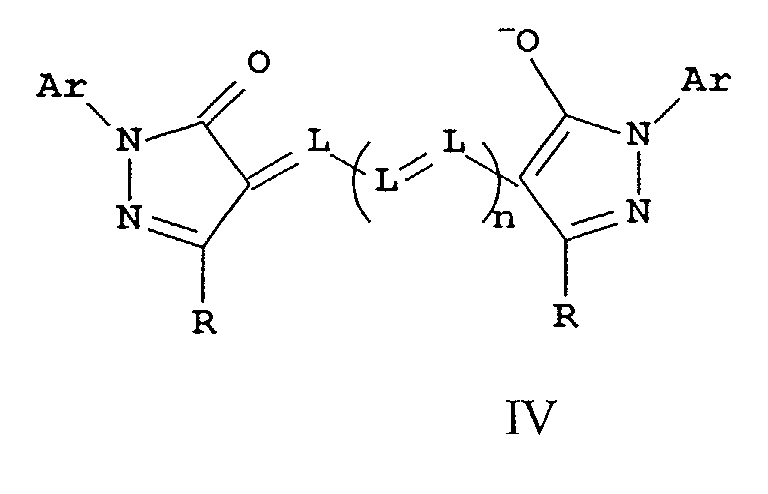
A preferred group of oxonol dyes can be represented by Structure
IV below:
wherein n is 1 to 3 and each Ar is independently a substituted or unsubstituted
aryl or heterocyclic group, and each R is independently a substituted or
unsubstituted alkyl, hydrogen, carboxyalkyl, acyl, aryl or alkenyl group and each
L independently represents a substituted or unsubstituted methine group.
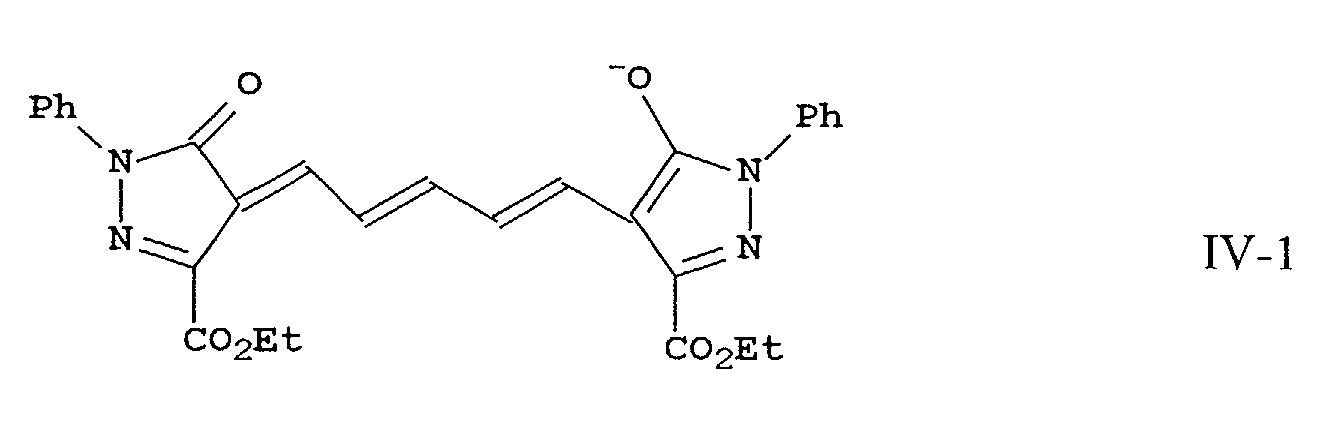
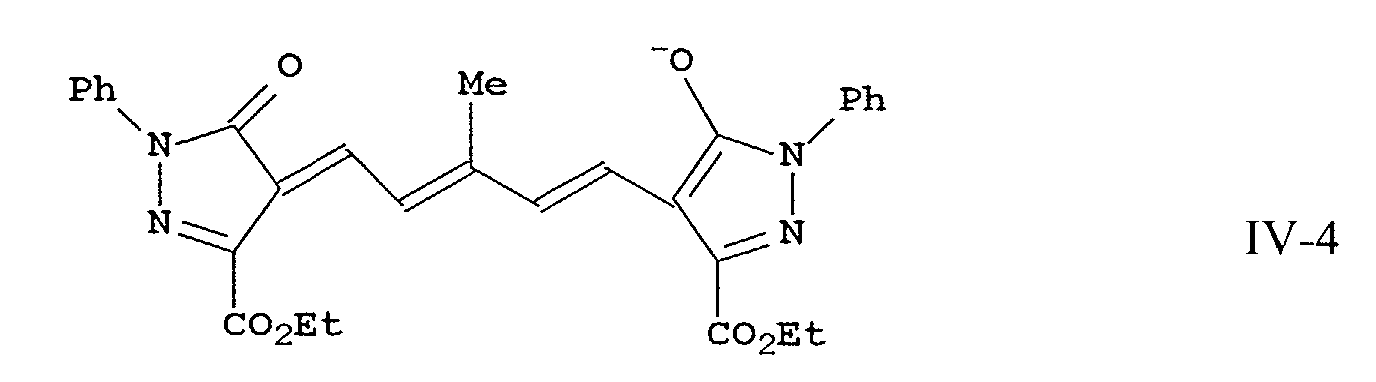
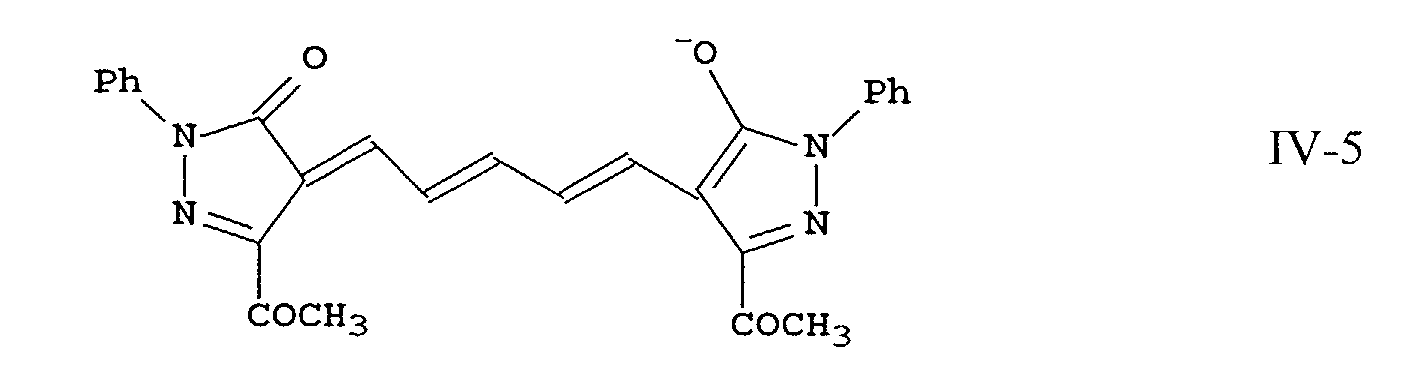
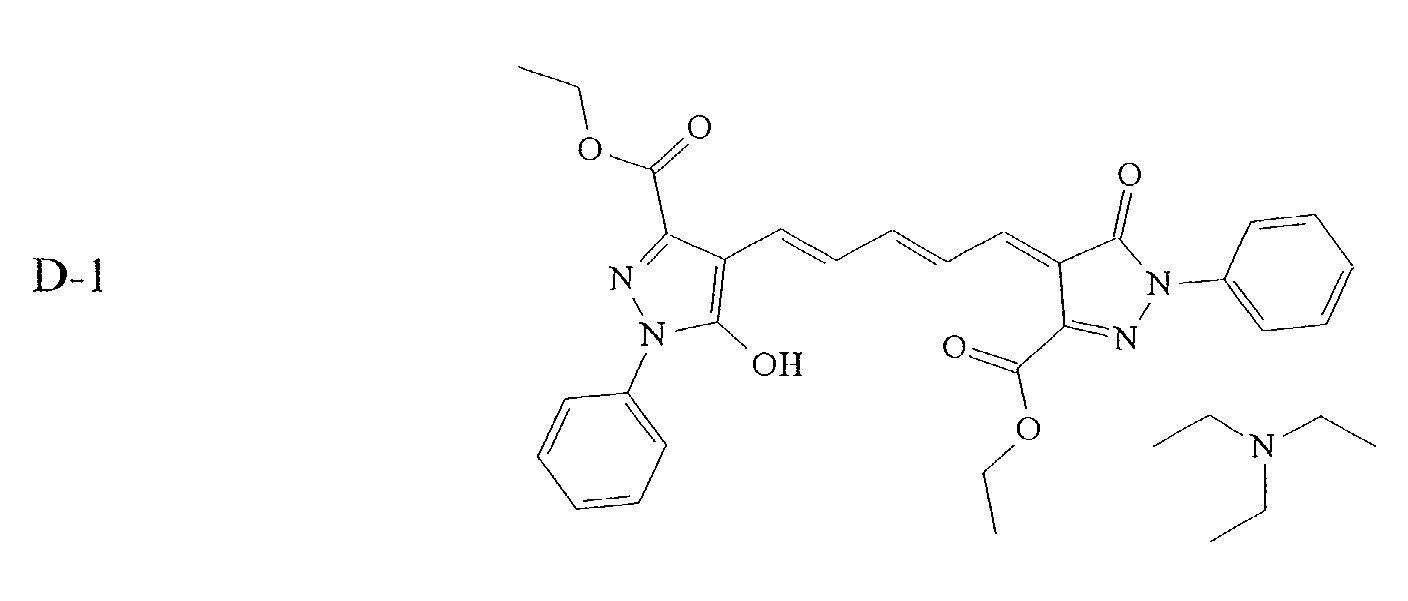
Examples of particularly useful oxonol dyes for use in this invention are dyes of
formulae IV-1, IV-2, IV-3, IV-4, and V-5:
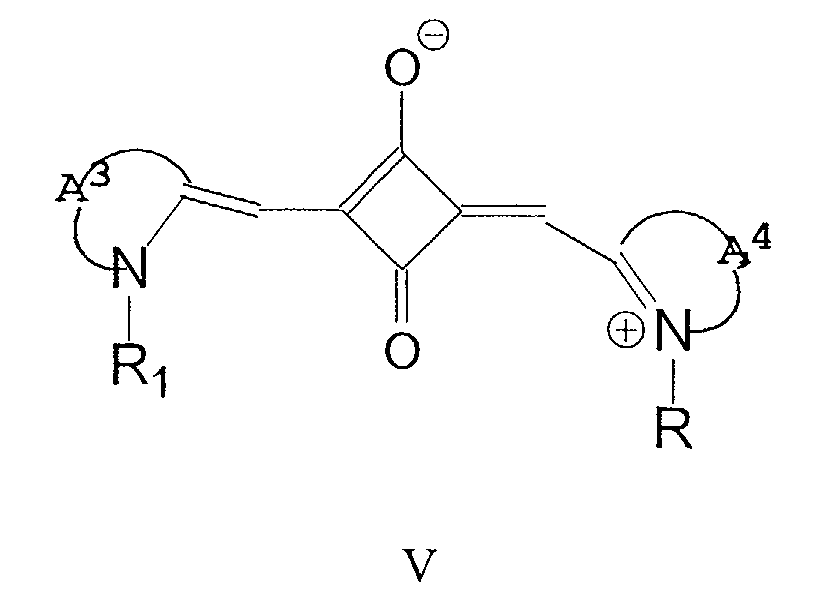
Still another example of a class of filter dyes that can be used in
the present invention are squaryllium dyes represented by the following Structure
V:
wherein A
3 and A
4, which may be the same or different, completes substituted or
unsubstituted heterocyclic or fused heterocyclic rings, preferably 5 to 12-membered
unsaturated rings, or wherein A
3 or A
4 completes substituted or
unsubstituted carbocyclic rings, preferably 5 to 12-membered unsaturated rings;
and R and R
1 independently represents alkyl, substituted alkyl or aryl, preferably
having 1-6 carbon atoms. Further examples of squaryllium dyes can be found in
US Patent No. 4,743,531 to Farid et al. (exemplified in Table II) and US Patent
Nos. 4,175,956 and 4,743,530 to Haley et al., hereby incorporated by reference in
their entirety.
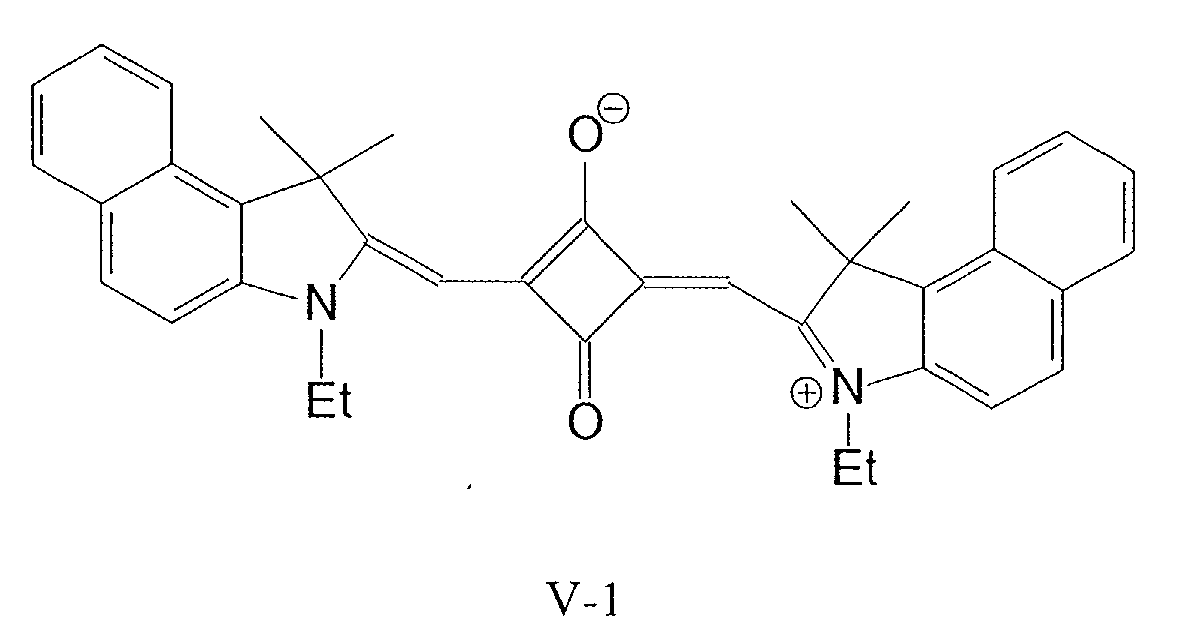
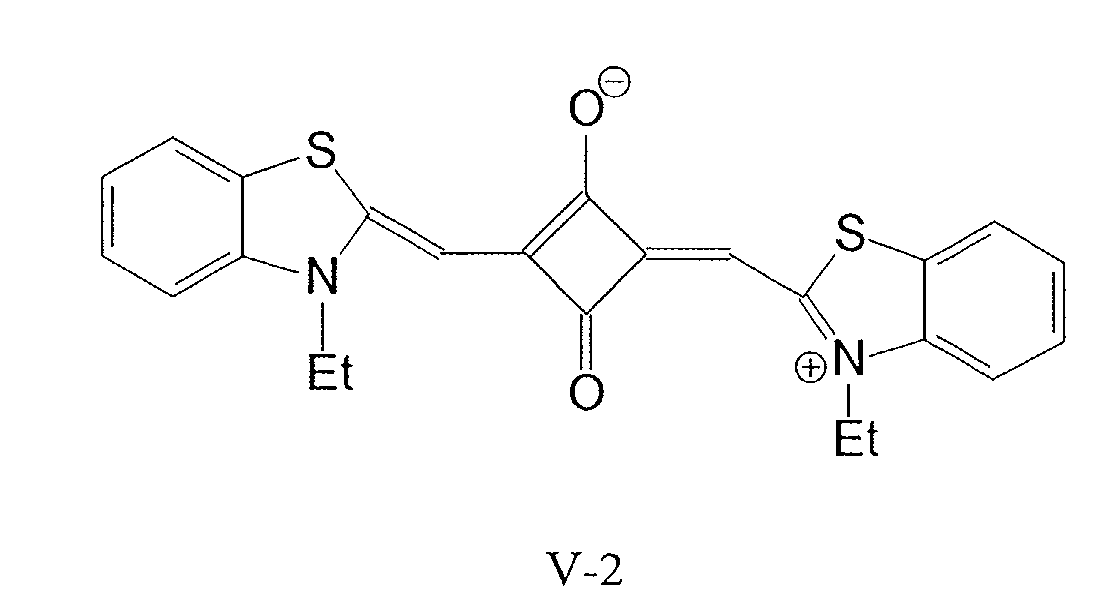
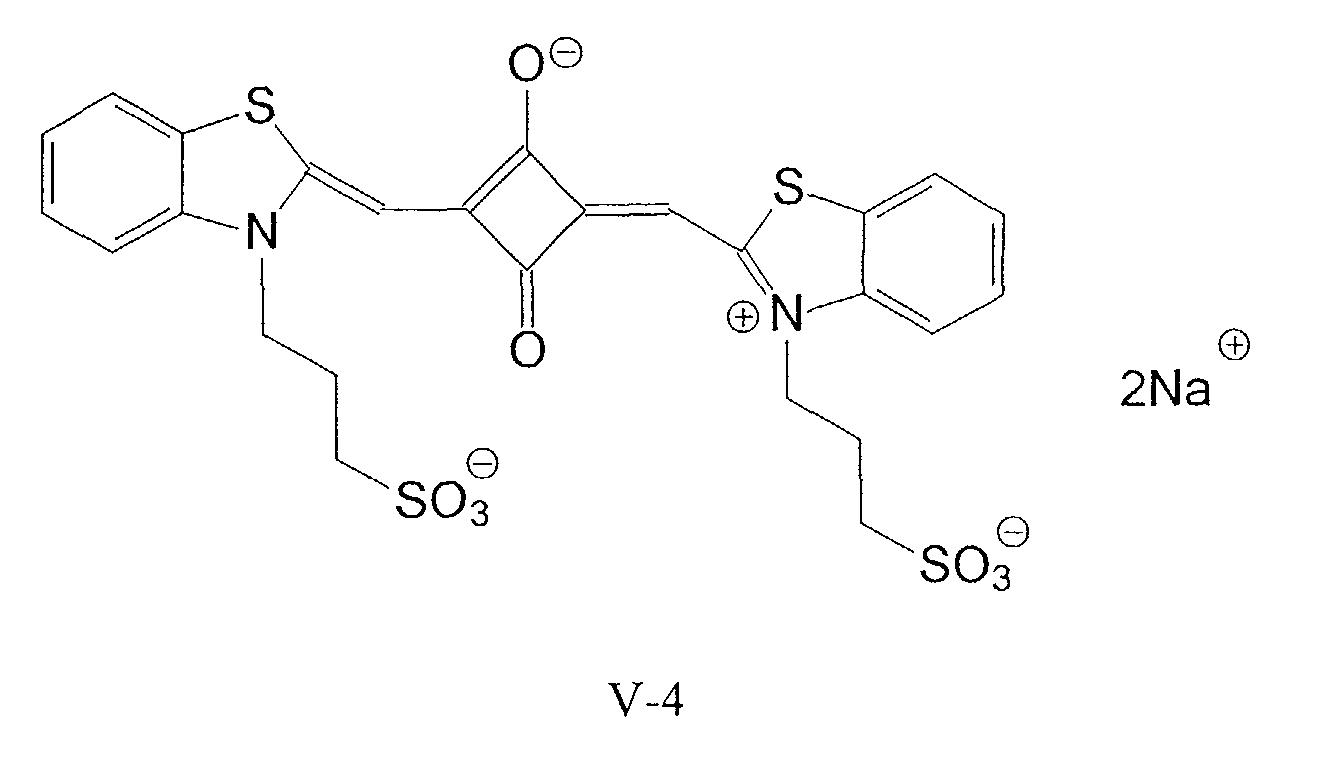
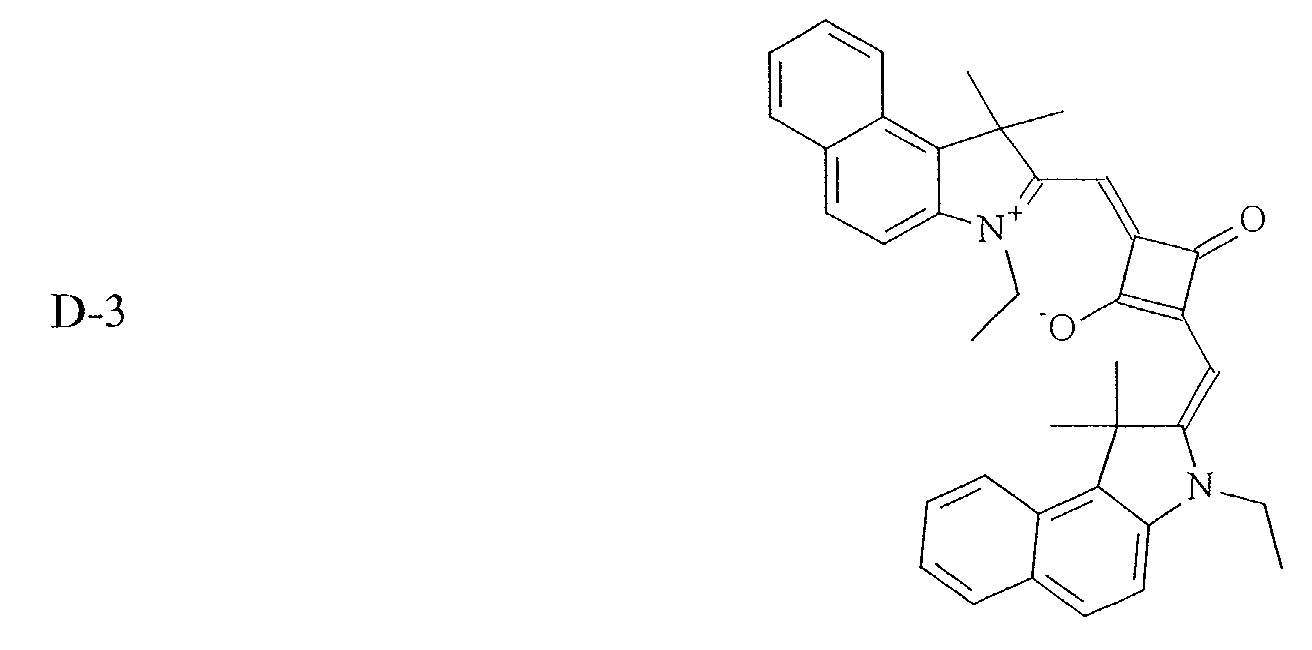
Particular examples of squaryllium dyes are:
More than one filter dye can be used in the same layer.
Combinations of different filter dyes can be used in the same layer or in different
layers, depending on the purpose of the dye. Preferably, the filter dyes useful in
an antihalation layer according to the present invention absorbs mainly from about
400 to about 850 nm. Preferably, the dyes absorbing mainly (and relatively
uniformly) at from about 500 to about 850 nm are used. In the case of filter
layers, a yellow filter dye useful in an yellow filter layer according to the present
invention absorbs mainly from about 400 to about 500 nm and will transmit most
of the light in the range 500 to 850 nm. Preferably, a yellow filter dye will
absorb mainly at from about 420 to about 480 nm and will transmit most of the
light in the range 490 to 850 nm. Similarly, a magenta filter dye will absorb light
mostly from 500 to 600 nm and preferably from 520 to 580 nm while transmitting
most of the light shorter than 500 nm and longer than 600 nm.
Depending on the choice of the filter dye, it can be in the
antihalation or filter layer in the form of solid particles, dissolved in a dispersed
organic phase, emulsified, or dissolved in the aqueous matrix of the antihalation
or filter layer. Although dissolving a water-soluble dye in the aqueous matrix is
easiest, it is not universally preferred since one would generally prefer that the
dye remain in the layer in which it was coated.
The coverages and proportions of the components which comprise
the described antihalation or filter component of the present invention can vary
over wide ranges depending upon such factors as the particular use, location in the
element of the antihalation or filter component, the desired degree of absorption,
processing temperatures, and the like. For example, in some photothermographic
elements the concentration of dye is sufficient to provide a peak optical density of
at least about 0.05. For antihalation purposes, it is desirable that the concentration
of the dye be sufficient to provide an optical density of at least about 0.2 such as
about 0.3 to about 2.0, throughout the visible spectrum. The hexaarylbiimidazole
must be present in at least sufficient concentration to provide at least 40%
bleaching of the described dye, by standard testing specified herein. A suitable
concentration of filter dye varies within the range of 0.20 to 20.0 moles of the
hexaarylbiimidazole to 1.0 mole of dye. Typically, an excess of the
hexaarylbiimidazole compound insures the desired degree of reaction with the
described dye in the elements in which the dye is used. The preferred molar ratio
of hexaarylbiimidazole compound to dye is within the range of about 0.4 to about
10 with an especially useful ratio being about 1.0 to 5.0. The exact mechanism by
which the described dye and dye-containing layer change from colored to
colorless is not completely understood. However, it is believed that the
hexaarylbiimidazole compound upon heating forms triarylimidazoyl radicals
which react with the dye in a manner which changes the dye structure from
colored to a less highly colored material.
The particles of hexaarylbiimidazole ("HABI particles) can be
made by conventional dispersion techniques, such as milling, by preparing the
particles by a limited coalescence procedure, or other procedures known in the art.
Milling processes that can be used include, for example, processes described in
U.K. Patent No. 1,570,632, and U.S. Patent No. 3,676,147, 4,006,025, 4,474,872
and 4,948,718, the entire disclosures of which are incorporate herein by reference.
Limited coalescence procedures that can be used include, for example, the
procedures described in U.S. Patent No. 4,994,3132, 5,055,371, 2,932,629,
2,394,530, 4,833,060, 4,834,084, 4,965,131 and 5,354,799, the entire disclosures
of which are incorporated herein by reference. A suitable average size of the
particles are 10 to 5000 nm, preferably 20 to 1000 nm, most preferably 30 to 500
nm.
In a preferred embodiment, the HABI is dispersed in the binder in
the form of a solid particle dispersion. Such dispersions can be formed by either
milling the dye in solid form until the desired particle size range is reached, or by
precipitating (from a solvent solution) the dye directly in the form of a solid
particle dispersion. In the case of solid particle milling dispersal methods, a
coarse aqueous premix, containing the HABI and water, and optionally, any
desired combination of water soluble surfactants and polymers, is made, and
added to this premix prior to the milling operation. The resulting mixture is then
loaded into a mill. The mill can be, for example, a ball mill, media mill, jet mill,
attritor mill, vibratory mill, or the like. The mill is charged with the appropriate
milling media such as, for example, beads of silica, silicon nitride, sand,
zirconium oxide, yttria-stabilized zirconium oxide, alumina, titanium, glass,
polystyrene, etc. The bead sizes typically range from 0.25 to 3.0 mm in diameter,
but smaller media may be used if desired. The solid HABI particles in the slurry
are subjected to repeated collisions with the milling media, resulting in crystal
fracture and consequent particle size reduction.
The aqueous dispersion can further contain appropriate surfactants
and polymers previously disclosed for use in making pH precipitated dispersions.
For solvent precipitation, a solution of the dye is made in some water miscible,
organic solvent. The solution of the dye is added to an aqueous solution
containing appropriate surfactants and polymers to cause precipitation as
previously disclosed for use in making solvent precipitated dispersions.
Surfactants and other additional conventional addenda may also be
used in the dispersing process described herein in accordance with prior art solid
particle dispersing procedures. Such surfactants, polymers and other addenda are
disclosed in U.S. Patents Nos. 5,468,598, 5,300,394, 5,278,037, 4,006,025,
4,924,916, 4,294,917, 4,940,654, 4,950,586, 4,927,744, 5,279,931, 5,158,863,
5,135,844, 5,091,296, 5,089,380, 5,103,640, 4,990,431,4,970,139, 5,256,527,
5,015,564, 5,008,179, 4,957,857, and 2,870,012, British Patent specifications
Nos. 1,570,362 and 1,131,179 referenced above, the disclosures of which are
hereby incorporated by reference, in the dispersing process of the filter dyes.
Additional surfactants or other water soluble polymers may be
added after formation of the HABI dispersion, before or after subsequent addition
of the small particle dispersion to an aqueous coating medium for coating onto a
photographic element support. The aqueous medium preferably contains other
compounds such as stabilizers and dispersants, for example, additional anionic
nonionic, zwitterionic, or cationic surfactants, and water soluble binders such as
gelatin as is well known in the photographic element art. The aqueous coating
medium may further contain other dispersion or emulsions of compounds useful
in photography. Another technique for forming solid HABI particles involves
solvent precipitation. For example, a solution of the HABI can be made in some
water miscible, organic solvent, after which the solution of the HABI can be
added to an aqueous solution containing appropriate surfactants and polymers to
cause precipitation.
Various techniques for forming a liquid dispersion of the HABI,
including oil-in-water emulsions, are well known by the skilled artisan. An oil-in-water
dispersion of the HABI may be prepared by dissolving the HABI in an
organic liquid, forming a premix with an aqueous phase containing dispersing
aids such as water-soluble surfactants, polymers and film forming binders such as
gelatin, and passing the premix through a mill until the desired particle size is
obtained. The mill can be any high energy device such as a colloid mill, high
pressure homogenizer, ultrasonic device, or the like. Preparation of conventional
oil-in-water dispersions are well known in the art and are described in further
detail, for example, in Jelly and Vittum U.S. Patent No. 2,322,027. Alternatively,
the HABIs can be loaded into a latex polymer, either during or after
polymerization, and the latex can be dispersed in a binder. Additional disclosure
of loaded latexes can be found in Milliken U.S. Patent No. 3,418,127.
The filter or antihalation dyes may be soluble or insoluble in the
aqueous coated antihalation layer or filter layer according to the present invention.
When the dye is insoluble and, therefore, also in the form of a dispersion, the
HABI dispersion and the dye dispersion can be made simultaneously in one
dispersion or they can be separately made in two dispersions and then later
combined. In a separate dye dispersion, the dye may be added directly to, or
dispersed in film forming polymeric vehicles and/or binders, as is well known in
the art. These include both naturally occurring and synthetic binders, such as
gelatin and gelatin derivatives, polyvinyl alcohols, acrylamide polymers,
polyvinyl acetates, polyacrylates and the like. In certain instances, especially
where the dye is mobile (e.g., a dye with one or more SO3 - constituents) it may
be advantageous to use the dye in combination with a mordant, such as
polyvinylimidazole and polyvinylpyridine, to aid in immobilizing the dye. The
technology of mordanting dyes is well known in the art, and is described in
further detail in Jones et al U.S. Patent No. 3,282,699 and Heseltine et al U.S.
Patent No. 3,255,693 and 3,483,779.
The dye may be in the form of an oil-in-water dispersion of the dye
be prepared or dispersed in the binder in the form of a solid particle dispersion as
described with respect to the HABI above. The solid particle dispersions of the
dye should have an average particle size of 0.01 to about 10 microns, preferably
0.05 to about 5 microns, and more preferably about 0.05 to about 3 microns.
Most preferably, the solid particles are of sub-micron average size. In addition to
solvent precipitation, the pH precipitation techniques can be used for forming
solid dye particles. An aqueous solution of the dye can be made at relatively high
pH then the pH is lowered to cause precipitation of the dye. The dye dispersion
can further contain appropriate surfactants and polymers previously disclosed for
use in making pH precipitated dispersions.
Combinations of bleachable filter or antihalation dyes can be used
or one or more bleachable dyes can be used in combination with other non-bleachable
dyes in the present invention to obtain a broader spectrum of
absorption, if desired. For example, when the filter dye is used to provide
antihalation properties or to permit room light loading, the filter dye should be
selected to provide an absorption envelope that matches the sensitization envelope
of the light sensitive layer(s) of the photographic element. Other filter dyes that
can be used include, for example, the filter dyes disclosed in US Patents Nos.
2,538,008, 2,538,009, and 4,420,555, and UK Patents Nos. 695,873 and 760,739.
It is preferred to use the filter dyes as solid particle dispersions as disclosed in US
Patents Nos. 4,950,586, 4,948,718, 4,948,717, 4,940,654, 4,923,788, 4,900,653,
4,861,700, 4,857,446, 4,855,221, 5,213,956 and 5,213,957, and European Patent
No. 430,186. The entire disclosures of the above patents are incorporated herein
by reference.
Another aspect of the present invention is directed to a composition
in the form of an aqueous dispersion comprising at least one antihalation or filter
dye and at least one hexaarylbiimidazole compound, which aqueous dispersion
comprises an aqueous phase and a dispersed organic phase, the aqueous phase
comprising, as a binder, a soluble hydrophilic polymer or dispersed hydrophobic
polymer and the dispersed organic phase comprising solid or liquid particles
comprising said hexaarylbiimidazole compound, and wherein the
hexaarylbiimidazole compound in said particles is capable of bleaching said dye
when the dispersion is coated, dried and heated to a temperature of at least 90°C
for at least 0.5 seconds. The dye may be in the aqueous phase or in a separate
dispersed organic phase. In one embodiment, solid particles comprising said
hexaarylbiimidazole compound are employed. In another embodiment, an oil-in-water
emulsion is employed. By the term "aqueous," with reference to this
aqueous dispersion, is meant that that the aqueous phase comprises at least 10%,
more preferably at least 20% by weight water, and most preferably at least 50%
by weight water. Similarly, when aqueous coated onto a substrate, for example,
in a photothermographic element, the term "aqueous," with reference to this
coating composition, is meant that the coating composition comprises at least
10%, more preferably at least 20% water and most preferably at least 50% by
weight water. Miscible organic solvents, mentioned below, can be optionally
included. In the complete photothermographic imaging element, once dried, the
amount of water in the aqueous coated antihalation or filter layer is at least about
1% by weight of the dried layer, but unless using a dispersible hydrophobic
polymer, is usually higher, comprising at least 5% by weight water, preferably 10
to 15 % by weight water, particularly in the case of a gelatin binder. Due to the
limited solubility of some compounds, it is often desirable to use organic solvents
to aid in preparation of the materials for coating to provide an element according
to the invention. Typical organic solvents which can be useful in preparing a
composition for coating as an antihalation layer or filter layer according to the
invention include tetrahydrofuran, methylene chloride, ethanol, methanol, acetone
and butanol. Mixing of the solvents with the described components according to
the invention can be carried out using means known in the photographic art.
The binders used in the aqueous dispersion or coating composition
should be transparent or translucent and include those materials which do not
adversely affect the reaction which changes the dye from colored to colorless and
which can withstand the processing temperatures employed. These polymers
include, for example, proteins such as gelatin, gelatin derivatives, cellulose
derivatives, polysaccharides such as dextran and the like; and synthetic polymeric
substances such as water soluble polyvinyl compounds like poly(vinyl alcohol),
poly(vinyl pyrrolidone), acrylamide polymers and the like. Other synthetic
polymeric compounds which can be useful include dispersed vinyl compounds
such as in latex form. Effective polymers include high molecular weight
materials, polymers and resins which are compatible with the imaging materials
of the element. Combinations of the described colloids and polymers can also be
useful if desired.
A preferred binder for use in the present invention is oxidized
gelatin, for example, gelatin treated with an oxidant such as hydrogen peroxide.
Moll, "Investigations of Oxidized Gelatins", 2nd Photographic Gelatin
Symposium, sponsored by the Royal Photographic Society, Oxford, United
Kingdom, Sept. 6,1985, discloses some of the chemical and physical properties of
oxidized gelatins. In general, oxidized gelatinopeptizers contain less than 30
micromoles per gram of methionine. Where the peptizer is gelatin or a gelatin
derivative it can be treated prior to or during emulsion precipitation with a
methionine oxidizing agent. Examples of methionine oxidizing agents include
NaOCI, chloramine, potassium monopersulfate, hydrogen peroxide and peroxide
releasing compounds, ozone, thiosulfates and alkylating agents. Specific
illustrations are provided by Maskasky U.S. Patents 4.713.320 and 4,713,323,
King et al U.S. Patent 4,942,120, Takada et al EPO 0 434 012 and Okumura et al
EPO 0 553 622.
Without wishing to be bound by theory it is surmised that the
methione group in gelatin, present in unoxidized gelatin, may react with the
radicals derived from the hexaarylbiimidazole compound upon heating, which
radicals are responsible for bleaching of the dye. Although higher amounts of the
hexaarylbiimidazole may be used with unoxidized gelatin to improve its bleaching
effect to some extent, the use of oxidized gelatin unexpectedly activates and
enhances the bleaching effect of the hexaarylbiimidazole.
The antihalation layer as described can be useful in a variety of
photothermographic elements. Useful photothermographic elements include those
which are designed to provide an image from photographic silver halide, such as
color images. Photothermographic color elements which are designed for
consumer film are especially useful with the antihalation materials according to
the invention.
The described combination of the hexaarylbiimidazole compound
and dye can be in any suitable location in the photothermographic element which
provides the desired bleaching of the dye upon heating. When the invention is
utilized as an antihalation layer of a photographic material coated on a transparent
support (such as photographic film), the inventive layer can be coated on the same
side or the opposite of the support as the radiation sensitive layers. When the
invention is utilized as an antihalation layer of a photographic material coated on
a reflective support (such as photographic paper), then the inventive layer must be
coated on the same side of the support as the radiation sensitive layers. When the
invention is utilized as a filter layer of a photographic material, the same
requirements apply depending upon the type of support used.
It is necessary that the dye and particles of the hexaarylbiimidazole
compound be in reactive association with one another to provide the desired heat
bleaching in the antihalation or filter component. The term "in reactive
association" as employed herein is intended to mean that the described materials
are in a location with respect to each other which enables the desired processing
and heat bleaching and provides a more useful developed image. The term is also
employed herein to mean that the hexaarylbiimidazole compound and the dye are
in a location with respect to each other which enables the desired change of the
dye from colored to colorless upon heating as described. In general, the two
components should be in the same layer, meaning there is no significant barrier or
distance between them even if not uniformly dispersed together. Preferably,
however, the particles of hexaarylbiimidazole and the dye are uniformly
interdispersed.
A preferred embodiment of the invention is a photothermographic
element comprising (a) a support having thereon (b) a photothermographic layer,
and on the support or in the support (c) at least one antihalation component
comprising, in a polymeric binder, in reactive association, (i) solid particles of at
least one compound represented by the formula (I), as described, with (ii) at least
one dye, wherein the dye component becomes at least about 50, preferably at least
90% colorless within about 30 seconds upon heating to a temperature of at least
about 120° C, as determined by standard testing described herein.
The antihalation or filter layer materials comprising the
combination of the described dye with the hexaarylbiimidazole compound can be
present in a suitable transparent support which permits the desired reaction
between the described dye and hexaarylbiimidazole. However, it is more
preferred that an antihalation layer according to the invention should comprise
binders which adhere suitably to the support or other layer of the
photothermographic element upon which the antihalation or filter layer is coated.
Selection of optimum binders for adhesion purposes will depend upon such
factors as the particular support, processing conditions, the particular
photosensitive layer, and the like.
A visible image can be developed in a photothermographic element
according to the invention within a short time after imagewise exposure merely by
uniformly heating the photothermographic element to moderately elevated
temperatures. For example, the photothermographic element can be heated, after
imagewise exposure, to a temperature within the range which provides
development of the latent image and also provides the necessary temperature to
cause the antihalation or filter layer to change from colored to colorless. Most
broadly, this temperature is within the range of about 80° C to about 250° C, such
as within the range of about 110° C to about 200°C. Heating is typically carried
out until a desired image is developed and until the antihalation or filter layer is
bleached to a desired degree. This heating time is typically a time within about 1
second to about 20 minutes, such as about I second to about 90 seconds.
A simple exemplary photothermographic element, showing one
embodiment comprising filter and AHU layers and their placement in the element,
can be represented as follows:
As indicated above, the invention is useful in a dry
photothermographic process (or "dry thermal process"). By a "dry thermal
process" is meant herein a process involving, after imagewise exposure of the
photographic element, development of the resulting latent image by the use of
heat to raise the temperature of the photothermographic element or film to a
temperature of at least about 80°C, preferably at least about 100°C, more
preferably at about 120°C to 180°C, in a dry process or an apparently dry process.
By a "dry process" is meant without the external application of any aqueous
solutions. By an "apparently dry process" is meant a process that, while involving
the external application of at least some aqueous solutions, does not involve an
amount more than the uniform saturation of the film with aqueous solution.
This dry thermal process typically involves heating the
photothermographic element until a developed image is formed, such as within
about 0.5 to about 60 seconds. By increasing or decreasing the thermal
processing temperature a shorter or longer time of processing is useful. Heating
means known in the photothermographic arts are useful for providing the desired
processing temperature for the exposed photothermographic element. The heating
means can, for example, be a simple hot plate, iron, roller, heated drum,
microwave heater, heated air, vapor or the like. Thermal processing is preferably
carried out under ambient conditions of pressure and humidity, for simplicity
sake, although conditions outside of normal atmospheric pressure and humidity
are also useful.
A dry thermal process for the development of a color
photothermographic film for general use with respect to consumer cameras
provides significant advantages in processing ease and convenience, since they are
developed by the application of heat without wet processing solutions. Such film
is especially amenable to development at kiosks or at home, with the use of
essentially dry equipment. Thus, the dry photothermographic system opens up
new opportunities for greater convenience, accessibility, and speed of
development (from the point of image capture by the consumer to the point of
prints in the consumer's hands), even essentially "immediate" development in the
home for a wide cross-section of consumers.
Preferably, during thermal development an internally located
blocked developing agent, in reactive association with each of three light-sensitive
units, becomes unblocked to form a developing agent, whereby the unblocked
developing agent is imagewise oxidized on development. It is necessary that the
components of the photographic combination be "in association" with each other
in order to produce the desired image. The term "in association" herein means
that. in the photothermographic element, the photographic silver halide and the
image-forming combination are in a location with respect to each other that
enables the desired processing and forms a useful image. This may include the
location of components in different layers.
The present invention is applicable to a photothermographic
element, inclusive of film and paper, black & white and color. Such
photothermographic elements are used in the field of microfilming, health
imaging, graphic arts, consumer products, and the like. It is especially useful
where the element is exposed to visible light, directly or indirectly, in the field of
health or medical imaging involving phosphorescent light, the originating
exposure may be X-ray, for example. A preferred use of the present invention is
in consumer color photothermographic film.
A typical photothermographic element will now be described.
The support for the photothermographic element can be either reflective or
transparent, which is usually preferred. When reflective, the support is white
and can take the form of any conventional support currently employed in color
print elements. When the support is transparent, it can be colorless or tinted and
can take the form of any conventional support currently employed in color
negative elements-e.g., a colorless or tinted transparent film support. Details of
support construction are well understood in the art. Examples of useful supports
are poly(vinylacetal) film, polystyrene film, poly(ethyleneterephthalate) film,
poly(ethylene naphthalate) film, polycarbonate film, and related films and
resinous materials, as well as paper, cloth, glass, metal, and other supports that
withstand the anticipated processing conditions. The element can contain
additional layers, such as filter layers, interlayers, overcoat layers, subbing
layers, antihalation layers and the like. Transparent and reflective support
constructions, including subbing layers to enhance adhesion, are disclosed in
Section XV of Research Disclosure I.
Photographic elements may also usefully include a magnetic
recording material as described in Research Disclosure, Item 34390, November
1992, or a transparent magnetic recording layer such as a layer containing
magnetic particles on the underside of a transparent support as in U.S. Patent No.
4,279,945, and U.S. Pat. No. 4,302,523.
In an example (one embodiment) of a color negative film
construction, each of blue, green and red recording layer units BU, GU and RU
are formed of one or more hydrophilic colloid layers and contain at least one
radiation-sensitive silver halide emulsion and coupler, including at least one dye
image-forming coupler. It is preferred that the green, and red recording units are
subdivided into at least two recording layer sub-units to provide increased
recording latitude and reduced image granularity. In the simplest contemplated
construction each of the layer units or layer sub-units consists of a single
hydrophilic colloid layer containing emulsion and coupler. When coupler present
in a layer unit or layer sub-unit is coated in a hydrophilic colloid layer other than
an emulsion containing layer, the coupler containing hydrophilic colloid layer is
positioned to receive oxidized color developing agent from the emulsion during
development. Usually the coupler containing layer is the next adjacent
hydrophilic colloid layer to the emulsion containing layer.
BU contains at least one yellow dye image-forming coupler, GU
contains at least one magenta dye image-forming coupler, and RU contains at
least one cyan dye image-forming coupler. Any convenient combination of
conventional dye image-forming couplers can be employed. Conventional dye
image-forming couplers are illustrated by Research Disclosure I, cited above, X.
Dye image formers and modifiers, B. Image-dye-forming couplers. The
photographic elements may further contain other image-modifying compounds
such as "Development Inhibitor-Releasing" compounds (DIR's). Useful
additional DIR's for elements of the present invention, are known in the art and
examples are described in US Patent Nos. 3,137,578; 3,148,022; 3,148,062;
3,227,554; 3,384,657; 3,379,529; 3,615,506; 3,617,291; 3,620,746; 3,701,783;
3,733,201; 4,049,455; 4,095,984; 4,126,459; 4,149,886; 4,150,228; 4,211,562;
4,248,962; 4,259,437; 4,362,878; 4,409,323; 4,477,563; 4,782,012; 4,962,018;
4,500,634; 4,579,816; 4,607,004; 4,618,571; 4,678,739; 4,746,600; 4,746,601;
4,791,049; 4,857,447; 4,865,959; 4,880,342; 4,886,736; 4,937,179; 4,946,767;
4,948,716; 4,952,485; 4,956,269; 4,959,299; 4,966,835; 4,985,336 as well as in
patent publications GB 1,560,240; GB 2,007,662; GB 2,032,914; GB 2,099,167;
DE 2,842,063, DE 2,937,127; DE 3,636,824; DE 3,644,416 as well as the
following European Patent Publications: 272,573; 335,319; 336,411; 346,899;
362,870; 365,252; 365,346; 373,382; 376,212; 377,463; 378,236; 384,670;
396,486; 401,612; 401,613.
DIR compounds are also disclosed in "Developer-Inhibitor-Releasing
(DIR) Couplers for Color Photography," C.R. Barr, J.R. Thirtle and
P.W. Vittum in Photographic Science and Engineering, Vol. 13, p. 174 (1969),
incorporated herein by reference.
It is common practice to coat one, two or three separate emulsion
layers within a single dye image-forming layer unit. When two or more emulsion
layers are coated in a single layer unit, they are typically chosen to differ in
sensitivity. When a more sensitive emulsion is coated over a less sensitive
emulsion, a higher speed is realized than when the two emulsions are blended.
When a less sensitive emulsion is coated over a more sensitive emulsion, a higher
contrast is realized than when the two emulsions are blended. It is preferred that
the most sensitive emulsion be located nearest the source of exposing radiation
and the slowest emulsion be located nearest the support.
One or more of the layer units of the invention is preferably
subdivided into at least two, and more preferably three or more sub-unit layers. It
is preferred that all light sensitive silver halide emulsions in the color recording
unit have spectral sensitivity in the same region of the visible spectrum. In this
embodiment, while all silver halide emulsions incorporated in the unit have
spectral absorptances according to invention, it is expected that there are minor
differences in spectral absorptance properties between them. In still more
preferred embodiments, the sensitizations of the slower silver halide emulsions
are specifically tailored to account for the light shielding effects of the faster
silver halide emulsions of the layer unit that reside above them, in order to
provide an imagewise uniform spectral response by the photographic recording
material as exposure varies with low to high light levels. Thus higher proportions
of peak light absorbing spectral sensitizing dyes may be desirable in the slower
emulsions of the subdivided layer unit to account for on-peak shielding and
broadening of the underlying layer spectral sensitivity.
The photothermographic element may have interlayers that are
hydrophilic colloid layers having as their primary function color contamination
reduction-i.e., prevention of oxidized developing agent from migrating to an
adjacent recording layer unit before reacting with dye-forming coupler. The
interlayers are in part effective simply by increasing the diffusion path length that
oxidized developing agent must travel. To increase the effectiveness of the
interlayers to intercept oxidized developing agent, it is conventional practice to
incorporate a reducing agent capable of reacting with oxidized developing agent.
Antistain agents (oxidized developing agent scavengers) can be selected from
among those disclosed by Research Disclosure I, X. Dye image formers and
modifiers, D. Hue modifiers/stabilization, paragraph (2). When one or more
silver halide emulsions in GU and RU are high bromide emulsions and, hence
have significant native sensitivity to blue light, it is preferred to incorporate a
yellow filter, such as Carey Lea silver or a yellow processing solution
decolorizable dye, in IL1. Suitable yellow filter dyes can be selected from among
those illustrated by Research Disclosure I, Section VIII. Absorbing and scattering
materials, B. Absorbing materials. In elements of the instant invention, magenta
colored filter materials are absent from IL2 and RU.
A photothermographic element may comprise a surface overcoat
SOC which is a hydrophilic colloid layer that is provided for physical protection
of the color negative elements during handling and processing. Each SOC also
provides a convenient location for incorporation of addenda that are most
effective at or near the surface of the color negative element. In some instances
the surface overcoat is divided into a surface layer and an interlayer, the latter
functioning as spacer between the addenda in the surface layer and the adjacent
recording layer unit. In another common variant form, addenda are distributed
between the surface layer and the interlayer, with the latter containing addenda
that are compatible with the adjacent recording layer unit. Most typically the
SOC contains addenda, such as coating aids, plasticizers and lubricants, antistats
and matting agents, such as illustrated by Research Disclosure I, Section IX.
Coating physical property modifying addenda. The SOC overlying the emulsion
layers additionally preferably contains an ultraviolet absorber, such as illustrated
by Research Disclosure I, Section VI. UV dyes/optical brighteners/luminescent
dyes, paragraph (1).
Alternative layer units sequences can be employed and are
particularly attractive for some emulsion choices. Using high chloride emulsions
and/or thin (<0.2 µm mean grain thickness) tabular grain emulsions all possible
interchanges of the positions of BU, GU and RU can be undertaken without risk
of blue light contamination of the minus blue records, since these emulsions
exhibit negligible native sensitivity in the visible spectrum. For the same reason,
it is unnecessary to incorporate blue light absorbers in the interlayers.
A number of modifications of color negative elements have been
suggested for accommodating scanning, as illustrated by Research Disclosure I,
Section XIV. Scan facilitating features. These systems to the extent compatible
with the color negative element constructions described above are contemplated
for use in the practice of this invention.
It is also contemplated that the imaging element of this invention
may be used with non-conventional sensitization schemes. For example, instead
of using imaging layers sensitized to the red, green, and blue regions of the
spectrum, the light-sensitive material may have one white-sensitive layer to record
scene luminance, and two color-sensitive layers to record scene chrominance.
Following development, the resulting image can be scanned and digitally
reprocessed to reconstruct the full colors of the original scene as described in
U.S.5,962,205. The imaging element may also comprise a pan-sensitized
emulsion with accompanying color-separation exposure. In this embodiment, the
developers of the invention would give rise to a colored or neutral image which,
in conjunction with the separation exposure, would enable full recovery of the
original scene color values. In such an element, the image may be formed by
either developed silver density, a combination of one or more conventional
couplers, or "black" couplers such as resorcinol couplers. The separation
exposure may be made either sequentially through appropriate filters, or
simultaneously through a system of spatially discreet filter elements (commonly
called a "color filter array").
The imaging element of the invention may also be a black and
white image-forming material comprised, for example, of a pan-sensitized silver
halide emulsion and a developer of the invention. In this embodiment, the image
may be formed by developed silver density following processing, or by a coupler
that generates a dye which can be used to carry the neutral image tone scale.
The photothermographic elements of the present invention are
preferably of type B as disclosed in Research Disclosure I. Type B elements
contain in reactive association a photosensitive silver halide, a reducing agent or
developer, optionally an activator, a coating vehicle or binder, and a salt or
complex of an organic compound with silver ion. In these systems, this organic
complex is reduced during development to yield silver metal. The organic silver
salt will be referred to as the silver donor. References describing such imaging
elements include, for example, U.S. Patents 3,457,075; 4,459,350; 4,264,725 and
4,741,992. In the type B photothermographic material it is believed that the latent
image silver from the silver halide acts as a catalyst for the described image-forming
combination upon processing. In these systems, a preferred
concentration of photographic silver halide is within the range of 0.01 to 100
moles of photographic silver halide per mole of silver donor in the
photothermographic material.
The Type B photothermographic element comprises an oxidation-reduction
image forming combination that contains an organic silver salt
oxidizing agent. The organic silver salt is a silver salt which is comparatively
stable to light, but aids in the formation of a silver image when heated to 80 °C or
higher in the presence of an exposed photocatalyst (i.e., the photosensitive silver
halide) and a reducing agent.
Suitable organic silver salts include silver salts of organic
compounds having a carboxyl group. Preferred examples thereof include a silver
salt of an aliphatic carboxylic acid and a silver salt of an aromatic carboxylic acid.
Preferred examples of the silver salts of aliphatic carboxylic acids include silver
behenate, silver stearate, silver oleate, silver laureate, silver caprate, silver
myristate, silver palmitate, silver maleate, silver fumarate, silver tartarate, silver
furoate, silver linoleate, silver butyrate and silver camphorate, mixtures thereof,
etc. Silver salts which are substitutable with a halogen atom or a hydroxyl group
can also be effectively used. Preferred examples of the silver salts of aromatic
carboxylic acid and other carboxyl group-containing compounds include silver
benzoate, a silver-substituted benzoate such as silver 3,5-dihydroxybenzoate,
silver o-methylbenzoate, silver m-methylbenzoate, silver p-methylbenzoate, silver
2,4-dichlorobenzoate, silver acetamidobenzoate, silver p-phenylbenzoate, etc.,
silver gallate, silver tannate, silver phthalate, silver terephthalate, silver salicylate,
silver phenylacetate, silver pyromellilate, a silver salt of 3-carboxymethyl-4-methyl-4-thiazoline-2-thione
or the like as described in U.S. Pat. No. 3,785,830,
and silver salt of an aliphatic carboxylic acid containing a thioether group as
described in U.S. Pat. No. 3,330,663. Preferred examples of organic silver donors
include a silver salt of benzotriazole and a derivative thereof as described in
Japanese patent publications 30270/69 and 18146/70, for example a silver salt of
benzotriazole or methylbenzotriazole, etc., a silver salt of a halogen substituted
benzotriazole, such as a silver salt of 5-chlorobenzotriazole, etc., a silver salt of
1,2,4-triazole, a silver salt of 3-amino-5-mercaptobenzyl-1,2,4-triazole, of 1H-tetrazole
as described in U.S. Pat. No. 4,220,709, a silver salt of imidazole and an
imidazole derivative, and the like.
It is also found convenient to use silver half soap, of which an
equimolar blend of a silver behenate with behenic acid, prepared by precipitation
from aqueous solution of the sodium salt of commercial behenic acid and
analyzing about 14.5 percent silver, represents a preferred example. Transparent
sheet materials made on transparent film backing require a transparent coating and
for this purpose the silver behenate full soap, containing not more than about 4 or
5 percent of free behenic acid and analyzing about 25.2 percent silver may be
used. A method for making silver soap dispersions is well known in the art and is
disclosed in Research Disclosure October 1983 (23419) and U.S. Pat. No.
3,985,565.
Silver salts complexes may also be prepared by mixture of aqueous
solutions of a silver ionic species, such as silver nitrate, and a solution of the
organic ligand to be complexed with silver. The mixture process may take any
convenient form, including those employed in the process of silver halide
precipitation. A stabilizer may be used to avoid flocculation of the silver complex
particles. The stabilizer may be any of those materials known to be useful in the
photographic art, such as, but not limited to, gelatin, polyvinyl alcohol or
polymeric or monomeric surfactants.
The photosensitive silver halide grains and the organic silver salt
are coated so that they are in catalytic proximity during development. They can
be coated in contiguous layers, but are preferably mixed prior to coating.
Conventional mixing techniques are illustrated by Research Disclosure, Item
17029, cited above, as well as U.S. Pat. No. 3,700,458 and published Japanese
patent applications Nos. 32928/75, 13224/74, 17216/75 and 42729/76.
Any convenient selection from among conventional radiation-sensitive
silver halide emulsions can be incorporated within the layer units and
used to provide the spectral absorptances of the invention. Most commonly high
bromide emulsions containing a minor amount of iodide are employed. To realize
higher rates of processing, high chloride emulsions can be employed. Radiation-sensitive
silver chloride, silver bromide, silver iodobromide, silver iodochloride,
silver chlorobromide, silver bromochloride, silver iodochlorobromide and silver
iodobromochloride grains are all contemplated. The grains can be either regular
or irregular (e.g., tabular). Illustrations of conventional radiation-sensitive silver
halide emulsions are provided by Research Disclosure I, cited above, I. Emulsion
grains and their preparation. Chemical sensitization of the emulsions, which can
take any conventional form, is illustrated in section IV. Chemical sensitization.
The emulsion layers also typically include one or more antifoggants or stabilizers,
which can take any conventional form, as illustrated by section VII. Antifoggants
and stabilizers.
The silver halide grains to be used in a photothermographic
element may be prepared according to methods known in the art, such as those
described in Research Disclosure I, cited above, and James, The Theory of the
Photographic Process. These include methods such as ammoniacal emulsion
making, neutral or acidic emulsion making, and others known in the art. These
methods generally involve mixing a water soluble silver salt with a water soluble
halide salt in the presence of a protective colloid, and controlling the temperature,
pAg, pH values, etc, at suitable values during formation of the silver halide by
precipitation. In the course of grain precipitation one or more dopants (grain
occlusions other than silver and halide) can be introduced to modify grain
properties.
In a photothermographic element, the silver halide is typically
provided in the form of an emulsion, including a vehicle for coating the emulsion
as a layer of the element. Useful vehicles include both naturally occurring
substances such as proteins, protein derivatives, cellulose derivatives (e.g.,
cellulose esters, ethers, and both anionically and cationically substituted
cellulosics), gelatin (e.g., alkali-treated gelatin such as cattle bone or hide gelatin,
or acid treated gelatin such as pigskin gelatin), deionized gelatin, gelatin
derivatives (e.g., acetylated gelatin, phthalated gelatin, and the like), and others as
described in Research Disclosure, I. Also useful as vehicles or vehicle extenders
are hydrophilic water-permeable colloids. These include synthetic polymeric
peptizers, carriers, and/or binders such as poly(vinyl alcohol), poly(vinyl
lactams), acrylamide polymers, polyvinyl acetals, polymers of alkyl and
sulfoalkyl acrylates and methacrylates, hydrolyzed polyvinyl acetates,
polyamides, polyvinyl pyridine, methacrylamide copolymers. The vehicle can be
present in the emulsion in any amount useful in photographic emulsions. The
emulsion can also include any of the addenda known to be useful in photographic
emulsions.
While any useful quantity of light sensitive silver, as silver halide,
can be employed in the elements useful in this invention, it is preferred that the
total quantity be less than 10 g/m2 of silver. Silver quantities of less than 7 g/m2
are preferred, and silver quantities of less than 5 g/m2 are even more preferred.
The lower quantities of silver improve the optics of the elements, thus enabling
the production of sharper pictures using the elements.
Because in one embodiment of the invention only silver
development is required, color developers (p-phenylene diamines or p-aminophenolics)
are not obligatory. Other developers that are capable of forming
a silver image may also be used, without regard to their ability to form a colored
dye. Such developers include, in addition to p-phenylene diamine developers and
substituted p-aminophenols (3,5-dichloroaminophenol and 3,5-dibromoaminophenol
are particularly preferred choices) but also p-sulfonamidophenols,
ascorbic acid, low valent metal compounds, particularly
those containing Fe(II), Cu(I), Co(II), Mn(II), V(II), or Ti(III), hydrazine
derivatives, hydroxylamine derivatives, phenidones. For incorporated developers,
thermally unblocking blocked developers are preferred.
In some cases, a development activator, also known as an alkali-release
agent, base-release agent or an activator precursor can be useful in the
described photothermographic element of the invention. A development
activator, as described herein, is intended to mean an agent or a compound which
aids the developing agent at processing temperatures to develop a latent image in
the imaging material. Useful development activators or activator precursors are
described, for example, in Belgian Pat. No. 709, 967 published Feb. 29, 1968, and
Research Disclosure, Volume 155, Mar. 1977, Item 15567, published by
Industrial Opportunities Ltd., Homewell, Havant, Hampshire, PO9 1EF, UK.
Examples of useful activator precursors include guanidinium compounds such as
guanidinium trichloroacetate, diguanidinium glutarate, succinate, malonate and
the like; quaternary ammonium malonates; amino acids, such as 6-aminocaproic
acid and glycine; and 2-carboxycarboxamide activator precursors.
Examples of blocked developers that can be used in photographic
elements of the present invention include, but are not limited to, the blocked
developing agents described in U.S. Pat. No. 3,342,599, to Reeves; Research
Disclosure (129 (1975) pp. 27-30) published by Kenneth Mason Publications,
Ltd., Dudley Annex, 12a North Street, Emsworth, Hampshire P010 7DQ,
ENGLAND; U.S. Pat. No. 4,157,915, to Hamaoka et al.; U.S. Pat. No. 4,
060,418, to Waxman and Mourning; and in U.S. Pat. No. 5,019,492. Particularly
useful are those blocked developers described in U.S. Application Serial No.
09/476,234, filed December 30, 1999, IMAGING ELEMENT CONTAINING A
BLOCKED PHOTOGRAPICALLY USEFUL COMPOUND; U.S. Application
Serial No. 09/475,691, filed December 30, 1999, IMAGING ELEMENT
CONTAINING A BLOCKED PHOTOGRAPHICALLY USEFUL
COMPOUND; U.S. Application Serial No. 09/475,703, filed December 30, 1999,
IMAGING ELEMENT CONTAINING A BLOCKED PHOTOGRAPHICALLY
USEFUL COMPOUND; U.S. Application Serial No. 09/475,690, filed December
30, 1999, IMAGING ELEMENT CONTAINING A BLOCKED
PHOTOGRAPHICALLY USEFUL COMPOUND; and U.S. Application Serial
No. 09/476,233, filed December 30, 1999, PHOTOGRAPHIC OR
photothermographic ELEMENT CONTAINING A BLOCKED
PHOTOGRAPHICALLY USEFUL COMPOUND.
In one embodiment of the invention, the blocked developer is
preferably incorporated in one or more of the imaging layers of the imaging
element. The amount of blocked developer used is preferably 0.01 to 5g/m2, more
preferably 0.1 to 2g/m2 and most preferably 0.3 to 2g/m2 in each layer to which it
is added. These may be color forming or non-color forming layers of the element.
The blocked developer can be contained in a separate element that is contacted to
the photographic element during processing.
After image-wise exposure of the imaging element, the blocked
developer can be activated during processing of the imaging element by the
presence of acid or base in the processing solution, by heating the imaging
element during processing of the imaging element, and/or by placing the imaging
element in contact with a separate element, such as a laminate sheet, during
processing. The laminate sheet optionally contains additional processing
chemicals such as those disclosed in Sections XIX and XX of Research
Disclosure, September 1996, Number 389, Item 38957 (hereafter referred to as
("Research Disclosure I"). All sections referred to herein are sections of Research
Disclosure I, unless otherwise indicated. Such chemicals include, for example,
sulfites, hydroxyl amine, hydroxamic acids and the like, antifoggants, such as
alkali metal halides, nitrogen containing heterocyclic compounds, and the like,
sequestering agents such as an organic acids, and other additives such as buffering
agents, sulfonated polystyrene, stain reducing agents, biocides, desilvering agents,
stabilizers and the like.
A reducing agent may be included in the photothermographic
element. The reducing agent for the organic silver salt may be any material,
preferably organic material, that can reduce silver ion to metallic silver.
Conventional photographic developers such as 3-pyrazolidinones, hydroquinones,
p-aminophenols, p-phenylenediamines and catechol are useful, but hindered
phenol reducing agents are preferred. The reducing agent is preferably present in
a concentration ranging from 5 to 25 percent of the photothermographic layer.
A wide range of reducing agents has been disclosed in dry silver
systems including amidoximes such as phenylamidoxime, 2-thienylamidoxime
and p-phenoxy-phenylamidoxime, azines (e.g., 4-hydroxy-3,5-dimethoxybenzaldehydeazine);
a combination of aliphatic carboxylic acid aryl
hydrazides and ascorbic acid, such as 2,2'-bis(hydroxymethyl)propionylbetaphenyl
hydrazide in combination with ascorbic
acid; an combination of polyhydroxybenzene and hydroxylamine, a reductone
and/or a hydrazine, e.g., a combination of hydroquinone and
bis(ethoxyethyl)hydroxylamine, piperidinohexose reductone or formyl-4-methylphenylhydrazine,
hydroxamic acids such as phenylhydroxamic acid, p-hydroxyphenyl-hydroxamic
acid, and o-alaninehydroxamic acid; a combination of
azines and sulfonamidophenols, e.g., phenothiazine and 2,6-dichloro-4-benzenesulfonamidophenol;
α-cyano-phenylacetic acid derivatives such as ethyl
α-cyano-2-methylphenylacetate, ethyl α-cyano-phenylacetate; bis-β-naphthols as
illustrated by 2,2'-dihydroxyl-1-binaphthyl, 6,6'-dibromo-2,2'-dihydroxy-1,1'-binaphthyl,
and bis(2-hydroxy-1-naphthyl)methane; a combination of bis-o-naphthol
and a 1,3-dihydroxybenzene derivative, (e. g., 2,4-dihydroxybenzophenone
or 2,4-dihydroxyacetophenone); 5-pyrazolones such as
3-methyl-1-phenyl-5-pyrazolone; reductones as illustrated by
dimethylaminohexose reductone, anhydrodihydroaminohexose reductone, and
anhydrodihydro-piperidone-hexose reductone; sulfamidophenol reducing agents
such as 2,6-dichloro-4-benzene-sulfon-amido-phenol, and p-benzenesulfonamidophenol;
2-phenylindane-1, 3-dione and the like; chromans
such as 2,2-dimethyl-7-t-butyl-6-hydroxychroman; 1,4-dihydropyridines such as
2,6-dimethoxy-3,5-dicarbethoxy-1,4-dihydropyridene; bisphenols, e.g., bis(2-hydroxy-3-t-butyl-5-methylphenyl)-methane;
2,2-bis(4-hydroxy-3-methylphenyl)-propane;
4,4-ethylidene-bis(2-t-butyl-6-methylphenol); and 2,2-bis(3,5-dimethyl-4-hydroxyphenyl)propane;
ascorbic acid derivatives, e.g., 1-ascorbyl-palmitate,
ascorbylstearate and unsaturated aldehydes and ketones, such as benzyl and
diacetyl; pyrazolidin-3-ones; and certain indane-1,3-diones.
An optimum concentration of organic reducing agent in the
photothermographic element varies depending upon such factors as the particular
photothermographic element, desired image, processing conditions, the particular
organic silver salt and the particular oxidizing agent.
It is useful to include a melt-forming compound or melt former
(also sometimes referred to as a "thermal solvent") in a photothermographic
element, such as in the imaging layers and in the antihalation layer or filter layer,
as described. Combinations of melt-forming compounds or melt-formers can also
be useful if desired. The term "melt-forming compound" or "melt former" as
employed herein is intended to mean a compound which upon heating to the
described processing temperature provides an improved reaction medium,
typically a molten medium, wherein the described reaction combination can
provide a better image. The exact nature of the reaction medium at processing
temperatures described is not fully understood; however, it is believed that at
reaction temperatures a melt occurs which permits the reaction components to
better interact. Useful melt-forming compounds are typically separate
components from the reaction combination, although the reaction combination
can enter into the melt formation. Typically useful melt-forming compounds are
amides, imides, cyclic ureas and triazoles which are compatible with other of the
components of the materials of the invention. Useful melt-forming compounds or
melt formers are described, for example, in Research Disclosure, Vol. 150,
October 1976, Item 15049 of LaRossa and Boettcher, published by Industrial
Opportunities Ltd., Homewell, Havant, Hampshire, PO9 1EF, UK. As described,
the antihalation or filter layers of the invention can comprise a melt-forming
compound if desired. A preferred melt-former is salicylanilide and similar
compounds. Examples of thermal solvents, for example, salicylanilide,
phthalimide, N-hydroxyphthalimide, N-potassium-phthalimide, succinimide, N-hydroxy-1,8-naphthalimide,
phthalazine, 1-(2H)-phthalazinone, 2-acetylphthalazinone,
benzanilide, and benzenesulfonamide. Prior-art thermal
solvents are disclosed, for example, in US Pat. No. 6,013,420 to Windender.
Examples of toning agents and toning agent combinations are described in, for
example, Research Disclosure, June 1978, Item No. 17029 and U.S. Patent No.
4,123,282.
A range of concentration of melt-forming compound or melt-forming
compound combination is useful in the heat developable photographic
materials described. The optimum concentration of melt-forming compound will
depend upon such factors as the particular imaging material, desired image,
processing conditions and the like.
The photothermographic elements according to the invention can
contain an image toner or toning agent in order to provide a more neutral or black
tone image upon processing. The optimum image toner or toning agent will
depend upon such factors as the particular imaging material, the desired image,
particular processing conditions and the like. In some cases certain image toning
agents or toners provide much better results with certain imaging materials than
with others. Combinations of toning agents or toners can be useful if desired. The
optimum concentration of toning agent or toning agent combination will depend
upon such factors as the particular imaging material, processing conditions,
desired image and the like.
Post-processing image stabilizers and latent image keeping
stabilizers are useful in the photothermographic element. Any of the stabilizers
known in the photothermographic art are useful for the described
photothermographic element. Illustrative examples of useful stabilizers include
photolytically active stabilizers and stabilizer precursors as described in, for
example, U.S. Patent 4,459,350. Other examples of useful stabilizers include
azole thioethers and blocked azolinethione stabilizer precursors and carbamoyl
stabilizer precursors, such as described in U.S. Patent 3,877,940.
Photothermographic elements as described can contain addenda
that are known to aid in formation of a useful image. The photothermographic
element can contain development modifiers that function as speed increasing
compounds, sensitizing dyes, hardeners, antistatic agents, plasticizers and
lubricants, coating aids, brighteners, absorbing and filter dyes, such as described
in Research Disclosure, December 1978, Item No. 17643 and Research
Disclosure, June 1978, Item No. 17029.
The layers of the photothermographic element are coated on a
support by coating procedures known in the photographic art, including dip
coating, air knife coating, curtain coating or extrusion coating using hoppers. If
desired, two or more layers are coated simultaneously.
A photothermographic element as described preferably comprises a
thermal stabilizer to help stabilize the photothermographic element prior to
exposure and processing. Such a thermal stabilizer provides improved stability of
the photothermographic element during storage. Preferred thermal stabilizers are
2-bromo-2-arylsulfonylacetamides, such as 2-bromo-2-p-tolysulfonylacetamide;
2-(tribromomethyl sulfonyl)benzothiazole; and 6-substituted-2,4-bis(tribromomethyl)-s-triazines,
such as 6-methyl or 6-phenyl-2,4-bis(tribromomethyl)-s-triazine.
Photographic elements of the present invention are preferably
imagewise exposed using any of the known techniques, including those described
in Research Disclosure I, Section XVI. This typically involves exposure to light
in the visible region of the spectrum, and typically such exposure is of a live
image through a lens, although exposure can also be exposure to a stored image
(such as a computer stored image) by means of light emitting devices (such as
light emitting diodes, CRT and the like). The photothermographic elements are
also exposed by means of various forms of energy, including ultraviolet and
infrared regions of the electromagnetic spectrum as well as electron beam and
beta radiation, gamma ray, x-ray, alpha particle, neutron radiation and other forms
of corpuscular wave-like radiant energy in either non-coherent (random phase) or
coherent (in phase) forms produced by lasers. Exposures are monochromatic,
orthochromatic, or panchromatic depending upon the spectral sensitization of the
photographic silver halide. Imagewise exposure is preferably for a time and
intensity sufficient to produce a developable latent image in the
photothermographic element.
Once yellow, magenta, and cyan dye image records have been
formed in the processed photographic elements of the invention, conventional
techniques can be employed for retrieving the image information for each color
record and manipulating the record for subsequent creation of a color balanced
viewable image. For example, it is possible to scan the photographic element
successively within the blue, green, and red regions of the spectrum or to
incorporate blue, green, and red light within a single scanning beam that is
divided and passed through blue, green, and red filters to form separate scanning
beams for each color record. A simple technique is to scan the photographic
element point-by-point along a series of laterally offset parallel scan paths. The
intensity of light passing through the element at a scanning point is noted by a
sensor which converts radiation received into an electrical signal. Most generally
this electronic signal is further manipulated to form a useful electronic record of
the image. For example, the electrical signal can be passed through an analog-to-digital
converter and sent to a digital computer together with location information
required for pixel (point) location within the image. In another embodiment, this
electronic signal is encoded with colorimetric or tonal information to form an
electronic record that is suitable to allow reconstruction of the image into
viewable forms such as computer monitor displayed images, television images,
printed images, and so forth.
In one embodiment, a photothermographic elements can be
scanned prior to any removal of silver halide from the element. The remaining
silver halide yields a turbid coating, and it is found that improved scanned image
quality for such a system can be obtained by the use of scanners that employ
diffuse illumination optics. Any technique known in the art for producing diffuse
illumination can be used. Preferred systems include reflective systems, that
employ a diffusing cavity whose interior walls are specifically designed to
produce a high degree of diffuse reflection, and transmissive systems, where
diffusion of a beam of specular light is accomplished by the use of an optical
element placed in the beam that serves to scatter light. Such elements can be
either glass or plastic that either incorporate a component that produces the
desired scattering, or have been given a surface treatment to promote the desired
scattering.
In view of advances in the art of scanning technologies, it has now
become natural and practical for photothermographic color films such as disclosed
in EP 0762 201 to be scanned, which can be accomplished without the necessity
of removing the silver or silver-halide from the negative, although special
arrangements for such scanning can be made to improve its quality. See, for
example, Simmons US Patent 5,391,443. Method for the scanning of such films
are also disclosed in commonly assigned USSN 60/211,364 (docket 81246) and
USSN 60/211,061 (docket 81247), hereby incorporated by reference in their
entirety.
For example, it is possible to scan the photographic element
successively within the blue, green, and red regions of the spectrum or to
incorporate blue, green, and red light within a single scanning beam that is
divided and passed through blue, green, and red filters to form separate scanning
beams for each color record. If other colors are imagewise present in the element,
then appropriately colored light beams are employed. A simple technique is to
scan the photographic element point-by-point along a series of laterally offset
parallel scan paths. A sensor that converts radiation received into an electrical
signal notes the intensity of light passing through the element at a scanning point.
Most generally this electronic signal is further manipulated to form a useful
electronic record of the image. For example, the electrical signal can be passed
through an analog-to-digital converter and sent to a digital computer together with
location information required for pixel (point) location within the image. The
number of pixels collected in this manner can be varied as dictated by the desired
image quality.
The electronic signal can form an electronic record that is
suitable to allow reconstruction of the image into viewable forms such as
computer monitor displayed images, television images, optically, mechanically
or digitally printed images and displays and so forth all as known in the art.
The formed image can be stored or transmitted to enable further manipulation or
viewing, such as in USSN 09/592,816 (Docket 81040) titled AN IMAGE
PROCESSING AND MANIPULATION SYSTEM to Richard P. Szajewski,
Alan Sowinski and John Buhr.
Illustrative systems of scan signal manipulation, including techniques for
maximizing the quality of image records, are disclosed by Bayer U.S. Patent
4,553,156; Urabe et al U.S. Patent 4,591,923; Sasaki et al U.S. Patent 4,631,578;
Alkofer U.S. Patent 4,654,722; Yamada et al U.S. Patent 4,670,793; Klees U.S.
Patents 4,694,342 and 4,962,542; Powell U.S. Patent 4,805,031; Mayne et al U.S.
Patent 4,829,370; Abdulwahab U.S. Patent 4,839,721; Matsunawa et al U.S.
Patents 4,841,361 and 4,937,662; Mizukoshi et al U.S. Patent 4,891,713; Petilli
U.S. Patent 4,912,569; Sullivan et al U.S. Patents 4,920,501 and 5,070,413;
Kimoto et al U.S. Patent 4,929,979; Hirosawa et al U.S. Patent 4,972,256; Kaplan
U.S. Patent 4,977,521; Sakai U.S. Patent 4,979,027; Ng U.S. Patent 5,003,494;
Katayama et al U.S. Patent 5,008,950; Kimura et al U.S. Patent 5,065,255; Osamu
et al U.S. Patent 5,051,842; Lee et al U.S. Patent 5,012,333; Bowers et al U.S.
Patent 5,107,346; Telle U.S. Patent 5,105,266; MacDonald et al U.S. Patent
5,105,469; and Kwon et al U.S. Patent 5,081,692. Techniques for color balance
adjustments during scanning are disclosed by Moore et al U.S. Patent 5,049,984
and Davis U.S. Patent 5,541,645.
The digital color records once acquired are in most instances
adjusted to produce a pleasingly color balanced image for viewing and to preserve
the color fidelity of the image bearing signals through various transformations or
renderings for outputting, either on a video monitor or when printed as a
conventional color print. Preferred techniques for transforming image bearing
signals after scanning are disclosed by Giorgianni et al U.S. Patent 5,267,030, the
disclosures of which are herein incorporated by reference. Further illustrations of
the capability of those skilled in the art to manage color digital image information
are provided by Giorgianni and Madden Digital Color Management, Addison-Wesley,
1998.
For illustrative purposes, a non-exhaustive list of
photothermographic film processes involving a common dry heat development
step are as follows:
The following examples are presented to illustrate the practice of
this invention, but are not meant to limit it in any way. All percentages are by
weight unless otherwise indicated.
The following examples demonstrate the principles of the
invention by preparing photographically useful compositions and testing them in
relevant coated formats. In the descriptions that follow, HABI will be used to
represent the hexarylbiimidazole bleach precursor compounds useful in the
practice of the current invention.
EXAMPLE 1
The following materials were prepared for the coatings that follow.
Solid Particle Dye SPD1:
A dispersion of aqueous insoluble dye D-1 was prepared by the method of ball
milling. To a total 10 g sample was added 0.25 g dye D-1, 0.15 g polyvinyl
pyrrolidone, 9.6 g distilled water, and 10 mL of zirconia beads. The slurry was
ball milled for 48 hours. Following milling, the zirconia beads were removed by
filtration. The slurry was refrigerated prior to use. The structure of D-1 is as
follows:
A dispersion of aqueous insoluble bleach precursor H-1 was prepared by the
method of ball milling. To a total 10 g sample was added 0.50 gm HABI H-1,
0.15 g polyvinyl pyrrolidone, 9.35 g distilled water, and 10 mL of zirconia beads.
The slurry was ball milled for 48 hours. Following milling, the zirconia beads
were removed by filtration. The slurry was refrigerated prior to use.
Aqueous Soluble Dye D-2:
The structure of aqueous soluble dye D-2 is as follows:
The coating examples were prepared according to the format listed below in Table
1-1, with variations consisting of changing the binder, coating solvent, and dye.
All coatings were prepared on a 7 mil thick polyethylene terephthalate support.
| Component | Laydown |
| Dye | 0.11 g/m2 |
| Bleach precursor | 0.46 g/m2 |
| Binder | 1.61 g/m2 |
The coating variations, including the components for the coatings, are listed
below in Table 1-2.
| Coating | Binder | Solvent | Dye source | HABI source |
| 1-1 | Gelatin | water | SPD1 | SPBP1 |
| 1-2 | Gelatin | water | D-2 | SPBP1 |
The coatings were thermally processed by contact with a heated platen for 10
seconds at a variety of temperatures. The coating red density was measured using
a Status M filter set. The results are shown in the following Table 1-3.
| Coating | Type | Process | Red density | Bleach ratio |
| 1-1 | invention | None | 1.20 | 0.0 |
| | | 10" / 90 °C | 1.38 | -0.15 |
| | | 10" / 110 °C | 1.22 | -0.02 |
| | | 10" / 150 °C | 1.02 | 0.15 |
| 1-2 | invention | none | 1.27 | 0.0 |
| | | 10" / 90 °C | 1.29 | -0.02 |
| | | 10" / 110 °C | 1.24 | 0.02 |
| | | 10" / 150 °C | 1.05 | 0.17 |
The results from the processing of the coatings show that coatings utilizing solid
particle bleach precursor bleached the dye at the highest temperature, and
improved formulations will be demonstrated in the examples that follow. Some
of the lower temperature thermal processing produced density increases. This was
likely due to particles of dye being smeared through the coating by thermal forces,
producing a slightly higher covering power and increased absorption.
The following materials were prepared for the coatings that follow.
Oil Bleach Precursor Dispersion OBP1:
An oil dispersion of bleach precursor H-2 was prepared. To 0.90 g of 1,2-Benzenedicarboxylic
acid, dibutyl ester was dissolved 0.45 g HABI compound
H-2. An aqueous phase was prepared by dissolving 0.60 g polyvinyl alcohol into
1.5 g of a 10 % Alkanol XC solution and 11.55 g distilled water. The two
component phases were then mixed together with high shear in a colloid mill.
Solid Particle Dye SPD2:
A dispersion of aqueous insoluble dye D-3 was prepared by the method of ball
milling. To a total 20 g sample was added 0.40 gm dye D-3, 0.20 g polyvinyl
pyrrolidone, 19.4 g distilled water, and 20 mL of zirconia beads. The slurry was
ball milled for 48 hours. Following milling, the zirconia beads were removed by
filtration. The slurry was refrigerated prior to use.
Solid Particle Dye SPD3:
A dispersion of aqueous insoluble dye D-1 was prepared by the method of ball
milling. To a total 20 g sample was added 0.40 gm dye D-1, 0.20 g polyvinyl
pyrrolidone, 19.4 g distilled water, and 20 mL of zirconia beads. The slurry was
ball milled for 48 hours. Following milling, the zirconia beads were removed by
filtration. The slurry was refrigerated prior to use.
Solid Particle Bleach Precursor SPBP2:
A dispersion of aqueous insoluble bleach precursor H-1 was prepared by the
method of ball milling. To a total 20 g sample was added 0.40 gm HABI H-1,
0.20 g polyvinyl pyrrolidone, 19.4 g distilled water, and 20 mL of zirconia beads.
The slurry was ball milled for 48 hours. Following milling, the zirconia beads
were removed by filtration. The slurry was refrigerated prior to use.
Dye Compounds:
Coating Examples:
The coating examples were prepared according to the formats listed below in
Table 2-1, with variations consisting of changing the binder, bleach precursor, and
dye. All coatings were prepared on a 7 mil thick polyethylene terephthalate
support.
| Component | Format A | Format B |
| Dye | 0.11 g/m2 | 0.11 g/m2 |
| bleach precursor | 1.08 g/m2 | 0.46 g/m2 |
| bleach precursor dispersion | oil dispersion | solid particle |
| Binder type | polyvinyl alcohol | polyvinyl alcohol |
| Binder level | 2.15 g/m2 | 1.61 g/m2 |
| melt former | 1.08 g/m2 | 1.08 g/m2 |
The coatings encompassed two bleach precursors incorporated into the coating by
two methods. The PVA binder used water as the solvent. The components for
the coatings are listed below in Table 2-2.
| Coating | Format | Dye source | HABI source | Melt former |
| 2-1 | A | SPD2 | OBP1 | Salicylanilide |
| 2-2 | B | SPD3 | SPBP2 | 1,3-dimethyl urea |
The coatings were thermally processed by contact with a heated platen for 10
seconds at a variety of temperatures. The coating density was measured using a
Status M filter that was the additive complement to the subtractive primary of the
particular dye. The results are shown in the following Table 2-3.
| Coating | Type | Process | Filter | Density | Bleach Ratio |
| 2-1 | invention | None | red | 0.52 | 0.0 |
| | | 10" / 120 °C | | 0.44 | 0.15 |
| | | 10" / 140 °C | | 0.27 | 0.49 |
| | | 10" / 160 °C | | 0.23 | 0.56 |
| | | 10" / 180 °C | | 0.29 | 0.44 |
| 2-2 | invention | none | red | 0.84 | 0.0 |
| | | 10" / 120 °C | | 0.73 | 0.13 |
| | | 10" / 140 °C | | 0.57 | 0.32 |
| | | 10" / 160 °C | | 0.33 | 0.61 |
| | | 10" / 180 °C | | 0.34 | 0.60 |
The results from the processing of the coatings show that good bleaching was
obtained with preparations that used oil and solid particle dispersions of bleach
precursor and utilized polyvinyl alcohol as the binder.
The following materials were prepared for the coatings that follow.
Solid Particle Dye SPD4:
A dispersion of aqueous insoluble dye D-3 was prepared by the method of ball
milling. To a total 20 g sample was added 0.50 gm dye D-3, 0.15 g polyvinyl
pyrrolidone, 19.35 g distilled water, and 20 mL of zirconia beads. The slurry was
ball milled for 48 hours. Following milling, the zirconia beads were removed by
filtration. The slurry was refrigerated prior to use.
Solid Particle Dye SPD5:
A dispersion of aqueous insoluble dye D-4 was prepared by the method of ball
milling. To a total 20 g sample was added 0.50 gm dye D-4, 0.15 g polyvinyl
pyrrolidone, 19.35 g distilled water, and 20 mL of zirconia beads. The slurry was
ball milled for 48 hours. Following milling, the zirconia beads were removed by
filtration. The slurry was refrigerated prior to use.
Solid Particle Dye SPD6:
A dispersion of aqueous insoluble dye D-1 was prepared by the method of ball
milling. To a total 20 g sample was added 0.50 gm dye D-1, 0.15 g polyvinyl
pyrrolidone, 19.35 g distilled water, and 20 mL of zirconia beads. The slurry was
ball milled for 48 hours. Following milling, the zirconia beads were removed by
filtration. The slurry was refrigerated prior to use.
Solid Particle Bleach Precursor SPBP3:
A dispersion of aqueous insoluble bleach precursor H-2 was prepared by the
method of ball milling. To a total 20 g sample was added 0.50 gm HABI H-2,
0.15 g polyvinyl pyrrolidone, 19.35 g distilled water, and 20 mL of zirconia
beads. The slurry was ball milled for 48 hours. Following milling, the zirconia
beads were removed by filtration. The slurry was refrigerated prior to use.
Solid Particle Bleach Precursor SPBP4:
A dispersion of aqueous insoluble bleach precursor H-1 was prepared by the
method of ball milling. To a total 20 g sample was added 0.50 gm HABI H-2,
0.15 g polyvinyl pyrrolidone, 19.35 g distilled water, and 20 mL of zirconia
beads. The slurry was ball milled for 48 hours. Following milling, the zirconia
beads were removed by filtration. The slurry was refrigerated prior to use.
Solid Particle Melt Former SPMF1:
A dispersion of salicylanilide was prepared by the method of ball milling. To a
total 20 g sample was added 3.0 gm salicylanilide solid, 0.20 g polyvinyl
pyrrolidone, 0.20 g Triton X 200 surfactant, 1.0 g gelatin, 15.6 g distilled water,
and 20 mL of zirconia beads. The slurry was ball milled for 48 hours. Following
milling, the zirconia beads were removed by filtration. The slurry was
refrigerated prior to use.
Coating Examples:
The coating examples were prepared according to the format listed below in Table
3-1, with variations consisting of changing the bleach precursor and dye. All
coatings were prepared on a 7 mil thick polyethylene terephthalate support.
| Component | Laydown |
| Dye | 0.11 g/m2 |
| Bleach precursor | 1.07 g/m2 |
| Salicylanilide SPMF1 | 1.07 g/m2 |
| Polyvinyl alcohol binder | 2.15 g/m2 |
The coatings encompassed three dyes and two bleach precursors. All coatings
used PVA as the binder and water as the solvent. The components for the
coatings are listed below in Table 3-2.
| Coating | Dye Source | HABI Source |
| 3-1 | SPD4 | SPBP3 |
| 3-2 | SPD4 | SPBP4 |
| 3-3 | SPD5 | SPBP3 |
| 3-4 | SPD5 | SPBP4 |
| 3-5 | SPD6 | SPBP3 |
| 3-6 | SPD6 | SPBP4 |
The coatings were thermally processed by contact with a heated platen for 10
seconds at a variety of temperatures. The coating density was measured using a
Status M filter that was the additive complement to the subtractive primary of the
particular dye. The results for the fresh samples are shown in the following Table
3-3.
| Coating | Type | Process | Filter | Density | Bleach Ratio |
| 3-1 | invention | none | Red | 0.74 | 0.0 |
| | | 10" / 120 °C | | 0.76 | -0.02 |
| | | 10" / 140 °C | | 0.11 | 0.85 |
| 3-2 | invention | none | Red | 0.65 | 0.0 |
| | | 10" / 120 °C | | 0.41 | 0.37 |
| | | 10" / 140 °C | | 0.18 | 0.72 |
| 3-3 | invention | none | blue | 0.30 | 0.0 |
| | | 10" / 120 °C | | 0.10 | 0.67 |
| | | 10" / 140 °C | | 0.07 | 0.77 |
| 3-4 | invention | none | blue | 0.26 | 0.0 |
| | | 10" / 120 °C | | 0.09 | 0.65 |
| | | 10" / 140 °C | | 0.05 | 0.81 |
| 3-5 | invention | none | red | 0.86 | 0.0 |
| | | 10" / 120 °C | | 0.19 | 0.78 |
| | | 10" / 140 °C | | 0.08 | 0.91 |
| 3-6 | invention | none | red | 0.95 | 0.0 |
| | | 10" / 120 °C | | 0.17 | 0.82 |
| | | 10" / 140 °C | | 0.08 | 0.92 |
The six coatings of this example were sealed into Mylar® plastic bags after
equilibration to the controlled conditions of 25.5 °C and 50 % relative humidity.
The samples were then held for 1 week at a temperature of 48.9 °C. The coatings
were evaluated for density loss after the accelerated keeping conditions. The
results for the incubated samples are shown in Table 3-4 below. The fresh
coatings used below were different than the fresh coatings in the above table, so
some variation in density is expected.
| Coating | Type | Condition | Filter | Density |
| 3-1 | Invention | fresh | red | 0.74 |
| | | 1 wk refrigerated | | 0.76 |
| | | 1 week ambient | | 0.75 |
| | | 1 week 48.9 °C | | 0.67 |
| 3-2 | invention | fresh | red | 0.57 |
| | | 1 wk refrigerated | | 0.51 |
| | | 1 week ambient | | 0.54 |
| | | 1 week 48.9 °C | | 0.46 |
| 3-3 | invention | fresh | blue | 0.31 |
| | | 1 wk refrigerated | | 0.31 |
| | | 1 week ambient | | 0.31 |
| | | 1 week 48.9 °C | | 0.22 |
| 3-4 | invention | fresh | blue | 0.27 |
| | | 1 wk refrigerated | | 0.25 |
| | | 1 week ambient | | 0.26 |
| | | 1 week 48.9 °C | | 0.12 |
| 3-5 | invention | fresh | red | 0.97 |
| | | 1 wk refrigerated | | 0.92 |
| | | 1 week ambient | | 0.98 |
| | | 1 week 48.9 °C | | 0.81 |
| 3-6 | invention | fresh | red | 0.77 |
| | | 1 wk refrigerated | | 0.74 |
| | | 1 week ambient | | 0.74 |
| | | 1 week 48.9 °C | | 0.39 |
The results from the processing of the coatings show that good bleaching was
obtained with solid particle dispersions of dye and bleach precursor coated in an
environment containing melt former and polyvinyl alcohol binder. All three dye
classes worked well with both HABI bleach precursors. In addition, the coatings
had the desirable property of not prematurely bleaching during incubation.
The materials described in Example 3 above were used for the coatings that
follow. In addition, the following example utilized gelatin that had received a
treatment with hydrogen peroxide to oxidize components of the gelatin that could
react with the thermally produced radicals from the HABI bleach precursor.
Coating Examples:
The coating examples were prepared according to the format listed in Table 4-1
below, with variations consisting of changing the bleach precursor and dye. All
coatings were prepared on a 7 mil thick polyethylene terephthalate support
| Component | Laydown |
| Dye | 0.11 g/m2 |
| Bleach precursor | 1.07 g/m2 |
| Salicylanilide SPMF1 | 1.07 g/m2 |
| Oxidized gelatin binder | 2.15 g/m2 |
The coatings encompassed three dyes and two bleach precursors. All coatings
used oxidized gelatin as the binder and water as the solvent. The components for
the coatings are listed below in Table 4-2 below.
| Coating | Dye Source | HABI Source |
| 4-1 | SPD4 | SPBP3 |
| 4-2 | SPD4 | SPBP4 |
| 4-3 | SPD5 | SPBP3 |
| 4-4 | SPD5 | SPBP4 |
| 4-5 | SPD6 | SPBP3 |
| 4-6 | SPD6 | SPBP4 |
The coatings were thermally processed by contact with a heated platen for 10
seconds at a variety of temperatures. The coating density was measured using a
Status M filter that was the additive complement to the subtractive primary of the
particular dye. The results are shown in the following Table 4-3.
| Coating | Type | Process | Filter | Density | Bleach Ratio |
| 4-1 | invention | None | red | 0.91 | 0.0 |
| | | 10" / 120 °C | | 0.89 | 0.02 |
| | | 10" / 140 °C | | 0.41 | 0.55 |
| | | 10" / 160 °C | | 0.24 | 0.74 |
| | | 10" / 180 °C | | 0.25 | 0.72 |
| 4-2 | invention | None | red | 1.04 | 0.0 |
| | | 10" / 120 °C | | 1.04 | 0.0 |
| | | 10" / 140 °C | | 0.80 | 0.23 |
| | | 10" / 160 °C | | 0.87 | 0.16 |
| | | 10" / 180 °C | | 0.75 | 0.29 |
| 4-3 | invention | None | blue | 0.48 | 0.0 |
| | | 10" / 120 °C | | 0.17 | 0.65 |
| | | 10" / 140 °C | | 0.08 | 0.83 |
| | | 10" / 160 °C | | 0.07 | 0.85 |
| | | 10" / 180 °C | | 0.08 | 0.83 |
| 4-4 | invention | none | blue | 0.46 | 0.0 |
| | | 10" / 120 °C | | 0.31 | 0.33 |
| | | 10" / 140 °C | | 0.18 | 0.61 |
| | | 10"/160°C | | 0.14 | 0.70 |
| | | 10" / 180 °C | | 0.17 | 0.63 |
| 4-5 | invention | none | red | 0.78 | 0.0 |
| | | 10" / 120 °C | | 0.32 | 0.59 |
| | | 10" / 140 °C | | 0.16 | 0.79 |
| | | 10" / 160 °C | | 0.15 | 0.81 |
| | | 10" / 180 °C | | 0.14 | 0.82 |
| 4-6 | invention | none | red | 0.87 | 0.0 |
| | | 10" / 120 °C | | 0.53 | 0.39 |
| | | 10" / 140 °C | | 0.42 | 0.52 |
| | | 10" / 160 °C | | 0.43 | 0.51 |
| | | 10" / 180 °C | | 0.40 | 0.54 |
The six coatings of this example were sealed into Mylar® plastic bags after
equilibration to the controlled conditions of 25.5 °C and 50 % relative humidity.
The samples were then held for 2 weeks at a temperature of 48.9 °C. The coatings
were evaluated for density loss after the accelerated keeping conditions. The
incubated results are shown in Table 4-4 below. The fresh coatings below were
different than the fresh coatings in the above table, so some variation in density is
expected.
| Coating | Type | Condition | Filter | Density |
| 4-1 | invention | fresh | red | 0.91 |
| | | 2 wk refrigerated | | 0.98 |
| | | 2 week ambient | | 0.92 |
| | | 2 week 48.9 °C | | 0.90 |
| 4-2 | invention | fresh | red | 1.26 |
| | | 2 wk refrigerated | | 1.03 |
| | | 2 week ambient | | 1.08 |
| | | 2 week 48.9 °C | | 1.08 |
| 4-3 | invention | fresh | blue | 0.63 |
| | | 2 wk refrigerated | | 0.70 |
| | | 2 week ambient | | 0.77 |
| | | 2 week 48.9 °C | | 0.35 |
| 4-4 | invention | fresh | blue | 0.49 |
| | | 2 wk refrigerated | | 0.53 |
| | | 2 week ambient | | 0.43 |
| | | 2 week 48.9 °C | | 0.25 |
| 4-5 | invention | fresh | red | 0.82 |
| | | 2 wk refrigerated | | 0.85 |
| | | 2 week ambient | | 0.83 |
| | | 2 week 48.9 °C | | 0.78 |
| 4-6 | invention | fresh | red | 0.88 |
| | | 2 wk refrigerated | | 0.94 |
| | | 2 week ambient | | 0.90 |
| | | 2 week 48.9 °C | | 0.85 |
The twelve high temperature and ambient temperature incubated coatings from
the previous table were thermally processed for 10 seconds at 160 °C. The
ambient samples were from separate coatings while the high temperature samples
were the same coatings used in the previous test. The results for the processing of
incubated samples are shown in Table 4-5 below.
| Coating | Incubation Condition | Filter | Start Density | Processed Density | Bleach Ratio |
| 4-1 | 2 week ambient | red | 0.97 | 0.26 | 0.73 |
| | 2 week 48.9 °C | | 0.86 | 0.25 | 0.71 |
| 4-2 | 2 week ambient | red | 0.86 | 0.64 | 0.25 |
| | 2 week 48.9 °C | | 1.06 | 0.75 | 0.29 |
| 4-3 | 2 week ambient | blue | 0.55 | 0.07 | 0.87 |
| | 2 week 48.9 °C | | 0.37 | 0.08 | 0.78 |
| 4-4 | 2 week ambient | blue | 0.31 | 0.11 | 0.65 |
| | 2 week 48.9 °C | | 0.26 | 0.15 | 0.42 |
| 4-5 | 2 week ambient | red | 0.86 | 0.16 | 0.81 |
| | 2 week 48.9 °C | | 0.79 | 0.10 | 0.87 |
| 4-6 | 2 week ambient | red | 0.91 | 0.42 | 0.54 |
| | 2 week 48.9 °C | | 0.87 | 0.52 | 0.39 |
The results from the processing of the coatings show that good bleaching was
obtained with solid particle dispersions of dye and bleach precursor coated in an
environment containing melt former and oxidized gelatin. All three dye classes
worked well with both HABI bleach precursors. The coatings had the desirable
property of not prematurely bleaching during incubation. In addition, the coatings
showed the ability to bleach the dye density after the incubation period as well as
when the coatings were fresh.
This example demonstrates the use of an antihalation layer of the
invention underneath a color photothermographic layer. The antihalation layer
was formulated identical to Example 4-1 above. The photothermographic
composition, described below, was coated both with and without this antihalation
layer underneath. The following materials were utilized in the
photothermographic layer.
Silver salt dispersion SS1:
A stirred reaction vessel was charged with 431 g of lime-processed
gelatin and 6569 g of distilled water. A solution containing 214 g of
benzotriazole, 2150 g of distilled water, and 790 g of 2.5 molar sodium hydroxide
was prepared (Solution B). The mixture in the reaction vessel was adjusted to a
pAg of 7.25 and a pH of 8.00 by additions of Solution B, nitric acid, and sodium
hydroxide as needed.
A 4 l solution of 0.54 molar silver nitrate was added to the kettle at
250 cc/minute, and the pAg was maintained at 7.25 by a simultaneous addition of
solution B. This process was continued until the silver nitrate solution was
exhausted, at which point the mixture was concentrated by ultrafiltration. The
resulting silver salt dispersion contained fine particles of silver benzotriazole.
Silver salt dispersion SS2:
A stirred reaction vessel was charged with 431 g of lime processed
gelatin and 6569 g of distilled water. A solution containing 320 g of 1-phenyl-5-mercaptotetrazole
, 2044 g of distilled water, and 790 g of 2.5 molar sodium
hydroxide was prepared (Solution B). The mixture in the reaction vessel was
adjusted to a pAg of 7.25 and a pH of 8.00 by additions of Solution B, nitric acid,
and sodium hydroxide as needed.
A 4 1 solution of 0.54 molar silver nitrate was added to the kettle at
250 cc/minute, and the pAg was maintained at 7.25 by a simultaneous addition of
solution B. This process was continued until the silver nitrate solution was
exhausted, at which point the mixture was concentrated by ultrafiltration. The
resulting silver salt dispersion contained fine particles of the silver salt of 1-phenyl-5-mercaptotetrazole.
Silver Halide Emulsion SH1:
The emulsion employed in these examples was a silver
iodobromide tabular grain precipitated by conventional means as known in the art.
The grain dimensions were 0.42 micrometer equivalent circular diameter by 0.06
micrometer thick. The emulsion was spectrally sensitized to blue light was given
a chemical sensitization as known in the art to produce optimum sensitivity.
Coupler Dispersion CDM1:
A coupler dispersion was prepared by conventional means
containing coupler M-1 (structure below) without any additional permanent
solvents.
Incorporated Developer IC1:
Blocked developer DEV-1 (having the structure below) was ball-milled
in an aqueous slurry for 3 days using Zirconia beads in the following
formula. For 1g of developer, 0.1 g of sodium tri-isopropylnaphthalene sulfonate,
10 g water, and 25 ml beads were. Following milling, the zirconia beads were
removed by filtration. The slurry was refrigerated prior to use.
The photothermographic coating examples were prepared according to the
formats listed below in Table 5-1. The first coating contained antihalation
example 4-1 coated underneath while the second coating was coated without an
antihalation layer. All coatings were prepared on a 7 mil thick polyethylene
terephthalate support.
| Component | Coating 5-1 | Coating 5-2 |
| antihalation layer 4-1 underneath | no | yes |
| developer IC1 | 0.86 g/m2 | 0.86 g/m2 |
| salicylanilide SPMF1 | 0.86 g/m2 | 0.86 g/m2 |
| silver halide emulsion SH1 | 0.86 g/m2 | 0.86 g/m2 |
| silver salt SS1 | 0.32 g/m2 | 0.32 g/m2 |
| silver salt SS2 | 0.32 g/m2 | 0.32 g/m2 |
| coupler CDM1 | 0.54 g/m2 | 0.54 g/m2 |
| gelatin binder | 4.28 g/m2 | 4.28 g/m2 |
The resulting coatings were exposed through a step wedge to a 1.8 log lux light
source at 5500K and a Wratten 2B filter. The exposure time was 0.1 seconds.
After exposure, the coating was thermally processed by contact with a heated
platen for 10 seconds at 160 °C. Red, green, and blue densities were read using
status M color profiles, to yield the densities listed in the table below. The
antihalation dye was cyan in color, so the red density record was used to monitor
the density of that layer. The imaging coupler within the photothermographic
layer produced a magenta dye, so the green density record was used to monitor
the density of that layer. It should be recognized that the photothermographic
layer also produced neutral silver density, which would affect all three Status M
density records. By the same token, the antihalation dye also exhibited non-zero
absorbance in the green and blue filter regions. Measurements were performed on
the raw-stock samples as well as on the processed samples at exposure steps
resulting in the minimum (Dmin) and maximum (Dmax) density. The results are
shown in the following Table 5-2.
| Coating | Color Record | Thermal Process | Image Location | Density | Change From Raw Stock |
| 5-1 | red | none | - | 0.07 | 0.00 |
| | green | none | - | 0.08 | 0.00 |
| | blue | none | - | 0.16 | 0.00 |
| | red | 10" / 160 °C | Dmin | 0.08 | 0.01 |
| | green | 10" / 160 ° | Dmin | 0.13 | 0.05 |
| | blue | 10" / 160 ° | Dmin | 0.16 | 0.00 |
| | red | 10" / 160 ° | Dmax | 0.15 | 0.08 |
| | green | 10" / 160 ° | Dmax | 0.46 | 0.38 |
| | blue | 10" / 160 ° | Dmax | 0.24 | 0.08 |
| 5-2 | red | none | - | 1.36 | 0.00 |
| | green | none | - | 0.40 | 0.00 |
| | blue | none | - | 0.23 | 0.00 |
| | red | 10" / 160 ° | Dmin | 0.93 | -0.43 |
| | green | 10" / 160 ° | Dmin | 0.57 | 0.17 |
| | blue | 10" / 160 ° | Dmin | 0.35 | 0.12 |
| | red | 10" / 160 ° | Dmax | 1.05 | -0.31 |
| | green | 10" / 160 ° | Dmax | 0.67 | 0.27 |
| | blue | 10" / 160 ° | Dmax | 0.38 | 0.15 |
It is clear from the above results that the density produced by the
photothermographic layer was reasonably unaffected by the chemistry contained
in the antihalation layer. This is indicated by the increase in green and blue
density for both of the processed coatings. In turn, the antihalation layer also
bleached in the presence of the chemistry contained in the photothermographic
layer. This is indicated by the large reduction in red density for the processed
coating containing the antihalation layer. This shows that the composition of the
invention is perfectly compatible for use with photothermographic elements.