FIELD OF THE INVENTION
-
This invention relates to a silver halide photographic light-sensitive
material and, more particularly, to a silver halide
photographic light-sensitive material containing tabular silver
halide grains for use in a radiographic film materials and screen-film
combinations thereof.
BACKGROUND OF THE INVENTION
-
Combinations of intensifying screens provided with luminescent
phosphors and light-sensitive silver halide photographic materials
are conventionally used for medical diagnosis. By X-ray radiation
the luminescent phosphors in the screen panel or panels are
converting X-rays into visible radiation, thereby exposing the film
material in contact with the said panel (for single-side coated
materials as e.g. in mammography) or panels (for duplitized
materials as e.g. in chest imaging).
It is clear that in order to get an image to be examined on the
film that after said exposure the film material is processed in a
wet processing cycle, requiring appropriate chemistry. A normal
processing cycle, whether or not performed in an automatic
processing machine, is following the steps of developing, fixing,
rinsing an drying. The more film material is passing in the
corresponding processing solutions of developer and fixer, the more
both of them become exhausted. In order to overcome that problem
replenishing is required.
As nowadays ecology becomes more and more important it is
recommended to reduce amounts of processing chemicals (developer,
fixer and corresponding replenishers) to a considerable extent in
order to reduce waste chemicals. Within the same context it is
recommended to reduce wash out or rinsing out of chemical compounds
coated in the film material as e.g. wash out in the processing of
sensitizing dyes or filter dyes present in hydrophilic layers of the
said film material thereby causing deposition of dirt on the walls
and rollers of the processing tanks.
Especially when the light-sensitive silver halide emulsion
crystals have been made sensitive to visible light as e.g. to blue
or green light emitted from blue light or green light emitting
intensifying phosphor screens the corresponding spectral sensitizers
and optionally present filter or antihalation dyes make arise the
problem of insufficient removal from the film material, thereby
causing residual color making increase minimum density and deviate
image tone from the desired outlook of the processed image.
Silver bromide emulsion crystals have an absorption spectrum
which is shifted towards longer wavelengths of the radiation
spectrum if compared with silver chloride emulsion crystals the
spectrum of which is shifted more to the ultraviolet range.
Luminescent phosphors however are not completely matching the
absorption spectra of non-spectrally sensitized emulsion crystals so
that spectrally sensitizing dyes are required in order to provide,
after processing of the (preferably forehardened) photographic
material, an image having a suitable gradation, high covering power
and low cross-over (leading to a high sharpness) as has e.g. been
recommended in US-A's 4,414,304; 4,425,425 and 4,425,426 in order to
make use of emulsion crystals or grains having a tabular habit and a
high aspect ratio. As this application technique makes improvement
of covering power of silver halide possible, it is desired in view
of saving silver. Said advantage of silver saving, expressed as a
lower coating weight, is the more preferred as rapid processing
applications are required, which is nowadays an ever more returning
demand.
Attaining the required sensitometry, particularly speed, even
in a rapid processing cycle of at most 90 seconds, making use of
minimum amounts of replenisher solutions of developer and fixer, and
further getting an image having the desired contrast, high
definition, covering power and image tone (the improvement of which
has e.g. been demonstrated in EP-A 0 770 909, wherein use has been
made of a specific multi-layer arrangement with grains having a
cubic crystal habit located farther from the support without showing
disturbing residual coloration) remains an ever lasting demand.
-
Besides the disadvantage of providing a brownish image tone as
becomes more stringent for thinner tabular grains or crystals,
light-sensitive materials making use of tabular silver halide grains
are susceptible to changes in development processing conditions.
Therefore, application of thin tabular grains in silver halide
photographic materials requires additional research in order to make
those materials less dependent on the said development processing
conditions, more particularly with respect to sensitometry, covering
power and image tone as these are still not completely satisfactory.
OBJECTS OF THE INVENTION
-
It is, therefore, an object of the present invention to provide
a silver halide photographic light-sensitive material containing
thin tabular silver halide grains which is improved with respect to
dependence of photographic properties on development processing
conditions, and, more particularly, with a reduced dependence of
covering power and image tone on the said development processing
conditions.
-
Further it is an object of the present invention to provide a
silver halide photographic light-sensitive material containing
tabular silver halide grains which is improved with respect to dye
stain (residual colour), thus preventing said stain from appearing
onto the photographic light-sensitive film material after
processing.
-
It is still a further object of the present invention to
provide a silver halide X-ray photographic material containing thin
tabular silver halide grains which is improved, after having been
indirectly exposed to X-rays in a film/screen combination with an
intensifying luminescent screen, with respect to the dependence of
sensitivity in varying processing conditions, i.e., even in a
processing cycle wherein a weak developer or a nearly exhausted
developer is used.
SUMMARY OF THE INVENTION
-
As a result of various investigations, it has been found that
the above-described problems can effectively be overcome and that
the objects of the present invention can be attained by providing a
silver halide photographic film material having at least one
emulsion comprising {111} tabular silver halide grains rich in
silver bromide, spectrally sensitive to irradiation in the (green)
wavelength range between 540 and 555 nm by the presence of a
combination of at least one J-aggregating spectrally sensitizing
cyanine dye according to the general formula (I), and of at least
one additional cyanine dye, characterized in that said additional
cyanine dye or dyes provide(s) a shift of maximum absorption
wavelength of said combination being less than 10 nm versus in the
absence thereof, wherein said at least one monomethine cyanine dye
corresponds to the formula (II), and wherein it is essential that
said monomethine cyanine dye has at least one solubilizing group.
In a further preferred embodiment an azacyanine dye is present.
-
The formulae (I) and (II) will further be explained both in the
detailed description hereinafter and in the claims.
-
Moreover a radiographic screen/film combination has been
claimed, said combination comprising a duplitized film material
sandwiched between a pair of supported or self-supporting X-ray
intensifying screens, characterized in that said pair of supported
or self-supporting X-ray intensifying screens essentially consists
of luminescent phosphor particles emitting at least 50 % of their
emitted radiation in the wavelength range between 540 and 555 nm,
and wherein said film material is a material according to the
present invention as claimed.
DETAILED DESCRIPTION OF THE INVENTION
-
In order to prevent loss of speed and in order to prevent
residual color or dye stain after processing it is advised not to
use antihalation dyes as those described e.g. in US-A 5,298,378
which are favorable in order to reduce internal scatter and print-through
as disclosed therein, although dye stain may also be present
after processing due to the presence, in high amounts of spectral
sensitizing dyes, on the large main (111) faces of tabular grain
emulsions having a large surface to volume ratio. As can be
examined from the diagnostic images obtained after processing of a
film material according to the present invention it has now
unexpectedly been observed that the objects of the present invention
are effectively attained when besides main spectral sensitizing dyes
for the spectral sensitization in the green part of the visible
wavelength spectrum, and more particularly in the wavelength range
between 540 and 555 nm, of {111} tabular grains rich in silver
bromide, other cyanine dyes, and moreover monomethine cyanine dyes
essentially having at least one solubilizing group, are present in
the light-sensitive emulsion layer(s) of the said silver halide
photographic material for use in a screen/film system of the present
invention, said emulsion layer(s) being present in at least one
light-sensitive emulsion layer at both sides of a film support.
Moreover presence of an azacyanine dye is highly preferred.
-
In the film material according to the present invention said
film thus comprises {111} tabular silver halide grains rich in
silver bromide, spectrally sensitive to irradiation in the said
wavelength range between 540 and 555 nm, of at least one J-aggregating
green-sensitizing dye according to the formula (I) and at least
one other cyanine dye, providing a and of at least one additional
cyanine dye, providing a shift of maximum absorption wavelength of
said combination of less than 10 nm, more preferably of less than 5
nm and even more preferably of from 0 up to 2 nm, versus in the
absence thereof.
-
In a preferred embodiment according to the present invention
said cyanine dye, differing from the green-sensitizing dye according
to the formula (I) is a monomethine dye according to the formula
(II), wherein in formula (I), representative for said (green-sensitizing)
cyanine dye,
- Z represents a nitrogen or an oxygen atom and is substituted with R"
if Z is a nitrogen atom,
- R, R' and R" each independently represents substituted or
unsubstituted alkyl,
- R''' represents hydrogen, substituted or unsubstituted alkyl or
substituted or unsubstituted aryl,
- T and T' each independently represents the usual substituents known
in the art,
- (X-)p represents an negatively charged atom or group of atoms to
compensate for the positive charge(s) present on the dye, and
- (M+)q represents a positively charged atom or group of atoms to
compensate for the negative charge(s) present on the dye, wherein p
and q each represent an integer in order to get an electronically
neutral compound.
-
-
In the said trimethine cyanine dye according to the general
formula (I) the usual substituents T and T' known in the art each
independently represents hydrogen, 5-phenyl, 5-Cl, 5-OCH3 or 5-CH3
and T' represents 5,6-(Cl)2; 5-CN-6-Cl; 5-Cl; 5-CN; 5-CF3; 5-CHF2;
5-SO2-CH3; 5-CO-OCH3, whether or not fluoro-substituted; 5-SO2-NRxRy
or 5-CO-NRxRy, wherein Rx and Ry each independently represent
substituted or unsubstituted alkyl groups, or independently or
together form a ring with the N-atom to which they are attached.
-
Especially preferred structures of the type wherein Z
represents oxygen are those wherein T and T' each represent Cl or T
represents 5-Cl and T' represents 5-Phenyl or vice versa and wherein
- R and R' each independently represents one of the combinations of
the formulae
- (CH2)nSO3 - wherein n equals 2, 3 or 4;
- (CH2)2CH(CH3)-SO3 - and
- (CH2)CHY-CH2-SO3 - and wherein Y represents -OH or Cl-;
or wherein R represents one of the formulae given above and R'
corresponds to one of the formulae
- -(CH2)pH wherein p equals 1, 2, 3 or 4;
- - (CH2)-Phen-SO3 - wherein Phen=phenyl;
- -(CH2)q-Phen-COOH and wherein q equals 1, 2 or 3.
-
-
In the at least one monomethine cyanine dye according to the formula
(II)
each of R
1 and R
2 independently represents a substituted or
unsubstituted C
1-C
5 alkyl chain, or a substituted or unsubstituted
(five- or six-membered) aromatic ring, provided that at least one of
R
1 and R
2 has a solubilizing group or a latent solubilizing group;
W and W' each independently represents a substituted or
unsubstituted alkyl, a substituted or unsubstituted aryl or a
substituted or unsubstituted heterocyclic group and X is an anion,
providing electrical neutrality.
-
In another embodiment each of R1 and R2 may independently
represent
(CH2)n"H or (CH2)n"OH, n" being an integer having a value from 1
to 4,
(CH2)m"(SO3 -) or (CH2)m"O(SO3 -), m" being an integer having a
value from 2 to 4,
(CH2)2CH(Y")SO3 - wherein Y" represents CH3-, -Cl or -OH;
(CH2)m"N(R)SO3 - or (CH2)m"N (R') SO3 -
(CH2)n"(COO-) or (CH2)n"(COOH),
(CH2)n"CONHSO2R or (CH2)n"CONHSO2R', wherein R and R' have the
same meaning as explained hereinbefore and wherein X is an anion,
providing electrical neutrality of the molecule;
(CH2)n"(COO-) or (CH2)n"(COOH),
(CH2)s"SO2 -(CH2)t"H wherein s" equals 2 or 3 and t" equals 1 or 2;
(CH2)x"-Phen-W", wherein W" represents -COO- or SO3 -; Phen
represents phenyl which is substituted or unsubstituted; and x"
equals 1, 2, 3 or 4;
a latent solubilizing group as, (CH2)m"'-(C=O)-O-CH2-(C=O)-CH3,
wherein m"' is an integer having a value of from 1 to 5 or
(CH2)n"CONHSO2R or (CH2)n"CONHSO2R', provided that R' may
represent hydrogen as set forth hereinbefore.
-
When W and/or W' represent(s) a substituted or unsubstituted
heterocyclic group, said heterocyclic group may be a saturated or
unsaturated five membered or six membered ring, whether or not
conjugated with a benzene ring.
-
As will become clear from the Examples given hereinafter the
said J-aggregating green-sensitizing cyanine dye or dyes are present
besides the preferred at least one monomethine cyanine dye (the
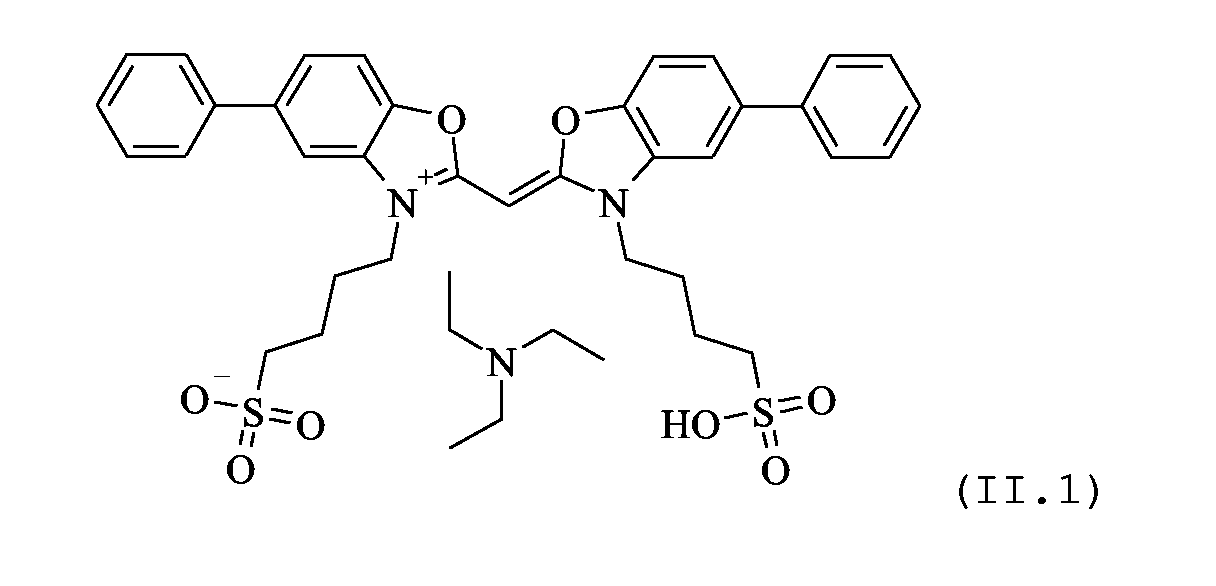
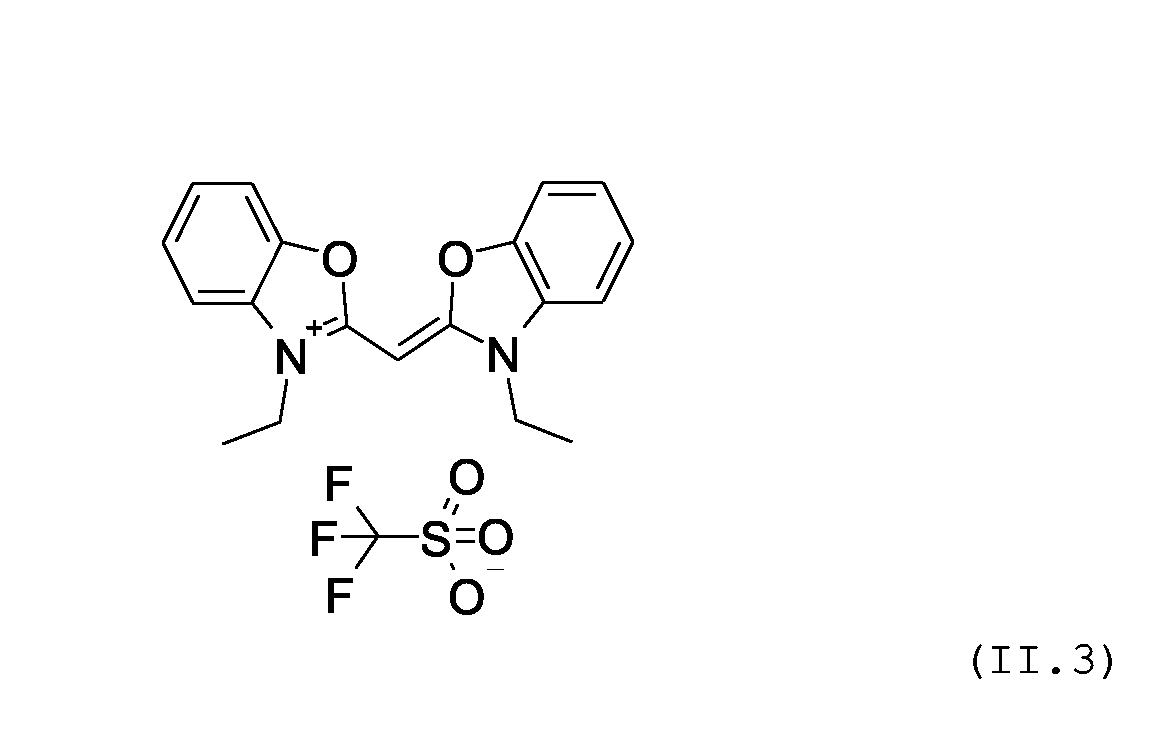
preferred formulae of which have been given under formulae II.1-II.3)
in order to reach the objects of the present invention,
thereby reducing dye stain after processing and retaining
sensitometry (speed), covering power and image tone in varying
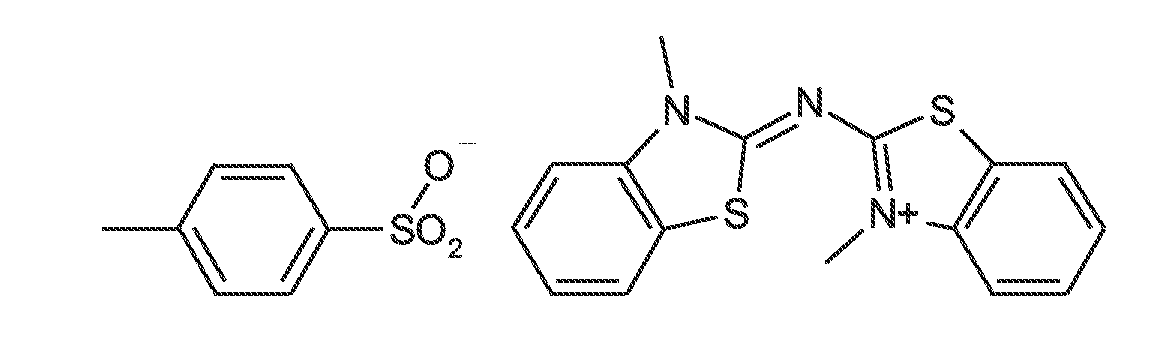
processing conditions. In another embodiment said cyanine dye
differing form the J-aggregating green-sensitizing cyanine dye or
dyes according to the formula (I) is an azacyanine dye.
-
Said sensitizing dyes are added as first ingredient during the
chemical ripening procedure, before addition of the other chemical
ripening compounds or agents as will further be illustrated in the
Examples given hereinafter. It is preferred to first add the
monomethine cyanine dye or dyes before the green-sensitizing cyanine
dye. Mixtures of both types of dyes, i.a. the monomethine cyanine
dye(s) and the green-sensitizing (trimethine) cyanine dyes may also
be added.
-
Monomethine cyanine dyes as those represented by the general
formula (II), and more particularly those represented by the
formulae (II.1-II.3) given hereinafter, are added in lower amounts
than the green-sensitizing trimethine dyes acting as main spectral
sensitizers in order to make the film sensitive in the particular
wavelength range between 540 and 555 nm, the corresponding radiation
having said wavelength range, emitted by the luminescent phosphors
in the intensifying screens in contact with the film. The said
lower amounts of monomethine cyanine dyes result in a preferred
molar ratio between monomethine dyes and trimethine dyes of less
than 5:10 and even more preferably of less than 1:10.
-
A typical example of a preferred trimethine cyanine dye is the oxacarbocyanine
dye according to the formula (I.1) given hereinafter:
-
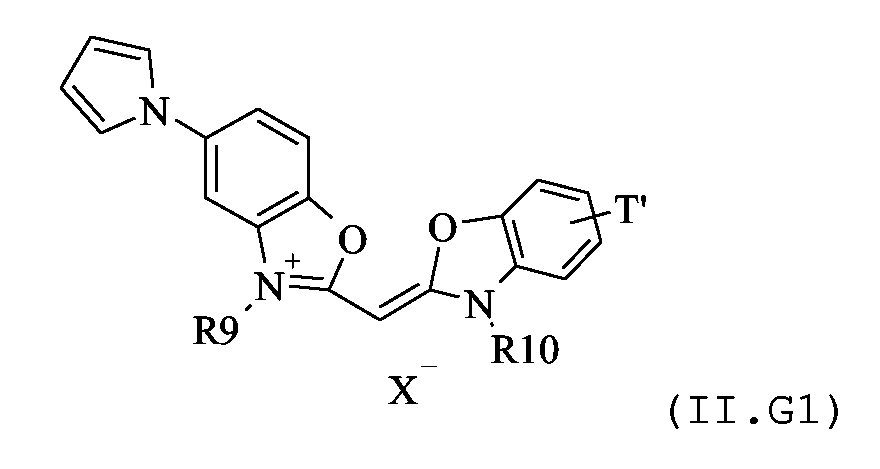
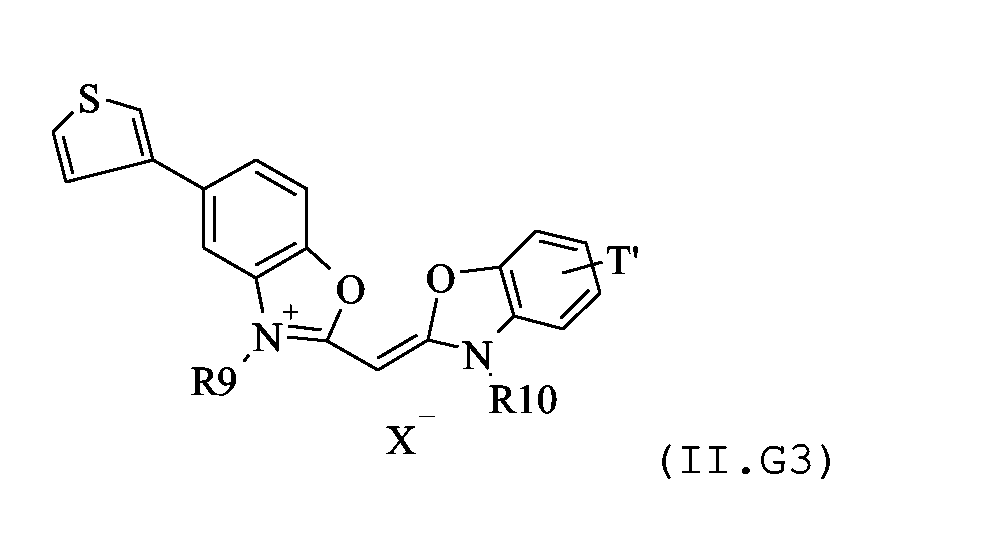
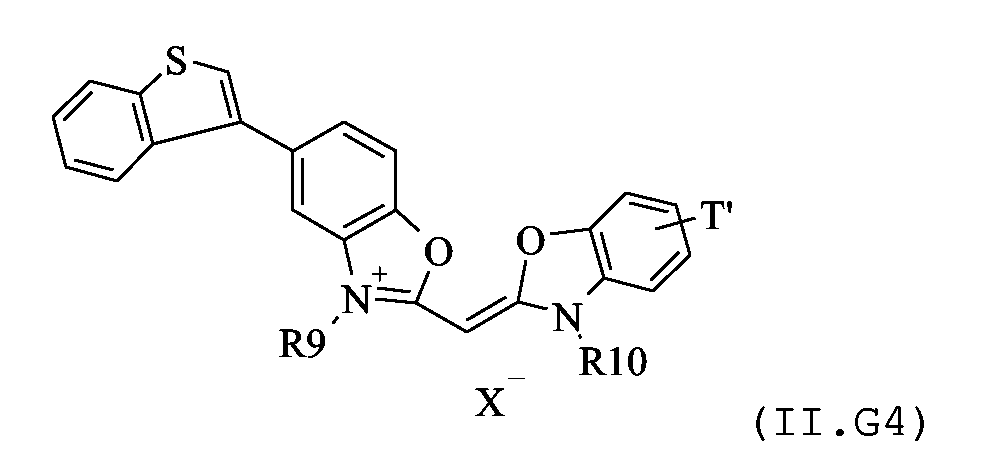
Preferred structures for the monomethine dyes according to the
general formula (II), without being exhaustive therefor, have been
given hereinafter in the formulae (II.G1)-(II.G6).
-
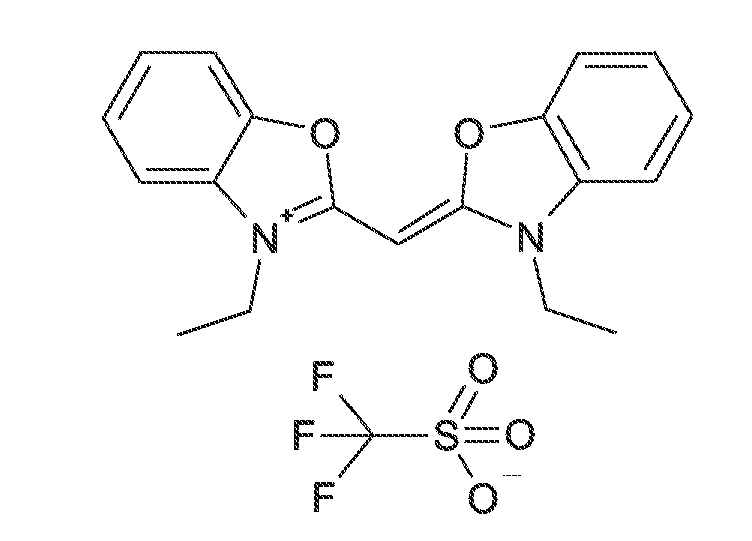
Particularly preferred monomethine cyanine dyes which may be
used as monomethine cyanine dyes in emulsions coated in light-sensitive
layers of the material used in the film/screen system of
the present invention, together with the main J-aggregating green
spectral sensitizer, correspond to the formula (II.1)-(II.3),
represented hereinafter:


The film material according to the present invention comprises
light-sensitive layers at both sides of the film support wherein
{111} tabular silver halide grains rich in silver bromide are
present, wherein, in a preferred embodiment said {111} tabular
silver halide grains rich in silver bromide have a silver iodide
content of less than 3 mole %, and even more preferably from 0.05 up
to 1 mole % of silver iodide, based on silver, and have an average
aspect ratio of 5 or more, an average grain thickness of at most
0.25 µm, and account for at least 50 % of the total projective area
of all grains. In a further embodiment according to the present
invention said film material is coated with light-sensitive layers
at both sides of the film support wherein {111} tabular silver
brom(oiod)ide grains have an average aspect ratio of from 5 up to
20, an average grain thickness of less than 0.1 µm, and account for
at least 70 % of the total projective area of all grains.
-
In a further preferred embodiment the tabular grain population
making part of a light-sensitive emulsion is homogeneous with
respect to average grain surface and/or thickness, i.e., has a
variation coeffient of less and 0.40 and more preferably even from
0.10 up to 0.30.
-
Preparation methods for {111} tabular grain emulsions rich in
silver bromide can be found in Research Dislosure No. 389057,
p. 591-639 (1996), more particularly in Chapter I. A very useful
method has been described in EP-A 0 843 208.
Said {111} tabular crystals rich in silver bromide are composed
of silver bromide, silver bromochloride, silver bromochloroiodide or
silver bromoiodide. When iodide is present it is preferred, in the
context of rapid processing (developing and fixing) ability, to have
at most 3 mole % of iodide present, more preferably at most 1 mole %
and even still more preferably from 0.05 up to 0.5 mole %. Iodide
ions may be divided homogeneously over the tabular grain volume, but
it can be preferred to build up a core-shell structure wherein the
shell is containing more or less iodide than the core or wherein
both distinct phases are separated by a silver halide band rich in
silver iodide, or even consisting of pure silver iodide, realized
e.g. by conversion wherein iodide ions are replacing halides of much
more soluble silver halide salts as silver chloride and/or silver
bromide. Addition of iodide is normally performed by addition of an
inorganic iodide salt as potassium iodide. If slower liberation of
iodide in the reaction is desired addition of organic iodide
releasing agents leads to an increased iodide concentration.
Addition of iodide by organic agents releasing iodide ions,
which is an embodiment which can advantageously be applied within
the context of the preparation of emulsions for use in materials
according to the present invention, is in favour of the realization
of homogeneous distribution of iodide into the crystal volume of
{111} tabular grains or crystals containing silver iodide as has
been demonstrated e.g. in EP-A's 0 561 415, 0 563 701, 0 563 708 and
0 651 284 and in US-A's 5,482,826 and 5,736,312. In an alternative
method iodide ions can be released from iodate as has been described
in US-A 5,736,312. Release of iodide in the presence of a compound
adjusting the rate of iodide release can be applied as described in
US-A 5,807,663 in order to get a multilayered structure in the
silver halide tabular emulsion grains.
-
Addition of iodide to emulsion grains rich in silver bromide is
however also possible by adding fine preformed grains of silver
iodide, whether or not including bromide and/or chloride in minor
amounts, said grains having a grain diameter of not more than 100
nm, and, more preferably, not more than 50 nm. Such fine grains are
so-called "Lippmann" emulsions. Addition of iodide making use from
such fine silver iodide grains has been described for the preparation
of {111} tabular grains in JP-A's 04-251241 and 08-029904 and
in EP-A's 0 662 632 and 0 658 805, wherein an outermost phase rich
in silver iodide has been added to {111} tabular grains rich in
silver bromide. More particularly ultrafine AgI-grains can be
introduced as seed emulsions as has been described in EP-A 0 621 505
or can be used in order to prepare core-shell emulsions as described
in EP-A 0 517 434, wherein two phases in the crystal differing in
composition have thus been built up. In order to improve speed
supplying of said ultrafine grains may proceed in the presence of an
oxidizing agent as has been described in EP-A 0 576 920. Addition
of said fine AgI-Lippmann emulsion grains to the surface of the
silver halide crystals in order to get a global iodide content of
less than 1 mole % in the grain may advantageously proceed as
disclosed in EP-A 0 475 191, wherein an excellent speed/fog ratio
and a high covering power are attained.
-
It is clear that {111} tabular silver halide emulsion grains,
present in light-sensitive emulsion layers of materials according to
the present invention, are, besides spectrally sensitized, also
chemically sensitized, preferably with compounds providing sulphur,
selenium and gold. Chemical sensitization methods for {111} tabular
grain emulsions rich in silver bromide can be found in Research
Dislosure No. 389057, p. 591-639 (1996), more particularly in
Chapter IV. Very useful methods related therewith have been
disclosed in EP-A's 0 443 453, 0 454 069, 0 541 104 and in US-A's
5,112,733 and 5,654,134 wherein further use of labile tellurium
compounds has been claimed. Useful labile selenium compounds have
been disclosed in EP-A's 0 831 363, 0 889 354 and 0 895 121.
-
Preparation of spectrally and chemically sensitized tabular
grains as applied to emulsion grains to be coated in one or more
light-sensitive layer of a material according to the present
invention has been described in US-A 4,439,520, wherein it has been
established to perform spectral sensitization before chemical
sensitization, so that the spectral sensitizer acts as a site-director
for the sensitivity specks, generated during chemical
sensitization. A broad review about spectral sensitization can be
found in in Research Dislosure No. 389057, p. 591-639 (1996), more
particularly in Chapter V. Further useful information about
additives which may be used in order to prepare emulsions to be
coated in a material according to the present invention can be found
in Research Dislosure No. 389057, p. 591-639 (1996), as in Chapter
VII about antifoggants and stabilizers, in Chapter VIII about
coating physical property modifying addenda, in Chapter XI about
layer arrangements and in Chapter XV about supports.
-
As it is a favorable aspect for materials coated from emulsions
having tabular grains to be coated with lower amounts of silver
without loss of covering power in the material according to the
present invention the total amount of coated silver halide in said
film, expressed as an equivalent amount of silver nitrate, is less
than 6.0 g/m2.
-
In practical applications the film material according to the
present invention preferably is a duplitized material, i.a., a
light-sensitive photographic material comprising in its light-sensitive
emulsion layers coated on both sides of a subbed support
an emulsion having {111} tabular grains rich in silver bromide,
spectrally sensitive to irradiation in the wavelength range between
540 and 555 nm by the presence of at least one green-sensitizing
trimethine spectral sensitizer according to the formula (I) and of
at least one monomethine cyanine dye corresponding with the formula
(II) as described hereinbefore. It is however clear that use of a
duplitized material as in the present invention does however not
exlude use in a single-side coated material, whether or not in
radiographic applications, as such a black-and-white silver halide
material can also be used e.g. in micrography, in aviation
photography, in black-and-white cinefilms, in laserfilms or hardcopy
films and in graphic or reprographic applications.
-
Said duplitized film materials for use in radiographic
applications are irradiated by the light emitted imagewise by X-ray
intensifying screens in intimate contact therewith at both sides of
the coated film support during X-ray exposure of part of a patient.
A diagnostic silver image thereof, in conformity with the X-ray
image, is obtained after processing of the said film material. For
use in common medical radiography (projection radiography) the X-ray
film material comprises a transparent film support, coated on both
sides with at least one silver halide emulsion layer, further
overcoated with at least one protective antistress layer and,
optionnally, an afterlayer as disclosed e.g. in EP-A's 0 644 454 and
0 644 456. During X-ray irradiation said film is arranged in a
cassette between two X-ray intensifying screens, each of them making
contact with its corresponding light-sensitive side, thus forming a
film/screen system.
-
According to the present invention a radiographic screen/film
combination or system has been provided comprising a duplitized film
material, sandwiched between a pair of supported or self-supporting
X-ray intensifying screens, characterized in that
- i) said pair of supported or self-supporting X-ray intensifying
screens essentially consists of luminescent phosphor particles
emitting at least 50 %, and, more preferably, at least 80 % of the
total radiation absorption, by the said grains of their emitted
radiation in the wavelength range between 540 and 555 nm,
- ii) said film material is a material according to the present
invention as disclosed hereinbefore, wherein said emulsion is
present in at least one light-sensitive emulsion layer at both sides
of a film support.
-
-
Luminescent phosphors suitable for use in a conventional
intensifying screen of a radiographic film/screen system as the one
according to the present invention must have a high prompt emission
of fluorescent light on X-ray irradiation and low afterglow in
favour of image sharpness. The relationship between resolution and
speed of X-ray intensifying screens is described e.g. in Med. Phys.
5(3), 205 (1978). Specific intensifying screens emitting green
light having the preferred wavelength range have been described in
EP-A's 0 299 409, 0 712 036 and 0 930 527; as well as in US-A
5,380,636. Preferred luminescent phosphors therein are the well-known
gadolinium oxysulfide phosphors used therein and more in
detail luminescent phosphor particles are Gd2O2S:Tb phosphor
particles.
-
X-ray intensifying screens according the present invention can
be self-supporting or supported. X-ray intensifying screens in
accordance with the present invention generally comprise in order: a
support (also called substrate), at least one layer comprising
phosphor particles dispersed in a suitable binder and a protective
coating coated over the phosphor containing layer to protect said
layer during use. Further, a primer layer is sometimes provided
between the phosphor containing layer and the substrate to closely
bond said layer thereto. Examples of support materials include
cardboard, plastic films such as films of cellulose acetate,
polyvinyl chloride, polyvinyl acetate, polyacrylonitrile,
polystyrene, polyester, polyethylene terephthalate, polyamide,
polyimide, cellulose triacetate and polycarbonate; metal sheets such
as aluminum foil and aluminum alloy foil; ordinary papers; baryta
paper; resin-coated papers; pigment papers containing titanium
dioxide or the like; and papers sized with polyvinyl alcohol or the
like. A plastic film is preferably employed as the support
material. Depending on the speed class of the screens for which a
synergistic effect should be attained in the relation between speed
and sharpness, supports characterized by their reflectance
properties, expressed as % reflectance over the wavelength range
from 350 to 600 nm, are particularly used. Such supports can be
highly light reflecting as e.g. polyethylene terephthalate
comprising a white pigment, e.g. BaSO4, TiO2, etc., or it can be
light absorbing supports, e.g. polyethylene terephthalate comprising
a black pigment, e.g. carbon black. Supports comprising dyes or
pigments that absorb light of a specific wavelength can also be
useful in the preparation of X-ray intensifying screens in the
film/screen system according to the present invention.
-
In most applications the phosphor layers contain sufficient
binder to give structural coherence to the layer. In view of a
possible phosphor recovery from worn-out screens the binder of the
phosphor containing layer is preferably soluble and remains soluble
after coating. Useful binders, a non-limitative survey of which is
given herein, include proteinaceous binders, e.g. gelatin,
polysaccharides such as dextran, gum arabic, and synthetic polymers
such as polyvinyl butyral, polyvinyl acetate, nitrocellulose,
ethylcellulose, vinylidene chloride-vinyl chloride copolymer,
polyalkyl (meth)acrylate, vinyl chloride-vinyl acetate copolymer,
polyurethane, cellulose acetate, cellulose acetate butyrate,
polyvinyl alcohol, polystyrene, polyester, etc. These and other
useful binders are disclosed e.g. in US-A's 2,502,529; 2,887,379;
3,617,285; 3,300,310; 3,300,311 and 3,743,833. A mixture of two or
more of these binders may be used, e.g., a mixture of polyethyl
acrylate and cellulose acetobutyrate. The weight ratio of phosphor
to binder is generally within the range of from 50:50 to 89:11,
preferably from 80:20 to 89:11.
-
The screen according to the present invention may comprise a
supported layer of phosphor particles dispersed in a binding medium
comprising one or more rubbery and/or elastomeric polymers as
described in EP-A's 0 647 258 and 0 648 254. In this way a ratio by
weight of pigment to binding medium of more than 90:10 and more
preferably of at least 93:7, e.g. 98:2 can be obtained providing
besides an excellent image resolution a high ease of manipulation as
a result of a good elasticity of the screen and good adhesion
properties between the support and the phosphor layer. Problems
concerning staining of screens comprising said rubbery binder(s) may
be overcome by the addition of known rubber anti-oxidation compounds
like IRGANOX 1010 and IRGASTAB T36 (trademarked products of CIBA-GEIGY,
Basel, Switzerland), ANTIOXIDANT 330 (trademarked product of
ETHYL CORP.,Richmond,USA), VANOX 2246 (trademarked product of
VANDERBILT ENERGY CORP., Denver, Canada) etc, this list being non-limitative.
The binder used in screens according to the present
invention, with high phosphor to binder ratio, can beneficially be a
polymer such as the polymers having been disclosed in EP-A 0 758 012
and the corresponding US-A 5,663,005.
-
The phosphor layer can be applied to the support by employing a
method such as vapour deposition, sputtering and spraying but is
usually applied by the following procedure. Phosphor particles and
a binder are added to an appropriate solvent as described
hereinafter, and are then mixed in order to prepare a coating
dispersion comprising the phosphor particles homogeneously dispersed
in the binder solution. Said coating dispersion may further
comprise a dispersing agent and plasticizer and filler material as
described hereinafter. The coating dispersion containing the
phosphor particles and the binder is applied uniformly onto the
surface of the support to form a layer of the coating dispersion.
The coating procedure may proceed according to any conventional
method such as doctor blade coating, dip-coating or roll coating.
For the preparation of highly abrasion resistant and chemically
resistant phosphor-binder layers the binder is cured. Curing of the
binder may proceed photochemically by means of UV radiation or with
electron beam (EB) as described e.g. in Research Disclosure December
1977, item 16435 or proceeds purely chemically as described e.g. in
US-A 4,508,636. It may also be cured by moisture as described in
EP-A 0 541 146. Curing may also be performed by heating.
-
In the preparation of the phosphor screen having a primer layer
between the substrate and the fluorescent layer, the primer layer is
provided on the substrate beforehand, and then the phosphor
dispersion is applied to the primer layer and dried to form the
fluorescent layer. After applying the coating dispersion onto the
support, the coating dispersion is then heated slowly to dryness in
order to complete the formation of a phosphor layer. In order to
remove entrapped air in the phosphor coating composition as much as
possible it can be subjected to an ultrasonic treatment before
coating. The phosphor-binder layer (as described e.g. in US-A
4,059,768) can be calendered to improve the phosphor packing density
in the dried layer.
-
Useful solvents for the binder of the phosphor containing
layer, employable in the preparation of the phosphor coating
dispersion include lower alcohols such as methanol, ethanol,
n-propanol and n-butanol; chlorinated hydrocarbons such as methylene
chloride and ethylene chloride; ketones such as acetone, butanone,
methyl ethyl ketone and methyl isobutyl ketone; esters of lower
alcohols with lower aliphatic acids such as methyl acetate, ethyl
acetate and butyl acetate; ethers such as dioxane, ethylene glycol
monoethylether; methyl glycol; and mixtures of the above-mentioned
solvents.
-
Useful dispersing agents for the phosphor particles in the
coating dispersion to improve the dispersibility of the phosphor
particles therein, may contain a variety of additives such as a
plasticizer for increasing the bonding between the binder and the
phosphor particles in the phosphor layer. Examples of the
dispersing agent include ionic and nonionic well-known dispersing
agents or combinations thereof, e.g., DISPERSE AYD (trade name of
Daniel Products Company, New Jersey, USA) GAFAC RM 610 (a tradename
a polyoxyethylene (20) sorbitan monopalmitate and monolaurate
marketed by General Aniline and Film Company (GAF) New York, USA,
polymeric surfactants such as the acrylic graft copolymer,
PHOSPHOLIPON 90 (trade name) marketed by Nattermann-Phospholipid
GmbH, Köln, W. Germany, silane dispersing agents and surfactants
e.g. DOW CORNING 190 (trade name) and SILANE Z6040 (trade name)
marketed by Dow Corning Corporation, Midland, Michigan, USA or
glymo-3-glycidyloxy-propylmethoxysilane or organosulfate
polysilanes, unsaturated p-aminamide salts and high molecular acid
esters such as ANTI TERRA U 80 (trade name) marketed by BYK-Chemie
GmbH, Wesel, W. Germany, high molecular unsaturated polyesters, etc.
Dispersing agents are added in an amount of 0.05 to 10 % by weight
based on the phosphor.
-
Useful plasticizers include phosphates such as triphenyl
phosphate, tricresyl phosphate and diphenyl phosphate; phthalates
such as diethyl phthalate and dimethoxyethyl phthalate; glycolates
such as ethylphthalyl ethyl glycolate and butylphthalyl butyl
glycolate; polymeric plastizers, e.g. and polyesters of polyethylene
glycols with aliphatic dicarboxylic acids such as polyester of
triethylene glycol with adipic acid and polyester of diethylene
glycol with succinic acid.
-
After the formation of the fluorescent layer, a protective
layer is generally provided on top of the fluorescent layer. In a
prefer-red embodiment the protective coating has a layer thickness d
comprised between 1 and 50 µm and an embossed surface roughness is
applied for high ease of manipulation, thereby avoiding sticking,
friction and electrostatic attraction with maintenance of an
excellent image resolution. The embossed protective layer can be
provided on the phosphor layer in order to protect it against
mechanical and chemical damage by the steps of
- (1) coating onto said phosphor containing layer a liquid
radiation-curable composition having at the coating temperature a
viscosity of at least 380 mPa.s, measured with a Hoeppler
viscometer,that does not penetrate for a substantial degree into the
phosphor containing layer,
- (2) providing an embossed structure to the coating, and
- (3) curing said coating by radiation.
More details concerning preferred protective coatings with
embossed surface can be found in EP-A's 0 510 753 and 0 510 754.-
-
Assemblies providing means for reducing cross-over to less than
10 % for radiation longer than 300 nm in wavelength have been
described e.g. in US-A 5,259,016.
-
According to the present invention a method of image formation
is obtained by consecutively performing the steps of
- exposing to X-rays the radiographic screen/film combination or
system described hereinbefore; followed by
- processing the film according to the present invention by the
steps of developing, fixing, rinsing and drying.
-
The said processsing is preferably performed in an automatic
processsing machine. More in detail for processing the film
material of the present invention, preferably an automatically
operating apparatus is used provided with a system for automatic
replenishment of the processing solutions. The processing dry-to-dry
within a short processing time of from 30 to 90 seconds and more
preferably from 30 seconds to less than 60 seconds of materials
coated from low amounts of silver is made possible by the steps of
- developing said material in a developer (preferably) without
hardening agent;
- fixing said material in a fixer, optionally without hardening
agent;
- rinsing and drying said material.
-
A normally used configuration in the processing apparatus shows
the following consecutive tank units corresponding with, as
consecutive solutions, developer, fixer and rinse water.
Recent developments however have shown, that from the viewpoint
of ecology and especially with respect to reduction of replenishing
amounts, as consecutive solutions the sequence developer-fixer-fixer-rinse
water-rinse water is preferred. One washing step
between developing and fixation and one at the end before drying may
also be present.
As ecology and low replenishing amounts are main topics with
respect to the present invention use is made of concentrated
hardener free processing solutions in one single package. Examples
thereof have been disclosed e.g. in US-A's 5,187,050 and 5,296,342.
-
Especially preferred developers comprising ecologically
acceptable developing agents such as ascorbic acid and derivatives
thereof have been described in EP-A 0 732 619 and in US-A's
5,593,817 and 5,604,082. Instead of or partially substituting (e.g.
in a ratio by weight of from 1:1 up to 9:1) the ecologically
questionable "hydroquinone" (iso)ascorbic acid, 1-ascorbic acid and
tetramethyl reductic acid are preferred as main developing agent in
the developer. Said developing agents have further been described
in EP-A's 0 461 783, 0 498 968, 0 690 343, 0 696 759, 0 704 756, 0
732 619, 0 731 381 and 0 731 382; in US-A's 5,474,879 and 5,498,511
and in Research Disclosure No 371052, published March 1, 1995,
wherein a more general formula covering the formula of said
developing agents has been represented.
-
In order to reduce "sludge formation" which is favored by
solubilizing agents like sulphites, present in the developer as
preservatives, a particularly suitable developer solution is the one
comprising a reduced amount of sulphite and ascorbic acid which acts
as a main developer and anti-oxidant as well and which is called
"low-sludge" developer.
In favour of ecological fixation the presence of aluminum ions
should be reduced, and more preferably, no aluminum ions should be
present. This is moreover in favour of the absence of "sludge"
formation, a phenomenon which leads to pi-line defects when high
amounts of silver are coated in the light-sensitive layers.
Measures in order to reduce "sludge-formation" have further been
described in US-A's 5,447,817; 5,462,831 and 5,518,868. A
particularly suitable fixer solution comprises an amount of less
than 25 g of potassium sulphite per liter without the presence of
acetic acid wherein said fixer has a pH value of at least 4.5, in
order to make the fixer solution quasi odorless.
If however aluminum ions are present in the fixer composition
for whatever a reason, the presence of α-ketocarboxylic acid
compounds is recommended as has been described in EP-A's 0 620 483
and 0 726 491 as well as in RD 16768, published March 1978.
It is possible to use sodium thiosulphate as a fixing agent,
thus avoiding the ecologically undesirable ammonium ions normally
used. For low coating amounts of emulsion crystals rich in chloride
a fixation time which is reduced to about 2 to 10 seconds can be
attained. Moreover regeneration is kept to a minimum, especially in
the processing of materials coated from very low amounts of emulsion
crystals rich in silver chloride. Preferred minimum regeneration or
replenishment amounts are from 20 to 200 ml/m2, more preferred from
20 to 100 ml/m2, and still more preferred from 20 to 50 ml/m2 of
developed material. Materials coated from higher amounts of silver
will require the higher amounts of replenisher but in most practical
cases replenishment amounts of less than 200 ml/m2 are attainable.
Replenishment of a developer comprising ascorbic acid or
derivatives thereof and a 3-pyrazolidone derivative has been
described in EP-A 0 573 700, wherein a method is disclosed for
processing with constant activity image-wise exposed silver halide
photographic material comprising the steps of developing
photographic material in a continuous automatic way by means of a
developing solution contai-ning an ascorbic acid analogue or
derivative and a 3-pyrazolidone derivative as developing agents and
replenishing said developing solution by means of at least one
replenishing solution having a higher pH than the developing
solution. In an alternative method the replenisher is added as a
powder. Other references related therewith are EP-A 0 552 511; US-A
5,503,965 and further in EP-A 0 660 175, wherein a method of
replenishment control is described. For the fixer preferred minimum
regeneration or replenishment amounts are also from about 20 to 200
ml/m2, more preferred from 20 to 100 ml/m2 and still more preferred
from 20 to 50 ml/m2 of developed material. When aluminum ions are
present in the fixer solution in order to effect hardening, it is
necessary to adjust the pH of the fixer in the range from 4.2 to 4.6
in order to get the highest hardening reactivity and to suppress
swelling with washing water in the washing or rinsing step. For
hardened materials having a swelling degree of the hydrophilic
layers of less than 250 % and more preferably of less than 200 % it
is not required for the fixer pH to held constant in the pH range
from 4.2 to 4.6 as mentioned hereinbefore: in order to reduce
irritating smell from sulphite ions in aqueous acidic medium which
lead to sulphur dioxide vapour it is recommended to enhance pH to a
value of 4.65 up to 5.00. A process whereby the quality of the
fixer remains at an optimum level has been described in EP-A 0872
764.
-
Although it is possible to use whatever a processing unit
adapted to the requirements described hereinbefore to reach the
objectives concerning a perfect link between rapid processing and
ecology, the objects of this invention concerning processing have
e.g. been realized in the processing unit CURIX HT 530, trade name
product marketed by Agfa-Gevaert.
-
New developments however become available with respect to
processing apparatus. In a conventional processing apparatus the
sheet material is transported along a generally horizontal feed
path, the sheet material passing from one vessel to another usually
via a circuitous feed path passing under the surface of each
treatment liquid and over dividing walls between the vessels.
However, processing machines having a substantially vertical
orientation have also been proposed, in which a plurality of vessels
are mounted one above the other, each vessel having an opening at
the top acting as a sheet material inlet and an opening at the
bottom acting as a sheet material outlet or vice versa. In the
present context, the term "substantially vertical" is intended to
mean that the sheet material moves along a path from the inlet to
the outlet which is either exactly vertical, or which has a vertical
component greater than any horizontal component. The use of a
vertical orientation for the apparatus leads to a number of
advantages. In particular the apparatus occupies only a fraction of
the floor space which is occupied by a conventional horizontal
arrangement. Furthermore, the sheet transport path in a vertically
oriented apparatus may be substantially straight, in contrast to the
circuitous feed path which is usual in a horizontally oriented
apparatus.
-
It is clear that within the scope of the present invention any
screen/film combination may be used, wherein said screen comprises
at least luminescent phosphors as e.g. gadolinium oxysulfide
phosphors emitting green light in the wavelength range from 540 to
555 nm, and wherein said film comprises {111} tabular silver halide
crystals rich in silver bromide spectrally sensitized with at least
one or more other cyanine dyes (like monomethine or azacyanine dyes)
in combination with a processing unit, provided that with minimum
amounts of silver coated (total amount, expressed as an equivalent
amount of silver nitrate of less than 6.0 g /m2, particularly for
double-side coated materials) sufficient covering power is attained
in the film in rapid ecological processing (with e.g. ascorbic acid
and/or derivatives thereof as developing agent(s) in a hardener-free
developer and an odor-free fixer, optionally free from aluminum
ions, thereby reducing sludge; and replenishing amounts for
developer and fixer as low as possible, i.e. from about 20 ml/m2 up
to at most 200 ml/m2) and provided that an optimal relationship is
attained between sensitometry and image quality, especially
sharpness, thanks to low cross-over exposure, without residual
color, thus providing a good image tone, and wherein moreover said
image tone and sensitometry is influenced to a lesser extent by
changes of photographic properties on development processing
conditions, more paticularly with respect to processing in weak or
exhausted developers.
-
The following examples illustrate the present invention without
however limiting it thereto.
Examples
-
While the present invention will hereinafter be described in
connection with preferred embodiments thereof, it will be understood
that it is not intended to limit the invention to those embodiments.
1. Emulsion preparation
-
To a solution of 7.5 g of oxidized gelatin, free from Ca-ions,
in 3 l of demineralized water at 25 °C, adjusted to a pH of 1.8 by
adding H2SO4 and a pBr of 2.39 by adding a diluted solution of
potassium bromide, stirred up to a rate of 700 r.p.m., were added by
a double jet method aqueous solutions of 1.96 M AgNO3 (hereinafter
referred to as A1) and 1.96 M KBr (hereinafter referred to as B1):
4.2 ml of A1 and 4.2 ml of B1 were added in a time interval of 30
seconds. After a physical ripening time of 90 seconds the
temperature was increased up to 45 °C over a period of 30 minutes,
followed by another 10 minutes during which the temperatur'e was
held at 45°C and after which a solution of 50 g of gelatin (oxidized
gelatin, free from Ca-ions) in 500 ml of demineralized water of
45°C was added. 2 minutes later pH was adjusted to a value of 5.0.
7 minutes later B1 was added at a rate of 7.5 ml/min. during
436 seconds, followed by a neutralization step, adding therefor A1
at a rate of 5.5 ml/min., while adding B1 at a rate in order to get
a UAg of -20 mV at a temperature of 45°C, corresponding with a pBr
value of 1.47 (pAg = 9.94).
In a double jet addition A1 and B1 were added during a growth
step taking 7248 seconds at a linearly increasing rate going from
5.5 up to 19.2 ml/min., while adding B1 in order to maintain a
constant UAg potential of - 20 mV in the reaction vessel,
corresponding with a pAg of 9.94. 3 minutes after ending that
double-jet addition period, an amount of an emulsion having
ultrafine (ca. 0.040 µm) 100 % AgI crystals, was added to the
reaction vessel in a time of 2 minutes in order to get a total AgI
content at the end of precipitation of 0.1 mole % vs. silver
precipitated (and 99.9 mole % of AgBr).
-
The average grain sizes of the silver bromoiodide tabular {111}
emulsion grains thus prepared, have been calculated as follows:
- as average equivalent volume diameter - measured by Möller
counting apparatus, expressing volume of each separate grain after
electrochemical reduction - a value of 0.56 µm was obtained; and a
- as average equivalent surface area - measured from electron
microscopic photographs - a value of 1.16 µm was obtained; with a
variation thereupon of 0.45;
- as average thickness, measured from shadowed replicas obtained
by electron microscopy, a value of 0.060 µm was obtained.
-
After addition of polystyrene sulphonic acid, followed by
decrease of pH in order to flocculate the emulsion, a washing
procedure followed by decanting supernatant liquid, and peptization
after addition of gelatin, was leading to an emulsion having a gesi
of 0.5 and silver, expressed as an equivalent amount if silver
nitrate in an amount of 230 g/kg.
2. Chemical sensitization
-
As spectral sensitizers following compounds 1 and 2 for the
inventive material coatings (amounts indicated in the Table 1
hereinafter) were added (compound 1 and 3 for the comparative
coating):
-
Compound 1 (as a main spectral sensitizer added in a solution,
having a concentration of 2.783 µmole per ml). Amounts of this main
spectral sensitizer were the same for all coating materials.
-
Compound 2 (as additional spectral sensitizer added in a
solution, having a concentration of 8.763 µmole per ml) added in an
amount indicated as "z" in Table 1 hereinafter.
-
Compound 3 (as comparative additional spectral sensitizer added
in a solution, having a concentration of 20.68 µmole per ml)
-
Compound 4 (as stabilizing agent added in a solution having a
concentration of 4.76 µmole/ml) was always added in an amount of 0.2
ml per 500 g of AgNO3.
-
As chemical sensitizers 6 ml of a sodium thiosulphate solution
(0.1 % solution of the pentahydrate product), x ml of ammonium gold
thiocyanate (solution having a concentration of 1.456 µmole/ml),
-
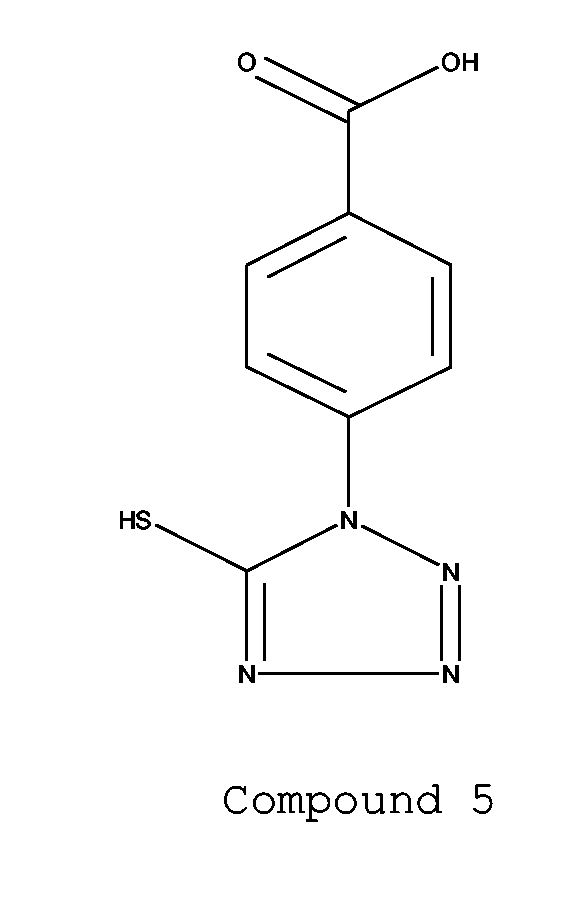
y ml of compound 5, present as sodium salt (solution having a
concentration of 37.57 µmole/ml) and
-
7 ml of compound 6 (solution having a concentration of 3.494
µmole/ml)
Coating of the materials
Preparation of the film material.
-
As stabilizers in the emulsion layer coatings 0.1 mmole of 1-(m-carboxymethylthioacetamido)-phenyl-5-mercaptotetrazole
and 0.6
mmole of 5-methyl-1,2,4-triazolo-(1,5-A)-pyrimidine-7-ol were added
per mole of silver. Resorcinol was added as hardener accelerator in
an amount of 2.8 g per mole of Ag. Consecutively 0.5 g of
polyglycol (MW=6000) was added as a development accelerator; 20 ml
of polyoxyethylene surfactant H17C8-Phenyl-(O-CH2-CH2)8-O-CH2-COOH
and in an amount of 140 mg (per mole of Ag) fluoroglucinol was added
as a hardener stabilizer together with polymethyl acrylate latex (in
an amount of 140 % by weight, based on the amount of gelatin binder)
which was used as a plasticizer. The thus prepared emulsion coating
solutions were coated on a blue coloured polyethylene terephthalate
support (density of the support measured to be 0.200) in such an
amount in order to give a coating weight of 2.00 g/m2 per side in
terms of AgNO3 and 1.29 g of gelatin per m2 per side.
-
The following protective layer was coated thereupon (pH value:
6.25) at both sides:
| Composition of the protective antistress layer |
| Gelatin | 1.11 g/m2 |
| Graft copolymer (7) | 14 mg/m2 |
| Chromium acetic acid | 7.3 mg/m2 |
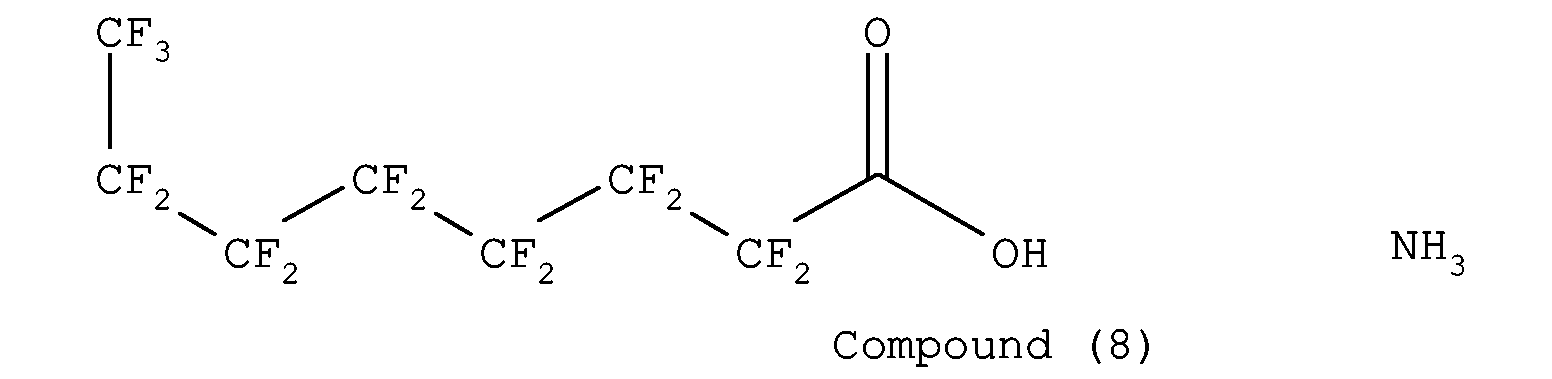
| Compound (8) | 16 mg/m2 |
| Compound (9) | 6.7 mg/m2 |
| Mobilcer Q (MMM trademarked product) | 9 ml/m2 |
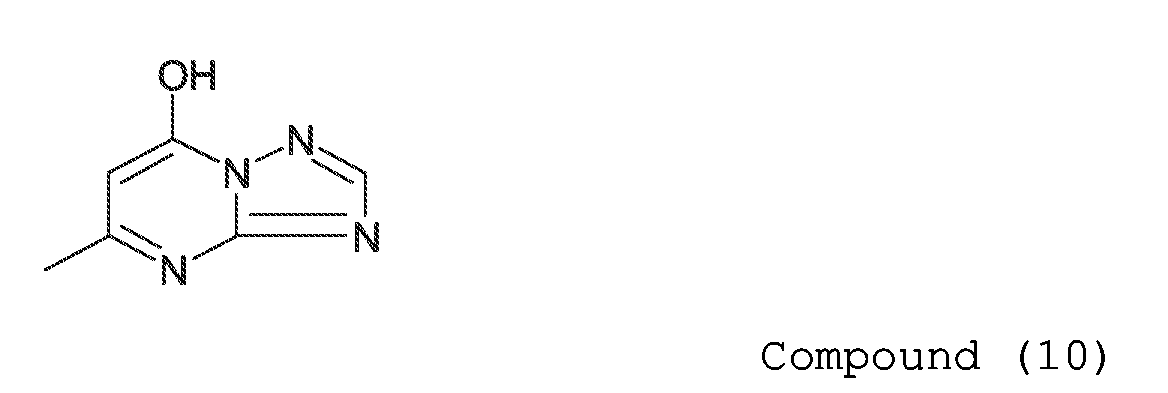
| Compound (10) | 15 mg/m2 |
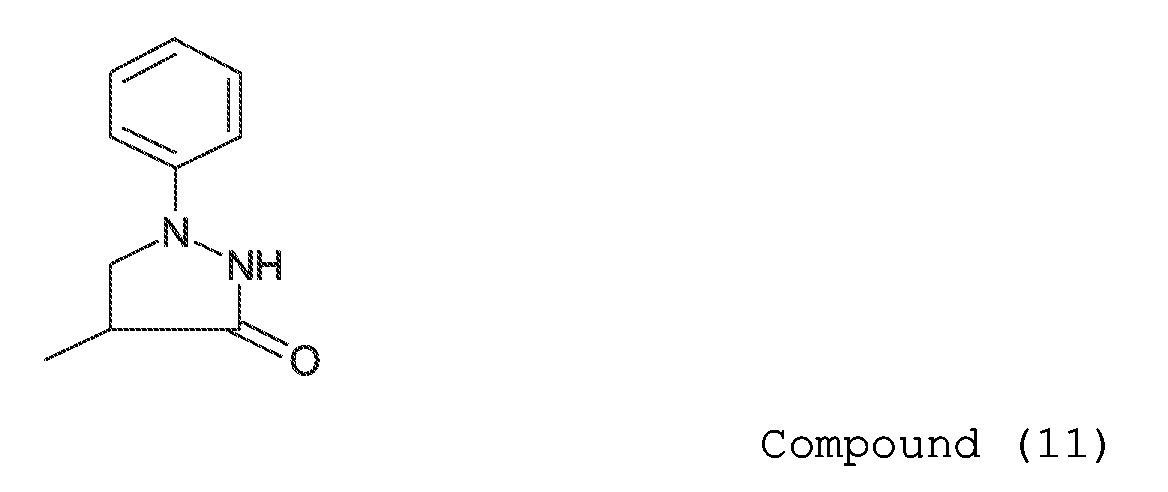
| Compound (11) | 40 mg/m2 |
-
Film materials were called F2-F5 for those coated with the
inventive emulsions and F1 for the one coated with the comparative
emulsion in the light-sensitive emulsion layer of the respective
film materials.
Samples of these coatings were exposed with green light of 540
nm during 0.1 seconds using a continuous wedge and were processed.
The processing was run in the developer G138i, trademarked
product from Agfa-Gevaert N.V., Mortsel, Belgium, followed by fixing
in fixer G334i, trademarked product from Agfa-Gevaert N.V., Mortsel,
Belgium,and rinsing at the indicated temperature of 33°C for a total
processing time of 90 seconds.
-
In order to make a comparison between differing processing
cycles besides a processing in G138i (trademarked product form Agfa-Gevaert),
another cycle was run in the weak hydroquinone developer
I347, pH set at 10.0, the composition of which is given in the Table
1 hereinafter (fixer being the same as hereinbefore, namely G334).
-
For total processing times of 90 s (35°C) data in for differing
developer temperatures have been given for Speed in the Table 1 and
differences in speed were calculated.
| Composition of weak hydroquinone developer |
| Developer H2Q |
| Hydroquinone | 13.3 g/l |
| Phenidone | 0.8 g/l |
| Sodium EDTA | 1.33g/l |
| Potassium hydroxide | 27.9 g/l |
| Sodium tetraborate.10aq | 8.8 g/l |
| Acetic acid | 5.2 g/l |
| 5-methyl benzotriazole | 0.04 g/l |
| 5-nitrobenzimidazole | 0.05 g/l |
| glutardialdehyde | 3.0 g/l |
| diethylene glycol | 12.8 g/l |
Sensitometric and other useful parameters given in Table 2 are
- Fog "F", given as an integer after having multiplied the real
fog density as measured with a factor of 1000;
- Speed "S", given as an integer after having multiplied the
sensitivity measured at a density of 1.00 above minimum density as
measured with a factor of 100; - an decrease of speed with a figure
of 30 corresponding with a doubling in speed -;
- Covering power "CP", given as density of the "DLS" as measured
after subtraction of the density of the suppport, multiplied with a
factor of 100, further divided by the coating amount of silver per
sq.m., said silver amount expressed as silver nitrate equivalent;
- "DLS": Density (of the) last (measurable) step (density in the
shoulder part of the sensitometric curve (before reaching maximum
density Dmax)
- Image tone "IT", evaluated from figures corresponding with Dr,
wherefore data are summarized with respect to the density Dr
measured through a red filter at a blue density Db=2: the higher
this value (figure multiplied by a factor of 100), the better (more
desired blue-black instead of undesired red-brown) is the colour of
the developed silver.
| Material No. | F | S | DLS | CP | IT: G138 | IT: I347 | ΔIT |
| Spectral Sensitizer | x/y/z |
| 1(Comp.3) | 12/10/146 | 195 | 176 | 341 | 97 | 183 | 175 | -8 |
| 2(Comp.2) | 12/10/125 | 227 | 180 | 338 | 93 | 181 | 179 | -2 |
| 3(Comp.2) | 14/10/125 | 202 | 183 | 334 | 94 | 182 | 179 | -3 |
| 4(Comp.2) | 12/10/ 75 | 232 | 190 | 317 | 89 | 184 | 181 | -3 |
| 5(Comp.2) | 14/10/125 | 219 | 177 | 316 | 88 | 187 | 185 | -2 |
-
As becomes clear from the data in Table 2 differences in image
tone remain almost the same when a combination of spectral
sensitizers according to the present invention is applied to the
thin tabular crystals, which was reflected in the small negligible
differences for the "IT" results, reflecting "image tone" values, in
both developers (strong and weak respectively) - see more particular
the Materials Nos. 4-5. For about the same covering power, a
comparable speed and density is maintained. Moreover a shift of
maximum absorption wavelength of less than 10 nm (3 and 4 nm
respectively) was measured for the dye mixtures set forth in the
Table versus in the absence of any other dye (thus with the main J-aggregating
green-sensitizing oxacarbocyanine dye). Said shift was
determined in a SHIMADZU UV-2101 PC UV-VIS spectrophotometer.
-
Having described in detail preferred embodiments of the current
invention, it will now be apparent to those skilled in the art that
numerous modifications can be made therein without departing from
the scope of the invention as defined in the appending claims.










 and of at least one additional cyanine dye,Z represents a nitrogen or an oxygen atom and is substituted with R" if Z is a nitrogen atom,R, R' and R" each independently represent substituted or unsubstituted alkyl,R''' represents hydrogen, substituted or unsubstituted alkyl or substituted or unsubstituted aryl,T and T' each independently represent the usual substituents known in the art,(X-)p represents an negatively charged atom or group of atoms to compensate for the positive charge(s) present on the dye, and(M+)q represents a positively charged atom or group of atoms to compensate for the negative charge(s) present on the dye, wherein p and q each represent an integer in order to get an electronically neutral compound;