EP1217069A2 - Nucleotide sequences which code for the ilvE gene - Google Patents
Nucleotide sequences which code for the ilvE gene Download PDFInfo
- Publication number
- EP1217069A2 EP1217069A2 EP01128596A EP01128596A EP1217069A2 EP 1217069 A2 EP1217069 A2 EP 1217069A2 EP 01128596 A EP01128596 A EP 01128596A EP 01128596 A EP01128596 A EP 01128596A EP 1217069 A2 EP1217069 A2 EP 1217069A2
- Authority
- EP
- European Patent Office
- Prior art keywords
- gene
- codes
- polynucleotide
- sequence
- amino acid
- Prior art date
- Legal status (The legal status is an assumption and is not a legal conclusion. Google has not performed a legal analysis and makes no representation as to the accuracy of the status listed.)
- Withdrawn
Links
Classifications
-
- C—CHEMISTRY; METALLURGY
- C12—BIOCHEMISTRY; BEER; SPIRITS; WINE; VINEGAR; MICROBIOLOGY; ENZYMOLOGY; MUTATION OR GENETIC ENGINEERING
- C12N—MICROORGANISMS OR ENZYMES; COMPOSITIONS THEREOF; PROPAGATING, PRESERVING, OR MAINTAINING MICROORGANISMS; MUTATION OR GENETIC ENGINEERING; CULTURE MEDIA
- C12N15/00—Mutation or genetic engineering; DNA or RNA concerning genetic engineering, vectors, e.g. plasmids, or their isolation, preparation or purification; Use of hosts therefor
- C12N15/09—Recombinant DNA-technology
- C12N15/11—DNA or RNA fragments; Modified forms thereof; Non-coding nucleic acids having a biological activity
- C12N15/52—Genes encoding for enzymes or proenzymes
-
- C—CHEMISTRY; METALLURGY
- C12—BIOCHEMISTRY; BEER; SPIRITS; WINE; VINEGAR; MICROBIOLOGY; ENZYMOLOGY; MUTATION OR GENETIC ENGINEERING
- C12N—MICROORGANISMS OR ENZYMES; COMPOSITIONS THEREOF; PROPAGATING, PRESERVING, OR MAINTAINING MICROORGANISMS; MUTATION OR GENETIC ENGINEERING; CULTURE MEDIA
- C12N9/00—Enzymes; Proenzymes; Compositions thereof; Processes for preparing, activating, inhibiting, separating or purifying enzymes
- C12N9/10—Transferases (2.)
- C12N9/1096—Transferases (2.) transferring nitrogenous groups (2.6)
-
- C—CHEMISTRY; METALLURGY
- C12—BIOCHEMISTRY; BEER; SPIRITS; WINE; VINEGAR; MICROBIOLOGY; ENZYMOLOGY; MUTATION OR GENETIC ENGINEERING
- C12P—FERMENTATION OR ENZYME-USING PROCESSES TO SYNTHESISE A DESIRED CHEMICAL COMPOUND OR COMPOSITION OR TO SEPARATE OPTICAL ISOMERS FROM A RACEMIC MIXTURE
- C12P13/00—Preparation of nitrogen-containing organic compounds
- C12P13/04—Alpha- or beta- amino acids
- C12P13/06—Alanine; Leucine; Isoleucine; Serine; Homoserine
-
- C—CHEMISTRY; METALLURGY
- C12—BIOCHEMISTRY; BEER; SPIRITS; WINE; VINEGAR; MICROBIOLOGY; ENZYMOLOGY; MUTATION OR GENETIC ENGINEERING
- C12P—FERMENTATION OR ENZYME-USING PROCESSES TO SYNTHESISE A DESIRED CHEMICAL COMPOUND OR COMPOSITION OR TO SEPARATE OPTICAL ISOMERS FROM A RACEMIC MIXTURE
- C12P13/00—Preparation of nitrogen-containing organic compounds
- C12P13/04—Alpha- or beta- amino acids
- C12P13/08—Lysine; Diaminopimelic acid; Threonine; Valine
-
- C—CHEMISTRY; METALLURGY
- C12—BIOCHEMISTRY; BEER; SPIRITS; WINE; VINEGAR; MICROBIOLOGY; ENZYMOLOGY; MUTATION OR GENETIC ENGINEERING
- C12P—FERMENTATION OR ENZYME-USING PROCESSES TO SYNTHESISE A DESIRED CHEMICAL COMPOUND OR COMPOSITION OR TO SEPARATE OPTICAL ISOMERS FROM A RACEMIC MIXTURE
- C12P13/00—Preparation of nitrogen-containing organic compounds
- C12P13/04—Alpha- or beta- amino acids
- C12P13/22—Tryptophan; Tyrosine; Phenylalanine; 3,4-Dihydroxyphenylalanine
- C12P13/222—Phenylalanine
Definitions
- the invention also provides polynucleotides chosen from the group consisting of
- the invention also provides polynucleotides, which substantially comprise a polynucleotide sequence, which are obtainable by screening by means of hybridization of a corresponding gene library of a coryneform bacterium, which comprises the complete gene or parts thereof, with a probe which comprises the sequence of the polynucleotide according to the invention according to SEQ ID No.1 or a fragment thereof, and isolation of the polynucleotide sequence mentioned.
- plasmids such as pBR322 (Bolivar, Life Sciences, 25, 807-818 (1979)) or pUC9 (Vieira et al., 1982, Gene, 19:259-268).
- Suitable hosts are, in particular, those E. coli strains which are restriction- and recombination-defective.
- An example of these is the strain DH5 ⁇ mcr, which has been described by Grant et al. (Proceedings of the National Academy of Sciences USA, 87 (1990) 4645-4649).
- PCR polymerase chain reaction
- plasmid vectors such as e.g. those based on pCG4 (US-A 4,489,160), or pNG2 (Serwold-Davis et al., FEMS Microbiology Letters 66, 119-124 (1990)), or pAG1 (US-A 5,158,891), can be used in the same manner.
- Plasmid vectors which are furthermore suitable are also those with the aid of which the process of gene amplification by integration into the chromosome can be used, as has been described, for example, by Reinscheid et al. (Applied and Environmental Microbiology 60, 126-132 (1994)) for duplication or amplification of the hom-thrB operon.
- the complete gene is cloned in a plasmid vector which can replicate in a host (typically E. coli), but not in C. glutamicum.
- L-amino acids may enhance, in particular over-express one or more enzymes of the particular biosynthesis pathway, of glycolysis, of anaplerosis, of the citric acid cycle, of the pentose phosphate cycle, of amino acid export and optionally regulatory proteins, in addition to the ilvE gene.
- L-amino acids in addition to the enhancement of the ilvE gene, for one or more of the genes chosen from the group consisting of:
- the invention also provides the microorganisms prepared according to the invention, and these can be cultured continuously or discontinuously in the batch process (batch culture) or in the fed batch (feed process) or repeated fed batch process (repetitive feed process) for the purpose of production of amino acids.
- batch culture batch culture
- feed process feed process
- repetitive feed process repetition feed process
- Sugars and carbohydrates such as e.g. glucose, sucrose, lactose, fructose, maltose, molasses, starch and cellulose, oils and fats, such as e.g. soya oil, sunflower oil, groundnut oil and coconut fat, fatty acids, such as e.g. palmitic acid, stearic acid and linoleic acid, alcohols, such as e.g. glycerol and ethanol, and organic acids, such as e.g. acetic acid, can be used as the source of carbon. These substances can be used individually or as a mixture.
- oils and fats such as e.g. soya oil, sunflower oil, groundnut oil and coconut fat
- fatty acids such as e.g. palmitic acid, stearic acid and linoleic acid
- alcohols such as e.g. glycerol and ethanol
- organic acids such as e.g. acetic acid
- composition of the usual nutrient media such as LB or TY medium, can also be found in the handbook by Sambrook et al.
- the DNA of the sequencing vector pZero-1 obtained from Invitrogen (Groningen, Holland, Product Description Zero Background Cloning Kit, Product No. K2500-01), is cleaved with the restriction enzyme BamHI (Amersham Pharmacia, Freiburg, Germany, Product Description BamHI, Product No. 27-0868-04).
- BamHI Amersham Pharmacia, Freiburg, Germany, Product Description BamHI, Product No. 27-0868-04.
- the ligation of the cosmid fragments in the sequencing vector pZero-1 is carried out as described by Sambrook et al. (1989, Molecular Cloning: A laboratory Manual, Cold Spring Harbor), the DNA mixture being incubated overnight with T4 ligase (Pharmacia Biotech, Freiburg, Germany). This ligation mixture is then electroporated (Tauch et al.
- the resulting nucleotide sequence is shown in SEQ ID No. 1.
- Analysis of the nucleotide sequence shows an open reading frame of 1103 base pairs, which is called the ilvE gene.
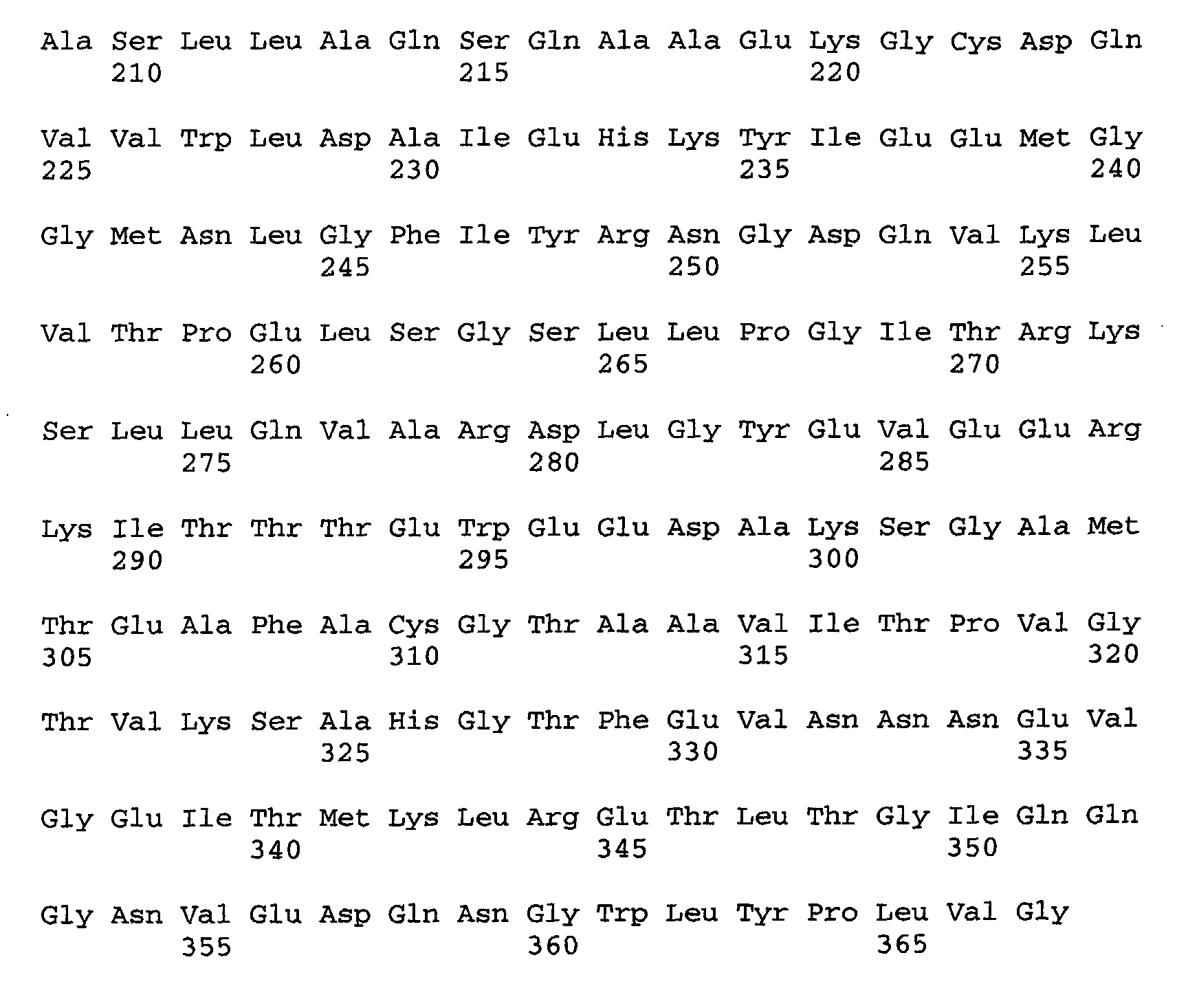
- the ilvE gene codes for a protein of 367 amino acids.
Landscapes
- Chemical & Material Sciences (AREA)
- Life Sciences & Earth Sciences (AREA)
- Organic Chemistry (AREA)
- Engineering & Computer Science (AREA)
- Health & Medical Sciences (AREA)
- Genetics & Genomics (AREA)
- Wood Science & Technology (AREA)
- Zoology (AREA)
- Bioinformatics & Cheminformatics (AREA)
- Biotechnology (AREA)
- General Engineering & Computer Science (AREA)
- Microbiology (AREA)
- Biochemistry (AREA)
- General Health & Medical Sciences (AREA)
- Biomedical Technology (AREA)
- Chemical Kinetics & Catalysis (AREA)
- Molecular Biology (AREA)
- General Chemical & Material Sciences (AREA)
- Medicinal Chemistry (AREA)
- Physics & Mathematics (AREA)
- Biophysics (AREA)
- Plant Pathology (AREA)
- Preparation Of Compounds By Using Micro-Organisms (AREA)
- Micro-Organisms Or Cultivation Processes Thereof (AREA)
- Measuring Or Testing Involving Enzymes Or Micro-Organisms (AREA)
Abstract
Description
- (i)
- the nucleotide sequence shown in SEQ ID No. 1, or
- (ii)
- at least one sequence which corresponds to sequence (i) within the range of the degeneration of the genetic code, or
- (iii)
- at least one sequence which hybridizes with the sequence complementary to sequence (i) or (ii), and optionally
- (iv)
- sense mutations of neutral function in (i) which do not modify the activity of the protein/polypeptide.
a polynucleotide, in particular DNA, which is capable of replication and comprises the nucleotide sequence as shown in SEQ ID No. 1;
a polynucleotide which codes for a polypeptide which comprises the amino acid sequence as shown in SEQ ID No. 2;
a vector containing the polynucleotide according to the invention, in particular a shuttle vector or plasmid vector, and
coryneform bacteria which contain the vector or in which the endogenous ilvE gene is enhanced.
- the gap gene which codes for glyceraldehyde 3-phosphate dehydrogenase (Eikmanns (1992), Journal of Bacteriology 174:6076-6086),
- the tpi gene which codes for triose phosphate isomerase (Eikmanns (1992), Journal of Bacteriology 174:6076-6086),
- the pgk gene which codes for 3-phosphoglycerate kinase (Eikmanns (1992), Journal of Bacteriology 174:6076-6086),
- the zwf gene which codes for glucose 6-phosphate dehydrogenase (JP-A-09224661),
- the mqo gene which codes for malate-quinone oxidoreductase (Molenaar et al., European Journal of Biochemistry 254, 395-403 (1998)),
- the lysC gene which codes for a feed-back resistant aspartate kinase (Accession No.P26512),
- the hom gene which codes for homoserine dehydrogenase (EP-A 0131171),
- the ilvA gene which codes for threonine dehydratase (Möckel et al., Journal of Bacteriology (1992) 8065-8072)) or the ilvA(Fbr) allele which codes for a "feed back resistant" threonine dehydratase (Möckel et al., (1994) Molecular Microbiology 13: 833-842),
- the ilvBN gene which codes for acetohydroxy-acid synthase (EP-B 0356739),
- the ilvD gene which codes for dihydroxy-acid dehydratase (Sahm and Eggeling (1999) Applied and Environmental Microbiology 65: 1973-1979),
- the leuB gene which codes for 3-isopropyl malate dehydrogenase (Patek et al. (1998) Applied and Microbiology Biotechnologie [sic] 50: 42-47)
- the brnE gene which codes for valine export (DE: 19951708.8)
- the leuA gene which codes for isopropyl malate synthase(Patek et al.(1994) Applied and Environmental Microbiology 60 (1): 133-140)
- the pyc gene which codes for pyruvate carboxylase (Peters-Wendisch et al.(Microbiology 144, 915 - 927 (1998))
- the zwa1 gene which codes for the Zwa1 protein (DE: 19959328.0, DSM 13115),
- the pck gene which codes for phosphoenol pyruvate carboxykinase (DE 199 50 409.1; DSM 13047),
- the dapA gene which codes for dihydrodipicolinate synthase (EP-B 0 197 335),
- the pgi gene which codes for glucose 6-phosphate isomerase (US 09/396,478; DSM 12969),
- the poxB gene which codes for pyruvate oxidase (DE: 1995 1975.7; DSM 13114),
- the zwa2 gene which codes for the Zwa2 protein (DE: 19959327.2, DSM 13113)


Claims (20)
- Isolated polynucleotide from coryneform bacteria, comprising a polynucleotide sequence which codes for the ilvE gene, chosen from the group consisting ofthe polypeptide preferably having the activity of transaminase E.a) polynucleotide which is identical to the extent of at least 70% to a polynucleotide which codes for a polypeptide which comprises the amino acid sequence of SEQ ID No. 2,b) polynucleotide which codes for a polypeptide which comprises an amino acid sequence which is identical to the extent of at least 70% to the amino acid sequence of SEQ ID No. 2,c) polynucleotide which is complementary to the polynucleotides of a) or b), andd) polynucleotide comprising at least 15 successive nucleotides of the polynucleotide sequence of a), b) or c)
- Polynucleotide according to claim 1, wherein the polynucleotide is a preferably recombinant DNA which is capable of replication in coryneform bacteria.
- Polynucleotide according to claim 1, wherein the polynucleotide is an RNA.
- Polynucleotide according to claim 2, comprising the nucleic acid sequence as shown in SEQ ID No. 1.
- DNA according to claim 2 which is capable of replication, comprising
- (i)
- the nucleotide sequence shown in SEQ ID No. 1, or
- (ii)
- at least one sequence which corresponds to sequence (i) within the range of the degeneration of the genetic code, or
- (iii)
- at least one sequence which hybridizes with the sequence complementary to sequence (i) or (ii), and optionally
- (iv)
- sense mutations of neutral function in (i).
- DNA according to claim 5 which is capable of replication, characterized in that the hybridization is carried out under a stringency corresponding to at most 2x SSC.
- Polynucleotide sequence according to claim 1, which codes for a polypeptide which comprises the amino acid sequence shown in SEQ ID No. 2.
- Coryneform bacteria in which the ilvE gene is enhanced, in particular over-expressed.
- Process for the fermentative preparation of L-amino acids, in particular L-leucine, L-valine, L-isoleucine and L-phenylalanine, characterized in that the following steps are carried out:a) fermentation of the coryneform bacteria which produce the desired L-amino acid and in which at least the endogenous ilvE gene or nucleotide sequences which code for it are enhanced, in particular over-expressed;b) concentration of the L-amino acid in the medium or in the cells of the bacteria, andc) isolation of the L-amino acid.
- Process according to claim 9, characterized in that bacteria in which further genes of the biosynthesis pathway of the desired L-amino acid are additionally enhanced are employed.
- Process according to claim 9, characterized in that bacteria in which the metabolic pathways which reduce the formation of the desired L-amino acid are at least partly eliminated are employed.
- Process according to claim 9, characterized in that a strain transformed with a plasmid vector is employed, and the plasmid vector carries the nucleotide sequence which codes for the ilvE gene.
- Process according to claim 9, characterized in that the expression of the polynucleotide(s) which code(s) for the ilvE gene is enhanced, in particular over-expressed.
- Process according to claim 9, characterized in that the regulatory or catalytic properties of the polypeptide (enzyme protein) for which the polynucleotide ilvE codes are increased.
- Process according to claim 9, characterized in that for the preparation of L-amino acids, coryneform microorganisms in which at the same time one or more of the endogenous genes chosen from the group consisting of
- 15.1
- the dapA gene which codes for dihydrodipicolinate synthase,
- 15.2
- the gap gene which codes for glyceraldehyde 3-phosphate dehydrogenase,
- 15.3
- the tpi gene which codes for triose phosphate isomerase,
- 15.4
- the pgk gene which codes for 3-phosphoglycerate kinase,
- 15.5
- the zwf gene which codes for glucose 6-phosphate dehydrogenase,
- 15.6
- the pyc gene which codes for pyruvate carboxylase,
- 15.7
- the mqo gene which codes for malate-quinone oxidoreductase,
- 15.8
- the lysC gene which codes for a feed-back resistant aspartate kinase,
- 15.9
- the lysE gene which codes for lysine export,
- 15.10
- the hom gene which codes for homoserine dehydrogenase
- 15.11
- the ilvA gene which codes for threonine dehydratase or the ilvA(Fbr) allele which codes for a feed back resistant threonine dehydratase,
- 15.12
- the ilvBN gene which codes for acetohydroxy-acid synthase,
- 15.13
- the ilvD gene which codes for dihydroxy-acid dehydratase,
- 15.14
- the zwa1 gene which codes for the Zwa1 protein
- Process according to claim 9, characterized in that for the preparation of L-amino acids, coryneform microorganisms in which at the same time one or more of the genes chosen from the group consisting of
- 16.1
- the pck gene which codes for phosphoenol pyruvate carboxykinase,
- 16.2
- the pgi gene which codes for glucose 6-phosphate isomerase,
- 16.3
- the poxB gene which codes for pyruvate oxidase
- 16.4
- the zwa2 gene which codes for the Zwa2 protein is or are attenuated are fermented.
- Coryneform bacteria which contain a vector which carries a polynucleotide according to claim 1.
- Process according to one or more of claims 9-16, characterized in that microorganisms of the species Corynebacterium glutamicum are employed.
- Process for discovering RNA, cDNA and DNA in order to isolate nucleic acids or polynucleotides or genes which code for transaminase E or have a high similarity with the sequence of the ilvE gene, characterized in that the polynucleotide comprising the polynucleotide sequences according to claims 1, 2, 3 or 4 is employed as hybridization probes.
- Process according to claim 19, characterized in that arrays, micro arrays or DNA chips are employed.
Applications Claiming Priority (2)
| Application Number | Priority Date | Filing Date | Title |
|---|---|---|---|
| DE10063314A DE10063314A1 (en) | 2000-12-20 | 2000-12-20 | New nucleotide sequences coding for the ilvE gene |
| DE10063314 | 2000-12-20 |
Publications (2)
| Publication Number | Publication Date |
|---|---|
| EP1217069A2 true EP1217069A2 (en) | 2002-06-26 |
| EP1217069A3 EP1217069A3 (en) | 2002-07-03 |
Family
ID=7667802
Family Applications (1)
| Application Number | Title | Priority Date | Filing Date |
|---|---|---|---|
| EP01128596A Withdrawn EP1217069A3 (en) | 2000-12-20 | 2001-11-30 | Nucleotide sequences which code for the ilvE gene |
Country Status (3)
| Country | Link |
|---|---|
| US (1) | US20030100054A1 (en) |
| EP (1) | EP1217069A3 (en) |
| DE (1) | DE10063314A1 (en) |
Cited By (4)
| Publication number | Priority date | Publication date | Assignee | Title |
|---|---|---|---|---|
| WO2002055711A3 (en) * | 2001-01-12 | 2002-12-19 | Forschungszentrum Juelich Gmbh | Method for the production of pantothenic acid by fermentation |
| WO2003093490A1 (en) * | 2002-05-02 | 2003-11-13 | Forschungszentrum Jülich GmbH | Method for the microbial production of aromatic amino acids and other metabolites of the aromatic amino acid biosynthetic pathway |
| JP2008514191A (en) * | 2004-09-28 | 2008-05-08 | フォルシュングスツェントルム・ユーリッヒ・ゲゼルシャフト・ミット・ベシュレンクテル・ハフツング | A method for fermentative production of L-valine using a Corynebacterium glutamicum strain having increased transaminase C activity. |
| KR102143964B1 (en) * | 2019-12-06 | 2020-08-12 | 씨제이제일제당 주식회사 | Novel branched-chain amino acid aminotranferase variant and a method of producing leucine using thereof |
Families Citing this family (4)
| Publication number | Priority date | Publication date | Assignee | Title |
|---|---|---|---|---|
| US8647642B2 (en) | 2008-09-18 | 2014-02-11 | Aviex Technologies, Llc | Live bacterial vaccines resistant to carbon dioxide (CO2), acidic PH and/or osmolarity for viral infection prophylaxis or treatment |
| US10676723B2 (en) | 2015-05-11 | 2020-06-09 | David Gordon Bermudes | Chimeric protein toxins for expression by therapeutic bacteria |
| US11129906B1 (en) | 2016-12-07 | 2021-09-28 | David Gordon Bermudes | Chimeric protein toxins for expression by therapeutic bacteria |
| US11180535B1 (en) | 2016-12-07 | 2021-11-23 | David Gordon Bermudes | Saccharide binding, tumor penetration, and cytotoxic antitumor chimeric peptides from therapeutic bacteria |
Family Cites Families (6)
| Publication number | Priority date | Publication date | Assignee | Title |
|---|---|---|---|---|
| GB8301700D0 (en) * | 1983-01-21 | 1983-02-23 | Searle & Co | Cloning and utilisation of aminotransferase genes |
| JP3709564B2 (en) * | 1994-08-30 | 2005-10-26 | 味の素株式会社 | Process for producing L-valine and L-leucine |
| JP4032441B2 (en) * | 1995-08-30 | 2008-01-16 | 味の素株式会社 | Method for producing L-amino acid |
| MXPA01013123A (en) * | 1999-06-25 | 2002-06-21 | Basf Ag | Corynebacterium glutamicum. |
| CA2380613C (en) * | 1999-08-02 | 2014-03-25 | Archer-Daniels-Midland Company | Production of l-lysine by corynebacterium strain having mutation in ilvbn operon |
| JP4623825B2 (en) * | 1999-12-16 | 2011-02-02 | 協和発酵バイオ株式会社 | Novel polynucleotide |
-
2000
- 2000-12-20 DE DE10063314A patent/DE10063314A1/en not_active Withdrawn
-
2001
- 2001-11-30 EP EP01128596A patent/EP1217069A3/en not_active Withdrawn
- 2001-12-18 US US10/020,513 patent/US20030100054A1/en not_active Abandoned
Cited By (4)
| Publication number | Priority date | Publication date | Assignee | Title |
|---|---|---|---|---|
| WO2002055711A3 (en) * | 2001-01-12 | 2002-12-19 | Forschungszentrum Juelich Gmbh | Method for the production of pantothenic acid by fermentation |
| WO2003093490A1 (en) * | 2002-05-02 | 2003-11-13 | Forschungszentrum Jülich GmbH | Method for the microbial production of aromatic amino acids and other metabolites of the aromatic amino acid biosynthetic pathway |
| JP2008514191A (en) * | 2004-09-28 | 2008-05-08 | フォルシュングスツェントルム・ユーリッヒ・ゲゼルシャフト・ミット・ベシュレンクテル・ハフツング | A method for fermentative production of L-valine using a Corynebacterium glutamicum strain having increased transaminase C activity. |
| KR102143964B1 (en) * | 2019-12-06 | 2020-08-12 | 씨제이제일제당 주식회사 | Novel branched-chain amino acid aminotranferase variant and a method of producing leucine using thereof |
Also Published As
| Publication number | Publication date |
|---|---|
| EP1217069A3 (en) | 2002-07-03 |
| DE10063314A1 (en) | 2002-07-04 |
| US20030100054A1 (en) | 2003-05-29 |
Similar Documents
| Publication | Publication Date | Title |
|---|---|---|
| EP1315745B1 (en) | Recombinant coryneform bacteria overexpressing the glyceraldehyde-3-phosphate dehydrogenase -2 gene , and their use in l-lysine production | |
| US6939692B2 (en) | Nucleotide sequences coding for the pknB gene | |
| US20020055152A1 (en) | Nucleotide sequences which code for the 11dD2 gene | |
| EP1317550B1 (en) | Nucleotide sequences which code for the ppsa gene | |
| EP1317549B1 (en) | Isolation and sequencing of the ptsi gene of c. glutamicum | |
| US20030100054A1 (en) | Nucleotide sequences which code for the ilvE gene | |
| US6777206B2 (en) | Nucleotide sequences which code for the RodA protein | |
| US6890744B2 (en) | Methods for producing amino acids in coryneform bacteria using an enhanced sigD gene | |
| US20020106760A1 (en) | Nucleotide sequences which code for the dps gene | |
| US20020048795A1 (en) | Nucleotide sequences coding for the ccsB gene | |
| US6727086B2 (en) | Nucleotide sequences which code for the sigH gene | |
| US20020119549A1 (en) | Nucleotide sequences which code for the RPSL gene | |
| US7252977B2 (en) | Nucleotide sequences which code for the msiK gene | |
| US20020110879A1 (en) | Nucleotide sequences coding for the ppgK gene | |
| US6913908B2 (en) | Methods of making L-amino acids in coryneform using the sigE gene | |
| US20020115159A1 (en) | Nucleotide sequences coding for the ATR61protein | |
| US20020107377A1 (en) | Nucleotide sequences coding for the ftsX gene | |
| US20020086374A1 (en) | Nucleotide sequences which code for the dep67 gene | |
| US20020115160A1 (en) | Nucleotide sequences which code for the truB gene | |
| US6927052B2 (en) | Nucleotide sequences coding for the pknD gene | |
| US20020146782A1 (en) | Nucleotide sequences coding for the sigC gene | |
| US20020115162A1 (en) | Nucleotide sequences coding for the cysQ gene | |
| US20020090685A1 (en) | Nucleotide sequences coding for the ndkA gene | |
| US20020052486A1 (en) | Nucleotide sequences which code for the gpmB gene | |
| US20020107379A1 (en) | Nucleotide sequences coding for the thyA gene |
Legal Events
| Date | Code | Title | Description |
|---|---|---|---|
| PUAI | Public reference made under article 153(3) epc to a published international application that has entered the european phase |
Free format text: ORIGINAL CODE: 0009012 |
|
| PUAL | Search report despatched |
Free format text: ORIGINAL CODE: 0009013 |
|
| 17P | Request for examination filed |
Effective date: 20011130 |
|
| AK | Designated contracting states |
Kind code of ref document: A2 Designated state(s): AT BE CH CY DE DK ES FI FR GB GR IE IT LI LU MC NL PT SE TR |
|
| AX | Request for extension of the european patent |
Free format text: AL;LT;LV;MK;RO;SI |
|
| AK | Designated contracting states |
Kind code of ref document: A3 Designated state(s): AT BE CH CY DE DK ES FI FR GB GR IE IT LI LU MC NL PT SE TR |
|
| AX | Request for extension of the european patent |
Free format text: AL;LT;LV;MK;RO;SI |
|
| AKX | Designation fees paid |
Designated state(s): AT BE CH CY DE DK ES FI FR GB GR IE IT LI LU MC NL PT SE TR |
|
| 17Q | First examination report despatched |
Effective date: 20060925 |
|
| RAP1 | Party data changed (applicant data changed or rights of an application transferred) |
Owner name: DEGUSSA GMBH |
|
| STAA | Information on the status of an ep patent application or granted ep patent |
Free format text: STATUS: THE APPLICATION IS DEEMED TO BE WITHDRAWN |
|
| 18D | Application deemed to be withdrawn |
Effective date: 20070406 |