EP1215882A1 - Halftone detection in the wavelet domain - Google Patents
Halftone detection in the wavelet domain Download PDFInfo
- Publication number
- EP1215882A1 EP1215882A1 EP01129124A EP01129124A EP1215882A1 EP 1215882 A1 EP1215882 A1 EP 1215882A1 EP 01129124 A EP01129124 A EP 01129124A EP 01129124 A EP01129124 A EP 01129124A EP 1215882 A1 EP1215882 A1 EP 1215882A1
- Authority
- EP
- European Patent Office
- Prior art keywords
- wavelet
- sub
- domain data
- band
- data
- Prior art date
- Legal status (The legal status is an assumption and is not a legal conclusion. Google has not performed a legal analysis and makes no representation as to the accuracy of the status listed.)
- Granted
Links
- 238000001514 detection method Methods 0.000 title description 12
- 238000000354 decomposition reaction Methods 0.000 claims abstract description 42
- 238000000034 method Methods 0.000 claims abstract description 37
- 238000007906 compression Methods 0.000 claims abstract description 18
- 230000006835 compression Effects 0.000 claims abstract description 17
- 238000003672 processing method Methods 0.000 claims description 11
- 230000003213 activating effect Effects 0.000 claims 1
- 230000008901 benefit Effects 0.000 description 7
- 230000003750 conditioning effect Effects 0.000 description 6
- 230000007423 decrease Effects 0.000 description 6
- 238000013144 data compression Methods 0.000 description 4
- 230000006837 decompression Effects 0.000 description 3
- 238000011144 upstream manufacturing Methods 0.000 description 2
- 230000000694 effects Effects 0.000 description 1
- 230000001960 triggered effect Effects 0.000 description 1
Images


Classifications
-
- H—ELECTRICITY
- H04—ELECTRIC COMMUNICATION TECHNIQUE
- H04N—PICTORIAL COMMUNICATION, e.g. TELEVISION
- H04N1/00—Scanning, transmission or reproduction of documents or the like, e.g. facsimile transmission; Details thereof
- H04N1/40—Picture signal circuits
- H04N1/40062—Discrimination between different image types, e.g. two-tone, continuous tone
Definitions
- the present invention relates to the digital image processing arts. More particularly, the present invention relates to a method for detecting halftones in the wavelet domain.
- the method is employed in a compression encoding procedure to trigger a descreening process (in the wavelet domain) whereby the halftone data are descreened prior to the compression process to increase compression.
- the method is also employed in a decompression decoding procedure to trigger the descreening process during image reconstruction to improve the quality of the reconstructed image.
- Wavelet-based data compression schemes are also known and are expected to become increasingly popular.
- JPEG 2000 is a newly developed wavelet-based data compression scheme that is expected to be widely implemented in the digital image processing arts.
- halftone image data in a digital image is disruptive to wavelet-based compression methods.
- halftone image data cannot be compressed as efficiently:
- reconstruction of an image from compressed data that contains halftones results in a reconstructed image of sub-optimal quality.
- an image processing method comprises receiving wavelet-domain data defining a digital image.
- the wavelet-domain data are processed in the wavelet domain to determine if halftone data are present in the wavelet-domain data.
- a descreening process preferably a wavelet-domain process, is activated if halftone data are present in the wavelet domain data.
- violations of the model can be counted based upon the quantity and/or the magnitude thereof
- ⁇ increases when a bit-rate at which said wavelet-domain data are compressed increases, and wherein ⁇ decreases when a bit-rate at which said wavelet-domain data are compressed decreases.
- ⁇ 0.4 + 0.6R, wherein R is the bit-rate of compression expressed in terms of bits per pixel.
- said threshold equals 5.
- each of said sub-bands defined in said wavelet domain data comprises a plurality of coefficients, and wherein said actual energy of a sub-band is calculated as an average of said plurality of coefficients.
- said model of expected sub-band energy values defines a pattern of decaying energy for each sub-band of said wavelet decomposition moving from a highest level of said decomposition to a lowest level of said decomposition.
- said step of determining if said wavelet-domain data conform to said model comprises:
- One advantage of the present invention resides in the provision of a method for detection of halftone image data in the wavelet domain.
- Another advantage of the present invention is found in the provision of a method for detection of halftone image data in the wavelet domain wherein a wavelet-based halftone descreening method is triggered in response to detection of halftone data.
- Another advantage of the present invention resides in the provision of a method for detection of halftone image data in the wavelet domain wherein the method is employed upstream and/or downstream from a wavelet-based image compressor to trigger descreening prior to compression or during image reconstruction.
- a further advantage of the present invention results from the provision of a method for detecting halftones in the wavelet domain wherein halftone detection is based upon the absence of a preferred energy pattern in the wavelet sub-band data.
- a yet further advantage of the present invention resides in the provision of a method for detecting halftone data in the wavelet domain wherein an expected energy pattern for the wavelet sub-band data is modeled and the actual energy pattern is compared to the model to determine if halftone data are present.
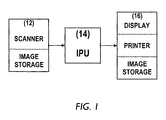
- FIGURE 1 diagrammatically illustrates an image processing apparatus adapted for implementing a method for detection of halftone image data in the wavelet domain in accordance with the present invention.
- the image processing apparatus comprises an image input terminal 12, an image processing unit 14, and an image output terminal 16 .
- the input terminal can be any source of digital image data including a scanner or a source of stored image data.
- the image processing unit (IPU) is provided by any suitable electronic computing apparatus including a microprocessor or the like for carrying out digital image processing as described herein. Image data from the input terminal 12 are supplied to the IPU 14 for processing.
- the IPU 14 After processing the data, the IPU 14 outputs the data to the image output terminal 16 that comprises a non-impact printer, video display, image storage device or the like.
- Suitable image processing apparatus including an input terminal 12 , an image processing unit 14 and an image output terminal 16 are provided by digital xerographic image processing apparatus such as XEROX DocuTech document reproduction system or a conventional computer including a scanner, and a printer operatively connected thereto.
- the decomposition of a digital image into different frequency sub-bands or sub-band images using a discrete wavelet transform is well known.
- the discrete wavelet transform and its inverse transform are well-known and fully described in Wavelets and Subband Coding, Vetterli and Kovacevic, Prentice Hall PTR (1995); Wavelets and Filter Banks, Strang and Nguyen, Wellesley-Cambridge Press (1996); and, Wavelet Basics, Chan, Kluwer Academic Publishers (1995), each of which is hereby expressly incorporated by reference herein.
- the wavelet decomposition of a digital image comprises four sub-bands LL,LH,HL,HH.
- the low-pass sub-band LL is defined by a low-pass, sub-sampled version of the original image;
- the horizontal sub-band LH is defined by the high-frequency horizontal information in the original image;
- the vertical sub-band HL is defined by the high-frequency vertical information in the original image;
- the diagonal sub-band is defined by the high-frequency diagonal information in the original image.
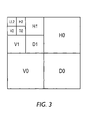
- the first level wavelet decomposition of the original image comprises a horizontal sub-band H0, a vertical sub-band V0 and a diagonal sub-band D0 as described above.
- the low-pass sub-band itself, has been subjected to a wavelet decomposition so that a second-level of sub-bands H1,V1,D1 are defined.
- the second-level low-pass sub-band has been subjected to a wavelet decomposition so that a third level of wavelet sub-bands is defined by a third-level low-pass sub-band LL2, a third-level horizontal sub-band H2, a third-level vertical sub-band V2 and a third-level diagonal sub-band D2.
- the wavelet decomposition can be repeated further if desired.
- Each sub-band of each wavelet decomposition level is defined by a Nr rows and Nc columns of coefficients Sij wherein 0 ⁇ i ⁇ Nr and 0 ⁇ j ⁇ Nc.
- a sub-band having a large number of zero coefficients is said to have less energy than a sub-band having a large number of non-zero coefficients.
- the energy E B of a sub-band B is calculated as the average of all coefficients in the sub-band according to:
- FIGURE 3 discloses a method S100 for halftone detection in the wavelet domain in accordance with the present invention.
- the method comprises a step S110 of receiving wavelet-domain data for a digital image.
- a step S120 calculates the energy of each sub-band for each level of decomposition represented in the wavelet-domain data.
- a step S130 determines if the energy of each sub-band decays according to a predefined pattern moving toward the lowest-level (highest-frequency) decomposition.
- the energy of the sub-bands should decrease as the decomposition level decreases if halftone data are not present in the wavelet-domain data, i.e., with reference to FIGURE 3, the energy of the sub-band D0 should be less than the energy of the sub-band D1, and the energy of the sub-band D1 should be less than the energy of the sub-band D2 if halftone data are not present.
- wavelet decomposition of an image including halftone data results in an energy pattern that does not decay in this fashion. Instead, when halftone data are present in the wavelet decomposition, at least some of the high frequency sub-bands will possess higher energy than corresponding lower-frequency sub-bands.
- step S140 is carried out to descreen the wavelet-domain data. Most preferably, the descreening operation is also carried out in the wavelet domain using an operation such as that disclosed in U.S. Patent No. 5,799,112 or a similar method. If the step S130 determines that the expected decaying energy pattern is present, halftone data are not present and, thus, no descreening operation is carried out.
- the expected (non-halftone) energy pattern for a wavelet decomposition is modeled based upon the amount of compression of the image data.
- ⁇ Xn is the expected energy value for that sub-band at level n of the wavelet decomposition, given the energy of the corresponding sub-band at level n+1.
- the number of levels in the decomposition is expressed as N .
- the conditioning parameter ⁇ is varied based upon the amount of compression in the wavelet domain expressed in terms of bits per pixel (bpp). Specifically, as the bit rate decreases (greater compression) the conditioning parameter ⁇ also decreases. As the bit rate increases (less compression) the conditioning parameter ⁇ also increases. Thus, it can be seen that as the bit rate increases when the image has been less compressed, the expected energy for a sub-band based upon the above modeling is greater. Conversely, when an image is compressed to a greater degree (lower bit rate), the conditioning parameter ⁇ is lower and the expected energy of each sub-band according to the model is lower. This is due to the fact that a greater amount of compression resulting from a lower bit rate, itself, eliminates halftone data.
- a violation value K can be determined and compared to a threshold T of maximum allowed model violations.
- K is a measure of how many times the energy of a sub-band exceeds the expected energy of that sub-band as calculated according to the model.
- K is a measure of violations of the model and this value is compared to the threshold T that determines if the image data includes halftone data or not. Specifically, if the number of violations K exceeds the threshold T , the image is said to contain halftone data.
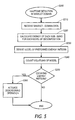
- FIGURE 5 discloses a method S200 for halftone detection in the wavelet domain in accordance with the foregoing alternative embodiment.
- the method S200 includes a step S210 that receives the wavelet-domain data defining an image.
- a step S220 calculates the energy of each sub-band for each level of decomposition in the wavelet-domain data.
- a step S230 derives the model of expected sub-band energies ⁇ for each sub-band based upon ⁇ .
- a step S240 determines the number of violations K of the model as described above.
- a step S250 determines if the number of violations K is greater than the threshold T . If not, no halftone data are present and the process is complete.
- step S250 halftone data are deemed to be present and a step S260 is carried out to activate a descreening process, preferably in the wavelet domain as in the aforementioned U.S. Patent No. 5,799,112.
- the magnitude of each violation of the model of expected energies can be used in the calculation of K to ensure that large violations have a more significant impact on the value of K relative to small violations.
- K is based upon both the number of violations and magnitude thereof.
- K is again compared to the threshold T to determine if the image data includes halftone data or not.
Landscapes
- Engineering & Computer Science (AREA)
- Multimedia (AREA)
- Signal Processing (AREA)
- Compression Of Band Width Or Redundancy In Fax (AREA)
- Compression Or Coding Systems Of Tv Signals (AREA)
- Facsimile Image Signal Circuits (AREA)
- Compression, Expansion, Code Conversion, And Decoders (AREA)
Abstract
Description
- The present invention relates to the digital image processing arts. More particularly, the present invention relates to a method for detecting halftones in the wavelet domain. The method is employed in a compression encoding procedure to trigger a descreening process (in the wavelet domain) whereby the halftone data are descreened prior to the compression process to increase compression. The method is also employed in a decompression decoding procedure to trigger the descreening process during image reconstruction to improve the quality of the reconstructed image.
- The representation of digital image data in the wavelet domain is well known. Wavelet-based data compression schemes are also known and are expected to become increasingly popular. For example, JPEG 2000 is a newly developed wavelet-based data compression scheme that is expected to be widely implemented in the digital image processing arts.
- It has been found that the presence of halftone image data in a digital image is disruptive to wavelet-based compression methods. Thus, halftone image data cannot be compressed as efficiently: Likewise, reconstruction of an image from compressed data that contains halftones results in a reconstructed image of sub-optimal quality.
- In accordance with the present invention, an image processing method comprises receiving wavelet-domain data defining a digital image. The wavelet-domain data are processed in the wavelet domain to determine if halftone data are present in the wavelet-domain data. A descreening process, preferably a wavelet-domain process, is activated if halftone data are present in the wavelet domain data.
- The method of detecting halftones in the wavelet domain includes determining an energy value for the sub-bands in a wavelet decomposition. The calculated energy values are compared to a model of energy values that are expected when halftone data are not present. If the actual energy values do not conform to the model, halftone data are deemed to be present. In one embodiment, the model defines a pattern of decaying sub-band energy for each sub-band moving from a highest level of the wavelet decomposition to the lowest level of the decomposition. In another embodiment, the expected energy values in the model vary depending upon the bit-rate of compression of the wavelet-domain data. If desired, violations of the model can be counted based upon the quantity and/or the magnitude thereof
In a further embodiment α increases when a bit-rate at which said wavelet-domain data are compressed increases, and wherein α decreases when a bit-rate at which said wavelet-domain data are compressed decreases.
In a further embodiment α = 0.4 + 0.6R, wherein R is the bit-rate of compression expressed in terms of bits per pixel.
In a further embodiment said threshold equals 5.
In a further embodiment each of said sub-bands defined in said wavelet domain data comprises a plurality of coefficients, and wherein said actual energy of a sub-band is calculated as an average of said plurality of coefficients.
In an embodiment of the method defined inclaim 10 said model of expected sub-band energy values defines a pattern of decaying energy for each sub-band of said wavelet decomposition moving from a highest level of said decomposition to a lowest level of said decomposition.
In a further embodiment said step of determining if said wavelet-domain data conform to said model comprises: - for each occurrence of a sub-band energy exceeding a corresponding expected sub-band energy, counting a violation of said model;
- comparing a total number of violations to a maximum violation threshold; and,
- identifying said wavelet-domain data as including halftone data when said total number of violations exceeds said maximum violation threshold. In a further embodiment said step of determining if said wavelet-domain data conform to said model comprises:
- for each occurrence of a sub-band energy exceeding a corresponding expected sub-band energy by a violation amount, increasing a total violation value based upon said violation amount;
- comparing said total violation value to a maximum violation value; and,
- identifying said wavelet-domain data as including halftone data when said total violation value exceeds said maximum violation value.
-
- One advantage of the present invention resides in the provision of a method for detection of halftone image data in the wavelet domain.
- Another advantage of the present invention is found in the provision of a method for detection of halftone image data in the wavelet domain wherein a wavelet-based halftone descreening method is triggered in response to detection of halftone data.
- Another advantage of the present invention resides in the provision of a method for detection of halftone image data in the wavelet domain wherein the method is employed upstream and/or downstream from a wavelet-based image compressor to trigger descreening prior to compression or during image reconstruction.
- A further advantage of the present invention results from the provision of a method for detecting halftones in the wavelet domain wherein halftone detection is based upon the absence of a preferred energy pattern in the wavelet sub-band data.
- A yet further advantage of the present invention resides in the provision of a method for detecting halftone data in the wavelet domain wherein an expected energy pattern for the wavelet sub-band data is modeled and the actual energy pattern is compared to the model to determine if halftone data are present.
- Still other benefits and advantages of the invention will become apparent to those of ordinary skill in the art to which the invention pertains upon reading and understanding this specification.
- The present invention comprises various steps and arrangements of steps, preferred embodiments of which are illustrated in the accompanying drawings that form a part hereof and wherein:
- FIGURE 1 is a diagrammatic illustration of a digital image processing apparatus adapted for implementing a method for detection of halftone data in the wavelet domain in accordance with the present invention;
- FIGURE 2 is a diagrammatic illustration of a single-level wavelet decomposition of a digital image;
- FIGURE 3 is a diagrammatic illustration of multiple-level (i.e., 3 level) wavelet decomposition of a digital image;
- FIGURE 4 is a flow chart that discloses a wavelet-domain halftone detection method in accordance with a first embodiment of the present invention; and,
- FIGURE 5 is a flow chart that discloses a wavelet-domain halftone detection method in accordance with a second embodiment of the present invention.
-
- Referring now to the drawings wherein the showings are for purposes of illustrating a preferred embodiment of the invention only and not for limiting the invention in any way, FIGURE 1 diagrammatically illustrates an image processing apparatus adapted for implementing a method for detection of halftone image data in the wavelet domain in accordance with the present invention. In this example, the image processing apparatus comprises an
image input terminal 12, animage processing unit 14, and animage output terminal 16. The input terminal can be any source of digital image data including a scanner or a source of stored image data. The image processing unit (IPU) is provided by any suitable electronic computing apparatus including a microprocessor or the like for carrying out digital image processing as described herein. Image data from theinput terminal 12 are supplied to the IPU 14 for processing. After processing the data, the IPU 14 outputs the data to theimage output terminal 16 that comprises a non-impact printer, video display, image storage device or the like. Suitable image processing apparatus including aninput terminal 12, animage processing unit 14 and animage output terminal 16 are provided by digital xerographic image processing apparatus such as XEROX DocuTech document reproduction system or a conventional computer including a scanner, and a printer operatively connected thereto. - The decomposition of a digital image into different frequency sub-bands or sub-band images using a discrete wavelet transform is well known. The discrete wavelet transform and its inverse transform are well-known and fully described in Wavelets and Subband Coding, Vetterli and Kovacevic, Prentice Hall PTR (1995); Wavelets and Filter Banks, Strang and Nguyen, Wellesley-Cambridge Press (1996); and, Wavelet Basics, Chan, Kluwer Academic Publishers (1995), each of which is hereby expressly incorporated by reference herein.
- Referring now to FIGURE 2, a one-level wavelet decomposition corresponding to an original digital image is illustrated. As is well known, the wavelet decomposition of a digital image comprises four sub-bands LL,LH,HL,HH. The low-pass sub-band LL is defined by a low-pass, sub-sampled version of the original image; the horizontal sub-band LH is defined by the high-frequency horizontal information in the original image; the vertical sub-band HL is defined by the high-frequency vertical information in the original image; and the diagonal sub-band is defined by the high-frequency diagonal information in the original image.
- Referring now to FIGURE 3, the first level wavelet decomposition of the original image comprises a horizontal sub-band H0, a vertical sub-band V0 and a diagonal sub-band D0 as described above. The low-pass sub-band, itself, has been subjected to a wavelet decomposition so that a second-level of sub-bands H1,V1,D1 are defined. Here, again, the second-level low-pass sub-band has been subjected to a wavelet decomposition so that a third level of wavelet sub-bands is defined by a third-level low-pass sub-band LL2, a third-level horizontal sub-band H2, a third-level vertical sub-band V2 and a third-level diagonal sub-band D2. The wavelet decomposition can be repeated further if desired.
- Each sub-band of each wavelet decomposition level is defined by a Nr rows and Nc columns of coefficients Sij wherein 0 ≤ i < Nr and 0 ≤ j < Nc. A sub-band having a large number of zero coefficients is said to have less energy than a sub-band having a large number of non-zero coefficients. In one example, the energy EB of a sub-band B is calculated as the average of all coefficients in the sub-band according to:

- It is known to compress image data after it has been decomposed in the wavelet domain. Image data compression schemes such as JPEG 2000 rely upon wavelet decomposition to achieve very high compression ratios. It is also known that higher compression ratios and better data decompression and image reconstruction are achieved when the image data does not include halftone data. Commonly assigned U.S. Patent No. 5,799,112 to de Queiroz et al. discloses a method for descreening image data in the wavelet domain to remove the effects of the halftoning operation and obtain continuous tone image data. When employed upstream from an image data compression operation the descreening operation improves the image compression ratio. When employed downstream from an image decompression operation, the descreening operation improves image reconstruction. U.S. Patent 5,799,112 is hereby expressly incorporated by reference herein.
- Heretofore, there has been no effective method for observing image data in the wavelet domain (i.e., without performing an inverse discrete wavelet transform) and determining if the data include halftone data so that descreening can be carried out. The present invention is directed to such a method.
- FIGURE 3 discloses a method S100 for halftone detection in the wavelet domain in accordance with the present invention. The method comprises a step S110 of receiving wavelet-domain data for a digital image. A step S120 calculates the energy of each sub-band for each level of decomposition represented in the wavelet-domain data. A step S130 determines if the energy of each sub-band decays according to a predefined pattern moving toward the lowest-level (highest-frequency) decomposition. Specifically, it has been determined that, for corresponding sub-bands in the various levels of a wavelet decomposition, the energy of the sub-bands should decrease as the decomposition level decreases if halftone data are not present in the wavelet-domain data, i.e., with reference to FIGURE 3, the energy of the sub-band D0 should be less than the energy of the sub-band D1, and the energy of the sub-band D1 should be less than the energy of the sub-band D2 if halftone data are not present. It has been found that wavelet decomposition of an image including halftone data results in an energy pattern that does not decay in this fashion. Instead, when halftone data are present in the wavelet decomposition, at least some of the high frequency sub-bands will possess higher energy than corresponding lower-frequency sub-bands.
- If the step S130 determines that the predefined decaying energy pattern is not present, a step S140 is carried out to descreen the wavelet-domain data. Most preferably, the descreening operation is also carried out in the wavelet domain using an operation such as that disclosed in U.S. Patent No. 5,799,112 or a similar method. If the step S130 determines that the expected decaying energy pattern is present, halftone data are not present and, thus, no descreening operation is carried out.
- In accordance with another embodiment of the present invention, the expected (non-halftone) energy pattern for a wavelet decomposition is modeled based upon the amount of compression of the image data. In this case, the expected energy Ê for a sub-band X in a level k-1 of the wavelet decomposition is based upon a conditioning parameter alpha α multiplied by the expected energy Ê for the same sub-band X in the next-highest level k of the wavelet decomposition as specified by the equation:
- In accordance with the present invention, the conditioning parameter α is varied based upon the amount of compression in the wavelet domain expressed in terms of bits per pixel (bpp). Specifically, as the bit rate decreases (greater compression) the conditioning parameter α also decreases. As the bit rate increases (less compression) the conditioning parameter α also increases. Thus, it can be seen that as the bit rate increases when the image has been less compressed, the expected energy for a sub-band based upon the above modeling is greater. Conversely, when an image is compressed to a greater degree (lower bit rate), the conditioning parameter α is lower and the expected energy of each sub-band according to the model is lower. This is due to the fact that a greater amount of compression resulting from a lower bit rate, itself, eliminates halftone data.
- Using the foregoing modeling technique, a violation value K can be determined and compared to a threshold T of maximum allowed model violations. The violation value K is defined as the number of occurrences of an actual energy value EX of a sub-band X being greater than the expected energy value ÊX of that sub-band. If the number of violations K is greater than the threshold T, it will be apparent that the actual energy pattern of the wavelet decomposition is not conforming to the model and halftone data are present in the wavelet-domain data. This can be expressed according to the following equation:where u(t) is a step function, i.e., u(t) = 0, t ≤ 0 ; otherwise u(t) = 1 . So, K is a measure of how many times the energy of a sub-band exceeds the expected energy of that sub-band as calculated according to the model. K is a measure of violations of the model and this value is compared to the threshold T that determines if the image data includes halftone data or not. Specifically, if the number of violations K exceeds the threshold T, the image is said to contain halftone data.

- Those of ordinary skill in the art will recognize that the values T and α can be varied without departing from the overall scope and intent of the present invention. In one embodiment, T = 5 and α = 0.4 + 0.6R, where R is the compression bit-rate expressed in terms of bits per pixel (bpp) has been found to be preferred.
- FIGURE 5 discloses a method S200 for halftone detection in the wavelet domain in accordance with the foregoing alternative embodiment. The method S200 includes a step S210 that receives the wavelet-domain data defining an image. A step S220 calculates the energy of each sub-band for each level of decomposition in the wavelet-domain data. A step S230 derives the model of expected sub-band energies Ê for each sub-band based upon α. A step S240 determines the number of violations K of the model as described above. A step S250 determines if the number of violations K is greater than the threshold T. If not, no halftone data are present and the process is complete. If K > T according to step S250, halftone data are deemed to be present and a step S260 is carried out to activate a descreening process, preferably in the wavelet domain as in the aforementioned U.S. Patent No. 5,799,112.
- As an alternative to the foregoing modeling technique, the magnitude of each violation of the model of expected energies can be used in the calculation of K to ensure that large violations have a more significant impact on the value of K relative to small violations. In this case, K can be calculated and compared to the threshold T according to:again, where u(t) is a step function, i.e., u(t) = 0 , t ≤ 0 ; otherwise u(t) = 1; WXn are weight values that control the influence that the violation magnitude has on K based upon the sub-band Xn. Here, K is based upon both the number of violations and magnitude thereof. K is again compared to the threshold T to determine if the image data includes halftone data or not. Specifically, if K exceeds the threshold T, the image is said to contain halftone data. Of course, those of ordinary skill in the art will recognize that the magnitude of the violations of the model can be summed and the total compared to a maximum violation value, without regard to the number of violation occurrences.

Claims (10)
- An image processing method comprising:receiving wavelet-domain data defining a digital image;processing said wavelet-domain data in the wavelet domain only to determining if halftone data are present in said wavelet-domain data;activating a descreening process if halftone data are present in said wavelet domain data.
- The image processing method as set forth in claim 1, wherein said step of processing said wavelet-domain data comprises:determining an energy of each sub-band of each level of decomposition represented in said wavelet-domain data;for corresponding sub-bands in each of the levels of decomposition, determining the presence of halftone data in the wavelet-domain data if the energy of the sub-bands does not decay moving from a highest level sub-band to a lowest level sub-band.
- The image processing method as set forth in claim 1, wherein said step of processing said wavelet-domain data comprises:deriving a model of expected energy for sub-bands represented in the wavelet-domain data;determining if said wavelet-domain data conform to said model;if said wavelet-domain data do not conform to said model, determining the presence of halftone data in said wavelet-domain data.
- The image processing method as set forth in claim 1, wherein said step of determining if said wavelet-domain data conform to said model comprises:tracking a number of violations representing occurrences of said wavelet-domain data violating said model;comparing said number of violations to a select threshold T;determining the presence of halftone data in said wavelet-domain data if said number of violations exceeds said threshold T.
- The image processing method as set forth in claim 4, wherein T = 5.
- The image processing method as set forth in claim 3, wherein said model of expected energy varies depending upon compression of said wavelet-domain data.
- The image processing method as set forth in claim 1, wherein said descreening process is a wavelet-domain descreening process.
- A wavelet-domain image processing method comprising:wherein X = H,D,V and k = 1 to N;receiving wavelet-domain data defining an N-level wavelet decomposition of a digital image, each of level n = 1 to N of said decomposition including a horizontal sub-band H, a vertical sub-band V and a diagonal sub-band D;deriving a model of expected energy values Ê for each sub-band H,V,D in each level n of said wavelet decomposition, said expected energies derived according to:determining an actual energy for each sub-band H,V,D of each level n of said wavelet decomposition defined by said wavelet-domain data;comparing each actual energy value to a corresponding expected energy of said model to determine if said actual energy value exceeds said expected energy value;tracking a number of occurrences that an actual energy value exceeds an expected energy value;comparing said number of occurrences to a select threshold; and,determining that halftone data are present in said wavelet-domain data if said number of occurrences exceeds said threshold.
- The wavelet-domain image processing method as set forth in claim 8, wherein α varies based upon a bit-rate at which said wavelet-domain data are compressed.
- In a xerographic or other non-impact printing environment, a wavelet-domain image processing method comprising:receiving wavelet-domain data defining a wavelet decomposition of a digital image;determining an energy value for sub-bands of said wavelet decomposition;for a plurality of said sub-bands of said wavelet decomposition, comparing said energy value of said sub-band to an expected energy value for that sub-band to determine if said wavelet-domain data conform to a model of expected sub-band energy values;if said wavelet-domain data do not conform to said model of expected sub-and energy values, identifying said wavelet-domain data as including halftone data.
Applications Claiming Priority (2)
| Application Number | Priority Date | Filing Date | Title |
|---|---|---|---|
| US09/738,477 US6738524B2 (en) | 2000-12-15 | 2000-12-15 | Halftone detection in the wavelet domain |
| US738477 | 2003-12-17 |
Publications (2)
| Publication Number | Publication Date |
|---|---|
| EP1215882A1 true EP1215882A1 (en) | 2002-06-19 |
| EP1215882B1 EP1215882B1 (en) | 2009-03-25 |
Family
ID=24968188
Family Applications (1)
| Application Number | Title | Priority Date | Filing Date |
|---|---|---|---|
| EP01129124A Expired - Lifetime EP1215882B1 (en) | 2000-12-15 | 2001-12-07 | Halftone detection in the wavelet domain |
Country Status (4)
| Country | Link |
|---|---|
| US (1) | US6738524B2 (en) |
| EP (1) | EP1215882B1 (en) |
| JP (1) | JP4051201B2 (en) |
| DE (1) | DE60138084D1 (en) |
Families Citing this family (8)
| Publication number | Priority date | Publication date | Assignee | Title |
|---|---|---|---|---|
| US7447639B2 (en) * | 2001-01-24 | 2008-11-04 | Nokia Corporation | System and method for error concealment in digital audio transmission |
| US7069208B2 (en) | 2001-01-24 | 2006-06-27 | Nokia, Corp. | System and method for concealment of data loss in digital audio transmission |
| US7120305B2 (en) * | 2002-04-16 | 2006-10-10 | Ricoh, Co., Ltd. | Adaptive nonlinear image enlargement using wavelet transform coefficients |
| US7139437B2 (en) * | 2002-11-12 | 2006-11-21 | Eastman Kodak Company | Method and system for removing artifacts in compressed images |
| US7580074B2 (en) * | 2005-05-10 | 2009-08-25 | Primax Electronics Ltd. | Digital halftoning technique based on 1-D multi-scale dot assignment |
| US7590298B2 (en) | 2006-04-12 | 2009-09-15 | Xerox Corporation | Decompression with reduced ringing artifacts |
| US8432451B2 (en) * | 2008-04-03 | 2013-04-30 | Delacom Detection Systems Llc | Method, device and system for determining the presence of volatile organic compounds (VOC) in video |
| US9760980B1 (en) * | 2015-03-25 | 2017-09-12 | Amazon Technologies, Inc. | Correcting moiré pattern effects |
Citations (4)
| Publication number | Priority date | Publication date | Assignee | Title |
|---|---|---|---|---|
| US4447830A (en) * | 1981-09-10 | 1984-05-08 | Xerox Corporation | Image scanning apparatus and method |
| US5535013A (en) * | 1991-04-19 | 1996-07-09 | Matsushita Electric Industrial Co., Ltd. | Image data compression and expansion apparatus, and image area discrimination processing apparatus therefor |
| US5799112A (en) * | 1996-08-30 | 1998-08-25 | Xerox Corporation | Method and apparatus for wavelet-based universal halftone image unscreening |
| US5828782A (en) * | 1995-08-01 | 1998-10-27 | Canon Kabushiki Kaisha | Image processing apparatus and method |
Family Cites Families (4)
| Publication number | Priority date | Publication date | Assignee | Title |
|---|---|---|---|---|
| US6195456B1 (en) * | 1996-12-19 | 2001-02-27 | Xerox Corporation | Multi resolution color correction using wavelet transforms |
| JP3400316B2 (en) * | 1997-10-03 | 2003-04-28 | 富士写真フイルム株式会社 | Method and apparatus for correcting dot image data, and method for correcting dot threshold data |
| JP3874918B2 (en) * | 1998-02-03 | 2007-01-31 | 株式会社リコー | Image processing device |
| US6172769B1 (en) * | 1998-08-06 | 2001-01-09 | International Business Machines Corporation | Printer dependent descreening method |
-
2000
- 2000-12-15 US US09/738,477 patent/US6738524B2/en not_active Expired - Fee Related
-
2001
- 2001-12-07 EP EP01129124A patent/EP1215882B1/en not_active Expired - Lifetime
- 2001-12-07 DE DE60138084T patent/DE60138084D1/en not_active Expired - Lifetime
- 2001-12-10 JP JP2001375238A patent/JP4051201B2/en not_active Expired - Fee Related
Patent Citations (4)
| Publication number | Priority date | Publication date | Assignee | Title |
|---|---|---|---|---|
| US4447830A (en) * | 1981-09-10 | 1984-05-08 | Xerox Corporation | Image scanning apparatus and method |
| US5535013A (en) * | 1991-04-19 | 1996-07-09 | Matsushita Electric Industrial Co., Ltd. | Image data compression and expansion apparatus, and image area discrimination processing apparatus therefor |
| US5828782A (en) * | 1995-08-01 | 1998-10-27 | Canon Kabushiki Kaisha | Image processing apparatus and method |
| US5799112A (en) * | 1996-08-30 | 1998-08-25 | Xerox Corporation | Method and apparatus for wavelet-based universal halftone image unscreening |
Non-Patent Citations (1)
| Title |
|---|
| JIA LI, GRAY R.M.: "Text and Picture Segmentation by the Distribution Analysis of Wavelet Coefficients", IMAGE PROCESSING, 1998. ICIP 98. PROCEEDINGS. 1998 INTERNATIONAL CONFERENCE ON CHICAGO, IL, USA 4-7 OCT. 1998, LOS ALAMITOS, CA, USA,IEEE COMPUT. SOC, US, 4 October 1998 (1998-10-04) - 7 October 1998 (1998-10-07), US, pages 790 - 794, XP010308932, ISBN: 978-0-8186-8821-8, DOI: 10.1109/ICIP.1998.999065 * |
Also Published As
| Publication number | Publication date |
|---|---|
| JP2002247380A (en) | 2002-08-30 |
| US20020106125A1 (en) | 2002-08-08 |
| EP1215882B1 (en) | 2009-03-25 |
| DE60138084D1 (en) | 2009-05-07 |
| US6738524B2 (en) | 2004-05-18 |
| JP4051201B2 (en) | 2008-02-20 |
Similar Documents
| Publication | Publication Date | Title |
|---|---|---|
| EP0622949B1 (en) | Inverse halftoning using linear filtering and statistical smoothing | |
| US7599095B2 (en) | Wavelet-based image processing path | |
| US7343025B2 (en) | Method for embedding and extracting digital watermark on lowest wavelet subband | |
| EP0574724A2 (en) | Adaptive coding level control for video compression systems | |
| Shapiro | A fast technique for identifying zerotrees in the EZW algorithm | |
| US7333661B2 (en) | Image coding device image coding method and image processing device | |
| Joshi et al. | Optimum classification in subband coding of images | |
| EP2654294A1 (en) | Wavelet coefficient quantization method applying human -eye visual model in image compression | |
| EP1215882B1 (en) | Halftone detection in the wavelet domain | |
| US5740277A (en) | Image encoding device in which zero-valued points and points subordinate thereto are not encoded | |
| EP1001608A2 (en) | Method of detecting image compression | |
| US6704455B1 (en) | Image processing system and image processing method | |
| US6853318B1 (en) | Digital image compression utilizing shrinkage of subband coefficients | |
| AU762996B2 (en) | An image compression system and method of determining quantisation parameters therefor | |
| Shapiro | Application of the embedded wavelet hierarchical image coder to very low bit rate image coding | |
| KR100635559B1 (en) | Classification Adaptive Multiprocessing System | |
| Varuikhin et al. | Continuous wavelet transform applications in steganography | |
| US20050141774A1 (en) | Image compression utilizing discarding of bitplanes | |
| Vander Kam et al. | JPEG-compliant perceptual coding for a grayscale image printing pipeline | |
| Luo et al. | An efficient method for the removal of impulse noise | |
| US6173079B1 (en) | Buffer data control circuit and method in image compression system using wavelet system using wavelet transform | |
| Daly | Application of a noise adaptive contrast sensitivity function to image data compression | |
| Chen et al. | Inverse halftoning for monochrome pictures | |
| Valade et al. | Homomorphic wavelet transform and new subband statistics models for SAR image compression | |
| Park et al. | Estimation of error diffusion kernel using genetic algorithm |
Legal Events
| Date | Code | Title | Description |
|---|---|---|---|
| PUAI | Public reference made under article 153(3) epc to a published international application that has entered the european phase |
Free format text: ORIGINAL CODE: 0009012 |
|
| AK | Designated contracting states |
Kind code of ref document: A1 Designated state(s): AT BE CH CY DE DK ES FI FR GB GR IE IT LI LU MC NL PT SE TR |
|
| AX | Request for extension of the european patent |
Free format text: AL;LT;LV;MK;RO;SI |
|
| 17P | Request for examination filed |
Effective date: 20021219 |
|
| AKX | Designation fees paid |
Designated state(s): DE FR GB |
|
| 17Q | First examination report despatched |
Effective date: 20071214 |
|
| GRAP | Despatch of communication of intention to grant a patent |
Free format text: ORIGINAL CODE: EPIDOSNIGR1 |
|
| GRAS | Grant fee paid |
Free format text: ORIGINAL CODE: EPIDOSNIGR3 |
|
| GRAA | (expected) grant |
Free format text: ORIGINAL CODE: 0009210 |
|
| AK | Designated contracting states |
Kind code of ref document: B1 Designated state(s): DE FR GB |
|
| REG | Reference to a national code |
Ref country code: GB Ref legal event code: FG4D |
|
| REF | Corresponds to: |
Ref document number: 60138084 Country of ref document: DE Date of ref document: 20090507 Kind code of ref document: P |
|
| PLBE | No opposition filed within time limit |
Free format text: ORIGINAL CODE: 0009261 |
|
| STAA | Information on the status of an ep patent application or granted ep patent |
Free format text: STATUS: NO OPPOSITION FILED WITHIN TIME LIMIT |
|
| 26N | No opposition filed |
Effective date: 20091229 |
|
| PGFP | Annual fee paid to national office [announced via postgrant information from national office to epo] |
Ref country code: GB Payment date: 20131125 Year of fee payment: 13 Ref country code: DE Payment date: 20131121 Year of fee payment: 13 |
|
| PGFP | Annual fee paid to national office [announced via postgrant information from national office to epo] |
Ref country code: FR Payment date: 20131219 Year of fee payment: 13 |
|
| REG | Reference to a national code |
Ref country code: DE Ref legal event code: R119 Ref document number: 60138084 Country of ref document: DE |
|
| GBPC | Gb: european patent ceased through non-payment of renewal fee |
Effective date: 20141207 |
|
| REG | Reference to a national code |
Ref country code: FR Ref legal event code: ST Effective date: 20150831 |
|
| PG25 | Lapsed in a contracting state [announced via postgrant information from national office to epo] |
Ref country code: GB Free format text: LAPSE BECAUSE OF NON-PAYMENT OF DUE FEES Effective date: 20141207 Ref country code: DE Free format text: LAPSE BECAUSE OF NON-PAYMENT OF DUE FEES Effective date: 20150701 |
|
| PG25 | Lapsed in a contracting state [announced via postgrant information from national office to epo] |
Ref country code: FR Free format text: LAPSE BECAUSE OF NON-PAYMENT OF DUE FEES Effective date: 20141231 |