EP1215740A2 - A structural feed through arrangement for the terminal of lithium ion cells - Google Patents
A structural feed through arrangement for the terminal of lithium ion cells Download PDFInfo
- Publication number
- EP1215740A2 EP1215740A2 EP01403149A EP01403149A EP1215740A2 EP 1215740 A2 EP1215740 A2 EP 1215740A2 EP 01403149 A EP01403149 A EP 01403149A EP 01403149 A EP01403149 A EP 01403149A EP 1215740 A2 EP1215740 A2 EP 1215740A2
- Authority
- EP
- European Patent Office
- Prior art keywords
- feed
- arrangement
- terminal
- seal
- battery
- Prior art date
- Legal status (The legal status is an assumption and is not a legal conclusion. Google has not performed a legal analysis and makes no representation as to the accuracy of the status listed.)
- Withdrawn
Links
Images

Classifications
-
- H—ELECTRICITY
- H01—ELECTRIC ELEMENTS
- H01M—PROCESSES OR MEANS, e.g. BATTERIES, FOR THE DIRECT CONVERSION OF CHEMICAL ENERGY INTO ELECTRICAL ENERGY
- H01M50/00—Constructional details or processes of manufacture of the non-active parts of electrochemical cells other than fuel cells, e.g. hybrid cells
- H01M50/10—Primary casings; Jackets or wrappings
- H01M50/183—Sealing members
- H01M50/186—Sealing members characterised by the disposition of the sealing members
-
- H—ELECTRICITY
- H01—ELECTRIC ELEMENTS
- H01M—PROCESSES OR MEANS, e.g. BATTERIES, FOR THE DIRECT CONVERSION OF CHEMICAL ENERGY INTO ELECTRICAL ENERGY
- H01M50/00—Constructional details or processes of manufacture of the non-active parts of electrochemical cells other than fuel cells, e.g. hybrid cells
- H01M50/10—Primary casings; Jackets or wrappings
- H01M50/172—Arrangements of electric connectors penetrating the casing
- H01M50/174—Arrangements of electric connectors penetrating the casing adapted for the shape of the cells
- H01M50/179—Arrangements of electric connectors penetrating the casing adapted for the shape of the cells for cells having curved cross-section, e.g. round or elliptic
-
- H—ELECTRICITY
- H01—ELECTRIC ELEMENTS
- H01M—PROCESSES OR MEANS, e.g. BATTERIES, FOR THE DIRECT CONVERSION OF CHEMICAL ENERGY INTO ELECTRICAL ENERGY
- H01M50/00—Constructional details or processes of manufacture of the non-active parts of electrochemical cells other than fuel cells, e.g. hybrid cells
- H01M50/10—Primary casings; Jackets or wrappings
- H01M50/183—Sealing members
- H01M50/19—Sealing members characterised by the material
- H01M50/191—Inorganic material
-
- H—ELECTRICITY
- H01—ELECTRIC ELEMENTS
- H01M—PROCESSES OR MEANS, e.g. BATTERIES, FOR THE DIRECT CONVERSION OF CHEMICAL ENERGY INTO ELECTRICAL ENERGY
- H01M50/00—Constructional details or processes of manufacture of the non-active parts of electrochemical cells other than fuel cells, e.g. hybrid cells
- H01M50/50—Current conducting connections for cells or batteries
- H01M50/543—Terminals
- H01M50/547—Terminals characterised by the disposition of the terminals on the cells
- H01M50/55—Terminals characterised by the disposition of the terminals on the cells on the same side of the cell
-
- H—ELECTRICITY
- H01—ELECTRIC ELEMENTS
- H01M—PROCESSES OR MEANS, e.g. BATTERIES, FOR THE DIRECT CONVERSION OF CHEMICAL ENERGY INTO ELECTRICAL ENERGY
- H01M50/00—Constructional details or processes of manufacture of the non-active parts of electrochemical cells other than fuel cells, e.g. hybrid cells
- H01M50/50—Current conducting connections for cells or batteries
- H01M50/543—Terminals
- H01M50/552—Terminals characterised by their shape
- H01M50/559—Terminals adapted for cells having curved cross-section, e.g. round, elliptic or button cells
-
- H—ELECTRICITY
- H01—ELECTRIC ELEMENTS
- H01M—PROCESSES OR MEANS, e.g. BATTERIES, FOR THE DIRECT CONVERSION OF CHEMICAL ENERGY INTO ELECTRICAL ENERGY
- H01M10/00—Secondary cells; Manufacture thereof
- H01M10/05—Accumulators with non-aqueous electrolyte
- H01M10/052—Li-accumulators
- H01M10/0525—Rocking-chair batteries, i.e. batteries with lithium insertion or intercalation in both electrodes; Lithium-ion batteries
-
- Y—GENERAL TAGGING OF NEW TECHNOLOGICAL DEVELOPMENTS; GENERAL TAGGING OF CROSS-SECTIONAL TECHNOLOGIES SPANNING OVER SEVERAL SECTIONS OF THE IPC; TECHNICAL SUBJECTS COVERED BY FORMER USPC CROSS-REFERENCE ART COLLECTIONS [XRACs] AND DIGESTS
- Y02—TECHNOLOGIES OR APPLICATIONS FOR MITIGATION OR ADAPTATION AGAINST CLIMATE CHANGE
- Y02E—REDUCTION OF GREENHOUSE GAS [GHG] EMISSIONS, RELATED TO ENERGY GENERATION, TRANSMISSION OR DISTRIBUTION
- Y02E60/00—Enabling technologies; Technologies with a potential or indirect contribution to GHG emissions mitigation
- Y02E60/10—Energy storage using batteries
Definitions
- the present invention relates to a structural design for lithium ion cells. More specifically, this invention is directed to a structural design for a cell feed-through arrangement that permits a high torque on the cell terminal post connection, wherein the feed-through has a very low impedance, volume and weight, presents excellent thermal shock properties and is hermetic to moisture.
- Lithium ion cells are used frequently in many of today's products. They are used in a wide variety of consumer and industrial products. As with any type of battery, the use life of the cells is extremely important. Through the years, technology has increased the use life of all types of batteries by making the batteries more durable. Batteries have become more durable because their designs have gotten better. Therefore, battery cells that have been designed to be more durable consequently increase the use life of the battery. Designing a more durable cell continues to be a goal of battery producers everywhere.
- a major problem that occurs that affects the durability of a battery is the breakdown of the seals that are necessary to keep electrolyte within the battery. Seals can breakdown or be damaged for many reasons, some of which include moisture, thermal-shock and shear torque between the seal and its adjacent component. If damage to the seal can be prevented, then the durability of the battery can be increased thereby increasing the life of the battery.
- the design of the battery is directly related to the damage that is cause to the seals.
- a feed-through sometimes referred to as a pass-through, is a "hole" in the cell housing that allows the external terminal of the battery to pass through the cell housing to be in contact with the electrolyte within the battery.
- These "holes”, or feed-throughs are slightly larger than the external terminal of the battery. This size difference creates a gap in the feed-through between the terminal and the cell housing. This gap is filled through the use of a seal. Therefore, in the conventional battery, the seal is in direct contact with the external terminal of the battery.
- the type of seal that is used in the feed-through affects the durability and consequently the life of the battery.
- Batteries are subjected to many various types of environments. If any of the environments to which the battery is exposed contains contaminants or moisture, the seal becomes extremely important.
- the seal acts as a protective barrier. It serves to prevent any of the contaminants or moisture from reaching the interior of the cell. In order to properly accomplish this, the seal itself must be impermeable to moisture and must maintain its integrity in the face of thermal-shock.
- the conventional mechanical seals are moisture permeable and do not readily maintain their integrity in the face of thermal-shock.
- the present invention is directed to a structural design for a cell feed-through that permits a high torque on the cell terminal post connection, wherein the feed-through has a very low impedance, volume and weight, presents an excellent thermal shock properties, and is hermetic to moisture.
- An object of the present invention is to provide a battery cell designed to minimize the torque on the feed-through seal that results from torque applied to the external terminal.
- the present invention achieves the first of the above objects by providing a plurality of pass-throughs, each having its own seal, which are connected to a terminal plate to which the terminal post is connected. That is, the terminal post does not pass directly through the cell housing and, therefore, does not transfer torque directly to the seals. Instead, the plurality of pass-throughs off-set the shear torque load from a single location-i.e., the terminal post as in the conventional design-to a distributed compression load on two or more locations. Because the seals are thus not torqued, but are compressed instead, they are not as easily damaged.
- each pass-through includes an anchor portion which is attached to the inside of the cell housing by, for example, welding or by heating the housing to expand the "holes" and dropping the pass-through into position.
- a post member passes through the anchor portion, and is connected to the terminal plate as well as to the electrodes within the cell.
- An insulating seal is then disposed between the anchor portion and the post member.
- the present invention achieves the remaining objects by providing a glass-metal pass-through. That is, the insulating seal is hermetically sealed to the metal post member and to the metal anchor portion. Therefore, the seal is not moisture permeable and, therefore, does not allow contaminants to enter the cell housing.
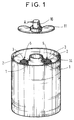
- Fig. 1 is an exploded view of the battery cell showing the terminal plate and its corresponding post members removed from the pass-throughs.
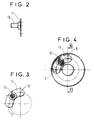
- Fig. 2 is a side view of the terminal plate showing its connection to the terminal post.
- Fig. 3 is a top view of the terminal plate showing its connection to the terminal post and the distributed compression loads locations.
- Fig. 4 is a top view of the cell showing the terminal plate and its connections to the terminal post and the pass-throughs.
- Fig. 5 is a top view of the pass-through showing the glass seal between the post member and the anchor portion.
- Fig. 6 is a sectional view of the pass-through along the VI-VI line of Fig. 5 showing the glass seal between the post member and the anchor portion.
- Fig. 7 is a sectional view of the cell along the VII-VII line of Fig. 4.
- Fig. 1 shows an exploded view of the battery cell of the preferred embodiment.
- the battery in Fig. 1 is similar to a conventional battery in that it contains an outer cell housing 14 and a terminal post 10.
- the electrodes of the battery are contained inside the cell housing 14.
- the cell housing 14 can be made of many different types of materials but preferably, it is made of stainless steel.
- the cell housing can also be made in different shapes and sizes depending on its intended use.
- a load is placed on terminal post 10.
- the terminal post 10 provides the electrical conduit for the voltage stored in the battery to be used by the applied load. It is essential that the terminal post 10 be electrically connected, either directly or indirectly, to the electrodes within the cell housing.
- the terminal post 10 can be connected indirectly to the electrodes using a terminal plate 11 as shown in Fig. 1.
- the terminal post 10 of the battery is connected to the top side of the terminal plate 11.
- the bottom side of the terminal plate 11 covers a plurality of pass-throughs 5 which are connected to the electrodes inside the cell housing 14.
- the pass-throughs 5 serve to connect the electrodes to the battery terminal post 10.
- the battery terminal assembly is better shown in Fig. 2, Fig. 3 and Fig. 4.
- Fig. 2 shows a side view of the terminal post 10 and the terminal plate 11 of the illustrated embodiment.
- the terminal post 10 is disposed on the terminal plate 11 by, for example but not limited to, welding.
- the terminal plate 11 is a thin but durable conductive plate.
- the thickness of the terminal plate 11 is not critical.
- the terminal plate 11 can be on any shape or size and should not be limited to the shape or size disclosed in any of the figures. Additionally, the position of the terminal post 10 on the terminal plate 11 is not critical and therefore should not be considered a limitation but, as shown, centering the terminal post 10 on the terminal plate 11 is preferred.
- Fig. 3 is a top view of the terminal plate 11 of the preferred embodiment. As described earlier, the terminal post 10 is disposed onto the terminal plate 11. Fig. 3 also shows positions of compression load locations 12, 13 where the pass-throughs 5 are located. In this embodiment, the locations are determined by constructing an imaginary circle having the center located at the center of the top of the cell housing 14. The radius of the imaginary circle is chosen so that the imaginary circle edge passes through the center of the terminal post 10. The centers of the compression load locations 12, 13 are then chosen along the edge of the imaginary circle such that the locations are equidistant from the terminal post 10 and form a right angle at the center of the cell housing 14.
- the above description relates to the preferred embodiment of the invention and that the pass-throughs 5 may be located at any other desired location.
- the exact positions of this embodiment should not be taken as limitations to this invention.
- the locations of the compression load locations 12, 13 can be located anywhere along on the terminal plate 11. As stated previously, there may be more than two compression load locations.
- Fig. 4 shows the terminal plate assembly of Fig. 3 as disposed on the cell housing 14.
- the centers of the terminal post 10 and the pass-throughs 5 are located along the edge of an imaginary circle whose center is located at the center of the top of the cell housing 14.
- the pass-throughs 5 are positioned underneath the terminal plate 11.
- the shape and position of the terminal plate 11 and the pass-throughs 5 may vary as long as the pass-throughs 5 are beneath the terminal plate 11.
- each pass-through 5 includes an anchor portion 1, an insulating seal 2 and a post member 3.
- the anchor portion 1 is secured to the interior of the cell housing 14 by, for example, welding.
- the anchor The post member 3, which is connected to the electrodes within the cell housing 14, is made of a conductive metal and passes through a hole provided in the center of the anchor portion 1 and protrudes from the anchor portion to allow for electrical connection at each end.
- the post member 3 is attached to the bottom side of the terminal plate 11 thereby providing a connection between the electrodes and the terminal plate 11 as noted above, the terminal plate is electrically connected to the electrodes.
- the post member is electrically connected to the positive or negative electrode.
- An electrical insulating filler 15 is disposed between the terminal plate 11 and the anchor portion 1. This electrical insulating filler 15 prevents an electrical arching from occurring since the anchor portion is preferably made of metal.
- the electrical insulating filler 15 can be left out of the present invention so long as the terminal plate 11 is lifted off of the anchor portion 1 by the post member 3 so as to prevent electrical arching between the terminal plate 11 and the anchor portion 1.
- the post member 3 is welded to the terminal plate 11 although the invention is not limited.
- An insulating seal 2 is disposed between the post member 3 and the anchor portion 1.
- the insulating seal 2 serves many purposes. The first purpose is to provide a water-proof seal.
- the second purpose is to absorb a portion of any shear torque that is applied to the terminal post 10.
- a final purpose is to aid in keeping the post member 3 in its proper position.
- the pass-through 5 and its components are further shown in Fig. 5 and Fig. 6.
- the anchor portion 1 and the post member 3 are made of metal (preferably molybdenum) while the insulating seal is made of glass. This combination results in a glass-to-metal seal having excellent thermal-shock properties while having a very low impedance, volume and weight.
- the materials used to form the pass-through may vary as long as the seal is hermetic to moisture and other contaminants and possesses the same qualities as the insulating seal 2 described above.
- the thickness of the insulating seal 2 does not have to be uniform although it is preferred in the present embodiment.
- the anchor portion 1, the post member 3 and the opening in the anchor portion 1 may vary in shape and size as long as their electro-mechanical and positional properties described above remain.
- the terminal post 10 is indirectly connected to the electrodes within the cell housing 14 through the terminal plate 11 and the post members 3 of the pass-throughs 5.
- any force A (see Fig. 1) applied to terminal post 10 is transferred to the terminal plate 11 and distributed to the post members 3 of the pass-throughs 5 as a compression force to the insulating seals 2.
- the compression force that is distributed to the insulating seals 2 via the post members 3 of the pass-throughs 5 is smaller than the shear force applied to the terminal post 10.
- the resulting compression force is a fraction of the applied force A and is approximately determined by the dividing the applied force A by the number of pass-throughs 5.
- An additional advantage to the present embodiment is that the resulting force on the insulating seals 2 is a compression force and not a shear torque.
- the seals are not as easily damaged by compression forces as they are from shear torque. Once again, the less damage occurring to the seals, the longer the life of the battery.
Landscapes
- Chemical & Material Sciences (AREA)
- Chemical Kinetics & Catalysis (AREA)
- Electrochemistry (AREA)
- General Chemical & Material Sciences (AREA)
- Inorganic Chemistry (AREA)
- Sealing Battery Cases Or Jackets (AREA)
- Connection Of Batteries Or Terminals (AREA)
Abstract
Description
- The present invention relates to a structural design for lithium ion cells. More specifically, this invention is directed to a structural design for a cell feed-through arrangement that permits a high torque on the cell terminal post connection, wherein the feed-through has a very low impedance, volume and weight, presents excellent thermal shock properties and is hermetic to moisture.
- Lithium ion cells are used frequently in many of today's products. They are used in a wide variety of consumer and industrial products. As with any type of battery, the use life of the cells is extremely important. Through the years, technology has increased the use life of all types of batteries by making the batteries more durable. Batteries have become more durable because their designs have gotten better. Therefore, battery cells that have been designed to be more durable consequently increase the use life of the battery. Designing a more durable cell continues to be a goal of battery producers everywhere.
- A major problem that occurs that affects the durability of a battery is the breakdown of the seals that are necessary to keep electrolyte within the battery. Seals can breakdown or be damaged for many reasons, some of which include moisture, thermal-shock and shear torque between the seal and its adjacent component. If damage to the seal can be prevented, then the durability of the battery can be increased thereby increasing the life of the battery. The design of the battery is directly related to the damage that is cause to the seals.
- Problems occur when the design of the battery is such that the feed-through is directly connected to the external terminal of the battery. A feed-through, sometimes referred to as a pass-through, is a "hole" in the cell housing that allows the external terminal of the battery to pass through the cell housing to be in contact with the electrolyte within the battery. These "holes", or feed-throughs, are slightly larger than the external terminal of the battery. This size difference creates a gap in the feed-through between the terminal and the cell housing. This gap is filled through the use of a seal. Therefore, in the conventional battery, the seal is in direct contact with the external terminal of the battery.
- When the seal is in direct contact with the external terminal of the battery, any torque applied to the external terminal is applied directly to the feed-through and to the feed-through's seal. This torque applied to the seal causes damage to the seal thereby reducing the life of the battery.
- Along with the physical design of the battery, the type of seal that is used in the feed-through affects the durability and consequently the life of the battery. Batteries are subjected to many various types of environments. If any of the environments to which the battery is exposed contains contaminants or moisture, the seal becomes extremely important. The seal acts as a protective barrier. It serves to prevent any of the contaminants or moisture from reaching the interior of the cell. In order to properly accomplish this, the seal itself must be impermeable to moisture and must maintain its integrity in the face of thermal-shock. The conventional mechanical seals are moisture permeable and do not readily maintain their integrity in the face of thermal-shock.
- The present invention is directed to a structural design for a cell feed-through that permits a high torque on the cell terminal post connection, wherein the feed-through has a very low impedance, volume and weight, presents an excellent thermal shock properties, and is hermetic to moisture.
- An object of the present invention is to provide a battery cell designed to minimize the torque on the feed-through seal that results from torque applied to the external terminal.
- It is another object of the present invention to provide a battery cell designed to extend the life and durability of the battery.
- It is still another object of the present invention to provide feed-throughs with very low impedance, volume and weight.
- It is yet another object of the present invention to provide feed-throughs with excellent thermal shock properties.
- It is still another object of the present invention to provide feed-throughs that are hermetic to moisture and other impurities.
- The present invention achieves the first of the above objects by providing a plurality of pass-throughs, each having its own seal, which are connected to a terminal plate to which the terminal post is connected. That is, the terminal post does not pass directly through the cell housing and, therefore, does not transfer torque directly to the seals. Instead, the plurality of pass-throughs off-set the shear torque load from a single location-i.e., the terminal post as in the conventional design-to a distributed compression load on two or more locations. Because the seals are thus not torqued, but are compressed instead, they are not as easily damaged.
- That is, each pass-through includes an anchor portion which is attached to the inside of the cell housing by, for example, welding or by heating the housing to expand the "holes" and dropping the pass-through into position. A post member passes through the anchor portion, and is connected to the terminal plate as well as to the electrodes within the cell. An insulating seal is then disposed between the anchor portion and the post member. Thus, when the terminal post is torqued, a compression force is placed on the insulating seals. This arrangement provides an insulating seal which maintains its integrity in the face of torque on the terminal post.
- The present invention achieves the remaining objects by providing a glass-metal pass-through. That is, the insulating seal is hermetically sealed to the metal post member and to the metal anchor portion. Therefore, the seal is not moisture permeable and, therefore, does not allow contaminants to enter the cell housing.
- Fig. 1 is an exploded view of the battery cell showing the terminal plate and its corresponding post members removed from the pass-throughs.
- Fig. 2 is a side view of the terminal plate showing its connection to the terminal post.
- Fig. 3 is a top view of the terminal plate showing its connection to the terminal post and the distributed compression loads locations.
- Fig. 4 is a top view of the cell showing the terminal plate and its connections to the terminal post and the pass-throughs.
- Fig. 5 is a top view of the pass-through showing the glass seal between the post member and the anchor portion.
- Fig. 6 is a sectional view of the pass-through along the VI-VI line of Fig. 5 showing the glass seal between the post member and the anchor portion.
- Fig. 7 is a sectional view of the cell along the VII-VII line of Fig. 4.
- The following is a detailed description of the invention with references to Figs. 1 to 7. Fig. 1 shows an exploded view of the battery cell of the preferred embodiment. The battery in Fig. 1 is similar to a conventional battery in that it contains an
outer cell housing 14 and aterminal post 10. The electrodes of the battery are contained inside thecell housing 14. Thecell housing 14 can be made of many different types of materials but preferably, it is made of stainless steel. The cell housing can also be made in different shapes and sizes depending on its intended use. When the battery is being used, a load is placed onterminal post 10. Theterminal post 10 provides the electrical conduit for the voltage stored in the battery to be used by the applied load. It is essential that theterminal post 10 be electrically connected, either directly or indirectly, to the electrodes within the cell housing. Theterminal post 10 can be connected indirectly to the electrodes using aterminal plate 11 as shown in Fig. 1. - The
terminal post 10 of the battery is connected to the top side of theterminal plate 11. The bottom side of theterminal plate 11 covers a plurality of pass-throughs 5 which are connected to the electrodes inside thecell housing 14. The pass-throughs 5 serve to connect the electrodes to thebattery terminal post 10. In the illustrated embodiment, there are two pass-throughs 5, although the invention is not limited in this respect. In fact, in some respect it is advantageous to have more pass-throughs 5 to off-set the shear torque applied to theterminal post 10 is off-set. The battery terminal assembly is better shown in Fig. 2, Fig. 3 and Fig. 4. - Fig. 2 shows a side view of the
terminal post 10 and theterminal plate 11 of the illustrated embodiment. Theterminal post 10 is disposed on theterminal plate 11 by, for example but not limited to, welding. Theterminal plate 11 is a thin but durable conductive plate. The thickness of theterminal plate 11 is not critical. Theterminal plate 11 can be on any shape or size and should not be limited to the shape or size disclosed in any of the figures. Additionally, the position of theterminal post 10 on theterminal plate 11 is not critical and therefore should not be considered a limitation but, as shown, centering theterminal post 10 on theterminal plate 11 is preferred. - Fig. 3 is a top view of the
terminal plate 11 of the preferred embodiment. As described earlier, theterminal post 10 is disposed onto theterminal plate 11. Fig. 3 also shows positions ofcompression load locations throughs 5 are located. In this embodiment, the locations are determined by constructing an imaginary circle having the center located at the center of the top of thecell housing 14. The radius of the imaginary circle is chosen so that the imaginary circle edge passes through the center of theterminal post 10. The centers of thecompression load locations terminal post 10 and form a right angle at the center of thecell housing 14. It should be understood that the above description relates to the preferred embodiment of the invention and that the pass-throughs 5 may be located at any other desired location. The exact positions of this embodiment should not be taken as limitations to this invention. The locations of thecompression load locations terminal plate 11. As stated previously, there may be more than two compression load locations. - Fig. 4 shows the terminal plate assembly of Fig. 3 as disposed on the
cell housing 14. As stated previously, in this embodiment the centers of theterminal post 10 and the pass-throughs 5 are located along the edge of an imaginary circle whose center is located at the center of the top of thecell housing 14. The pass-throughs 5 are positioned underneath theterminal plate 11. The shape and position of theterminal plate 11 and the pass-throughs 5 may vary as long as the pass-throughs 5 are beneath theterminal plate 11. - Referring to Figs. 1-7, the functions of the pass-
throughs 5 and their components are further described. Specifically, each pass-through 5 includes ananchor portion 1, an insulatingseal 2 and apost member 3. Theanchor portion 1 is secured to the interior of thecell housing 14 by, for example, welding. The anchor Thepost member 3, which is connected to the electrodes within thecell housing 14, is made of a conductive metal and passes through a hole provided in the center of theanchor portion 1 and protrudes from the anchor portion to allow for electrical connection at each end. Thepost member 3 is attached to the bottom side of theterminal plate 11 thereby providing a connection between the electrodes and theterminal plate 11 as noted above, the terminal plate is electrically connected to the electrodes. Hence, the post member is electrically connected to the positive or negative electrode. An electrical insulatingfiller 15 is disposed between theterminal plate 11 and theanchor portion 1. This electrical insulatingfiller 15 prevents an electrical arching from occurring since the anchor portion is preferably made of metal. The electrical insulatingfiller 15 can be left out of the present invention so long as theterminal plate 11 is lifted off of theanchor portion 1 by thepost member 3 so as to prevent electrical arching between theterminal plate 11 and theanchor portion 1. - According to the preferred embodiment, the
post member 3 is welded to theterminal plate 11 although the invention is not limited. An insulatingseal 2 is disposed between thepost member 3 and theanchor portion 1. The insulatingseal 2 serves many purposes. The first purpose is to provide a water-proof seal. The second purpose is to absorb a portion of any shear torque that is applied to theterminal post 10. A final purpose is to aid in keeping thepost member 3 in its proper position. The pass-through 5 and its components are further shown in Fig. 5 and Fig. 6. - In the preferred embodiment shown, the
anchor portion 1 and thepost member 3 are made of metal (preferably molybdenum) while the insulating seal is made of glass. This combination results in a glass-to-metal seal having excellent thermal-shock properties while having a very low impedance, volume and weight. - The materials used to form the pass-through may vary as long as the seal is hermetic to moisture and other contaminants and possesses the same qualities as the insulating
seal 2 described above. The thickness of the insulatingseal 2 does not have to be uniform although it is preferred in the present embodiment. Theanchor portion 1, thepost member 3 and the opening in theanchor portion 1 may vary in shape and size as long as their electro-mechanical and positional properties described above remain. - As noted above, the advantage of the present invention is as follows. Moreover, in the embodiment of Fig. 1, the
terminal post 10 is indirectly connected to the electrodes within thecell housing 14 through theterminal plate 11 and thepost members 3 of the pass-throughs 5. Thus, any force A (see Fig. 1) applied toterminal post 10 is transferred to theterminal plate 11 and distributed to thepost members 3 of the pass-throughs 5 as a compression force to the insulating seals 2. The compression force that is distributed to the insulatingseals 2 via thepost members 3 of the pass-throughs 5 is smaller than the shear force applied to theterminal post 10. Specifically, the resulting compression force is a fraction of the applied force A and is approximately determined by the dividing the applied force A by the number of pass-throughs 5. As can be seen, the more pass-throughs 5 disposed in the surface of thecell housing 14, the smaller the resulting compression force actually applied to the insulating seals 2. Therefore, the seals last longer so that the battery life is extended. - An additional advantage to the present embodiment is that the resulting force on the insulating
seals 2 is a compression force and not a shear torque. The seals are not as easily damaged by compression forces as they are from shear torque. Once again, the less damage occurring to the seals, the longer the life of the battery.
Claims (13)
- A feed-through arrangement for an electrochemical cell having a cell housing and an electrode within the cell housing, the feed-through arrangement comprising:a terminal plate having a top and a bottom side disposed adjacent to the cell housing;a terminal post, attached to said plate, for attaching a load to the electrochemical cell; anda plurality of pass-through members each of said pass-through members including an anchor portion for connection to the cell housing and having an opening therein, a post member passing through the opening and being connected to the electrode at one end of the plate at the opposite end, and an insulating seal disposed between the post member ad the anchor pattern.
- The feed-through arrangement of claim 1, wherein a filler is disposed between said terminal plate and said cell housing.
- The feed-through arrangement of claim 1, wherein said insulating seal is made of glass.
- The feed-through arrangement of claim 3, wherein said post member and said anchor portion are made of metal so as to form a glass-to-metal seal.
- The feed-through arrangement of claim 1, wherein said insulating seal is hermetic to moisture.
- The feed-through arrangement of claim 2, wherein said filler is adjacent to the bottom of said terminal plate and adjacent to said cell housing.
- The feed-through arrangement of claim 6, wherein said insulating seal is made of glass.
- The feed-through arrangement of claim 7, wherein said post member and said anchor portion are made of metal so as to form a glass-to-metal seal.
- The feed-through arrangement of claim 6, wherein said insulating seal is hermetic to moisture.
- The feed-through arrangement of claim 1, wherein said plurality of pass-through members separate said terminal plate from laying adjacent to said cell housing.
- The feed-through arrangement of claim 10, wherein said insulating seal is made of glass.
- The feed-through arrangement of claim 11, wherein said post member and said anchor portion are made of metal so as to form a glass-metal seal.
- The feed-through arrangement of claim 10, wherein said insulating seal is hermetic to moisture.
Applications Claiming Priority (2)
| Application Number | Priority Date | Filing Date | Title |
|---|---|---|---|
| US737956 | 1991-07-30 | ||
| US09/737,956 US6589691B2 (en) | 2000-12-18 | 2000-12-18 | Structural feed through arrangement for lithium ion cells |
Publications (2)
| Publication Number | Publication Date |
|---|---|
| EP1215740A2 true EP1215740A2 (en) | 2002-06-19 |
| EP1215740A3 EP1215740A3 (en) | 2003-11-05 |
Family
ID=24965967
Family Applications (1)
| Application Number | Title | Priority Date | Filing Date |
|---|---|---|---|
| EP01403149A Withdrawn EP1215740A3 (en) | 2000-12-18 | 2001-12-06 | A structural feed through arrangement for the terminal of lithium ion cells |
Country Status (2)
| Country | Link |
|---|---|
| US (1) | US6589691B2 (en) |
| EP (1) | EP1215740A3 (en) |
Families Citing this family (1)
| Publication number | Priority date | Publication date | Assignee | Title |
|---|---|---|---|---|
| TW563913U (en) * | 2003-03-11 | 2003-11-21 | Da-Luen Huang | Battery box with electrode protruding edge |
Citations (1)
| Publication number | Priority date | Publication date | Assignee | Title |
|---|---|---|---|---|
| US4315974A (en) * | 1978-05-01 | 1982-02-16 | Medtronic, Inc. | Electrochemical cell with protected electrical feedthrough |
Family Cites Families (10)
| Publication number | Priority date | Publication date | Assignee | Title |
|---|---|---|---|---|
| US4012562A (en) | 1974-10-07 | 1977-03-15 | Electric Power Research Institute, Inc. | Modular electrical energy storage device |
| US4064725A (en) | 1976-10-18 | 1977-12-27 | The Gates Rubber Company | Apparatus for making spirally wound electrochemical cells |
| US4061841A (en) * | 1977-04-15 | 1977-12-06 | General Motors Corporation | Feedthrough assembly for lithium-iron sulfide cell |
| US4158300A (en) | 1977-12-16 | 1979-06-19 | The Gates Rubber Company | Apparatus for producing a spirally wound electrochemical cell |
| US4283843A (en) | 1979-03-29 | 1981-08-18 | General Electric Company | Method of making vibration resistant electrochemical cell having deformed casing |
| US4362792A (en) * | 1980-12-01 | 1982-12-07 | Emerson Electric Co. | Conductor seal assembly |
| US5326655A (en) * | 1993-05-07 | 1994-07-05 | General Motors Corporation | Battery terminal |
| JP3418283B2 (en) | 1995-10-20 | 2003-06-16 | 松下電器産業株式会社 | Sealed secondary battery |
| US6218040B1 (en) * | 1999-06-11 | 2001-04-17 | Alcatel | Automatic circuit breaker for a battery |
| FR2796205B1 (en) * | 1999-07-08 | 2001-10-05 | Cit Alcatel | WATERPROOF ELECTROCHEMICAL ACCUMULATOR COMPRISING AN ALUMINUM RECOVERY DEVICE |
-
2000
- 2000-12-18 US US09/737,956 patent/US6589691B2/en not_active Expired - Fee Related
-
2001
- 2001-12-06 EP EP01403149A patent/EP1215740A3/en not_active Withdrawn
Patent Citations (1)
| Publication number | Priority date | Publication date | Assignee | Title |
|---|---|---|---|---|
| US4315974A (en) * | 1978-05-01 | 1982-02-16 | Medtronic, Inc. | Electrochemical cell with protected electrical feedthrough |
Also Published As
| Publication number | Publication date |
|---|---|
| US20020076609A1 (en) | 2002-06-20 |
| US6589691B2 (en) | 2003-07-08 |
| EP1215740A3 (en) | 2003-11-05 |
Similar Documents
| Publication | Publication Date | Title |
|---|---|---|
| KR102578862B1 (en) | Rechargeable battery | |
| JP5279226B2 (en) | Assembled battery | |
| US6387566B1 (en) | Battery with laminated insulator/metal/insulator case | |
| EP0269038B1 (en) | High-temperature accumulator battery | |
| US5104752A (en) | Dual, series/parallel battery cell connects | |
| EP1300893B1 (en) | Closed type battery | |
| AU2003276794A1 (en) | A bipolar battery and a method for manufacturing a bipolar battery | |
| ATE510309T1 (en) | BIPOLAR BATTERY AND BIPOLAR ASSEMBLY | |
| US4287273A (en) | Plural cell battery structure | |
| EP0854525A3 (en) | Sealed lead-acid cells and batteries | |
| US5411818A (en) | Perimeter seal on bipolar walls for use in high temperature molten electrolyte batteries | |
| US20060093907A1 (en) | Lithium ion secondary battery | |
| US6207320B1 (en) | Cap assembly of secondary battery | |
| US4609598A (en) | Electrochemical cell | |
| US4792503A (en) | Multi-functional hermetic seal for non-aqueous electrochemical cells | |
| US4419418A (en) | Individual rechargeable electric cell | |
| EP1050912B1 (en) | Electrochemical cell with header assembly | |
| EP1071146B1 (en) | Header insulator | |
| US6589691B2 (en) | Structural feed through arrangement for lithium ion cells | |
| GB2270794A (en) | Arrangement of cell terminals permitting side-by-side connection of identical cells in a battery | |
| US7754372B2 (en) | Lithium secondary battery | |
| EP1249879A3 (en) | Low profile battery termination | |
| US20250104890A1 (en) | Electrical feedthrough and energy store with such a feedthrough | |
| CA2384785A1 (en) | Via filled interconnect for solid oxide fuel cells | |
| US5432028A (en) | Electrolyte containment barrier for bipolar cells in high temperature molten salt batteries |
Legal Events
| Date | Code | Title | Description |
|---|---|---|---|
| PUAI | Public reference made under article 153(3) epc to a published international application that has entered the european phase |
Free format text: ORIGINAL CODE: 0009012 |
|
| AK | Designated contracting states |
Kind code of ref document: A2 Designated state(s): AT BE CH CY DE DK ES FI FR GB GR IE IT LI LU MC NL PT SE TR |
|
| AX | Request for extension of the european patent |
Free format text: AL;LT;LV;MK;RO;SI |
|
| PUAL | Search report despatched |
Free format text: ORIGINAL CODE: 0009013 |
|
| AK | Designated contracting states |
Kind code of ref document: A3 Designated state(s): AT BE CH CY DE DK ES FI FR GB GR IE IT LI LU MC NL PT SE TR |
|
| AX | Request for extension of the european patent |
Extension state: AL LT LV MK RO SI |
|
| 17P | Request for examination filed |
Effective date: 20040506 |
|
| AKX | Designation fees paid |
Designated state(s): DE FR GB |
|
| RAP1 | Party data changed (applicant data changed or rights of an application transferred) |
Owner name: SAFT FINANCE S.AE.R.L. |
|
| 17Q | First examination report despatched |
Effective date: 20070921 |
|
| STAA | Information on the status of an ep patent application or granted ep patent |
Free format text: STATUS: THE APPLICATION IS DEEMED TO BE WITHDRAWN |
|
| 18D | Application deemed to be withdrawn |
Effective date: 20100622 |