EP1215531A2 - Method for manufacturing photothermographic materials - Google Patents
Method for manufacturing photothermographic materials Download PDFInfo
- Publication number
- EP1215531A2 EP1215531A2 EP01129758A EP01129758A EP1215531A2 EP 1215531 A2 EP1215531 A2 EP 1215531A2 EP 01129758 A EP01129758 A EP 01129758A EP 01129758 A EP01129758 A EP 01129758A EP 1215531 A2 EP1215531 A2 EP 1215531A2
- Authority
- EP
- European Patent Office
- Prior art keywords
- coating
- liquid
- bead
- mpa
- silver
- Prior art date
- Legal status (The legal status is an assumption and is not a legal conclusion. Google has not performed a legal analysis and makes no representation as to the accuracy of the status listed.)
- Granted
Links
Images
Classifications
-
- B—PERFORMING OPERATIONS; TRANSPORTING
- B05—SPRAYING OR ATOMISING IN GENERAL; APPLYING FLUENT MATERIALS TO SURFACES, IN GENERAL
- B05C—APPARATUS FOR APPLYING FLUENT MATERIALS TO SURFACES, IN GENERAL
- B05C5/00—Apparatus in which liquid or other fluent material is projected, poured or allowed to flow on to the surface of the work
- B05C5/007—Slide-hopper coaters, i.e. apparatus in which the liquid or other fluent material flows freely on an inclined surface before contacting the work
-
- G—PHYSICS
- G03—PHOTOGRAPHY; CINEMATOGRAPHY; ANALOGOUS TECHNIQUES USING WAVES OTHER THAN OPTICAL WAVES; ELECTROGRAPHY; HOLOGRAPHY
- G03C—PHOTOSENSITIVE MATERIALS FOR PHOTOGRAPHIC PURPOSES; PHOTOGRAPHIC PROCESSES, e.g. CINE, X-RAY, COLOUR, STEREO-PHOTOGRAPHIC PROCESSES; AUXILIARY PROCESSES IN PHOTOGRAPHY
- G03C1/00—Photosensitive materials
- G03C1/494—Silver salt compositions other than silver halide emulsions; Photothermographic systems ; Thermographic systems using noble metal compounds
- G03C1/498—Photothermographic systems, e.g. dry silver
- G03C1/49881—Photothermographic systems, e.g. dry silver characterised by the process or the apparatus
-
- G—PHYSICS
- G03—PHOTOGRAPHY; CINEMATOGRAPHY; ANALOGOUS TECHNIQUES USING WAVES OTHER THAN OPTICAL WAVES; ELECTROGRAPHY; HOLOGRAPHY
- G03C—PHOTOSENSITIVE MATERIALS FOR PHOTOGRAPHIC PURPOSES; PHOTOGRAPHIC PROCESSES, e.g. CINE, X-RAY, COLOUR, STEREO-PHOTOGRAPHIC PROCESSES; AUXILIARY PROCESSES IN PHOTOGRAPHY
- G03C1/00—Photosensitive materials
- G03C1/74—Applying photosensitive compositions to the base; Drying processes therefor
-
- B—PERFORMING OPERATIONS; TRANSPORTING
- B05—SPRAYING OR ATOMISING IN GENERAL; APPLYING FLUENT MATERIALS TO SURFACES, IN GENERAL
- B05C—APPARATUS FOR APPLYING FLUENT MATERIALS TO SURFACES, IN GENERAL
- B05C9/00—Apparatus or plant for applying liquid or other fluent material to surfaces by means not covered by any preceding group, or in which the means of applying the liquid or other fluent material is not important
- B05C9/06—Apparatus or plant for applying liquid or other fluent material to surfaces by means not covered by any preceding group, or in which the means of applying the liquid or other fluent material is not important for applying two different liquids or other fluent materials, or the same liquid or other fluent material twice, to the same side of the work
-
- Y—GENERAL TAGGING OF NEW TECHNOLOGICAL DEVELOPMENTS; GENERAL TAGGING OF CROSS-SECTIONAL TECHNOLOGIES SPANNING OVER SEVERAL SECTIONS OF THE IPC; TECHNICAL SUBJECTS COVERED BY FORMER USPC CROSS-REFERENCE ART COLLECTIONS [XRACs] AND DIGESTS
- Y10—TECHNICAL SUBJECTS COVERED BY FORMER USPC
- Y10S—TECHNICAL SUBJECTS COVERED BY FORMER USPC CROSS-REFERENCE ART COLLECTIONS [XRACs] AND DIGESTS
- Y10S430/00—Radiation imagery chemistry: process, composition, or product thereof
- Y10S430/136—Coating process making radiation sensitive element
-
- Y—GENERAL TAGGING OF NEW TECHNOLOGICAL DEVELOPMENTS; GENERAL TAGGING OF CROSS-SECTIONAL TECHNOLOGIES SPANNING OVER SEVERAL SECTIONS OF THE IPC; TECHNICAL SUBJECTS COVERED BY FORMER USPC CROSS-REFERENCE ART COLLECTIONS [XRACs] AND DIGESTS
- Y10—TECHNICAL SUBJECTS COVERED BY FORMER USPC
- Y10S—TECHNICAL SUBJECTS COVERED BY FORMER USPC CROSS-REFERENCE ART COLLECTIONS [XRACs] AND DIGESTS
- Y10S430/00—Radiation imagery chemistry: process, composition, or product thereof
- Y10S430/166—Toner containing
Definitions
- the present invention relates to a method for manufacturing photosensitive materials and particularly a method of manufacturing photothermographic materials by bead coating.
- Simultaneous multiple bead coating is used for manufacturing a photosensitive materials to apply multiple layers of photosensitive materials to a web.
- a multiple slide hopper shown in US patent 2,761,791 is one of well-known coating apparatus for making simultaneous multiple coating through a bead of multiple layers formed between a lip of the multiple slide hopper, where a layered coating liquid flows by gravity on a inclined slide surface of the hopper, and a running web.
- This slide bead coating can easily control a coating thickness by adjusting a web running speed and a feeding rate of coating liquid, and is suitable way for having thin layer coating which gives good photosensitive resolution and for making simultaneous multiple coating which increases productivity and decreases possibility of coating defects.
- An object of the invention is to provide a coating method for manufacturing photosensitive materials, especially manufacturing photothermographic materials, with free from streak-like coating defect.
- the outer side layer includes materials capable of increasing optical density such as toner, streaks become more visible, and the streaks defect is restrained when meniscus curvature of upper side bead becomes less than a specified value. More specifically, the followings are inventions as described in the claim.
- Method for manufacturing photosensitive materials comprising steps of: forming a liquid multilayer composite of a plurality of distinct layers on a slide hopper and; forming a bead of the liquid multilayer composite between a lip of the slide hopper and a running web so that an upper meniscus curvature of the bead is less than 7.2 mm -1 .
- the liquid multilayer composite includes a liquid photosensitive layer containing a silver salt of organic acid and a hydrophobic polymer latex and a liquid non-photosensitive layer containing a water-soluble polymer.
- the proper value of clearance ranges from 0.10 mm to 0.40 mm and the proper value of pressure ranges from -100Pa to -700 Pa.
- the coating liquid of the photosensitive layer has thixotropy that a viscosity of the liquid shows from 300 mPa ⁇ s to 30,000 mPa ⁇ s at shear rate 0.1/s and from 1 mPa ⁇ s to 100 mPa ⁇ s at shear rate 1000/s.
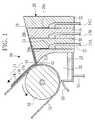
- a multiple slide bead coating apparatus 10 includes a multiple slide hopper 20 applying simultaneously multiple liquid layers to a running web 12 through a coating bead 44, a backing roller 40 to back up the web 12 and a vacuum chamber 50 to apply a reduced pressure to the coating bead 44.
- the multiple slide hopper 20 is constituted by a plurality of die blocks 30, 31 and 32 which are secured to each other.
- the multiple slide hopper 20 has slide surface 21 on its top side downwardly inclined toward the backing roller 40, over which coating liquid flows by gravity.
- the first coating liquid 14A is continuously pumped through a feeding tube 22a at a given rate into a cavity 23a from which it is extruded through a narrow vertical slot 24a out onto the downwardly inclined slide surface 21.
- the cavity 23a and the slot 24a extend across the width of the hopper 20 to cause the coating liquid 14A pumped into the cavity 23a to spread out across the hopper 20 and to be forced through the narrow vertical slot 24a in the form of a ribbon of hopper width.
- Other slots 24b and 24c, and cavities 23b and 23c of the multiple slide hopper 20 have the same structure and function.
- Second coating liquid 14B is fed into cavity 23b and third coating liquid 14C is fed into a cavity 23c.
- the second coating liquid 14B is superimposed on the first coating liquid 14A while flowing down the inclined slide surface and likewise the third coating liquid 14C is superimposed on the second coating liquid 14C. Those superimposed layers flow down without mixing with each other.
- the first coating liquid 14A is applied to form a photosensitive layer 14a
- the second coating liquid 14B is applied to form an intermediate layer 14b (non-photosensitive layer)
- the third coating liquid 14C is applied to form a protective layer 14c (non-photosensitive layer) which constitutes a photothermographic materials.
- a clearance 42 is formed between the web 12 backed up by the backing roller 40 and a lip 21a of the slide hopper (the lowest edge portion of the inclined slide surface).
- the coating bead 44 including the three layered coating liquids is maintained in bridging relation between the surface of the web and the lip.
- a vacuum chamber 50 for keeping a reduced pressure on a lower side of the coating bead (hereinafter referred to as a back pressure) is located lower side of the backing roller 40 and formed by being enclosed with a portion of the roller, a wall of the coating hopper leading to the lip and other covering members. Applying different pressures to the two sides of the coating bead helps bead be kept stable.
- the vacuum chamber 50 is connected to a vacuum pipe 52 which leads to a vacuum pump (not shown) and the degree of pressure reduction is controllable.
- the vacuum chamber 50 is also connected to coating liquid draining pipe 54.
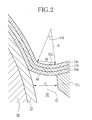
- the coating bead 44 As shown in FIG.2, the coating bead 44, maintained in bridging relation between the running surface of the web and the lip of the hopper, has concave surface 44a in the upper side thereof where the protective layer 14c is disposed in the example.
- Shape of the coating bead 44 is represented by an upper meniscus curvature ⁇ which is defined as 1/R where R is a radius of curvature of the upper side concave surface 44a.
- Actual concave curve is represented by an arc of the approximate fitted circle to determine ⁇ .
- the coating clearance 42 is preferably set between 0.10 mm and 0.40 mm and the back pressure between -100 Pa and -700 Pa, more preferably the clearance is set between 0.18 mm and 0.30 mm and the back pressure between -200 Pa and -600 Pa. It is found that it can not be realized to make ⁇ less than 7.2 mm -1 regardless of controlling the back pressure if the clearance 42 becomes less than 0.10 mm or more than 0.40 mm and it is almost impossible to make ⁇ less than 7.2 mm -1 regardless of controlling the clearance if the back pressure becomes beyond the range above.
- a photothemographic material used in the example of the invention.
- a photothemographic material includes a photosensitive layer and protective layer therefor.
- Each of those layers can consist of a plurality of layers respectively and an intermediate layer can be between the photosensitive layer and the protective one.
- Those layers is usually coated simultaneously on a supporting web in a superimposed relation.
- the photosensitive layer generally contains a reducible silver source (e.g., organic silver salt) which is main materials to form image, a catalytic amount of a photocatalyst (e.g., silver halide), a toner for controlling the tonality of silver, and a reducing agent, typically dispersed in a binder matrix.
- a reducible silver source e.g., organic silver salt
- a catalytic amount of a photocatalyst e.g., silver halide
- a toner for controlling the tonality of silver e.g., silver halide
- a reducing agent typically dispersed in a binder matrix.
- the organic silver salt (non-photosensitive silver salt)and the reducing agent are not necessarily contained in the photosensitive layer.
- the reducible silver source may comprise any material which contains a reducible source of silver ions.
- Silver salts of organic acids such as organic carboxylic acids, particularly long chain (from 10 to 30, preferably 15 to 28 carbon atoms) aliphatic carboxylic acids are preferred.
- the silver-providing compound is preferably contained in an amount of about 5-70 % by weight of an image forming layer. Examples include silver salts of aliphatic carboxylic acids and silver salts of aromatic carboxylic acids though not limited thereto.
- Preferred examples of the silver salt of aliphatic carboxylic acid include silver behenate, silver arachidonate, acid silver stearate, silver oleate, silver laurate, silver caproate, silver myristate, silver palmitate, silver maleate, silver fumarate, silver tartrate, silver linolate, silver butyrate, silver camphorate and mixtures thereof.
- the shapes of silver salts of organic acids are not limited to any specific ones .
- the organic silver salt used herein is preferably desalted. The desalting method is not critical. Any well-known filtration methods and water-washing method may be used such as centrifugation, suction filtration, ultra-filtration or flocculation.
- the organic silver salt is prepared into a solid microparticulate dispersion using a dispersing agent in order to provide fine grains of small size and free of flocculation.
- a solid microparticulate dispersion of the organic silver salt may be prepared by mechanically dispersing the salt in the presence of dispersing aids by well-known comminuting means such as ball mills, vibrating ball mills, planetary ball mills, sand mills, colloidal mills, jet mills, roller mills or high-pressure homogenizers. High-pressure homogenizer is particularly preferable for the purpose.
- the dispersing agent used in the preparation of a solid microparticulate dispersion of the organic silver salt may be selected from synthetic anionic polymers such as polyacrylic acid, copolymers of acrylic acid, copolymers of maleic acid, copolymers of maleic acid monoester, and copolymers of acryloylmethylpropanesulfonic acid; semi-synthetic anionic polymers such as carboxymethyl starch and carboxymethyl cellulose; anioni polymers such as alginic acid and pectic acid; anionic surfactants as described in JPA 92716/1977 and WO 88/04794; the compounds described in Japanese Patent Application No.
- synthetic anionic polymers such as polyacrylic acid, copolymers of acrylic acid, copolymers of maleic acid, copolymers of maleic acid monoester, and copolymers of acryloylmethylpropanesulfonic acid
- semi-synthetic anionic polymers such as carboxymethyl starch and carboxymethyl cellulose
- organic silver salts are preferably used so as to provide a silver coverage of 0.1 to 5 g/m 2 , preferably from 1 to 3 g/m 2 .
- Photosensitive silver halide is preferably used together with organic silver salt.
- a method for forming a photosensitive silver salt is well known in the art. Any of the methods disclosed in Research Disclosure No. 17029 (June 1978) and U.S. Pat. No.3,700,458, for example, may be used. Illustrative methods which can be used herein are a method of preparing an organic silver salt and adding a halogen-containing compound to the organic silver salt to convert a part of silver of the organic silver salt into photosensitive silver halide and a method of adding a silver-providing compound and a halogen-providing compound to a solution of gelatin or another polymer to form photosensitive silver halide grains and mixing the grains with an organic silver salt. The latter method is preferred in the practice of the invention.
- the photosensitive silver halide should preferably have a smaller grain size for the purpose of minimizing white turbidity after image formation.
- the grain size is preferably up to 0.20 ⁇ m, more preferably 0.01 ⁇ m to 0.15 ⁇ m, most preferably 0.02 ⁇ m to 0.12 ⁇ m.
- the term grain size designates the length of an edge of a silver halide grain where silver halide grains are regular grains of cubic or octahedral shape. Where silver halide grains are tabular, the grain size is the diameter of an equivalent circle having the same area as the projected area of a major surface of a tabular grain.
- the shape of silver halide grains may be cubic, octahedral, tabular, spherical, rod-like and potato-like, with cubic and tabular grains being preferably used. Where tabular silver halide grains are used, they should preferably have an average aspect ratio of from 100:1 to 2:1, more preferably from 50:1 to 3:1.
- the halogen composition of photosensitive silver halide is not critical and may be any of silver chloride, silver chlorobromide, silver bromide, silver iodobromide, silver iodochlorobromide, and silver iodide.
- Silver bromide or silver iodobromide is preferred in the practice of the invention.
- silver iodobromide preferably having a silver iodide content of 0.1 to 40 mol %, especially 0.1 to 20 mol %.
- the photosensitive silver halide grains used herein contain at least one complex of a metal selected from the group consisting of rhodium, rhenium, ruthenium, osmium, iridium, cobalt, mercury and iron.
- the metal complexes may be used alone or in mixture of two or more complexes of a common metal or different metals.
- the metal complex is preferably contained in an amount of 1 nmol to 10 mmol, more preferably 10 nmol to 100 ⁇ mol per mol of silver.
- Illustrative metal complex structures are those described in JP-A 225449/1995. Preferred among cobalt and iron complexes are hexacyano metal complexes.
- Illustrative, non-limiting examples include a ferricyanate ion, ferrocyanate ion, and hexacyanocobaltate ion.
- the distribution of the metal complex in silver halide grains is not critical. That is, the metal complex may be contained in silver halide grains to form a uniform phase or at a high concentration in either the core or the shell.
- the photosensitive silver halide grains used herein should preferably be chemically sensitized. Preferred chemical sensitization methods are sulfur, selenium, and tellurium sensitization methods which are well known in the art. Also useful are a noble metal sensitization method using compounds of gold, palladium, and iridium and a reduction sensitization method.
- Photosensitive silver halide is preferably used in an amount of 0.01 mol to 0.5 mol, more preferably 0.02 mol to 0.3 mol, most preferably 0.03 mol to 0.25 mol per mol of the non-photosensitive silver salt, typically organic silver salt.
- the reducing agent for the non-photosensitive silver salt typically organic silver salt may be any of substances, preferably organic substances, that reduce silver ion into metallic silver.
- Conventional photographic developing agents such as Phenidone., hydroquinone and catechol are useful although hindered phenols are preferred reducing agents.
- the reducing agent should preferably be contained in an amount of 5 to 50 mol %, more preferably 10 to 40 mol % per one mol of silver in an image forming layer.
- the reducing agent should preferably be contained in a slightly higher amount of about 10 to 50 mol %.
- Precursors capable of functioning as a reducing agent only at developing stage may be used in place of the reducing agent.
- reducing agent suitable for use in photothermographic materials using organic silver salts are disclosed in Japanese Patent Applications Nos. 6074/1971, 1238/1972, 33621/1972, 46427/1974, 115540/1974, 1433419/75, 36110/1975,147711/1975, 32632/1976,1023721/1976,32324/1976, 51933/1976, 84727/1977, 108654/1980, 146133/1981, 82828/1982, 82829/1982, 3793/1994, United States Patent Nos. 3679426, 3751252, 3751255, 3761270, 3782949, 3839048, 3928686, 5464738, German Patent No. 2321328 and European Patent No. 692732.
- Reducing agents may be added by any desired method in the form of solution, powder or solid microparticulate dispersion although they are preferably added in the form of a solid microparticulat dispersion using a dispersing agent.
- a solid microparticulate dispersion of the reducing agents may be prepared by mechanically dispersing the agent in the presence of dispersing aids by well-known comminuting means such as ball mills, vibrating ball mills, sand mills, colloidal mills, jet mills, roller mills or the like.
- the toner used for controlling the tonality of silver may increase an optical density.
- the toner should preferably be contained in an amount of 0.1 to 50 mol %, more preferably 0.5 to 20 mol % per one mol of silver in an image forming layer. Precursors capable of functioning as a toner only at developing stage may be used in place of the toner.
- the toner is well known in the photographic art and examples used for photothermographics using organic silver salt are described in Japanese Patent Applications 6077/1971, 10282/1972, 5019/1974, 5020/1974, 91215/1974, 2524/,1975, 32927/1975, 67132/1975, 67641/1975, 114217/1975, 3223/1976, 27923/1976, 14788/1977, 99813/1977, 1020/1978, 76020/1978, 156524/1979, 156525/1979 and 183642/1986, 56848/1992, JP-B ("examined Japanese patent publication") 10727/1974 and 20333/1979, U.S. Patent. Nos.
- Toners may be added to photosensitive layer, protective layer and/or intermediate layer by any desired method in the form of solution, powder or solid microparticulate dispersion although they are preferably added in the form of a solid microparticulat dispersion using a dispersing agent.
- a solid microparticulate dispersion of the reducing agents may be prepared by mechanically dispersing the agent in the presence of dispersing aids by well-known comminuting means such as ball mills, vibrating ball mills, sand mills, colloidal mills, jet mills, roller mills or the like.
- Photosensitive layer used in the invention includes hydrophobic polymer latex (hereinafter referred to simply as "polymer latex”) which is usually contained in an amount of more than 50 % by weight of all the binder in the photosensitive layer.
- polymer latex hydrophobic polymer latex
- the polymer latex used herein may be either a latex of the conventional uniform structure or a latex of the so-called core/shell type. In the latter case, better results are sometimes obtained when the core and the shell have different glass transition temperatures.
- the polymer latex should preferably have a minimum film-forming temperature (MFT) of about -30 °C to 90 °C , more preferably about 0 °C to 70 °C .
- MFT minimum film-forming temperature
- a film-forming aid may be added in order to control the minimum film-forming temperature.
- the film-forming aid is also referred to as a plasticizer and includes organic compounds (typically organic solvents) for lowering the minimum film-forming temperature of a polymer latex. It is described in Muroi, "Chemistry of Synthetic Latex, " Kobunshi Kankokai, 1970.
- Polymers used in the polymer latex include acryl resins, vinyl acetate resins, polyester resins, polyurethane resins, rubbery resins, vinyl chloride resins, vinylidene chloride resins, polyolefin resins, and copolymers thereof.
- the polymers may be linear, branched or crosslinked. Further the polymer may be either a homopolymer resulting from polymerization of a single monomer or a copolymer resulting from polymerization of two or more monomers.
- the copolymer may be either a random copolymer or a block copolymer.
- the polymer preferably has a number average molecular weight of about 5,000 to 1,000,000, more preferably about 10,000 to 100,000. A polymer with a lower molecular weight would provide a photosensitive layer with insufficient mechanical strength whereas a polymer with a higher molecular weight is unlikely to form a film.
- the polymer of the polymer latex used herein should have an equilibrium moisture content of up to 2% by weight, preferably 0.01 to 1% by weight, more preferably 0.03 to 1% by weight at 25 °C and RH 60%.
- an equilibrium moisture content preferably 0.01 to 1% by weight, more preferably 0.03 to 1% by weight at 25 °C and RH 60%.
- Illustrative examples of the polymer latex which can be used as the binder of the photosensitive layer of the invention include latices of methyl methacrylate/ethyl acrylate/methacrylic acid copolymers, latices of methyl methacrylate/2-ethylhexyl acrylate/styrene/acrylic acid copolymers, latices of styrene/butadiene/acrylic acid copolymers, latices of styrene/butadiene/divinyl benzene/methacrylic acid copolymers, latices of methyl methacrylate/vinyl chloride/acrylic acid copolymers, and latices of vinylidene chloride/ethyl acrylate/acrylonitrile/ methacrylic acid copolymers.
- the polymer latices may be used alone or in mixture of two or more.
- the polymer latex preferably constitutes at least 50%, especially at least 70% by weight of an entire binder.
- a hydrophilic polymer is added in an amount of less than 50%, preferably less than 30% by weight of the entire binder.
- the hydrophilic polymer may be selected from gelatin, polyvinyl alcohol (PVA), methyl cellulose, hydroxypropyl cellulose, carboxymethyl cellulose, and hydroxypropylmethyl cellulose.
- the entire amount of binder of the photosensitive layer preferably used in present invention is between 0.2 and 30g/m 2 , more preferably between 1 and 15 g/m 2 .
- Coating liquid in the photosensitive layer has a thixotropy that a viscosity of the liquid show 300 mPa ⁇ s - 30,000 mPa ⁇ s at shear rate 0.1/s and 1 mPa ⁇ s - 100 mPa ⁇ s at shear rate 1000/s.
- the viscosities were measured at 25 °C by RFS Fluid-Spectro-meter made by Rheometric Fareast KK.
- Sensitizing dye, reducing agent, toner, antifoggant and other suitable additives can be added to the photosensitive layer and dyestuff, crosslinking agent and surfactant can be added to the image forming layer.
- sensitizing dyes which can spectrally sensitize silver halide grains in a desired wavelength region when adsorbed to the silver halide grains.
- the sensitizing dyes used herein include cyanine dyes, merocyanine dyes, complex cyanine dyes, complex merocyanine dyes, holopolar cyanine dyes, styryl dyes, hemicyanine dyes, oxonol dyes, and hemioxonol dyes.
- Useful sensitizing dyes which can be used herein are described in Research Disclosure, Item 17643 IVA (December 1978, page 23), ibid., Item 1831 X (March 1979, page 437) and the references cited therein.
- any polymers can be used for the intermediate layer as long as the polymers have film-forming capability without causing a remarkable viscosity increase or flocculation when they contact the liquid layer including organic acid silver salts and aqueous latex binders.
- Water-soluble nonionic polymers are recommended for that.
- examples of water-soluble nonionic polymers are polyvinyl alcohol, denaturated polyvinyl alcohol, polyacrylamide, dextran, polyethylene glycol, block copolymer of polyethylene glycol and polypropylene glycol, although polyvinyl alcohol group, particularly polyvinyl alcohol is preferable.
- Polyvinyl alcohol of which saponification degree is between 80 and 99.9 and polymerization degree is between 300 and 2,400 are most preferable.
- Coating weight (dry) of the intermediate layer is preferably between 0.1 and 3.0 g/m 2 , more preferably between 0.2 and 2.0 g/m 2 .
- Those ranges of coating amount help improve the coating surface appearance. Less coating amount do not help, that is to say the intermediate layer does not work, and much more coating amount tends to cause adhesion problem. Namely, an excess part of the intermediate layer prevents coating the protective layer 14c in an adequate form, and the intermediate layer may easily be peeled off the film support in addition to increase of drying load. Further, a viscosity of the intermediate layer increases. Therefore, the surface appearance is often damaged.
- Water is preferable for a coating solvent and water-miscible organic solvent can be included in a coating solvent. It is required that more than 30 weight % of coating solvent should be water and preferably more than 50 weight %, more preferably more than 70 weight % should be water. Polymer concentration should be from 2 to 20 weight % of coating solution, wet coating weight should be between 2 and 30 ml/m 2 and viscosity of the coating solution is preferably from 5 to 200 mPa ⁇ s at 40 °C measured by B-type viscometer (produced by Tokyo Keiki K.K.)
- To the intermediate layer can be added a variety of additives such as toner and fogging agent which are compounds related to development, for example, phthalazine or ammonium phthalate.
- additives such as toner and fogging agent which are compounds related to development, for example, phthalazine or ammonium phthalate.
- Binders for protective layer may be dispersed in water to be coated to form a layer, typically hydrophilic polymer.
- Typical binders for protective layer are, for example, gelatin, polyvinyl alcohol, hydroxypropyl cellulose, methyl cellulose, hydroxypropylmethyl cellulose, hydroxyethyl cellulose, carboxymethyl cellulose, polyacrylamide, dextran. It is preferable to use gelatin, particularly delimed gelatin, as a binder for the protective layer in order to avoid mottle-like appearance defect of coating surface caused by air drying process because the gelatin can easily become gel in water solvent which has hardly fluidity.
- the protective layer can be divided into two layers.
- UV absorbing agent and/or hydrophobic polymer latex are added to one of two layers which is closer to a layer containing organic silver salt, and matte agent is added to the other outermost layer.
- matte agent is added to the other outermost layer.
- a film surface pH modifier and/or a hardening agent can be added to any of layers.
- Coating amount of binder in the protective layer is between 0.1 and 3.0 g/m 2 , preferably from 0.2 to 2.0 g/m 2 .
- Viscosity of the coating liquid in the protective layer should be between 5 and 100 mPa ⁇ s at 40 °C , preferably from 10 to 50 mPa ⁇ s.
- the outermost protective layer preferably includes adhesion-preventing material such as wax, silica particles, styrene-containing elastomeric block copolymers (e.g., styrenebutadiene-styrene and styreneisoprene-styrene), cellulose acetate, cellulose acetate butyrate, cellulose propionate and mixtures thereof.
- adhesion-preventing material such as wax, silica particles, styrene-containing elastomeric block copolymers (e.g., styrenebutadiene-styrene and styreneisoprene-styrene), cellulose acetate, cellulose acetate butyrate, cellulose propionate and mixtures thereof.
- the photosensitive layer and other layers of the photothermographic material are formed by applying an aqueous coating solution to form a coating and drying the coating.
- the "aqueous" system indicates that water constitutes at least 30% by weight of the solvent or dispersing medium of the coating solution.
- the remainder of the solvent or dispersing medium may be a water-miscible organic solvent such as methyl alcohol, ethyl alcohol, isopropyl alcohol, methyl cellosolve, ethyl cellosolve, dimethylformamide, and ethyl acetate.
- the water-content should preferably be more than 50%, more preferably more than 70%.
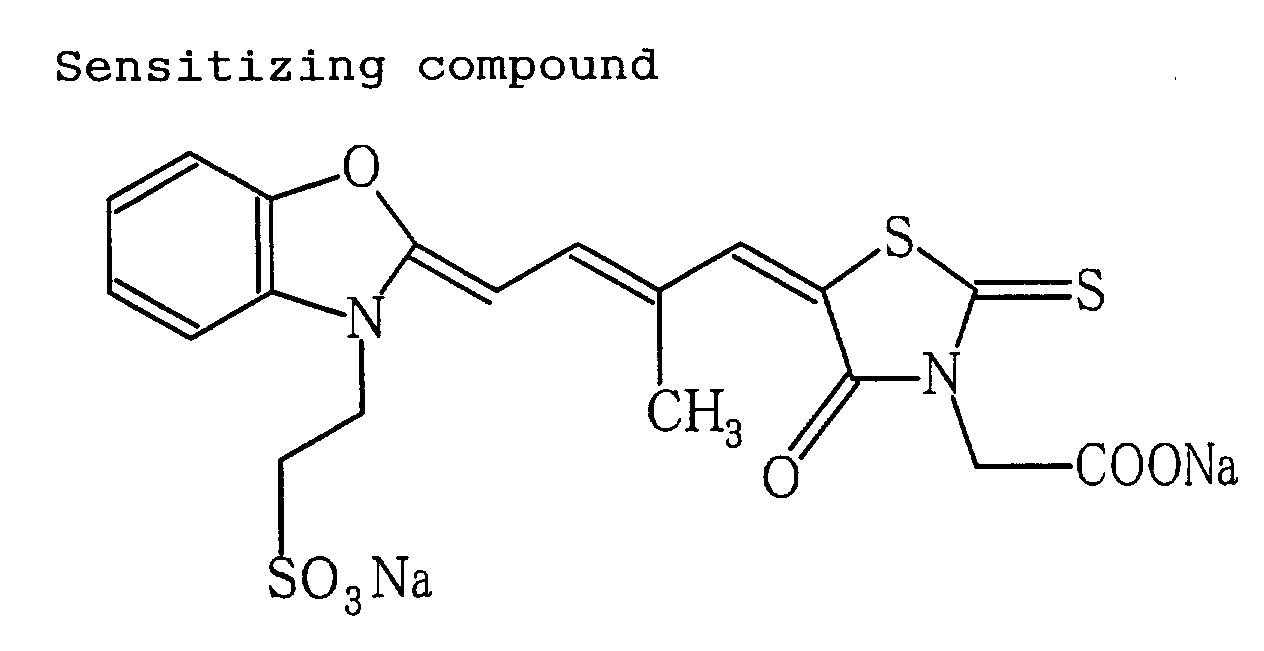
- the thus obtained silver halide grains were heated at 60 °C , to which 85 ⁇ mol of sodium thiosulfate, 11 ⁇ mol of 2,3,4,5,6-pentafluorophenyldiphenylphosphine selenide, 2 ⁇ mol of tellurium compound (shown below), 3.3 ⁇ mol of chloroauric acid, and 230 ⁇ mol of thiocyanic acid were added per mol of silver. The solution was ripened for 120 minutes.
- a mixture of 8 g of stearic acid, 39 g of behenic acid, and 850 ml of distilled water was stirred at 90 °C . With vigorous stirring, 187ml of 1N NaOH aqueous solution was added over 120 minutes to the solution. After adding 65 ml of 1N nitric acid, the solution was cooled to 50 °C . Then 125ml of silver nitrate aqueous solution was added to the solution over 100 seconds with more vigorous stirring, and stirring was continued for 20 minutes. The solids were separated by suction filtration and washed with water until the water filtrate reached a conductivity of 30 ⁇ S/cm.
- Water in amount of 850g was added to and thoroughly mixed with 100g 1001,1-bis(2-hydroxy-3,5-dimethylphenyl)-3,5,5-trimethylhexane and 50g of hydroxypropylmethyl cellulose, thereby obtaining a slurry.
- This slurry and 840 g of zirconia beads having an average diameter of 0.5 mm were placed together in a vessel, and underwent a dispersing operation over a period of 5 hours by means of a dispersing machine (1/4G Sand Grinder Mill, produced by Imex K. K.) to prepare a dispersion of reducing agent.
- SBR latex produced by DaiNihon Ink Chemical K.K.
- the viscosity of the coating liquid in the photosensitive layer showed 500, 70, 50, 20, 15 mPa ⁇ s at shear rate 0.1, 1.0 10, 100, 1000 [ 1 /sec ] in the order named.
- the viscosity was measured at 25 °C by RFS Fluid-Spectro-meter made by Rheometric Fareast KK.
- Polyvinyl alcohol PVA-205 (trade name, product of Kuraray Co., Ltd.) 20 weight % water solution in amount of 200g, 172g of Sebian A (Daicell Chemical Industry K.K.), 1 g of 5 weight % water solution of Aerosol OT (produced by American Cyanamide Inc.)and 5 g of 20 weight % of water solution of ammonium phthalate were put together and mixed to prepare a coating liquid in the intermediate layer.
- the viscosity of the thus prepared coating solution was 36 mPa ⁇ s at 40 °C , measured by No.1 rotor of B-type viscometer (made by Tokyo Keiki).
- Alkali-treated gelatin in amount of 100g was dissolved in 844g of water, and thereto were added 4 ml of 5 weight % solution of potassium salt of N-perfluorooctylsulfonyl-N-propylalanine, 45 ml of 2 weight % solution of polyethyleneglycolmono(N-perfluorooctylsulfonyl-N-propyl-2-aminoethyl) ether, 28 ml of 5 weight % solution of Aerosol OT (American Cyanamide Inc.), 115 g of polymethyl methacrylate fine particles, 39 ml of 15 weight % solution of phthalic acid and 181g of Sebian A.
- the thus prepared mixture was employed as a coating solution for a second protective layer.
- the viscosity of the thus prepared coating solution was 16 mPa ⁇ s at 40 °C , measured with the foregoing B-type viscometer (No.1 rotor).
- Coating liquid in the photosensitive layer, the intermediate layer, the first and second protective layers are coated in the order on a web of polyethylene terephthalate film with subbing of polyester.
- Multi-slide hopper for four layers were used.(Another one block was added to multi-slide hopper shown in FIG.1 to form another cavity and slot for fourth layer (second protective layer)). Thickness of the web was 175 ⁇ m.
- Table 1 indicates that visible streak defect emerges when the upper meniscus curvature ⁇ becomes more than 7.2 mm -1 and the curvature ⁇ can be controllable by coating clearance and back pressure of the coating condition.
Landscapes
- Chemical & Material Sciences (AREA)
- Engineering & Computer Science (AREA)
- Materials Engineering (AREA)
- Physics & Mathematics (AREA)
- General Physics & Mathematics (AREA)
- Non-Silver Salt Photosensitive Materials And Non-Silver Salt Photography (AREA)
- Application Of Or Painting With Fluid Materials (AREA)
Abstract
Description
A
A solid microparticulate dispersion of the reducing agents may be prepared by mechanically dispersing the agent in the presence of dispersing aids by well-known comminuting means such as ball mills, vibrating ball mills, sand mills, colloidal mills, jet mills, roller mills or the like.
17643 IVA (December 1978, page 23), ibid., Item 1831 X (August 1979, page 437) and the references cited therein.

| sample No. | coating clearance (mm) | back pressure (Pa) | upper meniscus curvature κ (mm-1) | the number of visible streak (-) |
| 1. | 0.15 | -392 | 7.41 | 13 |
| 2. | 0.19 | -392 | 7.29 | 16 |
| 3. | 0.19 | -196 | 7.11 | 0 |
| 4. | 0.23 | -392 | 7.11 | 0 |
| 5. | 0.23 | -783 | 7.41 | 5 |
Claims (10)
- Method for manufacturing photosensitive materials comprising steps of:forming a liquid multilayer composite (14) of a plurality of distinct layers (14a, 14b, 14c) on a slide hopper (20); andforming a bead (44) of the liquid multilayer composite (14) between a lip (21a) of the slide hopper (20) and a running web (12) so that an upper meniscus curvature of the bead (44) is less than 7.2 mm-1.
- Method according to claim 1, wherein the liquid multilayer composite (14) includes a liquid photosensitive layer (14a) containing a silver salt of organic acid and a hydrophobic polymer latex and a liquid non-photosensitive layer containing a water-soluble polymer.
- Method according to claim 1, wherein the upper meniscus curvature of the bead (44) being less than 7.2 mm-1 is accomplished by selecting a proper value of clearance (42) between the web surface and the lip (21a) of the slide hopper (20) and a proper value of pressure in a lower side of the bead (44).
- Method according to claim 3, wherein the proper value of clearance (42) ranges from 0.10 mm to 0.40 mm and the proper value of pressure ranges from -100 Pa to -700 Pa.
- Method according to claim 4, wherein the liquid (14A) in the photosensitive layer (14a) has thixotropy that a viscosity of the liquid (14A) becomes between 300 mPa·s and 30,000 mPa·s at shear rate 0.1/s and between 1 mPa·s and 100 mPa·s at shear rate 1000/s.
- Method according to claim 2, wherein the upper meniscus curvature of the bead (44) being less than 7.2 mm-1 is accomplished by selecting a proper value of clearance (42) between the web surface and the lip (21a) of the slide hopper (20) and a proper value of pressure in a lower side of the bead (44).
- Method according to claim 6, wherein the proper value of clearance (42) ranges from 0.10 mm to 0.40 mm and the proper value of pressure ranges from -100 Pa to -700 Pa.
- Method according to claim 7, wherein a liquid (14A) in the photosensitive layer (14a) has a thixotropy that viscosity of the liquid (14A) is between 300 mPa·s and 30,000 mPa·s at shear rate 0.1/s and between 1 mPa·s and 100 mPa·s at shear rate 1000/s.
- Method according to claim 8, wherein viscosity of liquid in said non-photosensitive layer is between 5 and 100 mPa·s at 40 °C .
- Method according to claim 2, wherein the liquid non-photosensitive layer further containing toner.
Applications Claiming Priority (2)
| Application Number | Priority Date | Filing Date | Title |
|---|---|---|---|
| JP2000378607 | 2000-12-13 | ||
| JP2000378607A JP2002182333A (en) | 2000-12-13 | 2000-12-13 | Method for producing heat developable photosensitive material |
Publications (3)
| Publication Number | Publication Date |
|---|---|
| EP1215531A2 true EP1215531A2 (en) | 2002-06-19 |
| EP1215531A3 EP1215531A3 (en) | 2003-02-12 |
| EP1215531B1 EP1215531B1 (en) | 2006-03-29 |
Family
ID=18847145
Family Applications (1)
| Application Number | Title | Priority Date | Filing Date |
|---|---|---|---|
| EP01129758A Expired - Lifetime EP1215531B1 (en) | 2000-12-13 | 2001-12-13 | Method for manufacturing photothermographic materials |
Country Status (4)
| Country | Link |
|---|---|
| US (1) | US6555309B2 (en) |
| EP (1) | EP1215531B1 (en) |
| JP (1) | JP2002182333A (en) |
| DE (1) | DE60118295T2 (en) |
Cited By (1)
| Publication number | Priority date | Publication date | Assignee | Title |
|---|---|---|---|---|
| WO2009120646A1 (en) * | 2008-03-26 | 2009-10-01 | 3M Innovative Properties Company | Methods of slide coating fluids containing multi unit polymeric precursors |
Families Citing this family (5)
| Publication number | Priority date | Publication date | Assignee | Title |
|---|---|---|---|---|
| JP2003114500A (en) * | 2001-10-04 | 2003-04-18 | Fuji Photo Film Co Ltd | Method for producing heat-developable photosensitive material |
| JP2005007258A (en) * | 2003-06-18 | 2005-01-13 | Fuji Photo Film Co Ltd | Coating method and coating line |
| JP4369876B2 (en) | 2004-03-23 | 2009-11-25 | 富士フイルム株式会社 | Silver halide photosensitive material and photothermographic material |
| US20060057512A1 (en) | 2004-09-14 | 2006-03-16 | Fuji Photo Film Co., Ltd. | Photothermographic material |
| CN101713910B (en) * | 2008-10-06 | 2013-12-18 | 大日本印刷株式会社 | Method of producing multilayer coating film |
Family Cites Families (11)
| Publication number | Priority date | Publication date | Assignee | Title |
|---|---|---|---|---|
| CA557259A (en) | 1955-02-23 | 1958-05-13 | Canadian Kodak Co. Limited | Multiple layer hopper for multiply coating a web |
| US4113903A (en) | 1977-05-27 | 1978-09-12 | Polaroid Corporation | Method of multilayer coating |
| JPS5927232B2 (en) | 1978-06-26 | 1984-07-04 | 富士写真フイルム株式会社 | Application method |
| JPS56108566A (en) | 1980-01-30 | 1981-08-28 | Fuji Photo Film Co Ltd | Simultaneous multilayer coating |
| JP2676289B2 (en) | 1992-01-13 | 1997-11-12 | 富士写真フイルム株式会社 | Coating method and coating device |
| US5290660A (en) * | 1993-04-23 | 1994-03-01 | Minnesota Mining And Manufacturing Company | Dye permeable polymer interlayers |
| US6013327A (en) * | 1996-10-30 | 2000-01-11 | Fuji Photo Film Co., Ltd. | Slide bead coating method and apparatus |
| JP3832946B2 (en) | 1997-06-06 | 2006-10-11 | 富士写真フイルム株式会社 | Thermal image forming material coating method, thermal image forming layer coating solution, thermal image forming material and photosensitive heat-developable image forming material |
| US6576296B1 (en) | 1998-03-10 | 2003-06-10 | 3M Innovative Properties Company | Web coating method and apparatus for continuous coating over splices |
| JP2000225368A (en) | 1999-02-03 | 2000-08-15 | Konica Corp | Coating apparatus and method |
| JP2002072409A (en) * | 2000-09-04 | 2002-03-12 | Fuji Photo Film Co Ltd | Coating application method and device for heat developable photosensitive material |
-
2000
- 2000-12-13 JP JP2000378607A patent/JP2002182333A/en active Pending
-
2001
- 2001-12-11 US US10/011,772 patent/US6555309B2/en not_active Expired - Fee Related
- 2001-12-13 EP EP01129758A patent/EP1215531B1/en not_active Expired - Lifetime
- 2001-12-13 DE DE60118295T patent/DE60118295T2/en not_active Expired - Lifetime
Cited By (1)
| Publication number | Priority date | Publication date | Assignee | Title |
|---|---|---|---|---|
| WO2009120646A1 (en) * | 2008-03-26 | 2009-10-01 | 3M Innovative Properties Company | Methods of slide coating fluids containing multi unit polymeric precursors |
Also Published As
| Publication number | Publication date |
|---|---|
| EP1215531A3 (en) | 2003-02-12 |
| US6555309B2 (en) | 2003-04-29 |
| DE60118295T2 (en) | 2006-09-07 |
| US20020106595A1 (en) | 2002-08-08 |
| JP2002182333A (en) | 2002-06-26 |
| EP1215531B1 (en) | 2006-03-29 |
| DE60118295D1 (en) | 2006-05-18 |
Similar Documents
| Publication | Publication Date | Title |
|---|---|---|
| US6140037A (en) | Photothermographic material and method for making | |
| EP1215531B1 (en) | Method for manufacturing photothermographic materials | |
| US6592946B2 (en) | Method for coating a heat-development photo-sensitive material having a photo-sensitive layer and a protective layer | |
| JP4299400B2 (en) | Thermally developed image forming material | |
| JP2000330232A (en) | Heat developable photosensitive material | |
| JP2001215647A (en) | Heat developable image recording material | |
| EP1063566B1 (en) | A method for preparing non-photo-sensitive fatty acid silver salt grain | |
| JP4008153B2 (en) | Photothermographic material | |
| JP3907844B2 (en) | Method for producing thermal imaging material | |
| JP4216438B2 (en) | Method for producing silver halide emulsion | |
| JP4117018B2 (en) | Image forming method using photothermographic material | |
| JP4021586B2 (en) | Photothermographic material | |
| JPH11343420A (en) | Purification of latex, latex, photosensitive material and heat-developable photosensitive material | |
| JP3927334B2 (en) | Thermal development method of photothermographic material | |
| JP2001194744A (en) | Heat developable image recording material | |
| JPH01255853A (en) | Silver halide photographic sensitive material having improved film feedability | |
| JP2003181350A (en) | Coating apparatus and method, and method of manufacturing photosensitive material for thermal development | |
| JPH10133329A (en) | Method for producing silver halide photographic light-sensitive material | |
| JP2004133207A (en) | Silver halide photographic material | |
| JP2000321710A (en) | Heat-developable photosensitive material | |
| JP2000267220A (en) | Heat developable photosensitive material for laser light exposure | |
| JP2000321709A (en) | Manufacture of heat-developable image forming material | |
| JP2000298326A (en) | Heat developable image recording material | |
| JP2000284400A (en) | Heat developable photosensitive material | |
| JP2001228577A (en) | Heat developable photosensitive material |
Legal Events
| Date | Code | Title | Description |
|---|---|---|---|
| PUAI | Public reference made under article 153(3) epc to a published international application that has entered the european phase |
Free format text: ORIGINAL CODE: 0009012 |
|
| AK | Designated contracting states |
Kind code of ref document: A2 Designated state(s): AT BE CH CY DE DK ES FI FR GB GR IE IT LI LU MC NL PT SE TR |
|
| AX | Request for extension of the european patent |
Free format text: AL;LT;LV;MK;RO;SI |
|
| PUAL | Search report despatched |
Free format text: ORIGINAL CODE: 0009013 |
|
| AK | Designated contracting states |
Designated state(s): AT BE CH CY DE DK ES FI FR GB GR IE IT LI LU MC NL PT SE TR |
|
| AX | Request for extension of the european patent |
Extension state: AL LT LV MK RO SI |
|
| RIC1 | Information provided on ipc code assigned before grant |
Ipc: 7G 03C 1/498 B Ipc: 7B 05C 5/00 B Ipc: 7G 03C 1/74 A |
|
| 17P | Request for examination filed |
Effective date: 20030422 |
|
| AKX | Designation fees paid |
Designated state(s): DE |
|
| 17Q | First examination report despatched |
Effective date: 20031211 |
|
| GRAP | Despatch of communication of intention to grant a patent |
Free format text: ORIGINAL CODE: EPIDOSNIGR1 |
|
| GRAS | Grant fee paid |
Free format text: ORIGINAL CODE: EPIDOSNIGR3 |
|
| GRAA | (expected) grant |
Free format text: ORIGINAL CODE: 0009210 |
|
| AK | Designated contracting states |
Kind code of ref document: B1 Designated state(s): DE |
|
| REF | Corresponds to: |
Ref document number: 60118295 Country of ref document: DE Date of ref document: 20060518 Kind code of ref document: P |
|
| PLBE | No opposition filed within time limit |
Free format text: ORIGINAL CODE: 0009261 |
|
| STAA | Information on the status of an ep patent application or granted ep patent |
Free format text: STATUS: NO OPPOSITION FILED WITHIN TIME LIMIT |
|
| 26N | No opposition filed |
Effective date: 20070102 |
|
| PGFP | Annual fee paid to national office [announced via postgrant information from national office to epo] |
Ref country code: DE Payment date: 20091119 Year of fee payment: 9 |
|
| REG | Reference to a national code |
Ref country code: DE Ref legal event code: R119 Ref document number: 60118295 Country of ref document: DE Effective date: 20110701 |
|
| PG25 | Lapsed in a contracting state [announced via postgrant information from national office to epo] |
Ref country code: DE Free format text: LAPSE BECAUSE OF NON-PAYMENT OF DUE FEES Effective date: 20110701 |