EP1213875A2 - Network node emulator and method of node emulation - Google Patents
Network node emulator and method of node emulation Download PDFInfo
- Publication number
- EP1213875A2 EP1213875A2 EP01127051A EP01127051A EP1213875A2 EP 1213875 A2 EP1213875 A2 EP 1213875A2 EP 01127051 A EP01127051 A EP 01127051A EP 01127051 A EP01127051 A EP 01127051A EP 1213875 A2 EP1213875 A2 EP 1213875A2
- Authority
- EP
- European Patent Office
- Prior art keywords
- node
- message
- network
- incoming message
- response
- Prior art date
- Legal status (The legal status is an assumption and is not a legal conclusion. Google has not performed a legal analysis and makes no representation as to the accuracy of the status listed.)
- Ceased
Links
- 238000000034 method Methods 0.000 title claims abstract description 196
- 230000004044 response Effects 0.000 claims abstract description 108
- 238000013515 script Methods 0.000 claims abstract description 71
- 238000004891 communication Methods 0.000 claims abstract description 14
- 230000003993 interaction Effects 0.000 claims description 55
- 230000006399 behavior Effects 0.000 claims description 32
- 230000005540 biological transmission Effects 0.000 claims description 24
- 238000012360 testing method Methods 0.000 claims description 19
- 230000014509 gene expression Effects 0.000 claims description 17
- 230000000737 periodic effect Effects 0.000 claims description 9
- 238000004590 computer program Methods 0.000 claims description 4
- 230000009471 action Effects 0.000 description 11
- 230000006870 function Effects 0.000 description 11
- 239000003607 modifier Substances 0.000 description 7
- 238000013459 approach Methods 0.000 description 5
- 230000008901 benefit Effects 0.000 description 2
- 230000000694 effects Effects 0.000 description 2
- 230000010354 integration Effects 0.000 description 2
- 230000002452 interceptive effect Effects 0.000 description 2
- 230000007246 mechanism Effects 0.000 description 2
- 238000012986 modification Methods 0.000 description 2
- 230000004048 modification Effects 0.000 description 2
- 238000012545 processing Methods 0.000 description 2
- 230000001360 synchronised effect Effects 0.000 description 2
- 230000001960 triggered effect Effects 0.000 description 2
- 230000004308 accommodation Effects 0.000 description 1
- 238000007792 addition Methods 0.000 description 1
- 230000015556 catabolic process Effects 0.000 description 1
- 238000012790 confirmation Methods 0.000 description 1
- 238000013500 data storage Methods 0.000 description 1
- 230000001419 dependent effect Effects 0.000 description 1
- 238000005538 encapsulation Methods 0.000 description 1
- 238000011156 evaluation Methods 0.000 description 1
- 238000001914 filtration Methods 0.000 description 1
- 238000003780 insertion Methods 0.000 description 1
- 230000037431 insertion Effects 0.000 description 1
- 230000001788 irregular Effects 0.000 description 1
- 238000012423 maintenance Methods 0.000 description 1
- 238000013507 mapping Methods 0.000 description 1
- 238000012544 monitoring process Methods 0.000 description 1
- 230000006855 networking Effects 0.000 description 1
- 230000003287 optical effect Effects 0.000 description 1
- 230000008520 organization Effects 0.000 description 1
- 238000012805 post-processing Methods 0.000 description 1
- 238000007781 pre-processing Methods 0.000 description 1
- 239000000047 product Substances 0.000 description 1
- 230000003989 repetitive behavior Effects 0.000 description 1
- 208000013406 repetitive behavior Diseases 0.000 description 1
- 238000005316 response function Methods 0.000 description 1
- 239000013589 supplement Substances 0.000 description 1
- 230000002123 temporal effect Effects 0.000 description 1
- 238000013024 troubleshooting Methods 0.000 description 1
- WDQKVWDSAIJUTF-GPENDAJRSA-N via protocol Chemical compound ClCCNP1(=O)OCCCN1CCCl.O([C@H]1C[C@@](O)(CC=2C(O)=C3C(=O)C=4C=CC=C(C=4C(=O)C3=C(O)C=21)OC)C(=O)CO)[C@H]1C[C@H](N)[C@H](O)[C@H](C)O1.C([C@H](C[C@]1(C(=O)OC)C=2C(=C3C([C@]45[C@H]([C@@]([C@H](OC(C)=O)[C@]6(CC)C=CCN([C@H]56)CC4)(O)C(=O)OC)N3C=O)=CC=2)OC)C[C@@](C2)(O)CC)N2CCC2=C1NC1=CC=CC=C21 WDQKVWDSAIJUTF-GPENDAJRSA-N 0.000 description 1
Images


Classifications
-
- H—ELECTRICITY
- H04—ELECTRIC COMMUNICATION TECHNIQUE
- H04L—TRANSMISSION OF DIGITAL INFORMATION, e.g. TELEGRAPHIC COMMUNICATION
- H04L43/00—Arrangements for monitoring or testing data switching networks
- H04L43/50—Testing arrangements
-
- H—ELECTRICITY
- H04—ELECTRIC COMMUNICATION TECHNIQUE
- H04L—TRANSMISSION OF DIGITAL INFORMATION, e.g. TELEGRAPHIC COMMUNICATION
- H04L67/00—Network arrangements or protocols for supporting network services or applications
- H04L67/01—Protocols
- H04L67/131—Protocols for games, networked simulations or virtual reality
-
- H—ELECTRICITY
- H04—ELECTRIC COMMUNICATION TECHNIQUE
- H04L—TRANSMISSION OF DIGITAL INFORMATION, e.g. TELEGRAPHIC COMMUNICATION
- H04L69/00—Network arrangements, protocols or services independent of the application payload and not provided for in the other groups of this subclass
- H04L69/22—Parsing or analysis of headers
Definitions
- the present invention relates generally to network node emulation, and more particularly to emulation of network node behavior.
- Computer networks have become widespread and ubiquitous. They are commonly used for data storage and manipulation, communications, commerce, information procurement, etc. By connecting together (networking) multiple computers or multiple computer networks, information may be easily shared, and shared in an almost instantaneous fashion.
- FIG. 1 shows a typical distributed electronic network 115 connecting two or more nodes, such as node A and node B as shown.
- the distributed electronic network 115 may be, for example, the Internet.
- a network node is a computer or computer device that is connected to the network and communicates over the network 115.
- a computer network may contain many such nodes, including computers, workstations, servers, routers, gateways, switches, etc.
- a node therefore may be any device on the network 115 capable of transmitting and/or receiving data.
- Data traveling on a computer network is typically in the form of a packet.
- Data in a data transmission is usually broken down into packets that are individually transmitted.
- a receiving device reassembles the data transmission when all of the packets have been received.
- the packets may pass through multiple networks and multiple network routers or gateways when traveling from one node to another.
- FIG. 2 shows a packet 125 according to the TCP protocol.
- the packet 125 includes a source port 205 (i.e., a source address) and a destination port 210 (i.e., a destination address).
- a network device receiving the packet 125 may be able to determine whether to accept the packet, whether to pass the packet on to another device, or whether to ignore the packet. Additional information on packet structure and packet communication may be found in Douglas Comer, Internetworking with TCP / IP Volume 1 Principles, Protocols, and Architecture, 3rd Ed., Prentice-Hall, Englewood Cliffs, New Jersey, 1995, incorporated herein by reference.
- TCP/IP Transport Control Protocol/Internet Protocol
- TCP/IP dictates a standard software protocol and a standard transmission protocol, allowing interconnected networks to communicate.
- TCP/IP also dictates a standard reception protocol.
- TCP/IP based data networks are a unique grouping of network elements or nodes that adhere to the TCP/IP protocol in order to communicate. Such networks include many nodes, with the nodes being connected by an underlying network infrastructure. The network infrastructure may participate in basic communications between nodes.
- a test bed of network nodes may be employed, including real world nodes. These real world nodes must emulate day-to-day behavior in a controlled manner that allows a tester to accurately script reproducible behavior. The tester must also be able to script ad hoc behavior in order to stimulate nondeterministic (i.e., irregular or unpredictable) functionality.
- the temporal characteristics of a network are rather difficult to capture due to their stochastic nature, but a functional breakdown shows that the most common compositional behavior is a regular transmission action and a pseudoregular reception action (pseudo because it is stimulated by a transmission from another node).
- the transmission action usually occurs with some periodicity, typically to output data.
- the reception action typically is a combination of a packet processing that results in some predetermined node application behavior and/or a packet processing that results in a protocol interaction behavior.
- emulation or testing of node behavior has traditionally been done by directing manually formatted or pre-formatted packet traffic at a node.
- the data content is typically fixed.
- ICMP Internet Control Message Protocol
- It is accessible via simple network utilities like "ping" that periodically send out to a specified address. This is done manually by a user via a console.
- a technician or operator may create or select test messages to be transmitted to a node under test.
- the drawbacks of this are the time and effort required, relatively large time gaps between messages, and the inability to fully emulate regular network traffic.
- Immersing a node into an existing network is another way in which the node may be tested.
- An actual network environment may offer realistic message traffic loads, traffic types, and response times. However, it may not offer a tester the opportunity or ability to supplement the on-going message traffic and stretch the test environment beyond normal traffic levels and traffic types.
- Real life testing may alternatively be done by creating a network test bed with multiple linked computers. However, this is expensive and time-consuming.
- Specification languages exist in the prior art for the purpose of describing and filtering packets. Some of the prior art specification languages are concerned with multiplexing/de-multiplexing and transmitting/receiving operations using a protocol stack. These operations are internal to the operation of the TCP/IP protocol and are not specific to host operations.
- the prior art specification languages allow fixed-time transmission and reception of packets because these languages are for synchronous programming of reactive systems.
- the specification languages of the prior art are more concerned with building type systems to represent packet structures with different degrees of refinement as part of a packet filter.
- the prior art approaches are lacking in terms of automation, language specification, approximation of dynamic node behavior, and linkage to time scales.
- the prior art approaches are also lacking in an ability to individually address or characterize different aspects and attributes of the TCP/IP protocol.
- the prior art approaches do not have a central integration of TCP/IP functionality, are not independent of platform and operating systems, are not expandable to accommodate new protocols, and cannot specify data contents of generated transmit messages.
- the prior art includes no accommodation of data protocol specifications. More importantly, the approaches of the prior art are inadequate because they are merely reactive or filter-based. Fixed-time packet transmission and reception is inadequate to fully emulate interactive node behavior.
- Common test apparatus and procedures perform some tests of capacity, but only overall capacity and not capacity at the level of individual packets.
- the prior art approaches require specialized or additional hardware, and may not accommodate insertion of a.node or node emulator into a real world network.
- a node emulator for conducting interactions with at least one network node comprises a network interface capable of transmitting and receiving packets over a distributed electronic network over which the at least one network node and the node emulator communicate.
- the node emulator further comprises a memory, the memory being capable of storing a network protocol information, storing a node emulator hardware configuration, storing a network hardware configuration, storing network addresses, storing payloads, storing transmit times of outgoing messages, storing outgoing message repetitions, storing outgoing message repetition times, storing outgoing message transmission periods, storing receive triggers, storing response destination addresses, and storing an emulation script.
- the node emulator further comprises a CPU, the CPU being capable of controlling the node emulator to receive an incoming message, to transmit an outgoing message, and to recognize a response requirement in the incoming message and respond to the incoming message by transmitting a response outgoing message if the emulated incoming message includes a response requirement.
- the node emulator is capable of specifying a predetermined set of interactions to be experienced by the at least one network node as a result of engaging in a packet exchange between the at least one network node and the node emulator, specifying protocol characteristics of a packet exchange, and specifying node interactions necessary to exchange packets.
- the node emulator is capable of employing the emulation script to conduct interactions with the at least one network node.
- a computer-implemented method of generating an emulated network node in a distributed electronic network comprises the steps of receiving an incoming message at the emulated network node and transmitting an outgoing message from the emulated network node.
- the method further comprises a step of recognizing a response requirement in the incoming message and responding to the incoming message by transmitting a response outgoing message if the incoming message includes a response requirement. Therefore, an emulation script is used to determine behavior of the emulated network node.
- a computer-implemented method of generating an emulated network node comprises the steps of generating an emulation script using a network node emulation language and operating a computer device according to the emulation script in order to transmit and receive data packets in the computer device. Therefore the computer device is capable of operating to receive an incoming message, transmit an outgoing message, and recognize a response requirement in the incoming message and responding to the incoming message by transmitting a response outgoing message if the incoming message includes a response requirement.
- a computer-implemented method of generating emulated communication between at least one network node and a node emulator comprises a step of specifying a predetermined set of interactions to be experienced by the at least one network node as a result of engaging in a packet exchange with the node emulator.
- the method further comprises a step of specifying protocol characteristics of the packet exchange.
- the method further comprises a step of specifying node interactions necessary to exchange packets between the at least one network node and the node emulator. Therefore an emulation language specifies the predetermined set of interactions, the protocol characteristics, and the node interactions, and is used to script behavior of the node emulator.
- a computer-implemented method of providing a network node emulation language capable of generating an emulation script for emulating a network node comprises a step of providing a transmit command capable of generating and transmitting an outgoing network message.
- the method further comprises a step of providing a receive command capable of receiving an incoming network message.
- the method further comprises a step of providing a response command capable of recognizing a response requirement in the incoming message and responding to the incoming message by transmitting a response outgoing message if the incoming message includes a response requirement.
- FIG. 3 shows one embodiment of a node emulator 300 according to the invention.
- the node emulator 300 may be connected to a network 115.
- the network 115 may be any type of distributed electronic network, including, for example, a Local Area Network (LAN), a Wide Area Network (WAN), a Virtual Private Network (VPN), or the Internet.
- the node emulator 300 may include a network Interface 304, a CPU 309, a protocol stack 312, and a memory 316.
- the node emulator 300 may include one or more I/O devices 318.
- the network interface 304 may be any sort of interface that allows communication over the network 115. This may be, for example, a network card such as that commonly found in computers, a modem or telephony card, serial ports, etc.
- the CPU 309 may be any type of general purpose CPU.
- the protocol stack 312 is a data construct used to specify how network communications are performed.
- a protocol is an established set of procedures and standards used by a computer or computer device in order to communicate over a network with other such devices. Common protocols are TCP, IP, the User Datagram Protocol (UDP), the Open Systems Interconnection (OSI) protocol, etc.
- a protocol stack (or suite) is made up of multiple protocols (sometimes termed layers) used to exchange information between computers. One protocol in the stack might be used to specify how a network interface card communicates, while another might specify how a computer reads information from the network interface card.
- protocol stack 312 is shown as a separate element, alternatively it may be implemented in the memory 316.
- the memory 316 is used to store data, program instructions, working values, etc., in order that the node emulator 300 may emulate a network node.
- the memory 316 may be any type of storage device, including Random Access Memory (RAM), Read-Only Memory (ROM), magnetic tape or disc, bubble memory, optical memory, etc.
- the memory 316 may include a protocol storage 321, an emulator configuration storage 324, a network configuration storage 328, a network address storage 335, a transmit time storage 338, a transmit periods storage 344, a message repetitions storage 347, a receive trigger storage 349, a payload storage 352, a listen type storage 355, a response destination address storage 359, an emulation language storage 363, an emulation script storage 365, a log storage 372, and an emulation language compiler 376.
- the protocol storage 321 may store any required or optional protocol information used by the node emulator 300 to communicate over the network 115.
- the protocol storage 321 may therefore store a plurality of protocols.
- the emulator configuration storage 324 may store any hardware configurations of the node emulator 300, including, for example, a node emulator address, network interface configurations (i.e., serial ports, parallel ports, interface cards, etc.), operating system configurations, protocol stack configurations, transmission speeds, and others.
- network interface configurations i.e., serial ports, parallel ports, interface cards, etc.
- operating system configurations i.e., serial ports, parallel ports, interface cards, etc.
- protocol stack configurations i.e., Transmission speeds, and others.
- the network configuration storage 328 may store network hardware and software configurations including, for example, packet characteristic descriptions (such as type of service, precedence, etc.), a source port or ports, network addresses of other nodes, network protocol information, destination ports, etc.
- the invention may emulate one or more addresses and one or more ports in the node emulator 300.
- the network address storage 335 may store, for example, non-existent network addresses used to simulate non-existent nodes (i.e., virtual nodes).
- the transmit time storage 338 may store one or more transmit times for outgoing packets transmitted by the node emulator 300.
- the transmit periods storage 344 may store one or more time periods between repetitions for a periodic outgoing message.
- the time periods may be fixed or pseudo random, varying between minimum and maximum values.
- the message repetitions storage 347 may store one or more numbers of repetitions of a periodic outgoing message.
- the receive trigger storage 349 may store information needed to implement one or more receive trigger actions. This information may include, for example, a source port, a packet protocol type, a payload data, and an incoming source IP address.
- the payload storage 352 may store one or more payloads to compare to a received payload in an incoming packet.
- the payload may be data contained within the data portion of a packet to be transmitted.
- the listen type storage 355 may store one or more listen types (i.e., UDP, TCP, etc.) to compare to a type of an incoming packet.
- the only required data for a listen is a destination address (i.e., the address of a node receiving or listening to a packet). The listen can therefore receive any and all incoming packets.
- a listen event may also include a matching criterion for specifying protocol types to compare to incoming packet protocol types.
- listen events may be used to configure the protocol stack to allow incoming packets to be received by specific protocols, using specific network protocols.
- the destination address storage 359 may store one or more destination addresses.
- the destination address storage 359 may be used to send outgoing messages.
- the destination address storage 359 may also store one or more destination port numbers.
- memory organization and utilization is illustrative and not exhaustive.
- Other memory configurations may be employed, such as, for example, a compiled emulation script storage that replaces items 321-359 with one compiled emulation script file containing all needed data or configurations employing a combination of items.
- the emulation language storage 363 may store an emulation language grammar, and additionally may store examples, instructions, etc.
- An emulation script 365 may be a previously constructed and stored emulation script that may be used to generate a emulated network node (such as a compiled emulation script 365 that configures and controls the hardware of the node emulator 300).
- a log 372 may be a record of node transactions, and may record all events or operations performed by the node emulator 300. In addition, the log 372 may also record packets received from other nodes and may record packets sent to other nodes.
- the emulation language compiler 376 may be used to compile an emulation script 365 in order to convert the emulation script from a human-readable form into a machine-readable form (i.e., an executable set of instructions and data).
- a human operator may use the one or more I/O cevices 318 to generate or activate one or more emulation scripts 365.
- the emulation script 365 may be stored in the memory 316, and may be executed by the CPU 309.
- the CPU 309 controls all transmission or reception events over the network 115 using the network interface 304 and the protocol stack 312.
- the CPU 309 accesses the memory 316 in order to retrieve the emulation script 365 and any of the stored variables. Therefore, a stored emulation script 365 may be retrieved and executed by the CPU 309 to transmit and receive packets over the network 115.
- the node emulator 300 may be manually operated by an operator who can access and use the emulation language 363 to generate commands which the CPU 309 can implement.
- a manual operator could generate and transmit a message or data packet over the network 115.
- the node emulator 300 may be connected to another network node, as shown in FIG. 1, or may be connected to an existing network.
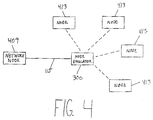
- FIG. 4 shows one node emulation configuration using the node emulator 300 according to the present invention.
- the node emulator 300 is connected to a network node 409 that is being tested in some manner.
- the node emulator 300 may be used to send packets to and receive packets from the network node 409 in order to test the network node 409 or to emulate a network environment. This may include emulating different types of network conditions, such as heavy traffic or specific traffic types.
- the node emulator 300 may more fully emulate a network environment by creating virtual nodes 413. This may be done by transmitting packets containing non-existent source addresses. In addition, the node emulator 300 may receive messages intended for these virtual nodes 413 and generate response outgoing packets, further emulating network behavior by making the virtual nodes 413 reactive to packets from the network node 409. Furthermore, virtual nodes may more fully emulate network behavior by autonomously transmitting packets, in the manner specified in the emulation script.
- the node emulator 300 may therefore create a plurality of virtual nodes 413 to interact with the network node 409.
- An advantage of this is that the node emulator 300 can quickly, easily, and economically emulate a network environment.
- the node emulator 300 may obviate the need to purchase multiple network devices, along with their attendant cabling, power consumption, and setup and maintenance overhead.
- the node emulator 300 may be connected into the existing network, and the node emulator 300 may inject packets into the existing network in order to interact with some or all of the nodes.
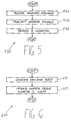
- FIG. 5 shows a flow chart 500 of a method of conducting message communication according to the invention.
- the node receives an incoming message from the network (i.e., a listen event).
- the receive command allows packets to be received at an emulator node, provided they are addressed to some listening destination port and no other condition is specified for the listen event (except possibly a protocol type such as a UDP/TCP/multicast protocol or an embedded protocol).
- the receive command may specify receipt from a particular node or nodes.
- the receive command may specify data or a regular expression in the message or data packet that must be matched.
- the receive command may specify that an incoming message be received if a text string in the incoming packet matches a predetermined text string.
- a received payload may be evaluated with a regular expression. The evaluation may generate a true or false result. If the result is true, then the received payload had enough components that matched according to the rules of regular expressions to result in a true match.
- the emulator and emulation method of the invention may conduct communications without necessarily involving packets.
- the invention may avoid using packets by communicating with a protocol transport layer that is independent of the packet structure via encapsulation.
- the invention may do this by specifying a particular transport protocol layer. For example, in a TCP/IP protocol communication session, the messages may be transmitted via protocol layer 6 instead of protocol layer 4.
- the node may transmit an outgoing message.
- a transmit command may be used to send a packet to a specific destination or destinations.
- the destination may be a node in an actual network or may be a solitary node that is only connected to the node emulator in order to emulate a network.
- the transmit command may specify that a message be sent at a specific time.
- the message may be repeated, with the number of repetitions and an interval period between message repetitions being specified in the transmit command.
- a payload, packet characteristics, and source and destination ports may be specified.
- the interval period between repetitions may be fixed or variable. For example, predetermined values for the interval period may be specified, or the repetitions may be transmitted at pseudo random times (i.e., sent anywhere between minimum and maximum time period values). This may be done in order to better emulate real node behavior.
- the node may respond to an incoming message by transmitting a response outgoing packet.
- an incoming message may need a responsive reply (the two nodes have some form of interaction occurring, with the interaction abiding by a peer-to-peer relationship but not restricted to any particular corresponding layer of communication).
- a response outgoing packet may be enabled and configured by a response command.
- the response command may specify a source address of the incoming message and may specify a destination address or addresses of the outgoing response message.
- a payload and packet characteristics may be specified.
- the response command may also specify a data payload.
- the source port number and the packet protocol type can also be used to match and trigger a response.
- the response command may evaluate a payload in an incoming message with a predetermined regular expression and transmit a response outgoing message if the payload is evaluated with the predetermined regular expression to match true.
- An additional capability of the invention is event triggering, where the execution of a particular event triggers another event and not necessarily a data transmission or reception.
- the event triggering capability may include event triggered events. This adds the ability to exercise actual functionality when an event from the event set occurs.
- a bind mechanism may bind an actual function to an event, with the function being capable of executing a unique and independent behavior that falls into the category of being triggered by "time” or "rcv from” functionality.
- the event triggering gives a flexibility to specify event actions that are simply the result of normal event operations.
- a node emulator according to the invention may be transmitting a message or packet while also receiving or responding to a message or packet.
- each action may occur an indefinite number of times, and not merely once.
- a first incoming message or packet may be received while an emulator according to the invention is responding to a second incoming message.
- a receive command in an emulation script may respond to the same incoming message that the emulator is receiving.
- the emulator and emulation method according to the invention may also perform preprocessing and postprocessing functions for each event. This allows for the manipulation of data before and/or after transmission or reception, reflecting a standard protocol stack capability.
- a group of emulated nodes may be named by specifying a group master and group members. Therefore, in order to send a message to the group master, the group members, or all nodes in the group, the invention allows a message to be addressed to the group.
- a single node may be considered a master, for example, if it employs a "poll and select" mechanism used to conduct round-robin transmissions to or from a subset of network nodes.
- a generic network grouping can be used to increase an addressing capability, allowing a node to refer to a subset of nodes in some relative fashion, independent of IP subnetting strategies.
- FIG. 6 shows a flow chart 600 of a method of controlling node device operation according to the invention.
- an emulation script is generated.
- the emulation script may contain one or more commands of the emulation language.
- the commands may be used, for example, to receive an incoming message, to transmit an outgoing message, or to respond to an incoming message.
- the emulation script therefore, is a listing of actions to be performed by a node emulator.
- the emulation script requires compilation before it can be executed by a computer device.
- a computer device is operated according to the emulation script.
- the computer device may be a node emulator or part of a node emulator.
- the computer device may be a network node or a network node component.
- the computer device operates according to the emulation script.
- the emulation script therefore comprises computer software used to operate the computer device in a particular manner in order to emulate a network node.
- the emulation includes sending packets, receiving packets, and responding to received packets.
- the emulation script therefore is a pre-programmed listing of events and possible events.
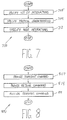
- FIG. 7 shows a flow chart 700 of a method of node interaction according to the invention.
- the method specifies a set of interactions to be experienced by a network node as a result of engaging in a packet exchange with the node emulator.
- the set of interactions may include, for example, an outgoing message or a periodic outgoing message transmitted by the node emulator to at least one network node.
- the predetermined set of interactions also includes an incoming message received by the node emulator from at least one network node.
- the emulator specifies protocol characteristics.
- the protocol characteristics may include, for example, a TCP protocol, UDP, IP, IPX, a type of service, precedence, etc.
- the emulator specifies node interactions.
- the node interactions may include, for example, a response outgoing message transmitted in response to an incoming message.
- the node interactions may include comparing a source IP address in an incoming message to a predetermined address or set of source addresses. A response outgoing message may be transmitted if there is a match. Therefore, the node emulator may respond to a message from a specific network address, for example. In this manner, the network traffic may be emulated in a highly specific manner.
- the response outgoing message may be directed at multiple destinations, and for a repetition number of times.
- the time period between the repetitions may be a pseudo random time period, with each repetition varying between minimum and a maximum values. Alternatively, the time interval between repetitions may be specified.
- the node emulator may model web traffic behavior by having minimal data uploads in conjunction with large downloads, as is the case with real world data traffic.
- FIG. 8 shows a flow chart 800 of a method of monitoring command response performance according to the invention.
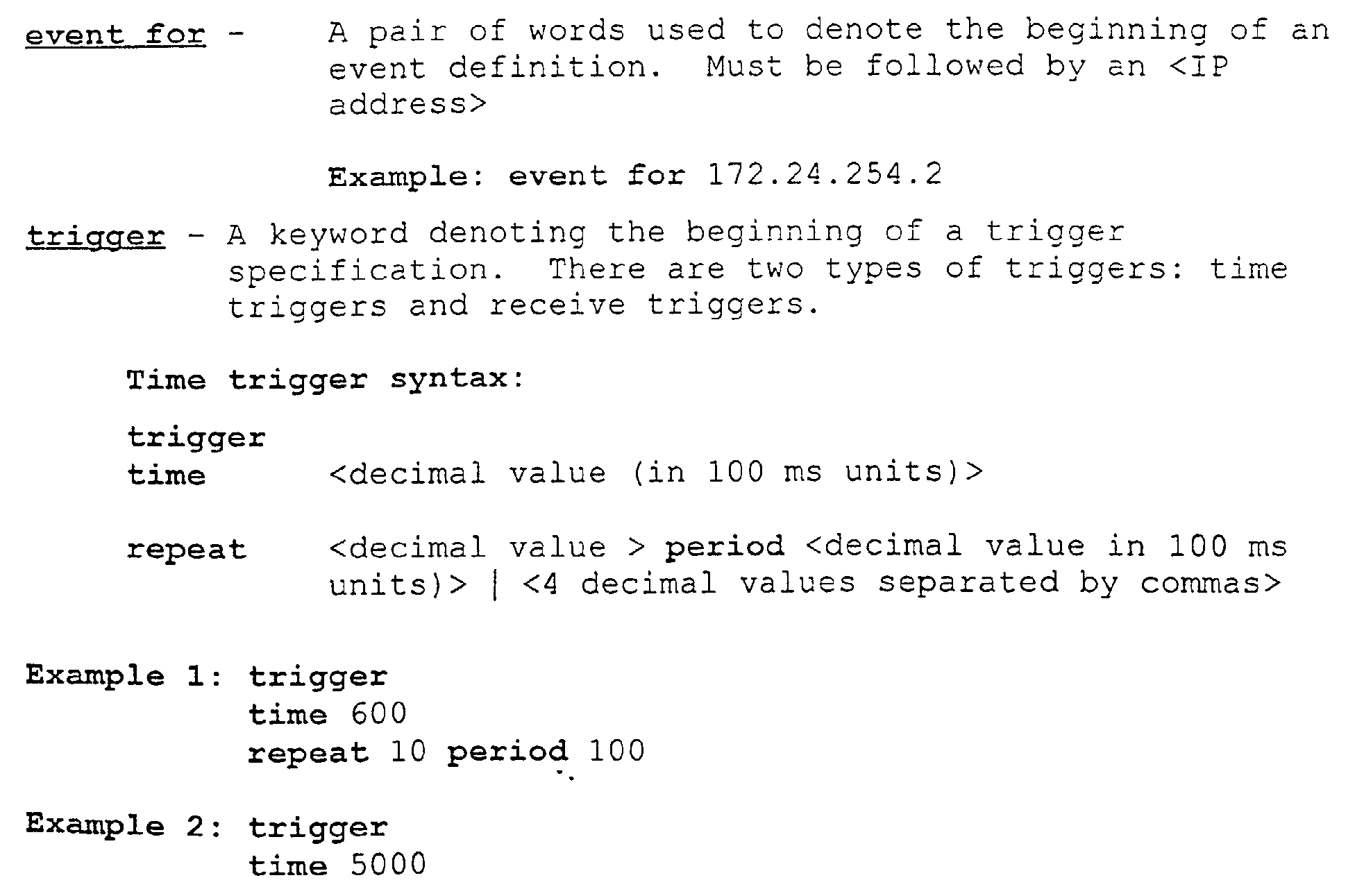
- the method provides a transmit command ("trigger time").
- the transmit command is capable of generating and transmitting an outgoing message from the node emulator to at least one destination node.
- the message contents may be specified by the transmit command.
- the transmit command may send one or more outgoing messages and may specify the start time of a transmission, the number of repetitions, and the time period between repetitions.
- the method provides a receive command ("listen") that receives incoming messages.
- the receive command may specify a destination port to listen on, may specify a protocol type (including embedded protocol types), may specify a multicast group address for a multicast, may specify a data contents of the packet to be received, etc.
- the method provides a response command ("trigger rcv from") that recognizes a response requirement in an incoming message and responds by transmitting a response outgoing message.
- the response command may respond according to a source address contained within the received packet. Additionally, the response command may respond according to a source port number, a protocol type of the incoming packet, a payload, and others.
- the emulation language may be used to generate an emulation script composed of one or more of the above commands.
- the emulation language is for human use and understanding.
- the emulation script may then be processed in an emulation language compiler that converts the emulation language script into a machine-readable set of instructions and data.
- the emulation language compiler translates time trigger commands, listen commands, and receive trigger commands, along with any associated command modifiers.
- the emulation language of the invention may be used to describe how a node behaves.
- the emulation language of the invention provides a syntax to specify general packet transmission and reception activity, as well as the details of the characteristics of those activities as related to any applicable communications protocol.
- Node emulation functions such as addresses, ports, type of service, precedence, transport protocol, time to live, and multicast addresses capture the protocol features.
- Node emulation functions such as triggering, repetitions, periodicity, absolute and relative time scales, capture all those features necessary to automate repetitive behavior over some period of time.
- Node emulation functions such as times, matching, and listening/receiving capture the action/reaction behavior in conjunction with specifying received data and how it is processed.
- Node emulation functions such as messages and patterns define the payload specifications.
- Node emulation functions such as embedded protocols capture higher level protocol integration.
- Node behavior is defined by the invention through an emulation language syntax and the semantic of emulation language operation in order to define nodes and node behavior.
- the invention utilizes a protocol stack to generate packets in accordance with the protocol. This gives the node emulator an ability to exchange packets as a standard node. Node behavior is captured because the emulation language enables both the frequency and the compositional aspects of node traffic to be expressed. These key features are paramount in providing the reactive and interactive components of node behavior.
- an emulation language In order to fully emulate node behavior, an emulation language must specify the underlying protocol details of a packet, specify the interactions necessary to exchange packets, and specify the interactions to be experienced by nodes as a result of engaging in a packet exchange.
- the emulation language of the invention allows for the scripting of traffic scenarios utilizing, for example, TCP/IP stack features in order to specify the underlying protocol details, to specify the interactions necessary to exchange packets, and to specify the interactions to be experienced by nodes.
- TCP/IP it is meant any implementation including a TCP protocol, an IP protocol, a TCP/IP protocol, a UDP protocol, etc.
- the emulation language of the invention comprises an event definition, followed by one or more commands and associated modifiers.
- the command syntax usually comprises a command followed by a number of modifiers.
- the emulation language is employed by generating an emulation script.
- the emulation script may be executed as it is generated (i.e., manually transmitting and receiving packets), or the emulation script may be stored and later executed.
- libraries of emulation scripts may be created and used as needed, with particular emulation scripts having particular functions.
- the emulation script will preferably lead off with a start command.
- the start command is optional, and it specifies a time of day in which the emulation script is to be activated.
- the time is preferably given in hours/minutes/seconds, and preferably in 24-hour military time.
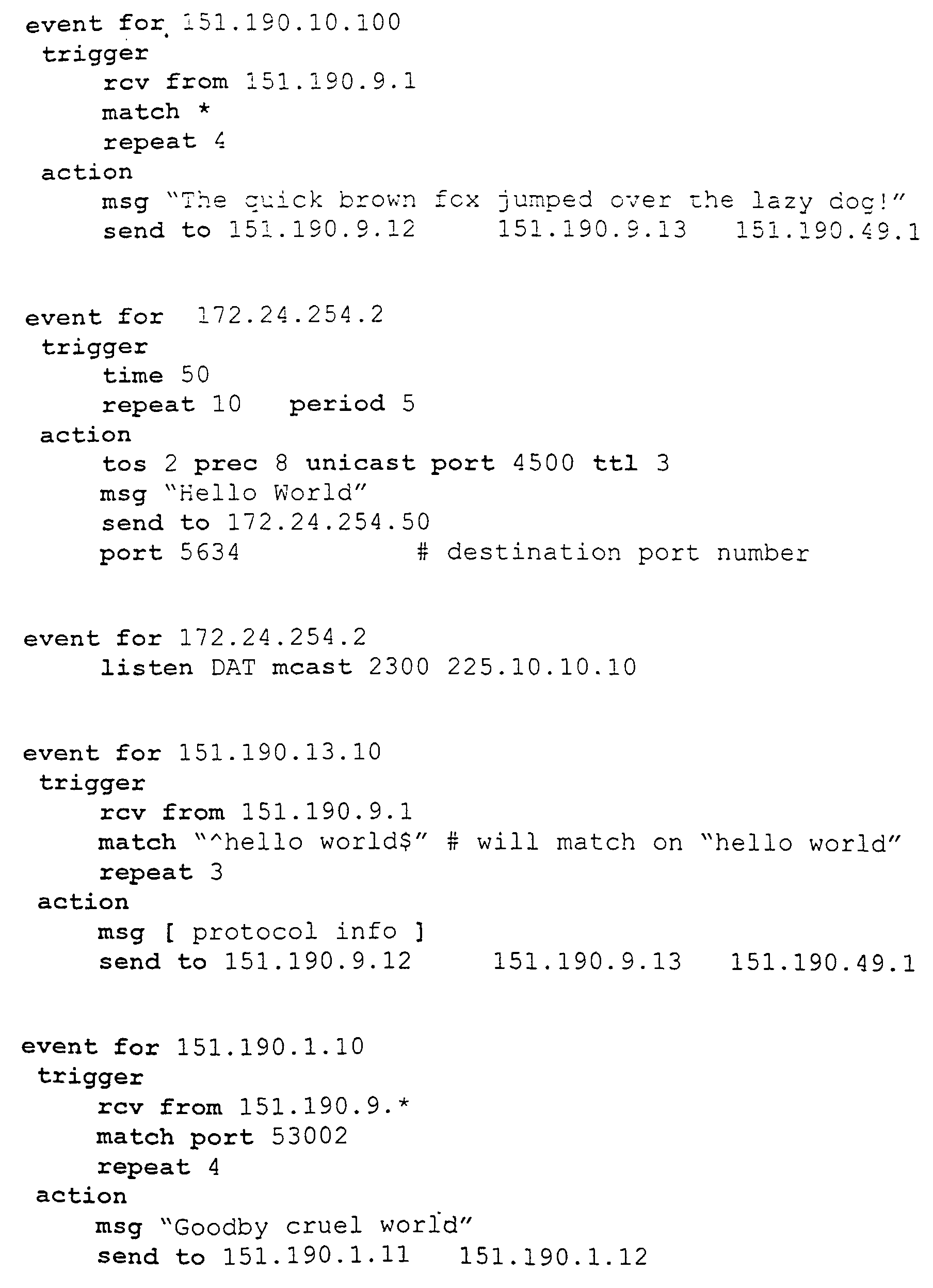
- the emulation script may contain, for example, one or more "event for" event definitions.
- the event definition delineates a new event, with an event being an action taken by the computer or computer device that is executing the emulation script. Therefore, an emulation script may include events such as an outgoing (transmitted) message, a series of outgoing messages, outgoing messages with different source addresses (emulating a plurality of virtual network nodes), receiving an incoming message, and responding to an incoming message by transmitting an outgoing message.
- events such as an outgoing (transmitted) message, a series of outgoing messages, outgoing messages with different source addresses (emulating a plurality of virtual network nodes), receiving an incoming message, and responding to an incoming message by transmitting an outgoing message.
- the "event for ⁇ IP address>” syntax denotes an event (specified below the "event for” line) that can occur for the specified address. Therefore, by employing multiple "event for" specifications, the node emulator is capable of including sets of events for many different nodes, with each node being capable of separating out the events that apply to it.
- a receive (“listen”) command a transmit (“trigger time”) command
- a response a response (trigger rcv from) command.
- a "listen" receive command enables the emulator to listen to (i.e., receive) all incoming packets that meet the listen criteria.
- the "trigger time” transmit command may generate an outgoing message upon the occurrence of a specific time.
- an emulation script may specify that an outgoing packet be transmitted at a specific time or periodically transmitted, starting at a specific time and repeating at a specified time period.
- the "trigger rcv from" response command is a reactive command that may be used to transmit an outgoing packet in response to a received incoming packet.
- Each command may be followed by one or more modifiers that specify parameters of an event, such as when the event is to happen, for example. If a parameter of a command is not specified through a modifier, the emulation language will employ a default value. In this manner, the emulation language is easy and economical to use.
- the emulation language depends on a system clock in the node emulator when transmitting on a specified time. Therefore, the system clocks in a network should be synchronized in order for the node emulator to properly implement and use the emulation language.
- the emulation language according to the invention preferably is not case or position sensitive.
- the position and spacing of commands and modifiers in an emulation script is free form as long as the sequence conforms to the emulation language grammar. Specifications of the emulation language grammar are illustrated in the examples below.
- the protocol keywords may include, for example, TXT, DAT, BIN and VMF.
- the "TXT” and “BIN” keywords do not result in any analyzable log-data being recorded (the data recorded can only be used for simple completion confirmation).
- the use of "DAT” and “VMF” keywords will result in valid log-data being recorded.
- the BIN keyword is special and the embedded protocol format uses the BIN keyword with the binary message specified between double quotes as two-byte, colon-separated, hexadecimal characters. All other max buffer size restrictions apply.
- the BIN keyword may be used as: msg [BIN "af:00:b5:c3"]
- protocol keywords in the embodiment above shows case-sensitivity. In this embodiment only capital letters should be used when specifying protocol keywords on the listen and other events. In general, the use of capital keywords also makes it easier to highlight differences among the events.
- the payload is a short string that must be specified after the listen keyword. It associates the type of data that will be listened to on that port. If no particular payload type is to be specified, the user should put the word "TXT" after the listen keyword.
- Valid payload types are not dictated by the emulation language compiler, and are network-driver implementation-dependent string values.
Landscapes
- Engineering & Computer Science (AREA)
- Computer Networks & Wireless Communication (AREA)
- Signal Processing (AREA)
- Data Exchanges In Wide-Area Networks (AREA)
- Computer And Data Communications (AREA)
Abstract
Description
TCP/IP also dictates a standard reception protocol. TCP/IP based data networks are a unique grouping of network elements or nodes that adhere to the TCP/IP protocol in order to communicate. Such networks include many nodes, with the nodes being connected by an underlying network infrastructure. The network infrastructure may participate in basic communications between nodes.
The transmit command is capable of generating and transmitting an outgoing message from the node emulator to at least one destination node. The message contents may be specified by the transmit command. In addition, the transmit command may send one or more outgoing messages and may specify the start time of a transmission, the number of repetitions, and the time period between repetitions.






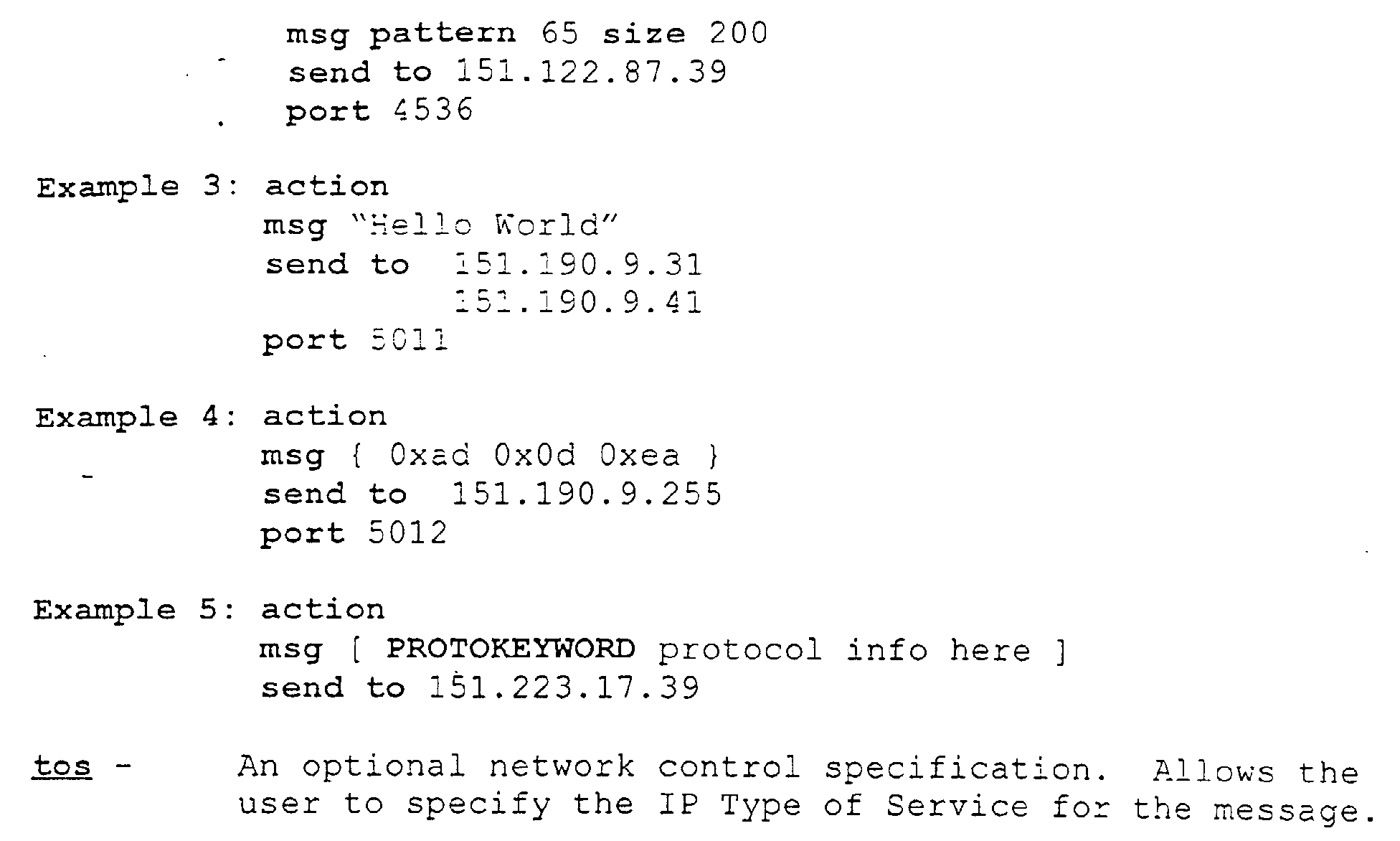
| Acceptable values for tos: | |
| 1 | Minimize Monetary Cost |
| 2 | Maximize Reliability |
| 4 | Maximize throughput (suggested default) |
| 8 | Minimize Delay |

| IP TOS Precedence Mappings | |
| 0 | Routine (suggested default) |
| 1 | Priority |
| 2 | Immediate |
| 3 | Flash |
| 4 | Flash Override |
| 5 | CRITIC/ECP |
| 6- | Internetwork Control |
| 7 | Network Control |


wherein said node emulator is capable of employing said emulation script to conduct interactions with said at least one network node.
Claims (10)
- A computer-implemented method of generating an emulated network node in a distributed electronic network, comprising the steps of:wherein an emulation script is used to determine behavior of said emulated network node.receiving an incoming message at said emulated network node;transmitting an outgoing message from said emulated network node; andrecognizing a response requirement in said incoming message and responding to said incoming message by transmitting a response outgoing message if said incoming message includes a response requirement;
- The method of claim 1, wherein said outgoing and incoming messages comprise data packets,
wherein preferably said method applies to a digital packet network,
wherein preferably said method is used to emulate a network behavior,
wherein preferably said method specifies a predetermined type of service,
wherein preferably said method specifies a message precedence,
wherein preferably said method specifies a protocol layer,
wherein preferably said method employs a predetermined network transport protocol,
wherein preferably said outgoing message includes a predetermined unicast network address,
wherein preferably said outgoing message includes a predetermined multicast address,
wherein preferably said outgoing message includes predetermined selective directed broadcast addresses,
wherein preferably said incoming message includes a predetermined network address,
wherein preferably said incoming message includes a predetermined network address and port,
wherein preferably said incoming message includes a predetermined source port,
wherein preferably said incoming message includes a predetermined protocol type,
wherein preferably said incoming message includes a predetermined payload,
wherein preferably said incoming message includes a wildcard payload,
wherein preferably said outgoing message is specified in a computer program and in a form dictated by an emulation language,
wherein preferably said outgoing message is specified by a manual operator and in a form dictated by an emulation language,
wherein preferably said response outgoing message is specified in a computer program and in a form dictated by an emulation language,
wherein preferably said response outgoing message is specified by a manual operator and in a form dictated by an emulation language,
wherein preferably said method specifies a time to live of an outgoing message,
wherein preferably said method specifies a predetermined trigger event that is capable of causing transmission of a corresponding predetermined outgoing message,
wherein preferably said method specifies a data included in said outgoing message,
wherein preferably said transmitting step includes periodically transmitting an outgoing message,
wherein preferably said method specifies a predetermined repetition number of a periodically transmitted outgoing message,
wherein preferably said method specifies a predetermined repetition time period of a periodically transmitted outgoing message,
wherein preferably said method specifies a pseudo random repetition time period of a periodically transmitted outgoing message,
wherein preferably said method specifies a listening mode of said emulated network node, said listening mode determining whether an incoming message will be received by said emulated network node,
wherein preferably said method specifies a predetermined data pattern in said outgoing message,
wherein preferably said method responds to any incoming message and transmits a response outgoing message,
wherein preferably said method compares a source address in an incoming message to a predetermined set of source addresses and transmits a response outgoing message if said source address in said incoming message is matched,
wherein preferably said method compares a protocol type in an incoming message to a predetermined protocol type and transmits a response outgoing message if said protocol type of said incoming message is matched,
wherein preferably said method compares a source port in an incoming message to a predetermined source port and transmits a response outgoing message if said source port in said incoming message is matched,
wherein preferably said method compares a regular expression in an incoming message to a predetermined regular expression and transmits a response outgoing message if said regular expression in said incoming message is matched,
wherein preferably said method generates a virtual node by transmitting an outgoing message containing a non-existent source address,
wherein preferably said method is capable of addressing a network node grouping. - A computer-implemented method of generating an emulated network node, comprising the steps of:wherein said computer device is capable of operating to receive an incoming message, transmit an outgoing message, and recognize a response requirement in said incoming message and responding to said incoming message by transmitting a response outgoing message if said incoming message includes a response requirement.generating an emulation script using a network node emulation language; andoperating a computer device according to said emulation script in order to transmit and receive data packets in said computer device;
- The method of claim 3, wherein said computer device is located within a network testbed,
wherein preferably said computer device is located within a distributed electronic network,
wherein preferably said computer device communicates with a network node under test,
wherein preferably said emulation script is stored in said computer device,
wherein preferably said emulation script is configurable by an operator during an emulation session,
wherein preferably the method further includes a step of compiling said emulation language script before said operating step. - A computer-implemented method of generating emulated communication between at least one network node and a node emulator, comprising the steps of:wherein an emulation language specifies said predetermined set of interactions, said protocol characteristics, and said node interactions, and is used to script behavior of said node emulator.specifying a predetermined set of interactions to be experienced by said at least one network node as a result of engaging in a packet exchange with said node emulator;specifying protocol characteristics of said packet exchange; andspecifying node interactions necessary to exchange packets between said at least one network node and said node emulator;
- The method of claim 5, wherein said at least one network node and said node emulator are included within a distributed electronic network,
wherein preferably said at least one network node and said node emulator are included within a distributed electronic network test bed,
wherein preferably said method employs a network protocol used by said at least one network node,
wherein preferably said method emulates a hardware configuration of said node emulator,
wherein preferably said predetermined set of interactions includes an outgoing message transmitted by said node emulator,
wherein preferably said predetermined set of interactions includes a periodic outgoing message transmitted by said node emulator,
wherein preferably said predetermined set of interactions includes a periodic outgoing message transmitted by said node emulator at predetermined times,
wherein preferably said predetermined set of interactions includes a periodic outgoing message transmitted by said node emulator at predetermined time periods,
wherein preferably said predetermined set of interactions includes an outgoing message having at least one predetermined destination address,
wherein preferably said predetermined set of interactions includes an incoming message received by said node emulator, wherein preferably said protocol characteristics includes a TCP/IP network protocol,
wherein preferably said protocol characteristics includes a TTL characteristic.
wherein preferably said protocol characteristics includes a TOS characteristic.
wherein preferably said protocol characteristics includes a precedence characteristic,
wherein preferably said node interactions include a response outgoing message transmitted by said node emulator to said at least one network node in response to an incoming message from said at least one network node,
wherein preferably said node interactions include comparing a source address in an incoming message to a predetermined set of source addresses and transmitting a response outgoing message if said source address is contained within said predetermined set of source addresses. - A computer-implemented method of providing a network node emulation language capable of generating an emulation script for emulating a network node, comprising the steps of:providing a transmit command capable of generating and transmitting an outgoing network message;providing a receive command capable of receiving an incoming network message; andproviding a response command capable of recognizing a response requirement in said incoming message and responding to said incoming message by transmitting a response outgoing message if said incoming message includes a response requirement.
- The method of claim 7, wherein preferably said method is capable of transmitting and receiving a unicast message,
wherein preferably said method is capable of transmitting and receiving a multicast message,
wherein preferably said method is capable of transmitting and receiving selective directed broadcast messages,
wherein prefesably said method is capable of transmitting and receiving a TCP/IP message,
wherein preferably said method specifies a protocol layer,
wherein preferably said transmit command is further capable of specifying a network address of a receiving device,
wherein preferably said transmit command is further capable of specifying a transmission protocol,
wherein preferably said transmit command is further capable of specifying a transmit time,
wherein preferably said transmit command is further capable of specifying a transmit repetition number,
wherein preferably said transmit command is further capable of specifying a transmit repetition time period,
wherein preferably said transmit command is further capable of specifying a pseudo random transmit repetition time period,
wherein preferably said receive command is further capable of specifying a destination address of a response outgoing message,
wherein preferably said receive command is further capable of specifying a source address of a packet to be received,
wherein preferably said receive command is further capable of specifying a reception protocol,
wherein preferably said receive command is further capable of specifying a payload,
wherein preferably said receive command is further capable of specifying a port number,
wherein preferably said method responds to any incoming message and transmits a response outgoing message,
wherein preferably said method compares a source address in an incoming message to a predetermined set of source addresses and transmits a response outgoing message if said source address in said incoming message is matched,
wherein preferably said method compares a protocol type in an incoming message to a predetermined protocol type and transmits a response outgoing message if said protocol type of said incoming message is matched,
wherein preferably said method compares a source port in an incoming message to a predetermined source port and transmits a response outgoing message if said source port in said incoming message is matched,
wherein preferably said method evaluates a payload in an incoming message with a predetermined regular expression and transmits a response outgoing message if said payload in said incoming message is evaluated with the predetermined regular expression to match true,
wherein preferably said method generates a virtual node by transmitting an outgoing message containing a non-existent source address. - A node emulator for conducting interactions with at least one network node, comprising:wherein said node emulator is capable of specifying a predetermined set of interactions to be experienced by said at least one network node as a result of engaging in a packet exchange between said at least one network node and said node emulator, specifying protocol characteristics of a packet exchange, and specifying node interactions necessary to exchange packets, anda network interface capable of transmitting and receiving packets over a distributed electronic network over which said at least one network node and said node emulator communicate;a memory; anda CPU, said CPU being capable of controlling said node emulator to receive an incoming message, to transmit an outgoing message, and to recognize a response requirement in said incoming message and respond to said incoming message by transmitting a response outgoing message if said emulated incoming message includes a response requirement;
wherein said node emulator is capable of employing said emulation script to conduct interactions with said at least one network node. - The node emulator of claim 9, wherein said memory is capable of storing a network protocol information, storing a node emulator hardware configuration, storing a network hardware and software configuration, storing network addresses, storing payloads, storing transmit times of outgoing messages, storing outgoing message repetitions, storing outgoing message repetition times, storing outgoing message transmission periods, storing receive triggers, storing response destination addresses, and storing an emulation script,
wherein preferably said memory additionally stores said network node emulation language,
wherein preferably the node emulator further includes a protocol stack,
wherein preferably the node emulator further includes an emulation language compiler.
wherein preferably the node emulator further includes at least one I/O device, and
wherein preferably the node emulator generates a virtual node by transmitting an outgoing message containing a non-existent source address.
Applications Claiming Priority (2)
| Application Number | Priority Date | Filing Date | Title |
|---|---|---|---|
| US711898 | 2000-11-15 | ||
| US09/711,898 US7596484B1 (en) | 2000-11-15 | 2000-11-15 | Network node emulator and method of node emulation |
Publications (2)
| Publication Number | Publication Date |
|---|---|
| EP1213875A2 true EP1213875A2 (en) | 2002-06-12 |
| EP1213875A3 EP1213875A3 (en) | 2003-08-13 |
Family
ID=24859962
Family Applications (1)
| Application Number | Title | Priority Date | Filing Date |
|---|---|---|---|
| EP01127051A Ceased EP1213875A3 (en) | 2000-11-15 | 2001-11-14 | Network node emulator and method of node emulation |
Country Status (2)
| Country | Link |
|---|---|
| US (1) | US7596484B1 (en) |
| EP (1) | EP1213875A3 (en) |
Cited By (2)
| Publication number | Priority date | Publication date | Assignee | Title |
|---|---|---|---|---|
| US7805287B1 (en) * | 2003-06-05 | 2010-09-28 | Verizon Laboratories Inc. | Node emulator |
| US7844432B1 (en) | 2003-06-05 | 2010-11-30 | Verizon Laboratories Inc. | Node emulator |
Families Citing this family (13)
| Publication number | Priority date | Publication date | Assignee | Title |
|---|---|---|---|---|
| CA2676374C (en) * | 2001-03-22 | 2015-09-29 | United Video Properties, Inc. | Personal video recorder systems and methods |
| US6782424B2 (en) * | 2002-08-23 | 2004-08-24 | Finite State Machine Labs, Inc. | System, method and computer program product for monitoring and controlling network connections from a supervisory operating system |
| US7877230B2 (en) * | 2007-03-15 | 2011-01-25 | Shunra Software Ltd. | System and method for attributing a portion of a response time to an element of a virtual network |
| US20080232263A1 (en) * | 2007-03-21 | 2008-09-25 | Amichai Lesser | System and method for correlating a network packet exchange with a period of a transaction |
| EP2107466A1 (en) * | 2008-03-31 | 2009-10-07 | Sony Corporation | Electronic device for emulating other electronic devices and method for operating an electronic device |
| US8522199B2 (en) * | 2010-02-26 | 2013-08-27 | Mcafee, Inc. | System, method, and computer program product for applying a regular expression to content based on required strings of the regular expression |
| GB2495293B (en) * | 2011-10-04 | 2014-12-17 | Canon Europa Nv | A method of connecting a device to a network, a system, and a program |
| KR101310609B1 (en) | 2012-03-30 | 2013-09-24 | 주식회사 이노와이어리스 | Device and method which generate data structure and interface using yaml |
| US9740708B2 (en) | 2012-05-01 | 2017-08-22 | Everbridge, Inc. | Systems and methods for distance and performance based load balancing |
| US9391855B2 (en) * | 2012-05-09 | 2016-07-12 | Everbridge, Inc. | Systems and methods for simulating a notification system |
| US8996917B1 (en) * | 2012-12-10 | 2015-03-31 | Google Inc. | Systems and methods for testing a central controller in a centrally managed network |
| CN113741407A (en) * | 2021-10-22 | 2021-12-03 | 长春一汽富晟集团有限公司 | CANoe-based automobile electronic product simulation test method |
| CN119806514B (en) * | 2024-12-25 | 2025-10-17 | 电子科技大学 | A lightweight code reusable framework for network protocol development |
Family Cites Families (24)
| Publication number | Priority date | Publication date | Assignee | Title |
|---|---|---|---|---|
| US4736320A (en) | 1985-10-08 | 1988-04-05 | Foxboro Company | Computer language structure for process control applications, and translator therefor |
| US5045994A (en) | 1986-09-23 | 1991-09-03 | Bell Communications Research, Inc. | Emulation process having several displayed input formats and output formats and windows for creating and testing computer systems |
| US5355496A (en) | 1992-02-14 | 1994-10-11 | Theseus Research, Inc. | Method and system for process expression and resolution including a generally and inherently concurrent computer language |
| JPH05216712A (en) | 1991-10-23 | 1993-08-27 | Internatl Business Mach Corp <Ibm> | Computer system, method for performing inner-viewing task on computer system and i/o processor assembly |
| US5303166A (en) | 1992-04-14 | 1994-04-12 | International Business Machines Corporation | Method and system for automated network benchmark performance analysis |
| US5835726A (en) | 1993-12-15 | 1998-11-10 | Check Point Software Technologies Ltd. | System for securing the flow of and selectively modifying packets in a computer network |
| US5822520A (en) * | 1995-12-26 | 1998-10-13 | Sun Microsystems, Inc. | Method and apparatus for building network test packets |
| US5774695A (en) * | 1996-03-22 | 1998-06-30 | Ericsson Inc. | Protocol interface gateway and method of connecting an emulator to a network |
| US5732213A (en) | 1996-03-22 | 1998-03-24 | Ericsson Inc. | System and method of testing open systems interconnection (OSI) layers in telecommunication networks |
| US5812780A (en) | 1996-05-24 | 1998-09-22 | Microsoft Corporation | Method, system, and product for assessing a server application performance |
| US5907696A (en) | 1996-07-03 | 1999-05-25 | Cabletron Systems, Inc. | Network device simulator |
| US5796633A (en) | 1996-07-12 | 1998-08-18 | Electronic Data Systems Corporation | Method and system for performance monitoring in computer networks |
| US5974572A (en) | 1996-10-15 | 1999-10-26 | Mercury Interactive Corporation | Software system and methods for generating a load test using a server access log |
| US5809250A (en) | 1996-10-23 | 1998-09-15 | Intel Corporation | Methods for creating and sharing replayable modules representive of Web browsing session |
| US6035264A (en) * | 1996-11-26 | 2000-03-07 | Global Maintech, Inc. | Electronic control system and method for externally controlling process in a computer system with a script language |
| US5889954A (en) * | 1996-12-20 | 1999-03-30 | Ericsson Inc. | Network manager providing advanced interconnection capability |
| US6074427A (en) | 1997-08-30 | 2000-06-13 | Sun Microsystems, Inc. | Apparatus and method for simulating multiple nodes on a single machine |
| US6295518B1 (en) * | 1997-12-09 | 2001-09-25 | Mci Communications Corporation | System and method for emulating telecommunications network devices |
| US6549882B1 (en) * | 1998-12-21 | 2003-04-15 | Cisco Technology, Inc. | Mechanisms for providing and using a scripting language for flexibly simulationg a plurality of different network protocols |
| US6330587B1 (en) * | 1998-12-21 | 2001-12-11 | Ford Global Technologies, Inc. | Real-time multiprocessing computer infrastructure for automated testing |
| US6532237B1 (en) * | 1999-02-16 | 2003-03-11 | 3Com Corporation | Apparatus for and method of testing a hierarchical PNNI based ATM network |
| US6772107B1 (en) * | 1999-11-08 | 2004-08-03 | J.D. Edwards World Source Company | System and method for simulating activity on a computer network |
| US6922663B1 (en) * | 2000-03-02 | 2005-07-26 | International Business Machines Corporation | Intelligent workstation simulation-client virtualization |
| US6832184B1 (en) * | 2000-03-02 | 2004-12-14 | International Business Machines Corporation | Intelligent work station simulation—generalized LAN frame generation simulation structure |
-
2000
- 2000-11-15 US US09/711,898 patent/US7596484B1/en not_active Expired - Fee Related
-
2001
- 2001-11-14 EP EP01127051A patent/EP1213875A3/en not_active Ceased
Cited By (2)
| Publication number | Priority date | Publication date | Assignee | Title |
|---|---|---|---|---|
| US7805287B1 (en) * | 2003-06-05 | 2010-09-28 | Verizon Laboratories Inc. | Node emulator |
| US7844432B1 (en) | 2003-06-05 | 2010-11-30 | Verizon Laboratories Inc. | Node emulator |
Also Published As
| Publication number | Publication date |
|---|---|
| US7596484B1 (en) | 2009-09-29 |
| EP1213875A3 (en) | 2003-08-13 |
Similar Documents
| Publication | Publication Date | Title |
|---|---|---|
| US6832184B1 (en) | Intelligent work station simulation—generalized LAN frame generation simulation structure | |
| US7596484B1 (en) | Network node emulator and method of node emulation | |
| Wang et al. | The design and implementation of the NCTUns 1.0 network simulator | |
| EP1482712B1 (en) | Virtual network addresses | |
| US6549882B1 (en) | Mechanisms for providing and using a scripting language for flexibly simulationg a plurality of different network protocols | |
| He et al. | Mapping peer behavior to packet-level details: A framework for packet-level simulation of peer-to-peer systems | |
| EP0947074B1 (en) | Network manager providing advanced interconnection capability | |
| US5732213A (en) | System and method of testing open systems interconnection (OSI) layers in telecommunication networks | |
| US8233399B2 (en) | Generic packet generator and method | |
| CN106126402B (en) | The processing method and processing device of accelerator exception | |
| US7006963B1 (en) | Intelligent workstation simulation-simulation at protocol stack level 2 | |
| Wang et al. | A simple methodology for constructing extensible and high-fidelity TCP/IP network simulators | |
| US20060039538A1 (en) | "Software only" tool for testing networks under high-capacity, real-world conditions | |
| JP2000508847A (en) | Protocol interface gateway | |
| CN112333019B (en) | Router configuration and test method and system and readable storage medium | |
| Ivey et al. | Comparing a scalable SDN simulation framework built on ns-3 and DCE with existing SDN simulators and emulators | |
| WO2001041365A1 (en) | Apparatus for simulating communication equipment | |
| US7526420B2 (en) | Method and system for virtual injection of network application codes into network simulation | |
| US20140078929A1 (en) | Automatic address configuration in a network test system | |
| Wang et al. | A new methodology for easily constructing extensible and high-fidelity tcp/ip network simulators | |
| Saha | Physical implementation and evaluation of ad hoc network routing protocols using unmodified simulation models | |
| Lai et al. | A simulation suite for accurate modeling of IPv6 protocols | |
| CN110048960B (en) | Distributed flow generation system with message response | |
| Pérennou et al. | Emulating opportunistic networks with kaunet triggers | |
| Wen et al. | A system architecture for managing complex experiments in wireless sensor networks |
Legal Events
| Date | Code | Title | Description |
|---|---|---|---|
| PUAI | Public reference made under article 153(3) epc to a published international application that has entered the european phase |
Free format text: ORIGINAL CODE: 0009012 |
|
| AK | Designated contracting states |
Kind code of ref document: A2 Designated state(s): AT BE CH CY DE DK ES FI FR GB GR IE IT LI LU MC NL PT SE TR |
|
| AX | Request for extension of the european patent |
Free format text: AL;LT;LV;MK;RO;SI |
|
| PUAL | Search report despatched |
Free format text: ORIGINAL CODE: 0009013 |
|
| AK | Designated contracting states |
Designated state(s): AT BE CH CY DE DK ES FI FR GB GR IE IT LI LU MC NL PT SE TR |
|
| AX | Request for extension of the european patent |
Extension state: AL LT LV MK RO SI |
|
| RIC1 | Information provided on ipc code assigned before grant |
Ipc: 7H 04L 29/06 B Ipc: 7H 04L 12/26 B Ipc: 7H 04L 12/24 A |
|
| 17P | Request for examination filed |
Effective date: 20040213 |
|
| AKX | Designation fees paid |
Designated state(s): AT BE CH CY DE DK ES FI FR GB GR IE IT LI LU MC NL PT SE TR |
|
| AXX | Extension fees paid |
Extension state: SI Payment date: 20040213 Extension state: RO Payment date: 20040213 Extension state: MK Payment date: 20040213 Extension state: LV Payment date: 20040213 Extension state: LT Payment date: 20040213 Extension state: AL Payment date: 20040213 |
|
| 17Q | First examination report despatched |
Effective date: 20060524 |
|
| APBN | Date of receipt of notice of appeal recorded |
Free format text: ORIGINAL CODE: EPIDOSNNOA2E |
|
| RIN1 | Information on inventor provided before grant (corrected) |
Inventor name: SALANT, NEIL K. Inventor name: PATEL, AMIT J. |
|
| APBR | Date of receipt of statement of grounds of appeal recorded |
Free format text: ORIGINAL CODE: EPIDOSNNOA3E |
|
| APAF | Appeal reference modified |
Free format text: ORIGINAL CODE: EPIDOSCREFNE |
|
| APAF | Appeal reference modified |
Free format text: ORIGINAL CODE: EPIDOSCREFNE |
|
| APBT | Appeal procedure closed |
Free format text: ORIGINAL CODE: EPIDOSNNOA9E |
|
| STAA | Information on the status of an ep patent application or granted ep patent |
Free format text: STATUS: THE APPLICATION HAS BEEN REFUSED |
|
| 18R | Application refused |
Effective date: 20110201 |