EP1213476A2 - Common rail injector with separately controlled pilot and main injection - Google Patents
Common rail injector with separately controlled pilot and main injection Download PDFInfo
- Publication number
- EP1213476A2 EP1213476A2 EP01123117A EP01123117A EP1213476A2 EP 1213476 A2 EP1213476 A2 EP 1213476A2 EP 01123117 A EP01123117 A EP 01123117A EP 01123117 A EP01123117 A EP 01123117A EP 1213476 A2 EP1213476 A2 EP 1213476A2
- Authority
- EP
- European Patent Office
- Prior art keywords
- fuel
- pressure
- injector
- needle
- valve
- Prior art date
- Legal status (The legal status is an assumption and is not a legal conclusion. Google has not performed a legal analysis and makes no representation as to the accuracy of the status listed.)
- Withdrawn
Links
- 238000002347 injection Methods 0.000 title claims abstract description 88
- 239000007924 injection Substances 0.000 title claims abstract description 88
- 239000000446 fuel Substances 0.000 claims abstract description 183
- 238000000034 method Methods 0.000 claims abstract description 8
- 239000012530 fluid Substances 0.000 claims description 55
- 230000007246 mechanism Effects 0.000 claims description 8
- 238000005086 pumping Methods 0.000 claims description 3
- 238000004891 communication Methods 0.000 description 9
- 238000002485 combustion reaction Methods 0.000 description 5
- 230000009471 action Effects 0.000 description 4
- 230000000977 initiatory effect Effects 0.000 description 3
- 238000010586 diagram Methods 0.000 description 2
- 238000007493 shaping process Methods 0.000 description 2
- 239000007921 spray Substances 0.000 description 2
- 230000008878 coupling Effects 0.000 description 1
- 238000010168 coupling process Methods 0.000 description 1
- 238000005859 coupling reaction Methods 0.000 description 1
- 230000003247 decreasing effect Effects 0.000 description 1
- 238000013461 design Methods 0.000 description 1
- 239000002828 fuel tank Substances 0.000 description 1
- 238000012986 modification Methods 0.000 description 1
- 230000004048 modification Effects 0.000 description 1
- 238000009428 plumbing Methods 0.000 description 1
- 230000004044 response Effects 0.000 description 1
- 238000004513 sizing Methods 0.000 description 1
- 230000001960 triggered effect Effects 0.000 description 1
Images


Classifications
-
- F—MECHANICAL ENGINEERING; LIGHTING; HEATING; WEAPONS; BLASTING
- F02—COMBUSTION ENGINES; HOT-GAS OR COMBUSTION-PRODUCT ENGINE PLANTS
- F02M—SUPPLYING COMBUSTION ENGINES IN GENERAL WITH COMBUSTIBLE MIXTURES OR CONSTITUENTS THEREOF
- F02M57/00—Fuel-injectors combined or associated with other devices
- F02M57/02—Injectors structurally combined with fuel-injection pumps
- F02M57/022—Injectors structurally combined with fuel-injection pumps characterised by the pump drive
- F02M57/025—Injectors structurally combined with fuel-injection pumps characterised by the pump drive hydraulic, e.g. with pressure amplification
-
- F—MECHANICAL ENGINEERING; LIGHTING; HEATING; WEAPONS; BLASTING
- F02—COMBUSTION ENGINES; HOT-GAS OR COMBUSTION-PRODUCT ENGINE PLANTS
- F02M—SUPPLYING COMBUSTION ENGINES IN GENERAL WITH COMBUSTIBLE MIXTURES OR CONSTITUENTS THEREOF
- F02M45/00—Fuel-injection apparatus characterised by having a cyclic delivery of specific time/pressure or time/quantity relationship
- F02M45/02—Fuel-injection apparatus characterised by having a cyclic delivery of specific time/pressure or time/quantity relationship with each cyclic delivery being separated into two or more parts
- F02M45/04—Fuel-injection apparatus characterised by having a cyclic delivery of specific time/pressure or time/quantity relationship with each cyclic delivery being separated into two or more parts with a small initial part, e.g. initial part for partial load and initial and main part for full load
-
- F—MECHANICAL ENGINEERING; LIGHTING; HEATING; WEAPONS; BLASTING
- F02—COMBUSTION ENGINES; HOT-GAS OR COMBUSTION-PRODUCT ENGINE PLANTS
- F02M—SUPPLYING COMBUSTION ENGINES IN GENERAL WITH COMBUSTIBLE MIXTURES OR CONSTITUENTS THEREOF
- F02M45/00—Fuel-injection apparatus characterised by having a cyclic delivery of specific time/pressure or time/quantity relationship
- F02M45/02—Fuel-injection apparatus characterised by having a cyclic delivery of specific time/pressure or time/quantity relationship with each cyclic delivery being separated into two or more parts
- F02M45/04—Fuel-injection apparatus characterised by having a cyclic delivery of specific time/pressure or time/quantity relationship with each cyclic delivery being separated into two or more parts with a small initial part, e.g. initial part for partial load and initial and main part for full load
- F02M45/08—Injectors peculiar thereto
-
- F—MECHANICAL ENGINEERING; LIGHTING; HEATING; WEAPONS; BLASTING
- F02—COMBUSTION ENGINES; HOT-GAS OR COMBUSTION-PRODUCT ENGINE PLANTS
- F02M—SUPPLYING COMBUSTION ENGINES IN GENERAL WITH COMBUSTIBLE MIXTURES OR CONSTITUENTS THEREOF
- F02M47/00—Fuel-injection apparatus operated cyclically with fuel-injection valves actuated by fluid pressure
- F02M47/02—Fuel-injection apparatus operated cyclically with fuel-injection valves actuated by fluid pressure of accumulator-injector type, i.e. having fuel pressure of accumulator tending to open, and fuel pressure in other chamber tending to close, injection valves and having means for periodically releasing that closing pressure
- F02M47/022—Mechanically actuated valves draining the chamber to release the closing pressure
-
- F—MECHANICAL ENGINEERING; LIGHTING; HEATING; WEAPONS; BLASTING
- F02—COMBUSTION ENGINES; HOT-GAS OR COMBUSTION-PRODUCT ENGINE PLANTS
- F02M—SUPPLYING COMBUSTION ENGINES IN GENERAL WITH COMBUSTIBLE MIXTURES OR CONSTITUENTS THEREOF
- F02M59/00—Pumps specially adapted for fuel-injection and not provided for in groups F02M39/00 -F02M57/00, e.g. rotary cylinder-block type of pumps
- F02M59/02—Pumps specially adapted for fuel-injection and not provided for in groups F02M39/00 -F02M57/00, e.g. rotary cylinder-block type of pumps of reciprocating-piston or reciprocating-cylinder type
- F02M59/10—Pumps specially adapted for fuel-injection and not provided for in groups F02M39/00 -F02M57/00, e.g. rotary cylinder-block type of pumps of reciprocating-piston or reciprocating-cylinder type characterised by the piston-drive
- F02M59/105—Pumps specially adapted for fuel-injection and not provided for in groups F02M39/00 -F02M57/00, e.g. rotary cylinder-block type of pumps of reciprocating-piston or reciprocating-cylinder type characterised by the piston-drive hydraulic drive
-
- F—MECHANICAL ENGINEERING; LIGHTING; HEATING; WEAPONS; BLASTING
- F02—COMBUSTION ENGINES; HOT-GAS OR COMBUSTION-PRODUCT ENGINE PLANTS
- F02M—SUPPLYING COMBUSTION ENGINES IN GENERAL WITH COMBUSTIBLE MIXTURES OR CONSTITUENTS THEREOF
- F02M63/00—Other fuel-injection apparatus having pertinent characteristics not provided for in groups F02M39/00 - F02M57/00 or F02M67/00; Details, component parts, or accessories of fuel-injection apparatus, not provided for in, or of interest apart from, the apparatus of groups F02M39/00 - F02M61/00 or F02M67/00; Combination of fuel pump with other devices, e.g. lubricating oil pump
- F02M63/02—Fuel-injection apparatus having several injectors fed by a common pumping element, or having several pumping elements feeding a common injector; Fuel-injection apparatus having provisions for cutting-out pumps, pumping elements, or injectors; Fuel-injection apparatus having provisions for variably interconnecting pumping elements and injectors alternatively
- F02M63/0225—Fuel-injection apparatus having a common rail feeding several injectors ; Means for varying pressure in common rails; Pumps feeding common rails
Definitions
- the present invention relates generally to fuel injectors, and more particularly to common rail systems with the ability to produce separate pilot and main injections.
- Common rail fuel injection systems have proven highly successful in diesel engine applications. Many of these injection systems use high pressure hydraulic fluid to actuate fuel injection. This has allowed great precision in controlling the initiation and termination of fuel injection, resulting in significant improvements in fuel efficiency and combustion burn quality over earlier systems. Furthermore, these systems have been shown to be highly versatile, allowing a great degree of control over injection rate shape.
- a common rail allows a simpler and more efficient fuel injection system design.
- a single pump can be used to pressurize fuel for injection.
- Using fuel itself as the actuation fluid can simplify the system further still.
- a separate delivery and return system for hydraulic fluid is no longer needed.
- the common rail is used to supply fuel for both combustion and injector actuation.
- these systems are not without problems.
- First, the use of high pressure fluid outside the injectors can result in fuel leakage to outside the system, creating serious safety concerns and compromising the systems' mechanical integrity.
- these injection systems often have difficulty producing separate pilot and main injections.
- prior art injection systems often do not offer adequately controlled injection initiation and termination when smaller volume injections are desired, such as during idle speed operation.
- the ability to reliably inject at different pressures in a single injection cycle is problematic.
- the present invention is directed to overcoming one or more of the problems and limitations set forth above.
- a fuel injector which includes an injector body, a fuel pressurization chamber, a nozzle chamber, a needle control chamber, a needle control spill outlet, a fuel inlet, and a nozzle outlet.
- a pressure intensifying pumping element is provided which has a large hydraulic surface exposed to fluid pressure in the actuation fluid cavity, and a small hydraulic surface that is exposed to fluid pressure in the fuel pressurization chamber.
- the needle control chamber is fluidly connected to the fuel inlet and the needle control spill outlet.
- a needle valve is positioned in the injector body and includes a closing hydraulic surface that is exposed to fluid pressure in the needle control chamber.
- a flow control valve is attached to the injector body that is moveable between a first position in which the actuation fluid cavity is open to the fuel inlet, and a second position in which the actuation fluid cavity is closed to the fuel inlet.
- a fuel injection system which includes a source of intermediate pressure fuel, a pressure intensifying pumping element, a flow control valve, and a low pressure reservoir.
- the fuel injection system also includes at least one fuel injector having a needle valve, and an injector body defining a needle control chamber fluidly connected to a needle control spill outlet and a fuel inlet, and a nozzle outlet.
- An intermediate pressure supply line extends between the source of intermediate pressure fuel and the fuel inlet.
- a low pressure vent line extends between the needle control spill outlet and the low pressure reservoir.
- a pressure release valve is positioned in the vent line and has a first position in which the vent line is closed, and a second position in which the vent line is open.
- a method of injecting fuel which includes the steps of injecting fuel at a high pressure at least in part by fluidly connecting a nozzle chamber of a fuel injector to a source of intermediate pressure fuel, and injecting the fuel at a high pressure at least in part by exposing a pressure intensifying element to the source of intermediate pressure fuel.
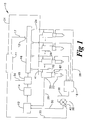
- Injection system 10 is controlled by an electronic control module 11 and includes a low pressure pump 14, an intermediate pressure pump 15, a common rail 16, and a plurality of fuel injectors 22. Injection system 10 also provides a flow control switch 18, a pressure reducing valve 20, and a low pressure reservoir 12, which is preferably the engine fuel tank. Injection system 10 circulates intermediate pressure fuel used to directly control pilot or idle speed fuel injection at the intermediate pressure, and hydraulically actuate main injection at a relatively high pressure.
- Low pressure pump 14 supplies fuel from low pressure reservoir 12 to intermediate pressure pump 15, which pressurizes fuel and transfers it to common rail 16.
- a plurality of supply lines 24 supply fuel to a plurality of fuel injectors 22.
- Fuel pressure in common rail 16 is communicated via pressure sensor line 17 to electronic control module 11, and is preferably maintained between 20 and 40 MPa.
- Fuel enters an injector 22 via a fuel inlet 41, and is then supplied to various parts of the injector 22 where it is injected, used to directly control a pilot injection, or to hydraulically actuate main injection.
- Fuel used as actuation fluid drains out of the injector 22 through a low pressure fuel drain 33 from which it is returned to the low pressure fuel reservoir 12 for recirculation via a low pressure drain line 26, only one of which is shown.
- a needle control spill outlet 87 is provided which vents the fuel pressure used to directly control pilot injection. Fuel draining from spill outlet 87 passes via a control pressure line 28 to the flow control switch 18.
- FIG. 1 there is shown a sectioned diagram of the flow control switch 18 for use with fuel injectors 22 of fuel injection system 10 from Figure 1.
- flow control switch 18 Within flow control switch 18 are a number of spring biased flow control valve members 25, equal to the number of fuel injectors 22 included in fuel injection system 10.
- Each valve member 25 is biased toward a first position by a biasing spring 27, and includes a contact surface 23 which is preferably a convex surface.
- a cam 19 is included which can be rotated at half engine speed and is attached to the engine. As cam 19 rotates, a contact platform 21 is rotated which comes in contact with contact surface 23 of valve member 25.
- Contact platform 21 preferably includes sloped sides such that it can move smoothly over contact surface 23, moving valve member 25 to its second position.
- valve member 25 When valve member 25 is in its biased, first position, an annulus 31 included on valve member 25 is out of fluid communication with a drain passage 29 and a main passage 30 (vent line 30 from Figure 1), which connects to pressure release valve 20.
- valve member 23 When valve member 23 is in its second position, annulus 31 provides fluid communication between main passage 30 and drain passage 29, which is connected to one of the low pressure lines 28.
- annulus 31 When annulus 31 is open to low pressure line 28 of a particular fuel injector 22, that fuel injector 22 is fluidly connected to vent line 30. Because of cam 19's rotation, flow control switch 18 has a plurality of positions, each of which exposes the low pressure line 28 of a different injector 22 to a vent line 30, which fluidly connects to pressure release valve 20.
- Pressure release valve 20 is positioned in vent line 30 and includes an electrical actuator 42 that moves it between an open and a closed position. Pressure release valve 20's electrical actuator is controlled with electronic control module 11, allowing fluid in vent line 30 to drain into low pressure reservoir 12 when valve 20 is opened.
- the rotation speed of cam 19 is preferably such that the length of time during which the low pressure line 28 of any given injector is in fluid communication with vent line 30, spanning a time period that could accommodate any injection event.
- Electronic control module 11 controls the operation of the pressure intensifying aspect of each fuel injector 22 via a communication line 34 in a conventional manner, and also controls the pressure in the common rail 16 in a conventional manner, such as by control output of pump 15 via pump control line 36.
- the pressure in the common rail 16 is communicated to the electronic control module 11 from an attached pressure sensor 13 via pressure sensor line 17. Because the electronic control module 11 is also connected to intermediate pressure pump 15, intermediate pressure pump 15 can be precisely controlled to maintain the desired pressure in the common rail 16. Because pressure release valve 20's electrical actuator 42 is also controlled by electronic control module 11, via a control line 35, the open or shut state of pressure release valve 20 can also be precisely controlled.
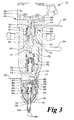
- FIG. 3 there is shown a diagrammatic sectioned side view of a fuel injector 22 shown as part of injection system 10 in Figure 1.
- Injector 22 has an injector body 40 and includes a flow control valve assembly 44, a pressure intensifying mechanism 70, and a needle valve 80.
- flow control valve assembly 44 is attached to injector body 40, though it should be appreciated that it could be positioned remote from injector body 40 without departing from the scope of the present invention.
- Flow control valve assembly 44 includes an electrical actuator 46 and a flow control valve 60.
- Electrical actuator 46 which is preferably a solenoid but could be some other suitable device such as a piezoelectric actuator, includes a coil 48 and an armature 50.
- Flow control valve 60 includes a valve member 61, which is attached to armature 50 of solenoid 46 with a screw 52. Energizing or deenergizing solenoid 46 moves valve member 61 between a first position in which it closes a low pressure seat 64, and a second position in which it closes an intermediate pressure seat 66.
- Injector body 40 defines an intermediate pressure passage 43 and an actuation fluid cavity 45 which are in fluid communication when valve member 61 is in its first position.
- actuation fluid cavity 45 is fluidly connected to a low pressure fuel drain 47, also defined by injector body 40.
- Low pressure fuel drain 47 connects via outlet 33 to drain line 26 which drains into low pressure reservoir 12.
- a biasing spring 62 biases valve member 61 toward its second position, such that intermediate pressure seat 66 is shut when solenoid 46 is de-energized.
- the strength of biasing spring 62 should be sufficient to hold valve member 61 against intermediate pressure seat 66 in spite of the constant intermediate pressure in intermediate pressure passage 43.
- a first nozzle supply passage 32 branches from passage 43 to provide a continuous intermediate pressure supply of fuel to nozzle chamber 81.
- the pressure intensifying mechanism 70 is positioned within injector body 40 and includes a piston 72 which is attached to a plunger 74.
- a relatively large hydraulic surface 71 on piston 72 is exposed to fluid pressure in actuation fluid cavity 45.
- a relatively small hydraulic surface 73 on the bottom of plunger 74 is exposed to fluid pressure in a fuel pressurization chamber 75.
- the alternately intermediate pressure or low pressure on the large hydraulic surface 71 of piston 72 from actuation fluid cavity 45 causes piston 72 and hence plunger 74 to move between an up position and a down position.
- a biasing spring 76 biases piston 72 toward its up position.
- the strength of biasing spring 76 is preferably such that it can move piston 72 and plunger 74 toward their up position when low pressure prevails in actuation fluid cavity 45.
- hydraulic surface 71 should be such that when intermediate pressure prevails in actuation fluid cavity 45, piston 72 and plunger 74 are forced down to compress fuel in fuel pressurization chamber 75.
- biasing spring 76 can move piston 72 and plunger 74 toward their up position, drawing fuel into fuel pressurization chamber 75 from a second nozzle supply passage 77 and expelling used actuation fuel into drain 47.
- Fuel pressurization chamber 75 connects via second nozzle supply passage 77 to a nozzle chamber 81 which is defined by injector body 40.
- First nozzle supply passage 32 extends between fuel inlet 41 and a nozzle chamber 81, also defined by injector body 40, and supplies intermediate pressure fuel from intermediate pressure fuel supply line 24 to nozzle chamber 81.
- a check valve 90 is positioned within first nozzle supply passage 32 between inlet 41 and the junction 78 with second nozzle supply passage 77. Check valve 90 allows fuel to flow from inlet 41 toward nozzle chamber 81, but blocks flow from fuel pressurization chamber 75 back up the passage toward inlet 41.
- Needle valve 80 provides a needle valve member 82 which is moveable between an up position in which a nozzle outlet 89 is open and a down position in which it holds nozzle outlet 89 shut.
- Needle valve member 82 has been illustrated as a two piece valve member, although a one piece valve member might be substituted without departing from the scope of the present invention by moving spring 84 into chamber 85, or by eliminating spring 84 altogether.
- Needle valve member 82 has an opening hydraulic surface 93 which is exposed to fluid pressure from first nozzle supply passage 32 in nozzle chamber 81. Needle valve member 82 also has a closing hydraulic surface 86 which is exposed to fluid pressure in a needle control chamber 85, which is defined by injector body 40.
- a biasing spring 84 biases needle valve member 82 toward its down position.
- Needle valve member 82 and needle control chamber 85 are preferably sized such that a match clearance exists between valve member 82 and injector body 40. Preferably, this will prevent fuel from flowing around needle valve member 82 toward biasing spring 84. However, because some fuel leakage into the region around biasing spring 84 is possible, injector body 40 preferably defines a vent passage 83 that allows any fuel that might accumulate around biasing spring 84 to be expelled.
- Needle valve 80 has a valve opening pressure (VOP) which is defined in part by the pressures in nozzle chamber 81 and needle control chamber 85, and also in part by the strength of biasing spring 84.
- a branch passage 79 fluidly connects needle control chamber 85 and first nozzle supply passage 32. Needle control chamber 85 is also fluidly connected to a spill passage 88 that connects via outlet 87 to a low pressure line 28. Low pressure line 28 connects to the flow control switch 18 from Figures 1 and 2.
- Needle control chamber 85 of injector 22 can be fluidly connected via flow control switch 18 and pressure reducing valve 20 with low pressure reservoir 12. By opening valve 20 the pressure in control chamber 85 can be reduced relatively quickly. Similarly, the pressure in needle control chamber 85 can be increased relatively quickly by closing pressure reducing valve 20.
- a first flow restriction orifice 91 is positioned where branch passage 79 opens to needle control chamber 85, and is sized to communicate pressure changes while simultaneously limiting flow volume through needle control chamber 85.
- a second flow restriction orifice 92 connects needle control chamber 85 with spill passage 88.
- the diameter of first flow restriction orifice 91 is preferably smaller than the diameter of second flow restriction orifice 92 to ensure that sufficient pressure drop in needle control chamber 85 occurs when pressure reducing valve 20 is opened.
- the sizing of hydraulic surfaces 93 and 86, the strength of biasing spring 84, and the fluid pressure in rail 16 should be such that the VOP in nozzle chamber 81 is reached and needle valve member 82 can be lifted away from nozzle outlet 89 when the pressure in needle control chamber 85 is reduced by opening pressure reducing valve 20.
- the closing of valve 20 should return sufficient pressure to needle control chamber 85 to force needle valve member 82 down to shut nozzle outlet 89.
- fuel injector 22 is shown with its various components in the positions they would occupy just prior to the initiation of a fuel injection event.
- Solenoid 46 is de-energized, flow control valve member 61 is in its second position, closing intermediate pressure seat 66.
- Actuation fluid cavity 45 is exposed to low pressure from fuel drain 47, and piston 72 and plunger 74 are biased toward their up position.
- Nozzle chamber 81 is supplied with pressurized fuel from rail 16 via passage 32. Fluid pressure in needle control chamber 85 and the force of biasing spring 84 act to hold needle valve member 82 in its down position, closing nozzle outlet 89.
- flow control switch 18 is shown in a position providing fluid communication between low pressure line 28 of a fuel injector 22 and vent line 30.
- pressure reducing valve 20 is opened.
- pressure reducing valve 20 is controlled with an electrical actuator that is preferably a solenoid, though some other suitable means or device such as a piezoelectric actuator might be used to open and close valve 20.
- needle valve 80 when the pressure in needle control chamber 85 drops, the relatively constant hydraulic pressure acting on needle opening hydraulic surface 93 is sufficient to open needle valve 80, and allow fuel to spray out nozzle outlet 89. Recall that a relatively constant medium hydraulic pressure is supplied to nozzle chamber 81 from the common rail 16.
- current to pressure reducing valve 20 is stopped, and valve 20 closes. Because needle control chamber 85's fluid connection with low pressure reservoir 12 is closed, pressurized fuel entering needle control chamber 85 via branch passage 79 causes the pressure in needle control chamber 85 to rise relatively quickly. As the pressure in needle control chamber 85 rises, the hydraulic force exerted on needle closing hydraulic surface 86 forces needle valve member 82 down, closing nozzle outlet 89 and ending injection.
- needle valve 80 could be hydraulically balanced, and held in its closed position under the action of spring 84.
- FIGs 4-8 there are shown a variety of graphical illustrations of the positioning of fuel injection system components during injection events, the sac 100 pressure, and the rate shape of fuel injection itself.
- a graph representing the position (x) of the pressure release valve 20 over the time (t) of a pilot injection. Pressure release valve 20 is opened at “1” and closed at “2.”
- Figure 5 is a graph of the position (y) of flow control valve member 61 over the time (t) of a main injection event.
- FIG. 6 is a graph of the sac 100 pressure (p) over the time (t) of a pilot-main injection sequence. Because needle valve member 82 is biased against nozzle outlet 89, the nozzle sac 100 is isolated from nozzle chamber 81, and the pressure in sac 100 is zero between injection events. When a pilot injection is initiated, at “7,” the sac 100 pressure rises. When the pilot injection is terminated, at “8,” the sac 100 pressure falls back to zero.
- FIG. 7 is a graph illustrating the position (z) of the pressure intensifying plunger 74 during the time (t) of the injection event. Piston 72 and plunger 74 begin to move downward to pressurize fuel at "11" shortly after flow control valve member 61 reaches its first position. When flow control valve member 61 begins to move back to its second position, at “12,” the pressure in actuation fluid cavity 45 drops, and piston 72 and plunger 74 begin to move to their retracted, up, position.
- Figure 8 is a graph illustrating the mass flow rate (v) through nozzle outlet 89 over the time (t) of a pilot injection (A) followed by a main injection (B).
- the present invention helps to improve fuel efficiency and combustion burn quality by allowing separate control over pilot and main fuel injections.
- relatively small injections using only rail pressure can be directly controlled by opening and closing pressure release valve 20.
- larger main injections at a relatively high pressure can be made using pressure intensification mechanism 70.
- the injection of a small pilot quantity of fuel, followed by a main injection, or even a main injection followed by a pilot injection might be desirable.
- the present invention not only allows separate control over pilot and main injection, but provides greater versatility in injection rate shaping over prior art injectors by allowing the timing of the two injection types to be varied, producing square or ramp shaped injection rate profiles. For example, a small pilot injection might be initiated and a larger main injection triggered before cessation of the pilot injection.
Landscapes
- Engineering & Computer Science (AREA)
- Chemical & Material Sciences (AREA)
- Combustion & Propulsion (AREA)
- Mechanical Engineering (AREA)
- General Engineering & Computer Science (AREA)
- Physics & Mathematics (AREA)
- Fluid Mechanics (AREA)
- Fuel-Injection Apparatus (AREA)
Abstract

Description
- The present invention relates generally to fuel injectors, and more particularly to common rail systems with the ability to produce separate pilot and main injections.
- Common rail fuel injection systems have proven highly successful in diesel engine applications. Many of these injection systems use high pressure hydraulic fluid to actuate fuel injection. This has allowed great precision in controlling the initiation and termination of fuel injection, resulting in significant improvements in fuel efficiency and combustion burn quality over earlier systems. Furthermore, these systems have been shown to be highly versatile, allowing a great degree of control over injection rate shape.
- The use of a common rail allows a simpler and more efficient fuel injection system design. A single pump can be used to pressurize fuel for injection. Using fuel itself as the actuation fluid can simplify the system further still. A separate delivery and return system for hydraulic fluid is no longer needed. Instead, the common rail is used to supply fuel for both combustion and injector actuation. However, these systems are not without problems. First, the use of high pressure fluid outside the injectors can result in fuel leakage to outside the system, creating serious safety concerns and compromising the systems' mechanical integrity. Second, these injection systems often have difficulty producing separate pilot and main injections. Third, prior art injection systems often do not offer adequately controlled injection initiation and termination when smaller volume injections are desired, such as during idle speed operation. Fourth, the ability to reliably inject at different pressures in a single injection cycle is problematic.
- The present invention is directed to overcoming one or more of the problems and limitations set forth above.
- In one aspect of the present invention, a fuel injector is provided which includes an injector body, a fuel pressurization chamber, a nozzle chamber, a needle control chamber, a needle control spill outlet, a fuel inlet, and a nozzle outlet. A pressure intensifying pumping element is provided which has a large hydraulic surface exposed to fluid pressure in the actuation fluid cavity, and a small hydraulic surface that is exposed to fluid pressure in the fuel pressurization chamber. The needle control chamber is fluidly connected to the fuel inlet and the needle control spill outlet. A needle valve is positioned in the injector body and includes a closing hydraulic surface that is exposed to fluid pressure in the needle control chamber. A flow control valve is attached to the injector body that is moveable between a first position in which the actuation fluid cavity is open to the fuel inlet, and a second position in which the actuation fluid cavity is closed to the fuel inlet.
- In another aspect, a fuel injection system is provided which includes a source of intermediate pressure fuel, a pressure intensifying pumping element, a flow control valve, and a low pressure reservoir. The fuel injection system also includes at least one fuel injector having a needle valve, and an injector body defining a needle control chamber fluidly connected to a needle control spill outlet and a fuel inlet, and a nozzle outlet. An intermediate pressure supply line extends between the source of intermediate pressure fuel and the fuel inlet. A low pressure vent line extends between the needle control spill outlet and the low pressure reservoir. A pressure release valve is positioned in the vent line and has a first position in which the vent line is closed, and a second position in which the vent line is open.
- In still another aspect, a method of injecting fuel is provided which includes the steps of injecting fuel at a high pressure at least in part by fluidly connecting a nozzle chamber of a fuel injector to a source of intermediate pressure fuel, and injecting the fuel at a high pressure at least in part by exposing a pressure intensifying element to the source of intermediate pressure fuel.
-
- Figure 1 is a system level schematic representation of a fuel injection system according to the present invention;
- Figure 2 is a sectioned side diagrammatic view of a flow control switch for use with the fuel injection system of the present invention;
- Figure 3 is a sectioned side diagrammatic side view of a fuel injector according to the present invention;
- Figure 4 is a graph of the pressure release valve position versus time during an example injection event;
- Figure 5 is a graph of the flow control valve position versus time;
- Figure 6 is a graph of sac fuel pressure versus time;
- Figure 7 is a graph of pressure intensifying element position versus time; and
- Figure 8 is a graph of the injection mass flow rate versus time.
-
- Referring now to Figure 1, there is shown a system level diagram representing a
fuel injection system 10 according to the present invention.Injection system 10 is controlled by anelectronic control module 11 and includes alow pressure pump 14, anintermediate pressure pump 15, acommon rail 16, and a plurality offuel injectors 22.Injection system 10 also provides aflow control switch 18, a pressure reducing valve 20, and alow pressure reservoir 12, which is preferably the engine fuel tank.Injection system 10 circulates intermediate pressure fuel used to directly control pilot or idle speed fuel injection at the intermediate pressure, and hydraulically actuate main injection at a relatively high pressure. -
Low pressure pump 14 supplies fuel fromlow pressure reservoir 12 tointermediate pressure pump 15, which pressurizes fuel and transfers it tocommon rail 16. From thecommon rail 16, a plurality ofsupply lines 24 supply fuel to a plurality offuel injectors 22. Fuel pressure incommon rail 16 is communicated viapressure sensor line 17 toelectronic control module 11, and is preferably maintained between 20 and 40 MPa. Fuel enters aninjector 22 via afuel inlet 41, and is then supplied to various parts of theinjector 22 where it is injected, used to directly control a pilot injection, or to hydraulically actuate main injection. Fuel used as actuation fluid drains out of theinjector 22 through a lowpressure fuel drain 33 from which it is returned to the lowpressure fuel reservoir 12 for recirculation via a lowpressure drain line 26, only one of which is shown. A needlecontrol spill outlet 87 is provided which vents the fuel pressure used to directly control pilot injection. Fuel draining fromspill outlet 87 passes via acontrol pressure line 28 to theflow control switch 18. - Referring in addition to Figure 2, there is shown a sectioned diagram of the
flow control switch 18 for use withfuel injectors 22 offuel injection system 10 from Figure 1. Withinflow control switch 18 are a number of spring biased flowcontrol valve members 25, equal to the number offuel injectors 22 included infuel injection system 10. Eachvalve member 25 is biased toward a first position by a biasingspring 27, and includes acontact surface 23 which is preferably a convex surface. Acam 19 is included which can be rotated at half engine speed and is attached to the engine. Ascam 19 rotates, acontact platform 21 is rotated which comes in contact withcontact surface 23 ofvalve member 25.Contact platform 21 preferably includes sloped sides such that it can move smoothly overcontact surface 23, movingvalve member 25 to its second position. Whenvalve member 25 is in its biased, first position, anannulus 31 included onvalve member 25 is out of fluid communication with adrain passage 29 and a main passage 30 (vent line 30 from Figure 1), which connects to pressure release valve 20. Whenvalve member 23 is in its second position,annulus 31 provides fluid communication betweenmain passage 30 anddrain passage 29, which is connected to one of thelow pressure lines 28. Whenannulus 31 is open tolow pressure line 28 of aparticular fuel injector 22, thatfuel injector 22 is fluidly connected tovent line 30. Because ofcam 19's rotation,flow control switch 18 has a plurality of positions, each of which exposes thelow pressure line 28 of adifferent injector 22 to avent line 30, which fluidly connects to pressure release valve 20. Pressure release valve 20 is positioned invent line 30 and includes anelectrical actuator 42 that moves it between an open and a closed position. Pressure release valve 20's electrical actuator is controlled withelectronic control module 11, allowing fluid invent line 30 to drain intolow pressure reservoir 12 when valve 20 is opened. The rotation speed ofcam 19 is preferably such that the length of time during which thelow pressure line 28 of any given injector is in fluid communication withvent line 30, spanning a time period that could accommodate any injection event. -
Electronic control module 11 controls the operation of the pressure intensifying aspect of eachfuel injector 22 via acommunication line 34 in a conventional manner, and also controls the pressure in thecommon rail 16 in a conventional manner, such as by control output ofpump 15 viapump control line 36. The pressure in thecommon rail 16 is communicated to theelectronic control module 11 from an attachedpressure sensor 13 viapressure sensor line 17. Because theelectronic control module 11 is also connected tointermediate pressure pump 15,intermediate pressure pump 15 can be precisely controlled to maintain the desired pressure in thecommon rail 16. Because pressure release valve 20'selectrical actuator 42 is also controlled byelectronic control module 11, via acontrol line 35, the open or shut state of pressure release valve 20 can also be precisely controlled. - Referring now to Figure 3, there is shown a diagrammatic sectioned side view of a
fuel injector 22 shown as part ofinjection system 10 in Figure 1.Injector 22 has aninjector body 40 and includes a flow control valve assembly 44, apressure intensifying mechanism 70, and aneedle valve 80. In the preferred embodiment, flow control valve assembly 44 is attached toinjector body 40, though it should be appreciated that it could be positioned remote frominjector body 40 without departing from the scope of the present invention. Flow control valve assembly 44 includes anelectrical actuator 46 and aflow control valve 60.Electrical actuator 46, which is preferably a solenoid but could be some other suitable device such as a piezoelectric actuator, includes a coil 48 and anarmature 50.Flow control valve 60 includes avalve member 61, which is attached to armature 50 ofsolenoid 46 with ascrew 52. Energizing ordeenergizing solenoid 46moves valve member 61 between a first position in which it closes alow pressure seat 64, and a second position in which it closes anintermediate pressure seat 66.Injector body 40 defines anintermediate pressure passage 43 and anactuation fluid cavity 45 which are in fluid communication whenvalve member 61 is in its first position. Whenvalve member 61 is in its second position,actuation fluid cavity 45 is fluidly connected to a lowpressure fuel drain 47, also defined byinjector body 40. Lowpressure fuel drain 47 connects viaoutlet 33 to drainline 26 which drains intolow pressure reservoir 12. A biasingspring 62biases valve member 61 toward its second position, such thatintermediate pressure seat 66 is shut whensolenoid 46 is de-energized. The strength of biasingspring 62 should be sufficient to holdvalve member 61 againstintermediate pressure seat 66 in spite of the constant intermediate pressure inintermediate pressure passage 43. A firstnozzle supply passage 32 branches frompassage 43 to provide a continuous intermediate pressure supply of fuel tonozzle chamber 81. Those skilled in the art will appreciate that the described configuration and features of control valve assembly 44 might be modified significantly without departing from the intended scope of the present invention. For example, a pilot operated valve assembly might be employed rather than directly coupling the flowcontrol valve member 61 to theelectrical actuator armature 50. Further, a spool valve might be substituted for thepoppet valve 60 shown. - The
pressure intensifying mechanism 70 is positioned withininjector body 40 and includes apiston 72 which is attached to aplunger 74. A relatively largehydraulic surface 71 onpiston 72 is exposed to fluid pressure inactuation fluid cavity 45. A relatively smallhydraulic surface 73 on the bottom ofplunger 74 is exposed to fluid pressure in afuel pressurization chamber 75. The alternately intermediate pressure or low pressure on the largehydraulic surface 71 ofpiston 72 fromactuation fluid cavity 45 causespiston 72 and hence plunger 74 to move between an up position and a down position. A biasingspring 76biases piston 72 toward its up position. The strength of biasingspring 76 is preferably such that it can movepiston 72 andplunger 74 toward their up position when low pressure prevails inactuation fluid cavity 45. The size ofhydraulic surface 71 should be such that when intermediate pressure prevails inactuation fluid cavity 45,piston 72 andplunger 74 are forced down to compress fuel infuel pressurization chamber 75. When low pressure is returned toactuation fluid cavity 45, biasingspring 76 can movepiston 72 andplunger 74 toward their up position, drawing fuel intofuel pressurization chamber 75 from a secondnozzle supply passage 77 and expelling used actuation fuel intodrain 47. -
Fuel pressurization chamber 75 connects via secondnozzle supply passage 77 to anozzle chamber 81 which is defined byinjector body 40. Firstnozzle supply passage 32 extends betweenfuel inlet 41 and anozzle chamber 81, also defined byinjector body 40, and supplies intermediate pressure fuel from intermediate pressurefuel supply line 24 tonozzle chamber 81. Acheck valve 90 is positioned within firstnozzle supply passage 32 betweeninlet 41 and thejunction 78 with secondnozzle supply passage 77. Checkvalve 90 allows fuel to flow frominlet 41 towardnozzle chamber 81, but blocks flow fromfuel pressurization chamber 75 back up the passage towardinlet 41. Thus, whenplunger 74 moves from its down position back toward its up position, fuel can be drawnpast check valve 90, through secondnozzle supply passage 77, and intofuel pressurization chamber 75. Whenplunger 75 is subsequently driven downward, the pressurized fuel can be forced intonozzle chamber 81, butcheck valve 90 prevents the pressurized fuel from being forced back up firstnozzle supply passage 32. -
Needle valve 80 provides aneedle valve member 82 which is moveable between an up position in which anozzle outlet 89 is open and a down position in which it holdsnozzle outlet 89 shut.Needle valve member 82 has been illustrated as a two piece valve member, although a one piece valve member might be substituted without departing from the scope of the present invention by movingspring 84 intochamber 85, or by eliminatingspring 84 altogether.Needle valve member 82 has an openinghydraulic surface 93 which is exposed to fluid pressure from firstnozzle supply passage 32 innozzle chamber 81.Needle valve member 82 also has a closinghydraulic surface 86 which is exposed to fluid pressure in aneedle control chamber 85, which is defined byinjector body 40. A biasingspring 84 biasesneedle valve member 82 toward its down position.Needle valve member 82 andneedle control chamber 85 are preferably sized such that a match clearance exists betweenvalve member 82 andinjector body 40. Preferably, this will prevent fuel from flowing aroundneedle valve member 82 toward biasingspring 84. However, because some fuel leakage into the region around biasingspring 84 is possible,injector body 40 preferably defines avent passage 83 that allows any fuel that might accumulate around biasingspring 84 to be expelled.Needle valve 80 has a valve opening pressure (VOP) which is defined in part by the pressures innozzle chamber 81 andneedle control chamber 85, and also in part by the strength of biasingspring 84. Abranch passage 79 fluidly connectsneedle control chamber 85 and firstnozzle supply passage 32.Needle control chamber 85 is also fluidly connected to aspill passage 88 that connects viaoutlet 87 to alow pressure line 28.Low pressure line 28 connects to the flow control switch 18 from Figures 1 and 2. -
Needle control chamber 85 ofinjector 22 can be fluidly connected viaflow control switch 18 and pressure reducing valve 20 withlow pressure reservoir 12. By opening valve 20 the pressure incontrol chamber 85 can be reduced relatively quickly. Similarly, the pressure inneedle control chamber 85 can be increased relatively quickly by closing pressure reducing valve 20. A firstflow restriction orifice 91 is positioned wherebranch passage 79 opens toneedle control chamber 85, and is sized to communicate pressure changes while simultaneously limiting flow volume throughneedle control chamber 85. A secondflow restriction orifice 92 connectsneedle control chamber 85 withspill passage 88. The diameter of firstflow restriction orifice 91 is preferably smaller than the diameter of secondflow restriction orifice 92 to ensure that sufficient pressure drop inneedle control chamber 85 occurs when pressure reducing valve 20 is opened. By adjusting the flow areas oforifices needle valve 80 can be achieved. In the preferred embodiment, the sizing ofhydraulic surfaces spring 84, and the fluid pressure inrail 16 should be such that the VOP innozzle chamber 81 is reached andneedle valve member 82 can be lifted away fromnozzle outlet 89 when the pressure inneedle control chamber 85 is reduced by opening pressure reducing valve 20. Similarly, the closing of valve 20 should return sufficient pressure toneedle control chamber 85 to forceneedle valve member 82 down to shutnozzle outlet 89. Engineering the surface sizes and spring strength appropriately, and setting the appropriate rail pressure, thus allows direct control over pilot injection by simply opening or closing pressure reducing valve 20. In this fashion, relatively small injections for pilot combustion or idle speed operation can be achieved at an intermediate but sufficient pressure independently of the action of thepressure intensifying mechanism 70. Injection of a relatively larger quantity of fuel can take place by supplying pressurized fuel tonozzle chamber 81 from thepressure intensification mechanism 70. A larger injection can occur with or without adjusting the pressure inneedle control chamber 85. Larger volume injections are terminated when the pressure innozzle chamber 81 is reduced. - Referring now to Figure 3,
fuel injector 22 is shown with its various components in the positions they would occupy just prior to the initiation of a fuel injection event.Solenoid 46 is de-energized, flowcontrol valve member 61 is in its second position, closingintermediate pressure seat 66.Actuation fluid cavity 45 is exposed to low pressure fromfuel drain 47, andpiston 72 andplunger 74 are biased toward their up position.Nozzle chamber 81 is supplied with pressurized fuel fromrail 16 viapassage 32. Fluid pressure inneedle control chamber 85 and the force of biasingspring 84 act to holdneedle valve member 82 in its down position, closingnozzle outlet 89. - Referring in addition to Figures 1 and 2, flow
control switch 18 is shown in a position providing fluid communication betweenlow pressure line 28 of afuel injector 22 and ventline 30. When a relatively small pilot/idle injection is desired from the fluidly connectedinjector 22, pressure reducing valve 20 is opened. In the preferred embodiment, pressure reducing valve 20 is controlled with an electrical actuator that is preferably a solenoid, though some other suitable means or device such as a piezoelectric actuator might be used to open and close valve 20. When valve 20 opens, fluid communication is established withlow pressure reservoir 12, and the pressure invent line 30 andlow pressure line 28, and hence spillpassage 88 andneedle control chamber 85, drops significantly. In the preferred embodiment, when the pressure inneedle control chamber 85 drops, the relatively constant hydraulic pressure acting on needle openinghydraulic surface 93 is sufficient to openneedle valve 80, and allow fuel to spray outnozzle outlet 89. Recall that a relatively constant medium hydraulic pressure is supplied tonozzle chamber 81 from thecommon rail 16. When termination of pilot injection is desired, current to pressure reducing valve 20 is stopped, and valve 20 closes. Becauseneedle control chamber 85's fluid connection withlow pressure reservoir 12 is closed, pressurized fuel enteringneedle control chamber 85 viabranch passage 79 causes the pressure inneedle control chamber 85 to rise relatively quickly. As the pressure inneedle control chamber 85 rises, the hydraulic force exerted on needle closinghydraulic surface 86 forces needlevalve member 82 down, closingnozzle outlet 89 and ending injection. Alternatively,needle valve 80 could be hydraulically balanced, and held in its closed position under the action ofspring 84. - When a larger main injection is desired, current is supplied to
solenoid 46.Armature 50 andvalve member 61 are pulled up toward coil 48 to openintermediate pressure seat 66 and closelow pressure seat 64. Fluid communication is established between intermediatepressure supply passage 43 andactuation fluid cavity 45, while fluid communication is closed betweenactuation fluid passage 45 andfuel drain 47. The increased pressure inactuation fluid cavity 45 exerts a hydraulic force onhydraulic surface 71 ofpiston 72.Piston 72 moves downward to pressurize fuel infuel pressurization chamber 75 to a high pressure which is substantially higher than the pressure inrail 16. Pressurized fuel fromfuel pressurization chamber 75 travels via secondnozzle supply passage 77 tonozzle chamber 81, causing the pressure innozzle chamber 81 to rise substantially. The increased hydraulic pressure innozzle chamber 81 acts on needle openinghydraulic surface 93 to liftneedle valve member 82 andopen nozzle outlet 89, allowing fuel to spray into the combustion space. - When termination of main injection is desired, current to solenoid 46 is stopped. Biasing
spring 62 acts to movevalve member 61 back toward its second position, openinglow pressure seat 64 and closingintermediate pressure seat 66.Actuation fluid passage 45 becomes fluidly connected withlow pressure drain 47. As a result, the hydraulic force onhydraulic surface 71 ofpiston 72 is significantly decreased.Piston 72 andplunger 73 move under the hydraulic force onhydraulic surface 73 and the action of biasingspring 76 back toward their upward position. Asplunger 73 is drawn upward, fuel is drawn intofuel pressurization chamber 75 from firstnozzle supply passage 32 through secondnozzle supply passage 77. Potentially, it would be desirable to eliminatespring 76 altogether. At the same time, the pressure innozzle chamber 81 drops significantly. Hydraulic force inneedle control chamber 85 and the force of biasingspring 84 can moveneedle valve member 82 down toclose nozzle outlet 89, ending the injection event. - Referring to Figures 4-8, there are shown a variety of graphical illustrations of the positioning of fuel injection system components during injection events, the
sac 100 pressure, and the rate shape of fuel injection itself. In Figure 4, there is shown a graph representing the position (x) of the pressure release valve 20 over the time (t) of a pilot injection. Pressure release valve 20 is opened at "1" and closed at "2." Figure 5 is a graph of the position (y) of flowcontrol valve member 61 over the time (t) of a main injection event. Flowcontrol valve member 61 begins to move from its second position at "3," reaches its first position at "4," begins its return at "5," and has returned to its second position at "6." Figure 6 is a graph of thesac 100 pressure (p) over the time (t) of a pilot-main injection sequence. Becauseneedle valve member 82 is biased againstnozzle outlet 89, thenozzle sac 100 is isolated fromnozzle chamber 81, and the pressure insac 100 is zero between injection events. When a pilot injection is initiated, at "7," thesac 100 pressure rises. When the pilot injection is terminated, at "8," thesac 100 pressure falls back to zero. When a main injection is initiated at "9," thesac 100 pressure quickly rises in response to the opening ofneedle valve 80 and the pressure increase innozzle chamber 81 from the action ofpressure intensification mechanism 70. Whenneedle valve 80 closes, thesac 100 pressure begins to drop at "10," and quickly returns to zero. Figure 7 is a graph illustrating the position (z) of thepressure intensifying plunger 74 during the time (t) of the injection event.Piston 72 andplunger 74 begin to move downward to pressurize fuel at "11" shortly after flowcontrol valve member 61 reaches its first position. When flowcontrol valve member 61 begins to move back to its second position, at "12," the pressure inactuation fluid cavity 45 drops, andpiston 72 andplunger 74 begin to move to their retracted, up, position. Figure 8 is a graph illustrating the mass flow rate (v) throughnozzle outlet 89 over the time (t) of a pilot injection (A) followed by a main injection (B). - The present invention helps to improve fuel efficiency and combustion burn quality by allowing separate control over pilot and main fuel injections. When the engine is operating at idle speed, relatively small injections using only rail pressure can be directly controlled by opening and closing pressure release valve 20. At higher engine loads or operating speeds, larger main injections at a relatively high pressure can be made using
pressure intensification mechanism 70. Additionally, under certain operating conditions the injection of a small pilot quantity of fuel, followed by a main injection, or even a main injection followed by a pilot injection might be desirable. The present invention not only allows separate control over pilot and main injection, but provides greater versatility in injection rate shaping over prior art injectors by allowing the timing of the two injection types to be varied, producing square or ramp shaped injection rate profiles. For example, a small pilot injection might be initiated and a larger main injection triggered before cessation of the pilot injection. - It should be understood that the above description is for illustrative purposes only and is not intended to limit the scope of the present invention in any way. Although this invention is illustrated in the context of a variation on a hydraulically actuated unit injector as shown in commonly-owned U.S. Patent No. 5,738,075, for example, one skilled in the art will recognize that this invention is equally applicable to other fuel systems such as the amplifier piston common rail system (APCRS) illustrated in the paper "Heavy Duty Diesel Engines -The Potential of Injection Rate Shaping for Optimizing Emissions and Fuel Consumption", presented by Messrs. Bernd Mahr, Manfred Durnholz, Wilhelm Polach, and Hermann Grieshaber; Robert Bosch GmbH, Stuttgart, Germany, at the 21st International Engine Symposium, May 4-5, 2000, Vienna, Austria. Thus, those skilled in art will appreciate that various modifications could be made without departing from the intended scope of the present invention. For instance, while the preferred version of the invention has the pressure intensifying element and flow control valve connected to the injector body, these elements could be located separately and in different locations with suitable plumbing there between. Other aspects, objects, and advantages of this invention can be obtained from a study of the drawings, the disclosure, and the appended claims.
Claims (20)
- A fuel injector (22) comprising:an injector body (40) defining an actuation fluid cavity (45), a fuel pressurization chamber (75), a nozzle chamber (81), a needle control chamber (85), a needle control spill outlet (87), a fuel inlet (41) and a nozzle outlet (89) ;a pressure intensifying pumping element (70) with a large hydraulic surface (71) exposed to fluid pressure in said actuation fluid cavity (45) and a small hydraulic surface (73) exposed to fluid pressure in said fuel pressurization chamber (75) ;said needle control chamber (85) being fluidly connected to said fuel inlet (41) and said needle control spill outlet (87);a needle valve (80) positioned in said injector body (40) and including a closing hydraulic surface (86) exposed to fluid pressure in said needle control chamber (85); anda flow control valve (60) attached to said injector body (40) and being moveable between a first position in which said actuation fluid cavity (45) is open to said fuel inlet (41), and a second position in which said actuation fluid cavity (45) is closed to said fuel inlet (41).
- The fuel injector (22) of claim 1 wherein said injector body (40) defines a nozzle supply passage (32) extending between said fuel inlet (41) and said nozzle chamber (81); and
a check valve (90) positioned in said nozzle supply passage (32). - The fuel injector (22) of claim 2 wherein said nozzle supply passage (32) is a first nozzle supply passage (32);
said injector body (40) defines a second nozzle supply passage (77) extending between said fuel pressurization chamber (75) and said nozzle chamber (81). - The fuel injector (22) of claim 3 including an electrical actuator (46) attached to said injector body (40);
said flow control valve (60) includes a poppet valve member (61) attached to said electrical actuator (46). - The fuel injector (22) of claim 4 including a needle spring (84) operably positioned in said injector body (40) to bias said needle valve (80) toward a closed position; and
said needle valve (80) includes an opening hydraulic surface (93) exposed to fluid pressure in said nozzle chamber (81). - The fuel injector (22) of claim 5 wherein said injector body (40) defines a fuel drain (47); and
said actuation fluid cavity (45) being closed to said fuel drain (47) when said flow control valve (60) is in said first position, but open to said fuel drain (47) when said flow control valve (60) is in said second position. - A fuel injection system (10) comprising:a source of intermediate pressure fuel (16);a low pressure fuel reservoir (12);at least one fuel injector (22) having a pressure intensifying mechanism (70), a needle valve (80), a flow control valve (60) and an injector body (40) defining a nozzle outlet (89) and a needle control chamber (85) fluidly connected to a needle control spill outlet (87) and a fuel inlet (41);an intermediate pressure supply line (24) extending between said source of intermediate pressure fuel (16) and said fuel inlet (41);a low pressure vent line (30) extending between said needle control spill outlet (87) and said low pressure reservoir (12); anda pressure release valve (20) positioned in said vent line (30) and having a first position in which said vent line (30) is closed, and a second position in which said vent line (30) is open.
- The fuel injection system (10) of claim 7 wherein said at least one fuel injector (22) is a plurality of fuel injectors (22); and
a flow switch (18) positioned between said pressure release valve (20) and said needle control spill outlet (87) of each said fuel injector (22), and said flow switch (18) having a plurality of positions, a different fuel injector (22) being fluidly connected to said pressure release valve (20) at each of said plurality of positions. - The fuel injection system (18) of claim 7 wherein said injector body (40) defines an actuation fluid cavity (45) and a fuel drain (87);
said pressure intensifying element (70) is positioned in said injector body (40) and includes a hydraulic surface (71) exposed to fluid pressure in said actuation fluid cavity (45);
said flow control valve (18) being attached to said injector body (40) and moveable between a first position in which said actuation fluid cavity (45) is open to said fuel inlet (41) and closed to said fuel drain (47), and a second position in which said actuation fluid cavity (45) is closed to said fuel inlet (41) and open to said fuel drain (47); and
a drain line (26) extending between said fuel drain (47) and said low pressure fuel reservoir (12). - The fuel injection system (10) of claim 9 including a first electrical actuator (46) operably connected to said flow control valve (18); and
a second electrical actuator (42) operably connected to said pressure release valve (20). - The fuel injection system (10) of claim 10 wherein said source of intermediate pressure fuel (16) is a common rail (16); and
said at least one fuel injector (22) is a plurality of fuel injectors (22). - The fuel injection system (10) of claim 11 wherein said flow control valve (60) includes a poppet valve member (61).
- The fuel injection system (10) of claim 12 wherein said injector body (40) defines a nozzle supply passage (32) extending between said fuel inlet (41) and a nozzle chamber (81); and
a check valve (90) positioned between said nozzle chamber (81) and said source of intermediate pressure fuel (16). - The fuel injection system (10) of claim 13 wherein said nozzle supply passage (32) is a first nozzle supply passage (32);
said injector body (40) defines a second nozzle supply passage (77) extending between a fuel pressurization chamber (75) and said nozzle chamber (81). - The fuel injection system (10) of claim 14 including a needle spring (84) operably positioned in said injector body (40) to bias said needle valve (80) toward a closed position; and
said needle valve (80) includes an opening hydraulic surface (93) exposed to fluid pressure in said nozzle chamber (81). - A method of fuel injection, comprising the steps of:injecting fuel at a high pressure at least in part by fluidly connecting a nozzle chamber (81) of a fuel injector (22) to a source of intermediate pressure fuel (16); andinjecting fuel at an intermediate pressure at least in part by exposing a pressure intensifying mechanism (70) to the source of intermediate pressure fuel (16).
- The method of claim 16 wherein said step of injecting fuel at an intermediate pressure includes a step of releasing pressure on a closing hydraulic surface (86) of a needle valve (80) positioned in the fuel injector (22).
- The method of claim 17 including a step of ending injection of fuel at intermediate pressure at least in part by exposing the closing hydraulic surface (85) of the needle valve (80) to the source of intermediate pressure fuel (16).
- The method of claim 18 including a step of ending injection of fuel at high pressure at least in part by moving a flow control valve (60) to a position that exposes the pressure intensifying element (70) to a low pressure fuel drain (47).
- The method of claim 19 including a step of providing a plurality of fuel injectors (22); and
said step of releasing pressure includes the step of moving a flow switch (18) to a position that opens a low pressure vent line (30) of only one of said plurality of fuel injectors (22) at a time.
Applications Claiming Priority (2)
| Application Number | Priority Date | Filing Date | Title |
|---|---|---|---|
| US729880 | 2000-12-05 | ||
| US09/729,880 US6568369B1 (en) | 2000-12-05 | 2000-12-05 | Common rail injector with separately controlled pilot and main injection |
Publications (2)
| Publication Number | Publication Date |
|---|---|
| EP1213476A2 true EP1213476A2 (en) | 2002-06-12 |
| EP1213476A3 EP1213476A3 (en) | 2003-01-29 |
Family
ID=24933008
Family Applications (1)
| Application Number | Title | Priority Date | Filing Date |
|---|---|---|---|
| EP01123117A Withdrawn EP1213476A3 (en) | 2000-12-05 | 2001-09-27 | Common rail injector with separately controlled pilot and main injection |
Country Status (2)
| Country | Link |
|---|---|
| US (1) | US6568369B1 (en) |
| EP (1) | EP1213476A3 (en) |
Cited By (1)
| Publication number | Priority date | Publication date | Assignee | Title |
|---|---|---|---|---|
| WO2004016935A1 (en) * | 2002-07-20 | 2004-02-26 | Robert Bosch Gmbh | Fuel-injection device for an internal combustion engine |
Families Citing this family (8)
| Publication number | Priority date | Publication date | Assignee | Title |
|---|---|---|---|---|
| US7219655B2 (en) * | 2003-02-28 | 2007-05-22 | Caterpillar Inc | Fuel injection system including two common rails for injecting fuel at two independently controlled pressures |
| US7249722B2 (en) | 2004-03-30 | 2007-07-31 | Stanadyne Corporation | Fuel injector with hydraulic flow control |
| DE102009002128A1 (en) * | 2009-04-02 | 2010-10-14 | Robert Bosch Gmbh | Fuel injector |
| US9038601B2 (en) * | 2011-11-01 | 2015-05-26 | Cummins Inc. | Flow limiter assembly for a fuel system of an internal combustion engine |
| KR20130124066A (en) * | 2012-05-04 | 2013-11-13 | 한국과학기술원 | Micro flow control injector for use in mono-propellant based pneumatic generator |
| US9228505B2 (en) * | 2012-08-01 | 2016-01-05 | Caterpillar Inc. | Fuel injector with co-axial control valve members and fuel system using same |
| US9200563B2 (en) | 2013-03-12 | 2015-12-01 | Pratt & Whitney Canada Corp. | Internal combustion engine with common rail pilot and main injection |
| US9399947B2 (en) | 2013-03-12 | 2016-07-26 | Pratt & Whitney Canada Corp. | Internal combustion engine with pilot and main injection |
Citations (1)
| Publication number | Priority date | Publication date | Assignee | Title |
|---|---|---|---|---|
| US5738075A (en) | 1994-07-29 | 1998-04-14 | Caterpillar Inc. | Hydraulically-actuated fuel injector with direct control needle valve |
Family Cites Families (20)
| Publication number | Priority date | Publication date | Assignee | Title |
|---|---|---|---|---|
| JPH07117012B2 (en) | 1986-09-05 | 1995-12-18 | トヨタ自動車株式会社 | Unit Injector |
| DE3823827A1 (en) | 1988-07-14 | 1990-01-18 | Bosch Gmbh Robert | FUEL INJECTION DEVICE FOR INTERNAL COMBUSTION ENGINES, IN PARTICULAR PUMPEDUESE |
| DE4004610A1 (en) | 1989-04-21 | 1990-10-25 | Bosch Gmbh Robert | FUEL INJECTION SYSTEM, IN PARTICULAR PUMP JET, FOR COMBUSTION MACHINES |
| AT408133B (en) | 1990-06-08 | 2001-09-25 | Avl Verbrennungskraft Messtech | INJECTION SYSTEM FOR INTERNAL COMBUSTION ENGINES |
| DE4019586A1 (en) | 1990-06-20 | 1992-01-02 | Bosch Gmbh Robert | FUEL INJECTION SYSTEM FOR INTERNAL COMBUSTION ENGINES |
| DE4106015A1 (en) | 1991-02-26 | 1992-08-27 | Ficht Gmbh | PUSHBULE FUEL INJECTION FOR COMBUSTION ENGINES |
| JPH07145750A (en) * | 1993-11-25 | 1995-06-06 | Zexel Corp | Fuel injection control device |
| GB2289313B (en) | 1994-05-13 | 1998-09-30 | Caterpillar Inc | Fluid injector system |
| JP2885076B2 (en) * | 1994-07-08 | 1999-04-19 | 三菱自動車工業株式会社 | Accumulator type fuel injection device |
| US5636615A (en) | 1995-02-21 | 1997-06-10 | Diesel Technology Company | Fuel pumping and injection systems |
| US5651345A (en) | 1995-06-02 | 1997-07-29 | Caterpillar Inc. | Direct operated check HEUI injector |
| EP0745764B1 (en) * | 1995-06-02 | 2001-03-21 | Ganser-Hydromag Ag | Fuel injection valve for internal combustion engines |
| DE19607070B4 (en) | 1996-02-24 | 2013-04-25 | Robert Bosch Gmbh | Method and device for controlling an internal combustion engine |
| GB2310889A (en) | 1996-03-05 | 1997-09-10 | Lucas Ind Plc | Fuel supply system for solenoid-actuated fuel injectors |
| AUPO501897A0 (en) * | 1997-02-10 | 1997-03-06 | Invent Engineering P/L | Hydraulically actuated electronic fuel injection system |
| US6053421A (en) * | 1998-05-19 | 2000-04-25 | Caterpillar Inc. | Hydraulically-actuated fuel injector with rate shaping spool control valve |
| US6021999A (en) * | 1998-08-11 | 2000-02-08 | Caterpillar Inc. | Bounce suppression device for high speed poppet valve |
| DE19939423A1 (en) | 1999-08-20 | 2001-03-01 | Bosch Gmbh Robert | Fuel injection system for an internal combustion engine |
| DE19939422A1 (en) * | 1999-08-20 | 2001-03-01 | Bosch Gmbh Robert | Fuel injection system for an internal combustion engine |
| DE50109811D1 (en) | 2000-01-20 | 2006-06-22 | Bosch Gmbh Robert | INJECTION DEVICE AND METHOD FOR INJECTING FLUID |
-
2000
- 2000-12-05 US US09/729,880 patent/US6568369B1/en not_active Expired - Lifetime
-
2001
- 2001-09-27 EP EP01123117A patent/EP1213476A3/en not_active Withdrawn
Patent Citations (1)
| Publication number | Priority date | Publication date | Assignee | Title |
|---|---|---|---|---|
| US5738075A (en) | 1994-07-29 | 1998-04-14 | Caterpillar Inc. | Hydraulically-actuated fuel injector with direct control needle valve |
Cited By (1)
| Publication number | Priority date | Publication date | Assignee | Title |
|---|---|---|---|---|
| WO2004016935A1 (en) * | 2002-07-20 | 2004-02-26 | Robert Bosch Gmbh | Fuel-injection device for an internal combustion engine |
Also Published As
| Publication number | Publication date |
|---|---|
| EP1213476A3 (en) | 2003-01-29 |
| US6568369B1 (en) | 2003-05-27 |
Similar Documents
| Publication | Publication Date | Title |
|---|---|---|
| US6601566B2 (en) | Fuel injector with directly controlled dual concentric check and engine using same | |
| US5697342A (en) | Hydraulically-actuated fuel injector with direct control needle valve | |
| EP1429020B1 (en) | Variable discharge pump | |
| US5423484A (en) | Injection rate shaping control ported barrel for a fuel injection system | |
| US5697341A (en) | Fill metered hydraulically actuated fuel injection system and method of fuel injection | |
| EP0737808A2 (en) | High pressure electronic common rail fuel injector and method of controlling a fuel injection event | |
| WO1996003853A2 (en) | Hydraulically-actuated fluid injector having pre-injection pressurizable fluid storage chamber and direct-operated check | |
| US5709341A (en) | Two-stage plunger for rate shaping in a fuel injector | |
| US6675773B1 (en) | Method and apparatus for performing a fuel injection | |
| US5601067A (en) | Fuel injection system for an internal combustion engine | |
| EP1053397B1 (en) | Hydraulically actuated fuel injector with seated pin actuator | |
| GB2297359A (en) | Hydraulically actuated fuel injector | |
| US6647966B2 (en) | Common rail fuel injection system and fuel injector for same | |
| JPH08232796A (en) | Injection supply pattern control port check stop member of fuel injection nozzle | |
| US6568369B1 (en) | Common rail injector with separately controlled pilot and main injection | |
| US6935580B2 (en) | Valve assembly having multiple rate shaping capabilities and fuel injector using same | |
| US6390070B2 (en) | Pressure-intensifying hydraulically-actuated electronically-controlled fuel injection system with individual mechanical unit pumps | |
| US6173699B1 (en) | Hydraulically-actuated fuel injector with electronically actuated spill valve | |
| US6354270B1 (en) | Hydraulically actuated fuel injector including a pilot operated spool valve assembly and hydraulic system using same | |
| US6129072A (en) | Hydraulically actuated device having a ball valve member | |
| US6408829B1 (en) | Fuel pressure delay cylinder | |
| JPH08210220A (en) | Mechanical hydraulic oil pressure increasing fuel injector with electronic control pressure relief valve | |
| US20070175448A1 (en) | Fuel injector with selectable intensification | |
| US6412705B1 (en) | Hydraulically-actuated fuel injector having front end rate shaping capabilities and fuel injection system using same | |
| US20060065241A1 (en) | Fuel injection system for internal combustion engine |
Legal Events
| Date | Code | Title | Description |
|---|---|---|---|
| PUAI | Public reference made under article 153(3) epc to a published international application that has entered the european phase |
Free format text: ORIGINAL CODE: 0009012 |
|
| AK | Designated contracting states |
Kind code of ref document: A2 Designated state(s): AT BE CH CY DE DK ES FI FR GB GR IE IT LI LU MC NL PT SE TR |
|
| AX | Request for extension of the european patent |
Free format text: AL;LT;LV;MK;RO;SI |
|
| PUAL | Search report despatched |
Free format text: ORIGINAL CODE: 0009013 |
|
| RIC1 | Information provided on ipc code assigned before grant |
Free format text: 7F 02M 63/02 A, 7F 02M 59/10 B, 7F 02M 57/02 B, 7F 02M 45/04 B, 7F 02M 45/08 B |
|
| AK | Designated contracting states |
Designated state(s): AT BE CH CY DE DK ES FI FR GB GR IE IT LI LU MC NL PT SE TR |
|
| AX | Request for extension of the european patent |
Extension state: AL LT LV MK RO SI |
|
| AKX | Designation fees paid |
Designated state(s): DE |
|
| STAA | Information on the status of an ep patent application or granted ep patent |
Free format text: STATUS: THE APPLICATION IS DEEMED TO BE WITHDRAWN |
|
| 18D | Application deemed to be withdrawn |
Effective date: 20030730 |