EP1213289B1 - N-benzenesulfonyl L-proline compounds as bradykinin antagonists - Google Patents
N-benzenesulfonyl L-proline compounds as bradykinin antagonists Download PDFInfo
- Publication number
- EP1213289B1 EP1213289B1 EP01310151A EP01310151A EP1213289B1 EP 1213289 B1 EP1213289 B1 EP 1213289B1 EP 01310151 A EP01310151 A EP 01310151A EP 01310151 A EP01310151 A EP 01310151A EP 1213289 B1 EP1213289 B1 EP 1213289B1
- Authority
- EP
- European Patent Office
- Prior art keywords
- compound
- formula
- pharmaceutically acceptable
- disease
- acceptable salt
- Prior art date
- Legal status (The legal status is an assumption and is not a legal conclusion. Google has not performed a legal analysis and makes no representation as to the accuracy of the status listed.)
- Expired - Lifetime
Links
Classifications
-
- C—CHEMISTRY; METALLURGY
- C07—ORGANIC CHEMISTRY
- C07D—HETEROCYCLIC COMPOUNDS
- C07D451/00—Heterocyclic compounds containing 8-azabicyclo [3.2.1] octane, 9-azabicyclo [3.3.1] nonane, or 3-oxa-9-azatricyclo [3.3.1.0<2,4>] nonane ring systems, e.g. tropane or granatane alkaloids, scopolamine; Cyclic acetals thereof
- C07D451/02—Heterocyclic compounds containing 8-azabicyclo [3.2.1] octane, 9-azabicyclo [3.3.1] nonane, or 3-oxa-9-azatricyclo [3.3.1.0<2,4>] nonane ring systems, e.g. tropane or granatane alkaloids, scopolamine; Cyclic acetals thereof containing not further condensed 8-azabicyclo [3.2.1] octane or 3-oxa-9-azatricyclo [3.3.1.0<2,4>] nonane ring systems, e.g. tropane; Cyclic acetals thereof
-
- A—HUMAN NECESSITIES
- A61—MEDICAL OR VETERINARY SCIENCE; HYGIENE
- A61P—SPECIFIC THERAPEUTIC ACTIVITY OF CHEMICAL COMPOUNDS OR MEDICINAL PREPARATIONS
- A61P1/00—Drugs for disorders of the alimentary tract or the digestive system
- A61P1/16—Drugs for disorders of the alimentary tract or the digestive system for liver or gallbladder disorders, e.g. hepatoprotective agents, cholagogues, litholytics
-
- A—HUMAN NECESSITIES
- A61—MEDICAL OR VETERINARY SCIENCE; HYGIENE
- A61P—SPECIFIC THERAPEUTIC ACTIVITY OF CHEMICAL COMPOUNDS OR MEDICINAL PREPARATIONS
- A61P1/00—Drugs for disorders of the alimentary tract or the digestive system
- A61P1/18—Drugs for disorders of the alimentary tract or the digestive system for pancreatic disorders, e.g. pancreatic enzymes
-
- A—HUMAN NECESSITIES
- A61—MEDICAL OR VETERINARY SCIENCE; HYGIENE
- A61P—SPECIFIC THERAPEUTIC ACTIVITY OF CHEMICAL COMPOUNDS OR MEDICINAL PREPARATIONS
- A61P11/00—Drugs for disorders of the respiratory system
-
- A—HUMAN NECESSITIES
- A61—MEDICAL OR VETERINARY SCIENCE; HYGIENE
- A61P—SPECIFIC THERAPEUTIC ACTIVITY OF CHEMICAL COMPOUNDS OR MEDICINAL PREPARATIONS
- A61P11/00—Drugs for disorders of the respiratory system
- A61P11/02—Nasal agents, e.g. decongestants
-
- A—HUMAN NECESSITIES
- A61—MEDICAL OR VETERINARY SCIENCE; HYGIENE
- A61P—SPECIFIC THERAPEUTIC ACTIVITY OF CHEMICAL COMPOUNDS OR MEDICINAL PREPARATIONS
- A61P11/00—Drugs for disorders of the respiratory system
- A61P11/06—Antiasthmatics
-
- A—HUMAN NECESSITIES
- A61—MEDICAL OR VETERINARY SCIENCE; HYGIENE
- A61P—SPECIFIC THERAPEUTIC ACTIVITY OF CHEMICAL COMPOUNDS OR MEDICINAL PREPARATIONS
- A61P13/00—Drugs for disorders of the urinary system
- A61P13/10—Drugs for disorders of the urinary system of the bladder
-
- A—HUMAN NECESSITIES
- A61—MEDICAL OR VETERINARY SCIENCE; HYGIENE
- A61P—SPECIFIC THERAPEUTIC ACTIVITY OF CHEMICAL COMPOUNDS OR MEDICINAL PREPARATIONS
- A61P17/00—Drugs for dermatological disorders
- A61P17/02—Drugs for dermatological disorders for treating wounds, ulcers, burns, scars, keloids, or the like
-
- A—HUMAN NECESSITIES
- A61—MEDICAL OR VETERINARY SCIENCE; HYGIENE
- A61P—SPECIFIC THERAPEUTIC ACTIVITY OF CHEMICAL COMPOUNDS OR MEDICINAL PREPARATIONS
- A61P19/00—Drugs for skeletal disorders
- A61P19/02—Drugs for skeletal disorders for joint disorders, e.g. arthritis, arthrosis
-
- A—HUMAN NECESSITIES
- A61—MEDICAL OR VETERINARY SCIENCE; HYGIENE
- A61P—SPECIFIC THERAPEUTIC ACTIVITY OF CHEMICAL COMPOUNDS OR MEDICINAL PREPARATIONS
- A61P25/00—Drugs for disorders of the nervous system
- A61P25/04—Centrally acting analgesics, e.g. opioids
-
- A—HUMAN NECESSITIES
- A61—MEDICAL OR VETERINARY SCIENCE; HYGIENE
- A61P—SPECIFIC THERAPEUTIC ACTIVITY OF CHEMICAL COMPOUNDS OR MEDICINAL PREPARATIONS
- A61P25/00—Drugs for disorders of the nervous system
- A61P25/28—Drugs for disorders of the nervous system for treating neurodegenerative disorders of the central nervous system, e.g. nootropic agents, cognition enhancers, drugs for treating Alzheimer's disease or other forms of dementia
-
- A—HUMAN NECESSITIES
- A61—MEDICAL OR VETERINARY SCIENCE; HYGIENE
- A61P—SPECIFIC THERAPEUTIC ACTIVITY OF CHEMICAL COMPOUNDS OR MEDICINAL PREPARATIONS
- A61P27/00—Drugs for disorders of the senses
- A61P27/02—Ophthalmic agents
-
- A—HUMAN NECESSITIES
- A61—MEDICAL OR VETERINARY SCIENCE; HYGIENE
- A61P—SPECIFIC THERAPEUTIC ACTIVITY OF CHEMICAL COMPOUNDS OR MEDICINAL PREPARATIONS
- A61P27/00—Drugs for disorders of the senses
- A61P27/02—Ophthalmic agents
- A61P27/06—Antiglaucoma agents or miotics
-
- A—HUMAN NECESSITIES
- A61—MEDICAL OR VETERINARY SCIENCE; HYGIENE
- A61P—SPECIFIC THERAPEUTIC ACTIVITY OF CHEMICAL COMPOUNDS OR MEDICINAL PREPARATIONS
- A61P29/00—Non-central analgesic, antipyretic or antiinflammatory agents, e.g. antirheumatic agents; Non-steroidal antiinflammatory drugs [NSAID]
-
- A—HUMAN NECESSITIES
- A61—MEDICAL OR VETERINARY SCIENCE; HYGIENE
- A61P—SPECIFIC THERAPEUTIC ACTIVITY OF CHEMICAL COMPOUNDS OR MEDICINAL PREPARATIONS
- A61P3/00—Drugs for disorders of the metabolism
- A61P3/08—Drugs for disorders of the metabolism for glucose homeostasis
- A61P3/10—Drugs for disorders of the metabolism for glucose homeostasis for hyperglycaemia, e.g. antidiabetics
-
- A—HUMAN NECESSITIES
- A61—MEDICAL OR VETERINARY SCIENCE; HYGIENE
- A61P—SPECIFIC THERAPEUTIC ACTIVITY OF CHEMICAL COMPOUNDS OR MEDICINAL PREPARATIONS
- A61P31/00—Antiinfectives, i.e. antibiotics, antiseptics, chemotherapeutics
- A61P31/02—Local antiseptics
-
- A—HUMAN NECESSITIES
- A61—MEDICAL OR VETERINARY SCIENCE; HYGIENE
- A61P—SPECIFIC THERAPEUTIC ACTIVITY OF CHEMICAL COMPOUNDS OR MEDICINAL PREPARATIONS
- A61P35/00—Antineoplastic agents
-
- A—HUMAN NECESSITIES
- A61—MEDICAL OR VETERINARY SCIENCE; HYGIENE
- A61P—SPECIFIC THERAPEUTIC ACTIVITY OF CHEMICAL COMPOUNDS OR MEDICINAL PREPARATIONS
- A61P37/00—Drugs for immunological or allergic disorders
- A61P37/02—Immunomodulators
- A61P37/06—Immunosuppressants, e.g. drugs for graft rejection
-
- A—HUMAN NECESSITIES
- A61—MEDICAL OR VETERINARY SCIENCE; HYGIENE
- A61P—SPECIFIC THERAPEUTIC ACTIVITY OF CHEMICAL COMPOUNDS OR MEDICINAL PREPARATIONS
- A61P37/00—Drugs for immunological or allergic disorders
- A61P37/08—Antiallergic agents
-
- A—HUMAN NECESSITIES
- A61—MEDICAL OR VETERINARY SCIENCE; HYGIENE
- A61P—SPECIFIC THERAPEUTIC ACTIVITY OF CHEMICAL COMPOUNDS OR MEDICINAL PREPARATIONS
- A61P43/00—Drugs for specific purposes, not provided for in groups A61P1/00-A61P41/00
-
- A—HUMAN NECESSITIES
- A61—MEDICAL OR VETERINARY SCIENCE; HYGIENE
- A61P—SPECIFIC THERAPEUTIC ACTIVITY OF CHEMICAL COMPOUNDS OR MEDICINAL PREPARATIONS
- A61P9/00—Drugs for disorders of the cardiovascular system
-
- A—HUMAN NECESSITIES
- A61—MEDICAL OR VETERINARY SCIENCE; HYGIENE
- A61P—SPECIFIC THERAPEUTIC ACTIVITY OF CHEMICAL COMPOUNDS OR MEDICINAL PREPARATIONS
- A61P9/00—Drugs for disorders of the cardiovascular system
- A61P9/10—Drugs for disorders of the cardiovascular system for treating ischaemic or atherosclerotic diseases, e.g. antianginal drugs, coronary vasodilators, drugs for myocardial infarction, retinopathy, cerebrovascula insufficiency, renal arteriosclerosis
-
- C—CHEMISTRY; METALLURGY
- C07—ORGANIC CHEMISTRY
- C07D—HETEROCYCLIC COMPOUNDS
- C07D401/00—Heterocyclic compounds containing two or more hetero rings, having nitrogen atoms as the only ring hetero atoms, at least one ring being a six-membered ring with only one nitrogen atom
- C07D401/02—Heterocyclic compounds containing two or more hetero rings, having nitrogen atoms as the only ring hetero atoms, at least one ring being a six-membered ring with only one nitrogen atom containing two hetero rings
- C07D401/12—Heterocyclic compounds containing two or more hetero rings, having nitrogen atoms as the only ring hetero atoms, at least one ring being a six-membered ring with only one nitrogen atom containing two hetero rings linked by a chain containing hetero atoms as chain links
-
- C—CHEMISTRY; METALLURGY
- C07—ORGANIC CHEMISTRY
- C07D—HETEROCYCLIC COMPOUNDS
- C07D401/00—Heterocyclic compounds containing two or more hetero rings, having nitrogen atoms as the only ring hetero atoms, at least one ring being a six-membered ring with only one nitrogen atom
- C07D401/14—Heterocyclic compounds containing two or more hetero rings, having nitrogen atoms as the only ring hetero atoms, at least one ring being a six-membered ring with only one nitrogen atom containing three or more hetero rings
-
- C—CHEMISTRY; METALLURGY
- C07—ORGANIC CHEMISTRY
- C07D—HETEROCYCLIC COMPOUNDS
- C07D451/00—Heterocyclic compounds containing 8-azabicyclo [3.2.1] octane, 9-azabicyclo [3.3.1] nonane, or 3-oxa-9-azatricyclo [3.3.1.0<2,4>] nonane ring systems, e.g. tropane or granatane alkaloids, scopolamine; Cyclic acetals thereof
- C07D451/02—Heterocyclic compounds containing 8-azabicyclo [3.2.1] octane, 9-azabicyclo [3.3.1] nonane, or 3-oxa-9-azatricyclo [3.3.1.0<2,4>] nonane ring systems, e.g. tropane or granatane alkaloids, scopolamine; Cyclic acetals thereof containing not further condensed 8-azabicyclo [3.2.1] octane or 3-oxa-9-azatricyclo [3.3.1.0<2,4>] nonane ring systems, e.g. tropane; Cyclic acetals thereof
- C07D451/04—Heterocyclic compounds containing 8-azabicyclo [3.2.1] octane, 9-azabicyclo [3.3.1] nonane, or 3-oxa-9-azatricyclo [3.3.1.0<2,4>] nonane ring systems, e.g. tropane or granatane alkaloids, scopolamine; Cyclic acetals thereof containing not further condensed 8-azabicyclo [3.2.1] octane or 3-oxa-9-azatricyclo [3.3.1.0<2,4>] nonane ring systems, e.g. tropane; Cyclic acetals thereof with hetero atoms directly attached in position 3 of the 8-azabicyclo [3.2.1] octane or in position 7 of the 3-oxa-9-azatricyclo [3.3.1.0<2,4>] nonane ring system
-
- C—CHEMISTRY; METALLURGY
- C07—ORGANIC CHEMISTRY
- C07D—HETEROCYCLIC COMPOUNDS
- C07D453/00—Heterocyclic compounds containing quinuclidine or iso-quinuclidine ring systems, e.g. quinine alkaloids
- C07D453/02—Heterocyclic compounds containing quinuclidine or iso-quinuclidine ring systems, e.g. quinine alkaloids containing not further condensed quinuclidine ring systems
-
- C—CHEMISTRY; METALLURGY
- C07—ORGANIC CHEMISTRY
- C07D—HETEROCYCLIC COMPOUNDS
- C07D487/00—Heterocyclic compounds containing nitrogen atoms as the only ring hetero atoms in the condensed system, not provided for by groups C07D451/00 - C07D477/00
- C07D487/02—Heterocyclic compounds containing nitrogen atoms as the only ring hetero atoms in the condensed system, not provided for by groups C07D451/00 - C07D477/00 in which the condensed system contains two hetero rings
- C07D487/08—Bridged systems
Definitions
- This invention relates to novel N-benzenesulfonyl L-proline compounds. These compounds are useful as antagonists of bradykinin, and are thus useful in the treatment of inflammation, asthma, allergic rhinitis, pain or the like in mammalian, especially humans.
- the present invention also relates to a pharmaceutical composition comprising the above compounds.
- Bradykinin is generated under normal conditions in mammalia by the action of various plasma enzymes such as kallikrein on high molecular weight kininogens. It is widely distributed in mammals, and relates its two receptor subtypes, B 1 and B 2 .
- the actions of BK at the B 2 receptor include mainly contraction of arterial and venous preparations, although it can cause relaxation of peripheral resistance vessels as well.
- BK cardiovascular disease
- B 2 receptor Many of the more important functions of BK, such as increases in vascular permeability, pain, and vasodilatation, however, are mediated by the B 2 receptor. These effects at the B 2 receptor are believed to be responsible for BK's role in numerous diseases, such as inflammation, cardiovascular disease, pain, and the common cold. Hence antagonists at the B 2 receptor should find considerable therapeutic applications. Most of the efforts in this area thus far have been directed at peptidic analogues of the BK structure, some of which have been studied as analgesics and antiinflammatory agents.
- N-benzenesulfonyl L-proline compounds as a B 2 antagonist have been synthesized, and disclosed in a number of patent publications such as international publication Nos. WO 97/41104, WO 96/13485, WO 99/00387, WO 98/24783, WO 98/03503, WO 97/24349, WO 97/07115 and WO 96/40639.
- the present invention provides a compound of the following formula: or the pharmaceutically acceptable salts thereof wherein X 1 and X 2 are independently halo or C 1-4 alkyl; R 1 and R 2 are independently hydrogen or C 1-4 alkyl; R 3 and R 4 are independently hydrogen or halo; and R 5 is -C 3-9 diazacycloalkyl substituted with C 5-11 azabicycloalkyl.
- N-benzenesulfonyl L-proline compounds of this invention have an antagonistic action towards bradykinin and are thus useful in therapeutics, particularly for the treatment of inflammation, rheumatoid arthritis, cystitis, post-traumatic and post ischemic cerebral edema, liver cirrhosis, Alzheimer's disease, cardiovascular disease, pain, common cold, allergies, asthma, pancreatitis, burns, virus infection, head injury, multiple trauma, rhinitis, hepatorenal failure, diabetes, metastasis, pancreatitis, neovascularization, corneal haze, glaucoma, ocular pain, ocular hypertension or the like in mammalian, especially humans.
- N-benzenesulfonyl L-proline compounds of this invention have an antagonistic action towards bradykinin and are thus useful in therapeutics, particularly for the treatment of Amyotrophic lateral sclerosis, Huntington's disease, Parkinson's disease, multiple sclerosis, stroke, head trauma, post-surgical brain edema, brain edema (general), cytotoxic brain edema (such as that associated with brain tumors, stroke, head trauma,etc.), brain edema associated with metabolic diseases (renal failure, pediatric metabolic diseases, etc.), rheumatoid arthritis, osteoarthritis, migraine, neuropathic pain, pruritis, brain tumor, pseudotumor cerebri, glaucoma, hydrocephalus, spinal cord trauma, spinal cord edema, neurodegenerative diseases, respiratory diseases, diuresis, natriuresis calciuresis, COPD (chronic obstructive pulmonary disease), post-traumatic brain injury, itching, sepsis or the like in ma
- the present invention provides a pharmaceutical composition for the treatment of disease conditions mediated by bradykinin, in a mammalian subject, which comprises administering to said subject a therapeutically effective amount of a compound of formula (I).
- the present invention also provides a pharmaceutical composition for the treatment of inflammation, rheumatoid arthritis, cystitis, post-traumatic and post ischemic cerebral edema, liver cirrhosis, Alzheimer's disease, cardiovascular disease, pain, common cold, allergies, asthma, pancreatitis, burns, virus infection, head injury, multiple trauma, rhinitis, hepatorenal failure, diabetes, metastasis, pancreatitis, neovascularization, corneal haze, glaucoma, ocular pain, ocular hypertension or the like, which comprises a therapeutically effective amount of the N-benzenesulfonyl L-proline compound of formula (I) or its pharmaceutically acceptable salt together with a pharmaceutically acceptable carrier.
- the present invention also provides a pharmaceutical composition for the treatment of Amyotrophic lateral sclerosis, Huntington's disease, Parkinson's disease, Multiple sclerosis, Stroke, head trauma, Post-surgical brain edema, Brain edema (general), Cytotoxic brain edema (such as that associated with brain tumors, stroke, head trauma, etc.), Brain edema associated with metabolic diseases (renal failure, pediatric metabolic diseases, etc.), Rheumatoid arthritis, Osteoarthritis, Migraine, Neuropathic Pain, Pruritis, Brain Tumor, Pseudotumor cerebri, Glaucoma, Hydrocephalus, Spinal cord trauma, Spinal cord edema, neurodegenerative diseases, respiratory diseases, diuresis, natriuresis calciuresis, COPD (chronic obstructive pulmonary disease), post-traumatic brain injury, itching or Sepsis, which comprises a therapeutically effective amount of a compound of formual (I) or its pharmaceutically acceptable carrier
- the present invention provides a method for the treatment of disease conditions mediated by bradykinin, in a mammalian subject, which comprises administering to said subject a therapeutically effective amount of a compound of formula (I).
- the present invention provides a method for the treatment of inflammation, rheumatoid arthritis, cystitis, post-traumatic and post ischemic cerebral edema, liver cirrhosis, Alzheimer's disease, cardiovascular disease, pain, common cold, allergies, asthma, pancreatitis, burns, virus infection, head injury, multiple trauma, rhinitis, hepatorenal failure, diabetes, metastasis, pancreatitis, neovascularization, corneal haze, glaucoma, ocular pain, ocular hypertension or the like, in a mammalian subject, which comprises administering to said subject a therapeutically effective amount of a compound of formula (I).
- halo is fluoro, chloro, bromo or iodo (preferably fluoro or chloro).
- alkyl means straight or branched chain saturated radicals, including, but not limited to methyl, ethyl, n- propyl, isopropyl, n -butyl, iso -butyl, secondary -butyl, tertiary -butyl.
- C 3-9 diazacycloalkyl, C 5-11 azabicycloalkyl means a group wherein one or two carbons of mono- or bicyclic alkyl ring components are substituted by nitrogen atoms, included, but not limited to, piperazinyl, azabicyclo[3.3.0]octyl, quinuclidinyl, azabicyclo[3.2.1]octyl, azabicyclo[3.3.1]nonyl, azabicyclo[2.2.2]octyl.
- R 5 is preferably -C 4-8 diazacycloalkyl substituted with C 6-10 azabicycloalkyl, and most preferably azabicyclo[2.2.2]octyl-piperazinyl.
- Preferred compounds of this invention are those of the formula (I) wherein X 1 and X 2 are chloro; R 1 and R 2 are independently hydrogen, methyl or ethyl; R 3 and R 4 are independently hydrogen or fluoro; and R 5 is -C 4-8 diazacycloalkyl substituted with C 6-10 azabicycloalkyl.
- Much preferred compounds of this invention are those of the formula (I) wherein R 1 and R 2 are methyl; R 3 and R 4 are hydrogen; and R 5 is azabicyclo[2.2.2]octyl-piperazinyl.
- Preferred individual compounds of this invention are: 8-[[3-[[(2 S )-2-[[4-[(3 S )-1-Azabicyclo[2.2.2]oct-3-yl]-1-piperazinyl]carbonyl]pyrrolidinyl]sulfonyl]-2,6-dichlorobenzyl]oxy]-2,4-dimethylquinoline, and a salt thereof.
- N-benzenesulfonyl L-proline compounds of formula (I) of this invention may be prepared by a variety of synthetic methods.
- WSC is 1-[3-(dimethylamino)propyl]-3-ethylcarbodiimide hydrochloride
- HOBt is 1-hydroxybenzotriazole hydrate.
- N-benzenesulfonyl L-proline compounds of formula (Ia-II) were prepared by reaction of a compound (III) with a compound of formula (IV) as indicated in the following Scheme A-II. (wherein R 5A is hydroxy, C 1-4 alkoxy (such as methoxy and ethoxy) or R 5 ; X 3 is halo; and the other symbols are as already defined are as already defined)
- This method utilizes a synthesis as described in WO97/07115.
- This reaction is carried out in a suitable reaction-inert solvent (anhydrous).
- suitable solvents include, for example, aromatic hydrocarbons such as benzene, toluene and xylene; alcohols such as methanol, ethanol, propanol and butanol; ethers such as diethyl ether, dioxane and tetrahydrofuran; halogenated hydrocarbons such as methylene dichloride, chloroform, dichloromethane and dichloroethane; amides such as N,N-dimethylformamide; and nitriles such as acetonitrile.
- This reaction is carried out at a temperature between -10 °C and 100 °C, preferably from 0 °C to 50 °C for 5 minutes to 24 hours, preferably 30 minutes to 5 hours.
- This method utilizes a synthesis as described in WO97/07115.
- This reaction is carried out in the presence of base in a suitable reaction-inert solvent.
- Suitable base includes, for example, triethylamine.
- Suitable solvents include, for example, aromatic hydrocarbons such as benzene, toluene and xylene; alcohols such as methanol, ethanol, propanol and butanol; ethers such as diethyl ether, dioxane and tetrahydrofuran; halogenated hydrocarbons such as chloroform, dichloromethane and dichloroethane; amides such as N,N-dimethylformamide; and nitriles such as acetonitrile.
- This reaction is carried out at a temperature between -10 °C and 100 °C, preferably from 0 °C to 40 °C for 5 minutes to 24 hours, preferably 30 minutes to 3 hours.
- the compounds of formula (I), and the intermediates above-mentioned preparation methods can be isolated and purified by conventional procedures such as recrystallization or chromatographic purification.
- optically active compounds of this invention can be prepared by several methods known to a skilled person in the art.
- the optically active compounds of this invention may be obtained by chromatographic separation or fractional crystallization from the final compounds or the intermediates in racemic form thereof.
- the optically active compounds may be prepared by optically selective reaction, enzymatic hydrolysis or reactions using optically active intermediates.
- N-benzenesulfonyl L-proline compounds of this invention possess an asymmetric center. Hence, the compounds can exist in separated (+)- and (-)-optically active forms, as well as in racemic one thereof.
- the present invention includes all such forms within its scope. Individual isomers can be obtained by known methods, such as optically selective reaction or chromatographic separation in the preparation of the final product or its intermediate.
- the present invention includes salt forms of the compounds (I) as obtained above.
- N-benzenesulfonyl L-proline compounds of this invention are basic compounds, they are capable of forming a wide variety of different salts with various inorganic and organic acids.
- the acids which are used to prepare the pharmaceutically acceptable acid addition salts of the aforementioned N-benzenesulfonyl L-proline base compounds of this invention of formula (I) are those which form non-toxic acid addition salts, i.e., salts containing pharmaceutically acceptable anions, such as the chloride, bromide, iodide, nitrate, sulfate or bisulfate, phosphate or acid phosphate, acetate, lactate, citrate or acid citrate, tartrate or bi-tartrate, succinate, malate, fumarate, gluconate, saccharate, benzoate, methanesulfonate, ethanesulfonate, benzenesulfonate, p-toluenesulfonate and pamoate (i.e., 1.1'-methylene-bis-(2-hydroxy-3-naphthoate).
- the acid addition salts can be prepared by conventional procedures.
- N-benzenesulfonyl L-proline compounds of the present invention of formula (I) exhibit significant bradykinin receptor-binding activity and therefore, are of value in the treatment of a wide variety of clinical conditions in mammals, especially human. Such conditions include inflammation, cardiovascular disease, pain, common cold, allergies, asthma, pancreatitis, burns, virus infection, head injury, multiple trauma and the like.
- these compounds are readily adapted to therapeutic use as bradykinin antagonists for the control and/or treatment of any of the aforesaid clinical conditions in mammals, including humans.
- the compounds of formula (I) may be expected more effective therapeutic effects with being co-administered with H 1 -antagonist.
- the present invention also encompasses a pharmaceutical composition for the treatment of inflammation, rheumatoid arthritis, cystitis, post-traumatic and post ischemic cerebral edema, liver cirrhosis, Alzheimer's disease, cardiovascular disease, pain, common cold, allergies, asthma, pancreatitis, burns, virus infection, head injury, multiple trauma, rhinitis, hepatorenal failure, diabetes, metastasis, cystitis, pancreatitis, amyotrophic lateral sclerosis, Huntington's disease, Parkinson's disease, multiple sclerosis, stroke, head trauma, post-surgical brain edema, brain edema (general), cytotoxic brain edema (such as that associated with brain tumors, stroke, head trauma,etc.), brain edema associated with metabolic diseases (renal failure, pediatric metabolic diseases, etc.), rheumatoid arthritis, osteoarthritis, migraine, neuropathic pain, pruritis, brain tumor, pseudotumor cerebri,
- the compounds of the invention may advantageously be employed in combination with one or more other therapeutic ingredients selected from an antibiotic, anti-fungal, or anti-viral agent, an anti-histamine, a non-steroidal antiinflammatory drug or disease modifying anti-rheumatic drug.
- anti-histamine H 1 antagonist
- anti-histamine examples include chlorpheniramine, brompheniramine, clemastine, ketotifen, azatadine, loratadine, terfenadine, cetirizine, astemizole, tazifylline, levocabastine, diphenhydramine, temelastine, etolotifen, acrivastine, azelastine, ebastine, mequitazine, KA-398, FK-613, mizolastine, MDL-103896, levocetirizine, mometasone furoate, DF-1111301, KC-11404, carebastine, ramatroban, desloratadine, noberastine, selenotifen, alinastine, E-4716, efletirizine, trito
- the activity of the N-benzenesulfonyl L-proline compounds of the present invention, as bradykinin antagonists, is determined by their ability to inhibit the binding of bradykinin at its receptor sites in recombinant human bradykinin B 2 receptor expressing CHO-K1 cells (from Receptor Biology, Inc.) employing radioactive ligands.
- the bradykinin antagonist activity of the N-benzenesulfonyl L-proline compounds is evaluated by using the standard assay procedure described in, for example, Baenziger N. L., Jong Y-J. I., Yocum S. A., Dalemar L. R, Wilhelm B., Vaurek R., Stewart J. M., Eur. J. Cell Biol ., 1992, 58 , 71-80.
- This method essentially involves determining the concentration of the individual compound required to reduce the amount of radiolabelled bradykinin ligands by 50% at their receptor sites in CHO-K1 cells, thereby affording characteristic IC 50 values for each compound tested.
- the assay is carried out as follows. First, rat, guinea pig or monkey ileum tissues are minced and suspended in 25mM piperazine-N,N'-bis (2-ethanesulfonic acid (PIPES) buffer (pH 6.8) containing 0.1 mg/ml of soybean trypsin inhibitor. Then, the tissues are homogenized using a Polytron homogenizer at setting 7 for 30 seconds three times, and then rehomogenized with a Teflon-coated homogenizer. The homogenized suspension was centrifuged at 1,200 X g for 15 minutes. The pellet was rehomogenized and then centrifuged at 1,200 X g for 15 minutes.
- PPES piperazine-N,N'-bis (2-ethanesulfonic acid
- tissue pellets CHO-K1 cell membrane are suspended in 25 mM PIPES buffer (pH6.8) containing 1.25 mM dithiothreitol, 1.75 ⁇ g/ml bacitracin, 1 mM o -phenanthroline, 18.75 ⁇ M captopril, 1.25 mg/ml bovine serum albumin (BSA), to prepare tissue/cell suspensions.
- PIPES buffer pH6.8
- BSA bovine serum albumin
- test compound solution dissolved in phosphate buffered saline (PBS, pH 7.5) containing 2% DMSO (final) and 0.1% BSA (w/v) or 10ml of 12.5 mM bradykinin in PBS (pH 7.5) containing 0.1% BSA (w/v) are placed in a reaction 96-well plate.
- 15 ⁇ l of 8.3 nM [3H]bradykinin is added to the compound solution or bradykinin solution in the 96-well plate.
- tissue or cell suspension are added to the mixture in the plate, and incubated at room temperature for 1 hour under the dark.
- the possibility of drug-drug interaction of the N-benzenesulfonyl, L-proline compounds of the present invention, as bradykinin antagonists, is determined by their ability to inhibit the testosterone 6 ⁇ -hydroxylase activity raised by CYP3A4 which is most abundant subtype of cytochrome P-450 in human.
- This method essentially involves determining the concentration of the individual compound required to reduce the amount of 6 ⁇ -hydroxytestosterone by 50%.
- the assay is carried out as follows. Human liver microsomes (0.2 mg/ml) were mixed with appropriate concentrations of kinin B 2 antagonist. Then, incubated with the presence of 50 ⁇ M testosterone, 1.3 mM NADP + , 0.9 mM NADH, 3.3 mM glucose-6-phosphate, 3.3 mM MgCl 2 , and glucose-6-phosphate dehydrogenase (8 units/ml) in a total volume of 0.2 ml of 100 mM potassium phosphate buffer, pH 7.4, at 37 °C. After incubation (20 minutes), 10 ⁇ l of methylalchol containing internal standard was withdrawn. The medium was filtrated by membrane filter with centrifugation at 1,800 x g for 10 minutes, and the resulting filtrate was taken.
- a 6 ⁇ -hydroxylated metabolite of testosterone in samples was analyzed by HPLC.
- a sample of 20 ⁇ l was injected to the HPLC system equipped with a Polymer C18 column (2.0 x 75 mm).
- the mobile phase consisted of 24% to 66% acetonitorile linear gradient including 10 mM ammonium phosphate, and with a flow rate of 0.35 ml/min.
- T 1/2 value against human liver microsome was calculated by conventional procedure. More specifically, human liver microsomes (0.2 mg/ml) were mixed with 1 ⁇ M of kinin B2 antagonist and incubated with in the presence of 1.3 mM NADP + , 0.9 mM NADH, 3.3 mM glucose-6-phosphate, 3.3 mM MgCl 2 , and glucose-6-phosphate dehydrogenase (8 units/ml) in a total volume of 1.2 ml of 100 mM potassium phosphate buffer, pH 7.4, at 37 °C. At specified incubation times (0, 5, 10, 30 minutes), an aliquot of 100 ⁇ l was withdrawn from the reaction mixture and mixed with 1 ml of acetonitrile containing internal standard. Protein was precipitated by centrifugation at 1,800 x g for 10 minutes, and the resulting supernatant was taken.
- Kinin B 2 antagonist in samples were analyzed by LS/MS/MS, in a Sciex API-300 mass spectrometer linked with a Hawlett-Pakkered HP1100 HPLC system.
- a sample of 20 ⁇ l was injected to the HPLC system equipped with a Wakosil II 5C18 HG column (2.0 x 150 mm).
- the mobile phase consisted of 80% acetonitorile including 10 mM ammonium acetate, and the elution was isocratic with a flow rate of 0.3 ml/min.
- Part of the eluent from the HPLC column was introduced into the atmospheric ionization source via an ion spray interface.
- the compounds of the formula (I) exhibit excellent biological activity in vitro and in vivo as bradykinin antagonists. Additionally, the compound of the formula (I) was stable against metabolism in human liver microsomes assay experiments. The most preffered compounds of Working Examples showed T 1/2 values of more than 10 minutes.
- the compound of this invention showed a good IC 50 in CHO-K1 cells and a good T 1/2 value, which are essential for a practical drug.
- N-benzenesulfonyl L-proline compounds of formula (I) of this invention can be administered via either the oral, parenteral or topical routes to mammals.
- these compounds are most desirably administered to humans in doses ranging from 0.3 mg to 750 mg per day, preferably from 10 mg to 500 mg per day, although variations will necessarily occur depending upon the weight and condition of the subject being treated, the disease state being treated and the particular route of administration chosen.
- a dosage level that is in the range of from 0.06 mg to 2 mg per kg of body weight per day is most desirably employed for treatment of inflammation.
- the compounds of the present invention may be administered alone or in combination with pharmaceutically acceptable carriers or diluents by either of the above routes previously indicated, and such administration can be carried out in single or multiple doses. More particularly, the novel therapeutic agents of the invention can be administered in a wide variety of different dosage forms, i.e., they may be combined with various pharmaceutically acceptable inert carriers in the form of tablets, capsules, lozenges, troches, hard candies, powders, sprays, creams, salves, suppositories, jellies, gels, pastes, lotions, ointments, aqueous suspensions, injectable solutions, elixirs, syrups, and the like.
- Such carriers include solid diluents or fillers, sterile aqueous media and various nontoxic organic solvents, etc.
- oralpharmaceutical compositions can be suitably sweetened and/or flavored.
- the therapeutically-effective compounds of this invention are present in such dosage forms at concentration levels ranging 5% to 70% by weight, preferably 10% to 50% by weight.
- tablets containing various excipients such as microcrystalline cellulose, sodium citrate, calcium carbonate, dipotassium phosphate and glycine may be employed along with various disintegrants such as starch and preferably corn, potato or tapioca starch, alginic acid and certain complex silicates, together with granulation binders like polyvinylpyrrolidone, sucrose, gelatin and acacia.
- disintegrants such as starch and preferably corn, potato or tapioca starch, alginic acid and certain complex silicates, together with granulation binders like polyvinylpyrrolidone, sucrose, gelatin and acacia.
- lubricating agents such as magnesium stearate, sodium lauryl sulfate and talc are often very useful for tabletting purposes.
- compositions of a similar type may also be employed as fillers in gelatin capsules; preferred materials in this connection also include lactose or milk sugar as well as high molecular weight polyethylene glycols.
- preferred materials in this connection also include lactose or milk sugar as well as high molecular weight polyethylene glycols.
- the active ingredient may be combined with various sweetening or flavoring agents, coloring matter or dyes, and, if so desired, emulsifying and/or suspending agents as well, together with such diluents as water, ethanol, propylene glycol, glycerin and various like combinations thereof
- solutions of a compound of the present invention in either sesame or peanut oil or in aqueous propylene glycol may be employed.
- the aqueous solutions should be suitably buffered (preferably pH>8) if necessary and the liquid diluent first rendered isotonic.
- These aqueous solutions are suitable for intravenous injection purposes.
- the oily solutions are suitable for intra-articular, intra-muscular and subcutaneous injection purposes. The preparation of all these solutions under sterile conditions is readily accomplished by standard pharmaceutical techniques well known to those skilled in the art.
- Flash column chromatography was carried out using Merck silica gel 60 (230-400 mesh ASTM) or Fuji Silysia Chromatorex® DU3050 (Amino Type, 30 ⁇ 50 ⁇ m).
- Low-resolution mass spectral data were obtained on a Automass 120 (JEOL) mass spectrometer.
- Low-resolution mass spectral data (ESI) were obtained on a Quattro II (Micromass) or ZMD (Micromass) mass spectrometer.
- IR spectra were measured by a Shimazu infrared spectrometer (IR-470).
- Optical rotations were measured using a JASCO DIP-370 Digital Polarimeter (Japan Spectroscopic CO, Ltd.). Chemical symbols have their usual meanings; b.p. (boiling point), m.p. (melting point), 1 (liter(s)), ml (milliliter(s)), g (gram(s)), mg(milligram(s)), mol (moles), mmol (millimoles), eq. (equivalent(s)).
Landscapes
- Health & Medical Sciences (AREA)
- Chemical & Material Sciences (AREA)
- Organic Chemistry (AREA)
- Life Sciences & Earth Sciences (AREA)
- Engineering & Computer Science (AREA)
- Bioinformatics & Cheminformatics (AREA)
- Chemical Kinetics & Catalysis (AREA)
- General Chemical & Material Sciences (AREA)
- Medicinal Chemistry (AREA)
- Nuclear Medicine, Radiotherapy & Molecular Imaging (AREA)
- Veterinary Medicine (AREA)
- Pharmacology & Pharmacy (AREA)
- Public Health (AREA)
- Animal Behavior & Ethology (AREA)
- General Health & Medical Sciences (AREA)
- Pulmonology (AREA)
- Immunology (AREA)
- Ophthalmology & Optometry (AREA)
- Diabetes (AREA)
- Neurosurgery (AREA)
- Neurology (AREA)
- Biomedical Technology (AREA)
- Urology & Nephrology (AREA)
- Cardiology (AREA)
- Rheumatology (AREA)
- Pain & Pain Management (AREA)
- Heart & Thoracic Surgery (AREA)
- Endocrinology (AREA)
- Obesity (AREA)
- Psychiatry (AREA)
- Vascular Medicine (AREA)
- Oncology (AREA)
- Communicable Diseases (AREA)
- Emergency Medicine (AREA)
- Transplantation (AREA)
- Hematology (AREA)
- Hospice & Palliative Care (AREA)
- Dermatology (AREA)
- Otolaryngology (AREA)
- Gastroenterology & Hepatology (AREA)
Abstract
Description
- This invention relates to novel N-benzenesulfonyl L-proline compounds. These compounds are useful as antagonists of bradykinin, and are thus useful in the treatment of inflammation, asthma, allergic rhinitis, pain or the like in mammalian, especially humans. The present invention also relates to a pharmaceutical composition comprising the above compounds.
- Bradykinin ("BK") is generated under normal conditions in mammalia by the action of various plasma enzymes such as kallikrein on high molecular weight kininogens. It is widely distributed in mammals, and relates its two receptor subtypes, B1 and B2. The actions of BK at the B2 receptor include mainly contraction of arterial and venous preparations, although it can cause relaxation of peripheral resistance vessels as well.
- Many of the more important functions of BK, such as increases in vascular permeability, pain, and vasodilatation, however, are mediated by the B2 receptor. These effects at the B2 receptor are believed to be responsible for BK's role in numerous diseases, such as inflammation, cardiovascular disease, pain, and the common cold. Hence antagonists at the B2 receptor should find considerable therapeutic applications. Most of the efforts in this area thus far have been directed at peptidic analogues of the BK structure, some of which have been studied as analgesics and antiinflammatory agents.
- Numerous N-benzenesulfonyl L-proline compounds as a B2 antagonist have been synthesized, and disclosed in a number of patent publications such as international publication Nos. WO 97/41104, WO 96/13485, WO 99/00387, WO 98/24783, WO 98/03503, WO 97/24349, WO 97/07115 and WO 96/40639.
- International Publication Number WO 98/24783, WO 98/03503, WO 97/24349, WO 97/07115 disclose a variety of N-benzenesulfonyl L-proline compounds as antagonists of bradykinin.
- It would be desirable if there were provided a non-peptide antagonist of the B2 receptor, having an improved B2 antagonistic activity and a good metabolic stability against human liver microsomes.
- The present invention provides a compound of the following formula:or the pharmaceutically acceptable salts thereof wherein
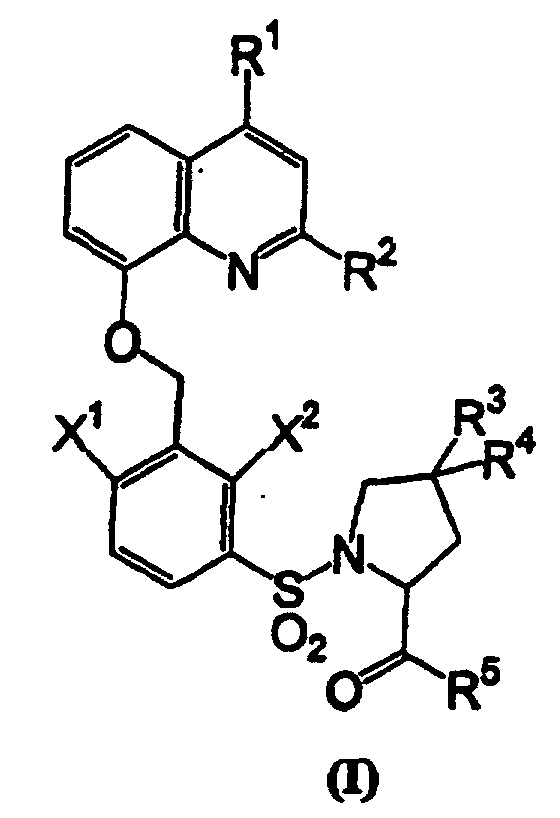
X1 and X2 are independently halo or C1-4 alkyl;
R1 and R2 are independently hydrogen or C1-4 alkyl;
R3 and R4 are independently hydrogen or halo; and
R5 is -C3-9 diazacycloalkyl substituted with C5-11 azabicycloalkyl. - The N-benzenesulfonyl L-proline compounds of this invention have an antagonistic action towards bradykinin and are thus useful in therapeutics, particularly for the treatment of inflammation, rheumatoid arthritis, cystitis, post-traumatic and post ischemic cerebral edema, liver cirrhosis, Alzheimer's disease, cardiovascular disease, pain, common cold, allergies, asthma, pancreatitis, burns, virus infection, head injury, multiple trauma, rhinitis, hepatorenal failure, diabetes, metastasis, pancreatitis, neovascularization, corneal haze, glaucoma, ocular pain, ocular hypertension or the like in mammalian, especially humans.
- The N-benzenesulfonyl L-proline compounds of this invention have an antagonistic action towards bradykinin and are thus useful in therapeutics, particularly for the treatment of Amyotrophic lateral sclerosis, Huntington's disease, Parkinson's disease, multiple sclerosis, stroke, head trauma, post-surgical brain edema, brain edema (general), cytotoxic brain edema (such as that associated with brain tumors, stroke, head trauma,etc.), brain edema associated with metabolic diseases (renal failure, pediatric metabolic diseases, etc.), rheumatoid arthritis, osteoarthritis, migraine, neuropathic pain, pruritis, brain tumor, pseudotumor cerebri, glaucoma, hydrocephalus, spinal cord trauma, spinal cord edema, neurodegenerative diseases, respiratory diseases, diuresis, natriuresis calciuresis, COPD (chronic obstructive pulmonary disease), post-traumatic brain injury, itching, sepsis or the like in mammalian, especially humans.
- The present invention provides a pharmaceutical composition for the treatment of disease conditions mediated by bradykinin, in a mammalian subject, which comprises administering to said subject a therapeutically effective amount of a compound of formula (I).
- Further, the present invention also provides a pharmaceutical composition for the treatment of inflammation, rheumatoid arthritis, cystitis, post-traumatic and post ischemic cerebral edema, liver cirrhosis, Alzheimer's disease, cardiovascular disease, pain, common cold, allergies, asthma, pancreatitis, burns, virus infection, head injury, multiple trauma, rhinitis, hepatorenal failure, diabetes, metastasis, pancreatitis, neovascularization, corneal haze, glaucoma, ocular pain, ocular hypertension or the like, which comprises a therapeutically effective amount of the N-benzenesulfonyl L-proline compound of formula (I) or its pharmaceutically acceptable salt together with a pharmaceutically acceptable carrier.
- Further, the present invention also provides a pharmaceutical composition for the treatment of Amyotrophic lateral sclerosis, Huntington's disease, Parkinson's disease, Multiple sclerosis, Stroke, head trauma, Post-surgical brain edema, Brain edema (general), Cytotoxic brain edema (such as that associated with brain tumors, stroke, head trauma, etc.), Brain edema associated with metabolic diseases (renal failure, pediatric metabolic diseases, etc.), Rheumatoid arthritis, Osteoarthritis, Migraine, Neuropathic Pain, Pruritis, Brain Tumor, Pseudotumor cerebri, Glaucoma, Hydrocephalus, Spinal cord trauma, Spinal cord edema, neurodegenerative diseases, respiratory diseases, diuresis, natriuresis calciuresis, COPD (chronic obstructive pulmonary disease), post-traumatic brain injury, itching or Sepsis, which comprises a therapeutically effective amount of a compound of formual (I) or its pharmaceutically acceptable carrier.
- Also, the present invention provides a method for the treatment of disease conditions mediated by bradykinin, in a mammalian subject, which comprises administering to said subject a therapeutically effective amount of a compound of formula (I).
- Further, the present invention provides a method for the treatment of inflammation, rheumatoid arthritis, cystitis, post-traumatic and post ischemic cerebral edema, liver cirrhosis, Alzheimer's disease, cardiovascular disease, pain, common cold, allergies, asthma, pancreatitis, burns, virus infection, head injury, multiple trauma, rhinitis, hepatorenal failure, diabetes, metastasis, pancreatitis, neovascularization, corneal haze, glaucoma, ocular pain, ocular hypertension or the like, in a mammalian subject, which comprises administering to said subject a therapeutically effective amount of a compound of formula (I).
- As used herein, the term "halo" is fluoro, chloro, bromo or iodo (preferably fluoro or chloro).
- As used herein, the term "alkyl" means straight or branched chain saturated radicals, including, but not limited to methyl, ethyl, n-propyl, isopropyl, n-butyl, iso-butyl, secondary-butyl, tertiary-butyl.
- As used herein, the term " C3-9 diazacycloalkyl, C5-11 azabicycloalkyl " means a group wherein one or two carbons of mono- or bicyclic alkyl ring components are substituted by nitrogen atoms, included, but not limited to, piperazinyl, azabicyclo[3.3.0]octyl, quinuclidinyl, azabicyclo[3.2.1]octyl, azabicyclo[3.3.1]nonyl, azabicyclo[2.2.2]octyl.
- In the formula (I), R5 is preferably -C4-8 diazacycloalkyl substituted with C6-10 azabicycloalkyl, and most preferably azabicyclo[2.2.2]octyl-piperazinyl.
- Preferred compounds of this invention are those of the formula (I) wherein X1 and X2 are chloro;
R1 and R2 are independently hydrogen, methyl or ethyl;
R3 and R4 are independently hydrogen or fluoro; and
R5 is -C4-8 diazacycloalkyl substituted with C6-10 azabicycloalkyl. - Much preferred compounds of this invention are those of the formula (I) wherein
R1 and R2 are methyl; R3 and R4 are hydrogen; and
R5 is azabicyclo[2.2.2]octyl-piperazinyl. - Preferred individual compounds of this invention are: 8-[[3-[[(2S)-2-[[4-[(3S)-1-Azabicyclo[2.2.2]oct-3-yl]-1-piperazinyl]carbonyl]pyrrolidinyl]sulfonyl]-2,6-dichlorobenzyl]oxy]-2,4-dimethylquinoline, and a salt thereof.
- The N-benzenesulfonyl L-proline compounds of formula (I) of this invention may be prepared by a variety of synthetic methods.
- (wherein X1, X2, R1, R2, R3, R4 and R5 are as already defined; and WSC is 1-[3-(dimethylamino)propyl]-3-ethylcarbodiimide hydrochloride, HOBt is 1-hydroxybenzotriazole hydrate.
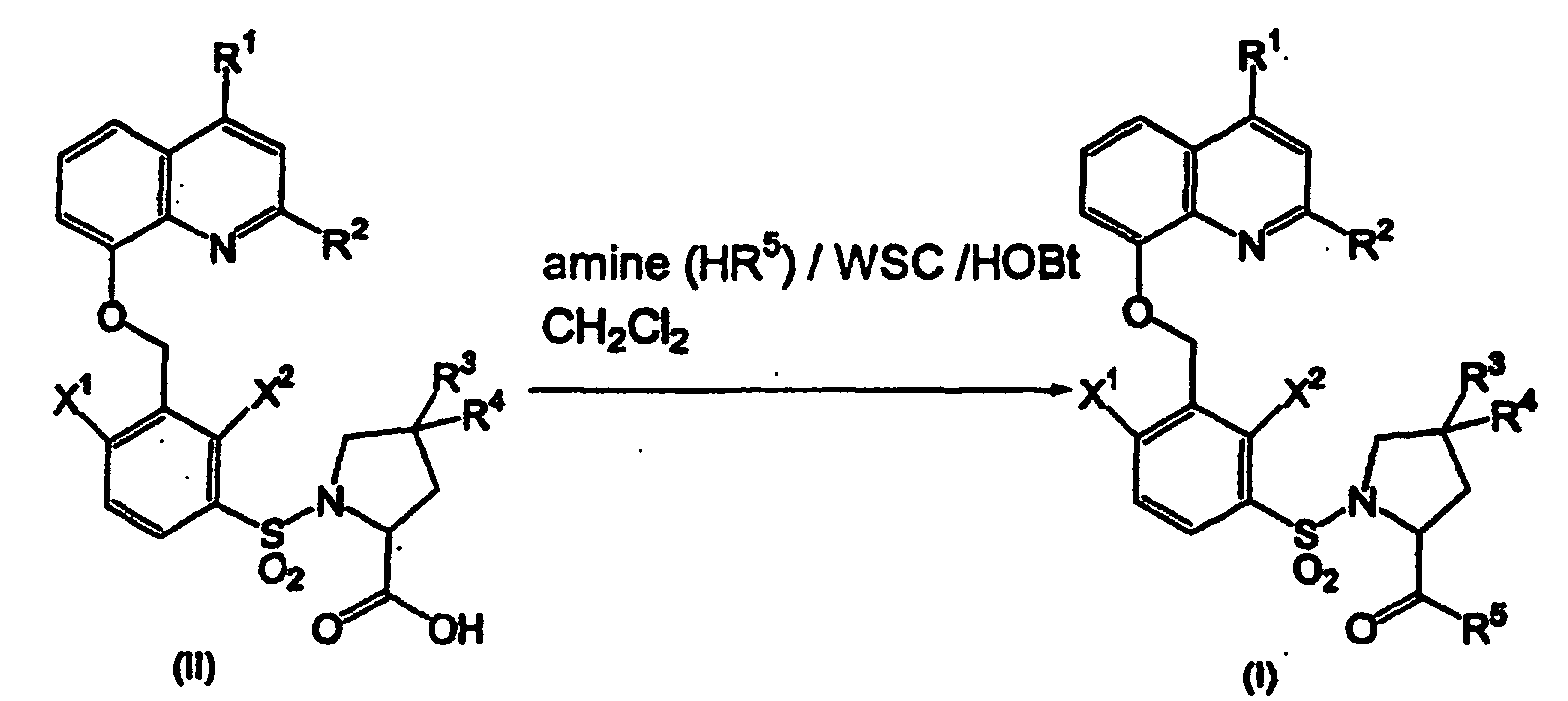
- To a stirred solution of the acid of formula (II) (150 mg, 0.294 mmol) and amine H-R5 (0.441 mmol) in CH2Cl2 (15 mL) were added HOBt (67 mg, 0.441 mmol) and WSC (84 mg, 0.441 mmol) at room temperature and the mixture was stirred overnight. To the mixture was added H2O (5 mL) and the organic layer was separated, washed with saturated aqueous NaHCO3, brine, dried over MgSO4, filtered and concentrated in vacuo. Column chromatography (NH gel, 200-350 mesh, 8 g, CH2Cl2/MeOH = 99/1 to 90/10) afforded the coupling product including a compound of formula (I).
- In the described method A, 1,3-diisopropylcarbodiimide in place of WSC , t-BuOH-CH2Cl2(1-1), DMF, or AcOEt in place of CH2Cl2 were also used. For purification process, appropriate regins or solid-phase extraction method was also utilized when the small amount of the starting material (II) (about 50 µmol) were used.
- To a stirred solution of the coupling product including a compound of formula (I) (0.0964 mmol) in MeOH was added HCI-MeOH (2.9 mL) and the mixture was stirred for 15 minutes. Then the solvent was removed in vacuo to provide the HCl salt.
- Alternately, the N-benzenesulfonyl L-proline compounds of formula (Ia-II) were prepared by reaction of a compound (III) with a compound of formula (IV) as indicated in the following Scheme A-II.(wherein R5A is hydroxy, C1-4 alkoxy (such as methoxy and ethoxy) or R5; X3 is halo; and the other symbols are as already defined are as already defined)
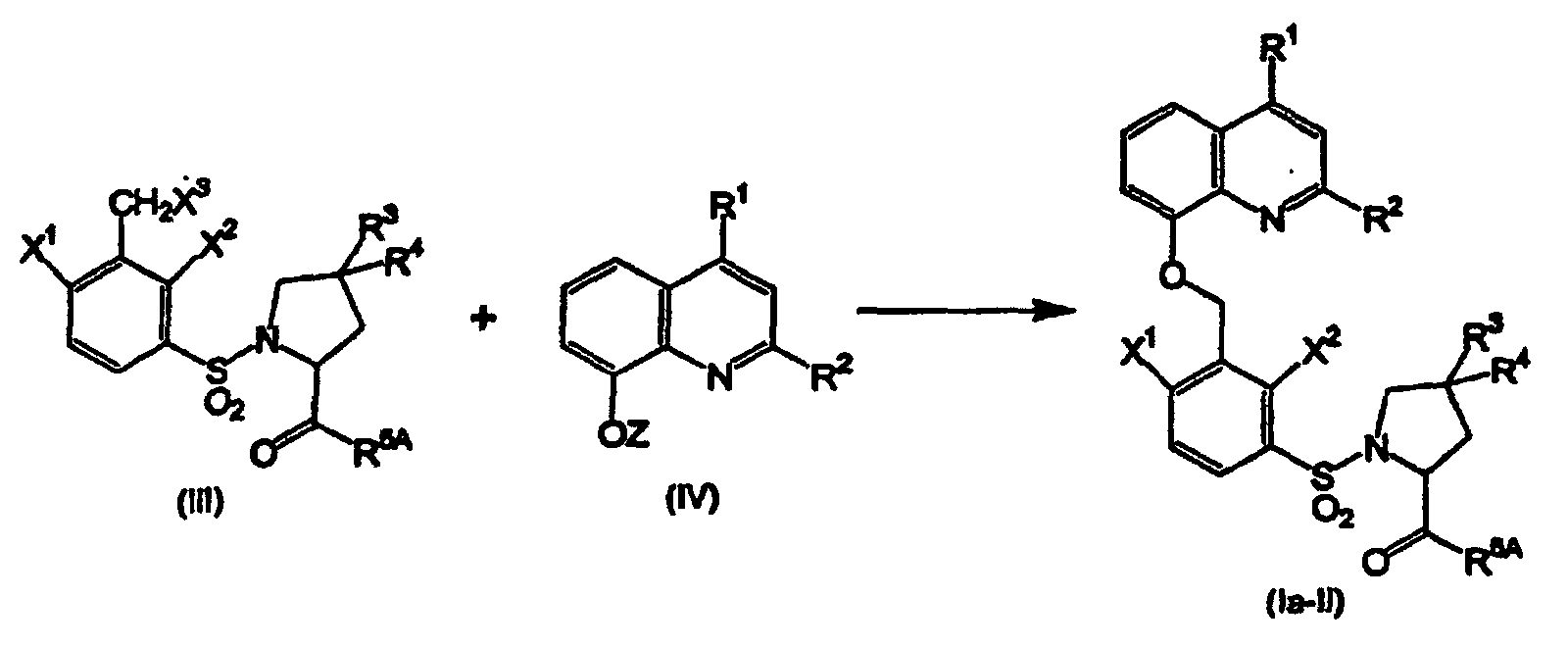
- This method utilizes a synthesis as described in WO97/07115. This reaction is carried out in a suitable reaction-inert solvent (anhydrous). Suitable solvents include, for example, aromatic hydrocarbons such as benzene, toluene and xylene; alcohols such as methanol, ethanol, propanol and butanol; ethers such as diethyl ether, dioxane and tetrahydrofuran; halogenated hydrocarbons such as methylene dichloride, chloroform, dichloromethane and dichloroethane; amides such as N,N-dimethylformamide; and nitriles such as acetonitrile. This reaction is carried out at a temperature between -10 °C and 100 °C, preferably from 0 °C to 50 °C for 5 minutes to 24 hours, preferably 30 minutes to 5 hours.
- In addition, the compounds (III) and (IV) which can be used herein may be either already known or may be prepared according to the reported methods.
- The compounds of formula (III) was prepared by the reaction of a compound (V) with a compound of formula (VI) as indicated in the following Scheme B.(wherein X3 is halo; and the other symbols are as already defined)
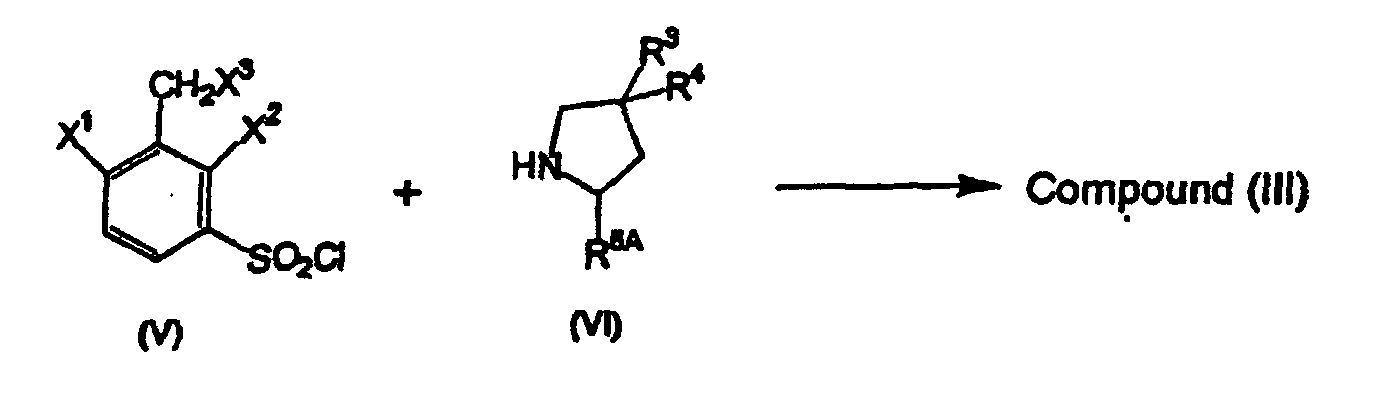
- This method utilizes a synthesis as described in WO97/07115. This reaction is carried out in the presence of base in a suitable reaction-inert solvent. Suitable base includes, for example, triethylamine. Suitable solvents include, for example, aromatic hydrocarbons such as benzene, toluene and xylene; alcohols such as methanol, ethanol, propanol and butanol; ethers such as diethyl ether, dioxane and tetrahydrofuran; halogenated hydrocarbons such as chloroform, dichloromethane and dichloroethane; amides such as N,N-dimethylformamide; and nitriles such as acetonitrile. This reaction is carried out at a temperature between -10 °C and 100 °C, preferably from 0 °C to 40 °C for 5 minutes to 24 hours, preferably 30 minutes to 3 hours.
- The compounds of formula (I), and the intermediates above-mentioned preparation methods can be isolated and purified by conventional procedures such as recrystallization or chromatographic purification.
- The optically active compounds of this invention can be prepared by several methods known to a skilled person in the art. For example, the optically active compounds of this invention may be obtained by chromatographic separation or fractional crystallization from the final compounds or the intermediates in racemic form thereof. Alternatively, the optically active compounds may be prepared by optically selective reaction, enzymatic hydrolysis or reactions using optically active intermediates.
- The N-benzenesulfonyl L-proline compounds of this invention possess an asymmetric center. Hence, the compounds can exist in separated (+)- and (-)-optically active forms, as well as in racemic one thereof. The present invention includes all such forms within its scope. Individual isomers can be obtained by known methods, such as optically selective reaction or chromatographic separation in the preparation of the final product or its intermediate.
- The present invention includes salt forms of the compounds (I) as obtained above.
- Insofar as the N-benzenesulfonyl L-proline compounds of this invention are basic compounds, they are capable of forming a wide variety of different salts with various inorganic and organic acids.
- The acids which are used to prepare the pharmaceutically acceptable acid addition salts of the aforementioned N-benzenesulfonyl L-proline base compounds of this invention of formula (I) are those which form non-toxic acid addition salts, i.e., salts containing pharmaceutically acceptable anions, such as the chloride, bromide, iodide, nitrate, sulfate or bisulfate, phosphate or acid phosphate, acetate, lactate, citrate or acid citrate, tartrate or bi-tartrate, succinate, malate, fumarate, gluconate, saccharate, benzoate, methanesulfonate, ethanesulfonate, benzenesulfonate, p-toluenesulfonate and pamoate (i.e., 1.1'-methylene-bis-(2-hydroxy-3-naphthoate). The acid addition salts can be prepared by conventional procedures.
- The N-benzenesulfonyl L-proline compounds of the present invention of formula (I) exhibit significant bradykinin receptor-binding activity and therefore, are of value in the treatment of a wide variety of clinical conditions in mammals, especially human. Such conditions include inflammation, cardiovascular disease, pain, common cold, allergies, asthma, pancreatitis, burns, virus infection, head injury, multiple trauma and the like.
- Therefore, these compounds are readily adapted to therapeutic use as bradykinin antagonists for the control and/or treatment of any of the aforesaid clinical conditions in mammals, including humans.
- Also, the compounds of formula (I) may be expected more effective therapeutic effects with being co-administered with H1-antagonist.
- Further, the present invention also encompasses a pharmaceutical composition for the treatment of inflammation, rheumatoid arthritis, cystitis, post-traumatic and post ischemic cerebral edema, liver cirrhosis, Alzheimer's disease, cardiovascular disease, pain, common cold, allergies, asthma, pancreatitis, burns, virus infection, head injury, multiple trauma, rhinitis, hepatorenal failure, diabetes, metastasis, cystitis, pancreatitis, amyotrophic lateral sclerosis, Huntington's disease, Parkinson's disease, multiple sclerosis, stroke, head trauma, post-surgical brain edema, brain edema (general), cytotoxic brain edema (such as that associated with brain tumors, stroke, head trauma,etc.), brain edema associated with metabolic diseases (renal failure, pediatric metabolic diseases, etc.), rheumatoid arthritis, osteoarthritis, migraine, neuropathic pain, pruritis, brain tumor, pseudotumor cerebri, glaucoma, hydrocephalus, spinal cord trauma, spinal cord edema, neurodegenerative diseases, respiratory diseases, diuresis, natriuresis calciuresis, COPD (chronic obstructive pulmonary disease), post-traumatic brain injury, itching, sepsis, or the like, which comprises a therapeutically effective amount of the N-benzenesulfonyl L-proline compound of formula (I) and H1-antagonist or their pharmaceutically acceptable salt together with a pharmaceutically acceptable carrier.
- The compounds of the invention may advantageously be employed in combination with one or more other therapeutic ingredients selected from an antibiotic, anti-fungal, or anti-viral agent, an anti-histamine, a non-steroidal antiinflammatory drug or disease modifying anti-rheumatic drug.
- The combination with an anti-histamine (H1 antagonist) is particularly favorured for use in the prophylaxis and treatment of asthma and rhinitis. Examples of anti-histamine are chlorpheniramine, brompheniramine, clemastine, ketotifen, azatadine, loratadine, terfenadine, cetirizine, astemizole, tazifylline, levocabastine, diphenhydramine, temelastine, etolotifen, acrivastine, azelastine, ebastine, mequitazine, KA-398, FK-613, mizolastine, MDL-103896, levocetirizine, mometasone furoate, DF-1111301, KC-11404, carebastine, ramatroban, desloratadine, noberastine, selenotifen, alinastine, E-4716, efletirizine, tritoqualine, norastemizole, ZCR-2060, WY-49051, KAA-276, VUF-K-9015, tagorizine, KC-11425, epinastine, MDL-28163 terfenadine, HSR-609, acrivastine and BMY-25368.
- The activity of the N-benzenesulfonyl L-proline compounds of the present invention, as bradykinin antagonists, is determined by their ability to inhibit the binding of bradykinin at its receptor sites in recombinant human bradykinin B2 receptor expressing CHO-K1 cells (from Receptor Biology, Inc.) employing radioactive ligands.
- The bradykinin antagonist activity of the N-benzenesulfonyl L-proline compounds is evaluated by using the standard assay procedure described in, for example, Baenziger N. L., Jong Y-J. I., Yocum S. A., Dalemar L. R, Wilhelm B., Vaurek R., Stewart J. M., Eur. J. Cell Biol., 1992, 58, 71-80. This method essentially involves determining the concentration of the individual compound required to reduce the amount of radiolabelled bradykinin ligands by 50% at their receptor sites in CHO-K1 cells, thereby affording characteristic IC50 values for each compound tested.
- More specifically, the assay is carried out as follows. First, rat, guinea pig or monkey ileum tissues are minced and suspended in 25mM piperazine-N,N'-bis (2-ethanesulfonic acid (PIPES) buffer (pH 6.8) containing 0.1 mg/ml of soybean trypsin inhibitor. Then, the tissues are homogenized using a Polytron homogenizer at setting 7 for 30 seconds three times, and then rehomogenized with a Teflon-coated homogenizer. The homogenized suspension was centrifuged at 1,200 X g for 15 minutes. The pellet was rehomogenized and then centrifuged at 1,200 X g for 15 minutes. These supernatant were centrifuged at 10,000 X g for 60 minutes. The tissue pellets, CHO-K1 cell membrane are suspended in 25 mM PIPES buffer (pH6.8) containing 1.25 mM dithiothreitol, 1.75 µg/ml bacitracin, 1 mM o-phenanthroline, 18.75 µM captopril, 1.25 mg/ml bovine serum albumin (BSA), to prepare tissue/cell suspensions. Then, 10 µl of test compound solution dissolved in phosphate buffered saline (PBS, pH 7.5) containing 2% DMSO (final) and 0.1% BSA (w/v) or 10ml of 12.5 mM bradykinin in PBS (pH 7.5) containing 0.1% BSA (w/v) are placed in a reaction 96-well plate. 15 µl of 8.3 nM [3H]bradykinin is added to the compound solution or bradykinin solution in the 96-well plate. Finally 100 µl of the tissue or cell suspension are added to the mixture in the plate, and incubated at room temperature for 1 hour under the dark. After incubation, the resultant product in the reaction plates is filtered through 0.1% polyethylenimine presoaked LKB filermat. The filtrate is washed using a Skatron auto cell harvester. The tissue bound radioactivity is determined using a LKB betaplate counter. The IC50 value is determined using the equation:
- All compounds prepared in the working examples as described below were tested by this method, and showed an IC50 value of 0.1 nM to 4 nM in CHO-K1 cells with respect to inhibition of binding at its receptor.
- The most preferred compounds prepared in the working examples as described below were tested by this method, and showed an IC50 value of 0.5 nM to 3.3 nM in CHO-K1 cells with respect to inhibition of binding at its receptor.
- The possibility of drug-drug interaction of the N-benzenesulfonyl, L-proline compounds of the present invention, as bradykinin antagonists, is determined by their ability to inhibit the testosterone 6β-hydroxylase activity raised by CYP3A4 which is most abundant subtype of cytochrome P-450 in human.
- This method essentially involves determining the concentration of the individual compound required to reduce the amount of 6β-hydroxytestosterone by 50%.
- More specifically, the assay is carried out as follows. Human liver microsomes (0.2 mg/ml) were mixed with appropriate concentrations of kinin B2 antagonist. Then, incubated with the presence of 50 µM testosterone, 1.3 mM NADP+, 0.9 mM NADH, 3.3 mM glucose-6-phosphate, 3.3 mM MgCl2, and glucose-6-phosphate dehydrogenase (8 units/ml) in a total volume of 0.2 ml of 100 mM potassium phosphate buffer, pH 7.4, at 37 °C. After incubation (20 minutes), 10 µl of methylalchol containing internal standard was withdrawn. The medium was filtrated by membrane filter with centrifugation at 1,800 x g for 10 minutes, and the resulting filtrate was taken.
- A 6β-hydroxylated metabolite of testosterone in samples was analyzed by HPLC. A sample of 20 µl was injected to the HPLC system equipped with a Polymer C18 column (2.0 x 75 mm). The mobile phase consisted of 24% to 66% acetonitorile linear gradient including 10 mM ammonium phosphate, and with a flow rate of 0.35 ml/min.
- The IC50 value is determined using the equation:
- The most preferred compounds as memtined above of Working Examples showed IC50 values of more than 10 µM.
- T1/2 value against human liver microsome was calculated by conventional procedure. More specifically, human liver microsomes (0.2 mg/ml) were mixed with 1 µM of kinin B2 antagonist and incubated with in the presence of 1.3 mM NADP+, 0.9 mM NADH, 3.3 mM glucose-6-phosphate, 3.3 mM MgCl2, and glucose-6-phosphate dehydrogenase (8 units/ml) in a total volume of 1.2 ml of 100 mM potassium phosphate buffer, pH 7.4, at 37 °C. At specified incubation times (0, 5, 10, 30 minutes), an aliquot of 100 µl was withdrawn from the reaction mixture and mixed with 1 ml of acetonitrile containing internal standard. Protein was precipitated by centrifugation at 1,800 x g for 10 minutes, and the resulting supernatant was taken.
- Kinin B2 antagonist in samples were analyzed by LS/MS/MS, in a Sciex API-300 mass spectrometer linked with a Hawlett-Pakkered HP1100 HPLC system. A sample of 20 µl was injected to the HPLC system equipped with a Wakosil II 5C18 HG column (2.0 x 150 mm). The mobile phase consisted of 80% acetonitorile including 10 mM ammonium acetate, and the elution was isocratic with a flow rate of 0.3 ml/min. Part of the eluent from the HPLC column was introduced into the atmospheric ionization source via an ion spray interface. T1/2 value is determined using the equation:
- The compounds of the formula (I) exhibit excellent biological activity in vitro and in vivo as bradykinin antagonists. Additionally, the compound of the formula (I) was stable against metabolism in human liver microsomes assay experiments. The most preffered compounds of Working Examples showed T1/2 values of more than 10 minutes.
- The compound of this invention showed a good IC50 in CHO-K1 cells and a good T1/2 value, which are essential for a practical drug.
- The N-benzenesulfonyl L-proline compounds of formula (I) of this invention can be administered via either the oral, parenteral or topical routes to mammals. In general, these compounds are most desirably administered to humans in doses ranging from 0.3 mg to 750 mg per day, preferably from 10 mg to 500 mg per day, although variations will necessarily occur depending upon the weight and condition of the subject being treated, the disease state being treated and the particular route of administration chosen. However, for example, a dosage level that is in the range of from 0.06 mg to 2 mg per kg of body weight per day is most desirably employed for treatment of inflammation.
- The compounds of the present invention may be administered alone or in combination with pharmaceutically acceptable carriers or diluents by either of the above routes previously indicated, and such administration can be carried out in single or multiple doses. More particularly, the novel therapeutic agents of the invention can be administered in a wide variety of different dosage forms, i.e., they may be combined with various pharmaceutically acceptable inert carriers in the form of tablets, capsules, lozenges, troches, hard candies, powders, sprays, creams, salves, suppositories, jellies, gels, pastes, lotions, ointments, aqueous suspensions, injectable solutions, elixirs, syrups, and the like. Such carriers include solid diluents or fillers, sterile aqueous media and various nontoxic organic solvents, etc. Moreover, oralpharmaceutical compositions can be suitably sweetened and/or flavored. In general, the therapeutically-effective compounds of this invention are present in such dosage forms at concentration levels ranging 5% to 70% by weight, preferably 10% to 50% by weight.
- For oral administration, tablets containing various excipients such as microcrystalline cellulose, sodium citrate, calcium carbonate, dipotassium phosphate and glycine may be employed along with various disintegrants such as starch and preferably corn, potato or tapioca starch, alginic acid and certain complex silicates, together with granulation binders like polyvinylpyrrolidone, sucrose, gelatin and acacia. Additionally, lubricating agents such as magnesium stearate, sodium lauryl sulfate and talc are often very useful for tabletting purposes. Solid compositions of a similar type may also be employed as fillers in gelatin capsules; preferred materials in this connection also include lactose or milk sugar as well as high molecular weight polyethylene glycols. When aqueous suspensions and/or elixirs are desired for oral administration, the active ingredient may be combined with various sweetening or flavoring agents, coloring matter or dyes, and, if so desired, emulsifying and/or suspending agents as well, together with such diluents as water, ethanol, propylene glycol, glycerin and various like combinations thereof
- For parenteral administration, solutions of a compound of the present invention in either sesame or peanut oil or in aqueous propylene glycol may be employed. The aqueous solutions should be suitably buffered (preferably pH>8) if necessary and the liquid diluent first rendered isotonic. These aqueous solutions are suitable for intravenous injection purposes. The oily solutions are suitable for intra-articular, intra-muscular and subcutaneous injection purposes. The preparation of all these solutions under sterile conditions is readily accomplished by standard pharmaceutical techniques well known to those skilled in the art. Additionally, it is also possible to administer the compounds of the present invention topically when treating inflammatory conditions of the skin and this may preferably be done by way of creams, jellies, gels, pastes, ointments and the like, in accordance with standard pharmaceutical practice.
- The invention is illustrated in the following non-limiting example in which, unless stated otherwise: all operations were carried out at room or ambient temperature, that is, in the range of 18-25 °C; evaporation of solvent was carried out using a rotary evaporator under reduced pressure with a bath temperature of up to 60 °C; reactions were monitored by thin layer chromatography (tlc) and reaction times are given for illustration only; melting points (m.p.) given are uncorrected (polymorphism may result in different melting points); the structure and purity of all isolated compounds were assured by at least one of the following techniques: tlc (Merck silica gel 60 F254 precoated TLC plates or Merck NH2 F254s precoated HPTLC plates), mass spectrometry, nuclear magnetic resonance (NMR), infrared red absorption spectra (IR) or microanalysis. Yields are given for illustrative purposes only. Flash column chromatography was carried out using Merck silica gel 60 (230-400 mesh ASTM) or Fuji Silysia Chromatorex® DU3050 (Amino Type, 30∼50 µm). Low-resolution mass spectral data (EI) were obtained on a Automass 120 (JEOL) mass spectrometer. Low-resolution mass spectral data (ESI) were obtained on a Quattro II (Micromass) or ZMD (Micromass) mass spectrometer. NMR data was determined at 270 MHz (JEOL JNM-LA 270 spectrometer) or 300 MHz (JEOL JNM-LA300) using deuterated chloroform (99.8% D) or dimethylsulfoxide (99.9% D) as solvent unless indicated otherwise, relative to tetramethylsilane (TMS) as internal standard in parts per million (ppm); conventional abbreviations used are: s = singlet, d = doublet, t = triplet, q = quartet, m = multiplet, br. = broad, etc. IR spectra were measured by a Shimazu infrared spectrometer (IR-470). Optical rotations were measured using a JASCO DIP-370 Digital Polarimeter (Japan Spectroscopic CO, Ltd.).
Chemical symbols have their usual meanings; b.p. (boiling point), m.p. (melting point), 1 (liter(s)), ml (milliliter(s)), g (gram(s)), mg(milligram(s)), mol (moles), mmol (millimoles), eq. (equivalent(s)). - To a solution of N-benzyliminodiacetic acid (2.23 g, 10.0 mmol) in THF (30 mL) was added 1,1'-carbonylbis-1H-imidazole (3.57 g, 22.0 mmol) at room temperature under nitrogen atmosphere. The resulting mixture was stirred at reflux temperature for 30 min (until the evolution of CO2 gas ceased, giving a clear solution), then cooled to room temperature. To the resulting mixture was added a solution of (3S)-3-aminoquinuclidine dihydrochloride (2.00 g, 10.0 mmol) and triethylamine (3.06 mL, 22.0 mmol) in THF (10 mL) stirred at room temperature under nitrogen atmosphere for 30 min via a cannula. The combined reaction mixture was stirred under reflux for 24 h, then cooled to room temperature and quenched with H2O (10 mL). The organic layer was extracted with EtOAc (50 x 2 mL) and the combined organic layers were dried over MgSO4, concentrated in vacuo. The residue was purified by column chromatography (NH gel, 200-350 mesh, 150 g, EtOAc) to give a product (2.17 g, 69%) as a white solid.
1H NMR (CDCl3) δ: 7.39-7.27 (m, 5 H), 4.73-4.66 (m, 1 H), 3.77-3.69 (m, 1 H), 3.60 (s, 2 H), 3.38 (s, 4 H), 3.34-3.29 (m, 1 H), 3.02-2.93 (m, 1 H), 2.90-2.75 (m, 3 H), 1.91-1.61 (m, 4 H), 1.38-1.28 (m, 1 H) - To a solution of 1-[(3S)-1-azabicyclo[2.2.2]oct-3-yl]-4-benzyl-2,6-piperazinedione (1.90 g, 6.00 mmol) in 1,4-dioxane (40 mL) was added LiAlH4 (911 mg, 24.0 mmol) at room temperature under nitrogen atmosphere. The resulting suspension was stirred under reflux for 3.5 h, then cooled to 0 °C. The mixture was diluted with Et2O (80 mL), then treated carefully with Na2SO4·10 H2O (9.1 g) and anhydrous KF (1 g). After the resulting white suspension was stirred vigorously at room temperature for 30 min, the white precipitate was removed by filtration through a pad of celite. The filtrate was concentrated in vacuo and the residue was purified by column chromatography (NH gel, 200-350 mesh, 40 g, EtOAc) to give a product (1.39 g, 81%) as a white solid. 1H NMR (CDCl3) δ: 7.32-7.24 (m, 5 H), 3.51 (s, 2 H), 3.01-1.98 (m, 16 H), 1.83-1.59 (m, 2 H), 1.48-1.40 (m, 1 H), 1.30-1.21(m, 1 H)
- A mixture of (3S)-3-(4-benzyl-1-piperazinyl)-1-azabicyclo[2.2.2]octane (1.25 g, 4.37 mmol) and 400 mg of Pd(OH)2 (20 wt% on carbon) in MeOH (60 mL) was stirred at room temperature under hydrogen atmosphere (4 atm) for 6 h. The reaction mixture was filtered through a pad of celite and the filtrate was concentrated in vacuo to give a product (850 mg, quant.).
1H NMR (CDCl3) δ: 3.01-2.00 (m, 16 H), 1.81-1.65 (m, 2 H), 1.50-1.36 (m, 1 H), 1.36-1.20 (m, 1 H) - This compound was prepared by a procedure similar to that described in method A and AcOEt was used for the extraction solvent. Column chromatography (NH gel, 200-350 mesh, AcOEt/MeOH = 10/1-5/1) afforded a product. Free base
1H-NMR (CD3OD) δ: 8.09 (d, J=8.6 Hz, 1H), 7.60 (d, J=8.4 Hz, 1H), 7.58 (dd, J=8.4, 1.0Hz, 1H), 7.44 (t, J=8.2 Hz, 1H), 7.27 (dd, J=8.4, 1.0Hz, 1H), 7.18 (d, J=1.0 Hz, 1H), 5.70-5.44 (m ,2H), 4.94 (dd, J=8.6, 3.6 Hz, 1H), 3.65-3.30 (m, 6H), 2.94-2.60(m, 4H), 2.59 (s, 3H), 2.53 (s, 3H), 2.20-2.15 (m, 6H), 2.05-1.90 (m, 2H), 1.90-1.55 (m, 6H), 1.45-1.20 (m, 2H)
HCl salt
mp 181-184 °C
IR (KBr)νmax: 3386, 2924 1655, 1638, 1439, 1333, 1269, 1153, 1030 cm-1.
MS (m/z): 686.18 (ES+, exact mass 685.23) - The chemical structure of the compound prepared in Example 1 is shown in the following table.(wherein X1 and X2 are chloro; R1 and R2 are methyl; and R3 and R4 are hydrogen)

Ex.# R5 1 4-(1-azabicyclo[2.2.2]octy-3-yl)-piperazin-1-yl
Claims (11)
- A compound of the formula (I):or a pharmaceutically acceptable salt thereof wherein

X1 and X2 are independently halo or C1-4 alkyl;
R1 and R2 are independently hydrogen or C1-4 alkyl;
R3 and R4 are independently hydrogen or halo; and
R5 is -C3-9 diazacycloalkyl substituted with C5-11 azabicycloalkyl. - A compound according to Claim 1, wherein
X1 and X2 are chloro;
R1 and R2 are independently hydrogen, methyl or ethyl;
R3 and R4 are independently hydrogen or fluoro; and
R5 is -C4-8 diazacycloalkyl substituted with C6-10 azabicycloalkyl. - A compound according to Claim 1 or 2, wherein
R1 and R2 are methyl; R3 and R4 are hydrogen; and
R5 is azabicyclo[2.2.2]octyl-piperazinyl. - A compound according to Claim 1 or 2 which is
8-[[3-[[(2S)-2-[[4-[(3S)-1-Azabicyclo[2.2.2]oct-3-yl]-1-piperazinyl]carbonyl]pyrrolidinyl]sulfonyl]-2,6-dichlorobenzyl]oxy]-2,4-dimethylquinoline, or a salt thereof. - A pharmaceutical composition which comprises a compound of the formula (I) or a pharmaceutically acceptable salt thereof as claimed in any one of Claims 1-4 and a pharmaceutically acceptable carrier.
- A compound of the formula (I) or a pharmaceutically acceptable salt thereof as claimed in any one of Claims 1-4 for use as a medicament.
- Use of a compound of the formula (I) or a pharmaceutically acceptable salt thereof as claimed in any one of Claims 1-4 in the manufacture of a medicament for the treatment of inflammation, rheumatoid arthritis, cystitis, post-traumatic and post ischemic cerebral edema, liver cirrhosis, Alzheimer's disease, cardiovascular disease, pain, common cold, allergies, asthma, pancreatitis, bums, virus infection, head injury, multiple trauma, rhinitis, hepatorenal failure, diabetes, metastasis, pancreatitis, neovascularization, corneal haze, glaucoma, ocular pain or ocular hypertension.
- Use of a compound of the formula (I) or a pharmaceutically acceptable salt thereof as claimed in any one of Claims 1-4 in the manufacture of a medicament for the treatment of amyotrophic lateral sclerosis, Huntington's disease, Parkinson's disease, multiple sclerosis, stroke, head trauma, post-surgical brain edema, brain edema (general), cytotoxic brain edema, brain edema associated with metabolic diseases, rheumatoid arthritis, osteoarthritis, migraine, neuropathic pain, pruritis, brain tumor, pseudotumor cerebri, glaucoma, hydrocephalus, spinal cord trauma, spinal cord edema, neurodegenerative diseases, respiratory diseases, diuresis, natriuresis calciuresis, chronic obstructive pulmonary disease, post-traumatic brain injury, itching or sepsis.
- Use of a compound of the formula (I) or a pharmaceutically acceptable salt thereof as claimed in any one of Claims 1-4 in the manufacture of a medicament for the treatment of a disease condition mediated by bradykinin.
- A compound of the formula (I) or a pharmaceutically acceptable salt thereof as claimed in any one of Claims 1-4 for the treatment of a disease condition mediated by bradykinin.
- A compound of the formula (I) or a pharmaceutically acceptable salt thereof as claimed in any one of Claims 1-4 for the treatment of inflammation, rheumatoid arthritis, cystitis, post-traumatic and post ischemic cerebral edema, liver cirrhosis, Alzheimer's disease, cardiovascular disease, pain, common cold, allergies, asthma, pancreatitis, burns, virus infection, head injury, multiple trauma, rhinitis, hepatorenal failure, diabetes, metastasis, pancreatitis, neovascularization, corneal haze, glaucoma, ocular pain or ocular hypertension.
Applications Claiming Priority (2)
| Application Number | Priority Date | Filing Date | Title |
|---|---|---|---|
| US25122500P | 2000-12-05 | 2000-12-05 | |
| US251225P | 2000-12-05 |
Publications (2)
| Publication Number | Publication Date |
|---|---|
| EP1213289A1 EP1213289A1 (en) | 2002-06-12 |
| EP1213289B1 true EP1213289B1 (en) | 2003-11-05 |
Family
ID=22951009
Family Applications (1)
| Application Number | Title | Priority Date | Filing Date |
|---|---|---|---|
| EP01310151A Expired - Lifetime EP1213289B1 (en) | 2000-12-05 | 2001-12-04 | N-benzenesulfonyl L-proline compounds as bradykinin antagonists |
Country Status (12)
| Country | Link |
|---|---|
| US (1) | US6734306B2 (en) |
| EP (1) | EP1213289B1 (en) |
| JP (1) | JP2002220387A (en) |
| AT (1) | ATE253575T1 (en) |
| BR (1) | BR0105775A (en) |
| CA (1) | CA2364178C (en) |
| DE (1) | DE60101137T2 (en) |
| DK (1) | DK1213289T3 (en) |
| ES (1) | ES2208523T3 (en) |
| MX (1) | MXPA01012558A (en) |
| PT (1) | PT1213289E (en) |
| TR (1) | TR200302106T4 (en) |
Cited By (2)
| Publication number | Priority date | Publication date | Assignee | Title |
|---|---|---|---|---|
| US10577344B2 (en) | 2013-09-10 | 2020-03-03 | The Board Of Regents Of The University Of Texas System | Therapeutics targeting truncated adenomatous polyposis coli (APC) proteins |
| US10836748B2 (en) | 2017-11-24 | 2020-11-17 | Pharvaris Netherlands B.V. | Bradykinin B2 receptor antagonists |
Families Citing this family (10)
| Publication number | Priority date | Publication date | Assignee | Title |
|---|---|---|---|---|
| DE10304994A1 (en) * | 2003-02-07 | 2004-09-02 | Aventis Pharma Deutschland Gmbh | The use of antagonists of the bradykinin B2 receptor for the treatment of osteoarthrosis |
| JP2006522835A (en) | 2003-04-10 | 2006-10-05 | アムジェン インコーポレイテッド | Cyclic amine derivatives and their use in the treatment of inflammation-related disorders mediated by bradykinin |
| UA82517C2 (en) | 2003-06-24 | 2008-04-25 | Ньюросерч А/С | Novel 8-aza-bicyclo[3.2.1]octane derivatives and their use as monoamine neurotransmitter re-uptake inhibitors |
| TWI407960B (en) | 2007-03-23 | 2013-09-11 | Jerini Ag | Small molecule bradykinin b2 receptor modulators |
| AR118982A1 (en) | 2019-05-23 | 2021-11-17 | Pharvaris Gmbh | CYCLIC BRADYKININ RECEPTOR ANTAGONISTS |
| UY38707A (en) | 2019-05-23 | 2020-12-31 | Pharvaris Gmbh | NEW CYCLIC ANTAGONISTS OF BRADIQUININ B2 RECEPTOR |
| BR112024002215A2 (en) | 2021-08-05 | 2024-04-30 | Pharvaris Gmbh | LIPID-BASED COMPOSITION FOR ORAL ADMINISTRATION OF BRADYKININ B2 RECEPTOR ANTAGONISTS |
| EP4499100A1 (en) | 2022-03-25 | 2025-02-05 | Pharvaris GmbH | Therapeutic uses of bradykinin b2-receptor antagonists |
| HRP20260166T1 (en) | 2022-03-25 | 2026-03-27 | Pharvaris Gmbh | SOLID COMPOSITION CONTAINING SOLUBILIZED BRADYKININ B2 RECEPTOR ANTAGONISTS |
| TW202345810A (en) | 2022-03-25 | 2023-12-01 | 瑞士商帕法瑞斯有限責任公司 | Solid extended-release composition comprising bradykinin b2-receptor antagonists |
Family Cites Families (3)
| Publication number | Priority date | Publication date | Assignee | Title |
|---|---|---|---|---|
| FR2743073B1 (en) * | 1995-12-29 | 1998-02-20 | Fournier Ind & Sante | NOVEL 1-BENZENESULFONYLPYRROLIDINE COMPOUNDS, METHOD OF PREPARATION AND THERAPEUTIC USE |
| FR2751650B1 (en) * | 1996-07-24 | 1998-10-09 | Fournier Ind & Sante | NOVEL N-BENZENESULFONYL-L-PROLINE COMPOUNDS, METHOD OF PREPARATION AND THERAPEUTIC USE |
| FR2756562B1 (en) * | 1996-12-04 | 1999-01-08 | Fournier Ind & Sante | NOVEL N-BENZENESULFONYL-L-PROLINE COMPOUNDS, METHOD OF PREPARATION AND THERAPEUTIC USE |
-
2001
- 2001-12-03 CA CA002364178A patent/CA2364178C/en not_active Expired - Fee Related
- 2001-12-04 ES ES01310151T patent/ES2208523T3/en not_active Expired - Lifetime
- 2001-12-04 EP EP01310151A patent/EP1213289B1/en not_active Expired - Lifetime
- 2001-12-04 DE DE60101137T patent/DE60101137T2/en not_active Expired - Fee Related
- 2001-12-04 TR TR2003/02106T patent/TR200302106T4/en unknown
- 2001-12-04 PT PT01310151T patent/PT1213289E/en unknown
- 2001-12-04 DK DK01310151T patent/DK1213289T3/en active
- 2001-12-04 AT AT01310151T patent/ATE253575T1/en not_active IP Right Cessation
- 2001-12-04 MX MXPA01012558A patent/MXPA01012558A/en unknown
- 2001-12-04 BR BR0105775-8A patent/BR0105775A/en not_active IP Right Cessation
- 2001-12-05 JP JP2001371430A patent/JP2002220387A/en active Pending
- 2001-12-05 US US10/010,863 patent/US6734306B2/en not_active Expired - Fee Related
Cited By (4)
| Publication number | Priority date | Publication date | Assignee | Title |
|---|---|---|---|---|
| US10577344B2 (en) | 2013-09-10 | 2020-03-03 | The Board Of Regents Of The University Of Texas System | Therapeutics targeting truncated adenomatous polyposis coli (APC) proteins |
| US10836748B2 (en) | 2017-11-24 | 2020-11-17 | Pharvaris Netherlands B.V. | Bradykinin B2 receptor antagonists |
| US11261173B2 (en) | 2017-11-24 | 2022-03-01 | Pharvaris Netherlands B.V. | Bradykinin B2 receptor antagonists |
| US11820756B2 (en) | 2017-11-24 | 2023-11-21 | Pharvaris Netherlands B.V. | Bradykinin B2 receptor antagonists |
Also Published As
| Publication number | Publication date |
|---|---|
| DK1213289T3 (en) | 2004-02-09 |
| US20020128271A1 (en) | 2002-09-12 |
| MXPA01012558A (en) | 2004-11-10 |
| BR0105775A (en) | 2002-08-13 |
| TR200302106T4 (en) | 2004-01-21 |
| CA2364178A1 (en) | 2002-06-05 |
| ATE253575T1 (en) | 2003-11-15 |
| PT1213289E (en) | 2004-01-30 |
| ES2208523T3 (en) | 2004-06-16 |
| DE60101137D1 (en) | 2003-12-11 |
| CA2364178C (en) | 2006-01-10 |
| DE60101137T2 (en) | 2004-08-26 |
| EP1213289A1 (en) | 2002-06-12 |
| US6734306B2 (en) | 2004-05-11 |
| JP2002220387A (en) | 2002-08-09 |
Similar Documents
| Publication | Publication Date | Title |
|---|---|---|
| JP7221217B2 (en) | Sulfonamide-substituted cyanopyrrolidines with activity as DUB inhibitors | |
| CN105073748B (en) | New octahydro-pyrrolo- [3,4-c]-azole derivatives as autotaxin inhibitors and the like | |
| TW202136247A (en) | Solid forms of 2-((4-((s)-2-(5-chloropyridin-2-yl)-2-methylbenzo [d] [1,3] dioxol-4-yl)piperidin-1-yl)methyl)-1-(((s)-oxetan-2-yl)methyl)-1h-benzo [d] imidazole-6-carboxylic acid, 1,3-dihydroxy-2-(hydroxymethyl)propan-2 -amine salt | |
| RU2726410C2 (en) | Novel disubstituted 1,2,4-triazine compound | |
| TW201720823A (en) | Novel bicyclic compounds as dual ATX/CA inhibitors | |
| US20140329795A1 (en) | Kynurenine-3-monooxygenase inhibitors, pharmaceutical compositions, and methods of use thereof | |
| US20250163021A1 (en) | 2-methyl-4-phenylpiperidin-4-ol derivatives as inhibitors of apol1 and methods of using same | |
| CA2731897C (en) | Diazepine and diazocane compounds as mc4 agonists | |
| US6734306B2 (en) | N-benzenesulfonyl L-proline compounds as bradykinin antagonists | |
| KR20250073547A (en) | Therapeutic compounds | |
| US8344002B2 (en) | Compound having β-secretase inhibitory activity | |
| WO2011156220A1 (en) | Novel prolylcarboxypeptidase inhibitors | |
| IL291828A (en) | Indazole carboxamides as kinase inhibitors | |
| EP1106614B1 (en) | 5-Membered heteroaryl substituted 1,4-dihydropyridine compounds as bradykinin antagonists | |
| JP2002502845A (en) | Tryptase inhibitor | |
| JPH09510992A (en) | Dihydropyridine derivatives as bradykinin antagonists | |
| WO2024215817A1 (en) | Novel 5-cycloproylquinoline derivatives as plpro inhibitors | |
| EP1106615B1 (en) | Substituted 1,4-dihydropyridine compounds as bradykinin antagonists | |
| US11613532B2 (en) | Compounds active towards nuclear receptors | |
| JP2003171377A (en) | N-benzenesulfonyl L-proline compounds as bradykinin antagonists | |
| WO2026105052A1 (en) | Biaryl acid compounds | |
| AU2021245397A1 (en) | Compounds active towards nuclear receptors | |
| HK1252995B (en) | New bicyclic compounds as dual atx/ca inhibitors |
Legal Events
| Date | Code | Title | Description |
|---|---|---|---|
| PUAI | Public reference made under article 153(3) epc to a published international application that has entered the european phase |
Free format text: ORIGINAL CODE: 0009012 |
|
| 17P | Request for examination filed |
Effective date: 20020102 |
|
| AK | Designated contracting states |
Kind code of ref document: A1 Designated state(s): AT BE CH CY DE DK ES FI FR GB GR IE IT LI LU MC NL PT SE TR |
|
| AX | Request for extension of the european patent |
Free format text: AL;LT;LV;MK;RO;SI |
|
| 17Q | First examination report despatched |
Effective date: 20021007 |
|
| AKX | Designation fees paid |
Designated state(s): AT BE CH CY DE DK ES FI FR GB GR IE IT LI LU MC NL PT SE TR |
|
| GRAH | Despatch of communication of intention to grant a patent |
Free format text: ORIGINAL CODE: EPIDOS IGRA |
|
| GRAS | Grant fee paid |
Free format text: ORIGINAL CODE: EPIDOSNIGR3 |
|
| GRAA | (expected) grant |
Free format text: ORIGINAL CODE: 0009210 |
|
| AK | Designated contracting states |
Kind code of ref document: B1 Designated state(s): AT BE CH CY DE DK ES FI FR GB GR IE IT LI LU MC NL PT SE TR |
|
| REG | Reference to a national code |
Ref country code: GB Ref legal event code: FG4D |
|
| REG | Reference to a national code |
Ref country code: CH Ref legal event code: EP |
|
| REG | Reference to a national code |
Ref country code: CH Ref legal event code: NV Representative=s name: E. BLUM & CO. PATENTANWAELTE |
|
| REF | Corresponds to: |
Ref document number: 60101137 Country of ref document: DE Date of ref document: 20031211 Kind code of ref document: P |
|
| REG | Reference to a national code |
Ref country code: GR Ref legal event code: EP Ref document number: 20030404682 Country of ref document: GR |
|
| PG25 | Lapsed in a contracting state [announced via postgrant information from national office to epo] |
Ref country code: MC Free format text: LAPSE BECAUSE OF NON-PAYMENT OF DUE FEES Effective date: 20031231 |
|
| REG | Reference to a national code |
Ref country code: IE Ref legal event code: FG4D |
|
| REG | Reference to a national code |
Ref country code: DK Ref legal event code: T3 |
|
| REG | Reference to a national code |
Ref country code: SE Ref legal event code: TRGR |
|
| REG | Reference to a national code |
Ref country code: ES Ref legal event code: FG2A Ref document number: 2208523 Country of ref document: ES Kind code of ref document: T3 |
|
| ET | Fr: translation filed | ||
| PLBE | No opposition filed within time limit |
Free format text: ORIGINAL CODE: 0009261 |
|
| STAA | Information on the status of an ep patent application or granted ep patent |
Free format text: STATUS: NO OPPOSITION FILED WITHIN TIME LIMIT |
|
| 26N | No opposition filed |
Effective date: 20040806 |
|
| PGFP | Annual fee paid to national office [announced via postgrant information from national office to epo] |
Ref country code: LU Payment date: 20050926 Year of fee payment: 5 |
|
| PGFP | Annual fee paid to national office [announced via postgrant information from national office to epo] |
Ref country code: PT Payment date: 20050927 Year of fee payment: 5 |
|
| PGFP | Annual fee paid to national office [announced via postgrant information from national office to epo] |
Ref country code: GR Payment date: 20051024 Year of fee payment: 5 |
|
| PGFP | Annual fee paid to national office [announced via postgrant information from national office to epo] |
Ref country code: IE Payment date: 20051026 Year of fee payment: 5 |
|
| PGFP | Annual fee paid to national office [announced via postgrant information from national office to epo] |
Ref country code: AT Payment date: 20051104 Year of fee payment: 5 |
|
| PGFP | Annual fee paid to national office [announced via postgrant information from national office to epo] |
Ref country code: DK Payment date: 20051107 Year of fee payment: 5 |
|
| PGFP | Annual fee paid to national office [announced via postgrant information from national office to epo] |
Ref country code: NL Payment date: 20051109 Year of fee payment: 5 |
|
| PGFP | Annual fee paid to national office [announced via postgrant information from national office to epo] |
Ref country code: CH Payment date: 20051111 Year of fee payment: 5 |
|
| PGFP | Annual fee paid to national office [announced via postgrant information from national office to epo] |
Ref country code: TR Payment date: 20051114 Year of fee payment: 5 |
|
| PGFP | Annual fee paid to national office [announced via postgrant information from national office to epo] |
Ref country code: FI Payment date: 20051128 Year of fee payment: 5 |
|
| PGFP | Annual fee paid to national office [announced via postgrant information from national office to epo] |
Ref country code: FR Payment date: 20051201 Year of fee payment: 5 |
|
| PGFP | Annual fee paid to national office [announced via postgrant information from national office to epo] |
Ref country code: SE Payment date: 20051202 Year of fee payment: 5 |
|
| PGFP | Annual fee paid to national office [announced via postgrant information from national office to epo] |
Ref country code: ES Payment date: 20051215 Year of fee payment: 5 |
|
| PGFP | Annual fee paid to national office [announced via postgrant information from national office to epo] |
Ref country code: DE Payment date: 20051230 Year of fee payment: 5 |
|
| PGFP | Annual fee paid to national office [announced via postgrant information from national office to epo] |
Ref country code: BE Payment date: 20060113 Year of fee payment: 5 |
|
| PG25 | Lapsed in a contracting state [announced via postgrant information from national office to epo] |
Ref country code: FI Free format text: LAPSE BECAUSE OF NON-PAYMENT OF DUE FEES Effective date: 20061204 Ref country code: IE Free format text: LAPSE BECAUSE OF NON-PAYMENT OF DUE FEES Effective date: 20061204 |
|
| PG25 | Lapsed in a contracting state [announced via postgrant information from national office to epo] |
Ref country code: SE Free format text: LAPSE BECAUSE OF NON-PAYMENT OF DUE FEES Effective date: 20061205 |
|
| PG25 | Lapsed in a contracting state [announced via postgrant information from national office to epo] |
Ref country code: BE Free format text: LAPSE BECAUSE OF NON-PAYMENT OF DUE FEES Effective date: 20061231 Ref country code: CH Free format text: LAPSE BECAUSE OF NON-PAYMENT OF DUE FEES Effective date: 20061231 Ref country code: LI Free format text: LAPSE BECAUSE OF NON-PAYMENT OF DUE FEES Effective date: 20061231 |
|
| PGFP | Annual fee paid to national office [announced via postgrant information from national office to epo] |
Ref country code: IT Payment date: 20061231 Year of fee payment: 6 |
|
| PG25 | Lapsed in a contracting state [announced via postgrant information from national office to epo] |
Ref country code: PT Free format text: LAPSE BECAUSE OF NON-PAYMENT OF DUE FEES Effective date: 20070604 |
|
| REG | Reference to a national code |
Ref country code: PT Ref legal event code: MM4A Free format text: LAPSE DUE TO NON-PAYMENT OF FEES Effective date: 20070604 |
|
| PG25 | Lapsed in a contracting state [announced via postgrant information from national office to epo] |
Ref country code: NL Free format text: LAPSE BECAUSE OF NON-PAYMENT OF DUE FEES Effective date: 20070701 |
|
| PG25 | Lapsed in a contracting state [announced via postgrant information from national office to epo] |
Ref country code: DE Free format text: LAPSE BECAUSE OF NON-PAYMENT OF DUE FEES Effective date: 20070703 |
|
| REG | Reference to a national code |
Ref country code: DK Ref legal event code: EBP |
|
| REG | Reference to a national code |
Ref country code: CH Ref legal event code: PL |
|
| EUG | Se: european patent has lapsed | ||
| GBPC | Gb: european patent ceased through non-payment of renewal fee |
Effective date: 20061204 |
|
| NLV4 | Nl: lapsed or anulled due to non-payment of the annual fee |
Effective date: 20070701 |
|
| REG | Reference to a national code |
Ref country code: IE Ref legal event code: MM4A |
|
| REG | Reference to a national code |
Ref country code: FR Ref legal event code: ST Effective date: 20070831 |
|
| PG25 | Lapsed in a contracting state [announced via postgrant information from national office to epo] |
Ref country code: AT Free format text: LAPSE BECAUSE OF NON-PAYMENT OF DUE FEES Effective date: 20061204 Ref country code: GB Free format text: LAPSE BECAUSE OF NON-PAYMENT OF DUE FEES Effective date: 20061204 Ref country code: CY Free format text: LAPSE BECAUSE OF NON-PAYMENT OF DUE FEES Effective date: 20061204 |
|
| BERE | Be: lapsed |
Owner name: *PFIZER INC. Effective date: 20061231 |
|
| PG25 | Lapsed in a contracting state [announced via postgrant information from national office to epo] |
Ref country code: DK Free format text: LAPSE BECAUSE OF NON-PAYMENT OF DUE FEES Effective date: 20070102 |
|
| REG | Reference to a national code |
Ref country code: ES Ref legal event code: FD2A Effective date: 20061205 |
|
| PG25 | Lapsed in a contracting state [announced via postgrant information from national office to epo] |
Ref country code: FR Free format text: LAPSE BECAUSE OF NON-PAYMENT OF DUE FEES Effective date: 20070102 Ref country code: ES Free format text: LAPSE BECAUSE OF NON-PAYMENT OF DUE FEES Effective date: 20061205 |
|
| PGFP | Annual fee paid to national office [announced via postgrant information from national office to epo] |
Ref country code: CY Payment date: 20051204 Year of fee payment: 5 |
|
| PG25 | Lapsed in a contracting state [announced via postgrant information from national office to epo] |
Ref country code: LU Free format text: LAPSE BECAUSE OF NON-PAYMENT OF DUE FEES Effective date: 20061204 |
|
| PG25 | Lapsed in a contracting state [announced via postgrant information from national office to epo] |
Ref country code: GR Free format text: LAPSE BECAUSE OF NON-PAYMENT OF DUE FEES Effective date: 20070704 |
|
| PGFP | Annual fee paid to national office [announced via postgrant information from national office to epo] |
Ref country code: GB Payment date: 20051011 Year of fee payment: 5 |
|
| PG25 | Lapsed in a contracting state [announced via postgrant information from national office to epo] |
Ref country code: IT Free format text: LAPSE BECAUSE OF NON-PAYMENT OF DUE FEES Effective date: 20071204 |
|
| PG25 | Lapsed in a contracting state [announced via postgrant information from national office to epo] |
Ref country code: TR Free format text: LAPSE BECAUSE OF FAILURE TO SUBMIT A TRANSLATION OF THE DESCRIPTION OR TO PAY THE FEE WITHIN THE PRESCRIBED TIME-LIMIT Effective date: 20031105 |