EP1213287A1 - Substituted benzylthiazolidine-2,4-dione derivatives - Google Patents
Substituted benzylthiazolidine-2,4-dione derivatives Download PDFInfo
- Publication number
- EP1213287A1 EP1213287A1 EP00953475A EP00953475A EP1213287A1 EP 1213287 A1 EP1213287 A1 EP 1213287A1 EP 00953475 A EP00953475 A EP 00953475A EP 00953475 A EP00953475 A EP 00953475A EP 1213287 A1 EP1213287 A1 EP 1213287A1
- Authority
- EP
- European Patent Office
- Prior art keywords
- group
- substituents
- unsubstituted
- carbon atoms
- phenyl
- Prior art date
- Legal status (The legal status is an assumption and is not a legal conclusion. Google has not performed a legal analysis and makes no representation as to the accuracy of the status listed.)
- Granted
Links
- 0 *c1ccc(C=O)cc1 Chemical compound *c1ccc(C=O)cc1 0.000 description 8
- NKASCHNBOAUAFH-JVYQOHIESA-N B/C=C/C=C\C(\CC(NC(C)SC(NC(C)=O)=O)=O)=C/CC Chemical compound B/C=C/C=C\C(\CC(NC(C)SC(NC(C)=O)=O)=O)=C/CC NKASCHNBOAUAFH-JVYQOHIESA-N 0.000 description 1
- CQSLRONTORJRDY-QGMBQPNBSA-N BC1(C)C=CC(CC(Nc2c(C)ccc(C/C=C(\C(N3)=O)/SC3=O)c2)=O)=CC=C1 Chemical compound BC1(C)C=CC(CC(Nc2c(C)ccc(C/C=C(\C(N3)=O)/SC3=O)c2)=O)=CC=C1 CQSLRONTORJRDY-QGMBQPNBSA-N 0.000 description 1
- IMHSKDNSXVOXGV-UHFFFAOYSA-N B[N](C)(CC=C1)CC=C1NC(N)=O Chemical compound B[N](C)(CC=C1)CC=C1NC(N)=O IMHSKDNSXVOXGV-UHFFFAOYSA-N 0.000 description 1
- RVVXQUPKRYNTIJ-IZZDOVSWSA-N CC(Cc1cc(/C=C(\C(N2)=O)/SC2=O)ccc1O)=O Chemical compound CC(Cc1cc(/C=C(\C(N2)=O)/SC2=O)ccc1O)=O RVVXQUPKRYNTIJ-IZZDOVSWSA-N 0.000 description 1
- VZMZHARUERNUCS-NTEUORMPSA-N CCOC(Cc1cc(/C(/C)=C(\C(N2)=O)/SC2=O)ccc1OC)=O Chemical compound CCOC(Cc1cc(/C(/C)=C(\C(N2)=O)/SC2=O)ccc1OC)=O VZMZHARUERNUCS-NTEUORMPSA-N 0.000 description 1
- MPUHDMSZXIYCLY-UHFFFAOYSA-N COc(ccc(C1OCCO1)c1)c1C(NO)=O Chemical compound COc(ccc(C1OCCO1)c1)c1C(NO)=O MPUHDMSZXIYCLY-UHFFFAOYSA-N 0.000 description 1
- GPJCWPCZJWLRSM-UHFFFAOYSA-N COc(ccc(C=O)c1)c1C(NON)=O Chemical compound COc(ccc(C=O)c1)c1C(NON)=O GPJCWPCZJWLRSM-UHFFFAOYSA-N 0.000 description 1
- BRCWQOBXRDGBJJ-UHFFFAOYSA-N COc(ccc(CC(C(N1)=O)SC1=O)c1)c1[N+]([O-])=O Chemical compound COc(ccc(CC(C(N1)=O)SC1=O)c1)c1[N+]([O-])=O BRCWQOBXRDGBJJ-UHFFFAOYSA-N 0.000 description 1
- MLEYEAMBTJOEKR-UHFFFAOYSA-N COc1ccc(CC(C(N2)=O)SC2=O)cc1 Chemical compound COc1ccc(CC(C(N2)=O)SC2=O)cc1 MLEYEAMBTJOEKR-UHFFFAOYSA-N 0.000 description 1
- LSEOTFNLUCCTOF-UHFFFAOYSA-N C[N](S)(=CC=C1)=CC=C1NC(Cc(cc(CC(C(NC1)=O)SC1O)cc1)c1OC)=O Chemical compound C[N](S)(=CC=C1)=CC=C1NC(Cc(cc(CC(C(NC1)=O)SC1O)cc1)c1OC)=O LSEOTFNLUCCTOF-UHFFFAOYSA-N 0.000 description 1
Classifications
-
- C—CHEMISTRY; METALLURGY
- C07—ORGANIC CHEMISTRY
- C07D—HETEROCYCLIC COMPOUNDS
- C07D277/00—Heterocyclic compounds containing 1,3-thiazole or hydrogenated 1,3-thiazole rings
- C07D277/02—Heterocyclic compounds containing 1,3-thiazole or hydrogenated 1,3-thiazole rings not condensed with other rings
- C07D277/20—Heterocyclic compounds containing 1,3-thiazole or hydrogenated 1,3-thiazole rings not condensed with other rings having two or three double bonds between ring members or between ring members and non-ring members
- C07D277/32—Heterocyclic compounds containing 1,3-thiazole or hydrogenated 1,3-thiazole rings not condensed with other rings having two or three double bonds between ring members or between ring members and non-ring members with hetero atoms or with carbon atoms having three bonds to hetero atoms with at the most one bond to halogen, e.g. ester or nitrile radicals, directly attached to ring carbon atoms
- C07D277/34—Oxygen atoms
-
- A—HUMAN NECESSITIES
- A61—MEDICAL OR VETERINARY SCIENCE; HYGIENE
- A61P—SPECIFIC THERAPEUTIC ACTIVITY OF CHEMICAL COMPOUNDS OR MEDICINAL PREPARATIONS
- A61P3/00—Drugs for disorders of the metabolism
- A61P3/06—Antihyperlipidemics
-
- A—HUMAN NECESSITIES
- A61—MEDICAL OR VETERINARY SCIENCE; HYGIENE
- A61P—SPECIFIC THERAPEUTIC ACTIVITY OF CHEMICAL COMPOUNDS OR MEDICINAL PREPARATIONS
- A61P3/00—Drugs for disorders of the metabolism
- A61P3/08—Drugs for disorders of the metabolism for glucose homeostasis
- A61P3/10—Drugs for disorders of the metabolism for glucose homeostasis for hyperglycaemia, e.g. antidiabetics
-
- A—HUMAN NECESSITIES
- A61—MEDICAL OR VETERINARY SCIENCE; HYGIENE
- A61P—SPECIFIC THERAPEUTIC ACTIVITY OF CHEMICAL COMPOUNDS OR MEDICINAL PREPARATIONS
- A61P43/00—Drugs for specific purposes, not provided for in groups A61P1/00-A61P41/00
Definitions
- the present invention relates to substituted benzylthiazolidine-2,4-dione derivatives effective for the prevention and/or therapy of metabolic diseases such as diabetes and hyperlipidemia as agonists of peroxisome proliferator-activated receptor (abbreviated as PPAR) being nuclear receptor, in particular, as agonists of human PPAR, their addition salts, processes for preparing them, and medicinal compositions containing these compounds.
- PPAR peroxisome proliferator-activated receptor
- the peroxisome proliferator-activated receptor(PPAR) is a ligand-dependent transcription factor that belongs to nuclear receptor superfamily similarly to steroid receptor, retinoid receptor, thyroid receptor, etc., and three isoforms ( ⁇ type, ⁇ (or ⁇ ) type and ⁇ type) with different histological distribution have been identified hitherto in human and various animal species (Proc. Natl. Acad. Sci., 1992, 89 , 4653). Thereamong, the PPAR ⁇ is distributed in the liver, kidney, etc.
- acyl CoA synthetic enzyme fatty acid-binding protein and lipoprotein lipase
- AII apolipoprotein gene related to the metabolisms of cholesterol and neutral lipid.
- the PPAR ⁇ is expressed ubiquitously in the tissues or organisms, including nerve cells. At present, the physiological significance of PPAR ⁇ is unclear. The PPAR ⁇ is highly expressed in the adipocytes and contributed to the differentiation of adipocytes (J. Lipid Res., 1996, 37 , 907). In this way, each isoform of PPAR play specific functions in the particular organs and tissues.
- fibrates and statins are widely used so far as the therapeutic drugs for hyperlipidemia.
- the fibrates have only weak decreasing action of cholesterol, while the statins have weak decreasing action of free fatty acids and triglycerides.
- various adverse effects such as gastrointestinal injury, anthema, headache, hepatic disorder, renal disorder and biliary calculus are reported. The reason is considered to be due to that the fibrates exhibit extensive pharmacological function.
- PPAR ⁇ the major intracellular target proteins of Troglitazone, Pioglitazone and Rosiglitazone, a series of thiazolidine-2,4-dione derivatives that are therapeutic drugs for type II diabetes (noninsulin-dependent diabetes) and exhibit blood sugar-decreasing action, improving action on hyperinsulinemia, etc.
- PPAR ⁇ -activator agonist
- PPAR ⁇ -activator agonist
- PPAR transcription factor
- a compound that binds directly to as a ligand of PPAR in particular, human PPAR and can activate human PPAR could be created, it would be reasonable to expect the medicinal use as a compound that exhibits blood glucose-decreasing action and/or decreasing action of lipids (both of cholesterol and neutral lipid) in blood due to very specific mechanism.
- HETE hydroxyeicosatetraenoic acid
- cytochrome P-450 cytochrome P-450
- eicosanoides in HEPE hydroxyeicosapentaenoic acid
- 8-HETE, 8-HEPE, etc. are reported in addition to LTB 4 , being a metabolite of arachidonic acid (Proc. Natl. Acad. Sci., 1997, 94 , 312).
- these endogenous unsaturated fatty acid derivatives are unstable metabolically and chemically and cannot be offered as medicinal drugs.
- thiazolidine-2,4-dione derivatives in Japanese Unexamined Patent Publication Nos. Sho 55-22636, Sho 60-51189, Sho 61-85372, Sho 61-286376, Hei 1-131169, Hei 2-83384, Hei 5-213913, Hei 8-333355, Hei 9-48771 and Hei 9-169746, European Patent Open No. 0441605, WO-92/07839, etc. are known. However, all of these compounds are thiazolidine-2,4-dione derivatives with different structure from the inventive compounds.
- Both the hyperlipidemia and the diabetes are risk factors of arterosclerosis and, from a viewpoint of the prevention of arterosclerosis, in particular, coronary arterosclerosis, the development of a therapeutic drug for metabolic diseases with effectiveness and high safety is desired clinically.
- novel substituted benzylthiazolidine-2,4-dione derivatives represented by a following general formula (1) have excellent transactivation function on human PPAR, and exhibit the blood glucose-decreasing action and the lipid-decreasing action, leading to the completion of the invention.
- the invention relates to substituted benzylthiazolidine-2,4-dione derivatives represented by a general formula (1) [wherein the bond mode of A denotes -CH 2 CONH-, -NHCONH-, -CH 2 CH 2 CO- or -NHCOCH 2 -, and B denotes a lower alkyl group with carbon atoms of 1 to 4, lower alkoxy group with carbon atoms of 1 to 3, halogen atom, trifluoromethyl group, trifluoromethoxy group, phenyl group which is unsubstituted or may have substituents, phenoxy group which is unsubstituted or may have substituents or benzyloxy group which is unsubstituted or may have substituents], their medicinally acceptable salts and their hydrates.
- A denotes -CH 2 CONH-, -NHCONH-, -CH 2 CH 2 CO- or -NHCOCH 2 -
- B denotes a lower alkyl group
- the salts of the compounds represented by the general formula (1) in the invention are of common use and metal salts, for example, alkali metal salts (e.g. sodium salt, potassium salt, etc.), alkaline earth metal salts (e.g. calcium salt, magnesium salt, etc.), aluminum salt, and other pharmacologically acceptable salts are mentioned.
- alkali metal salts e.g. sodium salt, potassium salt, etc.
- alkaline earth metal salts e.g. calcium salt, magnesium salt, etc.
- aluminum salt e.g. calcium salt, magnesium salt, etc.
- other pharmacologically acceptable salts are mentioned.
- the compounds represented by the general formula (1) in the invention sometimes include optical isomers based on thiazolidine-2,4-dione ring portion, but all of such isomers and their mixtures are to be included in the scope of the invention.
- lower alkyl group with carbon atoms of 1 to 4" straight chain or branched ones with carbon atoms of 1 to 4 such as methyl, ethyl, propyl, isopropyl and butyl are mentioned.
- lower alkoxy group with carbon atoms of 1 to 3 straight chain or branched ones with carbon atoms of 1 to 3 such as methoxy, ethoxy, isopropoxy and propoxy are mentioned.
- halogen atoms fluorine atom, chlorine atom, bromine atom and iodine atom are mentioned.
- the compounds (1a), the bond mode of A portion being -NHCOCH 2 - in the said general formula (1) can be prepared, for example, through following processes (Scheme 1).
- the compounds (1a), the bond mode of A portion being -NHCOCH 2 - in the general formula (1) can be prepared as follows.
- (first process) 4-Methoxybenzaldehyde (2) was treated with ethyl 2-chloro-2-(methylthio)acetate in the presence of Lewis acid (Chem. Pharm. Bull., 1982, 30 , 915) to obtain ethyl 2-methylthio-2-(5-formyl-2-methoxyphenyl)acetate (3).
- the first process can be performed in a solvent such as methylene chloride, chloroform or nitrobenzene.
- a solvent such as methylene chloride, chloroform or nitrobenzene.
- the Lewis acid aluminum chloride, tin chloride, boron trifluoride or the like can be used.
- the reaction can be performed at the reaction temperature of -20°C to 150°C, preferably at refluxing temperature of the solvent.
- the second process can be performed in a solvent such as benzene, toluene, xylene, ethanol or acetic acid, or without solvent.
- a solvent such as benzene, toluene, xylene, ethanol or acetic acid, or without solvent.
- secondary amine such as piperidine or pyrrolidine, or ammonium acetate can be used.
- the reaction can be performed at the reaction temperature of 0°C to 150°C, preferably at refluxing temperature of the solvent.
- the reaction of the third process can be performed in a solvent such as acetic acid or hydrochloric acid, by reacting metallic zinc, zinc amalgam or zinc-copper alloy.
- the reaction can be performed at a reaction temperature of -10°C to 100°C, preferably at 0°C to room temperature.
- the fourth process can be performed under acidic condition.
- acidic condition hydrochloric acid, sulfuric acid, acetic acid, phosphoric acid or their mixtures, the mixed solvents of these acids with organic solvent such as sulfolane, or the like are used.
- the reaction can be performed at a reaction temperature of 0°C to 150°C, preferably at refluxing temperature of the solvent.
- the fifth process can be performed by leaving the carboxyl group as it is, or converting it to the reactive derivative.
- the reaction can be performed in a solvent such as methylene chloride, chloroform, dioxane or N,N-dimethylformamide in the presence or absence of, for example, alkali metal hydride such as sodium hydride, alkali metal hydroxide such as sodium hydroxide, alkali metal carbonate such as potassium carbonate, or organic base such as pyridine or triethylamine as a base.
- a solvent such as methylene chloride, chloroform, dioxane or N,N-dimethylformamide
- alkali metal hydride such as sodium hydride
- alkali metal hydroxide such as sodium hydroxide
- alkali metal carbonate such as potassium carbonate
- organic base such as pyridine or triethylamine as a base.
- the reaction can be performed in a solvent such as methylene chloride, chloroform, dioxane or N,N-dimethylformamide in the presence of condensing agent in the presence or absence of base, and further in the presence or absence of additive.
- a solvent such as methylene chloride, chloroform, dioxane or N,N-dimethylformamide
- condensing agent for example, dicyclohexylcarbodiimide, 1-[3-(dimethylamino)propyl]-3-ethylcarbodiimide hydrochloride, diethyl cyanophosphate, diphenylphosphoric azide, carbonyldiimidazole or the like can be mentioned.
- base for example, alkali metal hydroxide such as sodium hydroxide, alkali metal carbonate such as potassium carbonate, or organic base such as pyridine or triethylamine can be mentioned.
- N-hydroxybenzotriazole N-hydroxysuccinimide, 3,4-dihydro-3-hydroxy-4-oxo-1,2,3-benzotriazine or the like can be mentioned.
- the reaction can be performed at the reaction temperature of -20°C to 100°C, preferably at 0°C to 50°C.
- the sixth process can be performed at a hydrogen pressure of 98.1kPa to 491kPa in a solvent such as ethanol, methanol, tetrahydrofuran, ethyl acetate or N,N-dimethylformamide in the presence of metallic catalyst such as palladium on activated carbon, platinum on activated carbon, platinum oxide or rhodium on alumina.
- a solvent such as ethanol, methanol, tetrahydrofuran, ethyl acetate or N,N-dimethylformamide
- metallic catalyst such as palladium on activated carbon, platinum on activated carbon, platinum oxide or rhodium on alumina.
- the reaction can be performed at a reaction temperature of 0°C to 100°C, preferably at room temperature to 80°C.
- compounds, the bond mode of A portion being -NHCOCH 2 - in the said general formula (1) can also be prepared, for example, through following processes (Scheme 2).
- compounds (1a), the bond mode of A portion being -NHCOCH 2 - in the general formula (1) can be prepared by reducing (seventh process) ethyl [5-[(2,4-dioxothiazolidin-5-ylidene)methyl]-2-methoxyphenyl]acetate (5) to obtain ethyl [5-[(2,4-dioxothiazolidin-5-yl)methyl]-2-methoxyphenyl]-acetate (9).
- the seventh process can be performed at a hydrogen pressure of 98.1kPa to 491kPa in a solvent such as ethanol, methanol, tetrahydrofuran, ethyl acetate or N,N-dimethylformamide in the presence of metallic catalyst such as palladium on carbon, platinum on carbon, platinum oxide or rhodium on alumina.
- a solvent such as ethanol, methanol, tetrahydrofuran, ethyl acetate or N,N-dimethylformamide
- metallic catalyst such as palladium on carbon, platinum on carbon, platinum oxide or rhodium on alumina.
- the reaction can be performed at a reaction temperature of 0°C to 100°C, preferably at room temperature to 80°C.
- the hydrolysis of the eighth process can be performed under acidic condition.
- acidic condition hydrochloric acid, sulfuric acid, acetic acid, phosphoric acid or their mixtures, the mixed solvents of these acids with organic solvent such as sulfolane, or the like are used.
- the reaction can be performed at a reaction temperature of 0°C to 150°C, preferably at refluxing temperature of the solvent.
- the reaction of the ninth process can be performed by leaving the carboxyl group as it is, or converting it to the reactive derivative.
- the reaction can be performed in a solvent such as methylene chloride, chloroform, dioxane or N,N-dimethylformamide in the presence or absence of, for example, alkali metal hydride such as sodium hydride, alkali metal hydroxide such as sodium hydroxide, alkali metal carbonate such as potassium carbonate, or organic base such as pyridine or triethylamine as a base.
- a solvent such as methylene chloride, chloroform, dioxane or N,N-dimethylformamide
- alkali metal hydride such as sodium hydride
- alkali metal hydroxide such as sodium hydroxide
- alkali metal carbonate such as potassium carbonate
- organic base such as pyridine or triethylamine as a base.
- the reaction can be performed in a solvent such as methylene chloride, chloroform, dioxane or N,N-dimethylformamide in the presence of condensing agent in the presence or absence of base, and in the presence or absence of additive.
- a solvent such as methylene chloride, chloroform, dioxane or N,N-dimethylformamide
- condensing agent for example, dicyclohexylcarbodiimide, 1-[3-(dimethylamino)propyl]-3-ethylcarbodiimide hydrochloride, diethyl cyanophosphate, diphenylphosphoric azide, carbonyldiimidazole or the like can be mentioned.
- base for example, alkali metal hydroxide such as sodium hydroxide, alkali metal carbonate such as potassium carbonate, or organic base such as pyridine or triethylamine can be mentioned.
- N-hydroxybenzotriazole N-hydroxysuccinimide, 3,4-dihydro-3-hydroxy-4-oxo-1,2,3-benzotriazine or the like can be mentioned.
- the reaction can be performed at the reaction temperature of -20°C to 100°C, preferably at 0°C to 50°C.
- compounds, the bond mode of A portion being -NHCONH- (1b) or -CH 2 CONH- (1c) in the general formula (1) can be prepared, for example, through the following processes (Scheme 3). Namely, compounds, the bond mode of A portion being -NHCONH-(1b) or -CH 2 CONH- (1c) in the general formula (1), can be prepared by nitrating (tenth process) 5-[(4-methoxyphenyl)-methyl]thiazolidine-2,4-dione (11), then reducing (eleventh process) 5-[(4-methoxy-3-nitro- phenyl)methyl]thiazolidine-2,4-dione (12) to give 5-[(3-amino-4-methoxyphenyl)methyl]-thiazolidine-2,4-dione (13).
- the tenth process can be performed by reacting nitrating agent such as concentrated nitric acid, fuming nitric or the mixture of concentrated nitric acid with concentrated sulfuric acid (mixed acid) in a solvent such as methylene chloride or chloroform, or without solvent.
- nitrating agent such as concentrated nitric acid, fuming nitric or the mixture of concentrated nitric acid with concentrated sulfuric acid (mixed acid) in a solvent such as methylene chloride or chloroform, or without solvent.
- a solvent such as methylene chloride or chloroform
- the eleventh process can be performed by reduction at a hydrogen pressure of 98.1kPa to 491kPa in a solvent such as ethanol, ethyl acetate, tetrahydrofuran or N,N-dimethylformamide using a catalyst such as palladium on carbon, rhodium on alumina or platinum oxide.
- the reaction can be performed at the reaction temperature of 0°C to 100°C, preferably at room temperature to 80°C.
- the twelfth process can be performed in a solvent such as ethyl acetate, tetrahydrofuran or N,N-dimethylformamide.
- the reaction can be performed at the reaction temperature of -20°C to 150°C, preferably at 0°C to 100°C.
- the thirteenth process can be performed by leaving carboxyl group as it is, or converting it to reactive derivative.
- reaction using reactive derivative can be performed in a solvent such as dioxane or N,N-dimethylformamide in the presence or absence of, for example, alkali metal hydride such as sodium hydride, alkali metal hydroxide such as sodium hydroxide, alkali metal carbonate such as potassium carbonate, or organic base such as pyridine or triethylamine as a base.
- alkali metal hydride such as sodium hydride
- alkali metal hydroxide such as sodium hydroxide
- alkali metal carbonate such as potassium carbonate
- organic base such as pyridine or triethylamine as a base.
- the reaction can be performed in a solvent such as methylene chloride, chloroform, dioxane or N,N-dimethylformamide in the presence of condensing agent in the presence or absence of base, and in the presence or absence of additive.
- a solvent such as methylene chloride, chloroform, dioxane or N,N-dimethylformamide
- condensing agent for example, dicyclohexylcarbodiimide, 1-[3-(dimethylamino)propyl]-3-ethylcarbodiimide hydrochloride, diethyl cyanophosphate, diphenylphosphoric azide, carbonyldiimidazole or the like can be mentioned.
- base for example, alkali metal hydroxide such as sodium hydroxide, alkali metal carbonate such as potassium carbonate, or organic base such as pyridine or triethylamine can be mentioned.
- N-hydroxybenzotriazole N-hydroxysuccinimide, 3,4-dihydro-3-hydroxy-4-oxo-1,2,3-benzotriazine or the like can be mentioned.
- the reaction can be performed at the reaction temperature of -20°C to 100°C, preferably at 0°C to 50°C.
- compounds, the bond mode of A portion being -NHCONH- (1b) or -CH 2 CONH- (1c) in the general formula (1) can also be prepared through following processes (Scheme 4). Namely, compounds, the bond mode of A portion being -NHCONH-(1b) or -CH 2 CONH- (1c) in the general formula (1), can be prepared by reacting (fourteenth process) 4-methoxy-3-nitrobenzaldehyde (14) with thiazolidine-2,4-dione, then reducing (fifteenth process) the nitro group of 5-[(4-methoxy-3-nitrophenyl)methylidene]thiazolidine-2,4-dione (15) to give 5-[(3-amino-4-methoxyphenyl)methylidene]thiazolidine-2,4-dione (16), and condensing (sixteenth process, seventeenth process) (16) with the compounds represented by the general formula (27) [wherein B denotes a lower al
- the fourteenth process can be performed in a solvent such as benzene, toluene, xylene or acetic acid, or without solvent.
- a solvent such as benzene, toluene, xylene or acetic acid
- secondary amine such as piperidine or pyrrolidine, or ammonium acetate
- the reaction can be performed at the reaction temperature of 0°C to 150°C, preferably at refluxing temperature of the solvent.
- the fifteenth process can be performed by reducing in a mixed solvent of alcohol such as ethanol or methanol with hydrochloric acid, using tin, tin chloride(II), tin amalgam or the like.
- the reaction can be performed at the reaction temperature of 0°C to 100°C, preferably at room temperature to 50°C.
- the sixteenth process can be performed by leaving the carboxyl group as it is, or converting it to the reactive derivative.
- the reaction can be performed in a solvent such as dioxane or N,N-dimethylformamide in the presence or absence of, for example, alkali metal hydride such as sodium hydride, alkali metal hydroxide such as sodium hydroxide, alkali metal carbonate such as potassium carbonate, or organic base such as pyridine or triethylamine as a base.
- alkali metal hydride such as sodium hydride
- alkali metal hydroxide such as sodium hydroxide
- alkali metal carbonate such as potassium carbonate
- organic base such as pyridine or triethylamine as a base.
- the reaction can be performed in a solvent such as methylene chloride, chloroform, dioxane or N,N-dimethylformamide in the presence of condensing agent in the presence or absence of base, and in the presence or absence of additive.
- a solvent such as methylene chloride, chloroform, dioxane or N,N-dimethylformamide
- condensing agent for example, dicyclohexylcarbodiimide, 1-[3-(dimethylamino)propyl]-3-ethylcarbodiimide hydrochloride, diethyl cyanophosphate, diphenylphosphoric azide, carbonyldiimidazole or the like can be mentioned.
- base for example, alkali metal hydroxide such as sodium hydroxide, alkali metal carbonate such as potassium carbonate, or organic base such as pyridine or triethylamine can be mentioned.
- N-hydroxybenzotriazole N-hydroxysuccinimide, 3,4-dihydro-3-hydroxy-4-oxo-1,2,3-benzotriazine or the like can be mentioned.
- the reaction can be performed at the reaction temperature of -20°C to 100°C, preferably at 0°C to 50°C.
- the seventeenth process can be performed in a solvent such as ethyl acetate, tetrahydrofuran or N,N-dimethylformamide.
- the reaction can be performed at the reaction temperature of -20°C to 150°C, preferably at 0°C to 100°C.
- the eighteenth process can be performed at a hydrogen pressure of 98.1kPa to 491kPa in a solvent such as ethanol, methanol, tetrahydrofuran, ethyl acetate or N,N-dimethylformamide in the presence of metallic catalyst such as palladium on carbon, platinum on carbon, platinum oxide or rhodium on alumina.
- a solvent such as ethanol, methanol, tetrahydrofuran, ethyl acetate or N,N-dimethylformamide
- metallic catalyst such as palladium on carbon, platinum on carbon, platinum oxide or rhodium on alumina.
- the reaction can be performed at the reaction temperature of 0°C to 100°C, preferably at room temperature to 80°C.
- compounds, the bond mode of A portion being -CH 2 CH 2 CO- (1d) in the general formula (1) can be prepared, for example, through following processes (Scheme 5). Namely, compounds, the bond mode of A portion being -CH 2 CH 2 CO-(1d) in the general formula (1), can be prepared by reacting (nineteenth process) publicly known [Japanese Unexamined Patent Publication No.
- the nineteenth process can be performed by leaving carboxyl group as it is, or converting it to reactive derivative.
- the reaction can be performed in a solvent such as dioxane or N,N-dimethylformamide in the presence or absence of, for example, alkali metal hydride such as sodium hydride, alkali metal hydroxide such as sodium hydroxide, alkali metal carbonate such as potassium carbonate, or organic base such as pyridine or triethylamine as a base.
- alkali metal hydride such as sodium hydride
- alkali metal hydroxide such as sodium hydroxide
- alkali metal carbonate such as potassium carbonate
- organic base such as pyridine or triethylamine as a base.
- the reaction can be performed in a solvent such as methylene chloride, chloroform, dioxane or N,N-dimethylformamide in the presence of condensing agent in the presence or absence of base, and in the presence or absence of additive.
- a solvent such as methylene chloride, chloroform, dioxane or N,N-dimethylformamide
- condensing agent for example, dicyclohexylcarbodiimide, 1-[3-(dimethylamino)propyl]-3-ethylcarbodiimide hydrochloride, diethyl cyanophosphate, diphenylphosphoric azide, carbonyldiimidazole or the like can be mentioned.
- base for example, alkali metal hydroxide such as sodium hydroxide, alkali metal carbonate such as potassium carbonate, or organic base such as pyridine or triethylamine can be mentioned.
- N-hydroxybenzotriazole N-hydroxysuccinimide, 3,4-dihydro-3-hydroxy-4-oxo-1,2,3-benzotriazine or the like can be mentioned.
- the reaction can be performed at the reaction temperature of -20°C to 100°C, preferably at 0°C to 50°C.
- the twentieth process can be performed in a solvent such as benzene, toluene or xylene in the presence of acid catalyst.
- acid catalyst sulfuric acid, p-toluenesulfonic acid, camphorsulfonic acid, phosphorus oxychloride, oxalic acid or the like can be used.
- the reaction can be performed at the reaction temperature of 0°C to 150°C, preferably at refluxing temperature of solvent.
- the twenty-first process can be performed in a solvent such as ether, tetrahydrofuran or dioxane.
- the reaction can be performed at the reaction temperature of -100°C to room temperature, preferably at -80°C to 0°C.
- the twenty-second process can be performed in a solvent such as ether, tetrahydrofuran or dioxane in the presence of base.
- a solvent such as ether, tetrahydrofuran or dioxane
- base for example, alkali metal hydride such as sodium hydride, organometallic compound such as butyl lithium, metal amide such as lithium diisopropylamide, or metal alkoxide such as sodium methoxide or potassium t-butoxide can be used.
- the reaction can be performed at the reaction temperature of -20°C to 150°C, preferably at 0°C to 50°C.
- the alkylating reaction can be performed in a solvent such as ether, tetrahydrofuran or dioxane in the presence of base.
- a solvent such as ether, tetrahydrofuran or dioxane
- base for example, alkali metal hydride such as sodium hydride, organometallic compound such as butyl lithium, metal amide such as lithium diisopropylamide, or metal alkoxide such as sodium methoxide or potassium t-butoxide can be used.
- the reaction can be performed at the reaction temperature of -20°C to 150°C, preferably at refluxing temperature of the solvent. Following decarbonation reaction can be performed under acidic condition.
- hydrochloric acid As the acid, hydrochloric acid, acetic acid, sulfuric acid, phosphoric acid or the like singly, or mixed solvents thereof can be used.
- the reaction can be performed at the reaction temperature of room temperature to 150°C, preferably at refluxing temperature of the solvent.
- the twenty-fourth process can be performed in a solvent such as benzene, toluene, xylene, ethanol or acetic acid, or without solvent.
- a solvent such as benzene, toluene, xylene, ethanol or acetic acid
- secondary amine such as piperidine or pyrrolidine, or ammonium acetate can be used.
- the reaction can be performed at the reaction temperature of 0°C to 150°C, preferably at refluxing temperature of the solvent.
- the twenty-fifth process can be performed at a hydrogen pressure of 98.1kPa to 491kPa in a solvent such as ethanol, methanol, tetrahydrofuran, ethyl acetate or N,N-dimethylformamide in the presence of metal catalyst such as palladium on carbon, platinum on carbon, platinum oxide or rhodium on alumina.
- a solvent such as ethanol, methanol, tetrahydrofuran, ethyl acetate or N,N-dimethylformamide
- metal catalyst such as palladium on carbon, platinum on carbon, platinum oxide or rhodium on alumina.
- the reaction can be performed at the reaction temperature of 0°C to 100°C, preferably at room temperature to 80°C.
- administering form of the novel compounds of the invention for example, oral administration with tablet, capsule, granule, powder, inhalant, syrup or the like, or parenteral administration with injection, suppository or the like can be mentioned.
- N-[4-(Trifluoromethyl)phenyl]-2-[5-[(2,4-dioxothiazolidin-5-ylidene)methyl]-2-methoxyphenyl]acetamide 300mg, 0.687mmol
- 10% palladium on carbon 300mg
- a mixed solvent of tetrahydrofuran and ethanol 2:1v/v, 40mL
- N-Methoxy-N-methyl-5-formyl-2-methoxybenzamide (6.56g, 29.4mmol), ethylene glycol (8.20mL, 147mmol), p-toluenesulfonic acid monohydrate (110mg, 0.578mmol) and toluene (100mL) were mixed, and, while removing water generated using dean-stark apparatus, the mixture was refluxed for 4 hours. After allowed to stand for cooling, ethyl acetate was added, which was washed with saturated aqueous solution of sodium hydrogencarbonate and water in sequence. Then, the organic layer was dried over anhydrous sodium sulfate and concentrated.
- N-Methoxy-N-methyl-5-(1,3-dioxolan-2-yl)-2-methoxybenzamide (6.60g, 24.7mmol) and dehydrated tetrahydrofuran (200mL) were mixed, and under an atmosphere of argon, the mixture was cooled using dry ice-acetone bath, and 3.0mol/L solution of methyl magnesium iodide in ether (24.7mL, 74.1mmol) was added dropwise slowly under stirring. After completion of the dropwise addition, the mixture was stirred for 1.5 hours under cooling with ice. A saturated aqueous solution of ammonium chloride (200mL) was added dropwise thereto under cooling with ice and stirring.
- Example 6 Similarly to Example 6, the title compound was obtained as colorless powder. Melting point 82.0-84.0°C; Mass analysis(EI + )(m/z): 462(M + ); Elemental analysis (%) C 25 H 22 N 2 O 5 S ⁇ •1H 2 O:
- Example A B Melting point (°C) Charac. formula Elemental analysis(%) 28 CH 2 CONH 4-Me 183.0 C 20 H 2 ON 2 O 4 S Calc.; C 62.48, H 5.24, N 7.29 - Found; C 62.32, H 5.16, N 7.21 185.0 29 CH 2 CONH 4-OMe 124.0 C 20 H 2 ON 2 O 5 S ⁇ 1/4H 2 O Calc.; C 59.32, H 5.10, N 6.92 - Found; C 59.43, H 4.90, N 6.89 125.0 30 CH 2 CONH 4-Ph(4-OMe) 205.0 C 26 H 24 N 2 O 5 S ⁇ 1/4H 2 O Calc.; C 64.92, H 5.13, N 5.82 - Found; C 65.15, H 5.06, N 5.76 207.0 31 CH 2 CONH 4-Ph(4-Me) 189.0 C 26 H 24 N 2 O 4 S ⁇ 1/4H 2 O Calc.; C
- receptor plasmid and its reporter plasmid that express fused protein of DNA-binding domain being transcription factor of yeast with ligand-binding domain of human type PPAR ⁇ and ⁇ (Biochemistry, 1993, 32 , 5598), and ⁇ -galactosidase plasmid (Promega Corp.) for internal standard were cotransfected with lipofectamine in the serum-free state.
- testing compound and control compound (Troglitazone and Pioglitazone for control drug of PPAR ⁇ , and (8S)-HETE for control drug of PPAR ⁇ ) were dissolved into DMSO and adjusted with Ham's F-12 medium containing fatty acid free 10% fetal calf serum, so that the final concentration of DMSO became 0.01% to culture. After 24 hours, CAT activity and ⁇ -galactosidase activity were measured.
- the inventive substituted benzylthiazolidine-2,4-dione derivatives are novel compounds with excellent human PPAR transactivation action.
- inventive compounds have agonistic activity on human PPAR, it can be said that they are effective compounds as therapeutic drugs for diabetes and/or therapeutic drugs for hyperlipidemia aforementioned.
Landscapes
- Health & Medical Sciences (AREA)
- Organic Chemistry (AREA)
- Chemical & Material Sciences (AREA)
- Diabetes (AREA)
- General Chemical & Material Sciences (AREA)
- Public Health (AREA)
- Medicinal Chemistry (AREA)
- Nuclear Medicine, Radiotherapy & Molecular Imaging (AREA)
- Chemical Kinetics & Catalysis (AREA)
- Pharmacology & Pharmacy (AREA)
- Life Sciences & Earth Sciences (AREA)
- Animal Behavior & Ethology (AREA)
- General Health & Medical Sciences (AREA)
- Engineering & Computer Science (AREA)
- Veterinary Medicine (AREA)
- Bioinformatics & Cheminformatics (AREA)
- Hematology (AREA)
- Obesity (AREA)
- Emergency Medicine (AREA)
- Endocrinology (AREA)
- Pharmaceuticals Containing Other Organic And Inorganic Compounds (AREA)
- Heterocyclic Carbon Compounds Containing A Hetero Ring Having Nitrogen And Oxygen As The Only Ring Hetero Atoms (AREA)
Abstract

Description
- Substituted benzylthiazolidine-2,4-dione derivatives
- The present invention relates to substituted benzylthiazolidine-2,4-dione derivatives effective for the prevention and/or therapy of metabolic diseases such as diabetes and hyperlipidemia as agonists of peroxisome proliferator-activated receptor (abbreviated as PPAR) being nuclear receptor, in particular, as agonists of human PPAR, their addition salts, processes for preparing them, and medicinal compositions containing these compounds.
- The peroxisome proliferator-activated receptor(PPAR) is a ligand-dependent transcription factor that belongs to nuclear receptor superfamily similarly to steroid receptor, retinoid receptor, thyroid receptor, etc., and three isoforms (α type, β(or δ) type and γ type) with different histological distribution have been identified hitherto in human and various animal species (Proc. Natl. Acad. Sci., 1992, 89, 4653). Thereamong, the PPARα is distributed in the liver, kidney, etc. with high catabolic capacity for fatty acids and, particularly high expression is recognized in the liver, (Endo-crinology, 1995, 137, 354), positively or negatively controlling the expressions of genes related to the metabolism and the intracellular transport of fatty acids (e.g. acyl CoA synthetic enzyme, fatty acid-binding protein and lipoprotein lipase) and apolipoprotein (AI, AII, CIII) genes related to the metabolisms of cholesterol and neutral lipid. The PPARβ is expressed ubiquitously in the tissues or organisms, including nerve cells. At present, the physiological significance of PPARβ is unclear. The PPARγ is highly expressed in the adipocytes and contributed to the differentiation of adipocytes (J. Lipid Res., 1996, 37, 907). In this way, each isoform of PPAR play specific functions in the particular organs and tissues.
- Moreover, it is reported that a knock-out mouse of PPARα exhibits hypertriglyceridemia with ageing and becomes obesity mainly by increasing the white adipose tissues (J. Biol. Chem., 1998, 273, 29577), hence the relevance between activation of PPARα and decreasing action of lipids (cholesterol and triglyceride) in blood is suggested strongly.
- On the other hand, fibrates and statins are widely used so far as the therapeutic drugs for hyperlipidemia. However, the fibrates have only weak decreasing action of cholesterol, while the statins have weak decreasing action of free fatty acids and triglycerides. Moreover, with respect to the fibrates, various adverse effects such as gastrointestinal injury, anthema, headache, hepatic disorder, renal disorder and biliary calculus are reported. The reason is considered to be due to that the fibrates exhibit extensive pharmacological function.
- On the other hand, it is ascertained that the major intracellular target proteins of Troglitazone, Pioglitazone and Rosiglitazone, a series of thiazolidine-2,4-dione derivatives that are therapeutic drugs for type II diabetes (noninsulin-dependent diabetes) and exhibit blood sugar-decreasing action, improving action on hyperinsulinemia, etc. is PPARγ, and these drugs increase the transactivation of PPARγ (Endocrinology, 1996, 137, 4189, Cell., 1995, 83, 803, Cell., 1995, 83, 813). Hence, PPARγ-activator (agonist) that can augment the transactivation of PPARγ is important as antidiabetic drug.
- As described, when considering the role of transcription factor called PPAR on the function on adipocytes and the controlling mechanisms of glucose metabolism and lipid metabolism, if a compound that binds directly to as a ligand of PPAR, in particular, human PPAR and can activate human PPAR could be created, it would be reasonable to expect the medicinal use as a compound that exhibits blood glucose-decreasing action and/or decreasing action of lipids (both of cholesterol and neutral lipid) in blood due to very specific mechanism.
- For compounds having an affinity to PPARα as ligands of PPARα, HETE (hydroxyeicosatetraenoic acid) produced via oxidation with cytochrome P-450 and eicosanoides in HEPE (hydroxyeicosapentaenoic acid) groups, in particular, 8-HETE, 8-HEPE, etc. are reported in addition to LTB4, being a metabolite of arachidonic acid (Proc. Natl. Acad. Sci., 1997, 94, 312). However, these endogenous unsaturated fatty acid derivatives are unstable metabolically and chemically and cannot be offered as medicinal drugs.
- Moreover, with Toroglitazone, the occurrence of serious adverse effect on liver is reported rarely, hence the development of a therapeutic drug for type II diabetes with effectiveness and high safety is being sought.
- Now, as compounds with similar structure to the inventive substituted benzylthiazolidine-2,4-dione derivatives, thiazolidine-2,4-dione derivatives in Japanese Unexamined Patent Publication Nos. Sho 55-22636, Sho 60-51189, Sho 61-85372, Sho 61-286376, Hei 1-131169, Hei 2-83384, Hei 5-213913, Hei 8-333355, Hei 9-48771 and Hei 9-169746, European Patent Open No. 0441605, WO-92/07839, etc. are known. However, all of these compounds are thiazolidine-2,4-dione derivatives with different structure from the inventive compounds.
- With regard to patents etc. reporting the agonistic effect on PPAR α, WO-97/25042, WO-97/36579, etc. are reported, but all of these have different structure from the inventive compounds and the transactivation function of PPARα is also never satisfied in strength.
- Both the hyperlipidemia and the diabetes are risk factors of arterosclerosis and, from a viewpoint of the prevention of arterosclerosis, in particular, coronary arterosclerosis, the development of a therapeutic drug for metabolic diseases with effectiveness and high safety is desired clinically.
- As a result of diligent studies paying an attention to such specific role on the lipid metabolism of human PPAR, aiming at the creation of structurally novel drug with effectiveness and high safety as a therapeutic drug for diabetes and a therapeutic drug for hyperlipidemia, the inventors have found that novel substituted benzylthiazolidine-2,4-dione derivatives represented by a following general formula (1) have excellent transactivation function on human PPAR, and exhibit the blood glucose-decreasing action and the lipid-decreasing action, leading to the completion of the invention.
- Namely, the invention relates to substituted benzylthiazolidine-2,4-dione derivatives represented by a general formula (1)[wherein the bond mode of A denotes -CH2CONH-, -NHCONH-, -CH2CH2CO- or -NHCOCH2-, and B denotes a lower alkyl group with carbon atoms of 1 to 4, lower alkoxy group with carbon atoms of 1 to 3, halogen atom, trifluoromethyl group, trifluoromethoxy group, phenyl group which is unsubstituted or may have substituents, phenoxy group which is unsubstituted or may have substituents or benzyloxy group which is unsubstituted or may have substituents], their medicinally acceptable salts and their hydrates.

- The salts of the compounds represented by the general formula (1) in the invention are of common use and metal salts, for example, alkali metal salts (e.g. sodium salt, potassium salt, etc.), alkaline earth metal salts (e.g. calcium salt, magnesium salt, etc.), aluminum salt, and other pharmacologically acceptable salts are mentioned.
- Moreover, the compounds represented by the general formula (1) in the invention sometimes include optical isomers based on thiazolidine-2,4-dione ring portion, but all of such isomers and their mixtures are to be included in the scope of the invention.
- Furthermore, for the compounds represented by the general formula (1), the existence of various tautomers is considered. These are, for example, as shown in the following formulae.[wherein the bond mode of A denotes -CH2CONH-, -NHCONH-, -CH2CH2CO- or -NHCOCH2-, and B denotes a lower alkyl group with carbon atoms of 1 to 4, lower alkoxy group with carbon atoms of 1 to 3, halogen atom, trifluoromethyl group, trifluoromethoxy group, phenyl group which is unsubstituted or may have substituents, phenoxy group which is unsubstituted or may have substituents or benzyloxy group which is unsubstituted or may have substituents].

In the general formula (1) aforementioned, all of these isomers and their mixtures are to be included in the scope of this invention. - In the general formula (1) of the invention, for "lower alkyl group with carbon atoms of 1 to 4", straight chain or branched ones with carbon atoms of 1 to 4 such as methyl, ethyl, propyl, isopropyl and butyl are mentioned. For "lower alkoxy group with carbon atoms of 1 to 3", straight chain or branched ones with carbon atoms of 1 to 3 such as methoxy, ethoxy, isopropoxy and propoxy are mentioned.
For "halogen atoms", fluorine atom, chlorine atom, bromine atom and iodine atom are mentioned. For substituents acceptable in "phenyl group which is unsubstituted or may have substituents, phenoxy group which is unsubstituted or may have substituents or benzyloxy group which is unsubstituted or may have substituents", lower alkyl group with carbon atoms of 1 to 4, lower alkoxy group with carbon atoms of 1 to 3, and halogen atom are mentioned. - According to the invention, the compounds (1a), the bond mode of A portion being -NHCOCH2- in the said general formula (1), can be prepared, for example, through following processes (Scheme 1).Namely, the compounds (1a), the bond mode of A portion being -NHCOCH2- in the general formula (1), can be prepared as follows. (first process) 4-Methoxybenzaldehyde (2) was treated with ethyl 2-chloro-2-(methylthio)acetate in the presence of Lewis acid (Chem. Pharm. Bull., 1982, 30, 915) to obtain ethyl 2-methylthio-2-(5-formyl-2-methoxyphenyl)acetate (3). Then, reacting (second process) (3) with thiazolidine-2,4-dione in the presence of catalyst, and subsequent elimination (third process) of methylthio group of ethyl 2-methylthio-2-[5-[(2,4-dioxothiazolidin-5-ylidene)methyl]-2-methoxyphenyl]acetate (4), and hydrolysis (fourth process) of the ethyl ester portion of ethyl 2-[5-[(2,4-dioxothiazolidin-5-ylidene)methyl]-2-methoxyphenyl]acetate (5), to give 2-[5-[(2,4-dioxothiazolidin-5-ylidene)methyl]-2-methoxyphenyl]acetic acid (6). Then reacting (fifth process) (6) with compounds represented by the general formula (8)
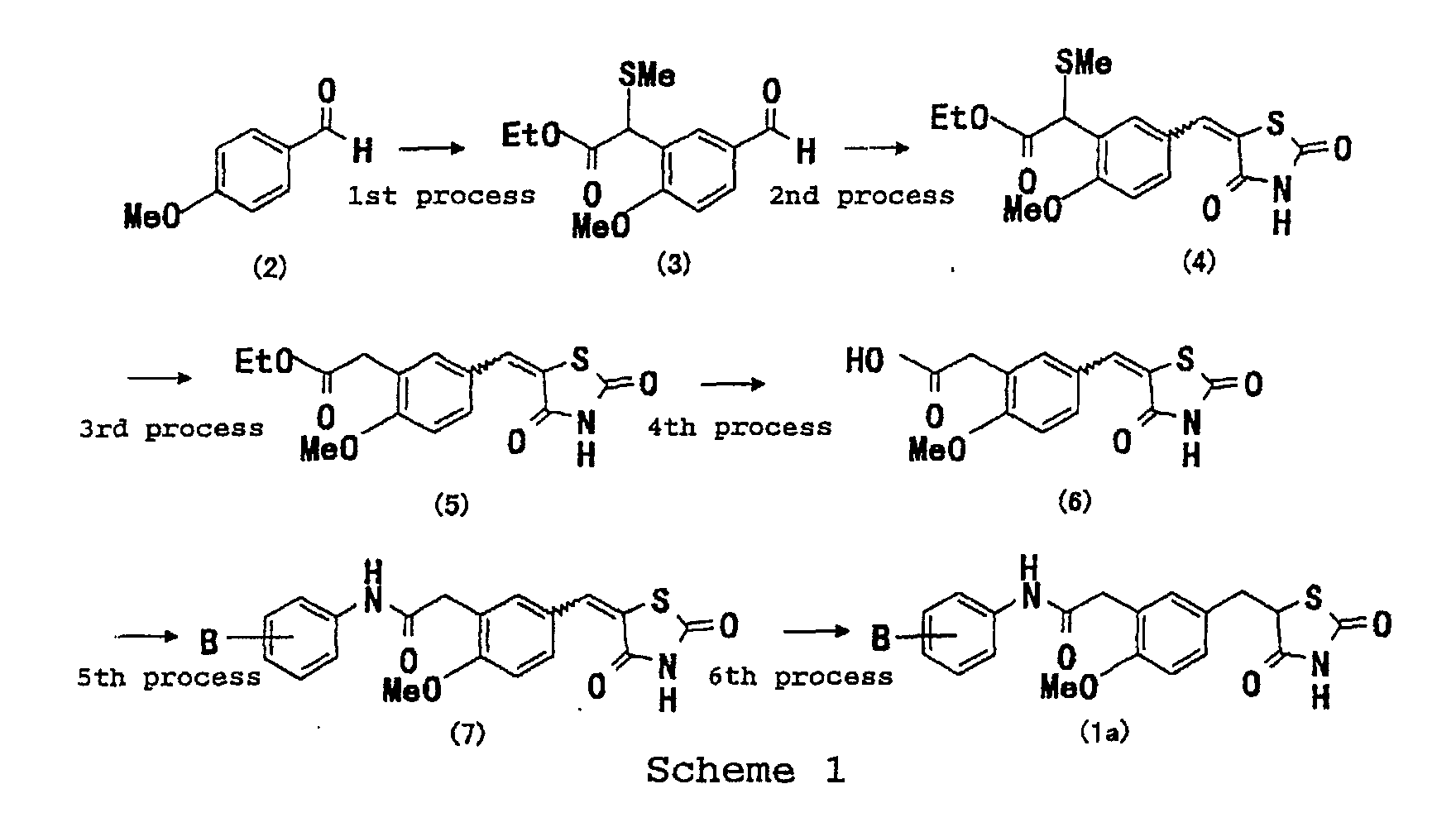 [wherein B denotes a lower alkyl group with carbon atoms of 1 to 4, lower alkoxy group with carbon atoms of 1 to 3, halogen atom, trifluoromethyl group, trifluoromethoxy group, phenyl group which is unsubstituted or may have substituents, phenoxy group which is unsubstituted or may have substituents or benzyloxy group which is unsubstituted or may have substituents], and subsequent reduction (sixth process) of the double bond of the general formula (7) obtained
 [wherein B denotes a lower alkyl group with carbon atoms of 1 to 4, lower alkoxy group with carbon atoms of 1 to 3, halogen atom, trifluoromethyl group, trifluoromethoxy group, phenyl group which is unsubstituted or may have substituents, phenoxy group which is unsubstituted or may have substituents or benzyloxy group which is unsubstituted or may have substituents].
- The first process can be performed in a solvent such as methylene chloride, chloroform or nitrobenzene. As the Lewis acid, aluminum chloride, tin chloride, boron trifluoride or the like can be used. The reaction can be performed at the reaction temperature of -20°C to 150°C, preferably at refluxing temperature of the solvent.
- The second process can be performed in a solvent such as benzene, toluene, xylene, ethanol or acetic acid, or without solvent. As the catalyst, secondary amine such as piperidine or pyrrolidine, or ammonium acetate can be used. The reaction can be performed at the reaction temperature of 0°C to 150°C, preferably at refluxing temperature of the solvent.
- The reaction of the third process can be performed in a solvent such as acetic acid or hydrochloric acid, by reacting metallic zinc, zinc amalgam or zinc-copper alloy. The reaction can be performed at a reaction temperature of -10°C to 100°C, preferably at 0°C to room temperature.
- The fourth process can be performed under acidic condition. For the acidic condition, hydrochloric acid, sulfuric acid, acetic acid, phosphoric acid or their mixtures, the mixed solvents of these acids with organic solvent such as sulfolane, or the like are used. The reaction can be performed at a reaction temperature of 0°C to 150°C, preferably at refluxing temperature of the solvent.
- The fifth process can be performed by leaving the carboxyl group as it is, or converting it to the reactive derivative.
- In the case of the reaction using the reactive derivative, the reaction can be performed in a solvent such as methylene chloride, chloroform, dioxane or N,N-dimethylformamide in the presence or absence of, for example, alkali metal hydride such as sodium hydride, alkali metal hydroxide such as sodium hydroxide, alkali metal carbonate such as potassium carbonate, or organic base such as pyridine or triethylamine as a base.
- In the case of conducting the reaction by leaving the carboxylic acid as it is, the reaction can be performed in a solvent such as methylene chloride, chloroform, dioxane or N,N-dimethylformamide in the presence of condensing agent in the presence or absence of base, and further in the presence or absence of additive.
- As the condensing agent, for example, dicyclohexylcarbodiimide, 1-[3-(dimethylamino)propyl]-3-ethylcarbodiimide hydrochloride, diethyl cyanophosphate, diphenylphosphoric azide, carbonyldiimidazole or the like can be mentioned. As the base, for example, alkali metal hydroxide such as sodium hydroxide, alkali metal carbonate such as potassium carbonate, or organic base such as pyridine or triethylamine can be mentioned. As the additive, N-hydroxybenzotriazole, N-hydroxysuccinimide, 3,4-dihydro-3-hydroxy-4-oxo-1,2,3-benzotriazine or the like can be mentioned. The reaction can be performed at the reaction temperature of -20°C to 100°C, preferably at 0°C to 50°C.
- The sixth process can be performed at a hydrogen pressure of 98.1kPa to 491kPa in a solvent such as ethanol, methanol, tetrahydrofuran, ethyl acetate or N,N-dimethylformamide in the presence of metallic catalyst such as palladium on activated carbon, platinum on activated carbon, platinum oxide or rhodium on alumina. The reaction can be performed at a reaction temperature of 0°C to 100°C, preferably at room temperature to 80°C.
- Moreover, compounds, the bond mode of A portion being -NHCOCH2- in the said general formula (1), can also be prepared, for example, through following processes (Scheme 2).Namely, compounds (1a), the bond mode of A portion being -NHCOCH2- in the general formula (1), can be prepared by reducing (seventh process) ethyl [5-[(2,4-dioxothiazolidin-5-ylidene)methyl]-2-methoxyphenyl]acetate (5) to obtain ethyl [5-[(2,4-dioxothiazolidin-5-yl)methyl]-2-methoxyphenyl]-acetate (9). Then hydrolyzing (eighth process) (9) to obtain 2-[5-[(2,4-dioxothiazolidin-5-ylidene)methyl]-2-methoxyphenyl]acetic acid (10), and by reacting (ninth process) (10) with compounds represented by the general formula (8)
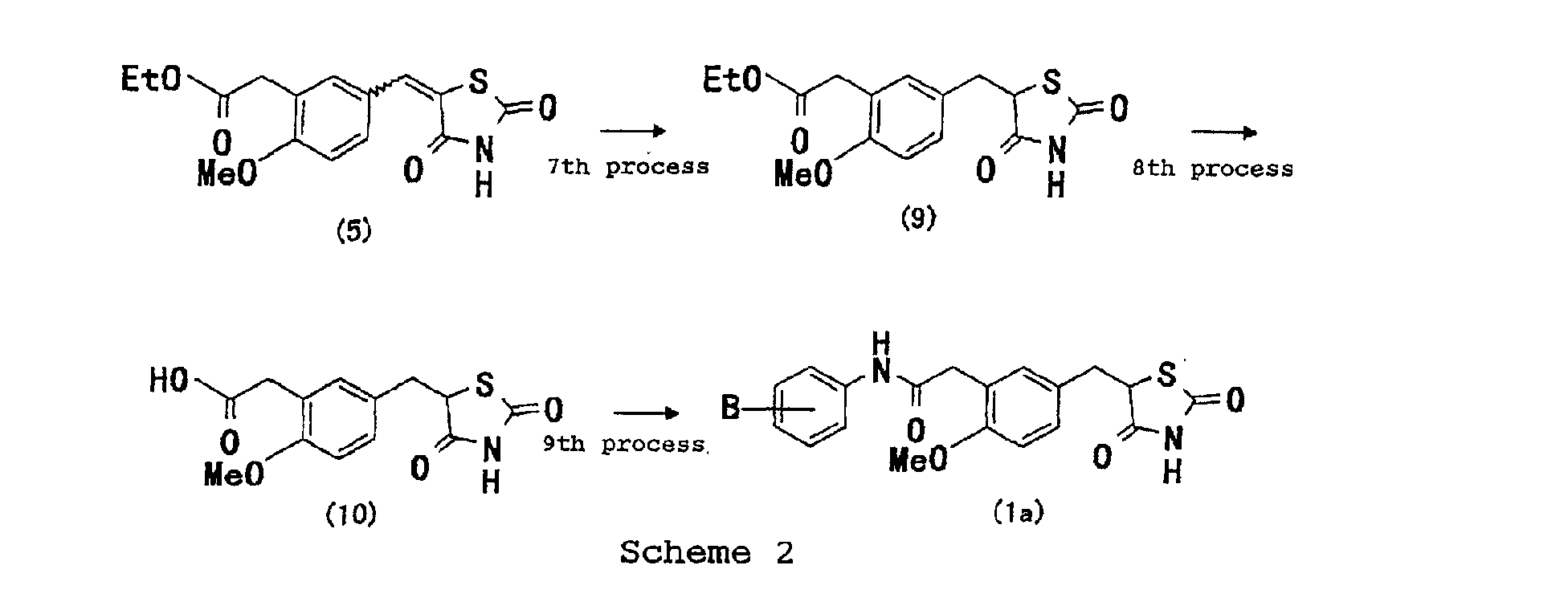 [wherein B denotes a lower alkyl group with carbon atoms of 1 to 4, lower alkoxy group with carbon atoms of 1 to 3, halogen atom, trifluoromethyl group, trifluoromethoxy group, phenyl group which is unsubstituted or may have substituents, phenoxy group which is unsubstituted or may have substituents or benzyloxy group which is unsubstituted or may have substituents].
- The seventh process can be performed at a hydrogen pressure of 98.1kPa to 491kPa in a solvent such as ethanol, methanol, tetrahydrofuran, ethyl acetate or N,N-dimethylformamide in the presence of metallic catalyst such as palladium on carbon, platinum on carbon, platinum oxide or rhodium on alumina. The reaction can be performed at a reaction temperature of 0°C to 100°C, preferably at room temperature to 80°C.
- The hydrolysis of the eighth process can be performed under acidic condition. For the acidic condition, hydrochloric acid, sulfuric acid, acetic acid, phosphoric acid or their mixtures, the mixed solvents of these acids with organic solvent such as sulfolane, or the like are used. The reaction can be performed at a reaction temperature of 0°C to 150°C, preferably at refluxing temperature of the solvent.
- The reaction of the ninth process can be performed by leaving the carboxyl group as it is, or converting it to the reactive derivative.
- In the case of the reaction using the reactive derivative, the reaction can be performed in a solvent such as methylene chloride, chloroform, dioxane or N,N-dimethylformamide in the presence or absence of, for example, alkali metal hydride such as sodium hydride, alkali metal hydroxide such as sodium hydroxide, alkali metal carbonate such as potassium carbonate, or organic base such as pyridine or triethylamine as a base.
- In the case of conducting the reaction by leaving the carboxylic acid as it is, the reaction can be performed in a solvent such as methylene chloride, chloroform, dioxane or N,N-dimethylformamide in the presence of condensing agent in the presence or absence of base, and in the presence or absence of additive.
- As the condensing agent, for example, dicyclohexylcarbodiimide, 1-[3-(dimethylamino)propyl]-3-ethylcarbodiimide hydrochloride, diethyl cyanophosphate, diphenylphosphoric azide, carbonyldiimidazole or the like can be mentioned. As the base, for example, alkali metal hydroxide such as sodium hydroxide, alkali metal carbonate such as potassium carbonate, or organic base such as pyridine or triethylamine can be mentioned. As the additive, N-hydroxybenzotriazole, N-hydroxysuccinimide, 3,4-dihydro-3-hydroxy-4-oxo-1,2,3-benzotriazine or the like can be mentioned. The reaction can be performed at the reaction temperature of -20°C to 100°C, preferably at 0°C to 50°C.
- Moreover, compounds, the bond mode of A portion being -NHCONH- (1b) or -CH2CONH- (1c) in the general formula (1), can be prepared, for example, through the following processes (Scheme 3).Namely, compounds, the bond mode of A portion being -NHCONH-(1b) or -CH2CONH- (1c) in the general formula (1), can be prepared by nitrating (tenth process) 5-[(4-methoxyphenyl)-methyl]thiazolidine-2,4-dione (11), then reducing (eleventh process) 5-[(4-methoxy-3-nitro- phenyl)methyl]thiazolidine-2,4-dione (12) to give 5-[(3-amino-4-methoxyphenyl)methyl]-thiazolidine-2,4-dione (13). Then by condensing (twelfth process, thirteenth process) (13) with compounds represented by the general formula (26)
 [wherein B denotes a lower alkyl group with carbon atoms of 1 to 4, lower alkoxy group with carbon atoms of 1 to 3, halogen atom, trifluoromethyl group, trifluoromethoxy group, phenyl group which is unsubstituted or may have substituents, phenoxy group which is unsubstituted or may have substituents or benzyloxy group which is unsubstituted or may have substituents], or with compounds represented by the general formula (27)
 [wherein B denotes a lower alkyl group with carbon atoms of 1 to 4, lower alkoxy group with carbon atoms of 1 to 3, halogen atom, trifluoromethyl group, trifluoromethoxy group, phenyl group which is unsubstituted or may have substituents, phenoxy group which is unsubstituted or may have substituents or benzyloxy group which is unsubstituted or may have substituents].
- The tenth process can be performed by reacting nitrating agent such as concentrated nitric acid, fuming nitric or the mixture of concentrated nitric acid with concentrated sulfuric acid (mixed acid) in a solvent such as methylene chloride or chloroform, or without solvent. The reaction can be performed at the reaction temperature of -20°C to 120°C, preferably at 0°C to 100°C.
- The eleventh process can be performed by reduction at a hydrogen pressure of 98.1kPa to 491kPa in a solvent such as ethanol, ethyl acetate, tetrahydrofuran or N,N-dimethylformamide using a catalyst such as palladium on carbon, rhodium on alumina or platinum oxide. The reaction can be performed at the reaction temperature of 0°C to 100°C, preferably at room temperature to 80°C.
- The twelfth process can be performed in a solvent such as ethyl acetate, tetrahydrofuran or N,N-dimethylformamide. The reaction can be performed at the reaction temperature of -20°C to 150°C, preferably at 0°C to 100°C.
- The thirteenth process can be performed by leaving carboxyl group as it is, or converting it to reactive derivative.
- As the "reactive derivative of carboxyl group", acid chloride, acid bromide, acid anhydride, carbonylimidazole or the like can be mentioned. In the case of the reaction using reactive derivative, the reaction can be performed in a solvent such as dioxane or N,N-dimethylformamide in the presence or absence of, for example, alkali metal hydride such as sodium hydride, alkali metal hydroxide such as sodium hydroxide, alkali metal carbonate such as potassium carbonate, or organic base such as pyridine or triethylamine as a base.
- In the case of conducting the reaction by leaving the carboxylic acid as it is, the reaction can be performed in a solvent such as methylene chloride, chloroform, dioxane or N,N-dimethylformamide in the presence of condensing agent in the presence or absence of base, and in the presence or absence of additive.
- As the condensing agent, for example, dicyclohexylcarbodiimide, 1-[3-(dimethylamino)propyl]-3-ethylcarbodiimide hydrochloride, diethyl cyanophosphate, diphenylphosphoric azide, carbonyldiimidazole or the like can be mentioned. As the base, for example, alkali metal hydroxide such as sodium hydroxide, alkali metal carbonate such as potassium carbonate, or organic base such as pyridine or triethylamine can be mentioned. As the additive, N-hydroxybenzotriazole, N-hydroxysuccinimide, 3,4-dihydro-3-hydroxy-4-oxo-1,2,3-benzotriazine or the like can be mentioned. The reaction can be performed at the reaction temperature of -20°C to 100°C, preferably at 0°C to 50°C.
- Moreover, compounds, the bond mode of A portion being -NHCONH- (1b) or -CH2CONH- (1c) in the general formula (1), can also be prepared through following processes (Scheme 4).Namely, compounds, the bond mode of A portion being -NHCONH-(1b) or -CH2CONH- (1c) in the general formula (1), can be prepared by reacting (fourteenth process) 4-methoxy-3-nitrobenzaldehyde (14) with thiazolidine-2,4-dione, then reducing (fifteenth process) the nitro group of 5-[(4-methoxy-3-nitrophenyl)methylidene]thiazolidine-2,4-dione (15) to give 5-[(3-amino-4-methoxyphenyl)methylidene]thiazolidine-2,4-dione (16), and condensing (sixteenth process, seventeenth process) (16) with the compounds represented by the general formula (27)
 [wherein B denotes a lower alkyl group with carbon atoms of 1 to 4, lower alkoxy group with carbon atoms of 1 to 3, halogen atom, trifluoromethyl group, trifluoromethoxy group, phenyl group which is unsubstituted or may have substituents, phenoxy group which is unsubstituted or may have substituents or benzyloxy group which is unsubstituted or may have substituents], or with the compounds represented by the general formula (26)
 [wherein B denotes a lower alkyl group with carbon atoms of 1 to 4, lower alkoxy group with carbon atoms of 1 to 3, halogen atom, trifluoromethyl group, trifluoromethoxy group, phenyl group which is unsubstituted or may have substituents, phenoxy group which is unsubstituted or may have substituents or benzyloxy group which is unsubstituted or may have substituents], and by reducing (eighteenth process) the double bond of compounds represented by the general formula (17)
 [wherein B denotes a lower alkyl group with carbon atoms of 1 to 4, lower alkoxy group with carbon atoms of 1 to 3, halogen atom, trifluoromethyl group, trifluoromethoxy group, phenyl group which is unsubstituted or may have substituents, phenoxy group which is unsubstituted or may have substituents or benzyloxy group which is unsubstituted or may have substituents], or the general formula (18)
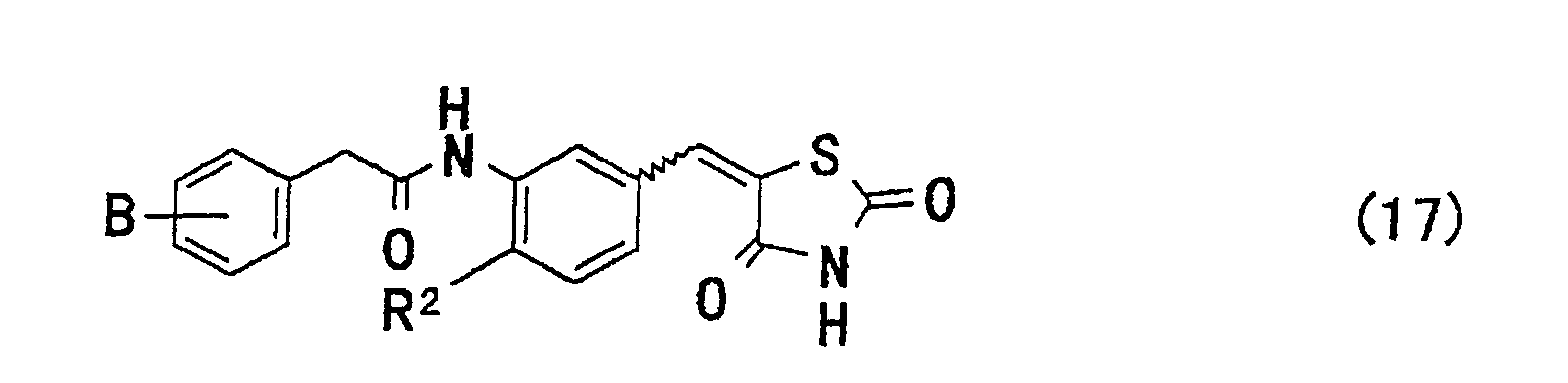 [wherein B denotes a lower alkyl group with carbon atoms of 1 to 4, lower alkoxy group with carbon atoms of 1 to 3, halogen atom, trifluoromethyl group, trifluoromethoxy group, phenyl group which is unsubstituted or may have substituents, phenoxy group which is unsubstituted or may have substituents or benzyloxy group which is unsubstituted or may have substituents].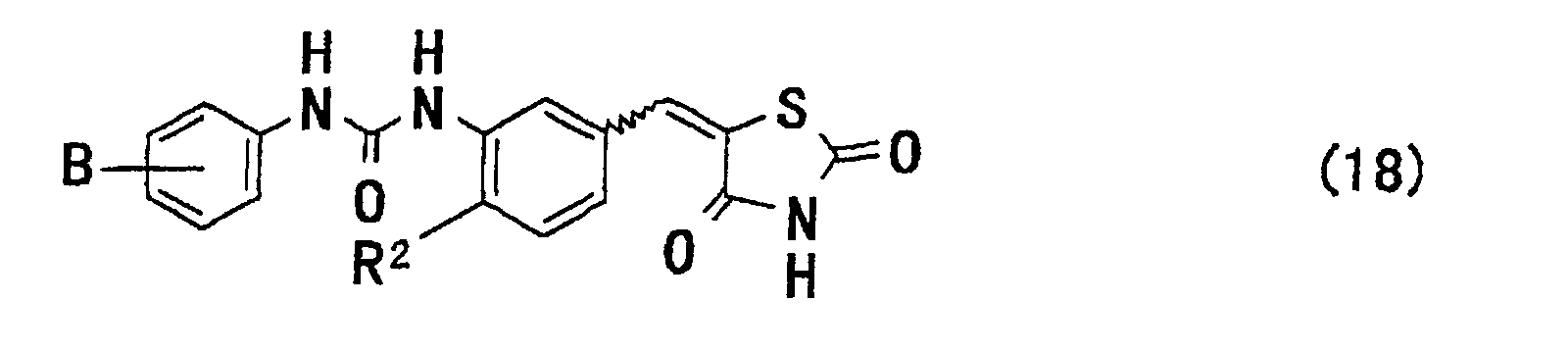
- The fourteenth process can be performed in a solvent such as benzene, toluene, xylene or acetic acid, or without solvent. As the catalyst, secondary amine such as piperidine or pyrrolidine, or ammonium acetate can be used. The reaction can be performed at the reaction temperature of 0°C to 150°C, preferably at refluxing temperature of the solvent.
- The fifteenth process can be performed by reducing in a mixed solvent of alcohol such as ethanol or methanol with hydrochloric acid, using tin, tin chloride(II), tin amalgam or the like. The reaction can be performed at the reaction temperature of 0°C to 100°C, preferably at room temperature to 50°C.
- The sixteenth process can be performed by leaving the carboxyl group as it is, or converting it to the reactive derivative.
- In the case of the reaction using the reactive derivative, the reaction can be performed in a solvent such as dioxane or N,N-dimethylformamide in the presence or absence of, for example, alkali metal hydride such as sodium hydride, alkali metal hydroxide such as sodium hydroxide, alkali metal carbonate such as potassium carbonate, or organic base such as pyridine or triethylamine as a base.
- In the case of conducting the reaction by leaving the carboxylic acid form as it is, the reaction can be performed in a solvent such as methylene chloride, chloroform, dioxane or N,N-dimethylformamide in the presence of condensing agent in the presence or absence of base, and in the presence or absence of additive.
- As the condensing agent, for example, dicyclohexylcarbodiimide, 1-[3-(dimethylamino)propyl]-3-ethylcarbodiimide hydrochloride, diethyl cyanophosphate, diphenylphosphoric azide, carbonyldiimidazole or the like can be mentioned. As the base, for example, alkali metal hydroxide such as sodium hydroxide, alkali metal carbonate such as potassium carbonate, or organic base such as pyridine or triethylamine can be mentioned. As the additive, N-hydroxybenzotriazole, N-hydroxysuccinimide, 3,4-dihydro-3-hydroxy-4-oxo-1,2,3-benzotriazine or the like can be mentioned. The reaction can be performed at the reaction temperature of -20°C to 100°C, preferably at 0°C to 50°C.
- The seventeenth process can be performed in a solvent such as ethyl acetate, tetrahydrofuran or N,N-dimethylformamide. The reaction can be performed at the reaction temperature of -20°C to 150°C, preferably at 0°C to 100°C.
- The eighteenth process can be performed at a hydrogen pressure of 98.1kPa to 491kPa in a solvent such as ethanol, methanol, tetrahydrofuran, ethyl acetate or N,N-dimethylformamide in the presence of metallic catalyst such as palladium on carbon, platinum on carbon, platinum oxide or rhodium on alumina. The reaction can be performed at the reaction temperature of 0°C to 100°C, preferably at room temperature to 80°C.
- Moreover, compounds, the bond mode of A portion being -CH2CH2CO- (1d) in the general formula (1), can be prepared, for example, through following processes (Scheme 5).Namely, compounds, the bond mode of A portion being -CH2CH2CO-(1d) in the general formula (1), can be prepared by reacting (nineteenth process) publicly known [Japanese Unexamined Patent Publication No. Hei 1-316363] 5-formyl-2-methoxybenzoic acid (19) with N,O-dimethylhydroxylamine, then protecting (twentieth process) formyl group of N-methoxy-N-methyl-5-formyl-2-methoxybenzamide (20) with ethylene glycol to obtain N-methoxy-N-methyl-5-(1,3-dioxolane-2-yl)-2-methoxybenzamide (21). Then reacting (twenty-first process) (21) with magnesium methyl iodide, and reacting (twenty-second process) 3'-(1,3-dioxolane-2-yl)-2'-methoxyacetophenone (22) with diethyl carbonate in the presence of base, then reacting (twenty-third process) ethyl 3-[5-(1,3-dioxolane-2-yl)-2-methoxy- phenyl]-3-oxopropionate (23) with the compounds represented by the general formula (28)
 [wherein B denotes a lower alkyl group with carbon atoms of 1 to 4, lower alkoxy group with carbon atoms of 1 to 3, halogen atom, trifluoromethyl group, trifluoromethoxy group, phenyl group which is unsubstituted or may have substituents, phenoxy group which is unsubstituted or may have substituents or benzyloxy group which is unsubstituted or may have substituents], in the presence of base, followed by decarbonation reaction, to obtain compounds represented by a general formula (24)
 [wherein B denotes a lower alkyl group with carbon atoms of 1 to 4, lower alkoxy group with carbon atoms of 1 to 3, halogen atom, trifluoromethyl group, trifluoromethoxy group, phenyl group which is unsubstituted or may have substituents, phenoxy group which is unsubstituted or may have substituents or benzyloxy group which is unsubstituted or may have substituents]. Then reacting (twenty-fourth process) (24) with thiazolidine-2,4-dione in the presence of catalyst to obtain the compounds represented by the general formula (25)
 [wherein B denotes a lower alkyl group with carbon atoms of 1 to 4, lower alkoxy group with carbon atoms of 1 to 3, halogen atom, trifluoromethyl group, trifluoromethoxy group, phenyl group which is unsubstituted or may have substituents, phenoxy group which is unsubstituted or may have substituents or benzyloxy group which is unsubstituted or may have substituents], and by reducing (twenty-fifth process) the double bond of these compounds.
- The nineteenth process can be performed by leaving carboxyl group as it is, or converting it to reactive derivative.
- In the case of the reaction using the reactive derivative, the reaction can be performed in a solvent such as dioxane or N,N-dimethylformamide in the presence or absence of, for example, alkali metal hydride such as sodium hydride, alkali metal hydroxide such as sodium hydroxide, alkali metal carbonate such as potassium carbonate, or organic base such as pyridine or triethylamine as a base.
- In the case of conducting the reaction by leaving the carboxylic acid as it is, the reaction can be performed in a solvent such as methylene chloride, chloroform, dioxane or N,N-dimethylformamide in the presence of condensing agent in the presence or absence of base, and in the presence or absence of additive.
- As the condensing agent, for example, dicyclohexylcarbodiimide, 1-[3-(dimethylamino)propyl]-3-ethylcarbodiimide hydrochloride, diethyl cyanophosphate, diphenylphosphoric azide, carbonyldiimidazole or the like can be mentioned. As the base, for example, alkali metal hydroxide such as sodium hydroxide, alkali metal carbonate such as potassium carbonate, or organic base such as pyridine or triethylamine can be mentioned. As the additive, N-hydroxybenzotriazole, N-hydroxysuccinimide, 3,4-dihydro-3-hydroxy-4-oxo-1,2,3-benzotriazine or the like can be mentioned. The reaction can be performed at the reaction temperature of -20°C to 100°C, preferably at 0°C to 50°C.
- The twentieth process can be performed in a solvent such as benzene, toluene or xylene in the presence of acid catalyst. As the acid catalyst, sulfuric acid, p-toluenesulfonic acid, camphorsulfonic acid, phosphorus oxychloride, oxalic acid or the like can be used. The reaction can be performed at the reaction temperature of 0°C to 150°C, preferably at refluxing temperature of solvent.
- The twenty-first process can be performed in a solvent such as ether, tetrahydrofuran or dioxane. The reaction can be performed at the reaction temperature of -100°C to room temperature, preferably at -80°C to 0°C.
- The twenty-second process can be performed in a solvent such as ether, tetrahydrofuran or dioxane in the presence of base. As the base, for example, alkali metal hydride such as sodium hydride, organometallic compound such as butyl lithium, metal amide such as lithium diisopropylamide, or metal alkoxide such as sodium methoxide or potassium t-butoxide can be used. The reaction can be performed at the reaction temperature of -20°C to 150°C, preferably at 0°C to 50°C.
- For the twenty-third process, first, the alkylating reaction can be performed in a solvent such as ether, tetrahydrofuran or dioxane in the presence of base. As the base, for example, alkali metal hydride such as sodium hydride, organometallic compound such as butyl lithium, metal amide such as lithium diisopropylamide, or metal alkoxide such as sodium methoxide or potassium t-butoxide can be used. The reaction can be performed at the reaction temperature of -20°C to 150°C, preferably at refluxing temperature of the solvent. Following decarbonation reaction can be performed under acidic condition. As the acid, hydrochloric acid, acetic acid, sulfuric acid, phosphoric acid or the like singly, or mixed solvents thereof can be used. The reaction can be performed at the reaction temperature of room temperature to 150°C, preferably at refluxing temperature of the solvent.
- The twenty-fourth process can be performed in a solvent such as benzene, toluene, xylene, ethanol or acetic acid, or without solvent. As the catalyst, secondary amine such as piperidine or pyrrolidine, or ammonium acetate can be used. The reaction can be performed at the reaction temperature of 0°C to 150°C, preferably at refluxing temperature of the solvent.
- The twenty-fifth process can be performed at a hydrogen pressure of 98.1kPa to 491kPa in a solvent such as ethanol, methanol, tetrahydrofuran, ethyl acetate or N,N-dimethylformamide in the presence of metal catalyst such as palladium on carbon, platinum on carbon, platinum oxide or rhodium on alumina. The reaction can be performed at the reaction temperature of 0°C to 100°C, preferably at room temperature to 80°C.
- As the administering form of the novel compounds of the invention, for example, oral administration with tablet, capsule, granule, powder, inhalant, syrup or the like, or parenteral administration with injection, suppository or the like can be mentioned.
- In following, the invention will be illustrated based on examples, but the invention is not confined to these examples.
- Under an atmosphere of argon, to a solution of 4-methoxybenzaldehyde (8.17g, 60.0mmol) in methylene chloride (250mL) was added dropwise anhydrous tin chloride(IV) (7.02mL, 60.0mmol) under cooling with ice and stirring. After stirring for 10 minutes at room temperature, a solution of ethyl 2-chloro-2-(methylthio)acetate (10.2g, 60.5 mmol), methylene chloride (50mL) and carbon tetrachloride (50mL) was added dropwise. After refluxing for 16 hours, the reaction mixture was allowed to stand for cooling, poured into ice-water, and the organic layer was separated, the aqueous layer was then extracted with methylene chloride. After combined respective organic layers, they were washed with water, saturated aqueous solution of sodium hydrogen-carbonate and saturated brine in sequence, then dried over anhydrous sodium sulfate and concentrated. The residue was purified by silica gel chromatography (eluate n-hexane:ethyl acetate=6:1v/v) to obtain 7.51g (47%) of the title compound as a yellow oily product.
Mass analysis(EI+)(m/z): 268(M+) - Ethyl 2-methylthio-2-(5-formyl-2-methoxyphenyl)acetate (7.50g, 28.0mmol), thiazolidine-2,4-dione (3.94g, 33.6mmol), piperidine (2.80mL, 28.3mmol) and ethanol (100mL) were mixed and refluxed for 14 hours. After allowed to stand for cooling, concentrated hydrochloric acid was added under cooling with ice and stirring to make the reaction mixture acidic. Ice water was added thereto and the mixture was stirred for 30 minutes. The precipitated crystals were collected by filtration, washed with ethanol and water, and then dried to obtain 6.18g (60%) of the title compound as yellow crystals.
Mass analysis(EI+)(m/z): 367(M+) - Ethyl 2-methylthio-2-[5-[(2,4-dioxothiazolidin-5-ylidene)methyl]-2-methoxyphenyl]acetate (6.18g, 16.8mmol) and acetic acid (100mL) were mixed, and zinc powder (46.0g, 706mmol) was added under stirring, which was stirred for 24 hours at room temperature. Zinc was collected by filtration, washed with acetic acid, and the filtrate was concentrated. The residue was dissolved into ethyl acetate, washed with water and brine in sequence, then dried over anhydrous sodium sulfate and concentrated. The residue was recrystallized from methanol to obtain 2.71g (50%) of the title compound as yellow powder.
Mass analysis(EI+)(m/z): 321(M+) - Ethyl 2-[5-[(2,4-dioxothiazolidin-5-ylidene)methyl]-2-methoxyphenyl]acetate (1.29g, 4.01mmol), concentrated hydrochloric acid (20mL)and acetic acid (20mL) were mixed and refluxed for 2.5 hours.
After allowed to stand for cooling, ice water was added thereto and the precipitated crystals were collected by filtration, washed with water, and then dried to obtain 1.13g (96%) of title compound as yellow powder.
Mass analysis(EI+)(m/z): 293(M+) - 2-[5-[(2,4-Dioxothiazolidin-5-ylidene)methyl]-2-methoxyphenyl]-acetic acid (440mg, 1.50mmol), 4-(trifluoromethyl)aniline (242µL, 1.50mmol), triethylamine (210µL, 1.51mmol) and dehydrated N,N-dimethylformamide (5mL) were mixed, and, under an atmosphere of argon, diethyl cyanophosphate (228µL, 1.50mmol) was added under cooling with ice and stirring. After stirring for 1 hour at room temperature, the mixture was allowed to stand for 3 days. The reaction mixture was poured into ice water and the precipitated crystals were collected by filtration. The crystals were washed with ethyl acetate, and then dried to obtain 472mg (72%) of the title compound as yellow crystals.
Mass analysis(EI+)(m/z): 436(M+) - N-[4-(Trifluoromethyl)phenyl]-2-[5-[(2,4-dioxothiazolidin-5-ylidene)methyl]-2-methoxyphenyl]acetamide (300mg, 0.687mmol), 10% palladium on carbon (300mg) and a mixed solvent of tetrahydrofuran and ethanol (2:1v/v, 40mL) were mixed, and hydrogenation was performed at room temperature and at an initial pressure of 392kPa. After completion of the reaction, catalyst was filtered and the filtrate was concentrated. The residue was purified by silica gel chromatography (eluate n-hexane:ethyl acetate= 2:1v/v) to obtain 172mg (57%) of the title compound as colorless powder.
Melting point 194.5-196.5°C;
Mass analysis(EI+)(m/z): 438(M+);
Elemental analysis(%) C20H17F3N2O4S: - Calcd.(%) C, 54.79; H, 3.91; N, 6.39.
- Found (%) C, 54.62; H, 3.81; N, 6.24.
-
- 4-Methoxybenzaldehyde (20.4g, 150mmol), thiazolidine-2,4-dione (21.1g, 180mmol), piperidine (12.8g, 150mmol) and ethanol (150mL) were mixed and refluxed for 18 hours. After allowed to stand for cooling, the precipitated crystals were collected by filtration. These were washed with ethanol, and then dried to obtain 11.2g (32%) of the title compound as yellow crystals. Moreover, the filtrate was made acidic with concentrated hydrochloric acid, and the precipitated crystals were collected by filtration, washed with ethanol and water, and then dried to additionally obtain 18.1g (51%, totally 83%) of the title compound as yellow crystals.
Mass analysis(EI+)(m/z): 235(M+) - 5-[(4-Methoxyphenyl)methylidene]thiazolidine-2,4-dione (6.00g, 25.5mmol), 10% palladium on carbon (6.00g) and a mixed solvent of tetrahydrofuran and ethanol (2:1v/v, 300mL) were mixed, and hydrogenation was performed at room temperature and at an initial pressure of 294kPa. After completion of the reaction, catalyst was filtered and the filtrate was concentrated. The residue was purified by silica gel chromatography (eluate n-hexane: ethyl acetate=2:1v/v) to obtain 5.84g (97%) of the title compound as colorless powder.
Mass analysis(EI+)(m/z): 237(M+) - To concentrated nitric acid (100mL) was added 5-[(4-methoxyphenyl)methyl]thiazolidine-2,4-dione (3.56g, 15.0mmol) little by little under cooling with ice-salt and stirring. After stirring further for 3 hours, the reaction mixture was poured into ice water, and the precipitated crystals were collected by filtration, washed with water, and then dried to obtain 3.04g (72%) of the title compound as yellow crystals.
Mass analysis(EI+)(m/z): 282(M+) - 5-[(4-Methoxy-3-nitrophenyl)methyl]thiazolidine-2,4-dione (3.00g, 10.6mmol), 10% palladium on carbon (2.00g) and a mixed solvent of ethyl acetate and ethanol (1:1v/v, 200mL) were mixed, and hydrogenation was performed at room temperature and at an initial pressure of 294kPa. After completion of the reaction, catalyst was filtered and the filtrate was concentrated. The residue was purified by silica gel chromatography (eluate n-hexane: ethyl acetate=1:1v/v) to obtain 2.55g (95%) of the title compound as light brown crystals.
Mass analysis(EI+)(m/z): 252(M+) - 5-[(3-Amino-4-methoxyphenyl)methyl]thiazolidine-2,4-dione (378mg, 1.50mmol) and dehydrated tetrahydrofuran (5mL) were mixed and under an atmosphere of argon, 4-trifluoromethyl-isocyanate (0.236mL, 1.65 mmol) was added at room temperature under stirring, and stirred for 6 hours at room temperature. After allowed to stand over-night, the reaction mixture was concentrated, and the residue was recrystallized from methylene chloride to obtain 375mg (57%) of the title compound as colorless powder.
Melting point 202.0-204.0°C;
Mass analysis(EI+)(m/z): 439(M+);
Elemental analysis(%) C19H16F3N2O4S: - Calcd.(%) C, 51.93; H, 3.67; N, 9.56.
- Found (%) C, 51.80; H, 3.60; N, 9.58.
-
- 4-Methoxy-3-nitrobenzaldehyde (4.00g, 22.2mmol), thiazolidine-2,4-dione (3.10g, 26.5mmol), ammonium acetate (3.40g, 44.1mmol), acetic acid (8mL) and benzene (120mL) were mixed, and, while removing water formed by the reaction, the mixture was refluxed for 8 hours. After allowed to stand for cooling, the precipitated crystals were collected by filtration, washed with benzene and 20% aqueous acetone, and then dried to obtain 5.50g (88%) of the title compound as yellow powder.
Mass analysis(EI+)(m/z): 280(M+) - 5-[(4-Methoxy-3-nitrophenyl)methylidene]thiazolidine-2,4-dione (841mg, 3.00mmol), ethanol (20mL) and concentrated hydrochloric acid (10mL) were mixed, and tin chloride(II) dihydrate (2.26g, 9.01mmol) was added little by little at room temperature under stirring. After stirring for 8 hours at room temperature, the reaction mixture was poured into water and neutralized with saturated aqueous sodium hydrogencarbonate, which was extracted with ethyl acetate. The extracted solution was washed with water, then dried over anhydrous sodium sulfate and concentrated to obtain 641mg (85%) of the title compound as yellowish orange powder.
Mass analysis(EI+)(m/z): 250(M+) - 5-[(3-Amino-4-methoxyphenyl)methylidene]thiazolidine-2,4-dione (561mg, 2.24mmol), 4-(trifluoromethyl)phenylacetic acid (460mg, 2.25 mmol) and N,N-dimethylformamide (6mL) were mixed, and, under an atmosphere of argon, triethylamine (250mg, 2.46mmol) and diethyl cyanophosphate (0.37mL, 2.44mmol) were added under cooling with ice and stirring. After stirring further for 20 minutes under cooling with ice, the mixture was stirred for 6 hours at room temperature. The reaction mixture was poured into ice water and the precipitated crystals were collected by filtration. The crystals were washed with water, and then dried to obtain 873mg (89%) of title compound as yellow powder.
Mass analysis(EI+)(m/z): 436(M+) - N-[2-Methoxy-5-[(2,4-dioxothiazolidin-5-ylidene)methyl]-phenyl]-2-[4-(trifluoromethyl)phenyl]acetamide (610mg, 1.40mmol), 10% palladium-carrying activated carbon (600mg) and a mixed solvent of ethyl acetate with ethanol (1:1v/v, 150mL) were mixed, and hydrogenation was performed at room temperature and at an initial pressure of 343kPa. After completion of the reaction, catalyst was filtered and the filtrate was concentrated. The residue was recrystallized from ether to obtain 598mg (98%) of the title compound as colorless fine powder.
Melting point 147.0-149.0°C;
Mass analysis(EI+)(m/z): 438(M+);
Elemental analysis (%) C20H17F3N2O4S: - Calcd.(%) C, 54.79; H, 3.91; N, 6.39.
- Found (%) C, 54.71; H, 3.88; N, 6.33.
-
- Publicly known [Japanese Unexamined Patent Publication No. Hei 1-316363] 5-formyl-2-methoxybenzoic acid (6.70g, 37.2mmol), triethylamine (13.0mL, 93.3mmol) and dichloromethane (200mL) were mixed and ethyl chlorocarbonate (3.90mL, 40.8mmol) was added under cooling with ice and stirring, which was stirred for 20 minutes. Next, N,O-dimethylhydroxylamine•hydrochloride (4.35g, 44.6mmol) was added, and the mixture was stirred for 6 hours at room temperature, which was then allowed to stand overnight. After washed the reaction mixture with lmol/L hydrochloric acid, water, saturated aqueous solution of sodium hydrogencarbonate and water in sequence, the organic layer was separated, then dried over anhydrous sodium sulfate and concentrated. The residue was purified by silica gel chromatography (eluate n-hexane:ethyl acetate=2:3v/v) to obtain 6.56g (79%) of the title compound as colorless crystals.
Mass analysis(EI+)(m/z): 223(M+) - N-Methoxy-N-methyl-5-formyl-2-methoxybenzamide (6.56g, 29.4mmol), ethylene glycol (8.20mL, 147mmol), p-toluenesulfonic acid monohydrate (110mg, 0.578mmol) and toluene (100mL) were mixed, and, while removing water generated using dean-stark apparatus, the mixture was refluxed for 4 hours. After allowed to stand for cooling, ethyl acetate was added, which was washed with saturated aqueous solution of sodium hydrogencarbonate and water in sequence. Then, the organic layer was dried over anhydrous sodium sulfate and concentrated. The residue was purified by silica gel chromatography (eluate n-hexane:ethyl acetate=1:2v/v) to obtain 6.60g (84%) of the title compound as a colorless oil.
Mass analysis(EI+)(m/z): 267(M+) - N-Methoxy-N-methyl-5-(1,3-dioxolan-2-yl)-2-methoxybenzamide (6.60g, 24.7mmol) and dehydrated tetrahydrofuran (200mL) were mixed, and under an atmosphere of argon, the mixture was cooled using dry ice-acetone bath, and 3.0mol/L solution of methyl magnesium iodide in ether (24.7mL, 74.1mmol) was added dropwise slowly under stirring. After completion of the dropwise addition, the mixture was stirred for 1.5 hours under cooling with ice. A saturated aqueous solution of ammonium chloride (200mL) was added dropwise thereto under cooling with ice and stirring. After separated the organic layer, the aqueous layer was extracted with ethyl acetate. Respective organic layers were combined, washed with water and saturated brine in sequence, then dried over anhydrous sodium sulfate and concentrated. The residue was purified by silica gel chromatography (eluate n-hexane:ethyl acetate=4:1v/v) to obtain 4.31g (79%) of the title compound as colorless crystals.
Mass analysis(EI+)(m/z): 267(M+H)+ - To dehydrated ether (15mL) was added sodium hydride (940mg, 23.5 mmol) under cooling with ice and stirring, and following this, diethyl carbonate (1.66g, 14.1mmol) was added, which was stirred for 30 minutes at room temperature. Next, 5'-(1,3-dioxolane-2-yl)-2'-methoxyacetophenone (2.08g, 9.36mmol), dehydrated tetrahydrofuran (20mL) and ethanol (0.05mL) were mixed and added dropwise slowly. After completion of the dropwise addition, the mixture was refluxed for 7 hours. After allowed to stand for cooling, the reaction mixture was poured slowly into a solution of 2mol/L hydrochloric acid (20mL) and ethyl acetate (30mL) under cooling with ice and stirring. After separated the organic layer, the aqueous layer was extracted with ethyl acetate. Respective organic layers were combined, washed with water and saturated brine in sequence, then dried over anhydrous sodium sulfate and concentrated. The residue was purified by silica gel chromatography (eluate n-hexane:ethyl acetate=3:1v/v) to obtain 1.44g (52%) of the title compound as a pale yellow oil.
Mass analysis(EI+)(m/z): 267(M+H)+ - To dehydrated tetrahydrofuran (7mL) was added sodium hydride (190 mg, 4.75mmol), and, under an atmosphere of argon, a solution of ethyl 3-[5-(1,3-dioxolane-2-yl)-2-methoxyphenyl]-3-oxopropionate (1.40g, 4.76mmol) dissolved into dehydrated tetrahydrofuran (10mL) was added dropwise slowly under cooling with ice and stirring. After stirring for 30 minutes at room temperature, a solution of 4-(trifluoromethyl)benzyl bromide (1.30g, 4.44mmol) dissolved into dehydrated tetrahydrofuran (3mL) was added dropwise. After completion of the dropwise addition, the mixture was refluxed for 18 hours. After allowed to stand for cooling, the reaction mixture was concentrated. Concentrated hydrochloric acid (3mL) and acetic acid (10mL) were added thereto, and the mixture was refluxed for 5 hours. After allowed to stand for cooling, the reaction mixture was poured into ice water, which was extracted with ethyl acetate. The extracted solution was washed with saturated aqueous solution of sodium hydrogen-carbonate, water and brine in sequence, then dried over anhydrous sodium sulfate and concentrated. The residue was purified by silica gel chromatography (eluate n-hexane: ethyl acetate=6:1v/v) to obtain 911mg (61%) of the title compound as colorless crystals.
Mass analysis(EI+)(m/z): 336(M+) - 3-[4-(Trifluoromethyl)phenyl]-1-(5-formyl-2-methoxyphenyl)propane-1-one (900mg, 2.68mmol), 1,3-thiazolidine-2,4-dione (377mg, 3.21mmol), piperidine (265µL, 2.68mmol) and ethanol (10mL) were mixed, and the mixture was refluxed for 13 hours. After allowed to stand for cooling, this was made acidic with concentrated hydrochloric acid under cooling with ice and stirring, and the precipitated crystals were collected by filtration. These were washed with ethanol and water, and then dried to obtain 906mg (78%) of the title compound as yellow crystals.
Mass analysis(EI+)(m/z): 435(M+) - 5-[[3-[3-[4-(Trifluoromethyl)phenyl]propanoyl]-4-methoxyphenyl]methylidene]-1,3-thiazolidine-2,4-dione (500mg, 1.15mmol), 10% palladium on carbon (500mg) and tetrahydrofuran (50mL) were mixed, and medium pressure hydrogenation was performed for 8 hours at an initial pressure of 392kPa. After completion of the reaction, the catalyst was filtered, the filtrate was concentrated, and the residue was purified by silica gel chromatography (eluate n-hexane:ethyl acetate=2:1v/v) to obtain 444mg (88%) of the title compound as colorless powder.
Melting point 103.0-104.5°C;
Mass analysis(EI+)(m/z): 437(M+);
Elemental analysis(%) C21H18F3NO4S: - Calcd.(%) C, 57.66; H, 4.15; N, 3.20.
- Found (%) C, 57.84; H, 4.10; N, 3.25.
-
- Similarly to Example 6, the title compound was obtained as colorless powder.
Melting point 82.0-84.0°C;
Mass analysis(EI+)(m/z): 462(M+);
Elemental analysis (%) C25H22N2O5S·•1H2O: - Calcd.(%) C, 62.49; H, 5.03; N, 5.83.
- Found (%) C, 62.21; H, 4.94; N, 6.07.
-
- Similarly to Example 11, the compounds in Table 1 were obtained.
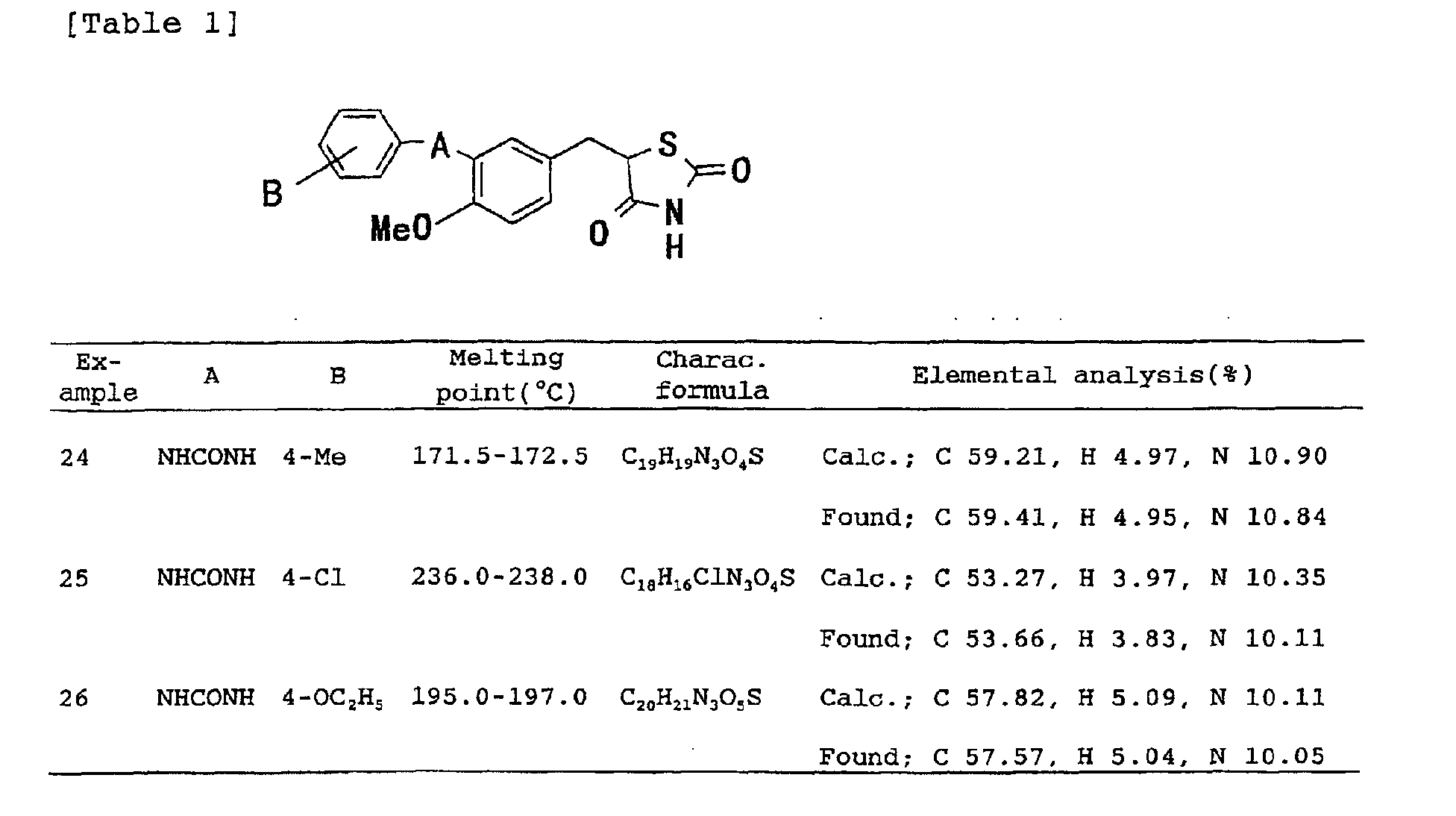
- 5-[(3-Amino-4-methoxyphenyl)methyl]thiazolidine-2,4-dione (250mg, 0.991mmol) and dehydrated methylene chloride (10mL) were mixed, and, after 4-chlorophenylacetic acid (178mg, 1.04mmol) and 1-[3-(dimethylamino)propyl]-3-ethylcarbodiimide hydrochloride (228mg, 1.19mmol) were added under cooling with ice and stirring, the mixture was stirred for 20 minutes under cooling with ice. The reaction mixture was poured into water, which was extracted with methylene chloride. The extracted solution was washed with 5% hydrochloric acid, saturated aqueous solution of sodium hydrogencarbonate and brine in sequence, and then concentrated. The residue was recrystallized from mixed solvent of methanol with isopropyl ether to obtain 327mg (82%) of the title compound as colorless powder.
Melting point 182.0-183.0°C;
Mass analysis(EI+)(m/z): 404(M+);
Elemental analysis(%) C19H17ClN2O4S: - Calcd.(%) C, 56.36; H, 4.23; N, 6.92.
- Found (%) C, 56.27; H, 4.16; N, 6.88.
-
- Similarly to Example 27, compounds in Table 2 were obtained.
Example A B Melting point (°C) Charac. formula Elemental analysis(%) 28 CH2CONH 4-Me 183.0 C20H2ON2O4S Calc.; C 62.48, H 5.24, N 7.29 - Found; C 62.32, H 5.16, N 7.21 185.0 29 CH2CONH 4-OMe 124.0 C20H2ON2O5S ·1/4H2O Calc.; C 59.32, H 5.10, N 6.92 - Found; C 59.43, H 4.90, N 6.89 125.0 30 CH2CONH 4-Ph(4-OMe) 205.0 C26H24N2O5S ·1/4H2O Calc.; C 64.92, H 5.13, N 5.82 - Found; C 65.15, H 5.06, N 5.76 207.0 31 CH2CONH 4-Ph(4-Me) 189.0 C26H24N2O4S ·1/4H2O Calc.; C 67.15, H 5.31, N 6.02 - Found; C 67.36, H 5.27, N 6.08 191.0 32 CH2CONH 4-Ph(4-Cl) 193.0 C25H21ClN2O4S ·1/4H2O Calc.; C 61.85, H 4.46, N 5.77 - Found; C 61.91, H 4.41, N 5.72 195.0 33 CH2CONH 4-OPh(4-Cl) Amorphous C25H21ClN2O5S Calc.; C 60.42, H 4.26, N 5.64 Found; C 60.12, H 4.28, N 5.47 34 CH2CONH 4-OCH2Ph(4-OMe) 140.0 C27H26N2O6S Calc.; C 64.02, H 5.17, N 5.53 - Found; C 64.03, H 5.25, N 5.38 141.0 35 CH2CONH 4-OCH2Ph(4-Me) 158.0 C27H26N2O5S Calc.; C 66.10, H 5.34, N 5.71 - Found; C 66.42, H 5.29, N 5.63 160.0 36 CH2CONH 4-OPh(4-Me) 186.0 C26H24N2O5S Calc.; C 65.53, H 5.08, N 5.88 - Found; C 65.14, H 5.19, N 5.75 188.0 - To CHO cells cultured in a Ham's F-12 medium containing fatty acid free 10% fetal calf serum, receptor plasmid and its reporter plasmid (STRATAGENE Corp.) that express fused protein of DNA-binding domain being transcription factor of yeast with ligand-binding domain of human type PPARα and γ (Biochemistry, 1993, 32, 5598), and β-galactosidase plasmid (Promega Corp.) for internal standard were cotransfected with lipofectamine in the serum-free state. Thereafter, testing compound and control compound (Troglitazone and Pioglitazone for control drug of PPARγ, and (8S)-HETE for control drug of PPARα) were dissolved into DMSO and adjusted with Ham's F-12 medium containing fatty acid free 10% fetal calf serum, so that the final concentration of DMSO became 0.01% to culture. After 24 hours, CAT activity and β-galactosidase activity were measured.
- Results are shown in Table 3. From these results, it was shown that the inventive compounds had potent transactivation action on human peroxisome proliferator-activated receptorα and γ.
Example Transactivation action PPARα PPARγ EC50(µmol/L) EC50(µmol/L) 6 0.60 3.30 11 0.55 0.43 15 0.86 1.10 22 0.80 0.40 Troglitazone - 1.15 Pioglitazone - 0.72 (8S)-HETE 1.30 - - From the results as described above, the inventive substituted benzylthiazolidine-2,4-dione derivatives are novel compounds with excellent human PPAR transactivation action.
- From the fact that these inventive compounds have agonistic activity on human PPAR, it can be said that they are effective compounds as therapeutic drugs for diabetes and/or therapeutic drugs for hyperlipidemia aforementioned.
Claims (12)
- Substituted benzylthiazolidine-2,4-dione derivatives represented by a general formula (1)[wherein the bond mode of A denotes -CH2CONH-, -NHCONH-, -CH2CH2CO- or -NHCOCH2-, and B denotes a lower alkyl group with carbon atoms of 1 to 4, lower alkoxy group with carbon atoms of 1 to 3, halogen atom, trifluoromethyl group, trifluoromethoxy group, phenyl group which is unsubstituted or may have substituents, phenoxy group which is unsubstituted or may have substituents or benzyloxy group which is unsubstituted or may have substituents], their medicinally acceptable salts and their hydrates.

- Substituted benzylthiazolidine-2,4-dione derivatives, their medicinally acceptable salts and their hydrates of Claim 1, wherein the bond mode of A is -CH2CONH-.
- Substituted benzylthiazolidine-2,4-dione derivatives, their medicinally acceptable salts and their hydrates of Claim 1, wherein the bond mode of A is -NHCONH-.
- Substituted benzylthiazolidine-2,4-dione derivatives, their medicinally acceptable salts and their hydrates of Claim 1, wherein the bond mode of A is -NHCOCH2-.
- Substituted benzylthiazolidine-2,4-dione derivatives, their medicinally acceptable salts and their hydrates of Claim 1, wherein the bond mode of A is -CH2CH2CO-.
- Compounds, their medicinally acceptable salts and their hydrates of Claim 1, wherein one of the compounds is N-[2-methoxy-5-[(2,4-dioxothiazolidin-5-yl)methyl]phenyl]-2-[4-(trifluoromethyl)phenyl]acetamide.
- Compounds, their medicinally acceptable salts and their hydrates of Claim 1, wherein one of the compounds is 5-[[4-methoxy-3-[3-[4-(trifluoromethyl)phenyl]ureido]phenyl]-methyl]thiazolidine-2,4-dione.
- Compounds, their medicinally acceptable salts and their hydrates of Claim 1, wherein one of the compounds is N-[4-(trifluoromethyl)phenyl]-2-[5-[(2,4-dioxothiazolidin-5-yl)methyl]-2-methoxyphenyl]acetamide.
- Compounds, their medicinally acceptable salts and their hydrates of Claim 1, wherein one of the compounds is 5-[[3-[3-[4-(trifluoromethyl)phenyl]propanoyl]-4-methoxyphenyl]methyl]-thiazolidine-2,4-dione.
- A blood glucose-decreasing drug having at least one or more kinds of substituted benzylthiazolidine-2,4-dione derivatives represented by the general formula (1)[wherein the bond mode of A denotes -CH2CONH-, -NHCONH-, -CH2CH2CO- or -NHCOCH2-, and B denotes a lower alkyl group with carbon atoms of 1 to 4, lower alkoxy group with carbon atoms of 1 to 3, halogen atom, trifluoromethyl group, trifluoromethoxy group, phenyl group which is unsubstituted or may have substituents, phenoxy group which is unsubstituted or may have substituents or benzyloxy group which is unsubstituted or may have substituents], their medicinally acceptable salts and their hydrates as effective ingredients.

- A lipid-decreasing drug having at least one or more kinds of substituted benzylthiazolidine-2,4-dione derivatives represented by the general formula (1)[wherein the bond mode of A denotes -CH2CONH-, -NHCONH-, -CH2CH2CO- or -NHCOCH2-, and B denotes a lower alkyl group with carbon atoms of 1 to 4, lower alkoxy group with carbon atoms of 1 to 3, halogen atom, trifluoromethyl group, trifluoro-methoxy group, phenyl group which is unsubstituted or may have substituents, phenoxy group which is unsubstituted or may have substituents or benzyloxy group which is unsubstituted or may have substituents], their medicinally acceptable salts and their hydrates as effective ingredients.

- An agonist of human peroxisome proliferator-activated receptor (PPAR) having at least one or more kinds of substituted benzylthiazolidine-2,4-dione derivatives represented by the general formula (1)[wherein the bond mode of A denotes -CH2CONH-, -NHCONH-, -CH2CH2CO- or -NHCOCH2-, and B denotes a lower alkyl group with carbon atoms of 1 to 4, lower alkoxy group with carbon atoms of 1 to 3, halogen atom, trifluoromethyl group, trifluoromethoxy group, phenyl group which is unsubstituted or may have substituents, phenoxy group which is unsubstituted or may have substituents or benzyloxy group which is unsubstituted or may have substituents], their medicinally acceptable salts and their hydrates as effective ingredients.

Applications Claiming Priority (5)
| Application Number | Priority Date | Filing Date | Title |
|---|---|---|---|
| JP23552799 | 1999-08-23 | ||
| JP23552799 | 1999-08-23 | ||
| JP2000242706 | 2000-08-10 | ||
| JP2000242706 | 2000-08-10 | ||
| PCT/JP2000/005519 WO2001014349A1 (en) | 1999-08-23 | 2000-08-18 | Substituted benzylthiazolidine-2,4-dione derivatives |
Publications (3)
| Publication Number | Publication Date |
|---|---|
| EP1213287A1 true EP1213287A1 (en) | 2002-06-12 |
| EP1213287A4 EP1213287A4 (en) | 2002-09-18 |
| EP1213287B1 EP1213287B1 (en) | 2005-05-25 |
Family
ID=26532180
Family Applications (1)
| Application Number | Title | Priority Date | Filing Date |
|---|---|---|---|
| EP00953475A Expired - Lifetime EP1213287B1 (en) | 1999-08-23 | 2000-08-18 | Substituted benzylthiazolidine-2,4-dione derivatives |
Country Status (10)
| Country | Link |
|---|---|
| US (1) | US6730687B1 (en) |
| EP (1) | EP1213287B1 (en) |
| KR (1) | KR100738245B1 (en) |
| CN (1) | CN1155586C (en) |
| AT (1) | ATE296294T1 (en) |
| AU (1) | AU778720B2 (en) |
| CA (1) | CA2382574A1 (en) |
| DE (1) | DE60020381T2 (en) |
| HU (1) | HUP0202520A3 (en) |
| WO (1) | WO2001014349A1 (en) |
Cited By (7)
| Publication number | Priority date | Publication date | Assignee | Title |
|---|---|---|---|---|
| WO2005058813A3 (en) * | 2003-12-17 | 2005-08-25 | Ranbaxy Lab Ltd | Thiodiazolidinedione, oxazolidinedione and diazolidinedione derivatives and their use as antidiabetic agents |
| JP2007501288A (en) * | 2003-01-17 | 2007-01-25 | ベクセル ファーマシューティカルズ インコーポレイテッド | Amino acid phenoxy ether |
| US7521465B2 (en) | 2003-01-17 | 2009-04-21 | Bexel Pharmaceuticals, Inc. | Diphenyl ether derivatives |
| US7521466B2 (en) | 2003-10-07 | 2009-04-21 | Bexel Pharmaceuticals, Inc. | Dipeptide phenyl ethers |
| US7781464B2 (en) | 2003-01-17 | 2010-08-24 | Bexel Pharmaceuticals, Inc. | Heterocyclic diphenyl ethers |
| EP1216980A4 (en) * | 1999-10-01 | 2010-12-08 | Eisai R&D Man Co Ltd | Carboxylic acid derivatives and drugs containing the same |
| US8148421B2 (en) | 2006-09-11 | 2012-04-03 | Fuji Yakuhin Co., Ltd. | Phenylacetic acid derivative |
Families Citing this family (21)
| Publication number | Priority date | Publication date | Assignee | Title |
|---|---|---|---|---|
| US7407978B2 (en) * | 1999-04-06 | 2008-08-05 | Theracos, Inc. | Heterocyclic analogs of diphenylethylene compounds |
| WO2002046161A1 (en) * | 2000-12-05 | 2002-06-13 | Kyorin Pharmaceutical Co., Ltd. | Substituted carboxylic acid derivatives |
| US6982251B2 (en) | 2000-12-20 | 2006-01-03 | Schering Corporation | Substituted 2-azetidinones useful as hypocholesterolemic agents |
| PT1355644E (en) | 2001-01-26 | 2006-11-30 | Schering Corp | The use of substituted azetidinone compounds for the treatment of sitosterolemia |
| RS20100015A (en) | 2001-01-26 | 2010-12-31 | Schering Corporation | Combination of receptor activator activated by fenofibrate peroxisome-proliferator (ppar) with sterol absorption inhibitor ezetimibe for vascular indications |
| EP1911462A3 (en) | 2001-01-26 | 2011-11-30 | Schering Corporation | Compositions comprising a sterol absorption inhibitor |
| US7071181B2 (en) | 2001-01-26 | 2006-07-04 | Schering Corporation | Methods and therapeutic combinations for the treatment of diabetes using sterol absorption inhibitors |
| EP1429756B1 (en) | 2001-09-21 | 2006-11-22 | Schering Corporation | Treatment of xanthoma with azetidinone derivatives as sterol absorption inhibitors |
| US7056906B2 (en) | 2001-09-21 | 2006-06-06 | Schering Corporation | Combinations of hormone replacement therapy composition(s) and sterol absorption inhibitor(s) and treatments for vascular conditions in post-menopausal women |
| US7053080B2 (en) | 2001-09-21 | 2006-05-30 | Schering Corporation | Methods and therapeutic combinations for the treatment of obesity using sterol absorption inhibitors |
| FR2836683B1 (en) * | 2002-03-01 | 2006-06-23 | Galderma Res & Dev | NOVEL PPARy RECEPTOR ACTIVATION LIGANDS, PROCESS FOR THEIR PREPARATION AND THEIR USE IN HUMAN MEDICINE AND COSMETICS |
| US6908939B2 (en) | 2001-12-21 | 2005-06-21 | Galderma Research & Development S.N.C. | Biaromatic ligand activators of PPARγ receptors |
| FR2833949B1 (en) * | 2001-12-21 | 2005-08-05 | Galderma Res & Dev | NOVEL PPARy RECEPTOR ACTIVATION LIGANDS, PROCESS FOR THEIR PREPARATION AND THEIR USE IN HUMAN MEDICINE AND COSMETICS |
| JP2006508188A (en) | 2002-11-06 | 2006-03-09 | シェーリング コーポレイション | Cholesterol absorption inhibitors for the treatment of demyelination |
| CN1756756A (en) | 2003-03-07 | 2006-04-05 | 先灵公司 | Substituted azetidinone compounds, formulations and uses thereof for the treatment of hypercholesterolemia |
| US7459442B2 (en) | 2003-03-07 | 2008-12-02 | Schering Corporation | Substituted azetidinone compounds, processes for preparing the same, formulations and uses thereof |
| CN1756755A (en) | 2003-03-07 | 2006-04-05 | 先灵公司 | Substituted azetidinone compounds, formulations and uses thereof for the treatment of hypercholesterolemia |
| DE602004016123D1 (en) | 2003-03-07 | 2008-10-09 | Schering Corp | SUBSTITUTED AZETIDINONE DERIVATIVES, THEIR PHARMACEUTICAL FORMULATIONS AND THEIR USE FOR THE TREATMENT OF HYPERCHOLESTEROLMIA |
| UY31952A (en) * | 2008-07-02 | 2010-01-29 | Astrazeneca Ab | 5-METHYLIDENE-1,3-THIAZOLIDINE-2,4-DIONAS REPLACED AS PIM QUINASE INHIBITORS |
| US20130156720A1 (en) | 2010-08-27 | 2013-06-20 | Ironwood Pharmaceuticals, Inc. | Compositions and methods for treating or preventing metabolic syndrome and related diseases and disorders |
| CN118206542B (en) * | 2023-03-22 | 2025-06-27 | 沈阳药科大学 | Compound, preparation method thereof and application of compound in preparation of sEH inhibitor and PPARs agonist |
Family Cites Families (10)
| Publication number | Priority date | Publication date | Assignee | Title |
|---|---|---|---|---|
| WO1989008650A1 (en) * | 1988-03-08 | 1989-09-21 | Pfizer Inc. | Thiazolidinedione hypoglycemic agents |
| US5223522A (en) * | 1988-03-08 | 1993-06-29 | Pfizer Inc. | Thiazolidinedione hypoglycemic agents |
| JP3144624B2 (en) | 1995-06-02 | 2001-03-12 | 杏林製薬株式会社 | N-benzyldioxothiazolidylbenzamide derivative and method for producing the same |
| JP3929512B2 (en) * | 1995-06-02 | 2007-06-13 | 杏林製薬株式会社 | N-substituted dioxothiazolidylbenzamide derivative and process for producing the same |
| JP3906935B2 (en) * | 1995-12-18 | 2007-04-18 | 杏林製薬株式会社 | N-substituted dioxothiazolidylbenzamide derivative and process for producing the same |
| AU2231397A (en) | 1996-03-08 | 1997-09-22 | Torii Pharmaceutical Co., Ltd. | Thiazolidine-2,4-dione derivatives |
| IL120443A (en) | 1996-03-18 | 2000-07-16 | Sankyo Co | Use of an insulin sensitizer for the manufacture of a medicament for the treatment or prophylaxis of pancreatitis |
| JPH09301963A (en) * | 1996-05-17 | 1997-11-25 | Kyorin Pharmaceut Co Ltd | N-benzyldioxothiazolidylbenzamide derivative and method for producing the same |
| JP3982645B2 (en) * | 1996-09-06 | 2007-09-26 | 杏林製薬株式会社 | Intermediate for the production of N-substituted dioxothiazolidylbenzamide derivatives |
| GB0127805D0 (en) | 2001-11-20 | 2002-01-09 | Smithkline Beecham Plc | Pharmaceutical composition |
-
2000
- 2000-08-18 WO PCT/JP2000/005519 patent/WO2001014349A1/en not_active Ceased
- 2000-08-18 CA CA002382574A patent/CA2382574A1/en not_active Abandoned
- 2000-08-18 DE DE60020381T patent/DE60020381T2/en not_active Expired - Fee Related
- 2000-08-18 AU AU65945/00A patent/AU778720B2/en not_active Ceased
- 2000-08-18 US US10/049,645 patent/US6730687B1/en not_active Expired - Fee Related
- 2000-08-18 KR KR1020027001998A patent/KR100738245B1/en not_active Expired - Fee Related
- 2000-08-18 EP EP00953475A patent/EP1213287B1/en not_active Expired - Lifetime
- 2000-08-18 HU HU0202520A patent/HUP0202520A3/en unknown
- 2000-08-18 AT AT00953475T patent/ATE296294T1/en not_active IP Right Cessation
- 2000-08-18 CN CNB008147086A patent/CN1155586C/en not_active Expired - Fee Related
Non-Patent Citations (2)
| Title |
|---|
| No further relevant documents disclosed * |
| See also references of WO0114349A1 * |
Cited By (9)
| Publication number | Priority date | Publication date | Assignee | Title |
|---|---|---|---|---|
| EP1216980A4 (en) * | 1999-10-01 | 2010-12-08 | Eisai R&D Man Co Ltd | Carboxylic acid derivatives and drugs containing the same |
| JP2007501288A (en) * | 2003-01-17 | 2007-01-25 | ベクセル ファーマシューティカルズ インコーポレイテッド | Amino acid phenoxy ether |
| EP1583529A4 (en) * | 2003-01-17 | 2007-07-04 | Bexel Pharmaceuticals Inc | Amino acid phenoxy ethers |
| US7521465B2 (en) | 2003-01-17 | 2009-04-21 | Bexel Pharmaceuticals, Inc. | Diphenyl ether derivatives |
| US7781464B2 (en) | 2003-01-17 | 2010-08-24 | Bexel Pharmaceuticals, Inc. | Heterocyclic diphenyl ethers |
| JP4833072B2 (en) * | 2003-01-17 | 2011-12-07 | ベクセル ファーマシューティカルズ インコーポレイテッド | Amino acid phenoxy ether |
| US7521466B2 (en) | 2003-10-07 | 2009-04-21 | Bexel Pharmaceuticals, Inc. | Dipeptide phenyl ethers |
| WO2005058813A3 (en) * | 2003-12-17 | 2005-08-25 | Ranbaxy Lab Ltd | Thiodiazolidinedione, oxazolidinedione and diazolidinedione derivatives and their use as antidiabetic agents |
| US8148421B2 (en) | 2006-09-11 | 2012-04-03 | Fuji Yakuhin Co., Ltd. | Phenylacetic acid derivative |
Also Published As
| Publication number | Publication date |
|---|---|
| CN1382129A (en) | 2002-11-27 |
| KR100738245B1 (en) | 2007-07-12 |
| AU6594500A (en) | 2001-03-19 |
| WO2001014349A1 (en) | 2001-03-01 |
| CA2382574A1 (en) | 2001-03-01 |
| KR20020040774A (en) | 2002-05-30 |
| US6730687B1 (en) | 2004-05-04 |
| EP1213287A4 (en) | 2002-09-18 |
| CN1155586C (en) | 2004-06-30 |
| ATE296294T1 (en) | 2005-06-15 |
| AU778720B2 (en) | 2004-12-16 |
| EP1213287B1 (en) | 2005-05-25 |
| DE60020381T2 (en) | 2006-01-26 |
| HUP0202520A3 (en) | 2004-11-29 |
| HUP0202520A2 (en) | 2002-11-28 |
| DE60020381D1 (en) | 2005-06-30 |
Similar Documents
| Publication | Publication Date | Title |
|---|---|---|
| EP1213287B1 (en) | Substituted benzylthiazolidine-2,4-dione derivatives | |
| KR100706735B1 (en) | Oxazole and Thiazole Derivatives Substituted as hPAR Alpha Activators | |
| US7605181B2 (en) | Method for the treatment of metabolic disorders | |
| AU773445B2 (en) | Substituted phenylpropanoic acid derivatives as agonists to human peroxisome proliferator-activated receptor (PPAR) alpha | |
| EP1285908B9 (en) | Substituted phenylpropionic acid derivatives | |
| CA2382573C (en) | Substituted benzylthiazolidine-2,4-dione derivatives | |
| CA2382581C (en) | Substituted benzylthiazolidine-2,4-dione derivatives | |
| JPWO2001092201A1 (en) | Substituted phenylpropionic acid derivatives | |
| US7049342B2 (en) | Substituted phenylpropionic acid derivatives | |
| AU781076B2 (en) | Substituted benzylthiazolidine-2,4-dione derivatives | |
| JPWO2001014349A1 (en) | Substituted benzylthiazolidine-2,4-dione derivatives | |
| CA1326489C (en) | Intermediates for preparing benzoxazole derivatives | |
| WO2005037804A1 (en) | Thiazole-2-carboxamide derivatives for use as hppar agonists in the treatment of i.a. dyslipidemia | |
| JPWO2001014350A1 (en) | Substituted benzylthiazolidine-2,4-dione derivatives | |
| HK1064367A1 (en) | Oxazol/thiazol-derivatives activators of the hppar-alpha receptor |
Legal Events
| Date | Code | Title | Description |
|---|---|---|---|
| PUAI | Public reference made under article 153(3) epc to a published international application that has entered the european phase |
Free format text: ORIGINAL CODE: 0009012 |
|
| 17P | Request for examination filed |
Effective date: 20020214 |
|
| AK | Designated contracting states |
Kind code of ref document: A1 Designated state(s): AT BE CH CY DE DK ES FI FR GB GR IE IT LI LU MC NL PT SE |
|
| AX | Request for extension of the european patent |
Free format text: AL PAYMENT 20020214;LT PAYMENT 20020214;LV PAYMENT 20020214;MK PAYMENT 20020214;RO PAYMENT 20020214;SI PAYMENT 20020214 |
|
| A4 | Supplementary search report drawn up and despatched |
Effective date: 20020805 |
|
| AK | Designated contracting states |
Kind code of ref document: A4 Designated state(s): AT BE CH CY DE DK ES FI FR GB GR IE IT LI LU MC NL PT SE |
|
| RIN1 | Information on inventor provided before grant (corrected) |
Inventor name: TANASE, TAKAHIRO Inventor name: MURAKAMI, KOJI Inventor name: TSUNODA, MASAKI Inventor name: NOMURA, MASAHIRO Inventor name: MIYACHI, HIROYUKI |
|
| 17Q | First examination report despatched |
Effective date: 20030117 |
|
| GRAP | Despatch of communication of intention to grant a patent |
Free format text: ORIGINAL CODE: EPIDOSNIGR1 |
|
| GRAS | Grant fee paid |
Free format text: ORIGINAL CODE: EPIDOSNIGR3 |
|
| GRAA | (expected) grant |
Free format text: ORIGINAL CODE: 0009210 |
|
| AK | Designated contracting states |
Kind code of ref document: B1 Designated state(s): AT BE CH CY DE DK ES FI FR GB GR IE IT LI LU MC NL PT SE |
|
| AX | Request for extension of the european patent |
Extension state: AL LT LV MK RO SI |
|
| PG25 | Lapsed in a contracting state [announced via postgrant information from national office to epo] |
Ref country code: FI Free format text: LAPSE BECAUSE OF FAILURE TO SUBMIT A TRANSLATION OF THE DESCRIPTION OR TO PAY THE FEE WITHIN THE PRESCRIBED TIME-LIMIT Effective date: 20050525 Ref country code: LI Free format text: LAPSE BECAUSE OF FAILURE TO SUBMIT A TRANSLATION OF THE DESCRIPTION OR TO PAY THE FEE WITHIN THE PRESCRIBED TIME-LIMIT Effective date: 20050525 Ref country code: NL Free format text: LAPSE BECAUSE OF FAILURE TO SUBMIT A TRANSLATION OF THE DESCRIPTION OR TO PAY THE FEE WITHIN THE PRESCRIBED TIME-LIMIT Effective date: 20050525 Ref country code: BE Free format text: LAPSE BECAUSE OF FAILURE TO SUBMIT A TRANSLATION OF THE DESCRIPTION OR TO PAY THE FEE WITHIN THE PRESCRIBED TIME-LIMIT Effective date: 20050525 Ref country code: CH Free format text: LAPSE BECAUSE OF FAILURE TO SUBMIT A TRANSLATION OF THE DESCRIPTION OR TO PAY THE FEE WITHIN THE PRESCRIBED TIME-LIMIT Effective date: 20050525 Ref country code: AT Free format text: LAPSE BECAUSE OF FAILURE TO SUBMIT A TRANSLATION OF THE DESCRIPTION OR TO PAY THE FEE WITHIN THE PRESCRIBED TIME-LIMIT Effective date: 20050525 |
|
| REG | Reference to a national code |
Ref country code: GB Ref legal event code: FG4D |
|
| REG | Reference to a national code |
Ref country code: CH Ref legal event code: EP |
|
| REG | Reference to a national code |
Ref country code: IE Ref legal event code: FG4D |
|
| REF | Corresponds to: |
Ref document number: 60020381 Country of ref document: DE Date of ref document: 20050630 Kind code of ref document: P |
|
| PG25 | Lapsed in a contracting state [announced via postgrant information from national office to epo] |
Ref country code: IE Free format text: LAPSE BECAUSE OF NON-PAYMENT OF DUE FEES Effective date: 20050818 Ref country code: CY Free format text: LAPSE BECAUSE OF FAILURE TO SUBMIT A TRANSLATION OF THE DESCRIPTION OR TO PAY THE FEE WITHIN THE PRESCRIBED TIME-LIMIT Effective date: 20050818 Ref country code: LU Free format text: LAPSE BECAUSE OF NON-PAYMENT OF DUE FEES Effective date: 20050818 |
|
| PG25 | Lapsed in a contracting state [announced via postgrant information from national office to epo] |
Ref country code: DK Free format text: LAPSE BECAUSE OF FAILURE TO SUBMIT A TRANSLATION OF THE DESCRIPTION OR TO PAY THE FEE WITHIN THE PRESCRIBED TIME-LIMIT Effective date: 20050825 Ref country code: GR Free format text: LAPSE BECAUSE OF FAILURE TO SUBMIT A TRANSLATION OF THE DESCRIPTION OR TO PAY THE FEE WITHIN THE PRESCRIBED TIME-LIMIT Effective date: 20050825 Ref country code: SE Free format text: LAPSE BECAUSE OF FAILURE TO SUBMIT A TRANSLATION OF THE DESCRIPTION OR TO PAY THE FEE WITHIN THE PRESCRIBED TIME-LIMIT Effective date: 20050825 |
|
| PG25 | Lapsed in a contracting state [announced via postgrant information from national office to epo] |
Ref country code: MC Free format text: LAPSE BECAUSE OF NON-PAYMENT OF DUE FEES Effective date: 20050831 |
|
| PG25 | Lapsed in a contracting state [announced via postgrant information from national office to epo] |
Ref country code: ES Free format text: LAPSE BECAUSE OF FAILURE TO SUBMIT A TRANSLATION OF THE DESCRIPTION OR TO PAY THE FEE WITHIN THE PRESCRIBED TIME-LIMIT Effective date: 20050905 |
|
| PG25 | Lapsed in a contracting state [announced via postgrant information from national office to epo] |
Ref country code: PT Free format text: LAPSE BECAUSE OF FAILURE TO SUBMIT A TRANSLATION OF THE DESCRIPTION OR TO PAY THE FEE WITHIN THE PRESCRIBED TIME-LIMIT Effective date: 20051027 |
|
| LTIE | Lt: invalidation of european patent or patent extension |
Effective date: 20050525 |
|
| REG | Reference to a national code |
Ref country code: CH Ref legal event code: PL |
|
| NLV1 | Nl: lapsed or annulled due to failure to fulfill the requirements of art. 29p and 29m of the patents act | ||
| ET | Fr: translation filed | ||
| PLBE | No opposition filed within time limit |
Free format text: ORIGINAL CODE: 0009261 |
|
| STAA | Information on the status of an ep patent application or granted ep patent |
Free format text: STATUS: NO OPPOSITION FILED WITHIN TIME LIMIT |
|
| 26N | No opposition filed |
Effective date: 20060228 |
|
| REG | Reference to a national code |
Ref country code: IE Ref legal event code: MM4A |
|
| PGFP | Annual fee paid to national office [announced via postgrant information from national office to epo] |
Ref country code: DE Payment date: 20070831 Year of fee payment: 8 |
|
| PGFP | Annual fee paid to national office [announced via postgrant information from national office to epo] |
Ref country code: GB Payment date: 20070815 Year of fee payment: 8 |
|
| PGFP | Annual fee paid to national office [announced via postgrant information from national office to epo] |
Ref country code: IT Payment date: 20070727 Year of fee payment: 8 |
|
| PGFP | Annual fee paid to national office [announced via postgrant information from national office to epo] |
Ref country code: FR Payment date: 20070731 Year of fee payment: 8 |
|
| GBPC | Gb: european patent ceased through non-payment of renewal fee |
Effective date: 20080818 |
|
| REG | Reference to a national code |
Ref country code: FR Ref legal event code: ST Effective date: 20090430 |
|
| PG25 | Lapsed in a contracting state [announced via postgrant information from national office to epo] |
Ref country code: IT Free format text: LAPSE BECAUSE OF NON-PAYMENT OF DUE FEES Effective date: 20080818 Ref country code: FR Free format text: LAPSE BECAUSE OF NON-PAYMENT OF DUE FEES Effective date: 20080901 Ref country code: DE Free format text: LAPSE BECAUSE OF NON-PAYMENT OF DUE FEES Effective date: 20090303 |
|
| PG25 | Lapsed in a contracting state [announced via postgrant information from national office to epo] |
Ref country code: GB Free format text: LAPSE BECAUSE OF NON-PAYMENT OF DUE FEES Effective date: 20080818 |