EP1213031A2 - Combination treatment for depression, anxiety and psychosis comprising an antidepressant and/or anxiolytic and a D4 receptor antagonist - Google Patents
Combination treatment for depression, anxiety and psychosis comprising an antidepressant and/or anxiolytic and a D4 receptor antagonist Download PDFInfo
- Publication number
- EP1213031A2 EP1213031A2 EP01310160A EP01310160A EP1213031A2 EP 1213031 A2 EP1213031 A2 EP 1213031A2 EP 01310160 A EP01310160 A EP 01310160A EP 01310160 A EP01310160 A EP 01310160A EP 1213031 A2 EP1213031 A2 EP 1213031A2
- Authority
- EP
- European Patent Office
- Prior art keywords
- methyl
- octahydro
- phenyl
- pyrido
- pyrazine
- Prior art date
- Legal status (The legal status is an assumption and is not a legal conclusion. Google has not performed a legal analysis and makes no representation as to the accuracy of the status listed.)
- Withdrawn
Links
Classifications
-
- A—HUMAN NECESSITIES
- A61—MEDICAL OR VETERINARY SCIENCE; HYGIENE
- A61K—PREPARATIONS FOR MEDICAL, DENTAL OR TOILETRY PURPOSES
- A61K45/00—Medicinal preparations containing active ingredients not provided for in groups A61K31/00 - A61K41/00
- A61K45/06—Mixtures of active ingredients without chemical characterisation, e.g. antiphlogistics and cardiaca
-
- A—HUMAN NECESSITIES
- A61—MEDICAL OR VETERINARY SCIENCE; HYGIENE
- A61K—PREPARATIONS FOR MEDICAL, DENTAL OR TOILETRY PURPOSES
- A61K31/00—Medicinal preparations containing organic active ingredients
- A61K31/33—Heterocyclic compounds
- A61K31/395—Heterocyclic compounds having nitrogen as a ring hetero atom, e.g. guanethidine or rifamycins
- A61K31/495—Heterocyclic compounds having nitrogen as a ring hetero atom, e.g. guanethidine or rifamycins having six-membered rings with two or more nitrogen atoms as the only ring heteroatoms, e.g. piperazine or tetrazines
- A61K31/4985—Pyrazines or piperazines ortho- or peri-condensed with heterocyclic ring systems
-
- A—HUMAN NECESSITIES
- A61—MEDICAL OR VETERINARY SCIENCE; HYGIENE
- A61K—PREPARATIONS FOR MEDICAL, DENTAL OR TOILETRY PURPOSES
- A61K31/00—Medicinal preparations containing organic active ingredients
- A61K31/33—Heterocyclic compounds
- A61K31/395—Heterocyclic compounds having nitrogen as a ring hetero atom, e.g. guanethidine or rifamycins
- A61K31/495—Heterocyclic compounds having nitrogen as a ring hetero atom, e.g. guanethidine or rifamycins having six-membered rings with two or more nitrogen atoms as the only ring heteroatoms, e.g. piperazine or tetrazines
- A61K31/505—Pyrimidines; Hydrogenated pyrimidines, e.g. trimethoprim
- A61K31/506—Pyrimidines; Hydrogenated pyrimidines, e.g. trimethoprim not condensed and containing further heterocyclic rings
-
- A—HUMAN NECESSITIES
- A61—MEDICAL OR VETERINARY SCIENCE; HYGIENE
- A61P—SPECIFIC THERAPEUTIC ACTIVITY OF CHEMICAL COMPOUNDS OR MEDICINAL PREPARATIONS
- A61P25/00—Drugs for disorders of the nervous system
- A61P25/18—Antipsychotics, i.e. neuroleptics; Drugs for mania or schizophrenia
-
- A—HUMAN NECESSITIES
- A61—MEDICAL OR VETERINARY SCIENCE; HYGIENE
- A61P—SPECIFIC THERAPEUTIC ACTIVITY OF CHEMICAL COMPOUNDS OR MEDICINAL PREPARATIONS
- A61P25/00—Drugs for disorders of the nervous system
- A61P25/22—Anxiolytics
-
- A—HUMAN NECESSITIES
- A61—MEDICAL OR VETERINARY SCIENCE; HYGIENE
- A61P—SPECIFIC THERAPEUTIC ACTIVITY OF CHEMICAL COMPOUNDS OR MEDICINAL PREPARATIONS
- A61P25/00—Drugs for disorders of the nervous system
- A61P25/24—Antidepressants
-
- A—HUMAN NECESSITIES
- A61—MEDICAL OR VETERINARY SCIENCE; HYGIENE
- A61P—SPECIFIC THERAPEUTIC ACTIVITY OF CHEMICAL COMPOUNDS OR MEDICINAL PREPARATIONS
- A61P43/00—Drugs for specific purposes, not provided for in groups A61P1/00-A61P41/00
Definitions
- the present invention relates to a method of treating depression, anxiety or psychosis in a mammal, including a human, by administering to the mammal a dopamine D4 receptor antagonist (D4 receptor antagonist) in combination with an antidepressant or an anxiolytic agent. It also relates to pharmaceutical compositions containing a pharmaceutically acceptable carrier, a D4 receptor antagonist and an antidepressant or an anxiolytic agent.
- D4 receptor antagonist dopamine D4 receptor antagonist
- the present invention relates to a pharmaceutical composition for the treatment of depression, anxiety or psychosis in a mammal, comprising: (a) a compound that exhibits activity as an antidepressant or an antianxiety (i.e ., anxiolytic) agent, or a pharmaceutically acceptable salt thereof; (b) a D4 receptor antagonist (i.e., dopamine D4 receptor antagonist) or pharmaceutically acceptable salt thereof; and (c) a pharmaceutically acceptable carrier; wherein the active agents "a” and "b” above are present in amounts that render the composition effective in treating, respectively, depression, anxiety or psychosis.
- a compound that exhibits activity as an antidepressant or an antianxiety i.e ., anxiolytic
- a D4 receptor antagonist i.e., dopamine D4 receptor antagonist
- This invention also relates to a method of treating depression, anxiety or psychosis in a mammal, comprising administering to said mammal, respectively, an antidepressant, anxiolytic or antipsychotic effective amount of a pharmaceutical composition
- a pharmaceutical composition comprising: (a) a compound that exhibits activity as, respectively, an antidepressant or an anxiolytic agent, or a pharmaceutically acceptable salt thereof; (b) a D4 receptor antagonist or pharmaceutically acceptable salt thereof; and (c) a pharmaceutically acceptable carrier; wherein the active agents "a” and "b” above are present in amounts that render the composition effective in treating, respectively, depression, anxiety or psychosis.
- This invention also relates to a method of treating depression, anxiety or psychosis in a mammal, comprising administering to said mammal: (a) a compound that exhibits activity as, respectively, an antidepressant or an anxiolytic agent, or a pharmaceutically acceptable salt thereof; and (b) a D4 receptor antagonist or pharmaceutically acceptable salt thereof; wherein the active agents "a” and "b" above are present in amounts that render the combination of the two agents effective in treating, respectively, depression, anxiety or psychosis.
- both the D4 receptor antagonist and the antidepressant or antianxiety agent will be administered to a patient within a reasonable period of time.
- the compounds may be in the same pharmaceutically acceptable carrier and therefore administered simultaneously. They may be in separate pharmaceutical carriers such as conventional oral dosage forms that are taken simultaneously.
- the term combination also refers to the case where the compounds are provided in separate dosage forms and are administered sequentially. Therefore, by way of example, the antidepressant or anxiolytic agent may be administered as a tablet and then, within a reasonable period of time, the D4 receptor antagonist may be administered either as an oral dosage form such as a tablet or a fast-dissolving oral dosage form.
- a fast dissolving oral formulation is meant an oral delivery form which, when placed on the tongue of a patient, dissolves within about seconds.
- compositions of the present invention that contain a D4 receptor antagonist and an antidepressant are useful for the treatment of depression.
- depression includes depressive disorders, for example, single episodic or recurrent major depressive disorders, dysthymic disorders, cyclothymic disorder, depressive neurosis, and neurotic depression; melancholic depression including anorexia, weight loss, insomnia and early morning waking, and psychomotor retardation; atypical depression (or reactive depression) including increased appetite, hypersomnia, psychomotor agitation or irritability, anxiety and phobias.
- depression also includes the mood disorders such as mood disorders associated with premenstrual syndrome (PMS) or premenstrual dysphoric disorder (PMDD), seasonal affective disorder and bipolar disorders or manic depression, for example, bipolar I disorder and bipolar II disorder.
- PMS premenstrual syndrome
- PMDD premenstrual dysphoric disorder
- bipolar disorders for example, bipolar I disorder and bipolar II disorder.
- Major depression is characterized by feelings of intense sadness and despair, mental slowing and loss of concentration, pessimistic worry, agitation, and self-deprecation. Physical changes also occur, especially in severe or "melancholic" depression. These include insomnia or hypersomnia, anorexia and weight loss (or sometimes overeating), decreased energy and libido, and disruption of normal circadian rhythms of activity, body temperature, and many endocrine functions.
- Treatment regimens commonly include the use of tricyclic antidepressants, monoamine oxidase inhibitors, some psychotropic drugs, lithium carbonate, and electroconvulsive therapy (ECT) (see R. J. Baldessarini in Goodman & Gilman's The Pharmacological Basis of Therapeutics, 9th Edition, Chapter 19, McGraw-Hill, 1996 for a review). More recently, new classes of antidepressant drugs have been or are being developed including selective serotonin reuptake inhibitors (SSRIs), specific monoamine reuptake inhibitors and 5-HT IA/ID receptor agonists, antagonists and partial agonists.
- SSRIs selective serotonin reuptake inhibitors
- specific monoamine reuptake inhibitors and 5-HT IA/ID receptor agonists
- antagonists and partial agonists include the use of tricyclic antidepressants, monoamine oxidase inhibitors, some psychotropic drugs, lithium carbonate, and electroconvulsive therapy (ECT) (see R. J. Baldess
- mood disorders encompassed within the term “depression” include dysthymic disorder with early or late onset and with or without atypical features; dementia of the Alzheimer's type, with early or late onset, with depressed mood; vascular dementia with depressed mood; mood disorders induced by alcohol, amphetamines, cocaine, hallucinogens, inhalants, opioids, phencyclidine, sedatives, hypnotics, anxiolytics and other substances; schizoaffective disorder of the depressed type; and adjustment disorder with depressed mood.
- compositions of the present invention that contain a D4 receptor antagonist and an anxiolytic agent are useful for the treatment of anxiety.
- anxiety includes anxiety disorders, such as panic disorder with or without agoraphobia, agoraphobia without history of panic disorder, specific phobias, for example, specific animal phobias, social phobias, obsessive-compulsive disorder, stress disorders including post-traumatic stress disorder and acute stress disorder, and generalized anxiety disorders.
- Anxiety disorders are generally treated using benzodiazepine sedative-antianxiety agents.
- Potent benzodiazepines are effective in panic disorder as well as in generalized anxiety disorder, however, the risks associated with drug dependency may limit their long-term use.
- 5-HT IA receptor partial agonists also have useful anxiolytic and other psychotropic activity, and less likelihood of sedation and dependence (see R. J. Baldessarini in Goodman & Gilman's The Pharmacological Basis of Therapeutics, 9th Edition, Chapter 18, McGraw-Hill, 1996 for a review).
- Generalized anxiety is typically defined as an extended period ( e.g ., at least six months) of excessive anxiety or worry with symptoms on most days of that period.
- the anxiety and worry is difficult to control and may be accompanied by restlessness, being easily fatigued, difficulty concentrating, irritability, muscle tension, and disturbed sleep.
- Panic disorder is defined as the presence of recurrent panic attacks followed by at least one month of persistent concern about having another panic attack.
- a “panic attack” is a discrete period in which there is a sudden onset of intense apprehension, fearfulness or terror.
- the individual may experience a variety of symptoms including palpitations, sweating, trembling, shortness of breath, chest pain, nausea and dizziness.
- Panic disorder may occur with or without agoraphobia.
- Phobias includes agoraphobia, specific phobias and social phobias.
- Agoraphobia is characterized by an anxiety about being in places or situations from which escape might be difficult or embarrassing or in which help may not be available in the event of a panic attack. Agoraphobia may occur without history of a panic attack.
- a "specific phobia” is characterized by clinically significant anxiety provoked by a feared object or situation.
- Specific phobias include the following subtypes: animal type, cued by animals or insects; natural environment type, cued by objects in the natural environment, for example storms, heights or water; blood-injection-injury type, cued by the sight of blood or an injury or by seeing or receiving an injection or other invasive medical procedure; situational type, cued by a specific situation such as public transportation, tunnels, bridges, elevators, flying, driving or enclosed spaces; and other type where fear is cued by other stimuli.
- Specific phobias may also be referred to as simple phobias.
- a "social phobia” is characterized by clinically significant anxiety provoked by exposure to certain types of social or performance circumstances. Social phobia may also be referred to as social anxiety disorder.
- anxiety disorders encompassed within the term “anxiety” include anxiety disorders induced by alcohol, amphetamines, caffeine, cannabis, cocaine, hallucinogens, inhalants, phencyclidine, sedatives, hypnotics, anxiolytics and other substances, and adjustment disorders with anxiety or with mixed anxiety and depression.
- Anxiety may be present with or without other disorders such as depression in mixed anxiety and depressive disorders.
- the compositions of the present invention are therefore useful in the treatment of anxiety with or without accompanying depression.
- compositions of the present invention that contain a D4 receptor antagonist and an antidepressant or anxiolytic agent are useful for the treatment of psychosis.
- psychosis includes all the specific disorders, including types and subtypes, listed in the DSM-IVTM under the category of schizophrenia and other psychotic disorders.
- schizophrenia for example, of the paranoid, disorganized, catatonic, undifferentiated, or residual type
- schizophreniform disorder for example, of the bipolar or depressive type
- delusional disorder for example, of the erotomanic, grandiose, ashamed, persecutory, somatic, mixed or unspecified type
- brief psychotic disorder shared psychotic disorder
- psychotic disorder due to a general medical condition, for example, of the type with delusions or of the type with hallucinations, substance-induced psychotic disorder, for example, of the type with delusions or of the type with hallucinations, and psychotic disorder not otherwise specified.
- DSM-IVTM The meanings attributed to the different types and subtypes of schizophrenia and other psychotic disorders are as stated in the DSM-IVTM. (See Diagnostic and Statistical Manual of Mental Disorders, Fourth Edition, (DSM-IVTM), American Psychiatric Association, 1994, p. 273-315).
- Psychosis is characterized by major alterations in mental function, severe disturbances in cognitive and perceptual processes (e.g., hallucinations, delusions), inability to distinguish reality from fantasy, impaired reality testing and disturbances of feeling and behavior.
- Psychoses may be acute or chronic and functional or organic. They can occur in children, adolescents, adults and the elderly. (See Ayd, Jr., Frank J., Lexicon of Psychiatry, Neurology and the Neurosciences, Williams & Wilkins, Baltimore, 1995, p. 543).
- Psychotic disorders are generally treated using miscellaneous antipsychotic agents, including ClorazilTM, Haldol® , Loxitane® , Moban® , Navane® , Orap® , Risperdal® , SeoquelTM and Zyprex, and phenothiazines and combinations.
- miscellaneous antipsychotic agents including ClorazilTM, Haldol® , Loxitane® , Moban® , Navane® , Orap® , Risperdal® , SeoquelTM and Zyprex.
- compositions of the present invention are especially useful for the treatment of depression, anxiety or psychosis, where the use of an antidepressant, anxiolytic agent or antipsychotic agent, respectively, is generally prescribed.
- an antidepressant, anxiolytic agent or antipsychotic agent respectively.
- a combination of a D4 receptor antagonist and an antidepressant or anxiolytic agent in accordance with the present invention it is possible to treat depression and/or anxiety and/or psychosis in patients for whom conventional antidepressant, antianxiety or antipsychotic therapy might not be wholly successful or where dependence upon the antidepressant or antianxiety therapy is prevalent.
- antidepressant agents examples include norepinephrine reuptake inhibitors, serotonin reuptake inhibitors (SRIs), selective serotonin reuptake inhibitors (SSRIs), monoamine oxidase inhibitors (MAOIs), reversible inhibitors of monoamine oxidase (RIMAs), serotonin and noradrenaline reuptake inhibitors (SNRIs), corticotropin releasing factor (CRF) antagonists, ⁇ -adrenoreceptor antagonists, dopamine reuptake inhibitors, NK1 receptor antagonists, 5-HT 1A/1D receptor agonists or antagonists and atypical antidepressants.
- SRIs serotonin reuptake inhibitors
- SSRIs selective serotonin reuptake inhibitors
- MAOIs monoamine oxidase inhibitors
- RIMAs reversible inhibitors of monoamine oxidase
- SNRIs noradrenaline reuptake
- antidepressant agents that may be used in the present invention are noradrenergic and specific serotonergic antidepressants (NaSSAs).
- NaSSAs noradrenergic and specific serotonergic antidepressants
- An example of a NaSSA is mirtazapine.
- norepinephrine reuptake inhibitors that may be used in the present invention include tertiary amine tricyclics and secondary amine tricyclics.
- tertiary amine tricyclics include: amitriptyline, clomipramine, doxepin, imipramine and trimipramine, and pharmaceutically acceptable salts thereof.
- secondary amine tricyclics include: amoxapine, desipramine, maprotiline, nortriptyline and protriptyline, and pharmaceutically acceptable salts thereof.
- Another norepinephrine reuptake inhibitor that may be used in the present invention is reboxetine.
- selective serotonin reuptake inhibitors examples include: fluoxetine, fluvoxamine, paroxetine and sertraline, and pharmaceutically acceptable salts thereof.
- monoamine oxidase inhibitors examples include: isocarboxazid, phenelzine, tranylcypromine and selegiline, and pharmaceutically acceptable salts thereof.
- reversible inhibitors of monoamine oxidase examples include: moclobemide, and pharmaceutically acceptable salts thereof.
- serotonin and noradrenaline reuptake inhibitors examples include: venlafaxine, and pharmaceutically acceptable salts thereof.
- CRF antagonists examples include those compounds described in International Patent Application Nos. WO 94/13643, WO 94/13644, WO 94/13661, WO 94/13676 and WO 94/13677.
- dopamine reuptake inhibitors examples include: methylphenidate, destroamphetamine, bupropion, pemoline, amphetamine and methamphetamine and pharmaceutically acceptable salts thereof, or Adderall® .
- NK1 receptor antagonists examples include the following compounds, and their pharmaceutically acceptable salts, the activity and synthesis of which is referred to in U.S. Patent No. 2,114,848, issued October 7, 1998 and International Patent Application No. WO 93/00331, published January 7, 1993, and U.S. Patent No. 5,744,480, issued April 28, 1998, and EP 0589924, all of which are incorporated herein by reference in their entirety:
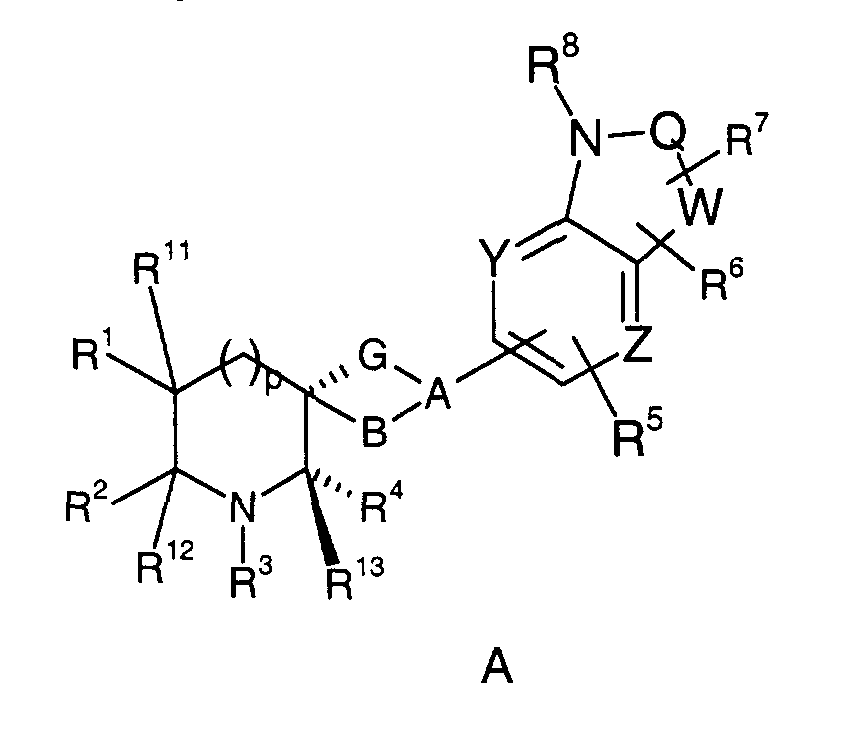
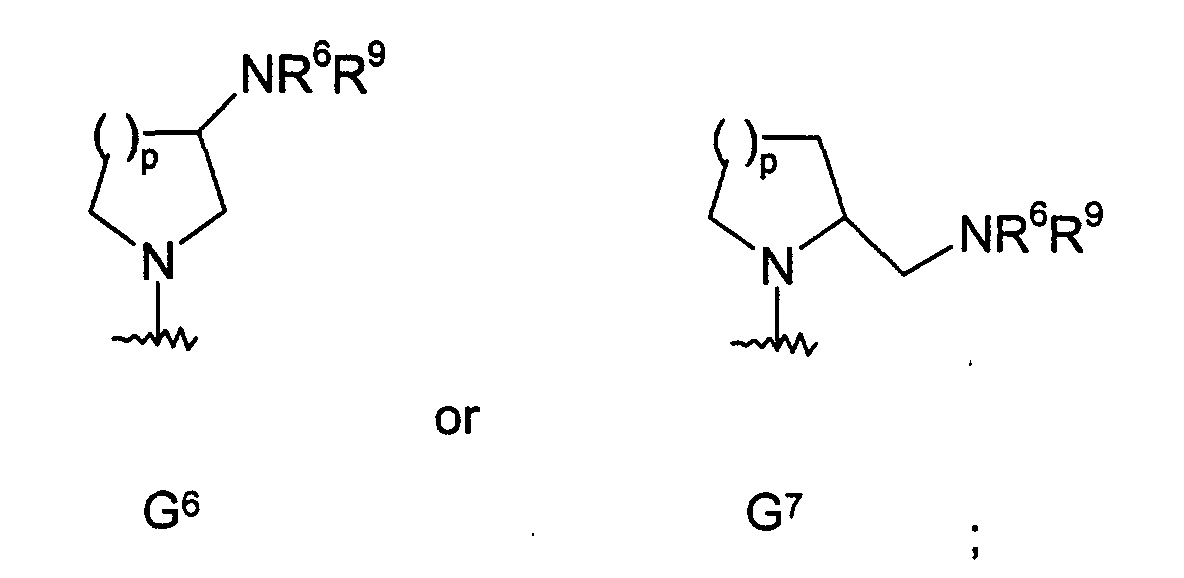
- NK1 receptor antagonists that may be used in the methods and pharmaceutical compositions of this invention include compounds of the formula A, and their pharmaceutically acceptable salts, the activity and synthesis of which is referred to in International Application PCT/IB01/00629, filed April 6, 2001, all of which are incorporated herein by reference in their entirety: wherein
- Examples of compounds of the formula A that are preferred for use in the methods and pharmaceutical compositions of this invention are the following compounds and their pharmaceutically acceptable salts:
- NK1 receptor antagonists that may be used in the methods and pharmaceutical compositions of this invention include the compounds disclosed in European Patent Application No. 01307657.5, and their pharmaceutically acceptable salts, the activity and synthesis of which is referred to in the aforementioned patent application, which application is incorporated herein by reference in its entirety.
- atypical antidepressants examples include: bupropion, lithium, nefazodone, trazodone and viloxazine, and pharmaceutically acceptable salts thereof.
- Another suitable atypical antidepressant is sibutramine.
- antidepressants that may be used in the present invention include adinazolam, alaproclate, amineptine, amitriptyline/chlordiazepoxide combination, atipamezole, azamianserin, apelinaprine, befuraline, bifemelane, binodaline, bipenamol, brofaromine bupropion, caroxazone, cericlamine, cianopramine, cimoxatone, citalopram, clemeprol, clovoxamine, dazepinil, deanol, demexiptiline, dibenzepin, dothiepin, droxidopa, enefexine, estazolam, etoperidone, femoxetine, fengabine, fezolamine, fluotracen, idazoxan, indalpine, indeloxazine, iprindole, levoproti
- classes of antianxiety agents include benzodiazepines and 5-HT IA/1D agonists or antagonists, especially 5-HT IA partial agonists and 5-HT 1D antagonists, corticotropin releasing factor (CRF) antagonists, serotonin reuptake inhibitors (SRls) and GABA receptor agonists.
- benzodiazepines and 5-HT IA/1D agonists or antagonists especially 5-HT IA partial agonists and 5-HT 1D antagonists, corticotropin releasing factor (CRF) antagonists, serotonin reuptake inhibitors (SRls) and GABA receptor agonists.
- CRF corticotropin releasing factor
- SRls serotonin reuptake inhibitors
- GABA receptor agonists GABA receptor agonists
- nonbenzodiazepine sedative-hypnotic drugs such as zolpidem
- mood-stabilizing drugs such as clobazam, gabapentin, lamotrigine, loreclezole, oxcarbamazepine, stiripentol and vigabatrin
- barbiturates are nonbenzodiazepine sedative-hypnotic drugs such as zolpidem
- mood-stabilizing drugs such as clobazam, gabapentin, lamotrigine, loreclezole, oxcarbamazepine, stiripentol and vigabatrin
- barbiturates such as clobazam, gabapentin, lamotrigine, loreclezole, oxcarbamazepine, stiripentol and vigabatrin.
- benzodiazepines examples include: alprazolam, chlordiazepoxide, clonazepam, chlorazepate, diazepam, halazepam, lorazepam, oxazepam and prazepam, and pharmaceutically acceptable salts thereof.
- 5-HT 1A receptor agonists or antagonists examples include, in particular, the 5-HT IA receptor partial agonists buspirone, flesinoxan, gepirone and ipsapirone, and pharmaceutically acceptable salts thereof.
- An example of a compound with 5-HT IA receptor antagonist/partial agonist activity is pindolol.
- CRF antagonists examples include those compounds described in International Patent Application Nos. WO 94/13643, WO 94/13644, WO 94/13661, WO 94/13676 and WO 94/13677.
- antianxiety agents that may be used in the present invention are compounds having muscarinic cholinergic activity.
- compounds in this class include m1 muscarinic cholinergic receptor agonists such as those compounds described in European Patent Application Nos. 0 709 093, 0 709 094 and 0 773 021, and International Patent Application No. WO 96/12711.
- antianxiety agents that may be used in the present invention are compounds acting on ion channels.
- compounds in this class include carbamazepine, lamotrigine and valproate, and pharmaceutically acceptable salts thereof.
- D4 receptor antagonists that may be used in the methods and pharmaceutical compositions of this invention are compounds of the formula and their pharmaceutically acceptable salts, wherein Ar is phenyl, naphthyl, benzoxazolonyl, indolyl, indolonyl, benzimidazolyl, quinolyl, furyl, benzofuryl, thienyl, benzothienyl, oxazolyl or benzoxazolyl;
- the D4 receptor antagonist, or pharmaceutically acceptable salt thereof is a
- A is O.
- A is S, SO, or SO 2 .
- A is CH 2 .
- Ar is phenyl or substituted phenyl.
- Ar is naphthyl or substituted naphthyl.
- Ar is benzoxazolonyl or substituted benzoxazolonyl.
- Ar is indolyl or substituted indolyl.
- Ar is indolonyl or substituted indolonyl.
- Ar is benzimidazolyl or substituted benzimidazolyl.
- Ar is quinolyl or substituted quinolyl.
- Ar 1 is phenyl or substituted phenyl.
- Ar 1 is pyridinyl or substituted pyridinyl.
- Ar 1 is pyridazinyl or substituted pyridazinyl.
- Ar 1 is pyrimidinyl or substituted pyrimidinyl.
- Ar 1 is pyrazinyl or substituted pyrazinyl.
- Preferred embodiments of this invention relate to the above pharmaceutical compositions for the treatment of depression, anxiety or psychosis, and the above methods of treating depression, anxiety or psychosis, wherein the D4 receptor antagonist, or pharmaceutically acceptable salt thereof, is selected from the following compounds of the formula I and their pharmaceutically acceptable salts:
- substituents includes from one to the maximum number of substituents possible based on the number of available bonding sites.
- alkyl as used in the compounds of formula I, includes saturated monovalent hydrocarbon radicals having straight, branched or cyclic moieties or combinations thereof.
- alkoxy refers to radicals having the formula -O-alkyl, wherein “alkyl” is defined as above for the compounds of formula I.
- halo or halogen, as used in the compounds of formula I, includes fluoro, chloro, bromo and iodo.
- D4 receptor antagonists that may be used in the methods and pharmaceutical compositions of this invention are compounds of the formula and their pharmaceutically acceptable salts, wherein R 1 is phenyl, naphthyl, benzoxazolonyl, indolyl, indolonyl, benzimidazolyl, quinolyl, furyl, benzofuryl, thienyl, benzothienyl, oxazolyl or benzoxazolyl;
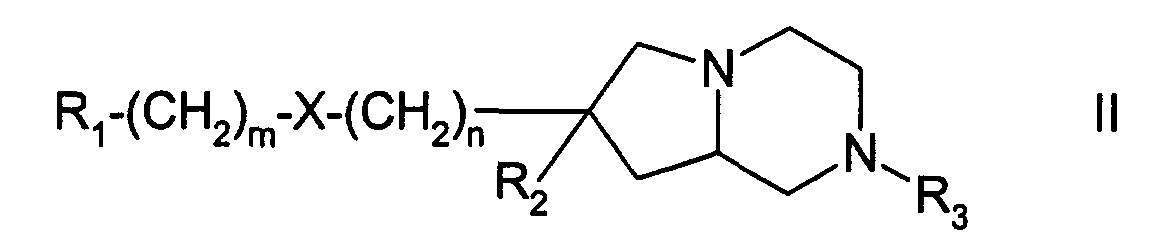
- this invention relates to the above pharmaceutical compositions for the treatment of depression, anxiety or psychosis, and the above methods of treating depression, anxiety or psychosis, wherein the D4 receptor antagonist, or pharmaceutically acceptable salt thereof, is a compound of the formula II, wherein R 1 is phenyl, naphthyl, benzoxazolonyl, indolyl, indolonyl, benzimidazolyl or quinolyl; wherein R 1 and R 3 may be independently substituted with up to three substituents independently selected from the group consisting of fluoro, chloro, bromo, iodo, cyano, -NR 4 R 5 , -(C 1 -C 6 )alkoxy, - COOR 4 , -CONR 4 R 5 , -(C 1 -C 6 )alkyl, -(C 1 -C 6 )alkyl substituted with one to six halogens, -(C 3 -C 6 )
- Preferred embodiments of this invention relate to the above pharmaceutical compositions for the treatment of depression, anxiety or psychosis, and the above methods of treating depression, anxiety or psychosis, wherein the D4 receptor antagonist, or pharmaceutically acceptable salt thereof, is selected from the following compounds of the formula II and their pharmaceutically acceptable salts:
- alkyl includes saturated monovalent hydrocarbon radicals having straight, branched or cyclic moieties or combinations thereof.
- alkoxy refers to radicals having the formula -O-alkyl, wherein “alkyl” is defined as above for compounds of formula II.
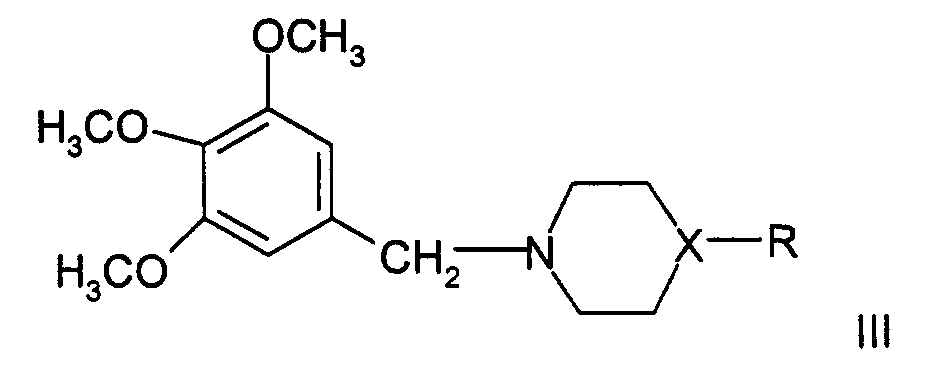
- D4 receptor antagonists that may be used in the methods and pharmaceutical compositions of this invention are compounds of the formula and their pharmaceutically acceptable salts, wherein X is N or CH; and R is aryl or heteroaryl; with the proviso that when X is N and R is aryl, aryl is not phenyl, phenyl monosubstituted by lower alkyl, lower alkoxy, halogen, or nitro, phenyl disubstituted by lower alkyl, or phenyl trisubstituted by lower alkoxy; or compounds of the formula and their pharmaceutically acceptable salts, wherein X is N or CH; and R is aryl or heteroaryl; with the following provisos:
- this invention relates to the above pharmaceutical compositions for the treatment of depression, anxiety or psychosis, and the above methods of treating depression, anxiety or psychosis, wherein the D4 receptor antagonist, or pharmaceutically acceptable salt thereof, is a compound of the formula III, wherein R is phenyl, phenyl substituted by 1 to 3 substituents selected from the group consisting of lower alkyl, lower alkoxy, lower thioalkoxy, halogen, nitro, amino and cyano, 2-, 3-, or 4-pryridinyl, 4-, 5-, 6-, or 7-benzo[b]furanyl, 4-, 5-, 6-, or 7-benzo[b]thienyl, 4-, 5-, 6-, or 7-indolyl, 2-, 3-, 4-, 5-, 6-, 7-, or 8-quinolinyl, or 2-, 3-, 4-, 5-, 6-,7-, or 8-isoquinolinyl; with the proviso that when X is N, R is not phen
- this invention relates to the above pharmaceutical compositions for the treatment of depression, anxiety or psychosis, and the above methods of treating depression, anxiety or psychosis, wherein the D4 receptor antagonist, or pharmaceutically acceptable salt thereof, is a compound of the formula III, wherein R is phenyl, phenyl substituted by 1 to 2 substituents selected from the group consisting of lower alkyl, lower alkoxy and halogen, or 2-pyridinyl; with the proviso that when X is N, R is not phenyl, phenyl monosubstituted by lower alkyl, lower alkoxy or halogen, or phenyl disubstituted by lower alkyl.
- this invention relates to the above pharmaceutical compositions for the treatment of depression, anxiety or psychosis, and the above methods of treating depression, anxiety or psychosis, wherein the D4 receptor antagonist, or pharmaceutically acceptable salt thereof, is a compound of the formula III, wherein R is phenyl, phenyl substituted by 1 to 2 substituents selected from the group consisting of methyl, methoxy and chloro, or 2-pyridinyl; with the proviso that when X is N, R is not phenyl, phenyl monosubstituted by methyl, methoxy and chloro, or phenyl disubstituted by methyl.
- compositions for the treatment of depression, anxiety or psychosis relate to the above pharmaceutical compositions for the treatment of depression, anxiety or psychosis, and the above methods of treating depression, anxiety or psychosis, wherein the D4 receptor antagonist, or pharmaceutically acceptable salt thereof, is selected from the following compounds of the formula III and their pharmaceutically acceptable salts:
- Additional preferred embodiments of this invention relate to the above pharmaceutical compositions for the treatment of depression, anxiety or psychosis, and the above methods of treating depression, anxiety or psychosis, wherein the D4 receptor antagonist, or pharmaceutically acceptable salt thereof, is selected from the following compounds of the formula III and their pharmaceutically acceptable salts:
- this invention relates to the above pharmaceutical compositions for the treatment of depression, anxiety or psychosis, and the above methods of treating depression, anxiety or psychosis, wherein the D4 receptor antagonist, or pharmaceutically acceptable salt thereof, is a compound of the formula IIIA, wherein R is phenyl, phenyl substituted by 1 to 3 substituents selected from the group consisting of lower alkyl, lower alkoxy, lower thioalkoxy, halogen, nitro, amino and cyano, 2-, 3-, or 4-pyridinyl, 4-, 5-, 6-, or 7-benzo[b]furanyl, 4-, 5-, 6-, or 7-benzo[b]thienyl, 4-, 5-, 6-, or 7-indolyl, 2-, 3-, 4-, 5-, 6-, 7-, or 8-quinolinyl, or 2-, 3-, 4-, 5-, 6-, 7-, or 8-isoquinolinyl; with the following provisos: (a) that when X is N
- this invention relates to the above pharmaceutical compositions for the treatment of depression, anxiety or psychosis, and the above methods of treating depression, anxiety or psychosis, wherein the D4 receptor antagonist, or pharmaceutically acceptable salt thereof, is a compound of the formula IIIA, wherein R is phenyl, phenyl substituted by 1 to 2 substituents selected from the group consisting of lower alkyl, lower alkoxy and halogen, or 2-pyridinyl; with the following provisos: (a) that when X is N or CH, R is not phenyl, phenyl monosubstituted by lower alkyl, lower alkoxy or halogen, and (b) that when X is N, R is not 2-pyridinyl.
- this invention relates to the above pharmaceutical compositions for the treatment of depression, anxiety or psychosis, and the above methods of treating depression, anxiety or psychosis, wherein the D4 receptor antagonist, or pharmaceutically acceptable salt thereof, is a compound of the formula IIIA, wherein R is phenyl, phenyl substituted by 1 to 2 substituents selected from the group consisting of methyl, methoxy and chloro, or 2-pyridinyl; with the following provisos: (a) that when X is N or CH, R is not phenyl, phenyl monosubstituted by methyl, methoxy and chloro, and (b) that when X is N, R is not 2-pyridinyl.
- compositions for the treatment of depression, anxiety or psychosis relate to the above pharmaceutical compositions for the treatment of depression, anxiety or psychosis, and the above methods of treating depression, anxiety or psychosis, wherein the D4 receptor antagonist, or pharmaceutically acceptable salt thereof, is selected from the following compounds of the formula IIIA and their pharmaceutically acceptable salts:
- Additional preferred embodiments of this invention relate to the above pharmaceutical compositions for the treatment of depression, anxiety or psychosis, and the above methods of treating depression, anxiety or psychosis, wherein the D4 receptor antagonist, or pharmaceutically acceptable salt thereof, is selected from the following compounds of the formula IIIA and their pharmaceutically acceptable salts:
- lower alkyl means a straight or branched hydrocarbon radical having from 1 to 6 carbon atoms and includes, for example, methyl, ethyl, n-propyl, isopropyl, n-butyl, sec-butyl, isobutyl, tert-butyl, n-pentyl, n-hexyl, and the like.
- aryl as used in the compounds of formula III or formula IIIA, means an aromatic radical which is a phenyl group or phenyl group substituted by 1 to 4 substituents selected from lower alkyl, lower alkoxy, lower thioalkoxy, halogen, nitro, amino, or cyano, such as for example, 2-chlorophenyl, 3-chlorophenyl, 4-chlorophenyl, 2-methylphenyl, 3-methylphenyl, 4-methylphenyl, 2-methoxyphenyl, 3-methoxyphenyl, 4-methoxyphenyl, 2-chloro-3-methylphenyl, 2-chloro-4-methylphenyl, 2-chloro-5-methylphenyl, 3-chloro-2-methylphenyl, 3-chloro-4-methylphenyl, 4-chloro-2-methylphenyl, 4-chloro-3-methylphenyl, 5-chloro-2-methylphenyl, 2,3-dichlorophenyl
- heteroaryl as used in the compounds of formula III or formula IIIA, means a heteroaromatic radical which is 2-, 3- or 4-pyridinyl, 4-,5-, 6-, or 7-benzo[b]furanyl, 4-, 5-,6-, or 7-benzo[b]thienyl, 4-,5-, 6-, or 7-indolyl, 2-, 3-, 4-,5-, 6-, 7-, or 8-quinolinyl, 2-, 3-,4-, 5-, 6-, 7-, or 8-isoquinolinyl.
- lower alkoxy and lower thioalkoxy are, respectively, O-alkyl or S-alkyl of from 1 to 6 carbon atoms as defined above for “lower alkyl” for compounds of formula III or formula IIIA.
- halogen as used in the compounds of formula III or formula IIIA, includes fluorine, chlorine, bromine and iodine.
- D4 receptor antagonists that may be used in the methods and pharmaceutical compositions of this invention are compounds of the formula and their pharmaceutically acceptable salts, esters, amides and prodrugs thereof, wherein R 1 and R 2 are independently hydrogen or C 1 -C 6 alkyl;
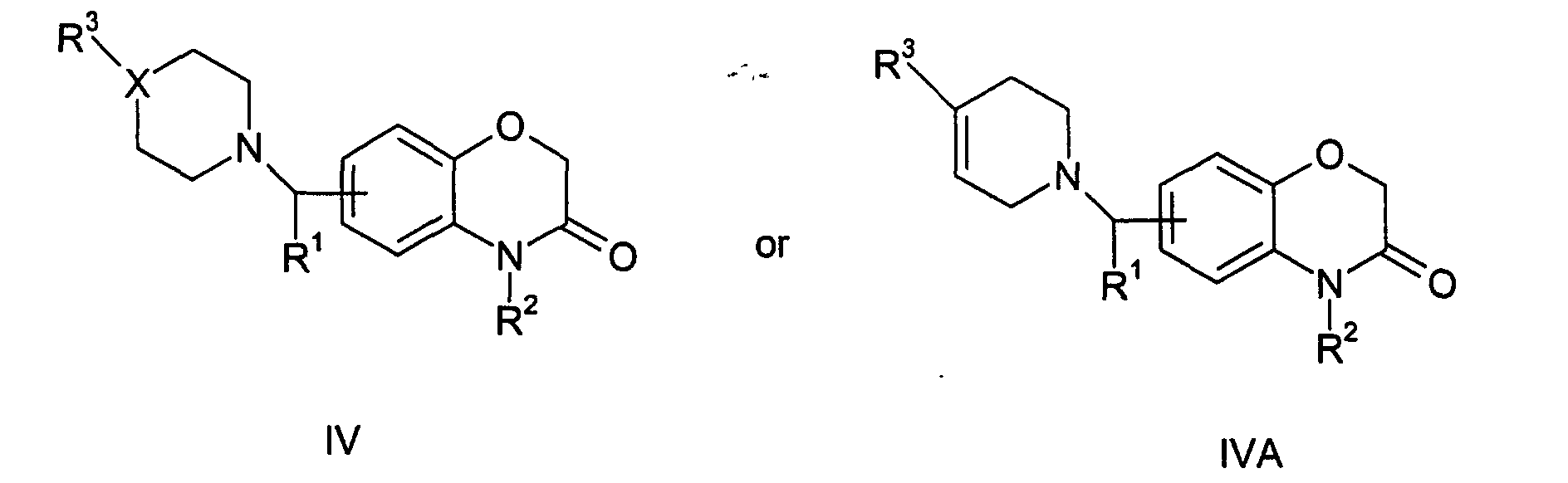
- this invention relates to the above pharmaceutical compositions for the treatment of depression, anxiety or psychosis, and the above methods of treating depression, anxiety or psychosis, wherein the D4 receptor antagonist, or pharmaceutically acceptable salt thereof, is a compound of the formula IV or IVA, wherein the group is attached to the benzoxazinone group at the 6 or 7 position.
- this invention relates to the above pharmaceutical compositions for the treatment of depression, anxiety or psychosis, and the above methods of treating depression, anxiety or psychosis, wherein the D4 receptor antagonist, or pharmaceutically acceptable salt thereof, is a compound of the formula IV or IVA, wherein R 1 and R 2 are hydrogen.
- this invention relates to the above pharmaceutical compositions for the treatment of depression, anxiety or psychosis, and the above methods of treating depression, anxiety or psychosis, wherein the D4 receptor antagonist, or pharmaceutically acceptable salt thereof, is a compound of the formula IV or IVA, wherein R 3 is phenyl, methyltolyl, tolyl, or sulfonamido.
- this invention relates to the above pharmaceutical compositions for the treatment of depression, anxiety or psychosis, and the above methods of treating depression, anxiety or psychosis, wherein the D4 receptor antagonist, or pharmaceutically acceptable salt thereof, is a compound of the formula IV or IVA, wherein X is N. N.
- D4 receptor antagonists that may be used in the methods and pharmaceutical compositions of this invention are compounds of the formula and their pharmaceutically acceptable salts, esters, amides and prodrugs thereof, wherein X is N or CH;
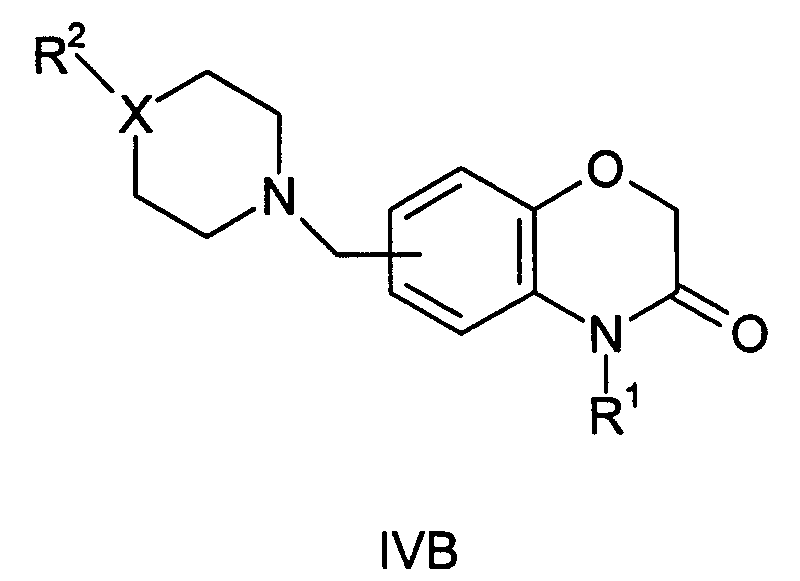
- this invention relates to the above pharmaceutical compositions for the treatment of depression, anxiety or psychosis, and the above methods of treating depression, anxiety or psychosis, wherein the D4 receptor antagonist, or pharmaceutically acceptable salt thereof, is a compound of the formula IVB, wherein the group, is attached to the benzoxazinone group at the 6 or 7 position.
- this invention relates to the above pharmaceutical compositions for the treatment of depression, anxiety or psychosis, and the above methods of treating depression, anxiety or psychosis, wherein the D4 receptor antagonist, or pharmaceutically acceptable salt thereof, is a compound of the formula IVB, wherein R 1 is hydrogen.
- this invention relates to the above pharmaceutical compositions for the treatment of depression, anxiety or psychosis, and the above methods of treating depression, anxiety or psychosis, wherein the D4 receptor antagonist, or pharmaceutically acceptable salt thereof, is a compound of the formula IVB, wherein R 2 is phenyl, methyltolyl, tolyl, or sulfonamido.
- More preferred embodiments of this invention relate to the above pharmaceutical compositions for the treatment of depression, anxiety or psychosis, and the above methods of treating depression, anxiety or psychosis, wherein the D4 receptor antagonist, or pharmaceutically acceptable salt thereof, is selected from the following compounds of the formulas IV, IVA and IVB and their pharmaceutically acceptable salts:
- alkyl as used in the compounds of formula IV, IVA and IVB, means a straight or branched chain hydrocarbon.
- Representative examples of alkyl groups are methyl, ethyl, propyl, isopropyl, isobutyl, butyl, tert-butyl, sec-butyl, pentyl and hexyl.
- aryl as used in the compounds of formula IV, IVA and IVB, means a cyclic aromatic hydrocarbon.
- Representative examples of aryl groups include phenyl and naphthyl, which can be substituted or unsubstituted.
- suitable substituents include halogen, C 1 -C 6 alkyl, hydroxy, C 1 -C 6 alkoxy, -CF 3 and sulfonamides.
- heteroaryl as used in the compounds of formula IV, IVA and IVB, means a cyclic hydrocarbon that contains one or more heteroatoms.
- Representative examples of heteroaryl groups are thiazole, thiophene, pyridine, pyrimidine, quinoline, isoquinoline and imidazole.
- the heteroaryl group can be substituted or unsubstituted. Examples of suitable substituents include C 1 -C 6 alkyl, C 1 -C 6 alkoxy or halogen.
- heteroatom as used in the compounds of formula IV, IVA and IVB, means an atom other than carbon.
- heteroatoms include nitrogen, oxygen, sulfur and phosphorus.
- halogen as used in the compounds of formula IV, IVA and IVB, means chlorine, fluorine, bromine and iodine.
- sulfonamido as used in the compounds of formula IV, IVA and IVB, means a group having the structure -SO 2 NR a R b , where R a and R b are sulfonamido substituents well known to those in the art such as hydrogen and C 1 -C 6 alkyl.
- pharmaceutically acceptable salts, esters, amides, and prodrugs refers to those carboxylate salts, amino acid addition salts, esters, amides, and prodrugs of the compounds of formulas IV, IVA and IVB which are, within the scope of sound medical judgement, suitable for use in contact with the tissues of patients without undue toxicity, irritation, allergic response, and the like, commensurate with a reasonable benefit/risk ratio, and effective for their intended use, as well as the zwitterionic forms, where possible, of the compounds of the invention.
- esters of the compounds of formulas IV, IVA and IVB include C 1 -C 6 alkyl esters wherein the alkyl group is a straight or branched chain. Acceptable esters also include C 5 -C 7 cycloalkyl esters as well as arylalkyl esters such as, but not limited to, benzyl. C 1 -C 4 alkyl esters are preferred. Esters of the compounds of the present invention may be prepared according to conventional methods.
- Examples of pharmaceutically acceptable, nontoxic amides of the compounds of formulas IV, IVA and IVB include amides derived from ammonia, primary C 1 -C 6 alkyl amines and secondary C 1 -C 6 dialkyl amines wherein the alkyl groups are straight or branched chains. In the case of secondary amines the amine may also be in the form of 5- or 6-membered heterocycle containing one nitrogen atom. Amides derived from ammonia, C 1 -C 3 alkyl primary amines and C 1 -C 2 dialkyl secondary amines are preferred. Amides of the compounds of the invention may be prepared according to conventional methods.
- prodrug refers to compounds that are rapidly transformed in vivo to yield the parent compound of the formulas IV, IVA and IVB, for example, by hydrolysis in blood.
- a thorough discussion is provided in T. Higuchi and V. Stella, "Pro-drugs as Novel Delivery Systems,” Vol 14 of the A.C.S. Symposium Series, and in Bioreversible Carriers in Drug Design, ed. Edward B. Roche, American Pharmaceutical Association and Pergamon Press, 1987, both of which are incorporated herein by reference.
- D4 receptor antagonist that may be used in the methods and pharmaceutical compositions of this invention is L-745,870 (3-(4-(4-chlorophenyl)piperazin-1-yl)methyl-1H-pyrrolo(2,3-b)pyridine), the activity and synthesis of which is referred to in U.S. Patent No. 5,432,177, issued July 11, 1995, International Patent Application No. WO 94/20497, published September 15, 1994 and U.S. Patent No. 5,622,950, issued April 22, 1997, and U.S. Patent No. 5,563,152, issued October 8, 1996, International Patent Application No. WO 94/20459, published September 15, 1994, U.S. Patent No. 5,563,150, issued October 8, 1996, International Patent Application No.
- D4 receptor antagonist that may be used in the methods and pharmaceutical compositions of this invention is NGD 941, 2-(4-(2-phenylimidazol-5-ylmethyl)piperazin-1-yl)pyrimidine, 2-(4-((2-phenyl-1H-imidazol-4-yl)methyl)-1piperazinyl)pyrimidine, the activity and synthesis of which is referred to in U.S. Patent No. 5,633,376, issued May 27, 1997, U.S. Patent No. 5,428,164, issued June 27, 1995 and International Patent Application No. WO 96/10018, published April 4, 1996, and International Patent Application No.
- D4 receptor antagonist that may be used in the methods and pharmaceutical compositions of this invention is the active metabolite of NGD 941, the activity and synthesis of which is referred to in U.S. Patent No. 5,681,956, issued October 28, 1997, and "Neurogen update on schizophrenia program," Drug News Persp., 8 , 559, 1995.
- D4 receptor antagonist that may be used in the methods and pharmaceutical compositions of this invention is PNU-101,387 (sonepiprazole), (S)-4-(4-(2-(3,4-dihydro-1H-2-benzopyran-1-yl)ethyl)-1-piperazinyl benzenesulfonamide, (S)-4(4-(2-(isochroman-1-yl)ethyl)piperazin-1-yl)benzenesulfonamide, the activity and synthesis of which is referred to in U.S. Patent No.
- D4 receptor antagonist that may be used in the methods and pharmaceutical compositions of this invention is LU-111,995 (balaperidone, (1 ⁇ ,5 ⁇ ,6 ⁇ )-3-(2-(6-(4-fluorophenyl)-3-azabicyclo(3.2.0)hept-3-yl0ethyl)-2,4(1H,3H)-quinazolinedione), the activity and synthesis of which is referred to in U.S. Patent No. 5,475,105, issued October 10, 1995 and International Patent Application No.
- D4 receptor antagonist that may be used in the methods and pharmaceutical compositions of this invention is RP 62203 (fananserin, 2-(3-(4-(4-fluorophenyl)-1-piperazinyl)propyl)naphtho(1,8-c,d)isothiazole-1,1-dioxide), the activity and synthesis of which is referred to in U.S. Patent No. 5,021,420, issued June 4, 1991, which is incorporated herein by reference in its entirety.
- D4 receptor antagonist that may be used in the methods and pharmaceutical compositions of this invention is PNU-96,415E, the activity and synthesis of which is referred to in Tang, A.H., Franklin, S.R., Himes, C.S., Smith, M.W., Ten Brink, R.E., "PNU-96415E: a potential antipsychotic agent with clozapine-like pharmacological properties," J. Pharmacol. Exp. Ther., 281, 440-447, 1997, which is incorporated herein by reference in its entirety.
- D4 receptor antagonist Another example of a D4 receptor antagonist that may be used in the methods and pharmaceutical compositions of this invention is olanzapine, the activity and synthesis of which is referred to in U.S. Patent No. 5,229,382, issued July 20, 1993, and U.S. Patent No. 4,115,574, issued September 19, 1978, and U.S. Patent No. 5,736,541, issued April 7, 1998, U.S. Patent No. 5,919,485, issued July 6, 1999, U.S. Patent No. 5,817,656, issued June 10, 1998, U.S. Patent No. 5,817,655, issued June 10, 1998, U.S. Patent No. 5,627,178, issued May 6, 1997, U.S. Patent No.
- D4 receptor antagonists that may be used in the methods and pharmaceutical compositions of this invention are the compounds referred to in the following references, which references refer to methods of preparing same, and their pharmaceutically acceptable salts: U.S. Patent No. 5,883,094, issued March 16, 1999 and International Patent Application No. WO 95/34555, published December 21, 1995; U.S. Patent No. 5,889, 010, issued March 30, 1999 and International Patent Application No. WO 96/04250, published February 15, 1996; International Patent Application No. WO 98/08835, published March 5, 1998; European Patent Application EP0953567; International Patent Application No. WO 99/09025, published February 25, 1999; GB 2306164; International Patent Application Nos.
- WO 96/18630 published June 20, 1996, WO 95/17400, published June 29, 1995 and WO 96/18622, published June 20, 1996; Okuyama, S., Chaki, S., Kawashima, N., Suzuki, Y., Ogawa, S.-I., Kuagai, T., et al., "The atypical antipsychotic profile of NRA0045, a novel dopamine D4 and 5-hydroxytryptamine 2A receptor antagonist, in rats," Br. J.
- anxiolytic effective amount and “antianxiety effective amount”, as used herein, refer to an amount that is effective in treating anxiety.
- antidepressant effective amount refers to an amount that is effective in treating depression.
- treating refers to, and includes, reversing, alleviating, inhibiting the progress of, or preventing a disease, disorder or condition, or one or more symptoms thereof; and "treatment” and “therapeutically” refer to the act of treating, as defined above.
- compositions and methods of this invention comprise, or comprise administering, D4 receptor antagonists of the formulas I through IVB, which may have chiral centers and therefore exist in different enantiomeric forms.
- This invention includes methods and pharmaceutical compositions, as described above, wherein the D4 receptor antagonists that are employed are optical isomers, tautomers or stereoisomers of the compounds of formulas I through IVB that are defined above, or mixtures thereof.
- D4 receptor antagonists of the formulas I through IVB that contain basic groups can form acid addition salts with various inorganic and organic acids.
- the present invention also relates to pharmaceutical compositions and methods comprising, or comprising administering, pharmaceutically acceptable acid addition salts of D4 receptor antagonists and of antidepressant and anxiolytic agents.
- the possible acids which are used to prepare the pharmaceutically acceptable acid addition salts of the basic active agents employed in the methods and pharmacuetical compositions of this invention are those which form non-toxic acid addition salts, i.e., salts containing pharmacologically acceptable anions, such as the hydrochloride, hydrobromide, hydroiodide, nitrate, sulfate, bisulfate, phosphate, acid phosphate, acetate, lactate, citrate, acid citrate, tartrate, bitartrate, succinate, maleate, fumarate, gluconate, saccharate, benzoate, methanesulfonate, ethanesulfonate, benzenesulfonate, p-toluenesulfonate and pamoate [ i.e. , 1,1'-methylene-bis-(2-hydroxy-3- naphthoate)]salts.
- non-toxic acid addition salts i.e., salts containing
- D4 receptor antagonists of the formulas I through IVB that contain acidic groups can form base addition salts with certain bases.
- the present invention also relates to pharmaceutical compositions and methods comprising, or comprising administering, pharmaceutically acceptable base addition salts of D4 receptor antagonists and of antidepressant and anxiolytic agents.
- the chemical bases that may be used as reagents to prepare pharmaceutically acceptable base salts of the acidic active agents that are employed in the methods of this invention are those that form non-toxic base salts with such compounds.
- Such non-toxic base salts include, but are not limited to, those derived from such pharmacologically acceptable cations such as alkali metal cations (e.g. , potassium and sodium) and alkaline earth metal cations (e.g. , calcium and magnesium), ammonium or water-soluble amine addition salts such as N-methylglucamine (meglumine), and the lower alkanolammonium and other base salts of pharmaceutically acceptable organic amines.
- the present invention also relates to pharmaceutical compositions and methods of treatment that employ isotopically-labeled compounds that are identical to those recited in formulas I through IVB, or to other D4 receptor antagonists, but for the fact that one or more atoms are replaced by an atom having an atomic mass or mass number different from the atomic mass or mass number usually found in nature.
- isotopes that can be incorporated into the D4 receptor antagonists that are employed in the pharmaceutical compositions and methods of the present invention include isotopes of hydrogen, carbon, nitrogen, oxygen, phosphorous, sulfur, fluorine and chlorine, such as 2 H, 3 H, 13 C, 11 C, 14 C, 15 N, 18 O, 17 O, 31 P, 32 P, 35 S, 18 F, and 36 Cl, respectively.
- the D4 receptor antagonists employed in the pharmaceutical compositions and methods of the present invention, prodrugs thereof, and pharmaceutically acceptable salts of said compounds or of said prodrugs which contain the aforementioned isotopes and/or other isotopes are within the scope of this invention.
- isotopically-labeled D4 receptor antagonists for example, those into which radioactive isotopes such as 3 H and 14 C are incorporated, are useful in drug and/or substrate tissue distribution assays. Tritiated, i.e., 3 H, and carbon-14, i.e. , 14 C, isotopes are particularly preferred for their ease of preparation and detectability. Further, substitution with heavier isotopes such as deuterium, i.e., 2 H, can afford certain therapeutic advantages resulting from greater metabolic stability, for example increased in vivo half-life or reduced dosage requirements and, hence, may be preferred in some circumstances.
- D4 receptor antagonists of the formula I can be prepared as described in International Patent Application No. WO 96/10571, published April 11, 1996, and as described in U.S. Patent No. 5,852,031, issued December 22, 1998, and also as described in European Patent Application EP 0783503.
- the foregoing patents and patent applications are incorporated herein by reference in their entirety.
- D4 receptor antagonists of the formula II can be prepared as described in International Patent Application No. WO 97/23482, published November 6, 1996, and as described in U.S. Patent No. 5,714,487, issued February 3, 1998.
- the foregoing patents and patent applications are incorporated herein by reference in their entirety.
- D4 receptor antagonists of the formula III and IIIA can be prepared as described in International Patent Application No. WO 97/41108, published November 6, 1997. The foregoing patent application is incorporated herein by reference in its entirety.
- D4 receptor antagonists of the formula IV, IVA and IVB can be prepared as described in International Patent Application No. WO 97/45419, published December 4, 1997. The foregoing patent application is incorporated herein by reference in its entirety.
- This invention relates both to methods of treating depression, anxiety or psychosis, in which the D4 receptor antagonist and the antidepressant or anxiolytic agent, or pharmaceutically acceptable salts of the same, are administered together, as part of the same pharmaceutical composition, as well as to methods in which these two active agents are administered separately as part of an appropriate dose regimen designed to obtain the benefits of the combination therapy.
- the appropriate dose regimen, the amount of each dose administered, and specific intervals between doses of each active agent will depend upon the subject being treated, the emetogen and the severity of the condition.
- the D4 receptor antagonist will be administered to an adult human in an amount ranging from 0.05 to 1500 mg per day, in single or divided doses, preferably from 5 to 500 mg/day.
- the compounds may be administered on a regimen of up to 6 times per day, preferably 1 to 4 times per day, especially 2 times per day and most especially once daily.
- a suitable dosage level for the antidepressant agent is 0.5 to 1500 mg per day, preferably 2.5 to 1000 mg per day, and especially 2.5 to 750 mg per day.
- the compounds may be administered on a regimen of up to 6 times per day, preferably 1 to 4 times per day, especially 2 times per day and most especially once daily.
- a suitable dosage level for the anxiolytic agent is 0.1 to 1500 mg per day, preferably 0.1 to 1000 mg per day, and especially 0.1 to 500 mg per day.
- the compounds may be administered on a regimen of up to 6 times per day, preferably 1 to 4 times per day, especially 2 times per day and most especially once daily.
- Variations may nevertheless occur depending upon the species of animal being treated and its individual response to said medicament, as well as on the type of pharmaceutical formulation chosen and the time period and interval at which such administration is carried out.
- dosage levels below the lower limit of the aforesaid range may be more than adequate, while in other cases still larger doses may be employed without causing any harmful side effect, provided that such larger doses are first divided into several small doses for administration throughout the day.
- Compounds that have been approved for use by the Food and Drug Administration (FDA) will have preferred dosages as indicated in the most current edition of the Physicians' Desk Reference (PDR® , published by Medical Economics Company, Inc), which, as of the filing date of this application, is the 54 th Edition.
- the D4 receptor antagonists, their pharmaceutically acceptable salts, and the antidepressant and anxiolytic agents and their pharmaceutically acceptable salts that are employed in the pharmaceutical compositions and methods of this invention are hereinafter also referred to as "therapeutic agents".
- the therapeutic agents can be administered via either the oral or parenteral route.
- Compositions containing both a D4 receptor antagonist and an antidepressant or anxiolytic agent, or pharmaceutically acceptable salts of one or both therapeutic agents will generally be administered orally or parenterally daily, in single or divided doses, so that the total amount of each active agent administered falls within the above guidelines.
- the therapeutic agents may be administered alone or in combination with pharmaceutically acceptable carriers or diluents by either of the routes previously indicated, and such administration may be carried out in single or multiple doses. More particularly, the therapeutic agents of this invention can be administered in a wide variety of different dosage forms, i.e., they may be combined with various pharmaceutically acceptable inert carriers in the form of tablets, capsules, lozenges, troches, hard candies, suppositories, aqueous suspensions, injectable solutions, elixirs, syrups, and the like. Such carriers include solid diluents or fillers, sterile aqueous media and various non-toxic organic solvents, etc. Moreover, oral pharmaceutical compositions can be suitably sweetened and/or flavored. In general, the therapeutic agents of this invention, when administered separately (i.e., not in the same pharmaceutical composition) are present in such dosage forms at concentration levels ranging from 5.0% to 70% by weight.
- tablets containing various excipients such as microcrystalline cellulose, sodium citrate, calcium carbonate, dicalcium phosphate and glycine may be employed along with various disintegrants such as starch (and preferably corn, potato or tapioca starch), alginic acid and certain complex silicates, together with granulation binders like polyvinylpyrrolidone, sucrose, gelatin and acacia.
- disintegrants such as starch (and preferably corn, potato or tapioca starch), alginic acid and certain complex silicates, together with granulation binders like polyvinylpyrrolidone, sucrose, gelatin and acacia.
- lubricating agents such as magnesium stearate, sodium lauryl sulfate and talc are often very useful for tabletting purposes.
- compositions of a similar type may also be employed as fillers in gelatin capsules; preferred materials in this connection also include lactose or milk sugar as well as high molecular weight polyethylene glycols.
- preferred materials in this connection also include lactose or milk sugar as well as high molecular weight polyethylene glycols.
- the active ingredient may be combined with various sweetening or flavoring agents, coloring matter or dyes, and, if so desired, emulsifying and/or suspending agents as well, together with such diluents as water, ethanol, propylene glycol, glycerin and various like combinations thereof.
- solutions of a therapeutic agent in either sesame or peanut oil or in aqueous propylene glycol may be employed.
- the aqueous solutions should be suitably buffered if necessary and the liquid diluent first rendered isotonic.
- These aqueous solutions are suitable for intravenous injection purposes.
- the oily solutions are suitable for intraarticular, intramuscular and subcutaneous injection purposes. The preparation of all these solutions under sterile conditions is readily accomplished by standard pharmaceutical techniques well known to those skilled in the art.
- the D4 receptor antagonist and the antidepressant or anxiolytic agent may be formulated in a single pharmaceutical composition or alternatively in individual pharmaceutical compositions for simultaneous, separate or sequential use in accordance with the present invention.
- compositions according to the present invention which contain both a D4 receptor antagonist and an antidepressant or an anxiolytic agent, as well as the pharmaceutical compositions used to deliver only one of these active agents, are in unit dosage forms such as tablets, pills, capsules, powders, granules, solutions or suspensions, or suppositories, for oral, parenteral or rectal administration, by inhalation or insufflation or administration by transdermal patches or by buccal cavity absorption wafers.
- the principal active ingredient is mixed with a pharmaceutical carrier, e.g., conventional tableting ingredients such as corn starch, lactose, sucrose, sorbitol, talc, stearic acid, magnesium stearate, dicalcium phosphate or gums, and other pharmaceutical diluents, e.g. , water, to form a solid preformulation composition containing a homogeneous mixture of a compound of the present invention, or a non-toxic pharmaceutically acceptable salt thereof.
- a pharmaceutical carrier e.g., conventional tableting ingredients such as corn starch, lactose, sucrose, sorbitol, talc, stearic acid, magnesium stearate, dicalcium phosphate or gums, and other pharmaceutical diluents, e.g. , water
- preformulation compositions when referring to these preformulation compositions as homogeneous, it is meant that the active ingredient is dispersed evenly throughout the composition so that the composition may be readily subdivided into equally effective unit dosage forms such as tablets, pills and capsules.
- This solid preformulation composition is then subdivided into unit dosage forms of the type described above containing, typically, from 0.05 to 500 mg of each of the therapeutic agents contained in the composition.
- the tablets or pills of the composition can be coated or otherwise compounded to provide a dosage form affording the advantage of prolonged action.
- the tablet or pill can comprise an inner dosage and an outer dosage component, the latter being in the form of an envelope over the former.
- the two components can be separated by an enteric layer which serves to resist disintegration in the stomach and permits the inner component to pass intact into the duodenum or to be delayed in release.
- enteric layers or coatings such materials including a number of polymeric acids and mixtures of polymeric acids with such materials as shellac acetyl alcohol and cellulose acetate.
- liquid forms in which the novel compositions of the present invention may be incorporated for administration orally or by injection include aqueous solutions, suitably flavoured syrups, aqueous or oil suspensions, and flavored emulsions with edible oils such as cottonseed oil, sesame oil, coconut oil, peanut oil or soybean oil, as well as elixirs and similar pharmaceutical vehicles.
- Suitable dispersing or suspending agents for aqueous suspensions include synthetic and natural gums such as tragacanth, acacia, alginate, dextran, sodium carboxymethyl cellulose, methylcellulose, polyvinyl-pyrrolidone or gelatin.
- compositions for administration of a D4 receptor antagonist or other therapeutic agent by injection include those comprising the therapeutic agent in association with a surface-active agent (or wetting agent or surfactant) or in the form of an emulsion (as a water-in-oil or oil-in-water emulsion).
- Suitable surface-active agents include, in particular, non-ionic agents, such as polyoxyethylenesorbitans (e.g ., TweenTM 20, 40, 60, 80 or 85) and other sorbitans (e.g ., SpanTM 20, 40, 60, 80 or 85).
- Compositions with a surface-active agent will conveniently comprise between 0.05 and 5% surface-active agent, and preferably between 0.1 and 2.5%. It will be appreciated that other ingredients may be added, for example mannitol or other pharmaceutically acceptable vehicles, if necessary.
- Suitable emulsions may be prepared using commercially available fat emulsions, such as IntralipidTM, Liposyn TM, InfonutrolTM, Lipofundin TM and LipiphysanTM.
- the therapeutic agent may be either dissolved in a pre-mixed emulsion composition or alternatively it may be dissolved in an oil (e.g. , soybean oil, safflower oil, cottonseed oil, sesame oil, com oil or almond oil) and an emulsion formed upon mixing with a phospholipid (e.g. , eggs phospholipids, soybean phospholipids or soybean lecithin) and water.
- an oil e.g. , soybean oil, safflower oil, cottonseed oil, sesame oil, com oil or almond oil
- a phospholipid e.g. , eggs phospholipids, soybean phospholipids or soybean lecithin
- Suitable emulsions will typically contain up to 20% oil, for example, between 5 and 20%.
- the fat emulsion will preferably comprise fat droplets between 0.1 and 1.0 ⁇ m, particularly 0.1 and 0.5 ⁇ m, and have a pH in the range of 5.5 to 8.0.
- compositions for inhalation or insufflation include solutions and suspensions in pharmaceutically acceptable, aqueous or organic solvents or mixtures thereof, and powders.
- the liquid or solid compositions may contain suitable pharmaceutically acceptable excipients as set out above.
- the compositions are administered by the oral or nasal respiratory route for local or systemic effect.
- Compositions in preferably sterile pharmaceutically acceptable solvents may be nebulised by use of inert gases. Nebulised solutions may be breathed directly from the nebulising device or the nebulising devise may be attached to a face mask, tent or intermittent positive pressure breathing machine.
- Solution, suspension, or powder compositions may be administered, preferably orally or nasally, from devices which deliver the formulation in an appropriate manner.
- compositions of the present invention may also be presented for administration in the form of transdermal patches using conventional technology.
- the compositions may also be administered via the buccal cavity using, for example, absorption wafers.
- the present invention further provides a process for the preparation of a pharmaceutical composition comprising a D4 receptor antagonist and an antidepressant or anxiolytic agent, or pharmaceutically acceptable salts of the same, which process comprises bringing a D4 receptor antagonist and the antidepressant or anxiolytic agent (or the pharmaceutically acceptable salts of one or both of these therapeutic agents) into association with a pharmaceutically acceptable carrier or excipient.
- the amount of the D4 receptor antagonist and the antidepressant or anxiolytic agent required for use in the treatment of depression, anxiety or psychosis will vary not only with the particular compounds or compositions selected but also with the route of administration, the nature of the condition being treated, and the age and condition of the patient, and will ultimately be at the discretion of the patient's physician or pharmacist.
- Dopaminergic activity of the compounds used in the invention is related to the ability of the compounds to bind to the D4 receptors, and the relative ability of compounds of this invention to inhibit [ 3 H]-spiperone binding to human dopamine D4 receptor subtypes expressed in clonal cell lines was measured using the following procedure.
- tissue homogenate 0.75 ml aliquots of tissue homogenate are incubated in triplicate with increasing concentrations of [ 3 H]-spiperone (70.3 Ci/mmol; 10-3000 pM final concentration) for 30-120 minutes at 22°C in a total volume of 1 ml.
- assays are initiated by the addition of 0.75 ml of membrane and incubated in duplicate with the indicated concentrations of competing ligands (10 -14 -10 -3 M) and/or [ 3 H]-spiperone (100-300 pM) for 60-120 min at 22°C.
- the D4 receptor antagonist and the antidepressant or anti-anxiety agent are presented in a ratio which is consistent with the manifestation of the desired effect.
- the ratio by weight of the D4 receptor antagonist and the antidepressant or anxiolytic agent will suitably be between 0.001 to 1 and 1000 to 1, and especially between 0.01 to I and 100 to 1.
Landscapes
- Health & Medical Sciences (AREA)
- General Health & Medical Sciences (AREA)
- Chemical & Material Sciences (AREA)
- Medicinal Chemistry (AREA)
- Veterinary Medicine (AREA)
- Public Health (AREA)
- Pharmacology & Pharmacy (AREA)
- Life Sciences & Earth Sciences (AREA)
- Animal Behavior & Ethology (AREA)
- Epidemiology (AREA)
- Bioinformatics & Cheminformatics (AREA)
- Engineering & Computer Science (AREA)
- General Chemical & Material Sciences (AREA)
- Organic Chemistry (AREA)
- Nuclear Medicine, Radiotherapy & Molecular Imaging (AREA)
- Chemical Kinetics & Catalysis (AREA)
- Biomedical Technology (AREA)
- Neurology (AREA)
- Neurosurgery (AREA)
- Psychiatry (AREA)
- Pain & Pain Management (AREA)
- Pharmaceuticals Containing Other Organic And Inorganic Compounds (AREA)
- Medicines That Contain Protein Lipid Enzymes And Other Medicines (AREA)
Abstract
Description





R is aryl or heteroaryl;
with the proviso that when X is N and R is aryl, aryl is not phenyl, phenyl monosubstituted by lower alkyl, lower alkoxy, halogen, or nitro, phenyl disubstituted by lower alkyl, or phenyl trisubstituted by lower alkoxy;
or compounds of the formula

R is aryl or heteroaryl;
with the following provisos:



Claims (19)
- A pharmaceutical composition comprising: (a) a compound that exhibits activity, respectively, as an antidepressant or an anxiolytic agent, or a pharmaceutically acceptable salt thereof; (b) a D4 receptor antagonist or pharmaceutically acceptable salt thereof; and (c) a pharmaceutically acceptable carrier.
- A pharmaceutical composition according to claim 1, wherein the D4 receptor antagonist or pharmaceutically acceptable salt thereof is selected from compounds of the formula I, as depicted and defined below, and their pharmaceutically acceptable salts:
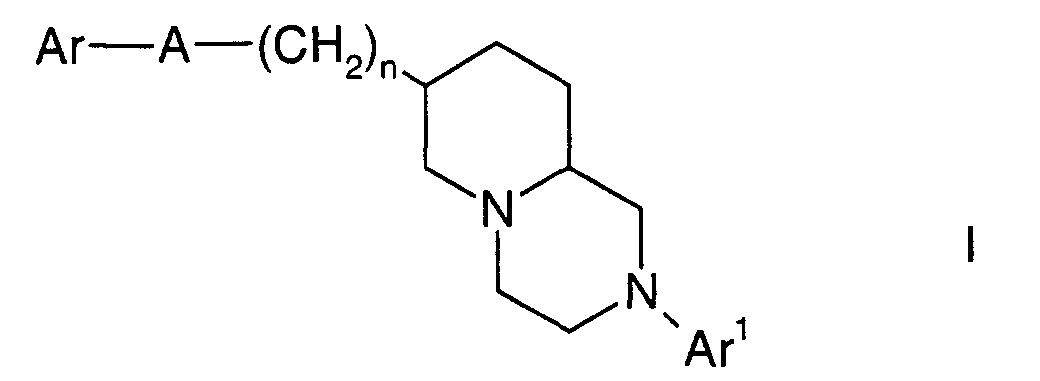 wherein Ar is phenyl, naphthyl, benzoxazolonyl, indolyl, indolonyl, benzimidazolyl, quinolyl, furyl, benzofuryl, thienyl, benzothienyl, oxazolyl or benzoxazolyl;Ar1 is phenyl, pyridinyl, pyridazinyl, pyrimidinyl or pyrazinyl;A is O, S, SO, SO2, C=O, CHOH or -(CR3R4)-;n is 0, 1 or 2;each of Ar and Ar1 may be independently and optionally substituted with one to four substituents independently selected from the group consisting of fluoro, chloro, bromo, iodo, cyano, nitro, thiocyano, -SR, -SOR, -SO2R, -NHSO2R, -(C1-C6)alkoxy, -NR1R2, -NRCOR1, -CONR1R2, phenyl, -COR, -COOR, -(C1-C6)alkyl, -(C1-C6)alkyl substituted with one to six halogens independently selected from fluoro, chloro, bromo and iodo, -(C3-C6)cycloalkyl and trifluoromethoxy;each and every R, R1, and R2 is independently selected from the group consisting of hydrogen, -(C1-C6)alkyl, -(C1-C6)alkyl substituted with one to thirteen halogens independently selected from fluoro, chloro, bromo and iodo, phenyl, benzyl, -(C2-C6)alkenyl,-(C3-C6)cycloalkyl and -(C1-C6)alkoxy; andeach and every R3 and R4 is independently selected from the group consisting of hydrogen, methyl, ethyl, n-propyl and i-propyl.
 - A pharmaceutical composition according to claim 1, wherein the D4 receptor antagonist or pharmaceutically acceptable salt thereof is selected from compounds of the formula II, as depicted and defined below, and their pharmaceutically acceptable salts:
 wherein R1 is phenyl, naphthyl, benzoxazolonyl, indolyl, indolonyl, benzimidazolyl, quinolyl, furyl, benzofuryl, thienyl, benzothienyl, oxazolyl or benzoxazolyl;R2 is H or (C1-C6)alkyl;R3 is phenyl, pyridinyl, pyrimidinyl, pyrazinyl or pyridazinyl;R4 is H or (C1-C6)alkyl;R5 is H or (C1-C6)alkyl;wherein each group of R1 and R3 may be independently and optionally substituted with one to four substituents independently selected from the groups consisting of fluoro, chloro, bromo, iodo, cyano, nitro, thiocyano, -SR4, -SOR4, -SO2R4, -NHSO2R4, -(C1-C6)alkoxy, -NR4R5, -NR4COR5, -CONR4R5, phenyl, -COR4, -COOR4, -(C1-C6)alkyl, -(C1-C6)alkyl substituted with one to six halogens, -(C3-C6)cycloalkyl and trifluoromethoxy;X is O, S, SO, SO2, NR4, C=O, CH(OH), CHR4,
 m is 0, 1 or 2; andn is 0, 1 or 2.
 - A pharmaceutical composition according to claim 1, wherein the D4 receptor antagonist or pharmaceutically acceptable salt thereof is selected from compounds of the formula III or IIIA, as depicted and defined below, and their pharmaceutically acceptable salts:
 orwherein X is N or CH; andR is aryl or heteroaryl;with the proviso that when X is N and R is aryl, aryl is not phenyl, phenyl monosubstituted by lower alkyl, lower alkoxy, halogen, or nitro, phenyl disubstituted by lower alkyl, or phenyl trisubstituted by lower alkoxy;
 with the following provisos:wherein X is N or CH; andR is aryl or heteroaryl;(a) that when X is N or CH, and R is aryl, aryl is not phenyl, or phenyl monosubstituted by lower alkyl, lower alkoxy, or halogen; and(b) that when X is N and R is heteroaryl, heteroaryl is not 2-, 3-, or 4-pyridinyl.
 - A pharmaceutical composition according to claim 1, wherein the D4 receptor antagonist or pharmaceutically acceptable salt thereof is selected from compounds of the formula IV or IVA, as depicted and defined below, and their pharmaceutically acceptable salts:wherein
 R1 and R2 are independently hydrogen or C1-C6 alkyl;X is N or CH; andR3 is phenyl, naphthyl, heteraryl, substituted phenyl, substituted naphthyl or substituted heteroaryl, wherein each substituent is independently selected from halogen, C1-C6 alkoxy, C1-C6 alkyl, -CN, -CF3 or sulphonamido.
 - A pharmaceutical composition according to claim 1, wherein the D4 receptor antagonist or pharmaceutically acceptable salt thereof is selected from compounds of the formula IVB, as depicted and defined below, and their pharmaceutically acceptable salts:wherein
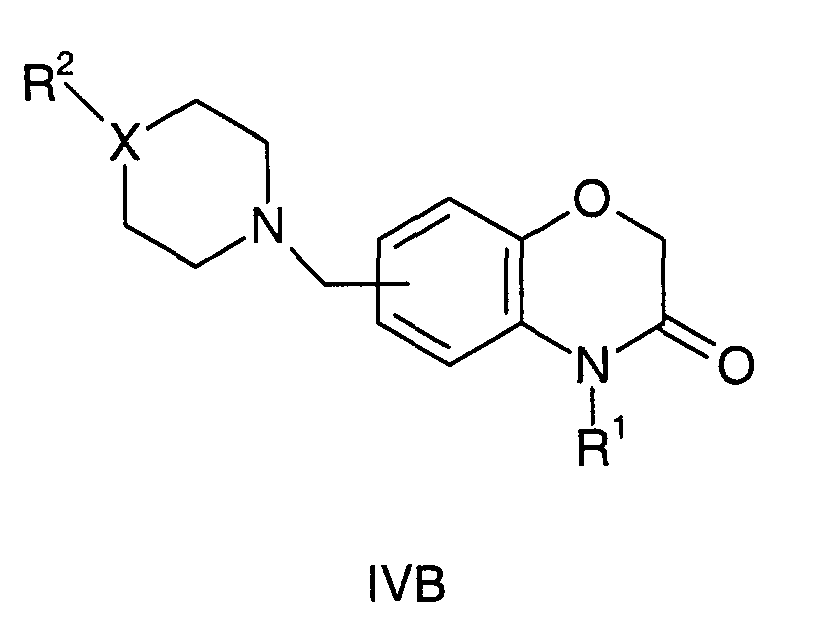 X is N or CH;R1 is hydrogen or methyl; andR2 is phenyl or substituted phenyl, wherein each substituent is independently selected from C1-C6 alkyl or sulphonamido.
 - A pharmaceutical composition according to any one of claims 1 to 6 wherein the amount of the antidepressant, or pharmaceutically acceptable salt thereof, in said composition is from 0.5 mg to 1500 mg per day or the amount of the anxiolytic agent, or pharmaceutically acceptable salt thereof, in said composition is 0.1 mg to 1500 mg per day, and the amount of the D4 receptor antagonist or pharmaceutically acceptable salt thereof is from 0.05 mg to 1500 mg per day.
- A pharmaceutical composition according to claim 7 wherein the amount of the antidepressant, or pharmaceutically acceptable salt thereof, in said composition is from 2.5 mg to 750 mg per day or the amount of the anxiolytic agent, or pharmaceutically acceptable salt thereof, in said composition is 0.1 mg to 500 mg per day, and the amount of the D4 receptor antagonist or pharmaceutically acceptable salt thereof is from 5 mg to 500 mg per day.
- Use of a pharmaceutical composition according to any one of claims 1 to 8 in the preparation of a medicament for the treatment of depression, anxiety or psychosis in a mammal.
- A kit comprising: (a) a compound that exhibits activity as an antidepressant or an anxiolytic agent, or a pharmaceutically acceptable salt thereof; (b) a D4 receptor antagonist or pharmaceutically acceptable salt thereof; and (c) a container for (a) and (b).
- A kit according to claim 10, wherein the D4 receptor antagonist or pharmaceutically acceptable salt thereof is selected from compounds of the formula I, as depicted and defined below
 orwherein Ar is phenyl, naphthyl, benzoxazolonyl, indolyl, indolonyl, benzimidazolyl, quinolyl, furyl, benzofuryl, thienyl, benzothienyl, oxazolyl or benzoxazolyl;Ar1 is phenyl, pyridinyl, pyridazinyl, pyrimidinyl or pyrazinyl;A is O, S, SO, SO2, C=O, CHOH or -(CR3R4)-;n is 0, 1 or 2;each of Ar and Ar1 may be independently and optionally substituted with one to four substituents independently selected from the group consisting of fluoro, chloro, bromo, iodo, cyano, nitro, thiocyano, -SR, -SOR, -SO2R, -NHSO2R, -(C1-C6)alkoxy, -NR1R2, -NRCOR1, -CONR1R2, phenyl, -COR, -COOR, -(C1-C6)alkyl, -(C1-C6)alkyl substituted with one to six halogens independently selected from fluoro, chloro, bromo and iodo, -(C3-C6)cycloalkyl and trifluoromethoxy;each and every R, R1, and R2 is independently selected from the group consisting of hydrogen, -(C1-C6)alkyl, -(C1-C6)alkyl substituted with one to thirteen halogens independently selected from fluoro, chloro, bromo and iodo, phenyl, benzyl, -(C2-C6)alkenyl, -(C3-C6)cycloalkyl and -(C1-C6)alkoxy; andeach and every R3 and R4 is independently selected from the group consisting of hydrogen, methyl, ethyl, n-propyl and i-propyl;compounds of the formula II, as depicted and defined below
 wherein R1 is phenyl, naphthyl, benzoxazolonyl, indolyl, indolonyl, benzimidazolyl, quinolyl, furyl, benzofuryl, thienyl, benzothienyl, oxazolyl or benzoxazolyl;R2 is H or (C1-C6)alkyl;R3 is phenyl, pyridinyl, pyrimidinyl, pyrazinyl or pyridazinyl;R4 is H or (C1-C6)alkyl;R5 is H or (C1-C6)alkyl;wherein each group of R1 and R3 may be independently and optionally substituted with one to four substituents independently selected from the groups consisting of fluoro, chloro, bromo, iodo, cyano, nitro, thiocyano, -SR4, -SOR4, -SO2R4, -NHSO2R4, -(C1-C6)alkoxy, -NR4R5, -NR4COR5, -CONR4R5, phenyl, -COR4, -COOR4, -(C1-C6)alkyl, -(C1-C6)alkyl substituted with one to six halogens, -(C3-C6)cycloalkyl and trifluoromethoxy;X is O, S, SO, SO2, NR4, C=O, CH(OH), CHR4,
 m is 0,1 or 2; andn is 0, 1 or 2;compounds of the formula III or IIIA, as depicted and defined below
 wherein X is N or CH; andR is aryl or heteroaryl;with the proviso that when X is N and R is aryl, aryl is not phenyl, phenyl monosubstituted by lower alkyl, lower alkoxy, halogen, or nitro, phenyl disubstituted by lower alkyl, or phenyl trisubstituted by lower alkoxy;
 with the following provisos:wherein X is N or CH; andR is aryl or heteroaryl;compounds of the formula IV or IVA, as depicted and defined below(a) that when X is N or CH, and R is aryl, aryl is not phenyl, or phenyl monosubstituted by lower alkyl, lower alkoxy, or halogen; and(b) that when X is N and R is heteroaryl, heteroaryl is not 2-, 3-, or 4-pyridinyl;
 compounds of the formula IVB, as depicted and defined belowwherein R1 and R2 are independently hydrogen or C1-C6 alkyl;X is N or CH; andR3 is phenyl, naphthyl, heteraryl, substituted phenyl, substituted naphthyl or substituted heteroaryl, wherein each substituent is independently selected from halogen, C1-C6 alkoxy, C1-C6 alkyl, -CN, -CF3 or sulphonamido;
 and their pharmaceutically acceptable salts.wherein X is N or CH;R1 is hydrogen or methyl; andR2 is phenyl or substituted phenyl, wherein each substituent is independently selected from C1-C6 alkyl or sulphonamido;
 - A kit according to claim 11, wherein the D4 receptor antagonist or pharmaceutically acceptable salt thereof that is employed in such method is selected from the following compounds and their pharmaceutically acceptable salts:(7R,9aS)-7-(4-fluorophenoxy)methyl-2-(5-chloro-pyridin-2-yl)-2,3,4,6,7,8,9,9a-octahydro-1H-pyrido[1,2-a]pyrazine;(7R,9aS)-7-(3,5-difluorophenoxy)methyl-2-(5-chloro-pyridin-2-yl)-2,3,4,6,7,8,9,9a-octahydro-1H-pyrido[1,2-a]pyrazine;3-[(7R,9aS)-2-(5-chloro-pyridin-2-yl)-2,3,4,6,7,8,9,9a-octahydro-1H-pyrido[1,2-a]pyrazin-7-ylmethyl]-3H-benzooxazol-2-one;3-[(7R,9aS)-2-(5-fluoro-pyrimidin-2-yl)-2,3,4,6,7,8,9,9a-octahydro-1H-pyrido[1,2-a]pyrazin-7-ylmethyl]-3H-benzoxazol-2-one;(7R,9aS)-7-(4-fluorophenoxy)methyl-2-(5-fluoro-pyrimidin-2-yl)-2,3,4,6,7,8,9,9a-octahydro-1H-pyrido[1,2-a]pyrazine;(7R,9aS)-7-(3,5-difluorophenoxy)methyl-2-(5-fluoro-pyrimidin-2-yl)-2,3,4,6,7,8,9,9a-octahydro-1H-pyrido[1,2-a]pyrazine;(7R,9aS)-7-(3,4-difluorophenoxy)methyl-2-(5-fluoro-pyrimidin-2-yl)-2,3,4,6,7,8,9,9a-octahydro-1H-pyrido[1,2-a]pyrazine;(7R,9aS)-7-(3-cyanophenoxy)methyl-2-(5-fluoro-pyrimidin-2-yl)-2,3,4,6,7,8,9,9a-octahydro-1H-pyrido[1,2-a]pyrazine;(7R,9aS)-7-(4-cyanophenoxy)methyl-2-(5-fluoro-pyrimidin-2-yl)-2,3,4,6,7,8,9,9a-octahydro-1H-pyrido[1,2-a]pyrazine;(7R,9aS)-7-(4-iodophenoxy)methyl-2-(5-fluoro-pyrimidin-2-yl)-2,3,4,6,7,8,9,9a-octahydro-1H-pyrido[1,2-a]pyrazine;(7R,9aS)-7-(4-fluorophenoxy)methyl-2-(4-fluorophenyl)-2,3,4,6,7,8,9,9a-octahydro-1H-pyrido[1,2-a]pyrazine;(7S,9aS)-7-(4-fluorophenoxy)methyl-2-(5-fluoro-pyrimidin-2-yl)-2,3,4,6,7,8,9,9a-octahydro-1H-pyrido[1,2-a]pyrazine;(7S,9aS)-7-(2-carbomethoxy-4-fluorophenoxy)methyl-2-(5-fluoro-pyrimidin-2-yl)-2,3,4,6,7,8,9,9a-octahydro-1H-pyrido[1,2-a]pyrazine;(7S,9aS)-7-(2-bromo-4-fluorophenoxy)methyl-2-(5-fluoro-pyrimidin-2-yl)-2,3,4,6,7,8,9,9a-octahydro-1 H-pyrido[1,2-a]pyrazine;(7S,9aS)-7-(4-fluoro-2-trifluoromethylphenoxy)methyl-2-(5-fluoro-pyrimidin-2-yl)-2,3,4,6,7,8,9,9a-octahydro-1H-pyrido[1,2-a]pyrazine;(7S,9aS)-7-(3,5-difluorophenoxy)methyl-2-(5-chloro-pyridin-2-yl)-2,3,4,6,7,8,9,9a-octahydro-1H-pyrido[1,2-a]pyrazine;(7S,9aS)-7-(4-fluorophenoxy) methyl-2-(5-chloro-pyridin-2-yl)-2,3,4,6,7,8,9,9a-octahydro-1H-pyrido[1,2-a]pyrazine;(7S,9aS)-7-(4-fluoro-2-methylphenoxy)methyl-2-(5-fluoro-pyrimidin-2-yl)-2,3,4,6,7,8,9,9a-octahydro-1H-pyrido[1,2-a]pyrazine;(7S,9aS)-7-(2,4-difluorophenoxy)methyl-2-(5-fluoro-pyrimidin-2-yl)-2,3,4,6,7,8,9,9a-octahydro-1H-pyrido[1,2-a]pyrazine;(7S,9aS)-7-(3-methyl-phenoxy)methyl-2-(5-fluoropyrimidin-2-yl)-2,3,4,6,7,8,9,9a-octahydro-1H-pyrido[1,2-a]pyrazine;(7S,9aS)-7-(3,4-difluoro-phenoxy)methyl-2-(5-fluoropyrimidin-2-yl)-2,3,4,6,7,8,9,9a-octahydro-1H-pyrido[1,2-a]pyrazine;(7S,9aS)-7-(3,5-difluoro-phenoxy)methyl-2-(5-fluoropyrimidin-2-yl)-2,3,4,6,7,8,9,9a-octahydro-1H-pyrido[1,2-a]pyrazine;(7S,9aS)-7-(3-cyano-phenoxy)methyl-2-(5-fluoropyrimidin-2-yl)-2,3,4,6,7,8,9,9a-octahydro-1H-pyrido[1,2-a]pyrazine;(75,9aS)-7-(3-trifluoromethyl-phenoxy)methyl-2-(5-fluoropyrimidin-2-yl)-2,3,4,6,7,8,9,9a-octahydro-1H-pyrido[1,2-a]pyrazine;(7S,9aS)-7-(4-trifluoromethyl-phenoxy)methyl-2-(5-fluoropyrimidin-2-yl)-2,3,4,6,7,8,9,9a-octahydro-1H-pyrido[1,2-a]pyrazine;(7S,9aS)-7-(3-trifluoromethoxy-phenoxy)methyl-2-(5-fluoropyrimidin-2-yl)-2,3,4,6,7,8,9,9a-octahydro-1H-pyrido[1,2-a]pyrazine;(7S,9aS)-7-(3-methoxy-phenoxy)methyl-2-(5-fluoropyrimidin-2-yl)-2,3,4,6,7,8,9,9a-octahydro-1H-pyrido[1,2-a]pyrazine; and(7S,9aS)-7-(4-methoxy-phenoxy)methyl-2-(5-fluoropyrimidin-2-yl)-2,3,4,6,7,8,9,9a-octahydro-1H-pyrido[1,2-a]pyrazine.
- Use of a kit according to any one of claims 10 to 12 in the preparation of a medicament for treating depression, anxiety or psychosis in a mammal.
- Use according to claim 13 wherein the antidepressant or anxiolytic agent, or pharmaceutically acceptable salt thereof, and the D4 receptor antagonist or pharmaceutically acceptable salt thereof, are administered as part of the same dosage form.
- Use according to either claim 13 or claim 14 wherein the D4 receptor antagonist, or pharmaceutically acceptable salt thereof, is administered in an amount from 0.05 mg to 1500 mg per day, and the antidepressant, or pharmaceutically acceptable salt thereof, is administered in an amount from 0.5 mg to 1500 mg per day or the anxiolytic agent, or pharmaceutically acceptable salt thereof, is administered in an amount from 0.1 mg to 1500 mg per day.
- Use according to claim 15 wherein the D4 receptor antagonist is administered in an amount ranging from 5 mg to 500 mg per day.
- A pharmaceutical composition according to claim 2, wherein the D4 receptor antagonist or pharmaceutically acceptable salt thereof that is employed in such composition is selected from the following compounds and their pharmaceutically acceptable salts:(7R,9aS)-7-(4-fluorophenoxy)methyl-2-(5-chloro-pyridin-2-yl)-2,3,4,6,7,8,9,9a-octahydro-1H-pyrido[1,2-a]pyrazine;(7R,9aS)-7-(3,5-difluorophenoxy)methyl-2-(5-chloro-pyridin-2-yl)-2,3,4,6,7,8,9,9a-octahydro-1H-pyrido[1,2-a]pyrazine;3-[(7R,9aS)-2-(5-chloro-pyridin-2-yl)-2,3,4,6,7,8,9,9a-octahydro-1H-pyrido[1,2-a]pyrazin-7-ylmethyl]-3H-benzooxazol-2-one;3-[(7R,9aS)-2-(5-fluoro-pyrimidin-2-yl)-2,3,4,6,7,8,9,9a-octahydro-1H-pyrido[1,2-a]pyrazin-7-ylmethyl]-3H-benzoxazol-2-one;(7R,9aS)-7-(4-fluorophenoxy)methyl-2-(5-fluoro-pyrimidin-2-yl)-2,3,4,6,7,8,9,9a-octahydro-1H-pyrido[1,2-a]pyrazine;(7R,9aS)-7-(3,5-difluorophenoxy)methyl-2-(5-fluoro-pyrimidin-2-yl)-2,3,4,6,7,8,9,9a-octahydro-1H-pyrido[1,2-a]pyrazine;(7R,9aS)-7-(3,4-difluorophenoxy)methyl-2-(5-fluoro-pyrimidin-2-yl)-2,3,4,6,7,8,9,9a-octahydro-1H-pyrido[1,2-a]pyrazine;(7R,9aS)-7-(3-cyanophenoxy)methyl-2-(5-fluoro-pyrimidin-2-yl)-2,3,4,6,7,8,9,9a-octahydro-1H-pyrido[1,2-a]pyrazine;(7R,9aS)-7-(4-cyanophenoxy)methyl-2-(5-fluoro-pyrimidin-2-yl)-2,3,4,6,7,8,9,9a-octahydro-1H-pyrido[1,2-a]pyrazine;(7R,9aS)-7-(4-iodophenoxy)methyl-2-(5-fluoro-pyrimidin-2-yl)-2,3,4,6,7,8,9,9a-octahydro-1H-pyrido[1,2-a]pyrazine;(7R,9aS)-7-(4-fluorophenoxy)methyl-2-(4-fluorophenyl)-2,3,4,6,7,8,9,9a-octahydro-1 H-pyrido[1,2-a]pyrazine;(7S,9aS)-7-(4-fluorophenoxy)methyl-2-(5-fluoro-pyrimidin-2-yl)-2,3,4,6,7,8,9,9a-octahydro-1H-pyrido[1,2-a]pyrazine;(7S,9aS)-7-(2-carbomethoxy-4-fluorophenoxy)methyl-2-(5-fluoro-pyrimidin-2-yl)-2,3,4,6,7,8,9,9a-octahydro-1H-pyrido[1,2-a]pyrazine;(7S,9aS)-7-(2-bromo-4-fluorophenoxy)methyl-2-(5-fluoro-pyrimidin-2-yl)-2,3,4,6,7,8,9,9a-octahydro-1H-pyrido[1,2-a]pyrazine;(7S,9aS)-7-(4-fluoro-2-trifluoromethylphenoxy)methyl-2-(5-fluoro-pyrimidin-2-yl)-2,3,4,6,7,8,9,9a-octahydro-1H-pyrido[1,2-a]pyrazine;(7S,9aS)-7-(3,5-difluorophenoxy)methyl-2-(5-chloro-pyridin-2-yl)-2,3,4,6,7,8,9,9a-octahydro-1H-pyrido[1,2-a]pyrazine;(7S,9aS)-7-(4-fluorophenoxy)methyl-2-(5-chloro-pyridin-2-yl)-2,3,4,6,7,8,9,9a-octahydro-1H-pyrido[1,2-a]pyrazine;(7S,9aS)-7-(4-fluoro-2-methylphenoxy)methyl-2-(5-fluoro-pyrimidin-2-yl)-2,3,4,6,7,8,9,9a-octahydro-1H-pyrido[1,2-a]pyrazine;(7S,9aS)-7-(2,4-difluorophenoxy)methyl-2-(5-fluoro-pyrimidin-2-yl)-2,3,4,6,7,8,9,9a-octahydro-1H-pyrido[1,2-a]pyrazine;(7S,9aS)-7-(3-methyl-phenoxy)methyl-2-(5-fluoropyrimidin-2-yl)-2,3,4,6,7,8,9,9a-octahydro-1H-pyrido[1,2-a]pyrazine;(7S,9aS)-7-(3,4-difluoro-phenoxy)methyl-2-(5-fluoropyrimidin-2-yl)-2,3,4,6,7,8,9,9a-octahydro-1H-pyrido[1,2-a]pyrazine;(7S,9aS)-7-(3,5-difluoro-phenoxy)methyl-2-(5-fluoropyrimidin-2-yl)-2,3,4,6,7,8,9,9a-octahydro-1H-pyrido[1,2-a]pyrazine;(7S,9aS)-7-(3-cyano-phenoxy)methyl-2-(5-fluoropyrimidin-2-yl)-2,3,4,6,7,8,9,9a-octahydro-1H-pyrido[1,2-a]pyrazine;(7S,9aS)-7-(3-trifluoromethyl-phenoxy)methyl-2-(5-fluoropyrimidin-2-yl)-2,3,4,6,7,8,9,9a-octahydro-1H-pyrido[1,2-a]pyrazine;(7S,9aS)-7-(4-trifluoromethyl-phenoxy)methyl-2-(5-fluoropyrimidin-2-yl)-2,3,4,6,7,8,9,9a-octahydro-1H-pyrido[1,2-a]pyrazine;(7S,9aS)-7-(3-trifluoromethoxy-phenoxy)methyl-2-(5-fluoropyrimidin-2-yl)-2,3,4,6,7,8,9,9a-octahydro-1H-pyrido[1,2-a]pyrazine;(7S,9aS)-7-(3-methoxy-phenoxy)methyl-2-(5-fluoropyrimidin-2-yl)-2,3,4,6,7,8,9,9a-octahydro-1H-pyrido[1,2-a]pyrazine; and(7S,9aS)-7-(4-methoxy-phenoxy)methyl-2-(5-fluoropyrimidin-2-yl)-2,3,4,6,7,8,9,9a-octahydro-1H-pyrido[1,2-a]pyrazine.
- A product comprising (a) a compound that exhibits activity as an antidepressant or an anxiolytic agent, or a pharmaceutically acceptable salt thereof, and (b) a D4 receptor antagonist or pharmaceutically acceptable salt thereof as a combined preparation for simultaneous, separate or sequential use in treating depression, anxiety or psychosis in a mammal
- A pharmaceutical composition according to claim 1 for use in medicine.
Applications Claiming Priority (2)
| Application Number | Priority Date | Filing Date | Title |
|---|---|---|---|
| US251284 | 1988-09-30 | ||
| US25128400P | 2000-12-05 | 2000-12-05 |
Publications (2)
| Publication Number | Publication Date |
|---|---|
| EP1213031A2 true EP1213031A2 (en) | 2002-06-12 |
| EP1213031A3 EP1213031A3 (en) | 2004-03-10 |
Family
ID=22951265
Family Applications (1)
| Application Number | Title | Priority Date | Filing Date |
|---|---|---|---|
| EP01310160A Withdrawn EP1213031A3 (en) | 2000-12-05 | 2001-12-05 | Combination treatment for depression, anxiety and psychosis comprising an antidepressant and/or anxiolytic and a D4 receptor antagonist |
Country Status (6)
| Country | Link |
|---|---|
| US (2) | US20020094986A1 (en) |
| EP (1) | EP1213031A3 (en) |
| JP (1) | JP2002205957A (en) |
| BR (1) | BR0105776A (en) |
| CA (1) | CA2364211A1 (en) |
| MX (1) | MXPA01012559A (en) |
Cited By (3)
| Publication number | Priority date | Publication date | Assignee | Title |
|---|---|---|---|---|
| US7279481B2 (en) | 2003-07-18 | 2007-10-09 | Glaxo Group Limited | Quinoline and quinazoline derivatives having affinity for 5HT1-type receptors |
| US10154988B2 (en) | 2012-11-14 | 2018-12-18 | The Johns Hopkins University | Methods and compositions for treating schizophrenia |
| US12054479B1 (en) | 2022-03-14 | 2024-08-06 | Slap Pharmaceuticals Llc | Multicyclic compounds |
Families Citing this family (12)
| Publication number | Priority date | Publication date | Assignee | Title |
|---|---|---|---|---|
| US8256433B2 (en) | 1999-07-16 | 2012-09-04 | Aradigm Corporation | Systems and methods for effecting cessation of tobacco use |
| US20080138398A1 (en) * | 1999-07-16 | 2008-06-12 | Aradigm Corporation | Dual release nicotine formulations, and systems and methods for their use |
| US6602911B2 (en) | 2001-11-05 | 2003-08-05 | Cypress Bioscience, Inc. | Methods of treating fibromyalgia |
| MXPA04011529A (en) * | 2002-04-24 | 2005-08-15 | Cypress Bioscience Inc | Prevention and treatment of functional somatic disorders, including stress-related disorders. |
| EP1551393A4 (en) * | 2002-07-30 | 2010-06-16 | Peter Migaly | Combination therapy for depression, prevention of suicide, and varous medical and psychiatric conditions |
| US20040152710A1 (en) * | 2002-10-15 | 2004-08-05 | Deecher Darlene Coleman | Use of norepinephrine reuptake modulators for preventing and treating vasomotor symptoms |
| AR042806A1 (en) | 2002-12-27 | 2005-07-06 | Otsuka Pharma Co Ltd | COMBINATION OF CARBOSTIRILE DERIVATIVES AND INHIBITORS OF SEROTONINE REABSORTION FOR THE TREATMENT OF ANIMO DISORDERS |
| US20050176693A1 (en) * | 2003-08-12 | 2005-08-11 | Boissonneault Roger M. | Method of intermittent administration of a pharmaceutical for the treatment of conditions associated with a female's menstrual cycle |
| EP1713486A4 (en) * | 2003-12-02 | 2009-04-29 | Sheldon Leslie James | Combination therapy for dementia,depression and apathy |
| EP1737473A4 (en) * | 2004-04-19 | 2009-08-26 | Noven Therapeutics Llc | Lithium combinations, and uses related thereto |
| US7994220B2 (en) * | 2005-09-28 | 2011-08-09 | Cypress Bioscience, Inc. | Milnacipran for the long-term treatment of fibromyalgia syndrome |
| WO2015157451A1 (en) | 2014-04-08 | 2015-10-15 | Reviva Pharmaceuticals, Inc. | Methods for treating attention deficit hyperactivity disorder |
Family Cites Families (4)
| Publication number | Priority date | Publication date | Assignee | Title |
|---|---|---|---|---|
| US6231833B1 (en) * | 1999-08-05 | 2001-05-15 | Pfizer Inc | 2,7-substituted octahydro-1H-pyrido[1,2-A]pyrazine derivatives as ligands for serotonin receptors |
| ZA977967B (en) * | 1996-09-23 | 1999-03-04 | Lilly Co Eli | Combination therapy for treatment of psychoses |
| US6013654A (en) * | 1997-08-14 | 2000-01-11 | Pharmacia & Upjohn Company | Imidazo[1,2-A]pyridines for the treatment of CNS and cardiac diseases |
| US6121259A (en) * | 1998-11-23 | 2000-09-19 | Sepracor Inc. | Olanzapine-N-oxide compositions and methods |
-
2001
- 2001-12-03 CA CA002364211A patent/CA2364211A1/en not_active Abandoned
- 2001-12-04 BR BR0105776-6A patent/BR0105776A/en not_active IP Right Cessation
- 2001-12-04 MX MXPA01012559A patent/MXPA01012559A/en unknown
- 2001-12-05 US US10/001,827 patent/US20020094986A1/en not_active Abandoned
- 2001-12-05 JP JP2001371473A patent/JP2002205957A/en active Pending
- 2001-12-05 EP EP01310160A patent/EP1213031A3/en not_active Withdrawn
-
2003
- 2003-09-03 US US10/654,151 patent/US20040048869A1/en not_active Abandoned
Cited By (8)
| Publication number | Priority date | Publication date | Assignee | Title |
|---|---|---|---|---|
| US7279481B2 (en) | 2003-07-18 | 2007-10-09 | Glaxo Group Limited | Quinoline and quinazoline derivatives having affinity for 5HT1-type receptors |
| US7459456B2 (en) | 2003-07-18 | 2008-12-02 | Glaxo Group Limited | Quinoline and quinazoline derivatives having affinity for 5HT1-type receptors |
| US7592346B2 (en) | 2003-07-18 | 2009-09-22 | Glaxo Group Limited | Quinoline and quinazoline derivatives having affinity for 5HT1-type receptors |
| US7732600B2 (en) | 2003-07-18 | 2010-06-08 | Glaxo Group Limited | Quinoline and quinazoline derivatives having affinity for 5HT1-type receptors |
| US10154988B2 (en) | 2012-11-14 | 2018-12-18 | The Johns Hopkins University | Methods and compositions for treating schizophrenia |
| EP3610890A1 (en) | 2012-11-14 | 2020-02-19 | The Johns Hopkins University | Methods and compositions for treating schizophrenia |
| US10624875B2 (en) | 2012-11-14 | 2020-04-21 | The Johns Hopkins University | Methods and compositions for treating schizophrenia |
| US12054479B1 (en) | 2022-03-14 | 2024-08-06 | Slap Pharmaceuticals Llc | Multicyclic compounds |
Also Published As
| Publication number | Publication date |
|---|---|
| CA2364211A1 (en) | 2002-06-05 |
| JP2002205957A (en) | 2002-07-23 |
| EP1213031A3 (en) | 2004-03-10 |
| BR0105776A (en) | 2002-08-13 |
| US20040048869A1 (en) | 2004-03-11 |
| MXPA01012559A (en) | 2002-06-11 |
| US20020094986A1 (en) | 2002-07-18 |
Similar Documents
| Publication | Publication Date | Title |
|---|---|---|
| AU2022279416B2 (en) | Methods of treating depression using orexin-2 receptor antagonists | |
| US20040048869A1 (en) | Combination treatment for depression, anxiety and psychosis | |
| EP1238676B1 (en) | Combination of a serotonin reuptake inhibitor and an atypical antipsychotic for use in depression, obsessive compulsive disorder and psychosis | |
| US20130310340A1 (en) | Method of treating muscular degradation | |
| US20080107756A1 (en) | Lithium combinations, and uses related thereto | |
| JP2003063994A (en) | Combination treatment for dementia or congnition disturbance relating to alzheimer's disease and parkinson's disease | |
| KR20080105104A (en) | Novel therapeutic combinations for the treatment of depression | |
| US20030235631A1 (en) | Combination treatment for depression and anxiety | |
| WO2017076842A1 (en) | Indolin-2-one derivatives | |
| AU726745B2 (en) | CNS-penetrant NK-1 receptor antagonists as antidepressant and/or an anti-anxiety agent | |
| US20020049211A1 (en) | Combination treatment for depression and anxiety | |
| WO2024006984A1 (en) | Methods and compositions relating to controlling psychedelic effects with serotonin receptor modulators | |
| US20090075974A1 (en) | Agent for prophylaxis and treatment of pancreatitis | |
| US20040220274A1 (en) | Combination treatment for depression and anxiety | |
| US20030022814A1 (en) | Method for treating or preventing depression | |
| BRPI0611506A2 (en) | COMBINATION OF PYRIMIDYLAMINOBENZAMIDE AND IMATINIB COMPOUNDS TO TREAT OR PREVENT PROLIFERATIVE DISEASES | |
| MXPA04012706A (en) | Combination of pde-v inhibitors and nk1 antagonists for the treatment of depression. | |
| WO2003051397A1 (en) | Neuropeptide y5 receptor antagonists for treating depression, anxiety and dementia |
Legal Events
| Date | Code | Title | Description |
|---|---|---|---|
| PUAI | Public reference made under article 153(3) epc to a published international application that has entered the european phase |
Free format text: ORIGINAL CODE: 0009012 |
|
| 17P | Request for examination filed |
Effective date: 20020102 |
|
| AK | Designated contracting states |
Kind code of ref document: A2 Designated state(s): AT BE CH CY DE DK ES FI FR GB GR IE IT LI LU MC NL PT SE TR |
|
| AX | Request for extension of the european patent |
Free format text: AL;LT;LV;MK;RO;SI |
|
| RIC1 | Information provided on ipc code assigned before grant |
Ipc: 7A 61P 25/18 B Ipc: 7A 61P 25/22 B Ipc: 7A 61P 25/24 B Ipc: 7A 61K 31/506 B Ipc: 7A 61K 31/5377 B Ipc: 7A 61K 31/4985 B Ipc: 7A 61K 31/538 B Ipc: 7A 61K 31/495 B Ipc: 7A 61K 45/06 A |
|
| PUAL | Search report despatched |
Free format text: ORIGINAL CODE: 0009013 |
|
| AK | Designated contracting states |
Kind code of ref document: A3 Designated state(s): AT BE CH CY DE DK ES FI FR GB GR IE IT LI LU MC NL PT SE TR |
|
| AX | Request for extension of the european patent |
Extension state: AL LT LV MK RO SI |
|
| 17Q | First examination report despatched |
Effective date: 20040921 |
|
| AKX | Designation fees paid |
Designated state(s): AT BE CH CY DE DK ES FI FR GB GR IE IT LI LU MC NL PT SE TR |
|
| STAA | Information on the status of an ep patent application or granted ep patent |
Free format text: STATUS: THE APPLICATION IS DEEMED TO BE WITHDRAWN |
|
| 18D | Application deemed to be withdrawn |
Effective date: 20050402 |