EP1211638A2 - Method for blond-hair-pixel removal in image skin-color detection - Google Patents
Method for blond-hair-pixel removal in image skin-color detection Download PDFInfo
- Publication number
- EP1211638A2 EP1211638A2 EP01203797A EP01203797A EP1211638A2 EP 1211638 A2 EP1211638 A2 EP 1211638A2 EP 01203797 A EP01203797 A EP 01203797A EP 01203797 A EP01203797 A EP 01203797A EP 1211638 A2 EP1211638 A2 EP 1211638A2
- Authority
- EP
- European Patent Office
- Prior art keywords
- space
- image
- skin
- color
- skin color
- Prior art date
- Legal status (The legal status is an assumption and is not a legal conclusion. Google has not performed a legal analysis and makes no representation as to the accuracy of the status listed.)
- Granted
Links
Images


Classifications
-
- G—PHYSICS
- G06—COMPUTING OR CALCULATING; COUNTING
- G06T—IMAGE DATA PROCESSING OR GENERATION, IN GENERAL
- G06T7/00—Image analysis
- G06T7/10—Segmentation; Edge detection
- G06T7/11—Region-based segmentation
-
- G—PHYSICS
- G06—COMPUTING OR CALCULATING; COUNTING
- G06V—IMAGE OR VIDEO RECOGNITION OR UNDERSTANDING
- G06V10/00—Arrangements for image or video recognition or understanding
- G06V10/20—Image preprocessing
- G06V10/26—Segmentation of patterns in the image field; Cutting or merging of image elements to establish the pattern region, e.g. clustering-based techniques; Detection of occlusion
- G06V10/273—Segmentation of patterns in the image field; Cutting or merging of image elements to establish the pattern region, e.g. clustering-based techniques; Detection of occlusion removing elements interfering with the pattern to be recognised
-
- G—PHYSICS
- G06—COMPUTING OR CALCULATING; COUNTING
- G06V—IMAGE OR VIDEO RECOGNITION OR UNDERSTANDING
- G06V10/00—Arrangements for image or video recognition or understanding
- G06V10/20—Image preprocessing
- G06V10/28—Quantising the image, e.g. histogram thresholding for discrimination between background and foreground patterns
-
- G—PHYSICS
- G06—COMPUTING OR CALCULATING; COUNTING
- G06V—IMAGE OR VIDEO RECOGNITION OR UNDERSTANDING
- G06V10/00—Arrangements for image or video recognition or understanding
- G06V10/40—Extraction of image or video features
- G06V10/56—Extraction of image or video features relating to colour
-
- G—PHYSICS
- G06—COMPUTING OR CALCULATING; COUNTING
- G06T—IMAGE DATA PROCESSING OR GENERATION, IN GENERAL
- G06T2207/00—Indexing scheme for image analysis or image enhancement
- G06T2207/30—Subject of image; Context of image processing
- G06T2207/30196—Human being; Person
- G06T2207/30201—Face
Definitions
- the current invention relates to the field of digital detection for skin color pixels in a digital image, and in particular to the field of hair-skin color pixel separation in a digital image.
- Skin color detection is adopted as a preliminary step in automatic redeye detection and correction of consumer images for real-time use (see commonly assigned U.S. Serial No. 08/919,560 filed August 29, 1997 entitled “A Computer Program Product for Redeye Detection”).
- redeye detection application skin color areas are first located and subsequent steps are employed to determine if the red dots within the skin color areas are true red eyes.
- the success of redeye detection largely depends on the success of having clean face skin color regions identified. Previous experiences tell that it is particularly difficult to obtain clean face regions in color images with the presence of blond hairs.
- the algorithm designed in the aforementioned redeye detection application is used for locating and correcting redeye defects in consumer images without user intervention such as ROI (region-of-interest) selection.
- the major goal of the redeye detection algorithm is to detect redeye defects with a minimum number of false positives and within a minimum execution time without sacrificing performance. For this reason, face-region (with most of the hair regions eliminated) detection is performed so that unnecessary processing is not performed on red-dot candidates that are not located in detected face regions.
- face-region with most of the hair regions eliminated
- face-region localization is the use of skin-color pixel detection that requires only pixel operations. It has been shown that difficulties arise when dealing with images having faces associated with blond hairs.
- FIG 1 displays an example picture 500 that causes problems.
- objects 504, 505, 508, 509, and 510 are non-skin objects; 501 and 506 are blond hairs; 502, 503, and 507 are skin regions.
- picture 600 shows the example result of conventional skin detection algorithms.
- the skin-color detection process does not separate the hairs from the face (see object 601) and therefore the subsequent redeye detection process will take the whole head plus the body as the face region and no redeye defects will be corrected.
- the hair model is a function of three variables: the luminance Y and the chromaticities, u and v. Noticeably, this hair model works mainly for Asian faces with dark hairs. Moreover, the conversion from RGB to the corresponding CIE tristimulus values requires the knowledge of the color calibration that varies from imaging device to device.
- Table 1 illustrates the computation expense for different transformation operations. Among them, gRGB transformation has the lowest computation expense. This is one of the advantages that gRGB transformation provides.
- the present invention describes a mechanism that overcomes the difficulty of separating blond hair pixels from skin color pixels by fusing two color detection strategies that work in generalized RGB (gRGB) space and the hue space respectively.
- RGB generalized RGB
- a method and a computer program product for generating a clean skin color image comprises the steps of:
- the present invention is effective in obtaining a clean skin color image in the presence of blond hair color pixels and has the advantages of:
- the computer program may be stored in a computer readable storage medium, which may comprise, for example; magnetic storage media such as a magnetic disk (such as a floppy disk or a hard drive) or magnetic tape; optical storage media such as an optical disc, optical tape, or machine readable bar code; solid state electronic storage devices such as random access memory (RAM), or read only memory (ROM); or any other physical device or medium employed to store a computer program.
- a computer readable storage medium may comprise, for example; magnetic storage media such as a magnetic disk (such as a floppy disk or a hard drive) or magnetic tape; optical storage media such as an optical disc, optical tape, or machine readable bar code; solid state electronic storage devices such as random access memory (RAM), or read only memory (ROM); or any other physical device or medium employed to store a computer program.
- block 1 represents the input (RGB) color image to be processed.
- the input image is re-sampled to a default size of 252 by 320 if the input image size exceeds the default size.
- a simple pixel-averaging process is performed during the re-sampling procedure.
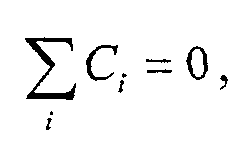
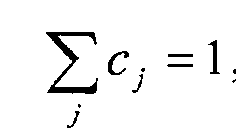
- the input RGB image, I RGB with size of M ⁇ N ⁇ 3, is converted to the generalized RGB image, I gRGB , using the formula: where C i is the individual color channel (R, G, or B) of the input image I RGB , c j is the individual color channel of the resultant generalized R, G or B of the output image I gRGB .
- This operation is not valid when and the output will be set to zero.
- the resultant three new elements are linearly dependent, that is, so that only two elements are needed to effectively form a new space that is collapsed from three dimensions to two dimensions.
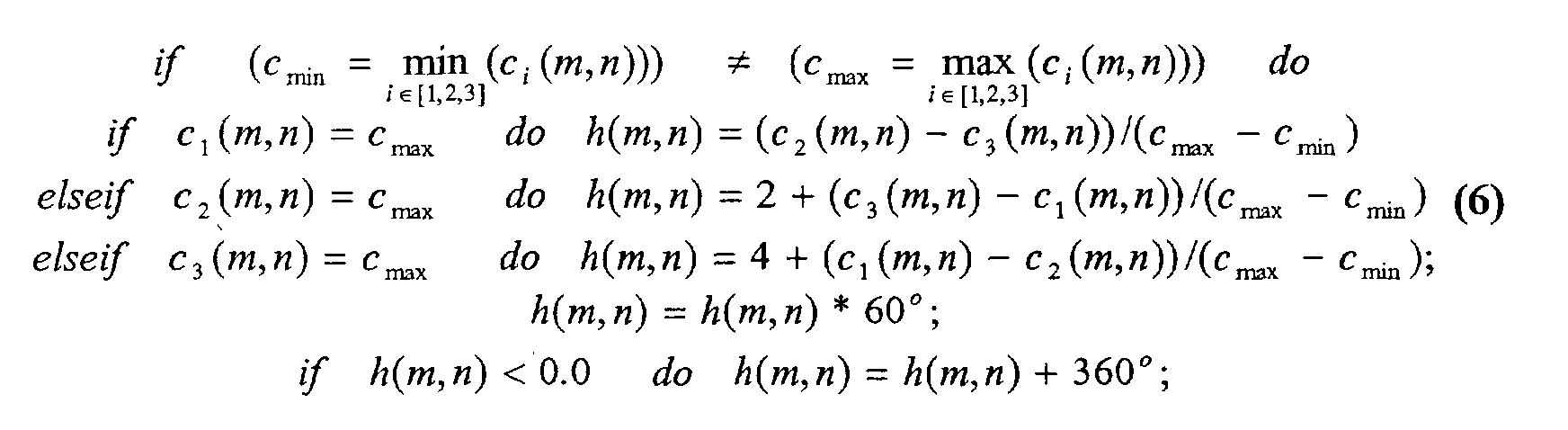
- c 1 and c 2 that is, generalized R and G, are used in analyzing the skin color distribution of a large population of images and detecting skin color pixels in an image. Although only c 1 and c 2 need to be computed at this point, however, in this design, c 3 is also computed since all of them are needed in a later stage, hue computation.
- the skin-color region detection takes place in block 4.
- the generalized RGB image I gRGB is passed to a classifier that is trained on a large population of images beforehand.
- c 1 and c 2 of the image I gRGB are used in the classification process.
- the pictorial view 800 presents an example where dark region 802 contains skin-color pixels in the ( c 1 , c 2 ) space.
- the classifier is an ellipse 801 in the ( c 1 , c 2 ) space.
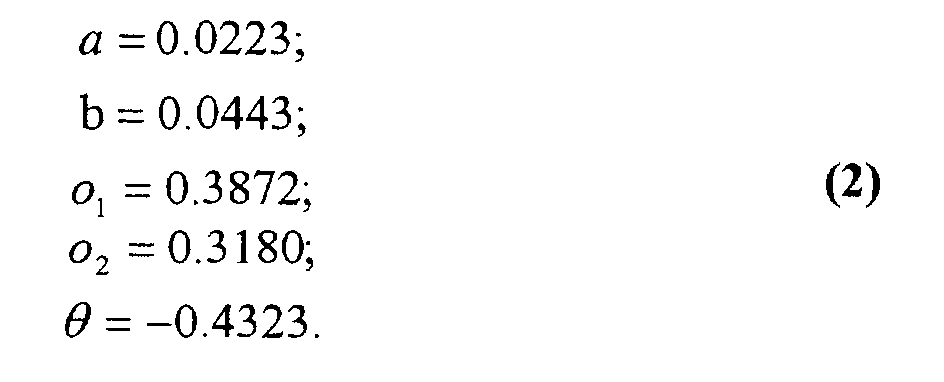
- Parameters a, b, ( o 1 , o 2 ), and ⁇ are the constants of the trained classifier, where a and b are the ellipse axes length, ( o 1 , o 2 ) is the center coordinates of the ellipse in the ( c 1 , c 2 ) space, and ⁇ is the angle between the c 1 axis and the longer axis of the ellipse.
- Exemplary parameter values for the ellipse are:
- the resultant of the skin-color classifier is a skin-color mask (block 5)
- P skin ⁇ p ( i , j ) ⁇ M ⁇ N , that is, an M ⁇ N matrix with elements p ( i , j ).
- the skin-color mask, P skin is provided to terminal A, where it then becomes an input to AND gate a .
- the other input of AND gate a is the generalized RGB image I gRGB .
- the blond hair color distributes in the same region where the majority skin color occupies, as shown by the pictorial view 900 in Figure 5.
- the blond hair color pixels are plotted in a region 903, skin color pixels in a region 902 for a person with blond hair, and a region 901 is for a larger population of skin color pixels. It is not a trivial task to parameterize the sub-regions in the ( c 1 , c 2 ) space so that the region 903 can be separated from the region 902. If the space dimension drops down to one, the separation of blond hair color pixels from the skin color pixels becomes fairly easy.
- the output skin-color RGB image (block 11) is the result of an AND operation (in gate b ) of the new skin mask and the original RGB color image I RGB input through terminal B.
- the pictorial view 700 displays an exemplary skin mask for the example image shown in Figure 1.
- a clean face part 701 is separated from other body parts 702 and 703, and therefore, provides useful information for applications such as redeye detection.
- the subject matter of the present invention relates to digital image understanding technology, which is understood to mean technology that digitally processes a digital image to recognize and thereby assign useful meaning to human understandable objects, attributes or conditions and then to utilize the results obtained in the further processing of the digital image.
Landscapes
- Engineering & Computer Science (AREA)
- Physics & Mathematics (AREA)
- General Physics & Mathematics (AREA)
- Theoretical Computer Science (AREA)
- Multimedia (AREA)
- Computer Vision & Pattern Recognition (AREA)
- Image Analysis (AREA)
- Image Processing (AREA)
Abstract
Description
- Psychological space - Some researchers believe that the RGB basis is not a particularly good one to explain the perception of colors. Alternatively, a transformed non-RGB space, or a psychological space, is well accepted to describe 'colors'. It is compatible to human color perception. This non-RGB space is composed of three components, hue (H), saturation (S) and brightness value (V). Instead of using three values (R,G,B) to distinguish color objects, a single component, H, is used to label a color pixel in this transformed space.
- CIELab space-CIE in 1976 recommended the CIELab formula for color measurement. It is designed that colors in the CIELab space are perceptually more uniformly spread than are colors in RGB and psychological (e.g. HSV) spaces. Therefore, using the CIELab space enables the use of a fixed color distance in decision making over a wide range of colors.
- Lst space-The Lst space is traditionally called T-space in graphic applications and is constructed with log exposures. L is the luminance component, and s and t are the two chrominance components. It is shown that the statistical distribution of color signals is more symmetrical in Lst space than in linear space.
- YC R C B space-The YC R C B space is designed for television broadcasting signal conversion. Y is the luminance component, C R and C B are two chrominance components. Researchers working in video images prefer using this space.
- Generalized R-G-B Space (gRGB)-This is also called normalized R-G-B space. This space is transformed from the native R-G-B space by normalizing each of the three elements of the original R-G-B by the summation of the three original elements. The resultant three new elements are linearly dependent so that only two elements are needed to effectively form a new space that is collapsed from three dimensions to two dimensions. So, it is also called a collapsed R-G-B space in some articles. This space does not provide an explicit luminance component like the other spaces. This generalization process reduces the illuminant effects on chromaticity components.
| Space transformation computation complexity (pixel-wise) | |||||
| HSV | Lab | Lst | YCRCB | gRGB | |
| Addition | 3.17 | 9 | 5 | 9 | 2 |
| Multiplication | 1.5 | 32 | 4 | 9 | 2 |
| | 5 | 1 | |||
| Note: for HSV, only H is considered; gRGB stands for generalized RGB |





Claims (5)
- A method for removing blond hair color pixels during skin color detection in an original digital image space, the method comprising the steps of:(a) converting the original digital image space to a normalized space, thereby obtaining a normalized image;(b) detecting skin color pixels within the normalized image;(c) generating a masked normalized image using the detected skin color pixels;(d) converting the masked normalized image to a one-dimensional image space;(e) separating blond hair color and the associated skin color within the one-dimensional image space; and(f) utilizing the separated pixels in the one-dimensional space to identify blond hair color pixels in the original image space.
- The method as claimed in claim 1 wherein step (f) comprises the steps of:(f1) forming a skin color image mask based on the separated skin color pixels in the one-dimensional image space; and(f2) generating a masked image in the original image space using the skin color image mask.
- The method as claimed in claim 1 wherein the one-dimensional image space is a hue image.
- The method as claimed in claim 1 wherein the original digital image space is an RGB space.
- The method as claimed in claim 4 wherein the normalized space is a generalized RGB space.
Applications Claiming Priority (2)
| Application Number | Priority Date | Filing Date | Title |
|---|---|---|---|
| US09/692,929 US6711286B1 (en) | 2000-10-20 | 2000-10-20 | Method for blond-hair-pixel removal in image skin-color detection |
| US692929 | 2000-10-20 |
Publications (4)
| Publication Number | Publication Date |
|---|---|
| EP1211638A2 true EP1211638A2 (en) | 2002-06-05 |
| EP1211638A3 EP1211638A3 (en) | 2015-09-02 |
| EP1211638B1 EP1211638B1 (en) | 2017-06-07 |
| EP1211638B8 EP1211638B8 (en) | 2017-08-02 |
Family
ID=24782622
Family Applications (1)
| Application Number | Title | Priority Date | Filing Date |
|---|---|---|---|
| EP01203797.4A Expired - Lifetime EP1211638B8 (en) | 2000-10-20 | 2001-10-08 | Method for blond-hair-pixel removal in image skin-color detection |
Country Status (3)
| Country | Link |
|---|---|
| US (1) | US6711286B1 (en) |
| EP (1) | EP1211638B8 (en) |
| JP (1) | JP3769487B2 (en) |
Cited By (6)
| Publication number | Priority date | Publication date | Assignee | Title |
|---|---|---|---|---|
| US7362886B2 (en) | 2003-06-05 | 2008-04-22 | Canon Kabushiki Kaisha | Age-based face recognition |
| US7444022B2 (en) | 2003-12-09 | 2008-10-28 | Mitsubishi Denki Kabushiki Kaisha | Method and apparatus for separating content types in images |
| EP1694051A4 (en) * | 2003-12-11 | 2010-11-17 | Fujitsu Ltd | PROCESS. IMAGE PROCESSING PROGRAM AND DEVICE |
| WO2016107638A1 (en) * | 2014-12-29 | 2016-07-07 | Keylemon Sa | An image face processing method and apparatus |
| CN106407909A (en) * | 2016-08-31 | 2017-02-15 | 北京云图微动科技有限公司 | Face recognition method, device and system |
| CN107392166A (en) * | 2017-07-31 | 2017-11-24 | 北京小米移动软件有限公司 | Skin color detection method, device and computer-readable recording medium |
Families Citing this family (22)
| Publication number | Priority date | Publication date | Assignee | Title |
|---|---|---|---|---|
| US7092122B2 (en) * | 2000-07-18 | 2006-08-15 | Fuji Photo Film Co., Ltd. | Image processing device and method |
| US20030174869A1 (en) * | 2002-03-12 | 2003-09-18 | Suarez Anthony P. | Image processing apparatus, image processing method, program and recording medium |
| JP4086580B2 (en) * | 2002-07-30 | 2008-05-14 | キヤノン株式会社 | Image processing apparatus, program, and method |
| US7039222B2 (en) * | 2003-02-28 | 2006-05-02 | Eastman Kodak Company | Method and system for enhancing portrait images that are processed in a batch mode |
| US7907135B2 (en) * | 2005-03-29 | 2011-03-15 | Panasonic Corporation | Image display and image displaying method for gradation correction |
| JP2006338377A (en) * | 2005-06-02 | 2006-12-14 | Fujifilm Holdings Corp | Image correction method, apparatus, and program |
| KR101303877B1 (en) * | 2005-08-05 | 2013-09-04 | 삼성전자주식회사 | Method and apparatus for serving prefer color conversion of skin color applying face detection and skin area detection |
| JP5354842B2 (en) * | 2006-05-26 | 2013-11-27 | キヤノン株式会社 | Image processing method and image processing apparatus |
| KR100862341B1 (en) * | 2006-11-13 | 2008-10-13 | 삼성전기주식회사 | Human skin region detection device and method |
| US9313504B2 (en) * | 2007-07-02 | 2016-04-12 | Vixs Systems, Inc. | Pattern detection module with region detection, video encoding system and method for use therewith |
| US8027521B1 (en) | 2008-03-25 | 2011-09-27 | Videomining Corporation | Method and system for robust human gender recognition using facial feature localization |
| WO2010019925A1 (en) | 2008-08-15 | 2010-02-18 | Brown Technology Partnerships | Method and apparatus for estimating body shape |
| CN102216956A (en) * | 2008-11-19 | 2011-10-12 | 夏普株式会社 | Specified color area demarcation circuit, detection circuit, and image processing apparatus using same |
| US8270682B2 (en) * | 2008-11-25 | 2012-09-18 | Eastman Kodak Company | Hair segmentation |
| US20100158357A1 (en) * | 2008-12-19 | 2010-06-24 | Qualcomm Incorporated | Image processing method and system of skin color enhancement |
| US20110194762A1 (en) * | 2010-02-04 | 2011-08-11 | Samsung Electronics Co., Ltd. | Method for detecting hair region |
| CN102147852B (en) * | 2010-02-04 | 2016-01-27 | 三星电子株式会社 | Detect the method for hair zones |
| JP5818091B2 (en) * | 2011-12-27 | 2015-11-18 | ソニー株式会社 | Image processing apparatus, image processing system, image processing method, and program |
| CN103778430B (en) * | 2014-02-24 | 2017-03-22 | 东南大学 | Rapid face detection method based on combination between skin color segmentation and AdaBoost |
| CN105373789A (en) * | 2015-10-08 | 2016-03-02 | 中国电子科技集团公司第四十一研究所 | Cigarette invisible sprayed code integrity detection method |
| CN105787929B (en) * | 2016-02-15 | 2018-11-27 | 天津大学 | Skin rash point extracting method based on spot detection |
| CN110544257A (en) * | 2019-08-20 | 2019-12-06 | 成都品果科技有限公司 | Rapid skin color segmentation method |
Family Cites Families (13)
| Publication number | Priority date | Publication date | Assignee | Title |
|---|---|---|---|---|
| US3778541A (en) * | 1971-09-03 | 1973-12-11 | Itek Corp | System for analyzing multicolored scenes |
| US5128711A (en) | 1989-04-28 | 1992-07-07 | Fuji Photo Film Co., Ltd. | Apparatus for recording position information of principal image and method of detecting principal image |
| US6249317B1 (en) * | 1990-08-01 | 2001-06-19 | Minolta Co., Ltd. | Automatic exposure control apparatus |
| US6072526A (en) * | 1990-10-15 | 2000-06-06 | Minolta Co., Ltd. | Image sensing device that can correct colors corresponding to skin in a video signal |
| US5907315A (en) * | 1993-03-17 | 1999-05-25 | Ultimatte Corporation | Method and apparatus for adjusting parameters used by compositing devices |
| US5432863A (en) | 1993-07-19 | 1995-07-11 | Eastman Kodak Company | Automated detection and correction of eye color defects due to flash illumination |
| US5715377A (en) * | 1994-07-21 | 1998-02-03 | Matsushita Electric Industrial Co. Ltd. | Gray level correction apparatus |
| JP3799633B2 (en) * | 1995-06-16 | 2006-07-19 | セイコーエプソン株式会社 | Face image processing method and face image processing apparatus |
| US6343141B1 (en) * | 1996-10-08 | 2002-01-29 | Lucent Technologies Inc. | Skin area detection for video image systems |
| US5864630A (en) * | 1996-11-20 | 1999-01-26 | At&T Corp | Multi-modal method for locating objects in images |
| US6292574B1 (en) * | 1997-08-29 | 2001-09-18 | Eastman Kodak Company | Computer program product for redeye detection |
| JP2000048184A (en) * | 1998-05-29 | 2000-02-18 | Canon Inc | Image processing method and face region extraction method and apparatus |
| KR100343223B1 (en) * | 1999-12-07 | 2002-07-10 | 윤종용 | Apparatus for eye and face detection and method thereof |
-
2000
- 2000-10-20 US US09/692,929 patent/US6711286B1/en not_active Expired - Lifetime
-
2001
- 2001-10-08 EP EP01203797.4A patent/EP1211638B8/en not_active Expired - Lifetime
- 2001-10-19 JP JP2001322731A patent/JP3769487B2/en not_active Expired - Fee Related
Cited By (6)
| Publication number | Priority date | Publication date | Assignee | Title |
|---|---|---|---|---|
| US7362886B2 (en) | 2003-06-05 | 2008-04-22 | Canon Kabushiki Kaisha | Age-based face recognition |
| US7444022B2 (en) | 2003-12-09 | 2008-10-28 | Mitsubishi Denki Kabushiki Kaisha | Method and apparatus for separating content types in images |
| EP1694051A4 (en) * | 2003-12-11 | 2010-11-17 | Fujitsu Ltd | PROCESS. IMAGE PROCESSING PROGRAM AND DEVICE |
| WO2016107638A1 (en) * | 2014-12-29 | 2016-07-07 | Keylemon Sa | An image face processing method and apparatus |
| CN106407909A (en) * | 2016-08-31 | 2017-02-15 | 北京云图微动科技有限公司 | Face recognition method, device and system |
| CN107392166A (en) * | 2017-07-31 | 2017-11-24 | 北京小米移动软件有限公司 | Skin color detection method, device and computer-readable recording medium |
Also Published As
| Publication number | Publication date |
|---|---|
| JP3769487B2 (en) | 2006-04-26 |
| EP1211638B1 (en) | 2017-06-07 |
| EP1211638B8 (en) | 2017-08-02 |
| JP2002183729A (en) | 2002-06-28 |
| EP1211638A3 (en) | 2015-09-02 |
| US6711286B1 (en) | 2004-03-23 |
Similar Documents
| Publication | Publication Date | Title |
|---|---|---|
| EP1211638B1 (en) | Method for blond-hair-pixel removal in image skin-color detection | |
| EP1223550B1 (en) | Method for detecting skin color in a digital image | |
| US6256409B1 (en) | Method for determining a correlation between images using multi-element image descriptors | |
| US11321963B2 (en) | Face liveness detection based on neural network model | |
| US7454040B2 (en) | Systems and methods of detecting and correcting redeye in an image suitable for embedded applications | |
| US8055066B2 (en) | Apparatus, system, and method for skin tone detection in a CMOS image sensor | |
| EP0756426B1 (en) | Specified image-area extracting method and device for producing video information | |
| US6757426B2 (en) | System and method for image processing by automatic color dropout | |
| Gomez | On selecting colour components for skin detection | |
| US6289110B1 (en) | Object extracting method using motion picture | |
| US20110069208A1 (en) | Two Stage Detection For Photographic Eye Artifacts | |
| JP2004348733A (en) | Method and device for detecting red-eye area in digital image | |
| JP4722467B2 (en) | A method of classifying pixels in an image, a method of detecting skin using the method, configured to use data encoded using the method to encode, transmit, receive, or decode Method and apparatus, apparatus configured to perform the method, a computer program causing a computer to execute the method, and a computer-readable storage medium storing the computer program | |
| Gómez et al. | On selecting an appropriate colour space for skin detection | |
| US7058220B2 (en) | Method and system for processing images using histograms | |
| Lee et al. | Color image enhancement using histogram equalization method without changing hue and saturation | |
| US7528991B2 (en) | Method of generating a mask image of membership of single pixels to certain chromaticity classes and of adaptive improvement of a color image | |
| US7133552B2 (en) | Method of extracting face using color distortion information | |
| US20190385283A1 (en) | Image pre-processing for object recognition | |
| JP2009038737A (en) | Image processing device | |
| KR100488014B1 (en) | YCrCb color based human face location detection method | |
| Andreadis et al. | Image pixel classification by chromaticity analysis | |
| Ferrara | Adaptive spatial/spectral detection of subpixel targets with unknown spectral characteristics | |
| WO2008119368A1 (en) | Method for red eye detection in a digital image | |
| Andreadis et al. | Coloured object recognition using invariant spectral features |
Legal Events
| Date | Code | Title | Description |
|---|---|---|---|
| PUAI | Public reference made under article 153(3) epc to a published international application that has entered the european phase |
Free format text: ORIGINAL CODE: 0009012 |
|
| AK | Designated contracting states |
Kind code of ref document: A2 Designated state(s): AT BE CH CY DE DK ES FI FR GB GR IE IT LI LU MC NL PT SE TR |
|
| AX | Request for extension of the european patent |
Free format text: AL;LT;LV;MK;RO;SI |
|
| RAP1 | Party data changed (applicant data changed or rights of an application transferred) |
Owner name: INTELLECTUAL VENTURES FUND 83 LLC |
|
| PUAL | Search report despatched |
Free format text: ORIGINAL CODE: 0009013 |
|
| AK | Designated contracting states |
Kind code of ref document: A3 Designated state(s): AT BE CH CY DE DK ES FI FR GB GR IE IT LI LU MC NL PT SE TR |
|
| AX | Request for extension of the european patent |
Extension state: AL LT LV MK RO SI |
|
| RIC1 | Information provided on ipc code assigned before grant |
Ipc: G06T 7/00 20060101AFI20150730BHEP Ipc: G06K 9/38 20060101ALI20150730BHEP Ipc: G06K 9/46 20060101ALI20150730BHEP Ipc: G06K 9/34 20060101ALI20150730BHEP |
|
| 17P | Request for examination filed |
Effective date: 20160301 |
|
| RBV | Designated contracting states (corrected) |
Designated state(s): AT BE CH CY DE DK ES FI FR GB GR IE IT LI LU MC NL PT SE TR |
|
| AKX | Designation fees paid |
Designated state(s): DE FR GB |
|
| AXX | Extension fees paid |
Extension state: RO Extension state: AL Extension state: LV Extension state: LT Extension state: MK Extension state: SI |
|
| 17Q | First examination report despatched |
Effective date: 20160607 |
|
| GRAP | Despatch of communication of intention to grant a patent |
Free format text: ORIGINAL CODE: EPIDOSNIGR1 |
|
| STAA | Information on the status of an ep patent application or granted ep patent |
Free format text: STATUS: GRANT OF PATENT IS INTENDED |
|
| INTG | Intention to grant announced |
Effective date: 20161114 |
|
| GRAS | Grant fee paid |
Free format text: ORIGINAL CODE: EPIDOSNIGR3 |
|
| GRAJ | Information related to disapproval of communication of intention to grant by the applicant or resumption of examination proceedings by the epo deleted |
Free format text: ORIGINAL CODE: EPIDOSDIGR1 |
|
| GRAL | Information related to payment of fee for publishing/printing deleted |
Free format text: ORIGINAL CODE: EPIDOSDIGR3 |
|
| STAA | Information on the status of an ep patent application or granted ep patent |
Free format text: STATUS: EXAMINATION IS IN PROGRESS |
|
| REG | Reference to a national code |
Ref country code: DE Ref legal event code: R079 Ref document number: 60150477 Country of ref document: DE Free format text: PREVIOUS MAIN CLASS: G06T0005000000 Ipc: G06T0007110000 |
|
| GRAR | Information related to intention to grant a patent recorded |
Free format text: ORIGINAL CODE: EPIDOSNIGR71 |
|
| STAA | Information on the status of an ep patent application or granted ep patent |
Free format text: STATUS: GRANT OF PATENT IS INTENDED |
|
| INTC | Intention to grant announced (deleted) | ||
| GRAA | (expected) grant |
Free format text: ORIGINAL CODE: 0009210 |
|
| STAA | Information on the status of an ep patent application or granted ep patent |
Free format text: STATUS: THE PATENT HAS BEEN GRANTED |
|
| RIC1 | Information provided on ipc code assigned before grant |
Ipc: G06T 7/11 20170101AFI20170403BHEP Ipc: G06K 9/46 20060101ALI20170403BHEP Ipc: G06K 9/34 20060101ALI20170403BHEP Ipc: G06K 9/38 20060101ALI20170403BHEP |
|
| INTG | Intention to grant announced |
Effective date: 20170427 |
|
| AK | Designated contracting states |
Kind code of ref document: B1 Designated state(s): DE FR GB |
|
| REG | Reference to a national code |
Ref country code: GB Ref legal event code: FG4D |
|
| GRAA | (expected) grant |
Free format text: ORIGINAL CODE: 0009210 |
|
| RAP2 | Party data changed (patent owner data changed or rights of a patent transferred) |
Owner name: MONUMENT PEAK VENTURES, LLC |
|
| REG | Reference to a national code |
Ref country code: DE Ref legal event code: R096 Ref document number: 60150477 Country of ref document: DE |
|
| REG | Reference to a national code |
Ref country code: FR Ref legal event code: PLFP Year of fee payment: 17 |
|
| PGFP | Annual fee paid to national office [announced via postgrant information from national office to epo] |
Ref country code: DE Payment date: 20171027 Year of fee payment: 17 Ref country code: FR Payment date: 20171025 Year of fee payment: 17 |
|
| PGFP | Annual fee paid to national office [announced via postgrant information from national office to epo] |
Ref country code: GB Payment date: 20171027 Year of fee payment: 17 |
|
| REG | Reference to a national code |
Ref country code: DE Ref legal event code: R097 Ref document number: 60150477 Country of ref document: DE |
|
| PLBE | No opposition filed within time limit |
Free format text: ORIGINAL CODE: 0009261 |
|
| STAA | Information on the status of an ep patent application or granted ep patent |
Free format text: STATUS: NO OPPOSITION FILED WITHIN TIME LIMIT |
|
| 26N | No opposition filed |
Effective date: 20180308 |
|
| REG | Reference to a national code |
Ref country code: DE Ref legal event code: R119 Ref document number: 60150477 Country of ref document: DE |
|
| GBPC | Gb: european patent ceased through non-payment of renewal fee |
Effective date: 20181008 |
|
| PG25 | Lapsed in a contracting state [announced via postgrant information from national office to epo] |
Ref country code: DE Free format text: LAPSE BECAUSE OF NON-PAYMENT OF DUE FEES Effective date: 20190501 |
|
| PG25 | Lapsed in a contracting state [announced via postgrant information from national office to epo] |
Ref country code: FR Free format text: LAPSE BECAUSE OF NON-PAYMENT OF DUE FEES Effective date: 20181031 |
|
| PG25 | Lapsed in a contracting state [announced via postgrant information from national office to epo] |
Ref country code: GB Free format text: LAPSE BECAUSE OF NON-PAYMENT OF DUE FEES Effective date: 20181008 |