EP1211413A2 - Engine ignition system - Google Patents
Engine ignition system Download PDFInfo
- Publication number
- EP1211413A2 EP1211413A2 EP01310149A EP01310149A EP1211413A2 EP 1211413 A2 EP1211413 A2 EP 1211413A2 EP 01310149 A EP01310149 A EP 01310149A EP 01310149 A EP01310149 A EP 01310149A EP 1211413 A2 EP1211413 A2 EP 1211413A2
- Authority
- EP
- European Patent Office
- Prior art keywords
- rotor
- iron core
- inductor
- legs
- outer periphery
- Prior art date
- Legal status (The legal status is an assumption and is not a legal conclusion. Google has not performed a legal analysis and makes no representation as to the accuracy of the status listed.)
- Granted
Links
- XEEYBQQBJWHFJM-UHFFFAOYSA-N Iron Chemical group [Fe] XEEYBQQBJWHFJM-UHFFFAOYSA-N 0.000 claims abstract description 61
- 230000002093 peripheral effect Effects 0.000 claims abstract description 25
- 230000004907 flux Effects 0.000 claims abstract description 19
- 238000004804 winding Methods 0.000 claims abstract description 3
- 229910000838 Al alloy Inorganic materials 0.000 claims description 6
- 230000001360 synchronised effect Effects 0.000 claims 2
- 229910052751 metal Inorganic materials 0.000 description 6
- 239000002184 metal Substances 0.000 description 6
- 238000003475 lamination Methods 0.000 description 4
- 239000000696 magnetic material Substances 0.000 description 3
- 229910001018 Cast iron Inorganic materials 0.000 description 2
- 238000004512 die casting Methods 0.000 description 2
- 229910052742 iron Inorganic materials 0.000 description 2
- ZOXJGFHDIHLPTG-UHFFFAOYSA-N Boron Chemical compound [B] ZOXJGFHDIHLPTG-UHFFFAOYSA-N 0.000 description 1
- 229910052779 Neodymium Inorganic materials 0.000 description 1
- 229910052796 boron Inorganic materials 0.000 description 1
- 238000010586 diagram Methods 0.000 description 1
- 230000000694 effects Effects 0.000 description 1
- 238000000034 method Methods 0.000 description 1
- QEFYFXOXNSNQGX-UHFFFAOYSA-N neodymium atom Chemical compound [Nd] QEFYFXOXNSNQGX-UHFFFAOYSA-N 0.000 description 1
- 229910001172 neodymium magnet Inorganic materials 0.000 description 1
- 229910052761 rare earth metal Inorganic materials 0.000 description 1
- 150000002910 rare earth metals Chemical class 0.000 description 1
- 238000007493 shaping process Methods 0.000 description 1
Images



Classifications
-
- F—MECHANICAL ENGINEERING; LIGHTING; HEATING; WEAPONS; BLASTING
- F02—COMBUSTION ENGINES; HOT-GAS OR COMBUSTION-PRODUCT ENGINE PLANTS
- F02P—IGNITION, OTHER THAN COMPRESSION IGNITION, FOR INTERNAL-COMBUSTION ENGINES; TESTING OF IGNITION TIMING IN COMPRESSION-IGNITION ENGINES
- F02P3/00—Other installations
- F02P3/02—Other installations having inductive energy storage, e.g. arrangements of induction coils
- F02P3/04—Layout of circuits
- F02P3/0407—Opening or closing the primary coil circuit with electronic switching means
- F02P3/0435—Opening or closing the primary coil circuit with electronic switching means with semiconductor devices
-
- F—MECHANICAL ENGINEERING; LIGHTING; HEATING; WEAPONS; BLASTING
- F02—COMBUSTION ENGINES; HOT-GAS OR COMBUSTION-PRODUCT ENGINE PLANTS
- F02P—IGNITION, OTHER THAN COMPRESSION IGNITION, FOR INTERNAL-COMBUSTION ENGINES; TESTING OF IGNITION TIMING IN COMPRESSION-IGNITION ENGINES
- F02P1/00—Installations having electric ignition energy generated by magneto- or dynamo- electric generators without subsequent storage
- F02P1/08—Layout of circuits
- F02P1/083—Layout of circuits for generating sparks by opening or closing a coil circuit
Definitions
- the present invention relates to an improvement of a magnet generator type ignition system, which is used for an engine preferably with comparatively small dimensions.
- the present invention has been conducted under the above-mentioned circumstances, and it is an object of at least the preferred embodiments of the present invention to provide an engine ignition system that can reduce the weight of the rotor while allowing the rotational balance of the rotor to be easily adjusted, simplify the arrangement of the rotor itself, and secure an effectively usable space in the region on the inside of the rotor in the radial direction.
- an engine ignition system that includes a rotor that rotates in synchronism with the rotation of an engine.
- An iron core is fixedly disposed opposite the outer periphery of the rotor, and a primary coil and a secondary coil are wound concentrically around the iron core.
- a spark plug can be fired in synchronism with the rotation of the rotor.
- At least one permanent magnet is fitted to the iron core having a plurality of legs opposite the outer periphery of the rotor, the legs are positioned so they are spaced in the peripheral direction of the rotor, and an inductor is fixed to the outer periphery of the rotor.
- the inductor forms a magnetic path for the magnetic flux that is formed by the permanent magnets between a pair of the legs that are adjacent to each other in the peripheral direction of the rotor.
- the winding of the primary coil and the secondary coil around the iron core enable the spark plug to be energized every time the inductor passes the pair of legs.
- the rotor since the rotor is provided with only the inductor for forming the magnetic path for the magnetic flux generated by the at least one permanent magnet on the iron core side, the weight of the rotor can be reduced and the rotational balance of the rotor can be easily adjusted and, moreover, the inductor can be easily provided on the rotor in comparison with the conventional arrangement in which a permanent magnet is fitted to a rotor. Furthermore, a comparatively large space can be secured in the region on the inside of the rotor in the radial direction, and the space can be used effectively.
- an engine ignition system wherein the iron core is provided with three legs that are spaced at equal intervals in the peripheral direction of the rotor, the permanent magnets are fitted to at least each of the legs on opposite sides along the peripheral direction of the rotor, and the primary coil and the secondary coil are wound around the leg that is in the middle along the peripheral direction of the rotor.
- the rate of change in the magnetic flux due to the inductor passing over the middle leg among the three legs as the rotor rotates is greater than the rate of change in the magnetic flux due to the inductor passing over two legs when only two legs are provided, thereby giving a high ignition energy.
- an engine ignition system wherein the permanent magnet is mounted within a cut-out provided in the iron core, and in accordance with such an arrangement, the permanent magnet can be easily fitted and fixed to the iron core.
- an engine ignition system wherein the permanent magnets are fitted to a face of the iron core, the face being opposite the rotor, and in accordance with such an arrangement, leakage of magnetic flux can be suppressed.
- an engine ignition system wherein the inductor projects out of the outer periphery of the rotor toward the iron core, and in accordance with such an arrangement, the inductor can be easily formed.
- an engine ignition system wherein the inductor is formed by fitting a magnetic plate to the outer periphery of the rotor, and in accordance with such an arrangement, the inductor can be easily formed while obviating the need for a die, etc.
- an engine ignition system wherein the inductor is formed by embedding a piece of magnetic plate in the rotor that is made of an aluminum alloy by die casting, and in accordance with such an arrangement, the inductor can be easily formed by simply fitting and fixing the magnetic plate to the rotor that is made of an aluminum alloy, which is a non-magnetic material.
- an engine ignition system wherein the inductor is formed by inwardly recessing a part of the outer periphery of the rotor, and in accordance with such an arrangement, the inductor can be easily formed.
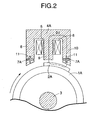
- a rotor 1A that rotates in synchronism with the rotation of an engine (not illustrated) is coaxially connected to, for example, a crankshaft 3 of the engine.
- an iron core 4A Placed in a fixed position opposite the outer periphery of the rotor 1A is an iron core 4A.
- Wound concentrically around the iron core 4A are a primary coil 5 and a secondary coil 6, and fitted to the iron core 4A are, for example, a pair of permanent magnets 7A.
- the iron core 4A is made in the form of an E shape that is open on the rotor 1A side and has a plurality of legs, for example, three legs 8, 9 and 10 that are opposite the outer periphery of the rotor 1A at positions that are spaced at intervals in the peripheral direction.
- the iron core 4A is formed by stacking a plurality of iron core laminations that have been stamped by means of a press.
- the primary coil 5 and the secondary coil 6 are wound concentrically around the leg 9 among the above-mentioned legs 8 to 10, the leg 9 being positioned in the middle along the peripheral direction of the rotor 1A.
- Each of the legs 8 and 10 positioned on opposite sides along the peripheral direction of the rotor 1A has one of the permanent magnets 7A fitted thereto.
- the permanent magnets 7A are mounted in corresponding cut-outs 11 that are provided close to the extremities of the legs 8 and 10.
- a rare earth magnet having a high magnetic flux density such as, for example, an Nd-Fe-B system (neodymium/iron/boron system) magnet.
- An inductor 2A is fixedly provided on the outer periphery of the rotor 1A by fitting a magnetic plate to the outer periphery of the rotor 1A.
- the inductor 2A projects radially outward from the outer periphery of the rotor 1A so as to form a magnetic path for the magnetic flux generated by the permanent magnets 7A between the legs 8, 9 and between the legs 9, 10.
- the legs in each of the pairs are adjacent to each other in the peripheral direction of the rotor 1A.
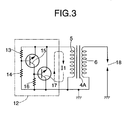
- the primary coil 5 is connected to an ignition circuit 12.
- the ignition circuit 12 has resistors 13 and 14 that are connected in series between opposite ends of the primary coil 5, a series circuit including a transistor 15 and a resistor 16 that are connected in parallel to the resistors 13 and 14, and a transistor 17 that is connected between opposite ends of the primary coil 5.
- the junction between the resistors 13 and 14 is connected to the base of the transistor 15.
- the junction between the transistor 15 and the resistor 16 is connected to the base of the transistor 17.
- the secondary coil 6 is connected to a spark plug 18.
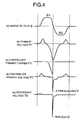
- the magnetic flux ⁇ that passes through the primary coil 5 changes from ⁇ 1 to ⁇ 2 as shown in FIG. 4 (a), thereby generating a primary voltage V1' in the primary coil 5 as shown in FIG. 4 (b).
- the ignition circuit 12 conducts in response to a rise in the base voltage of the transistor 17, and a controlled primary current I1 as shown in FIG. 4 (c) flows through the primary coil 5.
- the increase in the primary current I1 raises the potential between the corrector and emitter of the transistor 17, and when the potential reaches a certain set value the transistor 15 starts to conduct, and as a result the transistor 17 is cut off and the primary current I1 that has been passing is rapidly interrupted.
- Such a rapid change of the primary current I1 causes a rapid change of the magnetic flux in the leg 9 of the iron core 4A.
- the leg 9 is wrapped with the primary coil 5, thereby generating a primary voltage V1 of a few hundred volts in the primary coil 5 as shown in FIG. 4 (d). Since the primary coil 5 and the secondary coil 6 are wound concentrically around the leg 9, a secondary voltage V2 is induced in the secondary coil 6 as shown in FIG. 4 (e) at a level of ten-odd kV according to the ratio of the number of turns thereof to that of the primary coil 5.
- This secondary voltage V2 is supplied to the spark plug 18, thereby effecting engine ignition.
- the primary coil 5 and the secondary coil 6 are wound around the leg 9 of the iron core 4A so that the spark plug 18 is energized every time the inductor 2A of the rotor 1A passes the two pairs of legs 8, 9 and 9, 10 among the three legs 8 to 10 belonging to the iron core 4A.
- the rotor 1A is provided with only the inductor 2A for forming the magnetic path for the magnetic flux generated by the permanent magnets 7A and 7B that are present on the iron core 4A side; in comparison with the conventional arrangement in which a permanent magnet is fitted to a rotor, it becomes possible to reduce the weight of the rotor 1A and easily adjust the rotational balance of the rotor 1A.
- the inductor 2A since the inductor 2A only slightly projects radially outward from the outer periphery of the rotor 1A, a comparatively large empty space can be secured in a region on the inside of the rotor 1A in the radial direction and the space can be used effectively.
- the iron core 4A has the three legs 8, 9 and 10 that are spaced at equal intervals in the peripheral direction of the rotor 1A.
- the permanent magnets 7A are fitted to at least two legs 8 and 10 on opposite sides along the peripheral direction of the rotor 1A (the opposite sides alone in this embodiment) among the above-mentioned legs 8, 9 and 10.
- the primary coil 5 and the secondary coil 6 are wound around the leg 9 that is in the middle along the peripheral direction of the rotor 1A.
- the permanent magnets 7A are mounted within the cut-outs 11 provided in the two legs 8 and 10 of the iron core 4A, and the iron core 4A is made by stacking a plurality of iron core laminations. Since it is simple to form apertures in the iron core laminations when shaping them by stamping, the apertures corresponding to the above-mentioned cut-outs 11, it becomes easy to fit and fix the permanent magnets 7A to the iron core 4A.
- the inductor 2A projects toward the iron core 4A from the outer periphery of the rotor 1A
- the inductor 2A can be easily formed by, for example, fitting a magnetic plate to the outer periphery of the rotor 1A.
- the magnetic plate is fitted to the outer periphery of the rotor 1A, the inductor 2A can be easily formed while obviating the need for a die, etc.
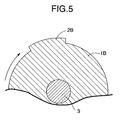
- FIG. 5 to FIG. 10 show modified embodiments of the rotor and the inductor.
- an inductor 2B is formed integrally with the outer periphery of a cast-iron rotor 1B so as to project radially outward from the rotor 1B, and in accordance with this first modified embodiment, the inductor 2B can be easily formed.
- a rotor 1C is formed by press-forming sheet iron in the form of a pan shape having a cylindrical section 19 on its outer periphery and pushing a part of the cylindrical section 19 outward so as to form an inductor 2C on the outer periphery of the rotor 1C.
- a rotor 1D is formed by stacking magnetic metal sheets stamped by a press, a part corresponding to an inductor 2D being formed simultaneously when stamping each of the magnetic metal sheets.
- the inductor 2D can be formed simultaneously so as to project radially outward from the outer periphery of the rotor 1D.
- a rotor 1E is formed by die casting an aluminum alloy, and an inductor 2E is formed by embedding a part of a magnetic plate in the outer periphery of the rotor 1E.
- the inductor 2E can be easily formed by simply fitting and fixing the magnetic plate to the rotor 1E made of an aluminum alloy, which is a non-magnetic material.
- a recess 20 is formed by inwardly recessing a part of the outer periphery of a cast-iron rotor 1F, thereby providing on the outer periphery of the rotor 1F an inductor 2F employing the recess 20 as its outer surface, and the inductor 2F can thus be easily formed.
- a rotor 1G is formed by stacking magnetic metal sheets stamped by a press.
- the recess 21 can be formed when stacking the magnetic metal sheets to form the rotor 1G.
- the recess 21 is formed by inwardly recessing a part of the outer periphery of the rotor 1G.
- An inductor 2G employing the recess 21 as its outer surface is thus provided on the outer periphery of the rotor 1G.
- the inductor 2G can also be easily formed.
- FIG. 11 shows a second embodiment of the present invention.
- An iron core 4B fixedly disposed in a position opposite the outer periphery of the rotor 1A is made in the form of an E shape that is open on the rotor 1A side and has three legs 8, 9 and 10 that are opposite the outer periphery of the rotor 1A at positions that are spaced in the peripheral direction of the rotor 1A.
- the legs 8 to 10 are, the leg 9 that is positioned in the middle along the peripheral direction of the rotor 1A is wound concentrically with a primary coil 5 and a secondary coil 6.
- Permanent magnets 7B are fitted by, for example, adhesion to the extremity of each of the pair of legs 8 and 10 that are positioned at opposite sides along the peripheral direction of the rotor 1A, that is to say, the faces of the legs 8 and 10 are opposite the rotor 1A.
- the leakage of magnetic flux can be suppressed in comparison with the case of the first embodiment in which the permanent magnets 11 are mounted in the legs 8 and 10 of the iron core 4A.
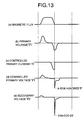
- FIGS. 12 and 13 show a third embodiment of the present invention, and parts that correspond to those in the above-mentioned embodiments are denoted using the same reference numerals and symbols.
- An iron core 4C is fixedly disposed in a position opposite the outer periphery of a rotor 1A.
- a primary coil 5 and a secondary coil 6 are wound concentrically around the iron core 4C and, for example, a pair of permanent magnets 7A are fitted to the iron core 4C.
- the iron core 4C is made in the form of a U shape that is open on the rotor 1A side and has a pair of legs 22 and 23 opposite the outer periphery of the rotor 1A at positions that are spaced in the peripheral direction.
- the iron core 4C is formed by stacking a plurality of iron core laminations that are stamped by a press.
- cut-outs 11 are provided in areas close to the extremities of the legs 22 and 23, and the permanent magnets 7A are mounted within the cut-outs 11.
- the primary coil 5 and the secondary coil 6 are wound concentrically around the leg 23 among the two legs 22 and 23.
- the magnetic flux ⁇ that passes through the primary coil 5 changes as shown in FIG. 13 (a).
- a primary voltage V1' shown in FIG. 13 (b) is accordingly generated in the primary coil 5, and a controlled primary current I1 as shown in FIG. 13 (c) flows through the primary coil 5.
- a primary voltage V1 of a few hundred volts is generated in the primary coil 5 as shown in FIG. 13 (d).
- a secondary voltage V2 is induced in the secondary coil 6 as shown in FIG. 13 (e) at a level of ten-odd kV according to the ratio of the number of turns thereof to that of the primary coil 5.
- the weight of the rotor in comparison with the conventional arrangement in which a permanent magnet is fitted to a rotor the weight of the rotor can be reduced and the rotational balance of the rotor can be easily adjusted and, moreover, the inductor can be easily provided on the rotor. Furthermore, a comparatively large space can be secured in the region on the inside of the rotor in the radial direction, and the space can be used effectively.
- the rate of change in the magnetic flux due to the inductor passing over the middle leg among the three legs as the rotor rotates is greater than the rate of change in the magnetic flux due to the inductor passing over two legs when only two legs are provided, thereby giving a high ignition energy.
- the permanent magnet can be easily fitted and fixed to the iron core.
- leakage of magnetic flux can be suppressed.
- the inductor can be easily formed.
- the inductor can be easily formed while obviating the need for a die, etc.
- the inductor can be easily formed by simply fitting and fixing the magnetic plate to the rotor that is made of an aluminum alloy, which is a non-magnetic material.
- the inductor can be easily formed.
Landscapes
- Engineering & Computer Science (AREA)
- Chemical & Material Sciences (AREA)
- Combustion & Propulsion (AREA)
- Mechanical Engineering (AREA)
- General Engineering & Computer Science (AREA)
- Permanent Magnet Type Synchronous Machine (AREA)
- Ignition Installations For Internal Combustion Engines (AREA)
Abstract
Description
Claims (8)
- An engine ignition system comprising:a rotor synchronized to rotate with the rotation of an engine, the rotor having an outer periphery;a primary coil;a secondary coil;an iron core fixedly disposed opposite the outer periphery of the rotor and having a plurality of legs positioned opposite the outer periphery of the rotor and spaced in the peripheral direction of the rotor, wherein the primary and the secondary coil are wound concentrically around the iron core;at least one permanent magnet fitted to the iron core;a spark plug, operatively synchronized with the rotation of the rotor; andan inductor fixedly provided at the outer periphery of the rotor, the inductor forming a magnetic path for the magnetic flux generated by the at least one permanent magnet between a pair of the legs adjacent to each other in the peripheral direction of the rotor, wherein the winding of the primary coil and the secondary coil around the iron core, energizes the spark plug at a time when the inductor passes the pair of legs.
- An engine ignition system as claimed in claim 1, wherein the iron core comprises three legs that are spaced at equal intervals in the peripheral direction of the rotor, and wherein the at least one permanent magnet is fitted to at least each of the legs on opposite sides of the peripheral direction of the rotor, and the primary coil and the secondary coil are wound around a middle leg along the peripheral direction of the rotor.
- An engine ignition system as claimed in claim 1 or 2, wherein the iron core includes a cutout and wherein the permanent magnet is mounted within the cut-out provided in the iron core.
- An engine ignition system as claimed in claim 1 or 2, wherein the at least one permanent magnet is fitted to a face of the iron core, the face of the iron core being opposite the rotor.
- An engine ignition system as claimed in any preceding claim, wherein the inductor projects outward beyond the outer periphery of the rotor toward the iron core.
- An engine ignition system as claimed in claim 5, wherein the inductor comprises a magnetic plate fixed to the outer periphery of the rotor.
- An engine ignition system as claimed in any of claims 1 to 4, wherein the rotor is an aluminum alloy and wherein the inductor is a magnetic plate partially embedded in the rotor.
- An engine ignition system as claimed in any of claims 1 to 4, wherein the inductor comprises a part inwardly recessed from the outer periphery of the rotor.
Applications Claiming Priority (2)
| Application Number | Priority Date | Filing Date | Title |
|---|---|---|---|
| JP2000369034 | 2000-12-04 | ||
| JP2000369034A JP3966687B2 (en) | 2000-12-04 | 2000-12-04 | Engine ignition device |
Publications (3)
| Publication Number | Publication Date |
|---|---|
| EP1211413A2 true EP1211413A2 (en) | 2002-06-05 |
| EP1211413A3 EP1211413A3 (en) | 2004-07-07 |
| EP1211413B1 EP1211413B1 (en) | 2007-11-07 |
Family
ID=18839135
Family Applications (1)
| Application Number | Title | Priority Date | Filing Date |
|---|---|---|---|
| EP01310149A Expired - Lifetime EP1211413B1 (en) | 2000-12-04 | 2001-12-04 | Engine ignition system |
Country Status (5)
| Country | Link |
|---|---|
| US (1) | US6550462B2 (en) |
| EP (1) | EP1211413B1 (en) |
| JP (1) | JP3966687B2 (en) |
| CN (1) | CN1207491C (en) |
| DE (1) | DE60131240T2 (en) |
Cited By (1)
| Publication number | Priority date | Publication date | Assignee | Title |
|---|---|---|---|---|
| GB2538624A (en) * | 2015-05-05 | 2016-11-23 | Skf Ab | Power generator and railway bearing unit |
Families Citing this family (5)
| Publication number | Priority date | Publication date | Assignee | Title |
|---|---|---|---|---|
| JP4159050B2 (en) * | 2004-09-29 | 2008-10-01 | 本田技研工業株式会社 | Engine ignition device |
| NZ600103A (en) * | 2009-07-16 | 2014-10-31 | Jon Eric Harms | Improved electro-motive machine using halbach array and electrons trapped in electromagnetic providing current |
| EP2323242A1 (en) * | 2009-11-13 | 2011-05-18 | ABUS August Bremicker Söhne KG | Generator for a bicycle wheel |
| JP6184833B2 (en) * | 2013-10-22 | 2017-08-23 | マーレエレクトリックドライブズジャパン株式会社 | Ignition device for internal combustion engine |
| CN104265539A (en) * | 2014-08-09 | 2015-01-07 | 山东双全电机有限公司 | Programmable intelligent magnetic motor |
Citations (2)
| Publication number | Priority date | Publication date | Assignee | Title |
|---|---|---|---|---|
| JPS6321739A (en) | 1986-07-16 | 1988-01-29 | Toshiba Corp | High pressure vapor discharge lamp |
| JPH0542629A (en) | 1990-12-28 | 1993-02-23 | Kawasaki Steel Corp | Composite vibration damping material and manufacturing method thereof |
Family Cites Families (8)
| Publication number | Priority date | Publication date | Assignee | Title |
|---|---|---|---|---|
| US3747649A (en) * | 1971-02-08 | 1973-07-24 | Outboard Marine Corp | Crankshaft magneto system |
| DE2261156C2 (en) * | 1972-12-14 | 1982-08-26 | Robert Bosch Gmbh, 7000 Stuttgart | Ignition device for internal combustion engines |
| US4181114A (en) * | 1975-04-25 | 1980-01-01 | Aktiebolaget Svenska Elektromagneter | Circuit arrangement for electronic ignition apparatus |
| DE3535477C2 (en) * | 1985-10-04 | 1996-05-02 | Stihl Maschf Andreas | Chain saw or similar hand-held drive machine |
| US5392753A (en) * | 1993-11-22 | 1995-02-28 | R. E. Phelon Company, Inc. | Microprocessor controlled capacitor discharge ignition system |
| US5704338A (en) * | 1997-01-06 | 1998-01-06 | Walbro Corporation | Flywheel magneto generator |
| US5931137A (en) * | 1997-05-30 | 1999-08-03 | R.E. Phelon Co., Inc. | Discharge ignition apparatus for internal combustion engine having automatic spark advance |
| US6009865A (en) * | 1998-09-23 | 2000-01-04 | Walbro Corporation | Low speed ignition system |
-
2000
- 2000-12-04 JP JP2000369034A patent/JP3966687B2/en not_active Expired - Fee Related
-
2001
- 2001-12-04 EP EP01310149A patent/EP1211413B1/en not_active Expired - Lifetime
- 2001-12-04 DE DE60131240T patent/DE60131240T2/en not_active Expired - Lifetime
- 2001-12-04 US US10/000,798 patent/US6550462B2/en not_active Expired - Lifetime
- 2001-12-04 CN CNB011456264A patent/CN1207491C/en not_active Expired - Fee Related
Patent Citations (2)
| Publication number | Priority date | Publication date | Assignee | Title |
|---|---|---|---|---|
| JPS6321739A (en) | 1986-07-16 | 1988-01-29 | Toshiba Corp | High pressure vapor discharge lamp |
| JPH0542629A (en) | 1990-12-28 | 1993-02-23 | Kawasaki Steel Corp | Composite vibration damping material and manufacturing method thereof |
Cited By (2)
| Publication number | Priority date | Publication date | Assignee | Title |
|---|---|---|---|---|
| GB2538624A (en) * | 2015-05-05 | 2016-11-23 | Skf Ab | Power generator and railway bearing unit |
| GB2538624B (en) * | 2015-05-05 | 2018-02-07 | Skf Ab | Power generator and railway bearing unit |
Also Published As
| Publication number | Publication date |
|---|---|
| EP1211413B1 (en) | 2007-11-07 |
| JP2002171736A (en) | 2002-06-14 |
| DE60131240D1 (en) | 2007-12-20 |
| CN1357681A (en) | 2002-07-10 |
| JP3966687B2 (en) | 2007-08-29 |
| DE60131240T2 (en) | 2008-08-28 |
| US20020066429A1 (en) | 2002-06-06 |
| CN1207491C (en) | 2005-06-22 |
| EP1211413A3 (en) | 2004-07-07 |
| US6550462B2 (en) | 2003-04-22 |
Similar Documents
| Publication | Publication Date | Title |
|---|---|---|
| US4990881A (en) | Ignition coil with permanent magnet | |
| US9735637B2 (en) | Magnet-type rotating electric machine | |
| US6242828B1 (en) | Flywheel-rotor apparatus | |
| US4129107A (en) | Magnetic pickup type ignition distributor | |
| US2993134A (en) | Permanent magnet motor | |
| EP1211413B1 (en) | Engine ignition system | |
| US2192985A (en) | Electric generating apparatus | |
| US4061121A (en) | Magneto-alternator with magneto energy limiting | |
| JP2009121376A (en) | Capacitor discharge engine ignition system | |
| US3500081A (en) | Low inertia stepping motor | |
| JP2001095183A (en) | Self-starting permanent magnet synchronous motor | |
| JP2002238194A (en) | Rotor structure of permanent magnet motor | |
| JPH1197261A (en) | Ignition coil | |
| JPS60219902A (en) | Alternative pole magnet | |
| GB2035707A (en) | An ignition coil for motor vehicles | |
| JP3707529B2 (en) | Internal combustion engine drive power generator | |
| US2230008A (en) | Magnetogenerator | |
| JP4159050B2 (en) | Engine ignition device | |
| US3293468A (en) | Saturistors comprising hard magnetic materials energized by alternating currents | |
| JP2006101613A (en) | Flywheel magnet generator | |
| JPH0646205Y2 (en) | Stator for magnet generator | |
| JPH03136219A (en) | Ignition coil for internal combustion engine | |
| US5621261A (en) | Motor and/or generator operating on the reluctance principle | |
| JP2517335Y2 (en) | Flywheel magnet generator | |
| US1590506A (en) | Magneto |
Legal Events
| Date | Code | Title | Description |
|---|---|---|---|
| PUAI | Public reference made under article 153(3) epc to a published international application that has entered the european phase |
Free format text: ORIGINAL CODE: 0009012 |
|
| AK | Designated contracting states |
Kind code of ref document: A2 Designated state(s): AT BE CH CY DE DK ES FI FR GB GR IE IT LI LU MC NL PT SE TR |
|
| AX | Request for extension of the european patent |
Free format text: AL;LT;LV;MK;RO;SI |
|
| PUAL | Search report despatched |
Free format text: ORIGINAL CODE: 0009013 |
|
| AK | Designated contracting states |
Kind code of ref document: A3 Designated state(s): AT BE CH CY DE DK ES FI FR GB GR IE IT LI LU MC NL PT SE TR |
|
| AX | Request for extension of the european patent |
Extension state: AL LT LV MK RO SI |
|
| 17P | Request for examination filed |
Effective date: 20040625 |
|
| AKX | Designation fees paid |
Designated state(s): DE FR GB IT |
|
| 17Q | First examination report despatched |
Effective date: 20061006 |
|
| GRAP | Despatch of communication of intention to grant a patent |
Free format text: ORIGINAL CODE: EPIDOSNIGR1 |
|
| GRAS | Grant fee paid |
Free format text: ORIGINAL CODE: EPIDOSNIGR3 |
|
| GRAA | (expected) grant |
Free format text: ORIGINAL CODE: 0009210 |
|
| AK | Designated contracting states |
Kind code of ref document: B1 Designated state(s): DE FR GB IT |
|
| REG | Reference to a national code |
Ref country code: GB Ref legal event code: FG4D |
|
| REF | Corresponds to: |
Ref document number: 60131240 Country of ref document: DE Date of ref document: 20071220 Kind code of ref document: P |
|
| ET | Fr: translation filed | ||
| PLBE | No opposition filed within time limit |
Free format text: ORIGINAL CODE: 0009261 |
|
| STAA | Information on the status of an ep patent application or granted ep patent |
Free format text: STATUS: NO OPPOSITION FILED WITHIN TIME LIMIT |
|
| 26N | No opposition filed |
Effective date: 20080808 |
|
| PGFP | Annual fee paid to national office [announced via postgrant information from national office to epo] |
Ref country code: GB Payment date: 20141203 Year of fee payment: 14 Ref country code: DE Payment date: 20141125 Year of fee payment: 14 |
|
| PGFP | Annual fee paid to national office [announced via postgrant information from national office to epo] |
Ref country code: FR Payment date: 20141208 Year of fee payment: 14 |
|
| PGFP | Annual fee paid to national office [announced via postgrant information from national office to epo] |
Ref country code: IT Payment date: 20141126 Year of fee payment: 14 |
|
| REG | Reference to a national code |
Ref country code: DE Ref legal event code: R119 Ref document number: 60131240 Country of ref document: DE |
|
| GBPC | Gb: european patent ceased through non-payment of renewal fee |
Effective date: 20151204 |
|
| REG | Reference to a national code |
Ref country code: FR Ref legal event code: ST Effective date: 20160831 |
|
| PG25 | Lapsed in a contracting state [announced via postgrant information from national office to epo] |
Ref country code: DE Free format text: LAPSE BECAUSE OF NON-PAYMENT OF DUE FEES Effective date: 20160701 Ref country code: GB Free format text: LAPSE BECAUSE OF NON-PAYMENT OF DUE FEES Effective date: 20151204 |
|
| PG25 | Lapsed in a contracting state [announced via postgrant information from national office to epo] |
Ref country code: FR Free format text: LAPSE BECAUSE OF NON-PAYMENT OF DUE FEES Effective date: 20151231 |
|
| PG25 | Lapsed in a contracting state [announced via postgrant information from national office to epo] |
Ref country code: IT Free format text: LAPSE BECAUSE OF NON-PAYMENT OF DUE FEES Effective date: 20151204 |