EP1211306A1 - Foam hand washing / disinfectant system - Google Patents
Foam hand washing / disinfectant system Download PDFInfo
- Publication number
- EP1211306A1 EP1211306A1 EP01310009A EP01310009A EP1211306A1 EP 1211306 A1 EP1211306 A1 EP 1211306A1 EP 01310009 A EP01310009 A EP 01310009A EP 01310009 A EP01310009 A EP 01310009A EP 1211306 A1 EP1211306 A1 EP 1211306A1
- Authority
- EP
- European Patent Office
- Prior art keywords
- hand washing
- solution
- antimicrobial
- disinfectant
- foam
- Prior art date
- Legal status (The legal status is an assumption and is not a legal conclusion. Google has not performed a legal analysis and makes no representation as to the accuracy of the status listed.)
- Withdrawn
Links
Classifications
-
- C—CHEMISTRY; METALLURGY
- C11—ANIMAL OR VEGETABLE OILS, FATS, FATTY SUBSTANCES OR WAXES; FATTY ACIDS THEREFROM; DETERGENTS; CANDLES
- C11D—DETERGENT COMPOSITIONS; USE OF SINGLE SUBSTANCES AS DETERGENTS; SOAP OR SOAP-MAKING; RESIN SOAPS; RECOVERY OF GLYCEROL
- C11D3/00—Other compounding ingredients of detergent compositions covered in group C11D1/00
- C11D3/48—Medical, disinfecting agents, disinfecting, antibacterial, germicidal or antimicrobial compositions
-
- C—CHEMISTRY; METALLURGY
- C11—ANIMAL OR VEGETABLE OILS, FATS, FATTY SUBSTANCES OR WAXES; FATTY ACIDS THEREFROM; DETERGENTS; CANDLES
- C11D—DETERGENT COMPOSITIONS; USE OF SINGLE SUBSTANCES AS DETERGENTS; SOAP OR SOAP-MAKING; RESIN SOAPS; RECOVERY OF GLYCEROL
- C11D17/00—Detergent materials or soaps characterised by their shape or physical properties
- C11D17/04—Detergent materials or soaps characterised by their shape or physical properties combined with or containing other objects
- C11D17/041—Compositions releasably affixed on a substrate or incorporated into a dispensing means
Definitions
- This invention relates to a foam hand washing/disinfectant system that allows a healthcare professional to disinfect his/her hands without the use of water or alcohol.
- Hand washing by healthcare professionals is an essential component of infection control activities.
- studies from the Center for Disease Control show that compliance with hand washing protocol by healthcare professionals is unacceptably low. This is often attributed to the lack of a conveniently located soap/sink station, hand wash solutions that are inconvenient to use and, with continual use, that result in dry and chapped hands and the time consuming nature of the hand washing procedure.
- the first category is a full surgical scrub with a scrub brush and an antimicrobial solution.
- the active ingredient in such antimicrobial solutions typically is iodine, chlorhexidine gluconate, parachlorametaxylenol (PCMX), triclosan or hexachlorophenes.
- PCMX parachlorametaxylenol
- triclosan triclosan
- hexachlorophenes typically have a high surfactant and active ingredient content and thus must be rinsed off of the healthcare professional's hands with water in a sink station.
- a typical surgical scrub procedure takes about six minutes.
- the second category is hand washing with a traditional soap solution, with or without an antimicrobial agent. This procedure also requires a sink station so the healthcare professional can rinse the soap off of his/her hands with water.
- waterless hand washing solutions have been developed. These waterless hand wash solutions generally are alcohol based. They also tend to be fast acting efficacious and convenient. Unfortunately these waterless hand wash solutions can cause the healthcare professional's hands to become dry and chapped after repeated uses. Moreover, the alcohol-based solutions do not have long term residual antimicrobial efficacy and are flammable. In addition, the controlled delivery of liquid alcohol-based solutions is problematic. For example, a significant portion of the liquid alcohol-based solution can be wasted during the delivery of the solution to the healthcare professional. Where the liquid is poured onto the healthcare professional's hands, controlling the amount of the liquid that is dispensed is difficult and the delivered liquid can spill off of the healthcare professional's hands.
- the hand washing/disinfectant system of this invention comprises a dispenser and a hand washing/disinfectant solution.
- the dispenser has a convenient portable size that delivers a controlled amount of a non-aerosol foam.
- the hand washing/disinfectant solution is a water based, non-alcohol solution with a viscosity in the range of about 0 to about 200 cps and that has between about 0.01 to about 4% by weight of an active antimicrobial ingredient.
- the dispenser that is used in the combination of this invention can be any available device that dispenses a non-aerosol air-liquid mixture, i.e. foam.
- a propellant could be used to create the foam, this is undesirable because such propellants contaminate the antimicrobial solution and may be harmful to the environment.
- a preferred dispenser should not use gas propellants but should instead create the foam by some other means, such as mechanical action.
- such a dispenser may be obtained from Airspray International of Pompano Beach, Florida under the "Mini Foamer" designation.
- Such a dispenser delivers 0.4 g of foam for a single stroke. This allows the delivery of a controlled dose of the active antimicrobial ingredient. See also U.S. Patent Nos.
- the antimicrobial solution that can be used with the dispenser in the combination of this invention should be foamable. This is because the foam evaporates more quickly when rubbed on the hands due to the increased surface area of the foam bubbles as compared to liquid or spray applied solutions. And the foam is easier to evenly distribute on the skin and is less likely to be spilled and wasted.
- the antimicrobial solution that may be used in the hand washing/disinfectant system of this invention should have between about 0.01 to about 4% by weight of the active antimicrobial ingredient.
- a diluted amount of any commercially available antimicrobial solution could be used in the system of this invention.
- These commercially available solutions should be diluted in water to between 1:20 and 1:100. It is important that these commercially available solutions be diluted in order to minimize the concentration of the surfactant and the active ingredient. Too high of a concentration will require the user to rinse her hands after using the antimicrobial solution in order to avoid skin irritation. Although dilution is important to avoid skin irritation, the amount of dilution should not adversely affect the antimicrobial efficacy of the antimicrobial solution.
- antimicrobial solutions that have been diluted to between 1:20 and 1:100 results in a solution having an active ingredient concentration of between about 0.1% and about 0.2%. Surprisingly, this diluted solution will have a sufficient antimicrobial efficacy. In fact, the antimicrobial efficacy of the diluted version will be greater than the commercial version since the diluted version will not be rinsed off of the clinician's hands after use.
- dilution is important because these commercially available antimicrobial solutions have a viscosity that is too high to allow them to be used with a non-aerosol foam dispenser.
- the viscosity should be between 0 and 200 cps, and even more preferably, the viscosity should be between 0 and 60 cps.
- a hand washing/disinfectant system that can be used by a healthcare professional without the need for a soap/sink station, that is quick and convenient to use, that will not result in dry or chapped hands for the healthcare professional even after repeated use, and that will deliver controlled amounts of non-aerosol hand washing/disinfectant foam to the healthcare professional.
Landscapes
- Chemical & Material Sciences (AREA)
- Life Sciences & Earth Sciences (AREA)
- Engineering & Computer Science (AREA)
- Chemical Kinetics & Catalysis (AREA)
- Oil, Petroleum & Natural Gas (AREA)
- Wood Science & Technology (AREA)
- Organic Chemistry (AREA)
- Apparatus For Disinfection Or Sterilisation (AREA)
- Cosmetics (AREA)
- Detergent Compositions (AREA)
Abstract
The hand washing/disinfectant system of this invention comprises a
dispenser and a hand washing/disinfectant solution. The dispenser has a
convenient portable size that delivers a controlled amount of a non-aerosol
foam. The hand washing/disinfectant solution is a water based, non-alcohol
solution with a viscosity in the range of about 0 to about 200 cps and that has
between about 0.01 to about 4% by weight of an active antimicrobial
ingredient.
Description
This invention relates to a foam hand washing/disinfectant system that
allows a healthcare professional to disinfect his/her hands without the use of
water or alcohol.
Hand washing by healthcare professionals is an essential component
of infection control activities. However, studies from the Center for Disease
Control show that compliance with hand washing protocol by healthcare
professionals is unacceptably low. This is often attributed to the lack of a
conveniently located soap/sink station, hand wash solutions that are
inconvenient to use and, with continual use, that result in dry and chapped
hands and the time consuming nature of the hand washing procedure.
Historically, there have been two main categories of hand washing
procedures used by healthcare professionals. The first category is a full
surgical scrub with a scrub brush and an antimicrobial solution. The active
ingredient in such antimicrobial solutions typically is iodine, chlorhexidine
gluconate, parachlorametaxylenol (PCMX), triclosan or hexachlorophenes.
These solutions typically have a high surfactant and active ingredient content
and thus must be rinsed off of the healthcare professional's hands with water
in a sink station. A typical surgical scrub procedure takes about six minutes.
The second category is hand washing with a traditional soap solution, with or
without an antimicrobial agent. This procedure also requires a sink station so
the healthcare professional can rinse the soap off of his/her hands with water.
Since sink stations are not always conveniently located, waterless hand
washing solutions have been developed. These waterless hand wash
solutions generally are alcohol based. They also tend to be fast acting
efficacious and convenient. Unfortunately these waterless hand wash
solutions can cause the healthcare professional's hands to become dry and
chapped after repeated uses. Moreover, the alcohol-based solutions do not
have long term residual antimicrobial efficacy and are flammable. In addition,
the controlled delivery of liquid alcohol-based solutions is problematic. For
example, a significant portion of the liquid alcohol-based solution can be
wasted during the delivery of the solution to the healthcare professional.
Where the liquid is poured onto the healthcare professional's hands,
controlling the amount of the liquid that is dispensed is difficult and the
delivered liquid can spill off of the healthcare professional's hands.
Alternatively, where a spray bottle is used, up to 30% of the solution can be
lost as mist. In both circumstances, decreased antimicrobial efficacy can
result if insufficient amounts of the solution are used by the healthcare
professional. Although, the delivery of solutions can be somewhat controlled
if the solution is delivered as foam, the propellants that are required for such
foam delivery can compromise the purity of the solution and are detrimental to
the environment.
It is therefore an object of the invention to provide a hand
washing/disinfectant system that can be used by a healthcare professional
without the need for a soap/sink station.
It is another object of this invention to provide a hand
washing/disinfectant system that is quick and convenient to use.
It is still another object of this invention to provide a hand
washing/disinfectant system that will not result in dry or chapped hands for the
healthcare professional even after repeated use.
It is yet another object of this invention to provide a hand
washing/disinfectant system that delivers a controlled amount of the hand
washing/disinfectant solution to the healthcare professional.
It is even a further object of this invention to provide a hand
washing/disinfectant system that delivers a non-aerosol hand
washing/disinfectant solution foam to the healthcare professional.
The hand washing/disinfectant system of this invention comprises a
dispenser and a hand washing/disinfectant solution. The dispenser has a
convenient portable size that delivers a controlled amount of a non-aerosol
foam. The hand washing/disinfectant solution is a water based, non-alcohol
solution with a viscosity in the range of about 0 to about 200 cps and that has
between about 0.01 to about 4% by weight of an active antimicrobial
ingredient.
The dispenser that is used in the combination of this invention can be
any available device that dispenses a non-aerosol air-liquid mixture, i.e. foam.
Although a propellant could be used to create the foam, this is undesirable
because such propellants contaminate the antimicrobial solution and may be
harmful to the environment. Thus, a preferred dispenser should not use gas
propellants but should instead create the foam by some other means, such as
mechanical action. For example, such a dispenser may be obtained from
Airspray International of Pompano Beach, Florida under the "Mini Foamer"
designation. Such a dispenser delivers 0.4 g of foam for a single stroke. This
allows the delivery of a controlled dose of the active antimicrobial ingredient.
See also U.S. Patent Nos. 5,337,929; 5,429,279 and 6,053,364, the
disclosures of which are incorporated herein by reference. The antimicrobial
solution that can be used with the dispenser in the combination of this
invention should be foamable. This is because the foam evaporates more
quickly when rubbed on the hands due to the increased surface area of the
foam bubbles as compared to liquid or spray applied solutions. And the foam
is easier to evenly distribute on the skin and is less likely to be spilled and
wasted.
The antimicrobial solution that may be used in the hand
washing/disinfectant system of this invention should have between about 0.01
to about 4% by weight of the active antimicrobial ingredient. For example, a
diluted amount of any commercially available antimicrobial solution could be
used in the system of this invention. These commercially available solutions
should be diluted in water to between 1:20 and 1:100. It is important that
these commercially available solutions be diluted in order to minimize the
concentration of the surfactant and the active ingredient. Too high of a
concentration will require the user to rinse her hands after using the
antimicrobial solution in order to avoid skin irritation. Although dilution is
important to avoid skin irritation, the amount of dilution should not adversely
affect the antimicrobial efficacy of the antimicrobial solution. Commercially
available antimicrobial solutions that have been diluted to between 1:20 and
1:100 results in a solution having an active ingredient concentration of
between about 0.1% and about 0.2%. Surprisingly, this diluted solution will
have a sufficient antimicrobial efficacy. In fact, the antimicrobial efficacy of the
diluted version will be greater than the commercial version since the diluted
version will not be rinsed off of the clinician's hands after use.
In addition, dilution is important because these commercially available
antimicrobial solutions have a viscosity that is too high to allow them to be
used with a non-aerosol foam dispenser. Preferably the viscosity should be
between 0 and 200 cps, and even more preferably, the viscosity should be
between 0 and 60 cps.
Commercially available solutions that meet the foregoing requirements
are 4% or 2% chlorhexidine gluconate, 3% PCMX, 0.2% benzethonium
chloride and 0.25% - 1% available iodine which may be obtained from Ecolab,
Zeneca, Ballard Medical, Becton Dickinson, First Scientific or Xtrium. If 0.2%
benzethonium chloride is used, it does not have to be diluted.
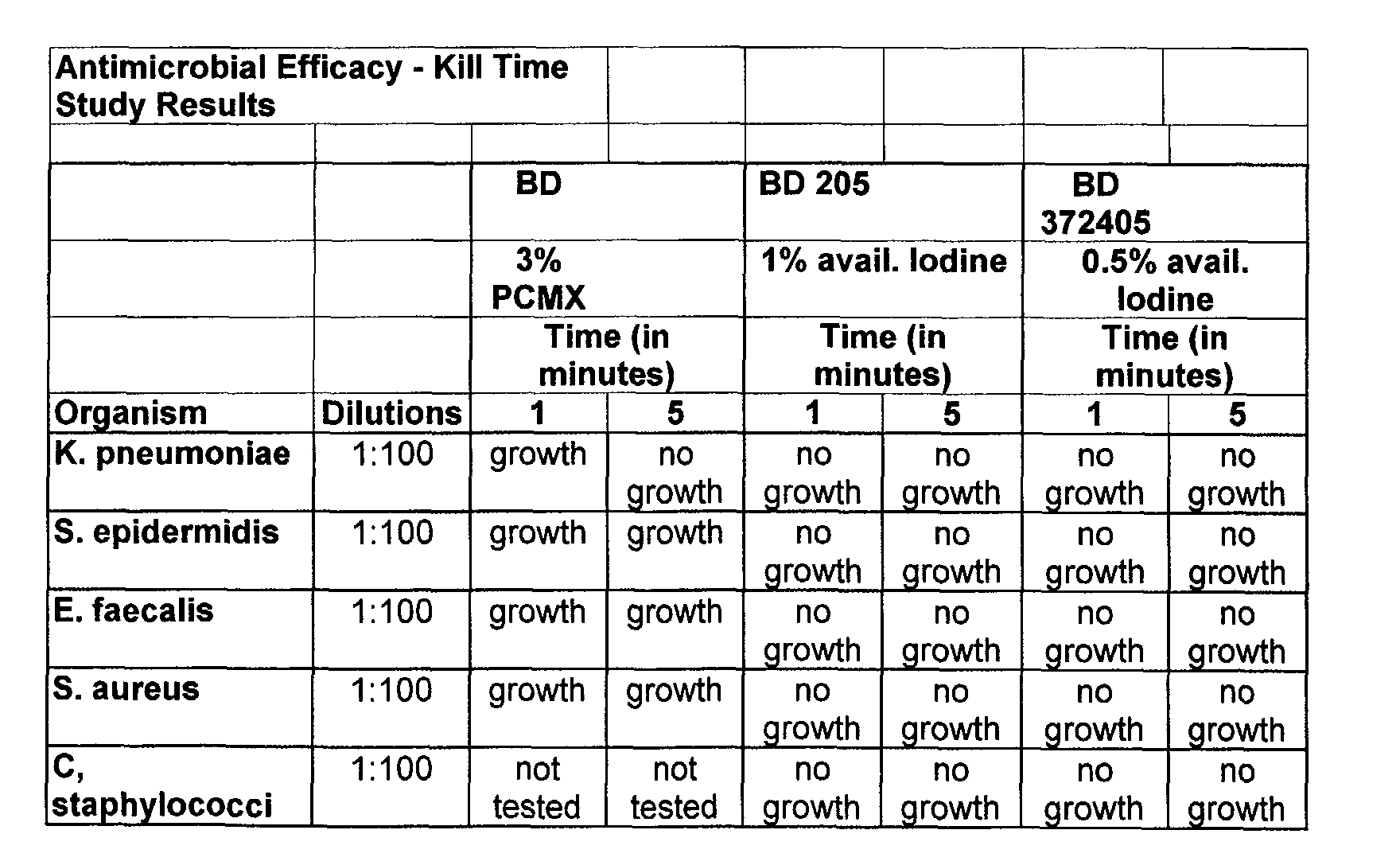
To illustrate the efficacy of the diluted base solution, seven
commercially available anti-microbial solutions were diluted at 1:100. The
study evaluated the antimicrobial efficacy of various solutions when challenge
with ten different microorganism strains using an in-vitro time-kill method. The
products were challenged with ten different microorganism strains utilizing 1
minute and 5 minute exposure times. The following table shows that the vast
majority of the diluted base solutions were still effective as anti-microbial
solutions.


Thus it is seen that a hand washing/disinfectant system is provided that
can be used by a healthcare professional without the need for a soap/sink
station, that is quick and convenient to use, that will not result in dry or
chapped hands for the healthcare professional even after repeated use, and
that will deliver controlled amounts of non-aerosol hand washing/disinfectant
foam to the healthcare professional.
Claims (3)
- A combination foam dispenser and antimicrobial solution wherein the antimicrobial solution has an active ingredient concentration of between about 0.1% and about 0.2%.
- The combination foam dispenser and antimicrobial solution of claim 1 wherein the antimicrobial solution has a viscosity in the range of between about 0- 200 cps.
- The combination foam dispenser and antimicrobial solution of claim 2 wherein the foam dispenser dispenses the antimicrobial solution as a non-aerosol air-liquid mixture.
Applications Claiming Priority (2)
| Application Number | Priority Date | Filing Date | Title |
|---|---|---|---|
| US72691100A | 2000-11-30 | 2000-11-30 | |
| US726911 | 2000-11-30 |
Publications (1)
| Publication Number | Publication Date |
|---|---|
| EP1211306A1 true EP1211306A1 (en) | 2002-06-05 |
Family
ID=24920550
Family Applications (1)
| Application Number | Title | Priority Date | Filing Date |
|---|---|---|---|
| EP01310009A Withdrawn EP1211306A1 (en) | 2000-11-30 | 2001-11-29 | Foam hand washing / disinfectant system |
Country Status (1)
| Country | Link |
|---|---|
| EP (1) | EP1211306A1 (en) |
Cited By (3)
| Publication number | Priority date | Publication date | Assignee | Title |
|---|---|---|---|---|
| WO2005009190A1 (en) * | 2003-07-31 | 2005-02-03 | Jan Gunnar Lapins | A device providing quick and simple attainable disinfection or sanitary action when required |
| WO2006044297A1 (en) * | 2004-10-13 | 2006-04-27 | The Procter & Gamble Company | Device for delivering an anti-microbial composition |
| US7299951B2 (en) | 2005-03-08 | 2007-11-27 | Ecolab Inc. | Foot activated dispenser |
Citations (3)
| Publication number | Priority date | Publication date | Assignee | Title |
|---|---|---|---|---|
| WO1993000089A1 (en) * | 1991-06-21 | 1993-01-07 | The Procter & Gamble Company | Cleansing products |
| WO1997025408A1 (en) * | 1996-01-04 | 1997-07-17 | S. C. Johnson & Son, Inc. | Self-foaming microemulsion cleaning compositions |
| EP0990412A2 (en) * | 1998-09-28 | 2000-04-05 | Becton Dickinson and Company | Foam forming liquid dispensing device |
-
2001
- 2001-11-29 EP EP01310009A patent/EP1211306A1/en not_active Withdrawn
Patent Citations (3)
| Publication number | Priority date | Publication date | Assignee | Title |
|---|---|---|---|---|
| WO1993000089A1 (en) * | 1991-06-21 | 1993-01-07 | The Procter & Gamble Company | Cleansing products |
| WO1997025408A1 (en) * | 1996-01-04 | 1997-07-17 | S. C. Johnson & Son, Inc. | Self-foaming microemulsion cleaning compositions |
| EP0990412A2 (en) * | 1998-09-28 | 2000-04-05 | Becton Dickinson and Company | Foam forming liquid dispensing device |
Cited By (4)
| Publication number | Priority date | Publication date | Assignee | Title |
|---|---|---|---|---|
| WO2005009190A1 (en) * | 2003-07-31 | 2005-02-03 | Jan Gunnar Lapins | A device providing quick and simple attainable disinfection or sanitary action when required |
| WO2006044297A1 (en) * | 2004-10-13 | 2006-04-27 | The Procter & Gamble Company | Device for delivering an anti-microbial composition |
| US7299951B2 (en) | 2005-03-08 | 2007-11-27 | Ecolab Inc. | Foot activated dispenser |
| US7753235B2 (en) | 2005-03-08 | 2010-07-13 | Ecolab Inc. | Foot activated dispenser |
Similar Documents
| Publication | Publication Date | Title |
|---|---|---|
| EP1668105B1 (en) | High alcohol content gel-like and foaming compositions | |
| US8263098B2 (en) | High alcohol content foaming compositions with silicone-based surfactants | |
| EP0966511B1 (en) | Washing disinfectant for hygienic and surgical hand disinfection | |
| US6488665B1 (en) | Antimicrobial alcohol gel pre-operative skin-preparation delivery system | |
| US9730870B2 (en) | Sodium hypochlorite-based body wash compositions | |
| US6964782B1 (en) | Stable hydrogen peroxide compositions, products and methods of use | |
| JPH06199700A (en) | Quick-drying gel type hand sanitizer | |
| TW200803929A (en) | A dispenser for delivering foam and mist | |
| JPH06279268A (en) | Disinfecting and sterilizing agent and aerosol composition containing the same | |
| JP5986394B2 (en) | Foam forming aerosol composition | |
| CA2321334A1 (en) | Composition and method for producing lubricating, germicide foam | |
| AU2005295969B2 (en) | Device for delivering an anti-microbial composition | |
| JPH06327750A (en) | Aerosol composition for sterilization | |
| US12357594B1 (en) | Antimicrobial solution for pre-operative preparation | |
| JP2023036424A (en) | Disinfectant product | |
| JP2000247802A (en) | Solid mold remover |
Legal Events
| Date | Code | Title | Description |
|---|---|---|---|
| PUAI | Public reference made under article 153(3) epc to a published international application that has entered the european phase |
Free format text: ORIGINAL CODE: 0009012 |
|
| AK | Designated contracting states |
Kind code of ref document: A1 Designated state(s): AT BE CH CY DE DK ES FI FR GB GR IE IT LI LU MC NL PT SE TR |
|
| AX | Request for extension of the european patent |
Free format text: AL;LT;LV;MK;RO;SI |
|
| AKX | Designation fees paid |
Designated state(s): DE ES FR GB IT |
|
| STAA | Information on the status of an ep patent application or granted ep patent |
Free format text: STATUS: THE APPLICATION IS DEEMED TO BE WITHDRAWN |
|
| 18D | Application deemed to be withdrawn |
Effective date: 20021206 |