Technical Field
The present invention relates to novel 3-oxo-3, 4-dihydro-2H-1,
4-thiazine derivatives or 2-oxo-1, 2, 3, 4-tetrahydropyrazine derivatives
being useful as pharmaceuticals.
Background Art
Compounds having 3-oxo-3, 4-dihydro-2H-1, 4-thiazine or 2-oxo-1, 2,
3, 4-tetrahydropyrazine as a main skeleton, which are compounds having
one double bond in their ring, have scarcely been studied. There were only
reports concerning a study of introducing a phenyl group into the
5th-position of 3-oxo-3, 4-dihydro-2H-1, 4-thiazine derivatives (Japanese
Laid-open Patent Publication No. 275869/1990), a study of synthesis of
2-oxo-1, 2, 3, 4-tetrahydropyrazine derivatives as synthetic intermediates of
1, 5-imino-3-benzoazocine derivatives aiming at analgesics or antitussives
(Japanese Laid-open Patent Publication No. 35176/1983) and the like.
Much less, there has been no report relating to a study wherein
various substituents are introduced into a nitrogen atom at the 4th-position
of the 3-oxo-3, 4-dihydro-2H-1, 4-thiazine derivatives or into a nitrogen atom
at the 1st-position of the 2-oxo-1, 2, 3, 4-tetrahydropyrazine derivatives and
their pharmaceutical utility is examined. In particular, compounds having
carboxy-lower alkylene converted into amide, which are subjects of the
present invention, have not been studied at all.
It is a very interesting subject to synthesize novel compounds having
3-oxo-3, 4-dihydro-2H-1, 4-thiazine or 2-oxo-1, 2, 3, 4-tetrahydropyrazine as
a main skeleton wherein various substituents are introduced into the
nitrogen atom in their ring and to study their pharmaceutical utility.
Disclosure of the Invention
The present inventors studied preparation of various novel
compounds having 3-oxo-3, 4-dihydro-2H-1, 4-thiazine or 2-oxo-1, 2, 3,
4-tetrahydropyrazine as a main skeleton. Targets of the study are 1) to
prepare novel compounds wherein carboxy-lower alkylene converted into
amide is introduced into a nitrogen atom at the 4th-position of 3-oxo-3,
4-dihydro-2H-1, 4-thiazine derivatives or into a nitrogen atom at the
1st-position of 2-oxo-1, 2, 3, 4-tetrahydropyrazine derivatives, and 2) to
prepare novel compounds wherein various substituents are introduced into a
nitrogen atom at the 4th-position of the 2-oxo-1, 2, 3, 4-tetrahydropyrazine
derivatives. As a result, the present inventors succeeded in preparing many
novel compounds as mentioned later. Studying their pharmacological actions,
these novel compounds were found to exhibit chymase inhibitory effects and
to be useful as pharmaceuticals. The present inventors succeeded also in
preparing novel compounds which are useful as synthetic intermediates in a
process of the preparation of the above-mentioned 3-oxo-3, 4-dihydro-2H-1,
4-thiazine derivatives or 2-oxo-1, 2, 3, 4-tetrahydropyrazine derivatives.
The present invention relates to compounds represented by the
following general formula [I] and salts thereof (hereinafter referred to as "the
present compound" as far as there is no proviso), pharmaceutical
compositions comprising them as active ingredients, and compounds
represented by the general formula [II] being useful as synthetic
intermediates of the present compound and salts of the intermediates
(hereinafter referred to as "the present synthetic intermediate" as far as
there is no proviso),
wherein
Each lower alkyl defined above can be substituted by halogen,
hydroxy, lower alkoxy, aryl or aryloxy.
Each lower alkoxy defined above can be substituted by aryl.
Each lower alkylene defined above can be substituted by aryl. The
same definitions are applied hereinafter.
[wherein Q is -CH(OH)CO- or -CH(OH)-. The same definition is applied
hereinafter.]
The groups defined above have the following meanings through the
whole present specification.
The halogen is fluorine, chlorine, bromine or iodine.
The lower alkyl is straight-chain or branched alkyl having one to six
carbon atoms such as methyl, ethyl, propyl, isopropyl, butyl, isobutyl,
sec-butyl, tert-butyl, pentyl, isopentyl, hexyl or isohexyl. The lower alkyl can
be substituted by halogen, cycloalkyl, hydroxy, lower alkoxy, aryl or aryloxy.
The cycloalkyl is cycloalkyl having three to eight carbon atoms such
as cyclopropyl, cyclobutyl, cyclopentyl, cyclohexyl, cycloheptyl or cyclooctyl.
The cycloalkyl can be substituted by halogen, lower alkyl, cycloalkyl, hydroxy,
lower alkoxy, aryl or aryloxy.
The lower alkoxy is straight-chain or branched alkoxy having one to
six carbon atoms such as methoxy, ethoxy, propoxy, isopropoxy, t-butoxy or
hexyloxy. The lower alkoxy can be substituted by halogen, cycloalkyl,
hydroxy, lower alkoxy, aryl or aryloxy.
The lower alkylene is straight-chain or branched alkylene having one
to six carbon atoms such as methylene, ethylene, trimethylene,
tetramethylene, pentamethylene, hexamethylene, methylmethylene,
dimethylmethylene, ethylmethylene, propylmethylene, isopropylmethylene,
butylmethylene, isobutylmethylene, sec-butylmethylene,
tert-butylmethylene, tert-butylethylene, dimethylethylene, ethylethylene,
propylethylene, isopropylethylene, methyltrimethylene or propylene. The
lower alkylene can be substituted by halogen, cycloalkyl, hydroxy, lower
alkoxy, aryl or aryloxy.
The aryl is a monocyclic or condensed aromatic hydrocarbon such as
phenyl or naphthyl. The aryl can be substituted by halogen, lower alkyl,
cycloalkyl, hydroxy, lower alkoxy, aryl, aryloxy, acyl or nitro.
The aromatic heterocycle is an aromatic heterocycle having one
heteroatom in the ring such as pyrrole, furan, thiophene or pyridine; an azole
aromatic heterocycle such as imidazole, oxazole, thiazole, pyrazole, isoxazole
or isothiazole; an aromatic heterocycle having two nitrogen atoms in the ring
such as pyrazine or pyrimidine; or a condensed aromatic heterocycle such as
indole, isoindole, benzimidazole, benzoxazole, benzothiazole or quinoline.
Each aromatic heterocycle can be substituted by halogen, lower alkyl,
cycloalkyl, hydroxy, lower alkoxy, aryl, aryloxy or acyl.
The nonaromatic heterocycle is a saturated nonaromatic heterocycle
having one heteroatom in the ring such as pyrrolidine, tetrahydrofuran,
tetrahydrothiophene, piperidine, tetrahydropyran or homopiperazine; a
saturated nonaromatic heterocycle having two heteroatoms in the ring such
as imidazolidine, oxazolidine, thiazolidine, pyrazolidine, piperazine,
morpholine, thiomorpholine, homopiperidine or homomorpholine; an
unsaturated nonaromatic heterocycle having one heteroatom in the ring
such as pyrroline, dihydrofuran, dihydrothiophene, tetrahydropiperidine,
dihydropiperidine, dihydropyran or pyran; or an unsaturated nonaromatic
heterocycle having two heteroatoms such as imidazoline, oxazoline,
thiazoline or pyrazoline. Each nonaromatic heterocycle can be substituted by
halogen, lower alkyl, cycloalkyl, hydroxy, lower alkoxy, aryl, aryloxy or
carbamoyl.
The acyl is lower alkanoyl having two to six carbon atoms such as
acetyl, propionyl, butyryl, pivaloyl or pentanecarbonyl, or benzoyl. The
phenyl ring of the benzoyl can be substituted by halogen, lower alkyl,
cycloalkyl, hydroxy, lower alkoxy, aryl, aryloxy, acyl or nitro.
When the present compound or the present synthetic intermediate
has free hydroxy or free amino, -NHR (wherein R is lower alkyl) or imino,
they can be protected with a general protecting group.
General protecting groups of hydroxy can be used as the protecting
group of hydroxy. Specific examples of the protecting group are acyl such as
formyl, lower alkanoyl, halogeno-lower alkanoyl or benzoyl; alkoxycarbonyl
such as lower alkoxycarbonyl or phenyl-lower alkoxycarbonyl; substituted
alkyl derivatives such as allyl, lower alkoxy-lower alkyl, substituted lower
alkoxy-lower alkyl, phenyl-lower alkyl, tetrahydropyranyl and
tetrahydrofuranyl; and substituted silyl such as lower alkylsilyl or
phenylsilyl. Each phenyl ring of the above-mentioned benzoyl, phenyl-lower
alkoxycarbonyl, phenyl-lower alkyl and phenylsilyl can be substituted by
halogen, lower alkyl, lower alkoxy or nitro.
More specific examples of the protecting group of hydroxy are acyl
such as formyl, acetyl, pivaloyl, monochloroacetyl, trichloroacetyl,
trifluoroacetyl, benzoyl, methoxycarbonyl, ethoxycarbonyl,
isobutoxycarbonyl, t-butoxycarbonyl or benzyloxycarbonyl; substituted alkyl
derivatives such as allyl, methoxymethyl, 1-ethoxyethyl,
2-methoxyethoxymethyl, benzyloxymethyl, benzyl, 4-methoxybenzyl, trityl,
2-tetrahydropyranyl and 2-tetrahydrofuranyl; and substituted silyl such as
trimethylsilyl, triethylsilyl, triisopropylsilyl, t-butyldimethylsilyl or
t-butyldiphenylsilyl.
The protecting groups of amino or imino can be those which are
widely used as protecting groups of amine. Specific examples of the
protecting group are acyl such as formyl, lower alkanoyl, halogeno-lower
alkanoyl, benzoyl, lower alkoxycarbonyl, substituted lower alkoxycarbonyl or
phenoxycarbonyl; substituted alkyl derivatives such as allyl, phenyl-lower
alkyl and benzoyl-lower alkyl; substituted sulfonyl such as lower
alkylsulfonyl or phenylsulfonyl; and lower alkoxy. Each phenyl ring of the
above-mentioned benzoyl, phenoxycarbonyl, phenyl-lower alkyl,
benzoyl-lower alkyl and phenylsulfonyl can be substituted by halogen, lower
alkyl, lower alkoxy or nitro.
More specific examples of the protecting group of amino or imino are
acyl such as formyl, acetyl, trichloroacetyl, trifluoroacetyl, benzoyl,
methoxycarbonyl, ethoxycarbonyl, isobutoxycarbonyl, t-butoxycarbonyl,
allyloxycarbonyl, 2, 2, 2-trichloroethoxycarbonyl, benzyloxycarbonyl,
diphenylmethoxycarbonyl or phenoxycarbonyl; substituted alkyl derivatives
such as allyl, benzyl and trityl; and substituted sulfonyl such as
benzenesulfonyl, 2, 4, 6-trimethylbenzenesulfonyl or toluenesulfonyl.
Preferred examples of the present compound are compounds wherein
the group(s) is (are) the followings in the compounds represented by the
general formula [I] or salts thereof;
Namely,
- Compounds defined by above (1a) in the compounds represented by the
general formula [I] or salts thereof,
- Compounds defined by above (2a) in the compounds represented by the
general formula [I] or salts thereof,
- Compounds defined by above (3a) in the compounds represented by the
general formula [I] or salts thereof,
- Compounds defined by above (4a) in the compounds represented by the
general formula [I] or salts thereof,
- Compounds defined by above (5a) in the compounds represented by the general formula [I] or salts thereof,
- Compounds defined by above (6a) in the compounds represented by the
general formula [I] or salts thereof,
- Compounds defined by above (7a) in the compounds represented by the
general formula [I] or salts thereof,
- Compounds defined by above (8a) in the compounds represented by the
general formula [I] or salts thereof,
- Compounds defined by above (9a) in the compounds represented by the
general formula [I] or salts thereof,
- Compounds defined by above (10a) in the compounds represented by the
general formula [I] or salts thereof,
- Compounds defined by above (11a) in the compounds represented by the
general formula [I] or salts thereof, and
- Compounds defined by any combinations of two or more of above (1a), (2a),
(3a), (4a), (5a), (6a), (7a), (8a), (9a), (10a) and (11a) in the compounds
represented by the general formula [I] or salts thereof.
More preferred examples of the present compound are compounds
wherein the group(s) is (are) the followings in the compounds represented by
the general formula [I] or salts thereof
Namely,
- Compounds defined by above (1a) in the compounds represented by the
general formula [I] or salts thereof,
- Compounds defined by above (2a) in the compounds represented by the
general formula [I] or salts thereof,
- Compounds defined by above (3a) in the compounds represented by the
general formula [I] or salts thereof,
- Compounds defined by above (4a) in the compounds represented by the
general formula [I] or salts thereof,
- Compounds defined by above (5a) in the compounds represented by the
general formula [I] or salts thereof,
- Compounds defined by above (6a) in the compounds represented by the
general formula [I] or salts thereof,
- Compounds defined by above (7a) in the compounds represented by the
general formula [I] or salts thereof,
- Compounds defined by above (8a) in the compounds represented by the
general formula [I] or salts thereof,
- Compounds defined by above (9a) in the compounds represented by the
general formula [I] or salts thereof,
- Compounds defined by above (10a) in the compounds represented by the
general formula [I] or salts thereof,
- Compounds defined by above (11a) in the compounds represented by the
general formula [I] or salts thereof, and
- Compounds defined by any combinations of two or more of above (1a), (2a),
(3a), (4a), (5a), (6a), (7a), (8a), (9a), (10a) and (11a) in the compounds
represented by the general formula [I] or salts thereof.
Further preferred examples of the present compound are compounds
wherein the group(s) is (are) the followings in the compounds represented by
the general formula [I] or salts thereof;
Namely,
- Compounds defined by above (1a) in the compounds represented by the
general formula [I] or salts thereof,
- Compounds defined by above (2a) in the compounds represented by the
general formula [I] or salts thereof,
- Compounds defined by above (3a) in the compounds represented by the
general formula [I] or salts thereof,
- Compounds defined by above (4a) in the compounds represented by the
general formula [I] or salts thereof,
- Compounds defined by above (5a) in the compounds represented by the
general formula [I] or salts thereof,
- Compounds defined by above (6a) in the compounds represented by the
general formula [I] or salts thereof,
- Compounds defined by above (7a) in the compounds represented by the
general formula [I] or salts thereof,
- Compounds defined by above (8a) in the compounds represented by the
general formula [I] or salts thereof,
- Compounds defined by above (9a) in the compounds represented by the
general formula [I] or salts thereof,
- Compounds defined by above (10a) in the compounds represented by the
general formula [I] or salts thereof,
- Compounds defined by above (11a) in the compounds represented by the
general formula [I] or salts thereof, and
- Compounds defined by any combinations of two or more of above (1a), (2a),
(3a), (4a), (5a), (6a), (7a), (8a), (9a), (10a) and (11a) in the compounds
represented by the general formula [I] or salts thereof.
The most preferred examples of the present compound are
compounds wherein the group(s) is (are) the followings in the compounds
represented by the general formula [I] or salts thereof;
Namely,
- Compounds defined by above (1a) in the compounds represented by the
general formula [I] or salts thereof,
- Compounds defined by above (2a) in the compounds represented by the
general formula [I] or salts thereof,
- Compounds defined by above (3a) in the compounds represented by the
general formula [I] or salts thereof,
- Compounds defined by above (4a) in the compounds represented by the
general formula [I] or salts thereof,
- Compounds defined by above (5a) in the compounds represented by the
general formula [I] or salts thereof,
- Compounds defined by above (6a) in the compounds represented by the
general formula [I] or salts thereof,
- Compounds defined by above (7a) in the compounds represented by the
general formula [I] or salts thereof,
- Compounds defined by above (8a) in the compounds represented by the
general formula [I] or salts thereof,
- Compounds defined by above (9a) in the compounds represented by the
general formula [I] or salts thereof,
- Compounds defined by above (10a) in the compounds represented by the
general formula [I] or salts thereof,
- Compounds defined by above (11a) in the compounds represented by the
general formula [I] or salts thereof, and
- Compounds defined by any combinations of two or more of above (1a), (2a),
(3a), (4a), (5a), (6a), (7a), (8a), (9a), (10a) and (11a) in the compounds
represented by the general formula [I] or salts thereof.
The salts in the present invention refer to any pharmaceutically
acceptable salts and are exemplified by salts with an inorganic acid such as
hydrochloric acid, nitric acid or sulfuric acid, salts with an organic acid such
as acetic acid, fumaric acid, maleic acid or tartaric acid, salts with an
alkaline metal or an alkaline earth metal such as sodium, potassium or
calcium, quaternary salts with an organohalogen compound, and the like.
Preferred examples of the quaternary salt are quaternary salts with
an alkyl halide derivative. Specific examples of the quaternary salt are
quaternary salts with methyl iodide, benzyl bromide, methyl bromoacetate,
2-bromoacetamide, 2-iodoacetamide, 4-bromo-2-methyl-2-butene, farnesyl
bromide, geranyl bromide or the like.
Further, some of the present compounds or the present intermediates
have asymmetric carbon atoms. When there are geometric isomers or optical
isomers, these isomers are also included in the scope of the present invention.
The present compounds or the present intermediates can take the form of
solvates such as hydrates.
The present compounds represented by the general formula [I] can be
synthesized, for example, by the following typical method or according to this
method.
The above-mentioned method includes the following three synthetic
routes.
These synthetic routes are specifically described hereinafter.
Synthetic method A:
The compound [III] and the amine derivative [VII] are condensed by
a general method for formation of amide linkage to give the present
compound [I]. Specific examples of the method are a method using a
dehydrating condensing agent such as
1-(3-dimethylaminopropyl)-3-ethylcarbodiimide hydrochloride or 1,
3-dicyclohexylcarbodiimide, and a method using mixed acid anhydride such
as isobutyl chloroformate.
Synthetic method B:
The compound [III] and the amine derivative [VIII] are condensed by
a method similar to the synthetic method A to give the present synthetic
intermediate [II]. Then, the hydroxyl group of the compound [II] is oxidized
by a general oxidation method (for example, Swern oxidation method,
Moffatt oxidation method, Dess-Martin oxidation method or the like) to give
the present compound [I].
Synthetic method C:
The compound [III] and the amine derivative [IX] are condensed by a
method similar to the synthetic method A to give the compound [IV]. Then,
the hydroxyl group of the compound [IV] is oxidized by a general oxidation
method (for example, Swern oxidation method, Moffatt oxidation method,
Dess-Martin oxidation method or the like) to give the compound [V]. Further,
the compound [V] is reacted with potassium cyanide to give the cyanohydrin
derivative [VI]. Then, the compound [VI] is reacted with acetyl chloride and a
lower alcohol (for example, ethanol or the like) to convert it into an
iminoester derivative, and this derivative is reacted with the aminoalcohol
derivative [X] to give the present synthetic intermediate [II]. Then, this
intermediate is oxidized by the same oxidation method as the synthetic
method B to give the present compound [I].
The amine derivatives [VII], [VIII] and [IX] to be used in these
methods can be synthesized by the method described in WO 93/25574 or J.
Med. Chem., 33, 2707-2714 (1990).
The above-mentioned compound [III] can be synthesized, for example,
by the following typical method or similar methods.
In the above synthetic route, X is S or R6-(A2)n-N, and Y is -SH, -NH2
or -NHR (wherein R is R6-(A2)n). Ra and Rb, being the same or different, are
lower alkyl.
This synthetic route is described specifically.
The compound [XI] is reacted with the compound [XVI] under a basic
condition to give the compound [XII]. (When Y is -NH2, the compound [XI] is
reacted with the compound [XVI] and then with the acid anhydride [XVIII]
or the acid chloride [XIX] to give the compound [XII].) Then, the compound
[XII] is reacted with ammonia to convert it into the amide derivative [XIII],
and this derivative is cyclized by refluxing it under an acidic condition to give
the compound [XIV]. Then, after adding a metal hydride, the compound
[XIV] is reacted with the compound [XVII] to give the compound [XV]. The
ester moiety of the compound [XV] is hydrolyzed under a basic condition to
give the compound [III].
The compound [III] can also be synthesized by a method described in
Japanese Laid-open Patent Publication No. 35176/1983.
The compound [II] is a novel compound and a useful synthetic
intermediate of the present compound [I]. In the formula, X, R1, R2, R3, R4, R7,
A1 and A3 have the same definitions as in the general formula [I]. Preferred
examples of the present synthetic intermediate [II] are compounds
corresponding to the above-mentioned preferred examples of the present
compound [I].
The compounds [I] and [II] obtained by the above-mentioned methods
can be converted into the above-mentioned salts by the conventional method.
As mentioned above, when there are diastereomers and optical isomers in
the compounds represented by the general formulae, all these isomers are
included in the present invention. When an optically active starting material
is used, a single diastereomer and a single optical isomer are obtained. When
a racemate is used as a starting material, respective isomers can be
separated by general methods such as optical resolution methods.
As described in the section of "Background Art", compounds having
3-oxo-3, 4-dihydro-2H-1, 4-thiazine or 2-oxo-1, 2, 3, 4-tetrahydropyrazine as
a main skeleton have scarcely been studied.
Namely, the present compounds are novel compounds which are
unknown in literatures. Features of their chemical structure composing a
main skeleton are shown in the general formula [I]. The targets of the study
are 1) to prepare the novel compounds wherein carboxy-lower alkylene
converted into amide is introduced into the nitrogen atom at the 4th-position
of the 3-oxo-3, 4-dihydro-2H-1, 4-thiazine derivatives or into the nitrogen
atom at the 1st-position of the 2-oxo-1, 2, 3, 4-tetrahydropyrazine derivatives,
and 2) to prepare the novel compounds wherein the various substituents are
introduced into the nitrogen atom at the 4th-position of the 2-oxo-1, 2, 3,
4-tetrahydropyrazine derivatives.
Focusing attention on these two points and studying precisely, the
present inventors have succeeded in preparing the many novel compounds.
Administration methods of drugs can be a method of administering
active compounds themselves or a method of administering the drugs in the
form to be decomposed in vivo and to be converted into the active compounds,
namely in the form of prodrugs. Both are widely used. The present
compounds have a carboxyl group in their molecule. The present compounds
can be administered in the form of the carboxylic acid and also in the form of
an ester which can be converted into the carboxylic acid by hydrolysis. When
the present compounds have an amino group or a hydroxyl group in their
molecule, the present compounds can be administered with these groups
protected with suitable protecting groups.
Further, in order to find utility of the present compounds, chymase
inhibitory effects of the present compounds were studied. Details will be
described later in the part of "Pharmacological Test". The present compounds
exhibited excellent chymase inhibitory effects. Chymase has been reported to
exist in systemic tissues such as gut, skin and lung centering around tissues
of cardiovascular system and to participate in outbreaks of physiologic
functions such as cardiovascular lesion, inflammation, immune functions
and tissue remodeling (Journal of Clinical and Experimental Medicine, 743
(10), 743 (1995)). Chymase has been reported to participate also in outbreaks
of cardiac infarction, heart failure, blood vessel restenosis after PTCA and
the like (Blood Vessel & Endothelium, 5 (5), 37 (1995)), hypertension (FEBS
Lett., 406, 301(1997)), diabetes complication (Biol. Chem., Hoppe Seyler
(GERMANY, WEST), 369 Suppl., p299), allergic diseases (Nobuhiko
Katsunuma, "Intracellular Proteolysis", p. 101-106), asthma (J. Pharmacol.
Exp. Ther., 244 (1), 133 (1987)) and the like. Chymase inhibitors are expected
to be effective in treating these diseases.
The present compound can be administered orally or parenterally.
Examples of dosage forms are tablets, capsules, granules, powders, injections,
eyedrops and the like. The present compound can be formulated into
preparations by the conventional methods. For example, oral preparations
such as tablets, capsules, granules and powders can be prepared by using
optionally a diluent such as lactose, crystalline cellulose, starch or vegetable
oil; a lubricant such as magnesium stearate or talc; a binder such as
hydroxypropylcellulose or polyvinyl pyrrolidone; a disintegrator such as
calcium carboxymethylcellulose or low-substituted
hydroxypropylmethylcellulose; a coating agent such as
hydroxypropylmethylcellulose, macrogol or silicone resin; or a film forming
agent such as a gelatin film. Eyedrops can be prepared by using optionally
an isotonic agent such as sodium chloride or concentrated glycerine; a buffer
such as sodium phosphate or sodium acetate; a surfactant such as
polyoxyethylenesorbitan monooleate, polyoxyl 40 stearate or
polyoxyethylene hydrogenated castor oil; a stabilizer such as sodium citrate
or disodium edetate; or a preservative such as benzalkonium chloride or
paraben. pH can be in a range acceptable for ophthalmic preparations, and it
is more preferably in a range of 4 to 8.
The dosage of the present compound can be selected suitably
depending on symptoms, age, dosage form and the like. In case of the oral
preparations, the present compound can be administered once to several
times per day with a daily dose of 0.1 to 5000 mg, preferably 1 to 1000 mg.
Best Mode for Carrying out the Invention
Examples of preparations and formulations and results of
pharmacological test of the present invention are shown below. These
examples do not limit the scope of the invention, but are intended to make
the invention more clearly understandable.
Reference Examples
Preparation of Compounds
The following Reference Examples 1 to 33 show examples of the
synthesis of the amine derivatives [VII] or the aminoalcohol derivatives
[VIII] described in detail in the section of "Disclosure of the Invention".
Reference Example 1
(2S)-2-(tert-Butoxycarbonyl)amino-3-phenyl-1-propanol (Reference
compound No. 1-1)
A solution of di-tert-butyl dicarbonate (1.44 g) in tetrahydrofuran (5
ml) is added dropwise to a solution of(2S)-2-amino-3-phenyl-l-propanol (1.00
g) in tetrahydrofuran (15 ml), and the mixture is stirred for 30 minutes.
Then, the reaction mixture is concentrated under reduced pressure, and the
resulting residue is purified by silica gel column chromatography to give the
titled reference compound (1.70 g).
mp 95.2-96.7°C
[α]D 20 -26.9° (c=1.0, methanol)
IR(KBr,cm-1)3355,1688,1529,1444,1367,1316,1270,1252,1169,1006,702
The following compound is obtained by a method similar to Reference
Example 1.
(2S)-2-(tert-Butoxycarbonyl)amino-4-methyl-1-pentanol (Reference
compound No. 1-2)
[α]D 20 -25.2° (c=1.0, methanol)
IR(Film,cm-1)3337,2957,2870,1685,1522,1469
Reference Example 2
(2S)-2-(tert-Butoxycarbonyl)amino-3-phenylpropanal (Reference
compound No. 2-1)
Triethylamine (17 ml) is added to a solution of
(2S)-2-(tert-butoxycarbonyl)amino-3-phenyl-1-propanol (5.00 g, Reference
compound No. 1-1) in dimethyl sulfoxide (100 ml). Then, a sulfur
trioxide-pyridine complex (11.1 g) is added to the mixture, and the whole is
stirred for 40 minutes. Water is added to the reaction mixture, and the whole
is extracted with diethyl ether. The extract is washed with a saturated
aqueous ammonium chloride solution, water, a saturated aqueous sodium
hydrogencarbonate solution and saturated brine successively and dried over
anhydrous magnesium sulfate. The extract is concentrated under reduced
pressure, and the resulting residue is purified by silica gel column
chromatography to give the titled reference compound (4.48 g).
IR(KBr, cm-1) 1731,1672, 1561
The following compounds are obtained by a method similar to
Reference Example 2.
(2S)-2-(tert-Butoxycarbonyl)amino-4-methylpentanal (Reference
compound No. 2-2)
[α]D 20 +1.8° (c=0.99, chloroform)
IR(Film,cm-1)3349,2960,2871,1708,1512,1391
(2S)-2-(Benzyloxycarbonyl)amino-3-phenylpropanal (Reference
compound No. 2-3)
IR(Film,cm-1)3331,3063,3030,2949,1706,1604,1585,1517,1454
Reference Example 3
(2RS, 3S)-3-(tert-Butoxycarbonyl)amino-2-hydroxy-4-phenylbutanenitrile
(Reference compound No. 3-1)
A solution of sodium hydrogensulfite (0.92 g) in water (5 ml) is added
to a suspension of (2S)-2-(tert-butoxycarbonyl)amino-3-phenylpropanal (2.00
g, Reference compound No. 2-1) in water (20 ml) under ice cooling, then the
temperature is raised to room temperature, and the mixture is stirred
overnight. Ethyl acetate (100 ml) is added to the mixture, and the whole is
stirred for one hour. Then, a solution of potassium cyanide (0.58 g) in water
(5 ml) is added thereto, and the whole is further stirred for four hours. The
reaction mixture is extracted with ethyl acetate, and the extract is washed
with saturated brine. The extract is dried over anhydrous magnesium sulfate
and concentrated under reduced pressure to give the titled reference
compound (1.18 g).
The following compounds are obtained by a method similar to
Reference Example 3.
(2RS, 3S)-3-(tert-Butoxycarbonyl)amino-2-hydroxy-5-methylhexanenitrile
(Reference compound No. 3-2)
IR(Film,cm-1)3350,2960,2872,2248,1688,1523,1454,1393
(2RS, 3S)-3-(tert-Butoxycarbonyl)amino-4-(4-chlorophenyl)-2-hydroxybutanenitrile
(Reference compound No. 3-3)
mp 110-119.5°C
IR(KBr,cm-1)3499,3381,2955,2932,2253,1684,1512
(2RS, 3S)-3-(tert-Butoxycarbonyl)amino-2-hydroxy-5-phenylpentanenitrile
(Reference compound No. 3-4)
mp 62.0-73.0°C
IR(KBr,cm-1)3499,3381,2955,2932,2253,1684,1512
(2RS, 3S)-3-(Benzyloxycarbonyl)amino-2-hydroxy-4-phenylbutanenitrile
(Reference compound No. 3-5)
IR(Film,cm-1)3331,3063,3030,2949,1706,1604,1585,1517,1454
Reference Example 4
Isopropyl (2RS, 3S)-3-amino-2-hydroxy-4-phenylbutyrate (Reference
compound No. 4-1)
A solution of (2RS, 3S)-3-(tert-butoxycarbonyl)amino-2-hydroxy-4-phenylbutanenitrile
(1.00 g, Reference compound No. 3-1) in isopropanol (40
ml) is saturated with hydrogen chloride under ice cooling, then the
temperature is raised to room temperature, and the solution is stirred
overnight. The reaction mixture is concentrated under reduced pressure, 0.1
N hydrochloric acid is added to the resulting residue, and the whole is stirred
at room temperature for 20 minutes. The reaction mixture is washed with
diethyl ether, a saturated aqueous sodium hydrogencarbonate solution is
added to the reaction mixture to basify the system, and the whole is
extracted with ethyl acetate. The extract is washed with water and saturated
brine successively and dried over anhydrous magnesium sulfate. The extract
is concentrated under reduced pressure to give the titled reference compound
(0.54 g).
The following compounds are obtained by a method similar to
Reference Example 4.
Isopropyl (2RS, 3S)-3-amino-2-hydroxy-5-methylhexanoate
(Reference compound No. 4-2)
IR(Film,cm-1)3360,3298,2956,2870,1733,1590,1468,1386
Isopropyl (2RS, 3S)-3-amino-4-(4-chlorophenyl)-2-hydroxybutyrate
(Reference compound No. 4-3)
IR(KBr,cm-1)3360,3302,2983,2836,1732,1594,1491,1229,1207
Isopropyl (2RS, 3S)-3-amino-2-hydroxy-5-phenylvalerate (Reference
compound No. 4-4)
IR(Film,cm-1)3499,3381,2955,2932,2253,1684,1512
Reference Example 5
Benzyl (2RS, 3S)-3-amino-2-hydroxy-4-phenylbutyrate
p-toluenesulfonate (Reference compound No. 5-1)
A solution of isopropyl (2RS, 3S)-3-amino-2-hydroxy-4-phenylbutyrate
(1.42 g, Reference compound No. 4-1), p-toluenesulfonic acid
monohydrate (1.37 g) and benzyl alcohol (6 ml) in benzene (20 ml) is
subjected to azeotropic distillation overnight with a Dean-Stark apparatus,
and water and isopropanol are separated. Diethyl ether is added to the
reaction mixture, and precipitated crystals are filtered off to give the titled
reference compound (1.68 g).
mp 135.0-150.0°C
IR(KBr,cm-1)3335,2923,1742,1631,1499,1172,1125,1037,1012,815,699,
679
Reference Example 6
(2S)-2-(tert-Butoxycarbonyl)amino-3-(4-chlorophenyl)propionic acid
(Reference compound No. 6-1)
Triethylamine (1.05 ml) is added to a suspension of
p-chlorophenylalanine (1.00 g) in water (5 ml). Then, a solution of
di-tert-butyl dicarbonate (1.20 g) in tetrahydrofuran (5 ml) is added to the
mixture, and the whole is stirred for three hours. The reaction mixture is
concentrated under reduced pressure, an aqueous citric acid solution is
added to the resulting residue, and the whole is extracted with ethyl acetate.
The extract is washed with water and saturated brine successively and dried
over anhydrous magnesium sulfate. The extract is concentrated under
reduced pressure to give the titled reference compound (1.47 g).
mp 108.9-112.4°C
[α]D 20 +12.7° (c=1.0, methanol)
IR(KBr, cm-1)3347,2990,2930,1713,1689,1522
The following compound is obtained by a method similar to Reference
Example 6.
(2S)-2-(tert-Butoxycarbonyl)amino-4-phenylbutyric acid (Reference
compound No. 6-2)
[α]D 20 +31.5° (c=0.54, chloroform)
IR(Film,cm-1)3322,2978,1716,1497,1455,1368
Reference Example 7
N1-Methyl-N1-methoxy-(2S)-2-(tert-butoxycarbonyl)amino-3-(4-chlorophenyl)propionamide
(Reference compound No. 7-1)
Carbonyldiimidazole (876 mg) is added to a solution of
(2S)-2-(tert-butoxycarbonyl)amino-3-(4-chlorophenyl)propionic acid (1.35 g,
Reference compound No. 6-1) in tetrahydrofuran (10 ml), and the mixture is
stirred for 30 minutes. To the mixture is added a solution of N,
O-dimethylhydroxylamine hydrochloride (483 mg) and
diisopropylethylamine (941 µl) in dimethylformamide (5 ml), and the whole
is stirred for three days. Ethyl acetate is added to the reaction mixture, and
the whole is washed with water, 1 N hydrochloric acid, saturated aqueous
sodium hydrogencarbonate solution and saturated brine successively. The
organic layer is dried over anhydrous magnesium sulfate and concentrated
under reduced pressure to give the titled reference compound (1.53 g).
mp 59.5-61.1°C
[α]D 20 +2.6° (c=1.0, methanol)
IR(KBr, cm-1)3352,2983,1703,1652,1510
The following compound is obtained by a method similar to Reference
Example 7.
N1-Methyl-N1-methoxy-(2S)-2-(tert-butoxycarbonyl)amino-4-phenylbutyramide
(Reference compound No. 7-2)
[α]D 20 +35.9° (c=1.0, methanol)
IR(Film,cm-1)3324,2976,2934,1712,1662,1497
Reference Example 8
(2S)-2-(tert-Butoxycarbonyl)amino-3-(4-chlorophenyl)propanal
(Reference compound No. 8-1)
A suspension of lithium aluminum hydride (183 mg) in diethyl ether
(7.5 ml) is cooled to -15°C, and a solution of N1-methyl-N1-methoxy-(2S)-2-(tert-butoxycarbonyl)amino-3-(4-chlorophenyl)propionamide
(1.5 g,
Reference compound No. 7-1) in diethyl ether (7.5 ml) is added to the
suspension. The temperature is raised to -5°C, and the mixture is stirred for
30 minutes. Ethyl acetate (4 ml) is added to the reaction mixture, the whole
is stirred for five minutes, and a 5% aqueous potassium hydrogensulfite
solution (10 ml) is added thereto. Ethyl acetate is added to the reaction
mixture, and the whole is washed with 1 N hydrochloric acid, water, a
saturated aqueous sodium hydrogencarbonate solution and saturated brine
successively and dried over anhydrous magnesium sulfate. The organic layer
is concentrated under reduced pressure to give the titled reference compound
(1.16 g).
mp 117.3-120.5°C
[α]D 20 -35.3° (c=1.0, methanol)
IR(KBr,cm-1)3366,2984,2737,1731,1688,1517
The following compound is obtained by a method similar to Reference
Example 8.
(2S)-2 -tert-Butoxycarbonylamino-4-phenylbutanal (Reference
compound No. 8-2)
[α]D 20 +15.5° (c=1.0, methanol)
IR(Film,cm-1)3350,2977,2930,1698,1497
Reference Example 9
(1RS, 2S)-1-(2-Benzothiazolyl)-2-(tert-butoxycarbonyl)amino-3-phenyl-1-propanol
(Reference compound No. 9-1)
A solution of benzothiazole (0.74 g) in tetrahydrofuran (10 ml) is
cooled with dry ice/methanol under a nitrogen atmosphere. A 1.6 M
n-butyllithium/hexane solution (3.5 ml) is added dropwise thereto, and the
mixture is stirred for 30 minutes. A solution of (2S)-2-(tert-butoxycarbonyl)amino-3-phenyl-1-propanal
(1.25 g, Reference compound No.
2-1) in tetrahydrofuran (10 ml) is added to the mixture, and the whole is
further stirred for four hours. A saturated aqueous ammonium chloride
solution is added to the reaction mixture, the temperature is raised to room
temperature, and the whole is stirred for 30 minutes. The reaction mixture is
extracted with ethyl acetate, and the extract is washed with water and
saturated brine successively and dried over anhydrous magnesium sulfate.
The extract is concentrated under reduced pressure, and the resulting
residue is purified by silica gel column chromatography to give the titled
reference compound (0.93 g).
IR(KBr,cm-1)3338,1691,1497,1392,1367,1168,759,700
The following compounds are obtained by a method similar to
Reference Example 9.
(1RS, 2S)-2-(tert-Butoxycarbonyl)amino-3-phenyl-1-(2-thiazolyl)-1-propanol
(Reference compound No. 9-2)
(1RS, 2S)-1-(2-Benzoxazolyl)-2-(tert-butoxycarbonyl)amino-3-phenyl-1-propanol
(Reference compound No. 9-3)
(1RS, 2S)-2-(tert-Butoxycarbonyl)amino-1-(2-oxazolyl)-3-phenyl-1-propanol
(Reference compound No. 9-4)
Reference Example 10
(1RS, 2S)-2-Amino-1-(2-benzothiazolyl)-3-phenyl-1-propanol
hydrochloride (Reference compound No. 10-1)
A 4 N hydrogen chloride/dioxane solution (6.3 ml) is added to (1RS,
2S)-1-(2-benzothiazolyl)-2-(tert-butoxycarbonyl)amino-3-phenyl-1-propanol
(0.64 g, Reference compound No. 9-1) under ice cooling, then the temperature
is raised to room temperature, and the mixture is stirred for 30 minutes. The
reaction mixture is concentrated under reduced pressure, diethyl ether is
added to the residue, and precipitated crystals are filtered off to give the
titled reference compound (0.56 g).
IR(KBr,cm-1)2857,1600,1495,1454,1117,1067,759,700
The following compounds are obtained by a method similar to
Reference Example 10.
(1RS, 2S)-2-Amino-3-phenyl-1-(2-thiazolyl)-1-propanol hydrochloride
(Reference compound No. 10-2)
(1RS, 2S)-2-Amino-1-(2-benzoxazolyl)-3-phenyl-1-propanol
hydrochloride (Reference compound No. 10-3)
(1RS, 2S)-2-Amino-1-(2-oxazolyl)-3-phenyl-1-propanol hydrochloride
(Reference compound No. 10-4)
Reference Example 11
(1RS, 2S)-2-(Benzyloxycarbonyl)amino-1-(4, 5-dihydro-1, 3-thiazol-2-yl)-3-phenyl-1-propanol
(Reference compound No. 11-1)
Acetyl chloride (7.8 ml) is added to a solution of ethanol (7.60 ml) in
methylene chloride (20 ml) under ice cooling, and the mixture is stirred for
15 minutes. A solution of (2RS, 3S)-3-(benzyloxycarbonyl)amino-2-hydroxy-4-phenylbutanenitrile
(2.00 g, Reference compound No. 3-5) in methylene
chloride (10 ml) is added to the mixture, and the whole is stirred overnight.
The reaction mixture is concentrated under reduced pressure, and
methylene chloride (30 ml) is added to the resulting residue. This solution is
cooled with ice, triethylamine (3.60 ml) is added to the solution, and the
mixture is stirred for 10 minutes. 2-Aminoethanethiol hydrochloride (1.46 g)
is added to the mixture, then the temperature is raised to room temperature,
and the whole is stirred overnight. Ethyl acetate is added to the reaction
mixture, the whole is washed with a 10% aqueous citric acid solution,
saturated brine, a saturated aqueous sodium hydrogencarbonate solution
and saturated brine successively, and the organic layer is dried over
anhydrous magnesium sulfate. The organic layer is concentrated under
reduced pressure, and the resulting residue is purified by silica gel column
chromatography to give the titled reference compound (1.70 g).
IR(Film,cm-1)3328,3062,3029,2942,1703,1620,1585,1497,1454
The following compounds are obtained by a method similar to
Reference Example 11.
(1RS, 2S)-2-(Benzyloxycarbonyl)amino-1-(4, 5-dihydro-1, 3-oxazol-2-yl)-3-phenyl-1-propanol
(Reference compound No. 11-2)
IR(Film,cm-1)3318,3062,3028,2972,1706,1670,1585,1496, 1454
(1RS, 2S)-2-(Benzyloxycarbonyl)amino-1-(4, 4-dimethyl-4,
5-dihydro-1, 3-oxazol-2-yl)-3-phenyl-1-propanol (Reference compound No.
11-3)
(1RS, 2S)-2-(Benzyloxycarbonyl)amino-1-(3-oxa-1-azaspiro[4.
4]non-1-en-2-yl)-3-phenyl-1-propanol (Reference compound No. 11-4)
IR(Film,cm-1)3321,3029,2957,1715,1667,1604,1504,1454
(1RS, 2S)-2-(Benzyloxycarbonyl)amino-1-(5, 5-dimethyl-4,
5-dihydro-1, 3-thiazol-2-yl)-3-phenyl-1-propanol (Reference compound No.
11-5)
IR(Film,cm-1)3330,3063,3030,2958,2927,1714,1614,1514,1454
Reference Example 12
(1RS, 2S)-2-Amino-1-(4, 5-dihydro-1, 3-thiazol-2-yl)-3-phenyl-1-propanol
(Reference compound No. 12-1)
Iodotrimethylsilane (10 ml) is added to a solution of (1RS, 2S)-2-(benzyloxycarbonyl)amino-1-(4,
5-dihydro-1, 3-thiazol-2-yl)-3-phenyl-1-propanol
(650 mg, Reference compound No. 11-1) in acetonitrile (10 ml), and
the mixture is stirred for 30 minutes. The reaction mixture is concentrated
under reduced pressure, ethyl acetate is added to the resulting residue, and
the whole is extracted with 1 N hydrochloric acid. Sodium
hydrogencarbonate is added to the extract to basify the system, and the
whole is extracted with ethyl acetate. The extract is washed with saturated
brine and dried over anhydrous magnesium sulfate. The extract is
concentrated under reduced pressure to give the titled reference compound
(323 mg).
mp 82.3-90.0°C
IR(Film,cm-1)3320,3024,2916,1649,1578,1542,1495,1453
The following compounds are obtained by a method similar to
Reference Example 12.
(1RS, 2S)-2-Amino-1-(4, 5-dihydro-1, 3-oxazol-2-yl)-3-phenyl-1-propanol
(Reference compound No. 12-2)
IR(Film,cm-1)3400-2900,1620,1528,1495,1451
(1RS, 2S)-2-Amino-1-(4, 4-dimethyl-4, 5-dihydro-1, 3-oxazol-2-yl)-3-phenyl-1-propanol
(Reference compound No. 12-3)
(1RS, 2S)-2-(Benzyloxycarbonyl)amino-1-(3-oxa-1-azaspiro[4.
4]non-1-en-2-yl)-3-phenyl-1-propanol (Reference compound No. 12-4)
IR(Film,cm-1)3286,2955,1659,1603,1524,1496,1454
(1RS, 2S)-2-(Benzyloxycarbonyl)amino-1-(5, 5-dimethyl-4,
5-dihydro-1, 3-thiazol-2-yl)-3-phenyl-1-propanol (Reference compound No.
12-5)
IR(KBr,cm-1)3350,3280,3028,2922,1612,1559,1496,1456
Reference Example 13
Isopropyl (2RS, 3S)-3-(benzyloxycarbonyl)amino-2-hydroxy-4-phenylbutyrate
(Reference compound No. 13-1)
Water (10 ml) and sodium carbonate (763 mg) are added to a solution
of isopropyl (2RS, 3S)-3-amino-2-hydroxy-4-phenylbutyrate (800 mg,
Reference compound No. 4-1) in diethyl ether (10 ml). Benzyl chloroformate
(691 mg) is added to the mixture, and the whole is stirred for two hours.
Ethyl acetate is added to the reaction mixture, and the whole is washed with
a saturated aqueous sodium hydrogencarbonate solution, water and
saturated brine successively and dried over anhydrous magnesium sulfate.
The organic layer is concentrated under reduced pressure, and the resulting
residue is purified by silica gel column chromatography to give the titled
reference compound (1.02 g).
IR(Film,cm-1)3360,2981,1726,1520
Reference Example 14
(2RS, 3S)-3-(Benzyloxycarbonyl)amino-4-phenyl-1, 2-butanediol
(Reference compound No. 14-1)
Ethanol (1 ml) and lithium bromide (36.7 mg) are added to a solution
of isopropyl (2RS, 3S)-3-(benzyloxycarbonyl)amino-2-hydroxy-4-phenylbutyrate
(150 mg, Reference compound No. 13-1) in tetrahydrofuran
(1 ml). The mixture is cooled with ice, sodium borohydride (42.1 mg) is added
to the mixture, and the temperature is raised to room temperature. The
whole is stirred overnight, water is added thereto, and the whole is further
stirred for one hour. The reaction mixture is concentrated under reduced
pressure, and the resulting residue is extracted with ethyl acetate. The
extract is washed with saturated brine and dried over anhydrous magnesium
sulfate. The extract is concentrated under reduced pressure to give the titled
reference compound (105 mg).
IR(KBr,cm-1)3362,3214,2933,2889,1694,1604,1525
Reference Example 15
(2RS, 3S)-3-(Benzyloxycarbonyl)amino-1-(tert-butyldimethylsilyl)-oxy-4-phenyl-2-butanol
(Reference compound No. 15-1)
Triethylamine (69 µl) and 4-dimethylaminopyridine (catalytic
amount) are added to a solution of (2RS, 3S)-3-(benzyloxycarbonyl)amino-4-phenyl-1,
2-butanediol (130 mg, Reference compound No. 14-1) in methylene
chloride (2 ml). tert-Butyldimethylsilyl chloride (68.3 mg) is added to the
mixture, and the whole is stirred overnight. Ethyl acetate is added to the
reaction mixture, the whole is washed with water and saturated brine
successively, and the organic layer is dried over anhydrous magnesium
sulfate. The organic layer is concentrated under reduced pressure, and the
resulting residue is purified by silica gel column chromatography to give the
titled reference compound (149 mg).
IR(Film,cm-1)3430,2929,2857,1701,1497
Reference Example 16
(2RS, 3S)-3-Amino-1-(tert-butyldimethylsilyl)oxy-4-phenyl-2-butanol
(Reference compound No. 16-1)
5% Palladium-carbon (130 mg) is added to a solution of (2RS, 3S)-3-(benzyloxycarbonyl)amino-1-(tert-butyldimethylsilyl)oxy-4-phenyl-2-butanol
(130 mg, Reference compound No. 15-1) in methanol (5 ml), and the mixture
is stirred under a hydrogen atmosphere (1 atm) for three hours. The reaction
mixture is filtered to remove the catalyst. The filtrate is concentrated under
reduced pressure to give the titled reference compound (89.2 mg).
IR(Film, cm-1)3433,2928,2884,2857,1698,1497
Reference Example 17
(2RS, 3S)-3-Amino-2-hydroxy-4-phenylbutyramide (Reference
compound No. 17-1)
A solution of isopropyl (2RS, 3S)-3-amino-2-hydroxy-4-phenylbutyrate
(200 mg, Reference compound No. 4-1) in methanol (3 ml) is
saturated with an ammonia gas, and the solution is sealed and stirred
overnight. The reaction solution is concentrated under reduced pressure to
give the titled reference compound (162 mg).
IR(KBr,cm-1)3395,3269,2909,1668,1619,1600,1584
Reference Example 18
Isopropyl (2RS, 3S)-3-(tert-butoxycarbonyl)amino-2-hydroxy-4-phenylbutyrate
(Reference compound No. 18-1)
A solution of di-tert-butyl dicarbonate (101 mg) in tetrahydrofuran (1
ml) is added to a solution of isopropyl (2RS, 3S)-3-amino-2-hydroxy-4-phenylbutyrate
(100 mg, Reference compound No. 4-1) in tetrahydrofuran (1
ml), and the mixture is stirred for 3.5 hours. The reaction mixture is
concentrated under reduced pressure, and the resulting residue is purified
by silica gel column chromatography to give the titled reference compound
(121 mg).
IR(Film,cm-1)3381,2979,2933,1716,1604,1497
Reference Example 19
(2RS, 3S)-3-(tert-Butoxycarbonyl)amino-2-hydroxy-4-phenylbutyric
acid (Reference compound No. 19-1)
A 1 N aqueous lithium hydroxide solution (4 ml) is added to a
solution of isopropyl (2RS, 3S)-(tert-butoxycarbonyl)amino-2-hydroxy-4-phenylbutyrate
(950 mg) in methanol (10 ml), and the mixture is stirred for
three hours. The reaction mixture is washed with diethyl ether, 1 N
hydrochloric acid is added to the mixture to acidify the system, and the
whole is extracted with ethyl acetate. The extract is washed with saturated
brine and dried over anhydrous magnesium sulfate. The extract is
concentrated under reduced pressure to give the titled reference compound
(801 mg).
Reference Example 20
N1-Isopropyl-(2RS, 3S)-3-(tert-butoxycarbonyl)amino-2-hydroxy-4-phenylbutyramide
(Reference compound No. 20-1)
N-Methylmorpholine (200 µl) is added to a solution of (2RS,
3S)-(tert-butoxycarbonyl)amino-2-hydroxy-4-phenylbutyric acid (440 mg,
Reference compound No. 19-1) in tetrahydrofuran (5 ml), and the mixture is
cooled to -10°C. Isobutyl chloroformate (230 µl) is added to the mixture, and
the whole is stirred for 20 minutes. Further, a solution of isopropylamine and
N-methylmorpholine (200 µl) in tetrahydrofuran (5 ml) is added thereto,
and the whole is stirred for two hours. Ethyl acetate is added to the reaction
mixture, the whole is washed with water and saturated brine successively,
and the organic layer is dried over anhydrous magnesium sulfate. The
organic layer is concentrated under reduced pressure, and the resulting
residue is washed with diisopropyl ether to give the titled reference
compound (329 mg).
mp 126.0-145.0°C
IR(KBr,cm-1)3444,3310,2979,1705,1678,1634,1526,1496
The following compound is obtained by a method similar to Reference
Example 20.
N1, N1-Dimethyl-(2RS, 3S)-3-(tert-butoxycarbonyl)amino-2-hydroxy-4-phenylbutyramide
(Reference compound No. 20-2)
Reference Example 21
N1-Isopropyl-(2RS, 3S)-3-amino-2-hydroxy-4-phenylbutyramide
(Reference compound No. 21-1)
A 4 M hydrogen chloride/ethyl acetate solution (2 ml) is added to
N1-isopropyl-(2RS, 3S)-3-(tert-butoxycarbonylamino)-2-hydroxy-4-phenylbutyramide
(300 mg, Reference compound No. 20-1), and the mixture is
stirred for five hours. The reaction mixture is concentrated under reduced
pressure, a saturated aqueous sodium hydrogencarbonate solution is added
to the resulting residue, and the whole is extracted with ethyl acetate. The
extract is washed with water and saturated brine successively and dried over
anhydrous magnesium sulfate. The extract is concentrated under reduced
pressure to give the titled reference compound (212 mg).
The following compound is obtained by a method similar to Reference
Example 21.
N1, N1-Dimethyl-(2RS, 3S)-3-amino-2-hydroxy-4-phenylbutyramide
(Reference compound No. 21-2)
Reference Example 22
N1-Methoxy-(2S)-2-(tert-butoxycarbonyl)amino-3-phenylpropionamide
(Reference compound No. 22-1)
N-Methylmorpholine (0.54 ml), 1-hydroxybenzotriazole (611 mg) and
O-methylhydroxylamine hydrochloride (350 mg) are added to a solution of
(2S)-2-(tert-butoxycarbonyl)amino-3-phenyl-1-propionic acid (1.00 g) in
methylene chloride (7.5 ml). The mixture is cooled with ice, and
1-(3-dimethylaminopropyl)-3-ethylcarbodiimide hydrochloride (867 mg) is
added to the mixture. The temperature is raised to room temperature, and
the whole is stirred overnight. Ethyl acetate is added to the reaction mixture,
the whole is washed with a 0.1 N aqueous sodium hydroxide solution, 1 N
hydrochloric acid and saturated brine successively, and the organic layer is
dried over anhydrous magnesium sulfate. The organic layer is concentrated
under reduced pressure to give the titled reference compound (1.11 g).
[α] D 20 -6.2° (c=1.0, methanol)
IR(KBr,cm-1)3334,3241,1667,1522
The following compounds are obtained by a method similar to
Reference Example 22.
N1-Methoxy-N1-methyl-(2S)-2-(tert-butoxycarbonyl)amino-3-phenylpropionamide
(Reference compound No. 22-2)
[α]D 20 +4.3° (c=1.0, methanol)
IR(Film,cm-1)3323,1712,1662,1496
(2S)-2-(tert-Butoxycarbonyl)amino-1-morpholino-3-phenyl-1-propanone
(Reference compound No. 22-3)
[α]D 20 +9.0° (c=1.0, methanol)
IR(Film,cm-1)3306,2975,2929,2859,1708,1640,1495,1454,1391
(2S)-2-(tert-Butoxycarbonyl)amino-3-phenyl-1-piperidino-1-propanone
(Reference compound No. 22-4)
[α]D 20 +1.8° (c=0.99, methanol)
IR(Film, cm-1)3293,2975,2936,1708,1632,1494
(2S)-1-{(2S)-2-(Aminocarbonyl)pyrrolidin-1-yl}-2-(tert-butoxycarbonyl)amino-3-phenyl-1-propanone
(Reference compound No. 22-5)
IR(Film, cm-1)3318,1692,1641,1445,1168,752
Reference Example 23
N1-Methoxy-(2S)-2-amino-3-phenylpropionamide hydrogen
trifluoroacetate (Reference compound No. 23-1)
Trifluoroacetic acid (4.0 ml) is added to N1-methoxy-(2S)-2-(tert-butoxycarbonyl)amino-3-phenylpropionamide
(600 mg, Reference compound
No. 22-1), and the mixture is stirred for 10 minutes. The reaction mixture is
concentrated under reduced pressure, ethyl acetate is added to the resulting
residue, and the whole is extracted with 1 N hydrochloric acid. A saturated
sodium hydrogencarbonate solution is added to the extract to basify the
system, and the whole is extracted with ethyl acetate. The extract is washed
with saturated brine and dried over anhydrous magnesium sulfate. The
extract is concentrated under reduced pressure to give the titled reference
compound (70.8 mg).
The following compound is obtained by a method similar to Reference
Example 23.
N1-Methoxy-N1-methyl-(2S)-2-amino-3-phenyl-1-propionamide
hydrogen trifluoroacetate (Reference compound No. 23-2)
Reference Example 24
(2S)-2-Amino-1-morpholino-3-phenyl-1-propanone hydrochloride
(Reference compound No. 24-1)
A 4 N hydrogen chloride/ethyl acetate solution (7 ml) is added to a
solution of (2S)-2-(tert-butoxycarbonyl)amino-1-morpholino-3-phenyl-1-propanone
(3.10 g, Reference compound No. 22-3) in ethyl acetate (7 ml), and
the mixture is stirred for four hours. The reaction mixture is concentrated
under reduced pressure to give the titled reference compound (2.36 g).
mp 232.4-236.6°C
[α] D 20 +63.9° (c=1.00, methanol)
IR(Film, cm-1)3050,2856,1659,1597,1573,1506,1468,1453,1442
The following compounds are obtained by a method similar to
Reference Example 24.
(2S)-2-Amino-3-phenyl-1-piperidino-1-propanone hydrogen
trifluoroacetate (Reference compound No. 24-2)
mp 149-154°C
[ α ]D 20 +54.4° (c=1.00, methanol)
IR(Film, cm-1)3050,2856,1659,1597,1573,1506,1468,1453,1442
(2S)-2-Amino-1-{(2S)-2-(aminocarbonyl)pyrrolidin-1-yl}-3-phenylpropanone
hydrochloride (Reference compound No. 24-3)
mp 120°C
[α]D 20 -13.9° (c=1.00, methanol)
IR(KBr,cm-1)3700-2500,1653,1497
Reference Example 25
(2S)-2-(Benzyloxycarbonyl)amino-1-{4-(tert-butoxycarbonyl)-piperazin-1-yl}-3-phenyl-1-propanone
(Reference compound No. 25-1)
N-Methylmorpholine (1.3 ml), hydroxybenzotriazole (2.03 g) and
tert-butyl piperazinecarboxylate (2.24 ml) are added to a solution of
(2S)-2-(benzyloxycarbonyl)amino-3-phenyl-1-propionic acid (2.99 g) in
methylene chloride (30 ml). The mixture is cooled with ice,
1-(3-dimethylaminopropyl)-3-ethylcarbodiimide hydrochloride (2.30 g) is
added to the mixture, and the whole is stirred overnight. Ethyl acetate is
added to the reaction mixture, the whole is washed with a 0.1 N aqueous
sodium hydroxide solution, 0.1 N hydrochloric acid and saturated brine
successively, and the organic layer is dried over anhydrous magnesium
sulfate. The organic layer is concentrated under reduced pressure to give the
titled reference compound (4.68 g).
[α] D 20 +14.4° (c=1.00, methanol)
IR(Film,cm-1)3292,3007,2976,2930,1699,1640,1529,1497
Reference Example 26
(2S)-2-Amino-1-{4-(tert-butoxycarbonyl)piperazin-1-yl)-3-phenyl-1-propanone
(Reference compound No. 26-1)
A solution of (2S)-2-(benzyloxycarbonyl)amino-1-{4-(tert-butoxycarbonyl)piperazin-1-yl}-3-phenyl-1-propanone
(4.2 g, Reference
compound No. 25-1) in ethanol (30 ml) is saturated with a nitrogen gas. Then,
5% palladium hydroxide/carbon (2.1 g) is added to the solution, and the
whole is stirred overnight under a hydrogen atmosphere (4.2 kgf/cm-1). The
reaction mixture is filtered to remove the catalyst. The filtrate is
concentrated under reduced pressure, ethyl acetate is added to the resulting
residue, and the whole is extracted with a 10% aqueous citric acid solution.
Sodium hydrogencarbonate is added to the extract to basify the system, and
the whole is extracted with ethyl acetate. The extract is dried over
anhydrous magnesium sulfate and concentrated under reduced pressure to
give the titled reference compound (1.32 g).
IR(KBr,cm-1)3367,1694,1641,1454,1419
Reference Example 27
(2S)-2-(tert-Butoxycarbonyl)amino-1, 3-diphenyl-1-propanone
(Reference compound No. 27-1)
A solution of N1-methoxy-N1-methyl-(2S)-2-(tert-butoxycarbonyl)amino-3-phenylpropionamide
(700 mg, Reference compound No. 22-2) in
anhydrous tetrahydrofuran (10 ml) is cooled to -78°C, a 1.8 N
phenyllithium/cyclohexane/ether solution (6.31 ml) is added thereto, and the
mixture is stirred for two hours. A saturated aqueous ammonium chloride
solution (20 ml) is added to the reaction mixture, and the whole is extracted
with ethyl acetate. The extract is washed with saturated brine and dried
over anhydrous magnesium sulfate. The extract is concentrated under
reduced pressure, and the resulting residue is purified by silica gel column
chromatography to give the titled reference compound (425 mg).
mp 109.0-110.0°C
[α]D 20 +15.6° (c=1.0, methanol)
IR(KBr,cm-1)3353,3325,1685,1597,1530
Reference Example 28
(2S)-2-Amino-1, 3-diphenyl-1-propanone hydrochloride (Reference
compound No. 28-1)
A 4 N hydrogen chloride/ethyl acetate solution (8 ml) is added to a
solution of (2S)-2-(tert-butoxycarbonyl)amino-1, 3-diphenylpropanone (300
mg, Reference compound No. 27-1) in ethyl acetate (10 ml), and the mixture
is stirred for three hours. The reaction mixture is concentrated under
reduced pressure, and the resulting residue is washed with hexane to give
the titled reference compound (224 mg).
mp 215.0-226.0°C
[α] D 20 +72.4° (c=1.0, methanol)
IR(KBr,cm-1)3065,2820,1690,1594,1497
Reference Example 29
(4RS)-2-Phenyl-4-phenylmethyl-5(4H)-oxazolone (Reference
compound No. 29-1)
A suspension of N-benzoyl-DL-phenylalanine (5.39 g) and acetic
anhydride (12.3 g) is stirred at 80°C for 40 minutes under a nitrogen
atmosphere. The reaction mixture is concentrated under reduced pressure to
give the titled reference compound (4.30 g).
mp 70.0-72.0°C
IR(KBr,cm-1)1826,1813,1647,1297,1079,1048,902,695
Reference Example 30
(3RS)-3-Benzoylamino-2-oxo 4-phenyl-1, 1, 1-trifluorobutane
(Reference compound No. 30-1)
A solution of (4RS)-2-phenyl-4-phenylmethyl-5(4H)-oxazolone (3.65 g,
Reference compound No. 29-1) in trifluoroacetic anhydride (6.13 g) is stirred
for one day under a nitrogen atmosphere. The solution is concentrated under
reduced pressure, and oxalic acid (1.97 g) is added to the resulting residue.
The mixture is heated at 120°C and stirred for 30 minutes. The reaction
mixture is cooled with ice, water is added to the mixture, and the whole is
extracted with ethyl acetate. The extract is washed with water, a saturated
aqueous sodium hydrogencarbonate solution and saturated brine
successively and dried over anhydrous magnesium sulfate. The extract is
concentrated under reduced pressure to give the titled reference compound
(3.23 g).
mp 148.5-157.0°C
IR(KBr,cm-1)3344,1763,1654,1624,1554,1166,1110,695
The following compound is obtained by a method similar to Reference
Example 30.
(2RS)-2-Benzoylamino-4, 4, 5, 5, 6, 6, 6-heptafluoro-3-oxo-1-phenylhexane
(Reference compound No. 30-2)
mp 120:0-125.0°C
IR(KBr,cm-1)3292,3031,2908,1753,1723,1653,1580,1525,1491,1445,
1347
Reference Example 31
(2RS, 3RS)-3-Benzoylamino-2-hydroxy-4-phenyl-1, 1,
1-trifluorobutane (Reference compound No. 31-1)
Sodium borohydride (0.37 g) is added to a solution of (3RS)-3-benzoylamino-2-oxo-4-phenyl-1,
1, 1-trifluorobutane (3.12 g, Reference
compound No. 30-1) in ethanol (25 ml), and the mixture is stirred at 35°C for
four hours. The reaction mixture is cooled with ice, 6 N hydrochloric acid is
added to the mixture, and the whole is extracted with ethyl acetate. The
extract is washed with water, a saturated aqueous sodium
hydrogencarbonate solution and saturated brine successively and dried over
anhydrous magnesium sulfate. The extract is concentrated under reduced
pressure to give the titled reference compound (3.00 g).
mp 176.0-183.0°C
IR(KBr, cm-1)3309,1646,1538,1237,1261,1190,1133,699
The following compound is obtained by a method similar to Reference
Example 31.
(2RS, 3RS)-2-Benzoylamino-4, 4, 5, 5, 6, 6, 6-heptafluoro-3-hydroxy-1-phenylhexane
(Reference compound No. 31-2)
mp 152.0-160.0°C
IR(KBr,cm-1)3216,3065,3030,2931,1644,1576,1538,1494,1454,1356
Reference Example 32
(2RS, 3RS)-3-Amino-2-hydroxy-4-phenyl-1, 1, 1-trifluorobutane
hydrochloride (Reference compound No. 32-1)
12 N Hydrochloric acid is added to a suspension of (2RS,
3RS)-3-benzoylamino-2-hydroxy-4-phenyl-1, 1, 1-trifluorobutane (3.00 g,
Reference compound No. 31-1), ethanol (60 ml) and water (60 ml), and the
mixture is refluxed for one day. After standing, the reaction mixture is
concentrated under reduced pressure, diethyl ether is added to the resulting
residue, and the whole is extracted with water. The extract is concentrated
under reduced pressure to give the titled reference compound (1.58 g).
mp 218.0-226.0°C
IR(KBr,cm-1)3318,3128,2924,1601,1513,1285,1181,1156
Reference Example 33
(2RS, 3RS)-2-Amino-4, 4, 5, 5, 6, 6, 6-heptafluoro-3-hydroxy-1-phenylhexane
(Reference compound No. 33-1)
Lithium aluminum hydride (118 mg) is added to a solution of (2RS,
3RS)-2-benzoylamino-4, 4, 5, 5, 6, 6, 6-heptafluoro-3-hydroxy-1-phenylhexane
(1.10 g, Reference compound No. 31-2) in anhydrous
tetrahydrofuran (20 ml), and the mixture is stirred for three days. The
reaction mixture is filtered through Celite to remove impurities. The filtrate
is concentrated under reduced pressure, diethyl ether is added to the
resulting residue, and the whole is extracted with 0.1 N hydrochloric acid.
Sodium hydrogencarbonate is added to the extract to basify the system, and
the whole is extracted with ethyl acetate. The extract is washed with
saturated brine and dried over anhydrous magnesium sulfate. The extract is
concentrated under reduced pressure to give the titled reference compound
(164 mg).
IR(Film,cm-1)3357,3312,3065,2915,2873,1644,1614,1558,1540,1496
The following Reference Examples 34 to 65 show examples of the
synthesis of the carboxylic acid derivatives [III] described in detail in the
section of "Disclosure of the Invention".
Reference Example 34
Ethyl 2-(2, 2-diethoxyethylthio)acetate (Reference compound No.
34-1)
Sodium ethoxide (2.83 g) is added to a solution of ethyl thioglycolate
(5.00 g) and bromoacetaldehyde diethylacetal (8.20 g) in ethanol (150 ml),
and the mixture is refluxed for three hours. The reaction mixture is allowed
to stand at room temperature, water is added to the mixture, and the whole
is extracted with diethyl ether. The extract is washed with saturated brine
and dried over anhydrous magnesium sulfate. The extract is concentrated
under reduced pressure, and the resulting residue is purified by silica gel
column chromatography to give the titled reference compound (5.75 g).
IR(Film,cm-1)3439,1735,1478,1445,1273
Reference Example 35
Methyl 2-(2-hydroxybutylthio)acetate (Reference compound No. 35-1)
Sodium methoxide (1.94 g) is added to a solution of methyl
thioglycolate (3.18 g) in methanol (60 ml), and the mixture is stirred for 10
minutes. Then, 2-butylene oxide (3.1 ml) is added to the mixture, and the
whole is stirred overnight. The reaction mixture is concentrated under
reduced pressure, and the resulting residue is purified by silica gel column
chromatography to give the titled reference compound (4.35 g).
IR(Film,cm-1)3437,1735,1437,1284
Reference Example 36
Methyl 2-(2-oxobutylthio)acetate (Reference compound No. 36-1)
Triethylamine (28.3 ml) is added to a solution of methyl
2-(2-hydroxybutylthio)acetate (6.00 g, Reference compound No. 35-1) in
dimethyl sulfoxide (180 ml). A sulfur trioxide-pyridine complex (20.0 g) is
added to the mixture, and the whole is stirred for one hour. Water is added to
the reaction mixture, and the whole is stirred for 20 minutes and extracted
with ethyl acetate. The extract is washed with water, 1 N hydrochloric acid
and saturated brine successively and dried over anhydrous magnesium
sulfate. The extract is concentrated under reduced pressure, and the
resulting residue is purified by silica gel column chromatography to give the
titled reference compound (5.93 g).
IR(Film,cm-1)1736,1710,1588,1436,1410,1351,1280
Reference Example 37
Methyl 2-(2, 2-dimethoxybutylthio)acetate (Reference compound No.
37-1)
Methyl orthoformate (10.8 ml) and p-toluenesulfonic acid
monohydrate (catalytic amount) are added to a solution of methyl
2-(2-oxobutylthio)acetate (5.80 g, Reference compound No. 36-1) in methanol
(60 ml), and the mixture is refluxed for two hours. The reaction mixture is
cooled to 0°C, sodium methoxide (1.98 g) is added to the mixture, and the
whole is stirred for 20 minutes. The reaction mixture is concentrated under
reduced pressure, ethyl acetate is added to the resulting residue, and the
whole is washed with saturated brine. The organic layer is dried over
anhydrous magnesium sulfate, and the solvent is distilled away under
reduced pressure to give the titled reference compound (6.85 g).
IR(Film,cm-1)1735,1458,1436,1344,1281,1197,1156
Reference Example 38
2-(2, 2-Diethoxyethylthio)acetamide (Reference compound No. 38-1)
An ammonia gas is bubbled through a solution of ethyl 2-(2,
2-diethoxyethylthio)acetate (4.90 g, Reference compound No. 34-1) in
methanol (100 ml) under ice cooling for 20 minutes. The temperature is
raised to room temperature, and the solution is stirred for 20 hours. The
reaction solution is concentrated under reduced pressure, and the resulting
residue is purified by silica gel column chromatography to give the titled
reference compound (3.88 g).
IR(Film,cm-1)3421,3197,1673,1124,1057
The following compound is obtained by a method similar to Reference
Example 38.
2-(2, 2-Dimethoxybutylthio)acetamide (Reference compound No.
38-2)
IR(Film,cm-1)3368,3174,1643,1460,1431,1403,1385,1345,1304
Reference Example 39
3, 4-Dihydro-2H-1, 4-thiazin-3-one (Reference compound No. 39-1)
p-Toluenesulfonic acid monohydrate (catalytic amount) is added to a
solution of 2-(2, 2-diethoxyethylthio)acetamide (3.19 g, Reference compound
No. 38-1) in toluene (30 ml), and the mixture is refluxed for 15 hours. The
reaction mixture is allowed to stand at room temperature and washed with a
saturated aqueous sodium hydrogencarbonate solution and saturated brine
successively. The organic layer is dried over anhydrous magnesium sulfate
and concentrated under reduced pressure, and the resulting residue is
purified by silica gel column chromatography to give the titled reference
compound (1.21 g).
mp 73.0-74.0°C
IR(KBr,cm-1)3252,3106,3003,1615,1468,1382,1320,1240
The following compound is obtained by a method similar to Reference
Example 39.
5-Ethyl-3, 4-dihydro-2H-1, 4-thiazin-3-one (Reference compound No.
39-2)
IR(KBr,cm-1)3191,3081,1691,1635,1484,1456,1439,1405,1371,1274,1230
Reference Example 40
2-Mercaptoacetamide (Reference compound No. 40-1)
An ammonia gas is bubbled through methyl thioglycolate (3.00 g) for
four hours. Nitrogen is bubbled through the reaction mixture to replace
ammonia with nitrogen. The resulting methanol is distilled away under
reduced pressure to give the titled reference compound (2.15 g).
IR(KBr,cm-1)3370,2546,1655,1381,1248
Reference Example 41
5-Phenyl-3, 4-dihydro-2H-1, 4-thiazin-3-one (Reference compound No.
41-1)
Triethylamine (4.55 g) is added to a solution of 2-mercaptoacetamide
(8.00 g, Reference compound No. 40-1) in ethanol (70 ml), then phenacyl
bromide (17.5 g) is added to the mixture, and the whole is stirred for four
hours. The reaction mixture is concentrated under reduced pressure, water
and 0.1 N hydrochloric acid are added to the resulting residue, and the whole
is extracted with ethyl acetate. The extract is washed with saturated brine
and dried over anhydrous magnesium sulfate. The extract is concentrated
under reduced pressure. The resulting residue is suspended in ethanol (200
ml), p-toluenesulfonic acid monohydrate (catalytic amount) is added to the
suspension, and the mixture is refluxed for five days. The reaction mixture is
cooled to room temperature to precipitate crystals. The crystals are filtered
off and washed with ethanol to give the titled reference compound (11.6 g).
mp 158.0-160.0°C
IR(KBr,cm-1)3174,3072,1666,1471
The following compounds are obtained by a method similar to
Reference Example 41.
5-(4-Fluorophenyl)-3, 4-dihydro-2H-1, 4-thiazin-3-one (Reference
compound No. 41-2)
mp 142.0-160.0°C
IR(KBr,cm-1)3072,1659,1459,1157
5-(4-Methoxyphenyl)-3, 4-dihydro-2H-1, 4-thiazin-3-one (Reference
compound No. 41-3)
mp 150.0-152.5°C
IR(KBr,cm-1)3213,1670,1608,1515
Reference Example 42
(2RS)-2-Isopropyl-3, 4-dihydro-2H-1, 4-thiazin-3-one (Reference
compound No. 42-1)
A solution of lithium diisopropylamide (10.4 mmol) in
tetrahydrofuran (5 ml) is cooled to -78°C under a nitrogen atmosphere, and
a solution of 3, 4-dihydro-2H-1, 4-thiazin-3-one (500 mg, Reference
compound No. 39-1) in tetrahydrofuran (5 ml) is added dropwise thereto.
Then, 2-bromopropane (640 mg) is added dropwise thereto, and the mixture
is stirred for three hours. The temperature is raised to room temperature,
and the mixture is stirred for two days. Water is added to the reaction
mixture under ice cooling, and the whole is extracted with ethyl acetate. The
extract is washed with water and saturated brine successively and dried over
anhydrous magnesium sulfate. The extract is concentrated under reduced
pressure, and the resulting residue is purified by silica gel column
chromatography to give the titled reference compound (100 mg).
mp 101.0-105.5°C
IR(KBr,cm-1)3188,1664,1613
The following compounds are obtained by a method similar to
Reference Example 42.
(2RS)-5-Ethyl-2-isopropyl-3, 4-dihydro-2H-1, 4-thiazin-3-one
(Reference compound No. 42-2)
(2RS)-2-Isopropyl-5-phenyl-3, 4-dihydro-2H-1, 4-thiazin-3-one
(Reference compound No. 42-3)
mp 134.5-140.5°C
IR(KBr, cm-1)3186,3072,1657,1469,1340
(2RS)-5-(4-Fluorophenyl)-2-isopropyl-3, 4-dihydro-2H-1, 4-thiazin-3-one
(Reference compound No. 42-4)
IR(KBr, cm-1)3190,3069,1660,1608,1509,1237
(2RS)-2-Isopropyl-5-(4-methoxyphenyl)-3, 4-dihydro-2H-1, 4-thiazin-3-one
(Reference compound No. 42-5)
mp 99.0-110.0°C
IR(KBr, cm-1)3187,3066,1660,1607,1513,1256
(2RS)-2-Methyl-3, 4-dihydro-2H-1, 4-thiazin-3-one (Reference
compound No. 42-6)
IR(KBr,cm-1)3238,1664,1445,1381
(2RS)-2-Ethyl-3, 4-dihydro-2H-1, 4-thiazin-3-one (Reference
compound No. 42-7)
IR(KBr,cm-1)3775,3231,3082,2967,2875,1673,1456,1378
(2RS)-2-Propyl-3, 4-dihydro-2H-1, 4-thiazin-3-one (Reference
compound No. 42-8)
IR(KBr,cm-1)3189,3073,1670,1614,1387
(2RS)-2-(2-Methoxyethyl)-3, 4-dihydro-2H-1, 4-thiazin-3-one
(Reference compound No. 42-9)
IR(Film,cm-1)3238,1674,1618,1117
Reference Example 43
Methyl 2-{(2RS)-2-isopropyl-3-oxo-3, 4-dihydro-2H-1, 4-thiazin-4-yl}acetate
(Reference compound No. 43-1)
A solution of (2RS)-2-isopropyl-3, 4-dihydro-2H-1, 4-thiazin-3-one (70
mg, Reference compound No. 42-1) in anhydrous tetrahydrofuran (1 ml) is
added to a solution of sodium hydride (39 mg) in anhydrous tetrahydrofuran
(1 ml) under ice cooling, and the mixture is stirred for 10 minutes. Methyl
bromoacetate (74.3 mg) is added to the mixture, the temperature is raised to
room temperature, and the whole is stirred for 20 minutes. The reaction
mixture is cooled with ice, water is added to the mixture, and the whole is
extracted with ethyl acetate. The extract is washed with 1 N hydrochloric
acid, water and saturated brine successively and dried over anhydrous
magnesium sulfate. The extract is concentrated under reduced pressure, and
the resulting residue is purified by silica gel column chromatography to give
the titled reference compound (90.2 mg).
IR(Film,cm-1)1756,1667,1386,1286
The following compounds are obtained by a method similar to
Reference Example 43.
Ethyl 2-{(2RS)-5-ethyl-2-isopropyl-3-oxo-3, 4-dihydro-2H-1, 4-thiazin-4-yl}acetate
(Reference compound No. 43-2)
IR(Film,cm-1) 1752,1669,1465,1368,1200
Methyl 2-{(2RS)-2-isopropyl-3-oxo-5-phenyl-3, 4-dihydro-2H-1, 4-thiazin-4-yl}acetate
(Reference compound No. 43-3)
IR(Film,cm-1) 1754,1674,1209
Methyl 2-{(2RS)-5-(4-fluorophenyl)-2-isopropyl-3-oxo-3, 4-dihydro-2H-1,
4-thiazin-4-yl}acetate (Reference compound No. 43-4)
IR(Film,cm-1) 1754,1673,1508,1365,1213
Methyl 2-{(2RS)-2-isopropyl-5-(4-methoxyphenyl)-3-oxo-3, 4-dihydro-2H-1,
4-thiazin-4-yl}acetate (Reference compound No. 43-5)
mp. 99.0-110.0°C
IR(Film,cm-1)1753,1671,1609,1511,1364,1248,1210,1177
Methyl 2-{(2RS)-2-methyl-3-oxo-3, 4-dihydro-2H-1, 4-thiazin-4-yl}acetate
(Reference compound No. 43-6)
IR(Film,cm-1)1753,1667,1389,1207
Ethyl 2-{(2RS)-2-ethyl-3-oxo-3, 4-dihydro-2H-1, 4-thiazin-4-yl}acetate
(Reference compound No. 43-7)
IR(Film,cm-1) 1749,1667,1455,1385
Methyl 2-{(2RS)-3-oxo-2-propyl-3, 4-dihydro-2H-1, 4-thiazin-4-yl}acetate
(Reference compound No. 43-8)
IR(Film,cm-1) 1754,1668,1619,1208
Methyl 2-{(2RS)-2-(2-methoxyethyl)-3-oxo-3, 4-dihydro-2H-1, 4-thiazin-4-yl}acetate
(Reference compound No. 43-9)
IR(Film,cm-1) 1753,1668,1387,1208
Methyl (2RS)-2-{(2RS)-2-isopropyl-3-oxo-3, 4-dihydro-2H-1, 4-thiazin-4-yl}propanoate
(Reference compound No. 43-10)
Ethyl (2RS)-2-{(2RS)-2-isopropyl-3-oxo-3, 4-dihydro-2H-1, 4-thiazin-4-yl}butyrate
(Reference compound No. 43-11)
Benzyl (2RS)-2-{(2RS)-2-isopropyl-3-oxo-3, 4-dihydro-2H-1, 4-thiazin-4-yl}-3-phenylpropanoate
(Reference compound No. 43-12)
Reference Example 44
2-{(2RS)-2-Isopropyl-3-oxo-3, 4-dihydro-2H-1, 4-thiazin-4-yl}acetic
acid (Reference compound No. 44-1)
Methanol (0.15 ml) and a 1 N aqueous sodium hydroxide solution
(0.34 ml) are added to a solution of methyl 2-{(2RS)-2-isopropyl-3-oxo-3,
4-dihydro-2H-1, 4-thiazin-4-yl}acetate (70 mg, Reference compound No. 43-1)
in tetrahydrofuran (0.15 ml) under ice cooling, then the temperature is
raised to room temperature, and the mixture is stirred for 15 minutes.
Diethyl ether is added to the reaction mixture, and the whole is extracted
with water. 2 N Hydrochloric acid is added to the extract to acidify the
system, and the whole is extracted with ethyl acetate. The extract is washed
with saturated brine and dried over anhydrous magnesium sulfate. The
extract is concentrated under reduced pressure to give the titled reference
compound (65.7 mg).
IR(KBr,cm-1)1733,1627,1390,1201
The following compounds are obtained by a method similar to
Reference Example 44.
2-{(2RS)-5-Ethyl-2-isopropyl-3-oxo-3, 4-dihydro-2H-1, 4-thiazin-4-yl}acetic
acid (Reference compound No. 44-2)
2-{(2RS)-2-Isopropyl-3-oxo-5-phenyl-3, 4-dihydro-2H-1, 4-thiazin-4-yl}acetic
acid (Reference compound No. 44-3)
mp 107.5-111.0°C
IR(Film,cm-1)1749,1627,1185,757
2-{(2RS)-5-(4-Fluorophenyl)-2-isopropyl-3-oxo-3, 4-dihydro-2H-1, 4-thiazin-4-yl}acetic
acid (Reference compound No. 44-4)
mp 139.5-146.0°C
IR(KBr,cm-1)3279,1752,1724,1673,1605,1507
2-{(2RS)-2-Isopropyl-5-(4-methoxyphenyl)-3-oxo-3, 4-dihydro-2H-1,4-thiazin-4-yl}acetic
acid (Reference compound No. 44-5)
IR(Film,cm-1)3440,1732,1609,1510
2-{(2RS)-2-Methyl-3-oxo-3, 4-dihydro-2H-1, 4-thiazin-3-one}acetic
acid (Reference compound No. 44-6)
mp 72.0-80.5°C
IR(Film,cm-1)1735,1629,1434,1402,1199
2-{(2RS)-2-Ethyl-3-oxo-3, 4-dihydro-2H-1, 4-thiazin-4-yl}acetic acid
(Reference compound No. 44-7)
IR(Film,cm-1) 1731,1662,1393,1355
2-{(2RS)-3-Oxo-2-propyl-3, 4-dihydro-2H-1, 4-thiazin-4-yl}acetic acid
(Reference compound No. 44-8)
2-{(2RS)-2-(2-Methoxyethyl)-3-oxo-3, 4-dihydro-2H-1, 4-thiazin-4-yl}acetic
acid (Reference compound No. 44-9)
IR(Film,cm-1)3422,1729,1642,1397,1217
(2RS)-2-{(2RS)-2-Isopropyl-3-oxo-3, 4-dihydro-2H-1, 4-thiazin-4-yl}propanoic
acid (Reference compound No. 44-10)
(2RS)-2-{(2RS)-3, 4-Dihydro-2-isopropyl-3-oxo-2H-1, 4-thiazin-4-yl}butyric
acid (Reference compound No. 44-11)
(2RS)-2-{(2RS)-2-Isopropyl-3-oxo-3, 4-dihydro-2H-1, 4-thiazin-4-yl}-3-phenylpropanoic
acid (Reference compound No. 44-12)
Reference Example 45
DL-Valine methyl ester hydrochloride (Reference compound No. 45-1)
Methanol (50 ml) is cooled to -15°C, then thionyl chloride (21.2 g) is
added dropwise to the methanol, and the solution is stirred for 20 minutes.
DL-Valine is added to the solution, and the mixture is stirred overnight. The
reaction mixture is concentrated under reduced pressure, and diethyl ether
is added to the resulting residue to precipitate crystals. The precipitated
crystals are filtered off to give the titled reference compound (8.68 g).
D-Valine methyl ester hydrochloride (Reference compound No. 45-2)
mp 162.5-166.0°C
[α]D 21 -24.0° (c=2.0, methanol)
IR(KBr,cm-1)3463,2975,1981,1740,1595,1508
The following compounds are obtained by a method similar to
Reference Example 45.
L-Valine methyl ester hydrochloride (Reference compound No. 45-3)
Glycine methyl ester hydrochloride (Reference compound No. 45-4)
Methyl 2-aminoisobutyrate hydrochloride (Reference compound No.
45-5)
mp 186.0-186.5°C
IR(KBr,cm-1)2960,1748,1596,1522,1468,1438
Methyl (2RS)-2-aminobutyrate hydrochloride (Reference compound
No. 45-6)
mp 148.0-149.1°C
IR(KBr,cm-1)2958,1748,1591,1522,1455
DL-Isoleucine methyl ester hydrochloride (Reference compound No.
45-7)
IR(KBr,cm-1)3416,1745,1595,1510,1442
DL-Leucine methyl ester hydrochloride (Reference compound No.
45-8)
mp 136.5-138.9°C
IR(KBr,cm-1)2960,1756,1517,1232
DL-Cyclohexylglycine methyl ester hydrochloride (Reference
compound No. 45-9)
mp 150.0-157.0°C
IR(KBr,cm-1) 1740,1590,1522,1442
DL-Threonine methyl ester hydrochloride (Reference compound No.
45-10)
IR(KBr,cm-1)3441,2633,1752,1594,1509
Methyl (2RS)-2-amino-3-methoxypropionate hydrochloride
(Reference compound No. 45-11)
mp 138.2-139.4°C
IR(KBr,cm-1)2935,1747,1587,1519,1477,1441
DL-Phenylglycine methyl ester hydrochloride (Reference compound
No. 45-12)
IR(KBr,cm-1)1744,1581,1514,1494,1460,1430
Reference Example 46
Methyl (2RS)-2-(2-oxo-2-phenylethyl)aminoisovalerate (Reference
compound No. 46-1)
Diisopropylethylamine (7.66 ml) and 2-bromoacetophenone (4.2 g)
are added to a suspension of DL-valine methyl ester hydrochloride (3.36 g,
Reference compound No. 45-1) in methylene chloride (100 ml), and the
mixture is refluxed for four days. The reaction mixture is allowed to stand at
room temperature, diethyl ether is added to the mixture, and the whole is
extracted with 0.1 N hydrochloric acid. Sodium hydrogencarbonate is added
to the extract to basify the system, and the whole is extracted with ethyl
acetate. The organic layer is washed with saturated brine and dried over
magnesium sulfate. The organic layer is concentrated under reduced
pressure to give the titled reference compound (4.92 g).
mp 32.5-50.8°C
IR(KBr,cm-1)3334,2964,2614,1730,1687,1598,1448
The following compounds are obtained by a method similar to
Reference Example 46.
Methyl (2R)-2-(2-oxo-2-phenylethyl)aminoisovalerate (Reference
compound No. 46-2)
mp 41.5-46.0°C
[α]D 20 +33.6° (c=1.0, methanol)
IR(KBr,cm-1)3333,3085,3029,3000,2971,2954,1727,1685,1596
Methyl (2S)-2-(2-oxo-2-phenylethyl)aminoisovalerate (Reference
compound No. 46-3)
mp 44.0-48.5°C
IR(KBr,cm-1)3436,3333,2954,1727,1685,1596,1580,1468,1449
Ethyl 2-(2-oxo-2-phenylethyl)aminoacetate (Reference compound No.
46-4)
Methyl 2-(2-oxo-2-phenylethyl)aminoisobutyrate (Reference
compound No. 46-5)
mp 51.0-61.0°C
IR(KBr,cm-1)3327,1725,1683,1593,1450
Methyl (2RS)-2-(2-oxo-2-phenylethyl)aminobutyrate (Reference
compound No. 46-6)
IR(KBr,cm-1)3333,1736,1690,1598,1550,1447
Methyl (2RS, 3RS)-3-methyl-2-(2-oxo-2-phenylethyl)aminopentanoate
(Reference compound No. 46-7)
IR(Film,cm-1)3330,1736,1691,1597,1580,1546,1529,1502
Methyl (2RS)-4-methyl-2-(2-oxo-2-phenylethyl)aminopentanoate
(Reference compound No. 46-8)
IR(KBr,cm-1)3323,1730,1684,1453
Methyl (2RS)-2-cyclohexyl-2-(2-oxo-2-phenylethyl)aminoacetate
(Reference compound No. 46-9)
IR(Film,cm-1)3323,1727,1687,1597,1581,1495,1450
Methyl (2RS, 3RS)-3-hydroxy-2-(2-oxo-2-phenylethyl)aminobutyrate
(Reference compound No. 46-10)
mp 76.0-78.5°C
IR(KBr,cm-1)3067,1737,1604,1449
Methyl (2RS)-3-methoxy-2-(2-oxo-2-phenylethyl)aminopropionate
(Reference compound No. 46-11)
IR(KBr,cm-1)3345,3061,1740,1691,1598,1581,1449
Ethyl (2RS)-4-methoxy-2-(2-oxo-2-phenylethyl)aminobutyrate
(Reference compound No. 46-12)
IR(Film,cm-1)3322,1735,1688,1598,1580,1528,1448
Methyl (2RS)-2-(2-oxo-2-phenylethyl)amino-2-phenylacetate
(Reference compound No. 46-13)
mp 45.0-54.0°C
IR(KBr,cm-1)3332,3083,3023,1741,1686,1597,1580,1447
Methyl (2RS)-2-{2-oxo-2-(3, 4, 5-trimethoxyphenyl)ethyl}aminoisovalerate
(Reference compound No. 46-14)
mp 103.0-104.3°C
IR(KBr,cm-1)3332,2961,2842,1726,1677,1585,1511,1467
Methyl (2RS)-2-{2-(3, 4-dimethoxyphenyl)-2-oxoethyl}amino-isovalerate
(Reference compound No. 46-15)
IR(Film,cm-1)3338,2960,2840,1732,1679,1595,1516,1514
Methyl (2RS)-2-{2-(3-methoxyphenyl)-2-oxoethyl}aminoisovalerate
(Reference compound No. 46-16)
Methyl (2R)-2-{2-(3-methoxyphenyl)-2-oxoethyl}aminoisovalerate
(Reference compound No. 46-17)
Reference Example 47
Methyl (2RS)-2-{N-acetyl-N-(2-oxo-2-phenylethyl)}aminoisovalerate
(Reference compound No. 47-1)
Pyridine (10.7 ml) is added to a solution of methyl (2RS)-2-(2-oxo-2-phenylethyl)aminoisovalerate
(16.5 g, Reference compound No. 46-1) in
methylene chloride (70 ml). The mixture is cooled with ice, and acetyl
chloride (7.06 ml) is added to the mixture. Then, the temperature is raised to
room temperature, and the whole is stirred overnight. The reaction mixture
is concentrated under reduced pressure, and the resulting residue is diluted
with ethyl acetate. The diluted solution is washed with hydrochloric acid, a
saturated aqueous sodium hydrogencarbonate solution and saturated brine
successively and dried over anhydrous magnesium sulfate. The diluted
solution is concentrated under reduced pressure, and the resulting residue is
purified by silica gel column chromatography to give the titled reference
compound (18.6 g).
mp 85.5-86.0°C
IR(KBr,cm-1) 1729,1697,1640
The following compounds are obtained by a method similar to
Reference Example 47.
Methyl (2R)-2-{N-acetyl-N-(2-oxo-2-phenylethyl)}aminoisovalerate
(Reference compound No. 47-2)
[α]D 20 +70.7° (c=1.1, methanol)
IR(Film,cm-1)3454,2965,2875,1738,1702,1653,1598,1449
Methyl (2S)-2-{N-acetyl-N-(2-oxo-2-phenylethyl)}aminoisovalerate
(Reference compound No. 47-3)
[α]D 20 -74.5° (c=0.99, methanol)
IR(Film,cm-1)3460,2964,2875,1739,1701,1653,1598,1581,1449
Ethyl 2-{N-acetyl-N-(2-oxo-2-phenylethyl)}aminoacetate (Reference
compound No. 47-4)
Methyl 2-{N-acetyl-N-(2-oxo-2-phenylethyl)}aminoisobutyrate
(Reference compound No. 47-5)
IR(Film,cm-1)1736,1698,1649,1596,1580
Methyl (2RS)-2-{N-acetyl-N-(2-oxo-2-phenylethyl)}aminobutyrate
(Reference compound No. 47-6)
IR(Film,cm-1)1737,1702,1654,1597,1580,1449
Methyl (2RS, 3RS)-2-{N-acetyl-N-(2-oxo-2-phenylethyl)}amino-3-methylpentanoate
(Reference compound No. 47-7)
IR(Film,cm-1)1739,1702,1657,1598,1581
Methyl (2RS)-2-{N-acetyl-N-(2-oxo-2-phenylethyl)}amino-4-methylpentanoate
(Reference compound No. 47-8)
mp 66.6-68.3°C
IR(Film,cm-1)1729,1702,1635,1582,1471,1452
Methyl (2RS)-2-{N-acetyl-N-(2-oxo-2-phenylethyl)}amino-2-cyclohexylacetate
(Reference compound No. 47-9)
IR(Film,cm-1)3006,1734,1702,1654,1598,1581
Methyl (2RS, 3RS)-2-{N-acetyl-N-(2-oxo-2-phenylethyl)}amino-3-tert-butyldimethylsilyloxybutyrate
(Reference compound No. 47-10)
IR(Film,cm-1)3062,1745,1705,1660,1598,1581
Methyl (2RS)-2-{N-acetyl-N-(2-oxo-2-phenylethyl)}amino-3-methoxypropionate
(Reference compound No. 47-11)
IR(Film,cm-1)1745,1699,1655,1598,1449
Methyl (2RS)-2-{N-acetyl-N-(2-oxo-2-phenylethyl)}amino-4-methoxybutyrate
(Reference compound No. 47-12)
IR(Film,cm-1)1736,1702,1658,1597,1580
Methyl (2RS)-2-{N-acetyl-N-(2-oxo-2-phenylethyl)}amino-2-phenylacetate
(Reference compound No. 47-13)
mp 133.5-136.0°C
IR(KBr,cm-1)3037,3008,1742,1685,1645,1598,1580
Methyl (2RS)-2-{N-isobutyryl-N-(2-oxo-2-phenylethyl)}aminoisovalerate
(Reference compound No. 47-14)
IR(Film,cm-1)1737,1702,1654,1470
Methyl (2R)-2-{N-isobutyryl-N-(2-oxo-2-phenylethyl)}aminoisovalerate
(Reference compound No. 47-15)
[α]D 20 +59.1° (c=1.0, methanol)
IR(KBr,cm-1)1732,1697,1648,1450
Methyl (2RS)-2-{N-(2-oxo-2-phenylethyl)-N-pivaloyl}aminoisovalerate
(Reference compound No. 47-16)
Methyl (2RS)-2-{N-cyclohexylcarbonyl-N-(2-oxo-2-phenylethyl)}-aminoisovalerate
(Reference compound No. 47-17)
IR(Film,cm-1)2931,2854,1737,1701,1648,1598,1449
Methyl (2R)-2-{N-methoxyacetyl-N-(2-oxo-2-phenylethyl)}amino-isovalerate
(Reference compound No. 47-18)
[α]D 20 +53.1° (c=1.0, methanol)
IR(Film,cm-1)2963,2876,2825,1738,1700,1666,1448
Methyl (2R)-2-{N-benzoyl-N-(2-oxo-2-phenylethyl)}aminoisovalerate
(Reference compound No. 47-19)
[α]D 20 +88.6° (c=1.0, methanol)
IR(Film,cm-1)2963,1739,1702,1645,1599,1580,1493,1448
Methyl (2RS)-2-{N-(4-chlorobenzoyl)-N-(2-oxo-2-phenylethyl)}amino-isovalerate
(Reference compound No. 47-20)
IR(KBr,cm-1) 1740,1701,1646,1597
Methyl (2RS)-2-{N-(4-methoxybenzoyl)-N-(2-oxo-2-phenylethyl)}-aminoisovalerate
(Reference compound No. 47-21)
IR(Film,cm-1) 1740,1707
Methyl (2RS)-2-{N-(4-nitrobenzoyl)-N-(2-oxo-2-phenylethyl)}amino-isovalerate
(Reference compound No. 47-22)
mp 117°C
IR(KBr,cm-1) 1743,1711,1657,1600,1531
Methyl (2RS)-2-{N-(2-oxo-2-phenylethyl)-N-(3-phenylpropanoyl)}-aminoisovalerate
(Reference compound No. 47-23)
IR(Film,cm-1)3379,3061,3027,2963,2874,1738,1701,1656,1449
Methyl (2RS)-2-{N-(2-oxo-2-phenylethyl)-N-phenoxyacetyl}aminoisovalerate
(Reference compound No. 47-24)
mp 100.0-109.5°C
IR(KBr,cm-1)3375,3056,2958,2875,1729,1696,1660,1591,1496
Methyl (2RS)-2-{N-(2-oxo-2-phenylethyl)-N-(2-pyridylcarbonyl)}aminoisovalerate
(Reference compound No. 47-25)
IR(Film,cm-1)1737,1701,1646,1449
Methyl (2RS)-2-{N-(2-oxo-2-phenylethyl)-N-(3-pyridylcarbonyl)}aminoisovalerate
(Reference compound No. 47-26)
IR(Film,cm-1)2964,2875,1740,1701,1645,1590
Methyl (2RS)-2-{N-(2-oxo-2-phenylethyl)-N-(4-pyridylcarbonyl)}aminoisovarelate
(Reference compound No. 47-27)
IR(Film,cm-1)2965,2875,1741,1703,1650,1597,1582
Methyl (2RS)-2-{N-(2-oxo-2-phenylethyl)-N-phenylsulfonyl}aminoisovalerate
(Reference compound No. 47-28)
IR(Film,cm-1)1740,1707
Methyl (2RS)-2-[N-acetyl-N-{2-oxo-2-(3, 4, 5-trimethoxyphenyl)ethyl}]aminoisovalerate
(Reference compound No. 47-29)
IR(Film,cm-1)2964,2840,1739,1696,1652,1586,1540,1506,1456
Methyl (2RS)-2-[N-benzoyl-N-{2-oxo-2-(3, 4, 5-trimethoxyphenyl)ethyl}]aminoisovalerate
(Reference compound No. 47-30)
IR(KBr,cm-1)2964,2840,2645,1742,1696,1642,1586,1540,1506
Methyl (2RS)-2-[N-methoxyacetyl-N-{2-oxo-2-(3, 4, 5-trimethoxyphenyl)ethyl}]aminoisovalerate
(Reference compound No. 47-31)
IR(Film,cm-1)2962,2829,1740,1692,1664,1586,1506,1453
Methyl (2RS)-2-[N-acetyl-N-{2-(3, 4-dimethoxyphenyl)-2-oxoethyl}]aminoisovalerate
(Reference compound No. 47-32)
IR(Film,cm-1)2964,2875,2841,1738,1691,1650,1596,1547,1517
Methyl (2RS)-2-[N-benzoyl-N-{2-(3, 4-dimethoxyphenyl)-2-oxoethyl}]
aminoisovalerate (Reference compound No. 47-33)
IR(Film,cm-1)3011,2964,2874,2840,1739,1689,1644,1596,1515
Methyl (2RS)-2-[N-{2-(3, 4-dimethoxyphenyl)-2-oxoethyl}-N-methoxyacetyl]aminoisovalerate
(Reference compound No. 47-34)
IR(Film,cm-1)2962,2839,1738,1688,1596,1553,1516,1454
Methyl (2RS)-2-[N-benzoyl-N-{2-(3-methoxyphenyl)-2-oxoethyl}]aminoisovalerate
(Reference compound No. 47-35)
Methyl (2RS)-2-{N-methoxyacetyl-N-(2-oxo-2-phenylethyl)}aminoisovalerate
(Reference compound No. 47-36)
Methyl (2RS)-2-{N-benzoyl-N-(2-oxo-2-phenylethyl)}aminoisovalerate
(Reference compound No. 47-37)
Methyl (2R)-2-{N-(2-oxo-2-phenylethyl)-N-(2-pyridylcarbonyl)}aminoisovalerate
(Reference compound No. 47-38)
Methyl (2R)-2-{N-(2-oxo-2-phenylethyl)-N-(3-pyridylcarbonyl)}aminoisovalerate
(Reference compound No. 47-39)
Methyl (2R)-2-{N-(2-oxo-2-phenylethyl)-N-(4-pyridylcarbonyl)}aminoisovalerate
(Reference compound No. 47-40)
Methyl (2R)-2-[N-acetyl-N-{2-(3-methoxyphenyl)-2-oxoethyl}]aminoisovalerate
(Reference compound No. 47-41)
Reference Example 48
(2RS)-2-{N-Acetyl-N-(2-oxo-2-phenylethyl)}aminoisovaleramide
(Reference compound No. 48-1)
A solution of methyl (2RS)-2-{N-acetyl-N-(2-oxo-2-phenylethyl)}aminoisovalerate
(1.0 g, Reference compound No. 47-1) in methanol (5 ml) is
saturated with an ammonia gas, and then the solution is sealed and stirred
for six days. The reaction solution is concentrated under reduced pressure,
and the resulting residue is purified by silica gel column chromatography to
give the titled reference compound (926 mg).
IR(Film,cm-1)3121,1659,1448,1297
The following compounds are obtained by a method similar to
Reference Example 48.
(2R)-2-{N-Acetyl-N-(2-oxo-2-phenylethyl)}aminoisovaleramide
(Reference compound No. 48-2)
[α]D 20 +3.1° (c=1.1, methanol)
IR(KBr,cm-1)3215,2965,2874,1668,1449
(2S)-2-(N-Acetyl-N-(2-oxo-2-phenylethyl)}aminoisovaleramide
(Reference compound No. 48-3)
[α]D 20 -3.0° (c=1.0, methanol)
IR(KBr,cm-1)3233,2964,2874, 1670,1449
2-{N-Acetyl-N-(2-oxo-2-phenylethyl)}aminoacetamide (Reference
compound No. 48-4)
2-{N-Acetyl-N-(2-oxo-2-phenylethyl)}aminoisobutyramide (Reference
compound No. 48-5)
IR(Film,cm-1)3208,1682,1597,1449
(2RS)-2-{N-Acetyl-N-(2-oxo-2-phenylethyl)}aminobutyramide
(Reference compound No. 48-6)
IR(Film,cm-1)3242,1663,1449
(2RS, 3RS)-2-{N-Acetyl-N-(2-oxo-2-phenylethyl)}amino-3-methyl-pentanamide
(Reference compound No. 48-7)
IR(Film,cm-1)3208,1659,1449
(2RS)-2-{N-Acetyl-N-(2-oxo-2-phenylethyl)}amino-4-methyl-pentanamide
(Reference compound No. 48-8)
mp 166.7-170.7°C
IR(KBr,cm-1)3320,3284,1661,1630,1467,1423
(2RS)-2-{N-Acetyl-N-(2-oxo-2-phenylethyl)}amino-2-cyclohexyl-acetamide
(Reference compound No. 48-9)
mp 175.0-192.3°C
IR(KBr,cm-1)3271,3060,3020,1656,1640,1467
(2RS, 3RS)-2-{N-Acetyl-N-(2-oxo-2-phenylethyl)}amino-3-tert-butyl-dimethylsilyloxybutyramide
(Reference compound No. 48-10)
IR(Film,cm-1)3197,3089,1674,1435
(2RS)-2-{N-Acetyl-N-(2-oxo-2-phenylethyl)}amino-3-methoxypropionamide
(Reference compound No. 48-11)
(2RS)-2-{N-Acetyl-N-(2-oxo-2-phenylethyl)}amino-4-methoxybutyramide
(Reference compound No. 48-12)
IR(Film,cm-1)3246,1666,1448
(2RS)-2-{N-Acetyl-N-(2-oxo-2-phenylethyl)}amino-2-phenylacetamide
(Reference compound No. 48-13)
mp 174.5-176.5°C
IR(KBr,cm-1)3276,3016,1660,1642,1602,1497
(2RS)-2-{N-Formyl-N-(2-oxo-2-phenylethyl)}aminoisovaleramide
(Reference compound No. 48-14)
IR(Film,cm-1)3212,2964,1666,1449
(2RS)-2-{N-Isobutyryl-N-(2-oxo-2-phenylethyl)}aminoisovaleramide
(Reference compound No. 48-15)
(2R)-2-{N-Isobutyryl-N-(2-oxo-2-phenylethyl)}aminoisovaleramide
(Reference compound No. 48-16)
(2RS)-2-{N-(2-Oxo-2-phenylethyl)-N-pivaloyl}aminoisovaleramide
(Reference compound No. 48-17)
IR(Film,cm-1)3338,2965,2875,1668,1650,1643,1633,1469
(2RS)-2-{N-Cyclohexylcarbonyl-N-(2-oxo-2-phenylethyl)}aminoisovaleramide
(Reference compound No. 48-18)
IR(Film,cm-1)3260,2931,2854,1664,1449
(2RS)-2-{N-Methoxycarbonyl-N-(2-oxo-2-phenylethyl)}aminoisovaleramide
(Reference compound No. 48-19)
mp 133.5-136.0°C
IR(KBr,cm-1)3233,2961,1690,1653,1471
(2RS)-2-{N-Ethoxycarbonyl-N-(2-oxo-2-phenylethyl)}aminoisovaleramide
(Reference compound No. 48-20)
IR(Film,cm-1)3345,2965,1681,1448
(2R)-2-{N-Methoxyacetyl-N-(2-oxo-2-phenylethyl)}aminoisovaleramide
(Reference compound No. 48-21)
[α]D 20 -0.8° (c=0.52, methanol)
IR(Film,cm-1)3270,2963,2825,1666,1449
(2R)-2-{N-Benzoyl-N-(2-oxo-2-phenylethyl)}aminoisovaleramide
(Reference compound No. 48-22)
[α]D 20 +12.1° (c=1.0, methanol)
IR(Film,cm-1)3349,2964,1667,1494,1448
(2RS)-2-{N-(4-Chlorobenzoyl)-N-(2-oxo-2-phenylethyl)}aminoisovarelamide
(Reference compound No. 48-23)
(2RS)-2-{N-(4-Methoxybenzoyl)-N-(2-oxo-2-phenylethyl)}aminoisovaleramide
(Reference compound No. 48-24)
(2RS)-2-{N-(4-Nitrobenzoyl)-N-(2-oxo-2-phenylethyl)}aminoisovaleramide
(Reference compound No. 48-25)
(2RS)-2-{N-(2-Oxo-2-phenylethyl)-N-(3-phenylpropanoyl)}aminoisovaleramide
(Reference compound No. 48-26)
IR(Film,cm-1)3338,3062,3027,2963,2874,1662,1496,1450
(2RS)-2-{N-Benzyloxycarbonyl-N-(2-oxo-2-phenylethyl)}aminoisovaleramide
(Reference compound No. 48-27)
IR(Film,cm-1)3341,2964,1679,1450
(2RS)-2-{N-(2-Oxo-2-phenylethyl)-N-phenoxyacetyl}aminoisovaleramide
(Reference compound No. 48-28)
IR(Film,cm-1)3339,3064,3012,2965,2874,1666,1599,1496,1449
(2RS)-2-{N-(2-Oxo-2-phenylethyl)-N-(2-thienylcarbonyl)}aminoisovaleramide
(Reference compound No. 48-29)
mp 137.0-138.5°C
IR(KBr,cm-1)3266,2964,1662,1616,1522,1448
(2RS)-2-{N-(2-Oxo-2-phenylethyl)-N-(2-pyridylcarbonyl)}aminoisovaleramide
(Reference compound No. 48-30)
(2RS)-2-{N-(2-Oxo-2-phenylethyl)-N-(3-pyridylcarbonyl)}aminoisovaleramide
(Reference compound No. 48-31)
IR(Film,cm-1)3209,2964,1646
(2RS)-2-{N-(2-Oxo-2-phenylethyl)-N-(4-pyridylcarbonyl)}aminoisovaleramide
(Reference compound No. 48-32)
IR(Film,cm-1)3204,1650,1552,1494,1448
(2RS)-2-{N-Methanesulfonyl-N-(2-oxo-2-phenylethyl)}aminoisovaleramide
(Reference compound No. 48-33)
IR(Film,cm-1)3212,1659,1448,1292
(2RS)-2-{N-Benzenesulfonyl-N-(2-oxo-2-phenylethyl)}aminoisovaleramide
(Reference compound No. 48-34)
(2RS)-2-[N-Acetyl-N-{2-oxo-2-(3, 4, 5-trimethoxyphenyl)ethyl}]aminoisovaleramide
(Reference compound No. 48-35)
IR(Film,cm-1)3305,2965,2837,1667,1591,1506,1463
(2RS)-2-[N-Benzoyl-N-{2-oxo-2-(3, 4, 5-trimethoxyphenyl)ethyl}]aminoisovaleramide
(Reference compound No. 48-36)
IR(Film,cm-1)3304,3010,2964,2837,1672,1650,1594,1552,1504,1454
(2RS)-2-[N-Methoxyacetyl-N-{2-oxo-2-(3, 4, 5-trimethoxyphenyl)ethyl)]aminoisovaleramide
(Reference compound No. 48-37)
IR(Film,cm-1)3304,2964,2830,1666,1591,1552,1504,1462
(2RS)-2-[N-Acetyl-N-{2-(3, 4-dimethoxyphenyl)-2-oxoethyl}]aminoisovaleramide
(Reference compound No. 48-38)
IR(Film,cm-1)3325,2964,2839,1684,1636,1596,1516,1464
(2RS)-2-[N-Benzoyl-N-{2-(3, 4-dimethoxyphenyl)-2-oxoethyl}]aminoisovaleramide
(Reference compound No. 48-39)
IR(Film,cm-1)3325,3010,2963,2838,1676,1636,1600,1516,1448
(2RS)-2-[N-{2-(3, 4-Dimethoxyphenyl)-2-oxoethyl}-N-methoxyacetyl]aminoisovaleramide
(Reference compound No. 48-40)
IR(Film,cm-1)3326,2964,2936,2836,1670,1596,1516,1464
(2RS)-2-[N-Benzoyl-N-{2-(3-methoxyphenyl)-2-oxoethyl}]aminoisovaleramide
(Reference compound No. 48-41)
(2RS)-2-{N-Methoxyacetyl-N-(2-oxo-2-phenylethyl)}aminoisovaleramide
(Reference compound No. 48-42)
(2RS)-2-{N-Benzoyl-N-(2-oxo-2-phenylethyl)}aminoisovaleramide
(Reference compound No. 48-43)
(2R)-2-{N-(2-Oxo-2-phenylethyl)-N-(2-pyridylcarbonyl)}aminoisovaleramide
(Reference compound No. 48-44)
(2R)-2-{N-(2-Oxo-2-phenylethyl)-N-(3-pyridylcarbonyl)}aminoisovaleramide
(Reference compound No. 48-45)
(2R)-2-{N-(2-Oxo-2-phenylethyl)-N-(4-pyridylcarbonyl)}aminoisovaleramide
(Reference compound No. 48-46)
IR(Film,cm-1)3204,1650,1552,1494,1448
(2R)-2-[N-Acetyl-N-{2-(3-methoxyphenyl)-2-oxoethyl}]aminoisovaleramide
(Reference compound No. 48-47)
Reference Example 49
(3RS)-4-Acetyl-3-isopropyl-2-oxo-6-phenyl-1, 2, 3, 4-tetrahydropyrazine
(Reference compound No. 49-1)
p-Toluenesulfonic acid monohydrate (catalytic amount) is added to a
solution of (2RS)-2-{N-acetyl-N-(2-oxo-2-phenylethyl)}aminoisovaleramide
(900 mg, Reference compound No. 48-1) in toluene (15 ml), and the mixture
is refluxed overnight. The reaction mixture is allowed to stand at room
temperature, washed with a saturated aqueous sodium hydrogencarbonate
solution and saturated brine successively and dried over anhydrous
magnesium sulfate. The reaction mixture is concentrated under reduced
pressure, and the resulting residue is purified by silica gel column
chromatography to give the titled reference compound (757 mg).
mp 181.5-185.0°C
IR(KBr,cm-1)3231,1698,1626,1503
The following compounds are obtained by a method similar to
Reference Example 49.
(3R)-4-Acetyl-3-isopropyl-2-oxo-6-phenyl-1, 2, 3, 4-tetrahydropyrazine
(Reference compound No. 49-2)
mp 152.0-157.5°C
[α]D 20 -483.6° (c=1.0, methanol)
IR(KBr,cm-1)3184,3085,2971,2931,1957,1887,1694,1644,1468
(3S)-4-Acetyl-3-isopropyl-2-oxo-6-phenyl-1, 2, 3, 4-tetrahydropyrazine
(Reference compound No. 49-3)
mp 151.5-155.5°C
[α]D 20 +470.2° (c=0.99, methanol)
IR(KBr,cm-1)3186,3082,2971,2932,1959,1887,1696,1644,1468,1444
4-Acetyl-2-oxo-6-phenyl-1, 2, 3, 4-tetrahydropyrazine (Reference
compound No. 49-4)
4-Acetyl-3, 3-dimethyl-2-oxo-6-phenyl-1, 2, 3, 4-tetrahydropyrazine
(Reference compound No. 49-5)
mp 160.0-195.0°C
IR(KBr,cm-1)3190,3088,1694,1674,1509,1478,1460,1445
(3RS)-4-Acetyl-3-ethyl-2-oxo-6-phenyl-1, 2, 3, 4-tetrahydropyrazine
(Reference compound No. 49-6)
mp 181.0-185.0°C
IR(KBr,cm-1)3184,3088,1874,1652,1446
(3RS)-4-Acetyl-3-{(1RS)-1-methylpropyl}-6-phenyl-1, 2, 3, 4-tetrahydropyrazine
(Reference compound No. 49-7)
mp 176.0-177.0°C
IR(KBr,cm-1)3200,3088,1686,1648,1452
(3RS)-4-Acetyl-3-isobutyl-2-oxo-6-phenyl-1, 2, 3, 4-tetrahydropyrazine
(Reference compound No. 49-8)
mp 165.0-173.5°C
IR(KBr,cm-1)3196,3088,1689,1674,1649,1470
(3RS)-4-Acetyl-3-cyclohexyl-2-oxo-6-phenyl-1, 2, 3, 4-tetrahydropyrazine
(Reference compound No. 49-9)
mp 226.5-228.5°C
IR(KBr,cm-1)3195,3088,1679,1647,1504,1470,1449
(3RS)-4-Acetyl-3-{(1RS)-1-tert-butyldimethylsilyloxyethyl}-2-oxo-6-phenyl-1,
2, 3, 4-tetrahydropyrazine (Reference compound No. 49-10)
IR(Film,cm-1)3222,3109,1683,1463,1446
(3RS)-4-Acetyl-3-methoxymethyl-2-oxo-6-phenyl-1, 2, 3, 4-tetrahydropyrazine
(Reference compound No. 49-11)
IR(Film,cm-1)3230,3110,1684,1654,1558,1540,1447
(3RS)-4-Acetyl-3-(2-methoxyethyl)-2-oxo-6-phenyl-1, 2, 3, 4-tetrahydropyrazine
(Reference compound No. 49-12)
IR(Film,cm-1)3223,3109,1682,1651,1446
(3RS)-4-Acetyl-3, 6-diphenyl-2-oxo-1, 2, 3, 4-tetrahydropyrazine
(Reference compound No. 49-13)
mp 180°C
IR(KBr,cm-1)3196,3095,1683,1668,1656,1467,1448
(3RS)-4-Formyl-3-isopropyl-2-oxo-6-phenyl-1, 2, 3, 4-tetrahydropyrazine
(Reference compound No. 49-14)
IR(Film,cm-1)3229,3102,2967,1680,1643
(3RS)-4-Isobutyryl-3-isopropyl-2-oxo-6-phenyl-1, 2, 3, 4-tetrahydropyrazine
(Reference compound No. 49-15)
IR(KBr,cm-1)3219,3112,1680,1642,1468
(3R)-4-Isobutyryl-3-isopropyl-2-oxo-6-phenyl-1, 2, 3, 4-tetrahydropyrazine
(Reference compound No. 49-16)
[α]D 20 -401.6° (c=0.51, methanol)
IR(Film,cm-1)3218,3104,1682,1467,1446
(3RS)-3-Isopropyl-2-oxo-6-phenyl-4-pivaloyl-1, 2, 3, 4-tetrahydropyrazine
(Reference compound No. 49-17)
mp 158.3-167.3°C
IR(KBr,cm-1)3191,3087,2970,2932,1679,1639,1473
(3RS)-4-Cyclohexylcarbonyl-3-isopropyl-2-oxo-6-phenyl-1, 2, 3, 4-tetrahydropyrazine
(Reference compound No. 49-18)
mp 209.1-211.4°C
IR(KBr,cm-1)3212,3110,2924,2859,1676,1643,1601,1473,1446
(3RS)-3-Isopropyl-4-methoxycarbonyl-2-oxo-6-phenyl-1, 2, 3, 4-tetrahydropyrazine
(Reference compound No. 49-19)
mp 117.5-127.5°C
IR(KBr,cm-1)3188,2962,1725,1670,1443
(3RS)-4-Ethoxycarbonyl-3-isopropyl-2-oxo-6-phenyl-1, 2, 3, 4-tetrahydropyrazine
(Reference compound No. 49-20)
mp 106.5-108.5°C
IR(KBr,cm-1)3192,3088,2961,2933,1719,1673,1479
(3R)-3-Isopropyl-4-methoxyacetyl-2-oxo-6-phenyl-1, 2, 3, 4-tetrahydropyrazine
(Reference compound No. 49-21)
[α]D 20 -379.3° (c=1.3, methanol)
IR(Film,cm-1)3230,3109,2965,2932,2823,1686,1655,1601,1465,1447
(3R)-4-Benzoyl-3-isopropyl-2-oxo-6-phenyl-1, 2, 3, 4-tetrahydropyrazine
(Reference compound No. 49-22)
[α]D 20 -430.2° (c=1.0, methanol)
IR(Film,cm-1)3216,3102,2966,1683,1642,1600,1578,1464,1447
(3RS)-4-(4-Chlorobenzoyl)-3-isopropyl-2-oxo-6-phenyl-1, 2, 3, 4-tetrahydropyrazine
(Reference compound No. 49-23)
mp 175.0-186.0°C
IR(KBr,cm-1)3852,1680,1646,1590
(3RS)-3-Isopropyl-4-(4-methoxybenzoyl)-2-oxo-6-phenyl-1, 2, 3, 4-tetrahydropyrazine
(Reference compound No. 49-24)
mp 202.1-206.6°C
IR(KBr,cm-1)3855,1676,1643,1601
(3RS)-3-Isopropyl-4-(4-nitrobenzoyl)-2-oxo-6-phenyl-1, 2, 3, 4-tetrahydropyrazine
(Reference compound No. 49-25)
mp 216.4-221.0°C
IR(KBr,cm-1) 1683,1627,1603,1522
(3RS)-3-Isopropyl-2-oxo-6-phenyl-4-(3-phenylpropanoyl)-1, 2, 3, 4-tetrahydropyrazine
(Reference compound No. 49-26)
IR(Film,cm-1)3219,3103,3026,2964,1932,1684,1651,1602
(3RS)-4-Benzyloxycarbonyl-3-isopropyl-2-oxo-6-phenyl-1, 2, 3, 4-tetrahydropyrazine
(Reference compound No. 49-27)
mp 122.0-124.0°C
IR(KBr,cm-1)3218,3104,2961,1679,1498
(3RS)-3-Isopropyl-2-oxo-4-phenoxyacetyl-6-phenyl-1, 2, 3, 4-tetrahydropyrazine
(Reference compound No. 49-28)
mp 166.2-171.1°C
IR(KBr,cm-1)3204,3101,2963,1684,1652,1596,1494
(3RS)-3-Isopropyl-2-oxo-6-phenyl-4-(2-thienylcarbonyl)-1, 2, 3, 4-tetrahydropyrazine
(Reference compound No. 49-29)
mp 139.5-155.0°C
IR(KBr,cm-1)3211,1674,1636
(3RS)-3-Isopropyl-2-oxo-6-phenyl-4-(2-pyridylcarbonyl)-1, 2, 3, 4-tetrahydropyrazine
(Reference compound No. 49-30)
mp 195.0-196.0°C
IR(KBr,cm-1)3300-2000,1697,1643
(3RS)-3-Isopropyl-2-oxo-6-phenyl-4-(3-pyridylcarbonyl)-1, 2, 3, 4-tetrahydropyrazine
(Reference compound No. 49-31)
mp 170°C
IR(KBr,cm-1)3210,3104,2985,2936,1738,1679,1644,1586,1503,1464
(3RS)-3-Isopropyl-2-oxo-6-phenyl-4-(4-pyridylcarbonyl)-1, 2, 3, 4-tetrahydropyrazine
(Reference compound No. 49-32)
mp 199.0-202.5°C
IR(KBr,cm-1)3230,3109,3050,2971,1684,1645,1597,1552,1496,1460
(3RS)-3-Isopropyl-4-methanesulfonyl-2-oxo-6-phenyl-1, 2, 3, 4-tetrahydropyrazine
(Reference compound No. 49-33)
(3RS)-4-Benzenesulfonyl-3-isopropyl-2-oxo-6-phenyl-1, 2, 3, 4-tetrahydropyrazine
(Reference compound No. 49-34)
(3RS)-4-Acetyl-3-isopropyl-2-oxo-6-(3, 4, 5-trimethoxyphenyl)-1, 2, 3,
4-tetrahydropyrazine (Reference compound No. 49-35)
mp 197.4-200.4°C
IR(KBr,cm-1)3227,3110,2965,2829,1678,1652,1585,1516,1466
(3RS)-4-Benzoyl-3-isopropyl-2-oxo-6-(3, 4, 5-trimethoxyphenyl)-1, 2, 3,
4-tetrahydropyrazine (Reference compound No. 49-36)
IR(Film,cm-1)3219,3102,3011,2965,2936,2840,1683,1644,1583,1514,
1466
(3RS)-3-Isopropyl-4-methoxyacetyl-2 oxo-6-(3, 4, 5-trimethoxyphenyl)-1,
2, 3, 4-tetrahydropyrazine (Reference compound No. 49-37)
mp 146.6-149.7°C
IR(KBr,cm-1)3208,3094,2971,2874,2824,1700,1678,1662,1583,1512,1467
(3RS)-4-Acetyl-6-(3, 4-dimethoxyphenyl)-3-isopropyl-2-oxo-1, 2, 3, 4-tetrahydropyrazine
(Reference compound No. 49-38)
IR(Film,cm-1)3221,3105,3011,2965,2935,2838,1683,1650,1522,1466
(3RS)-4-Benzoyl-6-(3, 4-dimethoxyphenyl)-3-isopropyl-2-oxo-1, 2, 3,
4-tetrahydropyrazine (Reference compound No. 49-39)
mp 135.0°C
IR(KBr,cm-1)3228,3109,2963,2872,1679,1643,1599,1534,1490,1466,1442
(3RS)-6-(3, 4-Dimethoxyphenyl)-3-isopropyl-4-methoxyacetyl-2-oxo-1,
2, 3, 4-tetrahydropyrazine (Reference compound No. 49-40)
mp 137.0-140.2°C
IR(KBr,cm-1)3209,3096,2963,2831,1674,1648,1586,1526,1470
(3RS)-4-Benzoyl-3-isopropyl-6-(3-methoxyphenyl)-2-oxo-1, 2, 3, 4-tetrahydropyrazine
(Reference compound No. 49-41)
(3RS)-3-Isopropyl-4-methoxyacetyl-2-oxo-6-phenyl-1, 2, 3, 4-tetrahydropyrazine
(Reference compound No. 49-42)
(3RS)-4-Benzoyl-3-isopropyl-2-oxo-6-phenyl-1, 2, 3, 4-tetrahydropyrazine
(Reference compound No. 49-43)
(3R)-3-Isopropyl-2-oxo-6-phenyl-4-(2-pyridylcarbonyl)-1, 2, 3, 4-tetrahydropyrazine
(Reference compound No. 49-44)
(3R)-3-Isopropyl-2-oxo-6-phenyl-4-(3-pyridylcarbonyl)-1, 2, 3, 4-tetrahydropyrazine
(Reference compound No. 49-45)
(3R)-3-Isopropyl-2-oxo-6-phenyl-4-(4-pyridylcarbonyl)-1, 2, 3, 4-tetrahydropyrazine
(Reference compound No. 49-46)
(3R)-4-Acetyl-3-isopropyl-6-(3-methoxyphenyl)-2-oxo-1, 2, 3, 4-tetrahydropyrazine
(Reference compound No. 49-47)
Reference Example 50
Ethyl {(3RS)-4-acetyl-3-isopropyl-2-oxo-6-phenyl-1, 2, 3, 4-tetrahydropyrazin-1-yl}acetate
(Reference compound No. 50-1)
Under ice cooling, 60% sodium hydride (27.9 mg) is added to a
solution of (3RS)-4-acetyl-3-isopropyl-2-oxo-6-phenyl-1, 2, 3, 4-tetrahydropyrazine
(150 mg, Reference compound No. 49-1) in
tetrahydrofuran (1 ml), and the mixture is stirred for 30 minutes. Ethyl
bromoacetate (77 µl) is added to the mixture, then the temperature is
raised to room temperature, and the whole is stirred for one hour. The
reaction mixture is diluted with ethyl acetate, and a saturated aqueous
ammonium chloride solution is added thereto. The diluted solution is washed
with 0.1 N hydrochloric add, a saturated aqueous sodium
hydrogencarbonate solution and saturated brine successively and dried over
anhydrous magnesium sulfate. The diluted solution is concentrated under
reduced pressure, and the resulting residue is purified by silica gel column
chromatography to give the titled reference compound (195 mg).
mp 96.0-98.0°C
IR(KBr,cm-1) 1751,1686,1666,1645,1576
The following compounds are obtained by a method similar to
Reference Example 50.
Ethyl {(3R)-4-acetyl-3-isopropyl-2-oxo-6-phenyl-1, 2, 3, 4-tetrahydropyrazin-1-yl}acetate
(Reference compound No. 50-2)
mp 115.7-118.0°C
[α]D 20 -186.0° (c=1.0, methanol)
IR(KBr,cm-1)3083,2966,2905,2877,1753,1688,1666,1643
Ethyl {(3S)-4-acetyl-3-isopropyl-2-oxo-6-phenyl-1, 2, 3, 4-tetrahydropyrazin-1-yl}acetate
(Reference compound No. 50-3)
mp 114.5-117.5°C
[α]D 20 +181.7° (c=1.0, methanol)
IR(KBr,cm-1)3083,2966,2905,2877,1753,1689,1668,1644
Methyl (4-acetyl-2-oxo-6-phenyl-1, 2, 3, 4-tetrahydropyrazin-1-yl)acetate
(Reference compound No. 50-4)
IR(KBr,cm-1)1751,1680
Ethyl (4-acetyl-3, 3-dimethyl-2-oxo-6-phenyl-1, 2, 3, 4-tetrahydropyrazin-1-yl)acetate
(Reference compound No. 50-5)
IR(Film,cm-1)1749,1681,1549,1446
Ethyl {(3RS)-4-acetyl-3-ethyl-2-oxo-6-phenyl-1, 2, 3, 4-tetrahydropyrazin-1-yl}acetate
(Reference compound No. 50-6)
mp 126.0-128.0°C
IR(KBr,cm-1)1745,1733,1669,1687,1648,1574,1480
Ethyl [(3RS)-4-acetyl-3-{(1RS)-1-methylpropyl}-2-oxo-6-phenyl-1, 2, 3,
4-tetrahydropyrazin-1-yl]acetate (Reference compound No. 50-7)
IR(Film,cm-1)1749,1682,1446
Methyl {(3RS)-4-acetyl-3-isobutyl-2-oxo-6-phenyl-1, 2, 3, 4-tetrahydropyrazin-1-yl}acetate
(Reference compound No. 50-8)
mp 127.5-134.0°C
IR(KBr,cm-1)3105,1745,1684,1668,1647,1401
Ethyl {(3RS)-4-acetyl-3-cyclohexyl-2-oxo-6-phenyl-1, 2, 3, 4-tetrahydropyrazin-1-yl}acetate
(Reference compound No. 50-9)
mp 121.0-123.0°C
IR(Film,cm-1)3082,1751,1685,1666,1644,1448
Ethyl [(3RS)-4-acetyl-3-{(1RS)-1-tert-butyldimethylsilyloxyethyl}-2-oxo-6-phenyl-1,
2, 3, 4-tetrahydropyrazin-1-yl]acetate (Reference compound
No. 50-10)
IR(KBr,cm-1)1750,1691,1472
Ethyl {(3RS)-4-acetyl-3-methoxymethyl-2-oxo-6-phenyl-1, 2, 3, 4-tetrahydropyrazin-1-yl}acetate
(Reference compound No. 50-11)
IR(Film,cm-1)1749,1684,1446
Ethyl {(3RS)-4-acetyl-3-(2-methoxyethyl)-2-oxo-6-phenyl-1, 2, 3, 4-tetrahydropyrazin-1-yl}acetate
(Reference compound No. 50-12)
IR(Film,cm-1)1748,1682,1446
Ethyl {(3RS)-4-acetyl-3, 6-diphenyl-2-oxo-1, 2, 3, 4-tetrahydropyrazin-1-yl}acetate
(Reference compound No. 50-13)
mp 144.7-147.9°C
IR(Film,cm-1)3086,3054,1740,1694,1678,1650,1446
Ethyl {(3RS)-4-formyl-3-isopropyl-2-oxo-6-phenyl-1, 2, 3, 4-tetrahydropyrazin-1-yl}acetate
(Reference compound No. 50-14)
IR(Film,cm-1)2966,1748,1690,1467,1446
Methyl {(3RS)-4-isobutyryl-3-isopropyl-2-oxo-6-phenyl-1,2, 3, 4-tetrahydropyrazin-1-yl}acetate
(Reference compound No. 50-15)
IR(Film,cm-1)1755,1685,1652
Ethyl {(3R)-4-isobutyryl-3-isopropyl-2-oxo-6-phenyl-1, 2, 3, 4-tetrahydropyrazin-1-yl}acetate
(Reference compound No. 50-16)
mp 69.5-74.0°C
[α]D 20 -165.5° (c=0.52, methanol)
IR(KBr,cm-1)1755,1684,1455
Ethyl {(3RS)-3-isopropyl-2-oxo-6-phenyl-4-pivaloyl-1, 2, 3, 4-tetrahydropyrazin-1-yl}acetate
(Reference compound No. 50-17)
IR(Film,cm-1)2968,2935,2874,1751,1691,1667,1642
Ethyl {(3RS)-4-cyclohexylcarbonyl-3-isopropyl-2-oxo-6-phenyl-1, 2, 3,
4-tetrahydropyrazin-1-yl}acetate (Reference compound No. 50-18)
mp 125.6-128.6°C
IR(KBr,cm-1)2934,2861,1749,1686,1667,1645,1470,1450
Methyl {(3RS)-3-isopropyl-4-methoxycarbonyl-2-oxo-6-phenyl-1, 2, 3,
4-tetrahydropyrazin-1-yl}acetate (Reference compound No. 50-19)
IR(Film,cm-1)2960,1755,1720,1692,1445
Methyl {(3RS)-4-ethoxycarbonyl-3-isopropyl-2-oxo-6-phenyl-1, 2, 3, 4-tetrahydropyrazin-1-yl}acetate
(Reference compound No. 50-20)
IR(File,cm-1)2964,1755,1714,1693
Ethyl {(3R)-3-isopropyl-4-methoxyacetyl-2-oxo-6-phenyl-1, 2, 3, 4-tetrahydropyrazin-1-yl}acetate
(Reference compound No.50-21)
[α]D 20 -150.1° (c=1.0, methanol)
IR(KBr,cm-1)2965,2824,1749,1690,1657
Ethyl {(3R)-4-benzoyl-3-isopropyl-2-oxo-6-phenyl-1, 2, 3, 4-tetrahydropyrazin-1-yl}acetate
(Reference compound No. 50-22)
mp 110.0-116.8°C
[α]D 20 -211.5° (c=1.0, methanol)
IR(KBr,cm-1)3108,3059,3030,2968,1747,1672,1647,1600,1579,1492
Methyl {(3RS)-4-(4-chlorobenzoyl)-3-isopropyl-2-oxo-6-phenyl-1, 2, 3,
4-tetrahydropyrazin-1-yl}acetate (Reference compound No. 50-23)
mp 125.5-128.0°C
IR(KBr,cm-1) 1753,1685,1636,1590
Methyl {(3RS)-3-isopropyl-4- (4-methoxybenzoyl)-2-oxo-6-phenyl-1, 2,
3, 4-tetrahydropyrazin-1-yl}acetate (Reference compound No. 50-24)
mp 179.6-185.8°C
IR(KBr,cm-1)1744,1683,1651,1630,1607
Methyl {(3RS)-3-isopropyl-4-(4-nitrobenzoyl)-2-oxo-6-phenyl-1, 2, 3,
4-tetrahydropyrazin-1-yl}acetate (Reference compound No. 50-25)
mp 162.0-165.5°C
IR(KBr,cm-1)1760,1688,1638,1600,1524
Ethyl {(3RS)-3-isopropyl-2-oxo-6-phenyl-4-(3-phenylpropanoyl)-1, 2, 3,
4-tetrahydropyrazin-1-yl}acetate (Reference compound No. 50-26)
mp 131.7-134.0°C
IR(KBr,cm-1)3086,3032,2967,2941,1745,1669,1645,1600,1577
Methyl {(3RS)-4-benzyloxycarbonyl-3-isopropyl-2-oxo-6-phenyl-1, 2, 3,
4-tetrahydropyrazin-1-yl}acetate (Reference compound No. 50-27)
IR(Film,cm-1)3032,2963,1755,1714,1692,1446
Ethyl {(3RS)-3-isopropyl-2-oxo-4-phenoxyacetyl-6-phenyl-1, 2, 3, 4-tetrahydropyrazin-1-yl}acetate
(Reference compound No. 50-28)
mp 133.8-137.3°C
IR(KBr,cm-1)3058,2978,1759,1680,1598,1497
Methyl {(3RS)-3-isopropyl-2-oxo-6-phenyl-4-(2-thienylcarbonyl)-1, 2,
3, 4-tetrahydropyrazin-1-yl}acetate (Reference compound No. 50-29)
IR(Film,cm-1)2962,1752,1690,1630,1516
Methyl {(3RS)-3-isopropyl-2-oxo-6-phenyl-4-(2-pyridylcarbonyl)-1, 2,
3, 4-tetrahydropyrazin-1-yl}acetate (Reference compound No. 50-30)
IR(Film,cm-1)1753,1688,1600
tert-Butyl {(3RS)-3-isopropyl-2-oxo-6-phenyl-4-(3-pyridylcarbonyl)-1,
2, 3, 4-tetrahydropyrazin-1-yl}acetate (Reference compound No. 50-31)
IR(Film,cm-1)2972,2934,2875,1741,1690,1671,1648,1588,1467,1446
tert-Butyl {(3RS)-3-isopropyl-2-oxo-6-phenyl-4-(4-pyridylcarbonyl)-1,
2, 3, 4-tetrahydropyrazin-1-yl}acetate (Reference compound No. 50-32)
IR(Film,cm-1)2971,1741,1688,1651,1596,1550,1447
Ethyl {(3RS)-3-isopropyl-4-methanesulfonyl-2-oxo-6-phenyl-1, 2, 3, 4-tetrahydropyrazin-1-yl}acetate
(Reference compound No. 50-33)
IR(Film,cm-1)2967,2934,2875,1747,1690,1492,1467
Methyl {(3RS)-4-benzenesulfonyl-3-isopropyl-2-oxo-6-phenyl-1, 2, 3,
4-tetrahydropyrazin-1-yl}acetate (Reference compound No. 50-34)
IR(Film,cm-1)3062,2968,2876,1749,1691,1468,1449
Ethyl {(3RS)-4-acetyl-3-isopropyl-2-oxo-6-(3, 4,
5-trimethoxyphenyl)-1, 2, 3, 4-tetrahydropyrazin-1-yl}acetate (Reference
compound No. 50-35)
mp 129.8-134.2°C
IR(KBr,cm-1)3083,2962,2887,2838,1738,1692,1668,1587,1509,1458
Ethyl {(3RS)-4-benzoyl-3-isopropyl-2-oxo-6-(3, 4,
5-trimethoxyphenyl)-1, 2, 3, 4-tetrahydropyrazin-1-yl}acetate (Reference
compound No. 50-36)
mp 161.0-165.4°C
IR(KBr,cm-1)3097,2981,2957,2826,1749,1670,1648,1586,1559,1540,
1508,1490,1458
Ethyl {(3RS)-3-isopropyl-4-methoxyacetyl-2-oxo-6-(3, 4,
5-trimethoxyphenyl)-1, 2, 3, 4-tetrahydropyrazin-1-yl}acetate (Reference
compound No. 50-37)
IR(Film,cm-1)2964,2828,1748,1691,1582,1540,1507,1464
Ethyl {(3RS)-4-acetyl-6-(3, 4-dimethoxyphenyl)-3-isopropyl-2-oxo-1, 2,
3, 4-tetrahydropyrazin-1-yl}acetate (Reference compound No. 50-38)
IR(Film,cm-1)2965,2937,2838,1748,1682,1653,1603,1582,1517,1465
Ethyl {(3RS)-4-benzoyl-6-(3, 4-dimethoxyphenyl)-3-isopropyl-2-oxo-1,
2, 3, 4-tetrahydropyrazin-1-yl}acetate (Reference compound No. 50-39)
mp 147.7-149.8°C
IR(KBr,cm-1)3086,2965,2938,2874,2842,1746,1669,1648,1602,1583,
1519,1493,1465,1449
Ethyl {(3RS)-6-(3, 4-dimethoxyphenyl)-3-isopropyl-4-methoxyacetyl-2-oxo-1,
2, 3, 4-tetrahydropyrazin-1-yl}acetate (Reference
compound No. 50-40)
IR(Film,cm-1)2964,2936,2837,1747,1689,1657,1603,1582,1547,1517,
1466
Ethyl {(3RS)-4-benzoyl-3-isopropyl-6-(3-methoxyphenyl)-2-oxo-1, 2, 3,
4-tetrahydropyrazin-1-yl}acetate (Reference compound No. 50-41)
IR(KBr,cm-1)3083,3057,2962,1755,1667,1643,1600,1496,1226
Ethyl {(3RS)-3-isopropyl-4-methoxyacetyl-2-oxo-6-phenyl-1, 2, 3,
4-tetrahydropyrazin-1-yl)acetate (Reference compound No. 50-42)
Ethyl {(3RS)-4-benzoyl-3-isopropyl-2-oxo-6-phenyl-1, 2, 3,
4-tetrahydropyrazin-1-yl}acetate (Reference compound No. 50-43)
mp 123.0-124.0°C
IR(KBr,cm-1)3103,3059,2957,2890,2870,1752,1672,1645,1492
tert-Butyl {(3R)-3-isopropyl-2-oxo-6-phenyl-4-(2-pyridylcarbonyl)-1, 2,
3, 4-tetrahydropyrazin-1-yl}acetate (Reference compound No. 50-44)
mp 113.9-117.0°C
IR(KBr,cm-1)2971,2930,1753,1691,1669,1640,1439
tert-Butyl {(3R)-3-isopropyl-2-oxo-6-phenyl-4-(3-pyridylcarbonyl)-1, 2,
3, 4-tetrahydropyrazin-1-yl}acetate (Reference compound No. 50-45)
IR(Film,cm-1)2972,2930,1742,1690,1674,1649,1387,1230,1155,756,702
tert-Butyl {(3R)-3-isopropyl-2-oxo-6-phenyl-4-(4-pyridylcarbonyl)-1, 2,
3, 4-tetrahydropyrazin-1-yl}acetate (Reference compound No. 50-46)
IR(Film,cm-1)1741,1690,1388,1230,1155,756
Ethyl {(3R)-4-acetyl-3-isopropyl-6-(3-methoxyphenyl)-2-oxo-1, 2, 3,
4-tetrahydropyrazin-1-yl}acetate (Reference compound No. 50-47)
[α]D 20 -173.2° (c=1.0, methanol)
IR(Film,cm-1)1752,1684,1599,1579
Reference Example 51
{(3RS)-4-Acetyl-3-isopropyl-2-oxo-6-phenyl-1, 2, 3,
4-tetrahydropyrazin-1-yl}acetic acid (Reference compound No. 51-1)
A 4 N aqueous lithium hydroxide solution (0.4 ml) is added to a
solution of ethyl {(3RS)-4-acetyl-3-isopropyl-2-oxo-6-phenyl-1, 2, 3,
4-tetrahydropyrazin-1-yl}acetate (185 mg, Reference compound No. 50-1) in
ethanol (5 ml), and the mixture is stirred for 35 minutes. To the reaction
mixture is added 1 N hydrochloric acid to acidify the system, and the whole
is extracted with ethyl acetate. The extract is washed with saturated brine
and dried over anhydrous magnesium sulfate. The extract is concentrated
under reduced pressure to give the titled reference compound (167 mg).
IR(Film,cm-1)3400-2000,1743,1691,1640,1495,1446
The following compounds are obtained by a method similar to
Reference Example 51.
{(3R)-4-Acetyl-3-isopropyl-2-oxo-6-phenyl-1, 2, 3,
4-tetrahydropyrazin-1-yl}acetic acid (Reference compound No. 51-2)
[α]D 20 +186.6° (c=1.0, methanol)
IR(Film, cm-1)3450,2968,1725,1681,1617
{(3S)-4-Acetyl-3-isopropyl-2-oxo-6-phenyl-1, 2, 3,
4-tetrahydropyrazin-1-yl}acetic acid (Reference compound No. 51-3)
[α]D 20 -178.9° (c=1.0, methanol)
IR(Film,cm-1)2966,2606,1742,1683,1467,1447
(4-Acetyl-2-oxo-6-phenyl-1, 2, 3, 4-tetrahydropyrazin-1-yl)acetic acid
(Reference compound No. 51-4)
mp 210°C
IR(KBr,cm-1)3250-2500,1739,1684,1665,1614
(4-Acetyl-3, 3-dimethyl-2-oxo-6-phenyl-1, 2, 3, 4-tetrahy dropyrazin-1-yl)acetic
acid (Reference compound No. 51-5)
IR(Film,cm-1)3016,1676,1558,1385
{(3RS)-4-Acetyl-3-ethyl-2-oxo-6-phenyl-1, 2, 3, 4-tetrahydropyrazin-1-yl}acetic
acid (Reference compound No. 51-6)
mp 203.5-206.0°C
IR(KBr,cm-1)1748,1674,1624,1450
[(3RS)-4-Acetyl-3-{(1RS)-1-methylpropyl}-2-oxo-6-phenyl-1, 2, 3,
4-tetrahydropyrazin-1-yl] acetic acid (Reference compound No. 51-7)
IR(KBr,cm-1)1742,1683,1395
{(3RS)-4-Acetyl-3-isobutyl-2-oxo-6-phenyl-1, 2, 3,
4-tetrahydropyrazin-1-yl}acetic acid (Reference compound No. 51-8)
IR(Film,cm-1)1742,1687,1393
{(3RS)-4-Acetyl-3-cyclohexyl-2-oxo-6-phenyl-1, 2, 3,
4-tetrahydropyrazin-1-yl}acetic acid (Reference compound No. 51-9)
IR(KBr,cm-1) 1743,1688,1448
[(3RS)-4-Acetyl-3-{(1RS)-1-tert-butyldimethylsilyloxyethyl}-2-oxo-6-phenyl-1,
2, 3, 4-tetrahydropyrazin-1-yl]acetic acid (Reference compound No.
51-10)
mp 92.0-101.0°C
IR(KBr,cm-1) 1745,1677,1628,1404
{(3RS)-4-Acetyl-3-methoxymethyl-2-oxo-6-phenyl-1, 2, 3,
4-tetrahydropyrazin-1-yl}acetic acid (Reference compound No. 51-11)
IR(Film,cm-1)3015,1741,1686,1657,1492,1447
{(3RS)-4-Acetyl-3-(2-methoxyethyl)-2-oxo-6-phenyl-1, 2, 3,
4-tetrahydropyrazin-1-yl}acetic acid (Reference compound No. 51-12)
mp 107.5-118.0°C
IR(KBr,cm-1)1740,1684,1646,1497,1487
{(3RS)-4-Acetyl-3, 6-diphenyl-2-oxo-1, 2, 3, 4-tetrahydropyrazin-1-yl}acetic
acid (Reference compound No. 51-13)
IR(Film,cm-1)3022,1738,1682,1495,1447
{(3RS)-4-Isobutyryl-3-isopropyl-2-oxo-6-phenyl-1, 2, 3,
4-tetrahydropyrazin-1-yl}acetic acid (Reference compound No. 51-14)
IR(KBr,cm-1)3500-2500,1748,1690,1470,1448
{(3R)-4-Isobutyryl-3-isopropyl-2-oxo-6-phenyl-1, 2, 3,
4-tetrahydropyrazin-1-yl}acetic acid (Reference compound No. 51-15)
[α]D 20 -158.8° (c=0.53, methanol)
IR(KBr,cm-1)3500-2800,1744,1687
{(3RS)-3-Isopropyl-2-oxo-6-phenyl-4-pivaloyl-1, 2, 3,
4-tetrahydropyrazin-1-yl}acetic acid (Reference compound No. 51-16)
IR(Film,cm-1)2968,1745,1690,1664,1446
{(3RS)-4-Cyclohexylcarbonyl-3-isopropyl-2-oxo-6-phenyl-1, 2, 3,
4-tetrahydropyrazin-1-yl}acetic acid (Reference compound No. 51-17)
IR(Film,cm-1)3410,2933,2856,1685,1674,1646,1558,1540,1506,1496,
1447
{(3RS)-3-Isopropyl-4-methoxycarbonyl-2-oxo-6-phenyl-1, 2, 3,
4-tetrahydropyrazin-1-yl}acetic acid (Reference compound No. 51-18)
mp 159.0-162.0°C
IR(KBr,cm-1)2969,1745,1710,1616,1448
{(3RS)-4-Ethoxycarbonyl-3-isopropyl-2-oxo-6-phenyl-1, 2, 3,
4-tetrahydropyrazin-1-yl}acetic acid (Reference compound No. 51-19)
mp 172.3-174.5°C
IR(KBr,cm-1)2983,2938,1751,1711, 1661,1629
{(3R)-3-Isopropyl-4-methoxyacetyl-2-oxo-6-phenyl-1, 2, 3,
4-tetrahydropyrazin-1-yl}acetic acid (Reference compound No. 51-20)
[α]D 20 -95.8° (c=0.99, methanol)
IR(Film,cm-1)3500,2966,1742,1686,1653,1447
{(3R)-4-Benzoyl-3-isopropyl-2-oxo-6-phenyl-1, 2, 3,
4-tetrahydropyrazin-1-yl}acetic acid (Reference compound No. 51-21)
[α]D 20 -221.9° (c=1.0, methanol)
IR(KBr,cm-1)3087,2960,1746,1670,1605,1572,1492,1448
{(3RS)-4-(4-Chlorobenzoyl)-3-isopropyl-2-oxo-6-phenyl-1, 2, 3,
4-tetrahydropyrazin-1-yl}acetic acid (Reference compound No. 51-22)
mp 181.5-183.5°C
IR(KBr,cm-1)3150,1751,1692,1668,1626
{(3RS)-3-Isopropyl-4-(4-methoxybenzoyl)-2-oxo-6-phenyl-1, 2, 3,
4-tetrahydropyrazin-1-yl}acetic acid (Reference compound No. 51-23)
mp 186.5-188.0°C
IR(KBr,cm-1)3500-2200,1737,1688,1611
{(3RS)-3-Isopropyl-4-(4-nitrobenzoyl)-2-oxo-6-phenyl-1, 2, 3,
4-tetrahydropyrazin-1-yl}acetic acid (Reference compound No. 51-24)
mp 186.5-188.0°C
IR(Film,cm-1)3500-2200,1737,1688,1611
{(3RS)-3-Isopropyl-2-oxo-6-phenyl-4-(3-phenylpropanoyl)-1, 2, 3,
4-tetrahydropyrazin-1-yl}acetic acid (Reference compound No. 51-25)
IR(Film,cm-1)2963,1742,1685,1549,1448
{(3RS)-4-Benzyloxycarbonyl-3-isopropyl-2-oxo-6-phenyl-1, 2, 3,
4-tetrahydropyrazin-1-yl}acetic acid (Reference compound No. 51-26)
mp 182.0-192.0°C
IR(KBr,cm-1)2966,2725,1754,1713,1625,1448
{(3RS)-3-Isopropyl-2-oxo-4-phenoxyacetyl-6-phenyl-1, 2, 3,
4-tetrahydropyrazin-1-yl}acetic acid (Reference compound No. 51-27)
{(3RS)-3-Isopropyl-2-oxo-6-phenyl-4-(2-thienylcarbonyl)-1, 2, 3,
4-tetrahydropyrazin-1-yl}acetic acid (Reference compound No. 51-28)
IR(Film,cm-1)2966,1745,1692,1632,1516,1446
{(3RS)-3-Isopropyl-2-oxo-6-phenyl-4-(2-pyridylcarbonyl)-1, 2, 3,
4-tetrahydropyrazin-1-yl}acetic acid (Reference compound No. 51-29)
IR(Film,cm-1)3500-2200,1734,1684
{(3RS)-3-Isopropyl-4-methanesulfonyl-2-oxo-6-phenyl-1, 2, 3,
4-tetrahydropyrazin-1-yl}acetic acid (Reference compound No. 51-30)
IR(Film,cm-1)3400-2750,1748,1660,1636,1447
{(3RS)-4-Benzenesulfonyl-3-isopropyl-2-oxo-6-phenyl-1, 2, 3,
4-tetrahydropyrazin-1-yl}acetic acid (Reference compound No. 51-31)
IR(Film, cm-1)3400-2750,1748,1660,1636,1447
{(3RS)-4-Acetyl-3-isopropyl-2-oxo-6-(3, 4, 5-trimethoxyphenyl)-1, 2, 3,
4-tetrahydropyrazin-1-yl}acetic acid (Reference compound No. 51-32)
IR(Film,cm-1)2966,1688,1583,1507,1463
{(3RS)-4-Benzoyl-3-isopropyl-2-oxo-6-(3, 4, 5-trimethoxyphenyl)-1, 2,
3, 4-tetrahydropyrazin-1-yl}acetic acid (Reference compound No. 51-33)
mp 240.0°C
IR(KBr,cm-1)3515,2969,1664,1585,1508,1465
{(3RS)-3-Isopropyl-4-methoxyacetyl-2-oxo-6-(3, 4,
5-trimethoxyphenyl)-1, 2, 3, 4-tetrahydropyrazin-1-yl}acetic acid (Reference
compound No. 51-34)
IR(Film,cm-1)2968,2831,1688,1649,1584,1503,1464
{(3RS)-4-Acetyl-6-(3, 4-dimethoxyphenyl)-3-isopropyl-2-oxo-1,2, 3,
4-tetrahydropyrazin-1-yl}acetic acid (Reference compound No. 51-35)
IR(Film,cm-1)3019,2967,1736,1686,1649,1632,1517,1465
{(3RS)-4-Benzoyl-6-(3, 4-dimethexyphenyl)-3-isopropyl-2-oxo-1, 2, 3,
4-tetrahydropyrazin-1-yl}acetic acid (Reference compound No. 51-36)
IR(Film,cm-1)3018,2965,2840,1742,1689,1666,1644,1601,1578,1517,
1464,1447
{(3RS)-6-(3, 4-Dimethoxyphenyl)-3-isopropyl-4-methoxyacetyl-2-oxo-1,
2, 3, 4-tetrahydropyrazin-1-yl}acetic acid (Reference compound No.
51-37)
IR(Film,cm-1)2966,2838,1739,1687,1652,1605,1584,1517,1465
{(3RS)-4-Benzoyl-3-isopropyl-6-(3-methoxyphenyl)-2-oxo-1, 2, 3,
4-tetrahydropyrazin-1-yl}acetic acid (Reference compound No. 51-38)
{(3RS)-3-Isopropyl-4-methoxyacetyl-2-oxo-6-phenyl-1, 2, 3,
4-tetrahydropyrazin-1-yl}acetic acid (Reference compound No. 51-39)
{(3RS)-4-Benzoyl-3-isopropyl-2-oxo-6-phenyl-1, 2, 3,
4-tetrahydropyrazin-1-yl}acetic acid (Reference compound No. 51-40)
{(3R)-3-Isopropyl-2-oxo-6-phenyl-4-(2-pyridylcarbonyl)-1, 2, 3,
4-tetrahydropyrazin-1-yl}acetic acid (Reference compound No. 51-41)
{(3RS)-4-Acetyl-3-isopropyl-6-(3-methoxyphenyl)-2-oxo-1, 2, 3,
4-tetrahydropyrazin-1-yl}acetic acid (Reference compound No. 51-42)
Reference Example 52
DL-N-tert-Butoxycarbonylphenylglycine (Reference compound No.
52-1)
Triethylamine (14.4 ml) and water (50 ml) are added to a suspension
of DL-phenylglycine (15.1 g) in tetrahydrofuran (100 ml). Di-tert-butyl
dicarbonate (22.9 g) is added to the mixture, and the whole is stirred
overnight. Diethyl ether is added to the reaction mixture, and the whole is
extracted with a saturated aqueous sodium hydrogencarbonate solution. A
10% aqueous citric acid solution is added to the extract to acidify the system,
and the whole is extracted with ethyl acetate. The extract is washed with
saturated brine and dried over anhydrous magnesium sulfate. The extract is
concentrated under reduced pressure to give the titled reference compound
(25 g).
IR(Film,cm-1)3300,1720,1657,1497,1455
Reference Example 53
DL-N-tert-Butoxycarbonylcyclohexylglycine (Reference compound No.
53-1)
Under a nitrogen atmosphere, 5% rhodium/alumina (3.00 g) is added
to a solution of DL-N-tert-butoxycarbonylphenylglycine in ethanol (80 ml).
The atmosphere is replaced with pressurized hydrogen (4.0 kgf/cm2) and
stirred for ten days. The 5% rhodium/alumina is filtered out. The filtrate is
concentrated under reduced pressure, and the residue is purified by silica gel
column chromatography to give the titled reference compound (25.0 g).
Reference Example 54
Ethyl (2RS)-2-amino-4-methoxybutyrate hydrochloride (Reference
compound No. 54-1)
Sodium hydride (1.8 g) is added to a solution of
N-(diphenylmethylene)glycine ethyl ester in tetrahydrofuran under ice
cooling, then the temperature is raised to room temperature, and the
mixture is stirred for one hour. 2-Bromoethyl methyl ether (4.22 ml) is added
to the mixture, and the whole is refluxed overnight. The reaction mixture is
cooled to room temperature, 0.1 N hydrochloric acid is added thereto, and the
whole is stirred for four hours. Ethyl acetate is added to the reaction mixture,
and the whole is extracted with 0.1 N hydrochloric acid. The extract is
basified with a saturated aqueous sodium hydrogencarbonate solution, and
the whole is extracted with ethyl acetate. The extract is washed with
saturated brine and dried over anhydrous magnesium sulfate. The extract is
concentrated under reduced pressure, a 4 N hydrogen chloride/ethyl acetate
solution is added to the resulting residue, and the whole is concentrated
under reduced pressure again to give the titled reference compound (2.67 g).
IR(Film,cm-1)3418,1746,1595,1504
Reference Example 55
Methyl (2RS, 3RS)-3-tert-butyldimethylsilyloxy-2-(2-oxo-2-phenylethyl)aminobutyrate
(Reference compound No. 55-1)
Diisopropylethylamine (3.1 ml) is added to a solution of methyl (2RS,
3RS)-3-hydroxy-2-(2-oxo-2-phenylethyl)aminobutyrate (3.70 g, Reference
compound No. 46-10) in methylene chloride (35 ml). The mixture is cooled
with ice, and tert-butyldimethylsilyl trifluoromethanesulfonate (4.06 ml) is
added to the mixture. Then, the temperature is raised to room temperature,
and the whole is stirred overnight. Diethyl ether is added to the reaction
mixture, and the whole is washed with a saturated aqueous sodium
hydrogencarbonate solution and saturated brine successively, and the
organic layer is dried over anhydrous magnesium sulfate. The organic layer
is concentrated under reduced pressure, and the resulting residue is purified
by silica gel column chromatography to give the titled reference compound
(4.21 g).
IR(Film,cm-1)3342,3062,1742,1693,1598,1580
Reference Example 56
Methyl (2RS)-2-{N-formyl-N-(2-oxo-2-phenylethyl)}aminisovalerate
(Reference compound No. 56-1)
Formic acid (0.46 ml) is added to a suspension of 1,
1'-oxalyldiimidazole in acetonitrile under ice cooling, and the mixture is
stirred for five minutes. The temperature is raised to room temperature, and
the mixture is stirred for 15 minutes. Then, to the mixture is added methyl
(2RS)-2-(2-oxo-2-phenylethyl)aminoisovalerate (3.00 g, Reference compound
No. 46-1), and the whole is stirred for two hours. The reaction mixture is
concentrated under reduced pressure, and the resulting residue is diluted
with ethyl acetate. The dilute solution is washed with water, 0.1 N
hydrochloric acid and saturated brine successively and dried over anhydrous
magnesium sulfate. The solution is concentrated under reduced pressure,
and the resulting residue is purified by silica gel column chromatography to
give the titled reference compound (2.60 g).
IR(Film,cm-1)2965,2875,1740,1703,1677,1598,1582,1449
Reference Example 57
Methyl (2RS)-2-{N-methoxycarbonyl-N-(2-oxo-2-phenylethyl)}aminoisovalerate
(Reference compound No. 57-1)
Water (4 ml) and sodium carbonate (1.87 ml) are added to a solution
of methyl (2RS)-2-(2-oxo-2-phenylethyl)aminoisovalerate (2.0 g, Reference
compound No. 46-1) in ethyl acetate (20 ml). Methyl chloroformate (1.12 ml)
is added to the mixture, and the whole is stirred for one day. Ethyl acetate is
added to the reaction mixture, the whole is washed with water and saturated
brine successively, and the organic layer is dried over anhydrous magnesium
sulfate. The organic layer is concentrated under reduced pressure, and the
resulting residue is purified by silica gel column chromatography to give the
titled reference compound (2.45 g).
IR(Film,cm-1)2960,1739,1710,1452
The following compounds are obtained by a method similar to
Reference Example 57.
Methyl (2RS)-2-{N-ethoxycarbonyl-N-(2-oxo-2-phenylethyl)}aminoisovalerate
(Reference compound No. 57-2)
IR(Film,cm-1)2965,1739,1708,1598,1448
Methyl (2RS)-2-{N-benzyloxycarbonyl-N-(2-oxo-2-phenylethyl)}aminoisovalerate
(Reference compound No. 57-3)
IR(Film,cm-1)2963,1736,1702,1598,1449
Methyl (2RS)-2-{N-(2-oxo-2-phenylethyl)-N-(2-thienylcarbonyl)}aminoisovalerate
(Reference compound No. 57-4)
IR(Film,cm-1)2963,1738,1702,1628,1521
Reference Example 58
Methyl (2RS)-2-(N-methanesulfonyl)aminoisovalerate (Reference
compound No. 58-1)
Triethylamine (6.7 ml) is added to a solution of DL-valine methyl
ester hydrochloride (3.35 g, Reference compound No. 45-1) in methylene
chloride (70 ml). The mixture is cooled with ice, methanesulfonyl chloride
(1.9 ml) is added to the mixture, and the whole is stirred overnight. Ethyl
acetate is added to the reaction mixture, the whole is washed with 0.1 N
hydrochloric acid and saturated brine successively, and the organic layer is
dried over anhydrous magnesium sulfate. The organic layer is concentrated
under reduced pressure, and the resulting residue is purified by silica gel
column chromatography to give the titled reference compound (4.00 g).
IR(Film,cm-1)3287,3024,2967,2877,1793
Reference Example 59
Methyl (2RS)-2-{N-methanesulfonyl-N-(2-oxo-2-phenylethyl)}amino-isovalerate
(Reference compound No. 59-1)
Sodium hydride (574 mg) is added to a solution of methyl
(2RS)-2-(N-methanesulfonyl)aminoisovalerate (2.5 g, Reference compound
No. 58-1) in dimethylformamide (30 ml) under ice cooling, and the mixture is
stirred for 20 minutes. Phenacyl bromide is added to the mixture, and the
whole is stirred at 70°C for two days. The reaction mixture is cooled to room
temperature, and ethyl acetate is added to the reaction mixture. The whole is
washed with water and saturated brine successively, and the organic layer is
dried over anhydrous magnesium sulfate. The organic layer is concentrated
under reduced pressure, and the resulting residue is purified by silica gel
column chromatography to give the titled reference compound (3.00 g).
IR(Film,cm-1)2968,2877,1740,1703,1598,1581,1450
Reference Example 60
{(3RS)-4-Formyl-3-isopropyl-2-oxo-6-phenyl- 1, 2, 3,
4-tetrahydropyrazin-1-yl}acetic acid (Reference compound No. 60-1)
Potassium carbonate (983 mg) and water (6 ml) are added to a
solution of ethyl {(3RS)-4-formyl-3-isopropyl-2-oxo-6-phenyl-1, 2, 3,
4-tetrahydropyrazin-1-yl}acetate (1.96 g, Reference compound No. 50-1) in
ethanol (14 ml), and the mixture is stirred overnight. Ethyl acetate is added
to reaction mixture, and the whole is extracted with water. A 10% aqueous
citric acid solution is added to the extract to acidify the system, and the
whole is extracted with ethyl acetate again. The extract is washed with
water and dried over anhydrous magnesium sulfate. The extract is
concentrated under reduced pressure to give the titled reference compound
(0.90 g).
IR(Film,cm-1)2967,2608,1684,1447
Reference Example 61
{(3RS)-3-Isopropyl-2-oxo-6-phenyl-4-(3-pyridylcarbonyl)-1, 2, 3,
4-tetrahydropyrazin-1-yl}acetic acid (Reference compound No. 61-1)
A 4 N hydrogen chloride/ethyl acetate solution (4.00 ml) is added to
tert-butyl (3RS)-3-isopropyl-2-oxo-6-phenyl-4-(3-pyridylcarbonyl)-1, 2, 3,
4-tetrahydropyrazin-1-yl}acetate (300 mg, Reference compound No. 50-31),
and the mixture is stirred for four hours. The reaction mixture is
concentrated under reduced pressure, and the resulting residue is washed
with diethyl ether/n-hexane to give the titled reference compound (1.29 g).
mp 230-240°C
IR(KBr,cm-1)3056,2965,2879,1682,1603,1543,1465,1448
The following compounds are obtained by a method similar to
Reference Example 61.
{(3RS)-3-Isopropyl-2-oxo-6-phenyl-4-(4-pyridylcarbonyl)-1, 2, 3,
4-tetrahydropyrazin-1-yl}acetic acid (Reference compound No. 61-2)
IR(KBr,cm-1)3087,2965,2879,2726,1733,1678,1655,1599,1501,1447
{(3R)-3-Isopropyl-2-oxo-6-phenyl-4-(3-pyridylcarbonyl)-1, 2, 3,
4-tetrahydropyrazin-1-yl}acetic acid (Reference compound No. 61-3)
{(3R)-3-Isopropyl-2-oxo-6-phenyl-4-(4-pyridylcarbonyl)-1, 2, 3,
4-tetrahydropyrazin-1-yl}acetic acid (Reference compound No. 61-4)
Reference Example 62
{(3R)-4-Acetyl-6-(3-hydroxyphenyl)-3-isopropyl-2-oxo-1, 2, 3,
4-tetrahydropyrazin-1-yl}acetic acid (Reference compound No. 62-1)
A solution of {(3R)-4-acetyl-3-isopropyl-6-(3-methoxyphenyl)-2-oxo-1,
2, 3, 4-tetrahydropyrazin-1-yl}acetic acid (1.55 g, Reference compound No.
51-42) in methylene chloride (20 ml) is cooled to -78°C, and boron tribromide
(10.6 g) is added to the solution. The temperature is raised to room
temperature, then the mixture is stirred for three hours, and methylene
chloride and ice-cold water are added to the reaction mixture. The whole is
extracted with ethyl acetate, and the extract is washed with saturated brine.
The extract is dried over anhydrous magnesium sulfate and concentrated
under reduced pressure to give the titled reference compound (1.49 g).
[α]D 20 -167.9° (c=0.22, methanol)
IR (Film,cm-1)3500-3000,1734,1651
The following compounds are obtained by a method similar to
Reference Example 62.
{(3RS)-4-Acetyl-3-isopropyl-2-oxo-6-(3, 4, 5-trihydroxyphenyl)-1, 2, 3,
4-tetrahydropyrazin-1-yl}acetic acid (Reference compound No. 62-2)
IR(Film,cm-1)3424,1643,1537
{(3RS)-4-Benzoyl-3-isopropyl-2-oxo-6-(3, 4, 5-trihydroxyphenyl)-1,2,
3, 4-tetrahydropyrazin-1-yl}acetic acid (Reference compound No. 62-3)
IR(KBr,cm-1)3454,1660,1605,1538,1495,1464
{(3RS)-4-Acetyl-6-(3, 4-dihydroxyphenyl)-3-isopropyl-2-oxo-1, 2, 3,
4-tetrahydropyrazin-1-yl}acetic acid (Reference compound No. 62-4)
IR(Film,cm-1)3425,1636,1522
Reference Example 63
Benzyl {(3R)-4-acetyl-6-(3-benzyloxyphenyl)-3-isopropyl-2-oxo-1, 2, 3,
4-tetrahydropyrazin-1-yl}acetate (Reference compound No. 63-1)
Potassium carbonate (920 mg) and benzyl bromide (0.48 ml) are
added to a solution of {(3R)-4-acetyl-6-(3-hydroxyphenyl)-3-isopropyl-2-oxo-1,
2, 3, 4-tetrahydropyrazin-1-yl}acetic acid (221 mg, Reference compound No.
62-1) in acetone (10 ml). Then, the temperature is raised to 50°C, and the
mixture is stirred overnight. To the reaction mixture is added 1 N
hydrochloric acid to acidify the system, and the whole is extracted with ethyl
acetate. The extract is washed with saturated brine and dried over
anhydrous magnesium sulfate. The extract is concentrated under reduced
pressure, and the resulting residue is purified by silica gel column
chromatography to give the titled reference compound (276 mg).
[α]D 20 -123.2° (c=1.0, methanol)
IR(Film, cm-1) 1748,1682
The following compounds are obtained by a method similar to
Reference Example 63.
3-Chlorobenzyl [(3R)-4-acetyl-6-{3-(3-chlorobenzyloxy)phenyl}-3-isopropyl-2-oxo-1,
2, 3, 4-tetrahydropyrazin-1-yl]acetate (Reference
compound No. 63-2)
[α]D 20 -113.9° (c=1.0, methanol)
IR(Film,cm-1) 1752,1682
3, 5-Dichlorobenzyl [(3R)-4-acetyl-6-{3-(3, 5-dichlorobenzyloxy)-phenyl}-3-isopropyl-2-oxo-1,
2, 3, 4-tetrahydropyrazin-1-yl]acetate
(Reference compound No. 63-3)
[α]D 20 -101.9° (c=0.51, methanol)
IR(Film,cm-1)1755,1682,1652,1593,1570,1436,1386
Reference Example 64
{(3R)-4-Acetyl-6-(3-benzyloxyphenyl)-3-isopropyl-2-oxo-1, 2, 3,
4-tetrahydropyrazin-1-yl}acetic acid (Reference compound No. 64-1)
A 4 N aqueous lithium hydroxide solution (1.5 ml) is added to a
solution of benzyl {(3R)-4-acetyl-6-(3-benzyloxyphenyl)-3-isopropyl-2-oxo-1, 2,
3, 4-tetrahydropyrazin-1-yl}acetate (276 mg, Reference compound No. 63-1)
in ethanol (8 ml)/diethyl ether (2 ml), and the mixture is stirred overnight. To
the reaction mixture is added 6 N hydrochloric acid to acidify the system,
and the whole is extracted with ethyl acetate. The extract is washed with
saturated brine, dried over anhydrous magnesium sulfate and concentrated
under reduced pressure to give the titled reference compound (215 mg).
IR(Film,cm-1)1740,1689
The following compounds are obtained by a method similar to
Reference Example 64.
[(3R)-4-Acetyl-6-{3-(3-chlorobenzyloxy)phenyl}-3-isopropyl-2-oxo-1,2,
3, 4-tetrahydropyrazin-1-yl]acetic acid (Reference compound No. 64-2)
[α]D 20 -127.6° (c=0.95, methanol)
IR(Film,cm-1)3500-3000,1740,1687
[(3R)-4-Acetyl-6-{3-(3, 5-dichlorobenzyloxy)phenyl}-3-isopropyl-2-oxo-1,
2, 3, 4-tetrahydropyrazin-1-yl]acetic acid (Reference compound No.
64-3)
[α]D 20 -123.1° (c=0.48, methanol)
IR(Film,cm-1)3500-2400,1739,1688,1389
Reference Example 65
{(3RS)-4-Acetyl-3-isopropyl-2-oxo-6-(3, 4, 5-triacetoxyphenyl)-1, 2, 3,
4-tetrahydropyrazin-1-yl}acetic acid (Reference compound No. 65-1)
Acetic anhydride is added to a suspension of {(3RS)-4-acetyl-3-isopropyl-2-oxo-6-(3,
4, 5-trihydroxyphenyl)-1, 2, 3, 4-tetrahydropyrazin-1-yl}acetic
acid (630 mg, Reference compound No. 62-2) in acetone (10 ml), and
the mixture is stirred for one week. The reaction mixture is concentrated
under reduced pressure to give the titled reference compound (790 mg).
IR(Film,cm-1)3023,2968,1779,1690,1501
The following compounds are obtained by a method similar to
Reference Example 65.
{(3RS)-4-Benzoyl-3-isopropyl-2-oxo-6-(3, 4, 5-triacetoxyphenyl)-1, 2, 3,
4-tetrahydropyrazin-1-yl}acetic acid (Reference compound No. 65-2)
IR(KBr,cm-1)3024,2968,1775,1666,1578,1515,1494,1447
{(3RS)-4-Acetyl-6-(3, 4-diacetoxyphenyl)-3-isopropyl-2-oxo-1, 2, 3,
4-tetrahydropyrazin-1-yl}acetic acid (Reference compound No. 65-3)
Examples
The following Examples 1 to 21 show examples of the synthesis of the
present synthetic intermediates [II] or the present compounds [I] described
in detail in the section of "Disclosure of the Invention".
Example 1
Isopropyl (2RS, 3S)-3-{(3RS)-4-acetyl-3-isopropyl-2-oxo-6-phenyl-1, 2,
3, 4-tetrahydropyrazin-1-yl}methylcarbonylamino-2-hydroxy-4-phenylbutyrate
(Compound No. 1-1)
N-Methylmorpholine (67 µl), 1-hydroxybenzotriazole (103 mg) and
isopropyl (2RS, 3S)-3-amino-2-hydroxy-4-phenylbutyrate (144 mg, Reference
compound No. 4-1) are added to a solution of {(3RS)-4-acetyl-3-isopropyl-2-oxo-6-phenyl-1,
2, 3, 4-tetrahydropyrazin-1-yl}acetic acid (160 mg, Reference
compound No. 51-1) in methylene chloride (5 ml). The mixture is cooled with
ice, 1-(3-dimethylaminopropyl)-3-ethylcarbodiimide hydrochloride (116 mg)
is added to the mixture, and the whole is stirred overnight. Ethyl acetate is
added to the reaction mixture, the whole is washed with a 0.1 N aqueous
sodium hydroxide solution, saturated brine, 0.1 N hydrochloric acid and
saturated brine successively, and the organic layer is dried over anhydrous
magnesium sulfate. The organic layer is concentrated under reduced
pressure, and the resulting residue is purified by silica gel column
chromatography to give the titled compound (259 mg).
IR(Film,cm-1)3328,1731,1680,1531,1447
The following compounds are obtained by a method similar to
Example 1.
Isopropyl (2RS, 3S)-3-{(3R)-4-acetyl-3-isopropyl-2-oxo-6-phenyl-1, 2,
3, 4-tetrahydropyrazin-1-yl}methylcarbonylamino-2-hydroxy-4-phenylbutyrate
(Compound No. 1-2)
[α]D 20 -96.2° (c=1.0, methanol)
IR(Film,cm-1)3419,3062,3012,2978,1733,1673,1538,1496
Isopropyl (2RS, 3S)-3-{(3S)-4-acetyl-3-isopropyl-2-oxo-6-phenyl-1, 2, 3,
4-tetrahydropyrazin-1-yl}methylcarbonylamino-2-hydroxy-4-phenylbutyrate
(Compound No. 1-3)
[α]D 20 +92.7° (c=1.0, methanol)
IR(Film,cm-1)3338,3011,2978,1735,1676,1539,1496,1467,1447
Isopropyl (2RS, 3S)-3-{4-acetyl-2-oxo-6-phenyl-1, 2, 3,
4-tetrahydropyrazin-1-yl}methylcarbonylamino-2-hydroxy-4-phenylbutyrate
(Compound No. 1-4)
IR(Film,cm-1)3325,1732,1678
Isopropyl (2RS, 3S)-3-(4-acetyl-3, 3-dimethyl-2-oxo-6-phenyl-1, 2, 3,
4-tetrahydropyrazin-1-yl)methylcarbonylamino-2-hydroxy-4-phenylbutyrate
(Compound No. 1-5)
IR(Film,cm-1)3338,3062,1732,1679,1655,1531
Isopropyl (2RS, 3S)-3-{(3RS)-4-acetyl-3-ethyl-2-oxo-6-phenyl-1, 2, 3,
4-tetrahydropyrazin-1-yl}methylcarbonylamino-2-hydroxy-4-phenylbutyrate
(Compound No. 1-6)
IR(Film,cm-1)3328,3061,1734,1676,1534,1469,1446
Isopropyl (2RS, 3S)-3-[(3RS)-4-acetyl-3-{(1RS)-1-methylpropyl}-2-oxo-6-phenyl-1,
2, 3, 4-tetrahydropyrazin-1-yl]methylcarbonylamino-2-hydroxy-4-phenylbutyrate
(Compound No. 1-7)
IR(Film, cm-1)3339,1733,1678,1532,1447
Isopropyl (2RS, 3S)-3-{(3RS)-4-acetyl-3-isobutyl-2-oxo-6-phenyl-1, 2,
3, 4-tetrahydropyrazin-1-yl}methylcarbonylamino-2-hydroxy-4-phenylbutyrate
(Compound No. 1-8)
IR(Film,cm-1)3337,3062,1732,1680,1646,1535
Isopropyl (2RS, 3S)-3-{(3RS)-4-acetyl-3-cyclohexyl-2-oxo-6-phenyl-1,
2, 3, 4-tetrahydropyrazin-1-yl}methylcarbonylamino-2-hydroxy-4-phenylbutyrate
(Compound No. 1-9)
IR(Film,cm-1)3337,3061,3010,1733,1682,1539,1496,1447
Isopropyl (2RS, 3S)-3-[(3RS)-4-acetyl-3-{(1RS)-1-tert-butyldimethylsilyloxyethyl}-2-oxo-6-phenyl-1,
2, 3, 4-tetrahydropyrazin-1-yl]methylcarbonylamino-2-hydroxy-4-phenylbutyrate
(Compound No. 1-10)
IR(Film,cm-1)3336,3061,1732,1681,1533,1446,1404
Isopropyl (2RS, 3S)-3-{(3RS)-4-acetyl-3-methoxymethyl-2-oxo-6-phenyl-1,
2, 3, 4-tetrahydropyrazin-1-yl}methylcarbonylamino-2-hydroxy-4-phenylbutyrate
(Compound No. 1-11)
IR(Film,cm-1)3324,1734,1677,1654,1530,1496,1447
Isopropyl (2RS, 3S)-3-{(3RS)-4-acetyl-3-(2-methoxyethyl)-2-oxo-6-phenyl-1,
2, 3, 4-tetrahydropyrazin-1-yl}methylcarbonylamino-2-hydroxy-4-phenylbutyrate
(Compound No. 1-12)
IR(Film,cm-1)3328,3060,1733,1680,1532
Isopropyl (2RS, 3S)-3-{(3RS)-4-acetyl-3, 6-diphenyl-2-oxo-1, 2, 3,
4-tetrahydropyrazin-1-yl}methylcarbonylamino-2-hydroxy-4-phenylbutyrate
(Compound No. 1-13)
IR(Film,cm-1)3328,3062,1729,1678,1530,1495,1447
Isopropyl (2RS, 3S)-3-{(3RS)-4-formyl-3-isopropyl-2-oxo-6-phenyl-1, 2,
3, 4-tetrahydropyrazin-1-yl}methylcarbonylamino-2-hydroxy-4-phenylbutyrate
(Compound No. 1-14)
IR(Film,cm-1)3338,3061,2975,1733,1683,1537,1448
Isopropyl (2RS, 3S)-2-hydroxy-3-{(3RS)-4-isobutyryl-3-isopropyl-2-oxo-6-phenyl-1,
2, 3, 4-tetrahydropyrazin-1-yl}methylcarbonylamino-4-phenylbutyrate
(Compound No. 1-15)
IR(Film,cm-1)3338,1730,1682
Isopropyl (2RS, 3S)-2-hydroxy-3-{(3R)-4-isobutyryl-3-isopropyl-2-oxo-6-phenyl-1,
2, 3, 4-tetrahydropyrazin-1-yl}methylcarbonylamino-4-phenylbutyrate
(Compound No. 1-16)
IR(Film,cm-1)3338,1732,1682,1537,1391,1227,1106
Isopropyl (2RS,3S)-2-hydroxy-3-{(3RS)-3-isopropyl-2-oxo-6-phenyl-4-pivaloyl-1,
2, 3, 4-tetrahydropyrazin-1-yl}methylcarbonylamino-4-phenylbutyrate
(Compound No. 1-17)
IR(Film,cm-1)3341,3061,2974,2935,2875,1730,1682,1637,1532
Isopropyl (2RS, 3S)-3-{(3RS)-4-cyclohexylcarbonyl-3-isopropyl-2-oxo-6-phenyl-1,
2, 3, 4-tetrahydropyrazin-1-yl}methylcarbonylamino-2-hydroxy-4-phenylbutyrate
(Compound No. 1-18)
IR(Film,cm-1)3337,2933,2856,1730,1680,1644,1530,1496,1467,1447
Isopropyl (2RS, 3S)-2-hydroxy-3-{(3RS)-3-isopropyl-4-methoxycarbonyl-2-oxo-6-phenyl-1,
2, 3, 4-tetrahydropyrazin-1-yl}-methylcarbonylamino-4-phenylbutyrate
(Compound No. 1-19)
Isopropyl (2RS, 3S)-3-{(3RS)-4-ethoxycarbonyl-3-isopropyl-2-oxo-6-phenyl-1,
2, 3, 4-tetrahydropyrazin-1-yl}methylcarbonylamino-2-hydroxy-4-phenylbutyrate
(Compound No. 1-20)
IR(Film,cm-1)3348,2978,1714,1687,1529
Isopropyl (2RS, 3S)-2-hydroxy-3-{(3R)-3-isopropyl-4-methoxyacetyl-2-oxo-6-phenyl-1,
2, 3, 4-tetrahydropyrazin-1-yl}methylcarbonylamino-4-phenylbutyrate
(Compound No. 1-21)
[α]D 20 -88.4° (c=1.0, methanol)
IR(Film,cm-1)3324,3061,2978,2935,2825,1733,1680,1533,1448
Isopropyl (2RS, 3S)-3-{(3R)-4-benzoyl-3-isopropyl-2-oxo-6-phenyl-1, 2,
3, 4-tetrahydropyrazin-1-yl}methylcarbonylamino-2-hydroxy-4-phenylbutyrate
(Compound No. 1-22)
[α]D 20 -128.1° (c=0.97, methanol)
IR(Film,cm-1)3339,3061,2969,1732,1668,1640,1577,1537,1494,1447
Isopropyl (2RS, 3S)-3-{(3RS)-4-(4-chlorobenzoyl)-3-isopropyl-2-oxo-6-phenyl-1,
2, 3, 4-tetrahydropyrazin-1-yl}methylcarbonylamino-2-hydroxy-4-phenylbutyrate
(Compound No. 1-23)
IR(Film,cm-1)3338,1732,1682,1596
Isopropyl (2RS, 3S)-2-hydroxy-3-{(3RS)-3-isopropyl-4-(4-methoxybenzoyl)-2-oxo-6-phenyl-1,
2, 3, 4-tetrahydropyrazin-1-yl}methylcarbonylamino-4-phenylbutyrate
(Compound No. 1-24)
Isopropyl (2RS, 3S)-2-hydroxy-3-{(3RS)-3-isopropyl-4-(4-nitrobenzoyl)-2-oxo-6-phenyl-1,
2, 3, 4-tetrahydropyrazin-1-yl}methylcarbonylamino-4-phenylbutyrate
(Compound No. 1-25)
IR(Film,cm-1)3852,1733,1684,1675,1602,1526
Isopropyl (2RS, 3S)-2-hydroxy-3-{(3RS) -3-isopropyl-2-oxo-6-phenyl-4-(3-phenylpropanoyl)-1,
2, 3, 4-tetrahydropyrazin-1-yl}methylcarbonylamino-4-phenylbutyrate
(Compound No. 1-26)
IR(Film, cm-1)3319,3027,2967,1732,1687,1530,1496,1447
Isopropyl (2RS, 3S)-3-{(3RS)-4-benzyloxycarbonyl-3-isopropyl-2-oxo-6-phenyl-1,
2, 3, 4-tetrahydropyrazin-1-yl}methylcarbonylamino-2-hydroxy-4-phenylbutyrate
(Compound No. 1-27)
IR(Film,cm-1)3350,3015,2967,1690,1528
Isopropyl (2RS, 3S)-2-hydroxy-3-{(3RS)-3-isopropyl-2-oxo-4-phenoxyacetyl-6-phenyl-1,
2, 3, 4-tetrahydropyrazin-1-yl}methylcarbonylamino-4-phenylbutyrate
(Compound No. 1-28)
IR(Film,cm-1)3317,3061,3027,2974,2932,1730,1681,1650,1600,1496
Isopropyl (2RS,3S)-2-hydroxy-3-{(3RS)-3-isopropyl-2-oxo-6-phenyl-4-(2-thienylcarbonyl)-1,
2, 3, 4-tetrahydropyrazin-1-yl}methylcarbonylamino-4-phenylbutyrate
(Compound No. 1-29)
IR(Film,cm-1)3338,2971,1732,1685,1654,1634,1519
Isopropyl (2RS, 3S)-2-hydroxy-3-{(3RS)-3-isopropyl-2-oxo-6-phenyl-4-(2-pyridylcarbonyl)-1,
2, 3, 4-tetrahydropyrazin-1-yl}methylcarbonylamino-4-phenylbutyrate
(Compound No. 1-30)
IR(Film,cm-1)3336,1732,1680,1600,1530
Isopropyl (2RS, 3S)-2-hydroxy-3-{(3RS)-3-isopropyl-2-oxo-6-phenyl-4-(3-pyridylcarbonyl)-1,
2, 3, 4-tetrahydropyrazin-1-yl}methylcarbonylamino-4-phenylbutyrate
(Compound No. 1-31)
IR(Film,cm-1)3345,2977,1731,1681,1589,1531,1496,1448
Isopropyl (2RS, 3S)-2-hydroxy-3-{(3RS)-3-isopropyl-2-oxo-6-phenyl-4-(4-pyridylcarbonyl)-1,
2, 3, 4-tetrahydropyrazin-1-yl}methylcarbonylamino-4-phenylbutyrate
(Compound No. 1-32)
IR(Film, cm-1)3341,2977,1730,1680,1645,1599,1549,1495,1447
Isopropyl (2RS, 3S)-2-hydroxy-3-{(3RS)-3-isopropyl-4-methanesulfonyl-2-oxo-6-phenyl-1,
2, 3, 4-tetrahydropyrazin-1-yl}methylcarbonylamino-4-phenylbutyrate
(Compound No. 1-33)
IR(Film, cm-1)3365,3061,3026,2977,2934,2875,1730,1686,1602,1529
Isopropyl (2RS, 3S)-3-{(3RS)-4-benzenesulfonyl-3-isopropyl-2-oxo-6-phenyl-1,
2, 3, 4-tetrahydropyrazin-1-yl}methylcarbonylamino-2-hydroxy-4-phenylbutyrate
(Compound No. 1-34)
IR(Film,cm-1)3358,3027,2978,2934,1727,1682,1525,1496,1467
Isopropyl (2RS, 3S)-3-{(3RS)-4-acetyl-3-isopropyl-2-oxo-6-(3, 4,
5-trimethoxyphenyl)-1, 2, 3, 4-tetrahydropyrazin-1-yl}methylcarbonylamino-2-hydroxy-4-phenylbutyrate
(Compound No. 1-35)
IR(Film,cm-1)3338,2969,2939,2838,1734,1681,1583,1507,1456
Isopropyl (2RS, 3S)-3-{(3RS)-4-benzoyl-3-isopropyl-2-oxo-6-(3, 4,
5-trimethoxyphenyl)-1, 2, 3, 4-tetrahydropyrazin-1-yl}methylcarbonylamino-2-hydroxy-4-phenylbutyrate
(Compound No. 1-36)
IR(Film,cm-1)3338,2969,2835,1732,1684,1582,1507,1454
Isopropyl (2RS, 3S)-2-hydroxy-3-{(3RS)-3-isopropyl-4-methoxyacetyl-2-oxo-6-(3,
4, 5-trimethoxyphenyl)-1, 2, 3, 4-tetrahydropyrazin-1-yl}methylcarbonylamino-4-phenylbutyrate
(Compound No. 1-37)
IR(Film,cm-1)3339,2968,2938,2828,1734,1682,1583,1507,1456
Isopropyl (2RS, 3S)-3-{(3RS)-4-acetyl-6-(3, 4-dimethoxyphenyl)-3-isopropyl-2-oxo-1,
2, 3, 4-tetrahydropyrazin-1-yl}methylcarbonylamino-2-hydroxy-4-phenylbutyrate
(Compound No. 1-38)
IR(Film, cm-1)3343,2968,2839,1732,1678,1516,1464
Isopropyl (2RS, 3S)-3-{(3RS)-4-benzoyl-6-(3, 4-dimethoxyphenyl)-3-isopropyl-2-oxo-1,
2, 3, 4-tetrahydropyrazin-1-yl}methylcarbonylamino-2-hydroxy-4-phenylbutyrate
(Compound No. 1-39)
IR(Film,cm-1)3345,3013,2967,2936,2838,1731,1684,1580, 1517,1450
Isopropyl (2RS, 3S)-3-{(3RS)-6-(3, 4-dimethoxyphenyl)-3-isopropyl-4-methoxyacetyl-2-oxo-1,
2, 3, 4-tetrahydropyrazin-1-yl}methylcarbonylamino-2-hydroxy-4-phenylbutyrate
(Compound No. 1-40)
IR(Film,cm-1)3416,2967,2936,2838,1732,1678,1583,1517,1466
Isopropyl (2RS, 3S)-3-{(3RS)-4-benzoyl-3-isopropyl-6-(3-methoxyphenyl)-2-oxo-1,
2, 3, 4-tetrahydropyrazin-1-yl}methylcarbonylamino-2-hydroxy-4-phenylbutyrate
(Compound No. 1-41)
Isopropyl (2RS, 3S)-3-{(3RS)-4-acetyl-3-isopropyl-2-oxo-6-(3, 4,
5-triacetoxyphenyl)-1, 2, 3, 4-tetrahydropyrazin-1-yl}methylcarbonylamino-2-hydroxy-4-phenylbutyrate
(Compound No. 1-42)
IR(Film,cm-1)3339,2981,2936,1781,1738,1680,1564,1530,1500
Isopropyl (2RS, 3S)-3-{(3RS)-4-benzoyl-3-isopropyl-2-oxo-6-(3, 4,
5-triacetoxyphenyl)-1, 2, 3, 4-tetrahydropyrazin-1-yl}methylcarbonylamino-2-hydroxy-4-phenylbutyrate
(Compound No. 1-43)
IR(Film,cm-1)3350,2981,2937,1778,1732,1666,1538,1446
Isopropyl (2RS, 3S)-3-{(3RS)-4-acetyl-6-(3, 4-diacetoxyphenyl)-3-isopropyl-2-oxo-1,
2, 3, 4-tetrahydropyrazin-1-yl}methylcarbonylamino-2-hydroxy-4-phenylbutyrate
(Compound No. 1-44)
IR(Film,cm-1)3323,2979,1727,1668,1643,1578,1528
Isopropyl (2RS, 3S)-3-{(3R)-4-acetyl-6-(3-benzyloxyphenyl)-3-isopropyl-2-oxo-1,
2, 3, 4-tetrahydropyrazin-1-yl}methylcarbonylamino-2-hydroxy-4-phenylbutyrate
(Compound No. 1-45)
Isopropyl (2RS, 3S)-3-[(3R)-4-acetyl-6-{3-(3-chlorobenzyloxy)-phenyl}-3-isopropyl-2-oxo-1,
2, 3, 4-tetrahydropyrazin-1-yl]methylcarbonylamino-2-hydroxy-4-phenylbutyrate
(Compound No. 1-46)
IR(Film,cm-1)3838,1732,1677,1388
Isopropyl (2RS, 3S)-3-[(3R)-4-acetyl-6-{3-(3, 5-dichlorobenzyloxy)-phenyl}-3-isopropyl-2-oxo-1,
2, 3, 4-tetrahydropyrazin-1-yl]methylcarbonylamino-2-hydroxy-4-phenylbutyrate
(Compound No. 1-47)
IR(Film,cm-1)3338,1733,1680,1432,1388,1280,1213
Methyl (2S)-2-{(3RS)-4-acetyl-3-isopropyl-2-oxo-6-phenyl-1, 2, 3,
4-tetrahydropyrazin-1-yl}methylcarbonylamino-3-phenylpropionate
(Compound No. 1-48)
IR(Film,cm-1)3316,3062,3012,2964,1745,1682,1650,1532,1446,1388
(2S)-2-{(3R)-4-Isobutyryl-3-isopropyl-2-oxo-6-phenyl-1, 2, 3,
4-tetrahydropyrazin-1-yl}methylcarbonylamino-1, 3-diphenylpropanone
(Compound No. 1-49)
N1-Methoxy-(2S)-2-{(3RS)-4-acetyl-3-isopropyl-2-oxo-6-phenyl-1, 2, 3,
4-tetrahydropyrazin- 1-yl}methylcarbonylamino-3-phenylpropionamide
(Compound No. 1-50)
IR(Film,cm-1)3280,1671
N1-Methoxy-N1-methyl-(2S)-2-{(3RS)-4-acetyl-3-isopropyl-2-oxo-6-phenyl-1,
2, 3, 4-tetrahydropyrazin-1-yl}methylcarbonylamino-3-phenylpropionamide
(Compound No. 1-51)
IR(Film,cm-1)3212,1674,1388
(2S)-2-{(3RS)-3-Isopropyl-2-oxo-4-methoxyacetyl-6-phenyl-1, 2, 3,
4-tetrahydropyrazin-1-yl}methylcarbonylamino-1-morpholino-1-oxo-3-phenylpropane
(Compound No. 1-52)
IR(Film,cm-1)3306,3060,3006,2965,2929,2861,1682,1644,1538
(2S)-2-{(3RS)-3-Isopropyl-2-oxo-4-methoxyacetyl-6-phenyl-1, 2, 3,
4-tetrahydropyrazin- 1-yl}methylcarbonylamino-1-oxo-3-phenyl-1-piperidinopropane
(Compound No. 1-53)
IR(Film,cm-1)3294,3004,2936,2857,1684,1628,1540,1496,1447,1388
(2S)-1-{(2S)-2-Carbamoylpyrrolidin-1-yl}-2-{(3RS)-3-isopropyl-4-methoxyacetyl-2-oxo-6-phenyl-1,
2, 3, 4-tetrahydropyrazin-1-yl}methylcarbonylamino-1-oxo-3-phenylpropane
(Compound No. 1-54)
IR(Film,cm-1)3306,1682,1630,1447,754
(2S)-1-(4-tert-Butoxycarbonylpiperazin-1-yl)-2-{(3RS)-3-isopropyl-4-methoxyacetyl-2-oxo-6-phenyl-1,
2, 3, 4-tetrahydropyrazin-1-yl}methylcarbonylamino-1-oxo-3-phenylpropane
(Compound No. 1-55)
IR(Film,cm-1)3306,3007,2973,2931,1682,1644,1447,1416,1367
Example 2
Isopropyl (3S)-3-{(3RS)-4-acetyl-3-isopropyl-2-oxo-6-phenyl-1, 2, 3,
4-tetrahydropyrazin-1-yl}methylcarbonylamino-2-oxo-4-phenylbutyrate
(Compound No. 2-1)
Acetic anhydride (2.0 ml) is added to a solution of isopropyl (2RS,
3S)-3-{(3RS)-4-acetyl-3-isopropyl-2-oxo-6-phenyl-1, 2, 3,
4-tetrahydropyrazin-1-yl}methylcarbonylamino-2-hydroxy-4-phenylbutyrate
(220 mg, Compound No. 1-1) in dimethyl sulfoxide (2.0 ml), and the mixture
is stirred overnight. Water is added to the reaction mixture, and the whole is
stirred for 1.5 hours. Water and sodium hydrogencarbonate is added to the
reaction mixture to basify the system, and the whole is extracted with ethyl
acetate. The extract is washed with saturated brine and dried over
anhydrous magnesium sulfate. The extract is concentrated under reduced
pressure, and the resulting residue is purified by silica gel column
chromatography to give the titled compound (188 mg).
IR(Film,cm-1)3306,1725,1677,1525,1446
The following compounds are obtained by a method similar to
Example 2.
Isopropyl (3S)-3-{(3R)-4-acetyl-3-isopropyl-2-oxo-6-phenyl-1, 2, 3,
4-tetrahydropyrazin- 1-yl}methylcarbonylamino-2-oxo-4-phenylbutyrate
(Compound No. 2-2)
[α]D 20 -86.7° (c=1.0, methanol)
IR(Film,cm-1)3306,2978,2935,1725,1679,1529,1446
Isopropyl (3S)-3-{(3S)-4-acetyl-3-isopropyl-2-oxo-6-phenyl-1, 2, 3,
4-tetrahydropyrazin-1-yl}methylcarbonylamino-2-oxo-4-phenylbutyrate
(Compound No. 2-3)
[α]D 20 +86.5° (c=0.99, methanol)
IR(Film,cm-1)3306,2978,2935,1725,1679,1529,1446
Isopropyl (3S)-3-{4-acetyl-2-oxo-6-phenyl-1, 2, 3,
4-tetrahydropyrazin-1-yl}methylcarbonylamino-2-oxo-4-phenylbutyrate
(Compound No. 2-4)
IR(Film,cm-1)3854,1725,1679,1536
Isopropyl (3S)-3-(4-acetyl-3, 3-dimethyl-2-oxo-6-phenyl-1, 2, 3,
4-tetrahydropyrazin-1-yl)methylcarbonylamino-2-oxo-4-phenylbutyrate
(Compound No. 2-5)
IR(Film,cm-1)3302,1731,1670,1539
Isopropyl (3S)-3-{(3RS)-4-acetyl-3-ethyl-2-oxo-6-phenyl-1, 2, 3,
4-tetrahydropyrazin-1-yl}methylcarbonylamino-2-oxo-4-phenylbutyrate
(Compound No. 2-6)
IR(Film,cm-1)3306,1726,1680,1649,1530,1446
Isopropyl (3S)-3-[(3RS)-4-acetyl-3-{(1RS)-1-methylpropyl}-2-oxo-6-phenyl-1,
2, 3, 4-tetrahydropyrazin-1-yl]methylcarbonylamino-2-oxo-4-phenylbutyrate
(Compound No. 2-7)
IR(Film,cm-1)3305,1726,1682,1540,1497,1447
Isopropyl (3S)-3-{(3RS)-4-acetyl-3-isobutyl-2-oxo-6-phenyl-1, 2, 3,
4-tetrahydropyrazin-1-yl}methylcarbonylamino-2-oxo-4-phenylbutyrate
(Compound No. 2-8)
IR(Film,cm-1)3306,1743,1727,1681,1646,1528
Isopropyl (3S)-3-{(3RS)-4-acetyl-3-cyclohexyl-2-oxo-6-phenyl-1, 2, 3,
4-tetrahydropyrazin-1-yl}methylcarbonylamino-2-oxo-4-phenylbutyrate
(Compound No. 2-9)
IR(Film,cm-1)3315,3061,1727,1679,1530,1448
Isopropyl (3S)-3-[(3RS)-4-acetyl-3-{(1RS)-1-tert-butyldimethylsilyloxyethyl}-2-oxo-6-phenyl-1,
2, 3, 4-tetrahydropyrazin-1-yl]methylcarbonylamino-2-oxo-4-phenylbutyrate
(Compound No. 2-10)
IR(Film,cm-1)3305,1725,1686,1524,1472,1446,1404
Isopropyl (3S)-3-{(3RS)-4-acetyl-3-methoxymethyl-2-oxo-6-phenyl-1,
2, 3, 4-tetrahydropyrazin-1-yl}methylcarbonylamino-2-oxo-4-phenylbutyrate
(Compound No. 2-11)
IR(Film,cm-1)3296,2830,1723,1682,1651,1520,1496,1446
Isopropyl (3S)-3-{(3RS)-4-acetyl-3-(2-methoxyethyl)-2-oxo-6-phenyl-1,
2, 3, 4-tetrahydropyrazin-1-yl}methylcarbonylamino-2-oxo-4-phenylbutyrate
(Compound No. 2-12)
IR(Film,cm-1)3308,1727,1680,1538,1448
Isopropyl (3S)-3-{(3RS)-4-acetyl-3, 6-diphenyl-2-oxo-1, 2, 3,
4-tetrahydropyrazin-1-yl}methylcarbonylamino-2-oxo-4-phenylbutyrate
(Compound No. 2-13)
IR(Film,cm-1)3308,3061,3028,1725,1678,1526,1496,1448
Isopropyl (3S)-3-{(3RS)-4-formyl-3-isopropyl-2-oxo-6-phenyl-1, 2, 3,
4-tetrahydropyrazin-1-yl}methylcarbonylamino-2-oxo-4-phenylbutyrate
(Compound No. 2-14)
IR(Film,cm-1)3308,2975,1727,1682,1654,1538,1452
Isopropyl (3S)-3-{(3RS)-4-isobutyryl-3-isopropyl-2-oxo-6-phenyl-1, 2,
3, 4-tetrahydropyrazin-1-yl}methylcarbonylamino-2-oxo-4-phenylbutyrate
(Compound No. 2-15)
IR(Film,cm-1)3316,1725,1679,1529
Isopropyl (3S)-3-{(3R)-4-isobutyryl-3-isopropyl-2-oxo-6-phenyl-1, 2, 3,
4-tetrahydropyrazin-1-yl}methylcarbonylamino-2-oxo-4-phenylbutyrate
(Compound No. 2-16)
IR(Film,cm-1)3324,1727,1682,1524,1390,1227
Isopropyl (3S)-3-{(3RS)-3-isopropyl-2-oxo-6-phenyl-4-pivaloyl-1, 2, 3,
4-tetrahydropyrazin-1-yl}methylcarbonylamino-2-oxo-4-phenylbutyrate
(Compound No. 2-17)
IR(Film,cm-1)3306,2974,2874,1725,1690,1666,1641
Isopropyl (3S)-3-{(3RS)-4-cyclohexylcarbonyl-3-isopropyl-2-oxo-6-phenyl-1,
2, 3, 4-tetrahydropyrazin-1-yl}methylcarbonylamino-2-oxo-4-phenylbutyrate
(Compound No. 2-18)
IR(Film,cm-1)3316,2933,2857,1726,1678,1643,1527,1449
Isopropyl (3S)-3-{(3RS)-3-isopropyl-4-methoxycarbonyl-2-oxo-6-phenyl-1,
2, 3, 4-tetrahydropyrazin-1-yl}methylcarbonylamino-2-oxo-4-phenylbutyrate
(Compound No. 2-19)
IR(Film,cm-1)3334,2965,1720,1689,1528,1446
Isopropyl (3S)-3-{(3RS)-4-ethoxycarbonyl-3-isopropyl-2-oxo-6-phenyl-1,
2, 3, 4-tetrahydropyrazin-1-yl}methylcarbonylamino-2-oxo-4-phenylbutyrate
(Compound No. 2-20)
IR(Film,cm-1)3329,2979,1716,1687,1522
Isopropyl (3S)-3-{(3R)-3-isopropyl-4-methoxyacetyl-2-oxo-6-phenyl-1,
2, 3, 4-tetrahydropyrazin-1-yl}methylcarbonylamino-2-oxo-4-phenylbutyrate
(Compound No. 2-21)
[α]D 20 -80.2° (c=0.53, methanol)
IR(Film,cm-1)3306,2966,2934,1725,1683,1522
Isopropyl (3S)-3-{(3R)-4-benzoyl-3-isopropyl-2-oxo-6-phenyl-1, 2, 3,
4-tetrahydropyrazin-1-yl}methylcarbonylamino-2-oxo-4-phenylbutyrate
(Compound No. 2-22)
[α]D 20 -113.6° (c=1.0, methanol)
IR(Film,cm-1)3314,3061,3027,1725,1689,1578,1528,1495,1447
Isopropyl (3S)-3-{(3RS)-4-(4-chlorobenzoyl)-3-isopropyl-2-oxo-6-phenyl-1,
2, 3, 4-tetrahydropyrazin-1-yl}methylcarbonylamino-2-oxo-4-phenylbutyrate
(Compound No. 2-23)
IR(Film,cm-1)3789,1725,1689,1642
Isopropyl (3S)-3-{(3RS)-3-isopropyl-4-(4-methoxybenzoyl)-2-oxo-6-phenyl-1,
2, 3, 4-tetrahydropyrazin-1-yl}methylcarbonylamino-2-oxo-4-phenylbutyrate
(Compound No. 2-24)
IR(Film,cm-1)3306,1725,1689,1633,1512
Isopropyl, (3S)-3-{(3RS)-3-isopropyl-4-(4-nitrobenzoyl)-2-oxo-6-phenyl-1,
2, 3, 4-tetrahydropyrazin-1-yl}methylcarbonylamino-2-oxo-4-phenylbutyrate
(Compound No. 2-25)
IR(Film, cm-1)3318,1740,1681,1650,1601,1526
Isopropyl (3S)-3-{(3RS)-3-isopropyl-2-oxo-6-phenyl-4-(3-phenylpropanoyl)-1,
2, 3, 4-tetrahydropyrazin-1-yl}methylcarbonylamino-2-oxo-4-phenylbutyrate
(Compound No. 2-26)
IR(Film,cm-1)3310,3061,3027,2966,1725,1678,1647,1527,1497
Isopropyl (3S)-3-{(3RS)-4-benzyloxycarbonyl-3-isopropyl-2-oxo-6-phenyl-1,
2, 3, 4-tetrahydropyrazin-1-yl}methylcarbonylamino-2-oxo-4-phenylbutyrate
(Compound No. 2-27)
IR(Film,cm-1)3332,3028,2966,1745,1714,1688,1519
Isopropyl (3S)-3-{(3RS)-3-isopropyl-2-oxo-4-phenoxyacetyl-6-phenyl-l,
2, 3, 4-tetrahydropyrazin-1-yl}methylcarbonylamino-2-oxo-4-phenylbutyrate
(Compound No. 2-28)
IR(Film,cm-1)3319,3062,3027,2978,2935,2874,1726,1681,1601
Isopropyl (3S)-3-{(3RS)-3-isopropyl-2-oxo-6-phenyl-4-(2-thienylcarbonyl)-1,
2, 3, 4-tetrahydropyrazin-1-yl}methylcarbonylamino-2-oxo-4-phenylbutyrate
(Compound No. 2-29)
IR(Film,cm-1)3326,2975,2935,1744,1688,1630,1517
Isopropyl (3S)-3-{(3RS)-3-isopropyl-2-oxo-6-phenyl-4-(2-pyridylcarbonyl)-1,
2, 3, 4-tetrahydropyrazin-1-yl}methylcarbonylamino-2-oxo-4-phenylbutyrate
(Compound No. 2-30)
IR(Film,cm-1)3314,1725,1683,1600,1521
Isopropyl (3S)-3-{(3RS)-3-isopropyl-2-oxo-6-phenyl-4-(3-pyridylcarbonyl)-1,
2, 3, 4-tetrahydropyrazin-1-yl}methylcarbonylamino-2-oxo-4-phenylbutyrate
(Compound No. 2-31)
IR(Film,cm-1)3319,2973,1726,1674,1589,1529,1447
Isopropyl (3S)-3-{(3RS)-3-isopropyl-2-oxo-6-phenyl-4-(4-pyridylcarbonyl)-1,
2, 3, 4-tetrahydropyrazin-1-yl}methylcarbonylamino-2-oxo-4-phenylbutyrate
(Compound No. 2-32)
IR(Film,cm-1)3306,2978,1724,1687,1647,1599,1550,1526,1495,1447
Isopropyl (3S)-3-{(3RS)-3-isopropyl-4-methanesulfonyl-2-oxo-6-phenyl-1,
2, 3, 4-tetrahydropyrazin-1-yl}methylcarbonylamino-2-oxo-4-phenylbutyrate
(Compound No. 2-33)
IR(Film,cm-1)3358,3027,2978,2934,1727,1682,1525,1496,1467
Isopropyl (3S)-3-{(3RS)-4-benzenesulfonyl-3-isopropyl-2-oxo-6-phenyl-1,
2, 3, 4-tetrahydropyrazin-1-yl}methylcarbonylamino-2-oxo-4-phenylbutyrate
(Compound No. 2-34)
IR(Film,cm-1)3368,1726,1686,1447
Isopropyl (3S)-3-{(3RS)-4-acetyl-3-isopropyl-2-oxo-6-(3, 4,
5-trimethoxyphenyl)-1, 2, 3, 4-tetrahydropyrazin-1-yl}methylcarbonylamino-2-oxo-4-phenylbutyrate
(Compound No. 2-35)
IR(Film,cm-1)3311,2969,2839,1727,1679,1583,1507,1456
Isopropyl (3S)-3-{(3RS)-4-benzoyl-3-isopropyl-2-oxo-6-(3, 4,
5-trimethoxyphenyl)-1, 2, 3, 4-tetrahydropyrazin-1-yl}methylcarbonylamino-2-oxo-4-phenylbutyrate
(Compound No. 2-36)
IR(Film,cm-1)3323,2968,2938,2837,1727,1670,1582,1507,1454
Isopropyl (3S)-3-{(3RS)-3-isopropyl-4-methoxyacetyl-2-oxo-6-(3, 4,
5-trimethoxyphenyl)-1, 2, 3, 4-tetrahydropyrazin-1-yl}methylcarbonylamino-2-oxo-4-phenylbutyrate
(Compound No. 2-37)
IR(Film,cm-1)3311,2968,2938,2830,1726,1681,1583,1508,1456
Isopropyl (3S)-3-{(3RS)-4-acetyl-6-(3,4-dimethoxyphenyl)-3-isopropyl-2-oxo-1,
2, 3, 4-tetrahydropyrazin-1-yl}methylcarbonylamino-2-oxo-4-phenylbutyrate
(Compound No. 2-38)
IR(Film,cm-1)3323,3017,2968,2937,2839,1726,1678,1603,1583,1516,
1469
Isopropyl (3S)-3-{(3RS)-4-benzoyl-6-(3, 4-dimethoxyphenyl)-3-isopropyl-2-oxo-1,
2, 3, 4-tetrahydropyrazin-1-yl}methylcarbonylamino-2-oxo-4-phenylbutyrate
(Compound No. 2-39)
IR(Film,cm-1)3338,2967,2839,1726,1681,1603,1580,1517,1449
Isopropyl (3S)-3-{(3RS)-6-(3, 4-dimethoxyphenyl)-3-isopropyl-4-methoxyacetyl-2-oxo-1,
2, 3, 4-tetrahydropyrazin-1-yl}methylcarbonylamino-2-oxo-4-phenylbutyrate
(Compound No. 2-40)
IR(Film,cm-1)3322,2967,2936,2838,1727,1680,1603,1583,1517,1465
Isopropyl (3S)-3-{(3RS)-4-benzoyl-3-isopropyl-6-(3-methoxyphenyl)-2-oxo-1,
2, 3, 4-tetrahydropyrazin-1-yl}methylcarbonylamino-2-oxo-4-phenylbutyrate
(Compound No. 2-41)
Isopropyl (3S)-3-{(3RS)-4-acetyl-3-isopropyl-2-oxo-6-(3, 4,
5-triacetoxyphenyl)-1, 2, 3, 4-tetrahydropyrazin-1-yl}methylcarbonylamino-2-oxo-4-phenylbutyrate
(Compound No. 2-42)
IR(Film,cm-1)3338,2986,2937,1781,1745,1682,1651,149 8,1455
Isopropyl (3S)-3-{(3RS)-4-benzoyl-3-isopropyl-2-oxo-6-(3, 4,
5-triacetoxyphenyl)-1, 2, 3, 4-tetrahydropyrazin-1-yl}methylcarbonylamino-2-oxo-4-phenylbutyrate
(Compound No. 2-43)
IR(Film,cm-1)3308,2981,2936,1781,1726,1670,1522,1498
Isopropyl (3S)-3-{(3RS)-4-acetyl-6-(3, 4-diacetoxyphenyl)-3-isopropyl-2-oxo-1,
2, 3, 4-tetrahydropyrazin-1-yl}methylcarbonylamino-2-oxo-4-phenylbutyrate
(Compound No. 2-44)
IR(Film,cm-1)3307,3021,2981,2936,1770,1725,1682,1650,1576,1505
(2S)-2-{(3RS)-4-Acetyl-3-isopropyl-2-oxo-6-phenyl-1, 2, 3,
4-tetrahydropyrazin- 1-yl}methylcarbonylamino-1-oxo-3-phenyl-1-(1,
3-thiazol-2-yl)propane (Compound No. 2-45)
(2S)-2-{(3RS)-4-Acetyl-3-isopropyl-2-oxo-6-phenyl-1, 2, 3,
4-tetrahydropyrazin-1-yl}methylcarbonylamio-1-(1, 3-benzothiazol-2-yl)-1-oxo-3-phenylpropane
(Compound No. 2-46)
(2S)-2-{(3RS)-4-Acetyl-3-isopropyl-2-oxo-6-phenyl-1, 2, 3,
4-tetrahydropyrazin-1-yl}methylcarbonylamio-1-(4, 5-dihydro-1,
3-oxazol-2-yl)-1-oxo-3-phenylpropane (Compound No. 2-47)
IR(Film,cm-1)3307,2965,1750,1678,1542,1496,1446
(2S)-2-{(3RS)-4-Acetyl-3-isopropyl-2-oxo-6-phenyl-1, 2, 3,
4-tetrahydropyrazin- 1-yl}methylcarbonylamino-1-(4, 5-dihydro-1,
3-thiazol-2-yl)-1-oxo-3-phenylpropane (Compound No. 2-48)
IR(Film,cm-1)3308,3012,2965,1751,1680,1529,1445
(2S)-1-(4, 5-Dihydro-1, 3-oxazol-2-yl)-2-{(3RS)-3-isopropyl-4-methoxyacetyl-2-oxo-6-phenyl-1,
2, 3, 4-tetrahydropyrazin-1-yl}methylcarbonylamino-1-oxo-3-phenylpropane
(Compound No. 2-49)
IR(KBr,cm-1)3306,2964,1746,1681,1530,1447
(2S)-1-(1-Aza-3-oxaspiro[4, 4]non-1-en-2-yl)-2-{(3RS)-4-benzoyl-3-isopropyl-2-oxo-6-phenyl-1,
2, 3, 4-tetrahydropyrazin-1-yl}methylcarbonylamino-1-oxo-3-phenylpropane
(Compound No. 2-50)
IR(Film,cm-1)3308,2964,2873,1731,1670,1519,1447
(2S)-1-(1-Aza-3-oxaspiro[4, 4]non-1-en-2-yl)-2-{(3RS)-3-isopropyl-4-methoxyacetyl-2-oxo-6-phenyl-1,
2, 3, 4-tetrahydropyrazin-1-yl}methylcarbonylamino-1-oxo-3-phenylpropane
(Compound No. 2-51)
IR(Film,cm-1)3310,2963,1729,1681,1521,1448
(2S)-1-(4, 4-Dimethyl-4, 5-dihydro-1, 3-oxazol-2-yl)-2-{(3RS)-3-isopropyl-4-methoxyacetyl-2-oxo-6-phenyl-1,
2, 3, 4-tetrahydropyrazin-1-yl}methylcarbonylamino-1-oxo-3-phenylpropane
(Compound No. 2-52)
IR(Film,cm-1)3305,3064,2971,1733,1663,1588,1570,1440
(2S)-2-{(3RS)-4-Benzenesulfonyl-3-isopropyl-2-oxo-6-phenyl-1, 2, 3,
4-tetrahydropyrazin-1-yl}methylcarbonylamino-1-(4, 4-dimethyl-4,
5-dihydro-1, 3-oxazol-2-yl)-1-oxo-3-phenylpropane (Compound No. 2-53)
IR(Film,cm-1)3348,3063,3027,2968,2932,1734,1682,1531,2447
(2S)-1-(4, 4-Dimethyl-4, 5-dihydro-1, 3-oxazol-2-yl)-2-{(3RS)-3-isopropyl-2-oxo-6-phenyl-4-pivaloyl-1,
2, 3, 4-tetrahydropyrazin-1-yl}methylcarbonylamino-1-oxo-3-phenylpropane
(Compound No. 2-54)
IR(Film,cm-1)3319,2970,1731,1679,1518,1448
(2S)-2-{(3RS)-4-Acetyl-3-isopropyl-2-oxo-6-phenyl-1, 2, 3,
4-tetrahydropyrazin-1-yl}methylcarbonylamino-1-(5, 5-dimethyl-4,
5-dihydro-1, 3-thiazol-2-yl)-1-oxo-3-phenylpropane (Compound No. 2-55)
IR(Film,cm-1)3308,3013,2964,2930,1682,1581,1520,1446
(2S)-1-(5, 5-Dimethyl-4, 5-dihydro-1, 3-thiazol-2-yl)-2-{(3R)-3-isopropyl-2-oxo-6-phenyl-4-(2-pyridylcarbonyl)-1,
2, 3,
4-tetrahydropyrazin-1-yl}methylcarbonylamino-1-oxo-3-phenylpropane
(Compound No. 2-56)
IR(Film,cm-1)3317,3060,3024,2963,2928,1682,1644,1584,1568,1520,
1468
(2S)-1-(5, 5-Dimethyl-4, 5-dihydro-1, 3-thiazol-2-yl)-2-{(3RS)-3-isopropyl-2-oxo-6-phenyl-4-(3-pyridylcarbonyl)-1,
2, 3,
4-tetrahydropyrazin- 1-yl}methylcarbonylamino-1-oxo-3-phenylpropane
(Compound No. 2-57)
IR(Film,cm-1)3325,3015,2931,1682,1644,1588,1520,1446
Isopropyl (3S)-3-{(3R)-4-acetyl-6-(3-benzyloxyphenyl)-3-isopropyl-2-oxo-1,
2, 3, 4-tetrahydropyrazin-1-yl}methylcarbonylamino-2-oxo-4-phenylbutyrate
(Compound No. 2-58)
IR(Film,cm-1)3306,1725,1680,1599
Isopropyl (3S)-3-[(3R)-4-acetyl-6-{3-(3-chlorobenzyloxy)phenyl}-3-isopropyl-2-oxo-1,
2, 3, 4-tetrahydropyrazin-1-yl]methylcarbonylamino-2-oxo-4-phenylbutyrate
(Compound No. 2-59)
IR(Film,cm-1)3299,1725,1679,1599
Isopropyl (3S)-3-[(3R)-4-acetyl-6-{3-(3, 5-dichlorobenzyloxy)phenyl}-3-isopropyl-2-oxo-1,
2, 3, 4-tetrahydropyrazin-1-yl]methylcarbonylamino-2-oxo-4-phenylbutyrate
(Compound No. 2-60)
[α]D 20 -65.7° (c=0.51, methanol)
IR(Film,cm-1)3304,1725,1679,1571,1432,1387
Isopropyl (3S)-3-{(2RS)-2-isopropyl-3-oxo-3, 4-dihydro-2H-1,
4-thiazin-4-yl}methylcarbonylamino-2-oxo-4-phenylbutyrate (Compound No.
2-61)
IR(Film, cm-1)3305,1727,1665,1529,1271
Isopropyl (3S)-3-{(2RS)-5-ethyl-2-isopropyl-3-oxo-3, 4-dihydro-2H-1,
4-thiazin-4-yl}methylcarbonylamino-2-oxo-4-phenylbutyrate (Compound No.
2-62)
IR(Film,cm-1)3324,3062,1726,1667,1524,1497,1455,1375,1258
Isopropyl (3S)-3-{(2RS)-2-isopropyl-3-oxo-5-phenyl-3, 4-dihydro-2H-1,
4-thiazin-4-yl}methylcarbonylamino-2-oxo-4-phenylbutyrate (Compound No.
2-63)
IR(Film,cm-1)3305,1727,1665,1529,1271
Isopropyl (3S)-3-{(2RS)-5-(4-fluorophenyl)-2-isopropyl-3-oxo-3,
4-dihydro-2H-1, 4-thiazin-4-yl}methylcarbonylamino-2-oxo-4-phenylbutyrate
(Compound No. 2-64)
IR(Film,cm-1)3326,1726,1673,1508,1227
Isopropyl (3S)-3-{(2RS)-2-isopropyl-5-(4-methoxyphenyl)-3-oxo-3,
4-dihydro-2H-1,4-thiazin-4-yl}methylcarbonylamino-2-oxo-4-phenylbutyrate
(Compound No. 2-65)
IR(Film,cm-1)3326,1725,1670,1511,1249
Isopropyl (3S)-3-{(2RS)-2-methyl-3-oxo-3, 4-dihydro-2H-1,
4-thiazin-4-yl}methylcarbonylamino-2-oxo-4-phenylbutyrate (Compound No.
2-66)
IR(Film,cm-1)3304,1726,1673,1538
Isopropyl (3S)-3-{(2RS)-2-ethyl-3-oxo-3, 4-dihydro-2H-1, 4-thiazin-4-yl}methylcarbonylamino-2-oxo-4-phenylbutyrate
(Compound No. 2-67)
IR(Film,cm-1)3307,3064,3027,1725,1667,1527,1496,1454
Isopropyl (3S)-3-{(2RS)-3-oxo-2-propyl-3, 4-dihydro-2H-1, 4-thiazin-4-yl}methylcarbonylamino-2-oxo-4-phenylbutyrate
(Compound No. 2-68)
Isopropyl (3S)-3-{(2RS)-2-methoxy-3-oxo-3, 4-dihydro-2H-1,
4-thiazin-4-yl}methylcarbonylamino-2-oxo-4-phenylbutyrate (Compound No.
2-69)
Isopropyl (3S)-3-[(1RS)-1-{(2RS)-2-isopropyl-3-oxo-3, 4-dihydro-2H-1,
4-thiazin-4-yl}ethyl]carbonylamino-2-oxo-4-phenylbutyrate (Compound No.
2-70)
Isopropyl (3S)-3-[(1RS)-1-{(2RS)-2-isopropyl-3-oxo-3, 4-dihydro-2H-1,
4-thiazin-4-yl}propyl]carbonylamino-2-oxo-4-phenylbutyrate (Compound No.
2-71)
Isopropyl (3S)-3-[1-{(2RS)-2-isopropyl-3-oxo-3, 4-dihydro-2H-1,
4-thiazin-4-yl}-2-phenylethyl]carbonylamino-2-oxo-4-phenylbutyrate
(Compound No. 2-72)
(3S)-3-{(3RS)-4-Acetyl-3-isopropyl-2-oxo-6-phenyl-1, 2, 3,
4-tetrahydropyrazin-1-yl}carbonylamino-2-oxo-4-phenylbutyramide
(Compound No. 2-73)
N1-Isopropyl-(3RS)-3-{(3RS)-4-acetyl-3-isopropyl-2-oxo-6-phenyl-1, 2,
3, 4-tetrahydropyrazin-1-yl}methylcarbonylamino-2-oxo-4-phenylbutyramide
(Compound No. 2-74)
IR(Film,cm-1)3305,2970,2933,1671,1522
N1, N1-Dimethyl-(3RS)-3-{(3RS)-4-acetyl-3-isopropyl-2-oxo-6-phenyl-1,
2, 3, 4-tetrahydropyrazin-1-yl}methylcarbonylamino-2-oxo-4-phenylbutyramide
(Compound No. 2-75)
IR(Film,cm-1)3305,3061,3029,2964,2934,1722,1682,1640,1540
Example 3
The following compound is obtained by a method similar to Example
1.
(2RS, 3RS)-3-{(3RS)-4-Acetyl-3-isopropyl-2-oxo-6-phenyl-1, 2, 3,
4-tetrahydropyrazin-1-yl}methylcarbonylamino-2-hydroxy-4-phenyl-1, 1,
1-trifluorobutane (Compound No. 3-1)
The following compounds are obtained by a method similar to
Example 3.
IR(Film,cm-1)3307,3064,3028,1669,1646,1546
(2RS, 3RS)-3-{(3R)-4-Acetyl-3-isopropyl-2-oxo-6-phenyl-1, 2, 3,
4-tetrahydropyrazin-1-yl}methylcarbonylamino-2-hydroxy-4-phenyl-1, 1,
1-trifluorobutane (Compound No. 3-2)
(2RS, 3RS)-3-{(3S)-4-Acetyl-3-isopropyl-2-oxo-6-phenyl-1, 2, 3,
4-tetrahydropyrazin-1-yl}methylcarbonylamino-2-hydroxy-4-phenyl-1, 1,
1-trifluorobutane (Compound No. 3-3)
(2RS, 3RS)-3-(4-Acetyl-2-oxo-6-phenyl-1, 2, 3, 4-tetrahydropyrazin-1-yl)methylcarbonylamino-2-hydroxy-4-phenyl-1,
1, 1-trifluorobutane
(Compound No. 3-4)
IR(Film,cm-1)3322,3064,3026,1675,1548,1497,1446
(2RS, 3RS)-3-(4-Acetyl-3, 3-dimethyl-2-oxo-6-phenyl-1, 2, 3,
4-tetrahydropyrazin-1-yl)methylcarbonylamino-2-hydroxy-4-phenyl-1, 1,
1-trifluorobutane (Compound No. 3-5)
IR(Film,cm-1)3322,3064,3026,1675,1548,1497,1446
(2RS, 3RS)-3-{(3RS)-4-Acetyl-3-ethyl-2-oxo-6-phenyl-1, 2, 3,
4-tetrahydropyrazin-1-yl}methylcarbonylamino-2-hydroxy-4-phenyl-1,1,
1-trifluorobutane (Compound No. 3-6)
IR(Film,cm-1)3308,3064,3027,1669,1646,1540,1498,1447
(2RS, 3RS)-3-[(3RS)-4-Acetyl-3-{(1RS)-1-methylpropyl}-2-oxo-6-phenyl-1,
2, 3, 4-tetrahydropyrazin-1-yl]methylcarbonylamino-2-hydroxy-4-phenyl-1,
1, 1-trifluorobutane (Compound No. 3-7)
IR(Film, cm-1)3314,3064,3028,1670,1541,1497,1447
(2RS, 3RS)-3-{(3RS)-4-Acetyl-3-isobutyl-2-oxo-6-phenyl-1, 2, 3,
4-tetrahydropyrazin-1-yl}methylcarbonylamino-2-hydroxy-4-phenyl-1,1,
1-trifluorobutane (Compound No. 3-8)
IR(Film,cm-1)3315,3016,1671,1646,1548
(2RS, 3RS)-3-{(3RS)-4-Acetyl-3-cyclohexyl-2-oxo-6-phenyl-1, 2, 3,
4-tetrahydropyrazin-1-yl}methylcarbonylamino-2-hydroxy-4-phenyl-1,1,
1-trifluorobutane (Compound No. 3-9)
IR(Film,cm-1)3312,3064,3026,1670,1541,1448
(2RS, 3RS)-3-[(3RS)-4-Acetyl-3-{(1RS)-1-tert-butyldimethylsilyloxyethyl}-2-oxo-6-phenyl-1,
2, 3, 4-tetrahydropyrazin-1-yl]methylcarbonylamino-2-hydroxy-4-phenyl-1,1,1-trifluorobutane
(Compound No. 3-10)
(2RS, 3RS)-3-{(3RS)-4-Acetyl-3-methoxymethyl-2-oxo-6-phenyl-1, 2, 3,
4-tetrahydropyrazin-1-yl}methylcarbonylamino-2-hydroxy-4-phenyl-1, 1,
1-trifluorobutane (Compound No. 3-11)
(2RS, 3RS)-3-{(3RS)-4-Acetyl-3-(2-methoxyethyl)-2-oxo-6-phenyl-1, 2,
3, 4-tetrahydropyrazin-1-yl}methylcarbonylamino-2-hydroxy-4-phenyl-1, 1,
1-trifluorobutane (Compound No. 3-12)
IR(Film,cm-1)3307,3064,3026,1672,1649,1540,1447
(2RS, 3RS)-3-{(3RS)-4-Acetyl-3, 6-diphenyl-2-oxo-1, 2, 3,
4-tetrahydropyrazin-1-yl}methylcarbonylamino-2-hydroxy-4-phenyl-1,1,
1-trifluorobutane (Compound No. 3-13)
IR(Film,cm-1)3316,3064,3027,1668,1549,1496,1448
(2RS, 3RS)-3-{(3RS)-4-Formyl-3-isopropyl-2-oxo-6-phenyl-1, 2, 3,
4-tetrahydropyrazin-1-yl}methylcarbonylamino-2-hydroxy-4-phenyl-1,1,
1-trifluorobutane (Compound No. 3-14)
IR(Film,cm-1)3307,3064,3027,2966,1676,1654,1540,1496,1447
(2RS, 3RS)-2-Hydroxy-3-{(3RS)-4-isobutyryl-3-isopropyl-2-oxo-6-phenyl-1,
2, 3, 4-tetrahydropyrazin-1-yl}methylcarbonylamino-4-phenyl-1, 1,
1-trifluorobutane (Compound No. 3-15)
IR(Film,cm-1)3323,1665,1547
(2RS, 3RS)-2-Hydroxy-3-{(3R)-4-isobutyryl-3-isopropyl-2-oxo-6-phenyl-1,
2, 3, 4-tetrahydropyrazin-1-yl}methylcarbonylamino-4-phenyl-1, 1,
1-trifluorobutane (Compound No. 3-16)
IR(Film,cm-1)3328,1666,1546
(2RS, 3RS)-2-Hydroxy-3-{(3RS)-3-isopropyl-2-oxo-6-phenyl-4-pivaloyl-1,
2, 3, 4-tetrahydropyrazin-1-yl}methylcarbonylamino-4-phenyl-1, 1,
1-trifluorobutane (Compound No. 3-17)
IR(Film,cm-1)3789,1660,1547
(2RS, 3RS)-3-{(3RS)-4-Cyclohexylcarbonyl-3-isopropyl-2-oxo-6-phenyl-1,
2, 3, 4-tetrahydropyrazin-1-yl}methylcarbonylamino-2-hydroxy-4-phenyl-1,
1, 1-trifluorobutane (Compound No. 3-18)
IR(Film,cm-1)3324,3064,3015,2934,2857,1666,1548,1497,1447
(2RS, 3RS)-2-Hydroxy-3-{(3RS)-3-isopropyl-4-methoxycarbonyl-2-oxo-6-phenyl-1,
2, 3, 4-tetrahydropyrazin-1-yl}methylcarbonylamino-4-phenyl-1,
1, 1-trifluorobutane (Compound No. 3-19)
IR(Film,cm-1)3326,2964,1688,1536,1446
(2RS, 3RS)-3-{(3RS)-4-Ethoxycarbonyl-3-isopropyl-2-oxo-6-phenyl-1,
2, 3, 4-tetrahydropyrazin-1-yl}methylcarbonylamino-2-hydroxy-4-phenyl-1,1,
1-trifluorobutane (Compound No. 3-20)
IR(Film,cm-1)3327,3026,2967,1688
(2RS, 3RS)-2-Hydroxy-3-{(3R)-3-isopropyl-4-methoxyacetyl-2-oxo-6-phenyl-1,
2, 3, 4-tetrahydropyrazin-1-yl}methylcarbonylamino-4-phenyl-1, 1,
1-trifluorobutane (Compound No. 3-21)
IR(Film,cm-1)3321,1678
(2RS, 3RS)-3-{(3R)-4-Benzoyl-3-isopropyl-2-oxo-6-phenyl-1, 2, 3,
4-tetrahydropyrazin- 1-yl}methylcarbonylamino-2-hydroxy-4-phenyl-1, 1,
1-trifluorobutane (Compound No. 3-22)
IR(Film,cm-1)3316,1666
(2RS, 3RS)-3-{(3RS)-4-(4-Chlorobenzoyl)-3-isopropyl-2-oxo-6-phenyl-1,
2, 3, 4-tetrahydropyrazin-1-yl}methylcarbonylamino-2-hydroxy-4-phenyl-1,
1, 1-trifluorobutane (Compound No. 3-23)
IR(Film,cm-1)3786,1664,1548
(2RS, 3RS)-2-Hydroxy-3-{(3RS)-3-isopropyl-4-(4-methoxybenzoyl)-2-oxo-6-phenyl-1,
2, 3, 4-tetrahydropyrazin-1-yl}methylcarbonylamino-4-phenyl-1,
1, 1-trifluorobutane (Compound No. 3-24)
IR(Film,cm-1)3319,1666,1660
(2RS, 3RS)-2-Hydroxy-3-{(3RS)-3-isopropyl-4-(4-nitrobenzoyl)-2-oxo-6-phenyl-1,
2, 3, 4-tetrahydropyrazin-1-yl}methylcarbonylamino-4-phenyl-1,
1, 1-trifluorobutane (Compound No. 3-25)
(2RS, 3RS)-2-Hydroxy-3-{(3RS)-3-isopropyl-2-oxo-6-phenyl-4-(3-phenylpropanoyl)-1,
2, 3, 4-tetrahydropyrazin-1-yl}methylcarbonylamino-4-phenyl-1,
1, 1-trifluorobutane (Compound No. 3-26)
(2RS, 3RS)-3-{(3RS)-4-Benzyloxycarbonyl-3-isopropyl-2-oxo-6-phenyl-1,
2, 3, 4-tetrahydropyrazin-1-yl}methylcarbonylamino-2-hydroxy-4-phenyl-1,
1, 1-trifluorobutane (Compound No. 3-27)
IR(Film,cm-1)3330,3064,3028,2966,1688,1549
(2RS, 3RS)-2-Hydroxy-3-{(3RS)-3-isopropyl-2-oxo-4-phenoxyacetyl-6-phenyl-1,
2, 3, 4-tetrahydropyrazin-1-yl}methylcarbonylamino-4-phenyl-1, 1,
1-trifluorobutane (Compound No. 3-28)
IR(Film,cm-1)3324,1762,1682,1496
(2RS, 3RS)-2-Hydroxy-3-{(3RS)-3-isopropyl-2-oxo-6-phenyl-4-(2-thienylcarbonyl)-1,
2, 3, 4-tetrahydropyrazin-1-yl}methylcarbonylamino-4-phenyl-1,
1, 1-trifluorobutane (Compound No. 3-29)
IR(Film, cm-1)3323,2966,1676,1628,1544
(2RS, 3RS)-2-Hydroxy-3-{(3RS)-3-isopropyl-2-oxo-6-phenyl-4-(2-pyridylcarbonyl)-1,
2, 3, 4-tetrahydropyrazin-1-yl}methylcarbonylamino-4-phenyl-1,
1, 1-trifluorobutane (Compound No. 3-30)
IR(Film,cm-1)3321,1665,1541,1442
(2RS, 3RS)-2-Hydroxy-3-{(3RS)-3-isopropyl-2-oxo-6-phenyl-4-(3-pyridylcarbonyl)-1,
2, 3, 4-tetrahydropyrazin-1-yl}methylcarbonylamino-4-phenyl-1,
1, 1-trifluorobutane (Compound No. 3-31)
IR(Film,cm-1)3322,3028,2967,1670,1638,1590,1549,1447
(2RS, 3RS)-2-Hydroxy-3-{(3RS)-3-isopropyl-2-oxo-6-phenyl-4-(4-pyridylcarbonyl)-1,2,
3, 4-tetrahydropyrazin-1-yl}methylcarbonylamino-4-phenyl-1,
1, 1-trifluorobutane (Compound No. 3-32)
IR(Film,cm-1)3325,3027,2967,1674,1642,1601,1551,1496,1447
(2RS, 3RS)-2-Hydroxy-3-{(3RS)-3-isopropyl-4-methanesulfonyl-2-oxo-6-phenyl-1,
2, 3, 4-tetrahydropyrazin-1-yl}methylcarbonylamino-4-phenyl-1,
1, 1-trifluorobutane (Compound No. 3-33)
(2RS,3RS)-3-{(3RS)-4-Benzenesulfonyl-3-isopropyl-2-oxo-6-phenyl-1,
2, 3, 4-tetrahydropyrazin-1-yl}methylcarbonylamino-2-hydroxy-4-phenyl-1,1,
1-trifluorobutane (Compound No. 3-34)
IR(Film,cm-1)3369,1675,1538
(2RS, 3RS)-3-{(3RS)-4-Acetyl-3-isopropyl-2-oxo-6-(3, 4,
5-trimethoxyphenyl)-1, 2, 3, 4-tetrahydropyrazin-1-yl}methylcarbonylamino-2-hydroxy-4-phenyl-1,
1, 1-trifluorobutane (Compound No. 3-35)
IR(Film,cm-1)3314,3086,3012,2968,2877,2835,1671,1583,1547,1507
1455
(2RS, 3RS)-3-{(3RS)-4-Benzoyl-3-isopropyl-2-oxo-6-(3, 4,
5-trimethoxyphenyl)-1, 2, 3, 4-tetrahydropyrazin-1-yl}methylcarbonylamino-2-hydroxy-4-phenyl-1,
1, 1-trifluorobutane (Compound No. 3-36)
IR(Film,cm-1)3324,3065,3012,2966,2837,1665,1583,1546,1509,1453
(2RS, 3RS)-2-Hydroxy-3-{(3RS)-3-isopropyl-4-methoxyacetyl-2-oxo-6-(3,
4, 5-trimethoxyphenyl)-1, 2, 3, 4-tetrahydropyrazin-1-yl}methylcarbonylamino-4-phenyl-1,
1, 1-trifluorobutane (Compound No. 3-37)
IR(Film,cm-1)3324,3066,3010,2966,2940,2830,1682,1584,1540,1507,
1455
(2RS, 3RS)-3-{(3RS)-4-Acetyl-6-(3,4-dimethoxyphenyl)-3-isopropyl-2-oxo-1,
2, 3, 4-tetrahydropyrazin-1-yl}methylcarbonylamino-2-hydroxy-4-phenyl-1,
1, 1-trifluorobutane (Compound No. 3-38)
IR(Film,cm-1)3324,3085,3017,2966,2937,2839,1670,1604,1582,1517,
1465,1454
(2RS, 3RS)-3-{(3RS)-4-Benzoyl-6-(3, 4-dimethoxyphenyl)-3-isopropyl-2-oxo-1,
2, 3, 4-tetrahydropyrazin-1-yl}methylcarbonylamino-2-hydroxy-4-phenyl-1,
1, 1-trifluorobutane (Compound No. 3-39)
IR(Film,cm-1)3325,3064,3023,2965,2937,2839,1666,1602,1579,1517,
1465,1447
(2RS, 3RS)-3-{(3RS)-6-(3, 4-Dimethoxyphenyl)-3-isopropyl-4-methoxymethyl-2-oxo-1,
2, 3, 4-tetrahydropyrazin-1-yl}methylcarbonylamino-2-hydroxy-4-phenyl-1,
1, 1-trifluorobutane (Compound No. 3-40)
IR(Film,cm-1)3326,3085,3013,2965,2837,1677,1604,1517,1453
(2RS, 3RS)-3-{(3RS)-4-Benzoyl-3-isopropyl-6-(3-methoxyphenyl)-2-oxo-1,
2, 3, 4-tetrahydropyrazin-1-yl}methylcarbonylamino-2-hydroxy-4-phenyl-1,
1, 1-trifluorobutane (Compound No. 3-41)
(2RS, 3RS)-3-{(3RS)-4-Acetyl-3-isopropyl-2-oxo-6-(3, 4,
5-triacetoxyphenyl)-1, 2, 3, 4-tetrahydropyrazin-1-yl}methylcarbonylamino-2-hydroxy-4-phenyl-1,
1, 1-trifluorobutane (Compound No. 3-42)
(2RS, 3RS)-3-{(3RS)-4-Benzoyl-3-isopropyl-2-oxo-6-(3, 4,
5-triacetoxyphenyl)-1, 2, 3, 4-tetrahydropyrazin-1-yl}methylcarbonylamino-2-hydroxy-4-phenyl-1,
1, 1-trifluorobutane (Compound No. 3-43)
(2RS, 3RS)-3-{(3RS)-4-Acetyl-6-(3, 4-diacetoxyphenyl)-3-isopropyl-2-oxo-1,
2, 3, 4-tetrahydropyrazin-1-yl}methylcarbonylamino-2-hydroxy-4-phenyl-1,
1, 1-trifluorobutane (Compound No. 3-44)
(2RS, 3RS)-3-{(3R)-4-Acetyl-6-(3-benzyloxyphenyl)-3-isopropyl-2-oxo-1,
2, 3, 4-tetrahydropyrazin-1-yl}methylcarbonylamino-2-hydroxy-4-phenyl-1,
1, 1-trifluorobutane (Compound No. 3-45)
IR(Film,cm-1)3311,1671
(2RS, 3RS)-3-[(3R)-4-Acetyl-6-{3-(3-chlorobenzyloxy)phenyl}-3-isopropyl-2-oxo-1,
2, 3, 4-tetrahydropyrazin-1-yl]methylcarbonylamino-2-hydroxy-4-phenyl-1,
1, 1-trifluorobutane (Compound No. 3-46)
IR(Film,cm-1)3317,1671,1578,1492,1391,1276
(2RS, 3RS)-3-[(3R)-4-Acetyl-6-{3-(3,5-dichlorobenzyloxy)phenyl}-3-isopropyl-2-oxo-1,
2, 3, 4-tetrahydropyrazin-1-yl]methylcarbonylamino-2-hydroxy-4-phenyl-1,
1, 1-trifluorobutane (Compound No. 3-47)
IR(Film,cm-1)3317,1671,1432,1391,1276,1213
(2RS, 3RS)-2-{(3RS)-4-Benzoyl-3-isopropyl-2-oxo-6-phenyl-1, 2, 3,
4-tetrahydropyrazin-1-yl}methylcarbonylamino-4, 4, 5, 5, 6, 6,
6-heptafluoro-3-hydroxy-1-phenylhexane (Compound No. 3-48)
IR(Film,cm-1)3318,3064,3028,2967,1666,1639,1548,1494,1448,1391
Example 4
(3RS)-3-{(3RS)-4-Acetyl-3-isopropyl-2-oxo-6-phenyl-1, 2, 3,
4-tetrahydropyrazin-1-yl}methylcarbonylamino-2-oxo-4-phenyl-1, 1,
1-trifluorobutane (Compound No. 4-1)
A solution of dimethyl sulfoxide (0.26 ml) in anhydrous methylene
chloride (4.0 ml) is cooled with methanol/dry ice, oxalyl chloride (0.16 ml) is
added to the solution, and the mixture is stirred for 10 minutes. To the
mixture is added a solution of (2RS, 3RS)-3-{(3RS)-4-acetyl-3-isopropyl-2-oxo-6-phenyl-1,
2, 3, 4-tetrahydropyrazin-1-yl}methylcarbonylamino-2-hydroxy-4-phenyl-1,
1, 1-trifluorobutane (0.75 ml, Compound No. 2-1) in
anhydrous methylene chloride (3.0 ml). The temperature is raised to 0°C,
triethylamine (0.75 ml) is added thereto, and the whole is stirred for one
hour. Ethyl acetate is added to the reaction mixture, the whole is washed
with a saturated aqueous ammonium chloride solution and saturated brine
successively, and the organic layer is dried over anhydrous magnesium
sulfate. The organic layer is concentrated under reduced pressure, and the
resulting residue is purified by silica gel column chromatography to give the
titled compound (154 mg).
IR(Film,cm-1)3295,3088,1668,1540
The following compounds are obtained by a method similar to
Example 4.
(3RS)-3-{(3R)-4-Acetyl-3-isopropyl-2-oxo-6-phenyl-1,2, 3,
4-tetrahydropyrazin-1-yl}methylcarbonylamino-2-oxo-4-phenyl-1, 1,
1-trifluorobutane (Compound No. 4-2)
(3RS)-3-{(3S)-4-Acetyl-3-isopropyl-2-oxo-6-phenyl-1, 2, 3,
4-tetrahydropyrazin-1-yl}methylcarbonylamino-2-oxo-4-phenyl-1, 1,
1-trifluorobutane (Compound No. 4-3)
(3RS)-3-{4-Acetyl-2-oxo-6-phenyl 1, 2, 3, 4-tetrahydropyrazin-1-yl}methylcarbonylamino-2-oxo-4-phenyl-1,
1, 1-trifluorobutane (Compound No.
4-4)
(3RS)-3-(4-Acetyl-3, 3-dimethyl-2-oxo-6-phenyl-1, 2, 3,
4-tetrahydropyrazin-1-yl)methylcarbonylamino-2-oxo-4-phenyl-1, 1,
1-trifluorobutane (Compound No. 4-5)
IR(Film,cm-1)3312,1755,1661,1548,1495
(3RS)-3-{(3RS)-4-Acetyl-3-ethyl-2-oxo-6-phenyl-1, 2, 3,
4-tetrahydropyrazin-1-yl}methylcarbonylamino-2-oxo-4-phenyl-1, 1,
1-trifluorobutane (Compound No. 4-6)
IR(Film,cm-1)3323,3064,3028,1672,1541,1497
(3RS)-3-[(3RS)-4-Acetyl-3-{(1RS)-1-methylpropyl}-2-oxo-6-phenyl-1, 2,
3, 4-tetrahydropyrazin-1-yl]methylcarbonylamino-2-oxo-4-phenyl-1, 1,
1-trifluorobutane (Compound No. 4-7)
IR(Film,cm-1)3292,1784,1671,1529,1496
(3RS)-3-{(3RS)-4-Acetyl-3-isobutyl-2-oxo-6-phenyl-1, 2, 3,
4-tetrahydropyrazin-1-yl}methylcarbonylamino-2-oxo-4-phenyl-1, 1,
1-trifluorobutane (Compound No. 4-8)
IR(Film,cm-1)3304,3024,1782,1765,1679,1646,1530
(3RS)-3-{(3RS)-4-Acetyl-3-cyclohexyl-2-oxo-6-phenyl-1, 2, 3,
4-tetrahydropyrazin-1-yl}methylcarbonylamino-2-oxo-4-phenyl-1, 1,
1-trifluorobutane (Compound No. 4-9)
IR(Film,cm-1)3278,3025,1785,1678,1525,1448
(3RS)-3-[(3RS)-4-Acetyl-3-{(1RS)-1-tert-butyldimethylsilyloxyethyl}-2-oxo-6-phenyl-1,
2, 3, 4-tetrahydropyrazin-1-yl]methylcarbonylamino-2-oxo-4-phenyl-1,
1, 1-trifluorobutane (Compound No. 4-10)
(3RS)-3-{(3RS)-4-Acetyl-3-methoxymethyl-2-oxo-6-phenyl-1, 2, 3,
4-tetrahydropyrazin-1-yl}methylcarbonylamino-2-oxo-4-phenyl-1,1,
1-trifluorobutane (Compound No. 4-11)
(3RS)-3-{(3RS)-4-Acetyl-3-(2-methoxyethyl)-2-oxo-6-phenyl-1,2, 3,
4-tetrahydropyrazin-1-yl}methylcarbonylamino-2-oxo-4-phenyl-1,1,
1-trifluorobutane (Compound No. 4-12)
IR(Film,cm-1)3316,3063,1676,1541,1446
(3RS)-3-{(3RS)-4-Acetyl-3, 6-diphenyl-2-oxo-1, 2, 3,
4-tetrahydropyrazin-1-yl}methylcarbonylamino-2-oxo-4-phenyl-1, 1,
1-trifluorobutane (Compound No. 4-13)
IR(Film,cm-1)3271,3026,1783,1679,1526,1496,1447
(3RS)-3-{(3RS)-4-Formyl-3-isopropyl-2-oxo-6-phenyl-1, 2, 3,
4-tetrahydropyrazin-1-yl}methylcarbonylamino-2-oxo-4-phenyl-1, 1,
1-trifluorobutane (Compound No. 4-14)
IR(Film,cm-1)3306,3065,3026,2968,1672,1656,1535,1497,1447
(3RS)-3-{(3RS)-4-Isobutyryl-3-isopropyl-2-oxo-6-phenyl-1, 2, 3,
4-tetrahydropyrazin-1-yl}methylcarbonylamino-2-oxo-4-phenyl-1, 1,
1-trifluorobutane (Compound No. 4-15)
IR(Film,cm-1)3306,1763,1668,1540
(3RS)-3-{(3R)-4-Isobutyryl-3-isopropyl-2-oxo-6-phenyl-1, 2, 3,
4-tetrahydropyrazin-1-yl}methylcarbonylamino-2-oxo-4-phenyl-1, 1,
1-trifluorobutane (Compound No. 4-16)
IR(Film,cm-1)3305,1666,1537
(3RS)-3-{(3RS)-3-Isopropyl-2-oxo-6-phenyl-4-pivaloyl-1, 2, 3,
4-tetrahydropyrazin-1-yl}methylcarbonylamino-2-oxo-4-phenyl-1, 1,
1-trifluorobutane (Compound No. 4-17)
IR(Film,cm-1)3310,1666,1540
(3RS)-3-{(3RS)-4-Cyclohexylcarbonyl-3-isopropyl-2-oxo-6-phenyl-1, 2,
3, 4-tetrahydropyrazin-1-yl}methylcarbonylamino-2-oxo-4-phenyl-1, 1,
1-trifluorobutane (Compound No. 4-18)
IR(Film,cm-1)3286,3027,2934,2857,1717,1673,1638,1521,1449
(3RS)-3-{(3RS)-3-Isopropyl-4-methoxycarbonyl-2-oxo-6-phenyl-1, 2, 3,
4-tetrahydropyrazin-1-yl}methylcarbonylamino-2-oxo-4-phenyl-1, 1,
1-trifluorobutane (Compound No. 4-19)
IR(Film,cm-1)3305,3027,2964,1784,1718,1689,1522,1446
(3RS)-3-{(3RS)-4-Ethoxycarbonyl-3-isopropyl-2-oxo-6-phenyl-1, 2, 3,
4-tetrahydropyrazin-1-yl}methylcarbonylamino-2-oxo-4-phenyl-1, 1,
1-trifluorobutane (Compound No. 4-20)
(3RS)-3-{(3R)-3-Isopropyl-4-methoxyacetyl-2-oxo-6-phenyl-1, 2, 3,
4-tetrahydropyrazin-1-yl}methylcarbonylamino-2-oxo-4-phenyl-1, 1,
1-trifluorobutane (Compound No. 4-21)
IR(Film,cm-1)3305,1678
(3RS)-3-{(3R)-4-Benzoyl-3-isopropyl-2-oxo-6-phenyl-1, 2, 3,
4-tetrahydropyrazin-1-yl}methylcarbonylamino-2-oxo-4-phenyl-1, 1,
1-trifluorobutane (Compound No. 4-22)
IR(Film,cm-1)3745,3471,3256,3089,1689,1628
(3RS)-3-{(3RS)-4-(4-Chlorobenzoyl)-3-isopropyl-2-oxo-6-phenyl-1, 2, 3,
4-tetrahydropyrazin-1-yl}methylcarbonylamino-2-oxo-4-phenyl-1, 1,
1-trifluorobutane (Compound No. 4-23)
IR(Film,cm-1)3307,1666,1660,1596
(3RS)-3-{(3RS)-3-Isopropyl-4-(4-methoxybenzoyl)-2-oxo-6-phenyl-1, 2,
3, 4-tetrahydropyrazin-1-yl}methylcarbonylamino-2-oxo-4-phenyl-1, 1,
1-trifluorobutane (Compound No. 4-24)
IR(Film, cm-1)3305,1665,1660
(3RS)-3-{(3RS)-3-Isopropyl-4-(4-nitrobenzoyl)-2-oxo-6-phenyl-1, 2, 3,
4-tetrahydropyrazin-1-yl}methylcarbonylamino-2-oxo-4-phenyl-1, 1,
1-trifluorobutane (Compound No. 4-25)
(3RS)-3-{(3RS)-3-Isopropyl-2-oxo-6-phenyl-4-(3-phenylpropanoyl)-1, 2,
3, 4-tetrahydropyrazin-1-yl}methylcarbonylamino-2-oxo-4-phenyl-1, 1,
1-trifluorobutane (Compound No. 4-26)
(3RS)-3-{(3RS)-4-Benzyloxycarbonyl-3-isopropyl-2-oxo-6-phenyl-1, 2,
3, 4-tetrahydropyrazin-1-yl}methylcarbonylamino-2-oxo-4-phenyl-1, 1,
1-trifluorobutane (Compound No. 4-27)
(3RS)-3-{(3RS)-3-Isopropyl-2-oxo-4-phenoxyacetyl-6-phenyl-1, 2, 3,
4-tetrahydropyrazin-1-yl}methylcarbonylamino-2-oxo-4-phenyl-1, 1,
1-trifluorobutane (Compound No. 4-28)
IR(Film,cm-1)3321,1761,1677,1599,1542,1495,1448
(3RS)-3-{(3RS)-3-Isopropyl-2-oxo-6-plienyl-4-(2-thienylcarbonyl)-1,2,
3, 4-tetrahydropyrazin-1-yl}methylcarbonylamino-2-oxo-4-phenyl-1, 1,
1-trifluorobutane (Compound No. 4-29)
IR(Film,cm-1)3322,3085,3028,2966,1782,1763,1687,1628,1518
(3RS)-3-{(3RS)-3-Isopropyl-2-oxo-6-phenyl-4-(2-pyridylcarbonyl)-1,2,
3, 4-tetrahydropyrazin-1-yl}methylcarbonylamino-2-oxo-4-phenyl-1, 1,
1-trifluorobutane (Compound No. 4-30)
IR(Film,cm-1)3317,1670,1650,1549
(3RS)-3-{(3RS)-3-Isopropyl-2-oxo-6-phenyl-4-(3-pyridylcarbonyl)-1, 2,
3, 4-tetrahydropyrazin-1-yl}methylcarbonylamino-2-oxo-4-phenyl-1, 1,
1-trifluorobutane (Compound No. 4-31)
IR(Film,cm-1)3289,3026,2967,1721,1672,1644,1589,1526,1496,1446
(3RS)-3-{(3RS)-3-Isopropyl-2-oxo-6-phenyl-4-(4-pyridylcarbonyl)-1, 2,
3, 4-tetrahydropyrazin-1-yl}methylcarbonylamino-2-oxo-4-phenyl-1, 1,
1-trifluorobutane (Compound No. 4-32)
IR(Film,cm-1)3291,3025,2968,1787,1679,1599,1549,1495,1446
(3RS)-3-{(3RS)-3-Isopropyl-4-methanesulfonyl-2-oxo-6-phenyl-1, 2, 3,
4-tetrahydropyrazin-1-yl}methylcarbonylamino-2-oxo-4-phenyl-1, 1,
1-trifluorobutane (Compound No. 4-33)
(3RS)-3-{(3RS)-4-Benzenesulfonyl-3-isopropyl-2-oxo-6-phenyl-1, 2, 3,
4-tetrahydropyrazin-1-yl}methylcarbonylamino-2-oxo-4-phenyl-1, 1,
1-trifluorobutane (Compound No. 4-34)
IR(Film,cm-1)3894,1672,1447
(3RS)-3-{(3RS)-4-Acetyl-3-isopropyl-2-oxo-6-(3, 4,
5-trimethoxyphenyl)-1, 2, 3, 4-tetrahydropyrazin-1-yl}methylcarbonylamino-2-oxo-4-phenyl-1,
1, 1-trifluorobutane (Compound No. 4-35)
IR(Film,cm-1)3314,3086,3012,2968,2877,2835,1671,1583,1547,1507,
1455
(3RS)-3-{(3RS)-4-Benzoyl-3-isopropyl-2-oxo-6-(3, 4,
5-trimethoxyphenyl)-1, 2, 3, 4-tetrahydropyrazin-1-yl}methylcarbonylamino-2-oxo-4-phenyl-1,
1, 1-trifluorobutane (Compound No. 4-36)
IR(Film,cm-1)3324,3065,3012,2966,2837,1665,1583,1546,1509,1453
(3RS)-3-{(3RS)-3-Isopropyl-4-methoxyacetyl-2-oxo-6-(3, 4,
5-trimethoxyphenyl)-1, 2, 3, 4-tetrahydropyrazin-1-yl}methylcarbonylamino-2-oxo-4-phenyl-1,
1, 1-trifluorobutane (Compound No. 4-37)
IR(Film,cm-1)3324,3066,3010,2966,2940,2830,1682,1584,1540,1507,
1455
(3RS)-3-{(3RS)-4-Acetyl-6-(3, 4-dimethoxyphenyl)-3-isopropyl-2-oxo-1,
2, 3, 4-tetrahydropyrazin-1-yl}methylcarbonylamino-2-oxo-4 phenyl-1, 1,
1-trifluorobutane (Compound No. 4-38)
IR(Film,cm-1)3324,3085,3017,2966,2937,2839,1670,1604,1582,1517,
1465,1454
(3RS)-3-{(3RS)-4-Benzoyl-6-(3, 4-dimethoxyphenyl)-3-isopropyl-2-oxo-1,
2, 3, 4-tetrahydropyrazin-1-yl}methylcarbonylamino-2-oxo-4-phenyl-1,
1, 1-trifluorobutane (Compound No. 4-39)
IR(Film,cm-1)3325,3064,3023,2965,2937,2839,1666,1602,1579,1517,
1465,1447
(3RS)-3-{(3RS)-6-(3, 4-dimethoxyphenyl)-3-isopropyl-4-methoxyacetyl-2-oxo-1,
2, 3, 4-tetrahydropyrazin-1-yl}methylcarbonylamino-2-oxo-4-phenyl-1,
1, 1-trifluorobutane (Compound No. 4-40)
IR(Film,cm-1)3326,3085,3013,2965,2837,1677,1604,1517,1453
(3RS)-3-{(3RS)-4-Benzoyl-3-isopropyl-6-(3-methoxyphenyl)-2-oxo-1, 2,
3, 4-tetrahydropyrazin-1-yl}methylcarbonylamino-2-oxo-4-phenyl-1, 1,
1-trifluorobutane (Compound No, 4-41)
(3RS)-3-{(3RS)-4-Acetyl-3-isopropyl-2-oxo-6-(3, 4,
5-triacetoxyphenyl)-1, 2, 3, 4-tetrahydropyrazin-1-yl}methylcarbonylamino-2-oxo-4-phenyl-1,
1, 1-trifluorobutane (Compound No. 4-42)
(3RS)-3-{(3RS)-4-Benzoyl-3-isopropyl-2-oxo-6-(3, 4,
5-triacetoxyphenyl)-1,2, 3, 4-tetrahydropyrazin-1-yl}methylcarbonylamino-2-oxo-4-phenyl-1,
1, 1-trifluorobutane (Compound No. 4-43)
(3RS)-3-{(3RS)-4-Acetyl-6-(3, 4-diacetoxyphenyl)-3-isopropyl-2-oxo-1,
2, 3, 4-tetrahydropyrazin-1-yl}methylcarbonylamino-2-oxo-4-phenyl-1, 1,
1-trifluorobutane (Compound No. 4-44)
(3RS)-3-{(3R)-4-Acetyl-6-(3-benzyloxyphenyl)-3-isopropyl-2-oxo-1, 2,
3, 4-tetrahydropyrazin-1-yl}methylcarbonylamino-2-oxo-4-phenyl-1, 1,
1-trifluorobutane (Compound No. 4-45)
IR(Film,cm-1)3291,1682,1282
(3RS)-3-[(3R)-4-Acetyl-6-{3-(3-chlorobenzyloxy)phenyl}-3-isopropyl-2-oxo-1,
2, 3, 4-tetrahydropyrazin-1-yl]methylcarbonylamino-2-oxo-4-phenyl-1,
1, 1-trifluorobutane (Compound No. 4-46)
IR(Film,cm-1)3304,1670,1390,1278
(3RS)-3-[(3R)-4-Acetyl-6-{3-(3, 5-dichlorobenzyloxy)phenyl}-3-isopropyl-2-oxo-1,
2, 3, 4-tetrahydropyrazin-1-yl]methylcarbonylamino-2-oxo-4-phenyl-1,
1, 1-trifluorobutane (Compound No. 4-47)
[α]D 20 -65.7° (c=0.51, methanol)
IR(Film,cm-1)3304,1672,1571,1433,1389,1286
(2RS)-2-{(3RS)-4-Benzoyl-3-isopropyl-2-oxo-6-phenyl-1, 2, 3,
4-tetrahydropyrazin-1-yl}methylcarbonylamino-4, 4, 5, 5, 6, 6,
6-heptafluoro-3-oxo-1-phenylhexane (Compound No. 4-48)
IR(Film,cm-1)3294,3063,3029,2966,1689,1668,1636,1577,1538,1495,
1448,1388
Example 5
(1RS, 2S)-2-{(3RS)-4-Acetyl-3-isopropyl-2-oxo-6-phenyl-1, 2, 3,
4-tetrahydropyrazin-1-yl}methylcarbonylamino-3-phenyl-1-(1, 3-thiazol-2-yl)-1-propanol
(Compound No. 5-1)
N-Methylmorpholine (66.4 µl) is added to a solution of
{(3RS)-4-acetyl-3-isopropyl-2-oxo-6-phenyl-1, 2, 3, 4-tetrahydropyrazin-1-yl}-acetic
acid (162 mg, Reference compound No. 51-1) in tetrahydrofuran (2.5
ml). The mixture is cooled to -10°C, isobutyl chloroformate (65.4 µl) is
added to the mixture, and the whole is stirred for 15 minutes. A mixed
solution of (1RS, 2S)-2-amino-3-phenyl-1-(1, 3-thiazol-2-yl)-1-propanol
hydrochloride (150 mg, Reference compound No. 10-2) and
N-methylmorpholine (132.6 µl) in tetrahydrofuran (2.5 ml) and dimethyl
sulfoxide (1 ml) is added thereto, and the whole is stirred overnight. Water is
added to the reaction mixture, and the whole is extracted with ethyl acetate.
The extract is washed with an aqueous sodium hydrogencarbonate solution,
water and saturated brine successively and dried over magnesium sulfate.
The extract is concentrated under reduced pressure, and the resulting
residue is purified by column chromatography to give the titled compound
(162.9 mg).
The following compounds are obtained by a method similar to
Example 5.
(1RS, 2S)-2-{(3RS)-4-Acetyl-3-isopropyl-2-oxo-6-phenyl-1, 2, 3,
4-tetrahydropyrazin-1-yl}methylcarbonylamino-1-(1, 3-benzothiazol-2-yl)-3-phenyl-1-propanol
(Compound No. 5-2)
(1RS, 2S)-2-{(3RS)-4-Acetyl-3-isopropyl-2-oxo-6-phenyl-1, 2, 3,
4-tetrahydropyrazin-1-yl}methylcarbonylamino-1-(4, 5-dihydro-1,
3-oxazol-2-yl)-3-phenyl-1-propanol (Compound No. 5-3)
IR(Film,cm-1)3307,3061,2965,1749,1674,1540,1446
(1RS, 2S)-2-{(3RS)-4-Acetyl-3-isopropyl-2-oxo-6-phenyl-1, 2, 3,
4-tetrahydropyrazin-1-yl}methylcarbonylamino-1-(4, 5-dihydro-1,
3-thiazol-2-yl)-3-phenyl-1-propanol (Compound No. 5-4)
IR(Film,cm-1)3307,3011,2965,1681,1532,1446
(1RS, 2S)-1-(4, 5-Dihydro-1, 3-oxazol-2-yl)-2-{(3RS)-3-isopropyl-4-methoxyacetyl-2-oxo-6-phenyl-1,
2, 3, 4-tetrahydropyrazin-1-yl}methylcarbonylamino-3-phenyl-1-propanol
(Compound No. 5-5)
IR(KBr,cm-1)3324,3062,2964,1746,1678,1534,1496,1447
(1RS, 2S)-1-(1-Aza-3-oxaspiro[4, 4]non-1-en-2-yl)-2-{(3RS)-4-benzoyl-3-isopropyl-2-oxo-6-phenyl-1,
2, 3, 4-tetrahydropyrazin-1-yl}methylcarbonylamino-3-phenyl-1-propanol
(Compound No. 5-6)
IR(Film,cm-1)3307,3011,2965,1681,1532,1446
(1RS, 2S)-1-(1-Aza-3-oxaspiro[4, 4]non-1-en-2-yl)-2-{(3RS)-3-isopropyl-4-methoxyacetyl-2-oxo-6-phenyl-1,
2, 3, 4-tetrahydropyrazin-1-yl}methylcarbonylamino-3-phenyl-1-propanol
(Compound No. 5-7)
IR(Film,cm-1)3326,3062,3010,2963,2874,1682,1526,1447
(1RS, 2S)-1-(4, 4-Dimethyl-3, 4-dihydro-1, 3-oxazol-2-yl)-3-{(3RS)-3-isopropyl-4-methoxyacetyl-2-oxo-6-phenyl-1,
2, 3, 4-tetrahydropyrazin-1-yl}methylcarbonylamino-3-phenyl-1-propanol
(Compound No. 5-8)
IR(Film,cm-1)3323,3062,2966,2932,1681,1540,1450
(1RS, 2S)-2-{(3RS)-4-Benzenesulfonyl-3-isopropyl-2-oxo-6-phenyl-1, 2,
3, 4-tetrahydropyrazin-1-yl}methylcarbonylamino-1-(4, 4-dimethyl-3,
4-dihydro-1, 3-oxazol-2-yl)-3-phenyl-1-propanol (Compound No. 5-9)
IR(Film,cm-1)3368,3063,3027,2967,2933,2874,1682,1538,1496,1447
(1RS, 2S)-1-(4, 4-Dimethyl-3, 4-dihydro-1, 3-oxazol-2-yl)-2-{(3RS)-3-isopropyl-2-oxo-6-phenyl-4-pivaloyl-1,
2, 3, 4-tetrahydropyrazin-1-yl}methylcarbonylamino-3-phenyl-1-propanol
(Compound No. 5-10)
IR(Film, cm-1)3325,3062,2968,2933,2874,1665,1540,1496,1446
(1RS, 2S)-2-{(3RS)-4-Acetyl-3-isopropyl-2-oxo-6-phenyl-1, 2, 3,
4-tetrahydropyrazin-1-yl}methylcarbonylamino-1-(5, 5-dimethyl-4,
5-dihydro-1, 3-thiazol-2-yl)-3-phenyl-1-propanol (Compound No. 5- 11)
IR(Film,cm-1)3324,3011,2965,2930,1682,1650,1520,1446
(1RS, 2S)-1-(5, 5-Dimethyl-4, 5-dihydro-1, 3-thiazol-2-yl)-2-{(3R)-3-isopropyl-2-oxo-6-phenyl-4-(2-pyridylcarbonyl)-1,
2, 3,
4-tetrahydropyrazin-1-yl}methylcarbonylamino-3-phenyl-1-propanol
(Compound No. 5-12)
IR(Film,cm-1)3326,3010,2964,2928,1680,1585,1568,1529,1439
(1RS, 2S)-1-(5, 5-Dimethyl-4, 5-dihydro-1, 3-thiazol-2-yl)-2-{(3RS)-3-isopropyl-2-oxo-6-phenyl-4-(3-pyridylcarbonyl)-1,
2, 3,
4-tetrahydropyrazin-1-yl}methylcarbonylamino-3-phenyl-1-propanol
(Compound No. 5-13)
IR(Film,cm-1)3330,3012,2964,2930,1682,1589,1520,1496,1446
Isopropyl (2RS, 3S)-2-hydroxy-3-{(2RS)-2-isopropyl-3-oxo-3,
4-dihydro-2H-1, 4-thiazin-4-yl}methylcarbonylamino-4-phenylbutyrate
(Compound No. 5-14)
IR(Film,cm-1)3325,1732,1667,1537,1495,1387,1265
Isopropyl (2RS, 3S)-3-{(2RS)-5-ethyl-2-isopropyl-3-oxo-3,
4-dihydro-2H-1, 4-thiazin-4-yl}methylcarbonylamino-2-hydroxy-4-phenylbutyrate
(Compound No. 5-15)
IR(Film,cm-1)3393,1730,1666,1529,1454,1373,1263
Isopropyl (2RS, 3S)-2-hydroxy-3-{(2RS)-2-isopropyl-3-oxo-5-phenyl-3,
4-dihydro-2H-1, 4-thiazin-4-yl}methylcarbonylamino-4-phenylbutyrate
(Compound No. 5-16)
IR(Film,cm-1)3388,1731,1672,1523
Isopropyl (2RS, 3S)-3-{(2RS)-5-(4-fluorophenyl)-2-isopropyl-3-oxo-3,
4-dihydro-2H-1, 4-thiazin-4-yl}methylcarbonylamino-2-hydroxy-4-phenylbutyrate
(Compound No. 5-17)
IR(Film,cm-1)3369,1733,1668,1508,1225
Isopropyl (2RS, 3S)-2-hydroxy-3-{(2RS)-2-isopropyl-5-(4-methoxyphenyl)-3-oxo-3,
4-dihydro-2H-1, 4-thiazin-4-yl}methylcarbonylamino-4-phenylbutyrate
(Compound No. 5-18)
IR(Film,cm-1)3391,1731,1667,1511,1249
Isopropyl (2RS, 3S)-2-hydroxy-3-{(2RS)-2-methyl-3-oxo-3,
4-dihydro-2H-1, 4-thiazin-4-yl}methylcarbonylamino-4-phenylbutyrate
(Compound No. 5-19)
IR(Film,cm-1)3409,1731,1665,1539,1496
Isopropyl (2RS, 3S)-3-{(2RS)-2-ethyl-3-oxo-3, 4-dihydro-2H-1,
4-thiazin-4-yl}methylcarbonylamino-2-hydroxy-4-phenylbutyrate
(Compound No. 5-20)
IR(Film,cm-1)3328,3064,1732,1667,1528,1496,1454
Isopropyl (2RS, 3S)-2-hydroxy-3-{(2RS)-3-oxo-2-propyl-3,
4-dihydro-2H-1, 4-thiazin-4-yl}methylcarbonylamino-4-phenylbutyrate
(Compound No. 5-21)
Isopropyl (2RS, 3S)-2-hydroxy-3-{(2RS)-2-methoxy-3-oxo-3,
4-dihydro-2H-1, 4-thiazin-4-yl}methylcarbonylamino-4-phenylbutyrate
(Compound No. 5-22)
Isopropyl (2RS, 3S)-2-hydroxy-3-[(1RS)-1-{(2RS)-2-isopropyl-3-oxo-3,
4-dihydro-2H-1, 4-thiazin-4-yl}ethyl]carbonylamino-4-phenylbutyrate
(Compound No. 5-23)
Isopropyl (2RS, 3S)-2-hydroxy-3-[(1RS)-1-{(2RS)-2-isopropyl-3-oxo-3,
4-dihydro-2H-1, 4-thiazin-4-yl}propyl]carbonylamino-4-phenylbutyrate
(Compound No. 5-24)
Isopropyl (2RS, 3S)-3-[(lRS)-1-{(2RS)-2-isopropyl-3-oxo-3,
4-dihydro-2H-1, 4-thiazin-4-yl}-2-phenylethyl]carbonylamino-2-hydroxy-4-phenylbutyrate
(Compound No. 5-25)
(2RS, 3S)-3-{(3R)-4-Acetyl-3-isopropyl-2-oxo-6-phenyl-1, 2, 3,
4-tetrahydropyrazin- 1-yl}methylcarbonylamino-1-tert-butyldimethylsilyl-oxy-4-phenyl-2-butanol
(Compound No. 5-26)
IR(Film,cm-1)3325,2957,2929,1674,1388
(2RS, 3S)-3-{(3RS)-4-Acetyl-3-isopropyl-2-oxo-6-phenyl-1, 2, 3,
4-tetrahydropyrazin-1-yl}carbonylamino-2-hydroxy-4-phenylbutyramide
(Compound No. 5-27)
N1-Isopropyl-(2RS, 3S)-3-{(3RS)-4-acetyl-3-isopropyl-2-oxo-6
phenyl-1, 2, 3, 4-tetrahydropyrazin-1-yl}methylcarbonylamino-2-hydroxy-4-phenylbutyramide
(Compound No. 5-28)
IR(Film, cm-1)3307,1671,1532
N1, N1-Dimethyl-(2RS, 3S)-3-{(3RS)-4-acetyl-3-isopropyl-2-oxo-6-phenyl-1,
2, 3, 4-tetrahydropyrazin-1-yl}methylcarbonylamino-2-hydroxy-4-phenylbutyramide
(Compound No. 5-29)
IR(Film, cm-1)3326,2963, 1676,1535,1387,1276
Example 6
(2S)-2-{(3RS)-4-Acetyl-3-isopropyl-2-oxo-6-phenyl-1, 2, 3,
4-tetrahydropyrazin-1-yl}methylcarbonylamino-3-phenyl-1-propanol
(Compound No. 6-1)
N-Methylmorpholine (525 µl), hydroxybenzotriazole (647 mg) and
L-phenylalaninol (491 mg) are added to a solution of {(3RS)-4-acetyl-3-isopropyl-2-oxo-6-phenyl-1,
2, 3, 4-tetrahydropyrazin-1-yl}acetic acid (1.01 g,
Reference compound No. 51-1) in methylene chloride (25 ml). The mixture is
cooled with ice, 1-(3-dimethylaminopropyl)-3-ethylcarbodiimide
hydrochloride is added to the mixture, and the whole is stirred for three days.
Ethyl acetate is added to the reaction mixture, and the whole is washed with
a 0.1 N aqueous sodium hydroxide solution, saturated brine, 1 N
hydrochloric acid and saturated brine successively. The organic layer is dried
over anhydrous magnesium sulfate and concentrated under reduced
pressure, and the resulting residue is purified by silica gel column
chromatography to give the titled compound (1.37 g).
IR(Film,cm-1)3318,2963,1670,1540
The following compounds are obtained by a method similar to
Example 6.
(2S)-2-{(3RS)-4-Isobutyryl-3-isopropyl-2-oxo-6-phenyl-1, 2, 3,
4-tetrahydropyrazin-1-yl}methylcarbonylamino-3-phenyl-1-propanol
(Compound No. 6-2)
IR(Film,cm-1)3325,1668,1540
(2S)-2-{(3R)-4-Isobutyryl-3-isopropyl-2-oxo-6-phenyl-1, 2, 3,
4-tetrahydropyrazin-1-yl}methylcarbonylamino-3-phenyl-1-propanol
(Compound No. 6-3)
(2S)-2-{(3RS)-4-Benzoyl-3-isopropyl-2-oxo-6-phenyl-1, 2, 3,
4-tetrahydropyrazin-1-yl}methylcarbonylamino-3-phenyl-1-propanol
(Compound No. 6-4)
IR(Film,cm-1)3325,1667,1660
(2S)-2-{(3R)-3-Isopropyl-2-oxo-6-phenyl-4-(4-pyridylcarbonyl)-1, 2, 3,
4-tetrahydropyrazin-1-yl}methylcarbonylamino-3-phenyl-1-propanol
(Compound No. 6-5)
[α]D 20 -121.6° (c=0.54, dimethyl sulfoxide)
IR(KBr,cm-1)3288,1691,1674,1645,1601,1552
(2S)-2-{(3R)-3-Isopropyl-2-oxo-6-phenyl-4-(3-pyridylcarbonyl)-1, 2, 3,
4-tetrahydropyrazin- 1-yl}methylcarbonylamino-3-phenyl-1-propanol
(Compound No. 6-6)
[α]D 20 -121.7° (c=0.97, methanol)
IR(Film,cm-1)3327,2962,2927,1669,1644,1446
(2S)-2-{(3RS)-3-Isopropyl-2-oxo-6-phenyl-4-(2-pyridylcarbonyl)-1, 2, 3,
4-tetrahydropyrazin-1-yl}methylcarbonylamino-3-phenyl-1-propanol
(Compound No. 6-7)
IR(Film,cm-1)3327,1669
(2S)-2-{(3R)-3-Isopropyl-2-oxo-6-phenyl-4-(2-pyridylcarbonyl)-1, 2, 3,
4-tetrahydropyrazin-1-yl}methylcarbonylamino-3-phenyl-1-propanol
(Compound No. 6-8)
[α]D 20 -185.0° (c=1.0, methanol)
IR(Film,cm-1)3326,1670,1441
(2S)-2-{(3R)-4-Acetyl-3-isopropyl-2-oxo-6-phenyl-1, 2, 3,
4-tetrahydropyrazin-1-yl}methylcarbonylamino-3-phenyl-1-propanol
(Compound No. 6-9)
[α]D 20 -97.1° (c=1.0, methanol)
IR(Film,cm-1)3321,1670,1548,1391
Example 7
(2S)-2-{(3RS)-4-Acetyl-3-isopropyl-2-oxo-6-phenyl-1, 2, 3,
4-tetrahydropyrazin-1-yl}methylcarbonylamino-3-phenylpropanal
(Compound No. 7-1)
Triethylamine (2.60 ml) is added to a solution of (2S)-2-{(3RS)-4-acetyl-3-isopropyl-2-oxo-6-phenyl-1,
2, 3, 4-tetrahydropyrazin-1-yl}-methylcarbonylamino-3-phenyl-1-propanol
(1.37 g, Compound No. 6-1) in
dimethyl sulfoxide (16 ml). A sulfur trioxide-pyridine complex (1.7 g) is added
to the mixture, and the whole is stirred overnight. Water is added to the
reaction mixture, and the whole is stirred for one hour and extracted with
ethyl acetate. The extract is washed with a saturated aqueous ammonium
chloride solution, water and saturated brine successively and dried over
anhydrous magnesium sulfate. The extract is concentrated under reduced
pressure, and the resulting residue is purified by silica gel column
chromatography to give the titled compound (631 mg).
IR(Film,cm-1)3306,3025,2964,1735,1673,1538
The following compounds are obtained by a method similar to
Example 7.
(2S)-2-{(3RS)-4-Isobutyryl-3-isopropyl-2-oxo-6-phenyl-1, 2, 3,
4-tetrahydropyrazin-1-yl}methylcarbonylamino-3-phenylpropanal
(Compound No. 7-2)
(2S)-2-{(3R)-4-Isobutyryl-3-isopropyl-2-oxo-6-phenyl-1, 2, 3,
4-tetrahydropyrazin-1-yl}methylcarbonylamino-3-phenylpropanal
(Compound No. 7-3)
(2S)-2-{(3RS)-4-Benzoyl-3-isopropyl-2-oxo-6-phenyl-1, 2, 3,
4-tetrahydropyrazin-1-yl}methylcarbonylamino-3-phenylpropanal
(Compound No. 7-4)
IR(Film,cm-1)3311,1734,1668
(2S)-2-{(3R)-3-Isopropyl-2-oxo-6-phenyl-4-(4-pyridylcarbonyl)-1, 2, 3,
4-tetrahydropyrazin-1-yl}methylcarbonylamino-3-phenylpropanal
(Compound No. 7-5)
(2S)-2-{(3R)-3-Isopropyl-2-oxo-6-phenyl-4-(3-pyridylcarbonyl)-1, 2, 3,
4-tetrahydropyrazin-1-yl}methylcarbonylamino-3-phenylpropanal
(Compound No. 7-6)
[α]D 20 -106.5° (c=0.99, chloroform)
IR(Film,cm-1)3326,2963,2925,1668,1643,1588,1539,1446
(2S)-2-{(3RS)-3-Isopropyl-2-oxo-6-phenyl-4-(2-pyridylcarbonyl)-1, 2, 3,
4-tetrahydropyrazin-1-yl}methylcarbonylamino-3-phenylpropanal
(Compound No. 7-7)
(2S)-2-{(3R)-3-Isopropyl-2-oxo-6-phenyl-4-(2-pyridylcarbonyl)-1, 2, 3,
4-tetrahydropyrazin-1-yl}methylcarbonylamino-3-phenylpropanal
(Compound No. 7-8)
[α]D 20 -175.8° (c=1.0, chloroform)
IR(Film,cm-1) 1734,1682,1437
(2S)-2-{(3R)-4-Acetyl-3-isopropyl-2-oxo-6-phenyl-1, 2, 3,
4-tetrahydropyrazin-1-yl}methylcarbonylamino-3-phenylpropanal
(Compound No. 7-9)
[α]D 20 -102.1° (c=0.93, methanol)
IR(Film,cm-1)3308,1740
(3S)-3-{(3R)-4-Acetyl-3-isopropyl-2-oxo-6-phenyl-1, 2, 3,
4-tetrahydropyrazin- 1-yl}methylcarbonylamino-1-tert-butyldimethylsilyl-oxy-2-oxo-4-phenylbutane
(Compound No. 7-10)
IR(Film,cm-1)3307,2930,2856,1680,1528,1388
Example 8
(2RS, 3S)-3-{(3RS)-4-Acetyl-3-isopropyl-2-oxo-6-phenyl-1, 2, 3,
4-tetrahydropyrazin-1-yl}methylcarbonylamino-2-hydroxy-4-phenylbutanenitrile
(Compound No. 8-1)
(2S)-2-{(3RS)-4-Acetyl-3-isopropyl-2-oxo-6-phenyl-1, 2, 3,
4-tetrahydropyrazin-1-yl}methylcarbonylamino-3-phenylpropanal (630 mg,
Compound No. 7-1) is suspended in water (6 ml). Sodium hydrogensulfite
(160 mg), water (6 ml) and ethyl acetate (18 ml) are added to the suspension,
and the mixture is stirred for 30 minutes. Potassium cyanide (105 mg) is
added to the mixture, and the whole is stirred for one day. Water is added to
the reaction mixture, and the whole is extracted with ethyl acetate. The
extract is washed with water and saturated brine successively and dried over
anhydrous magnesium sulfate. The extract is concentrated under reduced
pressure, and the resulting residue is purified by silica gel column
chromatography to give the titled compound (624 mg).
IR(Film,cm-1)3305,1669,1540
The following compounds are obtained by a method similar to
Example 8.
(2RS, 3S)-2-Hydroxy-3-{(3RS)-4-isobutyryl-3-isopropyl-2-oxo-6-phenyl-1,
2, 3, 4-tetrahydropyrazin-1-yl}methylcarbonylamino-4-phenylbutanenitrile
(Compound No. 8-2)
IR(Film,cm-1)3308,1670
(2RS, 3S)-2-Hydroxy-3-{(3R)-4-isobutyryl-3-isopropyl-2-oxo-6-phenyl-1,
2, 3, 4-tetrahydropyrazin-1-yl}methylcarbonylamino-4-phenylbutanenitrile
(Compound No. 8-3)
IR(Film,cm-1)3310,1666,1536,1446
(2RS, 3S)-3-{(3RS)-4-Benzoyl-3-isopropyl-2-oxo-6-phenyl-1, 2, 3,
4-tetrahydropyrazin-1-yl}methylcarbonylamino-2-hydroxy-4-phenylbutanenitrile
(Compound No. 8-4)
IR(Film,cm-1)3306,1666,1447
(2RS, 3S)-2-Hydroxy-3-{(3R)-3-isopropyl-2-oxo-6-phenyl-4-(4-pyridylcarbonyl)-1,
2, 3, 4-tetrahydropyrazin-1-yl}methylcarbonylamino-4-phenylbutanenitrile
(Compound No. 8-5)
IR(Film,cm-1)3310,1672,1601,1551,1495,1446
(2RS, 3S)-2-Hydroxy-3-{(3R)-3-isopropyl-2-oxo-6-phenyl-4-(3-pyridylcarbonyl)-1,
2, 3, 4-tetrahydropyrazin-1-yl}methylcarbonylamino-4-phenylbutanenitrile
(Compound No. 8-6)
IR(Film,cm-1)3356,2956,1662,1648,1540,1450,1426
(2RS, 3S)-2-Hydroxy-3-{(3RS)-3-isopropyl-2-oxo-6-phenyl-4-(2-pyridylcarbonyl)-1,
2, 3, 4-tetrahydropyrazin-1-yl}methylcarbonylamino-4-phenylbutanenitrile
(Compound No. 8-7)
IR(Film,cm-1)3306,1672
(2RS, 3S)-2-Hydroxy-3-{(3R)-3-isopropyl-2-oxo-6-phenyl-4-(2-pyridylcarbonyl)-1,
2, 3, 4-tetrahydropyrazin-1-yl}methylcarbonylamino-4-phenylbutanenitrile
(Compound No. 8-8)
IR(Film,cm-1)3314,1672,1643
Example 9
(1RS, 2S)-2-{(3RS)-4-Acetyl-3-isopropyl-2-oxo-6-phenyl-1, 2, 3,
4-tetrahydropyrazin-1-yl}methylcarbonylamino-1-(4, 4-dimethyl-4,
5-dihydro-1, 3-oxazol-2-yl)-3-phenyl-1-propanol (Compound No. 9-1)
Acetyl chloride (1.1 ml) is added dropwise to a solution of ethanol
(0.95 ml) in chloroform (2 ml) under ice cooling. Then, to the mixture is
added a solution of (2RS, 3S)-3-{(3RS)-4-acetyl-3-isopropyl-2-oxo-6-phenyl-1,
2, 3, 4-tetrahydropyrazin-1-yl}methylcarbonylamino-2-hydroxy-4-phenylbutanenitrile
(250 mg, Compound No. 8-1) in chloroform (3 ml), and
the whole is stirred for one hour. The reaction mixture is concentrated under
reduced pressure, ethanol (4 ml) and 2-amino-2-methyl-1-propanol (75 µl)
are added to the resulting residue, and the whole is refluxed for one day. The
reaction mixture is allowed to stand at room temperature, ethyl acetate is
added to the reaction mixture, and the whole is washed with saturated brine.
The organic layer is dried over anhydrous magnesium sulfate and
concentrated under reduced pressure, and the resulting residue is purified
by silica gel column chromatography to give the titled compound (113 mg).
IR(Film,cm-1)3307,1674
The following compounds are obtained by a method similar to
Example 9.
(1RS, 2S)-1-(4, 4-Dimethyl-4, 5-dihydro-1, 3-oxazol-2-yl)-2-{(3RS)-4-isobutyryl-3-isopropyl-2-oxo-6-phenyl-1,
2, 3, 4-tetrahydropyrazin-1-yl}methylcarbonylamino-3-phenyl-1-propanol
(Compound No. 9-2)
IR(Film,cm-1)3319,1674,1536
(1RS, 2S)-1-(4, 4-Dimethyl-4, 5-dihydro-1, 3-oxazol-2-yl)-2-{(3R)-4-isobutyryl-3-isopropyl-2-oxo-6-phenyl-1,
2, 3, 4-tetrahydropyrazin-1-yl}methylcarbonylamino-3-phenyl-1-propanol
(Compound No. 9-3)
IR(Film,cm-1)3318,1674,1536
(1RS, 2S)-1-(5, 5-Dimethyl-4, 5-dihydro-1, 3-thiazol-2-yl)-2-{(3RS)-4-isobutyryl-3-isopropyl-2-oxo-6-phenyl-1,
2, 3, 4-tetrahydropyrazin-1-yl}methylcarbonylamino-3-phenyl-1-propanol
(Compound No. 9-4)
IR(Film,cm-1)3324,2968,2932,1682,1446
(1RS, 2S)-1-(5, 5-Dimethyl-4, 5-dihydro-1, 3-thiazol-2-yl)-2-{(3R)-4-isobutyryl-3-isopropyl-2-oxo-6-phenyl-1,
2, 3, 4-tetrahydropyrazin-1-yl}methylcarbonylamino-3-phenyl-1-propanol
(Compound No. 9-5)
IR(Film,cm-1)3324,2967,1682,1522,1446
(1RS, 2S)-1-(1-Aza-3-oxaspiro[4, 4]non-1-en-2-yl)-2-{(3RS)-4-isobutyryl-3-isopropyl-2-oxo-6-phenyl-1,
2, 3, 4-tetrahydropyrazin-1-yl}methylcarbonylamino-3-phenyl-1-propanol
(Compound No. 9-6)
IR(Film,cm-1)3325,1671,1538
(1RS, 2S)-2-{(3RS)-4-Benzoyl-3-isopropyl-2-oxo-6-phenyl-1, 2, 3,
4-tetrahydropyrazin- 1-yl}methylcarbonylamino-1-(4, 4-dimethyl-4,
5-dihydro-1, 3-oxazol-2-yl)-3-phenyl-1-propanol (Compound No. 9-7)
IR(Film,cm-1)3309,1668
(1RS, 25)-2-{(3RS)-4-Benzoyl-3-isopropyl-2-oxo-6-phenyl-1, 2, 3,
4-tetrahydropyrazin- 1-yl}methylcarbonylamino-1-(5, 5-dimethyl-4,
5-dihydro-1, 3-thiazol-2-yl)-3-phenyl-1-propanol (Compound No. 9-8)
(1RS, 2S)-1-(4, 4-Dimethyl-4, 5-dihydro-1, 3-oxazol-2-yl)-2-{(3R)-3-isopropyl-2-oxo-6-phenyl-4-(4-pyridylcarbonyl)-1,
2, 3,
4-tetrahydropyrazin-1-yl}methylcarbonylamino-3-phenyl-1-propanol
(Compound No. 9-9)
IR(Film,cm-1)3291,1673,1599,1551,1446
(1RS, 2S)-1-(5, 5-Dimethyl-4, 5-dihydro-1, 3-thiazol-2-yl)-2-{(3R)-3-isopropyl-2-oxo-6-phenyl-4-(4-pyridylcarbonyl)-1,
2, 3,
4-tetrahydropyrazin- 1-yl}methylcarbonylamino-3-phenyl-1-propanol
(Compound No. 9-10)
IR(Film,cm-1)3324,1682,1650,1552
(1RS, 2S)-1-(4, 4-Dimethyl-4, 5-dihydro-1, 3-oxazol-2-yl)-2-{(3R)-3-isopropyl-2-oxo-6-phenyl-4-(3-pyridylcarbonyl)-1,
2, 3,
4-tetrahydropyrazin- 1-yl}methylcarbonylamino-3-phenyl-1-propanol
(Compound No. 9-11)
IR(Film, cm-1)3324,2966,1673,1644
(1RS, 2S)-1-(4, 4-Dimethyl-4, 5-dihydro-1, 3-oxazol-2-yl)-2-{(3RS)-3-isopropyl-2-oxo-6-phenyl-4-(2-pyridylcarbonyl)-1,
2, 3,
4-tetrahydropyrazin-1-yl}methylcarbonylamino-3-phenyl-1-propanol
(Compound No. 9-12)
IR(Film,cm-1)3321,1672
(1RS, 2S)-1-(4, 4-Dimethyl-4,5-dihydro-1,3-oxazol-2-yl)-2-{(3R)-3-isopropyl-2-oxo-6-phenyl-4-(2-pyridylcarbonyl)-1,
2, 3,
4-tetrahydropyrazin-1-yl}methylcarbonylamino-3-phenyl-1-propanol
(Compound No. 9-13)
IR(Film,cm-1)3324,1673,1539,1437
Example 10
(2S)-2-{(3RS)-4-Acetyl-3-isopropyl-2-oxo-6-phenyl-1, 2, 3,
4-tetrahydropyrazin-1-yl}methylcarbonylamino-1-(4, 4-dimethyl-4,
5-dihydro-1, 3-oxazol-2-yl)-1-oxo-3-phenylpropane (Compound No. 10-1)
Dess-Martin oxidizing reagent (293 mg) and tert-butanol (650 µl)
are added to a solution of (1RS, 2S)-2-{(3RS)-4-acetyl-3-isopropyl-2-oxo-6-phenyl-1,
2, 3, 4-tetrahydropyrazin-1-yl}methylcarbonylamino-1-(4,
4-dimethyl-4, 5-dihydro-1, 3-oxazol-2-yl)-3-phenyl-1-propanol (93.3 mg,
Compound No. 9-1) in methylene chloride (2.5 ml), and the mixture is stirred
for one day. A saturated aqueous sodium hydrogencarbonate solution (6 ml)
and an aqueous sodium thiosulfate solution (6 ml) are added to the reaction
mixture, and the whole is stirred and then extracted with ethyl acetate. The
extract is washed with an aqueous sodium thiosulfate solution, a saturated
aqueous sodium hydrogencarbonate solution and saturated brine
successively and dried over anhydrous magnesium sulfate. The extract is
concentrated under reduced pressure, and the resulting residue is purified
by silica gel column chromatography to give the titled compound (43.8 mg).
IR(Film, cm-1)3306,1682,1520
The following compounds are obtained by a method similar to
Example 10.
(2S)-1-(4, 4-Dimethyl-4, 5-dihydro-1, 3-oxazol-2-yl)-2-{(3RS)-4-isobutyryl-3-isopropyl-2-oxo-6-phenyl-1,
2, 3, 4-tetrahydropyrazin-1-yl}methylcarbonylamino-1-oxo-3-phenylpropane
(Compound No. 10-2)
IR(Film, cm-1)3324,1700,1678
(2S)-1-(4, 4-Dimethyl-4, 5-dihydro-1, 3-oxazol-2-yl)-2-{(3R)-4-isobutyryl-3-isopropyl-2-oxo-6-phenyl-1,
2, 3, 4-tetrahydropyrazin-1-yl}methylcarbonylamino-
1-oxo-3-phenylpropane (Compound No. 10-3)
IR(Film,cm-1)3323,1726,1682,1518
(2S)-1-(5, 5-Dimethyl-4, 5-dihydro-1, 3-thiazol-2-yl)-2-{(3RS)-4-isobutyryl-3-isopropyl-2-oxo-6-phenyl-1,
2, 3, 4-tetrahydropyrazin-1-yl}methylcarbonylamino-1-oxo-3-phenylpropane
(Compound No. 10-4)
IR(Film,cm-1)2967,1681,1516,1446
(2S)-1-(5, 5-Dimethyl-4, 5-dihydro-1, 3-thiazol-2-yl)-2-{(3R)-4-isobutyryl-3-isopropyl-2-oxo-6-phenyl-1,
2, 3, 4-tetrahydropyrazin-1-yl}methylcarbonylamino-1-oxo-3-phenylpropane
(Compound No. 10-5)
[α]D 20 -80.8° (c=1.0, dimethyl sulfoxide)
IR(Film,cm-1)3325,2967,1682,1646,1514,1446
(2S)-1-(1-Aza-3-oxaspiro[4, 4]non-1-en-2-yl)-2-{(3RS)-4-isobutyryl-3-isopropyl-2-oxo-6-phenyl-1,
2, 3, 4-tetrahydropyrazin-1-yl}methylcarbonylamino-1-oxo-3-phenylpropane
(Compound No. 10-6)
IR(Film,cm-1)3323, 1678
(2S)-2-{(3RS)-4-Benzoyl-3-isopropyl-2-oxo-6-phenyl-1, 2, 3,
4-tetrahydropyrazin-1-yl}methylcarbonylamino-1-(4, 4-dimethyl-4,
5-dihydro-1, 3-oxazol-2-yl)-1-oxo-3-phenylpropane (Compound No. 10-7)
IR(Film,cm-1)3320,1727,1684,1578
(2S)-2-{(3RS)-4-Benzoyl-3-isopropyl-2-oxo-6-phenyl-1, 2, 3,
4-tetrahydropyrazin-1-yl}methylcarbonylamino-1-(5, 5-dimethyl-4,
5-dihydro-1, 3-thiazol-2-yl)-2-oxo-3-phenylpropane (Compound No. 10-8)
(2S)-1-(4, 4-Dimethyl-4, 5-dihydro-1, 3-oxazol-2-yl)-2-{(3R)-3-isopropyl-2-oxo-6-phenyl-4-(4-pyridylcarbonyl)-1,
2, 3,
4-tetrahydropyrazin-1-yl}methylcarbonylamino-1-oxo-3-phenylpropane
(Compound No. 10-9)
(2S)-1-(5, 5-Dimethyl-4, 5-dihydro-1, 3-thiazol-2-yl)-2-{(3R)-3-isopropyl-2-oxo-6-phenyl-4-(4-pyridylcarbonyl)-1,
2, 3,
4-tetrahydropyrazin-1-yl}methylcarbonylamino-1-oxo-3-phenylpropane
(Compound No. 10-10)
mp 100.0-125.0°C
[α]D 20 -107.8° (c=1.0, methanol)
IR(KBr,cm-1)3218,1684
(2S)-1-(4, 4-Dimethyl-4, 5-dihydro-1, 3-oxazol-2-yl)-2-{(3R)-3-isopropyl-2-oxo-6-phenyl-4-(3-pyridylcarbonyl)-1,
2, 3,
4-tetrahydropyrazin-1-yl}methylcarbonylamino-1-oxo-3-phenylpropane
(Compound No. 10-11)
[α]D 20 -104.9° (c=1.0, dimethyl sulfoxide)
IR(Film,cm-1)3325,3023,2969,1723,1678,1642,1589,1517,1447
(2S)-1-(4, 4-Dimethyl-4, 5-dihydro-1, 3-oxazol-2-yl)-2-{(3RS)-3-isopropyl-2-oxo-6-phenyl-4-(2-pyridylcarbonyl)-1,
2, 3,
4-tetrahydropyrazin- 1-yl}methylcarbonylamino-1-oxo-3-phenylpropane
(Compound No. 10-12)
IR(Film,cm-1)3324,1736,1681,1514
(2S)-1-(4, 4-Dimethyl-4, 5-dihydro-1, 3-oxazol-2-yl)-2-{(3R)-3-isopropyl-2-oxo-6-phenyl-4-(2-pyridylcarbonyl)-1,
2, 3,
4-tetrahydropyrazin-1-yl}methylcarbonylamino-1-oxo-3-phenylpropane
(Compound No. 10-13)
[α]D 20 -126.6° (c=0.98, dimethyl sulfoxide)
IR(Film,cm-1)3324,3061,3014,2970,2934,1737,1682,1641,1586,1568,
1514,1468
(2S)-{(3RS)-4-Acetyl-3-isopropyl-2-oxo-6-phenyl-1, 2, 3,
4-tetrahydropyrazin-1-yl}-1-oxo-3-phenyl-1-(1H-1, 2, 3, 4-tetrazol-5-yl)-propane
(Compound No. 10-14)
IR(Film,cm-1)3204,1673,1529,1391,756
Example 11
(3S)-3-{(3R)-4-Acetyl-3-isopropyl-2-oxo-6-phenyl-1, 2, 3,
4-tetrahydropyrazin-1-yl}methylcarbonylamino-2-oxo-4-phenylbutyric acid
(Compound No. 11-1)
Water (0.45 ml) and a 1 N aqueous lithium hydroxide solution (55 µ
l) are added to a solution of isopropyl (3S)-3-{(3R)-4-acetyl-3-isopropyl-2-oxo-6-phenyl-1,
2, 3, 4-tetrahydropyrazin-1-yl}methylcarbonylamino-2-oxo-4-phenylbutyrate
(24.5 mg, Compound No. 2-2) in methanol (0.5 ml), and the
mixture is stirred for one hour. The reaction mixture is concentrated under
reduced pressure, and 1 N hydrochloric acid is added to the concentrate to
acidify the system. The whole is extracted with ethyl acetate, and the extract
is washed with water and a saturated aqueous sodium hydrogencarbonate
solution successively and dried over magnesium sulfate. The extract is
concentrated under reduced pressure, and the resulting residue is purified
by silica gel column chromatography to give the titled compound (21.8 mg).
IR(KBr,cm-1)3306,2965,1671,1534,1497,1389
Example 12
(3S)-3-{(3R)-4-Acetyl-3-isopropyl-2-oxo-6-phenyl-1, 2, 3,
4-tetrahydropyrazin- 1-yl}methylcarbonylamino-2-oxo-4-phenyl-1-butanol
(Compound No. 12-1)
A 1.0 M tetrabutylammonium fluoride/tetrahydrofuran solution (0.5
ml) is added to a solution of (3S)-3-{(3R)-4-acetyl-3-isopropyl-2-oxo-6-phenyl-1,
2, 3, 4-tetrahydropyrazin-1-yl}methylcarbonylamino-1-tert-butyldimethylsilyloxy-2-oxo-4-phenylbutane
(130 mg, Compound No. 7-10)
in tetrahydrofuran (0.5 ml), and the mixture is stirred for 2.5 hours. The
reaction mixture is concentrated under reduced pressure, and the resulting
residue is purified by silica gel column chromatography to give the titled
compound (25.2 mg).
IR(Film,cm-1)3849,3305,2963,1674,1529,1388
Example 13
(2S)-2-{(3RS)-4-Acetyl-3-isopropyl-2-oxo-6-phenyl-1, 2, 3,
4-tetrahydropyrazin-1-yl}methylcarbonylamino-3-phenylpropionic acid
(Compound No. 13-1)
A 4 N aqueous sodium hydroxide solution (7.2 ml) is added to a
solution of methyl (2S)-2-{(3RS)-4-acetyl-3-isopropyl-2-oxo-6-phenyl-1, 2, 3,
4-tetrahydropyrazin-1-yl}methylcarbonylamino-3-phenylpropionate (4.60 g,
Compound No. 1-48) in ethanol (30 ml), and the mixture is stirred for 4.5
hours. The reaction mixture is washed with ether, then 2 N hydrochloric acid
is added to the reaction mixture to acidify the system, and the whole is
extracted with ethyl acetate. The extract is washed with saturated brine and
dried over anhydrous magnesium sulfate. The extract is concentrated under
reduced pressure to give the titled compound (4.46 g).
IR(Film,cm-1)3306,3016,1732,1679,1530,1446,1391
Example 14
4-Nitrophenyl (2S)-2-{(3RS)-4-acetyl-3-isopropyl-2-oxo-6-phenyl-1, 2,
3, 4-tetrahydropyrazin-1-yl}methylcarbonylamino-3-phenylpropionate
(Compound No. 14-1)
4-Nitrophenol (1.39 g) and dicyclohexylcarbodiimide (2.01 g) are
added to a solution of (2S)-2-{(3RS)-4-acetyl-3-isopropyl-2-oxo-6-phenyl-1, 2,
3, 4-tetrahydropyrazin-1-yl}methylcarbonylamino-3-phenylpropionic acid
(4.30 g, Compound No. 13-1) in ethyl acetate (100 ml), and the mixture is
stirred overnight. The resulting impurity is filtered out, then the filtrate is
concentrated under reduced pressure, and the resulting residue is purified
by silica gel column chromatography to give the titled compound (4.52 g).
IR(Film,cm-1)3303,3025,1769,1679,1592,1524,1491,1446,1390
Example 15
3-[(2S)-2-{(3RS)-4-Acetyl-3-isopropyl-2-oxo-6-phenyl-1, 2, 3,
4-tetrahydropyrazin-1-yl}methylcarbonylamino-3-phenylpropanoyl]-1-methylhydantoin
(Compound No. 15-1)
60% Sodium hydride (200 mg) is added to a solution of
1-methylhydantoin (571 mg) in anhydrous tetrahydrofuran (20 ml), and the
mixture is stirred for 20 minutes. Then, 4-nitrophenyl
(2S)-2-{(3RS)-4-acetyl-3-isopropyl-2-oxo-6-phenyl-1, 2, 3,
4-tetrahydropyrazin-1-yl}methylcarbonylamino-3-phenylpropionate (1.17 g,
Compound No. 14-1) is added to the mixture, and the whole is stirred for
three days. A saturated aqueous ammonium chloride solution is added to the
reaction mixture, and the whole is extracted with ethyl acetate. The extract
is washed with a saturated aqueous sodium hydrogencarbonate solution and
saturated brine successively and dried over anhydrous magnesium sulfate.
The extract is concentrated under reduced pressure, and the resulting
residue is purified by silica gel column chromatography to give the titled
compound (116 mg).
IR(Film,cm-1)3303,3016,2966,2935,1739,1526,1417,1391
Example 16
(2S)-2-{(3RS)-4-Acetyl-3-isopropyl-2-oxo-6-phenyl-1, 2, 3,
4-tetrahydropyrazin-1-yl}methylcarbonylamino-1-(2, 3-dihydrofuran-5-yl)-1-oxo-3-phenylpropane
(Compound No. 16-1)
A solution of 2, 3-dihydrofuran (80 µl) in anhydrous
tetrahydrofuran (2 ml) is cooled to -78°C, a 1.55 N tert-butyllithium/pentane
solution (660 µl) is added thereto, and the mixture is stirred for one hour.
The mixture is added to a solution of N1-methoxy-N1-methyl-(2S)-2-{(3RS)-4-acetyl-3-isopropyl-2-oxo-6-phenyl-1,
2, 3, 4-tetrahydropyrazin-1-yl}methylcarbonylamino-3-phenylpropionamide
(295 mg, Compound No.
1-51) in anhydrous tetrahydrofuran (3 ml) cooled at -78°C, and the whole is
stirred for two hours. The temperature is raised to 0°C, and the reaction
mixture is stirred for 30 minutes. A saturated aqueous ammonium chloride
solution is added to the reaction mixture, and the whole is extracted with
ethyl acetate. The extract is washed with saturated brine and dried over
anhydrous magnesium sulfate. The extract is concentrated under reduced
pressure, and the resulting residue is purified by silica gel column
chromatography to give the titled compound (38.4 mg).
IR(Film,cm-1)3307,1679,1388
Example 17
(3S)-3-{(3RS)-4-Acetyl-3-isopropyl-2-oxo-6-phenyl-1, 2, 3,
4-tetrahydropyrazin-1-yl}methylcarbonylamino-2-oxo-4-phenylbutane
(Compound No. 17-1)
A solution of N1-methoxy-N1-methyl-(2S)-2-{(3RS)-4-acetyl-3-isopropyl-2-oxo-6-phenyl-1,
2, 3, 4-tetrahydropyrazin-1-yl}methylcarbonylamino-3-phenylpropionamide
(122 mg, Compound No. 1-51)
in anhydrous tetrahydrofuran (2 ml) is cooled to -78°C, a 1.0 M
methyllithium/tetrahydrofuran/cumene solution (1.2 ml) is added thereto,
and the mixture is stirred for 15 minutes. A saturated aqueous ammonium
chloride solution is added to the reaction mixture, and the temperature is
raised to 0°C. The whole is extracted with ethyl acetate, and the extract is
washed with saturated brine and dried over anhydrous magnesium sulfate.
The extract is concentrated under reduced pressure, and the resulting
residue is purified by silica gel column chromatography to give the titled
compound (53.8 mg).
IR(Film,cm-1)3305,1700,1660
Example 18
(2RS, 3S)-2-Acetoxy-3-{(3RS)-4-acetyl-3-isopropyl-2-oxo-6-phenyl-1, 2,
3, 4-tetrahydropyrazin-1-yl}methylcarbonylamino-4-phenylbutanenitrile
(Compound No. 18-1)
Pyridine (0.15 ml) is added to a solution of (2RS, 3S)-3-{(3RS)-4-acetyl
3-isopropyl-2-oxo-6-phenyl-1, 2, 3, 4-tetrahydropyrazin-1-yl}methylcarbonylamino-2-hydroxy-4-phenylbutanenitrile
(291 mg, Compound
No. 8-1) in methylene chloride (3 ml). The mixture is cooled with ice, acetic
anhydride (115 µl) and dimethylaminopyridine (catalytic amount) are
added to the mixture, and the whole is stirred for six hours. Ethyl acetate is
added to the reaction mixture, and the whole is washed with 1 N
hydrochloric acid and saturated brine successively. The organic layer is
concentrated under reduced pressure, and the resulting residue is purified
by silica gel column chromatography to give the titled compound (317 mg).
IR(Film,cm-1)3305,1758,1682,1538,1388,1320,1275,757
Example 19
(1RS, 2S)-2-{(3RS)-4-Acetyl-3-isopropyl-2-oxo-6-phenyl-1, 2, 3,
4-tetrahydropyrazin-1-yl}-3-phenyl-1-(1H-1, 2, 3, 4-tetrazol-5-yl)-1-propanol
(Compound No. 19-1)
Sodium azide (75.3 mg) and aluminum chloride (386 mg) are added to
a solution of (2RS, 3S)-2-acetoxy-3-{(3RS)-4-acetyl-3-isopropyl-2-oxo-6-phenyl-1,
2, 3, 4-tetrahydropyrazin-1-yl}methylcarbonylamino-4-phenylbutanenitrile
(299 mg, Compound No. 18-1) in tetrahydrofuran (3.5
ml), and the mixture is stirred for two hours. The reaction mixture is
warmed to 60°C and stirred for three hours. The reaction mixture is cooled
to room temperature, then water is added to the reaction mixture, and the
whole is extracted with ethyl acetate. The extract is washed with saturated
brine and dried over anhydrous magnesium sulfate. The extract is
concentrated under reduced pressure, and the resulting residue is purified
by silica gel column chromatography to give the titled compound (242 mg).
IR(Film,cm-1)3292,1667,1529,1391,756
Example 20
(2S)-2-{(3RS)-3-Isopropyl-2-oxo-4-methoxyacetyl-6-phenyl-1, 2, 3,
4-tetrahydropyrazin- 1-yl}methylcarbonylamino-1-oxo-1-(piperazin-1-yl)-3-phenylpropane
hydrochloride (Compound No. 20-1)
A 4 N hydrogen chloride/ethyl acetate solution (0.24 ml) is added to a
solution of (2S)-1-(4-tert-butoxycarbonylpiperazin-1-yl)-2-{(3RS)-3-isopropyl-4-methoxyacetyl-2-oxo-6-phenyl-1,
2, 3, 4-tetrahydropyrazin-1-yl}methylcarbonylamino-1-oxo-3-phenylpropane
(190 mg, Compound No.
1-55) in ethyl acetate (3 ml), and the mixture is stirred for one hour. The
reaction mixture is concentrated under reduced pressure to give the titled
compound (146 mg).
mp 120°C
IR(Film,cm-1)3450,2963,1684,1652,1544,1496,1448,1389
Example 21
3-[(2R)-4-{(1S)-1-Benzyl-2-(4, 4-dimethyl-4, 5-dihydro-1,
3-oxazol-2-yl)-2-oxoethylcarbamoylmethyl}-2-isopropyl-3-oxo-5-phenyl-1, 2, 3,
4-tetrahydro-1-pyrazinylcarbonyl]-1-methylpyridinium iodide (Compound
No. 21-1)
Methyl iodide (246 µl) is added to a solution of (2S)-1-(4,
4-dimethyl-4, 5-dihydro-1, 3-oxazol-2-yl)-2-{(3R)-3-isopropyl-2-oxo-6-phenyl-4-(3-pyridylcarbonyl)-1,
2, 3, 4-tetrahydropyrazin-1-yl}-methylcarbonylamino-1-oxo-3-phenylpropane
(80 mg) in acetonitrile (2 ml),
and the mixture is stirred overnight. The reaction mixture is concentrated
under reduced pressure, and acetonitrile/diethyl ether is added to the
resulting residue to precipitate crystals. The precipitated crystals are
filtered off to give the titled compound (75 mg).
mp 160.0°C
[α]D 20 -106.4° (c=1.0, dimethyl sulfoxide)
IR(KBr, cm-1)3421,3050,2967,1726,1676,1447
The following compounds are obtained by a method similar to
Example 21.
3-[(2R)-4-{(1S)-1-Benzyl-2-(4, 4-dimethyl-4, 5-dihydro-1,
3-oxazol-2-yl)-2-oxoethylcarbamoylmethy]}-2-isopropyl-3-oxo-5-phenyl-1, 2, 3,
4-tetrahydro-1-pyrazinylcarbonyl]-1-methoxycarbonylmethylpyridinium
bromide (Compound No. 21-2)
mp 140.0°C
[α]D 20 -113.1° (c=1.0, dimethyl sulfoxide)
IR(KBr,cm-1)3350,3200,3030,2968,1755,1675,1542,1447
1-Benzyl-3-[(2R)-4-{(1S)-1-benzyl-2-(4, 4-dimethyl-4, 5-dihydro-1,
3-oxazol-2-yl)-2-oxoethylcarbamoylmethyl}-2-isopropyl-3-oxo-5-phenyl-1, 2, 3,
4-tetrahydro-1-pyrazinylcarbonyl]pyridinium bromide (Compound No. 21-3)
mp 135-150°C
[α]D 20 -110.1° (c=1.0, dimethyl sulfoxide)
IR(KBr,cm-1)3400,3188,3031,2966,1725,1674,1455,1446
3-[(2R)-4-{(1S)-1-Benzyl-2-(4, 4-dimethyl-4, 5-dihydro-1,
3-oxazol-2-yl)-2-oxoethylcarbamoylmethyl}-2-isopropyl-3-oxo-5-phenyl-1, 2, 3,
4-tetrahydro- 1-pyrazinylcarbonyl]-1-carbamoylmethylpyridinium bromide
(Compound No. 21-4)
mp 110.0°C
[α]D 20 -103.1° (c=0.98, dimethyl sulfoxide)
IR(KBr,cm-1)3165,2968,1674
3-[(2R)-4-{(1S)-1-Benzyl-2-(4, 4-dimethyl-4, 5-dihydro-1,
3-oxazol-2-yl)-2-oxoethylcarbamoylmethyl}-2-isopropyl-3-oxo-5-phenyl-1, 2, 3,
4-tetrahydro-1-pyrazinylcarbonyl]-1-[(E, E)-3, 7, 11-trimethyl-2, 6,
10-dodecathorin-1-yl]pyridinium bromide (Compound No. 21-5)
mp95-120°C
[α]D 20 -79.9° (c=0.99, dimethyl sulfoxide)
IR(KBr,cm-1)3198,2965,1679,1518,1446
3-[(2RS)-4-{(1RS)-1-Benzyl-2-oxo-3, 3, 3-trifluoropropylcarbamoylmethyl}-2-isopropyl-3-oxo-5-phenyl-1,
2, 3, 4-tetrahydro-1-pyrazinylcarbonyl]-1-methylpyridinium
iodide (Compound No. 21-6)
IR(KBr,cm-1)3436,1785,1677,1447
4-[(2RS)-4-{(1RS)-1-Benzyl-2-oxo-3, 3, 3-trifluoropropylcarbamoylmethyl}-2-isopropyl-3-oxo-5-phenyl-1,
2, 3, 4-tetrahydro-1-pyrazinylcarbonyl]-1-methylpyridinium
iodide (Compound No. 21-7)
IR(KBr,cm-1)3428,1786,1682
4-[(2R)-4-{(1S)-1-Benzyl-(4, 4-dimethyl-4, 5-dihydro-1,
3-oxazol-2-yl)-2-oxopropylcarbamoylmethyl}-2-isopropyl-3-oxo-5-phenyl-1, 2,
3, 4-tetrahydro-1-pyrazinylcarbonyl]-1-methyloxycarbonylmethylpyridinium
bromide (Compound No. 21-8)
IR(KBr,cm-1)3856,1753,1677
1-Benzyl-4-[(2R)-4-{(1S)-1-benzyl-2-(4, 4-dimethyl-4, 5-dihydro-1,
3-oxazol-2-yl)-2-oxoethylcarbamoylmethyl}-2-isopropyl-3-oxo-5-phenyl-1, 2, 3,
4-tetrahydro-1-pyrazinylcarbonyl]pyridinium bromide (Compound No. 21-9)
IR(KBr,cm-1)3369,1730,1677
4-[(2R)-4-{(1S)-1-Benzyl-2-(4, 4-dimethyl-4, 5-dihydro-1,
3-oxazol-2-yl)-2-oxoethylcarbamoylmethyl}-2-isopropyl-3-oxo-5-phenyl-1, 2, 3,
4-tetrahydro- 1-pyrazinylcarbonyl]-1-(3-methyl-2-butenyl)pyridinium
bromide (Compound No. 21-10)
IR(KBr,cm-1)3600-2000,1742,1677
4-[(2R)-4-{(1S)-1-Benzyl-2-(4, 4-dimethyl-4, 5-dihydro-1,
3-oxazol-2-yl)-2-oxoethylcarbamoylmethyl}-2-isopropyl-3-oxo-5-phenyl-1, 2, 3,
4-tetrahydro-1-pyrazinylcarbonyl]-1-{(2E)-3, 7-dimethyl-2, 6-octadienyl}-pyridinium
bromide (Compound No. 21-11)
IR(KBr,cm-1)3560-2300,1752,1676,1529
4-{(2R)-4-[(1S)-1-Benzyl-2-(4, 4-dimethyl-4, 5-dihydro-1,
3-oxazol-2-yl)-2-oxoethylcarbamoylmethyl]-2-isopropyl-3-oxo-5-phenyl-1, 2, 3,
4-tetrahydro- 1-pyrazinylcarbonyl}-1-(carbamoylmethyl)pyridinium iodide
(Compound No. 21-12)
mp78.0-85.0°C
IR(KBr,cm-1)3305,1671
Formulation
General formulation examples of oral preparations and eyedrops
using the present compounds are shown below.
| 1) Tablet |
| Formulation 1 in 100 mg |
| Present compound |
1 mg |
| Lactose |
66.4 mg |
| Cornstarch |
20 mg |
| Calcium carboxymethylcellulose |
6 mg |
| Hydroxypropylcellulose |
4 mg |
| Magnesium stearate |
0.6 mg |
Tablets according to the formulation as above are coated with 2
mg/tablet of a coating agent (this is a conventional coating agent such as
hydroxypropylmethylcellulose, macrogol or silicone resin) to obtain desired
coated tablets. (The same is applied to tablets mentioned below.) Desired
tablets can be obtained by changing the amounts of the present compound
and the additives appropriately.
| 2) Capsule |
| Formulation 1 in 150 mg |
| Present compound | 5 mg |
| Lactose | 145 mg |
Desired capsules can be obtained by changing the mixing ratio of the
present compound to lactose appropriately.
| 3) Eyedrops |
| Formulation 1 in 10 ml |
| Present compound | 1 mg |
| Concentrated glycerin | 250 mg |
| Polysorbate 80 | 200 mg |
| Sodium dihydrogenphosphate dihydrate | 20 mg |
| 1 N Sodium hydroxide | q.s. |
| 1 N Hydrochloric acid | q.s. |
| Sterile purified water | q.s. |
Desired eyedrops can be obtained by changing the amounts of the
present compound and the additives appropriately.
Pharmacological Test
1) Chymase inhibitory effect
Chymase (enzyme) causes angiotensin I (substrate) to liberate a
dipeptide (His-Leu) by the enzyme reaction with the substrate. It was
reported that an enzymatic activity of chymase can be measured by
measuring fluorescence intensity of the resulting peptide (Biochem. Biophys.
Res. Com., 149 (3) 1186 (1987)). Since drugs having chymase inhibitory
activities suppress this liberation of the dipeptide, the chymase inhibitory
activities of the drugs can be measured by measuring fluorescence intensity.
In the present pharmacological test, chymase inhibitory effects of the
present compounds were studied by using chymase extracted from a dog
cardiac tissue (J. Biol. Chem., 265 (36), 22348 (1990)).
Experimental method
[1. Preparation of chymase enzyme solution]
1. A beagle is killed by drawing blood under Nembutal anesthesia, a heart is
enucleated, and left ventricle is separated.
2. This left ventricle is finely minced, and the tissue weight is measured.
3. A 0.02 M Tris-HCl buffer (pH 7.4) is added to the tissue in an amount of 10
times by volume the tissue weight. The obtained mixture is homogenized at
8,000 rpm for 20 seconds and then centrifuged at 4°C and 21,000 rpm for 30
minutes, and the resulting supernatant is discarded.
4. The same procedure as the above 3 is repeated twice for the residue. Then,
a 0.02 M Tris-HCl buffer (pH 7.4) containing 1% Triton X-100 and 0.01 M
potassium chloride is added to the residue in an amount of 10 times by
volume the amount of the residue. The obtained mixture is homogenized at
8,000 rpm for 20 seconds, then incubated at 4°C for one hour and centrifuged
at 21,000 rpm for 30 minutes, and the supernatant is discarded.
5. A 0.02 M Tris-HCl buffer (pH 7.4) containing 1% Triton X-100 and 0.5 M
potassium chloride is added to the residue in an amount of 10 times by
volume the amount of the residue. The obtained mixture is homogenized at
8,000 rpm for 20 seconds, then incubated at 4°C for one hour and centrifuged
at 21,000 rpm for 30 minutes, and the supernatant is discarded.
6. A 0.02 M Tris-HCl buffer (pH 7.4) containing 1% Triton X-100 and 2.0 M
potassium chloride is added to the residue in an amount of 10 times the
amount of the residue. The obtained mixture is homogenized at 8,000 rpm
for 20 seconds, then incubated at 4°C for one hour and centrifuged at 21,000
rpm for 30 minutes. The obtained supernatant is used as a chymase enzyme
solution.
[2. Preparation of reaction buffer]
Tris-HCl and disodium ethylenediaminetetraacetate are dissolved in
water so that their concentrations are 92.3 mM and 12.0 mM respectively to
prepare a reaction buffer adjusted to pH 8.
[3. Preparation of substrate solution]
Angiotensin I is dissolved in water to prepare a 1.54 mM substrate
solution.
[4. Preparation of test compound solution]
A test compound is dissolved in dimethyl sulfoxide to prepare 3.0 ×
10-3 M, 3.0 × 10⁻⁴ M, 3.0×10⁻⁵ M and 3.0 × 10⁻⁶ M test compound solutions.
[5. Measurement of chymase enzymatic activity]
1. The reaction buffer (32.5 µl), the substrate solution (75.0 µl), the
chymase enzyme solution (37.5 µl) and the test compound solution (5 µl)
are mixed.
2. The obtained mixture is incubated at 37°C for one hour.
3. To the mixture is added 15% trichloroacetic acid (225 µl), and the whole
is centrifuged at 4°C and 14,000 rpm for five minutes.
4. The supernatant is taken out. A 1% orthophthalaldehyde/methanol
solution (165 µl) is added to 300 µl of this supernatant, and the whole is
stirred and allowed to stand at room temperature for 10 minutes.
5. 1.5 M Hydrochloric acid (300 µl) is added to the resulting mixture, and
the whole is stirred and centrifuged at 4°C and 14,000 rpm for two minutes.
6. The supernatant is taken out and irradiated with light having a
wavelength of 340 nm, and fluorescence intensity is measured at a
wavelength of 455 nm.
The blank of this test is defined as follows. The same procedures as in
the above 1 to 6 are repeated provided that a 20 mM Tris-HCl buffer (pH 7.4,
37.5 µl) containing 1% Triton X-100 and 2.0 M potassium chloride is used
instead of the chymase enzyme solution (37.5 µl), and dimethyl sulfoxide (5
µl) is used instead of the test compound solution (5 µl) in the above 1. The
obtained absorbance is the blank value. The control of this test is defined as
follows. The same procedures as in the above 1 to 6 are repeated provided
that dimethyl sulfoxide (5 µl) is used instead of the test compound solution
(5 µl) in the above 1. The obtained absorbance is the control value.
[6. Calculation of chymase inhibition rate]
Chymase inhibition rates of the test compounds are calculated by the
following equation from the measured fluorescence intensity.
Chymase inhibition rate (%)
= [1-(Fluorescence intensity in using test compound solution-Blank
fluorescence intensity)/(Control fluorescence intensity-Blank fluorescence
intensity)] × 100
[7. Results]
Concentrations required to inhibit a chymase enzymatic activity by
50% were calculated from the obtained chymase inhibition rates of the test
compounds.
As examples of test results, Table 1 shows concentrations of the
following test compounds (Compound Nos. 2-22, 2-31, 2-32, 2-34, 2-46, 2-47,
2-48, 2-63, 2-65, 4-1 and 10-7) required to inhibit the chymase enzymatic
activity by 50%, i.e., IC
50.
| Test compound | IC50 (M) |
| Compound No. 2-22 | 0.20 × 10⁻⁶ |
| Compound No. 2-31 | 0.21 × 10⁻⁶ |
| Compound No. 2-32 | 0.36 × 10⁻⁶ |
| Compound No. 2-34 | 0.25 × 10⁻⁶ |
| Compound No. 2-46 | 3.80 × 10⁻⁶ |
| Compound No. 2-47 | 0.50 × 10⁻⁶ |
| Compound No. 2-48 | 1.20 × 10⁻⁶ |
| Compound No. 2-63 | 0.32 × 10⁻⁶ |
| Compound No. 2-65 | 0.28 × 10⁻⁶ |
| Compound No. 4-1 | 1.50 × 10⁻⁶ |
| Compound No. 10-7 | 0.37 × 10⁻⁶ |
Table 1 shows that the present compounds exhibited excellent
chymase inhibition effects.
From the above-mentioned results, the present compounds are
expected to be useful as drugs, particularly to be effective in treating various
diseases originating from chymase such as cardiac infarction, heart failure,
blood-vessel restenosis after PTCA, hypertension, diabetes complication,
allergic diseases and asthma.
Industrial Applicability
The present invention relates to novel 3-oxo-3, 4-dihydro-2H-1,
4-thiazine derivatives or 2-oxo-1, 2, 3, 4-tetrahydropyrazine derivatives.
These derivatives are expected to be effective in treating various diseases
caused by chymase such as cardiac infarction, heart failure, blood-vessel
restenosis after PTCA, hypertension, diabetes complication, allergic diseases
and asthma.


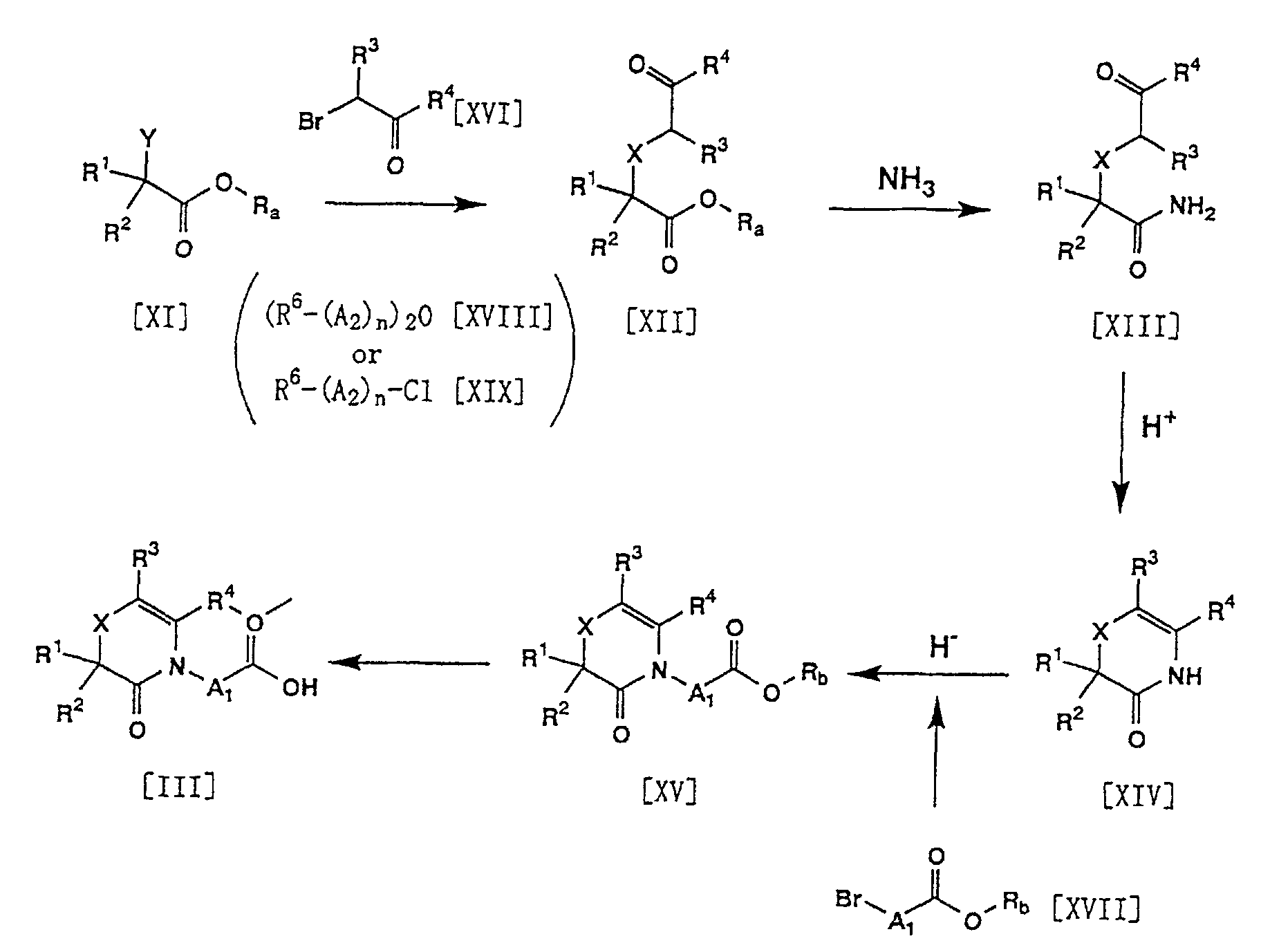


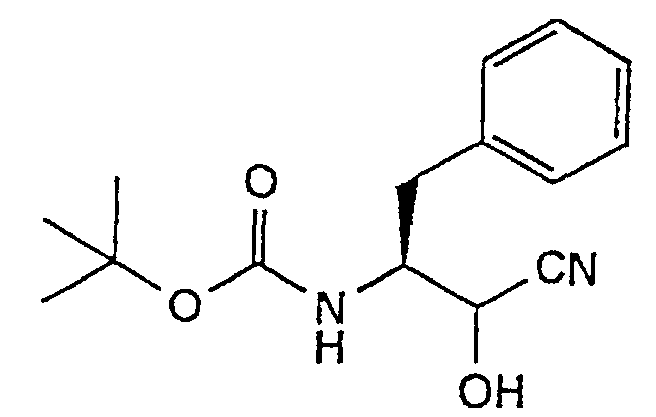

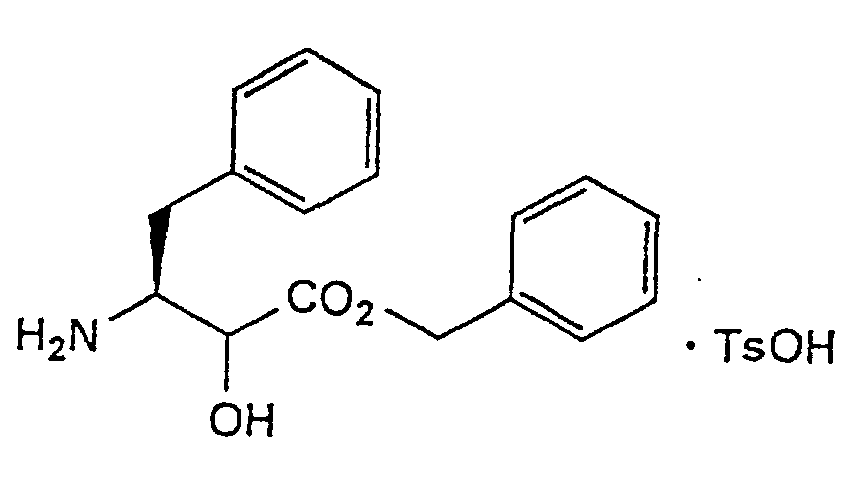
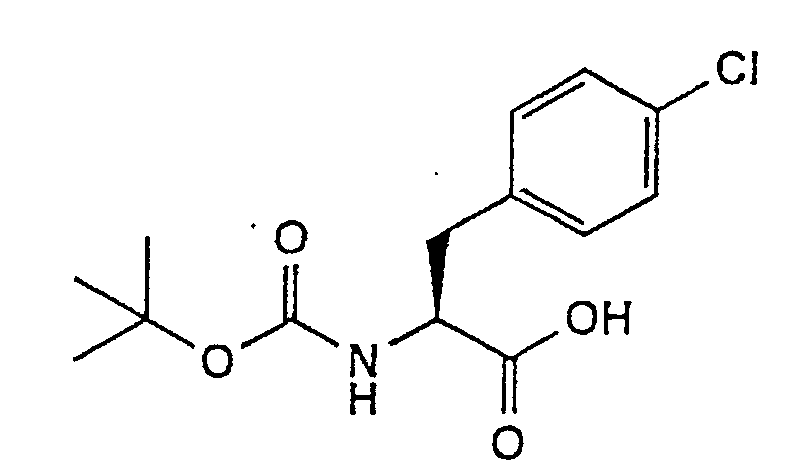
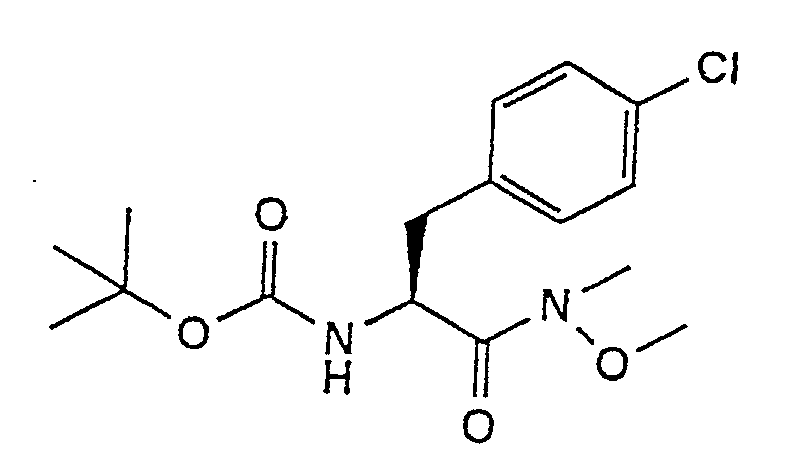

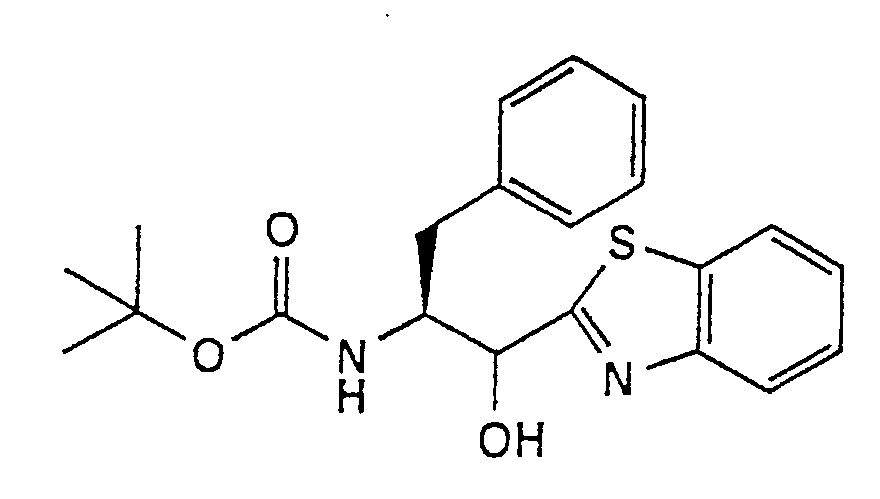
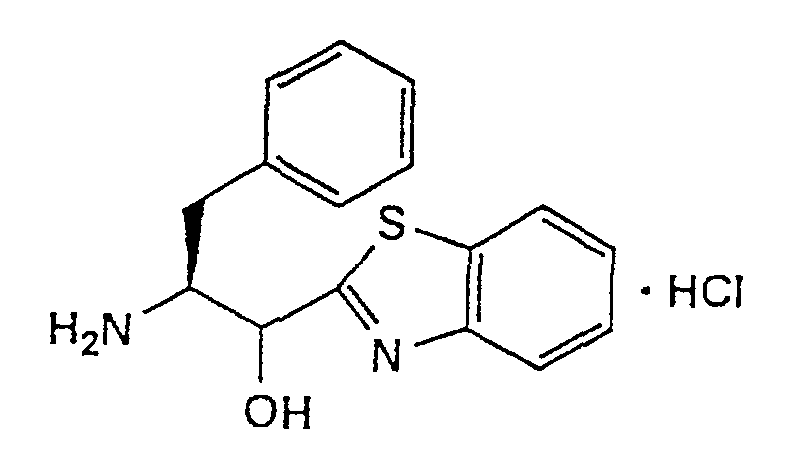

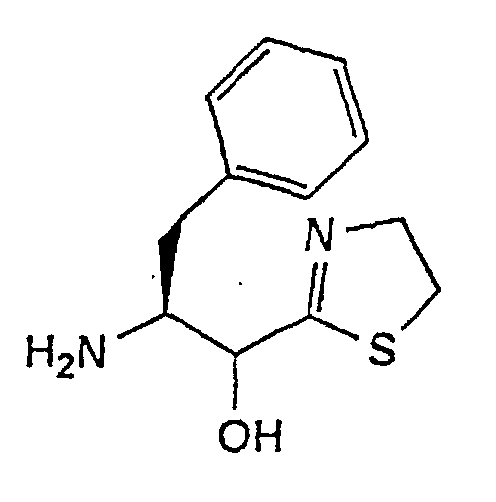
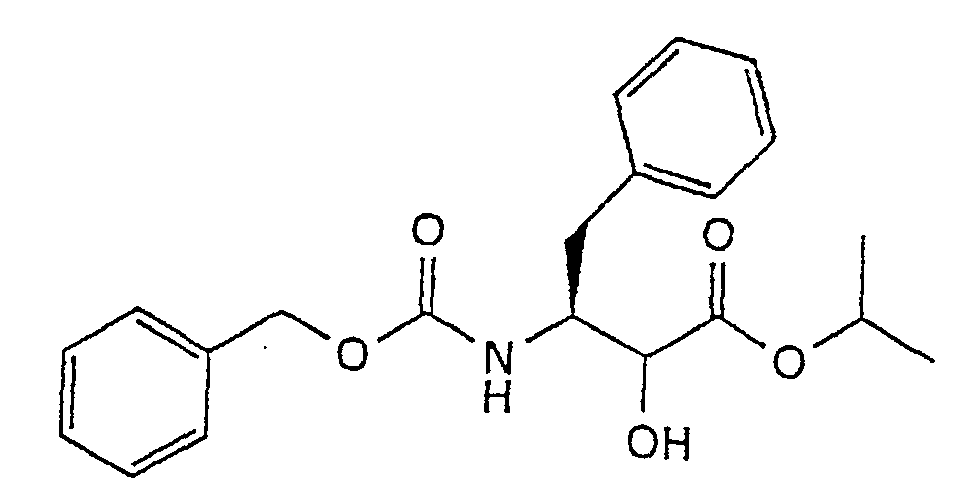

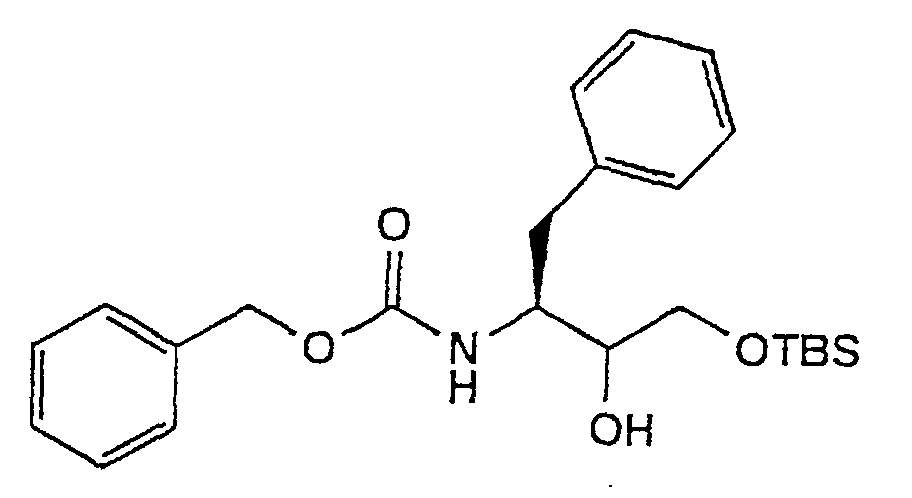

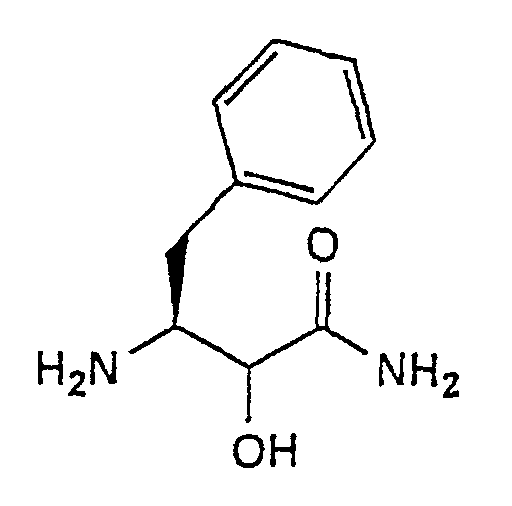

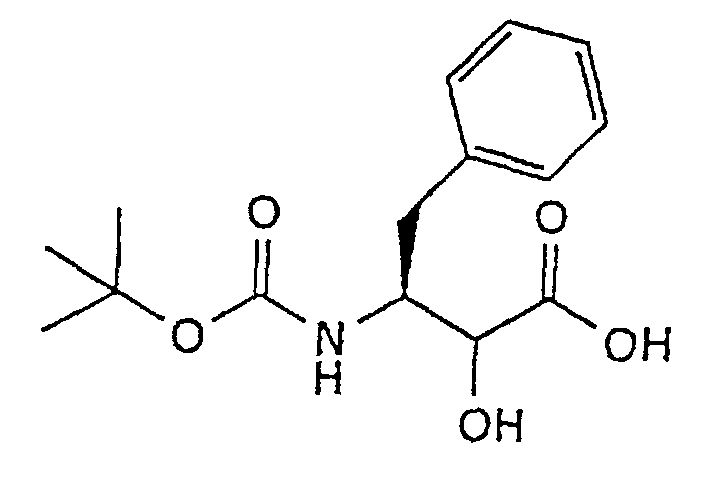

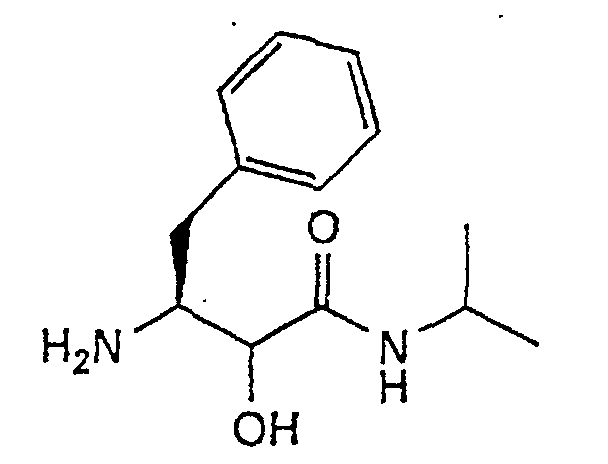


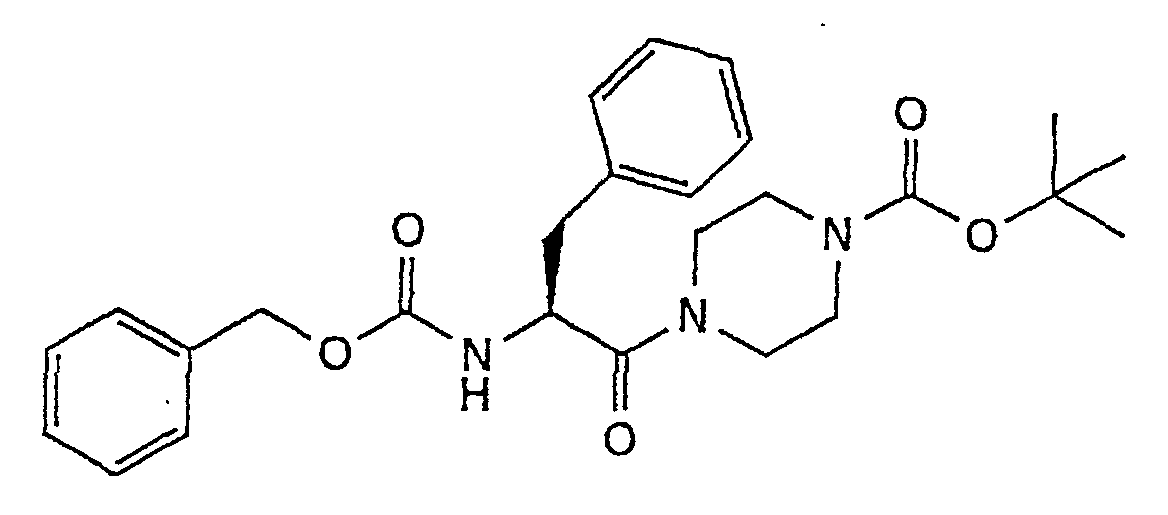


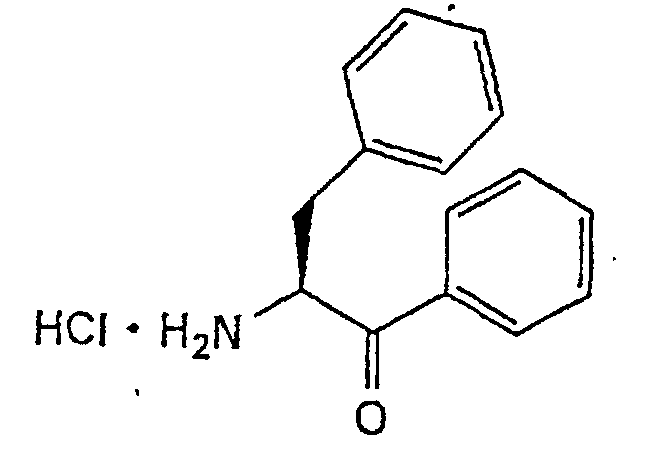
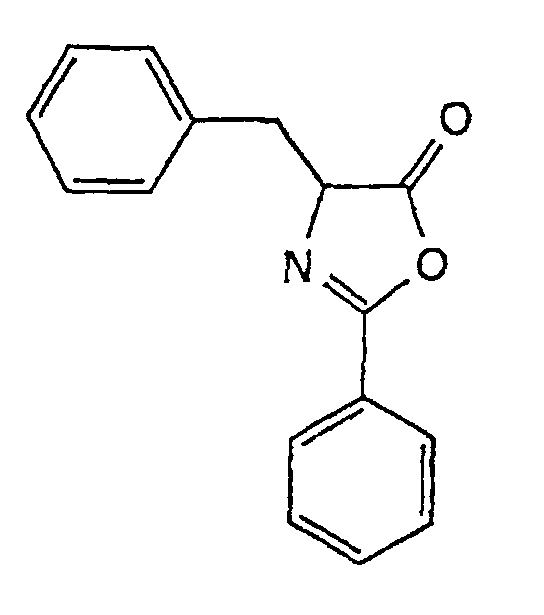
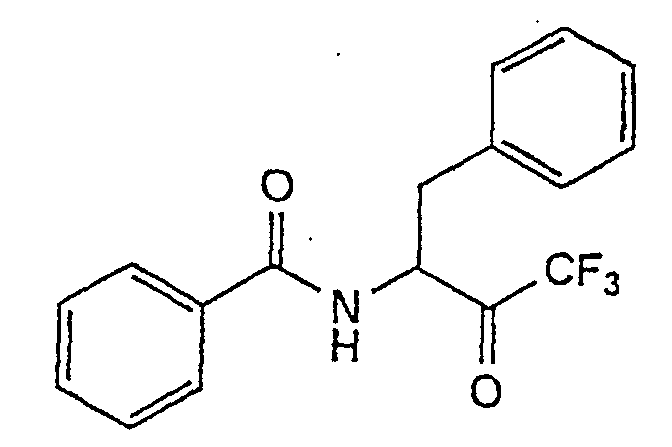
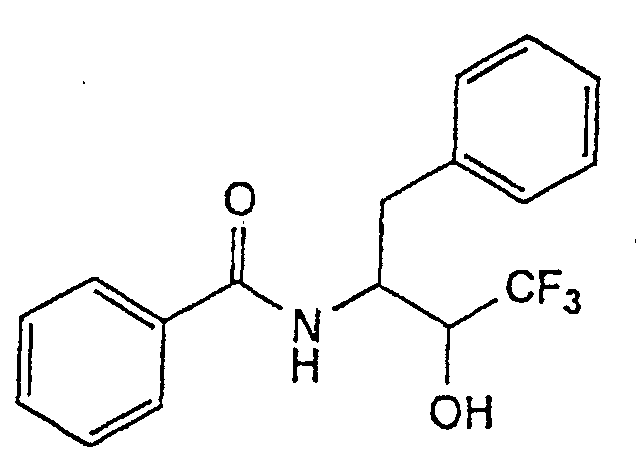
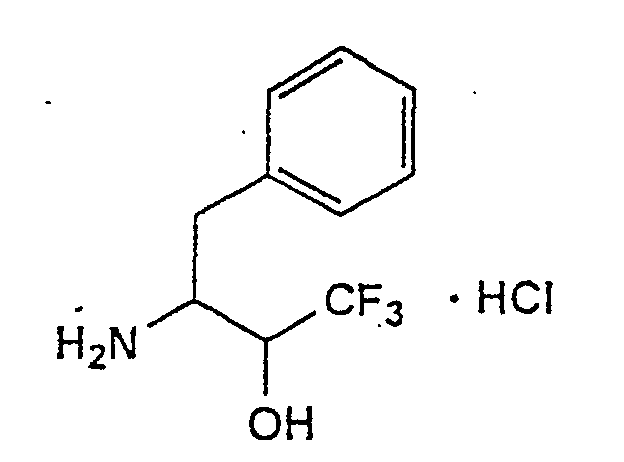


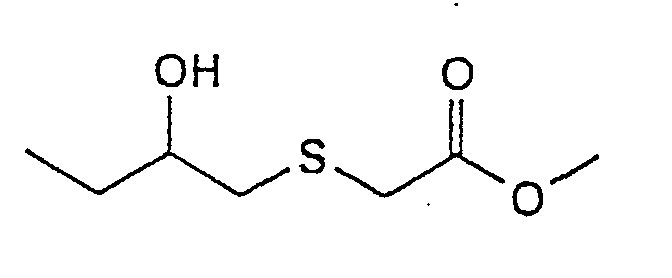

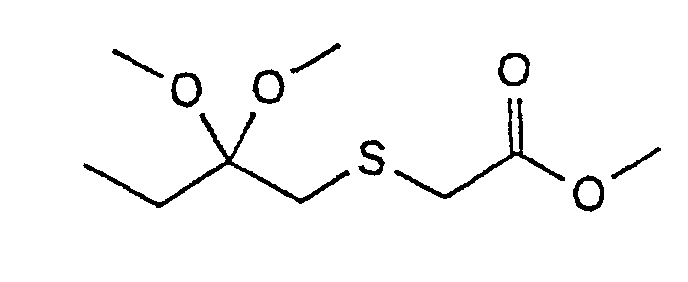


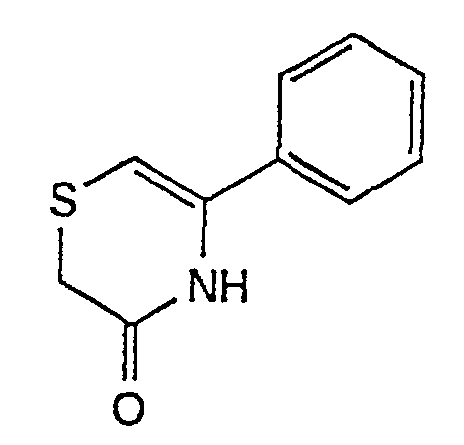


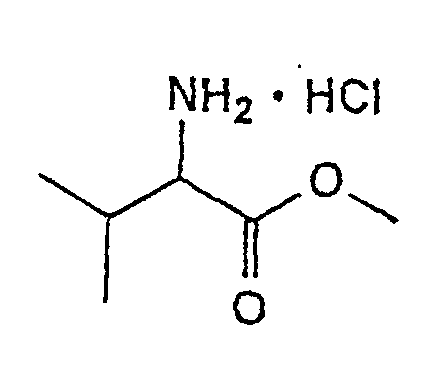


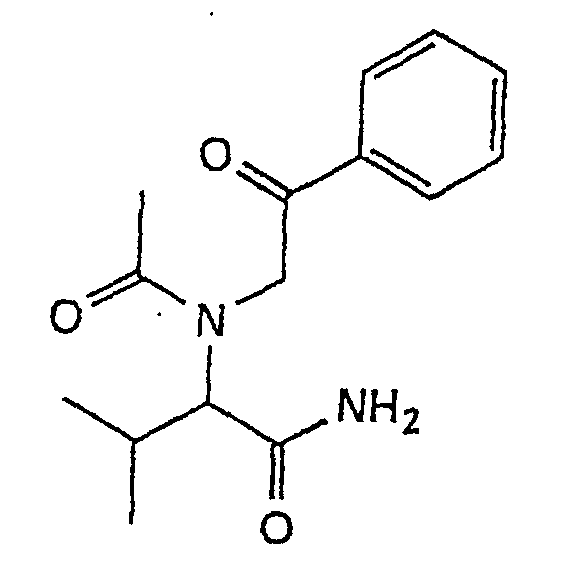

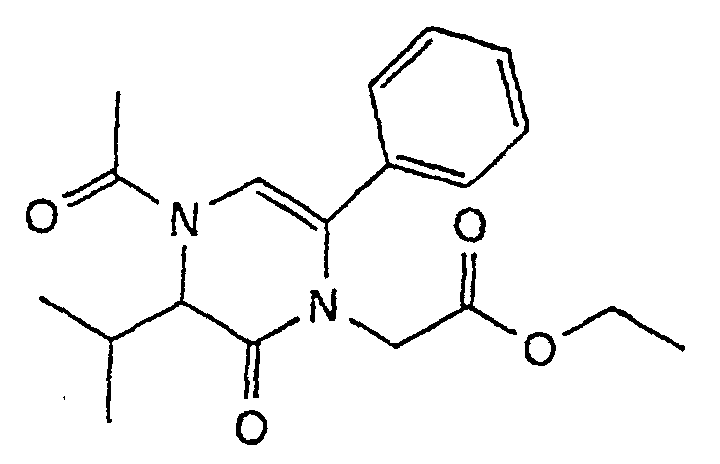
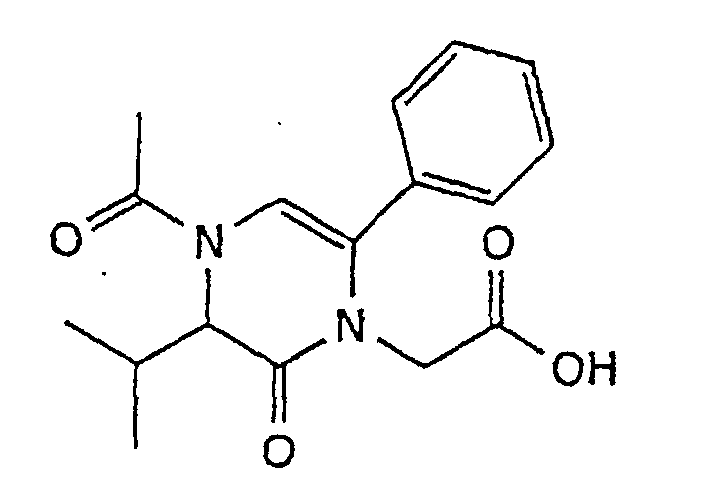


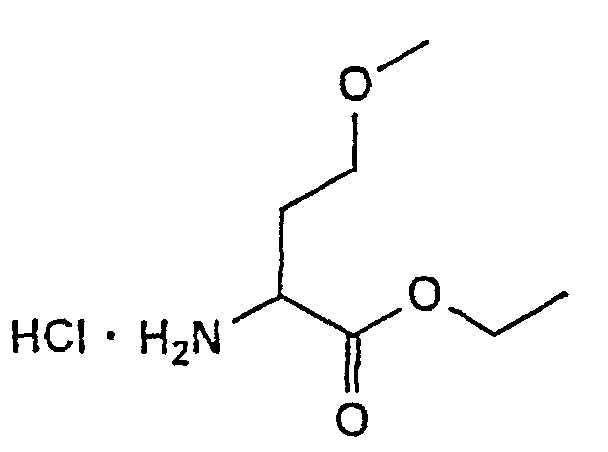


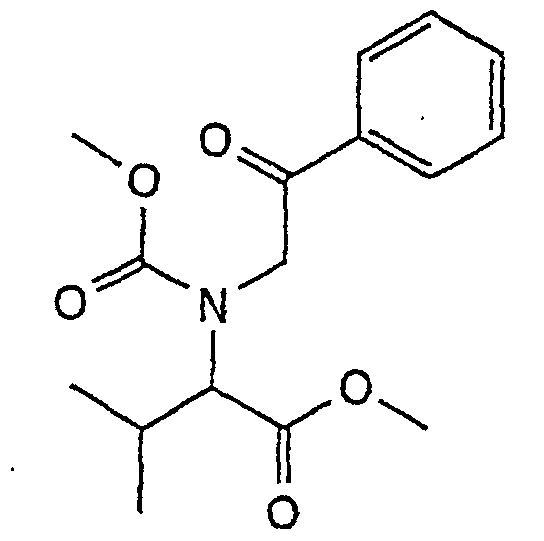


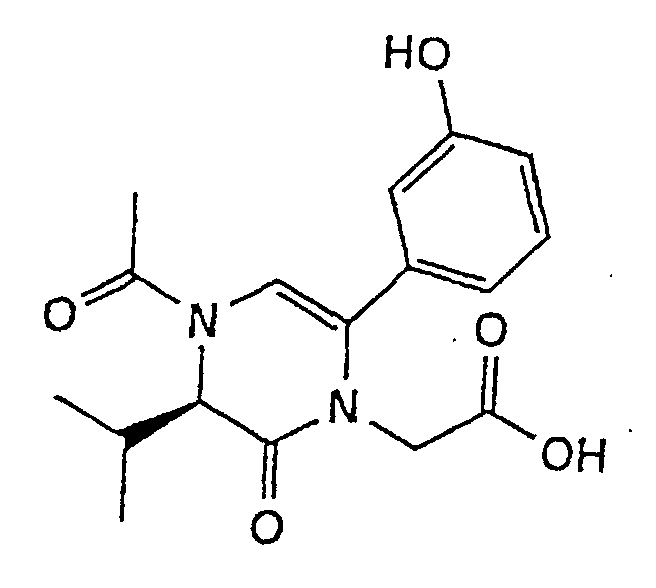


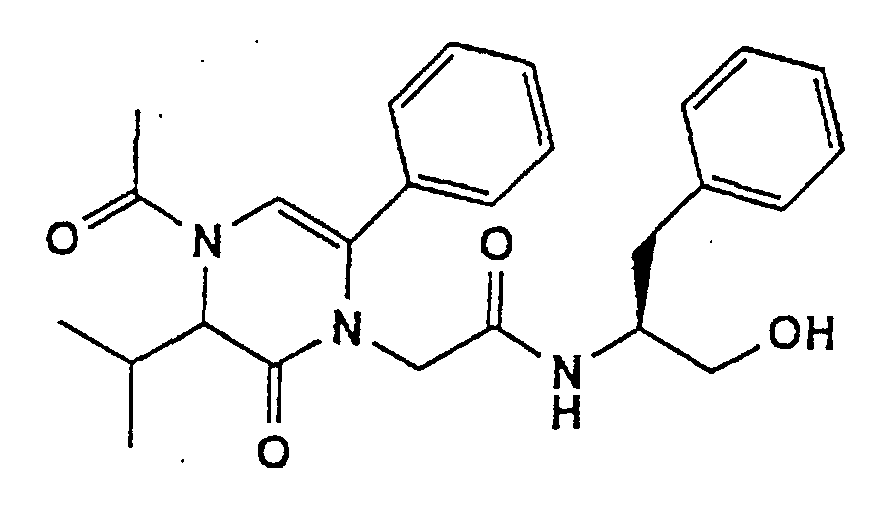


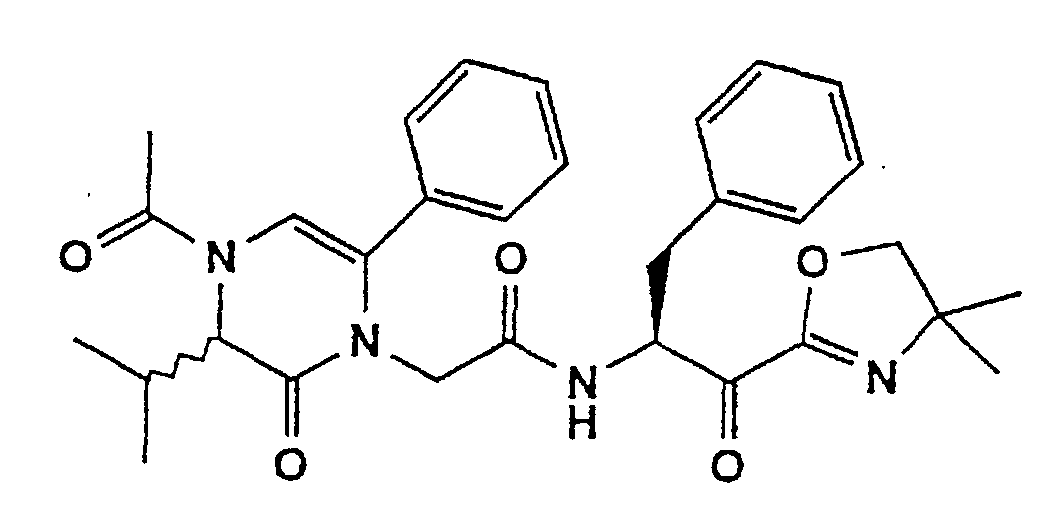
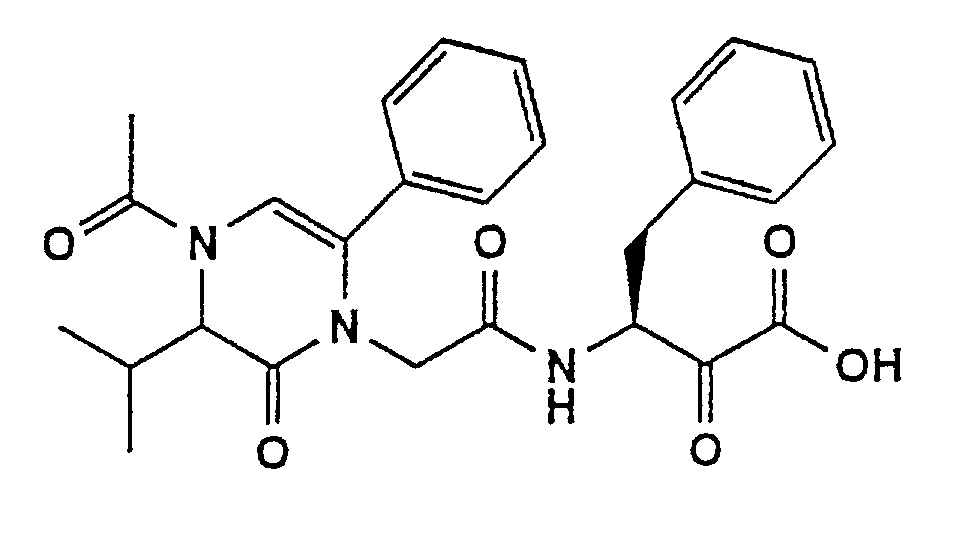
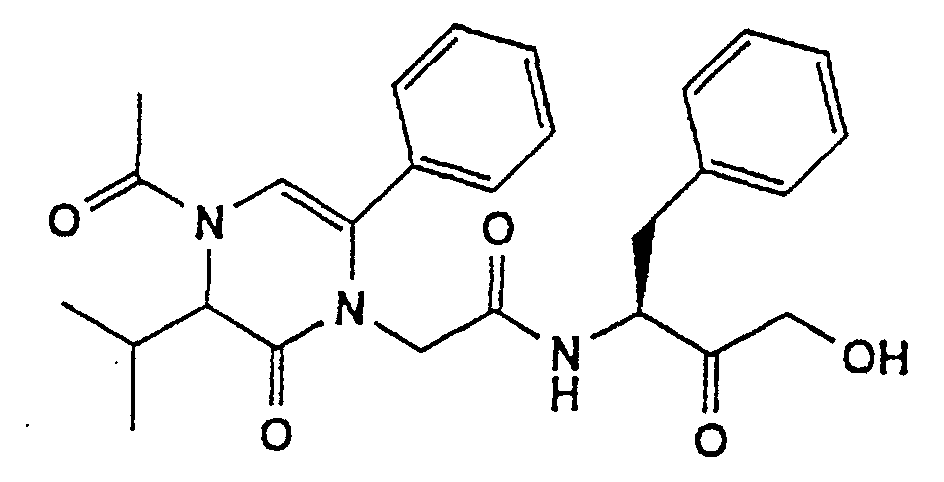


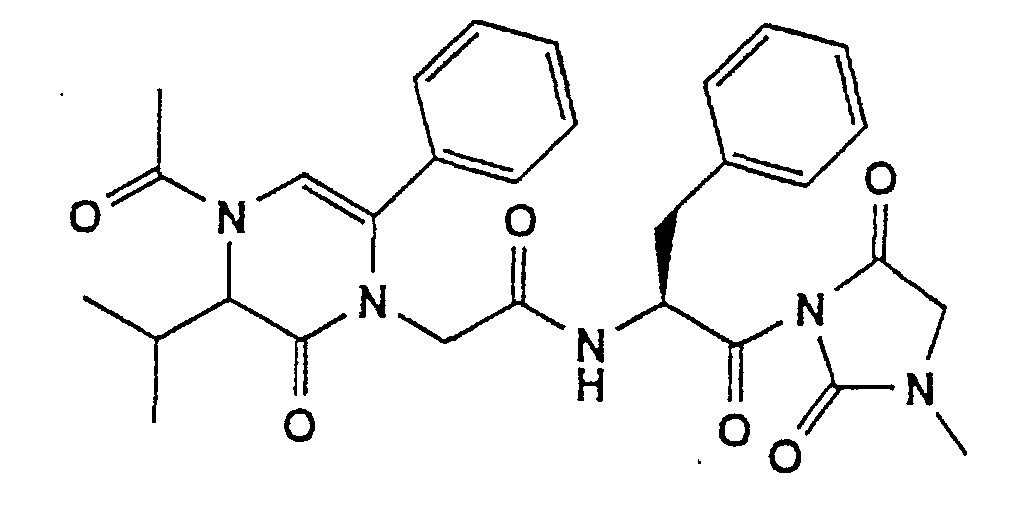

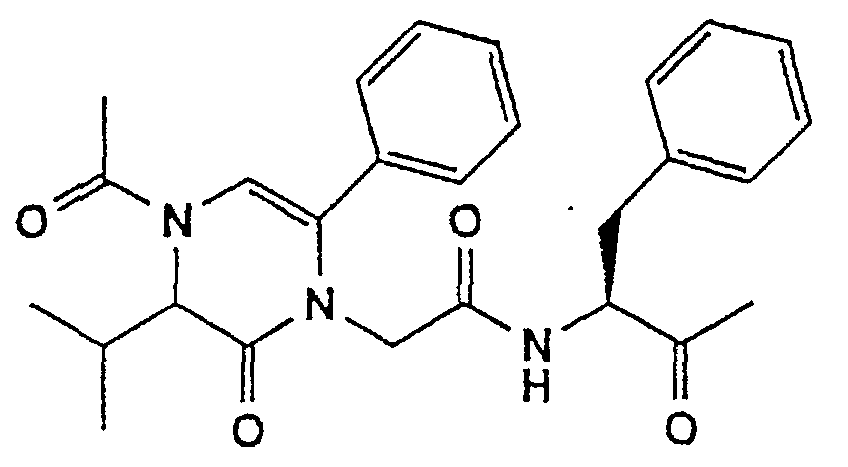
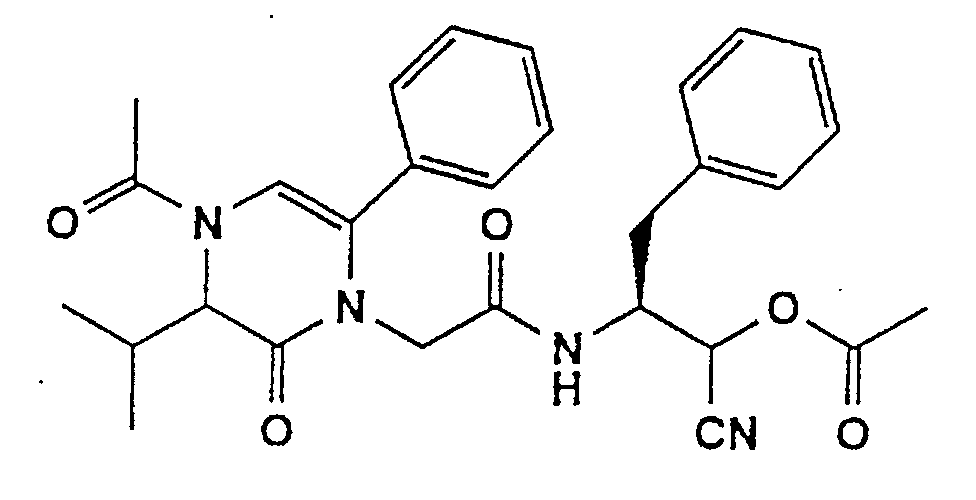
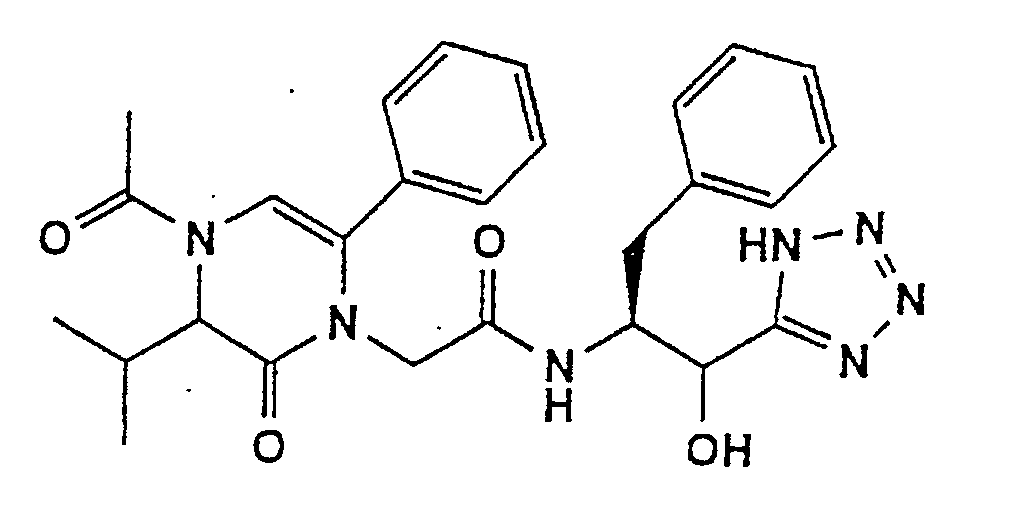
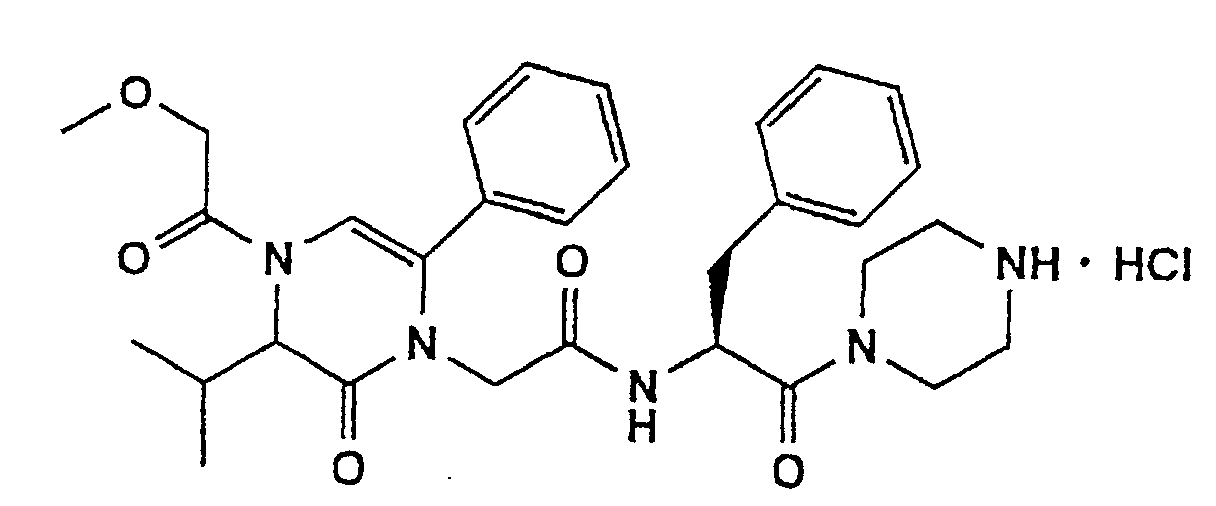

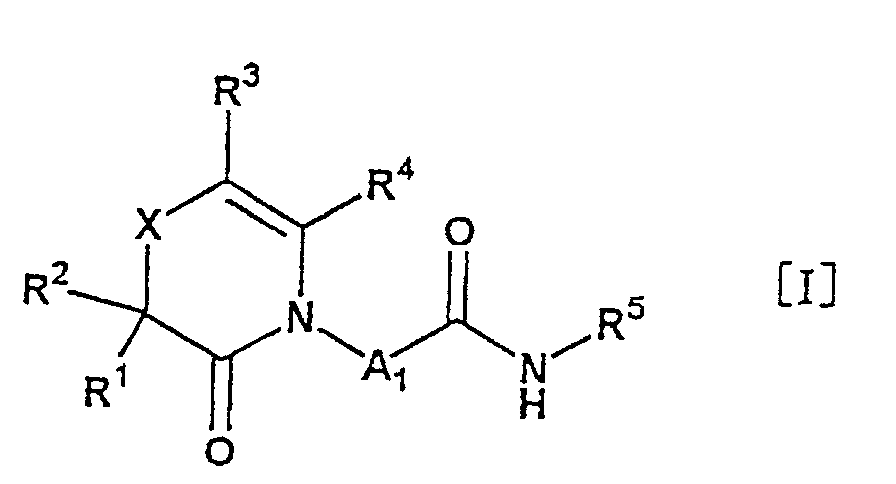 each lower alkyl defined above can be substituted by halogen, hydroxy, lower alkoxy, aryl or aryloxy,X is S or R6-(A2)n-N,R1 and R2, being the same or different, are hydrogen, lower alkyl, cycloalkyl or aryl,R3 and R4, being the same or different, are hydrogen, lower alkyl, cycloalkyl, aryl or aromatic heterocycles,R5 is hydrogen, lower alkyl, cycloalkyl, aryl or -A3-A4-R7,R6 is hydrogen, lower alkyl, cycloalkyl, hydroxy, lower alkoxy, aryl, aryloxy or an aromatic heterocycle,R7 is hydrogen, lower alkyl, hydroxy, lower alkoxy, aryl, aryloxy, amino, lower alkylamino, arylamino, an aromatic heterocycle or a nonaromatic heterocycle,n is 0 or 1,A1 is lower alkylene,A2 is carbonyl or sulfonyl,A3 is lower alkylene,A4 is carbonyl or oxalyl,
 each lower alkyl defined above can be substituted by halogen, hydroxy, lower alkoxy, aryl or aryloxy,X is S or R6-(A2)n-N,R1 and R2, being the same or different, are hydrogen, lower alkyl, cycloalkyl or aryl,R3 and R4, being the same or different, are hydrogen, lower alkyl, cycloalkyl, aryl or aromatic heterocycles,R6 is hydrogen, lower alkyl, cycloalkyl, hydroxy, lower alkoxy, aryl, aryloxy or an aromatic heterocycle,R7 is hydrogen, lower alkyl, hydroxy, lower alkoxy, aryl, aryloxy, amino, lower alkylamino, arylamino, an aromatic heterocycle or a nonaromatic heterocycle,n is 0 or 1,A1 is lower alkylene,A2 is carbonyl or sulfonyl,A3 is lower alkylene,Q is -CH(OH)CO- or -CH(OH)-,