EP1211245A1 - Agents for controlling animal diseases caused by parasites - Google Patents
Agents for controlling animal diseases caused by parasites Download PDFInfo
- Publication number
- EP1211245A1 EP1211245A1 EP00953518A EP00953518A EP1211245A1 EP 1211245 A1 EP1211245 A1 EP 1211245A1 EP 00953518 A EP00953518 A EP 00953518A EP 00953518 A EP00953518 A EP 00953518A EP 1211245 A1 EP1211245 A1 EP 1211245A1
- Authority
- EP
- European Patent Office
- Prior art keywords
- group
- substituted
- atom
- alkyl
- alkyl group
- Prior art date
- Legal status (The legal status is an assumption and is not a legal conclusion. Google has not performed a legal analysis and makes no representation as to the accuracy of the status listed.)
- Withdrawn
Links
Classifications
-
- C—CHEMISTRY; METALLURGY
- C07—ORGANIC CHEMISTRY
- C07D—HETEROCYCLIC COMPOUNDS
- C07D233/00—Heterocyclic compounds containing 1,3-diazole or hydrogenated 1,3-diazole rings, not condensed with other rings
- C07D233/54—Heterocyclic compounds containing 1,3-diazole or hydrogenated 1,3-diazole rings, not condensed with other rings having two double bonds between ring members or between ring members and non-ring members
- C07D233/66—Heterocyclic compounds containing 1,3-diazole or hydrogenated 1,3-diazole rings, not condensed with other rings having two double bonds between ring members or between ring members and non-ring members with hetero atoms or with carbon atoms having three bonds to hetero atoms with at the most one bond to halogen, e.g. ester or nitrile radicals, directly attached to ring carbon atoms
- C07D233/84—Sulfur atoms
-
- A—HUMAN NECESSITIES
- A61—MEDICAL OR VETERINARY SCIENCE; HYGIENE
- A61K—PREPARATIONS FOR MEDICAL, DENTAL OR TOILETRY PURPOSES
- A61K31/00—Medicinal preparations containing organic active ingredients
- A61K31/33—Heterocyclic compounds
- A61K31/395—Heterocyclic compounds having nitrogen as a ring hetero atom, e.g. guanethidine or rifamycins
- A61K31/41—Heterocyclic compounds having nitrogen as a ring hetero atom, e.g. guanethidine or rifamycins having five-membered rings with two or more ring hetero atoms, at least one of which being nitrogen, e.g. tetrazole
- A61K31/4164—1,3-Diazoles
-
- A—HUMAN NECESSITIES
- A61—MEDICAL OR VETERINARY SCIENCE; HYGIENE
- A61P—SPECIFIC THERAPEUTIC ACTIVITY OF CHEMICAL COMPOUNDS OR MEDICINAL PREPARATIONS
- A61P33/00—Antiparasitic agents
- A61P33/02—Antiprotozoals, e.g. for leishmaniasis, trichomoniasis, toxoplasmosis
-
- Y—GENERAL TAGGING OF NEW TECHNOLOGICAL DEVELOPMENTS; GENERAL TAGGING OF CROSS-SECTIONAL TECHNOLOGIES SPANNING OVER SEVERAL SECTIONS OF THE IPC; TECHNICAL SUBJECTS COVERED BY FORMER USPC CROSS-REFERENCE ART COLLECTIONS [XRACs] AND DIGESTS
- Y02—TECHNOLOGIES OR APPLICATIONS FOR MITIGATION OR ADAPTATION AGAINST CLIMATE CHANGE
- Y02A—TECHNOLOGIES FOR ADAPTATION TO CLIMATE CHANGE
- Y02A50/00—TECHNOLOGIES FOR ADAPTATION TO CLIMATE CHANGE in human health protection, e.g. against extreme weather
- Y02A50/30—Against vector-borne diseases, e.g. mosquito-borne, fly-borne, tick-borne or waterborne diseases whose impact is exacerbated by climate change
Definitions
- the present invention relates to an agent for controlling animal diseases caused by parasites, which contains, as an active ingredient, a specific imidazole compound.
- an agent for controlling animal diseases is useful, for example, as an agent for controlling parasites such as coccidia which are parasitic on animals.
- various pest controlling agents or insecticides have been employed against parasites parasitic on animals such as domestic animals, domestic poultry or companion animals.
- coccidia which are endobiotic protozoa belonging to genus Eimeria and which are widely distributed among various domestic animals and domestic poultry such as chickens, sulfa drugs; quinolines; antithiamine drugs; polyether antibiotics such as monensin, salinomycin and lasalocid; and nicarbazin as a synthetic agent, have widely been used.
- the specific imidazole compound which is used as an active ingredient of the agent for controlling animal diseases of the present invention is a known compound disclosed in e.g. JP-A-1-131163, JP-A-63-255269, etc. However, it has not been known to use such compound as an agent for controlling animal diseases.
- an animal disease caused by parasites will result from parasitism of the parasites on or in the body of a host animal.
- the parasites which cause an animal disease are parasitic on the body surface, stomach, intestinal tract, lung, heart, liver, blood vessels, subcutis or lymphatic tissues of domestic animals, domestic poultry or companion animals, and are likely to bring about serious problems in many cases.
- Animal diseases caused by parasites are likely to bring about anemia, malnutrition, asthenia, weight loss, or disorder of intestinal tract walls or other tissues or organs, and if left untreated, hosts infested with the parasites are likely to die.
- coccidiosis which is one of animal diseases caused by parasites, presents a serious economical loss particularly to poultry industry. Further, this is one of diseases which are problematic in breeding not only poultry but also cattle, sheep, rabbits, dogs and cats. Therefore, control of coccidiosis will bring about a substantial benefit to the poultry industry, lively stock industry and breeding of companion animals. On the basis of such a concept, the present invention provides an agent for controlling animal diseases caused by parasites.
- The-present inventors have conducted an extensive research for compounds which are capable of controlling animal diseases, particularly coccidiosis, caused by parasites. As a result, they have found that a certain specific imidazole compound which is known to have an agricultural application, has an effect for controlling animal diseases caused by parasites, and the present invention has been accomplished on the basis of this discovery.
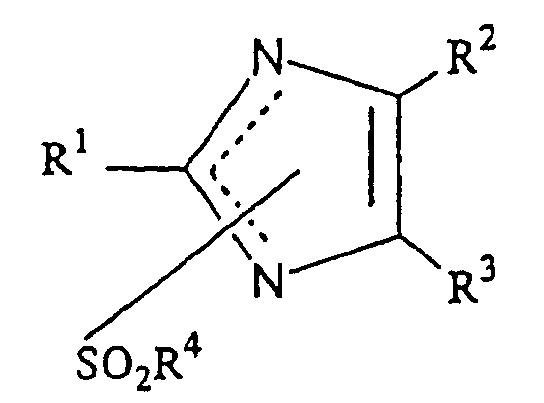
- the present invention provides an agent for controlling animal diseases caused by parasites, which contains, as an active ingredient, an imidazole compound represented by the formula (I): wherein R 1 is a cyano group, a group or a group ⁇ wherein each of R 5 and R 6 is a hydrogen atom, an alkyl group which may be substituted, an alkenyl group which may be substituted, an alkynyl group which may be substituted, a cycloalkyl group which may be substituted, an aryl group which may be substituted, or a -CO-R 7 group (wherein R 7 is an alkyl group which may be substituted, an alkoxy group which may be substituted, or an aryl group which may be substituted) ⁇ , each of R 2 and R 3 is a hydrogen atom; a halogen atom; a hydroxyl group; a nitro group; a cyano group; a thiocyanate group; a trimethylsilyl group; an alkyl group
- the alkyl moiety contained in R 2 to R 13 may be one having a carbon number of from 1 to 12, and it may, for example, be a methyl group, an ethyl group, an-propyl group, an isopropyl group, a n-butyl group, a sec-butyl group, an isobutyl group, a tert-butyl group, a n-pentyl group, a n-hexyl group, a heptyl group, an octyl group, a nonyl group or a decyl group.
- the cycloalkyl group represented by R 2 , R 3 , R 4 , R 5 , R 6 and R 8 may be one having a carbon number of from 3 to 7, and it may, for example, be a cyclopropyl group, a cyclobutyl group, a cyclopentyl group or a cyclohexyl group.
- the alkenyl group contained in R 2 , R 3 , R 8 , R 12 and R 13 may be one having a carbon number of from 2 to 12, and it may, for example, be an allyl group or a geranyl group.
- the cycloalkenyl group represented by R 2 , R 3 and R 8 may be one having a carbon number of from 5 to 8, and it may, for example, be a cyclopentenyl group, a cyclohexenyl group or a cyclooctenyl group.
- the alkynyl group contained in R 2 , R 3 and R 8 may be one having a carbon number of from 2 to 12, and it may, for example, be a 2-propynyl group.
- the aryl group which may be substituted, represented by R 2 , R 3 , R 4 , R 5 , R 6 , R 7 , R 8 and R 11 , or the aryl moiety of the aryloxy group which may be substituted, represented by R 2 and R 3 may, for example, be a phenyl group or a naphthyl group.
- the aryl group for R 2 , R 3 and R 8 is preferably a phenyl group or a naphthyl group.
- the aryl group for R 4 , R 5 , R 6 , R 7 and R 11 is preferably a phenyl group.
- the aryloxy group which may be substituted, represented by R 2 and R 3 is preferably a phenoxy group.
- the 5- or 6-membered aromatic heterocyclic group which may be substituted, represented by R 2 and R 3 may be one containing at least one hetero atom selected from the group consisting of an oxygen atom, a sulfur atom and a nitrogen atom, in its ring, and it may, for example, be a thienyl group which may be substituted, a furyl group which may be substituted, a thiazolyl group which may be substituted, or a pyridyl group which may be substituted.
- the substituent for the alkyl group which may be substituted represented by R 2 , R 3 , R 4 , R 5 , R 6 , R 7 , R 8 , R 11 , R 12 and R 13 ; the cycloalkyl group which may be substituted, represented by R 2 , R 3 , R 4 , R 5 , R 6 and R 8 ; the alkenyl group which may be substituted, represented by R 2 , R 3 , R 5 , R 6 , R 8 , R 12 and R 13 ; the alkynyl group which may be substituted, represented by R 2 , R 3 , R 5 , R 6 and R 8 ; the alkoxy group which may be substituted, represented by R 2 and R 3 ; the alkenyloxy group which may be substituted, the alkynyloxy group which may be substituted, the cycloalkyloxy group which may be substituted, and the cycloalkenyloxy group which may be substituted, represented by R 2 ,
- the substituent for the aryl group which may be substituted, represented by R 2 , R 3 , R 4 , R 5 , R 6 , R 7 , R 8 and R 11 ; the aryloxy group which may be substituted, represented by R 2 and R 3 ; the pyridyl group which may be substituted, represented by R 8 ; the thienyl group which may be substituted, represented by R 4 ; the furyl group which may be substituted, represented by R 4 ; and the 5- or 6-membered aromatic heterocyclic group which may be substituted, represented by R 2 and R 3 , may, for example, be a halogen atom; a nitro group; a cyano group; an alkyl group which may be substituted by a halogen atom; an alkoxyalkyl group; an alkoxy group which may be substituted by a halogen atom; a methylenedioxy group which may be substituted by a halogen atom; a -NR 14
- the number of such secondary substituents is preferably from 0 to 5.
- the halogen atom contained in the above R 2 to R 8 and R 11 to R 16 may be a chlorine atom, a bromine atom, a fluorine atom or an iodine atom.
- the alkyl moiety contained in the above R 14 to R 16 and the after mentioned R 17 may be the same one as the alkyl moiety contained in the above R 2 to R 13 .
- R 12 and R 13 may, together with the adjacent nitrogen atom, form a 5- to 7-membered saturated hetero ring which may contain an oxygen atom, a sulfur atom or a nitrogen atom, such as a piperidine ring, a pyrrolidine ring, a morpholine ring or a thiomorpholine ring.
- a particularly preferred imidazole compound is the compound of the above-preferred embodiment (7), which includes the following compounds.
- the imidazole compound of the above formula (I) can be prepared by methods disclosed in e.g. JP-A-1-131163 and JP-A-8-208623.
- the agent for controlling animal diseases caused by parasites of the present invention is effective against (1) parasites parasitic on the exterior of a host animal, such as, acarus, such as mange mite, mesostigmatid mites, sarcoptic mange mite ( Sarcoptes scabiei ), trombiculid mites, New Zealand cattle tick ( Haemaphyalis longicornis ) and southern cattle tick ( Boophilus microplus ); fleas such as cat flea ( Ctenocephalides felis ), dog flea ( Ctenocephalides canis ), northern rat flea (Nosopsyllus fasciatus ), oriental rat flea ( Xenopsylla cheopis ) and human flea ( Pulex irritans ); sucking lice such as short-nosed cattle louse ( Haematopinus eurysternus ), horse sucking louse ( Haematopinus asini ), sheep lice, long-nosed cattle lous
- parasites it is particularly effective against parasites parasitic in the body of a host animal, and among them, it is especially effective against protozoa. Further, among protozoa, it is particularly effective against coccidia. Further, among coccidia, it is most effective against coccidia parasitic on domestic poultry (such as fowls, ducks, geese or turkeys).
- the coccidia parasitic on domestic poultry include, for example, Eimeria tenella , Eimeria acervulina , Eimeria brunetti , Eimeria maxima , Eimeria mitis , Eimeria mivati , Eimeria necatrix and Eimeria praecox .
- the compound of the formula (I) may be used as it is. However, it may be used as formulated together with a suitable vehicle into a formulation such as a powder, a granule, a tablet, a dusting powder, a capsule, a premix, a solution or an emulsion.
- a suitable vehicle may be one which is commonly used as a feed additive, and it may, for example, be lactose, sucrose, glucose, starch, wheat powder, corn powder, soybean meal, degreased rice bran, calcium carbonate or other commercially available feed material.
- the compound of the present invention can be used, together with a vehicle, in combination with various vitamins, minerals, amino acids, enzyme drugs, antifebriles, sedatives, antiphlogistics, bactericides, colorants, aromatizing agents, preservatives, etc.
- the dose of the compound of the formula (I) varies depending upon the administration method, the purpose of administration, the diseased degree, etc. However, it is usually administered as mixed in a feed in a concentration of at least 0.1 ppm.
- the compound of the above formula (I) may sometimes change to a compound of the formula (II): (wherein R 1 , R 2 and R 3 are as defined above).
- a compound of the formula (II) will also act as an agent for controlling animal diseases caused by parasites in the same manner as the compound of the formula (I) in the body of an animal.
- the compound of the above formula (II) is disclosed as an intermediate of the compound of the formula (I) in JP-A-1-131163.
- This compound can be produced by e.g. the methods disclosed in e.g. JP-A-1-131163, JP-A-4-59766, JP-A-7-215946, JP-A-7-252233, JP-A-7-252234, JP-A-7-309843 and JP-A-8-225539.
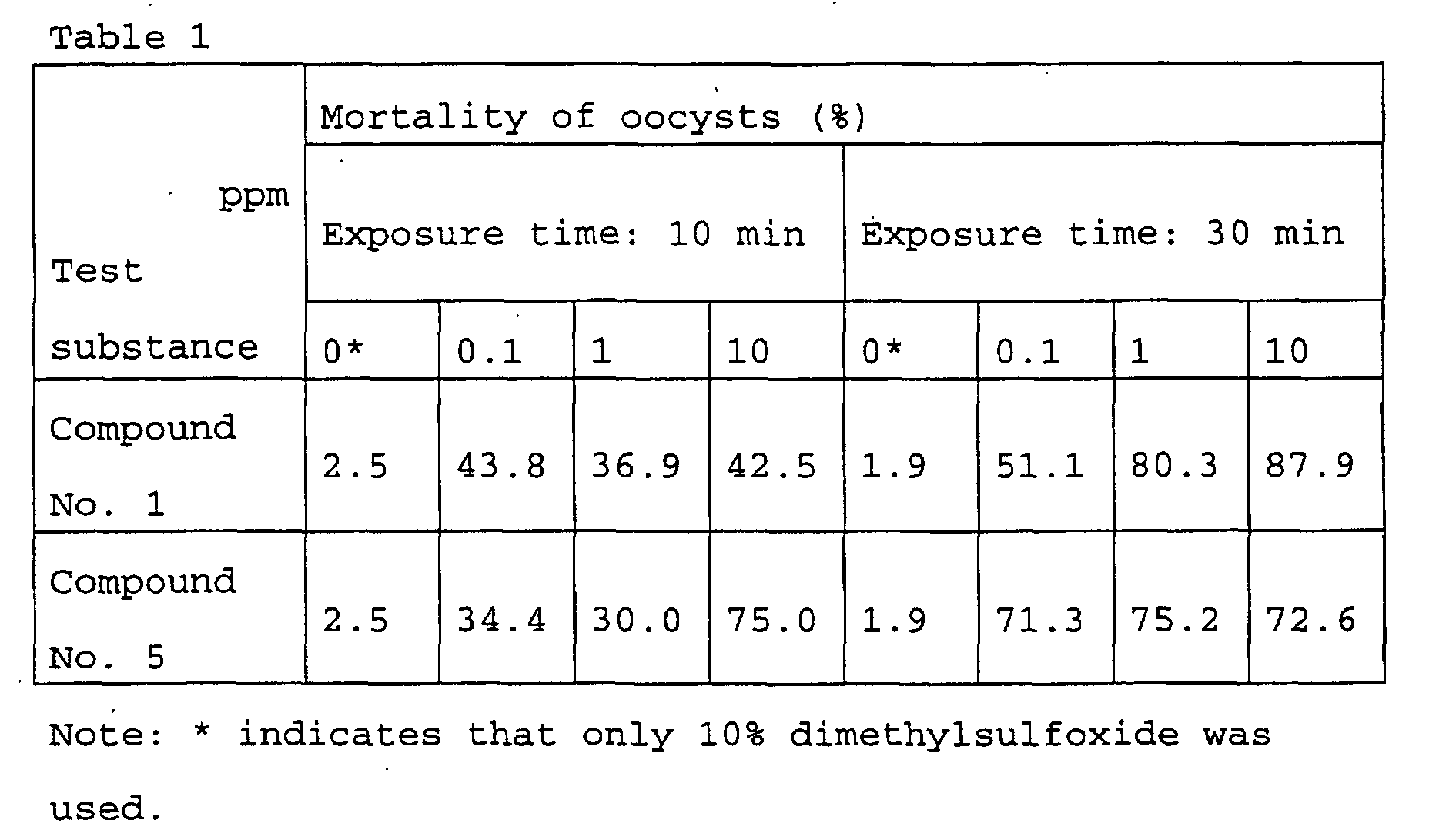
- Chicks were infested with Eimeria tenella of wild type to obtain fresh immature oocycts.
- the obtained fresh immature oocysts were exposed to a solution of each test substance having a predetermined concentration for 10 or 30 minutes.
- the exposed immature oocysts were centrifuged at 1500 min -1 for 5 minutes, and the supernatant was removed. Then, a 2% potassium bichromate aqueous solution was added, and sporulation was carried out at 25°C for 4 days, whereupon the ratio of mature oocysts (sporulated oocysts) to the number of observed oocysts, was calculated.
- the specific imidazole compound can be presented as an agent for controlling animal diseases caused by parasites.
Landscapes
- Health & Medical Sciences (AREA)
- Chemical & Material Sciences (AREA)
- Organic Chemistry (AREA)
- Veterinary Medicine (AREA)
- Medicinal Chemistry (AREA)
- Pharmacology & Pharmacy (AREA)
- Life Sciences & Earth Sciences (AREA)
- Animal Behavior & Ethology (AREA)
- General Health & Medical Sciences (AREA)
- Public Health (AREA)
- Epidemiology (AREA)
- Chemical Kinetics & Catalysis (AREA)
- General Chemical & Material Sciences (AREA)
- Nuclear Medicine, Radiotherapy & Molecular Imaging (AREA)
- Tropical Medicine & Parasitology (AREA)
- Pharmaceuticals Containing Other Organic And Inorganic Compounds (AREA)
Abstract

Description
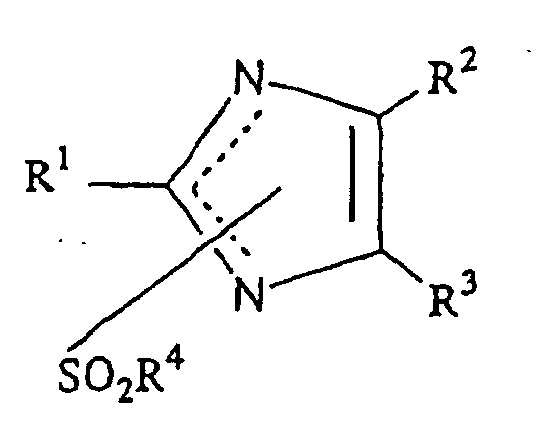
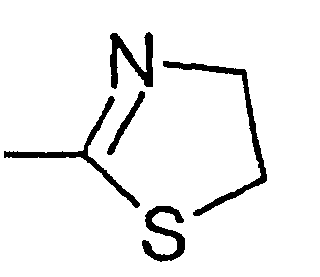
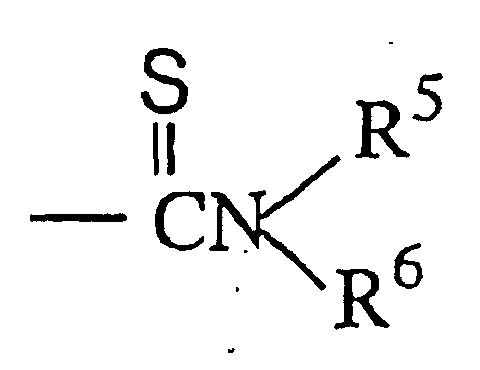
each of R2 and R3 is a hydrogen atom; a halogen atom; a hydroxyl group; a nitro group; a cyano group; a thiocyanate group; a trimethylsilyl group; an alkyl group which may be substituted; a cycloalkyl group which may be substituted; an alkenyl group which may be substituted; a cycloalkenyl group which may be substituted; an alkynyl group which may be substituted; an alkoxy group which may be substituted; a cycloalkyloxy group which may be substituted; an alkenyloxy group which may be substituted; a cycloalkenyloxy group which may be substituted; an alkynyloxy group which may be substituted; an aryl group which may be substituted; an aryloxy group which may be substituted; a 5- or 6-membered aromatic heterocyclic group which may be substituted; a -SOnR8 group {wherein R8 is an alkyl group which may be substituted; a cycloalkyl group which may be substituted; an alkenyl group which may be substituted; a cycloalkenyl group which may be substituted; an alkynyl group which may be substituted; an aryl group which may be substituted; a pyridyl group which may be substituted, or a -N(R9)R10 group (wherein each of R9 and R10 is an alkyl group), and n is an integer of from 0 to 2}; or a

R4 is an alkyl group which may be substituted; a cycloalkyl group which may be substituted; an aryl group which may be substituted; a thienyl group which may be substituted; a furyl group which may be substituted; or a -N(R12)R13 group (wherein each of R12 and R13 is a hydrogen atom; an alkyl group which may be substituted; or an alkenyl group which may be substituted, or they form, together with the adjacent nitrogen atom, a 5- to 7-membered saturated heterocyclic group, provided that a case where R12 and R13 are simultaneously hydrogen atoms, is excluded),
provided that a case where R2 and R3 are simultaneously hydrogen atoms, is excluded.

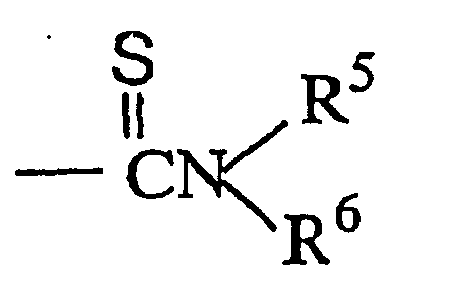
each of R2 and R3 is a hydrogen atom; a halogen atom; a nitro group; a cyano group; a thiocyanate group; a trimethylsilyl group; an alkyl group which may be substituted; a cycloalkyl group which may be substituted; an alkenyl group which may be substituted; an alkynyl group which may be substituted; an alkoxy group which may be substituted; a phenoxy group which may be substituted; a phenyl group which may be substituted; a naphthyl group which may be substituted; a 5- or 6-membered aromatic heterocyclic group which may be substituted; a -SOnR8 group {wherein R8 is an alkyl group which may be substituted; a cycloalkyl group which may be substituted; an alkenyl group which may be substituted; an alkynyl group which may be substituted; a phenyl group which may be substituted; a pyridyl group which may be substituted; a -N(R9)R10 group (wherein each of R9 and R10 is an alkyl group), or a naphthyl group which may be substituted, and n is an integer of from 0 to 2}; or a
R4 is an alkyl group which may be substituted; a cycloalkyl group which may be substituted; a phenyl group which may be substituted; a thienyl group which may be substituted; a furyl group which may be substituted; or a -N(R12)R13 group (wherein each of R12 and R13 is a hydrogen atom; an alkyl group which may be substituted; or an alkenyl group which may be substituted, or they form, together with the adjacent nitrogen atom, a 5- to 7-membered saturated heterocyclic group, provided that a case where R12 and R13 are simultaneously hydrogen atoms, is excluded).
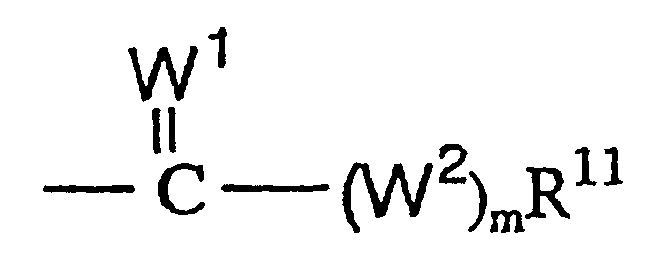
-C(=O)-(NH)mR11 (wherein R11 is an alkyl group which may be substituted by a halogen atom; or a phenyl group which may be substituted by a halogen atom, and m is an integer of from 0 to 1).
- 4-chloro-2-cyano-1-dimethylsulfamoyl-5-(4-methylphenyl)imidazole (compound No. 1)
- 4-chloro-2-cyano-1-dimethylsulfamoyl-5-(4-methoxyphenyl)imidazole (compound No. 2)
- 4-chloro-2-cyano-1-dimethylsulfamoyl-5-(4-ethylphenyl)imidazole (compound No. 3)
- 4-chloro-2-cyano-1-dimethylsulfamoyl-5-(3-methyl-4-methoxyphenyl)imidazole (compound No. 4)
- 4-chloro-2-cyano-1-dimethylsulfamoyl-5-(4-ethyl-α-fluorobenzyl)imidazole (compound No. 5)

Claims (7)
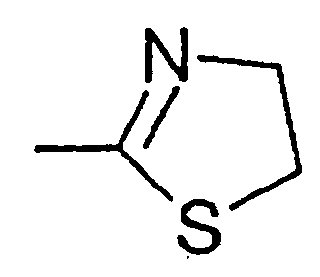
- An agent for controlling animal diseases caused by parasites, which contains, as an active ingredient, an imidazole compound represented by the formula (I):wherein R1 is a cyano group, a
 group or a
 group {wherein each of R5 and R6 is a hydrogen atom, an alkyl group which may be substituted, an alkenyl group which may be substituted, an alkynyl group which may be substituted, a cycloalkyl group which may be substituted, an aryl group which may be substituted, or a -CO-R7 group (wherein R7 is an alkyl group which may be substituted, an alkoxy group which may be substituted, or an aryl group which may be substituted)},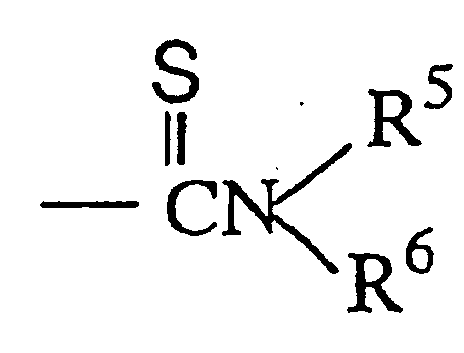
each of R2 and R3 is a hydrogen atom; a halogen atom; a hydroxyl group; a nitro group; a cyano group; a thiocyanate group; a trimethylsilyl group; an alkyl group which may be substituted; a cycloalkyl group which may be substituted; an alkenyl group which may be substituted; a cycloalkenyl group which may be substituted; an alkynyl group which may be substituted; an alkoxy group which may be substituted; a cycloalkyloxy group which may be substituted; an alkenyloxy group which may be substituted; a cycloalkenyloxy group which may be substituted; an alkynyloxy group which may be substituted; an aryl group which may be substituted; an aryloxy group which may be substituted; a 5- or 6-membered aromatic heterocyclic group which may be substituted; a -SOnR8 group {wherein R8 is an alkyl group which may be substituted; a cycloalkyl group which may be substituted; an alkenyl group which may be substituted; a cycloalkenyl group which may be substituted; an alkynyl group which may be substituted; an aryl group which may be substituted; a pyridyl group which may be substituted, or a -N(R9)R10 group (wherein each of R9 and R10 is an alkyl group), and n is an integer of from 0 to 2}; or agroup (wherein W1 is an oxygen atom or a sulfur atom, W2 is an oxygen atom, a sulfur atom or -NH-, m is an integer of from 0 to 1, and R11 is an alkyl group which may be substituted; or an aryl group which may be substituted),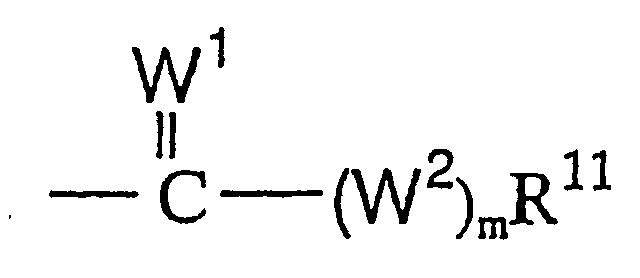
R4 is an alkyl group which may be substituted; a cycloalkyl group which may be substituted; an aryl group which may be substituted; a thienyl group which may be substituted; a furyl group which may be substituted; or a -N(R12)R13 group (wherein each of R12 and R13 is a hydrogen atom; an alkyl group which may be substituted; or an alkenyl group which may be substituted, or they form, together with the adjacent nitrogen atom, a 5- to 7-membered saturated heterocyclic group, provided that a case where R12 and R13 are simultaneously hydrogen atoms, is excluded),
provided that a case where R2 and R3 are simultaneously hydrogen atoms, is excluded. - The agent for controlling animal diseases caused by parasites according to Claim 1, wherein R1 is a cyano group, agroup or a
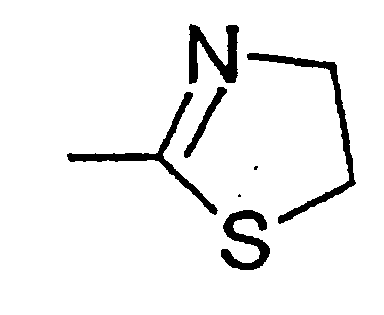 group {wherein each of R5 and R6 is a hydrogen atom, an alkyl group, a phenyl group which may be substituted, or a -CO-R7 group (wherein R7 is an alkyl group which may be substituted, or a phenyl group which may be substituted)},
each of R2 and R3 is a hydrogen atom; a halogen atom; a nitro group; a cyano group; a thiocyanate group; a trimethylsilyl group; an alkyl group which may be substituted; a cycloalkyl group which may be substituted; an alkenyl group which may be substituted; an alkynyl group which may be substituted; an alkoxy group which may be substituted; a phenoxy group which may be substituted; a phenyl group which may be substituted; a naphthyl group which may be substituted; a 5- or 6-membered aromatic heterocyclic group which may be substituted; a -SOnR8 group {wherein R8 is an alkyl group which may be substituted; a cycloalkyl group which may be substituted; an alkenyl group which may be substituted; an alkynyl group which may be substituted; a phenyl group which may be substituted; a pyridyl group which may be substituted; a -N(R9)R10 group (wherein each of R9 and R10 is an alkyl group), or a naphthyl group which may be substituted, and n is an integer of from 0 to 2}; or agroup (wherein W1 is an oxygen atom or a sulfur atom, W2 is an oxygen atom, a sulfur atom or -NH-, m is an integer of from 0 to 1, and R11 is an alkyl group which may be substituted; or a phenyl group which may be substituted),
R4 is an alkyl group which may be substituted; a cycloalkyl group which may be substituted; a phenyl group which may be substituted; a thienyl group which may be substituted; a furyl group which may be substituted; or a -N(R12)R13 group (wherein each of R12 and R13 is a hydrogen atom; an alkyl group which may be substituted; or an alkenyl group which may be substituted, or they form, together with the adjacent nitrogen atom, a 5- to 7-membered saturated heterocyclic group, provided that a case where R12 and R13 are simultaneously hydrogen atoms, is excluded). - The agent for controlling animal diseases caused by parasites according to Claim 1, wherein R1 is a cyano group, R2 is an alkyl group which may be substituted, or a phenyl group which may be substituted, R3 is a chlorine atom, and R4 is a dimethylamino group.
- The agent for controlling animal diseases caused by parasites according to Claim 1, wherein the parasites are ones parasitic in the body of a host animal.
- The agent for controlling animal diseases caused by parasites according to Claim 4, wherein the parasites are protozoa.
- The agent for controlling animal diseases caused by parasites according to Claim 5, wherein the protozoa are coccidia.
- The agent for controlling animal diseases caused by parasites according to Claim 6, wherein the coccidia are coccidia of a domestic animal.
Applications Claiming Priority (3)
| Application Number | Priority Date | Filing Date | Title |
|---|---|---|---|
| JP23325599 | 1999-08-19 | ||
| JP23325599 | 1999-08-19 | ||
| PCT/JP2000/005566 WO2001014341A1 (en) | 1999-08-19 | 2000-08-18 | Agents for controlling animal diseases caused by parasites |
Publications (2)
| Publication Number | Publication Date |
|---|---|
| EP1211245A1 true EP1211245A1 (en) | 2002-06-05 |
| EP1211245A4 EP1211245A4 (en) | 2002-10-30 |
Family
ID=16952218
Family Applications (1)
| Application Number | Title | Priority Date | Filing Date |
|---|---|---|---|
| EP00953518A Withdrawn EP1211245A4 (en) | 1999-08-19 | 2000-08-18 | Agents for controlling animal diseases caused by parasites |
Country Status (3)
| Country | Link |
|---|---|
| EP (1) | EP1211245A4 (en) |
| AU (1) | AU6597200A (en) |
| WO (1) | WO2001014341A1 (en) |
Cited By (3)
| Publication number | Priority date | Publication date | Assignee | Title |
|---|---|---|---|---|
| CN115996714A (en) * | 2020-06-03 | 2023-04-21 | 石原产业株式会社 | Antifungal agent for human use |
| EP4162938A4 (en) * | 2020-06-03 | 2024-06-26 | Ishihara Sangyo Kaisha, Ltd. | ANTIMICROBIAL AGENT FOR NON-HUMAN ANIMAL |
| RU2859458C2 (en) * | 2020-06-03 | 2026-04-02 | Исихара Сангио Кайся, Лтд. | Fungicidal agent for humans |
Family Cites Families (5)
| Publication number | Priority date | Publication date | Assignee | Title |
|---|---|---|---|---|
| US4659720A (en) * | 1982-12-20 | 1987-04-21 | Merck & Co., Inc. | 5-amino or substituted amino imidazoles useful to treat coccidiosis |
| CA1339133C (en) * | 1987-03-13 | 1997-07-29 | Rikuo Nasu | Imidazole compounds and biocidal composition comprising the same for controlling harmful organisms |
| MY129863A (en) * | 1988-03-11 | 2007-05-31 | Ishihara Sangyo Kaisha | Biocidal composition |
| JPH02262562A (en) * | 1988-10-20 | 1990-10-25 | Ishihara Sangyo Kaisha Ltd | Imidazole compound |
| JPH0311003A (en) * | 1989-06-08 | 1991-01-18 | Ishihara Sangyo Kaisha Ltd | Control of pest |
-
2000
- 2000-08-18 AU AU65972/00A patent/AU6597200A/en not_active Abandoned
- 2000-08-18 WO PCT/JP2000/005566 patent/WO2001014341A1/en not_active Ceased
- 2000-08-18 EP EP00953518A patent/EP1211245A4/en not_active Withdrawn
Cited By (6)
| Publication number | Priority date | Publication date | Assignee | Title |
|---|---|---|---|---|
| CN115996714A (en) * | 2020-06-03 | 2023-04-21 | 石原产业株式会社 | Antifungal agent for human use |
| EP4162939A4 (en) * | 2020-06-03 | 2024-06-26 | Ishihara Sangyo Kaisha, Ltd. | Antifungal agent for use in humans |
| EP4162938A4 (en) * | 2020-06-03 | 2024-06-26 | Ishihara Sangyo Kaisha, Ltd. | ANTIMICROBIAL AGENT FOR NON-HUMAN ANIMAL |
| TWI910177B (en) * | 2020-06-03 | 2026-01-01 | 日商石原產業股份有限公司 | Antibacterial agents for non-human animals |
| US12521372B2 (en) | 2020-06-03 | 2026-01-13 | Ishihara Sangyo Kaisha, Ltd. | Antimicrobial agent for non-human animal |
| RU2859458C2 (en) * | 2020-06-03 | 2026-04-02 | Исихара Сангио Кайся, Лтд. | Fungicidal agent for humans |
Also Published As
| Publication number | Publication date |
|---|---|
| EP1211245A4 (en) | 2002-10-30 |
| WO2001014341A1 (en) | 2001-03-01 |
| AU6597200A (en) | 2001-03-19 |
Similar Documents
| Publication | Publication Date | Title |
|---|---|---|
| JPH08231410A (en) | Coccidiosis-reducing agent and feed containing the same | |
| EP2883545A1 (en) | Control of ectoparasites | |
| EP1224165B1 (en) | Novel compounds | |
| TWI822717B (en) | Pyrazolopyridine-diamides, their use as insecticide and processes for preparing the same | |
| RU2241331C2 (en) | Composition of enantiomers of 5-amino-3-cyano-1-(2,6-dichloro-4-trifluoromethylphenyl)-4-trifluoromethylsulfinylpyrazole | |
| KR20230029854A (en) | Coccidiosis Control Agents and Methods of Using Coccidiosis Control Agents | |
| US6713500B2 (en) | Agent for controlling animal diseases caused by parasites | |
| US6384052B1 (en) | Anticoccidial compounds | |
| KR20110031360A (en) | Nipurtimox for the treatment of disease caused by trichoidella | |
| WO2011061326A1 (en) | Amidoacetonitrile compounds having pesticical activity | |
| JPS58501467A (en) | Treatment of infectious diseases | |
| JP2001122781A (en) | Controlling agent for animal disease caused by parasite | |
| US4659713A (en) | Quinoxalinedione compounds useful for controlling coccidiosis | |
| RU2174833C1 (en) | Preparation for prophylaxis and treatment of poultry with coccidiosis | |
| WO2001014341A1 (en) | Agents for controlling animal diseases caused by parasites | |
| JPWO2001014341A1 (en) | Parasitic animal disease control agents | |
| US2831795A (en) | Practice for the raising and protection of animals | |
| US4042703A (en) | Method of treating and preventing coccidiosis | |
| JPH07173055A (en) | Anticoccidial composition | |
| US4067973A (en) | 2-((2-chlorophenyl)azo)imidazoles and their use as an anthelmintic | |
| US4264610A (en) | N,N'-Bis(2,6-Bis(trifluoromethyl)-4-pyridinyl)ethanediamide and its use as a coccidiostat | |
| CN121489930A (en) | Application of a cyclopropamide-substituted benzamide derivative in the control of animal parasites | |
| JPS6112891B2 (en) | ||
| JPWO2001014340A1 (en) | Control agent for animal diseases caused by internal parasites | |
| GB1583453A (en) | Compositions for treating coccidiosis containing 5-deazariboflavin and its derivatives |
Legal Events
| Date | Code | Title | Description |
|---|---|---|---|
| PUAI | Public reference made under article 153(3) epc to a published international application that has entered the european phase |
Free format text: ORIGINAL CODE: 0009012 |
|
| 17P | Request for examination filed |
Effective date: 20020208 |
|
| AK | Designated contracting states |
Kind code of ref document: A1 Designated state(s): AT BE CH CY DE DK ES FI FR GB GR IE IT LI LU MC NL PT SE |
|
| AX | Request for extension of the european patent |
Free format text: AL;LT;LV;MK;RO;SI |
|
| A4 | Supplementary search report drawn up and despatched |
Effective date: 20020913 |
|
| AK | Designated contracting states |
Kind code of ref document: A4 Designated state(s): AT BE CH CY DE DK ES FI FR GB GR IE IT LI LU MC NL PT SE |
|
| RIC1 | Information provided on ipc code assigned before grant |
Free format text: 7C 07D 233/84 A, 7C 07D 417/04 B, 7A 61K 31/4164 B, 7A 61K 31/426 B, 7A 61P 33/02 B, 7C 07D 233/90 B, 7A 61K 31/415 B |
|
| 17Q | First examination report despatched |
Effective date: 20030115 |
|
| GRAP | Despatch of communication of intention to grant a patent |
Free format text: ORIGINAL CODE: EPIDOSNIGR1 |
|
| STAA | Information on the status of an ep patent application or granted ep patent |
Free format text: STATUS: THE APPLICATION IS DEEMED TO BE WITHDRAWN |
|
| 18D | Application deemed to be withdrawn |
Effective date: 20040723 |