EP1209899A2 - Digitally darkening/lightening halftone images - Google Patents

Digitally darkening/lightening halftone images Download PDF

Info

Publication number
EP1209899A2
EP1209899A2 EP01127736A EP01127736A EP1209899A2 EP 1209899 A2 EP1209899 A2 EP 1209899A2 EP 01127736 A EP01127736 A EP 01127736A EP 01127736 A EP01127736 A EP 01127736A EP 1209899 A2 EP1209899 A2 EP 1209899A2
Authority
EP
European Patent Office
Prior art keywords
value
pixels
halftone image
binary halftone
image
Prior art date
Legal status (The legal status is an assumption and is not a legal conclusion. Google has not performed a legal analysis and makes no representation as to the accuracy of the status listed.)
Granted
Application number
EP01127736A
Other languages
German (de)
French (fr)
Other versions
EP1209899A3 (en
EP1209899B1 (en
Inventor
Reiner Eschbach
Current Assignee (The listed assignees may be inaccurate. Google has not performed a legal analysis and makes no representation or warranty as to the accuracy of the list.)
Xerox Corp
Original Assignee
Xerox Corp
Priority date (The priority date is an assumption and is not a legal conclusion. Google has not performed a legal analysis and makes no representation as to the accuracy of the date listed.)
Filing date
Publication date
Application filed by Xerox Corp filed Critical Xerox Corp
Publication of EP1209899A2 publication Critical patent/EP1209899A2/en
Publication of EP1209899A3 publication Critical patent/EP1209899A3/en
Application granted granted Critical
Publication of EP1209899B1 publication Critical patent/EP1209899B1/en
Anticipated expiration legal-status Critical
Expired - Lifetime legal-status Critical Current

Links

Images

Classifications

    • HELECTRICITY
    • H04ELECTRIC COMMUNICATION TECHNIQUE
    • H04NPICTORIAL COMMUNICATION, e.g. TELEVISION
    • H04N1/00Scanning, transmission or reproduction of documents or the like, e.g. facsimile transmission; Details thereof
    • H04N1/40Picture signal circuits
    • H04N1/407Control or modification of tonal gradation or of extreme levels, e.g. background level
    • HELECTRICITY
    • H04ELECTRIC COMMUNICATION TECHNIQUE
    • H04NPICTORIAL COMMUNICATION, e.g. TELEVISION
    • H04N1/00Scanning, transmission or reproduction of documents or the like, e.g. facsimile transmission; Details thereof
    • H04N1/40Picture signal circuits
    • H04N1/405Halftoning, i.e. converting the picture signal of a continuous-tone original into a corresponding signal showing only two levels
    • H04N1/4051Halftoning, i.e. converting the picture signal of a continuous-tone original into a corresponding signal showing only two levels producing a dispersed dots halftone pattern, the dots having substantially the same size
    • H04N1/4052Halftoning, i.e. converting the picture signal of a continuous-tone original into a corresponding signal showing only two levels producing a dispersed dots halftone pattern, the dots having substantially the same size by error diffusion, i.e. transferring the binarising error to neighbouring dot decisions

Definitions

  • the binary halftone image data is received in a step S1 N .
  • a step S2 N all white pixels of the input image are mathematically lightened or moved away from the black pixels by a select amount.
  • a step S3 N error diffusion is used to move all pixel values back into the dynamic range. The error diffusion step S3 N alters the state of some black pixels to white due to the error propagated thereto.

Landscapes

  • Engineering & Computer Science (AREA)
  • Multimedia (AREA)
  • Signal Processing (AREA)
  • Image Processing (AREA)
  • Facsimile Image Signal Circuits (AREA)

Abstract

A method for adjusting the lightness/darkness of a binary halftone image includes receiving digital image data defining a binary halftone image in terms of a plurality of light pixels having a first value and a plurality of dark pixels having a second value. If the binary halftone image is to be lightened, the first value for each light pixel is moved in a direction away from the second value by a select amount so that it lies outside of the valid dynamic range. If the binary halftone image is to be darkened, the second value for each dark pixel is moved in a direction away from the first value by a select amount so that it lies outside of the valid dynamic range. Error diffusion is then performed on the binary halftone image to move all pixel values into the dynamic range. In the case of lightening the image, the error diffusion operation converts some dark pixels to light pixels. In the case of darkening the image, the error diffusion operation converts some light pixels to dark pixels. Propagated error in the error diffusion operation is limited by a preset amount.

Description

Background of the Invention
The present invention relates to the digital image processing arts. It is particularly related to processing of binary halftone images for purposes of controlling darkness/lightness levels. Binary halftone images are often "black and white" images, and the present invention is described with reference thereto for ease of understanding. However, it is not intended that the invention be limited to black-and-white images, but multi-separation color images are explicitly included.
To lighten or darken a digital image defined by a plurality of pixels expressed in terms of a gray scale, the input data is subjected to a tone reproduction curve (TRC) that maps the input pixel gray values to lighter/darker values as desired. However, for binary images, such a simple operation is not possible given that each pixel is defined as one of two different possible values.
A large amount of "print-ready" binary halftone images exist in image archives as legacy documents or in "far away memory" such as fax machines and remote copy print. These binary halftone images are defined by a bitmap or array of pixels having "m" columns and "n" rows. Each pixel is binary, i.e., it is defined in one of two possible states such as, for example: (i) "on" or "1" to indicate the presence of a first state such as white; and, (ii) "off' or "0" to indicate a second state such as black.
In a halftone image, an adjacent group or cell of binary pixels, referred to as a halftone dot, are used to simulate gray levels between the two binary states. The gray level of the cell is varied by controlling the number of on/off pixels in the cell. The human visual system possesses a limited frequency response and, to a good approximation, spatially integrates the binary data within the cell to derive an overall gray level of the cell.
It is desirable to be able to process binary halftone images to at least some degree to enhance their appearance. For example, it is highly desirable to be able to lighten or darken a binary halftone image. Unfortunately, virtually all image processing is "locked" in the data.
The technique disclosed in commonly assigned U.S. Patent No. 5,258,854 to Eschbach allows for darkness/lightness control of binary halftone images. While this prior method is highly effective, it relies upon an output data resolution that is higher than the input data resolution during at least the processing of the data. Therefore, it is generally more complex and time-consuming to implement and, thus, not suited for all image processing platforms or environments.
Coarse adjustment of darkness and lightness can be achieved simply by directly adding white or black pixels to the image data as desired. For example, to darken and image, additional black pixels can be added using morphological operations. To lighten and image, white pixels are added. This results in very coarse lightness/darkness adjustment and generally leads to sub-optimal results.
In light of the foregoing a need has been identified for a digital image processing method and apparatus for controlling lightness and darkness in a binary halftone image in an efficient manner without degrading image quality.
Summary of the Invention
In accordance with the present invention, a novel and unobvious method and apparatus are provided for controlling lightness/darkness in binary halftone digital images
In accordance with one aspect of the invention a method for adjusting the lightness/darkness of a binary halftone image includes receiving digital image data defining a binary halftone image in terms of a plurality of light pixels having a first value and a plurality of dark pixels having a second value. If the binary halftone image is to be lightened, adjusting the first value in a direction away from the second value by a select amount for each of the plurality of light pixels. If the binary halftone image is to be darkened, adjusting the second value in a direction away from the first value by a select amount for each of the plurality of dark pixels. An error diffusion operation is then performed on the binary halftone image.
One advantage of the present invention resides in the provision of a method and apparatus for controlling lightness/darkness in binary halftone digital images wherein only strict pointwise operations and error diffusion type operations are performed so that the bit depth and resolution of the input image equals the bit depth and resolution of the output image.
Another advantage of the present invention is found in the provision of a method and apparatus for controlling lightness/darkness in binary halftone digital images wherein halftone dot spacing and position are maintained.
A further advantage of the present invention resides in the provision of a method and apparatus for controlling lightness/darkness in binary halftone digital images wherein processing error is controlled to prevent instabilities in the resulting output image.
Still other benefits and advantages of the present invention will become apparent to those of ordinary skill in the art to which the invention pertains upon reading and understanding this specification.
Brief Description of the Drawings
The invention comprises a variety of components and arrangements of components, and a variety of steps and arrangements of steps, preferred embodiments of which are disclosed herein and illustrated in the accompanying drawings that form a part hereof and wherein:
  • FIGURE 1 is a diagrammatic illustration of a digital image processing apparatus or system for implementing a digital darker/lighter method in accordance with the present invention;
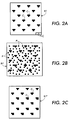
  • FIGURE 2A illustrates a binary halftone image;
  • FIGURE 2B illustrates the binary halftone image of FIGURE 2A as darkened by one conventional method;
  • FIGURE 2C illustrates the binary halftone image of FIGURE 2A as darkened in accordance with the method of the present invention;
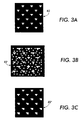
  • FIGURE 3A illustrates a second binary halftone image;
  • FIGURE 3B illustrates the binary halftone image of FIGURE 3A as lightened by one conventional method;
  • FIGURE 3C illustrates the binary halftone image of FIGURE 3A as lightened in accordance with the method of the present invention;
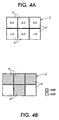
  • FIGURE 4A diagrammatically illustrates a single halftone cell of the image of FIGURE 2A showing one example of pixel values;
  • FIGURE 4B diagrammatically illustrates the single halftone cell of FIGURE 4A without the pixel values;
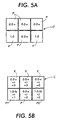
  • FIGURE 5A diagrammatically illustrates the halftone cell of FIGURE 4A after an initial darkening step that results in adjusted pixel values;
  • FIGURE 5B diagrammatically illustrates the single halftone cell of FIGURE 5A after it has been subjected to error diffusion;
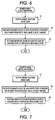
  • FIGURE 6 is a flow chart that discloses a method of darkening a binary halftone digital image in accordance with the present invention; and,
  • FIGURE 7 is a flow chart that discloses a method of lightening a binary halftone digital image in accordance with the present invention.
  • Detailed Description of the Preferred Embodiments
    Referring now to the drawings wherein the showings are for the purpose of illustrating preferred embodiments of the invention only and not for limiting same, FIGURE 1 illustrates a digital image processing system 10 comprising an image input terminal 12, an image processing unit 14, and an image output terminal 16. The image input terminal 12 is provided, for example, by an archive image storage device, a facsimile device or any other source of print-ready binary halftone images. The image input terminal 12 supplies digital image data that defines the binary halftone images to the image processing unit 14 for darkening or lightening in accordance with the present invention (and any other desired image processing operations). The image processing unit 14 comprises a digital copier, a personal computer or other computer apparatus adapted for receiving digital image data and modifying same according to an image processing method. Subsequent to image processing, the image processing unit 14 supplies the digital image data to the image output terminal 16 that comprises, for example, a video display, a printer and/or an image storage device.
    Referring now also to FIGURE 2A, the image input terminal 12 supplies digital data that define a binary halftone image B1. The image B1 comprises a plurality of halftone cells C including, in this example, 50 pixels, each of which is has one of two different values or states -- "on" or "off." These two different states are often represented numerically by the bits "1" and "0" as is well known. In the present example, as shown in FIGURE 4A, black corresponds to the value 0 and white corresponds to the value 1. For simplicity, only six pixels of the 50 pixels are shown in Figure 4, the remaining, non-shown pixels all have the same value of "on". Of course, the bitmap can be used to describe a different color separation and two colors other than black and white can be represented. However, black and white or dark and light are used in the present examples for ease of understanding the invention. A dynamic range is defined inclusively between the two possible pixel values, indicating that there is nothing lighter than "white" or darker than "black".
    In a conventional non-binary darkening method, the image is darkened by lowering the input values and limiting the result to the dynamic range between black and white. As a simple example one might perform the following mapping: 0 → 0, 0.1 → 0, 0.2 → 0.1, 0.3 → 0.2, etc., where all values are reduced by 0.1. Extending this concept to the case of binary halftone images leads to the mapping of 0 → 0, 1 → 0.9, since only two possible input values are present. The result of this operation is that the new image no longer conforms to the binary data requirement of having only "on" and "off" pixels in its description. In order to transform the image into a binary image, an error diffusion algorithm might be used. "Error diffusion" is one commonly employed halftoning method and is taught in "An Adaptive Algorithm for Spatial Greyscale," Floyd and Steinberg, Proceedings of the SID 17/2, 75-77 (1976). Numerous other error diffusion methods are known. For example, commonly assigned U.S. Patent 5,565,994 to Eschbach describes an error diffusion method particularly suited for application to multiple separation color documents. The foregoing documents are hereby expressly incorporated by reference herein for their teachings.
    In this way, the binary halftone image B1 is darkened as shown in FIGURE 2B effectively by adding black pixels PN to the image in the white regions. The image B1N is darker than the image B1, but image quality is sub-optimal. By design, black pixels PN are located in the image B1N at regions where no black pixels were previously located. As an additional point, the image in Figure 2B also is less stable to printing process variations as are common for example in offset or xerographic printing.
    FIGURES 3A and 3B correspond to FIGURES 2A and 2B. However, FIGURES 3A and 3B illustrate the opposite case, where a binary halftone image B2 is lightened by addition of white pixels thereto in regions formerly defined by only black pixels. Again, while the image B2N is lighter, its quality has been degraded.
    From the above description, it is obvious that standard pointwise operations, optionally followed by error diffusion or the like, are not sufficient for the darker / lighter operation desired.
    A method for darkening a binary halftone image such as the image B1 is illustrated in FIGURE 6. In a step S1, the binary halftone image B1 is received. Again, the binary halftone image B1 is defined by a plurality of halftone cells C each made up from a plurality of pixels P, wherein each pixel P has one of two values (1 or 0 in the present example) as shown in FIGURE 4A.
    In a step S2, each black pixel P of each halftone cell C is made darker or blacker to define a new, modified halftone cell CN (see FIGURE 5A) with modified black pixels PN for each cell C of the original image B1. While it is not physically possible to make a black pixel blacker, it is mathematically possible as illustrated in FIGURE 5A. There, it can be seen that a select value x has been subtracted from each black pixel formerly having a value 0.0 so that each now has a value 0.0 - x. In one example, the value x is selected as up to 10% of the dynamic range between the black and white pixel values, i.e., between 0.0 and 0.1 in the present example. All white pixels P of each cell CN are unaltered relative to the cell C at this stage. The step S2 can be expressed more generally as moving the value of each black pixel away from the value of the white pixels by a select amount x. Of course, as noted above, this moves the value of each pixel out of the valid dynamic range or physically realizable state which is in direct contrast to the standard methods.
    Finally, in a step S3, the image defined by the modified halftone cells CN is subjected to error diffusion or a similar method to quantize the values of the pixels PN to physically realizable states. In a typical error diffusion method, input pixel values are examined and the output for each pixel -- either "on" or "off"-- is determined by comparing the input pixel value to a threshold t. Input pixel values greater than the threshold t are set to "on" while input pixel values less than the threshold t are set to "off." Unlike other halftoning methods, the difference or "error" between the input pixel value (e.g., 0.75) and the resulting binary output pixel value (e.g. 1) is not discarded. Instead, the error is propagated to adjacent pixels so that it may be accounted for or "recovered" at some point. Thus, for example, even though an adjacent pixel may have an actual input value less than the threshold, if an error from one or more previous pixels is added to the input pixel value of the adjacent pixel, the adjacent pixel may thereafter exceed the threshold so that the previous error(s) are recovered. The term error diffusion as used herein is intended to encompass any threshold-based halftoning method that propagates error.
    FIGURE 5B illustrates a halftone cell C that results when the cell CN of FIGURE 5A is subjected to error diffusion in the step S3. All black pixels PN are defined by values less than the threshold t and, thus, are set to "0" and remain black. Because each black pixel PN of the cell CN has a value 0.0 - x, error will be present and will be propagated to other pixels in the cell CN. This error varies from pixel to pixel depending upon the pixel values and the error diffusion algorithm. As shown, a first white pixel P1 receives a first error value fx that is subtracted from its input value. The resulting pixel value is still greater than the threshold t and the pixel P1 remains white. In contrast, a second white pixel P2 receives an error fx' that is subtracted from its value which results in a new pixel value that is less than the threshold t so the pixel P2 is altered to black or "0."
    The image B1NN resulting from application of the foregoing darkening method to the input image B1 is shown in FIGURE 2C. It can be seen that all original black pixels P are present and halftone dot spacing is maintained. Those of ordinary skill in the art will recognize that, by increasing the blackness of all black pixels P in the input image B1, error is intentionally introduced into the error diffusion operation so that some white pixels P of the input image B1 are turned black by the error diffusion operation. It will also be recognized that due to the inherent properties of the error feedback, black pixels can only be introduced adjacent to existing black pixels, thus disabling any dispersed dot patterns as prevalent in Figure 2B. As mentioned before, the dispersed dot patterns often lead to heightened image quality degradations in the presence of process variations.
    It will also be recognized that the foregoing can easily introduce instabilities in the image if the error resulting from the error diffusion operation is not bounded. Allowing the input data to exceed the output dynamic range is inherently instable since the error can grow beyond any given bound. In a typical error diffusion method, where the input dynamic range is limited by the output dynamic range, the error is naturally bounded by ∀1/2 of the dynamic range, i.e., error values are limited between -0.5 and 1.5. The total dynamic range of the error is thus twice the dynamic range of the input. However, in accordance with the present invention no natural error bound exists since the input dynamic range exceeds the output dynamic range, i.e.: input images can have values lighter than "white" or darker than "black". Therefor it has been deemed most preferred to include an algorithmic error bound into the process. This error bound limits the total accumulated error and in the examples given, the dynamic range of the error was limited to four times the dynamic range of the input data. This allows for a sufficient error to develop that will alter the state of some white pixels without introducing instabilities into the image. It should be understood that other bounds might be used on the error range and that an increase in the bound allows a stronger effect at the cost of possible artifact, while a lower bound reduces the strength of the effect.
    FIGURE 7 discloses a method for lightening the image B2 shown in FIGURE 3A to obtain the image B2NN shown in FIGURE 3C in accordance with the present invention. The lightening method is identical to the darkening method except that all white pixel values are adjusted away from the dark pixel values in the initial step, i.e.: white pixels are mapped to a value lighter than "white" while black pixels are maintained, thereby again exceeding the input dynamic range.
    More particularly, the binary halftone image data is received in a step S1N. In a step S2N, all white pixels of the input image are mathematically lightened or moved away from the black pixels by a select amount. In a step S3N, error diffusion is used to move all pixel values back into the dynamic range. The error diffusion step S3N alters the state of some black pixels to white due to the error propagated thereto.

    Claims (10)

    1. A method for adjusting the lightness/darkness of a binary halftone image, said method comprising:
      receiving digital image data defining a binary halftone image in terms of a plurality of light pixels having a first value and a plurality of dark pixels having a second value;
      if said binary halftone image is to be lightened, adjusting said first value in a direction away from said second value by a select amount for each of said plurality of light pixels;
      if said binary halftone image is to be darkened, adjusting said second value in a direction away from said first value by a select amount for each of said plurality of dark pixels; and,
      performing error diffusion on said binary halftone image.
    2. The method for adjusting lightness/darkness of a binary halftone image as set forth in claim 1, wherein:
      said plurality of light pixels are white pixels having a first value equal to one of 1 and 0; and,
      said plurality of dark pixels are black pixels having a second value equal to the other of 1 and 0.
    3. The method for adjusting lightness/darkness of a binary halftone image as set forth in claim 1, wherein a dynamic range is defined inclusively between said first and second values and said select amount equals up to 10% of said dynamic range.
    4. The method for adjusting lightness/darkness of a binary halftone image as set forth in claim 3, wherein said step of performing error diffusion comprises an error bounding step to limit error propagated in said error diffusion step.
    5. A method for darkening a binary halftone image, said method comprising:
      receiving a binary halftone image defined by dark pixels having a first value and light pixels having a second value, said first and second values defining inclusively therebetween a dynamic range;
      for each of said dark pixels, adjusting said first value away from said second value to a new value outside said dynamic range;
      performing error diffusion on said binary halftone image to quantize said new value for each of said dark pixels into said dynamic range, said error diffusion changing said second value for at least some to said light pixels to said first value.
    6. A method for lightening a binary halftone image, said method comprising:
      receiving a binary halftone image defined by dark pixels having a first value and light pixels having a second value, said first and second values defining inclusively therebetween a dynamic range;
      for each of said light pixels, adjusting said second value away from said first value to a new value outside said dynamic range;
      performing error diffusion on said binary halftone image to quantize said new value for each of said light pixels into said dynamic range, said error diffusion changing said first value for at least some to said dark pixels to said second value.
    7. The method as set forth in claim 5 or 6, wherein said binary halftone image is defined by black pixels and white pixels.
    8. The method as set forth in claim 7, wherein said step of adjusting said first value away from said second value comprises adjusting said first value by a select percentage of said dynamic range.
    9. The method as set forth in claim 8, wherein said select percentage is less than or equal to 10%.
    10. A xerographic reproduction or other non-impact printing apparatus for adjusting the lightness/darkness of a binary halftone image, said apparatus comprising:
      means for receiving digital image data defining a binary halftone image in terms of a plurality of light pixels having a first value and a plurality of dark pixels having a second value;
      means for lightening said binary halftone image comprising means for adjusting said first value in a direction away from said second value by a select amount for each of said plurality of light pixels;
      means for darkening said binary halftone image comprising means for adjusting said second value in a direction away from said first value by a select amount for each of said plurality of dark pixels; and,
      means for performing error diffusion on said binary halftone image.
    EP01127736A 2000-11-27 2001-11-21 Digitally darkening/lightening halftone images Expired - Lifetime EP1209899B1 (en)

    Applications Claiming Priority (2)

    Application Number Priority Date Filing Date Title
    US722914 1991-06-28
    US09/722,914 US6816285B1 (en) 2000-11-27 2000-11-27 Digital darker/lighter for halftone images

    Publications (3)

    Publication Number Publication Date
    EP1209899A2 true EP1209899A2 (en) 2002-05-29
    EP1209899A3 EP1209899A3 (en) 2004-07-21
    EP1209899B1 EP1209899B1 (en) 2008-07-23

    Family

    ID=24903953

    Family Applications (1)

    Application Number Title Priority Date Filing Date
    EP01127736A Expired - Lifetime EP1209899B1 (en) 2000-11-27 2001-11-21 Digitally darkening/lightening halftone images

    Country Status (4)

    Country Link
    US (1) US6816285B1 (en)
    EP (1) EP1209899B1 (en)
    JP (1) JP4104321B2 (en)
    DE (1) DE60134941D1 (en)

    Families Citing this family (4)

    * Cited by examiner, † Cited by third party
    Publication number Priority date Publication date Assignee Title
    KR100611981B1 (en) * 2004-05-01 2006-08-11 삼성전자주식회사 Halftoning method and apparatus of an image
    US8208175B2 (en) * 2005-04-13 2012-06-26 Xerox Corporation Blended error diffusion and adaptive quantization
    US7711211B2 (en) * 2005-06-08 2010-05-04 Xerox Corporation Method for assembling a collection of digital images
    US9116924B2 (en) 2013-01-14 2015-08-25 Xerox Corporation System and method for image selection using multivariate time series analysis

    Family Cites Families (4)

    * Cited by examiner, † Cited by third party
    Publication number Priority date Publication date Assignee Title
    US5045952A (en) * 1989-08-21 1991-09-03 Xerox Corporation Method for edge enhanced error diffusion
    US5258854A (en) 1991-12-06 1993-11-02 Xerox Corporation Converting between write-white, write-black and neutral bitmaps
    JP3711707B2 (en) * 1997-08-07 2005-11-02 ブラザー工業株式会社 Image binarization method, image binarization apparatus, and recording medium
    US6751358B1 (en) * 1999-06-21 2004-06-15 Xerox Corporation Error diffusion for digital printing

    Also Published As

    Publication number Publication date
    US6816285B1 (en) 2004-11-09
    DE60134941D1 (en) 2008-09-04
    EP1209899A3 (en) 2004-07-21
    JP2002223358A (en) 2002-08-09
    EP1209899B1 (en) 2008-07-23
    JP4104321B2 (en) 2008-06-18

    Similar Documents

    Publication Publication Date Title
    US7440139B2 (en) Systems and methods for controlling a tone reproduction curve using error diffusion
    US5325211A (en) Error diffusion with output and input based feedback
    US5694224A (en) Method and apparatus for tone adjustment correction on rendering gray level image data
    US7251060B2 (en) Image-processing device using quantization threshold values produced according to a dither threshold matrix and arranging dot-on pixels in a plural-pixel field according to the dither threshold matrix
    DE69220651T2 (en) Halftone screening with increased dynamic range and edge-enhanced error diffusion
    US7684085B2 (en) Methods and apparatus for reconstructing digitized images
    EP0946049B1 (en) Processing images
    EP0598104B1 (en) Method and apparatus for reproducing an image with gray level printing
    US20020126313A1 (en) Image processing method and apparatus for varibly processing image based upon image characteristics
    US5956157A (en) Method and apparatus for locally blending gray dot types of the same or different types to reproduce an image with gray level printing
    US8687240B2 (en) Image processing apparatus and control method for performing screen processing
    EP0566300B1 (en) Image processing system and method employing adaptive scanning of halftones to provide better printable images
    US8405877B2 (en) Laser print apparatus with dual half tones
    EP0402162B1 (en) Image processing with noise enhancing operators for moiré reduction and/or random dot generation
    EP0817465B1 (en) Error diffusion method with symmetric enhancement
    US5835238A (en) Phantom level edge enhanced error diffusion
    EP1065876B1 (en) Method and apparatus for printing a black-and-white image based on color image information
    US7511857B2 (en) Halftoning method and system
    JPH0669211B2 (en) Image processing device
    EP1209899B1 (en) Digitally darkening/lightening halftone images
    US6552824B2 (en) Method of processing pixels with binary or multibit error diffusion
    US8537410B2 (en) Tint block image generation program and tint block image generation device using multi-grayscale camouflage pattern data
    US6147771A (en) Method of image density adjustment and apparatus using the method
    US6356360B1 (en) Apparatus and method for rendering halftone dot structures using grey level dots
    KR101085928B1 (en) An image forming apparatus and a method of adjusting the sharpness of documents containing color text

    Legal Events

    Date Code Title Description
    PUAI Public reference made under article 153(3) epc to a published international application that has entered the european phase

    Free format text: ORIGINAL CODE: 0009012

    AK Designated contracting states

    Kind code of ref document: A2

    Designated state(s): AT BE CH CY DE DK ES FI FR GB GR IE IT LI LU MC NL PT SE TR

    AX Request for extension of the european patent

    Free format text: AL;LT;LV;MK;RO;SI

    PUAL Search report despatched

    Free format text: ORIGINAL CODE: 0009013

    AK Designated contracting states

    Kind code of ref document: A3

    Designated state(s): AT BE CH CY DE DK ES FI FR GB GR IE IT LI LU MC NL PT SE TR

    AX Request for extension of the european patent

    Extension state: AL LT LV MK RO SI

    RIC1 Information provided on ipc code assigned before grant

    Ipc: 7H 04N 1/40 B

    Ipc: 7H 04N 1/407 A

    17P Request for examination filed

    Effective date: 20050121

    AKX Designation fees paid

    Designated state(s): DE FR GB

    17Q First examination report despatched

    Effective date: 20050420

    GRAP Despatch of communication of intention to grant a patent

    Free format text: ORIGINAL CODE: EPIDOSNIGR1

    GRAS Grant fee paid

    Free format text: ORIGINAL CODE: EPIDOSNIGR3

    GRAA (expected) grant

    Free format text: ORIGINAL CODE: 0009210

    AK Designated contracting states

    Kind code of ref document: B1

    Designated state(s): DE FR GB

    REG Reference to a national code

    Ref country code: GB

    Ref legal event code: FG4D

    REF Corresponds to:

    Ref document number: 60134941

    Country of ref document: DE

    Date of ref document: 20080904

    Kind code of ref document: P

    PLBE No opposition filed within time limit

    Free format text: ORIGINAL CODE: 0009261

    STAA Information on the status of an ep patent application or granted ep patent

    Free format text: STATUS: NO OPPOSITION FILED WITHIN TIME LIMIT

    26N No opposition filed

    Effective date: 20090424

    PGFP Annual fee paid to national office [announced via postgrant information from national office to epo]

    Ref country code: FR

    Payment date: 20131121

    Year of fee payment: 13

    Ref country code: DE

    Payment date: 20131022

    Year of fee payment: 13

    Ref country code: GB

    Payment date: 20131025

    Year of fee payment: 13

    REG Reference to a national code

    Ref country code: DE

    Ref legal event code: R119

    Ref document number: 60134941

    Country of ref document: DE

    GBPC Gb: european patent ceased through non-payment of renewal fee

    Effective date: 20141121

    REG Reference to a national code

    Ref country code: FR

    Ref legal event code: ST

    Effective date: 20150731

    PG25 Lapsed in a contracting state [announced via postgrant information from national office to epo]

    Ref country code: DE

    Free format text: LAPSE BECAUSE OF NON-PAYMENT OF DUE FEES

    Effective date: 20150602

    Ref country code: GB

    Free format text: LAPSE BECAUSE OF NON-PAYMENT OF DUE FEES

    Effective date: 20141121

    PG25 Lapsed in a contracting state [announced via postgrant information from national office to epo]

    Ref country code: FR

    Free format text: LAPSE BECAUSE OF NON-PAYMENT OF DUE FEES

    Effective date: 20141201