EP1207709A1 - Retransmission control method and the apparatus - Google Patents
Retransmission control method and the apparatus Download PDFInfo
- Publication number
- EP1207709A1 EP1207709A1 EP01309570A EP01309570A EP1207709A1 EP 1207709 A1 EP1207709 A1 EP 1207709A1 EP 01309570 A EP01309570 A EP 01309570A EP 01309570 A EP01309570 A EP 01309570A EP 1207709 A1 EP1207709 A1 EP 1207709A1
- Authority
- EP
- European Patent Office
- Prior art keywords
- mobile station
- error
- base station
- base stations
- retransmission
- Prior art date
- Legal status (The legal status is an assumption and is not a legal conclusion. Google has not performed a legal analysis and makes no representation as to the accuracy of the status listed.)
- Granted
Links
Images



Classifications
-
- H—ELECTRICITY
- H04—ELECTRIC COMMUNICATION TECHNIQUE
- H04B—TRANSMISSION
- H04B7/00—Radio transmission systems, i.e. using radiation field
- H04B7/24—Radio transmission systems, i.e. using radiation field for communication between two or more posts
- H04B7/26—Radio transmission systems, i.e. using radiation field for communication between two or more posts at least one of which is mobile
-
- H—ELECTRICITY
- H04—ELECTRIC COMMUNICATION TECHNIQUE
- H04L—TRANSMISSION OF DIGITAL INFORMATION, e.g. TELEGRAPHIC COMMUNICATION
- H04L1/00—Arrangements for detecting or preventing errors in the information received
- H04L1/12—Arrangements for detecting or preventing errors in the information received by using return channel
- H04L1/16—Arrangements for detecting or preventing errors in the information received by using return channel in which the return channel carries supervisory signals, e.g. repetition request signals
- H04L1/18—Automatic repetition systems, e.g. Van Duuren systems
- H04L1/1829—Arrangements specially adapted for the receiver end
-
- H—ELECTRICITY
- H04—ELECTRIC COMMUNICATION TECHNIQUE
- H04L—TRANSMISSION OF DIGITAL INFORMATION, e.g. TELEGRAPHIC COMMUNICATION
- H04L1/00—Arrangements for detecting or preventing errors in the information received
- H04L2001/0092—Error control systems characterised by the topology of the transmission link
- H04L2001/0093—Point-to-multipoint
Definitions
- the present invention relates to a retransmission control method and the apparatus in a base station for performing retransmission control for a signal sent from a mobile station.
- a method of sending acknowledgment is usually adopted as a retransmission control method in communication systems.
- the receiver judges whether the signal is correctly received, that is, whether the signal includes an error.
- the receiver sends ACK (acknowledgement) which indicates that retransmission is unnecessary to the sender.
- the receiver sends NACK (negative acknowledgement) for requesting retransmission to the sender.
- the sender receives NACK, the sender retransmits a signal corresponding to the previously transmitted signal.
- This retransmission control method is also adopted in a communication system in which mobile stations and base stations communicate each other via communication channels.
- a base station which will be called an up-link signal hereinafter
- an mobile station which plays a role of a sender sends a signal to a corresponding base station with which the mobile station communicates, that is, a communication partner of the mobile station.
- the base station performs error judgment for the received up-link signal.
- the base station sends NACK to the mobile station.
- the base station sends ACK to the mobile station.
- the mobile station receives NACK, the mobile station retransmits a corresponding up-link signal.
- the corresponding base station when the corresponding base station judges that the up-link signal includes an error, the corresponding base station sends NACK to the mobile station even if other base station correctly receives the signal.
- Such inefficient retransmission control increases load for retransmission process.
- such retransmission control becomes a factor for preventing effective use of communication channels.
- An object of the present invention is to provide an effective retransmission control method and an apparatus performing effective retransmission control.
- every base station which received the up-link packet from the mobile station performs error judgment, and, when at least one base station judges that there is no error, ACK signal which indicates that retransmission is not required is sent to a mobile station by the corresponding base station. Therefore, retransmission process is reduced maximally so that effective retransmission control becomes possible. As a result, load of retransmission process can be reduced and communication channels can be used effectively.
- retransmission process is reduced maximally so that effective retransmission control can be possible.
- load of retransmission process can be reduced and communication channels can be used effectively.
- a value of received signal power level can be included in the exchanging error judgement results.
- a received signal power level of a signal sent from the base station to the mobile station is also largest. Therefore, by sending a response for retransmission control signal from such base station to the mobile station, the possibility of receiving the response by the mobile station can be increased so that retransmission control can be performed with more reliability.
- a retransmission control apparatus in a base station including:
- a retransmission control apparatus in a base station including:
- the first response or the second response is returned to the mobile station by the base station which has the highest received signal power level of up-link packet sent from the mobile station.
- a retransmission control apparatus suitable for performing the retransmission control method can be provided.
- Fig.1A shows a network configuration of a communication system of a first embodiment to which the retransmission control method and the apparatus of the present invention are applied.
- some base stations receive an up-link signal sent from a mobile station.
- Each of the base stations performs error judgment for the received signal.
- a corresponding base station which is a specific base station with which the mobile station communicates obtains results of error judgment from every base station which received the signal from the mobile station. Then, the corresponding base station sends NACK for requesting retransmission to the mobile station only when all results of error judgment indicate that the signal includes an error.
- the communication system includes a mobile station 1, N base stations 2-1 - 2-N and a backbone network 3.
- the communication system is configured as an IP network so that a unique IP address is assigned to each of the base stations 2-1 - 2-N as shown in Fig.1B.
- a mobile station 1 communicates with the base station 2-2 as its communication partner so that the mobile station 1 sends an up-link signal to the base station 2-2.
- the up-link signal can be received by adjacent base stations 2-1 and 2-3 in addition to the base station 2-2.
- Each of the base stations 2-1 - 2-3 which has received the up-link signal judges whether the received up-link signal includes an error. After the error judgment is performed by each base station, each of the base stations 2-1 and 2-3 sends the result of the error judgment, via the backbone network 3, to the base station 2-2 which is the communication partner of the mobile station 1. In this example, the base stations 2-1 and 2-3 can recognize that the base station 2-2 is the communication partner of the mobile station 1 by using the up-link signal.
- the base stations 2-1 and 2-3 can recognize that the base station 2-2 is the communication partner of the mobile station 1.
- the base stations 2-1 and 2-3 send the result of the error judgment
- the result of error judgment can be sent to the base station 2-2 by using the IP address as a destination.
- the base station 2-2 When the base station 2-2 receives the results of error judgment from the base stations 2-1 and 2-3, the base station 2-2 analyzes these results and a result of error judgment in the base station 2-2 itself, and judges whether the results indicate that there is no error in the received up-link signal. When at least one result indicates that there is no error in the received signal, it is not necessary for the mobile station 1 to retransmit the up-link signal because the signal received by a base station which sends the result indicating that there is no error can be used. Therefore, in this case, the base station 2-2 returns ACK to the mobile station 1. When the mobile station 1 receives the ACK, the mobile station 1 does not retransmit the signal.
- the base station 2-2 returns NACK to the mobile station 1.
- the mobile station 1 receives the NACK, the mobile station 1 retransmits the corresponding up-link signal.
- the base station of the communication partner of the mobile station not only the base station of the communication partner of the mobile station, but also other base stations which receive an up-link signal from the mobile station judge error of the up-link signal.
- ACK is sent to the mobile station and the mobile station does not retransmit the corresponding signal. Therefore, since the retransmission processing can be suppressed maximally, efficient transmission control can be realized.
- the destination to which the result of error judgment is sent is the base station 2-2 with which the mobile station communicates, the destination is not limited to the base station 2-2.
- the destination can be any other base station.
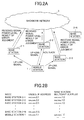
- Fig.2A shows a network configuration example of a communication system of the second embodiment to which the retransmission control method and apparatus of the present invention are applied.
- some base stations receive an up-link signal sent from a mobile station.
- Each of the base stations performs error judgment of received signal and measures a received signal power level, and the base stations exchange the results of error judgment and the received signal power levels with each other. Then, only when every result of error judgment indicates that there is an error, a base station in which the received signal power level is the largest sends NACK to the mobile station.
- This communication system includes a mobile station 1, N base stations 2-1 - 2-N, and a backbone network 3 like the communication system shown in Fig.1A.
- This communication system forms an IP network in which each of the base stations 2-1-2-N has a unique IP address.
- each of the base stations 2-1-2-N has a same IP address (base station multicast address) in order to allow multicast communication as shown in Fig.2B.
- This embodiment corresponds to a case where the mobile station 1 sends an up-link signal without specifying a base station of a communication partner of the mobile station.
- the up-link signal is received by the base stations 2-1 - 2-3.
- Each of the base stations 2-1 - 2-3 which received the up-link signal judges whether the received up-link signal includes an error and measures the power level (received power level).
- the result of error judgment and the received power level is included in a multicast packet which has the base station multicast address as its destination.
- the multicast packet is sent to other base stations via backbone network 3.
- each base station When the base stations 2-1 - 2-3 receive the multicast packet, each base station generates a retransmission control table from the results of error judgment and the received signal power levels included in the multicast packets and the result of error judgment and the received signal power level obtained by the base station itself.
- Fig.3 shows a structure example of the retransmission control table.
- the retransmission control table includes mobile station addresses, base station addresses, results of error judgment and received signal power levels.
- the mobile station addresses are IP addresses of mobile stations which sent the up-link signal
- the base station addresses are IP addresses of base stations which received the up-link signal.
- the mobile station address, the base station address, the result of error judgment and the received signal power level are associated with each other.
- each of the base stations 2-1 - 2-3 judges whether the received signal power level of the base station itself is larger than any other received signal power levels in the retransmission control table.
- the base station having the largest received signal power level analyzes the results of error judgment in the retransmission table and judges whether the table includes an result of error judgment indicating that the received up-link signal includes no error.
- the base station when the table includes the result of error judgment indicating the received up-link signal includes no error, the base station sends ACK to the mobile station. The mobile station which receives ACK does not retransmit the signal.
- the base station when the table does not include the result of error judgment indicating no error, that is, when every result of error judgment indicates that the received up-link signal includes an error, the base station sends NACK to the mobile station. The mobile station which receives NACK retransmits the signal.
- Fig.4 shows a flowchart of the operation of the base station in the second embodiment.
- each base station generates the retransmission control table from the results of error judgment and the received signal power levels included in the multicast packets, and the result of error judgment and the received signal power level of the base station itself in step 4. Then, each base station analyzes the received signal power levels in the retransmission control table and judges whether the received signal power level of the base station itself is larger than any other received signal power levels in the table in step 5. When the received signal power level of the base station itself is not larger than any other received signal power levels in the table, the base station ends the process.
- the base station analyzes the results of error judgment in the retransmission control table and judges whether the table includes an result of error judgment indicating no error in step 6.
- the base station When the table includes the result of error judgment indicating no error, the base station sends ACK to the mobile station 1 in step 7. When the table does not include the result of error judgment indicating no error, the base station sends NACK to the mobile station 1 in step 8.
- the base station of a communication partner of the mobile station not only the base station of a communication partner of the mobile station, but also other base stations which receives the up-link signal from the mobile station perform error judgment for the up-link signal.
- ACK is sent to the mobile station. Therefore, since retransmission is not performed, retransmission processing is suppressed maximally so that efficient retransmission control can be possible.
- a base station having the largest received signal power level for the up-link signal sends ACK or NACK to the mobile station. Therefore, since it can be considered that a received signal power level in the mobile station is large if the base station having the largest received signal power level sends a signal to the mobile station, the possibility of receiving ACK or NACK by the mobile station can be increased. As a result, retransmission control can be performed with more reliability.
- each of base stations which receive a signal from a mobile station performs error judgment of the signal.
- ACK which indicates that retransmission is unnecessary is sent to the mobile station so that retransmission is not performed. Therefore, retransmission process can be suppressed maximally, efficient retransmission control can be possible, load of performing retransmission process can be decreased, and communication channels can be used effectively.
Landscapes
- Engineering & Computer Science (AREA)
- Computer Networks & Wireless Communication (AREA)
- Signal Processing (AREA)
- Mobile Radio Communication Systems (AREA)
- Detection And Prevention Of Errors In Transmission (AREA)
Abstract
Description
- The present invention relates to a retransmission control method and the apparatus in a base station for performing retransmission control for a signal sent from a mobile station.
- Conventionally, a method of sending acknowledgment is usually adopted as a retransmission control method in communication systems. In this method, when a receiver receives a signal which is sent from a sender, the receiver judges whether the signal is correctly received, that is, whether the signal includes an error. When the signal is correctly received, the receiver sends ACK (acknowledgement) which indicates that retransmission is unnecessary to the sender. When the signal is not correctly received, the receiver sends NACK (negative acknowledgement) for requesting retransmission to the sender. When the sender receives NACK, the sender retransmits a signal corresponding to the previously transmitted signal.
- This retransmission control method is also adopted in a communication system in which mobile stations and base stations communicate each other via communication channels. For example, as far as retransmission control for a signal sent from a mobile station to a base station (which will be called an up-link signal hereinafter) is considered, an mobile station which plays a role of a sender sends a signal to a corresponding base station with which the mobile station communicates, that is, a communication partner of the mobile station. The base station performs error judgment for the received up-link signal. When there is an error in the received signal, the base station sends NACK to the mobile station. On the other hand, when there is not any error, the base station sends ACK to the mobile station. When the mobile station receives NACK, the mobile station retransmits a corresponding up-link signal.
- In the above-mentioned communication system in which an up-link signal from a mobile station is received by one or more base stations other than a corresponding base station with which the mobile station communicates, there is a case in which a base station adjacent to the corresponding base station correctly receives the signal even when the corresponding base station does not correctly receive the signal.
- However, in the conventional retransmission control method, when the corresponding base station judges that the up-link signal includes an error, the corresponding base station sends NACK to the mobile station even if other base station correctly receives the signal. Such inefficient retransmission control increases load for retransmission process. In addition, such retransmission control becomes a factor for preventing effective use of communication channels.
- An object of the present invention is to provide an effective retransmission control method and an apparatus performing effective retransmission control.
- The above object is achieved by a retransmission control method including the steps of:
- base stations receiving a signal sent from a mobile station;
- each of the base stations performing error judgment for the signal sent from the mobile station;
- a corresponding base station of a communication partner of the mobile station obtaining results of error judgment of the corresponding base station and other base stations;
- the corresponding base station sending a response which indicates that retransmission is not required to the mobile station when at least one result indicates that there is no error; and
- the corresponding base station sending a response which indicates that retransmission is required to the mobile station when every result indicates that there is an error.
-
- According to this retransmission control method, every base station which received the up-link packet from the mobile station performs error judgment, and, when at least one base station judges that there is no error, ACK signal which indicates that retransmission is not required is sent to a mobile station by the corresponding base station. Therefore, retransmission process is reduced maximally so that effective retransmission control becomes possible. As a result, load of retransmission process can be reduced and communication channels can be used effectively.
- The above object is also achieved by a retransmission control method including the steps of:
- base stations receiving a signal sent from a mobile station;
- each of the base stations performing error judgment for the signal sent from the mobile station;
- the base stations exchanging results of the error judgment with one another;
- a corresponding base station sending a response which indicates that retransmission is not required to the mobile station when at least one result from the base stations indicates there is no error; and
- the corresponding base station sending a response which indicates that retransmission is required to the mobile station when every result from the base stations indicates that there is an error.
-
- Also according to this retransmission control method, retransmission process is reduced maximally so that effective retransmission control can be possible. As a result, load of retransmission process can be reduced and communication channels can be used effectively.
- In the retransmission control method, a value of received signal power level can be included in the exchanging error judgement results.
- It can be considered that, when the base station has the largest received signal power level from a mobile station, a received signal power level of a signal sent from the base station to the mobile station is also largest. Therefore, by sending a response for retransmission control signal from such base station to the mobile station, the possibility of receiving the response by the mobile station can be increased so that retransmission control can be performed with more reliability.
- The above object is also achieved by a retransmission control apparatus in a base station, including:
- a part receiving a signal sent from a mobile station;
- a part performing error judgment for the signal sent from the mobile station;
- a part obtaining results of error judgment of the base station itself and other base stations;
- a part sending a response which indicates that retransmission is not required to the mobile station when at least one result indicates that there is no error; and
- a part sending a response which indicates that retransmission is required to the mobile station when every result indicates that there is an error.
-
- The above object is also achieved by a retransmission control apparatus in a base station, including:
- a part receiving a signal sent from a mobile station;
- a part performing error judgment for the signal sent from the mobile station;
- a part exchanging results of the error judgment with other base stations;
- a part sending a first response which indicates that retransmission is not required to the mobile station when at least one result indicates there is no error; and
- a part sending a second response which indicates that retransmission is required to the mobile station when every result of the error judgments indicates that there is an error.
-
- In the retransmission control apparatus, the first response or the second response is returned to the mobile station by the base station which has the highest received signal power level of up-link packet sent from the mobile station.
- According to the above invention, a retransmission control apparatus suitable for performing the retransmission control method can be provided.
-
- Fig.1A shows a network configuration of a communication system of a first embodiment to which a transmission control method and the apparatus of the present invention are applied;
- Fig.1B shows nodes and the corresponding unique IP addresses;
- Fig.2A shows a network configuration example of a communication system of a second embodiment to which the retransmission control method and apparatus of the present invention are applied;
- Fig.2B shows nodes, the corresponding unique IP addresses and base station multicast addresses;
- Fig.3 shows a structure example of a retransmission control table used in the second embodiment;
- Fig.4 shows a flowchart of the operation of an base station in the second embodiment.
-
- In the following, embodiments of the present invention will be described with reference to figures.
- Fig.1A shows a network configuration of a communication system of a first embodiment to which the retransmission control method and the apparatus of the present invention are applied.
- In the communication system shown in the figure, some base stations receive an up-link signal sent from a mobile station. Each of the base stations performs error judgment for the received signal. In addition, a corresponding base station which is a specific base station with which the mobile station communicates obtains results of error judgment from every base station which received the signal from the mobile station. Then, the corresponding base station sends NACK for requesting retransmission to the mobile station only when all results of error judgment indicate that the signal includes an error.
- The communication system includes a
mobile station 1, N base stations 2-1 - 2-N and abackbone network 3. The communication system is configured as an IP network so that a unique IP address is assigned to each of the base stations 2-1 - 2-N as shown in Fig.1B. - In this example, a
mobile station 1 communicates with the base station 2-2 as its communication partner so that themobile station 1 sends an up-link signal to the base station 2-2. In this system, the up-link signal can be received by adjacent base stations 2-1 and 2-3 in addition to the base station 2-2. - Each of the base stations 2-1 - 2-3 which has received the up-link signal judges whether the received up-link signal includes an error. After the error judgment is performed by each base station, each of the base stations 2-1 and 2-3 sends the result of the error judgment, via the
backbone network 3, to the base station 2-2 which is the communication partner of themobile station 1. In this example, the base stations 2-1 and 2-3 can recognize that the base station 2-2 is the communication partner of themobile station 1 by using the up-link signal. - For example, when the up-link signal includes an IP address of the base station 2-2 as a destination address or a routing header address, the base stations 2-1 and 2-3 can recognize that the base station 2-2 is the communication partner of the
mobile station 1. In addition, when the base stations 2-1 and 2-3 send the result of the error judgment, the result of error judgment can be sent to the base station 2-2 by using the IP address as a destination. - When the base station 2-2 receives the results of error judgment from the base stations 2-1 and 2-3, the base station 2-2 analyzes these results and a result of error judgment in the base station 2-2 itself, and judges whether the results indicate that there is no error in the received up-link signal. When at least one result indicates that there is no error in the received signal, it is not necessary for the
mobile station 1 to retransmit the up-link signal because the signal received by a base station which sends the result indicating that there is no error can be used. Therefore, in this case, the base station 2-2 returns ACK to themobile station 1. When themobile station 1 receives the ACK, themobile station 1 does not retransmit the signal. - On the other hand, when the results of error judgment do not include any result indicating that there is no error, that is, when every result indicates that the received up-link signal has an error, any signal which is received by any base station can not be used. Thus, in this case, the base station 2-2 returns NACK to the
mobile station 1. When themobile station 1 receives the NACK, themobile station 1 retransmits the corresponding up-link signal. - As mentioned above, according to the communication system of this embodiment, not only the base station of the communication partner of the mobile station, but also other base stations which receive an up-link signal from the mobile station judge error of the up-link signal. When there is a base station which judges that there is no error in the received signal, ACK is sent to the mobile station and the mobile station does not retransmit the corresponding signal. Therefore, since the retransmission processing can be suppressed maximally, efficient transmission control can be realized.
- In this embodiment, although the destination to which the result of error judgment is sent is the base station 2-2 with which the mobile station communicates, the destination is not limited to the base station 2-2. The destination can be any other base station.
- Next, a second embodiment will be described. Fig.2A shows a network configuration example of a communication system of the second embodiment to which the retransmission control method and apparatus of the present invention are applied.
- In the communication system shown in Fig.2A, some base stations receive an up-link signal sent from a mobile station. Each of the base stations performs error judgment of received signal and measures a received signal power level, and the base stations exchange the results of error judgment and the received signal power levels with each other. Then, only when every result of error judgment indicates that there is an error, a base station in which the received signal power level is the largest sends NACK to the mobile station.
- This communication system includes a
mobile station 1, N base stations 2-1 - 2-N, and abackbone network 3 like the communication system shown in Fig.1A. This communication system forms an IP network in which each of the base stations 2-1-2-N has a unique IP address. In addition to the unique IP address, each of the base stations 2-1-2-N has a same IP address (base station multicast address) in order to allow multicast communication as shown in Fig.2B. - This embodiment corresponds to a case where the
mobile station 1 sends an up-link signal without specifying a base station of a communication partner of the mobile station. The up-link signal is received by the base stations 2-1 - 2-3. - Each of the base stations 2-1 - 2-3 which received the up-link signal judges whether the received up-link signal includes an error and measures the power level (received power level). The result of error judgment and the received power level is included in a multicast packet which has the base station multicast address as its destination. The multicast packet is sent to other base stations via
backbone network 3. - When the base stations 2-1 - 2-3 receive the multicast packet, each base station generates a retransmission control table from the results of error judgment and the received signal power levels included in the multicast packets and the result of error judgment and the received signal power level obtained by the base station itself.
- Fig.3 shows a structure example of the retransmission control table. The retransmission control table includes mobile station addresses, base station addresses, results of error judgment and received signal power levels. The mobile station addresses are IP addresses of mobile stations which sent the up-link signal, and the base station addresses are IP addresses of base stations which received the up-link signal. The mobile station address, the base station address, the result of error judgment and the received signal power level are associated with each other.
- After generating the retransmission control table, each of the base stations 2-1 - 2-3 judges whether the received signal power level of the base station itself is larger than any other received signal power levels in the retransmission control table. The base station having the largest received signal power level analyzes the results of error judgment in the retransmission table and judges whether the table includes an result of error judgment indicating that the received up-link signal includes no error.
- In the same way as the first embodiment, when the table includes the result of error judgment indicating the received up-link signal includes no error, the base station sends ACK to the mobile station. The mobile station which receives ACK does not retransmit the signal. On the other hand, when the table does not include the result of error judgment indicating no error, that is, when every result of error judgment indicates that the received up-link signal includes an error, the base station sends NACK to the mobile station. The mobile station which receives NACK retransmits the signal.
- Fig.4 shows a flowchart of the operation of the base station in the second embodiment. When the base stations 2-1 - 2-3 receive the up-link signal from the
mobile station 1 instep 1, each base station judges whether the up-link signal includes an error and measures the received signal power level instep 2. Then, each base station sends the multicast packet which includes the result of error judgment and the received signal power level, and receives multicast packets from other base stations instep 3. - Next, each base station generates the retransmission control table from the results of error judgment and the received signal power levels included in the multicast packets, and the result of error judgment and the received signal power level of the base station itself in
step 4. Then, each base station analyzes the received signal power levels in the retransmission control table and judges whether the received signal power level of the base station itself is larger than any other received signal power levels in the table instep 5. When the received signal power level of the base station itself is not larger than any other received signal power levels in the table, the base station ends the process. - On the other hand, when the received signal power level of the base station itself is larger than any other received signal power levels in the table, the base station analyzes the results of error judgment in the retransmission control table and judges whether the table includes an result of error judgment indicating no error in step 6.
- When the table includes the result of error judgment indicating no error, the base station sends ACK to the
mobile station 1 in step 7. When the table does not include the result of error judgment indicating no error, the base station sends NACK to themobile station 1 in step 8. - According to the communication system in this embodiment, not only the base station of a communication partner of the mobile station, but also other base stations which receives the up-link signal from the mobile station perform error judgment for the up-link signal. In addition, when a base station judges that the signal does not include an error, ACK is sent to the mobile station. Therefore, since retransmission is not performed, retransmission processing is suppressed maximally so that efficient retransmission control can be possible.
- In addition, according to this embodiment, a base station having the largest received signal power level for the up-link signal sends ACK or NACK to the mobile station. Therefore, since it can be considered that a received signal power level in the mobile station is large if the base station having the largest received signal power level sends a signal to the mobile station, the possibility of receiving ACK or NACK by the mobile station can be increased. As a result, retransmission control can be performed with more reliability.
- As mentioned above, according to the present invention, each of base stations which receive a signal from a mobile station performs error judgment of the signal. When there is at least one base station which judges that the signal includes no error, ACK which indicates that retransmission is unnecessary is sent to the mobile station so that retransmission is not performed. Therefore, retransmission process can be suppressed maximally, efficient retransmission control can be possible, load of performing retransmission process can be decreased, and communication channels can be used effectively.
- The present invention is not limited to the specifically disclosed embodiments, and variations and modifications may be made without departing from the scope of the invention.
Claims (6)
- A retransmission control method characterized by the steps of:base stations receiving a signal sent from a mobile station;each of said base stations performing error judgment for said signal sent from said mobile station;a corresponding base station of a communication partner of said mobile station obtaining results of error judgment of said corresponding base station and other base stations;said corresponding base station sending a response which indicates that retransmission is not required to said mobile station when said results includes a result indicating no error; andsaid corresponding base station returning a response which indicates that retransmission is required to said mobile station when every result in said results indicates that there is an error.
- A retransmission control method characterized by the steps of:base stations receiving a signal sent from a mobile station;each of said base stations performing error judgment for said signal sent from said mobile station;said base stations exchanging results of said error judgment with one another;a corresponding base station sending a response which indicates that retransmission is not required to said mobile station when results of said error judgment of said base stations include a result indicating no error; andsaid corresponding base station returning a response which indicates that retransmission is required to said mobile station when every result of said error judgment of said base stations indicates that there is an error.
- The retransmission control method as claimed in claim 2, wherein a received signal power level of said signal in said corresponding base station is the largest among received signal power levels in said base stations.
- A retransmission control apparatus in a base station, characterized by:a part receiving a signal sent from a mobile station;a part performing error judgment for said signal sent from said mobile station;a part obtaining results of error judgment of said base station and other base stations;a part sending a response which indicates that retransmission is not required to said mobile station when said results includes a result indicating no error; anda part sending a response which indicates that retransmission is required to said mobile station when every result in said results indicates that there is an error.
- A retransmission control apparatus in a base station, characterized by:a part receiving a signal sent from a mobile station;a part performing error judgment for said signal sent from said mobile station;a part exchanging results of said error judgment with other base stations;a part returning a first response which indicates that retransmission is not required to said mobile station when results of said error judgment of said base station and said other base stations include a result indicating no error; anda part returning a second response which indicates that retransmission is required to said mobile station when every result of said error judgment of said base station and said other base stations indicates that there is an error.
- The retransmission control apparatus as claimed in claim 5, wherein said first response or said second response is sent to said mobile station when a received signal power level of said signal in said base station is larger than any received signal power level in said other base stations.
Applications Claiming Priority (2)
| Application Number | Priority Date | Filing Date | Title |
|---|---|---|---|
| JP2000348517A JP3844957B2 (en) | 2000-11-15 | 2000-11-15 | Retransmission control method and apparatus |
| JP2000348517 | 2000-11-15 |
Publications (2)
| Publication Number | Publication Date |
|---|---|
| EP1207709A1 true EP1207709A1 (en) | 2002-05-22 |
| EP1207709B1 EP1207709B1 (en) | 2005-12-14 |
Family
ID=18822085
Family Applications (1)
| Application Number | Title | Priority Date | Filing Date |
|---|---|---|---|
| EP01309570A Expired - Lifetime EP1207709B1 (en) | 2000-11-15 | 2001-11-13 | Retransmission control method and the apparatus |
Country Status (7)
| Country | Link |
|---|---|
| US (1) | US6839559B2 (en) |
| EP (1) | EP1207709B1 (en) |
| JP (1) | JP3844957B2 (en) |
| KR (1) | KR100398782B1 (en) |
| CN (1) | CN1198410C (en) |
| DE (1) | DE60115819T2 (en) |
| SG (1) | SG135906A1 (en) |
Cited By (6)
| Publication number | Priority date | Publication date | Assignee | Title |
|---|---|---|---|---|
| WO2005081446A1 (en) * | 2004-02-12 | 2005-09-01 | Telefonaktiebolaget Lm Ericsson (Publ) | Method and apparatus for cell-site arq generation under softer handoff conditions |
| WO2005104665A3 (en) * | 2004-05-04 | 2006-04-20 | Lg Electronics Inc | Packet data transmitting method and mobile communication system using the same |
| WO2006082272A1 (en) * | 2005-02-01 | 2006-08-10 | Nokia Corporation | Processing of uplink data in a communications system |
| EP1479179A4 (en) * | 2002-02-14 | 2006-12-20 | Nokia Corp | PACKET TRANSFER PROCESSING OF THE PHYSICAL LAYER IN WCDMA IN SOFT-WIDE RANGE |
| EP1814347A1 (en) * | 2006-01-25 | 2007-08-01 | Fujitsu Limited | Mobile communication system with retransmission control during handover |
| EP2249505A1 (en) * | 2002-02-14 | 2010-11-10 | Nokia Corporation | Physical Layer Packet Retransmission Handling in WCDMA in Soft Handover |
Families Citing this family (13)
| Publication number | Priority date | Publication date | Assignee | Title |
|---|---|---|---|---|
| US20020078184A1 (en) * | 2000-12-18 | 2002-06-20 | Eiji Ujyo | Record medium, multicast delivery method and multicast receiving method |
| WO2003049484A1 (en) * | 2001-11-30 | 2003-06-12 | Fujitsu Limited | Packet data resending control method and apparatus therefor |
| US7013157B1 (en) * | 2002-06-03 | 2006-03-14 | Cisco Technology, Inc. | Method for multicast delivery with designated acknowledgment |
| JP4048855B2 (en) * | 2002-07-16 | 2008-02-20 | 日本電気株式会社 | Failure detection device |
| JP3643360B2 (en) * | 2002-08-12 | 2005-04-27 | 松下電器産業株式会社 | Receiving apparatus and communication method |
| KR20040046322A (en) | 2002-11-27 | 2004-06-05 | 엘지전자 주식회사 | Signal Processing Apparatus and Method of Multi Input, Multi Output Mobile Communication System |
| US7433701B1 (en) * | 2002-12-05 | 2008-10-07 | Cisco Technology, Inc. | Smart frame selection for improved backhaul bandwidth efficiency |
| WO2005109726A1 (en) * | 2004-05-06 | 2005-11-17 | Koninklijke Philips Electronics N.V. | Method, system and station for communicating data packets using arq |
| KR101248071B1 (en) | 2006-09-06 | 2013-03-27 | 삼성전자주식회사 | Method and apparatus of automatic repeat request in broadband wireless communication system supporting multi-hop |
| WO2010123464A1 (en) * | 2009-04-24 | 2010-10-28 | Agency For Science, Technology And Research | Base stations, cellular communication systems, methods for controlling a base station, and methods for controlling a cellular communication system |
| US8737345B2 (en) * | 2009-05-20 | 2014-05-27 | Robert Bosch Gmbh | Dynamic function slot assignment in intra-vehicular wireless networks |
| US8559323B2 (en) | 2010-03-10 | 2013-10-15 | Cisco Technology, Inc. | Downlink OFDMA for service sets with mixed client types |
| KR102419147B1 (en) | 2020-03-13 | 2022-07-08 | 주식회사 케이티앤지 | Aerosol generating apparatus determining abnormal operation |
Citations (4)
| Publication number | Priority date | Publication date | Assignee | Title |
|---|---|---|---|---|
| EP0687078A2 (en) * | 1994-06-08 | 1995-12-13 | Nokia Mobile Phones Ltd. | A system for transmitting packet data in radio telephone TDMA systems |
| WO1999013652A2 (en) * | 1997-09-10 | 1999-03-18 | Nokia Networks Oy | Method of implementing macrodiversity |
| EP1037491A1 (en) * | 1999-03-17 | 2000-09-20 | Motorola Limited | A CDMA cellular communication system and method of access therefor |
| WO2000062467A1 (en) * | 1999-04-13 | 2000-10-19 | Nokia Networks Oy | A retransmission method with soft combining in a telecommunications system |
Family Cites Families (11)
| Publication number | Priority date | Publication date | Assignee | Title |
|---|---|---|---|---|
| US6341124B1 (en) * | 1998-03-13 | 2002-01-22 | Telefonaktiebolaget Lm Ericsson | Accommodating packet data loss at base stations interfacing between a packet switched network and a CDMA macrodiversity network |
| KR100319122B1 (en) * | 1998-08-27 | 2002-04-22 | 윤종용 | Method for registrating position after inter msc soft handoff in cellular system |
| US6377560B1 (en) * | 1998-10-09 | 2002-04-23 | Ericsson Inc. | Group call capability in a wireless network |
| US6643813B1 (en) * | 1999-02-17 | 2003-11-04 | Telefonaktiebolaget Lm Ericsson (Publ) | Method and apparatus for reliable and efficient data communications |
| US6072790A (en) * | 1999-05-13 | 2000-06-06 | Motorola, Inc. | Method and apparatus for performing distribution in a communication system |
| US6507572B1 (en) * | 1999-06-11 | 2003-01-14 | Lucent Technologies Inc. | Primary transfer for simplex mode forward-link high-speed packet data services in CDMA systems |
| US6553032B1 (en) * | 1999-09-01 | 2003-04-22 | Tantivy Communications, Inc. | Packeting timeout spoofing in a wireless data communications network |
| JP3908490B2 (en) * | 2000-08-03 | 2007-04-25 | 株式会社エヌ・ティ・ティ・ドコモ | Retransmission control method and system in multicast distribution service, retransmission control apparatus, radio base station, and radio terminal |
| US6678523B1 (en) * | 2000-11-03 | 2004-01-13 | Motorola, Inc. | Closed loop method for reverse link soft handoff hybrid automatic repeat request |
| US6567387B1 (en) * | 2000-11-07 | 2003-05-20 | Intel Corporation | System and method for data transmission from multiple wireless base transceiver stations to a subscriber unit |
| US6678249B2 (en) * | 2002-02-14 | 2004-01-13 | Nokia Corporation | Physical layer packet retransmission handling WCDMA in soft handover |
-
2000
- 2000-11-15 JP JP2000348517A patent/JP3844957B2/en not_active Expired - Fee Related
-
2001
- 2001-11-12 SG SG200106966-5A patent/SG135906A1/en unknown
- 2001-11-13 EP EP01309570A patent/EP1207709B1/en not_active Expired - Lifetime
- 2001-11-13 DE DE60115819T patent/DE60115819T2/en not_active Expired - Lifetime
- 2001-11-14 KR KR10-2001-0070870A patent/KR100398782B1/en not_active Expired - Fee Related
- 2001-11-14 CN CNB011349239A patent/CN1198410C/en not_active Expired - Fee Related
- 2001-11-14 US US09/987,264 patent/US6839559B2/en not_active Expired - Fee Related
Patent Citations (4)
| Publication number | Priority date | Publication date | Assignee | Title |
|---|---|---|---|---|
| EP0687078A2 (en) * | 1994-06-08 | 1995-12-13 | Nokia Mobile Phones Ltd. | A system for transmitting packet data in radio telephone TDMA systems |
| WO1999013652A2 (en) * | 1997-09-10 | 1999-03-18 | Nokia Networks Oy | Method of implementing macrodiversity |
| EP1037491A1 (en) * | 1999-03-17 | 2000-09-20 | Motorola Limited | A CDMA cellular communication system and method of access therefor |
| WO2000062467A1 (en) * | 1999-04-13 | 2000-10-19 | Nokia Networks Oy | A retransmission method with soft combining in a telecommunications system |
Cited By (12)
| Publication number | Priority date | Publication date | Assignee | Title |
|---|---|---|---|---|
| EP1479179A4 (en) * | 2002-02-14 | 2006-12-20 | Nokia Corp | PACKET TRANSFER PROCESSING OF THE PHYSICAL LAYER IN WCDMA IN SOFT-WIDE RANGE |
| EP2249505A1 (en) * | 2002-02-14 | 2010-11-10 | Nokia Corporation | Physical Layer Packet Retransmission Handling in WCDMA in Soft Handover |
| WO2005081446A1 (en) * | 2004-02-12 | 2005-09-01 | Telefonaktiebolaget Lm Ericsson (Publ) | Method and apparatus for cell-site arq generation under softer handoff conditions |
| WO2005104665A3 (en) * | 2004-05-04 | 2006-04-20 | Lg Electronics Inc | Packet data transmitting method and mobile communication system using the same |
| RU2372733C2 (en) * | 2004-05-04 | 2009-11-10 | ЭлДжи ЭЛЕКТРОНИКС ИНК. | Method of packaged data transmission and mobile communication system using method |
| US8799733B2 (en) | 2004-05-04 | 2014-08-05 | Lg Electronics Inc. | Packet data transmitting method and mobile communication system using the same |
| US9319198B2 (en) | 2004-05-04 | 2016-04-19 | Lg Electronics Inc. | Packet data transmitting method and mobile communication system using the same |
| US9923697B2 (en) | 2004-05-04 | 2018-03-20 | Lg Electronics Inc. | Packet data transmitting method and mobile communication system using the same |
| WO2006082272A1 (en) * | 2005-02-01 | 2006-08-10 | Nokia Corporation | Processing of uplink data in a communications system |
| US8934935B2 (en) | 2005-02-01 | 2015-01-13 | Nokia Corporation | Processing of uplink data in a communications system |
| EP1814347A1 (en) * | 2006-01-25 | 2007-08-01 | Fujitsu Limited | Mobile communication system with retransmission control during handover |
| US7486654B2 (en) | 2006-01-25 | 2009-02-03 | Fujitsu Limited | Communication method used in mobile communication system |
Also Published As
| Publication number | Publication date |
|---|---|
| KR100398782B1 (en) | 2003-09-19 |
| CN1353510A (en) | 2002-06-12 |
| JP2002152843A (en) | 2002-05-24 |
| KR20020037713A (en) | 2002-05-22 |
| CN1198410C (en) | 2005-04-20 |
| DE60115819T2 (en) | 2006-07-06 |
| JP3844957B2 (en) | 2006-11-15 |
| US6839559B2 (en) | 2005-01-04 |
| SG135906A1 (en) | 2007-10-29 |
| US20020058493A1 (en) | 2002-05-16 |
| DE60115819D1 (en) | 2006-01-19 |
| EP1207709B1 (en) | 2005-12-14 |
Similar Documents
| Publication | Publication Date | Title |
|---|---|---|
| US6839559B2 (en) | Retransmission control method and the apparatus | |
| KR101235109B1 (en) | Method for sending an acknowledgement to an ingress mesh point in a mesh network and a medium access control frame format | |
| EP1686716A1 (en) | Communication system, transmitter and receiver with adaptive retransmission depending on the type of data | |
| US20030115331A1 (en) | Method and apparatus for data transmission | |
| US8638677B2 (en) | Data communication system | |
| JPH05207023A (en) | Mass data transmission method | |
| JPH11163946A (en) | Gateway device, wireless base station device, router device, and wireless terminal device | |
| EP1558000B1 (en) | Transmitter device for controlling data transmission | |
| EP3973649B1 (en) | Communications device, infrastructure equipment and methods | |
| CN100583805C (en) | Method and apparatus for transmitting data packets using a common hybrid automatic repeat request process | |
| JP2001177523A (en) | Multicast communication method | |
| EP1505759B1 (en) | Method and device for transmitting/receiving data using acknowledged transport layer protocols | |
| US20040148422A1 (en) | Communication control method, communication system, and communication apparatus that can improve throughput | |
| JP2011097569A (en) | User terminal and method for performing retransmission control | |
| JP2008099171A (en) | Wireless data communication device | |
| JP2006014103A (en) | Wireless communication control device and control method thereof | |
| KR20000019680A (en) | Method for re-transmitting the enhanced call processing message of telecommunication system | |
| JP2003078509A (en) | Automatic retransmission request communication method | |
| HK1081759B (en) | Data retransmission method | |
| KR20120113496A (en) | Method of transmission between one hop links in wireless mesh network and mesh node supporting the same | |
| HK1081759A1 (en) | Data retransmission method | |
| KR20080050792A (en) | Packet data retransmission method and system in wireless communication system |
Legal Events
| Date | Code | Title | Description |
|---|---|---|---|
| PUAI | Public reference made under article 153(3) epc to a published international application that has entered the european phase |
Free format text: ORIGINAL CODE: 0009012 |
|
| 17P | Request for examination filed |
Effective date: 20011126 |
|
| AX | Request for extension of the european patent |
Free format text: AL;LT;LV;MK;RO;SI |
|
| AKX | Designation fees paid |
Designated state(s): DE GB IT |
|
| 17Q | First examination report despatched |
Effective date: 20040309 |
|
| GRAP | Despatch of communication of intention to grant a patent |
Free format text: ORIGINAL CODE: EPIDOSNIGR1 |
|
| GRAS | Grant fee paid |
Free format text: ORIGINAL CODE: EPIDOSNIGR3 |
|
| GRAA | (expected) grant |
Free format text: ORIGINAL CODE: 0009210 |
|
| AK | Designated contracting states |
Kind code of ref document: B1 Designated state(s): DE GB IT |
|
| PG25 | Lapsed in a contracting state [announced via postgrant information from national office to epo] |
Ref country code: IT Free format text: LAPSE BECAUSE OF FAILURE TO SUBMIT A TRANSLATION OF THE DESCRIPTION OR TO PAY THE FEE WITHIN THE PRESCRIBED TIME-LIMIT;WARNING: LAPSES OF ITALIAN PATENTS WITH EFFECTIVE DATE BEFORE 2007 MAY HAVE OCCURRED AT ANY TIME BEFORE 2007. THE CORRECT EFFECTIVE DATE MAY BE DIFFERENT FROM THE ONE RECORDED. Effective date: 20051214 |
|
| REG | Reference to a national code |
Ref country code: GB Ref legal event code: FG4D |
|
| REF | Corresponds to: |
Ref document number: 60115819 Country of ref document: DE Date of ref document: 20060119 Kind code of ref document: P |
|
| PLBE | No opposition filed within time limit |
Free format text: ORIGINAL CODE: 0009261 |
|
| STAA | Information on the status of an ep patent application or granted ep patent |
Free format text: STATUS: NO OPPOSITION FILED WITHIN TIME LIMIT |
|
| 26N | No opposition filed |
Effective date: 20060915 |
|
| PGFP | Annual fee paid to national office [announced via postgrant information from national office to epo] |
Ref country code: DE Payment date: 20101110 Year of fee payment: 10 |
|
| PGFP | Annual fee paid to national office [announced via postgrant information from national office to epo] |
Ref country code: IT Payment date: 20101115 Year of fee payment: 10 Ref country code: GB Payment date: 20101110 Year of fee payment: 10 |
|
| GBPC | Gb: european patent ceased through non-payment of renewal fee |
Effective date: 20121113 |
|
| PG25 | Lapsed in a contracting state [announced via postgrant information from national office to epo] |
Ref country code: IT Free format text: LAPSE BECAUSE OF NON-PAYMENT OF DUE FEES Effective date: 20121113 |
|
| REG | Reference to a national code |
Ref country code: DE Ref legal event code: R119 Ref document number: 60115819 Country of ref document: DE Effective date: 20130601 |
|
| PG25 | Lapsed in a contracting state [announced via postgrant information from national office to epo] |
Ref country code: DE Free format text: LAPSE BECAUSE OF NON-PAYMENT OF DUE FEES Effective date: 20130601 |
|
| PG25 | Lapsed in a contracting state [announced via postgrant information from national office to epo] |
Ref country code: GB Free format text: LAPSE BECAUSE OF NON-PAYMENT OF DUE FEES Effective date: 20121113 |